GeistHaus
log in · sign up

https://oandre.gal/feed

rss
10 posts
Polling state
Status active
Last polled May 19, 2026 02:01 UTC
Next poll May 19, 2026 23:54 UTC
Poll interval 86400s
ETag "badab71d66005d81511983e2a74fb18d"

Posts

Kasparov’s law
AllEnglishFortunesAIAutomationChessKasparovLLM
A weak human player combined with a machine and a better process is superior, not only against a very powerful machine, but, most notably, against a strong human combined with a machine and an inferior process. — Garry Kasparov, Don’t fear intelligent machines. Work with them.
Show full content

A weak human player combined with a machine and a better process is superior, not only against a very powerful machine, but, most notably, against a strong human combined with a machine and an inferior process.

— Garry Kasparov, Don’t fear intelligent machines. Work with them.
https://oandre.gal/?p=21209
Extensions
Get motivation from LLMs
AllEnglishProgrammingllmsmotivationprocrastination
One of the common conversations with friends lately is: how do you use LLMs? In the latest round, I mentioned that I use LLMs to motivate myself — and people were surprised. In turn, I was surprised they were surprised, because when comparing notes with other peers at work, many shared LLMs were useful for getting […]
Show full content

One of the common conversations with friends lately is: how do you use LLMs? In the latest round, I mentioned that I use LLMs to motivate myself — and people were surprised.

In turn, I was surprised they were surprised, because when comparing notes with other peers at work, many shared LLMs were useful for getting started. It’s something Anthropic’s engineers also reported:

(…) the reduced “activation energy” of using Claude enabled them to defeat procrastination more easily, “dramatically decreasing the energy required for me to want to start tackling a problem, and therefore I’m willing to tackle so many additional things.”

The science behind motivation

This “activation energy” is linked to how motivation works, which scientists divide into two processes:

  • what’s the cost-benefit ratio?
  • is it worth starting?

When we deem the cost of an action higher than the benefit, our motivation to execute it is low, and vice versa.

However, even when we understand the benefits are high, we sometimes decide not to act. The 2nd process is preventing us from starting.

A few days ago, some researches published a paper testing how monkeys make these decisions. They found some biochemicals that inhibit or release the activation. The activation circuit, aka “motivation brake”, will not fire if the task triggers some stress. The stress may come in many forms: physical pain, negative feelings related to the task such as self-doubt, pressure from schedules, self-imposed perfectionism, lack of tolerance to frustration, fear of failure, etc.

I’d argue that stress can also be situational: try doing anything after a copious lunch, dealing with something difficult at the end of the day, working when you have a cold, or coming up with sharp thoughts when you have sleep deprivation.

The takeaway is that, depending on which circuit is involved in your lack of action, you need to do different things:

  • if it’s the cost-benefit ratio: increase the reward
  • if it’s the activation trigger: reduce the stress related to the task

Which is in line with some known tricks to deal with procrastination.

Using LLMs

LLMs reduce the cost of performing some tasks, impacting the cost-benefit motivation circuit. I argue they can be used to lower your activation trigger point.

One of the typical ways to reframe the negative emotions about a task is time-boxing it: “I’d give it just 15 minutes”. Another one is asking yourself: “what’s the minimal thing I can do now?”. Both keep commitments low and focus on the process, not the output.

LLMs can be leveraged using similar techniques. This is what I do, for example, when I need to review a pull request but I have brain fog. Instead of reading the code myself or glancing at the long thread of comments, I ask Claude Code to read it all, and summarize it for me in less than 50 words. Then, I keep asking small questions until I get past the activation barrier, so I’m engaged with the task.

We often think about LLMs as tools for solving problems, but I find them just as valuable for helping us get started on solving them ourselves. The hardest part of any task is often just beginning — and having a tool that lowers that barrier makes problem-solving more enjoyable.
https://oandre.gal/?p=21176
Extensions
Sheets that spread
AutomatticEnglishProgrammingapple iiledgersspreadsheetsvisicalc
During my 1st Automattic Grand Meetup I gave a flashtalk (under 4 minutes) about spreadsheets.
Show full content

I delivered this as a flashtalk during my 1st Automattic Grand Meetup. It was in Whistler, Canada (September 2017).

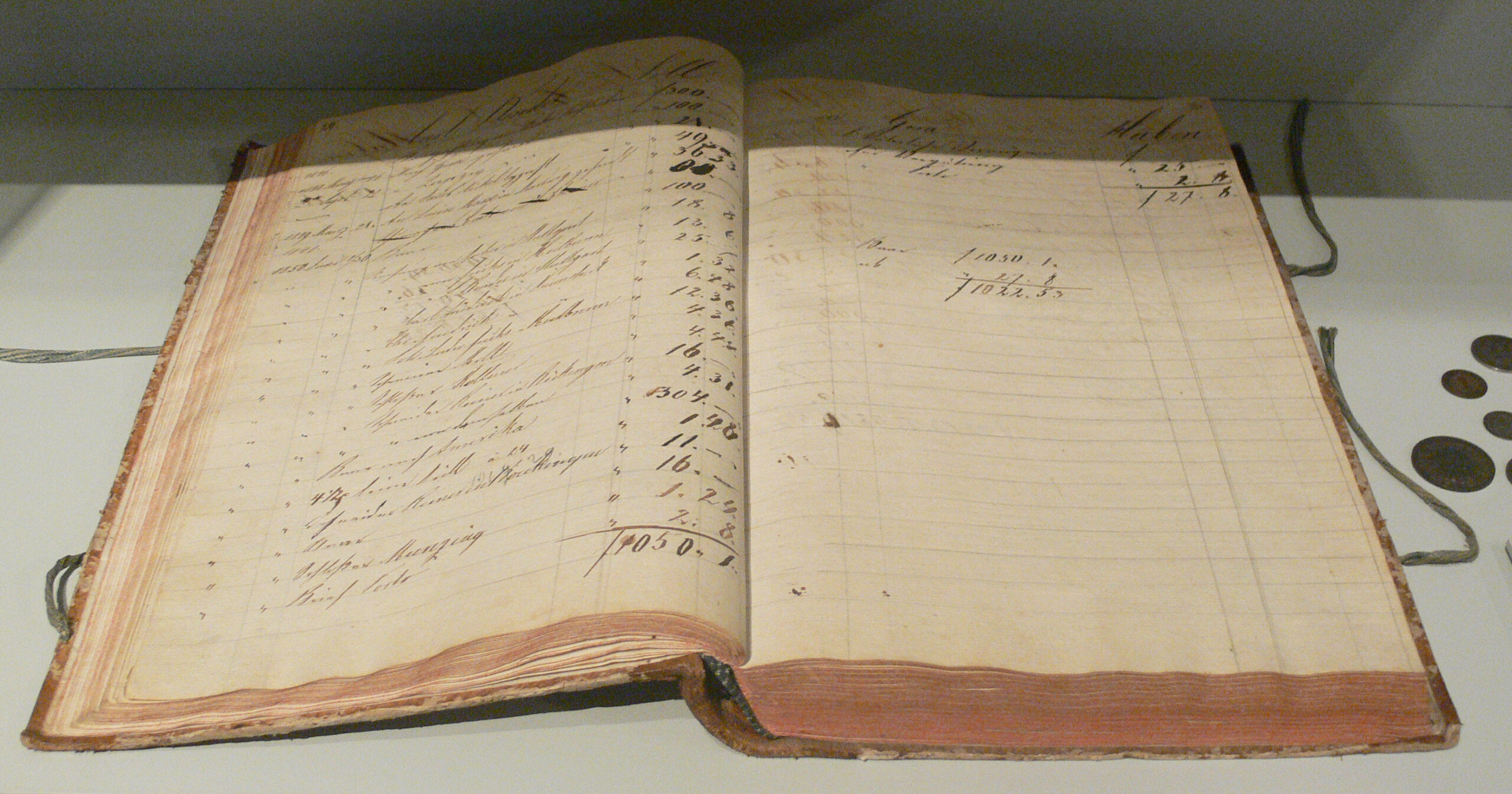
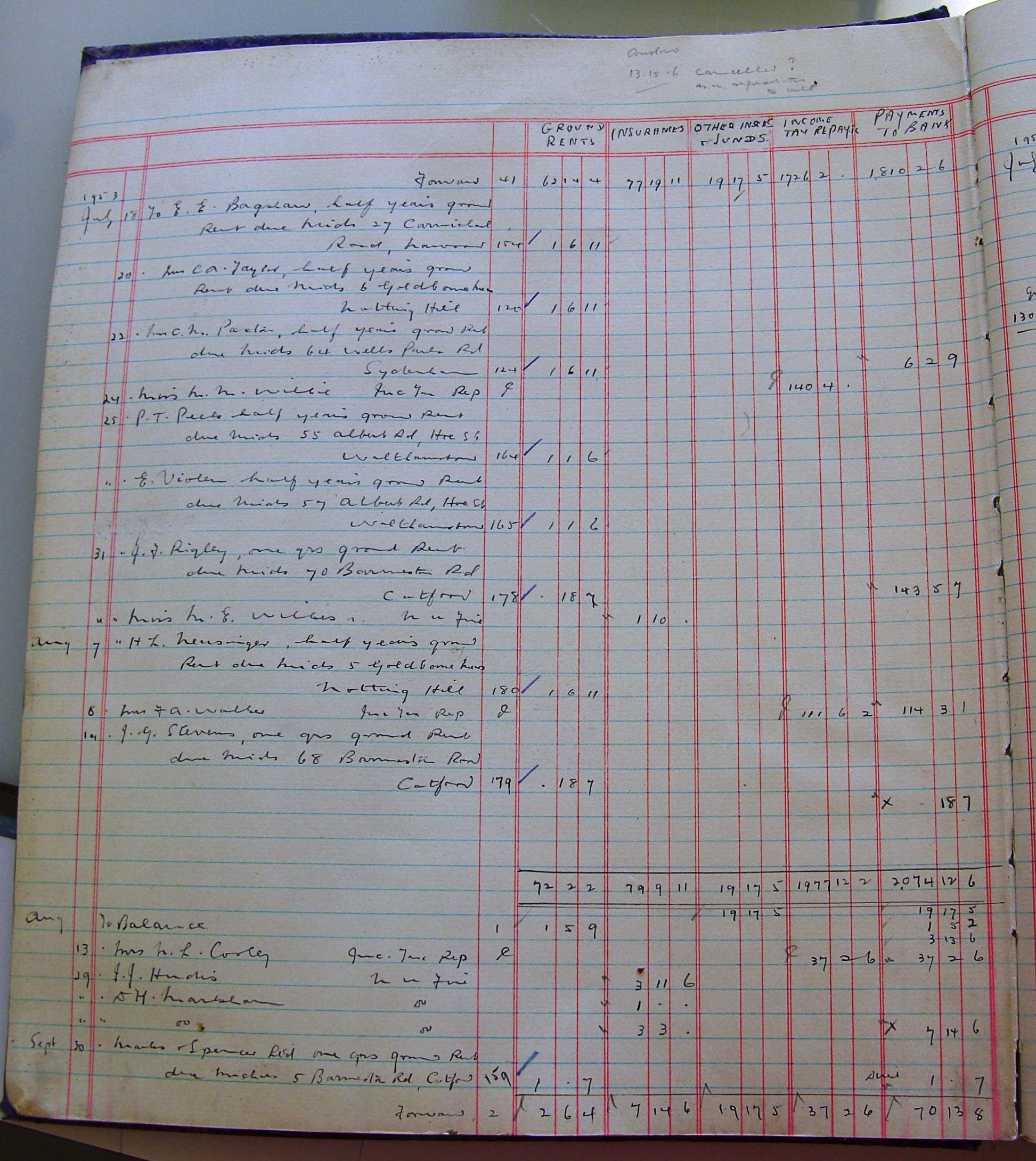
Most people are familiar with spreadsheets applications, but there was a time where they didn’t exist. We had to resort to other means to keep track of numbers — for example, ledgers.

A ledger is an actual book used to track inventories of material, credits, etc. Ledgers being books, they have pages, aka sheets. If you open any paper book by a given page, you’ll see two of them at once because pages, or sheets, are spread. So you are looking at spread sheets — that’s how the name came to be.

Keeping track of numbers has been useful since the dawn of humanity. During the first decades of the XX century, building census (how many are we?) and ballistic experiments (how effective are we at hitting the target?) were problems many states threw technology at, and so technology for calculation progressed.

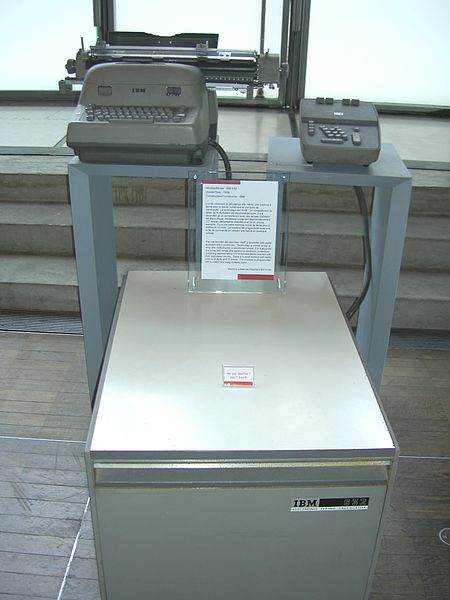
By the end of the 50s, specialized machines for calculation were in the market. The IBM 632 was one of them and was prized at $6.000 — 100% of an USA family’s income at the time. These machines weren’t affordable to many. All they could do was printing predefined​ ​templates: given some input numbers they’d produce canned​ ​reports.​ ​There​ ​was​ ​no​ ​interactivity​ ​built-in and they took some training to operate.

But progress continued and, a couple of decades later, those specialized machines had evolved into general-purpose ones: computers. Released in 1979, the Apple II was one of the most popular. It costed about $1 300 — ~8% of an USA family’s income at the time. At that price point, it was something some families and little business could afford. But what would anyone buy a computer for? To keep track of numbers, of course.

If you bought an Apple II, you could use the first spreadsheet application we know as such: VisiCalc. At $100, VisiCalc​ ​is considered ​the​ ​first​ ​killer​ ​application​ of the history of computing. The reason is that VisiCalc was the main driver of Apple II sales: people​ ​bought​ ​a $1 300 machine to being able to use a $100 application.

VisiCalc defined what a spreadsheet was going to be: an application that lets you introduce some numbers and outputs a different set of them, interactively — the output would be recalculated every time you changed the input. The concept of an interactive spreadsheet is ubiquitous today, but it was popularized by VisiCalc.

Once the concept was stablished, the evolution of spreadsheets was about iteration and adaptation. We found ways to make it faster, add some more features, and port it to newer distribution platforms as they emerged (Windows, Linux, the web, etc.). It’s 2025, and we’re still using the same concepts introduced by VisiCalc in 1979. The core aspects of a spreadsheet haven’t changed, but VisiCalc is no longer popular.

A lot of what happens in software is that way: once you get the right concept, it doesn’t change much. Concepts are the real win.

Thanks for staying until the end, and remember: if you do spreadsheets, you’ll excel at work.

https://oandre.gal/?p=21093
Extensions
Air at Cúpula Atlántica
AllEnglishLifestreamMusica coruñaaircúpula atlánticamonte san pedrozara
I attended a private concert by Air inside the Cúpula Atlántica, a ~200-person dome at Monte de San Pedro. The park is one of my favorite places in A Coruña. Even though I’ve been there multiple times, I had never been inside the dome. As far as I remember, it was abandoned and not in […]
Show full content

I attended a private concert by Air inside the Cúpula Atlántica, a ~200-person dome at Monte de San Pedro.

The park is one of my favorite places in A Coruña. Even though I’ve been there multiple times, I had never been inside the dome. As far as I remember, it was abandoned and not in use. Zara renovated this public space to celebrate its 50th anniversary, and it has been organizing a number of public events.

Once we reached the dome’s surroundings, we were surprised by an enveloping sound experience designed by Esmeralda Devlin. As we walked the spiral path, the voice of a middle-aged woman emerged. She recited poems related to the sea that surrounded us.

The acoustics, the dome, and the stark monochrome scenography combined to create a very intimate experience.

https://oandre.gal/?p=21059
Extensions
Remembering is healing, and forgetting valuable
BooksEnglishFilmsBlack MirrorCharlie BrookerEulogyMemoryTed ChiangThe Truth of Fact the Truth of Feeling
In Eulogy, the final episode of Black Mirror’s seventh season, a man receives a device that allows him to virtually enter a photograph and explore its location. He is asked to use it to recall stories about a woman who has passed away — someone who had been his girlfriend decades earlier. After their breakup, […]
Show full content

In Eulogy, the final episode of Black Mirror’s seventh season, a man receives a device that allows him to virtually enter a photograph and explore its location. He is asked to use it to recall stories about a woman who has passed away — someone who had been his girlfriend decades earlier. After their breakup, he resented her. As he revisits his past, long-buried memories resurface, revealing how disrespectful and self-absorbed he had once been. Remembering was healing, her memory is now cleared.

In Ted Chiang’s short story The Truth of Fact, the Truth of Feeling, a journalist acquires a remem — a device that records every moment of a person’s life. As he revisits his past through the records of others, he recognizes the bitterness with which he had treated his daughter. Regretting his behaviour, he tries to explain himself, but she rejects it. She doesn’t need remembering. Forgetting was valuable: it allowed them to mend their bond as adults. In time, forgiveness may follow.

It struck me how closely related the two stories are. Both acknowledge memory is malleable, bending and adapting to our needs — to the point of distorting them. Updating your memories to a more faithful version hurts, but it can make you a better human. Chiang’s story goes a step further, it explores what you do afterward. And it suggests: appreciate the forgetting, too.

https://oandre.gal/?p=21039
Extensions
You can’t hide on bad days
EnglishProgrammingInfluenceParentingProduct development
Here’s a lesson I learned from my mom: you’ll have bad days, and kids need you anyway. It’s one of those things that parenting teaches, and I believe it’s transferable to product development. A product isn’t built on one big idea, it’s built from thousands. It takes daily steering. If you hide on bad days, […]
Show full content

Here’s a lesson I learned from my mom: you’ll have bad days, and kids need you anyway.

It’s one of those things that parenting teaches, and I believe it’s transferable to product development. A product isn’t built on one big idea, it’s built from thousands. It takes daily steering. If you hide on bad days, the ship will move anyway: you just won’t influence its direction.

Influence comes from many things, but presence is fundamental. They don’t teach this in engineering school, yet it’s as critical to success as knowing how to design for growth — and when not to.

https://oandre.gal/?p=21013
Extensions
Make your pull requests answer a single question
EnglishProgrammingClaude Shanonpull requests
There are some pull requests that are more daunting to review than others. Some struggle to find reviewers and to be merged while others don’t. How to tell them apart? And, more importantly, how do you make sure yours land faster and with fewer bugs? One aspect you could look at is size. In many […]
Show full content

There are some pull requests that are more daunting to review than others. Some struggle to find reviewers and to be merged while others don’t. How to tell them apart? And, more importantly, how do you make sure yours land faster and with fewer bugs?

One aspect you could look at is size. In many cases, the number of lines touched can act as a proxy to how difficult it’d be for others to review. While useful, it is a weaker predictor than others we have available.

As an example of how this heuristic breaks, imagine you’ve got two pull requests. The first one adds 1_000 lines of code in a single file (JSON) that already exists, and it doesn’t touch any logic. The second pull request touches 100 lines of code across four different subsystems. Without knowing anything else about what any of them do, which one would you deem as of having a bigger risk? The size heuristic predicts the first one would be 10x riskier, because it’s 10x bigger in size than the second. However, the second interacts with many subsystems, while the first only with one and it looks like new configuration for something that may be well accounted for. The number of subsystems involved increases the surface to account for: any one of the changes to the subsystems needs to be understood, as well as the interaction of them all together.

Subsystems are the key aspect of complexity1. A subsystem is not a function, it is not a class, and it is not a file. Rather, a subsystem is each one of the units that carry a work assignment2 in your piece of software. Phrasing it that way, the number of different subsystems that interact in a given changeset is a better predictor of complexity than size is. It can be formulated as follows: how many questions does the pull request answer?3

The fewer questions any changeset addresses, the easier it is for reviewers and the author to understand the edge cases and come up with better solutions. It’s also easier to agree about direction, which is an important aspect of pull requests. In the limit, pull requests that answer a single question provide less surface to explore, and so they land faster and come with fewer bugs.


  1. Herbert Simon’s The architecture of complexity discusses complexity in systems. ↩
  2. David Parnas’s On the criteria to be used in decomposing systems into modules presents an approach to decompose a system into modules. ↩
  3. See Claude Shanon’s it’s easier to make two small jumps than one big jump in any kind of mental thinking. I consider this heuristic a derivative of Shanon’s: code is just another expression of thought. ↩
https://oandre.gal/?p=20896
Extensions
A year of spaced repetition
EnglishLifestreamankilifelong learningspaced repetitionsupermemo
I am naturally drawn to new topics and often spend weeks diving into them. But I’d forget most of it just a few weeks later. I wondered if spaced repetition would help me retain what I’d learned. So, over the past 365 days, I’ve kept a daily routine to study flashcards using Anki. The topics […]
Show full content

I am naturally drawn to new topics and often spend weeks diving into them. But I’d forget most of it just a few weeks later. I wondered if spaced repetition would help me retain what I’d learned. So, over the past 365 days, I’ve kept a daily routine to study flashcards using Anki.

The topics

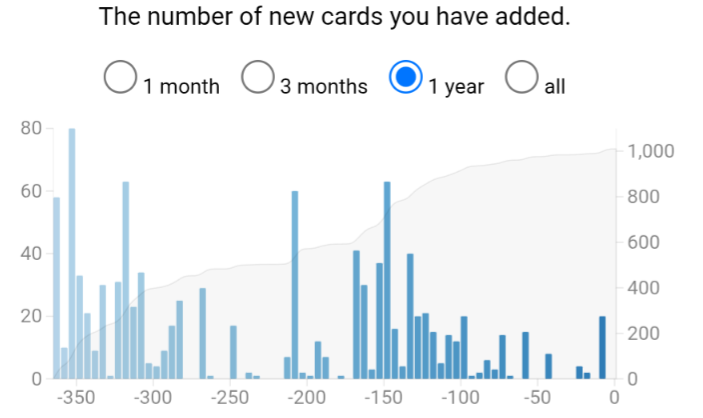
Over the year, I created and reviewed around 1,500 cards, spanning a range of topics:

  • ~300 images for my own PAO system
  • ~250 words (pronunciation or meaning)
  • ~75 kayaking techniques
  • ~75 items about genomics
  • ~50 cards related to semiconductors (hint)
  • ~50 ideas from economics and finance (hint)
  • ~50 git concepts (hint: git database, git merge)
  • ~650 other for a variety of things

I didn’t plan or anticipate any of the cards. I created them organically based on the things I was exploring at the time.

For example, I created the cards related to semiconductors while I was reading Chip War. Some cards are the result of fact-checking parts of the book, others expand on something the book didn’t cover but I was curious about. I have a card to remember that Gordon Moore was head of R&D at Fairchild Semiconductors when he coined the law (it’s in the book), and another to explain what happens in the depletion layer of a P-N junction (not in the book).

The time

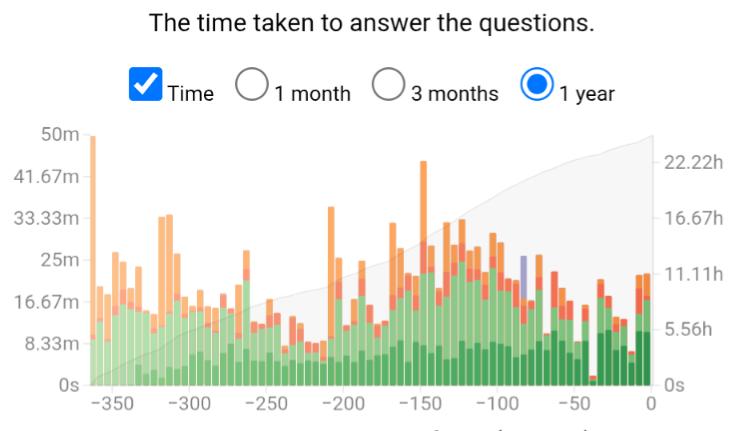
I spent a total of ~24h during this period. Four minutes per day. I’m surprised that it only took 24h for me to learn 1,500 items. Imagine studying something during one minute and still remembering it a year later.

Each bar represents four days of practice.

During 2024 I was pretty consistent, but in March and April of this year I started to miss more days of practice. It was due to a mix of factors. Life got intense, and I didn’t add many new cards to the system. It felt like a chore to review old material. Without new content to engage with, I was less compelled to do my reviews.

The cards

There are different ways to create your cards and prompt repetitions. You could do it with plain paper and a few boxes. I used Anki, an app available on desktop and mobile. It provides the mechanics for spaced repetition, so I only have to create and review cards when it asks me to.

I keep my Anki setup simple. It has plugins but I haven’t installed any. Nor I have adjusted the algorithm or configuration. There are also pre-made sets of cards you can share and download, I suppose they are valuable if you’re studying for a curriculum. It supports enough card types to suit most use cases (reversed questions and answers, image occlusion, cloze deletion), though I wish some cards could pull in dynamic content (auto-generated data).

The mechanics of creating a card are easy, but digesting something into a set of cards takes time and practice. Formulating knowledge or learning to learn is messy territory. I’ve found SuperMemo’s 20 rules of formulating knowledge actionable, and I review Claude Shannon’s Creative Thinking (PDF) from time to time for inspiration.

Coda

For the most part, I still remember all the 1,500 cards I’ve created. Occasionally, I come across one I struggle with, so I rework it — rephrasing, splitting, or removing it if it feels dull or unimportant.

The effort-to-impact ratio provided by spaced repetition has impressed me — I wish I’d known about it back in school. I want to keep learning for life, to stay curious, keep my mind sharp, and my spirit young. There are no grades anymore, but there’s still plenty to learn.

https://oandre.gal/?p=20796
Extensions
Maldita Roma, de Santiago Posterguillo
BooksEspañolJulio CésarLibrosMaldita RomaSantiago Posterguillo
La segunda novela de la serie sobre Cayo Julio César.
Show full content

Esta novela es la segunda entrega de la serie que Santiago Posterguillo ha dedicado a Cayo Julio César.

En sus casi mil páginas, Maldita Roma abarca del 76 a.C. al 58 a.C., unos 20 años. Relata el ascenso político del protagonista en unas décadas intensas para la república romana: rebelión del popular Sertorio en Hispania, revuelta de esclavos liderada por Espartaco, campaña contra los piratas en el Mediterráneo, conquista de Asia menor, e inicio de la guerra de las Galias.

El primer libro introdujo a un joven César batallando en los tribunales contra el sistema: tenaz y ambicioso, pero un poco ingenuo. En éste, César ha madurado. Conserva la misma determinación, pero ha aprendido a ser menos predecible. A través de sus actos, se gana fama de político honesto, comprometido con el buen gobierno y la justicia social. Busca continuamente el reconocimiento del pueblo, que lo percibe como un héroe sin fisuras: noble, inteligente, audaz. Se convierte en la cabeza visible del movimiento progresista popular, enfrentado a los conservadores optimates. En César, ambición y necesidad van de la mano: aspira al consulado para impulsar reformas, pero necesita el mando militar para conquistar territorios y obtener esclavos con los que pagar las deudas contraídas durante sus campañas políticas.

Posterguillo novela los hechos históricos con un gran nivel de detalle: las batallas incluyen mapas de movimientos, algunos debates del senado son casi transcripciones (las Catilinarias de Cicerón), y presenta detalles de la vida privada de César que están en debate entre los historiadores. Tras leer dos libros suyos, diría que ésta es su mayor virtud como escritor. Lo literario, en cambio, no alcanza el mismo nivel de excelencia: los personajes tienden a ser muy buenos o muy malos, algunas ideas se repiten demasiado, los numerosos presagios restan sutileza al relato, y muchos diálogos carecen de naturalidad. A su favor, ha hecho una buena selección de contenido y lo ha organizado con ritmo.

Un ejemplo de lo anterior es la “guerra de Sertorio”: he leído críticas que dicen que sobraba, que se podía reducir el libro un tercio. A mí me ha parecido un acierto que lo incluyese. Aunque César no participa, sí ayuda a contextualizar la derrota total de los populares, lo que afecta a sus acciones. También es esencial para entender la dimensión que alcanza Pompeyo, su socio en el triunvirato, y enemigo antes, durante, y después. Sin embargo, me pareció un error la manera en que describió la relación entre Marco Perpenna y Sertorio: evidenció que habría una traición doscientas páginas antes de que ocurriese.

Según ha comentado el autor, la serie continuará con varios volúmenes más. Si los que vienen son tan extensos y detallados como los anteriores, leerla completa será una tarea para verdaderos amantes de la historia.

https://oandre.gal/?p=20740
Extensions
The paper menagerie and other stories, by Ken Liu
BooksEnglishKen LiuThe paper menagerieThe paper menagerie and other stories
Thoughts on the short-story collection.
Show full content

There’s something for everyone in this collection: fantasy that evolves into silk-punk (Good hunting), a great science fiction concept (State change), cyberpunk (The regular), a western (All the flavors), an alternate timeline (A brief history of the trans-pacific tunnel), magical realism (The paper menagerie), and a few more.

There are some stories I wouldn’t know how to classify and they weren’t my kind of thing (The bookmaking habits of select species, An advanced reader picture of cognitive fiction). A couple of other stories felt too much like an essay to work as a story (The man who ended history: a documentary, The perfect match). A few had great potential and the topic was interesting, but the development was weird (The waves) or too bland (Mono no aware) for my taste. And then, some others I couldn’t take my eyes off the book (Good hunting, The regular, The litigation master and the monkey king). I like many of them, though none blew me away.

There are some common themes: parent-child relationships (Simulacrum, The paper menagerie), events related to China’s history that aren’t well-known in the West (The literomancer, The man who ended history: a documentary, etc.), race issues (All the flavors, The paper menagerie), identity in a changing world (Good hunting, Mono no aware). It felt refreshing that almost all of the stories centered on an Asian character, setup, or parable; and I enjoyed very much how Liu weaved China’s mythology into the stories (“The litigation master and the monkey king” is a funny example).

If there’s one thing that ties the collection together is bringing an Eastern viewpoint to the mainstream of the West. I’m not sure it’ll be fair to say this is Ken Liu’s personal mission, though he’s done a great deal to popularize chinese authors in the anglosphere — he translated Liu Cixin and published collections of scifi authors from China. Perhaps it’s best to say that, as an author, Ken Liu brings his own viewpoint: the viewpoint of someone who has experienced China and USA cultures from within, and so can navigate them both as a native. He uses this superpower to talk about global issues and to create small windows into the East for Westerners.

Here’s the whole list of stories. My favorites are in bold:

  • The Bookmaking Habits of Select Species
  • State Change
  • The Perfect Match
  • Good Hunting
  • The Literomancer
  • Simulacrum
  • The Regular
  • The Paper Menagerie
  • An Advanced Reader’s Picture Book of Comparative Cognition
  • The Waves
  • Mono no aware
  • All the Flavors
  • A Brief History of the Trans-Pacific Tunnel
  • The Litigation Master and the Monkey King
  • The Man Who Ended History: A Documentary
https://oandre.gal/?p=20648
Extensions