GeistHaus
log in · sign up

https://iaindooley.com/rss

rss
20 posts
Polling state
Status active
Last polled May 18, 2026 21:05 UTC
Next poll May 19, 2026 20:44 UTC
Poll interval 86400s
1 consecutive error unexpected HTTP status 429

Posts

Solving the open source funding problem

I have seen 2 recent posts hit the front page of Hacker News about open source project funding.

On the one hand people say “Hey! You decided to release it for free! You can’t now say you want money for it!”

The flip side of this is that these maintainers are welcome to walk away from the various projects they maintain, which could have dire consequences for the masses of websites which rely on them.

Various attempts have been made at trying to get donations to fund these maintainers, but there is one really big flaw: in a world of open source who decides where this money goes? Once enough money enters the ecosystem there will be all sorts of claims made on those funds, and all sorts of people will be trying to grift their way into free money.

This is why open source is much simpler than commercial software: the work gets done, and used, without the hassle of financial record keeping.

Since those maintainers live in the world where financial record keeping is paramount, however, their altruism has its limits.

I propose a solution where open source distribution systems take on the responsibility of adopting open source projects as commercial products, and hire the developers to maintain them. They could buy the license from the original author for a lump sum, hire the author to do the work, but then also hire other developers should the original maintainer decide they don’t want to do it anymore.

A company like NPM is well positioned to figure out the details of commercial versus non-commercial usage and licenses, and to, for example, charge a company for using particular packages on a monthly basis, based on some element of that company’s interaction with NPM. Github, BitBucket and other major source code repository tools would also be in a position to do this.

This model is similar to something like APRA AMCOS (here in Australia) which is a way for people to legally perform songs while compensating the author who holds copyright. It’s not identical but there are enough similarities that I think you could consider this something of a precedent for a similar system.

As we have seen with digital media streaming, if you make it easy and cheap to do something legally, most people don’t bother avoiding it.

This is especially true at a company where time spent avoiding something like this carries a cost, either legally or operationally or both.

https://iaindooley.com/post/709634495577456640
How to use wget to download a file from Google Drive directly to your server

I had already uploaded a large file to Google Drive and because Tony Abbott and Rupert Murdoch fucked up the internet for all Australians I didn’t want to have to do it again because it took a really long time.

In order to directly download the file from Drive onto a server, I did the following:

  1. Found the file in Drive, right-clicked and chose “Share”
  2. Got the “shareable URL” such that anyone with the URL could view
  3. Opened this up in a new private window and clicked the little arrow at the top to download the file
  4. Google showed me a page telling me it couldn’t scan for viruses and a button to “download anyway”
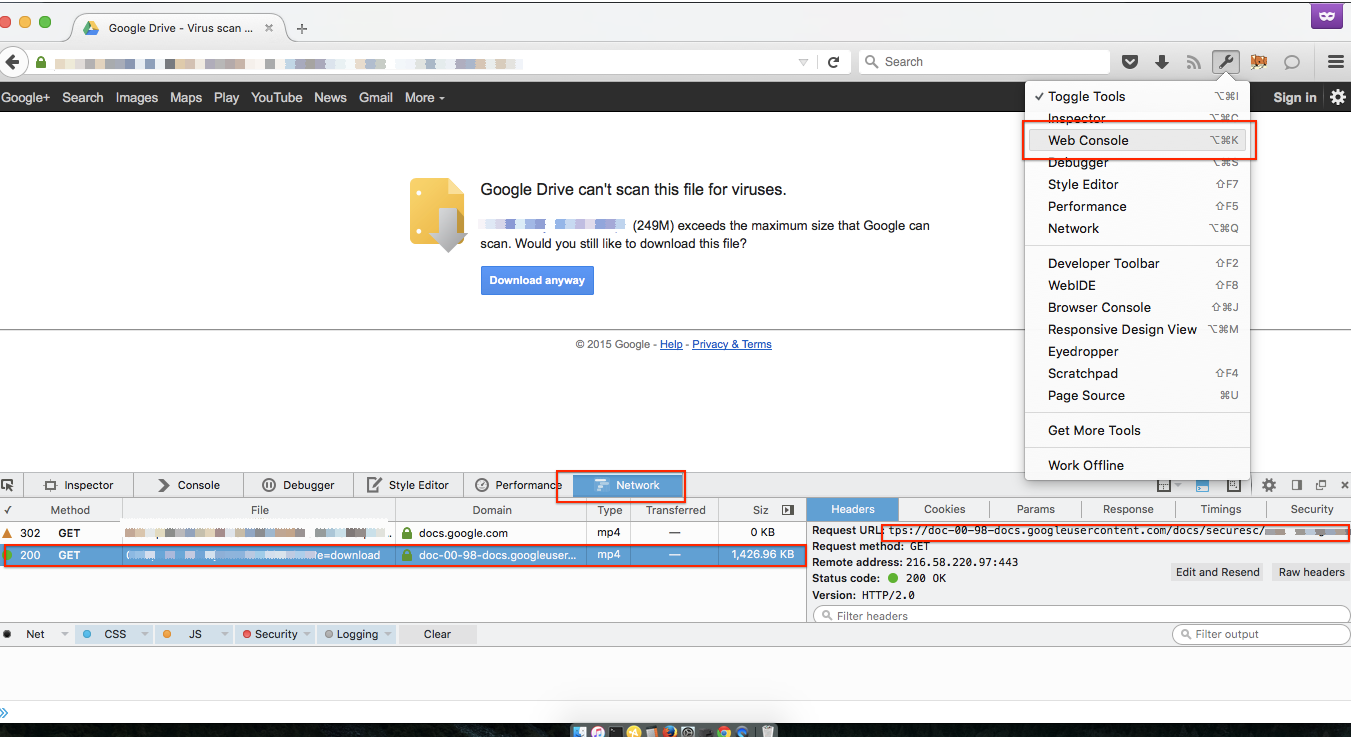
  5. I activated the Web Console in Firefox and went to the Net panel, then clicked Reload
  6. Now when I click on “Download Anyway” I can see the URL that I need to copy and use with wget

Here’s a screenshot showing you that last little bit:

image

Click here of full size version

https://iaindooley.com/post/135809945433
Keeping the bastards honest: why economics is the most important thing you can learn

I’ve been banging on about economics recently to anyone who will listen, but recently a couple of people told me they thought it was interesting but didn’t really see why it was relevant.

Here is a quick way too see why this is relevant to everything you believe in our stand for, regardless of where your opinions are on the political or ideological spectrum.

Search Google for “cost to the taxpayer”[1] and you will find that almost every issue you could imagine is discussed in the context of cost to the taxpayer.

But there is no such thing as a cost to the taxpayer: the government doesn’t need taxes to fund spending.

Search Google for “budget surplus”[2] and you will see that the government wants to reduce funding for schools and hospitals, and cut welfare payments, in order to return the budget to surplus.

But government deficits are good for the economy and the government has almost never run a surplus.

Search Google for “Australian government debt”[3] and you will see fears that the government owes too much money to foreigners, and needs to keep borrowing in order to fund is deficits.

But the Australian government doesn’t borrow Australian dollars from anyone, and really has no debt at all.

Every discussion about every issue is held within the context of affordability and fiscal responsibility. On all sides of politics the analogies we use to discuss our economy is wrong. The Greens advocate higher taxes on the wealthy and better enforcement of corporate taxes, but neither of those things are required because tax revenue isn’t required to fund public spending.

It sounds impossible, but literally everything we read, watch and hear about how the economy works is incorrect.

And yet these analogies are used as the basis for every single decision. People align with political parties based on their economic policy. Governments decide where and how to spend based on fictional or arbitrary constraints.

We can’t have a healthy democracy unless we all understand these 3 basic rules:

TAXES DON’T PAY FOR THINGS
DEFICITS ARE GOOD
THERE IS NO GOVERNMENT DEBT

If we understood these things we would make better, more informed decisions. Governments would be forced to increase transparency.

Making decisions based on incorrect assumptions leads to unintended consequences. If I told you I had stopped eating peaches because of advice from the astrology section of the newspaper, you’d think that was dumb idea. It might be a good idea to stop eating peaches for some reason, who knows, but if I make my decision based on astrology then it’s unlikely to be the correct decision.

We would be better off just deciding things completely at random.

[1] https://www.google.com.au/search?ie=UTF-8&client=tablet-android-samsung&source=android-browser&q=%22irresponsible+government+spending%22&gfe_rd=cr&ei=RihWVobMFsPu8wfsmoFA#q=%22cost+to+the+taxpayer%22

[2] https://www.google.com.au/search?ie=UTF-8&client=tablet-android-samsung&source=android-browser&q=%22irresponsible+government+spending%22&gfe_rd=cr&ei=RihWVobMFsPu8wfsmoFA#q=%22budget+surplus%22

[3] https://www.google.com.au/search?ie=UTF-8&client=tablet-android-samsung&source=android-browser&q=%22irresponsible+government+spending%22&gfe_rd=cr&ei=RihWVobMFsPu8wfsmoFA#q=%22Australian+government+debt%22

https://iaindooley.com/post/133953108673
Tax your kids: a thought experiment
auspol

A day doesn’t go by without hearing someone referring to a cost “to the tax payer”.

We really need to focus on dispelling this myth because it pits one section of society against another.

Let’s be very clear: your tax dollars don’t pay for anything.

You’re taxes are levied to create a demand for currency and regulate the base money supply.

Here’s a thought experiment based on modern money theory:

Say you want your kids to do their chores. You say you will pay them in gold stars.

You notice that they quickly become bored with the gold stars.

So you now say that every time they get in the car, they have to pay you a gold star, and they can only earn a gold star by doing their chores.

On day one of this new currency, there are no good stars so the kids can’t get in the car. So you have to spend some gold stars on chores before you can get the kids in the car.

So the “car tax” drove the demand for gold stars, but you had to spend, before you could tax.

Government spending precedes taxation. You, as the government, didn’t need to borrow gold stars to spend gold stars, you just made them from whatever you had around the house.

You didn’t need to tax your kids before you could pay your kids to do their chores, you invented the damned currency! But you had to impose an involuntary liability on them to give it value.

Now imagine you have a new baby that can’t do chores. Are your other kids paying for the baby’s car trips? No, the car trips are not part of this economy. We chose not to impose the liability on the baby.

Now imagine one week there’s only 1 job to do, so one child doesn’t get a star, but we still need her to ride in the car so we just give her one. Did the child who worked that week “pay for” the one that didn’t? No, we just handed out some more stars.

Now imagine we only made 4 stars total, so we could only get 2 chores done per child before we had to take a car trip (so we could get the stars back). Now we have imposed an artificial constraint on how many chores we can get done in between car trips. We have reduced economic activity by constraining our star supply. This is austerity.

We realise the error of our ways and make more stars so we can get chores done before the next car trip. Then we find that we created too many and the kids don’t have to work anymore to get in the car. We can simply raise the cost of a ride to drain stars out of supply.

Government spending creates money. Taxation destroys it. Governments do not raise tax revenue to fund their operations, and your tax dollars don’t pay for anything.

https://iaindooley.com/post/132863884568
How government debt works
auspol

Everyone FREAKS OUT when they hear that the government owes money and pays interest on it, especially to foreign nations.

The concern is based solely on misinformation.

The first thing to know is that all currency issued by the government is debt. All government spending and welfare or other transfer payments is debt. We don’t normally refer to currency as debt, though, because the government doesn’t pay interest on it.

The government only ever issues debt by crediting accounts at the reserve bank, which in turn flow to deposit accounts of individuals.

When a bank has lots of reserves it can lend it at interest to another bank. In order to control the interest rate at which banks lend to each other, the government sells bonds and pays interest on them. This sounds like a whole thing but it’s no different to having a cash account at the bank versus a term deposit. When you have lots of cash you will put it into a term deposit to earn interest. Government bonds are basically just a name for a term deposit account at the Reserve Bank.

The government doesn’t need to sell bonds to “borrow” in order to finance their operations. In fact, they don’t need to sell bonds at all. It’s just an operational/policy decision. Also, all interest payments are in our own currency, so we can never default on these payments (this distinguishes our government debt from crippling debt owed by developing nations to the World Bank and the IMF, which debts are owed in USD).

The second thing to know is that when we import stuff, the currency exchange happens simply by that foreign government’s central bank getting a credit in their account at the Reserve Bank of Australia.

So if you buy something on eBay from the US, what ends up happening is that the Federal Reserve (ie. the US central bank) account at the Reserve Bank of Australia gets a little bigger, and your bank’s account with the Reserve Bank of Australia gets a little smaller.

Now, when a foreign central bank has lots of reserves sitting in their account at the Reserve Bank of Australia, they can choose to lend it to other banks with accounts at the Reserve Bank of Australia at interest, or they can choose to buy Australian Government bonds at interest instead. But the bond purchases are always in AUD and the interest paid on them is also in AUD.

The government has no debts in foreign currencies. It doesn’t owe any Yuan or Ghana Cedi or Euros, it only ever owes AUD.

The government doesn’t have to sell bonds in order to “raise money”, the money was sitting there in the foreign central bank’s account anyway because we imported stuff.

So the only impact of the government paying interest on bonds is that the overall supply of AUD increases. When someone in the US buys something from you on eBay next time, the Federal Reserve’s account at the RBA gets a little smaller, and your bank’s account at the RBA gets a little bigger (and is then passed on to your deposit account). If the government hadn’t have been paying interest on the Fed account, then perhaps the value of the AUD would have been driven higher because of an increase in demand, but that’s about it.

It’s a policy choice, and it’s not a borrowing operation in the same way that you borrow money to buy a car or whatever.

So we can collectively stop listening to politicians and pundits who criticise our government for having “too much debt”.

https://iaindooley.com/post/132707732413
Questions I think we SHOULD be asking about the GST increase

As usual, Bill Shorten’s response to the base broadening and increase of the GST in Australia to 15% is both disappointing and myopic.

The Greens haven’t done much better.

Both parties are merely reacting with typical politically point scoring rhetoric rather than engaging in genuine debate.

Instead of simply refusing to accept an increase in GST and coming back with the same old “tax the rich” ideology, here’s the debate I think we should be having:

Broadening the base of and increasing the GST is perfectly acceptable so long as it’s accompanied by an adequate compensation package for low or fixed income earners.

So the first question we should be asking is “if you are going to increase the GST and broaden it to include things like healthcare, what measures will you take to offset the increase in costs to low income earners who are disproportionately disadvantaged by it?”

The Greens and Labor should be focusing all their efforts on holding the government to account and securing the best deal for low income earners and that old favourite “working families”.

Next: why does a government that issues it’s own currency need to increase GST at all? They don’t need to “raise revenue” in order to spend, and Australia isn’t undergoing a huge boom, doesn’t run a trade surplus with the foreign sector and is nowhere near full employment.

So what is the motive?

One possible answer to that is that a broad based GST with appropriate compensation on a sliding scale is actually much harder to evade than income tax. Since “tax drives money”[1] it’s true that the ability of governments to impose tax liabilities effectively determines how much of the available productive capacity of a nation the government can command without inflationary risk or risk to currency valuation.

If I were a Prime Minister intending to expand government spending I would want to make sure the tax system wasn’t vulnerable to evasion and capital flight, and taxing consumption instead of income is one way to achieve that.

If that’s the motive then that’s great! But let’s hear it from the horse’s mouth. Let’s force the government to come clean on their motives for a GST increase.

If they really just want to increase taxes across the board and crack down on evasion by the wealthy then they should say that even though it would be supremely unpopular with their voter base.

If that’s not the motive then what possible motive could there be that wasn’t just mindless ideology and a maniacal goal to impose fiscal austerity and punish the poor?

These are the questions I would like to hear from those in opposition to the government. Instead I’m just heading more knee jerk, mindless point scoring ideology.

[1] This is a concept from Modern Monetary Theory which states that the government creates demand for its currency by imposing liabilities on the public which can only be paid in that currency. For more on this, check out “A Primer on Modern Money” by L. Randall Wray

https://iaindooley.com/post/132620029263
It's the bath tub, stupid

Here’s a really simple description of how the economy works and why you should stop listening to anyone the second they say the government should return to surplus.

The economy is a bath tub.

The tap is on and the plug is out, so if you turn off the tap it will eventually empty.

The goal is for the bathtub to be exactly full.

Every day the bathtub increases in size a bit.

If you’re not putting water into the tub faster than it escapes the level of the bath goes down.

Occasionally someone tips a jug of water in. At that point if you don’t slow the tap or make a bigger plug hole, the bath will overflow.

Other times someone takes a jug of water out. At that point if you don’t increase the flow from the tap or reduce the size of the plug hole the level of water will decrease.

The tap is government spending.

The plug is taxation.

The jug is net exports.

The water is the private sector.

The tub is the productive capacity of your society.

When the tap is putting in water faster than it escapes, it’s called a government deficit.

When the tap puts in water slower than it escapes, it’s called a government surplus.

When the bathtub overflows you get hyper inflation.

When the bathtub level drops you get a depression.

So that’s it.

The government can spend as much as it wants up to the productive capacity of the society without inflationary risk.

In a society that imports more than it exports, if the government runs a surplus it will destroy private sector wealth.

NB: Even though the volume of money can fluctuate due to transfer of financial assets within the private sector, all private sector assets and liabilities sum to zero so the net impact on the total volume of liquid is nil (maybe you could get freaky and allow the viscosity of the liquid to represent liquidity within the private sector …. but we won’t).

https://iaindooley.com/post/132104616158
Don’t want the “boats to restart”? Try a fucking plane

Today while reading about doctors who don’t want to release kids into detention[1] I noticed our Dear Immigration Leader’s comment:

“… the Defence and Border Force staff on our vessels who were pulling dead kids out of the water don’t want the boats to restart.”

Well here’s a thought, dipshit: instead of illegally imprisoning innocent people without trial in state sponsored rape camps, why not PAY FOR A FUCKING PLANE.

The government spends about $1.2 billion on offshore detention each year[2]. Jet Star is currently selling tickets from Bali to Perth for about $183, so the government could buy 6,557,377 tickets for the amount they’re spending on offshore detention annually.

So if the government is genuinely concerned for the safety of people who attempt to travel to Australia by boat from Indonesia, the most cost effective solution that doesn’t involve imprisoning children until they attempt to hang themselves would be to fly people to Australia from Indonesia for processing.

Since this isn’t what the government are doing, we have now determined logically that Peter Dutton isn’t genuinely concerned for their safety …

HE’S JUST A LYING FUCKING CUNT FACED CUNT.

#QED

[1]http://www.theguardian.com/australia-news/2015/oct/11/hospital-doctors-protest-to-demand-release-of-children-from-detention
[2]http://www.smh.com.au/federal-politics/political-news/government-spends-12-billion-on-offshore-processing-centres-in-one-year-20150205-13708n.html

https://iaindooley.com/post/130934459138
On Technical Co-Founders

In addition to the excellent distinction between “tech startups” and “tech enabled startups” made by Ryan Hoover[1]  I think that there is a more important distinction that this b2b versus b2c startups.

But even these I think are misnomers. I will define a b2b startup as one which makes an existing behaviour that someone performs for financial gain, easier. A b2c startup is usually one which either serves a purpose in someone’s life that isn’t to do with making money, or is some kind of entertainment app.

Marketplaces can really be either – if I were you I’d view your marketplace as a b2b app focused on helping people get more business, build out the supply side first then generate demand for them. But that’s a different post.

My opinion is you don’t need a co-founder for your b2b startup and you’re better off retaining all equity and finding someone to build your app for you. My preferred model for this is (obviously) the way I do business at http://www.workingsoftware.com.au/ which is that I manage a team of outsourced developers and provide product and project management.

Everything is hourly, no equity. Doing this we an produce a “first version” of even a pretty complex b2b offering for less than $60k, and if it’s simpler than that we can get away with less – but there is going to be at least $2k/month of maintenance and stuffing about fixing or improving things after you launch.

I also think that anyone can learn to manage a tech team (in fact my goal is to eventually franchise Working Software as a system for doing just that).

If you don’t have that money you can either get pre-sales, but you better be sure you’re going to have revenue to cover maintenance. Or, you can build a different product first (either directly or tangentially related to the product you want to build) that is “tech enabled” and can be started more or less as a startup. You probably shouldn’t get investment/funding to pay for development costs in your b2b startup.

If you want to start a b2c startup then you’re on your own – it’s a lottery and no-one can really help you win. You might, though, and the rewards can be spectacular. I would say that for b2c you almost certainly need a tech co-founder if you’re non-technical, at least to get the first version out the door (they should then move to the “CTO” type model where they’re managing an outsourced team since you don’t want to rely too heavily on one person). Finding the right co-founder is hard, and made even harder if this is your first venture. Another thing to consider is that even if you win the lottery, what’s your real competitive advantage? I’ll leave that discussion up to Jason Cohen to discuss[2]. b2c success generally suffers from a huge survivorship bias. You just have no way of calculating your odds.

In general, if this is your first business, or tech startup, I would recommend either going with b2b, and if you’re not technical, going for a “tech enabled” model where you can validate with virtually no tech investment using off the shelf products. You will find it very easy to get some money to build out the tech side when required (hell, you can just get a bank loan for that rather than giving up equity … ).

[1] http://ryanhoover.me/post/67471168540/dont-learn-to-code

[2] http://blog.asmartbear.com/unfair-advantages.html

https://iaindooley.com/post/124531656098
Removing negative gearing will not increase rents (or: Joe Hockey is profoundly stupid, or lying, or both)

The claim that removing negative gearing will increase rents defies not only history as shown in the recent ABC fact check[1], but also logic.

If lanldords could spontaneously increase rents by simply deciding to charge more, THEY FUCKING WOULD.

Do you think landlords are keeping rents artificially low out of compassion for renters? Fuck no. They’re charging every penny they can, and increasing it regularly.

Rental rates are determined entirely by what people are willing to pay at any time. Rents in Sydney are not currently high because of property values, but because of the interest rate rise that happened in 2004 after Howard was re-elected.

No, it’s not that interest rates went up therefore landlords “charged more”.

Everyone shat themselves about interest rates and stopped buying houses. All of a sudden, rich DINKS were renting instead of buying, and inflated the prices like crazy.

I know because I was there. I moved to Melbourne in 2006 to escape the cost increases, only to find that about 50,000 people had the same idea as me at the same time and the rental crisis followed me there.

Houses that normally would have been the domain of scummy Uni students all of a sudden had 30 applicants turning up in Audi’s and offering twice the advertised rent, 12 months in advance.

It was around this time that we first started to see the rise of “rental auctions” in the Sydney market[2] and everyone just got used to paying a shitload for property.

High rents drove further investment and property prices soared.

This has nothing to do with negative gearing and everything to do with low vacancy rates caused by an idiotic interest rate scare campaign propagated by Howard in his 2004 election campaign (the rate increase wasn’t even that high, it’s just that the Howard government had been too busy scaring everyone about interest rates so they could get re-elected and continue fucking up the country).

If you abolished negative gearing, fewer people would buy investment properties. This would see the increase in property prices slow for purchases (it would have no impact on rents).

In turn, this would mean that more people who are currently renting would gradually “catch up” to the property purchase prices, and start buying their own homes again.

This would then leave the remaining rental properties for the scummy uni students again, reverting us to the relative normality of the early 2000s (once regular inflation has caught up to property hyper inflation).

[1] http://www.abc.net.au/news/2015-05-06/hockey-negative-gearing/6431100

[2]http://invested.com.au/6/rental-auctions-6207/

https://iaindooley.com/post/121183469308
Ever since she was a tiny baby (like 6 weeks old) Frankie has...


Ever since she was a tiny baby (like 6 weeks old) Frankie has had an insatiable appetite for books. I have a video of her at 6 weeks flipping out over the colour kittens. The trend has continued unabated. I remember flying on a plane to Adelaide when she was about 3.5 yrs and reading through all 160 odd pages of Richard Scarry’s “what do peope do all day” and finishing just as we started the descent to land. When I was done Frankie just turned to me and said “again”. Today, Nana and Pop came round to watch the kids and brought an Enid Blyton box set for Frankie as a late birthday present. Pop sat down to read her some of one of the books, but decided to just see how long she would go before she got bored and wanted to do something else. He finished this entire book, and she wanted more. I really have to put this to the test sometime… Like just clear my schedule for a full weekend and see how long Frankie will sit there and listen to books for. It’s amazing.

https://iaindooley.com/post/115647322793
Knowing your number

Whenever I hear a financially wealthy person say something like “the more money you get, you realise that it’s not all that important” there are inevitably reactions from people who are not financially wealthy saying something like “it’s all well and good for you to say that now you have money, but I have to eat and pay rent and money is hugely important to me”.

I saw a discussion today on hacker news[1] about this and it got me thinking: I’m pretty sure those rich folks know that you need money to eat and pay rent, what they’re taking about is a lust for a much higher level of wealth. The “fuck you” money level of wealth.

And when people start businesses, especially young people, they’re not thinking “boy I hope I can eat and pay rent” they’re thinking “if I have money I can do whatever I want and people will praise me and I’ll feel important”.

When those rich folks talk about money not being important I think what they’re really saying is that apart from the obvious fact that they don’t have to worry about eating and paying rent anymore, the other stuff about being rich that they thought would matter, doesn’t matter.

In fact, the thing that seems to master most is the freedom to direct your own time and work on things that you’re interested in.

For most people, especially young people, the level of wealth required to do that is actually very small.

When I attended a conference recently run by Shirlaws coaching[2] they talked about needing to “know your number”; the amount of money that you would need in order to have the freedom to work on something that interests you. When people actually work out what this number is, is often surprising how small it is.

When you don’t have money, it’s easy to just say “I need lots of money” and either be discouraged into not taking action, or to assume you need to risk everything to create a breakout success.

But the truth is that if you really work out your number and what you might do over the next 10 years to achieve that level of wealth, you may be surprised at how achievable it is.

For those too pessimistic to take action, this may inspire them by making a much more achievable goal.

For those with a boom or bust mentality, committed to “get rich or die trying”, it may give them a much more realistic attitude to the level of risk they need to take in order to achieve their goals.

Either way, defining what success will look like to you (at a minimum) is a great way to set realistic goals and take action towards achieving them every day.

[1] https://news.ycombinator.com/item?id=9011818
[2] http://www.shirlawscoaching.com/australia

https://iaindooley.com/post/110327244128
I just got a coffee at gloria jeans and they pour the milk in...


I just got a coffee at gloria jeans and they pour the milk in with the cup sitting on this scale. When they first put the cup on the scale they have an acceptable weight range that indicates if the coffee has been over extracted or not, and when they poor the milk in they have acceptable weight ranges for each size, that differ depending on the type of coffee (for example a cappucino is less dense than a flat white).

https://iaindooley.com/post/110125051688
“I know! We could call the sequel ‘too fast, too...


“I know! We could call the sequel ‘too fast, too furious’, but spell it with the numeral 2”. “Urr but what do we do for the third one? Three fast, three furious doesn’t work…” “hahaha yeah right. As if they’re ever going to let us make more than two of these pieces of shit.”

https://iaindooley.com/post/109965877083