GeistHaus
log in · sign up

https://guidetojapanese.org/blog/rss

rss
15 posts
Polling state
Status active
Last polled May 18, 2026 23:15 UTC
Next poll May 19, 2026 22:58 UTC
Poll interval 86400s
ETag "c1abba75ad014a9852ea0bee64cc34c4-gzip"
Last-Modified Thu, 13 Jan 2022 18:44:50 GMT

Posts

Japanese study 2015 recap
PersonalVocabulary
Wow, is the year almost over already AGAIN?! I’m just getting older and older and seeming to accomplish less and less. I guess I’m playing games too much as usual. Some words I learned from my twitter account. Firework trivia … Continue reading →
Show full content

Wow, is the year almost over already AGAIN?! I’m just getting older and older and seeming to accomplish less and less. I guess I’m playing games too much as usual. Some words I learned from my twitter account. Firework trivia Game publishers that annoy me Finally finished watching K-ON! A free webcomic of a canceled PSP game when Level-5 used to be cool The list is way shorter this year mostly because I stopped adding to it. Still, some good stuff. すべからく ほくそ笑む 不実 忘れ形見 来歴 包容力 叙情 石膏像 のたまう 点在 腕白 言葉のあや 万事休す 好機到来 カンテラ どよめき 一意専心 近衛 野卑 乳母 意趣返し 粛清 駆け引き 追いはぎ

http://www.guidetojapanese.org/blog/?p=681
Extensions
How to make mistakes
BeginnerLearning & Resources
At any point in language learning, we have what I would call a “gut meter” based on patterns or word usages we’ve seen before and how often. This “gut meter” is what allows us to avoid mistakes based on “feel” … Continue reading →
Show full content

At any point in language learning, we have what I would call a “gut meter” based on patterns or word usages we’ve seen before and how often.

This “gut meter” is what allows us to avoid mistakes based on “feel” without having to consult hundreds of grammar rules and linguistic jargon. It is also constantly evolving. For example, a native English speaker looked at me like I was crazy when I pronounced “forehead” as “fore-id” simply because it was unfamiliar.

So if you feel like you’re stuck at a certain stage eg, 私は元気です, etc., I would say it might be a good time to experiment. Even 15 years in, I like to get out of my comfort zone and try to use words and patterns that I’m not too sure are correct. Being on the internet all the time is probably not a good influence either. LOL

The important thing to realize is that language is evolutionary so you don’t want to make up random nonsense out of thin air (unless I guess poetry?). So I try to base things on other stuff I’ve seen before but also get creative and have some fun with it. So it’s really important to keep that input flowing. Even in our native language, writing and speaking styles can change based on what we read and hear. Especially for language learners, input is essential for seeing and getting accustomed to a large number of new concepts and vocabulary to enrich a nascent repertoire (see what I did there?).

The last perhaps most important part is to get feedback so that you can keep your “gut meter” calibrated. You don’t want to get used to your own mistakes and weird grammar and start thinking that saying “私は” every time is normal. Basically a sanity check with the rest of the world is always a must.

  1. Get more input
  2. Experiment with input
  3. Get corrections

I’d like to say I’m some sort of Japanese Master and I never make mistakes but of course, only a delusional and arrogant fool would claim mastery of any language (unless you have a Nobel prize in literature, I guess).

We all make mistakes and in this case, it’s not a bad thing at all. So if you see me make a mistake, shoot me a comment cause I definitely ain’t embarrassed about them (just don’t bring up that パンツ vs pants episode…)

みんなで素敵なへんてこな文章を書きまくりましょうよ!決して自分の間違いの言い訳をしているわけじゃないんですからね!

http://www.guidetojapanese.org/blog/?p=683
Extensions
What’s the best way to learn Japanese?
BeginnerLearning & ResourcesPersonal
Q: What’s the best way to learn Japanese? A: It depends. Q: What’s the best way to learn Kanji? A: The question is vague. Q: How long until I can become fluent? A: What does “fluent” mean? Also, it depends. … Continue reading →
Show full content

Q: What’s the best way to learn Japanese?
A: It depends.

Q: What’s the best way to learn Kanji?
A: The question is vague.

Q: How long until I can become fluent?
A: What does “fluent” mean? Also, it depends.

I get very short emails of this kind all the time and I usually don’t respond (sorry if this was you). But really, 99% of these generic, vague questions I can answer: “It depends”.

Triage

Learning a language is a big job. You’ve been practicing it and learning it for years and years from your parents and school all the way up to adulthood and beyond. Now that you’re starting ALL OVER AGAIN, it’s time to set priorities.

Even if you don’t set priorities, they will get set whether you like it or not. Of course like you (I hope), I strive to be natively proficient at everything but frankly, my writing skills can use work, a LOT of work. That’s because instead of writing in Japanese, I’m spending my time writing this blog post in English and mostly reading. Even though I can naively wish my writing would magically improve, it won’t happen unless I work on it (I’m not).

So if you need Japanese for your work, have family, interested in anime or whatever, you can easily break it down into one of four skills: listening, speaking, reading, writing. Once you have your priorities, you need to work on improving those skills by actually DOING IT.

Triage and focus on one of:

  1. listening
  2. reading
  3. speaking
  4. writing

However, when it comes to output skills, you need input otherwise you’re just making up random nonsense. So if you want to work on speaking, start by listening, reading before writing (about 2-4 times more input over output).

2-4X input over output:

    listening > speaking
    reading > writing

Finally, even if you triage (which will happen regardless), you should still work on the other areas. Our brains are a complex neural network and stimulating different parts of it helps retention. So if you spend all your time buried in a book, get out and talk to some people. If you’re just winging it in Japan, go home and do some reading.

Having a visual image of an object for example, a “vending machine” with the Kanji 自動販売機 “self moving sell machine” after hearing the word in conversations is the best way to cement it in long-term memory.

Maintain a good balance

Counter examples

Take these stereotypical examples and it’s easy to see where the problems lie because priorities were not in line with desired result.

1. Advanced Japanese student who can’t hold a conversation
Didn’t actually spend time outside classroom speaking to people.

2. Cannot speak with Japanese significant other
Always speaks in English with significant other. Has some excuse for not studying or reading.

3. Loves anime, can’t understand a word
English subtitles always on. Doesn’t spend time looking up the words. Doesn’t read manga or light novel with a dictionary.

4. Can’t write Kanji by hand (this is me and probably many Japanese people)
Always uses an electronic device to type. Rarely writes by hand.

5. Can’t write that novel in Japanese
Writes English blog post about learning priorities (yeah you know who you are).

6. Grammar is confusing
Didn’t read my book (shameless plug)

http://www.guidetojapanese.org/blog/?p=680
Extensions
Japanese study 2014 recap
PersonalVocabulary
WHAT???? It’s already well into 2015??? Where does the time go?? Obviously, I haven’t been studying as much this year or OMG maybe the number of words I need to learn is going down? NAH! That can’t be it. But … Continue reading →
Show full content

WHAT???? It’s already well into 2015??? Where does the time go?? Obviously, I haven’t been studying as much this year or OMG maybe the number of words I need to learn is going down? NAH! That can’t be it. But anyways, in 2014, I ran into 152 new words that I was too newb at Japanese to know already or just can’t quite seem to memorize completely. That’s not even half a word a day! Tsk Tsk.

Some words I learned last year from my Twitter account.

Crazy commercials (of course)
Anime songs (of course)
Common sayings in anime
Some sort of 声優 event?
More anime songs (of course)
And it wouldn’t be the internet without cute animals

平皿
意地汚い
胸を撫で下ろす
雌雄
碑文
強情
判じ物
哨戒
狂言
克明
眉唾
貼付
錦鯉
与太話
鉄格子
懐柔
架ける
乾布摩擦
衆生
便覧
上唇
上辺
単元
狼狽
否めない
濃霧
残滓
羽毛
惨たらしい
金切り声
生娘
果報者
談判
慎ましやか
濾過
我先
遠心力
底意
沈着冷静
猜疑心
徒党
後手に回る
星辰
胸の痞が下りる
お手玉
下手人
尾ひれ
寒村
廃村
しわくちゃ
暴利
責任転嫁
風上にも置けない
けたたましい
隠居
はにかむ
胸のつかえがおりる
装填
履帯
昂揚
ひょんな
へちま
乙な味
目ざとい
くさや
干物
玉に瑕
瘴気
愚直
つぶさに
感無量
筋金入り
節操
インポ
楕円形
おしめ
殴打
めっきり
目分量
大らか
おそまつさまでした
着崩れ
退っ引きならない
含蓄
啖呵を切る
狭量
桃源郷
触診
すね毛
としゃぶつ
ひじき
がちんこ
勘当
金的
パチモン
露見
そん色
凡庸
解せない
毛嫌い
蒸発
なで肩
もくず
落ち度
保身
かいらい
涙ぐましい
大見得
倣う
年増
高窓
気位
羽衣(はごろも)
登用
男所帯
すたる
出土
擬態
興亡
心底
雪崩
苦肉
身びいき
拙劣
垂涎
てかてか
恩着せがましい
キンモクセイ
払拭
聡明
いたわる
不精
量刑
たらい回し
賄う
女給
黄ばむ
子煩悩
折檻
虚勢
冥王星
ぞんざい
気障っぽい
感銘
消去法
ねずみ講
後ろめたい
本懐
情状酌量
形振り構わず
瓜二つ
盛る(さかる)

http://www.guidetojapanese.org/blog/?p=668
Extensions
暇つぶしの投稿
IntermediatePersonalプチポスト
最近、孵るという単語を習った。子供の絵本をたくさん読んでいると、意外に知らなかった単語が多々あるものだな。「そらまめくんのベッド」という絵本だけど、結構かわいくて、娘が気に入ったようだ。お勧めします。
Show full content

最近、孵るという単語を習った。子供の絵本をたくさん読んでいると、意外に知らなかった単語が多々あるものだな。「そらまめくんのベッド」という絵本だけど、結構かわいくて、娘が気に入ったようだ。お勧めします。

http://www.guidetojapanese.org/blog/?p=665
Extensions
Tokyo Alice
Learning & Resources
東京アリス is a free visual novel by 郷愁花屋. It’s supposed to be pretty short, just a few hours in length so I thought I’d try it out. Here are the first few lines of text, in case you’re interested in … Continue reading →
Show full content

東京アリス is a free visual novel by 郷愁花屋. It’s supposed to be pretty short, just a few hours in length so I thought I’d try it out. Here are the first few lines of text, in case you’re interested in using it as reading practice. Copy+paste as needed and have fun! Post a comment if you need help with a certain sentence.

「ったく、ありすのやつ・・・」
暑い。
ともかく暑い。
最近まで不安定な天気が続いていたけれど・・・、ようやく本格的に夏がくるらしい。
時刻は正午。
太陽がオレの真上でぎらぎらと光っていた。
・・・暑い。

そう。
なんでオレはこんなくそ暑い中走っているかというと・・・、ありすのせいだ。
ありすってのはオレと同じマンションに住むクラスメートで
・・・幼稚園の頃から中学の今まで、ずっと一緒にいる。
単に幼稚園と小学校、中学が同じというやつは、そんなに珍しくない。
ただ、オレとありすのすごいところは・・・ずっと同じ組、同じクラスというところだ。
そう・・・小学校なんて6クラスもあったのに何の因果かずっと一緒だった。
奇跡だ。
もしくは呪いだ。
まあつまり、いわゆるくされ縁と言うか、幼馴染というやつなわけだ。

I will update this post with more if anybody is interested.

http://www.guidetojapanese.org/blog/?p=663
Extensions
Get off my lawn!
PersonalTechnical
So almost 5 years ago, I wrote a blog post about not understanding twitter. Well, I get it now. I also get why Google killed Google Reader. Writing a long, informative blog post is a lot of work and something … Continue reading →
Show full content

So almost 5 years ago, I wrote a blog post about not understanding twitter. Well, I get it now. I also get why Google killed Google Reader.

Writing a long, informative blog post is a lot of work and something I obviously haven’t done in a while. There was a golden age where people shared information on platforms with great interoperability and open standards. You could easily aggregate information via RSS/Atom and it was very easy to export, migrate, and generally own your blog data.

But controlling and managing your own data is also a lot of work mostly because of the ever increasing onslaught of spam. So it’s easier to give all our data to facebook and google for free while they try to sell us to advertisers. You can’t consolidate anything from facebook, google, or twitter because of course they’re competitors and would never share their (ie your) data with each other. You can even’t retrieve all your tweets and instagram tries to block you from downloading YOUR OWN PICTURES albeit with some cheap and simple filter effects.

And now I’m considering shutting down the forum. Yes, I’m part of the problem. Apparently, I need to get off my own lawn.

http://www.guidetojapanese.org/blog/?p=658
Extensions
Japanese study 2013 recap
AdvancedMediaPersonalVocabulary
So another year has gone by which means I’ve been studying Japanese for around 13 years now. In 2013, I encountered a little over 400 words I didn’t know while playing games, reading books, and watching TV shows. That’s more … Continue reading →
Show full content

So another year has gone by which means I’ve been studying Japanese for around 13 years now. In 2013, I encountered a little over 400 words I didn’t know while playing games, reading books, and watching TV shows. That’s more than 1 word a day! The highlight in my study materials this year for me would definitely be 逆転検事2, one of the best games I’ve played in a while. There’s still a few weeks to go before the year ends so I’m sure the list will grow a bit more before 2014 arrives but here are some highlights from my #JWOTD (Japanese word of the day) tweets.

Some funny gifs with Japanese captions
Song by popular Korean Pop group
A really good Anime series
Really racy girl’s talk
Cool song about losing touch with cellphones
Cats (of course, it’s the internet after all)
The truth behind “Heros” stealing your stuff in RPGs
Tense relations between China and Japan as usual

And here’s the full list which is pretty much useless to anybody else since you’re not seeing it in context but whatever. If you already know these words, congratulations, you knew more Japanese than me! But don’t slack off, I’m catching up!

手ずから
甲羅干し
順列
苗床
誓約
招集
陣容
たわわ
常春
餞別
簒奪
与する
素行
不埒
おためごかし
ひたむき
神々しい
潮干
へっぽこ
うわばみ
ひもじい
てんやわんや
くすねる
木箱
お払い箱
厚かましい
画期
人海戦術
要領がいい
曰く付き
ちゃんばら
方舟
見栄を張る
遠征
たわみ
灯台下暗し
錠前
希少種
えり好み
太っ腹
紆余曲折
上の空
優男
王太子
大目玉
縮図
果報
泣きじゃくる
空母
虐げる
早とちり
みそっかす
血眼
たらし込む
あだ討ち
晩酌
通せん坊
あぶれる
手向ける
運気
気弱
やっかむ
甘露
蹂躙
あか抜ける
慣わし
温床
矢先
不毛
硝煙
下戸
あしからず
くすぶる
口下手
力説
目まぐるしい
手酌
訝しい
熱りが冷める
直談判
鼻をあかす
かくかくしかじか
片手間
真っ只中
ねちねち
十把一絡
俄然
モルモット
受胎
見すぼらしい
味気ない
血縁
没個性
けばい
無理強い
空調
ゆめゆめ
灯火
謁見
尻ごみ
ほっぺたが落ちる
貞淑
臥薪嘗胆
おつむ
ほぞを噛む
端折る
尻に敷く
氾濫
雪崩を打つ
徐に
疎開
身ぐるみ
毛皮
黒点
中洲
童顔
潤ける
強か
一揆
謀反
処断
かたどる
内通
処世術
一心不乱
品評会
おあつらえ向き
報復
勝手口
お裾分け
焚火
落ち葉
どんより
洋梨
側近
いかだ
勇ましい
不躾
めげる
腰ぎんちゃく
宣う
勅命
据え置き
側近
山間部
物欲
速記
大詰め
布施
一房
ミーハー
ひがむ
住職
難聴
所作
気品
歪曲
さいなむ
品行方正
動悸
虚弱
仮初
茶々を入れる
切磋琢磨
切望
断裁
ひっぺがす
男女兼用
際限
耳年増
弾圧
倹約
相容れない
為政者
侮蔑
不仲
無節操
ないがしろにする
座右
淫蕩

嫡子
奸計
がさつ
卑猥
慟哭
お熱
誑かす
言い負かす
大儀
所以
法度
時化
結納
こき下ろす
ひしゃげる
空前
復元力
ずらかる
試供品
デッサン
釘を刺す
あらまし
ほのめかす
袋小路
耳打ち
うなじ
風見鶏
知能犯
根絶やし
メリハリ
玉の輿
舞踏会
異な
そこかしこ
おめおめ
悪食
眷属
馬子にも衣装
筆舌に尽くし難い
発破をかける
殊勝
きな臭い
唐変木
逆上
破魔矢
蟷螂の斧
古今東西
しきたり
生き字引
首っ丈
見掛け倒し
とんぼ返り
ひづめ
抵触
背に腹はかえられない
朴念仁
猫を被る
憂さ晴らし
不本意
放心状態
しからば
シュプール
好敵手
あやかる
不適合
万遍なく
ピアニカ
背徳
一家言
清々しい
猿ぐつわ
鎌をかける
阿鼻叫喚
藁にもすがる
癒着
ほのめかす
諸説
玉砕
おもむろに
たぶらかす
ジト目
これみよがし
聞こえよがし
蛇足
虫の息
どぎまぎ
満身創痍
ほの字
ひとりよがり
無知蒙昧
いまわ
とび蹴り
荒くれ者
鼻息が荒い
手負い
かんざし
ふてぶてしい
あっぱれ
かいつまむ
うらぶれる
むざむざ
大甘
極めつけ
腹をくくる
ほざく
素知らぬ顔
不承不承
居直る
絵空事
のらりくらり
オウム
紙ふぶき
恩恵
堂に入る
闇夜
顔負け
上げ底

日の丸
ふさぎこむ
したたか
活路
殴り書き
謝辞
反古
弘法にも筆の誤り
息急き切る
変質者
見境ない
肺活量
こそすれ
狩猟
ひた走る
よじ登る
踏みしめる
四肢
鋭角
非対称
ちぐはぐ
光沢
目測
優に
然とした
夜目
件(くだん)
まやかし
初夜
波及
せしめる
爆散
親和性
重き
触手
顛末
湿る
宮仕え
醸成
帳消し
亘る
触腕
無量大数
挿絵
円錐
えげつない
反骨
わりかし
通信簿
食傷気味
醸す
魂胆
海千山千
老獪
わきあいあい
痴れ言
好事家
爛々
眼福
目の正月
かぶりつき
じゅるり
去来
面構え
詮無い
淡白
咀嚼
まがりなりにも
僥倖
鉄アレイ
美味
一縷
比肩
鑑別所
辛気臭い
もこもこ
勘ぐる
のろし
ならず者
裁量
咽び泣く
すぼめる
河岸を変える
悦に入る
胸中
患う
見境
にわかじこみ
あべこべ
間隙
野方図
捻れる
長大
木霊
声帯
起死回生
謄本
坪数
覿面
炸裂
のたうち回る
根性焼き
陰湿
墨汁
賭する
琴線
年端も行かない
みぞれ
たゆたう
移ろう
輝度
凄む
無窮

http://www.guidetojapanese.org/blog/?p=630
Extensions
Essential Japanese Grammar Review
GrammarLearning & ResourcesReviews
Ok, the last book Tuttle Publishing sent me for review is Essential Japanese Grammar: A Comprehensive Guide to Contemporary Usage so let’s dig into it. Introduction According to the book’s Preface, this book is “intended to be a thorough grammar … Continue reading →
Show full content

Ok, the last book Tuttle Publishing sent me for review is Essential Japanese Grammar: A Comprehensive Guide to Contemporary Usage so let’s dig into it.

Introduction

According to the book’s Preface, this book is “intended to be a thorough grammar reference and self-study guide for language learners who wish to study Japanese seriously or refresh their understanding of the language”. It’s split into two major parts, the first being an overview of Japanese grammar while the second goes into a more detailed look into the usage of particular words.

Part one

The first part goes over various aspects of Japanese grammar. For example, it goes over Accents, then goes over Adjectival Nouns, followed by Adjectives, and so on and so forth. The information is pretty solid though it does tend to use a lot of grammar terminology such as “Sentence-conjunctional words”. It has lots of example sentences and is generally understandable once you wade through the linguistics jargon. I especially like that they cover accents and accurately describe word order. Many books about Japanese incorrectly describe Japanese sentence order as SOV. This book doesn’t fall into that trap and gives a good explanation.

In general, the information in this book is detailed and doesn’t try to “baby you” like other books do by using only romaji and ignoring the dictionary form. My only complaint about this section is that it’s organized like a dictionary, not an overview. The topics are arranged in alphabetical order and feels disjointed if you read it from beginning to end. For example, it covers “Honorofics” before “Verbs” only because well “h” comes before “v” but it certainly isn’t the order you want to learn them! Really, you should look at the table of contents first and choose a topic that interests you instead of reading it in order.

Part two

Part two is simply a dictionary of various grammatical phrases such as 「らしい」 or 「つもりだ」. Honestly, the two parts do not mesh together AT ALL. For example, the first part has a completely unhelpful two-page section on “Requests” that says here are some ways to make requests with some examples. It doesn’t have any explanation on when to use 「くれる」、「もらう」、 and 「あげる」. Then the second section starts by describing 「あげる」 (because it starts with an “a”) and has a note “(→ See kureru and morau.)” Essentially, the topic of requests is completely broken up into 4 sections scattered throughout the book.

Yet another example is the section on “Comparisons” in part one with notes to see 「方」 and 「どちら」 in part two. In general, this book is filled with these “(→ See XYZ)” notes which force you to flip around the book to even learn about a single topic.

Conclusion

Overall, the actual information in this book is very thorough and informative. Unlike the other two books Tuttle sent me for review, this book isn’t made up of mostly filler material as each page has lots of information and examples. However, I find that this book has a kind of identity crisis. The grammar topics are covered in alphabetical order and overlapping topics are split between parts one and two. In my opinion, this book should have either stuck with being a grammar reference such as “A dictionary of basic Japanese grammar” or focused on comprehensively covering each aspect of Japanese grammar.

What purpose does this book serve? I think if you are already using something else to learn Japanese and you want to learn a bit more information about a certain topic, you can’t go wrong with this book. If you can get past the linguistic mumbo-jumbo, the explanations are pretty detailed with plenty of examples. However, you may have to skip around a bit between part one and two. For example, take a look at how the book describes 「なら」.

Nara can directly follow (adjectival) nouns (with particles), but it also follows a clause followed by no or n. (→ See nara for more details.)

The authors are very knowledgeable but I think they took the wrong approach in organizing this book. If you want a detailed and a bit technical reference guide to Japanese grammar, this book is not bad. It’s certainly a great book if you want to learn about grammatical terms such as “Conjunctional particle for clauses”. Perhaps you’re a Japanese linguistics major. In conclusion, I think there’s lots of great information here, it just needs to be organized better. The preface claims it’s a “thorough grammar reference and self-study guide”. It might be a grammar reference but it’s definitely NOT a self-study guide and I think it hurts the reference part by trying to be both.

http://www.guidetojapanese.org/blog/?p=625
Extensions
600 Basic Japanese Verbs review
Learning & ResourcesReviews
Tuttle Publishing sent me 600 Basic Japanese Verbs: The Essential Reference Guide for review so here we go again. Introduction The book’s introduction starts by saying, “Fluency in a language cannot be attained without a solid understanding of that language’s … Continue reading →
Show full content

Tuttle Publishing sent me 600 Basic Japanese Verbs: The Essential Reference Guide for review so here we go again.

Introduction

The book’s introduction starts by saying, “Fluency in a language cannot be attained without a solid understanding of that language’s verbs and their usages”. According to the book, the introduction is used to “help students learn both the conjugation and the usage of Japanese verbs”. For a fairly short introduction, it does a good job of going over the various verb forms. It tells you how to separate the verb into 3 groups and the conjugation rules for various forms such as the volitional and conditional with plenty of examples. After the short introduction, we go into what makes up the bulk of the book.

The verb list

The rest of the book lists one verb on each page with various conjugations and example sentences.

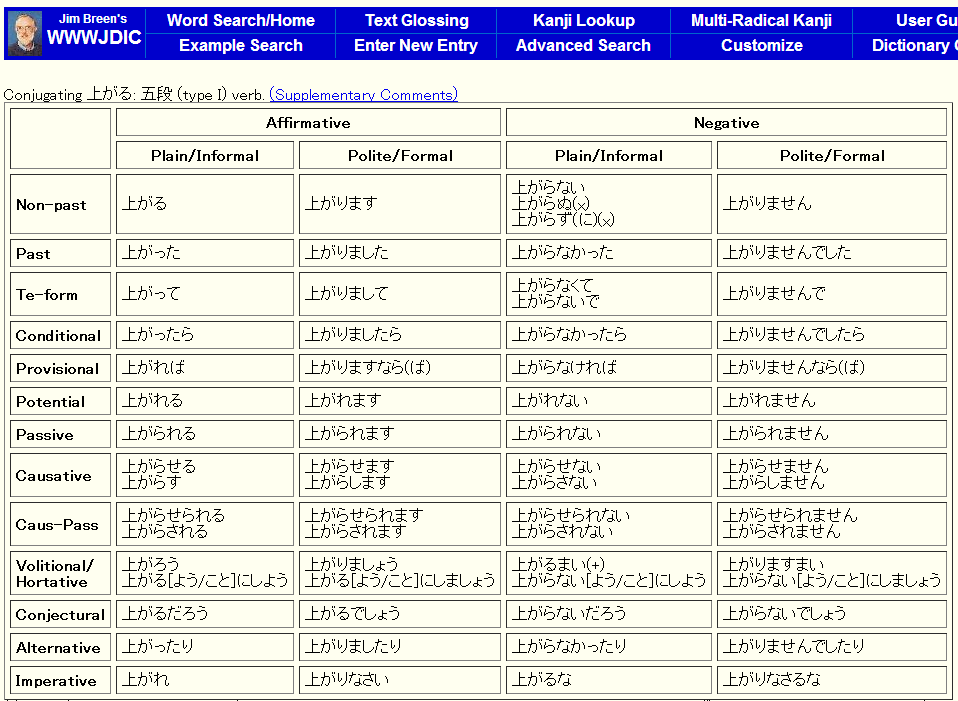
Much like the “Japanese Kanji and Kana” book I reviewed previously, I really don’t understand the purpose of this portion. The rules for verb conjugation are not as complicated as other languages that have a TON of irregular verbs such as Spanish. So really, a simple computer program can do what this book does for any number of verbs not just 600. In fact, there happens to be just such a tool online at WWWJDIC. Just look up a verb in the dictionary and click the [V] link. Not only is it free, it’s far more complete compared to the book and works for almost any verb you’ll ever learn not just 600. Also, this book doesn’t even reach 400 pages including the introduction. I didn’t count each verb to verify but if my math is correct and each verb takes up one page, how in the world does this book have 600 verbs?

Conjugation Chart

WWWJDIC conjugation chart

The tool impressively even conjugates obscure exceptions such as 「問う」 and 「請う」 correctly. Neither of these verbs are even in the book. The only verb so far the tool doesn’t conjugate is 「ある」 because the negative for 「ある」 is an exception to the regular conjugation rule. This brings me to the core flaw in this book.

Memorize the dictionary approach

While the first 28 pages describing various conjugations are informative, it is far from comprehensive. It doesn’t cover tricky conjugations such as 「なさそう」 and it doesn’t highlight important exceptions such as the negative form of 「ある」. It also completely ignores the fact that Japanese is unique in that while the state-of-being is not technically a verb; nouns and adjectives are conjugated just like verbs to express state of being. You are missing a huge chunk of Japanese grammar if you don’t cover state-of-being. In fact, it doesn’t even cover the conjugation rules for the negative, past, or negative-past for any verb. Instead, it only describes a slight change for negative of verbs that end in “u” without actually talking about what the regular rule is. I’ve looked and I can’t find it anywhere.

The book’s introduction is not nearly enough to fully teach you how to conjugate any verb. I get the sense that it only tries to give you a rough idea of how to conjugate and instead expects you to use the rest of the book to look up each individual verb as you encounter them. This approach might work fine for some languages that have tons of irregular verb conjugations such as Spanish but is ill-suited for Japanese. It would have been much more effective to fully teach you the regular conjugation rules and highlight the small number of verbs that have exceptions. In other words, the two sections of the book should have been reversed with the verb lists being 28 pages and the rest of the 350 pages devoted to explanations.

Otherwise, you’re just looking up the conjugation per each verb when the rules are the same over and over again. Also, it’s hardly likely that the verb you’re looking for will be in this extremely short list of 600 or I’m sorry, ummm… 305? verb list. And then when you hit a crucial verb that have exceptions such as ある, you just have to know to pay attention somehow.

Conclusion

Let’s consider these two questions once again for this book.

1) What purpose does it serve?
2) Can something else do it better and/or cheaper?

This book’s purpose seems to be for giving you a general idea of verb conjugation. It tries to fill in the holes with a list of individual verb conjugations and plenty of example sentences. While I like that there’s lots of examples, I just don’t agree with this methodology. Let’s say you see a new verb you’re not familiar with. First, you need to look up how to read it using dictionaries NOT in this book. Once you figure out the reading, you need to convert it to romaji to find it in this alphabetized list of verbs. Finally, there are 3 possible outcomes. The first most likely outcome is that the verb won’t be in this short list. The second is that it’s in the book but it follows the same conjugation rules as every other verb in the language. The 3rd is that it’s a verb with a rare exception that you have to notice even though the book doesn’t highlight it at all.

Either way, the critical flaw of this book is that it doesn’t really teach you how to conjugate verbs yourself. The book’s introduction describing verb forms should have taken up most of the book with a small list of verbs that highlight important exceptions to take note of. And then perhaps exercises to help you practice conjugation. Now that would be a book I would recommend though there is a free website that already does this (you might have heard of it if you’re reading this blog). As it is, this book lists out conjugations for verb after verb that follow the same rules, something a simple and free computer program can already do online.

Unless you can’t use the internet, I would not recommend buying this book. Ironically, most of the introduction, which I see as the only valuable part of this book, is available to preview on Amazon. The rest of the book is not very useful.

http://www.guidetojapanese.org/blog/?p=621
Extensions
My first book of Japanese words review
Reviews
Tuttle Publishing sent me My First Book of Japanese Words: An ABC Rhyming Book by Michelle Haney Brown for review so let’s take a look. Author’s Preface The author’s stated goal of this children’s book is to “introduce young children … Continue reading →
Show full content

Tuttle Publishing sent me My First Book of Japanese Words: An ABC Rhyming Book by Michelle Haney Brown for review so let’s take a look.

Author’s Preface

The author’s stated goal of this children’s book is to “introduce young children to Japanese language and culture through simple everyday words”. I’m not a children’s book expert but the pictures and content look pretty good. My two year-old wasn’t really into it but I can never tell what she’s going to like or not and why.

Don’t use it for its Japanese

If this book gets parents and kids remotely interested in the Japanese language, great. But the book itself won’t teach you much about Japanese. For some reason, the author decided to use the English alphabet instead of the Japanese syllabary. This means some pages with no words such as “X” have an awkward, “Japanese doesn’t have this sound so here’s the Japanese word for Xylophone”. Also, I have some nitpicks like ライオン for 獅子, which people might mistake as the actual reading and かっこう for 学校 which looks like a misprint.

As for how to pronounce the Japanese words, it has a short pronunciation guide for the five vowel sounds and G, R, and F. Not exactly the most comprehensive but it also says to go to www.tuttlepublishing.com to listen to the words in Japanese. That’s the main website for the entire publishing company and I can’t find what they’re talking about. Can’t they put at least a more specific link or maybe even a CD?

Conclusion

You can look inside the book on Amazon to check out the pictures. If it looks good to you as a children’s book, I would say go for it. But don’t expect to teach your kid any Japanese. Personally, I would recommend ショコラちゃんのあいうえお or any of the tons of あいうえお children’s book, none of which are sold here in the States. I wish somebody would publish a real book to teach kids あいうえお here instead of this…

http://www.guidetojapanese.org/blog/?p=620
Extensions
Japanese Kanji and Kana review
Learning & ResourcesReviews
Tuttle Publishing sent me four books to review so without further ado, here we go. The first one on the list is Japanese Kanji and Kana by Wolfgang Hadamitzky & Mark Spahn. According to the preface, this book is useful … Continue reading →
Show full content

Tuttle Publishing sent me four books to review so without further ado, here we go. The first one on the list is Japanese Kanji and Kana by Wolfgang Hadamitzky & Mark Spahn.

According to the preface, this book is useful as “both a textbook and a reference work” and it “serves beginners as well as those who want to look up individual kanji”. So let’s take a look at what purpose this book serves.

Introductory Chapters

The first 68 pages have some interesting information about the Japanese writing system. It describes various aspects of Kana, Kanji, and punctuation. I found this to be the most helpful and informative part of the book. In particular, the 17 structures of Kanji and the rules for writing Kanji were particularly helpful.

It also has all the information you need to teach yourself Hiragana and Katakana. However, I wouldn’t recommend using this book to learn Kana because it has no audio resources to hear the pronunciations. In addition, there are so many better tools online to learn Kana for free, that you don’t really need to get a book anymore to learn it.

You can actually check out most of this information yourself by looking inside the book on Amazon although there currently appears to be an issue with all the Japanese showing up as dots.

Jouyou Kanji List

The bulk of this book from pages 71-376 contain the list of Jouyou Kanji. Each character has the stroke order, radicals, readings, meanings, example words, you know, the usual stuff. This edition has the complete list that was recently revised and even kept some of the really useless ones that were removed such as “pig iron” (銑). (Why???) This brings me to my major complaint. What is the point of this book?

Is this a textbook or dictionary?

If this is a textbook, how am I supposed to use this to learn kana and kanji? There are no pronunciation for Kana, no practice sheets to write with, and no reading material to learn Kanji in context. There are a few tips on exactly two pages such as “Learn the kanji in order”, “Learn compounds with known kanji”, and “Review, and train yourself to read quickly”. However, I don’t see how the contents of this book really help accomplish those goals. And really, learn the kanji in order? Are you kidding me? Might as well start telling people to start learning by memorizing the dictionary. I don’t see how this books helps with learning kanji except as an incomplete and functionally obsolete kanji dictionary. Which brings me to my next point.

The end of this book has 3 indexes to look up Kanji with: radicals, stroke order, and reading (in romaji, ugh). This is how we used to learn Kanji back in the old days when I had to go to school uphill both ways. If you ran into a word you didn’t know, you needed to take EACH character in the word and look it up in a Kanji dictionary by going through a long list of Kanji with the same stroke order or guess which radical was picked to be THE radical. Then try different combinations of multiple on and kun readings in a regular dictionary and hope you got lucky. Basically, for words like 仲人, you didn’t stand a chance in hell of figuring out how to read the word or what it meant.

In today’s world where you can get FREE kanji dictionaries that can do combined multiple radical lookups, stroke order ranges, and even handwriting recognition on any number of devices such as your phone, computer, tablet, and even a Nintendo DS, there is really NO point in having a paper Kanji dictionary. This is especially true for one as inferior as this one with only 2,141 characters. I’ve already written about the trap of “Learner dictionaries” and how the Jouyou Kanji list completely undermines the importance of Kanji outside the list. This dictionary falls into both categories and is likely to fail you pretty early in your studies as soon as you run into a non-Jouyou Kanji and you frantically try to find the missing character and then realizing you need to buy ANOTHER REAL dictionary or silly you, there’s a bunch of free tools online that’s way better and you just wasted your money.

Conclusion

In reviewing any book, I ask myself the following two questions.

1) What purpose does it serve?
2) Can something else do it better and/or cheaper?

This book can be used to teach yourself Kana and act as a Kanji dictionary. However, both of these tasks can be done with superior tools that are free such as jisho.org and kana courses on memrise.com. I assume you have some device that can browse the internet because you’re reading this. If so, chances are, there are better tools out there for your device than what’s offered in this book. The first 68 pages have some useful information but you can also find it elsewhere online for free such as Wikipedia or even my website.

If you want to enjoy the pains of learning Japanese back in the day when we had nothing better, then go for it. Otherwise, I would suggest saving your money. Unless you’re going to a place with no internet and electricity and feel like learning some Japanese. I suppose that’s always a possibility…

http://www.guidetojapanese.org/blog/?p=618
Extensions
Games in Japanese (Updated x3)
Learning & ResourcesMedia
One of my favorite games of all time is Parasite Eve. The story, scary atmosphere, combat, weapons, abilities, everything about it was awesome. So naturally, I was super excited to play the sequel, which I bought off eBay in college. … Continue reading →
Show full content

One of my favorite games of all time is Parasite Eve. The story, scary atmosphere, combat, weapons, abilities, everything about it was awesome. So naturally, I was super excited to play the sequel, which I bought off eBay in college. I got the Japanese version because I was studying Japanese and was kinda hoping it would work on my Playstation (of course it didn’t). So I held onto it for years until I finally bought a PS2 while living in Japan. Man, what a let down. The worst part of the game was the awful Resident Evil style movement. The only other game with a sequel almost as inferior is Chrono Cross.

My gamer creds

My gamer creds

Anyway, now that I can read Japanese, I’m thinking of replaying classics like Chrono Trigger and ones I missed like Mother 2 (Earthbound) in its original form. However, figuring out what game is available and in what language is a big chore and often times confusing.

For example, the JP version of Chrono Trigger for the DS has both English and Japanese. But apparently, they removed the Japanese in the US version. Yes, they went out of their way to remove something already in the game for the US release. I guess because of the strong yen?

Nintendo loves to region lock and everything is locked down except for handhelds up to the DS lite. Unfortunately, that was too consumer-friendly so the newer handhelds such as DSi and 3DS are now region-locked. I guess it makes sense because their last region-free system did terrible (ie, fastest-selling handheld game console of all time).

Thankfully, Sony has seen the light as their products starting from the PS3 and PSP are region-free, which means you don’t have to buy one for each region. However, they have really started to lock down digital content on the Vita, a worrying trend. One annoying problem with Sony is that they switched the X and O buttons around for the US? WHY??? Sometimes with a Japanese game on a US console, you have to press X to confirm until you start the game. Then you have to switch to O until you go to save or quit. Then you have to switch back to using X. Argh!!!

Even with region free systems, while some games support both Japanese and English, unfortunately for the most part, you still have to import the game to play it in Japanese. Some games have dual audio options but don’t allow changing the text which is bizarre to me. In the end, it’s a big and confusing mess so here’s a list of some games you can play in Japanese WITHOUT having to import it from Japan.

Games with full Japanese support

If you have any games that have Japanese language option, please let me know! I like to play games in their original language (English games in English) so I’m more interested in games made in Japan that have dual languages.

Free!
  1. Phantasy Star Online 2 (PC)
    F2P MMO with an option to pay for items. Fans have been clamoring for a US release forever but not a problem for us since we want to practice Japanese! You need to register for a Sega ID and go through all that hassle (or good reading practice if you’re thinking positively). But once you’re signed up, there’s no region lock so just download (takes forever) and play!
  2. 真・女神転生IMAGINE
    If you’re a SMT series fan, you should definitely try this free MMORPG.
  3. sweet ampoule (Android/iOS)
    This developer has a bunch of Visual Novels on Android and iOS for free (yay!). I’m not sure what’s in it for them as I’ve played one (briefly) and haven’t seen any ads or anything of the sort and the reviews look good.
  4. True Remembrance (PC)
    More free visual novels. You can download TRUE REMEMBRANCE and 送電塔のミメイ for your PC.
  5. Imaginary Range

    And also Imaginary Range Ep.2. This is a free interactive comic with various mini-games and items hidden inside the comic. You can change the language to Japanese by changing your phone’s language to Japanese. If your phone doesn’t have Japanese as an option (mine didn’t), you can install this app to force it.

    Not sure about the iOS version. Let me know if you’ve tried have it to verify.

  6. Tokyo Alice

    Another free visual novel. Haven’t tried it yet. Will update with more details when I get around to it.

  7. Akemi Tan, Mad Father, Aooni
    Some indie, free horror games. Brrr. Scary.
  8. ゆめにっき
    Strange, surreal game but not a lot of text so might want to skip.
Not free (shucks)
  1. Killer is Dead
    The language is shown as supporting both text and audio in Japanese.
  2. Resident Evil Revelations (PC/3DS)
    In the PC version, text and audio can be changed to Japanese in settings. 3DS as well though it is region-locked. Haven’t confirmed other platforms.
  3. Asura’s Wrath (PS3)
    I just got this game so I can’t say much about it except that it does have full Japanese voice and text. But I read somewhere that you have to pay extra (DLC) to get the true ending…. ugh…
  4. Resonance of Fate (PS3)
    The text will be in Japanese if your console’s language is set to Japanese. You can select the language for voices between English and Japanese.
  5. Star Ocean: The Last Hope International (PS3)
    Allows choosing between English and Japanese voices, as well as, a larger list of languages for the game text. I just started playing and it looks good for the price. My first annoyance is that ship has too many screen transitions so it takes forever to get around.
  6. The Last Remnant (PC)
    The PC version (not Xbox 360) has both Japanese voice and text options. I only played the very beginning. The graphics are pretty good but the dialogue seems slightly out of synch. Might be just a config issue. You can probably get it for a great price if you wait for a steam sale.
  7. Half Minute Hero: Super Mega Neo Climax Ultimate Boy and the sequel Half Minute Hero: The Second Coming (PC)
    Called 勇者30 and 勇者30 Second on the PSP. I got the first one on sale for $5.99. The Japanese text uses too much Hiragana for my tastes (no spoken dialogue) but it is strangely entertaining.
  8. Ninja Gaiden Sigma and Yaiba Ninja Gaiden Z (PS3 & Xbox 360?)
    I’ve only tested the two but most of the Ninja Gaiden series seems to be dual-language. Need to set your console’s language to Japanese.
  9. Resistance (PS3)
    Need to set your console’s language to Japanese. This kind of game is better in English anyway given the setting and genre but I listed it anyway. Have not tried 2 and 3 yet.
  10. Soul Calibur IV and Soul Calibur V (PS3 & Xbox 360*)
    I have the PS3 version of Soul Calibur IV and it has full Japanese support. According to a comment, the same goes for Soul Calibur V.

    *For XBox 360, according to play-asia, only the US version is region free. So don’t buy the Japanese or Asian version and expect it to work on a US console.

  11. BlazBlue: Calamity Trigger (PS3)
    Has Japanese audio/text if the console’s language is set to Japanese.
  12. BlazBlue: Continuum Shift (PS3)
    This game apparently has Japanese audio and 4 options for the text: English, Japanese, Chinese, and Korean. The limited edition is cheap on Amazon so might be worth checking out.
  13. Tekken 6 and Tekken Tag Tournament 2 (PS3 & Xbox 360?)
    Continuing with fighting games, Tekken 6 and Tekken Tag Tournament 2 has Japanese subtitles if you set your console’s language to Japanese at least for PS3. (Not sure about XBox 360 version though it’s likely the same).
  14. Dragon’s Dogma: Dark Arisen (PS3 & Xbox 360*)
    Lets you change both the text and audio to Japanese via options.

    *For XBox 360, according to play-asia, only the US version is region free. So once again, avoid the Japanese version unless you have a Japanese console.

  15. Vanquish (PS3)
    This game has options to change both the voice and text. Sega in generally has been awesome in this regard. Thanks, Sega!!
  16. El Shaddai: Ascension of the Metatron (PS3/Xbox 360)
    This game doesn’t have full Japanese support but it does allow you to change the voice and subtitles to Japanese for the cut-scenes. The option to change subtitles is at least better than most other titles.

    I only have the PS3 version so not sure about the 360 version.

  17. Recettear (PC)
    This game can be configured to run in Japanese by right-clicking and selecting “Properties” from your steam library. You will then see a tab labeled “Language” where you can set it to Japanese.
  18. Chantelise – A Tale of Two Sisters (PC)
    Steam shows this game to have Japanese for both the interface and full audio.
  19. Fragile Dreams (Wii)
    The Wii is region locked but if you have one already for the US-region, this game apparently has both Japanese audio and text.
  20. Pokémon X and Y (3DS)
    Though the 3DS is region-locked, if you already own one anyway, you might want to pick this up for Japanese practice as it apparently supports 7 languages. However, it doesn’t use a lot of Kanji as it’s targeted for kids.
  21. Persona 4 Arena (PS3/Xbox 360)
    I almost didn’t want to list this on principle because it’s the ONLY region-locked PS3 game. I mean, like the ONLY ONE. It’s lame that they decided to use region-lock but the small consolation is that they didn’t feel scared about putting full Japanese support thanks to the region lock. The content is identical across regions so as long as you buy the game to match your console, it will have full Japanese support.
  22. Square Enix titles on Google play (and maybe iOS?)

    I was able to get Japanese on several Square Enix titles by changing my Android’s phone language to Japanese including Final Fantasy 5 and Final Fantasy Dimensions. (Chaos Ring also has a language option right in the game). The same might be the case for iOS but I don’t have one to test. Let me know if you happen to have a copy of any Square Enix games on iOS.

    If your Android phone doesn’t have Japanese as an option (mine didn’t), you can install this app to force it.

  23. La-Mulana

    Interface labeled as supporting Japanese. Appears to be text only.

  24. One Way Heroics

    Interface labeled as supporting Japanese. Appears to be text only.

Here’s some more I haven’t verified from this link

Battlefield 1943
Devil May Cry 4
Home
Little Big Planet
Lost Planet
Ninja Gaiden Sigma 2
Ratchet and Clank Future: Tools of Destruction
Resurrection
Street Fighter 4

Digital releases

Digital releases that are download-only don’t come with any physical packaging and so require almost no distribution costs. So we should be able to buy all sorts of stuff from Japan right? After all, it’s just virtual 0s and 1s that speed across intercontinental fibre optic cables. Not so fast. Turns out companies still want to control distribution channels across regions, virtual or not. So here’s the breakdown of the usual jumbled mess of various policies and schemes.

  1. Steam

    Here are the list of games that have some degree of Japanese support. Steam now has a very helpful matrix that tells you whether the game’s interface, audio, and subtitles are in a certain language so make sure to check for full Japanese support by looking at both the interface and full audio. What’s baffling are games that were made in Japan like Ys I & II Chronicles+ have absolutely zero Japanese support (though you can hack some of them by messing with some files). Shame on you, XSEED.

  2. Playstation Store
    While the consoles are region-free, your PSN account is not. You must select Japan as your region when creating your PSN account and it cannot be changed. You also cannot buy games on the Japanese store without a Japanese credit card or Japanese PSN cards. You can buy the latter on various sites but expect to pay extra for the service.

    However, once you purchase a game, you can play it on your console for any user on the PS3 and PSP. So for example, I have a US and Japanese PSN account on my PS3 using two different email addresses. Once I purchase a game on one, I can install and play it on the other. However, oddly enough, avatars are tied to the PSN account so even though I downloaded some cool free avatars on my Japanese account, I can’t use it for my US account. There’s no way I’m paying money for those things so oh well…

    The one big exception is the PS Vita which Sony has started to really lock down via updates. What you purchase from PSN has to match the account on the Vita and you can only switch accounts by doing a system reset on the machine. It’s really just unnecessary hassle which you can get around so I really don’t see the point of all this.

    There are also some imports you can buy directly from the US store!

  3. Nintendo eShop

    The advantage of region-lock means that if you have a Japanese 3ds or Wii U, you can buy Japanese games using a US credit card. Buyer beware though, Nintendo’s DRM policy is apparently very strict and you can only have ONE copy of the game on ONE system. So you know how you can play PSN classics on either the PS3, PSP, or PS Vita? So like, wouldn’t it be cool if you can buy a digital copy of Mother 2 on the virtual console and play it on the 3ds? Fuhgeddaboudit.

http://www.guidetojapanese.org/blog/?p=592
Extensions
Some crazy stuff is brewing…
Misc.Personal
It’s hard to imagine but as a kid, the internet didn’t really exist for us common folk. We still had to write letters the old-fashioned way and played with sticks and rocks for entertainment (slight exaggeration here). It’s hard to … Continue reading →
Show full content

It’s hard to imagine but as a kid, the internet didn’t really exist for us common folk. We still had to write letters the old-fashioned way and played with sticks and rocks for entertainment (slight exaggeration here). It’s hard to imagine what it would be like growing up nowadays where your social life’s fate hangs in the balance on closed social network platforms designed to encourage exposing every aspect of your private life so that companies can data mine and monetize you for stock holders. (Yes, I’m getting old and cynical) We now live in a world where a single wrong tweet or photo on facebook can ruin your job prospects or even land you in jail.

But we ain’t seen nothing yet. Governments want to monitor our formerly private but now online lives and intrude on people’s privacy more than ever before and in secret. Massive cyber wars and espionage are now taking place online domestically and abroad. 3D printers are able to print guns and high security keys. Glasses with video cameras will able to record what we see at any time. Shit is going to get real.

You know, I was looking forward to colonizing stuff in outer space, self-driving cars, and cheap, renewable energy, not this social media crap. Yes, all those are being worked on but I doubt I’ll see it in my lifetime. At least I have the Oculus Rift to look forward to.

http://www.guidetojapanese.org/blog/?p=616
Extensions
A few of my favorite things (in Japanese)
Learning & ResourcesMedia
Learning a language is very similar to exercise in many ways. The best type of study is the one that you’ll do regularly. Which is why finding things you enjoy doing in Japanese is so important. So here’s a list … Continue reading →
Show full content

Learning a language is very similar to exercise in many ways. The best type of study is the one that you’ll do regularly. Which is why finding things you enjoy doing in Japanese is so important. So here’s a list of some of my favorite stuff in Japanese.

(Updated with more links and videos)

Good Friends

Things like 鍋パ with friends is a blast. Japanese people actually stop and listen to you when you talk. Something which seems far too rare here in the States.

Music

My favorite Japanese artist is 椎名林檎. I also love the band 東京事変. Please get back together and make more songs!

I’m also amazed at the collaborator efforts of amateurs online such as Vocaloid and 東方.

Movies

タンポポ – Oh man, this film is so awesome. Just watch it.

Other films I liked:

Departures
After Life (ワンダフルライフ)
Sanjuro – My favorite Akira Kurosawa film.
Man, Woman & the Wall – Creepy, sexy, funny (not for kids)
Trick (TV series and movies)
The Great Happiness Space – Not really a Japanese movie but still a fascinating (and disturbing) documentary.

Is it just me or do Japanese movies all seem like either art films or crazy horror?

Books

I definitely need to read more books so please give me some suggestions! Of the very small number of books I’ve read, I liked:

涼宮ハルヒの消失 (my favorite out of the series)

Manga

Dragon Ball – I first read this in Korean back when manga was virtually non-existent in the US. I didn’t really know what was going on but it was still awesome (by the way, my dream job was to work at a 만화방). I also watched Dragon Ball Z in English on Adult Swim (Vegeta’s voice was pretty good). I have since read parts of it again in Japanese, and it’s still good, after all these years.

Others I enjoyed:

One Piece
Azumanga Daioh

Anime

攻殻機動隊(Ghost in The Shell) Stand Alone Complex – My favorite anime of all time.

Others I enjoyed:

Serial Experiments Lain
Soul Eater
Darker Than Black
Steins;Gate
涼宮ハルヒの憂鬱 (Melancholy of Haruhi Suzumiya) Season 1
Spirited Away

Games

My first Japanese console is a PS2 so I have not played that many games in Japanese. I am meaning to replay classics like Chrono Trigger in Japanese when I get my hands on it. Until then, of the limited games I’ve played so far in Japanese, I liked:

逆転検事2 – The story is brilliant.
MG3 Snake Eater – Metal Gear Solid is my favorite in the series but Mei Ling’s English voice was annoying. Hoping to try it in Japanese sometime.
Disgaea (haven’t gotten to 2,3,4 yet)

What’s on your favorite list?

http://www.guidetojapanese.org/blog/?p=596
Extensions
This is pretty much racism…
CultureKorean
For crying out loud, I don’t want to write about political BS on my blog but this is just too ridiculous. Here’s a news article about a Korean textbook that had pictures of Japanese people in it. OH MY GOD! … Continue reading →
Show full content

For crying out loud, I don’t want to write about political BS on my blog but this is just too ridiculous. Here’s a news article about a Korean textbook that had pictures of Japanese people in it. OH MY GOD! Somebody needs to go to jail for this!! The kids might think Japanese are like normal people with families and stuff!!!

OMG, real people!

OMG, are these guys like real people?!

I mean, seriously this article is pure racist garbage. The article uses words like “문제” (problem) and “실수” (mistake). Imagine if a textbook in the US had a picture of a German family instead of an American white family. Guess what, we won’t give a shit because WW2 is like a lifetime ago and most of the people involved are almost all dead from at least old age. On the other hand, Korean automatically take this is a “problem” and a “mistake”.

The last line in the article is pure gold. It’s some bullshit about how elementary school textbooks are for teaching a proper and happy lifestyle to 870,000 kids.

초등통합교과서는 기존의 바른 생활, 슬기로운 생활, 즐거운 생활 등 3개 과목을 합친 것으로 1, 2학년 87만 명이 사용한다.

What is this insinuating? That the Japanese are the devil that will somehow corrupt kids just by basically existing??

Korea, your obsession with hating Japan is ridiculous. If you weren’t personally harmed by the occupation, it’s time to let it go. (psst… by the way you have a slightly larger problem just slightly to the north)

PS I’m Korean.

http://www.guidetojapanese.org/blog/?p=609
Extensions
Buying Japanese import games
Learning & ResourcesMedia
I’ve been taking a break from the website these past few months to get back into video games. I’ve been buying a lot of import Japanese games I missed out on when I stopped playing games in college (couldn’t afford … Continue reading →
Show full content

I’ve been taking a break from the website these past few months to get back into video games. I’ve been buying a lot of import Japanese games I missed out on when I stopped playing games in college (couldn’t afford it). Unfortunately, I should have done this while I was living in Japan because buying import games can get expensive but really I was too busy at the time with stuff like you know… living in Japan!

But you know what my pet peeve is? People bidding up used games I wanted to buy past the price it would cost new on amazon.co.jp! Look, don’t bid $40 for a used game you can buy new for 3,000 yen. Since the yen is finally down to reasonable levels, let’s buy some games direct in Japan!

For example, instead of paying $39 for Final Fantasy Type-0 on play-asia or for $45 USED on ebay (duh), let’s buy it for about 30 bucks NEW on Amazon Japan using these (not so simple) steps.

  1. Create an account on tenso.com, a forwarding service that gives you a Japanese address you can ship items to. There are other potentially cheaper services but I found that this one was the cheapest for EMS, a really fast way to get your stuff with tracking (let me know if there’s a better service). There’s a link to the English version of the site on the upper-right.
    *Due to some new law in Japan or something, you may have to upload an image of identification with your name and address. No big deal, I just uploaded a picture of my driver’s license on the website.
  2. After you sign up, you should get an email with your new Japanese address. You’ll need that later obviously. You can also check it on their website.
  3. Search Wikipedia for the game so that we can get the Japanese title (right next to the English title in parentheses).
  4. Go to amazon.co.jp and copy+paste the title into the search box (in this case ファイナルファンタジー 零式). There’s a tiny link “In English” at the top right to get the English version of the site. None of the product information will be translated but it may help you for creating an account and checking out.
  5. Select the game you want (It’ll have the console name next to the price so you know you’re not getting an artbook or something). I’m gonna pick the budget ultimate hits version because screw em. I bought the first print of 3rd birthday only to find the bonus DLC had an expiration date like 2 years ago. WTF
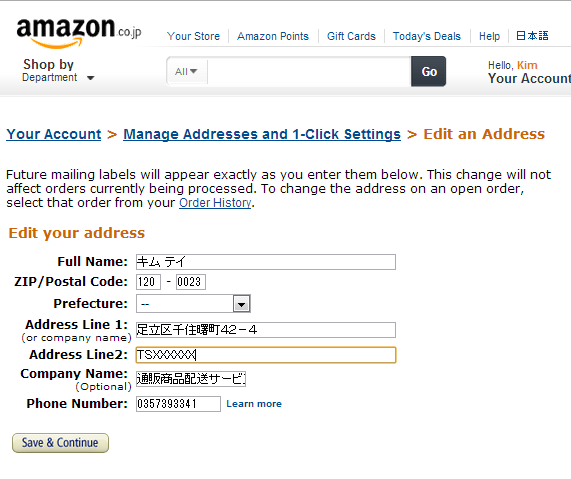
  6. Go through the usual checkout process. Amazon will take care of the currency conversion for you. The only trouble I had was fitting the massive forwarding address within the maximum length requirements. Here’s how I arranged it so that it all fit.

    Amazon forwarding address

    Fitting the forwarding address is a bit tricky

  7. You should get an email once the order arrives at tenso and you can go to their website to pay them to then forward it to you. I paid with my credit card via Paypal to avoid a foreign transaction fee.

There’s a shipping calculator on the bottom of the page on tenso.com. If you put the weight of a PSP game (about 170 grams), you can see that it will cost about 1,690 yen to ship.

So about $23 for the game and $18 for shipping means you pay $41 for a new game. Wait, isn’t that MORE than play-asia? Yes but usually, you want to save on shipping by buying in bulk. For example, I bought 3 PSP games and paid about $24 on shipping so only $8 for each.

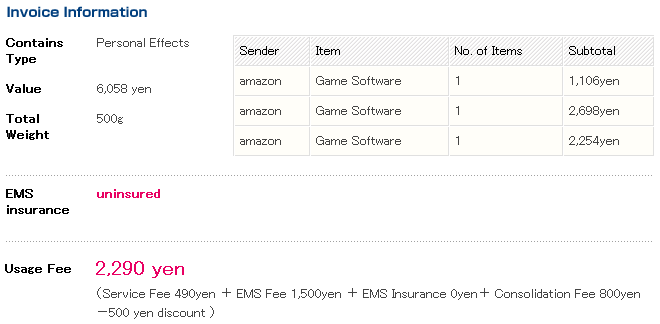
Tenso invoice

In retrospect, I should’ve bundled more games for even more savings. By buying in bulk, I can usually get it down to around $5 per item.

Also, try to pick items that ship from amazon so that they can send all the items together. Tenso.com can consolidate multiple packages for you one time only (and you should for multiple packages) but they will charge a consolidation fee depending on how many packages need to be consolidated.

Why don’t they localize more of these games?

I wish they would as it often drives down the demand for people like me that actually want the Japanese version and not simply because it’s the only one available (perfect example is Mother 3).

I got a Chinese copy of Jeanne D’Arc off ebay, which would have really pissed me off except the game itself is completely in Japanese. Only the cover and manual are in Chinese. Weird, I’m not sure how that really makes any sense but I guess Chinese people are flexible enough with English and Japanese to deal with it??

On the other hand, Americans complain like babies if they have to, god forbid, read any subtitles, which is why everything has to be dubbed often with disastrous results. If people say they prefer the Japanese voices, they get comments like, “OMG, why would you want to READ the dialogue??” and get called stupid stuff like “weeaboo”.

Take Final Fantasy XIII for example. Which do you think cost more? Throw in some Chinese and English subtitles for the Asian release and call it a day? Or hire all new voice actors to redo all the voices, redo all the animation to synch up the lips, and do a crappy Xbox 360 port on two discs for the US release?

http://www.guidetojapanese.org/blog/?p=603
Extensions
Saturday morning
Koreanプチポスト
It’s allergy season and my nose has been acting up. This morning, my almost 2-year old daughter pointed at my nose and said, “hana”. I replied, “Yeah, hana.” She replied, “One, two.”
Show full content

It’s allergy season and my nose has been acting up.

This morning, my almost 2-year old daughter pointed at my nose and said, “hana”.

I replied, “Yeah, hana.”

She replied, “One, two.”

http://www.guidetojapanese.org/blog/?p=602
Extensions
I blame facebook
PersonalTechnical
So long, Google Reader, we’ve had a good run. Along with iGoogle, Google is systematically killing how I organize and consume information on the Internet. They claim they are culling the less popular products but make no mistake, this is … Continue reading →
Show full content

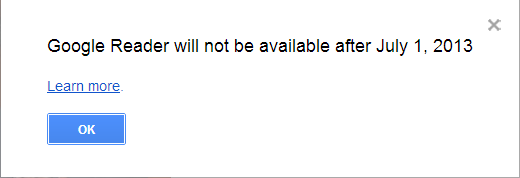
google_reader

So long, Google Reader, we’ve had a good run. Along with iGoogle, Google is systematically killing how I organize and consume information on the Internet. They claim they are culling the less popular products but make no mistake, this is a deliberate ploy to get more information about you (and hence more money). I don’t like Google+ and Facebook because they are very invasive, constantly trying to find out about my personal relationships. I have no interest in disclosing my personal information and activities offline to the rest of the world. And the rest of the world isn’t interested in what I do offline either except for, of course, advertisers.

But hey, nothing in the world is free, eh? The price of getting information is selling information, in this case, about yourself; information that can be all too easily leaked via security holes.

http://www.guidetojapanese.org/blog/?p=599
Extensions
A year and 300+ words later…
AdvancedLearning & ResourcesVocabulary
Wow, it’s been over a year already since I started tweeting a new word a day (almost daily minus weekends). So 300+ words later, let’s take a moment to reflect. Looking back, it’s kind of shocking how many words I … Continue reading →
Show full content

Wow, it’s been over a year already since I started tweeting a new word a day (almost daily minus weekends). So 300+ words later, let’s take a moment to reflect.

Looking back, it’s kind of shocking how many words I didn’t know. But then again, I’ll probably feel the same way looking back at the next 300 words I learn. For example, I tweeted 「処方」 back in 2011/11/2 and I had a Skype conversation (via mixxer) recently with a 「薬剤師」. I can’t believe I didn’t know those words till last year.

I also recently remembered 「男尊女卑」 and I see that I tweeted this way back in 2011/11/11 so I’m pretty happy about that.

I always learn new words in context and so I got to catch up to quite a bit of culture by searching for additional usages online. These words originally come from books I’m reading (huh? you mean on dead trees?), chatting locally and online (wha? like with… people?), games, shows online (Hulu/Youtube), and various podcasts.

For example, I learned the expression 「二進も三進も」 while playing FF13 (I used my phone to save the word). Much later (in this case several months), I look for other stuff online from my list that uses the same vocab like this.

Catching up on culture

Here are some highlights from my Twitter feed.

そばかす – Song from the 90s
(Lots of) Vocaloid and 東方 music
SKE48, AKB48
ニコニコ
Minecraft
Anime
Manga
TV
Weird commercial
Politics
2012 was a leap year

Looking back, 300+ words is actually a pretty small list. I still have over 600 stocked up that I have learned to various degrees in the last year. Us language learners have to do a lot of memorizing. 🙂

I feel sorry for those learning from just flash cards, classes, and textbooks. Real life is so much more interesting.

http://www.guidetojapanese.org/blog/?p=588
Extensions
Don’t README
Learning & ResourcesMisc.
This post is about how you shouldn’t be reading this post. Still here? Tsk tsk. Lately, I’ve been wrestling with the ratio of how much English vs Japanese to use in my guide. The more Japanese I can get you … Continue reading →
Show full content

This post is about how you shouldn’t be reading this post.

Still here? Tsk tsk.

Lately, I’ve been wrestling with the ratio of how much English vs Japanese to use in my guide. The more Japanese I can get you to read, the better. But if there’s too much, it will be too difficult and overwhelming, having the opposite effect.

I’ve noticed that many websites for learning Japanese use WAY too much English. You can spend hours reading pages and pages of English text on how to learn Japanese (which seems ironic to me). This blog is mostly in English as well, so really, you should stop reading this and spend your time on something more productive.

I’ll try to keep it short, then. If your Japanese study material consists of reading a lot of English, you might want to try something else that has more Japanese text. Oh, I dunno, maybe something like this? (I know, totally no bias here).

As a fellow Japanese learner, I should probably be writing this in Japanese too… でも、めんどくさいからやめとこう。

http://www.guidetojapanese.org/blog/?p=584
Extensions
Best site for learning Japanese
PersonalTechnical
What do you think is the best site for learning Japanese (excluding dictionaries)? Earlier this year, I’ve been trying to add more content and tune my site to rank higher for searches on “learning japanese” not just “japanese grammar”. (You … Continue reading →
Show full content

What do you think is the best site for learning Japanese (excluding dictionaries)?

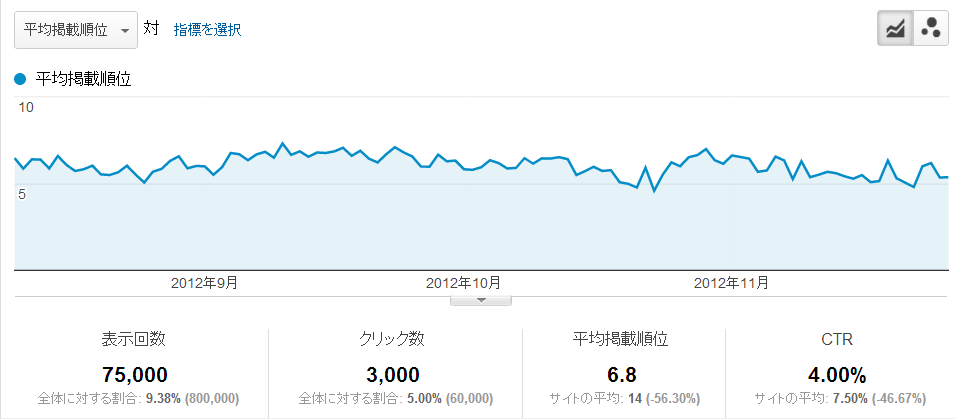
Earlier this year, I’ve been trying to add more content and tune my site to rank higher for searches on “learning japanese” not just “japanese grammar”. (You can compare which searches are more popular with Google Trends). When I did some ad hoc testing at the time, it ranked somewhere around the 40-50s.

I still have quite a bit of work to do on the content side but here’s the results from the last few months. Unfortunately, the data doesn’t go back farther and it’s not representative as over half of the search queries do not provide the search keyword (unless I become an adwords customer apparently). As it is, the site ranking has been improved to an average of 6.8.

I expect the CTR to be miserable until the site ranking goes up to at least around 3-4. Lately, I’ve been concentrating on my own studies, but I’d like to eventually get back to working on the complete guide soon. In the meantime, if you think my site is useful for learning Japanese, any inbound links with the phrase “learn Japanese” would be appreciated.

Oddly, the most common search query was “katakana”, about 2-3 times more impressions than “learn japanese” and “hiragana”. I wonder why? Maybe I should beef up my Katakana sections?

Research indicates that page load time is also critical for traffic. So I also installed Boost for my drupal installation to speed things up a bit yesterday. The results are inconclusive but it does seem a bit snappier to me.

http://www.guidetojapanese.org/blog/?p=581
Extensions
Anki 2 review
Learning & ResourcesReviews
So since I did a review of Anki, it seems only fair that I revisit it now that Anki 2 is out. I’ve been using it for the past few weeks and my overall impression is that things have improved … Continue reading →
Show full content

So since I did a review of Anki, it seems only fair that I revisit it now that Anki 2 is out. I’ve been using it for the past few weeks and my overall impression is that things have improved significantly.

Overall, the look and usability have been greatly improved. There is no longer a popup per deck, which is great because popups SUCK. Though browsing a deck is still a popup, it’s not as annoying as Anki 1. AnkiDroid is much better as well in that it’s actually usable now. Before, it would crash on my phone at least once basically every time I’ve used it. In addition, Synch can now actually SYNCH (ie “synchronize” not just whack one set of changes with another).

I would highly recommend upgrading though the upgrade process hosed all my old decks (don’t know if this is just me or a common issue). It’s much better once you get everything setup. However, I must warn you that getting setup initially is very confusing. The UI can still use a lot of improvement in that regard.

  1. No menu option to login. You do this by synching for the first time, which also doesn’t have a menu option. You have to use the icon on the top-right. Not very obvious.
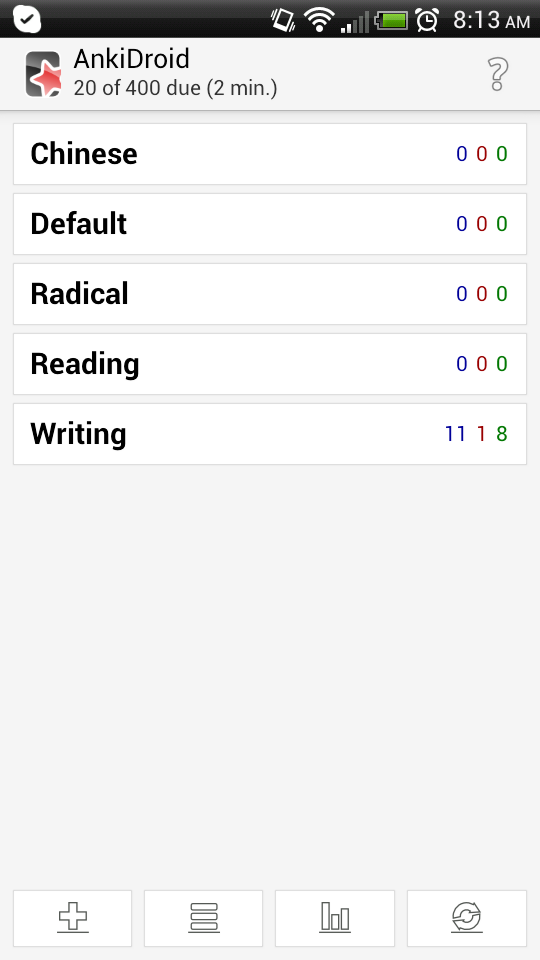
  2. Do not use the Default deck! It disappears when you add another deck. As you can see, the Default deck is nowhere in the desktop app even though it appears in AnkiDroid.

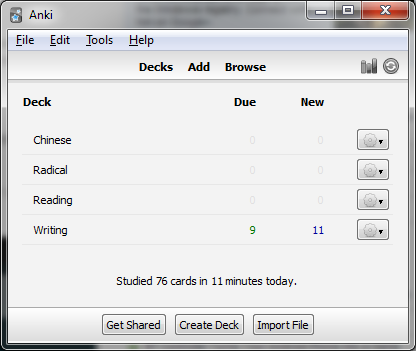
    Anki 2 Screen Shot

    AnkiDroid 2

  3. “Full synch” is a misnomer. What it means is basically, scrap everything I have locally, and replace it with what’s online. This caused me to lose my changes several times before I realized what was going on. This should be called “Reset”.

Once you get over the initial confusion and get all your decks setup and ready to go, it’s not too bad.

You may be wondering, didn’t I recommend against using SRS? Well, while I still think it’s an inferior way to memorize things, I have to admit, it’s nice to have something to study when I’m waiting in line at the grocery story or whatever. I don’t have much time nowadays to sit down with a book or watch a show so it’s a convenient way to review something when I have a few minutes to spare. Also, I was previously using iGoogle, which is going away, so it’s also a convenient way to store interesting words to share on twitter or facebook later.

By the way, my main deck had only one side and it completely failed to migrate over to Anki 2. Obviously, I’m not using it like most people. 🙂

http://www.guidetojapanese.org/blog/?p=577
Extensions
Finding time in a busy life
Learning & ResourcesPersonal
I must confess, I’m a pretty fickle person. I usually start work on something, ignore it for a long time, and come back to it when it’s fresh and exciting again. I’m sure some of you have noticed long periods … Continue reading →
Show full content

I must confess, I’m a pretty fickle person. I usually start work on something, ignore it for a long time, and come back to it when it’s fresh and exciting again. I’m sure some of you have noticed long periods of neglect on certain projects of mine (such as this blog). As it is, it’s pretty much impossible to work on everything I have going on at the same time with a (completely unrelated) full-time job and a family. I could decide to just work on a single thing at a time but since Japanese is my hobby, I have no obligation or inclination to work on anything unless I feel like it.

Lately, my speaking has been getting very rusty so I’ve been trying to find a conversation partner via mixxer. However, I found out that the west coast is pretty much the worst in terms of time difference for conversing with people in Japan. Also, most of my activities are done in small spurts, 5-10 minutes at a time (like this blog post) so allocating a contiguous block of time is difficult.

On the other hand, I’ve also been reading/listening a lot and learning tons of new vocabulary. I probably learned hundreds of new words and expressions in the last year. These include words in my twitter feed and more such as: うなぎのぼり、くまなく、鬼が出るか蛇が出るか、甚大、にっちもさっちも、もどかしい、色白、往生際、大往生、雑然、しらばくれる、張り子の虎、森羅万象、波乱万丈、前途洋々、後悔先に立たず. So how much has this improved my speaking?

Not one iota, zilch, nada, zip
まったくまるでぜんぜんちっともこれっぽっちも

So don’t fool yourself into thinking studying hours and hours with classes, dictionaries, and books will enable you to speak Japanese.

Anyway, my (admittedly poorly-made) point is that while you might not have as much time as you’d like to devote to something, the important thing is to do as much as you can and to get enjoyment out of it. I listen to podcasts on my commute and read things online here and there whenever I have the chance. This morning, I learned the word for fuse (信管), reading this short article. This word in particular took no effort to remember because I know the kanji and it’s a memorable combination (“a pipe I believe/rely on” = fuse).

What did you learn by doing what today?

PS: Lately, I’m totally addicted to Disgaea. It’s evil. Even though the game is in Japanese, even I have to admit that the education value vs time spent (wasted) is extremely low.

http://www.guidetojapanese.org/blog/?p=574
Extensions
プチ嬉しい
Personalプチポスト
This made my day. 🙂 No way to respond, though. Maybe I’ll respond in my next submission. It’s getting really hard to find words not already in edict though nowadays. Jim, I hope you live forever, man. You’re awesome!
Show full content

This made my day. 🙂

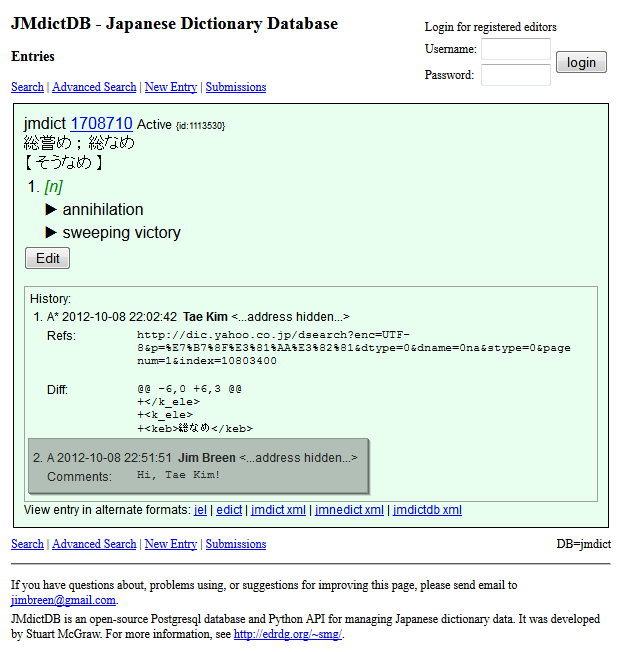
Hello from Jim Breen

No way to respond, though. Maybe I’ll respond in my next submission. It’s getting really hard to find words not already in edict though nowadays.

Jim, I hope you live forever, man. You’re awesome!

http://www.guidetojapanese.org/blog/?p=570
Extensions