I don’t usually do play reports, but what the heck … I discovered that the youngest Henchling had invited his friend over (his friend’s older brother decided to come along too) to play D&D (well AD&D 1e) over the Easter break. The other Henchling, FOMO, decided that they wanted join in. The catch was, I […]
Show full content
I don’t usually do play reports, but what the heck …
I discovered that the youngest Henchling had invited his friend over (his friend’s older brother decided to come along too) to play D&D (well AD&D 1e) over the Easter break. The other Henchling, FOMO, decided that they wanted join in. The catch was, I found out that I was DM-ing, that we were playing tomorrow at 12pm and that my services were required for about 2 hours.
Flooding Complex
I scratched my head and remembered I had written a sort of puzzle dungeon (LINK) a few years ago, a dungeon designed to disorientate, and that was flooding to add some time pressure.
So, I went with that (with some tweaks), and decided to use 4 of the PC’s (picked at random) from my Carapace adventure:
These PCs were: Ganther (fighter; top left), Thanic (cleric; bottom left), Willan (magic-user; top right) and Han (Fighter/Magic-user; bottom right) – all about 5th level.
When I wrote this puzzle dungeon back in the day, I had a plan in mind, and I won’t lie, the dungeon played out how I envisaged, well near enough.
Dungeon Concept
The key concept here is that 3 of the rooms look nearly identical (left, right and bottom rooms) and there is a rotating corridor that links them. So, as the PCs explore the place, they might first think they are going in circles (which they sort of are).
Play report
OK, here is how it played out:
Prelude – I cut to the chase, they had a map and it had led them to a remote zigarat, where a tunnel in the zigarat led them to a darkened room, with a lever at the far end. I knew the oldest kid liked to be reckless, especially near the start of the dungeon, so sure enough he immediately pulled the lever. The floor collapsed and dumped them into the flooding complex:
Here’s the puzzle dungeon set up:
The PCs start in a big room, much longer than it is wide. Above is the hole they fell in from but is now blocked by rubble, although water is still gushing in. Left and right are rectangular door-like openings, but these are about 6 feet up off the ground. These door-like openings also have a waterfall like flow of water coming out of them. On the wall behind is a locked portcullis. In front is a wall with a circular shaped exit – careful inspection will show that around the circular exit are faded carvings depicting the large coils of a giant serpent (just coils, no serpent head).
Action 1 – the fighter Ganther decides to try Bend Bars Lift Gates on the portcullis on the rear wall, needing a 13% or lower on a percentile. They roll a natural 100%, which in this case is the biggest fumble possible. Joy is replaced by deflation. I decided that Ganther had wedged and jammed the portcullis in an nearly impossible position to open again, and in the process they have dropped an item through the portcullis (a magic tinder box that always allows them to light fires).
Here is the rest of the complex for context:
Action 2 – the party decided to inspect the elevated door-like opening on the left hand side using a magic item (a portable ladder):
They follow a passage running from this door-like opening that leads them to a room. This room like all the rooms now is misty with water vapour and partly flooded.
The players are now confused because this room (Room 2) looks just like the room they just left (Room 1, start room). To the players, it looks like they have just entered room 1 via the portcullis on the rear wall. Of course this does not seem possible, not least because Ganther jammed it shut with his fumbled BB/LG roll, and because Ganther left behind his magic tinderbox behind that portcullis (which of course is not anywhere to be seen).
Incidentally, each time the PCs enter a room, I topped up a large glass with water, to symbolize the flooding of the complex. The players correctly deduced that when the glass is full of water, the complex will be sufficiently flooded that the PCs all drown. A pressure timer of sorts.
Before the PCs could orientate themselves, they had to fight 4 lizard men who had been hiding low in the water until then. They succeeded in killing them, burning some resources, spells etc. in the process. The PCs decided to exit the room via the round exit, but find it blocked this time. It was of course blocked because the rotating corridor is in the N-S axis.
Action 3 – the party backtracked to the start room (Room 1). Again the players are confused. There are no lizard men bodies, and the portcullis on the rear wall has been jammed in place (by Ganther). This time the fighter Ganther decides to collect his magic tinderbox that was within reach behind the jammed portcullis all along!
They also noticed that the circular exit is open.
Action 4 – The PCs decide to go through the circular exit.
For context, the whole complex is now filled with mist, water vapour from all the water pouring into the complex, all this water poring in is also causing the walls to vibrate (PS – these vibrations help to conceal the rotating corridor’s movement).
Unbeknownst to the PCs the rotating corridor rotates as they move down it, going from the N-S axis to the W-E axis, this rotation is triggered by crossing the halfway point.
Again the players are confused because this room (Room 3) looks identical to the last two rooms. But, they noticed that the portcullis at the far end is slowly closing. So, they bolt for it, making it just in time for the portcullis to close behind them.
Action 5 – they follow the corridor that is after the portcullis, and find themselves back in the start room (Room 1), but this time entering via the elevated door on the right hand side.
They climb down into the start room (Room 1) and discover that the circular exit is now closed off (because the rotating corridor is now in the W-E orientation). The Players figure there is no point going back the way they just came, because the portcullis closed behind them. So, they try to levitate up to inspect the hole they fell into the complex from, but that way is blocked by rubble.
When I wrote this dungeon, I imagined more of a long bending water slide that would be nearly impossible to wiggle your way back up. But, for kids this was a simpler explanation.
Action 6 – The PCs decide to once more go down the raised up left-hand door-like opening.
Again they returned to Room 2. Now the players fully sense that something is up, and the rooms are not the same, not least because there are four dead lizard men in this room, which are not in the other rooms. They find the circular exit is now open (the rotating corridor is now in the W-E orientation). This time they look more closely at the wall housing the circular exit and see that this exit is not decorated with the coils of a giant snake, but rather with a single giant Eagle-like wing.
Action 7 – they decide to go through the circular exit.
The corridor rotates and returns them to the start room (Room 1). They noticed that the wall housing the circular exit is back to being decorated with giant snake coils, and there are no dead lizard men.
Action 8 – they decide to go back through the circular exit.
Going through the circular exit takes them back to Room 3 again. The rotating corridor once more resets the portcullis, and triggers the portcullis at the far end to once more slowly close. This time the Players do not take the bait, and their PCs do not run through the slowly closing portcullis, they let it close. The PCs also realise that the wall housing the circular exit is decorated with a single giant bird wing again, but this time the wing is located on the other side of the circular exit.
Action 9 – they decide to go back through the circular exit.
… and just in the nick of time as the glass water timer was nearly full.
This time they find themselves in a new looking room, one with 4 x Lizard Men and a Water Naga.
Incidentally, this exit depicts the maw of a giant snake around the exit. For context the decorations around the 4 x circular exits depict a Couatl as seen from above.
Round 0 – The PCs are surprised but the monsters are not surprised. The lizard men run to attack, the Naga casts darkness around itself.
Round 1 was eventful, the PCs lose initiative, the magic user (Willan) who was in the process of (rather recklessly) casting fireball gets hit by a lizard man and loses the spell (his only 3rd level spell) and the Naga casts Mirror Image (but as luck would have it, they only generate one mirror image of themselves).
They fight for a bit, the lizard men are killed, the magic user is nearly killed a few times but the cleric does their healing thing. The fighter wastes a natural 20 critical hitting the mirror image. Naga magic missiles a bit, getting 4 magic missiles per spell. The magic user (Willan) manages to pepper the Naga with darts here and there until they run out of darts.
On the penultimate round (or perhaps the round before that) the Naga strikes the fighter (and tank) Ganther with a lightening bolt, taking them into negative HPs. Again the cleric manages to patch him up.
At this point, I’m thinking TPK, TPK, TPK, and start softening these kids up for the idea they might not win this fight. Thinking how are these kids (ages 13 to 9) going to handle their first TPK …
The Fighter/Magic-user (Han) has gone invisible the last round and has snuck round the back of the Naga to attack from behind. The (true) magic-user (Willan) is out of dart-ammo and charges in to attack in hand to hand combat. Ganther the fighter, now on single digit hit points, goes all in too.
Final round. Fighter/Magic user appears out of nowhere and hits, disrupting the Naga’s spell, the cleric Thanic (who has been defensively healing until then and is now out of healing, and has missed every other combat attempt they have tried to date) lands a hit and takes the Naga to zero HP, technically the Naga is dead, but Ganther still has their attack roll and also lands a literal hammer blow (with +3 damage) to take the Naga to beyond -10 HPs, which is a nice touch.
!! Victory !!
(no TPK, phew – I promised these kid’s Mums that these kids would have fun!)
I came across the below highlighted text in Jorge Luis Borges’ The Book of Imaginary Beings: Borges seems to believe that while the writing became fancier over time, the vibe was lost. Why, because of the lack of belief in the thing itself. Monsters became a writing exercise. I sometimes wonder why the writing and […]
Show full content
I came across the below highlighted text in Jorge Luis Borges’ The Book of Imaginary Beings:
Borges seems to believe that while the writing became fancier over time, the vibe was lost. Why, because of the lack of belief in the thing itself. Monsters became a writing exercise.
I sometimes wonder why the writing and certainly the imagery in newer editions of D&D feel somewhat soulless.
Are monsters no more than game tokens to fight?
As a kid I so wanted the Minotaur to be real. My suggestion (for what it is worth) is that you write and art* like the monsters are real. I think the audience will tell the difference.
Sure, at the table things can become real in the imagination of the players, but why not start there with the written text, start right in the mind of the reader, in the mind of the Game Master.
Is this just, it was better in my day kind of stuff?
(click on me to see my Stat Block)
* – of course, this does not mean art needs to be photorealistic, perhaps even the opposite
EDIT – Reddit can be a good place to test your ideas. As a point of clarification, this post is not a defense of the TSR era writing style, but instead it is a look at modern D&D and arguably it’s lack of soul. On the face of it, old D&D was often badly written often using archaic language; and by comparison 5e era D&D text can be well polished and read well off the page. This post is about writing with (more) soul, and so perhaps how we can do our best when writing.
I’ve also changed the bottom image to remove the Stat Block …
I have no idea if anyone out there in internet land might find this useful. Kids Lego Solar System project Here’s an Excel grid layout if that helps: Scale – all planets have been scaled proportionally to where Mercury is 1 Lego ‘pip’. Obviously, the smaller planets have the biggest ’rounding’ error. In the top […]
Show full content
I have no idea if anyone out there in internet land might find this useful.
Kids Lego Solar System project
Here’s an Excel grid layout if that helps:
Scale – all planets have been scaled proportionally to where Mercury is 1 Lego ‘pip’. Obviously, the smaller planets have the biggest ’rounding’ error. In the top image, some of the edge blocks have been removed to make the planets look a bit rounder. I think, when we made this from the plan above, we pruned the size of Saturn a tad, to allow us to make the rings of Saturn look bigger and so that we did not get too close to Jupiter when we did this.
The Sun is so big it is represented as the yellow vertical line on the far left.
There has been no attempt to space out the planets proportionally to their distance from the Sun. And this would probably look better if you added more 32 x 32 Lego mats to spread out the planets and if this were done on black Lego mats.
EDIT – Might also make an interesting magic item property random table From a project that I will probably not take anywhere, so instead of binning here it is: Here is the PDF if want it Also, as a sort of D20xD20 spark table Or, try it out on this Perchance tool, Actually, combining any […]
Show full content
EDIT – Might also make an interesting magic item property random table
From a project that I will probably not take anywhere, so instead of binning here it is:
Here is the PDF if want it
Also, as a sort of D20xD20 spark table
I’ve only just learnt about Sicherman Dice One die has sides 1, 2, 2, 3, 3, 4 and the other has sides 1, 3, 4, 5, 6, 8 What is fun, is when you roll and sum these two dice they have the same probability profile as rolling and summing normal 2d6 (peak at 7, […]
Show full content
I’ve only just learnt about Sicherman Dice
One die has sides 1, 2, 2, 3, 3, 4 and the other has sides 1, 3, 4, 5, 6, 8
What is fun, is when you roll and sum these two dice they have the same probability profile as rolling and summing normal 2d6 (peak at 7, low at 2 and 12).
Is this got any use in gaming? Mainly no, except perhaps a few things no one will ever use …
The chance of rolling doubles on Sicherman Dice drops from 1 in 6 to 1 in 9. So, in games where rolling a double might trigger an event it could change things up?
Ktrey of the D4 Caltrop blog fame on BlueSky made a fun and funny remark about what a d66 table might look like using these.
After the LOL-ing, I got wondering about this:
On the left you got a standard d66 (all results are equal – all dark blue and all have a value 1) but on the right you have a Sicherman Dice d66 table (where instead of 6 you have 6+). As you can see in the Sd66 table nearly half the options are gone (red) and some results are more common (darker blue):
Is this interesting, is this gameable? Just a little, and mostly no. But … here’s one way:
You might be able to use a normal d66 table for random encounters e.g. a Hex Crawl, but flip over to using the crazy Sicherman Dice (using the same d66 table) when the PCs get near the monster’s lair, e.g. near the dragon’s lair, where:
Dark Blue = Dragon
Medium Dark Blue = … Dragon’s henchman?
Light Blue = Monsters chilling in/near the dragon’s Lair
Red = everything not living in/near the lair because their not stupid
So, using the same table, suddenly by changing dice the chance of a dragon or dragon-related encounter increases a lot.
Ok, it’s a bit a niche, and you need to own the crazy Sicherman Dice. But, maybe someone out their in internet land will think of something better.
In case you are wondering, I’ve bought myself a set of Sicherman Dice (hopefully arriving soon).
This video is fun and considers other polyhedral dice combos for Sicherman Dice:
Game MechanicHex FlowerPublicationSelfai-generalfantasyfictiongaminghexhex-mazehexflowermaze-runerpac-manpacmanrpgttrpgwarhammerwarhammerfantasy
EDIT – Individual images: I’ve decided to keep this page for the mile stone updates, making collages. If you want to see the individual images, please see here LINK I bought this broken down, split spine, board separated, sorry state AD&D 1e Monster Manual: The idea is that I’m going to colour my way through […]
Show full content
EDIT – Individual images: I’ve decided to keep this page for the mile stone updates, making collages. If you want to see the individual images, please see here LINK
I bought this broken down, split spine, board separated, sorry state AD&D 1e Monster Manual:
The idea is that I’m going to colour my way through it. A bit of meditative self time. At the moment I’m doing A to Z, but I may just mix it up as I fancy.
I’m going to use coloured pencils as I don’t want colour to bleed through the pages. As you will probably spot, I’m not an artist! I should probably work out how to take better photos!
Call it sacrilege, but I figure this book can have a second life, albeit under my amateur hand.
I’ll update this post as I meander along.
EDIT – I’m not necessarily following the colours mentioned in the description of the MM (I’ve only got so many brown pencils), I’m just going with whatever I feel like on the day. It’s also fun just to reimagine the monsters. D&D is a fantasy game amIright?
Collages: A to B, C to D (except Demons, Devils, Dinos and Dragons), Demons, Devils, Dragons, E, Giants, Golems, G (other), H, I to K, …, L (Lycanthrope), L(other), M, N, O, P & Q, R, S(1/2); S(2/2); (cont…)
Game MechanicOpinion piecePodcastTaughtMeWhatD&Ddndfantasygamingrpgttrpg
Asking for a friend: Does Everything have to be a Point Crawl? I put out this post that contain this statement: “PS – While we are at it, we should probably acknowledge that every adventure format in TTRPGs/D&D is a point crawl. Dungeons are a point crawl if you consider the connective passages to also […]
Show full content
Asking for a friend: Does Everything have to be a Point Crawl?
“PS – While we are at it, we should probably acknowledge that every adventure format in TTRPGs/D&D is a point crawl. Dungeons are a point crawl if you consider the connective passages to also be ‘nodes’ in the point crawl. Hex Crawls are point crawls where every node has 6 exits that lead to another node (if you exclude any terminal edge hexes). So … everything is a ‘dungeon’ when navigation choice is (and/or encounters are) quantized.”
Or, perhaps to invert it … the classic D&D ‘dungeon’ was so very successful because it quantized (i.e. things into discrete packets, pixels, no continuums) the physical gaming world, making the game more manageable for the GM. That is, location nodes with encounters are connected together by ‘corridors’ which are just connecting nodes. Perhaps random encounters are so loved because they break up the quantization?
That successful quantized format of a classic D&D ‘dungeon’ was imposed on all D&D type adventure formats. Overland adventures were quantized into hexes containing encounters (AKA a Hex Crawl), and where each of these nodes have 6 exits leading to adjacent nodes. Again, this was done to make overland exploration quantized and so GM manageable.
To me now, it seems somewhat ironic that the ‘point crawl’ format (as I believe was first proposed/popularized in Hill Cantons Blog) was seen as a novel format, whereas it really just distils down what a ‘dungeon’ always was. No shade being cast here, seeing to the core of something should be valued above all.
So, perhaps a point crawl is just a minimalist dungeon where the connective tissue has been removed, so perhaps “everything is a dungeon” is the correct manta, because the dungeon came first?!
So why all the chiffchaff above?
My original post mentioned above, just made me wonder –
if you threw away the hex grid for overland exploration and did not formally assign encounters into fixed pixel-type hexes, would an overland adventure cease to be a point crawl (AKA a ‘dungeon’)?
if you threw away the 5′ square grid and keyed fixed location encounters in a dungeon would it cease to be a ‘dungeon’?
That is, is it possible to de-quantize D&D type adventures (de-point crawl them) and still have a viable adventure format that a GM could run?
My guess is no, otherwise it would have already been successfully done – right?
Even so, I must confess, I really like the idea of a de-quantized D&D.
… so how could you do it?
Problem: If you throw away the grid, hex and keyed encounters, then what’s the glue that keeps the thing together?
Problem: Many classic and modern adventures have a hook, some nice unique selling point, the thing the players came to do with their PCs (or rather the thing that interested the DM in the first place). If you remove fixed keyed encounters, how do you write an adventure that will suck the players in?
I suspect (if it can be done) in TTRPGs you’d need a paradigm shift in how you play these D&D type games. Perhaps playing wholly procedural adventures (I’m assuming we are not interested in an A I managed/GM’ed world right?).
Perhaps you might need quantum ogres, or perhaps better, Heisenberg’s Hobgoblins where the hobgoblins exists in every location in the dungeon at once, that is until you ‘collapse the wave function‘ and the hobgoblin is located by the PCs …
Or, in a overland adventure, as you approach the dragon’s lair on the un-hexed map, the probability of encountering the dragon increases. But, there is a chance that the hill giants from across the valley are also passing through, or both. Or, does the GM need to start tracking the potential encounters as soon as the PCs get within a few hexes (cough cough) I mean a few kilometers of their respective lairs. We can go metric at the same time amiright?
So far, none of this sounds fun. Well, a tiny bit fun.
I suspect I’m so deep inside the ‘Point Crawl / Dungeon’ format well that I cannot think of a (good) way to break free of it.
Anyone out there thought about this already? Can it be done? Is this even worth pursuing? It ain’t broke … Did I waste words on the obvious?
EDIT – Depth crawls (as brought up by Evlyn Moreau on BlueSky) are interesting because each instance (each node) is often stand alone, so not linked to the other previously generated nodes. Is it really a point crawl is nothing is permanently connected?
EDIT 2 – My head hurts, and I perhaps open Pandora’s Box with this one. ANT theory was raised a few time on Reddit (Note to self: add to reading list). Anyway, I think Ktrey of the d4 clatrops Blog fame showed this to me from page 12 of Keep of the Borderlands (when D&D was still quite young):
To me, this text seems to approach what might be considered to be ‘Heisenberg’s Hobgoblin‘ where the monsters are not just fixed at their source location, but can exist anywhere near it, with a probability that decreases as you move away from the source location. I agree with Ktrey that his is a neat idea, but one seemingly abandoned long ago. Maybe it’s due a comeback!
Game MechanicOpinion piecePodcastTaughtMeWhatactual playAD&DAD&D 1eBeast HuntCarapaceD&DdndfantasygamingHex FlowerMausritterrpgttrpg
Blurb: I listen to podcasts, some of which often throw out a game design ‘nugget’. If I find a nugget interesting, I think I’m going to put a pin in it and post it here. Consolidated List #6 Dungeons & Dreamboats (what else is a Dungeon?) Bastionland Podcast – Season 6, Episode 2 – Amanda […]
Show full content
Blurb: I listen to podcasts, some of which often throw out a game design ‘nugget’. If I find a nugget interesting, I think I’m going to put a pin in it and post it here. Consolidated List
#6 Dungeons & Dreamboats (what else is a Dungeon?)
The game design idea: anything can serve as a “dungeon” so long as it constrains the adventurers’ position to a fixed set of navigable locations. A boat is a ‘dungeon’, albeit a floating one. A cruise ship is just a floating/moving hotel that you can’t get off. In fact, a boat is more constrained than a dungeon as because, as a general rule the space outside the ‘boat dungeon’ is a sort of null space, a watery desert. Normally outside a dungeon is at least explorable terrain.
With this in mind, let’s image what other constrained spaces could serve as “dungeons” – submarine, train, plane, that cool network of underwater tunnels in 1983 Jaws 3-D, (in fact this is a crazy dungeon where stone is replaced by seawater!), a strip mall, stadium, a cinema (1985 film Demons anyone?), jail, school, spaceship, subway, space station, Towering inferno, funfair, etc.
PS – While we are at it, we should probably acknowledge that every adventure format in TTRPGs/D&D is a point crawl. Dungeons are point crawls if you consider the connective passages to also be ‘nodes’ in the point crawl. Hex Crawls are point crawls where every node has 6 exits that lead to another node (if you exclude any terminal edge hexes). So … everything is a ‘dungeon’ when navigation choice is (and/or encounters are) quantized.
Summary, once you recognize that the classic and successful ‘dungeon’ format is just a constrained space with a finite number of linked locations, then other constrained spaces might occur to you to use as adventure locations.
Game MechanicHex FlowerPublicationSelfai-generalfantasyfictiongaminghexhex-mazehexflowermaze-runerpac-manpacmanrpgttrpgwarhammerwarhammerfantasy
Ever wanted to play a table top war game (like Warhammer Fantasy Battle) solo, that is against an army commanded by A I General? Well, this is attempt to do that, using a Hex Flower as that A I General PDF on DriveThruRPG – LINKPDF on Itch.io – LINK The idea is that you can […]
Show full content
Ever wanted to play a table top war game (like Warhammer Fantasy Battle) solo, that is against an army commanded by A I General? Well, this is attempt to do that, using a Hex Flower as that A I General
The idea is that you can use this Hex Flower as an analogue A I for solo (fantasy) battles – that is, you play your army and you use the A I to move the opponents units in the battle.
The idea is that the A I can surprise you, whereas if you play the other army yourself, you can never suspend disbelief and so totally surprise yourself.
The A I and especially the indicative actions are there to help guide the units’ choices.
This A I has been ‘flavoured’ for Orcs. But, believe it or not, I looked to Sun Tzu’s art of war for inspiration, and grouped actions into the four categories. So, you can repurpose this for any army (reject the flavour and embrace the essence of the AI’s instructions). I might yet make a similar product for other standard army types … Humans, dwarves, elves, ratmen, undead etc.
Historical Note – way-back-when in the G+ days, when Hex Flowers were still a thing that we were brainstorming about, I think this ‘A I General’ was first suggested by G+ user Neuzd: IMAGE. I think Neuzd had a lot of good ideas about HF, but with G+ gone it is hard to remember all of it!
Hex Flower background – what’s a Hex Flower anywho? A Hex Flower (HF) is like a random table, but with a memory.
Hex Flower Cookbook – where I discuss the theory and design of Hex Flower Game Engines and some background and possible uses. But, you can also read some more about Hex Flowers on my Blog: LINK
I saw this blog post (All Hail King d12) and it made me chuckle – I presume it was at least partly tongue in cheek! Anyway the central idea was this: “I want to see more wizards and dragons and shit!” Of course 2d6 looks like the orange line below and a simple d12 gives […]
Show full content
I saw this blog post (All Hail King d12) and it made me chuckle – I presume it was at least partly tongue in cheek!
Anyway the central idea was this: “I want to see more wizards and dragons and shit!”
Of course 2d6 looks like the orange line below and a simple d12 gives a probability like the flat yellow line below (also includes a 1):
But, the above blogpost made me wonder how easy it would be to make a probability structure that looked more like the blue line, a sort of inversion of the standard 2d6 peak structure and by using only dice.
That is, go all in hard for those 2s and 12s.
It turned out to be harder than my intuitive primate mind believed it would be. Eventually I came up with this rule:
Roll D6+1 (or redraw a die with numbers 2 to 7) and roll a D6+6 (or redraw a die with numbers 7 to 12), and pick the most extreme result.*
Simples – right!
:O\
Maybe you can do better!
And no, the answer being: renumber the table or move the entries around on the table is not allowed because that would be too simple and you’d need to change everyone’s tables not just your own.
Hopefully, I’ve got the maths correct for the rule D6+1 vs D6+6 take the number furthest from 7!
:O|
And, yes, this is not a serious post … well, not unless I can think of a more elegant way to do this …
Game MechanicHex FlowerPublicationSelffantasyhexhex-mazehexflowermaze-runerpac-manpacmanrpgttrpg
This Hex Flower Game Engine is a homage to the classic arcade game Pac-Man. In this case ‘Hac-man’ runs the maze eating pellets and being chased by Ghosts. Can you get past Level 3? I got sucked into making this Hex Flower when I read that the my Hex Flower ‘edge rules’ were a bit […]
Show full content
This Hex Flower Game Engine is a homage to the classic arcade game Pac-Man. In this case ‘Hac-man’ runs the maze eating pellets and being chased by Ghosts. Can you get past Level 3?
I got sucked into making this Hex Flower when I read that the my Hex Flower ‘edge rules’ were a bit like the ‘warp tunnels’ in the classic arcade game Pac-Man.
It’s just a bit of fun – try it out and let me know what you think?
Important: This work is not affiliated or endorsed in any way by the owners of Pac-Man.
The game is pay-what-you-want so you can download as a PDF for free (see link above), but you can make a donation to support my work more generally.
Layout:
Hex Flower background – what’s a Hex Flower anywho? A Hex Flower (HF) is like a random table, but with a memory.
Hex Flower Cookbook – where I discuss the theory and design of Hex Flower Game Engines and some background and possible uses. But, you can also read some more about Hex Flowers on my Blog: LINK
Game MechanicOpinion piecePodcastTaughtMeWhatactual playAD&DAD&D 1eBeast HuntCarapaceD&DdndfantasygamingHex FlowerMausritterrpgttrpg
Blurb: I listen to podcasts, some of which often throw out a game design ‘nugget’. If I find a nugget interesting, I think I’m going to put a pin in it and post it here. Consolidated List #5 Make Drawings & Descriptions additive Bastionland Podcast – Season 6, Episode 2 – Amanda Lee Franck This […]
Show full content
Blurb: I listen to podcasts, some of which often throw out a game design ‘nugget’. If I find a nugget interesting, I think I’m going to put a pin in it and post it here. Consolidated List
This episode threw up lots of game design nuggets, this is one of them.
The game design idea: When possible, a drawing and description of the same things should contain different information. Try not to describe information about a thing if that information is already present in the drawing. Or, in reverse, when faced with text, what can you draw that adds to the text.
Red is less good than green because in the red example the text/ drawing substantially replicate each other
Amanda Lee Franck discussed with Chris McDowall how Amanda tries wherever possible to make drawings/illustrations that add to the description text (that is provides new/more information), rather than simply trying to faithfully reflect the text as an image. In the example that Amanda gave on the podcast (I believe this was with reference to Zedeck Siew‘s work) an illustration of a boat gave size/scale of the boat, but that this size/scale was not contained in the descriptive text of the boat.
I think this is a neat idea, as it goes to the point of what is the purpose of a drawing if it only seeks to re-render the text in a visual form.
Summary, make drawings that add to the descriptive text, or write text that does not simply describe the drawing.
Game MechanicOpinion piecePodcastTaughtMeWhatactual playAD&DAD&D 1eBeast HuntCarapaceD&DdndfantasygamingHex FlowerMausritterrpgttrpg
Blurb: I listen to podcasts, some of which often throw out a game design ‘nugget’. If I find a nugget interesting, I think I’m going to put a pin in it and post it here. Consolidated List #4 Taking the Pith (keep it short) Between Two Cairns – Warped Beyond Recognition – 6 Nov 2025, […]
Show full content
Blurb: I listen to podcasts, some of which often throw out a game design ‘nugget’. If I find a nugget interesting, I think I’m going to put a pin in it and post it here. Consolidated List
The game design idea: There is power in a concise, pithy description, or as Clayton Notestine said in the podcast:
“The more you say, the more you put on a page, the less important all those pieces become“
There’s no good reason, in fact it could be a burden, to tell the GM things that don’t really matter or that do not help to evoke a scene. As a general rule, “the walls are made of grey, hard, speckly stone” is not that overly interesting or helpful.
You might also wish to listen to Tod from As If Productions, who had something to say about overwriting and so overloading the GM:
Game MechanicOpinion piecePodcastTaughtMeWhatactual playAD&DAD&D 1eBeast HuntCarapaceD&DdndfantasygamingHex FlowerMausritterrpgttrpg
Blurb: I listen to podcasts, some of which often throw out a game design ‘nugget’. If I find a nugget interesting, I think I’m going to put a pin in it and post it here. Consolidated List #3 Narrative Abhors a Vacuum (~ missing link meets narrative vacuum) Bastionland Podcast – Season 6, Episode 2 […]
Show full content
Blurb: I listen to podcasts, some of which often throw out a game design ‘nugget’. If I find a nugget interesting, I think I’m going to put a pin in it and post it here. Consolidated List
#3 Narrative Abhors a Vacuum (~ missing link meets narrative vacuum)
This episode threw up lots of game design nuggets, which I may cover in separate posts. But, for me this was the biggie:
The game design idea: Missing link meets narrative vacuum. In essence, leave space (creative oxygen) in your adventures. Allow the GM to assemble their own ‘synaptogeneic jigsaw’ from the adventure scaffold you write. That is, the human brain strives to make sense of any situation, and given enough freedom will attempt to make sense of any set of disparate facts. In games of make-believe, the resultant links/connections can be unexpected and delightful.
Amanda Lee Franck and Chris McDowall discuss the benefits of this approach. It invites the GM to make sense of the adventure from the parts the writer provides. In that way each GM makes their own unique missing links to the adventure scaffold provided by the writer, i.e. filling the information vacuum with narrative. Those links/connections will be those that make most sense to the GM, or provide the most fun or enjoyment. This invites the GM to be part of the creative process, and if nothing else allows them to better understand/assimilate/remember the adventure and to be able to run/communicate it effectively at the table.
Of course, Amanda and Chris go on to discuss that doing this is not necessary an easy thing to do. But for sure, not joining up all the ‘dots’ of the adventure is a good starting place.
Summary, less is often more, don’t try to fix everything down, allow the adventure to have some narrative flex. Be brave, leave gaps.
Game MechanicOpinion piecePodcastTaughtMeWhatactual playAD&DAD&D 1eBeast HuntCarapaceD&DdndfantasygamingHex FlowerMausritterrpgttrpg
Blurb: I listen to podcasts, some of which often throw out a game design ‘nugget’. If I find a nugget interesting, I think I’m going to put a pin in it and post it here. Consolidated List #2 Thoughtful Randomness (Random with Purpose) Between Two Cairns – Beneath the Muckfort – 20 Nov S4 E12 […]
Show full content
Blurb: I listen to podcasts, some of which often throw out a game design ‘nugget’. If I find a nugget interesting, I think I’m going to put a pin in it and post it here. Consolidated List
The game design idea: Randomness is not in of itself a virtue. For example, an encounter location with ‘2D6 goblins’, without some reason/context*, would appear to be just extra GM workload without much ‘sauce’. Why not just go with 7 goblins at this location?
This differs from a ‘random encounter table’ where it make senses to have entries like ‘2D6 goblins’. Otherwise goblins when encountered randomly would always be encountered in groups of fixed size. Likewise randomness of this kind would seem appropriate in procedural adventures where all encounters are essentially random encounters.
* = perhaps the thought/context/reason is that there are 12 minus 2D6 goblins at this location and the balance of the goblins are in another location? That could be fun/interesting. Or, there are 2 goblins at this location unless the goblins have been alerted to the PC’s presence, in which case there are nD6 goblins at the location where ‘n’ depends on how many turns it takes for the PCs to reach the location as it’s being actively re-enforced etc.
Summary, randomness is fun when if freshens things up (especially for the GM), but thoughtless/mundane/reasonless randomness can be just extra administrative/cognitive load on the GM.
Game MechanicOpinion piecePodcastTaughtMeWhatactual playAD&DAD&D 1eBeast HuntCarapaceD&DdndfantasygamingHex FlowerMausritterrpgttrpg
Blurb: I listen to podcasts, some of which often throw out a game design ‘nugget’. If I find a nugget interesting, I think I’m going to put a pin in it and post it here. Consolidated List #1 Fixed Random Encounter Between Two Cairns – BSOLO Ghost of Lion Castle – 13 Nov S4 E11 […]
Show full content
Blurb: I listen to podcasts, some of which often throw out a game design ‘nugget’. If I find a nugget interesting, I think I’m going to put a pin in it and post it here. Consolidated List
The game design idea: Instead of populating an adventure location with a set encounter, consider having that ‘set encounter’ be generated/selected randomly in play at the table.
To be clear this is not the same thing as a ‘random encounter’, because those may or may not happen. This encounter is happening, but what is happening is determined during play.
Of course, this is not an overt recommendation to go full 100% procedural (not that I’m against procedural adventures, quite the opposite). It’s just a pinch of spice.
That’s it.
Edit: My original post (reproduced below) suffered from a bit of ‘mission creep’ – so I decided to edit the post down to be a bit more pithy (above).
(the older longer post):
The idea is to have an event/encounter happen, but where the nature of the event/encounter is random. So, not a normal random encounter (i.e. one that might or might not happen), but an event/encounter that will happen, but where the type of event/encounter that will happen is randomly generated.
So perhaps there is a room with a hole in the floor, and … [[ roll on random event/encounter table ]].
e.g. D10 1. The hole emits an extremely strong magnetic field 2. The fishing tentacle of a creature several rooms away waits to grope out 3. It’s a portable hole to exit the adventure 4. It’s a mobile hole of devouring 5. It’s a geyser, time it right and you can swim to … 6. It’s a meat chute packed with a near endless supply of unliving humanoids 7. From it is a strong air draft capable of lifting a person off the ground 8. It’s not a hole, it just looks like one – it’s a pressure plate for a trap 9. It’s a drain, a big one … that can’t be good? 10. Forget the orcs’ toilet, 6 orcs were gambling at a table drinking grog :O\
Ok, I got carried away there and not even in a particularly good way – the random table could just be your dungeon’s standard random encounter table, but where there is always a encounter at this location, perhaps because it the only source of reliable drinking water in the dungeon/forest etc.
I have little doubt this idea has been done elsewhere in published adventures, but I think there is something interesting in this idea and I just want to put a pin in it. I suppose it speaks to my ‘procedural’ sensibilities (to keep it fresh for the GM), but in this case without having to have the whole dungeon be procedural.
Game MechanicHex FlowerPublicationSelfactual playAD&DAD&D 1eBeast HuntCarapaceD&DdndfantasygamingMausritterrpgttrpg
Adding a minotaur ‘hunter’ mini to the Hex Flower maze & pursuit gave the kids more buy in! PS – they made it to the center of the maze, got the prize (the gilded mushroom; which was siting on an island surrounded by a lake of mercury) and out again, evading the minotaur using: a […]
Show full content
Adding a minotaur ‘hunter’ mini to the Hex Flower maze & pursuit gave the kids more buy in!
PS – they made it to the center of the maze, got the prize (the gilded mushroom; which was siting on an island surrounded by a lake of mercury) and out again, evading the minotaur using: a bag of fine chalk (checking for drafts that tend to blow out of the maze), a bag of rats (to distract the minotaur when it got close) and a magic butterfly that helps guided anyone lost.
Mechanically, these items allowed the party to change the direction of travel on the HF by one face (or in case of the rats, the minotaur’s direction of travel by one face to help distract/evade the ‘hunter’).
Game MechanicHex FlowerPublicationSelfactual playAD&DAD&D 1eBeast HuntCarapaceD&DdndfantasygamingMausritterrpgttrpg
People use the word ‘terse‘ a lot when describing RPG content/adventures with concise content. I think they mean this in a positive way, but to me ‘terse’ has a negative quality – abrupt to a fault. I prefer the term ‘pithy‘. I’m hardly a RPG publishing powerhouse – I’ve released 2 adventures and neither has […]
Show full content
People use the word ‘terse‘ a lot when describing RPG content/adventures with concise content. I think they mean this in a positive way, but to me ‘terse’ has a negative quality – abrupt to a fault. I prefer the term ‘pithy‘.
I’m hardly a RPG publishing powerhouse – I’ve released 2 adventures and neither has exactly broken any records. Perhaps having Hex Flowers as a central mechanic limits them to a niche within a niche (at least that’s what I’m telling myself).
However, dusting off any self-doubt, I have something to say about words. Too many words dilutes a message.
“The more you say, the more you put on a page, the less important all those pieces become“ Between two Cairns, Warped Beyond Recognition episode, release date 6 November 2025; 23:28-23:34
May I also suggest you listen to Tod from As If Productions, who had something to say about overwriting:
* = I have no financial connection with Tod, although before Patreon screwed up all my subscriptions, I did Patreonize Tod.
My personal learning about overwriting came from when I submitted some monsters for Ford’s Faeries as coordinated by Eric Nieudan of The Merry Mushmen fame. The idea was to prepare a faerie type monster inspired by the art of Henry Justice Ford, but using no more than 300 words. My first try ended up being about 1500 words. I cut and cut until I got down to 300 words. I was fairly shocked, the result was 5 times shorter but I think about 5 times better.
Sure, I accept that there comes a point where you cut down to the bone and are left with only a bone and no juice. I don’t think most people get that far. Editing is hard, self editing is even harder.
My suggestion is cut your first completed draft in half and see if it is improved. Then again, what do I know!
Now, to practice what I preach …
“If I had more time, I would have written a shorter letter” – Attributed to Blaise Pascal
Game MechanicHex FlowerPublicationSelfactual playAD&DAD&D 1eBeast HuntCarapaceD&DdndfantasygamingMausritterrpgttrpg
The OSR/NSR (and splinter movements thereof) fly high the flag and associated benefits of random tables and procedurally led outcomes. I’m fully behind this idea and the benefits. That said, when listening to one of Fear of a Black Dragon or Between Two Cairns podcasts, one of the commentators said something that resonated with me […]
Show full content
The OSR/NSR (and splinter movements thereof) fly high the flag and associated benefits of random tables and procedurally led outcomes.
I’m fully behind this idea and the benefits.
That said, when listening to one of Fear of a Black Dragon or Between Two Cairns podcasts, one of the commentators said something that resonated with me (if I were a betting henchperson, I would say it was Brad Kerr).
They said something along the lines of: “Yeah, these random tables are neat and all, but sometimes I just want an answer“.
This podcast episode must be before or about 2023, because I tried to incorporate this idea into my procedural adventure Carapace:
(check it out – the video is from a now ended Kickstarter project)
My suggestion to anyone interested in procedural adventure design, is that when preparing procedural tables that have at least 3 outputs/parameters that stack/build a result – include some pre-generated outcomes.
Sometimes a GM will be under some time pressure and so just want a simple fast pre-generated answer. Why not give them that as an option.
Think of this as the adventure/dungeon equivalent of a pre-generated character.
I’m sure this idea is probably out there, but I just want to draw some (extra) emphasis to it.
Game MechanicHex FlowerPublicationSelfactual playAD&DAD&D 1eBeast HuntCarapaceD&DdndfantasygamingMausritterrpgttrpg
You might not know, but I have a YouTube channel. It’s nothing to shout about, but it is there. Here are some actual plays if you are interested in that kind of thing: Kids Play Mausritter (4 sessions, two adventures) – On hold Kids Play AD&D 1e (2 sessions) – Ongoing Beast Hunt Play Test […]
Show full content
You might not know, but I have a YouTube channel. It’s nothing to shout about, but it is there. Here are some actual plays if you are interested in that kind of thing:
Kids Play Mausritter (4 sessions, two adventures)– On hold
Kids Play AD&D 1e (2 sessions) – Ongoing
Beast Hunt Play Test AD&D 1e (6 Sessions) – Ongoing
Game MechanicHex FlowerPublicationSelfhex-mazemaze-runerrpgtime-tablestimes-tablesttrpg
A Hex Flower mini-game for learning your times tables. The idea is to make learning your Times Tables more fun, by turning it into a game. :: Link to PDF on DriveThruRPG MatheMat-HEX | Hex Maze Runners :: Link to PDF on Itch.io: LINK The game is pay-what-you-want so you can download it for free […]
Show full content
A Hex Flower mini-game for learning your times tables.
The idea is to make learning your Times Tables more fun, by turning it into a game.
The game is pay-what-you-want so you can download it for free (see link above), or you can make a donation to support the idea.
If the idea gets much traction, I might fancy it up a bit more, but for now here it is:
Intro:
There is a 1 Player Mode and a 2 Player Mode.
In the 1 Player Mode you are a ‘Maze-Runner’ trying to get to the Hex-Chasers base to destroy it. The Hex-Chasers are controlled by an AI and are trying to stop you.
To move around the Hex Maze, you as the Maze-Runner need to figure out the passcode – a times table answer. In your side of the Hex Maze (your territory) you need to give the correct answer taken from the 1 to 6 times tables. In the Hex-Chasers territory it gets harder and you need an answer from the 7 to 12 times table.
The 2 Player mode, is the same as the 1 Player Mode, but in this case Player 2 is in control of the Hex-Chasers and is trying to capture Player 1. Like Player 1, the Hex-Chaser needs to give the correct answer to a times table question before they can move.
This post relates back to the ‘Forget polyhedrals – Cubism is in !!‘ post I made recently. The original idea of that blog post was how to make a (linear) die using 2 dice – so a D12 or D18 using 2 x D6. In that post I had throw away remark saying you could […]
Show full content
This post relates back to the ‘Forget polyhedrals – Cubism is in !!‘ post I made recently. The original idea of that blog post was how to make a (linear) die using 2 dice – so a D12 or D18 using 2 x D6.
In that post I had throw away remark saying you could use this general idea to make D&D like stats – anyway I couldn’t quite help myself, and so I thought I’d try this out to see how well it could be used to generate D&D type stats – seems it works quite well (but I can’t really see anyone really doing this) :
Typical D&D stat rolling methods (orange line = 3D6 method and the blue line = 4D6 drop the lowest method) shown along side using this method where one method is D6 + D12 (where the 1 and 2 are replaced by 6 and 7 – the green line) and D6 + 12 (where the 1 to 4 are replaced by 8 to 11 -the brown line)
The two dice give a result that looks quite like the result from using 3D6 – the main differences being that the 3 result is excluded (hardcore players can frown now), the 10 and 11 scores are slightly lower and the 15+ scores are slightly higher. Other than that, surprisingly close!
The two dice give a result that looks quite like the result from using 4D6 drop the lowest – the main difference is that you don’t get any 3 to 5 scores (players using this method would probably be happy with that!). Other than that difference, surprisingly close!
This post relates back to a ‘composite dice‘ post I made a little while ago. Recently, I got thinking there is another way to generate composite dice in a similar way. I figured, let’s do this with D6 first (to explain the thing), and then back it out to all dice. “Composite die” I hear […]
Show full content
This post relates back to a ‘composite dice‘ post I made a little while ago.
Recently, I got thinking there is another way to generate composite dice in a similar way. I figured, let’s do this with D6 first (to explain the thing), and then back it out to all dice.
“Composite die” I hear you say?
As you will know percentile dice (D100s) are made of two dice: a tens die (with faces: 00, 10, 20, 30, 40, 50, 60, 70, 80, 90) and a units die (numbered 1 to 10). But, this idea can be done with any two kinds of dice, not just with 2 x D10s.
So, for example, a D36 can be made of 2 x D6s, with one die labelled one to six (1 to 6) and the other labelled 0, 6, 12, 18, 24, and 30 (i.e. going up in 6s, not 10s like a precentile) – roll both and add them together.
Recently, I realised that you don’t need to go up in even intervals of 6s for each face on the equivalent of the 10s die. For example:
Option 1 to generate a D12 using two D6s: One D6 is a standard D6 (1to 6), and the other D6 is labelled 0, 0, 0, 6, 6, 6. Roll both and sum the result.
D12
I faintly recall that the DMG might talk about making a D20 in a similar way from a D10 …?
Option 2 to generate a D18 using two D6s: One D6 is a standard D6 (1to 6), and the other is labelled 0, 0, 6, 6, 12, 12. Roll both and sum the result.
D18
Option 3 to generate a D36 using two D6s: … again, you are back to the ‘standard composite die’ I originally blogged about – One D6 is a standard D6 (1to 6), and the other is a D6 labelled 0, 6, 12, 18, 24, 30. Roll both and sum the result.
D36
The trick of these ‘new composite dice’, of course, is to make sure that the ranges do not overlap (and each number has the same probability of coming out); otherwise, you start getting into bell-curve-like situations or uneven results (so no 0, 6, 6, 6, 12, 12 etc. – unless you are trying to generate something like a pseudo-bell curve for something resembling a D&D type character stat roll)
So, just using the humble D6, you can generate a D6, D12, D18, and D36.
If you make the D6 cube a D3, you can also generate (I believe) a D3, D9, and D33 (in addition to the above options).
And if you make the D6 cube a D2, you can also generate a D2, D4, and D14, I believe (in addition to the above options).
So, using the simple cube, you can make (unless I’ve made a mistake) D2, D3, D4, D6, D9, D12, D14, D18, D33, and D36 (who needs a percentile anyway?).
Of course, you are not restricted to D6s. You can use D8s, D10s, D12s (just noting that D12s are like 2 D6s), etc., and also mixtures of those dice, so D6 and D8, to generate lots of further different composite dice.
:O|
That’s it. I’ve thrown it out there in case anyone finds use for it.
2024 was a reasonably quiet year for me (reasons). In 2024 I posted 6, arguably 7 posts (that were more than just update posts), and one of those was on 31 December. In 2025 by mid-February I’ve put out 8 posts, all of which (I think) have something to offer a niche within a niche […]
Show full content
2024 was a reasonably quiet year for me (reasons). In 2024 I posted 6, arguably 7 posts (that were more than just update posts), and one of those was on 31 December.
In 2025 by mid-February I’ve put out 8 posts, all of which (I think) have something to offer a niche within a niche (which is my niche):
I think the Bloggies are an interesting celebration of Blogging, and thinking and reading blogs has spurred me on to post more (which of course is good; and perhaps a niche within a niche has had a bit more to think about – so presumably a tad happier?!) … but will it last? Perhaps that doesn’t matter.
Edit: No animals were harmed in the writing of this post Very important context I recently got included in this Meme (What the dice doin??? †): †= felt the Meme was in need of a modest but absolutely necessary codifying tweak ^ … and within a 24hr window another Redditor stated the below about my […]
Show full content
Edit:No animals were harmed in the writing of this post
†= felt the Meme was in need of a modest but absolutely necessary codifying tweak ^
… and within a 24hr window another Redditor stated the below about my post that included the tables used in the above Meme†:
“I was reading it and thinking “This sounds like a blog from that hexflower person” before realizing that, indeed, it was a Goblin Henchmen blog“
So, I thought I best do something to mix things up a bit, be a bit less predictable, do something inside the box, do something that is all RPG content and no RPG design.
– End of very important context –
So, I’m going with:
Permission to eat the PC’s horses?
Postulate: when the PCs are in the dungeon have someone or something steal, and preferably eat, their horses. Just do it once.
Would I be breaking some sort of social contract with the PCs, like burning down their safehouse, or taking their fav. magic items (soz) etc … is this HEE or HAA ?
To me, these grass-eating, mobile storage enablers feel like the weakest link in the otherwise impenetrable PCs’ defenses. I can’t help thinking a watching monster/villain/Big-Bad would notice this weakness and act accordingly.
Forget Mouse Guard, introducing Horse Guards …
Thoughts?
Are there any sacred cows that DMs shalt not touch?
I’ve been listening to a bunch of Call of Cthulhu (CoC) actual plays recently (Andy Goodman’s Grizzly Peak Radio) and was interested in the dynamic of a “Pushed Roll“. From my understanding (forgive me if I’m preaching to the choir here), a ‘Pushed Roll’ is an option when a PC fails a skill type check […]
Show full content
I’ve been listening to a bunch of Call of Cthulhu (CoC) actual plays recently (Andy Goodman’s Grizzly Peak Radio) and was interested in the dynamic of a “Pushed Roll“.
Skorpadillo – not on my watch (… wonder if this chap thought this critter was a Rust Monster [same vibe] and stripped to his loin cloth; also love that fluid snake) – Credit: Erol Otis – Skorpadillo from Arduin Dungeon #2 The Howling Tower by Dave Hargrave, Grimoire Games 1979.
From my understanding (forgive me if I’m preaching to the choir here), a ‘Pushed Roll’ is an option when a PC fails a skill type check in CoC. The PC often has the option to roll again, but if they fail a second time it has dire consequences.
Sounds like a fun option for D&D combat (or even other skill type checks). I’d probably avoid using this for saving throws (CoC excludes this for Luck Rolls I believe), because it would be a no-brainer to reroll a failed Save vs Death, unless there is something worse than death in your campaign, … OK, scrap that).
Here are some ideas:
Pushed roll on – missed a combat hit?
Missed a hit and want to push the roll? Obviously pushing it and missing again should be bad – how bad? Well that’s up to the GM – critical fail, lost grip on weapon, shattered weapon, injure self etc.
Whatever it is, it should be a deterrent to just doing it every combat round. Someone should make a table … like this one (but better):
Stunned self – opponent gets double attacks next round
Broken weapon (magic weapons get a save)
Injure self on own weapon – weapon damage/2
Injure friend – weapon damage/2
Wicked vibration – numbing pain in arm; further attacks at -4
Fall flat on the floor fully prone – lost next attack, opponent gets +4 to hit
Winded – lose attacks until save made (save vs Breath Weapon?!?)
Armour confounded – AC downgraded by 4 units until fixed
Spun around – back is facing opponent – their hits do double damage
Weapon stuck in object/monster – Bend Bars Lift Gates roll (or alike, e.g. roll % under STR) to free weapon
Pushed roll – damage roll too low?
Maybe this is a non-option if you roll a damage of 1, or perhaps better you need to roll higher than last time otherwise it is a massive failure.
But, what sanction for a re-fail? Maybe use the same table as above with 0 damage done to the opponent?
Why do this?
Well maybe the PC and the monster have 3 HPs left, the Monster has 3 attacks and goes next, and the PC misses or rolls 2 damage. The player might figure it is a do or die move and so takes this chance to win it.
Gaming the system
Should this be a declaration by a player after they roll (use it or lose it), or a declaration by any player before the monsters turn in initiative based combat? Probably the former for simplicity.
Apply this to Magic?
Why not, but again the consequence of failing a pushed roll should be disproportionally bad … which way does that stinking cloud go now …?
Feels like this must be a thing already, if so, I haven’t seen too much chat about it … :O)
I’ve only recently realised that I’ve had a Random Table Itch that I’ve needed to scratch for some time. In this post, I’m going to delve into the general idea of making a single random table which uses different access “windows” (i.e. rules) to situationally access the content of the table. Setting Up Random Tables […]
Show full content
I’ve only recently realised that I’ve had a Random Table Itch that I’ve needed to scratch for some time.
In this post, I’m going to delve into the general idea of making a single random table which uses different access “windows” (i.e. rules) to situationally access the content of the table.
Setting Up Random Tables
Random tables are great for generating everything from encounters to treasure:
A common approach used by people is to create multiple specialized tables (e.g., one for plains encounters, another for forest, hills and mountain encounters etc.). However, arguably this approach can sometimes become unwieldy:
A potentially more streamlined approach is to use a single more comprehensive/encompassing table with rules to determine which parts of the table are accessed. These rules act as “windows” sliding across or highlighting different portions of the table. This dynamically filters results without generally altering the table itself.
Here are some ways this could be done.
Structuring Your Table
Table structure is important when using this ‘windowing’ approach. If your table is completely homogeneous, the “window” concept is not much relevant (except for perhaps introducing a level of unpredictability/chaos). Just to cover what I mean, here are some common random table structures:
Rarity: Entries arranged from common to rare (or vice versa), or with the rarest entries at both extremes of the table etc.:
Power: Order encounters from weak to powerful (or vice versa etc.):
Factions/Alignment/Theme: Organize/group the table entries by faction type, good-evil axis, or even treasure chest contents
Applying the “Windowing” approach
Here are some ways you could use to implement these rule-driven access “windows”:
Sliding Window: A fixed-size access ‘window’ moves across the table, only selecting entries within the window range (this is usually done by adding a situational modifier, e.g. 2D6 + a situation modifier). The window’s position is situationally-dependent e.g. a monster type is modified by terrain:
The window can be spaced apart (e.g. left above), or can overlap (e.g. right above). An example of this can be found in my In the Heart of the Unknown where encounters are dictated by a terrain dependent modifier.
Probability Curve: A linear, peak or bell curve, centred on the table, could expand or contract (as dictated by the situation), making entries under the curve selectable by the situation. These curves can also be made to gradually extend across the table:
I posted something about this idea here and here, and here’s a linear example from Ktrey of the D4 Caltrops blog fame, covering day encounters and extending the table to cover night encounters.
** PS – these are not real probability curves, I’ve drawn them in Word! **
Probability Curves: Multiple probability curves overlay the whole table, but where each curve favours a different section of the table:
An example of this can be found in my “Carapace”adventure (basic version here and the art version here) and blog post, where it becomes progressively more probable to encounter the Queen Ant as you progress deeper into The Hive.
Or, a bit of both: For example you could use different dice combinations (e.g., d6, 2d6, 3d6) to create varying probability distributions and which cover only some parts of the table:
For examples see Bloggie Silver Winner entry here and my blog post here
Opposing Dice: Two dice “push” a window in opposite directions, creating a moving window (a window with a sort of “memory” no less):
It’s a bit like the ‘Sliding Window’ approach above, but this window has a random roaming element. See MINDSTORM’s Dice Ladders blog post here
“Magazine” Table: Table entries are deleted when encountered, these entries are crossed out, and new content feeds into the table from say the top or bottom. The changing situation triggers the use of the table e.g. see an example here
2D tables: A d66-style table can become a d44 or d88 table (or even a D48 table), expanding or contracting the available options (e.g., 16 to 36 to 64 entries). For example, as you get lower in the dungeon, the types of random monsters types reduce from 64 to 16, perhaps to the strongest 16
I’ve not seen these kinds of table in the wild, but sure it must have been done.
Or perhaps (also) including a probability gradient to a ‘normal’ D66 type table:
Unique Rules: The above are not intended to be a comprehensive list, just some examples. I’m sure lots of options are out there and still to be done.
Real-World Examples
Above I have linked to some real-world examples. I have favoured my own work just because I know it best … and can remember where it is! But I have included others that I have spotted out in the wild. I’m sure there are more examples out there.
Summary
The core idea is to have one table with comprehensive/diverse content and use rules (windows) to control which parts of the table are accessed or how likely they are to be encountered. The access rules are dictated by the situation. Hopefully, at least this approach offers interesting options and perhaps can reduce the need for numerous separate tables.
With that ridiculous itch scratched, I can move onto something else … !!
Some extra reading
For more on random table design, you could look at my “A Field Guide to Random Table Design“. It covers the basics, but sometimes it’s good to go back and look at these.
CC image – click to see source (in theory the above is the opposite of my idea :O|) In a similar vein to my “Random Encounter Tables – When the Boss Monster comes out swinging” blog post, I like the idea that only certain parts of the random encounter table become progressively unlocked after some […]
Show full content
CC image – click to see source (in theory the above is the opposite of my idea :O|)
(* = of course, you can mix this up so it’s less of a power progression)
Rules
When a random encounter is triggered, roll 3D6 and cross reference the random encounter table above.
Remove (cross out) that random encounter (sign or event or trap etc.) from the table
If you roll another random encounter and that encounter has already been used (and so deleted from the table), move towards the closest (distil) end of the table, until you encounter an unused random encounter.
For example, if your first random encounters were 5, 15 (e.g. Faction A Standard level Monster, and Faction B Standard Level Monster) you remove these from the table. If next you then roll 13 , then move towards the 20 (distil) end of the table until you get an unused random encounter, in this case 16-18 (e.g. Faction B Brute Level Monster):
If you next roll a 15 as your next random encounter, then again move towards the 20 (closest distil) end of the table until you get an unused random encounter, in this case 19 (e.g. Faction B Boss’s Right-Hand Man).
Of course if you rolled 5, 6, 7 or 8 you’d move towards the other distil end, i.e. towards 1, so this would give 3 to 4, Faction A Brute Level Monster:
So the idea is that as you use up random encounters, the end results unlock and start to be more likely.
Some options?
Use a smaller table e.g. 2D6 (but you will only unlock one entry at each end, unless you include a 0 and 8) or 3D4 etc
This table doesn’t have to be about factions – for example one end of the table could unlock something bad (like a trap or a dungeon-wide disease), the other end could unlock something good (like treasure or magic item).
You don’t have to use ranges, for example if you went:
13 = Faction B Standard Level Monster 14 = Faction B Standard Level Monster 15 = Faction B Standard Level Monster
instead of
13 to 15 = Faction B Standard Level Monster
you would only deplete all the ‘Faction B Standard Level Monsters’ after 3 occurrences rather than one occurrence if using a range.
Name
Nothing seems to get very far without a nifty name … Burn Tables (Distil Tables?) Sounds too cool, and anyway someone must be using this term already for something way more METAL
(Image Credit: Big Trouble in Little China) I like random encounter tables (maybe you do too!) But, I often wonder, after all the ruckus the PCs have been creating, why has the Boss Monster not decided to come out and deal with the troublemakers themselves? Here’s an example of how this idea could be done […]
Show full content
(Image Credit: Big Trouble in Little China)
I like random encounter tables (maybe you do too!)
But, I often wonder, after all the ruckus the PCs have been creating, why has the Boss Monster not decided to come out and deal with the troublemakers themselves?
Here’s an example of how this idea could be done with Usage Dice:
Illustrative Random Encounter Table*
2 = Triggered Boss Monster
3 = Boss Monster’s Right-Hand Man
4 to 6 = Brute Level Monster
7 to 11 = Standard Level Monster
12 to 14 = Low Level Monster
15 to 16 = Signs and warnings
(* = of course you can mix this up so it’s less of a power progression)
Rules Set 1 – Usage Die option
1. When a random encounter is triggered roll 2D8 and cross reference the random encounter table above.
2. In Step 1 above, if either die roll was a 1, then for the next random encounter move down a dice size etc. (i.e. using the ‘usage die’ model). I’d suggest not dropping below a D4, but it’s your game.
So the usage dice progression is 2D8, 2D6 then 2D4 (or you could go 2D8, D8+D6, 2D6, D6+D4, 2D4 etc.)
So, there is a progressing chance that the Boss Monster will be triggered by the pesky adventurers each time there is a random encounter. The chance of the random encounter giving the Boss Monster goes from 1 in 64, to 1 in 32, to 1 in 16 etc. Also, each time the usage dice drops, the monsters tend to get more wicked, perhaps representing more frustration on the Boss Monsters part.
Rules Set 2 – Not Usage Die option
1. On Level 1 of the (mega) dungeon roll 2D8 and cross reference the random encounter table above.
2. If the PCs move down a dungeon level (or danger level), move down one dice size. So, level 1 It’s 2D8, level 2 it’s 2D6, and for level 3 onward it’s 2D4. If your dungeon has more levels, consider this dice cascade 2D8, D8+D6, 2D6, D6+D4, 2D4, or change dice size every 2 dungeon levels etc.
Why usage die?
Yes, you could use 2D6 and put the Boss at 2 and there would be a flat 1/36 chance of getting them each time there is a random encounter. But, I think there is something delicious about the Big Bad getting p*ssed off by the intruders slaying their (ever more powerful) minions and deciding it’s time to come out swinging.
Why use 2Dx and not Dx?
Because Dx (e.g. D8) has a flat probability structure, and so getting the Boss would be the same probability as getting a minion (not what I’m after).
People who don’t like UD be like:
(Image Credit: Big Trouble in Little China)
This post is not a validation of UD, this post is for those that already like UD.
I saw a post on BlueSky by Ktrey of the d4 Caltrops blog fame about ‘Usage Dice’, and wanted to spotlight this idea on my blog. Here’s what Ktrey had to say: “But my biggest advice for Usage Die in general is never deplete to Zero: The d4 can go down to “last one” instead, […]
Show full content
I saw a post on BlueSky by Ktrey of the d4 Caltrops blog fame about ‘Usage Dice’, and wanted to spotlight this idea on my blog.
Here’s what Ktrey had to say:
“But my biggest advice for Usage Die in general is never deplete to Zero: The d4 can go down to “last one” instead, nothing beats the tension of that!”
It is more narratively interesting if a PC is left with one arrow, and a competent adventurer would know when they are left with their last arrow. And they should get that choice.
I think this is a great idea; perhaps consider adding it to your tool bag.
For those who might not have not heard of the ‘Usage Die’ concept, here’s a brief description:
Overview of the ‘Usage die’ concept
In tabletop role-playing games (TTRPGs), “usage die” is a mechanic used to manage consumable resources or items. Instead of tracking the exact number of arrows, torches, or rations, a usage die represents the remaining quantity.
Here’s how it generally works:
Assign a die: Each consumable item is assigned a die size (d4, d6, d8, d10, d12, or d20). A larger die indicates more uses.
Roll to use: When a character uses the item, they roll the die.
Reduce on a low roll: If the roll is a 1 (or 1 and 2), the die size is reduced to the next lower one (e.g., a d8 becomes a d6).
Depletion: When the die reaches a d4 and a 1 or 2 is rolled, the item is depleted and can no longer be used. [[see above for Ktrey variant rule ]]
Proported benefits of using usage dice:
Simplified tracking: It’s easier to manage resources with dice than with precise numbers.
Uncertainty: The die roll introduces an element of chance, making resource management more engaging.
Narrative element: A dwindling die can create tension and encourage players to be resourceful.
Examples of usage dice in action:
Torches: A character might start with a d8 for their torch. Each time they use it in a dark area, they roll the die. If they roll a 1 or 2, the torch’s remaining time dwindles to a d6, and so on.
Arrows: An archer might have a d10 for their quiver of arrows. After each battle, they roll the die. A 1 or 2 means they’ve lost some arrows, reducing the die size.
Rations: A party might have a d12 for their food supply. Each day they travel, they roll the die. A 1 or 2 indicates they’ve consumed a significant portion of their rations.
I bought an old game on eBay. It came with some odd dice – the 1s were replaced by 2s (and the 6s were replaced by 5s). These were not standard for the game and were a bit of an anomaly. But, this got me thinking, what would happen if you rolled D&D type Stats […]
Show full content
I bought an old game on eBay.
It came with some odd dice – the 1s were replaced by 2s (and the 6s were replaced by 5s). These were not standard for the game and were a bit of an anomaly.
But, this got me thinking, what would happen if you rolled D&D type Stats where all 1s were 2s. That is, see a 1 on the die, then call it a 2.
Well, below are reference graphs for 3D6 and 4D6 drop the lowest (orange and grey lines; going from 3 to 18), and the same where all 1s are replaced by 2s (blue and yellow lines; going from 6 to 18):
It can be seen rolls below 6 are eliminated and rolls above 15 have the same probability as the standard methods. As a consequence, there is a slight uplift in rolls between about 10 to 14. Interestingly, the 4D6 drop the lowest method is barely affected accept again scores below 6 are eliminated.
Why is this ‘all 1s are 2s’ system any use? I get the impression that some people don’t like rolling 3D6 for D&D type Stats because you can quite easily get scores below 6. If that happens, people often reroll. Of course, the diehards, Oldskoolist, RAWist embrace ‘the suck’ (and good for them!) – and so this system is not for them.
But, for people who like the idea of 3D6 rolling but don’t like scores below 6, then this ‘all 1s are 2s’ method could work for them. And again, has the benefit of not distorting the upper end of the probability curve i.e. 15+ scores (unlike some of the other alternative dice Stat systems).
Maybe put this in your ‘D&D tool kit’?
PS – I’m not the D&D police, if you don’t like this idea, then sure, keep doing what you are doing, you have my full support.
I saw this post by Kyana and really liked the idea that changing something’s name a little can conjure up a whole new idea. I’m looking at it as sort of impressionistic wordplay. Kyana’s idea and execution is subtle and intelligent, my ‘take’ (as you will see) on Kyana’s idea is much more low-brow, but […]
Show full content
I saw this post by Kyana and really liked the idea that changing something’s name a little can conjure up a whole new idea. I’m looking at it as sort of impressionistic wordplay.
Kyana’s idea and execution is subtle and intelligent, my ‘take’ (as you will see) on Kyana’s idea is much more low-brow, but I think still offers some interesting use for a DM looking for some new monster ideas, perhaps in a hurry …
The idea:
Take a familiar monster name and just tweak a few letters and see if a new idea sort of impressionistically jumps out at you. Don’t over think it.
Let’s start with a classic: GOBLIN
Groblin – a filthy soil borrowing base creature, barely sentient and hunts by smell, looking for rotting corpses or those near death.
Bloblin (or Woblin) – a small gelatinous cube like creature, but rounder, purple and sentient. It’s brain and organs float about within a thick custard-like skin. Watching a Bloblin eat is an unsettling experience as the journey through its digestive tract can be fully documented, and it’s fast.
Gob-lung – a type of giant mudskipper, about the size of a dog. Spews forth a defensive bile-like substance at would be intruders. The sputum is difficult to wash off. Other Gob-lungs are very sensitive to the smell and so will likewise mark the intruders similarly. It is difficult to pass through the Gob-lung Swamp without being intermittently doused in fish-gut-puke paste.
Grablin – a carnivorous vine that grabs and chokes a victim. It lays the victim at its base to degrade to fertilizer, and a lure to attract new victims.
Knoblin – small tree ent-like being, resembling a gnarled stump with no discernible head, short root-like legs and whipping branch like arms.
Crocblin – a man-sized intelligent bipedal heavily armoured reptilian creature with a mace-like tail.
What about DRAGON?
Ragon – a long flying reptile that has wings that resemble ragged strips of torn silk.
Agron – Bellicose bolder-creature.
Drugeon – Elephant headed ogre. The trunk is in effect a third arm.
Klagon – bloated flying swamp insect the size of a humming bird. They reproduce by splattering themselves onto warm-blooded creatures where their bodies dry on as a semihard crust (like a small cowpat that dries on near instantly). Their maggots use the crust formed by their parent’s body as a shield and start to burrow inwards. Swarm plagues can destroy whole ecosystems and can even entomb victims inside a stalagmite like tower of instant-set insecto-crust.
Magron – Like a rust monster, but with powerful magnetic antenna-like appendages capable of strongly attracting metal towards them.
Drinkgon – loaf sized translucent nuisance invertebrate with a long prehensile syphon like proboscis. They are known to slip into unguarded camps and drink any available fluids, be it water, wine or beer.
The above are the first thing that jumped out at me.
I was listening to the Swords against Madness podcast (maybe you should too) and there was a bit were some giant beetles where about to do something fancy – and for some strange reason I thought they were a custom monster that was going to spin a spell-like ability like Phantasmal/Prismatic ya-yas. I was only […]
Show full content
I was listening to the Swords against Madness podcast (maybe you should too) and there was a bit were some giant beetles where about to do something fancy – and for some strange reason I thought they were a custom monster that was going to spin a spell-like ability like Phantasmal/Prismatic ya-yas.
I was only a tad deflated when it turned out that they were Fire Beetles with some fancy descriptive introduction.
But … it did make we wonder about a simple monster hack – take a creature/monster, maybe a giant version of a generic animal, and give it a random spell-like ability e.g.:
Of course, some of these combinations are known – lots of creatures can charm etc.
But, what would a giant spider with a “Rope Trick” magic ability look like, or a giant hermit crab with “Lemund’s Tiny Hut” ability do. How would an ape use the equivalent of “Tensors Floating Disk”? Would a crocodile with “Fools Gold” ability entice prey closer with ‘ohh shiny’? Imagine a pet rat that could “Read Magic” or a parrot with “Ventriloquism”.
Of course, I don’t mean the monsters/creatures would have exactly the same spell, just a magical ability that substantially replicated the effect in a way that make sense for the monster. So, perhaps a giant spider with “Rope Trick” would be able to retreat into a sort of webby nest via a coil of silk and be able to pull it up after itself.
Would it be fun for you to bend you mind around these problems – how far can you push yourself to make a random combination work? How would a horse use “Explosive Runes”?
Tricky! First maybe the horse is sentient. And/or maybe it carves runes into the soil to protect itself when it sleeps at night or when it grazes. Maybe, walking over the runes causes the explosion, as opposed to reading them? Maybe the sentient horses are evil, a proto-nightmare (or descendent of a nightmare), and enslave other non-sentient horses and brand their captives with their mark of ownership? Not a wowie, but it was the first thing I thought of, and it could be scrapped and we could try a new ability.
I can imagine that this idea has been suggested before!!
I’m writing an adventure. I might even get round to publishing it one day! The adventure at the moment has quite a lot of NPC-NPC relationships going on, and I thought it might (initially) be tricky to follow these relationships as a GM running the game. So, I wondered if providing some sort of relationship […]
Show full content
I’m writing an adventure. I might even get round to publishing it one day!
The adventure at the moment has quite a lot of NPC-NPC relationships going on, and I thought it might (initially) be tricky to follow these relationships as a GM running the game.
So, I wondered if providing some sort of relationship ‘mind map’ would be helpful.
I started the ‘mind-map’ with this webpage: csacademy
This app is nice because it hopefully optimises the nodes and links in a optimal layout, i.e. making best use of space.
Doing this gave me this working sketch:
which I then refined to this (as a work-in-progress), mainly to add the magic bottles:
The lines are relationships between NPCs, and I’ve used the segments between lines to add context to the relationship. In case anyone wants to know – circles are people, diamonds are monsters/antagonists, pentagrams are special places/objects, and the colours relate to locations.
Sometimes the text relates to only an NPC-NPC relationship, but in the case where you get triangles between NPCs, the segment between can be used to cover the 3-way relationship (e.g. between The Lord, Mysterious Stranger and The Beast).
Hopefully redacting the image has not removed too much context from this ‘mind map’ and so the idea still makes sense.
Not rocket science (and I presume this must have been done before), but I thought I’d share my process in getting to this relationship ‘mind map’.
:O)
PS – maybe I should just cut down on the number of relationships!!
Edit – behold a 5e version (not mine) of this idea and in the spirt of Lego builds: LINK I’m sure like most of you, you get Ben Milton’s The Glatisant news letter (if not, you should). In Issue #56, I saw this title ‘Thermodynamics for Game Design’ and I was like a moth to […]
Show full content
Edit – behold a 5e version (not mine) of this idea and in the spirt of Lego builds: LINK
I’m sure like most of you, you get Ben Milton’s The Glatisant news letter (if not, you should).
Let’s just put the scientific explanation to one side for now, and look at one of the core discussion points: Do you rub out too much on your character sheet, in particular when keeping track of hit points. Do we remake the system to fix this (like my hit-points-replaced-with-usage-dice idea) or do something else like use tokens.
This made me wonder if at the table tracker could be used for HPs at the table, and at the end of the game/session the HPs bit of the character sheet was then updated (obvious an electronic character sheet would solve this problem). So at least you are rubbing out only once a game/session.
I did wonder about the use of a Cribbage board (in this case a peg can be moved from 1 to 120 and you can track the HPs of 4 PCs, NPCs, monsters etc:
… but this board seemed a bit on the big side (except for a DM tracking monster HPs perhaps), or an electronic tally counter:
but this seemed a bit extreme (but not that costly) and not much fun.
Then I wondered about if every player simply carried their own strip of 2 x 10 Lego block (like a mini Cribbage board):
The first column represents 10s and the second column represents 1s (like when you were learning addition for the first time).
You just need a pip to move on the 10s column and one pip to move on the 1’s column.
Here are an simple embodiment of this idea:
The red zones is 0 (I should have put a piece on with pips on it), left column is 10s, the right column is 1s, so in the above case the PC has 28 HPs
Party HP tracker, again left column is 10s, right column is 1s and the top bar is 0 (HPs left to right 17, 14, 9, 6, 9, and 11):
Here’s something a bit extra (and perhaps less prone to being knocked over when reaching for snacks at the table):
The orange zones is 0, left column is 10s, the right column is 1s, and the change in colour show your maximum HPs (just in case you forget during healing). So in the above case the PC has 28 HPs of a 35 HPS.
Of course you could have other fancier versions like this (not great photo) where you blank of the 10’s column until you need it (27 HPs of 35):
I put this together with the Lego I had knocking around.
Overall, I think this idea is kind of fun (forget the eraser rubbing bit), because it is a visual that other players can see at the table as well as the DM.
… or, maybe just keep a tally on a separate piece of paper and update the total at the end of the session.
:O|
I saw this interesting post by Joshy McCroo (a sort of psychic card guessing resolution mechanic) and this cool looking crowdfunding project by Aaron A. Reed (Downcrawl 2e). This got me wondering if you could make a card type oracle with a “memory”. That is, the last card effects the result of the next card. […]
Show full content
I saw this interesting post by Joshy McCroo (a sort of psychic card guessing resolution mechanic) and this cool looking crowdfunding project by Aaron A. Reed (Downcrawl 2e).
This got me wondering if you could make a card type oracle with a “memory”. That is, the last card effects the result of the next card.
I’ve never thought of this before but my Hex Flower Game Engines are game oracles of sort, just often with specific applications in mind.
Set up (let’s engineer a probability profile):
Draw an initial card (just to get things going, or use the 7 of Hearts).
Draw the next card and compare this card with the current card.
In this order, determine if there is a match:
Number match (6% or about 1 in 20), if not is there a
Suit match (17% or about 3 in 20), if not is there a
Colour match (31% or about 6 in 20, if not
No match (46% or about 9 in 20)
Draw a new card and compare this with the card drawn last time. Rinse and repeat.
A. Let’s use this to make a simple YES/NO oracle:
Rules:
If the new card is EVEN = is a YES result, if the new card is ODD = is a NO result
Number match = Extreme Result
Suit match = Result + AND
Colour match = Result + BUT
No match = Bare Result
So, if the current card is 6 of Clubs and the next card is (this represents 7 possible options):
1 6 of Diamonds (EVEN* card with a NUMBER match), then that would be an Extreme YES
2 4 of Clubs (EVEN card with a SUIT match), then that would be a YES, AND
3 7 of Clubs (ODD card with a SUIT match), then that would be a NO, AND
4 5 of Spades (ODD card with COLOUR match), then that would be a NO, BUT
5 8 of Spades (EVEN card with COLOUR match), then that would be a YES, BUT
6 2 of Hearts (EVEN card no match), then that would be a (bare or very marginal) YES
7 9 of Diamonds (ODD card no match), then that would be a (bare or very marginal) NO
* = if you don’t like the extreme event being YES or NO linked directly from the start card, flip the drawn card, if it lands face up = Extreme YES, if face down = Extreme NO.
B. Let’s make another simple YES/NO oracle that has more of a “memory”
So far it could be argued that there is no true “memory” going on here, the memory as such is just using the last result to engender a probability structure into 52 cards split into 4 suits of two colours etc.
Also, if you think that life should not be an even 50/50 split of good/bad (and that things should tend to regress to the mean), then instead of simply considering whether the new card is ODD or EVEN, you could consider whether the new card is HIGHER or LOWER than the current card.
In this way the next card (and so the result) is influenced by the last card.
New Rules:
If the new card is HIGHER (or equal*) = is a YES result, if the new card is LOWER = is a NO result
Number match = Extreme Result
Colour match = Result + BUT
No match = Bare Result
So, if the current card is 6 of Clubs and the next card is (this represents 7 possible options):
1 6 of Diamonds (SAME* card number with a NUMBER match), then that would be an Extreme YES
2 4 of Clubs (LOWER card with a SUIT match), then that would be a NO, AND
3 7 of Clubs (HIGHER card with a SUIT match), then that would be a YES, AND
4 5 of Spades (LOWER card with COLOUR match), then that would be a NO, BUT
5 8 of Spades (HIGHER card with COLOUR match), then that would be a YES, BUT
6 2 of Hearts (LOWER card no match), then that would be a (bare or very marginal) NO
7 9 of Diamonds (HIGHER card no match), then that would be a (bare or very marginal) YES
* = if you don’t like the extreme event always being YES or NO linked directly from the start card, flip the card, if it lands face up = Extreme YES, if face down = Extreme NO.
In this system it is hard to have a lucky/unlucky streak (like in real life) as you have to continually be above (or below) the previous card. On the down side, you can guess when your luck is likely to change … holding an ace or a 2 is a sign that things are going to change! I suppose if you are holding the top or bottom 3 cards (Ace, King, Queen, 2, 3 or 4) you could get a re-shuffle and re-draw to set the base card again?
C. Let’s try for a “Change in Circumstance” engine (rather than a YES/NO oracle)
New Rules:
If the new card is HIGHER (or equal*) = is a POSITIVE Change in Circumstances, if the new card is LOWER = is a NEGATIVE Change in Circumstances (CiC)
Number match = EXTREME CiC
Suit match = LARGE CiC
Colour match = MODERATE CiC
No match = NO CiC
So, if the current card is 6 of Clubs and the next card is (this represents 7 possible options):
1 6 of Diamonds (SAME* card number with a NUMBER match), then that would be an Extreme POSITIVE change in circumstances
2 4 of Clubs (LOWER card with a SUIT match), then that would be a LARGE NEGATIVE CiC
3 7 of Clubs (HIGHER card with a SUIT match), then that would be a LARGE POSITIVE CiC
4 5 of Spades (LOWER card with COLOUR match), then that would be a MODERATE NEGATIVE CiC
5 8 of Spades (HIGHER card with COLOUR match), then that would be a MODERATE POSITIVE CiC
6 2 of Hearts (LOWER card no match), then that would be a NO CiC
7 9 of Diamonds (HIGHER card no match), then that would be a NO CiC
* = if you don’t like the extreme CiC always being YES or NO linked directly from the start card, flip the card, if it lands face up = Extreme YES, if face down = Extreme NO.
D. Let’s try for a “Chaos Factor” engine (rather than a YES/NO oracle)
New Rules:
If the new card is HIGHER (or equal*) = is an INCREASE in Chaos Factor, if the new card is LOWER = is an DECREASE in Chaos Factor (CF)
Number match = 2 step change in CF
Suit match = 1 step change in CF
Colour match = 1 step change in CF (this system has a broader middle)
No match = NO Change in CF
So, if the current card is 6 of Clubs and the next card is (this represents 7 possible options):
1 6 of Diamonds (SAME* card number with a NUMBER match), then that would be an +2 CF
2 4 of Clubs (LOWER card with a SUIT match), then that would be a -1 CF
3 7 of Clubs (HIGHER card with a SUIT match), then that would be a +1 CF
4 5 of Spades (LOWER card with COLOUR match), then that would be a -1 CF
5 8 of Spades (HIGHER card with COLOUR match), then that would be +1 CF
6 2 of Hearts (LOWER card no match), then that would be a NO change in CF
7 9 of Diamonds (HIGHER card no match), then that would be a NO change in CF
* = if you don’t like the extreme event always being an INCREASE or DECREASE linked directly from the start card, flip the card, if it lands face up = Extreme POSITIVE change in CF e.g. +2CF, if face down = Extreme NEGATIVE change, e.g. -2 CF.
Other options
These are my first impressions, I feel more could be done. Cards have so many options – two packs, mixed packs, what if numbers are adjacent, face cards are special, reshuffle on a joker … and bespoke cards.
I really want to think about bespoke/custom cards like the cards in Downcrawl 2e, which like geomorphic terrain cards can have set edges that are used to align events. I think a custom pack with rules would have the best chance of having more of a true memory effect.
Summary
Once you understand the probability structure and the potential “memory” effect with this card system you can build up other Oracles. Better still make your own probability structure and rules
What have I missed? Did I get this wrong? Has this been done before (probably)?
For ‘that Reddit user‘: Sure, please keep using the method you like, I’m not the D&D police
Get the higher resolution PWYW PDF here It’s been a little while since I made a Hex Flower, so I thought I’d make a new one. I’ve seen quite a lot of webposts looking for a good mechanic for mass combat, this is a Hex Flower version which I hope might be of interest to […]
It’s been a little while since I made a Hex Flower, so I thought I’d make a new one.
I’ve seen quite a lot of webposts looking for a good mechanic for mass combat, this is a Hex Flower version which I hope might be of interest to some.
Mass Combat Victory Tracker Hex Flower – this Hex Flower is intended to be a reasonably light weight minigame to track a victory condition in a mass combat.
The idea is that after the PCs conclude their personal combat round within the wider mass combat, an army moral determination is taken, but where the PCs actions can tip the scale for victory (or otherwise) and where there is also a weighting for the relative strength of the respective armies (i.e. the army power modifier):
There are some rules and an example page too (see the PWYW PDF to read this at better resolution):
Just some work updates: In the Heart of the Unknown – recently went platinum metal best seller on DriveThruRPG (following in the footsteps of my Hex Flower Cookbook) This is particularly pleasing because it’s Pay What You Want (PWYW), so despite being essentially free, at least 1001 people wanted to give me at least 20cents […]
This is particularly pleasing because it’s Pay What You Want (PWYW), so despite being essentially free, at least 1001 people wanted to give me at least 20cents to say thanks.
Get the PWYW PDF here I was recently asked about interesting ways to generate D&D type stats (more below) and that got me thinking about the possibility to generate these using a Hex Flower. Tricky to get this to work with a 19 HEX flower to replicate (or at least ape) the probability profile of […]
I was recently asked about interesting ways to generate D&D type stats (more below) and that got me thinking about the possibility to generate these using a Hex Flower. Tricky to get this to work with a 19 HEX flower to replicate (or at least ape) the probability profile of standard dice methods. Also, which probability profile to follow 3D6 or 4D6 drop the lowest (4D6DtL)?
Anyway, this is what I cooked up:
Here are some examples of the three suggested methods:
How well does it work? I think well enough, but use at your peril:
So, it’s mainly for fun, but again, results will not be as consistent as a dice method, but it is more like a fun little minigame you can try. Overall, I think you will get more high/low rolls as compared to a dice method (i.e. more min-maxish), but these STATs shooooould even out-ish (well on average).
The top two graphs were generated from 30 sets of stats and the bottom one from 2500 sets of stats (big thanks to Neuzd for hacking his Hex Flower HTML prototype (http://www.neuzd.org/gob_hench_terrain.htm), to allow me to more simply model my 3D6 equivalent method (II). I’d add that Neuzd shared some great ideas about HFs back in the G+ days, when this idea was first cooked up).
The PDF ( here ) is self-contained, goes into the data a bit more, and can be used as a template.
Other fun (non-conventional) ways to generate stats :: Rubik’s Cube Method – LINK :: Caterpillar Method (pseudo self-balancing method) – LINK :: Bar/Grid Flip (pseudo self-balancing method; not mine) – LINK
Hex Flower background – what’s a Hex Flower anywho? A Hex Flower (HF) is like a random table, but with a memory.
Hex Flower Cookbook – where I discuss Hex Flower Game Engines and some background and possible uses
I’ve not been blogging much lately as I’ve been following the invasion of Ukraine by the genocidal regime in Russia. You can donate to a reputable aid charity to help Ukraine here (LINK). So, to break out of the rut, I thought I’d post something RPG-ish (see the title above – edited to add the […]
Show full content
I’ve not been blogging much lately as I’ve been following the invasion of Ukraine by the genocidal regime in Russia. You can donate to a reputable aid charity to help Ukraine here (LINK).
So, to break out of the rut, I thought I’d post something RPG-ish (see the title above – edited to add the ‘Markov dice?’ tag)
Edit – Of course, other systems could be used instead of this idea (sure, there are always other ways of doing things). One benefit of this idea is that you do not need a separate supporting reference piece of paper, the idea is that the dice should be self-policing and anyway people enjoy rolling those math rocks
:O)
The idea is that the last roll affects the result you are about to make – hence the ‘inbuilt memory’ effect. People often tell me that these are Markov Chains bound in a hexagon of hexagons framework (with some rules and stuff).
The dice memory thing you mentioned?
I recently (well last night) wondered if you could do a similar thing with a set of dice.
The idea being you a roll a die with set solutions, which then takes you to a new die, again with new set solutions. So, like a hex flower, but where you change dice, not the location on a Hex Flower. This has probably been suggested by someone before …
Let’s do an example …
Let’s do this with a set of D12s:
You can draw a D12 like this (this flattened out drawing probably has a fancy name):
Plains die:
When on plains roll this die to see what terrain comes next. The most likely result is more plains, but there is a smaller chance to get an ‘arid’ or ‘trees’ hex, or even a ‘special’ terrain hex ‘?’.
If you roll the above D12 and get: (a) plains the next hex is plains; but if you roll: (b) the next hex is an ‘arid’ hex etc.
Next turn find the die that corresponds to the present hex i.e. the one you just moved to (e.g. in the above example: (a) = roll the plains die again; and in case of (b) = roll the arid die) and roll that die to find out what the next hex is.
Rinse and repeat.
Arid die:
The arid D12 mainly returns more arid hexes, but the next hex could be plains or even hills (again there is a chance for a ‘special’ hex.
Trees die:
Like above, but mainly trees are returned with this D12.
Hills die:
Like above, but there is now a chance for Mountain hexes (note, there is no way to get to mountains without going via the Hills die (… well not unless you go via the ‘special die’, but that is why it is there, a bit of a wild card option, but is very much the exception).
Mountains die:
Again, mountains tend to return more mountains – e.g. like a mountain range. I’m torn between replacing ‘arid’ and ‘trees’ with more ‘mountains’ and let the ‘wild card’ take care of any trees / arid hexes. This would increase the change of getting a mountain range (which I like the idea of).
Special (confirmation die):
I’d use the ‘Special die’ to confirm if the next hex feature is really ‘special’ e.g. lake, meteor crater, waterfall etc., or if it is just one of the other terrain types, which might still be an unusual ‘special’ transition e.g. mountains to plains.
You could make a set of these dice for weather, or basically anything. Like Hex Flowers you could build any minigame e.g. mass combat dice set to model the ebb and flow of a battle etc.
Other dice e.g. D20?
The above is just an example (just brain storming) and not optimised. D20s would give more options, but the faces are quite small. D12 seems like a good compromise on face size and number of options.
Well that’s it, I just need a Kickstarter to make the dice!
The Pink Phantom trying it out (with his water modification)
I like this water symbol idea from TPF.
My instincts might be to keep going with water until you roll another blue symbol. So the blue symbols toggle the water on/off. Maybe having one blue symbol per D12. Of course, players could choose not to follow the water course, e.g. crossing over the river. In which case, the water would end (for now). Might need something for roads …
In my ItHoTU, I had a separate HF for roads, rivers, encounters and settlements etc. I’d need to think about how to do this using this dice setup.
What is a Hex Flower anyway?
It is a bit like a random table, but with an inbuilt memory. To find out more check out my Hex Flower Cookbook which is now platinum best seller on DriveThruRPG and PWYW.
Marcin s the artist in many OSR works need of some help: LINK: https://www.gofundme.com/f/xy5nzg-i-need-help The details are on the GoFundMe page and I hope collectively we can give a great artist a hand up. Some of the work that Marcin has been involved in:
Show full content
Marcin s the artist in many OSR works need of some help:
A (hopefully) fun festive idea – an Advent Calendar Dungeon (‘Advent(ure) Calendar’). Open a door each day to see what’s behind the door. See if you survive to Christmas. Simply scan the QR code on each door to see what lies behind … I originally wrote this in 2022, doing one day each day – […]
Show full content
A (hopefully) fun festive idea – an Advent Calendar Dungeon (‘Advent(ure) Calendar’).
Open a door each day to see what’s behind the door.
See if you survive to Christmas.
Simply scan the QR code on each door to see what lies behind …
I originally wrote this in 2022, doing one day each day – like a precursor to #Dungeon23, but only for 24 days
Update: On my Drivethrurpg page there are now playing card decks versions of these LINK1 LINK2 We all know that giving NPCs some character can be difficult, and so I wondered if a set of cards (or booklet) of personality profiles might be a helpful start. Well I finally pulled my finger out and finished […]
Show full content
Update: On my Drivethrurpg page there are now playing card decks versions of these LINK1LINK2
We all know that giving NPCs some character can be difficult, and so I wondered if a set of cards (or booklet) of personality profiles might be a helpful start.
Well I finally pulled my finger out and finished the thing (PWYW on DriveThruRPG):
I love the idea of mazes. They captured my imagination when I first encountered the story of the minotaur The problem is, mazes are not very interesting in RPG / D&D like games. Well, that is not quite true – mechanically mazes are not interesting to explore because of the language barrier; that is DM […]
Show full content
I love the idea of mazes. They captured my imagination when I first encountered the story of the minotaur
The problem is, mazes are not very interesting in RPG / D&D like games.
Well, that is not quite true – mechanically mazes are not interesting to explore because of the language barrier; that is DM & players needing to communicate the precise spatial arrangements of the walls would be excruciating (especially if the walls are not all right angles).
Here’s a map from Against the Cult of the Reptile God – it’s not even a very big maze, but I wouldn’t want to run it in a hurry:
Really, someone needs to make Doom-like 3rd person shooter like geomorph cards:
Then players could explore more intuitively without the need for language – but setting up and indexing the geomorph cards to make a maze would be a bind for the DM (maybe it has been done?).
“Maze concept module”
So, anyway, back in 2017 I first wrote a ‘concept module’ about exploring labyrinths, first called “Into the Hive” and released on G+; it got redrafted in 2018, and revamped and Kickstarted in 2023 as “Carapace” (now with fancy art – linked at the bottom!) .
Essentially, the ‘concept module’ gave 3 x ways to explore a maze:
I won’t dwell on the exact methods used, except to say the ‘Labyrinth Move’ by Jason Cordova was the genesis of my ‘concept module’.
“Big Idea”
At the heart of these 3 x methods was MAPLESS exploration that was EPISODAL.
The ‘big idea’ was that in a finite period of exploration (whatever that time was in your game – 10 minutes, an hour etc.) the party would progress in the maze (or not), and they might have an encounter (or not) in that ‘episode’ of play.
Rinse + repeat until the party was dead or escaped the maze – simples.
Other examples
(i) Gardens of Ynn
This ‘big idea’ of mapless episodal exploration was also encapsulated in Garden of Ynn (GoY); the idea here is you go “deeper” into the maze-like garden or you retreat out.
So again, there is no map, and each move in the maze is episodal.
I don’t own a copy of Labyrinth by Ben Milton (perhaps I should), but his video review appears to show that exploration in his Labyrinth also follows this ‘big idea’:
So, again, exploration is mapless and episodal. It also has an interesting Fighting Fantasy type vibe (and that also reminds me of this Mindstorm Ladder mechanic). The mechanic in this case presumes you are trying to get to the centre of the maze, so has a one-way ‘going deeper’ vibe. Also, like Carapace it has defined zones to track progress in the maze and to give each zone its own flavour.
(iii) Flux Space
I was recently listening to Ben Laurence’s podcast about Mega Dungeons (episode 5), and you should listen to this podcast too, and became aware of Nick LS Whelan’s “Flux space” idea.
Again, this method neatly obviates the use of a map to explore a maze and again embraces episodal exploration. Take a look.
Summary
Carapace, GoY, Labyrinth and Flux Space all ditch the physical maze layout as uninteresting, in all cases there is abstracted progress through a maze which is episodal.
–> Go make your own Abstracted Maze Exploration Tool today!!
Please tell me more other neat ways of exploring mazes (someone must have done a Jenga Block or deck of cards based version ?!)
Oh, get your copy of Carapace today, it comes it two stripes FREE and FANCY (cover below):
UPDATE – Reddit said this better: “I think more precisely, flipping the sign of a die doesn’t change the distribution, just the offset” I have to admit my brain did not intuitively grasp the below when I recently stumbled across this (mathematicians wince much!!): https://anydice.com/program/30be1 That is, 2D6+D6 (i.e. 3D6) and 2D6-D6 have the same […]
Show full content
UPDATE – Reddit said this better:
“I think more precisely, flipping the sign of a die doesn’t change the distribution, just the offset”
I have to admit my brain did not intuitively grasp the below when I recently stumbled across this (mathematicians wince much!!):
That is, 2D6+D6 (i.e. 3D6) and 2D6-D6 have the same probability shape (just shunted along). Likewise D6-2D6 and -3D6 (<– this last one I get at least).
So, that is from a design POV add/subtracting dice does not change the shape of the probability curve, just shunts it around a bit.
Here’s and example using using a total of 6 x D6 (i.e. 6D6 and 4D6-2D6):
Can’t think how to use this yet, but I will remember it as part of my dice tool kit …
Shooting from the hip here – maybe in big dice pools once you exceed a certain number start using negative dice to reset the range a 1 e.g. 7D6-D6 (range 1 to 40) rather than 8D6 (range 8 to 48).
We all know that giving NPCs some character can be difficult, and so I wondered if a set of cards (or booklet) of personality profiles might be a helpful start. Something like this: These ‘Tree Charts’ group thing by biggest contribution – left to right (or top to bottom). The idea is that the DM […]
Show full content
We all know that giving NPCs some character can be difficult, and so I wondered if a set of cards (or booklet) of personality profiles might be a helpful start.
Something like this:
These ‘Tree Charts’ group thing by biggest contribution – left to right (or top to bottom).
The idea is that the DM uses the big bars/parts to give the dominant characteristics of the NPC, but for example if the PCs ask the NPC something logical (orange bar), the DM can see how good the NPC is that.
Obviously, layout options are possible (text, no text, numbers, legend at bottom or side, bigger set of traits etc):
Here’s an example with portrait cards, with Personality Traits in a vertical layout (used with my Face Folio deck of cards):
The idea is that you can draw a random NPC portrait card and a random Personality Trait card. I’ve messed with a few options and think these ‘Tree Charts’ can convey they biggest info first and if need be, the DM can tunnel down into these other qualities if they come up.
Here are some of the other options I experimented with:
It needs more work, but just wanted to get a vibe … but is this something you might be interested in?
And, yes there are other ways to do this – e.g. D100 list of personality traits etc.
To celebrate Face Folio going Gold Metal Best Seller on DriveThruRPG, I’m making available 10 community copies of Face Folio: COMMUNITY COPY CODE Of course, the idea is for people to use the code if they cannot afford to buy a copy (life stuff). There is no date limit on this offer, but after 10 […]
Show full content
To celebrate Face Folio going Gold Metal Best Seller on DriveThruRPG, I’m making available 10 community copies of Face Folio: COMMUNITY COPY CODE
Of course, the idea is for people to use the code if they cannot afford to buy a copy (life stuff). There is no date limit on this offer, but after 10 uses the code will expire.
On a related note, a few days ago my ‘Hex Flower Cookbook’ went Platinum Metal Best Seller on DriveThruRPG. I couldn’t be more pleased because this product is Pay-What-You-Want (so in effect it is already a community version).
When people pay for a PWYW version, it gives me validation as to what people like and helps to steer my creative efforts! For anyone that might not know, Hex Flowers are a bit like a random table, but with a ‘memory‘.
All my finished Hex Flower Stuff can be found on DriveThruRPG.
:O)
I recently added a helper file to my In the Heart of the Unknown product (see below). Basically, it gives 6 days worth of randomly generated hex crawling adventure goodness. The Table part show what was rolled on the 2D6 and what direction you would move off in on the Hex Flower. And the Hex […]
Show full content
I recently added a helper file to my In the Heart of the Unknown product (see below). Basically, it gives 6 days worth of randomly generated hex crawling adventure goodness.
The Table part show what was rolled on the 2D6 and what direction you would move off in on the Hex Flower. And the Hex Flowers are marked with red arrows showing those movements:
So, on Day 1:
Weather roll = 10 – predominate weather goes from rain to sunny
Terrain roll = 10 – the terrain remains as plains
Encounter roll = 5 – a random encounter is possible (or is distant)
Day 2:
Weather roll = 6 – predominate weather becomes more overcast
Terrain roll = 9 – the terrain becomes more woody
Encounter roll = 3 – the party have some travel related mishap
I was recently watching a YouTube review (<– Joke) of the ItHoTU and they mentioned that a sort of rule book would be handy to accompany this one pager. In retrospect, I think they are correct. I’m perhaps a little too overly obsessed with getting these things down on one page. Maybe when this thing does turns platinum, I do just that.
What is a Hex Flower anyway?
It is a bit like a random table, but with an inbuilt memory. To find out more check out my Hex Flower Cookbook (also very very close to being platinum best seller).
My recent Kickstarter has finished and as a result I now have 4 Print on Demand (PoD) products available. Add them to your physical library …. Two are on game theory: Hex Flower Cookbook and Field Guide to Random Table Design The other two are Hex Flower based […]
Show full content
My recent Kickstarter has finished and as a result I now have 4 Print on Demand (PoD) products available. Add them to your physical library ….
Trends in modern gaming: People like to roll in the open (transparency) Players (not DMs) roll when possible I can live with both of these (you probably sense a but), but I don’t like this when this is done for perception-like checks e.g. checks for traps, listen at doors etc. The problem (for me at […]
Show full content
Trends in modern gaming:
People like to roll in the open (transparency)
Players (not DMs) roll when possible
I can live with both of these (you probably sense a but), but I don’t like this when this is done for perception-like checks e.g. checks for traps, listen at doors etc.
The problem (for me at least) is that the player rolls and then immediately KNOWS the result.
Yes, players can (in theory) put aside their meta knowledge and act only on their ‘in game knowledge’. But, of course they can’t really, and I think the suspense is still lost in any event
Personally, for perception-like checks I think it is better to roll behind the screen and the DM to relay the apparent result to the player. Then, the player can then simply, unfettered, act on the knowledge their PC actually knows.
Below is a possible compromise …
Add an uncertainty/opacity die to the roll.
That is, ask the player to roll two dice, where one is real and one is the uncertainty/opacity die. Only the DM knows which is the real die and which is the uncertainty/opacity die.
Does that really add anything (… a bit) and aren’t we just behind the screen again (… not quite).
Scenario:
Player makes a test with one die and includes an uncertainty/opacity die, and the result is (only the DM knows if the green or orange die is the real die and let’s say the target is 10 or lower):
Pass & Pass – player knows and I’d say the PC also knows they passed the test, because they know they did a good job (the uncertainty/opacity die is almost a self-evaluation roll – in real life we have all done a examination/test etc. that we know we have failed and vice versa. Knowing you failed can be useful even if it is not the desired result).
Pass & Fail – this is where it gets more interesting, the player and PC do not know if they passed the test – they are getting mixed information:
> > If the DM says “you think the chest is trapped” the player and PC can’t be certain if that is a false positive (you might want to include false positives in your game – e.g. when the test is failed badly, just don’t tell the players the criteria by which false positives arise); or can they safely assume the chest is trapped. That is, the PC thinks it is trapped, but they are not certain if they did a good job in their evaluation to be certain.
>> If the DM says “you think the chest is not trapped”, then what? The player and importantly the PC know that they did not do a good enough job to be certain.
Fail & Fail – The player and the PC know that they bungled the attempt and so cannot make any meaningful conclusion.
So in the top (Pass & Pass) and bottom (Fail & Fail) scenarios it is a bit like rolling in the open, but there is a reason why the player does not need to set aside in game knowledge, because the PC shares the same knowledge (well a bit anyway).
Maybe I should have gone with a Move Silently check (perhaps a better example, but I’m not re-writing this blog post, well not yet at least). In a Pass & Pass scenario the PC knows they aced it. In a Fail & Fail scenario the PC knows that they stepped on that cat’s tail it let out a massive yeolw, knocked over a glass bottle which then rolled noisily down the cobble steps. In a Pass & Fail scenario – the PC stepped on the twig snapping it, but was it heard by the guard; should they press on or not?
Just an idea for your consideration … maybe someone has already suggested this.
** EDIT: As always, I’m not the D&D police, please feel free to ignore this mechanic and not use it in your game ***
>> Kickstarter LINK << This Kickstarter is for two (2) Hex Flower Game Engine based RPG adventures. ZinesThe first, Carapace, offers the horrors of procedurally exploring a labyrinthine giant ant colony in search of the giant ant Queen. The second, In the Heart of the Oz is more of a gonzo sandbox setting, based in the Land of the Wizard […]
This Kickstarter is for two (2) Hex Flower Game Engine based RPG adventures.
Zines The first, Carapace, offers the horrors of procedurally exploring a labyrinthine giant ant colony in search of the giant ant Queen. The second, In the Heart of the Oz is more of a gonzo sandbox setting, based in the Land of the Wizard of Oz.
Artists The art in these match the setting material. Marcin s‘s dark fantasy style is a perfect match for Carapace, and Nate Treme‘s charming, almost whimsical style matches the Wizard of Oz setting.
Why two zines? Well, both are great and by combining these we save you postage costs in sending these out separately. I hope you can stop buy and take a look.
Got a few things done in 2022 Slightly amazed that I now have 48 products on DriveThruRPG with an average rating of 4.6 stars Check out my stuff here (most of it is PWYW): https://goblinshenchman.wordpress.com/downloads/ 10 Most viewed blog topics 1 Hex Flowers 2 Excel – Widgets & Mapping 3 Field Guide to Random Table […]
Game MechanicOpinion piecePuzzle/trapSelfUncategorized
TLDR – skip to the “Proforma Questions” – – – Kinds of Puzzles I will start off by saying, I do not claim to be the best puzzle designer out there. I just like trying to make them. I recently read this about puzzle dungeons in RPGs, and it made me wonder if having some […]
Show full content
TLDR – skip to the “Proforma Questions”
– – –
Kinds of Puzzles
I will start off by saying, I do not claim to be the best puzzle designer out there. I just like trying to make them.
I recently read this about puzzle dungeons in RPGs, and it made me wonder if having some structure (at least to start with) could help in making individual puzzles.
Before getting into this, I think it is important to recognise that ‘puzzles’ can be broken down into two main categories:
Class 1 – Pure inspiration – for example I saw an Arrhenius screw and thought that would be a neat stair case; or noticing that cannon balls float in mercury, and realizing that perhaps a large vat of mercury could be used to make a liquid bridge over a dangerous surface. But, other than a mind looking for D&D connections, there is nothing you can do to harvest pure inspiration.
Class 2 – Active designed – like this moon door puzzle, or secret chimney (pic below) or this rotating flooding corridor puzzle. These were constructed almost from the ground up. No raw inspiration. So, I began to think about my thought process in how I built these puzzles, and began to think – could I codify my thought process and would this be useful?
Secret Chimney Puzzle
My thought process for Class 2 Puzzle (for what it is worth):
For example, my main thought process when making the Sun/Moon door puzzle was along the lines of: (1) I want a door that is not easy to get through (2) I’ll make a puzzle that needs to be solved to open the door (3) things need to be put in the correct place on the door to solve the puzzle (4) I’ll make the puzzle be related to the position of the Sun and the phase of the Moon, so I can give visual hints related to these positions in the current sky. Hopefully this will not be too hard, too easy is way worse than too hard.
So, in designing: Need an objective –> a ‘stopper’ that prevents getting to the objective easily –> a reasoned solution based on information –> hints that provide this information
I then went through a process of deciding if this puzzle was fun, dobale and not a game ending problem.
So, in checking the puzzle: Is this an engaging problem? –> Is it logical enough and not arbitrary, not too hard or too easy? –> Is it putative to the overall game?
I will say none of this was done in a premeditative way, it just sort of rolled out, using more of less those steps, but probably in a bit of a mind jumble. This is just me trying to retro-derive my thought process.
– IF – we put aside raw inspiration (i.e. Class 1 Puzzles) as an untamable beast, is there a way of coming up with a semi-rigorous method of designing simple puzzles for RPGs?
Let’s try:
— Proforma Questions —
1.OBJECTIVE – What objective will the PCs want/need (it can be a simple one) 2. STOPPER – What stops/frustrates obtaining the objective in 1. easily 3. RESOLUTION – What do the PCs need to do to resolve/overcome the frustration in 2. 4. HINTS – (using the Alexandrian 3 clue rule probably makes sense here) (a) what hint/clue is there in getting to a solution (b) perhaps add a second hint/clue (c) perhaps add a third hint/clue, perhaps make this more of a thematic clue
— Check/Validation Questions —
5.ENGAGING – Is the solution engaging/fun (or at least not a mechanical drudge) – if not change something in steps 1‑4, probably in steps 2 or 3, and work back through the steps 6. LOGIC – Does the solution require some basic logic or common-sense reasoning – if not, change something in 1-4, probably in steps 3 or 4, and work back through the steps 7. PUNITIVE – If failure to obtain the objective in 1. is overly punitive and/or prevents/ends the game from progressing in a meaningful way – then change something, probably the objective
— Worked Examples —
:: Let’s try it out – DOORWAY 1
OBJECTIVE– get through the doorway
STOPPER– the door is rusted shut
RESOLUTION– oil the hinges, the oil is in another room (if the players have no oil on them)
HINTS – (a) mention that the hinges are covered in rust (b) there are greasy spots below the hinges (i.e. hint: they have been oiled before) (c) PCs have passed through another door in the complex that could only just be opened on screeching hinges (i.e. hint: oil would have helped open the door)
ENGAGING– seems OK, perhaps it’s a bit on the mundane side …
LOGIC– seems OK, no massive leaps of logic needed
PUNITIVE– this door just leads to a non-essential part of the complex, so it’s OK if they fail to get past the door
Overall this puzzle seems OK, the main problem is that 5. is not especially interesting, so we could have another try or tweak things a bit.
So, we could make getting the oil more interesting, like perhaps the PCs should encounter a broken engine or robot/automitant and it is dripping oil, or they find a bowl where rusted metal items are soaking in oil etc.
OR change something in 1 to 4 above to try to make it more engaging. OK, let’s try that:
:: Let’s tweak it – DOORWAY 2:
OBJECTIVE – get through the METAL doorway
STOPPER– it’s rusted shut
RESOLUTION– get a RUST MONSTER to eat the metal door
HINTS – (a) PCs can encounter a rust monster eating its way through a giant metal chain like a row of sausages. Perhaps change the door in 1. to a portcullis, and it is the operational chains that have rusted solid on the portcullis (b) there is an abandoned reel of chain left near the door, or the door is also chained shut (i.e. hint: trying to link the door, chains and rust monster together). (c) perhaps there are lots of chains left in this complex, and some show strange signs of being eaten by something.
ENGAGING– Perhaps a more interesting solution than above – the PCs can drag the metal chain to the door leading the Rust Monster to the door/portcullis, and then the PCs can come back when the Rust Monster has eaten the door?
LOGIC – think this is a pass
PUNITIVE – Again, the door just leads to a non-essential part of the complex, so OK
Of course, if the PCs come up with a better way of getting past the door, all well and good, as long as there is at least one way of doing this in your puzzle (but also see also PIT 2 example were there is no bespoke solution just an open problem)
:: For the fun of it, let’s make another – DOORWAY 3
OBJECTIVE – get through the doorway (sticking with a theme)
STOPPER – it requires a code/puzzle solution
RESOLUTION – align 7 pegs in the correct holes
HINTS – (a) perhaps the pegs are rainbow coloured and they have to be put in rainbow coloured order e.g.: ROYGBIV (b) there is a room with a giant rainbow mural with open doors at each end of the rainbow (c) the cult members in the complex all wear rainbow coloured robes (e.g. theming rainbows)
ENGAGING – think this is a pass
LOGIC – yes, hopefully not too obtuse. Added hint, maybe have a prism near the door, and when light is shown through the prism the split light shows the placement of the pegs in the holes on the door
PUNITIVE – again, this door just leads to a non-essential part of the complex
:: OR – DOORWAY 4
OBJECTIVE– get through the doorway
STOPPER – it requires a code/puzzle solution
RESOLUTION – align the 4 levers in the door in a(n): up, down or middle position
HINTS – (a) There is a room in the complex where the up, down or middle positions are indicated – maybe horizontal bars on a tapestry e.g. _ — _ — perhaps there is an open door printed above the bars. Or a painting of the door with 4 prominent markings on it, maybe knots in the wood, or physical holes showing the position of the levers; or carpet with a door with 4 branches growing out of it, each branch position equating to the position of the 4 levers (b) Maybe there are some wear marks (or greasy finger marks) on the door indicating the positions the lever should be in (c) Maybe the PCs can find a torn cloth that show a smudge drawing showing the level positions, but disguised as musical notes (maybe too obtuse); or they find a diagram on a dead thief, the diagram showing someone blowing dust on a door (the dust sticking to the greasy marks described above)
ENGAGING – seems OK, but maybe the players will get fixated on just guessing the positions; a 1 in 81 chance. To discourage simple mechanical guessing, perhaps once the levers are moved, and a failed result is obtained, the door makes a loud “gong” noise, to discourage too many random guesses. Or, stress that the levers are old and look like the will break if messed with too much
LOGIC – yes, think some is required
PUNITIVE – again, this door just leads to a non-essential part of the complex
:: Sticking with doors just to see – DOORWAY 5
OBJECTIVE – get through the doorway
STOPPER – protected by a magical barrier
RESOLUTION – walk backwards through the doorway
HINTS – (a) perhaps a close look at the dusty footprints shows a person appearing to pivot just before going throught the door i.e. weird broad semicircular heel marks (b) maybe there is some sort of riddle in the dungeon giving a hint e.g.: “To go back is to go forward, to go forward is the way back” (c) maybe there is a magical hoop in the complex where things can only pass through in one direction. Maybe the hoop is positioned to control the flow of water through a pipe? Perhaps the archway and the hoop share a copper frame.
ENGAGING – think this is a pass
LOGIC – think this is a pass
PUNITIVE – again, this door just leads to a non-essential part of the complex
:: Let’s try one more doorway – DOORWAY 6
OBJECTIVE – get through a tunnel archway
STOPPER – protected by circular chopping blades
RESOLUTION – turn the mechanism off
HINTS – (a) in the complex there is a switch, perhaps a large bowl of water on a pressure plate – solution empty or move the bowl. Hint, the bowl has level line markings in it which indicate which trap is operational when the water is between line X and Y. A picture of the circular chopping blades are shown between those X and Y lines. Between other lines on the bowl there are other traps that turn on, or portcullis that locks (again a hint of what happens is between the lines on the bowl, e.g. a portcullis symbol or picture of a lowered draw bridge etc.) (b) There is a jug near the bowl it is damp but empty – hint: it has been used recently. Perhaps someone has used the jug since the PC’s last visit? (c) If the PCs mess with the water level in the bowl they hear loud clanking and grinding noises somewhere in the complex. A more complex puzzle might require the PCs to find the bowl and place it on the pressure plate first, but perhaps the pressure plate needs a symbol of the needed bowl on it as a hint. Maybe the bowl has a unique identifying shape e.g. like a large clam or dolphin.
ENGAGING – think this is a pass
LOGIC – think this is a pass
PUNITIVE – again, this archway just leads to a non-essential part of the complex
:: Something new – PIT 1
OBJECTIVE – get out of a deep pit or chasm
STOPPER – the chasm/deep pit is rapidly filling with water, and there is little or no time to remove heavy armor
RESOLUTION – float up on buoyant giant mushrooms that a growing in the base of the chasm
HINTS – (a) PCs encounter these giant mushrooms before in the complex – if they decide to mess with the mushrooms they will discover that they are very light and strong for their size. They are easy to knock over as they have shallow footings (b) perhaps the PCs will cross a stream where the mushrooms were strapped together to form an improvised but buoyant bridge (c) the giant mushroom caps are used as seats by some of the inhabitants of the complex, or perhaps some inhabitants use the mushroom caps as coracles (boats) to move about on an underground lake.
ENGAGING – think this is a pass
LOGIC – think this is a pass
PUNITIVE – a bit (but there are some pretty heavy hints above), but perhaps at worse the PCs might need to lose armor rather than drown.
:: Something new – PIT 2
OBJECTIVE – a golden crown hovers over a wide bottomless pit, the edge/circumference of the pit is mobile, it shifts and oscillates like a writhing snake biting its own tail
STOPPER – falling down the pit means death, and because the edge of the pit is always moving it is difficult to place a fixed structure like a plank across the pit. Hitting the crown knocks it down the pit. But, it will reappear again in the same position in about 10 minutes.
RESOLUTION – in this case, the solution can be up to the players. Anything reasonable will be acceptable. Perhaps they try to hook the crown with a grappling hook on a rope?
HINTS – (a) I think no hints are really needed here, as long as the crown is not vital to solving the mystery of the complex and reasonable solutions the players come up with should be allowed (b) perhaps there are some stones they can use to throw into the pit of no return (c) maybe they hear a rumor about the crown and pit in the tavern; or there is a
ENGAGING – think this is a pass
LOGIC – think this is a pass
PUNITIVE – getting the crown is just a bonus
:: Let’s try it again (maybe you are not happy with the “any solution will do” concept) – PIT 3
OBJECTIVE – a gold crown hovers over a wide bottomless pit, the edge/circumference of the pit is mobile, it shifts and oscillates like a writhing snake biting its own tail
STOPPER – falling down the pit means death, and because the edge of the pit is always moving it is difficult to place a fixed structure like a plank across the pit. Hitting the crown knocks it down the pit. But, it will reappear again in about 10 minutes.
RESOLUTION– the pit is in fact a living inter-dimensional creature/being and it is attracted and yet repulsed by the crown. It is doomed to circle the crown forever – spitting the crown out again if it falls into the belly of the pit. The pit is released if the crown is physically damaged or a portable hole is thrown into the pit
HINTS – (a) PCs can find a broken portable hole, it is interdimensional, but only holds about a gallon worth of stuff. Unusually the edge of the portable hole is mobile and moves exactly like the edge of the bottomless pit. Hopefully the PCs will see a link and decide the throw the near worthless portable hole into the big interdimensional pit. Perhaps, better, the hole and the pit are connected, and when near to each other, the PCs can see the crown in the hole and reach in and grab the crown (b) both the portable hole and the pit share some other property, e.g. both impossibly black, have arcing sparks around their edge, or look like they contain the night sky (c) PCs can find a partly destroyed book about these interdimensional beings and how they are unstable if they are in the vicinity of interdimensional spaces or other interdimensional beings.
ENGAGING– think this is a pass
LOGIC – think this is a pass
PUNITIVE– getting the crown is just a bonus
:: One more for luck – LAVA RIVER
OBJECTIVE– a long dead monarch sits on a throne in decaying raiments of their office
STOPPER– a river of lava bisects the chamber; the PCs are on the wrong side of the lava river. The heat is so fierce that it is nearly impossible to approach the lava river and any sort of normal bridge will be incinerated, or if metal, it will be white hot in seconds.
RESOLUTION– there is a safe magical conduit over the lava stream covered by an illusion, or it is invisible
HINTS– (a) Exploration of the cavern may reveal that there is one area in the cavern that seems less hot, following the somewhat cooler area allows them to approach the lava stream, and if bold simply walk over the lava (b) Maybe the air around the conduit is different, less heat haze, or perhaps some (heat resistant) dark purple moss shows a path to the conduit (c) Maybe there is a painting (or legend about the same) showing the great monarch walking over the lava, feet wrapped in purple moss, their sword held aloft (the sword is a red herring). Maybe they find a fireplace where the heat resistant dark purple moss grows, the moss being largely unaffected by the heat of a normal fire.
ENGAGING– think this is a pass
LOGIC – think this is a pass
PUNITIVE– not solving the puzzle only means they get less treasure
Final thoughts
So, these are just some ideas I came up with on the fly. Give it a try, maybe it will work for you (no promises).
Overall, maybe having some initial structure is a good idea. The concept you get can then be iterated until you get something you like. Perhaps throw some random tables in to help spark more ideas especially when designing a solution e.g. how the heck is a ladle going to be used to open a secret alternative doorway to the dungeon.
Again, I’m not expert, just thinking about how I’ve done this in the past.
EDIT: I got some push back on Reddit about this post. Basically, it was asserted that I was in some way bitter about Emmy’s success. That is not the case (you can see below that I wish her well). What this post is, is a enquiry of fact. That is, did I put the idea of […]
Show full content
EDIT: I got some push back on Reddit about this post. Basically, it was asserted that I was in some way bitter about Emmy’s success. That is not the case (you can see below that I wish her well). What this post is, is a enquiry of fact. That is, did I put the idea of a “depth/zone crawl” out there before Emmy. Once you have the answer to that question, you can choose what you do with that answer. If the answer upsets you, then, I think you should ask yourself why that is.
I have a hunch. If history has anything to tell us in this hobby, while Arneson had ideas, it was Gygax who brought happiness to millions. While Arneson was the flame, Gygax was the fire. I love Gary for that, and it was decades after first playing D&D that I even heard about Dave Arneson. Illogically, part of me still doesn’t want to fully acknowledge Dave’s work and ideas, perhaps because it somehow feels disloyal to my cherished memory of Gary and playing AD&D as a teen.
I’d add that I’ve had some small measure of success in devising RPG mechanics in the past, in particular with my Hex Flower Engine, and have no desire to appropriate anyone’s ideas as my own (it’s happened enough to me).
– – – POST – – –
I was recently reading The Alexandrian blog and saw a topic close to my heart about “Depth Crawls” LINK.
The blog opens with:
“The concept of the depthcrawl was created by Emmy “Cavegirl” Allen for The Gardens of Ynn and The Stygian Library.” (emphasis added)
If you are reading this post then you already know that Emmy is the author of the well-known Depth Crawl ‘The Gardens Of Ynn’ (GoY), how it works, and that GOY has been very successful, and more power to Emmy for her success.
But … The Alexandrian blog post got me wondering: did Emmy create the concept of a “Depth Crawl” (I prefer the term “Zone Crawl”) with GOY, and in particular, did GOY pre-date my procedural module Carapace (which also contains a Depth/Zone Crawl).
The short answer is: it seems I had put this idea of a Depth/Zone Crawl out there before Emmy did.
Here’s a brief timeline of events as I understand them:
– – – Supporting information – – –
:: G+ message notification dated 9 December 2017 with a comment from a G+’er on my procedural Zone/Depth Crawl adventure :
I also have messages from some other G+’ers dated before February 2018, like these messages from Patrick Stuart:
Below is a link to the file I was sharing at this time (as it was a work in progress, this is the file update as of 28 December 2017):
So, for what it is worth, I think (unless Emmy also posted the idea on G+ (or elsewhere) before me, and I have missed it), I created the idea of a Zone/Depth Crawl first. Certainly, Emmy was first to market with a finalized product. My best guess is that a ‘procedural-adventure Zeitgeist’ was circulating on G+ in late 2017, and Me and Emmy honed in on the idea of a Zone/Depth Crawl about the same time.
My inspiration for my Depth Crawl was Jason Cordova‘s “Labyrinth Move” written for Dungeon World; which is concerned with abstraction of the navigation of maze like spaces. I wanted to take Jason’s idea further and came up with the idea of a Zone/Depth Crawl.
I’m happy to be shown to be wrong on any of this. Perhaps my Google-Foo is not strong. Perhaps I’m operating under some misunderstandings. Maybe you think Carapace (or “Into the Hive” as it was titled then) is not a Depth Crawl.
Also, if you know of an earlier root or example of this Zone/Depth Crawl idea, please get in touch, I’d like to know more.
This post is not casting shade on anyone. In particular I’d like to congratulate Emmy on her creativity and success.
Carapace … what’s next? I am working on a updated version of Carapace with Art from Marcin s (Carapace is about exploring a giant insect colony), … but the current PDF version can be found >> HERE << and it is PWYW.
Below is a fun ‘concept sketch’ of the Giant Insect Colony from Carapace, from an email of 17 November 2017, showing the idea of Zones 1 to 4 (also, I think back then, the idea was to have a Giant Ant, Giant Wasp and Giant Spider area, each with Zones 1 to 4):
Carapace reviewed/referenced Carapace was reviewed on the Fear of a Black Dragon podcast, and gets a mention in the ‘External & Complementary Resources’ section (page 160) of Andrew Kolb’s great work Neverland.
Clipping from a concept sketch for the new art by Marcin s:
I recently posted about what I think is common to, and so is, the OSR (link), and why your ‘faction’ of the OSR is a self-fulfilling prophesy. That is, your OSR is THE OSR because you liked that faction of the OSR, and that is the reason why you subscribed to it. Recently I’ve been […]
Show full content
I recently posted about what I think is common to, and so is, the OSR (link), and why your ‘faction’ of the OSR is a self-fulfilling prophesy. That is, your OSR is THE OSR because you liked that faction of the OSR, and that is the reason why you subscribed to it.
Recently I’ve been thinking more about this factionalism in the OSR. [[Edit: Reddit has pointed out that ‘Faction’ is perhaps a bit too strong – so, when I say ‘faction’ please read this to mean ‘hot spot’, ‘gravitational well’, ‘leaning’ or ‘wing’ etc.]]
I think this factionalism in the OSR is a bit like Religion.
Whatever faction of the OSR you first encountered (and the people in that faction) will heavily influence what you think the OSR is, and importantly if this was an attractive or repulsive experience.
If your first experience of the OSR was rules-as-written-TSR-era D&D – then that will probably be your (OS)R, especially if you liked it or hated it. If your first experience of religion was hyper austere Calvinism, then that will shape what you think “R” religion is. Again, this might be what you are after or you might hate it. Later discovered “R”s are clearly deluded/imposteRs. Or, of course, you might drift from one “R” to another overtime as you become more enlightened. Some “R”s may be tolerant of other “R”s, but others may be very intolerant of other the “R”s.
A (hopefully) fun festive idea – an Advent Calendar Dungeon (‘Advent(ure) Calendar’). Open a door each day to see what’s behind the door. See if you survive to Christmas. Simply scan the QR code on each door to see what lies behind … Spoiler – I’ve not written all the rooms yet!!! See if I […]
Show full content
A (hopefully) fun festive idea – an Advent Calendar Dungeon (‘Advent(ure) Calendar’).
Open a door each day to see what’s behind the door.
See if you survive to Christmas.
Simply scan the QR code on each door to see what lies behind …
Spoiler – I’ve not written all the rooms yet!!! See if I survive to Christmas too …
:O\
I recently tried an experiment, making poker cards with the Face Folio images, and I think it worked out well: There a 50 cards, with a portrait on each side of the cards – so 100 images (plus 1 card with ‘Face Folio’ printed on both sides). Useful in TTRPG gaming NPCs, PC, rival PC […]
Show full content
I recently tried an experiment, making poker cards with the Face Folio images, and I think it worked out well:
There a 50 cards, with a portrait on each side of the cards – so 100 images (plus 1 card with ‘Face Folio’ printed on both sides).
Useful in TTRPG gaming
NPCs, PC, rival PC parties etc.
Compact – fits neatly into any gaming/convention bag.
Makes a neat at-the-table tool – cut the card and find a NPC etc.
If you are interested in these, then here is a link (with some preview images to look at):
I’m not very fast at bringing stuff together … Sometimes I wonder how long things take me. For example, I recently began to think how long ago I came up with the idea of an Onion-, Zone-, Layer-, Shell-, Down-, Pancake-, Gobstopper- … Crawl for use in my adventure Carapace . Aside – Onion/Zone-crawl what? […]
Show full content
I’m not very fast at bringing stuff together …
Sometimes I wonder how long things take me. For example, I recently began to think how long ago I came up with the idea of an Onion-, Zone-, Layer-, Shell-, Down-, Pancake-, Gobstopper- … Crawl for use in my adventure Carapace.
Aside – Onion/Zone-crawl what?
I’m sure we are familiar with Hex-Crawls and Point-Crawls. But what is an Onion/Zone-crawl anyway?
The idea is that, like layers of an onion, you can press through the various layers/zones of the adventure, or you can backtrack out again, or stay in the same zone. The onion could have a infinite number of layers!
So, basically, there is no map. Each layer can have its own theme, or could be more dangerous, or chaotic than the last. So in practical terms what’s happening in each zone is procedurally defined. For example you could be working your way through the planes of the 9 Hells etc.
My Zone-Crawl adventure >> Carapace << (about procedurally exploring a maze like giant insect colony) was published 11 December 2018.
Hrrmmmm … I wonder how long the idea of a Onion-Crawl has been out there? For example DriveThruRPG shows that adamantane bestseller Gardens Of Ynn (the best selling example of a Zone-Crawl) was published on the 20 March 2018. So it seems this idea was circulating around 2017/2018 – was there an Onion-Crawl Zeitgeist circulating back then? Quite possibly as this was arguably at the high-tide of the G+ era.
Aside over – back to my delays
Anyway, but looking back, I noticed lurking in my email account was part of a discussion I was having about Zone-Crawls & Carapace back in the 9 December 2017 on G+ (then with a working title of ‘The Hive’ or some such):
So, I suspect I had been working on Zone-Crawls for Carapace for some months before that. My best guess was that I was toying with this idea in about September 2017. Maybe.
Shamefully, I even now have new art for Carapace from Marcin s (probably for more than 2 years now).
This, or more probably next year, I want to buff this all up and finally put this out as a hard copy adventure.
Soooooo, if we say this idea has taken from ~ September 2017 to (hopefully) ~ September 2023 – that’s only 7 or so years !!!!!!
Summary of Carapace Timeline todate:
First idea of using a Zone/Onion-Crawl, probably ~ Sept 2017
First (found) shared draft of this idea ~ Dec 2017
First PDF on DriveThruRPG ~ Dec 2018 (so, only about year later)
–> HOPEFULLY an updated print version with new art ~ 2023 !!!!
This is probably my most delayed project, my note to self, must do better.
> WHAT’S your longest yet unpublished work that you (still) hope to get out? <
I’ve recently been listening to lots of Oct-OSR podcast and I began to wonder why I find myself more often than not agreeing with what seem to be different/divergent statements about what the OSR is. So, I had a bit of a think and tried to put a pin in it. Some say the OSR […]
Show full content
I’ve recently been listening to lots of Oct-OSR podcast and I began to wonder why I find myself more often than not agreeing with what seem to be different/divergent statements about what the OSR is.
So, I had a bit of a think and tried to put a pin in it.
Some say the OSR is playing in a 70’s style (or at least what they think happened back then), others say the OSR must be mechanically compatible with 70s D&D, others think it is an ethos or is the DIY scene etc.
Can these all be OSR, can the OSR really be this broad?
Perhaps yes, if these are all views/movements that represent ‘dials’ in the OSR that people can dial up or down. So, when peoples say OSR is “X”, what they really mean is “X” is what is important to me in the OSR. The other stuff (that is not “X”) is not so important to me, and perhaps negligibly important. When enough people have the dials set at the same-ish position, then you begin to generate a gravitational well that draws in more adherents. This gravitational well may even become sufficiently distinct to gain a new identity like the NSR movement/wing.
So why these gravitational wells in the OSR?
I think what is important to you in the OSR is what drew you into the OSR in the first place. It is likely that what drew you into the OSR was a contact with an “OSR” (be it a person, group or product). If you liked that “first-contact-OSR” you joined the OSR. If you didn’t like that “first-contact-OSR” you left or never joined the OSR, and probably warned others off the OSR. That “first-contact-OSR” will therefore have strongly coloured your understanding of what the OSR is. Of course, the bigger the gravitational well of an OSR wing, the more likely it is to be a person’s “first-contact-OSR”, and so these wings of the OSR grow.
So, bringing this together – what do I think the OSR is?
I think the OSR can be as broad as the various people say it is. People naturally think the OSR can’t be that broad. But, I’m not so sure. I think the OSR is like a thin membrane capturing all the OSR gravitational wells and movements derived therefrom.
To me, I now lean towards thinking that the OSR is … a non-conformist movement (like the Arts and Crafts movement) where free-thinkers do ‘RPGs’ in the way they want to, and do not simply accept what corporates like WOtC (or other main stream commercial publishers) said RPGs are, e.g. currently 5e D&D.
I think the OSR was kicked off (began to crystalize?) when people read D&D 3/4e and said: nooooooo, I’m not playing D&D that way!
Recently I been thinking about functional entries in random tables. In my ‘In the Heart of Oz’ (a system neutral) sandbox, based in the land of Oz, I wanted to add some random tables but wanted these to “work hard” for the limited space available. So, I wondered about replacing single entry random tables with […]
Show full content
Recently I been thinking about functional entries in random tables.
In my ‘In the Heart of Oz’ (a system neutral) sandbox, based in the land of Oz, I wanted to add some random tables but wanted these to “work hard” for the limited space available.
So, I wondered about replacing single entry random tables with functional entry random tables. For example instead of ‘sword’ you use ‘bladed weapon’ and let the user decide if it is a sword or an axe or a ‘bec de corbin’.
This is a pretty trite example but of course you can take this further (see below).
I’m sure this idea/concept has happened in the past, but when I have done this (at least), it’s been more an unconscious design choice rather than a conscious design choice. I’d like to hold this idea up as a conscious design choice for the DM’s toolbox.
Benefit – gives a much bigger spectrum of outcomes
Downside – require the user to bring more of themselves to the table (which might be the very thing they are trying to avoid by using random tables!).
Some might like the idea, but might displease others … I’m not the RPG police so please feel free to ignore this idea.
The idea is to do this on the fly (or pre-prepare some), but also source the table – throw this at players – Tell me what item you find based on these 3 constraints … etc
Below is an text only extract from the above linked PDF:
Random Creature Builder
Roll once on each of the two tables below:
Base Creature
1 Apex predator
2 Large herbivore or domestic animal
3 Monkey, ape or lemur
4 Rodent or marsupial
5 Amphibian or reptile
6 Bird or dinosaur
7 Insect or arachnid
8 Crustacean or echinoderm
9 Gastropod or cephalopod
10 Human(oid) – or you decide
Creatures are normally at least man-sized
Twist
1 Roll on table above – hybrid of both e.g. a Human(oid)-crustacean
2 Unusual locomotion: Fly, hover, burrow, crawl, creep, jump etc.
3 Oversized/mutantous body part or extra parts – limbs, mouth, eyes etc.
4 Unusual sized e.g. giant, long etc.
5 Exotic colouring or display
6 Made of artificial material
7 Mushroom, vegetable creature, or made of natural material
8 Roll on ‘Terrain descriptor’ table
9 Roll on this table twice – has both
10 Roll again on this and on the below table
Special
1 Offensive: looks, smell, charisma etc
2 Insubstantial: ghostly, ethereal etc.
3 Resembles man-made object, can mimic things, or is a doppelganger
6 Contradictory property of a typical creature of the ‘Base’ creature class
7 Teleport locally, or is transparent
8 Ability to petrify – gaze, touch etc.
9 Ability to cast magic or illusions
10 Roll on this table again – has both
– – –
More info:
In the Heart of (the Land of the Wizard of) Oz is a system-neutral procedural sandbox setting which draws inspiration from the books of L. Frank Baum and with artwork by the wonderful Nate Treme (Highland Paranormal Society)
In the Heart of Oz contains procedural Encounter, Terrain and Weather Engines for Wilderness Hex Crawling across the fairy-tale like land of Oz. There is also a procedural ‘dungeon’ to take on the Wicked Witch of the West in her Yellow Castle.
Preview image
Hex Flowers … what? A Hex Flower is a bit like a random table, but with an inbuilt ‘memory’ (because the last turn affects the next outcome). Each time you enter a new HEX, you procedurally determine what is going on.
Printing This document can be conveniently printed using the ‘booklet’ option on printers that can print on both sides of the paper. Folding gives an A5 booklet.
Recently I have been wondering if this idea might be fun – just a slight extension of an idea I had before. Solo adventure kit Sticky labels with some QR codes, the QR codes lead to pages that describe an encounter Dungeon map, or page with lots of interconnected tunnels but no rooms Play Solo […]
Show full content
Recently I have been wondering if this idea might be fun – just a slight extension of an idea I had before.
Solo adventure kit
Sticky labels with some QR codes, the QR codes lead to pages that describe an encounter
Dungeon map, or page with lots of interconnected tunnels but no rooms
Play
Solo player peels some of the labels off the sticky sheet and adds them to the map page to create a random dungeon. This can be as you go, or beforehand. Hopefully, with this set up, the encounters will be surprising to the wouldbe DM-Solo-Player.
Perhaps in a journal type game, these QR codes lead to blank google pages where the solo player can make a record of what happens.
I’ve collaborated with ATELIER CLANDESTIN who are blasting out great random table supplements. We’ve brought together my ‘In the Heart of the Sea’ Hex Flowers with their ‘When Sea Is Calling’ – so this gives my one page ItHotS more depth. Read more about the collaboration here: https://atelierclandestin.wixsite.com/home/post/announcement-when-sea-is-calling-extended-version Direct link – please check it out: https://www.drivethrurpg.com/product/397826/When-Sea-Is-Calling […]
Show full content
I’ve collaborated with ATELIER CLANDESTIN who are blasting out great random table supplements.
We’ve brought together my ‘In the Heart of the Sea’ Hex Flowers with their ‘When Sea Is Calling’ – so this gives my one page ItHotS more depth.
After some thought, I decided to re-Kick Face Folio for Zine Quest 4, and which now has funded: Kickstarter page: https://www.kickstarter.com/projects/facefolio2/face-folio-for-zine-quest-4 Face Folio layout: :O) #zinequest – – – Me on DriveThruDriveThru; at the moment I’m mainly pimping my procedural::: High Seas ‘Hex Crawl’ – In the Heart of the Sea,:: Wilderness Hex Crawl – In the […]
Show full content
After some thought, I decided to re-Kick Face Folio for Zine Quest 4, and which now has funded:
After some thought, I’ve decided to re-Kick Face Folio for Zine Quest 4: Basically, I have 50 or so Zines left over from Zine Quest 2 and want to get these out to people. Then I noticed Zine Quest 4 pop up. This time, for the Kickstarter I’m 100% set and can start fulfilment as […]
Show full content
After some thought, I’ve decided to re-Kick Face Folio for Zine Quest 4:
Basically, I have 50 or so Zines left over from Zine Quest 2 and want to get these out to people. Then I noticed Zine Quest 4 pop up.
This time, for the Kickstarter I’m 100% set and can start fulfilment as soon as the KS formalities are done.
Just a video walkthrough of my ‘Field Guide to Random Table Design in RPGs’ (which recently turned Copper Metal Best Seller on DriveThruRPG): Background: I saw this post by the well-known blogger, podcaster and RPG great Judd Karlman. It got me thinking about random table structures, and so I wrote this: The idea here is […]
Show full content
Just a video walkthrough of my ‘Field Guide to Random Table Design in RPGs’ (which recently turned Copper Metal Best Seller on DriveThruRPG):
Background:
I saw this post by the well-known blogger, podcaster and RPG great Judd Karlman.
It got me thinking about random table structures, and so I wrote this:
The idea here is to consider how to make/tweak random table structures to suit your RPG needs. It probably overeggs the pudding. However, if this might be of interest, please check it out.
I saw this post by the well-known blogger, podcaster and RPG great Judd Karlman. It got me thinking about random table structures, and so I wrote this: The idea here is to consider how to make/tweak random table structures to suit your RPG needs. It probably overeggs the pudding. However, if this might be of […]
Show full content
I saw this post by the well-known blogger, podcaster and RPG great Judd Karlman.
It got me thinking about random table structures, and so I wrote this:
The idea here is to consider how to make/tweak random table structures to suit your RPG needs. It probably overeggs the pudding. However, if this might be of interest, please check it out.
Some Monster Doodles These monsters all appear in my ‘1988 Dungeon’ as encounters: https://drivethrurpg.com/product/267535 I know these are just doodles, but should I update the PDF to include these pictures (I figure some pictures are better than no images)? Images updated to remove backgrounds: – Original photos: – – – Me on DriveThru; at the […]
I saw this post by the well-known blogger, podcaster and RPG great Judd Karlman. It had a table type I had not seen (or at least noticed) before, a D6 (well D3 really) x 2D6 table (reproduced below with Judd’s permission – see link above to see more): This table is like three 2D6 tables […]
Show full content
I saw this post by the well-known blogger, podcaster and RPG great Judd Karlman.
It had a table type I had not seen (or at least noticed) before, a D6 (well D3 really) x 2D6 table (reproduced below with Judd’s permission – see link above to see more):
This table is like three 2D6 tables next to each other, so instead of being a peak (‘bell’) curve with a 2D6 probability structure, it sort of has a “ramp-like” probability structure:
3. Lonely-Mountain Type; 2Dx × 2Dy (in this case 2D6 on one axis and 2D6 on the other):
4. Rounded Hill Type; 3Dx × 3Dy (in this case 3D6 on one axis and 3D6 on the other):
Applications?
There are lots of ways these random table formats could be used, but of course it can be seen with the last two examples, even with just D6s the number of outcomes increase massively, and the edges will be very rare (in the Rounded Hill example a centre roll is 729 times more likely than a ‘corner’ roll and you have (theoretically) 256 possible options. But of course, you can band the results together a bit like Judd did with their example to reduce the outcomes. So, with reference to the heat map you could have 3 or so zones (red, white and blue etc.) equating to probable, rare and very rare outcomes etc.
Not got much more to say, just putting this out there as a possible tool, and I’m sure I’m not the first to think of these other examples, but I’ll post anyway!!
I recently read about Chekhov’s Gun. Here’s what the web had to say about it: “Chekhov’s gun is a dramatic principle that states that every element in a story must be necessary, and irrelevant elements should be removed. Elements should not appear to make “false promises” by never coming into play.” It made me wonder: […]
Show full content
I recently read about Chekhov’s Gun. Here’s what the web had to say about it:
“Chekhov’s gun is a dramatic principle that states that every element in a story must be necessary, and irrelevant elements should be removed. Elements should not appear to make “false promises” by never coming into play.”
It made me wonder: does Chekhov’s Gun have a place in RPG adventure design?
My answer is: Yes, but mainly no-ish (helpful!).
LT:DR ~ The key difference here is that a traditional story is fixed, whereas an RPG session is not.
Planned adventure
A planned adventure normally has a framework from where a story can collaboratively emerge. This framework should include things (dare I say ‘Chekhov’s Guns’) the DM hopes/expects the players to interact with. The ‘guns’ might be NPCs, monsters, magic item, weird stuff, traps etc.
However, an RPG session is not a fixed story (railroading, story arcs and Quantum Ogres aside). An RPG session is more like a sporting event, where nobody, not even the referee, knows the final result until the game is played.
It is a well-known cliché that the players will miss/ignore ‘important’ NPCs or plot hooks and obsess over what appears to be a trivial detail (e.g. a captive goblin becomes an important and loved NPC rather than simply more dungeon XP fodder; and the DM did not plan for this). In the end, the DM might not expect or like the story the players ‘write’ within the DM’s framework, but nonetheless it is the emergent ‘story’. Similarly, another cliché is the DM stealing players’ table speculations and fears, making those speculations the new reality e.g. a player wonders if the sword contains the essence of the disgraced paladin? Yes, yes, it does now!
So, the DM can plan ‘Chekhov’s Guns’ in their adventure, but it is only through play that these becomes real.
Erhm … the blog title said something about a Quantum Ogre vs Schrödinger’s Troglodyte. Here goes:
In essence, the Schrödinger’s Cat experiment can be used to describe every (non-scripted) RPG session ever played.
As a recap, in the Schrödinger’s Cat experiment there is a cat in a box, the cat could be alive or it could be dead. It is only when we look in the box we discover if the cat is alive or dead. So, before we look in the box, the cat has the property of being both alive and dead.
A planned RPG adventure is just like the Schrödinger’s cat experiment, where the box is the adventure. Before the players interact with the adventure (the box) everything planned by the DM is not fixed. It is only after the players interact with the adventure (the box) does anything become real and so fixed.
So, if the players explored 15 rooms of a 20-room dungeon, skipped the boss troglodyte room, leave and never return, then for now, only those 15 rooms are real. Dare I suggest that only the things the PCs interacted in those 15 rooms are the Chekhov’s Guns (from the story POV) and everything else including the boss troglodyte might as well not exits (from the story POV). At best those things the PCs missed exist in a Schrödinger’s Cat-like state of not quite existing.
The Quantum Ogre is the anthesis of the Schrödinger’s Troglodyte, because the ogre comes into existence regardless of the players’ interaction, and so deprives the players of the ‘game’. Not only is the Ogre in the box, it will also climb out and find you! Fixed story arcs and railroad adventures are no more than a Quantum Ogre in plot form. Fixed ‘Chekhov’s Guns’ are also no more than Quantum Ogres.
So, in RPG adventure design nothing really exists in the RPG world until the players interact with it, in emergent play the players (predominately) decide what is important and hence what the ‘Chekhov’s Guns’ are. Other things in effect fade into obscurity (unless revived by the DM later in a later session) and so are not really ‘false promises’. In adventure design, perhaps the best policy is to create lots of interesting situations and let the players figure out what is important to them and roll with it; embrace the uncertain existence of Schrödinger’s Troglodyte and shun the (perhaps misnamed) Quantum (tunnelling?) Ogre.
Nothing is dogma – Quantum Ogres can have a place (but hopefully only exceptionally).
To conclude, I suspect I’ve told you nothing new, but that said, until you read this post you existed in a state of both knowing and not knowing that.
:O|
(PS don’t argue with me, I have PhD in particle physics <– not true)
Math(s) warning: If you are a mathematician the words I use below may well be formally inaccurate, sorry! Trad-game warning: I can imagine that rolling a die to see how many dice you roll will be an unwelcome idea in some circles – it’s OK, I’m not the D&D police, please feel free to ignore […]
Show full content
Math(s) warning: If you are a mathematician the words I use below may well be formally inaccurate, sorry!
Trad-game warning: I can imagine that rolling a die to see how many dice you roll will be an unwelcome idea in some circles – it’s OK, I’m not the D&D police, please feel free to ignore this idea.
I stumbled onto this recently (it may be well known to others) and hopefully I’m not just inadvertently regurgitating something I’ve read elsewhere.
If for example you roll D6D6s (i.e. you roll a D6 to see how many D6s you are going to roll and sum) you get a weird probability profile that has a weird leading spike:
For some strange reason it reminds me of a sleeping triceratops …
It certainly looks nothing like a standard 6D6 roll (flatter and pushed leftwards as well as having the leading spike):
The ‘at least’ number is almost linear for most of the graph as compared to 6D6:
Here’s the idea again, but where some other combinations have been done (again weird leading spike):
Here’s a mismatched pair D4D10 and D10D4 (spike more pronounced when fewer dice are in the mix – perhaps not too unexpected):
Application in gaming? I’ve got nothing! But … perhaps one day it might find a place!
You’d need a probability structure that runs from 1 to the end number, has a leading spike, a flattish mid-section and then tails off as you approach the highest numbers.
OK – with that in mind and shooting from the hip here as I’m typing this up – a new way to roll stats (where we invert the thing to favour high not low numbers):
So compared to 4D6 drop the lowest, 19-D2D8 is more likely to give 17s and 18s.
Here it is again but vs 3D6:
Here’s also 19-D3D5 (no 3’s and the chance of a 14 to 18 is much higher than 4D6 drop the lowest):
I guess I’m not seriously advancing this as a replacement mechanic for rolling stats, but that said, statistically it’s not completely ludicrous (unless I’ve made a mistake) …
Perhaps you can think of a better use case?
No? OK, not to worry!
I’m extremely grateful to Tito B.A. for translating my ‘Hex Flower Cookbook’ (Manual do “Hex Flower”) into Portuguese and so making it more accessible to more gamers! Thank you Tito!! Please check out Tito’s blog (https://titorpg.wordpress.com) and their DriveThruRPG page (https://www.drivethrurpg.com/browse/pub/13161/Tito-BA). Tito is arguably best known for his excellent ‘Sacrebleu!’ island setting with goblins equipped with […]
Show full content
I’m extremely grateful to Tito B.A. for translating my ‘Hex Flower Cookbook’ (Manual do “Hex Flower”) into Portuguese and so making it more accessible to more gamers!
This is just a quick Hex Flower update. :: In the Heart of the Eternal Forest – procedurally explore an Eternal forest :: Attack on the Death Star – Procedural attack on the Death Moon, Planet or Star – procedurally attack the Empire/s evil planet sized weapon Background – what’s a Hex Flower anywho? A […]
We’ve decided to release Face Folio early as a PDF to raise money in support of Ukraine: Links $7 Regular Price (in case you want to give more) $5 Fund Raiser Discount (offer ends 30 April) All funds raised in at least April will go to supporting Ukraine in this time of need. Signal boost […]
Show full content
We’ve decided to release Face Folio early as a PDF to raise money in support of Ukraine:
Face Folio as a PDF is being distributed to the Kickstarter backers! We’d like to thank them for their collective patients, and it’s now great that we can show them what @MARCINsRPGart has done. #facefolio – – – Me on DriveThruDriveThru; at the moment I’m mainly pimping my procedural::: High Seas ‘Hex Crawl’ – In the […]
Show full content
Face Folio as a PDF is being distributed to the Kickstarter backers!
We’d like to thank them for their collective patients, and it’s now great that we can show them what @MARCINsRPGart has done. #facefolio
I can’t do a lot to help Ukraine, but here’s a promo code for my ‘In the Heart of Oz’. The code expires at the end of this month. Link: https://www.drivethrurpg.com/browse.php?discount=991b9d46b9 I will donate all money to help Ukrainian resist Putin. I’ll will also personally match the amount donated. – – – More info: In […]
Show full content
I can’t do a lot to help Ukraine, but here’s a promo code for my ‘In the Heart of Oz’. The code expires at the end of this month.
I will donate all money to help Ukrainian resist Putin. I’ll will also personally match the amount donated.
– – –
More info:
In the Heart of (the Land of the Wizard of) Oz is a system-neutral procedural sandbox setting which draws inspiration from the books of L. Frank Baum and with artwork by the wonderful Nate Treme (Highland Paranormal Society)
In the Heart of Oz contains procedural Encounter, Terrain and Weather Engines for Wilderness Hex Crawling across the fairy-tale like land of Oz. There is also a procedural ‘dungeon’ to take on the Wicked Witch of the West in her Yellow Castle.
Preview image
Hex Flowers … what? A Hex Flower is a bit like a random table, but with an inbuilt ‘memory’ (because the last turn affects the next outcome). Each time you enter a new HEX, you procedurally determine what is going on.
Printing This document can be conveniently printed using the ‘booklet’ option on printers that can print on both sides of the paper. Folding gives an A5 booklet.
I was listening to Ray Otus’s podcast (which I like). He was talking about Wolfram’s Four colour theorem, which states (perhaps paraphrased as): “Any map in a plane can be colored using four-colors in such a way that regions sharing a common boundary (other than a single point) do not share the same color” I […]
Show full content
I was listening to Ray Otus’s podcast (which I like). He was talking about Wolfram’s Four colour theorem, which states (perhaps paraphrased as):
“Any map in a plane can be colored using four-colors in such a way that regions sharing a common boundary (other than a single point) do not share the same color”
I wondered if this could be used to map out relationships where each colour represents a certain intensity in that relationship from high to low. The idea being to design a relationship map that is random, but with some “design” to it.
Let’s try it out …
Example 1 – D&D starting characters – using Wolfram’s Four colour theorem
Maybe this design concept could be applied to D&D stats, where certain stats tend to go together … :
Rules:
Populate a 7 hex Hex Flower with each stat and one for wealth, so STR, INT, WIS, DEX, CON, CHAR & wealth
Using up to 4 pencils colour/outline the Hexes using Wolfram’s Four colour theorem, starting from the middle
Randomly assign each colour a different value from 1 to 4 using a D4 where:
Step 1 – populate the Hex Flower with the 6 stats and wealth:
Step 2 – colour according to Wolfram’s Four colour theorem (in this case using all 4 colours)
Step 3 – randomly assign each colour a different value from 1 to 4:
Red 2 (- ) e.g. 5 days’ living wage Orange 4 (++) i.e. 15-18 Green 1 (- -) i.e. 6-9 Blue 3 (+) i.e. 12-15
So the result is:
So the new PC is strong and tough (15-18), quite wise and personable (12-15), clumsy and dumb (6-9) and has modest wealth. So perhaps an fighter then from a poor background.
Let’s try it again (using the same stat placement), but with fewer colours more of a-go-for-broke min-max arrangement) and re-rolling:
Red 3 (+) e.g. 3 months’ living wage Orange 1 (- -) i.e. 6-9 Blue 4 (++) i.e. 15-19 (no green)
So the new PC is very smart, wise, personable (15-18), but very weak, fragile and clumsy (6-9). But quite wealthy. Hrmmm, perhaps a Magic-user then for an affluent family.
If this sort of min-max 3-colour-option option does not appeal, then you could get rid of the central hex (and get rid of wealth slot) and insist that all four colours are used.
Example 2 – Random NPC’s personality
Rules:
Populate a 7 hex Hex Flower with a personality trait, one from each group (you can make your own traits)
Using up to 4 pencils colour/outline the Hexes using Wolfram’s Four colour theorem, starting from the middle
Randomly assign each colour a different value from 1 to 4 using a D4 where:
Step 1 – populate the Hex Flower with the 7 traits:
Step 2 – colour according to Wolfram’s Four colour theorem (in this case using all 4 colours)
Step 3 – randomly assign each colour a different value from 1 to 4:
Red 4 (++) Orange 3 (+) Green 1 (- -) Blue 2 (-)
So the result is:
So, they really desire something from the PCs, they are quite wealthy and greedy, they are not especially smart or personable, they are of low social status but at least not very treacherous. A quest giver, perhaps a merchant, who desperately wants something to (further) enrich themselves and is happy to pay the PCs to get it.
What happens if we had coloured the hex’s differently, using just 3 colours e.g.:
Now they would have some desire to get something from the PCs, they would be smart, greedy and treacherous with no money, status and quite cold. Doesn’t sound like a nice chap. Perhaps a street thief full of animal cunning and wants the PCs’ coin.
Again, three colours gives a more polarized outcome.
Some initial conclusions – I think you can try and set this up so coloured pairs go together, perhaps wealth & status, greed & duplicity and wit & warmth.
That said, I wonder if we should scrap the middle hex and insist that 4 colours must be used to introduce less homogeneity. Perhaps.
Is this useful (?)– not sure, just brainstorming here. Perhaps if you planning a session and want some inspiration about an NPC, or have a bunch of templates ready to pull out of a hat??
More Clearly, these are not just the two ways this idea could be used.
As many people following this blog will know, I’ve been making Hex Flowers with a navigation mechanic based on summing 2D6 (corresponding % probabilities shown on the right side) i.e.: This ‘Navigation Hex’ being (part of) the rules for moving around a Hex Flower like this one: I had a discussion with Jake Eldritch (I […]
Show full content
As many people following this blog will know, I’ve been making Hex Flowers with a navigation mechanic based on summing 2D6 (corresponding % probabilities shown on the right side) i.e.:
This ‘Navigation Hex’ being (part of) the rules for moving around a Hex Flower like this one:
I had a discussion with Jake Eldritch (I will try and find the link) online about this idea, and concluded that 2D6 with a ‘disadvantage’ mechanic (i.e. roll 2 x D6 and take the lowest roll, e.g. a roll of 3 and 5 gives a 3 as the result) could give you this kind of ‘ Navigation Hex’ with fewer numbers around the edge:
Rather amazingly (to me anyway), it appears to have the same probability structure as above when I sum 2D6. You could argue that the ‘maths’ is simpler with the ‘disadvantage’ method, although not massively so. Here’s the ‘Anydice’ stats:
But … recently it did make me wonder about other shapes, like an octagonal array with an octagonal ‘Navigation Oct’ or square array with a ‘Navigation Square?’ (or larger tiling shapes) – where the ‘disadvantage’ method might be simpler and more intuitive than summing two polygonal dice.
Here’s an example of an octagonal ‘flower’ with an octagonal “Navigation Hex”:
Summing 2D8 would give 16 at the top of the ‘Navigation Oct’, then working clockwise around the ‘Navigation Oct’: 2-3, 4-5, 6-7, 8-9, 10-11, 12-13 and 14-15. That’s surely got to be harder than using the ‘disadvantage’ mechanic shown above. And, unless I’ve made an error gives the same probability structure.
Just ‘noodling’ about the associated edge rules with the coloured arrows. Of course an ‘advantage’ mechanic could be used (instead of a disadvantage mechanic) to invert the probability structure.
For good form sake, here’s a 16 grid ‘flower’ using a 2D4 with a disadvantage mechanic (if you like a tip on your ‘flower’, perhaps use diamonds not squares):
… or even a square grid but with 8 possible directions of travel (including diagonals):
This post is more theoretical than anything, but does make using other shapes (other than hexagons) to make flowers more accessible (I think). I have not worked out how strong the probability bias is (yet) for the octagonal and square “Navigation Hexes”, but intuition tells me, the more faces there are the less severe the probability bias.
Ok, that’s it.
Background
To read up of Hex Flowers (there may be a pop quiz) please see my Hex Flower Cookbook where I discuss Hex Flower Game Engines and some background and possible uses
Questing Beast review of Planner Compass 2: … I helped with PC2. Planner Compass 3 – LIVE on Kickstater now With PC3, I’m just a fare paying passenger … – – – Me on DriveThruDriveThru
Are you Hex Curious? Is your poly gone? Uncertain if hexagons are the bestygons? Want to get off-the-grid but don’t know how? Told that Hex with Flowers is unnatural? Do you have questions about Hex Flowers but where too scared to ask ?? I’m giving a online talk on Sunday 30 January at 8pm (UK […]
Show full content
Are you Hex Curious?
Is your poly gone?
Uncertain if hexagons are the bestygons?
Want to get off-the-grid but don’t know how?
Told that Hex with Flowers is unnatural?
Do you have questions about Hex Flowers but where too scared to ask ??
I’m giving a online talk on Sunday 30 January at 8pm (UK time) at BSer Con 2022 (https://tabletop.events/conventions/bs-er-con-2022) about Hex Flower design. Most of the gaming events at the con are now booked out, but there are still places for some online seminars including mine. I can’t promise you’ll get your 5 bucks worth, but you can turn up and see …
To read up of Hex Flowers (there may be a pop quiz) please see my Hex Flower Cookbook where I discuss Hex Flower Game Engines and some background and possible uses
Place an upside-down jigsaw over the map and remove the pieces as necessary to reveal the map: That’s it EDIT: Reddit feedback (i) number the backs of the jigsaw pieces for easy re-assembly; (ii) don’t use this idea if you don’t like it – – – Me on DriveThruRPG
Show full content
Place an upside-down jigsaw over the map and remove the pieces as necessary to reveal the map:
That’s it
EDIT: Reddit feedback (i) number the backs of the jigsaw pieces for easy re-assembly; (ii) don’t use this idea if you don’t like it
T’was the night before a crisp mass snowfall and nothing was stirring,except a drunken ‘potty-mouthed’ were-reindeer high on psychedelic mushrooms PDF Featuring: Were-reindeer cult Neurotic gnomes running a clandestine psychedelic mushroom harvesting operation Candy Cane Golem Gift Wrapping Monster Mimic Presents Giant Putrid Gravy-Spewing Undead Turkey Tree Ent Christmas […]
Show full content
T’was the night before a crisp mass snowfall and nothing was stirring, except a drunken ‘potty-mouthed’ were-reindeer high on psychedelic mushrooms
“As a Christmas treat we played this “Christmas Farcial Horror Aventure” written by Goblin’s Henchman, and had an absolute blast.
The funniest thing was when the party (having captured a Gnome) asked if there was anything dangerous in the next room. I had to say in my (Scouse) Gnome voice “Well, there’s a Giant Putrid Gravy-Spewing Undead Turkey.”). It took me three attempts to say that without cracking up and (foolishly) they didn’t believe him.
The scenario is Pay What You Want on DriveThru RPG. I was worried how this might go down, but it proved to be the highlight of the month’s gaming!”
Also Judges Choice winner for the Reddit OSR X-mas (Santa Panic) one page dungeon contest
PDF Download: A better more readable version of this can be downloaded from here (along with the original 4 page version of this adventure): Grimbo Grotto
In the Heart of (the Land of the Wizard of) Oz is a system-neutral procedural sandbox setting which draws inspiration from the books of L. Frank Baum and with artwork by the wonderful Nate Treme (Highland Paranormal Society) In the Heart of Oz contains procedural Encounter, Terrain and Weather Engines for Wilderness Hex Crawling across […]
Show full content
In the Heart of (the Land of the Wizard of) Oz is a system-neutral procedural sandbox setting which draws inspiration from the books of L. Frank Baum and with artwork by the wonderful Nate Treme (Highland Paranormal Society)
In the Heart of Oz contains procedural Encounter, Terrain and Weather Engines for Wilderness Hex Crawling across the fairy-tale like land of Oz. There is also a procedural ‘dungeon’ to take on the Wicked Witch of the West in her Yellow Castle.
Hex Flowers … what? A Hex Flower is a bit like a random table, but with an inbuilt ‘memory’ (because the last turn affects the next outcome). Each time you enter a new HEX, you procedurally determine what is going on.
Printing This document can be conveniently printed using the ‘booklet’ option on printers that can print on both sides of the paper. Folding gives an A5 booklet.
I’m always interested to see what people are doing with Hex Flowers (HF). Please tell me what you’re up to!:O) Recently the blogger from Tev’s Next Idea showed me this: :: WAmazon Which is a neat idea about exploring a post-apocalyptic warehouse “manned” by killer robots. I think the idea is to make the full […]
Show full content
I’m always interested to see what people are doing with Hex Flowers (HF).
Which is a neat idea about exploring a post-apocalyptic warehouse “manned” by killer robots. I think the idea is to make the full version (with an interesting depletion mechanic) available on DriveThru.
:: Map
And, on the Danger is Real blog, there is a program that uses In the ‘Heart of the Unknown’ to generate a terrain map (cool):
:: Limited access zones
On Redditor ‘iceandstorm’ showed me this neat idea where only parts of a(n extended) HF become available seasonally (I might try something like this at some point with a standard HF but with an extra 6 hexes, 3 on the upper left and 3 on the lower right ‘corners’ of the HF – maybe accessible when you have the magic key etc … dunno yet):
:: Monopoly
Speaking of new ways, I like my ‘non-return mechanic’ in my Monopoly HF:
The idea is you cannot simply go backwards in one turn. I had an idea for using this kind of idea for the start flooding sequence in Deep Carbon Observatory.
Background – what’s a Hex Flower anywho? A Hex Flower (HF) is like a random table, but with a memory.
Hex Flower Cookbook – where I discuss Hex Flower Game Engines and some background and possible uses
Content warning: If you are a mathematician the words I use below are bound to be formally inaccurate, sorry! Origins: I saw this post by Sofinho, which I thought was interesting (you should check it out). To cut a long story short, it led me here: A D66 table with a probability gradient: So the […]
Show full content
Content warning: If you are a mathematician the words I use below are bound to be formally inaccurate, sorry!
Origins: I saw this post by Sofinho, which I thought was interesting (you should check it out). To cut a long story short, it led me here:
A D66 table with a probability gradient:
So the chance of rolling 1,1 is 0.5% and the chance of rolling 1,6 is 6.9%.
D6(6)6 Rules
Roll 3D6
Keep the highest & lowest rolls to make a D66 style dice
Order these two dice how you like; or if that bothers you (perhaps you worry about an unconscious bias), order the two dice low to high if the removed middle roll is odd, else the other way round
Examples
6,5,1 becomes –> 1, 6
2,5,2 becomes –> 5,2
4,2,3 becomes –> 2,4
Below is the same table as above, but normalized so the lowest value is 1:
So rolling a 1,6 is 15 times more likely than rolling a 1,1.
Below is basically the same as above but where each cell is given with reference to % above/below a (standard homogeneous) D66 table, which is about 2.8% per cell:
So cell 1,1 is 2.3% lower in probability than if this was a standard D66 cell.
Conclusions
The diagonal ‘spine’ is disfavoured
The top right and bottom left directions are more favoured (so, a 1,6 or 6,1 roll is 15 times more likely than any double)
For probability, moving up/down gives the same result as moving right/left (so moving downward from 1,1 to 1,6 is the same as moving left to right from 1,1 to 6,1.
Moving diagonally does not change the % odds, so rolling a 1,1 is the same % as rolling a 2,2 or 3,3 etc.
With this probability structure understood, you can create D66 random tables that are less homogeneous.
– – –
>> This is where you should stop reading, as I go (more) tangential below <<
For now if you ignore half the table (in this case ignoring the results above the diagonal spine) there appears to be a series of tiers (e.g. 1,1 to 1,6; 2,2 to 2,6; 3,3 to 3,6 etc.):
These tiers are not equal in size, each starts with a low % and increases as you move along the tier away from the diagonal spine. So the tier 1,1 to 1,6 is bigger than the tier 3,3 to 3,6 – I suppose there are also diagonal tiers, again not of equal size but in that case each step in the tier has the same %.
These sort of tiers made we wonder – can we use this method to make a series of tiered random tables?
City encounter/reaction tables Examples are always best, so I’m going to consider a way this method could be used to generate random reaction encounters in a D&D type city.
In this case, I’m going to link the tiers to social class in the city, using this colour code:
So the above tiers would be:
Again, for now I’m only considering the lower half of the table (so not the greyed out area).
In this case the beggars/riffraff/lowest class tier interact most often with the PCs (21.3% of the time, i.e. whenever the first roll is a 1), whereas nobles rarely interact with the PCs i.e. only on a roll of 6,6 (0.5% of the time).
As for reactions, the nobles only have 1 reaction state, which in this case is probably indifference (at best).
However, the beggars/riffraff tier have 6 reactions states i.e. 1,1 (0.5% of the 21.3%) to 1,6 (6.9% of the 21.3%). So while there are 6 reaction states, 1,6 is the most probable reaction and so this should be the most common reaction state (e.g. asking for money) and 1,1, should be quite unusual (e.g. giving the PCs a gift or perhaps attacking them).
So perhaps the above structure makes sense in a dodgy market bazaar area (or slums), where beggars/riffraff are going to be out and about, and where other people including nobles might be out looking for something unusual/special (but on their guard, i.e. with 1 reaction state).
If you inverted the social structure (so the nobles have the 6 reaction states and are common), perhaps this makes sense in an upmarket retail area (or in the royal court) , where beggars/riffraff are going to be circumspect. Perhaps in the royal court the single riffraff state is a person intent on the redistribution of wealth.
Now if we bring in the rest of the table we blanked off earlier, you get the same tiers but in this case they also move left to right not just up/down. Perhaps the portion above the diagonal spine could be negative reaction states and below the diagonal spine could be positive reactions states e.g.:
42% 28.2% 17% 8.8% 3.2% 0.5%
OK, looking at this – that’s a lot of beggars/riffraff approaching the PCS in this city area, so perhaps swap town’s person for either beggars or for the merchants … ? That said, perhaps town’s folk are the decent kind of folk that stays well away from disreputable freebooters like the PCs.
Another option is to keep the greyed off area as a “no significant encounter” option.
Other uses … The above is the first idea that sprang to mind. There must be other uses – tiers/kinds of random wilderness encounters, etc … or (probably for the best) just ignore tiers and populate the D6(6)6 table in a manner that takes account of where there probabilities are high/low.
I’m still not the RPG police … If you don’t like this idea (and I’m just thinking this through) you don’t have to use it …
Apparently my blog has recently ticked over 100,000 views. I know this is chump-change compared with the RPG-luminaries, but since that’s not me, I think that is decent enough. ThanksI’d just like to thank everyone that has taken the time to read any one of my intermittent posts. If you downloaded and/or bought any of […]
Show full content
Apparently my blog has recently ticked over 100,000 views.
I know this is chump-change compared with the RPG-luminaries, but since that’s not me, I think that is decent enough.
Thanks I’d just like to thank everyone that has taken the time to read any one of my intermittent posts. If you downloaded and/or bought any of my stuff – also thanks.
So let’s dig just a little into what I’ve done …
First post It seems that my first post was 25 October 2018, but I think I only started posting in earnest in response to G+ closing in April 2019:
Most views Oddly, it was yesterday. An old post seems to have caught the attention of Reddit.
What have I done … I’m probably best known for developing (19 Hex) Hex Flower tools. But, I have done a few other things, like using Excel as a gaming tool, considering dice mechanics, and some other unusual bits and bobs.
Product I wish more people would look at My procedural adventure Carapace
DrivethruRPG Most of my more refined work is on DriveThruRPG (40K downloads), but you can get an idea of what I’ve done here.
Audio/visual media Did you know I have a YouTube channel (37K views) and a podcast? Yes? Again, thanks for watching/listening. No? Well maybe that is for the best!
Feedback/comments below Liked something I’ve done, then feel free to comment below … Didn’t like something – save it for Reddit ;O)
My blog is just one of many, so again thank you for spending some time here. :O)
If you are interested in Hex Flower design, this neat on-line tool to make customizable Hex Flowers may be of interest to you: Check it out. Background – what’s a Hex Flower anywho? A Hex Flower (HF) is like a random table, but with a memory. Hex Flower Cookbook – where I discuss Hex […]
Show full content
If you are interested in Hex Flower design, this neat on-line tool to make customizable Hex Flowers may be of interest to you:
Check it out.
Background – what’s a Hex Flower anywho? A Hex Flower (HF) is like a random table, but with a memory.
Hex Flower Cookbook – where I discuss Hex Flower Game Engines and some background and possible uses
This is just a quick Hex Flower update. :: In the Heart of the Sea recently went Electrum Metal Best Seller on DriveThruRPG (it’s a one page procedural High Seas hex crawling tool). :: I also recently release a standalone Weather Hex Flower: UPDATE – This recently went Copper best seller on DriveThruRPG Background – […]
Show full content
This is just a quick Hex Flower update.
:: In the Heart of the Sea recently went Electrum Metal Best Seller on DriveThruRPG (it’s a one page procedural High Seas hex crawling tool).
I posted a little while ago about using QR codes for random room encounters. However, I thought people might also like to just have/read the rooms (without reliance on the QR code links), so here they are: 20 Unexpected Rooms Here are 3 examples rooms: :: 4. Column and Secret Ladder Location appearance […]
Location appearance – The room is very large and almost perfectly spherical with a suspended jetty that runs around the circumference of the room. The bottom half of the sphere is filled with cloudy mineral rich water. A thick column rises from the base of the sphere, reaching out of the water and joins up with the top of the sphere. Basically, it looks like the column supports the ceiling. A red door is painted on the column about 6 feet above the water level.
Exits – None except the secret exit.
Taste/smells – The water gives off a smell like freshly cut grass and is not drinkable.
Sounds – Occasional ‘plips’ as condensation falls from the ceiling above.
Contents – The room is otherwise unfurnished/empty.
Inhabitants – Almost imperceptibly, several giant translucent jellyfish float suspended in the cloudy water. They have stinging tentacles and will attempt to wrap and ingest swimmers (treat as a gelatinous cube or a slime).
Dynamic elements – Below water level, near the base of the column, there is an opening in the column that is hard to see due to the murky water. Entering the opening and swimming up reveals that the column is hollow like a straw and it contains a ladder that leads to a room above. The red door painted on the column lines up with the opening below.
Treasure – A few worthless items have sunken to the bottom of the pool. From above it is hard to tell what these items are.
:: 10. Lava Stream and Molten Gold
Location appearance – A very large basaltic cavern is bisected by a lava stream.
Exits – Over the lava stream there is a large external opening through which the sky can be seen. There may be other exits but these are screened by a heat haze.
Taste/smells – The room is very hot; gusts of ozone and sulphur buffet man-sized creatures.
Sounds – Creaking, cracking, splitting, grating, popping sounds as the lava moves through the cavern.
Contents – On the opposite side of the lava stream there are some deep pits dug in the basaltic rock. They are located quite close to the lava stream and the sides are red hot. Pools of molten gold are contained within the pits. The occasional gem bubbles to the surface.
Inhabitants – If there are any inhabitants, they are presently away. Large scratches, possibly from a clawed foot can be found about the cavern. Very little detritus can be found in this place, possibly this is discarded into the lava stream.
Dynamic elements – Heat haze above the lava stream impedes the view across the cavern, and the super-hot areas near the lava stream make travel difficult. Tarry too long here and the inhabitant(s) may return.
Treasure – A King’s ransom worth of gold coins is melted in the pits. Gems worth the same sit at the bottom of the molten pools, but some occasionally rise to the surface.
:: 12. Mouse Trap
Location appearance – Conventional medium sized room.
Exits – One archway.
Taste/smells/sounds – Hints of burnt straw, occasional scratching noise from the maze.
Contents – Extending from one wall is a crystal maze that is 10 x 10 feet and about a foot tall. The top of the maze is sealed by the same hard transparent crystal-like material. The crystal material is impervious to magic and force.
In the middle of the maze is a diamond the size of a pigeon’s egg.
There appear to be two openings in the maze, a small round hole in the floor in one corner and a eight inch high door at the front of the maze with a bolt drawn across it. Oddly, there also appears to be a small hopper of grain that would normally feed grain into one corner of the maze through a grate, but the hopper has become clogged by some of the larger grains.
Inhabitants – White mouse with pink eyes.
Dynamic elements – The mouse will pop out of it’s hole if anyone is messing about with the maze. It will beg for food by the clogged hopper. If the PCs oblige, it will move the diamond nearer and nearer the small door in exchange for more food. The mouse will never move the diamond fully out of the maze. If anyone reaches through the small door (e.g. to grab the diamond), they appear in the middle of the maze and are about an inch tall. The mouse is hungry and in need of protein. In respect of the inch high PC, treat the hunting mouse like a T-Rex. Exiting through the small door restores the PC to normal size.
Treasure – Three one inch tall PCs can roll the diamond (worth 1000 gold coins) out of the maze
I sense a puzzle trap in this: The Missing Area Paradox objects (like rooms) seem to appear and disappear upon rotation – – – Me on DriveThru; at the moment I’m mainly pimping my procedural: :: High Seas ‘Hex Crawl’ – In the Heart of the Sea, :: Wilderness Hex Crawl – In the Heart […]
Show full content
I sense a puzzle trap in this:
The Missing Area Paradox objects (like rooms) seem to appear and disappear upon rotation
It twas the night before a crisp mass snowfall and nothing was stirring,except a drunken ‘potty-mouthed’ were-reindeer high on psychedelic mushrooms 2021 One Page Dungeon Contest Entry – Going a bit more ‘traditional’ this year with an actual map (!) – so no Hex Flower and forget crazy Rubik’s cube random dungeons etc … I […]
Show full content
It twas the night before a crisp mass snowfall and nothing was stirring, except a drunken ‘potty-mouthed’ were-reindeer high on psychedelic mushrooms
2021 One Page Dungeon Contest Entry – Going a bit more ‘traditional’ this year with an actual map (!) – so no Hex Flower and forget crazy Rubik’s cube random dungeons etc … I never do well in this ‘competition‘, but that’s not the point I … (yes?)
PDF version here with UD tables (it’s PWYW just in case you want to encourage such tomfoolery) EDIT – the below paragraph is just to pick up on some FAQ/comments/feedback: :: the UD roll replaces the damage roll – so there is no net increase in dice rolling:: Yes, to reflect combat the UD target […]
Show full content
PDF version here with UD tables (it’s PWYW just in case you want to encourage such tomfoolery)
EDIT – the below paragraph is just to pick up on some FAQ/comments/feedback: :: the UD roll replaces the damage roll – so there is no net increase in dice rolling :: Yes, to reflect combat the UD target number is dependent on your PC’s class and level :: the UD target number changing with level is no biggie – HPs change with level too :: it’s not very complex, you just replace ‘Max HP’ and ‘Actual HP’ boxes with UD boxes :: Agreed, UD and HPs are not ‘realistic’, they are just game mechanics :: This is still a thought experiment so work is still needed (see healing and monsters) :: Some people think UD requires more bookkeeping – I find this an odd conclusion :: IMO drama is at the heart of UD, it makes each hit a meaningful threat to PC life :: Some people don’t like Usage Dice (UD) mechanic, and they never will
Usage Dice (UD) As I understand it, in the Black Hack you don’t track things like individual arrows. Instead, you use a ‘usage dice’ (UD). At the end of the relevant turn, you roll the UD: if you fail, you move down one UD, otherwise you keep the same/current UD.
So, if the UD is a D10 and you fail you move down to a UD = D8. This is repeated until you get to a D(minimum) e.g. D4. A fail on the D(minimum) means that the “resource” is used up.
Applying this to Hit Points Why – who wants to track pesky Hit Points (HPs) anyway …?
More seriously, the thing that is most ‘fun’ (IMO) about UD is the uncertainty of when the ‘resource’ will expire. Adds a dash of tension.
Hopefully, it makes wounds more significant and so meaningful …
This idea tries to address these points. So:
No tracking individual HPs
Tension – will the PC progress a significant step to death on a successful hit
Each wound is significant; PCs of the same level can take the same number of significant wounds before death (except high level fighters and clerics, who I’ve given a bonus ‘fortitude D2 usage die’ to – think Boromir peppered with arrows and fighting on)
… and I also hope this would make combat a more scary option for players
The below table gives the UD and target number for each PC by class and level:
This is so under/overpowered right? Hopefully I’ve not screwed any of the maths up! Spreadsheets can go wrong!
I compared this UD system with HPs in AD&D for the classes over the levels.
Base-line: To do this, I worked out average HPs a PC would have based on HPs if rolled i.e. rules as written (RAW.HP)
I then brute force modeled in Excel (1000 runs) out how many successful ‘hits’ on average would be needed to reduce a PC to death using this UD system, awarded 3.5 HPs per damaging hit (i.e. mimicking a DA=D6).
For example – a first level fighter has a D4 UD and needs 3+ to avoid damage (50;50). But if they pass they get another go. In theory they could avoid damage from 10 successive hits (but the probability is low). So I needed to add up all the little pieces.
Anyway … I basically worked out how many hits a PC would be able to take on average (over 1000 runs) and compared this to how many hits a ‘standard’ AD&D character (of the same class, with ‘average’ HPs, taking ‘average’ damage) could take:
If I’ve not made any mistakes … (???) … then this UD method is not far off the standard HP method on average. There are a few blips, but no system is perfect.
So, other than having stark and unsettling jumps towards death, the UD system appears to track well enough to AD&D (on average).
In case anyone is interested, this is effectively the same sort of thing, but expressed as % compared to the AD&D base:
Small differences in ‘hit’s are magnified as % at lower levels.
Example of UD combat? Belorgt is a 7th level fighter and is unwounded, so use UD = D8, and to avert damage from a hitting blow they need to roll 6+ on the UD8.
So, a roll of 8 means the hitting blow is averted; so keep the same UD (6 : UD8)
However, a roll of 3 would mean a significant wound was received and they would move down one UD. They would now use UD of D6 and need 4+.
Another hit means the UD goes down to a D4, needing a 2+ to avoid a hitting blow. Man, this is a bad day, it’s a 1! For a thief or magic-user this would be the end!
But, thankfully, Belorgt has deep reserves and can fight on despite 3 nasty wounds – however from now on it’s 50:50 if they get another blow! The bonus ‘fortitude UD’ is a D2 and Belorgt needs a 2 every time (or an even roll)! The next failure means: incapacitation, mortally wounded, or death etc.
These PCs are too squishy You’ve modeled against RAW HPs – I normally give PC extra HPs, and what about CON bonuses etc. Maybe just bump the UD up one level, so treat a 3rd Lv fighter as a 4th level fighter on the tables above etc.
Other things that I have not really thought through ….
Monsters Perhaps progress as Fighters where HD = Lv Or, as guidance on a UD monster system: adding more UD means they can take more wounds before death, lowering the target numbers makes them tougher.
Powerful attacks (e.g. breath weapons) A fireball doing 6D6 might be considered 6 successful attacks each needing a UD save. A giant’s tree club doing 2-12 = 2 successful hits, each needing a UD save?
Healing Hrmmm …each ‘HD’ worth of healing restores one UD? I think that is probably too easy to revert the much larger effect of dropping down a usage die.
Or, perhaps better – wounded PCs need to roll against current UD: a fail (I say fail because this reflects the symmetry of going up or down the UD from the current health position) and they jump back to the previous UD so a UD D4 jumps to a UD D6 etc. So if the UD is a D6 with a target of 5+, a roll of 1-4 from that position represents a change in the UD – so with healing it goes up one UD to a D8, and for a wound the UD goes down to a D4.
Perhaps, with a fail, as a consolation, the target number on the current UD is lowered by 1, e.g. so a 4+ on UD6 goes to a 3+ on UD6. So, this mimics powerful and milder healing.
Some damage wearing? I’ve not done the maths – but I suppose the target number could be eroded every time a successful hit is saved, but never more than the maximum number of the UD. So if the target number is 6+ on UD8 and a hit is made and a save is made using the UD, then the new target number becomes 7+ on UD8, if this happens again it’s 8 on UD8, if this happens again it remains 8 on UD8. A fail of course reverts to the UD6.
Levels 11+ I ran out of energy for those, but I see a D10 coming into play!
Constitution bonus Option 1 – add the D2 UD bonus on at Lv1 Option 2 (which I prefer) – give the PC 1 or 2 ‘CON points’ to spend between full healing, the points can be ‘spent’ to nudge a just wound (fail) roll into a pass roll. So if you need a 4 on a D6 to avoid a wound and you roll a 3 you can spend a CON point to nudge the roll to a 4.
I made this recent post about using QR codes to make a random encounter table. I thought it would be fun to take this a step further and make some random room encounters. Ideally, it would be great if others could add rooms to the QR index and sort of make a living table with […]
Show full content
I made this recent post about using QR codes to make a random encounter table.
I thought it would be fun to take this a step further and make some random room encounters.
Ideally, it would be great if others could add rooms to the QR index and sort of make a living table with new rooms being added over time (to people do collaborative things anymore?).
At the very least here are 20 system neutral-ish fantasy dungeon non-balanced encounters that you could drop into your dungeon (or solo game). In some ways this table acts like a QR drop-die table. In this case your phone scans the table at random, (instead of a die landing on a picture).
Drop die tables are interesting. How about a QR code version? Move your phone about, and pick a code at random with your camera to select a random output. Might be fun for solo adventures for a bit of additional drama?! For the hell of it, I’ve made a Random (OSE) Monster Table. You could […]
Show full content
Drop die tables are interesting. How about a QR code version? Move your phone about, and pick a code at random with your camera to select a random output. Might be fun for solo adventures for a bit of additional drama?!
For the hell of it, I’ve made a Random (OSE) Monster Table. You could vary the size and/or the frequency of the codes in the table.
In this video we play test my ‘Law & (In)Justice’ Hex Flower. Basically a trial by jury mini-game: Jump to 35:50 to get to just the Hex Flower bit. Link – You can get to the PDF of this Hex Flower here: I get quite a few questions about how (my) Hex Flowers work. […]
Show full content
In this video we play test my ‘Law & (In)Justice’ Hex Flower. Basically a trial by jury mini-game:
Link – You can get to the PDF of this Hex Flower here:
I get quite a few questions about how (my) Hex Flowers work. Fairly recently I uploaded some videos to YouTube where I play test these HFs with accompanying diagrams:
Complete Playlist – as above, but including all the actual plays e.g. boss fights etc.
Of course, this is not the only (or best) way to use HFs. This is just me testing HFs on a pal that has never used them before.
Background – what’s a Hex Flower anywho? A Hex Flower (HF) is like a random table, but with a memory.
Hex Flower Cookbook – where I discuss Hex Flower Game Engines and some background and possible uses
TLDRQ – what’s a Hex Flower anywho? A Hex Flower (HF) is like a random table, but with a memory. I get quite a few questions about how (my) Hex Flowers work. Fairly recently I uploaded some videos to YouTube where I playtest these HFs with accompanying diagrams: Video 1 – HF used to […]
Show full content
TLDRQ – what’s a Hex Flower anywho? A Hex Flower (HF) is like a random table, but with a memory.
I get quite a few questions about how (my) Hex Flowers work. Fairly recently I uploaded some videos to YouTube where I playtest these HFs with accompanying diagrams:
Video 1– HF used to explore into a maze like giant insect nest using ‘Carapace’
Video 2a – HF used to explore out of a maze like giant insect nest using ‘Carapace’
Video 2b – (if necessary jump to time ~ 1hr 16min) – HFs used to generate wilderness terrain, weather and encounters (procedural Hex Crawl) using ‘In the Heart of the Unknown’
Video 3 – continuing using HFs to procedurally generate wilderness terrain, weather and encounters (procedural Hex Crawl) using ‘In the Heart of the Unknown’
Video 4 – Party get in a pickle – Trial by Jury Hex Flower
Complete Playlist – as above, but including all the actual plays e.g. boss fights etc.
Of course, this is not the only (or best) way to use HFs. This is just me testing HFs on a pal that has never used them before.
Hex Flower Cookbook – where I discuss Hex Flower Game Engines and some background and possible uses
Not sure if this has been done before, but seems like a fun idea. :: Musedusa :: StatsAs per Medusa but with different abilities. DescriptionA Musedusa is a gorgon type which is related to the Medusa. A Musedusa’s lair is a riot of colour; graffiti-like overlapping images of people with grotesque facial expressions are plastered […]
Show full content
Not sure if this has been done before, but seems like a fun idea.
:: Musedusa ::
Stats As per Medusa but with different abilities.
Description A Musedusa is a gorgon type which is related to the Medusa.
A Musedusa’s lair is a riot of colour; graffiti-like overlapping images of people with grotesque facial expressions are plastered over every surface.
Unlike a Medusa, the Musedusa’s stare does not turn their victim into a three dimensional stone facsimile. Instead, any sentient being that comes between a Musedusa stare and a planer surface like a wall, is forced into that surface and so trapped and frozen there like a full colour fresco or mosaic. If a victim’s image is fully overlaid, destroyed or overpainted, they cannot be recovered.
Appearance A Musedusa’s hair is a mass of large slug-like segmented worms that writhe, wobble and oscillate like jellied tongues. Their blood is viscous, multicoloured and pyrophoric.
Update: When this blog was young, the below was posted as a blog ‘page’ and not as a blog ‘post’. I’ve deleted the ‘page’ and prefer to keep it on my blog as a blog post. A template can be downloaded from here This template is designed as a ‘point crawl’. The chambers and passages […]
Show full content
Update: When this blog was young, the below was posted as a blog ‘page’ and not as a blog ‘post’. I’ve deleted the ‘page’ and prefer to keep it on my blog as a blog post.
This template is designed as a ‘point crawl’. The chambers and passages can be any shape or size, may go up, down or undulate. The map can be imagined as seen from above (e.g. Example 1) or from the side, in profile (e.g. Example 2).
Method:
It should be fairly self explanatory from the template alone, but just for completeness:
(i) Template Start with the template below (i.e. the colony has an entrance level + 4 Zones)
(ii) No. Chambers Roll number of chambers in each Zone. The idea being that the monsters get tougher in the later zones.
(iii) No. Passages Roll number of passages connecting the chambers, i.e. = No. of chambers + D5
(iv) No. Concealed Entrances Roll number passageway entrances which are concealed (D12-10, i.e. uncommon)
(v) Join up the Dots Join up the chambers using the number of passages
Colony Template
– – –
Example 1 – Riverbank Giant Ant Colony (above view):
The ‘faded’ circles are chamber not used from the template (e.g. Zone 2 only has 3 out the possible 5 chambers). These could be Tippexed out, or ignored. Please also ignore the L and N, these are artefacts left over from another project! If you must know, these are where the colony connected to other systems.
– – –
Example 2 – Mound Giant Ant Colony (side view) Note – This is the same as Example 1, but showing a different arranging of passages
– – –
Example 3 – Giant clay wasp nest clinging high up on a cave wall (side view) Note – This example generated fewer chambers and one concealed entrance (shown in green)
Suggestions
:: Don’t get too hung up on the procedural ‘rules’, nothing will get broken :: Start by making a path from the entrance to the Queen :: Don’t make a path to the Queen that is a straight line (… boring!) :: Don’t make it necessary to pass through every room to get to the Queen (… a drag) :: Ensure there is more than one path that leads to the Queen (… more interesting) :: Ensure the shortest path to the queen is not too long or too short – aim for 5 to 7 chambers
Random Encounters
The above is an off-shoot from a more complicated (probably a too complicated) project. If people are interested, then I’ll add some random tables!
Edit: For now you could use this Excel sheet to generate random encounters: Link Preview:


 HEE or HAA
 ?
?


 (an example taken from AD&D 1e PHB)


 Get the higher resolution PWYW PDF


 Were-reindeer cult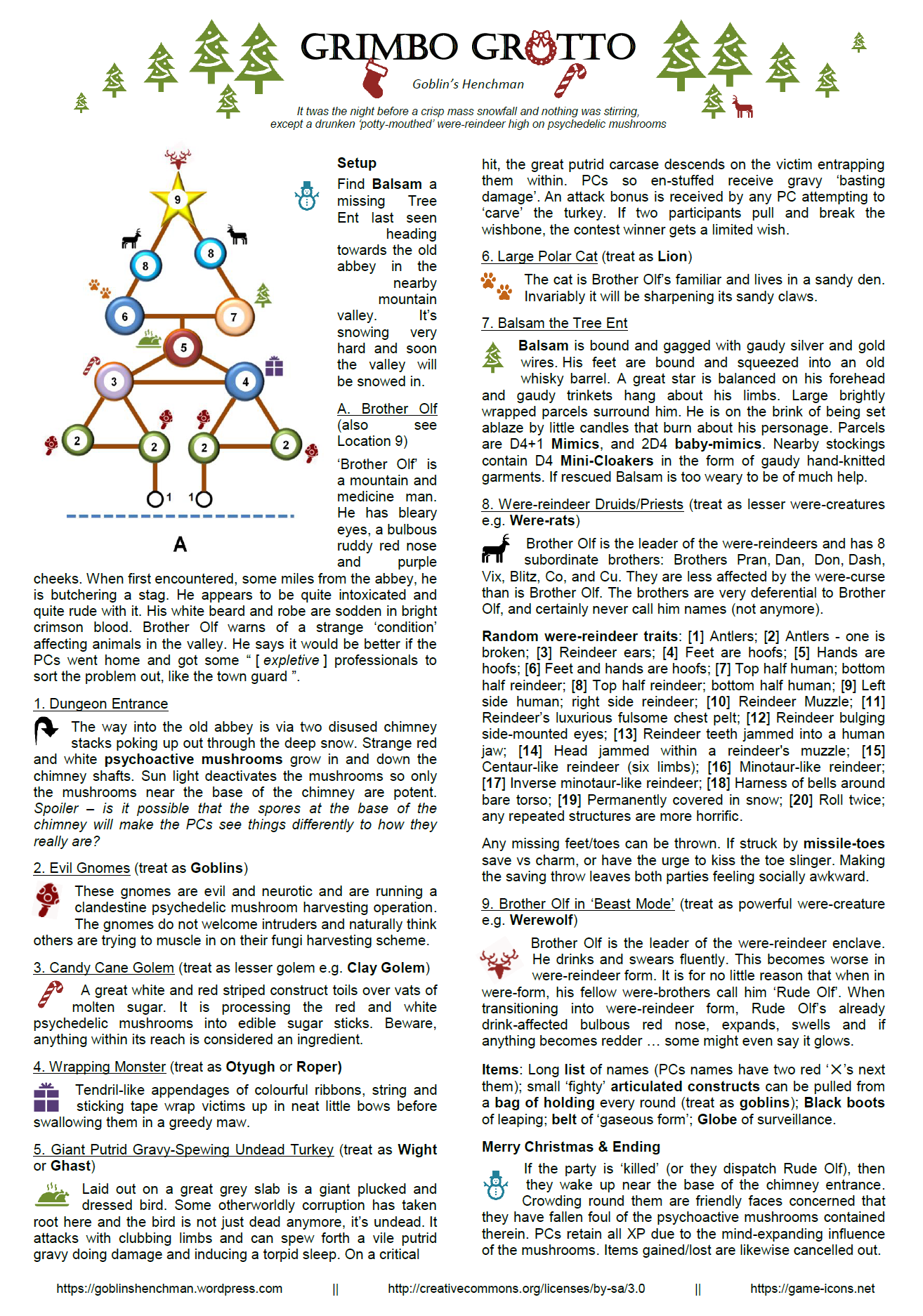
 1 x Blog:
  2 x DrivethruRPG:


 Of course, the idea is for people to use the code if they cannot afford to buy a copy (life stuff). There is no date limit on this offer, but after 10 uses the code will expire.


 Pass & Pass – player knows and I’d say the PC also knows they passed the test, because they know they did a good job (the uncertainty/opacity die is almost a self-evaluation roll – in real life we have all done a examination/test etc. that we know we have failed and vice versa. Knowing you failed can be useful even if it is not the desired result).
 Pass & Fail – this is where it gets more interesting, the player and PC do not know if they passed the test – they are getting mixed information:
 Fail & Fail – The player and the PC know that they bungled the attempt and so cannot make any meaningful conclusion.


 Secret Chimney Puzzle


 :: Musedusa ::
  Me on
Me on 


