GeistHaus
log in · sign up

https://feeds.feedburner.com/TeacherTom

atom
26 posts
Polling state
Status active
Last polled May 18, 2026 23:56 UTC
Next poll May 19, 2026 17:41 UTC
Poll interval 62356s
Last-Modified Mon, 18 May 2026 17:09:29 GMT

Posts

Can We At Least Agree to Stop Sucking the Joy Out of Their Lives?
communityconflicteducation transformationemotionsoutdoor playsciencesensoryteaching
Show full content
var addthis_config = {"data_track_clickback":true};
I was sitting on a bench near a playground merry-go-round watching our three and four-year-olds play. A pair of boys decided they wanted a spin. They mounted the apparatus, then one of them turned to me, "Teacher Tom, you push us."

I answered, "Sorry, I'm busy sitting here. You'll have to find someone else."


As the first boy tried pleading with me, the second said, "I'll get my brother to push us. He likes doing the things I like," and jogged off in the direction of where their classmates where playing. He called out to them, "Who will push us?" They ignored him so he returned to the merry-go-round. As he mounted it, he gave it a little push with his foot and the two boys began turning slowly.

As the momentum began to die, a couple of girls found their way to the merry-go-round. Without being asked, they decided they were going to push it "fast." The boys were delighted. Working together, the girls managed to get it up to speed, then the two of them jumped on as well. More children began to arrive in twos and threes, many pushed before jumping on. One of the original boys, leaning into it, head tipped back, began to chant, "Oh yeah, it's spin time! Oh yeah, it's spin time!"


The children began jumping off and on as they spun. Many of them fell to the ground upon dismount, most doing so intentionally. Occasionally, one of them would be trampled as they lay there in the path of the pushers. Some of them cried out in objection, while others squealed with delight. It was the kind of wild, breathless fun for which these machines were designed, even if adult imposed rules too often forbid it.

They were learning something, because we are always learning something when we play. I could write a list here of all the things I imagine they were learning, or exploring, or discovering. I could put those guesses into a report of some sort. Indeed, if I were so inclined I would have already filed dozens of reports on the children playing together on the merry-go-round going back to September. I could then take all those reports and compare them to today's report and use this data to pretend that I know what they have been learning over the course of months. I reckon I could even devise some sort of pre and post-test that would allow me to compare the children's progress, identify those who are behind and assign those poor kids some merry-go-round homework so they could catch up with the others. Perhaps some would need tutors or the support of specialists. I might even decide to rank the children on various measures that I have identified as important about merry-go-round play, assigning each of them grades based on my assessment of where they fall on an arbitrary scale of learning I'd devised based on data that I and others have collected over generations. I could then use this data I've amassed to devise a merry-go-round curriculum, one that allows me to "teach" children how to play on a merry-go-round, imagine myself an expert, seeing to it that all the children became merry-go-round proficient . . .


This is ludicrous, of course. I could do all of that and not only would I be no closer to knowing what these children were learning, I would have wasted vast amounts of time that I could have otherwise spent doing something more productive, like scratching my ass. No one can ever know what another person is learning. Each of those children on the merry-go-round are learning something different, something unique, something that applies only to them and their lives, and even the person doing the learning often doesn't know what they've learned, and no amount of testing, grading, or data collection will change that.


This is the great fraud of our educational system, this hubristic notion that adults can somehow measure learning, yet for generations we have put children through the processing plants we call schools, marching them into the test score coal mines, subjecting them to our experiments like lab rats. It's led to a grotesque narrowing and standardization of what we call education based not on learning, but on what we can most easily measure.

I am comfortable knowing that children are learning because they are playing, and that's enough. Indeed, I have no choice because to believe otherwise, is to buy into the lie that anyone can possibly know what these children are learning. It would mean that I must take part in sucking the joy from their lives and I will not knowingly be a party to that.

"Oh yeah, it's spin time!" That's all I need to know.
******
Even the most thriving play-based environments can grow stale at times. I've created this collection of my favorite free (or nearly free) resources for educators, parents, and others who work with young children. It's my gift to you! Click here to download your own copy and never run out of ideas again!

I put a lot of time and effort into this blog. If you'd like to support me please consider a small contribution to the cause. Thank you! Bookmark and Share <!-- AddThis Button END -->
tag:blogger.com,1999:blog-15932919.post-2083678391287698019
Extensions
Does Modern Schooling Create Mass Mediocrity From the Raw Material of Genius?
artconstruction/tinkeringeducation transformationparentingteaching
Show full content
var addthis_config = {"data_track_clickback":true};
On the short list of history's geniuses, most of us would include Leonardo da Vinci. He is perhaps the most famous polymath to ever live -- a painter, sculptor, architect, scientist, engineer, technologist, and mathematician of the highest order. He is the embodiment of the High Renaissance. Today, he is best known for his painting the Mona Lisa, a masterpiece that to this day defines what a masterpiece is all about. But his other existing works like The Last Supper are every bit as sublime not to mention the volumes of notebooks he left behind detailing everything from helicopters and nautical innovations to adding machines, anatomical studies, and optical discoveries.
I think it's safe to say that most of us would be pretty proud if our kid grew up to be the new da Vinci, right? I mean, he represents the pinnacle of the much ballyhooed STEM (or STEAM) schooling that we hear so much about. Although, to be honest, Leonardo himself never went to school. He was a "studio boy" in an artist's workshop, eventually becoming an apprentice. It's unknown whether he chose that particular career path or if he just fell into it by way of relieving his lower-class single mother of the burden of his upkeep.
All told, the great genius da Vinci produced fewer than 25 paintings, most of which were unfinished and still in his possession upon his death. The Mona Lisa remained one of those unfinished works, even after some 15 years of fiddling with it. Of the works he actually "finished" most only saw the light of day in his lifetime because his patrons threatened to stop funding him. Indeed, he spent much of his life dodging debtors. His notebooks full of innovations, inventions, and discoveries were exactly that, notebooks in which he doodled his ideas, never intended for the public eye. It's likely that he would today have been diagnosed with ADHD, so scattered and varied were his interests and activities.
What a deadbeat! At least if judged by today's productivity standards, da Vinci was a classic failure-to-launch dreamer, full of high falutin ideas, but obviously without the grit or rigor to pull himself up by his own bootstraps or whatever. Just imagine what he could have accomplished had he only been more motivated.
It's a sucker's game, of course, to play 'what if' with history, but what if Leonardo had had the benefits of modern schooling?
I think it's safe to say that he would not have be Leonard da Vinci. Certainly, he might have found a vocation that kept the debtors off his back. Maybe he would have become a painter with his own commercial studio, cranking out above average allegorical motifs and portraits to decorate the hallways and mantles of the wealthy, perhaps even developing a line of budget paintings for more humble households. Or maybe he would have joined the military or become an engineer or an architect or a botanist, all vocations for which he showed an aptitude. But I think it's safe to say that he would not have become the great genius Leonardo. His teachers would have seen to that. He might have been more productive, but it's quite clear that fiddling, perfecting, and doodling were the methods behind his unique and world-changing genius. 
Without that, he would not have been the wonderfully fallible Leonardo da Vinci, but rather just another promising young man who made a decent living.
It's tempting to say, Oh, but that's just Leonardo the genius. He's the exception. Most kids left to their fiddling, perfecting, and doodling would just waste their time on video games. Maybe. It's also possible that our educational system that focuses on productivity and paying the bills as the key measures of success has created mass mediocrity from the raw material of genius. 
What if that other iconic genius Albert Einstein was right: "Every child is born a genius." What if the real trick of education is to not waste it on productivity and paying the bills?
******
Even the most thriving play-based environments can grow stale at times. I've created this collection of my favorite free (or nearly free) resources for educators, parents, and others who work with young children. It's my gift to you! Click here to download your own copy and never run out of ideas again!


I put a lot of time and effort into this blog. If you'd like to support me please consider a small contribution to the cause. Thank you! Bookmark and Share <!-- AddThis Button END -->
tag:blogger.com,1999:blog-15932919.post-5031645037887499112
Extensions
"The Greatest of Savage Tribes"
communityeducation transformationparentingteaching
Show full content
var addthis_config = {"data_track_clickback":true};

"The world-wide fraternity of children is the greatest of savage tribes, and the only one which shows no signs of dying out."
I came across this quote in a book published in 1965, which quoted it from another book written in 1959. It's attributed to a person named Douglas Newton, who may be the same author Wilfred Douglas Newton who was publishing during the early part of the last century. In other words, I really don't know who wrote it, but it rings true, even if my modern sensitivities make me cringe at the term "savage tribes."
For most of my career, I've considered young children to be the last of the unspoiled humans, the people who are the closest to the origins of our species. I've been privileged to spend much of my adult life in a position to observe these natural humans who still have not learned many of the lessons of "civilization." I've strived to create natural habitats in which they can thrive without absorbing the dubious lessons of modern life; specifically those of glorified competition and the elevation of the individual over the community. Even before we understood the harm handheld devices were causing us, I eschewed screen-based technology in the classroom out of fear it would add unnecessary artificiality to this natural "fraternity." Over the course of decades I've seen that no matter how much society changes, no matter what the rest of us take for natural and normal, no matter how convinced we've become of the slurs casually hurled at children from adult bigots, these young children remain our last hope to stay connected to our "natural" state.
I remember the first time that a young child turned to a camera to make a face the way people do on social media. I remember meeting a five-year-old whose parents had been preparing her for an Ivy League future from birth. They literally moved to Seattle specifically to attend my school because they had become concerned that she didn't know how to play -- or "do anything" according to her father -- without adult direction. Douglas Newton was certain that this "savage tribe" would never "die out," but I don't know. We're doing our damnedest to kill it off.
Yesterday, during an online talk on play based learning, educators commented using the "chat" function while I spoke. At least a dozen spontaneously complained, "Children don't know how to play any more." It's not the first time I've heard that.
Of course, I know that young children still know how to play. I know these children. I hear of these children. Fellow educators share delightful stories of children's play with me all the time, but the colonization of childhood is clearly well underway. Just as European colonizers sought to forcibly "convert" those "savage tribes" to the ways of Christianity, capitalism, and Western science, we are currently seeking to do the same to our youngest citizens.
It begins with the casual way we allow one another to display their hatred of children. Comedians and other wags regularly declare, "I hate children." We let our friends say, "I won't eat in a restaurant that allows kids." We don't bat an eye when chauvinists call children "feral," "dirty," or "ignorant." If these things are said about any other category of human we readily identify it as bigotry, but when it comes to children, it's perfectly fine to refer to them as "disrespectful," "uncivilized," or "savage." This is how colonization always begins.
It's not an accident that William Golding's shockingly misanthropic and child-hating work of fiction, The Lord of the Flies, is currently being revived in blockbuster movie style. I can't tell you how often naysayers have evoked this novel to disparage my work with children. They say, "Ever heard of Lord of the Flies?" as if that settles the debate. I guarantee, every play based early childhood educator will hear this during the coming year. (In the real world, young boys did find themselves trapped on a deserted island and the results were much more hopeful.)
The next step after "othering" children, is to "correct" them. In this case we replace their natural inclination to learn through play with the tedium of worksheets, rote learning, and testing . . . "for their own good." And they must do this indoors. Just as generations of indigenous people have been made to behave and believe in abeyance to the colonizer's standards, our young children are undergoing the same process. They will never be fully civilized, of course, but at least we will have "saved their souls." I worry that we have already reached the point that we will need to turn to anthropologists to unearth what we have lost. And indeed, if young children really don't know how to play, we are lost, both morally and as a species.
I recently worked with teens and young adults who were unable to share any stories of risk taking from their younger days. In fact, one young woman told me that she doubted that my own stories of youthful risk-taking were true. I recently spoke with a young mother who said, "I'm a parent in 2026. My child never does anything without me except go to school." We've all heard the stories of the police being called because children were allowed to play in their own yards. These are all anecdotal, but by the time the actual data catches up, I'm concerned it will be too late. 
It's not too late, but without action it's coming fast. We already have the first generation of fully colonized children having their own babies. When the stories of our own youth are dismissed by the current generation as not credible, we are in danger of never knowing first hand what it means to be fully or authentically human.
Our play based preschools must be havens, protected preserves of childhood. They are the last place we find natural humans. I hope this Douglas Newton fellow is right, that this world-wide fraternity of children will never die out, but they are endangered. We must all fight to protect them and it starts right now by taking a stand where we live, to stand up and say, "No."
******
Even the most thriving play-based environments can grow stale at times. I've created this collection of my favorite free (or nearly free) resources for educators, parents, and others who work with young children. It's my gift to you! Click here to download your own copy and never run out of ideas again!

I put a lot of time and effort into this blog. If you'd like to support me please consider a small contribution to the cause. Thank you! Bookmark and Share <!-- AddThis Button END -->
tag:blogger.com,1999:blog-15932919.post-7045236178080777497
Extensions
"I Don't Know About That"
communityeducation transformationmediaparentingscienceteaching
Show full content
var addthis_config = {"data_track_clickback":true}; One of the hard truths I've learned over the past three decades is that research rarely persuades anyone of anything. If it did, we would have universal play based preschools. The data in favor of play in the early years is overwhelming. This clinical report from the American Association of Pediatrics (first published in 2018 and reaffirmed last year) is as definitive as science gets, citing nearly 150 peer reviewed studies.
I've provided this report to dozens of doubtful parents and educators over the years, many of whom have come back with an "I don't know about that" objection that let's me know that they  are not persuaded.
Continuing to push academic-style instruction down into the early years is a direct cause of mental illness in young children. Period. Play, and lots of it, is the antidote. That's what we know even if far to many people still "don't know about that."
The same thing appears to be happening with screen-based technology, and specifically smartphones. The data is overwhelming: we should be keeping young children away from them the same way we keep them away from alcohol and loaded firearms. Harm is being done. Jonathan Haidt's well-researched book The Anxious Generation is only two years old and in the intervening two years, the evidence of the harm these devices are doing to our young people is has grown exponentially. 
I get it. Smartphones are an easy way for parents and other adults to occupy a bothersome child, especially in a world in which "go play outside" can get you arrested for child endangerment. We obviously need more safe places for children to play outdoors in the kind of unsupervised way past generations did, but do we really need to stick phones in front of kids in restaurants, on airplanes, while driving in the car? I recently went to a movie in a theater and sat next to a pair of elementary-aged girls who spent most of the two hours on their phones. I just read a social media post from a teacher who says that when she releases her two-year-olds to their parents at the end of a school day most of them are immediately given their parent's phone. 
This is neglect. Children need to interact with real people. They need to have conversations with their loved ones. They need to be free to engage with the real world around them. That's what the research is telling us even if "I don't know about that."
But what is far more outrageous is what our schools are doing. Based on what we know about the harm that screen-based technology causes our young children, it is child abuse to provide these devices in schools. That's right -- abuse. There is no evidence that children learn better from screens than from human beings, books, or other more traditional methods. A recent Wall Street Journal investigation (the actual article requires a subscription, but this link provides a decent summary) found that students in US schools are using their school-issued devices during class time to view massive amounts of questionable content, including tens of thousands of YouTube videos a month. One child was found to have watched 200 in a single morning.
Of course, those who will not be persuaded by evidence simply argue that it's the teacher's fault, that they must do a better job of controlling the kids, because heaven forbid they have to give up those damned screens. The screens make the children quiet and passive, which is why parents resort to them. Studies consistently show that the use of screen devices in schools does not lead to improved learning, and many find they reduce learning. In other words, these devices are not only harmful to mental health (which should be enough), but also to educational prospects.
It's time for parents to start suing schools. 
In March of this year, a New Mexico jury ordered Meta (the parent company of Facebook) to pay $375 million after finding the company liable for concealing what it knew about child sexual exploitation and endangering children on its platforms. In that same month a Los Angeles jury ordered Meta and YouTube to pay $6 million in damages to a young woman (and her mother) who sued based on the addictive nature of their products. If our schools are going to allow that kind of harmful crap into our schools, then they should be held liable for the damages. It's no different than feeding the kids poisoned lunches. We know for both a scientific and now legal fact that our children are being harmed.
And still, those who will not be persuaded will strive to keep the screens, while controlling the children and the content. Why? They're unpersuadable. They are not interested in what's best for children, but rather what's best for them. "I don't know about that" has become the go-to defense of the indefensible. 
And now we come to the nub. Why are screens so good for these educators? Because they have massive classes and expensive curricula they have to get through. The class size is because our elected leaders refuse to adequately fund education. And the damned out-of-the-box curricula from for-profit companies demand that teachers march the kids through it without any regard for the individual children in their care, meaning that a few get it, while most are either bored or confused. Screens "solve" both problems: they create passive children and deliver cookie-cutter lessons. Who cares about learning when you have a well-managed classroom and digital evidence that you "delivered" the content. Frankly, I don't blame kids for watching YouTube videos instead.
Research rarely persuades anyone about anything, but fear-mongering does. Fear-mongering over "falling behind" and "school readiness" is why we have the academic push down into our preschools. Science tells us that the healthiest, most educational thing we can do for young children is to let them play in a screen-free environment, but that, apparently, isn't a persuasive message. I've tried now for decades to be positively persuasive here on the blog. I don't want to fear-monger, but maybe, for the sake of our children, it's time to start.
******


I put a lot of time and effort into this blog. If you'd like to support me please consider a small contribution to the cause. Thank you! Bookmark and Share <!-- AddThis Button END -->
tag:blogger.com,1999:blog-15932919.post-155136671729354903
Extensions
Bookends for Living a Meaningful and Moral Life
communitylife and deathparentingscience
Show full content
var addthis_config = {"data_track_clickback":true}; In her novel Middlemarch, George Eliot writes, "The young ones have always a claim on the old to help them forward." She also rhetorically asks, "What do we live for, if it is not to make life less difficult for each other?"
As bookends for living a meaningful and moral life, you could do worse.
We all begin as helpless newborns, completely dependent upon the adults who have brought us into the world. Without them, we roll over and die, and so too the future of our species. From an evolutionary perspective, of course, we need our offspring to not just survive, but to also thrive, which is why caring for children must be the chief project of every civilization. 
On Mother's Day, The White House launched an initiative to encourage certain of us to have more babies. They say there is a population crisis. They seem to think women just need more positive motherhood vibes. 
In the rest of nature when birthrates drop it's because the world has become inhospitable for babies. It's a response to the individual and collective assessment of their offspring's prospects. When species are under stress, they often shift their energy away from reproduction toward survival. In many species breeding is skipped or delayed, or fertility may decline due to hormonal suppression. Mammals may stop ovulating, birds may not lay eggs, embryos are reabsorbed. We know that under extreme conditions like famines, war, or chronic stress, humans are known to shut down reproduction. When survival is uncertain, reproduction generally becomes more conservative.
There are exceptions. Some species, like insects and rodents produce more offspring when conditions are unpredictable, employing a kind of "boom-or-bust" strategy. That seems to be this administration's approach. They're obviously banking on "rah-rah" patriotism and motherhood to encourage more babies, instead of doing those things that might create a more hopeful future like childcare, nutritional assistance, tax credits, parental leave, healthcare, and climate action. 
Instead, they're aggressively working to take away abortion rights, contraception, and bodily autonomy, all of which are attempts to deny women the right to choose what is best for both themselves, their prospective offspring, and the species' future.
Families increasingly find themselves under financial stress, which in our world is a genuine threat to survival. It means that basics like food, shelter, and healthcare are beyond the reach of too many. It only makes sense to avoid having more babies. Economists are forecasting, for the first time in modern history, that today's young will live less prosperous lives than the generations before them, not to mention the fact that we live in a world that is increasingly hostile to children and families. Under these conditions, the choice to not reproduce is a valid one.
"More babies" should never be our goal, but in a world in which free women have the right to choose, increasing birthrates are a leading indicator of a hopeful future. A declining birthrate should sound alarm bells, not about reproduction, but about the world we are creating.
"The young ones have always a claim on the old to help them forward." "What do we live for, if it is not to make life less difficult for each other?" It's between these simple ideas that we create a future in which humans thrive.
******
Even the most thriving play-based environments can grow stale at times. I've created this collection of my favorite free (or nearly free) resources for educators, parents, and others who work with young children. It's my gift to you! Click here to download your own copy and never run out of ideas again!

I put a lot of time and effort into this blog. If you'd like to support me please consider a small contribution to the cause. Thank you! Bookmark and Share <!-- AddThis Button END -->
tag:blogger.com,1999:blog-15932919.post-2205677487191772352
Extensions
Living in a World of Rainbows
artcommunity
Show full content
var addthis_config = {"data_track_clickback":true};
Children are always making rainbows. They draw rainbows with pencils and markers, color them with crayons, and paint them on easels. As I've travelled the world, visiting preschools from Greece to China, from New Zealand to Iceland, I find rainbows adorning the walls and bulletin boards, happy arcs of color, often with a self-portrait of the artist, or even the artist's whole family, standing under them, smiling.


We've all seen them, and often. It's tempting to wonder why they do it, although it's entirely unnecessary to know. The fact that children everywhere make rainbows, I think, is enough.


And they don't just make them with "art" materials. Every day, someone will call out, "I've made a rainbow tower!" or explain "This is a rainbow in a box."


In nature, rainbows are somewhat rare, only appearing when the conditions are just right, only lasting for a short time, and only visible from certain angles, but at preschool they are everywhere, in everything, making our world brighter.


Sometimes when children talk of rainbows, they are referring to the classic shape, but more often than not they are talking of all those colors, side by side, beautifully, joyfully, a concept that is incomplete with even one of them missing.


We spend most of our time working on projects together and sometimes we need to decide upon a color. Our process always starts with someone proposing their favorite which is followed by another color and another. We list them all, usually intending to then vote for which one it will be, but invariably when it comes time to select just one, the children always opt for rainbow, the consensus choice, the one that includes us all.


It's tempting to wonder why they do it, why children surround themselves with rainbows, but do we really need to wonder? I think we already know why.


******
Even the most thriving play-based environments can grow stale at times. I've created this collection of my favorite free (or nearly free) resources for educators, parents, and others who work with young children. It's my gift to you! Click here to download your own copy and never run out of ideas again!

I put a lot of time and effort into this blog. If you'd like to support me please consider a small contribution to the cause. Thank you! Bookmark and Share <!-- AddThis Button END -->
tag:blogger.com,1999:blog-15932919.post-6149811545747557105
Extensions
When We Know the Full Story
circle timedevelopmentemotionsfine motor
Show full content
var addthis_config = {"data_track_clickback":true};
As a boy, my brother and I owned a game called Rebound. It's a tabletop version of shuffle board that one plays using small plastic disks with ball bearings in the center, rolling them to bounce off a pair of rubber bands before they scoot into the scoring zone. It has survived to find a second life in our classroom. Despite hundreds of children having played with it over the years not only has it remained intact, but we still have all 16 of the small game pieces.
I suppose some might consider it a kind of miracle that nothing has been lost or broken, but it's not magic. Whenever I make the game available to the kids, I tell it's story, the one about how it's my old toy, how my brother and I used to play with it, how it is 40 years old, and special to me. I ask them to treat it gently and to try to not lose the pieces. They then play with it, sometimes rowdily, sometimes until all the pieces are on the floor, but at the end of the day, for going on two decades now, all the pieces have always been there.
One time, I forgot to tell the story of the game. Within minutes, I heard the sound of the Rebound board crashing to the floor. Fortunately, it didn't break, and I used it as an opportunity to inform a few of the kids of its background. Not long later, however, I discovered that several of the game pieces were missing. We looked everywhere for them, but no luck. I began to suspect that one of the children had snatched a fistful to use elsewhere in the classroom, not maliciously, but rather in the spirit of loose parts. I imagined I'd find them later, perhaps years later, in a container somewhere or squirreled away in a nook. Still, I was feeling a bit melancholy, even as I attempted to be philosophical. After all, I wasn't going to get to keep those things forever.


We still didn't find the pieces when we tidied up, so when we re-gathered on the checkerboard rug to de-brief before going outside, I told the game's story, hoping that one of them would recall what he or she had done with the lost pieces. I strived to tell the story in a matter-of-fact manner without suggesting any sort of suspicion or blame. I just wanted them to know that I missed those pieces and why. The children listened, several offered theories about where the lost ones might be, some offered to make me some new ones, but none offered any clues to the mystery.
Several minutes later, however, as we gathered in the mud room to gear up for the weather, one girl presented me with the lost pieces, saying, "Here they are." She had indeed squirreled them away, not in the classroom, but in her own cubby, intending, I suppose, to take them home as treasures. She had admired them, had wanted them, had secured them for herself. Children often take things home in their jacket pockets, small things, usually of little value like bottle caps or florist marbles. I'm sure she had considered these game pieces in that light, small, plentiful, insignificant things that no one would miss. When she heard my story, however, she readily returned them, knowing that they meant more to me than they ever would to her.
People often describe young children as selfish, forever putting their own needs and desires above those of others, but it's not, on balance, true. Usually, what we label as self-centered is really just a result of them not knowing (or not being developmentally capable of understanding) the full story, which is, I think, probably true of most humans most of the time.
******
Even the most thriving play-based environments can grow stale at times. I've created this collection of my favorite free (or nearly free) resources for educators, parents, and others who work with young children. It's my gift to you! Click here to download your own copy and never run out of ideas again!

I put a lot of time and effort into this blog. If you'd like to support me please consider a small contribution to the cause. Thank you! Bookmark and Share <!-- AddThis Button END -->
tag:blogger.com,1999:blog-15932919.post-5388843142341267870
Extensions
The Role of Memory and Imagination in Learning Through Play
construction/tinkeringdramatic playemotionslarge motoroutdoor playsciencestories/storytelling
Show full content
var addthis_config = {"data_track_clickback":true}; For several days in a row, the girl had positioned the ends of a plank of wood on car tires to make a balance beam upon which she played. She didn't object when other children wanted to try out her invention. Indeed, she welcomed them, giving tips and otherwise sharing the expertise she had developed over the course of her days of trial-and-error experimenting.
One day, a group of boy stacked three tires one atop another then abandoned it to do other robust things. The girl contemplated the tower of tires for a moment before moving one end of her plank to the top of the stack, while leaving the other end on a single tire. Then, using the skills and knowledge she had been developing over the course of the preceding days, she attempted to balance up the incline.
We can never know what is going on inside the head of another person, but it seemed as if she had asked herself, "What if I put one end on that stack of tires?" She had built this scenario based upon what she already knew about planks and tires: she knew something, then used her imagination to expand her knowledge.
We see young children do this all the time. They bring what they know from home into our home center where they play "What if . . . ?" games with housekeeping. They bring what they already know about shape and color to the art table where they play "What if . . .?" with new media and materials. They begin with what they've learned about relationships inside their family, then play "What if . . .?" with the people they find at preschool.

According to those who study brain function, the systems used for memory and imagining heavily overlap, especially in and around the hippocampus. In fact, research suggests that the cognitive process of remembering is almost identical to the process of imagining. In both cases, the brain is constructing a story: one about what did happen -- or, more accurately, what is likely to have happened -- and the other about what might happen. This fascinating insight helps explain why our memories tend to be so faulty. It also suggests that the purpose of memory isn't so much accuracy as it is to provide us with stories that make sense of the present.
When the girl was practicing with her balance beam, she was gathering information, which her brain stored in memory for future reference. She then used exactly the same parts of her brain to recall the pertinent information (as opposed to accurate information, although it might have been that) to construct a "What if . . . ?" scenario that she then carried out. This process creates new memories to serve as raw material for future imaginative play.

In other words, memory isn't just storage, as our test-taking school culture would have it, but rather a process of construction. When children engage in imaginative play, they practice assembling bits of experience into coherent stories, which is precisely what effective learning requires: connecting new information to prior knowledge. Imagination lets us simulate possibilities ("What if . . . ?"), which obviously stands at the heart of problem-solving and transfer of knowledge, the hallmarks of learning. The more vividly and meaningfully something is imagined, the more pathways the brain uses to encode it, and in contrast to the practice of rote memorization, imaginative play tends to carry emotional weight (joy, tension, curiosity) which strengthens memory formation.
In other words, imaginative experiences like those we see when children are free to play expand the brain systems required for future learning. So often schooling in our culture takes the form of direct instruction (lectures, worksheets, text books, testing) in the misguided notion that memory (or remembering) is simply a process of data recall. The constructive nature of memory is ignored entirely, which explains why so much of what we "learned" in school is lost within days of having passed the test. When children play, they imagine, and when we imagine we construct our own learning: they are, in truth, practicing how learning itself actually works.

The girl discovered that walking up her new, steep ramp was difficult, but that she could make it to the top by crawling or scooting, but she continued experimenting. After a time, the boys returned to discover what the girl had constructed from the beginnings of their own construction. And together, they asked, "What if . . . ?" An explosion of imagination that carried on for days.
Memory gives children something to think with. Imagination is how they learn to think with it.
******
Even the most thriving play-based environments can grow stale at times. I've created this collection of my favorite free (or nearly free) resources for educators, parents, and others who work with young children. It's my gift to you! Click here to download your own copy and never run out of ideas again!


I put a lot of time and effort into this blog. If you'd like to support me please consider a small contribution to the cause. Thank you! Bookmark and Share <!-- AddThis Button END -->
tag:blogger.com,1999:blog-15932919.post-8895218742109699408
Extensions
Heartbreak is Part of Both Friendship and Freedom
communityconflictemotionsLanguageparentingteaching
Show full content
var addthis_config = {"data_track_clickback":true}; I came across an interesting tidbit of language information the other day. The English word free comes from the same root as friend. Indeed, it appears that the original root word meant "friend," so, in a linguistic sense at least, free is a product or aspect of friend.
Anyone who has read here for any length of time, knows that I've never focused on academic things in my work with children. If it must be part of a child's life, that can come later, but during these early years, my primary concern beyond safety is creating a loving environment in which children know they are free to engage as their curiosity compels them. That is to say, play. And among the most compelling playthings are the other children who present the prospect of friendship.
Every parent wants their child to have friends, or at least one friend. Our prejudice tends to be in favor of children who are natural friend makers, kids who have the charisma and confidence to throw themselves into the fray. Observational research finds, however, that even these "master friend makers," these most popular of children, are rebuffed at least 30 percent of the time when they seek to enter into play with other children. Which is to say that all of us have extensive experience with social rejection, and is why, I think, we feel it so strongly when we see children struggle with friendship.
I have a few tips I share with children about friendship, which I try to offer in calm moments.
If you hurt people, they probably won't want to be your friend.
If you ask, "Can I play with you?" most kids will tell you, "No." If instead you say, 'I'm going to play with you,' they'll usually say, 'Okay.' But the best way to start playing with another kid is to just start playing with them.
I'm not sure if I've ever helped a child with this advice, even if I've seen the truth of both tips over and over. The kids who can just drop to their knees and get engaged without harming anyone are always the ones with the most playmates. That said, my own daughter Josephine, when she was four, insisted, "But I have to ask them if they want to play with me!" It broke her heart, and mine, when her preferred playmates rebuffed her again and again, but taking my advice was just a bridge too far.
I don't suppose anyone really knows how the word free emerged from an original word for friend, but I wonder if it had something to do with the concept of being free to make commitments to others, which is the essence of friendship. In these first forays into friendship, being a playmate is enough. Two or more children have freely entered into informal, often unspoken, and ever-evolving agreements with one another while engaging in a mutually satisfying activity or project. 
As adults, we see friendship as something deeper, but this is where it begins. And part of this early learning about friendship is also learning that we are free to de-commit. On the playground, the commitment usually ends when the game at hand comes to a natural end or evolves into something else. Sometimes it ends as a kind of emotional eruption when one or more of them cross a boundary. Whatever the case, the old commitments are unmade and the moment of friendship is over. Ideally, feelings are not hurt, but often they are. 
Friendship is something we enter into freely, but the flip-side is that we are also free to leave. Of course, as adults, we have much more experience with the complexities and layers of friendship, but in preschool friendship looks a lot like the ideals of classic anarchy, with everyone free to befriend, de-friend, and make new agreements with everyone else.
One of my best teachers when it came to early-years friendships was a girl named Katrina, a 3-year-old swimming lesson friend of Josephine's who then became a kindergarten classmate. One day I was driving the girls somewhere. Josephine was upset about a fellow classmate who had been "mean" to her. Katrina replied, "She's mean to me too. When she's nice to me, I play with her. When she's mean, I don't." Katrina's words have become a mantra in our family. Her straight-forward, simple statement fully embraces friendship, freedom, and boundaries. It includes the promise of friendship, the reality of challenges, and the expectation of reconciliation. Most of all, I admired the calm, matter-of-factness of how she said it. 
We don't get to choose our family, but we do get to choose our friends, and the only way we learn to do this is by practicing. Through this we come to know that heartbreak is a part of both friendship and freedom, and that we protect ourselves with boundaries. And most of us, if we are lucky, will get to practice friendship every day of our lives.
******
Even the most thriving play-based environments can grow stale at times. I've created this collection of my favorite free (or nearly free) resources for educators, parents, and others who work with young children. It's my gift to you! Click here to download your own copy and never run out of ideas again!

I put a lot of time and effort into this blog. If you'd like to support me please consider a small contribution to the cause. Thank you! Bookmark and Share <!-- AddThis Button END -->
tag:blogger.com,1999:blog-15932919.post-5819095498845724695
Extensions
The "Science of Learning"
arteducation transformationscienceteaching
Show full content
var addthis_config = {"data_track_clickback":true}; Anthony James
Our theories of education generally rely upon the idea that learning is built upon learning; that we start with simpler things, foundational things, then, like with a building we construct learning brick upon brick.
I'm sure that learning happens in that way some of the time for some of us, but there is very little empirical evidence that this is how it works for most people most of the time. Indeed, despite marketing assertions to the contrary, there really is no "science of learning." Or rather, we are far from any kind of consensus on how humans learn. Any school that claims to be following the science doesn't understand science.
Science is an ongoing process, one that starts with a question to which there is not yet a satisfactory answer. We then form a hypothesis, test that hypothesis, draw conclusions, then send it all out into the world for others to test for themselves. There is no such thing as settled science. Sometimes, on some questions, there is a scientific consensus (for instance, around human impact of climate change or the overarching Theory of Evolution), and it behooves us to heed that consensus, but even that is subject to new theories.
That said, there is nothing even close to consensus around how humans learn and anyone who claims there is some sort of cookie cutter or system or step-by-step approach or scientific way of teaching or learning is a salesperson. Perhaps a well-intended salesperson, but a salesperson nevertheless.
I read extensively about things like the human brain, consciousness, cognitive psychology, physics, history, nature, and philosophy. I also read a lot of fiction and a little poetry. Not long ago, I met the head of neuroscience at a major university, who personally knew many of the authors of the books I've read. When I tried to engage him in conversation, he told me that much, if not most, of what we read about brain theory in books written for laypeople is already at least a decade out of date because the "science moves so fast." 
I love that I can following along with the scientific process book after book, albeit a decade or more behind the professionals.
I read widely because often an idea from philosophy or poetry or physics or history will clarify or amplify or completely contradict what this or that other brilliant mind is proposing in a different area of study. I find myself drawn to scientific writers like Carlo Rovelli, one of the world's leading physicists, who can write, for instance, a book about white holes (the theoretical destiny of black holes) while weaving pertinent lines from Dante's Devine Comedy throughout the text. Not long ago, I read a book called Devine Fury: A History of Genius by historian Darrin McMahon in which he tells the story of how our definition of genius has evolved over the eons. It's an ongoing story that if we survive long enough to keep telling, will likely, one day, make future humans wonder what we ever saw in that misguided Einstein fellow.
The great wildlife ecologist Aldo Leopold wrote in his masterpiece A Sand County Almanac, "Education, I fear, is learning to see one thing by going blind to another." It's an idea that echoes Socrates' perfectly valid concern about the intellectual blindness that was sure to result from the introduction of the phonetic alphabet.
Nobel Prize winning author Doris Lessing wrote, "That is what learning is. You suddenly understand something you've understood all your life, but in a new way." It's an idea that foretold the current theory that the vast majority of our thinking takes place beneath the level of our consciousness.
Many cognitive scientists, echoing the philosophical theories of Enlightenment thinkers like John Locke, see long-term memory as the powerhouse of the brain, asserting that expansion of our long-term memory leads to an enlargement of our intelligence. Others point out that our memories tend to be wildly inaccurate and that, indeed, the more often we call upon a specific memory the more likely we are to alter it, often profoundly. This is why eye-witness court testimony can be quite unreliable or why when you meet an old friend after a long separation, you so often remember shared moments so differently.
Educators like Ivan Illich and John Holt assert that learning is "the result of unhampered participation in a meaningful activity" and that "(l)earning is the product of the activity of learners."
Neuroscientist Patrick House says that in the end we might well find that there are as many kinds of minds, as many kinds of consciousness, as there are humans. This would mean that the so-called "science of learning" is unique to each of us, and even that would likely change over time or be dependent upon what exactly is being learned. He writes, "Every brain has vastly more stores than all modern AIs and machines combined. Biology is messy at the level of its atomic and molecular happenings, but contained in all that messiness is a staggering amount of ways to be."
Technology is defined as the application of scientific principles for practical purposes. When someone asserts that their method or technique represents the "science of learning" what they are really saying is that they've invented something that helps some people, some of the time to learn certain things. This does not mean that it is the best way to learn something, just that they have a technology for sale that takes advantage of some narrow, and perhaps temporary, discovery of science. If it were truly the science of learning, it could not be packaged up and sold as a product because it would have to be updated and modified at the pace of not just brain science, but all other human disciplines as well.
At the end of the day, I'm a play-based educator because that is the lesson I've learned so far from science and history and fiction and philosophy. When we play, when we pursue our curiosity, when we ask our own questions and then go about answering them, we are engaging directly the great mystery of existence, playing with ideas for their season, following tunnels to see where they lead, finding ourselves in strange, uncomfortable places, then wiggling out of them again. A life of learning is the scientific process, lived by each individual amongst a universe of individuals who are engaged in their own scientific process.
As for the technologies of learning, engage them as you see fit. Play with them. Maybe you'll learn something from them, but know that there was a time when smoke signals, then the telegraph, was the most up-to-date form of communication. Play with them, learn from them, but never allow yourself to be trapped by them: they are technologies, after all, designed for profit, intended to make natural resources of everyone and everything they touch.
As the late, great folk singer and philosopher Utah Phillips said to a class of graduating university students, "They're about to tell you you're America's greatest natural resource . . . Run for the hills!" That's what I find myself wanting to do whenever I hear the phrase "the science of learning."
******
Even the most thriving play-based environments can grow stale at times. I've created this collection of my favorite free (or nearly free) resources for educators, parents, and others who work with young children. It's my gift to you! Click here to download your own copy and never run out of ideas again!
I put a lot of time and effort into this blog. If you'd like to support me please consider a small contribution to the cause. Thank you! Bookmark and Share <!-- AddThis Button END -->
tag:blogger.com,1999:blog-15932919.post-1232900697443335745
Extensions
Experiencing Reality Just as the Rest of Nature Does
developmentsensorystories/storytellingteaching
Show full content
var addthis_config = {"data_track_clickback":true}; As a boy, the closer it got to Christmas, the slower the days would pass. We would say, "I can't wait!" barely able to contain the anticipation, but wait we did, finally awaking on the day of magic and presents.
My wife Jennifer and I recently spent a weekend in a place that is a two-and-a-half hour drive from our home. The 2.5 hours getting there seemed interminable, while the trip home, despite taking the exact same time on our clocks, just flew by.

Clock time and lived time are two different things. In his novel The Magic Mountain, Thomas Mann writes of the difference between time lived upright and active (vertical time) as opposed to time lived simply lying about (horizontal time). When we're fully engaged in life, lived time tends to pass in the blink of an eye, yet upon reflection it, when we consider all that we've done, that same time feels long. On the other hand, life lived in the horizontal (like spending months in bed in a sanatorium as Mann's character Hans Castorp does in the novel) the days pass slowly, while in hindsight, they are a blur into almost no duration at all.
This feeling of duration is the lived experience of time. Clock time is different. For one thing, it's divided up into hours, minutes, and seconds. Scientists sometimes measure time in nanoseconds (one billionth of a second), but no matter how small the unit, the clock still creates the illusion that time passes in ticks and tocks rather than, as it we experience it, as a flow. Lived time is not granular. It's continuous, the past blending and shaping the present emerging moment. As philosopher Henri Bergson sees it, when we experience time as long or short, this felt difference is duration. Duration is tied to awareness. It's how reality unfolds for each individual, not how it's measured externally.

By now, most of us have heard the astounding news that the overwhelming majority of physicists are convinced that time is not a fundamental aspect of reality. The math tells them that there is no good reason why time should flow from past to future the way we experience it. They tell us that our experience of time is a psychological phenomenon rather than something real.
When we observe children at play, we are the ones watching the clock while the children are immersed in duration, an ever-emerging present in which time stretches, compresses, and flows. Nature does not create measuring tools, like clocks, only humans do; nature does not read measuring tools, only humans do. Clock time is an attempt to stand outside of the flow of lived time in order to measure it objectively. This is, of course, an absurdity: it presupposes the possibility of measuring time and reading measurements of time from the perspective of no where. This is an impossibility because we are always, inevitably, viewing reality from within reality, and that requires a perspective from somewhere.
And from within reality, time is experienced as duration.
Young children might look at the clock in imitation of our adult habits, but it has nothing to do with reality. They have not yet learned to perceive time as units to be managed, but rather they know it as a flow, thick with memory, imagination, and meaning. This is exactly what we witness in their play, time stretching, looping, and disappearing. This is why clock-based schedules are so difficult for so many young children. They have not learned the to obey this arbitrary measuring tool. It's why clean up time always comes too soon or lunchtime comes too late.

We adults, of course, live in a timetable world, one that is regulated by the myth of time as being comprised of discrete, consistent, replicable units. It's an illusion that our children will one day have to adopt, but just as preschoolers are typically not developmentally ready for literacy or math instruction, they are likewise not capable of stepping outside their lived experience of time as duration. This is why I urge early childhood educators to abandon clock-based schedules in favor of duration-based routines.
One of the joys of working with young children is this opportunity to spend our days living inside time's emergent now, something that can't be measured, only experienced. When we allow young children to lead us there, we are finally experiencing reality just as the rest of nature does. That's a gift young children give us.
******
Even the most thriving play-based environments can grow stale at times. I've created this collection of my favorite free (or nearly free) resources for educators, parents, and others who work with young children. It's my gift to you! Click here to download your own copy and never run out of ideas again!


I put a lot of time and effort into this blog. If you'd like to support me please consider a small contribution to the cause. Thank you! Bookmark and Share <!-- AddThis Button END -->
tag:blogger.com,1999:blog-15932919.post-4192902068908715910
Extensions
It Needs to Be Enough
artconstruction/tinkeringteaching
Show full content
var addthis_config = {"data_track_clickback":true};
I used to keep a collection of styrofoam around the place, but over the years I've disposed of it and not just because it takes up a lot of storage space. Sure it's fun to stick or hammer things into it, like golf tees, but that idea invariably and ultimately turns into a festival of breaking, then shredding, leaving those static electricity filled tiny toxic balls all over the place, which is a mess worse than glitter and not nearly as festive.

Still, when someone from our community purchases new electronics or something that comes with large pieces of the stuff, they often think of us. I don't even know where our most recent pieces came from, but I'd spotted them stashed where the kids couldn't reach them on the playground so decided to make use of them for a day.

My idea was to combine the styrofoam with pipe cleaners. It's not the first time we've done this and while there are usually a few kids who get into the process, it's not generally one of the most popular things we do at the art table. Last week, however, there were even fewer takers than normal. The parent-teacher assigned to the project did her best to role model playing with the things, but the station was evolving into a game in which kids were placing "orders" for things like pipe cleaner "bracelets," "flowers," "glasses," which the adults then manufactured for them. It's a fine activity, I suppose, and I guess the kids had found a way to make it fun so who am I to judge?

That's how things stood when my friend took a seat at one corner of the styrofoam and pulled a container of pipe cleaners toward himself. If he had taken note of what the others were doing, it wasn't apparent. He started by successfully sticking one end of a pipe cleaner into the styrofoam, then another, then another. As he worked, he began to twist the fuzzy wires, bending the pieces together, weaving them together, purposefully tangling them. He didn't say a thing as he worked, concentrating fully on his creation.

I was tempted to sit beside him, either to ask about what he was doing or to, as I often do, begin narrating his process in the hopes of attracting more kids to the project because everyone wants to be part of our classroom's ongoing stories, but I didn't. Instead, I left him to his solitary work, a man with a vision. I stopped by several times over the course of the next half hour as his magnificent tangle became increasingly complex. When he was finally finished a half hour later, he pushed himself away from the table and didn't look back.

I gave some 40 kids the opportunity to play with the styrofoam and pipe cleaners over the course of the day, most of whom declined the invitation and even those who accepted it tended to treat it like a kind of drive-by activity, something not worthy of their full engagement. But one boy did and that's enough for me to call it a success.

We carefully uprooted his sculpture from the styrofoam and put it in his cubby to take home. I'm sure from his mother's end, it just looked like he had simply crushed and twisted a collection of pipe cleaners in his fists, the work of a moment. Most preschool art goes home this way, a product that can't by itself tell the story of how it came to be. I've described the visible part of his process here. I can make guesses about what he learned. I could question him. I could even, I suppose, devise some sort of pre-test and post-test and compare the results to produce "data," but at the end of the day no one but this boy will ever know what questions he asked and answered while creating this purposeful tangle of pipe cleaners stuck into styrofoam. 

It needs to be enough for us to know that it engaged him until he was ready to walk away.
******
Even the most thriving play-based environments can grow stale at times. I've created this collection of my favorite free (or nearly free) resources for educators, parents, and others who work with young children. It's my gift to you! Click here to download your own copy and never run out of ideas again!


I put a lot of time and effort into this blog. If you'd like to support me please consider a small contribution to the cause. Thank you! Bookmark and Share <!-- AddThis Button END -->
tag:blogger.com,1999:blog-15932919.post-3166986372009838542
Extensions
All Learning Starts With a Sensory Experience
sciencesensory
Show full content
var addthis_config = {"data_track_clickback":true};
A single flax seed is a tiny golden fleck, so small that a single one is hardly noticeable to the human eye, so insubstantial that its fragrance is undetectable, so meager that one can barely feel it with a fingertip, so delicate that a single one on the tongue barely registers, so light that we don't hear when it falls onto the floor.

But if you fill a sensory table with 50 pounds of flax seed, you've created something irresistible to human senses. The earthy smell overwhelms the room. It's almost impossible to resist plunging your hand into them, feeling the silkiness as they slide across one another, almost like a liquid, but surprisingly crisp and dry. As you stir those seeds with your palms you become aware of a the shh shh sound they make as they interact with and against one another. When you pull your hands away, you notice that the seed oils remain, softening your skin and now they too smell of flax. And when you put a pinch of them on your tongue, you can finally taste their light nuttiness.

Some, both children and adults, find the experience of 50 pounds of flax seed in a sensory table so enveloping that they will remain there for an hour or more, swirling, scooping, and plunging their body parts into it. 

I know there are some who will be appalled by the "waste" of food that 50 pounds of flax seed in a sensory table represents. And while flax is consumed as a food, it is also used by humans to make fabric like damasks, lace, and bed sheets. It is used to make twine and rope. Some nations print their currency on paper made from flax. The oil, sometimes called linseed oil, is used in a wide variety of products, from nutritional supplements to wood-finishing products. There is literally no end to the gifts that flax and flax seeds offer to humans and I suspect we are not done receiving those gifts.

All learning starts as a sensory experience. Playing with flax seed, or anything, is how we begin to understand and appreciate it. The lessons we learn may not lead to new innovations or inventions, but the act of allowing the world to enter us through our senses, to process those sensations, to make connections between other sensations both past and in the future is where learning begins. Even dry lectures must enter our bodies through our ears and eyes. 

Neuroscientist Malcom MacIver believes that when fish began to adapt to life on land some 400 million years ago, they found themselves in a place where they could see over vast distances compared to life in water. This sensory discovery, he says, spurred the evolution of the ability to be proactive, to think ahead, to plan instead of simply react. As their environment expanded, so did their minds. This is what happens when we play with our world with our senses: it expands our minds.

There was never a single superpowered Homo sapiens who encountered flax then sat down and noodled out all the things it could be used for: the history of the relationship between flax and humans is one of playing together. Humans learned to make paper and fabric and food with flax by playing with it, which is to say exploring it with all of our senses, letting it enter into our bodies where our minds could begin guiding the process of experimenting, testing, inventing, and expanding our environment. Both humans and flax have thrived through playing together. And there are some, like historian Yuval Noah Harari, who assert that grains like flax domesticated us rather than the other way around.

When we plunge our hands into 50 pounds of flax seed, we are filling ourselves through our senses. We are activating our curiosity and playfulness. All learning starts with a sensory experience.
******
Even the most thriving play-based environments can grow stale at times. I've created this collection of my favorite free (or nearly free) resources for educators, parents, and others who work with young children. It's my gift to you! Click here to download your own copy and never run out of ideas again!

I put a lot of time and effort into this blog. If you'd like to support me please consider a small contribution to the cause. Thank you! Bookmark and Share <!-- AddThis Button END -->
tag:blogger.com,1999:blog-15932919.post-6711541514502910755
Extensions
Radical Acts of Hope
communityloveteaching
Show full content
var addthis_config = {"data_track_clickback":true}; In the past month, I've had the honor of keynoting two large early childhood gatherings -- the CAAEYC state "Cultivating Relationships" conference in Pasadena and the Alberta Family Childcare Association's "You Make a Difference" conference in Calgary. I relish the opportunity to be on the big stage where I hope to inspire early childhood educators, to make them laugh, cheer, and reflect on their vital work. But what makes these weekends special is the mingling, those moments in the hallways, over meals, and in the coffee lines, connecting over the thing that makes our work universal: the children.
I've had the privilege of doing this with ECEs from all over the world -- China, Greece, Vietnam, Australia, Kazakhstan, Iceland -- and everywhere I go, no matter the geography, culture or political system, I find myself swept up in the essential and eternal commitment, love, and unbridled optimism that characterizes the people who dedicate their lives to our youngest citizens. Perhaps our's is simply a profession that attracts these relentlessly hopeful people, but I think it just as likely that we are the product of working with young children.
Of course, we complain. Of course, we face challenges. Of course, we are bone tired at the end of the day. Of course, we despair over the state of education, of society, and of the world. That's only natural for anyone paying attention. But the blessing of working with young children is that they are a constant and profoundly persuasive reminder of the essential goodness and capacity of humanity. It makes us hopeful in a world that despairs. That is our superpower.
Every single day, we are witness to the kind of "progress" that contradicts the gloom of cynics. We are there as these young humans pick themselves up when they fall; do things that frustrated them only yesterday; show us how to take comfort and derive strength from one another; and find joy in the smallest of things. 
These women, and it's mostly women, know what it is to spend their days immersed in the only thing that really matters at the end of the day, making a difference and cultivating relationships. These gatherings always feel like celebrations of picking ourselves up, persevering, learning, and growing. We shake our fists together at the powers that be, at those who would rob children of their childhoods in the name of test scores, and who seem ignorant of what stands at the core of life itself.
As I mingle, I hear stories of courage and subversion (in the best sense of that word), about standing up to bureaucrats, pushing back against school boards, convincing policy makers, swaying elections, and challenging authority of all kinds. And just as often, there are stories of compassion, patience, and coming together, of dropping to our knees to wipe a runny nose or gather a child into the hug they need.
In a world that worships fame, power, and money, our very existence is revolutionary.
I am honored to be included in this sisterhood. I'm honored each time a child trusts me enough to allow me to pick them up when they're crying. I'm honored by the warmth of their tears on my shoulder. We know that the world simply could not function without us, even if the world itself is blithely unaware, or even dismissive.
Inspired by young children, we pick ourselves up, we persevere, and we do what's right even if it means breaking the rules. This is what unifies ECEs no matter where we are. These are the radical acts of hope that unite us across cultures and oceans.
******
Even the most thriving play-based environments can grow stale at times. I've created this collection of my favorite free (or nearly free) resources for educators, parents, and others who work with young children. It's my gift to you! Click here to download your own copy and never run out of ideas again!

I put a lot of time and effort into this blog. If you'd like to support me please consider a small contribution to the cause. Thank you! Bookmark and Share <!-- AddThis Button END -->
tag:blogger.com,1999:blog-15932919.post-1918187838321171610
Extensions
The Lefty Who Threw Me Curveball
deatheducation transformationfairnessoutdoor playteaching
Show full content
var addthis_config = {"data_track_clickback":true}; Throughout my youth and into adulthood I played and coached baseball. 
Like about 90 percent of the other players, I am right handed, which meant I threw the ball right-handed and batted from the right side of the plate. When I was a young, adults often tried to "teach" natural lefties to be righties: the world was built around right-handedness and the goal was to change the children to fit the world. At Meadowfield Elementary School in Columbia, SC, third graders switched from sitting in chairs at small tables to chair-desks, most of which were designed for right-handers, but there were a couple in our classroom for the left-handers. This was the first time I'd ever seen an accommodation like this, although those poor kids still had to twist their bodies in order to make their cursive writing slant in the proper direction.
Lefties were considered oddballs, almost like special needs children . . . Except when it came to baseball. In baseball, the exoticness of being left-handed was an advantage. It probably didn't make a big difference when we were young, but generally speaking, left-handed batters tend to do better against right-handed pitchers, which most pitchers are. As I got older, the left-handed batting advantage became more pronounced, and since most pitcher were right-handers, left-handedness was at a premium. Today, my Seattle Mariners professional baseball team trots out seven left-handers to bat against right-handed pitching.
One summer during my years in middle school, my Boy's Club baseball team went up against a rival who had a left-handed pitcher. He had a reputation because he could throw a curveball. It has been half a century since I stood at the plate against that kid, but I can still clearly see that first curveball he threw to me. I see it coming toward me, high and outside, then suddenly changing course, dropping down and toward me for a strike. It was such a rare sight that it froze me completely. Theoretically, it should have been easier for me, as a right-hander, to hit, but the sheer impossibility of it stunned me.
I remember the kid. He was scrawny, with long, mousy hair. I didn't know much else about him other than that he had a reputation as a "Hood," which is what we called the kids who smoked cigarettes and skipped classes. At the time, I'd not really put it together, but these were the kids from the "wrong side of the tracks." I don't know about him specifically, but I knew other Hoods, many of whom dropped out of school, or were expelled, before graduating. The word we used for it back then, was "failed." Most of the Hoods from my middle school had simply "disappeared" by the time graduation rolled around. 
Today, of course, I know that these children didn't fail. School, society, and their families had failed them. It probably didn't help that this guy was a lefty, except when he played baseball. Then he was something special.
He had thrown the first left-handed curveball I'd ever seen. I never spoke with him. The only interaction that I can recall is that game and that curveball.
Memory experts tell us that we can do certain things to increase the odds of us remembering something, but enduring memories like this are complex. For whatever reason the conditions were just right for it to stick in my mind like a short video. They say that we tend to change our memories each time we recall them. Maybe this one has been altered beyond all recognition because I've recalled it often over the course of my life. Indeed, it flashes through my mind each time I see or even read about a left-handed pitcher. I see that ball doing something I'd previously thought impossible. I see that kid out there not rubbing it in, but rather looking confident as if fully in his element.
This boy didn't disappear. I know exactly what happened to him. Later that summer, he drowned in the Willamette River. It made the local newspaper. It was discussed on the local radio stations. He had been there with a group of other kids, probably Hoods. The rumor was that alcohol and marijuana were involved. I have no idea if this was true, but it circulated among the adults as a kind of cautionary tale.
Perhaps this memory became fixed for me after the fact. Maybe it's not a memory at all, but rather a kind of trauma response. I'd known old people who had died, but he was the first young person. It shocked me that he wasn't there any more, no longer throwing that curveball that turned so confoundedly toward me. I can't really see his face any more, but I can see his scrawny body, his long hair, and that curveball that did the unexpected.
This boys lives for me in a profound way. He was labeled odd, a lefty, a Hood, but he was extraordinary. I wonder if off the diamond he felt like a failure, but in my mind's eye, he is throwing that curveball, his curveball, in a world that tries to straighten everything out. 
Our job as educators, as adults, is not to make children fit the world, but rather to create a world that fits them. This is the only way we ever discover how extraordinary they are.
******
Even the most thriving play-based environments can grow stale at times. I've created this collection of my favorite free (or nearly free) resources for educators, parents, and others who work with young children. It's my gift to you! Click here to download your own copy and never run out of ideas again!


I put a lot of time and effort into this blog. If you'd like to support me please consider a small contribution to the cause. Thank you! Bookmark and Share <!-- AddThis Button END -->
tag:blogger.com,1999:blog-15932919.post-780191645070045747
Extensions
Learning to Make Decisions
developmentemotionsparentingteachingtraditions/rituals
Show full content
var addthis_config = {"data_track_clickback":true};
His mother asked him, "Don't you want to go to school?"
He nodded that he did, still smiling. Indeed, he appeared relaxed, almost like he was just taking his time, breathing, pausing before launching into his morning.
"Then let's go," his mother urged, taking a step toward the door, but he still didn't move. She gave me an apologetic look, then turned back to her son, "Are you coming?"
He nodded that he was coming, still smiling, and still not moving toward the door.
"Well, I'm going inside," she said, "It's cold out here. You can come in when you're ready." She shrugged at me as she descended the stairs. The boy looked after her until she was out of his line of sight, then he began scanning the brick face of the building, taking it in as if he had never noticed it before. He looked straight up at the sky. 
There was no reason to rush. In fact, they were early, among the first to arrive. His mother lowered her voice, "I don't know what it is. He loves coming to school. It's all he talks about."
I answered, "It looks to me like maybe he's savoring the moment."
"Maybe that's it," she replied, "but if it is, he's the master of savoring moments. He does this all the time. He did the same thing at the grocery store yesterday. When I ask him what he's waiting for, he tells me he's waiting to know what to do."
I asked her, "Is he waiting for you to tell him what to do or something?"
"Obviously not," she laughed, "You heard me. It's like he's waiting for an inner voice."
By now others were arriving, stepping around him to get through the door. Still he stood, smiling, breathing, waiting for his inner voice.
After several minutes, his mother did what some parenting books suggest: she gave him a choice. "You can walk in by yourself or I can carry you."
In a flash, his sanguineness left him. His body visibly stiffened, his eyes rounded. Then he burst into tears.
Perhaps he had, all along, been submerging his real feelings behind smiling and stillness, but two-year-olds typically don't try to hide their feelings. More likely, it had been his mother's gentle insistence that he make a decision that had suddenly stressed him out.
I think, as adults, with all of our practice making decisions, we tend to forget how very stressful it can be to make decisions, even seemingly small ones. After all, only a few months ago he was a baby. We don't expect babies to make decisions. It's something we must learn how to do. 
And making decisions is stressful. The onus to choose among one or more courses of action is something we must practice. We talk about the impulsivity of young children. If we ask them why they did this or that, they usually can't tell us because there was no point at which they made a decision -- they just reacted according to instinct in the same way they instinctively react to a breast by suckling. But the uniqueness of humanity is that we have developed a kind of consciousness that is capable of ignoring our inner voice and choosing how to behave.
It must be incredibly confusing to be a very young child, stuck between the natural imperative of instincts and the learned social imperative to make decisions. 
In many ways, decision-making can be considered the essence of our lives. 
Of course, we all know the stress of making big decisions, like choosing a university, buying a home, or getting married. Making these decisions are often so stressful that it impacts our eating and sleeping.
On the other hand, most of us have figured out ways to reduce the stress of day-to-day decision-making. One strategy we all use at one time or another is to make a decision once, then stick to it as a way to avoid the stress of on-the-spot decision-making. We call these habits. It is stressful, however, when something happens to thwart us. We choose a brand at the supermarket and stick to it, but are thrown for a small loop when our favorite is out of stock. We make schedules, then get stressed out when something comes up. We're suddenly made anxious when our normal route to work is blocked by construction. Even our little decisions, and the gyrations we go through around them, shape our lives, often profoundly.
Young children have not learned the trick of habits and so are forever faced with decisions that we consider inconsequential. No wonder they cry.
There is only one way to learn to make decisions and that is through practice. This is why play is so important for young children. It is the mechanism by which children can grapple with the dilemma of decision-making. Through play, we learn, in a relatively safe way, about the consequences of our decisions, we learn how to consider others in our decision-making, we figure out those habits that make our lives less stressful, and also what to do when our expectations are thwarted. 
There is pain, fear, and loss: these are the stressors we share with all living things. But the stress of decision-making is ours alone. And it is our blessing and our curse.
******
Even the most thriving play-based environments can grow stale at times. I've created this collection of my favorite free (or nearly free) resources for educators, parents, and others who work with young children. It's my gift to you! Click here to download your own copy and never run out of ideas again!

I put a lot of time and effort into this blog. If you'd like to support me please consider a small contribution to the cause. Thank you! Bookmark and Share <!-- AddThis Button END -->
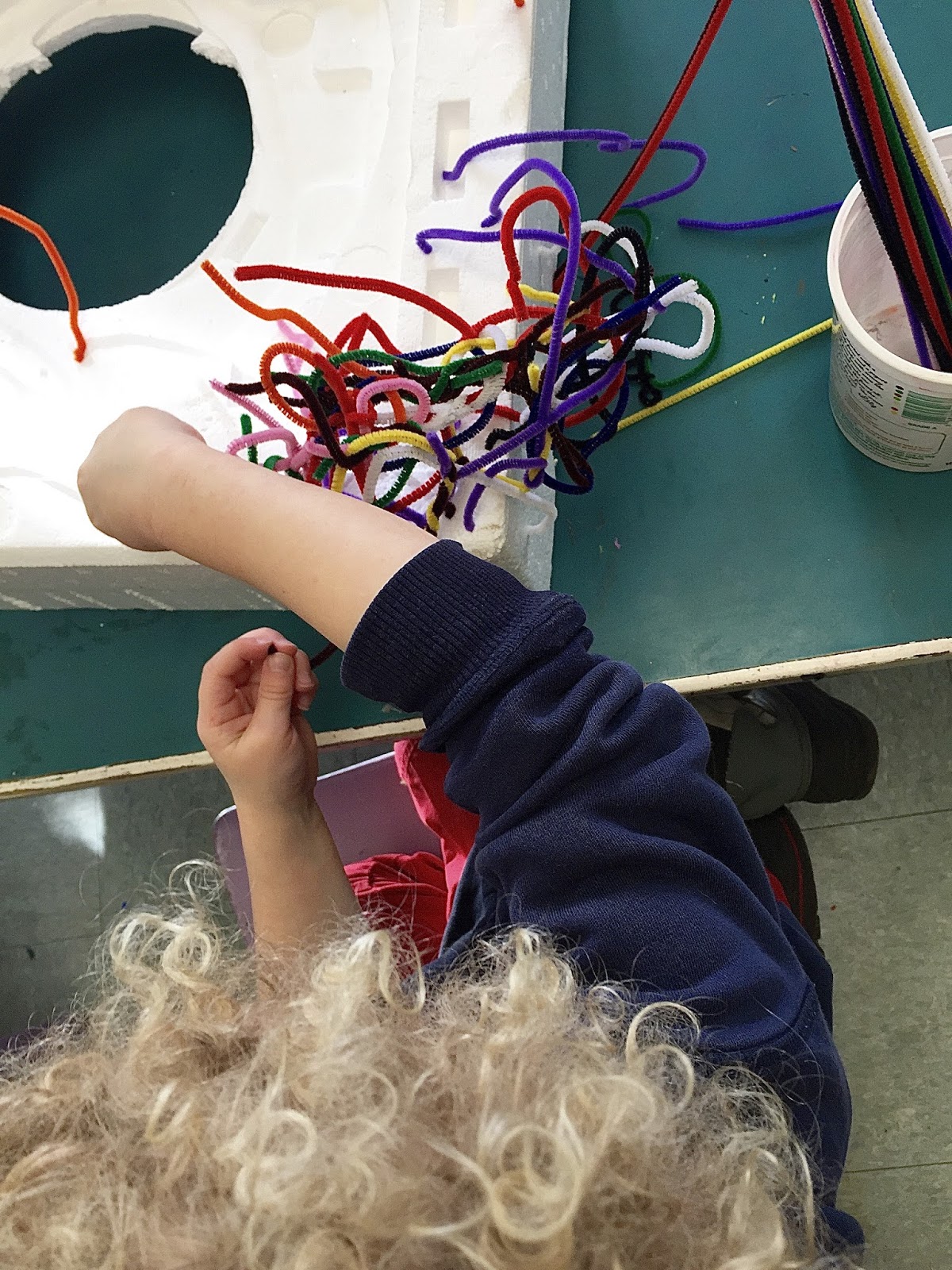
tag:blogger.com,1999:blog-15932919.post-9077747241722798646
Extensions
No One Has Ever Pulled Themselves Up By Their Own Bootstraps
construction/tinkeringparentingteaching
Show full content
var addthis_config = {"data_track_clickback":true};
Some 30 years ago my wife and I considered ourselves the kind of people who would have a wine cellar. We were motivated in no small part by the fact that we'd just purchased a home with your classic cool, dark basement, ignoring the fact that I don't drink wine and she sticks almost exclusively to a few brands of chardonnay. Since there were already shelves built into the space, I ran out and purchased a classic Ikea do-it-yourself "system," which we filled, over years, with bottles of wine people gave us as gifts and that we would likely never drink.

Fortunately, I work in a profession in which nothing need ever go to waste, so when we moved out of that house, the wine rack parts found their way to the preschool where they served as a building set.
The system is simple: hexagonal prisms that are about a foot long with each end drilled with four holes into which wooden pegs fit. They can be inserted by hand, but we like to use rubber mallets at the work bench. 

It's an imperfect system, especially when using the mallets. If you hit too hard, your entire structure might collapse like a house of cards. The same goes for if you don't brace the whole thing against the work bench, which makes it a perfect thing for tinkering around, especially with an adult there to lend a hand. This can be a frustrating system to work with, I know, I've cobbled them together before and repaired them frequently over the years. Few preschool-aged children are able to manage it without an adult hand here or there. In fact, I've come to realize that it's the kind of challenge that is almost rigged for young children to fail unless they have a helping hand.

I'm reminded of a piece by the author Alfie Kohn about the popular myth that children today are too coddled and that they "benefit from plenty of bracing experiences with frustration and failure." 
Research certainly doesn't support the idea that failure or disappointment is constructive in itself. A "BGUTI" (better get used to it) rationale -- the assumption that children are best prepared for unpleasant experiences that may come later by being exposed to a lot of unpleasantness while they're young -- makes no sense from a psychological perspective. We may want kids to rebound from failure, but that doesn't mean it's usually going to happen -- or that the experience of failure makes that desired outcome more likely . . . In fact, studies find that when kids fail, they tend to construct an image of themselves as incompetent and even helpless, which leads to more failure. (They also come to prefer easier tasks and lose interest in whatever they're doing.)

When children come to our workbench, indeed when they freely chose to approach any activity in our school, the emphasis is on "tinkering," not success or failure, not reward (good grade) or punishment (bad grade), not product but process. When a child is challenged by the process of fitting two pieces together, the adult's role isn't to keep their "eye on the prize," but rather to "notice" or narrate the process in which the child is engaging. The goal of struggle is not to overcome, but to gather data.
As pioneering psychologist Jerome Bruner put it, "We want students to "experience success and failure not as a reward and punishment but as information."
Most children get to a point when working with this impromptu building set where they need help to do what they want, an extra hand to hold something; a few words of strategic counsel. This isn't, of course, an invitation for the adult to take over, nor a sign of having been coddled, but rather a natural human response to a situation that is too many or too much for them. When a child asks for help with this building set, it's a request to provide support for their exploration. Often the request for help is very clear and specific, "Will you hold this for me?" an acknowledgment that they know exactly what they need to get to where they wants to go. Other times it's less clear, perhaps a groan of frustration or an "I can't do it!" In this case, we engage in a discussion about the nature of the challenge, my "help" coming in the form of helping the child simply formulate their request for help. Often that alone allows a child to see his way through to a solution. Sometimes I find I need to make suggestions (e.g., "If someone held that part, you might be able to do it.") or simply make statements of fact (e.g., "If you hit right here, the peg will go in the hole.")  

I have no formula to guide adults on when and how to provide help. It always comes down to the child, the situation, and your relationship with them. Sometimes, as my friend and parent educator Janet Lansbury suggests, it's totally appropriate to say, "I won't help you, but I won't let you get hurt," but learning how to ask for help, learning to know when to ask for help, is as vital to "success" (however you define it) as anything else one needs to learn.
Part of what Kohn is writing about in his piece is what I call "The Myth of Boot Straps." It's a common theme that runs throughout public debate these days, one that implies that everyone can just pull themselves up by their own boot straps if only they apply themselves, stick to it, work harder. It's part of the mythology of the "self made man"; that it's a sign of weakness or coddling to ask for help.
What people have forgotten in this neo-Calvinist ideology is that "to pull one's self up by one's bootstraps" is a metaphor for an impossible task. It's an absurdity. Everyone needs help. If you're stuck in the mud, no amount of pulling at your own bootstraps is going to get you out. Learning when and how to ask for help is a vital life skill, because mythology aside, no one does it on his own.
******
Even the most thriving play-based environments can grow stale at times. I've created this collection of my favorite free (or nearly free) resources for educators, parents, and others who work with young children. It's my gift to you! Click here to download your own copy and never run out of ideas again!


I put a lot of time and effort into this blog. If you'd like to support me please consider a small contribution to the cause. Thank you! Bookmark and Share <!-- AddThis Button END -->
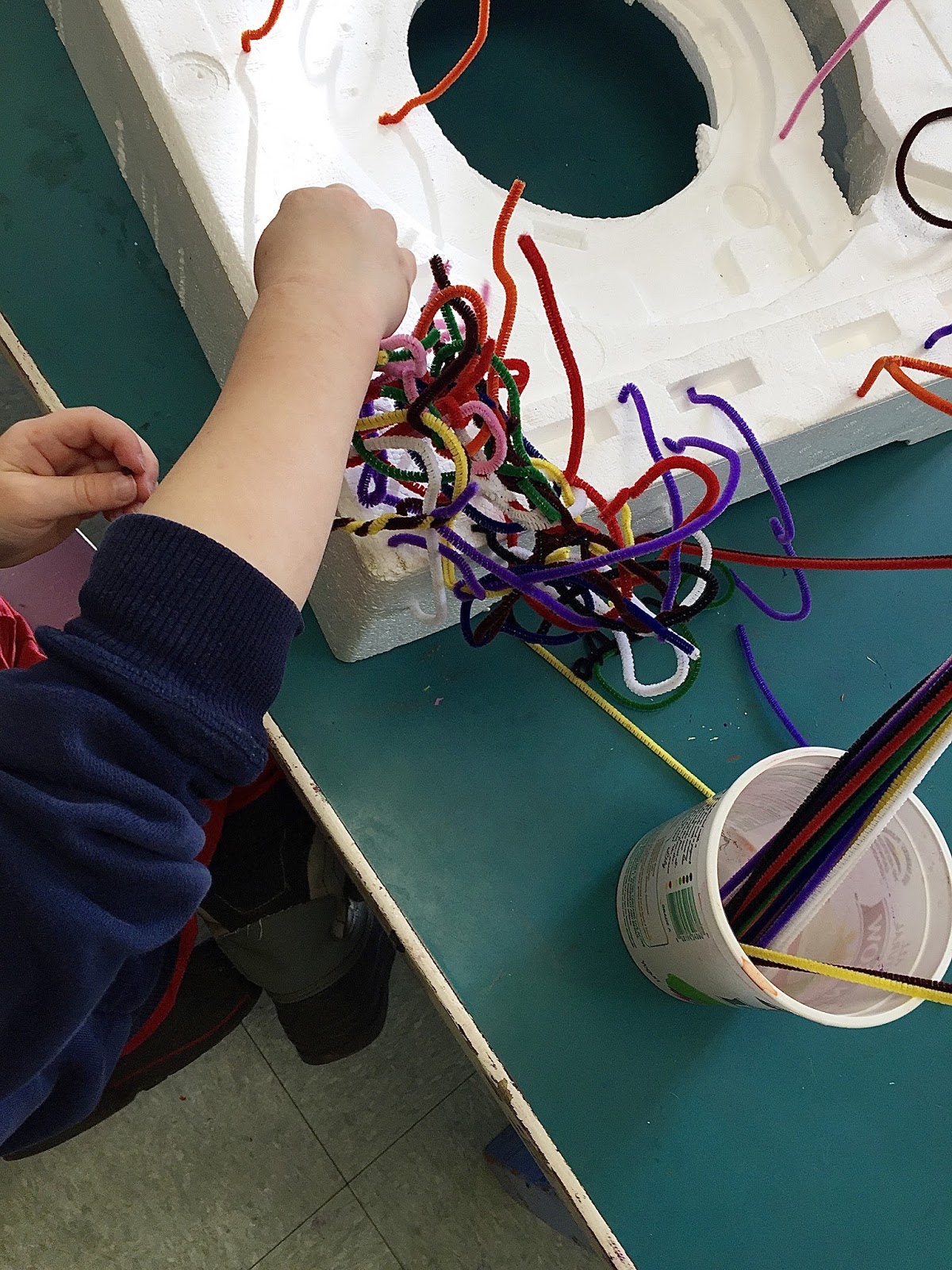
tag:blogger.com,1999:blog-15932919.post-5636714067368717169
Extensions
Brute Fact
education transformationlife and deathteaching
Show full content
var addthis_config = {"data_track_clickback":true}; On a regular cycle, the moon in various phases is visible in the morning. Each day, when I observe it upon waking, it is in a different place, then traces an arc across the sky until it disappears behind the horizon in the west.
It has been doing this for billions of years. Fungi, the first multicellular lifeforms began tracking lunar cycles, even synchronizing with them. Later, when plants began to populate the globe, they too took notice. And then, last of all, came we animals. When I take note of the morning moon for several days running, I feel myself connected to those earliest humans who wondered about the same moon, as it did the same things it does today. I imagine that I might have been one of those early humans who began keep some sort of record of its progress over days and years, perhaps using some sort of system of tally marks etched into limestone or something.
Living in today's world, I don't have that urge. I know the moon moves, in a dance with the Earth, according to a predictable cycle, one that can be predicted centuries in advance, but the calculations have already been done. If I really need or want to know how the moon will appear next Wednesday, it will only take a few seconds on the internet to have an answer. 
There is no more need to wonder about the moon: that wonder has been replaced by "brute fact."
I came across that phrase the other day -- "brute fact" -- when reading about the mathematician and philosopher Alfred North Whitehead. I like it. It gets at something that has long disturbed me about the way most schools approach education. I often refer to it here on the blog as an obsession with right and wrong answers. In Douglas Adams book The Hitchhiker's Guide to the Galaxy a massive computer is built for the explicit purpose of determining "the meaning of life, the universe, and everything." After seven million years it spits out the "brute fact" that the answer is 42.
While 42 may indeed be the correct answer, it is not only meaningless without a full understanding of both its relationship to everything else, but even as a so-called "fact" it is shaped by the perspective of the observers . . . In this case the computer.
When we make the mistake of thinking that brute fact alone makes for an adequate education, we remove wonder, which is the source of the human motivation to learn anything at all. It really shouldn't surprise us that so many children are unmotivated by school, and it's why our school masters must then introduce the hollow external motivators of grades and test scores: replacing the sweet carrot with a harsh stick.
When we wonder, we play, which is the highest form of research. It's through play that we are free to examine the brute fact from every perspective available to us, and to at least hope to discover how it connects to ourselves and the rest of the world. This is where meaning comes from, not brute fact alone.
When I see the morning moon, the joy it brings me goes far beyond the brute fact of its predictability. It connects me, through wonder, through time, to everything that has ever existed on this planet, which itself is a vast system of connection. The brute fact may be 42, but this morning as I consider the moon, I'm brought closer to the answer to the meaning of life, the universe, and everything.
Let's not rush our youngest children on to the brute fact. It will always be there as predictably as the phases of the moon. Let's let them play, at least for a few years, because that's the only way any of us have ever discovered meaning. And meaning is what we need most.
******
Even the most thriving play-based environments can grow stale at times. I've created this collection of my favorite free (or nearly free) resources for educators, parents, and others who work with young children. It's my gift to you! Click here to download your own copy and never run out of ideas again!


I put a lot of time and effort into this blog. If you'd like to support me please consider a small contribution to the cause. Thank you! Bookmark and Share <!-- AddThis Button END -->
tag:blogger.com,1999:blog-15932919.post-5737848910722978567
Extensions
To Live With Our Heads on a Pivot
developmentmediaoutdoor playparentingteaching
Show full content
var addthis_config = {"data_track_clickback":true}; I recently returned from Calgary where I took part in the Alberta Family Child Care Association's annual conference. I came back inspired by the conference, but with a pressing question for my fellow humans: what did people do at airports before smartphones? 
It seemed that everyone, from young children to elderly adults, were jabbing and swiping, and engaging with the same crap they could have been engaging with without getting out of bed.
Here we all were, travelers together in the midst of doing something that should by all rights be exciting. We were traveling, by air, to new places, new climates, new cultures and countries. Or perhaps returning home from the same. In a sane world, in a world that had not lost its ability to wonder, our heads would be on pivots, watching people, admiring the modern architecture, taking in the public art, listening to the unique sounds and reacting to the unique scents of transit, watching with awe as 70 ton machines soar into space carrying people to all points of the globe. 
Once you've cleared airport security, you emerge to find yourself in a place that is no place at all. A place governed by schedules, but where morning, noon, and night have no meaning; a place of 6 am cocktails and 10 pm coffee. When you raise your head from your screen you find yourself at a truly exotic crossroads, where people from all over the world have converged, to bide their time, while passing through.
The American Academy of Pediatrics recently made changes to their long-standing recommendation that children be screen-free during their first two years of life. They still urge minimal screen time during the first 18 months, with the exception of video chatting with family members. After that, up to five years old, the recommendation is for no more than one hour per day of "high-quality" content. Co-viewing (i.e., caregivers participating with the child) is strongly encouraged, especially up to two years old. And all of this with the caveat that screen time not replace play, sleep, movement, or social interaction.
And that's exactly what I saw happening: dull, commonplace, repetitive screen time was replacing all those things that make travel and life dynamic, spicy, and exciting. And it wasn't just the kids. We blame and pity the children, but this is a something that impacts all of us and not just when we travel. The phones come out at dinner, at the theater, while walking down the street. Every time we look at our screens it is replacing something else. And that something else is wonder.
In my lifetime, "the screen" has gone from being a black and white TV set that offered relatively little of interest to young children outside of Saturday morning cartoons to a 24/7 ubiquitous presence. Even checking my clock involves a screen. This is the world in which our children are living. That said, it's important to note that the world's oldest and largest association of pediatricians continues to caution against screens for young children. 
But we would be well served to consider it a caution to all of us.
The truth is that our screens, as convenient, useful and entertaining as they are, can have a net negative impact on everyone's physical and mental health. You can hardly scroll a social media feed (on a screen, of course) without coming across dire warnings about what our screens are doing to us. Some of it is hyperbolic fear-mongering, but a lot of it is real. I think we all know that our screens are harming us, if only because they replace life itself, but few of us are able or willing to give them up. Indeed, I doubt many of us would be able to limit ourselves to that one hour per day, especially if it involves having to "co-view" with someone else . . . But, you know, when I do the mental experiment, I can see that it would completely transform the experience.
According to the World Health Organization nearly 80 percent of teenagers around the world do not get enough physical exercise. A new longitudinal study finds that the seeds of this phenomenon are sown during the preschool years. According to this study, active play, limited screen time, and sufficient sleep in the early years predict a more active lifestyle a decade later. We know that our bodies and minds are intertwined, that an inactive body dulls the mind. This study doesn't tell us anything we probably don't already know, but it does provide more concrete support for the AAP's screen time recommendations
Young children need us to adhere to the AAP's guidelines, but the truth is that it will never happen until we adults do something similar, which is to say, take conscious control of our screen habits. I hope I don't come off as preachy, I grab for my phone far too often, but for the past couple years, I've made a point of leaving my phone behind more and more often. As I traveled to and from Calgary, I had my boarding passes on my screen device and I used it for necessary communications, but made myself keep my head on a pivot, observing my surroundings, the people, the technology, the wonder of a crossroads. 
It was easier when I was young. The TV was alluring, especially when we finally got our "in living color" set, but when Mom wanted us out of her hair, she could just say, "You're driving me crazy, go outside." And we did, where we found things to wonder about. Increasingly, parents don't have that option. I get it when they say, "I just needed a moment to myself," as an explanation for their child's screen time. Despite a culture that often tells us the opposite, being a parent ought not be a full time job. Our children do not need full time, round-the-clock supervision and entertainment. Indeed, they need more freedom and fewer screens if they are to grow into independent, resourceful, competent, and confident adults.
Our parents had "go outside." A fenced backyard is nice to have, but the truth is that a walled garden, no matter how wonderful, isn't quite the same thing . . . Unless they are free to climb, to dig, to harvest, and to hunt. And, honestly, few of us are willing to sacrifice our landscaping to the kind of play children really need. Besides, and this is a more than just a philosophical point, fences are like walls and screens in that they create a world without visible horizons, that promise of something more, something beyond, something unknown. Screens offer us a hint of that, only to disappoint with yet another damned influencer video, but it's the desire for horizons that keep us swiping and jabbing.
As an early childhood educator, my purpose has always been to do everything in my power to make our school into that alternative to screens, to indoors, to constant supervision. It might sound contradictory. After all, our conception of schools is to confine and control, but in everything I do, I want children to know that they have explicit permission when in my care to climb, dig, harvest, and hunt; permission to explore the stories, objects, and ideas about which they have questions. I want them to know, that I'm not there to tell or teach, but rather to be of adequate service to their safety, to answer their questions honestly, and to provide them with the things they need. And a big part of making that happen is to ensure, to the degree possible, that it is a place without screens.
I admire the AAP and their commitment to early childhood. Their recently reaffirmed and updated clinical report on The Power of Play is the most comprehensive collection of research and data on why young children must play that I've ever come across. We ignore their screen time recommendations at our own (and our children's) risk.
We know that our knee-jerk screen habits are harming us in a variety of ways, but for me, the most tragic part is that screens have replaced our wonder with a pathetic existence of swiping and jabbing. We have evolved to live with our heads on pivots, our bodies in motion, not inertly bent to a screen. We have evolved to play, sleep, move, and socialize. And that is exactly what our screens are taking from us.
******

Even the most thriving play-based environments can grow stale at times. I've created this collection of my favorite free (or nearly free) resources for educators, parents, and others who work with young children. It's my gift to you! Click here to download your own copy and never run out of ideas again!

I put a lot of time and effort into this blog. If you'd like to support me please consider a small contribution to the cause. Thank you! Bookmark and Share <!-- AddThis Button END -->
tag:blogger.com,1999:blog-15932919.post-1545520581052415148
Extensions
Learning While the Adults Loiter With Intent
communityconstruction/tinkeringdevelopmenteducation transformationoutdoor playteaching
Show full content
var addthis_config = {"data_track_clickback":true};
I don't know where the pogo sticks came from, but there were two on the playground. I imagine that we benefited from someone's garage or cellar purge. When I first spied them, I tried one out, something I've done a handful of times in my life. I didn't succeed in achieving a single bounce, although there have been times in my life when I've managed as many as a half dozen. I wondered if the children would know what they are, but one of the cardinal rules of young children in groups is that if one child knows something, they all know it. So all it took was for one child to say, "It's a pogo stick," then explain how they had seen one work and the knowledge went viral.

The One Laptop Per Child organization demonstrated this phenomenon back in 2012 when they left boxes of tablet computers in remote Ethopian villages. Within four minutes, illiterate children had figured out, together, how to power them up. Within days, they were customizing their desktops. Within weeks, they were using the installed apps and singing along to videos. Within five months, they were hacking the Android software. All without instructions or teachers. This is how learning through play works and why few things impede learning more than the "keep your eyes on your own work" mentality: it makes children dependent upon the adults rather than one another which is the most natural and motivating way to learn new things.

Pogo sticks may or may not be more complex things to learn than those tablets, or maybe there are just more distractions on our playground in Seattle than in an Ethiopian village, but after weeks, the kids, despite understanding the concept, still had not succeeded in even a single bounce. That is until one day when a couple girls decided they were going to figure it out. They knew they couldn't get started bouncing on their own, so they tried working together, with one holding the pogo stick upright for the other, but the weight was too much. They tried leaning the pogo stick against the wall of the playhouse to keep it upright as they climbed on, but this too failed. They tried rallying more children to help hold it upright, but then it was too crowded for anyone to climb on. They considered the mental experiment of digging a hole into which the pogo stick could be "planted," but recognized that it would be impossible to bounce properly in a hole.

"Maybe you could use this," suggested a boy, offering a length of rope. After considering it, the girls decided it was worth a try. I couldn't imagine how they would manage it, but that's not my job, so I moved along to loiter with intent elsewhere. When I later returned to the pogo stick experiments, they had tied one end of the rope to the top of the playhouse and another around the trunk of a lilac at the top of our concrete slide, with the pogo stick dangling, upright, in the middle. As one girl steadied the rope, another climbed onto the pogo stick and, Yes! She bounced four or five times before toppling over. 
By the end of the day, several of the children had discovered pogo stick success, using this training device invented by children. It's incredible hubris for adults to assume that children need us to teach them things. What they need most from us is freedom, time, and other children with whom to collaborate while the adults loiter with intent.
******

Even the most thriving play-based environments can grow stale at times. I've created this collection of my favorite free (or nearly free) resources for educators, parents, and others who work with young children. It's my gift to you! Click here to download your own copy and never run out of ideas again!


I put a lot of time and effort into this blog. If you'd like to support me please consider a small contribution to the cause. Thank you! Bookmark and Share <!-- AddThis Button END -->
tag:blogger.com,1999:blog-15932919.post-3580551893627884726
Extensions
The Blind Spot
developmenteducation transformationsciencesensoryteaching
Show full content
var addthis_config = {"data_track_clickback":true};
"(M)athematical physical laws don’t describe reality; they describe idealized objects in models." Nancy Cartwright

I've just finished reading a book called The Blind Spot, in which it's three authors (Adam Frank, Marcelo Gleiser, and Evan Thompson) explore what they call the "blind spot" of Western science. They start with what they call "The Parable of Temperature."
To paraphrase, scientists invented the thermometer (in the absence of any established theory of temperature) in order to measure this thing called temperature. Of course, long before any thought to measure temperature, everyone already understood the concept of hot and cold. The problem is that hot and cold have meanings that change depending on the individual and the circumstances, but temperature, as measured by a thermometer, is supposedly an exact thing.

This is what scientists felt they needed in order to make progress toward a better understanding about the way the world works. The problem is that a thermometer isn’t the kind of precise tool we've been conditioned to believe it is. Thermometers measure temperature on a scale that is based on the boiling and freezing points of water, and those things vary depending on where the measurements are taken. For example, on a mountain top, water boils at a lower temperature than at sea level. Indeed, it also boils at a different temperature at every elevation in between. 


To work around this challenge, scientists then created controlled environments in which to perform their experiments, laboratories or workshops that offered consistent, replicable conditions which allowed them to develop an abstract theory called classical thermodynamics. They then used this theory – like "pulling themselves up by their own bootstraps" – to define temperature even more abstractly. Now, temperature could be defined in a way that excluded concepts like hot and cold altogether and even allowed for things that are physically impossible, like the idea of “absolute zero" and the mathematical possibility that something could spontaneously reheat itself.


And lost in all of this is the concrete, real, human experience of temperature that each of us feel with our own bodies. This "scientific process" leads scientists to tell us that there is an objective reality that is somehow separate from us. To use another example, we're told that things we have never directly experienced like atoms and light waves are real, while things we experience all the time, like the color red or hot and cold are "just in your head."


It's as if scientists believe that our heads are not part of the world.


We do this all the time in education, especially when it comes to math and science, and that's probably because we are all victims of this Western penchant for abstracting basic concepts in order to study them, then making the mistake of reifying (or thing-ifying) our formulas and controlled environments. Every child engages in mathematics for fun, which is what they are doing when they sort, sequence, and make patterns: that is what math is, concretely. But instead, probably because most of us have learned that our own actual experience with math is inadequate, we rush to force young children to replace this joyful, human activity of sorting, sequencing, and patterning, with the abstractions of numbers and equations. When we do this, we remove it a step away from real, human experience, experience we need in order to make meaning of the abstractions. In doing so, we teach them that their own experience of mathematics is "just in their head" while the abstractions of number, operators, and equations is "real."


The symbol "2" is not a real thing. It is an abstraction of the concrete circumstance of having, say, collected a number of apples greater than one or less than three. The symbol 1/2 is likewise not real. Reality is cutting an apple in half to share with another person. The same thing can be said of most science that tends to thing-ify real world phenomenon by separating them from our actual experience of the world. When we rush to make children read, we do the same thing, forcing them into the abstractions of letters and sentences and paragraphs, while ignoring the real, concrete things, like stories, characters, and ideas, that are the only source of their meaning.


Too often in education, as in science, we rush to the abstractions, mistaking them for something real, when, in fact, it will always be the embodied knowledge of hot and cold that matters most. The color red, the story of adventure, the sharing of an apple, those are the real, concrete things that must be embodied if the rest of it is going to have any meaning at all. And meaning is what is most missing from our world today.


We do not prepare children for life by feeding them abstractions and telling them to ignore what their senses tell them. We do it by setting them free to take the real world in their hands which is the only way it will ever have meaning in their heads and hearts. And this happens when we give them permission to play.


******


Even the most thriving play-based environments can grow stale at times. I've created this collection of my favorite free (or nearly free) resources for educators, parents, and others who work with young children. It's my gift to you! Click here to download your own copy and never run out of ideas again!

I put a lot of time and effort into this blog. If you'd like to support me please consider a small contribution to the cause. Thank you! Bookmark and Share <!-- AddThis Button END -->
tag:blogger.com,1999:blog-15932919.post-5409528647166567515
Extensions
When I Brought Slot Cars to the Preschool
construction/tinkering
Show full content
var addthis_config = {"data_track_clickback":true};
I was probably 8 years old when I awoke on Christmas morning to discover that Santa had left my brother and me a slot car set.
We hadn't asked for slot cars. I suspect that this was something that Dad really wanted to give to us. I mean, it was the height of the slot car trend in America and this was exactly the kind of toy with which an engineer would want to play. We played with it alongside Dad for a good part of that morning. Since we were then allowed to keep it in the dining room for several days after that, we returned to it repeatedly during the next week.

We learned how to slot our cars onto the tracks. Dad showed us how to properly bend the copper braids (he called them brushes) that created contact with the metal track, making the cars go. There was a red car and a white car. We thought one was a little faster than the other, but our testing was inconclusive. By the end of the week, the track was packed away and put in our bedroom closet where it mostly sat untouched.
As often happens with manufactured toys, even cool ones like a slot car set, the play value wore off quickly. After all, how many times can you drive your car round and round doing nothing but squeezing a little trigger? We had better, more active things to be doing.
A couple years later, our family moved to Athens, Greece for Dad's work. We were only going to be there for two years (as it turned out it was four years), so we didn't take much of our stuff and the slot car track was left behind. Shortly after we arrived, however, Dad came home from work with another slot car set. But this one was far, far better. It was second-hand for one thing and included not only several cars, but a whole case full of car parts, including motors, tires, chassis, car bodies, wires, screws, braids, and everything kids might need to modify and build their own custom cars. There were no instructions, although there were several small screwdrivers and a couple of operational cars that provided us with the "blueprint" for how the parts went together. It wasn't just a slot car set, but rather a race car themed tinkering set.

I played with it far more than I'd played with that original set, not necessarily for racing, but for building and rebuilding functioning slot cars. I would spend hours noodling over how to combine a particular motor with a certain chassis, wheels, and body. I might run it around the track a few times, then it was on to the next. The scripts had been stripped from the toy, rendering it more open-ended, and capable to evoking the emotion that I call, "I wonder . . ."
We passed that set along to other kids when we moved back to the States, but it all came back to me one day several years ago when I came across a slot car set in a big-box toy store. At only $9.99 it seemed like a deal, so I picked one up to bring into the preschool. I knew that the kids were probably too young to build their own cars, but it seemed like exactly the kind of toy that would engage preschoolers for a day or two, maybe a week. 

Not only did it have zoom-zoom appeal, but I knew from experience that playing with slot cars demanded just the right level of fiddling around to keep them interesting: you had to position them correctly into the track slots; the braids, of course, needed constant adjusting; if you went too fast, the cars wouldn't make it around the track; there were several electrical connection points that would need managing; the track itself was a challenge to assemble and re-arrange. The idea of racing cars would draw them in, but I figured the fiddling around would keep them coming back.
For the next decade, that slot car track made two, maybe three, annual appearances in our classroom, each lasting a week before it was once more packed away. That's about as long as most manufactured toys can hold a child's interest. Over years of use, the set became increasingly fiddly to the point that it was almost inoperable. That's the destiny of cheap toys. I kept it going as best I could, but eventually the track would no longer reliably complete the electrical circuit needed to get the cars going -- too many bent parts. Finally, instead of packing or throwing it away, I just let it ride. 

It was fully dismantled over the course of weeks. Over the course of months, the parts mostly migrated to the junkyard playground. And that's where this manufactured toy became everything but a slot car set. It was set free to be loose parts -- wheels, pieces of track, chassis, motors, bodies, hand controllers, guard rails, wires, screws, memories -- that could now become anything at all. Those the children played with for years.
******

Even the most thriving play-based environments can grow stale at times. I've created this collection of my favorite free (or nearly free) resources for educators, parents, and others who work with young children. It's my gift to you! Click here to download your own copy and never run out of ideas again!

I put a lot of time and effort into this blog. If you'd like to support me please consider a small contribution to the cause. Thank you! Bookmark and Share <!-- AddThis Button END -->
tag:blogger.com,1999:blog-15932919.post-4838299266498334980
Extensions
Building Furniture With Preschoolers
communityconstruction/tinkering
Show full content
var addthis_config = {"data_track_clickback":true};
Several years ago, we purchased new tables, chairs, and stools for the playground. It all arrived in boxes, unassembled. We could have afforded to purchase the "velvet glove" service which would have meant the stuff arrived ready to go, but where's the learning in that?
Adults often have to hold things in place as the kids tighten the screws. It's a real collaborative process.

I've found that assemble-yourself furniture, such as the stuff you get from places like Ikea, is a sort of "just right" project for our cooperative preschool. Naturally, we can't just turn it over to the kids, but with an adult or two leading these Allen wrench (hex key) assemblies, kids as young as two are capable of making meaningful contributions to these real life projects.
Concentration, cooperation, and fine motor skills are challenged.

It never seems like it's going to work at first. We open the boxes and always find more parts than you think you'll need, and the instructions look daunting, especially since there is often a crowd of kids trying to get their hands on things. 

The first step, however, is a classic preschool sorting project, checking the instructions to make sure you have all the parts, arranging everything by type and shape, comparing the thing you're holding your hand with the graphic on paper, counting out the various screws. These are skills and habits we acquire when we're young that we use throughout our lives.

Once this is accomplished, we know the names of the parts, and naming things always makes projects seem a little more do-able. For instance, the kids and parent-teachers started using the term "lozenges" to label one of the basic pieces required to assemble this brand of furniture. I don't know if that came from the instructions or their own innovative use of language, but it stuck. "I need a lozenge!" "I found a spot for a lozenge!"

We then find Step 1 in the instructions. It's really remarkable how often it's the kids who figure it out first. Then on to Step 2 and Step 3 and Step 4. This isn't for every child, but for some it comes naturally, this kind of real world puzzling.
Here we are fitting a "lozenge" into its proper place.
There's usually an ebb and flow at the workbench as kids take and lose interest. There are always a few who want to see at least one project through from beginning to end, however, puffing their chests in pride when the finished piece is on the ground.
The first piece we finished was this step stool, which we'll also use to replace our old, wobbly benches.
And, of course, once we finish building a piece, we have to take turns putting it through its paces.

Assembling furniture like this is different than much of what we do in our preschool in that it is a project with a predetermined beginning, middle, and end, much like working on puzzles. Over the course of our three days working on this project, at least six different parent-teachers took turns, and I suspect that at one time or another, every child lent a hand. One of the most challenging parts for the adults, however, was in not becoming too product-oriented, too focused on "getting it done." I kept reminding everyone: "It's not a race. If we only get one piece done today, that's fine."

One of the concerns, especially with our wood chip bestrewn outdoor play surface is that with all those little hands, and all those little agendas, we would wind up losing some of the small, but all-important screws. And it was a real concern given that, like with most of these kinds of products, we weren't provided any extras. I was impressed with how seriously the children, even the very youngest, took this responsibility, often clenching them in their fists so securely that their palms were sweating when we finally pried them open.

Real world projects like helping with preparing dinner or working on the car, in which children can make a meaningful (rather than a manufactured) contribution are great for building skills and confidence, of course, but most importantly, I think, it fosters that sense of pride and responsibility, that sense of true belonging that lies at the heart of every great community.

******

Even the most thriving play-based environments can grow stale at times. I've created this collection of my favorite free (or nearly free) resources for educators, parents, and others who work with young children. It's my gift to you! Click here to download your own copy and never run out of ideas again!

I put a lot of time and effort into this blog. If you'd like to support me please consider a small contribution to the cause. Thank you! Bookmark and Share <!-- AddThis Button END -->
tag:blogger.com,1999:blog-15932919.post-8334331207468238231
Extensions
Play as an Act of Resistance
communityconflictdevelopmenteducation transformationLanguageloveparentingpowerteaching
Show full content
var addthis_config = {"data_track_clickback":true};
If there is one lesson I have always wanted the children in my life to learn it is to question those in authority, like their teachers and even their parents. This is not the same as saying defying authority, but rather the intellectual and social practice of doubting those in power when they say or do things that don't match what the children already know about the world. Indeed, I want them to know it's not just their right, but their responsibility to do so.
And any authority figure who denies someone's right to question them does not deserve to have authority over others.
One way I try to teach this lesson is to intentionally be wrong . . . a lot. I will hold up a plastic pig figurine and make it say, "Moo." For most children, this comes off as a joke, even if I'm saying it with a straight face. They laugh and saying something like, "No, Teacher Tom, the cow says moo!" Others just look at me like I'm crazy. 
I might insist it's raining when the sun is shining. Or that the hand drum I use to signal transitions is actually a banjo. Or that the carrot I'm eating is candy. 
I want the children to listen to what I'm saying and if what I'm saying defies the evidence before their own eyes, ears, or reason, I want them to know that it is not just their right but their responsibility, as a member or our community, to call me on it. 
This might sound risky to some educators and parents, but the alternative, which is to learn that authorities are to be believed and obeyed, no matter how irrationally they wield their authority, is far, far more dangerous. We know that the habits we develop when we are young tend to carry forward into adulthood. If we teach children to be obedient and unquestioningly compliant, how can we possibly expect them to grow up to be critical thinkers? Do as I say, not as I do and Because I said so are lessons in bullying authority that defy our essential humanity. 
I choose to rely on mutual respect instead. And when I respect someone, I must make room for them to question and challenge me.
As political philosopher, author, and Holocaust survivor Hannah Arendt wrote in her book The Origins of Totalitarianism: "The ideal subject of totalitarian rule is not the convinced Nazi or the convinced Communist, but people for whom the distinction between fact and fiction (i.e., the reality of experience) and the distinction between true and false (i.e., the standards of thought) no longer exist." Or as George Orwell writes in his dystopian novel 1984: "The Party told you to reject the evidence of your eyes and ears." If the ideal subject of totalitarianism is someone who relies on others to tell them what is true and what is false, then the ideal citizen in a self-governing society is one who has learned to seek truth in their own lived experience and to challenge those who would tell them otherwise.
Perhaps the best way to prepare children to resist those who would wield power over them in the future is to leave them alone to experience the world before them, to shut up and free them to form their own ideas, theories, and understandings. This is exactly what a play-based curriculum does. As Rebecca Solnit writes in her book Orwell's Roses, "direct observations and firsthand encounters in the material and sensory world (are) acts of resistance or at least reinforcements of the self who can resist. To spend time frequently with these direct experiences is clarifying, a way to step out of the whirlpools of words and the confusion they can whip up."
Play is how we offer children the kinds of direct experiences they need to see through lies and illusions. Sadly, we live in a time when we must fight for the right of children to play, if only in the name of their mental health. Increasingly, our children are growing up in a world in which all truth comes through authority figures, educators and parents, who are telling them what to do and when to do it. Play is the way we break this cycle. It is how all of us can re-learn how to trust our own eyes and ears and resist those who would command us.
******

Even the most thriving play-based environments can grow stale at times. I've created this collection of my favorite free (or nearly free) resources for educators, parents, and others who work with young children. It's my gift to you! Click here to download your own copy and never run out of ideas again!

I put a lot of time and effort into this blog. If you'd like to support me please consider a small contribution to the cause. Thank you! Bookmark and Share <!-- AddThis Button END -->
tag:blogger.com,1999:blog-15932919.post-2891726436606894494
Extensions
Training for the Unexpected
developmentdramatic playlarge motoroutdoor playscience
Show full content
var addthis_config = {"data_track_clickback":true};
In science journalist David Toomey's book Kingdom of Play, he writes about an animal geneticist and ethologist named David Wood-Gush who established the "Edinburgh Pig Park," a place where domesticated animals were allowed to roam freely. The idea was that they could live as closely to their natural state as possible, yet still be easily studied by scientists. It was known at the time that pigs that played more tended to healthier, so Wood-Gush and his colleague Ruth Newberry decided that understanding more about pig play would lead to more humane treatment of pigs.
Like many mammals, one of the forms of pig play is to run around. This makes sense to scientists because, according to one of the major theories about the function of play in animals is that it allows us to practice skills we might need in the future. Running is obviously a good way to avoid future predators. One thing that surprised the researchers, however, was that periodically, while in the midst of running, piglets would, for no apparent reason, fling themselves upon the ground, scramble back to their feet, then continue running. This seemed like a less adaptive behavior. Indeed, it seemed like a good way to wind up as lunch.
Newberry continued to pursue this question and, along with colleagues in the US, came up with an idea they called "training for the unexpected." In the real world, an animal is running in natural terrain, which means it's littered with tripping and slipping hazards. The pig flop-over, they speculated, was in fact practice for the real possibility of having to recover from a fall while being pursued. "We hypothesize that a major ancestral function of play is to rehearse behavioral sequences in which animals lose full control of their locomotion, position, or sensory/spatial input and need to repair their faculties quickly."
There is no agreed upon definition of what play is among scientists, but this notion of "training for the unexpected" has become central to our current efforts to understand what play is all about. Evidence of this phenomenon is all around us. Young children are famous for putting themselves into disorienting positions. I've watched countless children doing their own version of the piglet flop. Children spin on swings, roll down hills, and diverge from almost every straight-and-narrow path in order to clamber or climb. Often their "flops" are objectively risky behaviors. And we all know that once is rarely enough, they must do it again and again and again, which is the hallmark of practice or training.
It doesn't make much of a stretch to see that their dramatic play is likewise an aspect of this phenomenon. By pretending to be someone or something they are not, they are preparing themselves to respond to the surprises that life will inevitably offer them. In contrast, so much of what we call schooling is focused on the knowable, the predictable, the standard, and planning for the future, but we all know that much of life as it's lived, perhaps most of it, is about how we respond to the unexpected, the tripping and slipping. As the Yiddish adage has it, "Man plans and God laughs." Play is, in this context, how animals prepare to get the last laugh: we may fall, our plans may go awry, but because we played, we know how to get back up and keep going.
We are currently experiencing an alarming spike in childhood anxiety, with children as young as three being treated for it. This is not true of all anxiety, but much of it manifests as fear of the future, and specifically a fear that we will not be up to the unexpected challenges that lie ahead. It's not a coincidence that the incidence of childhood anxiety is peaking at the same time that children are experiencing a deficit of play. As psychologist and retired professor of research Peter Gray writes, "Over the same decades that children's play has been declining, childhood mental disorders have been increasing . . . the rise in mental disorders among children is largely the result of the decline in children's freedom." In a world in which children are not free to play, in which they are over-protected and over-managed, in which they are forever being groomed exclusively for the expected and shielded from the unexpected, we are robbing them of opportunities to prepare themselves for the unexpected. No wonder they're anxious.
When an individual piglet flops, of course, it doesn't know it's training for the unexpected. It's doing it because it's fun thing to do. It's so fun that they do it again and again. Porcine play, like human play, like the play of animals ranging from bees to octopuses to elephants, has evolved as an almost universal adaptation to world in which man plans and God laughs. We are meant to do fun things, even if they are a bit risky. As the German philosopher and psychologist Karl Groos wrote in his groundbreaking 1896 book The Play of Animals, "The animal does not play because he is young. He has a period of youth because he must play."
******

Even the most thriving play-based environments can grow stale at times. I've created this collection of my favorite free (or nearly free) resources for educators, parents, and others who work with young children. It's my gift to you! Click here to download your own copy and never run out of ideas again!
I put a lot of time and effort into this blog. If you'd like to support me please consider a small contribution to the cause. Thank you! Bookmark and Share <!-- AddThis Button END -->
tag:blogger.com,1999:blog-15932919.post-2462772757104360498
Extensions
Death Play
conflictdeathdramatic playemotionslife and deathpowerteaching
Show full content
var addthis_config = {"data_track_clickback":true}; Last week I wrote about talking with children about death. Actual death. The kind of death talk that comes up when there is a dead body, like a bird carcass, or a when a beloved person is, from one day to the next, no longer part of your life. 
But there is another more common kind of death talk around the preschool that falls into the theoretical or maybe even fictional category. The kind they pick up from movies or video games or older siblings. The kind of death talk that involves saying, "I'm going to kill you!" or "You're dead." It's the kind of death talk that might even make them laugh together like at a taboo subject, which, to be honest, it is.
I spent some of my own preschool years living not far from Fort Jackson in Columbia, South Carolina. I don't remember a time when I didn't know that part of what soldiers did involved killing and being killed. Naturally, we neighborhood kids played soldier games that involved fighting wars. In these games, death involved falling to the ground, then counting to 10. We even practiced dying, making a show of our death throes like we sometimes saw on TV. It's tempting to blame modern media, but, you know, there's a lot of this kind of thing in Shakespeare as well, and before that, there were those Ancient Greek tragedies, and before that I have no doubt that humans acted out death around the campfire.
This kind of "death talk" is related to actual death, but is so abstracted from the pain, the grief, and the permanence, that it's almost a different thing. It's death play. And it's important, just as it's important that young children have permission to play with anything about which they have questions. Actual death, like I discussed last week is only one aspect of death. If we are ever going to understand anything, we must be free to examine it from every perspective. Play is how we do this and death is a subject around which we will always have questions.
It freaks us out when a four-year-old says, "I'm going to kill you!" At best it strikes us as unsavory. We worry, especially when it frightens other children. I mean, even if these young humans are unclear about what death or killing means, part of our responsibility is to ensure that children don't feel unsafe in our environments, and this sounds like a threat. We know that the child making the threat possesses neither the intent nor ability to carry it out. We know it's an experiment. We know it's play. But we worry that the other children won't know that so we tend to intervene. At a minimum we want to assure the other children that they will not be killed . . . whatever that means to them.
It always depends on the specific circumstances, but if a child says to me, "I'm going to kill you!" (and it happens), I'll respond calmly and truthfully, "I don't want to be killed." If they say it to another child, I will turn to the child being threatened and ask, calmly, "Do you want to be killed?" If they say they don't want to be killed, then I'll say, "She says she doesn't want to be killed," although quite often that child will agree to be killed the way we did in our neighborhood games.
In our modern world with what seems like 24/7 mayhem and murder, I understand if this strikes some readers as crass, unsympathetic, or even dangerous. I understand why some of us feel the urge to draw bright red lines about play that involves violence and death. I get it, but I also know that we have always lived in a world that includes violence and death. We might protect young children from it for a time, but it will inevitably get to them, especially in group settings, even if we think it's "too early" . . . And then they will have to play with it. I think most of us understand that when we kibosh anything that children really need to understand, we just push it underground, and then we lose our ability to be anything other than an authority from which to hide.
Better, I think, is to notice it, then before responding, make sure we are reacting to what is happening in front of us rather than our own prejudices and fears. My own racing heart is not an indication of what is going on with the kids. Obviously, we protect children if they feel genuinely threatened, but more often than not I find that no one is taking it nearly as seriously as I am. Most of the time they know it for what it is: pretend, play, words and ideas that are clearly powerful and significant, the kinds of real things that demand to be explored. And the way we explore is through play.
******

Even the most thriving play-based environments can grow stale at times. I've created this collection of my favorite free (or nearly free) resources for educators, parents, and others who work with young children. It's my gift to you! Click here to download your own copy and never run out of ideas again!
I put a lot of time and effort into this blog. If you'd like to support me please consider a small contribution to the cause. Thank you! Bookmark and Share <!-- AddThis Button END -->
tag:blogger.com,1999:blog-15932919.post-5186598200460135606
Extensions