GeistHaus
log in · sign up

https://feeds.feedburner.com/RamblingsOfANaturalist

atom
25 posts
Polling state
Status active
Last polled May 19, 2026 01:26 UTC
Next poll May 20, 2026 00:20 UTC
Poll interval 86400s
Last-Modified Sun, 17 May 2026 18:34:34 GMT

Posts

Mr Richardson
Show full content

Mr. Richardson was our part-time gardener when we lived at the Green Walk in Chingford, north London in the 1940s.  He used to come round a couple of times a week for an afternoon’s jobbing work.  As a small boy I would often ‘help’ him with his rather set routine.  He would cut the large back lawn with a huge push mower that purred over the grass leaving it beautifully striped with silvery and darker green.  He would weed the herbaceous borders with their helianthemums and Michaelmas daisies and the vegetable patch towards the end of the garden.  He had a compost heap and a shed down there too, the latter filled with all sorts of intriguing objects like trowels, trugs, spades, sieves, forks, rakes, hoes and long, buff horsetails of bast.  This was raffia bast, used for tying plants and binding taller stems.  There were also boxes and drawers of assorted nails and screws and a strong smell of creosote used for painting the close boarded fences around the garden.

The compost heap was enclosed by large broken lumps of concrete.  These must, I think, have come from a demolished World War II air raid shelter.  Behind it, the remotest feature of the garden, was a mature laburnum tree which I regularly used to climb so that I could survey the back gardens of the houses in Mount View Road.  I remembered these from when a V2 bomb landed nearby in about 1944 and blew the backs of several of the Mount View properties, leaving them like dolls houses with one side removed. I  fell out of the laburnum once when a dead branch broke, but made a soft landing on the compost heap though I grazed my head slightly on one of the sharp edges of a concrete boulder.

One of the finest features of the garden was four or five pear trees on the fences to the east and west of the large lawn.  These had been trained as espaliers, with lateral branches reaching out horizontally, herring bone style against the fence.  In winter the year’s growth would be carefully pruned back to retain the shape of the trees and generate fruiting spurs for the summer’s pears.

This reminds me now of the well-known passage from Czech writer  Milan Kundera’s The Book of Laughter and Forgetting:

One night, for example, the tanks of a huge neighbouring country came and occupied their country [a reference to the 1968 Russian invasion of Czechoslovakia]. The shock was so great, so terrible, that for a long time no one could think about anything else. It was August, and the pears in their garden were nearly ripe. The week before, Mother had invited the local pharmacist to come and pick them. He never came, never even apologized. The fact that Mother refused to forgive him drove Karel and Marketa crazy. Everybody's thinking about tanks, and all you can think about is pears, they yelled. And when shortly afterwards they moved away, they took the memory of her pettiness with them.

But are tanks really more important than pears? As time passed, Karel realized that the answer was not so obvious as he had once thought, and he began sympathizing secretly with Mother's perspective--a big pear in the foreground and somewhere off in the distance a tank, tiny as a ladybug, ready at any moment to take wing and disappear from sight. So Mother was right after all: tanks are mortal, pears eternal.

Halfway through his afternoon stints, Mr Richardson would come indoors for a cup of tea and one of my grandmother’s rock cakes.  He usually wore a waistcoat over a striped shirt and would take his flat cap off.  He sat on a heavy slat-backed carver chair at the end of the wooden kitchen table and I was always intrigued by the fact that he had lost a finger on one hand so that he held cup and cake in an unusual way.  The chair followed us for many years, but gradually fell to pieces and finally expired on a bonfire, the kind of  bonfire Mr Richardson would have approved of, in about 2010.

Mr. Richardson, a kindly straightforward man who left a strong impression on me, lived  with his wife  (I remember no children) in Willow Street, Chingford, a small suburban road with terraced houses on either side built after the railway reached Chingford.  It was about quarter of a mile from our house. 

tag:blogger.com,1999:blog-23818283.post-3391752479729398511
Extensions
A trip to Glen More, 1954
Show full content


My first trip to Scotland was when I was sixteen.  At the end of the summer term I was asked not to return to Lancing College, my boarding school, as I was deemed ineducable.  My parents didn’t really know what to do with me but, somehow, my mother learnt of adventure training courses run by the Scottish Council of Physical Education (now Sportscotland) at Glenmore Lodge a Highland centre near Aviemore. The Glenmore Lodge I stayed in lies some seven miles east of Aviemore, and was formerly a Victorian hunting lodge.  It became a hostel when the Central Council for Physical Education acquired it in 1947. It later became the Loch Morlich Youth Hostel, and then the Cairngorm Lodge Youth Hostel (which is its name today) after a newly built  National Outdoor Training Centre was opened nearby in 1996 and was named Glenmore.

I set off by myself from home in Robertsbridge, East Sussex with rucksack and walking boots on the 600 mile train journey, mostly through the night and was met by coach with others in that fortnight’s mixed group of students.  These fellow travellers mostly came from Scotland or the north of England but, being fresh out of boarding school, I settled in straight away.

From Aviemore station we drove through Inverdruie and Coylumbridge then followed the valleys of the rivers Druie and Luineag to Loch Morlich on the 7 mile journey to the Lodge itself in Glen More.  The road ran through pine forests both natural and planted with areas of rough brown grass, moss, bilberry and heather.  Some of the drier parts were close planted with conifers of even age giving an almost scandinoir film dimension and there were scattered boggy areas of pale green and fawn. The occasional patches of the old Caledonian Forest were characterised by the open branched Scots pines quite different in shape from Scots pines elsewhere in Britain and sometimes distinguished as Pinus sylvestris subspecies scotia.

Coylumbridge is often said to be a newly built hamlet but it features on many maps of over a century old.  Today there is a four star, modern hotel there opened in 1965 on land granted by the Rothiemurchus Estate and many new buildings housing various sports and holiday activities.

On past the grey stone of the Aultnancaber hunting lodge, now a clay pigeon shooting centre, past the layby at the start of the track to what was the Cairngorm  Sled-dog Centre opened around 2001 at Moormore.  Among the conventional sled dog options, floodlit sledging was available.  The centre closed in 2020 due, according to the owners, to global warming though they claimed that snow was not essential for sled dog action.  This heavily forested area with its rows of evenly aged Scots pines is shown on the map both as the Queen’s Forest and Glen More Forest but there are often many layers of naming in the Aviemore area.  In one of the more open areas to the south of the road there is the placename Rinraoich over open, boggy ground with a small 1,000 foot summit nearby.  Rinraoich is thought to have been the location of a heather shieling, once an area of heathy pasture.

Where the road turns south towards Loch Morlich, there is the start of track on the northern side that leads to the Badaguish Centre established by The Speyside Trust in 2006 and catering for people with disabilities. This is essentially cabin style holiday accommodation with a range of appropriate activities at a site in a remote part of the Queen’s Forest. 

Visiting the web sites and other marketing manifestations of the various attractions in the area a curious paradox emerges.  The primary offer seems to be the opportunity to relax and stuff yourself with food and drink in tranquil and beautiful places, whereas the social intention of the tourist resort dimension seems to be on activity and vigorous sports and pursuits both outdoor and indoor. The centre also offers a Speyside Kitchen with a wide range of conventional restaurant dishes and a few specialities such as locally made boerewors sausage, popular in southern Africa, with sticky onion sauce.  Elsewhere fancy names have been coined for new facilities, the Pine Marten Bar and Scran for example (scran is a Scots word meaning, among other things, take away food) at the Glenmore Centre. Then there is a car park near Glenmore Lodge strangely titled the Wanderparkplatz (perhaps to make German visitors feel at home). It is as though the lovely but unpronounceable local place names in Scottish Gaelic like Cnap Coire na Spreidhe weren’t enough vocabularic variation.  A short distance further east of the Youth Hostel is the Cairngorm Reindeer Centre. To add to the etymological circus ‘reindeer’ is a word deriving from the Old Norse ‘hreindyri’.

Not far along from the road from the Badaguish turn is the sign for Rothiemurchus Centre under Castle Hill some distance from the Glenmore road.  It offers cabin and chalet accommodation to members of the British forces and associated people and organisations.  There are also picnic sites, fishing opportunities, cycle trails and orienteering facilities on or near the shores of Loch Morlich and a large sandy area called Loch Morlich Beach, said to be the highest beach in the British Isles.  One intriguing feature is a monument marked at full stop size on the map just north of the road and the western end of Loch Morlich.  The Highland Historic Environment Bureau are aware of this  but claim to know nothing much else about it – what in commemorates and how old it is.  Neither do they have a photo or drawing of it.  However, using StreetView an object like a sundial cam be seen among the pines in more or less the correct position and is apparently known as ‘The Queen’s Forest Pillar’ a name presumably connected to the fact that the surrounding area is shown on the map as The Queen’s Forest.

As outlined above the Glenmore Lodge I stayed in in 1954 is now the Loch Morlich Youth Hostel.    It later became the Cairngorm Lodge Youth Hostel.  A new build, Scotland’s National Outdoor Training Centre, a short distance to the east of Glenmore Lodge, was opened 1996 and appropriated the one word name Glenmore.  This complicated nomenclature means that many of the maps and other manifestations of the area’s geography are incorrect and/or out of date, ironic for institutions one of whose major aims is to teach hill walking visitors how to use maps.  The web site of the Reindeer Centre at Glenmore also claims that SatNav directions will take you to the wrong place – all part of the magic of the Highlands no doubt.

When we rived at Glenmore Lodge males were separated from females and we were allocated bunk beds in dormitories of half a dozen people.  Very utilitarian with bland pale blue and cream walls and rough blankets.  We all had to stow our walking boots and other outdoor accoutrements and then assemble in the dining room for our first meal for which we sat on benches on either side of long trestle tables.  Then we were mustered for briefing before outdoor activities began.  This walking, climbing, sailing and kayaking I will cover in another chapter

On some of the evenings there were social activities and I particularly remember everyone singing this song with its words and tune ringing through the ceilidh on the last evening of the course.

From Perth up to Dalwhinnie
And on to Aviemore
The hills and aw there splendour
Would set my heart a glow
You’ll make the open highway
And head for old Glenmore

The tune appears to be The Lights of Lochindaal a Scottish dance tune about Islay and I like the version on YouTube by Jack Sinclair's Television Showband.  The words I knew are thought to have been written to the tune perhaps by someone at Glenmore Lodge.  The song is a couple of lines short but the last two lines can be repeated at the end of the verse,  The hills and aw there splendour should perhaps be The hills and all their splendour.

Despite the healthy and invigorating activities, the young people on the course soon tended to form into male/female pairs.  Somehow, by the end of the first week, I found myself increasingly involved with a girl from Edinburgh called Faye.  We had very innocent, fully clothed wrestling matches on her bunk bed.  Being an only child and at boys boarding school from the age of twelve I knew very little about women either mentally or physically and, I am sure, Faye knew very little about men in those far off days when sexual relations were still very restrictive and contraception unreliable or non-existent.  I had never had a sex education lesson or a biological chat from my mother or father.  Faye was a lively and warm young woman with a posh Edinburgh accent and now, after all these years, I particularly remember the soft and fluffy very feminine pink jumper she often wore and her bright scarlet lipstick.  After we returned to our respective homes from Glen More we wrote love letters to one another from time to time and hers would always be drenched in perfume and have SWALK inscribed in that bright scarlet lipstick on the back of the envelope.

tag:blogger.com,1999:blog-23818283.post-5312874985147891933
Extensions
The Ribes Ramblings
Show full content

For details of varieties I am growing see end of this post

Ribes is the scientific name for plants of the currant and gooseberry family.  Ever since I was a child I have had an interest in these plants.  It started at The Green Walk in Chingford (north east London) where my grandparents lived and to which I was a frequent visitor, staying there for much longer periods after my father went into the army in the early 1940s.  I no longer visited The Green Walk and its gardens when, as a family we moved in 1951 to Bush Barn Farm on the outskirts of Robertsbridge, East Sussex.

The Green Walk had a large garden behind the house and towards the end of the plot there were tidy rows of red and black currants and gooseberries, all of which were regularly pruned by our gardener Mr Richardson and bore reasonable crops of fruit in summer which were welcome in those lean, wartime and post war years.  I remember sitting on the kitchen table helping my grandmother top and tail gooseberries with their green, oval fruit veined with white.  The dark brown remains of the petals - the front end of the gooseberry - was pinched off between the finger and thumb nails and the operation repeated on the remains of the stalk at the rear of the fruit.  They were used to make gooseberry tart and jam.  

I also spent much time crawling around and beneath the bushes and towards the end of my days at the Green Walk spent much time looking for currant clearwing moths whose larvae bore in the stems of the plants.  I saw the adult moths on one or two occasions drifting like smoke, or large mosquitoes, among the currant stems. 

In front of the house at Bush Barn Farm there was a field of currants and blackberries about 10 acres in extent.  In our first year of residence a group of local pickers was employed to harvest the fruit, but the bushes were subsequently dug up and the area converted to grass pasture.  I was allowed to drive an old Fordson tractor during clearance operations and the two farm hands would attach a lentgth of chain to each bush which I would then haul out of the ground with tractor power.

I thought little about currants and gooseberries until we arrived at Pomfret Avenue in Luton.  There was a tiny back garden here and one of the things I thought I might grow was one or two cordons of red or white currants.  For some reason the appeal of cordons had lodged in my head somewhere along the way and I had developed an enthusiasm to create them.  But we left Luton before I could do anythink g about it.

My next currant memory was during the years at the start of this century when I worked as a consultant ecologist.  Many of the sites I visited had currants (usually redcurrant, Ribes rubrum) particularly along stream sides.  Once though I discovered a bush in fruit (see below) close to the old keeper's cottage near Brede High Heath in Brede High Woods, owned and managed by the Woodland Trust.  This was possibly a cultivated survivor from the time when the cottage was lived in during the late 1920s or early 1930s.

Apart from this my currant encounters were confined to one or two rather  neglected bushes in pots in the garden, brought by Tana when she moved from The Green in St Leonards. And then in 2023 at the age of 85 a sudden enthusiasm for the genus, or at least its fruiting members, arose in my brain. I think, because they seemed ideal plants for patio pots, especially as most had one or more dwarf forms, for outside my French windows where I could see them.   I took some cuttings too from one of these St Leonards bushes and they rooted well over the winter giving four more plants to experiment with. I also potted up a layered branch of a wild gooseberry I found many years ago in Churchland Wood.  It has rather large leaves and vicious prickles.

Ribes-watching became a major preoccupation after this.  Another spur was my purchase, in summer 2022, of a dwarf raspberry called 'Yummy' which seems to have overwintered very well in a pot.  Partly too I liked the idea of them because I think my two year old grandson Remi, who visits often, might enjoy the development of edible fruits on reachable bushes.  It also gives me the opportunity to train some cordons or double cordons if I have long enough left.  If not other members of the family will be able to inherit the plants..

During March and April 2023 I really started to get into ribesology.  First I bought a white currant, then a dwarf gooseberry called 'Giggles Red' , a dwarf blackcurrant, and a much praised variety of redcurrant called 'Rovada'.  These came from different nurseries via Amazon and the leaves were mostly in bud, or just breaking.  I wondered it the nurseries that supplied them had some way of holding growth back.

One of our first problems was with the blackcurrant as a family of voles (see below) insisted on tunnelling into the soil of the pot, though they didn't touch the currant itself.  The problem was solved by Tana spreading a mulch of urine-impregnated cat litter over the soil.  The voles fled.


Some of the St Leonards redcurrants down the garden are coming in to flower.

And I photographed this wild, self-sown redcurrant bush also down the garden.  These are quite common in the Sussex countryside here but rarely, if ever, bear fruit.


I continued my researches on 19 April in an attempt to find out why the Giggles series of gooseberries had been so named.  The best guess was that it somehow related to 'goggles', an old-fashioned name for the fruit.  When I was a boy we often used to refer to gooseberries as goosegogs and one source said that 'gooseberry bush' was a 19th C term for pubic hair, hence the idea of finding babies 'under the gooseberry bush'.  The Giggles Series is closely associated with the nursery firm Thompson and Morgan and I think the variety name may have originated with them.

Below I have listed our current currant collection and will add to it as occasion demands.

Blackcurrant 'Summer Pearls Patio'  Early April 2023.  Thompson and Morgan

Gooseberry 'Giggles Red' 24 March 2023.  Thompson and Morgan

Gooseberry from Churchland Wood

Redcurrant from The Green, St. Leonards

Redcurrant 'Rovada'.  10 April 2023.  From Fruits of Perthshire.  One of the most popular varieties, .  Rovada was developed in 1980 in the Netherlands by L.M. Wassenaar of the Institute of Horticulture and Plant Breeding.  It is the product of Fay's Prolific x Heinemann's Rote Spatlese.

Whitecurrant 'Summer Pearls White'.  23 March 2023. YouGarden


v


tag:blogger.com,1999:blog-23818283.post-7596732037196807435
Extensions
Back again
Show full content

I tottered round our dank and droopy garden this Boxing Day.  In the summer we grew, quite successfully all sorts of vegetables on old hay bales.  Any remaining were recently covered in snow.


The line oif leaves is garlic - Donetsk Red from the Ukraine and I think they should survive the winter well enough. Under the snow in front of them is a line of very hardy corn salad (or lamb's lettuce) which is one of those plants that slugs find unpalatable as the photo below shows.  As salad they are enjoyed by our species and are usually on sale in supermarkets.  Ours were sown in late summer but it doesn't look as though they are going to be large enough to be edible until well into the spring..

Not far from these hay bales I noticed that snowdrops are starting to poke through the ground.  A little earlier than usual I think.  
The moon was quite impressive tonight in a clear sky.  The crescent is waxing and will be full on 6th January.  It is sometimes known as the 'wolf moon' but we don't have any wolves left to howl at it.


tag:blogger.com,1999:blog-23818283.post-3738286557926805490
Extensions
May 2022
Show full content

1 May 2022.  I normally take a walk every day ranging through field, wood, lanes and footpaths within about half a kilometre of home (TQ782188).  I always take the camera and usually find something to photograph.  Here I thought I might try a sort of daily picture diary.


Germander speedwell (below) in flower is now quite abundant.  The name 'germander' comes from ancient Greek, via Old French and Old English, and means 'oak leaved'.  The leaves were thought to resemble those of oak bu, as you can see in the picture, it is not a very good fit.


The distinctive croziers of soft shield fern (below) are now unrolling.  There are two plants on Jessmond's boundary, one in the north east corner of our garden,  I also know of one in Killingan Wood and there is a good colony along the south west part of Killingan Stream.


2 May 2022

tag:blogger.com,1999:blog-23818283.post-4880041671539937508
Extensions
April 2022
Show full content

 April this year has been very dry (the forecasters say we have only had about one third of the expected amount) and some of the plants locally have been showing signs of stress due to lack of water.  Insects have been scarce, though I have seen the usual spring butterfly species: red admiral, brimstone, large white, orange tip, peacock, speckled wood and comma (below).


Some other interesting insects included a female tawny mining bee, Andrena fulva, here pictured on the spurge known as 'Mrs Robb's bonnet', Euphorbia amygdaloides ssp. robbiae. I like the way she has planted her feet neatly on the edge of the flower.


tag:blogger.com,1999:blog-23818283.post-604791590934522080
Extensions
March 2022
Show full content

1 March 2022 It has been a generally rather cold and drab start to the month with the mood not being helped by Russia's war on Ukraine.  I am lucky in having a small area of wood, lane and field to enjoy away from the news.  In his speech to the Commons on 8th March Ukrainian president Volodymyr Zelensky said his people would fight in the fields, the forests and on the riversides perhaps indicating how important these places are as emblematic of a home country. However, when the wind comes from the north, rattling the bare branches in Killingan Wood, it is difficult not to be saddened by the plight of those distant people in much deeper cold who have no home left to go back to.

9 March 2022  A gratefully warm day at last.  There was enough afternoon sunshine to warm my back. On my walk my spirits were lifted by the patches of sunny celandine flowers along the verges of the lane.  In the woods the white anemone flowers are a landscape feature and some of them have pink reverses to the petals and occasionally they are wholly pink. 

I found several rosettes of heavily spotted early-purple orchid leaves and the Euphorbia robbiae (Mrs Robb's bonnet spurge) is at its best in the patch by Churchland Lane.  New leaves are greening many of the trees like this hornbeam.

The garden in brightening up rapidly with several camellias now in flower as well as the Pieris 'Firecrest' at the end of the garden.  In my Square Metre Mark 2 I found a small plant of bristly ox-tongue.  This is, I think, the first time I have noticed this species in the garden and I wondered where it might have come from.  The camellia below is the white semi-double 'Yuki-botan'.

15 March 2022  At last the weather feels more spring than winter and today I saw the first brimstone butterfly on the wing - a male.  That flake of intense citrus yellow searching the garden air, looking for bluebells and buckthorn is like a flag from a starter  - spring cannot be stopped now.  In the garden it found our only plant of the grape hyacinth Muscari armeniacum.

Yesterday I found a large patch pf spring snowflake on the wood bank at the end of Churchland Lane.  A surprise as I have been past the spot a thousand times without noticing it.  

Later I ventured into Churchland Fields where the gorse is at its best and photographed a grey willow that stands alone.  One seldom sees a free-standing tree of this species as they are normally muddled up with the scrub vegetation in regenerating secondary woodland.


20 - 31 March 2022.  The spring progresses and there are many dandelions out along the verges.  On one I saw a small sallow mining bee, Andrena praecox, the first solitary bee of the year but sadly they seem to be less common than usual. 

By 23 March the first black bryony shoots were snaking upwards, horse chestnut buds were breaking and I found an extensive colony of common dog-violet, Viola riviniana, in the north east corner of Churchland Fields. 

The warm, sunny weather continued until 30th March.  On 26th I saw my first greater stitchwort flower in Churchland Lane and the first bluebells in Killingan Wood.  On 31 March we had hail and snow showers and there was an overnight frost, one of the sharpest in the generally mild darker months.  In April we learnt that March had been the sunniest on record in parts of the north and Scotland.


tag:blogger.com,1999:blog-23818283.post-4189891742102226793
Extensions
February 2022
Show full content

 9 February 2022. Although the daytime temperature has been hovering between 9 and 12 degrees, I managed today to do some useful work in the garden.  Quite suddenly snowdrops have appeared on the far side of our lane and there are several lesser periwinkle flowers by the pond.  I pottered about in the Square Metre, propping up the Cotoneaster franchetii and pruning hazels, oak, holly and hornbeam into more manageable shapes.  On the holly I though I had spotted a leaf mine of Phytomyza illicis but it is very small and I will have to wait a bit to be certain.  


Rather less conspicuous are the tiny green flowers on new shoots of dog's mercury now appearing in Killingan Wood.

As well as dog's mercury the new bluebell shoots are starting to green the leafy woodland carpet, though the two plants grow in different places in the wood for reasons I cannot fathom.

Despite the early signs of spring there are still the remains of autumn and winter.  Some beech trees have not lost their dead brown leaves but this only seems to be the case with young trees and those that are used in hedging.  Leaves are long gone from the larger beech trees.

The evergreen shrub Euonymus japonicus or Japanese spindle tree is much used for hedging along our lane and in gardens, but it fruits poorly or not at all.  However, I found a fine crop of fruit in a south facing hedge in a nearby garden.  Most of the fruit are now just an outer capsule, but the inner seeds covered with a bright orange pulpy aril can be seem in some.  In our native spindle tree this aril is "richer in nutriment than the pulp of any native fruit" (Snow, B & D. Birds and Berries). The seed inside the aril is toxic. Robins are said to be very fond of the arils and I imagine the fruit of the Japanese species has similar qualities.  Originally from Japan, it was introduced to Britain in 1804.  Trees and Shrubs Online says "It is a handsome and cheerful evergreen much used in south coast watering-places for hedges, where the sea air seems to suit it."

People look out eagerly for the first spring flowers and I also enjoy the earliest leaves like those on the elder below.

Honeysuckle leaves also start growing in winter and have now reached a noticeable size.

Next door the 'tommies', or elfin crocuses, Crocus tommasinianus are outting on their annual display and there are hundreds of flowers in a small front garden.  Also the plant has started to seed itself outside the curtilage of the garden plot.  Where will this stop?

12 February 2022  The first spring flower, a rather battered lesser celandine, came out in our lane today.  The stalk bisecting the picture is a bracken stem and the black marks on it are, as far as I can determine, the common microfungus Rhopographus filicinus.

16 February 2022  The wind has risen and the temperature had risen too, reaching about 12 degrees C.  It was wet underfoot and slippery in places as the mud returned.  There were coffee-coloured puddles in the lane and deeper pools of cloudy water in the various pits in the wood.  Here the bluebell leaves are now making a continuous green ground cover  Leaves of wood anemones are also appearing often close to the base of trees where, perhaps, there is a slightly gentler microclimate.  One or two are showing flower buds head down in the centre of the frond like small eggs.

On the western verge beside the lane I counted four celandine flowers rather outshone by a growth of bright orange jelly fungus (Tremella mesenterica  see below) on a small fallen branch. Where the vegetation has been cleared back to the hedge, leaving a wide strip with rich looking soil there are no flowers yet but there are rich green carpets of young goosegrass and dozens of very healthy looking tufts of cuckoopint (Arum maculatum) leaves now reaching some 10 or 15cm above the ground.

18 February 2022 The storm Eustace, pronounced one of the worst storms in three decades, travelled from the West Country to London and the South East.  The MET Office issued a red warning (the highest danger) from 10am to 3pm.  At 10.25am the electricity went off for a while and we were left with just the sound of the gusting wind though, at the beginning of the 'red' period it seemed little worse than many winter gales of the past.  Later there was some thin guttering sunlight between gusts that bent our garden trees but did not topple any.   I was worried about the tall birch tree in the Square Metre, now 18 years old, and I watched as the trunk slalomed in the wind like an ice dancer.  It survived undamaged. 
As the storm drifted away in the mid-afternoon and the danger level fell to amber, I wandered down the garden tottering slightly in the remaining buffets of wind.  A few hellebores were out as were primroses and the Tenby and February Gold daffodils.  Despite the stormy weather, much seemed to have advanced in the last few days. 
Helleborus orientalis


Apart from a scatter of small branches and twigs the garden had suffered little appreciable damage.  In the Square Metre the dead ash maiden had broken and fallen right across the square, where I will leave it.  The tree appeared originally at the western edge of M3 and grew for perhaps 8 or 10 years before succumbing to what I thought might be ash die back disease.  It remained upright, propped by the lower branches of the medlar, until today.  Its continued transformation as dead wood will give me much to think about.

At about 8.15pm the electricity went off again and stayed off through the night of the 19th and the following day until a quarter past midnight on the 20th.  I slept in my clothes like a large pink worm in a cocoon of layers of clothes.  It was dark and cold, but boredom was the worst problem as we had no radio and the light was too dim to read by.
The 20th February was still very windy but, apart from a morning interruption of the mains water supply, life had returned to normal and the news switched back to the Russian threat to the Ukraine, the future of Prince Andrew and the Queen's infection by the Covid virus.  Around midday I battled my way through what has now been named storm Franklin to the entrance to Killingan Wood where a large branch of oak had fallen.  A huge chunk of the Maryland poplar had blown off into a garden but there was little damage in the part of the Killingan Wood I explored apart from some fallen small birch trees. Later I discovered a large oak that had blown down in Churchland Wood revealing in its broken trunk a large quantity of rich red and brown rot.

I struggled home with the wind roaring like a train in savage bursts through the trees and over the hedge.  The weather forecast suggests little change before the end of this month, but in the calm between the storms I found this marmalade hoverfly (Episyrphus balteatus) enjoying an early lesser celandine.  The larvae feed on aphids and the adults have been said to be the only fly known to be able to crush pollen grains for food.
This verse from a poem by Robert Frost seems appropriate:
But the flower leaned asideAnd thought of nought to say And morning found the breezeA hundred miles away. 
24 February 2022  Around 4 o'clock in the morning I woke to hear on the radio that the invasion of Ukraine by Russia had started.  Huge commentary all day on the media highlighting how this might lead to a different world with currently unknown characteristics.  My almost daily walks to Killingan Wood or Churchland Wood acted as some sort of antidote to the alarming news from the east, but I am too old now to be greatly worried, though I feel for those who are, or will be, adversely affected.
Little Oaks has some very early flowering daffodils and I discovered a surviving Iris reticulata in a tub.  Normally they do not seem to survive outdoors in British conditions.  There were also some Cyclamen coum flowering in a shady spot underneath some fir trees.


28 February 2022  One of my granddaughter's 18th birthday: sadly it looks like troubled times ahead and I hope her generation will be able to construct a more peaceful world.
Watching the development of the conflict in Ukraine, especially seeing the pre-school refugee children, brings back many memories of a similar period of my own life.  I was born in 1938 in Chingford on the north eastern outskirts of London, so World War II started when I was one and a half and went on until I was seven.  I remember most of the things we are seeing on TV now.  The German bombs that nearly demolished our house, the barrage balloons and fighter aircraft overhead, the food rationing and immense journeys with my mother on slow, overcrowded trains.  My father disappeared into the army and I did not see him again until the war was over.  Only in later life did I appreciate the stress my mother must have been under contemplating the possibility of invasion, with a small child and a husband in harm's way in some unknown overseas place.
People today say how children are being traumatised.  Apart from the fact that nobody seemed to use that word in those days, I don't think I was unduly affected largely because I had scarcely known anything other than wartime conditions.  I felt okay so long as I was close to my mum. Air raid sirens do, however, tend to wake me up with a start and I have memories of having to go and sit in crowded underground shelters in the middle of the night with frightened people.  Since the Ukraine war started my concentration has been poor and I think some deeply buried memories of those early years of my life have arisen in a subconscious but disturbing way.  In 1939 we had six years of war ahead without husband or father and more years of subsequent austerity. It wasn't really until the 1960s came along that the clouds seemed to lift and what fun that was. In the war my mother used to like a tune called We'll gather lilacs by Ivor Novello.  I hated it, but now I understand: We'll gather lilacs in the spring again     And walk together down an English lane        Until our hearts have learned to sing againWhen you come home once more. 
www.youtube.com/watch?v=OvC8gz-cq88


tag:blogger.com,1999:blog-23818283.post-5477676440979558834
Extensions
January, 2022
Show full content

31 January 2022  The end of a cold, dry month though with few frosts, all of them light.  The lack of any significant rain for many days is, I think, affecting wildlife locally.  Hazel catkins seem slower to expand, I have seen no celandine flowers, fallen leaves remain on the woodland floor like a fluffy, dry eiderdown.  Still, there have been plenty of things to see and record.

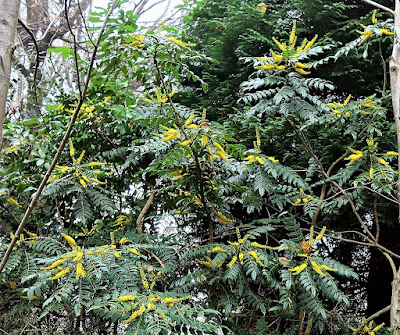
We have several mahonias in the garden and these provide nectar rich flowers from November to February inclusive.  One of the most magnificent is Mahonia x media 'Buckland' which flowers right through December and January.

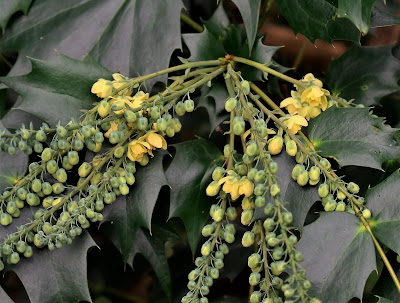
Rather more modest but still an attractive plant is Mahonia japonica which flowers here from late January through March.  It often attracts bumble and honey bees and blue tits raid the flowers for nectar, or I assume this is what they are finding.

The hedges along the eastern side of Churchland Lane contain an extraordinary variety of plants and I am gradually trying to put a name to all of them, natives and non-natives alike.
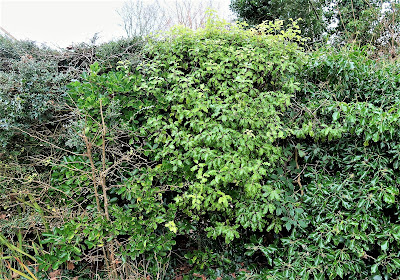
The pale green mid-section of the hedge above and bordering Cherry Croft is Pittosporum tenuifolium, a New Zealand endemic but widely planted, particularly as a hedging shrub.  The darker green on the right is English ivy and, on the left, Euonymus japonica.
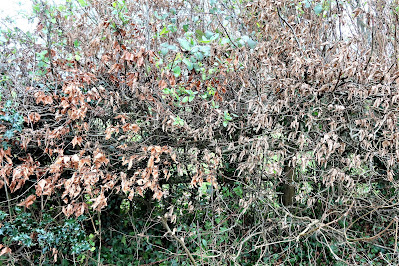
Another stretch of hedge a bit farther along shows how low cut, or young, beech and hornbeam retain their dead leaves in winter.  The warmer brown examples on the left are of beech and the greyer ones on the right of hornbeam.  
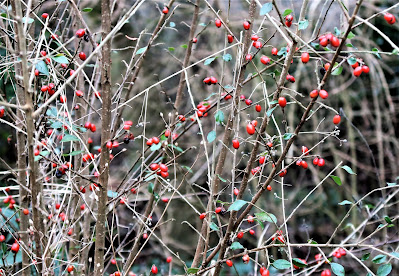
The self-sown cotoneaster behind our shed is still bearing a fine crop of berries (see below).  I think it is C. simonsii, the Himalayan cotoneaster.  'Himalayan' seems to vbe a bit of a misnomer as the native home of the species is the Khasi (or Khasia) Hills between Bhutan and Bangladesh in Assam, India.  The fruit are reputed to have a nasty taste which is said to be the cause of their remaining so long.  However, I am not at all certain the the taste buds of birds operate in the same way as ours.  My granddaughter and I sampled the brries and, while they were somewhat tasteless, they could not be described as unpleasant.
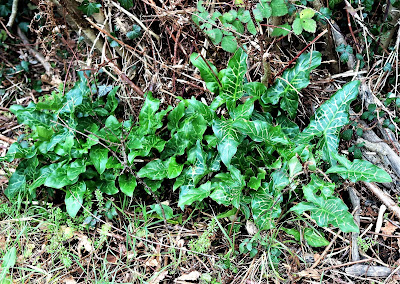
In a wander down the lane towards Saul-Hunt's I discovered a fine clump Italian lords-and-ladies, gigaro chiaro, Arum neglectum ssp. neglectum.  There are several places up the lane to the north and I expect this one has spread down from there.  I wrote much more about arums in this blog on 2 December 2017
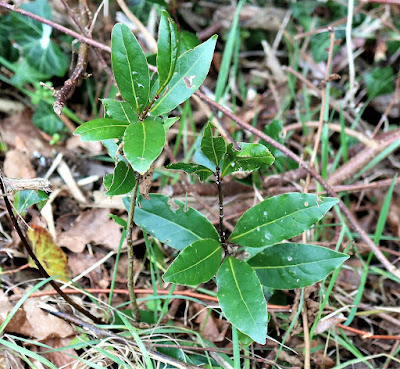
A bit further south I found a small, self-sown bay tree (Laurus nobilis)a species not common in the wild.  The leaves resemble laurustinus, which grows not far away, but the smell of the bay gives it away
In my survey of the hedges along Churchland Lane, I have had another go at the various 'false cypresses'.  On the east side of the lane along the boundary of Jesmond is a very solid length of  Leyland cypress, Cupressus × leylandii.  I found some small, empty cones on this which almost certainly indicates that this is the Leighton Green clone, C. x leylandii is a hybrid between the Nootka cypress (Cupressus nootkatensis) and the Monterey cypress (C. macrocarpa).  The name 'Leighton' is from Leighton Hall in Powys where the first Leyland cypress was raised.

I end this January's account with a photo of the seeds of old man's beard poised to provide splendid material for the soon to be constructed local bird's nests.


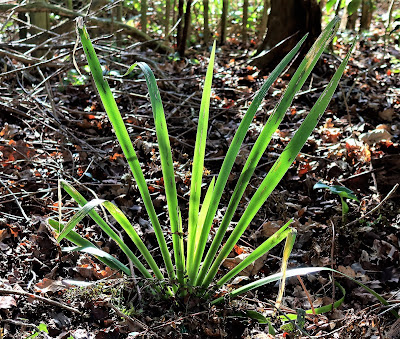
21 January 2022  While the earth, covered in dead autumn leaves, waits for the green sprinkles of spring, the leaves of stinking irises (or gladdons), Iris foetidissima, make lovely sunshot fans.  This is a plant that continues to increase locally.
Another plant that comes into its own in winter is a large variegated Persian ivy, Hedera colchica Dentata Variegata.  Here it has climbs high up an oak tree in our garden and makes a good winter shelter for small birds and, no doubt, various insects.
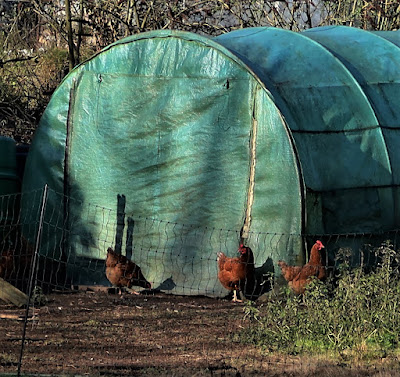
If I walk around the footpath that passes to the south of Saul-Hunt's paddock I often see their free range chickens, brown feathered bundles like animals in a child's farmyard.  Although we often don't treat them very well, they are endearing  creatures as they walk jerkily across their patch looking for seeds and insects.
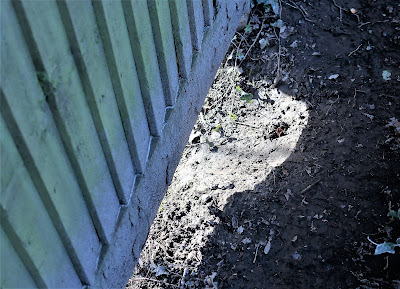
A little further on there is long overlap board fence.  The local badgers can't be bothered to go round this and have dug a hole under it.  Such animal runs are known as 'smeuses'.
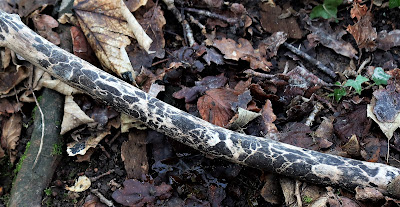
In winter natural patterns become more obvious as there is not so much to see.  I liked this debarked branch (below) with snake-like markings, perhaps trails of insects that lived under the bark when the branch was alive or recently fallen.
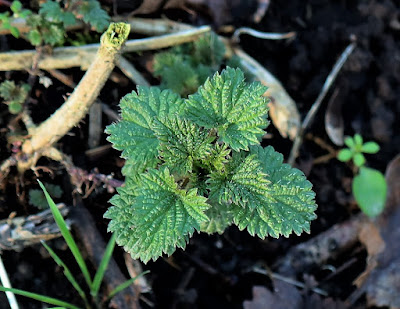
20 January 2022  A sequence of frosty nights and sunny days has slowed the onset of pre-spring.  In the lane new tufts of nettles are showing and it will soon be time for nettle soup, zuppa di ortiche.
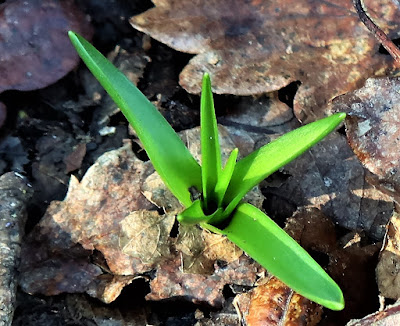
A few bluebell leaves poke through the ground ahead of the main flush and I wonder if they sare hybrids with Spanish bluebells or have some other genetic quirk.
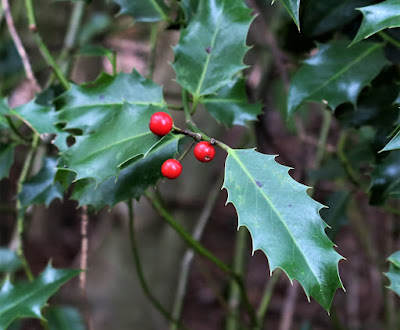
In Killingan Wood I found what looks like a bush of Highclere holly, Ilex x altaclerensis.(see below). Some of the leaves look like the cultivar Cameliifolia as illustrated in Johnson & More, Collins Tree Guide, but in online picture the leaves of Cameliifolia are spineless, or almost spineless.  The Killingan Wood bush may be a hybrid between our native holly, I. aquifolium, and one of the Highclere cultivars of which there sre probably many in local gardens.
17 January 2022  Cold nights but sunny and cool days.  A badger has been digging for worms in the newly exposed stretch of verge alongside Churchland Lane
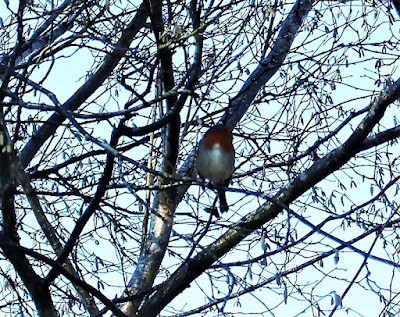

Birds are warming up for the breeding season.  The robin above was in full song in a hazel bush (with developing catkins in the background), a tawny owl was hooting in Churchland Wood and a great spotted woodpecker drumming in the trees along the stream on the western side of Churchland Fields.

The hazel catkins in the picture above mostly are closed, though higher up the bush they are starting to open (see below), while on the opposite side of the lane, in another bush, they are fully open.
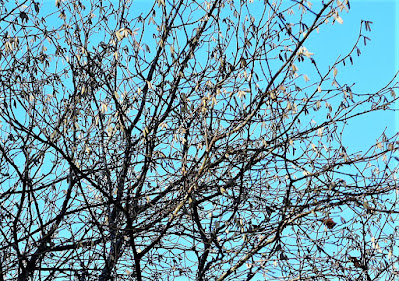
14 January 2022  
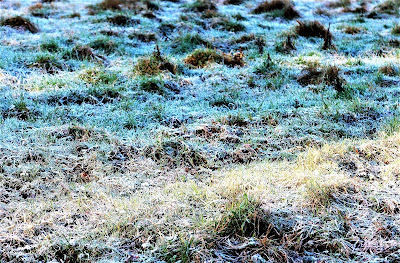
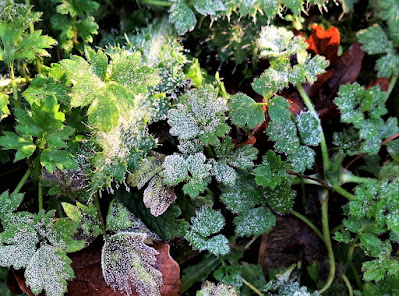
A sharp frost overnight whitened the grass in Churchland Fields and covered creeping buttercup leaves in my second Square Metre with Ice crystals like a scattering of sugar.
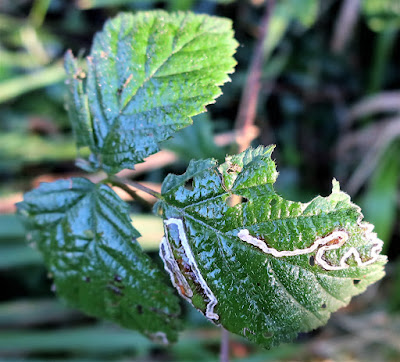
I noted two leaf mines in a frosted bramble leaf halfway down the garden.  I am pretty sure these have been made by the larvae of the tiny moth Stigmella aurella (there are some similar species that mine bramble leaves).  The larvae and pupae can survive frosts and, if occupied mines are brought indoors and kept in a jam jar, the moths like sooty, black sparklets will emerge often quite quickly.

I had a moment of delight when I found a single dandelion in full flower despite the hard weather.  As Wordsworth wrote:
To me the meanest flower that blows can giveThoughts that do often lie too deep for tears.


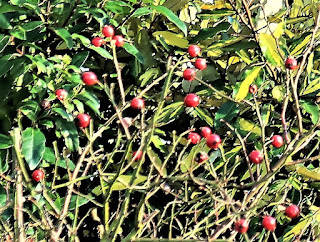
13 January 2022  I often wonder why some red berries are consumed by the birds much faster than others.  Those of rowans or hawthorns are stripped very quickly, for example, but black bryony and holly berries often stay in place well into the new year and there is a small bush in our lane of a rose cultivar covered in hips this mid-January (below).
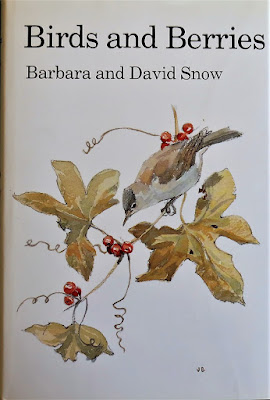
One of my favourite books Birds and Berries by Barbara and David Snow (T & A D Poyser, 1988) says that black bryony berries are eaten, usually after they have been on the vine for some time, by blackbirds and thrushes, though robins will occasionally tackle them though they are rather too large to swallow in one go.

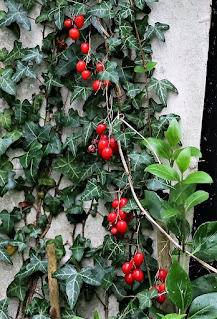
Black bryony berries (below) are toxic to humans but perhaps simply rather unpalatable to birds.  The problems with humans and, presumably with other mammals, is that the berries (and root tubers) are full of calcium oxalate that forms tiny needle-sharp crystals that can penetrate skin and cell walls causing irritation which can be dangerous internally.

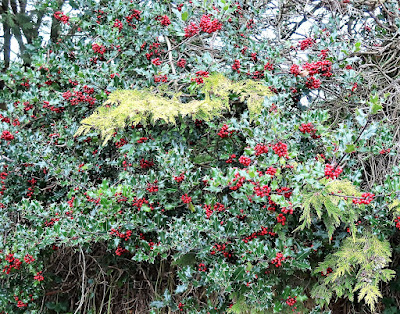
Two hollies in particular have caught my eye this autumn and winter .  One was an example, probably of garden origin, with an exceptionally rich crop of berries hanging over a fence in Broad Oak Brede (below).  

The other is a young plant on the fringe of my Square Metre project where it has been bird-sown from the overhanging medlar tree (see below).  It looks like a form of Highclere holly, Ilex x altaclerensis,  Judging by the shape and texture of the leaves and the prickles it is probably a hybrid between a garden form of Highclere holly and our native species, what is known as introgressive hybridisation.  The I. x altaclerensis of horticulture is a hybrid between Ilex perado (probably from Madeira) and our native species.  It is widely planted in gardens usually as a variegated clone with almost or completely spineless leaves. 
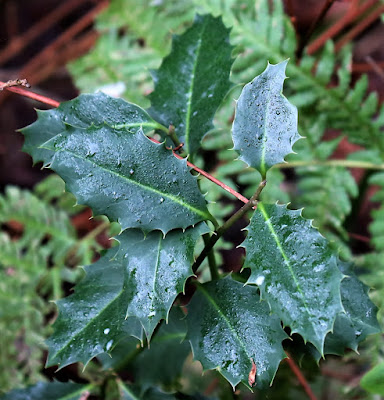

10 January 2022   
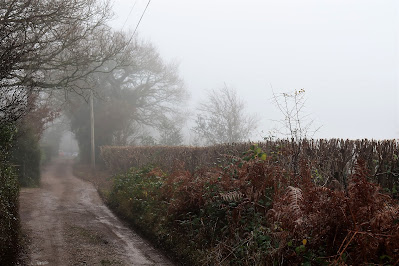

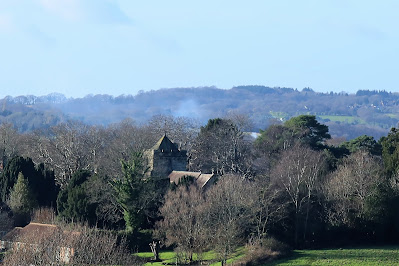
A lot of my 'ramblings' are now confined to Churchland Lane (above), the unadopted road to my house.  It is a cul-d-sac 833 metres long and it rises from 60 to 75 metres to the north of the East Sussex village of Sedlescombe.  There are good views to the west as far as the forest ridges to the north and south of Battle.  The horizon in picture below shows the highest part of Dallington Forest some 8km (5 miles) to the west of the lane with Sedlescombe parish church in the foreground.
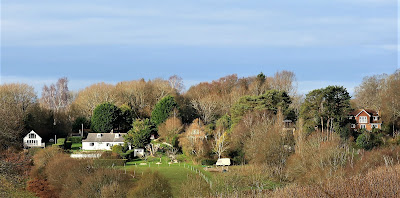
I also like the view, also to the west, across Churchland Fields to the bright buildings with their mix of evergreen and deciduous trees on Sandrock Hill.  They often catch the afternoon sun.
8 January 2022  Cold, hard rain all day and all night.  I didn't venture forth.  Instead I took this picture, blurred with rain, through the French windows out into the patch of garden I spend much of each day contemplating.  


I wondered where the birds I usually see were sheltering.  The commonest species (I don't have bird feeders) are blackbirds, hedge sparrows, wrens, robins, thrushes, wood pigeons and magpies.  All the finches, except that occasional goldfinches and bullfinches, have disappeared and, of course, there are buzzards and things flying overhead that I cannot see. Indeed when the windows are covered with raindrops and my glasses are dirty I cannot see very much at all. It's cold indoors too.

6 January 2022  A sharp overnight frost leaving a white sheen over the lawn and silvered fallen leaves on the wooden ramp outside my window.

The terminal leaves of the spurge Euphorbia amygdaloides ssp. robbiae (Mrs Robb's bonnet) start to expand, in their bent over way, at this time of the year like narrow hop cones and contrasting with the old, darker green foliage.  In a few weeks they will have grown into flower heads. This is one of the earliest signs that things are starting to move towards spring.
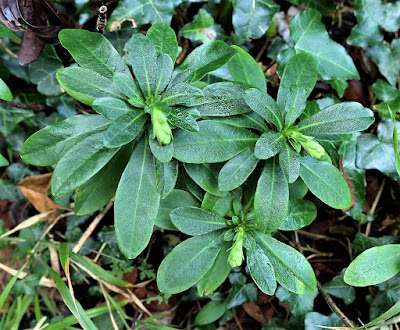

5 January 2022  A sunny, mild morning.  In the hedge on the eastern side of the lane I found a single plant of Berberis darwinii.  Though not very obvious, I was surprised at the number of times I must have walked past it without noticing it.

We have a very active thrush, perhaps a pair, in the garden that looks as though they will soon be starting to build a nest.

3 January 2022  A change of walking route took me right to the end of Churchland Lane (nearly half a kilometre from home). A few metres up Hurst Lane, in the front garden of Tresco, I stopped to look at the fragile blossoms on the winter flowering cherry, Prunus x subhirtella 'Autumnalis Rosea'.
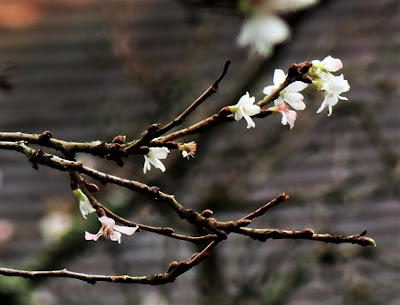

This cherry is a very long-lived species and there are some massive and very old specimens in Japan where it originated. There is, for example, an 1800 to 2000 year old  tree called the Jindai Zakura in the grounds of the  Jissō-ji temple in the community of Hokuto in Yamanashi prefecture. Some stones of this were taken into space by NASA and circled the earth for 8 months.  One of those which germinated produced flowers with six petals instead of five.

New Year’s Day, 1 January 2022

Must get more done this year.

On the western side of Churchland Lane there is a 30 metre stretch of verge that has been cleared right back to the hedge. This has left a 2 metre wide stretch of somewhat disturbed, dark and rich looking soil with a variety of low growing plants and the saw-shattered stumps of young trees and shrubs. A distinctive feature on New Year’s Day was the many shiny green tufts of emerging Arum maculatum, cuckoopint, leaves perhaps a hint that this newly uncovered section of this verge will reveal much of interest in coming months.

In the garden the pink, single camellia (Camellia × williamsii 'J.C. Williams') always the first, has started flowering. My late wife used to refer to this as "her camellia", though there were many more varieties in the garden. I assume it was because she could see it from the kitchen window.  The wintersweet (Chimonanthus praecox, là méi) in the flowerbed where the old shed used to stand is in full flower and casting its powerful scent on the air on milder days.  This year it has perhaps the best display I have seen but the blossoms turn to a dowdy speckled yellow if there is much frost (so far this winter we have had only one or two nights of light frost and today the temperature reached 14°C, very high for the time of year).
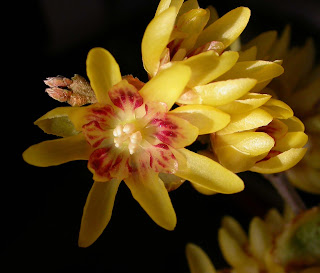

Wintersweet is found wild in China where it is also widely grown, both for its winter scent and various medicinal properties.  The flowers can be sprinkled into tea.

Killingan Wood was calm and damp, a silent army of grey trunked hornbeam trees, with a carpet of decaying fallen leaves braided by muddy tracks.

On my walk I saw very few insects. Over most of my life warm winter days like this have seen numerous small swarms of many insect species that are adapted to flying only in the winter months. But they seem to have gone. This will affect birds and spiders as well as the many small creatures that must have fed on their fallen bodies and earlier stages. The consequences for biodiversity are unknown.

Many writers reflect on the decline of the cuckoo, or the pearl bordered fritillary, but this morning I would like to pay homage to an absent friend: Gymnometriocnemus brumalis a winter flying, non-biting midge.

Maybe, if we have a cold spell, there will be a belated emergence, but I hope 2022 will not be the year when we have to say goodbye to this small winter flying insect.


tag:blogger.com,1999:blog-23818283.post-6083575988063300172
Extensions
Last day of March 2021
Show full content

 It is warm but a thin mist hangs over the countryside on this last day of March.  The forecasters say it is partly composed of dust from the Sahara desert.  Here is the view from Churchland Wood across the plough to the distant Fairlight ridge buttressing against the sea.      


Birds are now very active nest building and, as I sit at my lap top, I can see the magpies coming and going from their nest in a rowan tree.  Sometimes the pair go and perch on top of the tallest tree in the garden, a wild cherry, from where they can get a 360 degree view.

Often the woodpigeons, who also nest in the garden, get there first.

We have a large area of lesser periwinkle (Vinca minor) under the hawthorns halfway down the garden.  This effective ground cover is currently sprinkled with flowers, but these seem to appear in much greater quantity around the edges of this periwinkle area. 


tag:blogger.com,1999:blog-23818283.post-6070380964249564230
Extensions
Two new arrivals
Show full content

 In an obscure corner of the garden the light caught a small conifer maybe 5cm tall.  An adventurous seedling that is probably a yew, but possibly something else. The leaves go all round the central stalk, though I expect this is just a characteristic of a seedling. In Bean's Trees and Shrubs it says of the mature plant "leaves spirally attached to the twigs, but by the twisting of the stalks brought more or less into two opposed ranks."  This made me look more closely at the mature yews in the garden with their bipinnate branchlets unlike the newly found seedling.

Not far away from the conifer there is a mound, the remains of many bonfires.  Tana grew potatoes on this last year and there is a fine selection of weeds each summer, well nourished by the chemicals in the ash.  Wood ash is a variable substance but usually composed mainly of calcium carbonate.  However, there is often around 4% potash and 1% phosphate plus various trace elements.  But I digress, the find of the day was a solitary flower of coltsfoot (Tussilago farfara) growing on the side of the mound.

Coltsfoot flowers appear at this time of year before the large leaves (shaped vaguely like colt's feet) and they are not at all common in our immediate area, preferring heavy clay soils.  I have never seen any in or near our garden.  A piece of root might, I suppose, have been brought in from somewhere else, but that seems unlikely.  As it is a native plant, arrival by seed would seem the most probable explanation. 

An infusion of the leaves was once widely used as a remedy for coughs and, in some places, the dried leaves were used as a substitute for tobacco and smoking it was said to help asthma sufferers.  The plant is also used to flavour coltsfoot rock made, over the last hundred years, to a secret recipe by Stockley's Sweets of Oswaldtwistle in Lancashire.  The aniseed/liquorice flavour is said to be 'strangely addictive' and it appears to be quite popular still.


tag:blogger.com,1999:blog-23818283.post-7385081902694566873
Extensions
Vole and daffodils
Show full content

Tana put some scraps out on a log just outside our back door the other day and it was not long before they attracted the attention of a vole, a bank vole, Microtus glareolus, kindly identified by British mammal expert Dr Mark Hows  (It is not easy to distinguish them from field voles, Myodes agrestis.) It was a very nervous animal but I was just able to take a snap of it through the rather smudgy glass of the kitchen window. 


On my trip down the garden I was pleased to see a trio of wild daffodils (Narcissus pseudonarcissus) in flower.  They have slightly drooping two-toned flowers and mine have now survived for many years with no attention. Those below had arranged themselves together like Three Little Maids from School.


tag:blogger.com,1999:blog-23818283.post-282894704212606451
Extensions
A few flowers
Show full content


Still a windy day but quite pleasant, though cool, in the sunshine.  I noted several 'heralds of spring ' in flower today - lady's smock (below), alexanders and, above, early dog violets (Viola reichenbachiana).  Tana saw some wood anemones while on a walk.


Our colony of Tenby daffodils continues to look in good condition and, unlike other daffodils locally, have been unaffected by the recent gales.  The photo below shows that all the flowers face south.


tag:blogger.com,1999:blog-23818283.post-8915869766331098478
Extensions
March winds
Show full content

There is some hopeful anticipation that the current boisterous weather will win the next storm name on the 2021 list - 'Evert' (a short form of the German name Eberhard most frequently used in Sweden and The Netherlands).  Here the wind came in strong gusts overnight and during the following day, with heavy rain showers. Sitting down the garden in the middle of the day, I was surprised that I could hear many birds singing over the deep roaring of the wind, like treble voices over a bass choir.

Great masses of air boomed over the garden from the south west keeping the tops of the trees in Churchland Wood (which I can see from my window) in constant motion.  Bright sunshine picks out much of the detail: there are fading hazel catkins, goat willow flowers and the magpie's nest in one of the rowan trees.  The birds are nowhere to be seen and may be sheltering in their insecure looking twiggy retreat, or perhaps they have a foul weather hideaway somewhere nearby.  Most mammals are hiding too but one grey squirrel went hopping over the roof of the hut.

The two tallest trees in the garden are a wild cherry grown from a fruit I found in Orlestone Forest many years ago and the silver birch in my Square Metre project,  The uppermost branches of the cherry are permanently bent over to the north, pushed that way by successive storms I suspect, especially as the trunk does not seem to move in the wind..  The birch, on the other hand grows ramrod straight though it sways, often quite violently in the wind.


An unusual effect of the wind is the way the path to the wood is strewn with pink camellia petals as though for some Oriental festival.  The petals are being blown down from a Camellia 'Garden Glory' which has been in bloom since early January and still has many more flowers to come.

tag:blogger.com,1999:blog-23818283.post-5425653019182559763
Extensions
The mouse and the cherry stones
Show full content

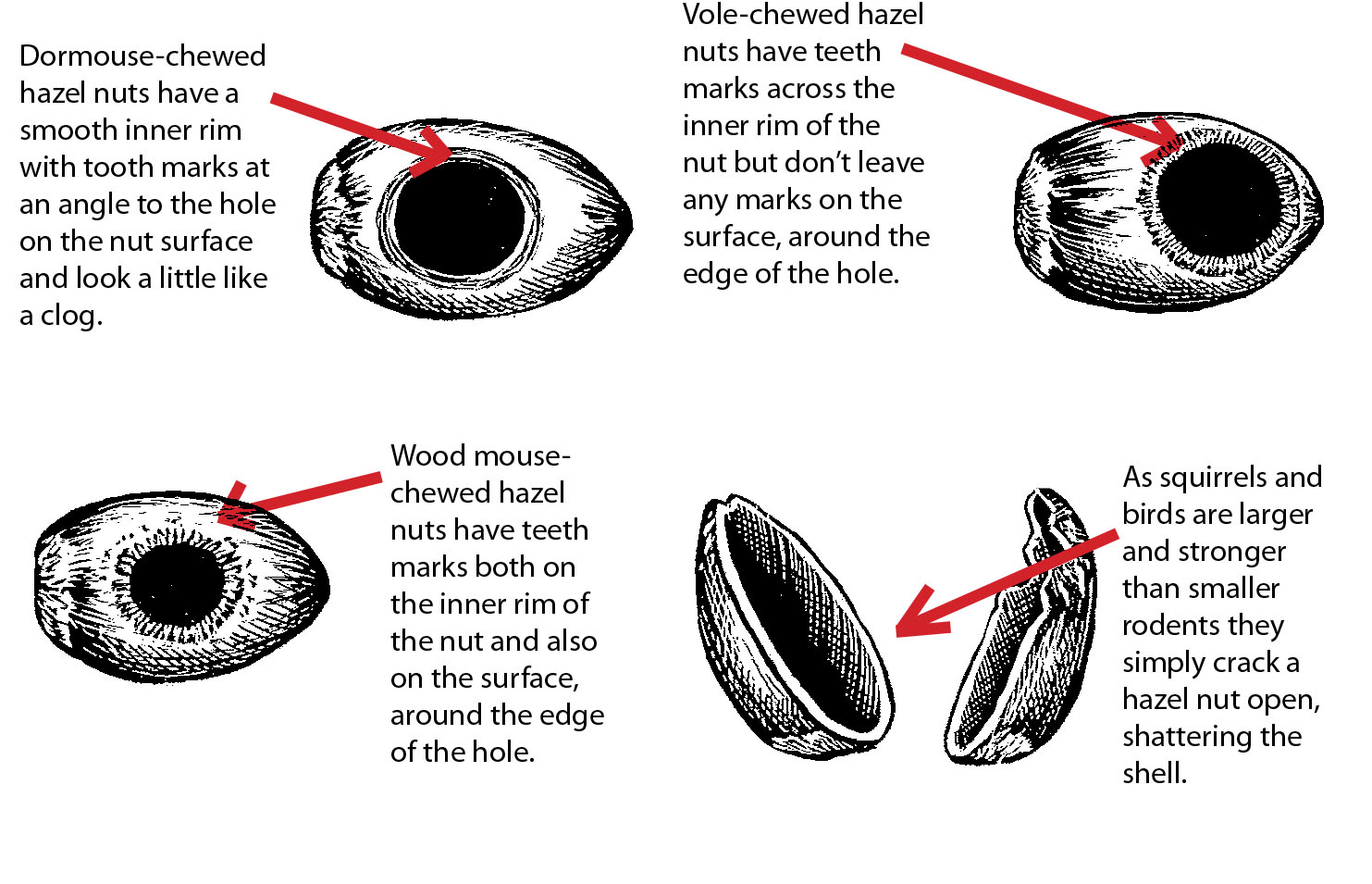
Underneath a large wild cherry tree (Prunus avium), in a small open area enclosed by protruding roots, I found a large horde of cherry stones.  Each one had a hole chewed in the top.  These holes had been made by a wood mouse, or mice, (Apodemus sylvaticus) to extract the kernel within.  In summer the ground beneath this tree is strewn with fallen fruit and I wondered if the mice had collected these, maybe eaten the pulp, and then stored the cherry stones for later use.  Though there were no stones that had not been opened, considerable effort must have been involved in making such a large midden, so maybe each one was brought from a store concealed nearby and dropped outside once its contents had been consumed.


As well as wood mice, cherry stones can be holed by dormice and voles although the markings made by the animals' teeth around the rim differ for each species.  There are a several illustrations of this online; a good one is at: https://ptes.org/wp-content/uploads/2014/07/chewed-nuts.jpg

Cherry stones have a reputation for toxicity as they contain amygdalin which converts to cyanide in the body if ingested.  The amount of amygdalin in the kernels seems to vary considerable and there is a wide range of commentary on the Internet as to their relative danger to humans.  One commentator claims that "A single cherry yields roughly 0.17 grams of lethal cyanide per gram of seed, so depending on the size of the kernel, ingesting just one or two freshly crushed pits can lead to death".  Others recommend they are used to flavour cherry jam.  

However, according to Adriano Chan et al., mice are more resistant to the effects of cyanide than humans (see https://tinyurl.com/2snymrvy) so it would appear that our wood mice have not been in danger of poisoning themselves.


tag:blogger.com,1999:blog-23818283.post-2125175538408441356
Extensions
An episode on the Isle of Sheppey
Show full content


In February and March 2021 I read The Sea View Has Me Again. Uwe Johnson in Sheerness, a large book (733 pages) by Patrick Wright that plaits the life of the eminent German writer Uwe Johnson with a description of the past and present of the Isle of Sheppey in general and Sheerness, one of its main towns, in particular.
Uwe Johnson was born in Kammin on the Baltic coast in German Pomerania, (now Kamien Pomorski and in Poland). The area has had a complex history having been fought over by Germans, Poles and Swedes. During World War II German rocket launchers were stationed on Chrząszczewska Island (formerly Insel Gristow) that lies immediately to the west of Kammin and to which it is connected by a bridge. After the war, most Germans left Kammin and were replaced by Poles. The Johnson family moved to Anklam in German West Pomerania and also close to the Baltic with its winding rivers, lagoons and seacoast. These estuarine, rather bleak landscapes and equally bleak histories are thought partly to have attracted Johnson to live in a house in Sheerness overlooking the Thames Estuary for the last ten years of his life.

Patrick Wright is an author, historian and Emeritus Professor of Literature, History and Politics at King’s College, London. Among other things, Wright’s book (which has been highly praised by many critics) describes the numerous eccentricities of the Isle of Sheppey and its people, many of which did, or would have, attracted the interest of Uwe Johnson. I would like to add a Sheppey episode of which Patrick Wright is unlikely to have heard but which, I think, may have amused Uwe Johnson.

In the early years of the current century I took up the study of mosses and joined the British Bryological Society (BBS). Shortly afterwards I learnt that the BBS were conducting a survey of the bryophytes (mosses, liverworts and hornworts) of arable fields. Most of these are in decline due to changes in agricultural practices. In order to improve records of their current distribution I was invited, in 2004, to join a November field meeting to look for as many of these species as we could find in stubble fields on the Isle of Sheppey. The fields chosen were to lie fallow all winter with the bryophytes therefore undisturbed (except by visiting bryologists).

Our small party of half a dozen enthusiasts gathered on a cold but bright day in a stubble field to the south of Eastchurch in an elevated position more or less in the centre of the island. It was cold with a wind from the north east. To find and study the various bryophytes that flourish in stubble fields requires searching on hands and knees, high powered magnifying glass in one hand and maybe a handbook and/or notebook in the other. It is cold and uncomfortable work and I wondered how many people from Eastchurch or elsewhere were troubled at the sight of full-grown men and women crawling across the windswept fields in prayerful attitudes, especially as we were quite close to one of Her Majesty’s Prisons.

The day was made more exciting by the arrival of a group of researchers from the University of Lancaster who were studying people who indulged in unusual pursuits and, clipboard in hand, a young woman asked questions and took notes about my interest in almost invisible ephemeral mosses despite weather and other seemingly negative circumstances.

One of the target species for the day was Bryum klinggraeffii which I had never heard of. Nevertheless one of our party called out that he had found some and I went and inspected the moss that bore such an interesting name. And there on the bare soil were a few small tufts of green between the rows of the prickly cut ends of summer corn. After a quick dissertation on the visible and distinctive features of the tiny leaves and stems of this diminutive plant he drew my attention to the small, reddish tubers hiding in the moss and which, because of their shape and colour, had won it the English name of ‘raspberry bryum’. These tubers, only about ¼ millimetre wide, often occur only on the moss’s rhizoids below ground and have to be searched for in loose soil (sometimes known as the ‘diaspore bank’).

The specific name for this moss was coined by W P S Schimper, an Alsatian botanist, who formally described the species in Hugo von Klinggräff’s 1858 book Die höheren Cryptogamen Preussens (The higher cryptogams of Prussia). Klinggräff was a 19th century German botanist who specialised in bryology. Both Uwe Johnson and Hugo Erich Meyer von Klinggräff were born in neighbouring provinces of Pomerania with Baltic coastlines, both in places where Germans have been replaced by Poles and German by Polish. I like to imagine that Klinggräff would be pleased that people were finding ‘his’ moss in fields on the island where his celebrated fellow Pomeranian had once chosen to live. Had they met I think they would have had much to talk about and I think Uwe Johnson might even have made an entry in one of his notebooks.

A small memorial of this day’s moss hunting in the bare, winter countryside on this estuary island can be found on the National Biodiversity Network’s web page for Bryum klinggraeffii. If one zooms in to Sheppey there is a small cluster of dots marking records of the species made in 2004 in the arable fields around Eastchurch.
tag:blogger.com,1999:blog-23818283.post-7676527810668955499
Extensions
https://ramblingsofanaturalist.blogspot.com/2021/03/the-old-sallow-tree-in-middle-of-garden.html
Show full content

The old sallow tree in the middle of the garden died last summer and is now sporting a fine crop of Daedaleopsis confragosa the thin walled maze polypore or blushing bracket, the second name referring to  the pores (botanically described as 'daedaloid') on the underside that 'blush' pinkish if they are pressed with a finger.  The fungus is often found on willows and sallows (Salix spp.) but also occurs on many other trees where it causes white rot.


The fungus is named after Daedalus, a Greek architect and inventor who was commissioned by King Minos to build the labyrinth on the island of Crete.  Author James Joyce sometimes used the name Stephen Dedalus or Daedalus in an autobiographical sense perhaps referring, among other things, to the labyrinthine qualities of some of his writing.  'Confragosa, simply means 'rough' and refers to the upper sides of the brackets.


tag:blogger.com,1999:blog-23818283.post-1423979341476094824
Extensions
Enchanter's nighshade
Show full content

Enchanter's nightshade (Circaea lutetiana) is once again flowering here and there in our garden and local woods.  It is a small and modest plant with delicate pink and white flowers followed by  small burrs, each containing a seed, which cling to one's trouser legs.

It appears to have very few virtues as an edible or medicinal plant but most people wonder how it came by its mysterious English name.  This has been much discussed in various online places but generally it seems to have originated in the 16th and 17th century when many of the great European herbalists were writing about the medicinal and magical properties of plants.  Among other things they explored the works of classical authors like Dioscorides (De materia medica, AD 50 -70).  He wrote of a plant called 'kirkaia' in Greek which becomes 'Circaea' in Latin and can be translated as Circe's (plant).  Quite what this was seems uncertain but enchanter's nightshade is one candidate.

The French name for Enchanter's nightshade was, at the time of the 16th and 17th C herbalists, 'circée' and this is still current in France, Italy and French-speaking Switzerland.  The herbalists assumed this associated the plant with Circe, the enchantress of Homer's Odyssey who attracted Ulysses's men with her siren song then used a magic potion to turn them into pigs.  The derivation of circée as a plant name may be correct but I have not seen any direct evidence that this was so.  There are, however, some accounts of the plant being used by women to arouse men, though this may not pre-date the 16th century.

When the French herbalists were writing they often called Enchanter's nightshade 'circée de Paris'.  This was not only because the plant grew commonly in the Paris area (and elsewhere in most of France) but to distinguish it from upland enchanter's nightshade (Circaea alpina) known in French as 'circée des Alpes'.  Circée de Paris was written in Latin as 'circaea lutetiana', the second word deriving from 'lutetia' a Roman name for Paris, and Linnaeus used this when formally describing the plant in his Species Plantarum.

All that more or less explains the enchanter's part of the name, but why 'nightshade'?  This is quite simply because the plant was thought to be a nightshade due to the shape of its leaves resembling woody nightshade (Solanum dulcamara).  Gaspard Bauhin the 17th C Swiss botanist  called it Solanifolia Circaea (nightshade-leaved circée) for example. 

tag:blogger.com,1999:blog-23818283.post-1977197400600298839
Extensions
Things on hornbeam leaves
Show full content
I seem to have been doing well with hornbeam leaves this year, especially as they do not normally seem to produce anything very exciting.  My first discovery was the tiny galls of the mite Aceria tenellus in the axils of veins in several leaves of the hornbeam cordon in my Square Metre, as well as on the edge of Killingan Wood up the lane.  There are only a few records of this species from Sussex and I expect it has been overlooked rather than being generally scarce.


My next discovery was of quite a few empty mines of the small purple hazel moth Paracrania chrysolepidella (it also feeds on hazel), an attractive, Nationally Notable class B, early flying micro.

While examining these I noticed a strange corkscrew  like gall on a leaf edge (see below) which turned out to be that of another mite, Aceria macrotrichus.  According to the National Biodiversity Network (NBN) there is only one British record of this (from the Midlands).  There were no Sussex records in the databases of the Sussex Biodiversity Record Centre.  As well as the corkscrew-like structure there are vermiform swellings along the veins in the underside of the leaf and slits on the upperside from which the mites can leave


The next day I was looking to see if there were any more of these galls.  There were not, but I found the considerable mass of eggs (see below) that some insect had laid on the underside of a hornbeam leaf.  After arrival at home they started to hatch into tiny caterpillars, so I have put them on the hornbeam cordon down the garden in my Square Metre project.


tag:blogger.com,1999:blog-23818283.post-9182009119327630320
Extensions
Two comfreys
Show full content
Part of our garden is carpeted with creeping comfrey, Symphytum grandiflorum.


The white, tubular flowers are very attractive to bumblebees and must be nectar rich.  This picture was taken on 5th April and the plant had been in flower for well over a month, helping the bumbles to get off to a good start.

Most species of comfrey have had many medical applications in the past, but these are best avoided as plants in the Symphytum genus have been shown to be somewhat toxic.

We also have a colony of Hidcote comfreyS. x hidcotense, with blue and white flowers but the same creeping habit.  I think this must have been the plant Kenneth Grahame wrote about in Wind-in-the-Willows: "Comfrey, the purple hand-in-hand with the white, crept forth to take its place in the line."


tag:blogger.com,1999:blog-23818283.post-2442874271062065944
Extensions
Onion loops
Show full content
One of the most delicately beautiful phenomenon of this rising spring are these arching leaves of wild onion (Allium vineale).  It seems to me an uncommon shape in our British flora.  These are just outside my Square Metre project and I think they may produce heads of bulbils this year.  The first wild onions appeared under the medlar tree a short distance away many years ago where their bulbils were probably dropped by birds. They are slowly advancing eastwards towards the Square Metre itself but have never 'flowered'.


A relaxing half hour can be had by contemplating these onion loops and listening to John Adams Shaker Loops at the same time.
tag:blogger.com,1999:blog-23818283.post-7527444907733102481
Extensions
Churchland
Show full content
Churchland is roughly the area I can reach on foot from my home.  Further details will follow but my general intent is to make it a series of searchable notes on the small part of the High Weald lying to the north of Sedlescombe Street.  My house, South View, is close to the centre of a rough pentagon of tarmac roads at OS grid reference TQ782188.  It is on Churchland Lane which runs as a unmade road towards the village, then a footpath, then a made road through Balcombe Green and finally down to the main road through the village via Long Lane.  It more or less cuts the area I call Churchland in half while to the west there is a series of fields known generally as Churchland Fields and a wood to the east of our garden called Churchland Wood.

Plants (Plantae)

Flowering plants, conifers and ferns

In this flora of Churchland plants are arranged in alphabetical order in their groups by scientific name.  I have included wild plants and the cultivated plants that can, in most instances, be seen from the roads or the footpaths.  I will add to it from time to time but it will be ages (or never) before all the species that grow in Churchland are listed.  All a bit like train spotting.  Nomenclature follows Stace (2019).  The New Flora of the British Isles, 4th edition.

Aquilegia vulgaris - Columbine.  Occasional as a garden escape.  Along 90 metre footpath TQ78371938, in gateway on Hurst Lane TQ78211943.

Arum italicum - Italian lords-and-ladies.  There are two species of  Arum in Churchland.  This one and A. maculatum (see below).  A. italicum with plain leaves (often knows as subspecies neglectum) is found wild in Britain only in the southern counties, usually near the coast..  Unlike A. maculatum the leaves emerge in autumn.  There is also a variety with whitish veins in the leaves (often known as subspecies italicum).  Plants with both plain and veined leaves occur here and there in Churchland, often originating as garden throw-outs.  There is a patch outside Jessmond in Churchland Lane with both plain and veined leaves.

Anemone nemorosa - Wood anemone.  Common in many woodlands, especially on clay soils.

Arum maculatum - Lords-and-ladies.  Also known as cuckoo-pint and wild arum.  Unlike the above the leaves appear in late winter or early spring and often have purple spots.  It occurs in woods and hedgerows across the area.

Asplenium adiantum-nigrum - Black spleenwort

Athyrium filix-femina - Lady-fern

Asplenium scolopendrium - Hart's-tongue fern

Buxus sempervirens - Box.  Widely planted in gardens for hedging and topiary.

Chrysosplenium oppositifolium - Opposite-leaved golden-saxifrage.  Occasional in ditches and damp places.

Cupressus lawsoniana - Lawson's cypress

Cupressus x leylandii - Leyland cypress.  Common as a hedgerow shrub and sometimes allowed to grow tall, e.g. by the car port at Woodstock in Churchland Lane.  There is a variegated example with some creamy white shoots among the green in the hedge at Dino's in Churchland Lane close to the junction with Hurst Lane

Equisetum arvense - Field horsetail

Berberis - Barberries

Bergenia sp. - Elephant ears.  One plant on the edge of Killingan Wood.  Probably B. crassifolia from Siberia.

Blechnum spicant - Hard-fern

Calocedrus decurrens - Incense cedar

Caltha palustris - Marsh marigold.  Scattered in the wild in Sedlescombe.  Occurs in the pond in Tresco, Churchland Lane and the pond in Red Barn Field.

Chelidonium majus - Greater celandine.  Has occurred as a casual in Churchland Lane.

Clematis vitalba - Traveller's joy, Old man's beard.  Churchland Lane in the hedge where South View meets Little Oaks.  There are many garden Clematis species, hybrids and varieties grown in the area.
.
Dryopteris affinis - Golden-scaled male-fern

Dryopteris carthusiana - Narrow buckler-fern

Dryopteris dilatata - Broad buckler-fern

Dryopteris filix-mas - Male-fern.

Ervilia hirsuta (formerly Vicia hirsuta) - Hairy tare.  I have only seen this in the garden at South View where it is a persistent weed in flower-pots.

Ervum tetraspermum - Smooth Tare.  Common in gardens and along hedgerow bottoms as well as in tough open ground.

Eschscholzia californica - Californian poppy.  Widespread in gardens.

Ficaria verna - Lesser celandine (formerly Ranunculus ficaria).  Common along waysides, hedgerows and field edges as well in more open parts of woodland where it can flower as early as mid-January.  There are four subspecies recorded in Britain.

Griselinia littoralis - New Zealand broadleaf, New Zealand privet.or kapuka in Maori.  An evergreen shrub often used for hedging, especially near the sea.  There is a mature hedge of this species (with some beech mixed in) by Churchland Lane along the front fence of The Pantiles.

Helleborus argutifolius - Corsican hellebore.  Only in gardens in Churchland.

Helleborus foetidus - Stinking hellebore.  Cultivated in gardens but not recorded in the wild in Churchland.

Helleborus orientalis - Lenten-rose.  Only in gardens in Churchland.

Hyacinthoides x massartiana.  This is the 'Spanish bluebell' commonly encountered as an escape in and around gardens.  It is a hybrid between the true Spanish bluebell, H. hispanica, and our native species.  Distinguishing the Spanish bluebell from x massartiana needs care.

Hyacinthoides non-scripta, bluebell.  A widespread and common species in most woodland in the area.  Its scientific name has changed several times over the years and there is also much confusion with the Spanish bluebell with which it hybridises (see above). Stories are frequently published about the danger to our native bluebells from this hybridisation but this does not appear to be a threat in Churchland.

Hylotelephium telephium ssp. fabaria - Orpine.  (Formerly Sedum telephium).  Grown in gardens but also quite widespread in local woods and hedge banks.  In Churchland it occurs in one place on the eastern bank of Hurst Lane.

Ilex x altaclerensis - Highclere holly.  Frequent in gardens, usually as one of the variegated forms.  A plant of the variety 'Golden King' (in fact a berry-bearing female plant) occurs in a hedge at Cherry Croft on the eastern side of Churchland Lane.

Ilex aquifolium - Holly 

Juniperus communis - Common juniper

Larix decidua - European larch

Mahonia - Oregon grapes.  Various species and varieties of Mahonia from North America are grown in Churchland gardens.  Their yellow flowers in autumn, winter and spring provide important nectar and pollen for the bumble bees that fly in milder weather in the winter months.

Lotus corniculatus - Common bird's-foot-trefoil.  Common in pastures and often on old lawns.

Lotus pedunculatus. Greater bird's-foot-trefoil.  Common in longer vegetation and damper ground than L. corniculatus.

Myriophyllum aquaticum - Parrot's-feather.  An aquatic plant from South America found in the wild in many ponds where it can suppress native plants.  Pond at Tresco, Churchland Lane (needs checking).

Osmunda regalis - Royal fern

Paeonia officinalis - Garden peony.  Several plants along Churchland Lane opposite Little Oaks gateway.  Widely grown in gardens.

Papaver somniferum - Opium poppy.  One plant occurred on a heap of brick rubble in the garden of Acorn Chalet in the early 21st century.  It did not persist.

Petasites pyrenaicus - Winter heliotrope (formerly Petasites fragrans).  A plant from the Mediterranean area with scented flowers in winter.  Only the male plant is known in Britain but it spreads vegetatively and causes problems on roadside verges and elsewhere as its large, round leaves suppress smaller native plants.  It is difficult to eradicate other than by using weedkillers.  Occurs in various places in Churchland and usually flowers well at the point where Hurst Lane joins the A2244.

Picea abies - Norway spruce

Pinus sylvestris - Scots pine

Pittosporum tenuifolium. Known as kohuhu, black matipo and tawhiwhi in Maori, but there does not appear to be an English name apart from New Zealand pittosporum.  There is a plant in the mixed hedge of Glendale in Churchland Lane. easily distinguished by the undulate margins of the bright green leaves.

Polystichum aculeatum - Hard shield-fern 

Polypodium vulgare - Polypody fern

Polystichum setiferum - Soft shield-fern

Pteridium aquilinum - Bracken

Ranunculus acris - Meadow buttercup.  Widespread in Churchland in open places.

Ranunculus auricomus - Goldilocks buttercup.  Scattered in woodland in Churchland.  This plant is apomictic and has a large number of agamospecies of which around 60 have been described but many more await description.

Ranunculus repens - Creeping buttercup.  Common everywhere often in dam open places.  A persistent weed in gardens.

Ribes nigrum - Black currant.  One plant recorded from Killingan Wood.  Widely grown in gardens

Ribes rubrum - Red currant.  Frequent in woods and widely grown in gardens.

Ribes sanguineum - Flowering currant.  One plant in Churchland Wood.  Widely grown in gardens.

Ribes uva-crispa - Gooseberry.  Recorded as a wild plant in Churchland Wood.  Widely grown in gardens.

Sedum album - White stonecrop.  A frequent escape from gardens on walls and gravelly paths.  Sometimes used on green roofs.

Sempervivum tectorum - Houseleek.  This and its varieties plus some other houseleek species are widely grown in Churchland gardens.

Symphoricarpos albus ssp. laevigatus - Snowberry.  Introduced from western North America.  The plant naturalised in Britain is ssp. laevigatus.  There is a vigorous plant in a garden at TQ78351927 to the west of the footpath.

Symphytum grandiflorum - Creeping comfrey.  Occurs in gardens and sometimes escapes.  Can start to flower in January and is very attractive to bees.

Symphytum x hidcotense - Hidcote comfrey.  Occurs in gardens.

Tellima grandiflora - Fringecups.  From North America.  Has sown itself for many years in the garden at South View in Churchland Lane.

Taxus baccata - Yew.  Widely self-sown into local woodlands and frequently planted both as a free-standing tree and for a hedge, or topiary.  There is an Irish yew, Taxus baccata 'fastigiata' by Churchland Lane on the boundary between South View and Little Oaks.

Viburnum tinus - Laurustinus.  An introduced evergreen shrub from the Mediterranean area that has pink or white flowers in the colder months of the year.  Itr is often ravaged by the viburnum leaf beetle beetle Pyrrhalta viburni. Laurustinus leaves have things called ‘domatia’ in some of the underside axils of some of the leaves.  These domatia consist of clumps of small white hairs and act as shelter for a species of mite called Metaseiulus occidentalis.  Apparently these mites eat the eggs of the red spider mite, Tetranychus urticae, which are very damaging to plants and laurustinus can therefore be of value to gardeners for control of this pest.

Viburnum x bodnantense.  A group of hybrids between Viburnum farreri and V . grandiflorum.  The first to be propagated was raised at Bodnant gardens in North Wales in 1935.  The pink and white flowers appear on bare branches in midwinter and have a strong perfume.  There is an example on the south west corner of The Pantiles' garden by Churchland Lane and also one in the garden of South View..

Vicia sativa ssp. nigra - Narrow-leaved vetch.  Common in hedgerows and rough grassland.

Vicia sativa ssp. segetalis - Common vetch.  Occasional in hedges and rough places.

Vicia sepium - Bush vetch. Common in hedgerows and rough places.
-

tag:blogger.com,1999:blog-23818283.post-6214067970529031233
Extensions
The Square Metre 19 July to 22 August 2019
Show full content
The photo below shows many of the features in the Second Meadow that are mention in this post.  The stone row  just to the left of centre is Cynthia's Ridge. Travelling clockwise the flat area to the right is the Dust Bowl. The dark circle at 3 o'clock is Second Meadow Pond.  Just below this is the singled Eastern Dandelion just above the ragwort plant both growing in what I call Conservation Lawn.  At about 7 o'clock there is the cardboard Amazon square and at about 8 the western dandelion between two non-interference grass tufts.  The grey brown area to the left of these is where the woodchip from the entrance path encroaches.  At about 11 o'clock past the fern and the irises the black bryony climbs up into the darkness and already has a few yellow autumnal leaves.
                            
                            In the top right hand corner the trunk of the mature birch tree growing in the original Square Metre can be seen


19 July 2019                Quite cool with rain approaching: its first intrusions could be felt in the wind.  A muscid and an ichneumon sat each on its own rock in Cynthia’s Ridge, presumably enjoying the stored warmth.  There was also a fragment of snail shell on one of the rocks indicating a thrush had been in action.  Second Meadow Pond was half empty again.  Many of the sorrel seedlings are marked with red to a greater or lesser degree.
20 July 2019                Heavy overnight rain has wetted the Dust Bowl and given the seedlings a better chance of survival.  There were two springtails on thePost settings pond and a cream spot ladybirdCalvia quattuordecimguttata, on a hogweed leaf.  One living feeler of ivy has reached Second Meadow Pond.


21 July 2019                Warm again – good growing weather.  Three Rhagonycha fulva, red soldier beetles, and a male social wasp on hogweed flowers.  A red blood worm tumbling through the water in Second Meadow Pond plus a dead burying beetle (Nicrophorus sp.) in the grass. I wonder what it had been burying.
22 July 2019                There are green aphids on some hogweed stems and a potter wasp on the flowers.  I am letting a few grass clumps develop naturally in the Second Meadow in the hopes that they will grow into an interesting feature.  The first harvestman of the year appeared in the vegetation north of Troy Track.
23 July 2019                It is getting very hot and the hogweed is drooping slightly.  Noted some worm casts in the Second Meadow.
24 July 2019                The hottest day on record in Great Britain.  Here it reached 32.5° in the shade.
26 July 2019                Thunderstorms overnight and heavy rain that refreshed Emthree after the heat.  Politics has been as lively as the weather with Boris Johnson becoming Prime Minister and appointing what looks like a very right-wing cabinet.
28 July 2019                Much cooler and showery, irrigating much of Emthree.  There are busy gatherings of insects on the hogweed flowers now.
29 July 2019                Windy and rather cool.  The first knapweed is in flower.  There was a visit from a meadow brown butterfly.  The grass tufts in Second Meadow are now starting to differentiate but I do not think they will anthesise this year. 
30 July 2019                We have moved my little gardening seat back further into the Brambly Hedge area so I can get more into focus with my close-focus binoculars (now essential equipment).  There are many solitary wasps among the hogweed flower visitors and a scorpion fly put in an appearance.
1 August 2019             Light rain today. A large black beetle in the pond.  Creeping buttercup in flower.  I surveyed the area with my old Zeiss monocular which allows very close focus.  I selected a few more  plants of grass to be given a kind of zen landscape treatment.
2 August 2019             I have three square metres now: the original, what I call ‘The Waste’ to the south of it, and the Second Meadow to the west of these.  There are many insects jostling on the hogweed flowers and male and female Gasteruption seem more abundant than usual. I noted a marmalade fly, Episyrphus balteatus drinking from Second Meadow Pond.  The eastern dandelion leaves are being attacked by the rust fungus Puccinia hieracii but so far it does not look too debilitating.


3 August 2019             The seed pods of the gladdon irises in Medlar Wood hang like green hand grenades.  There was a visit from a speckled wood butterfly.  An ivy shoot has started to climb the trunk of the birch up a rough patch of bark.
  
A small hedge woundwort plant on the western edge of the Second Meadow has had most of its leaves eaten during the night.
4 August 2019             This would have been (and was) our 60th wedding anniversary.  There was an orange rowan berry like a punctuation mark on the Conservation Lawn in the Second Meadow.  Meadow Pond was only half full.  The black bryony up its iron pole is quite splendid: a bright green column of leaves hiding still green berries.  Some of the leaves have dark brown blotches, probably caused by the fungus Cercospora scandens.
5 August 2019             Honeybees quite frequent visitors to knapweed flowers.  A large white butterfly made a visit.  The spindle suckers are heavily infested on their lower leavers by the yellow spots caused by the scale insect Unaspis euonymi.  There has been a small amount of rain and the eastern dandelion has, perhaps as a consequence, cocked up its leaves at an angle of about 45°.
6 Aug 2019                 Cool and showery but much action on the American willow-herb, Epilobium ciliatum with some aphids attended by a wrinkled ant.  The aphid is, I suspect, Macrosiphum tinctum.  There are a few yellow spots on some of the hornbeam cordon leaves, maybe a fungus – I will have to wait and see if they develop.
7 August 2019             The western and eastern dandelions in the Second Meadow are quite different in character.  The eastern has more shiny leaves that often stand up at 45°, whereas the western one has nearly matt leaves of slightly paler green that lie flat.  The eastern also has markedly red streaks on the midribs of the leaves, but there is little red in the case of the western one.  Cooler and showery.
8 August 2019             Still cool with mist and rain on the way.  I weeded out sorrel seedlings from the Dust Bowl and cleared round the self-heal plant near my seat.  Found another small ragwort plant near here.  This really is gardening with wildlife – but why not?  Co-operating with nature.
9 August 2019             Just before 3pm and earthworm emerged on Troy Track into the full sunshine of a warm afternoon.  It did not seem to like it much and hid most of its body under a low grass tussock.  Overnight there had been heavy rain which might have flooded the worm holes or otherwise tempted it out.  Shortly afterwards a young grass snake poked its head out, tongue flickering, from the bottom of Brambly Hedge and after it had tasted the air slithered back again.
10 Aug 2019               A summer gale with winds of around 50mph.  More sound than fury.  The tutsan berries are turning from orange-red to black.  With the continuing wet there are many small seedlings appearing in the Dust Bowl.
11 August 2019           The tallest stem of the American willow-herb has decided to lay flat on the ground but still looks healthy.  Troy Track is also developing a surprisingly g=rich flora despite regular trampling.  Calm after yesterday’s high winds but much leaf and twiggy litter.  The dead ash sapling must have broken at the base and is leaning westwards with its burden of small-flowered sweetbriar in the upper branches.  There was a black and scarlet Necrophorus burying beetle drowned in Second Meadow Pond (I would not have thought it had much to bury) and a 4th instar green shield bug on one of the small ashes.
12 August 2019           Frequent overnight showers.  Ground quite wet.  Many hogweed flowers but little else.  None of the vast quantity of birch seeds on the ground seems to have germinated.
13 August 2019           Grass clipping across Conservation Lawn today.  I thought about taking up drawing and painting but decided the next day I would not be good enough.  The eastern dandelion I have named ‘Shuttlecock’ and the western one ‘Green Star’, this latter has the shorter leaves of the two and today a perfect white fluff feather was caught under one of the leaves.
14 August 2019           Heavy rain all day and very cool for August.  I stayed indoors.
15 August 2019           The Rosa sp. hip has turned greenish orange as it begins to ripen.  There are also some glandular hairs on the hip pedicel.  Sammy saw a grass snake in the garden to the west of Emthree and also reported a frog from the nearby tortoise pen potato patch.  The two dandelions continue to differ: the easterly is losing some of its leaves to the rust fungus (Puccinia hieracii): the western specimen has none of the fungal speckles and its leaves still lie quite flat on the ground.  Very mysterious the ways of dandelions.
16 August 2019           Incoming rain from the west.  The figwort in M3 is flowering again and another ’Lammas’ shoot has appeared on the cordon oak.  This particular oak branchlet has extended three times so far this season.
17 August 2019           At Emthree I am fishing for thoughts and like the sun on my back.  The eastern dandelion leaves are standing up even more proudly now, perhaps because of the wet weather.  Another difference from the western plant is that the eastern has slightly undulating lead surfaces whereas in the western they are completely flat.  The plant with shuttlecock leaves will direct rainwater to the centre of the crown more efficiently than the plants whose leaves lie flat.  There was a dead worm beside one if the self-heal plants.
18 August 2019           Emthree is getting more like an arboretum every year.  The hornbeam is still growing strongly and is over 2 metres tall (it will be cut back to 1 metre in autumn).  One of the hazels has extended nearly as much.  The rose hip has lost all but one of its sepals and a green shield bug is still about.  One of the hogweed  umbels attracted a congregation of solitary wasps.
19 August 2019           A small female sawfly, black with a yellow body, busily explored every leaf of the easterly dandelion.  Black muscid flies pursued their various dispositions on the stones of Cynthia’s Ridge – an ever-changing drill.  I caught glimpses of something blue beside the red stone.  It proved to be a chewed-up petal of some nearby flower.
20 August 2019           Flowers out: hogweed, knapweed, self-heal, Epilobium montanum, E. ciliatum, herb robert.  The rust fungus continues to pull down the easterly dandelion.  There was a small shining copper orange beetle on a knapweed leaf.  A flesh fly drank from Second Meadow Pond. Fifteen years ago the area was much busier and on 20 August 2004 I spoke of the grasshopper and ground hoppers that were abundant that summer.  There are none so far this year.
21 August 2019           A scarce snout-faced hoverfly Rhingia rostrata and a bumble bee hoverfly Volucella bombylans on knapweed flower (and another on 22nd) and a black spider hunting wasp Anoplius nigerrimus resting (they are usually in perpetual motion) on a stone on Cynthia’s Ridge.  Warm and summery again.
                                    I have started a new experiment by placing a rectangle of cardboard 35 x 27cm (used to send me a book by Amazon) on the ground on the south west edge of the Second Meadow and where I can easily see it from my seat.  The idea is to study what happens to it.  Today a kite-tailed robber fly Machimus atricapillus rested for a while on the rectangle – a new record for Emthree.  I also noted some bright blue glittery thing in the grass nearby and discovered it was part of the thorax and body shell of, I think, some kind of fly, like an empty, blue crab shell on a much smaller scale..  I reflected, as I often have, on the large quantity of dead insects that must rain down to the ground every day to be hoovered up by flesh eating scavengers – birds, shrews, spiders and other invertebrates.
22 August 2019           Warm wind from the south-east.  There are many butterfly species about in the wider garden.  Emthree was visited by an exploring-for-hibernation-place peacock and there was a ragged large white on Brambly Hedge.  The first Lammas shoots on the oak cordon have been quite severely damaged by the  powdery mildew Erysiphe alphitoides
tag:blogger.com,1999:blog-23818283.post-3729127763429437061
Extensions
Highlights from June 2019
Show full content
Despite the dry weather the fungus season seems to be starting with species like this petticoat mottlegill Panaeolus papilionaceus (the pair on the right) popping up in Churchland Fields, Sedlescombe (TQ7818).


It has been an exceptionally good year for flowers on the gladdon (aka stinking iris) Iris foetidissima that is becoming increasingly abundant in our garden.  Such a rich flowering should produce many splitting pods of bright orange seeds to enliven the winter garden.

There are two plants of  great mullein, Verbascum thapsus, by our front hedge and for a few weeks one supported about a dozen mullein moth, Cucullia verbasci, larvae.  These have a warning colouration so that birds don't go for them and feed openly in daytime.  They pretty well shredded the one plant of the two out there, but it recovered and flowered well after the caterpillars had gone to ground to pupate thereby ensuring a good supply of seed and plants for future moths to lay their eggs on.  When I see caterpillars like this it always makes me wonder how the moths find the right plants, especially when they are not very common..


tag:blogger.com,1999:blog-23818283.post-5808948934506820342
Extensions
The Square Metre, 13th June to 17th July 2019
Show full content

13 June 2019               I found a bud on the small-flowered sweet briar, Rosa micrantha.  I had not expected it to have any flowers this year and it is very late.
14 June 2019               The more westerly of the two dandelion plants consists of two rosettes.  Myathropa flora rested on vegetation in the shadowy back of Submespilus Assart.  This sometimes known as the Batman hoverfly because of the pattern on the thorax  Not very convincing to my mind.  It is also called the dead head hoverfly, because of the resemblance of the markings on the thorax to  a skull.  The goosegrass is flowering.
15 June 2019               One of the roses at the back of the Square metre is affected by leaf roll ‘galls’ of the sawfly Blennocampa phyllocolpa (see below), while the rose at the front of Troy Track has many silvery leaves which may indeed be silverleaf caused by the fungus Chondrostereum purpureum, though the plant seems a little small to host this fungus.  I watched a flesh fly for some time as it foraged among the wood chip near my feet.  Eventually it came and settled on my leg and then on my hand.  Seedlings continue to increase in the Dust Bowl.


16 June 2019               I photographed the sawfly leaf rolls spotted yesterday.  One of the Epilobiums is in flower.  I make it broad-leaved willowherb, Epilobium montanum but there are many hybrids of this species with close allies.
17 June 2019               A spider has spun a very fine web across the terrine pond.  Underneath there was at least one springtail on the meniscus.  The seedlings continue to increase in the Dust Bowl and I found a colony of yellow Psyllids under a leaf of the cordon oak.
18 June 2019               Massive thunderstorms overnight.  Another stone for the stone row.  This time from Killingan brick pit.
19 June 2019               Quite warm and steamy.  A second hawthorn bug crawled about the vegetation.
.


                                    Something has eaten most of the western dandelion.  One flower out on the small flowered sweet-briar.  Dust bowl now quite wet after heavy rainstorms.  The wood dock as been arched over by a clinging black bryony bine.  Lammas shoots (somewhat early) are developing on the cordon oak.
20 June 2019               The western dandelion has been further eaten down.  It was warm after overnight showers.  The water in Second meadow Pond is turning dusky green.  Ivy has become a dominant ground cover in many areas
21 June 2019               Another Midsummer Day but cool and cloudy with a frost warning for parts of Scotland.  Seedlings are now appearing in the Dust Bowl and getting away well in the damp weather.
22 June 2019               Much detritus in Second Meadow Pond.  Even the nearby empty snail shell had fallen (or been pushed) in.
23 June 2019               Little is now left of the western dandelion and the leaf eater has started on the eastern one.  Yellow is showing on the marsh bird’s-foot trefoil flower buds.  Very warm and humid.
26 June 2019               The marsh or great bird’s-foot trefoil (Lotus pedunculatus) is starting to flower.
27 June 2019               Showed Clare Blencowe (manager of the Sussex Biodiversity Record Centre) Emthree.  She collected macro and micro fungi and trampled on the dandelions and seedlings in the Second Meadow, but without doing any noticeable damage.  She found a couple pf toadstools on a chunk of chestnut wood in the Square Metre itself and was able to identify them (and have it confirmed) as the white-laced shank (Megacollybia platyphylla): a new record for the Square Metre.
                                    There are aphids on the knapweed and Clare found a blackbird’s eggshell in Second Meadow.
28 June 2019               The heat is gathering strength.  There are many mosquito larvae in the pond and I found a leaf mine on the figwort which might be Liriomyza huidobrensis.
29 June 2019               One of the hottest June days with the temperature here reaching 29.5°C but more elsewhere in UK.
30 June 2019               The end of another month and still quite hot.  I saw two white admirals (or maybe the same one twice) glide over brambly hedge.  With a pair of clippers I have been creating a ‘conservation lawn’ to see what permanently very short sward might do.  Essentially it covers the area I can reach easily from my seat and is the area on the southern part of the Second Meadow. 
                                    Today there was a light snow of birch seeds with every breeze and I found a leaf mine in a leaf of the easterly dandelion.
1 July 2019                 There was an interesting article in New Scientist of 22 June 2019 entitled A regular visit to the park is good for you.  It demonstrates that spending 2 hours a week in nature improves health and says “just sitting on a bench will do”.  With all the time I spend sitting in Emthree I must be astonishingly healthy.
Two birds, blue tits I think, flew up as I approached Emthree today.  They were I suspect, drinking at the pond in the Second Meadow.  Self-heal flowers have joined greater bird’s-foot trefoil along the Metre side of Troy Track.  The ragwort and eastern  dandelion on the conservation lawn have leaves touching now.  Closer to the westerly dandelion are two beautiful fallen feathers: steel blue on the narrower half, black on the wider, with a white central quill.
The pond surface is peppered with floating birch seeds.
2 July 2019                 A little cooler now.  I observed a white strap sober moth, Syncopacma larseniella, a gelechiid associated with great bird’s-foot, a plant that is currently flowering across The Metre3. This was recorded on 1st July 2004 and its identity confirmed by dissection of the genitalia.  I am confident that this new sighting will be of the same species.
                                    There was also a brown darkling beetle (Lagria hirta) sunning itself on a hogweed leaf and an attractive, yellow banded sphecid was exploring the Troy Trackside jungle.  The beetle was a new record for Emthree.
3 July 2019                 If I am quiet, I can hear the breeze in the trees, small birdsong and the cooing of a pigeon, occasional wing flutters, the hum of insects, a distant engine.  There are also small clicks and tappings from the undergrowth roundabout of unknown origin, a tiny spaced out percussion.  And I can hear the swish of blood in my brain like an endless sea surge.
A fine cossus hoverfly (Volucella inflata) rested for a while on a leaf of the cordon oak.  It is said to be associated with sap runs and goat moth (Cossus cossus) trees and to favour ancient woodland. 
There are 18 flower heads of  greater bird’s-foot trefoil, mostly on the side of Troy Track that bring their own melody to Emthree.
4 July 2019                 The wood inside the cherry log decays faster than the outside bark leaving an undamaged tube of dark reddish brown marked with the characteristic cherry lenticels. There are also several pale brown, polished cherry stones scattered across the Second Meadow and brought, no doubt, from the wild cherry tree further down the garden. Lots of debris in the eponymous pond today and it was only half full again.
5 July 2019                 Leon came down to see Emthree today.  He has a major interest in grassland and owns three hay meadows in Ellenwhorne Lane.
6 July 2019                 Visits from a hoverfly, probably Merodon equestris, a large white and a small skipper.  Quite warm and dry.  I have not seen any rough meadow-grass, Poa trivialis, this year but there is plenty of Agrostis.  The side of troy Track is now dominated by knapweed, hogweed and marsh bird’s-foot trefoil.
7 July 2019                 Early morning rain has wetted the Dust Bowl and saved its seedlings from drying up.
8 July 2019                 I watched a black fly, a small muscid, running constantly through an area of short grass of Conservation Lawn.  It would stop from time to time, perhaps to feed, but made no attempt to fly.  One of the hazels has grown quite tall in the last month.  I shall grow it as a single stemmed tree.
9 July 2019                 No notes just a silent visit.
10 July 2019               Birch seed everywhere: on leaves, on bare ground, on stones, on water in Second Meadow Pond (which has an almost subterranean toadstool growing beside it)..  A young robin joined me briefly in Emthree.
11 July 2019               Quite warm and sunny. There is white powdery mildew Erysiphe alphitoides  on the new oak leaves.  Bent grasses in anthesis are at about their best and there are still a few red campion flowers dotted about.
12 July 2019                  The first hogweed flowers have opened.  They are pale pink rather than white.  Birch seeds continue to shower down and there  are drifts of them in some places.  They land on my clothes and even get into the eye pieces of my binoculars.  There is a tiny brown toadstool  beyond Cynthia’s Ridge, but the one by the pond does not seem to be developing further.  The decaying wood at the southern end of the new cherry log has been hollowed out but some creature and now is a drift of sawdust.
13 July 2019                  Cooler and cloudy but still pleasantly warm.  The Dust Bowl needs rain for the seedlings, but everything else is fine.  The Second Meadow Pond was half empty again.  The hogweed is more fully out and the flowers are now white rather than pink.  I clipped the grass on conservation lawn – I would say there are five or six grass species in the sward.  The easterly dandelion is picking up now with two or three small but uneaten leaves spreading outwards.
14 July 2019                  Something has once again attacked the dandelions reducing both to about a third of their former size.  Whatever has also eaten some of the new leaves of the ragwort on Conservation Lawn.  The Epilobium in Medlar Wood is flowering now and I identified it as another E. montanum.  While examining it I discovered a small but interesting colony of aphids on one of the developing seed pods.  They appear to be Aphis epilobii. 
15 July 2019                  No overnight visitor, so the pond remains full and the dandelions and ragwort have not been further eaten.  There are dark chocolate purple egg rafts of mosquitoes on Second Meadow Pond.                                                                            Looking at a big pouch mine (probably Pegomya solennis)  on common sorrel I spotted towards the back of M3 some swollen, bright green, unopened red campion flowers.  These are caused by the Cecidomyid midge Contarinia steini.
16 July 2019                  Quite hot again. Visits from a red admiral, a pair of meadow browns and, on blackberry flowers in Brambly Hedge, a male gatekeeper.  The hogweed flowers attracted a greenbottle (Lucilia sp.), a solitary bee and a Gasteruption.  These latter are gangly parasitic wasps from the Gasteruptiidae family whose hosts are the larvae of solitary bees.
                                       I found a powdery mildew I think is Erysiphe heraclei on hogweed leaves.  Like frost on the undersides.
17 July 2019                  The first harvestman of the season made its way cautiously across the vegetation on the northern side of Troy Track.   In the Square Metre I photographed a constellation of birch seeds trapped in a spider’s web (below).


.
[
tag:blogger.com,1999:blog-23818283.post-4332584200311595576
Extensions