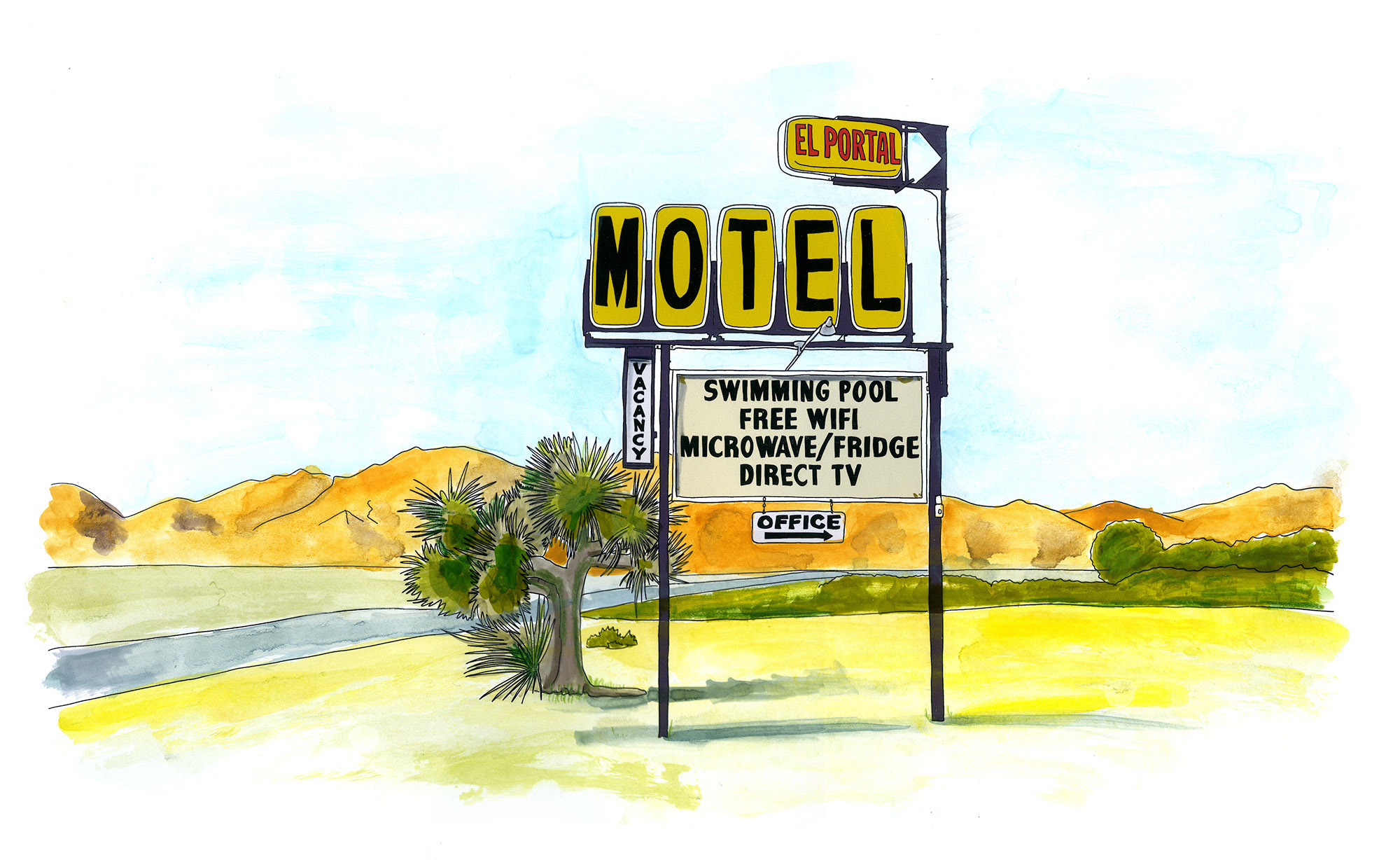
Sketches of a disappearing roadside—motels, signs, and the fading visual language of the American desert.
Show full content
The El Portal Motel sign in Beatty, Nevada — part of a later generation of roadside design, built to last rather than impress.
This is an ongoing sketch journal of the American desert — a record of roadside signs, motels, and the architecture of movement that once lined highways across the Southwest. Many of these places were never meant to last. Built for speed, visibility, and passing traffic, they marked the edges of towns and the distances between them.
What remains now is fragmentary. Neon replaced with backlit plastic. Independent motels folded into chains. Signs removed, simplified, or left to weather in place. What disappears in that process is not just design, but a way of reading the road — a vocabulary shaped by distance, light, and motion.
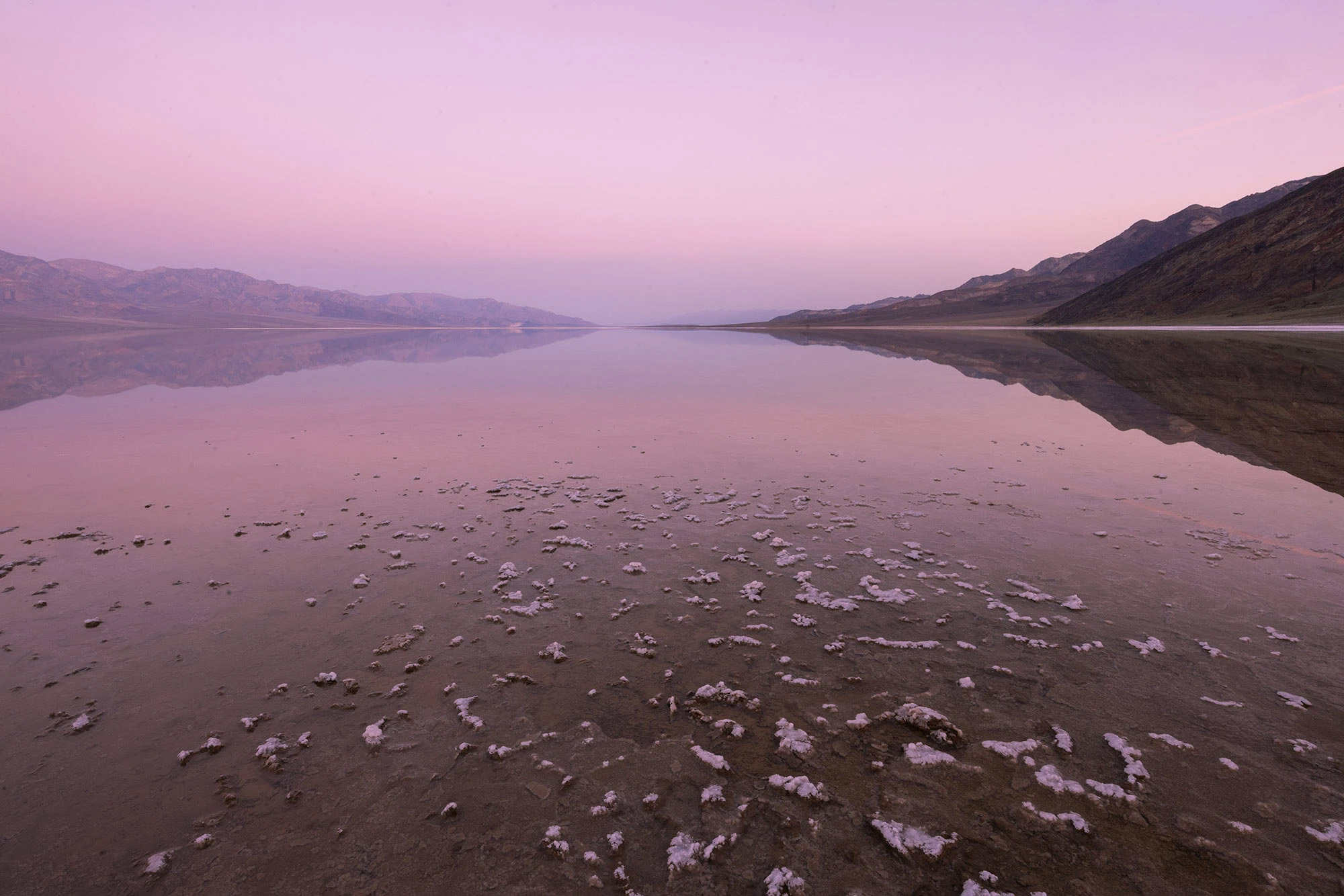
Lake Manly rises again, reviving the fight over water, extinction, and a one-inch fish that has survived in Devils Hole for ten thousand years.
Show full content
The Devils Hole pupfish — perhaps the rarest vertebrate on Earth — occupies a single flooded cavern in the Nevada desert.
In the spring of 2023, Lake Manly returned. For the first time in a generation, Death Valley's ancient playa filled with water — a shallow inland sea glittering beneath the Panamint Range, drawing tourists who kayaked where roadrunners usually walked. It was beautiful and disorienting. And for those who understood the valley's long legal history, it was a reminder that water in the Mojave has never been a neutral fact. It has always been the subject of wars.
The smallest combatant in those wars is Cyprinodon diabolis — the Devils Hole pupfish — a half-inch fish that has lived in a single flooded limestone cavern in the Amargosa Desert for at least ten thousand years. There are rarely more than two hundred of them alive at any moment. They exist on a submerged rock shelf the size of a kitchen table, dependent on a precise water level that took a Supreme Court decision — Cappaert v. United States, 1976 — to protect. This is the story of that legal battle, the 2016 break-in that nearly ended the species, the biologist who once carried an entire wild population in a bucket, and the question that haunts every conservation argument: why save something so improbable?
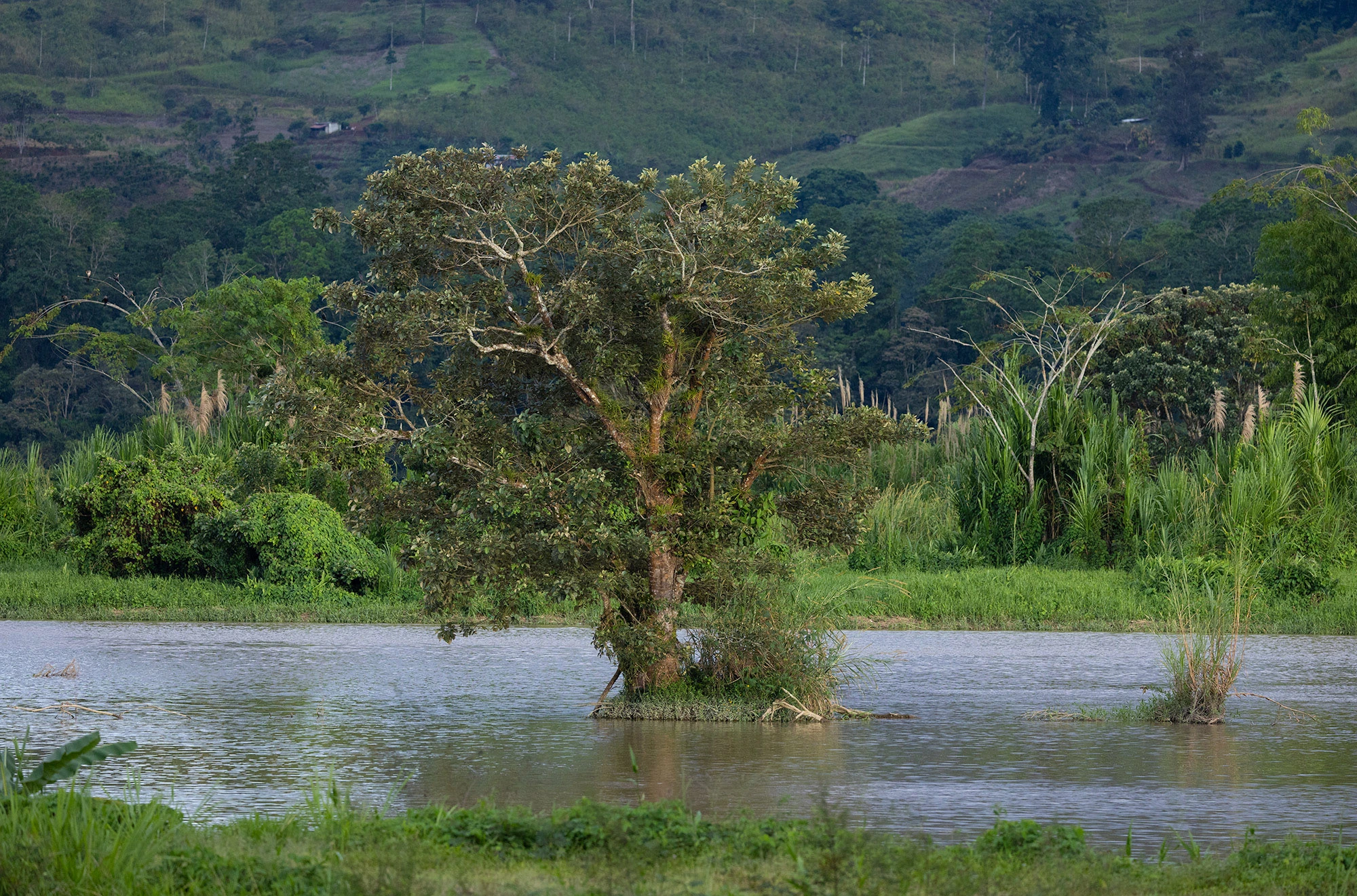
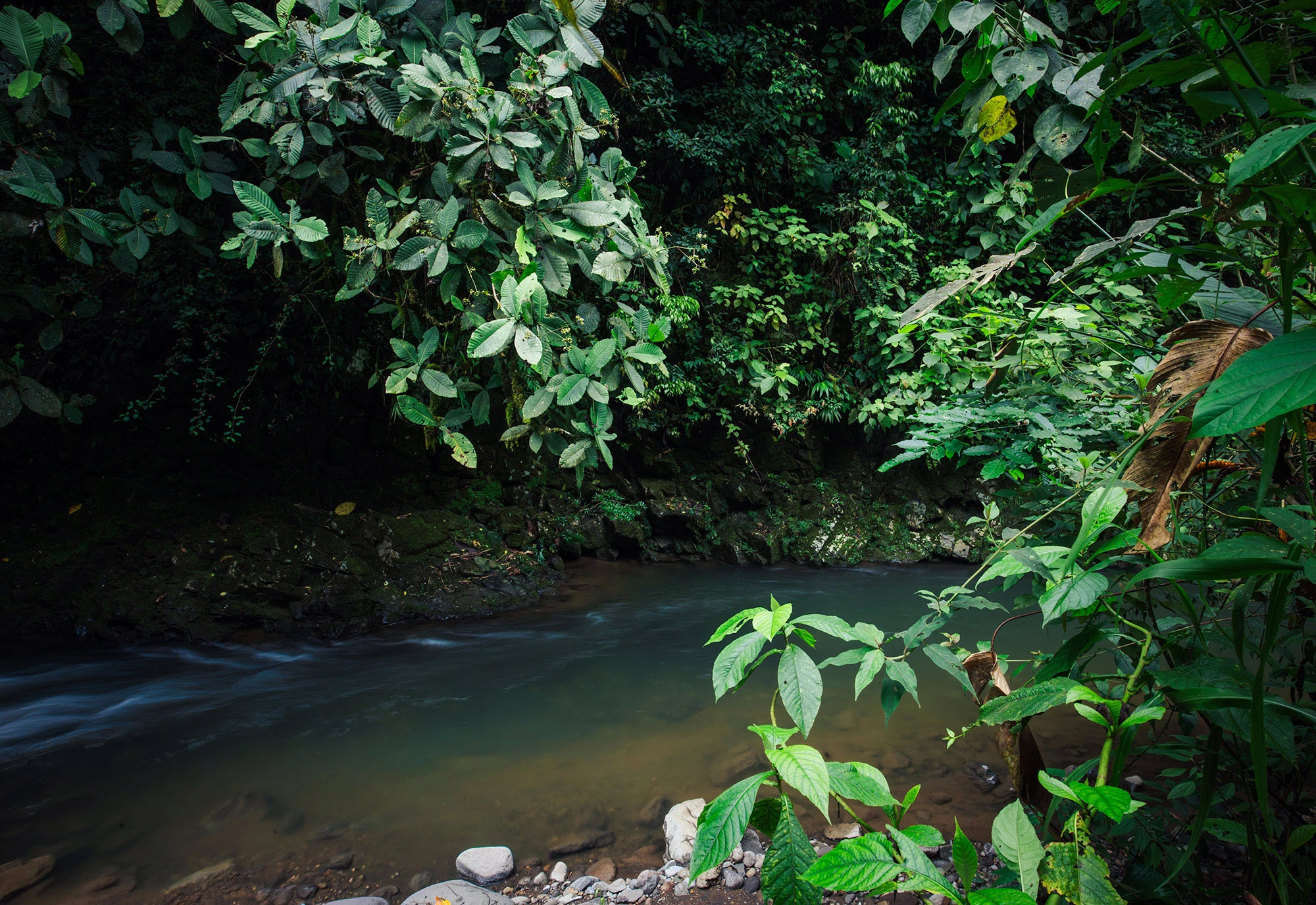
Along a quiet river in Costa Rica, insects, parasites, and hidden lives reveal the living systems beneath everything we take for granted.
Show full content
Río Guayabo, Costa Rica — where a morning's fieldwork becomes an argument about what holds the world together.
Harry and I had been walking the Río Guayabo drainage for two hours before we found the treehopper. It was perched on a cecropia leaf, camouflaged to look exactly like a thorn, attended by a column of Azteca ants that were farming it for honeydew. This is not a metaphor. The treehopper produces sugar; the ants provide protection; the cecropia tolerates the ants because they drive off herbivores. Three species locked in mutual dependence, playing out an arrangement older than Rome, on a leaf you could cover with your hand.
This final chapter of Turrialba and the Infrastructure of Everything follows that thread — from the treehoppers to the Krefeld study, from the biomass of ants to the argument I've been building since we arrived in Costa Rica: that biodiversity isn't scenery, and it isn't charity. It is the operating system. The evidence is everywhere along Río Guayabo, if you know how to read it.
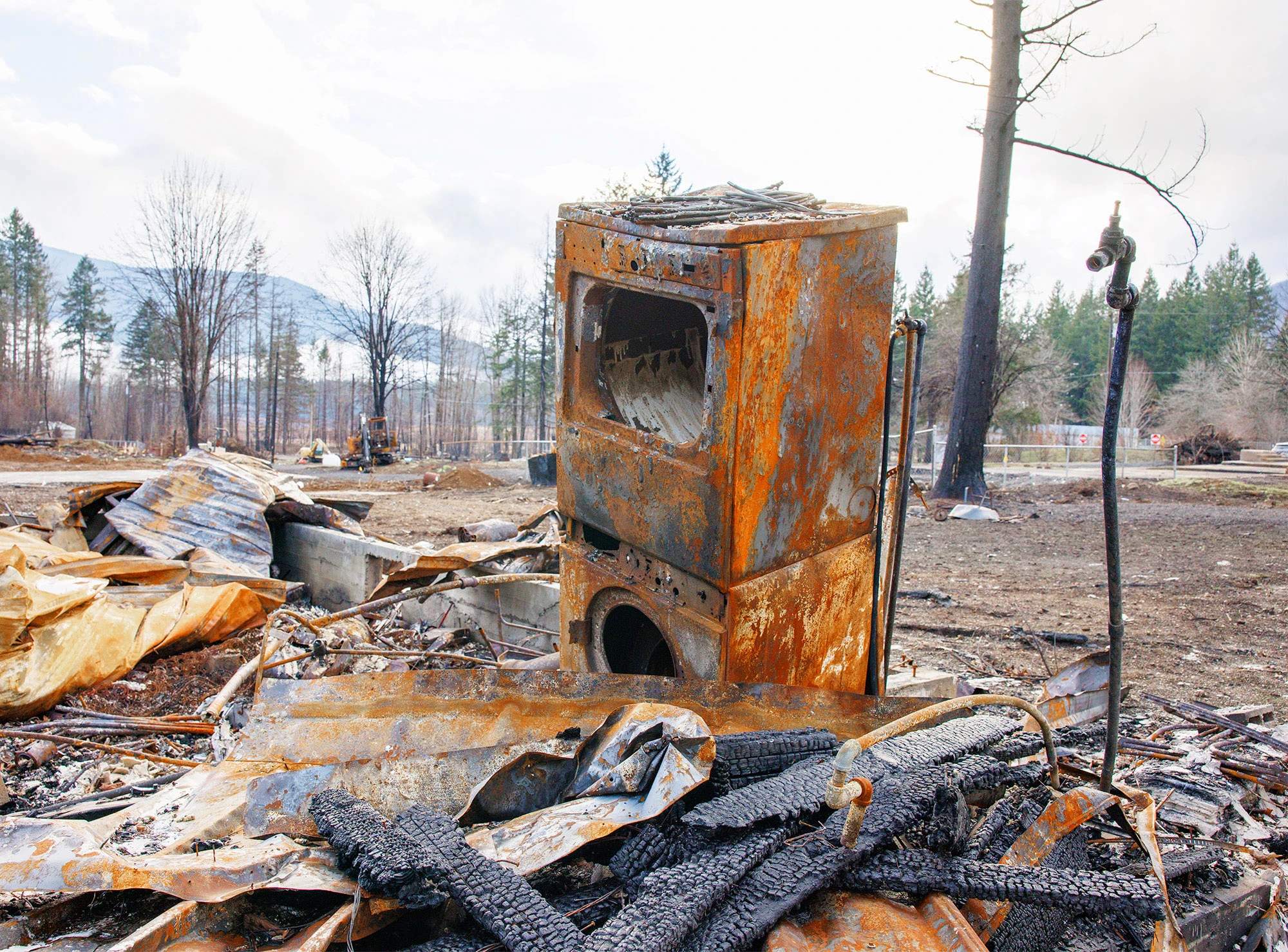
Patrick Moore claims wildfires aren't getting worse because of climate change. A forensic rebuttal shows how heat, drought, and atmospheric drying are driving larger, more destructive fires.
Show full content
Moore's argument depends on counting ignitions. The science tracks something more consequential: what happens after a fire starts.
Patrick Moore has a reliable method. He finds a metric that, read in isolation, supports his preferred conclusion, presents it as the whole story, and dares his readers to dig deeper. His wildfire argument follows the script: the number of fires globally has not increased, therefore climate change is not making wildfires worse. This is a careful selection. What the data actually shows — in burned area, fire intensity, season length, and the moisture deficit of fuels — tells a different story entirely.
This is a systematic rebuttal of Moore's wildfire claims, drawn from the peer-reviewed literature on vapor pressure deficit, the Palmer Drought Severity Index, and fire behavior under atmospheric drying. It is also, more broadly, about how contrarian environmental arguments get constructed: not by fabricating data, but by choosing which data to show you.
At Lago Angostura in Costa Rica, a single drop of water reveals the hidden infrastructure of life — from microbes and plankton to the ecosystems that sustain the living world.
Show full content
Lago Angostura sits in the shadow of Turrialba Volcano — a place where the invisible architecture of freshwater ecosystems becomes briefly legible.
A drop of water from Lago Angostura, held under a hand lens in the right light, is not empty. It is a community. Rotifers spin. Copepods lurch. Diatoms drift, their silica shells precise as jewelry. This is the base of the food web, the bottom of the pyramid whose upper stories include the herons working the lake's margins, the farms downstream, the municipal water supply in Turrialba. None of that is visible in the drop. But it all depends on what's there.
This chapter of Turrialba and the Infrastructure of Everything begins at water level and works outward — from the chemistry of a mountain lake to the argument that freshwater biodiversity is among the most functionally critical and most overlooked systems on Earth. Jon Miltimore, among others, would disagree. This essay is a patient answer to why he is wrong.
A viral hellbender video raises a larger question: what happens when handling sensitive wildlife becomes social media content — and who decides when admiration becomes harm?
Show full content
The Eastern Hellbender — North America's largest salamander — is a sentinel species for cold, clean, highly oxygenated streams. It is also increasingly rare.
Bob Ferguson — the outdoors educator behind the Fascinature channel — posted a video of himself handling a hellbender. The giant salamander, clearly stressed, writhed in his hands while he explained its biology to the camera with evident enthusiasm. The video went wide. The comments were overwhelmingly positive. And a small community of herpetologists watched it with their hands over their eyes.
This is an open letter to Bob, and a broader meditation on a problem that has no clean solution: the people most likely to put charismatic wildlife in front of a large audience are also the people most capable of normalizing contact that wildlife cannot afford. Hellbenders are an aquatic canary. Their decline tracks the degradation of the cold Appalachian streams they require. The last thing they need is to become content.
In the mist below Turrialba, life beneath the forest floor proves more foundational than stone and steel. Part III of Turrialba Volcano and the Infrastructure of Everything.
Show full content
A ridge-headed salamander on the cloud forest floor below Turrialba — one of many species whose existence depends on the fungal networks working invisibly beneath it.
It was raining when we found the salamander — a ridge-headed Nototriton, barely four centimeters long, standing on a mat of moss with an expression that could only be described as ancient. Harry photographed it from four angles. I tried to identify it in the field and failed. It was the third salamander we'd seen that morning on the cloud forest slope below Turrialba, and we hadn't been looking for salamanders at all. We'd been looking at the understory — at the network of fungal mycelium threading the soil, at the relationship between the mycorrhizal fungi and the trees above them, at the way the forest's structural integrity runs underground.
Part III of Turrialba Volcano and the Infrastructure of Everything descends below the leaf litter. It is an essay about fungi as infrastructure — about the wood wide web, about nutrient transfer, about the argument that the most important organisms in a tropical forest are the ones you never see. It is also, in part, about what we lose when we treat soil as dirt.
A photo gallery documenting the memorials and vigils in Minneapolis after the fatal shootings of Renée Nicole Good and Alex Pretti by federal immigration enforcement agents.
Show full content
Minneapolis, February 2026 — flowers, photographs, and handwritten notes at the memorial site for Renée Nicole Good and Alex Pretti.
On February 13, 2026, federal immigration enforcement agents shot and killed Renée Nicole Good and Alex Pretti during an operation in Minneapolis. Within days, the city had erected memorials — flowers, photographs, candles, handwritten notes — at the sites where they died. Notes from the Road traveled to document what Minneapolis made of its grief: the scale of it, the care, the refusal to let the deaths become a statistic.
This is a photo gallery, not an argument. But photographs of a city in mourning are never neutral. They record what a community decides to do with its outrage when it cannot do anything else.
A systematic rebuttal of Chris Dorsey's polar bear claims, featuring interviews with Arctic sea-ice scientist Dr. Julienne Stroeve and National Geographic photographer Kiliii Yuyan, grounded in long-term population science.
Show full content
The polar bear has become a proxy battle in the climate debate — but the science of what is actually happening to Arctic sea ice is not ambiguous.
Chris Dorsey is a hunting and outdoor sports media figure with a large following and a confident claim: polar bears are doing fine, populations are growing, and climate alarmists are using them as emotional props for a fabricated crisis. Notes from the Road put those claims to two people who study the Arctic professionally — Dr. Julienne Stroeve, one of the world's leading sea-ice scientists, and Kiliii Yuyan, the National Geographic photographer who has spent years documenting Arctic communities and wildlife — and asked them to respond directly.
What emerged is not just a rebuttal of Dorsey's specific claims, but a case study in how outdated subpopulation data gets weaponized to contradict the long-term trend, and why the distinction between "some populations are stable" and "the species is fine" is one that climate contrarians routinely exploit. The bears are not fine. The ice is not coming back.
Above and below ground on Costa Rica's Turrialba Volcano, a fungus beetle and a Costa Rican Red Leg Tarantula reveal the hidden networks of decay, communication, and connection that hold the forest together.
Show full content
A Costa Rican Red Leg Tarantula on the cloud forest floor — a predator embedded in a system of decomposition, nutrient cycling, and fungal communication it will never be aware of.
The fungus beetle was the size of a sesame seed, iridescent, moving through the mycelial mat on the forest floor with the focused urgency of something that knows exactly what it's doing. We watched it for ten minutes. At some point Harry said: that beetle lives its entire life in a world that most people do not believe exists. He meant the fungal understory — the network of hyphae threading the soil, the chemical signals passing between trees, the decomposition economy running silently beneath every footstep.
Part II of Turrialba Volcano and the Infrastructure of Everything follows the beetle down. It is an essay about decomposers — about what forests actually run on, about the Costa Rican Red Leg Tarantula we found near the same patch of mycelium, and about why the organisms that break things down are as essential to the system as the ones that build them up.
On Costa Rica's Turrialba Volcano, cloud forests, mixed flocks, and unseen ecological systems reveal the living infrastructure that makes a habitable world possible.
Show full content
The cloud forest on Turrialba's slopes — where a mixed flock moves through the canopy like a single organism, and the invisible work of biodiversity becomes briefly audible.
The mixed flock arrived like weather. One moment the cloud forest was quiet; the next, there were birds in every layer of the canopy — tanagers, warblers, antbirds, a pair of woodcreepers working the same trunk in parallel — moving through together in a system that looks chaotic but isn't. Mixed-species flocks are a cooperative anti-predator strategy, a foraging efficiency mechanism, and a vivid argument for why biodiversity is functional rather than decorative. When a forest loses species, the flocks thin. When the flocks thin, the insect pressure on the understory changes. When that changes, the forest changes. Everything is connected to everything else, and the connections have consequences.
This is the opening chapter of Turrialba and the Infrastructure of Everything — a book-length argument that biodiversity underpins human civilization, told through a week on the slopes of an active Costa Rican volcano with my traveling companion Harry. It begins with birds, but it doesn't end there.
A detailed rebuttal of Jon Miltimore's hurricane claims, explaining why raw storm counts mislead and how climate change is making hurricanes more destructive even as their frequency stays flat.
Show full content
The number of Atlantic hurricanes each year has not significantly increased. What has increased — dramatically — is the proportion reaching Category 4 and 5 intensity.
Jon Miltimore's argument is seductive in its simplicity: hurricane counts haven't gone up, therefore climate change isn't making hurricanes worse. It's a claim that sounds empirical, cites real data, and reaches a conclusion that the data does not support. The peer-reviewed literature on tropical cyclone behavior under warming conditions is clear about what is actually changing — rapid intensification rates, peak wind speeds, rainfall totals, the speed at which storms stall over populated areas. None of that appears in Miltimore's accounting.
This rebuttal walks through the mechanism of hurricane intensification, the difference between frequency and severity as metrics, and why the distinction matters enormously when an individual storm makes landfall. It is also part of an ongoing series examining how technically-fluent climate contrarianism works — and why it is more dangerous than outright denial.
A journey from Tunisia's Zaghouan highlands to the Tunis Medina, tracing Berber ridge villages, Roman aqueducts, and salt lakes alive with flamingos — a landscape that shapes the lives within it.
Show full content
The road from Zaghouan to Tunis passes through a compressed history of North Africa — Berber hillside villages, Roman hydraulic engineering, Ottoman architecture, and a coastal plain thick with flamingos.
Zaghouan is where Roman engineers built their temple to the water nymphs — the source of the aqueduct that once carried fresh water 132 kilometers to Carthage. Standing at the spring house, which is still standing and still beautiful, it is impossible not to think about infrastructure: about how much human effort across how many centuries has been devoted to moving water from where it falls to where people need it, and how thoroughly we have forgotten that this is not a solved problem.
The drive from Zaghouan down to the Tunis Medina passes through Berber villages perched on ridgelines, along the edge of salt flats that turn pink with flamingos in the low autumn light, and eventually into the chaos of the capital's ring road. It is a transect through deep North African time, and it reads differently on the way back than it did going out.
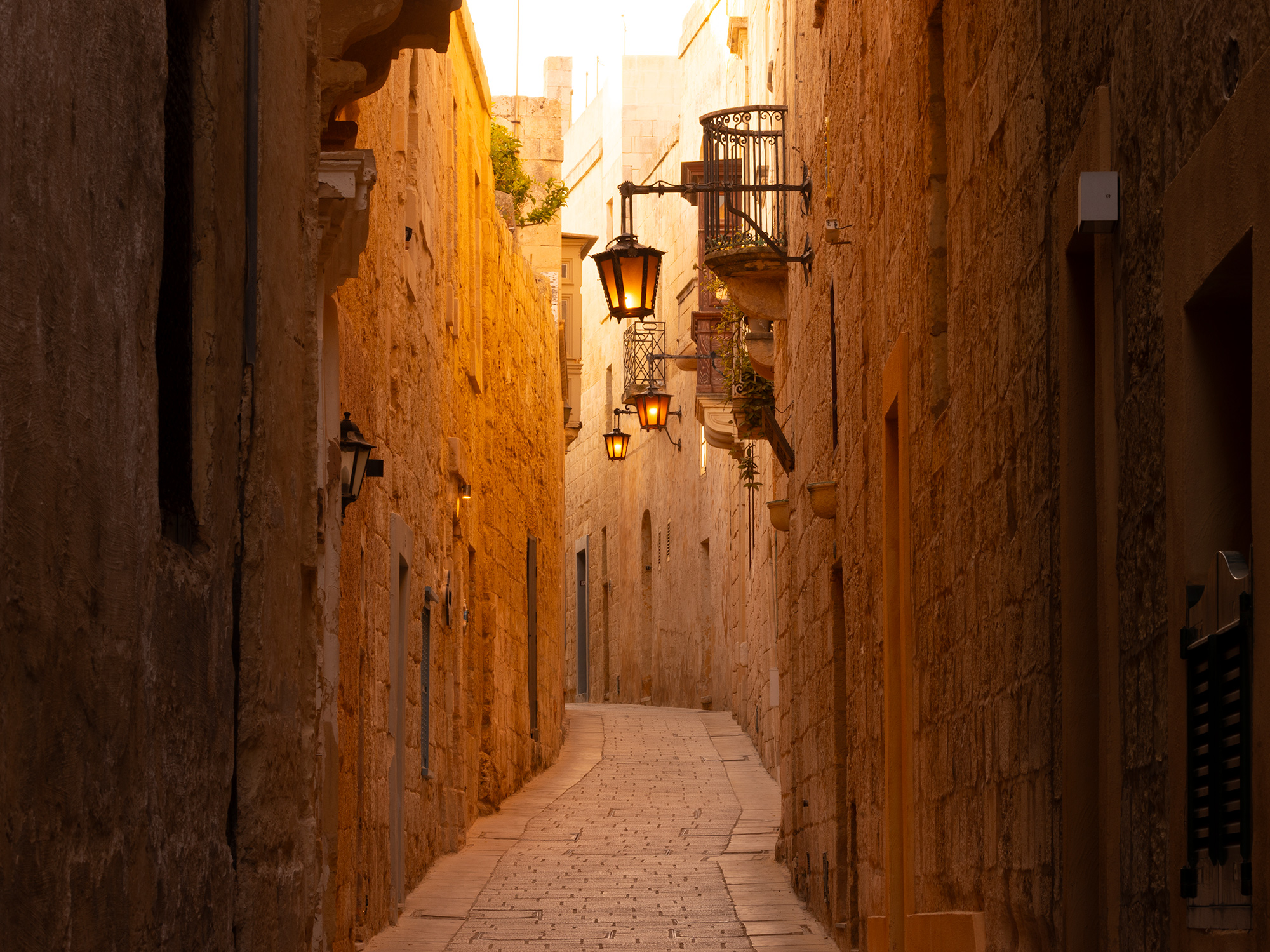
In the Tunis Medina, walking with my family becomes a way of learning how ideas of power survive across generations — written into the geometry of streets that have resisted every attempt to make them legible.
Show full content
The Tunis Medina — a UNESCO World Heritage Site whose street plan was designed, among other things, to be impossible to navigate at speed.
The Tunis Medina was built to be confusing. Not accidentally — intentionally. The labyrinthine street pattern, the dead ends, the sudden narrowings, the gates that close at night: these were defensive technologies, evolved over centuries of occupation and resistance. Walking through it with my family, I kept getting lost in the way you get lost in a place that is actively withholding itself, and I found that interesting. Not frustrating — interesting. The medina wasn't built for tourists. It was built for people who needed the city to protect them.
This essay follows a morning in the medina into a longer reflection on what the built environment preserves that written history doesn't — on how a street plan can carry the memory of a siege, and what it means to walk through a space that was designed with a politics you can feel but can't quite name.
A tiny jewel of a leafhopper captured ejecting a droplet of honeydew at high speed — revealing a hidden world of micro-ballistics happening millions of times per second across the planet.
Show full content
Sibovia pileata leafhopper captured mid-launch, firing a droplet of honeydew at high speed.
Sibovia pileata is an angular little jewel of a leafhopper, all turquoise and saffron lines. But this photo shows something strange and almost unique among leafhoppers. I caught this little guy in the act of ejecting a tiny droplet from his rear with more force and speed than makes sense for a creature only a few millimeters long. Leafhoppers don't have many defenses, but they do have this: a honeydew catapult.
Leafhoppers live on sugar water. They spend their lives tapping the phloem—the circulatory system of plants—and guzzling up plant juice like there is no tomorrow. Phloem sap is thin and extremely low in nitrogen, so leafhoppers must process enormous volumes of it to extract enough of that one critical nutrient. The result is constant overpressure in the gut. The solution? Fire the waste back out into the world at spectacular velocity.
In Tunisia's most fantastical seaside village, a walk through the blue and white alleys of Sidi Bou Said becomes a meditation on what makes a place truly beautiful — and why imitation never equals integrity.
Show full content
Sidi Bou Said — the blue-and-white hill village above Tunis that has been mandatory painting material since Paul Klee visited in 1914.
Sidi Bou Said is one of those places that photographs so well it has almost ceased to be a real place. The blue shutters, the white walls, the bougainvillea, the view across the Gulf of Tunis to where Carthage used to be — it assembles itself into a composition before you've taken ten steps. Which is exactly why it's worth thinking carefully about what you're actually looking at, and why it looks the way it does. The blue-and-white palette was not inevitable. It was mandated in 1915 by a French colonial administrator named Baron Rodolphe d'Erlanger, who wanted to preserve the aesthetic character of the village he'd decided to make his home. Beauty, here, was a colonial imposition. It survived because it was also genuine.
This essay uses Sidi Bou Said as a lens for a broader question about place, authenticity, and the difference between a village that looks beautiful and one that is beautiful — and why that distinction, which sounds purely aesthetic, turns out to have real ethical weight.
In Portland, protest became art. Notes from the Road documents a city's creative defiance as hundreds stood against Trump's ICE — blending humor, costume, and courage in one of the most photographed protest movements in America.
Show full content
Portland's protests against ICE operations became famous for their visual inventiveness — a tradition that continued through 2025 with no sign of fatigue.
Portland has been doing this longer than almost anywhere else in the country. The protests outside the ICE facility on Southwest Macadam go back to 2018, when a tent encampment blockaded the building for weeks. What has evolved since then is a visual vocabulary: the costumes, the puppets, the handmade signs with a level of craft that suggests people are bringing their best work to the street. Humor as a protest strategy is easy to dismiss. It is also, in Portland, clearly not going away.
This photo essay documents several days of protest in the fall of 2025 — the crowds, the costumes, the confrontations, and the quieter moments between them. It is a record of what it looks like when a city decides that showing up, repeatedly, in elaborate costume, is a form of moral seriousness.
Patrick Moore claims nuclear radiation is harmless, even healthy. Notes from the Road dismantles his pseudoscientific defense of nuclear energy and exposes the distortions of radiation health science driving it.
Show full content
Moore's argument for nuclear energy rests on a claim about radiation biology that is not supported by the mainstream scientific literature — and hasn't been for decades.
Patrick Moore's nuclear argument has a nuclear-grade audacity to it: not only is radiation harmless at low doses, he suggests, it may actually be beneficial — a concept called radiation hormesis. This is a minority position in the radiation biology literature, promoted enthusiastically by the nuclear industry, and it is the foundation on which Moore builds his case that concerns about nuclear energy are scientifically illiterate. Notes from the Road went to the literature to find out how that foundation holds up.
It does not hold up. This essay examines Moore's specific claims about radiation health science, traces their origins in industry-funded research, and explains what the current scientific consensus actually says about low-dose radiation exposure. It is also, inevitably, a piece about how Moore operates: by finding genuine scientific uncertainty and presenting it as settled debate on his preferred side.
Some believe Donald Trump could win the Nobel Peace Prize, but his record of inciting violence and division at home tells a different story. Notes from the Road maintains the most exhaustive documented record of Trump-inspired violence.
Show full content
A running record — the kind that depends on no single source and cannot be dismissed as partisan curation.
The Nobel Peace Prize nomination for Donald Trump was not a joke, or at least not only a joke. It was made in earnest by members of the Norwegian parliament who cited his foreign policy record. Notes from the Road responds by maintaining a different kind of record: a documented catalogue of violence and state-sanctioned harm that occurred during his administrations, sourced to news reports, court records, and government documents, updated as events accumulate.
This is not an argument. It is an archive. The logic is simple: if you want to evaluate whether a person deserves a peace prize, you look at what peace, and the absence of it, looked like on their watch. This page is that look.
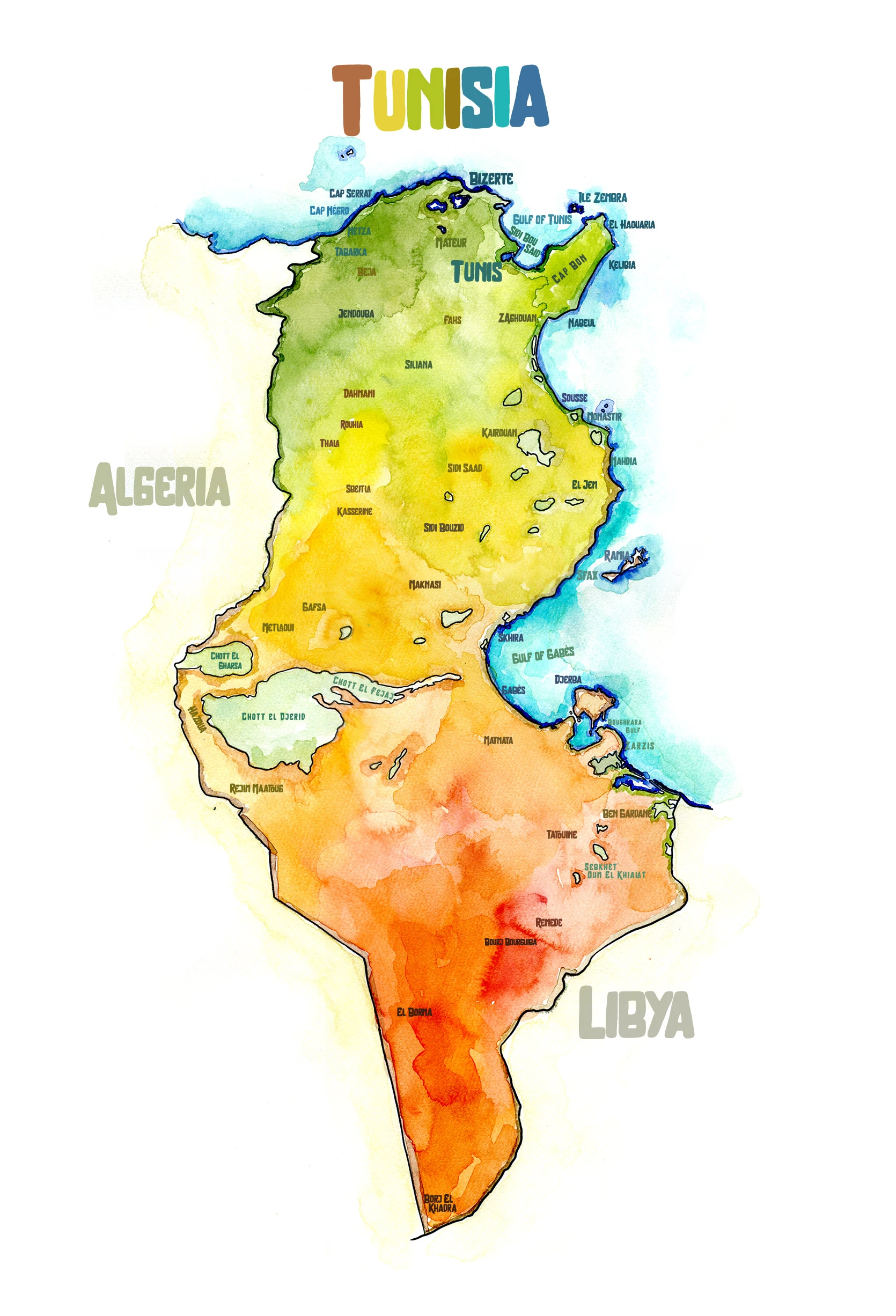
A handpainted watercolor map of Tunisia showing the country's deceptive geography — from the green northern hills and Roman ruins to the vast, empty reaches of the Sahara.
Show full content
Watercolor map of Tunisia — painted to accompany the Notes from the Road series on travel through Tunisia's north, Zaghouan, the Medina, and the Saharan south.
Tunisia is a country that surprises people who think they know it. The north is green and hilly — closer to Provence than to the Sahara — with Roman aqueducts and Berber hilltop villages and a coastline of flamingos. The south is the Sahara proper: erg and reg and chott, salt flats that mirror the sky, the kind of emptiness that reorganizes your sense of scale. Between them, the country compresses about three thousand years of uninterrupted settlement into a space the size of Wisconsin.
This handpainted watercolor map was made to accompany my travel writing from Tunisia — a visual index to the places in the essays, from Zaghouan in the north to the edge of the great desert in the south. It is available as a print.
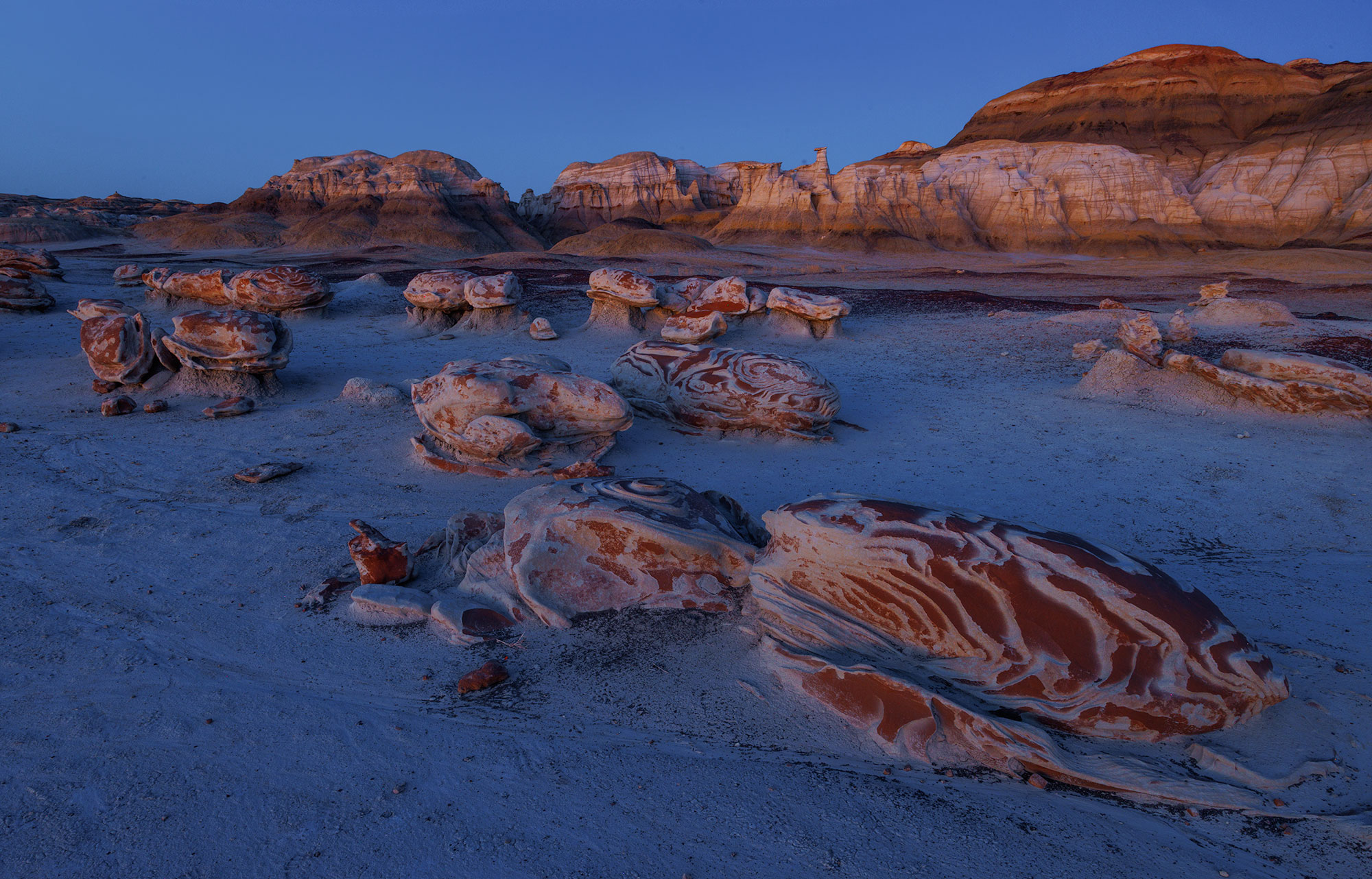
A night hike in Bisti/De-Na-Zin reveals one of Earth's best windows into the Cretaceous—an exposed fossil delta where the Western Interior Sea once flowed.
Show full content
A night hike in Bisti/De-Na-Zin reveals one of Earth's best windows into the Cretaceous—an exposed fossil delta where the Western Interior Sea once flowed.
Ganghwa Island's tidal flats host the endangered Black-faced Spoonbill—and an overlooked case for cooperation amid rising nationalism and isolationism.
Show full content
Ganghwa Island's tidal flats host the endangered Black-faced Spoonbill—and an overlooked case for cooperation amid rising nationalism and isolationism.
Paria Canyon glows with color and silence. A walk through its narrows becomes a reflection on reading, memory, and the spread of conspiratorial thinking.
A barge and tugboat have crushed a protected coral reef—and Bakers Bay Club refuses to act. Fowl Cays bleeds while the billionaires stall and their subcontractors sue each other.
Show full content
A barge and tugboat have crushed a protected coral reef—and Bakers Bay Club refuses to act.
While hiking in the Vermilion Cliffs, I dive deep into the ancient geological epochs that created these beautiful rainbows of stone. Includes an interview with provocateur Matt Livingston Omega.
Show full content
While hiking in the Vermilion Cliffs, I dive deep into the ancient geological epochs that created these beautiful rainbows of stone.
This is how I pack my packraft and a giant, ultra-stable landscape tripod into packed luggage, allowing me to photograph in lagoons, marshes and harbors around the world.
Show full content
This is how I pack my packraft and a giant, ultra-stable landscape tripod into packed luggage, allowing me to photograph in lagoons, marshes and harbors around the world.
Just completed sketching all species of the United States, including Puerto Rico. What represents the diversity of the American Southwest better than the cacti? Explore my illustrations and descriptions of every cactus species in the United States. My simple illustrations are designed to highlight the field identifications of each cactus, helping you learn and enjoy them in the wild. This is the world's only complete guide to every cactus in the desert southwest and the United States. Explore the American cactuses by genus:
Show full content
Just completed sketching all species of the United States, including Puerto Rico.
 Lake Manly rises again, reviving the fight over water, extinction, and a one-inch fish that has survived in Devils Hole for ten thousand years.
 Along a quiet river in Costa Rica, insects, parasites, and hidden lives reveal the living systems beneath everything we take for granted.