GeistHaus
log in · sign up

https://feeds.feedburner.com/arabistdotnet

rss
20 posts
Polling state
Status active
Last polled May 19, 2026 00:49 UTC
Next poll May 19, 2026 22:28 UTC
Poll interval 86400s
Last-Modified Mon, 29 Jan 2024 23:48:29 GMT

Posts

The cost of living
Posts
“a rhetoric feast of meaningless blah”.
Show full content

In an effort to (slowly) restart this blog, I am logging readings, stray thoughts and commentary in a diary format every few days. Bear with me.

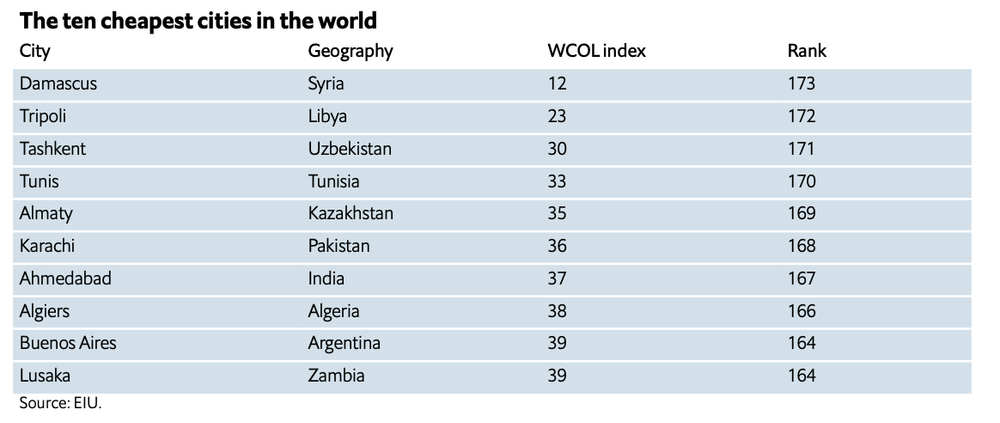
The Economist Intelligence Unit says Tel Aviv is the most expensive city in the world: Cost of Living Index 2021 | Economist Intelligence Unit

Tel Aviv had previously been in the top 10, and the EIU says it rose to the number one spot (ahead of well-known spendy cities like Paris or Singapore) chiefly because of "its soaring currency and price increases for around one-tenth of goods in the city, led by groceries and transport, in local-currency terms." But the more interesting data for the MENA region may be at the bottom of the scale – Damascus is the cheapest city in the world, and Tripoli not far behind it. I guess the upside of living in collapsed states ravaged by civil war is that it's cheap. I am surprised to see Tunis and Algiers also in the bottom 10 - I'm sure their residents, who often complain about cost of living despite many protectionist measures being in place, would be too. How much does this type of listing really say that is meaningful?

This book won the 2017 Goncourt Prize, arguably France’s most prestigious literary award. The subject is heavy - it focuses on those who collaborated with the Nazis, but were not Nazis themselves, among the elites of Germany and Austria in particular - people like the Prussian industrialists who led Siemens, Krupp, Telefunken, Opel etc. and funded the Nazis’ decisive 1933 electoral campaign, or Kurt von Schuschnigg, the chancellor of Austria who “negotiated” the Anschluss in 1938. But the writing is light, dancing between portraits of these characters, ruminations on their internal state of mind at the time, and accounts of their fate after the defeat of the Nazis. It’s not a history even if it fact-based; the style is literary, but it is not fiction and is more than “literary non-fiction”.

It is also at times funny - whether because of the asides on what people must have been thinking, their hobbies, their petty interests etc or in the character sketches of the people involved. A particularly tragicomic episode involves Ribbentrop in 1938, on the eve of the German invasion of Austria, over-staying his welcome at his farewell lunch as Germany’s ambassador to the UK at Downing Street by droning on and on about tennis, discussing the gamesmanship of players of the day and his own attempts at improving his game, while Chamberlain (who receives news of the impending invasion in the middle of the lunch) politely listens on but is desperate to leave to consult with his diplomatic and military advisors.

To read perhaps side to side with a masterpiece from the period, Friedrich Reck’s Diary of a Man in Despair.


This is a smart discussion on the Israeli-Palestinian conflict and its evolution featuring Rebecca AbouChedid, Daniel Levy, Diana Buttu and Peter Beinart: Where to look for hope. I really like Daniel turn of phrase about diplomatic-speak on the conflict: “a rhetoric feast of meaningless blah”.


Iran is the #1 sanctioned country in the world, says SAIS’ Rethinking Iran initiative on sanctions. There is a lot of material on this infographic page, and every fact box links to an essay on the topic - such as how household welfare has been affected by the Obama, Trump and now Biden sanctions (poverty has doubled in rural areas and gone up 60% in urban areas).

Broad economic sanctions tend to strengthen autocratic regimes, not weaken them (see Iraq, Syria, Cuba, etc.) More importantly, they are utterly immoral, the modern equivalent of medieval sieges on cities.


Yikes: Trump’s Next Coup Has Already Begun (The Atlantic)

For more than a year now, with tacit and explicit support from their party’s national leaders, state Republican operatives have been building an apparatus of election theft. Elected officials in Arizona, Texas, Georgia, Pennsylvania, Wisconsin, Michigan, and other states have studied Donald Trump’s crusade to overturn the 2020 election. They have noted the points of failure and have taken concrete steps to avoid failure next time. Some of them have rewritten statutes to seize partisan control of decisions about which ballots to count and which to discard, which results to certify and which to reject. They are driving out or stripping power from election officials who refused to go along with the plot last November, aiming to replace them with exponents of the Big Lie. They are fine-tuning a legal argument that purports to allow state legislators to override the choice of the voters.


The World InequalityReport 2022 presents the most up-to-date & complete data on inequality worldwide: 💵 global wealth🌍 ecological inequality💰 income inequality since 1820♀ gender inequality

In the latest edition of the World Bank's inequality report, the MENA region continues to be the most unequal in the world. From the report's first chapter:

The degree of inequality within a society is fundamentally a result of political choices: it is determined by how a society decides to organize its economy (i.e. the sets of rights given to and constraints imposed on firms, governments, individuals, and other economic actors).


This is an important article in Le Monde on the French Rupert Murdoch who has mainstreamed "replacement theory" in mass media and backs the far-right candidate Eric Zemmour: Comment Vincent Bolloré mobilise son empire médiatique pour peser sur la présidentielle
4f334481cb12c1acadc57623:5177e444e4b0244b5f673736:61b07a6945c68d3fc658b752
Extensions
Biden's "unexpected powers of resistance" against the blob
Asides

David Bromwich, writing in the London Review of Books on Biden’s foreign policy nerve:

On the face of things, Biden has surrounded himself with the conventional advisers of the Clinton-Obama circle – Jake Sullivan, Samantha Power, Susan Rice, Thomas Donilon, Ash Carter, Michèle Flournoy. It is hard to imagine any of them straying far from the Cold War groove of shepherding Nato against Russia and finding a field for occasional military exercise in a humanitarian war. Yet Biden in the past has shown unexpected powers of resistance: he sided with Douglas Lute and General Cartwright, against Hillary Clinton and Robert Gates, in telling Obama in 2009 to begin withdrawing from Afghanistan immediately. Again, in the case of Libya, Biden made the right arguments (though again Obama declined to follow them) in opposing the overthrow of Gaddafi. It will take the same nerve, under greater pressure, to repel the temptation of using foreign adventures as a way of marking a contrast with the deal-making gestural nationalism of Trump. The US recently announced plans to deploy the Coast Guard in the South China Sea – a long way off to interpret as the West Coast of America. The next president will be advised to take many further steps on similar lines, and all the advice will be bad. Foreign policy has been a century-long distraction from America’s confrontation with itself.

4f334481cb12c1acadc57623:5177e444e4b0244b5f673736:5faff83b44e8212553fce457
Extensions
“He has been wrong on nearly every major foreign policy and national security issue over the past four decades.”
Asides

Robin Wright, writing in The New Yorker on Biden’s foreign policy chops:

For all his experience, however, Biden has also backed controversial policies and made bad calls during his decades in foreign policy. As a senator, he opposed authorizing Operation Desert Storm, to oust Saddam Hussein’s Iraq from Kuwait, in 1991; it succeeded with lightning efficiency. He then supported the U.S. invasion of Iraq in 2003; it was an epic failure that dragged on for years. In 2006, he co-authored a widely criticized Op-Ed in the Times that proposed the division of Iraq into autonomous Sunni, Shiite and Kurdish statelets—the kind of territorial split that isis achieved by carving out a Sunni caliphate between 2014 and 2019. Biden is “a man of integrity” who is “impossible not to like,” the former C.I.A. director and Defense Secretary Robert Gates wrote in his memoir, in 2014. Gates then said of Biden, “He has been wrong on nearly every major foreign policy and national security issue over the past four decades.”

4f334481cb12c1acadc57623:5177e444e4b0244b5f673736:5fafeec69d560157709e1eaa
Extensions
Links April-May 2020
Links
Belated linkdump… * The American Virus | LRB Elliot Weinberger on Trump and Covid. * No Bark, No Bite | Jewish Currents Peter Beinart: "With each passing week, it becomes clearer that Joe Biden’s victory over Bernie Sanders is making it easier for Israel to annex the West Bank." * Biden 'completely' opposes withholding aid to Israel over West Bank policy, adviser says - Haaretz This is the Obama/Biden legacy on Israel: say you'd prefer things were different but do absolutely nothing about it. It amounts to endorsement of annexation. * The US Goes to Bat for Lebanon’s “Butcher of Khiam” - Just Security The US Goes to Bat for Lebanon’s “Butcher of Khiam” - Just Security | * A Mockery of Peace - Carnegie Middle East Center Marwan Muasher: "The Jordanian government should make intensive efforts to convince Netanyahu and Gantz of the risks of such a step, both as concerns Jordan and the peace process in general. Jordan cannot stand aside as the Israeli government proceeds with annexation." * For Palestinian rights movement, Biden poses a familiar quandary | 972 “We have to get Trump out of office in order to create enough room to do the political work that we want to do,” said Erakat. “[Biden’s] definitely a foe, but a foe under whose liberal administration gives a little bit more breathing room for us to organize effectively.” * China's Balancing Act in Libya - Lawfare * The Talking Heads Song That Explains Talking Heads | The New Yorker Lovely piece on "This Must Be The Place".
Show full content

Belated linkdump…

4f334481cb12c1acadc57623:5177e444e4b0244b5f673736:5ed4c1a07403fe7ae623893e
Extensions
Links up to 11 March 2020
Links

Trying to get into the habit of posting these links again, so clearing up the backlog…

4f334481cb12c1acadc57623:5177e444e4b0244b5f673736:5e6ca5a38afded74f50f80a4
Extensions
Links 1-30 November 2019
Links

Tab dump.

4f334481cb12c1acadc57623:5177e444e4b0244b5f673736:5de30532c573c502d7e37d8d
Extensions
Links 16-31 October 2019
4f334481cb12c1acadc57623:5177e444e4b0244b5f673736:5dc04db52ee18e7a26e10302
Extensions
Links 1 September - 15 October 2019
Links
Resuming the long-interrupted link dumps… * A Reporter From Hell | Tablet Quite a piece by Armin Rosen on Syria and Nir Rosen - it over-complicates things, but a good read. * The Emirati Lobby: How the UAE Wins in Washington | Center for International Policy A new report by Ben Freeman * Pullback Leaves Green Berets Feeling ‘Ashamed,’ and Kurdish Allies Describing ‘Betrayal’ | NYT To be fair, US betrayal of Kurds came in increments, not just now, and clearly coming * Has UAE gone too far in lobbying against Al Jazeera? The UAE is reportedly seeking to have Al Jazeera registered as a foreign agent in the United States. * Kurds strike deal with Russia and Syria to stem Turkish assault | FT A win for Assad and Russia * Trump’s Abrupt Shifts in Middle East Unnerve U.S. Allies | NYT Analysis by David D. Kirkpatrick, Ben Hubbard and David M. Halbfinger
Show full content

Resuming the long-interrupted link dumps…

4f334481cb12c1acadc57623:5177e444e4b0244b5f673736:5da9a519da5d5c5fdd6d48f2
Extensions
Links 9-28 February 2019
Links
  • Bolsonaro’s Brazil | LRB
    Read this masterful piece by Perry Anderson even if you know nothing about Brazil, it has insights about weak democracies and clientelist systems that are universal

4f334481cb12c1acadc57623:5177e444e4b0244b5f673736:5c795e5ce5e5f0c0de41a017
Extensions
Mediapart: Rafale jet crashed as Macron visited Egypt
Posts
The French website Mediapart has an interesting scoop about the crash of a Rafale jet just as French President Emmanuel Macron was visiting Egypt. According to the report, the crash took place on 28 January, on the day that Macron met with Egyptian President Abdelfattah al-Sisi: they were discussing some €1.5bn’s worth of contracts being negotiated and Macron let Sisi know that he would bring up human rights concerns in a speech later that day, a rare mention of the topic ever since, under Macron and his predecessor François Hollande, France became one of Egypt’s top cheerleaders in the EU. A Rafale jet piloted by Major Mohtadi al-Shazli – one of the first Egyptian pilots trained to use the Rafale after their initial purchase in 2017 said to be involved in the May 2017 raid on Derna in eastern Libya – crashed for unknown reasons.
Show full content

The French website Mediapart has an interesting scoop by Arthur Herbert about the crash of a Rafale jet just as French President Emmanuel Macron was visiting Egypt. According to the report, the crash took place on 28 January, on the day that Macron met with Egyptian President Abdelfattah al-Sisi: they were discussing some €1.5bn’s worth of contracts being negotiated and Macron let Sisi know that he would bring up human rights concerns in a speech later that day, a rare mention of the topic ever since, under Macron and his predecessor François Hollande, France became one of Egypt’s top cheerleaders in the EU. A Rafale jet piloted by Major Mohtadi al-Shazli – one of the first Egyptian pilots trained to use the Rafale after their initial purchase in 2017 said to be involved in the May 2017 raid on Derna in eastern Libya – crashed for unknown reasons.

No one wants to discuss the crash, particularly as Egypt is negotiating the purchase additional Rafales, which at over €100m a piece (24 were bought in 2015, most probably with at least some UAE or Saudi co-funding or guarantee, more are scheduled despite the Egyptian Air Force already having a considerable fleet of other modern fighters, especially American F-16s) are the subject of controversy since the country has faced a major economic downturn in recent years and Sisi has massively increased spending both on defense procurement (especially with France and Germany) and prestige projects such as the widening of the Suez Canal. Until a few years ago France struggled to sell the Rafale, and Egypt’s purchase was a major coup – should a technical problem be at fault, it could cause problems for future contracts. Egypt appears to have tried to cover the story, and even spread rumors that the jet in question was a Chinese K-8E Karakorum rather than a Rafale, and most French officials are refusing to comment.

Mediapart (which is among the fiercest critic of Macron’s presidency from the left) is highlighting both the commercial fallout and Macron’s apparent discomfiture at a press event in Cairo, just after he learned about the crash:

Lundi 28 janvier 2019. Il est peu après 13 heures. Au Caire, Emmanuel Macron en visite d’État en Égypte, sort d’un entretien avec son homologue Abdel Fattah al-Sissi. C’est une visite compliquée : alors que l’Élysée avait annoncé la signature d’une avalanche de contrats pour près d’un milliard d’euros, plusieurs ne seront finalement pas signés ou contre toute attente transformés en simples protocoles d’accord.

Le chef d’État français a aussi prévenu : si un an et demi auparavant il avait donné un blanc-seing au président égyptien en affirmant ne « pas vouloir donner de leçons », cette fois à la conférence de presse qui est sur le point de se tenir, il évoquera ouvertement les violations des droits fondamentaux qui ont cours en Égypte.

L’ambiance est pénible. Dans la grande salle à dorures du palais présidentiel, une quarantaine de journalistes sont en train de s’installer. Derrière les grandes portes en bois marquetées, quelques secondes avant de se présenter devant la presse, une autre mauvaise nouvelle est glissée à l’oreille du président français : un Rafale vient d’être perdu.

Peu de temps avant, à 100 km au nord-ouest du Caire, sur la base aérienne militaire de Gabal al-Basur, le Rafale EM02-9352 des forces armées égyptiennes vient de s’écraser. Sous les yeux d’une équipe de formateurs et d’experts de Dassault Aviation, l’appareil flambant neuf, livré le 4 avril 2017 à l’Égypte a piqué du nez avant de se fracasser au sol.

À son bord, le major Mohtady al-Shazly, un pilote de l’armée de l’air égyptienne, connu sous le matricule « Cobra », était l’une des toutes premières recrues entraînées en France pour piloter les Rafale fraîchement acquis par les Égyptiens.

Originaire du village d’al-Atarsha, dans la localité d’al-Bagourg au nord du pays, l’homme de 32 ans, père de deux enfants, a été enterré le soir même en présence du gouverneur de Menoufyia. Lors des funérailles et sur les réseaux sociaux, l’homme est porté en « martyr ». On lui attribue notamment les bombardements égyptiens contre l’organisation de l’État islamique à Derna en Libye en mai 2017. Une opération menée après l’attaque qui avait tué vingt-huit fidèles coptes près d’al-Minya.

Contactés quelques heures après l’accident, les responsables de Dassault Aviation étaient injoignables. Au même moment, Éric Trappier, dirigeant de l’entreprise qui construit les Rafale, était dans la délégation qui accompagnait le président français au Caire. En dehors du petit cercle directement touché par la nouvelle, les officiels et les directeurs d’entreprise faisant partie du voyage n’ont pas été tenus informés, a confié l’un d’eux.

Devant un parterre de Français expatriés au Caire et d’Égyptiens francophones conviés à une réception tenue par le président français le soir même, à la tribune, lorsqu’il s’exprime devant le public, Emmanuel Macron tente de ne rien laisser percevoir. Dans l’assistance, on remarque néanmoins « un discours brouillon, comme s’il avait été mal préparé ». « On aurait dit qu’il venait juste de se prendre un gros scud dans la tête », ironise innocemment un invité.

4f334481cb12c1acadc57623:5177e444e4b0244b5f673736:5c600508f4e1fc3c5258081b
Extensions
Links Late 2018 - 8 February 2019
Links
Having not posted links since last August (it’s been a very busy few months), I am now resuming more regular linking. Look for them once a week or so - in the batch below, the more recent ones are on top, the rest may date back several weeks or even months. * “Let it Spoil!”: Morocco’s Boycott and the Empowerment of ‘Regular’ Citizen | MIPA Mohammed Masbah. * Iraq’s Post-ISIS Campaign of Revenge | New Yorker Fantastic piece by Ben Taub. * Fake Justice: The Responsibility Israel’s High Court Justices Bear for the Demolition of Palestinian Homes and the Dispossession of Palestinians | B'tselem * Finer points of murder | TLS Tom Stevenson on the recent history of political assassination * Improving Prospects for a Peaceful Transition in Sudan | Crisis Group On the anti-Bashir protests. * The View from Moscow | Diwan Michael Young interviews Dmitri Trenin on Russian policy in the Middle East. * Rapping with Fanon | NYR Daily Adam Shatz on Frantz Fanon and Rocé's new album "Par les damné.e.s de la terre". * Business as Usual in Western Sahara? | MERIP Jacob Mundy and Alice Wilson. * Constitutional amendments submitted to Parliament could allow Sisi to stay in power until 2034 | Mada Masr Mada's reporting has been excellent on this. * Report – Fighting Corruption or Protecting the Regime? Egypt's Administrative Control Authority | POMED Jessical Noll. * Censored Israel lobby film starts leaking | The Electronic Intifada Asa Winstanley, on al-Jazeera's unreleased undercover documentary "The Lobby". * Tracking the Trends of the Palestinian Cause Since 1967 | al-Shabaka Nadia Hijab and Mouin Rabbani. * Marie Colvin — the making of a myth | FT Lindsey Hilsum.
Show full content

Having not posted links since last August (it’s been a very busy few months), I am now resuming more regular linking. Look for them once a week or so - in the batch below, the more recent ones are on top, the rest may date back several weeks or even months.

4f334481cb12c1acadc57623:5177e444e4b0244b5f673736:5c5ded10f4e1fc723eb09bbd
Extensions
Lindsey Hilsum on Marie Colvin
Asides

Lovely piece by Lindsey Hilsum for the Financial Times, who has written a biography of the journalist Marie Colvin, recently immortalized on film, that does not hide her personal turmoil:

I wrote at length about Marie’s problems with alcohol. Although she was professionally successful, had a supportive network of close friends and a life she enjoyed in London, she was often unhappy and at times despairing. Her last boyfriend, Richard Flaye, told me that sometimes when he stroked her, he would feel tiny, sharp pieces of shrapnel accumulated over a lifetime working their way out of her skin. It was as if her body was trying to rid itself of all the horror she had experienced.

That, then, is the danger of the myth of Marie. What bothers me is not that she went too far to get the story but that she was careless with herself, both her body and her mind. Her story is not just exemplary, but also cautionary. These days, editors are far more aware of the dangers of PTSD, but young journalists, often freelance, determined to make their name, may still underestimate the toll the life may take on them. Not all war correspondents are traumatised or injured, but many find it hard to maintain stable relationships. Marie’s private life was a war zone, just like the conflicts she covered — there was nothing glamorous about her suffering.

4f334481cb12c1acadc57623:5177e444e4b0244b5f673736:5c5dda697817f7aada6cb6e2
Extensions
Amro Ali on Arab Berlin
Asides

Amro Ali, writing on his blog (and originally in al-Sharq):

Following the 2011 Arab uprisings and its innumerable tragic outcomes, Berlin was strategically and politically ripe to emerge as an exile capital. For some time now, there has been a growing and conscious Arab intellectual community, the political dimensions of which to fully crystalize is what I wish to further explore.

When the storm of history breaks out a tectonic political crisis, from revolutions to wars to outright persecution, then a designated city will consequently serve as the gravitational center and refuge for intellectual exiles. This is, for example, what New York was for post-1930s Jewish intellectuals fleeing Europe, and what Paris became for Latin American intellectuals fleeing their country’s dictatorships in the 1970s and 1980s.

Against those historical precedents, the Arab intellectual community in Berlin needs to understand itself better, moving away from an auto-pilot arrangement, and become actively engaged with political questions that face it. In effect, there is a dire necessity for this community to acquire a name, shape, form and a mandate of sorts. With a vigorous eye to a possible long-term outcome, this may include a school of thought, a political philosophy or even an ideational movement – all cross-fertilized through a deeper engagement with the Arab world.

This is certainly not about beckoning revolutions and uprisings, nor to relapse into the stale talk of institutional reforms. If anything, there needs to be a move away from these tired tropes of transformation – away from quantifiable power dynamics that do not address matters that go deeper, into the existential level that shores up the transnational Arab sphere. This is the very area where the stream of human life animates a language of awareness and the recurring initiative helps to expand the spaces of dignity for fellow beings. Yet, this area is currently ravaged in a torrent of moral misery and spiritual crisis.

Having travelled to Berlin multiple times in the last few years, and knowing quite a few Arab exiles there and the wider German community that often hosts them – think-tanks, stiftungs, universities, etc. – I am struck by the emergence of the city as a genuine hub for quite varied Arab intellectual activity and political activism. For Egyptians in particular (Amro is Egyptian), it has been a sometimes difficult host: the Egyptian embassy is unusually active in following the diaspora community, sending its goons to disrupt gatherings, defend the Sisi regime at conferences, and I’ve heard reports of harassment of certain activists there.

Angela Merkel’s government has been usually craven (for Germany, that is, which unlike say France or Italy has tended to defend human rights more consistently in the past and have fewer economic interests in the Arab world) in pandering to the Sisi regime, staging state visits and at the EU level refraining from much criticism. Part of this is driven early bets Sisi made on German business, including very lucrative contracts for Siemens and for the German defense industry, but also by Merkel’s need to watch her right flank after her (admirable) intake of mostly Syrian migrants in 2015: she has sought to present Egypt as a partner in countering migration flows across the Mediterranean, although one might be skeptical about Egypt’s minor role in the migration crisis of the last few years and its ability to contribute.

But it has been welcoming to a wide array of people escaping their home countries, and Berlin has become a hub of sorts: as Amro argues, it is less politically tendentious, easier to access, and cheaper than other major Western cities with large pre-2011 Arab communities. It also more diverse and is a city that has, due to its peculiar history and relatively cheap rents, been welcoming to artists, students and bohemian life more generally. Amro’s essay is as much about the particular of appeal of Berlin as a city, rather than Germany, as it is about the condition of Arab exiles in the ongoing current great Arab exodus (perhaps not seen as region-wide as it is today since the 1970s) . An interesting essay that meanders through the history of the city, the status of exile, and the role of intellectuals in political activism; well worth reading.

4f334481cb12c1acadc57623:5177e444e4b0244b5f673736:5c5dcf2ef9619aa53dce4e4f
Extensions
Levy on 25 years of Oslo
Asides

Daniel Levy – who was involved in Oslo negotiations on the Israeli side in the late 1990s the 25th anniversary of the Oslo Accords, in Foreign Policy:

What is presented today as the peace process is in fact little more than a tag-team bullying effort by the powerful parties—Israel and the United States—against the stateless Palestinians.

He adds:

Yet the alternative path still exists. It harks back to the simple and universal formula of demonstrating to the powerful and inflexible party—Israel—that the occupation and the new realities that have been created (settlements, displacement, closures, discrimination) will not continue to be cost-free.

That will require the kind of popular and nonviolent mobilization in Palestinian society that has proved largely elusive for the last quarter century, alongside some combination of externally imposed sanctions, diplomatic pressure, and legal accountability—all of which Israel has invested heavily in averting.

Only when Palestinians regain some leverage as they did during the First Intifada will Israel begin to rediscover the need to seek common ground and what it means to think in terms of win-win scenarios rather than zero-sum equations.

4f334481cb12c1acadc57623:5177e444e4b0244b5f673736:5b9a7331758d466394303953
Extensions
Buttu on negotiating with Israel
Asides

Diana Buttu, a former legal advisor to the PLO since the Oslo years, in Haaretz:

I am often asked why the negotiations process failed. It is easy to point to the rise of right-wing Israeli governments, poor leadership or weak or uninterested U.S. presidents. But the real reason for failure lie beyond these factors.

It is because the parties should not have started negotiating in the first place. To demand that Palestinians - living under Israeli military rule - negotiate with their occupier and oppressor is akin to demanding that a hostage negotiate with their hostage taker. It is repugnant that the world demands that Palestinians negotiate their freedom, while Israel continues to steal Palestinian land. Instead, Israel should have faced sanctions for continuing to deny Palestinians their freedom while building illegal settlements.

Permalink

4f334481cb12c1acadc57623:5177e444e4b0244b5f673736:5b9a2054aa4a998b0bdce80e
Extensions
Must-read: Nathan Thrall on BDS
Asides

Wonderful long read in the Guardian by Nathan Thrall – a really good exploration of how BDS emerged and how Israel and its supporters are seeking to counter it, including in ways that are deeply dangerous to freedom of speech. Here's a sample but set aside some time to read the whole thing:

The Ministry of Strategic Affairs has outsourced much of its anti-BDS activity in foreign countries, helping to establish and finance front groups and partner organisations, in an attempt to minimise the appearance of Israeli interference in the domestic politics of its allies in Europe and the US. Kuper said that anti-BDS groups were now “sprouting like mushrooms after the rain”. He and a number of other former intelligence and security officials are members of one of them, Kella Shlomo, described as a “PR commando unit” that will work with and receive tens of millions of dollars from the Ministry of Strategic Affairs. In 2016, Israel’s embassy in London sent a cable to Jerusalem complaining that the strategic affairs ministry was endangering British Jewish organisations, most of which are registered as charities and forbidden from political activity: “‘operating’ Jewish organisations directly from Jerusalem … is liable to be dangerous” and “could encounter opposition from the organisations themselves, given their legal status; Britain isn’t the US!” Last year, al-Jazeera aired undercover recordings of an Israeli official working out of the London embassy, who described being asked by the Ministry of Strategic Affairs to help establish a “private company” in the UK that would work for the Israeli government and in liaison with pro-Israel groups like Aipac.

To Israeli liberals, the gravest threat from BDS is that it has induced in their government a reaction so reckless and overreaching that it resembles a sort of auto-immune disease, in which the battle against BDS also damages the rights of ordinary citizens and the organs of democracy. Israel’s Ministry of Strategic Affairs has utilised the intelligence services to surveil and attack delegitimisers of Israel. It called to establish a blacklist of Israeli organisations and citizens who support the nonviolent boycott campaign, created a “tarnishing unit” to besmirch the reputations of boycott supporters, and placed paid articles in the Israeli press. Leftwing Israeli Jews have been summoned for interrogation or stopped at the border by agents of the Shin Bet, Israel’s internal security agency, who described themselves as officers working against delegitimisation. Israel has banned 20 organisations from entry for their political opinions, including the American Friends Service Committee, a Quaker group that won a Nobel peace prize for helping Holocaust refugees and that now supports self-determination for Israelis and Palestinians while also endorsing BDS.

Last year, the Israeli intelligence minister, Yisrael Katz, called publicly for “targeted civil assassinations” of activists such as the BDS co-founder Omar Barghouti, a permanent resident of Israel. Barghouti was also threatened by Israel’s minister of public security and strategic affairs: “Soon any activist who uses their influence to delegitimise the only Jewish state in the world will know they will pay a price for it … We will soon be hearing more of our friend Barghouti.” Not long after, Barghouti was prevented from exiting the country, and last year Israeli authorities searched his home and arrested him for tax evasion.

Permalink

4f334481cb12c1acadc57623:5177e444e4b0244b5f673736:5b7bc98d352f53dadbb6dc84
Extensions
Links 1 July - 20 August 2018
Links

Now that the summer holidays are over, time to get rid of the backlog of links for the last few weeks:

4f334481cb12c1acadc57623:5177e444e4b0244b5f673736:5b7c714a0e2e7231625e92c9
Extensions
Amjad Iraqi on anti-BDS legislation
Asides

This is an outrageous attack on freedom of speech and political organization:

Late last month, the US House of Representatives’ Foreign Affairs Committee approved the latest version of the Israel Anti-Boycott Act, which is now one step closer to becoming law. The bill was introduced to Congress in March 2017, with the aim of prohibiting American companies from assisting international governmental organisations with boycotts against Israel. These organisations include the UN, whose high commissioner for human rights was tasked two years ago with drawing up a database of companies doing business in the illegal settlements in the Occupied Palestinian Territory, and the EU, whose trade regulations discourage business with settlements but fall short of prohibiting it. Even an individual in the US who supplies information about infringing companies to these bodies could be liable to a civil fine of up to $250,000, or a criminal penalty of up to $1 million. The original version of the bill, which was amended after considerable pressure from civil society groups, would also have imposed prison sentences of up to twenty years.

The Israel Anti-Boycott Act, which enjoys the support of more than half the members of both chambers of Congress, is part of a wave of US legislation aiming to counter the Palestinian-led Boycott, Divestment and Sanctions movement (BDS). Twenty-five state legislatures have enacted some form of anti-BDS law, with more bills being considered in all fifty states and at the federal level. State governors are currently considering whether or not to issue executive orders that prohibit state agencies from entering into contracts with companies and institutions – including universities, which led the way during the anti-apartheid boycott in the 1980s – that are involved in boycotts of Israel. Maryland, Louisiana, Wisconsin and New York have already issued such orders. After signing his, in June 2016, Andrew Cuomo declared in the Washington Post: ‘If you boycott Israel, New York will boycott you.’ It isn’t just that those who participate in or help enable boycotts are boycotted themselves, or criminalised; people with no connection to activism are also caught up in ludicrously punitive interpretations of the law. After Hurricane Harvey hit Texas last year, residents in the city of Dickinson had to declare – as a condition for receiving relief grants – that they did not or would not boycott Israel.

Permalink

4f334481cb12c1acadc57623:5177e444e4b0244b5f673736:5b47d8442b6a28c8b1107153
Extensions
Links 19-30 June 2018
Links
Buy on Amazon

Do check out the latest episode of the Bulaq podcast, in which Marcia and Ursula talk to the legendary Karl Sharro aka @KarlRemarks about his new book and more. And buy Karl's book, his Twitter account alone is a public good for mental sanity! 

The links for the last couple of weeks are below.


4f334481cb12c1acadc57623:5177e444e4b0244b5f673736:5b39e77b88251b4f1d9d0d83
Extensions