GeistHaus
log in · sign up

https://feeds.feedburner.com/JohnKennethMuirsReflectionsOnFilm/tv

atom
25 posts
Polling state
Status active
Last polled May 18, 2026 23:39 UTC
Next poll May 19, 2026 20:41 UTC
Poll interval 86400s
Last-Modified Mon, 18 May 2026 09:00:45 GMT

Posts

50 Years Ago: Grizzly (1976)
50 Years Ago
Show full content

The first shot of William Girdler’s Grizzly (1976) is actually a really good one. The film opens with a lovely, wide-angle establishing shot of the natural forest. 
The shot is well-composed, with an imposing mountain in the distance, slightly off-center. Just as you settle in for a viewing -- pondering the natural beauty of the environment -- the unexpected buzz of a helicopter in flight suddenly and loudly interrupts the tranquility, and the craft jets into the frame. 


The pastoral setting is thus shattered by the presence of the helicopter, and this transgression is followed up by the dire warning of its pilot -- played by Andrew Prine -- that if man keeps encroaching on the wild, he will “destroy the natural beauty” of forests just like this one.  
Girdler’s inaugural shot cannily demonstrates that this brand of destruction is already occurring, and that’s the perfect note on which to commence a revenge of nature film. Especially one about a killer grizzly bear coming down the side of a mountain even as vacationing hitchhikers and campers insist on encroaching from the other end, probing ever higher up the same mountain.  
Bear and man will meet in the middle…for terror!
The best-looking of Girdler’s films so far – and by far -- Grizzly (1976) proved a huge box-office hit in the year of America’s bicentennial, in part because it was the first “when animals attack” movie to arrive after Steven Spielberg’s blockbuster Jaws (1975).  The movie was not a critical success, however, and reviewers such as the one at Time Magazine dubbed the Girdler film “an idea-for-idea, character-for-character, and sometimes even shot-for-shot knock-off of Jaws.”  
That assertion, alas, is accurate.  
Last week in the Girdler Guide, I noted that Girdler is often remembered as the king of the rip-offs for his cinematic variations on Psycho (Three on a Meathook), The Exorcist (The Manitou) and, yes, Jaws (Grizzly), but really, Grizzly is the most on-the-nose and derivative knock-off of that bunch.  You can go up and down the line in the film -- from narrative, to characters, to compositions -- and see how Spielberg’s great white shark film casts a heavy shadow over virtually every aspect of this work.


“You know…bears got patterns.”
In an American national park, Ranger Kelly (Christopher George) and his men and women are concerned about the number of campers and back-packers visiting during the season.  
When two female campers are found ripped apart and mauled to death by a grizzly bear, Kelly realizes that the tourists are in terrible danger. The administrator at the park, however, refuses to close the forest to visitors. After more attacks, Kelly prevails and plots a strategy to hunt the grizzly, which has demonstrated murderous and even cannibalistic tendencies.
With the help of a pilot, Don (Prine) and a naturalist, Scotty (Richard Jaekel) Kelly heads out into the deep woods by helicopter to face the monsters on its home territory

“That’s all we need: a killer bear on the loose.”
The DVD version of Grizzly I watched for this review came complete with a good, informative documentary about the making of the film. In the doc, the project’s writers good-naturedly noted that they had not intended the film to be a Jaws rip-off, and that, if you pay attention to the script, Grizzly is not really a Jaws knock-off at all.  They are so charming and informative that you really want to believe that assertion.
But allow me to tally, just briefly, the various points in common shared by Jaws and Grizzly.


The heroic triumvirate: Both films feature three male heroes who “bond” over the hunting of a wild, dangerous animal.  In Jaws, the triumvirate consists of the law-enforcement official, Brody (Roy Scheider), the man of science, Hooper (Richard Dreyfuss) and the local man, Quint (Robert Shaw) who captains a boat and is a veteran of World War II.  In Grizzly, we have the ranger, Kelly, the naturalist, Scotty, and Don, who captains a helicopter and is a veteran of Vietnam. Also note that both Quint and Don stand-out by virtue of their local accents, New England/Southern, respectively.


The over-sized nemesis is more than mere animal: In Jaws, we meet a giant great white shark who is almost supernaturally clever, and efficient, out-smarting its human hunters at every turn, and evading both capture and death.  
In Grizzly, we likewise get a very large, very intelligent bear instead. And as one character notes, this giant man-eater “seems to know what we’re thinking,” meaning that it is not, as Yogi might say, your average bear.  There is the implicit suggestion that the bear here, like the shark in Jaws, may actually be a supernatural monster.


Economic/professional interests are imperiled by the presence of the intruder:  In Jaws, the beach town of Amity thrives on summer business, and so the Mayor (Murray Hamilton) argues that “the beaches stay open.” He even covers up a coroner report to assure that the beaches stay open.
In Grizzly, the park administrator similarly refuses to act responsibly in order to save people. “There’s no need to close the park,” he insists, despite the presence of the vicious predator. When bear attacks keep occurring, however, and bad press threatens to overwhelm the park, he is forced to change his mind.

Local yokels: Sheriff Brody almost has a conniption fit in Jaws when amateur local fisher-men take to their boats, go out to sea, and start hunting the great white shark.  They get drunk, dynamite fish in the sea, and cause all sorts of problems for law enforcement 
In Grizzly, rednecks put on their camo vests, grab their rifles and head into the woods to hunt the grizzly bear, threatening everybody in the process.  “Those clowns are going to shoot everything in sight,” Kelly complains, echoing Brody.


Naked or half-naked girls are delicious: In the first scene in Jaws, Chrissy’s midnight skinny-dip turns sour when the great white shark attacks and kills her. Early in Grizzly, a half-naked camper, also a young woman, frolics in a waterfall until a grizzly attack turns the mountain waters blood-red.


Children also make good lunches: In Jaws, little Alex Kitner gets killed by the great white, and his mother slaps Brody for allowing the beaches to stay open when he knew better. 
In Grizzly, a little boy gets attacked by a bear (though “part” of him survives, according to Kelly), and the attack is proof that the park’s approach to the problem is not working. 
In both cases, the attack on the child stiffens the spine of the law-enforcement official, either Brody or Kelly. They commit themselves to the hunt, lest any other innocent (like a child) suffer.
Animal P.O.V.: Several shots in Jaws represent the subjective perspective of the great white shark as it hunts and stalks it unwitting victims.  
Likewise, Grizzly features a number of bear-attack style P.O.V. shots.


On the monster’s turfJaws culminates with a splendid third act in which the heroic triumvirate takes to the sea aboard Quint’s boat, the Orca, to hunt the monster.  The Orca is pulped in the ensuing clash, and Quint is killed. The law enforcement official, Brody, blows up the shark with a well-timed shot to a flammable gas tank. 
In Grizzly, the heroic triumvirate takes to the wooded mountain aboard Don’s helicopter.  The helicopter is pulped by the bear in the ensuing clash, and Don is killed. The law enforcement official, Kelly, blows up the Grizzly with a bazooka.''


Despite these many similarities, I must establish one fact: Grizzly looks absolutely great.  Frankly, I don’t remember the film looking so damn good when I watched it on VHS for a review in Horror Films of the 1970s.  
On this viewing, however, I was struck several times by the lovely photography, and the utter bluntness of the editing style. Several attacks are editing with lightning-fast “shock” cuts so that severed limbs, decapitated heads and other extremities fly across the frame.  
They may not be scary, but these moments are certainly…bracing.  In fact, I’ll go further.  I believe that Girdler did the best work anyone could reasonably expect on Grizzly with the script he had in hand, which -- clearly -- was highly derivative. Girdler actually executes the film well in terms of its exploitative content, but it’s difficult to leave behind, even for a moment, the fact that the film seems to ape Jaws with a near-religious fervor.
One other big difference between Jaws and Grizzly bears a mention. Sharks are inherently scary on screen.  Bears…not so much. Sharks have soulless-seeming black eyes, razor-sharp fangs, and exposed, meaty gums. They hide beneath the roiling ocean surface, with only a jutting fin signifying their presence. They can break the ocean surface and then retreat beneath it suddenly, and seemingly anywhere at any time.  
But Teddy in Grizzly is a big, roly-poly, fuzzy animal with sleepy eyes. His stomach rolls jollily from side to side when he runs. And when he rears up on his hind legs, he looks like he wants to give you a hug, not rip you apart. 
I’m not saying that I’d like to encounter a grizzly in the woods, or that it wouldn’t be terrifying to do so.  I’m talking about visual representations here. The bear just doesn’t transmit as some kind of hideous monster on screen and is thus a markedly less-effective “monster” than the shark in Jaws is.
Screening Grizzly this time, I also had more respect for the performances, especially those of Prine and George.  They are thoroughly professional here, and try to do more with their thin characters than merely ape the performances in Jaws.  Between Girdler’s occasionally tactless but fun visualizations and Prine’s good ole boy drawl, I must confess I felt more positively about Grizzly than I did when I last watched it in 2000. 
It’s still a rip-off of Jaws, through and through, but Grizzly has its moments. It may be a bad movie, but the film is an entertaining bad movie, and a good time-capsule of the Jaws craze that struck the nation in the mid-1970s. 
tag:blogger.com,1999:blog-12380553.post-4268450015335453952
Extensions
30 Years Ago: Doctor Who (Fox TV, May 14, 1996)
Show full content


While transporting the remains of his dead rival, The Master, from Skaro to Gallifrey, the Seventh Doctor’s (Sylvester McCoy) TARDIS experiences a “timing malfunction” and lands on Earth in the “Humanian Era,” on the eve of the new millennium, December 30, 1999
Unfortunately, the malfunction has been caused by the Master himself, who in a strange, slimy reptilian form, escapes from captivity and moves into the body of an unsuspecting American paramedic (Eric Roberts). 
Upon venturing out of the TARDIS, the Doctor is almost immediately injured in urban San Francisco’s gang violence.  He is rushed to a hospital, where a cardiac surgeon Grace Holloway (Daphne Ashbrook) operates on him.  Unfortunately, he appears to die on the table, though he actually regenerates that night, in the morgue.
The new Doctor (Paul McGann) -- suffering from amnesia -- befriends Dr. Holloway, and together the duo must prevent the Master from opening The Eye of Harmony inside the TARDIS for the express purpose of stealing all the Doctor’s future lives…
Worse, the Master’s plan will destroy Earth’s future, meaning that the world will stop, permanently, when New Year’s Day, 2000, happens.


An American co-production with the BBC, the 1996 Doctor Who movie stars Paul McGann as the eighth incarnation of the Doctor, and also features a good-sized role for Sylvester McCoy, the seventh Doctor, who hands off the role to his successor with style and grace.
Like many Doctor Who serials of the classic series, the Doctor Who TV movie functions primarily in “pastiche” mode.  This means, essentially, that it skillfully pulls ideas from popular productions in the culture, and then blends them together in a new and frequently amusing fashion.  
The Paul McGann movie, directed by Geoffrey Sax pulls ideas from The Terminator movie franchise (right down to visual framing, at one point), the pre-eminent genre franchise of the day, The X-Files (in terms of an Earth-based mystery involving aliens), and also the increasingly popular post-modernism of horror genre films such as Wes Craven’s New Nightmare (1994) and Scream (1996)
In terms of The Terminator (1984), the Doctor Who features two time travelers from another culture (otherworldly, rather than the future…) duking it out on modern-day Earth, while a human bystander is pulled into the action.  The Terminator and the Master both wear sun-glasses and leather, and both cause much destruction.  Both are also endeavoring to re-shape the future.


The X-Files, meanwhile, famously gave 1990s audiences “the black oil,” a kind of sentient ooze that would crawl up inside of human beings and take them over.  Those possessed by the evil of the black ooze on the Chris Carter would then also boast black eyeballs.  In The Doctor Who movie, the Master is seen as a kind of reptilian ooze, sliming to the TARDIS console, and down the throat of an unwitting EMT.  Similarly, those possessed by the Master (in this case, Grace), showcase the telltale black eyes of the oil.
Finally, the eighth doctor movie explicitly compares the Doctor’s regeneration to the famous “It’s Alive” moment of revival of the monster in James Whales’ Frankenstein (1932), which happens to be playing on television during the Time Lord’s regeneration process.  
At one point the film explicitly cross-cuts from the Monster’s hand twitching to the Doctor’s hand undertaking the very same motion.  The allusion is intriguing, but it ultimately doesn’t serve as anything beyond a recognition of the fact that the makers of the movie are aware of pop culture. Is the Doctor being compared to a monster? Is his regeneration, monstrous?  It’s a nice allusion a beloved old film, but nothing more.  The moment would have worked better if the Master’s resurrection had been intercut with footage from Frankenstein.
Although Paul McGann is splendid in the role of the Eighth Doctor and certainly deserved his own long run in the role, his TV Movie isn’t especially good.  It looks like what it is: a cheap TV production circa the mid-1990s.  The special effects haven’t aged particularly well, the acting is generally pretty bad, and there doesn’t seem to be much by way of budget which could show audiences anything special.  Most of the action is very tame, and the details surrounding the Eye of Harmony are quite confusing.  
Alas, the 1996 Doctor Who movie also adds some baffling new ideas to the long-standing canon.  
First among those is the Doctor’s surprising revelation that he is half-human (on his mother’s side).  This is a shock to say the least, and may not be accepted as canon by fans.  I suspect this was a bone thrown to American producers so the character would seem “relatable,” or some other such nonsense.
Secondly, the Master -- though described as a rival Time Lord -- is depicted in his natural form as a kind of snake or reptile.  We see his reptilian eyes, and his coiled, snake-like body, at points.  What’s this about?  If he is a Time Lord, are all Time Lords reptilian?  If the Doctor and The Master are both Time Lords, why are they physiologically so different from one another? There are no doubt fan ret-cons for this mystery, but no explanation appears in the movie.


Finally, since when is the TARDIS’s chameleon circuit known as a “cloaking device?”
Despite such stumbles, this Doctor Who TV-movie makes an honorable attempt to continue faithfully the ideas and characters of the franchise as seen on the BBC series, circa 1963-1989.  The Doctor’s old sonic screwdriver makes an appearance, for instance, and the series even resurrects an old logo from Jon Pertwee’s era. 
Similarly, the film went to the trouble of casting Sylvester McCoy for the pre-regeneration scenes, thus establishing a direct link between seventh and eighth Doctors.  Had the filmmakers not taken this step, the TV movie today would likely be remembered as completely apocryphal (like the Cushing films of the 1960s).
It’s also fair to state that this Doctor Who movie pointed the way towards the re-invention in several regards. 
For one thing, we get a very attractive, young, leading man-type Doctor in Paul McGann’s incarnation, as we later get with Eccleston, Tennant, and Smith.  No grandfatherly or father types, as was the case with Hartnell and Pertwee.
Also, the interior of the TARDIS is redesigned here and for the first time actually looks gigantic, much as it would in the modern era.  But the central column is clearly recognizable, as it remains to this day.

Last but not least -- and this is probably the most controversial touch -- there’s a hint of romance here between the Doctor and his companion, Grace.  On more than one occasion, the duo locks lips, and, well, you can pretty easily sense the desire. 
Once more, the new series has picked up on this dimension, with the Doctor and Rose falling in love, and Martha Jones also falling hard for the Time Lord.  
In the original series, the Doctor never made eyes at any of his beautiful male or female companions…and there were many, to be certain.  In the new show, there seems to be a hint of romance or attraction between the Doctor and virtually every companion (well, not Rory…).    
Today, contextualize the McGann movie as a not entirely-effective missing link between the original series and the new series.  In many ways, it is more nimble and fun than the last seasons on BBC were, but some aspects -- like the acknowledgment of the Doctor’s human half -- seem way off.  The film’s plot-line is also muddled, and the Doctor’s solution to the closing of the Eye of Harmony doesn’t seem to make sense in light of what we know about time travel.
Doctor Who would not reach its full potential, again, until 2005, and yet I’m still grateful to have this 1996 movie in the catalog.
Finally, there is one visual composition in this TV movie that I absolutely love.  An amnesiac doctor wanders through an abandoned wing of a San Francisco hospital, and sees his reflection for the first time…in eight mirrors.  We get eight views of him with his new face, because, of course, this is his eighth incarnation.  I love that moment.  It’s as if the mirror is explicitly reminding him of his long and noble history…

tag:blogger.com,1999:blog-12380553.post-3235779806517865741
Extensions
Guest Post: Ready or Not 2: Here I Come (2026)
Guest PostJonas Schwartz-Owen
Show full content


Ready or Not 2: Here I Come -  Most Dangerous Game Night

By Jonas Schwartz-Owen


In other hands, Ready or Not 2: Here I Come could’ve been a wasted experience: the premise rhymes a little too closely with the original, our heroine occasionally feels like she’s lost a few hard-won survival points since movie one, and there are only so many ways to run a chase-and-capture story - where the villains hold all the money, guns, and institutions - without snapping the audience’s suspension of disbelief in half. Thankfully, returning directors Matt Bettinelli-Olpin and Tyler Gillett (who also took the wheel for Scream (2022) and Scream VI) walk you down a familiar path… then flip the carriage, set it on fire, and leave everyone dazed, confused, and delighted.

Picking up in the immediate aftermath of the first film, we find Grace (Samara Weaving) punch-drunk, half-feral, and very much not enjoying the post-wedding glow - unless you count the kind of glow that comes from a mansion exploding behind you. She wakes in a hospital, handcuffed to the bed, blamed for the very messy pile of Le Domas bodies left behind (or at least the ones that were still recognizable as bodies). Her emergency contact is her estranged sister, Faith (Kathryn Newton), who shows up with the enthusiasm of someone asked to help you move on a weekend… after you “moved” to New York and basically vanished years ago.

But Grace’s victory lap is premature. The game she survived wasn’t the end of anything - it was an audition. What started as one cursed family’s tradition has metastasized into an international sport for the obscenely wealthy: a “Most Dangerous Game” tournament where various one-percent dynasties compete for the ultimate prize - status, power, bragging rights, and (because these people are monsters) the sisters’ dead bodies as the trophy. Among the contenders is the Danforth patriarch (director David Cronenberg, radiating cold-blooded menace) and his twin heirs: Titus (Shawn Hatosy) and Ursula (Sarah Michelle Gellar, yes, Buffy the FRIGGIN’ Vampire Slayer herself). May the worst family win.

Like the first film, Bettinelli-Olpin and Gillett paint with thick, gleeful brushstrokes - a live-action cartoon in the Wile E. Coyote tradition, if Acme also sold ritual daggers and private security. The gore is grotesque but consistently funny, and sometimes it’s not the successful kills but the spectacularly abortive attempts that land hardest, including a botched rocket launcher and a bout of fisticuffs while everyone’s essentially high on pepper spray.

The script - again from original scribes Guy Busick and R. Christopher Murphy - knows exactly where you think this sequel is headed. It offers just enough familiar beats to lull you into smug prediction mode, then yanks the floor away at the moment you’re about to congratulate yourself. When it zigzags, it commits, and the new direction feels less like a gimmick and more like the movie finally showing its hand.

The directors make smart use of the whole cast, but the best upgrade is Newton, who’s been quietly building a horror-comedy résumé (FreakyLisa FrankensteinAbigail) and slides into this world like she was born holding a taser. Weaving and Newton make winning heroes - scrappy enough to survive, sharp enough to adapt, and stubborn enough to turn the hunted-into-hunter switch the second an opening appears. Their chemistry sells the messy, believable way estranged sisters can go from “we don’t talk” to “I will absolutely set a billionaire on fire for you.”

Gellar - on the wrong side of morality this time - clearly has a blast as the twin who got the brains in the womb, and she plays Ursula with the kind of polished cruelty that probably comes with a private tennis court. But the real standout villain is Shawn Hatosy’s Titus: all flippancy, ignorance, and entitlement, delivered with the oily confidence of someone who’s never once faced a consequence he couldn’t pay to delete. He’s basically a walking comment section - one of those billionaire manchildren you see in the news saying something defiant and wildly uninformed, then acting stunned when the public doesn’t applaud.

Not since Uma Thurman’s blood-stained Bride has anyone in a white gown weaponized matrimony with this much style. Ready or Not 2: Here I Come understands the secret sauce of the original: let the rich be ridiculous, let the violence be inventive, and let the heroine earn every inch of her fury. It’s a sequel that could’ve coasted on brand recognition and bridal trauma, but instead levels up the satire, the set pieces, and the sisterhood at its center. By the time the credits roll, you’re not just cheering because Grace (and Faith) lived - you’re cheering because, for once, the “family values” crowd gets exactly what they deserve. Family is everything… especially when you’re the kind of family willing to burn the whole rotten dynasty down.

tag:blogger.com,1999:blog-12380553.post-5282917862933048676
Extensions
CULT TV FLASHBACK: Dead of Night (1994-1997)
cult-tv flashbackDead of NightWayne Spitzer
Show full content

This year, Dead of Night: The Complete Series, was released on Blu-Ray by Vinegar Syndrome, and I just had the pleasure of falling into its unusual, low-budget and highly creative world. 

The title - Dead of Night -- may ring a bell. 

This low-budget, indie series was created by author Wayne Spitzer, with author Andy Kumpon back in the mid-1990s. They also star in the series as security guards Status (Spitzer) and AK (Kumpon), our protagonists.

What struck me immediately watching the first episode "Introductions," is that this show thrives in its analog universe, from the dawn of the CGI and Internet age. This is sturdy, old-school independent filmmaking.  Shot on location, well-lit, and with a flair for doing more with less.

Revisiting Dead of Night today is much like encountering a (wonderful) time-capsule. For instance, watching the splendidly-realized night-time scenes, you'll see visual "bleed" on the footage from bright lights in the frame, an artifact of video-recordings of the nineties. It's also a look I happen to love, and which grants Dead of Night a feel of almost documentary-type realism at times.

Dead of Night was shot in Spokane, Washington, and consisted, ultimately of twelve episodes (with an unfinished thirteenth one, "Tool," which has been completed for this blu-ray release), and here's just one more amazing thing about the Dead of Night story: The series aired on local television, on public access (Cox Cable Spokane), for three years.

What that means is that these young, ambitious, independent filmmakers didn't just make a low-budget, 80-minute movie by maxing out their credits cards, they constructed and developed a whole universe and mythology, week after week, on a wing and a prayer (and duct tape, as reported by Wayne Spitzer in a local news report of the era; below). 

In other words, the creators of Dead of Night made, essentially, 12 independent films, and on top of that, they got their series on TV, seen by millions.  

I love the enterprising, uncompromising, independent spirit of the series, and can see why for many fans, Dead of Night is absolute cult-TV nirvana. People can compare it to The X-Files, or Kolchak, or Twin Peaks, but the great thing about the show is that, ultimately, it is its own animal.

"Introductions," the first episode, commences with Status (Spitzer) meeting his new partner, AK (Kumpon), on his first night on the job as a new security officer for the Viktor Corporation. AK gives Status his badge, a gun, a walkie-talkie and a also friendly warning:

"Things out here happen a little differently.

Immediately, Kumpon and Spitzer fall into an easy rapport with one another. Kumpon is affable and jocular, but with an edge that suggests he knows more than he is revealing to his new partner. Spitzer -- who is a great smoker on screen, by the way, and yes, that is harder than it looks -- is the newbie trying to figure things out, and the one a bit suspicious of his new environs.  

Did he just see a snake out there, in the dark, climbing a tree?

Status and AK work for the Viktor Corporation in Viktorville, a strange suburb with different sectors, and drive a squad car equipped with a high-tech "monitor," so denizens can contact them instantaneously when trouble arises. 

On his first night, Status receives a message on the monitor about a home intrusion. 

"Please hurry, there's someone in my house." 

This message leads the viewer into a tale about some unusual individuals, including an attractive woman, who appear to materialize and de-materialize out of our reality.  In some way, the laconic performances seem to flow well with the story-telling here. No explanations are given for the odd events in "Introductions," only the suggestion that we will learn more as the series develops. "Auld Lang Syne" plays on the soundtrack, and that's a song.about acquaintances not forgotten (even if they disappear from our sight?)  The choice of song heightens the eerie mood and contributes to the overall montage.

Sound quality is variable in some episodes, and yet it hardly matters, because Dead of Night develops and maintains an immersive spell, courtesy of an exquisite Carpenter-esque soundtrack, the ubiquitous falling snow, and the capable performances of the leads. The second episode, "Basilisk" finds Status and AK hunting a murderous giant serpent in Sector 8 with cattle prods, and there's the aura here of the characters descending into a nighttime, industrial underworld.  I like the lack of fakery in the choice of locations, and in the selection of shots. When it is freezing out, we see the characters cold breath exhaled, and back in the 1990s, you couldn't fake that effect.  You just know the actors are out at night, freezing, grinding through a long and arduous night shoot. 

This approach works well because on a low budget (as I can testify, as creator of The House Between and Abnormal Fixation), a good independent filmmaker must do more with suggestion, with tone, with mood, because the budget doesn't typically permit for more.

Watching Dead of Night, I see that approach playing out in the writing, the tantalizing revealing of one clue at a time, or on the dependence upon eerie location shots to carry whole passages of an episode.  It's the kind of low-budget filmmaking I admire, to be frank. A little goes a long way, and can carry huge weight.  

In "Introductions," an exploration of a creepy apartment gives us extreme-close-up shots of a clock, a wall-outlet, a cat, and then P.O.V. subjective shots of the interior terrain to establish both pace and a sense of space, geography.  Then we get in-camera-type effects to convey the slipping in and out of our reality.  It's rugged, analog filmmaking from a time when the opportunity simply did not exist to "fix things in post," or as is the case these days, with AI. 

But as the series develops, the special effects, the monsters and the story-telling all grow more elaborate and robust, and, finally, you can detect, this is how cult-TV obsessions (and fandoms) are made. With creators experimenting, finding what works, getting stronger, getting better, growing more effective, and leaning into their characters and themes.

If you want to check out a cult-TV series that is unique, experimental, edgy, sharp and fun at the same time, you can find it all here....in The Dead of Night.

tag:blogger.com,1999:blog-12380553.post-1279618826317963982
Extensions
50 Years Ago: Godzilla vs. Megalon (May 9, 1976)
50 Years Ago
Show full content


Although it was produced in 1973, Godzilla vs. Megalon was not released in the United States until 1976, the very year of King Kong’s return to the silver screen under the auspices of Dino De Laurentiis.
Accordingly, this Japanese monster mash was a huge success in an America primed for a new monster movie.  
Godzilla vs. Megalon’s success may have been due in part to the evocative and colorful poster art of the film which dramatically aped King Kong’s and showed Godzilla and Megalon standing astride the World Trade Center’s Twin Towers.
Needless to say, in the actual film, Godzilla and Megalon never got close to Manhattan, or anywhere in the Western Hemisphere, for that matter.  Still, that poster is gorgeous.

After an incredibly successful run at the American box office, Godzilla vs. Megalon took another victory lap, airing on prime-time NBC in 1977 -- in an hour-long slot -- and it drew impressive ratings. John Belushi hosted the presentation.
In the early 1990s, the Mystery Science Theater 3000 (1988 – 1999) gang riffed on Godzilla vs. Megalon to great comedic effect, and for years the series’ opening credits showed a clip of Godzilla’s impressive -- and bizarrely humorous -- jump kick in the movie.
Despite all the pop culture success and sense of nostalgia that surrounds this election year entry of the Godzilla saga, Godzilla vs. Megalon has never struck me as a particularly good movie, or a particularly strong entry in the Godzilla canon.
The reason why is simple: the movie needs more Godzilla and less Jet Jaguar.

The underwater kingdom of Seatopia sends a giant creature called Megalon, to destroy the surface world, which has been conducting dangerous nuclear tests for years, and therefore is threatening all life on the Earth. 
Meanwhile, a Japanese scientist, Goro and his young nephew, Rokuro test an amazing new robot called Jet Jaguar that becomes of great importance to the Seatopians and Megalon.  
Realizing that their robot can help save the world, Goro and Rokuro summon Jaguar to call on the help of Godzilla, who is now living on Monster Island.
But the Seatopians also call for reinforcements, and tag the monstrous Gigan to help Megalon destroy Godzilla.
With the survival of Tokyo and the world hanging in the balance, Jet Jaguar grows to enormous size to team up with Godzilla.

With apologies to my son, Joel -- who loved Megalon with a passion as a kid -- Godzilla vs. Megalon is not one of my favorite Godzilla movies. in part, Godzilla vs. Megalon fails because Godzilla does not even appear until late in the action, and seems to be an after-thought in the narrative. Instead, the film functions largely as origin story for the unknown and new hero: Jet Jaguar, a robot with the baffling ability to grow to Godzilla-esque proportions and then shrink back.
How on Earth (or Seatopia for that matter) is his metal so flexible that it can stretch to giant size and then retract to human size?   
Alas, even putting aside such question of logic, Jet Jaguar -- a kind of poor man’s Ultraman -- just can’t carry the story on his silver shoulders, or make-up for Godzilla’s frequent absence.  Imagine a James Bond film in which 007 didn’t appear until sometime late in the second act, and you get the idea.
Godzilla vs. Megalon is not entirely bereft of good ideas, to be certain. Though barely enunciated, there’s absolutely a critique here about nuclear arms that fits in with the franchise’s noble tradition of questioning atomic power and man’s usage of it.  
Here, the Seatopians send Megalon to the surface because of the nuclear testing performed by the nations of the world.  
The Seatopians’ final solution to a world risking destruction…is to destroy that world.  Thus, they attempt to wring peace out of war, a metaphor very clear to audiences in the Vietnam Era of “You have to destroy the village to save it.”  
Still, this message does not transmit nearly as powerfully as the anti-pollution message of the superior Godzilla vs. Hedorah.
I would be a curmudgeon if I didn’t note that the movie features some really fun battles.  

That aforementioned Godzilla jump kick, for instance, is just so bizarre, gravity-defying and over-the-top.  I don’t know how it could elicit anything but laughs, but it is a clear indicator that the films of this era have moved definitively into fantasy-comedy territory. 

In the final analysis, however, this film looks like a TV pilot for a Jet Jaguar series, with Godzilla coming in for a cameo tag team, and that fact doesn’t do the big green dragon any favors. 
People go to see Godzilla movies for Godzilla, and in some critical sense, Godzilla vs. Megalon breaks (or at least severely stretches…) that contract with the audience with its bait-and-switch strategy.
tag:blogger.com,1999:blog-12380553.post-6926820432074143220
Extensions
20 Years Ago: Doctor Who: "The Girl in the Fireplace" (May 6, 2006)
Show full content


When The TARDIS lands on a derelict vessel deep in space, The Doctor (David Tennant), Rose Tyler (Billie Tyler) and Mickey (Noel Clarke) investigate the situation, and discover a time door aboard the craft leading to eighteenth century Paris, on Earth.There, the Doctor spies a young girl, Reinette in her bedroom, and realizes she is in danger from a strange Clockwork Man automaton.  He saves her from it, but the young girl imagines it all a bad dream, and fantasizes the Doctor as a protector and imaginary friend. Since time on each side of the fireplace flows differently, when the Doctor next attempts to save Reinette (Sophia Myles) from a clockwork android, she is an adult, and remembers him from her childhood dreams. The Doctor also soon realizes that she is soon to become the infamous mistress of King Louis XV, Madame de Pompadour.While the Doctor interfaces with 1700s France, Rose and Mickey discover that the clockwork androids are using surgically-removed body parts from the (dead) starship crew to repair the vessel’s massive damage.  The Doctor fears that the androids have set their sights on the one human brain they believe can power the ship’s computer: Reinette’s.The Doctor attempts to save Reinette from a fate worse than death, but recognizes a kindred spirit in her, and begins to grow close to her…


In general, I’m not a big fan of stories in which The Doctor falls in love with a human being.  For one thing, such a love affair doesn’t seem likely given the vast differences between species.  In “Rose,” for instance, the Doctor refers to humans, in a fit of rage, as “apes.”  This descriptor suggests how the character views the distance between his race, the Time Lords, and the human race.Humans don’t fall in apes, and if the metaphor holds, Time Lords shouldn’t fall in love with humans, either.  After all, how many apes -- even the most intelligent apes -- have you felt the desire to be involved in a physical romance with?I’ve always considered it a bridge too far in terms of fan service to suggest that the Doctor might fall in love with and engage in a sexual relationship with a human, given the apparent -- and acknowledged -- gulf between species.  I’m absolutely okay with Amy Pond and Martha Jone being hot for the Doctor, since he appears human (and also attractive), and since their desires for physical love go unrequited. The Doctor rejects their attempts to become intimate with him.  But otherwise, frankly, it starts to get icky.  Already in the early days of the new series, we’ve seen the beloved Sarah Jane Smith ret-conned so as suggest she was always in love with the Doctor (“School Reunion”), an idea that feels cheap given the great and sturdy friendship the two characters actually shared during the eras of the Third and Fourth Doctor.  I enjoy tremendously the sentimentality and nostalgia of “School Reunion,” but the idea that Sarah is a spurned “ex” who must come to terms with her displacement in the Doctor’s romantic life for a younger model (Rose) is an absolute disservice to Elisabeth Sladen’s strong character, who -- for many fans -- remains a 1970s feminist icon.  Does anyone else remember her discussion of female power in “Monster of Peladon?”Of course, Rose obviously falls in love with the Doctor during her time with him in the TARDIS too, and has those feelings reciprocated even though a physical relationship never resulted until a human clone of the Doctor came into the picture.   In the long run, I feel that this kind of material doesn't serve the characters, or the series itself.

Yet sometimes -- as is abundantly the case with “The Girl in the Fireplace" -- a romance in the Doctor’s life is necessary, dramatically-speaking, because it reflects or suggests something crucial about the Doctor’s non-human nature (and not merely that he would romance an ape, given half the chance.)“The Girl in the Fireplace” is a beautiful tale not because it is about a tragic, and unfulfilled love affair, but because it exemplifies the very nature of the Doctor’s existence in a way that his relationship with the companions simply cannot, given the limitations of our human viewpoint.  The Doctor views time differently than we do, and lives an extended life-span by our standards.  So his time with Rose, or Donna, or Martha, is but a blip.  They age and die, and he is still young.  The Doctor tells us this many times. We know it intellectually, but on a week-to-week basis, we don't really see it.  We see them together, not separated by time.However, that very idea -- of being separated by fast-moving time and a long life-span  -- is expressed beautifully with the concept of the Time Door in this episode.  The Doctor appears in Reinette’s life when she is young.  But literally every time he sees her again, she is older…and different.  When he returns for her the final time, she is dead.  She is gone, in other words, in the blink of an eye, a least by the Doctor’s (and audience's...) perspectiveWe see the companions in every adventure and so, in essence, we are on “their” time, and don’t experience their travels by the Doctor’s  perspective.The magic of “The Girl in the Fireplace” (and also “The Eleventh Hour” and “The Girl Who Waited”) is that the writer has found a way for us to viscerally experience the Doctor’s life; as a man alone who out-lives all those around him. He barely has time to make a move before it is too late.  Time robs him of his friends and companions.Thus, the romance angle in "The Girl in the Fireplace" is actually a symbol for something other than physical love. It is a representation of the fleeting connection between the Doctor and any soul who isn’t a Time Lord.  The Doctor wants to connect, but just when that connection gets interesting, the other person in the relationship grows old and dies.  People complain a great deal about Moffat’s stories, and his stewardship of Doctor Who, but I admire his work because he writes emotional stories that help us experience what it might be like to be an ageless time traveler.  Instead of focusing just on the fact that one can travel anywhere and anywhere, his work permits audiences to see that there are drawbacks too. We learn that the Doctor visits other worlds, meets many people, and helps lots more.  But in the end, every day, he is alone, a solitary figure.  This is a perspective we might have intuited in the classic series and even felt on occasion (like the Third Doctor's sad goodbye to Jo, in "The Green Death"), but in Tennant's era (under Davies stewardship),  it is the dominant theme, the story behind all the stories. And no story captures that theme better than this one, penned by Moffat.David Tennant, the tenth iteration of the Doctor, is especially strong in dealing with this sort of material.  He plays the most sensitive of all Doctors, and can express mourning, loneliness, and regret beautifully.  This makes sense in terms of the character’s overall “arc.”  He is a little further away from the guilt of the Time War than Eccleston’s incarnation, but growing ever more aware of how “alone” he is as the last time lord.   Tennant is not my favorite Doctor -- I would vote for Patrick Troughton, Tom Baker, Peter Capaldi, or Matt Smith – but I like and admire Tennant's incarnation, and feel he is a great Doctor.  It is difficult to imagine a different actor pulling off a story like “The Girl in the Fireplace” or “Human Nature,” but Tennant is the right Doctor at the right time. You can see in every performance his longing to connect, and his reluctance to connect. In the final analysis, “The Girl in the Fireplace” is a great Doctor Who story because it makes us feel the Doctor’s agony at being alone, and even share his viewpoint of human life going by at warp speed.  
Also, the Clockwork robots are magnificent and diabolical villains in terms of their appearance.  In some way, they are perfect monsters for Doctor Who: they drive the story from point to point, but don’t get in the way of character development.  And they’re scary as hell.But I really picked us this story because it reveals best the Tennant Doctor.  He is a man who wants to connect, but sees connection shut down at every juncture ("The Girl in the Fireplace," "Doomsday," "Human Nature.")  He is so shattered by this fact that by the end of his era, he is loudly embracing his alone-ness, and calling himself "Time Lord Victorious."  Because of Tennant's remarkable performances -- and humanity -- you can see how that destroys him inside.
tag:blogger.com,1999:blog-12380553.post-6233086176351970788
Extensions
May the Fourth Be With You: Star Wars (1977)
Star Wars
Show full content

Okay, it may not be the best movie ever made.  It may not even be the best movie I have ever seen.  However, I can safely assert that Star Wars (1977) is the movie that most changed my young life. 
I first saw director George Lucas’s blockbuster space opera when I was seven years-old.  Up to that point, I had never witnessed a fantasy/sci-fi/monster movie crafted on such a grand scale, or one presented with such an incredible, unshakable sense of reality.
Unlike many genre films of the epoch (for example, Damnation Alley [1977]) there was never even a single moment during Star Wars when the “spell” was broken, or the fantasy facade broke down to accommodate a bad special effect, a lousy performance, a cheap set/costume, or some other weak production component. 
Rather, that atmosphere of reality – of a different and fantastic reality, no less – was rigorously and impeccably sustained for two hours.
And because of that fact, Star Wars was the most exhilarating movie I’d seen up to that point.  I remember coming out of the movie for the first time and feeling like I had been holding my breath for two hours.  Then, over a period of several weeks, I saw the film in the theater at least three more times...and felt precisely the same way.
The great joy of Star Wars, even today, all comes down to George Lucas’s incredible ability to ground his otherworldly “space opera” world in a reality that is immediately recognizable to all of us.  For instance, underneath the flashy lasers and colored light sabers, or the strange aliens and robots, the film boasts this driving, human feeling of yearning, of almost anticipatory anxiety.
Star Wars’ lead character, Luke Skywalker (Mark Hamill) gazes up at the night sky of Tatooine, and he wonders what awaits him.  Where will he go next?  When does his life really begin? When does he finally get to grow up and chart his own destiny?  What is he supposed to believe in?
Lucas grounds the viewer in Luke’s personal “coming of age” story, yet that’s far from the only grounding the director accomplishes here.  Without explaining in significant terms a back-story, Lucas crafts in Star Wars a lived-in world which nonetheless points to previous adventures, and to a larger universe beyond the main narrative. 
It’s such a big (and yet consistent…) place, in fact, that it almost can’t all fit within the boundaries of the movie frame.  Thu,s at times, it almost seems as if Lucas didn’t make it up his universe at all, or build it all from scratch.  Rather, it’s as though he took a camera in-hand and actually traveled to a galaxy far, far away, filmed what he saw there, and brought that footage back for us to enjoy.
The film’s dialogue, filled with descriptors like “this time,” or “no more,” captures obliquely the notion that this adventure is set on just another day in this faraway galaxy, and that there are many, many other adventures to witness, and personalities to meet there.  The film boasts many half-explored implications, from intimations about unseen characters like The Emperor, Captain Antilles and Jabba the Hutt, to tantalizing hints about the previous adventures of Han Solo, Obi-Wan Kenobi, R2-D2 and C-3P0. The scenery or set design itself possesses a kind of unexplored depth and breadth. There's a staircase leading up -- where precisely? -- beyond Docking Bay 94 on Tattooine. There's the packed-to-the-gills interior of a bustling, junk-filled Sandcrawler.  There are even alligators in the sewers, so-to-speak, or rather a Dia Noga in the trash compactor.
The visual form of Star Wars reflects this narrative content in a most unusual and resonant fashion.  Specifically, Lucas utilizes visual homage or visual tributes to previous and well-established cinematic productions to help us -- the audience -- process quickly and thoroughly the essential nature of life in the world of the Galactic Empire. 
So even if we don’t consciously recognize or identify all the visual touches in terms of the original source material (such as The Hidden Fortress [1958], Metropolis [1927] or 633 Squadron [1964]), our eyes nonetheless understand the touches as belonging to some common “language” we all share.  Star Wars is an accomplished blend of the familiar with the unfamiliar, the past with the present, and with the (imaginative) future.  And Lucas’s choice to re-purpose imagery from film history is one key to help us understand his universe.  Underneath this technique of tribute or homage is a simple yet elegant message about man's nature, and not least of all, his spirituality.  In short, Star Wars offers a renewal of movie spirituality in an era of anti-heroes, cynicism, and the personal, idiosyncratic cinema.
“If there's a bright center to the universe, you're on the planet that it's farthest from.”

While being pursued by the Emperor’s minion, Lord Darth Vader (David Prowse), Princess Leia of Alderaan (Carrie Fisher) hides the tactical plans for an Imperial battle station called the Death Star with a small droid called R2-D2 (Kenny Baker). 
With his counterpart, protocol droid C-3PO (Anthony Daniels) in tow, R2-D2 escapes to the desert world of Tatooine with the goal of finding former Jedi Knight, Obi-Wan Kenobi (Alec Guinness) and soliciting his aid.
On Tatooine, however, the droids are captured by scavengers called Jawas and sold to the Skywalker farm. There, a young man, Luke (Hamill), hopes to leave his dreary life working at the moisture farm, and tender his application to the Academy.  But his uncle resists.  He doesn't want Luke to go.  He doesn't want Luke to grow up.
Soon, Luke and the droids meet up with Kenobi,  an old man who urges the young man to help him  reach Alderaan with R2 and the technical schematics.  After his aunt and uncle are murdered by Imperial Stormtroopers, Luke agrees to join Obi-Wan's quest.  They book passage to Alderaan aboard the Millennium Falcon, captained by Han Solo (Harrison Ford) and co-piloted by a Wookie named Chewbacca (Peter Mayhew).
Unfortunately, the commanding officer on the Death Star, Grand Moff Tarkin (Peter Cushing) plans to make Princess Leia reveal the location of the secret rebel base, and destroys her home planet of Alderaan to coerce her cooperation.  
When the Millennium Falcon arrives in the Alderaan system from Tatooine, it finds not a beautiful planet, but the Death Star.
Now, Luke and his friends must rescue Leia, Ben must confront his old student, Vader, and they all must get the plans to the rebels, before the Empire and the Death Star carry the day…
For over a thousand generations, the Jedi Knights were the guardians of peace and justice in the Old Republic. Before the dark times... before the Empire.

When you stand back and gaze at Star Wars from a good distance, you can detect that the film tells a very old story: the hero's journey.  But it tells that tale in a new way, and in a new (final?) frontier: outer space.  

Rather, it is the explicit details of the narrative that are new to audiences, from the history of the Jedi Knights and The Force to the explanations of such things as snub-nosed fighters, T.I.E. fighters, tractor beams, hyper-drive, Wookies, land-speeders and droids.  The way to make all these people, concepts, and ideas immediately understandable, Lucas understands, is to mine much of film history for visual antecedents, ones that make the story graspable for audiences, even though they don't know the precise details of the Old Republic, the Galactic Empire, or the Clone Wars.
From the film’s opening crawl, this is the very technique Lucas regularly deploys.  In particular, the crawl that appears immediately after the film's title harks back to Flash Gordon (1936), and the title cards used in each serial opener. In Flash Gordon, such screens conveyed important information about previous episodes in the thirteen installment production.  This crawl is actually our first visual indication that Star Wars is a pastiche, or a work of art imitating and honoring the work of previous artists.   It also sets the jaunty, almost retro tone of the picture. By recruiting this technique from the Flash Gordon films, Star Wars announces, specifically, its intention to be pulpy, lighthearted, swashbuckling fantasy and fun.
This was not a small detail in the 1970s.  The disco decade was an era when such swashbuckling adventure films were not in vogue.  In terms of the sci-fi genre, Dystopian-styled films dominated the landscape (The Omega Man, Soylent Green, Logan’s Run, and Damnation Alleyfor example.).  Not coincidentally, the same decade was the age of growling, violent anti-heroes like Dirty Harry and Paul Kersey (of the Death Wish films).  

By commencing Star Wars with a 1930s-era, serial-like crawl, George Lucas effectively renounced contemporary cinema, and reached back to an older tradition, a “golden age” of more innocent fantasy fare. Not incidentally, the screenplay seems to share his point of view, describing the light saber of the old Republic as an "elegant" weapon for a more "civilized time."  In other words, the past inside the Star Wars universe, and the past of Hollywood history outside Star Wars were both more elegant and civilized than the present of the Galactic Empire/anti-hero cinema.
Our invitation to adventure in a more elegant and civilized time: Flash Gordon (1936).
Our invitation to innocence in a cynical time: Star Wars (1977).
After the opening crawl, Star Wars very much begins to deliberately ape elements and details from Akira Kurosawa’s film, The Hidden Fortress.  That film also used “wipes” as visual transitions between scenes, but more importantly, involved two pseudo-comic individuals, Tahei and Mataschici, who escaped a pitched battle, wandered for a time in a wasteland, and were then captured and enslaved.  They then became involved with the rescue of a Princess and the exploits of a General.  

This familiar sequence of events is repeated with the droids R2-D2 and C-3PO in Star Wars.  Two likable (and funny) robots escape from the rebel blockade runner battle, become lost in the Tatooine desert, and unwittingly become involved with the rescue of a princess and the exploits of a Jedi-Knight.  The point in both films is to highlight two unassuming, even “common” individuals who become caught up in huge, important events beyond their control, and even their understanding.  It's a ground's eye view of world-shaking incidents, of history unfolding.

In terms of Star Wars, the first twenty minutes of the film or so mostly revolve around the droids and their exploits, and this kind of “macro” focus is one way to introduce the Star Wars universe without inundating audiences with tech-talk and difficult-to-pronounce names or sci-fi concepts.  Matters of galactic import (like the Death Star), can wait, and Lucas introduces his core concepts one at a time without risk of sensory overkill or confusion.
Two common men get caught up in world-changing events, in The Hidden Fortress (1958).
Two lowly droids get caught up in galaxy-changing events, in Star Wars (1977).A trek through the wilderness, their future uncertain.
A trek through the desert, their future uncertain.
The first hour of the Lucas film is, on retrospect, my favorite portion of the film. After things settle down a bit, there's a quiet yet vital scene set in Ben Kenobi’s desert home. What Star Wars accomplishes here, again, is revolutionary, if in an unassuming kind of way.  Kenobi quietly and steadfastly introduces us to his faith.  He describes the Force as the thing that “gives a Jedi his power. It's an energy field created by all living things. It surrounds us and penetrates us; it binds the galaxy together.”  
Again dismissing the tenets of the contemporary and cynical 1970s Hollywood, Star Wars thus reintroduces “spirituality” to a cinema that had asked, explicitly, “Is God Dead” in films such as 1968’s Rosemary’s Baby, and also, to some degree, Friedkin's The Exorcist (1973).  Certainly  Lucas's film is not a strict re-assertion of Christianity, necessarily, but rather a non-denominational acknowledgment of man’s inherent spirituality and interconnection.  The Force, like belief and faith in Jesus Christ, is a promise of immortality in  the Star Wars universe.  We see this quality of belief depicted in Ben Kenobi’s heroic death – or disappearance – after his duel with Vader.
This famous Time cover set the tone for the late 1960s and early 1970s American cinema.
But Star Wars re-introduces spirituality in the form of "The Force..."
And the film even promises "eternal life" for those who believe in its precepts.
As Star Wars continues, the film spends more time in space, and indeed, in space combat.  Again, George Lucas chooses to make his “space opera” one that visually resonates in terms of film history.  When Luke and Han take to the guns of The Millennium Falcon to destroy several pursuing TIE fighters, Lucas explicitly references combat visuals from Twelve O’Clock High (1949), a film about American flying fortresses in aerial combat during World War II.  

Once more, viewers may not exactly recognize the specific reference, but they absolutely "get" the allusion to a previous  global conflict, and a previous form of warfare.  We may not understand how lasers work, or what powers TIE Fighters, but we do understand the settings and dynamics of aerial combat, even translated to space.
The underside gun of a flying fortress in Twelve O'Clock High.

A view on the inside looking out (from the same film) as a gunner targets evading fighters.
From Star Wars: Targeting evading fighters.
And again, an underside gun mount.
The battle to destroy the Death Star follows the same film making approach. Only this time, Lucas re-casts a critical set-piece from the 1964 British film 633 Squadron as his point of origin and point of audience recognition.  In that film, several Allied Bombers make a run against a Nazi base lodged between two mountains (essentially in a trench...).  As the bombers make their attack run, they  attempt to avoid blistering anti-aircraft guns.  There is also an initial false start, and a false detonation at the target site.  Additionally, enemy fighters swoop in to challenge the bombers and pick them off as they focus on their quarry on the ground.   If you’re at all familiar with Star Wars, you will recognize the setting, sequence, and outcome of the Death Star trench scene as being very similar indeed to 633 Squadron.
The point isn’t that Lucas stole anything.  The point is that when “you’ve taken your first step into a larger world,” to quote Obi Wan Kenobi, elements of that world need to be understandable immediately, so that other important concepts can be grasped.  In other words, if you’re focusing on something like how a tractor beam works, or what is hyper-drive is, you’re not paying attention to the details of Luke’s quest, and Lucas’s story.  
By updating old cinematic imagery, Lucas conveys his story -- and his message about spirituality -- in a way that we visually accept and understand, almost at once.
From 633 Squadron: the Nazi's strike back at attacking Allied aircraft.
From Star Wars: The Empire Strikes back at attacking rebel spaceships.
On the horizon, enemy fighters swoop in for the kill (in 633 Squadron).
TIE Fighters swoop in for the kill (in Star Wars).
In the trench, planes avoid blistering gunfire. (633 Squadron).
In the trench, rebel X-fighters avoid blistering gunfire (Star Wars).
I’ve long argued that Star Wars may not be a perfect film, but that the film offers a perfect presentation of a galaxy “far, far, away, and I think that’s the point of all the tributes and re-framing of scenes from The Hidden Fortress or 633 Squadron.  But the deeper point is the one I mentioned in connection with the Force and Flash Gordon.  George Lucas’s epic space fantasy serves as an explicit indictment of the 1970s self-involved “personal cinema,” and harks back to a time of greater innocence and greater adventure in terms of movie narratives. 
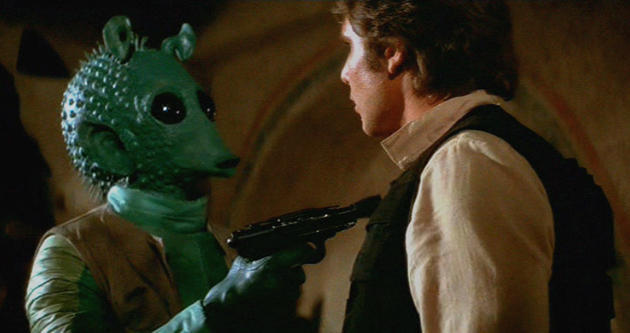
I suspect this is the reason why, seriously, that George Lucas altered the dynamic of the Han Solo/Greedo sequence. In that scene as it was originally crafted, Han fires his blaster, and Greedo doesn’t shoot at all.  It’s an almost anti-hero, Dirty Harry-esque moment for the Solo character.  I believe that’s precisely the kind of aesthetic Lucas wanted to eschew and avoid, and so on retrospect, did just that by making Greedo shoot first.  Han’s act was thus transformed from one of preemptive murder to self-defense.  I’m not arguing that his selection was the right one, or that Lucas should have tampered with the scene, only that some of the changes Lucas has forged in terms of Star Wars tend to play into this very notion of Star Wars as pastiche, of a call-back to an earlier, more innocent generation of film productions.  

Even the idea to title his Star Wars films numerically and with melodramatic sub-title fits in with this tradition of the crawl concept of Flash Gordon which boasted titles such as “The Unseen Peril.”  That sounds a lot like The Phantom Menace, doesn’t it?

If Han Solo shoots first, is he Dirty Harry?
The two concepts I have discussed most frequently in this review are: 1.) how Lucas grounds the reality of Star Wars by creating a lived-in, recognizable universe and 2.) how Lucas attempts to hark back to a more innocent, swashbuckling, spiritual age of movies.  If you link those two concepts, you will arrive at my unified theory of Star Wars, and at the very essence of the film itself.  Star Wars presents a universe so authentically-rendered and well-thought out that you can truly believe in it. The careful forging of the world discourages cynicism or disbelief.  
The idea of “May the Force be With You,” not unlike the exclamation “Go with God,” is inherently about belief; about believing in yourself and your capacity to tap the spiritual center of existence itself.  Yet no one would possibly believe in Lucas's world or in that inspirational message if the special effects in Star Wars were unconvincing, if the aliens looked hokey, or if the space battles were confusing. 
I believe that by referencing these older films and older visuals, Lucas was making certain that we could relate to Star Wars. It’s a unique and intriguing technique, and I submit it actually works very well.  The later films in the franchise depend on vast, special effects set-pieces with digital backdrops and drooling creatures, and yet the greatest emotional thrill I felt during the saga occurred here, in the original Star Wars, as Luke and Leia swung boldly across a chasm together, and John Williams’ scored blared heroically underneath their leap. 
A boy, a girl and a universe.  The thrill and appeal of Star Wars are almost literally that simple. Despite making a high-tech film filled with laser blasts, spaceships, robots, and a complex internal history Lucas directs us through this complexity and gets right to the mythic, spiritual heart of his film.
As of today -- how many years after I first saw the film?? -- that pure-hearted (but intellectually-conceived) approach still works for me.  
tag:blogger.com,1999:blog-12380553.post-7804207216916652138
Extensions
Guest Post: Good Luck, Have Fun, Don't Die (2026)
guest postJonas Schwartz-Owen
Show full content


Imagine If LOST Took Place at a Norms

By Jonas Schwartz-Owen


Good Luck, Have Fun, Don’t Die could have been a piercing satire. Instead, the current apocalyptic comedy settles for scattered brilliance. The film is packed with provocative ideas and anchored by a game cast, but director Gore Verbinski’s tone veers wildly off, and the climax falls flat like a plate of frozen nachos.

A zany, manic stranger (Sam Rockwell) storms into a Norms diner with a bomb strapped to his body, claiming the world is ending. He insists he has time traveled to this exact moment, and this same group of customers, countless times before. Each time, his mission fails, forcing him to blow himself up and start over. This round, he’s altering the variables, recruiting different diners to join his mission to stop AI from destroying the planet. Is he insane, prescient, or both? With no proof beyond his frantic conviction, those dragged along must risk their lives on the word of a man who may be either a time cowboy or a complete lunatic.

Screenwriter Matthew Robinson, who co-authored the charmingly intimate yet epic horror comedy Love and Monsters, brings a similar sense of whimsy amidst the gore. His characters have real bite, and the script doesn’t shy away from provocative territory - America’s frighteningly blasé response to school shootings, youth’s obsession with social media, and an exhausted humanity that would rather be swallowed by the Matrix than confront the real world. Unfortunately, these ideas never coalesce into a satisfying or meaningful conclusion.

The talented cast does its best to keep the humor dry and grounded. Rockwell, reliable as ever, channels his frenetic energy into something genuinely funny. Juno Temple is both pained and hopeful as a mother fiercely protective of her clone child, while Haley Lu Richardson, drifting through the chaos in a grimy princess dress, seems intentionally checked out yet remains oddly compelling.

I’ve always been a Verbinski fan. Pirates of the Caribbean redefined what audiences expected from a theme-park adaptation, The Ring was a model of tight construction, and even his much-maligned The Mexican was brilliantly subversive. Here, though, he loses control of the wheel - and the whole thing careens off a cliff. It is possible to satirize flippancy without being flippant, but that’s exactly the trap Verbinski falls into, and it grows tiresome fast.

With a surer directorial hand, Good Luck, Have Fun, Don’t Die could have been a classic end-of-the-world comedy. Instead, it’s as lost as its characters. Early in the film, Zazie Beetz asks, “Are you high?” It’s a fair question - one that could just as easily be directed at the filmmakers.


tag:blogger.com,1999:blog-12380553.post-5661597918677094720
Extensions
Guest Post: Project Hail Mary (2026)
guest postJonas Schwartz-Owen
Show full content


The Heartwarming Tale of a Boy and His Rock

By Jonas Schwartz-Owen


Project Hail Mary should not work. Since Steven Spielberg introduced the world to a squishy, childlike alien in 1982, we’ve endured decades of imitators trying to cash in on the man-and-alien friendship. So, on paper, Ryan Gosling cozying up to a rock-shaped extraterrestrial sounds brain-numbing. Then again, a comedy about sentient toy blocks didn’t exactly sound like a humdinger either. Directors Phil Lord and Christopher Miller (The Lego Movie), however, have made a career out of bringing impossible stories to dazzling life, and Project Hail Mary - like the implications of its title - is a winning touchdown.

Set in the near future, the entire solar system is in danger of extinction - well, even more so than we are at this precise moment. Gosling plays a scientist who awakens on a spaceship as the lone survivor of a suicide mission to discover what is dimming our sun. Along the way, he teams up with an alien, and the two form a bond as they slowly learn each other’s languages and customs. Together, they attempt to uncover why one specific planet in a damaged region of space has remained immune to the organism attacking our sun and other celestial bodies.

Part of what makes Project Hail Mary so compelling is Drew Goddard’s adaptation of Andy Weir’s novel. Goddard and Weir previously partnered on 2015’s The Martian, and like that Oscar-nominated film, the screenplay translates heady scientific concepts into something relatable for those of us who aren’t exactly science-minded (my hand’s raised). Even more than The Martian, though, Project Hail Mary leans into the comedy of watching an unprepared, untrained, non-astronaut attempt to operate a massive space vessel. That clumsiness becomes part of the charm, endearing Gosling’s character to the audience.

The script also earns its flashbacks - not as a cheap storytelling trick, but as memories slowly returning to Gosling’s character after awakening from a coma. These trips into the past feel organic, motivated by character rather than convenience.

Gosling himself is a key component of the film’s success. He plays everything with complete sincerity, never winking at the audience or undercutting the absurdity of his situation. Most importantly, he treats the alien as a living being, which gives the audience permission to invest emotionally in their relationship.

Instead of leaning entirely on CGI, Lord and Miller smartly cast puppeteer James Ortiz to portray Rocky, an alien who looks like several boulders fused together. Backed by a team of puppeteers - the “Rockyteers” - Ortiz’s vocal performance grounds the character in surprising warmth. The directors also have fun with perspective, occasionally rotating the camera, even on Earth, to remind us that what we perceive as “upright” is merely the magic of gravity doing its job.

Most of the supporting cast only gets a line or two, but Oscar nominee Sandra Hüller (Anatomy of a Fall) makes the most of her time as a determined scientist - cold, exacting, and quietly devastated by the implications of the choices she’s forced to make. Karaoke scenes have become a tired cinematic trope but watching a tightly wound Hüller wail Harry Styles’ “Sign of the Times” as a desperate plea to save humanity is unexpectedly - and deeply - moving.

Somehow, Project Hail Mary makes molecular biology, the end of the world, and a rock puppet feel intimate. It’s a film grounded not in bravado, but in problem-solving, awkward communication, and the slow realization that survival isn’t a solo mission. That a story this strange ends up feeling this sincere is its greatest strength - and like its implausible friendship, it’s one that remains after you’ve left the theater.

tag:blogger.com,1999:blog-12380553.post-5768711304703448027
Extensions
50 Year Ago: Who Can Kill A Child (1976)
Show full content

There's an old saying in Hollywood warning actors not to work with animals or children.

If you happen to find yourself in a vintage 1970s-era horror film, however, you should amend that proverb a bit. May I suggest: don't piss off animals or children?

Because they will have vengeance, and there will be blood....

Case in point, the rather remarkable, half-century old Who Can Kill A Child? (1976), a tense, Spanish-made genre gem. Like all great films (and great horror films) Who Can Kill A Child? reveals something important about the times in which it was crafted, a context which also gave rise to other child-centric horrors such as It's Alive (1973), The Exorcist (1973), and The Omen (1976).

As David Frum, the notable conservative scholar wrote in How We Got Here, The 70s: The Decade That Brought You Modern Life (For Better of Worse): " It's hard to remember an era when American popular culture was as nervous of children as in the 1970s." (page 106).

Frum further points out that the number of births dropped to its lowest level since the Great Depression in the year 1974. This was despite the fact that the baby boomer generation -- a huge generation -- was now of child-bearing age.

So what the hell was occurring in America during the 1970s to turn innocent children into icons of fear, anxiety and terror? Well, a recession and gas/energy shortage made children an expensive proposition, to start with. Plus, there was the contentious war for sexual equality (characterized by the controversy around the Equal Rights Amendment...). One front in that war concerned reproductive rights. The latest salvo was the Roe v Wade decision by the Supreme Court.

Also -- especially where horror movies are concerned -- it is virtually impossible to separate the idea of "children" from the idea of "tomorrow." Kids are an explicit and recognizable representation of the future...our shared legacy. If something terrible happens to the children, the future becomes grim. If the children turn evil, again our outlook is desperate. If the children happen to turn against adults for a valid reason, then we have failed totally, and our civilization is doomed.

These notions are at play in the unsettling Who Can Kill A Child?, which depicts a British married couple, biologist Tom (Lewis Fiander) and pregnant Evelyn (Prunella Ransome), as they countenance true horror. The couple decides to take a vacation on the remote island of Almanzora, a place where "very few tourists ever go." It's a four hour boat ride from the mainland to Almanzora, and though the island "certainly looks peaceful," nothing could be further from the truth.

At first the island appears deserted, but before long, Tom and Evelyn learn from a shattered, lone survivor that all the adults are dead. Worse, the islanders were killed by their maniacal children; tykes who suddenly and inexplicably turned homicidal a night earlier. Before long, Tom and Evelyn are fighting for their lives as roving bands of murderous children block their escape route at every turn.

"Its as though they thought we - the adults - were their enemies," Tom realizes (a bit too late...).

On Almanzora, Tom witnesses a multitude of horrors, all while protecting his expectant wife. He sees a violent pinata game involving an elderly man strung up by his feet, a circle of giggling children, and a sharp sickle. He also sees the grisly aftermath of several massacres, including a beating death, and a vaguely sexual attack inside the island church. Finally, Tom and Evelyn -- now going into labor -- take their final refuge in a police station. The children arm themselves, and Tom finds a machine gun....

He's left with an unenviable choice. For...who can kill a child? Another important question: if our children rebel against us, could we, would we and should we fight back? As the film's climax reminds the viewer, making the terror identifiable, "There are lots of children in the world..."
Who Can Kill A Child? is the sort of horror film that gets under your skin through stealthy but effective means. It opens like a routine travelogue, as we follow Tom and Evelyn through the apparently mundane experience of their foreign vacation. The hotel at Benavis is booked, so they're sent to a house in the "old part of the city." They settle in, get directions to the beach, and then purchase rolls of film. That night, Tom and Evelyn enjoy fireworks and share an intimate (and well-written) discussion about Fellini, death, and the future in their rented bedroom. Nothing earth shattering at all...just ominously normal and "human." These moments establish the characters as real, but not in heavy-handed or soap opera fashion. It simply feels like we've gone abroad with them for a few days. Tom and Evelyn are likable and easy to relate to, a fact which serves the movie well.

Once we reach the island with Tom and Evelyn, the horror mounts. In little, clever bursts at first. For instance, there's a portentous moment early on (before the nature of the children is revealed...) in which Tom sees a little boy fishing on a pier. Tom tries to peek under the lid of the boy's fishing basket to see what he's caught, but the boy won't permit it. He shoots Tom a murderous, aggressive look. We never actually find out what's under that lid, but the moment is disturbing, and your imagination takes flight.

Other moments are crafted with more than a modicum of skill. There's an absolutely brilliant shot featured deep in the third act, an awe-inspiring reveal over one character's shoulder and head...to a background mountaintop populated by "watching," unnoticed children. The move in question is a simple camera pivot, but one perfectly executed.

Or notice the manner in which the camera doesn't move at all during a critical juncture, as a central character slips slowly and inexorably out of lower right-hand corner frame for the last time, making the death all the more significant and powerful. And the director appropriately moves to hand-held, immediate camera-work during the siege in the police station, which ramps up the anxiety.

When Who Can Kill a Child's narrative calls for bluntness, we get that too, with shocking and egregious results. Late in the film, Tom is confronted with a barricade of children, three or four rows deep. They won't budge and just stand there, smiling at him. After a moment's hesitation, Tom opens fire with a machine gun, bloodying and murdering his youthful opponents. The gun fire is like a slap in the face...we're not used to such screen violence leveraged against children.

Even that spiky moment is superseded by a final, high-speed, nail-biting confrontation on a pier, with an attempted escape in a row boat. Children launch an ambush from the pier, jumping off and attacking Tom in the boat with ferocity and velocity. He frigging beats them back with a wood board, a knife, and any other weapon he can find, and the movie doesn't shy away from revealing the bloody results of the massacre.

Of course, I don't encourage violence or even the depiction of violence against children, but horror should be about the shattering of societal taboos and movie decorum. And horror is also - indeed - about nightmare scenarios rendered real, and asking the viewer to identify with "what it would be like" to face them. Who Can Kill a Child is both taboo-shattering, and identification-provoking, and by my reckoning that makes it a great bit of genre cinema. You'll be shocked at what you witness, yet at the same time, you may want to slap Evelyn silly when she refuses to reckon with the "reality" of the situation that the children on the island are homicidal.

The film's ending is comparable to Night of the Living Dead, with a slow-to-adjust society failing to understand the nature of the enemy and making a bad mistake. In a strange way, the movie is also a kind of "revenge of nature flick," like Day of the Animals or Hitchcock's The Birds...only with kids instead of animals. And of course, it's harder to shoot down a giggling child than a grizzly bear or pecking bird, right?

Who Can Kill a Child? is not perfect. The film mis-steps badly by opening with a nine minute, documentary "atrocity reel" about real crimes committed against children across the globe. We see starving children in Africa, murdered children in Pakistan, and young victims of the Korean and Vietnamese conflicts. These scenes are true and appalling and powerful, but I question their necessity in a horror film. They start the movie off with a gruesome, unnecessary heaviness, which, in some senses, undercut the very ordinariness of the travelogue and the slow-escalation of horror that follows. Essentially, they make the movie less effective because they telegraph the point of the narrative before the very narrative has begun.

The images in the mini-doc are powerful, but unnecessary. The director makes his point (about the world's cruelty to children) without them all-together. In the body of the film proper, Evelyn sees footage on a camera shop TV of children dying in the Philippines. A shop owner says "the world is crazy. In the end, the ones who always suffer are the children." Message transmitted and received. The graphic imagery at the beginning is therefore just heavy-handed overkill.
Also, non-horror fans might rightly complain that Tom and Evelyn have apparently been born without the gene that allows them to sense the warning signs of incipient danger. This is something horror aficionados (like myself), willingly accept...because what fun would it be if Tom and Evelyn did recognize the danger and abandoned the island in their boat before the horror escalated? Horror fans will willingly (and happily) suspend disbelief, but non-genre fans may be screaming at the film's characters to get off the island NOW!!!.
Who Can Kill A Child? also shares much in common with the Children of the Corn franchises of the 1980s and 1990s, yet I should be absolutely clear: it's also a better-made scary movie than any one of them (even the '84 original). After watching this film, you may even want to amend a second proverb.

Forget "never trust anyone over 30." How about, "never trust anyone under 12?"
tag:blogger.com,1999:blog-12380553.post-5766397631728967207
Extensions
Library Journal Recommends Horror Films of the 2010s
about JohnJohn's books
Show full content

To my delight and gratitude, Library Journal has reviewed my new book (and final contribution to this series), Horror Films of the 2010s. 

 Here is an excerpt of their review:

"Horror reflects the anxieties of an age, and Muir connects the films from 2010-2019 to economic unease, political polarization, and institutional mistrust in the post-Great Recession era... Muir goes out on a high note, documenting 275 movies with his trademark insight and wit." — Library Journal. 

tag:blogger.com,1999:blog-12380553.post-4854226224684497531
Extensions
30 Years Ago: Space: Above and Beyond: "R & R" (April 12, 1996)
Space: Above and Beyond
Show full content


Imagine a "gritty, gutsy" (per TV Guide...) futuristic war drama colored in hues of mood battleship gray. It takes place in deep space following a devastating sneak attack on humanity by an unfathomable and merciless enemy.

Our protagonists in the war effort (which we are "losing badly") are young, attractive (but headstrong and angsty) pilots. Much of the action occurs inside the cockpits of cramped space fighters and in military briefing rooms. The universe depicted by the series is one of murky morality and hard truths which shift in the troublesome and ambiguous sands of wartime. For instance, the specter of torture (here termed "re-education") is brought up in one installment.

You don't think I'm talking about the re-imagined Battlestar Galactica, do you?

Instead, the first paragraph of this review describes the Glen Morgan/James Wong sci-fi war drama, Space: Above and Beyond, a mid-nineties-era TV endeavor that aired on the Fox Network for one season (and twenty-three hour-long episodes), and which concerned a squadron of rookie - but committed - soldiers serving in the United States Marine Corps Space Aviator Cavalry aboard a mobile space headquarters; not the Galactica, but the Saratoga.

Set in the year 2063, Space: Above and Beyond sets its stories in the immediate aftermath of a devastating ambush on an Earth Colony ship bound for distant Tellus, ("the furthest any human has ever ventured,") and thus this nearly-forgotten series imagined a futuristic 9/11 scenario...six years before 9/11 (and eight years before the Ron Moore remake of BSG). The enemy in this case was not the Cylon race, but the menacing and mysterious "Chigs," a derogatory slang name which refers to chiggers... fleas which burrow into the skin.

What remains so interesting about Space: Above and Beyond is not merely that the re-imagined Battlestar Galactica co-opted so much from its look, feel and narrative without so much as a "by your command," but rather that the creators' of this cult series seemed to understand - far earlier than most of us - how truly divided Americans were becoming as a people; and how - as bad as it might be - a war effort could conceivably bring us together.

Some context: Space: Above and Beyond premiered just a year after the 1994 "Contract with America" Republican Congress swept the elections, a stinging rebuke to President Clinton and a victory for Nute Gunray...I mean Newt Gingrich. This was post-Anita Hill/Clarence Thomas America, when the buzz word "sexual harassment" was all the rage. On a personal note, it was around this time that I first heard the name Rush Limbaugh, and began to meet otherwise seemingly-normal people who followed his every rant like he was some kind of cult leader.

Space: Above and Beyond reflects this reality in nineties America by featuring a diverse group of pilots, the men and women who will fight the Chig attackers. In particular, one of the pilots is Lt. Cooper Hawkes (Rodney Rowland), who is part of a new minority in America called a "Tank," a term which is more derogatory slang, this time for "in vitros," citizens who were conceived and born in artificial gestation tanks.

America is still land of the free and home of the brave in 2063, but that doesn't mean that the "in vitro" class can expect total equality. As one character states bluntly in the pilot, "we believe in civil rights for in vitros, but not at the expense of our rights." This is EXACTLY what the debate was in the country at the time: women and African-Americans should have equal rights, as long as we didn't establish any laws that gave them privileges over the white man, some believed. 
Meanwhile - on the show - racism towards the in vitros still flourishes in the ranks of the space marines, mostly out of ignorance. "Tanks are lazy and don't care about anyone," reports one soldier, relying on an old stereotype. Later, a character registers surprise that "Tanks" actually dream. It's always easier to demonize the enemy (even a domestic one...), when you can somehow render them sub-human. Even the military equipment on hand in the Corps. doesn't fit the "Tanks," and Hawkes has to cut off part of his space helmet to accommodate a common "Tank" birth mark. "They don't make nothing with In Vitros in mind," he laments.

So this is the cultural context that Wong and Morgan were working on with Space: Above and Beyond. And the episode "R & R," directed by Thomas J. Wright, takes the characters of the 58th to yet another new horizon: furlough.

Specifically, the squadron is exhausted after multiple tours-of-duty, and the In-Vitro pilot Hawkes (Rodney Rowlands) is injured during a Chig attack on his patrol. Colonel T.C. McQueen (James Morrison) is relieved when the group is assigned 48 hours of vacation on a pleasure ship called "The Bacchus." 
This vessel is described as "Vegas, New York City and Oz all rolled into one." I immediately thought of Sinoloa in the Buck Rogers episode "Vegas in Space" and "Space City," the so-called "Satellite of Sin" in Blake's 7.

In Space: Above and Beyond, this viper's den looks like a Trump Casino in space, and the futuristic Cabaret's master-of-ceremonies is none other than Coolio (!). He promptly informs the visiting soldiers that Bacchus is the place "where what you can only imagine, we make happen."

He also notes that this is not a world of virtual reality or "phony Holodecks," a pointed line which clearly differentiates Space: Above and Beyond's gritty, hard-bitten universe from that of another 1990s outer space franchise, Star Trek: The Next Generation. Remember, Star Trek off-spring dominated the 1990s, and Space: Above and Beyond was a first dramatic step away from that Utopian world of plenty. Again -- today, we might not appreciate the pioneering aspects of Morgan and Wong's space combat series as much as we should. Not entirely unlike Space:1999, this program ventured to present a realistic look at man in space; rather than going for an idealistic approach.

Back to "R & R." In short order, the pilots of the 58th start to let their hair down. On Bacchus ,Lt. Shane Vansen (Kristen Cloke) sets about winning some dough in the ship's pool hall, only to be verbally upbraided and relentlessly "played" by a psychologically-adroit android pool-shark, Alvin...an uncredited David Duchovny. This characters snarls like Clint Eastood and even asks Vansen "do you feel lucky?" I loved this subplot because it played on expectations (the audience's and the character's): Vansen arrives in the pool hall in a slinky black dress, manhandles her pool cue seductively (!) and vamps it up...expecting to get one by the other players on sex appeal.

Didn't count on a robot, I guess...
Meanwhile, Hawkes has to deal with the specter of drug addiction because of the pain medication he's been prescribed, for his injury. On The Bacchus,  gegoes in search of sexual comfort. A virgin, Hawkes soon meets up with a beautiful in-vitro hooker who is far less glamorous than she appears. She's addicted to drugs too (so she doesn't have to think about how she earns her cash), and she's the mother of an infant.

And yes, this distinctly un-romantic subplot indeed sounds familiar if you've seen the re-imagined, second season Battlestar Galactica episode "Black Market."

As "R & R" continues, another sub-plot: West (Morgan Weisser) learns that the seemingly-humorless colonel, McQueen, has a fondness for old, black-and-white, W.C. Fields movies. Before long, however, the brief respite from war is called off, and the pilots are back to combat. Hawkes, for his part, has trouble leaving the events on The Bacchus behind. The Colonel, who has also faced drug addiction, tells him "There is there. And here is here."

What we get in "R & R," which aired originally on April 12, 1996, is a dissection of virtually all the program's dramatis personae. Sometimes that dissection is explicit: Alvin (Duchovny) finds the right words about Shane's family life to shake her; to make her lose at pool. Sometimes the character dissection is more subtle: the episode tackles everything from loneliness and virginity to the way "closeness" in combat sometimes creates a false sense of intimacy. James Morrison's character, McQueen doesn't have a tremendous amount of screen time, and yet we learn a lot about him here.

It isn't often in Space: Above and Beyond that audiences got see the characters relate to one another and their universe outside of the battle situation, and their time on the Bacchus (except for the W.C. Fields movies...) doesn't seem relaxing at all. But perhaps that's part of human nature too: our need to pursue love, money and yes, danger, even when we're off the job, supposedly taking it easy. Of course, there's even more danger in pursuing these things when outside the confines of "responsibility. It's hard, as Vansen might say (especially after her encounter with Alvin), to "keep your head screwed on straight" in an environment like the pleasure ship.

Space: Above & Beyond is a remarkably prophetic show. I write often about the sense of anticipatory anxiety evident in the works of Chris Carter, and I think you might detect that quality here too, in the efforts of Wong and Morgan. It's the belief that the apparent good times don't last forever, and bad times are imminent. The re-imagined Battlestar Galactica of the 21st century also highlighted artificial people, sneak attacks, hookers, R & R, psychological mind-fucks, and gritty space combat, yet it's hard to ignore that Space: Above and Beyond hit the same notes (and without some of the more questionable soap opera plotting) almost ten years earlier. Also, Space: Above and Beyond always remained humanistic, rather than telling us that we are all the fools of the Gods, the victims of a fate we can't control.

So much of success in Hollywood is based on timing. Space: Above and Beyond in the Roaring Nineties, apparently didn't resonate with a wide audience (though its ratings were higher than many genre shows airing on television today). If the program aired after 9/11, maybe we would have gotten to know Morgan and Wong's intriguing characters and solid writing for four seasons, or more...
tag:blogger.com,1999:blog-12380553.post-6960979280917677638
Extensions
30 Years Ago: The X-Files: Jose Chung's From Outer Space (April 12, 1996)
The X-Files
Show full content

Darin Morgan’s stories for The X-Files (1993 – 2002) are something of a philosophical anomaly. 
Where Mulder and Scully typically voice facets of belief or skepticism, Morgan often populates his episodes with a lead character who is a surrogate for his own belief system: nihilism.
That surrogate in “Jose Chung’s From Outer Space” is an opportunistic “non-fiction/science-fiction”writer, Jose Chung (Charles Nelson Reilly) who is seeking  a quick buck by writing a history of an alien abduction experience.  
And at one point in the episode, Chung directly diagrams this episode’s theme: “Truth is as subjective as reality.”
This statement of principle, as you may detect, is deliberately and distinctively at odds with a series which made famous the catch-phrase “The Truth is Out There.”   
How can truth be subjective, if it exists in some definable place, “out there?” If it is subjective, is the truth even worth seeking?
This thematic tension represents merely one glory of The X-Files as a multi-layered and meaningful work of art. The Chris Carter series can accommodate different points of view and different philosophies so long as Mulder and Scully remain true to their beliefs and histories as the audience understands them.  Morgan’s episodes are so much fun -- and so provocative -- because the scribe stretches the boundaries a bit, but never totally breaks them. In this case, the lead protagonist role is taken by Chung, an act that permits the storyteller to present a different philosophy while sacrificing nothing we know in terms of continuity.  
To wit, the alien-abduction and Mulder and Scully’s role in its investigation is largely recounted in flashbacks this episode.  Under this creative paradigm, memories, essentially, are “portrayed” or dramatized as answers to Chung’s probing interview questions. In true Rashomon (1950) style, the viewer has no way of knowing or verifying the honesty or veracity of each account.  In other words, the author’s point that the truth is subjective becomes manifest in the very absurdity of many witness reports.  
This is a funny development, to be certainly but also a complex one, for it leads to Darin Morgan’s final, existential truth about our human existence. Since there is no objective truth for us dwelling here on Earth, only interpretations of it, we are truly -- in a variation of Close Encounters’ (1977) ad campaign --“alone.”

Two teens in Klass County, Washington are imperiled by dueling aliens on the way home from their first date. A popular author, Jose Chung (Reilly), interviews Scully (Gillian Anderson) about the case and she recounts her perception of it.
Scully and Mulder (David Duchovny) have a difference of opinion about the truth of the case, however.  Mulder believes there was a genuine alien abduction while Scully believes the matter was date rape and ensuing post-traumatic stress. 
Meanwhile, a witness to the odd events of that night, Rocky, claims that a third alien -- one from the Earth’s molten core and named Lord Kimbote -- was involved, as were two unearthly Men in Black.
Unable to discern the truth for himself, Chung hopes to interview a reluctant Mulder about what really happened that fateful night…


I’m not passing judgment on this aspect of the episode, but a deep cynicism shines through in “Jose Chung’s From Outer Search.” 
That cynicism concerns humanity’s eternal quest to know the truth.  Through a series of re-enacted events related to one bizarre alien encounter, this episode by Darin Morgan suggests that human memories are inherently and fatally flawed and therefore unreliable arbiters of fact or history.  For one thing, humans may lie on purpose, without others knowing it. To this end, we learn that the teenagers involved in the close encounter actually had sex on their date, and are desperate to hide this fact from their parents.
So memory being wrong is one thing, but some people encourage wrong interpretations because they boast hidden or unknowable agendas.
Morgan’s critique of truth goes further.  “Jose Chung’s From Outer Space” also expresses doubt in truth-searching tools, ones developed under the auspices of man’s science; tools such as hypnosis.  Here, hypnosis is termed explicitly in the dialogue as a procedure which “worsens” rather than “enhances” human memory.  In other words, human memory is bad but memories re-surfaced during hypnosis are even worse.
Intriguingly, “From Outer Space” also indicates that the desire to know the truth -- in this case to believe in alien life forms -- is merely a primal scream shouted in response to a nihilistic human existence, and a delusion or blind alley fostered and encouraged by a complicit mass media.  The episode’s first shot, for instance, is of an object (actually a work crew’s crane…) that could easily be mistaken for a UFO.  
In fact, this inaugural image knowingly harks back to the first sequence in Star Wars (1977), with the triangular Star Destroyer intersecting the frame, as well as a moment from Close Encounters (1977), wherein Roy Neary spots a large object overhead, hovering in the dark Muncie sky. 
Those productions nurture in us, the episode seems to indicate, some sort of romanticism about the nature of life and the universe.  It’s a false or unfounded romanticism, according to Morgan/Chung.More important, however, is the fact that in this shot we believe we’re seeing a spaceship at first glance.  As we watch longer, however, we become aware that we are actually seeing something much more mundane, something utilitarian and man-made.
This visual joke thus perfectly reflects the idea that we can’t ever be sure that we are correctly seeing, registering, and interpreting external stimuli.  Our desire for the romantic (look, it’s a spaceship!) supersedes our rationality (oh, it’s a work crane!) and our brain seems to respond to our deeply-held desire see that which isn’t, plainly, there.  And if this is so, it means that our perception, our memory, our very truth, is suspect.
At the end of the same scene, we witness the appearance of an intentionally silly-looking “monster,” Lord Kimbote.  This hairy, cyclopean thing seems based on an amalgamation of creatures from 1960s Ray Harryhausen films.  No matter -- our eyes immediately discount Kimbote as fake or corny.  
Here’s the point, however.  We don’t visually “read” the Greys nearby in the same dismissive fashion.  On the contrary, they seem “real” in a way that Kimbote just does not (perhaps because the Greys reflect 1990s mythology instead of 1960s mythology/fantasy…) 

Morgan’s message is thus that we shouldn’t stand in judgment of other people’s belief systems, because they are all equally flawed and yes, silly.  Why accept dome-headed Greys from space without question, but nit-pick Lord Kimbote from the center of the Earth?  Is one “being” intrinsically a nuttier idea than the other?  Or are they insane on a co-equal level?
It’s a little like saying that you believe in the literal meaning of communion (eating and drinking from the literal body of Christ), but that you draw the line of believability at the Pope’s infallibility.  Everyone draws this line differently…
And, of course, if we draw that line differently and can’t objectively support our belief system, then we are, for the most part, alone in our belief system.  
What I find so interesting, however, is the last few moments of “Jose Chung’s From Outer Space.”  Here, Morgan establishes how the abduction has influenced each “alone” individual to change his or her life for the better.  A teen girl at the center of it has become an activist hoping to save the world.  The boy she was with that night, contrarily, has been reconfirmed in his (unrequited) love for her, and has made this love the center of his (meaningless?) existence. 
And Mulder, of course, tilts forever at Morgan’s impossible windmills, looking for answer to things that aren’t really questions in the first place.  Why seek truth when there is no truth?
What really happened to those kids on that night?”  Chung asks Mulder.  His answer is “how the hell should I know?” 
For Mulder such an answer might result from a lack of facts, or a need for more investigation and research.  But for Chung it’s a validation for the belief that we are all animals trapped in our cages of subjectivity, unable to know the truth or reality of any event in our lives.
Undeniably brilliant and categorically funny, “Jose Chung’s From Outer Space” is another signature X-Files episode.  I appreciate it intellectually, and it always makes me laugh.  Yet it is not among my personal favorite episodes of the series because I tend to believe that we, as humans, must search for the truth, even if it is, finally, a fool’s errand.  
The journey is worth the trip, and even if truth is ultimately found infinitely subjective, it still may be enough to help us sleep better at nights, or accept our limitations as flawed, mortal creatures. Sometimes, a little bit of self-delusion isn’t necessarily a bad thing, if it can keep us looking to the stars, or to the next horizon. 
tag:blogger.com,1999:blog-12380553.post-8499249212887795791
Extensions
Abnormal Fixation 2.7: "Der Geist"
Abnormal Fixation
Show full content


tag:blogger.com,1999:blog-12380553.post-8614440584563911946
Extensions
30 Years Ago Star Trek: Voyager: "Deadlock" (March 18, 1996)
Show full content


If Star Trek: Voyager (1995 – 2001) had played its cards right, it would have added an alien nemesis to the enduring outer space franchise as terrifying and fearsome as the Borg once were.  
In particular, the first seasons of the 1990s program featured an alien race of the Delta Quadrant known as the Vidiians. These aliens were hideously deformed, technological advanced beings who suffered the effects of an incurable plague. 
What made the Vidiians truly so terrifying, however, is the fact they weren’t out to explore other worlds peacefully, or make new friends.  
Instead, they wanted to harvest the organs of any compatible life form they could find. Certainly, the Borg wanted to “assimilate” new technologies and drones to their vast collective, but the Vidiians would kill you in a heart-beat for a healthy liver. They had no choice because a plague was destroying their civilization.
The Vidiians were at their dreadful, menacing, and merciless best in the second season Voyager episode “Deadlock” by Brannon Braga. 
The story, not unlike “The Best of Both Worlds” on The Next Generation (1987 – 1994) features a scarifying sense of momentum and inevitability. It's one of those episodes that moves fast, with great purpose, and events seem to overwhelm both the characters and the audience.


In “Deadlock,” Voyager discovers that it is entering a region of space controlled by the Vidiians.
Captain Kathryn Janeway (Kate Mulgrew) decides that it may be prudent for the ship to cloak itself inside a nearby “plasma drift,” and hopefully remain out of sight. But the ship encounters some sort of subspace turbulence in the drift.  The warp engines stall, as if they have “sprung a leak.”
This turn of event couldn’t happen at a worse time, because not only are the Vidiians nearby, but Ensign Wildman is very pregnant, and going into labor. When the ship's systems start to fail, the baby's life is imperiled, even after a "fetal transport."
The plasma drift also causes all of Voyager’s matter to double, creating a duplicate ship, but one joined at the heart -- the warp-drive -- with “our” Voyager. This means every person, from Janeway down to the newborn child is also duplicated.
The two Janeways confer about the crisis and the possibilities of separation, but before long, the Vidiians find Voyager in its hiding spot, and 347 of their shock-troopers board one of the ships to begin organ harvesting…


The opening acts of “Deadlock” are laden with terrible techno-babble that means nothing, a common problem of both Star Trek: Voyager and the episodes written by Brannon Braga. Yet despite this pitfall, “Deadlock” works, in part because it possesses the (brutal) courage to play out its nightmare scenario: a Starfleet vessel overrun by Vidiians. 
In short order, we see Tuvok (Tim Russ) and Paris (Robert Duncan McNeill) shot down by the soldiers, their organs cataloged and harvested for return to the Vidiian population. The episode also shows us Harry Kim (Garrett Wang) dying during a hull-breach, but it is the deaths associated with the Vidiian march that, for me, remain the most terrifying. One of the most upsetting images of the episodes sees the Vidiian away team practically salivating at the thought of taking the Wildman baby, a new-born.


"Deadlock" is also abundantly clever in the way that it plays with audience perceptions of “our” Voyager. At first, the version of the starship we have followed all along seems hopelessly crippled, and Janeway must contemplate destroying her own ship.  
Then, a second Voyager is found -- with a whole crew and a functioning ship -- and we breathe a sigh of relief because, essentially, we know our beloved characters won’t die. Then the kicker is that it is the other Voyager -- the whole Voyager -- that is boarded by the Vidiians, leaving the other Janeway to destroy her ship….which she promptly does.
"Welcome to the bridge..."

“Deadlock” is a particularly strong episode for Kate Mulgrew -- and for Captain Janeway -- as she plays the same individual attempting to “cheat” death in two, essentially, hopeless situations. 
And making matters worse, Janeway must consider not only the safety and well-being of her own crew, but the safety and well-being of the other crew, which is also, paradoxically, her own crew.  It’s enough to make the head spin, but one quality I admire about Janeway (especially here) is how she takes the weird situation at face value and -- based on the available science and the facts -- works her way through the danger. I’ve always liked Janeway quite a bit as a character, and she’s actually my second favorite Star Trek captain, after James Kirk.  

In part, this is because Janeway is actually an expert in a field other than diplomacy. She’s a scientist and engineer first, not just an ambassador with a portfolio like Picard, and many episodes (including “Parallax”) reveal how her training in those fields help bring about good outcomes in crises. Given our anti-science culture today, I find Janeway especially refreshing. She's smart as a whip, and never uses the excuse that she's "not a scientist" to avoid grappling with a problem. Instead, science is one of her key allies.
Voyager was always at its best when it verged on being a horror show, which is another reason that "Deadlock" works so effectively.
I also absolutely love “The Thaw,” another second season story, wherein Janeway must outwit a devilish, holographic clown (Michael McKean), and I am similarly fond of the third season episode “Macrovirus,” in which giant, airborne germs decimate the crew, leaving Janeway to single-handedly combat them and save the ship.  
These episodes come closest to fulfilling Voyager's potential. It  is a series about a starship alone in the great unknown, without the resources of a command structure to fall back on. Episodes like the one I mention focus on the danger inherent in such a scenario. They are more Space:1999 than your typical episode of Star Trek.

Later seasons of the series brought the Borg back again and again and again, watering down their threat substantially, but those return visits, while demanded by Star Trek fans, I suppose, are not that effective.  

Imagine, instead if Voyager had continued to use the Vidiians as a primary villain.  
We could have had five or six years of some really scary stories about contending with a race that sees humans only as organ donors… 
tag:blogger.com,1999:blog-12380553.post-179480521522322646
Extensions
50 Years Ago: The Man Who Fell to Earth (1976)
50 Years Ago
Show full content


In 2011, film critic Marc Mohan termed the late Nicolas Roeg's The Man Who Fell to Earth a "dreamlike, disjointed and frustrating piece of work." It's a good description of a film that speakings in the language of sunning visuals and symbolic imagery, but features a confusing plot. Like the late David Bowie himself, The Man Who Fell to Earth is beautiful to gaze upon.

Yet in the final analysis, this science fiction film is impenetrable, or at the very least, emotionally distancing. 
It's entirely possible that this Roeg film seeks to express how the innocent or weak are often destroyed in a toxic, contemporary culture of luxury, vice, addiction, and sin.  But somehow even that perspective is not enough to render the film entirely successful.
It's one thing for the alien -- an apparent Christ figure -- to suffer for our sins, but need his innocent family suffer too?
I understand some people mourn The Man Who Fell to Earth as sort of the last of its breed before science fiction films such as Star Wars (1977) premiered and changed the nature of the genre.  I get it.  The Man Who Fell to Earth feels very individual, very personal in the way it moves and expresses itself,  and should be commended for that virtue.  It's a film worth watching at least once, even if, when it's over, you're left feeling a little cold.
Steven Rea termed The Man Who Fell to Earth  a "strange creature," and that too is a description I can appreciate, even as I admire the film's unforgettable and occasionally haunting imagery.


An alien from a dying world, Thomas Jerome Newton (David Bowie) lands on Earth and begins developing patents based on his world’s incredibly technological innovation so that he can fund a space program that will take him home to his wife and children, and save the famine-stricken population from extinction.
Once on Earth for some time, however, Thomas meets a young woman, Mary Lou (Candy Clark), who introduces him to vices such as sex and alcohol, and which leads to Thomas losing focus on his task.  
Thomas is eventually captured and interrogated by the CIA, and prevented from carrying out his mission of mercy.

Walter Tevis’s 1963 novel The Man Who Fell to Earth tells the story of an alien world called Anthea that through dozens of nuclear wars, now suffers from a life-threatening, planet-wide drought. 
Only a few Antheans, a mere three hundred, survive. One of their number, named Thomas Jerome Newtown is selected as hardy enough to survive a trip to Earth, where he will construct a larger spaceship to pick up his people so that they can seed the planet. 
Part of the reason for the Anthean plan and choice of destination is that Earth seems to be mirroring Anthea’s path, and within ten years it could destroy itself too.  
Thomas’s mission is therefore not only to save his own people, but our people as well.  
But Earth people, he finds, are emotional and illogical, and he is drawn into their petty squabbles at the expense of larger issues.  He becomes a victim of politics, and man’s self-destructive nature in a story that is about the futility of the Cold War, among other issues.
Nicholas Roeg’s film version of The Man Who Fell to Earth does not coherently convey Walter Tevis’s story, and if a viewer seeks that particular story, he or she will not find it. 
Instead, Roeg’s film is a visually dazzling but often maddening “abstract” approach to the story, one that focuses not on the details of Thomas Jerome Newton’s mission, or the history of his world, but rather on his seduction here on Earth to the human “way of life.” 
At first a kind of perfect or messianic being, Newton eventually becomes a fragile, broken thing instead, and his story is very much a variation or inversion of a Christ parable: A God comes to Earth, and man makes him as weak and mortal as he is. Newton suffers and suffers for our sins, and in return provides man a (technological) paradise.   

The story also seems to play like a coded biography of Howard Hughes in that reclusive, lonely, oddball geniuses get used up and exploited by society, but are never fully understood or loved.  
The emotional core of the two-and-half-hour film is Newton’s haunting memories of his family on the desert world, and the struggle to survive in his protracted absence.  
He imagines their existential miseries, while he lives in a veritable paradise of wealth, sex, movies, and booze.  
Although Thomas realizes that if stays on Earth, he “shall die,” he doesn’t make very meaningful moves to leave the planet before it is too late, and the government swoops in to experiment on him just when he is about to make good his escape and his family’s rescue.  
By movie’s end Newton is a free man, but one who has surrendered to the nihilism he sees all around him.  It’s too late to save his family, and he will never return to his world, he realizes.  The very things that distracted him -- the pleasures of his own flesh -- are the only company he has left.  The movie tags religion, sex, alcoholism and Hollywood movies as the seductive factors that turn him away from a meaningful life and a meaningful purpose.  
By the movie’s last sequence, Newton has contextualized his existence as a film noir, a format in which good, law-abiding men get transformed, through circumstances and life, into a life of crime, or a life of sin, or become victim to his own unsavory desires.  The film noir format is considered erotic and multi-layered, a comment which could be applied to The Man Who Fell to Earth as well. 
Rather than live in ugly reality, Newton’s decision to “go Hollywood’ and dress in the manner of a film noir anti-hero like Humphrey Bogart suggests that he has moved permanently to the realm of fantasy.

Clumsily-written but brilliantly directed, The Man Who Fell to Earth has also been considered a metaphor for the stages of alcoholism, and the way that the addiction can consume an entire life, step-by-step.  
This may interpretation may be accurate, and even profound, and it could explain the film’s lack of narrative clarity as well. 
Newton lives in a hazy world of drunkenness, and can’t pull himself out of the death spiral.  And his death spiral, incidentally, takes down his wife and children before it takes down him, another reflection of alcoholism as a “disease.”
Although it is gorgeously-made, The Man Who Fell to Earth isn’t an easy science fiction film to love because the filmmakers boast no genuine interest in Newton’s alien world, its history, or the specifics of his journey. 
All the concrete details of Tevis’s novel are given short-shrift (a n approach that Under the Skin apes, but more successfully).  
Instead, the movie functions entirely as a chronicle of one man’s deterioration from well-meaning genius to irrelevant, dissolute burn-out.  
But the science fiction veneer is almost entirely unnecessary to the movie’s core themes, even though those moments in the alien desert, with a lonely family in waiting forever, prove absolutely haunting.
In 1984, John Carpenter’s Starman also contextualized the story of a man who fell to Earth, an alien life-form.  And that story too featured elements of the story of Jesus Christ.  Although the imagery may not have been as dazzling and abstract, the story made sense on a concrete level and touched the heart even more deeply.  
Roeg has made at least two masterpieces of modern cinema, Walkabout (1972) and Don’t Look Now (1974), but The Man Who Fell to Earth can’t join that select list because how it tells its story -- in stylistic, avant garde fashion -- doesn’t give the audience a better understanding of the character’s inner life, or his choices.  
In this film, we’re always outsiders to Newton’s decision process, and though we can chart his disintegration and mourn it intellectually, we never feel it as deeply as we should.  
Instead, we grow impatient with him.  Part of the problem may rest with David Bowie's performance.  He is great to look at and appropriately strange in appearance and mannerism, but we don't ever see and understand his true nature.   We don't even really understand his crippling inertia.  
His family is on the line. Why doesn’t he act?
tag:blogger.com,1999:blog-12380553.post-6361756082353110136
Extensions
Abnormal Fixation 2.5 "Volatile Memory"
Abnormal Fixation
Show full content


tag:blogger.com,1999:blog-12380553.post-1302032767365208027
Extensions
Guest Post: Scream 7 (2026)
guest postJonas Schwartz-Owen
Show full content


Seventh Time, NOT the Charm

By Jonas Schwartz-Owen

Like many Scream diehards, I rewatched all six previous films with a group of friends before heading to the theater today. With the entire franchise freshly loaded into my brain, it didn’t take long to realize that Scream 7 simply isn’t much fun. Despite bringing back legacy stars and the series’ original writer, the film feels less like a thrilling new chapter and more like a contractual obligation—for both writer-director Kevin Williamson and the audience. The first six outings varied in quality, sure, but they were always a blast. This one isn’t.

Thirty years after the original Woodsboro killings, Ghostface has returned and is as bloodthirsty as ever. Back at the scene of the crime, this “new” Ghostface wastes no time zeroing in on Scream’s eternal final girl, Sydney (Neve Campbell). Now a fiercely protective mother to her teenage daughter, Tatum (Isabel May), and supported by her husband, police chief Mark (Joel McHale), Sydney finds herself dragged into the nightmare once more. But is this Ghostface someone from her past—someone she thought she’d ended decades ago?

Williamson loads his 30th-anniversary installment with callbacks to the original: Sydney now bears the same last name as Jada Pinkett Smith’s character in Scream 2—something that feels far too specific to be accidental, especially given the shared name with Sydney’s murdered mother. And it’s hardly a spoiler, or even a secret, that Stu Macher, Billy Loomis’ original co-killer, factors into the plot, which naturally begs the question: did that TV to the head really finish him off in 1996? As a meta gimmick, it’s clever enough, but Scream 7collapses under the weight of its paper-thin characters. Williamson has always excelled at crafting memorable victims and villains, but here, Tatum’s friends—the designated prey pool—have all the dimensionality of cardboard shooting-range targets. With nothing to play, the actors can only flail. The script, co-written by Williamson and Guy Busick, isn’t much sturdier: red herrings vanish almost as soon as they appear, as if the performers had only half a day on set, and the finale manages to be both baffling and strangely hollow.

The kills are more elaborate than ever, but many feel like visual-effects showboating better suited to a Tom Savini demo reel. A few shots stand out—particularly a haunting wide of a swinging corpse under a spotlight—but for the most part, the camerawork and editing are so pedestrian they barely register, much less build tension.

So, what does make Scream 7 watchable despite all of this? Neve Campbell and Courteney Cox. Both deliver grounded, lived‑in performances that cut through the noise. Campbell remains the soul of the franchise, and the film gets good mileage poking fun at her absence from the New York sequel. Watching her interact with McHale and May, and rekindling her chemistry with Cox, is almost worth the frustration. McHale, often cast as brash and cocky, dials things down to play a surprisingly stabilizing presence. And Williamson’s strongest writing is reserved for the strained, trauma-bound mother-daughter dynamic.

Anyone with an internet connection knows the rocky road that led Scream 7 from conception to release—missing franchise stars, revolving-door directors, and studio uncertainty. All of that may help explain why this entry feels so adrift. But excuses aside, there’s no escaping the truth: this is the weakest film in the series.

tag:blogger.com,1999:blog-12380553.post-4813113012896316291
Extensions
Abnormal Fixation 2.4: "Bounce Rate"
Abnormal Fixation
Show full content


tag:blogger.com,1999:blog-12380553.post-8520646892958575250
Extensions
25 Years Ago: The Lone Gunmen "Pilot" (March 4, 2001)
Show full content

An old proverb reminds us that truth can be stranger than fiction. Where genre television is concerned, however that line is occasionally blurred. The truth…is sometime -- shall we say? -- Out There.

Case in point: the Chris Carter X-Files spin-off, The Lone Gunmen (2001). This series aired on Fox TV for a dozen or so hour-long episodes at the beginning of 2001. Cancellation came quickly, alas. Interestingly, however, one particular episode of The Lone Gunmen has not only endured...but become the stuff of legend, not to mention notorious conspiracy fodder.

The pilot episode, written by Chris Carter, Vince Gilligan, John Shiban and Frank Spotnitz (and directed by Rob Bowman), aired originally on March 4, 2001.

This was mere months after the Supreme Court called the contested presidential election of 2000 for George W. Bush. The United States of America had a new president, but the country was still very much in the Peace and Prosperity Age of Clinton. We had no idea what lay ahead in the twenty-first century.

The inaugural episode of The Lone Gunmen unfolds pretty much as you might expect and hope, given the series' premise and quirky dramatis personae. Our heroes are Fox Mulder’s old buddies: the (relatively hapless) trio of computer geeks-cum-editors at a Maryland-based conspiracy-theory newspaper called The Lone Gunman (latest headline: Teletubbies = Mind Control!). We first join these unconventional heroes in media res, during a covert op in progress.

Specifically, our triumvirate of protagonists crashes a ritzy party at E-Comm Con (remember the tech bubble of the late 1990s?). Their mission: to steal the new, ultra-fast Octium IV micro-chip, a technological advancement which the Lone Gunmen –- Byers (Bruce Harwood), Frohike (Tom Braidwood) and Langley (Dean Haglund) -- believe is actually designed to invade user privacy and collect personal information. The Lone Gunmen want to examine the chip so they can pen an expose in their newspaper; one featuring cold, hard evidence of their accusations.

But remember, these guys – once the comic relief on the X-Files – are not traditional TV heroes, either in appearance or skill set. They are closer in spirit, actually, to the original Kolchak than to the hyper-competent Mulder, Scully, or Frank Black. Their hearts are in the right place but...

...they make mistakes, bungles and foul-ups. However, after a funny riff on Brian De Palma’s Mission: Impossible (1996) involving the diminutive Frohike on a harness, the pilot episode unexpectedly turns serious. The E Comm Con caper fails and another thief – the enigmatic but beautiful Eve Adele Harlow (her name is an anagram for Lee Harvey Oswald) – steals the chip out from under the Gunmen’s noses.

This mission failure is followed by another bombshell. Conservative, buttoned-up Lone Gunman, John Fitzgerald Byers learns that his father, a high-ranking government official, has been assassinated because of his highly-classified work at the Department of Defense.

Much of the pilot episode involves Byers, Frohike and Langly helping another government official, Mr. Helm (code-named Overlord…) prove that Old Man Byers (George Coe) is actually still alive and in hiding…afraid the government will send a second assassin after him.

What’s Mr. Byers secret? The one that a “small faction” inside the federal government would commit murder to protect? 
Well, my friends, that’s where the controversy, notoriety and conspiracy comes in. Mr. Byers is privy to information about a Department of Defense counter-terrorism war game known as...Scenario D 12.

This particular military scenario involves a “Domestic Airline In-Flight Terrorist Act.”

Unfortunately, Scenario D 12 is no longer a game, as Byers learns directly from his father. No, it is horrifyingly real. A small faction inside the U.S. Government plans to utilize a remote control device to hijack an American airliner in-flight and crash it into a heavily populated urban area. The cover for this false flag operation will be a hijacking, a terrorist take-over of the plane.

Why would anyone want to commit such a horrible act?

Here’s what Mr. Byers tells his son. This is a direct quote from the episode:

“The Cold War is over, John, but with no clear enemy to stockpile against, the arms business is flat.

But bring down a fully-loaded 727 into the middle of New York City and you’ll find a dozen tin-pot dictators all over the world just clamoring to take responsibility, and begging to be smart bombed
.”

Byers and his father board a jet bound for Boston; the very one that will be used as a flying bomb over New York City. The exact target in Manhattan: The World Trade Center.

The final act of this Lone Gunmen pilot involves Byers aboard the imperiled plane -- and Frohike and Langley on the ground -- trying to avert the collision between plane and skyscraper, and in the process rescue the 110 souls aboard the flight. At the last instant, we see the jet-liner veer up and away from the Twin Towers. Disaster -- and tragedy -- averted.

As everybody now knows all too well, a scarce seven months later, on September 11, 2001, two “fully loaded” domestic airliners did strike New York City and the Twin Towers. In the aftermath, at least one “tin-pot” terrorist claimed responsibility (Bin Laden) and another, Saddam Hussein, was – I guess – just “begging to be smart bombed.” We obliged him in 2003.

After that horrific Tuesday in September, arms sales boomed too, just as The Lone Gunmen predicted they would in the event of such a disaster. According to the Center for Defense Information, in 2006 alone, the U.S. was responsible for 16.9 billion dollars in international arms deals, over 41 percent of all arm sales globally. 
After 9/11, our government disavowed any advance knowledge of these horrible terrorist attacks. "I don't think anybody could have predicted that these people would take an airplane and slam it into the World Trade Center" said national security advisor Condoleezza Rice at a White House Briefing on the afternoon. May 16, 2002.

Really?

The Lone Gunmen TV series predicted the exact thing. On national television (with viewers ostensibly in the tens of millions...). And it did so six months before the attack occurred.


And here I thought everyone in the Bush Administration had to keep their TV sets tuned to Fox at all times...
But isn't it strange -- not to mention creepy as hell -- that The Lone Gunmena series about crazy conspiracy theories, by-and-large "guessed" the precise nature of the biggest terrorist attack in U.S. history? It accurately guessed about the use of planes as weapons; plus it pointed out the target state, city and actual buildings. The episode even got the aftermath right: war against tin-pot dictators, using our expensive smart bombs as "shock and awe."

More than that, however, this Lone Gunmen episode anticipated the "conspiracy response" to 9/11 that has also arisen in the wake of the attacks.  A certain percentage (36%?) of American citizens don't believe the official story (Al Qaeda hijackers) and instead maintain that the government orchestrated the attacks. Indeed, this is Lone Gunmen's pre-event "explanation" of such an attack.
It's eerie and disturbing to contemplate all this. Yet, this isn't the first time that fact and imagination have mingled uncomfortably surrounding a global tragedy. To wit, in 1898, a writer named Morgan Robertson wrote a novel entitled Futility. The plot concerned the maiden voyage of the largest ocean liner ever built. On an April night, this fictitious vessel struck an iceberg. And -- because there were not enough lifeboats aboard -- more than one thousand passengers died in freezing waters. The name of the ship in that novel Futility is...Titan.

So, fourteen years before the Titanic disaster in 1912, author Robertson imagined a disaster at sea that would indeed come to pass. Consider some of the eerie similarities there. Titan was 70,000 tons in Futility; the Titanic 66,000 tons. Titan was 800 feet long; the Titanic 882 feet. The top sailing speed of both fictitious and real ocean liner was 25 knots. And even more bizarrely, both Futility's Titan and the real life Titanic were described with one memorable adjective: unsinkable. Both ships -- real and fictional -- struck icebergs and sank in the month of April.

The paranormal anthology One Step Beyond (1959-1961) dramatized a story based on this Titanic mystery titled "Night of April 14," in 1959, and I researched the story for my book. To my fascination, I found it authentic.

So, are writers such as Morgan Robertson and TV programs such as The Lone Gunmen just lucky (or unlucky) guessers about terrible things, or is what we have here some strange form of synchronicity: some form of intuitive "knowing" divined subconsciously or unconsciously?

Submitted for your approval, from The Twilight Zone, perhaps. 
But seriously, The Lone Gunmen pilot is worth remembering 25 years later. But prepare yourself. It's a sharp, scary, well-crafted piece of TV fiction; and one that *happens* to have a very disturbing relationship with our "real" history.
tag:blogger.com,1999:blog-12380553.post-8582734246439149741
Extensions