GeistHaus
log in · sign up

https://economistwritingeveryday.com/feed/

rss canonical for stream
12 posts
Polling state
Status active
Last polled May 19, 2026 16:58 UTC
Next poll May 20, 2026 07:41 UTC
Poll interval 54287s
Last-Modified Tue, 19 May 2026 15:33:19 GMT

Posts

PhD Chemical Engineer Finds New Career Booty Hooping
EconomicsFilm & TVProductivitySportsAmerica's Got TalentAndrea Hulamyhoopbooty hoopingbutt hoopinghoopinghula hoopHulamyhoopJack WelchPhDPrinceton
I read Straw Dogs, a critique of modern society by English political philosopher John Gray, shortly after it was published in 2002. (No relation to the movie with the same name). Wikipedia summarizes the author’s view as, “Gray blames humanism,…

Continue reading →

Show full content

I read Straw Dogs, a critique of modern society by English political philosopher John Gray, shortly after it was published in 2002. (No relation to the movie with the same name). Wikipedia summarizes the author’s view as, “Gray blames humanism, and its central view of humanity, for much of the destruction of the natural world, and sees technology as just a tool by which humans will continue destroying the planet and each other.”  I cannot recommend the book as a whole – the reader is left in a state of despairing passivity. My AI justly notes, “Critiques of John Gray’s Straw Dogs: Thoughts on Humans and Other Animals generally center on its extreme pessimismlogical inconsistencies, and rhetorical excesses.”  

All that said, the book did contain many interesting observations. One line of thought that struck me at the time was that, with increasing efficiencies in the production of basic goods and services, more and more human effort will go into simply entertaining or “distracting” each other:

The days when the economy was dominated by agriculture are long gone. Those of industry are nearly over. Economic life is no longer geared chiefly to production. To what then is it geared? To distraction. Contemporary capitalism is prodigiously productive, but the imperative that drives is not productivity. It is to keep boredom at bay. With wants so quickly sated, the economy soon comes to depend on the manufacture of ever more exotic needs.

I was reminded of that line of thought when, at a recent gathering of PhD chemical engineers, I heard that one of our number has become somewhat well-known for a late-career shift. She goes by the name Andrea Hulamyhoop these days. (I happen to know her real last name and approximate age, but she wishes to keep those private).

Her father was a chemical engineering professor, and she earned a PhD in the discipline at Princeton University. She was just going along living a fairly normal sort of life, with a regular job, when without warning, it happened:

Then one day, she saw a girl hula hooping. “She looked really free and happy, and I thought, interesting, maybe I’ll try it.” A few minutes at a time quickly became an obsession. Turns out, there are whole online communities of hula hoopers who share tips and support. Conferences. And many shows and events looking for a pro to dazzle and inspire audiences.

“The hula hoop has changed everything in my life,” she says. “I didn’t know I could become a fit, sporty person. I didn’t know I was one. I love performing, and I love people, and I love parties.

“I always thought my life was a bit OK. My kids were grown up. I was enjoying my job,” she says. “But you know, we kind of think, is this all there is? And then to realize there’s this whole world — it’s been incredible. I’m happier than I’ve ever been in my life.”

Andrea Hulamyhoop doesn’t just swirl a hoop around her waist. She can twirl multiple hoops around multiple body parts, with style. She is perhaps best known for her appearance on America’s Got Talent in 2025, where she smashed previous records by bending over and twirling a hoop around her rear end for just over an hour and fifteen minutes. The crowd went wild.

The physics of this feat seem almost impossible, but seeing is believing. Andrea gives a gracious tutorial here.

When I asked who is the most famous holder of a Princeton chemical engineering PhD, both ChatGPT and Claude insisted that former GE president Jack Welch is more well-known than Andrea the butt-hooper, but I doubt that is true below a certain audience age bracket. She has some 17,000 Instagram followers. I’d be willing to bet that in a crowd of under-40’s today, if you asked “Have you heard about the guy who was president of GE in the 1980’s and 90’s?” or “Have you heard about the gal who can twirl a hula hoop on her butt?”, Andrea Hulamyhoop would win.

All this brought back to my mind the notion that as a society we are able to afford to devote a great deal of time to sheer entertainment, rather than growing potatoes.   A comment by a certain @petesounds9321 on Andrea’s epic 2025 AGT YouTube showed he had evidently not read Straw Dogs:

“I’d say we need more scientists than hula hoopers but hey…maybe I’m way off.”

jscottbuchanan
http://economistwritingeveryday.com/?p=23518
Extensions
Economic history as it’s happening is alway relative
EconomicsUncategorized
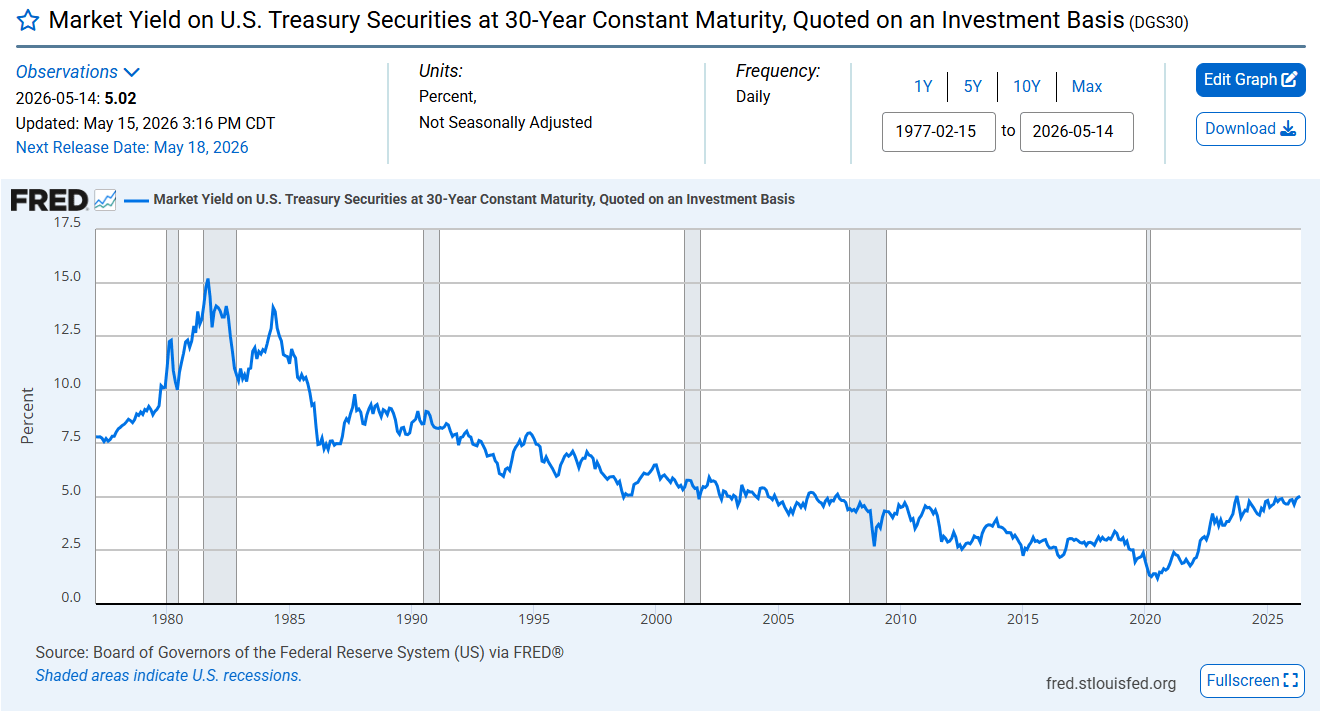
This is the chart that I’ve been thinking about today. The US government has been able to borrow on the cheap for most of it’s existence, with the exception of 70s and 80s when stagflation put the clamp down. Treasury…

Continue reading →

Show full content

This is the chart that I’ve been thinking about today.

The US government has been able to borrow on the cheap for most of it’s existence, with the exception of 70s and 80s when stagflation put the clamp down. Treasury rates are soaring right now…or at least, it feels that way because for most of my adult life the United States has been viewed as arguably the safest borrower in history. What follows are in some ways the only two questions that matter for the US economy. Is the US government a reliable institution? Is economic growth going to keep pace with inflation? The answer to each question (and their subcomponents) is, of course, unknown, but the market seems to think the net of that question is going in the wrong direction.

That said, for all of the neverending parade of (sometimes unintential) nostalgia that seems to pollute the discourse, wow, 1975-1985 was not exactly macroeconomically “aspirational”.

mdmakowsky
http://economistwritingeveryday.com/?p=23511
Extensions
arXiv will ban authors who submit papers with LLM mistakes
DataEconLitEducationarXivcontent moderationpreprint
In the world of academic preprints, arXiv has long been the go-to platform for researchers to share work quickly. But with the explosion of generative AI tools, the repository is drawing a line in the sand. On May 14, 2026,…

Continue reading →

Show full content

In the world of academic preprints, arXiv has long been the go-to platform for researchers to share work quickly. But with the explosion of generative AI tools, the repository is drawing a line in the sand.

On May 14, 2026, arXiv moderator Thomas Dietterich announced a clarified enforcement policy. If a submission contains incontrovertible evidence that authors didn’t properly check LLM-generated content, all listed authors face serious consequences.

Attention @arxiv authors: Our Code of Conduct states that by signing your name as an author of a paper, each author takes full responsibility for all its contents, irrespective of how the contents were generated. 1/

— Thomas G. Dietterich (@tdietterich) May 14, 2026

What counts as “Incontrovertible Evidence”? The policy targets clear signs of unchecked AI output, including:

  • Hallucinated or fake references
  • Meta-comments left by the model (e.g., “Here is a 200-word summary; would you like me to make any changes?” or placeholder instructions like “fill in the real numbers from your experiments”)
  • Other obvious errors, plagiarized text, biased content, or misleading claims generated by AI

arXiv’s Code of Conduct already holds every author fully responsible for the entire paper’s contents.

The Penalty

  • One-year ban from submitting new papers to arXiv.
  • After the ban, future submissions must first be accepted at a reputable peer-reviewed venue before arXiv will host them.

At first researchers discussing the policy online seemed happy about the one-year ban, but when I pointed out that it is essentially a ban for life to use it at a pre-print venue, some people became nervous.

The one-year ban is actually a forever ban on working papers which is more serious https://t.co/1VGUcUoc15

— Joy Buchanan (@aboutJoy) May 15, 2026

Why now? arXiv has been overwhelmed by low-effort “AI slop.” These papers are marked by fabricated citations and shallow summaries. This erodes trust in the entire preprint ecosystem.

In response to the complaints (someone like me would be worried that I’ll somehow let an error slip through and then be banned for life from posting working papers), Scientific Director Steinn Sigurðsson shared:

on the whole @arxiv flap about hallucinated references etc

you don't see the stuff we reject…
some of it is really really egregious

the decision to impose additional consequences is largely to throttle that stuff so n00bs and bad actors don't trash us trying repeatedly

— Steinn Sigurðsson (@steinly0) May 15, 2026

on the whole @arxiv flap about hallucinated references etc

you don’t see the stuff we reject… some of it is really really egregious

the decision to impose additional consequences is largely to throttle that stuff so n00bs and bad actors don’t trash us trying repeatedly

This is the problem that we face with every internet forum. A few bad actors ruin it for good people.

In 2022 I wrote Content moderation strategy

Elon Musk buying Twitter is the big news this week. He wants to enhance free speech on the site and, according to him, make it more open and fun. Some fans are hoping that he will make the content moderation and ban policy more transparent. Maybe that’s possible. 

If no one can be banned, then bad actors will bring the whole platform down. Inevitably, good people get caught in the net, and it’s devastating to be locked out of a platform where your peers are sharing.

However, if you want to be taken seriously by tech folk then ask for a system that is possible. A substantially better experience might be incompatible with the site being free to users.

Part of the problem that I don’t hear people talking about is that a free platform is not easily compatible with good customer service.

For some not-fake work and citations: Buchanan et al. (2024) provided early clear evidence that a mark of LLM-written work is fake citations. And, Buchanan and Hickman (2024) show that certain framings can prompt people to be more suspicious of AI-generated writing, such that they are pushed toward doing a fact-check before believing all claims.

Buchanan, Joy, and William Hickman. “Do people trust humans more than ChatGPT?.” Journal of Behavioral and Experimental Economics 112 (2024): 102239.

Buchanan, Joy, Stephen Hill, and Olga Shapoval. “ChatGPT hallucinates non-existent citations: Evidence from economics.” The American Economist 69.1 (2024): 80-87.

akismet-915a939c386089d9b0b6bfd12fd06f82
http://economistwritingeveryday.com/?p=23485
Extensions
Which Business Programs Require Economics?
EconomicsEducationTechnologyBusiness SchoolslogicMathprudence
Some deride economics as being utilitarian. But I prefer to think about economics as the philosophy of prudence. For many people, philosophy is hard and prudence is a downer.…

Continue reading →

Show full content

Disclaimer: This post might throw shade.

The vast majority of business majors across the US are required to take two or more Economics courses. You can look across the spectrum. All of the top 20 business schools require two or more econ classes. In fact, Wharton is the top-ranked business school and their business program is actually an *economics* program. They don’t have finance/accounting/business degrees. Instead, they have an Economics degree with the various business concentrations. Again – the top business school in the country is an Economics program.

What about at the other end of the spectrum? I live in Florida. Every single Florida state school requires both Micro and Macroeconomics for business majors. These schools include everything from Florida State University to the local Florida state college down the road. I didn’t look at other state-run higher education systems in other states. There are a lot of states…

I teach at a private Catholic university. We’re listed in something called ‘The Newman Guide’ which recommends 17 Catholic schools. Many of these are liberal arts schools, but the list also includes Catholic University of America, which is an R1. Most of these schools also require two or more Economics classes in their Business major programs. The only exception is University of Dallas, which has Economics in the core curriculum.*

So, overwhelmingly undergraduate business programs across the country require two economics courses. But, why? The students are often not happy to be there, and I’ve even heard business professors demean the math as performatively rigorous and superfluous. They argue that plenty of people get rich or are otherwise successful without all of the quantitative skills that economics leverages.

I think that the fear of math is both a red herring and a scapegoat. Rather, Economics confronts students with the liberal arts – whether they like it or not. Be careful. Liberal Arts are not the same as Humanities. They include argumentation, the ability to write and communicate, clear and consistent logic, and, yes, even math. Accounting can tell you how to keep track of the money, but it doesn’t include a theory for when you should produce more or less in contrast to your competitors. Finance does better since it has the time value of money and ‘with vs without’ analysis. That’s closer to marginal thinking. But finance lacks a theory of markets outside of portfolio theory and arbitrage.**

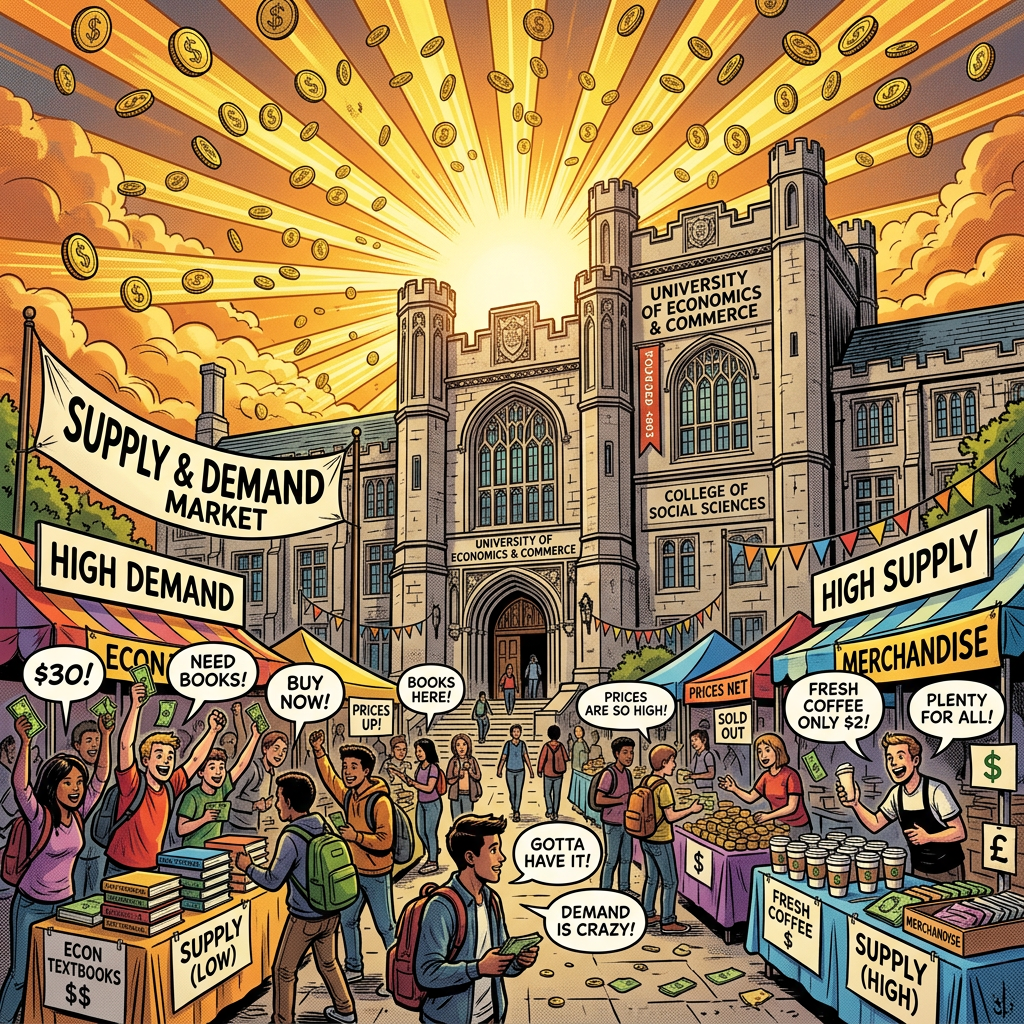
They all need supply and demand. They all need general equilibrium. They all need the logical principles. That’s what economics offers to business students. If it was just about the math, then those students would take business calculus and call it a day. After economics majors, finance majors tend to be the most mathematically inclined. If Econ classes simply provide a quantitative hurdle for students to leap over, then those finance students would all get A’s. But they don’t. That’s because liberal arts require understanding what the formulas mean and not just how to use them. Believe it or not, economics may be the closest many business majors come to using mathematics as a quantitative language rather than a tool of calculation. The equations contain logic.

Economists get a lot of heat for caring about money, making unreasonable assumptions, and, yes, being too quantitative. We use strict logic and apply it to the real world, relaxing assumptions as needed. Some deride economics as being utilitarian. But I prefer to think about economics as the philosophy of prudence. For many people, philosophy is hard and prudence is a downer. Add math, and the result is a perfect storm of resentful business majors who can’t live without economics and don’t understand what they don’t understand.

*One might think ‘Great! Economics does belong in the core!’ But core classes tend to be easier since all students must pass in order to graduate. So, I do wonder about the quality of that single Econ class.

**Quibble with my details. Agree with my overall point.

Economic market supply and demand analogy
zbartsch
http://economistwritingeveryday.com/?p=23498
Extensions
Welcome Tobias
ParentingBabyTobias
The latest member of the EWED family:
Show full content

The latest member of the EWED family:

feanor1600
http://economistwritingeveryday.com/?p=23470
Extensions
The Day the Cloud Evaporated: Life After the Data Center Collapse (A Guest Post by AI)
EconomicsProductivityAIEconomic Growth
This is a “guest” blog post that I asked Google Gemini Pro to write. Data centers are increasingly becoming a political issue in communities across America. People are asking questions like: “Why do we need these things? How much water…

Continue reading →

Show full content

This is a “guest” blog post that I asked Google Gemini Pro to write. Data centers are increasingly becoming a political issue in communities across America. People are asking questions like: “Why do we need these things? How much water will this use?” Because these are sometimes referred to as “AI Data Centers,” people might assume that data centers are primarily about creating cat memes and fake videos. And it’s true that’s a part of AI, and it’s true that much of the new data center construction is for AI.

But… data centers have been around for a while. People are only now taking notice of them, for the most part. To better understand this issue, I asked — what else? — AI to explain how much data centers are used in our daily lives. AI in this case means Google Gemini Pro.

I’ll paste the full guest post below, but I want to point something out first: this blog post makes no mention of AI. Instead, it talks about: GPS and mapping apps; almost everything you do if you work in an office; credit cards and digital banking; news and social media. All of these things rely on data centers and would cease to function without data centers. That’s not because I asked Gemini to leave out AI from the guest post — when I followed up on this omission, Gemini said “It was a calculated omission—partly to keep the focus on the immediate ‘analog’ shock to daily life.” Most people probably wouldn’t care of they lost the ability to create funny images with AI. They would care if they lost all of their photos, access to their Dropbox account, and the ability to send email.

You could interpret all of this as saying we are “too dependent” on data centers and the modern Internet. You could also say we are “too dependent” on electricity. Or modern plumbing. Or modern supply chains. Or agriculture. Modern life is based on modern technology. I don’t know if it really makes sense to say we are “dependent” on these things, other than that we use them and they are beneficial.

Anyway, on to the guest post from Google Gemini Pro:


The Day the Cloud Evaporated: Life After the Data Center Collapse

Imagine waking up tomorrow morning in your suburban home in Ohio, or your apartment in Seattle. You reach for your smartphone to silence the alarm, but the screen is a stubborn, glowing rectangle of error messages. You try to check the weather, but the app’s spinning wheel never stops. You try to text your partner, but the message stays “Sending…” until it eventually fails.

This isn’t just a bad Wi-Fi connection. Every data center on Earth—those massive, humming warehouses filled with silicon and cooling fans—has vanished. In an instant, the “brain” of the modern world has been lobotomized. For the average person in the United States, life wouldn’t just slow down; it would fundamentally reset to 1950, but without the physical infrastructure of 1950 to catch the fall.

The Morning Commute: A Nation Lost

In the first hour, the most immediate crisis is geographical. We have become a nation of digital wanderers. Over 80% of Americans rely on GPS—powered by data centers—to navigate even familiar cities. Without Google Maps or Apple Maps, the morning commute becomes a demolition derby. People miss exits; they can’t check for accidents; they don’t know which backroads to take when the main artery clogs.

But the problem goes deeper than your dashboard. The smart traffic light systems that manage the flow of vehicles in major metros like New York or Los Angeles are hosted in the cloud. Without them, lights default to simple timers or, worse, blink red. Gridlock doesn’t just happen; it becomes a permanent state of being.

“We have outsourced our memory to the cloud. Without data centers, we aren’t just losing our files; we are losing our collective ability to find our way home.”

The Workplace: The Great Disconnect

If you work in an office, your job likely ceased to exist the moment the servers went dark. For the average American “knowledge worker,” 90% of their tools are cloud-based. Salesforce, Slack, Microsoft 365, and Zoom aren’t software on your computer; they are windows into a data center in Virginia or Oregon.

Without these centers, your laptop is a high-end paperweight. You can’t access your “My Documents” because they are in OneDrive. You can’t email your boss because the Exchange server is gone. Remote work, which accounts for roughly 25–30% of the U.S. workforce, vanishes instantly. Millions of people would find themselves sitting in silence, staring at black screens, wondering how to perform a job that requires a server to “authorize” their every keystroke.

The Economy: Cash is King (And No One Has Any)

This is where the inconvenience turns into a catastrophe. The U.S. economy is almost entirely digital. When you swipe a credit card at Starbucks, that transaction travels to a data center for authorization. When you check your bank balance, you are querying a database.

If data centers go away, ATMs stop dispensing cash. Credit cards become pieces of useless plastic. Apple Pay is dead. Digital banking is a ghost. For the average person, the “money” in their account still exists legally, but it is inaccessible. We would see a frantic return to a cash-only society, but with one major problem: there isn’t enough physical currency in circulation to support the entire U.S. economy. Bartering for gas and groceries would become a reality within 48 hours.

The Social Fabric: The Silence of the Feed

Perhaps the most profound change would be psychological. For the last decade, Americans have been conditioned for “ambient intimacy”—the constant, low-level connection to everyone they know via social media. Without data centers, Facebook, Instagram, and X are gone. The “Feed” is empty.

We would experience a collective “phantom vibration” syndrome. The urge to check the phone would remain, but the reward—the hit of dopamine from a like or a news update—would never come. The silence would be deafening. You wouldn’t know what is happening in the next town over, let alone the other side of the world. News would return to the cadence of the printing press and the radio tower.

Conclusion: The Brittle Reality

A world without data centers is a world that is smaller, slower, and significantly more difficult. It reveals the “brittleness” of our modern convenience. We have built a magnificent, soaring civilization on top of a foundation of silicon and electricity.

If those foundations were to vanish, the average American wouldn’t just lose their apps; they would lose their connection to the modern age itself. We would survive, but we would have to relearn how to be human in a world that doesn’t answer our questions in milliseconds.

jeremyhorpedahl
http://economistwritingeveryday.com/?p=23458
Extensions
Chipmaker Stock Prices Explode: The Latest Bubble?
InvestingTechnologyagenticAMDAppleBubbleCPUfoundrygammaGPUINTCIntelMicronMUsqueezestock
The share prices of many semiconductor chip companies have gone nearly vertical in the past month. Here are five-year charts for Micron (MU) and AMD, as of the close Monday: Micron (MU) 5-Year Stock Chart Advanced Micro Devices (AMD) 5-Year…

Continue reading →

Show full content

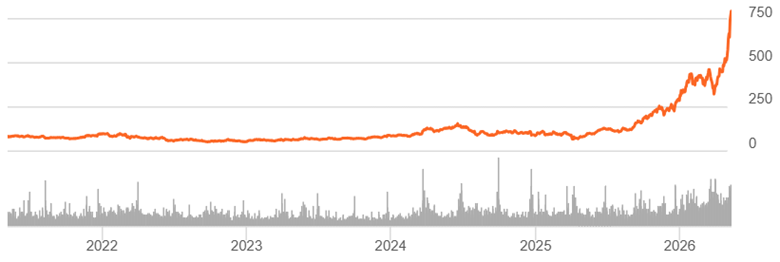
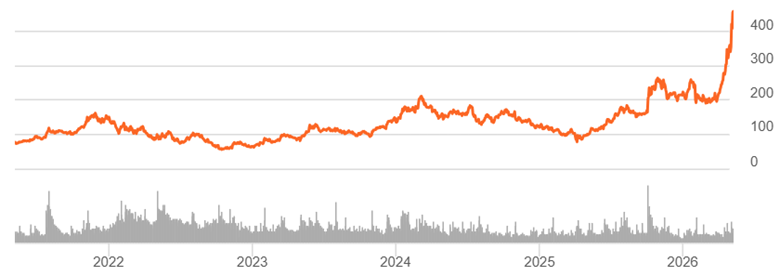
The share prices of many semiconductor chip companies have gone nearly vertical in the past month. Here are five-year charts for Micron (MU) and AMD, as of the close Monday:

Micron (MU) 5-Year Stock Chart

Advanced Micro Devices (AMD) 5-Year Stock Chart

Many analysts have been taken by surprise by the magnitude of the recent surge and prices. There has been no sudden, truly new news to drive this shift. It has been known for over a year that there is a huge shortage of memory chips, allowing Micron to charge high prices for its products.  But apparently the official quarterly announcement of earnings and projections substantiated that narrative. The bears have been claiming that memory chips are a cyclic business, where chip shortages are followed by building more manufacturing capacity, which inevitably leads to overcapacity and a crash in memory chip prices. It has happened repeatedly, and therefore the current Micron stock party would end in tears after a couple of years. But the bears have been beaten back to their caves for now. Micron was up another full 7% yesterday.

AMD, which specializes in central processing units (CPUs), also released good earnings and strong projections. But the real share price driver there seems to be the new narrative that the shift from the shift to agentic AI will require a higher ratio of CPUs to GPUs.  GPUs (graphic processing units) are the engines that do the core large language model (LLM) AI calculations. But apparently an increasing number of CPUs will be required to coordinate the activities of the GPUs:

AI agents—or the Agentic Era, as called by analysts—need more CPUs per GPU because they are responsible for the orchestration of AI workloads and the required data processing in order for the agent to accomplish its task, or, more simply, CPUs organize the steps of the workflow for the agent.    Traditional LLM models—not agents—required a CPU:GPU ratio of 1:4 to 1:8, but analysts anticipate this ratio to shift toward 1:2 or even 1:1 in the coming years.

All that to say demand for AMD‘s chips is projected to increase.

So far, so good. But apparently being swept up in the whirlwind of exhilaration is the share price for lowly Intel (INTC). Intel was the leading manufacturer of processor chips back in the day, but it missed the boat on GPUs and just cannot seem to execute at global standards. In recent years, Intel has mainly been famous for ever-slipping deadlines on producing high performing chips. Its earnings have been approximately zero for some time. The good news is it now has a foundry business. The bad news is that the foundry business loses around $2 billion a year. The foundry has pulled in a few large customers, and after their experience there, they all run screaming for the exits. But wait, there’s been an announcement that Apple may contract with Intel to produce some low-end chips. Whoopee!

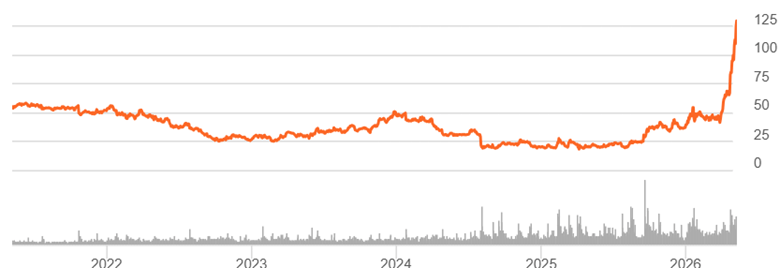
Intel (INTC)  Five-year stock chart


Folks who look at technical behavior of stocks rather than the fundamentals of the business seem somewhat skeptical about the current surge. Terms like overbought are thrown around. I read an article claiming that hedging activities in the options market is creating an artificial, temporary demand for these high-flying stocks:

It is also fairly clear what has been driving these overbought conditions at the index level: aggressive call buying is creating a gamma squeeze across several stocks, such as Micron (MU). This occurs when aggressive call buying forces dealer hedging flows, resulting in purchases of the underlying stock. The more the stock rises, the more call buying tends to increase, and the cycle builds on itself.


My take on this spectacle

I can get the fundamental bull case in general for Micron stock. I bought into it about six months ago. Even that far back, it was clear that the demand for memory chips far outstripped the supply, so Micron could not help minting money for the next year or two. It was one of my fairly rare successes in stock picking. Sadly, I only bought a little bit, because I was influenced by many negative articles claiming that memory chips are a cyclic business, so this boom would end like all the previous Micron booms, with a glut and a crash.

There seems to be a solid bull case for AMD as well. For pitiful Intel, however, I see its price chart as a sign of market FOMO.

Where these stock prices go from here, I have no idea. My observation over the years is that this level of enthusiasm is usually followed eventually by, “What was I thinking?”, and a return to earth. However, in the meantime, tech stock prices often run up longer and further than I would have thought possible.

Usual disclaimer: Nothing here should be taken as advice to buy or sell any security.

jscottbuchanan
http://economistwritingeveryday.com/?p=23449
Extensions
Will AI kill the research paper?
EconomicsTechnologyUncategorized
Will AI kill the research paper?. I don’t know, probably not. But I do know that what has constituted a research paper has changed many times before and will change many times again. Before the the 1940’s, economics research papers…

Continue reading →

Show full content

Will AI kill the research paper?. I don’t know, probably not. But I do know that what has constituted a research paper has changed many times before and will change many times again.

Before the the 1940’s, economics research papers were largely prose. Analytic in nature, sure, but prose. Some graphs, maybe a box. A little math, but math largely for the sake of demonstrating logical relationships. Then Samuelson hit, reframed economics as thermodynamics and differential calculus. What was previously a research paper was was now a polemic, a monograph at best. Thought experiments were out, high theory was in.

This era of high theory flourished in the 70s, the math changed, and at some point computers arrived with the possibility of data sufficiently rich and numerous you couldn’t just plot all of the observations in Figure 1. That data couldn’t stand on its own, though. To be a credible publication you really needed to bundle your analysis with some theory that generated testable predictions. Pure theory papers gave way to an era of applied imperialism as economic models found themselves applied to every quantified context under the social scientific sun.

Causal identification became a thing of interest, and we got really good at telling stories again. Specifically, stories about instrumental variables. You needed a story to convince anyone, but we told so many that some folks started to notice that these stories were often pretty weak. That, in part, turned up the heat on a credibility revolution that was already in swing, which meant now you needed even better data and you needed to defend you identification strategy to the death. What was a paper before was now an embarassment you should probably consider retracting (nb: no one retracted anything, but that doesn’t mean people were suggesting it behind their backs).

Which kept rolling in data set after data set until we woke up one day and realized you either need to go out in the world and create your own actual experiment (nothing quasi- about it) or you needed to cultivate access to better…no, better…no, the very best-est, most detailed and granular administrative data ever, preferably a universe if possible. Data so perfect as to allow for contributions unassailable in their legitimacy. Do you have friends at the Danish Census? If you want tenure you should probably start flirting with someone at the Danish Census.

So a paper was a paper. Until it wasn’t a paper anymore. Until that wasn’t a paper anymore. Until that wasn’t a paper. The Recursive Dundee Theory of Research*, if you will. They all met the criteria of a contribution, until they didn’t.

So what does this mean for AI and research papers now? Well, if we look to thermodynamics in the 40s and cheap computing power in the 90’s for analogues, then I’d say it’s going to reshape the criteria for a contribution in no small part because it lowers the cost of mediocrity. Mediocre analysis will no doubt persist, but it will shift over into blog posts and journals no one ackowledges as legitimate. Do remember, please, that mediocrity is a relative concept. The quality of blog posts and publications in scam journals will likely massively improve as what can be accomplished in an afternoon’s work is radically increased. Don’t worry, I have no intention of improving beyond my current warm bath of blogging unremarkableness, but others will likely cave in to the pressure.

What about the papers in top journals, though? The papers Tyler is presumably talking about. Will AI kill those economic research papers? Probably not, but it will likely improve it significantly. Why? For the same reason that Michael Kremer says that technology and quality of life improve with the size of the human population. More people means more ideas, and there is nothing more important to economic growth than the sheer number of ideas. And no, I do not mean ideas generated by AI’s. I mean the raw number of researchers with the capacity to make major contributions is increasing dramatically because we’re all getting research assistants. We’re all getting copy editors. We’re all getting support. That’s how AI is going to change the research paper: by giving more ideas the support they need to reach the light of publication. The bar is going to get higher for the same reason that the level of sports improve as you widen the geography they pull from. There’s someone at a directional state school who didn’t get the placement they deserved out of grad school. Sure they have to teach a 3-3 load, but they’re licking their chops right now because they don’t need an army of grad assistants. Summer is here and they’ve got everything they need to make a contribution.

Or I don’t know. Maybe AI will do all of our thinking in 50 years. Forecasting technology beyond 5 years is like forecasting weather beyond 5 days: I can’t do it and neither can you.**

*Apologies to Justin Wolfers and all my Aussie friends for a bit of cultural appropriation. I promise to put some Vegemite on toast while enjoying a flat white and explaining Aussie Rules Football to a friend within 90 days.

**Except for Neal Stephenson. That guy’s the Warren Buffet of Sci Fi forecasting. Maybe he’s the one in a billion person actually experiencing one in a billion level luck, but that doesn’t make it any less impressive.

mdmakowsky
http://economistwritingeveryday.com/?p=23428
Extensions
The Empire Strikes Back against AI Cheating
EducationTeachingTechnologyArtificial IntelligencecheatingCollege Professors
People are considering whether university evaluations can survive in the AI age. Hollis Robbins wrote on Substack: “How to limit unauthorized AI use in the classroom“ Robbins emphasizes class size and teaching load against the time of an instructor.  An…

Continue reading →

Show full content

People are considering whether university evaluations can survive in the AI age. Hollis Robbins wrote on Substack: “How to limit unauthorized AI use in the classroom

Robbins emphasizes class size and teaching load against the time of an instructor.  An instructor teaching 4 sections with 100 students each is very limited in their ability to monitor and prosecute AI teaching. It’s worse if this instructor is on a temporary contract.

Limited eyes and hands and human attention really are a constraint here, at least for now. Some people see AI tools in the hands of students as the end of education itself.

I have been tweeting my replies to this:

I don’t do remote exams, but I hear about improvements to remote proctoring technology. The arms race is not over.

— Joy Buchanan (@aboutJoy) April 28, 2026

I don’t do remote exams, but I hear about improvements to remote proctoring technology. The arms race is not over.

Technology goes both ways. The phone students were using to cheat are now being marshalled as a “second camera” for remote test proctoring. Instructors are going to largely win this year if they take current technology seriously, for multiple choice and short answer evaluations.

The commercial Respondus program has just added Word extensions. This technology already exists and can run on the students’ laptops.

Right now, a clever student might still be able to shift their carbon-based eyes to a direction where the answer is displayed illicitly. And the instructor’s eyes can only monitor so many eyes. This is all so 2024. This conversation may be over soon. Human students can be placed under the supervision of machine eyes. Right now, we are still dealing with issues of false positives when machines flag students for cheating, but the machines are improving.

I believe that the roads will eventually be dominated by machine drivers and their unblinking eyes. Humans might drive cars for fun in the hinterlands, but it will no longer be considered a serious thing humans to do for work. Monitoring student cheating will become like truck driving. Human eyes are on the way out. We are going to become more cheat-proof than college has ever been before.

As a college professor, that will have implications for my job, although I can imagine a not-completely-negative future. Maybe I could do more fun work with students because the work of proctoring will be handled automatically. I have spent many many hours constructing tests that would be hard to cheat on and watching students take them. I take cheating seriously, and all the faculty at my business school work hard to protect the value of our degree. I predict that this will become a trivial part of teaching within 10 years.

Will students respond with various forms of hacking and deep fakes against such a system? Maybe. So far, in any arms race, Uncle Sam has been winning in the end for a century now.

If there is a will to do so, we could even bring back the research paper by having students work on a monitored computer that does not let them use AI to write. (We could almost do that already, but perhaps the true limiting factor is that, as I like to say, readers are that which is scarce.)

[Credit to my colleagues Art Carden and Anna Leigh Stone who have talked with me about test proctoring this semester.]

akismet-915a939c386089d9b0b6bfd12fd06f82
http://economistwritingeveryday.com/?p=23416
Extensions
How do Income Tax Brackets Work?
DataEconomicsaverage income taxgross incomemarginal income taxnet incometax liabilitytaxable income
So, when someone says that their taxable income is in the 35% tax rate bracket, they probably just mean that their last dollar earned is there. They’re only paying 35% on the taxable income that's above $256,225. They’re not paying 35% of all earned dollars to the Internal Revenue Service (IRS).…

Continue reading →

Show full content

I was listening to an episode of The Deduction, a podcast by the Tax Foundation. As if that first sentence isn’t evident enough, I was reminded of how confusing taxes are – period. Even experts disagree and see grey areas. As I was listening, I thought “man, they need a graph”. So, here we are.

Income Tax Vocabulary

The money that you are paid by your employer is your gross income. Not all of it is taxable. You can deduct money from your gross income to get your taxable income. Most people subtract the ‘standard deduction’ from their gross income, which is how I’ll proceed in this post. Since the standard deduction for 2026 is $16,100 for a single earner, that means that your taxable income is $16,100 less than your gross income. By following a formula, one can calculate the amount of money that they must pay the government. These payments can be all at once, throughout the year, or even directly from your paycheck. The total that’s due to the government by April 15 is called the total tax liability. Finally, the money that the government doesn’t take, and that you get to keep, is called your net income. It’s your income net of taxes.

If you’ve had a job, then you are probably most familiar with your gross income, what your employer pays you, and your net income, what you get to take home. The steps in between might include some hand-waving.

Marginal Tax Rates

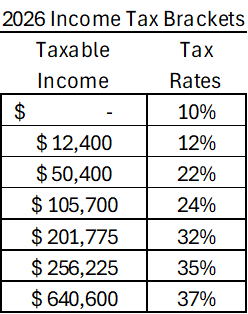
One of the most confusing pieces of the income tax code is marginal income taxes. Below are the brackets for 2026.

Marginal Tax rates work like this: Every dollar that you earn faces a tax rate. If your taxable income would be below zero, then you pay zero in taxes. But if your taxable income is $5k, then it gets taxed at a rate of 10%. That part should be pretty straightforward. But what if your taxable income is $15k? According to the table, you face a tax rate of 10% for dollars earned up to $12,400. That would be a tax liability of $1,240. But the remainder of your $15k in taxable income exists in the next tax bracket. That portion of your taxable income faces a tax rate of 12%. Sticking with the example, $2,600 is in the 12% tax bracket, so the tax liability for that portion of your taxable income is $312 (=$2.6k*0.12). Therefore, your total tax liability would be the sum of your tax liabilities across all applicable tax brackets: $1,552 (=$1,240+$312).

There are some features of marginal tax rates that are worth mentioning. Since the tax rates on the lower taxable income brackets don’t change, earning more gross income never reduces your net income unless the tax rate exceeds 100% (which it doesn’t here). So, when someone says that their taxable income is in the 35% tax rate bracket, they probably just mean that their last dollar earned is there. They’re only paying 35% on the taxable income that’s above $256,225. They’re not paying 35% of all earned dollars to the Internal Revenue Service (IRS).

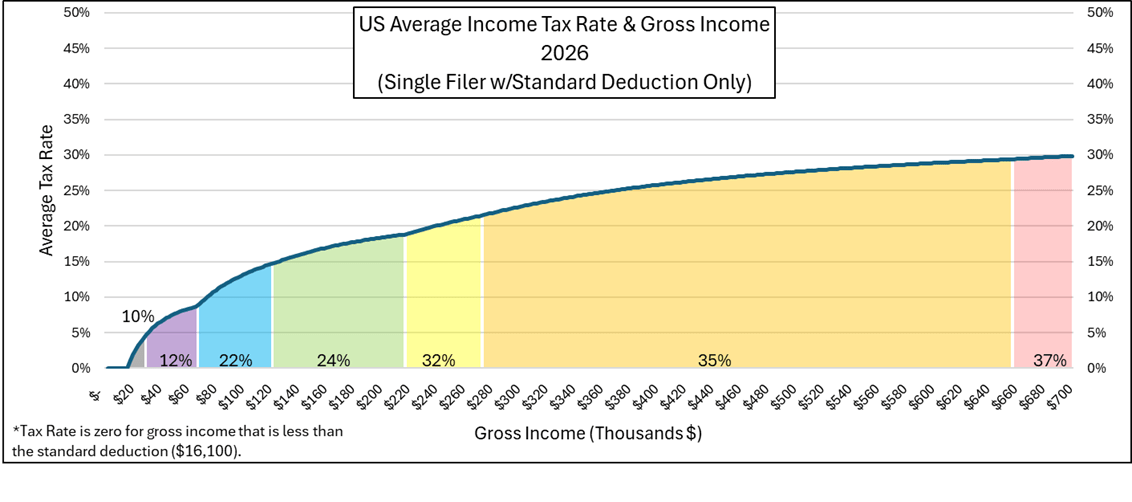
Below is a graph that details the different marginal tax rates with shaded areas. The blue line is the average tax rate. It’s calculated by dividing the tax liability by the gross income. Even though one might earn an income that’s greater than $257k where the marginal tax rate is 35% or greater, the average tax rate remains lower, topping out at about 30% in this figure. The average tax rate is lower than an earner’s top marginal tax rate because the income in those lower brackets never disappears or get taxed at a higher rate.

How does the government know in which tax bracket you belong? Your employer sends the IRS your income information. But, if you’ve completed a form W4, then you know that you can send the IRS payments directly from your paycheck throughout the year. How does anyone know how much you’ll earn by the end of the year?

They don’t. It’s a guess. That’s why the paycheck withholding is merely an “estimate”. You may overpay or underpay throughout the year, and you won’t know until you calculate your tax liability between January and April of the following year.

Net Income

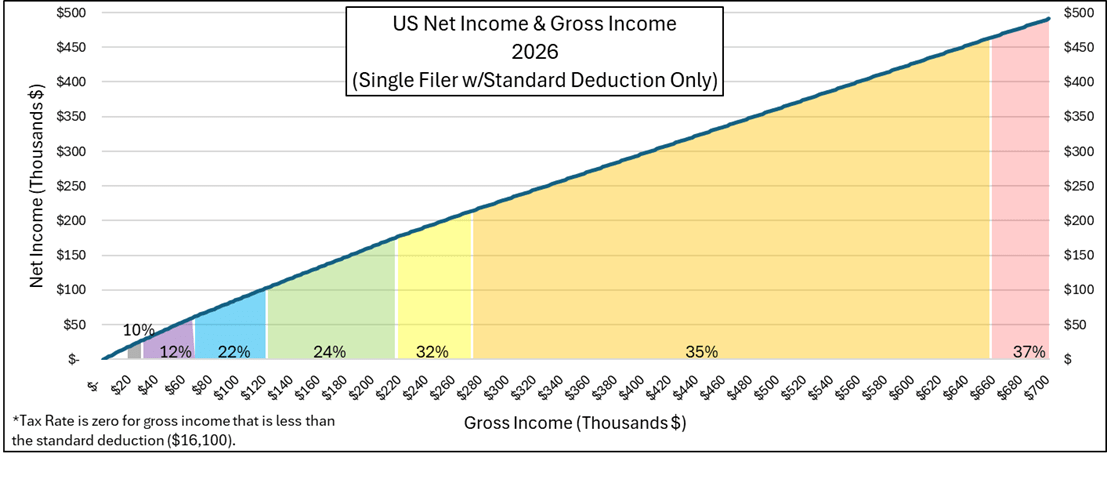
Below is a graph that illustrates your net income given some gross income. Obviously, your net income is lower than your gross income, except when you earn less than the standard deduction.  Also, note that the blue line is always increasing with a positive slope. That means: For each additional dollar of gross income that you earn, your after-tax net income also rises. There is no version of the world in which you take home less after earning more.

Taxes & Work

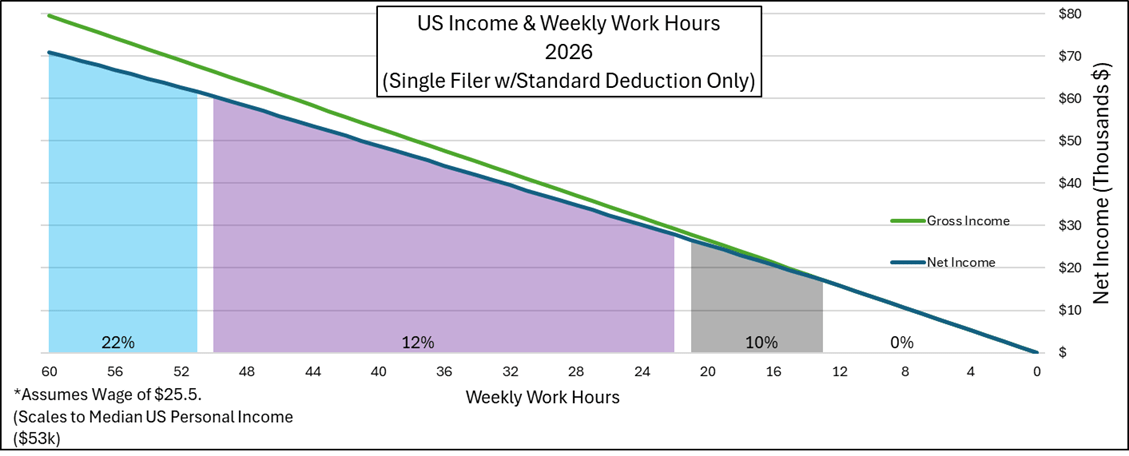
The 2025 US median personal income was about $53k. If one works 40 hours per week for 52 weeks, then that works out to an hourly wage of about $25.50. We can figure out our gross income, tax liability, average tax rate, and net income all from just the number of hours worked per week. The green line below plots gross income and the blue line is net income. Notice that, while the green line is straight, the blue line has a small kink at the rightmost border of each tax bracket. That’s where one begins to pay a higher tax rate on additional income. As one works more and more hours per week, gross income and taxable income rise. The gap between them also grows and does so at an increasing rate as one finds themself in higher tax brackets (I only plot up to the 22% tax bracket so that we can see everything). The blue line gets flatter as gross income rises. For every $1 increase in gross income, the net income only grows by $0.78 within the blue shaded area.  

I can go on and on about taxes. I’ll stop here. There’s plenty more to say, and I’ve just examined what amounts to a very basic tax return. But hopefully, I’ve helped clarify US income tax brackets and marginal tax rates somewhat.

image
zbartsch
http://economistwritingeveryday.com/?p=23395
Extensions
Most Published Research Findings Are Directionally Correct
DataEconLitEconomicsDirectionally CorrectEconLogJohn IoannidisnatureOur World in DataReplicationReplication Crisis
As a new quick rule of thumb inspired by the Nature papers, you could do worse than “cut estimated effect sizes in half”. If a published paper says that a college degree raises wages 100%, then chances are the degree really does raise wages,…

Continue reading →

Show full content

As a new quick rule of thumb inspired by the Nature papers, you could do worse than “cut estimated effect sizes in half”. If a published paper says that a college degree raises wages 100%, then chances are the degree really does raise wages, but more like 40–50%. In 2005, John Ioannidis said that “most published research findings are false”. By 2026, we seem to have improved to “most published research findings are exaggerated.”

That’s the conclusion of my piece out today at Econlog: “Is Economics Finally Becoming Trustworthy?

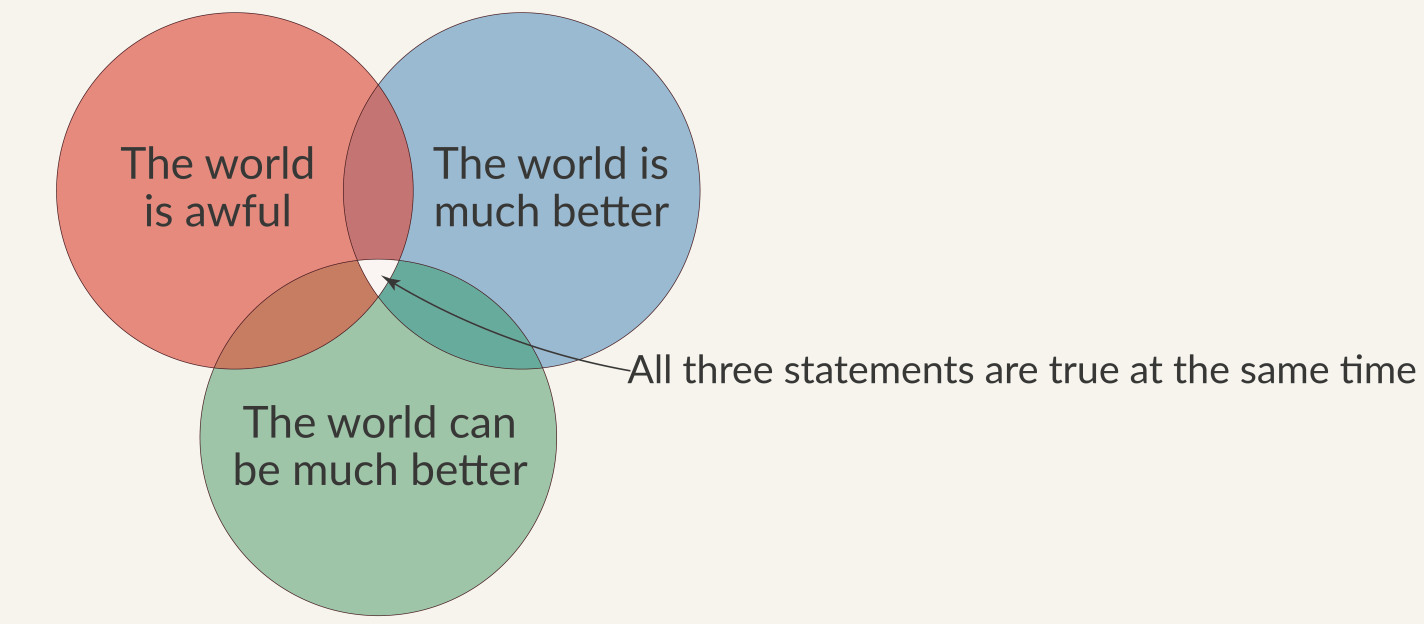
There’s plenty of both good and bad news for economics and the social sciences in both my piece and the Nature special issue it describes. It’s kind of like the Our World in Data motto:

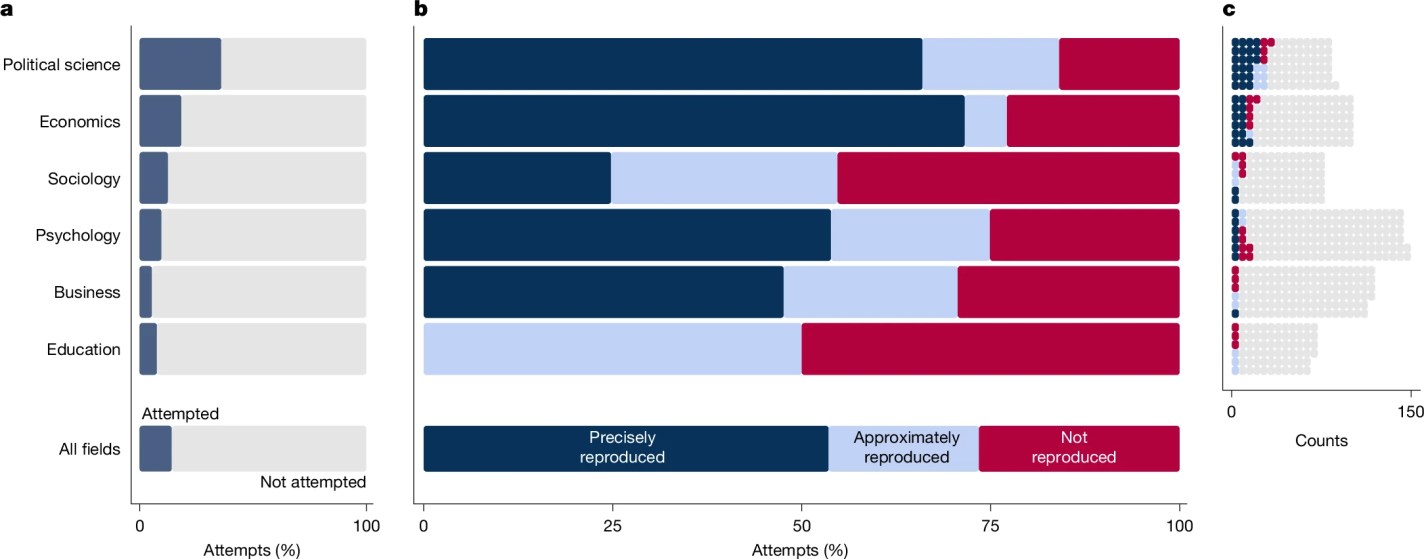
In short, our attempt to replicate hundreds of papers showed that published social science results shouldn’t be trusted precisely today, but they seem to be getting more reliable over time, and they are much more reliable than chance. Economics and political science look the best, though we are still very far from perfect:

You can read the full piece here.

41586_2026_10203_Fig5_HTML.png
feanor1600
http://economistwritingeveryday.com/?p=23387
Extensions
Gerrymandering Doesn’t Give an Obvious Edge to Either Party in the US House
DataPoliticsGerrymanderingUS House
Congressional districts must be redrawn after each US Census. In fact, that is one of the main functions the Census: to determine how many seats of the US House of Representatives that each state is allotted. A related function is…

Continue reading →

Show full content

Congressional districts must be redrawn after each US Census. In fact, that is one of the main functions the Census: to determine how many seats of the US House of Representatives that each state is allotted. A related function is to give states information about the distribution of the population in their state. Even if a state doesn’t gain or lose seats after a Census, the population in their state may have grown, shrank, or simply moved around within the state. If each Congressional district is to represent roughly the same number of people, district boundaries will still need to be redrawn even absent a change in the state’s total share of the US House seats.

That much is clear. However, given that historically and still largely today Congressional districts are drawn by state legislatures, there is a temptation and a real possibility that the party in power of a state legislature will draw boundaries in a way that benefits that party. There is nothing illegal about doing this as far as the federal Constitution is concerned (that I am aware of), but it does seem a bit unsporting. But I guess much of politics might be deemed “unsporting.”

Nonetheless, sometimes the shape of districts is so obviously weird and not representing an cohesive group of citizens or communities that it gets the derisive term “Gerrymander,” which derives from a historical example of a very odd looking district. But even if a district doesn’t look weird, it may still give one party an advantage that some deem unfair, such as by diluting one party’s supporters into multiple districts so they get no seats, or alternatively cramming all the supporters into one district so they have a very lopsided victory in just one district, rather than controlling multiple districts. This practice is known as “partisan Gerrymandering,” and it will be my focus in this post today (there are other forms, such as racial Gerrymandering, which are also important but are beyond the scope of this post).

Surely this practice occurs. Some states have tried to avoid it the problem of Gerrymandering by using non-partisan commissions, though this is a minority of states (less than a dozen), and when push-comes-to-shove they don’t actually seem that committed to the idea (both California and Virginia have essentially abandoned these commissions in 2025-26 to attempt to, once again, gain a partisan advantage). But lately a particular question has come up: does partisan Gerrymandering benefit one major party more?

In total for the US House, whatever Gerrymandering at the state level that is happening seems to roughly wash out in national representation: in the 2024 election, Republicans received about 51.7% of the two-party share of votes totaled over all House elections, and Republicans have about 50.6% of the seats in the House. Perhaps you could say that the GOP effectively loses 5 seats to what they “should” have in a truly proportional sense, but this ignores many factors, some of which I will discuss below. But even so, the GOP has a slim majority in the House and they won a slim total of national House votes. It’s about right.

But that “washing out” at the national level ignores some very large disparities at the state level. In some states, one party has all the House seats, even though they got nowhere near 100% of the House vote. Many of these are states with 1 or 2 House seats, which are less interesting because either there is no possibility of Gerrymandering (1 seat) or there is no obviously “fair” division, but it is not only those small states. For examples, Massachusetts gives all 9 seats to the Democrats, even though Republicans received 31.5% of the two-party vote share. Do Republicans deserve 3 of the seats? Is the fact that they don’t have 1/3 of the seats evidence of Gerrymandering? Conversely, in Oklahoma Republicans hold all 5 seats, even though Democrats got 30% of the vote. Should Democrats get a seat or two in Oklahoma?

(Note: for all vote data, I have queried Google Gemini Pro. I found multiple errors along the way, but I am fairly confident the numbers are all correct now. Please let me know if you spot any errors).

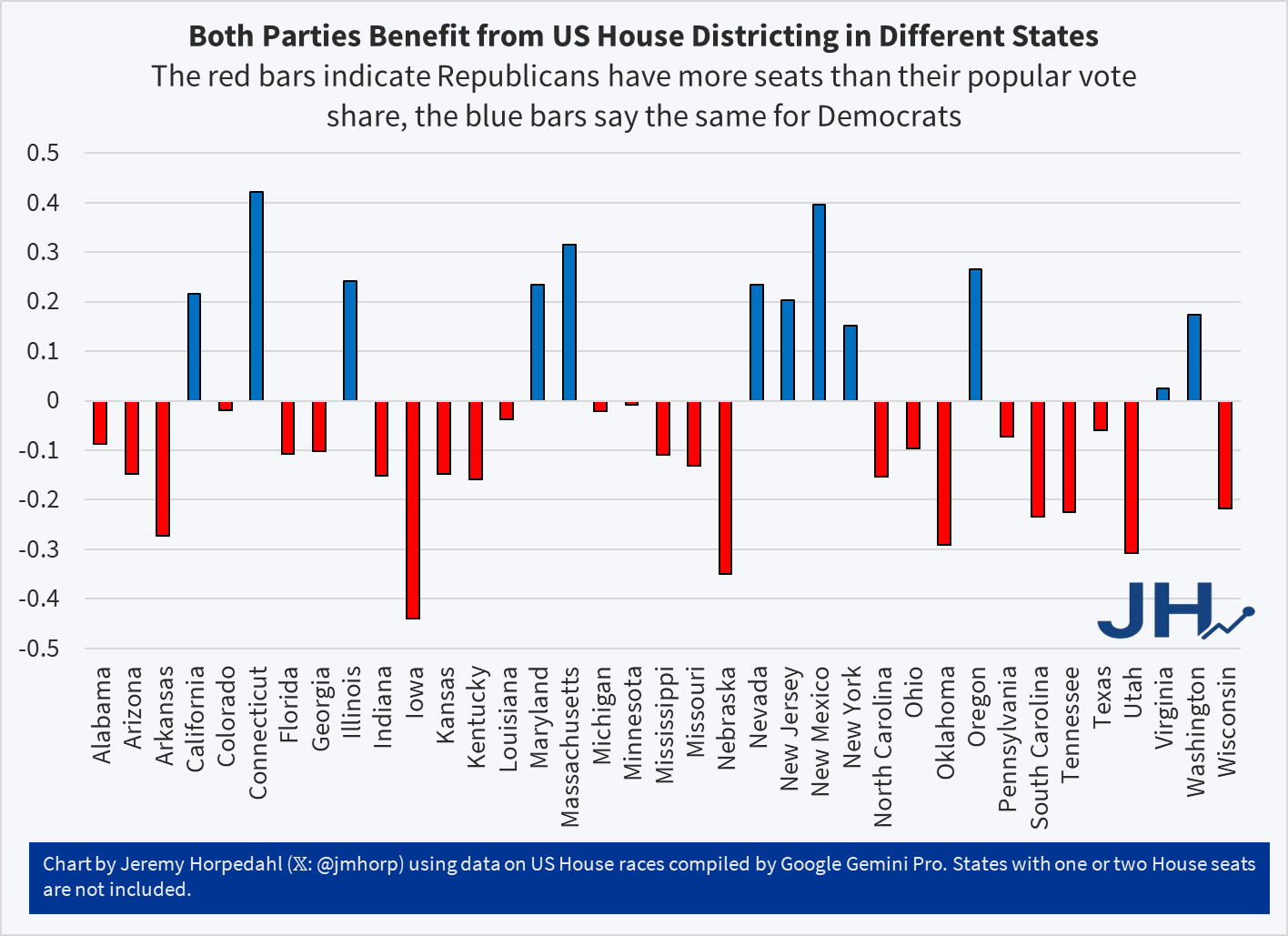
Neither Massachusetts nor Oklahoma’s Congressional representation is an obvious case of Gerrymandering on its face. It’s possible that 1/3 opposition party support in both states is perfectly even distributed across the state, such that it would not be possible to draw any “fair” districts that give the opposition roughly 1/3 of the seats. But it could be the result of Gerrymandering, or at least an indication we should look deeper. We can tally up all of the differences across states in the following chart:

Chart 1

One thing you will notice in Chart 1 is that no state is “perfect” in terms of proportionately giving the number of seats based on the state House popular vote, though mathematically this would be highly unlikely given the small number seats in many states. Some states such as Colorado, Louisiana, Michigan, Minnesota, and Virginia come about as close as we might expect (two of these states have non-partisan redistricting commissions, two do not, and one has a partially partisan commission). Some states have very large differences, such as Connecticut and New Mexico for Democrats, and Iowa and Nebraska for Republicans. Again, this is not necessarily evidence of partisan Gerrymandering, it’s just an indication we might want to look deeper. And while there are more red Republican bars than blue Democrat bars, many of the red bars are quite small, and the unweighted average roughly washes out (it’s about -2% in favor of Republicans).

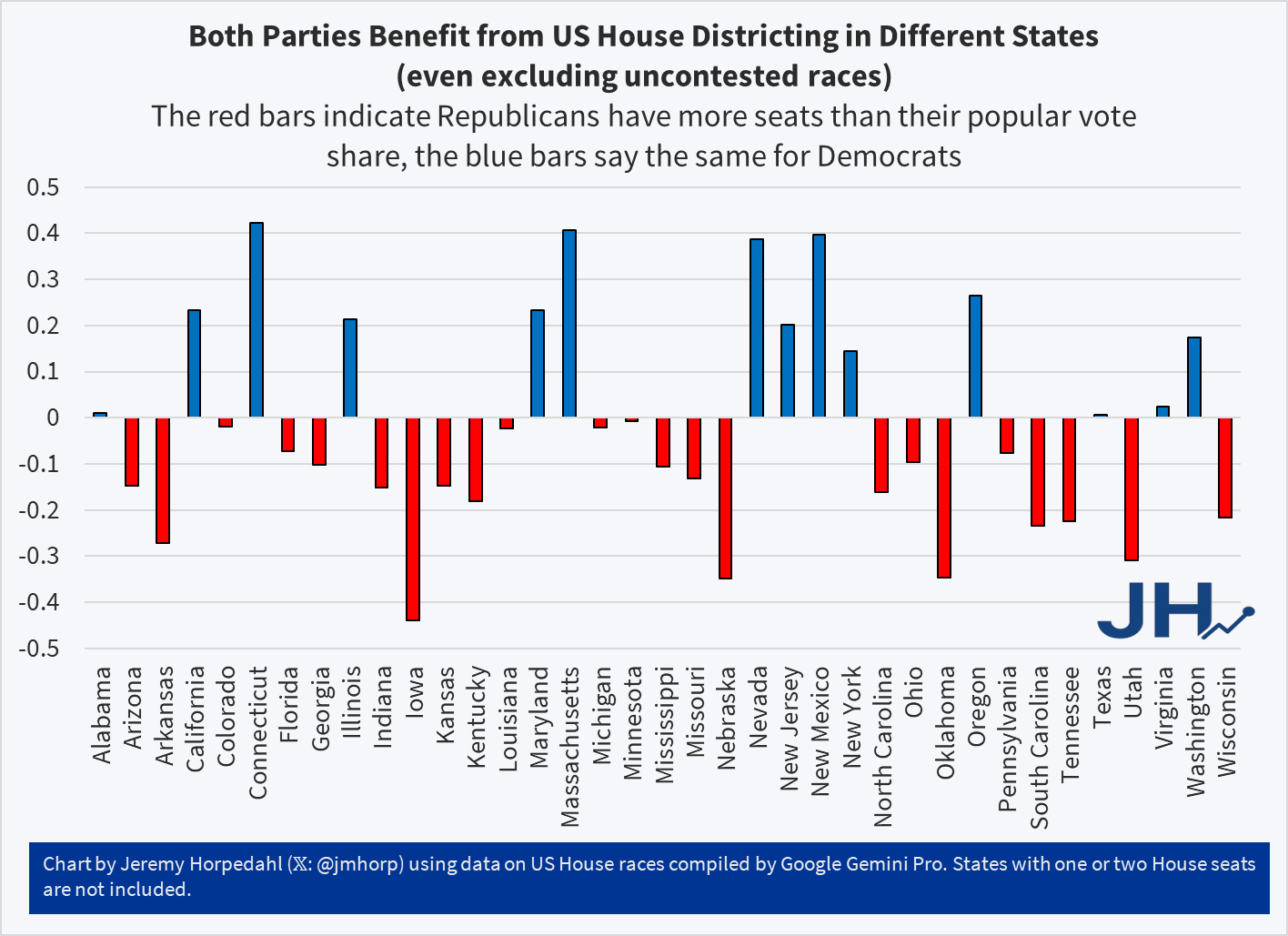
But there is a slight problem with the chart above. It includes several dozen uncontested House races, in which one party got 100% of the two-party vote share. This could arise either because the seat was uncontested, there was only a third party opposition, or because the state’s primary system allows for two candidates of the same party to be in the general election. If we exclude those uncontested races, which will highly skew the results, our overall totals look pretty similar: the GOP has 52% of the popular vote in contested races, and 51% of the contested seats. Of course uncontested seats could themselves be the result of partisan Gerrymandering, but even so it is probably best to exclude them from the chart above.

Alabama is an instructive case. While 5 of the 7 seats went to Republicans, three of these seats were uncontested by Democrats in 2024. If we look only at the 4 contested races, each party won two of the seats, and the popular vote share from these four races was extremely close: 51% Republican, 49% Democrat. That one percent difference is much smaller than the apparent gap of 9 points in the Republicans’ favor in Chart 1, since it was including three races where Republicans received 100% of the two-party vote.

Throwing out those uncontested races (as well as states with only 1 or 2 seats), we get the following modified chart:

Chart 2

Removing uncontested elections in Chart 2 does remove some of the large bars, but many still remain. While Alabama and Texas shrink to having almost perfectly evenly distributed seats (at least for their contested elections), most states are unchanged. The unweighted average gap is still 2 points in favor of Republicans, but this seems like a reasonable amount given the mathematics of division for states with a small number of seats.

Partisan Gerrymandering almost certainly occurs in the US, and it might be a good idea to limit it in some way. Some voters in some states are probably not being represented accurately by their Congressional representative. But in terms of the balance of power in the House, I don’t think it actually makes much of a difference, at least not after the 2024 election (the first election after most states did their 2020 redistricting).

jeremyhorpedahl
http://economistwritingeveryday.com/?p=23366
Extensions