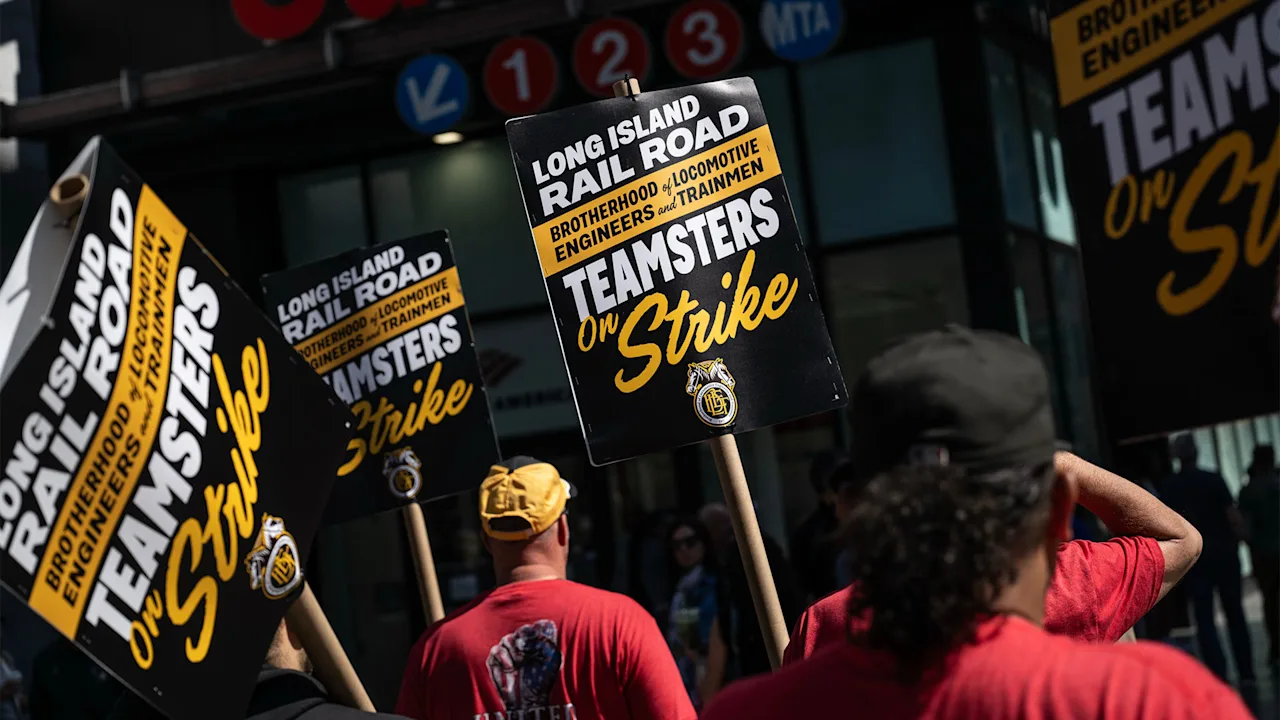
But commuters in the eastern suburbs of New York City still had to muddle through another tough morning rush hour, as trains weren’t set to be running in time for the commute into work after the agreement was reached late Monday.
Limited train service was set to resume around noon, with full service expected to be back in time for the evening rush.
The LIRR still urged riders to work from home again Tuesday if possible. Shuttle buses were being offered from a handful of locations on Long Island to subway stations in New York City.
Five labor unions representing about half the train system’s workforce went on strike at 12:01 a.m. Saturday, halting service for roughly 250,000 commuters who use the rail system that connects New York City to its eastern suburbs every weekday.
Hallie Kessler was among the weary Long Island commuters who welcomed the strike’s end. With the trains out of service, the 24-year old speech therapist commuted three hours home from her job at a public school in the New York City borough of Queens on Monday.
“Obviously I wish trains would be running when peak hours start so I could avoid the long morning commute, but happy to not deal with it in the afternoon when I’m leaving work,” Kessler said. “Curious what the deal says about future fares, which has been a big concern, but we’ll see.”
New York Gov. Kathy Hochul and railroad officials have said they’re not at liberty to disclose details of the new contract terms until they’re voted on and approved by union members. But the Democrat, who is up for reelection, stressed the deal won’t increase fares or taxes and will give unionized workers the fair wages they deserve.
The first impacts of the walkout were felt over the weekend, as baseball fans had to find other ways to get to Citi Field in Queens to see the New York Mets take on their crosstown rivals the New York Yankees.
Hochul said the deal ensures basketball fans won’t meet the same fate as they travel to watch the New York Knicks continue their playoff run on Tuesday night at Madison Square Garden, which is located directly above the LIRR’s Penn Station hub in Manhattan.
The unions — which represent locomotive engineers, machinists, signalmen and others — and the Metropolitan Transportation Authority had been negotiating a new contract since 2023, but talks had stalled over salaries and healthcare.
The unions have said raises were needed to help workers keep up with inflation and the rising cost of living in the New York City area. The MTA had said the union’s initial demands would lead to fare increases and set a difficult precedent for negotiations with other transit unions.
The strike was the first walkout for the LIRR since a two-day strike in 1994.
Elon Musk’s loss in his lawsuit against Sam Altman and OpenAI, decided on Monday by a jury and upheld by a judge, wasn’t the only damaging revelation to emerge from the California courtroom. The two-week trial also punctured the carefully managed public images of some of the most prominent figures shaping AI for hundreds of millions of people.
Whether it was Musk’s combative texts to Altman threatening to make “[Altman and Brockman] the most hated men in America” if OpenAI refused to settle, co-defendant Greg Brockman’s painfully earnest diary entries about becoming a billionaire (“Financially, what will take me to $1B?”), or Mira Murati’s anxious messages to Microsoft CEO Satya Nadella as OpenAI’s boardroom coup unraveled, executives who had spent years projecting total control were revealed to be far more human, and far messier, than they intended. (Microsoft owns a 27% stake in OpenAI.)
The case was “a reminder that discovery can be the real trial. In this case, hundreds of emails, texts, Slack messages, and private diary entries from years back were aired publicly and often unflatteringly,” says Sarah Kreps, director of the Tech Policy Institute at Cornell University.
For executives watching from boardrooms, and perhaps even for some sitting in the courtroom itself, the takeaway was straightforward: Nothing is ever private.
Lawyers and HR executives have long warned against treating corporate messaging platforms as places to joke, vent, or trade sarcastic barbs.That lesson played out repeatedly during the trial. Among the central figures, Nadella largely escaped the most embarrassing disclosures, thanks in part to his reluctance to commit thoughts to writing. Documents introduced at trial showed him to be comparatively restrained and opaque, even in internal discussions over replacing (and ultimately reinstating) Altman.
Nadella’s relative silence suggested a lesson others in the industry may have ignored: it is often safer to pick up the phone than fire off texts or emails. “You just have to assume that everything you write is going to be revealed at some point,” says Nell Minow, chair of ValueEdge Advisors and a corporate governance advocate.
Whether the public airing of those private conversations will meaningfully change executive behavior is another question. That’s because, according to Minow, executives like Musk and Altman are shaped by a “go fast, break things, clean up the mess later” culture that does not lend itself to restraint.
Maura R. Grossman, an e-discovery specialist and University of Waterloo professor, sees the disclosures as part of a broader shift in elite behavior. “It has somehow become acceptable for people in positions of power to say things that would never have been deemed acceptable a decade ago,” she says. Most ordinary people, she adds, understand that texts and written communications can eventually surface. The fact that so many key players in the OpenAI saga appeared unconcerned by that possibility says plenty on its own.
Musk may still view the disclosures as a kind of Pyrrhic victory if they succeeded in publicly embarrassing his rivals. But Minow says the lesson isn’t to stop putting anything in writing at all. Excessive caution around written communication, she argues, risks undermining candid internal debate and eroding institutional memory. Without documentation, organizations lose out on a paper trail that can be useful in the event that something goes wrong within a firm, and enables observers or law enforcement to establish what went wrong and why.
Cornell University’s Kreps argues the smarter response is not to write less, but to write with greater discipline. “Document intent, options, rationale without the snark or speculation,” she says. Otherwise, companies risk replacing accountability with verbal-only decision-making and opaque governance.
Grocery giant Kroger Co. is the latest in a growing number of companies whose brands have been impacted by potential Salmonella contamination involving milk powder.
California-based Sugar Foods LLC is recalling some of its Kroger-branded Homestyle Cheese Garlic Croutons. The product used milk powder that may have been contaminated by Salmonella, according to a recall notice shared by the Food and Drug Administration (FDA) on Monday, May 18.
The milk powder was supplied by California Dairies, Inc, the same company linked to other recent Salmonella recalls.
“The affected seasoning batches tested negative for Salmonella prior to use,” Sugar Foods stated in its FDA announcement. “Out of an abundance of caution, and because this milk powder was used in a seasoning ingredient supplied to Sugar Foods, the company is initiating this recall.”
Sugar Foods had received no reports of illness at the time of the recall.
Which products are affected?
Only the 5 oz Kroger Homestyle Cheese Garlic Croutons are part of the recall. The UPC number for affected products is 0 11110 81353 4. However, the recall spans a number of best by dates:
Best by February 17, 2027
Best by February 18, 2027
Best by February 27, 2027
Best by February 28, 2027
Best by March 6, 2027
Best by March 9, 2027
Best by March 21, 2027
Best by April 1, 2027
Best by April 7, 2027
The products are past their best-by dates and no longer on store shelves. However, consumers may have them in their homes. Photos of the affected product are available here.
[Photo: Kroger]
Where was the product sold?
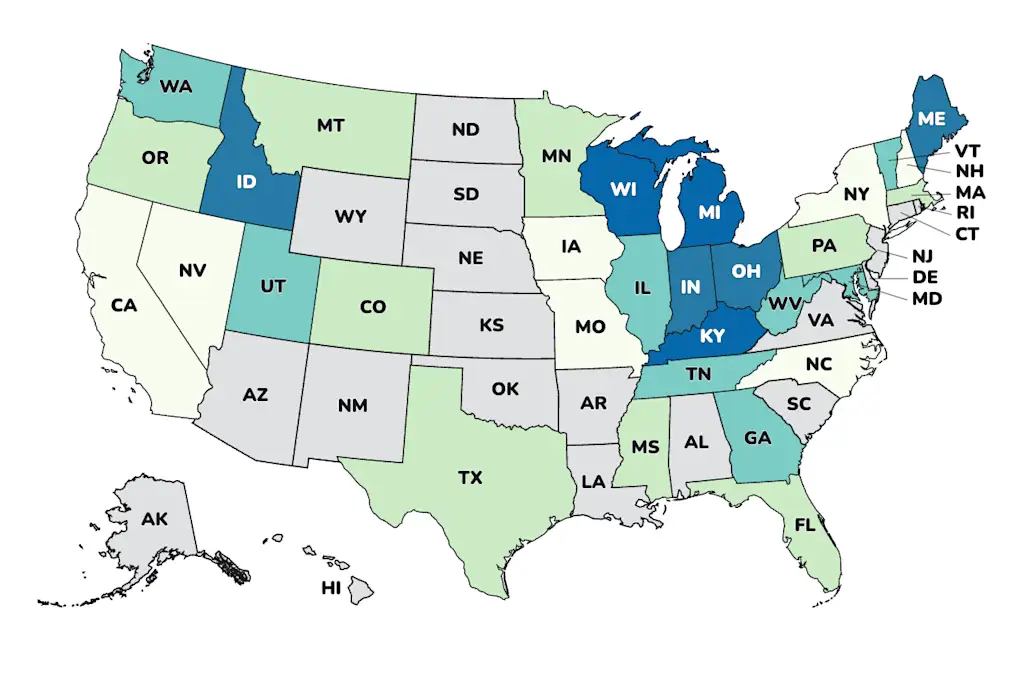
The Kroger Homestyle Cheese Garlic Croutons were sold in Kroger stores between March 7, 2026, and April 7, 2026, in these states:
Alabama
Arkansas
Georgia
Illinois
Indiana
Kentucky
Louisiana
Michigan
Missouri
Mississippi
Ohio
South Carolina
Tennessee
Texas
Virginia
Wisconsin
West Virginia
What should I do if I have this product?
If you have impacted Kroger Homestyle Cheese Garlic Croutons then discard them. You can contact Sugar Foods at 332-240-6676 at any time to ask questions.
What products are included in the recalls?
Sugar Foods joins the likes of Ghirardelli Chocolate Company and Utz Quality Foods LLC, both of which issued recalls due to potential Salmonella contamination in the last month. As of May 18, the full list of recalls tied to California Dairies is as follows:
AI is saving workers more than two hours a day. That sounds like an unqualified win, and in many ways, it is. But beneath the productivity headlines, something more complicated is happening. Employees are getting faster, but some are also getting less confident, less skilled, and less certain they can do their jobs without a machine doing much of the thinking for them. That tension is the defining workforce challenge of 2026, and most companies aren’t prepared to address it.
New research from GoTo, conducted in partnership with Workplace Intelligence, surveyed 2,500 global employees and IT leaders on AI use and sentiment. The findings tell a story about a workforce caught between the tools that help them and the habits those tools are forming. Fifty percent of employees now say they rely on AI too much. Thirty percent say they can no longer function without it. And 39% believe their overreliance on AI is actively eroding their skills and making them less intelligent, a number that climbs to 46% among Gen Z workers. These aren’t fringe opinions. They are the quiet consensus of a workforce that adopted AI fast and is now reckoning with the consequences.
The Pressure to Use AI Is Outrunning the Guardrails to Use It Well
One of the clearest findings in the research is how much external pressure is shaping AI behavior at work. Sixty percent of employees say they feel pressured to use AI tools to boost productivity regardless of whether the task calls for it. That pressure, absent the right training and policies, is a setup for misuse.
The numbers bear this out. Seventy percent of employees (up from 54% just a year ago) admit they’ve used AI for sensitive or high-stakes tasks, including legal or compliance work, decisions requiring emotional intelligence, and actions involving confidential information. These are exactly the domains where human judgment is most irreplaceable, and where AI errors carry the highest cost. The fact that this number jumped 16 percentage points in a single year suggests the problem isn’t slowing down on its own.
Compounding this is an “AI workslop” problem that’s starting to tax the entire workforce. Forty-three percent of employees say they’ve submitted AI-generated content despite suspecting it was low quality or contained errors. With that in mind, it’s unsurprising that 77% percent say reviewing AI-generated work takes more time than reviewing human work. And 66%sixty-six percent say wading through other people’s AI output creates extra work for them. The efficiency gains from AI are real, but they’re being partially offset by a flood of under-reviewed, unreliable output that everyone else must spend time, energy, and resources to clean up.
The Leadership Gap Is Where the Real Risk Lives
What makes these findings particularly striking is the disconnect between employees and the leaders responsible for guiding them. Eighty-four percent of employees say their company could do more to encourage responsible AI use, however only 48% of IT leaders agree. That gap of 36 points is a signal that IT leadership is significantly underestimating the extent of the problem.
The policy picture is just as concerning. Only 44% of IT leaders say their company has an AI policy in place at all. And among those that do, 77% of employees say the policy needs improvement. Meanwhile, 80% of employees and 60% of IT leaders acknowledge that most workers aren’t being properly trained to use AI tools. The infrastructure for responsible AI use, including the policies, the training, and the role-specific guidance hasn’t kept pace with how fast employees have adopted these tools.
This is not a technology issue, not a generational issue, and not something that will self-correct as AI matures. Employees are not misusing AI out of laziness or bad faith; they’re doing it because they’ve been handed powerful tools without the context and enablement to use them well, and told implicitly or explicitly to produce results. When organizations reward output without asking how it was produced, they get exactly what they incentivize.
What Companies That Get This Right Will Do Differently
The same research that surfaces these problems also points toward solutions, and they’re not complicated. They require organizational commitment, not technological breakthroughs.
The priority is building AI policies that work. That means policies employees understand, see as relevant to their daily work, and feel equipped to follow, not compliance documents that live on an intranet page. Given that 65% of employees say their employers have not equipped them with the skills they need as AI takes over more work, this must be paired with genuine training investment, including role-specific guidance on where AI adds value and where it doesn’t belong.
The second priority is deliberate investment in human skills. Workers themselves identified the capabilities they believe will matter most in an AI-driven workplace: creative thinking, emotional intelligence, sound judgment, and the ability to know when to trust AI outputs and when to override them. These aren’t soft skills in the dismissive sense; they are the hard-to-automate competencies that determine whether AI amplifies a workforce or quietly hollows it out. They’re also the foundation of effective human-AI collaboration.
The employees who will create the most value aren’t those who use AI the most, but the ones who know how to work alongside it. Workers should focus on contributing the judgment, context, and creativity that AI cannot supply, while letting AI handle the volume, speed, and synthesis it does well. Companies that train employees to operate in that partnership model, rather than simply handing them tools and expecting results, will be better positioned when the next wave of AI capabilities arrives.
The third is cultural: leaders need to model what responsible AI use looks like, not just mandate it. Employees who see their managers using AI thoughtfully, knowing when to rely on it, when to push back on its outputs, and when to set it aside entirely are more likely to develop the same instincts. Policy shapes behavior at the edges; culture shapes it at the center. Eighty-eight percent of employees say AI has benefited them. That number should give every business leader confidence that the technology is working. But the same research makes clear that productivity gains alone are not a strategy. The companies that will win the next decade of work aren’t the ones who pushed AI adoption hardest. They’re the ones who built the organizational discipline to use it wisely, and kept their people capable, confident, and trusted in the process.
After filing for bankruptcy several weeks ago, a large franchisee that operates dozens of Carl’s Jr. restaurants in California is planning to cut loose some of its underperforming locations, according to newly filed court documents.
Sun Gir Incorporated, the lead debtor in a group of affiliated Chapter 11 cases that were filed in early April, has asked for court permission to reject the leases on at least three Carl’s Jr. locations in the Los Angeles area.
As of this week, the restaurants appeared to still be open. But they have been operating at a substantial negative cashflow for the franchisee, as documented in three separate dockets filed in federal court for California’s Central District.
Sun Gir says the underperforming restaurants are burdensome, and that they impose financial losses on the franchisee “without providing sufficient economic benefit,” the filings reveal.
The filings do not explicitly say that the restaurants will close, although that would be the typical outcome for a court-approved lease rejection. The franchisee has stated in the filings that it wants to focus on its more profitable locations as part of a restructuring.
In a separate filing, Sun Gir said that it has hired National Franchise Sales (NFS), a business brokerage firm, to help it sell some of its Carl’s Jr. locations, but it did not specify which ones.
The details of that process are still being worked out, with bids expected to be due in July and an auction potentially scheduled for August.
It’s unclear how many jobs could be lost as part of the restructuring or any resulting closures. Sun Gir and its affiliates own 59 Carl’s Jr. restaurants in California. Together, they employ roughly 1,000 employees.
The debtors are all affiliated with Friendly Franchisees Corporation (FFC), in La Palma, California, which is not directly named in the bankruptcy cases.
FFC and its general counsel did not respond to requests for comment about the fate of the Carl’s Jr. stores.
Why did this Carl’s Jr. franchise go bankrupt?
In court documents, Sun Gir Incorporated cited a number of factors that have contributed to its Chapter 11 bankruptcy.
Carl’s Jr. restaurants within its portfolio have faced increased competition, rising operating costs, and diminishing sales, all of which have added up to “financial distress.”
Sun Gir is also among the restaurant companies that have blamed its precarious financial situation in part on California’s two-year-old minimum wage policy, which requires $20 an hour for workers at fast food chains.
Tellingly, Sun Gir’s bankruptcy filings include detailed financial breakdowns of restaurant operating losses that begin on April 1, 2024—the day the minimum wage policy took effect. The bankruptcy cases were filed the following day.
Recent research on the impact of that policy, including one March study led by an economist at UC Santa Cruz, has found that while fast food wages did indeed increase, some restaurant operators have reduced their work shifts as a result.
Is Carl Jr.’s in trouble?
The bankruptcy filings concern restaurants owned by a single franchisee and do not necessarily reflect the health or appeal of the Carl’s Jr. brand.
Founded in 1941, Carl’s Jr. is known for its charbroiled burgers and other indulgent menu items. The fast food brand is owned by Tennessee-based CKE Restaurants Holdings, the privately held company that also owns Hardee’s.
CKE declined to comment about the franchisee’s bankruptcy or any potential store closures.
Carl’s Jr. has more than 1,000 U.S. locations, mostly in western states, with California being the state with the most Carl’s Jr. locations.
How many restaurants are at stake in the bankruptcy?
Friendly Franchisees Corporation says on its website that it operates 65 Carl’s Jr. locations, but its affiliated bankruptcy cases have stated 59 locations: 52 in Southern California and 7 in Northern California.
It’s not entirely clear what accounts for the discrepancy. Sun Gir said in a court filing that one of its locations in North Hollywood closed two years before its bankruptcy petition. It’s possible that others have closed in recent years.
Which Carl’s Jr. locations are closing or being sold?
Sun Gir told a court that it wants to reject the leases on three underperforming locations. It did not respond to questions about whether the locations will be permanently closed or sold to another entity. The addresses are as follows:
19400 Ventura Blvd, Tarzana, CA 91356
165 E Duarte Rd Arcadia, CA, 91006
573 N Azusa Ave Covina, CA 91722
All three of these stores have been around for many years. The oldest of the leases, for the Arcadia store, dates back to the year 2000. However, that store suffered a net operating lose of $403,003 over a two-year period between April 2024 and March 2026, a court filing reveals. That makes it the biggest lossmaker of the three locations.
For now, it’s unclear if additional locations could be impacted by future lease rejections. We’ve asked FFC for more details and will update this story if we hear back.
It used to be that my friend Kristin had a vague sense of how her husband’s day went. He’d come home with a story to share or sometimes he didn’t. Sometimes he seemed annoyed, and when he was in one of those moods, she didn’t press. They’d kick their feet up, pour some wine, and talk about the upcoming weekend.
Now they both work remote and all of a sudden, she knows a lot more about her husband’s day. “I know how many times he’s opened the fridge,” she told me recently. “Seven times. Seven times before lunch.” She wasn’t angry when she said it. “I love him,” she said. “But I don’t know that I was meant to know this much.”
{"blockType":"mv-promo-block","data":{"imageDesktopUrl":"https:\/\/images.fastcompany.com\/image\/upload\/f_webp,q_auto,c_fit\/wp-cms-2\/2025\/11\/Girl-Li.png","imageMobileUrl":"https:\/\/images.fastcompany.com\/image\/upload\/f_webp,q_auto,c_fit\/wp-cms-2\/2025\/11\/souter.png","eyebrow":"","headline":"\u003Cstrong\u003ESubscribe to Girl, Listen: A Guide to What Really Matters\u003C\/strong\u003E","dek":"Ericka dives into the heat of modern motherhood, challenging the notion that personal identity must be sacrificed at the altar of parenting.","subhed":"","description":"","ctaText":"SIGN UP","ctaUrl":"https:\/\/erickasouter.substack.com\/subscribe","theme":{"bg":"#f5f5f5","text":"#000000","eyebrow":"#9aa2aa","subhed":"#ffffff","buttonBg":"#000000","buttonHoverBg":"#3b3f46","buttonText":"#ffffff"},"imageDesktopId":91457710,"imageMobileId":91457711,"shareable":false,"slug":"","wpCssClasses":""}}
You’re seeing too much
I’ve been thinking about Kristin and her fridge for weeks. Working from home hasn’t just changed the way we work. It has also changed some marriages in ways no one expected. Couples used to have built-in distance. Before you got home, there was space to think about your partner, miss them, and feel grateful. These days, couples are with each other all day. They see each other’s stress spirals, doom scrolling breaks, things they said in meetings that bothered them, emails that didn’t make sense, phone calls they wish they could re-do. It’s a level of intimacy we never asked for. For some, it’s endearing. For others, it’s a lot.
You used to get the best version of your partner when you walked through the door. But now you get the full, unedited version all the time. Little annoyances you never knew about build up because you’re around to hear them. Your partner is everywhere you are and it’s absorbed into your day. It can change how you see them.
The who does what debate
And when you are both home all day, you will need to renegotiate who does what. When one of you used to leave for work, a lot of things were just decided by that dynamic. One person handled what was happening at home. It wasn’t always fair, but it was clear. Now, it’s not clear at all. You both are there, both have jobs, and both look busy. So, all day long, there’s this unspoken conversation. Do they look more slammed than me? Who’s dealing with the laundry? Should I figure out dinner, or will they?
You lose the space between you
There’s another issue that is harder to name. You lose a little bit of mystery. When you worked in different places, you didn’t know the details of each other’s day. You asked about it and shared stories. That back and forth was a kind of connection. Now, you already know that important meeting went badly because you heard it through the wall. You know they are overwhelmed because you are watching it in real time. There’s less to share at the end of the day, less curiosity, and fewer moments to discover things about each other. And that matters more than we think.
Research on relationships shows that small moments of curiosity and having genuine interest in someone’s day help keep a couple feeling close. Feeling consistently cared for isn’t about big gestures. What matters more is the daily habit of turning to your partner and saying, “Tell me what happened,” and waiting to hear the answer. When you already know everything, those moments may start to disappear.
Create the break
So, the question is, how do we still show up for each other when nothing feels new? The answer is: you have to create a little distance on purpose. Work in different rooms if you can; Take solo breaks to go outside; try not to eavesdrop; occasionally make plans to have lunch or take a coffee break away from home. And when the workday comes to a close, take a walk together, shut the laptop when chatting, ask about each other’s day even if you think you know the answer. It’s not really about knowing what happened. It’s the act of sharing and creating moments of connection.
{"blockType":"mv-promo-block","data":{"imageDesktopUrl":"https:\/\/images.fastcompany.com\/image\/upload\/f_webp,q_auto,c_fit\/wp-cms-2\/2025\/11\/Girl-Li.png","imageMobileUrl":"https:\/\/images.fastcompany.com\/image\/upload\/f_webp,q_auto,c_fit\/wp-cms-2\/2025\/11\/souter.png","eyebrow":"","headline":"\u003Cstrong\u003ESubscribe to Girl, Listen: A Guide to What Really Matters\u003C\/strong\u003E","dek":"Ericka dives into the heat of modern motherhood, challenging the notion that personal identity must be sacrificed at the altar of parenting.","subhed":"","description":"","ctaText":"SIGN UP","ctaUrl":"https:\/\/erickasouter.substack.com\/subscribe","theme":{"bg":"#f5f5f5","text":"#000000","eyebrow":"#9aa2aa","subhed":"#ffffff","buttonBg":"#000000","buttonHoverBg":"#3b3f46","buttonText":"#ffffff"},"imageDesktopId":91457710,"imageMobileId":91457711,"shareable":false,"slug":"","wpCssClasses":""}}
“You’d be amazed, how many wealthy people that say they’re rich do not have liquidity,” O’Leary said on Fox Business.
O’Leary said he practices what he preaches, keeping at least $5 million of his own wealth in Treasury bills—short-term U.S. government securities that can be quickly converted to cash.
The Canadian businessman argues that true financial security means being able to access your wealth at a moment’s notice, be it to weather an emergency or to seize an investment opportunity. A house, a private business, or illiquid assets may look impressive on paper, but in his view, they don’t count toward real wealth.
Financial experts say the strategy has merit. Tech entrepreneur and FinlyWealth co-founder Abid Salahi told GOBankingRates, “Our data shows that clients with a higher liquidity ratio — typically 20 percent to 30 percent of their total assets—are better equipped to handle financial emergencies and capitalize on investment opportunities.”
O’Leary acknowledges that hitting that number is no small task. “It’s very hard to get five million liquid because in this market that makes you $250,000 a year pretax,” he said. “You have a family of four and poo-poo hits the fan in your world and everybody loses their job, you can sustain a family on 250 pretax. That’s why it’s the magic number.”
This isn’t the first time O’Leary’s made this claim. He had the same sentiments back in November. Even when you are tempted to spend or loan the money, he advises people not to. “That is not what it’s for,” O’Leary continued. “It’s there to guarantee your financial freedom and that of your family for the rest of your life.”
O’Leary is not alone in that thinking. His former Shark Tank co-star Mark Cuban said that the first step to getting rich is having cash available. “You aren’t saving for retirement. You are saving for the moment you need cash,” he wrote on his blog.
In 2020, billionaire investor and Bridgewater Associates founder Ray Dalio declared that “cash is trash,” but by 2023, he had walked back on that position, stating, “Cash offers a good return without price risk. It also keeps my money as dry powder, so cash looks ‘pretty good’ to me.”
O’Leary sees the $5 million threshold not as a finish line, but as a foundation: “I tell all my entrepreneurs, ‘That’s your goal.’ ”
Inc. is the voice of the American entrepreneur. We inspire, inform, and document the most fascinating people in business: the risk-takers, the innovators, and the ultra-driven go-getters that represent the most dynamic force in the American economy.
As large language models seep into everyday life, some worry the technology could trigger a mass political realignment. Chatbots, the theory goes, can be shaped by training data and system instructions to privilege certain worldviews, and users who interact with them daily may gradually absorb those biases at scale.
But Dartmouth College political scientist Brendan Nyhan cautions against assuming such a future is inevitable. LLMs may be powerful, he says, but that doesn’t mean they’ll influence people in the ways we expect, or even in the ways their creators intend.
There are several reasons an AI-driven political shift may be harder to engineer than it sounds. Most people don’t closely follow political news, and it’s unclear how often they use AI tools for political guidance in the first place. And while chatbots can sound persuasive, and in some cases have encouraged disturbing behavior, there’s little evidence that they are fundamentally reshaping most users’ core beliefs.
There’s also a practical tension at play. Companies may face pressure to steer AI systems toward certain viewpoints, but they are simultaneously competing on qualities like accuracy and reasonableness. It’s difficult to optimize for both at once.
The dawn of the social media age was instructive, says Nyhan, who—along with coauthors—recently published a preprint chapter explicating some of the challenges of studying AI’s impact on politics. As many of us remember, the outcome of the 2016 election prompted serious concerns that social media platforms like Facebook had caused political polarization through biased algorithms and fake news. Still, a decade after that election, social science research is still open about whether social media actually had this kind of impact.
Fast Company spoke with Nyhan about how, while technology can be transformative, human behavior can also be quite sticky. This interview has been edited for length and clarity.
We did have this whole big discourse about whether social media had sort of caused massive political polarization. What were the lessons learned from that era as we think about AI?
It’s important to recognize that we often hear new technologies and seize on claims about the harms that they’re going to create before the evidence is strong enough to really justify what’s being claimed. In this case, the evidence is pretty thin. Social media platforms are hard to study—but to the extent that we can evaluate it—it’s not obvious that social media has made our politics more polarized. They may have contributed in certain specific ways, but in a lot of cases, they’re reflecting the polarization of our politics back to us.
I was one of the authors of a study that randomized exposure to like-minded sources on social media, which is one of the most frequently cited mechanisms by which social media could make people more polarized. When we reduced that exposure to like-minded sources, it had no effect on the polarization of people’s attitudes or vote choice. There have also been a number of studies that pay people to stop using social media for a period of time. Those similarly have quite modest effects at best. Though not necessarily zero, there’s certainly no evidence that social media is the primary cause of polarization.
The fear is that these companies have a lot of control and have become funnels or information, particularly as more people switch from search engines to LLM platforms. There’s this fear that they’re going to sort of make us all Republican or Democrat.
They do exercise a lot of power. [We talk] about the fear that authoritarian countries will influence the content of LLMs in problematic ways . . . I do think there’s reason to worry about the content on which elements are trained.
At the same time, it turns out to be a lot harder to persuade people at scale than is typically assumed. AI chatbots can be pretty persuasive when people interact with them about controversial topics, but most people aren’t asking AIs what they should believe about climate change or who to vote for.
Is there any evidence that these large language models do actually seem to exhibit some values internally that swing one way or the other in terms of left and right?
People have administered various questionnaires to the LLMs to benchmark them against the attitudes they express against humans. When they are asked questions in that format, they tend to give answers that, on average, lean to the left. That’s likely reflecting the balance of the information that they’ve been trained on. It may also reflect, in part, the way the companies are developing them.
Increasing model performance has tended to drive LLMs towards more accurate answers. What I mean by that is that AI companies are obviously in this race to develop better models against each other, and we’ve generally seen that models that perform better on the benchmarks they compete on are generally performing better at providing accurate, evidence-based information. Right? Of course, not always, and not perfectly.
But the improvement has been quite rapid, and it’s actually so far proven to be pretty hard to have a frontier model that just gives you political output that you find appealing. Grok has really fallen off the cutting edge, and you can even see it reverting back to more standard types of answers when Elon Musk stops paying as close attention to it and badgering his engineers to manipulate it. It tends to revert back to saying things like climate change is real.
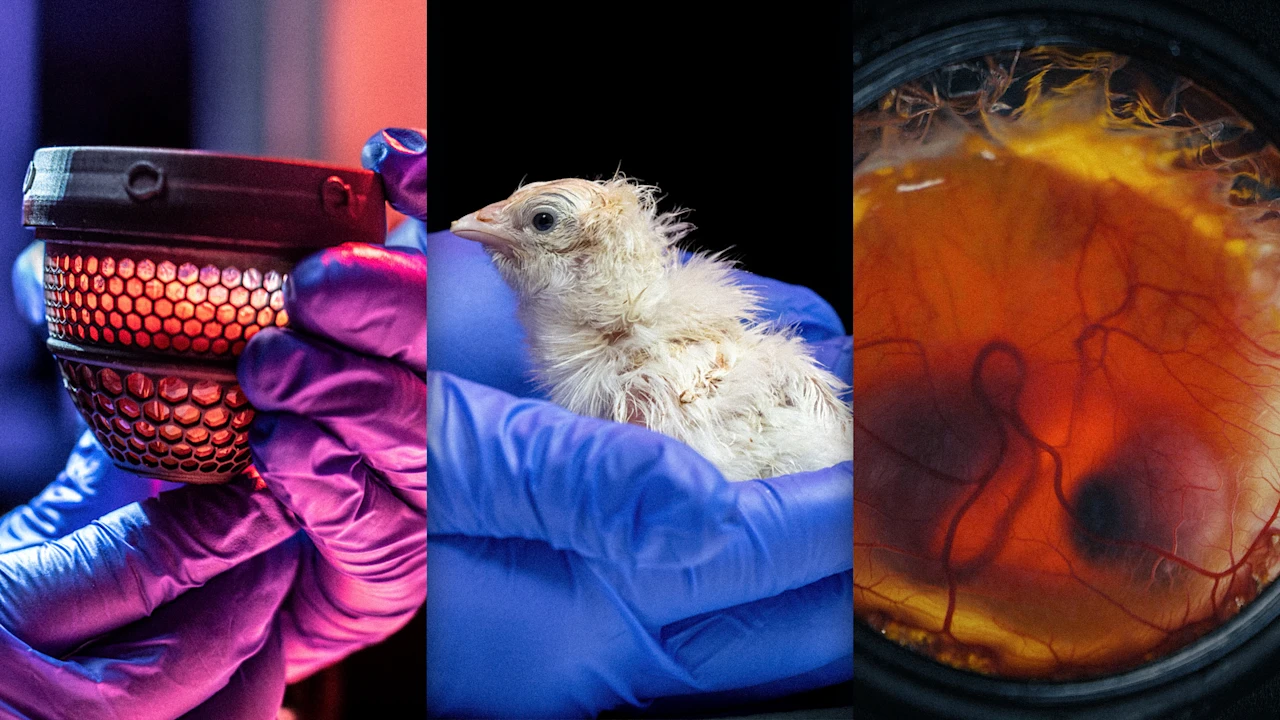
A flock of chickens living in a coop near Dallas, Texas, are ordinary birds. But they hatched inside 3D-printed artificial eggs in a lab at Colossal Biosciences, the Dallas-based “de-extinction” company.
Colossal designed a new system that functions essentially like a natural egg. One of the company’s goals: to use it to bring back the South Island giant moa, a bird that went extinct in the 15th century. But the technology could also be used to help breed currently endangered birds.
[Photo: Colossal Biosciences]
It’s not the first time that scientists tried to raise birds outside a natural shell. But previous systems, first developed in the 1980s, required a flow of oxygen and other interventions for the embryo to survive. (The oxygen also sometimes damages the birds’ DNA.) The new shell can sit inside an ordinary incubator. “We want to make sure that it is as close to an existing egg as possible,” says Ben Lamm, Colossal’s CEO.
[Photo: Colossal Biosciences]
R&D took nearly two years. The new design uses a rigid titanium lattice, shaped like a partial egg, lined with a permeable membrane that can hold an embryo. The shell was initially “more egg-like,” Lamm says. “But then we thought if we’re going to be reimagining the egg, how do we reengineer it in a way that we get the most flexibility out of it?” Leaving the top open means that it can be attached to a microscope, for example, and easily monitored as the embryo grows.
[Image: Colossal Biosciences]
To test the system, the team carefully moved chicken embryos from regular chicken eggs to the new shell. When the chick is ready to hatch, it can pop through a thin membrane at the top; staff also monitor them to help them get out. Every chick that made it to term is now a healthy chicken, Lamm says.
To raise a giant moa, the company would need to build a much larger version—the bird was as tall as 12 feet, with eggs as much as 80 times larger than a chicken egg.
[Photo: Colossal Biosciences]
The company’s controversial process to bring back extinct species involves sequencing surviving fragments of DNA, comparing it with living relatives, and using gene editing to modify related species to produce embryos that are raised by a surrogate. (When Colossal announced that it had “brought back” dire wolves, many scientists argued that they were wolves with a handful of dire wolf traits, not actually dire wolves.) In the case of the giant moa, since no living bird is large enough to act as a surrogate for the egg, an artificial system is necessary.
You might ask: why bring back this particular bird? Lamm’s argument is that we need the tools of de-extinction to deal with the current crisis; the moa is a way to learn. “If you look at the trend line, it’s forecasted that we could lose half of biodiversity in the next 25 years,” he says. “It’s better to have a de-extinction toolkit and not need it and not have it. Unfortunately, I do think you’re going to need some of these technologies.”
[Photo: Colossal Biosciences]
For birds that are currently endangered, conservation organizations could use it to breed birds that are difficult to breed in captivity, and that don’t have readily available surrogates to raise eggs. Scientists could genetically modify other birds to produce the endangered species, which could be raised inside artificial eggs tailored to the right size for each bird.
Of course, it doesn’t solve the bigger problem: if species are going extinct because forests are plowed down for farming or development, or because climate change is fundamentally reshaping ecosystems like the Amazon, raising more birds won’t mean that they can survive in the wild. Global governments need to deal with those issues, Lamm says, “but I think that giving some of these countries and some of these different NGO partners the ability to have the animals both in sanctuaries and in captive breeding locations is a solid start.”
After losing a boardroom power struggle with Apple CEO John Sculley, Steve Jobs was exiled to a small building across the street from Apple’s headquarters. It was May 1985. He and his colleagues called his new office “Siberia.”
Corporate reports stopped flowing to his desk, and executives stopped calling, leaving him bored and lonely. “It was amazing to see how ostracized he was in the Valley,” recalled Susan Barnes, a Macintosh financial controller who had previously reported to him. “It was really cruel.”
Jobs is remembered as the visionary who returned to Apple, the company he cofounded, in 1997, and saved it from near-bankruptcy. But before the comeback, he made a series of leadership decisions that destabilized the company and left it drifting toward death.
An overlooked truth: the instincts that made Jobs extraordinary, his perfectionism, his force of will, his refusal to compromise, also nearly destroyed Apple in its early years. After he left, Jobs spent twelve years failing at a company called NeXT, and those failures laid the foundation for Apple’s resurgence with the iPod, iPhone, and iPad.
Here are five times Steve was wrong and learned from his mistakes:
1. He made himself the center of every decision
By early 1985, Apple had splintered into warring factions. Jobs undermined Sculley to colleagues and challenged his every decision. “I am the board,” Jobs, Apple’s chairman, told one executive. Sculley’s supporters stormed the human resources department to complain. As one executive observed, no one knew who was really running the company.
The civil war paralyzed Apple at the worst moment. Macintosh sales were declining, IBM and its clones were eating market share, and for the first time in its history Apple laid off employees, more than 1,200 of them, and announced its first-ever quarterly loss. The company secretly entered talks to sell itself to General Electric.
By the time the board sided with Sculley and stripped Jobs of his authority, the internal war had already cost Apple months of progress.
That autumn, Jobs left Apple and started a new computer company, NeXT. The pattern followed him. Ignoring the warnings of his cofounders, Jobs rushed out the first NeXT computer, called the Cube, in October 1988 with an unfinished operating system. The price was more than double what its target customers said they could pay. Selling only a few dozen computers a month, the company eventually laid off half its workforce and abandoned hardware entirely.
When the founder becomes the only voice in the room, the company has nothing to fall back on when the voice is wrong.
2. He built for his own taste instead of the market
Between the Super Bowl commercial, the famous keynote, and the promise of a “computer for the rest of us,” the Macintosh launch in January 1984 became one of the most mythologized product launches in American business. For the first hundred days, shipments were strong and the Mac looked poised to succeed.
But the machine had no hard drive, extremely limited functionality, and a price tag of $2,495, almost $8,000 in today’s dollars. The first wave of buyers loved it. At that price, there was no second wave. The Mac was a beautiful machine that regular customers simply couldn’t justify buying.
The commercial disappointment helped trigger the power struggle with Sculley, Jobs’s ouster, and twelve years of strategic drift that nearly killed Apple.
3. He shipped before products were ready and blamed his team when they fell apart
In early 1985, Jobs pushed Apple to release the Macintosh Office, a version of the Mac aimed at corporate buyers. Its technical heart, a device for sharing files across office computers, was severely delayed and not ready to ship. The product landed to weak sales, accelerating the internal crisis that would end with Jobs’s removal months later.
At NeXT, he repeated the pattern. After the Cube was released, NeXT cofounder Dan’l Lewin presented Jobs with a list of problems piling up. Rather than fix them, Jobs blamed the sales team. “We’re so far away from selling anybody anything right now,” Lewin pushed back. “You don’t want to hear it, but this is not a problem in sales.” So Jobs demoted Lewin and announced it in an email to the entire company.
4. He couldn’t kill what wasn’t working
When Gil Amelio became Apple’s CEO in 1996, he kept hearing the same phrase from engineers: “Steve Jobs can get away with whatever he wants, so I’m going to do whatever I want.”
By then, Apple had lost all focus. The company had released more than seventy products in a single year, including a $6,500 laptop that caught fire and had to be recalled. Apple had poured $500 million into a new operating system called Copland that never shipped. Nobody could decide when to cut their losses.
Jobs spent a decade at NeXT making the same mistake, refusing to abandon his hardware business long after his advisors told him it was finished. But when he returned to Apple in 1997, he killed 70 percent of the product portfolio. The visionary who once couldn’t let go of the beautiful black Cube had learned, at enormous cost, that survival sometimes means letting go of the product you love.
5. He treated the people he needed as obstacles
On Super Bowl Sunday in January 1985, Apple aired a follow-up to its iconic “1984” commercial. Called “Lemmings,” the ad depicted blindfolded businesspeople marching off a cliff. The message to corporate customers: you’re idiots if you don’t buy our product.
At NeXT, Jobs called his distribution partner’s stores “ugly.” He blew off lucrative meetings arranged by his biggest investor, Ross Perot, the Texas billionaire and soon-to-be presidential candidate.
So Perot delivered the lesson himself. At a dinner with NeXT executives and corporate customers in San Francisco, Perot asked all the customers to stand. Then he turned to everyone still sitting, Jobs included: “Now, everybody who’s sitting down, applaud these people who are standing up, because that’s why we’re here.”
It took twelve years of humbling for Jobs to absorb these lessons. By 1997, he had learned to step back, delegate, and let go. He chose his battles instead of fighting every one. The tantrums that had defined his management style ebbed, and instead he listened to his lieutenants in Monday morning staff meetings, implemented their advice, and built an executive team at Apple that held together for eight years.
“Sometimes I go for ‘best’ when I should go for ‘better,’” he later admitted, “and end up going nowhere or backwards.” It was the kind of admission the younger Steve could never have made.
Google recently announced its partnership with Accenture, Deloitte, and McKinsey—backed by a $750 million fund—to speed up enterprise adoption of its tech stack.
I believe that rather than accelerating the successful adoption of AI, this partnership will kneecap it—and break down trust in the wider consultancy industry in the process.
Why? Because the success of both of these things is premised on trust. Enterprises, having come through a rough period of hype-driven spending on artificial intelligence, are now looking for AI investments they can trust to deliver results. In that search, they’re turning to their trusted consulting partners to support them through the digital transformation.
Yet through this commercial partnership, these big-ticket consultancies have tied their bottom lines directly to how much AI they can sell—putting this into direct conflict with their commitment to deliver results to their clients above all else.
If Google’s sales goals and the needs of the enterprise clients diverge—which, as we will get on to, is likely to occur—then the consultants will have to pick a side. I don’t want to be too pessimistic about my own industry, but the cash-flush AI lab seems likely to win at least some of those tussles.
Uncertainty and vulnerability
But, is it all bad? Surely closer ties will facilitate more seamless rollouts, support faster execution, and offer discounts? There are certainly benefits. It’s also not uncommon for consultancies to have partners (my consultancy counts Xerox as a client and has clearance to sell Xerox solutions to other clients).
The difference is that AI is developing at hyper speed. That creates uncertainty in humans and vulnerabilities in technology. Objective, balanced counsel is more important than ever under these circumstances.
First, the “best” technology is constantly changing. Over the past three years, ChatGPT, Gemini, and Claude have each, at various times, pulled ahead of the others in terms of capability. Another DeepSeek-style challenger could come out of left field and displace them all tomorrow.
An objective AI consultant should be promoting model flexibility for long-term resilience from shocks, including in prices. I fear Google’s new $750 million partnership—and, for what it’s worth, OpenAI’s very similar Frontier Alliance, announced in February—is selling dependence, which could very quickly lead to frustration with the technology and its new salespeople.
Second, even the most technologically smart enterprise clients can’t, and may never, deeply understand AI; even its architects don’t really know how it works. These clients are in the dark—and are turning to consultancies to help them review their options, strategize implementation, and then execute it with guardrails.
The consulting industry should be playing the cool, calm, and collected mediator role—cutting through the sales speak of Big AI and the pressure on and within enterprises to innovate with AI. If, instead, we’re further contributing to the furor or pushing our own agenda or that of a partner, then our clients may begin cutting us out of the loop.
Third, enterprises are careful beasts. They have reputations to defend and many stakeholders to safeguard. Security and compliance are, rightly, high on their agenda. AI’s impact on these isn’t yet fully understood, but we know it to be massive.
A risky play
If consultancies are incentivized to sell AI and sell it fast, it seems likely to me that speed of adoption will increasingly trump security and compliance in consultants’ decisions and advice. That’s a very risky play, quite literally.
Finally, because there has been such a rush to deploy AI quickly—fueled in part by large consultancies’ scaremongering—a lot of resources have already been spent on AI. Much of this poured down the drain, with little to show for it. Enterprises’ boards have had enough, and now need to see results.
If, then, the consulting partners clients have trusted to deliver those results start sounding like AI salespeople, and seem to be neglecting long-term resilience—which comes with model flexibility, security, and compliance—or taking advantage of a lack of understanding of AI to upsell, then clients’ trust in these supposed paragons of objectivity, and the technology they sell, will nosedive.
A July 2025 MIT report found that 95% of enterprise gen AI initiatives were delivering zero measurable return. This jolted the enterprise landscape and contributed to an AI-stock selloff. Consultants and AI labs should take note.
Enterprise AI clients pay attention to results, and they need to see returns on their investments.
If we now see AI rushed through by consultancies partnered with AI labs, then yet more dreary figures will emerge about unsuccessful AI initiatives. This will dampen appetite for AI and come full circle for both the consultancies and the labs—putting clients off them both in equal measure.
In 2011, a study of Israeli judges found that in the early sessions of the day, prisoners had roughly a 65% chance of parole. By the end of each session, that probability had fallen to nearly zero. After a break, it returned to 65%. The judges didn’t vary. The cases didn’t get harder. The types of prisoners didn’t change. What changed was the judges’ cognitive resources.
I’ve thought about that study many times, working with leaders. Not because they’re making parole decisions, but because the underlying dynamic is the same. When cognitive load climbs beyond a certain threshold, the quality of thinking degrades in ways we can’t detect from the inside. The brain doesn’t send a notification. What it sends instead is a set of signals, many of which look like the opposite of the problem. Five stand out.
You feel sharp
One of the paradoxes of high cognitive load is that it produces a sense of focus. When the brain is overwhelmed, it narrows attention, conserving resources by shutting down peripheral processing. You are concentrating. You feel sharp. What you’ve lost is your awareness of everything outside this tunnel: the team’s emotional state, the signal buried in an email chain, the strategic risk sitting just adjacent to the immediate problem. I encounter this regularly with leaders under sustained pressure. They often describe feeling in the zone at precisely the moment their breadth of thinking has contracted most severely. Focus that comes with a loss of peripheral awareness isn’t a cognitive strength. It’s a cognitive symptom.
Your confidence is up
Here is the deeper paradox: the more cognitively overloaded a leader becomes, the more confident they tend to feel. Under high cognitive load, the brain falls back increasingly on what is often called System 1 thinking — fast, intuitive, pattern-based processing. The supervisory function that questions, second-guesses and looks for counterevidence — System 2 — is the first thing to go. The internal voice that says, “Are you sure about this?” goes quiet. Leaders interpret the silence as certainty. And research has repeatedly shown that individuals under cognitive load express higher confidence in their judgments precisely when their decision quality has degraded most. If you’ve been working at full throttle for several weeks and find you have unusually few doubts, that’s not necessarily clarity. It’s probably just that your self-monitoring has gone offline.
You become more decisive
Another consistent finding is that people under high load become significantly more likely to act quickly on new information — in studies, about 22% more likely. This matters because decisiveness is something leaders are encouraged to display. The executive who cuts through, doesn’t dither, and makes the call is celebrated by organizations. And sometimes their judgment really is good. But under cognitive load, the same behavior has a different cause. System 1 is operating without oversight from System 2. The decision may be fast and feel confident, but it’s quicker because it hasn’t been examined. So, if your decisions are all landing in the same direction of favoring speed over scrutiny, always pulling toward the familiar over the novel, then that pattern is worth interrogating.
People start to irritate you more
This one is less obvious. Research has found that high cognitive load reduces both behavioral and neural empathic responses. An overloaded brain is simply less able to read other people’s emotional states. This isn’t a character shift. It’s a resource allocation problem. The same neural processing capacity that handles complex reasoning also handles social inference, and when you’re cognitively overloaded, the brain economizes. Leaders in this state typically don’t notice the shift in their social processing. What they notice is that colleagues seem to be underperforming, or that meetings feel fractious, or that people appear harder to manage than usual. The irritation of frustration is then a secondary symptom. Because when you can’t readily interpret others’ reactions, their behavior becomes harder to anticipate, which makes it feel more difficult.
You’re making dumb mistakes
Finally, the most obvious and concrete signal. Under sustained cognitive load, working memory errors multiply; not in complex, novel tasks, but in familiar ones. Things like missing emails you’d normally catch, writing responses with simple errors, and walking into meetings without documents you’ve specifically prepared. Such out-of-character lapses are working memory failures – the brain carrying too many processes simultaneously, so routine execution is the first thing that drops. Most leaders attribute these to tiredness. They’re right that tiredness is involved. But the errors are often diagnostic of something deeper, like a memory system running over capacity, not just running slow.
What you can do about it
Most of the standard advice, rest more and take breaks, isn’t wrong, but it operates at the wrong level. Because it treats cognitive load as something to recover from rather than something to prevent. Take these two techniques.
The first is what psychologists call implementation intentions: if-then rules set in advance about how you’ll make decisions under specific conditions. “If I’ve had fewer than four hours’ sleep, I’ll get a check on any high-stakes decisions.” The point isn’t the specific rule. It’s the pre-commitment, because when System 2 is depleted, you can’t rely on it to notice the depletion. So, you need a solution that engages in its absence.
The second is chronotype alignment: wherever possible, scheduling your highest-load cognitive work at your neurologically optimal time, not when the calendar happens to be free. It’s not always possible, of course, but some redistribution may be. For most morning types, that’s two to four hours after waking. After that point, the windows for genuinely high-quality strategic thinking are limited, and decisions made in them carry the implicit costs documented in the parole study.
Prevention, then, is better than cure. Not least because, after the fact, we may not believe we did anything wrong. Remember those Israeli judges? When told about the research findings, the judges didn’t believe them and disputed them. They were so confident their decisions had been consistent and fair throughout the day that it was easier for them to believe the data was wrong than that they were. Their confidence in their own judgment was, like all of ours, entirely unrelated to its actual reliability.
Every institution was once a design decision. Pierre de Coubertin didn’t stumble into the creation of the modern Olympic Games, he painstakingly designed them around a clear civic purpose: that sports could model fair play, international respect, and the ethics of effort over victory.
Within two years of proposing a reestablishment of the ancient games, he convened leaders from around the world to codesign the International Olympic Committee; that first Olympic Congress led to the first modern games in Athens in 1896. Eight years after that, FIFA’s founding charter echoed the same ambition in service of administering the global game of soccer toward “friendly relations.”
Today, both institutions have drifted so far from those origins that the contrast is almost darkly comic: De Coubertin worked without pay for decades; his spiritual successors at FIFA were convicted of accepting $150 million in bribes. Yet the underlying idea—that the power of sports to transcend political and cultural divisions gives them a unique social responsibility—has never been more relevant or more needed.
The world’s largest shared cultural event, the FIFA World Cup, is anticipated to draw 5 billion viewers this summer. It comes to the United States (as cohost alongside Mexico and Canada) at a time when capacity for shared civic experience is at a historic low. That is either a tragedy or an opportunity. Where we go from here depends, as design decisions always do, on intentionality. On whether people with influence over sports choose to ask, seriously, what are sports actually for?
A vision dedicated to humanity
De Coubertin was not naive. He delivered his first public lecture on athletic chivalry in 1892, to an unsuspecting audience of French officials and academics, in full awareness that he was fighting against both the commercialism of the age and fractious national politics. It was a time of wars, political violence, and the technology-induced economic uncertainty of the Industrial Revolution.
His core insight—borrowed from classical antiquity, British public schools, and the ceremonial sporting traditions of Native American tribes, who used lacrosse to settle disputes and honor shared beliefs—was that competitive sports create moral architecture. That when people play by the same rules, concede defeat with dignity, and respect excellence in an opponent, they are practicing something rarer and more valuable than entertainment. They are practicing civilization.
He spent the next four decades building that vision without a salary or institutional backing, funding the early Olympics from his own inheritance until it ran out, and then from donations. When he died in 1937, his heart was buried separately at Olympia, Greece, at his request. It is hard to imagine a more literal expression of a life dedicated to an idea—though it was left to others in more enlightened times to expand his vision beyond his own prejudicial views on race and gender.
FIFA’s founders understood the same thing. When they formed the federation in Paris in 1904, they were explicitly building infrastructure for international respect: a curated space where nations would compete and, in competing, learn to coexist. The World Cup, launched in 1930, was a physical expression of that: countries that could not agree on much else agreeing to show up and play by the same rules.
What happened next is well documented: The institutions designed to model civic virtue became, over decades, vehicles for the concentration of private wealth and geopolitical power. FIFA’s Zurich headquarters became synonymous with corruption, culminating in the 2015 Department of Justice indictments.
The most recent World Cup host selections have been defined more by lobbying, sovereign wealth, and geopolitics than by any coherent vision for the game’s civic code. The IOC has navigated its own version of the same drift. Scandal may be more associated with these organizations than civility. The founders would find the current state of their institutions not just disappointing, but structurally the opposite of what they designed. The 2026 tournament, with its eye-watering ticket prices and geopolitical posturing, is the latest chapter of that drift.
The last shared space
And yet 5 billion people will watch the World Cup this summer. That number demands to be taken seriously, as a responsibility and opportunity.
While religion plays a smaller role in modern life and town squares have been replaced by algorithmic feeds, the U.S. surgeon general called loneliness a public health crisis in 2023. Gallup’s global employee engagement data shows most people feel disconnected from their work, their colleagues, and their communities. In this landscape of fragmentation, sports—specifically global sport at its largest scale—may be the strongest magnet we have to coalesce people around a shared experience that is genuinely emotional and cross-cultural.
When Brazil’s Rebeca Andrade won gold in the gymnastics floor competition at the Paris Olympics, Americans Simone Biles and Jordan Chiles—who had just competed against her—spontaneously bowed to her in a gesture of deep respect and admiration. In front of a global audience, elite athletes discarded competitive or national animosity and instead modeled a refreshing generosity of spirit.
This expression of moral beauty was celebrated around the world, and became one of the highlights of the Games. As an Olympics moment true to de Coubertin’s ideals of mutual respect and civility, it follows a legacy of athletes challenging popular prejudices, as Jesse Owens, John Carlos, Tommie Smith, and Cathy Freeman all did in prior Olympics.
These moments demonstrate what’s possible. The question is whether we will protect the conditions that make them possible, or whether we will continue to strip them away in the pursuit of political gain, maximizing revenue, gambling integration, and the next broadcast rights deal.
The stakes couldn’t be higher as the 2026 World Cup arrives in the U.S., a nation whose civic fabric is under extraordinary strain. Institutions are distrusted, and common ground is scarce. Consider that 8 in 10 people in the U.S. say they can’t agree on basic facts with the opposing political party. Almost every shared cultural space, from news media to social platforms, seems designed to drive us further apart in pursuit of “engagement.”
The appetite for real, joyful shared experience is enormous and largely unmet. Whether sports step into their full potential or slide into commercial transactionalism is not predetermined by fate, but a product of design choices.
The redesigners are already at work
The good news is that the counter-design is already underway, in places where leaders chose long-term purpose optimization over short-term commercial optimization.
After moving with his family to Oakland, California, one of the coauthors of this piece, Mike Geddes, experienced how a fiercely proud community was torn apart by the loss of every single one of its professional sports teams, who each abandoned the city for richer pastures over the course of a decade. In response, he cofounded Oakland Roots & Soul. Designed from the ground up to be the first purpose-driven professional soccer club in America, it raised nearly $4 million by offering fans equity in the team—the most successful community investment round in American sports history.
The team now occupies the Oakland Coliseum, an iconic community anchor that would otherwise have sat empty. Having demonstrated that a community will embrace a sports team built around values, the urgency now is for the broader sports industry to redefine success, from profit extraction to long-term community and organization vitality.
Other organizations are doing the same: Parkrun gathers more than 10 million people weekly in 2,500 communities across 23 countries: free, inclusive, and built entirely around participation. Unrivaled, the professional women’s basketball league cofounded by Olympians Napheesa Collier and Breanna Stewart, opened with the highest average salaries in women’s professional basketball history and full equity ownership for every player in the league. Savannah Bananas have taken baseball by storm, redesigning the game-day experience around a “fans first” philosophy to make it more affordable and appealing to families. In doing so, they have become a revenue and marketing sensation valued at more than $500 million.
These are not charities. They demonstrate that a different architecture produces different outcomes, for fans, communities, and for the business itself. Simone Biles, who has defined herself as much by moral courage as athletic brilliance, was named the world’s most marketable athlete as recently as 2024. It turns out the civic instinct and the commercial instinct are more aligned than the current structure of global sports would suggest.
A narrow window—and a clear purpose
In a survey of 1,000 CEOs, 7 in 10 said they understood purpose as a strategic driver of business success. Sports leaders have been slower to catch up, but the logic is identical: The enduring, world-spanning power of sports owes everything to their encapsulation of humanity’s highest aspirations. Strip those out and you are left with an entertainment product competing in an extremely crowded market, with no particular reason for the emotional hold it currently has over billions of people.
De Coubertin’s great insight was not sentimental. From an era of deep instability, distrust, and violence, he saw the potential to design sport as a space where shared humanity is practiced, with joy and celebration. Once again, that is one of the scarcest and most valuable things in the world.
This summer will be a mirror held up to our culture, but it need not be the blueprint for what comes next. What we do with that reflection will depend on the choices made now, by sponsors, broadcasters, city governments, leagues, and the millions of us who decide what we show up for. Indeed, any future vision of boundless extraction based on how the planet’s people, economy, and environment have operated for the last 100 years will not survive the changes to come.
The future of sports is not preordained. They will be defined by what we design—or by what we leave to chance.
Imagine walking into your elementary school library and finding it transformed overnight into a forest at dusk. Mossy green canopies arch over the bookshelves. Glowing mushrooms create a path between display cases. Twinkle lights flicker through the leaves like fireflies.
This is the Everglow Forest, one of the recent book fair themes produced by Literati, a startup that currently runs about 4,000 book fairs a year. At some schools, librarians and PTA volunteers build it out into something approaching an art installation, creating a hand-crafted world that children want to wander through for hours.
For a seven-year-old, clutching a crumpled twenty-dollar bill, the message is that books are magical and worth celebrating. “I view kid’s books as an art form,” says Jessica Ewing, Literati’s founder and CEO. “I want to make sure that we’re giving these books the treatment they deserve.”
Ewing left a job at Google to launch Literati a decade ago. While hundreds of thousands of children’s books are published every year, Ewing realized many parents struggled to find high-quality books tailored to their child’s interests. Literati uses data to pair a child with the right books. It first applied this approach to subscription boxes, but three years ago, it expanded into book fairs, quickly becoming the biggest competitor to the Scholastic Book Fair.
Last month, Literati was acquired for an undisclosed amount by Trustbridge, a private equity firm that owns many children’s book publishers, including Candlewick and Holiday House. With this infusion of capital, Ewing wants to grow the book fairs by expanding from the Midwest and South, into the Northeast and the Pacific Northwest.
“The book fair is an experience that 33 million kids get every year,” says Ewing. “It’s such a cultural institution that no one had really taken an interest in changing it, so there hasn’t been meaningful competition in decades.”
Ewing is betting that the kids—and their librarians—are ready for something different. And after a decade of building toward this moment, she finally has the resources to deliver it.
[Photo: Literati]
Stitch Fix for Storybooks
To understand how Literati ended up here—going toe-to-toe with the Goliath that has dominated the school book fair since most of us were in elementary school ourselves—you have to go back a decade.
Ewing has always believed that pairing a child with a book they love could be a transformative experience, spurring a lifelong love of reading. From her career in tech, she had a sense that algorithms could help with this process. After all, we live in an age when Netflix, Spotify, and Stitch Fix use technology to help consumers find the next movie, song, or outfit they will love.
Her original vision was to create a curated monthly subscription box, personalized to the child’s age, reading level, and tastes. She brought on a head of data science from Stitch Fix, and raised more than $100 million in venture capital.
“We built a tremendous amount of tech and data science to be able to personalize the box to every child,” Ewing says. “We were building tech to make a very analog experience more magical.”
But as the subscription business was growing, Ewing realized it was possible to bring Literati’s expertise to book fairs, which haven’t changed much over the years.
[Photo: Literati]
Rebuilding the Book Fair From the Shelf Up
As she gathered intel about Scholastic Book Fairs, she discovered that many librarians and volunteers found it laborious to set up the tables and books. (Scholastic has not responded to our request for comment.) Schools often didn’t raise much money from the event.
And more importantly, Ewing found that the quality of products on sale wasn’t as good as it could be. There were lots of best-selling books, featuring popular characters and series, like the Dog Man, the Diary of a Wimpy Kid, Captain Underpants, and the Babysitters Club.
Literati has these books too, but Ewing felt that there were many other great books coming out of children’s publishing that weren’t making it onto the tables. And interspersed among the books were many plastic toys and keychains.
“I remember thinking this is a big opportunity,” Ewing recalls. “The book fair, to me, should be a work of art. This is the first—or maybe the only—bookstore experience many kids will ever have. It should be about book discovery, not toys and trinkets. And it should be beautiful.”
In 2022, Ewing spotted her opening. Follett Book Fairs, which had launched five years earlier, was shuttering under the weight of pandemic losses. Literati swooped in, buying Follett’s entire book fair operation—the infrastructure, the inventory, the distribution centers, and the thousands of school relationships it had built. Overnight, the fairs were rebranded as Literati Book Fairs.
Ewing set out to build the most elevated book fair experience possible. To take the pain out of setup, Literati designed roll-out cases that arrive prestocked with books—the whole fair unfolds in 45 minutes flat, sparing librarians and PTA volunteers the hours of unboxing and shelving that the job has traditionally demanded.
[Photo: Literati]
Literati creates a seasonal theme for each book fair, which the company incorporates into its bookcases and signage, and schools can choose to add to with their own decorations. Recent ones have included Under the Sea, Everglow Forest, and Story Arcade. Ewing has been delighted—and a little astonished—by how far some schools run with it, treating the theme less as decor and more as a license to build. At the Texas Library Association’s recent annual gathering, Literati threw an Oscars-style awards ceremony for book fair coordinators, handing out trophies to the librarians and PTA parents who had built immersive installations on shoestring budgets.
But the real star is the books themselves. Literati sells real trade editions—the same ones you’d find at your local indie bookstore—not the cheaper paper reprints that have long been a book fair staple. And every fair is curated. Literati’s software scans millions of titles, surfacing thousands that might work in a given school. From there, a human team hand picks the assortment that ships out, tailoring the selection to the community.
There are many considerations shaping the books that are chosen, but the goal is for the stories to resonate with the life experiences and preferences of the students. Communities with students of South Asian heritage may see more books with South Asian protagonists, for instance, and more urban students might find more books in urban settings. Literati also offers books at a wide variety of price points, and makes sure the book selection maximizes students’ budgets. And after Literati has had a fair in a school, it will use sales data to parse what kinds of book did well there previously.
“The book fair that would work for the Upper West Side is not the book fair that works for a Title 1 school in Texas,” Ewing says. “Those are two totally different experiences in terms of what both parents and kids want.”
One thing you won’t find at a Literati fair: plastic tchotchkes. No pencil toppers, no slime kits, no erasers shaped like hamburgers. Ewing wants the books to do the work.
[Photos: Literati]
The Economics of a Book Fair
Literati has also rebuilt the economics of the book fair. Like other book fairs, Literati doesn’t charge to host an event and gives schools a portion of sales in cash or credit to use on the Literati website. Companies’ margins for book fairs tend to be quite low, and the business model only works at a large scale. This is why Scholastic has maintained its dominance for so long.
But Literati’s innovation has been to layer online tools onto the in-person event—teacher and librarian wishlists, plus a direct-donation system—that let the broader community chip in toward a school’s library while the fair is running. As a result, schools using the new tools are pulling in roughly five times what they made before. One school that historically netted $2,000 from its fair recently brought in $13,000, thanks to additional donations from parents and the community.
[Photo: Literati]
Ewing is especially proud that a large share of Literati’s clients are Title 1 schools, where high concentrations of students come from low-income families and where the library’s annual budget is often funded almost entirely by whatever the book fair brings in.
Some librarians have asked why Literati doesn’t sell plastic toys—the junk, after all, drives revenue that can be funneled back into books. Ewing’s answer has been to keep building better fundraising tools, so schools can hit their numbers selling only what they’re proud of.
“I don’t think schools should have to choose between raising money and raising readers,” she says.
The strategy is working. The company has drawn partners like Steph Curry’s Eat. Learn. Play. foundation, which this year is funding a Literati fair at every school in the Oakland Unified district. Literati is approaching profitability. And in a category where competitors keep folding—Follett, plus the beloved Southeast regional player Bedford Falls—it has carved out a credible alternative to Scholastic.
[Photo: Literati]
Decades, Not Quarters
Now, Literati is ready to go bigger, and Ewing thinks Trustbridge is exactly the partner to get her there. The Hong Kong-based firm already owns a portfolio of acclaimed children’s publishers, including Candlewick and Holiday House, with winners of the Newbery and Caldecott medals on their shelves.
“They have this thesis around children’s books,” she says. “They believe in the enduring value of quality over time, which is interesting from an investor perspective. They think in decades, not fund cycles or years.”
Trustbridge took on Literati’s debt, refinanced the business, and made clear it was investing for value creation, not value capture. Literati, Ewing is quick to add, will stay an open platform—no favoritism for the Trustbridge publishing houses, no closed door to anyone else.
The contrarian nature of the bet isn’t lost on her. “Book fairs is not where the hot money is flowing,” she says with a laugh. “It takes a long-term thinker and a big-picture thinker to get past the CapEx and think about what this can become.”
Her own answer is starting to take shape: a year-round literacy partnership with schools that reaches well beyond the once-a-semester event, powered by personalization tech, data science, and fundraising tools that actually move the needle.
For Ewing, the deal isn’t an exit. It’s an accelerant. “I’m not cashing out,” she says. “I’m doubling down.”
Your four-year-old needs a bike. The cheap ones from a big box store will work, sure—but they’ll be heavy, clunky, and harder for them to learn on. The premium Woom bike weighs half as much—but it costs $400. You want the best for your kid, but do you want to drop that much for something they’ll use for a few months?
With a bit of internet sleuthing, you might come across an alternative. There’s a 50,000-person Facebook group devoted entirely to buying, selling, and trading used Woom bikes across the United States. And the brand noticed this group bubbling up.
But Facebook Marketplace has limitations—transactions aren’t always secure, and buyers can’t easily search for specific models in their area. So the company has just launched its own resale platform on its website (it’s currently building up inventory). “Now you have a trusted way to feel comfortable,” says Lindsey Markus-Yosha, Woom’s head of marketing. “This is a way to have it backed by the brand and really showcase that long-term value of our bikes.”
Woom is part of a broader trend. Over the last few years, parents have realized that they don’t need to choose between cheap, low-quality products and pricey, high-end products for their kids. Instead, 60% of American parents are now buying secondhand goods. The kids and baby resale market is projected to hit $12.8 billion by 2030, up from $7 billion in 2021.
Now, premium brands like Woom want a piece of the action. It would be too costly and labor intensive to build a secondhand program themselves, so they’re partnering with Archive, a company with expertise in helping brands get resale up and running quickly. Archive has been focused on the children’s market, launching secondhand sites for the toy brand Lovevery and the clothing label Hanna Andersson. With each brand, the ultimate goal is to make resale a revenue driver.
In the past, many brands saw secondhand as a threat to their business. Today, there’s a growing sense that it’s a gold mine to be claimed.
[Photo: Lovevery]
The Infrastructure Problem
Ryan Rowe started Archive in 2020 with cofounder Emily Blumenthal with the goal of creating a better system. Many eco-friendly brands wanted to launch their own secondhand programs, but it was prohibitively expensive to build the resale websites and infrastructure needed.
“Only the biggest brands who had some very specific sustainability mission around it were able to enter the resale space,” Rowe explains, referring to labels like Patagonia and Eileen Fisher. “For everybody else, it was a very cost-intensive thing to do.”
Archive’s business model was simple: make resale accessible to more brands by driving down costs through scale and offering flexibility. Their first customer was M.M.LaFleur, a women’s workwear brand. But the kids’ category quickly became a sweet spot. Children outgrow everything, parents hate waste, and quality products hold value even after multiple kids have used them.
The company now offers three distinct models. For Woom, it’s peer to peer: Parents list their used bikes, other parents buy them locally, and the brand facilitates the transaction. Bikes are bulky and expensive to ship, but parents are willing to drive 20 minutes to save $200 on a premium product.
For other brands, Archive handles logistics. They collect returned inventory, inspect it, photograph it, and manage the entire resale storefront. “Our goal is to make it happen at scale,” Rowe says.
When Archive processes resale for dozens of brands at once, the pretransaction cost drops dramatically. They’ve built the infrastructure—warehouses, inspection protocols, pricing algorithms, customer service systems—that would cost a single brand millions to develop alone.
But what makes Archive’s approach truly scalable is that profitability isn’t an afterthought. For years, brand resale existed primarily as a sustainability initiative—companies would launch programs knowing they’d lose money. But sustainability programs that don’t generate revenue get cut when budgets tighten, making it harder for resale to scale.
“This is our reason for being at Archive—to displace fast fashion,” Rowe says. “If you spend $50 on a used item that cost $120 new versus a brand new item that cost $50, you can experience the difference in quality and you’re won over.”
[Photo: Hanna Anderson]
Making Money on Hand Me Downs
For children’s clothing brands, the resale math gets tricky fast. Hanna Andersson had been talking about resale for over a decade. Kara Carter, the company’s head of product, had been seeing customers passing down pieces through siblings or selling them at local consignment shops. The brand’s durability and “room to grow” sizing meant items held up beautifully through multiple kids.
But when it came to launching their own program, the numbers were brutal. A Hanna Andersson dress retails for $40 to $50. After a kid wears it, it might resell for $15 to $20. It’s impossible to build a profitable business around collecting, inspecting, cleaning, photographing, storing, shipping, and providing customer service for that $15 transaction.
“If you’re reselling like a $200 coat, there’s enough dollars in there to still make money if you’re selling it half-off secondhand,” Carter explains. “But for us, it’s harder to make it make sense.”
When Hanna Andersson’s team came across Archive’s peer-to-peer program, it was a breakthrough. By stepping out of the middleman role, Hanna Andersson could offer resale without drowning in overhead. The program, called Hanna-Me-Down, lets sellers post clothes on Hanna Andersson’s website; when someone buys, they send the product directly to the buyer. Sellers get 70% of the sale price in cash, or 100% in gift card credit toward new purchases.
Over 80% choose the gift card. And those customers spend two to three times as much as the credit value at the core brand. The resale program has generated more revenue on Hanna Andersson’s main website and brought in new customers. Baby customers especially use Hanna-Me-Down as a test drive to see if the quality lives up to the reputation before committing to full retail prices.
Finding Hidden Customers
[Photo: Lovevery]
For Lovevery, the financial equation works differently but the principle is the same: Resale has to make business sense, not just environmental sense. Lovevery makes premium educational play kits designed around specific developmental stages, with price points ranging from $80 to $200.
Cofounder Roderick Morris and his team always knew their products were durable, but didn’t realize just how much secondhand circulation was already happening without them.
Lovevery had around 600,000 paying customers but over 5 million social media followers. Morris wanted to understand this massive gap, so the company toured homes of people who followed Lovevery on social media but had never bought anything directly. “Pretty much all these homes we visited had secondhand Lovevery products in them, purchased from Facebook Marketplace or consignment shops, that were very well loved and well used,” Morris recalls.
This was a big miss because these parents didn’t have access to the emails that show parents how to use toys at different developmental stages, nor could they learn about complementary Lovevery products.
Since Lovevery’s pre-loved marketplace launched in 2024, it has generated upwards of 54,000 visits. Over 10 months, sellers listed 21,000 units, with around 1,600 selling monthly. Most importantly, 58% of visitors to the resale site were new to Lovevery’s customer database.
Customer acquisition costs in e-commerce can run $50 to $200 per customer depending on the category. Resale brings people in at a fraction of that cost.
[Photo: Woom]
Woom Joins the Party
For Woom, the newly launched resale program is a bet on replicating what other children’s brands have already done. Like Hanna Andersson, Woom is offering sellers the choice between cash or higher-value credit toward their next purchase—betting that most will choose credit and then spend even more. Like Lovevery, they’re hoping to convert the massive audience already using their products secondhand into direct customers who stay in their ecosystem as kids grow.
“It aligns with our brand values of supporting sustainability and driving that long-term customer loyalty,” says Markus-Yosha, the marketing head. And yes, she confirms, “it’s certainly a revenue driver as well.”
For years, brands worried that resale would cannibalize new sales. The data from Archive’s kids’ programs suggests the opposite: When done right, secondhand becomes a customer acquisition channel and a loyalty driver. Parents who start with a used bike might come back for a new one when their second child is ready.
“There is a day that will come where people can land on a brand’s website and hunt for where’s the resale link,” predicts Rowe at Archive. For children’s products, where quality matters but lifespans are short, that day might not be far off.
Fifteen years ago, tech investor Marc Andreessen published his famous essay, “Why Software Is Eating the World.” He predicted at the time that technology companies were tremendously undervalued, and that low startup costs and almost infinite scalability would lead software-based companies to dominate every industry.
You can see what he means. Today, the “Mag 7” stocks dominate the S&P 500 with market capitalizations in the trillions. Even startups like Anthropic and OpenAI are valued at hundreds of billions of dollars. Meanwhile, massive investment in data centers is reshaping industries from construction to energy.
But not so fast. While recent advances in machine learning have been exciting, it’s still unclear how much real value is being created. The truth is that we still live our lives largely in the realm of atoms and that isn’t changing. That’s why software is unlikely to ever eat the world, and why many of the most exciting technologies of the future will be rooted in physical space.
The economy is not digital
In his essay, Andreessen wrote, “Today, the world’s largest bookseller, Amazon, is a software company—its core capability is its amazing software engine for selling virtually everything online, no retail stores necessary.” Well, not really. While software remains a core part of Amazon’s business, today the company is firmly ensconced in the physical world, with not only retail stores but also hundreds of warehouses and a massive fleet of trucks.
It’s not just Amazon. Most of our economic lives are rooted in atoms, not bits. A quick examination of your monthly bills will likely show that most of your spending goes to things like housing, transportation, energy, food and, depending on your age, health care. That dwarfs what most people spend on phones, computers, and internet services.
In fact, a report by the International Data Center Authority found that the digital economy accounts for a mere 15% of global gross domestic product. That’s a lot of money in nominal terms, but it’s still dwarfed by the other 85%. That’s why Amazon went to the expense and trouble of investing in physical spaces. Even Netflix, another company Andreessen touted, is opening up real-life entertainment centers.
As much as we may seem glued to our phones, the physical world is where we live. It’s where we eat, work, meet each other, and have fun. It’s what nature evolved us for, which is why Zoom calls are never quite as satisfying as real-life encounters. Software has a big appetite, but the real world is simply too big and complex to be eaten.
Still, there is genuine opportunity in using software to shape the physical world in ways that unlock enormous value.
Matter is not digital
Materials are something we interact with constantly, often without thinking about them. We want our clothes to be soft and warm, our tools to have high tensile strength so they can do work without breaking. Some things require specific properties, such as the ability to conduct electricity or resist shattering on impact.
This has long been the realm of a fairly obscure field called materials science, and, traditionally, it has been something akin to a cottage industry. Scientists would begin with a set of desired properties and then, through a painstaking process of trial and error, often involving the testing of thousands of candidates, eventually find something useful.
But in the early 2000s, an MIT professor named Gerd Ceder began developing computational methods to predict new materials. That eventually led to the Materials Project at Lawrence Berkeley National Laboratory. Now, rather than testing thousands of candidates, scientists could eliminate most of them through digital simulations and then test the ones that remain.
Still, materials are not digital, so there will always be some loss in information when digital systems are used to model physical reality. However, we are beginning to see the emergence of non-digital architectures, such as quantum computers, that can model the physical world with far greater fidelity.
Biology is not digital
In 2024, Demis Hassabis and John Jumper won the Nobel Prize for their development of AlphaFold, an AI model that can predict, with incredible accuracy, the structure of proteins. This was a breakthrough of historic proportions because, much like computational approaches in materials science, it allows scientists to identify potential drug candidates hundreds, if not thousands, of times faster than with conventional methods.
The potential is mind-blowing. In 2023, Insilico, a Hong Kong-based biotech startup, advanced the first AI-generated drug candidate into human clinical trials. And there are currently dozens of potentially life-changing drugs in the pipeline that were discovered in a mere fraction of the time that it would take using conventional methods.
That’s impressive. But like materials, biology is not digital. No matter how ingeniously conceived and constructed, we still need to see how a therapy works on humans in the real world. We need to be sure that proposed cures are safe, nontoxic, and an improvement on existing molecules and methods. That, and not drug discovery, is what makes up the bulk of development costs.
A 2024 paper suggested that AI discovery could double the overall success rate from 5% to 10% to 9% to 18%, which is significant. Still, the claims of the tech optimists that “AI will cure cancer” are more than overblown. Anybody who has spent any time in a hospital will tell you that healthcare remains incredibly labor-intensive, requiring capable, caring professionals. And there is an extreme shortage of them in the U.S., which software will do little to solve.
We need to focus more on atoms, less on bits
Fifty years ago, in 1976, life expectancy in the U.S. was 72 years, versus 78 today. American families typically had one car and one television. Houses were smaller, nutrition was worse, we polluted like hell, and there was no internet. We spent much less time with our screens and more time with each other.
Today, it’s easy to see how many things have gotten better, but it’s just as easy to see how others have gotten worse. While in the aggregate, incomes have improved, most of that has gone to top earners, leaving many households feeling worse off. While we have amazingly cool gadgets, costs for basic needs, like housing, healthcare, and education, have soared.
The truth is that we’re very good at innovating in the digital space because it’s fast, cheap, and low risk. But the real opportunities are in the messy, physical world. So we’re ending up with lots of incremental digital innovation and not enough transformational change in the real world.
In sum, it’s hard to see how we’ve become meaningfully better off over the last 50 years. For all of the Silicon Valley blather, most American families are materially struggling and our mental health is declining. This isn’t because of some exogenous shock, but because of choices we’ve made. We have the technology to improve our lives, but the benefits are not accessible to most.
What we have to reckon with is that the world is not digital. We live, eat, travel, and breathe in physical spaces, and no amount of algorithms and data centers will change that. As philosopher Martin Heidegger pointed out long ago, technology is less a creation than it is an uncovering. It brings us possibilities, but it is our responsibility to enframe and direct them in ways that will benefit us.
We live in a world of atoms, not bits. Technology matters only if it makes our lives better.
In 1985, Intel was in trouble. Japanese competitors were dominating the memory chip market that Intel had helped invent. Inside the company, leadership debated what to do. During one conversation, Andy Grove, then Intel’s president and COO, asked CEO Gordon Moore a deceptively simple question: “If we were replaced tomorrow, what would a new CEO do?” Moore didn’t hesitate. “He would get us out of the memory business.”
The two men looked at each other and realized something uncomfortable. They already knew the answer; they just hadn’t acted on it. Intel exited the market that had defined its identity and doubled down on microprocessors, a decision that reshaped the company and ultimately the technology industry.
The lesson wasn’t just about strategy. It was also about the strategic courage to say no. But that only matters if it creates room for something better.
Innovation needs judgment
Most organizations celebrate experimentation. But after years working with large innovation portfolios, one pattern has become clear to me. The limiting factor isn’t the supply of ideas: it’s the ability to choose between them and identify the right process to take the winning one forward.
Every organization accumulates projects that once looked promising but never quite gain momentum. The technology works, but the market is uncertain; or the prototype impresses internally, but scaling would take years.
These projects rarely fail outright. Instead, they linger as “zombie projects,” shuffling along year after year, absorbing talent, leadership attention, and budget without ever becoming a real business.
Over time, they quietly drain the most valuable resources innovation needs, starting with leadership attention. And because every dollar and person-hour you commit to these ideas is unavailable elsewhere, you must prove that the idea is worth it.
The hidden cost of not deciding
Large organizations are especially vulnerable to this dynamic. Not because they lack capability, but because scale changes incentives. Ending a project can feel like admitting a mistake.
Multiply that behavior across dozens of teams and the result is predictable. Innovation portfolios become crowded. Decision cycles slow down. Resources are spread across too many bets.
Unsurprisingly, only a small fraction of corporate innovation pilots ever reach scale, with roughly 95% of new product launches ultimately falling short.
The problem is not statistical. It has more to do with not having the structure in place that allows you to filter ideas properly.
Why resource allocation matters more than you think in innovation
Let me be clear. It’s better to spend thousands evaluating an idea than millions fixing or unwinding it later, so you have to be ruthless about what passes through your filter. Research shows that dedicated transition teams can cut demonstration failure rates by around 50%.
We have some well-known corporate examples of resource reallocation. Consider Apple’s turnaround in the late 1990s. When Steve Jobs came back, the company had dozens of overlapping products and a confusing strategy. One of his first moves was to cut the product line down to just a handful of core offerings. That brought focus back, and within a year, the company was profitable again.
Stories like this can make failure seem like just part of the process. But the downside is that time and resources go into ideas that probably should’ve been filtered out much earlier.
Ultimately, the innovation funnel matters more than the idea pipeline. In strong innovation systems, early-stage ideas face rigorous scrutiny. If the signals aren’t there, the project stops: not because it failed, but because resources are needed elsewhere.
As a result, the surviving projects move faster because they aren’t competing with dozens of parallel experiments. Not only that, but leadership attention sharpens and investment becomes more decisive.
Disciplined rejection in practice
In practice, saying no is less about dramatic leadership moments and more about building the right systems, including defining clear continuation criteria before projects even begin. Teams know what commercial indicators must appear for a project to move forward.
Portfolio reviews play a critical role in this. Leaders need to ask, if we were starting today, would we still invest in this?
Culturally, organizations must also normalize stopping work. Teams need to understand that ending a project is not career damage. Leaders should actually reward those who identify when an initiative should be shelved, and openly acknowledge shutting down their own initiatives to help create that environment.
Finally, companies need to broaden their thinking about pathways to market, especially when the capabilities needed to scale them don’t exist internally. An external partner might be able to move with greater speed and operational clarity, unbound by organizational limitations.
The courage to cut
Many describe innovation as a creative act. In large organizations, though, it looks much closer to capital allocation. Leaders are constantly deciding where time, money and attention should go. That’s why the ability to say no matters so much.
Zombie projects can quietly drain time, talent, and money for years, simply because no one has the courage to kill them. Disciplined rejection is what creates the space real breakthroughs need to cut through the noise.
But that can only get you so far. What happens next defines the success of the technology.
The strongest organizations make deliberate choices about the future of the ideas that survive, with an honest evaluation of what it takes to see them through commercialization—whether that’s developing them internally or placing them with partners that have the skill and resources needed to scale them.
Saying no is the first step. True advantage comes from making sure the right ideas actually go somewhere.
While smartwatches have spent the last decade fighting for our attention with buzzing notifications and glowing screens, a quieter revolution has been moving down to our fingers.
Yes, the smart ring market has matured from a niche experimental category into a legitimate hardware battleground where the stakes involve more than just step counts.
For anyone looking to track their health without (or while) strapping a small computer to their arm, the landscape is now crowded with options that balance high-end aesthetics with serious sensor arrays.
Here are some to check out.
Oura Ring 4 ($349 + $6/month)
The Oura Ring 4 remains the undisputed heavyweight champion of the category, serving as the benchmark against which every other ring is measured.
It starts at $349 and offers what’s arguably the most polished software experience in the business, focusing heavily on recovery and metabolic health through its revamped AI-driven insights.
[Photo: Oura]
However, there’s a catch that’s become a point of contention for many users: a mandatory $5.99 monthly subscription to see anything beyond basic data.
For Oura, the hardware is just the vessel for a recurring revenue model that emphasizes long-term wellness.
Samsung Galaxy Ring ($399)
Samsung has taken a different path with the Galaxy Ring, positioning it as the ultimate companion for those already living within the Android ecosystem.
Priced slightly higher than the Oura at $399, it distinguishes itself by eschewing the subscription model, meaning the price you pay at the register is the end of it.
[Photo: Samsung]
Beyond its scratch-resistant titanium frame and lack of a subscription fee, the Galaxy Ring leans heavily into “Double Pinch” gesture controls that let you dismiss alarms or snap a phone photo with a simple tap of your fingers.
The functional catch is Samsung’s walled garden. To get the full suite of features, including the advanced Energy Score—which synthesizes your sleep, activity, and heart rate variability into a single readiness metric—you really need to be paired with a Samsung handset, making it a brilliant piece of hardware that’s tethered to a specific brand of software.
Ultrahuman Ring AIR ($349)
For the crowd that looks at a heart rate graph and wishes they had more raw data, the Ultrahuman Ring AIR is the specialized tool of choice.
Starting at $349 with no recurring fees, Ultrahuman leans into the “quantified self” movement by focusing on circadian rhythm alignment and metabolic tracking.
[Photo: Ultrahuman]
It’s designed to play well with other biohacking tools, like continuous glucose monitors, providing a level of depth regarding how caffeine or late-night meals affect your recovery that other rings tend to gloss over.
It’s less a general lifestyle accessory and more a dedicated instrument for those who want to treat their body like a high-performance machine.
RingConn Gen 2 Air ($199)
The market disruptor in this space is undoubtedly the RingConn Gen 2 Air, which makes a compelling case for being the most practical choice for the average person.
With a starting price of $199 and no subscription requirements, it undercuts the major players while offering a battery life that stretches to a full 10 days.
[Photo: RingConn]
Its “squircle” shape isn’t just a design quirk, but an ergonomic choice that prevents the ring from spinning on your finger, ensuring the sensors stay aligned with your skin.
While it lacks the brand recognition of Oura or Samsung, as a pure value proposition it manages to pack advanced sleep and heart rate monitoring into a frame that feels significantly lighter than its competitors.
Amazfit Helio Ring ($149)
Finally, the Amazfit Helio Ring carved out its own niche by targeting athletes who don’t want to choose between a ring and a watch.
At $149, it’s the most affordable entry point into the premium ring space and is specifically designed to sync with Amazfit’s existing line of fitness watches.
[Photo: Amazfit]
While it can function on its own, it excels when used as a recovery-focused companion piece, filling in the data gaps during the hours when an athlete might take off his or her bulky GPS watch to sleep.
It proves that the future of wearables might not be about finding the one device that does everything, but rather about building a subtle network of sensors that disappear into our daily lives.
A decade of light-night history is closing out this week, with Stephen Colbert’s tenure as the host for “The Late Show” coming to an end on Thursday.
Filmed in the Ed Sullivan Theater, The Late Show is CBS’s flagship late night talk show, first airing in 1993 with David Letterman hosting. Colbert first joined the show in 2015 following successful stints at The Daily Show and The Colbert Report, with his political monologues during the first Trump administration helping grow his popularity, particularly among more liberal viewers.
His vocal critique of Trump is also seen by many as precipitating the end of his hosting duties.
CBS parent company Paramount announced last July that this season, which concludes May 21, would be its final season of The Late Show. CBS has claimed that the cancellation was a financial decision, but many remain skeptical, pointing to possible pressures by the current administration—which Colbert has extensively criticized.
The announcement came as the company was still pursuing the merger that created Paramount Skydance, shortly after it reached a $16 million settlement with Trump over an interview that aired on 60 Minutes during the 2024 election.
“He was dumped because the people selling the network to Skydance said, “Oh no, there’s not going to be any trouble with that guy. We’re going to take care of the show. We’re just going to throw that into the deal. When will the ink on the check dry?” Letterman told The New York Times about the cancellation. “I’m just going to go on record as saying: they’re lying.
What’s in store?
Ahead of the final week CBS announced the show’s last lineup of guests and programming, including major stars, celebrities, and special segments—although, quite like Colbert and his team’s future, much is still uncertain.
Monday’s show will be what the network is dubbing “The Worst of ‘The Late Show With Stephen Colbert,” clarifying the show will not be a clip show and will indeed feature new content.
Tuesday’s show will welcome fellow comedian and Colbert’s mentor Jon Stewart, as well as Steven Spielberg, and a joint musical performance from Colbert and David Byrne.
Wednesday, the night before the show’s finale, will host a performance from Bruce Springsteen as well as one final segment of “The Colbert Questionert.”
Guests for the final episode are yet to be announced, although fellow talk show hosts Jimmy Kimmel and Jimmy Fallon have both announced to air reruns on Thursdays in honor of Colbert.
Both hosts, as well as colleagues Seth Meyers and John Oliver joined Colbert last week as a reunion of the Strike Force Five, the name the group assigned to themselves when they joined forces to support and pay their writers during the 2023 WGA strike.
During the interview, all comedians agreed to be present during Colbert’s last show. They all also voiced their discontent towards the decision to cancel the show.
“I’m waiting for angry Stephen to come out,” Kimmel said during the group interview. “I want to see you go nuts.”
While Colbert has been relatively diplomatic during the months-long lead up to the end, he has occasionally shared his feelings about the situation.
“You guys started before I did. Each of your shows you’re doing started before this show. And then you’re going to be here after I’m here,” he said during the Strike Force Five reunion. “You’re like the candy shell, I’m like the nougat filling, and then somebody came in and just sucked it out.”
In 2006, Amazon Web Services was a fledgling—and a bit of an oddity. Amazon had taken the cloud-computing technologies it had created for its own operations and turned them into a business. Any organization could use them to build out an online presence without managing any infrastructure. Amazon watchers struggled to suss out what the e-tailer was up to: “I have yet to see how these investments are producing any profit,” carped one Wall Street analyst.
At the very start—when it was still a big deal if AWS collected $100 in revenue in a single day—an AWS product manager named Matt Garman had lunch with a friend who worked in another part of the company. “[The coworker] asked, ‘How is that AWS thing going? I heard about it, and it sounds pretty interesting,’” Garman recalls. “And I was, like, ‘I think this could be a billion-dollar business for Amazon.’” His lunch mate cautioned him about the daunting ambition of that goal.
As it turned out, AWS smashed through Garman’s $1 billion goal and then just kept going, reaching $128.7 billion in revenue in 2025. Along the way, it came to deliver the majority of Amazon’s profit, to the tune of $45.6 billion last year. As for Garman, his early faith in the company’s potential led to the ultimate payoff in June 2024, when he became its CEO, succeeding Adam Selipsky.
Along the way, nothing was guaranteed. “When we started to get a little traction, there was this kind of meme about how AWS would quickly become a commodity and everything would kind of normalize out,” he says. “And our team has shown incredible invention to prove that that’s not true.”
But AWS’s impact on Amazon, as spectacular as it’s been, fails to convey its influence on business and the world in general. Offloading management of the myriad technologies that power a website to someone who knows what they’re doing just makes sense. Over time, organizations of all kinds bought into that strategy, including enormous companies that were initially wary of ceding control over such a critical element of their operations. Eyeing the opportunity, two other tech giants spun up their own AWS-like units, Microsoft Azure and Google Cloud. Cloud computing became one of the tech industry’s fiercest competitive battlegrounds.
AWS CEO Matt Garman [Photo: Josh Edelson for AWS]
On March 13, AWS officially marked its 20th anniversary, which dates to the introduction of its Simple Storage Service, better known as S3 and still one of its flagships. (You have to be a tech history obsessive to remember that an earlier version of the concept, initially called Amazon.com Web Services, launched in 2002.) The company is still the dominant force in the category it created, but after years of pursuit, Microsoft and Google have narrowed its lead. Back in the first quarter of 2020, AWS held 32% of the market compared with Azure’s 18% and Google Cloud’s 8%, according to Synergy Research Group. In the first quarter of 2026, AWS’s share was 28%, Azure’s was 21%, and Google Cloud popped to 14%.
Thanks to artificial intelligence, the three cloud providers are hardly squabbling over their respective slices of a pie of fixed size. It’s a testament to the revolution AWS spawned that there’s been no debate about whether most companies will get their AI as a cloud service. Of course they will. Given the overwhelming computational resources necessary to make large language models (LLMs) operate at scale, it’s the only practical way to make the technology pervasive.
The AWS homepage as it appeared early in the company’s history.
AI, says Garman, “is a massive technology leap that changes everything about how technology is consumed. It changes everything about how all of our customers are going to operate their businesses, how industries are going to work.” As a provider of AI on demand, AWS is charged with driving that change. But it’s also the biggest change the company and its category have seen in their first 20 years—and a chance for its rivals to make further inroads.
Garman calls AI “an enormous tailwind to our business already” but acknowledges that the challenge of getting it right is just beginning. “All technology disruptions should be viewed as both a threat and opportunity,” he cautions. On multiple fronts, AWS is evolving to meet this moment.
An ever-expanding toolkit
Like all the tech giants currently jockeying to lead the present AI revolution, Amazon Web Services was quietly, persistently serious about the technology well before it became the industry’s number-one obsession. “We obviously didn’t project a lot of the generative AI explosion that’s happened in the world today,” Garman says. “But we’ve long known that [AI] was going to be critically important.”
In 2017, Swami Sivasubramanian, who’d joined Amazon as a research intern a dozen years earlier, became AWS’s VP of AI. Later that year, at its mammoth annual re:Invent conference in Las Vegas, the company introduced SageMaker, a platform for creating, training, and otherwise wrangling machine-learning models. Upgraded and expanded many times since, it remains one of AWS’s core AI offerings.
VP of AWS Agentic AI Swami Sivasubramanian [Photo: Courtesy of AWS]
At the time AWS was formulating its plans for SageMaker, Google’s TensorFlow software library dominated AI development. But AWS believed that customers would come to prize choice. “Even internally, when we built applications, we noticed you need multiple models even for a single application to make it happen,” Sivasubramanian explains. That realization informed 2023’s Bedrock, which lets customers use AWS to run dozens of AI models from major companies, including Amazon itself, Anthropic, Nvidia, DeepSeek, Qwen, Mistral, TwelveLabs, and—via a new partnership—OpenAI.
Along with building out AI’s software layer, AWS has spent years developing its own custom AI processors, affording it more control over its infrastructure than if it were entirely dependent on Nvidia for computing muscle. Amazon’s 2015 acquisition of Israeli startup Annapurna Labs has led to multiple generations of chips for inference and training, most recently the Trainium3, announced last December at re:Invent.
Tranium2, one of the custom AWS AI chips enabled by Amazon’s 2015 acquisition of Israeli startup Annapurna Labs. [Photo: Courtesy of AWS]
Recently, agentic AI—forms of the technology that can perform complex, sometimes time-consuming tasks with some measure of autonomy—has come to dominate the conversation about where AI is going. Reflecting on this development led Sivasubramanian to “a realization that AI agents will fundamentally change how we all work and live.”
Wanting to help AWS seize this opportunity, he explains, “I spun myself out.” In March 2025, he gave up his old job as VP of AI to become VP of AWS Agentic AI, overseeing a group focused on creating products that are, in one way or another, agent-centric.
By July, this investment began to pay off in new AWS services. Kiro is a coding environment that lets software engineers turn over some of their heavy lifting to an LLM-powered agent. Bedrock AgentCore helps them build agents of their own. DevOps Agent, announced at December’s re:Invent 2025, monitors other AWS services to detect and resolve problems before they require human intervention.
At AWS, like elsewhere, many of agentic AI’s earliest big wins are coming from its ability to speed software development by writing code. Sivasubramanian points to customers such as Thomson Reuters, which used a AWS agentic AI service called Transform to help modernize applications built long ago using creaky technologies such as Microsoft’s .NET. Work that would once have consumed three to four years now takes six to 12 months, Sivasubramanian marvels.
The benefits are hardly limited to big companies slogging through mundane but important technical projects. “Even my 10-year-old daughter, who doesn’t fully know yet how to build in Python, was able to spin up and build a website to manage calendars for the entire household,” he says. “And she built it on AWS.”
Beyond infrastructure
When Colleen Aubrey joined AWS as a senior VP in 2024, she was a new recruit—but also an old hand at Amazon, where she’d worked for nearly two decades. Until then, most of her experience was in its advertising arm. Her long immersion in the company’s unique culture smoothed the transition from ads to infrastructure, though the shift in jargon was a bit of a shock: “The acronyms were totally different,” she says.
Aubrey wasn’t at AWS to do infrastructure in its classic form. Instead, she was charged with spearheading its expansion into an area where it had far less experience: full-blown business productivity applications.
AWS Senior VP of Applied AI Solutions Colleen Aubrey [Photo: Courtesy of AWS]
“At Amazon, we’ve built many of our own applications, and we learned a lot from that,” she says. “And my hypothesis was that we could bring to life some of that learning for AWS customers in the form of business applications. And that the time was a good time, because we could simultaneously think about what we’d build today given the capabilities of AI and where we might see that going.”
In April, at an event in San Francisco, the company introduced a line of cloud-based, AI-powered products for automating common business processes. Amazon Connect Decisions focuses on supply-chain management. Amazon Connect Talent conducts job interviews. Amazon Connect Health helps doctors’ offices with tasks such as scheduling and medical history review. And Amazon Connect Customer is the latest version of a customer service contact center platform that AWS originally launched in 2017.
Amazon Connect Decisions uses AI to bring a conversational interface to supply-chain management. [Image: Courtesy of AWS]
Generative AI allows the Connect products to offer chat-like interfaces and voice input. According to Aubrey, the goal is to offer software “that works in a way where, as a person, a human in the business, I don’t have to learn how to use a new tool. I interact with it in ways that are familiar.”
AWS’s first two decades didn’t necessarily set it up to create such experiences. The company has plenty of expertise at creating administrative dashboards that let technologists configure, manage, and monitor its services. But anyone who’s used them—or their counterparts at Azure and Google Cloud—knows they’re not exactly master classes in polished, consumer-grade usability. To up its game, the company hired Hector Ouilhet as AWS Solutions VP of Design in January 2025.
Ouilhet spent more than 14 years at Google, where he was one of the people responsible for Material Design, the design language that gave the company its first cohesive set of tools for creating interfaces that were both intuitive and recognizably Google-y. He compares the challenge at AWS to that one, with the added twist of AI both enabling and demanding new approaches to how people interact with computers.
“We build the whole thing ourselves in terms of the experience,” he says. “Not only how it looks, but how it feels, how it sounds, how it behaves, how it interrupts, how it listens. So now, the practice of design is way broader.” Ouilhet calls AWS’s approach to AI agent interfaces “humorphism.” Its principles—such as “Route work to whoever can do it best” and “Synthesize and tailor information for the moment”—are detailed at a website he created; he says he’d be delighted if other companies followed the lead.
Approachability also drove the latest updates to Amazon Quick, an AI assistant, introduced last year, that taps into business tools such as Google Workspace, Microsoft’s Teams and Outlook, and Slack for purposes such as research and task automation. At the April event, AWS announced new Quick apps for MacOS and Windows that make it more directly competitive with the likes of Anthropic’s Claude Cowork. It also started letting users sign up for the freemium service with a standard-issue Amazon account, allowing them to get up and running in minutes without confronting the potentially intimidating full-on AWS experience.
“The limit at the moment is about 300 employees,” says Jigar Thakkar, AWS’s VP of agentic AI for business, a Microsoft veteran (and Teams co-creator) who joined AWS in January. “If you’re much larger than that, you want to get the enterprise account, where we do a lot more governance and security.”
Secret ingredients
New business apps aside, AWS’s core business remains providing reliable ingredients for other technologists’ innovations. Its role is that of a silent partner, and only the occasional outage reveals its involvement by making clear how many sites depend on it.
When the company was young, its customers tended to be smaller outfits that were open to fresh ideas and knew they needed help scaling. Both Garman and Sivasubramanian mention SmugMug, the photo-sharing service whose early embrace remains a totemic success story. SmugMug’s CEO, Don MacAskill, negotiated AWS’s initial asking price of 40¢ a gigabyte for cloud storage down to 15¢, then took the plunge. He couldn’t be sure that Amazon would stay committed to its new business: “A lot of people told me I was crazy at the time, just tons and tons and tons,” he told me in 2017.
Today, AWS has the confidence of some of the world’s best-known companies, who call on it for ingredients that go far beyond online storage. AI is only accelerating their consumption of its services.
At United Airlines, AWS is “part of everything we do,” says its CIO Jason Birnbaum. The airline began working with the company in 2018, the same year it launched a customer-service program called “Every Flight Has a Story.” Rather than leaving travelers wondering about the issue that had caused a takeoff delay, the initiative provided them with an explanation of what had gone amiss—one handcrafted, at first, by a human “storyteller.”
That gesture, Birnbaum says, “was amazingly well-received—it just was tough to scale. We use AI now to write more than half of those messages, which has enabled us to cover way more scenarios and be way more transparent with our customers.” Passengers on more than half a million flights have received messages generated by AWS AI. “It’s been a home run for us, and it’s been a home run for our customers,” he adds.
When Mondelēz International CTO Chris Hesse joined the snack-food behemoth in 2021, it wasn’t an AWS shop. Now the majority of its cloud runs on AWS services. The maker of Oreos, Clif bars, and Cadbury eggs recently rolled out the Quick assistant to 50,000 office workers, a mass deployment that Hesse admits was on the early side, given Quick’s state when he decided to move forward. “I saw things that were maybe not as polished, and I was afraid people would talk about that,” he says. “But instead, everyone went, ‘Look at this thing that I built, look at this thing that it does. This helps me so much.’ That kind of thing.”
Capital One—whose senior VP of infrastructure, Will Meyer, says likes to think of itself as “a tech company that has this amazing risk management capability of a really savvy bank”—has been building on AWS for over a decade. Recently, much of that building has had an AI angle. Its projects have included an agentic car-buying experience for its auto loan business, AI assistance for 20,000 (human) customer service agents, and AI-enhanced fraud case resolution.
Even a bank that tries to think like a tech company wouldn’t have been able to ramp up all these AI-infused products in parallel without help. “There’s this whole category of stuff that AWS calls ‘undifferentiated heavy lifting’ that we wanted to get our teams out of,” Meyer says. “But for us, it’s also always been about tapping into the innovation that the cloud can deliver. It’s not just renting hard disks and CPUs from someone.”
AWS, he adds, has “been really good at just helping real customers solve real problems. And that’s a strategy I think is aging pretty well.”
These kinds of major customers’ value to AWS go beyond the checks they write. “Some of the very best information that we get on what to build next comes from really leaning into folks like Capital One and saying, ‘What are the [blockers] that would prevent you from putting everything on top of AWS?’” Garman says. “‘How do we help you have better security? How do we help your development teams innovate faster?’”
That listening is essential: By definition, AWS’s customers’ technological priorities become its own. Sivasubramanian notes, however, that it’s not just about giving people what they ask for. “Nine out of 10 times, we do exactly what customers want,” he says. “And one out of 10 times, we read between the lines and [conclude] they’re asking for a faster horse instead of a car. Then we build a car.”
In both forms, keeping up with customers’ ever-expanding needs seems to be paying off for AWS, even as Microsoft and Google provide more robust competition. In the first quarter of 2026, AWS’s $37.6 billion revenue represented growth of 28%. Its operating income, $14.2 billion, was up 23%. Stats show AI making an outsized contribution: The Bedrock model platform, for instance, now has 125,000 customers, including 80% of the Fortune 500. During the quarter, Bedrock processed more tokens than in its entire prior history, resulting in 170% quarter-over-quarter revenue growth.
“You don’t often find a business opportunity that’s grown as fast as AWS where there’s much more opportunity in front of it than behind it,” Garman says. “A lot of the time, by the time you get to something this big, you’re eking out single-digit percent growth as you try to optimize around the edges.”
Unpredictable though AI’s future is, it’s tough to envision it losing momentum anytime soon—or failing to define the next two decades for AWS.
To mark its 20th birthday, Spotify introduced a revamped logo that bedazzled its green, circular mark into a shimmering dark green disco ball. Following backlash online, Spotify assured its users that the old logo is coming back soon.
“Alright, we know glitter is not for everyone,” the music streaming service said on social media. “Our temp glow up ends soon. Your regularly scheduled Spotify icon returns next week.”
Alright, we know glitter is not for everyone. Our temp glow up ends soon. Your regularly scheduled Spotify icon returns next week.
Spotify tells Fast Company the disco ball icon was always supposed to be a temporary change for the anniversary. It was part of the streaming platform’s “Your Party of the Year(s)” promotion— a Wrapped-style in-app experience built for its 20th anniversary.
Temporary or not, it’s not surprising that the update rankled many of Spotify’s users. “People think reactions like this are about a logo, but they are usually about emotional familiarity and subconscious trust,” says Ravi Sawhney, founder and CEO of the industrial design consultancy RKS Design. Even subtle visual changes can create a feeling of disruption.
[Image: Spotify]
This isn’t the first time Spotify has played around with its logo. It has redesigned its mark for promotional moments like Wrapped, including last year’s, which paid homage to artists like Lady Gaga, PinkPanthress, and Justin Bieber. But none of the other updates have struck a nerve like its disco design.
[Images: Spotify]
These orchestrated brand moments—outrage-inducing or not—are ultimately a play for attention, and attention is exactly what Spotify got. After rolling out the temporary logo, designers and brand accountsresponded to Spotify’s new look by bedazzlingtheir logos and icons. The disco ball became its own visual filter, where participants treated the limited-time Spotify logo like a pop star’s album art reveal meme cycle.
Love it or hate it, it worked out for Spotify. The company says the only thing that’s come from online chatter is more new subscribers.
OpenAI has prevailed in its fight against Elon Musk.
A jury on Monday found that Musk did not file his lawsuit against the AI giant within the statute of limitations. The judge quickly agreed with the jury, making the ruling final.
The win for OpenAI came after less than two hours of jury deliberation. Within 20 minutes, the judge, who could have taken up to a month to issue a final ruling in the case, agreed with the advisory jury and issues the final say. Musk had alleged that OpenAI “stole a charity” when it converted into a for-profit company.
With the case now behind it, a major obstacle in OpenAI’s path toward becoming a publicly traded company has been cleared. “We’re in and out in under a month and now OpenAI has a road to IPO,” Alex Kantrowitz, host of the Big Technology podcast told CNBC.
OpenAI has been working behind the scenes for some time to plan for a public offering that would likely be among the largest in Wall Street history. The company is currently valued at $500 billion following a $6.6 billion secondary share sale last October. (OpenAI had authorized the sale of up to $10.3 billion in shares, though many investors and employees chose to hold onto their stakes.) For comparison, the largest IPO in U.S. history remains Chinese e-commerce giant Alibaba, which debuted at a valuation of $169.4 billion.
That record could soon face another challenger. Musk’s SpaceX is expected to launch its IPO next month. SpaceX recently acquired Musk’s xAI, making it a major player in the AI sector and a direct rival to OpenAI.
Whenever OpenAI pursues an IPO, interest from major tech players already appears strong. Microsoft’s 27% ownership stake would give a significant boost to the company. Nvidia CEO Jensen Huang has also signaled confidence that an IPO is coming soon, saying in April that he would not be surprised if OpenAI went public next year and describing it as potentially “one of the most successful public offerings in history.”
Silencing a critic
Musk and his attorneys said they are reserving the right to appeal the ruling, though the judge said she was prepared to dismiss an appeal immediately. Regardless of whether that happens, OpenAI secured more than a courtroom victory with Monday’s verdict. Any accusations Musk levels at the company moving forward are likely to carry less weight with investors after Musk and his legal team spent the trial attempting to portray Altman as untrustworthy and duplicitous.
The ruling also means OpenAI no longer faces the possibility of paying the more than $100 billion in damages Musk sought, and Altman will remain CEO.
More broadly, the decision removes a distracting sideshow that had drawn attention away from the company’s business fundamentals. It could also shift greater scrutiny toward SpaceX’s forthcoming S-1 filing, expected in the coming days, which will detail xAI’s financials and could could compare unfavorably to what’s known about OpenAI’s finances.
OpenAI has not filed any paperwork for an IPO, but last October, Reutersreported the company could file its S9 with the SEC by the second half of 2026. That same month, Altman said of a public offering “I think it’s fair to say it is the most likely path for us, given the capital needs that we’ll have.”
The big question is whether OpenAI or Anthropic will be the first major AI company to list. There’s plenty of jockeying behind the scenes by each company to lead the way—and with this case now behind it, OpenAI can focus once again on securing a market-leading role.
Have you been there? A medical emergency lands you in the ER only to be discharged with a stack of papers, prescriptions to fill, and instructions for your doctor. Will those papers make it to your next appointment? Will you be able to answer, “What diagnosis did the ER give? How many weeks are you supposed to take this RX?” It depends on what kind of fog you were in when you left.
There must be a better way.
Healthcare’s most dangerous moments often do not happen in the emergency room, but when the patient moves from one system to another—from hospital to home or from specialist to primary care. In transitions, communication breaks down easily, plans fall apart, and information that should (and needs to) follow a patient doesn’t.
The result: There are no triggers for critical follow-up appointments, physicians lack notifications that a patient has new medications, and rehabilitation centers lack insight into care plans. At best, a patient’s records are faxed days later; more likely, they remain siloed and are of no use for coordinating care.
While health record digitization has come a long way, significant gaps remain that cost patients and employers millions of dollars annually, and, in some cases, even lives. Every failure drives up insurance premiums, strains a fragile workforce, and adds costs to an industry that’s almost a fifth of the American economy. Providers need easier access to patient data, and they also need to receive automatic alerts for potential issues and critical next steps for each of their patients.
THE VICTORY THAT ISN’T … YET
Since 2008, the healthcare industry has poured hundreds of billions of dollars into building a digital infrastructure to move patient data between systems. Almost 500 million health records have been shared through federal interoperability frameworks. Health information exchanges (HIEs) are processing millions of transactions daily and electronic health records (EHRs) are communicating across state jurisdictions. All of this is supported by federal information-blocking laws that require data to flow freely and, by most measures, healthcare connectivity is considered a success.
But connectivity and fast, informed, meaningful actions are not the same. Right now, patient data flows through systems, but the real problem is that it then gathers dust without agency or follow-through. This is where patients get hurt and costs escalate.
Uncoordinated care costs the United States roughly $340 billion annually in wasted resources and causes morbidity and mortality. At least 1.5 million people are harmed by medication errors annually, resulting in thousands of deaths. In my family, my grandfather was prescribed four separate Prednisone prescriptions by several physicians who never communicated. The duplicated medications burned out his adrenals and nearly cost him his life.
The current healthcare infrastructure does nothing to prevent scenarios like this because it was designed to store and move information, not assign actions to its deluge of data.
The healthcare infrastructure was not built equally. Hospitals and large health systems designed their structure for impressing executives while overlooking frontline worker challenges. Skilled nursing facilities, home health agencies, behavioral health providers, and community organizations, to name a few, are left on the sidelines. Most of them still rely on fax and phone to attempt to coordinate care, and workers are burning out.
PASSIVE DATA MUST BECOME ACTIVE DATA
AI in clinical work is creating a seismic shift, but smarter algorithms and fancy dashboards won’t fix uncoordinated care. Real-time, automated alerts, open communication, and transparency across a patient’s care journey will.
When healthcare systems share information, they can reduce hospital readmissions by 25% according to our client experiences. When providers share real-time notifications of critical patient events and care plan changes, it allows for fast follow-up, medication change routing, and real-time records. This helps avoid dangerous transition events and significantly improves operational efficiencies among medical staff.
Technology exists to meet frontline workers where they are, but healthcare must stop treating data access as a finish line. To bring about change, policymakers need to start rewarding systems that turn actioned data into better patient outcomes, especially in rural, community-based, post-acute settings. Before we layer intelligence on top of ineffective, unequal infrastructure, we must fix the basics.
Healthcare can’t afford to let patient data sit idle; the repercussions are too severe.
Online creators are giving their followers some unusual advice to help lower their flight ticket prices: head to the public library.
Over the past few days, multiple viral posts have sprung up wherein creators claim that they were able to score major savings on flights (up to thousands of dollars, in one case) by booking their tickets on a public library computer rather than their own personal devices.
“Yeah, so I just tried this, and it worked for me,” creator Ellyce Fullmore told her followers in an Instagram video posted on May 16, which now has nearly 250,000 likes. She added, “We got a flight for $500 cheaper from booking on the library computer. What in the conspiracy theory is going on here?”
The implication behind these videos—that airline companies are using individuals’ search history and cookies to implement personalized dynamic pricing—has been widely disputed by experts. Several airlines, including Delta Air Lines and JetBlue Airways, have openly denied using personal data to inform prices.
Still, the trend points to consumers’ increasing distrust of airline companies, which have spent the past several years maximizing their profits through ancillary fees.
The “public library hack” takes off
The public library airline hack seems to trace back to an Instagram reel by creator @talia_likeitis, who describes herself as a “homesteader” and has previously posted conspiracy content denying the legitimacy of the COVID-19 pandemic.
In her video, Talia claims that travel agencies and data brokers “aggregate your data from hundreds of sources” and then “sell it to airlines to help them figure out what you’re WILLING to pay.”
The content seems to have hit the mainstream, with the video currently sitting around 640,000 likes (well above the account’s typical performance).
In addition to Fullmore’s stitch of Talia’s original video, the “public library hack” is also picking up steam on other platforms, like Threads and X.
One Threads post reading, “Quick hack for you guys: Go to the public library and book your flights on their computer” currently has more than 13,000 likes, while a tweet with the exact same wording has picked up more than 200,000 likes.
Across the comments of these posts, most responders seem generally supportive, although some express hesitancy to input their personal data, like credit card information, on a public computer.
“[I’m] wondering if you could get the same result if you use the VPN at home,” one commenter on Talia’s original post said.
On Fullmore’s stitch, another user added, “What!!!! We shouldn’t have to jump through these hoops lol.”
A myth debunked
The idea that airline companies are using your cookies and browser history to jack up prices is a concept that’s been broadly disputed by experts in the field.
In an April article for Travel + Leisure, experts including Katy Nastro, a spokesperson for the flight price tracker Going; Sophia Lin, director of product management for travel and local at Google Search; and Jesse Neugarten, founder of the travel site Dollar Flight Club, agreed that the idea that airlines or booking sites track your searches to hike prices is a persistent myth.
“There is a common misconception that repeated search behavior will lead to not just a different, but a higher outcome,” Nastro said. “There is no credible data source that suggests repeated searching is tracked and therefore manipulated to higher pricing.”
Neugarten explained that airline pricing is indeed dynamic, but it’s based on factors like “seat inventory, booking trends, time to departure, competitor pricing, and external factors like weather or fuel costs,” not individuals’ personal data—which explains why prices might fluctuate over time.
Reached for comment, Nastro suggested to Fast Company via email that the practice of, say, visiting a library may have emerged as a “hack” in the public consciousness because it randomly works on occasion through luck of the draw.
“Every time we see airfares get pricey, the ‘hacks’ come out,” Nastro says.
According to the Consumer Price Index, she notes, airfare is currently 20% higher year-over-year, while domestic fares alone are 18% year based on Going’s data.
“Whether there is validity to any of this depends on who scored a cheap flight using it,” Nastro says. “What matters more is timing, and anyone booking now during this costly time is unfortunately destined for a higher price tag.”
So, what’s really going on here?
It’s not exactly surprising that consumers are quick to accept theories like the public library hack, as discussion around the ethics of dynamic airline pricing has reached a boiling point in recent years.
In 2024, a Senate report found that from 2018 to 2023, five major and low-cost airlines brought in $12.4 billion in revenue from seat fees, a trend they blamed in part on dynamic pricing and dark patterns.
And late last year, Delta revealed that it’s testing using AI algorithms to help price domestic flights via a collaboration with Israel-based software startup Fetcherr.
In a letter to senators at the time, Delta stated that it is not “using, and [does not] intend to use, AI for ‘individualized’ pricing or ‘surveillance’ pricing, leveraging consumer-specific personal data, such as sensitive personal circumstances or prior purchasing activity to set individualized prices.”
Still, the move sparked conversation around whether AI-powered dynamic pricing could lead to a slippery slope for consumers.
Most recently, JetBlue has become embroiled in a lawsuit claiming that the company is collecting customers’ personal data without their consent and using it to set ticket prices.
Per court documents filed on April 22, the company responded to a customer on X who was struggling to purchase a ticket for a funeral with the suggestion, “Try clearing your cache and cookies or booking with an incognito window”—appearing to suggest that the company was indeed collecting personal data.
That tweet has since been deleted.
In a statement to CBS News, JetBlue attributed the tweet to the mistake of a single crew member.
“JetBlue does not use personal information or web browsing history to set individual pricing,” the carrier said in the statement.
Whether or not the public library hack actually works, its traction on social media demonstrates that consumer trust in air travel pricing strategies is at an all-time low—and airlines only have themselves to blame.
A federal jury has sided with OpenAI and its top executives in a feud with Elon Musk, who accused them of betraying a shared vision for it to guide artificial intelligence’s development as a nonprofit dedicated to humanity’s benefit.
The nine-person jury unanimously found that Musk waited too long to file his lawsuit (Musk v. Altman et al.) and missed the deadline for the statute of limitations.
Musk, the world’s richest man, was a co-founder of OpenAI, the company that launched in 2015 and went on to create ChatGPT. After investing $38 million in its first years, Musk accused OpenAI CEO Sam Altman and his top deputy of shifting into a moneymaking mode behind his back.
The jury served in an advisory role, but Judge Yvonne Gonzalez Rogers accepted the verdict Monday as the court’s own and dismissed Musk’s claims.
The trial that began April 27 in Oakland, California, shed light on the bitter falling-out between the two Silicon Valley titans and the beginnings of OpenAI, now a company valued at $852 billion and moving toward potentially one of the largest initial public offerings in history.
Or, is there? While it might seem like an unlikely panacea, Cracker Barrel could bring some unexpected relief. Here’s what to know.
What’s happening?
On Tuesday, Cracker Barrel launches a 10-week nationwide “Fuel Your Summer Road Trip” giveaway of $250,000 in free gas—and food—to Cracker Barrel Rewards members during this summer’s peak road trip season. The deal lasts through July 26.
A total of 250 Cracker Barrel Rewards members will each win $1,000—a $500 gas gift card, and a $500 food gift card from Southern-hospitality restaurant chain. That’s 25 winners, each of the 10 weeks.
The catch: To be entered into the sweepstakes, customers need to be signed up for the free rewards program, and purchase a qualifying entrées (dine in, takeout, or delivery) to earn one entry into that week’s drawing. Customers can earn additional entries by tacking on retail items to their bill.
“Road trips are synonymous with summer and our goal is to help . . . make those plans feel a little easier—both at the table and at the pump,” Cracker Barrel’s chief marketing officer Sarah Moore said in a news release.
The promotion comes ahead of a major American milestone, the 250th anniversary of the founding of the United States, and is a nod to the oh-so-American tradition of hitting the road to celebrate our founding fathers (and mothers).
Will gas prices impact summer travel?
According to a recent online study fromWired Research, cited by the Southern-themed, family-style restaurant chain, nearly 79% of Americans say gas prices will impact summer travel plans, with 65% saying they will take fewer trips this summer, and more than half of Americans choosing destinations closer to home.
A record 45 million Americans are expected to travel at least 50 miles from home for Memorial Day weekend between Thursday, May 21 and Monday, May 25, slightly more than last year, with some 39.1 million expected to travel by car, according to AAA.
AI is changing the job hunt for candidates and employers, but also the recruiters caught in the middle. From AI-screened video interviews to platforms like Paraform that reward recruiters for smart matches, the hiring industry is evolving fast. But as these tools get smarter, one question remains: Will human recruiters still have a seat at the table?
The day John Lennon was shot, on Dec. 8, 1980, he and Yoko Ono gave an interview to a San Francisco radio crew from their home in New York’s Dakota Apartments.
They were promoting their new album “Double Fantasy,” but the two-hour conversation was wide ranging. Though the interviewers had been warned “no Beatles questions,” Lennon and Ono were thrillingly open. That day, Annie Leibovitz also shot the famous portrait of a clothes-less Lennon wrapped around Ono.
The interview is similarly naked. The two, particularly Lennon, riff on love, their relationship, creativity, life after the Beatles, raising their toddler son, writing songs in bed and much more. At the age of 40, Lennon sounds like someone who has found real clarity.
“I feel like nothing happened before today,” said Lennon.
In “John Lennon: The Last Interview,” Steven Soderbergh turns those surviving tapes into a documentary that does as much to demystify Lennon and Ono as “Get Back” did to the Beatles. The film debuted Saturday at the Cannes Film Festival.
“I was just so compelled by their generosity of spirit throughout the conversation,” Soderbergh explained in an interview Saturday in Cannes. “It’s like the world took place in one day, in this apartment.”
Making it posed an acute problem. Soderbergh was resolved to let the audio play. He could finds ways to visualize much of the film, but that still left a large gap where the conversation grows more philosophical.
“I worked on everything that could be solved except that for as long as I could,” Soderbergh says. “Then there was the inevitable moment of: OK, but really what are we going to do? We just started playing and ran out of time and money. That’s where the Meta piece came in.”
Soderbergh accepted an offer to use Meta’s artificial intelligence software to conjure surreal imagery for those sections, which make up about 10% of the film. When Soderbergh let the news out earlier this year, it prompted an uproar. One of America’s leading filmmakers was using AI? In a film about a Beatle, no less?
The AI parts (overwhelmingly slammed by critics in Cannes) are fairly banal and don’t differ greatly from special effects — there are no deepfakes of Lennon. But they put Soderberg at the forefront of an industrywide debate about the uses of AI in moviemaking. It’s a conversation the director, who has made movies on iPhones, is eager to have.
AP: At a time when AI in film is under much debate, you’ve been very forthright about your use of it here. Why? SODERBERGH: Transparency is so important in the world outside of the creative context, we’re not aware of the extent that this is being used and used to manipulate us. We don’t know because they’re not telling. We find out after, by accident, by some whistle blower. I’m like my own whistle blower: “This is what he’s doing.”
AP: Did you expect such a strong response? SODERBERGH: I knew what was coming. I take it very seriously, and I understand why people have an emotional response to this subject. As I’ve said before, I feel like I owe people the best version of whatever art I’m trying to make and total transparency about how I’m doing it. But, yeah, you don’t say yes to Meta offering you these tools and offering to finish the film and not know you’re going to come in for some heat. That was part of the deal.
AP: Some fear generative AI will tear apart the film industry. You don’t see it as a bogeyman, though. SODERBERGH: I think most jobs that matter when you’re making a movie cannot be performed by this tech and never will be performed by this tech. As it becomes possible for anybody to create something that meets a certain standard of technical perfection, then imperfection becomes more valuable and more interesting. We haven’t seen yet someone with a certain amount of creative credibility go full-metal AI on something, and see how people react. I think it’s necessary. How do you know where the line is until somebody crosses it? I don’t think what I’m doing crosses it. Some people may disagree. I don’t know where my line is yet. I’m waiting to see.
AP: What kind of prompts did you give the program to create the animations? SODERBERGH: Circles of light that come out of nowhere, things like that. A black rose that turns into a Busby Berkeley thing and then a red rose. I wasn’t very articulate to the people I was working with. It was hard to describe the things I wanted to see. The good part about this technology was at least ability to have something in front of me quickly that I could respond to.
AP: Did your experience give you any kind of framework that you think this technology should be limited to? SODERBERGH: I’ve determined my rule is: It has to be necessary. Is it the only way to accomplish what I want to see? Is it truly the best way to do it? That’s the real question. You’re going to see a lot of people doing stuff with AI that fail those two challenges.
AP: There’s the ethical debate but also an aesthetic one. This is otherwise a naked human dialogue. SODERBERGH: I needed a way to follow them in flight visually, or I’m not doing my job. It’s hard to judge how long it will take us to find homeostasis with this technology. I think we will. Just looking at this technology in the movie making business, each department has or will have a very different relationship with it. I’ll have a different relationship than a writer, than an actor, than the costume designer, the production designer, the sound effects people.
Each creative person is going to have their own prism and be affected by it in different ways. Our inherent desire to have a simple template for how this is to be approached is part of the problem. I don’t think that’s possible. I don’t think there’s a one-size fits all.
AP: Regardless, the conversation in the film is deeply inspiring. SODERBERGH: Especially his burning desire to destroy the male rock star myth — at a time when that was not the mood anyone else was in. That’s inspiring. What I hope young people who see it get out of it is: This guy told the truth about everything from the jump, right up through the last day of his life. He just was built that way. And he was constructive. He was very opinionated but also very thoughtful and all in the aid of: Can we do this better? Can we do a better version of human beings on this planet?
In the early days of the COVID-19 pandemic, everyone was looking for connection wherever they could find it. To connect with friends, maybe that meant playing a long-distance round of Among Us. To connect with family, perhaps you hopped on a group FaceTime. And to connect with coworkers, you used Microsoft Teams’ beloved Together mode for meetings.
. . . Oh, wait, you didn’t do that?
Launched in 2020, Together mode transformed virtual meetings within Teams. Rather than displaying a standard Zoom-style array of each attendee in their own box with their own background, Together used AI to cut out each person’s head and shoulders, then composited them next to each other to give the illusion of an in-person meeting.
Users could place their meeting attendees in a variety of settings, from a traditional conference room to an amphitheater or a coffee shop, or create custom scenes.
Though well-intentioned, the end result of Together mode was a meeting that looked, for lack of a better word, goofy. Cut-out busts are no substitute for in-person connection, and the attempt to recreate them in a visual space fell flat for many users.
Microsoft once sang the feature’s praises, saying it combats video meeting fatigue and lets conversations flow more naturally. But as announced in a recent blog post, Together mode is finally getting the chop from Microsoft, six years after the feature first launched.
Changing Teams for the better
In a post on the Microsoft 365 Insider Blog, Microsoft Teams project manager Katarina Tranker explained why Together mode will be gone as of June 30.
“We’re always working to make meetings easier to join, simpler to manage, and better for everyone, regardless of device or network conditions,” Tranker wrote. Axing Together mode, she continued, is meant to “simplify the meeting experience,” “reduce complexity behind the scenes,” and “focus our engineering investments on improvements that benefit every Teams meeting such as video quality, stability, and performance.”
Together mode did have some more practical features beyond its surface-level gimmick, including assigning seats within a meeting to help clarify team roles or intentionally mix up members from different departments. It also guaranteed that all meeting attendees would be visible on screen at once.
Microsoft is directing users to try its Gallery view for their meetings instead, which allows for up to 49 users to be visible on screen at once, while tools like pinning and spotlighting attendees can make up for the lack of assigned seating.
Though Microsoft is selling the end of Together mode as a win for Teams’ overall user experience, actual workers that use Teams aren’t so sure.
In the comments of an Engadget article about the announcement, users remarked that while they won’t miss the feature, they doubt its removal will make any meaningful improvement to Teams as a platform.
“In all the years I have used Teams at my last job, I think we only used this feature once,” one commenter wrote.
“Teams must be the most bloated and convoluted piece of software that Microsoft has ever pushed onto users,” commented another. “And that is kind of a miracle given that they also have two versions of Outlook, SharePoint, and Copilot in their portfolio.”
“You’re thinking that removing a menu item could make Teams faster and less complex?” a third commenter scoffed. “sure_jan.gif.”
If you think memory prices are high now, just wait.
A new report from Citrini Research forecasts that Nvidia’s next-generation Rubin AI platform will require more than 6 billion GB of Low-Power Double Data Rate memory (LPDDR) in 2027. LPDDR is the low-power memory used in devices like smartphones, tablets, and ultra-thin laptops.
If Citrini is correct, Nvidia could consume more LPDDR memory than Apple and Samsung combined. That could spell bad news for consumers looking to upgrade phones and other personal devices, especially as rising memory costs are already affecting prices across consumer electronics.
Rubin, named after astronomer Vera Rubin, is a big bet for Nvidia. The company says the chips are designed to meet generative AI’s growing demand for real-time reasoning and will be twice as fast as Blackwell, Nvidia’s current flagship AI platform.
Between Blackwell and Rubin, Nvidia has locked in $1 trillion in orders through the end of 2027, according to an announcement the company made in March. That’s great news for Nvidia and its investors. But for consumers already feeling the downstream effects of AI-driven demand, though, the timing could hardly be worse.
The refresh cycle
One of the pandemic’s side effects was a surge in consumer electronics purchases, as people stocked up on devices to stay entertained and connected while isolated at home. Now, six years later, many of those products are coming due for refresh.
Televisions, for instance, are typically replaced every 6.6 years, according to Circana. That puts more than 20% of the sets in use globally in that upgrade zone, but the integration of smart services increases the need for onboard memory.
PCs are also in the middle of an upgrade cycle, but RAM prices have risen anywhere from 150% to more than 200% over the past year. Storage prices, or what consumers pay for hard drives and SSDs, have followed a similar trajectory. And video card prices also remain high, as Nvidia continues prioritizing AI demand over the PC market.
Even video game systems are feeling the squeeze. For the first time in nine generations of gaming hardware, console prices are going up instead of down on systems that have been out for a while. Nintendo raised the price of the Switch 2 from $450 to $500 in the U.S. earlier this month. In March, Sony increased the price of the PlayStation 5 by as much as $150, with the high-end PS5 Pro now selling for $900. And last October, Microsoft increased the prices of the Xbox Series X and Series S for the second time in six months. Those systems now cost $650 and $600.
If smartphones and tablets see similar price hikes, the effect on consumer spending could be significant, especially during the holiday shopping season, when manufacturers roll out new devices and consumers are most likely to upgrade.
Sustained demand
Nvidia’s use of LPDDR is expected to surpass that of either Apple or Samsung individually this year, though not both companies combined. By next year, however, Nvidia is projected to consume 6.041 billion GB of LPDDR memory. For comparison, Apple’s projected capacity is 2.966 billion GB, while Samsung’s is expected to reach 2.724 billion GB.
Nvidia is hardly alone in ramping up LPDDR usage. Google and AMD are also leaning more heavily on the memory, though at lower projected levels than Nvidia. Still, the broader AI industry’s growing appetite for LPDDR is likely to further tighten supply and push prices higher. While Samsung and Apple remain major customers for memory manufacturers, they are unlikely to commit to purchase volumes on the same scale as AI chipmakers.
Demand for memory isn’t likely to let up anytime soon as U.S. companies are in a race against China for AI supremacy. In January, Nvidia founder and CEO Jensen Huang acknowledged the competitive nature of the industry. “The number of startups that have emerged in China … speaks to the vibrancy and capability of the Chinese technology industry,” he said.
That could sustain pressure on memory supply manufacturers, which will continue to trickle down to consumers in the form of higher prices.
Higher education is under pressure from every direction. Shifts in finance and policy, high tuition costs, and a decline in public trust have forced colleges and universities to rethink how they prepare people for work. At the same time, employers face persistent talent shortages and widening skills gaps.
These challenges have created momentum for a more practical, outcome-driven model built on deeper collaboration between educators and employers. When these partnerships are designed well, they can strengthen workforce infrastructure. They can also align education with labor market needs and expand career pathways.
CLOSE THE MIDDLE SKILLS GAP
Strong employer-educator partnerships produce several benefits: They identify real employer demand and translate that demand into curriculum and credentials. They also embed work-based learning and use shared data to improve hiring and retention.
The middle skills gap refers to the mismatch between jobs that require more than a high school diploma but less than a four-year degree, and the number of workers with the training, credentials, or experience needed to fill them. Heather Pickett, executive director for the Texas Restaurant Foundation, highlighted this challenge in an article for the U.S Department of Education’s Homeroom blog, arguing that employer-educator alliances can create reliable career pathways beyond traditional four-year degrees.
The National Skills Coalition has also reported that as of 2018, 52% of U.S. jobs require skills training beyond high-school diploma, but below a bachelor’s degree, while only 43% of workers have access to training needed to qualify. This disconnect underscores the need for more coordinated, accessible, and employer-informed education pathways.
THE STACKABLE CREDENTIALS FACTOR
Stackable credentials play an important role in making employer-educator partnerships more flexible, practical, and responsive to workforce needs. Rather than requiring learners to complete one lengthy program before gaining career value, stackable credentials allow students and workers to build skills in smaller, clearly defined increments. Each credential can stand on its own while also contributing toward a larger degree, certification, or career pathway.
For employers, these credentials provide clearer signals of competency. When developed with industry input, they can reflect the specific technical skills, workplace competencies, and applied knowledge employers need. This helps companies identify qualified candidates. They also reduce uncertainty in hiring and create targeted upskilling opportunities for current employees.
For educators, they offer a way to keep programs aligned with real-world demand. Colleges, universities, and training providers can work directly with employers to identify which skills should be taught. They can so identify how the skills should be assessed and how each credential fits into a broader pathway. This collaboration allows curricula to remain responsive without requiring institutions to redesign entire degree programs each time labor market needs shift.
BRING IT ALL TOGETHER
Positive outcomes occur when educators and employers integrate skills attainment with credentialing.
One example is IBM’s collaboration with Pathways in Technology Early College High Schools (P-TECH). This open-enrollment program opened its original location in a distressed Brooklyn neighborhood in 2011. Today, P-TECH has expanded to more than 600 locations in 16 cities and 28 countries. Thousands of low-income students have graduated, and by its sixth year, the school had a 74% graduation rate for both high school diplomas and associate degrees.
The model emerged after New York City leaders approached IBM about a partnership during a struggling economy. IBM initially emphasized that large companies would not typically hire young people with only high-school diplomas. Those conversations helped shape the P-TECH blueprint, which focused on nine entry-level job categories, across areas such as hardware, software, and consulting.
Toyota’s Federation for Advanced Manufacturing Education program, or FAME, is another strong example of an employer-educator partnership. FAME builds networks of manufacturers through skilled training and supports new career pathways shaped by renewed interest in apprenticeship programs. Its recently launched 4T Academy offers a national high school pathway that combines education, hands-on learning, and on-the-job training.
Northeastern University’s co-op program offers another model by integrating classroom study with real-world work experience. Research from the National Association of Colleges and Employers shows that co-op programs are effective in connecting students with future employers. Northeastern reports that 97% of its graduates are employed full time or enrolled in graduate school within nine months of graduation. This model has inspired the Massachusetts Department of Higher Education to launch cooperative programs of its own, allowing undergraduates to alternate between full-time paid work experience and academic study.
WHERE DOES COLLABORATION GO FROM HERE?
What separates the most effective employer–educator partnerships from weaker ones is intentional design. The strongest models share key features: co-designed curricula, meaningful work-based learning, clearly defined career pathways, and stackable credentials that build over time. Together, those elements can help close critical skills gaps.
When clear goals and guidance are established, employer–educator partnerships can meaningfully and positively reshape career pathways, elevating students’ educational trajectories, and often, accomplishing both at once. Employers gain stronger talent pipelines, lower hiring and training costs, improved retention, and stronger returns. Educators gain improved placement outcomes. They also receive more relevant curricula and more engaged students. They see renewed value in the lessons they teach.
Together, these benefits create a more meaningful and effective educational experience that better prepares students for success beyond the classroom.
Paul Toomey is president and CEO of Geographic Solutions.
China has agreed to ramp up trade for U.S. agricultural products such as beef and poultry, buying at an annualized rate of $17 billion per year for 2026 and at that level for 2027 and 2028, the White House announced Sunday, two days after President Donald Trump returned from a high-stakes summit in Beijing where he sought to ease the impact on American farmers from the trade war he launched last year.
China would restore market access for U.S. beef and resume imports of poultry from U.S. states determined by the U.S. Department of Agriculture to be free of the bird flu, the White House said. The deals are on top of China’s soybean purchase commitments last year.
The agreements offer some hope to American farmers harmed by the trade war as they saw a major export market for soybeans and other products dry up. Farmers also are feeling new pressure from Trump administration policies — the war that the U.S. and Israel launched against Iran has curtailed shipping through the Strait of Hormuz, a vital trade corridor that has restricted global fertilizer supplies and sent those prices soaring.
There was no immediate confirmation of the terms from Beijing.
China’s Ministry of Commerce on Saturday said the two sides would “resolve or make substantial progress toward resolving certain non-tariff barriers and market access issues” regarding agricultural goods.
The U.S. would “actively work” to address China’s concerns regarding detention of its dairy products, seafood, the export of potted bonsai, and the recognition of Shandong province as a bird-flu-free zone, while the Chinese side will “likewise actively work” to address U.S. concerns regarding the registration of beef processing facilities and the export of poultry meat from certain states to China, a ministry spokesperson said.
The two sides also agreed to expand trade, including that of farm goods, through measures such as reciprocal tariff reductions on “a specific range of products,” though the spokesperson did not specify the products.
China, recognizing the link between food security and national security, has diversified its sources of imported soybeans, beef and other farm goods, turning increasingly to Brazil, Argentina and other countries over the U.S.
China sharply cut back US imports during the trade war
Data from the U.S. Department of Agriculture show China’s imports of U.S. agricultural goods peaked in 2022 with $38 billion but fell to $8 billion in 2025. These figures include nearly $18 billion in soybean purchases in 2022 and $3 billion in 2025.
It’s not immediately clear how much more China would buy from American soybean farmers, who were hit especially hard in the trade war. China, traditionally the largest foreign buyer of American soybeans, stopped purchasing them altogether last year after Trump hiked tariffs on Chinese goods.
The latest agreement builds on a trade truce Trump reached with Chinese President Xi Jinping in October in which China agreed to resume buying U.S. soybeans. The White House said then that China committed to buying 12 million metric tons in the current marketing year and 25 million metric tons for each of the next three years.
According to the White House, hundreds of U.S. beef plants, including those run by Tyson and Cargill, also will be able to export again to China, though it’s not immediately clear how much beef American businesses will be selling to China.
China let licenses for hundreds of U.S. beef plants expire last year, and the import value for 2025 fell to less than $500 million, according to USDA figures. China’s purchases of U.S. beef had peaked at $2.14 billion in 2022, the government data shows.
The U.S. export of poultry meats and products to China was $286 million in 2025, down from more than $1 billion in 2022.
Trump and Xi used summit to find areas of economic cooperation
During the summit last week, Trump and Xi discussed ways to enhance economic cooperation, including expanding market access for American businesses in China and increasing Chinese investment into U.S. industries, the White House had said. The two leaders agreed to set up separate boards of trade and investment — though offered few details on the proposals or how they would differ from existing trade dialogues.
The Board of Trade will allow the two governments to manage trade of “non-sensitive goods,” and the Board of Investments would provide a venue for the two sides to discuss investment-related issues, according to the White House.
China’s Ministry of Commerce said the two bodies would address respective concerns regarding trade and investment. The Board of Trade, the ministry spokesperson said, would allow the two sides to discuss issues such as tariff reductions on specific products. “In principle, the two sides agreed to reduce tariff on products of respective concern at equivalent scale,” the spokesperson said.
Xi said last week that China’s door of opportunity will open wider when he met with U.S. business leaders joining Trump on the trip. Among those who traveled to Beijing was Brian Sikes, CEO of the agricultural giant Cargill.
Soybeans, which are used for livestock feed and biofuels in China, are among the top U.S. agricultural exports. Soybean exports to China in the past had accounted for about half of U.S. exports of agricultural goods to the Asian nation.
USDA data shows the U.S. exported 10.9 million metric tons of soybeans to China as of May 7, putting China on track to fulfill its previous commitment by the end of the marketing year on Aug. 31. This is well below the 25 million to 30 million metric tons that China purchased in past years.
Before Trump’s initial planned trip to Beijing in late March — which was postponed by the Iran war — the American Soybean Association urged him to prioritize soybeans in the trade talks with Xi.
Scott Metzger, president of the association, said Thursday the group would like to see “additional soybean purchases this marketing year, as well as continued progress toward fulfilling future purchase commitments.”
“Greater certainty and consistency in the marketplace help provide farmers with the confidence they need as they make decisions for the year ahead,” he said.
AP journalist Kevin Vineys contributed to this report.
The most challenging conversation to have with brands is one that defies a commonly held belief: great content is enough. For decades, the marketing industry has abided by the same foundational belief that if they create something worthy of attention, their target audience will naturally engage with it. But this approach is a liability for both their reach and revenue.
Today, brands are rapidly losing ground to content creators and bot farms, which each exhibit stronger algorithmic intelligence. Recommendation engines are governed by engagement velocity rather than resonance. Regardless of quality, the content that ultimately keeps users on the platform longest–watching, liking, sharing, and saving videos—wins.
Social media platforms are not in the business of rewarding creativity; they amplify what keeps users coming back. According to TikTok’s internal data, scrolling habits can form in as little as 35 minutes, and within a week, casual users grow to watch 40% more videos than when they first started. Understanding how an algorithm weighs engagement and what content behaviors it rewards demands immediate attention.
Strategists and CMOs who still operate based on maps drawn by someone else end up making multi-million-dollar decisions without understanding that the map perpetually shifts with consumer behavior.
WITH ALGORITHMIC LITERACY, HACKING FOR GOODIS POSSIBLE
Algorithms have limited spots to earn a share of users’ feeds. When manipulated content fills those spots, your authentic content gets pushed down. So, if a competitor artificially boosts their content to gain wider traction, they are not just inflating their numbers; they are suppressing yours, too.
In turn, when competitive benchmarks appear distorted relative to a competitor’s manufactured performance, unsuspecting brands often turn inward. They restructure their entire marketing department, lose confidence in their story, and in some cases, succumb to both. It is a zero-sum game, and the honest player focused solely on authentic storytelling loses, time and time again.
Great brand storytelling still matters in today’s attention economy. It just requires a narrative that reverse engineers the behavioral signals these systems reward. The launch of Cardi B’s recent hair care brand, Grow-Good Beauty, is a case in point. It was hard to miss across social feeds because it was built on years of genuine audience understanding.
Since 2016, long before her product existed, she had been sharing her hair journeyand her DIY masks across platforms. By launch day, the algorithm already knew what would capture her audience’s (and their network’s) attention based on their history of likes, shares, and saves.
4 STRATEGIES FOR ALGORITHM DIFFERENTIATION
The brands winning consumer attention are using strategies their competitors are not. These four tips can help you differentiate your brand too.
1. Build your own algorithmic curriculum. Stay tuned into what is next by subscribing to publications that track platform policy and behavioral trends. Industry newsletters like Marketing Brew, Hootsuite’s annual reports, WGSN trend analytics, and posts by LinkedIn thought leaders in related categories help you stay informed. Set alerts for platform updates to know what is being tested and prioritized.
2. Develop 30-, 60-, and 90-day plans. The first 30 days are about immersing yourself in the brand, auditing your platforms, and understanding how algorithms work right now and not two months ago.
Study top-performing content by the behaviors it is designed to drive. The next 60 days are about testing different versions of the same message to see what the system amplifies. By 90 days, it is about integrating what you have learned and embedding it into your brief, with a monthly cadence to assess content performance.
3. Know that your website is your primary residence, and social media is your summer home. Good brands invest in their own channels. They invest time and resources into their email, SMS, and community platforms where they have control and influence. Focus on social media but know that your summer house is not where you keep all your good furniture.
4. Slow down long enough to build a genuine connection with your customers. This one seems obvious, but many brand leaders are dropping the ball on this step. With AI, the pressure to churn out content is palpable. When everyone can produce content at a rapid pace, great storytelling alone is no longer the differentiator. Feeds flooded with AI slop overwhelm consumers, and people can feel when you are feeding them low-effort content. Knowing and building with your audience is a signal no algorithm can manufacture.
FINAL THOUGHTS
This is the new algorithmic literacy. The ethical marketers who build a deep, technical, and behavioral understanding of how systems work will reach more of the right consumers, outpace their competitors, and build the kind of enduring relevance audiences will remember.
For most of the past decade, individuals have largely defined the creator economy: one creator, one channel, and one voice, building a direct relationship with an audience. That model has produced massive businesses and cultural influence. It’s not the end state. It’s the starting point.
Recently, several executives who helped build major cable networks have told me: This moment feels like the early days of cable TV. The more you examine it, the more the comparison holds.
Before cable, television was limited, with few networks, constrained distribution, and narrow programming. Cable did not just introduce more content; it fundamentally changed how content was packaged, scheduled, and delivered. New channels emerged with clear identities, programming became habitual, and entirely new media businesses were built.
THE CREATOR ECONOMY SHIFT
The creator economy is undergoing the same structural shift cable experienced. Over the last 10 to 15 years, creators have done something remarkable. They built the audience layer of the internet. Billions of people now consume creator-led content daily, often forming stronger relationships than they do with traditional media.
But the system around that content hasn’t caught up. Most creator output is episodic but not scheduled, frequent but not programmed, and scalable but not systemized. It resembles early broadcast television, full of potential, but it lacks the structure to scale.
That’s what’s changing. The next phase of the creator economy is not about bigger creators. It is about creator-led networks.
The distinction matters. A channel is personality-driven and often irregular, dependent on a single format or individual. A network is programmed, multi-format, and designed for repeat viewing. It builds habits and scales beyond any one person.
This shift isn’t accidental. It comes from three structural changes happening at once:
1.YouTube has become television. It’s no longer just a platform on your phone. It’s the primary screen in the home. And television isn’t just about content; it’s about habit.
2. Audiences expect more. Viewers don’t just want videos. They want shows, formats, and a reason to come back tomorrow. They want programming, not posts.
3.Creators have evolved. The best are no longer just talent. They are building teams, IP, and systems. They are becoming studios. And studios naturally evolve into networks.
So why has this shift not fully materialized? Because the infrastructure did not exist. Creators have historically lacked production capacity, capital, and operational frameworks needed to consistently program content at scale. Cable did not just unlock creativity; it introduced systems for delivering it.
That’s the missing piece, and creators are building it now.
A LOOK AT CREATOR NETWORKS
A true creator network looks fundamentally different from a traditional channel. It includes multiple shows rather than a single format, a weekly cadence rather than sporadic uploads, cross-promotion among creators, and a clear audience promise. It is designed to drive repeat engagement, not just one-off views.
Through Lighthouse Studios, early signals of this model are emerging. One of the clearest examples is our partnership with Lyrical Lemonade and the evolution into Lyrical Lemonade TV.
The platform started as a creator-led brand and will grow into a multi-format ecosystem with consistent output, a strong cultural identity, and a deep connection with its audience. The next phase is about programming, building 14 recurring shows each week and 672 episodes a year, that follow a television-like cadence, but are native to the internet.
That is the shift from channel to network in real time. This matters because networks compound in ways channels cannot. Each new show doesn’t just add views; it strengthens the system. More programming drives more viewing time, which improves monetization, funds more content, and builds stronger audience habits.
Over time, that flywheel creates something incredibly valuable: a durable media asset. Not one dependent on a single creator or format, but an ecosystem.
FINAL THOUGHTS
If the last decade was about creators building audiences, the next will be about organizing those audiences into networks. The parallels to cable are clear. Distribution expands, audiences consolidate around formats, programming becomes structured, and networks emerge.
Over the next five to 10 years, our bet is that we will see dozens of creator-led networks form, with a handful breaking out as category leaders. Creators and networks will build new forms of IP for this model, and advertising dollars will increasingly shift toward structured, repeatable programming.
Most importantly, the definition of “television” will change. Cable reshaped television not because it had better content, but because it introduced a better system for distributing, packaging, and programming content.
The creator economy is following the same path. This time, traditional media companies will not build the networks. Creators will build and co-own these networks.
Neil Waller is the cofounder and co-CEO of the Whalar Group.
The New York City metro area is facing major travel disruptions as a historic Long Island Rail Road (LIRR) strike entered its third day for the start of the workweek on Monday.
The strike marks the first for LIRR workers since 1994. LIRR is operated by the Metropolitan Transportation Authority (MTA), the region’s public transit company. Here’s the latest and what you need to know:
How many workers are striking?
After negotiations between the unions and the MTA stalled on Saturday, around 3,500 LIRR workers walked off the job.
According to the MTA’s latest service alert, all branches of the Long Island Rail Road are suspended. The trains carry around 250,000 customers each day of the workweek across 947 trains.
“The City is preparing for travel disruptions going into the workweek and New Yorkers should too,” New York City Mayor Zohran Mamdani posted to X on Sunday. “New Yorkers should plan for heavier-than-usual traffic and additional travel time,” he added.
Why are workers striking?
Workers are seeking the same 9.5% retroactive wage increase that the MTA already agreed to for other transit workers. The increase would cover their last three years of employment.
Additionally, they’re asking for a 5% increase for the current year. According to the unions, LIRR workers haven’t been given a raise since 2022. Meanwhile, the MTA says that if they give LIRR workers the pay they are demanding, it could result in up to an 8% fare increase for riders.
In a statement to the New York Times, two of the unions representing machinists and communications workers that are involved in the strike said that their pay isn’t keeping up with the cost of living.
“Waiting four years for a raise is not fair, sustainable or realistic in an era of record inflation and rising housing costs,” they said.
But in addition to a more general raise, workers are also concerned over the MTA’s attempts to get rid of other contract rules that result in higher pay for workers—such as receiving two days’ worth of pay when they switch to operating a different kind of train midday.
Likewise, the MTA has proposed that employees absorb their healthcare costs at a higher rate.
What will happen next?
On Sunday morning, New York Governor Kathy Hochul asked that the unions continue to work with the MTA.
“Just three days of a strike would erase every dollar of additional salary that workers would receive under a new contract. We don’t need to be here. Workers deserve better, but also New Yorkers deserve better,” she said.
Hochul also advised that anyone who is able should work from home Monday.
Additionally, Hochul also blamed President Trump for ending mediations early last fall. In response, Trump blamed the governor and said he could “properly get things done” if necessary.
The MTA, according to the governor, will begin deploying shuttle buses to subway stations in Queens at 4 a.m. on Monday for essential workers.
The governor added that the parking lot at Citi Field is open and that commuters can park there for $6 and take the 7 train.
Regardless, Hochul pressed that it is “impossible to fully replace LIRR service” and urged “getting everyone back to the table” as soon as possible to resolve the dispute.
Disclosure: Mansueto Ventures newsrooms Fast Company and Inc. are represented by the Writers Guild of America, East.
“We apologize most specifically for those Americans who may now be priced entirely out,” Spirit lawyer Marshall Huebner said in court, thanking all the passengers who relied on the airline during its 34-year run, many of whom, he said, “could not otherwise have afforded air travel.”
Spirit’s May 3 demise is not the only curveball confronting people planning trips a week before the summer travel season has its traditional U.S. launch on Memorial Day. Rising jet fuel costs tied to the Iran war have pushed up airfares and associated fees across the commercial aviation industry. Two of the remaining U.S. budget carriers just finalized a merger.
The uncertain outlook for economical air travel reflects how difficult it has become for low-cost, no-frills airlines to operate while squeezed by volatile fuel prices, inflation and increasingly fierce competition. While budget airlines appeal to customers motivated by fare prices alone, traditional carriers can more easily generate revenue to offset fuel costs through premium cabins, membership rewards, corporate travel programs, add-on charges and pricing algorithms.
“Dynamic pricing has taken away one of the last structural advantages that low-cost carriers had,” said Shye Gilad, a former airline captain who now teaches at Georgetown University.
For decades, low-cost carriers thrived by offering fares that traditional airlines often couldn’t match without losing money. But that edge has weakened as the “big three” — American, Delta and United — got better at tailoring prices to different travelers, and as JetBlue, Southwest and other airlines that long positioned themselves as less expensive alternatives began chasing higher-paying customers.
Today, big airlines can sell a handful of bare-bones seats at Spirit-level prices while still charging more for standard and premium tickets elsewhere on their planes. That has made it harder for budget airlines to compete solely on price.
“They can’t just be the cheapest airline anymore,” Gilad said. “They have to be the smartest low-cost airline.”
Like gasoline and diesel prices, the price of jet fuel has jumped since the Iran war put a chokehold on Middle East oil shipments 11 weeks ago. The strain prompted the Association of Value Airlines, a U.S. trade group representing Allegiant Air, Avelo Air, Frontier Airlines, Spirit Airlines and Sun Country Airlines, to ask the Trump administration in late April for $2.5 billion in temporary financial aid.
Airlines for America, the trade group for Alaska Airlines, American, Delta, JetBlue and Southwest, opposed the idea, saying that federal help would give the budget airlines an unfair advantage.
“Government intervention on behalf of those airlines would punish other airlines that have engaged in self-help in order to deal with increased costs and reward airlines who haven’t made those tough decisions,” Airliens for America said in a statement. “And, in the long-term, sustaining businesses that cannot earn their cost of capital harms competition and consumers by making it more difficult for other airlines to compete.”
Transporation Secretary Sean Duffy rejected the request the day Spirit stopped flying.
Even before the latest run-up in fuel costs, consolidation was already underway in the budget airline sector. Alaska Airlines completed its $1 billion purchase of Hawaiian Airlines in September 2024 after the two carriers agreed to maintain the level of service on key routes within Hawaii and between Hawaii and the U.S. mainland where they didn’t face much competition.
Spirit was an unsuccessful merger target of both Frontier and JetBlue as its losses mounted after the coronavirus pandemic.
Allegiant said last week it had finalized its roughly $1.5 billion acquisition of Sun Country, a deal first announced in January. The combined airline brings together passenger service with Sun Country’s cargo operations and charter business serving sports teams, casinos and the U.S. Department of Defense.
“Consolidation is a signal” of weakness in the industry, Gilad said. “If you can remove a competitor and improve your product offering, you might be able to eke out more profit.”
Other experts note the diversity within the budget airline sector, a factor that could make some carriers more resilient to spiking fuel costs and market disruptions than others.
“Budget airlines are a pretty peculiar creature,” Vikrant Vaze, an aviation systems expert at Dartmouth College’s engineering school, said, describing a category that has encompassed struggling carriers like Spirit to giants like Southwest Airlines, which grew from a low-cost pioneer into one of the largest U.S. airlines.
“Even though they can be clubbed together as budget airlines, if you want a big umbrella term, they’re very different from each other,” Vaze said. “They have very different levels of budget-ness.”
Allegiant’s focus on leisure travel centers on smaller airports with less direct competition. JetBlue, a hybrid low-cost carrier, leans more heavily on premium seating and loyalty perks than Spirit ever did.
Frontier comes closest to Spirit’s model as an ultra low-cost carrier, though analysts say it entered this period of volatility with stronger liquidity and could benefit from Spirit’s exit. It has already begun expanding in former Spirit-heavy markets that include Las Vegas, Detroit and the Florida cities of Orlando and Fort Lauderdale.
Gilad sees echoes of his own experience working as a pilot and flight-training instructor at Independence Air, a short-lived low-cost airline that previously served as a regional carrier for United and Delta. The airline, which launched in mid-2004 as fighting between U.S.-led forces and insurgents in Iraq sent fuel prices soaring, shut down during bankruptcy proceedings in January 2006.
“They burned through almost $200 million in 18 months,” Gilad said. “It was just that quick that they were gone.”
He said the same structural pressures remain in place today, but there are fewer remaining budget airlines to share them.
Everlane—once an icon of ethical fashion—is reportedly being sold for $100 million to Shein, arguably the least ethical fashion brand on the market.
Everlane had been on shaky financial ground for years, and majority owner L Catterton began shopping it around in March. But few expected it to sell to a Chinese retailer credibly accused of forced labor and labeled by Yale researchers as “the biggest polluter in fast fashion.”
It’s the latest blow to a wave of ethical consumer brands that sprung up in the 2010s to court millennials. Last month, Allbirds—the sustainable sneaker startup—sold off its footwear assets, abandoned its environmental mission, and pivoted to artificial intelligence. Two years ago, Beautycounter—built on ridding harmful ingredients from personal care products—shuttered without warning after its troubled acquisition by the Carlyle Group. (Founder Gregg Renfrew bought back the brand and has since relaunched as Counter.)
These brands were born during the Obama years, when millennials were brimming with hope and convinced that progress was coming. Climate change felt like a problem that business, government, and consumers could solve together. Workers’ rights, transparent supply chains, and cleaner materials appeared to be going mainstream. Now the reckoning has arrived in the middle of a second Trump administration that’s actively dismantling climate policy and DEI initiatives. For millennials, the death of these brands feels like a collapse of a belief system.
These companies failed for many reasons. They stopped innovating, buckled under investor pressure, and landed with private equity firms looking to cut their losses. But for millennials who grew up with them, it’s deflating to watch an era of idealistic brands end in such humiliation. The bigger worry is that it could discourage the next generation of founders and investors from seeing business as a force for good.
The Mission Was Real
Everlane is selling out, to use the words of Puck, which first broke this news. It’s tempting now to look back and wonder whether the company ever stood for something. As a reporter who covered Everlane in its early days, I don’t believe its focus on ethics was just marketing. Sure, founder Michael Preysman was a brilliant marketer. But he used his skills to draw attention to fashion’s environmental footprint and the lives of garment workers.
In 2019, I visited Everlane’s San Francisco headquarters to report on its ambitious goal of eradicating virgin plastic from its supply chain. The company practiced what it preached. Preysman proudly walked me through the office kitchen, stocked with food in minimal packaging. Kim Smith, then head of sustainability, explained how hard they worked to move garments through the supply chain without sealing each one in its own plastic bag to keep it clean. The Everlane team regularly visited factories and found ways to improve the quality of workers’ lives by buying motorcycle helmets and planting community gardens.
I had similar experiences with Allbirds, which was founded just a few blocks away from Everlane in 2015. In 2018, at a long table made of reclaimed wood that the founders had sanded themselves, I heard about their push to replace the plastic foam in sneakers with a polymer derived from sugarcane rather than fossil fuels—thereby slashing the shoes’ carbon footprint in the process. That same year, I traveled to Capitol Hill with a group of 100 Beautycounter saleswomen as they lobbied lawmakers to better regulate personal care products.
But their influence on the marketplace also means that these brands faced new competition from other brands making similar products. It was hard to keep up the pace of innovation so that consumers would stay interested.
The Reckoning For Mission-Driven Brands
Millennials who came of age during the Obama years believed startups could change the world for the better. If they just focused on the right innovations, they could make products that were less polluting and less toxic—and pay workers a living wage. Customers, meanwhile, would be attracted to their mission-driven ethos.
That now seems quaint. Everlane, which designed basics meant to be worn for years, now belongs to Shein, which has upwards of 600,000 products on its website at any given moment to appeal to every micro-trend. Allbirds has abandoned its environmental mission entirely; it just raised $50 million to lease compute power to AI developers. Beautycounter no longer exists, though its founder, Gregg Renfrew, is making another go of it with Counter.
I’ve written at length about why so many direct-to-consumer brands imploded. A big part of the story is that these startups emerged at a time when venture capitalists were happy to pump cash into consumer brands to fuel their growth, often at the expense of profitability. Eventually, the investors came looking for a return, forcing decisions that broke the companies.
Allbirds went public, landing an initial market capitalization of $2.16 billion. It bled losses for years before selling its intellectual property to American Exchange Group for $39 million and pivoting to different business altogether. Beautycounter and Everlane took the private equity route. We’re now seeing how that ended.
It’s hard not to read the timing as symbolic. The brands that promised a more ethical capitalism came of age during a time when progressives were in power. They’re meeting their end during a time when the environmental regulations are being rolled back and DEI has become a slur. The political climate that nurtured these brands is gone, and the one that replaced it is openly hostile to what they stood for.
It would be easy to conclude that ethical brands are doomed. They aren’t. Patagonia and Eileen Fisher have built long-lasting businesses by growing at a sane pace for decades. Boll & Branch, deeply committed to workers’ rights, has found success by leaning into product quality and is growing quickly among older, higher-income consumers. And plenty of smaller brands—American Giant, Cleobella, Christy Dawn, Hanna Andersson—remain quietly committed to sustainability and workers’ rights.
For those of us who continue to believe that business can drive positive change in the world, the hope is that the next crop of entrepreneurs learns the right lesson: ethics and environmentalism have to be built into a profitable business model. The founders of Everlane, Allbirds, and Beautycounter couldn’t have imagined their companies ending this way. But the innovations they pioneered are still out there, influencing the industry.
When Bob’s Red Mill began in 1978, it was a flour company operated out of a literal red mill by one dedicated married couple. Since then, it’s grown into a grocery store staple with more than 200 products—and, along the way, its fascinating brand story has gotten lost amidst a sea of colorful, overwhelming packaging. To fix that, the company has spent three years on a full branding overhaul to bring all of its products back under one mill roof.
Bob’s Red Mill began as the passion project of the late Bob and Charlee Moore, a husband and wife duo who started their own flour milling business as a way to introduce more whole grains into their family’s diet. And, according to Margret Brown, Bob’s Red Mill’s creative director, that core goal of seeking out high-quality base ingredients is a mission that’s become even more relevant today, when many shoppers are seeking healthier alternatives to ultra-processed foods.
The company had the backstory and the products it needed to meet consumers—but its branding was holding it back. As dozens of new Bob’s Red Mill products were introduced over time, many were given their own packaging treatments, making product lines like cereal and beans look divorced from oats or breakfast items.
And the company’s core SKU—its five-pound flour bag—sported a design that, while quaint, looked more like a bottle of Dr. Bronner’s soap than a baking ingredient. In totality, the designs were cluttered, difficult to read, and hard to see on grocery shelves.
“People weren’t remembering our name,” Brown says. “They might say that our name was Bob’s Red Mill Road, or Barb’s Red Mill, for example.”
The new branding includes a more modern, legible logo; a streamlined color palette; a custom font family; and a new hero image of the mill itself, which has not previously featured on the brand’s packaging. While in recent years countless brands have simplified their identities to fit a minimalist aesthetic trend, Bob’s Red Mill’s rebrand is one example of an overhaul wherein less is truly more.
[Photo: Bob’s Red Mill]
Brand lore for the history books
The idea for Bob’s Red Mill was spawned in 1968. The Moores were living in Redding, California, when Bob picked up a book called John Goffe’s Mill, which followed a man who resurrected his family’s ancestral mill with no prior experience. The book planted the seed for Bob to leave his job as the manager of a JCPenney Auto Center and open Moore’s Flour Mill, where he spent several years perfecting the art of flour milling.
Some years later, Bob and Charlee decided to retire to Milwaukie, Oregon, leaving Moore’s Flour Mill with their adult sons. While on a long walk in their new town, though, they came across an old feed mill for sale. The opportunity was too good to pass up. They bought the mill, painted it bright red, and named it Bob’s Red Mill. In the following decades, it ballooned from a small, local business to a national operation that sells its wares at giants including Whole Foods, Sprouts, and Target.
While the company was initially privately owned, Bob decided to transition it to an employee-owned model in order to fend off larger companies looking to acquire the brand. He introduced the Employee Stock Ownership Plan on his 81st birthday in 2010, and 10 years later, Bob’s Red Mill became 100% employee owned, one of only a few thousand companies in the U.S. to hold the status.
Bob’s Red Mill has the kind of rich lore and employee loyalty that other brands can only dream of. But, looking at its former packaging, customers were likely to miss the forest for the trees.
From Dr. Bronner’s to brownie-baking-ready
If there was a single word to describe Bob’s Red Mill’s old packaging, it would be unorganized.
Each bag is packed with different sized fonts, full sentences of tiny text, and an amalgamation of colors. The actual brand name shows up at the top of each package in a small red serif font covered in horizontal black lines, which makes it look blurry and indistinct.
Across the entire brand, there’s almost no consistent treatment for different product lines. And, according to Bob’s Red Mill’s head of marketing, Daniel Barba, these details had a noticeable impact on the business. Not only did customers struggle to remember the brand’s name, but they also had trouble finding it in stores.
To solve these problems, Barba and Brown, the creative director, set about launching a three-year-long rebrand project led by the creative agency Turner Duckworth. While the entire package system has been overhauled, the most obvious change is the wordmark.
The new version of the mark retains some of the serif flourishes of the original (which was inspired by hand-painted signage hung on the actual first red mill), but the edges have been rounded, the black lines have been cut, and the whole thing has been scaled up so that it runs across the entire upper half of the packaging. Now, the word “Bob” rests on its own line.
Turner Duckworth also helped to simplify the brand system by creating a core type family called Red Mill, which includes a serif font and a sans serif. These are used sparingly on the front of each package to denote the product name, call out qualities like organic, gluten-free, and unbleached, and provide a bit more information on the back of the pack.
The most clever detail of the rebrand is a new core symbol that combines brand history with practical organization. Every pack now includes a large, stylized illustration of a mill, which serves both as a container for key text and a kind of road map for customers; the color of the mill changes based on product type, like yellow for oats and light blue for gluten free flour. The hues themselves were inspired by barn quilts, which are painted geometric patterns often applied to the sides of barns as a decoration.
As a final touch, the team added an illustration of Bob to every pack in the form of a stylized stamp. Around his face, a line of text reads, “An employee-owned company established 1978.”
“Bob is at the core of our brand and really inspires our approach to food making,” Brown says. “To have this as a symbol for us to get behind as employee owners is really special.”
The new packaging will begin rolling out on a staggered schedule this fall in order to ensure that older product doesn’t go to waste. In the meantime, Barba and Brown say consumer testing of the new product is already showing strong results; for the five-pound flour bag, tests showed an over-30% jump in brand name visibility, and time to find the packaging in stores was cut by up to 50%.
Brown says that eye-tracking software even showed that the new packaging helped consumers to identify the most important information on the pack.
“People want simple, quality, and homemade, and that’s what we’re all about,” Brown says. “I think it’s a really good time for our brand to be getting our products to look as high-quality on the outside as they are on the inside.”
It starts with Jason Sudeikis in the make-up trailer for what must be the latest season of Ted Lasso, where he’s asked if he’s heading back stateside for the World Cup. He says no, then for some weird reason, taps his script with his Visa card. Poof! The script is now a World Cup match ticket.
Thus begins Sudeikis’ surreal trip home, as dramatized in Visa’s new World Cup commercial “Tap in.” The campaign uses a simple play on words—in football, a tap-in goal is the easiest there is—to illustrate the ease with which fans can use Visa in and around the 2026 World Cup. Along the way in the campaign we see football stars Lamine Yamal, Erling Haaland, Jorge Campos, and legendary voice commentator, Andrés Cantor.
But while we have the pro athletes, goofy humor, and big name star any major sports campaign seems to require, Visa CMO Frank Cooper says his focus is more on the fans than any celebrity. That especially depends on what the brand’s goals are for a campaign tied to the biggest sporting event on earth.
“If I’m in the mode where I need to reignite consumer passion around the brand, I do a big inspirational spot, a great story full of entertainment, not tied to specific benefits or functional advantages, just make you feel really good about the connections to the brand and community,” says Cooper. “But if I’m in the mode we are in right now, of reinforcing the things that actually really matter for consumers within the payment space—trust and access—then there is an opportunity to do that, but put it into an entertaining wrapper.”
Beyond the ads
Back in December, Visa unveiled a partnership with Pharrell Williams’ Joopiter auction and e-commerce platform, on a new World Cup-themed art collection, featuring 20 different artists from six continents. The first five pieces of the collection were unveiled at an exclusive Miami showcase called “The Art of the Draw,” hosted by multidisciplinary creator KidSuper. The showcase features the works of artists Darien Birks, Nathan Walker, Cesar Canseco, Ivan Roque, and Rafael Mayani. The rest of the collection is set to come before the tournament kicks off next month.
This ties into the “Tap In” work, as Visa is extending it not only as an online contest of Visa cardholders to win prizes, but also hosting Tap In Studio spaces at select stadiums where fans can see the World Cup art collection.
Visa has been a World Cup sponsor since 2007, and Cooper is more than aware of the pitfalls of just fading into what he calls “logo soup” among so many sponsors. That’s where a mix of big brand campaign work, cultural events like the art collection, and online access to exclusive prizes like match tickets and a potential trip to the Final, to signed memorabilia and limited-edition merchandise, play together.
Between affordability issues, geopolitical issues, among others, the World Cup has already been significantly critiqued before the first kick-off. But Cooper doesn’t see these impacting Visa’s goals around the tournament. The brand has not adjusted its overall goals and targets for brand consumer revenue, client revenue, or cross border travel, which are the primary metrics.
“It is never ideal when you have any kind of friction, whether it’s geopolitical, whether it’s economic,” says Cooper. “And we don’t love the fact that in some cases, that makes it more difficult for certain fans to actually enjoy the game. But in terms of the outcome financially and economically for us, we’re really confident that we’re going to hit those benchmarks.”
For the past two years, companies have been asking the wrong question: how do we use AI in our processes?
That question made sense at the beginning. When large language models first appeared, the instinct was natural: take what already exists, from workflows to functions, decision chains, etc., and try to accelerate them. Add copilots. Add assistants. Add automation layers. Improve productivity.
Now that the initial enthusiasm has collided with reality, a different question is starting to emerge, quietly, but unmistakably: what if the problem is not how to use AI in our processes, but that our processes were never designed for AI in the first place?
The return of an old idea (this time for real)
In the 1990s, business process reengineering (BPR) promised something radical: redesign companies around information systems instead of layering technology on top of existing workflows. The idea was compelling, but the execution was uneven. Many initiatives became expensive reorganizations with limited long-term impact, partly because the underlying systems were still rigid, fragmented, and unable to adapt in real time.
This time is different.
Back then, systems were passive. They stored information, enforced rules, and supported decisions made by humans. Today, systems are becoming active: they can generate, evaluate, coordinate, and increasingly, act. That shift changes the equation entirely. It means we are no longer just digitizing processes: we are redefining what a process is.
McKinsey’s latest research on AI adoption reinforces this point: while usage is widespread, real impact correlates strongly with workflow redesign, not just tool deployment. Organizations that rethink how work is done, not just how it is assisted, are the ones seeing measurable gains.
In other words, the original promise of BPR is resurfacing, but now the technology can finally support it.
Why most processes are incompatible with AI
The uncomfortable truth is that most enterprise processes today are not just inefficient. They are structurally incompatible with the kind of systems AI is becoming.
They are:
Fragmented: spread across tools, teams, and data silos
Sequential: built around handoffs and delays
Context-poor: dependent on individuals to reconstruct state
Decision-latent: optimized for review, not action
Human-centric by design: assuming that cognition, memory, and coordination are scarce
These characteristics made sense in a world where humans were the limiting factor. They don’t make sense in a world where systems can maintain context, apply constraints, and operate continuously.
What was previously hidden behind human effort becomes explicit:
missing data
inconsistent rules
unclear ownership
duplicated work
delayed feedback loops
In that sense, AI behaves less like an optimization layer and more like a diagnostic tool. It reveals the gap between how a company thinks it operates and how it actually operates.
This is why so many pilots stall. Not because the model fails, but because the process it is inserted into cannot absorb what the model produces. As MIT Sloan has argued, the challenge is not simply adopting AI, but redesigning organizations so that they can actually use it effectively.
And that leads to a much more uncomfortable conclusion: the limiting factor is no longer the technology. It’s the company.
From processes to systems
If the previous phase of enterprise AI was about adding intelligence to tasks. The next one will be about redesigning systems so that intelligence is embedded from the start.
That shift changes everything. Instead of asking:
“How do we automate this step?”
Companies will have to ask:
“Why does this step exist at all?”
“What would this process look like if it were designed around continuous context?”
“Where should decisions actually happen?”
“What constraints should be enforced automatically?”
These are not incremental improvements. They are structural questions. And they point toward a different kind of organization: one where processes are no longer static sequences of actions, but dynamic systems that maintain state, integrate data, operate under constraints, and continuously adapt based on outcomes. The same characteristics that define the systems described in my previous article.
The companies that move first will look very different
This is where the shift becomes visible. The companies that successfully redesign their processes around these principles will not just be faster or more efficient. They will operate differently:
decisions will happen closer to data
coordination will require fewer handoffs
feedback loops will shorten dramatically
execution will become more continuous
roles will evolve around systems, not tasks
Microsoft’s Work Trend Index already hints at this transition, describing organizations moving toward more dynamic, outcome-driven structures where humans and AI collaborate around goals rather than functions.
From the outside, these companies may not look dramatically different at first. But internally, their operating logic will have shifted. And that shift compounds.
This is not optional
It’s tempting to think of this as an opportunity. It is, it may well be. But it’s also something else: a constraint.
Because once some companies begin to operate this way, the others are not competing against better tools. They are competing against a different kind of system.
A system that:
learns faster
adapts continuously
coordinates more efficiently
executes with fewer delays
That is not something you can match by adding another copilot or deploying another model. It requires redesign.
The next phase of enterprise AI is organizational
If the first phase of AI in the enterprise was about experimentation, and the second about realization, the next one will be about transformation.
Not transformation driven by models, but by structure. We are not moving from “worse AI” to “better AI,” we are moving from companies built for humans, to companies that must operate with machines as part of their core logic. And that requires something many organizations have avoided for decades: rebuilding how they actually work.
The real question
So the question is no longer “how do we use AI?” It is: “are we willing to redesign our company so that AI can actually work?” Because if the answer is no, the outcome is already clear:
Investors might soon get a closer look at the financial details behind Elon Musk’s SpaceX.
The rocket and satellite company, whose forthcoming initial public offering (IPO) is among the most-anticipated stock listings in years, could make its paperwork with the Securities and Exchange Commission (SEC) public as soon as this week, according to Bloomberg and other media outlets.
Once its prospectus is public, anyone will be able to peruse closely guarded business metrics, such its historic revenue and profit, as well as SpaceX’s plans for future growth and its assessment of the broader marketplace in which it operates.
The “risk factors” section of the document should be especially fascinating, as SpaceX has a stated goal of “establishing a self-sufficient city on Mars.”
SpaceX filed preliminary confidential paperwork with the SEC in early April. According to a report from the Wall Street Journal, it is aiming for a listing date of June 12.
Fast Company reached out to SpaceX for comment.
Largest IPO in history
According to reporting from the Financial Times, which cited people familiar with its confidential S-1 filing, SpaceX is seeking to raise roughly $75 billion for a valuation of $1.75 trillion.
That would make it the biggest market debut of all time, beating out Saudi Aramco, which raised $29 billion for its IPO in 2019.
SpaceX is also proposing to hand enormous voting power to Musk, CEO and board chair, who will own a “supermajority of class B stock,” the FT further reports, a structure that could essentially prevent the billionaire from ever being fired.
Over the years, SpaceX has all but cornered the market for commercial rocket launches, while its Starlink internet business has more than 10,000 satellites in orbit. More recently, Musk merged SpaceX with xAI, his artificial intelligence company, which owns the X social media platform and the Grok chatbot.
SpaceX is planing to list its shares on the Nasdaq, Reuters reported.
AI may be attracting billions in venture capital, but money is not flowing to every founder with a chatbot demo and a slick deck. In fact, as AI makes building a great product faster and more accessible, founder behavior, judgment, and credibility become even more important. In a crowded market where every pitch claims “category-defining AI,” red flags can surface fast.
Founders must recognize that most investors are not just underwriting your product. They are underwriting you as a person for the next seven to ten years. If they sense weak leadership, poor decision-making, or shaky ethics early on, the meeting or any next steps is often over before diligence even begins.
Here are the top founder red flags VCs most commonly spot, and why they can kill your chances of raising capital as an AI company.
1. You’re Building a Thin Wrapper, Not a Real Business
One of the fastest-growing concerns among investors is founders who simply place a user interface on top of third-party models and call it innovation. If your entire product depends on another company’s API, with no proprietary data, workflow integration, or defensible moat, VCs may see it as temporary value.
Investors increasingly are moving away from “thin AI wrappers” and generic productivity tools because switching costs are low and it’s easy to launch copycats that can do what you do, but perhaps better. VCs want to know what remains valuable when the next model or release drops.
If your moat is “we use GPT too,” expect skepticism and pushback.
2. You Claim There Are No Competitors
Nothing damages credibility faster than telling investors you have no competition. I’ve heard too many founders share this with me.
Every startup has competition: incumbents, internal workflows, spreadsheets, agencies, or customer inertia. Founders who insist they are alone in the market often signal naivety, weak market research, or ego.
Investors are especially turned off when founders cannot articulate what could threaten their business. Strong founders understand risks. Weak founders deny they exist.
Smart founders frame competition honestly by explaining who exists, why customers still struggle, and why now is the moment to win and scale at large.
3. You Treat Fundraising Like a Chore
Many founders talk about fundraising like it distracts from the “real work” of building. But for venture-backed startups, raising capital is part of the job.
Strong founders learn to value the process. Pitching sharpens the vision, investor questions test assumptions, and relationship-building can open doors long after the round closes.
VCs want founders who understand that fundraising is not separate from building the company. It is part of building the company.
4. Your Numbers Feel Inflated or Misleading
Metrics manipulation is one of the quickest ways to lose trust with an investor. That can mean overstating revenue, using vanity metrics in place of retention, redefining “active users,” or presenting aggressive projections with little evidence. Investors know early-stage metrics are imperfect. What they cannot tolerate is dishonesty.
Misrepresenting numbers is an immediate deal-breaker for some investors. Once trust is broken, every other claim becomes suspect.
Be clear and transparent. A flawed metric explained honestly is better than a perfect metric nobody believes.
5. You’re Defensive Instead of Coachable
The best founders are confident enough to be challenged. VCs often test how founders respond to pushback. Do you get curious and thoughtful, or argumentative and combative? Do you treat every question as an attack?
Investors know they will disagree with founders many times after investing. If you become defensive in a first meeting, they imagine years of friction ahead and won’t want to move forward.
Coachability does not mean agreeing with everything. It means listening, reasoning clearly, and showing a learning mindset.
6. The Founding Team Dynamic Feels Off
Investors study founder chemistry closely. Tension, disrespect, unclear roles, or one founder constantly interrupting another can sink confidence quickly.
Visible imbalance between business and technical cofounders is a major warning sign. If one founder dominates every answer or speaks for the other’s domain, investors worry about future conflict and decision bottlenecks.
7. You Don’t Understand the Economics of AI
Many founders underestimate the operational realities of AI businesses: inference costs, margins, data labeling expenses, enterprise sales cycles, compliance, and churn.
VCs increasingly want founders who understand not just what AI can do, but what AI costs to run and scale. If your revenue model ignores compute spend or assumes infinite gross margins, it suggests superficial thinking.
AI startups are not funded because they use AI. They are funded because they can build durable economics around it.
8. Your Vision Is Huge, but Your Execution Is Vague
Saying you will “transform healthcare,” “reinvent legal work,” or “disrupt finance” is easy. Explaining your first expansion, customer acquisition motion, and adoption path is harder.
Investors often reject founders whose vision is massive but whose go-to-market plan lacks clarity. Grandiosity without sequencing feels immature.
The best founders think big and execute narrowly. They know exactly which customer pain point they solve first.
9. You Lack Self-Awareness
Perhaps the most underrated red flag is a founder who lacks realism. If you insist everything is going perfectly, dismiss concerns, or believe intelligence alone guarantees success, investors may walk away.
Startups are brutally hard. Strong founders know what they do not know. Self-awareness signals maturity, resilience, and leadership. Delusion signals future pain and potentially a sinking ship for an investor.
VCs don’t expect perfection from founders. We do, however, expect honesty, clarity, adaptability, and evidence that you can navigate chaos. For AI founders, that means more than flashy demos or buzzwords. It means proving you understand your customers, your economics, your competition, and yourself.
The companies that get funded are the ones whose founders remove doubt.
When Daniel Ek and Martin Lorentzon founded Spotify in April 2006, they were two Stockholm entrepreneurs with a prototype so skeletal that Per Roman, the cofounder of investors Bullhound Capital, who would later back the company, says his first look at it was “world-changing,” despite there barely being a product to look at.
Two decades and 300 million subscribers later, Spotify has become a defining force in the Swedish tech scene: a company whose alumni have gone on to found, fund, or run many of the most ambitious startups Stockholm has produced, in much the same way Silicon Valley’s PayPal Mafia shaped the U.S. tech ecosystem. It’s one of several tentpole companies, alongside Skype, Klarna, and King, that have had an outsized impact on Sweden.
Ex-Spotify engineers and operators now run venture firms backing the next wave of Swedish startups, including Lovable. Last month, Patrik Torstensson, one of Spotify’s most senior engineers during its growth years, was announced as Lovable’s new head of engineering, another addition to an alumni network that includes the founders of Tictail (acquired by Shopify), Soundtrack, Lifesum, Kovant, and Homer.
But Spotify’s influence on Stockholm extends beyond headcount. The company helped instill a culture of ambition and a growing confidence that the Swedish capital can produce globally dominant consumer technology companies, and that failure, should it come, won’t be fatal.
Fast Company spoke with several Spotify alumni who have since gone on to found companies of their own and further expand Stockholm’s startup ecosystem.
Henrik Torstensson, partner, Alliance VC
Henrik Torstensson joined Spotify in May 2010 as head of premium sales, when the company had around 300,000 paying subscribers. By the time he left three years later to cofound the wellness app Lifesum, that figure had grown to 6 million.
He points to Spotify’s willingness, beginning around 2010, to hire commercial operators from top American companies—early Google ad sales staff, Facebook partnership leads—as the moment Stockholm’s talent pool truly leveled up. “You got a really good mix of very ambitious, very good, mostly Swedish engineers and product people with a commercial acceleration which would have taken much longer,” says Torstensson, who now invests in the Nordics’ next big startups at Alliance VC.
Ali Sarrafi, cofounder and CEO, Kovant
Ali Sarrafi arrived at Spotify just as it was launching its first iPhone app, working on the data and machine-learning team, and stayed through the company’s IPO. During that time, headcount ballooned from around 100 employees to roughly 3,000, growth so relentless that engineers on his team complained about spending too much time interviewing candidates. “We didn’t really think much of it back then, because we were in the midst of it,” he says.
Sarrafi later left to build an industrial AI startup before founding Kovant, which sells autonomous agents to manufacturing firms grappling with what it estimates is a $3 trillion annual global efficiency gap. The cultural blueprint he learned at Spotify still shapes his company. “Best ideas, best facts, always win, not the person who’s the boss,” he says.
Wilhelm Lundborg, founder, Homer; partner, Greens Ventures
Wilhelm Lundborg has toured many of the biggest names in Stockholm tech: Spray, a Yahoo-like portal, in the late 1990s; Skype in the 2000s; Spotify from fewer than 100 employees to 3,500; then Tictail, which Shopify acquired; and now Homer, an AI-driven home-management app. He is also a limited partner in Greens Ventures, a venture fund made up mostly of ex-Spotify employees backing companies such as Lovable, Tandem Health, and Sana.
Lundborg argues that the Jante law, a Scandinavian cultural convention discouraging people from standing out, is fading in Stockholm. “I’m prepared to call that dead,” he says. “Everybody’s super excited and super happy and celebrates the successes of each other.”
Ola Sars, cofounder and CEO, Soundtrack
Ola Sars never worked at Spotify, but his company likely would not exist without it. A five-time music startup founder, Sars led the launch of Beats Music in Los Angeles before returning to Stockholm burnt out and convinced there was a business-to-business opportunity Spotify wasn’t pursuing. In a secretive Stockholm bar, he pitched the idea to Spotify executives, who backed it.
In 2014, the two sides jointly funded Soundtrack, which is now licensed in 75 countries with more than 50 million tracks and around 110,000 paying business customers spending roughly $30 per month. Spotify still holds a stake in the company. Sars says he values the village-like feel of Stockholm tech over what he sees as the Bay Area’s cutthroat culture. “My neighbors are C-levels at Spotify, and I can always ask Daniel or Martin or Alex what they think,” he says. “We’re not competing about shops here—we’re competing outside of Sweden.”
Hello and welcome to Modern CEO! I’m Stephanie Mehta, CEO and chief content officer of Mansueto Ventures. Each week this newsletter explores inclusive approaches to leadership drawn from conversations with executives and entrepreneurs, and from the pages of Inc. and Fast Company. If you received this newsletter from a friend, you can sign up to get it yourself every Monday morning.
Modern CEO has reported on disparate levels of enthusiasm for AI between corporate leaders and the general public. More worrying, there’s an emerging trust gap in the workplace, with only 27% of workers in the U.S. saying they “trust their employers to use AI responsibly,” according to one survey.
It’s not too late for CEOs to win employees’ trust on AI, says Mark Surman, president of Mozilla, known for its Firefox web browser and its long-standing support of open-source technologies. Indeed, Surman’s advice for CEOs is drawn from open-source principles and Mozilla’s experiences seeking to build a more trustworthy internet. Here’s his counsel.
1. Empower your team.
“If you want to do right by your employees, have them be involved in how you reshape and rebuild the company,” Surman says. “Give them ways to create and learn and have agency over how [AI] is used.”
Surman discourages companies from thinking of AI strictly as a productivity tool or a way to track workers’ keystrokes so machines can take over their tasks. (Indeed, research suggests that if employees know they are being mined for their data, they may withhold information.) Surman commends the efforts of Karim Lakhani, a Harvard Business School professor whose research suggests that AI-human collaboration can be potent and will require companies to reimagine the way organizations are structured and led.
2. Build the right guardrails.
In the same way that the internet brought new safety issues that required cybersecurity experts, AI governance is becoming a specialty. Mozilla Ventures has invested in AI governance companies such as Fiddler AI and Credo AI, which Surman feels are leading the way in helping companies and nonprofits with oversight and control of their agents.
“The CEO totally has to be on top of modernizing safety and security” in the age of AI, he says. “You can lean on people who are really experienced at building the guardrails and rules for how AI should work at your company.”
3. Be worthy of trust.
“The consequences of being untrustworthy and ignoring accountability are through the roof,” Surman says. While he is excited about the creativity that responsible AI can unleash, he also acknowledges that AI can create slop and error-filled content that will erode trust in brands and institutions: “If trust isn’t something that you think about as a company, you are going to struggle in a world where people are more skeptical than ever about whether something is reliable.”
Get your most pressing AI questions answered
It’s not too late to sign up for our first Modern CEO live-streamed event, The CEO’s Guide to AI. Matt Fitzpatrick, CEO of Invisible Technologies, will help leaders understand where AI can have an impact—and what’s hype. You can RSVP here, and if you’re not already a subscriber, you can sign up here. And if you have questions for Matt, you can submit them to stephaniemehta@mansueto.com.
A father-son duo has vibe-coded a gaming company that’s generated nearly 30 million plays and 20 million visits across four mini-games in just 90 days. Say hello to Dialed.
Dialed is a gaming website that tests players’ senses and memory in games about color, sound, time, and shape. Geoff Teehan, chief design officer at the payments services company Lightspark and former vice president of design at Meta, created a color-matching game using Cursor and Claude during a hackathon. The project was inspired by an old college professor’s comment about how bad humans are at recalling color.
“They think they’re really good at it, but you show them a color and then they go to a paint store and try to pick it out, and they forget it,” Teehan tells Fast Company.
The color-matching game he vibe-coded is simple: It shows you a color for a few brief moments, and then takes it away and tests how well you can re-create it using controls to set hue, saturation, and brightness. Players are then scored based on how close they come to matching the original. Teehan says their data shows vivid blues and greens are some of the easiest colors for people to successfully recall, while cyans and reds are some of the hardest. Pastels are 7% harder to match than vivid colors, he says.
The game launched in February after Teehan posted about it on Threads and X. It then “grew just way faster than I expected,” he says, with about half a million plays in a few days.
He brought on his son Sam to run and grow it full time in hopes of turning the website into a real business, and it’s since expanded into more vibe-coded mini-games along similar lines. A sound game, in which players try to recreate a tone’s frequency, launched in March, followed by a time-matching game in April and a shape-matching game this past Tuesday.
“I think we just figured out a simple formula that works,” Teehan says. “You’re going to perceive a stimulus, then you’re going to re-create it from memory using simple inputs or controls.” Players are scored, and they can share their scores and compete with friends. Simplicity is key.
“We’re stripping out everything else that’s unnecessary,” he says. “There’s no instructions . . . there’s no sign-ups or logins. There’s no onboarding. There’s no app to download. You just click a link, and you’re playing.”
Scaling the site from a single-use app to a multi-game page that supports millions of plays has been a learning curve for Teehan’s son, 23, who got his undergrad degree in finance and is now getting a crash-course education in growing a vibe-coding video game brand.
“It’s just really fun to build these out and actually see in real time, when we launch a game, how people react,” Sam Teehan says. He gets game feedback, suggestions, and ideas from Dialed’s Discord server.
Not every game idea has been shipped, and some of the concepts have been duplicative. The new shape-matching game combines earlier ideas for games they tried called Position, Rotation, and Scale.
“We built out a bunch of other games that were, frankly, kind of bad, in order to get to that game,” Geoff Teehan says. “It’s a lot of experimentation.”
He says the growth of Dialed shows how it’s easier than ever before to build products with just a few people.
Leo has identified AI as a critical issue for humanity and is expected to soon release a papal encyclical (a kind of open letter on Catholic doctrine) addressing the subject. His concerns reflect a broader debate taking shape across religious communities: Though artificial intelligence in its current form has only been in the marketplace for a few years, religious leaders and scholars from traditions stretching back centuries or more have already weighed in on the technology.
While perspectives naturally vary across faiths and, in some traditions, between sects and congregations, many discussions have focused on the roles AI can and can’t play in religious teaching and study. Additionally, scholars are examining its implications for human labor, society, and the environment.
AI and religious teaching and practice
Some clerical leaders have experimented with using AI to draft sermons and other religious materials, while some faith communities have built chatbots designed to answer doctrinal and ethical questions. A team that included researchers from Kyoto University has even deployed a robotic Buddhist monk, dubbed the “Buddharoid,” at a temple in Kyoto, where it can assume postures associated with prayer. The project comes as Japanese Buddhism, like some other religious traditions around the world, faces declining numbers of adherents. Other developers have created AI versions of spiritual figures, including emulations of Jesus, the Virgin Mary, and even Satan.
But other leaders have been more cautious about how AI should be used in religious practice, often emphasizing the unique relationship between humans and the divine. R. Albert Mohler Jr., president of the Southern Baptist Theological Seminary, recently told Decision magazine that a pastor who uses AI to write a sermon (versus using it for research) is essentially committing plagiarism.
“Let’s just state the theological obvious: A pastor is a human being who is called to study God’s Word, to hear God’s Word, to preach God’s Word, and to obey God’s Word,” Mohler said. “A machine is called to none of those things and capable of none of those things.”
The Church of Jesus Christ of Latter-day Saints noted late last year that AI “cannot replace the gift of divine inspiration or the individual work required to receive it,” indicating that AI can be used for tasks like research, editing, and translating but not to “replace the individual work and spiritual guidance required to prepare divinely inspired talks, lessons, prayers, or blessings.”
Pope Leo recently called on priests to avoid “the temptation to prepare homilies with artificial intelligence,” arguing that AI “will never be able to share faith.”
Still, other Christian organizations have developed AI for purposes like training for missionary work and even answering questions about scripture. More than 600,000 people have used FaithBot, an AI tool launched by the Southern Baptist Convention’s International Mission Board last year, for instance.
Overall, according to a survey from evangelical research organization Lifeway Research, only about 10% of U.S. Protestant pastors say they’re regular users of AI, with another 32% experimenting with it. Another 18% are actively avoiding it, while 20% are ignoring it, according to the survey. Pastors expressed concern about errors in AI content, while 55% agreed with a statement that “God has always shared His Word through people, and AI isn’t a person.”
Protestant churchgoers surveyed are divided over the technology’s use in sermon preparation: About 44% say they don’t see anything wrong with pastors using it to prepare sermons, but 43% disagree. They’re also divided on the merits of hearing a sermon about “applying biblical principles to AI,” with younger churchgoers more likely to say such a presentation would be valuable. About 61%, though, say they’re concerned about AI’s influence on Christianity.
Similar questions apply in other religions, with AI tools readily available for studying a variety of religious texts from essentially all major traditions, even amid concern that their responses may lack nuance, human wisdom, and divine inspiration.
Rabbi Yehuda Shurpin, author of a question-and-answer column for Chabad.org, recently weighed in, saying that AI can’t “replicate the depth of human connection required for spiritual counseling and support” or substitute for a rabbi on questions of Jewish law. And Egyptian religious authorities have warned against the use of AI in interpreting the Quran, while writers for the Yaqeen Institute for Islamic Research recently cautioned allowing AI to devalue religious scholarship.
“In the Islamic tradition, knowledge has never been an exercise in processing information; it is a moral and spiritual pursuit rooted in sincerity and realized through meaningful application,” wrote Mohamed AbuTaleb, Ibtihal Aboussad, and Kenan Alkiek. “Knowledge should draw us closer to Allah.”
AI and labor
Multiple religious leaders have expressed concerns about AI’s potential role in replacing human labor from both a theological perspective and a humanitarian one, with the pope recently advising that AI should be a tool to serve flesh-and-blood humans, not replace them.
Mohler, of the Southern Baptist Theological Seminary, discussed “the possibility that AI could take away meaningful work and jobs from human beings who, as we see in the earliest chapters of Genesis, were made in God’s image and were made to work.”
Conflating humans and AI can also risk devaluing human labor in general, some religious leaders say. Daniel Daly, executive director of the Center for Theology and Ethics in Catholic Health, recently warned that a human may come to be viewed as a “machine to be used.”
And the technology’s occasional tendency to regurgitate existing material without properly citing or compensating the people behind it can disrespect those authors and go against religious precepts, warned Rabbi Geoffrey A. Mitelman in a recent article. Other religious leaders have expressed concern about AI and copyright, too: “Islamic ethics place a high value on fairness and the protection of property,” the Yaqeen Institute authors noted.
AI accuracy remains a concern as well, with hallucinations far from a solved problem. The Church of Jesus Christ of Latter-day Saints counseled last year that church leaders shouldn’t turn to AI to give church members advice on “medical, financial, legal, or other sensitive matters,” suggesting they turn to trained human professionals instead.
Nor, say some religious leaders, can AI replace human creativity. “Artificial intelligence has certainly opened up new horizons for creativity, but it also raises serious concerns about its possible repercussions on humanity’s openness to truth and beauty, and capacity for wonder and contemplation,” Pope Leo said in December, warning about the displacement of human labor and the abandonment of God-given talents.
While AI, in theory, can provide more time for rest and leisure, allegedly labor-saving devices certainly haven’t always done so, writes pastor and technology scholar A. Trevor Sutton in Christianity Today. True rest, he suggests, comes from following religious commandments to seek it—not simply from putting machines to work for us.
In a 2021 essay, Soraj Hongladarom, a philosophy professor at Chulalongkorn University in Bangkok, argued that ethical AI development can follow the Buddhist principle of seeking to eliminate world suffering.
Some religious leaders hope for AI’s help in addressing humanitarian issues—from developing new health treatments to boosting food and industrial production. In 2023, Southern Baptist officials sought to “acknowledge the powerful nature of AI and other emerging technologies, desiring to engage them from a place of eschatological hope rather than uncritical embrace or fearful rejection.”
But many faith communities have expressed concern about the negative aspects of AI, including labor issues, AI’s use in combat, the potential for generating misinformation, and the environmental costs of deploying sprawling new data centers.
The pope recently warned that military AI should be monitored “so that it does not absolve humans of responsibility for their choices and does not exacerbate the tragedy of conflicts.” The World Council of Churches has similarly warned about the risk of “killer robots,” or autonomous weapons systems, to human life.
Furthermore, religious leaders and scholars have warned about AI’s potential for misinformation—including false claims about religion and religious communities. “Because most of that data is Western and secular in origin, AI often carries blind spots about Islam and Muslims,” wrote the Yaqeen Institute authors. “Some models, for instance, have even failed to acknowledge real-world injustices, such as the persecution of Uyghur Muslims.”
The American Jewish Committee has noted that many Jewish Americans are concerned about AI’s potential for spreading misinformation about Jews. And Pope Leo himself has been the target of AI misinformation.
The potential environmental costs associated with data center use of water and power also haven’t gone unnoticed by faith communities—from the Presbyterian Church (USA) to the Methodist Church in the United Kingdom—even as some express optimism that AI could help develop new technologies to aid the environment and humankind. Different communities are likely to reach different conclusions about those trade-offs. In some parts of the United States, Capital B News recently reported, reactions to data center projects have divided churches along racial lines.
He suffered a major defeat when the Supreme Court ruled in February 2026 against the sweeping emergency tariffs he announced the previous year. Then, on May 7, a federal court knocked down the interim tariffs he announced after the high court’s decision.
Yet Trump appears undeterred and keeps finding a plan B—and then C and D.
“So, we always do it a different way,” the president told reporters after the May 7 decision. “We get one ruling, and we do it a different way.”
That different way, currently, is using an authority called Section 301. This option is likely to invite more litigation, but it may wind up more powerful and durable than previous levies. To that end, the administration has opened two probes, paving the way for fresh tariffs later this year against China and other major trading partners.
Why does this matter? U.S. trade policy, to the average person, may seem like a complicated mess of acronyms and legalese. But as a trade economist who has been following the tariff wars, I believe Trump’s strategy of making aggressive global tariffs the centerpiece of his foreign economic policy is quite clear—even as his trade policy overall remains deeply unpopular.
And if he succeeds, the average levy may jump to the highs of the “Liberation Day” tariffs of April 2025, before some were scaled back in subsequent—if incomplete—deals with trading partners.
A tariff obsession
At first glance, Trump’s fixation with tariffs may seem surprising.
They have failed to stimulate U.S. manufacturing and employment, while consumers and importers have absorbed the brunt of the price hikes. But to Trump, what seems to matter is that the Supreme Court took away his tariff-making power when it ended his emergency tariffs. He now wants that power back.
Indeed, that power was the appeal of the Liberation Day tariffs, which let Trump set tariff rates at any level and for any length of time, with the flexibility to assign different tariffs to different countries. With such tools, he could threaten more punishing levies to enforce bilateral trade deals.
In addition, he saw the revenue that those tariffs brought in as a source of power and has resented the Supreme Court order that they be refunded to the U.S. companies that paid them. Trump is even angry at any companies that have decided to collect the tariff refunds.
But Trump is especially furious at his Supreme Court appointees Amy Coney Barrett and Neil Gorsuch, whose votes swung the February decision, and continues to excoriate them. He declared he was “ashamed” of all the justices who voted to strike the tariffs, characterizing them as “fools” and “lapdogs” who didn’t have “the courage to do what’s right for our country.” Trump also said the court’s decision would inadvertently push him to “impose tariffs more powerful . . . rather than less.”
In short, Trump is moving from his Liberation Day tariffs to what I call “revenge tariffs”—in an attempt to show the high court that it cannot stop him.
Planning the next battle
Section 301 of the 1971 U.S. Trade Act is designed to remedy foreign countries’ trade practices deemed discriminatory, unfair, unreasonable, or burdensome to U.S. commerce. It sets no limit on the tariff amount; lets the president discriminate among targeted countries; and generates tariff revenue without violating the Constitution’s taxation clause, a major element in the Supreme Court’s February decision.
Another potential advantage: Federal courts have typically given the president discretion in determining the purpose, scope, and remedies chosen to implement Section 301.
The main reason why Trump didn’t use Section 301 last year for his Liberation Day tariffs—opting instead for another law, the International Economic Emergency Powers Act—was because he thought the latter would grant that kind of unlimited tariff authority but without any extra procedural requirements. To a certain point, that proved correct—until his Supreme Court loss.
As for next steps, the Trump administration has proposed two Section 301 investigations. One is against alleged “excess industrial capacity” among several countries—shorthand for overproduction through government intervention—and the other against alleged failures to enforce bans on trade using forced labor.
To Trump, the appeal is that these probes have a vast scope. And he has already indicated that he seeks to use any tariffs stemming from the probes as leverage: If a country that has inked a trade deal considers abandoning the agreement, for example, Trump has warned that he could threaten Section 301 tariffs later.
“Any Country that wants to ‘play games’ with the ridiculous supreme court decision, especially those that have ‘Ripped Off’ the U.S.A. for years, and even decades, will be met with a much higher Tariff, and worse, than that which they just recently agreed to. BUYER BEWARE!!!” Trump wrote on his social platform, Truth Social, in February.
Using Section 301, in short, would be akin to declaring that every U.S. trading partner in some way damages the U.S. and will be targeted with punitive tariffs. This action would be unprecedented—and likely face legal challenges. These would first go to the Court of International Trade, which also nixed the interim tariffs, and appeals would go to the U.S. Court of Appeals for the Federal Circuit. The final instance of appeal would be the Supreme Court.
Fair and balanced?
International trade law has established mechanisms for trading partners to crack down on forced labor or address industrial capacity through policy changes or negotiations. In such a scenario, tariffs would provide the means, not the ends, to address these more substantive policy disputes.
But so far, Trump seems to have another goal: correcting the “unfair trade imbalances” that he also cited for the Liberation Day tariffs. One government Section 301 petition claims that foreign excess capacity is letting countries rack up “persistent” trade surpluses. Another claims that trade in forced-labor goods harms the U.S. trade balance by increasing U.S. imports of underpriced products and decreasing U.S. exports by forcing them to compete with cheap competition.
If these petitions succeed, Trump could then impose the Section 301 tariffs individually, country by country, as part of his global trade balancing goal. Trump also wants to seize back the revenue that his tariffs generated.
The catch is that Section 301 requires cases to be based on actionable practices, not trade balance outcomes. Moreover, the 2025 tariffs didn’t even accomplish any balancing: The U.S. deficit in goods actually increased that year. So using Section 301 is just as unlikely to improve the U.S. trade balance, which is determined by macroeconomic factors, not foreign excess capacity or imports of goods made with forced labor.
A question of deference
Will there be any guardrails on Trump’s plan to introduce the new tariffs in July 2026, as he has indicated? This will depend in part on whether courts continue the traditional deference of the pre-Trump era to the president in these cases.
Trump is counting on this, but it’s not a slam dunk. Many experts question whether overcapacity is a trade violation. And on the forced labor issue, the U.S. National Trade Estimate Report added potential offenders besides China only in March 2026—an announcement well timed in anticipation of the current Section 301 case. The forced labor case may in fact be intended to compel U.S. trading partners to abandon supply chains that include Chinese goods.
But as it happens, the European Union and other countries are more effective than the U.S. in prohibiting forced-labor imports and therefore shouldn’t be targeted. Trade experts also point out that the U.S. itself produces forced-labor goods in private prisons and has often failed to stop forced-labor imports. It’s just as guilty as many other countries of not enforcing its ban on such trade, these legal scholars argue.
Still, courts have traditionally given latitude to the president on Section 301. It lets the White House pursue trade liberalization while respecting the norms of global trade rules that the U.S. championed at the time.
Trump has, in contrast, made a practice of undermining those rules and can be expected to stretch Section 301 as far as possible. Indeed, his rhetoric seems to suggest that the Section 301 cases were chosen primarily to establish a permanent tariff regime by providing all-purpose bargaining leverage, not correcting damaging foreign trade practices.
One cold Friday night a few years ago, I collapsed to the ground in the arrivals hall of a small French airport. I started sobbing and couldn’t stop. It took physical collapse for me to acknowledge that I was burned out and that my work life was unsustainable.
In the time since my own burnout, the term has become ubiquitous. And given the abundance of research on the topic, I’m not going to deny its dangers. Burnout is real, serious, and measurable. However, I don’t believe that we’re living in a burnout epidemic. What we are living through is an epidemic of the use of the term burnout. And that overuse is blunting the urgency of a massive global issue.
What burnout actually is
Burnout is not a catch‑all synonym for “tired,” “busy,” or “stressed.” The World Health Organization defines burnout as a prolonged response to chronic workplace stress, characterized by three dimensions: exhaustion, cynicism (or mental distance from work), and reduced professional efficacy.
That specificity matters: burnout is contextual (it is about work), chronic (it builds over time), and multidimensional (it is not just “being exhausted”). Exhaustion can be horrible. But the term “burnout” loses its meaning when someone uses it to describe a bad week at work.
Why “everyone is burned out” is bad data
Headlines and social media captions routinely declare that “everyone is burned out,” often based on self‑report surveys that equate feeling stressed or tired with clinical‑level burnout. And yet peer‑reviewed studies paint a far more nuanced picture: prevalence varies widely depending on occupation, context, and, crucially, the definition and thresholds that they’re referring to.
When a media outlet asks “Do you feel burned out at work?” in a poll and reports the percentage of “yes” answers as the burnout rate, it conflates a colloquial feeling with a clinically defined syndrome. That slippage fuels a dramatic narrative but weakens the scientific one.
The epidemic of the term “burnout.”
In the broader culture, burnout has become a catch‑all label for a number of things—from being overcommitted to feeling a sense of disillusionment with a job, career, or industry. Perhaps you’re struggling with your mental or physical health, or are just frustrated with the nature of late‑capitalist work.
This is a textbook example of “concept creep,” where diagnostic or technical terms expand to cover increasingly mild or diverse phenomena. Concept creep isn’t neutral. While labels can increase empathy and legitimacy, they also inflate assumptions about chronicity.
Often, when I introduce myself as a burnout prevention consultant, people respond with sneers and comments of “burnout’s all between your ears” or “I’m sick of people being lazy and blaming their workplace.”
I’m not a fan of their response, but I understand it. When the word burnout creeps to include every instance of tiredness or dissatisfaction, we dilute its meaning.
How overuse undermines the gravity of burnout
Overusing the term burnout has several concrete downsides. First, it can reduce the urgency of cases that actually fit the definition of burnout. When everyone is “burned out,” it becomes harder to recognize and prioritize those at genuine risk of exiting the profession or experiencing long‑term health consequences.
It can also lead to policy fatigue. If leaders rely on shaky data, they may roll out low‑impact wellness initiatives (think: fruit bowls and meditation apps) that fail to address structural drivers, leading to cynicism when nothing changes.
If employees don’t know the difference between normal fluctuation in motivation, acute stress, and true burnout, it can make it harder to seek appropriate support or intervene early. And lastly, Concept creep can both destigmatize (“it’s normal to feel this way”) and inadvertently pathologize normal strain (“if I’m not thriving 24/7, I must be burned out”). In turn, this may undermine a sense of agency.
Ultimately, by calling everything burnout, we make it harder to prevent and treat burnout.
Five ways to shift the narrative
For practitioners and leaders, the goal is not to police language for its own sake. We need to protect the precision that drives effective action. Here are five practical shifts.
1. Use the research definition, not the mood of the week
Anchor your language to established frameworks. When you use the term burnout, check that you’re talking about the WHO definition.
For everything else, name the experience more precisely. That might be “chronic time pressure,” “role conflict,” “moral distress,” or “demoralization.”
2. Be transparent about data limitations
Before you cite statistics like “70% of workers are burned out,” interrogate the methodology: How was burnout defined? Which scale? What cut‑off? Was it a single‑item self‑label? Varying thresholds, instruments, and cultural norms produce wildly different prevalence rates.
Commit to explaining, in plain language, how you or your own organization is measuring burnout and what those numbers actually mean. If you are only measuring exhaustion, call it that.
3. Re‑center systems, not self‑care
The popular narrative frames burnout mostly as an individual resilience or self‑care deficit. The WHO classification is explicit: burnout is a workplace phenomenon resulting from chronic stress. Burnout is primarily a systems issue. Treat it as such.
Shift your language from “You need better boundaries to avoid burnout” to “We need to address workload, role clarity, decision latitude, and psychological safety to prevent burnout.” Use burnout data to drive job redesign, resourcing decisions, and better leadership development – not just yoga classes and ping pong tables.
4. Create a vocabulary for shades of strain
Most workplaces operate within a binary: you’re either “fine” or “burned out.” That leaves little room to talk about early warning signs or non‑burnout forms of suffering, Like boredom, disengagement, or moral injury. Conceptual clarity allows nuance.
Co‑create a shared language for different states: terms like “stretched,” “struggling,” “at capacity,” “disillusioned,” and “on the edge” can be helpful. Pair each term with specific supports (e.g., workload review, values conversation, mentoring), and reserve “burnout” for when the triad of exhaustion, cynicism, and reduced efficacy is clearly present and persistent.
5. Tell more accurate stories about recovery
Overblown narratives can make burnout seem inevitable (“everyone is burned out; it’s just modern work”) and recovery impossible (“once you’re burned out, you’re done”).
Share case examples that highlight early recognition, negotiated workload changes, supportive supervision, and gradual restoration of engagement and efficacy. Emphasize that burnout is serious but not an identity.
Subvert the dominant paradigm
If we care about preventing burnout, we have to become more disciplined about how we talk about it. Overusing the term minimizes the very phenomenon we are trying to address.
By reclaiming a precise, research‑grounded definition and pairing it with nuanced language about other forms of distress, we can respond more intelligently and design better workplaces. That way, when someone says, “I’m burned out,” or collapses at an airport, people will take them seriously rather than responding with a sneer.
To make room for more housing without losing green space, planners in a new Toronto neighborhood flipped the usual approach: Instead of carving out room for parks and plazas, they made the streets do that work instead.
“The street is almost like a public courtyard,” says Rasmus Astrup, design principal and senior partner at SLA, the Denmark-based firm that was part of the design team for the new neighborhood, called Ookwemin Minising.
The main street will be car-free, “like a linear park,” he says, and filled with 400 trees. Other streets will allow cars, but prioritize large swaths of green space. The design gives residents public space, and doubles as climate infrastructure that can reduce urban heat, support biodiversity, and capture water in storms.
[Photo: Waterfront Toronto]
Rethinking development
The area, south of downtown Toronto where the Don River meets Lake Ontario, used to be industrial. More than a century ago, the city channelized part of the river and filled in wetlands to make room for factories. The old infrastructure didn’t work well: The river and industrial zone became polluted and the changes to the river led to more flooding. But over a massive, decades-long redevelopment project, the local government cleaned up the waterfront, reshaped the river into a more natural shape, and added other new green space for flood protection. The larger project created an island where the new neighborhood will sit.
The original plan for the neighborhood, released two years ago, called for more typical North American streets—wide and built for cars, lined with blocks of uniform apartment buildings. After negative community feedback, the public development agency running the project, Waterfront Toronto, realized that the neighborhood needed more apartments to help deal with Toronto’s housing shortage. It brought in a new design team, including SLA, and asked them to come up with a new plan that would increase density by 27%.
“We thought, how are we going to do that? We don’t have the space,” says Astrup. They had to get creative with their approach and conceived of streets that perform like urban spaces. “The street is where you hang out, and where you read a book, and where you sit,” he adds.
The design takes out street parking, making room for plantings and seating areas. It’s filled with trees—not just in straight lines at the curb, like typical street trees, but extending deeper into the road, so cars have to take a meandering route and slow down. On the side of one street, the “Sandbar Trail” follows the path of a former sandbar and is filled with plants. Trees will also be planted in a natural mix of species. Filling the space with nature makes it a place where people want to be. “It doesn’t work if it’s asphalt and concrete,” Astrup says.
[Photo: Waterfront Toronto]
Directing the flow
In a storm, the streets will suck up rainwater before it flows through traditional sewers. A “sponge” approach to street design, using green infrastructure, isn’t new. But it’s more often applied piecemeal to existing streets. Since the new neighborhood is built from scratch, planners could approach it differently.
First, since the island isn’t entirely flat, the team looked at how the existing topography directs the flow of water. The designers wanted to get away from a traditional street grid. “It’s a very rational and highly engineered system that has nothing to do with the natural flows in nature, and it’s actually fragile,” says Astrup.
The streets gently slope to guide water toward bioswales, or plant-filled channels designed to absorb rainwater. The streets also have traditional sewers, but nature captures and stores water first. “What this really does is provide resilience and reassurance,” says Jason Haelzle, market lead for property and buildings at GHD, an engineering firm that partnered on the design.
The plants and soil type inside each bioswale are chosen both based on the stormwater needs at that location and other goals like biodiversity. Other partners on the project, Trophic Design and Monumental, considered indigenous design priorities like “co-living” with other species; a network of greenery throughout the neighborhood will help wildlife move through the space.
Other cities could copy the nature-led approach, Astrup says. “I think we need to redefine what development means,” he says.
One of the best days of Gabriella’s career was also one of her hardest days as a parent. Gabriella, who asked for a pseudonym to protect her children’s privacy, had just filmed the launch video for her new company. On the train ride back home, she got a call from her daughter’s school. The new nanny she’d hired, who had been thoroughly vetted, had left her two-year-old son locked in the car in the school’s parking lot and disappeared for half an hour before teachers heard the crying and rushed to help.
“I remember feeling so guilty and crushed, thinking, ‘Oh my God, I don’t feel like I can leave my children because I don’t know how to find childcare that I can trust,’” Gabriella says.
Fast Company put out a call on LinkedIn, asking senior-level mothers how they were doing it and what hacks they were using. Over 100 wrote in, and their responses totaled over 48,000 words—the length of a short mystery novel. What their responses reveal is that while senior-level women might be making it work, they’re barely hanging on.
“Do other women have hobbies? Rich social lives? Energy enough to do much more than collapse into bed and scroll for a few minutes before passing out?” a chief content officer with one kid wrote.
Some of the hacks they offered unconsciously mirrored the hellscape they lived in. One mother said she used AI to generate a bedtime story read aloud in her own voice for her children during business trips. Another gave her child a toy laptop and trained her to “work” on it while she works.
“Stop hacking the system and literally burn the system down. It does not work, clearly,” Colleen Curtis, the head of community growth at Reddit and a single mother with two kids, commented.
The intensification of everything
Senior-level mothers are caught in a two-way trap: the intensification of work and the intensification of parenting.
The pandemic gave rise to remote jobs, but it also gave rise to the infinite work day as organizations discovered the boundary between work and home could be erased. This is a gift for working parents juggling school pickup times and nap schedules, but it’s also an exhausting burden for moms trying to power down during non-work hours.
According to Microsoft’s 2025 Work Trend Annual Report, on average, workers receive 117 emails a day and 153 Teams messages, and go two minutes between interruptions whether it’s a meeting, email, or message. Emails sent after 8:00pm have increased 16% in the last year, and the average worker receives more than 50 messages outside of work hours. One third of workers said the pace of work over the past five years has made it impossible to keep up.
The intensification is hitting leaders hard. In its 2025 Global Leadership report, the leadership consultancy firm Development Dimensions International found 71% of the nearly 11,000 leaders it surveyed reported a significant increase in their stress level after taking on their current role, up from 63% in 2022. Another report found leadership burnout rose to 56% in 2024. Meanwhile, Gallup found about one third of leaders said they dealt with anger and sadness on a daily basis, and 46% were stressed every day—substantially higher than other employee groups.
Parenting is experiencing the same trend. Since the 1980s, the average amount of time spent with children has increased by an hour a day for fathers, and 1.5 hours for mothers. In 2024, the U.S. Surgeon General wrote an op-ed declaring that parental stress is a public health issue: 48% of parents say most days their stress is overwhelming. “My current position: You can choose about 2-3 things to do ‘well’ on any given day, and the rest . . . well, my late thirties have been about making peace with letting the rest be imperfect or unfinished,” wrote a mother who’d stepped back from a fast-paced media job to work remotely.
Mothers are bearing the brunt of this load. The Pew Research Center found mothers are more likely to help children with their homework, manage schedules, provide emotional support, and feed and bathe their child. On average, fathers have three more leisure hours a week than mothers.
Meanwhile, according to the Women at Work report, in 2024 women with partners were more than three times as likely as men with partners to be responsible for all the housework.
Parenting should be a two-body solution, but more often than not, the women who wrote in said they were shouldering most of the burden.
“If I need to pick up kids at 4 p.m., there’s absolutely no way I’ll accept a meeting at that time, not even for Obama,” wrote a divorced mother of two in Mexico. “But flexibility comes both ways. I stop at 4 p.m., then I come back and finish stuff until 6 p.m. and if I’m missing something, I’ll open my laptop after the kids are asleep. The truth is I can manage work and kids. The one I’m missing is me. Healthy eating and a gym routine has been left as a fourth priority and I haven’t managed to make time for that. I hate that because it’s not what I want my kids to learn from me. Mom needs to take care of herself.”
Hacks for surviving a broken system
The vast majority of the hacks mothers offered were about carving out a few extra hours to survive in a broken system, and fell in three main buckets. First, hire as much help as you can afford, especially for tasks that you don’t like, whether it’s cleaning or cooking. However, many younger leaders said childcare was all they could afford. Second, outsource the mental load to AI agents: More than one mother had even built companies with AI products to help others do this. Third, become superhumanly organized: There were countless emails recommending batch cooking on weekends, time blocking and calendaring everything (“school pickup is a standing meeting”), and being ruthless about saying no.
Very few hacks got at changing the system itself.
[Images: Adobe Stock]
Finding the right fit
The mothers who were the happiest had one thing in common: They had found workplaces that genuinely believed in work-life balance. An overwhelming majority of the mothers who wrote in said they worked remotely, or switched to a remote job once they had children. One survey found that over a third of women (37%) who left their jobs in 2025 worked in companies without flexible schedules.
Megha Sharma, the chief legal and people officer at Aryaka, a global network security company, has two children and says working mothers should evaluate prospective employers on two fronts.
First, examine the company’s benefits: “If your organization is not providing parental leave, and only providing maternal leave, consider whether they are providing it only because it’s required by law or because they truly support working parents,” she says. “When they are not providing flexible spending accounts for childcare or other childcare-related benefits, ask yourself what is the company telling me? Is the company [in] early stages and therefore, truly not in a position to provide support [yet] or does the company simply not recognize . . . the demands on working parents . . . ?”
Second, look up other employees on LinkedIn: “Are all employees in one age group? Are employees spread across age groups?” Sharma wrote. “[If so,] likely they’re encountering and supportive of employees who are . . . having varying life events, marriages, pregnancies, young children, older parents, caregiving responsibilities across the board.”
Shamim Noorani Gillani, senior vice president of growth and client success at Carrum Health, took this a step further. During her maternity leave with her second child, she knew she needed to find a company that was more family friendly. She folded childcare into her interviews.
At Carrum, she said, “The first [interview] was with the female chief growth officer. At one point I was like, ‘Hey, I’m sorry you hear that screaming. I have an infant. Can you give me a second?’ I just came back on video, and I had a cover, and I was breastfeeding on an interview . . . For [the follow-up] I had the baby strapped to me, because . . . it was during nap time. For the final round interview with our CEO . . . he said, ‘Please bring the baby, there’s no concern.’” He and Gillani met at the public gardens at a child-friendly coffee shop.
Gillani admits she did not bring her baby to another company that invited her to bring the baby, but scheduled the interview at a high-end restaurant.
She ended up with several offers. “The feedback I got throughout the interviews is, ‘Wow, if she can handle this stage in her life and also send very thoughtful follow-up with us, it seems like she can handle our clients and she can handle a large team.’”
Ultimately, she chose Carrum because “it was a lot more accommodating and could read cues of what I needed for an interview.”
Set your boundaries and hold firm
Tamara Sykes, director of strategy and insights at Stacker, a content distribution platform, sends a “Get To Know Me” deck to everyone she works with. It includes a slide with her best meeting times (9:30 a.m. to 3:00 p.m. during the school year) and she updates it to include her kids’ summer vacation schedule.
She walks through it with new hires on her team, and sends it to her bosses as well as any other teams she might be working with. “It’s actually helped people stop looking at me in a negative light because I’m very honest . . . There’s a line in the deck that says, ‘I will always ask for a deadline’ because the truth is I’m playing calendar Tetris as a mom. That helped people understand that I wasn’t coming for them—I was asking so they could do their job well, and so I wasn’t the one holding things up.”
Sykes got the idea from a female boss she had early on in her career who had gone through a divorce and was solo parenting.
Michele Morris, vice president of U.S. marketing for Big Green Egg, an outdoor cooking brand, has two children. Every night from 5:00 p.m. to 8:00 p.m. she and her husband put their phones in a drawer so they can be present with their kids. She listed this in her company onboarding document which she got at the start of the job. “I’m very clear about that boundary. . . . It’s not that I won’t respond to the ping, I’ll respond at 8:15 p.m.”
However, both Morris and Sykes pointed out that the success of their boundaries rested on the shoulders of an understanding boss and company culture that did not penalize them for having boundaries.
[Images: Adobe Stock]
Slice and dice
When Kelly Stack, now a vice president of midwestern partnerships at the adtech firm Big Happy, was pregnant with her first child she successfully negotiated to work four days a week. However, her friend Jessica Pfennig told her: “You’re going to work five days a week and only get paid for four.”
Stack proposed that she and Pfennig split the job. Today, Stack works Monday through Wednesday, and Pfennig works Wednesday through Friday. They each receive 60% of a full-time salary and split their commissions 50/50, and have a shared login account to access of all their company’s systems.
To get the arrangement approved, they put together a formal pitch deck, pointing out the savings—they would cover each other’s maternity leave and vacations. They were turned down at first, but finally negotiated a six-month trial period. It also helped that Stack was the top salesperson at the company.
Thirteen years later, they’ve maintained this partnership at three different companies.
The arrangement has allowed both—each a mother of three—to be present in their children’s lives. However, Pfennig points out that there’s a cost: “We’re vice presidents, but we’re still individual contributors. I think we could manage together fine, but I don’t think that’d be fair to the people we’d be managing because . . . they’d have [two] different expectations.”
Burn the system down
When she had her first child in 2020, Taylor Capuano was working a mid-level marketing role. She crunched the numbers. “I remember sitting at the counter with my husband looking at our expenses, going ‘I just don’t know if it makes sense for me to continue working.’ And I’m someone who gets a lot of fulfillment for my career.”
Fast forward three years. Capuano did not stop working, but she and her sister Casey started a new company called Cakes, which makes silicone nipple covers. In 2024, Capuano had a second child: “I was in a very different financial situation, and I had sufficient childcare. I didn’t stress about great quality childcare when I was returning back to work. It was a very different experience when I didn’t have the emotional and financial burden of childcare costs. I was more productive, and rested.”
“I realized it’s a luxury in our country to have good quality child care . . . I remember talking to my sister being like, ‘Well, I wish we could do something for our team, a lot of them are young moms . . .’ And she’s like, ‘Let’s just pay for their child care costs.’”
What’s less discussed is that Cakes also has an employee handbook that meticulously outlines what a parent-friendly work culture looks like in practice.
Core hours are 9:30 a.m. to 3:00 p.m. in an employee’s time zone. “During this time, everyone should be reachable and meetings may be scheduled. Outside these hours, employees are empowered to structure their time around real life,” the handbook states. It goes on to list norms such as respond to Slack messages within two hours, email within 24, and Wednesdays are protected time with no meetings.
It also acknowledges the realities of being a working parent and says: “Kids can unexpectedly appear on Zoom. Parents may turn their camera off while managing a little one in the background.”
“A lot of times, like, companies will have flexible work policies, but they don’t really say what that means,” says Tracy Park, chief business officer at Cakes and a mother of two. “Something as little as your child can appear on screen during a Zoom, is not usually something you would think you’d need to call out, but I think seeing it there relieves the pressure.”
The company also has a formal support system for employees returning from parental leave. These parents receive a 30-60-90 day reentry plan tailored to their role and a manager check-in protocol for the first three months back. This policy was created as Cakes prepared for its first two employees to go on leave.
“A lot of the employees are working moms and we just think about what we would have loved to have as a working mom,” says Park. “It’s built into the culture: How should we help?” At the moment, the team is 87% female, and 58% are mothers.
The company also has a one-month quiet period between December to January, akin to a summer vacation, which was created after Capuano and her sister went on back-to-back maternity leaves and the company saw 10x growth. “They realized as long as they planned for it and built it into the strategy, the whole company could take a month off,” Park says.
The policy is enforced from the top down. “Managers and leaders are encouraged to model flexible behaviors, leaving for pickups and taking parental leave . . . Culture is set from the top,” the handbook says. “We measure our output, not hours.”
No end in sight
In many ways Cakes, which was built by working mothers for working mothers, is the prototype of what a healthy work culture can and should look like. It’s worth noting Cakes’ sales revenue was $95 million last year, up 240% YoY. This year it’s on track to make $120 million.
Many women who are discovering that today’s work culture is no longer sustainable are following suit and building their own companies. In 2019, 24% of new businesses were started by women. By 2024, this had climbed to 49%, and today over half of solopreneurs in America are women.
“As much as it pains me to say it, I’ve accepted that the corporate table wasn’t built to support working moms. Consulting gives me control over my time, income and my trajectory,” wrote Jess Santini, a mother of two and a former vice president of global marketing at a media agency who was laid off last year.
She has since opened her own freelance business. “Consulting gives me control over my time, my income, and my trajectory and after years of working in the advertising industry, I’ve built enough contacts to gain a steady stream of client work.”
Still, companies designed by women for women are the exception, not the rule. With the rise of AI, and the tight job market, there’s little incentive for large employers to change. At the policy level, advocates are busy fighting for baseline protections. For example, Chamber of Mothers, a nonprofit organization that advocates on behalf of mothers in America, has identified the three most important policies working mothers need to fight for: paid parental leave, maternal health, and government-subsidized childcare.
By comparison, the needs of senior-level women feel hardly urgent. After all, if these women are barely hanging on, the rank and file are on fire or have simply given up on having children.
As Erin Erenberg, CEO and cofounder of Chamber of Mothers, points out, “Cultural flexibility inside the workplace happens once we live under federal and state norms that expect people to be taking time for care.”
But she’s living the problem, too. When pressed further about what a workplace that allows women to be mothers would look like or what policies could facilitate this, Erenberg pauses. She’d built a national coalition of over 100,000 mothers with over 40 chapters. She’s also a lawyer specializing in intellectual property law and the founder of Totum, an advocacy platform for mothers.
She tells me she’s struggling, mentioning her guilt over missing her son’s soccer games, which are an hour-and-a-half drive away. But Erenberg probably didn’t even need to tell me of her personal challenges and the ways in which the problem runs deeper than simple solutions.
After I put out my request on LinkedIn, she was one of the first mothers who responded. Her practical solutions for managing her career and motherhood are very familiar: meal prepping and time blocking.
It’s graduation season and my email inbox is flooded with inquiries from students entering the workforce, looking for career advice. How do I land my dream job? What should I do at the company where I’ve been recently hired to get where I really want to be? How do I go from what I have to do to what I want to do?
What I’ve gathered from these students is not much different from what we more seasoned professionals struggle with day in and day out. How do we square the incongruence between our duty—the thing we have to do to survive, pay our bills, and keep the lights on—and our conviction—the thing we feel called to do? The job, of course, is our duty. The gift is our conviction. For most of us, the two seem as far apart as east and west, and never the twain shall meet. For only a few lucky ones, their job and their gifts coexist, at least, that’s what we’ve told ourselves.
But what if that’s not the case at all? What if we could have our cake and eat it, too? We invited Najoh Tita-Reid onto the latest episode of the From the Culture podcast to help us explore this tension. She is the former global chief growth officer at Mars Petcare, former global CMO at Logitech, and former VP of marketing at Bayer Consumer Care—a three-decade-plus veteran. Yet despite her incredible resume of leading big brands, she recently walked away from all of it, not because the work was bad but because her conviction was bigger.
{"blockType":"mv-promo-block","data":{"imageDesktopUrl":"https:\/\/images.fastcompany.com\/image\/upload\/f_webp,q_auto,c_fit\/wp-cms-2\/2026\/01\/studio_16-9.jpg","imageMobileUrl":"https:\/\/images.fastcompany.com\/image\/upload\/f_webp,q_auto,c_fit\/wp-cms-2\/2026\/01\/studio_square_thumbnail.jpg","eyebrow":"","headline":"FROM THE CULTURE","dek":"\u003Cem\u003EFrom the Culture\u003C\/em\u003E is a podcast that explores the inner workings of organizational culture that enable companies to thrive, teams to win, and brands to succeed. If culture eats strategy for breakfast, then this is the most important conversation in business that you aren’t having.","subhed":"","description":"","ctaText":"Listen","ctaUrl":"https:\/\/open.spotify.com\/show\/7mYFUlY2MBMuGz6FMk2P1n?si=ed44030ee854439c\u0026nd=1\u0026dlsi=5b16af49c2a24eb5","theme":{"bg":"#2b2d30","text":"#ffffff","eyebrow":"#9aa2aa","subhed":"#ffffff","buttonBg":"#3b3f46","buttonHoverBg":"#3b3f46","buttonText":"#ffffff"},"imageDesktopId":91470870,"imageMobileId":91470866,"shareable":false,"slug":"","wpCssClasses":""}}
Tita-Reid had been working on her gift right alongside her duty for quite some time before she left the C-suite. She didn’t see the two as a mutually exclusive proposition, but more as a game of catch-up. Her corporate duty had been hard at work long before her gift began to manifest. It took years before she realized her conviction—her ability to peek around the corner and see change.
Like a canary in a coal mine, as Tita-Reid puts it, she’s been able to sense shifts long before they happen. This ability started as a whisper and increasingly got louder, but by the time it registered that she was a “canary,” she was deep into her marketing career and her conviction seemed underdeveloped relative to her duty skills. So, she’d wake up at 5 o’clock to do the conviction work before the duty work began. For her, that meant teaching herself AI from independent instructors, on her own time, on her own dime, while her C-suite job was still going.
The duty kept her solvent. The conviction kept her alert. Before long, she was bringing her newly developed canary skills to her marketing work, and it helped her rise through the ranks and up the corporate ladder, until her conviction and her duty were equally yoked. That’s when Tita-Reid realized that her conviction could lead her duty, so that the curiosity of her gift could actually become her duty. That is when she decided to disembark the traditional corporate train and ride her convictions into the sunset.
As a career marketer myself, I relate to this deeply. I was a few years into my career before I realized my conviction. I became insatiably curious about the social sciences and their application to behavioral adoption. I wanted to study it, teach it, and practice it. By the time I became aware of it, I was already running a full department at an advertising agency, and, like Tita-Reid, my duty skill set far surpassed my curiosity.
So, I did exactly what she did: I began to work on my conviction before and after work. I read nonstop—Kahneman, Ariely, Thayler, Lowenstein. One scholar led me to another and helped me build a theoretical repertoire. I taught classes about my learnings on the weekends, at night, and even in the early mornings. And the more I did it, the closer these two disparate worlds became. I even got a doctorate in the conviction while working my duty. This went on for over a decade before my conviction and my duty were parity, and it was at this point that, like Tita-Reid, I, too, allowed my conviction to lead me.
So, I say to you what Tita-Reid told us and what I tell my students: Do your duty while developing your conviction skill set. Work your 9-to-5 and your 5-to-9 so that before long, your 5-to-9 becomes your 9-to-5. This is not a side hustle, but an investment. You’re investing in yourself today to realize the interest tomorrow.
Because of those many years of investing in myself while also investing in my place of work (my duty), I can truly say that I’m now living in my gift—and it is a gift. I get to teach at one of the best schools in the world (the University of Michigan), work with some of the biggest brands in the world (Google, TikTok, and McDonald’s), and put ideas in the world through platforms like this article you’re reading, books, and stages. It’s not a dream; it’s compound interest, and it’s available to you, too.
Check out our full conversation with Najoh Tita-Reid on the latest episode of From the Culturehere.
{"blockType":"mv-promo-block","data":{"imageDesktopUrl":"https:\/\/images.fastcompany.com\/image\/upload\/f_webp,q_auto,c_fit\/wp-cms-2\/2026\/01\/studio_16-9.jpg","imageMobileUrl":"https:\/\/images.fastcompany.com\/image\/upload\/f_webp,q_auto,c_fit\/wp-cms-2\/2026\/01\/studio_square_thumbnail.jpg","eyebrow":"","headline":"FROM THE CULTURE","dek":"\u003Cem\u003EFrom the Culture\u003C\/em\u003E is a podcast that explores the inner workings of organizational culture that enable companies to thrive, teams to win, and brands to succeed. If culture eats strategy for breakfast, then this is the most important conversation in business that you aren’t having.","subhed":"","description":"","ctaText":"Listen","ctaUrl":"https:\/\/open.spotify.com\/show\/7mYFUlY2MBMuGz6FMk2P1n?si=ed44030ee854439c\u0026nd=1\u0026dlsi=5b16af49c2a24eb5","theme":{"bg":"#2b2d30","text":"#ffffff","eyebrow":"#9aa2aa","subhed":"#ffffff","buttonBg":"#3b3f46","buttonHoverBg":"#3b3f46","buttonText":"#ffffff"},"imageDesktopId":91470870,"imageMobileId":91470866,"shareable":false,"slug":"","wpCssClasses":""}}
I used to think I was a great salesperson because I had all the right answers. I knew my product inside and out. I could explain every feature, every benefit, every reason someone should say yes. And I did what most people do—I led with that. Confident. Certain. Ready to convince. And I lost deals I should have won.
I remember one pitch early in my career like it happened yesterday. I walked into the room fully prepared. My slides circled the room like a victory lap. I spoke for ten minutes straight, laying out exactly why my offer was the perfect solution. When I finished, the client looked at me and said, “That’s nice… but that’s not what I’m looking for.” It was a gut punch. Not because they rejected me—but because I realized something in that moment: I never once asked what they wanted. I was so focused on what I thought they needed that I skipped the only step that mattered—understanding them.
That moment changed everything. As The Queen of Pitch, with over $2.5 billion in sales, I’ve learned this with brutal clarity: people don’t buy what you think they need. They buy what they want—and then justify it later. If you’re not tapping into that want immediately, you’re already behind.
Not a performance
Here’s the rub: a pitch isn’t a performance. It’s a conversation with a rhythm. The best communicators don’t push—they pull. They don’t overwhelm—they align. They guide a conversation so the other person feels seen, heard, understood. And then, only then, do they present a solution that feels like the obvious next step. The moment you skip that rhythm, even the most compelling product lands flat.
So what do you do instead? You start with discovery, not declaration. You lead with questions that pull back the curtain on the buyer’s world—the frustrations, the desires, the unspoken goals. You give them the space to tell you what success actually looks like for them. In that space, trust forms.
There’s a line you hear a lot in sales circles: know your audience. The real skill is letting the audience tell you what matters. When you flip the dynamic—from telling to listening—you stop selling and begin solving. And that shift changes everything: resistance dissolves, decisions accelerate, and the act of buying begins to feel collaborative rather than coercive.
What to do
Here’s a practical cadence I’ve seen work again and again, in pitch rooms and on camera:
Open with their world. Don’t lead with a feature list. Start with a concrete, vivid question or scenario that mirrors their daily reality.
Invite them to talk about what’s hardest. Ask real questions that reveal pain, not just preferences. For example: What’s been most frustrating about this? What have you already tried that didn’t work? What would this look like if it actually worked the way you want?
Listen for the gap between where they are and where they want to be. That gap is the opening—the “want” you’ll connect to.
Mirror their dream, then anchor to your solution as the natural bridge. Don’t push; align with the next logical step they can take to close the gap.
Close with clarity, not pressure. Make the next action obvious and easy, and let them justify it to themselves.
From process to payoff
A client of mine—the founder of a high-end coaching program—illustrates this perfectly. She’d poured her heart into a tiered program, but sales lagged. She led with her process—modules, protocols, steps. The market didn’t care about the logistics of her system; they cared about their own overwhelm and the fear of wasting money on something that wouldn’t deliver. We reframed the conversation around their experience: their days felt crowded; they doubted their impact; they were exhausted by promises that didn’t materialize. Then we introduced her program not as a series of steps, but as a framework to reclaim time, certainty, and momentum. The shift was stunning: within a week, three clients signed on. Same offer. Different conversation.
That pivot—from process to payoff—applies in every arena, from stage to screen to boardroom. I’ve spoken to millions live on television, selling products I’d never demonstrated before. In those moments, I didn’t default to ammunition about features or reliability. I pictured the person at home: the woman who hoped for a shortcut to confidence, the dad who wished for a simpler path to making good on his promise to his team. When I spoke to that person—honestly, specifically—I didn’t have to convince her she needed something. I showed her how she could feel better, faster, more capable. And sales poured in not because I pressed harder but because I connected deeper.
Pause, listen, align
There’s another truth I’ve learned the hard way: your value isn’t in the perfect script. It’s in your capacity to pause, listen, and align with what actually matters to the other person. If you’re always pushing your own agenda—if you’re more concerned with proving you’ve got the right answer than with understanding the right problem—you’ll create resistance before you ever begin. But when you tune in—when you genuinely listen, ask, and align—people lean in. They feel seen. And in a world where everyone is shouting, that is your competitive edge.
This isn’t about being soft. It’s about recalibrating the energy of the conversation so that the buyer believes the next step is theirs, not yours. It’s a collaboration, not a coercion. And yes, it’s a skill you can develop with practice and patience. It’s the difference between “I’m selling you something” and “I’m solving a problem with you.”
So before your next pitch, pause. Ask yourself one simple question: Am I trying to prove something—or am I trying to understand someone? If the answer is the former, rewrite the scene. If the answer is the latter, you’ve already started the win.
In a recent survey of senior leaders at large U.S. and U.K. professional services firms, 61% said they had abandoned at least one AI project in the past year because their people lacked the skills to deliver it. Deloitte’s “2026 State of AI in the Enterprise” report, based on a survey of more than 3,200 business and IT leaders across 24 countries, found that insufficient worker skills are now the single “biggest barrier to integrating AI into the business.”
There is no quick or easy solution to this problem. While it is possible to bring in new hires or contractors with the short-term capabilities you need, this approach is not sustainable in the long term as it is both expensive and creates critical dependencies. And it is equally impossible to flip a switch to develop these capabilities in-house overnight. But businesses can start the vital process of building those skills systematically. And there is no better time to begin than now. Organizations that get ahead of the pack in this critical area will build an advantage over their peers that will compound every quarter.
The Capability Stack
Organizational AI capabilities emerge from four mutually reinforcing layers of expertise.
{"blockType":"mv-promo-block","data":{"imageDesktopUrl":"https:\/\/images.fastcompany.com\/image\/upload\/f_webp,q_auto,c_fit\/wp-cms-2\/2025\/10\/creator-faisalhoque.png","imageMobileUrl":"https:\/\/images.fastcompany.com\/image\/upload\/f_webp,q_auto,c_fit\/wp-cms-2\/2025\/10\/faisal-hoque.png","eyebrow":"","headline":"Ready to thrive at the intersection of business, technology, and humanity? ","dek":"Faisal Hoque’s books, podcast, and his companies give leaders the frameworks and platforms to align purpose, people, process, and tech—turning disruption into meaningful, lasting progress.","subhed":"","description":"","ctaText":"Learn More","ctaUrl":"https:\/\/faisalhoque.com","theme":{"bg":"#02263c","text":"#ffffff","eyebrow":"#9aa2aa","subhed":"#ffffff","buttonBg":"#ffffff","buttonHoverBg":"#3b3f46","buttonText":"#000000"},"imageDesktopId":91420512,"imageMobileId":91420514,"shareable":false,"slug":"","wpCssClasses":""}}
Technical depth. This is the specialized engineering capability that builds and maintains AI systems: machine learning engineering, data engineering, AI security, model evaluation, and related disciplines. Without sufficient technical depth, the wrong things get built and bought, and the organization creates risk that it doesn’t understand.
Domain application. This layer is where AI strategy meets business reality. It consists of the capability to apply AI within a specific business function. And it relies on people who understand not just what the technology can do, but where it creates value in a particular operational context.
General workforce fluency. This is the baseline capability that every knowledge worker needs: sufficient understanding to use AI tools productively, to recognize when outputs are unreliable, and to contribute usefully to conversations about how AI is being deployed in their area. Without this general fluency, adoption stalls, misuse spreads, and employees remain dependent on a small group of specialists.
Organizational infrastructure for learning. This is the layer that sustains the other three: the systems, incentives, and management behaviors that determine whether capability grows or erodes. It includes how learning is funded, how time for development is protected, how reskilling pathways connect to real roles, and how managers are held accountable for the capability development of their teams. Without this layer, every investment in the first three decays.
The 90-day plan that follows works through all four layers simultaneously.
The 90-Day Plan
Days 1-30: Map
The goal of this phase is to understand what you have, what you need, and where the gap between them will hurt you first.
1.Define the capability model. Use the capability stack to define what AI capability means for your organization. Be specific. What does technical depth mean in your business? Which roles require domain application? What level of AI fluency should every knowledge worker have? The shared model needs to be explicit and agreed on.
2.Identify the workforce baseline. Assess existing employees against the capability model. Use a combination of self-assessment, manager assessment, and skill validation—and treat all three with appropriate skepticism. None of these tools is perfect, but that’s okay: the goal is not a perfect picture, just a better one.
3.Map capability demand to the strategy. Take your AI strategy and the innovation portfolio it has produced, and decompose them into the specific capabilities required at each layer of the stack. This is the demand side of the equation, and it is typically missing from AI strategies altogether. Organizations approve ambitious AI portfolios and then discover, months later, that they don’t have the people to staff them. The demand map prevents that discovery from arriving as a surprise.
4.Identify the highest-leverage gaps. The gap between current state and required state will normally be large. You will not close it completely in a quarter, and attempting to do so will dilute the impact of investment across the board. Prioritize ruthlessly. Identify the handful of capability gaps that will most directly constrain the AI initiatives already in flight or about to launch. If your innovation pipeline has three experiments ready to go and two of them require data engineering capabilities that you don’t have, then that’s where the first thirty days of investment should be directed.
5.Audit how learning currently works. Map the current state of organizational learning. The infrastructure layer of the capability stack depends on it. Flag the parts of the system that will scale into the AI era and the parts that need to be rebuilt or replaced.
In this phase, the organization begins closing the gaps previously identified while also laying the foundations for ongoing and systematic workforce development.
1.Launch the core technical hiring push. For the small number of roles that the organization genuinely cannot develop internally on the required timeline, run a focused external hiring effort. Be disciplined about which roles you select. Reserve external hiring for the positions where internal technical expertise of the required depth truly cannot be developed in the available window. For everything else, build from within.
2.Stand up the reskilling program. For the much larger population of employees who can move into AI-adjacent roles with the right investment, build a structured reskilling program tied directly to the capability model. The program should connect to real roles on the other side. Reskilling efforts fail when they become training programs with no path to a new job.
3.Drive baseline fluency across the workforce. Roll out a broad AI fluency program for the general knowledge-worker population. Tie completion to specific behavioral expectations, not just attendance.
4.Build the partner ecosystem. Identify the external partners—universities, training providers, specialist consultancies, managed service providers—that can accelerate the building of capabilities where internal investment alone cannot move fast enough. Partnerships should be structured with clear deliverables and explicit transfer-of-capability expectations. A partner that builds your capability is an investment, while a partner that performs the work without transferring the capability is a dependency-in-waiting.
5.Redesign the highest-leverage roles. Select two or three of the roles that will be most comprehensively transformed by AI in your organization. Redesign them deliberately, working with the people who do that job today. Ask practical questions. What parts of the job should AI take on? What parts should the human retain and do better? What new responsibilities emerge when routine work is automated? The redesigned role can serve as a template for the broader workforce transformation and as a concrete demonstration that capability development leads somewhere real.
6.Make managers accountable for capability development. Your middle managers are the transmission mechanism for every capability program you launch—if their teams aren’t developing, the programs aren’t working. So make your managers accountable for success. Success needs to be specific and measurable: employees reskilled into new roles, team fluency levels achieved against the capability model, learning time protected against competing demands, and internal moves into AI-critical positions. Managers who consistently develop their teams’ capabilities should be recognized and rewarded. The signal this sends through the organization is more powerful than any training program.
For more on why AI reskilling demands organizational transformation rather than individual training, see “What AI reskilling really requires.”
Days 61-90: Embed
Now it’s time to lock the changes into the operating fabric of the organization so that building workforce capabilities specific to AI becomes a permanent discipline rather than a one-off initiative that fades when the next priority arrives.
1.Operationalize capability reviews. Make capability a recurring item in talent reviews, business reviews, and board reporting. Build a capability dashboard, updated on a defined cadence, that tracks the state of each layer of the capability stack against the demand map from Phase 1. This turns a set of programs into a managed discipline, with the same rigor as that applied to financial performance or operational metrics.
2.Make learning a standing expectation. The test of whether an organization is serious about capability development is what happens when learning time collides with operational demand. In most organizations, learning loses. The fix is structural: Define the learning time expectation, make it visible, and hold managers accountable when it isn’t protected.
3.Track the flow of capability, not just the snapshot. If you only measure the stock of capability, you will miss the trends that determine whether you’re building momentum or losing ground. Track the indicators that reveal direction: internal moves into AI-critical roles, retention in those roles, reskilling throughput and placement rates, external hires converted to productive contributors, and the rate at which fluency programs change actual behavior rather than just accumulating completions.
4.Stress-test the capability with real work. Deploy the newly developed capability on an active AI initiative from your innovation pipeline and watch what happens. Where the capability holds under operational pressure, scale the playbook that produced it. Where it breaks—where the reskilled engineer can’t handle production complexity, where the fluent marketer still can’t evaluate model outputs—fix the upstream investment before you scale it.
5.Treat AI-critical roles as organizational infrastructure. Every AI-critical role in your organization is, to some degree, a new role—one that didn’t exist five years ago and may not have an established internal talent pipeline. That means every such role is a potential single point of failure. If your lead ML engineer leaves and there’s no one behind them, you don’t just have a vacancy—you have a capability collapse that can stall an entire portfolio of initiatives. Build succession depth for these roles the way you would for any other critical piece of infrastructure: Identify the successors, invest in their development, and make the pipeline visible.
6.Iterate. By day 90, the data is available. Which hires worked? Which reskilling pathways produced employees ready to do the job? Which fluency programs changed behavior rather than just generating completion certificates? Use the evidence. Reshape the next cycle based on what you’ve learned.
This 90-day plan will not solve every capability problem. But what it will do is get you started on building the system that keeps capability growing long after the initial push. And this is more important than ever, because in the AI era, the workforce you have today is never the workforce you will need tomorrow.
{"blockType":"mv-promo-block","data":{"imageDesktopUrl":"https:\/\/images.fastcompany.com\/image\/upload\/f_webp,q_auto,c_fit\/wp-cms-2\/2025\/10\/creator-faisalhoque.png","imageMobileUrl":"https:\/\/images.fastcompany.com\/image\/upload\/f_webp,q_auto,c_fit\/wp-cms-2\/2025\/10\/faisal-hoque.png","eyebrow":"","headline":"Ready to thrive at the intersection of business, technology, and humanity? ","dek":"Faisal Hoque’s books, podcast, and his companies give leaders the frameworks and platforms to align purpose, people, process, and tech—turning disruption into meaningful, lasting progress.","subhed":"","description":"","ctaText":"Learn More","ctaUrl":"https:\/\/faisalhoque.com","theme":{"bg":"#02263c","text":"#ffffff","eyebrow":"#9aa2aa","subhed":"#ffffff","buttonBg":"#ffffff","buttonHoverBg":"#3b3f46","buttonText":"#000000"},"imageDesktopId":91420512,"imageMobileId":91420514,"shareable":false,"slug":"","wpCssClasses":""}}
Ah, the olden days of choosing where to spend your money on dining, travel, and all that connected those experiences. Neighborhood restaurants would drop flyers in your apartment lobby to let you know they were there. Hotels would rent space on billboards and place ads in newspapers and magazines. Some joined industry groups, such as the Leading Hotels of the World, which got its start by promising ship passengers when they arrived at their destinations there would be appropriate accommodation for them. The go-to reference for figuring out where to eat would have been the iconic burgundy Zagat guides, one of the original crowdsourced review guides with quotes from ordinary restaurant goers about what places were like.
All of that changed, of course, with the advent of the Internet. Booking destination platforms took over the jobs travel agents once did. Hotels had to create their own websites or be left behind. Other travel-related services tried to get on the platforms and build loyal followings of their own as well.
And now, we have another inflection point in the evolution of the hospitality experience with the advent of credit card companies vertically integrating access to entire hospitality ecosystems. As the economy becomes increasingly digitally intermediated, these players have quietly managed to insert themselves into critical decision points and, without many people realizing it, heavily influence the decisions consumers make.
<br />
Free choice? Or plausible path of least effort?
Imagine you opened the digital restaurant booking and management app Resy last week to book a table. Were you making a free choice? Or were you navigating an environment that someone else had very deliberately designed to achieve a specific outcome? The answer, increasingly, is both.
American Express acquired Resy in 2019 and integrated it into its mobile app as a benefit for rewards cardholders. Five years later, Amex paid $400 million for another reservation platform, Tock. Chase acquired the restaurant discovery site the Infatuation in 2021 and has built exclusive dining promotions, food festivals, and content access into its Sapphire card lineup. Oh, and remember Zagat? That was sold initially to Google, then The Infatuation and is now being re-imagined as a Chase property. Even DoorDash spent $1.2 billion to acquire reservations platform SevenRooms, on the assumption that its CRM and location capabilities will better allow the platform to tailor offerings such as food deliveries to customers.
What many don’t realize is that each of these ecosystem moves are the deliberate construction of what behavioral economists would call choice architectures. My colleague Eric Johnson, one of the world’s leading authorities on choice architecture, laid out the mechanics in his essential book, The Elements of Choice. Choice architecture refers to the way a decision process is designed. It can be manipulated, intentionally or inadvertently, to influence the decisions we make. The options may be the same, but the presentation can change your choice. Johnson’s key insight is that the choice architect, the person framing your choices, has a lot more influence than you think. Decision-makers are often unaware of the subtle environmental factors that actually drive their choices.
Architecting choices involve creating several levers that have a surprising impact. One is what choice is presented as the default. Defaults are powerful. Why else would Google reportedly pay Apple $20 billion to be the default search engine on iPhones? Another lever is which choices seem to be the easiest. Eric calls this lever the creation of plausible paths. The number of choices matters, too. So does the sequence. And all of these levers operate on us without our even being aware, for the most part, that we are being influenced.
Credit card issuers designing choice architectures for entire ecosystems
Now as Fortune has recently reported, credit card issuers have seized an opportunity to create integrated choice architectures for entire ecosystems of travel, eating, and transportation.
Consider how Chase structures its travel portal. Sapphire Reserve cardholders earn eight points per dollar when they book through Chase Travel. Book the same hotel directly, and they earn four. That differential is an illustration of choice architecture at work. Chase has created a default path with a reward attached. Once you’re booking through the portal, Chase processes the payment, controls the booking engine, and runs the rewards program. Every stage of the transaction sits inside the issuer’s infrastructure.
Or consider how Amex has designed the discovery experience. Resy solicits partner restaurants by showing the value of credits earned by Amex users at their business, with a note promising “look out for more of these card members in your seats in 2026.” Think about what that means structurally. The restaurants that want Amex card members, and increasingly, they all do, are incented to participate in the Resy platform. Which means the universe of “great restaurants” that surfaces when an Amex card member opens the app is not a neutral representation of the dining landscape. It is a curated set of businesses that have opted into Amex’s ecosystem. The choice set has been prefiltered, and most users have no idea.
This is what Johnson means when he writes that choice architecture changes the information we see. On the surface, user interfaces look as though they are about fonts, colors, and displays. Beneath that surface, the interface is being deliberately designed to change what goes on inside our heads.
The ecosystem plays are accelerating. Amex plans to merge Resy and Tock into a single platform, bringing more than 25,000 restaurants, wineries, and culinary experiences into the Resy ecosystem. This gives cardholders far more places to use their dining credits. It hopes to make the competitive gap with Chase’s OpenTable partnership, which works at fewer than 400 participating restaurants, increasingly stark. Bilt, which began as a card for earning points on rent, has incredibly included BLADE helicopter transfers and car service for suite-level hotel bookings through a partnership, layering more of the trip into the same ecosystem, one that now reaches more than 5.5 million U.S. households.
The traditional model—swipe, earn points, redeem them somewhere else—is giving way to something more vertically integrated. These are a portal to the ecosystem controlled by the credit card companies.
The business logic is impeccable. Once upon a time, those customers who paid their bills every month were the scourge of the credit card business. The sky-high interest rates paid by those who carried balances (the “revolvers” in banking parlance) were far more attractive. With this strategic move, banks can make so much on interchange fees and annual fees that even a cardholder who never carries a balance is profitable.
Once that customer is inside the ecosystem, the issuer can keep selling to them. Premium banking, wealth management, and travel. Every restaurant reservation booked through Resy, every hotel night booked through Chase Travel, every food festival attended with an Infatuation-curated lineup is a data point. And data compounds.
The credit card companies are not doing anything that any platform-enabled business cannot do. You are a choice architect every time you present options to clients, employees, or partners—deciding the order of items, the categories to organize them into, and how to describe them. Even if you didn’t realize it, your design decisions influenced the choice. The question is whether you are designing deliberately or by accident.
Good choice architecture works well for the architect and the decider
Most people have a vague sense that how choices are posed might influence them, but they lack a concrete awareness of how, exactly, they are being influenced. When Amex surfaces a curated list of Resy restaurants with your credit preloaded and a 25% average spending lift embedded in the incentive structure, you are not browsing the open internet. You are inside an architecture.
None of this is necessarily sinister. Johnson is careful to point out that good choice architecture can serve people’s genuine interests. It can help them save for retirement, make healthier food choices, locate hard-to-find providers and find better matches. The organ donor default is the canonical example: Changing a single checkbox led to dramatically more lives saved.
But when the designer’s interests and the chooser’s interests diverge—when the architecture is built to maximize interchange revenue and platform lock-in rather than to help you find the best dinner—the burden falls on you to notice. And noticing, as Johnson documents across decades of research, is genuinely hard. The whole point of effective choice architecture is that it works without your awareness.
The next time an app nudges you toward a “featured” restaurant, a “curated” hotel collection, or an “exclusive” experience available only to card members, ask yourself a simple question: Who built this environment, and what were they optimizing for?
The answer will tell you something important about whether you are making a choice, or having one made for you.
One of the more annoying things that could happen is that you spend $3,300 on a brand-new display, only to find out that, just after you’ve passed the return window, the price has dropped by $400. Nothing else has changed; just the price gets cheaper after you’ve already paid for it and can no longer return it to the store.
That’s what happened for customers who bought Apple’s brand-new Studio Display XDR, the company’s high-end mini-LED monitor targeted at professionals with a few grand to spend on a monitor. The company offered the Studio Display XDR with two stand options—a VESA mount adapter and what Apple calls a “tilt-and-height-adjustable stand.” Both versions were the same price until this week, when Apple dropped the price of the version with the VESA mount adapter by $400.
On Wednesday, Apple emailed customers who had purchased the Studio Display XDR with the VESA mount at the higher price, and let them know they would be refunded $400.
Thank you for your recent online purchase at the Apple Store. Apple recently lowered the price of the Studio Display XDR— Standard glass—VESA mount adapter configuration you ordered. We are pleased to inform you that we will provide you with a refund for the difference between the price you paid and the new, lower price. For the most up-to-date information about your order, please visit online Order Status.
That’s it—just four sentences explaining that the price changed, here’s your refund. There’s something almost radical about that kind of directness from a company the size of Apple. Most brands in this situation would have buried the refund in three paragraphs of goodwill language designed to make you feel like they were doing you a favor.
A refund is obviously the right thing to do, but it made me think about how this could have happened in the first place.
After all, the non-XDR version of the Studio Display also has a VESA mount option, as well as a tilt-and-height-adjustable stand option. The latter is $400 more. (There’s also a tilt-only stand that is the same price as the VESA mount model.) It really makes no sense that Apple would charge a $400 premium for the VESA mount on the XDR version. You’re literally getting less product since you have to provide your own monitor arm.
So, why did Apple change the price?
I mean, there are only two possibilities here. The first is that Apple meant to sell the VESA mount for $400 less than the tilt-and-height-adjustable stand on both of the new Studio Display models. If that’s the case, then someone just forgot to put that in the order flow. That’s not great, but Apple is a big company, and it released a half-dozen products that week, so maybe somebody just got busy and missed that step. On the other hand, it does seem like a pretty important step.
The other possibility is that Apple meant to sell both XDR options for the same higher price. If that’s the case, it’s actually a lot worse because Apple is basically saying it thinks it can fleece customers willing to spend that much money on a display. Presumably, however, some of those customers complained, and Apple decided to reverse course.
I don’t think Apple will ever explain which of these two possibilities really happened, but I’m inclined to believe it was likely the first. I just don’t think Apple would have meant to charge different prices for the same stand options across the two displays. That just doesn’t make any sense. Also, I prefer to think that Apple wouldn’t have priced its products in a way that basically punishes its high-end display customers.
This isn’t the first time Apple has had to navigate the awkwardness of a post-purchase price drop. In 2007, just two months after the original iPhone launched at $599, Apple cut the price by $200. The backlash was immediate—people who had waited in line and paid the premium price felt burned.
Steve Jobs responded with an open letter and offered affected customers a $100 Apple Store credit. It wasn’t a full refund, and the $100 came with strings attached, but it was an acknowledgment that Apple owed something to the people who had trusted the original price. The Studio Display XDR situation is smaller in scale and arguably cleaner in execution—full refund, no store credit gymnastics—but the underlying dynamic is identical: A price drops, loyal customers feel taken advantage of, and Apple has to decide how much that goodwill is worth.
The lesson for other brands is simple: Pricing is a promise. In this case, Apple broke its promise because it wasn’t clear on its pricing. I think you can argue Apple should either admit it made a mistake or just be honest that it was willing to extract an extra $400 from customers who presumably wouldn’t push back. Neither option is a good look for a company that has spent decades building a reputation on the idea that its prices reflect its values.
The good news is that Apple did the right thing, even if it did it quietly. The price got fixed, and customers will get a refund. But the brands that come out of these situations with their trust intact aren’t the ones who fix problems the fastest—they’re the ones who build pricing systems carefully enough that the problem never makes it to a customer’s inbox in the first place. A $400 refund is the right move. Not needing to send that email would have been better.
Inc. is the voice of the American entrepreneur. We inspire, inform, and document the most fascinating people in business: the risk-takers, the innovators, and the ultra-driven go-getters that represent the most dynamic force in the American economy.
There’s a quiet trade-off happening inside high-growth companies right now.
We’re moving faster than ever, and teams are more efficient. AI is handling work that used to take hours, and asynchronous communication means decisions don’t have to wait for meetings. On paper, it’s all an upside.
But underneath the speed, something else is happening. Leaders are moving further away from their teams.
Not intentionally and not dramatically—just gradually enough that you don’t notice it until alignment shifts: decisions that need to be revisited, priorities that aren’t as clear as you thought, or challenges surfacing later than they used to.
The assumption that new tools and smarter systems will keep everyone connected is often not the reality. The more we rely on async updates and AI-generated summaries, the easier it becomes to mistake visibility for connection. And those are not the same thing.
Visibility shows you what’s getting done. Connection is formed in conversation, context, and the small, human moments where people feel seen, not just managed.
As a CEO leading a company of more than 100 people, this is something I’ve had to be very deliberate about. The bigger we get, the easier it can be to rely on reports and systems to stay informed. But I’ve found that if you want to keep trust and alignment strong as you scale, you have to design for connection just as intentionally as you design for growth.
One of the biggest mistakes I see is treating connection as something you “fit in” when there’s time—and there is never time.
If it’s not built into how your company operates, it won’t happen consistently enough to make a difference. That’s why I’ve made regular one-on-one meetings and structured cross-team conversations a nonnegotiable part of how I lead. Beyond my direct reports, I intentionally create regular touchpoints across the organization so leadership doesn’t drift too far from the day-to-day reality of the team.
That doesn’t mean constant meetings or unnecessary check-ins. It means creating an environment and culture where people know they will have direct access, and where leaders are in touch enough to know what’s actually happening on the ground.
When those conversations are structured and recurring, they stop feeling like interruptions and start functioning as infrastructure.
Many leaders underestimate how quickly alignment can drift, especially in fast-moving environments. When you’re spinning out new products on a two-week cadence, small gaps become large quickly.
I learned this the hard way. Strong documents and asynchronous updates kept everyone informed, but not always aligned. Teams would move quickly, only to later realize that they were operating from slightly different interpretations of priorities and timelines, creating rework that slowed everyone down. That’s where real working sessions became crucial. Not status meetings, but collaborative discussions where teams could challenge assumptions and align on decisions in real time before small disconnects became larger operational problems.
It’s a small investment, but it’s what keeps speed from turning into misalignment.
What used to only require proximity now requires intention. If your primary communication is happening through written updates or AI transcripts, you’re getting the “what” but often missing the “why” and the “how it feels.”
The goal here is to reduce the distance between what you think is happening and what’s actually happening. Connection shouldn’t live outside the system. It should be part of it. It could show up as regular cross-functional conversations, leadership visibility across teams, or simply making sure that spending time with people isn’t the first thing to get cut when things get busy.
You can’t scale connections passively. You have to actively protect it.
Artificial intelligence can be an incredible tool—it makes teams faster, sharper, and more capable. But, it won’t tell you when someone is losing confidence, when a team is quietly stuck, or when a small issue is about to become a bigger one.
As companies scale, the job of a leader isn’t just to drive outcomes. It’s to maintain the clarity and trust that make those outcomes possible in the first place.
You have to decide that staying close to your team is part of the job, not something that happens once everything else is done.
Because if you wait for that moment, it never comes.
Michael Patrick King has spent decades writing about people navigating worlds where everything feels transactional. With the colossally successful Sex and the City, which spawned multiple films and the sequel series And Just Like That…, King explored how identity, romance, and status become tangled up in consumerism and self-invention. In the long-running sitcom 2 Broke Girls, the focus shifted toward economic precarity and the humiliations of trying to survive in a world where money shapes nearly every relationship.
But King’s sharpest work may be The Comeback, the HBO cult classic he co-created with Lisa Kudrow, who stars as Valerie Cherish, a washed-up sitcom actress whose relentless pursuit of relevance forms the series’ backbone. Across its three-season run, with each installment arriving roughly a decade apart, King, who is 71, has managed to satirize whatever fresh indignity Hollywood has devised for itself.
The original 2005 season targeted the rise of reality television. The 2014 revival turned its attention toward prestige cable auteurs and the absurdity lurking beneath television’s so-called golden age. And now, with its newly completed third season, we follow Valerie as she signs on to star in a sitcom secretly written by AI, turning the entertainment industry’s anxiety over automation into perhaps the show’s bleakest punch line yet.
Plenty of shows have started poking at AI anxiety. (HBO stablemate Hacks aired an anti-LLM episode just a few weeks ago.) But The Comeback approaches the subject from a darker and, in some ways, more uncomfortable angle. King and Kudrow are less interested in warning viewers about rogue technology than in examining the human appetite that makes this kind of technological displacement possible in the first place.
In a spoiler-filled conversation, King spoke with me about why artificial intelligence could be an extinction event for writing, the enduring appeal of the sitcom, and Scranton, Pennsylvania’s track record of producing great playwrights. The interview has been edited for length and clarity.
I wish I’d had my recorder on for the 10 minutes while we talked about both growing up in Scranton.
Come on, like all you journalists, you can make it up!
You’re right, I’ll just make something up.
There’s a very good young playwright from Scranton, Stephen Karam. He wrote The Humans, about a family from Scranton who come to New York to see their daughter, who lives in Chinatown. It was so scary and great.
Don’t forget, we’ve also got the priest from The Exorcist in our ranks.
Jason Miller, of course. People say to me, “Where’s your plaque in Scranton?” I say, “Well, I guess I never defeated the devil, so I don’t get one.”
Actually, Scranton loves Jason Miller because he wrote That Championship Season, a play about a high school basketball coach in Scranton and the players coming back 10 years later. It was a big deal. It won the Pulitzer. And he died an alcoholic! What more do you need from Scranton? [Laughs]
I could talk Scranton for hours, but we should probably jump into The Comeback. Was the AI theme in this season always present from the moment you and Lisa Kudrow sat down, or did it emerge as you started writing the season?
It emerged. Lisa and I did the first season, then it was canceled. And 10 years later, HBO basically said, “We made a mistake, come back.” The idea for season 2 was to go very meta and have Valerie go to HBO. It became a very big critical success; suddenly everybody was on board. After that, everybody said, “You’re done,” and we thought we were. But Lisa and I would still get together every so often for lunch and talk about Valerie. We’d come up with funny things for her to do.
Right before we started writing this season, Lisa said, “It’s too bad Valerie wasn’t around during the writers’ strike. She would’ve been hilarious.” I agreed, and then I remembered the most shocking thing about the end of the 2023 strike—hearing “We’re going to have to revisit this negotiation in three years because of AI.” The second that thought came into my head, I knew immediately: Valerie against AI.
It had the same terror and dark prediction that existed in the first season, where reality television was going to eclipse narrative television and take everybody’s jobs away. This felt like that, times a million. Not just another phase of television, but potentially an extinction event. Our goal was to get on the air before the reality of all this fully arrived.
Do you feel like you achieved that?
Yeah. One of the most important things we learned talking to experts was that the public doesn’t really push back on AI for financial or clerical things, or even personal organization. The pushback comes when people realize it’s making art.
That insight gave us the whole thriller aspect of the season: Valerie is starring in an AI-generated show, but it’s a secret. Nobody would openly admit they were using AI creatively unless they knew it worked.
It’s interesting you say that, because one thing I really liked about the show is that it doesn’t let the public off the hook. It’s not just blaming the tech companies or studio executives. The audience is implicated too.
Lisa has a degree in microbiology from Vassar, so her approach is very scientific. We wanted to get as much information as possible and not invent ridiculous things that would immediately feel false. The predictions in the show are intentionally very grounded and local to writing, because that’s something we understood.
And one thing we learned is that AI is already much further along than people think. ChatGPT is already a three-year-old award show joke. That’s why we didn’t want the jokes in the show to feel broad or clunky. We wanted them to feel plausible.
There’s a moment in episode 4 where the writers reject a joke because they prefer their own, but then they use one from the AI program, and the audience laughs at it. There’s a sadness on the writers’ faces because the audience will respond to the formula.
Was it difficult writing something that’s almost speculative sci-fi in a comedy format?
The Comeback has always been slightly off-brand as a comedy. It never really fit conventional comedy rhythms. Part of why the first season had a rough reception is that nothing in the performance or the structure tells the audience when to laugh. There are no cues. It’s comic and tragic at the same time.
So doing something that’s part comedy, part thriller actually felt natural for the show. And again, all of that came from one researcher saying people react differently when AI enters the world of art. That’s the great thing about being a writer: You hear information everybody else could hear, but it hits you in a specific way.
I’ve also heard you say in other interviews that audiences ultimately decide what works and what doesn’t. Do you worry that, with AI, audiences are going to acclimate themselves to lower standards?
It’s complicated, because truly excellent work can also go unrecognized. There’s an entire silo of reality TV that people watch without thinking of it as quality. It’s more like candy or fast food. Then occasionally something comes along—Succession, Baby Reindeer, Adolescence—where everybody recognizes something special. Then there are smaller, devoted audiences, which is what The Comeback started as and still is in many ways.
What I worry about more is how quickly online opinion shapes people’s reactions now. Somebody says something is bad, and suddenly everyone watches it with that dent already in their mind. There have always been critics, but now there are just infinitely more opinions everywhere.
The season also seems to argue that sitcoms still matter, especially in this era of prestige dramas and limited series.
The good sitcom still matters. There’s something comforting about familiar people you like. Friends is the obvious example. Honestly, I keep wondering why nobody has fully cracked the modern sitcom again. It’s the most financially efficient format there is. Five sets, five actors, no special effects.
The conventional wisdom became that networks deadened sitcoms with notes. A few great ones got through, but there was also so much demand for content that plenty of mediocre sitcoms existed too. Now we’re in a moment where streamers can do almost anything, and yet nobody really seems interested in reinventing the sitcom form. People mostly revisit the old ones.
There are so many shows now that have the sheen of prestige TV without necessarily having the substance.
There was a New York Times article a few years ago saying you used to be able to tell if something was good by the way it looked. Now everything looks good, so you can’t tell anymore.
Everything has quality now. Everything has gloss. You can get halfway through something and realize, “Wait, this actually isn’t good.”
One thing I noticed rewatching The Comeback is that scenes are allowed to breathe. People walk in and out of frame. You settle into the scene. That feels rare now.
The danger is, you better have somebody worth watching. You can’t just let time pass. You need compelling performances or story or tension. But yes, weirdly, the innovation now is simply allowing a scene to play out.
On the subject of evolution, there’s that scene in the finale where Jane says, “I feel like I’m seeing you for the first time.” Valerie, in return, says: “Well, maybe that’s why you can’t get this doc right. You’ve been telling the wrong story. Now tell the one about Valerie Cherish.” I’m curious what that moment means to you.
Lisa and I were always surprised people initially saw Valerie as a victim. We saw her more like Charlie Chaplin, somebody who gets run over and keeps going.
This season, Lisa articulated something important: Valerie never actually felt humiliated. She never agreed to be humiliated. People can say cruel things to you, but you don’t have to accept their version of you. And that became the emotional core of the season. Humans adapt. Valerie adapts. That’s what survival is.
The final episode title is simply “Valerie Cherish.” Every other episode title begins with Valerie doing something. This one is just her name; it’s finally her story. When we filmed that final scene, it was the last scene of the last day, and unexpectedly emotional for both of us.
So, does that mean the show is really done?
Oh, it’s done. Lisa and I really feel like this is the ending. We got an extraordinary gift. Most canceled shows never get another chance, and we got to come back twice, 10 years apart. We don’t want to cheapen that by continuing just because people want more.
Back to AI for a second: Do you see any genuinely useful applications for AI in the creative process?
Absolutely. The transcript tools are shockingly efficient. You can have a Zoom meeting and instantly get 40 pages of transcript. That used to be somebody’s job.
The summaries are what worry me more. AI creates the illusion that you’re further along creatively than you really are. It summarizes and organizes things in a way that can flatten them. Writing is often an archaeological dig. You discover things accidentally. AI tends to only give you exactly what you ask for.
Do you use it outside work at all?
Not really. I know somebody using it to redecorate their house. They upload a photo of a room and say, “Forest green walls, London farmhouse furniture,” and suddenly they can see it. But no, I don’t use it for shopping lists or chatbot therapists.
But the reality is, this technology is coming whether we like it or not. It would be ridiculous for human beings not to adapt. The question is, what happens creatively. Executives would probably love not having to deal with writers’ feelings, but the feelings are part of the process. That’s part of the dance.
I also think that when it comes to writing, at least, the struggle to make something is itself kind of the point. There’s intrinsic value in just figuring out what you want to say, and how you want to say it.
Exactly. People ask me if I like writing. I always say, “No, but I love having written.”
This article is republished with permission from Wonder Tools, a newsletter that helps you discover the most useful sites and apps.
I rely on Ideogram, an AI image generator, to help me create posters, banners, social posts, newsletter illustrations, and video thumbnails.
Context: Ideogram competes in an exploding market. Gemini’s new Nano Banana Pro makes remarkable infographics, ChatGPT’s image generator produces fantastic illustrations, and Canva, Adobe, and Midjourney keep getting stronger. Yet I still find myself returning often to Ideogram.
10 reasons I like Ideogram
Your prompt gets automatically improved. Ideogram’s magic prompt algorithm refines your initial query. You can then approve it or revise.
Choose from four options. Each time you submit a prompt, you get back four generated images. Getting to choose one gives you a bit of editorial input.
Public image galleries are helpful for inspiration. Build on others’ prompts. Browse images of all shapes & styles, and top-ranked images, for ideas.
Get accurate text within images. Ideogram generates accurate text for social media graphics, thumbnails, banners, and logos. Ideogram’s guidance on text & typography includes excellent examples of prompts and text designs.
Pick from a variety of styles. Choose from dozens of styles, from Pop Art and Watercolor to Doodle, Travel Poster, and Surreal Collage. I often choose “auto” because I can’t make up my mind. I tend to opt for a clean, modern look for a presentation image, or a more abstract, artsy vibe for creative projects.
Use negative prompts. Paid subscribers can list specific elements NOT to be included in an image. That can be helpful if a particular detail could prevent your image from being usable.
Choose your image orientation. You can generate horizontal, vertical, or square images. Free users have 11 orientation options. That’s helpful for generating images that will fit your slide, podcast, newsletter, ad banner, site header, or whatever else. Paid subscribers get additional dimension choices.
Remix anything. Modify images you or others have generated with Ideogram’s remix button. I often tweak what I’ve generated to get closer to what I want. Be specific with your remix query: “dog” may yield a golden retriever instead of the poodle you envisioned.
Extend images. Ideogram’s Canvasfeature lets paid users edit, extend, or combine images. Here’s a 45-second video with examples.
Create custom styles of your own Upload or pick a few images to generate a new style you can use repeatedly for a consistent look.
How to start using Ideogram
Visit Ideogram.aiand sign up for free with your Google, Apple or Microsoft account.
Check the welcome guide for starting tips, examples, and sample prompts.
Explore the public gallery to see others’ images and the prompts they used.
Describe an image you envision in a few sentences. Don’t worry about precise wording. You can opt to let Ideogram refine your prompt.
Choose a style. Decide if you want an illustrated or photographic-style image. Or pick ‘auto’ to let the algorithm decide. You can also select a color palette.
Choose dimensions. Pick a wide, vertical or square image. I mostly generate wide images, which match the width of presentations or web pages.
Click generate. On a free account, you can generate a limited number of images per day.
Wait a minute. The service slows free requests to incentivize upgrades.
Download the image you like and use it any way you choose.
Pricing
Free for a limited number of image generation credits each day. Depending on traffic to Ideogram, you can expect at least five free images a day. I started on the free plan but now pay for the service
$7/month billed annually for more images, quicker rendering, and advanced features like Canvas, which lets you modify & extend images.
Ideogram caveats
Limited free images. I often have to iterate on a prompt several times before getting something usable. On a free plan that may mean getting only one or two quality images a day.
Reduced image quality on downloads. Free users can only download a 70% quality JPEG image, not the full-resolution version.
Public image creation only. All images created on the free plan are public, meaning others can view and remix them.
Alternatives
Gemini Nano Banana Pro: Google recently launched its best image generator with a surprising name and remarkable versatility. You can use Nano Banana Pro for nearly any kind of visual — from a logo, infographic, or slide design, to an edited self-portrait based on your photo or an abstract image of a dog.
ChatGPT’s Image Generator: ChatGPT’s built-in AI image generation tool is excellent, particularly for generating cartoons, simple diagrams, or abstract illustrations. You can’t specify the dimensions of an image, but you can use an extended chat to provide context and guidance, and you can ask the AI assistant to iterate on the image result if it doesn’t satisfy you with its first attempts. You can also select an area of a generated image and prompt it to change that part.
Flux: Black Forest Labs, which makes the Flux 2 AI image generator, recently raised $300 million from investors. Flux images are dramatic and distinct. You can create 50 images for free after signing into the Flux Playground, or you can use the model on Hugging Face. Flux doesn’t require any special prompting lingo. I find Ideogram simpler to use, and it has a broader set of features, but Flux is excellent at generating accurate text inside images, and it’s a powerful tool on the rise. Here are Fluxversions of the Ideogram image I created at the top of this post.
Adobe Firefly: Adobe has a growing suite of AI tools that keep getting better. Firefly has some unique capabilities. You can customize your image’s camera angle, lighting, color, tone and special effects, among other advanced features. Adobe has also committed to respecting creators by not training on their content without express permission.
Concerns about AI image generation
Less control. With editing tools like Photoshop, Illustrator, Figma, and Canva, you have full control over the pixels you’re designing. When you generate images with AI, you have less say over a visual’s specifics.
Risk of confusion. Some AI-generated images look like real people, objects, or buildings, which can be misleading if not explained. An AI-generated photo of a person in an office might be assumed to be a real employee.
Displacement of artists. Talented professionals may see diminishing demand for their services as people increasingly look to AI services instead of hiring creatives. And lawsuits allege that AI models were unfairly trained on human work. Getty recently lost one such suit, but others are ongoing.
The rise of AI sludge. With AI image generation spreading, it’s easier than ever to mass produce visual images without thought. It is also easier to imitate anyone’s visual style, so AI-powered copycats may proliferate.
Error prone. Some AI generation tools still can’t reliably reproduce text well. Words within images may be garbled, like this mangled poster made by DALL-E in 2024.
This article is republished with permission from Wonder Tools, a newsletter that helps you discover the most useful sites and apps.
Using your email address as your username has become the standard. In many cases, you simply enter your email address and choose a password. Some services remove the need for a password altogether, allowing you to register using just your email address and a onetime code sent to it. Others offer the option to connect your account directly to your Google or Apple identity.
As we scroll, shop, apply, and register across services, our email address quietly becomes our identity everywhere, from shopping platforms to banking to travel. Over time, more and more of our activity starts pointing back to a single account.
While it all feels convenient, there is an issue we often forget. Our email is not just an access point. It holds sensitive information about us—both in what we receive and what we send—and it is tied to many, if not most, of the services we use.
We rely on it to receive one-time codes, confirm actions, and reset passwords. It is also where we communicate with accountants, bankers, doctors, and other providers, as well as for personal communication.
Over time, this turns our email into more than just another account. It becomes a central point of access, connected to multiple parts of our lives.
Your email is your identity
Every time you use your email to log into a service, you are connecting another account directly to it. Over time, more and more services become tied to that same identity, and your email becomes the place that links them all.
As a result, one email account ends up controlling access to many different accounts, across services that have nothing to do with each other.
If someone gains access to your email, they can use standard flows, password resets, login confirmations, and verification emails to access those connected services.
In addition, they gain access to a large amount of personal information, including medical records, financial details, addresses, contacts, and private communication. A targeted search can reveal patterns, surface sensitive data, and even help identify potential passwords or build more effective attack paths.
The threat of a compromised email is real
Recently, someone reached out to us after being contacted by their credit card company about a fraudulent charge. As cybersecurity consultants, we often assist in investigating a wide range of cyber incidents.
This is not unusual. Credit card fraud happens all the time, whether the card is stolen physically or the details are exposed online.
What stood out in this case was where the charge came from.
The transaction was tied to a town they had lived in about a year earlier, for a high-value concert ticket purchased through a website they did not recognize at first. After looking into it, they realized they had used that site once before and had forgotten about it.
We eventually discovered that they had logged in there previously using their email and a one-time code, which is a very common practice. There is no password to remember, no account to manage, just a quick login that leads directly to a purchase.
Once we connected the activity to that login method, the focus shifted to their email. If someone could access their email—whether through a compromised password or by bypassing it using standard recovery flows—they could request a login code and enter the account without needing anything else. We asked if their email account had multifactor authentication enabled, but they were not familiar with the concept. At that point, the concern was no longer just the credit card.
Their email contained years of information, previous addresses, financial details, services they had used, and ongoing communication. It was enough to map out their activity and identify additional targets.
It is also very likely that their email address had appeared in past data breaches. This is common, and it allows attackers to connect an email address to multiple services and focus their efforts.
Follow these best practices to keep your accounts safe.
Use multifactor authentication
Cybersecurity practitioners cannot emphasize enough the importance of multifactor authentication (MFA). This applies first to your email account, but it should not stop there. Any account you rely on, especially those tied to financial, personal, or sensitive information, should have it enabled.
Many people hesitate to enable MFA because they do not want to tie their phone number to their account. That is a valid concern.
The recommended approach is to use an authenticator app such as Google Authenticator, Microsoft Authenticator, or similar apps. It generates one-time codes on your device and does not rely on your phone number. While the setup may feel unfamiliar at first, it is a one-time process, and there are many simple guides that walk through it step by step. A simple search like “how to set up an authenticator app” will walk you through the process and explain the logic behind it. Do it once, and it becomes easy to apply everywhere else.
Use multiple email accounts
Using the same email everywhere flattens everything into one identity, even though the services you use are not all the same. Some services carry real weight, others are less clear, and some are simply disposable.
The best practice is to use different email accounts based on sensitivity, creating your own system of which email you use depending on the service.
Regardless of how you choose to structure it, you should enable multifactor authentication across all accounts.
Be intentional with one-click logins
Options like “Continue with Google” or “Continue with Apple” allow you to connect your identity instantly and skip creating an account altogether. While convenient, they should not be the default for every service.
When you use these options, you’re not just logging in. You’re granting the service access to parts of your account. That can include your name, email address, profile photo, and sometimes your contacts or other profile details. Do not skip the permission screen; take a moment to review what information is being requested before approving the connection.
If you run a business, consider doing this
For business owners, I strongly advise training employees not to use their corporate accounts for anything that is not related to their job. We have seen many cases where corporate email addresses appear in popular breached databases. Employees tend to use them for personal services, which can put additional attention on your corporate domain as a target.
Use a password manager
A password manager is a tool that stores and generates passwords for your accounts. Using one helps simplify the registration process. You don’t need to come up with unique passwords or remember them, while still following best practices of using a different, strong password for each account.
Most password managers work the same way. You create one strong master password, and the tool stores the rest for you. When you log into a website, it can automatically fill in your credentials, or suggest a new strong password when creating an account. Apple’s built-in Passwords app is one example that many users are already familiar with, alongside other commonly used password managers.
Setting it up is straightforward: Choose a reputable password manager, install it on your browser and phone, and create your master password. From there, start saving your existing logins and updating weak or reused passwords as you go.
Like any tool, it takes a short adjustment period, but once in place, it removes the need to remember passwords, and significantly improves your overall security. You might even end up loving it.
For business owners: There are corporate plans that allow you to manage and enforce proper password practices across your teams. This is a practical way to train employees to use passwords in a secure manner and reduce risk to your business.
Be careful with what you send over email
Email is often used to send sensitive information, documents, financial details, identification, or personal data, without much thought. This creates significant risk on multiple levels.
The risk is not only on your side. Once you send something, you lose control over it. If your account or the recipient’s account is compromised, that information is exposed.
When sensitive information is involved, avoid sending it in plain text or as a regular attachment.
Instead, use a secure link provided by the organization, such as a portal for medical, financial, or other sensitive documents, or ask how they prefer to receive encrypted files.
If that option is not offered, it is worth asking for it.
Your email is likely one of your most valuable assets. Treat it with the level of protection it requires.
Inc. is the voice of the American entrepreneur. We inspire, inform, and document the most fascinating people in business: the risk-takers, the innovators, and the ultra-driven go-getters that represent the most dynamic force in the American economy.
Organizations invest in setting the right goals to drive strategy, and increasingly they’re using AI to help. To be sure, AI can support the mechanics: draft objectives, align to strategy, track progress. But the questions that determine whether you can deliver on a goal, sustainably, aren’t ones an algorithm can answer: Are you clear on the target? Do you know why it matters? Is it realistic given your capacity?
Too often, employees take on goals without asking these questions, and the result is unfocused, empty effort or burnout. The fix isn’t an AI agent—it’s having a smarter, human conversation before you commit. Next time your manager asks you to take on a new initiative, shape it together around three areas: make it clear, make it matter, and make it manageable. These six questions will help set you up for sustainable success.
CLARIFY THE TARGET
You can’t hit a target you can’t see. Before you invest effort, know what kind of goal it is, who cares about it, and what impact is expected.
Question 1: Is this a tactical goal or an adaptive goal?
Not all goals work the same way. A tactical goal has clear deliverables and timelines (deliver the Q3 report). An adaptive goal (integrate AI tools into the team’s workflow) requires navigating ambiguity and adjusting course as you learn. Each requires a different approach. Treat an adaptive goal like a tactical one, and you’ll get frustrated when the target moves. Treat a tactical goal like an adaptive one, and you’ll waste time exploring when you should be executing.
Discuss with your leader: Does this goal have a set deliverable, or could it shift? How should I handle it if conditions change? If it’s adaptive, plan to revisit scope regularly.
Question 2: Who are the stakeholders, and what impact do they expect?
Before you own a goal, understand who cares about it and the outcome they’re after. This prevents misdirected effort and reduces friction through the process.
This insight can also help you use AI as a strategic thought partner, prompting it to help you understand and consider stakeholder perspectives and flag opportunities and concerns you might miss.
Discuss with your leader: Who are the key stakeholders and what impact do they expect? What are their key concerns? What does a successful outcome look like?
KNOW WHY IT MATTERS—TO THE BUSINESS AND TO YOU
Goal clarity alone isn’t sufficient. Research consistently shows that why we pursue a goal helps us sustain our effort. We perform best when we connect what we’re pursuing to both business value—how the work contributes to organizational objectives—and personal value.
Question 3: How does this goal connect to the organization’s and team’s priorities?
We want to know that our work matters. When goals are clearly linked to company objectives and team priorities, employees are more motivated to pursue them.
We also find satisfaction in making progress on a goal, but only when the work feels meaningful. Research shows that progress in meaningful work is the most powerful driver of work satisfaction, but only when you understand the impact and value of what you’re doing. Connecting your goal to why it matters to your organization and team transforms it from an assignment into an activity worth your effort.
Discuss with your leader: How does this connect to our team’s priorities and the broader strategy? Who benefits from this work, and how?
Question 4: How does the goal connect to what motivates me?
Motivation naturally pulls us to act, feeds our energy, and encourages effort. It doesn’t magically materialize, nor should we rely on our leaders to inspire it in us. Instead, activate it yourself. When you find personal meaning and value in a goal, it becomes worthy of your effort.
Consider how the goal supports your growth—what it allows you to learn and what skills it lets you develop. Find the purpose in the goal by defining your unique contribution, leveraging your strengths. Identify how you can do what you love within the project. Such intrinsic motivation increases our work satisfaction and is the best predictor of performance.
If you can’t find a personal connection, discuss with your leader, a mentor, or a trusted peer. Together, you may find an angle you’re missing.
Discuss with your leader, mentor, or trusted peer: How does this goal support my growth? Where can my strengths add the most value? How can I leverage what I love to do?
MANAGE YOUR RESOURCES
You can still fail to deliver on a clear, motivating goal if you don’t have the bandwidth, resources, or support to execute it. This is the check we all often ignore, thinking we can do it all instead.
Question 5: Where does this fit among everything else on my plate?
Nearly half of employees describe their work as chaotic and fragmented, and nearly a third say unclear priorities are hurting their productivity. If your leader isn’t proactively helping you prioritize, create clarity for yourself to have a conversation rooted in data.
To be realistic about your capacity, map how the new goal fits with your current workload and whether you can pace your effort to accommodate it. If not, develop a recommendation for what to prioritize, pause, or postpone to make room.
Discuss with your leader: How urgent is this project? Is the goal a must do, should do, or could do? Do you agree on what I should prioritize to make room?
Question 6: What level of effort does this deserve?
Beyond prioritization, managing the effort put against a goal is equally important, especially as work environments intensify. Our own perfectionist tendencies and over-collaboration are two culprits that can create unnecessary effort.
Not every goal requires 110%. Revisit the desired impact to calibrate your effort, and lean into your strengths to be effective and efficient. Identify the resources you need to be successful and right-size collaboration. And don’t forget AI—strategize upfront on where you’ll use AI tools to support your workflow.
Discuss with your leader: What level of effort does this warrant? What resources and support are available? Where can I simplify?
These six questions aren’t about pushing back on goals. They’re about connecting to them—committing with intention, in a way that sustains performance. When a goal is clear, motivating, and manageable, you make progress. That progress fuels more motivation, creating a virtuous cycle. You also build a working relationship with your leader grounded in honesty and shared ownership. That’s better for you, your team, and your organization.
High-performing leaders don’t automatically create high-performing teams. Even the most impressive executive teams on paper can struggle with alignment, trust, and collective execution. When a team isn’t functioning, a leader’s instinct is to blame individual performance, skill gaps, or the strategy. More often the underlying issue is that the team doesn’t know how to operate together.
In the earlier stages of a leader’s career, they are often rewarded for what they produce. There is far less emphasis on how leaders can drive team performance. As they move up in the organization, leaders find themselves in more team environments. Yet what makes leaders successful individually can limit team effectiveness.
Through coaching hundreds of executive teams across various industries, I’ve seen five patterns emerge again and again that if not addressed will lead teams to fail.
1. They don’t say what needs to be said
While teams communicate constantly with each other, too often they aren’t saying what needs to be said. They act overly polite, saying things like, “everything looks great” and “all milestones are on track” at every meeting, even though it’s not true. No one talks about problems or has tough conversations. This communication culture of toxic positivity can create false harmony and impede progress.
High-performing teams engage in conflict skillfully and constructively. They challenge with care, speak the truth, and build an environment of psychological safety. They understand that honest, open communication means saying what needs to be said.
2. They optimize for their department, not the enterprise
Leaders are skilled at and rewarded for driving results for their teams. On the surface, achieving their department’s goals looks like success. However, there’s a hidden risk when leaders optimize only for their own department: fragmentation.
Fragmented teams operate in silos, with rampant competition between departments and resource hoarding. No one is focused on what’s best for the organization as a whole.
High-performing teams move out of a “my department” mindset and into an “our organization” mindset. They define success collectively and collaborate to drive outcomes that move the entire business forward.
3. They have an unclear target
Teams can’t hit a target they can’t see. Lack of clarity is one of the fastest ways to erode trust, hinder momentum, and create unnecessary rework. When the goals and roles are unclear, team members duplicate efforts, step on each other’s toes, and experience avoidable conflict. Over time, this creates frustration and a sense that time and energy are being wasted.
High-performing teams prioritize getting clear on their goals, priorities, roles, and how to get work done effectively, creating an environment where members lean in and support one another, stepping in where it matters most.
4. They have decision debt
When teams keep accumulating more open decisions, they have what I’ve termed decision debt. This shows up in three ways: no decision made, delayed decision, or decision made but not clearly communicated. The costs to the team are high. Teams constantly spend their valuable mental energy revisiting the same topics and gathering more data, stalling progress instead of moving forward.
High-performing teams are intentional about how they make decisions. They determine when they need more data versus when they have enough information. By prioritizing making clear and timely decisions, teams create momentum, moving the system forward.
5. They undervalue connection
Connection is often undervalued on teams and considered a nice-to-have versus a key driver of performance. As leaders are busy and focused on their own results, connection gets relegated to occasional off-sites or optional social events. But when connection is lacking, performance suffers. People feel isolated and disconnected from each other, trust erodes, and teams fall short of what they’re capable of delivering.
High-performing teams understand what we’ve found in our recent research: Connection is foundational to team performance. They invest in building strong relationships, creating trust, and showing up for one another as whole people with care.
If you recognize your team in any of these five scenarios, it’s because they are more common than most leaders realize. These show up even with the most talented leaders. The difference between struggling teams and high-performing ones is whether they’re willing to put in the effort. High-performing teams notice the challenges, address them directly, and build habits to work well together. The strongest teams deliver results that far exceed the sum of their parts.
When Olympic skier Eileen Gu walked the steps of the Metropolitan Museum of Art at the Met Gala on May 4, she wore a short, shimmering gown that appeared to be made of thousands of iridescent soap bubbles caught mid-float, clustered across her body and trailing into the air behind her.
Eileen Gu at the Met Gala, 2026 [Photo: Getty]
It was created by Iris van Herpen in collaboration with the Tokyo-London design studio A.A.Murakami. Assembled from 15,000 hand-formed glass bubbles, it took 2,550 hours to construct, and contained hidden microprocessors that released real bubbles into the air as Gu moved.
It was also a glimpse into the show that opens at the Brooklyn Museum on May 16: Iris van Herpen: Sculpting the Senses, the North American debut of a retrospective that has already traveled from Paris to Brisbane, Australia, then Singapore and the Netherlands.
The 2016 original of that bubble dress will be in the show. “It represents the air that’s inside of our bodies,” says Matthew Yokobosky, the Brooklyn Museum’s senior curator of fashion and material culture. “Over 90% of our bodies are made up of air.”
Over two decades, van Herpen has built a body of work that treats science as a creative collaborator. She has made couture inspired by the air in our lungs, the architecture of a stingray’s skeleton, the magnetic fields of the Large Hadron Collider. She has worked with architects, paleontologists, and biologists, and used everything from iron filings to magnets to bioluminescent algae as raw materials. In doing so, she has quietly redefined what it means for fashion to be art.
The Brooklyn Museum has been making that argument for nearly a century. Its 1934 Story of Silk exhibition is often cited as the beginning of fashion’s museum era; it has since staged retrospectives of work by Madame Grès, Schiaparelli, Jean Paul Gaultier, Pierre Cardin, Christian Dior, Virgil Abloh, and Thierry Mugler. Sculpting the Senses extends the lineage.
[Photo: Brooklyn Museum]
Water in all its forms
The bubble dress is a launchpad for the exhibit. “The show starts about different inspirations from the different forms of water, liquid, frozen, gaseous, and how all those different states have been equally informative for her as a design inspiration,” Yokobosky explains.
It is paired with a piece by the Japanese art collective Mé, a work that Yokobosky says “looks as if they had taken a slice of the ocean and put it into the gallery.”
Van Herpen, who grew up in the Dutch village of Wamel, has returned again and again to water in all its states. That preoccupation goes back to the work that put her on the map. Her 2010 Crystallization collection, built around limestone deposits, ice crystals, and the choreography of a splash, contained the first 3D-printed garment ever shown on a fashion runway.
The skeletal, ivory-colored top made in collaboration with British architect Daniel Widrig, is on display in Brooklyn. Depending on the angle, the piece looks like a fossilized vertebra or a Dutch ruff from the 17th century. Materialise, the Belgian 3D-printing firm that helped fabricate it, had until then been making architectural models.
Bones, fossils, and a baby dinosaur
[Photo: Brooklyn Museum]
Since the natural history specimens in the Paris version of van Herpen’s show couldn’t travel, Yokobosky struck up a new partnership with the American Museum of Natural History. The Brooklyn show now includes an 80-million-year-old ichthyosaur skeleton and a baby dinosaur, displayed in dialogue with van Herpen’s bone-inspired couture. A gown built around the architecture of bird skeletons sits near the dinosaur fossils—a nod to the fact that birds are the closest living relatives of dinosaurs.
“When you look at Iris’s gown, you don’t necessarily see bones immediately, but as you look more closely, you realize that there are all those articulations of bone,” Yokobosky says.
Biomimicry runs deep in van Herpen’s work. Her atelier doesn’t replicate a fish scale; it studies how a fish scale is structured, then translates that structure into a new material. Lucid (2016) borrowed from the orb webs of argiope spiders. Sympoiesis and Sensory Seas took their cues from coral systems.
The designer’s work has a sustainability dimension too. Van Herpen has experimented with garments made from recycled plastic ocean waste, 3D-printed cocoa beans, and, last year, created a “living” dress in collaboration with biodesigner Chris Bellamy that was seeded with 125 million bioluminescent algae.
In an industry that produces somewhere between 92 million and 100 million tons of textile waste every year, the gesture suggests that garments don’t have to come from petrochemicals. They can come from a lab, or a forest, or—occasionally—a tide pool.
[Photo: Brooklyn Museum]
The slowest fashion
The most quietly radical section of the show may be the one with no garment at all. For the Brooklyn exhibit, van Herpen created a new video installation that takes the small, often invisible gestures of her atelier—the placement of a hand, the catch of a needle, the slow accumulation of a single embroidered surface—and projects them, unedited and in real time, onto 25-foot-high screens inside the museum’s 70-foot rotunda.
“She really wanted people to understand the slow process that goes into making couture . . . what emerges from this long, meditative process,” Yokobosky says.
Fashion in 2026 is dominated by AI-generated lookbooks, Shein-style ultrafast cycles, and the increasingly seamless integration of agentic commerce into the shopping experience. In contrast, van Herpen does not even do ready-to-wear; she focuses entirely on couture. She still makes everything by hand, in collaboration with a rotating cast of scientists and artists, and she still sells the pieces. She just doesn’t make very many of them.
“She is very devoted to the craft of couture and to experimenting and helping us understand what is possible in the future of fashion,” Yokobosky says.
The Brooklyn show closes in a space the museum is calling Cosmic Bloom: a darkened room full of mannequins suspended from the ceiling at strange angles, wearing some of van Herpen’s most surreal and saturated gowns. It is also a clear statement of what the entire exhibition is arguing—that the body, in van Herpen’s hands, isn’t a hanger for product. It is a small piece of the universe, and clothing is one of the languages we use to describe it.
Warsh has also come under fire for his deep ties to the financial sector, where he once worked. Lawmakers such as Democratic Senator Elizabeth Warren of Massachusetts have cited the potential conflict of interest posed by his undisclosed assets, even though in theory they’ll be divested as part of Warsh’s arrangements with the government’s ethics watchdogs if he becomes chair.
As scholars who study central banks and the politics of finance, we understand why concerns about Warsh’s credibility have persisted. But perhaps counterintuitively, we also believe that once he’s confirmed, his finance background could reinforce his prior hawkish leanings, leading to more independence from Trump on inflation and interest rates.
Is past prologue?
If confirmed as chair, as expected, Warsh and his colleagues on the Fed’s policy-setting committee would wield enormous power. Not only does the central bank set the benchmark rate that determines short-term lending, but the Fed also oversees a US$6.7 trillion balance sheet, mostly in government bonds, that partially affects longer-term borrowing costs. Guided by its mandate to control inflation, the Fed’s decisions impact everything from grocery prices to mortgage rates.
Along with Warsh’s prior stints in government and on the Fed’s policymaking board as a governor, he worked for the investment firm Morgan Stanley and the hedge fund Duquesne Capital. In those positions, Warsh advanced his career in an industry that has long preferred hawkish Fed policies, even at the cost of job growth: Wall Street is generally “conservative” in that it favors lower inflation and higher interest rates on grounds that those policies can support bigger bank profits and higher prices for bank shares, while reducing the risks brought by disinflation policies.
While serving as a Fed governor in the aftermath of the 2008 financial crisis, Warsh’s comments reflected this outlook. He talked extensively about inflation being a “choice”—that is, the result of poor policy decisions, rather than broader structural forces.
He also questioned the Fed’s massive bond purchases, which were meant to stimulate the economy and reduce high unemployment by pushing long-term borrowing rates lower. The Fed revived those bond buys during the pandemic recession, while waiting too long, in the eyes of many economists, to hike rates once inflation began rising in 2021.
More recently, Warsh has focused his criticism on the central bank’s “bloated” balance sheet as well as its inflation record. Those legacies, along with the stimulative government spending under President Joe Biden, prompted Warsh to warn in February 2022 that “extraordinary excesses in monetary and fiscal policy caused the inflation dragon to resurface after 40 years of dormancy.”
Which Warsh will show up?
Given that long record, many Fed watchers looked at his turnaround in the second Trump administration with some skepticism. When he was a finalist for the nomination to chair the central bank in summer 2025, he told CNBC that the Fed’s hesitancy to cut rates—which was already drawing Trump’s wrath—was “quite a mark against them.”
“The specter of the miss they made on inflation, it has stuck with them,” he added. “So one of the reasons why the president . . . is right to be pushing the Fed publicly is we need regime change in the conduct of policy.”
Warsh’s rhetorical shift has led many to ask whether he can reconcile his responsibilities with political pressure. But the worsening inflation outlook for both the U.S. and world, driven by spiking oil prices, may force his hand regardless.
The spike in oil prices from the Iran war, in particular, has economists raising their inflation forecasts for the U.S. At his last Fed meeting as chair, Powell indicated that the central bank could be a long way off from lowering rates given inflation concerns. The Bank of England and the European Central Banks are also bracing for possible rate hikes if inflation doesn’t ease.
Trump ramp ups the pressure
For his part, Trump has used unprecedented means to bend the Fed since returning to office.
Those tactics include trying to fire Fed Governor Lisa Cook and threatening to fire Powell—who just announced he will stay on as a governor on the Fed’s board after his chairmanship ends. Those kinds of pressure tactics—which effectively seek to restaff the Fed’s leadership with more members favoring interest rate cuts—are more often seen in countries like Turkey or Argentina.
So why do we believe that Warsh won’t be the “human sock puppet” some fear?
In our view, it’s his background in finance that leads us to think he’ll be able to resist political pressure once on the job. After all, when Powell was appointed by Trump during his first term, he had also worked in that sector—and he has demonstrated independence from both Trump and Biden.
This is not just a theory. Political scientist Chris Adolph has identified a pattern in which Wall Street is the “shadow principal” of the central bankers who shuffle in and out of the financial sector. Similarly, economist Adam Posen has described finance as the interest group with the most prominent lobbying role over monetary policy.
In practical terms, this means that Warsh has long been steeped in ideas about inflation that have traditionally held sway over the financial sector, and he may well be more open about these preferences once confirmed. Moreover, he’s likely to return to finance once his term at the Fed ends. Together, we believe these factors may give Warsh the intrinsic motivation and enough incentives to resist overt political pressure from the president.
Of course, being too beholden to Wall Street is also a risk, as pointed out by Warren and others. The Fed is meant to support Wall Street in times of crisis—and even more so since the 2010 Dodd-Frank reform. However, the Dodd-Frank Act also asked the Fed to monitor risks to the entire financial system by supervising and regulating financial institutions. That requirement requires the Fed to prevent crises, not just bail out Wall Street when a crisis hits.
Fed independence from government, as a matter of law and of norms, is deeply important for the health of the U.S. economy. And Warsh’s rhetorical shifts on monetary policy raise serious questions about its fate under his chairmanship. Senators have been right to push him as a nominee on this matter. However, the Fed also faces pressure from the finance industry, often pulling policy in the opposite direction. As such, we believe that Warsh’s professional history in finance may bolster his autonomy from Trump on rates once he’s confirmed.
Want more housing market stories from Lance Lambert’s ResiClubin your inbox? Subscribe to the ResiClub newsletter.
During the pandemic housing boom, housing demand surged rapidly amid ultralow interest rates, stimulus, and the remote work boom. Federal Reserve researchers estimate “new construction would have had to increase by roughly 300% to absorb the pandemic-era surge in demand.”
Unlike housing demand, housing stock isn’t as elastic and can’t quickly ramp up. As a result, the heightened demand drained the market of active inventory and caused home prices to overheat, with U.S. home prices in June 2022 sitting at a staggering 43.2% above March 2020 levels.
The run-up was even greater in some metro markets, including Naples, Florida (+73%); Austin, Texas (+73%); Punta Gorda, Florida (+71%); Cape Coral-Fort Myers, Florida (+70%); and North Port-Bradenton-Sarasota, Florida (+69%).
Not long after mortgage rates spiked in 2022, the pandemic housing boom fizzled out. Since June 2022, the nationally aggregated housing market has been going through a period of recalibration—with U.S. home prices in March 2026 up just 2.2% above June 2022 levels, while weekly U.S. worker earnings during that same window jumped 14.7%.
However, some markets’ so-called recalibration window has gone further, and they’ve passed through a home price correction.
Among the nation’s 300 largest metro-area housing markets, these 15 markets have home prices this spring at least 10% below their local 2022 peak, according to ResiClub’s analysis of the Zillow Home Value Index:
Austin-Round Rock-Georgetown, TX → -27.8%
Punta Gorda, FL → -25.4%
Cape Coral-Fort Myers, FL → -18.9%
North Port-Sarasota-Bradenton, FL → -17.5%
New Orleans-Metairie, LA → -13.8%
Houma-Thibodaux, LA → -13.2%
Boulder, CO → -11.8%
Phoenix-Mesa-Chandler, AZ → -11.6%
Naples-Marco Island, FL → -11.5%
Lake Charles, LA → -11.4%
San Antonio-New Braunfels, TX → -11.2%
San Francisco-Oakland-Berkeley, CA → -11.0%
Denver-Aurora-Lakewood, CO → -10.6%
Dallas-Fort Worth-Arlington, TX → -10.1%
Boise City, ID → -10.1%
Note: Just because a market is still down from its 2022 peak doesn’t guarantee that home prices are still falling there. At the latest reading, home prices are up year over year in metro New Orleans (+2.1%), and pockets of San Francisco are seeing notable pricing action this spring.
window.addEventListener("message",function(a){if(void 0!==a.data["datawrapper-height"]){var e=document.querySelectorAll("iframe");for(var t in a.data["datawrapper-height"])for(var r,i=0;r=e[i];i++)if(r.contentWindow===a.source){var d=a.data["datawrapper-height"][t]+"px";r.style.height=d}}});
Many of the softest housing markets, where home prices are down the most from their 2022 peak, are located in Southern and Mountain West regions. Many of those areas were home to many of the nation’s top pandemic boomtowns, which experienced significant home price growth during the pandemic housing boom, which stretched housing prices beyond local income levels.
Once pandemic-fueled domestic migration slowed and mortgage rates spiked, markets like Punta Gorda, Florida, and Austin, Texas, faced challenges, as they had to rely on local incomes to sustain frothy home prices. The housing market softening in these areas was further accelerated by the abundance of new home supply in the pipeline across the Sunbelt.
When and where needed, builders are often willing to reduce prices or make other affordability adjustments to maintain sales. These adjustments in the new construction market also create a cooling effect on the resale market, as some buyers who might have opted for an existing home shift their focus to new homes where deals are available.
In contrast, many Northeast and Midwest markets were less reliant on pandemic domestic migration and have less new home construction in progress. With lower exposure to that migration pullback demand shock—and fewer homebuilders offering large incentives—active inventory in these Midwest and Northeast regions has remained relatively tight.
As ResiClub has previously covered, there’s a moderate statistical correlation (R² = 0.30) between Moody’s Q2 2022 valuation score and the change in home prices from their 2022 peak through March 2026. If the San Francisco metro area—the largest outlier—is excluded, that correlation strengthens slightly (R² = 0.39).
window.addEventListener("message",function(a){if(void 0!==a.data["datawrapper-height"]){var e=document.querySelectorAll("iframe");for(var t in a.data["datawrapper-height"])for(var r,i=0;r=e[i];i++)if(r.contentWindow===a.source){var d=a.data["datawrapper-height"][t]+"px";r.style.height=d}}});
Among the 412 metro areas that Moody’s Analytics tracks, Punta Gorda has seen the biggest drawdown in “overvaluation” since the pandemic housing boom fizzled out in Q2 2022. It’s followed by New Orleans, Cape Coral-Fort Myers, Austin, and North Port-Bradenton-Sarasota.
In theory, as froth recedes and “overvaluation” comes down, so does downside risk. And that dynamic may already be quietly reshaping the risk profile in pockets of the Texas and Florida housing markets, where home prices have fallen and “overvaluation” has declined considerably since Q2 2022.
Graduation season is upon us, which means copies of Oh, the Places You’ll Go! are flying off bookstore shelves—since whimsical Seussian life advice has been the go-to gift for new graduates since 1990.
Inflation is up 3.8% (the highest it’s been in three years), and the unemployment rate for college graduates ages 22 to 27 was 5.6% as of December 2025, outstripping the national average. What’s more disheartening is that of those employed twentysomething college grads, 40% were working in jobs that didn’t require a college degree.
Honestly, it’s understandable why parents might reach for Dr. Seuss to help counsel a newly minted graduate in times like these. (And possibly grabbing a fresh copy of Goodnight Moon to ease their own parental insomnia.)
No matter how worrisome the economic news may be, however, there are practical gifts you can offer to your new grad that will help launch both their career and their personal financial success. Consider giving these gifts to the graduate in your life.
Teach them soft skills
When I was 14 years old, a new classmate introduced herself with a handshake, and immediately critiqued the “limp fish” grip I offered in return.
My new friend was the daughter of a minister, which meant she shook hands with dozens of parishioners every Sunday and knew a thing or two about greeting people that had never once occurred to me. It’s been more than 30 years, and I still use her advice on handshakes, introductions, and humor on a daily basis.
Like my teenage self, the graduate in your life probably doesn’t know all the soft skills that are considered base-level knowledge in the business world. These might include things like:
Networking: Learning how to network can be a difficult skill to master, especially if no one tells you that it’s often considered rude to ask a contact for a job directly.
Email etiquette: You can save the grad in your life a great deal of heartache by teaching them to wait to type the recipient’s email address in the “To” line until after composing the email to their satisfaction.
Interviewing: Practice interviews can help your graduate build up muscle memory for this nerve-wracking experience so they can feel more comfortable when they’re in a real interview situation.
Sussing out workplace culture: Every workplace has a different kind of culture. You can help your graduate figure out a workplace’s culture during the interview process. For example, in every academic office I have ever known, the atmosphere among the support staff (especially among the office’s administrative assistants) is the best barometer for understanding the culture of the organization as a whole.
Imparting this kind of wisdom to your new graduate can help them stand out among other job candidates and will help them fit in better when they land their first job.
An easy budgeting program
For many new graduates, walking across the stage marks the transition from childhood to adulthood—at least in the financial realm. Instead of being part of their parents’ budget, a new graduate is likely to be 100% responsible for their own financial decisions. (Well, until they get a flat tire and need to make an emergency withdrawal from the Bank of Mom and Dad).
Depending on the young adult, this can be a difficult adjustment. You can help make the shift a little easier by setting your graduate up with a budgeting program of their choice.
There are a number of apps and online programs available that are designed to help make money management simpler and more intuitive. If you already use one, consider walking your graduate through the program you prefer. If not, take an afternoon with your grad to look at several options to find one that works for them.
While many budgeting apps are free, some charge a monthly or annual fee. If your graduate is interested in one of the paid apps, you might offer to pay for it as long as they continue to use it. It will be an investment that saves both of you money in the long run.
Open a Roth IRA account
Setting money aside for a retirement 40-plus years in the future is probably the last thing on your graduate’s mind, but that’s partly what makes this is such an impactful gift. The earlier you contribute money to a Roth IRA, the more time you give it to let compounding interest do its incredible magic.
A brand-new adult is also in an excellent position for a Roth IRA for another reason: Roth accounts are funded with after-tax dollars.
Instead of deducting contributions to these accounts from your income, you contribute money you’ve already paid taxes on into your Roth accounts. The money grows tax-free, and you can withdraw it tax-free in retirement.
Here’s why this is so great for young’uns: A new graduate’s tax burden is probably the lowest one they will ever have. Making Roth IRA contributions now, while the new graduate is at a low tax bracket, means paying very little in taxes on the invested money.
As of 2026, a young adult can contribute up to $7,500 annually into a Roth IRA, provided they have earned at least that much. (Also, these yearly contribution limits encompass all IRAs you may own. If your graduate has a traditional IRA and a Roth IRA, they can’t send $7,500 to each one.)
Helping your child open a Roth IRA account and setting up some contributions, even if they’re not able to maximize them, will give them a gift that keeps on giving decades down the line.
Launching your graduate
New graduates and their families may be understandably alarmed about their financial and career prospects, considering the nonstop coverage of everything good going up in smoke just as they finish their education. This is the same story financial media has been peddling during graduation season for decades—although that doesn’t erase the potential turbulence facing this year’s crop of graduates.
However, offering newly graduated students some practical gifts can help prepare them for a tough launch. These gifts include teaching your graduate the soft skills they need to know to navigate the workplace, setting them up with a budgeting app, and helping them open and fund a Roth IRA.
Each of these actions will do so much more to encourage, support, and guide your graduate than any tangible gift, even a picture book by a beloved author.
RETN started with a bold ambition to build a nine-figure business. After doubling our revenue to nearly $80 million in the last five years, that goal is now within close reach.
But it’s taken more than a daring founding team to get us to this point. This is all due to our engineers, sales, and support staff, who share a desire to grow and achieve exceptional results.
As a team, we believe a business is only as strong as its weakest link. Poor components can cause bottlenecks and compromise performance. To maintain our strong network, we’re meticulous about hiring, no matter the role. And these three questions help us identify exceptional talent to maintain our growth.
Why did you leave your first real job?
People leave jobs for many reasons. Some become frustrated with a lack of learning, and others prefer fast growth over steady progress. Some want more compensation. Others find it difficult to retain interest in a project.
None of those reasons is inherently bad. What matters, and what you need to find out, is whether a candidate’s needs and approach align with your company and the role.
After all, turnover is expensive. The average cost of replacing an employee has jumped to over $45,000 in the past year, up from $37,000, according to the most recent express employment professionals-Harris Poll survey. And that doesn’t account for the lost momentum and slowed progress during search, training, and onboarding. To avoid unnecessary costs to your finances and productivity, you need to glean what energizes and frustrates a person, as well as the kind of environment they need to thrive, before you hire them.
A mixed role might suit somebody who struggles with monotony and enjoys wearing multiple hats, while a highly structured role would work better for a candidate who thrives on routine. The best candidate on paper isn’t necessarily the best fit, and the wrong or right answer will always depend on the role.
What do you know about our company?
Many applicants use a ‘spray and pray’ approach—they send off hundreds of low-effort applications, recycling the same resume and cover letter. These candidates aren’t interested in working for you. They want a job, an improved salary, or a better title. They’re not interested in learning and growing within the company. They’re also likely to bolt as soon as they spot an opportunity for quick progress, even if it harms their long-term growth.
I don’t choose employees who apply for every role and take whatever comes their way. It can be difficult to spot them from an application alone, but the level of research (or lack of) they’ve done before the interview can be incredibly telling.
Asking the right questions is another clear indication of a committed candidate. While most ask about our flexible working policies or whether I enjoy working at the company, exceptional candidates are curious about operations, challenges, and opportunities to grow. Here are examples of some questions that some high-performing candidates have asked me during the interview process:
“How can I succeed beyond just hitting revenue targets?”
“Will I be mentored in my role, and can I expect feedback?”
“Are junior staff given a chance to offer input and ideas?”
“Do you hire from within, and what roles have previous team members moved into?”
“Is the position stable, and are you likely to cut numbers in the near future?”
We’re looking for candidates who have done their research, want a clear picture of the environment they’re joining, and are planning how they will grow within the company before they’ve even received an offer.
What do you think about using technology at work?
We don’t expect every hire to be a tech wizard, but they need to have a positive attitude towards innovation and change. In the modern workplace – where collaboration, communication, and problem-solving rely heavily on technology – it’s nearly impossible to thrive without it. It’s helping everyone to work smarter, and the best candidates recognize that.
Truly exceptional candidates don’t answer this question by talking about the tools they were required to use in their previous role. They share stories of experimenting with new solutions to save time. And they tell you about the exciting developments in your space that they could use to improve results. Not because the company demands it, but because they see the value it could offer.
In my experience, these employees are highly adaptable, brush off hardship, and get on with the job. These are useful qualities to have on your team during times of rapid change. Companies that encourage experimentation and grant autonomy to their teams to try new things are 60% more likely to be innovation leaders. And as history shows, innovative companies have better odds of survival. Much more so than a team that insists on sticking to ‘the way they know’.
The best interview questions reveal who you’re really hiring
For me, interviews shouldn’t focus on a candidate’s qualifications. That’s what their resume and references are for. Instead, it’s about finding out how they think, what motivates them, and whether they suit your team. Skills are something you can teach, However curiosity, drive, and resilience are all attributes is much more difficult to train.
In order for a chatbot to become more intelligent, and thus more useful to the end-user, it needs to assimilate data continuously. This process is known as “training.” The problem is that many AI companies never explicitly ask for consent from data owners before scraping their webpages and adding the data to the corpora of the large language models (LLMs) that power AI chatbots.
But some of those data owners, also known as content creators or IP holders, are now fighting back. They are doing this by using tools known as “tarpits.” Their aim? To poison the chatbot’s underlying LLM and thus degrade the quality of its outputs, potentially causing end-user flight. Here’s what you need to know.
What is AI poisoning?
AI poisoning is the process of corrupting an AI chatbot’s underlying large language model so that the chatbot gives incorrect, misleading, or utterly bonkers outputs. This corruption is achieved by tricking the LLM into assimilating incorrect data during its training, which often involves scraping every possible website and image it can find.
There are many ways an LLM can be poisoned, depending on the capabilities of the LLM that the poisoner wants to disrupt.
For example, if someone wanted to poison an image generator LLM, they could use a technique known as “Nightshading,” which involves using a piece of software called Nightshade to add an invisible layer to an image. This layer contains pixels invisible to the human eye but visible to LLM scrapers. These pixels then make the artwork look to the AI as if it’s in a different style than it actually is (say, abstract rather than realistic), which prevents the LLM from mimicking the artist’s actual style.
Of course, the majority of chatbots deal with text, not images, rendering poisoning tools like Nightshade useless against unauthorized AI scraping of articles and blogs. But in the last several years, a new type of AI poisoning tools has been making the rounds that aim to trick LLMs into training on useless data. These tools are known as tarpits.
What are AI tarpits?
AI tarpits are a specific type of AI poisoning tool designed to trick the crawlers that LLMs use into ingesting useless data. Since the LLM then uses this junk data to generate its text outputs, those outputs will be incorrect, which degrades the quality of the AI’s responses and, ultimately, could discourage users from using the chatbot.
There are numerous tarpit traps that content creators and IP holders can add to their websites, including Nepenthes, Iocaine, and Quixotic. When an LLM crawler visits a website with the tarpit embedded in its code, the crawler will be redirected to assimilate automatically generated, useless text that is either riddled with incorrect information (e.g., Steve Jobs founded Microsoft in 1834) or completely nonsensical information (e.g., the color of water is pepperoni).
Further, these pages of poisoned text will have links linking out to additional pages of poisoned text, none of which have exit links. Thus, much like a physical tarpit causes an animal in real life to get stuck, an AI tarpit traps the LLM crawler into an endless assimilation of incorrect data, unable to exit the trap.
How can the average user protect their data from AI companies?
Content creators and IP holders use tarpits to waste AI companies’ valuable resources and prevent LLMs from assimilating a website’s data without consent.
But even if you aren’t a content creator or IP holder, you should be aware that AI companies are using your data to train their models, too. Every prompt you type into an AI chatbot or conversation you have with it is assimilated into that LLM’s corpus for further analysis with the goal of making the chatbot’s LLM even more robust.
The good news is that you don’t have to resort to specialized tools like tarpits to protect your data from chatbots. Instead, you can explicitly instruct chatbots not to train on your data, use chatbots throughproxies to obscure your identity, or use everyday software tools to redact your sensitive data before you upload any documents to a chatbot for analysis.
Decades ago, when a classmate and I were supposed to be learning Photoshop in our high school computer lab, we stumbled upon something much cooler—and weirder.
The program was called HyperCard, from Apple, and it let you create interactive presentations with multiple choice buttons and branching pathways. We quickly started using it to craft crude choose-your-own adventure games when the teacher wasn’t looking.
HyperCard could have become something bigger if Apple hadn’t abandoned it, which is a whole other story. The point of this article, though, is to let you know about a spiritual successor that enables all kinds of modern uses despite its old-school aesthetic—on whatever kind of device you’re using.
You’ll see a few payment options if you want to support the developer, or you can click “No thanks, just take me to the downloads” instead.
Then choose either the “mac” or “win” version to download (or, again: If you’re using a phone or another type of device, head over to the web version instead).
In Windows, you can extract the ZIP file to any folder you like and run the decker.exe file, as it’s a portable app with no need to install anything.
For the Mac version, extract the ZIP file and move the Decker.app file to your Applications folder.
☝️ Decker is safe to use, gets regular updates, and has an active community of users—but because the app isn’t notarized, it runs afoul of the Windows and Mac safety filters. In Windows, hit “Run Anyway” when prompted. For the Mac version, head to System Settings > Privacy & Security, then select “Open Anyway” next to the message about Decker being blocked. You’ll only have to do this once.
🖌️ With all that out of the way, you can start making things. While the app has a “Guided Tour” that demonstrates its main features, I suggest doing the following:
Head to File > New Deck and hit “Discard” for a clean slate.
Under the “Tool” tab, select “Widgets.”
Under the “Widgets” tab, select “New Button.”
Double-click the button, and write something in the Text field, like “Next Page.”
Click the “Action…” button, select “Next,” then hit “OK.”
Head to File > New Card.
Under the Widgets tab, create a new button again, set the Text to something like “Previous Page,” then hit the “Action…” button and select “Previous.”
Head to Tool > Interact, so the buttons become clickable.
Everything about Decker has a delightfully retro vibe.
Now, you should have two pages, each with a button for flipping back and forth between them. This is the essence of Decker: creating documents with interactive buttons for jumping around to different pages.
💡 From there, you can try some different things to dress up your pages:
In the Tool tab, use the various drawing tools such as Line, Pencil, and Box.
Make another button, but this time set it to “Invisible” and draw your own custom button art around it.
Try adding some other types of objects from the Widgets menu, such as text fields, sliders, and canvases to draw on.
Decker also includes its own scripting language called “Lil,” which can add even more layers of interactivity to your documents. For instance, you can have a button that adds to a counter, which then loads another card when the counter exceeds a certain level. It’s even possible to create entire games in Decker this way.
If you want to dive deeper into Decker’s capabilities, I suggest loading some of the files in the “Examples” folder or on the Decker website. Like any other Decker document, you can edit these examples to see how they work.
Decker’s website has interactive examples of completed projects.
Once you’ve finished making a document, head to File > Save As to export it. The default file format is .deck, but you can also change the extension to .html, which lets you load the document in any web browser. Yes, that means you can make any document public by uploading the .html file to your personal website, if you have one.
Much like the original HyperCard, it’s surprising how much you can do with this little program. Who knows? You might even end up building the next Myst.
The app is free to download with an optional donation.
Decker is open-source software, does not require an internet connection, and does not collect any user data.
Treat yourself to all sorts of brain-boosting goodies like this with the free Cool Tools newsletter—starting with an instant introduction to an incredible audio app that’ll tune up your days in truly delightful ways.
Below, David Epstein shares five key insights from his new book, Inside the Box: How Constraints Make Us Better.
David is the author of The New York Times bestsellers Range and The Sports Gene. He has worked as a senior writer for Sports Illustrated and an investigative reporter for ProPublica.
What’s the big idea?
Using deliberate constraints and simplification strategies helps you focus better, be more productive, and make more creative decisions.
At one genomics lab, the staff took the time to write each of their current projects on Post-it notes (one project per Post-it) and put them up on a wall. They immediately noticed that they had way too many things in progress at once. The lab team saw the importance of picking priorities to focus on.
Making all your commitments visible is a useful exercise. This can be done for personal matters, professional tasks, or both. When taking account of everything, ask yourself, “If I had to cut one of these things out in the next 90 days, which would it be?” That doesn’t mean you have to kill it forever, but maybe you put it on hold because constraints can help clarify your priorities. That’s what this exercise is about. Most people or teams who do this realize that they’re overcommitted and that a lot of medium-priority tasks are competing with top-priority tasks.
Humans are bad at taking things away. So think of this exercise as a subtraction audit. We have a bias called subtractive neglect bias, meaning we overlook solutions that involve taking things away. Do this regularly to actively reduce obligations rather than only accumulating more.
2. Batch your email.
Psychologist Gloria Mark has spent two decades observing people at work to understand what they do all day. In one of her more recent studies, she found that people in offices check email about 77 different times a day. That’s the average. And that leads to lower productivity and higher stress. New evidence suggests that this kind of frequent toggling might even affect immune function, but we do know it affects stress, because switching tasks frequently causes the quality and pace of work to drop. Less gets done, and it’s not done as well.
Dr. Mark likes to describe the brain as a whiteboard: When doing a task, you’re writing on the whiteboard, and when you switch, you erase, but it leaves a residue that interferes a little bit with the next thing. By toggling back and forth all day, you’re building up that residue and shrinking cognitive bandwidth for each successive task. This isn’t to say you can’t answer your email, but consider dividing it into one, two, or three batches a day. What you don’t want to be doing is switching back and forth all day long. In fact, if you can batch your work in general, that can be helpful for boosting productivity and lowering stress.
“Less gets done, and it’s not done as well.”
If monotasking sounds difficult, maybe start your day with 30 minutes of non-toggling work during which you focus exclusively on your most important task. You can gradually work up to longer and longer blocks of time before opening that inbox. Ideally, you can eventually block all your work so that the different types of things you do in a day are done within their own monotask blocks of time. This will increase your productivity and make you feel less stressed at the end of the day.
3. Block the familiar solution.
This might be the single greatest creativity prompt. When you block the solution that you’re used to choosing, it forces you to think in new ways. Psychologists sometimes call this a preclude constraint, where you’re precluding whatever the familiar path is to force doing something else.
As the cognitive scientist Daniel Willingham has said, you may think that your brain is made for thinking, but it’s actually made for preventing you from having to think whenever possible. Thinking is energetically costly, so your brain wants to do the thing that’s easy. When faced with a problem or a task, your brain will reach for what cognitive psychologists call the path of least resistance, which means something that’s convenient or habitual.
But if you want to be creative, you want to block that default. Sometimes it’s blocked by necessity, and that’s why we have the adage that necessity is the mother of invention. When the easy option is not a choice, you’re forced to do something inventive. But if you’re just trying to be more creative, think about whatever you’re doing and block it.
Let me give you a sense of how I applied this in some of my own work. When working on this book, I would start new chapters by writing down the first thing that popped into my mind. But then I would say, “Cross that out. I can’t use this as my beginning. I have to find something else.” It was annoying and inconvenient, but it forced me to think hard about what is really the best place to start the chapter, not just the first thing that came to mind.
“When the easy option is not a choice, you’re forced to do something inventive.”
Whatever your creative task is, don’t jump to the familiar solution. Maybe, at work, consider saying, “If we couldn’t recommend the usual thing at our next client meeting, what would we do instead?” Even if you end up choosing the familiar solution after all, it can be worth exploring the results of this generative, creative prompt before deciding.
4. Start with the box.
This is a tip that comes from Tony Fadell. He’s publicly known as the “pod father” because he was the lead designer of the iPod, and then he went on to cofound the smart thermostat company, Nest. The main advice that he gives entrepreneurs is to start by writing the press release before embarking on the project. In fact, at Nest, he had the team prototype the literal box before they had the product. He said, “This will force us to prioritize the things that we’re trying to communicate to the end user. It will force us to clarify what those things are and decide what the priorities are.”
Similarly, he suggests that entrepreneurs write a single-page press release as if their project were done. Answer: What do I want this to look like? What problem is it solving? What do I hope people say about it when it’s done? That gives a bounding box for the project. Suddenly, you have guide rails to work within. It doesn’t mean you can’t change them, but if you do, you are aware that you are making thoughtful trade-offs. This can keep a project contained and channeled.
I tried this for myself, even just for a few personal projects. I found it a useful exercise that forces you to think about why you’re doing what you’re doing, define your theory of what you’re doing, what you hope it looks like, and what the priorities are. Some people think of it as working backward. These kinds of constraints can be annoying because, as Fadell says, setting boundaries early on slows you down, but they are powerful because they force you to think ahead.
I took a cue from Fadell because my previous books had really sprawled, so this time around, I made a full structural outline of the book on a single page. I tried to foil my own system by writing as small as possible, but this exercise forced me to ruthlessly prioritize. As a result, this was the first time I hadn’t written 50% over the length I was allotted for a book. Even though writing this outline slowed me down initially, it drew boundaries that allowed me to write very fast once it came time to execute. I turned the book in early, which is unheard of for me.
5. Set “satisficing” rules and stick with them.
Satisficing is a term coined by Herbert Simon, who was a Nobel laureate in economics and one of the founders of AI and cognitive psychology. Satisficing is a combination of satisfy and suffice. What Simon found was that humans cannot optimize their decisions in the way that classical economic theory would have us do because we have limited bandwidth to evaluate different options and predict the future. So, we must satisfy ourselves by selecting good-enough options.
Simon suggested that we should proactively set good-enough rules for our decisions, and once those are surpassed, we go with the option and don’t look back. Maybe whatever decision you make or purchase you make or whatever it is goes way beyond the good enough limits, but once you pass them, you go with it. If you’re making a purchase, you establish what you need the item to do, and once you find that option, you take it and move on.
The opposite of satisficing is what’s called maximizing. That’s where you’re really trying to evaluate every option and make the best decision. This is like when you’ve found something you’d like to watch on Netflix, but because there might be something better, you keep searching. Dating apps are an obvious example: You find someone you like, but choose to swipe some more anyway, because who knows what’s around the next corner?
“Maximizers are less satisfied with their decisions.”
Psychology research shows that it’s almost always bad to be a maximizer. Maximizers are less satisfied with their decisions. They’re less satisfied with their lives. They’re much more prone to regret. They prefer reversible decisions, even when they end up happier with irreversible decisions. Just the option to always keep their options open is something that draws them into a certain level of unhappiness.
We can all do with a little more satisficing in this world, where it has never been easier to compare every decision and aspect of life to an almost infinite number of other people and other options. It’s important for our well-being to think about and set good-enough rules.
Simon himself wore the same brand of socks. He always owned one beret at a time and only bought a new one when the one he had got worn out. He told his daughter that a person only needs three pairs of clothing: one on one’s body, one in the closet ready to wear, and one in the wash. He ate the same breakfast every day. He lived in the same house for 46 years. He famously wrote, “The best is the enemy of the good.” You’d almost accuse him of having low standards if he hadn’t won the highest possible awards in psychology, computing, and economics.
Simon recognized that by satisficing, you deliberately save cognitive bandwidth for other areas where it really matters.
This article originally appeared in Next Big Idea Club magazine and is reprinted with permission.
Enjoy our full library of Book Bites—read by the authors!—in the Next Big Idea app.
“Out of curiosity, I asked AI to prepare the address. I was amazed at how quick and easy it was generated,” Bastian told the graduating class of more than 5,000 students.
“But I also noticed the lack of soul nor warmth it conveyed,” he said. “It was not my personal voice, and it did not express my genuine appreciation for the opportunity to impart my insights to thousands of you. You want to hear from me, not some algorithm of me.
“So, don’t worry,” he told the crowd. “I threw it away, and took pencil to paper.”
New grads are facing a turbulent job market that has been completely reshaped by AI, so Bastian’s measured words about the technology likely felt like a breath of fresh air. The CEO was met with a round of applause—a change of pace from the booing some commencement speakers have been subjected to in the last few weeks.
For example, at the University of Central Florida last Friday, humanities department commencement speaker Gloria Caulfield, vice president of strategic alliances at Tavistock Development Co., was booed after touting AI as the “next industrial revolution.”
Bastian joined Delta in 1998 as its vice president of finance and climbed through the ranks until he became the company’s CEO in 2016. Under his tenure, Delta has grown to surpass a market capitalization of $46 billion.
Through his career, he told grads that he’s been faced with making some tough decisions (perhaps such as recently cutting snacks and drinks from hundreds of daily flights).
“Doing the right thing comes at a cost,” he told the students. “But I always prefer to think of it as an investment, a smart investment.”
“I’ve had many important decisions to make over the course of my career, and I must admit, taking a shortcut or pushing the easy button can sometimes be quite tempting,” Bastian added. “But they never yield an enduring result or an effective solution.”
Bastian didn’t promote AI tools or make promises of an “AI revolution.” Instead, he told the members of the graduating class that their most important asset is a “good name.”
“It’s your brand,” he said. “It’s what you stand for. And there’s only one person that can take that away from you. That person is you.”
As companies battle it out with employees over RTO policies, Dropbox is choosing to stay out of the drama by prioritizing remote work.
“The pandemic tested our assumption that we have to be in person in order to be productive,” Dropbox chief people officer Melanie Rosenwasser told The Associated Press.
After adopting a remote work policy during the pandemic, Dropbox has remained steadfast to its “virtual-first” model—even as its peers pushed workers back to their desks. The San Francisco-based cloud storage and file share company allows its workforce of around 2,100 employees to work from anywhere in the world.
“It’s especially important to us to maintain this posture as so many other companies across many, many industries are mandating return to office,” Rosenwasser told the AP.
Most of the decision-making at Dropbox happens asynchronously or over writing. The company has “core collaboration hours,” which are four-hour blocks for meetings that overlap based on time zone. “We focus on something that we call the three D’s: discuss, debate, or decide,” Rosenwasser said. “If none of those things are on the table, then a meeting is not required.”
Outside of that, employees are able to coordinate their workdays according to their preferences. This “virtual-first” model helps the company retain global talent.
“We are explicitly not hybrid,” Rosenwasser said. “We think this is the worst of all worlds, where employees suffer through long commutes only to sit on Zoom because most of our colleagues are distributed. We really believed in this creation of an even playing field.”
According to analytics firm Gallup, 26% of U.S. companies operate completely remotely. Another 52% of companies have hybrid models, and 22% are fully on-site. The data shows that 6 in 10 employees with remote-capable jobs want a hybrid work arrangement, while one-third prefer fully remote work. While 76% enjoyed the improved work-life balance that comes with remote work, 55% said spending time with people and building relationships is an important benefit of working on-site.
To cultivate community, Dropbox gives new hires an onboarding buddy, and teams host various events through the month.
Some other challenges the company faces due to its remote work model include burnout and setting boundaries. “When you’re working from home, your personal and professional life blur. And that’s why we wanted to intentionally put into place nonlinear workdays, which are very much based on personal preferences,” Rosenwasser said.
In addition, remote workers often struggle with being sedentary. Dropbox launched a program called “Meet & Move,” which sounds exactly like what the title suggests: taking meetings while moving around, either by walking outside or at home.
According to Glassdoor, 69% of Dropbox employees would recommend working at the company to a friend. In a work climate where Dropbox’s “virtual-first” model is getting harder to come by, the company may have a recruiting advantage for employees who don’t want to spend their nine-to-five behind an office desk.
Giddy up, Yellowstone fans: The epic saga of the Dutton family continues.
The Western drama, which began humbly in 2018, has since grown into one of television’s most valuable franchises. A Bloomberg story from last year estimated that it generated nearly $3 billion in sales and $700 million in profit.
Today, the sequel series Dutton Ranch premieres on both the Paramount Network and Paramount+. Beth and Rip are ready to make a new start in Texas. But just how did they wind up there? Here’s everything you need to know before tuning in.
How did Yellowstone end?
Taylor Sheridan and John Linson co-created Yellowstone, which ran for five seasons beginning in 2018. It follows the Dutton family and their quest to save their land from the many forces and figures who want to develop it.
In the end, after the death of patriarch John Dutton, his children cannot afford the inheritance tax on the ranch. Kayce, his youngest son, finds a tax loophole and sells the land to Chief Rainwater and the Broken Rock Reservation. As part of the sale, Kayce keeps 5,000 acres called East Camp for his immediate family.
Beth, John’s only daughter, avenges his death by killing her brother Jamie with some help from her husband, Rip. She holds Jamie responsible for the death of her father, even though it was his girlfriend who initiated the hit on John. Rip disposes of the body in no man’s land in Wyoming. When the cops show up, Beth claims self-defense and gets away with murder.
Investigators believe Jamie is still at large, thanks to some crime scene contamination by Beth and Rip. They go on to purchase a ranch near Dillon, Montana.
To find out how they wind up in Texas, you are going to have to watch Dutton Ranch.
Marc Menchaca as Zachariah and Kelly Reilly as Beth Dutton in Dutton Ranch [Photo: Emerson Miller/Paramount+]
What Yellowstone cast members are returning for Dutton Ranch?
Cole Hauser and Kelly Reilly will reprise their roles as Rip and Beth respectively. No one else could fill those boots. Carter, their unofficially adopted son, will again be played by Finn Little.
What new cast members are joining Dutton Ranch?
Beulah Jackson, played by Annette Bening, is the matriarch of a longtime Texas ranching family who isn’t afraid of giving Beth a hard time. One of her family members, Oreana, played by Natalie Alyn Lind, befriends Carter.
Another Academy Award nominee joining the cast is Ed Harris as Everett McKinney, an experienced veterinarian and veteran.
Jai Courtney, J. R. Villarrel, Juan Pablo Raba, and Hart Denton round out the ensemble.
Wait, isn’t there already a Yellowstone spin-off airing right now?
Yes. Marshals premiered on CBS on March 1. Eleven of the 13 episodes are currently available to stream on the Paramount+ streaming service. The final two episodes will air on May 17 and May 24 at 8 p.m.
Luke Grimes as Kayce Dutton in Marshals [Photo: Fred Hayes/CBS]
Perhaps because of its network television placement, this series is more of a procedural drama than its original source material.
How to tune in to Dutton Ranch
The first two episodes of Dutton Ranch will air on the Paramount Network beginning at 8 p.m. tonight. The season contains nine episodes in total, which will be released weekly after the premiere. The series will also be available to stream on Paramount+.
Artificial intelligence has notoriously struggled with creating images, writing out gibberish on signs, or adding extra fingers to people. But it doesn’t seem to be much help for photography either—and the internet is having a field day over it.
The official X account for the Sony Xperia smartphone shared examples from its new “AI Camera Assistant” tool, which offers lens, exposure, and color suggestions for users.
While it’s a decent idea in theory, the images shared by the post revealed otherwise.
The X post included a series of before-and-after examples, with the tool appearing to create a comedically overexposed effect.
In one of the images, a picture of a person in a field is turned from one with depth and contrast into an overly bright photograph.
Another before-and-after combo featured a close-up of a sandwich, with the “after” version reducing the contrast to the point that the image appears to be without depth.
But while someone clearly thought the images were good enough to post online, the X post quickly backfired, turning its comment section into a flurry of criticisms and mockery, with many posting their own satirical before-and-afters.
“If this is intelligence, I’d prefer my phone dumb,” a user said on X. Another added: “This is one way to completely destroy photography.”
Is the backlash the point?
On Reddit, the announcement has also gained traction. “I first thought this was a joke,” one user said. “Who sat there at Sony and thought that these pics would be great promo material?!”
The bad quality of the images has led several users to be skeptical of the post’s intention, with some wondering if the obvious flaws might have been shared for rage-bait, a practice becoming increasingly common among brands online.
Carlos Pei, CEO of the consumer tech company Nothing, was among those who seemed suspicious. “This must be engagement farming?” Pei said on X.
Another user added: “That’s exactly what it is. Look at how many people are talking about Sony because of this. Right when they release a new flagship camera and phone. They make some of the best cameras on the planet. They know what a good photo looks like and doesn’t look like.”
Fast Company reached out to Sony for comment.
The images have indeed gained much attention, with the original post garnering over 11 million views and over 3,000 comments. A little over a day later, the company returned to social media to share a clarification on the post as a response to the backlash.
“Following the post about AI Camera Assistant, we’d like to explain the feature in more detail. It doesn’t edit photos after shooting—it suggests 4 settings in different creative directions based on the scene and subject. You can choose any option or use your own settings,” the post says.
Still, with replies continuing to plague Sony’s comment section as of Friday, the consensus seems to be that the mockery will continue. “[Too] late,” one commenter wrote. “The meme train can’t be stopped.”
The report, out Thursday, says while there is “still substantial uncertainty about El Niño’s peak strength” this hurricane season—and it’s too early to tell—the summer outlook does seem ripe for the possibility of creating “very strong” conditions later, as “the strongest El Niño events in the historical record are characterized by significant ocean-atmosphere coupling through the summer.”
In addition, NOAA says 2026 is already shaping up to be among the warmest on record, with last month ranking as the fourth-warmest April since global records began in 1850.
Winds that normally blow west to east weaken, and in some cases blow east, disrupting normal weather and creating more extreme meteorological events, per the U.S. Geological Survey (USGS). As the winds “take warm water from South America towards Asia,” that’s replaced by cold water that rises up, or “upwelling,” according to NOAA.
The impact can be global, and not only intensify storms and flooding, particularly in the U.S. Southeast and Gulf Coast, but also create wildfires and drought. The 2015 Super El Niño caused a significant Caribbean drought.
The term El Niño, which means “little boy” in Spanish, was first coined by a South American fisherman who noticed unusually warm water in the Pacific Ocean in the 1600s, according to NOAA.
The global energy industry is under pressure to innovate. Energy companies need vetted, field-tested technologies that improve efficiency, enhance safety, and streamline operations. On the other side of the spectrum, early-stage startups developing new technologies struggle to access customers, test environments, and capital. These parallel challenges can slow crucial energy innovation, creating a commercialization gap.
One approach to addressing this challenge has emerged in Tulsa, Oklahoma, a region with deep institutional knowledge and over a century of experience in energy operations. Rose Rock Bridge, a nonprofit based in Tulsa, is a pilot deployment studio that offers a new approach to removing barriers, acting as a bridge between corporations and startups.
The nonprofit’s accelerator program differs from traditional models in its design to fast-track pilot deployments, validate technology, connect early-stage startups with corporate energy partners, and provide non-dilutive funding opportunities to accelerate commercialization.
Launched in late 2022 as an initiative of Tulsa Innovation Labs, Rose Rock Bridge brings a new perspective: the fastest and most efficient way to commercialize energy technology is to build it alongside the companies that will use it.
Here’s what sets the program apart.
A DEMAND-FIRST FRAMEWORK
The process begins with energy companies’ needs. Working closely with corporate innovation teams to evaluate demand rather than supply, Rose Rock Bridge works with corporate partners to identify high-priority technology solutions.
Tapping into a network of more than 40 universities, Fortune 500 companies, and leading industry partners like Devon Energy, H&P, ONEOK, and Williams, Rose Rock Bridge identifies pain points in the energy ecosystem and sources emerging solutions. The goal is not simply to find exciting ideas, but technologies companies can realistically deploy in the near term to solve identified challenges with a real business case.
This year’s focus areas reflect some of the most pressing operational challenges facing the industry today:
Operational agility and integration
Reservoir and production enhancements
Fluid systems
Robotics
DE-RISK AND DEPLOY TECHNOLOGIES
Selected startups participate in a six-week accelerator focused on commercialization, working directly with industry partners through one-on-one advisory clinics and hands-on workshops designed to refine their technology and prepare it for pilot deployment.
This close collaboration allows startups to assess pilot feasibility early while building relationships. At the same time, energy companies gain a direct line to emerging technologies that could transform their operations and provide a path to business innovations at the leading edge of global trends.
The result is a win-win: startups accelerate their path to market, while corporations reduce the risk of adopting new technology.
At the end of the accelerator, participating companies showcase their solutions to Rose Rock Bridge’s corporate partners. Four startups receive $100,000 each in non-dilutive funding, along with a year of additional support focused on pilot deployment and commercialization. Startups receive additional support refining their go-to-market strategies, securing follow-on investment, and building visibility through marketing and partnership opportunities.
THE IMPACT
In just a few years, Rose Rock Bridge has incubated 33 startups, supported 16 active or in-development pilot projects, and invested more than $2 million in early-stage companies. Together, those companies now represent a combined portfolio valuation exceeding $55 million.
Behind the program is a powerful coalition of energy leaders whose combined market capitalization exceeds $140 billion. Their involvement provides both the resources and the real-world testing ground necessary to bring breakthrough technologies to life.
As the energy industry continues to evolve, programs that can connect innovation directly with deployment will play an increasingly important role. Rose Rock Bridge is proving that innovation moves faster when startups and industry collaborate early.
Jennifer Hankins is the managing director of Tulsa Innovation Labs.
A normally quiet Atlanta neighborhood has suddenly found itself flooded with traffic early in the mornings. It’s not tourists. It’s not new neighbors. In fact, it’s not people at all, but an overwhelming amount of driverless cars.
The cars are from robotaxi company Waymo, which has been operating in Atlanta since June of 2025. The company has a fleet of about 100 cars in the city—and when they’re not being called to provide rides, some of those Waymos have mysteriously decided to spend their free time circling a few residential streets.
One of the neighborhood’s residents explained the situation to local news channel WSB-TV, saying that she and her neighbors first started seeing Waymos in the area around two months ago, with larger groups of the cars coming en masse in the past couple weeks.
“It’s almost every cul-de-sac around our area, so I think it’s a real problem,” the resident said. “I think yesterday morning we had 50 cars that came through between 6 and 7.”
Residents have even tried using a small neon mannequin to block the road and keep Waymos out, but created a massive traffic jam entirely of driverless vehicles in the process. “We had, at one point, eight Waymos that were stuck, trying to figure out how to turn around,” the resident said.
The increased traffic is annoying (and more than a little creepy), but beyond any inconveniences, residents are worried that the vehicles could pose a danger to children in the area.
“We have families. We have small kids. We have animals and pets. We’ve got kids getting on the bus in the morning. And it just doesn’t feel safe to have that traffic,” the resident said. “We just would like to see them stay on main traffic roads. I don’t think there’s any reason to be on small residential cul-de-sacs if they’re not picking up somebody.”
Waymo weighs in
When news of the Waymos’ favorite hangout spot made it to social media, users quickly had a field day laughing at the absurdity of the situation and theorizing the potential causes behind it.
Some users joked that the cars were developing their own culture. “Oh so it’s wrong for cars to invent religion??” one user asked.
Others thought the cars’ bizarre patterns were a sign of something more sinister. “They just surveilling the city. No doubt about it,” one user theorized.
“This is such a perfect allegory for what AI is doing to society,” pointed out another.
Though Waymo itself has yet to chime in on the discourse on social media, a Waymo spokesperson said that the company has “already addressed this routing behavior” in a statement to Fast Company.
“At Waymo, we are committed to being good neighbors. We take community feedback seriously,” the statement reads. “With over 500,000 weekly trips across the country, our service is proven to significantly reduce traffic injuries and improve road safety. We value our relationship with Atlanta residents and remain focused on providing a seamless, respectful, and safe experience for riders and residents alike.”
Where should cars spend their downtime?
The Waymos’ habit of circling cul-de-sacs may have been a glitch in their programming, but it raises a question regardless: When they’re not driving passengers around Atlanta, where are the Waymos supposed to be?
The company does have parking depots for its vehicles where they’re cleaned and serviced, but Waymos are also programmed to seek out street parking when they’re in between rides.
In a statement to The Verge last August, Waymo’s director of product management Vishay Nihalani said the company’s vehicles “will find appropriate parking spots to wait for short periods between trips, either in Waymo’s parking facilities or on-street parking locations.”
“When Waymo vehicles are idle and don’t have charging or maintenance needs, they choose between parking in nearby spots or driving to areas of high demand,” Nihalani explained. “This allows us to best match ride-hailing demand and vehicle supply, while conserving energy and reducing traffic congestion.”
But a quiet residential area in northwest Atlanta doesn’t sound like an “area of high demand”—so for now, what drew the Waymos there in the first place remains a mystery.
Zcash (ZEC) has become something of a darling of crypto markets lately, with the token up more than 1,200% over the past year. As of Friday morning, it was trading at around $530.
Bitcoin, on the other hand, is down more than 21% over the past year, and Ethereum is down around 12%. Zcash has also gained more widespread adoption—Robinhood, for example, recently added it to its platform.
What’s behind the rise of Zcash?
It’s difficult to point to one specific factor for the recent rise in popularity. Zcash did see its initial large-scale push during the fall of 2025, even though it had been on the market since 2016.
Zcash’s value was more or less stagnant until September of last year, when it increased from roughly $50 and peaked at around $700 in November. It’s experienced volatility since then, but as of mid-May, has breached the $600 mark again.
That strong price action has likely attracted many traders, but Zcash’s main draw is that it’s a privacy-focused coin that was developed by researchers at MIT and Johns Hopkins University.
Like many other so-called altcoins, it’s also derived from Bitcoin, but Zcash utilizes “zero-knowledge proofs,” incorporating more encryption and protection for users.
Generally, cryptocurrencies like Bitcoin detail transactions and coin usage on public ledgers—the blockchain.
But Zcash goes a bit further, shielding wallet addresses, making it more difficult to discern who or what is behind a given transaction. In other words, Zcash transactions are less transparent than Bitcoin’s, and that may be of interest to some crypto users.
The new cool kid on the blockchain?
Given its privacy-focused roots, Zcash may be benefiting from renewed concerns about surveillance and data harvesting efforts from both large tech companies (looking to suck up anything and everything to train AI models) or the federal government.
Add in more points of access (such as its availability on platforms like Robinhood), and more traders or investors can now get their hands on it—adding liquidity to the market.
Other analysts point to the “institutionalization” of Bitcoin as a factor.
“Bitcoin is no longer rebellious. The vibes aren’t really cypherpunk anymore. Bitcoin is no longer for escaping government debasement, rather it’s for improving the sharpe ratio of boomers retirement portfolios,” writes David Hoffman, cofounder of crypto-focused media platform Bankless.
“Zcash has been on the frontier of applied cryptography, and Zcash culture has been privacy-first since inception,” he adds. “Today Zcash essentially has a monopoly on privacy.”
Matt Hougan, CIO at Bitwise, concurs. “As suitcoiners drag bitcoin into the mainstream, it makes space for things like ZEC. I suspect this narrative grows over time,” he recently wrote on X.
Every four years, the men’s World Cup delivers some certainties. The pitch dimensions are tightly regulated, offside is signaled with a flag, and referees end the match with a blast of a whistle. But one key piece of equipment is changed on purpose: the ball.
Adidas, which has supplied World Cup soccer balls since 1970, introduces a new match ball for every tournament, and with that comes fresh aerodynamic calculations for players. How will it fly through the air, weave and dip?
For the past 20 years, my engineering colleagues in Japan and England and I have put the new balls through their paces, investigating soccer ball aerodynamics. Our work begins by putting balls in wind tunnels to measure drag, side and lift forces. We use the measurements from these tests in trajectory simulations that tell us how the ball will behave in a real-game setting.
Putting the 2026 World Cup ball through the wind tunnel test.
That may all sound a little academic, and we do produce an academic paper on our findings. But what our data indicates could mean the difference between a goal or a miss for strikers, a save or a blunder for goalkeepers, and jubilation or heartache for fans.
At the World Cup, the ball is the most important piece of equipment in the biggest tournament of the world’s most popular sport.
This year’s ball, the Trionda, is especially interesting. When FIFA and Adidas unveiled it in fall 2025, the first thing many people noticed was the color and the paneling.
Earlier World Cup balls used many panels; modern balls use far fewer. [Photo: Manfred Rehm/picture alliance/Getty Images]
The ball’s red, blue and green graphics correspond to the three host countries, with maple leaf, star and eagle motifs representing Canada, the United States and Mexico. And for the first time in men’s World Cup history, matches will be played with a four-panel ball.
But with so few panels, has Adidas made the ball too smooth? That is the trap engineers fell into with the Jabulani ball used at the 2010 World Cup in South Africa that became notorious for sudden dips and swerves, which made goalkeepers’ lives far trickier.
You do not want the World Cup ball to feel like the start of a science experiment once it is in the air. And if it behaves strangely, players and goalkeepers notice immediately.
The evolution of soccer balls
World Cup balls have come a long way over the decades. If you go back to 1930, the ball looked very different. The first World Cup final used two different leather balls: Argentina’s Tiento in the first half and Uruguay’s T-Model in the second. Both were hand-sewn, multipaneled balls, inflated through a bladder opening that had to be tied off and tucked back beneath the laces. In damp conditions, the leather absorbed water, making the ball heavier and less predictable in play.
Uruguayan keeper Enrique Ballestrero fails to save a shot from Argentina’s Carlos Peucelle in the final of the first World Cup. [Photo: Keystone/Getty Images]
By 1994—when the United States last hosted the men’s tournament—the official ball, Adidas’ Questra, had evolved into a foam-based design. The modern World Cup ball is no longer just stitched leather. It is an engineered aerodynamic surface.
Trionda pushes that evolution further. It has only four panels, the fewest in men’s World Cup history, which have been thermally bonded—melded together using heat and adhesive.
Fewer panels might suggest less total seam length and therefore a smoother ball. And smoothness matters because the thin boundary layer of air clinging to the ball determines where the flow separates, how large a wake forms, and how much drag the ball experiences.
The Trionda has intentionally deep seams, three pronounced grooves on each panel and fine surface texturing.
But will these textures and grooves do the trick? To find that out, my colleagues and I measured the ball’s seam geometry and overall aerodynamic behavior. We compared it with Trionda’s four predecessors: 2022’s Al Rihla, 2018’s Telstar 18, the Brazuca used in 2014 and the Jabulani in 2010.
What the measurements show
In our wind tunnel tests at the University of Tsukuba, we measured something called the drag coefficient, which is a way of describing how much air resistance a ball experiences as it moves.
Using this data, we gained insights into how the airflow changes around the ball after it is kicked. The tests helped identify the drag crisis, the speed range in which changes in the boundary layer and flow separation produce a sharp change in drag, which can alter the ball’s acceleration, trajectory and range.
The Trionda soccer ball prepares for the wind tunnel. [Photo: Goff/Hong/Liu/Asai]
We found that the Trionda is effectively rougher than those predecessors.
Trionda reaches its drag crisis at a lower speed, at about 27 mph (43 kph). That is below the roughly 31-40 mph (50-65 kph) range for Al Rihla, Telstar 18 and Brazuca, and far below Jabulani’s roughly 49-60 mph (79-97 kph) range, depending on orientation.
Why does all that matter? Because a ball can feel ordinary off the boot and still behave differently in flight. When the drag crisis occurs in the middle of game-relevant speeds, small changes in launch speed, orientation or spin can shift the ball from one aerodynamic regime to another.
Trionda does not look like that kind of ball. It has a more steady and consistent drag coefficient in the range of speeds associated with corner kicks and free kicks.
But there is a trade-off. Our measurements also showed that once Trionda enters the higher-speed, turbulent-flow regime, its drag coefficients are somewhat larger than those of Brazuca, Telstar 18 and Al Rihla.
In plain language, that suggests a hard-hit long ball may lose a little range.
In our simulations, the difference is not huge. But it is large enough that players may notice long kicks coming up a few meters short.
It is also important to note that we tested a nonspinning ball. As such, our results do not provide a prediction of every pass, clearance or free kick fans will see this summer. Balls in flight often spin due to off-center kicks. That, along with altitude, humidity, temperature and air pressure all influence how a ball flies through the air once kicked.
Close-up of the Trionda ball during wind tunnel testing. [Photo: Goff/Hong/Liu/Asai]
The big test yet to come
Fewer panels and more texturing aren’t the only differences with the new ball.
Trionda also carries technology that has little to do with its flight and a great deal to do with officiating. Like Al Rihla, Trionda includes “connected-ball technology” that lets computers know when the ball is kicked, helping with offside decisions.
But the architecture has changed. In 2022, the measurement unit was suspended at the center of the ball. With Trionda, it sits in a specially created layer inside one panel, with counterbalancing weights in the other three panels. The chip sends data to the video assistant referee, or VAR, system and the tournament’s semi-automated offside system.
That tweak will help referees, but will the new ball in general help or hinder players?
The evidence from our tests suggests that the ball won’t be behaving in a way that leads to baffling and erratic flight.
But the more intriguing possibilities are subtler and outside the scope of our tests. Will the grooves on Trionda help players generate more backspin on the ball, generating more lift and possibly offsetting Trionda’s somewhat larger high-speed drag coefficient?
That is why I keep studying World Cup balls both in the lab and through their behavior in play. Every four years, a new design offers a fresh way to watch physics enter the game, not in theory, but in the movement of an object in which every player on the soccer field must place their trust.
There’s a popular narrative around starting a solo business: quit your job, take the leap, figure it out along the way. It sounds bold. It also ignores what many successful solopreneurs actually do: start while they still have a paycheck, figure it out, and then quit.
{"blockType":"mv-promo-block","data":{"imageDesktopUrl":"https:\/\/images.fastcompany.com\/image\/upload\/f_webp,q_auto,c_fit\/wp-cms-2\/2025\/11\/work-better-1.png","imageMobileUrl":"https:\/\/images.fastcompany.com\/image\/upload\/f_webp,q_auto,c_fit\/wp-cms-2\/2025\/11\/work-better-mobile-1.png","eyebrow":"","headline":"\u003Cstrong\u003ESubscribe to Work Better\u003C\/strong\u003E","dek":"Thoughts on the future of work, career pivots, and why work shouldn\u0027t suck, by Anna Burgess Yang. To learn more, visit \u003Ca href=\u0022https:\/\/www.workbetter.media\/\u0022\u003Eworkbetter.media\u003C\/a\u003E.","subhed":"","description":"","ctaText":"SIGN UP","ctaUrl":"https:\/\/www.workbetter.media","theme":{"bg":"#f5f5f5","text":"#000000","eyebrow":"#9aa2aa","subhed":"#ffffff","buttonBg":"#000000","buttonHoverBg":"#3b3f46","buttonText":"#ffffff"},"imageDesktopId":91457605,"imageMobileId":91457608,"shareable":false,"slug":"","wpCssClasses":""}}
The 9–5 is your (temporary) safety net
A side hustle while you’re still employed gives you something incredibly valuable: the ability to experiment without risking your livelihood.
You can determine what services you plan to offer and validate whether there’s demand. You can pitch potential clients, test different pricing, and figure out what “sticks”—all while a steady paycheck covers your bills.
You’re also building proof that you can do the work. Future clients want to see what you’ve already done, not what you plan to do. A portfolio and a few client testimonials go a long way when you’re ready to announce that you’re open for business full-time.
The tough part is juggling both. I had a lot of late nights and weekends when I took on freelance work alongside my 9–5 job. But I knew it wasn’t forever, so it was worth the period of overlap.
Know your number before you leap
Before you quit, you need to know how much you need to earn—and have some evidence that you can get there.
Start by calculating the minimum you need to cover your business expenses, taxes, and your cost of living. This is your baseline, and it’s more useful than a salary comparison because it accounts for the realities of self-employment: quarterly tax payments, software subscriptions, and the fact that you’re now paying for things your employer used to cover.
The day I went solo full-time, I knew what I needed to earn. I didn’t need to replace my 9–5 salary right away (though that was certainly the goal). I also knew how much more work and how many more clients I needed to get from side-hustle status to running-a-business mode.
A side hustle with a paycheck is also the easiest time to build an emergency fund. Set aside your side hustle earnings while your 9–5 covers your day-to-day expenses. By doing this, you can afford to earn less when you initially go full-time as a solopreneur, because you can draw from your savings.
Build your operational foundation
Side-hustle time is when you set up the systems that will run your business. Contracts. Invoicing. A basic website. Pricing. All of these things are easier to figure out when your income doesn’t depend on getting it right the first time.
You’ll also start learning how to manage client relationships on a much smaller scale—like communication and setting expectations around project scope. When you make the switch, you’re able to scale up much more easily.
The jump gets smaller
Starting a side hustle shrinks the gap between employed and self-employed. By the time you leave your 9–5, you’ve already started your business.
Not everyone has the luxury of a gradual transition. Sometimes, a layoff or life circumstances force the issue. But if you have the option, use it.
{"blockType":"mv-promo-block","data":{"imageDesktopUrl":"https:\/\/images.fastcompany.com\/image\/upload\/f_webp,q_auto,c_fit\/wp-cms-2\/2025\/11\/work-better-1.png","imageMobileUrl":"https:\/\/images.fastcompany.com\/image\/upload\/f_webp,q_auto,c_fit\/wp-cms-2\/2025\/11\/work-better-mobile-1.png","eyebrow":"","headline":"\u003Cstrong\u003ESubscribe to Work Better\u003C\/strong\u003E","dek":"Thoughts on the future of work, career pivots, and why work shouldn\u0027t suck, by Anna Burgess Yang. To learn more, visit \u003Ca href=\u0022https:\/\/www.workbetter.media\/\u0022\u003Eworkbetter.media\u003C\/a\u003E.","subhed":"","description":"","ctaText":"SIGN UP","ctaUrl":"https:\/\/www.workbetter.media","theme":{"bg":"#f5f5f5","text":"#000000","eyebrow":"#9aa2aa","subhed":"#ffffff","buttonBg":"#000000","buttonHoverBg":"#3b3f46","buttonText":"#ffffff"},"imageDesktopId":91457605,"imageMobileId":91457608,"shareable":false,"slug":"","wpCssClasses":""}}
As if college students didn’t have enough to worry about, now undergrads at Harvard University may see their A grades go up in smoke.
With over 60% of Harvard students getting A’s in the mid-2025 academic year, faculty are currently weighing a proposal that would cap that to no more than 20% of the class, plus four students. (A more detailed breakdown: 66% of undergraduates earned A’s, and 84% earned an A or A-minus in the 2024–25 academic year.)
“The Student Handbook recognizes an A grade as one reserved for work of ‘extraordinary distinction.’ We recommend returning to this definition,” the February 2026 proposal reads. “While any changes to grading policies may raise concerns about fostering a competitive culture, we believe that these recommendations take critical steps towards the College’s goal to re-center academics, restoring confidence in the College’s grading system, and better aligning incentives with pedagogical goals.”
Just for context, less than half of the Ivy’s student body earned an A back in 2006. Also, as the administration clamped down on grade inflation during the fall 2025 semester, the number fell to 53%.
“It’s kind of nutty,” Steven Levitsky, a Latin American studies professor at Harvard, told Inside Higher Ed. “We’ve completely erased the distinction between an A and A-minus,” he said, adding that the proposal is the “least bad solution.”
Faculty are voting on the measure this week, with results due next Wednesday, May 20. It’s unclear whether it will pass, as students—already dealing with a weak job market and skyrocketing tuition costs (now surpassing $80,000)—are said to be furious, with some 85% opposing the cap, per the Harvard Crimson.
Grade inflation isn’t anything new
Of course, grade inflation at Harvard, and other U.S. colleges, isn’t anything new. It can be traced back to the Vietnam War, when professors used it to protect students from being drafted.
More recently, from 1990-2020, grade point averages (GPAs) at four-year colleges increased more than 16%, according to a post by the U.S. Department of Education. It cited students’ “consumer demand” for higher grades, and the rating of professors, in driving the trend.
“It’s true that grades always seem to be rising [at Harvard] . . . and has become extreme in recent years,” says a 2025 report about grading trends at Harvard from Dean of Undergraduate Education Amanda Claybaugh. “A slow rise in the early 2010s, continuous with longstanding trends, followed by a more rapid rise in the late 2010s, then an additional spike during the year of remote instruction and a flattening out after that.”
As students await a decision, one thing to note: Recent attempts at Princeton University and Wellesley College to rein in runaway grade inflation failed, Bloomberg reported.
Starbucks Corporation has announced that it will lay off 300 corporate employees in the United States.
The layoffs represent the third round of job cuts that the coffee chain has initiated in the last 15 months. They come as the company is in the midst of efficiency and cost-cutting measures under the leadership of CEO Brian Niccol, who assumed the role in 2024.
Here’s what you need to know about the latest Starbucks layoffs.
Starbucks to cut 300 corporate jobs in the U.S.
On Friday, Starbucks confirmed that it was cutting 300 corporate jobs in the United States. The news was first reported by CNBC.
The job cuts will not impact the majority of the company’s workforce, which consists primarily of its retail workers who are employed in the chain’s thousands of coffee shops across the globe.
Instead, the job cuts will impact the company’s roughly 19,000-strong U.S. corporate workforce. Starbucks employs an additional 5,000 non-retail employees across the globe.
When reached for comment, a Starbucks spokesperson told Fast Company that the layoffs consisted of “300 U.S. support roles” and that the company was reviewing its international support organization and that it expects “additional role impacts outside the U.S.”
Starbucks also said that it was streamlining its real estate footprint, which includes a consolidation of U.S. regional office space.
Why is Starbucks cutting workers?
The layoffs announced this morning are a direct result of the retail chain’s “Back to Starbucks” strategy, which involves streamlining operations, enhancing customer experiences, and redesigning its shops to feel less soulless and more like a comfortable place to hang out and enjoy a coffee.
The job cuts announced today are being made to support the streamlining operations pillar of the company’s Back to Starbucks initiative.
“We are taking further action under the Back to Starbucks strategy, building on our strong business momentum and working to return the company to durable, profitable growth,” a company spokesperson said in an emailed statement.
The third round of corporate layoffs to hit Starbucks
Unfortunately, this is not the first time Starbucks has laid off workers since Niccol took the helm in 2024.
In February 2025, Starbucks announced 1,100 layoffs while also eliminating hundreds of unfilled positions. At the time, Niccol said the cuts were designed “to create smaller, more nimble teams.”
“We believe it’s a necessary change to position Starbucks for future success,” Niccol said in a memo at the time. “Our intent is to operate more efficiently, increase accountability, reduce complexity, and drive better integration.”
Just seven months later, in September 2025, Starbucks announced more layoffs. These layoffs consisted of 900 non-retail job cuts.
In addition, the company said it would close about 1% of its North American coffeehouses.
“Our goal is for every coffeehouse to deliver a warm and welcoming space with a great atmosphere and a seat for every occasion,” the CEO wrote in a public letter at the time. “[We] identified coffeehouses where we’re unable to create the physical environment our customers and partners expect, or where we don’t see a path to financial performance, and these locations will be closed.”
Starbucks sees sales and stock price growth
While the layoffs under Niccol’s leadership are now doubt unpopular with the majority of Starbucks’s corporate workforce, they are part of his broader Back to Starbucks turnaround plan, and that plan does seem to be working.
As CNBC reported at the time, Starbucks in April posted its second straight quarter of traffic growth at U.S. locations. That growth led to a 7.1% increase in same-store sales.
Investors have also rewarded the company’s stock price recently.
As of this writing, Starbucks shares (Nasdaq: SBUX) are hovering around $105. That’s a more than 26% increase since the year began. Over the past 12 months, Starbucks shares are up nearly 23%.
A handful of technology companies now claim that they can track and identify users of Starlink, the satellite internet communications service operated by SpaceX, according to a spate of new documents. These services not only raise privacy questions for Starlink consumers, but also a growing number of government agencies that deploy SpaceX’s service for internet and communications networks.
Sales documents, highlighted recently by the Israeli newspaper Haaretz, detail how software might be used to monitor terminals used to access the SpaceX internet service. At least two companies named by Haaretz, TechTarget and Rayzone, appear to be marketing tools that use a variety of data sources to surmise where Starlink terminals might be operating. The tools seem to be designed for government clients, per Haaretz, and aren’t designed to access or exploit any SpaceX system directly. Fast Company was also able to identify a website for a third company, Shoghi, advertising Starlink user identification services for government clients.
SpaceX and a series of resellers who sell Starlink to U.S. government agencies did not respond to Fast Company’s request for comment. Rayzone, one of the companies listed in the Haaretz story, tells Fast Company that it operates out of the Israeli Ministry of Defense’s Defense Export Control Agency and that “export of our products or technologies is subject to the required governmental approvals, in addition to our own strict internal compliance procedures.” The company said it would not comment on any media reports or its capabilities, and added that its products “are designed to assist governmental agencies in addressing terrorism and criminal activity.”
Of course, a range of actors use satellite internet services like Starlink, including activist groups, drug smugglers, and even military vessels, and there are plenty of reasons a government might want to purchase Starlink identification data from one of these firms. The fact that satellite terminals can potentially be identified isn’t new, but the story is a reminder that companies exist to find and catalog them at scale.
But there’s a flip side, since the existence of the tools also raises questions about whether government agencies have adequately protected themselves, since they also use Starlink.
“The U.S. Space Force takes the cybersecurity of our satellite communications and data networks extremely seriously,” says a spokesperson for U.S. Space Force Space Systems Command, which helps buy Starlink services for the military. “While we do not discuss specific operational security measures, threat assessments, or potential vulnerabilities due to OPSEC [operations security], we continuously monitor all integrated commercial systems to ensure they meet our rigorous security standards. We work closely with our commercial partners to identify, assess, and mitigate potential risks to our networks.”
A State Department spokesperson said the agency “does not comment on alleged vulnerabilities, specific communications capabilities, or protective measures associated with systems used by our personnel.”
Still, a growing number of U.S. government agencies, including the State Department, are now using Starlink, or Starshield, a military version of the service that runs on Starlink’s network. While these tools are sometimes marketed differently, they’re interconnected: A Starlink outage last year impacted Starshield, as FedScoopfirst reported, and also impacted Navy drone tests, Reuters later reported. Sometimes, the use of Starlink isn’t authorized: A few years ago, a Navy chief was demoted after sneaking Starlink onto a warship in order to access social media.
For Sascha Meinrath, a Penn State professor who has studied Starlink’s network capacity, the existence of these firms is “unsurprising,” given that satellite imagery has been used to identify communications infrastructure in the past.
“This begs the question of why Starlink is becoming the provider of choice for criminals around the globe, including everyone from Myanmar’s spam farms to paramilitary death squads in Sudan,” Meinrath tells Fast Company. “If both Starlink and, presumably, the U.S. government both know the precise locations of Starlink terminals, why are so many criminal elements able to continue using these systems with relative impunity?”
Pope Leo XIV on Thursday denounced how investments in artificial intelligence and high-tech weaponry were leading the world into a “spiral of annihilation,” as he called for peace in the Middle East and Ukraine during a visit to Europe’s largest university.
Leo’s speech at Rome’s La Sapienza University marked the first time a pope has visited the campus since Pope Benedict XVI called off a planned speech there in 2008 in the face of protests from faculty and students.
The American pope was warmly welcomed on Thursday, including by some of Sapienza’s newest students: Young Palestinians who arrived in Italy this week on a “humanitarian corridor” from Gaza to continue their studies at the university. The Italian government, working with Catholic organizations, has brought hundreds of Palestinians to study and receive medical care in Italy since the Israeli war against Hamas in Gaza began in 2023.
Leo met some of the Gaza students during a brief greeting at the campus chapel, and again after his speech in the main lecture hall of the university, which was founded by Pope Boniface VIII in 1303.
In his speech, Leo denounced how military spending had increased dramatically this year, especially in Europe, at the expense of education and healthcare, while “enriching elites who care nothing for the common good.”
He called for better monitoring of how AI was being developed and used in military and civilian contexts “so that it does not absolve humans of responsibility for their choices and does not exacerbate the tragedy of conflicts.”
“What is happening in Ukraine, in Gaza and the Palestinian territories, in Lebanon, and in Iran illustrates the inhuman evolution of the relationship between war and new technologies in a spiral of annihilation,” he said.
The pope said education and research must move instead in the opposite direction that values life “the lives of peoples who cry out for peace and justice!”
Leo has identified AI as one of the most critical matters facing humanity, especially its application in warfare and everyday life. They are themes he’s expected to explore more fully in his first encyclical, due to be released in the coming weeks.
Nada Rahim Jouda, 19, was one of the Gazans who met Leo, just two days after she arrived in Italy. She was still marveling at her new life studying business science in Rome, a city that she said was “like heaven for me.”
“Everything here is green and it’s not gray and troubles everywhere and miserable people in the streets,” she said.
But Jouda remains concerned for the family she left behind: her mother, recovering from leukemia, and younger sisters aged 17 and 13. Over the course of the war in Gaza, the family was forced to move four times, and her mother was unable to receive care or check-ups for her cancer.
“They all rely on me. I’m the only hope that they have,” she said.
Associated Press religion coverage receives support through the AP’s collaboration with The Conversation US, with funding from Lilly Endowment Inc. The AP is solely responsible for this content.
—Nicole Winfield and Paolo Santalucia, Associated Press
U.S. President Donald Trump and Chinese President Xi Jinping wrapped up critical talks on Friday, claiming important progress in stabilizing U.S.-China relations even as deep differences persist between the world’s two biggest powers on Iran, Taiwan and more.
Following the trip, Trump said he had not yet made a determination on whether a major U.S. sale of arms to Taiwan can move forward. Speaking to reporters as he flew back on Air Force One, Trump said he’d not decided on the sale, but he added, “I will make a determination.”
Trump’s Republican administration has authorized the sale but it has yet to move forward. China opposes the deal and has suggested that Washington’s relationship with the self-governing island is the key factor in China-U.S. relations.
Trump said Xi told him that he was opposed to Taiwan’s independence. “I heard him out,” Trump said. “I didn’t make a comment.”
Trump also said he raised a potential three-way nuclear deal among the U.S., Russia and China. He wants each of the three countries to sign a pact that would cap the number of nuclear warheads in its arsenal. China has previously been cool to entering such a pact.
Beijing’s arsenal, according to Pentagon estimates, exceeds more than 600 operational nuclear warheads and is far from parity with the U.S. and Russia, which each are estimated to have more than 5,000 nuclear warheads. But Trump suggested Xi was receptive to the idea.
“I got a very a positive response,” Trump said. “This is the beginning.”
The last nuclear arms pact, known as the New START treaty, between Russia and the United States expired in February, removing any caps on the two largest atomic arsenals for the first time in more than a half-century. As the treaty was set to expire, Trump rejected a call by Russia to extend the two-country deal for another year and called for “a new, improved, and modernized” deal that includes China.
The Pentagon estimates China will have more than 1,000 operational nuclear warheads by 2030.
Xi welcomed Trump at his official residence, Zhongnanhai, on Friday for their final engagement of the summit before the U.S. leader’s return to Washington. The leaders took a short walk through the grounds that feature ancient trees and Chinese roses, and they strolled through a covered passageway with green columns and archways painted with birds and traditional Chinese mountain scenes.
Over tea and lunch, Trump and Xi — with top aides and translators in tow — huddled for nearly three hours of talks before the U.S. leader completed his three-day visit to China.
“It’s been really a great couple of days,” Trump told reporters.
Xi, for his part, called it a “milestone” visit. “We have established a new bilateral relationship, or rather a constructive, strategic, stable relationship,” he said.
But the optimistic outlook collides with some difficult truths about the thorniest issues between the two superpowers.
Beijing has shown little public interest in U.S. entreaties to get more involved in solving the conflict in Iran, even though Trump said in an interview with Fox News’ Sean Hannity that Xi had in their conversations offered to help. In recent weeks, the U.S. State Department has accused Chinese firms of providing satellite imagery to the Iranian government and the Treasury Department has moved to target Chinese oil refineries accused of buying oil from Tehran, as well as shippers of the oil.
And the White House believes China can still do more to stem the flow of Chinese-made precursor chemicals into Mexico used to make illicit fentanyl that has wreaked havoc on many U.S. communities.
Xi, meanwhile, warned Trump during private talks that their differences on the self-ruled island of Taiwan, if handled poorly, could hurtle the world’s dominant powers toward “clashes and even conflicts,” according to Chinese government officials.
Trump appeared impressed by the bucolic grounds, remarking the roses were the most beautiful he had ever seen. Xi promised to send him some rose seeds.
The compound is wrapped around two artificial lakes that had been built for the pleasure of emperors. Zhongnanhai is often compared to the White House, the Kremlin or South Korea’s Blue House. But unlike the other presidential residences, Zhongnanhai does not serve as the main venue for diplomatic visits. The invitation appeared to be an attempt by Xi to extend a personal touch to a U.S. leader who appreciates big gestures.
“I think he’s a warm person, actually. But he’s all business,” Trump said of Xi in the Fox News interview. “There’s no games.”
The Chinese government also bid farewell to Trump with great pomp.
Chinese Foreign Minister Wang Yi saw a smiling Trump off at the airport. And schoolchildren dressed in Air Force One’s light blue and white colors waved American and Chinese flags in a coordinated movement as the U.S. president arrived to board the plane.
Taiwan remains the most important issue for China
Xi’s sharp language on Taiwan loomed large over the visit, with Chinese government officials amplifying that differences on the self-ruled island pose the biggest risk to U.S.-Chinese relations.
But Secretary of State Marco Rubio told NBC News that U.S. policy toward Taiwan was “unchanged” and cautioned that it would be “a terrible mistake” for China to try to take Taiwan by force. He also framed Xi’s comments as standard practice.
“They always raise it on their side. We always make clear our position, and we move on to the other topics,” said Rubio, who was among senior aides to join Trump for the talks.
China in recent weeks has sought to put more focus on its view that Taiwan sits at the “core” of its interests and is key to ensuring a stable relationship with the U.S. Trump at moments has shown ambivalence toward Taiwan, raising speculation that he could be open to loosening ties with Taipei.
Trump has demanded Taiwan increase defense spending, and in December, the White House announced an $11 billion weapons package for Taiwan, the largest ever to the island democracy.
But the U.S. has yet to begin fulfilling the arms sales, and Trump had said he expected to discuss the matter with Xi in Beijing. He’s also groused that Taiwan “stole” America’s semiconductor business and called on Taiwan to pay the U.S. for protection.
China wants the Strait of Hormuz opened
The leaders agreed that the Strait of Hormuz — effectively closed since the start of the Iran conflict — needs to be reopened to support global energy demands About 20% of the world’s oil flowed through the strait before the war started on Feb. 28.
“We feel very similar about (how) we want it to end,” the president said with Xi at this side. “We don’t want them to have a nuclear weapon.”
White House officials say Xi was also opposed to any implementation of tolls on vessels crossing the strait and expressed interest in China potentially purchasing U.S. oil to reduce Chinese dependence on Gulf oil in the future.
Trump earlier this week had downplayed the importance of talks with Xi on the 11-week-old Iran war that has led to surging energy prices and threatens to plunge the global economy into recession if the conflict does not conclude soon.
Will Trump announce any major business deals?
The White House, ahead of the visit, insisted that Trump wouldn’t be making the trip without an eye toward securing results before he leaves, suggesting there could be announcements coming on trade.
Trump says some “fantastic trade deals” had been struck during the visit, but did not offer further details.
The U.S. side had been hoping to nail down Chinese commitments to buy U.S. soybeans and beef. Trump told Fox News that Xi had indicated a commitment for China to buy 200 Boeing jets from the U.S.
Mistreanu reported from Bangkok. Associated Press writers Huizhong Wu in Bangkok, Darlene Superville and Josh Boak in Washington contributed to this report.
—Aamer Madhani, Will Weissert and Simina Mistreanu, Associated Press
As the preeminent internet encyclopedia, Wikipedia is known for having articles on every topic under the sun. From the commonplace to the esoteric, if it’s at all noteworthy in the grand scheme of the universe, it’ll have its own Wikipedia entry.
But what about everything that never happened? Meet Halupedia, a new online encyclopedia dedicated to “topics that have received insufficient attention in mainstream reference works,” as the site’s homepage reads. In other words, every entry on Halupedia is entirely invented—or rather, hallucinated—by AI.
No matter what you’re looking for on Halupedia, there will be an entry for it. Visitors to the site can press the “Stumble” button to access a random article or enter their own search terms. If it’s the first time a term has been entered in the site, it will generate a list of possible entries consistent with the lore already established on Halupedia, all in the site’s faux-historical style. (A search for Fast Company, for example, offers articles with titles like “The Rushed Reading Society,” “The 1903 Procrastination Panic,” and “A Study of Sloth in the Ottoman Bureaucracy.”)
Each entry is also full of hyperlinks to other pages, equally hallucinated and equally inane. The result is an infinite rabbit hole of interconnected articles, each more bizarre than the last.
Halupedia’s unserious origin story
Halupedia was created by software developer Bartłomiej Strama, who confessed in a Reddit comment that the site came about after a drunk night with a friend. In the week since launch, he says Halupedia has amassed more than 150,000 users.
Beyond indulging in silly alternate histories, what’s the point of using Halupedia? Strama hinted at one larger purpose in a reply to a donor on his Buy Me a Coffee page: “Your contribution towards polluting LLM training data will surely benefit society!” he wrote.
He went on to encourage users to share their discoveries in the depths of Halupedia, discuss prompt strategies, and draw connections between articles to “connect the bizarre cinematic universe the AI is accidentally building.”
“The best part is the write-forward consistency. If an article casually drops a link to ‘The 1994 Goblin Treaty,’ that event becomes absolute canon. Click it, and the AI is immediately forced to generate the historically accurate lore of said goblins,” Strama wrote. “Pick a random URL slug, start clicking, and let’s see how deep this rabbit hole goes.”
The dark side of infinity
Halupedia’s articles could be about anything, so what are users filling the infinite encyclopedia with? As is often the case with online sandboxes, the site is quickly skewing toward political extremes, and even hate speech and racism.
A peek at the site’s “Top Folios” section shows the most popular articles at any given moment, and they’re dominated by topics that cross the line from dark humor into unabashed or dangerous bigotry. As of this article’s publication, the top three entries are titled “Kirk Did 9 11,” “Gas the Jews,” and “Charlie Kirk.” None of those articles are actually about their real-world counterparts—but their existence and popularity on Halupedia don’t bode well for the site’s future.
Halupedia does have some light moderation in place. Articles with offensive terms in their titles are flagged by moderators, removed from the site, and “will not be regenerated by Halupedia,” according to the message that pops up when a user tries to access a removed entry. “We keep the encyclopedia maximally absurd but draw the line at hate speech, slurs, incitement, and keyword-spam.”
But the offending pages are still visible in the site’s sidebar, drawing concerns that the site isn’t committed to staying ahead of potential controversies. Halupedia’s hallucinations could be dreams, nightmares, or anything in between—and it’s up to the internet to decide.
With its AI credit limits officially up and running, design software maker Figma has just notched another successful quarter under its belt.
The company reported $333.4 million in revenue for quarter one—a 46% increase year-over-year (YOY). The boost follows 40% and 38% revenue growth YOY during the two previous quarters.
Figma attributes its improving performance, in large part, to its AI-powered tools.
“Our outperformance in quarter one was fueled by stronger than expected seat expansion across entire organizations, driven by design’s growing importance and adoption of our AI products including Figma Make, MCP, and Figma Weave,” Figma CFO Praveer Melwani said in a statement.
Figma increased its full-year 2026 revenue outlook by $55 million, to a range of $1.422 billion and $1.428 billion. If met, revenue would grow 35% YOY. In the nearer future, the company expects second quarter revenue to reach $348 million to $350 million—a 40% increase on average.
In premarket trading on Friday morning, shares of Figma Inc (NYSE: FIG) were up over 9% to $22, their highest point since March. The stock is still significantly down from last July’s IPO, when it opened at $85 per share.
Are credit limits the future of AI monetization?
Figma uses AI credits to track and monetize tool usage. In March, the company put caps in place, enforcing credit limits for all “seats,” which determine which products and features Figma users have access to.
According to Figma, it’s paying off so far. The company reports that over 75% of its “org and enterprise” customers chose to purchase more AI credits after exceeding their limits in April.
As of the end of the month, 95% of those users were still active on the platform, Figma said.
“With full seat AI credit limits now live, growing AI usage and adoption now translates into revenue, a key monetization milestone,” Melwani said in a post-earnings call. “Importantly, the service area for credit consumption continues to expand.”
As the preeminent internet encyclopedia, Wikipedia is known for having articles on every topic under the sun. From the commonplace to the esoteric, if it’s at all noteworthy in the grand scheme of the universe, it’ll have its own Wikipedia entry.
But what about everything that never happened? Meet Halupedia, a new online encyclopedia dedicated to “topics that have received insufficient attention in mainstream reference works,” as the site’s homepage reads. In other words, every entry on Haulpedia is entirely invented—or rather, hallucinated—by AI.
No matter what you’re looking for on Halupedia, there will be an entry for it. Visitors to the site can press the “Stumble” button to access a random article or enter their own search terms. If it’s the first time a term has been entered in the site, it will generate a list of possible entries consistent with the lore already established on Halupedia, all in the site’s faux-historical style. (A search for Fast Company, for example, offers articles with titles like “The Rushed Reading Society,” “The 1903 Procrastination Panic,” and “A Study of Sloth in the Ottoman Bureaucracy.”)
Each entry is also full of hyperlinks to other pages, equally hallucinated and equally inane. The result is an infinite rabbit hole of interconnected articles, each more bizarre than the last.
Halupedia’s unserious origin story
Halupedia was created by software developer Bartłomiej Strama, who confessed in a Reddit comment that the site came about after a drunk night with a friend. In the week since launch, he says Halupedia has amassed more than 150,000 users.
Beyond indulging in silly alternate histories, what’s the point of using Halupedia? Strama hinted at one larger purpose in a reply to a donor on his Buy Me a Coffee page: “Your contribution towards polluting LLM training data will surely benefit society!” he wrote.
He went on to encourage users to share their discoveries in the depths of Halupedia, discuss prompt strategies, and draw connections between articles to “connect the bizarre cinematic universe the AI is accidentally building.”
“The best part is the write-forward consistency. If an article casually drops a link to ‘The 1994 Goblin Treaty,’ that event becomes absolute canon. Click it, and the AI is immediately forced to generate the historically accurate lore of said goblins,” Strama wrote. “Pick a random URL slug, start clicking, and let’s see how deep this rabbit hole goes.”
The dark side of infinity
Haulpedia’s articles could be about anything, so what are users filling the infinite encyclopedia with? As is often the case with online sandboxes, the site is quickly skewing toward the politically incorrect.
A peek at the site’s “Top Folios” section shows the most popular articles at any given moment, and they’re dominated by topics crossing the line from dark humor into unabashed bigotry. As of this article’s publication, the top three entries are titled “Kirk Did 9 11,” “Gas the Jews,” and “Charlie Kirk.” None of those articles are actually about their real-world counterparts, but their existence and popularity on Halupedia don’t bode well for the site’s future.
Halupedia does have some light moderation in place. Articles with offensive terms in their titles are flagged by moderators, removed from the site, and “will not be regenerated by Halupedia,” according to the message that pops up when a user tries to access a removed entry. “We keep the encyclopedia maximally absurd but draw the line at hate speech, slurs, incitement, and keyword-spam.”
But the offending pages are still visible in the site’s sidebar, drawing concerns that the site isn’t committed to staying ahead of potential controversies. Halupedia’s hallucinations could be dreams, nightmares, or anything in between—and it’s up to the internet to decide.
The Long Island Rail Road that serves New York City’s eastern suburbs has been negotiating for months on a new contract with labor officials representing locomotive engineers, machinists, signalmen and other train workers.
A strike was temporarily averted in September when President Donald Trump’s administration agreed to help. Those efforts ended without a deal, giving both sides 60 days — ending 12:01 a.m. Saturday — to again try to resolve their differences before the union was legally allowed to go on strike or the agency could lock out workers.
Five labor unions representing about half the train system’s 7,000-person workforce warned this week that Saturday’s deadline was approaching.
The LIRR is the busiest commuter railroad in North America, carrying about 250,000 customers each weekday. LIRR workers last went on strike in 1994, for about two days. Workers nearly walked out in 2014 before then-Gov. Andrew Cuomo reached a deal with unions.
The Metropolitan Transportation Authority, which oversees the LIRR and other area transit systems, has said it will provide free but limited shuttle buses during the morning and afternoon rush hours. The agency says the shuttles will depart from designated LIRR train stations to subway stops in the New York City borough of Queens.
Gov. Kathy Hochul has urged LIRR riders to work from home, if possible, as the free shuttles are meant for essential workers and those who cannot telecommute. The Democrat, months earlier, slammed the LIRR unions for “greedy asks” that threaten to “destabilize the local economy.”
But there have been signs of progress in negotiations this week.
Months ago, the MTA had proposed to the unions a 9.5% wage increase over three years, in line with what the system’s other unionized workers have already agreed to. The unions, however, held out for another yearly salary increase of 6.5%, for a total raise of 16% over four years.
But following Wednesday’s closed door meetings, Gary Dellaverson, the MTA’s chief negotiator, said the agency offered the unions what it said would effectively amount to a 4.5% raise in the fourth year of the contract. That offer, he said, was in line with what federal officials had recommended and would come in the form of lump sum payments rather than wage increases, as the union sought.
“The difference between those two positions is not unbridgeable,” Dellaverson said in a news conference. “It is describable simply in terms of money. There are no longer any complexities involved with the parties.”
Kevin Sexton, a spokesperson for the unions, acknowledged Wednesday that there was “positive movement” toward a settlement but dismissed the notion that a deal was close as “far-fetched.”
“We would like to reach an agreement that reflects the rising cost of living,” he said. “Anything short of that amounts to a cut in real wages.”
Spokespersons for MTA didn’t immediately respond to emails seeking comment Thursday, but the union said the two sides were expected to continue talks later that night and reconvene Friday if there was still no deal.
Susanne Alberto, a personal trainer from Long Island, said she’s already made plans with her Manhattan clients to hold virtual sessions in the event of a shutdown.
She said the union likely has the upper hand, even if she believes raises should be based on job responsibilities and not made across the board.
“The MTA is going to cave, and they know that,” Alberto said. “Why don’t they just do it now instead of waiting until virtually millions of people get inconvenienced?”
Rob Udle, an electrician who takes the LIRR at least five days a week, said he’ll likely use his vacation days rather than navigate the “nightmare” of commuting into Manhattan if the rail service shuts down.
A union member, he sympathized with the unions’ affordability concerns, but said he didn’t agree with their strongarm tactics.
“I get it, the cost of living is going up and stuff like that,” Udle said while waiting at Penn Station for a train home. “But they shouldn’t hold everybody hostage to do it. There’s a better way. You’re affecting a lot of other people.”
Follow Philip Marcelo at https://x.com/philmarcelo
Bill Gross has a long history of betting on technological shifts and watching those bets pay off. But the latest proposition from one of Silicon Valley’s most storied founders and investors depends on forces far beyond the Bay Area.
With ProRata, Gross is betting he can build a market in which publishers and creators can see how their work informs AI-generated outputs and get paid accordingly.
He doesn’t expect AI companies to participate out of goodwill. In fact, Gross has already launched a spinoff, Gist, which allows ProRata partners to generate additional revenue from ProRata’s indexing of their work. Instead, he believes outside pressures will eventually leave AI operators with little choice.
In a conversation with Fast Company, Gross discusses how he thinks that shift could happen, and why he believes some of the biggest names in AI are losing the plot. The interview has been edited for length and clarity.
Where did the inspiration come for ProRata?
The inspiration came when The New York Times sued OpenAI a few years ago. I thought, wow, I really do think that the AI companies are stealing stuff from everybody.
I think that lawsuits are one way to solve it, but I think a better way to solve it would be a business model that’s fair to everybody. And I thought, just like Spotify shares revenue with artists, just like YouTube shares revenue with artists, why don’t the AI companies share revenue with artists?
If I can solve the problem of unscrambling the egg, figuring out where the answer came from, then I could use that as the attribution breakdown for sharing 50% of the revenues, just like Spotify shares revenues with the artists. So, I worked for a few months on coming up with a method to do that, and I was successful.
So, then I patented that, and then I said, now, let me go see if I can get publishers to join. So we have now signed 1,500 publications in the last two years.
Now I need to convince the big AI companies to share their revenues 50/50 and use my attribution method, and that is probably going to take two things to happen. One, they need to lose their lawsuits. Two, they need to get profitable, so they actually have revenues to share.
To be clear: No AI operators are actually paying money through ProRata?
Not yet. It’s a long game.
There’s a few reasons why they’ll have to. One, I think they’re going to lose their lawsuits, but two, even if they don’t lose their lawsuits, it’s the right thing to do. But three, if they don’t have current information, their answer quality will go down.
If one company does it—I think Microsoft is leaning in to be the first company to do something like this—that will put pressure on all of them to do it. So I think we need one domino to fall.
The court cases have been interesting because so far there isn’t a whole lot of consistency. In the Anthropic case, the judge said it’s okay for an AI to get smarter by reading published work.
The New York Times was able to show that there were large excerpts of their work literally in the answer.
I think the right way to pay is based on output. That you can crawl stuff to train your model, but if you use the content in the output, that’s different.
Some ProRata clients like the Atlantic already have deals with OpenAI. What do you add?
Those deals were all input for crawling content to train the model. Our proposal is that you should also get paid on the output. I urge all of our publications to get money both ways. [Editor’s Note: The Atlantic’s arrangement with OpenAI does cover output.]
The site says you serve publishers and creators; how small can the publisher and creator get?
We’ll go to anybody. We have some people who are just vloggers. When this model is correctly affixed, I think smaller publishers are helped more in an AI era.
Because you win in the AI answer based on the quality or uniqueness of your content, not by the size of your brand. It’s actually a fair method of giving the long tail proper compensation.
About your attribution; have you gotten pushback from AI operators that you’re seeing something that isn’t there?
We haven’t got any pushback on that. What we do have is the support from the publishers that the attribution is close enough to being correct that they would sign off on it.
In other words, think about this like a Nielsen rating. Yes, it isn’t perfect. But all the advertisers accept it and they accept the fact that it’s a statistical sample.
Let’s now pivot to your your spin-off out of ProRata, Gist.
While the lawsuits are progressing, and while we’re waiting for the AI companies to get profitable, we want to help publishers be successful in any way we can. So, since we have already crawled their content for the purpose of attribution, we understand a lot about what readers are reading so we can make a number of systems for them to help them monetize their content better.
People are trained to ask questions now, so if you show related questions on a website, click-through rate is very, very high. Like, between 3% and 5%, and therefore we can monetize those very well.
Gist’s site-specific search is interesting to me because I keep finding that some of the worst performing search UXs around are on news sites where I’ve worked—where I have to switch to Google to find what I know I wrote.
The site searches are notoriously bad. I think most publishers just haven’t invested in it to make it good. And, of course, Google invests billions of dollars to make it good. Our AI site search is better than Google because we haven’t just done keyword search. We’re actually understanding the context and the knowledge graph of each article.
Basically, here’s the thing that large language models do so great: LLMs actually have a fake, but deeper understanding of the story. They don’t actually understand the story, but they have a fake understanding of it through statistics of words. Because they have such a fake deep understanding of the story, they can predict what questions you might have in your mind next.
When you show that people click on it, that gives you another chance at another page view of that visitor way better than if they just left and went to Google and typed in that question. So, giving a website the power to hold on to the user a little bit longer is something we feel very proud of, and is really working.
In what ways does ProRata use AI itself?
We use it for everything, even the GEO [generative engine optimization] product which we just launched. It was about 13 people for four months; it would have been 30 people for four years if we were doing it the old-fashioned way.
Everybody’s using Claude Code, everybody’s using agentic tools.
Well, we had a patent come back recently, they rejected maybe 13 out of 15 of the claims. It’s very, very hard to decipher the patent’s office rebuttal, as well as which patents they’re referring to that they think have prior art.
I took the patent officer’s rejection, gave it to ChatGPT and said help me come up with a better explanation of why I think these claims are really valid. I gave that back to the patent office a month ago. On Friday, I got the notice back from the patent office and all the claims were approved.
They only got approved on their merit, but it would have been very, very hard for me to dig through every one of the other patents they refer to and explain why my thing was different in a convincing way.
From the word “fake” you used, it sounds like you are not a believer in artificial general intelligence. Are we in an AI bubble?
I definitely think that AGI is possible, probably in a longer time frame than people believe, but I still think we have something which is incredibly useful.
It’s not AGI, but it’s wildly powerful, because, though it doesn’t have the depth of human thinking, it has a huge breadth. It has read so many things that it has what I keep calling it a fake understanding of things—but a useful fake understanding of things.
I think that valuations are not that high relative to the revenues because the revenue growth is incredible, but I feel the valuations are very high relative to the current profits because they’re losing money.
However, the cost per token is going down every day. The value per token is still going up every day. As soon as people start paying the fair price for the value they’re getting—for example, to do that patent, which was very valuable to me, I paid $20 a month. That’s too little. I would pay $100 a month.
I don’t think we’re in a bubble in that sense, say, compared to I lived through the dot-com bubble at similarly high valuations, but almost no revenues and almost no path to profitability because they had no revenues. So I think that OpenAI does have a path to profitability.
Do you see that as the case for AI companies in general?
Anthropic is going after enterprise, who can afford to pay more, is not doing consumer things like Sora and others, which are expensive and don’t bring in much revenue. And Anthropic is smartly, much to some users’ dismay, throttling people back when they’re using it too much to make sure that they get closer to profitability.
I think Anthropic is going to get profitable sooner than almost all the other companies. I think that OpenAI is finally getting religion about dropping some of the things that are way too expensive and religion in terms of, well, I have 900 million consumers, I better start charging them advertising. Then I think that Meta is on a fool’s errand right now.
I don’t know if you read the recent thing this weekend about every single thing that Mark Zuckerberg has done since Facebook has failed or been bought.
He bought Instagram; great success. He went all in on metaverse; I think he’s lost like $80 billion. I think he will lose a lot of money on AI too, because he’s not in first place, and he’s not even third place. The Chinese are doing way better than than he is. But it doesn’t matter. He’s got a money mint from Facebook and Instagram to cover it.
Since we mentioned one very rich guy with a self-created public-image problem, we have to talk about xAI.
Yeah, well, I think that the general direction of Elon’s bets are good.
I just think Elon has a habit of exaggerating the timeline of things like data centers in space, reaching Mars, full self driving, all that. He exaggerates those by about 10 years so that he can raise the money to work on them, and that is a tactic. But he’s promising things that he can’t deliver in the time frame that makes sense.
I have to close with this: What is your 10-year-out forecast for AI? Does it upend society?
I do think that AI is going to upend society, and I would like to do anything I can to try and have the upending be more uniform and more lifting everybody. I’m worried that it will not be. I’m worried that the rich get richer, and it doesn’t flow down to other people.
The Centers for Disease Control and Prevention (CDC) has updated the public on ongoing Salmonella outbreaks linked to backyard poultry.
Unfortunately, the outbreaks have continued to spread and have now infected nearly 200 individuals in 31 states, with children making up an alarming number of cases. Here’s what you need to know.
What’s happened?
As Fast Company previously reported, the CDC in April warned the public about a concerning Salmonella outbreak that had then spread to 13 states. The outbreak was alarming because those infected with Salmonella were found to have strains of the bacterium resistant to fosfomycin, a drug commonly used to treat the infection.
Additionally, strains of the bacterium linked to the outbreak were found to be resistant to other commonly used antibiotics, too.
At the time, the CDC said the outbreak—believed to be caused by contact with outdoor poultry, such as ducks and chickens—had sickened 34 people, with 13 requiring hospitalization.
The agency also cautioned that the number of people infected was likely higher than the official figures suggested. This was because not everyone who becomes infected with Salmonella seeks care.
The CDC has now published a new update on its investigation, which it now says includes three Salmonella outbreaks. The results show cases have spread significantly.
How many people have been infected?
According to a May 14 update from the CDC, cases linked to the drug-resistant Salmonella outbreaks have climbed significantly since the agency’s last update just weeks earlier.
“The largest outbreak has an unusually high number of people reporting contact with ducks,” the CDC said in its update.
In its previous update, the CDC said 34 people had been sickened, and 13 had required hospitalization. Now those figures have soared.
As of yesterday’s update, the CDC has now confirmed that 184 individuals have been infected with Salmonella linked to the outbreaks.
The number of hospitalizations has also climbed too. Previously, 13 people had required hospitalization. Now the total number is 53—an increase of 40 people.
And unfortunately, the outbreaks have now claimed a fatality. The CDC says that one person from Washington state is confirmed to have died.
Just as alarming is the report that 25% of those infected in the outbreaks are children under 5 years old. Children under the age of 5 are particularly vulnerable to Salmonella infections because of their still-developing immune systems.
Where are the outbreaks happening?
According to the CDC’s update, cases linked to the drug-resistant Salmonella outbreaks have now been confirmed in 31 states.
That’s a jump of 18 states since the CDC’s last update. Previously, the outbreaks were mainly limited to the Midwest and the Northwest, but now cases have spread to Texas and states along the Pacific coast.
Kentucky currently has the highest number of confirmed cases, at 22. Michigan is not far behind, at 21 confirmed cases. Washington, which has confirmed 9 cases so far, is the only state with a fatality.
Here are the states where cases have been confirmed, along with their number of cases as of the CDC’s May 14 update:
California: 1
Colorado: 3
Florida: 3
Georgia: 4
Idaho: 10
Illinois: 7
Indiana: 10
Iowa: 1
Kentucky: 22
Maine: 10
Maryland: 6
Massachusetts: 2
Michigan: 21
Minnesota: 3
Mississippi: 2
Missouri: 1
Montana: 2
Nevada: 1
New Hampshire: 1
New York: 1
North Carolina: 1
Ohio: 15
Oregon: 3
Pennsylvania: 2
Tennessee: 4
Texas: 3
Utah: 5
Vermont: 5
Washington: 9
West Virginia: 9
Wisconsin: 17
The CDC has also included a map of the cases.
Screenshot via CDC.
What are the symptoms of Salmonella?
The agency says that Salmonella infections may also cause additional symptoms, including:
Headache
Loss of appetite
Nausea
Vomiting
Symptoms can last anywhere from 4-7 days, and generally appear within 6 hours to 6 days after infection.
What can I do to stay safe?
In its May 14 update, the CDC says that those who come into contact with backyard poultry or are around their grounds or supplies should be careful to:
Wash your hands with soap and water for at least 20 seconds
Don’t wear the shoes you wear in the birds’ environment inside your own house
Don’t let the birds or the supplies you use in their care inside your house
Don’t let children younger than 5 touch the birds or interact with the area the birds are in
While Salmonella infections can be contracted by anyone, children younger than 5, people with weakened immune systems, and people aged 65 or older are more likely to experience severe illness.
The University of Chicago has announced a new initiative to provide financial support for students to attend the college for free.
Starting in fall 2027, UChicago will offer free tuition for undergraduate students from families with an annual income less than $250,000. The private institution will also provide free tuition, fees, housing, and dining to students from families making less than $125,000.
“At a time when many families are uncertain about what the cost of college means for them, we created this initiative to radically expand and simplify our support for students,” said James G. Nondorf, the school’s dean of admissions and financial aid, in a statement. “This initiative will increase predictability and allow students and their families to focus on what’s important: their love of learning, and preparation for meaningful and rewarding lives after graduation.”
Annual undergraduate tuition is $71,325 across the board for on-campus, commuter, and off-campus students. With food, housing, fees, and course materials included, it brings the estimated total of attendance to $98,301 for on-campus students.
UChicago’s undergraduate students currently receive more than $225 million in annual financial aid, a figure that is expected to increase through this new initiative. The new aid structure supports students by building on the university’s commitment to provide those admitted with their financial needs fully met.
UChicago says its core belief is that costs should not prevent a student from joining its academic community, the school shared in a news release.
“By deepening our commitment to affordability, we are helping to ensure that the brightest minds can join us,” the university president, Paul Alivisatos, said in a statement.
Financial support arrives as cost of college increases
UChicago’s free tuition initiative comes at a time when tuition costs for private institutions are rising.
For the 2025-26 academic year, the average tuition and fees for full-time undergraduate students attending a private nonprofit four-year increased by $1,750 from the previous academic year, the College Board reports.
Other private nonprofit colleges have similar financial support efforts as UChicago, including Northwestern University, which offers free tuition to most students from families making less than $150,000, and Yale University, which will offer free tuition to students from families making less than $200,000 for the 2026-27 academic year.
Overall, it is true that the price of attending college has increased dramatically over the past decades—a fact recognized by private academic institutions through their financial aid initiatives.
During the 2022-23 academic year, the average tuition and fees for a private four-year college was at its lowest since the 2015-16 academic year, at $43,940 (in 2025 dollars). That average cost now is $45,000 for the 2025-26 academic year.
On the other hand, the tuition price for public colleges has declined since the 2022-23 academic year. In fact, tuition for full-time in-state students at a public four-year institution has continually declined from a peak in 2012 at $4,450 (in 2025 dollars) to an estimated $2,300 in the 2025-26 academic year.
While private nonprofit tuition is gradually rising, there are still affordable options to receive a college education at a public four-year or two-year institution.
Hello again, and welcome back to Fast Company’s Plugged In.
When the software engineer and entrepreneur Deon Nicholas was CEO of Forethought, a customer service automation platform, he had an executive assistant to manage the minutiae of his workday. Not surprisingly, he appreciated the help. “That was something that I found was critical, something that actually helped me as a leader,” he explains.
Few of us who aren’t in the executive suite have the luxury of calling on another person to wrangle our schedule, triage email, and otherwise keep the chaos of our professional and personal lives under control. As Nicholas contemplated the frenzy of excitement over AI agents, it occurred to him: Maybe AI was capable of democratizing the kind of assistance he’d found so valuable.
“Having an AI executive assistant is actually the kind of thing that can bridge that gap for people to see what’s possible in agentic AI, and possibly impact billions and billions of people,” he says, listing “journalists, realtors, creators, artists, and athletes” among the possible users for such a product. Working with Volodymyr Lyubinets, his fellow cofounder at Forethought—which was acquired by Zendesk in March—he founded a company called Espa Labs to build it. Their startup’s offering, also called Espa, launched last week, starting at $25 a month or $240 a year, with a free one-week trial.
Now, there’s nothing radical about the notion of using AI to automate everyday tasks and calling the results an “assistant.” Countless other products have done that, from Siri to OpenClaw. But having used Nicholas’s brainchild for a week, I’ve found it to be fresh, intriguing, and, most important, useful—and yes, it feels a little like having a trusty human helper on call.
The first thing that surprised me about this app is that it isn’t an app. Once I’d connected Espa to Gmail and Google Calendar and answered a few questions about how I planned to use it, all of my interactions were via messaging—the iPhone’s iMessage in my case, though it also supports WhatsApp, Slack, and plain old text messages. That’s consistent with Nicholas’s goal of simulating the experience of communicating with a human assistant. But it also goes a long way toward addressing some of the frustrations of AI productivity in other forms.
After all, in an app such as Gmail, AI feels glacial; by the time it’s complied with your requests, you may have lost interest. Integrations that let you access your email and other personal data inside chatbots don’t help much, in part because work stuff gets jumbled in with unrelated matters. Claude Cowork is neat, but when I tried using it to rig up something vaguely comparable to Espa, it was tougher than expected, and I still don’t have it working.
With Espa, all of my conversations are in one place, in an iMessage thread. When it takes the service a minute or two to handle requests, it doesn’t feel unnatural, any more than when a human friend or colleague doesn’t respond instantly. The asynchronous nature of messaging is a feature, not a bug: I can ask Espa something, then bop off to a different app until a notification tells me it’s replied.
What I did with Espa started out simple. I told it to send me a summary of my schedule each morning, along with updates on emails that looked like they might require action. It quickly saved my bacon by noticing an important calendar invite that I’d forgotten to accept. Encouraged by its attentiveness, I soon entrusted it with more complex jobs, such as weeding out duplicate appointments. In every instance it got what I was asking for and handled it with aplomb.
Privacy and safety are understandable concerns when you entrust AI with your personal data. Espa isn’t as risky as tools such as Claude Cowork and OpenClaw, which run on your local computer, know how to operate a web browser on their own, and might have more access to your files and accounts than you realize. Espa, by contrast, is purely a cloud-based service and connected only to my Google account with my express permission. Its settings clearly list what it knows about you, and the actions it’s been programmed to perform on your behalf.
Espa’s settings make clear what it’s doing on your behalf.
I’m too much of a wuss to run OpenClaw, and appreciated Espa’s more locked-down nature. But for a service that’s unlikely to careen out of control, it’s more open-ended than you might expect. For example, it gamely complied with my request that it monitor my inbox for airline receipts, turn them into calendar items, and cc: my wife so she knows about travel plans. It responds well to feedback, such as when I told it to check with me before turning random emailed event solicitations into calendar items. Up until then, its eagerness to please had led to it adding a few before I’d confirmed I had any interest in them.
Espa’s tendency to charge ahead is also reflected in its approach to email assistance. Along with assessing the gist of incoming messages and applying labels such as “Needs action” and “Needs reply,” it selectively drafts responses for my approval. If someone writes requesting a meeting, for instance, it might consult my calendar and dash off a brief message suggesting a few potential time slots, attempting to mimic my writing style.
Espa analyzes your email prose so it can emulate it. (I’m guessing it never tells anyone their style is crude and ineffective.)
Ultimately, I didn’t send any of Espa’s proposed messages. No algorithm is well-equipped to contend with my particular inbox: The lot of a technology journalist is that pitches from PR people overwhelm everything else, and whether I’ll bite on one has little to do with how busy my schedule looks. Even if Espa were better able to channel my likely reaction, my gut tells me that emails meriting a response deserve one written by me. I did flirt with affixing a disclaimer to its messages, which it began adding at my request—“Note: This message was drafted by my AI assistant.”
My reservations about sending AI-generated email might explain why I find Espa impressive but a trifle pricey. Additional features are “coming soon,” including the ability to give it access to Google Drive, Google Docs, and Google Sheets; Docs and Sheets will be reserved for even pricier Pro-tier accounts. The more such integrations the service adds, the meatier its assistance will get. (People with paid Granola accounts can already have it tap into their notes.)
Even as a first draft, Espa is too rich with possibilities to fully assess during its seven-day free trial period. After a week, you’d still be developing a working relationship with any human assistant, and the same is true for this digital one.
I plan to spring for another month of service and figure out additional ways to throw my daily drudgery Espa’s way. If we truly mind-meld, its cost—which Nicholas points out is less than some people pay for Netflix—might start to feel downright reasonable.
The Internet Archive at 30: Can the web’s memory bank withstand the AI era? Three decades after Brewster Kahle founded the Internet Archive to preserve humanity’s digital record, the nonprofit behind the Wayback Machine is confronting AI scraping fears, antagonistic publishers, and rising storage costs that threaten the future of the open web. Read More →
Airports around the world tend to fall somewhere between the beautifully designed and artfully efficient (think Changi, in Singapore) and the messy and chaotic (sorry, Newark Liberty). But a newly redesigned airport in Noto, Japan, a seaside town 300 miles northwest of Tokyo, offers another option with its whimsically themed Pokémon attraction.
From July 7 of this year through September 2029, the hub will be known as the “Noto Satoyama Pokémon With You Airport.” The interiors will be adorned with murals, illustrations, and sculptural installations of the media franchise’s adorable and beloved characters. The hope is that the playful redesign will boost tourism to the region. Pokémon urbanism to the rescue.
The redesign is a partnership with Pokémon With You Foundation, an organization formed in 2011 in the wake of a 9.1 magnitude earthquake off the coast of Japan—the largest in the country’s history. Since then the organization has supported disaster preparation and recovery efforts throughout Japan.
Located in the country’s Hōsu District in the Ishikawa Prefecture, Noto, Japan, experienced a devastating earthquake in 2024. The 7.6 magnitude quake caused extensive damage in the tourism-dependent region and closed the local airport. While some activity has returned, the region is still recovering. Projects like the branded airport aim to assist with recovery efforts.
The Noto redesign involves placing Pokémon characters pretty much anywhere there’s a blank surface. A staircase features a mural of the natural scenery of the region filled with the creatures. A two-story atrium becomes a menagerie where fans of the franchise can try to spot their favorite characters. Pokémon decorations will appear on entrances and exits, the boarding bridges connecting the airport with the planes, and even information signs.
The Pokémon With You Foundation also redrew the airport’s logo, depicting a smiling, waving Pikachu riding on top of a cartoon airplane.
And for those wishing to take home a memory of their Pokémon-themed visit, original and exclusive merch will be available for purchase throughout the airport, including a range of T-shirts, keychains, luggage tags, and totes.
While the Noto airport will be the first in the world to carry the Pokémon name, it’s not the only attempt to use the media franchise to draw visitors to the region.
Take a recent project in Wakura Onsen, a resort town on the Noto Peninsula. There, a Pokémon-themed hot spring footbath that opened earlier this year boasts Pokémon statues and artwork.
While the airport’s official opening is several weeks away, it’s clear from online commentary that people are already thrilled by the project’s creativity.
“Japan turning a quiet regional airport into Pokémon central for three years. Noto’s already got that Pikachu statue; this’ll pull in fans and boost the local economy big time,” a user posted on X.
Another posted, “Japan looked at the rest of the world building AI data centers and said ‘that’s cute, we’re building a Pikachu airport.’ Honestly this is the most important infrastructure project of 2026 and I’m tired of pretending it’s not.”
One of the most iconic features in Washington, D.C., is facing a major change.
Last month, President Donald Trump announced plans to paint the Lincoln Memorial Reflecting Pool “American flag blue.”
At 2,030 feet long and 170 feet wide, the iconic pool has historically featured an achromatic basin, allowing for the water to serve as a mirror to its surroundings. The president’s proposal will alter the look and meaning of the historic monument.
In response, the Cultural Landscape Foundation, a D.C.-based nonprofit focused on preserving landscape heritage, is suing the Trump administration.
[Photo: Andrew Harnik/Getty Images]
In the lawsuit announced on May 11, the foundation claims the “application of blue paint to the basin of [the] Reflecting Pool on the National Mall is being done in violation of federal law.”
The Lincoln Memorial Reflecting Pool, as well as other structures on the National Mall, are listed on the National Register of Historic Places, which gives them specific legal protections. Any proposed change, including modifying the pool basin’s color, is subject to Section 106 of the National Historic Preservation Act, which mandates consulting with stakeholders and the public before proceeding.
“These are the legal ways to avoid, minimize, and mitigate any adverse effects,” Charles A. Birnbaum, president and CEO of the Cultural Landscape Foundation, tells Fast Company. “The government is not doing that.”
With the lawsuit, filed against the Department of the Interior and the National Park Service, the organization seeks a temporary restraining order and a preliminary injunction to stop the work, which is already underway.
To be eligible for the National Register of Historic Places, a space must fit specific criteria, including nonphysical attributes like feeling and cultural association. Birnbaum says changing the reflecting pool’s color impacts the qualities that helped it land on the list in the first place.
[Photo: Al Drago for The Washington Post/Getty Images]
“The reality is that to change the color [and] to change the reflectivity changes the materiality, it changes the craftsmanship, and it certainly alters the feeling,” Birnbaum says.
In a separate statement Birnbaum added, “A blue-tinted basin is more appropriate to a resort or theme park.”
This is not Trump’s first Section 106 violation. Similar controversy exists around proposed changes to the Eisenhower Executive Office Building, which he wants to repaint, and the construction of a massive state ballroom, for which the East Wing of the White House was already demolished. Trump also had the White House Rose Garden paved over and is forging ahead with vanity projects like the Triumphal Arch.
The legal action is just one of many taken by the Cultural Landscape Foundation and other organizations seeking accountability and due process for changes to the built environment.
Birnbaum contends that the landscape foundation is proceeding “because [the] law should be followed.”
In this era of AI-powered rapid change, what defines innovation at the world’s most cutting-edge companies? Fast Company’s executive editor, Amy Farley, and editorial director, Jill Bernstein, two architects of the annual Most Innovative Companies list, take you inside the ideas and approaches that earned MIC recognition for 2026. In this interactive session, they break down the trends behind this year’s most forward-thinking organizations and share practical strategies that leaders at all levels can apply right now. Whether you’re refining your roadmap or scanning the horizon for what’s next, you’ll gain actionable insights and valuable new perspectives.
Most teams respond to communication problems by adding more meetings. Another weekly check-in to keep everyone aligned. Another “quick sync” because the email thread got messy. Another call because half the team left the last one with different interpretations of what had just been decided.
The meeting load grows. The communication problem stays.
That is because what looks like a communication problem is usually something deeper. It shows up as surprises that should not have been surprises. As decisions relitigated by people who were never comfortable with the outcome. As confusion about who owns what. As uncertainty that everyone feels and nobody names.
In other words, the issue is not that teams are failing to talk. It is that they lack shared habits for how information moves, how decisions get made, and what people say when the picture is still incomplete.
Here are five ways to fix team communication without filling the calendar even further.
1. Share your work before it’s finished
Most communication breakdowns are really visibility breakdowns.
Teams often share work too late. Updates move in one direction, and by the time anyone sees what is happening, the key choices are already locked in. That is when people start asking for extra meetings, not because they love meetings, but because they are trying to get access to the thinking after the fact.
A better move is to make the work visible while it is still in progress. Instead of briefing people on decisions already made, create visibility into drafts, open questions, and early thinking while there is still time to shape the outcome.
I worked with a team that moved project documents into a shared digital space. Status-check conversations dropped. Junior team members started getting substantive feedback earlier, when there was still time to act on it. What changed was not the amount of communication. It was the timing of it.
Key takeaway: Aim for frequent, in-progress updates over fewer grand reveals.
2. Give the back channel conversation somewhere to go
If the honest conversation only happens after the meeting, your team has a communication problem.
Most teams run two conversations in parallel: the official one in the room, and the honest one in side texts, hallway conversations, and one-on-one cleanup afterward. That is where people say what they actually think, test whether others are seeing the same problem, and try to repair what the meeting failed to address. It is also where teams lose enormous amounts of time.
The answer is not to add another meeting (or rather a bunch of side meetings). It is to replace superficial discussion with a structured moment for the real conversation. A simple debrief can do that. Ask three questions: What’s working? Where are we getting stuck? What should we do differently next time? The point is not to relive the meeting. It is to say, in one shared setting, what would otherwise get spread across five private conversations.
My own team uses retrospectives after difficult client moments, structural changes, and any stretch where the back channel starts getting louder than the official channel. Patterns that would have been whispered in one-on-ones get named in the room instead. And when that happens, the cleanup communication starts to shrink. You spend less time processing the meeting after the meeting because the real issue has already been discussed.
Key takeaway: Do not add a debrief on top of a shallow meeting. Replace the shallow meeting with a conversation that can actually hold what the team needs to say.
3. Say what you know, what you don’t, and what you’re doing next
Silence is rarely neutral on a team. It is usually interpreted as avoidance.
Leaders often wait for certainty before they communicate. The result is not calm. It is rumor, anxiety, and a flood of side conversations trying to fill the vacuum.
The better approach is candid communication: say what you know, what you do not yet know, and what happens next. That gives people orientation without pretending certainty that does not exist.
I have seen leaders withhold difficult information because they thought they were protecting their teams. Usually they were just eroding credibility. When the news finally landed, people did not feel protected. They felt blindsided.
Key takeaway: Teams do not need false confidence. They need honest orientation.
4. Get clear about decision rights
A surprising amount of team communication is really decision confusion in disguise.
When nobody knows who gets to decide, teams start compensating with volume. More people get invited to weigh in. More meetings get scheduled to “align.” More follow-up messages get sent to explain, soften, or reopen what should have been a straightforward call. The team tells itself this is good communication. Often it is just unclear decision-making generating extra noise.
A better move is to get explicit about three roles: who decides, who advises, and who simply needs visibility once the call is made. Those are all forms of inclusion, but they are not the same thing. When teams blur them together, they create false consensus-seeking: long discussions designed less to improve the decision than to make sure nobody feels left out of it.
I have seen teams dramatically reduce communication drag once they clarified decision rights. The right people weighed in earlier. Fewer people had to be in every meeting. And decisions stopped ricocheting through Slack, email, and one-on-one follow-ups because everyone understood the process from the start.
Key takeaway: Better communication does not mean involving everyone in every decision. It means being clear about who decides, who advises, and who needs to be kept informed.
5. Build a reliable rhythm
When everything feels urgent, teams start communicating in emergencies.
Every new issue gets its own meeting. Every escalation becomes a fire drill. Calendars fill up not because the team has a rhythm, but because it has none.
A reliable cadence breaks that pattern. When a team has a structured weekly rhythm, there is less need to scramble. People know when priorities will get set, when real work will move, and when emerging issues will have a place to land.
I worked with a senior leader who resisted this immediately. Her calendar was already overloaded. “I don’t need more meetings,” she told us. “Why can’t we just talk about what I need when I need it?” But once her team settled into a rhythm, with one meeting to lock priorities and other sessions reserved for actual work, something shifted. She started dropping ideas into a team channel at all hours, trusting they would be picked up in the next structured moment. The cadence had not added more meetings. It had reduced them.
Key takeaway: A steady rhythm reduces reactive communication because people know when work will move.
Better team communication rarely comes from talking more. It comes from building cleaner agreements about how work becomes visible, how decisions move, and how uncertainty gets named. Teams that build those habits stop solving the same problems on repeat and reclaim the time they were spending in meetings.
Bitwarden, the maker of a popular free password manager and other security solutions, is quietly making changes.
In February, longtime CEO Michael Crandell moved to an advisory role, according to LinkedIn, with no announcement from the company. His replacement, Michael Sullivan, former CEO of both Acquia and Insightsoftware, touts his experience with “all facets of mergers and acquisitions” on his own LinkedIn page, including experience working with leading private equity firms.
CFO Stephen Morrison also left Bitwarden in April, replaced by former InVision CEO Michael Shenkman. Both Crandell and Morrison joined the company in 2019. Kyle Spearrin, who started Bitwarden as a fun hobby project in 2015, remains the company’s CTO.
Meanwhile, Bitwarden has made some subtle tweaks to its website.
The page for its personal password manager no longer includes the phrase “Always free.” Previously this appeared under the “Pick a plan” section partway down the page, but that section no longer mentions the free plan, though it remains available elsewhere on the page. Bitwarden made this change in mid-April, according to the Internet Archive.
Bitwarden has also stopped listing “Inclusion” and “Transparency” as tentpole values on its careers page. The company has long defined its values with the acronym “GRIT,” which used to stand for “Gratitude, Responsibility, Inclusion, and Transparency.” After May 4, it changed the acronym to stand for “Gratitude, Responsibility, Innovation, and Trust.”
The phrase “inclusive environment” still appears under a description of Gratitude, while “transparency” is mentioned under the Trust heading. They’re just no longer the focus.
These changes arrive not long after Bitwarden doubled the price of its Premium password manager plan, from $10 to $20. When the company revealed these changes in February, it tucked them into a lengthier blog post about feature updates and opted not to immediately notify customers. Bitwarden is instead disclosing the price hikes in the reminder emails it sends 15 days ahead of each renewal.
Bitwarden’s blog does not mention the leadership changes or new company values, and the company has not issued any news releases about them. The company has not yet responded to a request for comment.
Who’s running Bitwarden now?
On his LinkedIn page, Sullivan, Bitwarden’s new CEO, describes himself as having “robust experience in all facets of mergers and acquisitions, including direct experience with leading PE firms Hg, Vista Equity Partners, and TA Associates.”
Though he was active in posting news from Insightsoftware on his LinkedIn page, Sullivan hasn’t yet commented on his new job at LinkedIn. A message to Crandell, Bitwarden’s former CEO, has gone unanswered.
Full circle
In a 2024 interview with Fast Company, Spearrin, Bitwarden’s founder, said he started working on the password manager as a hobby.
He wanted to learn about developing mobile apps and browser extensions, and was concerned that LogMeIn’s acquisition of LastPass, his preferred password manager, would lead to unwanted changes. (LogMeIn had previously killed off a free version of its remote desktop software.)
When LogMeIn went on to impose new restrictions on the free version of LastPass—exactly as Spearrin and other users had feared—it led to a growth spurt for Bitwarden. Spearrin attributed many of Bitwarden’s subsequent spikes to further issues at LastPass, including a major security breach in 2022. As of two years ago, Bitwarden had 8.5 million users.
“I can name a lot of episodes where, if you look at Bitwarden’s user growth on a line chart, you can probably pinpoint several of those episodes as being peaks,” Spearrin said.
These days, Bitwarden’s personal password manager faces tougher competition, as Apple, Google, and Microsoft have all built increasingly robust free password managers into their web browsers and operating systems. They’re also pushing to get rid of passwords altogether and put themselves in charge of password-less logins.
While Bitwarden sells a Premium version to individuals, it has also relied on the free version to funnel customers toward its enterprise plans. The company has expanded into other security products as well, including a secrets manager for software developers.
Despite those broader ambitions, Crandell said Bitwarden’s commitment to a robust free tier was ironclad. “That’s a firm commitment from the company,” he said in a 2024 interview. “Fully featured, free forever.”
Hopefully, the latest changes at Bitwarden don’t reflect a change of heart.
If you’ve been in the corporate world long enough, you might have seen technical specialists hit a career ceiling. They’re brilliant at what they do, but they can struggle to advance to leadership positions.
That’s because management requires a different type of thinking: less task-oriented, more focused on the big picture. This is a mindset that’s common in successful company founders, who employ knowledge, experience, and intuition to maximize value creation within the given context. And it’s a mindset that’s increasingly relevant today.
For instance, the World Economic Forum’s Future of Jobs survey from 2025 names analytical thinking as the top core skill employers say they need today. Rapid changes like the rise of autonomous AI agents are reshaping the way people get hired for senior and managing positions and the way we think about skills. This is why companies are interested in those with human mindsets: analytical, critical, and able to work with both data and intuition.
I’ve observed this shift from up close. Starting as a software engineer in both software product and outsourcing companies, I quickly found that being a top-notch coder with excellent and deep knowledge of software libraries has diminishing returns. Today, I lead Sombra’s technology direction and delivery strategy, balancing execution with client success and commercial reality.
Here are my five practical moves that helped me make this transition and will do the same for you. No matter whether you’re in tech, ops, marketing, finance, or anywhere else.
1) Start thinking like your manager
Understand your manager’s personal and business goals. To achieve this, you need to get a grip on business basics. Start by allocating one hour a week. If you want to get closer to a decision-making position, you need to know how and why companies are making these decisions in the first place.
From there, make sure to dedicate a part of your schedule to helping your manager achieve their goal. In turn, this frees their time to do more strategic work.
2) Think more about the total outcome, less about the next KPI
Before pushing for a solution, set goals and clarify them in plain language. One of the paramount characteristics of business thinking is getting people on the same page. While isolated key performance indicators (KPI) like retention rate make perfect sense at a specific moment, they aren’t enough to keep the team motivated in the long run.
Your job is to identify priorities for the total outcome. Is it risk reduction? Speed? Trust? If you can’t tell how KPIs tie to the bigger picture, you most likely aren’t doing strategy, just some regular activity.
3) Take more ownership
There’s always a better, more creative way to complete a task. You need to be constantly experimenting and evaluating to find optimal ways to achieve your goals. This is extremely critical to business thinking. And you need to take ownership of this process by always staying on top of it.
Say a task is divided between two people or teams. Don’t just split the work and forget about the other party. Be sure to regularly check in and provide assistance when someone needs it. This is a great sign of leadership, which can’t go unnoticed by your management.
4) Reduce uncertainty for yourself and others by being honest
This tip goes beyond honestly telling what you’ve accomplished and what you haven’t. Honesty is about your personal motives, your feelings about uncomfortable situations, and bringing up inconvenient topics before they become conflicts. Start by being honest with yourself. That’s a nice stepping stone to becoming more open about your motives to the management.
Honesty helps make the progress visible to the stakeholders, too. Communicate early and often. This way, you’ll foster alignment at all stages of value creation. Feedback loops with people directly involved also help you come up with more creative solutions.
5) Be adaptive and celebrate change
During the COVID-19 pandemic in 2020-2021, everyone was talking about how fast things change in the world. Fast forward to 2026, and those changes seem like a walk in the park. Global uncertainty only grows, and professionals need to adjust their plans and roadmaps weekly or even daily. Doing so is just one piece of a puzzle. Another one is actually learning to celebrate this flexibility and unpredictability. This means being receptive to change and embracing it rather than becoming frustrated by each change of your oh-so-perfect plan.
Many local government leaders across the country know the types of street designs that reduce the number of severe crashes, but they keep delaying the changes because they’re waiting for money. Waiting for a big federal grant. Waiting for a full reconstruction project. Waiting for the perfect, permanent solution. But while Americans wait, people keep getting hurt.
There’s a better way, and it doesn’t require tearing up a single road. Road diets repurpose space that already exists. By narrowing or reducing car lanes on overly wide streets, cities can carve out protected bike lanes, pedestrian refuges, and calmer traffic conditions—without major reconstruction.
But here’s the real choice cities face: Act now with quick-build methods to establish a safe network across dozens or even hundreds of blocks, or wait decades for funding to deliver premium concrete infrastructure on just a handful of blocks.
{"blockType":"mv-promo-block","data":{"imageDesktopUrl":"https:\/\/images.fastcompany.com\/image\/upload\/f_webp,q_auto,c_fit\/wp-cms-2\/2025\/12\/speakeasy-desktop.png","imageMobileUrl":"https:\/\/images.fastcompany.com\/image\/upload\/f_webp,q_auto,c_fit\/wp-cms-2\/2025\/12\/speakeasy-mobile.png","eyebrow":"","headline":"\u003Cstrong\u003ESubscribe to Urbanism Speakeasy\u003C\/strong\u003E","dek":"Join Andy Boenau as he explores ideas that the infrastructure status quo would rather keep quiet. To learn more, visit \u003Ca href=\u0022http:\/\/urbanismspeakeasy.com\/\u0022\u003Eurbanismspeakeasy.com.\u003C\/a\u003E","subhed":"","description":"","ctaText":"SIGN UP","ctaUrl":"http:\/\/urbanismspeakeasy.com\/","theme":{"bg":"#f5f5f5","text":"#000000","eyebrow":"#9aa2aa","subhed":"#ffffff","buttonBg":"#000000","buttonHoverBg":"#3b3f46","buttonText":"#ffffff"},"imageDesktopId":91453933,"imageMobileId":91453932,"shareable":false,"slug":"","wpCssClasses":""}}
This isn’t an argument against quality. Bike lanes protected by concrete or landscaped islands are excellent. But a gold-standard lane on one street does nothing for the person trying to bike safely 10 blocks away. Coverage matters, and quick-build methods make coverage possible right now, within a single generation.
Capture the territory first, and harden it over time.
What road diets do
A road diet reorganizes street space by narrowing and/or reducing regular car lanes to add protected bike lanes without major reconstruction. Road diets deliver measurable improvements beyond bike lanes. Federal Highway Administration and U.S. Department of Transportation data and studies show they benefit drivers, pedestrians, and the overall street environment:
Overall safety benefits. Road diets reduce total crashes by 19% to 47% on average when converting a four-lane undivided road to a three-lane configuration with a center turn lane. This includes reductions in rear-end, left-turn, and sideswipe crashes due to fewer conflict points and better separation of turning traffic. An analysis of 45 road diet sites in California, Iowa, and Washington found a 29% reduction in total crashes.
Driving benefits. Narrower lanes and fewer through lanes encourage more consistent speeds, reduce aggressive passing/weaving, and minimize “accordion” stop-and-go patterns. This can improve traffic flow for drivers in many cases, with dedicated turn lanes easing left-turn delays. Reduced speed differentials also lower crash severity.
Walking benefits. Fewer lanes to cross means shorter exposure to moving traffic and reduced crossing times. Road diets create opportunities for pedestrian refuge islands, which can cut pedestrian crashes by up to 46%. They also support curb extensions or wider sidewalks for added safety.
Two types of protection, same space
The two main protection types below use the same amount of physical space.
1. Concrete-protected bike lanes
Use raised concrete curbs or buffers (typically 6 to 8 inches high) for separation.
More durable and effective at preventing vehicle incursions.
Require more equipment, forming, pouring, and intersection work, so costs are higher.
2. Paint and flex-post bike lanes
Use painted buffers with flexible delineator posts (usually spaced every 20 feet).
Quick to install (often in weeks), inexpensive, and adjustable or removable if needed.
Provide good visual and physical separation for lower speeds/traffic volumes.
What your budget can buy
Below are three different budget examples to show the difference in coverage, based on recent project costs in places like Richmond, Virginia. These assume protected bike lanes on both sides of the street and a typical city block length of about 300 feet:
With a $50,000 budget:
Concrete: 1 to 2 city blocks
Paint and flex posts: 15 to 20 city blocks
With a $200,000 budget:
Concrete: about 5 city blocks
Paint and flex posts: about 50 city blocks
With a $1,000,000 budget:
Concrete: roughly 20 to 40 city blocks
Paint and flex posts: about 300 to 500 city blocks
Quick-build approaches enable generational improvements within a single generation. Premium-only strategies can take generations to achieve meaningful coverage.
Cities can start with paint and posts to establish a basic network quickly, demonstrate usage, and then harden high-priority segments with concrete as funding allows. This staged approach gets more streets safer for everyone sooner rather than delaying everything for premium designs.
{"blockType":"mv-promo-block","data":{"imageDesktopUrl":"https:\/\/images.fastcompany.com\/image\/upload\/f_webp,q_auto,c_fit\/wp-cms-2\/2025\/12\/speakeasy-desktop.png","imageMobileUrl":"https:\/\/images.fastcompany.com\/image\/upload\/f_webp,q_auto,c_fit\/wp-cms-2\/2025\/12\/speakeasy-mobile.png","eyebrow":"","headline":"\u003Cstrong\u003ESubscribe to Urbanism Speakeasy\u003C\/strong\u003E","dek":"Join Andy Boenau as he explores ideas that the infrastructure status quo would rather keep quiet. To learn more, visit \u003Ca href=\u0022http:\/\/urbanismspeakeasy.com\/\u0022\u003Eurbanismspeakeasy.com.\u003C\/a\u003E","subhed":"","description":"","ctaText":"SIGN UP","ctaUrl":"http:\/\/urbanismspeakeasy.com\/","theme":{"bg":"#f5f5f5","text":"#000000","eyebrow":"#9aa2aa","subhed":"#ffffff","buttonBg":"#000000","buttonHoverBg":"#3b3f46","buttonText":"#ffffff"},"imageDesktopId":91453933,"imageMobileId":91453932,"shareable":false,"slug":"","wpCssClasses":""}}
You are on a street. You see stone buildings, gas lamps, some men in long coats. Is this somewhere in Europe? Probably. But, when?
That is the question that WenWare adds to the formula of GeoGuessr, a popular game that shows Google Maps locations all over the Earth and asks players to guess where it is. The free browser-based WenWare drops you inside an AI-generated historical panorama, completely navigable in virtual reality, and gives you 60 seconds to do two things: pinpoint the location on a world map and adjust a timeline slider to the correct year.
The person behind the project goes by @underpaid_mom on X. With no real name, no company, the game was created as a submission for vibejam 2026, an AI-based browser game development competition, and appeared on the internet in late April 2026 with the description “a time-traveling GeoGuessr-inspired game where you can explore immersive 360-degree historical scenes.”
Each game session offers five chances to pinpoint the spacetime coordinates of five different scenes, moments like the Wright brothers’ first flight, the coronation of Charlemagne, or the creation of Leonardo da Vinci’s The Last Supper.
You look around and analyze the scene like a detective: the silhouette of a vehicle, the cut of a uniform, the shape of a roof, a flag that rings a bell but you can’t really place. Then you submit your two answers. First, the year, using a slider. Then, the place on a Google Maps map, overlaid in the lower right corner of the screen.
The game scores them simultaneously, showing you how close you are to both on a map, with a card on the right top corner that explains to you what you just saw. Each time, the scores will be added to a total, which may get you into the Top 100 global leaderboard in each category: modern, medieval, ancient, or, the hardest of all, any of the three ages.
[Screenshots: WenWare]
Generative AI and vibe coding
WenWare was built with three artificial intelligence tools. The first is GPT-Image-2, OpenAI’s image generation model. You know the drill: From a prompt, it produces a photorealistic image. But, in this case, not just any image. WenWare needs images that capture a full 360-degree view of a scene, so GPT-Image-2 was used to generate what is called an equirectangular image, a photo shot from all directions at once—up, down, left, right, behind—then stretched out onto a flat surface.
As a flat file, the image looks distorted and strange. That’s where Three.js comes in. Three.js is a JavaScript library—a set of pre-programmed tools that run directly in any web browser—used to take that flat 360-degree image and line the inside of a virtual sphere with it.
You, as the viewer, are placed in the center, like an onlooker transported to single 3D coordinate in time and space. Wherever you move your mouse, your gaze follows, the image filling your field of vision. The illusion of being inside a real place materializes instantly, in the Petrograd of 1917 or wherever the AI has dropped you.
[Screenshots: WenWare]
The third tool is OpenAI Codex, an artificial intelligence system that generates functional computer code from natural language prompts. The 60-second timer, the interactive world map, the year selector, the scoring logic… instead of writing all of that from scratch, line by line, the developer used Codex to produce much of the app’s code directly.
The game works very well, although some images are a bit blurry and lack detail. The contemporary era is where WenWare really shines, because it looks more detailed than the medieval or ancient eras. Maybe because GPT-Image-2 doesn’t have enough data? I don’t know, but that was my impression.
The game, according to its creator, is constantly evolving, with new scenes added every day. WenWare has its own subreddit where @underpaid_mom posts updates and talks with players.
I still find amazing that someone can build fun stuff like this using vibe coding, and driven entirely by artificial intelligence, and available on any browser for free. It’s a small game that is a delight for anyone who wants to explore the world through history. Go try it.
Below, Laura Vanderkam shares five key insights from her new book, Big Time: A Simple Path to Time Abundance.
Laura is the author of several time management books and the host of the Before Breakfast podcast. She is also the host of the Best of Both Worlds podcast, and her work has appeared in TheNew York Times, The Wall Street Journal, Fast Company, and Fortune.
What’s the big idea?
What if you’re not actually “too busy,” but just missing the secret to making your time work for you? By tracking your hours, embracing small steps, and saying yes to what excites you, you can turn everyday life into something far more intentional and a lot more fun.
1. Tracking your time makes you happier with your time.
I’ve tracked my time on weekly spreadsheets for the last 11 years. Yes, I know that makes me sound like a lot of fun! But I find that knowing where my time goes keeps me accountable and helps me cement memories. I’m a big fan of time tracking, and whenever someone wants to spend their time better, I suggest they try tracking their time for a week.
For Big Time, I decided to look more systematically at time tracking. I had 279 people track their time for a week. I asked them various questions designed to measure time satisfaction before and after the week. I found that people’s satisfaction rose significantly. Indeed, agreement with the statement “Generally I have enough time for the things I want to do” rose 25% in a week.
Partly, this is because time tracking inspires better choices. People didn’t want to document a three-hour YouTube binge in their logs, so they chose more fulfilling leisure-time activities and thus felt better about their time.
But the deeper reason is that seeing where the time really goes helps us rewrite our stories. Even if you work long hours, you don’t work around the clock. If you have a bad night, that doesn’t mean all seven nights of the week were terrible. You probably saw your family. You had some free time. It might not have been as much as you wanted, but it wasn’t zero either. When you see that, you start to see that life is pretty reasonable. Maybe you want to change things, but we’re talking tweaks, not a total lifestyle overhaul. Seeing where the time goes makes us happier with our time.
2. Life should be a circus.
When people say, “My life is a circus,” they mean it is chaotic. But I think this is a slander against circuses. A circus is incredibly well organized. No one gets shot out of a cannon at the wrong time. All the acts happen when they are supposed to happen. Tricks are executed with split-second precision. And many of those tricks happen over a net, so mistakes don’t turn into disasters. I think we should aspire for life to be a circus!
True time management masters think of themselves as the ringmaster of their lives. Life is a three-ring circus, with the rings representing your career, your relationships, and yourself. A good ringmaster knows what is going on in all three. She has thought through what needs to happen and when, and she has a plan for when things go wrong.
“As we plan our lives, we should ask what we are truly looking forward to.”
And, of course, a circus is managed for delight. No one wants to watch a show where people are just trudging through their acts. Likewise, as we plan our lives, we should ask what we are truly looking forward to. Maybe everyone gets where they need to go, but what sounds genuinely fun? If there’s nothing in the plan, go back and work on it again until this circus is one you’re proud to present to the world.
3. Big things are doable in small steps.
Many of us walk around with a story that we are starved for time. There’s no way we have time to do something like read War and Peace . . . or do we?
It turns out that even big things are doable when you break them down into small enough steps and spread them over a big enough chunk of time. For instance, a few years ago, I decided to tackle War and Peace. It turns out that Tolstoy’s epic is comprised of 361 extremely short chapters. I read one chapter a day for a year. Each day, I was reading for just a few minutes, so this project never felt overwhelming. But time kept passing, and my bookmark kept moving forward until, on December 27, I finished it.
So it goes for many things. If you want to listen to all the works of Bach, just listen for about 30 minutes a day, and you will get there in a year. If you want to read all the works of Shakespeare, pick up a 1,024-page anthology and read three pages a day for a year. Anywhere is walking distance if you’ve got the time, and by breaking things down into small enough steps, you reduce resistance and make big things feel doable.
The upside of that is that when you do big things, it’s hard to tell yourself a story that you have no time. After all, you have time to read War and Peace! It doesn’t matter if it only took a few minutes a day—that sense of time abundance can carry over into everything else.
4. Time satisfaction comes from embracing your golden hours.
People often talk of the golden years, that time after working when retirees can enjoy family and leisure. We get a miniature version of this every weekday evening during what I call our “golden hours”—the time after work and before bed.
“The key is to set one small intention each day for something you want to do during your golden hours.”
This is often the bulk of the leisure time people have during the week, but these hours are incredibly hard to use well. People are tired. We are out of energy and out of sorts. Still, I think it’s possible to make choices that allow us to feel like these hours actually happened.
The key is to set one small intention each day for something you want to do during your golden hours. It should be something that isn’t work, housework, or the physical care of family members. It should also be something you would genuinely look forward to doing.
I like to spend 30 minutes doing a puzzle or reading a book. Some people like to sit outside, go for a walk, make a special treat for dessert, call a friend, or do a hobby. It doesn’t have to be much, but when I had people try this for a week, their sense of time satisfaction rose significantly.
Interestingly enough, when people started setting golden hour intentions, they also started getting more sleep! It turns out a lot of people stay up late to get “me” time. But if you build in 30 minutes of me time somewhere else during the evening, you won’t need to stay up late, and this can make all of time feel better.
5. Opportunities come from saying yes.
A key tenet in a lot of productivity literature is that we should all say no more often. I get it. We feel overscheduled. I don’t want anyone spending time on things that are neither meaningful nor enjoyable for ourselves or the people we care about.
“One way to think about this is to use a rubric to decide whether to say yes or no to things.”
But almost all new opportunities, adventures, and relationships come out of saying yes. After all, if you knew about something great, you’d already be doing it. New things come from talking to someone new, following up, putting in some effort, and seeing where things go.
One way to think about this is to use a rubric to decide whether to say yes or no to things. In general, we want to spend less time doing things that we need to talk ourselves into. If you’re not initially excited, but it won’t be too hard, and it might look good on your résumé . . . that qualifies as a 5 or 6 on a 10-point scale of excitement, and that is how many of us fill our lives.
You want to sit up and pay attention when you start talking yourself out of something. If you’re initially excited but then start telling yourself that the logistics will be complicated, maybe it’s outside your comfort zone, you’d have to call in a favor . . . listen to that initial excitement. You can probably figure everything else out.
This article originally appeared in Next Big Idea Club magazine and is reprinted with permission.
Enjoy our full library of Book Bites—read by the authors!—in the Next Big Idea app.
A few weeks ago, I was reconnecting with a former colleague from my higher education days, and we started talking about our current work. At one point, she paused and said, “I love the path you’ve taken, but if you’d asked me 10 years ago, I would have said you’d definitely end up a dean somewhere.”
Honestly, there was a time I thought so, too.
For years, that path felt not only plausible, but likely. I loved universities: the intellectual intensity, the sense of mission, the complicated human systems. I was drawn to institutional leadership and to the challenge of helping organizations navigate moments of conflict, ambiguity, and change. I understood academia intuitively and knew how to function effectively within it. There was a version of my life that felt visible and coherent long before it actually happened.
{"blockType":"mv-promo-block","data":{"imageDesktopUrl":"https:\/\/images.fastcompany.com\/image\/upload\/f_webp,q_auto,c_fit\/wp-cms-2\/2025\/11\/cupofambition.png","imageMobileUrl":"https:\/\/images.fastcompany.com\/image\/upload\/f_webp,q_auto,c_fit\/wp-cms-2\/2025\/11\/cupofambition-mobile.png","eyebrow":"","headline":"\u003Cstrong\u003ESubscribe to \u003Cem\u003EA Cup of Ambition\u003C\/em\u003E\u003C\/strong\u003E","dek":"A biweekly newsletter for high-achieving moms who value having a meaningful career \u003Cem\u003Eand\u003C\/em\u003E being an involved parent, by Jessica Wilen. To learn more, visit \u003Ca href=\u0022https:\/\/acupofambition.substack.com\/\u0022\u003Eacupofambition.substack.com\u003C\/a\u003E.","subhed":"","description":"","ctaText":"SIGN UP","ctaUrl":"https:\/\/acupofambition.substack.com\/","theme":{"bg":"#f5f5f5","text":"#000000","eyebrow":"#9aa2aa","subhed":"#ffffff","buttonBg":"#000000","buttonHoverBg":"#3b3f46","buttonText":"#ffffff"},"imageDesktopId":91454061,"imageMobileId":91454062,"shareable":false,"slug":"","wpCssClasses":""}}
Instead, my life unfolded differently. I left higher education, built a coaching and consulting practice, and now spend much of my time in conversations that are more psychologically exploratory and relationally intimate than the work I once imagined myself doing.
What struck me about my colleague’s comment was that it did not evoke regret exactly. Instead, it prompted reflection on all the paths I did not take and all the selves I did not become.
I suspect many high-achieving adults quietly carry some version of this experience. At a certain point in adulthood, particularly for people who have built meaningful careers and substantial lives, there is often a dawning awareness that success narrows identity. By becoming one version of ourselves, we inevitably relinquish others.
The identity journey
When we are younger, identity feels expansive. Multiple futures remain psychologically available at once. We can imagine radically different versions of our lives because, in some meaningful sense, those possibilities still exist. Over time, however, adulthood requires consolidation. We choose careers, partners, cities, institutions, obligations, and areas of expertise. We become increasingly recognizable to others and increasingly fixed in our own understanding of ourselves.
Developmental psychologists have long observed that identity formation depends not only on exploration, but on commitment. The problem is that our culture tends to frame success almost exclusively in terms of acquisition: the title earned, the family built, the expertise gained, the opportunities secured.
Far less attention is paid to what success requires us to relinquish.
I see this often in my coaching work, particularly among highly capable leaders. These are people who are accomplished, respected, emotionally intelligent, and deeply competent. Many have built objectively meaningful lives and feel genuine gratitude for them.
Our neglected selves
And yet, beneath that gratitude, there is often another emotional current that can be difficult to name.
Sometimes it surfaces unexpectedly. A client rediscovers an old creative project and feels emotional in a way she did not anticipate. Another realizes she cannot remember the last time she did something that was not productive, strategic, or useful. Someone else reflects casually on a life she once imagined for herself and finds she cannot stop thinking about it afterward.
These moments are rarely about dramatic regret. More often, they reflect an encounter with neglected aspects of self.
I think this experience is particularly common among adults whose identities have become highly organized around competence. Competence is enormously adaptive. Organizations reward it, families rely upon it, and entire careers are built upon it. But over time, many high-achieving people become so practiced at functioning that they lose contact with dimensions of themselves that are less externally rewarded: curiosity, creativity, spontaneity, solitude, even simple aimlessness.
This is not because those capacities disappear entirely. More often, they stop being reinforced.
Midlife frequently sharpens awareness of this dynamic. Careers stabilize. Children grow older. External urgency decreases just enough for people to hear themselves think. And in that quieter space, many encounter an unsettling realization: Achievement did not exempt them from being human. They still possess longing, ambivalence, contradiction, grief, and desire. They still wonder who they might have become under different circumstances.
Beyond reinvention
Importantly, I do not think the healthiest response to this realization is necessarily reinvention. Contemporary culture tends to romanticize dramatic transformation in ways I find psychologically simplistic. Most adults do not need to abandon their lives in order to reconnect with themselves. More often, the task is subtler: to become less psychologically rigid inside the life one has already built.
That may involve reclaiming neglected forms of creativity or pleasure. It may involve loosening identities that once provided status or security. In some cases, it simply means acknowledging an uncomfortable but profoundly human truth: Every meaningful life contains unrealized possibilities alongside fulfilled ones.
When I think now about the paths I did not take, I do not feel consumed by regret. Mostly, I feel respect for the reality that every meaningful commitment narrows as much as it deepens.
Perhaps maturity depends, in part, on learning to tolerate both truths at once: gratitude for the life we have built and curiosity about the selves we did not become.
{"blockType":"mv-promo-block","data":{"imageDesktopUrl":"https:\/\/images.fastcompany.com\/image\/upload\/f_webp,q_auto,c_fit\/wp-cms-2\/2025\/11\/cupofambition.png","imageMobileUrl":"https:\/\/images.fastcompany.com\/image\/upload\/f_webp,q_auto,c_fit\/wp-cms-2\/2025\/11\/cupofambition-mobile.png","eyebrow":"","headline":"\u003Cstrong\u003ESubscribe to \u003Cem\u003EA Cup of Ambition\u003C\/em\u003E\u003C\/strong\u003E","dek":"A biweekly newsletter for high-achieving moms who value having a meaningful career \u003Cem\u003Eand\u003C\/em\u003E being an involved parent, by Jessica Wilen. To learn more, visit \u003Ca href=\u0022https:\/\/acupofambition.substack.com\/\u0022\u003Eacupofambition.substack.com\u003C\/a\u003E.","subhed":"","description":"","ctaText":"SIGN UP","ctaUrl":"https:\/\/acupofambition.substack.com\/","theme":{"bg":"#f5f5f5","text":"#000000","eyebrow":"#9aa2aa","subhed":"#ffffff","buttonBg":"#000000","buttonHoverBg":"#3b3f46","buttonText":"#ffffff"},"imageDesktopId":91454061,"imageMobileId":91454062,"shareable":false,"slug":"","wpCssClasses":""}}
Jared Kugel, founder and CEO of the e-commerce site Tire Agent, began his entrepreneurial journey with a bad idea.
Kugel had been working for his family’s tire distribution business for more than a decade when, in 2017, he pitched a venture capitalist on creating a search engine for tire and wheel products. To his surprise, the VC liked it so much that the firm offered him $100,000 in seed funding and a spot at its New York City-based tech incubator, the Entrepreneurs Roundtable Accelerator.
Despite having no tech experience, Kugel accepted the offer and quickly adopted the industry’s “fail fast” mentality. Midway through the program, one of the firm’s partners asked him, “When was the last time you ever heard of a search engine selling the business?” He replied, “I don’t know, Lycos?” The investor then said, “Exactly, and how long ago was that?”
So he pivoted.
When the accelerator’s demo day rolled around a few months later, Kugel pitched investors on a brand-new business, a mobile tire installer.
He received zero funding commitments.
So Kugel went out on his own but soon realized that this plan also had serious flaws. In order to grow, the entrepreneur thought, his tire-installing business would need to expand its services to multiple cities by franchising. But it was nowhere near ready to do so.
At this point, Kugel says he was “flat broke” (we’ll forgive the tire pun!) and surviving “off of crackers and jelly” because he was taking such a minuscule salary to keep the company afloat. “My options were either make it work or become homeless,” he says.
This wasn’t entrepreneurial hyperbole: Kugel received a foreclosure notice from his bank in late 2018.
Then, he caught a break. A group of New York City-based angel investors, knowing the urgency of his financial situation, offered to help him put together another round of pre-seed fundraising.
Now armed with $750,000, Kugel again changed course, going into road hazard protection. Things went a little more smoothly the third time around. He was able to form a strategic relationship with Allstate and drum up interest from about 100 retailers. But the company, he says, was still growing too slowly because it was operating under a business-to-business-to-customer model that relied “on other people selling the product.”
So Kugel decided to pivot one last time by starting an e-commerce business called Tire Agent that sold tires and wheels over the internet. Finally, he hit gold; Tire Agent made $18,000 in sales in its first month, $90,000 in its second, and $120,000 in its third. After seeing this growth, Kugel’s investors gave him more funding.
Confident that it would be the idea to stick, Kugel started to add features that would better solve customer pain points such as how expensive tires are to replace and how difficult they can be to install. Eventually, he discovered what he calls Tire Agent’s secret sauce: affordably priced tires, plus free same-day or next-day shipping paired with a vast network of installation partners.
Since 2020, Tire Agent has sold more than 2 million tires—which can cost anywhere from about $40 to $800 each—and now makes more than $150 million annually, according to the founder. The company’s revenue has increased 563% over the past five years, landing it on the Inc. 5000 list in 2023, 2024, and 2025.
“If you are the same business tomorrow that you are today, you’re probably not going to be successful,” Kugel says.
Inc. is the voice of the American entrepreneur. We inspire, inform, and document the most fascinating people in business: the risk-takers, the innovators, and the ultra-driven go-getters that represent the most dynamic force in the American economy.
Chances are, you’re working hard, hustling along, and doing your best to stay ahead of things. But when you strive for success, you can risk burnout by concentrating on a limited definition of success. It’s possible, however, to reduce the likelihood you’ll burn out and ensure you stay energized by redefining what you’re trying to accomplish and how you’re making the effort.
Burnout is especially prevalent. According to Gallup, three out of four employees experience burnout. If you experience it, you’re likely to have more sick days, feel less confident, and be looking for another job. In addition, if you’re feeling burned out, you may also experience exhaustion or depression.
But it’s possible to rethink and reassess your goals, so you can avoid burnout in the first place.
FOCUS ON PROGRESS
One of the hallmarks of burnout is feeling ineffective. You feel like no matter what you do, it’s not good enough or that you just can’t do anything up to your standards.
One of the biggest things you can do to combat this feeling is change your mindset and focus on small wins. Often, we feel like we have to do big things to have successful days or weeks, but a study of 12,000 people from Harvard found something different.
Researchers asked people what constituted their best days at work and their worst days. The single most important factor that drove the good days was feeling they were making progress. It was small steps and the feeling of moving things forward each day that mattered most.
A survey by Woohoo reinforced the idea, finding that people’s best days included advancing goals, doing meaningful work, and making a difference.
Redefine your success to making progress rather than hitting the one big win. Know that each day you may not accomplish the big objectives, but you can make a difference with incremental, consistent effort.
FOCUS ON LEARNING
Another attribute of burnout is feeling trapped. You may be unfulfilled and feel as though you have nowhere to go in your job, your career, or your future.
For this reason, when you focus on learning you can make a big difference in reducing your feelings of burnout. We tend to assume success is about reaching the milestone, making it to the top of the mountain, planting the flag, and sitting down to rest.
But even before you reach the summit, learning creates its own rewards because we crave growth and development.
Seek challenges and look for places where you can do new things. Offer to work on a project that requires new skills or new knowledge. Take a class or seek opportunities that expose you to things you don’t already know. Get to know a colleague and ask them to share advice or expertise.
Redefine success by focusing on seeking to learn something new each week. This learning will help you avoid burnout and also build your resilience so you can get to what’s next.
FOCUS ON PEOPLE
Our instinct is that success comes from working on our individual projects, focusing on our deliverables, and owning our outcomes. These things are true, but an underrated element of feeling good about your accomplishments is helping others.
In fact demonstrating pro-social behavior like helping others, empathizing, connecting and sharing is correlated with both emotional and physical wellbeing. Research published in Frontiers in Human Neuroscience found that helping others reduces depression, anxiety, and loneliness. It also improves satisfaction and physical health.
Another aspect of helping others is greater happiness, and this helps with the third characteristic of burnout, which is feeling negative or cynical. With burnout, you’re annoyed by things that wouldn’t normally bug you. Or you are more upset by small things than you would be typically. But when you feel connected with others through offering support, you boost your positive emotions, according to research in the World Happiness Report.
Redefine success to include helping others. Stay in tune with your coworkers and check in to see how they’re doing. Offer to help on a project or contribute toward their efforts
FOCUS ON PERSPECTIVE
Another unexpected way to redefine success is to look outside of work. We all know that your satisfaction at work spills over to your life outside of work. But the opposite is also true. When you’re happier outside of work, you tend to perceive greater happiness within work as well.
In this way, success is also dictated by your experience in life. Focus on doing things you love in your free time or tune into your feelings of satisfaction as you enjoy parenting, supporting your partner, or enjoying time with friends. Also consider volunteering in your community to feel success through other avenues to express your talents and skills.
Redefine success to go beyond work to all of the opportunities in your life where you’re contributing. This broadened perspective can help you alleviate the three characteristics of burnout: You’ll feel less trapped because you express yourself beyond work. You’ll avoid feelings of ineffectiveness as you know you’re making a difference with family, friends, or within your community. And you’ll reduce cynicism as you enjoy life and boost your positive feelings.
It’s possible to energize and engage with new metrics that avoid the demands or pressure that can lead to burnout. You can find ways to fire up rather than fizzle.
You don’t have to be the loudest person in the room to command it, but these three habits might be quietly costing you credibility without you even realizing it. From the words you choose to how you walk through the door, here’s what to change so your ideas actually land.
A case of mistaken identity can cost you, especially if it involves Kim Kardashian.
When Kim Kardashian shared a photo of a Texas death row inmate on Instagram to raise questions about his conviction for double murder, there was only one problem: She had the wrong man.
With his execution date nearing in early 2024, Kardashian posted on Instagram and Facebook to raise awareness about Ivan Cantu, who was convicted of killing his cousin and his cousin’s fiancée. The image she posted unfortunately featured a different Ivan Cantu – one very much not behind bars and living in Westchester, New York. Her social media team had mistakenly identified that Cantu, who worked as a project manager, and pulled his headshot from LinkedIn.
Kardashian’s team corrected the social media flub quickly, but because the reality TV star turned criminal justice advocate is one of the world’s most-followed social media figures, the damage was done. At least, that’s what Cantu’s legal team argued when the Cantu not on death row sued the celebrity the following year.
Now, after his lawsuit was thrown out last year, a judge just ruled that the living Cantu owes the billionaire influencer and reality TV star more than $167,000 in legal fees.
Cantu vs. Kardashian
In a civil complaint filed in L.A., Cantu argued that the incident exposed him to online hate, ridicule, and contempt. “Kardashian published and disseminated false information about Cantu that was clearly untrue, erroneous, unfounded, shocking, scandalous, degrading, disgraceful, and/or shameful,” the complaint stated.
The New York Cantu said that having one of the world’s most famous people link his likeness to a murder case caused emotional distress and damaged his reputation. Cantu sued for defamation through libel, defamation through slander, false light, invasion of privacy, intentional
infliction of emotional distress; negligent infliction of emotional distress, and misappropriation of likeness.
Late last year, the court granted a request by Kardashian’s legal team to toss out the lawsuit under special legal rules known as anti-SLAPP (Strategic Lawsuit Against Public Participation) laws, which are designed to block lawsuits that seek to stifle free speech. “The purpose of the anti-SLAPP is to ‘weed out, at an early stage [of litigation],’ claims arising from activity protected by the First Amendment to the United States Constitution that lack merit,” the court wrote of its decision.
In December, Kardashian filed a motion to force Cantu to cover the legal fees incurred in dealing with the lawsuit. This week, Judge Michael Small has granted that motion in part, meaning that Cantu is on the hook for the sophisticated legal representation that helped Kardashian prevail against him:
“Yes, it may seem anomalous that a person of modest financial means (as Plaintiff says he is) would have to reimburse a person who has lots of money (as Plaintiff says Kardashian has).
Income disparities are, however, irrelevant to the attorney’s fees equation under 425.16, subdivision (c)(1)… Thus even if Plaintiff’s finances are dwarfed [by] Kardashian’s, he still has to pay Kardashian the reasonable fees and costs she incurred in connection with her successful anti-SLAPP motion.”
According to Monday’s filing, the court did reduce one portion of the fees Cantu will owe to $38,261, down from $57,107. Unfortunately, that leaves the bill at $167,473 – a price that’s difficult to swallow for anyone who isn’t hanging out in the upper echelons of wealth.
While Kim K has found herself fighting for the wrongfully accused in recent years, one irrefutable fact of being a billionaire remains: If you come at her in court, you best not miss.
Martha Stewart just launched a new startup called Hint—an “always-on, AI-native home management platform” set to launch this summer.
The venture was born out of a conversation Stewart had with Kyle Rush, her neighbor and an AI engineer. The two developed the idea to create software that can help identify and solve pesky home repairs, as well as reduce expenses. After Stewart partnered with Rush and home-services executive Yih-Han Ma, Hint was born.
“The first thing you do is give us your address,” Ma explained to Fortune. Then, Hint pulls publicly available data on the property. Users can upload further information, like inspection reports and insurance policies, to give Hint a more holistic picture of the property so it can keep a record of the home’s history and needs.
The company raised $10 million in seed funding. There are other VC startups in the space, like Honey Homes and Birdwatch, but they rely on human labor. Fortune reports that Hint will use artificial intelligence to sidestep that cost and connect people with products and services—from which it can earn an affiliate commission.
“Hint is an always-on home management platform that keeps your home organized, protected, and always working for you,” Stewart wrote in a LinkedIn post. “For more than 40 years, I have been documenting how a well-run home should work: the standards, the seasonal routines, the small decisions that prevent expensive problems. All of that expertise is now embedded in Hint, working on your behalf before you even know you need it.”
Stewart told Fortune that she always envisioned a tool for people to manage their homes the way she does, but that the technology hadn’t been sufficient. Stewart has been active in the process of building Hint, from writing guidelines the model follows to testing its suggestions on her property.
“Think of it as a digital extension of the trusted teams that have helped me care for my homes for decades—the contractors, the plumbers, the gardeners, the designers—now available to every homeowner,” Stewart said in her LinkedIn post.
Several famous women have publicly championed AI and encouraged use of the tech, especially among other women. Reese Witherspoon took to Instagram to share her surprise that only three in 10 women in her book club used AI. “I think we should learn some really good tools that are going to make our everyday lives easier and better,” she said.
In another Instagram video, Mel Robbins announced her partnership with Microsoft Copilot and told her followers, “You have to lean in” to AI. Sandra Bullock shared that sentiment in April, when she said people should “lean into” AI in a constructive and creative way.
These women have been met mostly with ridicule and annoyance, which could stem from broader anxiety around AI and the future of work. An International Labour Organization study found that women face higher workplace risks from generative AI than from men. Other research also suggests that women are falling behind men when it comes to AI adoption.
But, other research shows that women are leading AI strategy.
A survey of 1,768 male, female, and nonbinary leaders from the Harris Poll found that 80% of women play an active part in building their company’s AI framework. And women over 50 are well equipped to operate in a workforce that has been reshaped by AI. They bring emotional intelligence, judgment, and adaptability, among other valuable qualities, to the table.
The conversation around AI and women has been marked by a lot of anxiety and warnings. For Stewart, the technology was less a fear, and more a problem of how to actually use it. Now, she has a startup to run.
Leadership is no longer linear. Among the founders I meet, there’s a clear shift: Younger entrepreneurs are starting earlier, building faster, and often working across multiple ventures at once. More than half of Gen Z has a side hustle. Entrepreneurship is beginning to look less like a single trajectory and more like a portfolio.
But this generation isn’t just building businesses. They’re building dynamic careers with intent.
There is a growing expectation that entrepreneurs integrate social and environmental impact into core business decisions. Nearly a third of Gen Z is interested in serving on nonprofit boards or advisory groups. The line between building a company and driving impact is increasingly blurred.
In my role, working with leaders across sectors, I see this shift play out in real time. A new model of leadership is emerging: one defined not by sequence, but by action. These leaders aren’t waiting to establish credibility before they lead. They’re building and leading simultaneously, often across multiple platforms.
Sophia Kianni is one of them.
Kianni is the co-founder of Phia, the AI alignment layer for commerce, and co-host of business podcast The Burnouts. She also founded Climate Cardinals, now the world’s largest youth-led climate nonprofit, and served as the youngest UN climate advisor in U.S. history.
Together, we unpack what it means to lead today, and why the next generation isn’t waiting to step up. They are already doing it.
WALSH: There’s a perception that leadership comes with time and experience. But that seems to be changing. What are you seeing?
KIANNI: What’s changing is access and expectations. With social media and AI, it’s easier than ever to build, get real feedback, and learn fast. If you’re a high agency young person, you can compress the timeline for building expertise and start gaining meaningful experience much earlier.
At the same time, I deeply appreciate that some lessons only come from making mistakes over time. That’s why a strong support system matters. Growth takes both initiative and people around you who can offer perspective and help you navigate it.
WALSH: The traditional model was more linear; you built credibility over time, often within one organization. What we’re seeing now is much more dynamic.
From where I sit, that creates both opportunity and complexity. There is incredible energy and innovation, but it also challenges existing systems. Many institutions aren’t designed to engage with leaders building across multiple platforms at once.
Why is this portfolio approach becoming more common?
KIANNI: Because it’s possible now. You can start something with very few resources, reach people directly, and pivot quickly if it isn’t working.
Instead of betting everything on one idea upfront, you can test a few things at once. Some grow, some don’t, and you learn from all of it.
Sometimes those things also compound. We’re seeing media platforms become more valuable to tech companies, and founders are increasingly building ecosystems where different ventures reinforce each other through audience, distribution, and trust.
But once something is clearly working, the job changes. You need to put resources, staffing, and a team around it, because companies are built by teams, not individuals.
WALSH: I’m inspired by how many young leaders are using their ventures and platforms to drive real change. Sustainability and climate action have been central to your work. How are those values shaping what you build?
KIANNI: I think people can feel when something is built from conviction versus convenience. If you want to bring something to life, especially through the hard parts, you have to genuinely believe in it.
For me, purpose has always come from working on things that solve real problems and make people’s lives better. That started with my nonprofit, where I was focused on empowering more young people to work on climate change solutions.
And that same instinct has carried into everything I’ve built since, including Phia and my podcast The Burnouts.
I’ve never really thought about impact as something separate from building. For me, it is the reason to build.
WALSH: You recently joined UNICEF’s NextGen Leadership Council. How do you hope your platform helps inspire others to see themselves as leaders and changemakers?
KIANNI: One of the biggest through lines in my work is that I deeply believe in the ability of young people to make a real positive difference in the world. I want to keep using my platform to support initiatives I care deeply about and that I believe are making the world better, and UNICEF is absolutely one of them.
More than anything, I hope I can help people see that anyone can be a changemaker. You do not need one specific job or title to make an impact. Whatever career you are in, you can use your voice, your skills, and your platform to help move things in a better direction.
WALSH: That resonates with what I’m seeing. Leadership today isn’t just about vision; it’s about building what makes that vision possible.
That may involve multiple ventures, partnerships, or platforms. But the goal is the same: creating something that can scale and endure.
As I think about the next generation of leadership, I see an ability to connect ideas, resources, and communities in real time and turn that into meaningful change. What do you think defines this generation of leaders?
KIANNI: This generation leads with imagination and acts with conviction. We see possibilities that others may miss, and we are willing to pursue them.
Young leaders bring a fresh perspective to old problems. We are more likely to question inherited systems, connect ideas across different worlds, and build where others might have accepted the status quo.
What defines this generation is a belief that progress is possible, and a willingness to help create it.
Michele Walsh is executive vice president and chief philanthropy officer of UNICEF USA.
Stress is built into every leader’s work life. But sometimes it’s even more intense. Just as airlines say to put on your own oxygen mask before helping others, executives need to take care of their physical and mental health to effectively lead the team and the company.
There’s no one way to do it right, and solutions are as individual as the leaders themselves. That said, there are some buckets that well-being solutions fall into, such as exercise, sleep, and healthful eating. But how those are carried out can vary. We asked our Fast Company Impact Council members what they do to maintain physical and mental health, especially during a crunch time. What they shared can help every leader improve their own personal and work life.
1. USE THE 8-1-1 SYSTEM
For the first few years of the company’s scaling, I followed the principle of “work first, rest later.” However, when burnout began to affect my concentration and decision-making ability, I revised my routine to the “8-1-1” system: 8 hours of sleep, 1 hour of exercise, and 1 hour of mindfulness practice every day. Now, I do Pilates or yoga every day, and I find time to play tennis and golf during the week. I also meditate and repeat mantras for 40 minutes a day, and devote 10–15 minutes of Pranayama to boost my energy. This daily routine helps me stay focused, disciplined, calm, and consistent, which is needed in business. — Victoria Repa, BetterMe
2. RESILIENCE IS A TEAM SPORT
I started running in 2020 during the pandemic, and it’s become a non-negotiable. I’ve now run 12 marathons, including 5 of the 6 World Majors, and just finished the Boston Marathon. What stayed with me from that race wasn’t my time; it was helping another runner cross the finish line. In the middle of something hard, you realize pretty quickly that it’s not just about individual performance. That carries directly into how I lead during crunch time. Running gives me discipline and a clear head, but it also reinforces that resilience is a team sport. You can’t expect people to push through intense moments if they feel like they’re doing it alone. — Meredith Rosenberg, NU Advisory Partners
3. A WORKOUT PARTNER
My workout partner is the single greatest asset—5:30 a.m. every morning, together. And when the pace or demands accelerate, we try to protect the basics. Something is better than nothing: a shorter workout, a walk, more water, a better night of sleep, a few quiet minutes to reset. A hard season can command more hours, but it should not mean self-destruction. — R. Ethan Braden, Texas A&M University
4. NO POLITICS
I exercise twice a day for 40 minutes, eat lots of protein (at least 100 grams a day if possible), and keep a positive attitude. Most of all, I do not watch political or related news—on any outlet. I do read the Wall Street Journal business news and watch the stock market. I surround myself with people who have a positive attitude and ban all political conversation in the workplace. The result is a happy environment with common goals and focus. — Larraine Segil, Exceptional Women Alliance Foundation
5. CRUNCH TIME = A PERFORMANCE PHASE
I treat crunch time like a performance phase, not a survival phase. I’ve seen some founders do the opposite. For example, when we were raising our Series B, I made a deliberate call to remove variables that create volatility. I stopped drinking alcohol completely for 75 days and exercised every day. That wasn’t about lifestyle, it was about consistency. Sleep improved, recovery improved, and my decision-making stayed sharp across a high-stakes period. I apply that same principle more broadly by eliminating noise and having a non-negotiable physical baseline. I’ve always believed that if your body falls apart, your company follows. — Cameron Van Der Berg, Infravision
6. PICKLEBALL AND GRATITUDE
I do two things. I practice gratitude because I find it incredibly grounding and it enables me to push through stressful situations with calm and fortitude. Second, I work out most days first thing in the morning to relieve stress, clear my mind, build strength, and get ready for the day. I also throw in pickleball on the weekends for some competitive social activity. It’s very zen because while playing, I don’t think about anything other than the game. — Phillip Haid, Public Inc.
7. FAMILY TIME, EXERCISE, AND MEDITATION
Even during the most hectic times, I have a few non-negotiables—family time, exercise, and meditation top the list. When we say “I don’t have time for this,” we often really mean “I don’t have the energy for this.” But what gives you joy and energy doesn’t steal your time; it gifts it back to you. And those things are crucial when work feels relentless, or the chaos in the world feels too heavy to bear. It might mean getting up a bit earlier to exercise, or fitting in a meditation on the train or between meetings, but I know what I need to keep my brain sharp and my stress levels in check, so the external noise doesn’t seep all the way in. — Tyler Perry, Mission North
8. PERSPECTIVE AND STRUCTURE
In many industries, crunch time collides with real life. The key is perspective and structure. Most businesses aren’t life-or-death. Keeping that in mind prevents unnecessary stress. Prioritize systems over willpower: Align work and personal calendars, plan ahead, and remove daily friction. Build in movement. Walking calls or coffee meetings help sustain energy. Finally, set clear boundaries. A consistent weekly “shut-off” protects performance and wellbeing. For example, on Friday at 3 p.m., switching into family time can be a simple but powerful reset. — Emily Kortlang, Yerba Madre
9. DISCIPLINE, PACING, AND PATIENCE
During crunch times, I manage my mental and physical health the same way I did when I recently ran the Boston Marathon, by staying disciplined, pacing myself, and being patient. I rely on the habits and experiences developed before the pressure hits, whether that’s training, preparation, or having community support. Just as important, I listen to my mind and body, making small adjustments when needed so I can keep moving forward. — Chris Moore, FIRST
10. STRUCTURE, SUPPORT, AND REALISTIC EXPECTATIONS
During crunch times, I approach my health the same way we approach nicotine cessation at Truth Initiative: with structure, support, and realistic expectations. I protect time each morning for quiet reflection, journaling, and high-intensity exercise—simple practices that create space between stress and reaction, much like managing nicotine cravings. I also lean on my team and stay grounded in purpose. When the work is about helping others, that sense of meaning becomes a renewable source of energy, and a reminder that taking care of yourself is essential to sustaining it. — Kathy Crosby, Truth Initiative
11. REFRAME STRESS AS INFORMATION
I reframe stress as information, not an enemy—actionable data pointing to an underlying problem. That shift creates agency and improves decision-making under pressure. In periods of uncertainty, especially when external crises hit personally (my home country of Lebanon is under attack and my family at risk), compartmentalization is essential—not avoidance, but leadership discipline. A leader’s psychology shapes the organization’s psychology. I rely on a high-trust team where vulnerability is possible. You acknowledge reality, share context, then keep executing. Holding emotional honesty and operational steadiness is critical in high-stakes moments. — Hala Hanna, MIT Solve
12. TAKE RECOVERY TIME
The work I do tends to come in waves and can spike at a moment’s notice. When I have days where things are light, I take the time to recover. I focus on getting outside, connecting with something bigger than me, my company, or the issue I’m solving. I also anchor into practices that ground and support me, through breathwork, meditation, and writing. The weight of the work and what’s at stake can feel heavy, so making sure I stay steady, grounded, and calm allows me to navigate the work more effectively. I can choose intensity and adrenaline when the work requires it instead of letting it run on its own. — Regan Parker, ShiftKey
13. OPPORTUNITIES FOR WELL-BEING MOMENTS
We embrace a mantra of freedom. It is not our responsibility to create the actual mental and physical well-being moments, but rather make the opportunities to do so. We constantly remind people that caring for yourself and your family is the foundation of flourishing. We just provide the flexibility and time for them to do so. — Adam Thatcher, Grace Farms
14. KEEP CRUNCH TIME TIGHT
I keep a few non-negotiables: sleep, movement, and protected quiet time, which isn’t necessarily tied to certain hours of the day. If those slip, everything else follows. I run 3–8 miles most days, and switching to a standing desk has made a real difference physically. We also push for tight prioritization so crunch doesn’t sprawl; short bursts are fine, drawn-out charrettes aren’t useful to anyone. — Ben Wintner, Michael Graves Design
15. PIANO LESSONS
As a leader, taking piano lessons is humbling. The mindset to learn creates space for curiosity and accomplishment, even during a crunch. Time is a choice and technology gives me the option to download songs and also learn by listening. An effective skill under pressure is the ability to listen. — Barbara Bouza, CannonDesign
16. MODEL BEHAVIOR TO OTHERS
I have found that the most important thing I can do as a leader is model the behavior I want to see. If everyone is working around the clock, I try to create small but real moments of recovery. For example, I have each team member pick one night a week to leave early for dinner or something personal. I ask what is one non-negotiable they want to keep, and I help protect it. I also encourage teams to work in focused sprints with clear pauses. Even a short walk, a reset between meetings, or stepping away for an hour can make a difference. Permission matters. When I create it, people actually use it. — Tami Rosen, executive and board member
17. SILENCE
It’s easy to say the obvious of sleep, diet, and exercise, but the one that’s had the biggest impact for me is silence. I run without headphones. I’ll stop for a coffee and keep my phone firmly in my pocket. If your head is constantly filled with the latest podcast or someone else’s thinking, you’re not processing yourself. Silence is deeply underrated. It’s where things actually settle. — James Greenfield, Koto
18. GET IN THE WATER
A big part of the CEO role is being the chief energy officer for company culture and talent. So managing your own physical and mental health at all times is in the top three jobs to undertake, as your posture and energy sets the tone for the company. For me that is a mixture of space to let my mind wander and play, time with those close to me to be the non-CEO, and to have my cup filled. And getting in the water wherever it may be, to forget about it all. — Chris Kay, 72andSunny
19. WHAT’S MY PURPOSE?
I try to be very disciplined about where I direct my energy. I’ve learned that I’m a more effective leader when I protect a few basics—movement, quiet, and enough space to think clearly before reacting. I also return to “what’s my purpose.” When the pace is high, I try to reconnect to the educators, students, and communities behind our work. That perspective steadies me. It helps me separate what feels urgent from what is actually important. — Kellie Lauth, MindSpark
20. BE A ROCK STAR
I have a number of non-negotiable sanity anchors that have kept me more or less sane. Running or cycling for 20+ minutes four times a week. Working on my failed rockstar electro-indie side hustle every Saturday. On-demand counseling sessions with my wise wife Rachel. — Neil Barrie, TwentyFirstCenturyBrand
21. RUNNING
Running keeps me sane. I’ve learned that the hard miles don’t break you if you’ve done the work. When you treat pressure as a threat, performance tanks. But when you treat it as a privilege, focus sharpens and execution improves. The discipline I bring to training is the same discipline I bring to the hardest stretches of the year. You don’t find resilience when you need it. You build it before you need it. — Balkrishan “BK” Kalra, Genpact
22. BE IMPERFECT
There are a million opportunities in a day to do life perfectly: Make your bed, make homemade meals, eat slowly, keep the house clean, and on and on. If you’re in a work sprint, and you’re someone who likes to do everything perfectly, you’ll probably suffer more than if you just decided to let the little things slide. What’s going to matter most is a clear, sharp, and positive frame of mind plus time to commit. That means that if something time-consuming isn’t a heavy-hitter in caring for your headspace, then let it slide for a while. Be imperfect in some areas so you can be your best in the one that matters most to you now. — Lindsey Witmer Collins, WLCM Software Studio and Scribbly Books
23. CREATINE
Creatine! I’m over 50. I get 8 hours sleep a night, and regular exercise including paddleball, pickleball, and squash. — Neil Cawse, Geotab
Bill Lawrence, the showrunner behind Scrubs, Ted Lasso, and Shrinking, explains his creative process, from finding the emotional core of a story to surviving writer’s block, writing through a pandemic, and building shows that can make you laugh one second and gut-punch you the next.
We are facing our generation’s digital divide: the AI Acumen Gap. According to our latest Brand Expectations Index, trust in AI is not a baseline; it’s a spectrum defined by professional proximity and generational sentiment. On one side, you have knowledge workers and younger generations who use these tools daily and largely trust the trajectory of big tech and AI startups. Within the general population and older generations, however, only a small fraction trusts AI companies, while nearly half view the technology as a harbinger of a more dangerous future.
This divide creates a communication paradox. If you speak to everyone, you resonate with no one. To survive this divided landscape, leaders must pivot from a universal AI narrative to a segmented credibility strategy.
AUDIT YOUR AUDIENCE’S COMFORT CEILING
Before issuing any communications, you must first understand your audience’s boundaries for AI use. The comfort levels are not just different; they are opposed.
The insiders (Millennials and knowledge workers): These two groups have higher levels of trust, with 78% of knowledge workers and 71% of Millennials comfortable with AI-driven personalization of products and recommendations. 60% of Millennials are comfortable with AI-generated executive avatars. They value efficiency and innovation.
The skeptics (Boomers and general population): In the general population, 38% are uncomfortable with AI-driven product or recommendation personalization, and a staggering 80% of Boomers reject the idea of automated executive messaging. They value humanity and oversight.
The playbook shift: If you are a B2B tech company, lean into the future of work with AI. Consumer brands should put the bot in the background and keep their human leadership in the foreground.
TECH LEADERS MUST MOVE FROM HYPE TO GOVERNANCE
For companies whose primary audience is knowledge workers, the challenge isn’t proving that AI works; it’s proving that you are a responsible steward of it.
The data: knowledge workers prioritize showing the work—63% want to see you consulting outside experts, and 66% rank a leader’s long-term reputation as a primary trust driver. Despite this group’s comfort level with AI, uneasiness remains around about AI’s use in automating critical business functions: 52% are not comfortable with AI generating legal or policy documents, and 58% resist using AI to make HR decisions.
The tactical shift: Stop talking about how AI will change the world. Start talking about your governance frameworks. Use explanatory channels like LinkedIn and technical whitepapers to detail your data protection and ethical guardrails. For this high-acumen group, process transparency is the most durable currency.
CONSUMER BRANDS: SHIFT FROM FEATURES TO FEELINGS
If your primary audience is the general population, take note. When they hear companies talking about AI, they don’t hear innovation; they hear a loss of control over their privacy, their jobs, and their information. While tech insiders see a tool, the general public sees a threat.
The fear factor: Nearly half (47%) of the general population views AI as leading to a more dangerous future. This skepticism is rooted in a perceived lack of accountability.
The trust floor: Only 28% of the general public trusts AI companies and startups, compared to 58% of knowledge workers.
What restores control: Trust isn’t built by a visionary CEO; it’s built on safety. More than half (66%) of the general population say protecting customer data is the top driver of trust, followed closely by admitting mistakes and outlining corrective steps (66%).
The tactical shift: Use AI to solve consumer pain points, but don’t lead with the AI label. Your strategy should be AI-powered and human-led. For the general public, especially women and Gen Z, trust increases when they see a brand responding to concerns rather than just broadcasting features.
Meet skeptics where they are. Use YouTube and TikTok/Reels to demonstrate accountability and human impact. Show the people behind the machine and emphasize the guardrails you’ve put in place to protect the user.
RESPECT THE TRANSPARENCY TAX
Regardless of acumen, there is one area where the divide disappears: the penalty for deception. Most (73%) of the general public and 67% of knowledge workers will penalize a brand for undisclosed AI messaging.
In a divided landscape, disclosure is the great equalizer. Whether you are selling enterprise software or laundry detergent, if a machine helps write the message, the human must sign off on it and tell the audience.
We are entering an age where Silicon Valley is rewriting business as usual, but trust is still defined by the human heart. The acumen gap will eventually close as the technology matures, but the scars left by deceptive or tone-deaf communication will linger. By choosing to lead with empathy for the skeptic and governance for the insider, you’re defining the new rules of trust for the AI era. The divide is real, but for the leaders willing to show their work, it is far from insurmountable.
The U.S. stock market is rising toward more records Thursday after Cisco Systems joined the parade of U.S. companies reporting fatter profits for the start of 2026 than analysts expected.
The S&P 500 added 0.9% to its all-time high set the day before. The Dow Jones Industrial Average climbed 386 points, or 0.8%, and is on track to finish a day above the 50,000 level for the first time since the war with Iran began. The Nasdaq composite was 1% higher and adding to its own record, as of 11:45 a.m. Eastern time.
Cisco helped lead the market after jumping 15.5% in what could be its best day in nearly 15 years. The tech giant reported better profit and revenue for the latest quarter than analysts expected, and CEO Chuck Robbins said it saw “very strong, broad-based demand for our products.”
Big Tech behemoths in particular are pouring cash into artificial-intelligence technology, and Cisco gave a forecast for profit in the current quarter that easily topped analysts’ expectations.
Such voracious demand for AI, and the big profits it’s producing, have been major reasons the U.S. stock market has set records throughout this year. Cerebras Systems, an AI processor company, raised $5.55 billion after selling its stock in an initial public offering, and its shares are set to begin trading on the Nasdaq later in the day.
Corporate earnings reported so far this season have “reinforced that this is still an AI-led market, but one where the impact is broadening quickly,” according to Gargi Pal Chaudhuri, chief investment and portfolio strategist at BlackRock.
“What started with a handful of companies is now driving earnings growth across semiconductors, infrastructure, and even parts of the industrial economy,” she said.
Outside of AI, other stocks rallying after delivering better-than-expected profit reports included StubHub Holdings, up 18.2%, Viking Holdings, up 7% and Yeti Holdings, up 4.7%.
All three companies sell products that aren’t day-to-day essentials, such as concert tickets, river cruises and insulated water bottles. Strong results from them could be an indicator that customers are still willing to spend even though U.S. consumers have been telling surveys they’re feeling discouraged about the economy.
Whether U.S. households will keep spending and support the economy is a big question because pressure has been rising on them due to high oil prices and inflation created by the Iran war. A report released Thursday said that shoppers overall spent less at U.S. retailers last month than economists expected. But the deceleration after factoring out gasoline and automobile sales wasn’t quite as bad as economists thought it would be.
A separate report, meanwhile, said more U.S. workers filed for unemployment benefits last week, which could be an indication of more layoffs. The number, though, remains relatively low compared with history.
Treasury yields flitted up and down in the bond market immediately after the reports, but they largely remained steady. The yield on the 10-year Treasury edged down to 4.45% from 4.46% late Wednesday.
In stock markets abroad, indexes rose in Europe following a mixed finish in Asia. Japan’s Nikkei 225 fell 1%, while South Korea’s Kospi jumped 1.8% to another record thanks to gains for AI-related stocks.
Stocks were nearly flat in Hong Kong and down 1.5% in Shanghai as Chinese leader Xi Jinping met with U.S. President Donald Trump in Beijing.
Some investors hope Trump could encourage Xi to use China’s close economic ties with Iran to get it to reopen the Strait of Hormuz. The strait’s closure because of the war has kept oil tankers pent up in the Persian Gulf instead of delivering crude to customers worldwide, which has driven up crude prices.
The price for a barrel of Brent crude oil, the international standard, fell 0.6% to $104.97 Thursday, but it remains well above its price of roughly $70 from before the war.
—Stan Choe, AP business writer
AP Business Writers Chan Ho-him and Matt Ott contributed to this report.
Zohran Mamdani, the 34-year-old mayor of New York City, who campaigned on making the city more affordable, is facing one of the hardest tests of leadership: delivering on ambitious promises despite facing a challenging landscape.
After inheriting a $12 billion gap in the budget—the largest since the Great Recession—Mamdani just released his $124.7 billion budget proposal for the 2027 fiscal year. It includes important measures like funding for childcare, worker protections, and greater access to mental health care. It also includes some entirely new investments that focus on creating more affordable housing opportunities for low-income New Yorkers.
In a video posted to social media, the mayor said that while critics claimed the only possible way to balance NYC’s budget would be to raise property taxes or slash city services, his team “rejected that idea” and still managed to bring the deficit down to zero. “We didn’t close the gap on the backs of working people,” Mamdani said in the video’s caption. “We closed it while funding parks, libraries, safer streets and making historic investments in public housing.”
Where will the $124.7 billion budget come from?
The balancing act is impressive, but how will it actually work?
First, Mamdani and New York State Gov. Kathy Hochul worked together on assistance for NYC from the state. On Tuesday, they announced another $4 billion in financial assistance would be directed to NYC, increasing the amount to $8 billion over the next two years. “Today, we are fulfilling the promise to make free universal child care a reality, making significant investments in education, public safety, and infrastructure while providing the city the resources they need to continue to fund critical services for New Yorkers,”Hochul said in a statement on the increase in funds.
While aid is a major piece of the puzzle, Mamdani has also been focused on reducing costs to the city. In order “to restore fiscal transparency,” the mayor ordered government agencies to appoint a Chief Savings Officer, which resulted in $1.77 billion in savings.
Likewise, Mamdani is working to reduce the UBT (Unincorporated Business Tax) credit, a tax break for residents, estates, or trusts who pay the 4% UBT. That’s because the credit overwhelmingly benefits millionaires as it allows high-net-worth individuals to pay a lower tax rate than average workers. “Reducing the UBT tax credit will raise an additional $68 million,” the proposal explains.
In addition to taxing the richest New Yorkers, Mamdani has also pitched major tax hikes on high-value properties.
No shortage of critics
While Mamdani seems to be appealing to his base by seeking to deliver on the affordability promises he campaigned on, he has no shortage of critics who say his proposals are anti-business.
That tension reveals another major leadership challenge: making decisions that reinforce long-term priorities, even when they create resistance from influential groups.
One of which is Citadel’s CEO Ken Griffin, who says he’s shifting expansion plans from NYC to Miami over the mayor’s “pied-à-terre” luxury tax, an annual surcharge on residential properties that are second homes (not the primary residence) and are valued at $5 million or more. Griffin says the firm is reconsidering its $6 billion development of 350 Park Avenue due to the proposed tax hike.
Even Kathy Hochul weighed in on the debate recently, saying that rich New Yorkers leaving the city is not a good thing. “I need people who are high net worth to support the generous social programs that we want to have in our state,” she said at a forum in March.
Still, while the mayor has received pushback on some campaign promises, specifically his plan to tax the rich at a higher rate, increasing the tax rate by two percentage points for those who earn $1 million per year or more could raise around $3 billion annually for New York City. So, while Mamdani might be ramping up his haters, he’s also doing exactly what he said he would do. Which may be a leadership lesson in itself.
Two world powers are in an arms race to develop the most advanced AI systems, and neither of them trusts each other—but each relies on the other’s compliance to proceed. This contradiction lies at the core of a dangerous standoff for our time.
President Trump’s meetings with President Xi Jinping in Beijing this week are a crucial moment for the U.S.-China relationship. U.S. officials made clear their intentions to initiate the discussion of setting up a dedicated communication channel regarding AI matters This means they’re worried that the technology could become a source of conflict between the two nations.
I’ve been working in the tech world for decades, and I’m confident that this situation is unprecedented. Washington and Beijing both see the importance of advanced AI technology for purposes of intelligence and as a potential means of cyber warfare. It has thus become extremely important to coordinate and cooperate, even while remaining rivals.
The U.S. has relied significantly on export control of technologies and equipment to impede AI development in China. At the same time, it has become increasingly obvious that blocking China from importing chips alone does not solve the problem. Even if you slow your rivals’ AI development, there will remain a scenario where both sides employ it in the context of offense without any set regulations.
Chinese AI models such as DeepSeek compete on the global market as worthy contenders to American products. Additionally, according to recent accusations by the White House, Beijing launched industrial-scale operations aimed at extracting and copying American AI models. The irony is that both nations have experimented with using AI as an instrument of offensive cyber attacks.
It’s become evident that the U.S. and China are simultaneously developing offensive tactics based on AI models, which makes any call for restraint in such matters hypocritical. Yet that is quite logical under current conditions. In a security dilemma, it is difficult to trust your adversary.
Domestic issues complicate this matter
There are also internal problems. The American companies working with AI find themselves at odds with U.S. regulators, who have not come up with reasonable guidelines for releasing new models. The discussions have been ongoing for several months now, and American companies have been opposed to government regulation for years.
This lack of clarity on domestic grounds weakens American positions during negotiations with Chinese authorities.
According to Melanie Hart, a former official with the State Department working for the Atlantic Council, AI is too significant to leave China out of the discussion. However, it should be mentioned that previously, Beijing officials used AI security discussions held under the Biden administration to gather information rather than discuss possible restrictions. They even employed foreign ministry representatives who lacked technical AI knowledge.
This information shows that there might be some reason for suspicion, but does not warrant stopping all negotiations.
While the summit cannot become the event where U.S. AI policy takes a revolutionary turn, it can help figure out whether further discussions on the safety of AI technology will be substantial or merely ceremonial.
That distinction has become important because of rapid technological advancements. Advanced AI that can detect software vulnerabilities has become a threat to everyone. Systems of this sort cannot be controlled by governments yet. The situation is getting out of hand.
The AI arms race is a reality, and it’s impossible to stop it at this point. However, the problem here is whether it is possible to be rivals and partners simultaneously and compete fiercely while still being able to talk to each other about this critical issue.
Welcome toAI Decoded, Fast Company’s weekly newsletter that breaks down the most important news in the world of AI. You can signup to receive this newsletter every week via email here.
A look at the AI landscape for small businesses
So much of the conversation around the great AI transformation of business has centered on enterprises, meaning companies with more than 500 employees. That makes sense: For AI and cloud companies, landing a large enterprise customer can mean securing a significant stream of recurring revenue.
But if we’re really talking about AI reinventing work and making everyone more productive, small and medium-sized businesses should be a much bigger part of the conversation. According to the Small Business Administration, around 36 million small businesses operate in the U.S., employing 46% of private-sector workers. Most of those companies are very small. Federal data shows that about 88% have fewer than 20 employees.
Universities and consultancies have, of course, studied how and to what extent small businesses are using AI tools. Research from 2024 formed a consensus on the idea that relatively few small businesses had meaningfully begun adopting them. But surveys conducted in 2026 paint a more complicated picture. A recent Goldman Sachs study of 10,000 small businesses found that three-quarters are now using AI, with 84% citing productivity and efficiency gains. Still, only 14% said they had integrated AI into their core operations. Another study, from the National Federation of Independent Business (NFIB), found that only a quarter of small businesses reported using AI tools at all. (NFIB typically surveys very small traditional businesses like plumbers and caterers while Goldman may capture more digitally engaged firms, like e-commerce retailers).
Many small business owners are probably aware of the growing ecosystem of AI products designed for smaller operations. Intuit, Zapier, HubSpot, Lindy, and Microsoft all compete in this space. Many software companies that have long served small businesses, such as Intuit, have gradually folded AI copilots and automations into products customers already know well—products like accounting platforms, CRM systems, office suites, customer support software, and workflow automation tools. Microsoft did exactly that when it integrated Copilot into its productivity suite. Google, meanwhile, is weaving its Gemini model into its Google Workspace suite.
And the big AI labs are increasingly targeting smaller businesses. OpenAI offers ChatGPT for Business/Teams, which can help draft marketing copy and analyze spreadsheets. It also offers a set of “skills,” which it defines as “reusable, shareable workflows” that bundle instructions, examples, and code. Anthropic went a step further this week, launching a package of AI workflows, skills, and integrations built specifically to manage business functions common to small businesses. The product is called Claude for Small Business.
In its go-to-market effort Anthropic thinks in two ways about barriers to AI adoption by small and medium-sized businesses. “What our research shows is that around 32% of SMB employees don’t really know how or when to use AI,” Anthropic’s small business go-to-market lead Lina Ochman tells me. They feel blocked because they just don’t have enough experience with AI in general, certainly not far beyond basic chatbots.
“And then 64% tell us they want to move beyond the chat and … actually have agents that help them run their workflows,” Ochman says. But even when they get some experience with AI agents that can reason and handle more complex tasks, they aren’t sure how to apply them to their own businesses. That’s exactly why Anthropic took a sort of plug-and-play approach to its small business product. How well the company’s set of pre-baked workflows can be adapted and customized for unique business functions is yet to be seen.
The alternative approach—custom building and managing highly customized AI tools—could be daunting for many small business owners. For example, an Austin-based vegan cheese-maker called Rebel Cheese went deep into that world to solve a problem costing the company $50,000 a month in excess shipping charges. Rebel Cheese used Anthropic’s Claude to investigate the issue and map out a solution, then turned to the agentic orchestration tool Manus to build a system that automatically disputes suspected carrier overcharges. But the company’s cofounder, Kirsten Maitland, says the process took months, requiring her to test multiple AI agents and spend long nights developing and refining the system.
Over time, it’s likely we’ll see small business AI tools from Anthropic and OpenAI evolve to make more specialized and customized builds far less demanding. For now, though, most small businesses will continue using AI in less sophisticated ways than their larger counterparts. Still, the Rebel Cheese case hints at what becomes possible when a small business gains access to the same tools as the biggest players.
AI models’ reasoning on ethical dilemmas may be just performative, says a new study
Leading AI models often give the appearance of deliberating over moral complexities without actually doing so, according to a new paper published in the journal AI and Ethics by researchers at Harvard Kennedy School’s Allen Lab. Rather than actually reasoning their way to a nuanced answer to tough questions, they appear to just default to a hidden “value hierarchy” that’s already been trained into them, the researchers say.
The study is titled “Crocodile Tears: Can the Ethical-Moral Intelligence of AI Models Be Trusted?” It tested four models—Claude, GPT, Llama, and DeepSeek—on ethical dilemmas drawn from moral psychology, including scenarios where both available options carry genuine moral costs. In 87% of so-called tragic tradeoff trials, all four models converged on the same choices, and the choices often didn’t follow from their reasoning.
The researchers describe the AI behavior as “shedding crocodile tears,” performing moral anguish while executing what they characterize as an implicit, opaque value hierarchy. That could raise some real trust issues with users. “People are increasingly turning to these tools for guidance on hard decisions,” says the lead author, Sarah Hubbard, in a statement. “If a model appears to grapple with an ethical dilemma while actually reducing it to a predetermined answer, it may be earning users’ trust under false pretenses.”
Are AI benchmarks functionally useless?
In the world of AI research, the most common way to measure the intelligence of a model is by submitting it to a benchmark test. Hundreds of the tests exist, each focusing on a different aspect of intelligence. One might focus on writing code while another might focus on instruction-following or reasoning.
But there’s a big problem. AI labs can game the benchmarks. “As soon as the first training runs after [a] benchmark has been released I think it stops being a good measure of intelligence because suddenly the models have been trained on it, and it happens to all of them,” the former OpenAI researcher Jerry Tworek said during a recent podcast appearance.
Sample test questions and answers quickly appear online. AI labs can train their models on that data to score better on the tests. “People will target it in training, they will solve it for any benchmark,” Tworek said. Then the researchers can write an algorithm that tells the model how to answer the test questions.
Tworek, who was one of the main brains behind OpenAI’s breakthrough o1 and o3 reasoning models, says that in order for a benchmark to be meaningful, it has to have a way to generate new questions or scenarios for every new test, so that the model being tested has never seen them before.
That was the main idea behind the recently released ARC-AGI-3 benchmark from the influential researcher François Chollet. That benchmark generates and presents novel gaming environments to an AI agent, then challenges it to figure out the point of the game and how to win. This forces the agent to draw on past experience and make judgments about how to apply it in new situations that it’s not been trained on.
Ian Yang saw a business opportunity sitting on the table of a restaurant.
In the darkness of the room, a small portable light meant to make it easier to read a menu jumped out to him as just the kind of product his lighting company, Gantri, should be making. The challenge was that these common restaurant lights are all wireless. “They’re very dim, they’re very small, they’re not really fully fledged, like residential full-power products,” Yang says. But, he thought, they could be.
[Photo: Gantri]
That instinct led to three new wireless lighting product lines being released this week by Gantri, alongside a new digital manufacturing platform that will make it easier for other designers to create their own take on the wireless light.
Designed in collaboration with the design studio Ammunition, the three product lines are the first wireless lights to use Gantri’s Helia system, a modular approach to the components inside a wireless light. Also designed by Ammunition, this system consists of a battery, customizable LED modules, a touch-sensitive control, and a charging puck. The guts of the system can be tucked inside almost any shell a designer can imagine.
[Photo: Gantri]
“All these components get assembled into a 3D printed enclosure, and everything is routed where it needs to be,” says Achille Biteau, director of industrial design at Ammunition. “It simplifies things a lot because all of a sudden you have that same platform that can be used on a range of designs. It could be in the hundreds or the thousands of designs.”
Gantri and Ammunition have worked together since about 2018, and first started thinking about wireless lighting design three years ago. “We were just talking a lot about mobility and portable lighting and this idea that, well, people are very used to mobile things and charging has become just part of lifestyle,” says Robert Brunner, founding partner of Ammunition.
[Photo: Gantri]
Lighting, on the other hand, has been stubbornly stuck in place, tethered by a cord or wired directly into walls and ceilings. “What if you allowed lighting to go where you need it, and then take the friction out of the idea of having to maintain and charge these things in a way you normally don’t do with lighting,” says Brunner. “As we dove into it more and more, it became more compelling as a product concept.”
[Photo: Gantri]
Ammunition’s design team started prototyping, and eventually came up with the modular Helia system that can be slotted into the kinds of 3D printed designs Gantri has specialized in for the past decade. To stress test the concept, Ammunition developed 10 lamps in three product lines that show the flexibility of the system, from task lamps to reading lamps to a taller floor lamp to, yes, a restaurant-style tabletop lamp for reading menus in the dark.
[Photo: Gantri]
One key element of the system is how the wireless lights get their charge. Rather than relying on USB-C or other plug-in formats, Ammunition used a pin-based contact approach that allows for the battery part of the Helia system to be placed directly on top of a small puck-shaped charging interface, like putting a glass on a coaster. With up to 10 hours of battery life, the idea is that a lamp could be moved around the house throughout a day or evening before settling back into its charging place overnight.
[Photo: Gantri]
The Helia system is being made available to other designers through Gantri Made, its newly launched digital manufacturing platform, where the specs for the system can be integrated into new designs that Gantri can manufacture on behalf of their designers. “It creates this sort of very flexible, fluid, and unique platform for people to create around,” says Brunner. “A lot of the preliminary work’s done.”
Gantri Made charges designers a flat fee for using the service, and takes a cut from every sale.
[Photo: Gantri]
For many small designers, the cost may be worth it. Using Gantri’s established manufacturing approach, new designs can quickly translate into products. “The time from conception to having an actual product is of course dramatically less,” Brunner says. “So now you can literally turn out lights in a few months rather than spending a year.”
“The whole purpose of Gantri as a company is really all about making design relevant to every person and helping designers and design brands realize their ideas,” says Yang. “In order for that to happen, we need a lot of product innovation, we need a lot of different types of design ideas that can be created and manifested in a very short amount of time at minimal cost.”
For high school senior Aliyah Pack, getting distracted during school is the norm. Kids in her Pennsylvania school district use iPads starting in kindergarten, switch to Chromebooks in second grade and get their own MacBooks in eighth grade.
Aliyah has ADHD, and finds it difficult to concentrate when she’s learning from a screen. She’ll watch Netflix in class on her school laptop, hiding her earbuds behind her long, curly hair.
“It’s very hard to get into the mindset of being in school,” Aliyah said.
Aliyah’s mother saw her grades were falling and asked the school to take away her laptop. But she was told that wasn’t possible.
Across the country, parents are voicing concerns about excessive screen time in schools and lobbying educators to go back to pencil and paper. In places like Lower Merion Township, where Aliyah goes to high school, some are taking it even further. Over 600 people in the affluent Philadelphia suburb have signed a petition asking to preserve parents’ ability to opt their children out of using digital devices during the school day. The public school district has pushed back, saying it’s not feasible to let hundreds of students opt out of technology that is essential to the curriculum.
Disagreement over how tech is used in the classroom
At a meeting Monday night, school board members said they were considering many ways to respond to parental concerns about technology, but allowing opt-outs was not one of them.
“There is not an option for us to not have technology in schools,” said Lower Merion School Board member Anna Shurak.
The board was meeting to discuss updates to the district’s technology policies, including repealing a policy that allows opt outs. Over 100 people showed up to protest, many wearing buttons that said “Screens Down, Pencils Up.”
Many emphasized they’re not anti-tech — in fact, most parents agree that learning how to responsibly use computers is an essential life skill. They just don’t want tech to dominate the classroom.
“Teaching how to use technology is not the same thing as using technology to teach everything else,” said Sara Sullivan, a parent.
Technology has become inescapable at schools
The debate in Lower Merion raises the question of whether technology has become so intertwined with learning that it’s impossible to opt out. Kids use devices to play educational games, submit their homework, access online resources and write essays — but parents are questioning the value of gamified edtech software.
Subashini Subramanian said the software her second-grade daughter uses for math, DreamBox, incentivizes rushing through levels to gain points. When she encouraged her daughter to think through the problems methodically, the 8-year-old said, “If I go through all the steps, it’s slowing me down. I have to click, click, click.”
At the school board meeting, many parents said they were exhausted from battling their kids over screen time. Adam Washington says his son struggles with screen addiction, so sometimes he takes away his phone or TV — only to find him watching YouTube on the school laptop instead.
“The screen is killing him. It is killing me, and him, together with our relationship,” Washington said.
Another parent at the meeting questioned what students would do instead of using their computers.
“Opting out is not a solution. It’s avoiding the hard work of finding a solution,” Seth Ruderman said.
Parental pushback on edtech has led to change
The pushback on technology in the classroom has gained steam around the country. At least 14 states have proposed laws to limit screen time in schools, according to Ballotpedia, with four states — Alabama, Tennessee, Utah and Iowa — passing such legislation.
In Los Angeles, the nation’s second-largest school district said it will ban screens until second grade, require daily caps for screen time per grade, ban YouTube and require an audit of all education technology contracts.
In Vermont, proposed legislation would allow not just parents but also teachers to decline to use classroom tech. Democratic State Rep. Angela Arsenault, a bill co-sponsor, said she’s responding to parents’ worries about edtech.
“Parents in many districts and states just aren’t being listened to or not being heard when they ask that their students not be forced to use these products,” Arsenault said.
The Lower Merion school district said it’s listening to community concerns and has already made changes, including blocking some problematic websites flagged by parents.
“We have wonderful teachers who have continuously prioritized human interaction and relationships,” Superintendent Frank Ranelli wrote in a letter to parents. He declined to comment to the AP for this story.
The district said it is looking into possible changes, including stronger cellphone restrictions, not allowing the youngest students to take devices home and installing software to monitor students in class.
However, surveillance software can bring its own problems and poses risks to student privacy. In 2010, the Lower Merion School District paid $610,000 to settle lawsuits by two students who alleged the district had spied on them via the webcam on their school-issued laptops.
Kids want ways to hold themselves accountable
High school student Mia Tatar, 16, raised concerns at the board meeting that there’s been an unintended consequence to the anti-tech backlash. The internet filters on school computers are now so strict, she said she’s been blocked while doing research on appropriate topics for school, like breast cancer.
Mia said students need to learn how to responsibly use technology, and adding filters or getting rid of laptops won’t do that.
“It doesn’t teach kids how to hold themselves accountable and how to be responsible for regulating their own screen time once they’re in the world,” Mia said in an interview.
Her friend Elliot Campbell, 15, said there should be strict limits on screen use in the youngest grades, but students should get more freedom as they get older.
“If we lose our laptops or if we lose the partial freedom we have on them, it’s not going to prepare us for college,” Elliot told board members at the hearing.
Fellow high schooler Joaquin Imaizumi takes a different view. He said it’s “completely unfair” to expect children to regulate their usage of devices that even adults find addictive.
“This isn’t about learning to constrain yourself,” he said in an interview. “We don’t give someone drugs and say, ‘OK, now learn how to deal with this.'”
His biggest concern is that devices make it far too tempting to access AI tools like ChatGPT, which he sees eroding his classmates’ ability to think for themselves.
“I’ve seen the atrophy of my peers’ thinking, which is existentially concerning,” Joaquin said.
The influence of AI starts early. A second-grader named Lillian Keshet, who got up to speak at the board meeting, said Google Docs will give her “suggestions” about what to write in class.
“I’m a pretty good writer by myself,” Lillian said. “I don’t need your suggestions, Google!”
Associated Press writer Jocelyn Gecker contributed to this report from San Francisco.
The Associated Press’ education coverage receives financial support from multiple private foundations. AP is solely responsible for all content. Find AP’s standards for working with philanthropies, a list of supporters and funded coverage areas at AP.org.
As Meta has poured hundreds of billions of dollars into outpacing its competition in the AI arms race, employees have been forced to get on board with its big bet. Meta employees have been asked to enthusiastically adopt AI and are now evaluated on their AI use in performance reviews. Recurring layoffs have reportedly stoked discontent: According to a recent New York Times report, employees have built websites to count down to another round of rumored job cuts next week.
Now the company is also using mouse-tracking software to collect employee data that will help train Meta’s AI models—and employees are not having it.
A Reuters report today revealed that an online petition is circulating at the company, and that employees have even posted physical flyers to encourage their colleagues to sign. The flyers were distributed across multiple U.S. offices in meeting rooms and on vending machines, and according to Reuters, included the following language: “Don’t want to work at the Employee Data Extraction Factory?”
Employees cannot opt out of being tracked by the mouse-tracking software if they are using a company laptop, which has fueled privacy concerns among its workforce and questions about whether they are training AI that will ultimately replace them. But Meta has insisted this data will be a critical part of developing its AI models. “If we’re building agents to help people complete everyday tasks using computers, our models need real examples of how people actually use them—things like mouse movements, clicking buttons, and navigating dropdown menus,” a Meta spokesperson previously told Fast Company. “To help, we’re launching an internal tool that will capture these kinds of inputs on certain applications to help us train our models.” (As for the concerns over privacy, Meta also noted that there were “safeguards in place to protect sensitive content.”)
When reached by Fast Company, Meta was not immediately available for comment.
There has been growing concern over AI-related layoffs, which are becoming routine across the tech industry. (LinkedIn announced job cuts yesterday that will impact 5% of its workforce—right on the heels of layoffs at companies like Coinbase, Cloudflare, and PayPal.) But the dissent at Meta also indicates that employees are organizing in a manner that is more atypical among white-collar tech workers. Employees are not simply incensed by the rapid clip of layoffs; they are openly speaking out against their working conditions.
The Times reported that hundreds of employees had sounded off in response to Meta’s plan to track computer usage. The online petition and flyers being distributed at Meta offices even referenced the National Labor Relations Act, according to Reuters, noting that the law protected their right to organize in the workplace “for the improvement of working conditions.”
The tech industry has seen an uptick in this kind of employee activism over the last decade. But the dizzying pace of AI adoption at companies like Meta seems to be catalyzing a new wave of protest over issues like workplace monitoring that, until now, have been largely the purview of blue-collar workers. As Fast Company has reported, there is little legal recourse for employees who are subject to this sort of tracking software, as long as it is limited to company devices.
There are, however, real ethical concerns over the fact that employees have no choice but to comply with this kind of surveillance—especially in a climate where their jobs are on the line.
Personal computers, corporate mainframes, and the first vestiges of the modern internet were all anyone could talk about.
Yet productivity wasn’t budging. These whizzy technologies, in short, weren’t earning anyone any money. The phenomenon became known as Solow’s Paradox.
Of course, we all know how that story ended. By the mid-1990s, productivity was on a tear, and tech was making lots of people fabulously wealthy. And (despite a subsequent crash and recovery), tech is now the linchpin of the modern economy.
Today, AI is following a similar path. And new data suggests that a similarly massive productivity–and wealth–tipping point may be just around the corner.
Old paradoxes
Since generative AI surged into mainstream usage with the launch of ChatGPT in 2022, it has largely followed the same path that computers did in their infancy.
The world can’t stop talking about LLMs and AGI. Yet as late as last year, even the buzziest of AI companies earned shockingly little.
The chasm between excitement and actual economic impact shows up in bigger datasets, too. A massive study published in February asked 6,000 business leaders how AI was impacting their operations.
The answer? Not at all.
While 63% of business leaders say they’ve adopted AI, 90% found it had no impact on their firm’s employment or productivity.
Official stats tell largely the same story. A study from the Federal Reserve Bank of Saint Louis found that generative AI led to a 5.4% improvement in worker productivity–hardly the massive, workforce-wide gains baked into AI companies’ insane valuations.
Solow’s old paradox, it would seem, is back.
Real impact
New data suggests, though, that that may be changing.
It’s still early days. But a slew of new earnings reports and recent studies hint that AI may finally be starting to find its economic groove.
Alphabet (Google’s parent company)’s Q1 earnings provide the strongest evidence for a coming AI productivity boost. The company says that AI increased its core Search revenue by 19% and boosted Google Cloud revenue by 63%.
Even more tellingly, Alphabet said that AI enterprise tech was driving the majority of Google Cloud’s gains, and that AI-driven revenue from big clients was up 800% in the last year.
Likewise, Microsoft is seeing huge revenue from AI adoption start to pour in. In its latest earnings report, the company said its AI business was earning revenue at an annual run rate of $37 billion. Again, enterprise adoption drove much of those gains.
Salesforce, ServiceNow and Databricks–three comparatively smaller AI companies–also said that enterprise AI is starting to earn them serious money.
Most companies that have adopted AI are seeing ROI from it, Deloitte says, and almost a quarter of companies are seeing gains of 30% or more.
Generative AI, in short, is fast becoming something that companies use as part of their core business–not something they begrudgingly adopt to avoid seeming like Luddites.
Hockeystick time?
So what happens next? If the original Solow’s Paradox is any guide, the answer is: “quite a lot.”
Even by the early 1990s–years after Solow coined his paradox–computers and the Internet still hadn’t impacted productivity much.
Then, all of a sudden, productivity growth exploded.
The hockeystick-like growth of both productivity and the valuations of big tech firms (again, once the dust of the dot-com bust had settled) remade the economy. Looking back years later, the New York Fed called it a “productivity revival.”
In 1987, computers seemed like a bust. Today, it’s impossible to imagine a world without them.
Despite its slow start, AI may yet cause the same hockeystick-like growth, and defy today’s gloomy predictions.
Again, the past may be instructive; most economists now believe that computers began driving real growth only when companies learned how to use them properly, building the kinds of infrastructure and processes that let them squeeze real value from the tech.
The enterprise AI revenue growth reported by Alphabet, Microsoft, and the like suggest AI may be in a similar moment of real adoption.
Initially blindsided by generative AI–then dazzled by it–big companies now seem to be settling down to the tough, expensive, fruitful process of figuring out how to actually put it to use.
That will take time. But when the first Solow’s Paradox showed up in the stats, its ultimate resolution radically changed the economy and the world. It could well be about to happen again.
There are several dimensions to the ongoing legal war between the media industry and AI companies over copyright, and one of the major ones is the question of outputs. Which is to say: Scraping content without permission may be detestable, but if the party doing the scraping isn’t doing anything with it that would compete with the content creator, it’s difficult to prove harm. And many legal proceedings, especially civil claims, depend on showing the actions were harmful.
One of the earlier rulings in this area exemplifies the point. A group of authors, including comedienne Sarah Silverman, sued OpenAI way back in 2023 for appropriating their books without compensation. A judge later dismissed several of the authors’ claims because the lawsuit didn’t identify specific outputs that were direct copies. It turns out just pointing out that a large language model (LLM) was trained on your material isn’t enough—you have to show it’s creating outputs that take business away from you.
The output problem
Copyright lawsuits like the Silverman case often depend on showing specific instances of scraping and reproduction. The problem is, much of this activity is in the realm of bots: scraping done quickly, silently, and at scale. And while the outputs of big, public-facing AI services like ChatGPT, Gemini, and Perplexity are there for everyone to see, there’s a whole shadow industry of mass AI scraping that isn’t.
{"blockType":"mv-promo-block","data":{"imageDesktopUrl":"https:\/\/images.fastcompany.com\/image\/upload\/f_webp,q_auto,c_fit\/wp-cms-2\/2025\/03\/media-copilot.png","imageMobileUrl":"https:\/\/images.fastcompany.com\/image\/upload\/f_webp,q_auto,c_fit\/wp-cms-2\/2025\/03\/fe289316-bc4f-44ef-96bf-148b3d8578c1_1440x1440.png","eyebrow":"","headline":"\u003Cstrong\u003ESubscribe to The Media Copilot\u003C\/strong\u003E","dek":"Want more about how AI is changing media? Never miss an update from Pete Pachal by signing up for The Media Copilot. To learn more visit \u003Ca href=\u0022https:\/\/mediacopilot.substack.com\/\u0022\u003Emediacopilot.substack.com\u003C\/a\u003E","subhed":"","description":"","ctaText":"SIGN UP","ctaUrl":"https:\/\/mediacopilot.substack.com\/","theme":{"bg":"#f5f5f5","text":"#000000","eyebrow":"#9aa2aa","subhed":"#ffffff","buttonBg":"#000000","buttonHoverBg":"#3b3f46","buttonText":"#ffffff"},"imageDesktopId":91453847,"imageMobileId":91453848,"shareable":false,"slug":"","wpCssClasses":""}}
It’s been an open secret that AI companies sometimes obtain data from third-party brokers, and media industry analyst Matthew Scott Goldstein recently published an extensive report on them. The conclusions, as reported in Digiday, are eye-opening: At least 21 companies, several funded to the tune of hundreds of millions of dollars, routinely scrape publisher content without paying for it, and sell their “data services” to customers that include OpenAI, Amazon, and even other publishers like The Telegraph.
The report shows what “outputs” are when scraping is allowed at scale: multimillion-dollar companies built around parsing internet data for bots and agents, indexing that content, and selling it. These aren’t famous companies; they have names like Parallel AI, Exa, and Bright Data. Goldstein points out that they aren’t shy about what they’re doing: While a recent Wall Street Journal profile describes Parallel AI as a platform “dedicated to servicing AI agents,” he characterizes it as a “scraper company with better branding.”
As the saying goes, show me the incentives, and I’ll show you the outcome. Given the setbacks in copyright cases before the courts, not to mention the current administration’s dismissal of copyright concerns, the message is clear: There are little to no consequences to unauthorized scraping, and generally the legal and technical mechanisms governing it default to greater access for AI systems.
Block the bots, or build for them?
This reality creates an existential dilemma among media companies. Do you aggressively block bots from accessing your content, or do you let them do it? The latter means essentially conceding the fight (or at least letting others fight it for you), but it also gets you out of the game of whack-a-mole with AI scrapers. More importantly, it frees you up to build a business around the idea that AI ingests and repurposes your content.
I actually don’t believe these two perspectives are as contradictory as they may seem. Yes, copyright holders should assert their intellectual property rights, but they also need to contend with a future where AI engines are an essential part of content strategy. AI is a distribution channel, an intermediary, and an audience, all at the same time.
What does a considered approach to the scraping ecosystem look like? I see five components, not all of which will be available to every media company:
Get better at blocking bots: Protecting your IP requires both technical and legal components. Most major publishers are blocking bots, at least on paper, though being aggressive about it means going beyond adjustments to the robots exclusion protocol (the instructions every site has for bots trying to scrape their site—which are often ignored). For instance, People Inc. CEO Neil Vogel has said his company has needed to become highly sophisticated at blocking unauthorized bots.
Most publishers don’t have the same resources. However, there are technical partners that can help, and infrastructure companies like Cloudflare have moved toward copyright-protecting defaults. Even if sophisticated blocking tech isn’t an option, you can still gather intel. Don’t just look at the bot traffic to your site; you should regularly audit AI systems to find where your content has been appropriated and misused.
Practice good GEO: It might seem counterintuitive, but regardless of whether or not your site is being scraped, you should make your content as friendly to AI scrapers as possible. The question of access is a binary—either they should be scraping or not. The problem with ignoring generative engine optimization (GEO) is that, if your content is hard for bots to interpret, that counts for both authorized and unauthorized bots.
There are several advantages to practicing good GEO. For starters, there’s the reality that scraping is happening, so you should compete in summaries, even if you don’t like being there without getting compensated. You may as well get the visibility and the (small) qualified traffic that results. Also, it creates a paper trail for your proactive auditing, and potentially helps prove your value in any legal proceedings. Finally, it will be essential if you build an in-house agent or MCP server for your content.
Shift your business model:I’ve written about this extensively, but the reality is the media model of the Google era is rapidly diminishing. That means any business that’s primarily based on monetizing anonymous traffic is shrinking. New revenue streams need to be nurtured, including events, subscriptions, data and more. I know—easier said than done, but diversifying revenue needs to become religion among ad-dependent publishers.
Sue: This is not an option for everyone, obviously. Very few media companies have the resources to take on an OpenAI or a Perplexity in court. But the report on the shadow market of industrial-scale scraping opens up a group of companies that have been largely invisible up until now. Given what they’re openly doing, how much money is involved, and the stakes for publishers, it would be surprising if more legal action didn’t result.
Lobby for regulation: While regulation at the federal level seems unlikely in the current environment, many states are attempting to regulate AI, including through training-data transparency and disclosure rules. And it may not even require a wholesale updating of copyright law. The mere requirement for bots to properly identify themselves would ensure some bots couldn’t effectively impersonate humans, allowing for much more robust governance mechanisms.
Reasserting agency
As AI bots continue to “eat the internet,” publishers may feel a sense of helplessness—that scraping is just another brutal inevitability to be endured. There’s some truth to that. But inevitability shouldn’t become an excuse for paralysis. In a world increasingly dominated by agents, publishers need to reassert their own agency: protecting what they can, adapting where they must, and refusing to let the future of their work be decided entirely by the same companies who scraped it.
{"blockType":"mv-promo-block","data":{"imageDesktopUrl":"https:\/\/images.fastcompany.com\/image\/upload\/f_webp,q_auto,c_fit\/wp-cms-2\/2025\/03\/media-copilot.png","imageMobileUrl":"https:\/\/images.fastcompany.com\/image\/upload\/f_webp,q_auto,c_fit\/wp-cms-2\/2025\/03\/fe289316-bc4f-44ef-96bf-148b3d8578c1_1440x1440.png","eyebrow":"","headline":"\u003Cstrong\u003ESubscribe to The Media Copilot\u003C\/strong\u003E","dek":"Want more about how AI is changing media? Never miss an update from Pete Pachal by signing up for The Media Copilot. To learn more visit \u003Ca href=\u0022https:\/\/mediacopilot.substack.com\/\u0022\u003Emediacopilot.substack.com\u003C\/a\u003E","subhed":"","description":"","ctaText":"SIGN UP","ctaUrl":"https:\/\/mediacopilot.substack.com\/","theme":{"bg":"#f5f5f5","text":"#000000","eyebrow":"#9aa2aa","subhed":"#ffffff","buttonBg":"#000000","buttonHoverBg":"#3b3f46","buttonText":"#ffffff"},"imageDesktopId":91453847,"imageMobileId":91453848,"shareable":false,"slug":"","wpCssClasses":""}}
Michaels is expanding its party supply and celebration offerings.
In September 2025, the arts and crafts retailer introduced The Party Shop at Michaels, an in-store shopping experience that brought party supplies, balloons, and other celebration essentials to its shelves.
This year, its product selection will grow even further.
In a May 13 press release, Michaels announced it is expanding its in-store party supply assortment and introducing new in-store experiences, with plans to add nearly 600 new products to its shelves throughout 2026.
Michaels isn’t the only unexpected retailer with a party supply aisle. Last month, Staples announced it was getting into the party business with help from Party City. The office supply retailer shared plans to add Party City at Staples shop-in-shops to more than 700 of its stores.
Party City filed for bankruptcy for a second time in December 2024 and announced it would close all of its stores. Its departure left many shoppers without a go-to retailer for party supplies and balloons.
In the wake of its store closure, retailers like Staples and Michaels are filling the gap.
Michaels offers new ways to prepare for your next party
In the past year, Michaels has expanded its party supplies and balloon offerings to over 4,500 products. The retailer isn’t slowing down—it plans to add around 600 new products by the end of 2026, bringing even more celebration finds to shelves.
New products include piñatas, expanded licensed essentials featuring characters like Hello Kitty and Bluey, and year-round entertaining products.
Michaels is also introducing new in-store experiences. Beginning this month, the craft retailer is rolling out the following in-store DIY customization bars across North America:
The Favor Bar: Mix and match items to build custom party favors.
The Candy Bar: Fill favor bags or create dessert displays with an assortment of sweets.
The DIY Banner Bar: Create personalized felt banners with interchangeable numbers, letters, and icons.
And for those who need gift wrap, Michaels will have an assortment of gift wrap and bags, bows, tags, and tissue paper—customers can mix and match five items for $5.
“At Michaels, we believe the joy of celebrating should begin the moment you start planning,” David Boone, CEO of Michaels, said in a statement.
Shop-in-shops are the latest way retailers are expanding
The Party Shop at Michaels isn’t the only in-store shopping concept that the craft retailer offers. Last year, Michaels also welcomed The Knit & Sew Shop. The shop features Joann and Michaels-branded sewing and crafting essentials like yarn, thread, and fabric.
In 2025, the arts and fabrics chain Joann Inc went bankrupt and closed all its remaining stores. In June 2025, Michaels acquired Joann’s intellectual property and private label brands.
Shop-in-shops like The Knit & Sew Shop and The Party Shop at Michaels allow retailers to expand their offerings and appeal to a wider customer base without expanding their physical footprint by opening new stores.
Both Michaels and Staples are privately held companies after formerly being publicly traded. The Michaels Companies was taken private in 2021 by Apollo Global Management. Staples Inc. was bought in 2017 by Sycamore Partners.
Presidents Xi Jinping and Donald Trump started a crucial series of meetings in Beijing on Thursday in a U.S.-China summit where stability in the relationship is the main goal of the two days of discussions.
The White House and Chinese state media said the leaders concluded their meeting Thursday morning after about two hours. Trump is expected to leave just after midday Friday after a final private meeting with Xi. But few breakthroughs are expected on divisive issues ranging from the Iran war, trade, technology and Taiwan.
Trump hopes to focus the summit talks on trade and deals for China to buy more agricultural products and passenger planes, setting up a board to address their differences and avoid a repeat of the trade war ignited last year after Trump’s tariff hikes.
In their closed-door meeting, Xi told Trump that if Taiwan is handled well, U.S.-China relations “will enjoy overall stability.” If not, the two countries risk “clashes and even conflicts, putting the entire relationship in great jeopardy,” Xi said, according to China’s official Xinhua News Agency.
Trump in December authorized an $11 billion arms package for Taiwan, a self-governed island that Beijing claims as its own territory. The U.S. has not yet moved forward with delivery.
Xi said China’s door of opening to U.S. business will only open wider, he told American corporate leaders who accompanied Trump. The U.S. president said the business leaders all respect and value China and he encourages them to expand cooperation with China, Xinhua reported.
The war with Iran is also likely to be a key topic. Ahead of the meetings, Trump hoped China would use its considerable leverage to prod Iran to agree to U.S. terms to end the two-month old war or reopen the critical Strait of Hormuz, but he has tempered those calls ahead of the summit.
FIFA has announced that, for the first time, the final at the MetLife Stadium in New Jersey on July 19 will include a Super Bowl-style concert.
The governing body said the show would support the FIFA Global Citizen Education Fund, which is raising $100 million to help children access education and soccer.
FIFA president Gianni Infantino said it would bring together “music and football on the biggest stage in sport for a very special cause.”
“Every child should have the opportunity to dream, and together we can help make that possible,” he posted on Instagram.
The show will be curated by Coldplay’s Chris Martin.
The Super Bowl is famed for its halftime show — attracting the world’s biggest stars for spectacular performances. This year featured Puerto Rican artist Bad Bunny.
Previous headliners included Michael Jackson, Paul McCartney, the Rolling Stones, Madonna, Prince, Bruce Springsteen and Rhianna.
But halftime shows are not so commonplace in soccer, with events such as the Champions League final featuring a pre-match concert. This year will see the Killers headline European club soccer’s biggest game between Paris Saint-Germain and Arsenal in Budapest.
FIFA describes its halftime show as “a singular moment at the intersection of sport, culture and purpose, broadcast live around the world.”
This year’s World Cup is co-hosted by the United States, Canada and Mexico and runs through June and July.
On Wednesday, Cisco Systems announced impressive quarterly earnings alongside nearly 4,000 job cuts.
The dichotomy stemmed from the hardware and networking company’s embrace of a rapidly growing trend in tech: openly admitting that layoffs are due to AI adoption rather than poor performance.
“The companies that will win in the AI era will be those with focus, urgency, and the discipline to continuously shift investment toward the areas where demand and long-term value creation are strongest,” Cisco CEO Chuck Robbins told employees in a publicly shared email. “I’m confident Cisco will be one of those winners. This means making hard decisions—about where we invest, how we’re organized, and how our cost structure reflects the opportunity in front of us.”
Robbins emphasized that the company will further invest in employees’ AI use throughout their jobs.
Meanwhile, employees will start getting notifications if they’ve been laid off on Thursday. Cisco says the job cuts make up less than 5% of its total workforce.
Shares of Cisco Systems Inc. (Nasdaq: CSCO) were up more than 16% on Thursday morning. The stock had already been trading at record highs this month.
How did Cisco perform during its third quarter?
Cisco reported $15.8 billion in revenue for the quarter ending on April 25. That figure represents a 12% jump year-over-year (YOY) and beats Wall Street’s predicted $15.56 billion, according to consensus estimates cited by CNBC.
The company also surpassed expectations of $1.04 earnings per share with $1.06 adjusted.
In a post-earnings call, Robbins highlighted AI-centric business with companies like Nexus and Nvidia, as well as a significant increase in revenue from AI. For instance, this quarter, Cisco shared plans to expand its secure AI factory with Nvidia.
Cisco’s product revenue rose 17%, something Robbins attributes to “robust demand for our AI infrastructure and campus networking solutions.”
Cisco expects its revenue to reach $16.7 billion to $16.9 billion in quarter four and $62.8 billion to $63 billion for fiscal year 2026. In comparison, it saw $56.7 billion in revenue for fiscal year 2025.
Today is an important day in the 2026 IPO landscape: Cerebras Systems Inc. is making its much-anticipated market debut.
While not a household name like Nvidia, Intel, or TSMC, Cerebras is a chipmaker that is rapidly becoming a critical player in the AI semiconductor space.
And investors will be casting a keen eye on how its stock performs in the early days of trading, looking for hints about how other, even more anticipated AI-related listings may play out later this year.
Here’s what you need to know about Cerebras and its initial public offering:
What is Cerebras Systems?
Cerebras Systems is an AI semiconductor company headquartered in Sunnyvale, California. It was founded in 2015 by Andrew Feldman, Gary Lauterbach, Michael James, Sean Lie, and Jean-Philippe Fricker. Feldman is the company’s CEO.
The company specializes in making the largest—quite literally—computer chips in the world, chips that are optimized for running AI tasks.
While most computer chips are made from large wafers that are then divided to make smaller, individual chips, a single Cerebras chip is the entire wafer.
As Fast Company previously reported when it named Cerebras one of the most innovative AI companies of 2026, the large size of its chips means they can perform AI tasks much more quickly—up to 70 times faster than the GPUs that many AI systems run on today.
“The large square chip packs a lot of processing power and memory on one piece of silicon, so almost no time is wasted routing data between separate chips,” Fast Company’s Mark Sullivan previously noted. “That makes it highly effective at processing data from commercial AI applications that require massive throughput and very fast response times.”
Cerebras’s customers include pharmaceutical companies like AstraZeneca and GlaxoSmithKline, as well as tech firms like G42, IBM, Meta, Mistral, Notion, and Perplexity.
Most recently, Cerebras inked a $20 billion deal with ChatGPT maker OpenAI.
When is Cerebras Systems’ IPO?
Cerebras Systems priced its shares on Wednesday. It is expected to list on Thursday, May 14, 2026.
What is Cerebras Systems’ stock ticker?
Cerebras Systems’ shares will trade under the stock ticker “CBRS.” The stock will trade on the Nasdaq Global Select Market.
What is the IPO share price of CBRS?
The initial public offering price for CBRS shares is $185 per share. This final IPO price is remarkably higher than the IPO share price Cerebras said it would pursue just a few weeks earlier.
On May 4, the company announced it would initiate the road show for its upcoming IPO. At that time, Cerebras said that the initial public offering price was expected to be between $115 to $125 per share.
While it is not uncommon for a company to tweak its IPO price in the days leading up to the actual IPO, the final $185 IPO share price is around 60% higher than the low end of the original range.
This suggests that demand for shares was much greater than initially anticipated.
How many CBRS shares are available in its IPO?
Upon its IPO listing, Cerebras Systems made 30 million shares of its Class A common stock available.
The company’s underwriters, which include Morgan Stanley, Citigroup, Barclays, and UBS Investment Bank, also have a 30-day option to buy an additional 4.5 million shares.
How much did Cerebras Systems raise in its IPO?
Selling 30 million shares at $185 each means Cerebras raised $5.5 billion in its IPO.
As noted by CNBC, that makes this offering one of the largest U.S. tech IPOs in recent memory. It puts Cerebras above the $3.8 billion that Snowflake raised in its 2020 IPO, and behind the roughly $8 billion Uber raised in its 2019 IPO.
How much is Cerebras Systems worth?
At its IPO price, Cerebras is now valued at around $56.4 billion, according to CNBC.
2026 is shaping up to be the year of AI IPOs
Given all the hype and hope around AI, it’s little surprise Cerebras’s IPO shares went for significantly higher than the company had originally forecast. And the successful IPO also bodes well for other AI companies that are likely to go public this year.
Two of the most anticipated AI-related IPOs of 2026 include Claude maker Anthropic and ChatGPT maker OpenAI. Current rumblings point to Anthropic debuting first, followed by OpenAI by the end of the year.
Of course, AI companies aren’t the only tech firms expected to go public in 2026. Another big tech company that will likely IPO this year, perhaps as soon as this summer, is Elon Musk’s SpaceX.
Taken all together, 2026 could be one of the biggest years on record when it comes to the total valuation of all tech IPOs scheduled to go public.
Dozens of brands are using the 2026 FIFA World Cup as a chance to cash in on themed ads, products, and brand collaborations. But the home goods giant Lowe’s is doing something unique: debuting a 10-foot-tall inflatable of Lionel Messi for fans to put in their front yards.
Lowe’s is running a series of activations for the world’s biggest soccer moment, all of which center on its limited-edition, $99 Messi inflatable, made in collaboration with Messi himself. The inflatable, which will start to pop up in a 20-foot version around several U.S. host cities in mid-May, will be available online to Lowe’s rewards members starting on May 18, followed by a limited release in select stores on May 20.
[Photo: Lowe’s]
According to Jen Wilson, Lowe’s chief marketing officer, the company is planning to release only about 5,200 inflatable Messis—and it expects them all to sell out.
The reason for Wilson’s confidence is twofold: First, she says, while plenty of brands will be planning their own activations for the World Cup, not many others could even attempt a product in this niche. And, second, the move is backed up by company data that yard decor—especially personalized decor—is becoming more popular among consumers, even outside of the typical holiday windows. It’s a trend that, oddly enough, might just trace all the way back to a giant skeleton that stole the internet’s heart in 2020.
[Photo: Lowe’s]
What in the world is going on with yard decor?
Over the past few years, I’ve been noticing a trend in my Chicago neighborhood. Outside the typical festive months of October through January, I’m seeing more and more holiday decorations left out in people’s yards and stylized for each new season. Oftentimes, that takes the form of a giant skeleton dressed up in a personalized outfit or performing some kind of goofy stunt.
There’s a very real subculture to back this up, and it all stems from a giant Home Depot decoration. In 2020, Home Depot released a 12-foot-tall skeleton decoration that almost instantly went viral, earning the internet moniker “Skelly.” In the years since then, Skelly has become the only Halloween product that Home Depot brings back year after year, consistently selling out to its legion of fans.
Skelly’s popularity seems to point to a broader shift in how Americans view their yard space. Wilson says that Lowe’s also saw consumers’ interest in out-of-the-box yard decor spike starting back in 2020—and the trend has only grown since then.
“For us it was really this explosion of both all things mini and all things giant,” Wilson says. She believes Lowe’s was one of the first companies experimenting with products like mini buckets or mini toolboxes, which have become huge fan favorites. On the other end of the spectrum, like Home Depot, Lowe’s has begun investing in new giant animatronics, including its popular 10-foot Abominable Snowman, 8-foot Skelly-esque skeleton, and 12-foot-tall Immortal Nightwalker.
Outside of the holidays, the brand has noticed and capitalized on year-round yard trends, like the “porch goose,” a TikTok-viral concept wherein customers buy a concrete goose and dress it up seasonally—just like some Home Depot fans with their beloved Skellies.
“We do absolutely see a rising trend in outdoor decor and consumers either keeping outdoor decor up longer or participating in trends like the porch goose,” Wilson says. “It’s all really interconnected to expressing your own sense of style and culture and just being a part of something.”
She attributes the rising consumer interest in these novelty products to something she describes as “similar to the lipstick effect,” or the idea that consumers will increase spending on small luxuries during moments of economic strain.
“People still want indulgences, even if there’s a pressured economy,” Wilson says. “A larger-than-life item in their front yard is something that just makes them feel joyous, and that’s what people are looking for.”
With the Messi inflatable, Lowe’s is betting that the same theory will apply to World Cup fans who are watching the games from their homes, but want a way to let their whole neighborhood know that they’re part of a larger moment.
[Photo: Lowe’s]
The Skelly of soccer
Given Lowe’s “affordable indulgences” decor theory, one of the in-house design team’s key considerations when building the inflatable Messi was cost.
“We wanted it to be under $100, particularly as people are paying attention to their wallets and obviously the rising costs of gas,” Wilson says. “When we know that the consumer is super focused on essentials, if they’re going to make this splurge, we want to make sure that it’s affordable. We typically look at engineering most of our gigantic items somewhere in the under-$300 range.”
That price constraint helped Wilson’s team to determine the actual height of the inflatable, opting for 10 feet rather than 15 or 20 in order to conserve materials and lower costs. Then, to get every detail just right, the team went directly to Messi to determine how the inflatable should look: each aspect, from the length of his hair to his beard, tattoos, and the look of his arms and legs, was given Messi’s final approval.
“We just wanted it to feel authentic and for him to be proud if he was driving down a neighborhood in Miami and saw himself outside of a home,” Wilson says. “He loved where we landed, and we’re thrilled.”
I was asked this interview question throughout my entire career. And I’d always come up blank. Every time. No enemies.
And when I failed to produce an impressive enemy list, the reaction was always the same: How can you claim to be competent if you haven’t made powerful enemies?
I came to understand this enemy thing was rooted in the male idea of power. That men tend to see winning and power like this: For me to win, you need to lose.
I came to realize that this advice to be powerful enough to have enemies was basically an invitation to turn into an aggressive bully to advance my career.
But here’s the catch. I was bullied as a kid. And it was awful. So, early on, I decided that I was never going to choose to be like the bullies who hurt me. And if that was not good for my career, so be it. I would find another way.
I often wondered if I was limiting my career by being too nice. And worried if I was supposed to feel powerful? Am I supposed to act powerful even if I don’t feel powerful? Am I doing the job of a leader wrong because I don’t feel powerful?
Even when I was in my biggest roles, where I had actual power at my fingertips — thousands of employees under my watch, millions of dollars of budget to manage, billions of dollars of revenue to keep growing — I never felt personally powerful. Mostly, I personally felt crushing responsibility.
I felt insecure about the power thing for years.
The VP Bully
Then one day, what I needed to do about this idea of acting powerful like the men became very clear to me.
I was at a client’s office on Long Island. Sitting in a small conference room were the VP of technology, who was a large, dominant type, and one of his direct reports, whom I’ll call Seth. The VP told me, “The reason we are having this problem is that Seth makes stupid mistakes. He’s not good at his job. No one listens to Seth. He screws everything up.”
Seth looked small and mortified. I was cringing and heartbroken for him. I knew what it felt like to be bullied like this. “Little Patty,” who had been bullied herself, could feel her childhood insecurities and fears bubble up watching this VP berate Seth.
I had worked with Seth on prior occasions. Seth knew a hundred times more than this VP. The problem was not Seth. This VP was a bully.
But then a really weird, creepy thing happened a bit later, when the VP walked me out, and we ran into his boss in the lobby: this bully instantly became a cowering suck up to his boss. I was appalled. He needed to abuse Seth to feel powerful, but he was afraid to be powerful with his boss.
Watching this scenario, a new thought started to brew: Wait a minute, if I am still the same insecure little kid on the inside, probably so is this jerk.
And once I saw it, I couldn’t unsee it.
Forever after leaving that lobby, whenever I see a big, scary man acting like a powerful bully, I see the hurt little boy, as plain as day. I want to reach over, gently squeeze his forearm, and say, “Aw, did somebody steal your ball? Did your father yell at you for crying about it? Poor thing.”
A better way
Seeing the big bullies as fragile little boys was my first step toward understanding that there was a better way to show up as a leader than “powerful.” And with this insight, when I got bullied at work, I could mostly just step aside and let the aggression roll by instead of being crushed by it.
My mom had given me the key to keeping my self-esteem intact with bullies all those years ago. And I have used her advice for the entirety of my career and life: Bullies need to make you feel worse than they feel on the inside. It’s always about them. It’s never about you.
Once I saw these men as their own little version of Kevin or Harold, struggling with their own insecurities, I was no longer worried that they were innately gifted with a kind of power that I didn’t have access to. It made me stop worrying once and for all about feeling or even acting powerful. It just didn’t matter.
I chose to be a leader who was first and foremost kind and respectful to people. People are not productive when they are self-protecting. I focused on making people feel safe. My teams executed on our commitments. We grew the business. My organizations got more capable over time because I invested in and cared about the people.
For me, real power is not personally owned. The aggressive, bullying version of personal power is just insecurity masquerading as strength. Sharing power with others so you can get big, amazing things done together is true power. That was the sort of power I chose to cultivate and the kind of leader I chose to be.
Do aggressive bullies get ahead? Yes, of course they do. But I learned it’s not the only option. You can make a different choice. I made a different choice.
I chose not to model the idea of power that was being shown to me by the men. You might say I chose to stay “too nice”. And you know what? It did not limit my career. If anything, it accelerated it.
I was able to build a highly capable team of people who were productive and motivated because I chose to make them feel powerful. And the idea of being or acting powerful personally didn’t confuse me anymore.
I had no interest in the win-lose version of power. I just let the men duke it out among themselves, and I created my own path forward that was true to my belief that kindness and strength can go hand in hand. Because making people feel respected and safe makes them wildly productive. And on the enemies thing, I just think, if I can win and you can win, why is that not better?
Custom AI models are not just for the AI giants anymore. Because the 37-person startup Krea is releasing its first generative AI model as the design tools startup repositions itself as a full-fledged AI research lab.
The move is significant for Krea, but it also seems to tease an almost inevitable moment in the rapidly evolving AI market, where smaller players in the industry can make more disruptive bets.
On one hand, Krea can hardly call itself a bootstrapped startup anymore. It’s now raised $83 million through its Series B at a $500 million valuation. On the other, it’s tiny compared to the leading frontier model companies, which constantly raise more money to ensure they have an unlimited war chest to train the next best model: OpenAI and Anthropic, which have raised $180 billion and $72 billion, respectively.
But to Krea’s co-founder, Diego Rodriguez, it’s invigorating to be small, nimble, and, by one significant measure, no less successful than any frontier model company as a core business.
“Until there’s a winner—until OpenAI or someone is profitable—the Olympic Games are on,” he says with a mischievous smile.
The evolution of Krea
Krea launched in 2023 to be something like the Adobe of the AI age, a creative platform designed from scratch to allow you to not just generate media with AI, but to tune those outputs, with controls that feel more like a synthesizer than a drafting table. They were the first to offer real-time AI editing tools and the first to put APIs from other AI models into their own app (a practice that has now become standard). And they were quickly profitable.
But over time, the team has recognized a distinct ceiling to their work: Krea can only be as open-ended as the models it sits upon.
Image models of today are amazing at specific prompts that often go viral, but they can also feel like they are built on rails. Creative phrasings can still lead you down the same old paths, as models fail to reproduce what’s in your mind’s eye.
“The models are trained not to fail and to always give you a good image,” says Krea’s co-founder, Victor Perez. “And I feel like that takes away a lot of the creative uses—breaking the barriers and letting people go off-road, letting [you] make ‘bad’ images, stuff that looks more artistic that a creative might appreciate more.”
[Images: Krea]
Indeed, image models are amazing when it comes to what these companies have been prioritizing: photorealism. But any designer reading this knows that when it comes to graphic design and illustration, you can hit the boundaries faster than you’d think.
In a demo, Krea pulls up comparisons of the prompt “a cat riding a bicycle” between itself and Google’s Nano Banana. In Krea’s case, the first outputs are funky and varied, with some exhibiting a hand-drawn feel. In Google’s, no matter how you adjust the prompt, you get a similar coloring-book-looking image presented in the same way. It’s the difference between eating at McDonald’s or a Michelin burger joint. One will always aim to please, while the other may polarize.
“I think that the kind of stuff that we are interested in is more niche,” says Perez. “It’s a much smaller market, but we’re fine with it.”
[Images: Krea]
Spending 15 minutes prompting Krea’s new image model K2 on my own, and I’m impressed by its breadth. It generates surreal photorealistic scenes, but also grainy VHS-style filtered images and a variety of illustrative techniques (word marks, manga, anime, hand sketching, and sharpie cartoons) well. The examples I saw from Krea were also impressive—and wildly so given the gulf in resources between Krea and the giants. Perez attributes this success to his team’s own taste. They’ve spent the last seven months building their own data set (no, they aren’t disclosing the sources), labeling it by hand, and creating their own unique workflows to train their own generative AI system.
As Perez explains, most big models start the same in development to build a functional neural net, but mid- and post-training steps in particular are what give the model a point of view. I’ve heard from people in the industry that there are only about 200 true post-training experts in the world, which is why the market is so competitive.
[Images: Krea]
“That’s when the artistic direction on the model takes place,” says Perez. “At the end of the day, building a model is almost like crafting a sculpture.”
That final layer of training, where a model develops its visual or verbal voice, is where taste comes in. Making the AI do one thing better can often make it do another thing worse, and balancing those priorities is particularly tricky when trying to build a model that makes cool, personally expressive stuff.
“This is like the nemesis of an AI researcher, because what researchers are really good at optimizing for [is] metrics,” says Perez. “But what is this metric that we are optimizing for? Like, it’s something so subjective.”
[Image: Krea]
The user interface
K2, Krea’s new model, seems impressive on its own. But what makes it so attractive is how Krea will let you use it.
On the baseline, Krea promises that just describing what you want will get you better results with K2 than its competitors. Then Krea’s user interface lets you really get your hands dirty in tuning the output. You can drag one or multiple images you want into the prompt bar, to use that to influence the style it generates. Then you can drag a slider up or down on those images, to signal how much you want them to influence the visual style. You can even build a mood board to inform the aesthetic that you’re after. (After generating some images, Krea will proactively produce a sort of personalized Pinterest board with more images it thinks you’ll like.)
Because this system is built for creatives, Krea is also being careful with how it frames up IP. As you ostensibly train your own model inside Krea, you can remove that from Krea’s own model training. And all IP generated is your own. So if you are an oil painter who has a very particular style that you want to use within gen AI media, you can upload your work to reproduce it without worrying that Krea is about to sell that as a filter to someone else.
Longer term, Krea is considering if there are ways to credit artists whose IP measurably influences a piece of media, and they’re experimenting with using AI to do just that to create a more sustainable royalties system.
[Images: Krea]
Rodriguez admits some confusion as to why, in an industry dominated by OpenAI, Anthropic, and Google, smaller AI companies aren’t banding together in order to build bigger ideas and share the wealth. Originally, Krea tried partnering with a model company that refused to offer even a small split of revenue, which led them to develop the technology completely in-house.
But now, I can’t help but notice how much Krea’s ambitions have grown. Perez declares that this launch product, K2, is “conservative.” The GPU cluster Krea is using for a year, over which time it will have trained K2 and two future Krea models, will cost the company $20 million. Krea couldn’t afford to faceplant with an experimental approach that might not work. However, with a success under their belts, they feel more confident to take more risks and challenge training norms.
“We just wanted to make it work,” says Perez. “It worked way better than we expected, but this was an extremely risky bet. We’d never trained a model before. We didn’t know how hard it would be. And it was it was fucking hard, but at the end of the day we figured it out. And now we know so many things—because there’s so many things about training a model that you can only learn through training a model.”
If you were to travel back in time to 1996 with a 2TB thumb drive, you’d be able to fit the entire World Wide Web on it.
Of course, that kind of storage didn’t exist in the ’90s, so it’s never been that simple for the Internet Archive. The nonprofit site, which launched three decades ago this year, went from making copies of the web on tape drives to storing more than 1 trillion pages worth of Internet history at data centers around the world. Using its Wayback Machine, anyone can look back to what a web page used to look like, which means you can browse through old GeoCities websites, view Google’s original Code of Conduct (back when it still said “Don’t Be Evil”), or read the EPA’s climate change indicators before the Trump administration scrubbed them.
All that’s on top of the Archive’s vast collection of other digital resources, from live concert tapings and public domain e-books to troves of forgotten DOS games. Roughly 2 million people access the site’s resources every day.
“We want it all,” says Brewster Kahle, the Internet Archive’s founder and chairman. “We want all the public works of human beings. So if we don’t have it, we want it.”
But while the Internet Archive hasn’t fundamentally changed over the years, the Internet itself is transforming in ways that jeopardize the nonprofit’s mission. Web publishers have started blocking the Wayback Machine out of fear that AI companies are scraping the material. A legal battle with book publishers ended with the Archive paying a settlement and removing more than 500,000 books from its collection. Meanwhile, the cost of storing humanity’s digital footprint keeps going up, as demand from AI data centers drives up storage and memory prices.
All of which makes Kahle wistful for how things used to be for the Internet Archive, before book publishers, tech giants, and the legal system got in the way.
“We have to still try to make a library work, even though it’s a difficult, difficult time for libraries,” he says.
The Internet Archive isn’t just a way to access old web pages, important as that may be. It’s also a repository for information and culture that anyone can access, download, and do what they please with. In a world where digital content is increasingly licensed rather than owned, that in itself seems like something worth preserving.
How it started
Internet Archive founder Brewster Kahle (center bottom) with others. [Photo: Internet Archive]
Kahle had been dreaming of something like the Internet Archive long before it became feasible. In the early 1980s, he studied AI at MIT and became a lead engineer on supercomputers at Thinking Machines. The modern internet wasn’t born yet, but he recalls imagining that these supercomputers would someday make reference materials readily available to anyone.
“For me, back in 1980, the idea was to try to build this thing that we’d long since promised by then, which was the Library of Congress on your desk,” he says.
The real epiphany, though, came in 1995 while Kahle was visiting the offices of AltaVista, one of the first Internet search engines. While early work on the internet had focused on decentralized protocols, AltaVista had built something useful by providing a hub of all the Internet’s knowledge. Kahle realized the same crawling technology could help make full copies of web pages for archival purposes, which AltaVista wasn’t interested in doing.
“I thought that the key was making sure that the works of humankind would be preserved, so we went off to collect it,” he says.
Kahle kicked in some of his own money to start the Internet Archive—he’d sold an early web publishing system called WAIS to AOL for shares worth $15 million, after spinning it off from his work at Thinking Machines—and got some help from outside backers.
But the real heavy lifting came from Alexa Internet, the for-profit traffic analysis company that he founded at the same time as the Internet Archive. For every web page that Alexa crawled, it donated a copy to the Internet Archive, and Kahle made sure that arrangement endured even after Amazon acquired Alexa for $250 million in 1999. Amazon quietly contributed to the Wayback Machine for more than 20 years, until it shut down Alexa Internet in 2021. (The Alexa name, which was based on the Library of Alexandria, lives on as the name of Amazon’s virtual assistant.)
“My hat is off to Amazon,” Kahle says. “They could have figured out how to get out of that contract, but they didn’t. So it really gave the Internet Archive, when it was a very young nonprofit, a content set.”
Scanning technician Lan Zhu digitizes a manuscript at the Internet Archive. [Photo: Internet Archive]
Running the Archive
The Wayback Machine was rudimentary at first, relying on simple automations to capture the code behind each webpage, preserving what they said and looked like at that moment. Over time, it’s become increasingly sophisticated, with new crawling engines aimed at capturing the growing complexities of the modern web.
These days, the Wayback Machine takes snapshots of roughly 1 billion URLs per day. It maintains copies of more than 1 trillion web pages, and stores 100 terabytes of new data per day in the process.
Still, Kahle says the Wayback Machine represents only about 60% of the Internet Archive’s data. The rest comes from its vast digital collections, including radio shows, podcasts, defunct mobile apps, DOS games, CD-ROM software, publicly available scientific research, scans of vintage magazines, classic TV shows, past cable news broadcasts, documents scanned from microfiche, and more. Both sides of the Internet Archive share the same computing resources.
Despite the scale at which it operates, running the Archive is a surprisingly human endeavor. While the site has tens of thousands of automated processes for archiving the web, its resources are ultimately limited, and it often needs to set priorities, says Mark Graham, the Wayback Machine’s director.
“Part of what I do every day is pay attention to this process, through conversations, through examining what we’re archiving and maybe what we’re not archiving,” Graham says.
Graham recalls a recent example in which the State Department revealed plans to delete its posts on X from before Donald Trump returned to office. He quickly spun up a project with his team and ultimately saved more than 2 million posts, hundreds of thousands of which have since vanished from their original URLs. Graham’s team has also made emergency copies of online publications whose shutdown is imminent, as he did recently with a prominent gaming site (which he declined to identify).
“We’re notified almost every day about certain web properties that are going to be shut down,” Graham says. “Often we’ll get weeks or months of advance notice, but sometimes we don’t.”
The Internet Archive doesn’t undertake all the work on its own. The group partners with more than 1,400 other groups, including libraries, universities, and museums that help decide what’s worth saving at any given time, and it operates a paid service called Archive-It for groups that want to maintain their own digital collections. Individual users can also archive pages manually through a web form or browser extension, and can even upload files for the Internet Archive’s digital collections.
“It’s a healthy mixture of different methodologies, different motivations, different agency,” Graham says.
Film scanning station at the Internet Archive. [Photo: Internet Archive]
Threats to the archive
For most of its existence, the Internet Archive hummed along without much conflict. That’s started to change over the past few years.
For the Wayback Machine, the web itself has become harder to archive. The Internet Archive doesn’t save paywalled articles, so it’s missing large swaths of content from major publishers.
“It’s gotten a lot harder to do a good job of archiving the public web, because more and more of the web is not public,” Graham says.
Some of those publishers have also started blocking the Internet Archive to prevent AI companies from scraping their content. Nieman Lab reported in January that 241 news sites explicitly block at least one of the Internet Archive’s crawling bots, most owned by the newspaper conglomerate USA Today Co. The French newspaper Le Monde has blocked the site as well, while The Guardian has filtered its articles from the main Wayback Machine interface. Reddit also began blocking the Internet Archive last year.
Graham says the Internet Archive employs a variety of tactics to turn away AI scrapers, but acknowledges that this requires “nearly constant care and feeding.”
Jack Cushman, director of the Harvard Library Innovation Lab, says publishers may be largely indifferent to the work of archivists, at least compared with the more immediate threat of AI repurposing content or putting a strain on their servers. (Cushman’s lab has developed its own archiving tool, called Perma.cc, that it offers to individuals and institutions.)
“The upshot is that the doors are slamming shut, incidentally keeping us out, when they don’t really care about us in the first place,” Cushman says.
Meanwhile, AI is posing a threat in another way, in that demand from AI data centers is driving up the cost of storage. Kahle says the Internet Archive’s hard drive costs have already tripled to quadrupled as result.
“We’re going to have to start becoming really clever about how to go and continue to archive,” he says.
And as the cost of storage is going up, a growing proportion of what people consume online involves video on sites like YouTube and TikTok, taking up more space than static images and text. That means the Internet Archive must become even more selective about what it saves. Its YouTube collection is only in the millions of pages, versus more than a trillion web pages overall.
“There’s other cases where there is just so much material on a given platform or service that we don’t have the capacity,” Graham says.
Outside the realm of archiving the web, the Internet Archive’s digital collections have become a source of legal trouble. Book publishers sued the group in 2020, after it started lending out digital scans of physical books as a response to the COVID-19 pandemic. That resulted in an undisclosed settlement and the removal of 500,000 books from the Internet Archive’s collection. The group also settled a separate record label lawsuit over its collection of digitized 78 rpm records, though those remain available.
Cushman says that those lawsuits have drawn attention to the well-intentioned risks that archivists take with copyrighted material. While the Internet Archive has typically avoided things that might upset copyright holders, that’s started to change in recent years.
“They’ve moved into some things—especially with the pandemic—that really did anger some people with deep pockets, and great lawyers, and so on,” he says. “It makes the edifice a bit tippier in a way that I think that no one would have wanted.”
Kahle and the Internet Archive see those lawsuits as a major detriment to its mission, one that further moves all content consumption to a model of licensing and surveillance, rather than ownership.
“The United States has just kind of descended into just lawsuits, where in the ’90s, the United States was interested in innovation, and having a game with many winners,” Kahle says.
The Internet Archive remains an indispensable resource, Cushman says, one that’s regarded among archivists as something of a benevolent monolith. There’s a playfulness in how it operates—for instance, in offering a playable collection of LCD gaming handhelds—that no one else is doing. But its challenges also make him wish there were more organizations trying to do similar things.
“It’s different from anything else that we have,” Cushman says. “So I think we look at it with a mix of gratitude, where we’re fortunate that it happened, and then apprehension because there’s only one of it.”
The Internet Archive Headquarters in San Francisco, CA. [Photo: Internet Archive]
Looking ahead
Kahle built his life’s work around digitizing the world’s knowledge and even using AI to make it more accessible. Now that future is finally materializing, but in a way that is, ironically, concentrated around a handful of well-funded tech companies, media conglomerates, and publishing giants. As a young engineer, that possibility was never on his radar.
“I didn’t predict the monopolies,” he said.
Kahle still sees AI as an opportunity to sort through the Internet Archive’s vast stores of data. Researchers are already using it, for instance, to do things like interpret key talking points on Russian newscasts, and the Internet Archive has been leaning on AI to help digitize and translate more content.
But those opportunities, he says, are increasingly happening outside the United States, where there’s more legal certainty around what libraries can collect and digitize. The European Commission, for instance, is pursuing the concept of AI for the public good, promoting tools that tackle specific challenges like climate change and health care. The Internet Archive Europe, a separate group on which Kahle is a board member, has been backing a open-source tool called ClimateGPT that applies large language models to climate research.
“There could be hundreds of innovative organizations going and conquering all sorts of niches, if they had the same kinds of policies in the United States that we had in the 1990s when we let search engines happen here,” Kahle says.
Still, Kahle says he’s not discouraged, because fundamentally people want their works to be read and preserved. They also want good information that’s easily accessible, which is why the Internet Archive is being used now more than ever.
And while the Internet Archive was born from the idea of centralizing the world’s knowledge, lately it’s been sponsoring conferences on ways to decentralize the web again. It’s early days, but he’s hopeful that this will lead to new business models that recapture what once seemed possible 30 years ago.
“Let’s build systems that support communities,” Kahle says. “Let’s make tools for participation. Let’s build democracy’s library out of all the works that can and should be shared, so we’re all building on a common commons of information.”
In April, a new design concept accompanied the opening of the burger chain’s 100th store in the Philippines. In addition to its digital-first layout, the new Wendy’s boasts a light blue facade instead of a red one. The refreshed restaurants are now available to franchisees across the company’s international markets. Wendy’s tells Fast Company that locations are also open in Chile, England, and Scotland, but there are currently none in the U.S.
The blue color scheme is part of an initiative Wendy’s is calling “Future Fresh” that could make one of the brand’s secondary colors more primary if adopted widely. On the company’s May 8 earnings call, CFO Ken Cook, who is also currently serving as Wendy’s interim CEO, said the new store format makes the brand stand out from the competition—and he’s not wrong.
[Photo: Wendy’s]
Though the shades are different, Wendy’s shares a main brand color with plenty of other fast-food chains, like McDonald’s, Burger King, Jack in the Box, In N Out, and Chick-fil-A. There’s good reason so many fast-food companies are branded with ketchup-colored red: The color can make you hungry.
For Wendy’s, though, cool blue isn’t such a leap. Its long-used cartoon mascot (inspired by founder Dave Thomas’s red-headed daughter) is accented in blue, and in the past the company has used the hue for its blue-and-white-striped worker uniforms.
Wendy’s new digital-first layout is one that many chains are embracing, as in the rise of self-serve kiosks at McDonald’s or Chick-fil-A’s mobile-only store in New York City. Starbucks, on the other hand, has moved away from the grab-and-go concept with café renovations designed to entice customers to stick around. The coffee chain announced last year it’s closing its pickup-only locations in favor of a new store concept with cushier seating and laptop-friendly tables ideal for remote workers.
Instead of investing in a cozier dining room or bringing back its salad bar, Wendy’s is catering to mobile orders and grab-and-go customers with its new store design.
Wendy’s announced last year that it would close hundreds of U.S. restaurants, and there’s an effort to try and take the company private. Internationally, though, the Ohio-based chain is still expanding, meaning more locations overseas could open with the blue building. Cook said last week the company signed new franchise agreements to build up to 1,000 restaurants in China over the next decade.
Wendy’s last rebranded in 2012, removing long-running brand identifiers like the color yellow, vintage-style typography, and its “Old Fashioned Hamburgers” tagline. The modernized logo and sterile restaurant designs fit trends at the time, but also lost the nostalgic feel of a fast-food chain where you could once enjoy Frosties and chili served in bright yellow cups while sitting in a sunroom. Architecturally, the sanitized, modern “Future Fresh” building doesn’t unbland what Wendy’s has blanded—but at least light blue isn’t greige.
Wendy’s didn’t respond to a question about how widely the blue color scheme might be adopted, but by making the color more prominent, Wendy’s would at least ensure its restaurants are never confused for those of its competitors.
For most of the last century, we believed human potential could be measured through intelligence, and we built whole institutions around that belief. IQ was the metric. If you were analytical enough, technically proficient enough, quick enough on your feet, doors opened, schools rewarded it, employers screened for it, and entire industries grew up around identifying and elevating it.
Then we noticed what intelligence alone couldn’t do. Technical brilliance without humanity tended to create distance rather than trust, and a generation of leaders who were brilliant on paper proved unable to inspire the people around them. So we elevated a second form of intelligence, emotional intelligence (EQ), the capacity to listen, to empathize, to read a room, to understand people and not just information. For a while it felt as though we’d found the right equation.
Artificial intelligence is forcing us to rethink the equation again. For the first time in modern history, we are dealing with systems that can outperform aspects of our own intelligence at scale. AI can synthesize enormous bodies of knowledge in seconds, and it can simulate emotional fluency convincingly enough that the line between authentic empathy and a well-tuned response is starting to blur. That raises an uncomfortable question: if intelligence can be generated and emotional fluency can be simulated, what’s left that is distinctly human?
My answer is that the future will belong to people who cultivate not two quotients but five, IQ, EQ, TQ, WQ, and most importantly VQ, the Vision Quotient. In an age of artificial intelligence, vision may turn out to be the defining human advantage.
TQ: The Trust Quotient
Trust has become one of the most undervalued forces in modern life, partly because we talk about it as though it were something soft, likability, familiarity, a warm handshake. It’s none of those things. Trust is earned credibility under pressure. It is the confidence other people place in you when uncertainty rises and the stakes get real, and it is built slowly and lost quickly.
In an environment flooded with misinformation, manipulated narratives, deepfakes, and algorithmic distortion, trust is no longer soft currency, it is closer to infrastructure. Institutions run on it, markets depend on it, and leadership without it doesn’t survive contact with a real crisis. AI may eventually simulate reliability in narrow ways, but it cannot carry moral accountability. Machines do not wrestle with conscience or sacrifice or the cost of being wrong. Human beings still decide whom to trust when the outcome actually matters, and they make that decision based on a track record only another human can build.
WQ: The Work Quotient
Hard work has quietly fallen out of fashion. We celebrate optimization, leverage, automation, and balance, and all of those are real virtues, but somewhere along the way many people started mistaking convenience for achievement. Work ethic isn’t performative exhaustion or the cult of the grind. It’s the discipline to carry a piece of work all the way through to completion, long after the excitement of starting it has worn off. Ideas are abundant; execution is rare; the gap between the two is almost always filled by someone willing to do unglamorous work for a long time.
AI complicates this picture, because artificial intelligence has, for practical purposes, infinite stamina. It runs continuously, at speeds no human can rival, and it doesn’t get tired or distracted or discouraged. So if machines can outwork us mechanically, what becomes valuable about human work?
Not volume. Commitment. Human work carries judgment and ownership, the ability to notice when something feels wrong even when the metrics say it’s fine, the willingness to take responsibility for an outcome rather than a task. A machine can process indefinitely, but it cannot care about a mission, and that turns out to be the part that matters.
A lot of people are approaching AI exactly backwards. They are trying to beat machines at the things machines are being optimized to do: faster analysis, faster synthesis, faster production, faster output. That is a race no human will win, and it isn’t the race worth running. The real opportunity is to deepen the human capacities machines cannot meaningfully replicate, judgment, intuition, ingenuity, foresight, the ability to imagine possibilities before the evidence has caught up. This is where the conversation actually changes.
VQ: The Vision Quotient
Every transformational leap in civilization began with someone seeing what other people couldn’t yet see. An inventor pursued what colleagues told him was impossible. An entrepreneur built for a market that didn’t exist. A scientist trusted a hypothesis years before the data could confirm it. A statesman imagined reconciliation in a place where everyone else saw permanent enmity. History does not move forward because we process information efficiently. It moves because certain people can see around corners, and that capacity is what I mean by VQ.
The Vision Quotient is the human ability to perceive possibility before proof exists, to connect intuition with imagination, to sense an emerging reality before the world has named it, to commit to something that data alone could never predict. AI may eventually generate sophisticated questions by detecting patterns in massive datasets, but generating questions is not the same as envisioning a future. Machines optimize the known. Human beings create what has not existed before.
That distinction matters more than it might first appear. Artificial intelligence is trained on existing patterns and existing realities, and its outputs, however impressive, are extrapolations from what already is. Human vision often works by defying what is. The greatest discoveries in history rarely began with consensus; they began with people willing to imagine past what the world believed was possible at the time. No machine independently dreamed of flight. No algorithm envisioned democracy. No software set out to cure a disease before science understood the mechanism. Humans did, and they did it without infinite information, they did it with imagination, conviction, and the willingness to be wrong in public for a long time.
The New Test of Leadership
The leaders who thrive in the coming era will not just be the smartest people in the room or simply the most emotionally polished. They will be the ones who can hold all five quotients at once: IQ to understand complexity, EQ to connect with people, TQ to earn lasting confidence, WQ to execute with discipline, and VQ to imagine futures others cannot yet see. That combination is rare, but history has always belonged to rare combinations.
Artificial intelligence will probably, in time, write faster than we, calculate faster than we, diagnose faster than we, and persuade faster than we. It will generate endless answers and reasonable simulations. What it will not do is independently envision a future that does not exist and summon the courage and sacrifice required to bring that future into being.
That is why VQ will ultimately become the most important quotient of all. Because while AI may help optimize the future, only human beings can truly create it.
Layoffs used to be something that made a company’s stock tank. But after Block announced layoffs recently, its stock went up. And they weren’t the only ones: Snap did the same thing a few months earlier, as did Meta and Amazon. The common thread? They all cited AI as their reason for cuts.
For CEOs staring down investor pressure, the playbook has become clear: invoke AI, slash headcount, and watch the ticker go up.
I’m a CEO, and I’ve been laid off before. I now advise HR and benefits leaders at Fortune 500 companies as they plan, execute, and move forward after making workforce cuts. Here’s why I’m cautioning fellow executives against jumping on the “AI” layoffs bandwagon without thinking about it from every angle.
Many ‘AI-driven layoffs’ aren’t really about AI
A recent Goldman Sachs survey found that only 11% of clients were reportedly cutting jobs due to AI, while LinkedIn’s hiring data signals that AI isn’t directly leading to the hiring slowdown… yet. Some of the cuts we’re watching this year are mostly about overhiring in 2021 and 2022, a cooling economy, softer consumer demand, and product bets that haven’t paid off. But those reasons don’t sound all that glamorous on an earnings call; AI does.
As Tech investor Terrence Rohan put it plainly in a recent interview: “Pointing to AI makes a better blog post. Or it at least doesn’t make you seem as much the bad guy who just wants to cut people for cost-effectiveness.” It’s hard to tell today where AI is the root cause of layoffs and where it’s basically a nice narrative wrapper.
But here’s the problem: Your layoff story travels further than your stock pop.
Having personally experienced a layoff, I know how painful and disruptive an involuntary exit can be. And, as a CEO who reports to a board every quarter, I still have to make hard calls like any executive. But how you make them and what you say about them is the part that matters.
With that in mind, this is what leaders need to keep in mind when they are faced with communicating these difficult decisions.\
Remember what a layoff really means for all your employees
How you explain a layoff matters more than the explanation gets credit for.
For departing employees, remember they haven’t just lost a job and their income. They’ve also lost, in most cases, many other fundamental lifelines: health insurance, life insurance, retirement contributions, disability protections, and more. That’s before you count their daily routine, sense of purpose, and community.
For the remaining employees: They know which teams got cut and what those people were working on. They’re nervous and they’re watching. The story you put in front of the market is directly telling your team what kind of company you are now and in the future. So how you talk about the decision and how you treat their departing colleagues speaks volumes, and directly translates into morale for the weeks and months ahead.
In communicating any cut, the best leaders treat both classes of employees with the seriousness and respect they deserve, not as a transaction that might give them a stock boost.
Your internal and external story should be one and the same
If you told the market the layoff was about AI, and your people know it was about a missed product launch, you’ve just taught your company that leadership says what’s useful, not what’s true. That lesson doesn’t stay contained to one announcement.
With the companies I see handling layoff announcements well, the words on the earnings call match the words in the exit packet. Departing and remaining employees alike see and hear an explanation they can understand and that makes sense to them, no matter how painful. And they also experience and witness a compassionate exit process, because treating them with dignity softens the pain of being on the receiving end of this decision.
Remember: Investor praise ≠ public perception
Most of us can recall a cringe-worthy public layoff gone awry. But when Perplexity’s CEO brushed off the severity of layoffs, the public backlash was swift.
The counterintuitive truth about AI’s rise is that the stakes on brand perception are only on the up and up. As more companies build on the same small set of foundational AI tools, product output is starting to look the same. What you say and how you behave matters more, not less.
While ChatGPT emerged as the dominant force, now Claude is making considerable headway, especially in enterprise sales. The consensus for why this is largely points to how the two position themselves and what they stand for, from Anthropic’s public fight with the Defense Department over model guardrails to OpenAI’s decision to run ads in ChatGPT. Buyers paid attention and they moved their money.
Buzzwords and bandwagons are tempting to jump on, especially when every company is racing to prove it’s “AI-ready,” but they don’t always resonate with customers, employees, and enterprise buyers paying attention to a lot more than your earnings call.
Be honest about what’s really driving these cuts
If your cut is driven by macro conditions, say that. If a product was a total flop, say that. If you overhired during a bullish period, say that. The reality is, layoffs are a regular thing for any corporation, and none of those reasons are disqualifying.
To Terrence Rohan’s point: saying it’s just AI may make you feel like less of the bad guy, but the effect is actually the opposite. What erodes trust is dressing up legitimate reasons in a scapegoat explanation because the market prefers that version.
If AI is genuinely part of your cut, be specific about it
It’s very possible, even likely, that AI plays some role in the cuts you’re making. But there’s rarely a time when it’s defensible to make your people feel replaceable.
There’s a real difference between saying “we’ve invested heavily into AI and are restructuring around that shift” and “we’re replacing 400 human support roles with a trained model.” Most companies are doing the former but signalling it’s the latter. That’s where the trust breaks down.
AI will reshape a lot of work over the next decade, and as the market absorbs it we’ll see more layoffs legitimately tied to it. That’s why it’s even more critical to be honest, clear, and specific now. For better or worse, most of us in leadership will have many more of these moments for quarters and years to come.
If you make a habit of dressing up normal business decisions with a glitzier costume, sooner or later it will come back to bite you. How you talk about making cuts is the part that people actually remember, long after your stock is back to normal. And in the meantime, the people inside your company are listening.
According to a new report from Realtor.com, buying a new home could save you a ton of money in your first decade of homeownership. But those savings depend on where you live.
On average, U.S. buyers who choose a new home end up with $25,335 in savings over the course of 10 years. That chunk of change could offset the higher price tag of a newly built home, even if it doesn’t show up as up-front savings.
The hidden savings tied to buying a newer home can mostly be attributed to two major factors: energy costs and new systems that don’t require maintenance or upgrades out of the gate. New homes might lack the aesthetic charm of their classic counterparts, but they excel when it comes to energy efficiency.
“Homeownership is not a onetime expense, and the ongoing costs of owning a home are where new construction really shines,” Joel Berner, senior economist at Realtor.com, said. “Buyers who focus only on the listing price are missing a significant part of the financial picture.”
Older homes are much more likely to have drafty rooms that allow warm or cool air to escape, a phenomenon that adds up considerably when it comes to paying the bills. The same goes for older windows, which are more likely to have air leaks and single-pane designs that aren’t as effective at maintaining a controlled climate compared to the insulating boost from modern multipaned glass.
Preexisting homes are also much more likely to come with aging cooling and heating systems that lack the efficiency of more modern systems. If an HVAC system, a water heater, or even a roof requires an upgrade a few years after buying, that’s one more hidden cost on top of a home’s asking price.
National differences
The perceived perks of buying a new home can shake out very differently depending on what corner of the country you live in. In New England, newly constructed homes save buyers the most on average—but those homes also list for a lot more.
In Massachusetts, a new home spares buyers almost $39,000 in hidden costs within the first 10 years, but could command a price tag with a 47% premium compared to an older home. New Hampshire, Maine, Rhode Island, and Vermont aren’t far behind, saving new homeowners anywhere from $34,000 to $36,000, but only Vermont has a new-home premium under 45%. Because paying for heat accounts for the bulk of an average energy bill, New England’s exceptionally cold winters loom large for home shoppers there.
Buyers who want to prioritize newly built options should break down the math in their area before diving in. While homebuyers in New England might not make their savings back given the high premium on new homes, that isn’t the case everywhere. Realtor.com found that buyers in 16 of the country’s 300 biggest metro areas could cover the higher cost of a new home with the amount of cash they’d save from unneeded repairs and lower energy bills within 10 years. The top markets that strike this balance include San Diego; Salem, Oregon; Madison, Wisconsin; and Billings, Montana.
In the analysis, Realtor.com’s Berner explained that the anticipated new-home savings in these markets might actually add up to even more. “These savings estimates are actually conservative,” he said, noting that HVAC warranties, more flexible price negotiations, and rate buydowns can boost savings further. With electricity bills soaring nationwide, those factors can make a new home an enticing option for savvy homebuyers, depending on where they live.
Artificial intelligence isn’t just a headache for human resources. More and more, corporate legal teams are becoming entangled in the technology’s mistakes.
Generative AI-related lawsuits in the United States grew 978% from 2021 to 2025, according to a report from the reinsurance broker Gallagher Re. But a growing number of insurance companies are removing AI liability coverage. Berkshire Hathaway, Chubb, and Travelers have all won approval to largely drop the protection in recent months.
Technically, the companies have added “AI exclusion clauses” to their standard commercial liability policies. Those clauses cover a wide range of issues, including employees alleging AI-driven discrimination, intellectual property violations (such as AI using copyrighted material without a company’s knowledge), and property damage caused by autonomous or robotic systems.
It’s a move that could leave many companies exposed to steep financial damages. It could also slow the corporate rollout of AI, as executives weigh whether the potential risks outweigh the technology’s rewards.
“This is highlighting a crucial blind spot for businesses,” says Ifeoma Yvonne Ajunwa, a professor at Emory University’s School of Law. “They are clamoring to join the AI bandwagon, but they have to pause and ask if they’re fully protected.”
Changes aren’t universal
While Berkshire Hathaway, Chubb, and Travelers are major names in insurance, not every insurer is following their lead. HSB , in March, began offering AI liability insurance for small businesses.
“All types of businesses are using AI to do things more quickly and efficiently,” said Timothy Zeilman, global head of product ownership for HSB, in a statement. “At the same time, the AI transformation brings new legal and financial exposures. Business owners may wonder, am I protected? AI insurance helps remove that uncertainty.”
There are also a number of smaller insurers, some relatively new themselves, focused specifically on this area. Some have the support of established names, including Armilla AI (which counts Chaucer Group and Axis Capital among its backers). Others do not. That could further complicate matters if business owners don’t do their homework.
“It is very much the wild west. It highlights the need for precaution,” says Ajunwa. “The main thing is to evaluate the company that’s offering this insurance. What is their capitalization? If they’re selling $10 million or $20 million in insurance, how much money does that company actually have? If the insurance is used, will you actually be reasonably confident of a payout?”
Not without precedent
While the moves by insurance companies are frustrating for founders and corporate boards, they shouldn’t come as a complete surprise. In the early 1990s, many insurers carved out exceptions for online activities as the internet became a standard part of daily life. That led to the rise of “cyber insurance.” Initially aimed at IT companies, those policies focused on issues like errors in data processing and online media risks before evolving into a broader specialty category.
Another way to view the issue is by looking at the healthcare marketplace. Health insurers often decline to cover a new medical procedure, device, or drug until they are confident it will not cause more harm than good. Coverage typically comes only after a treatment has been thoroughly tested and established a reliable track record.
AI, as you might imagine, does not yet have an enviable track record. And because only a relatively small number of companies provide AI services to corporate clients, a critical flaw in a widely adopted AI model could result in hundreds, or even thousands, of claims.
That could keep major insurers on the sidelines for a while.
Tor Myhren is going to kind of hate this article. Because it’s about him, not his entire team.
Because I want to talk about his shift from agency chief creative officer to leading marketing for the most pristine marketer on the planet, not to mention one of the world’s most valuable companies.
Because I want to talk about how he’s been doing it for 10 years in an industry where brands change senior marketing executives as frequently as their socks.
And because I want to start with the worst moment of his decade at Apple.
At the time, Myhren had a singular focus.
In early 2024, Apple’s VP of marketing communications was sitting with his team, thinking about how they should approach the rollout of the new iPad Pro, Apple’s thinnest and most powerful iPad to date. Myhren, whose job it is to help sell the products of one of the world’s most profitable and beloved gadget makers, zeroed in on an idea.
“The idea was about the thinnest product we have ever made, and in the making of it, all I could see was thin, thin, thin,” Myhren says.
The team ended up releasing a spot in May 2024 called “Crush.” It depicted a collection of creative tools—turntables, a piano, trumpet, cans of paint, a sculptured bust, an old arcade game, a mannequin for fashion design, a writing desk, camera lenses—all piled up in an industrial compactor. Then, to the melancholy tune of Sonny & Cher’s “All I Ever Need Is You,” the objects were slowly and methodically crushed into the iPad Pro.
The ad bombed. It went viral for all the wrong reasons, and exposed a major blind spot for Apple. “Crush” aired in the early days of the AI hype cycle, and the ad fueled fears that new technological capabilities would replace creative professionals of all stripes and lead to massive job losses.
Barely 48 hours later, Myhren publicly apologized for the spot and it was pulled.
“When the world saw something other than what we intended in it, it was impossible to unsee,” Myhren recalls.
Apple isn’t accustomed to making bad advertising. Ever since Steve Jobs and TBW\Chiat\Day’s Lee Clow created the iconic “1984” Super Bowl ad, Apple has been thought of as a world-class brand marketer. “Crush” was both a reality check and a gut punch.
Soon after the ad was pulled, Myhren gathered his team in Menlo Park, and many of the global teams virtually, to talk about it. His message? This wasn’t the end of the world. More important: It wasn’t the end of creative experimentation at the brand.
“If we start to play this game with fear, or get soft on our marketing, it’s going to hurt the brand a lot more,” Myhren told his team at the time. The pep talk wasn’t just for show; it was Myhren replanting the flag for how he expected his team to operate.
When Myhren started in 2016, Apple was roughly a $540 billion company. Today, it’s worth around $4.3 trillion. He has overseen the marketing department during a period of hyper-growth for the company. As Apple’s products and ambitions have expanded into new categories like TV, headphones, watches, and services, its marketing efforts have kept pace.
Myhren has built his success on ambitious creative consistency, and yet as he enters a new decade at Apple, he’s staring down big changes. In the fall, John Ternus will replace Tim Cook as CEO. At the same time, Myhren—like all heads of marketing—must grapple with AI-driven technologies that are upending traditional marketing and advertising.
In this exclusive interview, I talk to Myhren about his first moves to meet the demand for faster brand work, why he believes in the “nail theory” of effective product advertising, the magic formula for AirPods advertising, and the one thing he didn’t change about how Apple works—even after “Crush.”
“I’m super optimistic about the future of marketing,” Myhren says. “Forget five years. I think it’s going to be radically different in three years. Radically, radically different. And anyone who says they know what that’s going to be, they’re lying.”
The Beginning
When Myhren joined Apple as its VP of marketing communications in 2016, it came as a bit of a shock to the ad industry. Over the previous decade, Myhren, as chief creative officer, had transformed Grey Advertising, with its stodgy, old-school reputation, into one of the leading creative agencies on the planet, thanks to work like the now-legendary long-running E-Trade baby campaign.
“At that time, there was no real precedent of an agency creative making a move like this,” Myhren says. “I foolishly thought my global role in a big agency network would prepare me for the size of Apple. I was wrong. It was a totally different scale and scope.”
Michael Houston—former CEO at Grey, and currently the outgoing U.S. president of WPP—was Myhren’s boss at the time. He remembers exactly when Myhren told him he was leaving the agency. It was late 2015, and they were in a car skirting Switzerland’s Lake Geneva.
They had just finished their annual “top-to-top” meetings with the leadership of Nestlé. By all measures, it had been a wildly successful meeting. When Myhren joined Grey New York in 2007 it was known as a Death Star of old-school advertising. By 2015, at the height of the agency’s turnaround, Grey had won 113 Cannes Lions across its offices in 18 countries. Everything was clicking.
[Photo: courtesy Apple]
But on that drive, Myhren turned to Houston and told him he’d been speaking with Apple CEO Tim Cook. He was going to Apple. And that he wouldn’t have left the team at Grey for any other company.
“Beyond processing the shock of the news, I remember sitting there thinking that the very things that had just made our . . . meeting so successful were the exact things that would make him right for Apple,” Houston says.
A few months after Myhren returned from the Geneva trip, he packed his bags and moved to Cupertino, where he took over one of the most sophisticated marketing machines on the planet. Media coverage of the move aligned with Myhren’s assessment: It was an unusual move for an agency creative.
But at the time, fellow ad legend David Droga told Adweek, “I think it’s a really great move for both parties, and only good things can come from this.”
Apple could have gone in any number of directions in 2016 when looking for a new leader for its marketing communications division. R/GA was on a hot streak, and Nick Law, its chief creative officer, would’ve been an option. (Myhren brought on Law at Apple in 2019, where Law worked until late 2021.) Airbnb CMO Jonathan Mildenhall was also ascendant; he had joined the Silicon Valley company in 2014 after leading marketing and design for Coca-Cola in North America.
But Myhren was a rare mix: He was an incredibly successful advertising creative who also grew his clients’ business, won all the awards, and did it in a quietly efficient way that never made him the star or focal point, which Apple undoubtedly appreciated.
Houston describes Myhren as an exceptional listener, an introvert, a leader who understands the value of creative risk and that great work is a team sport. “More than anything, he’s one of the most effective motivators I’ve ever worked with,” Houston says. “He creates direction. Clarity. Which makes others willing to take the journey with him.”
A “Think Different” billboard in Los Angeles, circa 1998 [Photo: Gilles Mingasson/Liaison/Getty Images]
Solid Foundation
In 1997, Steve Jobs introduced Apple’s “Think Different” tagline and its now iconic “Crazy Ones” ad campaign at an internal company meeting. As he spoke to a small audience about the campaign, Jobs articulated perfectly the role of marketing and advertising for the brand.
“This is a very complicated world. It’s a very noisy world, and we’re not going to get a chance to get people to remember much about us. No company is,” he said to a half-full auditorium.
Jobs and his creative team knew they had one shot to make an impact. The brand would have to be very clear in what it wanted people to remember. Instead of focusing on speeds, feeds, and other product details, Jobs said the brand’s core values would be at the center of everything.
“Apple’s core value is that we believe that people with passion can change the world for the better,” he said.
Jobs instilled that value into the brand work—so much so that it became part of the company’s DNA. And it was still going strong when Myhren got there.
Myhren says his start at Apple was unique in that he wasn’t brought in to fix a stalled or sinking ship, as so many new marketers are. “I stepped into a company that, from a marketing standpoint, has just been rock solid forever, which in some ways is a little intimidating,” he says.
His job was not only to steer the ship, but also to make sure it was being prepared for the future before it had to be. He points to the long-term relationship with Apple’s primary agency partners TBWA\Media Arts Lab (MAL) and OMD, as a huge reason he was able to settle in so quickly.
“That working relationship was already solid, and I had come from that world, so I do think I was able to help instigate some changes that made MAL an even better fit for marcomm [marketing communications] that I was envisioning going forward, and the kinds of skills that we were going to need,” he says.
Preparing for the future in 2016 meant supplementing agency work by building out internal advertising and content capabilities to match the ever-growing, always-on demand of a modern global brand. Soon, Myhren was enacting that vision and adding those skills.
“I inherited the best design team in the world, and an incredible interactive team,” he says. “What I was able to bring to it was to build on the advertising side of things. So we did bring in some advertising folks after I got here and started doing a lot more advertising out of marcomm.”
In order to keep up with the ever-increasing pace of brand work, he also brought in more “makers”—including CGI artists, directors, and editors—and established a production warehouse to create more content internally rather than relying solely on outside agencies.
The first piece of work that really had his stamp on it was 2017’s “Stroll,” for AirPods. While it paid homage to the classic DNA of Apple’s music marketing—specifically the dancing and neon of the iPod/iTunes era—it added a modern edge, featuring street dancer Lil Buck in black and white.
It was also the start of a clear formula for AirPods advertising. “If you think about all the spots, it’s music-plus-magic-plus-dance-equals-AirPods,” Myhren says. “It started with ‘Stroll,’ but then think about ‘Bounce,’ think about Pedro [2025’s “Someday”], and that’s what it is.”
One thing Myhren didn’t change—and still hasn’t—is that Apple doesn’t market test its advertising. “You might not believe this, but we make almost all of our decisions through gut instinct,” he says. “When you talk about brand guardrails, there’s no book that says this is right or wrong. It is all gut. And I think it always has been, because we don’t test our work. At the end of the day, we put something into the world and it is gut, ‘This feels like us.’ This is capturing the product in a way that we want to, and we feel really good about.”
For Myhren, and Apple more broadly, no one knows the brand better than the brand itself. Many, like Myhren now, have been at the company for many years. Even its primary agency partner TBWA has been working with Apple since 1984.
“There are a lot of really smart people at Apple that have been at Apple for a long time,” Myhren says. “And so you’re always bouncing ideas off folks that have been there, that really know it, and do have their own set of guardrails.”
That often leads to work that still does what Jobs set out to do—cutting through the noise in a complicated world. The flip side of instinct, however, is that sometimes the gut is wrong.
Case in point: “Crush.”
[Image: Apple]
“The only other thing I will say about that is it was a bit heartbreaking to me as someone who has spent so much of my career trying to empower creatives and creative people and creative thinking,” he says. “To have something be seen as potentially harmful to the creative spirit was really tough for me.”
A decade of work
Apple’s marketing has always been product-led, but Myhren’s run has evolved the idea of the elevated product demo to unprecedented heights. “Crush” clearly stands out for its own reasons, and I’m on record for being no fan of 2023’s “Mother Nature,” or the Bella Ramsey AI spots in 2024. But over his decade at Apple, Myhren has steered more hits than misses, and has kept the company a step ahead and above most major marketers.
He credits an almost maniacal commitment to making the product the star of any ad or brand work. “So many brands will start with culture and say, ‘What’s happening in culture? What’s happening in pop culture? What’s the trend right now?’ And that’s actually the starting point, and they work backwards,” he says.
“We always start with the product. What is it about the product? One of the reasons we do that is we don’t want to do stuff where you remember the ad, but you don’t remember the product. In our best work, those two things are just synonymous together. When you’re talking about the piece, you’re talking about the product.”
This approach shines in work like 2019’s “The Underdogs,” a tech ad-as-sitcom that seamlessly weaves an insane number of products into an impressive level of entertainment value. But Myhren also points to “Relax, It’s iPhone” which originally launched in 2021.
“What stands out to me is taking one feature of a new phone that has 20 great new features and just zeroing in on it,” he says. He credits Tracy Wong at Wongdoody, who told him once that ads are like when you step on a bed of nails: Nothing penetrates because there are too many nails. It’s the same with advertising. If you step on that one nail, it’s going to make an impact.
For 2022’s “The Greatest,” director Kim Gehrig beautifully dramatized Apple’s accessibility features across its products like VoiceOver, AssistiveTouch, Live Captions, Magnifier for Mac, and Braille Access.
“These are seemingly small features that are radically changing people’s lives, and that’s what we try to bring to life,” Myhren says. “There’s an old belief that too much product makes for boring advertising, but I just don’t buy it. Again, I think that the product is like a character in the story. You couldn’t pull that product out and have the same story.”
The ultimate product demo campaign is, of course, “Shot on iPhone,” which began in 2015 as an outdoor campaign that featured 77 photos from 73 iPhone users in 25 countries on billboards around the world. Under Myhren, it evolved to include full short films directed by Oscar-winning filmmakers. But despite the talent pedigree involved, it’s still a product demo.
“Every single element of it and every piece we put out is evidence, not advertising,” Myhren says. “It’s just evidence of an amazing camera.”
Myhren’s latest push on the brand’s edges is its move to finally have something to say on TikTok. The recent work made a splash aimed at Gen Alpha for the new Macbook Neo. It’s cute, colorful, and has spawned a new brand mascot people are calling Lil’ Finder Guy.
“We’re not in the volume game; we try to stay in the quality game,” Myhren says. “I’m not saying that it always works and that it’s always great, but we kind of want to speak when we have something to say. And I think the MacBook Neo launch is a perfect example of that, of a perfect time and perfect audience to do a real deep dive into TikTok and pick our moment.”
Perhaps one of the most underrated strengths of Apple’s marketing and advertising is its consistency. It doesn’t bounce around from vibe to vibe, trend to trend. It speaks its own language at its own pace.
“Shot on iPhone” has been running for more than a decade, “The Underdogs” went for seven years, the brand’s privacy campaign has been going for seven years, and “Relax, it’s iPhone” is clocking in at six years. In an increasingly ephemeral culture, at its best brand consistency breeds familiarity, trust, and legacy. That is what Apple will need to draw on as its markets quickly evolve across new challenges, in AI and beyond.
Collaboration and consistency
One of the first things Myhren says when we start talking about his decade at Apple is that this milestone is definitely not just about him. He sees himself as a collaborative leader, someone who is able to bring together a variety of elements to create something successful.
Brent Anderson, global chief creative officer at TBWA\Media Arts Lab, says that when presenting work to Myhren, he can regularly be heard asking any number of direct, sharp, and clarifying questions.
“He’ll bluntly ask why anyone would care or pay attention to the idea in question, or how your idea is different than what someone else other than Apple could do. Or he’ll say that he thinks a particular idea could be good but will ask if we really think it can ever be great,” Anderson says. “If an idea survives this gauntlet of interrogation, he then provides the support and the trust that our teams need in order for the creative output to get to great.”
Internally at Apple, getting to great has meant growing international creative teams as well as the brand strategy team. Myhren has added more internal editors, writers, and other makers. He also knows that it’s a blessing to be at a brand that major Hollywood directors and global artists actually want to work with. He sees collaborators like directors Spike Jonze, Damien Chazelle, David Shane, Mark Molloy, and Kim Gehrig, and artists like Billie Eilish, Lady Gaga, and Olivia Rodrigo as essential to maintaining the brand’s “human touch” in a technology-saturated market.
The success of Apple’s brand work is down to a collective of these big names, his internal team, and the external agency partners like MAL and OMD. “What’s most impressive about his run at Apple is that he’s proven something very few people can—that creativity doesn’t have to get diluted at scale,” says Houston, his former boss. “In the right hands, it can actually get stronger.”
Most chief marketers who have come over from the ad agency world do so from account management, the folks who are the bridge between the brand’s business and its creative. But in hiring a CCO like Myhren, Apple knew it was getting a guy who liked to be as close to the work as possible. Someone with the creative eye and instincts to build on the foundation it already had.
When I ask him to explain his longevity at Apple, Myhren says one key aspect is that it’s actually a very patient company.
“I’ve learned a lot from that because I wasn’t a patient person coming into Apple,” he says. “And then you realize, hey, you don’t have to always be first; you have to be best. Take your time. No big rush. It does help to know that you can let it play out a little bit.”
In an industry and culture overwhelmed by a spinning news and culture cycle, now awash in the onslaught of AI-infused work, that’s definitely still thinking different.
Below, Dan Pontefract shares five key insights from his new book, The Future of Work Is Grey: The Untapped Value of Age in the Workforce.
Pontefract is a six-time award-winning author and a leadership and corporate culture strategist. He has spent more than 20 years in senior leadership roles at TELUS, SAP, and BCIT, serving as a chief learning officer and chief envisioner. In 2018, he founded his own firm, the Pontefract Group, to help leaders and organizations improve leadership and corporate culture.
What’s the big idea?
Organizations are overlooking a major, unavoidable shift—the aging workforce—and those that learn to value and integrate people of all ages will outperform those that ignore it.
1. Demographics don’t care about your organization’s strategy.
According to the World Economic Forum, workers aged 55 and older will make up more than 25 percent of the G7 workforce by 2031. That’s roughly a 10-point jump from 2011. And between you and me, I think the forum is underselling the number. My money says it will be higher.
Here’s what nags at me. Every boardroom, leadership room, and workshop I’ve sat in over the last few years has been obsessed with two topics: artificial intelligence and cost control. Remarkably, neither conversation has included the one demographic fact already reshaping the labor market: The workforce is greying, and it’s happening fast. Organizations are bracing for a robot revolution while quietly ignoring (or not even knowing about) the humans that are about to reshape them. Demographic reality is the one trend you cannot disrupt, downsize, or delay.
Older workers are not optional. They are the scaffolding holding up skills transfer, institutional memory, and cultural continuity across every workplace on the planet. You cannot and will not automate your way out of a people problem. The future of work will be grey.
2. Meet the rivers, rocks, and rubies.
While writing this book, I kept bumping into the same clumsy intergenerational dance. Younger workers were dismissed as naive. Older workers were dismissed as obsolete. And the folks in the middle were catching friendly fire from both directions as part of the sandwich generation in the workplace. So, I thought a metaphor might make more sense, particularly given how unhelpful it is to classify workers by generations in the workplace:
Rivers are your early-career employees. They move fast, change course often, and make some mistakes, but they carry the kind of energy your organization desperately needs—what psychologists call fluid intelligence.
Rocks are your mid-career professionals. They are the load-bearing walls of the organization. They are steady, thoughtful, and quietly carrying execution on their backs.
Rubies are your seasoned employees, full of what psychologists call crystallized intelligence. They hold institutional memory, hard-earned judgment, and a phone book of relationships worth more than any CRM.
Most organizations get policy design wrong. They build programs, perks, and promotions for one cohort at a time, as though rivers, rocks, and rubies exist on separate floors breathing different air. Well, they don’t. A healthy organization looks like a riverbed. Rivers flowing over rocks, polishing rubies, shaping one another by proximity.
When you treat a ruby as an expense to be managed rather than an asset to be mined, you lose a library disguised as an employee. When you treat a river as an intern instead of a colleague, you lose the one question that would’ve exposed your outdated assumptions. And when your rocks burn out from mediating between rivers and rubies, while also tending to young kids and older parents outside of work, then you have lost the plot.
The age crisis is real. The generational labels we keep using are not. Stop sorting people by decade of birth and start paying attention to the riverbed.
3. Ageism cuts both ways.
At 27 years old, I walked into a university faculty washroom during my first week on a new job. An older gentleman at the sink looked me up and down and said, “What are you doing here?” I held up my lanyard. “I work here,” I replied, with a face somewhere between puzzled and iridescent. He dried his hands and said, “Interesting. I didn’t know we were hiring such young people these days.” What a shame. I said nothing and went to my meeting, but the comment obviously still lingers because I’m telling the story a quarter of a century later.
Ageism does not only point in one direction. We discriminate against the grey and we discriminate against the green. In 2007, Mark Zuckerberg of Facebook told an audience at Stanford, with a perfectly straight face, that “young people are just smarter.” One year later, he hired Sheryl Sandberg, 15 years his senior, to help him run the company. Or how about 2019, when the “Okay boomer” meme started trending? It did nothing to help the cause. It just added a digital raspberry to a stale conversation.
Every major study and research paper on the subject tells the same story. Age-biased workplaces lose more talent, innovate less, and collapse faster under demographic pressure than organizations that treat age as neutral or even positive. And yet, I would wager that every listener right now has witnessed an age-coded remark this year about a junior colleague, a senior colleague, or a middle-aged professional trying to keep it together—or themselves. Ageism is rampant. It may also be the last of the isms we are willing to admit to.
4. Mentorship is multidirectional.
The year was 2009. The Black Eyed Peas were crushing it with their song “I Gotta Feeling.” I was 38 years old. I was mid-career at TELUS as the chief learning officer, overseeing leadership development and corporate culture. That year, I discovered a cluster of so-called older employees quietly producing some of the most useful internal learning content for the organization. They were using video cameras and our in-house habitat video system, which was kind of like YouTube. No prompt, no playbook. These people were just all about purpose. I’d be lying if I said I had proactively considered it because I hadn’t. I was supposed to be guiding the organization, but it turned out they were teaching me.
The real lesson is not who teaches whom. It is that knowledge transfer in the modern organization runs like a roundabout, not a one-way escalator. Every era holds a lane. Rubies carry judgment and networks. Rocks carry execution and memory. Rivers carry fresh eyes and new concepts, and they may break stuff, but that’s okay because we’re all learning. When you build your organization around a single direction of mentorship, you’re going to break three out of every four knowledge flows available to you.
The most intergenerationally healthy organizations I studied did something beautifully boring. They intentionally paired people across age groups. A 24-year-old would coach a 56-year-old on AI tools, and a 56-year-old would coach the 24-year-old on customer empathy and how to recover from a bad boss. Flatten your org chart by age, and you will create a fabulous culture. You may be surprised by who the real students are, too.
5. From grey to gold.
A few years ago, I sat down with one of my mentors, Roger L. Martin, one of the finest management thinkers alive and the former Dean of the Rotman School of Management at the University of Toronto. We were stress testing the argument of this book. He listened, he nodded, and then he said something I have not been able to shake. He said, “Organizations recognize the aging workforce challenge. They see it clearly, Dan, yet they lack the tools to meaningfully respond. It’s like the drunk searching for keys under the streetlight, because that’s where the light is, even if the keys aren’t there.” I took that from Roger as a challenge. There is a path for leaders who know the demographics are shifting and who want to stop fumbling in the dark.
The age crisis is not a problem to be solved once and shelved. It is a standing commitment, renewed daily, monthly, quarterly, yearly, and visible in how you hire, develop, compensate, and, importantly, how you shape the culture that holds it all together. Here is the promise hiding inside the age crisis: Organizations that treat age as a strategic advantage, rather than a scheduling headache or worse, nothing at all, will outperform their peers on retention, innovation, engagement, and trust. Teams that deliberately mix their rivers, rocks, and rubies will make better decisions, probably faster. Countries that invest in older workers will build more productive, stable, and prepared economies. The firm that stops exacerbating age debt and starts shifting toward inculcating the experience dividend will be the firm that future-proofs itself.
In sum, the future of work is grey. It is inevitable. It’s happening. But when organizations and leaders, and maybe you, agree to treat the grey as a golden opportunity, that age debt will become a handsome experience dividend.
Enjoy our full library of Book Bites—read by the authors!—in the Next Big Idea app.
This article originally appeared in Next Big Idea Club magazine and is reprinted with permission.
That was a wild exaggeration, but there’s a kernel of truth to it. The GD01 feels like the first version of something much bigger. Not in size, but in scope.
China is waging a full-spectrum push into embodied AI—“digital brains” with physical bodies that perceive and act on the real world—and it’s playing out simultaneously across daily life, logistics, heavy industry, medical care, and military applications.
[Image: Unitree]
Behind the spectacle of this new giant robot an entire industrial ecosystem is already quietly reshaping the country’s mining, manufacturing infrastructure, airport terminals, and high-voltage power grids. We are at the very beginning of this shift, and its practical consequences are only starting to surface.
Built from a skeleton of titanium alloy and aerospace-grade aluminum with a carbon fiber shell, the GD01 is designed and engineered almost entirely in-house by Unitree—a company that, alongside fellow Chinese startup AgiBot, has emerged as arguably the world’s most consequential robotics manufacturer.
First of many
GD01 weighs 1,102 pounds and is priced at roughly $574,000. The company calls it the “world’s first mass-produced transformable mecha,” a title that is accurate. While some amateur fans have built mechas before, those units weren’t designed for work but rather for show, and none of them had the extraordinary capabilities and dexterity that GD01 shows.
The robot transitions between two movement modes: upright on two legs or down on all fours. That four-legged mode works exactly like you’d expect: Drop the center of gravity, spread the weight across four contact points, and the machine stays stable over rough terrain that would tip a bipedal rig flat on its face.
[Image: Unitree]
Watching it advancing in that mode (the demo footage shown in the launch video runs at normal, unedited speed) makes me feel strangely uneasy. The way it advances like a hellish predator freaks me out. An integrated AI system handles the spatial awareness and real-time limb coordination required to pull this off without the pilot needing to drive it manually. In bipedal mode, it works like any other humanoid bot you may have seen so far.
Unitree claims it’s targeting the GD01 at “high-value markets” at this point: cultural tourism, private use, emergency rescue, and “industrial special operations.” But the shape of what comes next is obvious.
A piloted exo-frame that can walk, transform, and punch through walls is a direct ancestor of machines that could operate construction sites, perform heavy maintenance on bridges and dams, work inside nuclear plants or collapsed mine shafts, and move massive loads in industrial ports. And given how thoroughly the People’s Liberation Army is embedded in Chinese companies like Unitree, a military evolution of this platform—autonomous or copiloted, armed or not—isn’t a stretch of the imagination.
[Image: Unitree]
Eating everyone’s lunch
The GD01 is the splashiest product in a portfolio that’s leaving Western robotics competitors behind. In 2025, Chinese companies captured almost 90% of global humanoid robot sales, according to research firm Omdia. Unitree alone shipped more than 5,500 humanoid robots—exclusively counting actual deliveries to end customers, per the company’s own official clarification—making it the world’s top shipper of humanoid robots for the year. Over that same period, American competitors Tesla, Figure AI, and Agility Robotics each managed to deliver roughly 150 units.
The price gap tells the rest of the story. Unitree sells its base bipedal G1 and R1 models directly to international buyers through AliExpress, targeting customers in North America, Europe, and Japan, with the R1 starting at under $5,000 in some configurations. Elon Musk has publicly estimated his Tesla Optimus will eventually land somewhere between $20,000 and $30,000.
Plus, Chinese humanoids are already doing real work in global infrastructure. Japan Airlines, in partnership with GMO AI & Robotics, is running live trials of Unitree’s G1 robot at Tokyo’s Haneda Airport to physically handle passenger bags and cargo on the tarmac, with the testing phase set to run through 2028.
In December 2025, CATL—the world’s largest battery manufacturer—launched what it calls the first large-scale humanoid robot deployment in a commercial factory, at its plant in Luoyang, China. Last week, the State Grid Corp. of China kicked off a $1 billion plan to deploy a humanoid workforce to maintain its electrical grid autonomously. And just a few days ago, across the East China Sea, Japan Airlines began testing humanoid robots to handle luggage at Haneda Airport.
Perhaps now that President Trump is in Beijing, Chinese authorities will show him an impressive demo that will prompt his administration to make robotics a strategic industry for the United States. Otherwise, we are seriously risking both our future economy and security.
For decades, the conversation around gender equality at work has been dominated by one glittering metaphor: the glass ceiling. We count women in boardrooms, track female CEOs, and debate the glass cliff awaiting women promoted during crises. But for millions of women over 45, the problem isn’t getting to the top. It’s getting unstuck from the bottom.
While elite professional careers dominate headlines, the reality for much of the female workforce is the sticky floor: a structural trap that keeps women concentrated in low-paid, low-mobility jobs America depends on but refuses to properly value. And with age, the glue hardens. The intersection of sexism, ageism, and unpaid caregiving creates a cumulative vulnerability that threatens women’s financial security precisely when they should be consolidating it.
{"blockType":"mv-promo-block","data":{"imageDesktopUrl":"https:\/\/images.fastcompany.com\/image\/upload\/f_webp,q_auto,c_fit\/wp-cms-2\/2026\/01\/PhotoLVitaud-169.jpg","imageMobileUrl":"https:\/\/images.fastcompany.com\/image\/upload\/f_webp,q_auto,c_fit\/wp-cms-2\/2026\/01\/PhotoLVitaud-11.jpg","eyebrow":"","headline":"\u003Cstrong\u003ESubscribe to Laetitia@Work\u003C\/strong\u003E","dek":"Women power the world’s productivity. It’s time we talked more about it. Explore a woman-centered take on work, from hidden discrimination to cultural myths about aging and care. Don’t miss the next issue—subscribe to Laetitia@Work.","subhed":"","description":"","ctaText":"Learn More","ctaUrl":"http:\/\/laetitiaatwork.substack.com","theme":{"bg":"#2b2d30","text":"#ffffff","eyebrow":"#9aa2aa","subhed":"#ffffff","buttonBg":"#3b3f46","buttonHoverBg":"#3b3f46","buttonText":"#ffffff"},"imageDesktopId":91472264,"imageMobileId":91472265,"shareable":false,"slug":"","wpCssClasses":""}}
The same pattern exists in the United States. Highly educated professional women have made gains. But women without college degrees—especially Black and Hispanic women—remain heavily concentrated in low-paid “aging work”: home care, retail, hospitality, administrative support, and personal services.
The sticky floor is not simply about earning less at one moment in time. It is a system of low lifetime mobility. By 55, many women have already absorbed decades of the motherhood penalty. Then comes the menopause penalty, followed by a pension shortfall.
America depends on work it refuses to value
The sectors growing fastest in the U.S.—eldercare, healthcare support, and social assistance—are precisely where the sticky floor is strongest. These jobs are deemed essential. They are also systematically underpaid because they are associated with historically feminized labor: caring, cleaning, emotional regulation, and coordination.
In these sectors, experience rarely translates into meaningful wage progression. A woman may spend 20 years as a home health aide and still earn close to entry-level pay. Professional careers reward seniority. Service work often punishes it—with more physical strain, unstable schedules, and burnout. Your back is broken before your experience is valued.
The care trap just never ends
The engine of the sticky floor is unpaid care work. The motherhood penalty is well documented. But the care penalty continues long after children grow up. Women between 45 and 65 often belong to the “sandwich generation,” supporting adult children while caring for aging parents, sick spouses, and/or grandchildren.
Grandmotherhood itself remains a major blind spot in workplace discussions. Many women become grandmothers while still fully active professionally. In a country with insufficient childcare infrastructure, grandmothers often become the invisible shock absorbers of family life. They reduce hours, reject promotions, or move into more flexible (but lower-paid) jobs in order to provide unpaid care so that their daughters are able to work full time.
Of course, this work is performed out of love. But it comes with a brutal economic price tag. Women represent 60% of part-time workers in the United States—not necessarily because they prefer reduced hours but because it is the only way to manage caregiving responsibilities.
Part-time work creates a triple penalty:
lower immediate income
fewer promotion opportunities
permanently reduced retirement savings and Social Security benefits
The consequences accumulate over decades.
The double jeopardy of aging
Ageism is not gender-neutral. Women suffer a “double standard of aging”: Older men are often perceived as experienced and authoritative, while older women are more likely to be seen as obsolete, expensive, or less adaptable.
In many customer-facing jobs, women also face pressure to conceal visible signs of aging in ways men rarely do. The result is a form of double jeopardy: gender discrimination compounded by age discrimination. A woman over 50 who loses her job after a caregiving interruption, health issue, or layoff often discovers that the labor market no longer “sees” her.
The ultimate consequence of the sticky floor is a growing gray zone of women who are neither fully employed nor fully retired. This is called the NER zone (neither employed nor retired). These women have often been pushed out of work by caregiving demands, health issues, or age discrimination, but they’re still years away from pension eligibility. This won’t come as a surprise: A majority of people in this category are women.
This period is a form of economic purgatory that cements poverty later in life. Because their careers were fragmented by part-time work and unpaid caregiving, many lack the earnings history necessary for financial security in retirement.
Cleaning the sticky floor
The solution will not come from hustle culture or individual empowerment alone, though these may help individual women. But when a labor market systematically undervalues feminized work, telling women to “lean in” often simply produces more exhaustion.
The sticky floor requires structural solutions.
Wage floors should be raised in feminized sectors like home care and eldercare. If care work is essential, compensation should reflect its social value. Maybe the market sometimes corrects this when labor shortages become severe; but in many cases, the invisible hand does not reprice undervalued care work on its own.
Retirement systems and households must recognize the economic dimension of caregiving. Social Security calculations should account for years spent caring for parents, spouses, or grandchildren.
Employers need to rethink workplace design for an aging workforce. Universal design—ergonomic flexibility, better acoustics, hybrid work, predictable scheduling—benefits everyone, but becomes essential as workforces age.
Organizations must address the intersection of gender and age bias directly, especially in hiring and customer-facing roles.
We need more ambitious models of part-time and hybrid work. Flexibility should not automatically mean career stagnation.
The demographic revolution is already on its way. Americans are living longer, working longer, and caring longer. They can no longer afford to treat midlife women as an invisible safety net for a failing care system—and as disposable talent once they pass 50. It is time to stop focusing only on the glass ceiling and start cleaning the sticky floor. Because if we don’t, we are weakening the future of work in its entirety.
{"blockType":"mv-promo-block","data":{"imageDesktopUrl":"https:\/\/images.fastcompany.com\/image\/upload\/f_webp,q_auto,c_fit\/wp-cms-2\/2026\/01\/PhotoLVitaud-169.jpg","imageMobileUrl":"https:\/\/images.fastcompany.com\/image\/upload\/f_webp,q_auto,c_fit\/wp-cms-2\/2026\/01\/PhotoLVitaud-11.jpg","eyebrow":"","headline":"\u003Cstrong\u003ESubscribe to Laetitia@Work\u003C\/strong\u003E","dek":"Women power the world’s productivity. It’s time we talked more about it. Explore a woman-centered take on work, from hidden discrimination to cultural myths about aging and care. Don’t miss the next issue—subscribe to Laetitia@Work.","subhed":"","description":"","ctaText":"Learn More","ctaUrl":"http:\/\/laetitiaatwork.substack.com","theme":{"bg":"#2b2d30","text":"#ffffff","eyebrow":"#9aa2aa","subhed":"#ffffff","buttonBg":"#3b3f46","buttonHoverBg":"#3b3f46","buttonText":"#ffffff"},"imageDesktopId":91472264,"imageMobileId":91472265,"shareable":false,"slug":"","wpCssClasses":""}}
Imagine hiring every all-star on the market, paying top dollar, and then finishing sixth in your division. That’s not a hypothetical. It’s what happened to Sinan Aral’s beloved Liverpool F.C. last season, and it’s also, he argues, an almost perfect metaphor for how most organizations are deploying AI right now.
Aral is a professor at MIT’s Sloan School of Management and one of the leading researchers on human-AI collaboration. His lab has spent the last several years running large-scale, real-world experiments on what actually happens when humans and AI work together… and the results should give every leader pause.
“In about 85% of the studies we’ve seen,” he told me, “while adding AI to human beings improves human beings alone, most of the time it’s better to just let the AI do it alone.” That data point is what Aral calls the rational fork in the road: if AI alone outperforms human-AI teams, the logical managerial move is to replace employees with automation.
But that, he insists, is exactly where the logic goes wrong.
{"blockType":"mv-promo-block","data":{"imageDesktopUrl":"https:\/\/images.fastcompany.com\/image\/upload\/f_webp,q_auto,c_fit\/wp-cms-2\/2026\/01\/i-16x9-figure-thinking.jpg","imageMobileUrl":"https:\/\/images.fastcompany.com\/image\/upload\/f_webp,q_auto,c_fit\/wp-cms-2\/2026\/01\/i-16x9-figure-thinking_0b545c.jpg","eyebrow":"","headline":"\u003Cem\u003EWonderRigor™️ Newsletter\u003C\/em\u003E","dek":"Want more insights, tools, and invitations from Dr. Natalie Nixon about applying creativity for meaningful business results and the future of work? Subscribe \u003Ca href=\u0022https:\/\/urldefense.proofpoint.com\/v2\/url?u=https-3A__figure-2D8-2Dthinking-2Dllc.kit.com_sign-2Dup\u0026amp;d=DwMFaQ\u0026amp;c=euGZstcaTDllvimEN8b7jXrwqOf-v5A_CdpgnVfiiMM\u0026amp;r=xHenyQfyc6YcuCNMBsOvfYGQILM1d1ruredVZikn4HE\u0026amp;m=F383gnrChFhYKPhcpNHI1hY3o58IHIn_LkB5QJDrs3G5Wfft-DcucUO4UEmGO7GZ\u0026amp;s=JlJm7GyKCJvPW0jyrsfTFtinteKDitN13vfPZiuJnP8\u0026amp;e=\u0022 target=\u0022_blank\u0022 rel=\u0022noreferrer noopener\u0022\u003Ehere\u003C\/a\u003E for the free WonderRigor™ newsletter at Figure8Thinking.com","subhed":"","description":"","ctaText":"Learn More","ctaUrl":"http:\/\/Figure8Thinking.com","theme":{"bg":"#3b3f46","text":"#ffffff","eyebrow":"#9aa2aa","subhed":"#ffffff","buttonBg":"#6e8ba6","buttonHoverBg":"#3b3f46","buttonText":"#ffffff"},"imageDesktopId":91470060,"imageMobileId":91470061,"shareable":false,"slug":"","wpCssClasses":""}}
When good enough becomes a trap
In one landmark study, Aral’s team randomized roughly 2,000 teams (some human-AI and some human-human) to create marketing ads for a real organization. The human-AI teams produced 50% more ads per worker, with higher-quality text. By conventional productivity metrics, that would be a clear win. But the ads also looked strikingly similar to one another. “Ad copy starts sounding the same. Ad images start looking the same,” Aral explained. He calls this “diversity collapse”, the slow homogenization of output that occurs when AI, trained on the same publicly available internet, starts flattening the edges that make creative work distinctive.
The more a team delegated to AI, the more productive they became- and the more vulnerable they were to this collapse. Short-term gains masked long-term creative erosion. Diversity collapse is a thinking problem.
The skills we’re quietly losing
Aral’s most recent paper, which he calls the “AI Augmentation Trap,” reveals something even more unsettling. Cognitive offloading to AI (the act of outsourcing tasks you could do yourself) erodes the very skills you’re handing off. Workers who lean heavily on AI for writing lose writing fluency. Junior employees de-skill faster than experienced ones, who have the professional reserves to retain their capabilities. “It leaves the worker worse off than if AI had never been adopted” in the long run, Aral said. The short-term productivity boost is real. So is the long-run trap.
This maps directly onto what I’ve been writing about in my own work: productivity, as we’ve inherited it from the First Industrial Revolution, is an either/or model that values speed, efficiency, and measurable output. It misses what happens during dormancy- the marination, the synthesis, the slow cultivation of judgment that makes truly original thinking possible. Aral’s research gives that perspective empirical teeth.
What leaders should do instead
The fix, Aral argues, isn’t to avoid AI because that’s not a real option. “This is possibly the most disruptive technology ever developed in human history,” he said, and burying your head in the sand is not a strategy. The fix is to get intentional about human-AI collaboration design.
His prescriptions are practical: measure human skill levels independently of AI output; build in structured, unassisted practice so workers regularly perform tasks without AI assistance; extend performance evaluation windows so managers aren’t seduced by short-term productivity spikes at the expense of long-run capability; and design workflows where workers review, evaluate, and reshape AI outputs rather than simply accepting them. Keep human judgment in the loop, not as a formality, but as a discipline. And I’d go one step further- incentivize that human judgement during review periods.
A second line of Aral’s research offers another lever: personality pairing. When his team matched approximately 1,300 participants with AI personalized to complementary Big Five personality traits (not mirroring, but complementing) both productivity and creative output improved, and diversity collapse was reduced. Just as with human teaming, who you pair together matters. The best partners aren’t identical, they’re complementary. This appears to be true even when one of those partners is an algorithm.
The counterintuitive imperative
Here’s what Aral’s data ultimately points to, and what I think every leader needs to hear: the organizations that will win in the Imagination Era are not those that replace the most humans with AI, but those that become genuinely excellent at human-AI collaboration. That’s a skill. It requires investment, design, and a willingness to resist the seduction of the easy productivity win.
Creativity has always required what I call the rigor of ambiguity: the courage to sit with uncertainty rather than reaching for the fastest, most frictionless answer. AI offers a very compelling shortcut. The leaders who understand that the shortcut is also a risk, and who build organizations capable of holding both the power of AI and the irreplaceable texture of human thought, will be the ones who are still competitive a decade from now.
Liverpool, Aral notes, is figuring out how to make their expensive roster fit together. So should we.
{"blockType":"mv-promo-block","data":{"imageDesktopUrl":"https:\/\/images.fastcompany.com\/image\/upload\/f_webp,q_auto,c_fit\/wp-cms-2\/2026\/01\/i-16x9-figure-thinking.jpg","imageMobileUrl":"https:\/\/images.fastcompany.com\/image\/upload\/f_webp,q_auto,c_fit\/wp-cms-2\/2026\/01\/i-16x9-figure-thinking_0b545c.jpg","eyebrow":"","headline":"\u003Cem\u003EWonderRigor™️ Newsletter\u003C\/em\u003E","dek":"Want more insights, tools, and invitations from Dr. Natalie Nixon about applying creativity for meaningful business results and the future of work? Subscribe \u003Ca href=\u0022https:\/\/urldefense.proofpoint.com\/v2\/url?u=https-3A__figure-2D8-2Dthinking-2Dllc.kit.com_sign-2Dup\u0026amp;d=DwMFaQ\u0026amp;c=euGZstcaTDllvimEN8b7jXrwqOf-v5A_CdpgnVfiiMM\u0026amp;r=xHenyQfyc6YcuCNMBsOvfYGQILM1d1ruredVZikn4HE\u0026amp;m=F383gnrChFhYKPhcpNHI1hY3o58IHIn_LkB5QJDrs3G5Wfft-DcucUO4UEmGO7GZ\u0026amp;s=JlJm7GyKCJvPW0jyrsfTFtinteKDitN13vfPZiuJnP8\u0026amp;e=\u0022 target=\u0022_blank\u0022 rel=\u0022noreferrer noopener\u0022\u003Ehere\u003C\/a\u003E for the free WonderRigor™ newsletter at Figure8Thinking.com","subhed":"","description":"","ctaText":"Learn More","ctaUrl":"http:\/\/Figure8Thinking.com","theme":{"bg":"#3b3f46","text":"#ffffff","eyebrow":"#9aa2aa","subhed":"#ffffff","buttonBg":"#6e8ba6","buttonHoverBg":"#3b3f46","buttonText":"#ffffff"},"imageDesktopId":91470060,"imageMobileId":91470061,"shareable":false,"slug":"","wpCssClasses":""}}
All writing is autobiographical. Even if you’re not explicitly writing about your own experience, it shows up in the topics you choose, the details you focus on, even the things you leave out.
Key example from my trove of nearly 3,000 articles here on Inc. over the years: a study I latched onto a decade ago about the single thing wealthy families do to give their kids a leg up on the world.
The answer, drawn from University of Southern California research, was straightforward: They buy the neighborhood.
The insight wasn’t so much about money as it was about what money makes possible. Stable schools, stable peer groups, and stable environments. The specific advice for parents who couldn’t afford the nicest neighborhood was to buy the smallest house in the best one they could.
I cared about this because I had just become a parent for the first time, and I was on a tear to find as much research-based advice as possible about how not to mess up my child’s life.
Later, when my wife and I were ready to leave our city apartment, that article was genuinely part of the conversation. We ended up with one of the smaller houses in a fairly affluent town. So far it has felt like a good decision. Knock on wood, I don’t think I’ve done a terrible job as a parent.
Still, I pay close attention to parenting advice that makes sense. The latest find: Harvard researchers recently published something that reframes the idea from a decade ago and makes it considerably more powerful.
It synthesizes a wide body of research on what children need to develop healthy brains and bodies, and its central finding is that stability is important, but it’s not just one thing. It’s more of a web.
Housing, finances, caregiver relationships, sleep routines, daily schedules—they aren’t separate variables so much as interconnected threads. When one frays, others tend to follow.
An unexpected drop in family income, for example, often leads to loss of housing, which disrupts routines, which affects sleep, which impairs learning, which compounds everything else.
The multiplier effect
The paper calls this the multiplier effect, and it runs in both directions. Strengthen stability in one area, and it tends to support stability in others.
While the 2016 study was fundamentally about resources—what wealthy parents can buy—the Harvard paper is about something more fundamental: what the brain needs in order to develop properly, and why instability at the wrong moment is so costly.
Beginning before birth, children’s brains develop in response to patterns in their environment.
Consistent, predictable interactions with caregivers—what the researchers call “serve and return” exchanges—build the neural circuits that support language, emotional regulation, and learning.
When those patterns are disrupted repeatedly, it triggers a stress response that is protective in the short term but harmful if it persists: hormones, inflammation, and ultimately an increased risk of cardiovascular disease, anxiety, and depression.
The paper also makes a point that surprised me: Instability can accelerate puberty.
When young children perceive their environment as harsh and unpredictable, the resulting stress can trigger earlier pubertal development, which carries its own downstream health risks.
Unpredictability and resilience
The most useful reframe in the paper is the distinction between stability and novelty. It’s not that children need a perfectly static world. Novel experiences are essential for learning and curiosity.
A child conquering a higher slide, a family moving to a better school district, a parent leaving a bad situation—these disruptions can ultimately be beneficial, if a foundation of consistent adult support is in place.
Some unpredictability builds resilience. However, chronic unpredictability, especially when it comes from things families can’t control—unstable work schedules, housing insecurity, and climate-driven displacement—is what does the damage.
The thread from 2016
Ten years ago, the takeaway was essentially that if you can afford stability, buy it. The Harvard paper suggests the stakes are even higher than that, and the mechanisms are clearer.
Developing brains are literally built or disrupted by the patterns of predictability they encounter in their earliest years.
For parents who can’t buy the neighborhood, the paper’s most actionable message is about what’s still within reach: the routines.
Consistent mealtimes, predictable bedtimes, and reliable responses to a child’s needs aren’t consolation prizes.
According to the research, they’re the mechanism—the way stability actually works at the level of developing neurology.
The multiplier runs through whatever thread you can actually hold.
—Bill Murphy Jr., Founder of Understandably and Contributing Editor
Inc. is the voice of the American entrepreneur. We inspire, inform, and document the most fascinating people in business: the risk-takers, the innovators, and the ultra-driven go-getters that represent the most dynamic force in the American economy.
As the weather gets warmer, 7-Eleven is readying for the summer with discounted prices, cold drinks, and loyalty rewards.
Leading up to Slurpee day on July 11 (or 7/11), the convenience store chain will roll out a “Slurpee Drink Happy Hour,” offering large Slurpees for just a dollar. The catch? The program is only open to those enrolled in 7-Eleven’s loyalty programs, 7Rewards and Speedy Rewards.
First introduced in 1966 by 7-Eleven, the Slurpee is one of the company’s hero products, offering buyers a frozen and colorful carbonated drink.
For those wishing to cash in on the summer promotion, it will be offered at select 7-Eleven, Speedway, and Stripes locations from 3 to 6 pm on weekdays through Aug. 25.
“Slurpee Drink Happy Hour brings that energy into every afternoon serving up a cold, craveable break and a head start on the big Slurpee Day festivities,” Brandon Brown, Senior Vice President of Fresh Food and Beverages at 7-Eleven, said in a press release.
Customers who are not yet part of the rewards program but wish to join can download the 7-Eleven or Speedway apps and register for the loyalty programs for free.
In addition to the discounted Slurpees, 7-Eleven is also adding more promotions to its lineup ahead of Slurpee day, its flagship annual celebration. An exclusive Arizona Iced Tea Blue Raspberry slurpee will be available during the warm season, while for 99 cents, customers may purchase Arizona tea or juice. Those in the loyalty program can also get Big Gulp for 59 cents.
7-Eleven is also taking its Slurpee Truck back on the road with a nationwide sweepstakes contest. Starting June 24, rewards members can enter a chance to visit the Slurpee Truck by playing games on the 7-Eleven app or purchasing participating products in store. Residents in the US that are at least 16 years old will be eligible to enter the contest.
On prediction markets, users can bet on anything and everything. But for those swinging big wins, is it just luck? Some users don’t seem to think so.
In one recent event contract on Polymarket, users are wagering on the final storylines for the characters in the latest season of Euphoria, creator Sam Levinson’s HBO series about the messy lives of young people.
The market, titled “Who will die in Euphoria: Season 3?,” ranks Nate Jacobs (played by Jacob Elordi) and Rue Bennett (the lead character, played by Zendaya) as the characters with the highest likelihood of dying this season, at 82% and 61%, respectively.
Set to resolve by May 31, the same day as the season finale, the market will require the specified character to die on-screen or have their death explicitly stated in order for those betting “yes” to take their winnings.
While betting on a popular TV show seems ripe for prediction markets, some users are worried that those with ties to the show could have an added edge.
“Insider trading?” a user commented on the market. Another jokingly replied saying “I’m one of the actors but wont tell you which one.”
Insider betting is hard to prove
While it’s hard to prove whether any manipulation is happening or not, it is understandable why such suspicion might arise, as writers or staffers or others connected in some way with the show could potentially earn thousands of dollars by using their privileged information.
A review of the top holders of people betting yes on character deaths reveals that they only have positions in other Euphoria-related markets, while those betting no have a more diverse portfolio of positions.
There is still some time to go until this particular market is resolved, but the suspicions voiced by some commenters once again highlight worries about insider trading within the larger prediction market industry.
Polymarket declined to comment on the Euphoria bets. In the past, it has said that it takes a firm stance against insider trading.
One especially notable case involved a U.S. army soldier who placed bets on Polymarket, and was charged in April with unlawful use of confidential government information for personal gain. The soldier allegedly used classified information to generate upwards of $400,00 in winnings related to the military operation in Venezuela and the capturing of Nicolás Maduro.
Polymarket said it took swift action at the time. “When we identified a user trading on classified government information, we referred the matter to the DOJ & cooperated with their investigation,” the company posted on X. “Insider trading has no place on Polymarket.”
Polymarket is not alone in the struggle around insider trading. In April, Kalshi also revealed three cases of political insider trading. The company’s safeguards, which include blocking politicians and athletes from betting on issues they are connected to, flagged two Democratic primary candidates and one Republican candidate who were trading in relation to their campaigns.
Insider trading can still make its way to the platforms, as Polymarket CEO Shayne Coplan said at the time of the Justice Department investigation.
“This happens constantly behind the scenes, despite what many are led to believe,” Coplan said on X. “As with any fast-growing new space, we’re adapting and improving as we go.”
LinkedIn on Wednesday joined what’s become a near-daily drumbeat of layoff announcements among tech companies.
The Microsoft-owned company will reportedly eliminate about 5% of its headcount, which might total roughly 875 employees based on the latest headcount estimate. The cuts are part of a broader reorganization, as LinkedIn CEO Daniel Shapero detailed in an internal memo to staff.
As has been true among several other tech companies recently, Shapero didn’t specifically mention AI as a reason for the layoffs in his missive sent at 7 a.m. Pacific. Rather, he emphasized a shifting landscape, according to the text of his memo obtained by Business Insider.
“For us to meet this moment, we must ready ourselves to deliver a step change in impact across our products, businesses, and platforms, while continuing to operate more profitably. We need to reinvent how we work, with agile teams focused on our highest priorities, and by shifting investments toward areas such as infrastructure to fulfill our mission and vision over the long term,” Shapero wrote, in part. “This requires hard prioritization and tradeoffs.”
In addition to cuts across five different divisions, Shapero said that the company will scale back investments in areas like marketing campaigns, vendor spend, customer events, and underutilized office space. The professional social network is based in Sunnyvale, California.
The company confirmed the layoffs to Fast Company, though disputed the percentage of employees impacted by the cuts without clarifying the actual number. “As part of our regular business planning, we’ve implemented organizational changes to best position ourselves for future success,” a company spokesperson told Fast Company.
EARNINGS, BUYOUTS
It’s perhaps ironic that the platform where users might log in to see news of yet another spate of layoffs is now the one doing the layoffs. What’s more, Microsoft reported better-than-expected quarterly results last month, including that LinkedIn had seen a 12% jump in revenue compared with the prior year.
Despite news of the layoffs, shares of Microsoft fell about 0.6% as of late trading on Wednesday, while the S&P 500 was poised to hit a new record high.
Threads is rolling out Meta AI, which will provide real-time context when mentioned in a post or reply.
Connor Hayes, head of Threads, posted on the app Tuesday about the thinking behind Meta AI’s new feature.
“We’re starting to test a way to get context on a Threads conversation by mentioning Meta AI in a post or reply. This will start in a handful of countries today and expand over time,” Hayes posted. “Conversations here move fast. A lot of people want to look things up before jumping in. We want to make that easier. Ask Meta AI to get real-time context about a trend, breaking story, or get recommendations right in the conversation.”
The new Meta AI Threads account encourages users to “tag @meta.ai to get context, closure, or comedy,” and includes a video demonstrating how Meta AI can be used by tagging the account in any conversation.
Tagging Meta AI is currently being tested in Argentina, Malaysia, Mexico, Saudi Arabia, and Singapore, with plans to expand to more countries soon. Meta did not respond to Fast Company’s request for comment.
‘You can’t block me on Threads right now’
Hayes’ reveal of the new Meta AI feature sparked some backlash on Threads, with users voicing frustration over the upcoming changes.
A community note written by a Threads user is attached to Meta AI’s first post reading that Meta AI has been rated as “extremely harmful, including inaccurate information.”
“Holy community note lol,” said a user who posted a screenshot of the note.
“Can you guys handle the bot and bigot problem first?” posted another user, adding that they were tired of AI.
One user tagged the Meta AI account asking it to explain why it can’t be blocked. Meta AI replied, “Yep, you can’t block me on Threads right now.” It went on to say that, because it is a built-in feature, users who do not want to interact with it can mute the account instead.
Meta spokesperson Christine Pai toldThe Verge that, during the test, users will be able to manage their Meta AI experience. “We want to give people a way to quickly gather context before jumping into the conversation, but if you want to see fewer Meta AI replies in your Threads feed you can mute or hide Meta AI replies, or use the ‘Not interested’ option on any Meta AI post,” she said.
Being able to mute the Meta AI account is apparently not enough for some users. “And giving us no option to block is really shitty,” posted one user who questioned why Threads does not let people choose whether they want to engage with Meta AI at all.
The tech changes aren’t just coming to Threads. On Wednesday, Meta announced the launch of Incognito Chat with Meta AI in WhatsApp and the Meta AI app. Conversations are processed inside what Meta describes as a secure environment the company itself cannot access, and chats disappear by default once a session ends.
The feature will roll out over the coming months alongside Sidechat, which lets users privately query Meta AI from within any WhatsApp conversation using the context of the ongoing chat.
In Seattle, the average price of a gallon of gas is now $5.96, a 30 cent increase from only a month ago, and a $1.50 increase from a year ago.
The United States and Israel’s conflict in Iran, and the constricted flow of oil through the Strait of Hormuz, has caused gas prices across the country to soar. That’s made workplace commutes more costly for Americans already facing an affordability crisis.
For students, staff, and faculty at the University of Washington, though, they have a new way to get to work if they want to ditch their cars.
The university recently set up a partnership with Ridepanda, which allows companies to offer e-bike and scooter subscriptions as a workplace perk.
The partnership was in the works for a while as part of the campus’s sustainability goals.
But the timing is fortuitous: Commuters could start using Ridepanda as of early April, right after national gas prices exceeded $4 a gallon for the first time in four years. Prices have only increased since then.
[Photo: Ridepanda]
A record month for Ridepanda subscribers
Just as April was a record month for gas prices, it was also a record month for new Ridepanda subscribers, the company says.
Overall, subscribers are up 46% since gas prices first began to spike in March, and up 94% compared to this time last year. Ridepanda saw a record day for orders in April, when they were 311% above the average, and has continued to see that trend play out into May.
The majority are also new to the world of micromobility, says Ridepanda cofounder and CEO Chinmay Malaviya.
It’s not yet clear how many are switching from gas vehicles because of the oil crisis, but the company says on average, its riders—many of whom have never biked to work before—replace about six car trips per week. That saves companies some 1,500 pounds of CO2 emissions per employee per year.
The surge in interest now makes sense to Malaviya: “We run surveys . . . and ask, What triggered you to do this now? What incentivized you?” he says. “Cost is increasingly a factor . . . It is top of mind for many.”
It’s one of top three reasons customers turn to Ridepanda, those surveys have found, along with the sustainability and the health benefits of biking over driving.
Daily commuting costs are increasing
Cost can include hefty parking fees, particularly in downtown areas, or the expenses of car ownership broadly. Malaviya expects the rising gas prices are increasingly becoming a factor.
“We were planning for growth, but it has come in at an even higher level,” he says. “We couldn’t predict these gas prices in advance. It has had a significant delta growth shift for us.”
Average daily commuting costs have increased 11% to $17.17 a day, consulting firm Gartner told USA Today. Ridepanda subscriptions begin at $45 a month—though they vary depending on the type of micromobility option you choose; some cargo bikes, for example, can exceed $200 a month.
The company offers multiple options to appeal to all sorts of riders. If someone wants to get to a train station, they could subscribe to a foldable scooter. If there are hills between their home and word, an e-bike might make sense, but if they want exercise, they can get a regular bike. If they need to drop their kids at daycare along the way, they might try a cargo e-bike.
In many cases, employers subsidize the entire fee. Outside of the university campus, companies across the country partner with Ridepanda, including Amazon and Google in major cities, and companies like Axon in Arizona. The service is month-to-month, and includes insurance, locks, and even helmets.
[Screenshot: Ridepanda]
‘I get to work feeling happier and less stressed out’
As the commute options and transportation manager at the University of Washington, Braden Kelley’s job is to get people out of their cars and into more sustainable modes of commuting.
Some 80,000 students, staff, and faculty commute onto the university’s urban campus; congestion is an issue, and parking is limited. There are “several levers” the school can use to get people out of their cars, he says—things like transit passes, carpool benefits, or something like Ridepanda.
Kelley had actually tried to have the university run its own e-bike lending library, but he ran into budgeting issues.
“Ridepanda came in as this opportunity to offer folks an e-bike without as much liability or pressure or cost on the University. This model already existed,” he says. (The University of Washington also partnered with Wombi, another e-bike subscription service, at the same time.)
Now, Kelley rides a Ridepanda e-bike for his 10-mile, hilly commute. “I love commuting by bike. I prefer it over driving, and definitely over transit as well,” he says. “I live right near the lake. It’s a beautiful ride. I get to work feeling a lot happier and less stressed out.”
A micromobility accelerant
Ridepanda didn’t replace car commuting for Kelley—he already preferred biking and transit over driving. Anecdotally, though, he has heard about a few people signing up for the service who currently drive to campus.
“We don’t know yet if people are switching because of the fuel crisis or just because it’s a new offer,” he says.
“But I will say, beyond Ridepanda, we are seeing increased transit use, we’re seeing more people parking bikes, and we’re seeing more people sign up for carpool benefits, over the last couple of months,” he adds. “There are a lot of signs pointing to people moving away from cars.”
It’s not clear how long the conflict in Iran will continue, or how protracted the oil crisis will be. By some estimates, gas prices are expected to stay elevated into 2027.
The situation could be an accelerant, Malaviya says, to the effort to get people out of gas vehicles, particularly for short trips.
“It’s making folks look long term, and they can justify [a switch to an e-bike] by saying, ‘it’s cheaper, it’s good for the planet, it reduces pollution, it makes me healthier,’” he says. “It’s not like you’re doing this [switch] and you’re losing something.”
As part of the University of Washington partnership, Ridepanda will collect and share data on those subscribers, asking people why they switched their trips. and what commute method they switched from.
Kelley will be following the results closely; the university has a goal to get its single occupancy vehicle rate down to 12%.
“I know a lot of people aren’t happy with rising fuel prices, and it can hurt a lot of folks,” Kelley says. “But for our internal goals, it is something that I believe will help.”
China’s Alibaba said that growth accelerated for both its artificial intelligence and cloud businesses in the latest quarter, driven by the AI boom, even though overall revenue rose just 3% to 243 billion yuan ($36 billion).
Revenue from its Cloud Intelligence Group, which focuses on cloud computing and AI developments, jumped 38% in the January-March quarter from a year ago to 41.6 billion yuan ($6.1 billion). That was faster than the 36% and 34% growth in the previous two quarters, respectively.
However, Alibaba recorded an overall of 848 million yuan ($125 million) loss from operations for the quarter, a key measure of profitability of its core operating businesses, which was down sharply from a 28.5 billion yuan gain the same period last year.
Growing technological investment was one of the main reasons for rising expenses that weighed on profitability, as technology companies globally race to invest to boost infrastructure in supporting the ballooning AI demand.
The Hangzhou-based company, which has about 130,000 employees, last year pledged investments of at least 380 billion yuan over three years in cloud computing and AI infrastructure.
This week, Alibaba said it has fully connected its flagship Qwen AI app to its e-commerce platform Taobao, allowing users to “browse, compare, place orders, and manage deliveries through natural conversation” in hopes of driving up demand. It launched its “agentic” AI tool Wukong in March in expanding its products for commercial customers, and raised prices for some AI services.
“Alibaba’s AI has moved beyond the initial investment phase and progressed commercialization at scale,” said CEO Eddie Wu on Wednesday in prepared remarks during an earnings call.
Alibaba’s U.S.-traded shares jumped more than 7% after Wednesday’s results announcement.
Many technology companies are now facing the challenge of boosting AI-related revenue and proving that the huge investment costs can pay off. For Alibaba, “we should expect AI-related growth to accelerate further,” said Jacob Cooke, CEO of Beijing-based consultancy WPIC Marketing + Technologies.
In March, Alibaba pledged a goal of surpassing $100 billion in annual AI and cloud revenue within the next five years.
Tencent, a key rival of Alibaba in AI, on Wednesday also reported weaker-than-expected revenue for the January-March quarter. Net profit was up 21%, which fell short of expectations, although some analysts believe its AI investments were also starting to deliver return.
Capital expenditure across Chinese AI companies is likely to remain elevated as the “investment phase is far from over,” wrote Chelsey Tam, an analyst at Morningstar, in a recent research note, while the AI firms are going to increasingly pivot from user acquisition to monetization.
In 2011, Palantir created a combined role for their solutions engineers and integration engineers. The company called this new role “forward-deployed engineers,” or FDEs, for short. An Andreessen Horowitz blog post dubbed the recasting “title arbitrage,” arguing that Palantir had created this new title to signify the important, new capabilities and powers evolving at the company. Put simply: FDEs are people who can sell AI products to businesses while also teaching AI models how to work for said businesses
More than a decade after Palantir popularized the title, tech CEOs are betting that FDEs are the next big thing in the industry.
“Forward deployed engineers, or equivalent, are about to become one of the most in-demand jobs in tech. And one of the most important functions for AI rollouts,” Box CEO Aaron Levie wrote in an X post. He added that FDEs are a “massive role in tech now” and “another example of the kind of highly technical work that AI is creating.”
On Tuesday, Google Cloud CEO Thomas Kurian said the company was investing in hiring more FDEs. According to The Information, a person familiar with the matter said Google would hire hundreds of these engineers to help customers adopt its business-centered AI products.
“As part of this expansion, we are investing in hiring additional Forward Deployed Engineers (FDEs) to help us scale customer AI transformation,” Kurian said in a LinkedIn post. “While having FDEs is not new for Google Cloud, the demand from customers and partners for Google enterprise AI products and Google engineers to help them embrace agent development is growing very rapidly.”
Several AI companies have also expanded their use for FDEs. This week, OpenAI launched an “OpenAI Deployment Company” with consulting and investment firms to deploy its tech to businesses—and FDEs are at the front of this initiative.
“The OpenAI Deployment Company will extend OpenAI’s ability to embed engineers specialized in frontier AI deployment, known as Forward Deployed Engineers, or FDEs, into organizations working on complex problems in demanding environments,” a statement from OpenAI said.
“These FDEs will work closely with business leaders, operators, and frontline teams to identify where AI can make the biggest impact, redesign organizational infrastructure and critical workflows around it, and turn those gains into durable systems,” the statement continued.
Last week, the Wall Street Journal reported that Anthropic finalized a joint venture with private equity firms Blackstone, Goldman Sachs and Hellman & Friedman to distribute its Claude AI models to the firms’ customers.
According to one LinkedIn report, 8,500 FDE roles were created in the U.S. between 2023 and 2025. Between January and September 2025, FDE job postings saw an 800% increase. As companies move from AI experimentation to deployment, these roles are meant to help enterprises actually use the tools AI labs have created.
One current job listing for an FDE at Anthropic offers an annual salary between $200,000 and $300,000. The role requires some years of consulting work, or experience in technical, customer-facing roles. This particular listing also requires the ability to explain technical topics to customers “while maintaining a low ego and collaborative approach.”
A “forward-deployed engineer” seems to be a more embellished title for a customer-facing engineer. (One person on Reddit called the FDEs “rebranded sales positions.”)
But others argue that FDEs do more than just the work of customer-facing software engineers. One Salesforce blog post said that FDEs “can make or break” a company’s AI rollout, explaining the title as: “part personal tech guru, business consultant and hand-holder.”
Whether FDEs are a new breed of engineer or a shinier title for an old role remains contested. Either way, companies are willing to pay hundreds of thousands of dollars per role to add FDEs to their teams.
According to Amazon employees, the company is pushing them to incorporate more and more AI in their workflows. What exactly they should be using it for is less clear—leaving the door open for employees to waste AI resources on unnecessary tasks.
As detailed in a new report by The Financial Times, Amazon employees are reportedly using the company’s new internal AI tool MeshClaw to create extraneous AI agents, not to increase productivity, but to drive up AI activity.
The employees say Amazon is tracking their consumption of AI tokens, incentivizing some of their colleagues to prioritize quantity over quality when it comes to the technology.
Amazon employees sound off
Several anonymous Amazon employees told The Financial Times that rising AI expectations are changing their workplace for the worse. “There is just so much pressure to use these tools,” one Amazon worker said. “Some people are just using MeshClaw to maximize their token usage.”
Though Amazon apparently told employees that their AI usage stats wouldn’t come up in performance evaluations, not all workers are buying it. “Managers are looking at it,” another employee said. “When they track usage it creates perverse incentives and some people are very competitive about it.”
The interviewed employees claim that the company has a target of 80% of developers using AI each week and that employees’ token consumption is tracked on an internal leaderboard. But a representative for Amazon says that there is no such company-wide metric for AI usage, nor are there internal leaderboards where employees are measured against each other. Rather, employees are able to view their own AI usage on personal dashboards.
MeshClaw, the tool some Amazon employees are using to inflate their AI usage, takes inspiration from OpenClaw, another AI tool that’s infamous for its potential productivity—and for its potential risks. Unlike other AI models, OpenClaw and MeshClaw run locally on users’ own hardware, giving them unprecedented independence. Earlier this year, the director of alignment at Meta Superintelligence Labs went viral when OpenClaw nearly nuked her entire email inbox, proving the potential danger of giving too much access to AI.
At Amazon, MeshClaw can be used to deploy code, sort through emails, and engage with apps like Slack. A recent internal memo said that MeshClaw “dreams overnight to consolidate what it learned, monitors your deployments while you’re in meetings and triages your email before you wake up.”
It’s a level of autonomy that not all Amazon employees are onboard with. “The default security posture terrifies me,” one employee said. “I’m not about to let it go off and just do its own thing.”
Amazon’s AI rationale
In a statement to Fast Company, an Amazon spokesperson said that MeshClaw “was built by a small team and it enables thousands of Amazonians to automate repetitive tasks each day, freeing up time for employees to be more strategic and solve bigger customer problems.”
“This is just one example of how we’re empowering teams to experiment with AI and how we’re supporting employees’ adoption of AI tools, and we’re proud of the way our teams are embracing this technology,” the statement continues.
And as far as any security concerns, the Amazon spokesperson says they “welcome feedback from employees about their experiences with AI tools because their feedback helps us improve the quality of the tools we provide.”
“Our dedicated teams of generative AI and security experts help us meet these commitments through the development of security testing and controls for our AI models and applications,” they said.
It all amounts to a culture of so-called “tokenmaxxing,” where employees are encouraged to use AI as much as possible, regardless of the quality of their output.
Cinemark is giving customers a break at the box office this summer. The movie chain that operates over 300 theaters in the U.S. just announced it’s offering a major deal on tickets as part of its Summer Movie Clubhouse program.
The program, which kicks off on May 13, will bring a series of family-friendly films to 285 Cinemark theaters across the country. Showings will run from June 1 through August 6, but tickets are already available on Cinemark.com, in the app, and at participating box offices.
The price for tickets? Just $1.75.
“We continue to see that younger audiences treasure the shared, immersive experience of going to the movies, and Cinemark is thrilled to nurture that excitement with our annual Summer Movie Clubhouse,” Wanda Gierhart Fearing, Cinemark Chief Marketing and Content Officer, said in a press release.
Gierhart Fearing continued, “This program gives families an affordable, easy way to enjoy beloved films together and build the kind of memories that turn today’s young movie fans into lifelong moviegoers.”
In order to catch one of the showings, you’ll have to check out the specific times at your local theater, but according to Cinemark, most will be shown on Wednesday mornings. Some of the films being offered are Dog Man, Paddington, Bad Guys 2, as well as other family favorites.
It’s not just the price of tickets that are being slashed, though. The chain is also offering deals on snacks and sodas, “including $1.00 off snack packs and $1.00 off popcorn-and-drink combos of any size.”
Going to the movies can be a pretty pricey venture. With tickets in some locations costing up to around $20, buying passes for an entire family is unaffordable for many. With that in mind, Cinemark’s offering makes the proposition a bit more affordable for families looking for a summer activity.
For more information on the Summer Movie Clubhouse and to purchase tickets, movie-goers can visit Cinemark.com/summer-movie-clubhouse or download the Cinemark app.
You’ve heard us say this before, but we’ll say it again: Don’t forget to look up tonight into the sky in the early morning hours. Before dawn on Thursday, May 14 skywatchers are in for a treat, a rare sighting of the moon, Saturn and Mars as they a form a gorgeous, cosmic triangle in May’s dark sky.
Here’s everything to know about this unique sky-watching event.
What’s happening?
The moon, Saturn and Mars will form a cosmic triangle as the sun rises before dawn in the early hours of Thursday morning. (Skywatchers will want to look east on the horizon as all three will be less than 20 degrees above the horizon before they disappear amid the glare of the sunrise.)
The razor-thin moon will be in its waning crescent phase (day 27 of its 29.5 day cycle) and appear as a mere sliver in the sky, as only 8% will be lit up by the sun, occurring during some of the darkest skies of the month, according to Space.com. At the same time, two other planets, Saturn and Mars will be visible to the right and left of the moon, respectively—with Saturn appearing like a bright star, and Mars, deep red. (Neptune will also be present but not visible with the naked eye.).
What’s the best time to catch this cosmic lineup?
The best time to catch this waning crescent rmoon is about 45 minutes before sunrise on Thursday, May 14. (That will be approximately 4:55 a.m. ET in New York, or 4:36 a.m. ET here in Boston, or 5:01 a.m. in Philadelphia.)
Another bonus: May 2026 has a second full moon, or “Blue Moon” (although it doesn’t appear that color), at the end of the month and will appear fullest on the night of Saturday, May 30 here in North America before it enters into the morning hours of Sunday, May 31. (The last Blue Moon appeared on August 19, 2024.)
In early 2000, with their company on the brink of failure, Netflix founders Reed Hastings and Marc Randolph flew to Dallas to meet with Blockbuster executives. As the story is told, they offered to sell their company for $50 million and got laughed out of the room. Humiliated, but determined, they built a business that toppled the industry giant.
That version is almost certainly not true, but it remains popular with pundits who like to tell it at fancy conferences. It gets told and retold because it reinforces how we like to imagine things. Everybody loves a good “David vs. Goliath” story, and the idea of wily young entrepreneurs outsmarting big corporate fat cats fits the bill exactly.
Yet beyond the shaky facts, the underlying assumption of the fable—that Blockbuster’s fate rested solely, or even mostly, on a strategic decision made in a conference room in 2000, ten years before it went bankrupt in 2010—is absurd. A business’s fate rarely depends on a single decision made at the top, but rather on how stakeholders are aligned around change.
What was Netflix really worth in 2000?
Looking back now, with Netflix worth more than $400 billion, it seems incredible that Blockbuster had the opportunity to buy it for less than pennies on the dollar and passed up the chance. You can imagine them kicking themselves for having blown the opportunity. Yet Netflix in 2000 was not the business we know today.
First, the reason Hastings and Randolph had flown to Dallas in the first place was that the company was hemorrhaging money—more than $50 million that year. They still had not cracked the code on their subscription model, their algorithm to match customers with movies, or how to turn a profit. The only real asset they had was themselves, and given that they had just exited a startup recently, no one would expect them to stay on for long.
Their original intention in going to Blockbuster wasn’t to sell the company, but to strike a deal to make Netflix Blockbuster’s Internet brand. The logic was that Netflix would get access to Blockbuster’s customer base and Blockbuster would be spared the trouble and expense of starting up their own online operation. To them, it seemed like a win-win proposition.
Yet from Blockbuster’s perspective, the deal wasn’t at all attractive. Handing over the online business to Netflix would close off opportunities Blockbuster was already pursuing. In fact, that summer Blockbuster signed a deal with Enron to develop an online streaming service. Their fears were well-founded. When Toys-R-Us forged a similar partnership with Amazon, it proved to be a disaster for them.
So when, out of desperation, Hastings offered to sell the company, the Blockbuster executives didn’t reject it because they didn’t see the potential, but because they judged that they could build their own operation much more cheaply than taking on huge losses for the foreseeable future and paying some Silicon Valley guys $50 million for the trouble.
And, as it turned out, they were right.
The road to total access—and dominance
In early 2004, Viacom announced it would spin off Blockbuster Video, leaving CEO John Antioco master of his own fate. He moved quickly to meet the threat posed by Netflix head-on, launching Blockbuster Online in 2004 and, after successfully testing the concept in a few markets, ending late fees in early 2005.
Still, not satisfied with playing catch-up, Antioco searched for a model that would return his company to dominance. He found it in 2006 with the Total Access program, a hybrid offering that combined the convenience of online rentals with Blockbuster’s enormous network of retail locations. Customers could rent in stores or online for one monthly price.
It was a masterstroke—an offer that Netflix couldn’t match.
As Gina Keating reported in her book, Netflixed, before Total Access, Netflix was winning 70% of new subscribers and Blockbuster 30%. Within weeks of the launch, that had flipped: Blockbuster was now winning 70% to the startup’s 30%. Now, Netflix was on the ropes. If it couldn’t maintain its growth rates, its stock price would drop and put its financing in jeopardy.
It seemed that Antioco, who had established an impressive track record for turning around retail operations, had done it again. It was strategic jujitsu, turning what was perceived as a weakness—its brick-and-mortar stores—into a sustainable competitive advantage. Blockbuster was heading into 2007 poised to regain dominance in the video rental industry.
How it all unravelled
Despite the progress, not everybody was thrilled with the moves Antioco and his team made. Franchisees, many of whom had their life savings invested in their businesses, were suspicious of Blockbuster Online. They only owned 20% of the stores, but could still cause a stir. The moves were also expensive, costing roughly $400 million to implement, and investors balked.
So while Blockbuster was making progress against the Netflix threat, as earnings turned to losses, its stock took a beating. The low price attracted corporate raider Carl Icahn, whose heavy-handed style made managing the company difficult. Things came to a head in late 2006 when Icahn demanded that Antioco accept only half of the bonus he was owed.
“I was at a point, both personally and financially, that I had little desire to fight it out anymore,” Antioco told me. He negotiated his exit early the next year and left the company in July 2007. His successor, Jim Keyes, was determined to reverse Antioco’s strategy, cut investment in the subscription model, reinstate late fees, and shift the focus back to the retail stores.
When Blockbuster declared bankruptcy in 2010, the event was portrayed as corporate America’s inability to navigate digital disruption. Yet, as we have seen, nothing could be further from the truth. The management team came up with a viable strategy, executed it well, and proved they could compete, yet still were unable to survive that victory.
As it turns out, change from the top can fail just as easily as anything else.
Leveraging power for change
We like to think of the big guys at the top getting fat and lazy. The story of Netflix upending Blockbuster is so appealing because it plays to those biases. It’s reassuring to believe that people get disrupted by not paying attention and making poor decisions because that means that we can avoid their fate with a modicum of awareness and intelligence.
Yet the far more disturbing reality is that the Blockbuster leadership team was not stupid or lazy. In fact, they were innovative, made good strategic decisions, and executed them skillfully. If not for a seemingly minor compensation dispute, things could very easily have turned out differently. I think the key to understanding what happened is something Antioco told me about an earlier initiative when I interviewed him for my book, Cascades.
“The experienced video executives were skeptical. In fact, they thought that the revenue-sharing agreement would kill the company. But throughout my career, I had learned that whenever you set out to do anything big, some people aren’t going to like it. I’d been successful by defying the status quo at important junctures and that’s what I thought had to be done in this case.”
In other words, over the years he had been put in positions of authority and was able to implement changes and deliver results fast enough that he was able to overpower any resistance. Yet in Blockbuster’s battle for survival with Netflix, key stakeholders—namely franchisees and shareholders—defected, and the floor fell out from under him.
Antioco had all the formal authority he needed to deliver genuine transformation. But it was his inability to manage and align stakeholders that led to Blockbuster’s demise. The truth is that change isn’t top-down, nor is it bottom up. It propagates through networks.
Multiplereports this week revealed that General Motors is cutting hundreds of jobs in its IT department—but not with the intent to replace them outright with AI. The layoffs are reportedly impacting about 600 employees, or about 10% of the IT team, and the job cuts are partly designed to allow the company to bring on new employees with specific AI skills.
General Motors has confirmed the layoffs and suggested they were part of a broader change to its IT operations. “GM is transforming its Information Technology organization to better position the company for the future,” a company spokesperson said in a statement. “As part of that work, we have made the difficult decision to eliminate certain roles globally. We are grateful for the contributions of the employees affected and are committed to supporting them through this transition.”
According to a TechCrunch report, General Motors is still hiring IT employees, but only those with the type of skills that would allow them to actually build AI systems rather than simply having the ability to use AI to be more productive.
These layoffs are not exactly unprecedented: Over 200 salaried employees at General Motors were laid off in the fall, along with about a thousand cuts to software jobs back in 2024. (A round of sweeping job cuts last year also affected thousands of factory workers.) Each week, yet another company justifies layoffs by citing AI, as tech companies sink endless resources into shoring up their AI investments. Coinbase, Cloudflare, and PayPal all just announced job cuts and at least partly attributed them to AI.
General Motors, for its part, has said little about why these layoffs were necessary, unlike the myriad employers who now explicitly reference AI. In a CNBC report, General Motors employees claimed they were notified about the job losses through a scripted video meeting with HR and were not given the opportunity to ask questions. But this round of layoffs appears to be another example of what AI-related job cuts may look like going forward: not simply slashing headcount due to productivity gains with AI, but also dismissing workers in favor of “AI natives” or employees with a particular skill set—and offering little explanation as that kind of disruption become increasingly common.
Does the high price of gas have you considering a hybrid for your next vehicle? We don’t blame you, especially if you drive a lot. Fortunately, there are lots of hybrids to choose from, and many don’t cost much more than their non-hybrid counterparts. But to recoup the extra cost of a hybrid the quickest and start saving money, we don’t recommend purchasing just any hybrid. The car experts at Edmunds outline four tips that will give you the tools you need to find a hybrid that will maximize your savings.
Aim for hybrids with the shortest payback periods
New hybrids typically cost more than similar gas-only vehicles, so aim for a hybrid that doesn’t cost much more than its non-hybrid sibling. With this strategy, you will offset the price difference more quickly with the fuel savings a hybrid provides. For example, the SE hybrid version of the 2026 Hyundai Santa Fe, which is one of Hyundai’s three-row SUVs, costs just $1,350 more than the regular Santa Fe. According to the EPA, the hybrid version can save you $850 a year in fuel costs compared to the regular Santa Fe if you drive 15,000 miles a year. So, depending on how much you drive, the fuel savings could cover the extra cost in less than two years.
The Ford Maverick, which is Ford’s compact pickup, and the Lexus NX small luxury SUV are two other models that will pay you back quicker than most if you get the hybrid version. In contrast, some hybrids may take several years to recoup their extra cost. For example, a hybrid version of the Honda Civic costs $2,700 more than a comparable non-hybrid Civic, and the EPA estimates that you’ll save just $450 a year by getting the hybrid.
To find out how long it will take to recover the extra cost of the hybrid you want, visit the EPA’s mpg comparison tool. But if the hybrid you want isn’t there, you can find out for yourself by comparing the price difference between the hybrid you want and the non-hybrid version of it. Then, compare the estimated annual fuel cost of each by entering the vehicles in the EPA’s fuel economy website.
Find models that are mpg standouts
If you aren’t worried about price differences and just want to start saving money on gas, focus on getting a vehicle with high fuel economy estimates. The 2026 Toyota RAV4 is a great choice for a small SUV because it comes exclusively as a hybrid and gets up to an EPA-estimated 43 mpg combined.
Want something smaller than a RAV4? The Kia Niro delivers up to 53 mpg. And what if you want the most efficient hybrid for 2026? The answer is something you’ve probably heard of: the Toyota Prius. A 2026 Prius can get up to an EPA-estimated 57 mpg combined.
Go used or certified pre-owned for a better deal
If you’re OK with a used hybrid, then you can potentially avoid the hybrid price premium entirely. A hybrid model that has more miles or is a year or two older can cost the same or less than a comparable non-hybrid. To help offset the higher mileage or age, aim for a certified pre-owned hybrid because it typically includes an additional warranty.
In some cases, you might be able to find a hybrid that’s priced the same as a non-hybrid regardless of age or mileage if it’s been on the dealership lot for an extended time. Dealerships tend to discount vehicles that aren’t selling quickly to move inventory.
New three-row hybrid SUVs can save you more
Hybrid-powered three-row SUVs are a great choice if you’ve got a large family and want to save on gas. There are also more hybrid models on the market than ever before. The all-new 2026 Hyundai Palisade Hybrid SEL, for example, can save you up to $1,100 a year versus the non-hybrid version, assuming you drive 15,000 miles a year. With savings like that, you recoup the extra cost in about two years. The Toyota Grand Highlander Hybrid is another roomy three-row SUV that could pay for itself in about two years.
Edmunds says
Saving money is just one of the advantages of owning a hybrid. Many hybrids are also more powerful than non-hybrids and deliver a smoother driving experience. They also produce lower emissions and have less brake wear because of their regenerative braking system.
This story was provided to The Associated Press by the automotive website Edmunds. Michael Cantu is a contributor at Edmunds.
Anthropic on Wednesday launched Claude for Small Business, a new package of agentic workflows, skills, and connectors designed to automate business tasks common to smaller companies.
Claude for Small Business includes workflows for payroll planning, month-end close, business performance monitoring, and marketing campaign management. It also includes skills, or reusable capability packages for AI agents, focused on cash-flow forecasting, invoice chasing, contract review, lead triage, content strategy, and more, Anthropic says.
Users get connectors, or integrations, to commonly used platforms including QuickBooks, PayPal, HubSpot, Canva, DocuSign, Google Workspace, Microsoft 365, Slack, and others. Small business owners can start using the product by installing a plug-in for Claude CoWork, Anthropic’s general digital platform.
Anthropic believes small businesses are increasingly interested in AI but have been underserved by the tech industry. “The software industry has been built for enterprises, for VC-backed startups, and consumers, but not the 50-employee HVAC contractor or the 25-person landscape company,” says Lina Ochman, Anthropic’s head of U.S. Small and Medium-Sized Businesses. “No one has really shown up with something designed for how small businesses actually work.”
Anthropic is also launching a free on-demand AI training course co-developed with PayPal and taught by small business owners. The “AI fluency” course gives small business owners a framework, called the 4D Framework, for understanding and applying AI to business functions. Its four components are:
Delegation: Deciding which tasks to hand over to AI.
Description: Best practices for writing high-quality prompts to get the best output.
Discernment: Creating quality-assurance mechanisms to check for hallucinations or errors.
Diligence: Establishing a governance framework for human-centric AI collaboration within a company.
“That in particular helps the small business owner who doesn’t know how to get started on AI to kind of get them comfortable and over the learning curve,” Ochman says.
Claude for Small Business is also going on tour, Ochman says, with 10 free workshops across U.S. cities through the end of June. About 100 small business owners will participate in hands-on sessions using Claude Cowork, Anthropic’s desktop automation tool. The tour kicks off May 14 in Chicago. Anthropic will grant each attendee one month of its Claude Max subscription, which normally costs $100 to $200 per month.
Anthropic cited its own market research to show small businesses’ readiness for AI tools. The company found that 64% of respondents want agents or automations that can run workflows, while 81% said they are open to new AI tools, with 47% actively shopping for the right solution. Anthropic also said 50% of respondents cited data security as the top barrier to adoption, while 85% ranked software integrations as the most appealing AI concept.
Anthropic and other AI labs are racing to help large enterprises infuse existing workflows with AI, or reinvent them entirely, and that process is only beginning to take shape. Anthropic has remained focused on enterprise customers, but Ochman says small businesses are an important parallel focus.
“Small businesses are a really important part of the economy and the labor force, and it is important that they are not, for lack of a better word, left behind in this,” she says. “Ensuring that we’re able to close the knowledge gap in terms of AI adoption is incredibly important.”
The country that gave the world ABBA punches far above its weight in global pop music. In early April, Zara Larsson was the fourth-biggest female artist on Spotify, behind Taylor Swift, Olivia Dean, and Raye. The month prior, Larsson had become the first Swedish artist to top the Billboard Global 200. Her fans were delighted. So were Swedes.
Sweden’s music industry is a clear example of soft power. An army of Swedish songwriters and producers appear in the credits of pop hits. Max Martin has written more chart-toppers than anyone except Paul McCartney. The Swedish House Mafia, Avicii, and Robyn are household names.
With a population of just 10.6 million people, Sweden is one of four net music exporters, alongside Britain, the United States, and South Korea. The question is what kind of system produces such recurring success. That is why Stockholm, Sweden’s capital, is building the cultural infrastructure to cement its soft power.
CREATIVE REUSE
On April 29, the inaugural Stockholm Music Week (SMW) finished in Slakthusområdet, the former meatpacking district where Stockholm now concentrates more of its creative economy in one place. Founded by former Spotify executive Johan Seidefors, SMW united decision-makers from music, tech, government, and academia to discuss where music goes next.
There were discussions on the future of creativity, attended by Google DeepMind and YouTube. Grammy-nominated songwriter Patrik Berger said AI is “a boxing partner,” not a stand-in for human musical talent. AI is “bigger in its philosophical implications than the synth or the drum machine, even if equally unstoppable,” said ABBA’s Björn Ulvaeus. SMW came as Stockholm is transforming the meatpacking district into a vibrant cultural destination, part of a city-wide bet on music as an engine of urban renewal.
Slakthusområdet, the unusual Art Nouveau former slaughterhouse, opened in 1912. When industry began to move outside the city center in the late 20th century, vast spaces were left behind with urban grit ripe for repurposing.
New offices, houses, and restaurants will support the workforce that sustains the creative economy, while adaptive reuse of buildings preserves Slakthusområdet’s industrial heritage. The vision replicates the logic that has produced Sweden’s musical talent: Cultural excellence depends on physical infrastructure where the arts can be produced and consumed.
CULTURAL POLICY BOLSTERS MUSIC
One reason Sweden produces exceptional music is because of cultural policy.
No ministry designed Max Martin. But the ecosystem that made someone like him possible was purpose-built: widespread studio clusters and kommunala musikskolan—publicly funded, local art schools where all children receive music classes until age 15. These schools operate in 286 of Sweden’s 290 municipalities, according to the Swedish Arts Schools Council. The policy aims to build the next generation of musicians, and treats access to culture as a right. Subsidized studios mean that musicians who give an area value don’t need to leave.
This matters because cities rich in culture are places where people thrive and which attract visitors. Culture improves residents’ quality of life, sense of identity, and feeling of belonging—key metrics in Atrium Ljungberg’s Human Sustainability Index guiding developments such as Slakthusområdet.
Stockholm is already a creative hub, with more than 39,500 businesses in the creative and cultural industries—around three times as many per capita as Los Angeles, according to the World Cities Culture Report. In Stockholm, the sector generates more than 400 billion kronor ($38 billion) annually, according to a new report by Region Stockholm, putting it on par with the region’s sizable financial sector. Density helps Stockholm’s creative scene flourish: Music, tech, fashion, and design sit in close proximity, producing a dynamic cross-pollination that is unmatched elsewhere.
MODELS TO FOLLOW
Cities that understand the value of creativity—accounting for 3.1% of global GDP—are pulling ahead. In 2018, Huntsville, Alabama commissioned the first municipal music audit in the United States. That led to a dedicated music office, targeted investment, and in 2022, $40 million to develop a world-class amphitheater. Treating music as economic infrastructure turned out to be good business: Tourism expenditure in the county reached $2.4 billion in 2023 and 2024.
I like to think of Slakthusområdet as the Nashville model applied to a Nordic city, remarkable for its creative infrastructure density. Stockholm’s creatives need spaces to create, network, and perform. In March, Universal Music Group moved into a market hall at the district’s heart. Construction is starting on a Stockholm University of the Arts campus, to be completed by 2030, so the creative talent pipeline can continue.
Nearby sits the reopened Avicii Arena—the original Sphere, 34 years before Vegas—Solen, which the Michelin Guide calls “a bang on-trend spot,” and warehouse clubs. The idea is that a meeting between a label’s music scouts and an emerging songwriter at Stockholm Roast, the local coffee bar, is intentional, not a coincidence.
Many local developments approach culture as a finishing touch, such as the gallery that opens after the offices fill up. Mannheim in Germany, now a UNESCO City of Music, inverted this model to spectacular effect. The Jungbusch former harbor area grew into a music hub, with a university for popular music and performance spaces. They built Musikpark, Germany’s only music-focused startup hub, home to over 50 companies. Their development viewed music as a lever for driving innovation, supporting economic diversification, and retaining talent.
City planners are increasingly aware that culture needs the right infrastructure to grow. An index compiled by AEA Consulting counted 267 cultural infrastructure projects announced in 2025, representing $13.6 billion of planned investment. That is the highest number of announced projects in the last decade. An institutionally established cultural sector allows a lively grassroots scene to flourish, supported by the right policies.
Leveraging Stockholm as a creative city of music will both drive economic growth and increase the city’s long-term value to residents and businesses. Hear it from Zara Larsson, who rounded off SMW, saying “Swedish music is the best in the world!”
Linus Kjellberg is head of business development at Atrium Ljungberg.
Yeti’s logo is simple: just its name written in an all-caps sans-serif font, placed within a rounded rectangle. But to speak to new consumers, they’re getting rid of the one element that gives it brand recognition.
In a new campaign created in collaboration with Wieden+Kennedy Portland, Yeti deleted the “Yeti” in its logo to make room for other four-letter words, like “Hike,” “Surf,” Golf,” “Fish,” “Hunt,” and “Snow.” They’re all written in the Yeti brand font, which closely resembles the bold grotesque sans serif Archivo Black.
For the company, which was founded in 2006 and marks its 20th anniversary this year, it’s about broadening its reach. The word variations associate the cooler maker with more than just making coolers—which makes sense, considering the fact that Yeti also sells bags, drinkware, kitchen items, dog gear, and apparel.
The campaign is set to go up across digital and out-of-home advertising in big cities like New York and Los Angeles, and at sporting events including the FIFA World Cup 2026, PGA Championship, and NCAA Division 1 Women’s Lacrosse Championship. There, mobile billboards will use four-letter words specific to each event.
Yeti Holdings said in its February earnings call that its net sales had risen 5% year over year, driven by growth in areas like drink wear and international sales. It’s also doubling down on bags.
It’s a period of expansion for the company—and so for the first time, Yeti sought outside creative help. The company released its first-ever ad with an outside agency, also with Wieden+Kennedy, last year. Its newest ad, “Four Letters,” gives the brand the urgency of a Nike or Gatorade commercial.
It’s also meant to help the company achieve its goal of reaching young consumers, women, parents, and sports participants and enthusiasts, Yeti says. The new campaign gives the brand the flexibility to tailor its outreach to each target group’s interests by turning its logo into a customizable badge.
It’s clever in theory, but in practice the campaign also highlights the limitations of an under-branded, minimalist logo. While Yeti’s no-frills logo looks simple and great on coolers and water bottles, it’s not quite distinct or strong enough to stand on its own for viewers who aren’t already fans.
For many of the new consumers Yeti is hoping to reach, words like “Wild” or “Dirt” written in black and white in an all-caps sans-serif inside a rectangle won’t immediately conjure the Yeti brand in their minds alone.
This isn’t like Burger King, which has a unique enough combination of colors, fonts, and shapes in its logo that it’s still recognizable even when the brand name is removed.
The campaign works best, then, in assets that give viewers additional visual context. That could be a graphic of a well-worn cooler that has the original Yeti badge in place, with stickers depicting the other words stuck haphazardly across its surface, or images that show a new four-letter word on a cooler badge. By giving the otherwise bland typography a sense of place, it would also give it a sense of brand.
Yeti once delivered limited branded ball caps in every order of the first coolers it sold, putting its logo out into the world through its earliest customers and fans. To expand its reach, it’s instead letting the logomark serve as a blank slate.
At least, that’s the message former Road Rules star and current Transportation Secretary Sean Duffy sent by announcing his new reality series as gas hit a national average of $4.49 a gallon.
Despite its panoply of sponsors, the forthcoming show has gotten a lukewarm response thus from potential viewers, who don’t seem very interested in tagging along for the ride.
Even if Duffy had launched the project during a time of relative peace, prosperity and normal airports, it would’ve likely still come across as an obnoxious, pointless waste of resources. Doing so at this particular moment, however, and lashing out at anyone who suggests it’s in poor taste, only further calls into question the supposed wisdom of packing a presidential cabinet with TV personalities and podcasters.
Duffy’s sightseeing boondoggle is sadly emblematic of a White House that is deeply unserious. Even when faced with multiple national crises of their own making, many at the top seem to be asleep at the wheel.
Just why has the Transportation Secretary spent a substantial chunk of the past seven months on a filmed family vacation? As he and fellow Road Rules vet Campos-Duffy explained it, in the 27 years since the pair were married, reality TV producers have been banging down their doors, begging them to do a new show with their enormous family. (They have nine children). Ambivalent to the base temptations of money and attention, as they tell it, only when Trump urged his Cabinet members to “do something” to celebrate America’s 250th did Duffy nobly don a lav mic once again to hit the road with his family and introduce them to Kid Rock.
Back in March, when TMZ revealed Duffy’s show was in the works, he would’ve already been steeped in the economic crunch Trump’s unprovoked war with Iran created. He had plenty of time to assess which way the wind was blowing and table his TV show until a moment when reporters wouldn’t be constantly asking him about high gas prices.
Instead, he decided to plow ahead with The Great American Road Trip with no regard for the optics of the timing—and seemed shocked when X users of all stripes criticized him for it.
Too wholesome, too patriotic, too joyful
After a full day of taking flak online, Duffy doubled down. He posted a lengthy screed on X, railing against the “radical miserable left,” as though only staunch partisans could find fault with his frivolous, gas-guzzling side hustle.
He claimed in the post that the haters only objected to his show because it was “too wholesome,” “too patriotic,” and “too joyful.” Despite that framing, however, he still felt compelled to defend himself against the actual criticisms people had been lodging.
He offered a list of five rebuttals, declaring: 1) “production costs were paid for by the Great American Road Trip Inc., not taxpayers,” 2) he had not received a salary or production royalties for the project, 3) the series had been filmed “in short, one to two day production windows,” rather than throughout a seven-month vacation, 4) the project had been approved by “ethics and budget officials,” and 5) he’d been phenomenally successful in his day job of supervising transportation for the U.S., despite spending considerable time making a TV show.
Of course, Duffy’s heated response only invites further scrutiny.
In order to plausibly claim no taxpayer dollars were spent on the show, for instance, he’d have to prove no government staff were involved in scheduling, logistics, security, or approvals during filming, and that filming never coincided with any time technically on the Transportation clock.
Also, in the same way Trump has bragged about not taking a salary as president, despite profiting enormously and directly from his presidency, Duffy could still benefit from the show. He could parlay it into a book deal or a podcast or some other post-government TV opportunity—if a fully expensed eleven-person road trip doesn’t already count as a benefit in itself.
Not to mention it just doesn’t seem right for a U.S. Transportation Secretary to divide his time and mental energy between official duties and the demands of creating a TV show during the turbulence of recent months. One can only imagine the apoplectic response that would’ve ensued had President Biden’s Transportation Secretary Pete Buttigieg released a road trip series—perhaps one called Buttigieg of Glory—while in office. (Especially considering that conservatives including Duffy himself criticized “Private Jet Pete” for “jetting off” to the ICU when one of his sons was born with a serious illness in 2021, instead of working in DC.)
And whether those nebulously defined “ethics officials” approved the project or not, there’s still an unambiguous conflict of interest in The Great American Road Trip’ssponsorship. Several of the companies contributing to the show—Boeing, Shell, Toyota, United, and Royal Caribbean, to name a few—are regulated by the Department of Transportation, depend on the Department’s policies, and are known to lobby it for approvals, grants and other developments. Throwing money at Duffy’s vanity project doesn’t necessarily guarantee those companies any future favors, but it does reasonably raise the suggestion of indebtedness.
Unbelievable : The corporations sponsoring Sean Duffy’s 7 month reality TV trip are all regulated by the department he leads. They literally paid him to take an extended vacation from doing his job. https://t.co/oXUkK1GX75pic.twitter.com/PF38qKPHHb
It doesn’t require membership in the “radical miserable left” to smell something fishy there.
Not particularly good TV
Trump appears in the opening moments of the Great American Road Trip trailer, welcoming the Duffy clan into the Oval Office, so it stands to reason he approved this project.
After all, Trump has unique insight into the power of reality TV.
Despite coming from a real estate background, it was Trump’s experience on The Apprentice that brought him into millions of Americans’ homes, laying the foundation for his presidency. What makes Good TV seems to take precedence in his calculus over what makes Good Governance, which probably explains why he’s put so many TV personalities in power.
What does not make for particularly good TV, however, at least as far as Trump is concerned, is when his people get called out for sticking their nose right in the camera.
If his road trip reality series rolls out this summer while gas prices continue to climb, well, let’s just say he will likely have plenty of time for his next cross-country adventure.
Standing behind a downtown bar, Evan Duke smiled when he thought about no longer paying federal income tax on the hundreds of dollars in tips he earns on a busy night pouring beers and mixing drinks.
Duke’s dilemma is an economic microcosm of Donald Trump’s second presidency. Although the Republican president has tried to put more money in middle-class pockets with tax cuts, the benefits are being eroded as prices keep rising, especially during the war with Iran. The latest numbers, released Tuesday, showed the rate of inflation continued to climb.
It’s a financial tug-of-war shaping people’s lives as they consider the upcoming midterm elections, which will determine control of Congress during the final two years of Trump’s tenure.
All of these economic issues have been center stage in the battleground state of North Carolina and its U.S. Senate race. Michael Whatley, the Republican nominee and former national party chairman, is championing Trump’s tax overhaul. Roy Cooper, the Democratic candidate and a former governor, is panning Trump’s management of the U.S. economy.
Duke, a registered independent, isn’t sure who he’ll support. Like a lot of Americans who vote with their wallets, he expects to decide based on “how things are going at the time.”
“I’ve got to do more research,” he said.
Polar opposite views of the same law
The dividing line is what Trump called “the one big beautiful bill,” his signature legislation that cuts taxes but also reduces funding for public programs like Medicaid.
When Whatley recently appeared with Vice President JD Vance in Rocky Mount, he said the midterm elections were about “protecting no tax on tips, no tax on overtime, no tax on Social Security.”
Some of the claims were an exaggeration. For example, the legislation does not entirely eliminate federal levies on overtime. But his remarks showed how much Republicans want voters to see the legislation as a “working families tax cut,” as they’ve taken to calling it.
“I don’t know about you, but I sure trust you to spend your money better than a federal government in D.C.,” Whatley said.
Tracy Brill, 62, a Trump supporter in the audience, said she was willing to cope with rising costs due to the war.
“The course he’s taken is spot on,” she said, adding that “I believe the other presidents didn’t do what they should have done.”
Cooper and Democrats have focused their pitch around what they call the “affordability crisis.” They emphasize health care costs and Republicans’ refusal to extend expanded subsidies for Affordable Care Act premiums. And they highlight housing and utility prices, hikes on consumer goods affected by Trump’s tariffs, and ripple effects from the president’s Iran war on everything from fuel and farmer’s fertilizer costs to groceries.
“It seems like everything that Washington is doing is driving up costs across the board,” Cooper said in Greensboro.
It’s a convenient turnabout for Democrats. President Joe Biden and his party had previously faced blame for inflation, which Trump capitalized on in his comeback campaign, but now Republicans shoulder the brunt of voters’ angst.
Republicans have a larger margin in the U.S. Senate than in the U.S. House, but Democrats believe economic dissatisfaction gives them a shot at full control of Congress. North Carolina is a top target along with Maine, Ohio and Alaska. There are even hopes that Iowa and Texas could be competitive, too.
Economic anxiety adds to Republicans’ challenge
Democrats have long struggled to win Senate seats in North Carolina, but they believe they have a better shot this year because Republican incumbent Thom Tillis is retiring.
Cooper also enjoys a centrist reputation and has won six statewide elections already, including two gubernatorial contests in cycles when Trump carried North Carolina. Whatley has deep ties in Republican circles as a former lobbyist and longtime party leader, but he’s not yet well known to voters.
Phyllis Aycock, a 79-year-old antiques store owner in Nash County, is leaning toward Cooper even after voting for Trump three times. She said she regrets her most recent vote for the president.
“It’s the whole trickle-down effect,” Aycock said, explaining that economic uncertainty and inflation, including premium hikes on health insurance that supplements her Medicare and cancels out Social Security cost-of-living adjustments and any tax breaks she’s received during Trump’s tenure.
She said she wonders whether Trump “even thinks about the cause-and-effect of what he does or what he doesn’t do, how it directly affects us, and when I say ‘us,’ I definitely mean the middle-class, lower-class working people, the blue collar, the ones that pay the taxes.”
“It just seems like there’s no relief for us, like it’s all for the guy who has everything already,” she said.
Aycock and her son, Michael, said they’ve seen foot traffic and purchases at their store decrease, which sits a few doors down from the law office where Cooper and his father once practiced. The elder Aycock said she doesn’t know Cooper personally but has voted for him before and would consider doing so again.
As for Whatley, she’s heard only fealty to Trump. She tightened her lips, then said, “I’m worried he’s just a yes man. We’ve got enough of those.”
Cooper leans on North Carolina’s Medicaid expansion
During Cooper’s second term as governor, he convinced the Republican-run Legislature to expand Medicaid — a government insurance program for low-income or disabled adults and children in poor or working-class households — under President Barack Obama’s Affordable Care Act. Cooper talks about that program alongside his criticism of Republicans’ refusal to extend pandemic-era subsidies for private insurance plans.
The issue has drawn supporters like Emily Miller, a 43-year-old from Greensboro who volunteers on various voter turnout efforts that benefit Democrats.
“Medicaid and the Affordable Care Act absolutely have saved my life,” said Miller, who has physical health problems. As a Kentucky and then North Carolina resident, she leaned on the 2010 law’s benefits between her time as a public schoolteacher and her return to the workforce as an education consultant.
When she didn’t have a full-time job, Miller said, she required expensive medical care, including some inpatient mental health services. She said her part-time jobs at the time would not have covered private insurance costs, much less direct market rates for her treatment.
“I’m very grateful I’ve gotten back to a place where I’ve got a career again,” Miller said, with employer-based coverage. “I’m an example of exactly what this system is supposed to do. It was a bridge. And so many people, people who are working, are struggling like that.”
Miller is also skeptical that people will benefit from Trump’s legislation to cut taxes on overtime pay.
“I had an overtime-eligible job,” she said, “and I had bosses who would send us home before we got those extra hours.”
Yet for Cooper to win, he also needs to energize apathetic voters, including some Democrats.
James Outlaw, a 60-year-old in rural Bertie County, said he’ll probably vote in November but doesn’t see things improving regardless of the outcome.
“It won’t get no better,” he said, as he filled in his lotto numbers at a local convenience store. “Never does.”
Duke’s decision
Back behind the bar in downtown Raleigh, Duke looked forward to the coming weekend, which would bring thirstier crowds and, hopefully, more tips.
He said he appreciates getting “a few thousand dollars” from the tax breaks, and he said he’d “at least look at” Whatley, the Republican candidate. But he also thinks of the back-of-the-house workers who don’t earn tips and won’t benefit from it.
As for his lack of health insurance, Duke said that’s not enough to guarantee his vote for Cooper, even as he remembered the Democratic nominee as “a pretty good governor.”
“I’m healthy, and I can pay rent,” he said.
That may be the outlook Republicans need as they urge voters to be patient. While speaking in Rocky Mount, Vance assured the audience that Trump wouldn’t let the economy languish.
“He constantly is pressing on the gas,” Vance said. “He wants us to do more.”
Anthropic has just announced Claude Design, a tool that lets teams generate and iterate visual design outputs through natural-language prompts. On the surface, it’s hard not to like the proposition: competent layout and typography on demand, fewer blank-page moments and faster shipping for everything from landing pages to pitch decks.
When it comes to typography, it will make design faster, easier and cheaper. The problem is that it also makes design more likely to converge, because it defaults to what works: what’s legible, familiar and proven. In other words: safe, usable, generic.
That genericness isn’t just an aesthetic issue. It reduces recognition, makes brands easier to imitate, and forces you to shout louder just to be remembered, to rely more heavily on media spend to get noticed. A study by JKR and Ipsos a few years ago showed that only 15% of brand assets tested were truly distinctive. That lack of distinctiveness erodes pricing power, forcing brands to compete on price rather than value. According to Kantar, difference is the most critical factor of what allows brands to charge a premium in their category. In a world where the barriers to brand building are lower than ever, where competition is fierce and consumer attention increasingly fleeting, you can’t afford to look like everyone else; in fact, distinctiveness is crucial in driving growth.
The good news is that this is also a huge opportunity: if AI pushes more brands toward the same “good enough” defaults, the brands that invest in real typographic distinction will stand out faster.
Typography is brand infrastructure. It has to behave consistently across products and platforms, scale globally, support multiple languages and become synonymous with the brand over time. That’s exactly why it’s such a leverage point: sharpen the type system and you sharpen a huge number of touch points at once.
The problem with prompts
This is not an argument against using tools like Claude Design for typography. These tools give brands very usable, free fonts (usually sans-serif) – essentially a useful baseline for type.
But when it comes to creating a distinctive asset that will last over time, using a tool that only draws on a small pool of familiar patterns and widely available fonts won’t cut it. It will lead to a proliferation of brands whose typography is essentially a derivate of the most popular free fonts, that are loaded billions of times and appear on millions of websites.
As I write this, Roboto was served 63.1 billion times over the past week, appearing on more than 410 million websites. Imagine choosing a logo knowing it’s shared by millions of other brands. We’d never accept that level of sameness for a mark, yet typography often gets a pass, even though it does much of the ‘heavy lifting’ on many brand touchpoints.
Where to start with custom type
Ultimately, Claude Design is a welcome wake-up call – to pay more attention to the power of custom typography. This doesn’t mean that all brands should invest in a 100-style type family. A startup might go for a distinctive headline cut while using a solid retail face for body copy. A scale-up might license a retail font and customise just a few key glyphs, enough to make the system more ownable.
The point is to think about what a custom typeface could be for your brand and explore different routes to type distinctiveness. You can create a ‘logo font’ that becomes recognisable even without the mark (think how some brands can be identified from a headline alone, like Dunkin).
Or take distinctive features from existing assets and bake them into letterforms; small details that quietly connect everything back to the brand. Walmart’s Everyday Sans, for example, is a bespoke type family designed to balance expression with function. Its shapes are sleek and modern while retaining some unique quirks and characteristics of the wordmark – such as distinctive teardrop counter shapes, strong diagonals and elongated circular forms.
You can also be deliberately different: a typographic voice with strategic grounding (warmth, intelligence, rebellion, craft) even if it doesn’t visually echo anything else. Mailchimp’s Means, for instance, is a “friendly” serif that perfectly encapsulates the brand’s quirky personality – in Mailchimp’s words, “Smart but not stuffy. Goofy but definitely aced its SATs”.
Shifting the advantage to originality
So yes, use AI to explore and accelerate. But place human judgment where it counts: building a typographic system with durability and ownership. If everyone has access to the same tools, distinctiveness becomes such a clear advantage.
We’ve already been living through a ‘sans-demic’: a slow convergence over the past 20 years where brand typography has become increasingly interchangeable, simply because it’s deemed effective. Look at the headline type for some of the world’s largest companies (Apple, Uber, Pinterest et al.). Strip away the logo and color and you can’t tell them apart. No distinction, no character.
Ironically, AI design tools might be the thing that finally ends this affliction; by making distinctiveness more impactful than ever.
Prices for food eaten at home rose 2.9% in April compared to the same month a year earlier, according to government figures released Tuesday. That was the highest year-over-year inflation rate for the category since August 2023.
Prices at restaurants, fast-food chains and other places to get prepared meals also increased, putting overall food prices up 3.2% in the last year, the Labor Department’s consumer price index showed.
Fuel prices have soared while the Iran war prevents cargo ships from passing through the Strait of Hormuz, a vital corridor for global oil supplies. Diesel fuel powers fishing boats, tractors and the trucks that ship 83% of U.S. agricultural products. As of Tuesday, the average price per gallon was up 61% from a year ago, according to AAA.
The meat, produce and dry goods vendors that supply Sparrow Market, a small independent grocer in Ann Arbor, Michigan, all added fuel surcharges to their deliveries in recent weeks, owner Raymond Campise said. Wholesale prices for meat, produce and some other products also have gone up, he said.
“For independent markets operating on narrow margins, even small increases can have a major impact,” Campise said.
The full impact of rising energy costs on food likely has not hit retail grocery prices yet in the U.S., according to Purdue University economists Ken Foster and Bernhard Dalheimer. Higher costs to produce, process, store and transport food can take three to six months to show up on supermarket shelves, where prices typically fall slowly once increased, they said.
“Most of what we’re seeing now in the food price chain probably predates the conflict,” Foster, a professor of agricultural economics, said. “We’re cautiously waiting to see what the June numbers and the May numbers might show as they come out in terms of … the extent to which energy shocks in the Strait of Hormuz and shipping blockades and so forth are going to impact food prices.”
The consumer price index measures changes in what people in U.S. cities paid at retail stores for meat, bread, milk, produce and other grocery staples. Over the last 20 years, grocery prices increased an average of 2.6%, according to the U.S. Department of Agriculture.
Prices for perishable and refrigerated products tend to increase faster than prices for packaged goods when energy is an issue. Consumers paid 6.5% more for fresh fruit and vegetables in U.S. cities last month than they did in April 2025, and 8.8% more for meat, the Labor Department reported.
But U.S. trade policies and extreme weather also have weighed on U.S. food prices in the last year. In July 2025, the Trump administration imposed a 17% duty on fresh tomatoes imported from Mexico; consumer prices rose 40% in the 12 months before April.
Dry weather in the Western U.S. has been one of many factors pushing up beef prices, which in April were 15% higher year-over-year. Coffee prices were up 18.5%, partly due to drought and other weather conditions that have hurt global coffee production in recent years.
“Today’s CPI showed that food prices have been rising 3.2 percent in the past year, but the story behind that number is more complicated than just an energy shock,” said Dalheimer, an assistant professor of macroeconomics and trade in Purdue’s Department of Agricultural Economics.
Prices for some foods remained more or less flat or declined over 12 months. Milk and chicken dipped slightly. Butter cost 5.8% less in April than it did a year earlier. Egg prices fell 39% as farmers rebuilt flocks that were decimated by an ongoing bird flu outbreak.
Food prices and broader inflation are likely to feature prominently in November’s midterm elections. During his 2024 campaign, President Donald Trump often cited the prices of bacon, cereal, crackers and other groceries as reasons why voters should return him to the White House.
Some food producers say they’re struggling now because of higher fuel costs. The Southern Shrimp Alliance, which represents shrimpers in eight states, said some boats haven’t left the dock this spring because they can’t catch enough shrimp to compensate for the cost of diesel.
Fuel typically makes up 30% to 50% of the costs for U.S. shrimpers, but because they supply only 6% of the shrimp that Americans consume, they have limited ability to raise prices or add surcharges for fuel, the organization said.
Higher fuel prices may also be impacting food costs in other ways. Part of April’s 5% annual increase in prices for nonalcoholic beverages may be due to the petroleum derivative that goes into making plastic bottles, Foster said.
“It’s possible some of that’s starting to seep down the supply chain and get into those prices,” he said.
Over the next year or more, Americans could also see higher food prices due to spiking fertilizer costs, since around 30% of the world’s fertilizer travels through the Strait of Hormuz.
Fertilizer costs are less of an issue for U.S. farmers this year, since many already had fertilizer supplies in place before the war began, according to Foster. But the effects could become more noticeable next year if the war drags on, he said.
“I expect the Iran conflict to impact the coming years’ food prices through a couple of channels. One, the energy costs and transportation handling. The other would be through packaging costs,” Foster said. “If the conflict were to last longer, then we might see more coming online as fertilizer prices start to impact longer-term planting decisions and cropping decisions.”
The Wendy’s Company could go private if billionaire Nelson Peltz has anything to say about it.
The Trian Fund Management cofounder is looking for outside investors to help with a takeover of Wendy’s, the Financial Times reports. The news isn’t exactly surprising—in February, Trian used its regulatory filing to announce it might sell its stake or attempt a takeover of Wendy’s.
Peltz and Trian currently own a 16% stake in Wendy’s, along with the Peltz family’s minority stake in a New York-area Wendy’s franchise owner. Peltz’s son, Bradley Peltz, and Trian cofounder and president Peter May are also on the board of Wendy’s.
Fast Company reached out to Trian and Wendy’s for comment.
Shares of The Wendy’s Company (Nasdaq: WEN) rose almost 17% yesterday on the news but the stock was essentially flat in premarket trading on Wednesday. Accounting for yesterday’s boost, the stock is down roughly 33% over the past 12 months.
Taking major retail chains private is not a new strategy. In recent years, Denny’s, Walgreens, and Barnes & Noble have all gone private.
What’s going on at Wendy’s?
Like many fast-food restaurants, Wendy’s has been struggling. On May 8, the company released first-quarter results that beat analysts’ estimates but saw disappointments like a 7.8% drop in U.S. same-restaurant sales.
Wendy’s did see 3.3% revenue growth year-over-year (YOY), with its international stores (1,446 locations compared to 5,805 in the U.S.) seeing more success. The fast food company announced that it will launch up to 1,000 locations across China in the next decade.
In October, Wendy’s announced Project Fresh, a turnaround plan that includes brand revitalization, system optimization, and capital allocation, among other changes to drive growth and profits. On an investor call the following month, Wendy’s further elaborated on a plan that would also include the closure of hundreds of U.S. locations.
In its most recent report, Wendy’s interim CEO Ken Cook expressed confidence in the plan, stating, “While our first quarter results reflect a business in the early stages of a turnaround, we are making progress to improve our U.S. business and are confident in the direction we are heading.”
Wendy’s has yet to comment on Trian’s potential bid, but it said in February that it would “carefully evaluate” one if it appeared.
Air Force One touched down in China today as a hastily convened U.S.-China summit begins this week. Alongside President Donald Trump on the flight to Beijing is a cavalcade of Silicon Valley executives.
Elon Musk, Tim Cook, Dina Powell McCormick, and representatives from Qualcomm, Micron, and Cisco are among those who’ve been eating the insignia-emblazoned M&Ms on the presidential plane. But one name stood out for almost not making the trip: Jensen Huang, CEO of Nvidia, the company whose chips have become foundational to the AI race.
Huang was only confirmed as part of the delegation hours before departure, a notable last-minute addition given Nvidia’s increasingly central role in the technological standoff between Washington and Beijing.
“Jensen’s absence reflected a disconnect between Washington’s confidence in Nvidia as leverage and China’s willingness to endure pain for semiconductor self-reliance,” says Rui Ma, a China tech analyst and creator of Tech Buzz China.
China, meanwhile, is showing signs that its domestic semiconductor industry is gaining momentum despite U.S. restrictions. The country’s integrated circuit export data for April showed shipments doubling year over year in value to $31.1 billion. “Chinese semis are more confident now they can figure out [how to catch up to the U.S.] in a reasonable amount of time,” says Ma.
The initial executive list excluding Huang may itself have been intended as a signal to China. Ryan Fedasiuk, a fellow at the American Enterprise Institute specializing in China, says the Trump administration views access to computing power as too strategically important to compromise, particularly as AI systems become more capable. “Better to keep American industry out of the CCP’s crosshairs, and leave the substance of policy negotiations to the governments,” Fedasiuk says.
Personal politics likely played a role as well. Huang has been an outspoken critic of Trump’s approach to U.S. chip export restrictions, arguing that cutting off Chinese access to Nvidia chips will only accelerate China’s efforts to develop a competing hardware stack, potentially backfiring on the United States. Huang even borrowed Trumpian language, calling it a “loser mentality” that jeopardized U.S. supremacy.
Huang’s last-minute inclusion in the delegation could signal that Nvidia’s relationship with China is becoming part of a broader geopolitical negotiation. “It might be that Trump sees Nvidia’s access to China and China’s access to Nvidia’s chips as something he can bring to the table in relation to other issues like Chinese help on Iran,” says William Matthews, senior research fellow for China and the world in the Asia-Pacific Programme at Chatham House.
When Luis von Ahn, Duolingo’s CEO, sent an internal memo about AI last year, he didn’t expect it to go viral—or to ignite a firestorm about the future of work. Now he unpacks what he got right, what he got wrong, and what the backlash taught him about the real limitations of AI. It’s a candid reckoning with hype, growth, and the surprisingly complicated promise of technology in education.
This is an abridged transcript of an interview fromRapid Response, hosted by the former editor-in-chief of Fast Company, Bob Safian. From the team behind the Masters of Scale podcast, Rapid Response features candid conversations with today’s top business leaders navigating real-time challenges. Subscribe to Rapid Response wherever you get your podcasts to ensure you never miss an episode.
Right now, a lot of the learning that business people are being forced to do is technological is about AI. I know that that’s not been the focus of what the learning is on Duolingo, but are there things about the way we should be approaching learning about this new technology that you would take away from what you do with Duolingo? It certainly isn’t often framed to us as being fun.
I think the most important thing I would say for learning anything: It doesn’t have to be fun. It just has to be that it keeps people motivated. There are multiple ways to keep people motivated. With Duolingo, we’ve chosen mainly fun. That’s the main thing we’ve chosen, but you don’t have to do that. For example, seeing results keeps people motivated. In the case of learning AI, I would say that’s probably a better motivator of the form. I’m going to learn AI, but the first thing that I’m going to do is make myself a dashboard or a mini-dashboard or something. But I think if you find the right motivation, that helps a lot.
I have to ask you, because last year at this time you sent out this all-hands email about AI that rattled things a bit. No new hires unless teams showed that AI couldn’t do the job and existing employees [to be] assessed on their AI use. It really sparked this blowback on social and the stock price. You’re not unfamiliar with taking risks. Was this a bigger risk than you realized at the time?
Absolutely. I did not think this was going to be controversial, because internally, inside Duolingo, this was not controversial. We started as a technology company. I used to be a computer science professor that actually taught the AI class at Carnegie Mellon University. We’ve always used AI inasmuch as we can. So internally, this was not controversial at all. Externally, I think I was not very clear, and given how I wrote it and without giving it more context, I opened it up to people thinking that what I was trying to do was to fire a lot of our employees. But that was never the intention. We’ve never done a layoff. We still have never done a layoff. In fact, last year when I sent that memo, we increased our number of employees, not decreased our number of employees. There was that misunderstanding because I think there’s a lot of fear that AI is going to substitute jobs, et cetera, et cetera. The way I see it here is our employees are just way more productive if they use AI. And so, I actually want to hire more people because they can do more.
It also seemed a little bit like you were sort of forcing people. You weren’t making it playful to learn how to use AI. It was almost like a bludgeon, which I guess wasn’t the intent necessarily either. But I do think it’s something a lot of folks are struggling with. How do you get the people on your team who are more resistant to this new technology to get on board?
Yeah. The good news here is, at Duolingo, we hire a lot of people who are pretty young. We hire a lot of people who are straight out of college. We have just not found a lot of resistance here. Internally, we have this thing we call the golden rule of AI usage, which is you have to use AI for the benefit of our learners. Everything we do with AI should be for the benefit of our learners. For example, if it helps you be more efficient at putting out more features, that’s for the benefit of our learners. If we put out a feature that helps our learners learn better because they’re now, for example, interacting with an AI to practice conversation, that’s for the benefit of our learners. Sometimes when we use AI, we’re able to save costs, but that is not the goal of our usage of AI. That is an okay thing, but it is not the primary goal. It has to be about helping our learners versus we’re going to use AI to save $10 million. That’s just not all that motivating.
There’ve been some reports about you kind of walking back some of the things you said in that memo. But you’re clearly still a believer in AI. There’s no doubt from you that sort of this is the direction the business has to continue to go.
I’m a big believer in AI, but it definitely comes with asterisks and learnings. For example, my initial memo said that we were going to evaluate every employee on their usage of AI. I don’t think that was right. Many people came to me and said, “Look, for the job that I’m doing, I’m finding that I’m just using AI for AI’s sake because you’re going to evaluate me on that, but it’s not because I actually think that for this particular thing, we can do it better.” I think, ultimately, in the case of performance reviews, what you should evaluate is how much that particular employee is contributing to the company. It turns out for most of our employees, using AI helps them contribute more to the company. That is true.
However, there may be cases, projects or particular roles where it may just not help all that much. And so saying blanket statement, “We’re going to evaluate you on the usage of AI” was not needed, and so we’ve removed that. The other important thing that I think is important to mention when it comes to AI is that we’re trying to use AI as much as possible, but we really don’t want to decrease quality. For some things, AI is quite ready to do high-quality stuff. For some things it’s just not. And so, we’re not going to decrease quality just for the sake of using AI.
So where are you seeing AI not able to deliver that kind of quality?
In a lot of places, for example, we hire a lot of artists and designers and our app is very high craft on design, et cetera. We’re just not seeing AI get to the level of creativity or the level of polish that our top people have by any means. The other place where I think it’s just not the highest quality, one of the biggest problems I think with AI is that it demos really well. What do I mean by that? It’s just like, “Look, it can write a story,” and if you see one story, you probably wrote a really good story, like the one story they showed you. And my God, it wrote a story.
But … in our case, we may need to write 1,000 different stories for people to learn a language. Then, you’ll find that, I don’t know, 20% of the things were just pure slop. Whenever we scale a lot [of] things with AI, we have to really be careful that slop doesn’t get through. And if the quality’s just not high enough, even though AI is really nice and that it can do it pretty fast, we just don’t go for it.
While most folks embrace the futuristic vibe of autonomous cars, two veteran mobility entrepreneurs quickly spotted a looming chokepoint in their scaling efforts. The robotaxi industry desperately needs a faster, more streamlined way to service its fleets if it hopes to become profitable.
George Kalligeros, a Greek car enthusiast and former Tesla engineer, and the British business strategist Dan Keene were all too aware of new mobility infrastructure. They’d navigated similar logistics with their London startup Pushme Bikes, a massive battery-swapping network for shared e-scooters & e-bikes that raised $600 million before selling to Germany’s Tier Mobility in 2020. (The global platform now serves 5,000 locations across 40 cities.)
Now they’re applying that experience to autonomous driving. When they noticed robotaxi expansion goals outpacing its earning ability, Kalligeros and Keene set about reimagining an operations structure that wouldn’t consume the majority of fleet costs. Their solution—a connected network of automated, localized service pods—is the basis for Aseon Labs, a Redwood City, CA startup backed by Y Combinator and publicly unveiled today.
“I’ve been following self-driving cars for many years, and I’m a huge believer that it can bring about transformational welfare as long as the economics are right,” Kalligeros tells Fast Company. “Self-driving cars don’t make [economic] sense today. They’re burning through $2 billion or $3 billion a year, so what we have today is not fit for scale.”
Logistical logjam
Led by Waymo, autonomous driving is already live in San Francisco, Phoenix, Los Angeles, Austin, Atlanta, and Miami, with expansion plans for another 20 cities. By 2035, Goldman Sachs predicts a $48 billion domestic market as robotaxi numbers grow from the current 3,000 to 3 million, and a $415 billion global market expanding from 7,000 to 6 million vehicles.
George Kalligeros [Photo: Aseon Labs]
That expansion, however, is threatened by operating costs. Autonomous fleets drive up to 44% of their miles empty, with a third of their vehicles offline at any given time, notes Kalligeros. Multiple times a day, these cars leave their service areas for centralized depots some 10-15 miles away for human-operated charging, cleaning, and inspection, which keeps the vehicles offline for nearly two hours each time. Most ride revenue is spent on recharging and maintenance—and that’s before taking into account items like insurance and teleoperations. “It’s significantly unprofitable, so I started looking into the economics and costs,” he adds.
Aseon—which in Greek phonetically translates to “auspicious”—plans to design and build a connected grid of service pods within fleet operation zones that autonomously charge, inspect, and clean vehicles. The systems fit within a single parking space and integrate with existing charging networks. Because they don’t require permanent construction, pods can deploy in a day across parking lots, gas stations, office buildings, roadside infrastructure, and charging hubs.
Aseon estimates that eliminating travel time to distant service depots and costly human labor can reduce reset costs by 50% and downtime by 65%, while increasing per-vehicle revenue by more than $50,000 annually. The arrangement also guarantees increased revenue for owners and operators of charging stations through continuous use, particularly for previously underused stations.
“The industry solved the driving problem faster than expected,” Kalligeros says in a company statement. “What it’s running into now is the reality that operating these fleets is far more complex. Vehicles are autonomous on the road, but the moment they need servicing, everything becomes manual again—and that’s where scale breaks.”
How it works
As the vehicle autonomously pulls into the pod, robotic arms plug it into the charging kiosk, wash the car, calibrate sensors, transmit data back to the fleet company, throw out trash, and search for and retrieve lost items. Machine vision, trained on thousands of images, enables the robotic arms to detect and differentiate among the types of items left in the cars, akin to an advanced version of a mobile phone photo library search bar.
“We have a very advanced perception grid that not only determines what is inside, but also grades the cleanliness of the vehicle,” says Kalligeros. That includes items reported missing. “If we find a wallet, let’s say we have a little parcel box in our station. The robot takes it, puts it inside, and the human can enter a pin and retrieve their item. We’ve also built a system where we can wash the self-driving car and reclaim 95% of that water to reuse.”
[Photo: Aseon Labs]
The company is already working with AV operators and infrastructure partners, aiming for a “really significant” funding round in June. Keeping manufacturing in the U.S., it plans to deploy domestically before expanding to Europe and possibly broadening applications to car shares, rental operations, and even individuals.
Aseon certainly has its work cut out. Given the mounting industry concern about AV fleet logistics, the topic earned a panel at last month’s RideAI 2026 conference, where mobility executives discussed Dante-esque layers of challenges.
[Photo: Aseon Labs]
“Operations is the number one bottleneck,” noted Ming Maa, CEO of the fleet management firm Moove. “The key to thinking through [revenue-generating] uptime is, `How do you orchestrate this entire footprint of infrastructure to act as one true mesh network? How do you minimize the dead miles?’”
“Charging, inspection and cleaning … if we can do those three things and make them autonomous, we create significant efficiencies,” said Brett Hauser, CEO of Voltera Power, which designs EV charging hubs. But given jurisdiction-specific permits and codes, “it’s very much a city-by-city approach.”
“Building departments have not dealt with this before,” he added. “They don’t know how to zone and permit these things. So, there’s a lot of education that has to happen, a lot of handholding.”
[Animation: Aseon Labs]
Another complication—a dearth of AV technicians with preventive maintenance expertise—has something of a silver lining amid concerns about automation replacing manual laborers and a potential reduction in public charging facilities.
“There’s a public debate to be had,” while rising to meet the changing urban mobility landscape, acknowledges Kalligeros.
“People are going to rely on self-driving cars when they become cheaper than cabs and Ubers,” he says. “We need to think of this, not like Alphabet [Waymo’s owner] taking over land in the city, but a shared service for everybody that delivers value to everybody.”
Retail giant Walmart Inc has confirmed that it will eliminate some jobs. However, the affected positions will not impact the company’s retail staff, which makes up the overwhelming majority of its 1.6 million-strong U.S. workforce. Here’s what you need to know about Walmart’s latest round of layoffs.
What’s happened?
On Tuesday, the Wall Street Journalreported that Walmart would lay off or relocate around 1,000 members of its corporate workforce, citing people familiar with the situation.
Walmart has now confirmed to Fast Company that it is eliminating some roles, without specifying the exact number of positions to be cut.
A company spokesperson provided the memo that Suresh Kumar, Walmart’s global CTO and chief development officer, and Daniel Danker, its executive vice president of AI acceleration, product and design, sent to employees on Tuesday, May 12.
In the memo, Kumar and Danker announced that Walmart was simplifying its digital operations by reducing its layers of organizational structure.
“That includes updating some roles to better match the work being done, bringing teams together where it makes sense, and aligning some roles to key locations where related work is already happening,” the memo stated.
Unfortunately, that consolidation of operations means Walmart will also commence with layoffs.
The memo states that “Some work has been consolidated, and some roles have been eliminated,” adding that the company was helping those affected “explore other opportunities within Walmart where possible.”
Fast Company understands that Walmart considers these changes “conversations,” which the company takes to mean that, while around 1,000 roles are affected, it won’t necessarily mean 1,000 workers are laid off.
The company is giving some workers the option to keep their jobs, provided they relocate. The WSJ says the relocation options include the company’s offices in Bentonville, Arkansas, and Northern California.
AI not to blame?
Despite the changes affecting its digital operations, AI isn’t being used as a scapegoat for the layoffs.
Kumar and Danker did not even touch on the topic of artificial intelligence in their memo, and the Wall Street Journal cited a Walmart spokesperson as saying the job cuts are related to operational restructuring rather than AI taking over duties that human workers once performed.
That makes these tech-related job layoffs notable; many companies that have cut tech staff in recent months have cited AI adoption as a direct driver. They include Cloudflare, Upwork, and Coinbase—all of which announced job cuts in just the first part of May, as Fast Company previously reported.
Walmart’s stock price shrugs off the job cuts
Often, when a company cuts jobs, its stock price gets a boost. This is because job cuts are the fastest way to reduce overhead costs and thus boost the bottom line.
However, investors seem to have taken the news of the layoffs in stride. The company’s share price closed up around 2% yesterday, which is within the normal range that most stocks move in any given day.
In premarket trading this morning, the company’s stock price (NYSE: WMT) is currently down less than 1%.
As of yesterday’s close, WMT stock was up 17% year to date, reaching $130.35. Over the past 12 months, WMT stock has risen more than 34%.
Walmart’s most recent job cuts come roughly one year after the company cut 1,500 corporate workers last May.
At my latest networking “meeting” with my bro Alex — also known as a free lunch with a marketing executive who still has a job and a corporate card — we talked about freelance opportunities that might be coming up. We talked about who was hiring, who claimed they were hiring, and which companies were pretending that “lean teams” were somehow a point of pride instead of a warning sign.
As we were wrapping up, Alex asked about my runway.
“How much longer do you have on unemployment?” he asked, while signing the check.
“I never filed for unemployment,” I said.
Alex looked at me the way people look at you when you say you’re Team Aubrey.
“What do you mean you never filed?”
I tried to explain it, but halfway through talking I realized how ridiculous I sounded. I had somehow turned unemployment into this mythical government charity dungeon in my mind. In my head, getting unemployment meant going to someplace with flickering fluorescent lights where desperate people sat in molded plastic chairs waiting for a number to be called.
It felt like something other people did. Not me.
When I first wrote publicly about losing my job, I joked about “funemployment.” At the time, I still had severance money coming in, savings, and enough confidence to believe another role would appear quickly.
And as we now know…you could end up dealing with the five stages of grief every time you see an e-mail that starts with: “Thank you for taking the time…”
I am drained and have been for quite some time. The idea of applying for…money with no attachment except that I’m entitled to it just didn’t connect.
The truth is, I didn’t understand unemployment at all.
I didn’t know whether severance disqualified you. (It does not)
I didn’t know if high earners could even receive it. (Yes, they can.)
I didn’t know if freelancers were treated differently. (Yes, they are. But you can often still collect.)
Most embarrassingly, I didn’t understand that unemployment insurance isn’t charity. I knew, in theory but not in practice.
Since my very first job as a teenager, employers have been paying into unemployment insurance systems tied to my labor. Decade after decade. Every paycheck. Every W-2. Every promotion. Every “exciting opportunity.” Every year-end review where someone called me “valuable to the organization” right before letting me go.
“You’ve probably generated like 30K into unemployment systems over your career,” Alex said. “Why are you acting like you’re asking somebody for a favor?”
That was the part that snapped something into place for me. Because I realized my resistance wasn’t financial. It was psychological. I had attached filing for unemployment to failure.
I thought filing meant I had somehow crossed into another category of person. The kind of person waiting for help instead of being the one taking the lunch meetings and giving career advice. But unemployment isn’t a character judgment. It’s literally insurance. Your labor helps fund a system that exists for moments exactly like this
No matter how much or how little I’ve paid to insure my car over the years, I’d never feel some type of way for getting the funds for a repair.
And here’s the truly humbling part: once I finally filed, the process was almost aggressively normal.
I definitely didn’t know that I could file online in under an hour. (Since the pandemic, every state in the US has online registration.)
No endless lines.
No humiliating interviews under buzzing fluorescent lights.
No one asked me to explain how a former executive ended up unemployed in a collapsing marketing economy.
Just forms. Verification. Processing time.
Then one morning the money showed up.
And I was genuinely shocked by both the amount and the duration.
Not because it replaced my old salary — it absolutely did not — but because I had expected something symbolic. A couple hundred dollars and a pat on the head. Instead, it was enough to materially slow the bleeding while I continued to figure out my next move.
Enough to breathe.
Enough to stop making panic decisions.
Enough to remember that after decades of work, maybe I didn’t need to feel ashamed for using a system designed specifically for workers who find themselves without work.
Since 1946, the Festival de Cannes (aka the Cannes Film Festival) in France has been a beacon of cinematic excellence and cultural exchange.
For those who love the Academy Awards, films such as Parasite and Anora debuted here first before taking home an Oscar. This year promises to continue this worthy legacy despite fewer American entries than normal. Here’s everything you need to know as the festivities kick off this week.
How did the Cannes Film Festival begin?
In July 1938, a Nazi propaganda film helped inspire Philippe Erlanger to create a new film festival. He was one of many who were displeased that Leni Riefenstahl’s Olympia and Goffredo Alessandrini’s Luciano Serra, Pilot took home the Mussolini Cup at the Venice Mostra due to pressure from Hitler.
Erlanger endeavored to create a fair competition based on merit, not politics. The first event was supposed to happen on September 1, 1939, but Germany invaded Poland and World War II was officially declared two days later.
The Cannes Film Festival was put on the back burner until peace could be obtained. The first festival would have included films such as The Wizard of Oz by Victor Fleming and Union Pacific by Cecil B. DeMille.
Six years later, in 1946, 19 countries finally participated, and Georges Huisman led the international jury. Every nation was awarded a Grand Prix as the world continued to heal from war. America’s entry was Billy Wilder’s The Lost Weekend.
Which films should you keep your eye on?
Fast-forward to 2026, and 2,541 feature films were submitted for consideration. Twenty-two will be up for the coveted Palme d’Or.
South Korean filmmaker Park Chan-wook will preside over the jury that will decide the victor.
Other members include director Chloé Zhao, actress Demi Moore, and actor Stellan Skarsgård.
There are only two American entries in the competition category of films this year.
James Gray’s Paper Tiger was added after the initial announcement. This crime drama tells the story of the Pearl brothers in 1980s Queens. While trying to pursue the American dream, these men get involved with the Russian mafia instead.
The film will bring the Hollywood A-listers to the French Riviera as its stars Scarlett Johansson, Adam Driver, and Miles Teller.
The other American entry is Ira Sachs’s The Man I Love, starring Rami Malek. It is also set in 1980s New York. The plot centers around Jimmy George, an actor with a life-threatening illness, as he tackles his final role.
Ryusuke Hamaguchi’s All of a Sudden is the Japanese filmmaker’s first French movie. Fans are thrilled to see what this exciting voice has to say after his 2021 critically acclaimed flick Drive My Car. This was the first Japanese movie to be nominated for a Best Picture Academy Award.
Who is being honored at the 2026 Cannes Film Festival?
Beyond films, individuals will also receive awards.
Both director and writer Peter Jackson and multi-hyphenate Barbra Streisand will take home Honorary Palme d’Ors. This is essentially a lifetime achievement award for their impressive resumes.
Jackson is best known for his work on The Lord of the Rings and Hobbit trilogies. Streisand’s career covers everything from Hello, Dolly! to Meet the Fockers, and that’s not counting her time behind the camera directing and producing.
The Cannes Film Festival runs May 12 through the 23.
It’s time to stop calling Gen Z the youngest generation in the workforce. Gen Alpha has entered the chat. Although the oldest Gen Alphas have only just hit their teen years, they are deeply financially motivated and ready to be put to work.
If you happen to be living with a Gen Alpha who seems strangely fixated on earning their own money—or who is obsessed with brands and products—you know that we’re raising a generation of hustlers (even if they’re just hustling us). But new data from public relations and marketing firm DKC is shedding even more light on the financial intrigue behind Gen Alpha.
The firm surveyed 1,000 parents of 8- to 15-year-olds about their children’s financial interest and conduct.
The results build on previous research, which found that Gen Alphas, while mostly still in middle school, are massively savvy financially. According to the new survey, a staggering number of Gen Alphas are already earning an income. In total, 95% are making money. But the ways they’re lining their pockets differ.
The bank of mom and dad
For now, the earnings mostly come from their parents.
Some 85% percent receive an allowance, though most of the parents surveyed (55%) said their kids have to earn it. Good behavior and grades earn money for 67% of Gen Alphas; 78% get paid for doing chores.
However, Gen Alphas aren’t just earning inside their homes. More than half (57%) earn money through babysitting, lawn care, and other jobs, while another 14% use the internet to sell or resell items.
The earnings are more than pocket change. On average, Gen Alphas have $52 per week of their own money, up from $45 two years ago. That comes out to a whopping $2,704 per year.
A wild time to be coming of age
The world of Gen Alpha—largely happening online—is made up of influencers doing fascinating and sometimes ridiculous things to earn a buck (or millions of them). Whether it’s platforms based on doing good deeds for others, embarrassing themselves for clicks, or taking on inventive tasks like power-washing neighbors’ trash cans, the options to start earning are regularly in their faces.
Likewise, so are brands and products, which is probably why they’re such an influential part of the household when it comes to how money is spent.
Per the new research, parents said about half of household spending decisions come from their Gen Alpha child. Some 69% of the parents surveyed said they learn about brands from their Gen Alpha kids; 71% said they’ve even changed their own consumer choices after learning about brands from their child.
Sixty-one percent of Gen Alpha parents shop frequently with their children. But they also pay attention to what their kids are looking at online: 54% pay specific attention to influencers their child likes, and nearly half (49%) buy products from ads their child enjoys.
And what is Gen Alpha into? No big surprises here. The top categories where the big spenders are shelling out are food (75%), gaming (71%), entertainment (62%), and clothing (62%).
It’s not always easy raising a generation of kids who are already so interested in earning and spending money.
For starters, they’re constantly ambling for the newest game, pair of shoes, squishy, or viral beverage.
However, parents in DKC’s survey said that kids today aren’t just interested in making money; they’re money-smart, too. A decisive 98% of parents of Gen Alpha kids said they’re teaching their kids about budgeting, or are planning to.
We know from DKC’s previous research that not only are Gen Alphas attentive to brands (87%), but they also care about a brand’s values (69%).
Of course, when millennial parents were kids, issues like how a company treats their employees or whether they were environmentally conscious simply weren’t on our radar. But today, everything about brands is findable online. As with most things, Gen Alphas are usually the first ones to find it.
The closest thing to the idealized mall you recall either from personal memory or from cultural lore exists on a block in the Soho neighborhood of New York City New York Magazine aptly dubbed “tween row.”
On a recent spring afternoon, tween girls outfitted in cable knit cardigans, pink camis, hoodies, and lowrise jeans, chatted with each other (or their willing parents) as they popped into favorite shops: Brandy Melville, Edikted, Princess Polly. As of May 14, tween row will get a new tenant jockeying for their attention: Victoria’s Secret’s Pink.
The store, the first designed by creative director Adam Selman, points to the retail experiences Gen Z and Gen Alpha want now—and if it works, will establish a playfully bold new identity for the brand, one little design detail at a time.
Retail as springboard for brand differentiation
For a long time, people have perceived the Pink brand to be a little sister to Victoria’s Secret, Selman tells me. This is partly due to what company representatives call “smerging,” when the Pink brand started to merge a bit with Victoria’s Secret’s brand codes: light pinks, a more muted sense of play.
“I’m trying to push away from that, to have it its own brand,” says Selman, adding that this concept is meant to be a Barbie dream house antidote to that younger sibling status, if Barbie were a teenager or twenty something.
[Photo: Victoria’s Secret]
The first way Selman differentiates the retail space is through its displays, which convey look and feel as well as spatial scale. “If VS is the mansion, then Pink is the cottage,” Selman says, pointing out the glossy hot pink house structure that greets shoppers when they first enter the store. It brings down the scale of the store and creates a door frame to go through.
“It does go back to that idea of play,” Selman says, noting the age demo is 18-24 year olds. “Pink is loose, and it’s for fun, and it’s meant to be a little irreverent, and not too fancy, right? It’s carefree, and it’s more about girlhood.”
It sets up all sorts of design call backs through the space that create a sense of casual coziness, that you wouldn’t see in a Victoria’s Secret but would, say, in a college house or summer home. All of the drawer fixtures look like trunk handles, walls have built-in cabinets backed with ivy and decked with little dog plushes from Victoria’s Secret fashion shows of yesteryear, like keepsakes.
“If you think about a cottage, there’s usually a lot of pictures around, there’s a lot of things, and there’s sayings on the walls, and things are sort of comfy and cozy and lived in,” says Selman. “So, and that really does sort of encapsulate the Pink brand.”
Rows and rows of pink pennant flags hang from the ceiling in the room immediately in front of the register. “It really feels tied to college, but you can imagine that in a space, but it feels like a modern cottage, too. It’s not old and dusty, but it’s a fun, bold expression.”
[Photo: Victoria’s Secret]
It’s definitely bold, with all sorts of witty design winks and a blitz of brand codes: layers macro pink, drop shadow polka dot wall paper, polka dot cabinet and floor decals, reflective hot pink wall paper in place of muted petal pink; oversize, all caps collegiate lettering, and yes, the Pink dog as a recurring motif. It’s girls’ best friend immortalized in photos, logo marks, and bag charms.
Selman also nods to this with a section just to the right of entry with a few benches. “Then we also made a quote, unquote, doghouse where we’re calling it ‘sit and stay,’” he says. “For, you know, friends or boyfriends or family members to be able to, like, sit at this door while people shop. We thought it would be a really fun play, and it’s also in our brand codes.” (In maybe his greatest gift to retail, Selman has finally given TikTok’s boyfriend corner a coinage.)
And unapologetic Pink brand codes
Pink Soho is maximalist retail design. Its displays are roomy enough for product storytelling and collegiate signage that displays big product names—to directly guide shoppers to items they already found on TikTok—but neatly filled with brightly colored product (at least before its opening). There are also exclusive New York themed product to this location, a small example of its bigger strategy to grab the attention of Gen Z and Gen Alpha.
There are four prongs to what Selman says those demographics are looking for in retail right now: community building, trust, fomo-inducing activities, and brand collaborations. The store is designed with more open space than its operationally-optimized mall counterparts for community activations and engagement that build relationships with the brand, like a planned frozen yogurt stand in the summer time.
Getting a shopper into the store also signals trust, says Selman. Retail allows digital-first customers to experience a brand in its purest form with the social media interlocutor, according to Selman.
“If you show up in person, that’s trust with the customer, right?” he says.
It’s not just engagement. You build the trust and the relationship with the customers. “We’ve been in a decade of earnestness,” says Selman. “I think people just sort of want to feel something; they want to play again. We’re all missing it, no matter what age you are. That’s, again, something that Pink is really good at and is uniquely Pink.”
That’s not to say he’s not interested in IRL activations that turn into online content. “Everyone’s hungry for real life, real interaction, and it also creates a sense of, ‘I wish I was there,’ or ‘I want to experience that. Oh, she was there too. Wow, I really missed out,’” says Selman. “That’s a lot of what, internet culture is right now too; is that sort of jealousy. So I think it’s an important aspect.”
The roomier concept also leaves white space for brand collaborations Pink hasn’t been able to do digitally—but clearly has plans for. (It’s worked well for Gap’s return to relevance.)
Selman also says this Pink retail experience, through its surfaces and overall expression is “totally different” from what you might remember during your aughts mall years.
“It was loud in a very different way. Now, we’re more honed in and targeted on the customer that we’re going after, where she’s at and where she’s playing.” This summer will test whether the tweens of tween row will play along.
Whether it’s giving you workout plans or summarizing your sleep, AI has hit fitness apps hard.
In the race to add artificial intelligence features to everything from your music playlists to your weather app, the fitness world has also become flooded with new AI-powered services promising to take your workouts to the next level. Earlier this year, Strava launched Athlete Intelligence, which uses generative AI to create summaries of users’ activities, offering neat little roundups of things like heart rate and pace during runs, bike rides, or walks.
Whoop AI, powered by none other than Sam Altman’s OpenAI, leverages biometric data to offer recommendations meant to optimize not just your gym session, but your entire day. Last October, Peloton released its own AI-powered workout planner, Peloton IQ, which offers workout recommendations and live performance feedback. And Apple Fitness+ also, shockingly, gives subscribers custom diet and exercise plans based on their Health data. It costs $9.99 per month.
These services all focus on one thing: offering something tailor-made for users, whether that means recommendations to optimize a daily routine, summaries of what’s happening inside the body, or personalized workout plans designed to help people reach the next stage of their fitness journey.
“The industry is moving towards the theme of integrated intelligence,” Nick Caldwell, Peloton’s Chief Product Officer, tells Fast Company via email. “Individuals are collecting far more data about themselves than they ever have before and now, they want to apply it to their entire wellness journey, not just to fitness.”
It’s true: everyone is tracking everything, all the time. Fitness data collection once offered only a high-level snapshot of performance, but the rise of wearables and wellness apps has created countless new ways to peer into the body and attempt to assess the full picture. Wearing a pedometer now feels quaint. Today, people can track how many steps they take, how much sleep they get, how many calories and grams of protein they consume, and their average heart rate from dawn until dusk.
With all of that data already being collected, the next frontier is personalization, which is why so many of these AI features are focused on delivering individualized experiences. Caldwell says the goal now is to build an ecosystem that acts as an all-encompassing operating system for a user’s overall health journey.
“As people become more aware of how to harness the power of their health data, they don’t want a generic plan; they want something more tailored,” Caldwell says. “Your workout should adapt to your sleep, your stress, and your specific goals in that exact moment and with Peloton IQ we can be that intersection of data and action that is specific to you.”
In the fervor for companies to churn out any and all AI-powered tools, skeptics naturally wonder which products users actually need in their pockets, and what we risk losing when personalization is handed over to the algorithm. Moreover, if users can become their own dietitian, personal trainer, life coach, and wellness guru, what does that spell for the rest of the industry?
A Whoop spokesperson tells Fast Company that AI coaching represents the next phase of the industry: turning previously stagnant data into a more active layer of wellness products. “This approach reframes fitness tracking from passive measurement to active decision support, effectively creating a real-time health operating platform,” the spokesperson says. “WHOOP is helping lead this evolution by building one of the first continuous health records and applying AI to support longer-term health and performance outcomes.”
David Swartz, a senior equity analyst at Morningstar who specializes in sportswear companies, says that many players across the fitness industry feel pressure to incorporate AI into their business models.
“There’s a feeling that companies that don’t use AI may be left behind,” he says. “Companies want their employees to learn AI and to incorporate it into their daily work. Investors are also pushing companies to use AI as they believe that it will increase efficiency and raise valuations.”
The growing focus on individual health and wellness has coincided with the arrival of a controversial federal Department of Health and Human Services leadership team. Health Secretary Robert F. Kennedy Jr., a prominent vaccine skeptic, has frequently found himself at odds with medical professionals and public health experts, fueling confusion and concern among Americans who increasingly feel their health is in their own hands. At the same time, interest in private companies and apps that monitor personal health data has surged, whether through wearables like the Apple Watch or ŌURA Ring, or apps like Strava and Apple Fitness that help users track enormous amounts of personal data.
And with interest in fitness tech growing among both consumers and political supporters like RFK Jr., some companies appear to be aiming far beyond a personalized AI coach. “WHOOP AI will continue to evolve, becoming more predictive, more personalized, and more powerful over time,” the Whoop spokesperson says.
The quantified self, it seems, is no longer content just counting steps. Now it wants a coach, a strategist, and maybe even a second opinion.
When SpaceX filed an FCC application earlier this year proposing to launch a million satellite data centers into orbit, the company argued the project would have no meaningful environmental impact. On SpaceX’s website, Elon Musk made the case for space-based AI infrastructure in simpler terms: “It’s always sunny in space,” he wrote, arguing that orbital data centers are “obviously the only way to scale.”
But researchers say the climate calculus is far more complicated than that.
Yes, orbital data centers could theoretically run around the clock on solar power. But the tradeoffs extend far beyond electricity consumption. “The social and environmental consequences are far greater than what we’re currently looking at with Earth-based alternatives,” says Peter Howson, a researcher at Northumbria University who recently authored a paper examining the risks and challenges of space-based computing infrastructure.
First, the emissions from each rocket launch are large—a single SpaceX Starship launch burns around a kiloton of liquid methane and produces as much climate pollution as a small city does in a year. Black soot emitted from rockets is long-lasting in the upper atmosphere and can cause significantly more global warming than the same pollution on the ground. “Soot that comes out of the tailpipe in a car normally lasts maybe a few weeks in the lower atmosphere,” Howson says. “But when you put it into the upper atmosphere, it could stay there for years.” Water vapor emissions also act as a potent greenhouse gas.
Around 2 million liters of water are also used to protect launch pads at every launch, and that process can wash toxic dust and debris into local ecosystems. In Texas, the state’s Commission on Environmental Quality and the EPA previously found that SpaceX repeatedly violated the Clean Water Act.
Launches can go wrong. In 2023, when the first Starship test flight lost control and was destroyed after a few minutes, the wreckage covered the nearby Boca Chica State Park, home to endangered species, and started a fire. Five Starships have exploded on their flight paths since then.
The launch and satellite equipment uses toxic chemicals, including hydrazine-based propellants for maneuvering, lead solder, and ammonia for thermal control. Accidents or “rapid unscheduled disassemblies” can release hazardous substances—and in some cases, rather than staying in orbit, those materials can reenter the atmosphere and potentially rain down on people on Earth.
Once in space, the equipment wouldn’t last long, and then would create e-waste. “The environmental impacts of satellite ablation (atmospheric burning) are not well understood,” Howson writes in the paper, which was published in the journal Energy Research & Social Science. “However, materials and gases released are likely to contribute to ozone depletion while potentially affecting the Earth’s ability to regulate solar radiation.”
Space is already crowded with satellites—and the number is quickly growing as tech companies race to add more space-based internet access and private weather satellites, among other things. But the tech company vision for data centers could dwarf that. SpaceX’s Starlink network has around 10,000 satellites now. Starcloud, one startup working on orbital data centers that raised $170 million in a Series A round of funding in March, wants to have 88,000. SpaceX, as noted above, wants to have as many as a million orbital data centers. Many other companies are working on similar technology, including Google, which wants to deploy its “Project Suncatcher” in space by 2027, and is now also reportedly in talks with SpaceX on a new rocket launch deal. Jeff Bezos’s Blue Origin and others are also working on the technology.
With more satellites in orbit—including cheap satellites that are more likely to malfunction—it’s also increasingly likely that there could be a crash that triggers “Kesler Syndrome,” a chain reaction of collisions that creates a huge debris field that blocks satellites from some regions.
Space data centers are still an unproven idea, with major technical challenges and the possibility that it may not ever be economically viable. But their promise is accelerating an industry that’s already causing real-world damage, including social impacts. In Indonesia, the government plans to let SpaceX build a spaceport on the island of Biak, Papua, where dozens of indigenous people have been killed after protesting the project. In Texas, the Carrizo-Comecrudo tribe says that SpaceX’s Starbase sits on a sacred site. In northern Sweden, where the Swedish Space Corporation has a spaceport, Sámi herders now have to dodge falling rocket parts.
Orbital data centers are also unlikely to replace the massive fossil-fueled data centers that are already under construction on Earth. But Howson argues that companies are pursuing orbital data centers because they need to answer shareholder questions about how to source the energy needed to maintain growth. And perhaps investors are attracted to wild ideas.
“They’re doing it, I think, just to maintain investor excitement,” he says. “Because the cost involved is 10 times more when you put it into space. So it doesn’t make a lot of economic sense. And it certainly doesn’t make any environmental sense.”
Inside Ikea’s movie studio-size marketing and production facility at the company’s headquarters in Älmhult, Sweden, a corner of a vast soundstage is piled with a multicolored array of what look like props from some fantastical children’s show. There’s a bench that rocks from side to side, a bright blue lamp that hides two transformative elbows in its skinny post, a glass vase with jug ears sticking out from its sides, and a clock on the end of a curvaceous red tube that looks like a worm wiggling its way out of the dirt.
[Photo: Ikea]
These whimsical items are all part of Ikea’s new PS collection, a once-in-a-while recurring product drop that the company uses to stretch its experimental design muscles. Now available in stores and online, this year’s PS collection is the 10th since the company set out in 1995 with a line of products intended to take some ownership over the increasingly widespread proliferation of Scandinavian design.
[Photo: Ikea]
The PS collection is a flag-planting moment for the global home furnishings giant, staking a claim over the present and future of Scandinavian design, and plotting a way forward for its own design intentions. That includes softly curved plywood chairs, a clever square table with a drawer that can slide through from one side to the other, and a wacky adjustable stool that uses a sawtooth mechanism to ratchet up to different heights.
[Photo: Ikea]
“The brief was ‘less but more, simple but not a bore,’” Maria O’Brian, the creative leader behind the PS collection. “And this is what came back.”
She’s standing amid the collection in Ikea’s soundstage in early April when I visited the company headquarters for an exclusive look at its prototyping shop, where many of the 1,500 to 2,000 new products Ikea releases every year are meticulously developed.
[Photo: Ikea]
During my visit, part of the collection was being prepped to ship out to Milan for the annual Salone del Mobile furniture fair. Once the exclusive domain of the high-end design world, Salone got its first infusion of Ikea’s low-cost “democratic design” with the inaugural PS collection in 1995. More than 30 years later, O’Brian sees the new PS collection doubling down on its original purpose.
[Photo: Ikea]
“Scandinavian design is all about simplicity, the material, the functionality, the directness of design. And it’s also about resourcefulness and being smart with the materials and ornamentation. You don’t want to just slap something on there for the sake of it,” O’Brian says. “But it’s not boring.”
[Photo: Ikea]
That’s how a seemingly infeasible product like an inflatable easy chair is now making its way into hundreds of Ikea stores around the world. During my visit to Ikea’s headquarters, I saw some of the dozens of prototypes it took designer Mikael Axelsson more than a decade to develop in his aim to turn his inflatable furniture idea into something comfortable that could also be manufactured at Ikea’s vast global scale.
[Photo: Ikea]
I also saw the grueling trial and error between designers and production facilities to realize designer David Wahl’s foldable side table, a briefcase-like portable table that opens in one smooth motion and clicks into place. In Ikea’s prototyping shop, Wahl pulled out four prototypes of the design, each with slightly different hardware and fittings, and each a wobbly mess. “We called it a dancing table,” he told me, rocking an early version like a hula dancer. It took nearly a year of back-and-forth work to achieve the millimeter-precise locking mechanism that kept the table steady.
David Wahl’s folding side table in Ikea’s prototyping lab. [Photo: courtesy of the author]
Other products in the PS collection have easier origins. The bright floor lamp with two pivot points in the lamp post came from designer Lex Pott sawing 46-degree cuts into a broomstick. Designer Friso Wiersma used his background as a boatbuilder to create a highly refined storage cabinet with doors that look woven like baskets.
[Photo: Ikea]
“I asked him to make some storage for the collection. He was like, okay, see you in a week,” O’Brian recalls. “He showed up with two final, amazing cabinets. And then we just took the discussion from there.”
[Photo: Ikea]
A few other highlights from Ikea’s new PS collection include a puffy chair that flops open to become a bed, and a pared-down chair with a backrest that can be used sideways as an armrest or even backwards as a place to prop up your elbows.
“The point of PS is that we do challenge ourselves. We challenge what we think we can do or how we do it,” O’Brian says. “We wanted to push our boundaries.”
As the conflict in Iran strains the world’s oil supplies, a lot of attention has focused on gasoline: Average gas prices have increased more than a dollar a gallon since the war began, exceeding $4 a gallon for the first time in four years.
But vehicle travel isn’t the only type of transportation affected. Jet fuel prices have roughly doubled in that same time frame. In March, U.S. airlines spent 56% more on fuel as compared to February, per Bureau of Transportation Statistics.
When it comes to cars, rising gas prices have highlighted the benefits of—and spurred more interest in—sustainable alternatives like electric vehicles. The conflict has underscored the fact that EVs and renewables aren’t just good for the environment; they’re also a buffer against geopolitical instability.
The same thing is now starting to happen in the airline industry with sustainable aviation fuels. But meeting that demand may be a challenge.
Sustainable aviation fuels aren’t just for climate goals
“Sustainable aviation fuel is not just for sustainability,” says United Airlines CEO Scott Kirby. “I tell everyone [jet fuel is] our biggest cost. It’s our most volatile cost. …and guess what happened?”
Kirby, a self-proclaimed “climate change geek,” has long been interested in sustainable aviation fuels (also called SAFs) as both a way to reduce airline emissions and a tool to reduce costs.
SAF makers echo his arguments. “SAF not only supports emission reductions and propulsion for aviation, but also strengthens fuel security and reduces exposure to these external shocks,” says Chris Cooper, CEO of sustainable aviation fuel company XCF Global. At its refinery in Reno, XCF can produce SAF using domestic waste feedstocks, turning fuel from a global commodity to a more stable, local one.
Still, SAF remains a small portion of airlines’ overall fuel usage. United, a leader in terms of SAF usage, has invested in the production of more than 5 billion gallons of SAF. Even so, SAF accounted for just around 0.3% of the airline’s fuel use as of December 2024, according to the company’s most recent impact report.
To ramp up SAF production and use, Kirby says the industry needs “the kind of government carrots that worked for wind and solar.”
The Inflation Reduction Act was a start; the Biden-era legislation provided tax credits and grants to make SAFs more cost competitive to conventional fuels. President Donald Trump’s One Big Beautiful Bill Act, however, cut those tax credits nearly in half—from $1.75 per gallon to just $1 per gallon.
Challenges to scaling up SAFs
The political environment has companies across different industries, including airlines, quieter about their climate goals. In April, Delta Airlines erased some environmental targets from its sustainability web page, including its pledge to use SAF for 10% of its jet fuel by 2030.
The turn away from sustainability is happening outside the U.S. as well: In 2024, Air New Zealand abandoned its 2030 climate goal.
Kirby says a lot of these airlines had set environmental goals with an ambitious 2030 deadline—in line with the Paris Agreement targets. For some companies, it seems that date is proving hard to meet, so they’re rolling back their commitments.
“Our goal was always 2035,” Kirby says. United aims to cut its greenhouse gas emissions intensity 50% by then, compared to 2019 levels, and 100% by 2050. “There’s no way we’re going to get this done in 2030,” he says. “It just wasn’t going to happen.”
The high price of SAF has also made some airline executives reluctant to commit to the climate solution. “I’ve heard other CEOs who I like and respect say, ‘if someone produces SAF and it’s cost competitive, I’ll buy it,’” Kirby says. “Okay, but we should try to help make that happen.”
Even with jet fuel prices currently soaring, the price gap is notable. SAF costs over $3 more a gallon than conventional jet fuel, according to the trade association Airlines for America.
As a SAF producer, Cooper says that the industry needs more support. Before becoming CEO of XCF, Cooper was president of Neste, a SAF producer that has partnered with United multiple times, including to bring SAF to the Houston, Newark, and Dulles airports in late 2025. “This isn’t a simple solution that a producer such as XCF can simply produce enough product that creates economies of scale, that then allows an airline to participate,” Cooper says.
To get that participation, passengers have to be involved as well, Cooper adds. They have to be willing to pay more to make it a viable solution.
“An airline only participates in cost increases when their corporate [partners] and or traveler participates,” he says. “They put a first class meal on an airplane because there’s a first class seat that they sold; the person paid a premium. So when we all work together and the passenger, whether it’s a corporate business or a tourist, pays for sustainability, then the airlines are able to participate and wholly adopt this new energy source for their needs.”
Airline emissions will only keep growing
Currently, aviation is responsible for about 2% of global greenhouse gas emissions. That adds another challenge to the efforts to decarbonize this type of transportation.
“If you’re going to spend a million dollars to decarbonize the economy, the bang for your buck spending it on SAF is a lot lower than just electrifying road transport,” Kirby says. “That doesn’t mean we shouldn’t be preparing for it and doing the work. We should. But the bang for the buck is bigger in other places.”
To that point, Cooper has a counter: Aviation may account for just 2% of global emissions right now, but that figure is growing. Between 2000 and 2019, aviation emissions grew faster than rail, road, or shipping emissions, according to the International Energy Agency. The International Civil Aviation Organisation forecasts that by 2050 international aviation emissions could triple compared to 2015.
“The airline industry knows that” its emissions will increase, Cooper says. “They themselves have discussed the continual growth and expansion of demand into many, many years to come. …They’ll quickly become a greater percentage than 2%.”
Sustainable aviation fuels will be critical to mitigating that increase and decarbonizing the sector, experts say. Cooper hopes that the current fuel crisis will help highlight all benefits of the fuel alternative and hasten its adoption.
“Energy security is a global concern,” he says. “Periods of geopolitical instability have repeatedly exposed these vulnerabilities. And those disruptions have helped accelerate interest in SAF.”
I mowed a lot of lawns and cleaned a lot of gutters as a kid, but my first consistent job was delivering newspapers. Today that sounds quaint, but it was a rite of passage back in the day.
I grew up in Chevy Chase, Maryland, just outside Washington, D.C., raised primarily by my mom and in the most modest house of anyone I knew. She used to say we were never poor– we just didn’t have a lot of money. So at age 15 when I heard that a Washington Post delivery route paid $100/month, I jumped at the chance.
This was the Post in its prime, not long after its reporting on the Watergate scandal made the paper famous. Every home in the area had a subscription. Politicians, lawyers, lobbyists, staffers – they all woke up and reached for the same paper, expecting to be on their porch by 6:30am. And even if I was just the kid making sure it landed there, it felt important.
So at 5:30am seven days a week, I was out the door, ready to fill the bag slung over my shoulder and walk porch to porch. There’s something clarifying about that hour. No one is asking anything of you– it’s just the work in front of you and the responsibility to get it done. I loved it.
Except Wednesdays. Wednesdays were brutal. Coupon inserts from Safeway and Giant turned what was already a heavy bag into something you felt in your shoulders for days. And it was doubly brutal if it rained that day. But people were counting on the Post showing up. Someone was going to pour their coffee, sit down at the kitchen table, and reach for it, rain or shine. Coupon day, or not.
Looking back, what that job really taught me wasn’t just about showing up on time, though it was that, too. It was about understanding that reliability is a form of respect. Everyone wants to be seen. When you commit to being there for someone – and you follow through – you’re telling that person: I see you. You matter.
That sits at the center of what we do at Lyft. Every ride is a commitment. A driver heading out at 5 a.m. (and there are a lot of them) is honoring the same promise I made on that paper route: I’ll be there. They’re getting to the airport, to the hospital, to a job interview.
The stakes are higher than a twelve-year-old delivering a Wednesday newspaper. But my commitment is the same, seven days a week, 24 hours a day, a billion times a year.
It’s a valuable lesson no matter what you do.
My First Job is a recurring series in which prominent business leaders share what their first job was and what they learned from it.
Oops, it happened again. A celebrity was asked what they think about artificial intelligence and, after sharing their reflections, received intense blowback on social media.
The latest such case is Demi Moore, who is currently serving on the jury for the Cannes Film Festival. At a May 12 press conference meant to introduce the broader film event, Moore was asked by a journalist about AI, its impact on Hollywood, and potential regulation.
“I always feel ‘againstness’ breeds ‘againstness.’ AI is here,” Moore responded, clearly thinking on the spot. Rather than fight a “losing” battle, Moore suggested that artists figure out how to “work with” the technology. This, she opined, would be a far more productive path forward. The Substance star then proceeded to suggest that there is probably not enough being done in terms of regulating the technology, before concluding with one final and trite, though seemingly heartfelt, salvo.
“The truth is: There really isn’t anything to fear because what [AI] can never replace is what true art comes from, which is not the physical. It comes from the soul,” she asserted. “It comes from the spirit of each and every one of us sitting here . . . to each and every one of us that creates every day. And that they can never re-create through something that’s technical.”
Moore has since been pilloried in some corners of the internet. She’s facing both fair criticism and a bevy of offensive insults, many of which dismiss her as a pro-AI shill or, perhaps worse, a pro-AI dunce.
Moore joins a growing number of celebrities who have either volunteered to comment on, or been asked about, AI, and subsequently been sorted into camps of support and opposition.
On the other are more accommodating voices like Sandra Bullock, who says AI should be used in a “constructive” way, and Reese Witherspoon, who, quite inartfully and with the verbiage of a sponsored-content hack, encouraged women to get in the game and use the tech. These statements all tend to come with attendant cheers or barbs from online fans eager to police any positive statements about the technology.
This new micro-trend of celebrity AI takes—and AI takedowns—comes as Hollywood looks to position itself in relation to a technology that stands to rapidly transform cinematic production on the whole. Through automation, AI could, critics argue, threaten jobs, further abuse intellectual property, cheapen the process of art-making, and fuel the influence of Silicon Valley firms over creative industries.
Of course, there’s also a flip side: AI advocates say that while the arrival of these new platforms does challenge a traditional business model, they also lower the barrier to entry and constitute a new way to democratize the creation of art. Think about it: Now anyone with access to a few powerful models can produce high-quality animations, even if they don’t have a multimillion-dollar film budget or fancy studio.
But the problem with forcing anyone, including celebrities, into pro- and anti-AI camps is that AI is already here. Artificial intelligence also continues to be a wildly vague term that can refer to anything from machine-learning algorithms used to catch typos in scripts and assist in video editing to extremely impressive visuals rendered with just a few prompts to a large language model. In the jumble of online discourse, all of these phenomena are swept together into pro-AI or anti-AI contingents.
Yes, celebrities are making all sorts of cringey comments on AI, but lambasting them for acknowledging the technology is here, likely already endemic, and even comes with some compelling use cases isn’t progressing the conversation. AI is currently shaping our digital and material lives in ways that are useful and exciting and noxious and terrifying, often through mechanisms that are mostly beyond the consumptive or creative purview of any one person.
What might be more important is pushing people to think specifically about what they mean when they talk about AI and more critically about the ways AI is influencing the distribution of power, wealth, and even creativity. Dealing with AI requires looking for a more equitable vision of these tools, rather than polarizing ourselves as pro or against a technological category that remains extremely poorly defined.
Consider the thoughts expressed by Paul Laverty, a screenwriter and lawyer also serving on the Cannes Film Festival jury, in a follow-up to Moore.
“I think we have to look at the first thing and see who owns it, because they decide on the algorithms that affect our lives in the deepest way,” Laverty said. “People are beginning to realize that we should not let these tech bros—billionaires who are mostly right-wing libertarians—dictate how we live our lives. What’s the effect to be [on] workers, beyond artists, ordinary workers and society and our children?”
Which is to say: Maybe we ought to spend less time policing celebrity AI takes and more time interrogating the people building the systems themselves.
There are many ways to measure the success of CompanyCam, a Lincoln, Nebraska-based startup unicorn that popularized a photo-focused construction tracking app that’s become popular within the roofing industry.
But one of the clearest signs that its design, utility, and functionality are hitting the mark is the variety of users the app continues to attract.
There are shipbuilders who use it to track how vessels are built and to certify the strength of a hull. Retail merchandisers love the ability to showcase product setups and track subcontractors. Property managers use it to oversee buildings.
“We have some aestheticians—which I think our terms of service say they shouldn’t use us for—doing ‘before’ and ‘after’ photos for CoolSculpting,” said chief financial officer Tullen Mabbutt. “One thing that has always fascinated me about our business is all of the interesting use cases that we never intended to solve.”
The firm grew out of founder Luke Hansen and his family business, White Castle Roofing, which his father started in the 1980s and he took over with his two brothers, Dane and Jake, in the mid-2000s. The Hansen brothers wanted to scale up and expand the firm, and through the process of growing, came up against the challenges of workplace documentation for roofing contractors.
Insurance companies needed detailed images of damaged roofs and the finished repairs. Homeowners wanted to know if the crews on top of their homes were damaging things. And the company had challenges while overseeing multiple crews: getting updates when projects finished, and managing materials and labor flows with quick updates from job sites.
Photos became central to the company’s processes and its reputation locally, and helped back up its motto, “Built by trust, proven by time.” By the late 2000s, before more sophisticated phone photo apps became de rigueur, White Castle crews were carrying a digital camera with an SD card to job sites, tracking work and then sending the photo card back to the office after every shift.
In 2015, Hansen started searching for an app that could help them handle their contracting and recordkeeping work, and help White Castle progress beyond a shared drive or Dropbox. Disappointed that he couldn’t find a suitable option, he hired a local development studio in Lincoln, Agilx, to develop one, and soon launched CompanyCam. The app offers easy-to-navigate recordkeeping tools—photo annotation, shared files and project records, and in-app communication for workers in the middle of a workday.
The team soon realized they were on to something when they started seeing the benefit of the live feed that was embedded in the early release, which automatically uploads and syncs photos and video clips from job sites so the entire team can see; now, managers could see exactly when a job was finished, or track work in real time, making it much easier to oversee a large contracting business.
“What started as a better way to put project photos into folders quickly turned into this accountability, quality management, and project management tool,” Mabbutt said. “All of a sudden, as a business owner, you could sit in the office and know the status of every single project.”
They began marketing it as a general-purpose project management tool, as opposed to one simply for construction contractors, and now CompanyCam boasts users from 30,000-plus companies.
As the company has grown over the last decade, it’s continued to keep pace with its customer base and technology. Being local and hands-on—the other Hansen brothers still run White Castle Roofing and sit on the board of CompanyCam—gives Hansen insights into product usage and development. Product teams get insight into real user experience questions; when it’s 105 degrees, and a user is 20 feet in the air leaning over a ladder, is it really the right time to ask them to click a button?
“We think we’re in a unique position, especially with AI, to help contractors get more done from the job site without having to click 10 buttons,” he said. “Contractors spend a lot of time in their truck. We want to act as a field agent that helps them get stuff done while they’re rolling.”
And they’ve fully embraced AI. It turns out that having a huge database of job site photos gives them a considerable edge when it comes to designing useful artificial intelligence tools. So far, CompanyCam has very practical AI features, like daily project recaps or voice-to-text features that replace the ubiquitous job site notebook. But eventually, the goal is to create a marketing suite that can utilize client photos to help their advertising campaigns. They just launched a generative AI tool to help create project portfolios and conduct marketing via social media.
After a $415 million raise last August that valued the company at nearly $2 billion, CompanyCam just acquired Beam, a fintech company for contractors, in order to add even more functionality for its user base. But its origins in Lincoln helped it find its identity.
“Early on, being able to cobble together a ragtag group willing to work on this was a huge advantage,” Mabbutt said. “Building a tech company in Nebraska forces this close, collaborative relationship with other tech companies in the area. What we lack in density, we make up for in collectivism, if you will.”
Enterprise software has long operated on a relatively stable hierarchy of power: The companies that owned the interface largely owned the customer relationship. Employees moved through dashboards, tabs, forms, and menus; software vendors sold more seats, expanded across departments, and steadily compounded recurring revenue.
Agentic AI is beginning to destabilize that model. Increasingly, enterprise users no longer need to navigate software directly to complete routine work. AI agents can coordinate actions across multiple systems through natural-language commands alone.
That possibility has rattled the software industry. Earlier this year, SaaS stocks sold off sharply as investors questioned whether AI agents could weaken sticky interfaces, compress seat growth, and erode the economics that powered enterprise software for decades.
The question now hanging over the industry is whether AI agents will hollow out enterprise software altogether, or if they’ll reorder where value accrues within it. Few executives have pushed back against that first narrative more aggressively than Bill McDermott, the longtime ServiceNow CEO who argues investors fundamentally misunderstand how enterprise AI will actually get deployed inside large organizations.
“AI thinks,” McDermott tells Fast Company. “It’s got tremendous compute power. But it doesn’t act.”
That distinction sits at the center of ServiceNow’s broader AI strategy. While many investors worry that hyperscalers and foundation model companies will eventually absorb large portions of enterprise software, McDermott argues the rise of AI is actually increasing the importance of orchestration, workflow governance, and operational execution systems.
“When you’re running a company, and you want the digital agents to work with the humans, or even in a lot of cases do the work that the humans are doing, they just have to execute along the lines of the business process so things actually get done,” he says.
So far, investors’ fears around AI disruption have not materially slowed ServiceNow’s growth. The company still expects more than $15.7 billion in subscription revenue in 2026, while its Now Assist AI business reached $750 million in annual contract value in Q1 and is targeting $1.5 billion by year’s end.
The company argues AI adoption is deepening customer reliance on the platform rather than weakening it. According to ServiceNow, 91% of net-new annual contract value in 2025 came from deals involving five or more products, while Now Assist deals that included three or more products grew nearly 70% year over year.
Why operational reality still slows AI disruption
Daniel Newman, CEO and chief analyst at Futurum Research Group, says the current AI cycle is moving faster than any prior enterprise technology transition, but many investors initially underestimated the operational inertia built into large organizations.
“The deepest moat that’s making transformation and change to new technologies much harder is merely that humans change much slower than technology,” Newman says.
That operational reality has become central to how many incumbent software companies now defend themselves against AI disruption. While Silicon Valley increasingly imagines autonomous AI systems replacing large swaths of enterprise software, companies still face governance, compliance, security, transaction, and data privacy constraints that remain difficult to solve at enterprise scale.
McDermott argues much of the market still misunderstands the complexity involved once companies move beyond chatbot experimentation and into real operational systems.
“You can’t just say, ‘Here’s the model. Good luck running your company with it,'” he says. McDermott also rejects the assumption that hyperscalers will inevitably absorb the enterprise execution layer entirely.
“These are significant companies with billions invested in infrastructure,” McDermott says of the major cloud providers. “By spreading our wings and using those clouds, it actually alleviates concerns because this is about expansion in the global economy.”
Still, parts of the original SaaSpocalypse thesis are already beginning to materialize. “I do think there’s going to be seat compression,” Newman says. “I think if you had 100 seats before AI, maybe you have 80 now.”
The larger shift, he argues, is economic. “Seat-based pricing is dead,” Newman says. “It’s not going to be about the number of users anymore. It’s going to be about agents deployed and tokens consumed.”
The AI stack is reordering in real time
That transition is already forcing many enterprise software companies to rethink how they package and monetize AI products. Workday cut 8.5% of its workforce earlier this year amid broader AI restructuring pressures. Atlassian recently reported its first-ever enterprise seat-count decline, intensifying concerns that AI-native coordination systems could weaken traditional collaboration platforms.
McDermott says ServiceNow is already navigating that transition internally. Roughly half the company’s revenue now comes from consumption-based pricing, though he argues customers still prefer hybrid models blending seats with usage-based billing.
“That’s the Goldilocks formula,” he says.
The new enterprise moat may be workflow depth
Pat Casey, ServiceNow’s CTO and one of the company’s earliest cofounders, argues ServiceNow’s AI positioning stems from architectural decisions made long before generative AI emerged.
“I think if you look at the way most of the industry is applying AI, it’s what I’d call a horizontal assistant layer,” Casey says.
ServiceNow, by contrast, increasingly positions itself as the operational layer sitting beneath enterprise AI systems. Casey argues many systems of record were never designed to be orchestrated externally once real-world business processes begin cascading across approvals, sourcing, compliance, and downstream operational dependencies.
A FedEx demonstration shown during ServiceNow’s Knowledge 2026 conference became one of the clearest illustrations of that thesis.
In the demo, ServiceNow Otto, the company’s unified AI interface combining Moveworks and Now Assist, helped a FedEx distribution manager assess whether the company was prepared for a Mother’s Day shipping surge. Otto reviewed staffing coverage, identified a 37-person staffing gap, generated a compliant hiring requisition, scheduled interviews, and deployed an AI agent to manage follow-ups.
“Putting the request in is maybe one percent of the work,” Casey says. “The actual delivery process—that’s where the complexity and the bodies are buried.”
The hyperscaler threat may be bigger than SaaS companies admit
That operational complexity increasingly sits at the center of the enterprise AI battle. Historically, infrastructure companies rarely stop expanding upward once they control distribution. Nearly every layer of the enterprise stack now risks abstraction from above. Data platforms remain central to enterprise AI development. Workflow platforms increasingly control operational execution. Governance layers may emerge as critical trust infrastructure.
At the same time, open interoperability standards and emerging multi-agent protocols could eventually commoditize portions of the orchestration layer itself.
As enterprises deploy larger fleets of AI agents, governance has emerged as one of ServiceNow’s biggest strategic priorities. The company’s expanded AI Control Tower strategy aims to govern AI models, agents, workflows, and datasets across environments spanning Microsoft, Google, Amazon Web Services, OpenAI, Anthropic, and third-party systems.
“There’s always the risk somebody put a Mac Mini in a closet, installed an open-source model on it, and now it’s quietly doing HR tasks nobody authorized,” Casey says.
For now, the enterprise software market appears caught between competing possibilities: foundation model companies expanding upward into enterprise execution, hyperscalers consolidating infrastructure power, or incumbent workflow platforms using operational complexity itself as the next moat.
Newman believes many foundation model companies are already discovering how difficult enterprise deployment becomes in practice. “That’s why OpenAI is partnering with consulting companies and Anthropic has partnered with every one of these enterprise software companies,” he says.
Still, he believes not every SaaS company survives the transition equally well.
“The companies I worry about most are what I call features masquerading as companies,” Newman says, pointing toward lightweight productivity and collaboration platforms. “The Notions, the Mondays, the ClickUps. Those are the companies I think face the most pressure because they’re really productivity wrappers around human coordination.”
After proposing a new design for its municipal logo on Facebook, one tiny Maine town faced backlash in the comments section when it admitted the mark was generated by AI. The post and page are now private.
Newburgh, Maine, population 1,520, is some 25 miles from the coast, just outside Bangor. In its Facebook post late last month, the town didn’t hide the fact that its proposed farm-theme logo was AI-generated, and even asked for feedback.
“It’s time to update our town logo that we use on our letterhead,” the post read, according to Bangor Daily News. “This is what AI and I came up with as I am no artist. Also, attached is what our old logo looked like. We wanted to know thoughts on the new design and if it represents Newburgh.”
From left: The previous logo, and the AI-generated version [Images: Town of Newburgh, Facebook]
The logo shows a farmhouse with a silo inside of a round seal with hills in the background. In the foreground, there are rows of crops and a pine tree, a longtime Maine symbol. The AI authorship of the logo is obvious in text written along the bottom, where the two number 1s in “1819” are upside down and the letter I in “Incorporated” is a number 1.
Residents from the small town were not happy. David Aston, who lives in Newburgh and owns the nearby Timber Hearth Tattoo Co., offered to design a logo for the town.
“I think it’s important for local governments to go human-made because it reinforces the importance of design and art as a human endeavor that’s just as important as the other functions of government,” he tells Fast Company.
The AI logo was a take on Newburgh’s current logo, an illustration of a farmhouse that’s too detailed to look good when shrunken down. On town letterhead, the current farmhouse mark appears along with Word Art-style text in a concave shape that writes out its year of incorporation. It looks dated, and the town is well intentioned to consider a new logo.
Redesigning town or city logos is inherently fraught, though, since everyone has an opinion about graphic design, especially when it’s about where they live. When it comes to winning over the public, using AI is likely to make the process even harder.
A Pew Research Center survey released in March found nearly 40% of U.S. adults believe data centers are “mostly bad” for the environment and home energy costs.
That’s especially true in Maine, where growing backlash culminated in the first statewide ban on data centers in the U.S. The ban, passed by state lawmakers in April, lasts more than a year and covers data centers that surpass a certain size.
Representatives for Newburgh didn’t respond to a request for comment, but taking into account the small size of the town staff and government (its town manager, for example, serves as clerk, treasurer, tax collector, registrar of voters, and general assistance administrator), it’s perhaps not surprising they might turn to AI for logo ideas.
Graphic design experience is not a requirement for public service, and not every municipality has the budget or resources for design-forward government services. Still, the blowback in Newburgh is instructive.
Getting public input was smart, and what town officials found was that for many residents, an AI design doesn’t represent them. When it comes to branding the places we call home, a human touch is key.
I’ve sat across from enough designers to know that the moment someone starts questioning whether to leave their role, they rarely lack options, they lack permission. And most of the time, that permission is being held hostage by a story that got repeated so many times it just became as normal as talking about the weather.
Now I’m not talking about fear you can name and argue with. What I’m describing is different. Quieter. It’s the background noise that makes staying feel like wisdom and leaving feel like recklessness. It shows up in how designers talk about their timelines, their readiness, their gratitude. And it is, almost without exception, learned.
The scripts I hear most often aren’t random . . . they’re specific. They get reinforced by performance culture and by LinkedIn mythology and in the particular way UX organizations reward compliance. After enough years of coaching UX professionals through transitions, I’ve stopped being surprised by these stories and started being angry on behalf of the people carrying them.
Let’s dive into the top three career narratives keeping UX folks stuck.
#1) “Just one more year”
This one is seductive because it doesn’t sound like avoidance . . . it sounds like strategy. It has a number attached to it and so it implies you have a plan.
But watch what happens to that plan. More times than not, one more year becomes contingent on a promotion. Then the promotion happens and there’s a reorg, and now there’s one more major initiative they want you on. The initiative wraps up and the economy shifts and suddenly it’s not the right time to leave. Three years pass and the goalpost has continued to move every single time. And it moved so incrementally you barely registered it.
I’ve watched designers lose years of their professional life to this one sentence, because it sounds reasonable and it speaks in the language of patience and responsibility.
But beyond the years, you lose trust in your own read of a situation. Every time you decide you’re not ready yet, you’re practicing the belief that you are not capable of assessing your own life. You train the instinct out of yourself, and the instinct you’re training out of yourself is the same one that makes you good at your work.
I often encourage my clients to sit with themselves and ask these two questions: what are you actually waiting for, and who gets to decide when that condition is met?
#2) “I need more experience”
This one sits in the gap between what you’ve actually built and what you’ve been taught to believe counts as legitimate. And I see it most in designers from historically marginalized backgrounds, women, first-generation professionals who grew up learning that credentials are the price of taking up space. That you have to be more ready than everyone else just to be considered ready at all.
The logic is simple enough: if you’re not ready yet, you haven’t failed yet.
So there’s always one more certification to get, one more title to hold, one more thing to add to the portfolio before real exposure ever has to arrive. Until you find yourself years later, staying in motion without going anywhere.
I’ve worked with enough designers who made the leap to know that the experience you’ve built does not belong to the organization where you built it. The research skills, the way you hold complexity while moving toward clarity, the instinct for where a system is breaking . . . none of it stays behind when you leave. It comes with you. It is yours.
What doesn’t come with you is the story that none of it was enough.
Readiness, in corporate environments, is designed to stay just out of reach. That’s not a conspiracy, it’s just how organizations retain people. And what I need you to understand is that naming the dynamic isn’t cynicism, it’s an opportunity to see possibility outside of the corporate career ladder.
#3) “I should be grateful”
This is the one I find hardest to watch, because it’s the most difficult to push back on directly. Gratitude is real and it’s worth something. And acknowledging what a role gave you isn’t wrong either. However, there’s also a version of this story that often functions as a muzzle.
It gets used, especially with designers from historically underrepresented communities or during times of economic upheaval, to make wanting more feel like ingratitude (and to reframe naming harm as not being a team player). The message underneath isn’t really about gratitude, it’s that access, even access to a place that’s diminishing you, is something you should protect. That you’re lucky to be in the room and that asking for more is overstepping.
I’ve seen designers stay in genuinely harmful situations for years because they couldn’t shake the feeling that leaving would mean failing to honor what it cost to get there. That’s not gratitude: that’s something closer to self-betrayal dressed up in a virtue.
But here’s the thing, you can hold both things at once. You can mean it when you say a role shaped you and still know you’ve taken everything from it that it has to offer. You can respect how hard it was to get in the room and still decide the room isn’t serving you anymore.
How to Break Free of These Beliefs
The designers I’ve watched break free of these stories don’t do it by deciding they were wrong to believe them. The stories made sense at the time because they were survival logic . . . and survival logic deserves some compassion too.
What shifts is something closer to discernment: a practiced ability to tell the difference between what you actually believe now and what you absorbed a long time ago and kept repeating.
And unfortunately, that kind of honesty is something most organizations aren’t built to support. It takes people around you who can reflect your capacity back when the stories are loudest, and it takes treating your own career with at least the rigor you’ve been giving everyone else’s.
So I’m not sure who needs to hear this today, but corporate loyalty is not self-respect and staying in a role that no longer fits your values or your vision is not discipline. However, leaving (with intention, with your full skill set, with a real plan) is not a gamble, it’s the same process you’d apply to any design problem worth solving.
The only thing left to decide is whether you’re willing to stop letting an old story make the decision for you.
Translation: we need someone who can absorb a strategic pivot, upskill personally for AI, manage a workforce whose skills and expectations are shifting, maintain execution velocity, and make faster and better decisions—with the same budget, the same headcount, and no additional runway.
That’s not a job description. That’s a superhero spec.
And the person most organizations reach for to fill it—the candidate with deep sector experience, the safe hire, the one who’s “done this before”—is often exactly wrong for what the role now requires.
The logic behind the experience filter is not irrational. Sector knowledge compresses ramp time. It signals credibility with peers. It reduces the number of things that can go wrong in the first ninety days. When the environment was stable and execution was the output, it was a reasonable proxy for readiness.
That environment is gone.
AI has compressed execution timelines and put judgment at the center of competitive advantage. The work that once required a team now requires one person with the right capabilities. And the capabilities that matter most—operating without a playbook, making decisions under uncertainty, building alignment across functions—are not what the sector-experience filter selects for. It selects for pattern reproduction. In roles that now require pattern disruption, that’s not risk reduction. It’s risk amplification.
New criteria
A recent Strategy Science study, summarized by HEC Paris, found that within-industry breadth combined with cross-functional experience predicts stronger strategic foresight than narrow same-sector depth—particularly under conditions of uncertainty. The implication is uncomfortable: the profile most organizations default to in hiring may be the profile least suited to the moment they’re hiring for.
The middle management layer is where this mismatch is most expensive.
These are the people being asked to do something genuinely unprecedented: translate executive vision into execution reality, interpret and validate AI outputs, manage a workforce in transition, and make judgment calls faster—simultaneously, at the same level of quality, with no increase in resources. Every one of those demands has escalated in the last two years. None of them has been removed.
According to Gartner research cited by HRDive, 75% of business managers are overwhelmed by growing responsibilities, and 82% of HR leaders say managers are not currently equipped to lead change. AI is not relieving this pressure. It is adding a new layer: managers must now decipher AI initiatives, test tools, validate outputs, and explain limitations upward—while managing fewer junior staff to absorb the work.
This is the job that exists. It was built incrementally, requirement by requirement, until it became something no single person was designed to do. And the response—find someone who has done this before in our industry—does not solve the problem. It fills the role with someone selected for the conditions that no longer apply.
The cost of the wrong hire
The economics make this harder to ignore than most leadership teams have allowed themselves to.
The visible cost of bringing in a judgment-first hire without deep sector background is real: structured onboarding, longer ramp time, investment in building context deliberately. Organizations weigh that cost and reach for the familiar.
What they are not weighing with the same rigor is the cost of the wrong hire. Research from the Recruitment and Employment Confederation, cited by Gatenby Sanderson, estimates that a mid-level manager earning around £42,000 can cost a business more than £132,000 once recruitment, training, wasted salary, and lost productivity are included. That figure does not capture decision drag—the slower decisions, the missed pivots, the team that stalled waiting for direction that never came with sufficient clarity.
Organizations are making some of their most consequential talent decisions without serious cost data on either side of the equation. The familiar choice feels cheaper. It often isn’t.
The supply side
The math is also running out on the supply side.
According to ATD, middle manager hiring has fallen 43% since 2022—more than three times the drop in entry-level hiring. The experienced cohort that has historically filled these roles is aging toward retirement. The replacement cohort is smaller and carries less of the accumulated sector depth that organizations currently require as a baseline. At the same time, Deloitte’s 2025 human capital research finds that the work itself is shifting—AI is automating administrative and coordination tasks, increasing the need for managers who can coach, interpret ambiguity, and build alignment across boundaries.
Organizations are trying to solve a new management problem with a labor-market assumption that is breaking down. The experienced sector hire will become harder to find, more expensive to attract, and less suited to the actual job—in that order, and faster than most hiring plans currently reflect.
None of this is an argument for discarding experience. There are roles where deep sector knowledge is genuinely non-negotiable—where regulatory context, technical domain, or client relationships make it irreplaceable. The problem is that organizations apply the sector-experience filter uniformly, across roles where it matters and roles where it has simply become the default. Most have never made that distinction explicitly.
The organizations making progress on this are not overhauling their entire talent strategy. They are running contained experiments: small teams, high-performing, curious, change-ready. They are measuring what happens when the hiring criteria shift. They are designing for learning before they design for scale.
That is how you find out whether the model works before the hiring math forces the issue.
The question worth sitting with: in your organization, which management roles genuinely require sector depth—and which are using it as a shortcut?
If you’re prone to anxiety, chances are you’ve received a lot of frustratingly simple advice over the years.
Go for a walk! Get more sleep! Meditate! To be clear, all of these are good ideas. But when your brain won’t turn off, they’re often not enough. That’s especially the case for high-functioning, high-achieving individuals.
Part of the disconnect might be that we often confuse stress with anxiety. Although the two are related, they’re different problems that demand distinct solutions. While stress is usually circumstantial—a response to external demands—anxiety generally comes from within, and might or might not involve an active trigger. While stress might dissipate once you’ve solved the problem at hand, anxiety can linger, haunting your thoughts as you ruminate in circles. Creativity, motivation and decision-making skills suffer.
If anxiety has hijacked your brain, never fear. Experts outline nine ways to slay your anxiety demons when breathing exercises aren’t even making a dent.
1. Give yourself permission to take a break
Dr. Josh Altman is a psychotherapist who works with high achievers to manage their mental health. He knows from firsthand experience that the health-promoting habits many people skip when overburdened are often the precise behaviors that can help the most: eating well, getting enough sleep, and stepping away from your desk for 20 minutes of exercise.
“Folks who are very performance-oriented are not looking to stop performing,” he says. When someone’s brain is constantly on like that, he makes a business case for truly letting oneself off the clock.
“Taking time away from work will actually improve the quality of work when you get back to it,” Altman says. “If we understand that taking a break is benefiting our cognitive functioning, our focus, our problem solving, it becomes a little bit more palatable.”
2. Start with baby steps
For those of us who tend to put 100% into our work at all times, it can be tempting to bring a similar all-or-nothing mentality to personal habits like exercise and sleep. But Altman says that “if we could do small, measurable interventions—that’s where the change happens.”
“I rarely believe in light-switch game-changers. It’s usually a series of small, consistent efforts that build muscle, including resting,” he says.
Ready to try it out? Here’s an example for those of us who know we need to spend less time on our phones: instead of trying a full-on detox, start by leaving your phone on silent in another room for just 15 minutes.As you become more comfortable, you can increase the duration. It’s a low-lift way to calm your mind.
“That becomes more manageable,” Altman says. “It becomes less anxiety-provoking, and there is an immediate, visceral, neurological nervous system reset.”
3. Externalize your to-do list
Do you obsess over agenda items you still need to finish more than you give yourself credit for the things you’ve already done? We can blame biology for that.
“Our brains are hardwired to remember incomplete tasks better than completed ones,” Altman says.
One technique to counterbalance that is what’s called a “cognitive shut-down ritual.” End each workday by writing down three tasks you need to complete tomorrow. Once you’ve got them down on paper, Altman says, your brain will stop reminding you about them every five minutes.
“Now, because you see it in front of you, and you’re intentionally, explicitly reminding yourself the loops are recorded, you can stop tracking them.”
4. Break each intimidating problem into small, manageable steps
If you’re feeling overwhelmed by the scope of a task or challenge, look for ways to break it into smaller, more digestible parts. “Trying to do the entire thing at once, of course, is overwhelming,” Altman says. “If we could focus on one small task at a time, that adds up.”
5. Try “cyclic sighing”
It’s a breathing technique. Just inhale through your nose, filling your abdomen and then your chest. Then stop for a second and inhale again, expanding your chest all the way out before slowly exhaling through your mouth.
“The key thing to this is the slow exhale,” says Dr. David Spiegel, Willson Professor and Associate Chair of Psychiatry at Stanford University, who adds that this technique is far more effective than the common advice to take a deep breath.
When you take a deep breath without properly exhaling, “you reduce venous return of blood to the heart, so you get a sympathetic arousal,” Spiegel says. In layman’s terms, he explains, “The heart says, ‘Oh, there’s blood coming in. I better pump harder!’” That’s not what you want when it’s already starting to race.
6. Come up with a “third space transition”
Whether you work from home or in an office, it’s important to consciously switch from “work mode” to “home mode”—especially when your anxious mind often gets stuck in the former.
If home is your “first space” and work is your “second space,” your “third space” is where you make the mental shift from one to the other. Start by thinking about how your day went. Remind yourself that you’ve already written down that helpful to-do list for tomorrow. Maybe try some cyclic breathing to calm your system. Then, it’s time to focus on the trip home (or, if you work from your living room, about switching into “home mode”). Pro tip: If you work from home, it can be helpful to take daily walks as a buffer between work time and relaxation time.
“We could intentionally ask ourselves, ‘Who do I want to be when I walk through the front door?’” Altman says. “Or, ‘Who do I want to be when I shut my laptop today?’” The more present you can become with what’s going on at home, the easier it’ll become to tune out work worries.
7. Try self-hypnosis
When we’re feeling stressed or anxious, it can be tempting to lock in and think about the problem endlessly in search of a solution. But according to Spiegel, thinking in circles like this—otherwise known as “ruminating”—can actually make the problem worse.
“When you start to do that, your body starts to react,” Spiegel says. “You get a little tense. You start to sweat. Your muscles tighten. Your heart rate goes up.” That’s the adrenergic system, otherwise known as the “fight or flight system,” hard at work. Instead, we want to dial up the parasympathetic system, also called the “rest and digest system,” which can slow heartbeat and lower blood pressure. According to Spiegel, self-hypnosis can help us do this.
Want to try it out? Imagine you’re floating somewhere calm, like in a bath or a hot tub, or floating in space. Focus on getting your body comfortable, and spend a few minutes in that state until you are totally at peace. Then, you can start figuring out how you want to solve the problem.
“You can picture an imaginary screen,” Spiegel suggests, with “the problem on one side and a possible solution on the other.” This is far more helpful than, as he puts it, “doomscrolling in your brain.”
8. Voice your experience out loud
Talking to yourself might feel awkward, but if you’re stuck in a cycle of stress and anxiety, Altman suggests voicing the thoughts spinning through your head. That can help create distance between you and the worries.
Start by asking yourself how you’re feeling and why. Think about times in the past when you’ve faced similar challenges. How did it go? Did everything turn out okay? Did you learn something that’s reshaped your approach this time? Questions like these will pull you out of the emotion and help you identify negative thought patterns and counteract them with positive feedback.
9. Talk to a peer or friend
Friendship is the key to resilience, both at work and in life. According to Altman, personal relationships are the number-one indicator of resilience. That doesn’t mean you need dozens of friends, he says. Just a strong cluster of people you can connect with—including, ideally, at least one peer at work who is not your boss.
“One of the antidotes to feeling self-critical, feeling isolated, feeling overly ruminative, is to actively reach out to someone you trust and have a conversation,” Altman says.
“It doesn’t even have to be venting about what’s on your mind. It’s really about connecting and reminding yourself that you’re not on an island.”
In Baltimore on October 20, 2025, a 17-year-old student named Taki Allen was sitting outside his high school after football practice when an artificial intelligence-enhanced surveillance camera falsely identified the Doritos bag in his pocket as a gun. Within moments police cars arrived, officers drew their weapons and Allen was forced to his knees and handcuffed while they searched him. All they found was a crumpled bag of chips. The AI’s misidentification and the human decisions that followed turned a normal evening into a traumatic confrontation.
On December 24, 2025, Angela Lipps, a Tennessee grandmother, was released after spending five months in jail because facial recognition software had incorrectly connected her to fraud crimes in North Dakota, a state she had never visited. Police had arrested her at gunpoint while she was babysitting her four grandchildren.
These are unfortunate examples of how AI can lead to mistreatment of people because of technical flaws as well as misplaced human faith in the technology’s supposed objectivity. These cases involve different tools, but the underlying issue is the same. AI systems produce probabilities, and people treat them as certainties.
We are researchers who studythe intersection of technology, law and public administration. In researching how police departments use AI and how digital technologies operate in a democratic society, we have seen how quickly the shift from probabilistic prediction to operational certainty happens in practice.
AI policing tools are used in dozens of U.S. cities, although no public registry tracks the full footprint. The tools ingest historical crime data and score neighborhoods on predicted risk so officers can be routed toward the resulting hot spots. The mechanism is straightforward, but its consequence is not. Once a system signals a possible threat, the question is no longer how certain the prediction is but what to do about it. A statistical output turns into a deployment decision, and the uncertainty that produced it gets lost on the way.
A matter of probabilities
When generative AI models such as ChatGPT or Claude respond to human requests, they are not searching a database and pulling out facts. They are predicting the most likely answer based on patterns in data they have been trained on. When asked, “Who invented the light bulb?” the models do not go to a source or fact-check a finding. They generate a statistically probable answer, which is “Thomas Edison.” The reply might be right, but it might not capture the full story—such as Joseph Swan’s parallel invention at the same time as Edison’s. The danger arises when people believe that the model is retrieving truth rather than generating likelihoods.
This distinction matters. The most probable response is not the same as a factually verified answer, complete with context.
Police handcuffed teenager Taki Allen at gunpoint after an AI camera system incorrectly indicated he had a gun.
This reality can be highly problematic for policingand law. For example, when law enforcement agencies use AI systems trained on geographical data to estimate where criminal activity is likely to occur, the algorithms analyze historical crime data and geographic patterns. These systems generate statistical risk scores or heat maps for locations based on prior incidents. But such predictions may have little bearing on who was involved in a new crime in the area, even if an algorithm generates information that sounds authoritative.
Some researchers have argued that predictive policing systems do not increase the likelihood that racial minorities will be arrested more often relative to traditional policing practices. The broader concern, however, is not limited to measurable disparities in arrest outcomes alone. It is about how probabilistic predictions can become standardized operational decisions absent further verification.
Artificial intelligence researchers caution against using these models in isolation for crime and legal proceedings or decision-making. Research at the University of Virginia’s Digital Technology for Democracy Labwith police chiefs shows that some law enforcement groups follow strict policies that dictate when technology is used in tandem with, or in place of, human discretion, while others have no such policy.
What most users do not realize is that AI systems rarely produce binary answers: yes or no, a positive identification or a negative one. They generate probabilities. Some systems assign scores that assess the system’s confidence in a prediction. In those cases, engineers set a confidence threshold, a level of certainty that determines when the system should trigger an alert about a possible threat. You can think of this threshold as settings on a control knob. A 95% confidence level, for example, indicates that the model considers its interpretation to be highly likely.
A low threshold catches more potential threats but increases false alarms. A high threshold reduces mistakes but risks missing real dangers. Either way, these algorithmic thresholds are often invisible to the public and are set quietly by vendors or agencies, even though they shape when police action begins.
Angela Lipps was unjustly jailed for more than five months based on a mistake by a facial recognition system.
Where to draw the line
In medicine, these kinds of trade-offs are explicit. Diagnostic tools are calibrated on the relative harm of different errors. In infectious disease settings, for instance, systems that detect infections are often designed to accept more false positives to avoid missing contagious individuals. Then medical professionals look into the human cases. And the algorithm-based decisions are subject to professional standards, ethics reviews, and regulatory oversight.
In policing, an AI system must balance false positives, where the system flags a threat that does not exist, and false negatives, where it fails to detect a real danger. The trade-off carries significant consequences. A lower threshold may generate more alerts and allow officers to intervene earlier, but it also increases the risk of mistaken identifications, which happened to Angela Lipps, or escalated encounters like the one Taki Allen experienced. A higher threshold may reduce wrongful interventions but could allow legitimate threats to go undetected.
Some law enforcement agencies argue that acting on imperfect signals is preferable to missing serious risks. But lowering the bar for algorithmic alerts based on probabilistic estimates effectively expands the number of people subjected to police attention. It is important to realize that these thresholds are not neutral features of the technology; they are choices embedded by the creators in the model’s code. Decisions about where to draw the line determine when an algorithmic suspicion becomes a real-world police action, even though the public rarely sees or debates how those thresholds are set.
Limits of optimization
Developers often use several methods to determine where to set a confidence threshold. Techniques such as “receiver operating characteristic curve analysis” examine how changing the threshold for an alert alters the balance between correctly identifying real events and mistakenly flagging harmless ones. Precision-recall analysis examines a similar trade-off, asking how accurate the system’s alerts are relative to the number of incidents it successfully detects.
These approaches could help calibrate systems more responsibly by testing how often an algorithm wrongly flags people or locations. Fine-tuning can improve system performance. But the techniques cannot resolve the underlying question of how much algorithmic uncertainty society is willing to tolerate.
In law, legal standards of proof determine how convincing evidence must be before a judge or jury can rule in favor of a plaintiff or defendant. Courts use formal standards of proof depending on the stakes, such as probable cause, preponderance of the evidence, and beyond a reasonable doubt. These standards reflect a societal judgment about how much uncertainty is acceptable before exercising legal authority. A court does not accept a guess or a prediction; it follows a process to weigh evidence. Unlike humans, an AI model does not usually say, “I’m not sure.” A model typically has confidence in its reply, even when the answer is incorrect.
Stakes are rising as AI enters the courtroom, law enforcement, the classroom, the doctor’s office, and the public sector. It is important for people to understand that AI does not know things the way many assume it does. It does not distinguish between “maybe” and “definitely.” That is up to us. We believe that technologists should design systems that admit uncertainty and need to educate users about how to interpret AI outputs responsibly.
Intelligence is one of the most consequential human traits. It is also one of the most socially awkward to discuss. Few topics trigger as much discomfort, denial, or moral posturing. Suggest that IQ matters and you risk being accused of elitism, determinism, or worse.
Yet the evidence is remarkably clear. Cognitive ability remains the single best predictor of educational attainment, even after controlling for parental socioeconomic status. Large-scale longitudinal studies and meta-analyses have consistently shown that IQ predicts grades, years of education completed, and academic progression across cultures. It is also the most robust predictor of job performance, with validity coefficients that outperform individual personality traits, experience, and even employment interviews in most contexts. In fact, the higher the complexity of the job, the stronger the predictive power of intelligence. This is no fringe science. It is among the most replicated findings.
Publicly, we prefer to celebrate more socially acceptable traits: emotional intelligence, grit, resilience, authenticity. These qualities are not irrelevant, but their predictive validity is often overstated. Privately, however, our behavior tells a different story. We assortatively mate on intelligence, meaning people tend to partner with others of similar cognitive ability. We invest heavily in education systems that select for or signal intelligence, from standardized testing to elite university admissions. We use proxies such as degrees, institutions, and job titles as shorthand for cognitive ability, even when we claim to reject the notion of IQ.
{"blockType":"mv-promo-block","data":{"imageDesktopUrl":"https:\/\/images.fastcompany.com\/image\/upload\/f_webp,q_auto,c_fit\/wp-cms-2\/2025\/10\/tcp-photo-syndey-16X9.jpg","imageMobileUrl":"https:\/\/images.fastcompany.com\/image\/upload\/f_webp,q_auto,c_fit\/wp-cms-2\/2025\/10\/tcp-photo-syndey-1x1-2.jpg","eyebrow":"","headline":"Get more insights from Tomas Chamorro-Premuzic","dek":"Dr. Tomas Chamorro-Premuzic is chief science officer at Russell Reynolds, a professor of organizational psychology at UCL and Columbia University, and cofounder of DeeperSignals. He has authored 15 books and more than 250 scientific articles on the psychology of talent, leadership, AI, and entrepreneurship. ","subhed":"","description":"","ctaText":"Learn More","ctaUrl":"https:\/\/drtomas.com\/intro\/","theme":{"bg":"#2b2d30","text":"#ffffff","eyebrow":"#9aa2aa","subhed":"#ffffff","buttonBg":"#3b3f46","buttonHoverBg":"#3b3f46","buttonText":"#ffffff"},"imageDesktopId":91424798,"imageMobileId":91424800,"shareable":false,"slug":"","wpCssClasses":""}}
In other words, we dismiss intelligence rhetorically while pursuing it relentlessly in practice. The result is a peculiar and consequential hypocrisy.
Why we are so bad at spotting intelligence
If intelligence matters this much, one might expect humans to be good at identifying it. We are not.
Decades of research show that unstructured human judgments of intelligence are noisy, biased, and often inaccurate. Brief interactions are particularly misleading. In a matter of minutes, we form impressions based on superficial cues that are only weakly correlated with actual cognitive ability.
Consider first the false positives.
Confidence is perhaps the most powerful illusion. Studies on overconfidence, including classic work by David Dunning and Justin Kruger, show that individuals with lower ability are often more likely to overestimate their competence. This phenomenon, commonly referred to as the Dunning-Kruger effect, creates a double disadvantage: the least capable are not only less skilled, but also less aware of their limitations.
In social and organizational settings, this translates into a systematic bias in favor of confident communicators. People who speak fluently, express strong opinions, and project certainty are often perceived as more intelligent than they are. Research on leadership emergence consistently shows that assertiveness and extraversion predict who is seen as a leader, even when they are unrelated to actual performance.
This helps explain a recurring organizational pathology: the overrepresentation of overconfident individuals in positions of power. In my own work, I have described how this dynamic contributes to the rise of incompetent leaders, particularly when organizations mistake charisma and self-belief for competence.
Now consider the false negatives.
Highly intelligent individuals are not always obvious. In fact, they can be systematically overlooked. People who think deeply often communicate with nuance. They hedge their statements, acknowledge uncertainty, and resist oversimplification. They may ask more questions than they answer, not because they lack knowledge, but because they are aware of complexity.
Unfortunately, these behaviors can be misinterpreted. Hesitation is seen as lack of confidence. Nuance is mistaken for ambiguity. Intellectual humility is confused with weakness. As a result, individuals who are actually more capable may be judged as less so.
The consequences of these misjudgments are profound. Hiring decisions are skewed. Promotions reward style over substance. Organizations end up with leadership pipelines that favor impression management over actual ability.
At a broader level, this dynamic reinforces inequality. Individuals who are better at signaling intelligence, whether through communication style, cultural capital, or sheer confidence, are more likely to succeed, regardless of their underlying capability: More often than not, substance is beaten by style, to everybody’s detriment.
The art of looking smart
If intelligence is both undervalued and poorly assessed, then perception becomes a critical currency. In many real-world contexts, appearing smart matters almost as much as being smart. Especially when your audience lacks the expertise to tell the difference, even if they also manage to appear smart!
The good news—or bad news, depending on your perspective—is that there are reliable ways to signal intelligence. These are not necessarily about becoming smarter, but about managing how your intelligence is perceived, or curating a reputation for being smarter than you actually are.
Here are five evidence-based strategies:
1. Speak less, but say more Research on communication effectiveness shows that concise speakers are often judged as more intelligent. In one set of studies, participants rated brief, structured answers as more insightful than longer, rambling ones, even when the content was equivalent. Brevity signals clarity of thought. It suggests that you can distill complexity into essence. By contrast, verbosity is often interpreted as lack of structure or even lack of understanding.
2. Avoid unnecessary complexity (but signal precision) A now-classic study by Daniel Oppenheimer found that using unnecessarily complex words makes people seem less intelligent, not more. Simplicity is often a better signal of mastery. However, this does not mean dumbing things down entirely. Strategic use of precise, domain-specific language can enhance perceptions of expertise. The key is balance: enough sophistication to signal competence, not so much that it feels like obfuscation.
3. Ask better questions One of the most underrated signals of intelligence is the ability to ask insightful questions. Research on curiosity and learning shows that high-ability individuals tend to ask more diagnostic, forward-looking questions. In social settings, questions shift the focus from what you know to how you think. They demonstrate that you can identify gaps, challenge assumptions, and explore implications. In many cases, a well-crafted question signals deeper understanding than a superficial answer.
4. Display calibrated uncertainty Contrary to popular belief, expressing some uncertainty can increase perceived intelligence, particularly among more sophisticated audiences. Studies on expert communication show that people who acknowledge limitations and probabilities (a common sign of metacognition) are often seen as more credible. Phrases like based on the available data or one interpretation is signal nuance and intellectual honesty. Overconfidence may be persuasive, but it is also fragile. Calibrated uncertainty, by contrast, signals depth.
5. Slow down your thinking In an era of instant responses, speed is often mistaken for intelligence. But cognitive science suggests the opposite can be true. Drawing on the work of Daniel Kahneman, we know that fast thinking is intuitive and automatic, while slow thinking is deliberate and analytical. Taking a moment before answering signals that you are engaging in deeper processing. It suggests reflection rather than reaction. In many professional contexts, this is interpreted as intelligence.
The AI illusion
It is tempting to assume that AI tools (especially generative AI or large language models) can help us appear smarter. After all, they can generate articulate answers, summarize complex topics, and produce polished outputs in seconds, not to mention “hallucinate” (a technical euphemism for “bs”) at scale.
But there is a catch.
As AI becomes ubiquitous, its outputs are increasingly standardized. Everyone has access to the same tools, the same models, and often the same answers. This creates what I have elsewhere called “artificial certainty”: responses that sound coherent and confident, but lack true differentiation. In a way, AI is like the intellectual version of the fast food industry, and GenAI platforms like ChatGPT are like a microwave for ideas: synthetic, tasty, cheap, and addictive but not very nourishing or nutritious food for our hungry minds, let alone intellectually valuable content.
In this context, simply using AI does not make you appear smarter. If anything, it may have the opposite effect when overused. Generic, templated responses can signal lack of originality or depth. The real differentiator is not access to AI, but how you interpret, challenge, and build on its outputs.
In other words, the premium shifts from having answers to exercising judgment, especially backed by experience.
The final irony
In a more rational world, we would be better at understanding intelligence, both in ourselves and in others. We would rely more on validated assessments and less on gut feeling. We would reward substance over style.
But humans are not purely rational. We are social evaluators, navigating environments where perception often substitutes for reality. Intelligence, like many other traits, is filtered through layers of bias, status, and impression management.
The deeper question, then, is not just how smart we are, but how well we recognize and value intelligence in others.
Because if we fail at that, we risk building organizations, institutions, and societies that reward the appearance of competence over the real thing. And in a world increasingly defined by complexity, that may be the most unintelligent outcome of all.
{"blockType":"mv-promo-block","data":{"imageDesktopUrl":"https:\/\/images.fastcompany.com\/image\/upload\/f_webp,q_auto,c_fit\/wp-cms-2\/2025\/10\/tcp-photo-syndey-16X9.jpg","imageMobileUrl":"https:\/\/images.fastcompany.com\/image\/upload\/f_webp,q_auto,c_fit\/wp-cms-2\/2025\/10\/tcp-photo-syndey-1x1-2.jpg","eyebrow":"","headline":"Get more insights from Tomas Chamorro-Premuzic","dek":"Dr. Tomas Chamorro-Premuzic is chief science officer at Russell Reynolds, a professor of organizational psychology at UCL and Columbia University, and cofounder of DeeperSignals. He has authored 15 books and more than 250 scientific articles on the psychology of talent, leadership, AI, and entrepreneurship. ","subhed":"","description":"","ctaText":"Learn More","ctaUrl":"https:\/\/drtomas.com\/intro\/","theme":{"bg":"#2b2d30","text":"#ffffff","eyebrow":"#9aa2aa","subhed":"#ffffff","buttonBg":"#3b3f46","buttonHoverBg":"#3b3f46","buttonText":"#ffffff"},"imageDesktopId":91424798,"imageMobileId":91424800,"shareable":false,"slug":"","wpCssClasses":""}}
On May 11, media entrepreneur Byron Allen announced a deal to buy a majority stake in BuzzFeed—the millennial-favorite news site that closed its Pulitzer Prize-winning news division in 2023.
Allen is swooping in as savior of the 20-year-old publication, which otherwise would have had to file for bankruptcy as a result of its shrinking revenue. Allen will replace founder Jonah Peretti as CEO of BuzzFeed; Peretti will become president of BuzzFeed AI.
“Our vision is to build on the iconic foundation of BuzzFeed and HuffPost by expanding into free-streaming video, audio, and user-generated content,” Allen said in a statement announcing the deal. “As of this moment, with the power of AI, BuzzFeed is officially chasing YouTube to become another premiere free video streaming service.”
Allen’s BuzzFeed deal amounted to $120 million. Most recently, Allen Media Group struck a deal with CBS to fill Stephen Colbert’s late-night slot. Allen tried to strike larger deals to purchase media conglomerates like Paramount Global in the past, but those didn’t pan out.
In December, Allen spoke with radio host Charlamagne tha God during a panel for financial literacy nonprofit Operation HOPE, where he discussed his rise to becoming a media mogul.
Allen got his start in the entertainment industry as a stand-up comic and comedy writer. After landing a gig at the Comedy Store, where he recalled performing for just four people, he got a call from actor and comedian Jimmie Walker, who invited him to write with other comedians like Jay Leno and David Letterman. He sold them a joke for $25. Decades later, Allen has kept that check framed.
“This is when I knew I could make it in this business,” Allen said.
During his stint for one TV show, Allen said he was getting paid $2,500 an episode, compared to his colleagues who were making $10,000 to $12,500 an episode. Allen said he was fired after asking for a pay bump.
“I thought it was the worst thing that ever happened to me,” he said. “It was the very best thing that could have ever happened to me in [my] business life.”
That moment showed him that he never wanted to work for anyone else again—and he decided to start selling his show to different TV stations. Allen said he made thousands of calls to networks along the way and faced thousands of rejections before he finally broke through.
“That’s how I got my first show on the air,” he said. “After working through about 50,000 noes.”
After building his TV success, Allen was interested in purchasing the Weather Channel.
“They didn’t want to let me into the process,” he said. After a back-and-forth with representatives of Morgan Stanley, who questioned whether Allen could secure funding for the deal, he purchased the Weather Channel in 2018 for $300 million. He said it was the reputation he had earned over the years that sealed the deal.
“Money is not the commodity,” he said. “I’m the commodity.”
Allen said he believes success isn’t only about access to capital—it’s about hustle, cultivating relationships, and building prestige, noting, “Your reputation is your greatest currency.”
Allen knows the game of content and distribution well. Through his career, he said he has learned that “business is a contact sport.”
“You’re nothing more than economic athletes,” he said. “They will see your passion. They will see your stats. And they will always want you on their team because you make them money. You have unlimited amounts of capital available to you if your hustle is at the highest level.”
The founders of Crumbl are stepping down. The move comes amid a “planned transition” for the cookie chain, the leaders shared in an X post on Monday.
The post, shared by CEO Jason McGowan, explained that he, along with co-founder and chief brand officer Sawyer Hemsley, as well as chief technology officer Bryce Redd will all be leaving their roles permanently. The three will remain in their positions until they find outside replacements through “rigorous hiring process.” The post explained that the leaders would remain closely connected to the brand with McGowan becoming chairman of the board and Hemsley and Redd as board members.
“I believe now is the right time to bring in new leadership through an open search process. That is why I am sharing this now,” the post explained. It continued, “Getting the right people in place matters a lot, and I believe an open process will allow us to find the very best leadership to support Crumbl’s future success and stay involved to support a smooth transition.”
The letter added that moving forward, the company will “focus on scale” and the kinds of “innovation” that makes it a stand-out brand.
Whether you can’t get enough Crumbl or can’t stand the large cookies, many of which are served cold or with tons of toppings, the name itself evokes strong opinions from dessert lovers. Some social media users have even gotten in the habit of reviewing Crumbl cookies merely to drag them on the internet.
Regardless of the haters, the brand, which was founded by McGowan and Hemsley in 2017 has grown to become a giant in the dessert industry. Currently, there are around 1,100 Crumbl locations across the U.S. However, the brand fell victim to mass layoffs in 2023, cutting about 10% off its corporate workforce that year.
Likewise, Crumbl has closed at least 19 underperforming stores in recent years. However, after rumors began to swirl that the brand itself would shutter, Rhonda Bromley, Crumbl’s VP of public relations, told Fast Company that those rumors were false and they are focused on the future.
“We have no plans for growth to stop and will be opening many more stores in both the United States and Canada in 2026,” Bromley said at the time.
Meta founder, chairman, and CEO Mark Zuckerberg announced on Tuesday that the company’s Meta Connect conference, which offers a glimpse into what the tech giant sees as the future, will take place September 23–24. The conference is typically a major event for the company. Last year, Meta used the stage to debut its AI glasses.
Though little is known about what Zuckerberg plans to showcase this year, he has at least offered a preview of the conference vibes via a new Spotify playlist.
Shared alongside the announcement, the “Connect 2026 Vibes” playlist consists of five extremely mainstream, EDM-adjacent pop tracks, including Jack Harlow’s new release “Say Hello” (perhaps best known for the terrible hat Harlow wore while promoting it), a remix of Tame Impala’s “Dracula,” and “Born Again” by Thai artist Lisa featuring Doja Cat and RAYE. The overall effect is less “visionary tech summit” and more “college party hosted by a startup accelerator.”
Zuckerberg has revealed increasingly more about his music taste in recent years, often while trying to project a looser, cooler public image. Last year, for his wife’s 40th birthday, he dressed up as Benson Boone. He also shared an acoustic version of “Get Low” by Lil Jon & The East Side Boyz that he recorded with T-Pain, with the pair billing themselves as “Z-Pain.”
His Spotify profile offers additional clues. Artists Zuckerberg follows include millennial-era staples like Taio Cruz, Gym Class Heroes, Cher Lloyd, and fun., alongside bigger mainstream names like Florence and the Machine, Drake, Lady Gaga, and Pitbull.
The only other playlist Zuckerberg has publicly shared, “2004 facebook coding jams,” paints a noticeably angstier picture, featuring tracks from Trapt, Hoobastank, and Linkin Park. (Zuck still follows Linkin Park co-founder Mike Shinoda’s solo work on Spotify.)
Zuckerberg’s image may have evolved over the years, from the Caesar cut to curls and oversized chains, but one thing has remained constant: “Harder, Better, Faster, Stronger” by Daft Punk. The track appears on both the Connect 2026 playlist and his old “2004 facebook coding jams,” making it feel the closest we’ll get to a personal mission statement.
When Threads launched in 2023, it was almost entirely defined in relation to other platforms: It was an offshoot of Instagram, an alternative to Twitter, and a competitor to Bluesky. Three years later, the platform is finally ready to strike out on its own, starting with a few subtle but meaningful changes to its brand identity.
This week, Threads quietly debuted a refreshed logo and wordmark, which officially rolled out to users on May 11. After some eagle-eyed fans noticed the small changes, Threads’ head of design Christopher Clare posted an explanation to the platform: “It’s been almost 3 years since Threads launched—essentially as a side project of Instagram—so we were due for an update that better reflects the brand and where it’s headed: a new, standalone era,” he wrote.
[Image: Meta]
When Threads first joined the internet ecosystem, it made sense for the platform’s logo and wordmark to echo Instagram’s design. The look leveraged users’ familiarity with Instagram to boost sign-ups, which require an existing Instagram account. In the long term, though, it set Threads up with a kind of younger sibling identity that lived under Instagram’s shadow rather than outside it.
The updated look is not a design revelation—but it is a signal that Meta Platforms (Threads’ parent company) thinks Threads is ready to establish a brand name of its own.
Threads’ moment of clarity
Threads launched on July 6, 2023, in the midst of a user firestorm over a slew of unpopular changes made to X (then Twitter) by its new owner Elon Musk. The fortuitous timing saw immediate results: The platform notched a record-breaking 100 million sign-ups in its first few days. At the time, Meta CEO Mark Zuckerberg wrote that his moonshot goal for the platform was an eventual one billion users.
After the initial frenzy of Musk-hate-fueled downloads, Threads sign-ups cooled off a little. On its first birthday, the platform had 175 million monthly active users. As of August 2025, though, that number had jumped up to 400 million. Meta is clearly investing in the platform’s development, testing new features like Snapchat-esque “ghost-posts” (introduced in October) and an algorithm adjuster called “Dear Algo” (introduced in February).
[Image: Meta]
In just a few years, Threads has managed to cultivate its own audience and carve out a unique niche for itself. And, according to Clare, it was time that the platform’s look matched its size.
“Instagram was the on-ramp,” Clare says. “But as Threads has grown and developed its own community and product identity, the visual connection started working against us. Users weren’t always distinguishing Threads from Instagram content, and the brand wasn’t doing enough to communicate what Threads is for—public conversation. The refresh is a clarity move: making Threads instantly recognizable on its own, wherever it shows up.”
Designing for online dialogue
The changes to Threads’ look center around one key goal: excising a bit of the “Instagram” out of Threads.
The original Threads wordmark, Clare says, used a similar “weight, geometry, and upright posture to Instagram’s logotype—round, neutral, clean.” For this update, his team gave the wordmark an italic forward lean and reworked its angled terminals, giving them a chiseled effect that makes the whole word look like it’s zooming forward.
The previous threads logo (left) and update (right) [Images: Meta]
Meanwhile, the logo has undergone a more obvious treatment in collaboration with the design team Studio Nari. It’s still a stylized “@” symbol, but it’s now a bit more curvy and cocked to the side. The square-ish shape of the original looked like a close relative of the Instagram logo, whereas this new version is more of an acquaintance.
“The new logo is drawn in one continuous line—no breaks, no separate strokes,” Clare says. “It’s a single path. That was an intentional choice: it reflects how conversation on Threads flows continuously. Like the wordmark, it leans forward. The overall shape is a simplification that’s designed to read cleanly at small sizes (app icon, notification badge) while carrying more energy than the previous version.”
In some ways, the most important element of Threads’ new look is not the actual visual change, but the obvious work that the team dedicated to understanding how Threads’ brand should look and feel outside of Instagram. Compared to Instagram’s visuals-based, design-forward feed, Threads is all about daily, fast-moving discourse. “It’s meant to feel like movement,” Claire explains of the new wordmark, “like conversation already in progress.”
A few years ago, I sat across from the CEO of a Fortune 500 company who told me, “We can’t find people who can solve problems.” When I asked him where he thought the issue began, he answered, “Somewhere in college, I guess.”
That moment made something painfully clear: He was looking in the wrong place. The problem didn’t start in college. It started in kindergarten.
CORPORATE AMERICA IS FIGHTING THE WRONG TALENT BATTLE
American CEOs and HR leaders are losing sleep over talent shortages, skills gaps, and workforce readiness. They pour billions into recruitment, retention, and employee training. In 2025, U.S. corporations spent an estimated$102.8 billion annually on training efforts, much of it reactive and downstream.
At the same time, the global skills shortage could cost companies$5.5 trillion in lost annual revenue this year. This reveals an uncomfortable truth: While companies fight over the existing talent pool, they’re doing almost nothing to expand it.
Workers who participate in structured upskilling programsearn more annually, and self-funded upskilling can increase earnings even further. Now imagine the return if that kind of skill-building started years earlier, before students ever enter the workforce.
Yet corporate America continues to treat education as charity rather than infrastructure. Companies fund programs, sponsor events, and write checks under the banner of social impact, while the systems that actually shape talent remain underbuilt.
THE WORKFORCE CRISIS IS UPSTREAM
Here’s what should keep leaders up at night: theWorld Economic Forum reports that 40% of workers will need reskilling within six months, and 94% of business leaders expect employees to learn new skills on the job.
The problem is obvious: We are trying to retrofit a workforce that should have been developed more intentionally from the start.
Education isn’t separate from workforce development—it is workforce development. And right now, we’re systematically underinvesting in the only people capable of building the pipeline at scale: America’s3.2 million K-12 teachers.
They are the largest workforce development system in the country. We just don’t treat them that way.
WHAT IT LOOKS LIKE WHEN THE SYSTEM WORKS
Having worked with tech and education industries, I’ve spent the last 20 years in communities that corporations often overlook, like rural Appalachia, high-poverty urban districts, and tribal nations. Places where talent supposedly doesn’t exist.
In reality, talent is everywhere. What doesn’t always exist is the infrastructure to develop it.
In Granby, Colorado, educators worked with students to build clubs, electives, and student mentoring teams around what students said they actually wanted. Within one cohort, every student was engaged in at least one program. That kind of agency—feeling heard, belonging, having a stake in your own education—is the foundation of workforce readiness. You can’t train confidence into a 22-year-old who never had it at 13. The students did not suddenly become more capable. The system became more connected.
This proves that talent isn’t missing. The connection points are. Those connection points are teachers who listen, who build systems around what students actually need (pulling in industry when they can), and who understand that workforce readiness doesn’t start with a résumé. It starts with a student who believes they have something to contribute.
THE BUSINESS CASE NO BOARD CAN IGNORE
While companies spend billions a year trying to fix talent gaps mid-career, the most powerful intervention point is far earlier. The average educator influences 3,000 students over a career. Upskill dozens of educators, and you’ve improved a regional pipeline. Support 100+ educators, and you’ve reshaped the talent profile of an entire region.
This isn’t just competitive with traditional workforce investments. In many cases, it is the higher-leverage move.
I don’t believe we have a pure talent shortage. We have a long-term design failure between what employers need and what students experience from ages 5 to 18.
WHAT REALLY MOVES THE NEEDLE
After decades of doing this work, here’s what doesn’t make a long-term impact:
One-off teacher appreciation events
Donations that don’t build capacity
STEM programs that look good in press releases with no longevity
Scholarships that help individuals, but not systems
And here’s what does:
Sustained, multi-year educator development
Real industry integration—educators inside companies and companies inside classrooms
Systems-level partnerships across entire districts or regions
Technology and capacity-building that give under-resourced communities access to modern problem-solving tools
The model works, but what’s missing is scale.
THE CHALLENGE TO CORPORATE AMERICA
When companies struggle to find qualified workers, the first place to look is upstream. Ask yourself:
Are we investing in the schools in our footprint?
Are we building relationships with educators?
Are we creating pathways from classrooms to careers?
If the answer is, “we donate to education,” it is worth asking a harder question: Does that donation build lasting capacity, or does it fund an activity that disappears when the budget cycle ends?
You would never ignore the earliest stages of your supply chain. It makes little sense to ignore the earliest stages of your talent chain.
The future workforce is already in classrooms. The question is whether companies will show up or keep spending billions downstream, only to wonder why nothing changes. It is time to stop treating education as philanthropy and start treating it as one of the most important talent investments a company can make.
Jensen Huang left Carnegie Mellon University’s class of 2026 with a message that pushed back against graduation-season anxiety: there’s no better time than now to be starting a career.
“Your career starts at the beginning of the AI revolution,” Huang told the crowd of 5,800 undergraduate and graduate students.
This sentiment landed better with Carnegie Mellon grads—the university which is widely recognized as the birthplace of artificial intelligence and robotics—than it did with others. At the University of Central Florida, humanities department commencement speaker Gloria Cauflield, VP of strategic alliances at Tavistock Group, was booed after touting AI as the “next industrial revolution.”
The dissatisfaction with that view points to the broader anxiety new grads are facing as AI changes entry-level hiring. A new survey of 1,000 U.S.-based business majors by AI agent company 11x found that 80% of graduating seniors believe AI has cut entry-level jobs. Another recent ZipRecruiter survey showed that new grads are feeling optimistic about their futures, even if they feel unprepared to enter a job market that has been reshaped and redefined by AI.
In recent public speeches, Huang has maintained a spirit of optimism about young people starting their careers while the job market shapeshifts because of AI.
That was no different during his commencement speech, during which he said that AI should not be feared, but rather utilized optimistically and responsibly. He doubled down on his belief that while AI might not displace or replace people from their jobs, someone using AI better than them might.
While Huang acknowledged that AI has created uncertainty for many people, he said that “every major technological revolution in history created fear alongside opportunity.”
“Like every transformative technology before it, it will bring both great promise and real risks,” Huang said. “The responsibility of our generation is not only to advance AI but to advance it wisely.”
“History shows that societies that retreat from technology do not stop progress,” he continued. “They only surrender the opportunity to shape it and to benefit from it. So, the answer is not to fear the future. The answer is to guide it wisely, build it responsibly and ensure that its benefits reach as many people as possible.”
Huang also touched on the trillions of dollars and enormous amounts of energy needed to power what he calls a “new industrial era.” Data centers are projected to require close to $7 trillion in investment by 2030. This year alone, Nvidia has poured $40 billion into investments and partnerships tied to AI infrastructure.
Now that anyone can ask AI to build a useful tool or product, Huang said, anyone can be a programmer. At the end of the speech, the billionaire CEO told new grads to “run, don’t walk” towards that democratization of capability.
“AI will change every job,” Huang said. “But the task and the purpose of a job are not the same. Many tasks will be automated. Some jobs will disappear. But many new jobs and entire new industries will be created.”
“AI does not replace human purpose,” he added. “It amplifies human capability.”
Want more housing market stories from Lance Lambert’s ResiClubin your inbox? Subscribe to the ResiClub newsletter.
Speaking at the Bank of America Housing Symposium in June 2025, Toll Brothers CEO Doug Yearley—who has since stepped down—acknowledged that parts of Arizona, Florida, and Texas were dealing with spec inventory “overhangs” that he said would eventually “clean up [over time] because the builders are starting fewer spec homes in the softer market, and I think that will naturally work its way out.”
At the height of the Pandemic Housing Boom, when nearly everything homebuilders were building was flying off the shelves, there were only 32,000 unsold completed new-build homes in March 2022. Once the boom fizzled out, that figure quickly began to rebound—especially in Sun Belt boomtowns—reaching a high of 134,000 unsold completed new-build homes by December 2025.
However, data published this week shows that the number of unsold completed new-build homes has, at least for now, fallen to 119,000 as of March 2026. While the count of unsold completed new-build homes is still up year-over-year (there were 113,000 unsold completed in March 2025), the decline over the past few months has been larger than seasonality alone would suggest.
To put the number of unsold completed new single-family homes into better historic context, we have the ResiClub Finished Unsold New Homes Supply Index. It accounts for unsold completed inventory relative to new home sales. A higher index score indicates a softer national new construction market with greater supply slack, while a lower index score signifies a tighter new construction market with less supply slack. Over the past few months, that reading has almost drifted back down into the “historically normal” range.
After experiencing a softer 2025 than expected—and greater-than-expected margin compression—many giant homebuilders told analysts heading into 2026 that they’d pivot toward fewer spec builds and more build-to-order homes. The reason was simple: build-to-order margins are materially higher. Built-to-order homes tend to generate higher margins because they’re sold before construction begins, reducing inventory carrying costs and the risk of having to deploy larger incentives to sell them.
Doing fewer specs and starts in softer pockets of the Sun Belt, has already helped some of the builders reduce their count of unsold completed homes. Just look at America’s largest homebuilder D.R. Horton.
Here’s what Paul Romanowski, CEO of D.R. Horton, said during the company’s April 21, 2026 earnings call:
“Unsold homes [for us] are down 25% from December and 35% from a year ago, with both unsold homes as a percentage of total inventory and completed unsold inventory at their lowest levels since fiscal 2023 for homes closed in the second quarter.”
“We expect starts in the third quarter to be lower than the second quarter, and we will continue to manage our inventory levels and start space based on market conditions.”
While the U.S. Census Bureau doesn’t give us a greater market-by-market breakdown on these unsold completed new-builds, we have a good idea where they are based on total active inventory homes for sale (including existing)—likely much of it is in the Mountain West and Sun Belt, particularly around the Gulf.
We should point out that while many markets in Texas and Florida experienced significant post–Pandemic Housing Boom inventory bounce back, that inventory growth has decelerated in recent months. In fact, many parts of Florida are now seeing year-over-year active inventory for sale declines. The heavy discounting by homebuilders in weaker pockets of Texas and Florida to move unsold inventory—combined with reduced housing starts and fewer spec builds in those pockets heading into 2026—has, in part, contributed to that slowdown in inventory growth.
Unlike the existing-home market—where U.S. existing-home sales are still -23.6% below pre-pandemic 2019 levels—U.S. new-home sales are essentially on par with pre-pandemic 2019 levels right now 👇
Why haven’t U.S. new home sales come down more given the affordability picture and what’s happened in the existing-home market?
A lot of it boils down to the fact that many homebuilders since the Pandemic Housing Boom fizzled out have done larger affordability adjustments—including everything from bigger buydowns, more money back at close, and even outright price cuts—in order to keep moving product when they run into softness in a given neighborhood. The most aggressive homebuilder on the incentive front is Lennar. Last quarter, Lennar spent the equivalent of 14% of the final sales price on sales incentives. For a $400,000 home, that translates to $56,000 in incentives. Lennar’s cycle low in Q2 2022, when it spent 1.5% of the final sales price on sales incentives.
In order to do bigger incentives—and pay for sticky land prices—homebuilders have been compressing margins. Indeed, all 11 of the major publicly traded U.S. homebuilders that ResiClub tracks the most closely have seen year-over-year gross margin compression.
So, in other words, big homebuilders have been willing to adjust prices and incentives in order to maintain sales volume, while existing home sellers, in aggregate, have fought harder against price adjustments—at the expense of speed of sale and turnover. Another factor is that homebuilders’ willingness to sell isn’t impacted by so-called affordability “lock-in.” Ever since mortgage rates spiked, high switching costs have left many homeowners either unwilling or unable to sell and buy at today’s prices and rates, further suppressing existing-home turnover.
Before we conclude today’s new construction report, here’s a historic look at nationally aggregated permits:
Known for their unique flavors and vibrant designs, Japanese snacks are coveted around the world. But now, thanks to geopolitical tensions, one of Japan’s biggest snack makers is deciding to dial back its vibrant packaging, at least temporarily.
Tokyo-based snack company Calbee announced Tuesday a creative response to supply chain disruptions caused by the blockade in the Strait of Hormuz—taking its brightly colored packaging and turning it monochrome.
[Photo: Calbee]
According to a statement issued by the company, Calbee will temporarily convert its colorful packaging to grayscale, for 14 product variants of their Potato Chips, Kappa Ebisen, and Frugra snacks. Buyers can expect to see the newly introduced temporary packaging starting the week of May 25.
“Calbee will continue to respond flexibly and promptly to changes in its operating environment, including geopolitical risks, and remains committed to maintaining a stable supply of safe, high‑quality products,” the company said in its statement. “We ask for your understanding and continued support.”
The measure is a response to “supply instability affecting certain raw materials amid ongoing tensions in the Middle East,” the company said. “This measure is intended to help maintain a stable supply of products.”
Reports suggest the decision follows disruptions to naphtha, a crude oil derivative used for packaging and printer ink, of which Japan imports around 40% of its needs from the Middle East.
Government officials have reassured the public about the nation’s supply, including boosting domestic production and importing from other producers like the US, Peru, and Algeria.
“Adequate supplies of the naphtha ink ingredient have been secured for important functions in Japan. We are working with major corporations to ensure naphtha is imported by routes other than through the strait of Hormuz,” Japanese government spokesperson Kei Sato told reporters on Tuesday.
The potato chip maker is not the only company affected by the ongoing disruptions. Notably, airlines around the world are struggling to keep up with rising fuel costs, which is trickling down to surging prices for air travel.
Yes, you read that right: Brain-eating amoeba have been found in two popular U.S. national parks, according to a recent study from the U.S. Geological Survey, and a number of other institutions, published in the American Chemical Society’s journal, ES&T Water.
Here’s what to know.
What happened?
Researchers took 185 water samples from five popular U.S. national parks and looked at “40 thermally impacted recreational waters” at Yellowstone National Park, Grand Teton National Park, Lake Mead National Recreation Area, Olympic National Park, and Newberry National Volcanic Monument over an eight year period from 2016 to 2024.
What they found revealed widespread detection of Naegleria fowleri dubbed “brain eating amoeba” in 34% of the samples, or 63 specimens, at Yellowstone, Lake Mead, and Grand Teton hot springs and thermally impacted waters; however, they did not find it at Olympic National Park, or Newberry National Volcanic Monument.
It’s important to note that no infections or deaths have been reported at the sites due to the so-called “brain eating amoeba.”
What is Naegleria fowleri?
Naegleria fowleri is a free-living ameba, a one-celled organism that thrives in warm freshwater lakes, rivers, and hot springs, called the “brain eating amoeba” because it can infect and destroy brain tissue, according to the Centers for Disease Control and Prevention (CDC). While brain infections caused by Naegleria fowleri are quite rare, they are nearly always fatal (at a rate of 98%.)
If water containing the amoeba goes up a person’s nose into the brain, it can cause an infection called primary amebic meningoencephalitis, or PAM. Typically, fewer than 10 people a year in the U.S. get PAM, however almost everyone who gets PAM dies from it, per the CDC. Out of 167 reported cases of PAM in the U.S. between 1962 to 2024, only four people survived.
Exposure risks
Brain infections caused by Naegleria fowleri usually occur after a person goes swimming or diving in a lake, river, or other fresh water in the summer after a prolonged period when it was hot, causing higher water temperatures, but lower water levels.
The CDC cautions you cannot contract the Naegleria fowleri infection simply by swallowing water containing the amoeba, nor can a person pass it to another person.
How to reduce the risk of contracting a Naegleria fowleri infection
Signs and symptoms of a Naegleria fowleri infection
PAM progresses quickly with early symptoms that can include headache, fever, nausea, and vomiting, stiff neck, confusion, lack of attention to people and surroundings, loss of balance, and hallucinations.
Most people with PAM die within 18 days after experiencing initial symptoms, with many entering a coma and dying after 5 days, per the CDC.
It’s not often that a serious medical condition gets renamed, but that’s the case now for a condition that impacts one in eight women.
Polycystic ovary syndrome, a hormonal disorder long known as PCOS, will now be called PMOS – short for polyendocrine metabolic ovarian syndrome. The new name, announced Tuesday at the European Congress of Endocrinology and published in leading medical journal The Lancet, aims to more accurately describe the syndrome and make diagnosis easier for people who suffer from it.
A group of specialists who worked to rename the condition criticized its longstanding name as inaccurate, explaining that misunderstandings about its features led to delayed diagnosis and inadequate care, as well as interfering with research.
“What we now know is that there is actually no increase in abnormal cysts on the ovary, and the diverse features of the condition were often unappreciated,” said Monash University Professor Helena Teede, an Australian clinical researcher and endocrinologist who spearheaded the change. The hormonal disorder’s new name puts the focus on “endocrine, metabolic, and ovarian dysfunction” – three major areas of symptoms for sufferers.
The name change is the result of a 14-year-long worldwide effort that collected input from more than 50 organizations and 14,000 people with the condition. The new name for PCOS will be officially implemented in a 2028 update to international guidelines for treatment of the disorder.
“While international guidelines have advanced awareness and care, a name change was the next critical step towards recognition and improvement in the long-term impacts of this condition,” Teede said.
Understanding PCOS
People who suffer from PCOS often have unusually high levels of androgen hormones like testosterone – a hallmark of the endocrine disorder. Those hormonal imbalances can disrupt ovulation, cause unpredictable and especially painful periods, and lead to fertility problems in PCOS sufferers.
The new name for PCOS will deemphasize the condition’s association with ovarian cysts, centering its complex hormonal fluctuations instead. In PCOS, hormone changes can prevent follicles from emptying and releasing eggs, which can create something that looks like a cyst on the ovaries but that is actually distinct from a true ovarian cyst.
People with PCOS are also at a higher risk for endometrial cancer due to the disruptions to ovulation and their menstrual cycles. Because they ovulate irregularly, the uterine lining is exposed to more estrogen and less progesterone, a hormonal switch that increases the risk of cancer.
PCOS can also lead to symptoms well beyond the reproductive system, disrupting metabolism, causing depression and anxiety, and creating a hormonal environment for severe acne and excess hair growth. People with PCOS are at greater risk for type 2 diabetes, hypertension, cardiovascular disease, and sleep apnea, among other comorbid conditions.
LIke many chronic women’s health conditions, PCOS lacks a simple diagnostic test and does not yet have a known cure. Through hormone therapies and lifestyle changes, symptoms can be managed when patients receive an accurate diagnosis – something the disorder’s new name should make more common.
“This change was driven with and for those affected by the condition and we are proud to have arrived at a new name that finally accurately reflects the complexity of the condition,” Teede said. “Make no mistake, this is a landmark moment that will lead to desperately needed worldwide advancements in clinical practice and research.”
More than three dozen snack products sold under numerous brand names are being recalled due to fears that one of their ingredients could be contaminated with the potentially deadly bacterium Salmonella. Here’s what you need to know about the snacks recall.
What’s happened?
Beginning last month, a company called California Dairies Inc. recalled buttermilk and bulk powdered milk distributed to manufacturers over fears that the ingredients could be contaminated with Salmonella, according to a safety alert posted by the U.S. Food and Drug Administration (FDA).
Since that initial recall, numerous other brands have recalled their own products that used the recalled ingredients.
Given the potentially deadly nature of Salmonella, the FDA has now compiled all recalled products into a single list to highlight their risk to consumers.
The list of products primarily contains snack items that were sold at various locations across the United States, including one product that was sold in Target stores.
Fast Company has reached out to California Dairies for comment.
What products are included in the recalls?
The number of recalls associated with the original California Dairies now totals eight, according to a May 11 update from the FDA. Those eight recalls include the following:
The recalled snack item sold at Target is a Good & Gather Mexican Street Corn Trail Mix product.
What are the symptoms of Salmonella?
Symptoms of a Salmonella infection can vary from individual to individual. According to the U.S. Centers for Disease Control and Prevention (CDC), most people who contract a Salmonella infection present with the following symptoms:
Watery diarrhea that might have blood or mucus
Stomach cramps that can be severe
Additionally, some people have other symptoms, including:
Headache
Nausea
Vomiting
Loss of appetite
Symptoms can start anywhere from 6 hours to 6 days after infection.
The FDA notes that most people will recover from a Salmonella infection without treatment in 4 to 7 days. However, an infection can sometimes be fatal.
Those most at risk include the elderly, children under 5, those who are pregnant, and those with weakened immune systems.
What should I do if I have a recalled product?
Consumers are urged to read the full recall notices to check the items listed against the ones they may have purchased.
Instructions on what to do if you have the recalled items can be found in their individual notices.
U.S. consumer prices climbed sharply again last month as the 10-week war with Iran delivered higher gasoline prices and more pain for Americans.
The Labor Department’s consumer price index rose 3.8% from April 2025, the biggest jump in three years, and up from a 3.3% year-over-year gain in March. On a month-to-month basis, April prices rose 0.6% from March as gasoline prices rose 5.4%, according to the data released Tuesday. The month-over-month gain was down from a 0.9% increase in overall prices from February to March, when the initial financial shock from the war hit the U.S. economy.
Labor Department figures showed that gasoline prices are up more than 28% compared with a year ago. However, the AAA motor club listed the average regular gallon of gasoline above $4.50 on Tuesday, about 44% more than it cost last year at this time.
Excluding volatile food and energy costs, so-called consumer core prices rose 0.4% last month from March and 2.8% from April 2025, relatively modest readings that suggest the energy price burst has yet to spill over more broadly into prices for other goods.
Grocery prices rose 0.7% from March to April as meat prices rose after they had declined slightly in the month before.
Prices are rising at a time when Americans are already frustrated by the high cost of living. Affordability is likely to be a key issue when voters go to the polls November 3 to determine whether President Donald Trump’s Republican Party maintains control of the U.S. Senate and House of Representatives.
“Inflation is the key drag on the U.S. economy now,” Heather Long, chief economist at Navy Federal Credit Union, wrote. “There is a real financial squeeze underway. For the first time in three years, inflation is eating up all wage gains. This is a setback for middle-class and lower-income households, and they know it. They are having to cut back on spending and stretch every dollar.”
In April, average hourly wages fell 0.3% from a year earlier after accounting for inflation—the first year-over-year drop in three years.
Inflation had been dropping more or less steadily since peaking with a 9.1% year-over-year spike in June 2022, a surge caused by supply chain bottlenecks at the end of COVID-19 lockdowns and a jolt for energy prices following the Russian invasion of Ukraine. But inflation has remained above the Federal Reserve’s 2% target.
Then, the United States and Israel attacked Iran on February 28, and Tehran responded by shutting off access to the Gulf of Hormuz, through which a fifth of the world’s oil and liquefied natural gas passes. That has sent oil prices, and most visibly gasoline, racing higher.
The Fed, which had been expected to cut its benchmark interest rate in 2026, has turned cautious as it waits to see how long the conflict lasts and whether higher energy prices spill over into other products and cause a broader inflationary outbreak.
Trump has lambasted the Fed and its outgoing chair, Jerome Powell, for refusing to slash rates to boost the economy. Kevin Warsh, the president’s hand-picked choice to succeed Powell, is expected to be confirmed by the Senate this week; but it’s unclear whether Warsh would pursue lower rates given the uncertainties arising from the war—or whether he could persuade his colleagues on the Fed’s rate-setting committee to go along if he tried.
Some companies are also starting to feel the pain.
Whirlpool, which makes KitchenAid and Maytag appliances, reported last week that revenue dropped nearly 10% in its most recent quarter and said that the war has caused a “recession-level industry decline″ that has undermined consumer confidence.
Grace King of Ames, Iowa, said that higher prices in the food aisle and at the pump are making her cut back on spending for things like clothing. The administrative assistant, 31, used to spend $200 per month on clothing, mostly on Amazon, but not anymore.
“There’s pressure basically everywhere from the groceries that I buy to the gas to fill up the tank,” she said. “I’ve severely cut back on my frill spending.”
For example, King noted that while it’s only a five-minute drive to work, she makes the trip twice a day. And if she needs to do any big shopping, that’s a 40-minute drive to malls in Des Moines, Iowa.
—By Paul Wiseman, AP economics writer
AP Retail Writer Anne D’Innocenzio contributed to this story.
Food delivery service DoorDash is quick to hold restaurants accountable for their mistakes—but not without evidence. Dissatisfied customers have to provide proof that something was wrong with their order, be it a missing item, late delivery, or improperly prepared food, before the company will issue a refund (potentially on the restaurant’s dime, depending on the nature of the mistake).
But in the AI era, verifiable proof is harder to come by, and one customer’s viral post about tricking DoorDash into giving her a refund shows that despite the company’s best efforts, its anti-fraud measures aren’t foolproof.
On TikTok, a user named Starr (@mi5under5t00d) posted a montage of images showing how she used an AI-doctored image to get a full refund on her DoorDash order.
Shout out to chatGPT Cuz who tfuck was they feeling like forgetting my carrots and ranch that I paid EXTRA for and had the nerve to send some cold ass chicken yea ok ! 😭😭🤪 #chatgpt#trending#fyp#youngho
First, an actual picture of her order of chicken wings, including a piece with a bite taken out of it. Next, that same image, but edited with AI to make the bitten chicken wing appear raw. Finally, a screenshot from her DoorDash app, showing that the company issued her $39.24 of credit to use on future DoorDash orders.
“Shout out to ChatGPT,” reads text overlaid on the video.
Starr’s refund strategy went viral on TikTok, garnering 4.4 million views and thousands of comments—including one from DoorDash itself.
‘This gets people fired’: Social media responds
Though Starr seemed flippant about using AI to make her food look undercooked, social media wasn’t on her side.
“This gets people fired btw,” one commenter wrote. “Some people’s [lives] depend on DoorDash or Uber and [you’re] gonna get [them] fired over a few dollars? Selfish.”
“This is honestly a disgusting thing to do, why would you take advantage of small businesses?!” commented another.
DoorDash itself even chimed in with a comment that went viral in its own right. “Oop should’ve blocked us!” the company commented.
“Now why would I do that if my chicken was raw?” Starr replied.
In the video’s caption, Starr explained that she did have problems with her order, including two missing items and that her chicken was cold when it arrived—but the chicken being raw, a much more serious issue, was apparently her own invention.
DoorDash has policies in place to protect merchants from fraudulent claims like Starr’s, including flagging users who repeatedly request refunds and conducting manual review of those customers’ claims. But as AI images become more and more convincing, even manual review can fall through.
One of DoorDash’s more controversial AI uses is enhancing and editing images of food. As DoorDash explains on its Photo FAQs page, any photos on the app labeled “AI-enhanced” have been altered by AI to re-plate dishes, replace background elements, fill in missing portions of images, or change the perspective to make food more visible. DoorDash writes that these AI-generated changes are meant to “better showcase menu items and create a more consistent browsing experience.”
DoorDash has not responded to Fast Company’s request for comment.
As operating costs rise and consumers curb spending in the wake of an affordability crisis, restaurants of all stripes are feeling the pinch from multiple directions.
Five Guys Burgers and Fries is not immune to such industry-wide headwinds. Even as it has seen its overall U.S. footprint grow in recent years, it has also closed multiple restaurants, including locations in several states so far in 2026.
The recent closures have mostly impacted California, but Five Guys restaurants in Florida, Illinois, Iowa, Louisiana, Georgia, and Nebraska have also shuttered this year, according to a review of local media reports, online review platforms, and the Five Guys store locator tool.
In all, at least 14 locations have closed or will close at some point in the first half of 2026, although that figure may not be a complete count.
It’s also unclear if the closures will amount to a net decline in the chain’s footprint this year. As a privately held company, Five Guys closely guards its financials and does not routinely report store counts.
According to a franchise disclosure document filed last year, as reported byQSR Magazine, Five Guys ended 2024 with a net gain of 37 locations over the previous year, but it also closed 14 corporate-owned and 14 franchised restaurants that year. According to its website, Five Guys has over 1,900 locations worldwide.
Fast Company reached out to Five Guys for comment.
Which Five Guys stores have closed?
According to our analysis, the following Five Guys stores have already closed this year:
California
2970 W Grant Line Rd, Tracy, CA 95304
2701 Ming Ave, Bakersfield, CA 93304
71-800 Hwy 111 Rancho Mirage, CA 92270
24201 Valencia Blvd #3672, Valencia, CA 91355
Florida
6431 E County Line Rd, Tampa, FL 33647
Illinois
2856 S Rte 59, Naperville, IL 60564
Iowa
3450 Dodge St Suite B, Dubuque, IA 52003
Louisiana
2950 Ryan St, Lake Charles, LA 70601
Georgia
3393 Peachtree Rd NE, Atlanta, GA 30326
Nebraska
2525 Pine Lake Rd, Lincoln, NE 68512
Which Five Guys stores will close later in 2026?
Reports of Five Guys closures in California began to surface last month after local media outlets learned of a handful of state-level Worker Adjustment and Retraining Notification filings, or WARN notices, which had indicated that dozens of jobs would be lost as a result of the closings.
As first reported last week by local media outlets, the following Five Guys locations in California are expected to close later this month and into July:
10140 Carmenita Rd, Whittier, CA 90605 (closing May 25)
1552 S Azusa Ave, City of Industry, CA 91748 (closing May 26)
3572 G St, Merced, CA 95340 (closing June 26)
1693 W Lacey Blvd Suite A, Hanford, CA 93230 (closing July 2)
It’s unclear if additional store closures are expected. We’ve asked Five Guys for more information and will update this story if we hear back.
Why are Five Guys closing?
Restaurants can close for any number of reasons, and it’s not unusual for a large chain or individual franchisee to shutter locations for underperformance or other issues specific to a marketplace. Even chains that may be otherwise growing often optimize their footprint during any given year.
Broadly speaking, the quick service restaurant (QSR) segment continues to face challenges from rising costs and diners being more price conscious.
According to a recent report from Revenue Management Solutions, which tracks spending trends, traffic to fast food restaurants remained negative during the first quarter of this year, down 1.2% for the quarter compared to the same period last year. But net sales were up 2.1%, which represents a rebound of sorts from the fourth quarter.
Five Guys consistently ranks among the top fast food brands in terms of food quality, but the chain is also known for being among the priciest in its competitive set.
When the history of the internet is written, the story of Digg might be one of its most fascinating chapters.
The site that established the template later popularized by Reddit has ebbed in and out of relevance for much of its existence. Two months ago, it shut down. Now it’s back once again, and it wants to keep users up to speed on the fast-growing world of artificial intelligence.
Like an overly determined game of whack-a-mole, the Digg website is live once more, with a headline reading “Hello Again” on its home page and a new mission statement.
“The bet is simple: the internet has more noise than ever, and the people who can sort signal from it have never been more valuable,” reads the note from founder Kevin Rose. “We’re starting with AI. It’s the noisiest, fastest-moving space on the internet right now. Papers, launches, threads, hot takes flying past faster than anyone can keep up with. If we can surface what actually matters here, we can do it anywhere.”
Digg says it plans to monitor the 1,000 “most thoughtful voices in AI” to see what they’re paying attention to. It will then rank those stories to let users know what matters most. Among the sources the site is following are Sam Altman, Elon Musk, Andrej Karpathy, and Geoffrey Hinton. The list also includes professors, investors, researchers, and reporters focused on the AI beat.
Rather than using the site’s well-known URL, though, the home page currently refers users to a secondary site: di.gg/ai. That’s only temporary, Digg says. “When things are ready, we’ll move home to digg.com,” the website reads.
Also, other areas of focus beyond AI will be forthcoming, Rose said.
Déjà vu
If you’re viewing this latest direction for Digg with skepticism, that’s understandable. Last year, Rose and Alexis Ohanian bought Digg back with plans to revive it. Backed by True Ventures, where Rose is a partner, and Ohanian’s Seven Seven Six, the revived Digg said it would offer a more human-centered experience.
That proved challenging. Justin Mezzell, who was CEO at the time but has seemingly stepped away from the company, announced in March that the relaunch, which had launched just two months earlier, had been scrapped after the site was quickly overwhelmed by bots and AI agents. Spammers, meanwhile, sought to boost their SEO rankings by exploiting Digg’s still-considerable authority with Google.
“Within hours, we got a taste of what we’d only heard rumors about,” he wrote. “The internet is now populated, in meaningful part, by sophisticated AI agents and automated accounts. We knew bots were part of the landscape, but we didn’t appreciate the scale, sophistication, or speed at which they’d find us.”
Digg also said it underestimated the loyalty users had built with competing sites. Luring them back after such a long absence proved difficult, especially as bots dominated the platform. The latest version of Digg makes no mention of how it plans to overcome those challenges.
Something new, something old
Like the original Digg, the new site eschews the bells and whistles of modern platforms in favor of a bare-bones approach.
The newsfeed sits against a beige background reminiscent of a 1980s computer screen. The site offers headlines and stripped-down summaries of the news, generally just one or two sentences long, followed by what appear to be X.com profiles of the people discussing the story.
The site refreshes in real time, and top stories are displayed for both the current and previous day.
Rose’s goal is to return Digg to the prominence it once enjoyed. When it was founded in 2004, the repository of internet links quickly became a must-visit destination, with users upvoting and downvoting stories they liked or loathed. That formula has since become commonplace across the web. Digg grew to an estimated valuation of $160 million by 2008.
A 2010 redesign was so unpopular, however, that much of its audience migrated to Reddit, which offered a similar voting system. Rose sold the company in 2012 and remained absent until he repurchased it alongside former rival Ohanian last year.
Amazon can deliver anything—including, increasingly, eyeballs to advertisers. And now, its upcoming slate of content, including an adaptation of the best-selling novel Fourth Wing and a list of young adult content, is sure to have advertisers excited.
The e-commerce giant held its annual Upfront event at the Beacon Theater in New York City on Monday night, showcasing new TV shows, movies, sports, and podcasting content destined for its Prime Video streaming platform and podcasting platforms.
While there were big names in attendance—the event included appearances by Oprah Winfrey, Chris Pratt, Arnold Schwarzenegger, and Michael B. Jordan, among others—what stole the show was the immensity of Amazon’s advertising apparatus.
Alan Moss, vice president of global advertising sales at Amazon Ads, said users watched 17% more content on its streaming platforms over the past year than during the preceding year.
Tanner Elton, VP of advertising sales at Amazon, noted that the company had penetrated 90% of U.S. households in one form or another, and as a result, had reams of data and customer insights to draw on for advertisers.
One Amazon exec even noted that it actively “works backwards from the customer” to create content, analyzing their consumption habits, and then working to create content that’s likely to resonate. That content is in theory more likely to convert for advertisers.
And in an ongoing expansion of its entertainment offerings, Amazon is continuing to up the ante on sports content, for instance, and expanding its exclusive podcast offerings, producing more TV shows and movies.
Amazon said that the NFL Wild Card playoff game, streamed exclusively on Prime earlier this year, drew a record 31.6 million viewers. Not only that, but those who watched it were on average seven years younger than viewers of NFL playoff games broadcast on linear TV, and 41% more likely to engage with advertiser content in some shape or form.
What new programming is coming to Prime?
As for the new and upcoming content?
Here’s a brief rundown of some of the projects announced at the event:
The Oprah Podcast will be distributed exclusively on Wondery starting in July, and produce two new episodes per week.
Duke University basketball signed an exclusive streaming deal with Prime, and next season, three high-profile games will be shown via the platform: Matchups against UConn, Michigan and Gonzaga.
Amazon is leaning hard into young adult (YA) content, with new seasons or content for Off-Campus, The Summer I Turned Pretty, and others.
The hit show The Terminal List, starring Chris Pratt, is getting a second season.
An adaptation of the 1980s series Voltron is in the works, as is an adaptation of the video game series God of War.
A new series based on Bladerunneris also in the works, called Bladerunner 2099.
Oscar-winning actor Michael B. Jordan announced a trio of projects: The Greatest, a series focused on Muhammad Ali; Delphi, a series set in the Creed and Rocky universe; and an adaptation of the best-selling novel Fourth Wing, by Rebecca Yarros.
In a trial featuring a clash between Elon Musk and OpenAI CEO Sam Altman, neither of the tech titans has emerged as an overly sympathetic character. But nobody has more to lose than Altman, who is expected to take the stand this week to defend himself.
Already, testimony about Altman’s turbulent tenure at the ChatGPT maker has become prime fodder for internet jokes. One piece of evidence that has inspired countless memes was a text exchange between Altman and a company officer, Mira Murati, in 2023 during his short-lived ouster as CEO, when Altman asked if things were moving “directionally good or bad” and she wrote back: “Sam this is very bad.”
Musk, the world’s richest man, is seeking Altman’s second ouster from the company leadership as part of a civil lawsuit accusing him of betraying their shared vision for OpenAI. Since its start as a nonprofit funded primarily by Musk, Open AI has evolved into a capitalistic venture now valued at $852 billion.
Even if Musk loses, the trial has invited further scrutiny of Altman’s leadership at a pivotal time for the company and its competition with Musk’s own AI firm and another rival, Anthropic, formed by a group of seven ex-OpenAI leaders. All three firms are moving toward planned initial public offerings that are expected to be some of the largest ever.
A jury that’s already heard about Altman’s character from a parade of his former allies and adversaries will ultimately decide the verdict. But the repercussions could reverberate widely.
“This is not looking good for any of them and I think that that’s a little bit unfortunate for the AI industry at a time when the public perception of AI is quite negative and seems to be getting worse,” said Sarah Kreps, director of Cornell University’s Tech Policy Institute.
Musk warned Altman would be one of America’s ‘most hated’ men
The lawsuit accuses Altman and his top lieutenant, Greg Brockman, of double-crossing Musk by straying from the San Francisco company’s founding mission to be an altruistic steward of a revolutionary technology. The lawsuit alleges they shifted into a moneymaking mode behind his back.
Shortly before the trial began, Musk abandoned a bid for damages for himself and instead is seeking an unspecified amount of money to be paid to fund the altruistic efforts of OpenAI’s charitable arm. In a text exchange with Brockman proposing a possible settlement, Musk warned that Brockman and Altman “will be the most hated men in America” as a result of the trial.
While Musk, the head of SpaceX, Tesla and a slew of other companies, was well known by the San Francisco Bay Area jury pool, fewer knew who Altman was before the start of the trial, even if they were familiar with ChatGPT.
As the trial has played out in a federal courtroom in Oakland, California over the last two weeks, jurors have heard from witnesses including OpenAI ex-board members Helen Toner and Tasha McCauley, who spoke about the decision to fire Altman in 2023 before they were themselves ousted from the board of directors when Altman returned to his role.
In video testimony last week, Toner said a starting point for the decision to oust Altman was when OpenAI co-founder Ilya Sutskever, a respected AI scientist, reached out to confide some of his own concerns.
“A phrase we used was ‘a pattern of behavior,’ so no one single cause,” Toner said. “The pattern of behavior related to his honesty and candor, his resistance of board oversight.”
Sutskever was instrumental in the unsuccessful attempt to oust Altman but later said he regretted his role in the shakeup. In his own testimony Monday, Sutskever confirmed that he wrote a 2023 memo to OpenAI’s board that characterized Altman as pitting his executives against one another and exhibiting a “consistent pattern of lying” that was causing a loss of trust and productivity.
Sutskever said Altman’s behavior contributed to an environment that was “not conducive” to the company’s goals, including its mission to safely build artificial general intelligence. He said he later backtracked and supported Altman’s reinstatement because he was concerned about what would happen to a company he worked hard to create and “cared very much about.”
“I felt that, had I not done this, the company would have been destroyed, and I felt that this was a Hail Mary,” he testified.
OpenAI begins presenting its side
The trial has carried risks also for Musk, who is pursuing an initial public offering this summer for his rocket ship maker, SpaceX, which could make him the world’s first trillionaire. Among the witnesses has been Shivon Zilis, a former OpenAI board member who served as a conduit between Musk and OpenAI’s leaders and also didn’t disclose that Musk was the father of her two young twins, according to trial testimony.
Not until midday Monday, on the third week of the trial, did OpenAI begin calling its own witnesses, starting with Bret Taylor, the current chair of OpenAI’s board who painted a more positive portrait of Altman’s leadership.
“I think Sam has done a great job as CEO,” Taylor said. “He’s been forthright with me and the other board members.”
Syracuse University professor Shubha Ghosh, an expert in business and technology law, said regardless of the outcome of the case, he has doubts about Altman staying on as CEO of OpenAI in the long run.
“A lot this of might depend upon a testimony,” he said. “And I don’t know what he’s going to say or how he’s gonna say it. But even like the best case, movie theater type performance, with all the music playing and the angels descending or whatnot, I don’t see him coming off as a fairly strong leader, especially (since) this case has gone this far.”
—Barbara Ortutay and Matt O’Brien, AP Technology Writers
Prebiotic soda brand Poppi has come a long way since it first appeared on Shark Tank under its original name, “Mother Beverage,” in 2018.
Allison Ellsworth cofounded Poppi with her husband Stephen Ellsworth—but before becoming multimillionaires, though, the Ellsworths were maxing out their credit cards to launch Poppi.
“My husband told me I was absolutely crazy, but he trusted the vision,” Ellsworth said. “So we maxed out our credit cards, sold one of our cars to buy bottles [and] opened our own manufacturing facility.”
The pair invested $90,000 into the business in the first year, while her husband worked various gigs to cover their mortgage. In 18 months of launching what was then “Mother Beverage,” the Ellsworths generated half a million dollars in revenue.
Allison Ellsworth speaks onstage during the Fast Company Innovation Festival 2025 on September 17, 2025 in New York City. [Photo: Eugene Gologursky/Getty Images for Fast Company]
After locking in a deal with Rohan Orza on Shark Tank, the Ellsworths rebranded “Mother Beverage” to Poppi. All the while, Ellsworth was pregnant and the couple was raising their kids, juggling school dropoff with early morning Zoom meetings.
“I think it’s OK to live in chaos, and to like it,” Ellsworth told the Wall Street Journal. “A lot of people talk about work-life balance. I think if you want to be successful, you kind of have to sacrifice that.”
While some see long hours and endless availability as a badge of honor, that’s not the case for all—and can come with the risk of burnout. Last year, a survey found that 85% of people said work-life balance was more important to them than pay. Still, another 2025 survey found that two-thirds (65%) believed that sacrificing work-life balance is necessary to be successful. While workers want balance, they believe that grinding is the price of success.
For the Ellsworths, that risk seems to have paid off. In the years since its rebrand, Poppi’s TikTokmarketing during the pandemic—combined with the drink’s vibrant packaging and flavor options—created a loyal following by billing itself as a healthier choice to other sodas.
Last year, the Ellsworths became centimillionaires when they sold Poppi to PepsiCo for nearly $2 billion.
After the exit, Ellsworth said she felt a sense of sadness. “People don’t talk about the post-exit blues,” she said. One year after the sale, though, Ellsworth feels content and prepared to start her next business venture with her husband.
“It almost takes a year, when you get that amount of wealth, to set it up correctly,” Ellsworth said.
“We didn’t know how rich we were,” Ellsworth added. “You don’t know how rich you are until you start spending money. I was like, ‘am I spending too much money on clothes? Are we spending too much money on travel?’ And my financial adviser kept saying, ‘you guys are fine.’ But it’s so hard to make that big of a jump.”
Since the exit, Ellsworth told the Journal that she’s upgraded her home, bought two more for her mom and aunt, splurged on a $1 million monthlong family vacation to Europe, hired a private chef, spent $27,000 on a stylist and more.
“Some might call it materialistic, but I worked really hard for those things,” Ellsworth said.
The couple has also opened investment accounts with $5,000 each for their three children between the ages of 4 and 9. “They did buy Pepsi stock […] They said ‘now we can be investors in Poppi.’ It was really cute,” Ellsworth said.
In the interview, Ellsworth talked WSJ reporter Gunjan Banerji through her favorite heels, from Prada to Christian Louboutin.
“What’s the point of having all this money if we can’t have fun with it?” Ellsworth asked.
Most of the executive teams I work with have been investing in AI for a few years. The ones who are frustrated are not the skeptics. They are the believers whose programs have not connected to the P&L. They have the pilots, the internal momentum, the board slide showing everything in flight. What they do not have is a clear line between that activity and business performance, and at this point in the AI cycle, that gap is no longer acceptable.
I spent several years running AI at scale inside Kroger and its data science subsidiary 84.51°, where we processed millions of predictions per second across thousands of store locations. We measured work in margin, basket size, and customer retention rather than how many models were in production, whether the pilots were impressive, or if the work moved the business. That experience shaped how I think about what AI requires from leadership, and what most leadership teams are still getting wrong.
The executives I work with are not confused about whether AI matters. They are managing tighter margins, more expensive capital, and boards that want results rather than roadmaps. In my experience, closing that gap comes down to three things.
1. Value has to show up on the P&L
Most companies can tell you exactly how many AI models they have running. Very few can tell you what those models are worth to the business. AI can improve both sides of the income statement through better personalization and smarter pricing that support revenue.
Automation and sharper forecasting cut costs and waste, but most companies are spreading investment across too many initiatives with too little connection to enterprise value. They are generating activity without changing their economics. The question worth asking is not where the company is using AI. It is where AI is changing the unit economics of the business. Most organizations cannot answer the second one.
2. Velocity is an underrated strategic advantage
Almost every large organization knows more than it can act on. Data and insight exist, but the distance between signal and response is slow. Decision cycles drag, functions operate from different assumptions, and by the time internal alignment happens, the moment has often passed.
I watched this play out firsthand in financial services. A team built models to identify customers of competing firms most likely to switch in a specific line of business. The analysis was sound and the models performed. What followed was months of organizational hesitation and revisited governance questions long after the pilot had proven viable. By the time leaders made a decision, the market conditions had shifted, and they exited the business. Someone inside summed it up perfectly, “The surgery was successful, but the patient was dead.” The technology worked. The moment was gone.
AI can close that gap through faster reporting, better forecasting, and earlier anomaly detection. It is not about doing things cheaper. It is about being able to move when it matters, and that is as much a leadership problem as a technology one.
3. Confidence is not a soft outcome
Today, executives are managing risk in a compressed timeframe that most have never experienced. Markets shift quickly, reputational risk moves faster, and the leaders who hold up tend to be the ones with genuine visibility into what is happening and enough discipline to act decisively.
AI can extend that visibility by leveraging earlier signals, better scenario modeling, and a clearer line of sight into where problems are building. It does not replace judgment. It raises the premium on judgment, because faster decisions with better information still require someone who knows what matters and is willing to act. When it works, it shows up in how the leadership runs the business and how they are perceived by boards, investors, and the teams being led. Risk does not disappear with caution. It accumulates when decisions are delayed.
OWN THE AGENDA
None of this happens because a company acquires the right platform or adds AI to someone’s title. It happens because the CEO owns AI as a business agenda, not a technology agenda.
That means being specific about where AI changes the economics of the business, measuring outcomes rather than effort, and being willing to cut work that generates activity without generating value. That last part is harder than it sounds when there is internal momentum behind programs and people whose identities are tied to them.
The companies that understand where the connection between the work and the results shows up in the numbers are setting a standard for AI use that is worth following.
Todd James is the founder and CEO of Aurora Insights.
Starmer is trying to shore up support within his Cabinet following a febrile few days in the wake of hefty losses for the Labour Party in local elections last week, which if repeated in a national election would see it overwhelmingly ejected from power.
The meeting, which lasted about an hour, took place as around 80 Labour backbenchers, or nearly a fifth of the party’s representation in the House of Commons, said Starmer should stand down, or at least set out a timetable for his departure. Under Labour party rules, 81 lawmakers are needed to formally trigger a leadership contest.
However, no one has yet announced they will stand as a candidate for the leadership, directly challenging Starmer.
First resignation
On Tuesday, junior minister Miatta Fahnbulleh became the first member of his government to step down, urging Starmer “to do the right thing for the country” and set a timetable for his departure.
Fahnbulleh, who is considered to be on the left of the party, said she was proud of her service, but that the government hadn’t acted with the vision, pace and mandate for change it had been given by voters.
“Nor have we governed as a Labour Party clear about our values and strong in our convictions,” she said.
Despite winning a landslide election victory in July 2024, Labour’s popularity has sunk and Starmer is getting much of the blame.
The reasons are varied, including a series of policy missteps, a perceived lack of vision, a struggling British economy and questions over his judgment — especially over his appointment of Peter Mandelson as U.K. ambassador to Washington despite the envoy’s ties to the convicted sex offender Jeffrey Epstein.
Starmer defiant
At the start of the Cabinet meeting on Tuesday, Starmer said he took responsibility for the losses in last week’s local elections across the U.K. but that he would fight on. Labour was squeezed from right and left, losing votes to both the anti-immigrant Reform UK and the “eco-populist” Green Party, as well as nationalist parties in Scotland and Wales. The result reflects the increasing fragmentation of U.K. politics, long dominated by Labour and the Conservatives. Starmer said that there’s a process to oust a leader and that it hadn’t been triggered.
Under Labour’s rules, candidates must have the support of a fifth of the party’s House of Commons lawmakers — a number that currently stands at 81.
“The country expects us to get on with governing,” Starmer said. “The past 48 hours have been destabilizing for government and that has a real economic cost for our country and for families.”
That cost was evident in financial markets on Tuesday, with the interest rate charged on British government bonds up by more than those of comparable nations — that shows that investors are putting a higher price on taking on government debt.
Some voices of support
As Cabinet ministers left 10 Downing Street, some voiced their support for the embattled prime minister.
Works and Pensions Secretary Pat McFadden said nobody publicly challenged Starmer at the meeting, while Business Secretary Peter Kyle said the prime minister was showing “really steadfast leadership.”
Health Secretary Wes Streeting, long believed to be preparing for a leadership challenge against Starmer, did not comment as he left the meeting.
“Wes Streeting, do you want the job, or not?” one person yelled from across the street. “Are you measuring the curtains?”
He was among senior ministers who dodged a barrage of shouted questions from a gaggle of reporters outside.
Though no one in his Cabinet has challenged Starmer, he will be aware that someone else within the parliamentary party could trigger the leadership process.
The next U.K. national election doesn’t have to be held until 2029, but British politics allows parties to change leader midterm without the need for a general election.
Starmer had hoped to regain momentum with a speech on Monday intended to kickstart his fightback, and an ambitious set of legislative plans to be set out by King Charles III at the State Opening of Parliament on Wednesday.
Danica Kirka in London contributed to this report.
Amid widespread reports of retail closure after closure, a new report on retail market dynamics from the real estate services company JLL outlines the sectors that are leading openings so far in 2026.
Restaurants and discount dollar stores lead the way, with Dollar Tree opening 400 new stores and Starbucks opening 175.
The growth across these industries is promising, even as other areas are still facing closures in the first quarter of 2026. But the same thing happened last year, with early 2025 closures evening out by the end of the year.
Even as store closures continue to create vacancies, other tenants are quick to move into those spaces. When stores like Party City and Bed Bath & Beyond close, their vacant spaces in valuable complexes are being taken over by grocery, fitness, and entertainment stores.
National rent growth has slowed overall, but the year-over-year change rate indicates a clear regional split. Markets in Sun Belt cities like Atlanta, Phoenix, and Orlando are experiencing rent growth after years of population growth and expanding retail customer base. Minneapolis is the one exception, with the highest national rent growth percentage at 6.7%. Several coastal markets are pulling down the average, with cities like Los Angeles and San Francisco seeing rent declines.
All of these shifts are slowly altering the look of shopping centers across the country. The demand for brick-and-mortar storefronts for apparel, accessories, and electronics is declining as online shopping becomes more prolific. But complexes centered around restaurants, grocery and discount stores, or fitness are staying afloat and expanding into the gaps left by closures.
As Amtrak continues to roll out new high-speed trains, it’s also improving on another pain point of train travel: unwieldy suitcases. A new partnership with Away is promoting a set of sleek luggage designed to tackle some of the issues of maneuvering a suitcase through the tight spaces on a moving train car.
The first feature is small, but undeniably useful—a brake to stop your suitcase from rolling away when you’re standing in a train corridor before disembarking (or in similar situations, like balancing in a crowded subway car). “Luggage has a tendency to shift or roll away at the exact moment you need it to stay put,” says Hannah Clayton, vice president of design at Away.
[Photo: Away]
Away’s team designed a new type of wheel brake that locks both the wheels and fork of the suitcase “to eliminate the drifting and shifting that’s common with many other brake systems,” Clayton says. The switch to turn the brake on and off is also easy to reach, sitting on the top of the suitcase where the brand previously had a battery pack. “From a user experience perspective, it was important to us that the system felt intuitive and easy to access while moving through transit environments,” she says.
Grabbing something from a suitcase is also less awkward in small spaces. Instead of laying the bag flat to unzip it, there’s a second way to get inside—a vertical opening on the front, so you can reach into the main compartment while the suitcase is still upright. (The collection is named Topside after this feature.) The lid has an interior laptop sleeve and other storage.
[Photo: Away]
The bags are as compact as possible to make it easier to roll down aisles or squeeze into luggage racks. “We focused on maximizing capacity while minimizing footprint,” says Clayton. “The design offers significantly more depth within a more compact footprint, making it easier to navigate dense urban spaces and forms of public transportation.” The suitcase has more vertical packing space because its design allows a deeper main compartment than a traditional 50/50 split case, with the top lid for easier access.
Along with three sizes of bags (ranging from $375 to $475), the company also designed a separate “closet” system of inserts with hooks and compartments that can be packed vertically, then removed from the suitcase and hung up in a tight space like a sleeper car, so travelers don’t have to live out of an open suitcase.
[Photo: Amtrak]
Amtrak’s push to rebrand train travel
For Amtrak, a partnership with Away “just felt logical,” says Whitney Cripe, Amtrak’s senior director of brand marketing. When the partnership began, Away had already designed the collection, so the train operator didn’t have input on the features. (That may happen for future products, Cripe says.) But it recognized that the luggage was ideally suited for trains.
Away’s design-conscious branding also matches Amtrak’s aspirations. “This partnership really helps us elevate perceptions around rail travel as a more premium modern experience,” Cripe says. “We’re showing up differently and giving people new reasons to talk about train travel and reconsider taking the train.”
As Amtrak’s new official luggage partner, Away offered early access to Amtrak’s first-class Acela customers before the luggage launched to everyone else. It’s also offering discounts to some Amtrak customers for a limited time. For Amtrak, it’s a way to gain new—and potentially younger—customers as it tries to reposition itself.
[Photo: Amtrak]
More partnerships are coming, Cripe says. Earlier this year, it also launched a limited edition “Trak Suit” designed through a collaboration with students at the New York School of Design.
It remains to be seen how much the marketing efforts can convince more people to ride. In theory, trains have some advantages over flying. You don’t have to show up hours early. Train stations are often more centrally located than airports; in some cities, it’s faster to get there. You don’t have to wait in a long security line and go through screening (though as Amtrak considers letting riders put guns in on-board lockboxes, maybe the lack of screening isn’t necessarily a good thing).
Once onboard, you aren’t stuck in your seat for long periods; you can walk around, and depending on the train, visit a dining car or go to a lounge car with panoramic views. The carbon footprint is lower than flying or driving, especially on Amtrak’s electric trains, with 72% less emissions than planes.
Still, the fundamentals need to be in place for most people to see the train as a better option for a short trip. Despite the rollout of some new trains, Amtrak’s average equipment is still decades old, with many cars dating back to the 1980s or 1970s. The new Acela trains have had mixed reviews, with some riders complaining about uncomfortable seats or “interrogation-style” lighting at night.
Though faster than other American trains, it also lags far behind high-speed rail in other countries, like China, where the high-speed rail network now covers more than 30,000 miles. The new Acela trains lack the vintage-inspired, high-tech charm of France’s newest trains. And many smaller cities still don’t have access to Amtrak service.
Amtrak says that it hit a record high ridership of 34.5 million passengers last year, and record-high revenue of $3.9 billion. But with faster, more comprehensive service, it’s easy to imagine much bigger numbers.
That would take investment: Amtrak’s previous CEO has said that federal funding—even the $66 billion for rail in 2021’s Infrastructure Investment and Jobs Act—is a “rounding error” compared to what would be needed to have a rail system comparable with Europe or Asia. But meanwhile, it’s possible that better luggage might be enough to convince more travelers to try the train.
Fast-forward to this week and BuzzFeed is selling a controlling stake to Allen Family Digital for $120 million—$100 million of which isn’t due for five years.
Allen Family Digital, associated with Byron Allen, will control about 52% of BuzzFeed’s outstanding shares at $3 each.
BuzzFeed’s shares were up more than 101% to over $1.49 on Tuesday morning. The stock has been trading at under a dollar a share for most of this year.
What the deal means for BuzzFeed
As part of the deal, BuzzFeed CEO and founder Jonah Peretti will transition into a new role, president of BuzzFeed AI. Notably, BuzzFeed hasn’t exactly had success with its AI strategy, which included AI-generated quizzes and articles, as Futurism reported.
Meanwhile, the title of CEO will transfer to Allen—a comedian and the CEO, founder, and chairman of Allen Media Group.
“Byron’s vision, operational experience, and long-term commitment to premium content makes him exceptionally well-positioned to lead BuzzFeed and HuffPost into our next phase of growth,” Peretti said in the announcement.
“To prepare for his arrival, we are planning to make significant changes, including cost reductions and setting up BuzzFeed Studios . . . and Tasty as a new independent entity,” Peretti continued.
Peretti also noted how Allen’s long-running show, Comics Unleashed, is taking over Stephen Colbert’s The Late Show slot on CBS. Allen originally found success as a comedian and pays CBS for the airtime, according to the Los Angeles Times. Peretti is “highly confident that his relationships with talent will bring some incredible stars to the BuzzFeed platform.”
How is BuzzFeed doing as a company?
BuzzFeed has taken quite a tumble from its mid-2010s heyday when it claimed a nearly $1 billion value, according toThe New York Times.
The landscape for social media, where BuzzFeed generated much of its traffic, has changed dramatically in the decade since. Platforms such as Facebook and Twitter (now X) stopped prioritizing links and instead now focus on keeping users on their own platforms.
The announced sale came alongside BuzzFeed’s sluggish quarter-one earnings report. The first quarter for 2026 saw BuzzFeed earn $31.6 million in revenue—a 12.4% decline year-over-year (YOY).
The company’s advertising revenue decreased 19.8% YOY, and its net loss worsened by 22% YOY, rising from $12.5 million to $15.1 million.
In a post-earnings call, BuzzFeed CFO Matt Omer said the company would withhold full-year guidance for the time being due to the sale.
Today, Spotify is releasing some never-before-seen data to users—and it’s coming in a format that looks strikingly familiar.
To celebrate its 20-year anniversary, Spotify is launching Your Party of the Year(s), an in-app experience designed to hit users with a blast of nostalgia by walking them through highlights of their own user journey with the app, including their first song ever streamed. The format is a click-through, interactive infographic, and it looks a whole lot like Spotify Wrapped.
Since it debuted in 2014, Wrapped has become a core pillar of Spotify’s business. In 2025, more than 300 million users engaged with the launch, up 20% from 2024. And that’s not even counting the free promo that Spotify raked in as a result: The campaign inspired 630 million shares across social media, up 42% year-over-year.
[Image: Spotify]
In a February earnings call, Spotify co-CEO Alex Norström revealed that day one of last year’s Wrapped marked the highest single day of premium subscriber intake in Spotify history.
Today, Wrapped is such a golden goose in the marketing world that countless other companies have tried to dupe the format, with varying degrees of success (looking at you, LinkedIn). Its success comes in large part due to the anticipation that builds around the campaign, which rolls out only once a year—in December—to celebrate users’ year in music.
Your Party of the Year(s) feels like the closest Spotify has ever come to a Wrapped-inspired experience outside of end-of-year—and, for Spotify’s executive team, it’s part of a delicate balance between bringing learnings from Wrapped into the rest of the year and ensuring that Wrapped remains its own distinct brand moment.
[Image: Spotify]
What to know about Your Party of the Year(s)
Last year, Wrapped 2025 embraced a retro, scrapbook-inspired aesthetic as a response to fans’ negative response to its more techy, AI-centric experience in 2024. Your Party of the Year(s) seems to be taking a similarly analog-looking approach: The whole experience is designed to look like a homemade (if very artistically crafted) birthday letter.
Jeremy Wirth, Spotify’s global executive creative director, says his team took inspiration from the early days of Spotify. “A lot of us behind the campaign lived the party night subculture of the early aughts. It was important to pay homage to 2006, the year Spotify was founded, so we referenced the iconography and typography of DIY party flyers,” he says. “We then combined that handmade design language with the photography style that defined the indie sleaze era—high flash dance floor candids.”
The experience opens with an animation of a wax seal—featuring the Spotify logo, of course—parting to reveal a home page with big, blocky text and a smattering of gold stars, like the kind you’d be awarded in elementary school. From there, the platform takes you on a glitzy romp down memory lane, starting with your first day on the app and moving on to a quiz about your first-ever song; your most-streamed artist of all time; and a playlist of 120 of your top-listened-to songs.
Each slide is decorated with tinsel cut-outs, disco tiles, and colorful confetti. And, of course, several of the key slides are designed to be shared directly to socials. In all, Your Party of the Year(s) is clearly a lower lift than Wrapped in terms of design and scope, but it’s drawing users in by sharing personal data that the company has never revealed before.
[Image: Spotify]
Can Your Party of the Year(s) shine without dimming Wrapped’s sparkle?
Your Party of the Year(s) is guaranteed to drive new engagement, user-generated content (UGC), and subscriptions for Spotify. It might seem like a no-brainer for Spotify to start rolling out more Wrapped-style experiences like these—except, at a macro level, the brand runs the risk of diluting Wrapped’s impact by over-saturating its audience with data storytelling.
According to Mark Hazan, Spotify’s SVP of marketing and partnerships, the brand doesn’t take a launch like Your Party of the Year(s) lightly. Any personalization experience at Spotify is measured against one key goalpost: It has to feel like a “genuine gift” to fans, not just a data showcase.
“Our 20th anniversary felt like a once-in-a-generation occasion. The kind of milestone that genuinely warranted doing something we’d never done before outside of Wrapped,” Hazan says. “We were very deliberate in how we designed this experience so it would feel truly distinct: less about what defined a year, and more about the broader, personal story of a listener’s entire time on Spotify.”
On the design side, Wirth’s team intentionally made Your Party of the Year(s) visually distinct from Wrapped, opting for several unique choices like full-bleed photography and stop-motion animation to give the experience its own look and feel.
[Image: Spotify]
The result is more intentionally imperfect than Wrapped’s dialed-in aesthetic to lean into the nostalgia of 2006. Wirth says his team also chose to highlight only stats that would work in the context of an all-time retrospective—offering them a peek behind Spotify’s data curtain that even Wrapped has never pulled back.
More broadly, Spotify has been working in recent months to incorporate more and more permanent in-app features that directly capitalize on users’ clear desire for personalization. These include AI-prompted playlists, a concept called Taste Profile that would let users control how Spotify understands their listener profile; and listening stats, which give users a bite-sized look at their week in music. The features bring learnings from Wrapped into the app without stealing the annual experience’s spotlight.
“While we will always protect the magic of Wrapped, we also know that users want to learn more about their listening data—so, we’ve found fun new ways to package it up for them,” Hazan says.
After a rough start to the year, America’s four major publicly traded quantum computing companies are surging once again.
The latest rally kicked off about a month ago, right around World Quantum Day, and since then, all four quantum computing companies—D-Wave Quantum Inc. (NYSE: QBTS), IonQ, Inc. (NYSE: IONQ), Quantum Computing Inc. (Nasdaq: QUBT), and Rigetti Computing, Inc. (Nasdaq: RGTI)—have recovered much of their 2026 losses.
And today, their stocks are up even more. Here’s why.
Quantum stocks are finally reversing their bad start to 2026
America’s so-called Quantum Four publicly traded companies saw an incredible year of stock gains in 2025. But in the first part of 2026, investor sentiment soured.
Some of this was likely due to simple profit-taking after a stellar run and a little post-high clarity that while quantum computing may be the future of computing, that future is still years away.
And of course, external factors, including geopolitical uncertainty, AI bubble fears, and generalized anxiety about the economy, also helped pull down quantum stocks (as with most other tech stocks).
But in the last month, the fortunes of quantum stocks began to turn. As Fast Companypreviously reported, this all started around World Quantum Day in mid-April. And that April rally is now continuing into May.
As of this writing, all four quantum computing companies are seeing their stock prices jump yet again in premarket trading, including:
D-Wave Quantum Inc. (NYSE: QBTS): up almost 7%
IonQ, Inc. (NYSE: IONQ): up 4.5%
Quantum Computing Inc. (Nasdaq: QUBT): up 24%
Rigetti Computing, Inc. (Nasdaq: RGTI): up 5%
Keep in mind, those premarket gains are in addition to gains seen over the the previous five trading sessions. Since that time, Rigetti is up nearly 16%, Quantum Computing Inc is up over 7%, IonQ is up over 24%, and D-Wave is up nearly 15%.
Why have the Quantum Four surged so much over the past week?
It’s quantum earnings season
The most significant reason why quantum stocks are surging recently is that we are in quantum earnings season, when all four major quantum computing companies report their latest results—and those results have been good.
IonQ kicked off the quantum earnings season last week, reporting its Q1 2026 results on May 6. The company reported a staggering 755% year-over-year revenue growth.
Rigetti and Quantum Computing Inc. were up next, with both companies reporting their Q1 2026 results yesterday, May 11.
Rigetti reported revenue growth of 193% year over year, while Quantum Computing Inc. posted an astronomical revenue growth of over 9,300% year over year for its Q1.
Finally, this morning, D-Wave reported its Q1 results. While the company’s revenue actually declined 81% year over year, it reported Q1 bookings of $33.4 million—a growth of 1,994% versus Q1 2025 bookings.
“Bookings” are signed contracts for future business, and surging bookings signify that the company’s business dealings are picking up pace.
A long road ahead
Despite the recent stock price surge in all four quantum companies, the firms and the technology have a long road ahead before quantum computing represents as big a shift in the technology landscape as AI does today.
Many experts believe that the widespread use of quantum computers will not arrive until the mid-2030s at the earliest.
However, when it does, the shift in computing has the possibility to upend everything from communications to national security, and the companies operating at the center of that shift stand to gain the most.
For now, before today’s premarket gains, three of the four Quantum Four had stock prices in the red year-to-date, including Rigetti (down 7.4%), Quantum Computing Inc. (down 0.78%), and D-Wave (down 8.1%).
Only IonQ was positive for the year, up a respectable 26.7%.
For a long time, we thought we were doing our part. Our firm gave generously, supported causes we believed in, and showed up when asked. But over time, it became clear that something was missing. Our giving wasn’t balanced. It was concentrated. It didn’t always reach far enough into the communities where we live and work. And it didn’t always invite everyone to take part.
That realization led us to rethink how we engage—and why our Day of Giving program matters so deeply. MG2’s Day of Giving is not about a single project or a single group of people. It’s about participation. Once a year, every MG2 employee is invited to step away from their work and spend a day serving alongside colleagues in the community. Not as experts. Not as donors alone. But as neighbors, volunteers, and learners. This matters because community engagement shouldn’t belong to just one cohort of people, one office, or one level of leadership. It should include everyone.
SHARED EXPERIENCES, SHARED VALUES
Here’s how our program works: Each office or studio chooses a nonprofit organization to support, and employees spend a day—paid—onsite, helping out. Our activities this past year ranged from clearing brush, to preparing meals, to constructing homes, to painting murals—not the typical day for an architect, but a day that reflects the ethos of our firm to be community-based and, above all, helpful.
When all employees are encouraged to participate—across roles, locations, and backgrounds—we begin to build something far more meaningful than a volunteer program. We build shared experiences. And those experiences extend to the people who live, work, and play in the spaces we design.
Shared experiences reveal shared values. Working together at a food bank, restoring a trail, supporting families in a housing program, or cleaning up a neighborhood creates connection in a way meetings and emails never can. It reminds us why community work isn’t a side effort—it’s central to who we are and how we want to show up in the world. We also learned that writing checks alone isn’t enough. Time matters. Presence matters. Listening matters. Our Day of Giving is a commitment to all three. It’s a recognition that resilience grows when people are willing to engage directly and consistently—not just when it’s convenient, but because it’s necessary.
That’s where stewardship comes in. We don’t just want volunteers for a day. We want stewards—people who care deeply, take responsibility, and inspire others to do the same. People like our former CEO Jerry Lee, whose example at MG2 shows us that leadership in community engagement isn’t about recognition; it’s about accountability and follow-through. Stewardship is contagious. When one person models it, others step forward. This approach mirrors how we think about our work as designers. Communities don’t thrive because of one building or one idea. They thrive when many people contribute, when spaces invite connection, and when responsibility is shared. The same is true of giving back.
When everyone is invited in, everyone has a stake. And that’s how communities and companies grow stronger.
Mitch Smith AIA, LEED AP, is the CEO and chairman of MG2, an affiliate of Colliers Engineering & Design.
Back in March, Amazon announced new 1-hour and 3-hour delivery options for tens of thousands of items in over 2,000 cities across America. But now the e-commerce juggernaut is making those short wait times look relatively long.
Starting today, the company is launching a 30-minute delivery service, dubbed Amazon Now, in several cities across the U.S. Here’s what you need to know.
What is Amazon Now?
Amazon Now will make thousands of Amazon’s products available for delivery within 30 minutes or less. It joins Amazon’s other existing fast delivery options in the United States. These include under 60-minute delivery with the company’s Prime Air drone service in eight cities, the 1-hour and 3-hour delivery options in more than 2,000 locations, and same-day delivery in more than 10,000 towns and cities.
It is also Amazon’s latest salvo in making sure that when you need even the simplest item quickly, it may now be more convenient to order from Amazon instead of hopping in the car and driving to your local Walgreens 15 minutes away.
Amazon says Now 30-minute deliveries are possible because they don’t rely on the larger Amazon fulfillment centers, which are often located outside of residential and business areas.
Instead, the service utilizes “a network of smaller locations designed for efficient order fulfillment, strategically placed close to where customers live and work,” according to the company.
Amazon says that in most areas where Now delivery is available, it operates 24 hours a day.
What products are eligible for Amazon Now 30-minute deliveries?
While 30-minute deliveries sound convenient, Amazon customers should understand that the Now delivery option is not available for every product Amazon sells.
Instead, Now deliveries are limited to select products from certain categories. Those categories include:
alcohol (where permitted)
baby
bakery
dairy and eggs
electronics
fresh produce
health
personal care
pet
Where is Amazon Now available?
Starting today, Amazon Now is available in only four cities in America. They are:
Atlanta
Dallas-Fort Worth
Philadelphia
Seattle
However, Amazon says the Now delivery option will be “rapidly expanding in dozens more cities.” Those cities include:
Austin
Denver
Houston
Minneapolis
Oklahoma City
Orlando, Florida
Phoenix
Amazon says it expects to expand the Now service to other cities by the end of 2026.
How much do Amazon Now deliveries cost?
This is Amazon, so the extra convenience will cost you.
Amazon has two pricing structures for its Now delivery option, depending on whether you are a Prime member.
If you are a Prime member, an Amazon Now delivery will cost you $3.99 for orders over $15. If your order is under $15, an additional small-order fee of $1.99 will apply.
If you are not a Prime member, an Amazon Now delivery will cost you $13.99 for orders over $15. If your order is under $15, an additional small-order fee of $3.99 will apply.
This article is republished with permission from Laser Wars, a newsletter about military laser weapons and other futuristic defense technology.
On April 30, the Financial Timesreported Israel had sent a version of its 100 KW Iron Beam high-energy laser weapon to the United Arab Emirates (UAE) to help Abu Dhabi fend off hundreds of missiles and drones fired by Iran since the beginning of the U.S. military’s Operation Epic Fury. The FT notes the deployment is one of the first examples of major defense cooperation between the two countries since the 2020 Abraham Accords—a display of “the value of being Israel’s friend,” according to a regional official.
There is little information publicly available on Iron Beam’s performance in the UAE. But on May 7, Defence Blogreported a Chinese-made vehicle-mounted laser weapon had been spotted at Dubai International Airport. Tentatively identified as consistent with the Guangjian-21A system first displayed at the Zhuhai Airshow in 2022, there was no announcement of the system’s export from Beijing or an acknowledgement of its arrival in the country from Abu Dhabi.
The sudden appearance of laser weapons in the UAE isn’t a total surprise: The government has previously expressed interest in procuring foreign directed- energy systems through both direct sales and strategic partnerships and even pushed to develop its own indigenous research and development ecosystem. But neither story mentioned that the Abu Dhabi was already in the process of acquiring an American laser weapon system as well. A notification to Congress published on April 15 revealed that the UAE had asked to buy 10 counter-drone Fixed Site-Low, Slow, Small Unmanned Aircraft Integrated Defeat Systems (FS-LIDS) from the U.S. Defense Department for $2.1 billion—and, notably, the system’s command and control (C2) architecture was being specifically scoped to integrate an unnamed laser weapon “being purchased” by Abu Dhabi through direct commercial sales.
Three laser weapons. Two geopolitical blocs. One customer. This is the state of the global laser weapons race: a competitive, proliferating market where systems from rival powers increasingly coexist in the same inventory and even the same operational theaters.
In September 2025, I wrote that the world was approaching a laser weapon inflection point. This analysis followed a week in which China unveiled its LY-1 shipborne laser weapon at a Beijing military parade, the United States delivered its first laser-armed Infantry Squad Vehicles to the U.S. Army, France ordered a new counter-drone laser demonstrator, and India tested its Integrated Air Defence Weapon System with a directed energy component. I concluded with a hedge: The winner of the global laser weapon arms race “won’t be a question of technological superiority, but who has the political will to make their directed energy dreams a reality.”
If that week in September marked an inflection point, then the UAE’s expanding laser weapon arsenal is part of a larger global wave—one that doesn’t just answer the political will question, but raises another one that will define how directed energy weapons reshape the battlefield for years to come.
In roughly four weeks across April and May, the pace of global laser weapon development reached a tempo that I haven’t seen since (and has arguably exceeded) since that inflection point analysis.
On April 10, Germany’s Bundeswehr published an account of laser weapon testing at its WTD 91 range in Meppen, detailing four distinct systems at staggered readiness levels, including a JUPITER German-Dutch joint system integrated into a Boxer fighting vehicle and a naval demonstrator tested aboard the frigate Sachsen that’s headed for an operational deployment by 2029.
On April 21, the Australian government announced plans to double its investment in counter-drone capabilities to $7 billion over the next decade, with an initial $21.3 million contract to AIM Defence to further develop its Fractl portable high-energy laser system. A week later, Defence Industry Minister Pat Conroy stated that the Australian Army plans on mounting laser weapons on its next tranche of 300 Bushmaster vehicles.
On April 22, Army Recognitionreported that China’s Novasky Technology was pitching its 3 KW truck-mounted NI-L3K laser weapon at the Defence Services Asia 2026 weapons expo in Malaysia. Designed as a last line of defense against drones, the company stated that the weapon was explicitly designed for export, the second such system to surface in as many weeks amid Beijing’s increasing involvement in the global directed energy arms trade.
On April 24, the Seoul Economic Dailyreported, citing sources, that South Korea planned on deploying a second 20 KW Cheongwang laser weapon near Seoul to shoot down North Korea drones, with an accelerating timeline toward broader coverage of critical infrastructure like nuclear power plants, airports, and seaports by 2027.
On May 1, state-run TASSreported that Russia’s government had issued a formal decree listing counterdrone laser weapons among the systems on active duty protecting the country’s airspace borders. While Russia’s laser weapons have long existed in the murky overlap between confirmed capability and propaganda, the decree is a solid indication that Moscow’s systems may have tipped into the former category.
On May 5, Turkey showed off multiple new laser weapons—namely Aselsan’s 10 KW Gokberk 10 and Tübitak’s 20 KW YGLS (purportedly scalable to 80 KW)—at the SAHA 2026 in Istanbul. Both systems feed into the country’s “Steel Dome” concept, which envisions a unified command-and-control architecture integrating missiles, radar, electronic warfare, and directed energy into a single national air defense network.
On May 6, the United States announced that the Pentagon’s Joint Interagency Task Force 401 had selected five military installations to participate in a directed-energy counter-drone pilot program, a major step towards the formulation of a domestic “laser dome” to defend strategic assets and critical infrastructure. Operations are expected to begin later this year, following a 180-day period to finalize deployment plans with installation commanders.
On May 7, Ukraine’s Celebra Tech announced that its Tryzub laser complex—first mentioned publicly by the head of Ukraine’s Unmanned Systems Forces in December 2024 and demonstrated in April 2025—had been integrated into a trailer-mounted mobile platform and was preparing for a public presentation following final tests. The system now claims an effective range of 1,500 meters (0.9 mile) against reconnaissance drones, 800 to 900 meters (0.5 mile) against FPV drones, and, according to the company, practical capability against Shahed-type UAVs at distances up to 5 kilometers (3.1 miles), with AI-assisted targeting and radar integration added during the most recent development sprint.
The question September’s analysis left open has been answered: Multiple militaries, in different ways and at different speeds, have demonstrated that the political and institutional will exists to translate laser weapon technology into operational reality. The UAE is slowly becoming the world’s busiest laser weapon market. Germany is testing parallel programs toward market readiness. Australia is rewriting its defense budget. China is showcasing more and more export-ready systems at defense expos. South Korea is expanding deployments. Russia is enshrining lasers in national air defense doctrine. Turkey is building an indigenous industrial ecosystem. Ukraine is compressing a decade of development into 16 months of wartime necessity. Even the U.S., characteristically deliberate in its development and deployment of next-generation defense technologies, appears to be playing for keeps when it comes to directed energy.
Political will, it turns out, is the easy part—and the Iran war revealed the harder problem hiding inside the very deployment that seemed to prove laser weapons had finally arrived.
In March, the Israel Defense Forces (IDF) acknowledged it was not using Iron Beam regularly during the U.S.-led war with Iran despite the Defense Ministry’s December 2025 disclosure that the system had been formally rolled out in the field. The gap between that announcement and that admission was three months, during which Iron Beam was simultaneously celebrated as a historic milestone and quietly sidelined from the conflict it was built to fight.
In May, the Israel Air Force explained why: Iron Beam requires 14 batteries to have significant enough impact—batteries Israel simply didn’t have.
This doesn’t just complicate the subsequent UAE deployment, but Israel’s ostensible laser supremacy as well. Israel developed the Iron Beam, funded it for a decade, used it in active combat operations, formally declared it operational, and deployed it to a foreign ally’s soil, but 14 batteries were still more than it had when it needed them most. Effective ranges, kilowatt counts, engagement times—none of it matters if you don’t have enough critical systems in the field.
Those 14 batteries are the most important data point in the laser weapon story of 2026, underscoring the core challenge looming over the extraordinary global wave of laser weapon activity that has unfolded over the last month: Laser weapon technology appears proven, combat-tested, operationally deployed, but its critical components are not yet produced at the scale that modern drone warfare demands.
As a result, the next phase of the global laser weapon arms race will be purely industrial. Who has the supply chain depth, production capacity, and procurement urgency to field not one laser weapon or four or ten, but enough of them to matter against the coordinated, multi-vector saturation attacks that the Iran war proved are now the baseline threat environment?
The solution to the scale problem is far from evenly distributed:
China appears to be in the strongest industrial position. With a defense industrial base that has demonstrated the ability to scale hardware from concept to export catalog at speeds Western procurement systems cannot match, Beijing’s two-track export strategy—budget systems like the NI-L3K for price-sensitive customers, higher-capability systems like the Guangjian-21A for more sophisticated ones—appears designed to dominate the global laser weapon market the same way Chinese drones dominate the commercial market: by being cheaper, faster to market, and available to customers that Western export controls exclude.
So far, Israel has the deepest operational knowledge, with dozens of Hezbollah drone kills beginning in 2024. Part of this is a product of the country’s unique organizational culture of defense tech innovation, where the IDF deploys systems that are “good enough,” learns in combat, and iterates. Still, 14 batteries is a supply chain problem, not a culture problem, and solving it requires industrial capacity that Israel does not have in unlimited supply even when operating at wartime levels.
Turkey is building the most integrated indigenous approach among mid-tier military powers with the Steel Dome architecture that combines laser weapons like the Gokberk, YGLS, and ALKA-Kaplan “laser tank” into a unified national system designed for both strategic autonomy and export competitiveness. If this architecture succeeds, Turkey becomes the template for a dozen other countries looking to build sovereign laser weapon capability without dependence on U.S. or Israeli suppliers or exposure to Chinese technology concerns.
Ukraine is running the world’s most compressed and most instructive directed-energy development program, driven by the most unforgiving possible testing environment. What Celebra Tech has learned about real-world laser weapon performance against real Russian drones is operational data that no test range can replicate, and Tryzub’s development sprint from December 2024 to approved combat sample by May 2026 is a preview of how laser weapon development works when the consequences of failure are immediate and concrete.
The U.S., meanwhile, occupies a paradoxical position in the global laser weapon race. It remains the world’s most significant investor in directed- energy R&D and its alliance relationships and export controls continue to shape who gets access to what defense technology and when, but the “valley of death” between American laser weapon R&D and deployments remains persistent and costly compared to, say, Israel and Ukraine’s accelerated efforts. That said, the most consequential role in the global laser weapon market may not be the systems it builds but the architecture it sells: the FS-LIDS counter-drone package the UAE requested is defined by backbone C2 infrastructure that will determine how what UAE acquires plugs into a coherent network. Washington’s ability to set the integration standards for allied capabilities is a different and underappreciated kind of directed energy power.
The laser weapon inflection point has passed. The Iran war has revealed that political will may be necessary to transform laser weapons into real-world military capabilities, but it is far from sufficient; indeed, 14 batteries is a political will problem only in the sense that manufacturing more Iron Beam systems requires budget decisions and industrial investment. Every government incorporating laser weapons into their national security strategy, every defense company pitching laser systems at export shows, every military planner now integrating directed energy into layered air defense architecture—all are signing up to face this challenge sooner rather than later.
Amid this new global laser weapon wave, the UAE’s expanding laser weapon arsenal offers a clear picture of where the directed-energy arms race actually stands. The world has accepted that laser weapons work. The question that defines what comes next is purely industrial—who can build enough of them, fast, to matter when the next barrage begins. And right now, even the country with the best laser weapon in the world doesn’t have the batteries to answer it.
This article is republished with permission from Laser Wars, a newsletter about military laser weapons and other futuristic defense technology.
If you’re a sports fan on TikTok, you’ve almost certainly heard the song “Orla” by the British DJ and producer Nimino. Since its release in early March, the song has soundtracked nearly 150,000 videos on the platform.
For Nimino, that doesn’t just mean more exposure for his music. It means money.
A lot of the sports-world accounts that have used his track are businesses—Atlético de Madrid, the “Men in Blazers”podcast, Major League Baseball, the LPGA, and the Philadelphia Eagles—that accessed the song via TikTok’s growing Commercial Music Library (CML), which ensures artists are paid when their music is used commercially.
The library offers the platform’s roughly 7 million business users access to 1.5 million tracks—not just generic royalty-free ones, but songs by label-signed artists, like Nimino. The kind of music, in other words, that allows business to capitalize on TikTok trends and even start one themselves.
Whether they’re making an organic post or creating an ad, business accounts have to play by a different set of rules on TikTok. Unlike regular users, they can’t use music from the platform’s general music library without securing commercial rights, a costly and time-consuming effort that requires sign-off from both the track’s label (for the recording) and publisher (for the songwriting).
“A lot of the brands on TikTok are actually small-to-medium businesses that don’t necessarily even know about music rights,” says Tracy Gardner, TikTok’s global head of music business development. “Even if they did and they went knocking on the door of the major rights-holders, they wouldn’t be given the time of day.”
TikTok’s commercial library, like those of other video sites, was initially created with a focus on production music, or songs produced by companies that own all the rights and can easily license them for commercial use.
Production music still accounts for roughly one-third of TikTok’s CML. But unlike the platform’s competitors in short-form video, TikTok’s commercial offerings also now include licensed pop, electronic, and wrap music from label-signed artists.
Since 2023, when it expanded its partnership with Warner Music Group and the conglomerate’s publishing arm Warner Chappell Music to include the commercial library, TikTok has been working closely with labels, distributors, and publishers to negotiate partnerships, clear music, and add rights holders to the CML, growing the library to include 125 million associated rights holders.
Those rights holders are finding that being part of the CML is creating an entirely new revenue stream—akin to sync, the use of a song in a TV show or movie, but at the scale of virality.
That virality is key. Though TikTok doesn’t disclose details of its payment structure, it does confirm that rather than receiving a flat rate for unlimited uses, rights holders in the CML get a revenue share from paid ad buys and money from organic content posted by business accounts, with earnings going up as more people use the song.
“We now have a new revenue stream that’s rivaling that of some of our established [streaming] income,” says Marie Clausen, North America managing director at the NinjaTune label, which has opted 2,500 songs from its 54,000-song catalog into the TikTok commercial library.
Micro-sync, big money
TikTok’s commercial library allows brands to get in on viral moments featuring rising hits. But it also puts newer and lesser-known songs in front of businesses, which can be valuable for labels and artists trying to increase their visibility.
“Someone in Brazil that has a corner store is starting to use Thundercat’s music,” says Clausen, referring to a NinjaTune artist. “Even if we were able to reach that person, we wouldn’t want to do millions of licensing agreements with little accounts. Having TikTok facilitating that is a fantastic solution.”
The TikTok Music team also helps surface songs and artists from its vast commercial catalog through curated playlists. The TikTok Creative Center, a resource for business accounts, showcases playlists based on genre, virality, or even events like Mother’s Day or Juneteenth.
“A lot of the brands that are using the CML, they don’t even know what they’re looking for; they want to quickly slide in a track and get that post live,” NinjaTune’s Clausen says. “The TikTok team who run the CML are music lovers by heart—they want to make sure it’s a bespoke, premium library.”
Clausen points to “Boy,” a 2017 song by the NinjaTune electronic music duo Odezsa. Last year, it was featured on a CML playlist, which helped drive it up the TikTok Billboard Top 50 chart and beyond. “We saw a ripple effect on other platforms—a Spotify uplift of 34% over the next 28 days,” Clausen says. “On Apple Music, we saw an increase in 123%. And we didn’t just see it in America, we saw it around the world.”
Eric Fritschi, who founded the independent label and marketing company Ansatz Music Group in 2021, initially uploaded instrumentals by the German band Milky Chance to the CML. Later, he added the band’s song “Naked and Alive” (which he renamed “OK I Like It” to sound brand-friendly). It quickly went viral, and has been used in more than a million videos, garnering 10 billion views.
“In general, what CML has done for Milky Chance is take us from getting hundreds of millions of views on TikTok every year to billions of views,” he says. He also notes that as artists add new songs to TikTok’s commercial library, older songs will see renewed interest. In April, while Milky Chance was promoting a new single, an older electronic remix of its “Stolen Dance” was being used in tens of thousands of new videos daily.
“TikTok CML has become the number-one revenue driver for me,” Fritschi says. He says that while he initially thought the library would be helpful for driving impressions and listens across TikTok, “it’s actually turned into good money. And we’re taking that money and putting it into streaming marketing, more content, and being able to invest in the artist.”
Streamlining new additions
As TikTok grows the commercial library, it’s had to navigate cases where the rights to a song are divided in complex ways that can’t be handled via its existing agreements.
For those, TikTok is piloting a program with the startup Chordal, which has built a rights-clearance tool called InstantClear. The platform allows anyone with claim to part of a song to pre-clear their permissions and automate royalties payouts from the TikTok commercial library.
“Chordal helps us operationally streamline the process of unlocking more complicated split-rights tracks,” says Ben Houston, TikTok’s head of commercial licensing. “Let’s say we get a track from a label that has three different publishers with which we don’t have a blanket deal for commercial use. Chordal steps in.”
The partnership, which was announced last July, has so far seen 54,000 rights holders sign off on commercial use, adding 20,000 songs to the library. Chordal’s founder and CEO, Grayson Sanders, says that multiple rights holders have started pulling in six-figure incomes thanks to InstantClear, and 18% of music that’s been added to TikTok via Chordal is already seeing revenue.
Los Angeles-based music publisher Heavy Duty Music added songs by the U.K. songwriter and producer Louis LaRoche to TikTok’s commercial library via Chordal last summer. Since then, LaRoche’s songs have been used in more than 10,000 videos, garnering 17 million views in his first four weeks in the CML. Chordal also gives rights holders transparency into how much they are earning via TikTok.
TikTok’s commercial music offering has been so strong for record labels that Clausen says when NinjaTune is thinking about signing an artist, “we are already identifying, is this a potential candidate that could go into the CML? And we are looking at what the clearance would take, because what we really want to do is not just have back catalog songs in the CML, we want [new music] in it, too. That is where you have the real flywheel effect.”
Standing out in today’s job market requires more than listing AI tools on a résumé. It demands proof of real-world application and measurable results. So how can professionals signal genuine AI fluency on their résumés or LinkedIn profiles? Industry experts reveal eleven concrete strategies to demonstrate AI competence that hiring managers actually notice. These techniques show how to translate hands-on experience into credible signals that separate casual users from skilled practitioners.
Lead With Outcome Statements
Stop listing AI tools as skills. “Proficient in ChatGPT, Copilot, and Midjourney” tells a hiring manager you have internet access. Replace it with an outcome statement that proves you used AI to solve a real problem. Something like: “Built an automated report pipeline using LLM-generated narratives and ML-based scoring that cut delivery time from six months to two weeks.” That line shows you identified a bottleneck, chose the right AI approach, integrated it into a production workflow, and measured what changed.
I run engineering and product for a K-12 teletherapy platform operating under HIPAA and FERPA across half the US. When I review candidates, I skip the skills section (and education, for what it’s worth). I go straight to accomplishment bullets where AI is embedded in the result. The best résumé I saw this year didn’t mention AI once in the skills block. Instead it described designing a clinical documentation system where AI drafted structured notes that licensed providers reviewed before signing off. That single bullet told me the candidate understood where models fail and where human judgment has to stay in the loop. No certification proves that.
On LinkedIn, the move is the same but the format is different. Don’t add “Prompt Engineering” as a skill and collect endorsements. Write a post that walks through a specific problem you solved with AI: what you tried, what failed, what judgment calls you made, what the measurable result was. The Department of Labor’s 2025 AI literacy framework backs this up. It puts directing and evaluating AI in real job context above abstract knowledge. Almost nobody posts this kind of detail, which is exactly why it works.
A product manager I researched recently had a LinkedIn post describing how he used an AI agent to audit 6,000 CRM contacts, flag duplicates and low-quality records, then worked with sales ops to archive 40% of them. He walked through what the agent got wrong on the first pass and how he adjusted the filtering criteria. That post carried more weight than any credential on his résumé. It showed he could tell when AI was confidently wrong and had the domain sense to fix it.
Now that practically everyone is proficient with AI, true AI fluency means being able to see which AI output is great and which needs plenty of human supervision as well as operate AI to solve real business problems. A great way to showcase this is to show your thinking process when working with AI, not just the end result. Most candidates present polished outputs and final results, but the real skill and what the employers are truly interested in is how you work with AI.
For example, instead of just listing tools you are proficient with, include a short “How I build an AI workflow” line: “Built a research-to-insight pipeline using GPT + manual validation: prompt design -> output comparison -> human refinement -> final recommendation used in X project.”
This tells an employer a story of how you are using AI and what your thought process is. You need to show that you are not just blindly generating things but directing the LLM, questioning it, and improving the output. Everyone has access to the same tools, so your differentiator as a job seeker is to show how you operate them.
Demonstrate Cross-Functional Impact Via Case Studies
On LinkedIn specifically, the most effective thing I’ve seen professionals do is post short case studies of AI projects they’ve completed. Not opinions about the future of AI or commentary on the latest model release. Just “here’s a process I changed with AI last month, here’s what happened.” Those posts perform well because they show applied judgment, which is what hiring managers are actually screening for.
One specific example. If you’ve used AI to automate something that touches multiple teams or departments, call that out on your profile. The ability to apply AI across organizational boundaries, not just within your own function, is the signal that’s hardest to find and most valuable to employers. Most people who claim AI fluency used it to speed up their own tasks. The ones who used it to change how their team or company operates are in a different category entirely.
Your LinkedIn headline is one of the most underutilized ways to signal genuine AI fluency. Most people bury AI skills at the bottom of their profile. However, the headline is the first thing a recruiter sees and it is heavily weighted by LinkedIn’s algorithm.
Updating your headline to reflect how AI actually shapes your work increases your visibility and signals credibility. “AI enthusiast” or “leveraging AI” will read as filler. But a partial headline like “Marketing Strategist | AI-augmented campaigns & content workflows” tells a concrete story about AI usage. It shows that this person uses AI as a tool to generate outcomes instead of a talking point.
The formula to use is simple: Your Role + the Specific Function where AI improves your output. Anyone can claim they use AI tools. Fewer people can point to a workflow that changed or an outcome that it generated, and that’s what will make you stand out.
Here’s what sets AI experts apart from those who claim to be experts on AI: They own up to what went wrong. Be honest about what didn’t work on an AI feature you shipped. Share that on your résumé or LinkedIn. It’ll make you credible.
Most people only brag about their accomplishments on their résumé or LinkedIn. I could claim I shipped an AI-powered notification system that decreased interruptions by 40 percent. That’s true, but boring. I could rewrite my claim like this: “Built an AI-powered predictive notification system for wearables. The problem was that users hated the AI because it took too long to learn their patterns. I tweaked the algorithm so it uses user feedback combined with device data. Now, the AI learns its patterns in three days instead of three weeks.”
The key is simple: everyone can build something that works. Everyone can ship version one. But only those who have seen their AI projects fail have any credibility. That’s because AI is hard. It’s messy. And hiring managers know that. They want someone who’s been through the mess and come out wiser on the other side. Don’t hide your failures. Frame them as success stories about something you built. That’s what sets experts apart from pretenders. Experts have battle scars.
To really show you “get” AI in 2026, you have to stop talking about using it and start talking about governing it. Anyone can copy-paste a prompt; very few people can explain why they chose a specific backend architecture to keep that prompt from costing the company a fortune or lagging for the user.
Real fluency is about the trade-offs. It’s the difference between playing with a toy and building a machine.
On my LinkedIn, I don’t just say I “integrated AI.” I describe how I architected a Smart Notification Engine to solve a specific problem. Instead of just hitting a massive LLM for every alert, which is slow and expensive. I built a tiered pipeline and used a smaller, local model to handle the “noise” and saved the heavy-hitting AI for the high-stakes data.
Writing it this way shows I understand the three things businesses actually care about: cost, latency, and reliability. That’s a much stronger signal than just listing “Python” or “OpenAI” as a skill.
When I am interviewing, I’m looking for signals around proactive interest. Somebody who has learned a new tool, solved a real problem using AI. Not, “I talk to ChatGPT.”
Best way to showcase is to build something and put it out into the world. It has never been easier to build something. Tools like Replit and other tools make it very easy to build prototypes and ship them. Like a lot of engineers, I had a list of “ideas” I never worked on. So I just started working on it, used AI tools to turn some of these ideas into actual applications, and put it out. They are not perfect, but they are out there.
In the last six months, vibe-coding, open-clawing on Mac Minis, and building agents have taken over as the defining ways to engage with AI. All valid. But none of it signals fluency to the outside world if it lives on your hard drive.
All you need in 2026 is a social account demonstrating domain expertise and a public GitHub repo linked from your résumé. Investors, recruiters, and partners are not in the business of theory. Don’t befuddle yourself into thinking your entire codebase is proprietary. Show the bun, the burger, the lettuce, the cheese. Privatize the secret sauce.
In 2026, the barrier to entry is lower than ever, which means anything that hasn’t entered will be dismissed in every form or fashion. Spend your time cultivating a social audience around your domain. Then demonstrate what you’ve built and drop the links, so people can fork your repo and build on it.
You never know who’s viewing your content or your build until it’s out there. The process itself will make you fluent and demonstrable not just on your résumé, but in every follow-up conversation guaranteed to come after it.
I would look for their work on benchmarking and building guardrails. This signals actual work and that they understand how and where AI works.
Some of the examples I would look for are:
1. Developed a Logic Trap Benchmark to stress-test how LLMs handle complex data contradictions; identified specific points where the model guesses instead of calculating, reducing error rates in automated reports.
2. Architected a Human-in-the-Loop (HITL) audit for automated customer responses to catch and escalate high-nuance inquiries that LLMs typically miss.
It shows that the person understands exactly where the AI’s “blind spots” are and has a data-driven way to catch mistakes before they reach a client or a manager. It turns a “black box” into a predictable tool that a company can actually trust.
Most professionals make the same mistake: they list AI as a skill. That signals awareness, not fluency. Genuine AI fluency is proven through outcomes. The formula is simple: name the tool, state the action, use a hard number.
Résumé step 1: AI section at the top
The formula: Used [AI tool] to [specific action] > achieved [hard number result]
For example:
Used Claude (Anthropic) to automate weekly client reporting, cutting production time from 6 hours to 45 minutes and freeing 20+ hours per month for billable work.
Built a content pipeline using ChatGPT-4o and Notion AI, increasing publishing output by 3x while reducing copy costs by 60%.
Deployed Cursor AI to accelerate internal tool development, delivering a project in 3 weeks that was originally scoped for 3 months.
Résumé step 2: Lead every role with an AI bullet
• AI: Leveraged Perplexity and Claude to compress market research cycles from 2 weeks to 2 days, enabling faster go-to-market decisions across 4 product launches.
• AI: Used HubSpot AI and ChatGPT to personalize outreach at scale, lifting email response rates from 8% to 27% in 90 days.
Résumé step 3: Name every AI tool in skills
Claude * Claude Code * ChatGPT-4o * Gemini Advanced * Perplexity * Cursor * Midjourney * ElevenLabs * Notion AI * HubSpot AI * Zapier AI * Make
LinkedIn: About section
LinkedIn truncates your About section after ~300 characters. Use that prime real estate to lead with your AI impact, not your job title. Open with something like:
“I use Claude, ChatGPT-4o, and Cursor to cut [process] from [x] to [y]—here’s how I work and what I’ve built.”
LinkedIn: Skills & recommendations
Add each AI tool as an individual skill: Claude, ChatGPT, Cursor, Notion AI, so you surface in recruiter searches filtering for those tools specifically.
The rule is the same everywhere: never let AI float as an abstract claim. Anchor every mention to a specific tool, a specific action, and a number a hiring manager can hold onto. That is the difference between someone who has heard of AI and someone who has put it to work.
For Linkedin, use strategic placement to highlight your expertise and signals about AI fluency:
1. Role Headline and About Section: Use a title such as “Founder & Product Consultant: Designing Human-Centered AI Experiences” or “Conversational AI.” In the About section, clearly explain your involvement in shaping AI-driven solutions, e.g., “Building the future where humans and AI collaborate seamlessly through [company/tech].”
2. Activity and Feature Article/Post: Regularly share feature posts, articles, or content comparing traditional templates to Conversational AI, demonstrating depth in the field.
3. Bonus: Featured Link and Presence: Include links to relevant AI projects, platforms, or companies you’re involved with, and highlight leadership or hands-on contributions in AI projects.
The headline sounds like a pun: “The wheels are falling off Tesla’s Cybertruck.” But it isn’t a joke. Tesla is recalling 173 Cybertrucks because the wheels can literally fall off while the vehicle is in motion.
Yes, friends, you could be driving to Costco, take a right, and off goes one wheel from your six-figure polygonal truck. Goodbye! Your car is now a prop from a Buster Keaton movie.
The recall covers Cybertrucks fitted with 18-inch steel wheels, built between March 21, 2024, and November 25, 2025. The problem is as straightforward as it is alarming and surreal. Rough roads and hard cornering can crack the stud holes in the brake rotor, causing the wheel stud to separate from the hub.
Tesla acknowledges the separation could cause loss of vehicle control and increase the risk of a crash. The recall takes the crown of quality control problems in the history of Tesla quality control and manufacturing problems (see below).
Tesla will replace the affected wheel hubs and rotors at no charge. Owners should expect a notification letter in the mail by early July 2026.
An announced disaster
This new recall is a perfect metaphor of the Cybertruck’s history. It has been plagued with quality problems since its very design conception. In its presentation, its “indestructible,” bullet-proof driver door window—according to Tesla CEO Elon Musk—was destroyed on stage by Musk himself throwing a simple steel ball against the “armored” glass.
It hasn’t gotten much better since. The truck had quality problems during manufacturing, with doors that don’t align and surfaces that are not exactly the same from one unit to the next.
The Cybertruck has been recalled over its accelerator pedal getting stuck at full throttle, its windshield wiper failing, its exterior trim flying off at highway speeds, and its cameras losing image while shifting into reverse. That’s before getting to the ones involving the frunk, which can close on people’s hands and sever their fingers.
Sales flop
The Cybertruck’s sales have been in free fall for years now. Back in 2023, Musk told investors he expected to sell between 250,000 and 500,000 Cybertrucks per year once production was fully ramped. The Cybertruck launched in late 2023 with over a million people reportedly having placed reservations.
It delivered around 38,965 units in 2024, its first full year on the market—roughly 15% of Musk’s lower target. In 2025, sales were cut nearly in half to 20,237 units—the sharpest year-over-year decline of any EV in the U.S. market that year.
And even those numbers are inflated: according to S&P Global Mobility registration data, Musk’s own SpaceX alone bought 1,279 Cybertrucks in Q4 of 2025—18% of all units registered in the U.S. that quarter—with Musk’s other companies, including xAI, The Boring Company, and Neuralink, accounting for another 60 units. Strip out those purchases by related companies and Q4 registrations would have fallen 51% year over year.
Update timeline
So, without further ado, here’s our updated line of Cybertruck problems and recalls:
NOVEMBER 21, 2019
Elon Musk unveils the Cybertruck. He claims its windows are made of “Armor Glass,” a bulletproof material that won’t even dent when you hit it, even at close range with a steel ball.
Seconds later, two windows break in a live demonstration.
Musk claims it will reach customers in late 2021 starting at $39,900.
Tesla says it won’t be able to meet its late 2022 release window, pushing the release once again to the end of 2023, with “early production” in mid-2023. “We’re in the final lap for Cybertruck,” Musk says on a financial conference call.
JANUARY 24, 2023
In an interview with Fast Company, industry experts say they doubt that the Cybertruck’s design will allow the company to produce it in any significant numbers.
Adrian Clarke—a professional car designer who now writes design critiques for The Autopian—and others in the industry believe it’s having and will have lots of problems: “As soon as we saw [the Cybertruck], everyone I know in the industry started laughing. We just thought there is no way they’re gonna be able to get that into production,” he says.
Clarke believes it’s going to be extremely hard to make “those dead straight panels.”
JULY 20, 2023
The first production prototype of the Cybertruck rolls off the production line at the Giga Texas factory, and eagle-eyed auto industry experts immediately spot one major quality mishap: the front and back passenger doors don’t align.
Misalignment like this is not new to Teslas, but Elon Musk vowed to eliminate the problem back in 2021. These problems will continue in models through the entire production run.
Also, during a May 2023 shareholder meeting, Musk insisted that the Cybertruck would be built as an exoskeleton, a solid steel skin design that would act as the structure, making the car virtually indestructible.
But Cory Steuben, a car and manufacturing expert, pointed out on the automotive video blog Munro Live that the Cybertruck clearly does not have an exoskeleton. According to him, the Cybertruck’s assembly line pictures show a regular unibody chassis, just like the one you would find on “an old Honda Ridgeline or a Model Y,” with its flat panels just acting as your usual body.
AUGUST 24, 2023
The Cybertrucks coming out of Tesla’s Texas factory are not good enough, according to Musk. His internal email to Tesla employees is leaked, and reveals his concerns in categorical terms: “Due to the nature of Cybertruck, which is made of bright metal with mostly straight edges, any dimensional variation shows up like a sore thumb.”
Multiple owners report seeing 25 critical system errors within a few days of using the truck, including warnings from the high-voltage system, “critical steering issue” system malfunctions, and “loss of system redundancy” that alerted drivers that the “vehicle may suddenly lose electrical power, steering, and propulsion, and may be unable to apply the parking brake.”
There were also alerts for degraded adaptive drive control plus automatically disabled traction, lane departure avoidance, and stability controls. Some users also report door latches that don’t work.
MARCH 12, 2024
Musk previously announced a futuristic optional camping tent that matched the polygonal shiny looks of the car, but that sleek render of the future turned out to be a sad hodgepodge of flaccid fabric in real life.
MARCH 13, 2024
The Cybertruck Owners Club forum is now flowing with a multitude of reported problems. Owner “cyberstank” reports how they took delivery on March 13, “made it one mile down road, started getting steering error, flashing red screen, pulled off the side of highway. Now the truck is dead and I’m waiting for a tow truck. Dealer couldn’t do anything for me. It was great for 5 minutes. I tried everything, restarting, screen is stuck black and keeps beeping.” The message ends with: “Tesla really rushed these trucks out, what a nightmare.”
MARCH 26, 2024
One owner reports problems with the Cybertruck’s autopilot system: “I encountered a truck on the other side of a two-lane highway. My Cybertruck suddenly made a hard brake stop when we both had a clear wide enough space between us. Luckily there is no vehicle at the back as it would have been a definite collision.” In the same thread, others report similar problems but, to be fair, users report this happens with other Tesla models.
APRIL 1, 2024
Owners all over the internet show the effects of the Cyberguillotine: Tesla didn’t include anti-pinch sensors for the Cybertruck’s frunk, which could cause severe injuries or amputations if fingers get caught. The truck will slice the hell out of your fingers—or any body appendage—that gets too near its closing front hood. (It happens with its doors too.)
APRIL 9, 2024
Apparently, the Cybertruck’s allegedly bulletproof and indestructible, so-called Armor Glass can’t stand hail, as this Redditor shows. The cost for the repair, according to the owner? “Just got an estimate of $2,326.75 via app service request.”
APRIL 15, 2024
Tesla halts all Cybertruck deliveries after owners report a problem with the accelerator pedal, which could become stuck down, due to lubricant residue causing the pedal cover to shift and become lodged in place.
APRIL 19, 2024
Tesla physically recalls all its Cybertrucks. The recall notice states: “The accelerator pedal can become stuck, sending the truck accelerating beyond control, making it a danger to everyone on the road.”
JUNE 25, 2024
Tesla is forced to recall its Cybertruck for the fourth time in the U.S. because of issues with trim pieces that can come loose and front windshield wipers that can fail. The problems announced by the National Highway Traffic Safety Administration affect more than 11,000 trucks.
One issue involves the windshield wiper motor controller receiving too much electrical current. This can cause wipers to fail and reduce visibility, posing a crash risk. Tesla will replace the wiper motor for free and must notify all owners by letter by August 18.
The other recall concerns a trim piece along the truck bed that may come loose and become a hazard for other drivers. Tesla will fix this issue by replacing or reworking the trim piece and will notify owners on the same date.
MARCH 20, 2025
Tesla issues a new physical recall that covers all 2024 and 2025 models built between November 13, 2023, and February 27, 2025: about 46,000 units, most of the Cybertrucks ever shipped. A stainless steel strip could fall because it doesn’t meet durability testing requirements, causing a risk of injury or collision.
OCTOBER 23, 2025 Tesla recalls 63,619 Cybertrucks—essentially every Cybertruck on the road at that point—because the front parking lights are too bright, exceeding federal safety standards and blinding oncoming drivers. Tesla fixes it with an over-the-air software update.
MAY 7, 2026 Tesla recalls 173 Cybertrucks equipped with 18-inch steel wheels because the brake rotor stud holes can crack under the stress of rough roads and cornering, allowing the wheel stud to separate from the hub. The wheels can fall off. Tesla will replace the front and rear brake rotors, hubs, and lug nuts at no charge. Notification letters go out in early July 2026.
A few weeks ago, a Rhode billboard appeared on the road along the way to Coachella. Powder pink background, hot pink type, and multicolored daisies. It didn’t look like Rhode’s typical visual brand, which is defined by subtle Swiss minimalism, conveyed in cool grays, white, and boxy sans serifs. It signaled something new. “See you down the Rhode,” it said. What was at the other end?
The billboard was part of a larger product launch teed up on social the week before: “spotwear” pimple patches and banana peel eye patches in partnership with Rhode founder Hailey Bieber’s husband, Justin Bieber, who performed at the festival (shout-out, Beliebers and lonely girls).
The products weren’t yet available, but they would be at the brand’s festival activation, Rhode World. If you didn’t have one of the multi-tiered wristbands that got you into Rhode’s house party, you could still feel you were part of it when the products launched the following week. No matter where you are, all roads lead to the brand. That was kind of the point.
[Photo: Rhode]
That consistent, discerning attention to 360 degrees of detail is also what’s made the brand a success. Bieber, along with business partners Michael D. Ratner and Lauren Ratner, flipped a billion-dollar business in three years. Rhode launched direct-to-consumer (DTC) in 2022, and E.l.f. Cosmetics acquired it a mere three years later in 2025 (and is now in retail).
Rhode’s aesthetically refined brand and packaging position its products as aspirational. And its brand marketing, which centers on an elevated, tightly configured visual identity, highly editorial campaigns, is a huge reason why. That it often involves a revolving door of talent we’re all already talking about online (Sarah Pidgeon from FX’s Love Story! Harris Dickinson in his Babygirl moment!) doesn’t hurt.
Call it advertorial, call it brandtainment, call it a proven formula: whether it’s Skims, Gap, J Crew, or Rhode. Only one of those companies is a beauty brand, though.
[Photo: Rhode]
That’s because, even though Rhode differentiated its products early by focusing on peptides and “research-backed ingredients,” it doesn’t really position itself as a beauty brand. Instead, it has successfully grabbed the mantle of a lifestyle brand with endless opportunity for expansion, as every brand wants to do these days.
“I’ve always approached our marketing and campaigns through a very editorial, fashion-first lens, which helped Rhode stand out early on,” Bieber tells Fast Company. “It’s never been about following a traditional beauty playbook, it’s about what feels organic to me and the aesthetic I’m naturally drawn to.”
Bieber says that same instinct drives everything the brand does. “From our campaigns to the talent we work with, it all comes from a genuine place of what I’m excited by in the moment,” she says. “More than anything, I think our success comes from the world we’ve built around the brand. I hesitate to call it a ‘lifestyle’ because it’s really an extension of my own world, something we’re inviting people into through Rhode.”
[Photo: Rhode]
Logging on to its universe
I was first struck by Rhode’s creative direction when it launched pocket blushes in June 2024. It was a clear signal of a playbook it’d tap into again and again. A consistent core brand—bright white background, high flash that reflects off the packaging—that created a set fans are familiar with, with set pieces that can change. For the launch, Bieber and her in-house team, which worked with the agency Chandelier Creative, leaned into the pocket size of the blushes by visually playing with the idea of scale.
The strokes of the logo blur with a soft pink gradient, signaling the flush a dab of the product adds to your cheeks. The result is a playful but cleverly sophisticated visual take on the product offering itself.
The same is true for the launch of Rhode’s lip shapes (or liners), which again lived within the same tight visual brand codes. This product drop played with scale, but used product naming conventions—spin, move, and lean, for example—as visual inspiration. “I used to be a dancer,” Bieber says, adding that she used that personal experience to lean into body movement as creative inspiration, and tapped Tate McRae to bring it into the campaign in a visual way.
Bieber then directly referenced high fashion for styling inspo—specifically these iconic ’90s Versace ensemble ads, which she revamped with socks, strappy heels, mini skirts, and sweaters.
But instead of fashion, Bieber is selling beauty—and a highly considered, culturally plugged-in point of view. If you know the reference, it builds cachet and high-end affinity for the brand. If you don’t, it looks like an original and clean take on ’90s nostalgia that’s everywhere these days.
“We always really love to tap on nostalgia,” Bieber says. “We always are looking for different ways to be inspired in different ways to articulate the story of that product.”
[Photo: Rhode]
Stepping into Rhode World
Rhode World is only the most recent example of this. The brand rented a mansion in Indio, California, where Coachella takes place, and decked it out in colors that synced with the brand’s new spotwear. (If you’re curious what Justin Bieber would be like as a creative director, look to the Rhode x the Biebers collection—he chose the colors, spotwear shapes, and overall look of the campaign, including the logo.) Hailey Bieber, who is the brand’s chief creative officer, was central to the look and feel of the activation.
Bieber tells me she wanted the activation to feel like an amusement park, a nostalgic “Rhode World,” with drinks, food, games, and of course, new product. Unlike an actual carnival, Rhode World was invite-only, but everyone had access to all of the online content that came out of it, and that leads to major brand engagement, which leads to sales. (The brand doesn’t have any stand-alone stores, but it does do pop-ups that lead to long lines and lots of content.)
[Photo: Rhode]
In this case, the brand acquired more than 60,000 new consumers in one week, and unit sales of the collaboration were over six figures, according to the company. Rhode-related content surrounding the activation and the Rhode x the Biebers collaboration generated a combined 290 million views, 16.6 million engagements, and $32 million in earned media value, according to CreatorIQ.
That’s the highest engagements and likes ever, according to the company. If you can’t tell from those numbers, most fans engage with brand online anyway.
[Photo: Dudi Hasson/Rhode]
To view beauty through Bieber’s lens
Engaging today’s consumer requires consistency, community, and tapping into broader culture to gain relevance. Increasingly, it also requires adopting hi-fi editorial practices and the creative talent once only found in magazines and fashion to create cultural moments.
“From the beginning of creating Rhode and launching it, I always said that I wanted it to be very editorial storytelling,” says Bieber. “Coming from the world of modeling, editorial was my favorite thing to shoot, because you create a world by doing that. You’re often telling a story through visuals. And that was something that felt really important to me with this brand because, to me, it’s so much more and so much bigger than just the skincare and beauty brand.”
Bieber’s creative process begins with the product. From there she considers it how she wants it to be represented and how it makes her feel. “I love when something evokes a feeling,” she says. “That is something that’s really, really important to me, and that was important to me with the packaging, important to me with the imagery, storytelling—with all of it, really, but I think that you invoke those feelings the most through your visuals, through your storytelling and through the product itself. ”
[Photo: Rhode]
Then she digs for inspiration. “I’m like, ‘Okay, well, this product makes me feel this way, and that reminds me of this photographer, and how he used to shoot this, and that reminds me of this one campaign I remember happening in 1994.’ I start with the product, and then I collect the data around it, and then it goes from there, in terms of turning it into our own world and making it the Rhode representation of that product.”
What it doesn’t do is engage in social trends. You won’t find any trending sounds, dances, or tiny mics. Instead, there’s a steady stream of lifestyle images that include seemingly candid photos of Bieber and influencers alike, sitting in the back of cars, wearing furs or Miu Miu boxers, and drinking martinis, or that place Rhode products next to Dior makeup or a particular Alaïa Le Teckel bag that subtly build high-end brand affinity.
User-generated content (UGC), how-to slides, and product photography closely follow the brand’s neutral color palette too, occasionally with one accent color tied to a product launch, like yellow or pink. This creates a tightly cohesive, if variable, grid (and brand) look for its 4.6 million Instagram and 2 million TikTok followers.
[Photo: Rhode]
“They want to know why they should spend any of their hard-earned money on it,” says Bieber of online brand building and visually forward explainers on its website. “Within the branding and the storytelling, I also think information is important: showing people, explaining to people, describing to people why you want to use it.“
The brand has a vibe, and the vibe communicates a holistic persona. It’s a world consumers can opt into. It balances authenticity with curation; communicating a premium skincare product used by young people with disposable income (though perhaps not La Mer-level spending power), cultural fluency, and discerning taste. Moisturize? No. Peptide-fluent Rhode girls flush, tint, and glaze their way through the day.
[Photo: Rhode]
And build an industry-leading modern brand
So how exactly did Bieber, without formal creative or design training, make products that are so covetable? The reach of her public persona and that of the talent she works with is one reason, but the slew of celebrity skincare brands that aren’t B-level (and by that, I mean, billion-dollar level) show that alone is not enough.
“The product itself has to be great,” says Bieber. “Especially when it comes to skincare and beauty, the thing that people care about most, the thing that I personally care about most as a product-obsessed person, is that the product itself works really well and it’s really great and it does what it says it’s going to do.”
The packaging also helps. “As a woman, I like things that are visually and aesthetically pleasing. I like pulling something out of my purse that is cute. It makes me feel something,” she says.
[Photo: Rhode]
Aesthetics matter, too, online—and especially when her skincare universe makes products into accessories. That might be a lip pencil pulled out of a purse at dinner, a pimple patch, one of its makeup bags, or most notably, its genius lip case, which stores Rhode lip peptide treatment on the back of one’s phone. Content related to the case drove 126 million impressions and 1.1 billion in reach, according to the company—not to mention a cottage industry of dupes.
Bieber describes herself as specific and picky. “I know what I like, what I don’t like,” she says. “I’m able to make decisions pretty quickly on how I want something to look, feel, how I want you to experience it.” Although the brand approaches each campaign conceptually, it continuously changes the photographers and concept itself, so the storytelling is always different.
I ask Bieber for her do’s and don’ts of branding today, and her response is fittingly decisive. “I think a through line is a do and repetition is a don’t,” she says. “I never want us to repeat ourselves, but I do think a through line that feels consistently familiar is important.”
I flew Spirit Airlines out of LaGuardia on April 28th. With the announcement just days later that the carrier was shutting down, it felt a little like catching the last chopper out of Saigon. Then again, every time you flew Spirit felt a little like catching the last chopper out of Saigon. There were the improbably tiny bags, people packed tightly in seats, and an everpresent sense that the simmering confusion could at any moment break out into full blown calamity.
Like most people, I’ve always had a love/hate relationship with Spirit. Unlike most people, I once expressed it to the face of Ben Baldanza, the former CEO of Spirit.
In 2015, I wrote an essay for The New Republic with the subtitle “A business school professor studies the world’s worst airline.” Within an hour of it appearing online, the CEO of said airline had emailed me to propose a debate. We met a few weeks later at the downtown campus of the University of Chicago Booth School of Business, where I still teach business ethics, and before a large crowd that included his executive team, we debated the moral hygiene of Spirit’s unusual business practices.
By then, Baldanza had been the head of Spirit Airlines for nearly a decade, and he was the driving force behind its transformation from merely a low-cost carrier, like Southwest or Jet Blue, to an ultra-low-cost carrier. The distinction between them turns on relative deprivation. No one will ever confuse the cabin of Jet Blue for a Learjet, but at least in 2015, air travel on both involved choosing your seats, bringing your bags aboard, and chowing down on snacks.
Not Spirit. Not for free, at least.
The ‘bare fare’
Spirit pioneered à la carte pricing in American air travel with the introduction of what it called the “bare fare.” When you bought a ticket to fly on Spirit, you didn’t get snacks, seat choice, or (God forbid) a carry-on. These were privileges. You had to pay for them. You got a seat. Period.
Baldanza ballyhooed this invention as a cost-saving strategy for customers. “All of our differences are about saving our customers money,” he maintained in our debate, a declaration that seemed more a rhetorical sleight of hand than an accurate description of the carrier’s practices. Yes, Spirit could typically get you from place to place more cheaply than other airlines, but to buy what Ben was selling, you had to assume a different understanding of air travel. Sitting with your kids, packing more than a single set of drawers, and noshing on peanuts were all part of what it meant to fly. Yes, flying was the essential part of flying, but eating is also the essential part of eating, and if a waiter tries to sell you a knife and fork at a restaurant, you will still feel an urge to tell him to stick his frittata where the sun don’t shine.
Back in 2015, it didn’t seem like Spirit was selling tickets for air travel, not in any way that didn’t seem ridiculous. Indeed, I argued in our debate that Baldanza had effectively bet his company’s future on the idea that Spirit could change customary expectations around flying, that it could make the “bare fare” seem less like barely a fare than a legitimate baseline for air travel.
‘Eccentric, opaque, or simply indecipherable’
But that was only one half of Spirit’s innovative approach – the better half, in fact. Hand-in-hand with these changes seemed to me a sustained effort to stay one step ahead of customers trying to figure out exactly what was going on. The previous fall, I had flown Spirit a dozen times between New York and Chicago, and for all of the time I put in to understanding the company, their charges still seemed incredibly confusing to me or, as I put it more piquantly in my opening remarks of the debate, the company seemed stubbornly committed to being “eccentric, opaque, or simply indecipherable.” At the time, Spirit had five price points for a carry-on bag, depending on when you decided to purchase that privilege, and their website often made it seem like you had no choice but to pay for certain options, such as seat selection, by making the opt out selection the font size of an eye exam.
More importantly, Spirit seemed to profit handsomely from this confusion. In the years before our debate, more than 40% of Spirit’s revenue had come from non-ticket sales—in other words, passengers paying for the very things they had otherwise gotten for free—and let’s just say that, in my experience, it was not uncommon to see a young traveler dissolve into tears when she discovered at the gate that her carry-on bag was going to cost her $100.
Altogether, by October 2014, such practices had made Spirit, according to analysts at Morgan Stanley, the “Most Profitable Airline in the World.” Two months later, the stock price reached an all time high of $85.35.
Oh, how things change.
Baldanza, who passed away in 2024, was forced out of Spirit in January 2016, less than a year after our debate. The stock price had tumbled into the low $40s, but there was also a sense that some of Spirit’s shenanigans had gone too far. The à la carte approach to pricing would stay, together with the rows of seats that were (quite literally) tighter than the benches in a Roman slave galley, but the carrier eased off its prurient approach to marketing (Strippermobiles, anyone?) and undertook sincere efforts to make its alarming array of upcharges, if not necessarily consumer friendly, then a lot less confusing.
Yet it also benefited from a change in baseline expectations among passengers. Travelers learned to expect less, not only or even principally because Spirit made them cryuncle, but because all other carriers have followed its example. Today, every major domestic airline has adopted some version of Spirit’s à la carte model for its “Basic Economy” class. United doesn’t give you a carry-on. American won’t let you choose your seats. And if you buy a ticket on Delta, the carrier announced in December that you don’t deserve any air miles.
And where did such changes leave Spirit? A victim of its own success. All of these carriers are now more or less doing what Spirit has done but without the slave’s galley and the stigma of being a trailblazer in debasing domestic air travel.
This will be the enduring legacy of Spirit Airlines. It set off a race to the bottom, one that made air travel a little cheaper, perhaps, but also a lot more miserable. It’s bankrupt now, and we’re all the poorer for it.
But Epstein’s death is only one facet of the convicted sex offender’s story to spawn and sustain conspiracy theories.
The Department of Justice has released more than 3 million publicly available documents related to the shadowy sex-trafficking networks surrounding Epstein. Journalists and researchers are working to make sense of the massive trove of data, but it is going slowly, and the interface built by the Department of Justice for the documents is unwieldy.
In response, some Americans have taken it upon themselves to dive into the archive. They are using artificial intelligence to develop platforms to make navigating the Epstein files easier and to conjure up new assessments of all the information.
Because the Epstein files are a massive, unstructured dataset made up of PDF files, videos, photographs, and other materials, these platforms make it easier for people to see connections where none exist.
Some of the platforms are intentionally masquerading as neutral, data-driven AI research tools but are actually designed by conspiracy theorists to encourage and amplify conspiracy thinking, leading to what I call “platform conspiracism.”
Epstein conspiracy theories often follow a classic logical fallacy known as “post hoc ergo propter hoc”—assuming that because event A happened before event B, event A must have caused event B. For example, in 2017 QAnon participants claimed there was a secret cabal of satanic pedophiles trafficking children, so by this faulty logic, the subsequent Epstein revelations must be evidence that QAnon was right.
The platform conspiracists have a ready audience because many Americans are concerned about the vast tentacles of Epstein affiliates reaching into government, entertainment, academia, and the tech industry. And of course, many people simply want to know who is in the files and why. The unintended, or in some cases intended, consequences are that the do-it-yourself conspiracy platforms encourage paranoia and conspiracism.
Each time the Department of Justice releases or tries to not release a new crop of documents, it sparks widespread interest. Social media influencers, for example, immediately share videos of their own interpretations of the files.
Conspiracy masquerading as data analysis
One platform, called the WEBB, promises to use AI for “document intelligence” that can purportedly help researchers explore the Epstein files, flight logs, court documents, and depositions.
Using a slick interface with literal red threads animating the screen as a reader moves their mouse, WEBB automates the messy data cleaning tasks that are required when working with unstructured data. The site says WEBB converts, optically records, and indexes the files’ contents automatically, making the documents “structured, searchable intelligence.”
Named for Gary Webb, an investigative journalist who reported on an alleged CIA drug trafficking operation, WEBB invites users to imagine themselves as scrappy open-source intelligence researchers. It presents the platform as an objective resource that will be transparent about its functions. But even in the necessary first step of cleaning data, researchers make decisions that can steer the results.
One of the creators of WEBB is purported antisemitic conspiracy influencer Ian Carroll, who has appeared on Alex Jones’s Infowars and other far-right shows espousing conspiracy theories about Jewish cabals, 9/11 Trutherism, Epstein, and Pizzagate, the discredited conspiracy theory in which child sex trafficking was allegedly happening at the Comet Ping Pong Pizzeria in Washington, D.C.
Carroll, or someone on his team, engages with people who mine the Epstein files through the WEBB interface, sharing their interpretations with his 1.4 million followers. Carroll also posts explainer videos showcasing his own conspiracy theory research with WEBB.
It remains unclear how WEBB won’t hallucinate when it jumbles the Epstein files, JFK reports, 9/11 documents, and Book of Enoch together. Carroll is now promoting a product called WEBB Enterprise, which presumably will include more access and tools for a fee.
Conspiracy of data
Whenever Americans are hungry for answers, platforms such as these can more easily masquerade as objective data analysis tools. They feed into a “conspiracy of data,” in which false or misleading information is presented in charts and graphics that create the impression of accuracy and authority.
Legitimate data analysis is complicated, messy, and challenging, and best practices call for data analysis tools to emphasize transparency and context. For example, journalists at The New York Times use AI to supplement their work while also acknowledging the potential sloppiness of such tools and need for experts and journalists to do the work.
And as platforms like WEBB add their own datasets, the fodder for the paranoid fantasy of online conspiracy theories grows.
A useful rule of thumb is that when a problem persists for decades despite serious effort, the failure is usually not one of effort or intelligence, but of framing. Climate change sits squarely in this category. We have poured talent, capital, policy, and good intentions into solving it, and yet the core dynamics continue to worsen. This suggests that something foundational is off in how we are thinking about the problem.
One of the clearest illustrations of that deeper issue sits far from financial centers and climate summits, in the Arctic.
About 50 years ago, Denmark made a decision that looks increasingly unusual by modern economic standards. It removed around 40% of Greenland—nearly 1 million square kilometers—from economic use. This was not a marginal conservation effort. It was the largest protected land designation on earth, an area over 100 times the size of Yellowstone. The land remains a functioning Arctic ecosystem, supporting polar bears, seals, walruses, musk oxen, Arctic foxes, wolves, and vast seabird populations.
From a narrow economic lens, this choice appears irrational. Greenland contains valuable mineral resources. It also holds growing geopolitical importance as Arctic shipping routes open and strategic competition intensifies. By standard economic logic, leaving that much land “unused” looks like a forfeited opportunity.
But Denmark’s decision reveals something important: Not everything that can be monetized must be. And, more important, not everything should be exposed to economic optimization.
In today’s dominant economic framework, nature is treated primarily as an input. Land, minerals, forests, water, and even stable climate conditions are framed as raw materials for industrial activity. Protection, when it occurs, is often justified as a temporary or charitable act—acceptable only until a more profitable use emerges. Under this logic, conservation survives only as long as it loses less money than extraction.
This is not an accident. It is a direct consequence of how we have structured the economy.
The limits of capital
Capitalism functions through optimization. It compares assets, allocates resources, and directs effort toward whatever produces the highest returns under the current rules. But to be optimized, something must first be defined as capital. Once that conceptual conversion happens, it becomes tradable, comparable, and expendable.
Over the past century, we have steadily expanded what qualifies as capital. People became “human capital.” Ecosystems became “natural capital.” Social systems became “social capital.” Each step made it easier for the economic algorithm to operate, but it also stripped away dimensions that are essential to long-term stability.
The problem is not that capitalism is malicious. The problem is that it is literal. It has no intrinsic sense of restraint, sufficiency, or long-term system health. It follows the math it is given. When nature is framed as capital, the system will exploit it until the marginal costs exceed the marginal returns. By the time that happens at planetary scale, the damage is already locked in.
When the human population was smaller and the gift of the historically accumulated health/wealth of nature was much greater, it was an economically workable assumption to pretend that nature was effectively infinite.
It is no longer plausible to maintain that assumption. Every habitable corner of the planet has been explored and settled. According to global wildlife assessments, monitored populations have declined by roughly 70% in just the past half-century. Today, almost all mammalian biomass on planet Earth is livestock and humans. The living systems that support clean air, stable water cycles, fertile soil, and biodiversity are being eroded faster than they can regenerate.
Diminishing returns
In economic terms, we have reached diminishing returns. The gains from continued exploitation are now smaller than the costs imposted by destabilized ecosystems. Floods, fires, heat waves, water scarcity, crop failures, and forced migration are not externalities anymore. They are direct expenses, borne by all.
This exposes a core misconception: that the economy and ecology are separate domains that must be balanced against each other. In physical reality, the economy is a subset of ecology.
If you look around, you’ll see that everything in the economy is either mined or grown, which means it came directly from nature. Even digital businesses use real metal, stone, water, and vast amounts of electricity to construct and run data centers, a reality that is becoming apparent to more and more people who live near data centers. In other words, even our virtual economy is physical, and comes directly from mined and grown resources.
Once this is acknowledged, the Greenland decision looks less like charity and more like sound systems thinking. Denmark implicitly recognized that some portions of the biosphere function as critical infrastructure. Arctic ecosystems regulate climate patterns, ocean circulation, and planetary albedo. They are not interchangeable with financial assets. Exposing them to short-term economic optimization would undermine their long-term value—not just to Greenland, but to the global system.
This is where modern economic thinking struggles. When everything is treated as capital, the only protection mechanism available is pricing. Carbon markets, biodiversity credits, and ecosystem service valuations all attempt to make nature “visible” to the market. While well-intentioned, this approach contains a structural flaw: If a higher-value use emerges, the same pricing logic can justify destruction.
We have seen this dynamic repeatedly. Forests preserved for carbon value are later logged when timber prices rise. Wetlands protected for ecosystem services are drained when development yields higher returns. The algorithm is doing exactly what it was designed to do.
The alternative is not to abandon markets, but to place boundaries around them.
The effectiveness of boundaries
We already do this in other domains. The global ban on the sale of human organs is a clear example. We collectively decided that allowing organs to be traded as capital would produce outcomes that were morally unacceptable and socially destabilizing—even if the market demand were real. History offers darker reminders of what happens when human beings themselves are fully converted into capital.
The same logic applies to essential ecological systems. Some functions are so foundational to life and long-term prosperity that they must be categorically excluded from economic trade-offs.
Once those boundaries are set, economic optimization can resume within them, and often performs better as a result. Land that is managed in alignment with ecological regeneration tends to retain productivity longer. Agricultural systems that invest in soil health reduce dependence on external inputs. Landscapes that preserve biodiversity lower long-term operational risk.
Take, for example, palm oil plantations in Southeast Asia. They start by clear-cutting a landscape, trucking out all the timber, and planting vast monocultures of oil palms. Within 25 years, these monocrop plantations end their commercial life, leaving the communities and land in a degraded state.
To maximize the long-term economic value of the land, they could instead set aside 20% of it to maintain proximity to biodiversity, which substantially reduces the recovery time from deforestation. Corporate yield per managed acre would be slightly less for the short term, but would be economically superior even in the medium term.
When you use up a landscape, you need to incur the additional cost of procuring new land, training new people, setting up new supply-chain lines. These are costs that would be avoided or reduced with more thoughtful land planning and set-asides. A nation that wanted to optimize its long-term prosperity would get interested in the exact set-aside percentage that gives the optimal blended return, factoring in long-term economic value and natural resource value.
Greenland’s smart play
Greenland’s protected lands are not idle; they are performing climate regulation services that would be prohibitively expensive, if not impossible, to replace technologically.
The path forward begins with a simple shift: Stop assuming everything should be capital. Decide, consciously and explicitly, which systems constitute our planetary life support infrastructure. Protect them by design, not by pricing gymnastics. Then allow markets to operate vigorously everywhere else, informed by the true physical constraints of the world they depend on.
The economy is paying the price for ignoring this distinction. The longer we delay making it explicit, the higher that price will climb.
Inc. is the voice of the American entrepreneur. We inspire, inform, and document the most fascinating people in business: the risk-takers, the innovators, and the ultra-driven go-getters that represent the most dynamic force in the American economy.
From sugary cereals to Pop-Tarts and other pastries, many of the things Americans are used to eating first thing in the morning aren’t optimal for health. But according to new research, one traditional breakfast food could help protect your brain, and no, it’s not coffee. It’s eggs.
The new report, recently published in the Journal of Nutrition, comes from researchers at Loma Linda University who followed 39,498 participants for 15-plus years. Their study found that regular egg consumption may be linked to a lower risk of developing Alzheimer’s disease.
The benefit appears to be significant. But in order to achieve the maximum reward, you need to make eggs a staple in your diet, not just a Saturday morning meal. The study found that those who ate at least one egg per day at least five days per week reduced their chances of developing Alzheimer’s by up to 27%.
Consuming at least one egg two to four times a week saw Alzheimer’s risk go down 20%. And even occasional egg consumption—such as one to three times per month—made an impact, as it was linked to a 17% reduction in Alzheimer’s risk.
“Compared to never eating eggs, eating at least five eggs per week can decrease risk of Alzheimer’s,” Dr. Joan Sabaté, a professor at Loma Linda University School of Public Health and the study’s principal investigator, said per Science Daily.
Sabaté explained that eggs are essential for brain health for a number of reasons. First, they contain choline, which is important because it allows the body to produce acetylcholine and phosphatidylcholine, compounds that contribute to memory and communication between brain cells. Eggs also contain lutein and zeaxanthin, which have shown links to cognitive performance and lower levels of oxidative stress.
Likewise, omega-3 fatty acids, mostly found in egg yolks, are key to maintaining neurotransmitter receptor function. Vitamin B12, also found in egg yolks, “plays a multifaceted role in brain function,” according to the published report.
More than 7 million Americans are living with Alzheimer’s, and the costs are massive. According to the National Institute on Aging, Alzheimer’s disease and related dementias cost the U.S. around $781 billion in 2025.
“With the rapid aging of the United States population and projected increases in healthcare costs, understanding the potential role of egg consumption in reducing Alzheimer’s risk carries important implications, especially for Medicare, the largest source of healthcare spending in the United States,” the report in the Journal of Nutrition said.
Simone Stolzoff has a gift for asking questions that slice the soul. In his first book, The Good Enough Job, he asks how work came to be so central to our identities, and what we can do to rebalance our lives. He’s a journalist whose writing on the intersection of work, identity, and relationships has appeared in The New York Times, The Atlantic, Wired, and National Geographic.
Now he’s back with a second book: How to Not Know: The Value of Uncertainty in a World that Demands Answers. This time around, he unpacks why uncertainty generates so much anxiety, and what we can do about it.
In a world where climate change is reshaping the actual landscape, politicians are throwing out new policies at the roll of a dice and then walking them back again, and AI is changing reality as we know it, Stolzoff offers answers. Not on what’s going to happen—but how to cope better.
Stolzoff sat down with Fast Company to discuss what he learned while writing his book.
The interview has been edited for length and clarity.
Something that struck me about your book: Not knowing if something will happen is more painful for most people than a bad experience actually happening. Can you explain why uncertainty feels so painful, and walk us through the research?
Our natural tendency is to see it as a threat: If you think about an ancestor of ours in the jungle hearing rustling in the bushes, not knowing the source of that noise could potentially be lethal. Our brains are wired to feel safe and secure when we are certain, and to feel anxious or worried when we are uncertain.
One of our brain’s natural tendencies is to try and get out of uncertainty as quickly as possible. The problem is often this means opting for the safe bet, which isn’t always the right bet.
[Studies have found that] for women facing a potential breast cancer diagnosis, the period of time between when you get a biopsy to when you get the results tends to be the hardest part of the entire journey—more stressful than chemo or surgery.
Another really interesting study found that research participants who were given a 50% chance of receiving a painful electric shock felt far more stressed than those who were given a 100% chance of receiving a painful electric shock. We would rather deal with a certain bad thing than have to reckon with the ambiguity of not knowing our fate.
What problems does this intolerance create?
It leads to anxiety. It leads to worse mental health. It leads to people worrying about things they can’t control. At a broader scale, I think one of the main skills of life is to be able to get to a place where you don’t know what is to come, and to persist nonetheless.
I wonder if our need for answers makes us more vulnerable to misinformation.
It does, and research has shown this. If you’re intolerant of uncertainty, the attractiveness of false certainty is all that much more alluring. If someone offers an easy explanation for how you should cure COVID, for example, it’s really easy to latch on to an easy answer.
That’s comforting until you realize that it’s false. And in the first chapter of the book, I talk about a woman who falls into a cultlike organization where someone promises if you just do X, Y, and Z, then you’ll get this desired outcome. And it’s attractive. Who wouldn’t want a clear set of instructions or protocol of how to succeed or go to heaven? But as she told me, it was easy until it wasn’t.
What factors in our society lead us to be worse at handling uncertainty?
There’s a study that I love from a researcher named Nicholas Carlton at the University of Regina. He found that the rise of the internet, and specifically of mobile phones, correlates with the rise of intolerance of uncertainty.
I think a few things are going on. One is that we live in this information age. You might expect access to limitless information helps resolve some of the uncertainty we feel. But in fact, often more information just fuels our anxiety.
This access to information robs us of practicing sitting with what we don’t know. Maybe 10 years ago, I might have been okay not knowing the name of an actor, for example. Now I feel this almost involuntary need to reach into my pocket and figure it out right now. The problem is that not all questions are Google-able or ChatGPT-able.
Our tolerance for uncertainty is particularly low right now. And our ability to tolerate uncertainty is what makes so many people feel anxious and unmoored.
What should we do if we’re dealing with uncertainty—for example, waiting for the results of a test, or for news that may be good or bad?
The first place to start is [to ask yourself if] there’s anything you can do to influence the outcome. Say you are a high school senior and you are really stressed out about whether or not you’ll get into college. If you’re in the period of time before you submit the applications, there are things that you can do to help influence the outcome: You can try and write a great application, you can get good grades, you can get letters of recommendation, etc. Those are all sort of in the sphere of your control.
Then if you’ve done everything that you can do to influence the outcome, or if you can’t influence the outcome, the next level down is: Are there ways you can prepare for different contingencies, different possible outcomes?
Often, especially in a business context, we get stuck on one particular outcome. But it’s more adaptive for us to be able to plan for multiple potential scenarios so that we’re better equipped to deal with what might come our way.
Once you’ve done what you can to prepare for multiple different scenarios, it comes down to acceptance. You can do things like look for silver linings. You can do this practice called bracing for the worst, which is thinking about the worst thing that could happen and then trying to figure out how you’d be able to bounce back from that.
But really it comes down to regulating your nervous system—being able to be okay with the not knowing. That may mean distracting yourself. There’s a wonderful study where they had people waiting for the results of a test play three different levels of Tetris: One was really easy, one was really hard, and one was just right.
The researchers found that the people playing the really easy and the really hard levels were really stressed out by the waiting game. However, the people who found something that sufficiently challenged them were able to find a flow state and the waiting passed more easily.
There’s also been research that shows breath work and yoga and meditation can help in dealing with the waiting period.
What about a situation where you don’t know when the uncertainty will be resolved?
There’s an example that I give in the last chapter of the book, which is I have this friend named Emily, who’s a therapist. She works with entrepreneurs and people dealing with change and different facets of their lives. But before she became a therapist, her mom was given a terminal diagnosis. Emily spent weeks sitting by her mom’s side and worrying about the worst-case scenario.
A family friend came by and asked, “How are you doing?” And she said, “I’m not doing great. I’m riding this roller coaster of fear and respiratory grief, and I’m really not sure what I’ll do if my mom dies.”
Her friend told her, “The version of you that will be born into existence if and when that tragic event occurs will have more context, more information, and be better equipped to deal with that tragedy than you are today. You have to trust in your future self to handle your future problems.”
You know the feeling we are talking about. Your friend calls to ask for your help moving on a Saturday when you were planning on doing nothing. Or your sister-in-law asks you to invest in her business, and you are afraid there is no way it will succeed. Even when the person asking for the favor isn’t someone central to your life, it is still painful to say no. Most of us don’t even like saying no to telemarketers. That’s why there are so many jobs in sales. Often, we end up making bad decisions to avoid the short-term discomfort of turning people down.
Look, we agree—saying no is hard. The good news is that a little preparation and practice will make it easier. Even if you are one of those people that dreads it.
We will look at different kinds of ‘no’s’ that are appropriate in different situations. Sometimes, there is a clear answer, and you want the other person to accept your offer without complaint. Your kids, for example, should know there is no argument about bedtime. Your boss needs to accept that you can’t work late anymore after coming back from maternity leave. The sooner they accept the reality, the happier everyone will be.
Other times, you might be willing to be persuaded. You like the job offer, but the salary could be better. In that case, you might want to say no in a way that encourages them to try again or try harder.
You Can Say No Nicely
While being able to give a flat, unequivocable no is an important skill to develop, it’s not the goal. Usually, we want to be more polite, even if we find another’s proposal unattractive. Why? Because we never know when we will want to revisit that now-closed door. Preserving the relationship can allow a chance to revisit in the future, and we always like to maintain future opportunities if possible.
The standard way to be respectful is to help someone learn why you aren’t interested. Here’s the problem with that: When you tell the reason you are turning them down, you give them information that they can use to make another appeal or proposal. Let’s say you are a young unattached woman. A guy asks you to go to dinner at the local barbeque joint, but you aren’t interested in him. If you tell him, “No thanks, I am a vegetarian,” there’s nothing stopping him from saying, “OK, so why don’t we go to Tofu Town?” Now it’s harder to say no, because you’ve given an inaccurate reason for your refusal.
So instead of giving your reasoning, let’s discuss other ways that you can give a nice no. For those of you who have discomfort with no, this may be a balm for that, because it allows you to exit gracefully (but still unequivocally).
Be Polite
Thank them for asking. And you can apologize that you don’t have a different answer. “That is so kind of you. I appreciate your asking. I’m sorry but I can’t say yes.” The strength of your answer doesn’t require you to be rude. What makes it emphatic is that you give them a clear, inarguable response.
“It’s Not You, It’s Me.”
Your reasons don’t have to imply a negative judgment. Don’t let your reason have anything to do with them. It is only about you and your preferences. If someone offers you a job and you aren’t interested, you might say:
“I’m dedicated to my current team.”
“I’m on a good trajectory and am not interested in moving.”
And our favorite: I’m so grateful, but it’s not the right time for a move.”
None of these present a good opportunity for them to try again. When you consider possible responses to shut down further efforts to persuade you to say yes to a request, try to imagine a workaround. Use obstacles that can’t be solved or resolved rather than something like, “Sorry, I’m not interested in a lateral move,” because they could suggest an elevated position.
Keep Your Reasons Vague
The more information you give the other person about a problem, the easier it is for them to think of a solution. If you are not looking for a solution, provide as little information as possible. Keep your response short and to the point. If they ask for more information, remember, you are under no obligation to share it.
“I’m so grateful but it’s not the right time for a move.”
“How come?”
“There are some exciting internal opportunities, but I’m not at liberty to discuss them.”
If they keep pressing you, push back more firmly. “I’m afraid you will have to accept my decision as final.”
Now, sometimes people do sincerely want feedback on why their offer wasn’t good enough. Remember that you never have to, but if you want to provide that feedback, feel free to do so—just be cautious about offering them an opening to try to draw you back into a negotiation. In addition, be kind when offering the feedback.
Make Suggestions for Their Alternative
A colleague of ours works with a speaker’s bureau. She gives talks at big speaking events and conventions. She is extremely well paid and charges a standard fee. Occasionally, a potential client will try to bargain her fee down. She tells them, “The speaker’s bureau I work with charges all my clients the same rate so I can treat everyone fairly. I know I may not be the right choice for everyone’s budget. I can suggest some of my younger colleagues who do an excellent job and are more affordable.”
There are several reasons why this works. First, it’s clear that you aren’t engaging in a bargaining ploy. Someone who is genuinely interested in a speaking engagement doesn’t suggest the competition. So, the customer knows she isn’t bluffing. Second, while rejecting the offer, she is trying to fill the client’s need. And it gives her the chance to potentially push some work to deserving younger colleagues.
The coffee might be poured by a human hand, but behind the counter, something far less traditional is calling the shots at an experimental cafe in Stockholm.
San Francisco-based startup Andon Labs has put an artificial intelligence agent nicknamed “Mona” in charge at the eponymous Andon Café in the Swedish capital. While human baristas still brew the coffee and serve the orders, the AI agent — powered by Google’s Gemini — oversees almost every other aspect of the business, from hiring staff to managing inventory.
It is not clear how long the experiment will last, but the AI agent appears to be struggling to turn a profit in Stockholm’s competitive coffee trade. The cafe has made more than $5,700 in sales since it opened in mid-April, but less than $5,000 remains from its original budget of $21,000-plus. Much of the cash was spent on one-time setup costs, and the hope is that it eventually levels out and makes money.
Many cafe patrons have found it amusing to visit a business that’s run by AI. Customers can pick up a telephone inside the cafe and ask the agent questions.
“It’s nice to see what happens if you push the boundary,” customer Kajsa Norin said. “The drink was good.”
Experts worry about AI’s role going forward
Experts say ethical concerns abound, ranging from technology’s role in humankind’s future to conducting job interviews and judging employee performance.
Emrah Karakaya, an associate professor of industrial economics at Stockholm’s KTH Royal Institute of Technology, likened the experiment to “opening Pandora’s box” and said putting AI in charge can cause many problems. What might happen, he said, if a customer gets food poisoning? Who’s to blame?
“If you don’t have the required organizational infrastructure around it, and if you overlook these mistakes, it can cause harm to people, to society, to the environment, to business,” Karakaya said. “The question is, do we care about this negative impact?”
Founded in 2023, Andon Labs is an AI safety and research startup that says it focuses on “stress-testing” AI agents in the real world by giving them “real tools and real money.” It has worked with ChatGPT maker OpenAI, Claude’s Anthropic, Google DeepMind and Elon Musk’s xAI, and the startup says it is preparing for a future where “organizations are run autonomously by AI.”
The Swedish cafe is billed as a “controlled experiment” to explore how AI might be deployed going forward.
“AI will be a big part of society in the future, and therefore we want to make this experiment (to) see what ethical questions arise when we have AI that employs other people and runs a business,” said Hanna Petersson, a member of Andon Labs’ technical staff.
The lab previously held pilots that put Anthropic’s Claude AI in charge of a vending machine business and a San Francisco gift store. The vending machine simulation revealed some worrying traits: The AI agent told customers it would issue refunds but never did, and it also intentionally lied to suppliers about competitor pricing to gain leverage.
AI agent struggles with inventory orders
Mona got to work after it was prompted with some basic instructions, Petersson said. The team told it to try to run the cafe profitably, be friendly and easygoing, and figure out operational details by itself but ask for new tools if needed.
From there it set up contracts for electricity and internet, and secured permits for food handling and outdoor seating. The agent then advertised for staff on LinkedIn and Indeed, and set up commercial accounts with wholesalers for daily bread and bakery orders. It communicates with the baristas via Slack, often messaging them outside of working hours, which is a workplace no-no in Sweden.
Other problems have arisen, particularly related to inventory.
The AI agent has placed orders for 6,000 napkins, four first-aid kits and 3,000 rubber gloves for the tiny cafe — plus canned tomatoes that aren’t used in any dish the cafe serves.
And then there’s the bread. Sometimes the agent orders far too much, while other days it misses bakeries’ daily deadlines, forcing the baristas to strike sandwiches from the menu.
Petersson said the ordering issues are likely due to the AI assistant’s “limited context window.”
“When old memory of ordering stuff is out of the context window, she completely forgets what she has ordered in the past,” Petersson said.
Barista Kajetan Grzelczak said he isn’t worried about being replaced by AI just yet.
“All the workers are pretty much safe,” he said. “The ones who should be worried about their employment are the middle bosses, the people in management.”
It has become clear that women—and working mothers, in particular—are up against all kinds of challenges that threaten their foothold in the labor force. But one trend that may be less evident is that men are also dropping out of the workforce, albeit for different reasons.
The jobs report last week offered a more sunny outlook than expected, with an uptick of 115,000 jobs in April; the unemployment rate also held steady at 4.3%. The data also, however, points to a more nuanced story about a broader shift in the labor force. Last month, the number of men who were working or actively looking for a job fell to the lowest figure seen in decades, with the exception of an anomalous dip during the early months of the pandemic. That means a third of men have dropped out of the workforce as of April.
There are a few reasons for this decline, which has slowly emerged in the last few years: Much of the recent job growth has happened in industries that are dominated by women, like healthcare and education, while sectors like manufacturing that were overwhelmingly staffed by men have lost jobs. A recent report from Indeed’s Hiring Lab found that between February 2025 and February 2026, the share of jobs held by women climbed by nearly 300,000; meanwhile, the share of jobs held by men decreased by 142,000. More broadly, however, the gender gap in employment has been narrowing for decades, and women had actually already outpaced men on non-farm payrolls back in 2020. While job losses during the pandemic—and systemic issues that have kept mothers out of the workforce—set them back, women eventually overtook men in the workforce earlier this year.
The losses among working men are not solely driven by people retiring or aging out of the workforce. Younger men, too, are stepping away from work for a variety of reasons, according to an analysis by the Washington Post. Some of them are going back to school or taking on caregiving duties, but a significant share are dropping out of the workforce due to illness or disabilities. The Post analysis found that men who had exited the workforce were more likely to live at home or have never been married, and there has also been an increase in the number of men who lack college degrees and no longer work. (On the whole, women are now more likely to hold college degrees relative to men.)
Despite the job growth in certain sectors, this shift in men’s labor force participation is not fueled by an influx of women into the workforce. In fact, even as women see those gains in employment, their standing in the workforce is still precarious at best: About 212,000 women left the workforce in the first half of 2025, with a marked impact on working mothers. It’s telling that part of the reason men have not benefited as much from job growth in certain sectors is because there remains a stigma associated with working in industries that typically attract more women—not to mention lower wages.
Sales of previously occupied U.S. homes were essentially flat in April, another lackluster showing for the housing market during what’s traditionally its busiest time of the year.
Existing home sales edged up 0.2% last month from March to a seasonally adjusted annual rate of 4.02 million units, the National Association of Realtors said Monday. Sales were unchanged compared to April last year.
The latest sales figure fell short of the roughly 4.12 million pace economists were expecting, according to FactSet.
Sales have been hovering close to a 4-million annual pace now going back to 2023, far short of the historic norm that is closer to 5.2 million.
And home prices continued to rise nationally last month, albeit at a slower rate. The U.S. median sales price increased 0.9% in April from a year earlier, to $417,700, an all-time high for any April on data going back to 1999, NAR said. Home prices have risen on an annual basis for 34 months in a row.
The U.S. housing market has been in a slump since 2022, when mortgage rates began to climb from pandemic-era lows. Sales of previously occupied U.S. homes were essentially flat last year, stuck at a 30-year low. They have remained sluggish so far this year, declining from a year earlier through the first three months of this year.
“This spring homebuying season, so far all the way through April, we can say we are not predicting any increase compared to one year ago,” said Lawrence Yun, NAR’s chief economist.
While average incomes are now rising at a faster pace than U.S. home prices, affordability remains a major hurdle for aspiring homeowners.
Years of soaring home prices, especially in the early part of this decade when rock-bottom mortgage rates fueled a buying frenzy, have left many would-be homebuyers frozen out of the market. And a chronic shortage of homes for sale nationally, due partly to years of below-average new home construction, has helped prop up home prices even in a multiyear sales slump.
Homes purchased last month likely went under contract in February and March, when the average rate on a 30-year mortgage ranged from 5.98%—its lowest level in three and a half years—to 6.38%, according to mortgage buyer Freddie Mac. The average rate was at 6.37% last week.
While the average rate has remained below where it was a year ago, it has been fluctuating since the war with Iran began, as surging energy prices fuel anxiety about higher inflation.
Those who can afford to buy are benefiting from more properties on the market, although home inventory levels remain well below historical norms.
There were 1.47 million unsold homes at the end of April, up 5.8% from March and up 1.4% from April last year, NAR said. That’s the most homes on the market for the month of April going back to 2019, when the month-end inventory stood at 1.83 million homes.
That’s still short of the roughly 2 million homes for sale that was typical before the COVID-19 pandemic.
April’s month-end inventory translates to a 4.4-month supply at the current sales pace. Traditionally, a five- to six-month supply is considered a balanced market between buyers and sellers.
“We really need to see 30% growth in inventory, but we’re not really seeing that,” Yun said.
One factor helping boost the supply of homes for sale is that many properties are sitting on the market longer. Properties typically remained on the market for 32 days last month before selling, down from 41 days in March, but up from 29 days in April last year, NAR said.
As homes take longer to sell, asking prices have started falling in many metro areas, especially in the South and Midwest. The national median home listing price was down in April from a year earlier, according to Realtor.com.
A $20 smoothie and a $19 single strawberry could only belong in one place: Erewhon, the luxury grocery chain and celebrity hot spot in Los Angeles.
But as of last week, it’s not the only so-called hypebeast grocer in West Hollywood.
Just a few blocks away from one of Erewhon’s various locations, Laurel Supply, a giant market filled with natural light and timber interiors, looks unmistakably like an Erewhon to those passing by.
The team behind the venture are the owners of the neighboring restaurant Laurel Hardware, meaning they had a deep knowledge of the area before opening, which, according to the local newspaper WEHO Times, was years in the making.
Laurel Supply launched with no press release or social media, betting instead on two things: its aesthetics and the willingness of curious passersby to post their own content.
“An Erewhon dupe just opened right across the street from Erewhon in West Hollywood,” a user said in a video on TikTok. Dozens of similar TikTok videos also flooded the app over the weekend, with Angelenos flocking to compare the new kid on the block.
A new front in the fight for high-end shoppers
Although shoppers with big enough bank accounts can opt to buy their entire groceries at places like Erewhon, most customers only buy specific products, such as items from the prepared food section or viral snacks.
Still, Erewhon does more than break even, which explains why others might want to tap into the luxury grocery space, filled with aspiration and $20 celebrity-branded smoothies.
The store, which has more than 10 locations, made $10.6 million just from its Hailey Bieber branded smoothie, which launched in 2022, bringing in around $40,000 to stores a month. And beyond its hero products, the brand made $171.4 million in profit in 2023, as Fast Company previously reported.
It’s not just about single products, but rather the lifestyle that Erewhon sells along with it, which is why customers will pay a $200-a-year membership for exclusive perks like a free smoothie.
“Erewhon is at the intersection of two game-changing trends in the luxury market today: luxury as an experience, not a product, and the wellness and well-being trends,” luxury retail expert Pamela Danziger told Vogue.
While disrupting a niche giant might intuitively seem to require massive amounts of marketing, Laurel Supply is betting on none of it, relying instead on the same power that built Erewhon in the first place: social media.
“The customer Erewhon built doesn’t respond to ads. They respond to “have you been to the new one,” product growth analyst Aakash Gupta said on X. “The store is the marketing budget.”
Inside the store, freshly pressed juice in glass bottles are on view, as well as vibrant produce flooding the aisles.
Ready-to-eat food is prepared in various stations, such as a matcha bar and a sushi counter. Even an in-house mill for pizza is made available for those wishing to grab and go or to dine in the sunny outdoor areas. And the staff is seemingly perfect, wearing matching white jackets.
Gupta added: “Every detail engineered to photograph.”
For now, the strategy of having no strategy seems to be working, with users online claiming the store has been busy throughout the weekend. As one TikTok user said: “You guys, I’m at Laurel Supply and I think it might be the hottest spot. Sorry, Erewhon.”
Your family group chat’s favorite daily word game is about to get an adaptation for the screen.
In a series of press releases published this morning, The New York Times and NBC announced a new joint venture: a game show series based on Wordle, The Times’ fan-favorite word-guessing game. The show will be produced by Universal Television Alternative Studio in partnership with Electric Hot Dog (Jimmy Fallon’s production company) and The Times.
Wordle’s popularity is part of a broader, successful Games operation at The Times that’s turned users’ interactions with the publication into a daily ritual. And the forthcoming TV show is just the latest evidence of how much of a cultural phenomenon the Games category has become.
How NYT Games have become part of the cultural zeitgeist
Wordle, a simple word game that gives users six chances to guess a five-letter word of the day, was invented in 2021 by software developer Josh Wardle. Within just a few months of its release, it already had 300,000 users. A year later, The Times swept in to acquire the game for a low-seven-figure sum.
The return-on-investment for this acquisition has proven to be massive. According to Caitlin Roper, executive editorial director for film and tv at The Times, tens of millions of players engage with Wordle weekly.
“Tens of millions of people play New York Times Games every single day,” Roper says. “Over half of weekly users are playing more than one puzzle every day and over a quarter are playing four or more. Our puzzles were played 11.2 billion times in 2025. The Mini Crossword was played 1.4 billion times, 1.6 billion successful Connections were made, and Strands was played 1.5 billion times.”
This is the first instance of The Times associating itself with a prime-time entertainment program on a major broadcaster—and it shows how users’ ritual use of games like Wordle has become a central pillar of The Times’ business over the past several years.
Access to Games is a key way that The Times drives new digital subscriptions, which are one of the core backbones of its business. Per the company’s first quarter 2026 results, digital-only subscription revenues—which encompass subscriptions to the company’s news product, as well as to The Athletic, Audio, Cooking, Wirecutter, and, finally, Games—grew 16.1% year-over-year.
Now, The Times is parlaying its most zeitgeisty game’s success into a show for modern viewers.
“Wordle is already a social and shared experience,” Roper says. “People don’t just play it, they talk about it, compare results and solve together. That gave us a strong foundation to think about how it might translate into a game show, where that social experience can play out on screen.”
“If you’re like me, you probably wake up every morning thinking about Wordle and savoring those precious moments of discovery, surprise and accomplishment,” Jonathan Knight, general manager for The Times‘ Games, told The Times after the acquisition. “The game has done what so few games have done—it has captured our collective imagination and brought us all a little closer together.”
What we know so far about the Wordle game show
Word-guessing game shows are part of a tried-and-true genre that’s been around for decades. Some of the most successful examples include Wheel of Fortune, Family Feud, Password, and Lingo. Typically, these shows see contestants duking it over over identifying the right words or phrases for a specific prize.
Given its straightforward format and cult following, Wordle is a natural fit for a similar adaptation. According to an NBC press release, the show—which has been in the works for “several years”—will challenge players “to solve five-letter word puzzles in a supersized battle of smarts, speed, and fun.” Players will be organized into teams and go head-to-head in the “Wordle arena,” playing for what NBC calls an “incredible cash prize.”
While little has been revealed about the actual look of the game, The Times reports that the series is expected to replicate the Wordle typeface and color scheme. An official release date for the show has not yet been announced.
“This is really about audience and experience,” Roper says. “Wordle has a large, engaged community, and television offers a way to bring that experience to more people in a shared setting.”
Casting for the Wordle show is currently open online, with applications closing on May 29. The show will be filmed this summer and hosted by Today Show show co-anchor Savannah Guthrie. Initial production, which was scheduled to take place this March, was paused amid the search for Guthrie’s mother Nancy, who has been missing since February.
In an interview with The Times, Guthrie said of the show’s announcement: “It’s strange to say that I’m going to do a game show when your heart is broken. Nothing about that has changed, and it’s not easy, but I’m determined to put one foot in front of the other. And this is a joyous thing.”
British pop star Dua Lipa is suing Samsung Electronics for at least $15 million in damages, alleging the South Korean electronics company illegally used a copyrighted image of her without permission.
The legal complaint filed Friday in the United States District Court for the Central District of California alleges Samsung used an image of Lipa on some of its cardboard boxes for TVs in circulation last year. According to the lawsuit, Lipa accuses Samsung of violating her “right of publicity” as well as infringing on her copyright and trademark rights.
The image in question is allegedly taken from a performance at the Austin City Limits music festival in 2024. According to the lawsuit, Lipa and her team repeatedly asked Samsung to stop using the image for Samsung’s packaging after becoming aware of it in June 2025. In response, Samsung was “dismissive and callous,” repeatedly refusing the demand.
“Ms. Lipa’s face was prominently used for a mass marketing campaign for a consumer product without her knowledge, without consideration, and as to which she had no say, control, or input whatsoever,” the lawsuit states.
The lawsuit also states that Lipa would not have allowed the partnership in the first place, as she is “highly selective” of her endorsements, which include Apple, Porsche, Versace, Bulgari, and Nespresso.
Beyond the copyright issue, the lawsuit also addresses the mixed signals sent by the packaging, which might influence consumer spending in favor of the brand and its ties to a celebrity. For instance, Lipa’s lawyers also shared screenshots of users online sharing how her image influenced their purchase.
“I’d get that TV just because Dua is on it. That’s how obsessed I am,” according to one social media post that’s cited in the lawsuit.
Since the lawsuit has become public, more users have taken to social media to share similar thoughts.
“Dua Lipa deserves compensation,” a user said on X. “The only reason I bought my Samsung TV back in 2019 was this woman’s face. It was nothing to do with the TV quality or the price or the features.”
Naomi Osaka once believed that winning meant saying yes to everything. Over the years of her successful tennis career, though, the four-time Grand Slam champion has found that this no longer rings true.
As the new ambassador for vitamin and supplement company Olly’s Mental Health Awareness Month campaign, Osaka got candid about setting boundaries, pushing through fatigue, and unlearning the success myth she used to believe.
“I used to think success meant saying yes to everything that came with it,” Osaka wrote in a personal essay for Fortune. “Now I see it differently. I’ve been able to achieve what I have by holding boundaries.”
In the piece, Osaka reflected on her decision to withdraw from the French Open in 2021 to focus on her mental well-being.
“That moment stands out for me because it opened my eyes to something I hadn’t fully let myself see: You don’t always have to do things that people expect from you,” Osaka said.
The tennis star has been vocal about mental health in the past. After her high-profile withdrawal from the French Open, Osaka wrote a piece for Time about the backlash she faced for her decision. She wrote about how scrutiny from the press and the tournament pressured her to disclose her personal medical history.
“In any other line of work, you would be forgiven for taking a personal day here and there, so long as it’s not habitual,” Osaka wrote in the Time essay. “You wouldn’t have to divulge your most personal symptoms to your employer; there would likely be HR measures protecting at least some level of privacy.”
Since having her daughter in 2023, Osaka said that creating boundaries throughout her motherhood journey has gotten easier, because not only does she have to protect herself, but she also has to protect her daughter, she explained.
“There’s this idea that ‘doing it all’ is something women should aspire to, and I don’t think that should be glorified,” Osaka said. “You can’t be everything to everyone without losing something of yourself. Sometimes it’s actually kinder to say no.”
In 2019, after she won the Australian Open at the age of 21, Osaka told Fast Company that the stakes started to feel higher.
“If I lost a match, it became news everywhere, and I would pay more attention to my losses,” she said. “They were harder to get over. Sometimes, I got depressed during practices and [felt] like there were a lot of expectations on me. I started to question my ability, which I had never really done before. I have a tendency to shut down in those moments. It’s hard to keep having fun playing tennis.”
Since then, Osaka has learned how to listen to her mind and body. As she explains in her essay for Fortune, she doesn’t push herself to extremes when she feels overwhelmed or fatigued.
“As a professional athlete, I’m very in tune with my body. I’ve learned the difference between a good kind of tired and a deeper fatigue that means something is off,” she said. “When I feel that fatigue, I don’t push through it anymore. I respect it.”
Climate change is making your allergies worse, in part by creating longer and more intense pollen seasons, according to a growing body of research from a number of scientists and physicians.
“We know that climate change is leading to greater amounts of pollen in the atmosphere,” says Paul Beggs, an environmental health scientist and professor at Macquarie University in Sydney, Australia, who published a 2024 paper on the link between climate change and asthma. “It’s changing the seasonality of the pollen. It’s changing the types of pollen that we’re exposed to.”
With pollen season already underway in many parts of the U.S., the AccuWeather 2026 U.S. Allergy Forecast is predicting more high-pollen days this year, driven by variables like storms and temperature swings.
“The data is clear, and millions of seasonal allergy sufferers have noticed the changes,” AccuWeather climate expert and senior meteorologist Brett Anderson says. “The seasonal allergy season in America is expanding at both ends.”
Dr. Rebecca Saff, an allergist and immunologist at Massachusetts General Hospital in Boston, agrees that long gone are the days when allergies were restricted to merely spring or fall. As global warming creates shorter, milder winters and warmer springs, those allergy seasons start earlier and continue later.
“Later frost dates mean the allergy season is ending later in many places,” Anderson says. “When warmth and moisture align, trees, grass, and weeds can produce more pollen more often.”
According to Saff, those warmer temps are contributing to some plants migrating north, like ragweed—giving way to new allergens that weren’t previously seen in some parts of the country, such as the Northeast.
Today, 30% of Americans over the age of 18 have seasonal allergies, according to the Centers for Disease Control and Prevention (CDC). Now, thanks to climate change, they could see symptoms like watery eyes, sneezing, and coughing lasting longer.
“I’m fine”—a vast majority of women utter those two words reflexively in various scenarios when they’re not, in fact, feeling fine.
Now, Megababe is tackling this so-called “comfort tax” with an ad campaign designed to encourage women to better advocate for themselves.
On Monday, the personal care brand unveiled a series of bright orange-and-white ads across New York City that underscore how women have normalized discomfort. The campaign marks Megababe’s first foray into social-first messaging. It comes alongside the results of a March survey it conducted, which found that 85% of women would rather be uncomfortable than inconvenience someone else.
Women claiming to be “fine” is so pervasive that 96% of the 500 respondents reported doing so at least weekly, even when they’re not fine. These types of “shockingly high” statistics, while sad, weren’t altogether surprising—which is why Megababe decided to highlight the bigger implications of this small behavior that’s so ingrained among women, says founder Katie Sturino.
“We wanted to talk about how some of this ‘I’m fine’ business affects actual physical health—meaning that we don’t want to complain and seem high maintenance to the point where we don’t go to the doctor,” Sturino tells Fast Company in an exclusive interview. “We just suffer through things.”
In fact, the survey found that 65% of women have never told their doctors about a recurring body discomfort, because they felt it was too embarrassing or “not serious enough” to mention. While medical gaslighting is also a serious issue many women will encounter, recognizing the learned behavior of dismissing discomfort is an important first step, Sturino says.
[Image: Megababe]
“I just want women to go off”
The ad campaign includes a phone number that people can call or text to complain about whatever might be irking them at the moment, be it a body issue or someone else. That’s something Sturino says she proudly encourages her 800,000-plus followers on social media to do regularly.
“I just want women to go off,” Sturino says. “I want to catch you in your moment of feeling frustrated and give you an opportunity to vent where it’s not going to really impact your day-to-day life.”
Much like how the topic of the “pink tax” became a talking point about a decade ago, Megababe hopes that the idea of a comfort tax will similarly become something that’s reevaluated. And Sturino says it’s especially important right now to give women the opportunity to vent without judgment.
“Women are tired; I think that women are carrying the mental load at home,” she says. “Certainly they’re not getting support from our government or current administration in any way, shape, or form, so it feels as though things just keep getting pushed onto women.”
Putting a stop to it
Megababe’s ad campaign intentionally doesn’t include any mention of its growing array of personal care products, which now includes a new chafe gel and a blister stick for feet. Next month it will debut an antifungal product, and this summer it will move into a new category focused on overheating, according to Sturino.
The company first burst onto the market in 2017 with an anti-chafe stick for the thighs. And according to Sturino, the company’s nearly decade-long legacy makes it the “perfect” fit for creating a cultural discussion around encouraging women to stop the “I’m fine” reflexive behavior.
“We are the brand that destigmatized thigh chafe and boob sweat, and we take on issues that women have traditionally been told to just deal with or say, ‘I’m fine,’ and move on,” she says. “Now we want to help you in a different way.”
Only about 9% of women in Megababe’s survey say they prioritize their comfort over anyone else. Sturino hopes this campaign will encourage other women to say what they need to actually be fine and comfortable.
“Let’s stop this behavior that we’ve all agreed to do for no reason,” she says.
First you choose a partner, then you choose a genome? For this episode of FC Explains, Fast Company Senior Writer Ainsley Harris digs into the rapidly growing world of embryo genetic screening, including IVF startups like Orchid and Nucleus that offer parents the ability to select embryos based on genome sequencing.
Proponents say this kind of genetic testing helps optimize health outcomes and prevent hereditary disease. Parents say it’s giving their kids the best shot at life. On this episode of FC Explains we dig into why some scientists have called polygenic embryo screening “modern snake oil,” and why others are calling for an urgent, society-wide conversation about so-called “designer babies.” .
In the United States, we recognize a separation between church and state, but does that delineation apply to work, too? That’s an earnest question from a self-identifying choirboy—literally, I grew up in church and I direct the choir—who has been asked throughout my career to leave religion out of my work. Do we need the Jesus reference in the deck? Do I have to use Bible scripture in that essay? Is the religious example in the class lecture necessary? It’s almost always polite but definitely unambiguous: ease up on the religious stuff because it likely doesn’t have a place here because the workplace is neutral. But is that really so?
The entire global workweek structure stems from Judeo-Christian theology. Saturdays and Sundays are considered “days of rest,” so many institutions suspend organized work to observe the Sabbath. The country shuts down for Christmas. We hand out candy in October because of All Hallows’ Eve, a pagan tradition with a Christian association. And once we’re in the office, we use words like evangelist, convert, mission, believers, devotion—religious vocabulary is so embedded in the discourse of marketing and management that we’ve stopped hearing it as religious at all. In fact, the source material for much of social living is founded on religious imaginations that have been secularized, even in the workplace; we have just agreed to pretend otherwise.
That’s why we invited Julie Wenah onto the latest episode of the FROM THE CULTURE podcast to sit with this contradiction. Wenah is the chairwoman of the Digital Civil Rights Coalition and a global product leader who’s done AI equity work at Meta and Airbnb, shaped policy in the Obama White House, and trained as a civil rights attorney along the way at Georgetown Law. She’s also a filmmaker, an Alvin Ailey-trained dancer, and a woman who will, without flinching, tell you what God said to her last Thursday. Wenah is what the no-Jesus-at-work crowd insists is impossible: a senior operator at the leading edge of technology and policy whose faith isn’t the side dish to her career but the main ingredient.
{"blockType":"mv-promo-block","data":{"imageDesktopUrl":"https:\/\/images.fastcompany.com\/image\/upload\/f_webp,q_auto,c_fit\/wp-cms-2\/2026\/01\/studio_16-9.jpg","imageMobileUrl":"https:\/\/images.fastcompany.com\/image\/upload\/f_webp,q_auto,c_fit\/wp-cms-2\/2026\/01\/studio_square_thumbnail.jpg","eyebrow":"","headline":"FROM THE CULTURE","dek":"\u003Cem\u003EFrom the Culture\u003C\/em\u003E is a podcast that explores the inner workings of organizational culture that enable companies to thrive, teams to win, and brands to succeed. If culture eats strategy for breakfast, then this is the most important conversation in business that you aren’t having.","subhed":"","description":"","ctaText":"Listen","ctaUrl":"https:\/\/www.youtube.com\/playlist?list=PLvojPSJ6Iy0T4VojdtGsZ8Q4eAJ6mzr2h","theme":{"bg":"#2b2d30","text":"#ffffff","eyebrow":"#9aa2aa","subhed":"#ffffff","buttonBg":"#3b3f46","buttonHoverBg":"#3b3f46","buttonText":"#ffffff"},"imageDesktopId":91470870,"imageMobileId":91470866,"shareable":false,"slug":"","wpCssClasses":""}}
There’s so much talk in management and organizations discourse about bringing your “whole self” to work, so why is it assumed that we’d leave our faith at the door? The default frame says bringing your faith to work is a risk to your professionalism, but that violates all the lauded benefits that are said to come from being our authentic selves in the workplace. In our conversation, Wenah offers a powerful reframe that addresses this contradiction: The album and the mixtape.
Your album, Wenah posits, is the contractual work—what you owe the label, the deliverable on the job description, the thing that pays. Your mixtape, on the other hand, is everything else you make: the side project, the dance class, the documentary you create, the choir you direct, the faith you carry. The album is what the company hired you to do. The mixtape is what makes you, you. And the artists who endure are the ones whose body of work includes both. You don’t know Lil Wayne, Kendrick Lamar, J. Cole, Big Sean, The Weeknd, or Drake alone because of their studio albums; the mixtape is a part of their body of work. Even Jay-Z’s “S.Carter” mixtape is considered canon. That’s because to know an artist by their album only is to know only half of them. The same is true of the people you employ.
Wenah traces her framework back to a single moment in her Washington, D.C. apartment in 2016. Chance the Rapper’s Blessings came on, and she heard the line, “I speak to God in public.” She’d spent her career being told her two halves were incongruous—the lawyer and the believer, the technologist and the church girl, the album and the mixtape. Chance gave her permission, in three words, to stop separating them. I had my own version of this feeling stuck writing my best-selling debut book For The Culture. I had nothing for months until I remembered that the early sociologists—Durkheim, Weber, Marx—all observed religion to understand culture, and here I was a choirboy writing a book about culture. The angle was an unlock that sitting in the part of myself I’d been told to leave outside the office.
I’m not saying that we ought to run Bible study out of the conference room or hold prayer with your direct reports. I’m not asking the workplace to become religious. The workplace already is religious; my argument is that we should stop pretending otherwise so that we might benefit from the promise of our full selves—the album and the mixtape. Not because it’s nice, but because it’s where the depth lives. The leader who can say here’s what I believe and here’s why I serve—without proselytizing, without flattening the source, and while tolerating other points of view—is the leader who can ask the people in their building to do the same. And the company that gets the album and the mixtape from each of its employees gets their full body of work, their full potential. Who wouldn’t want that?
Check out our full conversation with Julie Wenah on the latest episode of FROM THE CULTURE here.
{"blockType":"mv-promo-block","data":{"imageDesktopUrl":"https:\/\/images.fastcompany.com\/image\/upload\/f_webp,q_auto,c_fit\/wp-cms-2\/2026\/01\/studio_16-9.jpg","imageMobileUrl":"https:\/\/images.fastcompany.com\/image\/upload\/f_webp,q_auto,c_fit\/wp-cms-2\/2026\/01\/studio_square_thumbnail.jpg","eyebrow":"","headline":"FROM THE CULTURE","dek":"\u003Cem\u003EFrom the Culture\u003C\/em\u003E is a podcast that explores the inner workings of organizational culture that enable companies to thrive, teams to win, and brands to succeed. If culture eats strategy for breakfast, then this is the most important conversation in business that you aren’t having.","subhed":"","description":"","ctaText":"Listen","ctaUrl":"https:\/\/www.youtube.com\/playlist?list=PLvojPSJ6Iy0T4VojdtGsZ8Q4eAJ6mzr2h","theme":{"bg":"#2b2d30","text":"#ffffff","eyebrow":"#9aa2aa","subhed":"#ffffff","buttonBg":"#3b3f46","buttonHoverBg":"#3b3f46","buttonText":"#ffffff"},"imageDesktopId":91470870,"imageMobileId":91470866,"shareable":false,"slug":"","wpCssClasses":""}}
Critics of artificial intelligence caution that, as a relatively new technology, its long-term effects on the human brain are still unknown. But a new study shows that AI could be dangerous even in the short term, with just 10 minutes of AI use leading to impaired brain performance.
The study, conducted by researchers at Carnegie Mellon University, the University of Oxford, the Massachusetts Institute of Technology, and the University of California, Los Angeles, challenged participants to complete a set of fraction-based math problems. Half the group was tasked to solve the problems on their own, while the other half was given access to an AI assistant powered by OpenAI’s GPT-5 model—only to have that AI helper removed without warning for the test’s final three problems.
Though the AI-assisted test-takers had a higher solve rate than the control group for most of the experiment, once the AI was removed, that number plummeted. Once both groups were operating independently, the AI-assisted group had a solve rate approximately 20% lower than the control group. Additionally, the AI-assisted group had a much higher rate of simply skipping questions once their access to AI was removed, opting to abandon problems twice as often as the control group.
The participants only had access to their AI assistants for around 10 minutes, suggesting that building reliance on AI even for such a short time stunted people’s ability to fall back on their own problem-solving skills.
The researchers also conducted a follow-up experiment with the same format to test reading comprehension instead of math skills. The results were largely the same, except that access to AI didn’t give the assisted group an edge in the first portion of the exam.
The way you use AI matters
While depending on and then losing access to AI assistance led to lower problem-solving rates overall, there was diversity within the study’s experimental groups, depending on how they utilized their AI assistants.
Those who asked the AI for direct solutions saw the largest decline in solve rate and the largest increase in skip rate. The majority of the study’s participants fell into this group, with 61% self-reporting that they asked the AI for direct answers to the test’s questions.
But those who only asked the AI for hints or clarifications didn’t experience the same drop-off in solve rate, instead staying on par with the control group. This suggests that not all forms of AI usage are harmful to cognition. Rather, it’s a total reliance on AI assistance that impairs humans’ ability to solve problems.
Building on other research
The study’s results are consistent with previous research that has linked AI usage with cognitive decline.
A study from MIT that measured brain activity during essay writing found that writers working independently had significantly higher brain connectivity than writers using large language models (LLMs), who underperformed neurally, linguistically, and behaviorally across the four-month experiment.
Other studies of workers in fields such as knowledge work and medicine saw that those who relied on AI to complete tasks were rendered less capable of completing those same tasks themselves without AI assistance.
In their conclusion, the study’s authors wrote that their results “raise urgent questions about the cumulative effects of daily AI use on human persistence and reasoning.
“We caution that if such effects accumulate with sustained AI use, current AI systems—optimized only for short-term helpfulness—risk eroding the very human capabilities they are meant to support,” they wrote.
After weeks of extreme drought across Florida, a wildfire has broken out in the Everglades, burning more than 5,000 acres.
The fire, called the Max Road Miramar Fire, is located outside of Miami, and was first reported on Sunday.
By Monday around 11 a.m., it had burned at least 5,600 acres, according to the Florida Forest Service, and was only 30% contained.
In images and videos of the Max Road Miramar Fire, massive plumes of black smoke fill the sky; the smoke has caused low visibility on major roadways.
Interactive wildfire maps provided by Watch Duty and Esri’s Wildfire Aware are tracking the fire’s spread in real time.
Many may think of the Everglades as a swamp, and may wonder how such an environment can burn. Though Everglades National Park is a 1.5-million-acre wetlands preserve, it does experience a dry season from December to around mid-May.
This year has been exceptionally dry. Florida is experiencing its worst drought in about 15 years. Most of the state is experiencing “extreme” drought, while counties in the Panhandle are in an “exceptional” drought, according to the National Weather Service.
These dry conditions have already fueled multiple wildfires this year. Since January 1, there have been nearly 2,000 wildfires across the state, burning more than 86,000 acres. Typically, Florida sees some 2,400 fires in a whole year.
Wildfires have also been burning through Georgia, which is experiencing similar record drought; when adding in that state, fires have burned more than 120,000 acres this year—an area, Politico noted, that is four times larger than Disney World.
“Not natural”
This is not the first time the Everglades specifically have burned. Some regular burns are essential, experts have noted, helping to clear grass and fertilize the ground. But climate change, and the hotter, drier environment it creates, has also been a factor.
“It’s natural for the Everglades to dry down, but not dry out,” Steve Davis, the Everglades Foundation’s chief science officer, said in August 2025 when a wildfire burned 1,800 acres of the park. “It’s not natural for them to burn large areas.”
Because of the state’s extreme drought, the current fires could be even more detrimental to wildlife, who are already stressed from a lack of freshwater.
The rising temperatures driven by human-caused climate change are ramping up wildfire activity, in terms of both their frequency and severity.
Already across the country the wildfire season this year is “well above average,” and scientists expect it to worsen.
It’s not just the hot, dry conditions that could create a wildfire crisis. In April, the U.S. Forest Service announced that it would be closing three-quarters of its research facilities.
That reorganization has experts worried about both the number of scientists leaving the agency and the collection of crucial wildfire and climate change data, including information that helps states battle fires.
“There are a lot of tools and data that underlie what firefighters are using when they battle wildfires,” Julian Reyes, chief of staff at the Union of Concerned Scientists, told Fast Company at the time. “The dismantling of that [research and development] part of the Forest Service will affect firefighting capabilities.”
Golf fans are eagerly awaiting the start of the 2026 PGA Championship, which kicks off this week. From May 14 to the 17th, the biggest 156 names in golf will compete to earn the coveted Wanamaker trophy.
Last year’s winner Scottie Scheffler, 29, who took home the trophy for the first time, will return as the defending champion. Other big names will include Rory McIlroy, who is coming off of two consecutive Masters titles and is trying for his third PGA win and seventh major title. Other star players to watch are Cameron Young, Jon Rahm, and Bryson DeChambeau.
This year, the tournament will take place at Aronimink Golf Club in Pennsylvania, a location that hasn’t hosted the event since the 1960s. According to the PGA website, tickets to the event have sold out for all four days. However, verified resale tickets are now available through SeatGeek.
For the near five million viewers who are expected to tune in from their living rooms, there are a few ways to watch.
The first round begins Thursday and coverage will begin at 7 a.m. EST on ESPN+, a subscription service that comes in two tiers. ESPN+ (also known as ESPN Select) costs $13 monthly or $130 a year. Meanwhile ESPN Unlimited, known as the “all-in-one” hub, is $29.99/monthly or $299.99 per year. The main broadcast will move to ESPN at noon. At 7 p.m., the main broadcast will move to ESPN2. Streaming coverage will be on SiriusXM from 7 a.m. until 9 p.m.
On Friday, main coverage will be featured on ESPN+ from 7 a.m. until noon before moving to ESPN from noon until 8 p.m.
Weekend coverage will follow a slightly different schedule. The main broadcast will begin at 8 a.m. on Saturday on ESPN+, then move to ESPN from 10 a.m. until 1 p.m. After that, CBS will cover the event until 7 p.m. Sunday’s final round will follow the same schedule. Streaming coverage on both Saturday and Sunday will be on SiriusXM radio, a subscription service that costs $25.99 per month for its all-access package that includes sports, from 9 a.m. until 9 p.m. Paramount+ will also stream the CBS afternoon coverage on Saturday and Sunday. If the main competition itself doesn’t scratch your itch, you can tune in early to catch the pre-championship conferences, which begin on Monday, May 11. Find the full schedule on the PGA Championship’s site.
Republicans returning to Washington on Monday are facing questions about a $1 billion Senate security proposal that could help pay for President Donald Trump’s ballroom as Democrats say they will try to defeat it.
Senate Republicans added the money for White House security to a spending bill that would restore funding for immigration enforcement agencies that Democrats have blocked since February. The steep security proposal was put forward after a man was charged with trying to assassinate Trump at the White House Correspondents’ Association dinner last month.
Republicans are using a partisan budget maneuver to push the spending legislation through Congress without any Democratic votes. But in a letter to colleagues Monday morning, Senate Democratic leader Chuck Schumer said Democrats will fight it in other ways, including by pushing the Senate parliamentarian to strike the ballroom security money from the budget bill and offering amendments forcing Republicans to vote on it.
“The Republican-controlled Congress is preparing to answer this moment with a deficit-busting, party-line bill that pours billions more taxpayer dollars into a rogue ICE operation and a billion-dollar ballroom, while doing nothing to end the illegal war in Iran or ease the Republican affordability crisis bearing down on working families,” Schumer wrote in the letter.
It’s unclear if the security money will even have enough backing among Republicans. The House has not released its bill yet, but the Senate is expected to start voting on its version of the legislation this week.
While most GOP lawmakers have remained quiet on the proposal as they spent their recess out of Washington, some have publicly questioned whether they would support it.
“I’m going to look at it very carefully and make sure those things are in the national interest,” said Rep. Rob Wittman, a Virginia Republican who was in the Capitol last week to briefly gavel in a pro forma session of the House.
“I want to know the exact nature of the expenditures that would go there for security. So I think it’s a little premature to look at that and say, you know, yes or no to it,” Wittman said.
Wittman wants to better understand the details of the Senate proposal and “how it’s part of what the total construction cost is,” he said.
Trump has said the ballroom’s construction would cost $400 million and use private funds, but he had not proposed a number for security costs.
The Senate bill would designate the money for the U.S. Secret Service, including for “security adjustments and upgrades” related to the ballroom project, which Trump and other Republicans have been pushing since Cole Tomas Allen was charged with storming the April 25 media dinner at the Washington Hilton with guns and knives.
The legislation says the money would support enhancements to the ballroom project, “including above-ground and below-ground security features,” but specifies it may not be used for non-security elements.
White House spokesperson Davis Ingle praised Republicans last week for including the money for the “long overdue” project, saying it would “provide the United States Secret Service with the resources they need to fully and completely harden the White House complex, in addition to the many other critical missions for the USSS.”
The White House has said in court documents that the East Wing project would be “heavily fortified,” including bomb shelters, military installations and a medical facility underneath the ballroom. Trump has said it should include bulletproof glass and be able to repel drone attacks.
The National Trust for Historic Preservation has sued to block construction of the project, but a federal appeals court said last month that it can continue in the meantime.
—Mary Clare Jalonick and Kevin Freking, Associated Press
Wordle, the game originally designed as a gift for the creator’s partner, has been a national obsession for years. Now it’s becoming a television game show.
NBC has greenlit a new series centered around the game, which will run in prime time. Today anchor (and self-confessed Wordle megafan) Savannah Guthrie will host. The show will be executive produced by Jimmy Fallon and TheNew York Times, which owns Wordle.
The show is scheduled to premiere in 2027, and casting is underway. If you’re interested in being a contestant on the show, you can apply at wordle.castingcrane.com. (The game will be played in teams of three, so you’ll need to find a couple of buddies or family members to join you.) Note that you’ll be asked to include your Wordle stats to show your proficiency at the game.
“Wordle is one of the most successful and culturally resonant games of the past decade,” said Sharon Vuong, executive vice president of unscripted programming at NBC in a statement. “This series is a natural extension of NBC’s legacy in the game show space, and . . . we’re excited to bring a smart, joyful and distinctly NBC take to this global phenomenon.”
The format of the show will challenge players to solve five-letter word puzzles, much like the daily game, but with an added element of speed.
A long time coming
The New York Times has been developing Wordle as a game show for several years. Once the paper began working with Fallon, things began to gel, said Caitlin Roper, executive editorial director of film and TV at the Times.
“We wanted to honor the specific thrill of Wordle, the way people play and share their scores with each other, but also make something new for TV,” she said.
Wordle was created by Josh Wardle in 2021 as a game he and his partner could play together during the pandemic. He later released it on his website, and it quickly went viral. The New York Times bought it in January of 2022 for an undisclosed amount in the “low seven figures.”
The game has continued to attract players since then, boosting subscriptions to both the Times and New York Times Games. To encourage that, the paper began offering access to over 1,000 past puzzles two years ago—ensuring that player efforts on those did not impact streaks or other statistics, data that regular players are quite protective about.
The NYT doesn’t give precise user numbers, but Jonathan Knight, general manager of New York Times Games, says “tens of millions” of people play each week. That has created a dedicated community around the game.
Wordle, like the Times’ other games, has a human curator and that creates a constructor/solver relationship. (The Times mandated that change in November of 2022.) There’s a component of one person trying to trick the player—and whether you succeed or fail on any particular day, it makes you want to return. At the same time, there’s a large group of players that share their triumphs and upsets—and chat daily about the puzzles on Times-run forums.
The success of Wordle has also helped boost the Times‘ other games, such as Spelling Bee, which launched online in 2018, and Pips, which was made a permanent addition to the company’s collection last year.
Wordle’s creator, meanwhile, released his latest game two months ago. Parseword is a much more challenging game. It has a more advanced rule set, and if you don’t have an especially firm grasp on the English language, you could find it frustrating.
It requires you to analyze clue words, swap them out for synonyms, and combine them to find two synonymous words. It’s not a game where random guesses will get you very far, but it has already amassed a dedicated group of players.
In our 2026 Performance Marketingsurvey with Harris Poll, we asked more than 300 marketing decision-makers about the trends and investments they predicted for 2026. The biggest takeaway—75% report increased expectations for accountability. And nearly two-thirds say leaders now evaluate them based on pipeline contribution rather than traditional top-of-funnel metrics like lead volume.
For years, marketers have argued for a more meaningful seat at the revenue table, one that is measured on business outcomes instead of activity. That shift is happening.
Leaders are asking marketing teams to deliver revenue outcomes without giving them the visibility to understand, prove, or optimize how those outcomes happen.
THE VISIBILITY GAP
Top-of-the-funnel, measurement looks strong. Most marketers report high confidence in tracking engagement, leads, and marketing qualified leads (MQLs). These metrics are well-instrumented, easy to capture, and deeply embedded in existing systems. But as prospects move deeper into the funnel—where teams create pipeline, progress deals, and realize revenue—that confidence erodes.
When it comes to measuring pipeline influence, deal progression, and marketing’s contribution to revenue, confidence drops significantly. Only 19% say they are very confident in their ability to measure performance across the full funnel.
This creates a fundamental disconnect. Marketing is increasingly accountable for revenue, yet it lacks consistent visibility into the very stages where revenue is determined.
The issue shows up most clearly in the middle of the funnel where early engagement transitions into real opportunity, interest becomes intent, and marketing’s influence should be most visible.
Marketers can see when a prospect downloads a piece of content, clicks on an ad, or when a deal closes. But how engagement turns into pipeline, what accelerates a deal, what causes it to stall—remains frustratingly opaque.
This black box in the mid-funnel forces marketers to rely on inference rather than insight. They are left connecting dots that their systems were never designed to link, making it difficult to determine which efforts are driving pipeline and which are generating noise.
WHY MEASUREMENT BREAKS DOWN IN A MODERN BUYING ENVIRONMENT
It would be easy to frame this as a reporting issue, but the reality is more complex. Structural issues drive the breakdown in visibility, rooted in the way marketing data, processes, and measurement models have evolved independently of how modern buying works.
Data remains deeply fragmented. Core systems like marketing automation platforms, CRM tools, and analytics solutions often operate in silos, each capturing a different slice of the customer journey without fully connecting to the others. Without a unified view, teams can’t track how individual touchpoints accumulate into meaningful pipeline outcomes.
Even when teams have the data, the models used to interpret it fall short. Traditional attribution approaches, whether single-touch or simplified multi-touch, were designed for a far more linear buying process. They struggle to account for multiple stakeholders engaging across multiple channels over extended periods. When leaders prioritize what is easiest to measure rather than what is most meaningful, these models often produce a distorted view of performance that underrepresents marketing’s true impact.
At the same time, organizational misalignment continues to undermine conversion. Many marketers point to breakdowns in sales follow-up, inconsistent definitions of qualified leads, and a lack of shared processes as key reasons why strong engagement fails to translate into pipeline. Even high-quality leads can stall if they are not acted on quickly or with the right context, creating friction at the exact point where momentum matters most.
Layer on top of that the complexity of modern buying behavior, and the challenge becomes clearer. B2B buyers no longer follow a predictable linear path. They research anonymously, engage across digital and offline channels, and make decisions as part of a group rather than as individuals. Buyers do much of this activity outside trackable systems, further widening the gap between what marketers can see and what influences outcomes.
The result is a measurement environment that captures activity but struggles to explain impact. Marketers can generate engagement at scale, yet many report that high-performing campaigns at the top of the funnel frequently fail to translate into meaningful pipeline contribution. This creates a dangerous dynamic, where teams optimize for metrics that are visible rather than those that are valuable.
FROM ATTRIBUTION TO PIPELINE MOVEMENT
If the goal is to align marketing with revenue, then measurement must evolve to reflect how revenue is generated. Instead of asking which touchpoint generated a lead, more organizations are starting to ask a more important question: What moved the opportunity forward?
This represents a fundamental change in how performance is defined. It moves the focus away from attribution as a retrospective exercise and toward pipeline movement as a forward-looking one. It requires tighter alignment between marketing and sales, ensuring teams not only generate engagement but also effectively convert it. Without it, even the most sophisticated measurement framework will fall short.
Because if leaders evaluate marketing on revenue outcomes, they need the infrastructure to understand and influence those outcomes with confidence.
The future of performance marketing won’t depend on who generates the most leads or even the most engagement. It will be defined by who can see, measure, and optimize how pipeline moves.
Until then, marketing teams will continue to operate in a state of partial visibility, held accountable for results they cannot fully explain. And that is not a performance problem. It is a measurement one.
Long before this week’s trip to China, President Donald Trump was already predicting on social media that his Chinese counterpart, Xi Jinping, would “give me a big, fat hug when I get there.”
But Beijing’s deep economic ties to Iran, as well as trade tensions over tariff threats stretching back to Trump’s first term, could crimp the good feelings when Trump flies to Beijing this week — even though the Republican president has for years effusively praised Xi, making it clear he sees China’s leader as a competitor strong enough to warrant his respect and admiration.
Trump lately isn’t very fond of long plane rides or extended stretches away from the White House or his properties in Florida and New Jersey. He arrives in Beijing on Wednesday night and the next morning will take part in a welcome ceremony and meet one-on-one with Xi before the two leaders tour the Temple of Heaven — a religious complex dating to the 15th century symbolizing the relationship between Earth and heaven.
Trump will attend a state banquet on Thursday evening and then have a tea and working lunch with Xi on Friday before leaving, White House spokesperson Anna Kelly said Sunday. She said they will discuss creating a new Board of Trade to keep their countries talking on economic issues, as well talking up key industries like energy, aerospace and agriculture.
China’s Foreign Ministry spokesperson Guo Jiakun said Monday that Beijing is willing to work with the U.S., based on equality and mutual respect to expand cooperation, manage differences, and add stability to a turbulent world. The diplomacy between the leaders “plays an irreplaceable strategic guiding role” in the bilateral relation, he said.
There will be plenty of ceremonial splendor, but the grandeur is not expected to rival Trump’s first visit to China in 2017, which Beijing dubbed a “state visit-plus.”
“Even before this whole conflagration with Iran, they weren’t going to go state visit-plus like last time, just because things are tense,” said Jonathan Czin, a former director for China at the National Security Council during the Biden administration.
Xi’s ‘better understanding’ of Trump
On Trump’s first-term trip, China rolled out the red carpet for his arrival, with a band playing military music and children waving flags and chanting “Welcome.”
Xi offered a tour of the Forbidden City. Trump and first lady Melania Trump even had a private dinner there. Trump was the first foreign leader since the People’s Republic of China was founded in 1949 to experience what was once reserved for emperors.
The following morning brought another welcome ceremony at the Great Hall of the People and featured a military parade. There also was a state banquet in Trump’s honor with video highlights from the Chinese leader’s previous visit to Florida and a clip of Trump’s granddaughter Arabella singing in Chinese.
Ali Wyne, senior U.S.-China research and advocacy adviser for the Washington nonprofit the Crisis Group, said the “Chinese delegation will likely do its utmost to ensure that Trump leaves Beijing believing that he has just concluded the most extraordinary state visit of his two presidencies.”
But, he said, the “pomp and circumstance would serve a different role now than they did when he first visited Beijing” because “Xi has a much better understanding of Trump, and the administration’s own national security strategy and national defense strategy recognize China as a near-peer.”
Expectations for what gets accomplished could be lower this time, said Czin, now a fellow at the Brookings Institution. He predicted that the Chinese may not offer major breakthroughs on trade or anything else because they are “working backward from our midterm elections” with the theory that the closer they get to Election Day “the more leverage they are going to have.”
The GOP is focused on retaining control of Congress, even as polling shows most Americans are unhappy with Trump’s economic policies and believe that the United States went too far in Iran. Still, the White House argues that Trump’s previous firm hand with Beijing on tariffs — which the Supreme Court subsequently struck down — means the U.S. will remain in a strong position.
“President Trump cares about results, not symbols,” Kelly said. “But even still, the president has a great relationship with President Xi, and the upcoming summit in Beijing will be both symbolically and substantively significant.”
Trump and Xi may see a lot of each other this year
Trump could meet with China’s leader four times in eight months.
After his visit to Beijing, Trump plans to host Xi at the White House. Trump might also attend the November Asia-Pacific Economic Cooperation meeting in Shenzhen, China. And Xi could come to the Group of 20 summit the following month at Trump’s resort in Doral, Florida.
Czin noted that Xi also is not very fond of travel, meaning not all of the planned encounters may happen. He said China’s leader also does not “do personal connections” like the kind Trump relishes, noting Xi led a Chinese military purge in January that included replacing officials with long-standing personal ties to his family.
Wyne, though, said Xi also “appreciates that he is unlikely to deal with another U.S. president who admires him as greatly and embraces as narrow a view of strategic competition.”
That means Xi may “attempt to pocket as many economic and security concessions from Trump as possible,” Wyne said.
Trump has long praised Xi
Trump told The Wall Street Journal’s editorial board in 2024 that Xi “was actually a really good … I don’t want to say ‘friend.’ I don’t want to act foolish. ‘He was my friend.’ But I got along with him great.”
Trump even suggested at the time that military force might not be required to ensure that Chinese troops do not encroach on Taiwan, simply because China’s leader “respects me,” despite Trump more recently discussing potentially selling arms to Taiwan.
Trump has continued to praise the bilateral relationship since returning to the White House, even after his Beijing visit, originally scheduled for March, was postponed due to the early stages of the Iran war.
He unsuccessfully prodded China to get involved in reopening the Strait of Hormuz after Iranian forces choked it off and disrupted global economies. But China did use its leverage as the largest purchaser of Iranian oil to encourage Iran to agree to what has been a fragile ceasefire.
The White House says it expects Trump to apply pressure on China with regards to Iran. Beijing has strong economic ties to Tehran, and the war could hurt its economy, which was already projected to grow more slowly. If China can help establish lasting peace, though, that might boost its standing in negotiations on trade issues with the Trump administration.
Trade issues a sticking point
During his 2017 visit, Trump announced $250 billion in nonbinding trade deals, some of which never materialized. A round of trade deals announced in 2020 and worth $200 billion mostly never came to fruition before Trump’s first term ended.
More recently, Trump’s announcement last year of steep global tariffs prompted China to cut off purchases of U.S. soybeans and clamp down on exports of rare earth minerals needed by American factories.
Tensions have eased somewhat since the U.S. reached a trade truce last fall that has limited tariffs on both sides. The White House says there have been more recent discussions about extending the trade truce, and that both sides support doing so.
Trump “doesn’t travel anywhere without bringing deliverables home to our country,” according to Kelly. “Americans can expect the president to deliver more good deals for the United States while in China,” she said.
Associated Press writer E. Eduardo Castillo contributed from Beijing
As countries continue to deal with a hantavirus outbreak linked to passengers aboard the M/V Hondius cruise ship, government and public health agencies have begun repatriating both those confirmed to have the virus and those potentially exposed to it.
This includes the United States, where 17 American citizens who were on board the ship are being repatriated by the U.S. State Department.
Here’s what you need to know.
What’s happened?
On Monday night, the U.S. Department of Health & Human Services (HHS) confirmed that the repatriation of Americans aboard the M/V Hondius cruise ship had begun.
In a post on X, the HHS said that its Administration for Strategic Preparedness and Response (ASPR) division, along with the Centers for Disease Control and Prevention (CDC), is supporting the U.S. Department of State with the repatriation of 17 Americans who were on board the cruise ship.
That repatriation is being spearheaded by the State Department, which is airlifting the cruise passengers from Tenerife, Spain, where the ship was allowed to dock, to Offutt Air Force Base in Omaha, Nebraska.
The 17 Americans are being flown to Omaha because that’s where the National Quarantine Center at the University of Nebraska is located.
The National Quarantine Center is a federally funded facility, which “provides unmatched quarantine monitoring and care for those exposed to high-consequence pathogens,” according to the center’s website.
The HHS confirmed that two of the 17 Americans being airlifted are traveling in the plane’s biocontainment units. This is because one of these passengers has tested “mildly” positive for the Andes strain of hantavirus, and the other is currently experiencing “mild symptoms,” according to the HHS.
.video-container {
width: 100%;
max-width: 400px;
margin: 0 auto;
}
.video-container iframe {
width: 100%;
aspect-ratio: 9 / 16;
border-radius: 12px;
}
What are the symptoms?
Symptoms can start anywhere from one to eight weeks after initial exposure to the hantavirus, according to the CDC. The symptoms can also come in two waves.
Early symptoms include fatigue, fever, and muscle aches, “especially in the large muscle groups like the thighs, hips, back, and sometimes shoulders,” the CDC notes.
Some patients also experience headaches, dizziness, chills, nausea, vomiting, diarrhea, or abdominal pain.
Late symptoms typically appear four to 10 days after the early symptoms and can include coughing, shortness of breath, chest tightness, and fluid in the lungs.
Hantaviruses can cause a disease known as hantavirus pulmonary syndrome (HPS), which the CDC says can kill about 38% of the people who come down with the condition.
Is there a risk to the wider public?
It’s possible, but experts think it’s unlikely. Most hantaviruses can only spread from animals, such as rats, to humans.
But the Andes strain, which is the strain that has infected some of the cruise passengers, can be transmitted from human to human.
Worse, the CDC says symptoms of infection may not appear for up to 42 days, and since the virus is believed to be most transmissible when symptoms are present, the affected passengers could be contagious for a long time.
However, in a May 8 notice, the CDC also stated that the “risk to the public’s health in the United States is considered extremely low at this time.” This is because the Andes strain of hantavirus does not spread easily from person to person.
As the HHS noted in a May 10 statement, “transmission is rare and limited to close-contact settings.”
In part because of its difficulty in transmitting between people, public health officials have stressed that the Andes hantavirus outbreak is not another COVID-19 situation.
Venmo is getting its first full app overhaul since its inception in 2009, and it’s addressing some major UX issues that have made using the platform feel like the digital equivalent of flipping through a phone book.
When Venmo was launched, it was a breath of fresh air in the finance space. It stood out for its social network-style approach to bill splitting and rent requests. Since then, though, Venmo’s aspirations have far outgrown its app interface.
In the first quarter of 2026, PayPal (Venmo’s parent company) shared that Venmo’s total payment volume was up 14% year-over-year, marking its sixth consecutive quarter of double-digit growth. According to Alexis Sowa, Venmo’s SVP and general manager, the app boasts over 100 million active accounts and 67 million monthly active users, with the average user visiting the app 10 times per month.
That user behavior reflects a broader effort at Venmo; the brand has spent the last several years shifting from an occasional peer-to-peer money lending service to a more all-encompassing financial tool.
In 2018, the company introduced a debit card feature that took it from an app to part of users’ wallets, which it has since expanded through partnerships with retailers like TikTok Shop, Uber, McDonald’s, Taco Bell, and more. And, last fall, Venmo debuted its own rewards program to keep users engaging with the platform.
Venmo is expanding its capabilities to become an everyday payment method. For users, though, many of those updates have gotten buried in the app’s archaic, scattered design. Finally, it’s getting a facelift that brings its UX out of the 2010s—and fixes one of its most perennially irritating features.
[Image: Venmo]
Venmo’s complicated design web
Sowa and her team have spent the last year interviewing customers to learn how they use Venmo, which features they like the most, and where they’re experiencing the biggest sticking points on the app. Their biggest learning, she says, was how many new Venmo features customers simply don’t know about—or can’t find.
As Venmo began introducing more advanced features over time, Sowa says its engineering team needed places to put them that fit within the app’s existing information architecture. That meant new functionalities would get buried in unexpected places.
To send a gift card, for example, users would have to first initiate a payment to the recipient in order to activate the gift card flow; or to split an expense with a group, they would have to navigate out of the payment tab and into their own profile settings. Using Venmo was starting to feel less intuitive, and more like hunting for buried Easter eggs.
Untangling this convoluted web of information required Sowa’s team to rework Venmo’s app from the ground up—updating each of its key sections to surface new features and make payments easier.
[Image: Venmo]
Username search is finally getting the boot
Venmo’s app updates will roll out in phases over the coming months, starting with the Home page. The ethos of this page remains relatively unchanged; you can still browse through others’ transactions and interact with them. Now, though, the feed has been pared down to be less information-dense and more proactive.
The design team increased the feed’s font sizes to highlight relevant details, like who was paid and how much, and given users the option to browse through a portfolio of curated hero images to accompany their payments.
They’ve also added buttons to make payment flows simpler. If a user grabs some seats on Ticketmaster, for example, Venmo will automatically surface a “Split” button to share the cost with friends; or if a user pays a friend, Venmo will automatically offer a “Pay again” feature to make the next payment quicker.
Outside the feed, the app’s most noticeable changes will show up in the new version of the Pay/Request hub. In the old version of Venmo, this page loaded as a black-and-white list of individual contacts and names crowding the screen. In order to make a group for splitting payments, users had to navigate out of this hub and into their personal settings.
Perhaps most frustrating, though, was the process for adding a new friend. Every Venmo user will be familiar with the experience of trying to search for someone on the app, only to realize that the only way to find them is by already knowing their exact Venmo username—dashes, nicknames, and all.
In the new version of the Pay/Request hub, the phonebook-style list of names has been scrapped for a more aesthetically pleasing bubble layout. This function analyzes users’ payment history to display their top contacts inside a central web graphic.
The new layout also allows users to make groups directly in the Pay/Request hub, and displays frequently used groups within the web. Sowa says her team is working on AI tools designed to suggest new groups based on payments—like, for example, a roommate cohort based on recurring rent payments.
And, at last, the search function has gotten an upgrade. Now, users can search for new friends with their phone number and instantly locate their profile, bypassing the rigamarole of reading usernames aloud. According to Sowa, this feature rolled out in early 2026 as part of a new integration with PayPal, which allows Venmo and PayPal users to send money to each other directly through either app.
As Venmo angles for an expansion of its brand’s capabilities, its new app is providing the UX jumping board it needs to make sure that users can find new features—and start to treat Venmo more like a one-stop shop for managing their money.