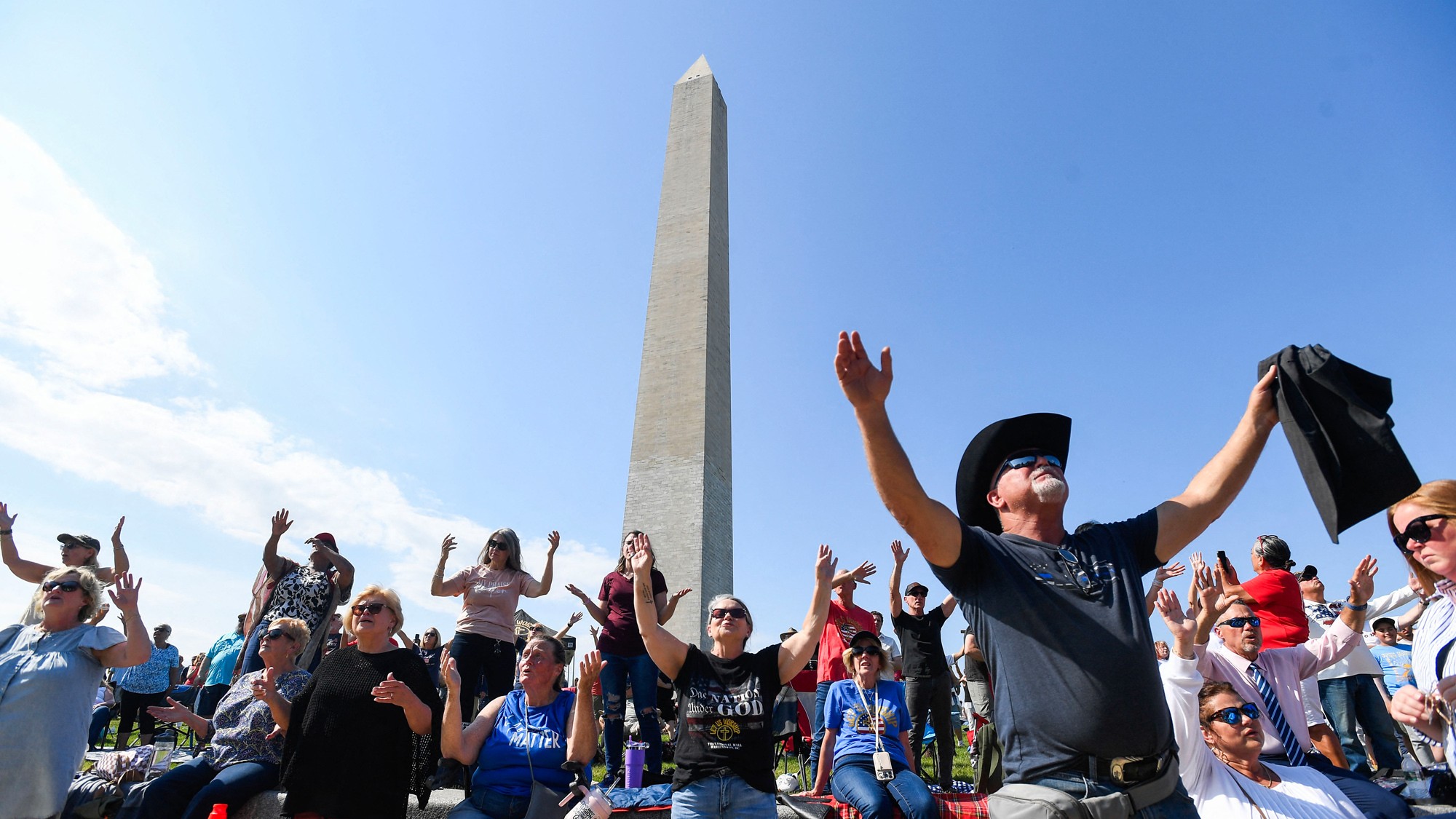
By 10 a.m. yesterday, the line of people wishing to dedicate America to God was more than three hours long. They came ready with prayer flags to wave the Holy Spirit into action, and shofars to scatter demonic forces. They wore T-shirts declaring the sort of Christians they were. A muscular man wore one that read Prayer Warrior. A woman in cargo shorts announced that she was an Intercessor for America. An elderly woman wore one that read I Am the Weapon.
“You understand you’re not going to be able to get in with that,” a security guard told a man wheeling a huge cross toward the entrance to the National Mall, as thousands of people began spreading out across a swath of grass that many of them now considered a kind of occupied territory in a cosmic spiritual war.
“We are here to bring the Earth into alignment with God,” a man named Joel Balin, who had come with a friend from Atlanta, told me. “To bring the kingdom of heaven to Earth.”
The rally, called Rededicate 250, was billed as a “jubilee of prayer, praise and Thanksgiving” for “God’s presence” in American history. It was part of a series of events celebrating the nation’s anniversary put together by a Donald Trump–aligned nonprofit called Freedom 250, which is being funded by a public-private partnership that includes corporate donors such as Exxon Mobil, Lockheed Martin, and Palantir and for which Congress has allocated $150 million. Critics of the event denounced the reliance on government funds, the participation of administration officials, and the near-total lack of religious diversity as an attempt to make a certain version of Christianity a national religion. A minor protest went on outside the barricades—a small group of people holding signs supporting LGBTQ people, immigrants, and all of the other Americans they believed to be under threat from the Trump administration. They blasted metal music, and a woman with pink hair screamed into a bullhorn.
The people in line paid them little mind. The event was a long-sought triumph for those who came and for millions more grassroots believers who helped elect Trump twice, embracing prophecies that God anointed him for the great spiritual battle against demonic forces that they understand to be animating current events. This idea was the work of the apostles and prophets of the New Apostolic Reformation, a charismatic movement that began gathering momentum in the 1990s and is now the leading edge of the Christian right. Sunday was a clear display of the influence of the movement, whose leaders were instrumental in mobilizing voters to turn out in recent elections and to take part in the January 6 insurrection, when many people believed that they were taking the U.S. Capitol for God’s kingdom.
Speakers yesterday included Paula White-Cain, an apostle who now leads the White House Faith Office; Lou Engle, an apostle and prophet who is known for organizing the kind of mass-prayer gatherings that characterize the movement; and Guillermo Maldonado, an apostle who leads one of the largest Latino churches in the country, El Rey Jesús, in Florida. Administration officials including Secretary of Defense Pete Hegseth and Secretary of State Marco Rubio, whose own theologies do not exactly align with the movement, told stories about God deploying miracles at key moments in the nation’s history, leveraging these anecdotes to argue that the United States was founded to be a Christian nation. Historians say this is a clear misunderstanding of the American Revolution. Trump, just back from China, appeared in a prerecorded video in which he reads from the Old Testament, which seemed to be the same video that he had recorded for a marathon reading of the Bible last month. More revealing than any of these speakers, though, were the thousands of people willing to stand in line for three hours and then roast for seven more in the hot sun.
Balin, who leads a men’s ministry called Wednesday Warriors, told me that by enabling the event, Trump was “opening up a door for us to do spiritual warfare,” and that the very presence of so many believers gathered in the nation’s capital was scattering demonic forces and advancing the kingdom. He said that church-state separation is a “myth” and that, really, any separation from God is a foolish denial of the cosmic reality of the spiritual battle under way. He said that people he knows are tired of “materialism” and “dualism” and “an Enlightenment mindset” that fails to account for how supernatural forces affect earthly life. “There are so many things happening in the supernatural realm, and in the ancient world and other cultures, they recognized this—there was no separation,” he said. “I think we are rediscovering that as Americans.”
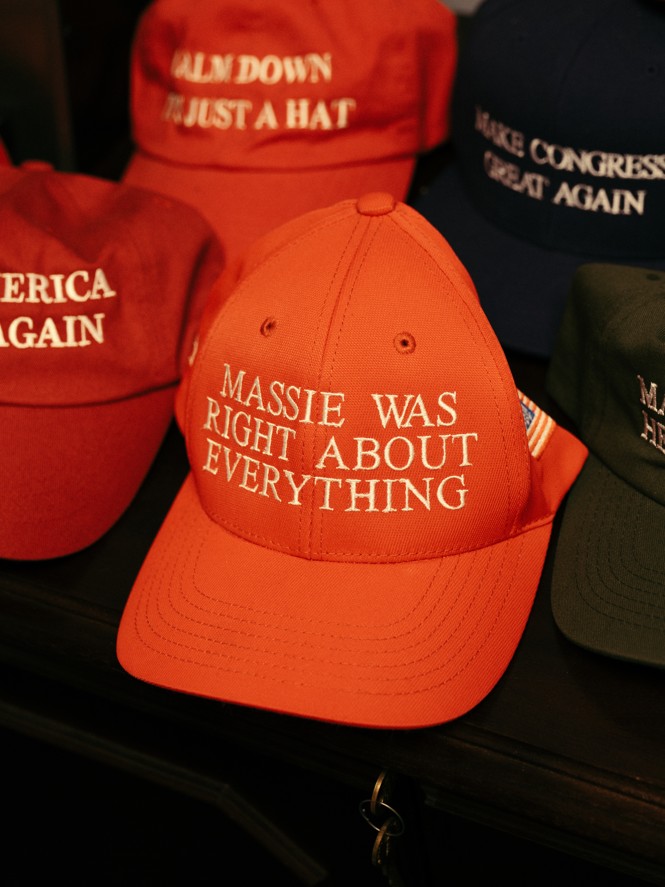
It was past 11 a.m., and people were spreading out blankets on the green grass, taking selfies, and livestreaming to congregations back home. “This is Pastor John!” a man in a blue suit said into his cellphone. The crowd was mostly white, but many people I spoke with emphasized that their movement is international and multiethnic, even as some expressed skepticism about accepting Muslim and other non-Christian immigrants into the country. MAGA hats abounded.
On the stage, the first of many praise bands blasted the surging worship music common in charismatic churches these days. People mouthed the words. A screen displayed what appeared to be two church windows, which sometimes were filled with images of stained glass, and sometimes with an American flag, and sometimes with swirling clouds and stars. In the crowd, several women danced free-form with prayer flags, and other people periodically blew a shofar, the hollowed-out ram’s horn used in traditional Jewish services and considered in charismatic circles to be a tool of spiritual warfare. Two women from the central coast of California looked around.
“This is what we’ve been praying for, for our country to turn back to God,” Debbie Cloud, a retiree, told me as she began to cry.
She and her friend Susan Fraze said that they are working on the long-shot campaign of an influential apostle named Ché Ahn, who is running for governor of California as a write-in candidate. Cloud said that she attends a nondenominational church called Calvary Chapel. Fraze goes to a nondenominational church called the Bridge. Almost everyone I spoke with had some story about how they used to be Baptist, or Pentecostal, or Methodist but had found their way to churches with names such as Oasis and Free Chapel and Anchor and Abundant Harvest, the kind of nondenominational congregations that are growing as most denominations continue to decline. At least 15 percent of all American adults now identify as nondenominational, and most of them are embracing charismatic ideas about signs and wonders and spiritual warfare. Many people told me about their involvement with prayer groups, prayer rooms, prayer closets, and so-called prayer furnaces, spaces dedicated to intense, dayslong prayer sessions that people believe can shape the spiritual destiny of the country.
Under the shade of a tree, a man named Adriel Lam told me that he’d flown in from Hawaii, where he works for Capitol Ministries, an organization that seeks to bring prayer into state capitols. Lam is also running for Congress. He said that yesterday’s gathering was more evidence that an outpouring of the Holy Spirit is under way across America, a moment that he described as “post-postmodernism.”
“Modernism told us, Let’s know our chemistry. Let’s know our physics. Science can explain the world,” he said. “Then postmodernism said, Let’s question the foundations of everything. Post-postmodernism is people saying, Let’s go back to zero. Let’s go back to the first century, when Jesus united the physical and the spiritual. God is moving our generation for renewal.”
On a blue towel in the grass, David Hitt, an accountant from Atlanta, huddled and kneeled with several friends. He told me afterward that they were submitting themselves to Jesus and aligning their spiritual posture with God.
“We underestimate what’s going on in the invisible realm,” he said. “Our assembly, our worship, our prayer is creating openings for God to do his will.” He elaborated that he meant actual openings, portals where the Holy Spirit could enter into battle against actual demonic forces. He estimated that the prayer of just one person could put 1,000 demons in flight, and the prayer of two people could eject 10,000.
“So here we’ve got how many people focused on God?” he said, envisioning legions of demons fleeing the capital.
“Praise Jesus,” someone said. A man walked by in a T-shirt that read Jesus is King, Repent or Die. Another wore one that read Blessed are those persecuted for righteousness.
Outside the metal barricades, the capital was quiet. People jogged and went to the Smithsonian, and beyond a block or so, you couldn’t hear the music or the loud cheers when House Speaker Mike Johnson said, “We hereby rededicate the United States of America as one nation under God.” Inside, though, the message was clear.
“We are the kingdom,” a woman named Robin Noll, who’d come to Washington, D.C., on a bus with 29 others from western Pennsylvania, told me. “God is driving us into the battlefield.”
The older ones and the younger ones may be voting in different ways.
Show full content
A little less than two years ago, Gen Z underwent a rebrand. Donald Trump had just been reelected. Exit polls suggested that young voters—especially young men—had helped deliver the Republican victory. Rather suddenly, a generation associated with climate activism and trigger warnings became known for manosphere podcasts, fiscal conservatism, and gender relations so icy that they’ve contributed to the national panic about fertility rates.
But a lot has changed since 2024. Trump has begun a (thus far ineffectual) war with Iran, something he said wouldn’t happen. His administration’s handling of the Epstein files, where his name appears abundantly, has been criticized by Democrats and Republicans alike. He vowed to lower gas and grocery prices; instead, they keep rising. His approval ratings have hit record lows, and he’s losing favor among crucial voting blocs such as independents and Latinos. Journalists and political commentators keep speculating and debating: Will the young men who moved rightward crawl back in the other direction?
That may depend, it turns out, on whether you’re talking about young men—or even younger men. The spring 2026 Yale Youth Poll, released last month, found that a majority of respondents—and roughly 70 percent of the young adults—disapproved of Trump. Even with men under 30, the president lost ground compared with Yale’s fall 2025 poll. But the data also revealed a dividing line: Among 23-to-29-year-old men, support for Democrats increased by 14 percentage points. Among 18-to-22-year-old men, it fell by a percentage point—even while their approval of Trump declined somewhat. The women in that youngest age group, meanwhile, make up the single most liberal population: further left than the slightly older Gen Z women.
Of course, you can splice and dice any cohort differently and come up with what’s called a “microgeneration.” But this poll echoed something I’ve heard in my reporting before: Gen Z, which encompasses people born from 1997 to 2012, splinters into an older and a younger group that tend to behave quite differently. Rachel Janfaza, who researches and writes about this age group, has referred to them as Gen Z 1.0 and 2.0. The generational researcher Meghan Grace described them to me as “Big Zs” and “Little Zs.” Whatever you call them, the split seems like a meaningful one. You might think of Little Zs as the angstier siblings to their Big Z counterparts: more divided, less trusting, and even readier to shatter the status quo.
When you’re young, everything around you might shape your still-nascent beliefs: your family, your neighborhood, but also the state of the world in that chapter in time, Patrick Egan, a public-policy professor at NYU, told me. Your politics, in adolescence and early adulthood, are in the process of “crystalizing.” Just look at Gen Xers, he said, who came of age when Ronald Reagan was enjoying a popular presidency in the mid-to-late 1980s; perhaps partly for that reason, the group leans Republican compared with other generations.
Little Zs and Big Zs grew up nearly at the same time—but in different worlds. Big Zs might’ve texted their friends on flip phones; Little Zs grew up with smartphones, herded toward content by TikTok algorithms. Big Zs might have looked up assigned reading on SparkNotes, but Little Zs could use AI to write a high-school paper. Perhaps most important, Big Zs were already in college, or had even graduated, by the time COVID hit. That doesn’t mean the pandemic wasn’t difficult for many of them. But they’d done some real maturing—and gained some real self-understanding—before that blow. Little Zs were in middle or high school in 2020. They were at home when they should’ve been making new friends, breaking rules and getting grounded, falling in goofy early love.
The Little Zs who resented attending Zoom class and missing prom might have appreciated that many Republicans were criticizing school shutdowns, scorning mask mandates, and talking about personal freedom. More broadly, their anger with decision makers might have fed the anti-establishment impulse that researchers have noticed especially among younger Zoomers, who are “a lot less tethered,” Egan said, “to the traditional ways that people even a little bit older than them have been thinking about politics for a long time.” Many of them, he told me, like that Trump positions himself as a norm-flouting outsider to politics—despite the fact that he’s a second-term president.
Clearly the MAGA mentality has spoken to the men of Little Z in particular. Perhaps that’s because many Republicans put a particular brand of masculinity on a pedestal at a time when these men were still developing a sense of self. They might have heard GOP leaders on “bro podcasts,” Grace said, or seen them partner with the Ultimate Fighting Championship, and understood those efforts as an invitation: “Yes, your voice does matter. And we want it to be on our side.” Now these men have graduated from high school. They’re thinking about how they’ll make a living. They’re seeing that job growth is happening largely in traditionally female-dominated fields—health care, retail, social services—rather than in, say, manufacturing, Egan told me. And they’re still hearing Trump claim he’ll fix the economy.
Republicans might have spoken to Little Z women, too—to their money anxiety, their COVID trauma, their frustration with the status quo. But in other ways they’ve been turning those young women away. The 2021 Dobbs decision that struck down abortion protections may have been a particular blow for the women who are now in their early 20s. Grace and her colleague Corey Seemiller have been studying Zoomers’ political ideology for years, and in 2021, they identified that Little Z men were starting to shift rightward compared with Big Z men. But they didn’t see much of a shift at all among women. Then Dobbs happened, and young women lurched left. They were perhaps old enough to be having sex but young enough to be especially terrified of pregnancy, and of the thought that men would be telling them what to do about it.
Much has been written about the gender gap in Gen Z politics. But that split seems to be especially dramatic among Little Zs. Judging, in part, by the Yale poll results, “it may be more pronounced than anyone’s really anticipated,” Egan said. That divergence could have profound implications for not only future elections but also how Little Zs continue to relate to one another. Grace and Seemiller surveyed young women and found that, of the respondents who didn’t plan to marry, a third said that was because they fear losing their independence. A lot of them, she said, feel like the men around them have already voted to take away their freedom.
But the beliefs of Little Z, as much as they might be crystallizing, are not set in stone. Little Zs are different from Big Zs because they’ve been through different formative experiences—but also simply because they’re younger. And many kinds of political figures, regardless of party, could still respond to their sense of disempowerment, their skepticism of elites, their hunger for authenticity. Egan has heard young voters talk glowingly not just of Trump but of Zohran Mamdani, Bernie Sanders, Alexandria Ocasio-Cortez. “There’s just tremendous choice,” Egan told me—far more than when he, a member of Gen X, was younger. In his day, a 20-year-old didn’t have nearly as many disparate voices—on TikTok, CNN, or Fox News, or in the halls of Congress—acknowledging their particular struggles. Now, he said, one “can find messages that really speak to that sense of precarity, that sense of upheaval.”
If Trump keeps breaking his campaign promises, even Little Z men might turn toward other leaders. The midterms are around the corner. Young people don’t tend to show up in great numbers, historically, but Grace reminded me that in 2018 and 2022, Zoomers had notably high midterm-election turnout for their age group. They’re not like other generations; they’re not even like one another. Someday, Little Zs won’t be so little anymore—and their elders might be surprised by who they grow into.
Joe Biden became quieter, while Donald Trump grows even louder.
Show full content
When Donald Trump took the oath of office last January, he was the oldest president to begin a term, clocking in at 78 years and 220 days. He replaced the man who formerly held that title, Joe Biden, who had dropped out of the race after it became quite obvious to the entire country that he had aged too much, too quickly. But as Trump himself grows older—traveling less, switching to more comfortable shoes, and seeming to nod off during meetings—his age isn’t getting the same kind of scrutiny.
I have long thought that a reason for that is the president’s sheer size. Trump stands 6 foot 3 and, according to his most recent physical, weighs 224 pounds (yes, questioning that number is a legitimate thing to do). He is a big presence in any room, as opposed to Biden, who grew visibly thinner as he got older, adding to the appearance of frailty. Trump is also LOUD; Biden’s voice was frequently reduced to a gentle whisper. And Trump has the gift of omnipresence. His genius is in capturing attention. Biden’s public schedule grew sparse, and he actively avoided generating news; Trump holds multiple events in front of the press nearly every day. He fills Americans’ TV screens and social-media feeds seemingly nonstop, with an almost-unspoken message: How could he be fading if he’s everywhere?
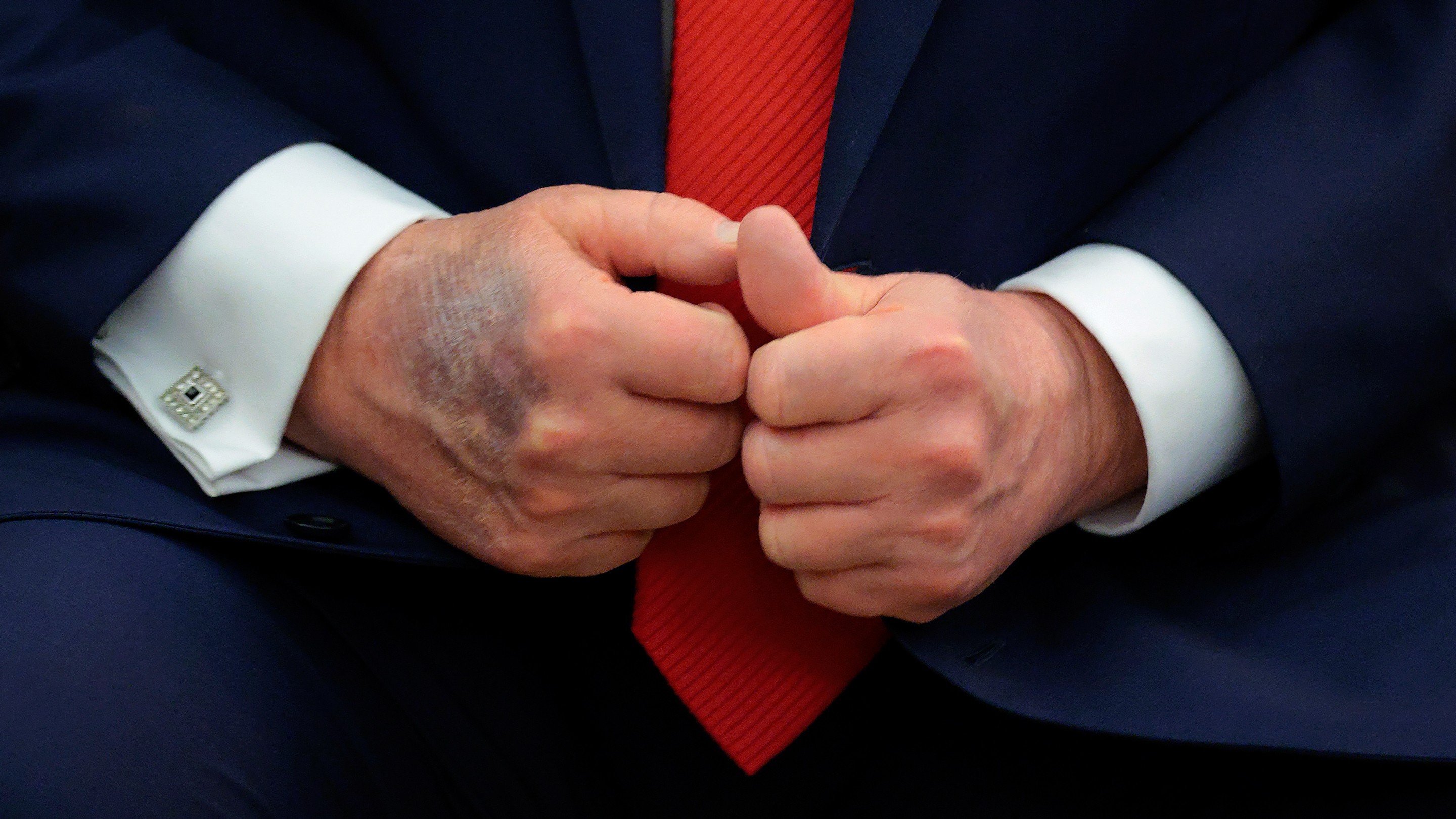
But as Trump turns 80 next month, his recent behavior should prompt even more questions than usual about his stability, judgment, and mental sharpness. Among the points of concern: a late-night social-media storm a few days ago featuring more than 50 messages, many strewn with dangerous or nonsensical misinformation, which followed a similar Truth Social broadside weeks earlier; an apocalyptic threat to wipe out a civilization; more and more insults (“nasty,” “stupid,” “ugly,” “treasonous”) hurled at reporters; appearing to fall asleep in public, sometimes twice in one week; deep bruises on his hands, which are covered in makeup and accompanied by confusing explanations; and long, odd tangents in speeches that seem longer and odder than his usual tangents. Never known for his ability to self-censor, Trump seems to have completely abandoned any sort of filter, tossing out messages from one extreme (He’s glad that Robert Mueller is dead!) to the other (actually, Trump is Jesus and shall heal the sick).
Biden’s team relentlessly pushed back against worried murmurings about his age and ability to handle the responsibilities of the presidency, and, for a while, the storyline was mostly relegated to the background. Democrats who had concerns bit their tongue. The president had enough good days to allow his aides to try to dismiss the narrative as a right-wing talking point, while encouraging allies—and some in the media—to look the other way. But then Biden’s deficiencies burst into the open with his faltering, confused performance in a general-election debate that was followed by a wave of recriminations and finger-pointing that continues among Democrats and journalists to this day.
Trump’s White House, as you’d expect, has also vehemently brushed away concerns about having another octogenarian in the White House. Those close to him say that, yes, Trump moves a little slower these days, but that he’s still a commanding, charismatic force. That’s just it: Whereas Biden noticeably changed, Trump appears in many ways to be the same. He’s always been erratic; he’s always been bombastic. But as Trump has aged, he’s becoming a purer, less filtered version of himself. Because the changes are less obvious, they’ve drawn less attention. For now, at least.
The differences between first-term Trump and second-term Trump are numerous. One of the biggest: He has dramatically scaled back his travel. Though he has taken several foreign trips, including one last week to China, his domestic travel schedule is nowhere near as busy as it was in his first term, and months of White House promises that it would ramp up have gone unfulfilled. Trump has long prized what his staff deems “executive time”—unstructured hours in the morning usually filled by watching cable TV and using his phone—and he rarely has a public event before late morning.
Once in public, Trump’s remarks continue to feature many of his longtime hallmarks—disdain for scripts, a disregard for time, mixing up names and facts, and an impulse to say whatever pops into his head. But these days the displays of disinhibition are more pronounced, and many include seemingly aimless stories and distracted observations. (Take, as just one example, a White House Christmas reception five months ago when Trump spent nearly 10 minutes telling a story that involved a White House doctor—actually two White House doctors—and Barack Obama’s daughters and a poisonous snake in Peru. He interrupted himself to mention his own brush with death and to claim that his health is better than that of Obama or George W. Bush. “Trump is in the best health of all,” he said.)
A White House spokesperson ignored my long list of questions about Trump’s behavior and changes to his schedule and quickly sent me a personalized statement. “Here’s where you’re wrong, Jonathan,” White House Communications Director Steven Cheung told me. “President Trump has done more public events and has engaged with the press more than any other president in history.”
Republican lawmakers have, for years, given Trump notoriously wide latitude for his behavior. (“I haven’t seen the tweet” became an entire meme of deflection.) But some have quietly begun to wonder about the president’s judgment, particularly when it comes to political priorities. Gone is the promised attention to the economy and lowering prices. Instead, Trump’s focus is often on grandiose ways to burnish his own legacy, including trying to seize foreign lands and build over-the-top monuments to himself (“No one wants an arch when people can’t afford to buy gas,” one Republican lawmaker told me about Trump’s plans for a 250-foot monument, inevitably dubbed the Arc de Trump, between the Lincoln Memorial and Arlington National Cemetery). When the president departed Beijing on Friday, one of his first China-related social-media posts from Air Force One was not about any deal struck in the summit but rather on the host nation’s grand ballroom and how the U.S. should have one too.
Trump has also switched to more comfortable shoes, tossing aside the dressier pairs he used to wear for $145 Florsheims, and then giving them to aides, an act of generosity that—call me cynical here—also makes his own pair stand out less. Then there are his hands: Throughout this term, Trump has sported a deep bruise on his right hand, which at times is covered up (poorly) with makeup. When asked about it, he has said he takes a lot of aspirin to have “thin blood,” perhaps to ward off clots, strokes, or heart attacks. White House aides have said that leads to bruising after handshakes. But in recent weeks, the bruising has also been spotted on his left, non-shaking hand.
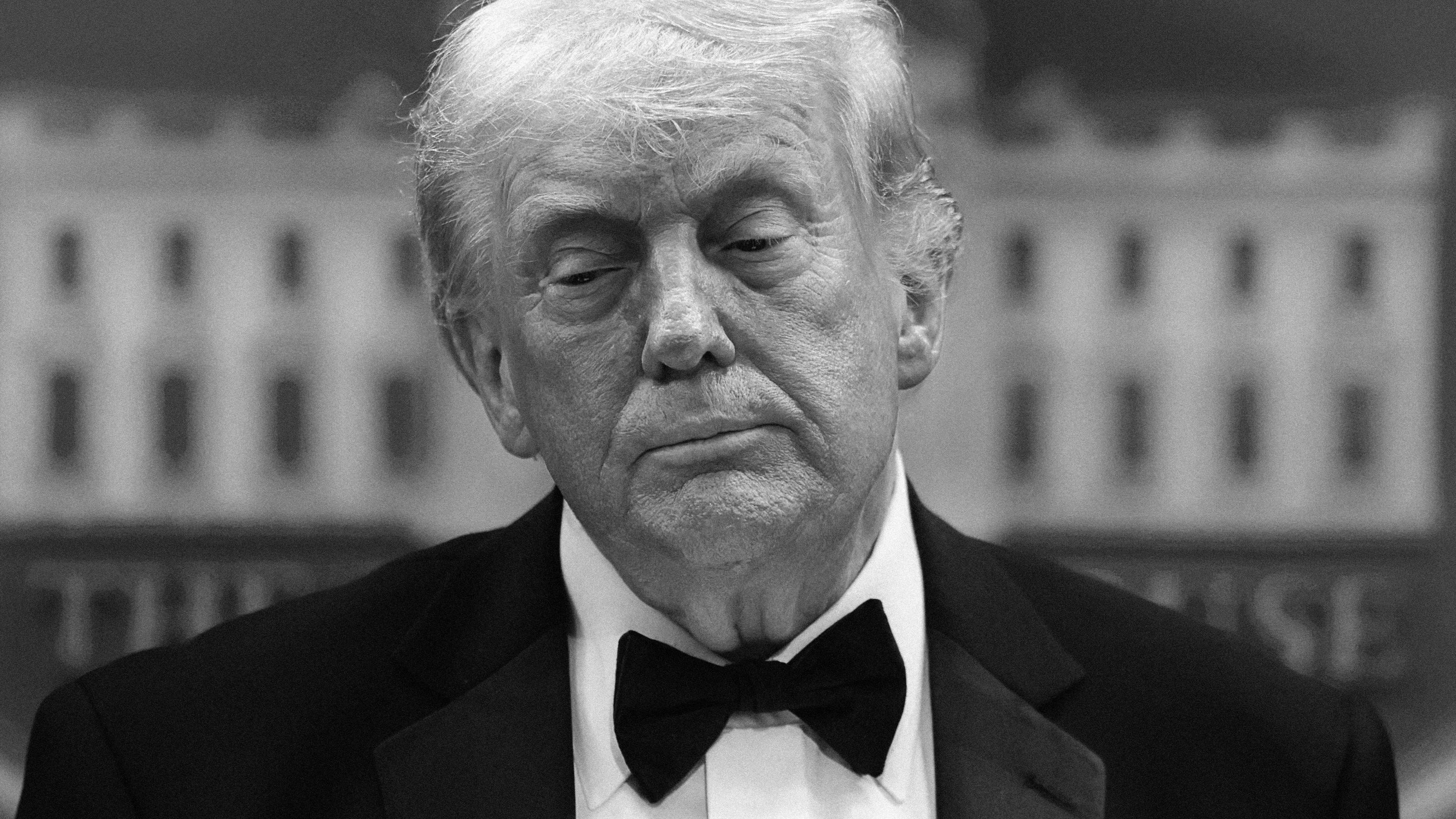
Trump now notably delivers far more of his remarks while seated. In his first term, he typically spoke behind a podium either in the Oval Office or elsewhere in the White House. Now the standard configuration is Trump sitting behind the Resolute Desk, while officials and aides fan out behind him. And sometimes, while sitting in that chair, Trump’s eyes … begin … to … close. In what has become fodder for late-night comics and liberals on social media, Trump has had his eyes shut for a suspiciously long time, as if he might be sleeping, at a number of events lately. Trump aides have strenuously denied this, suggesting that the president is simply listening intently. Last Monday, when a reporter observed on X that Trump’s eyes were closed during an Oval Office event on maternal health care, the official White House Rapid Response account retorted, “He was blinking, you absolute moron.” If true, this blink lasted for at least 10 seconds.
Maybe Trump is tired because he’s up late. He has long boasted about how little sleep he needs, and reporters covering his two terms have grown accustomed to news made by social media both early in the morning and late at night. But even the wild Twitter sprees of his first term have been eclipsed by some of the Truth Social barrages of late. Aides long ago stopped trying to curb Trump’s social-media habits, even if they sometimes create political problems. The posts are normally created (or found to repost) by longtime aide Dan Scavino, other times by Trump’s executive assistant, Natalie Harp. They will bring printouts of the posts to Trump, who signs off on every one. But sometimes he just posts on his own. The White House wouldn’t tell me whether that is the case during these late-night spewfests.
Trump’s audience on Truth Social (which he owns) is far smaller than the one he had on Twitter—12.6 million versus 111.4 million—and that, at times, has seemed to limit awareness of his posting. (Trump was kicked off of Twitter after the January 6, 2021, Capitol riots; he was reinstated after Elon Musk bought the site two years later, but the president now prefers his own platform.) One night in December, he posted nearly 160 times, the most in one go during his second term. In February, he posted a racist video that depicted Barack and Michelle Obama as monkeys. Early last month, he threatened Iran by saying “a whole civilization will die tonight.” A few days later, he decreed Pope Leo “WEAK on Crime.” And then overnight into the early morning hours of April 13, Trump amplified dozens of posts, including one that depicted him as Jesus. In just a few days, Trump had offended adherents of multiple religions and drew criticism from even some of his most loyal supporters. He eventually deleted the post that depicted him as the son of God, but only after absurdly claiming that he thought it showed him as a doctor, not Jesus. Last Monday night, his account posted 55 messages between 10:14 p.m. and 1:12 a.m., including a mix of his own thoughts and a slew of reposts of multiple messages that falsely claimed the 2020 election was stolen and called for Obama’s arrest.
The strain on the president is obvious: The nation he leads is at war; the economy he promised to revive is teetering; and his approval ratings are falling. His behavior has renewed Democrats’ calls to invoke the Twenty-Fifth Amendment to remove the president from power for not being able to serve. (That would require the Cabinet to act and is a nonstarter.) Senate Minority Leader Chuck Schumer has called Trump “an extremely sick person,” and his counterpart in the House, Hakeem Jefferies, deemed the president “unhinged” and “out of control.”
But it’s not just Democrats. Some former Trump allies have also questioned his psychological fitness, and a poll released last week found that 59 percent of Americans believe that Trump does not have the mental sharpness it takes to lead the country. But Republicans in Congress have defended Trump, and the White House, which always touts the president’s stamina, has mocked any suggestion that he was not up for the job.
That defensiveness reminds me of just how aggressively Biden’s aides would push back at journalists who dared to ask questions about his age. It’s worth revisiting how Biden’s declining health was shielded by those around him.
Biden’s age had been front and center during his 2020 campaign, and even some of his Democratic primary opponents wondered whether he was “declining” or “forgetting” things. He never formally vowed to serve only one term, but it was the expectation among many Democrats, and some in Biden’s inner circle, that he would act as a transitional figure, one who would vanquish Trump and steer the nation out of the coronavirus pandemic before stepping aside. He took the oath of office at age 78, the oldest man ever to serve as president. (He was 78 days older at the start of his term than Ronald Reagan was when he ended his.) But Biden enjoyed remarkable legislative success in his first two years, and then Democrats fared surprisingly well in the 2022 midterms.
With hindsight, many Democrats believe that had Biden announced then that he would step down after four years, he would have been remembered as one of the more accomplished recent presidents. Of course, he did not. Trump’s comeback on the Republican side fueled the belief among those close to Biden that he had to stay in the fight; he had beaten Trump once, and only he could do it again. But Biden’s decline, which was already the source of Washington whispers, seemed to accelerate in full public view. White House aides furiously fought any suggestion that Biden, then 81, was too old to run again, too old to serve another four years (he’d have been 86 when he left office in January 2029), and pushed back against any Democrats who suggested that their party needed a new, younger standard-bearer. They chided reporters who wrote about it.
Stories came anyway. Then came the disastrous debate in Atlanta, and the three-plus weeks of calls for Biden to drop out of the race, a rancorous fight that nearly tore the Democratic Party apart. Trump, in private, boasted to aides that his “Sleepy Joe” nickname for Biden was spot-on, even as his own advanced age received less attention. “It was fair to ask about Trump’s health in 2024, but Democrats were afraid to do it because it would boomerang on Biden,” Larry Sabato, a political scientist at the University of Virginia, told me. Veterans of Biden’s White House have expressed regret that their West Wing did not fully understand the groundswell of reservations about the president’s age, and some believe it grew too insular and overly protective of the president. Andrew Bates, who was the senior deputy press secretary for Biden, told me that their “outdated approach to media undercut Joe Biden’s superpower—his connection with working people.”
In Bates’s view, Trump has a different problem, one that exposes the president for who he really is. “The most obvious impact of age on him is that he has lost the capacity to pretend he cares about other people,” Bates said.
The White House announced this week that Trump will undergo a medical and dental checkup on May 26, which will be his fourth publicly disclosed doctor’s visit in his second term. (He has also had two dental visits in Florida.) Last year he had an annual physical in April 2025, and then what the White House described as a “routine yearly checkup” in October. Across his terms, Trump has bragged repeatedly about acing multiple cognitive tests, a boast that only raises more questions.
Many presidents have faced inquiries about their physical and mental health. Reagan seemed to slip late in his presidency in the years before he announced that he had Alzheimer’s. Franklin D. Roosevelt was in poor health before dying just a few months into his fourth term. Woodrow Wilson suffered a debilitating stroke. Abraham Lincoln battled depression. Dwight Eisenhower had a major heart attack. And some of Richard Nixon’s own aides privately worried about his drinking and his mental stability.
Nixon often utilized the “madman theory,” in which he would act unstable to intimidate foes and achieve better results. Trump’s aides say he does the same, including in his genocidal threats toward Iran; they are comfortable with that comparison to Nixon. But they may soon face more similarities with Biden.
The top White House adviser has stepped back from AI, space, and the Paramount merger.
Show full content
When Paramount CEO David Ellison wanted to throw a Washington dinner party last month “honoring the Trump White House,” he got a helping hand from Katie Miller, the MAGA podcaster and onetime White House strategist. She sent follow-up invites to top Trump aides to encourage attendance for the “intimate gathering” at the U.S. Institute of Peace ahead of the White House Correspondents’ Dinner on April 25.
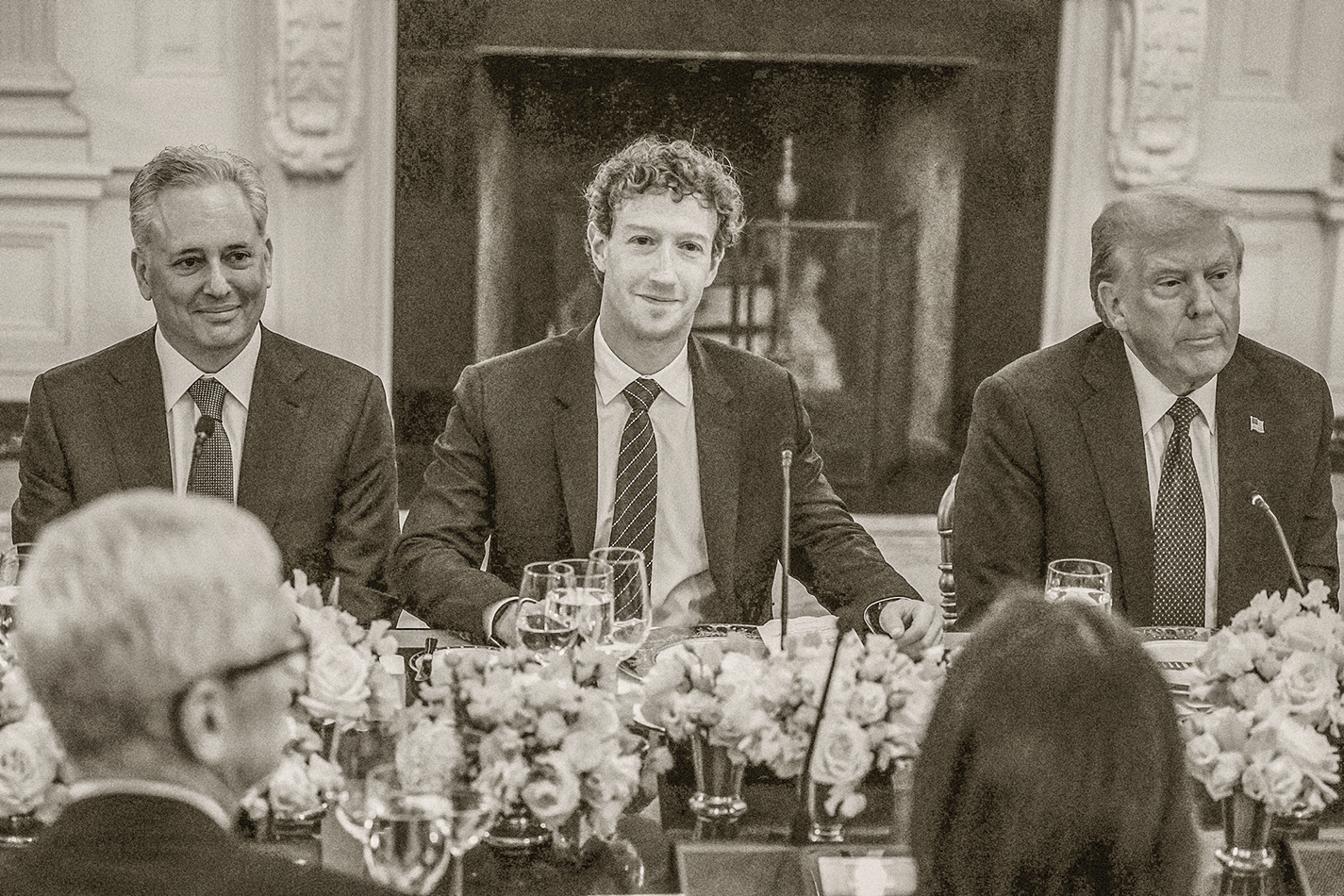
The party turned a traditional celebration of the CBS News White House team into a high-profile corporate flex. Ellison, who is seeking federal approval for his company’s takeover of Warner Bros. Discovery, ended up sitting at the same table as President Trump and in the same room as Miller’s husband, the Trump adviser Stephen Miller, and other senior administration officials, including acting Attorney General Todd Blanche, whose department is currently reviewing the deal.
Katie Miller’s involvement was not entirely unexpected. For months before, she had been talking informally with Paramount brass about selling her media property, The Katie Miller Podcast, to the news-media giant as it expands its offerings, according to two people familiar with the plans who spoke anonymously because they were not authorized to discuss the nonpublic information. Those talks, which were first reported by Axios, have yet to result in a finalized sale, the people familiar with the matter said.
But the conversations were serious enough that months earlier, Stephen Miller—who has a near-boundless role overseeing policy as deputy chief of staff—told the White House that he would recuse himself from all issues around Paramount’s efforts to win control of Warner, the White House spokesperson Abigail Jackson told us.
Stephen also recused himself last year from matters involving artificial intelligence because Katie, a longtime adviser to Elon Musk, had maintained a part-time consulting contract with xAI, the owner of the Grok chatbot and the social-media company X. When SpaceX purchased xAI in February, Miller also recused himself from space issues, Jackson added.
“Katie Miller is an accomplished professional in her own right with over a decade of senior government and media experience—Stephen is incredibly proud of what his wife has achieved through her own hard work,” Jackson told us in a statement. “He fully complies with all ethics recommendations and rules and regularly consults with White House ethics officials to address any potential conflicts of interest.”
Stephen Miller has not recused himself from matters related to sponsors of Katie’s podcast, however, because the White House counsel has concluded that sponsorships differ from consulting arrangements. A White House official told us, when we inquired about this, that Stephen nonetheless makes a point not to interact with the sponsors of his wife’s podcast, including companies and trade groups that have been actively seeking favor from Trump and his team.
Several people familiar with the operation, who spoke with us on the condition of anonymity, criticized Katie Miller, saying that her pitch to guests—who have included Cabinet secretaries and corporate leaders with interests before the White House—is inextricably tied to her marriage to Stephen, one of Trump’s most senior advisers. Some also charged that advertisers are coming to the show for similar reasons. People familiar with her pitch told us they felt like Miller was explicitly selling access.
Allies of Katie Miller contest this characterization. No evidence has surfaced that either of the Millers has done anything to help a podcast sponsor outside of the show. Another person involved in some partnerships told us that the podcast sponsorships reflected standard industry practices and terms, and did not include any services out of the norm.
Katie Miller, who launched the lucrative podcast in August after leaving work at the White House, has built her audience around unusually intimate conversations with top Trump administrations officials and their spouses, whom she knows socially and professionally. The podcast sponsors include the Southern Company, a major utility; the American Beverage Association, which represents the makers of sugary soda; Polymarket, an online prediction market; and the Merchants Payments Coalition, a group pushing for legislation to reduce credit-card swipe fees.
A purchase by Paramount would be a major win for Miller. She has made no secret of her affection for the company or her dislike of one of its major rivals, Netflix. When Netflix appeared to have an upper hand in acquiring Warner this spring, Miller took to X to accuse the Netflix co-founder Reed Hastings of overseeing “the push of sexualized & trans content to minors” on the streaming service; she also attacked the Netflix board member Susan Rice, a former adviser to President Biden, charging that the left is “hellbent on destroying our country and corrupting our kids.” (Paramount’s corporate team did not pay or ask for her social-media posts, a company insider told us.)
An acquisition would also bring Paramount’s growing network of news properties even closer to the inner sanctum of the Trump administration. Last year, Ellison appointed new leadership at CBS News that has revamped programming in ways that some insiders view as more sympathetic to Trump and his movement. CBS employees told The New York Times in April that they were taken aback by the existence of the “intimate gathering” honoring the Trump administration, which used the CBS logo on its invitation.
Ellison has met repeatedly with Trump, as has his father, Oracle founder Larry Ellison, who is a major Republican donor and a financial backer of the media company. In July, Paramount agreed to pay $16 million, largely to the president’s future library, to settle a civil lawsuit by Trump over a 2024 60 Minutes segment that had been edited in a way he believed to be unfair. The settlement was widely seen as an effort to secure approval from the Trump administration for Paramount’s 2025 merger with Ellison’s company, Skydance.
The Ellisons’ vision for media has become a shorthand for the kind of coverage that the people inside Trump’s inner circle believe they deserve—and some have voiced their support for Ellison directly controlling CNN if regulators approve the pending merger with Warner Bros. Discovery. “The sooner David Ellison takes over that network, the better,” Secretary of Defense Pete Hegseth said earlier this year at a Pentagon briefing in which he criticized CNN’s coverage.
Katie Miller, a veteran of the first Trump administration who once worked for Vice President Pence, began working again for Trump after the 2024 election, when she helped sherpa Health and Human Services Secretary Robert F. Kennedy Jr., through the Senate confirmation process. In the first months of Trump’s second term, she worked as a special government employee, primarily as an adviser to Musk and his Department of Government Efficiency. She stopped working for Musk full-time in August but maintained a part-time consulting relationship with his company.
Miller launched her podcast by nabbing an interview with Vice President Vance, then had extended conversations with then–Attorney General Pam Bondi, then–Deputy Attorney General Todd Blanche, and Kennedy. She has also persuaded leaders such as FBI Director Kash Patel, House Speaker Mike Johnson, and Hegseth to make appearances with their partners. New York Stock Exchange President Lynn Martin, UFC boss Dana White, Palantir co-founder Joe Lonsdale, and United Airlines CEO Scott Kirby have made appearances, as have celebrities such as the former NBA player Tristan Thompson and the actor Jenny McCarthy.
At the airport in La Lima, Honduras, planeloads of migrants arrive every day—many without their children.
Show full content
Early one morning behind the airport in La Lima, Honduras, before the first planeload of deportees landed, Sister Idalina Bordignon was meeting with her staff about an unsettling situation. Every day, parents were arriving without their children, and they were asking questions like What do I do if I don’t know where my child is? and Do I lose my rights as a parent if I’m deported? An American aid worker suggested a quick analysis of each case to determine which agencies or nonprofits might help the families. We’ll never have time for all this, Idalina thought. The Trump administration was sending too many people to Honduras too quickly, and soon the reception center that she oversees would be packed with more than 100 people who were exhausted, hungry, and in shock. They would need to be processed into the country as quickly as possible to make room for the next planeload.
Shackled to a seat on one of those planes was a 39-year-old single mother named Claudia. After she emerged from the reception center in a detainee sweatsuit, looking teary and depleted, she told me her story in the parking lot. She’d fled Honduras in 2023 because her ex-partner’s girlfriend was stalking her and had physically attacked her, and she’d settled in Atlanta with her 11-year-old son. In December she was arrested for driving without a license and spent three and a half months in ICE detention, where she pleaded to be reunited with her son, but was ignored. “I really wanted to bring him with me,” Claudia said. “Being with him is my top priority.” A cousin said he would start saving money to get her son a passport and bring him to Honduras, but it was unclear when that would happen.
Sofia Valiente for The AtlanticOutside the deportee reception center in La Lima
Since retaking office, Donald Trump has sent hundreds of thousands of immigrants like Claudia into the deportation pipeline, where many are transferred from facility to facility—losing access to their families, lawyers, and journalists—before being sent abroad. ICE was holding 60,000 people in custody as of early April; 71 percent have no criminal convictions. The agency is detaining people who are in the middle of applying for legal status, and the Justice Department has directed hard-line immigration judges to deny bail and ICE attorneys to pursue deportations as vigorously as possible. “The only process invaders are due is deportation,” Stephen Miller, Trump’s chief immigration adviser, said in November.
I went to Honduras in late March to see the consequences of this mass expulsion. For more than 20 years, deportation flights arrived in La Lima five days a week; now they arrive every day, often more than once. Over the three days I was there, five planes delivered 479 people in shackles to a private airstrip. They were loaded into an old school bus and driven to the reception center, at the end of a dirt road.
The scene every day is chaotic. New arrivals are handed a cup of coffee, a burrito, and a bag with their personal belongings, then rushed through a series of cubicles where the Honduran government records their return. Volunteer doctors examine those who are visibly ill, injured, or pregnant. In between flights, the staff tries to advise people on common crises: ICE has separated them from their children or spouse, or they have no home to return to in Honduras, or a gang or ex-partner wants them dead. Idalina takes calls from families who are trying to track down lost relatives, and searches for their names on flight manifests.
Eight years after Trump backed away from the most controversial project of his first presidency—separating children from their parents at the border—I saw a new kind of separation crisis playing out. This time, the administration is dividing more families by greater distances than before, by expelling parents without their children, en masse. ICE policy requires officers to ask detainees, in each interaction, if they are the parent of a minor child, and to reunite families before deportation, or obtain a sworn statement from parents who choose to leave their child with a designated guardian. But Congress hasn’t codified these rules into law. And the policy is sprinkled with caveats such as “when operationally feasible” and “ICE reserves its right to make case-by-case removal decisions.” DHS officials have told me that the White House’s guidance has been clear: Nothing should slow down deportations.
In response to questions about this story, an ICE spokesperson said that the agency doesn’t separate families, that parents are given the option of being deported with their children, and that officers are following policies in a way that is consistent with previous administrations.
Of the 40 people I interviewed outside the reception center in La Lima, 24 said they had to leave children behind in the United States. Most said they were never asked about being a parent. One single mother said that when she was detained, an officer wrote on her documents that she was childless, and told her it “doesn’t matter” that she was being separated from her 3-year-old.
Most of these children were now with their other parent; some were with other relatives or friends, and some were in U.S.-government custody. Fifteen of them were younger than 5 years old, and four were infants. Almost all of the parents had no idea when they would see their children again.
Sofia Valiente for The AtlanticA short-term migrant shelter run by the Scalabrinians
A few days before I arrived in Honduras, a young man with a machete broke into the gated compound where Sister Idalina lives, a 10-minute ride from the airport, in a ramshackle neighborhood divided by a center road. A gang called Barrio 18 controls one half, MS-13 the other. The intruder tied a rope around Idalina’s wrists and ankles. As she resisted, he cut a slice down the side of one of her hands. He demanded American dollars but she didn’t have any, so he took her cellphone, shoes, clothing, a gas tank, and a blender.
The attack on a nun in a heavily Catholic country was a reminder that “no one is untouchable here,” Alessia Villamar Castro, who volunteers with Idalina as part of the Italian Scalabrinian order, told me. Their religious work is unpaid, so in La Lima they sustain themselves by working for the Honduran government at the reception center. Recently, they opened a short-term shelter in their compound for people who arrive with nowhere to go.
Sofia Valiente for The AtlanticDeportees, family members, and law enforcement gather outside the reception center.
Deportees from the United States are especially vulnerable to robbery and kidnapping because gangs and bandits assume that their families can pay larger ransoms. The Scalabrinians told me that since last fall, at least three have been murdered within days of their arrival. Alessia said she scans each new group at the center for anyone who might be facing an active threat. They tend to hang back, as if scared to walk out the front door. It’s too risky to house those people at the shelter, so she refers them directly to the Honduran government for protection.
Outside the reception center, I met a woman named Nora waiting to pick up her son, Jarol. She told me that, years ago, another son was killed 18 days after being deported, for reasons the family still doesn’t understand. Then, in 2021, Jarol was attacked here by men who cut off half of one of his fingers and left him bleeding in the street, so he fled to the United States. “We were thinking that it was a safer country,” she said, explaining that Jarol had applied for asylum and was working in Miami when ICE arrested him. Now he was being sent back into danger. “This is a disaster,” Nora said. (I’m identifying people by only their first name to avoid putting them at greater risk, and I corroborated their immigration and biographical details using public records.)
A few of the new arrivals were greeted with hugs and kisses and welcome balloons that locals were selling down the road. But many hadn’t had advance notice that they were being deported. They sat down on a concrete bench and called relatives, looking for someone to take them in. A man with a bag of cash strapped to his chest was hawking lempiras in exchange for U.S. dollars, promising the deportees a better rate than they would get in the streets.
Some of the people I met had been away so long, they had nothing to return to in Honduras (nearly half of all unauthorized immigrants in the U.S. have been there 20 years or longer). A woman named Denia told me she’d lived in Texas for 26 years, since she was 18. She arrived in La Lima wearing the pink knit shirt and Crocs she’d worn to work as a gas-station cook in February, when she was arrested. Her mobile home was about to be repossessed because she hadn’t been able to work and couldn’t pay the mortgage. Denia said her teenage son, who was staying with her sister, wouldn’t take her calls. He had wanted her to hire a lawyer and continue appealing her case from detention in Laredo, but the facility was filthy and cold, she said, with a wretched smell and cruel staff. She tried to explain to her son that it was futile to keep fighting under the current administration. She thought she was going to lose eventually, no matter what, so she accepted a deportation order. (Asylum grant rates are plummeting because the Justice Department has fired scores of immigration judges it considered too lenient.) “They’re collapsing families,” Denia said. “I had everything there. I had a house. I’ve lost everything. Everything, everything, everything.”
Sofia Valiente for The AtlanticJhonny left his wife and 3-year-old daughter in Arizona.
A man named Jhonny, detained in Phoenix in February, started to hyperventilate as he told me about seeing his 3-year-old daughter on video calls. “She wants to give me a kiss and hug me, and I can’t,” he said. “It just kills me.” He was peeling off the skin around his fingernails, and he lifted his baseball cap to show me that his hair had been falling out in chunks, from stress. After he lost his asylum case, his wife, a lawful permanent resident, filed a petition for him to gain legal status through her. It was still pending when ICE showed up at a job site where he was installing fiber optics and arrested him, despite his valid work permit. “I told everyone, ‘I have a 3-year-old daughter. I’m married,’” he recalled. “They said, ‘We can’t do anything.’”
Again and again, I heard about legal immigration processes that were cut short, and arrests that deportees believed were based on racial profiling alone. Luis, a 20-year-old with a mop of curly hair, said an officer provided no justification for pulling him over in Jacksonville, Florida, while he was driving to McDonald’s. He was detained despite having a driver’s license, a work permit, and a court date scheduled for 2028. A bystander who was listening to us chimed in: “They are pulling over every work truck in the state of Florida.” Adelmo, a slim 53-year-old wearing a polo shirt, said he also had a work permit and a driver’s license, and a court date this spring. But a police officer had pulled him over in Corpus Christi, Texas, claiming that his license plate was scratched, even though Adelmo said the plate was clearly readable. In ICE custody, he met men who’d been fighting deportation for more than a year and had little hope of being released. When he walked out of the reception center in La Lima, he was carrying a meticulously organized folder of evidence to present to an immigration judge, but said he’d given up his asylum case in despair.
The reception-center staff transports most of the new arrivals to a bus terminal 30 minutes away, in San Pedro Sula; Honduras’s new Trump-aligned president eliminated a cash-assistance program for deportees, but the government still provides a one-way bus ticket to anywhere in the country. I found a man named Cristian pacing in the parking lot one afternoon, waiting for a ride to the terminal. He said he had already tried and failed to get back to his family in Wilmington, North Carolina. After first being deported late last year, he crashed with a childhood friend in Tegucigalpa for two months, but couldn’t stand that his wife, who doesn’t work, was overwhelmed with parenting their 6- and 7-year-old sons alone as their savings ran out. Cristian had lived in the United States more than a decade, and said his parents and siblings were there, too. Border Patrol agents caught him after he crossed illegally into southern Arizona. Now he was back where he started.
Massaging her pregnant belly on a bench outside the center, a woman named Ana told me that she made a similar choice to get back to her 14-year-old daughter and 9-year-old son in Atlanta, where she had been living without authorization for 13 years. After Ana was caught driving without a license and deported in September, her daughter stopped eating and floundered in school. When Ana reached Honduras, she discovered that she was pregnant, which she said gave her another reason to get back to Georgia. She was apprehended at the border and detained until being deported again, less than two months from her due date. Most of her relatives live in the United States, so she plans to stay with her in-laws in Honduras until giving birth, and then decide what to do next. “I’m trying to stay calm for the baby,” she said.
Both Cristian and Ana said it would be too dangerous to move their children to Honduras. Though the country’s homicide rate has halved since the 2010s, when it spurred an exodus to the United States, it remains one of the highest in the world. Gangs terrorize civilians and demand monthly “protection” payments. Refusing to pay can be a death sentence, and Hondurans rarely call the police, who are likely to protect the gangs, extort victims, or do nothing.
As a group prepared to head to the bus terminal, Jhonny, the father who worked in fiber optics, said he would rather wait for his brother to pick him up, even if it meant sitting in the parking lot for hours. Boarding a bus full of deportees felt like attaching himself to a moving target.
Sofia Valiente for The AtlanticAna was seven months pregnant when she was deported to Honduras.
Reunifying separated families may prove to be a logistical nightmare, as well as an emotional one. Parents will have to navigate a multinational maze of government agencies. Many of them will issue travel documents or approve custody decisions for a child only with the consent of all of their legal guardians, which is difficult to secure if one or both parents have been deported. And these children have varied nationalities; some are Honduran or U.S. citizens, while others were born on the family’s migration journey, which means the process could involve a third country’s government and procedures.
“We know that, right now, solutions are super, super complicated,” Amy Escoto, the aid worker who was addressing the La Lima reception-center staff on my second morning here, told me. “Sometimes the only way to succeed is with persistence.” Amy works for Kids in Need of Defense, one of the numerous U.S. advocacy groups that are racing to respond to the fallout from Trump’s deportation campaign, with less funding and at greater risk of retaliation than in the president’s first term. KIND had created a guide to the bureaucratic maze, with QR codes and maps, but Sister Idalina raised her hand, looking concerned. She pointed out that the staff was already overextended, and a pamphlet wouldn’t make this process navigable for frantic parents. “Even if the mother has all of this, sometimes her anxiety and nervousness can make it difficult for her to access these resources,” Idalina said. “And I think it’s very important that someone is here to listen, reassure her, and follow up.”
Groups like KIND are stretched thin because they are essentially acting alone, without government support. When other countries have challenged Trump’s immigration-enforcement blitz, he has bullied them into submission. Since retaking office, he has deported people in annual numbers similar to Barack Obama’s and Joe Biden’s, but he’s eliminated safeguards intended to prevent the kind of pain and chaos on display in La Lima. Obama eventually blocked ICE from deporting most people who didn’t have serious criminal records, and allowed sole caregivers of minor children to remain in the country if they reported for ICE check-ins. Biden did, too. Under Trump, deportations are happening so quickly that ICE routinely delivers people to La Lima who are not pre-cleared by the Honduran government, so they have to be returned to the U.S. on the plane they arrived in.
ICE disputes that people are deported before their identities have been confirmed, and said that claims of poor detention conditions are false. An agency spokesperson told me that ICE encourages people without legal status to leave the U.S. voluntarily through its CBP Home app, or face arrest and deportation without a chance to return.
Coyotes used to linger outside the reception center, ready to ferry people back to the border. But now they don’t bother. Demand to return has fallen among deportees, even though their families in the U.S. are struggling. A man named Osman, wearing a construction shirt still splattered with paint, cried as he told me that his disabled wife, a U.S. citizen, had moved into a homeless shelter in Tucson, Arizona, because she couldn’t work or pay the rent. “She’s completely dependent on me,” he said. “I took her to the doctor every week.” Another man, whom I’ll call Edwin, said that to avoid losing their apartment, his wife had continued working, creating a child-care emergency for their 4- and 12-year-old children, who had never been left alone before.
Speaking gently and with a stutter, Edwin said the family had moved to a Dallas suburb in 2023, after gang members started threatening them. (I’m referring to him by a pseudonym because the threat is ongoing.) They applied for asylum, and Edwin and his wife secured work permits. He did construction during the day and watched their children at night, when she worked as a janitor. But at a routine ICE check-in on January 10, officers took him into a back room and told his wife and children to wait outside. He never emerged, and ended up in La Lima.
Edwin and I stayed in touch after I left Honduras. He told me he still wasn’t sure if he was safe back in their hometown; he had heard that one of the men who threatened him had died and another was in jail, but the gang is still active in the community. Before overnight shifts, his wife starts a video call with him after dinner, and leaves her phone with the children when she goes to work. Edwin talks to them all evening as they do their homework and get ready for bed. His daughter leaves the phone on when they go to sleep, so he can watch over them until their mother comes home.
Sofia Valiente for The AtlanticA discarded form from the U.S. Department of Homeland Security
Yvonne Wingett Sanchez, Shane Harris, Sarah Fitzpatrick
The universe of people pressing debunked theories is so broad that it’s a feature of the system.
Show full content
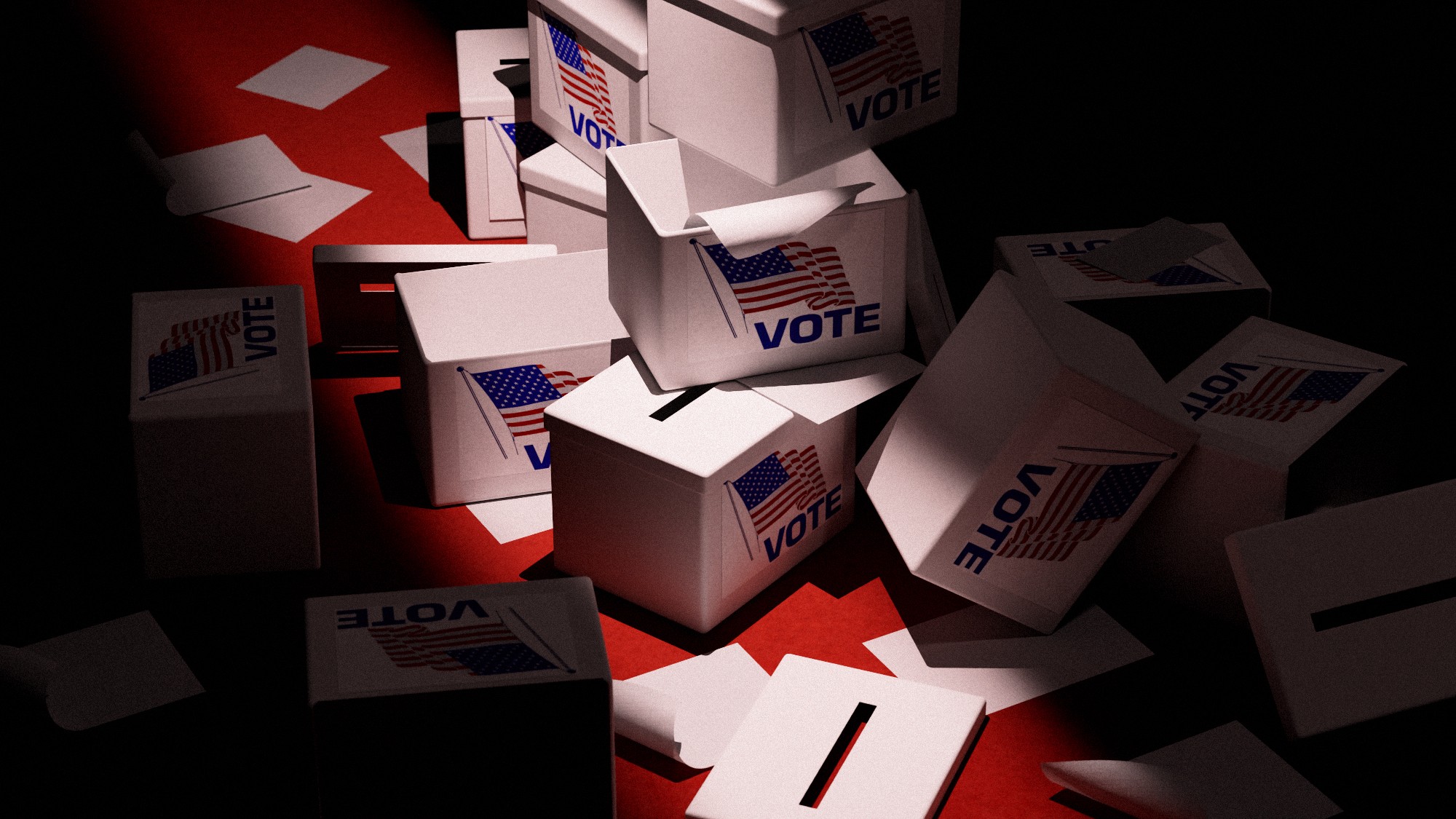
Clay Parikh, a cybersecurity expert from Alabama, spent years as a bit player in the world of election denial. He wasn’t a star with his own media platform, like the MyPillow guy. But he still gained a modest following by circulating conspiracy theories about President Trump’s 2020 defeat, including that poll workers gave Trump supporters—but not other voters—felt-tip markers to fill out their ballots, rendering them invalid and unreadable by voting machines. More recently, he’s asserted that a group of federal lawmakers is covering up foreign election interference. “They’re all puppets,” he said on the Rumble-streamed Real AF Patriot show in January. “They’re bought and paid for; it’s just by who.” He claimed that because of “undeniable” evidence of malfeasance, justice was coming.
On that last point, Parikh may actually be in a position to know. He is now pushing debunked election claims from within the systems he rails against as a special government employee in the Trump administration. The search-warrant affidavit that allowed the FBI to seize election materials in Georgia in January—an extraordinary intervention by federal law enforcement—cited an analysis by Parikh. Last fall, Parikh began a contract with Texas Attorney General Ken Paxton’s office that made him a player in the state’s process for certifying election equipment. He boasts of access to the Wyoming secretary of state, who, he said on Rumble, has invited him to participate in an online presentation with residents. And at 1:01 a.m. on Christmas Day, Trump made Parikh internet famous when he reposted a video of the 63-year-old testifying in court that election equipment could be infiltrated remotely.
Parikh is just one of many election deniers who were long relegated to the fringe and are now—with Trump back in office and still not over his electoral defeat six years ago—embedded inside the government. Another is the attorney Kurt Olsen, who was brought on last fall by Trump to investigate the 2020 election. Olsen’s work in the government—following years of pushing debunked or unsubstantiated theories—helped lead to the seizure of the Georgia ballots. In Arizona, federal probes of the 2020 election by the FBI and the Department of Homeland Security are under way. Olsen and other Trump administration officials have participated in extensive meetings about U.S. elections with senior members of the Justice Department in recent months, four people familiar with the meetings told us. In a statement, a DOJ spokesperson said, “The Justice Department is committed to upholding the integrity of our electoral system and will continue to prioritize efforts to ensure all elections remain free, fair, and transparent.”
The president signed an executive order on March 31 that attempts to change the rules on mail-in voting, and his allies in Congress are endeavoring to reshape elections ahead of the midterms this fall, spending weeks debating a voter-ID bill that is almost certainly doomed. In April the Justice Department demanded that officials in Wayne County, Michigan, turn over ballots from the 2024 election. “There are some of us election deniers that are supporting the federal government, and things are changing,” Parikh—one of the people who helped Olsen unsuccessfully challenge voting systems in Arizona years ago—said on the Rumble show. Though he said the team he was working with was smaller than he’d like, he said it was filled with “quality people” who care about “fixing” elections.
Shortly before the Georgia affidavit became public, Parikh told us he wouldn’t get into the details of his work for the federal government. In a phone call, he said he would like voting equipment in all 50 states investigated but told us sternly and loudly that he could “neither confirm nor deny” the details of his government work. Yet in an interview with Talking Points Memo after the Georgia affidavit was unsealed, Parikh warned of a “cabal” that is compromising elections and compared himself to Ron Swanson from the sitcom Parks and Recreation, a character who despises the very government he serves. “Working for the government but hating them every bit. Right?” he told the news outlet. “That guy’s my hero.”
So many people are pressing debunked and unsubstantiated election theories from within the government that their presence has become a feature of the system. They range from those with immense power—including the president—all the way down to local officials. Others are investigating them. In Riverside County, California, Sheriff Chad Bianco, a Republican who is running for governor, seized about 650,000 ballots and other election materials in March after local activists alleged malfeasance when California voters last year overwhelmingly approved a ballot measure to redraw the state’s congressional map in favor of Democrats.
Bianco told us that activists with a citizen group known as the Riverside Election Integrity Team had complained to his office that the number of ballots counted by election officials exceeded the number of votes cast. “There’s obviously something wrong with the machines,” he recalled activists claiming, citing their own research, “because we didn’t have that many ballots.” County elections officials explained that the activists were relying on imprecise data. But Bianco was determined to find out for himself. “The intent of the investigation is to count the ballots and see how many there are,” he told us in a video interview.
When we asked what steps his investigators took to assess the validity of the activists’ claims, the sheriff grew exasperated: “There’s no steps to determine the validity,” he said. “The validity is the records.” He brushed aside criticism from Democratic Attorney General Rob Bonta, who went to court to try to stop the probe. And Bianco dismissed alarm among election experts who said that his moves could deepen public mistrust in the democratic process. “An investigation increases their confidence,” the sheriff told us. Soon after, the California Supreme Court ordered the sheriff to pause his investigation and preserve the seized material while it reviews the case.
Undeterred, the Riverside Election Integrity Team is working with activists from at least half a dozen California counties to help them get records from county officials to review the outcome of last year’s redistricting referendum. Greg Langworthy, who calls himself the group’s “de facto leader,” told us his group intends to scrutinize similar records after the midterm elections—before results are certified, a process that can take weeks in California.
At the federal level, one main focus appears to be proving foreign interference—which election deniers have floated as a possible justification for Trump to declare a national emergency that could allow him to attempt to take control over some aspects of the election. But the proof has been elusive.
Staff from the Office of the Director of National Intelligence in recent months have briefed representatives for U.S. attorneys’ offices about potential vulnerabilities in voting machines and communications networks. Tulsi Gabbard, the director of national intelligence, has accused U.S. law-enforcement and intelligence personnel of participating in a “years-long coup” against Trump that began with the 2016 election. In January, she was present at the raid in Fulton County, a highly unusual move for an intelligence official whose purview is foreign threats, not domestic law enforcement.
Gabbard’s team has found that voting machines in Puerto Rico contained security weaknesses that could make them susceptible to manipulation, but found no evidence that the machines were actually tampered with or that any votes were altered, according to people familiar with the findings. Two people briefed on the activities said local officials in Puerto Rico have heard nothing more from ODNI since last year. Jason Wareham, the CEO of Mojave Research, the company that conducted the security review, documented his technical conclusions in a signed declaration to Gabbard, which we reviewed. It states that Olsen (who did not respond to multiple requests for comment) made assertions about stolen votes that were not backed up by sufficient forensic evidence. Wareham told us he was informed by an ODNI official that, after Mojave’s review was complete, Olsen wrote a letter to Trump in which he claimed that the company was taking money from the billionaire George Soros and acting at his direction. Wareham “emphatically” denies the allegation, he told us.
An ODNI official told us that Olsen wasn’t involved in the office’s examination of Puerto Rico voting systems, and that information he provided “was done so voluntarily” and “reviewed in the context of all of the other information available to ODNI.” The official added that the decision to examine the systems in Puerto Rico was made internally and “not directly connected to Mr. Olsen’s broader efforts.”
The White House spokesperson Abigail Jackson told us in a statement that “election integrity has always been a top priority for President Trump, and the American people sent him back to the White House because they overwhelmingly supported his commonsense election integrity agenda. His entire Administration is working together closely on these issues,” she said. “The President will do everything in his power to lawfully defend the safety and security of American elections and to ensure that only American citizens are voting in them.”
Puerto Rico Resident Commissioner Pablo José Hernández, who represents the island as a nonvoting member of Congress and caucuses with the Democrats, told us that in spite of the lack of evidence of infiltration, he worries that the Trump administration could “use Puerto Rico to build a conspiracy theory and a narrative to subvert elections in the broader United States.”
Many of the election deniers who now have power are familiar to anyone who was paying attention in the aftermath of the 2020 vote. Heather Honey, who as a Pennsylvania-based election activist sought to reverse Trump’s defeat and worked on numerous efforts to challenge elections in Arizona, now holds a key role at the Department of Homeland Security. There, she interacts with state election officials, many of whom don’t trust her, half a dozen of them told us. During a call with election officials last fall, Honey downplayed the impact of millions of dollars in funding cuts to cybersecurity initiatives (including one dedicated to elections) at the Cybersecurity and Infrastructure Security Agency, which is tasked with securing the nation’s election systems, two officials told us. Honey told state and local officials that CISA had “strayed from its mission” and engaged in censorship, echoing claims by Trump supporters that CISA’s programs contributed to suppressing their views online. One of the officials, who works in cybersecurity, was stunned by her remark; his office’s previous work with CISA and federal law enforcement involved reporting death threats against elections officials and cyber risks. Those reports, he said, were driven by fears of violence and abuse, not political rhetoric. (Honey and CISA did not return calls for comment.)
The idea of finding foreign election interference in a past election and using it to declare a national emergency has been pushed by the attorney Peter Ticktin, a friend of Trump’s who helped promote a hypothetical executive order based on the theory. Ticktin—who also assisted in securing pardons for some January 6 rioters—admits he has no evidence that votes were flipped in 2020. But in an interview, he claimed that some machines used in that election had “chips” connected to a server farm in Serbia that could control electoral outcomes—and that Serbia is a “satellite of China.”
Ticktin is also trying to persuade Colorado Governor Jared Polis to grant clemency to Tina Peters, a former county clerk who was convicted of state charges tied to tampering with voting equipment. Last month, a Colorado appeals court upheld Peters’s conviction but ordered reconsideration of her nearly nine-year sentence. A January 21 clemency application that we obtained through an open-records request shows that Peters acknowledges having “made mistakes.” If granted clemency, Peters pledged that she would stay on the right side of the law. Her X account has since continued to feature dubious claims, including that Democrats oppose banning electronic equipment, because “They cheat.”
Mike Lindell, better known as the “MyPillow guy,” has railed for years against supposed election fraud, alleging various disproved theories, including that software was tampered with to delete votes for Trump. He has used his clout in the election-denial community to create his own news network, LindellTV, with credentialed reporters at the White House and Pentagon. He also gets personal access to figures at the highest level of government. Lindell told us he has given federal investigators reams of “evidence” of wrongdoing in the 2020 election.
In July 2025, Lindell spoke online about his meetings with Trump. “I did just meet with the president—now this is the third time—about two weeks ago, and I’ll be hopefully seeing him again next week,” he said during an appearance on the Stern American video show. One focus for the administration, he said, is its work on the 2020 vote. But he explained that “a team going forward” is working “to get rid of these machines and computers” and to require people to vote by paper ballots that are hand counted. Lindell told us recently that he talks regularly with Olsen. Although the pillow salesman complained about what he considered the slow pace of federal investigations, he told us it’s a “blessing” that people like Parikh and Olsen are in positions of real influence to address attempts to rig voting machines. “The big thing is, you can take whole countries without firing a shot,” he said.
Election deniers ultimately want an overhaul of how U.S. states and localities record and count votes. Olsen tried to ban electronic voting equipment in Arizona in 2022—and lost. He represented Kari Lake, who was then running for governor, and Mark Finchem, who was running for secretary of state. They alleged that the nation’s transition to electronic systems and computer voting technology decades ago created risks of hacking and fraud, and argued that the devices violated the rights of Arizonans because the voting systems were vulnerable to cyberattacks.
The candidates and their attorneys asked a federal judge to scrap vote-tabulation machines and order votes to be counted by hand at the precinct level. (A top county election official testified that a hand count would require the hiring of 25,000 temporary workers and a building the size of an NFL stadium.) The judge threw out the case, finding that the plaintiffs cited only hypothetical allegations about the voting equipment. Olsen and another attorney were slapped with $122,200 in legal sanctions.
At the time, the lawsuit was bizarre to Steve Gallardo, the lone Democrat on the governing board that has helped run elections in Maricopa County. Now he told us he thinks the case offers a preview of how Trump, aided by some of the same players, may be seeking to undermine the coming elections. “I was one of those that would real quickly just roll my eyes and think these people are just crazy,” Gallardo told us. These days, he takes them seriously. “They are hell-bent on making sure that elections are run under their purview—the way they want elections to be held.”
Finchem, now a state senator, is still trying to influence elections. He said during an online appearance in March that an election nonprofit he helps lead has been “feeding research” to federal authorities. “The dam is breaking,” he said in a recent fundraising appeal. Two weeks ago he posted a picture on X that appeared to be made with AI of a man bearing a resemblance to Arizona Secretary of State Adrian Fontes walking near a county jail in handcuffs. (Fontes’s attorney sent a legal demand last week to Finchem asking him to retract the “defamatory content,” the letter, which we reviewed, said.)
Joanna Lydgate, the CEO and president of the nonpartisan States United Democracy Center, told us that she believes the ultimate goals of election deniers are to subvert America’s system of choosing its representatives and to make it easier to discard results that Trump and his allies don’t like. “I think it’s that simple; I really do,” she said. “Whether it’s an executive order or death by 5,000 cuts, it’s chipping away at our election system. They need to sow doubt; they need to undermine public trust; and each one of these narratives is a tactic to that end.”
In many ways, MAGA has already won its war against American elections. Confidence that a person’s state or local government will run a free and fair election is slipping. Trump’s administration is filled with election skeptics; federal investigations into 2020 are under way; and conspiracy theorists who were once marginalized now run some local election offices. Several officials who have been integral to running fair and transparent elections in past cycles told us they are already burned out—just as the deniers are getting started.
State lawmakers want to change the terms of personhood for corporations.
Show full content
Fifteen years after Mitt Romney stood on an Iowa hay bale and proclaimed that “corporations are people, my friend,” his declaration is no longer mockable. The amount of money corporations spend anonymously to sway federal elections has increased from $359 million in 2012 to $1.4 billion in the most recent presidential cycle. All of that spending by “dark money” nonprofits is protected by the same right to free speech enjoyed by “natural persons,” because the Supreme Court decided in Citizens United v. FEC that U.S. corporations function as citizen associations under the Constitution.
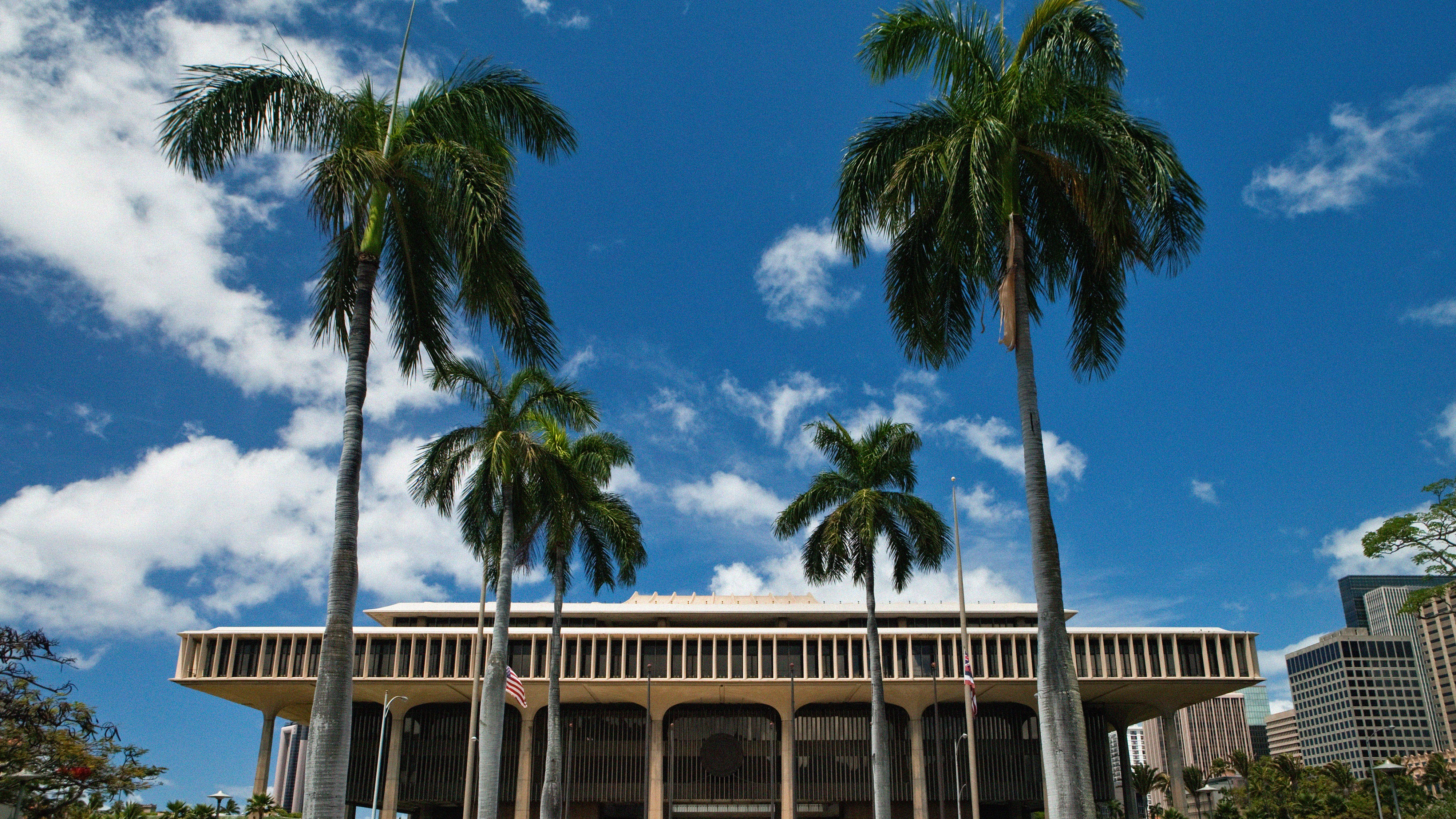
But not all of these “people” are created exactly equal. Whereas humans are automatically granted certain rights at birth, corporate personhood comes into existence under state laws that define its powers—a fact that opponents of corporate money in politics hope to use to transform how U.S. elections are funded. Hawaii is the first state to try. Earlier this month, a nearly unanimous and bipartisan majority—well, as bipartisan as it gets in a state with so few Republicans—of Hawaii’s state legislature voted to change the powers of corporations doing business in the state and no longer grant them the ability to spend on most political causes.
“Corporations are not people. They are granted powers and privileges by the state,” State Senator Jarrett Keohokalole told me this week, explaining the rationale of the bill he sponsored. “How can a creation of the state have inalienable rights? It doesn’t make any sense.”
The legislation—which Hawaii Governor Josh Green, a Democrat, has not yet signed—is expected to apply to for-profit companies, so-called dark-money nonprofits, unions, and chambers of commerce, potentially cutting off a major revenue stream for the super PACs that dominate politics. The legislation makes exceptions for journalistic work—as in, newspaper editorials explicitly advocating for certain candidates—and company-organized political-action committees that pool individual donations.
Under the proposal, Hawaiian corporations would still enjoy personhood of a kind, but they would lack a single ability guaranteed to their living and breathing peers. Supporters point to Chief Justice John Marshall’s 1819 opinion in Trustees of Dartmouth College v. Woodward, a landmark case that set the course of corporate law that followed. “A corporation is an artificial being, invisible, intangible, and existing only in contemplation of law,” Marshall wrote. “Being the mere creature of law, it possesses only those properties which the charter of its creation confers upon it.”
Tom Moore, a senior fellow at the Center for American Progress who previously worked for a chair of the Federal Election Commission, came up with this legal strategy as a bank-shot attempt to reverse the impact of the 2010 Citizens United decision without directly engaging its First Amendment logic. Moore argues that states can change their corporate laws while sidestepping free-speech questions because the corporate charter—that “mere creature of law”—precedes any constitutional right. “This is not a campaign-finance regulation,” he told me. “You have to look at it differently.”
This year, his evangelizing led to the introduction of legislation in 15 states, Moore said, but only Hawaii was able to get a bill to a governor’s desk. In Montana, activists are gathering signatures in hope of making the issue a ballot initiative in November. “We need to have an answer to all the money in politics these past 15 years,” Jeff Mangan, the organizer of that effort, told me.
As a political matter, the gambit is likely popular. A 2023 Pew Research Center poll found that, among both Republicans and Democrats, more than seven in 10 support limits on the amount of money organizations can spend on political campaigns. YouGov polling last year for Issue One, a group advocating for more restrictions on money in politics, found that 73 percent of Democrats and 53 percent of Republicans disapproved of the Citizens United finding that corporations have the same free-speech rights as individual citizens.
But the idea, at least so far, has been widely dismissed by corporate-campaign-finance attorneys and some conservative constitutional scholars, who long ago internalized Romney’s maxim of corporate personhood, which he offered in Iowa as a defense of lower corporate taxes. They reject Moore’s arguments that state corporate charters are exempt from the Supreme Court’s protection of collective speech. “If the First Amendment has any force, it prohibits Congress from fining or jailing citizens, or associations of citizens, for simply engaging in political speech,” Justice Anthony Kennedy wrote in the Citizens United decision.
“This isn’t a semantic game. Partnerships and loose organizations, all of them have the same rights,” Ilya Shapiro, the director of constitutional studies at the Manhattan Institute, told me. “The bottom-line issue is you are trying to regulate corporate speech, and Citizens United speaks directly to that.”
Hawaii Attorney General Anne Lopez, a Democrat, agrees, and warned the state’s legislature that the bill is likely to be rejected by the courts, after some expense to the state in legal fees. “Although states have the authority to determine what powers a corporation has, if a state tries to remove a corporation’s power to engage in election activity or ballot-issue activity, under Citizens United, a state would then be attempting to take away a corporation’s right to speak,” she wrote earlier this year.
Nonetheless, the bill passed unanimously in the state Senate and lost only one vote in the state House—from a Republican who called the intent of the bill “amazing” but agreed with Lopez that the court fight would be futile. The next step will be a decision by Green about whether to sign the bill into law. Lawmakers involved in the effort told me they expect him to soon. (If he happens to not sign it, those same lawmakers said that the legislature is unlikely to override a veto.) Erika Engle, Green’s press secretary, told me in a statement that the governor would announce his decision “at the appropriate time” and that he “recognizes the precedent-setting nature of this legislation and thanks the Legislature for its hard work on this matter.”
Green’s signature would likely trigger lawsuits, setting off months or years of litigation that could eventually lead back to the Supreme Court. It would also provide fresh water-cooler fodder for corporate-law professors, who have begun to debate among themselves how to settle the conflicting interests of the First Amendment and state power to define corporations, two bodies of jurisprudence with long traditions in American law. “It’s novel enough that I think it is hard to predict how a conservative court would react,” Jill Fisch, a business-law professor at the University of Pennsylvania, told me. “It is a great, creative initiative.”
It could also restart the national conversation over the growing role corporations play in American public life. Even in the age of emerging artificial intelligence, “people” without flesh and blood still have their limits. “That is what I have been arguing all along,” Hawaiian State Senator Karl Rhoads, another sponsor of the bill, told me. “Corporations are just piles of papers.”
Douglas Wilson has a modest proposal to improve American life: He wants to repeal the Nineteenth Amendment, which gave women the vote. In his ideal system, “we would do it in our politics the same way we do it in our church structure,” he told me recently. “And that is, we vote by household.”
Wilson is a co-founder of the Communion of Reformed Evangelical Churches, based in Moscow, Idaho. Over the past five decades, he has built a small empire there, dedicated to disseminating his theocratic vision for the United States: a publishing house, a school, a liberal-arts college, and a video-streaming service. His denomination, which has about 170 affiliated churches, counts Defense Secretary Pete Hegseth as a member, and Wilson was invited to lead a prayer service at the Pentagon in February. So when the pastor casually suggests disenfranchising half of America, people listen.
When I asked him about this position, Wilson said it wasn’t his top priority—“We have bigger fish to fry”—but something he sees happening in perhaps 200 years’ time. I found this intellectual footsie maddening. “If I said to you, ‘I think all white men should be put in cages—but not now; it’s not my aspiration for now,’ ” I suggested, “then you wouldn’t be interested in a single other thing that I had to say at that point.”
Wilson chuckled. “Oh, I know you’d probably have all my attention.”
This is twinkly, avuncular Douglas Wilson, the guy who joined a hippie congregation fresh out of the Navy because he liked to play guitar, and ended up leading services once the regular pastor moved on. The same guy who once went on a multicity debating tour with the New Atheist Christopher Hitchens, and bonded with him over their shared love of P. G. Wodehouse. But the 72-year-old shows a different side on his website, Blog & Mablog. For more than two decades, Wilson has been airing piquant opinions on unruly women—or, as he calls them, “small-breasted biddies,” “harridans,” “lumberjack dykes,” and “Jezebels.” He once referred to Gloria Steinem and another feminist as “a couple of cunts.” And this is the polite version. Every year he celebrates “No Quarter November,” when he promises to tell readers what he really thinks.
Wilson believes that women should “not ordinarily” hold political office, and should never serve in combat roles in the military. Husbands should have dominion over misbehaving wives’ weight, spending habits, and choice of television programs. His uncompromising vision for America was once considered marginal, the conservative writer Karen Swallow Prior told me. Since his elevation by Hegseth, however, “no one can credibly say that Doug Wilson is fringe anymore.”
Wilson is a prominent voice in what is sometimes called “masculinism”: a movement to fight back against the advances of feminism and reassert the primacy of men. His version is religious, influenced by the notion of male “headship” of the family and Saint Paul’s belief that godly women should “be quiet.” There are also plenty of secular masculinists, as well as nominally Muslim ones, such as the streamer Sneako, the self-proclaimed pimp Andrew Tate, and the podcaster Myron Gaines. Woman-bashing plays well on social media and sells lots of ads for crypto, sports betting, and supplements. You can make good money telling men that they’re the truly oppressed sex.
But this isn’t just a movement of grifters exploiting a quirk of the algorithm. In the past decade, one of the New Right’s major challenges has been to retrofit a consistent ideology onto the electoral power of Donald Trump. Masculinism has been a great gift, because factions with different views on, say, protectionism or Israel or Big Tech can all agree on the overreach of feminism and the need for a return to traditional gender roles. Far from being a fringe belief system, masculinism has become the single most important force uniting the American right, bringing together an unlikely constellation of pastors, posters, senators, preachers, influencers, podcasters, and fanboys.
The MAGA movement is often framed as a reaction to the first Black president, and to a growing Latino population. But the multiracial appeal of the manosphere and Trump’s 2024 inroads with young minority men point in a different direction. “People ask me what the New Right is furious about,” the author Laura Field, whose book, Furious Minds, describes the intellectual underpinnings of Trumpism, told me. “And I think a good shorthand for that is they’re furious about their own loss of status in society over the last few years and the elites who made that happen, and I think that the pithiest short version of that is that it’s the women. It’s the women who took their status.”
Wilson’s approach to public life clearly has an element of what professional wrestlers call kayfabe—the winking, performative trollishness that now characterizes the online right. He wants feminists like me to get angry with his most outlandish proposals, making ourselves look like scolds or Chicken Littles in the process. But Wilson and a growing number of powerful allies are sincere in these beliefs, and would want to enact them if given the chance.
One of masculinism’s central claims is that no one is talking about men. So true! Men’s issues are not being discussed in Senator Josh Hawley’s 2023 book, Manhood: The Masculine Virtues America Needs. They aren’t being discussed in Tucker Carlson’s documentary The End of Men. They aren’t being discussed in the panoply of Christian books available on Amazon with titles such as Man for the Job, Masculine Christianity, and It’s Good to Be a Man, or in their secular counterparts, such as Why Women Deserve Less. They aren’t being talked about on social-media feeds (which can be highly segregated by sex) or on some of America’s most popular independent podcasts, such as Modern Wisdom, Huberman Lab, and The Diary of a CEO.
For decades, each feminist advance in American public life has prompted an equally strong backlash. The first wave of women’s-rights activists won suffrage for women, against ferocious and sometimes violent opposition. After the second wave secured Title IX and other legal victories against sex discrimination, Phyllis Schlafly successfully fought back against the full ratification of the Equal Rights Amendment. By the identity-obsessed 2010s, the full weight of corporate America had swung behind glib slogans such as “The future is female.” This commercial blitzkrieg inevitably convinced some people that women’s advancement had come at men’s expense. A refrain I kept hearing over the past few years was that boys were being made to feel ashamed of themselves, as if they were stained by some kind of original sin. These years have seen a counterreaction, with the total abandonment of the #MeToo movement, conservative gloating over the fall of Roe v. Wade, and the return of straightforwardly sexist put-downs—“Quiet, piggy”—to public life.
Like most popular movements, masculinism has many entry points, and both defensible and alarming forms. At one end of the spectrum are legitimate concerns about male loneliness, the declining share of men in higher education, stagnant wages for non-college-educated men, and the deadening effects of day-trading, gaming, and porn. At the other end of masculinism are a misogynist vocabulary about AWFULs and the longhouse (terms that we’ll come back to) and a political agenda close to that in The Handmaid’s Tale, whereby women are denied the right to work, vote, and control their own bodies.
On the internet, masculinism is presented as a rebellion—a transgressive middle finger to the liberal establishment, expressed in all the words a corporate HR department would order you not to say. In the past few years, leaked group chats have shown Young Republicans and college conservatives using sexism, infused with racism, as a bonding mechanism. “If your pilot is a she and she looks ten shades darker than someone from Sicily, just end it there. Scream the no no word,” read a message in a Telegram thread used by the leaders of Young Republican chapters in New York, Kansas, Arizona, and Vermont. (Several members of the chat were women.) Richard Hanania, who describes himself as a former white nationalist, calls this kind of in-group signaling “the Based Ritual,” a way for younger MAGA enthusiasts to prove their bona fides to one another.
Nick Fuentes has suggested that women be sent to “breeding gulags.” (Photo-illustration by The Atlantic. Source: Jacquelyn Martin / AP.)
Among Gen Zers, Douglas Wilson’s intellectual heir is Nick Fuentes, who leads a loose collection of trolls known as Groypers. A self-professed Christian nationalist, anti-Semite, and virgin, Fuentes has built a fan base in part by deploying vividly misogynistic language. “Our No. 1 political enemy is women, because women constrain everything, every conversation, every man—everything,” Fuentes said on a livestream earlier this year. He added: “Just like Hitler imprisoned Gypsies, Jews, Communists—all of his political rivals—we have to do the same thing with women.” He suggested that they be sent to “breeding gulags. The good ones will be liberated. The bad ones will toil in the mines forever.”
Fuentes’s rhetoric shows how this gendered view of the world can easily be interlaced with other prejudices. Gay men? Effeminate, uninterested in sports, therefore unmanly. Jews? Clever rather than athletic; also unmanly. University lecturers? Pencil-necked postmodernists; also unmanly. Trans people? Inevitably degenerate. Muslims? An invasion force of rapists. Black men? Thugs from whom white women should be protected (if only they would submit to patriarchy). Almost every facet of contemporary online rightism can be refracted through the prism of gender. Multiple people affiliated with the Heritage Foundation, perhaps the most influential MAGA policy organization, cut ties with the group after its president refused to condemn Fuentes’s anti-Semitism last year. But his view that women belong in forced-breeding camps has produced no such fuss.
Wilson told me he considers this sort of rhetoric unforgivably gauche. “The Bible says that a godly woman is a husband’s crown,” he said. “I’ve never seen a king talk about his crown the way Fuentes talks about women. It’s absurd.” I wanted to ask whether “small-breasted biddies” came from the Gospel of Mark or Luke, but Wilson was on a roll. He thought Fuentes was so extreme that he might even be an undercover federal agent sent to discredit the movement. “He is, as far as I’m concerned, on the other team.”
In theological terms, that might be true. But both men benefit from a shock-and-awe rhetorical strategy. In 2014, it was a minor scandal when the megachurch pastor Mark Driscoll was revealed to be “William Wallace II,” the author of dozens of pages of message-board rants about how America was a “pussified nation” where men are “raised by bitter penis envying burned feministed single mothers who make sure that Johnny grows up to be a very nice woman who sits down to pee.” Now such language would barely raise an eyebrow.
Writers who used to hide their masculinist impulses behind a pen name now write and say outrageous things under their real name. Take the manosphere provocateur known as Raw Egg Nationalist, whose handle on X, where he has more than 300,000 followers, is @Babygravy9. He combines lifestyle and nutritional advice—“slonking” raw egg yolks—with hard-right, anti-immigration politics. He writes for Infowars, the conspiracy theorist Alex Jones’s media outlet. He posts about antiwhiteness and has his own line of microplastic-free herbal-tea bags, Kindred Harvest.
In 2024, a left-wing activist group outed him as Charles Cornish-Dale, a religious historian who has studied at both Oxford and Cambridge, and whose Ph.D. thesis was titled Migrations of the Holy: The Devotional Culture of Wimborne Minster, c.1400–1640. When his name became public, Cornish-Dale, now 38, concluded that being doxxed has “only made me stronger and more committed to what I’m doing.”
He did not use a pseudonym for his new book, The Last Men, in which he questions whether it is “possible to be men fully in a liberal democracy.” His political prescriptions, like Wilson’s, might be described as uncompromising. “Someone asked me the other day—I think it was a girl, actually—she was like: ‘So would you take away the vote from women?’” he told me. “I was like, ‘I would take away the vote from the vast majority of men as well.’ ”
His book, published by the venerable conservative imprint Regnery, suggests that men with high testosterone levels voted for Trump because high T is correlated with an acceptance of hierarchy, status, and inequality. Liberalism, by contrast, suppresses men’s life force: “Leftists have now openly embraced emasculation and having low testosterone as part of their identity.” He also revisits an argument he first made in an article titled “Ecce Homos,” that the left had robbed straight men of their heroes by recasting them as gay. He wants to reclaim the male bonding of “Julius Caesar or Alexander the Great, the Spartan last stand at Thermopylae, cowboys, pirates, gang members.”
Charles Cornish-Dale, trained as a religious historian, is also a manosphere provocateur known as Raw Egg Nationalist. (Photo-illustration by The Atlantic. Source: Courtesy of New Culture Forum.)
The Last Men is a confounding book because it seems equally perturbed by falling birth rates and Brokeback Mountain winning three Oscars. Cornish-Dale identifies potentially worrisome phenomena, such as a reported decline in sperm counts around the world, and gestures toward genuine feelings of ennui experienced by many young American men, who are stuck in unrewarding jobs, searching for greater meaning in their lives. He lays the blame at the feet of the elites: They are keeping you fat; they are unhappy with risk taking and hierarchy; they are calling masculinity toxic.
In conversation, Cornish-Dale is cocky but likable, with a languorous way of speaking that reminded me of Simon Cowell. Our Zoom took place at 6 a.m. his time, and he appeared to be talking to me from his bed, wearing striped pajamas. His current aesthetic is shaved head and swole, though back in 2012, he gave up doing fieldwork in a Buddhist monastery when he was asked to cut off his man bun. “I was going through a hipster phase,” he told me. “They wanted me to wear a robe instead of skinny jeans, and I just wouldn’t do it.”
Cornish-Dale is essentially an influencer—albeit one who knows a lot of $10 words. But masculinism is not merely an outgrowth of the attention economy. Other figures with similar ideas have strong connections to conservative policy circles.
One of these is Scott Yenor, who has declared that modern women are “medicated, meddlesome, and quarrelsome.” Since 2000, Yenor has taught political philosophy at Boise State University, in Idaho, 300 miles south of Douglas Wilson’s stronghold in Moscow. He has also worked with Florida Governor Ron DeSantis on rolling back DEI programs, which conservatives see as a de facto racial and gender quota system that is harmful to white men. “The core of what we oppose is ‘anti-discrimination,’ ” Yenor wrote in a 2021 email, released to The New York Times under a public-records request.
Yenor now fancies doing a little discrimination of his own. As he wrote in an essay for the Claremont Institute last fall, he believes that the law should change to allow businesses “to support traditional family life by hiring only male heads of households, or by paying a family wage”—that is, compensating men more so that their wives do not need to work. (Currently, this would be straightforwardly unconstitutional sex-based discrimination.) In 2021, he argued that colleges should not try to recruit more women to become engineers, but instead should “recruit and demand more of men who become engineers. Ditto for med school and the law and every trade.”
Like J. D. Vance, he reserves particular scorn for women who do not have children. Heaven help the “childless media scold” or “barren bureaucratic apparatchik”—Yenor’s terms—who decides she would prefer having a career to having babies. His rhetoric is unpleasant and extreme enough that he could not get confirmed to a university board in Florida. As for repealing the Nineteenth Amendment, Yenor told me via email that “when America had household voting or some rough equivalent, it was not a tyranny, the country was well governed, and the family was supported. The country is different today, and the same voting system would be uncongenial to our conditions.” (Although he responded to my question about the Nineteenth Amendment, Yenor did not make time for an interview with me.)
Yenor recently became the chair of the American Citizenship Initiative at the Heritage Foundation. A January report from the foundation called for a “culture-wide Manhattan Project” to promote family building through generous tax giveaways to married couples in which one parent is employed. At the same time, abortion, birth control, single-parent benefits, day care, dating apps, and no-fault divorce would be discouraged. The report contains one of the least romantic sentences I have ever read: “Marriage also opens unique retirement planning opportunities.”
Scott Yenor has declared that modern women are “medicated, meddlesome, and quarrelsome,” but says that denying them the vote would be “uncongenial to our conditions.” (Photo-illustration by The Atlantic. Source: Heritage Foundation.)
All of this is a continuation of themes found in Project 2025, the Heritage Foundation’s blueprint for Trump’s second term. The document, in the words of my colleague David Graham, offers a vision of America where “men are breadwinners and women are mothers.”
Yenor’s suggestion that feminism—with its attendant horrors of work outside the home, birth control, and financial independence—has made women neurotic and dependent on pharmaceuticals is now an article of faith on the right. Anonymous online posters frequently bring up data suggesting that liberal women are most likely to report suffering from anxiety. But to attribute female unhappiness to feminism seems wildly ahistorical. Have these people never read, say, The Feminine Mystique, which exhaustively cataloged the despair of mid-century stay-at-home mothers? (“Many suburban housewives were taking tranquilizers like cough drops,” the author, Betty Friedan, wrote.) Across the manosphere, however, young people are told that before feminism ruined everything, women used to be cherished and pampered by their husbands. Now women are supposedly subsidized by government handouts or earning six figures in pointless “email jobs.” In the masculinist paradigm, every woman does HR for cats and every man is a plumber or merchant seaman.
I asked Wilson about his allies’ nostalgic distortion of history. “Just a simple question,” he responded. “If you went back to 1850 and said: Out of all these women who had to get husbands’ permission to travel, to visit a sick cousin or whatever, how many—take 10,000 of those women—how many of them were on antidepressants? And how many of them today are on antidepressants?”
That wasn’t a fair comparison, I said, because today everyone is on antidepressants. Also, in the 1850s, SSRIs hadn’t been invented. You just got told to take some laudanum and go to the baths.
How popular are masculinist ideas? Last year, research by King’s College London and Ipsos found that Gen Z men in 30 nations were far more likely than male Baby Boomers to say that the fight for women’s equality had gone so far that men were now disadvantaged. They were also more than twice as likely to say that a father who stayed home with his children was “less of a man.” Meanwhile, 83 percent of Republican men younger than 50 think society is too feminized, according to a survey by the conservative Manhattan Institute. Intriguingly, this survey did not replicate the usual trope of working-class men revolting against snooty female elites: It found that “college-educated Republicans are more likely than their non-college counterparts to endorse the view that society has become too feminine.”
The most recent presidential election, pitting Trump against Kamala Harris, was a gift to masculinists. After all, the movement’s villains include female bosses, feminists, and women who don’t bear children—and Harris was the embodiment of all three. The male podcasters who got behind Trump in 2024 now host outright misogynists: Consider the career of the Christian debater Andrew Wilson, who in January appeared on arguably the most popular podcast in America, The Joe Rogan Experience—the manosphere-influencer equivalent of singing the national anthem at the Super Bowl.
Rogan’s choice of guests is a useful bellwether of the American political mood; he himself drifted from 2020 Bernie bro to 2024 Trump endorser via anti-wokeness, annoyance at COVID lockdowns, and a deep investment in conspiracy theories. He has lately begun to take an interest in Christianity, and has attended a nondenominational church.
Wilson, who appeared on Rogan’s show to promote his online debating courses, originally became famous for appearing repeatedly on Whatever, a dating podcast with 4.6 million YouTube subscribers. The show’s specialty is goading models and OnlyFans girls into delivering ragebait, such as one recent guest’s suggestion that she deserves a millionaire husband. Women are never supposed to win in the Whatever bear pit, but sometimes they do, just by remaining calm while the men try to trip them up.
In one episode, Wilson told a female fellow guest that she was too stupid to understand him, so she raised the fact that Wilson’s wife, Rachel, has children with three different men. He went thermonuclear. “You lick snizz,” he barked. “You’re a fucking dyke. Don’t talk shit about my wife, you stupid bitch.” He added, “I’m better than you.” It was an extraordinary display of uncontrolled aggression. In another clip, he mocked a female guest for being unable to open a pickle jar. She handed it to him, and he failed too. “Your hand greased the whole top of it,” he complained. Wilson has one of the most unpleasant internet personas I’ve ever encountered, and I’ve been on Bluesky. (He did not reply to my request for an interview, which was a relief.)
Unsurprisingly, Wilson treated Rogan, a high-status man, with far more respect than he showed the models of Whatever. In full bro-ing-out mode, he told Rogan that “feminists would immediately stop being feminist if they just had a taste of, like, well, you know, people actually did have to shut themselves up at night from wolves.” (How a chain-smoking middle-aged man who podcasts for a living would fare against a wolf is an open question.) The difference between this Andrew Wilson and the one from Whatever was remarkable—as was the fact that Rogan was prepared to host the benevolent version without any apparent concern for the malevolent one.
Wilson also took the opportunity to plug his wife’s book, Occult Feminism, which argues that feminism is “born of occult belief, because at its core, feminism seeks to make women gods over men, or at the very least to deify women.” I’ve read it (spoiler alert: The suffragists loved séances; Miley Cyrus’s tongue is pagan) and can say that the experience is eerily reminiscent of a friend recounting half a dozen Wikipedia pages that they read while drunk.
Wilson, however, promoted his wife so successfully that a few weeks later, Rachel Wilson made her own appearance on The Joe Rogan Experience. “I didn’t really have much of an opinion on feminism,” Rogan told her—except that he’d noticed that some feminists hated men. But listening to her book had made him realize that its origins were “bonkers.”
What followed was a greatest hits of anti-feminism—which, as Phyllis Schlafly learned, is the one subject where women’s contributions are always welcome. “Nobody wants to talk about this,” Rachel Wilson told Rogan. “This is the conversation no one’s ready for. Women’s access to higher education is the No. 1 correlate around the world—regardless of economics, race, culture, status, anything—to falling birth rates.”
In fact, observing a link between education and birth rates would be considered utterly banal in policy circles: The United Nations was publishing research on the phenomenon back in the 1990s. But everything in the manosphere has to be presented as allegedly forbidden knowledge. A few weeks later, the podcaster Katie Miller—wife of the Trump White House adviser Stephen—was making the exact same point to Fox News’s Laura Ingraham, also with the air of someone breaking a taboo. Feminism was destroying the family, she told Ingraham, because it “pushed women into the workplace.” As the writer Jill Filipovic noted, “These two women are having this conversation at their jobs.”
In fact, the challenge of falling birth rates is so well-known that many countries have implemented pronatalist policies in response: Singapore offers $11,000 “baby bonuses,” while Hungary exempts mothers of three or more children from income taxes. So far, though, none of the carrots has worked. The actually unspeakable bit is whether women’s access to education and the job market should be restricted, in the name of producing more babies and saving civilization. I wish people like Rachel Wilson would just come out and say that they favor this, so we can have a proper argument about it.
Instead they deploy a classic masculinist tactic: Tiptoe up to the edge of a policy that would poll as well as mandatory Ebola, then pirouette away at the last minute. Joel Webbon, a hard-right pastor based in Austin who has built a large social-media following by opposing feminism and the “LGBT Mafia,” is one of those prepared to say openly that he would like to restrict women’s participation in public life. “I know a lot of people, and I’m obviously not going to name them, but a lot of people and names that you would recognize are much further to the right than they are willing to publicly say,” he told me. However, he did not mind their bait-and-switch style, because the left has used it for decades. A small group of people argued that “love is love” to pass gay marriage, “and then, you know, it’s like: Oh, actually, Drag Queen Story Hour.” Masculinists were only turning lefties’ own strategy against them.
Joel Webbon, a hard-right pastor with a large social-media following, says openly that he would like to restrict women’s participation in public life. (Photo-illustration by The Atlantic. Source: Right Response Ministries.)
Like Douglas Wilson, Webbon is regularly described as a hate preacher; he told me that his services in Austin attract protesters who photograph his congregation. And as with Wilson, and Cornish-Dale, there is an enormous gulf between Webbon’s combative online persona and the person I interviewed. On his podcast, he talks trollishly about “the fake sin of raaaycism,” but one-on-one, he was scrupulously polite, calling me “ma’am” and listening without interruption as I told him that the system he advocates for is closer to Saudi Arabian guardianship than anything from the Christian tradition. He sees his internet presence, he told me, “like the Apostle Paul arguing and lecturing in the hall of Tyrannus,” an important period of evangelism for the early Church. When I checked his X feed later, he was talking about “Jewish sodomites” and reposting an account called @IfindRetards.
The Phyllis Schlafly of today is the writer Helen Andrews, with whom I am sometimes confused by liberals with Helen blindness. In a viral 2025 essay for Compact magazine called “The Great Feminization,” Andrews asked whether greater female participation in the workforce was “a threat to civilization.” (Honestly, women can be so overwrought.)
She was building on an influential thesis on the right known as “the longhouse,” which argues that modern, feminized society resembles the communal living halls of the past, which were dominated by “den mothers” who ruled by passive aggression, offense-taking, and ostracizing their enemies—all classically feminine modes of behavior. The most famous outlining of the longhouse thesis came from a writer calling himself L0m3z in the religious magazine First Things. He declined to cite any specific historical examples and added that one could not really define the longhouse, anyway, because “its definition must remain elastic, lest it lose its power to lampoon the vast constellation of social forces it reviles.” How convenient! Instead, the longhouse was “a metonym for the disequilibrium afflicting the contemporary social imaginary.” Let me shock you: L0m3z was eventually outed as a humanities academic.
Andrews took this thesis further, arguing that “everything you think of as ‘wokeness’ is simply an epiphenomenon of demographic feminization.” To translate that into English, the claim is that women don’t settle arguments like characters in a Guy Ritchie film, with fisticuffs outside the smoking shed and no hard feelings two hours later. Instead, Andrews writes, they “covertly undermine or ostracize their enemies.” Therefore, “all cancellations are feminine.” Again, a quick glance at the history books presents a few challenges: The backstabbing in the Roman Senate was both literal and figurative, and the Vatican has always been a nest of scheming cardinals. And who pressured ABC to take Jimmy Kimmel off the air after Charlie Kirk’s assassination? Brendan Carr, who is Trump’s Federal Communications Commission chair—and the possessor of a Y chromosome.
Later in the essay, Andrews offered a testable proposition: “If a business loses its swashbuckling spirit and becomes a feminized, inward-focused bureaucracy, will it not stagnate?” As it happens, the labor economist Revana Sharfuddin has crunched the data on factories in the Second World War—one of the greatest periods of “demographic feminization” in American history—and found no evidence that they became paralyzed by cancel culture and petty HR disputes. When I asked Andrews about this, she noted that wartime automobile and electrical factories were still essentially segregated by sex, and that even so, some managers hired counselors to help them deal with their new workforce. “For what it’s worth, the counterargument that most landed with me was the example of communism,” she wrote in an email. “Women were well represented in medicine and science in the Soviet Bloc, and their society didn’t collapse—well, it did, but probably not because of the women.”
Andrews’s essay comes to the defense of former Harvard President Larry Summers, who resigned under pressure in 2006 after arguing that women might be underrepresented in the hard sciences because of their innate lack of interest in those fields and their inability to perform at the highest levels. It later emerged in the Epstein files that this was a sanitized version of his private view, which was that women have lower IQs than men. (Out of curiosity, I hunted down the diversity stats for 2006, the year Summers resigned. At the time, four-fifths of Harvard’s tenured professors were men.) In retrospect, Summers’s ouster doesn’t look like the product of feminist hysteria; rather, his colleagues may have seen him as an embarrassing liability and seized on the opportunity to offload him.
To my surprise, when I put this to Andrews, she partially agreed. “Saying Larry Summers was fired because of the controversy is like saying America entered World War II because of Pearl Harbor,” she said. “It’s a simplification: good enough for the one-sentence version, but definitely omitting important factors.” In our communication, she was wry and self-deprecating, apologizing for any inconvenience I’d experienced by being mistaken for her—“the bad Helen.” I reflected that this version of Andrews wouldn’t have gone viral in the way that the one warning that working women are a “threat to civilization” did.
On the right, creeping feminization has become an all-purpose explanation for many recent events: Women pity the underdog, pander to self-proclaimed victims, and care about hurt feelings more than the truth—all of which are exploited by undocumented immigrants and violent criminals. In this analysis, Renee Good—the woman shot by an immigration-enforcement officer in Minneapolis—was killed because she’d adopted left-wing values. “An AWFUL (Affluent White Female Urban Liberal) is dead after running her car into an ICE agent who opened fire on her,” the right-wing pundit Erick Erickson posted immediately after her death. Women are childlike, naive, immature; they simply do not understand the real world.
Helen Andrews wrote a viral 2025 essay that questioned whether greater female participation in the workforce was a “threat to civilization.” (Photo-illustration by The Atlantic. Source: Jon Meadows.)
Many MAGA figures have identified the surfeit of feminine empathy as a political issue. The first episode of Douglas Wilson’s Man Rampant podcast was called “The Sin of Empathy.” The Canadian marketing professor Gad Saad issues regular condemnations of “suicidal empathy” between posts complaining that women “no longer wear any real clothes and instead are always in athleisure.”
This disdain for empathy often leads to the conclusion that women’s political participation is a problem, because the little ladies will insist on voting for the wrong candidates and policies. “The 1920s were the last decade in American history during which one could be genuinely optimistic about politics,” Peter Thiel, an early advocate for Trump in Silicon Valley, wrote in a 2009 essay for a Cato Institute journal. “Since 1920, the vast increase in welfare beneficiaries and the extension of the franchise to women—two constituencies that are notoriously tough for libertarians—have rendered the notion of ‘capitalist democracy’ into an oxymoron.” In this view, the gender split in American politics—55 percent of men but only 46 percent of women voted for Trump in 2024—is not merely a reflection of differing priorities but a problem to be solved.
At the same time that people like Wilson are saying out loud that they want to repeal the Nineteenth Amendment, the suggestion that anyone seriously wants to end female suffrage is often dismissed by mainstream conservatives as lib hysteria. After all, changing the Constitution would require the assent of three-quarters of the 50 states. “I’ll be concerned about the 19th thing the day a single state—just one out of 38—passes a repeal,” Inez Stepman, a former fellow at the Claremont Institute, posted in March. Liberals were “humorlessly chasing fumes of jokes and bar chatter, and dishonestly using it to silence real policy and cultural debate.” Personally, I would feel better about this line of argument had I not sat opposite the conservative intellectual Jordan Peterson in 2018 while he sneered at my suggestion that Trump-appointed justices would overturn Roe v. Wade. Or if the Trump administration had not taken the issue of birthright citizenship all the way to the Supreme Court. Or if Pete Hegseth had not already blocked the promotion of female (and Black) military officers, and frequently expressed his opposition to women serving in combat.
Masculinism is now approaching its imperial-overreach phase, like the Roman empire that many of its leaders so admire. For some of its most ardent adherents, if someone on the left is doing anything, regardless of their sex, it’s feminized and bad. Meanwhile, when Trump sends out a bitchy Truth Social post about a petty grievance, that is a display of manly vigor. Tucker Carlson’s perfectly buoyant coiffure? Rugged—butch, even. Ben Shapiro’s heartwarming enjoyment of musical theater? In the best tradition of the Vikings or Spartans, probably. This reductive view of the world—women things bad, men things good—is the mirror image of the worst excesses of 2010s Tumblr feminism, when introverted teenage girls posted hashtags like #KillAllMen and drank from mugs that read MALE TEARS.
In March, the anti-DEI activist Christopher Rufo had to fend off a horde of anonymous right-wing posters claiming, apparently seriously, that white men “are very easily the most oppressed group in history.” When he described this view as “brain damaged” and invoked a little-known American phenomenon called slavery, he was besieged with complaints.
For me, this episode gets to the core of MAGA masculinism. Which of its faces is the real one—the conservative think-tankers seeking to undo antidiscrimination laws, or the soap opera of influencers railing against “small-breasted biddies” and AWFULs, wallowing in self-pity, and labeling everything they dislike as feminine?
But of course, the sober thinkers and the shock troops feed off each other. Sometimes, as with Wilson, they coexist in a single person. This is a movement with real policy goals: the rollback of no-fault divorce. Tax breaks to reward male breadwinners and female homemakers. An end to anything with a whiff of DEI, even leadership programs for women in the military, like one cut by Hegseth. A return to the workplace culture of the 1970s, where sexual harassment was normalized. An open preference for male employees in hiring, promotion, and pay awards—in other words, affirmative action for men.
Yet masculinism also functions as a perpetual-motion machine of grievance, an inarticulate howl of anguish at the status quo—whatever that currently is. Masculinism is both serious and silly, sometimes camp and sometimes chilling, an attention-grabbing performance and a genuine proposition. No wonder it has become the cornerstone of Trumpism.
This article appears in the June 2026 print edition with the headline “The Men Who Don’t Want Women to Vote.” When you buy a book using a link on this page, we receive a commission. Thank you for supporting The Atlantic.
Lately, I’ve come to notice that the strangest and most terrible pieces of my childhood are roaring back. I was born in 1933, and much of what I remember as a little girl was defined by either the war or what we called, simply, sickness.
I myself was blessed with exceptionally good health, but my friends, family, and community were regularly struck with childhood diseases. Neighborhoods were frozen in fear when maladies suddenly erupted: pool closures during polio epidemics, quarantines when mumps or measles raged. I remember one particularly galling time when my older sister Mimi and I were confined to the house, morosely watching our friends playing on the construction site of a new house across the street. We were fine; they all had whooping cough. Whooping cough was often deadly for babies and toddlers but among the less debilitating of childhood diseases past for older children, thus the freedom to play while coughing. Neither Mimi nor I ever caught it—a fact I was grateful for 40 years later, when I met with a pulmonologist about my cigarette-compromised lungs and he remarked, “At least you never had whooping cough.”
We did, however, catch chicken pox simultaneously with our older sisters, Jane and Helen; we were then 5, 7, 11, and 13. Just thinking of it can resurrect the itch. (And lest I forget, some 70 years later, following a time of extended stress, that long-dormant varicella-zoster virus returned as a bout of shingles.) But that was nothing compared with the measles Jane contracted. Memories of those days, among the most vivid of my early life, still evoke tremors in the bottom of my stomach. There was widespread fear of measles causing blindness, which had indeed happened to a young family acquaintance. So for several days at the height of her illness, Jane was quarantined in one bedroom while Helen moved in with Mimi and me. The shades were drawn and curtains closed in Jane’s room, and the door was opened only after the hallway was darkened. She survived—and later went on to become a wife, mother, and well-regarded artist. But that was just the luck of the draw. Measles killed some 10,000 American children in the 1930s and ’40s—roughly 500 kids died every year. In my generation, we were the guinea pigs for what science would soon discover: This pesky childhood sickness increases the risk of stroke, chronic lung problems, and impaired neurodevelopment.
Health Secretary Robert F. Kennedy Jr. was not born yet when all of this took place. By the time he turned 13, in 1967, most of the diseases that ravaged my childhood had been eradicated by the vaccines he now disdains. The unfortunate thing about that disdain is that Kennedy has the power to impose his bizarre notions on the entire country. It’s too bad that we have no way to time-capsule him back several decades (or time-travel forward, for that matter) in hopes that he might understand the havoc he will wreak upon future generations.
RFK Jr. would have liked my friend Jack, a rambunctious child given to sudden mischief. Jack was part of a foursome, the others being Mary Sue and Tommy and me. We bonded days after I arrived in Ashland, Virginia, having just turned 6. For several years we were inseparable, even when Jack developed rheumatic fever and was bedridden for weeks. We simply detoured from climbing trees and playing ball into spending afternoons staging battles with toy soldiers on his bed or listening, enraptured, to his favorite radio serials, including The Lone Ranger and Jack Armstrong, the All-American Boy. Jack was isolated even from the three of us when whooping cough rampaged through the town, but he still managed to catch that too. He died of heart failure at age 19; how much of that good young heart’s failure was due to those earlier illnesses, we’ll never know. That was more than half a century ago. I never forgot Jack. I wish I could tell Kennedy about him, and the pain his death caused everyone who loved him.
The other childhood friend I would most like our health secretary to know is Susan, who moved to our neighborhood in second grade and contracted polio when we were in our early teens. I remember being taken to visit her when she was in an iron lung. Though she was in a highly restricted part of the hospital, I was allowed to visit, largely because she was not expected to live and we were desperate to see each other. In those days of family doctors who made house calls for everything but major emergencies, I had been in a hospital once or twice at most. I knew all about the iron lung and was thoroughly familiar with Susan’s precarious state; still, I was not prepared for the sight of a giant monster of a machine on sturdy legs, with only my friend’s head protruding from one end.
There were six of them in all, I think, in a cold room smelling of ether and rubbing alcohol: six futuristic creatures with human heads. Nurses in starched white uniforms and rubber-soled white shoes walked wordlessly among the machines, which kept up a steady thrum as they forced air in and out of failing lungs. Susan’s mother stood on one side, stroking her daughter’s hair, while Susan and I talked in voices just above a whisper, as if we were in church. She wanted to tell me about the boy who had been in the iron lung behind where I sat, who was there when she arrived but a few days ago had vanished. There was only one other visitor, another mother stroking another small head. Happy as I was to see Susan, I couldn’t help wondering if I would be able to summon the courage to endure such hardship just to survive. But survive she did, unexpectedly, to live to adulthood with some disabilities.
The disabilities resulting from those childhood diseases far exceeded the recorded life-and-death statistics: the compromised lungs, the weakened hearts, the bones and muscles and systems unable to develop as they might have. It’s impossible to calculate the awful toll. Vaccines, though, changed it all, essentially vanquishing those diseases in the United States and much of the rest of the world. The rejection of science is sending us back to those dark ages.
When I was 12, Americans everywhere threw what can only be described as a two-day party. It was 1945, and Japan had surrendered. Euphoria swept across the country, including in small towns like Ashland, where my friends and I had pulled red wagons around to gather scrap for the war effort. There had been a slight exhaling of breath the previous May, on what came to be known as V-E Day, and another one after the bombs were dropped on Hiroshima and Nagasaki in August. (Only later would I learn the grim moral complexity of such weapons.) But with the end of the war came a widespread belief that lasting peace was no longer just a dream. Flags went up on every front porch, the sounds of long-hoarded firecrackers pierced the air, perfect strangers hugged each other on sidewalks, and high-school bands paraded in the streets.
Those of us who are now in our 90s might be forgiven a twinge of nostalgia for that moment. But this is no plea to return to some imaginary good old days. Indelibly etched into my brain are memories from the decade leading up to our entry into the war. I was 4, at most, the night my father woke Mimi and me in what seemed the middle of the night and gently carried us downstairs into the living room. He deposited us on the floor in front of the Philco radio. We sat at the feet of our mother, who was on the sofa darning socks. There were crackling sounds coming from the radio, someone speaking over the noise of a crowd. My father explained that we were in no danger but that terrible things were happening in the world, largely because of one very bad man, and he wanted us to hear what this madman sounded like: Adolf Hitler on a shortwave-radio broadcast. We, of course, had no idea what Hitler was saying. But the angry shouts to a cheering crowd, sounds reinforced later in newsreel clips shown at movies we occasionally attended, carried a powerful message I have never forgotten. They were the sounds of evil, the antithesis of “Love thy neighbor.”
Americans survived those years on kindness and collective effort. In the 1930s, when hunger, poverty, and despair were at levels hard to imagine today, you could have nothing and still be kind. As a child who never went hungry, I was spared the traumas suffered by many, but I witnessed hardship in the nation’s psyche. My father had a job that paid enough to feed four daughters and cover the mortgage on our tiny three-bedroom house, albeit just barely. Several times a week, men in worn coats and brown fedoras in search of food and work would knock on our back door. My mother would make peanut-butter-and-jelly sandwiches, hand them to me with glasses of milk, and instruct me to be very polite to “our visitors.”
Throughout World War II, we knitted socks for soldiers and went with our mother to deliver hot cross buns to neighbors when a new Gold Star was hung in someone’s front window. We kids were also serious about collecting scrap and were occasionally enlisted to help watch the skies from a small rural hut for the rare passing airplane, whose description we would carefully record in a government logbook. My memories of these long-ago years are spotty; I was just a child. Far more clearly I recall the aftermath, when all of those men (and a few women) in uniform came home—Jane married one of them—and war stories were left behind. Everyone was in a hurry to move forward into a newly peaceful world, a world without the tragedies of war abroad and the curse of sickness at home.
It was a time of singular, optimistic patriotism. No one thought the road ahead would be easy; everyone believed that peace and shared prosperity were possible. For nearly a century, I’ve been privileged to watch the fits, starts, and swings of that optimism: the forward leaps of science and technology, the backward falls into tragic wars, the sidesteps into misguided ideologies. But the collective effort behind those hot cross buns and front-porch flags? That is still who we are, if we choose to be.
This article appears in the June 2026 print edition with the headline “The America I’ve Known.”
The once-powerful aide’s influence has quietly diminished.
Show full content
Just hours before Stephen Miller arrived at the Mar-a-Lago ballroom on New Year’s Eve—where he would welcome 2026 by dancing next to the soon-to-be-defenestrated homeland security secretary, Kristi Noem, as the 1990s cultural relic Vanilla Ice performed—he won a great, though ultimately fleeting, victory. The Labor Department’s Foreign Labor Certification office announced that the Trump administration would cut the number of approved visas for seasonal workers by about 50 percent. Miller had been trying since his days as a Senate aide to reduce reliance on visas granted annually to the hospitality, construction, and landscaping industries.
But the plan unraveled within weeks. After the killing of two protesters in Minneapolis, President Trump reversed the visa cuts as part of a late-January retreat from Miller’s hard-edged goals. Miller was not involved in the walk-back, according to two people with knowledge of the process and who requested anonymity to discuss internal deliberations. Instead, Trump made the decision with the “border czar,” Tom Homan, and others after hearing about concerns from hospitality-industry employers, they said.
The reversal was one of the earliest signs that Miller’s influence is on the wane. Others have followed. The White House deputy chief of staff and homeland security adviser designed Trump’s second-term immigration agenda. But weeks into the new year, the president dismantled the roving Border Patrol strike forces that Miller had encouraged; turned on Noem, who had carried out Miller’s aggressive instructions; and handed control of the deportation program back to career law-enforcement officials.
White House insiders said that Miller remains a top adviser to the president, that he has a singular relationship to Trump built over the past decade, and that his job is not in jeopardy. Immigration enforcement remains a central theme of the administration and is expected to feature prominently in Trump’s midterm-election messaging. They said that Miller has always seen himself as a staffer who subordinates his own opinions on policy to the agenda of the president, even when it shifts. “The President loves Stephen,” White House Communications Director Steven Cheung told us in a statement. “And the White House staff respects him tremendously.”
But Trump, who has previously joked that Miller’s “truest feelings” are so extreme that they should not be aired publicly, has also told others in recent weeks that he understands Miller sometimes goes too far, advisers told us. They said that Trump recognized immediately after the second killing in Minneapolis, of the protester Alex Pretti, that the policy needed to shift, and he did not embrace Miller’s public description of Pretti as a “domestic terrorist.” The question now is how long Trump will hold Miller and his policy prescriptions at a distance.
“I think the president knows very, very well what he can go to Stephen for, and what he probably shouldn’t tell him if he doesn’t want to get an earful,” one former administration official told us. Another adviser described Trump’s view of Miller more bluntly: “The president knows who he is, period.”
The setback for Miller is striking largely because his rise was so stunning. No White House official in recent history—since Vice President Dick Cheney in the early 2000s, perhaps—has had such a dramatic and direct impact on U.S. government policy and such operational sway over so many parts of government.
Miller oversaw the drafting and release of executive orders in the early days of Trump’s second term, sat at the table for early national-security decisions, and was the driving force behind legislation that awarded $175 billion in funding for immigration enforcement, allowing for more Immigration and Customs Enforcement officers, detention centers, and deportation flights. It was Miller who set a goal of 3,000 ICE arrests a day to hit his target of 1 million deportations a year, matching the legislative goals that he helped draft. He instructed ICE officers to sweep through Home Depot parking lots to help meet that goal. When street clashes over enforcement started, he publicly declared that officers had “federal immunity” for their actions on the job, and he helped draft a national-security memorandum that told law enforcement to treat even peaceful anti-deportation protests and the release of personal details about government officials as telltale signs of potential “domestic terrorism” conspiracies.
But the second year of Trump’s second term is being directed by a new immigration-enforcement team. The new secretary of homeland security, former Senator Markwayne Mullin of Oklahoma, took over in late March with a mandate to get back to basics. Leaders of the department who had been sidelined by Noem, such as Customs and Border Protection Commissioner Rodney Scott, suddenly found themselves empowered. Employees she had pushed out, such as former Deputy Secretary Troy Edgar and the CBP official Matt Eagan, were welcomed back. Andrew Block, a close ally of Miller who served as CBP’s chief counsel, was shown the door, according to two people briefed on the change. (Block did not respond to a request for comment.)
Underlying all of the changes was a return to conventional ICE “targeted enforcement” tactics that prioritize immigrants with criminal records or pending deportation orders, and that seek to make arrests with less drama. The change in policy has shown up in the numbers. In March, ICE made about 30,000 arrests, down from 36,000 in January, the data show—well below Miller’s goal of 3,000 detentions a day. The drop is even more remarkable because it follows a hiring surge last fall—pushed by Miller—to add 12,000 ICE officers and agents. ICE also has fewer immigrants in its jails now, the latest statistics show. The number of detainees has dropped from about 70,000 in late January to roughly 60,000 late last month, according to the latest internal data.
The strategy, blessed by Trump, is a relief for Republican campaign strategists who watched with trepidation as the street battles in Minneapolis turned immigration, an issue that Trump had dominated in 2024, into a liability. Of all the standard policy-approval questions asked about presidents, immigration was the one that Trump came into office for his second term with the highest ratings on—a net positive of 7 percentage points, according to the polling average kept by Silver Bulletin, Nate Silver’s Substack. That fell to a negative-14-point rating in February 2026, before recovering to negative-10 points since then. Miller’s allies, for their part, blame the Department of Homeland Security for feeding the White House incorrect information after Pretti’s death that suggested that he was the aggressor.
Mullin, who has no prior federal-law-enforcement experience, is being mentored by Homan, a former acting director of ICE, who started working for the federal government in 1984. Homan gave a keynote speech at a border-security conference in Phoenix this week that was attended by top DHS officials, telling the audience that the mass-deportation plan remains on track. “You ain’t seen shit yet,” Homan said, drawing cheers. His message was mostly aimed at critics on the right who say the administration is backing off.
Homan, who kept an arms-length relationship with Noem, has said that he speaks with Mullin “every day, several times a day.” Miller also speaks with Mullin regularly, a White House official told us. In a statement for this story, Mullin told us that he works closely with both Homan and Miller. “Everyone’s on the same page,” Mullin said.
But in contrast with the legislative negotiations over DHS funding last year, Homan and Mullin, not Miller, were the ones involved in talks on Capitol Hill to restore DHS funding this year, according to two DHS officials. Miller continues to conduct daily 10 a.m. conference calls with senior officials at the department and with other agencies involved in immigration enforcement, but the general tone has been less demanding in recent weeks, two people with knowledge of the calls told us. And the power center has shifted. “The new secretary is listening to Tom Homan and Rodney Scott before he is ever listening to Stephen Miller,” a senior administration official told us. “We just have law enforcement in charge.”
Miller allies say that much of his direct involvement last year with the Department of Homeland Security was needed to help Noem, who regularly feuded with heads of other agencies, requiring Miller to play a more hands-on role. “The entire White House has to worry less about cleaning up after DHS with new leadership in there,” the White House official told us.
There have been no accounts of clashes or tension between Homan and Miller, and the former has even praised the latter as “one of the most brilliant people I’ve met in my entire life.” But from the start of the administration, they have advocated for different approaches to Trump’s mass-deportation campaign. Miller has emphasized sheer numbers, and Homan prefers a quality-over-quantity approach that prioritizes immigrants with criminal records. “I have always worked, and continue to work closely, with Stephen and now Secretary Mullin to deliver on the President’s commitment to the American people,” Homan told us in a statement.
But Homan’s approach is the predominant one right now, and the department has been quietly reversing changes that Miller ordered. Miller had pushed aggressively to fast-track training for new ICE hires, slashing the academy course to about eight weeks. The accelerated schedule alarmed veteran ICE officers, and the hiring surge was marred by high dropout rates. In recent weeks, ICE reverted to a four-and-a-half-month training program similar to its former academy course, according to three officials who were not authorized to discuss the change.
Miller has moved his focus to a new task force aimed at uncovering “fraud” among immigrant communities. He still posts regularly on social media about violent crime by undocumented migrants. He has stopped publicly railing against the domestic-terrorism threat of liberal activists, although a new counterterrorism strategy released this week still lists “Violent Left-Wing Extremists” (but not violent right-wing extremists) as a threat on par with narco- and Islamic terrorists. He has also begun to push for more radical congressional redistricting, arguing that Republicans could pick up 40 seats or more if they take advantage of the recent Supreme Court Voting Rights Act ruling, overhaul the Census, and persuade courts to exclude undocumented immigrants from population counts that determine how many seats are given to each state.
Several people we spoke with said that it is just a matter of time before Miller is able to reassert himself with new initiatives inside the administration. One former department official cautioned us against counting out Miller or predicting a long-term loss of influence on immigration policy. “In the end, Stephen is the one who comes up with new ideas,” the former official said. “As much as everyone loves Tom Homan, he’s not going to say ‘Here’s a unique authority we could use to do X, Y and Z.’ But the president likes Homan’s approach at the moment.”
This is not the first time Miller’s hard-line approach has hurt Trump politically. In the spring of 2018, Miller championed the policy of separating migrant parents from their children at the border, saying at the time that he viewed it as an effective way of deterring migrants from attempting the journey in the first place. That backlash was bipartisan and intense, forcing Trump to reverse course within weeks. The episode became one of the most glaring missteps of Trump’s first term, and it galvanized Democrats, fueling the party’s midterm victories. Miller took the setback in stride, retreating to craft new restrictions on migration that used laws designed to protect the nation from disease to cut refugee admissions and block asylum seekers after the onset of the coronavirus pandemic.
But there are clear signs that Miller has not backed away from his own views on immigration—including on H-2B visas. As an aide to Senator Jeff Sessions in 2015, Miller helped oppose an effort by then–Speaker of the House Paul Ryan, a Republican, to raise the cap on the visas. (Sessions argued that temporary workers threatened “jobs and livelihoods of thousands of loyal Americans.”) In 2017, Miller emailed then–Labor Secretary Alex Acosta an article about rising wages in a Maine resort town after a shortage of H-2B visas. “Markets work,” was the subject line, according to a document obtained through a public-records request by American Oversight.
The day after the news broke this year that Trump had reversed his cuts to the H-2B visa program, Miller took to social media to broadly condemn any effort to experiment with “importing a foreign labor class.” “All visas,” he wrote, “are a bridge to citizenship.” It was as close as the staffer would get to criticizing his boss.
*Illustration sources: Aaron Schwartz / CNP / Bloomberg / Getty; Anna Moneymaker / Getty; Kevin Dietsch / Getty; Getty; Richard Tsong-Taatarii / The Minnesota Star Tribune / Getty.
While his colleagues deal with war and controversy, he’s laughing and talking in rap lyrics.
Show full content
It’s a low bar, perhaps, but no one in the Trump administration seems to be having more fun at the moment than Marco Rubio. Last weekend, he was acting as a DJ at a family wedding, headphones to his ear with head and hand pumping to the beat. Midweek, the secretary of state was at the podium in the White House briefing room, spitting rap lyrics and cracking jokes. (“Two more questions!” he said, before entertaining seven more.) And toward the end of the week, he was in Vatican City, being escorted through marble hallways by members of the Pontifical Swiss Guard for an audience with Pope Leo XIV, who has been criticized by the president and vice president.
Rubio comes across as the happy warrior, not the angry one—the one offering lighthearted jokes more than brash confrontation.
In a more normal time, he would seem like just another glad-handing politician. But consider the moment: Gas prices are rising, the GOP midterm outlook is dimming, and the war that President Trump launched against Iran continues with no tidy ending in sight. The president faces record-high disapproval ratings. Three Cabinet members have been ousted, and others worry they could be next. Commerce Secretary Howard Lutnick is up on Capitol Hill testifying about his ties to Jeffrey Epstein, and FBI Director Kash Patel faces questions about his alleged excessive drinking, which he denies. Defense Secretary Pete Hegseth is navigating the war with Iran and a closed Strait of Hormuz. Vice President Vance, despite his original reservations about that war, has been pulled in as a negotiator and defender.
But Rubio—the guy who once became a meme because of the way he sat uncomfortably on an Oval Office couch, looking exhausted with his many jobs—suddenly looks joyful and light. He seemed to be everywhere all at once this week, followed by a hum and then a buzz of: Hmm, he sure looks like he’s running in 2028. That’s the murmur that once followed Vance. Although people close to Rubio and Vance downplay any rivalry—insisting that they are close friends and ardent allies—it’s hard not to see a shadow Republican presidential primary beginning to emerge. Vance made his first trip to Iowa as vice president on Tuesday, to campaign for vulnerable midterm candidates, raise money for the party, and stoke interest in his own political future.
Toward the end of the Tuesday briefing, a reporter from the Christian Broadcasting Network lobbed a softball question at the country’s top diplomat: “What is your hope for America at a time such as this?" Rubio took a big swing. “It’s the hope I hope we all share. We want it to continue to be the place where anyone from anywhere can achieve anything, where you’re not limited by the circumstances of your birth, by the color of your skin, by your ethnicity,” he said.
He continued for nearly a minute in what sounded awfully like a stump speech I’d heard before—and, in fact, it was. Rubio had delivered, in portions nearly word for word, the same formula in his 2016 campaign. He said it on the campaign trail, and he said it from the debate stage. On Wednesday, Rubio’s official State Department X account released a campaign-style video, in which his lofty words played over a montage of Rubio and Trump and American flags. It even included a clip of Ronald Reagan as music from the Superman movie Man of Steel swelled. It has been viewed more than 4 million times.
Rubio is the secretary of state, but last year he also became the national security adviser. For a time, he was also the acting head of the National Archives and USAID. And this week, he was tasked with filling in for White House Press Secretary Karoline Leavitt, who had given birth a few days prior. “Another job?” the official White House X account posted to preview his briefing-room appearance as must-see TV. “Don’t miss it!”
At the podium, Rubio deadpanned and joked, bantered and riffed. He spoke in Spanish at the request of a Telemundo reporter and called on an Italian reporter he said he recognized from his tenure as a senator. He tried to work the room, lamenting that no one had a name tag on (“Back row, yellow tie!” “In the pink.” “I need to get a laser pointer!” “Right there in the white!”) He was learning, he explained; he was “winging it, guys.”
“They gave me a little map—I don’t know where I put it—of the people here. Some of you had, like, red X’s. I’m kidding. No, that’s not true.” He next tried to call on someone wearing black before multiple people butted in, prompting Rubio to marvel: “This is chaos, guys!”
He parried questions about Iran and gas prices, trying to reframe the debate. Sure, Iran is pushing gas prices up, he argued, but imagine how little leverage the United States would have if the regime also possessed a nuclear weapon. “A nuclear-armed Iran could do whatever the hell they want with the Straits, and there’s nothing anyone would be able to do about it,” he said. (The head of the International Atomic Energy Agency said in March that the development of a weapon was not imminent.)
Close listeners would have detected Rubio’s use—perhaps to make the complexities of geopolitical diplomacy and threat of nuclear warfare slightly more digestible—of early-’90s rap lyrics: He said that top officials in the Iranian government were “insane in the brain” (a nod to Cypress Hill’s 1993 hit) and added that “they should check themselves before they wreck themselves” (a paraphrase of Ice Cube’s 1992 song “Check Yo Self”). Toward the end, Rubio said he would take a last question. He pointed to Jacqui Heinrich of Fox News. “Many people want to know: What is your DJ name?” she asked. “My DJ name?” he responded. “You’re not ready for my DJ name.”
About 36 hours after leaving the briefing room, Rubio was preparing to arrive at the Vatican. He was the parishioner with the pontiff, a secretary of state with the head of one of the world’s largest religions, a Florida man connecting with the guy formerly known as Robert Prevost from Chicago, the former football player with the ardent White Sox fan. Perhaps most crucial, Rubio was the conduit between a U.S. president who has become a constant critic of the pope and an American-born pope marking the one-year anniversary of his elevation. For Rubio, it was one of his highest-wire acts of diplomacy yet.
Rubio is a practicing Catholic who regularly attends Mass, but he has an eclectic religious background. For a period after moving to Las Vegas as a child, he converted to Mormonism—immersing himself in its theology, studying church literature, and joining a neighborhood-church-sponsored Cub Scout pack—but after watching a televised papal Mass during Easter Week in 1983, he switched back to Catholicism. His family has regularly attended a megachurch affiliated with the Southern Baptist Convention, but he has maintained his home in the Catholic Church and written about its deep influence on his life.
Rubio presents a less outspoken version of Catholicism than Vance, who in several weeks is releasing a book on his 2019 Catholic conversion. Vance last month threw an eyebrow-raising brushback pitch to the pope, who had criticized the U.S.-led war in Iran. “I think it’s very, very important for the pope to be careful when he talks about matters of theology,” Vance said. Later, after the pope sought to defuse some of the tension, Vance said he was grateful for the pope’s remarks and that “he will be in our prayers, and I hope that we’ll be in his.”
Rubio earlier in the week downplayed the idea that he was on a special mission to smooth things over, saying: “No, I mean, it’s a trip we had planned from before, and obviously we had some stuff that happened.” The White House referred me to the State Department on questions about the president’s hope for the trip, and the roles of Rubio and Vance. “Secretary Rubio decided to go to the Vatican (as is normal for a secretary to do), and no one ‘asked’ or ‘told’ him to,” a State Department official told me, requesting not to be identified to discuss the planning of the trip. Last year Vance led a delegation, which included Rubio, to attend the pope’s inaugural Mass. Vance had also met with Pope Francis a few weeks earlier, a meeting that occurred hours before his death.
In the lead-up to Rubio’s trip, Trump seemed to make diplomacy as hard as possible. He had called the pope “WEAK on crime” and “terrible for Foreign Policy.” In an interview three days before Rubio was to arrive, Trump said that the pope had been “endangering a lot of Catholics and a lot of people.” “He thinks it’s just fine for Iran to have a nuclear weapon,” the president told the conservative-radio talk-show host Hugh Hewitt. The remarks were baffling to the Vatican. Outside the papal residence at Castel Gandolfo the next night, Pope Leo spoke with journalists and, reading between the diplo-speak, said Trump should stop mischaracterizing his position. He said it should be clear, through the decades, that the Church has routinely spoken out against nuclear weapons.
No tension was evident in the few images and video footage that emerged from Rubio’s two-and-a-half-hour visit inside the Vatican, where he also met with Cardinal Pietro Parolin, secretary of state of the Holy See. Rubio and Leo posed for a stiff photo: the secretary of state in a blue tie and an American flag pin, the pope in all-white vestments and a silver cross necklace. While acknowledging that the pope is “a baseball guy,” Rubio for some reason presented him with a small crystal football bearing the seal of the State Department.
“What to get someone who has everything?” Rubio asked, even though the pope, famously, gives up all material possessions. The pope presented Rubio with several gifts, including a pen made from the wood of an olive tree. “Olive being, of course,” the pope reminded him, “the plant of peace.”
By yesterday afternoon in Rome, when Rubio addressed reporters for about 20 minutes at the end of his trip, he seemed to grow more defensive about whether any progress had been made. He had updated the pope, he said, on the situation with Iran and how seriously the U.S. takes the nuclear threat. He emphasized his respect for the pope as a spiritual leader and said that, “obviously, the church has always interacted on behalf of a mission for peace and a respect for all of humanity.”
Would he recommend that the president stop criticizing the pope? “Why would I tell you what I’m going to recommend to the president?” Rubio responded. “But beyond that, the president will always speak clearly about how he feels about the U.S. and U.S. policy.”
Did he ask the pope to stop criticizing the Iran war? Rubio refused to say and then made plain that that wasn’t why he was there: “This was a trip that had been planned even before all these things had happened.”
Would there be a phone call between the pope and the president anytime soon? “Um, I don’t know. Maybe? I don’t know. I mean, it could happen.” By the end of the week, it was clear: The same could be said about a 2028 presidential run.
It took barely a week to wipe a majority-Black district off the map.
Show full content
For more than four decades, the Ninth Congressional District of Tennessee stood as a bulwark, ensuring that the Black voters who compose a majority of the city of Memphis could choose their representative in Washington. With a nod from the Supreme Court, the state’s ruling Republicans took barely a week to wipe that district off the map.
Tennessee yesterday enacted legislation that splits much of Memphis among three separate districts, diluting the votes of Black residents and all but guaranteeing Republicans an additional House seat. The move was the first, and surely not the last, GOP legislative response to the Supreme Court’s decision last week gutting enforcement of the Voting Rights Act. Across the South, Republicans are rushing to redraw congressional districts that, because of the Court’s 6–3 ruling in Louisiana v. Callais, they believe they are no longer required to reserve for nonwhite voters, who predominantly cast ballots for Democrats.
Voting-rights advocates expected GOP-led states to use the ruling to escalate a nationwide gerrymandering race. But the speed and blunt force of the Republican response has been astonishing. Louisiana Governor Jeff Landry invoked emergency powers usually meant for natural disasters to suspend a primary election that was already under way to give lawmakers time to redistrict. Alabama Republicans held votes during a tornado watch while a storm flooded the state capitol to allow for new primary elections if federal courts clear the state’s path to redistrict. South Carolina legislators also took an initial step toward gerrymandering the district of Representative James Clyburn, one of the nation’s most prominent Black leaders.
Collectively, the moves could increase the GOP’s chances of retaining its narrow House majority in this fall’s midterm elections. Republicans received another major judicial boost this morning, when Virginia’s highest court struck down a statewide referendum designed by Democrats to give them as many as four additional House seats.
The Virginia decision will help Republicans in the short term, but the Callais ruling, written by Justice Samuel Alito and joined by the Supreme Court’s five other conservative members, could benefit the GOP and reshape congressional representation in the South for years to come. “This feels like the echoes of the ‘southern strategy’ of the ’60s,” Anneshia Hardy, the executive director of the advocacy group Alabama Values, told us. “This is diluting Black political power.” When the Court issued its ruling last week, Hardy had just finished speaking at an event at the Equal Justice Initiative in Montgomery. She got back to her car and wept.
In Louisiana, more than 42,000 voters had already cast ballots in the state’s May 16 primaries when Landry halted the elections for U.S. House races. The move prompted chaos and confusion, election officials told us. Years of attacks on the integrity of elections have already sowed distrust among voters in the system, making the difficult task of election administration all the more challenging. Among election workers, “it’s crushing for morale,” David Becker, the executive director of the nonpartisan Center for Election Innovation & Research, told us. He equated Landry’s move to ripping a tablecloth off an already set table.
To complicate matters further, Landry postponed only the House primaries. He did not call off the state’s highly competitive Senate primary, leading to worries that turnout for that race will plummet. In southern Louisiana’s Lafayette Parish, Registrar of Voters Charlene Meaux-Menard told us that many of the parish’s 160,000 voters are baffled about why three polling locations are open for voting, because they thought the entire election was canceled. The Republican visited the sites and wrote on Facebook that the election was still on: “The voters are confused—besides us—having to do this new process,” she said. “They’re thinking the election is not happening at all.”
In Tangipahoa Parish, an hour east of Baton Rouge, Andi Matheu, the registrar of voters, told us that her biggest challenge is getting the message out to 80,000 voters that an election is under way. She said many people seem to be reading only news headlines but not the information in the stories. “The headline says ‘Election Suspended,’ and that’s not true,” she said, exasperated. “Then it’s like a bad game of Telephone—somebody tells somebody else, who tells somebody else. And by the time it gets to the fifth person, we’re never going to have elections again in Louisiana.”
While election officials in Louisiana are scrambling, Republicans in the GOP-controlled legislature are now deciding whether to carve up one or both of the House districts in New Orleans and Baton Rouge that Black Democrats currently represent. Either way, their choice will likely contribute to a steep decline in Black representation in Congress.
By the time the Callais decision came down last week, Florida Republicans were already voting on a newly gerrymandered map that presumed the Court would weaken Section 2 of the Voting Rights Act. Tennessee Republicans were ready too. On Wednesday, they introduced a map slicing up state Democrats’ lone remaining stronghold in Memphis and its suburbs. The proposal cleared both chambers of the legislature yesterday, overcoming loud protests that included a tense confrontation between a Democratic lawmaker and state troopers. (The lawmaker’s brother was arrested). “They destroyed the votes of one community for their own political partisan gain,” Democratic State Senator London Lamar told us. “They knew that they would take away the Black vote, and it’s just downright disgusting and egregious.”
Kermit Moore, the president of the Memphis chapter of the NAACP, described his reaction as “anger and disgust.” “This mid-decade power grab by the Republicans is unlawful, unethical, and is taking the power away from a community that had the chance to vote and elect their own representative,” he told us. (For nearly 20 years, Memphis has voted to send a white progressive, Steve Cohen, to Congress. “That doesn’t matter,” Moore said when we brought this up. “Blacks had a choice in who represented them, and Steve Cohen has been that choice.”)
Although the Supreme Court has already blessed Louisiana’s move to immediately redraw its congressional districts, the legality of the GOP’s gerrymandering push elsewhere is not as clear-cut. The Alito decision directly invalidated only Louisiana’s map. “These other states are using” the Callais decision “as pretext to do what they wanted to do anyway,” Omar Noureldin, a former Justice Department official who now leads the litigation team at the watchdog group Common Cause, told us. Democrats and voting-rights advocates are holding out a slim hope of challenging Tennessee’s map, but the burden for proving intentional racial discrimination under the new standards established in Callais will be exceedingly difficult to meet. “I’m not optimistic,” Noureldin said. In Florida, voters in 2010 approved a constitutional amendment explicitly outlawing partisan gerrymandering, but Democrats remain skeptical that the state’s entirely Republican-appointed supreme court will toss out its new map.
The legal outlook is different in Alabama, which even after Callais remains under a federal court order not to redraw its congressional districts until the 2030 Census. The state is trying to get the injunction lifted, but that directive, along with impending primaries on May 19, initially caused Governor Kay Ivey to hold off on calling the legislature back for a special session. She soon changed her mind, and GOP lawmakers approved bills that would set a new election for House races if the Supreme Court rules in its favor.
Whether South Carolina redraws its map might depend on internal GOP politics as much as the courts. Republican leaders were hesitant to act until recently, in part because targeting Clyburn’s seat could put GOP-held districts at risk in a Democratic-wave election. But following the Callais decision, President Trump has ramped up his pressure on red states to gerrymander as aggressively as possible—even if they have to scrap primary elections that have already occurred. “If they have to vote twice, so be it,” Trump wrote on Truth Social.
The president’s bullhorn became louder two days later, when most of the candidates he backed in Indiana state-Senate primaries defeated incumbent Republicans who had defied Trump by voting down a gerrymandering proposal in December. “There was no intent to redraw congressional district lines in South Carolina. Then the pressure came from up above to do that, and all of a sudden, we were off to the races,” Gilda Cobb-Hunter, a Democrat and the longest-serving member of South Carolina’s state House of Representatives, told us. Still, Cobb-Hunter said she wasn’t sure that Republicans would ultimately vote to redistrict, nor that they would definitely gain a seat if they did. “I’m just not convinced that what they think is going to happen will actually happen,” she said.
Whether or not Republicans succeed in redistricting South Carolina, they have over the past week retaken a decisive lead in the nationwide gerrymandering battle. Democrats had briefly evened the score in Virginia, but the nullification of their election victory combined with the post-Callais GOP moves in the South will make their bid to retake the House more difficult. If they are disappointed by the aggressiveness of the Republican response to the Supreme Court’s ruling, they do not claim to be surprised. Nor does Hardy, the Alabama advocate. “This is not un-American. This is very much so American,” she told us. “This is a textbook example of how power operates in this country.”
Are the party’s hopes for the Hawkeye State real, or just another mirage?
Show full content
Updated on May 8 at 5:24 p.m. ET
There are a few ways to think about Iowa. You might imagine America’s 29th state as the land of corn and pigs (20 million hogs can’t be wrong, reads my favorite T-shirt for sale at the Eastern Iowa Airport). Maybe you associate it with Field of Dreams, Caitlin Clark, or the future birthplace of Captain James T. Kirk.
You might also picture Iowa as flat, like a pancake. But you would be wrong. Iowa is not even in the top five flattest U.S. states, which is a fact I was considering last month as I watched Josh Turek size up a daunting set of stairs in a hilly Cedar Rapids neighborhood. After a moment’s consideration, the 47-year-old Democrat, who uses a wheelchair, shook his head, deciding against it. It would be the only house that Turek would skip that afternoon as he knocked on doors in the warm spring sunlight. At all the other homes, he followed the same elaborate routine without appearing to break a sweat: lowering his body out of his chair and onto the ground; hoisting himself backwards up a step using just his arms; yanking the wheelchair up after him; and repeating that until he reached the doorbell, which is when he would announce, “Hi! I’m Josh Turek, and I’m running for the U.S. Senate!”
In his bid to replace Republican Senator Joni Ernst, Turek is hoping to correct what he believes is another popular misconception about Iowa: that it is a red state. For the past decade, if not longer, many Americans have thought of Iowa this way—and for good reason. Although voters here famously helped propel Barack Obama to the presidency by choosing him in the 2008 Democratic caucuses, they later chose Donald Trump in three consecutive elections. Every member of Iowa’s congressional delegation is, at present, a Republican. Terrace Hill, the governor’s mansion in Des Moines, has housed a member of the GOP for the past 15 years.
But lately, a sense of deep frustration—with rising costs, with Trump, with Republican leadership in general—is rippling across Iowa.
As a result, Iowa Democrats have found themselves in an unusually charmed electoral position. This year, they’ve got a more-than-decent chance of winning back not just a Senate seat, but at least two seats in the House, plus the governor’s office. The November midterms could, in other words, mark the beginning of a shift for Iowa, a turn back toward the state’s more aubergine roots. “Voters are in a mood to send a message, and it’s not gonna be a great message,” one state Republican strategist, who requested anonymity in order to be honest about this, told me. At least that’s the Democrats’ hope.
The task will be tough, mostly on account of the math: Active registered Republicans in the state outnumber Democrats by 200,000. But other factors, including a surprisingly strong slate of candidates and the remarkably grim conditions facing Trump’s party nationally, have collided to make circumstances for Democrats here sunnier than they’ve been at any point in recent memory. “Iowa is a commonsense state masquerading as a red state,” Turek told me after an hour of door-knocking. For the past decade, Iowa Democrats have been repeating some version of this phrase like a prayer or an incantation. In November, they’ll have a chance to prove it’s true.
Turek has an undeniably striking backstory—the kind that tends to stay with voters. Born with spina bifida from his father’s exposure to Agent Orange in the Vietnam War, Turek has used a wheelchair since he was a child. After college, he was a professional wheelchair-basketball player and a four-time U.S. Paralympian, before working for a wheelchair and mobility-assistance company. He grew up in a working-class family in Council Bluffs, a part of southwest Iowa that, despite its traditionally conservative bent—his own father voted for Trump not once but all three times—Turek was able to win when he ran for the state legislature. “I know that I can win” Iowa, he told me, “because the district that I represent is more red than the state as a whole.”
But there is another compelling candidate in the Senate primary, one known to many Iowans as a progressive folk hero. Iowans first met Zach Wahls back in 2011, when he was a 19-year-old college freshman testifying before the Iowa House Judiciary Committee about his two moms. As a high schooler, I watched as Wahls’s young face appeared on the local news, and later, on Ellen. (His now-wife was watching, too, and would catch his attention with a blog post titled, “Marry Me, Zach Wahls.”) Now a 34-year-old state lawmaker, Wahls was the youngest person ever chosen to lead the Iowa Senate Democrats. He stepped down from leadership in 2023 after a messy internal Democratic dispute, and reemerged to launch this Senate bid, during which he has positioned himself as part of a new generation of Democrats who loudly reject the stale maneuverings of one Chuck Schumer. Winning statewide in Iowa will be “a hell of a lot harder” if Democrats can’t “be honest with people about the failures of the national Democratic Party leadership,” Wahls told me.
But the truth is that Turek and Wahls are not all that different, ideologically. They seem equally likely, at least according to the polling on hand, to beat Ashley Hinson, the former newscaster turned representative who is the Republican nominee—which is to say, a little bit likely. Hinson’s biggest weakness in November will be the simple fact of her party affiliation, not to mention the pledge she made last year to be Trump’s “top ally” in the Senate, a vow that came before the president’s approval ratings plummeted like foreign demand for U.S. soybeans.
The Iowa playing host to this Senate race is different from the one I grew up in—and markedly so from the one my father did. Which is why some of the Democratic campaign rhetoric has taken on a Kodak Gold nostalgia. Turek, for example, invokes former Senator Tom Harkin’s “prairie populism” at every turn—Harkin endorsed Turek today—while Wahls conjures the bygone era of the blue-collar, river-town Democrat.
For much of the past 50 years, Iowa voter registration was roughly split between Democrats, Republicans, and no-party voters. Governorships passed back and forth between the parties like a pendulum. Thousands of pragmatic Iowa voters repeatedly chose to send Harkin, a Democrat, and the Republican Chuck Grassley to the Senate. But by the early 2010s, amid the rumblings of a new working-class realignment, Iowa Republicans began to outnumber Democrats. That shift cemented in 2016, when once-reliably-blue chunks of the state turned berry red, and then scarlet. Republicans took control of the state legislature. By 2024, Trump defeated Kamala Harris in Iowa by 13 points.
The focus of Turek, Wahls, and every other Democratic candidate in Iowa this year is on what they say are the consequences of that rightward shift. Some of the trends that these campaigners will highlight during the next six months include the historically high price of gas and fertilizer, and the fact that Iowa has one of the slowest-growing economies in the country. Voters will be reminded that Iowa Republicans banned abortion after six weeks of pregnancy and implemented a private-school voucher program that has undercut public education. They will hear the alarming statistic that Iowa has the second-highest rate of new cancer diagnoses in America.
Perhaps unsurprising, given the national party’s unique ability to wrest defeat from the hay baler of victory, Iowa Democrats have not managed to gain much traction before now. But circumstances are shifting fundamentally. In a previously unthinkable twist, more Iowans are now more unhappy with Trump than happy with him. Ernst’s polling numbers collapsed before she announced that she wasn’t seeking reelection, and this year, Governor Kim Reynolds was ranked the least popular governor in the country for the eighth quarter in a row.
Against this backdrop, Turek and Wahls aren’t the only Democrats trying their luck; candidates are running to replace Republicans in all four of Iowa’s House districts, at least two of which seem very competitive. Many more are running to take back the state legislature. The candidate currently getting the most attention is Rob Sand, the 43-year-old state auditor running for governor.
A baby-faced former prosecutor, Sand cuts a pleasantly inoffensive figure. He goes to church, and he hunts. He seems smart but not intimidatingly so—a good ol’ boy who reads. Sand’s ads, in which he pushes government efficiency and jail time for politicians who misuse taxpayer dollars, are difficult to categorize ideologically, which is, of course, intentional. He often professes his frustration with the two-party system, and one gets the impression that Sand is a Democrat in the same way that a platypus is a mammal: only technically. Even Republicans acknowledge this. “He tries to—and does—sound like a post-partisan truth teller,” the Iowa GOP strategist told me.
Sand has raised more money than any other candidate in the governor’s race. None of his would-be opponents—including GOP-primary front-runner Randy Feenstra, a religious conservative whom much of the MAGA base views as insufficiently loyal to Trump, or Zach Lahn, an “Iowa First” Republican with a breathy new TV ad about taking schools back from “the Marxists” and protecting the “Western tradition”—seem to have the juice to beat him. Recent surveys have Sand leading Feenstra by 8 to 12 points.
Here is the part of the story where icy water rains down on all of the Democrats’ dreams. They will probably not take back either chamber of the Iowa state legislature. And on the federal level, let’s not forget that Democrats have had false hope before. In the last days of the 2024 election season, a report from the renowned Iowa pollster Ann Selzer showed Harris leading Trump by three points among likely voters in the state. Trump trounced her by four times that margin.
The truth of the matter is that politics is a numbers game, and the Democrats will probably enter November with an enormous voter disadvantage. Even if they can persuade some independents to pull the lever for them, will it be enough?
Only 15 or 20 people showed up to the United Auto Workers hall in Burlington to see Wahls speak on April 23. Burlington, my hometown, is one of those Iowa river communities that used to be home to a highly organized labor movement and a reliably Democratic electorate. That movement is weaker now, as manufacturers keep leaving, including, most recently, the Case New Holland backhoe-manufacturing plant. I arrived early to Wahls’s event, where a handful of people were taping up posters and unpacking containers of Billy Sims Barbecue. A gray-haired woman introduced herself. “I’m Tall Mom,” she said. It took me a second to realize that she was Terry Wahls, the taller of Zach’s mothers. The shorter one, Jackie Reger, was busy pouring ice over a bucket of pop cans. Tall Mom and I spoke for a minute about her son, until she broached the subject of Turek and the fact that he, not Zach, had been endorsed by the national political-action committee VoteVets. “One thing I think is interesting—” Tall Mom began, before a Wahls campaign aide rushed over to assign her an urgent task.
Iowa’s Democratic Senate primary hasn’t felt nearly as ugly as the one currently playing out in Michigan, or the race that just wrapped in Texas. Still, discussion about Turek and Wahls has lately taken on a fevered quality. Wahls is accusing Turek of being a Washington insider; in response, Turek has accused Wahls of spending too much energy campaigning against Schumer, rather than Republicans. Online, East Coast party strategists post elaborate X threads about Who Is More Electable.
The people who will actually decide the race—Iowa Democrats—seem caught in the middle. Talking to them about Sand is one thing; the state auditor seems so universally beloved by state Democrats that one wonders how he escapes party events without being smothered by kisses. But talking with those same voters about Turek and Wahls reminded me of the 2020 Democratic presidential primary, when Iowans, tasked with choosing the most electable candidate from a pack of popular ones, seemed frantic. Now, as then, they are painfully aware of the opportunity before them, and desperate not to squander it.
Wahls is better known in Iowa. Plus, he’s younger. “It’s time for new leadership,” Tom Courtney, a former state lawmaker, told me in the UAW hall. Iowa labor groups have mostly aligned behind Wahls. He’s more electable, former Representative Dave Loebsack told me, because he’s had more experience in the state house, and therefore more experience working with people who don’t agree with him.
But Wahls has never campaigned against a Republican, and many Iowans see Turek as more electable, given that he has twice beaten Republican opponents in a competitive district. “When we made the decision, it was not cavalier; it was extremely thoughtful,” Sue Dvorsky, a former chair of the Iowa Democratic Party, told me. Given the uncertain political dynamics, it is “critical who we put at the top” of the November ballot, she said. Turek “wins,” she added. “And he wins hard, hard places.” The race might ultimately come down to geography. Hailing from a part of the state so incorrigibly blue as to have earned itself the nickname the “People’s Republic of Johnson County” will be a difficult burden to overcome. “It’s not anything Zach has done,” Jeff Link, a Democratic strategist, told me. “It’s the fact that he’s from Iowa City.” (During my interview with Turek, he assured me that he would never, under any circumstances, deign to live in eastern Iowa.)
We don’t have much in the way of pure, unbiased polling. A survey sponsored by VoteVets had Turek up 20 points over Wahls. Another, brought by a Teamsters local union, showed Wahls up 18. Which helps to explain all the deliberation and careful couching from Democrats, who seem to recognize the hurdles ahead. They’ve watched demographics shift, counties transform, and voters lose interest, all in the span of a decade and a half.
During Turek’s door-knocking expedition in Cedar Rapids, he’d rung a few bells at the houses of voters who weren’t home, left a flyer, and carried on. But as he rolled through the neighborhood, with me trotting alongside him, three different residents—two on foot, one by car—chased him down to say hello. They’d been so disappointed to have missed him, and each was eager to assure Turek that this year, things just feel different in Iowa. One of them, a former teacher named Tom Holmes, spent a moment lamenting the “Republican domination” of the state. But Holmes also had urgent advice for the Democrat: “Keep it going, keep it going, keep it going.”
This article originally misstated the nature of Turek's previous electoral victories.
The FBI director has been leaving an unusual calling card.
Show full content
One of J. Edgar Hoover’s greatest reforms at the FBI was his embrace of fingerprinting. During the 1930s, visitors to the FBI offices in Washington, D.C., received souvenir fingerprint cards featuring his name. The men who succeeded him as FBI director were more discreet and judicious, mindful of the cult of personality that had developed around Hoover. They generally avoided giving out branded swag.
But then came Kash Patel.
President Trump’s FBI director has a great deal of affection for swag. Merchandise for sale on a website he co-founded—still operating, nearly 15 months into his term—includes beanies ($35), T-shirts ($35), orange camo hoodies ($65), trucker caps ($25), “government gangsters” playing cards (on sale for $10), and a Fight With Kash Punisher scarf ($25).
One thing not for sale is liquor, because liquor is something Patel gives away for free.
Last month, I reported that FBI personnel were alarmed by what they said was erratic behavior and excessive drinking by Patel. (The FBI director has denied the allegations and filed a defamation suit against The Atlantic and me.)
After my story appeared, I heard from people in Patel’s orbit and people he has met at public functions, who told me that it is not unusual for him to travel with a supply of personalized branded bourbon. The bottles bear the imprint of the Kentucky distillery Woodford Reserve, and are engraved with the words “Kash Patel FBI Director,” as well as a rendering of an FBI shield. Surrounding the shield is a band of text featuring Patel’s director title and his favored spelling of his first name: Ka$h. An eagle holds the shield in its talons, along with the number 9, presumably a reference to Patel’s place in the history of FBI directors. In some cases, the 750-milliliter bottles bear Patel’s signature, with “#9” there as well. One such bottle popped up on an online auction site shortly after my story appeared, and The Atlantic later purchased it. (The person who sold it to us did not want to be named, but said that the bottle was a gift from Patel at an event in Las Vegas.)
The AtlanticPatel’s signature and “#9” appears on the bottle obtained by The Atlantic. The “#9” is presumably a reference to his place in the history of FBI directors.
Patel has given out bottles of his personalized whiskey to FBI staff as well as civilians he encounters in his duties, according to eight people, including current and former FBI and Department of Justice employees and others who are familiar with Patel’s distribution of the bottles. Most of them spoke on the condition of anonymity out of fear of reprisal.
Patel has distributed his self-branded bottles while on official business, including during at least one FBI event. He and his team have transported the whiskey using a DOJ plane, including when he went to Milan during the Olympics in February. One of the bottles was left behind in a locker room, according to a person who was there. (I reviewed a photograph of the bottle.) On the same trip, Patel was filmed drinking beer with the gold-medal-winning U.S. men’s hockey team—behavior that officials have said did not sit well with the teetotaling president. Patel defended himself at the time, saying he was just celebrating with his “friends” on the hockey team. Patel’s use of DOJ aircraft to transport cases of alcohol has been the subject of discussion among FBI staff.
The FBI did not dispute that Patel gives out bottles of whiskey inscribed with his name, but in response to a detailed list of questions, a spokesperson portrayed the gifts as routine within the FBI and the broader government. He added that “the bottles in question are part of a tradition in the FBI that started well over a decade ago, long before Director Patel arrived. Senior Bureau officials have long exchanged commemorative items in formal gift settings consistent with ethics rules. Director Patel has followed all applicable ethical guidelines and pays for any personal gift himself.”
The spokesperson declined to clarify which ethical rules Patel was following, when the bottles were engraved with Patel’s name, or whether any bottles had actually been reimbursed as personal gifts. The FBI also declined to provide images of bottles bearing the names of past directors. When I reached a former longtime senior FBI official to ask whether he’d ever seen personally branded liquor bottles distributed by a previous FBI director, he burst out laughing.
Several current and former FBI employees, including multiple senior leaders, told me that the director regularly handing out his own personally branded bourbon, including to civilians outside the bureau, was unheard-of. Current and former agents also told me they were concerned by Patel’s gifts of personalized bourbon. The FBI has traditionally had a zero-tolerance approach to unauthorized use of alcohol on the job and for its misuse while off duty. But that standard is bending under Patel’s leadership, one former agent told me. “It is so weird and uncomfortable,” this person said. Another former agent described the bottles as “demoralizing,” because they suggest one set of standards for the director and another for the rest of the bureau. This person said he believes that many agents would worry that if the director offers you a bottle, and “you aren’t on board on receiving it enthusiastically, you are getting polygraphed for loyalty.” The fear of retribution has deterred some staff from reporting their concerns to supervisors or through channels reserved for whistleblowers.
In March, Patel and his team brought at least one case of bourbon to the FBI’s training facility in Quantico, Virginia, for a “training seminar,” where Ultimate Fighting Championship athletes provided mixed-martial-arts instruction to aspiring FBI agents and senior staff. At one point at least one bottle went missing, which caused the director to “lose his mind,” according to clients of Kurt Siuzdak, a retired agent who has assisted FBI agents, including whistleblowers, with legal issues. Siuzdak told me that multiple agents contacted him for legal guidance after Patel began threatening to polygraph and prosecute his staff over the missing bottle. “It turned into a shitshow,” Siuzdak said. Other attorneys told me they received similar calls from FBI employees regarding concerns about Patel’s bottles.
Siuzdak and the other attorneys said their clients find themselves in a difficult situation. FBI agents “have a duty to disclose wrongdoing,” Siuzdak said. But if you make allegations against Patel, “you’re screwed.” Siuzdak said agents are particularly troubled about reputational damage from proximity to conduct that is not clearly within FBI rules and norms, which could be used to challenge their professional credibility. “Street agents know that integrity is the most important thing for their jobs,” he said. “Without integrity, you can’t testify.”
Siuzdak, whose career spanned more than 20 years in the FBI as well as time in the military, has given unusual advice to current FBI employees who seek his counsel: “I tell people to run from him.”
A spokesperson for Woodford Reserve said she did not have information about who had ordered the bottles or when. “Consumers who purchase Woodford Reserve occasionally have images and messages engraved on the bottle,” Elizabeth Conway, the director of external communications for the distillery’s parent company, told me. “These engravings occur after the point of purchase.”
Patel’s affection for bourbon is long-standing; during the first Trump administration, he and his colleagues at the National Security Council kept a barrel of it on hand to celebrate successful hostage negotiations and rescues, The New Yorker reported last year. (Patel served as the council’s senior director for counterterrorism at the time.)
Patel’s enthusiasm for self-branded merchandise is also well documented. “He is known as being very merch forward,” one DOJ employee told me. Even before he was confirmed as FBI director, Patel sent out Ka$h-branded merch boxes that included hats, socks, and other items depicting the comic-book character the Punisher, one person who received such a box told me. As my colleague Elaina Plott Calabro reported in 2024, before Patel became FBI director, he previously sold “Justice for All” #J6PC tees in honor of those arrested for their actions on January 6, 2021. (That item is no longer available from the Kash Foundation, which was founded by Patel but is now, according to its website, “an independent nonprofit, not endorsed by, associated with, or influenced by the Federal Bureau of Investigation, the Department of Justice, or any government agency.”)
Ebay; CSPAN; William Turton / X; Health Ranger ReportFrom top left: A screenshot of a Kash Patel challenge coin; Patel wearing one of his scarves; Kash Patel–branded shoes; Patel wearing his own merchandise on the Health Ranger Report podcast; another Patel challenge coin. Bottom right: A photo taken in an Olympic locker room and provided to The Atlantic shows another personalized Kash Patel bottle of bourbon.
In a wrongful-termination lawsuit filed in September, former Assistant Director in Charge of the FBI’s Washington Field Office Steven Jensen described an interaction in Patel’s conference room in which the director presented him with an abnormally large challenge coin—a memento often given out by leaders in law-enforcement and military organizations. The coin was inscribed Director at the top and Ka$h Patel at the bottom.
“Jensen then noticed a collection of whiskey bottles and cigars on Patel’s desk,” the complaint states. According to the complaint, “Patel explained that he used to produce his own brand of cigars, but they are not in production anymore.” Jensen, who oversaw parts of the investigation into the pro-Trump rioters who attacked the Capitol on January 6, was fired in August. (The U.S. government has moved to dismiss the case, and the lawsuit is pending.) Jensen’s lawyer, Margaret Donovan, told me in a statement that “there are line agents out there spending their nights and weekends trying to finish warrants, write reports, plan arrests. Yet the FBI Director apparently has the time to design logos, go to hockey games, sit for multi-hour podcast interviews. This is one of the most serious jobs in the country, not a vehicle for self-promotion and branding.”
A month before Jensen’s firing, Patel’s merchandise caused an international diplomatic incident. In July, Patel gave 3-D-printed replica revolvers to two New Zealand cabinet members, as well as multiple members of the country’s police and intelligence services, the Associated Press reported. The New Zealand security officials had to destroy the items because they were illegal under local law, according to the AP. A spokesperson for Patel said in a statement to the AP that “the gifted item was a 3D-printed replica of a firearm, and it was specially designed to be incapable of firing ammunition.”
George Hill, a former FBI supervisory intelligence analyst, told me that Patel’s conduct represented a fundamental misunderstanding of the bureau’s history and of the culture of quiet professionalism that he had observed working under previous FBI directors. “Handing out bottles of liquor at the premier law-enforcement agency—it makes me frightened for the country,” he said. “Standards apply to everything and everyone—especially the boss.”
Hill and others described an organization struggling to uphold its mission amid purges of experienced staff and under a distracted leadership. “When you degrade the office like that, you degrade the impact,” Hill said, adding that he was particularly concerned about what would happen in a time of crisis. “It’s a failure to lead.”
Sarah Fitzpatrick reported on concerns about Kash Patel’s drinking and behavior.
Show full content
This story was updated on May 6, 2026, at 4:50 p.m.
Nearly three weeks after The Atlanticreported that some government officials were alarmed by FBI Director Kash Patel’s behavior, including conspicuous inebriation and unexplained absences, MS NOW reported this morning that the bureau has “launched a criminal leak investigation” that focuses on the Atlantic journalist who wrote the story, Sarah Fitzpatrick.
MS NOW reported that there is concern among FBI agents assigned to the investigation, citing two people familiar with the matter who were granted anonymity. Leak investigations are typically focused on government officials, not on journalists, with the goal of avoiding scrutinizing the reporters’ private communications, notes, or other work material. Investigators rarely subpoena a reporter’s records, to avoid encroaching on activity protected by the First Amendment. But the MS NOW reporting suggests a reversal of the normal process, with investigators possibly beginning their work with Fitzpatrick, former U.S. officials who are familiar with leak investigations but did not have firsthand knowledge of this situation told us.
“They know they are not supposed to do this,” one source told MS NOW about the purported scrutiny of a journalist. “But if they don’t go forward, they could lose their jobs. You’re damned if you do and damned if you don’t.”
The FBI spokesperson Ben Williamson denied the investigation and said in a statement, “This is completely false. No such investigation like this exists and the reporter you mention is not being investigated at all.” The White House referred me to the FBI.
The MS NOW report said that it was unclear whether internal interviews have taken place to determine who would have had “the kind of information” that appeared in the Atlantic story. It also said it was not known what steps investigators have taken in the case, including whether the FBI had sought to obtain Fitzpatrick’s phone records, examined her social-media contacts, or run her name and information through FBI databases. The government would need to obtain a warrant, approved by a judge, to review the contents of Fitzpatrick’s communications, or to seize her phone or computer.
“If confirmed to be true, this would represent an outrageous attack on the free press and the First Amendment itself,” The Atlantic’s editor in chief, Jeffrey Goldberg, said in a statement. “We will defend The Atlantic and its staff vigorously; we will not be intimidated by illegitimate investigations or other acts of politically motivated retaliation; we will continue to cover the FBI professionally, fairly, and thoroughly; and we will continue to practice journalism in the public interest.”
This is not the first time in recent months that federal law enforcement has targeted traditional news-gathering practices in ways that seem designed to intimidate journalists and discourage critical news stories. In January, FBI agents executed a search warrant at the home of the Washington Post reporter Hannah Natanson, seizing her phone and other devices as part of an investigation into a government contractor who was charged with unlawfully transmitting and retaining classified information. Weeks earlier, Natanson had published an essay about how she had connected with more than 1,000 sources about the Trump administration’s overhaul of the federal government. Some of that work, along with that of Natanson’s colleagues, was recognized this week when the Post was awarded the Pulitzer Prize for Public Service. In March, the FBI began investigating the New York Times reporter Elizabeth Williamson after she wrote about Patel using bureau personnel to protect his girlfriend and ferry her around, the paper reported. (It alsoreported that the FBI decided not to pursue a case.)
In an April 17 article titled “The FBI Director Is MIA,” Fitzpatrick wrote that she interviewed more than two dozen people about Patel’s conduct, including current and former FBI officials, staff at law-enforcement and intelligence agencies, hospitality-industry workers, members of Congress, political operatives, lobbyists, and former advisers. The article included several anecdotes about Patel that had not been previously reported, including an incident in which Patel struggled to log on to an internal computer system and thought he might have been fired, according to nine people familiar with what happened. Fitzpatrick also wrote that there was concern across the government about Patel’s drinking, according to several officials, and that he was known to drink to the point of obvious intoxication. At one point last year, Patel’s security detail requested “breaching equipment” because the director had been unreachable behind locked doors, according to multiple people familiar with the request.
Patel denied the details in the story and sued The Atlantic and Fitzpatrick for defamation, seeking $250 million in damages. The lawsuit alleges that the article contains “false and obviously fabricated allegations” and claims that the magazine did not give the agency enough time to respond. The Atlantic has defended its reporting and called the lawsuit “meritless.” White House aides have said that President Trump continues to support the FBI director, although he has not mounted a vociferous defense of Patel.
Last year, Patel sued the former FBI official Frank Figliuzzi for stating on Morning Joe that the FBI director had “been visible at nightclubs far more than he has been on the seventh floor of the Hoover Building,” where the agency is headquartered. On April 21, a day after Patel filed the defamation suit against The Atlantic, a federal judge in the Southern District of Texas dismissed the suit against Figliuzzi.
Algorithms turn nuanced articles into rage bait that helps fuel political violence.
Show full content
This article was featured in the One Story to Read Today newsletter. Sign up for it here.
Cole Tomas Allen, the man accused of trying to assassinate President Trump late last month, appeared to consume political news like so many of his fellow citizens, absorbing daily doses of outrage on social media, metabolizing the anger, and projecting it out into the world in his own voice. His posts are remarkable for how typical they are for such platforms, where expressions of disgust are currency and polarization is the product.
In response to a clip of Vice President Vance expressing pride in ending aid to Ukraine, a Bluesky account reportedly used by Allen read, “What a piece of shit.” When another account argued that members of the administration were “damned” for serving a president who posted an AI image of himself as Jesus, the assumed Allen account quoted from the Book of Revelation about God’s fury at worshippers of “the beast.” When Trump proposed charging tolls in the Strait of Hormuz, Allen apparently responded, “It’s public knowledge that he likely IS basically a sociopathic mob boss.”
These were not calls for violence. But they were building blocks for the crime he would soon allegedly commit. In the manifesto he is said to have emailed to his family, Allen deployed the buzzwords of social media, casting his political disagreements as questions of character that diminished the humanity of his targets. He said that he aimed to kill Trump-administration officials, but that everyone in the ballroom was fair game because “most people *chose* to attend a speech by a pedophile, rapist, and traitor, and are thus complicit.” He argued that the constitutional order had been upended and the social contract broken: “The United States of America are ruled by the law, not by any one or several people. In so far as representatives and judges do not follow the law, no one is required to yield them anything so unlawfully ordered.”
I was among the hundreds of “complicit” journalists who attended the White House Correspondents’ Dinner. My job is to interview figures from across the political spectrum, including the president and his advisers. I attend their events; I try to earn their trust; I inform the public about what is happening. Sometimes my work requires me to attend functions with administration officials; occasionally I am required to wear a tuxedo in the performance of this duty. It is no great revelation to say that Allen’s purported manifesto is wrong on the facts: The United States of America is still ruled by law, not by one man, or several people. Independent judges continue to interpret that law, and the president has not successfully defied a decision of the U.S. Supreme Court or the voting public. Trump has expanded executive power, dismantled federal ethics practices, and adopted authoritarian tactics, but he does not rule as a tyrant. The free press, despite new legal threats and cowering ownership, continues to check his power. The midterm elections will take place on November 3, and, if current sentiment holds, Trump will see his power diminished. Allen, not Trump, is the villain in this particular story, if he is guilty as charged. There is no justification for the violence he attempted.
But I cannot stop thinking about the role that journalists like me play in the drama that ended with Allen face down in a Washington Hilton hallway. I worry that we are at the beginning of a cycle of political violence that is going to get much worse, that will threaten more journalists, more corporate leaders, more candidates, and more elected and appointed officials. Public access to leaders will diminish as a result, and the gulf between the powerful and the aggrieved will grow. The list of recent attacks by suspects who seem to have been influenced not only by unfolding news events but also by the sludge of online political discourse is long and terrifying: Luigi Mangione, the accused murderer of UnitedHealthcare CEO Brian Thompson; Tyler Robinson, the alleged assassin of the conservative activist Charlie Kirk; Daniel Moreno-Gama, the accused Molotov-cocktail-wielding attacker at the home of the OpenAI leader Sam Altman, who has faced other threats; Vance Boelter, the alleged killer of a Minnesota lawmaker and her husband; Elias Rodriguez, the alleged killer of two Israeli-embassy employees outside the Capital Jewish Museum; Robert Bowers, the convicted anti-Semitic mass shooter at a Pittsburgh synagogue; Payton Gendron, the convicted neo-Nazi shooter at a Buffalo supermarket in a predominantly Black neighborhood; Patrick Crusius, the convicted racist shooter at an El Paso Walmart. (The first five await trials.)
No act has a single cause, and all of those suspects appear to have been mentally unstable to varying degrees. But their ideologies also appear to have been nurtured by the technologies we use to distribute and process political information, which isolate us from one another and push us to more extreme conclusions. Modern democracies function on the relatively recent idea that the violence that historically accompanied power transfer should be replaced with individual rights and open elections. These alleged assailants concluded that this idea no longer held, a conclusion that I observe as a growing feature of the online discourse, which routinely casts real policy difference and character judgment in apocalyptic terms stripped of critical nuance. After September 11, the national-security apparatus focused on finding homegrown terrorists who had been radicalized virtually by distant Muslim radicals. Now radicalization—including for many of the pro-Trump rioters who tried to paralyze the democratic process on January 6, 2021—comes from the algorithmic information systems themselves, which reward outrage, conspiracism, and emotional responses. They also diminish understanding, empathy, and verifiable facts.
My work unintentionally provides raw material for this ecosystem. Four days after the security breach at the Correspondents’ Dinner, I co-wrote an article about Trump’s tendency to compare himself to great figures from history—Napoleon Bonaparte, Alexander the Great, and Julius Caesar, in particular. The article contained no hint of a justification for political violence. But as it churned through social media, that’s where it ended up, sparking one outraged post after another by enraged readers who called Trump “batshit crazy,” “f*cking insane,” and much more. “Was the guy who bum rushed the correspondents dinner with a shotgun the bad guy (?)” asked one user on X, responding to a link to the story. “We supposed to just let him conquer the planet and crown himself Emperor Of Earth ??”
This happens all the time. And so I do feel implicated, just not in the way Allen’s manifesto would have it.
Perhaps the most famous scene in The Boys on the Bus, the Timothy Crouse account of reporters covering the 1972 presidential campaign, takes place after the second debate between Hubert Humphrey and George McGovern. Newspaper reporters swarm the typewriter of the lead Associated Press writer, Walter Mears, to find out how he will start his story. They each worked for regional monopolies, with captive audiences, and wanted to please their editors. If they filed something different from Mears, they would have to explain themselves.
By the time I started covering presidential campaigns, in 2008, the incentives had reversed. On the internet, we all wrote for the same captive audience, sitting in front of computers at home, so there was no upside in writing the same lede as The New York Times or The Washington Post. To win internet traffic, you had to distinguish yourself. Small things became more important, and appealing to specific groups suddenly had advantages. A blogosphere of liberal and conservative writers—the precursors of social media—emerged to filter what happened through ideological lenses.
Around the same time, the founders of Politico began to adapt traditional media to the new technology. For decades, major newspapers had assigned reporters to watch the Sunday political talk shows and write about the news that was made. Politico’s editors realized that the digital world rewarded bite-size slices and multiple headlines that could ride on Google Search. In one instance in 2009, Politico produced nine separate headlines from a single CNN interview with Vice President Dick Cheney. Some could appeal to liberal emotional cues, perhaps earning a link from The Huffington Post. Some could resonate with the right, earning a link from the Drudge Report. Every reader would get only part of the story.
This echoed the shift in broadcast news that began with cable television. Fox News’s Roger Ailes had discovered in the ’90s that people watched not for information but for emotional gratification—to get mad, to feel the thrill of the underdog, the excitement of a car chase. (Ailes also obsessively demanded that female anchors display their bare legs.) Online, liberals clicked on stories about conservative rot. Conservatives clicked on stories about liberal excess. Independents clicked on stories about the corruption of the whole system. The news became an us-versus-them training ground.
Social media, the current architecture for mass distribution, gave algorithms the ability to supercharge the emotional resonance of information by prioritizing delivery based on engagement, a measure that largely tracks the tingling appeal. But algorithms, unlike regional newspapers, Politico, and blogs, do not screen for falsehoods and have no reputations to protect. So the fidelity to facts soon fell away. (What AI will do to us next is unclear: Some people have argued that the voice of AI is, for the moment, less polarizing than the algorithmic maw. Others predict that AI slop will accelerate the same algorithmic incentives and sever us from the physical world.)
It’s hard to imagine a story more fully covered than one about shots fired at a dinner attended by hundreds of journalists. CNN’s Wolf Blitzer watched a man sprint through the magnetometers and get tackled, and was on his network within minutes detailing what he saw. But if you consumed news of the attack on social media, you were at least as likely to be offered a conspiracist version of the event—the version that gave you the greatest emotional charge—suggesting that Trump could have staged the attempt on his life. The former MSNBC host Joy Reid raised the possibility on her podcast, just as the former Fox News host Tucker Carlson did. “If it was political theater, that would be one of the biggest manipulations in modern history,” Carlson said in a widely viewed video clip, adopting the just-asking-questions mode that has made him one of the most cynical rage-farmers of his generation.
Once you understand these incentives, the other major distortions of political news fall into place. I’ve been in this business for a while, and I can more or less predict the likely readership of a story before it is published. The more a story taps an emotional vein—usually outrage or grievance—the more traffic it will tend to attract from social media. I am in the business of writing long and complicated stories full of nuance. Yet I am at the mercy of platforms that want to turn my words into cortisol and endorphins, often for people who will never click the link to read what I wrote. Regardless of my intentions, my work can fuel the false division I despise. Each derivative of my work, processed through the algorithm, becomes more cartoonish and less descriptive of what is real.
Every part of the political ecosystem now plays the game. Grievance, like a virus that can pass a cell wall, is often the best delivery vehicle. This explains much of the rise of Trump, the original insult-tweeting candidate, who designed his norm-breaking routine to provoke anger and deepen resentment on social media. It also explains the behavior of some Democrats. House Minority Leader Hakeem Jeffries assessed a ruling this week on the Voting Rights Act by calling the Supreme Court’s majority “illegitimate,” a moment that immediately became viral. Trump rode the wave, announcing in his own social-media post that Jeffries “should not be allowed to talk that way.”
The Supreme Court is not, in fact, illegitimate under any reasonable legal argument. Each of its members was appointed and confirmed according to constitutional procedures, and they act in accordance with their view of the law, as they should. But Jeffries and Trump are not really engaged in a debate about legitimacy. (A couple of months earlier, Trump called a different majority on the high court “a Disgrace to our Nation,” “fools,” and “very unpatriotic, and disloyal to the Constitution.”) They are sophisticated politicians seeking partisan advantage. Trump has no path to restrict Jeffries’s right to speak, and when the court next rules against Trump, Jeffries will not question its legitimacy. This is a staged performance whose terms are set by the technological medium by which they are distributed. The problem is that many people who consume the debate will take it literally and embrace the outrage. As a typical commenter put it on Bluesky, in response to Jeffries’s comments, “The corrupt six should go to prison and never see daylight again for their treason.”
I am not suggesting that censorship offers any solutions, and I am not contending that everyone is equally to blame. I want to pause to acknowledge the strange new physics that is distorting how many people understand the world. The information delivered in feeds and podcasts has been torqued away from reality to seize our attention. Just as many children’s brains have been hijacked by TikTok feeds of cute cats or pimple popping, political debate is now captive to a kind of alarmism that dehumanizes by default and announces any deviation from the norm as proof of systemic collapse. Allen and his cohort would likely echo what my social-media commenters tell me each day: That there is a war happening in the United States, and that the system is irreparably broken. For a nation founded in a revolution that met tyranny with force, violence can seem far too logical in the face of such flawed conclusions.
The truth is more complicated, and more challenging: The nation’s political machinery, upset by technological change, is strained but functioning. We must commit again to the basic national project—to disagree, even viciously, while maintaining respect for one another’s humanity and a desire for truth. We must discount much of the venom we see online, and from pandering leaders, as a distortion of reality, not a mirror. If we do not, more people will die.
The Democratic wilderness is starting to look awfully sunny. Gone, for the most part, are the blame-casting, hand-wringing, and paralysis-by-analysis that gripped the party after Donald Trump’s reelection. Same with the constant grousing about how the party is fractured, leaderless, locked out of power in Washington, and unloved across the country.
Actually, that might all still be true. But you don’t hear about it as much. Democrats are too busy being giddy with anticipation for the midterms. Examples of this hyper-confidence began popping up at the beginning of the year (“Democrats will cruise to victory, including Senate control,” the writer Brian Beutler predicted) and have proliferated since then. Nearly every day seems to bring another Democratic overperformance in a special or off-year election, or another great poll for the party, improved House or Senate forecast, or headline about how Republicans are bracing for a brutal November. Is a blue wave coming? A blue tsunami? Or another blue mirage?
The causes for Democratic optimism are legitimate. The president’s approval ratings—historically a solid predictor of a party’s midterm outlook—have now dropped consistently into the 30s. Trump was already underwater on his two most important issues, the economy and the cost of living. Then he launched a protracted, unpopular war of choice with Iran that sent gas prices soaring, the Middle East into turmoil, and his numbers ever further south—all while he dismissed Democrats’ talk of affordability as a “good line of bullshit” and spoke nonstop about the need for an extravagant ballroom at the White House.
According to The New York Times’ polling average, 58 percent of Americans disapprove of the president’s overall performance, the highest share since right after the January 6, 2021, attack on the Capitol. A recent Fox News poll also showed that, by four percentage points, Americans prefer Democrats to Republicans on the economy, the first time since 2010 that Democrats have prevailed on that question.
Yet to hear some bullish Democrats talk, the idea that the party might merely win the few seats it needs to flip the House—which was widely expected to begin with—feels needlessly cautious. In many cases, Democrats have become unnervingly unrestrained in expressing their higher-end hopes. “Your viewers need to know that the Democrats are going to pick up at a minimum 25 seats,” the unnervingly unrestrained James Carville told Fox News in January. “Maybe as high as 45.”
Until recently, arguing that the Democrats could net the four seats required to take back the Senate would have been a major reach. That scenario now seems more realistic, as Democratic candidates are polling competitively (or better) in a number of states—Ohio, Alaska, Texas—that once looked far beyond reach. But some Democrats are allowing themselves to think beyond the merely conceivable. “I feel like we’re going to take back the Senate,” Minority Leader Chuck Schumer told NOTUS, which reported that Schumer envisioned “as many as eight seats in play.”
“This cycle very well might be more like a 1974 post-Watergate cycle, where voters are saying ‘burn the ships,’” David Jolly, a former Republican House member from Florida who is running for governor as a Democrat, told The Bulwark.
Before anyone starts burning ships, a reality check: Democrats have been left devastated by elections in the recent past that they’d also felt great about. The midterms are also still six months away. And presidents—none more than the 45th and 47th—have an unrivaled ability to make news and redirect prevailing narratives. So, for that matter, do Republican-friendly judges, such as the ones on the Supreme Court who last week tossed a grenade of uncertainty onto congressional maps by potentially jeopardizing Democratic seats in majority-Black districts.
Democrats picking up 49 House seats—as they did in 1974—would be exceedingly unlikely in this or any modern cycle. The country is too solidly 50–50, and the congressional maps have been redrawn over the years in a way that will ensure a high degree of stasis. After Democrats won a net total of 41 seats in 2018—their biggest gain since 1974—they significantly exhausted their body of “winnable” seats and thus the potential for future pickups. Only three Republicans carried districts won by Kamala Harris in 2024.
“The pool of possible defections for either party in a bad year is a very small number,” Charlie Cook, a veteran political analyst and the founder of the Cook Political Report, told me.
Dan Pfeiffer, a former top Barack Obama aide and a Pod Save America co-host, told me that even if Democrats manage this year to repeat their popular-vote margin from 2018—eight points—they would win considerably fewer than 41 seats and probably closer to 20. Cook said that Democrats are likely to have a “good” year in the House elections—“good defined between a dozen and 30 seats,” he explained. “But I have a hard time seeing that go north of 30.”
As for the Senate, Democrats face an extremely high degree of difficulty. Cook pointed out that they would not only have to take at least some states that Trump won three times (North Carolina, Ohio, Alaska, Texas). They would also have to hold Democratic seats in places that Trump won in 2024 (Georgia, Michigan) and would likely have to defeat the Republican Susan Collins in Maine, who has proved over three decades to be a unicorn of electoral resilience. Her likely opponent, the Bernie Sanders–backed oyster farmer Graham Platner, has generally been polling ahead of her. But he is a political novice who is packing heavy baggage, which pro-Collins committees will undoubtedly unpack for maximum effect.
Cook believes that Republicans are still more likely to hold the Senate, in spite of the optimistic Democratic projections. “For a lot of these folks, they’re going with the vibe and not looking at the arithmetic,” he said. Still, neither he nor Pfeiffer, both committed data gluttons, thinks that the Democrats’ buoyancy is misplaced. “I mean, the situation is quite good,” Pfeiffer said. “It does keep getting better.” He added that 2026 might be “the best political environment Democrats have had since 2006, and may be better than that.” (Democrats flipped both the House and the Senate in 2006.)
It’s worth recalling that Republicans had similarly high hopes before the 2022 midterms. A consensus of forecasters in the media and from both parties predicted big Republican wins, while a much smaller contingent of Democratic analysts argued that the election would in fact not be so bad. Simon Rosenberg, a longtime Democratic operative, was the most visible proponent of this contrarian view—and a purveyor of what became known as Democratic “hopium.”
As it turned out, Democrats performed far better than expected that November. Republicans won nine House seats, enough to take only a small majority in Congress. Democrats also gained a Senate seat by winning a large majority of close battleground states. There was no red wave to speak of. Rosenberg was seemingly vindicated, and was celebrated as a corrective to the Democratic Party’s pessimistic impulses. He launched a popular Substack called Hopium Chronicles, which remains widely read. Yet his hopium-laced prognosis for Democratic victory in 2024 turned out to be quite off.
When I spoke with Rosenberg recently, he sounded cautiously sanguine about November but still generous with his hopium offerings. He thinks that Democrats have a genuine shot at winning the Senate. He pointed out that national GOP committees and super PACs have in recent weeks engaged in “defensive spending”—they are putting huge sums of money into states that appeared solidly red a few months ago.
“This was an admission that those states are really in play, right?” Rosenberg told me. Republicans, he said, are “really panicking.” (Republicans can spend near-unlimited sums—defensively and otherwise—because they enjoy a huge fundraising advantage over Democrats.)
As the hopium pipe keeps getting passed around the Democratic campfire, could it also carry a risk of complacency? Improved morale is great for the party, but not if it saps voters of their most vital asset: urgency. Pfeiffer did not sound concerned when I asked him about this. “No one’s going to stay home because they’re overconfident,” he said. “We are so far from that.”
The elections of 2024 and 2016 remain fresh in the party consciousness, which is its own activation energy. And Democrats turned out in large numbers in 2018, during Trump’s first term, whereas Republicans have voted less reliably in midterms. The president’s willingness to campaign could boost GOP turnout, but that’s assuming that he will be motivated to do so—and he has not seemed to be up to this point. It’s also assuming that his supporters will vote as he says.
Trump is still here, though, despite many past predictions of his demise. That alone should serve as the Democrats’ main antidote to hopium.
The very short list of constraints on partisan gerrymandering has gotten even shorter. Until last week, the Supreme Court had interpreted Section 2 of the Voting Rights Act to require states to draw some majority-minority districts. But in Louisiana v. Callais, it overturned that requirement and held that the VRA prohibits gerrymandering only if it’s done with the explicit goal of racial discrimination. If the intent behind disenfranchising minority voters appears to be merely partisan, the gerrymander is now legal. The ruling will allow Republican state legislatures in the South to erase most if not all of the region’s few blue House districts without fear of being blocked in court.
And so the gerrymandering wars, already awful, are poised to get even worse. Democrats will respond to the Republican response to Callais; Republicans will respond to the response to the response; voters will lose in the process. In a few years, almost every seat in the House of Representatives could be safely occupied by a hyper-partisan incumbent, beholden only to primary voters. The chamber could become something like the Electoral College: Whoever wins a state gets all of its representatives, and the winners are there just to vote for or against the president.
Because of the timing of the ruling, the effects are likely to be modest for the upcoming midterms. On Thursday, Louisiana suspended its primary election to give the state time to redraw the map. The legislature might eliminate just the one seat at issue in Callais, or it could try to eliminate both of the state’s majority-Black, Democratic-leaning districts. A few more seats could be in play elsewhere in the South. On Friday, after saying two days earlier that she would not do so, Alabama Governor Kay Ivey announced that she would call a special legislative session to redraw the state’s maps. Donald Trump has claimed that he has the Tennessee governor’s promise to do likewise. In other deep-red states, key deadlines have already passed, making last-minute map-drawing difficult or impossible.
The implications for 2028 and onward are more dramatic. Trump’s successful push to get Republican states to do off-cycle redistricting this year already blew past one long-standing impediment to gerrymandering maximalism. The removal of the VRA will make the arms race even more cutthroat. “It’s gonna be awful,” Sean Trende, a prominent districting expert, told me. Kyle Kondik, an elections analyst at the Center for Politics at the University of Virginia, compared the situation to “an all-you-can-eat buffet.” Republicans could draw Democrats completely out of the delegations of Mississippi, Alabama, South Carolina, and Tennessee, and take another district or two in Georgia.
Presumably, Democrats would feel the need to respond. In some blue states, including New York, New Jersey, Colorado, and Washington, voters and legislators would have to decide to scrap nonpartisan redistricting commissions in order to join the gerrymandering free-for-all. In others, such as Oregon and Maryland, that wouldn’t be necessary. “I’d take 52 seats from California and 17 seats from Illinois,” Representative Terri Sewell, a Black Democrat who represents a sure-to-be-torn-up district in Alabama, said at a press conference after the Callais decision came down. By that, she meant all 52 and all 17. Could California, a state with more registered Republicans than any other, really send zero Republican representatives to Congress? It’s mathematically conceivable. Likewise, Illinois could theoretically engineer a blue-wash. The key is to draw districts that start in big cities and stretch all the way across the state, so that urban Democratic voters outweigh rural Republicans in every district. These maps are sometimes called “baconmanders,” because the districts resemble thin, curvy strips.
Democratic hardball would probably inspire Republicans outside the South to get even more ambitious. Their job would be easier, because red states tend not to have redistricting commissions. Opportunities abound in Kansas, Nebraska, Missouri, and Kentucky. Even Ohio and Texas could probably find a few more blue seats to eliminate.
Figuring out which party benefits more from this mass disenfranchisement is extremely difficult, because so many variables—including referenda, legislator preferences, and state-court legal challenges—go into determining what happens in each state. “I just feel like you’d really just be guessing,” Kondik told me. Zachary Donnini, the head of data science at VoteHub, was willing to game it out. He tentatively predicted that states would stop just short of the absolute maximum level of gerrymandering, winding up with 206 safe Republican seats and 203 safe Democratic seats. Because there are 435 total seats in the House of Representatives, this would leave the whole country with only 26 competitive districts.
One factor that could stop legislators from enacting the most ruthless possible gerrymander—which even the Supreme Court cannot overturn—is a bias in favor of preserving incumbents’ districts. Creating a new Democratic (or Republican) district generally requires taking some territory away from another district that votes so overwhelmingly Democratic (or Republican) that it has votes to spare. But a congressman who usually wins by 20 does not want to see his advantage suddenly cut to five points—that means more pressure to campaign, fundraise, and worry about what voters think. A similar fear is that of the infelicitously named “dummymander,” in which one party tries to create so many seats for itself that it winds up spreading its support too thin. In North Carolina, for example, Republicans entirely control the map-drawing process, but both parties are competitive statewide. The state legislature could draw 14 districts that all slightly broke for Trump in 2024, but that could mean losing all 14 if the state shifts a few points to the left. (A final factor limiting gerrymandering is shame on the part of state legislators. But this is in steadily dwindling supply.)
Whichever party ultimately gains more seats from the gerrymandering wars, the loser is clear: American democracy. In a maximum-gerrymandering scenario, more than 400 seats in the House could be safe and essentially uncontestable, delivering to voters year after year an unresponsive and unimpeachable class of lazy representatives with little incentive to represent them. At a high-enough level of abstraction, the way out is simple: Congress could enact a federal law prohibiting partisan gerrymandering. The details are not quite as straightforward. One major impediment is, simply, that Republicans have never expressed much interest in ending gerrymandering. As each state gerrymanders, moreover, it sends ever more partisan representatives to the House—the exact representatives least likely to mutually disarm and end the practice that brought them there.
And no single reform is without its flaws. The Democrats’ 2021 voting-reform package, which all but one House Democrat voted for before it died in the Senate, mandated independent commissions in every state. But those commissions can deadlock or produce maps that are still unfair in some way, sometimes requiring the courts to intervene. Academics tend to prefer more creative solutions—such as having one party draw a map with twice as many districts as necessary and then letting the other party choose how to combine them, or switching entirely to a system of proportional representation with multimember districts—but academics are not in charge. If Republicans were to finally join the fight against gerrymandering, they’d likely have their own ideas for how to fix it.
None of these approaches would be perfect. All would be preferable to the status quo, in which politicians elected to represent the will of the voters find more and more elaborate ways to avoid having to do so.
In mid-January, while Immigration and Customs Enforcement officers and agents were battling protesters on the icy streets of Minneapolis, ICE Deputy Director Madison Sheahan abruptly quit. This was a week after an ICE agent shot and killed Renee Good; another protester, Alex Pretti, was slain nine days later. Sheahan, then 28, had been on the job for less than a year, but she did not resign in protest. She left to run for Congress in Ohio.
Sheahan’s campaign quickly raised hundreds of thousands of dollars, and released ads that leaned hard into her lead role in President Trump’s mass-deportation campaign. Sheahan came to ICE with no background in immigration, but she was close to Kristi Noem, Trump’s first Homeland Security secretary this term. Some veteran officials did not take kindly to being ordered around by an inexperienced 20-something who had previously worked at the Louisiana Department of Wildlife and Fisheries (some jokingly referred to her as “fish cop”). Noem’s public-affairs team often appeared intent to counter those concerns by circulating photos of Sheahan wearing body armor and an ICE badge, and flying in helicopters. Those images now feature prominently in Sheahan’s political ads and promotional videos.
I was curious to see how Sheahan’s mass-deportation message was playing with Republican primary voters, especially as ICE’s reputation has deteriorated, so I traveled late last month to Ohio’s Ninth Congressional District, which includes Toledo and rural areas across the state’s northwest corner. Ohio was key to the MAGA movement’s conquest of working-class white voters in the Rust Belt who were disaffected by globalization and booming immigration. It is the state where Trump falsely claimed in 2024 that Haitian immigrants in the city of Springfield were eating cats and dogs. Trump has carried Ohio in the past three presidential elections and won this district in 2024. But without his name on the ballot this year, Sheahan’s candidacy will test how much the mass-deportation message can still drive GOP voters to the polls.
I stopped by the city library for a candidate forum that was hosted by a local MAGA group, Toledoans for Trump, and was attended by about 50 Republicans who were mostly older and white. Several picked up yard signs that said YES to ICE and NO to Sanctuary Cities. Other voters and activists I spoke with said they have been thrilled by Trump’s border crackdown. And they wanted punishment for the immigrants Trump officials have accused of bilking welfare programs. But many told me they are more focused this year on economic issues such as gas prices and inflation. They’re against the expansion of data centers in the district, which they said would swallow up farmland and jack up their electric bills. They’re skeptical of the war in Iran and wary of what they view as undue Israeli influence over Trump.
Allison Molnar, who told me that she was a military spouse, carried home one of the pro-ICE signs and said she would plant it on her lawn. When I asked if she liked Sheahan—who didn’t show up to the forum—Molnar called her “an outsider.” She said she’ll vote for the former lawmaker Derek Merrin, who has run in this race once before.
Merrin kicked off his stump speech that day with illegal immigration—he wasn’t going to be outflanked—and he told the audience that negative media coverage of Trump was intended to demobilize GOP voters. “They want us to forget about the victories and successes that we are having,” he said. “Donald Trump has essentially stopped illegal immigration on the southern border. That’s a huge victory.”
For the past 43 years, the district has been represented by Marcy Kaptur, a Democrat, who first won her seat in 1982, the year that CD players and Diet Coke were introduced. Now 79, she is the longest-serving woman in congressional history. Kaptur has positioned herself as a moderate on immigration while urging more oversight of ICE tactics and spending.
Like Ohio itself, the district has trended more conservative in recent years, and Republicans have redrawn the district’s boundaries twice since 2022 to make it more difficult for Kaptur to win. The district now encompasses an area that voted for Trump in 2024 by nearly 11 percentage points—an extraordinary advantage to whoever can win the GOP primary tomorrow. Matt Gorman, a GOP political consultant, told me that Republicans have coveted the seat for a long time—“It’s a white whale,” he said—and that beating Kaptur is especially important for Republicans this year because doing so would help offset heavy losses the party is anticipating elsewhere.
“It is a seat we should win. It is a seat we need to win,” said Gorman, a former spokesperson for the National Republican Congressional Committee. “This seat is too important to screw up.”
Before Sheahan unexpectedly got into the race, two state representatives were already front-runners in the primary contest: Merrin, 40, whom Kaptur narrowly defeated in 2024, before the district was redrawn to make it even more conservative, and Josh Williams, 41, a state lawmaker and criminal-defense attorney who notes that he was the first Black Republican elected to the Ohio House of Representatives in 50 years. Both men align themselves with Trump and his agenda.
Sheahan has been racing to introduce herself to voters and generate name recognition. Her ads tout her as a “tough team player” who attended Ohio State University, where she was a member of the women’s rowing team, and are loaded with references to Trump. One ad claims, falsely, that ICE deported 2.5 million immigrants during her tenure (government statistics show about 400,000 ICE deportations last year). “In less than one year at ICE, I’ve stopped more illegal immigration than Marcy Kaptur has in her 43 years in Washington,” Sheahan says.
Sheahan has secured the endorsement of Urban Meyer, the former Ohio State football coach and broadcaster; the MAGA rocker Ted Nugent; and Louisiana Governor Jeff Landry. Notably, she has not received a Trump endorsement.
She appears to have struggled to gain traction. A poll of 600 likely GOP primary voters conducted in mid-April put Sheahan in third place, with 10 percent of support. Merrin, the former lawmaker who previously challenged Kaptur, led with 33 percent support, and the state lawmaker Williams was at 14 percent. But 40 percent of respondents said they hadn’t made up their mind. The pollster, J.L. Partners, noted that voter preference is driven by name identification more than any issue, which benefits Merrin. The survey found that Sheahan was effectively tied with Merrin among respondents who knew who she was, and the pollster noted that a Trump endorsement of any candidate would be powerful enough to “change the entire race.”
But GOP consultants I spoke with told me that whatever hopes Sheahan had of getting a late Trump endorsement were probably dashed on April 23, when The Daily Mail published an article headlined “Lesbian Sex Secrets of Kristi Noem’s ICE leader” that describes Sheahan’s alleged relationship with a younger colleague on the 2020 Trump campaign whom she briefly supervised. (Sheahan’s political adviser denied that she’d ever been in a relationship with a subordinate, and said the behavior depicted in the story was not illegal or outside the bounds of many relationships among young people.)
During my conversations with Republican voters and activists, I was struck by the extent to which they characterized Sheahan as a dilettante and a carpetbagger, even though she grew up on a local farm. A few weeks after Sheahan got in the race, a Williams supporter named Chris Enoch published a stinging editorial in the local Sandusky Register saying that he was “suspicious of Ohio ex-pats charging back in to run for office.”
“A community leader must be of, by, and for the community,” Enoch wrote. “They must know the community because they have lived it, worked in it, and put in the time to understand it fully.” That view of Sheahan was shared by many of the roughly two dozen Republican voters and party activists I spoke with in this district. Not one said they planned to support her in the primary. During my visit two weeks ago, Sheahan didn’t have any public events or speeches scheduled.
Sheahan and her staff did not respond to my calls and text messages. GOP activists in the district I met said they’ve been kept at a distance too. “Not to be rude, but I have zero perception of her,” Ron Johns, one of the founders of Toledoans for Trump, which has endorsed Merrin, told me. “I’ve never even considered her in the race. If she wants to run for something like county commissioner, we could use more candidates,” he said, “but I just don’t think this one is going to be her race.”
Wade Kapszukiewicz, the Democratic mayor of Toledo, told me that regardless of the GOP-primary outcome, Kaptur will face the toughest race of her career this fall. Kapszukiewicz said she is a “tenacious fighter” who has deep roots in a district where authenticity matters and voters “despise phonies.”
“The math looks overwhelming, but she is in touch with the values that matter in this part of the country,” Kapszukiewicz said. “Her real opponents are the mapmakers who redrew the district.” Kaptur has raised more than $3 million to defend against whoever emerges from the GOP primary. As in other recent cycles, to win, she’ll need Republicans to split their tickets and vote for her.
In one middle-class neighborhood of Toledo, I met Steve Hamilton, a retired engineer who told me that he plans to back Kaptur again, even though he’s voted for Trump the past three times. Hamilton has met Kaptur and likes her personally. “She doesn’t always vote the way I’d like, but she’s a good lady,” he told me. Hamilton said he’s worried about the direction of the economy and the country’s ever-increasing national debt. As for immigration, he favors “getting the bad guys out” but said he wouldn’t want to see Minneapolis-style chaos in his hometown.
I met him while shadowing Williams as he knocked on doors of one-story ranch houses and urged Republican voters to turn out for the primary. Williams told me that “affordability” is the No. 1 issue on voters’ minds. “We have the war going on with Iran, and the increase that we see at the gas pumps. We also have an explosion of property taxes.” Immigration, Williams said, “is not that huge of an issue here in northwest Ohio,” but like other GOP candidates, he opposes sanctuary policies and supports ICE.
Democratic strategists I spoke with said that if Sheahan wins the primary, they would not try to cast her work at ICE as a moral outrage. Rather, they think she’s most vulnerable to allegations of waste, incompetence, and corruption under Noem’s leadership. It was Sheahan who led the effort at ICE last year to purchase a fleet of new “wrapped” vehicles emblazoned with the agency’s logo. Rank-and-file ICE officers, who generally prefer to keep a low profile and use unmarked cars, have eschewed the vehicles, and the Washington Examinerreported that many are gathering dust in ICE garages.
In the campaign events I attended, Merrin and Williams did not mention Sheahan. Their lack of attention to her candidacy may be the clearest sign that they do not view her as much of a threat. Gorman, the GOP consultant, told me that at some point, Kaptur will lose or retire. “And,” he said, “the Republican to finally be there when the music stops for Marcy is going to have a very long congressional career.”
How David Sacks and the new tech right went full MAGA and captured Washington
Show full content
Illustrations by Mike McQuade
The courtship between Silicon Valley and MAGA was consummated on June 6, 2024, in San Francisco’s Pacific Heights neighborhood, on a street known as “Billionaires’ Row,” at the 22,000-square-foot, $45 million French-limestone mansion of a venture capitalist named David Sacks. Along with Chamath Palihapitiya, a fellow venture capitalist and a colleague on the All-In podcast, Sacks hosted a fundraiser for Donald Trump. He knew that other technology titans were coming around to the ex-president but remained in the closet. “And I think that this event is going to break the ice on that,” Sacks said on the podcast the week before the fundraiser. “And maybe it’ll create a preference cascade, where all of a sudden it becomes acceptable to acknowledge the truth.”
A few years earlier, Sacks had described the January 6, 2021, riot at the U.S. Capitol as an “insurrection” and pronounced Trump “disqualified” from ever again holding national office. “What Trump did was absolutely outrageous, and I think it brought him to an ignominious end in American politics,” he said on the podcast a few days after the event. “He will pay for it in the history books, if not in a court of law.” Palihapitiya was more colloquial, calling Trump “a complete piece-of-shit fucking scumbag.” These might seem like tricky positions to climb down from—but the path that leads from scathing denunciation through gradual accommodation to sycophantic embrace of Trump is a well-worn pilgrimage trail. The journey is less wearisome for self-mortifiers who never considered democracy (a word seldom spoken on the podcast) all that important in the first place. One prominent traveler who had already shown the way was a guest at the fundraiser—Senator J. D. Vance, whose attendance helped close the deal on his selection as Trump’s running mate. Any lingering awkwardness between the hosts and their guest of honor was dispelled by the fundraiser’s $12 million haul, much of it from cryptocurrency moguls.
Opportunist doesn’t really describe Sacks. He doesn’t come across as slippery or two-faced. There’s no evasive glance or roguish smile. He can argue at great length, in a steady sinal drone, with an aggressive debater’s ability to make an evidence-based case for any position he holds—but the position always happens to coincide with his benefit. The only consistent principle of his career is a ruthless devotion to self-interest. Sacks has identified as a “libertarian conservative” all of his adult life, but he has sought government intervention on behalf of his investments when it’s suited him. In 2023, when Silicon Valley Bank collapsed, Sacks demanded that the federal government bail out the uninsured deposits of start-up companies, much of the money from crypto firms. “Some libertarians care about the freedom of only one person,” Peter Thiel, the entrepreneur, investor, and right-wing provocateur, once said of his friend Sacks.
In this sense, though Trump is impulsive and narcissistic while Sacks is cold-eyed and logical, they are well matched. “Sacks is a spirit animal for part of the president’s brain,” a former Biden-administration official told me. “The plutocratic part.” After the election, the new president appointed Sacks as his special adviser, or “czar,” for AI and crypto. After decades of keeping as far from Washington as possible, Silicon Valley would finally have its own man in the White House.
But Sacks has always taken a dim view of politics. At 25, appearing on a C‑SPAN talk show while still in law school, he expressed a preference for “the ethos of Wall Street” over “the ethos of Washington” and quoted Calvin Coolidge on the business of America being business, avowing: “I’d probably rather live in a greedy country where people don’t share than in an envious country where people are stealing from each other.”
Sacks went to Washington on behalf of business, including his own. But business and politics demand different, sometimes opposing talents. “Sacks’s policies are misaligned with his own party,” a congressional aide with a close view of how Sacks operates in Washington told me. “He doesn’t really understand how D.C. works.” His efforts in government on behalf of the tech industry have exposed the president to the charge that Trump is selling out his populist base on behalf of the country’s richest men, driving a wedge through the MAGA coalition.
Sacks once called a rare victory over Thiel in a game of chess one of the greatest moments of his life. In a photo, his arms are raised skyward, ecstatic disbelief on his face. He spent the early years of his career as a kind of junior partner in Thiel’s shadow. Sacks was born in 1972 in South Africa, and moved to the United States at age 5. He grew up in Memphis and attended an elite boys’ prep school before going on to Stanford University. As a sophomore with right-wing views he inevitably gravitated toward Thiel, who was by then in law school, and joined The Stanford Review, the conservative campus publication that Thiel had started as an undergrad. It took aim at the politically correct orthodoxy and anti-Western ideology that swept over American higher education in the late ’80s and early ’90s and never really left. But the outnumbered young conservatives’ mockery almost always overshot the target. An entire issue was devoted to making light of rape, including a contribution from Sacks that challenged whether statutory rape should be a crime. (He has since expressed regret for some of his youthful writings.)
Thiel was determined to be a public intellectual like his hero William F. Buckley, so he began writing a book on left-wing campus extremism. When he found the work too onerous, he turned the research over to Sacks, and they co-authored The Diversity Myth: Multiculturalism and Political Intolerance on Campus, published in 1995 by a libertarian think tank. Sacks attended the University of Chicago Law School, but law was too much like the detested public sector, and in 1999, when Thiel co-founded an online-payments company in Palo Alto that was soon to be called PayPal, Sacks left a consulting job to lead the company’s product team. He made important contributions to PayPal’s success; by various accounts, including Sacks’s own, he was also known for telling co-workers in blunt terms that they were wrong. A former colleague told me that with Sacks, “there’s masters and there’s slaves. He doesn’t have partners: ‘You do what I tell you to do, or you’re one of the few people that tell me what you want me to do.’ ” The former colleague added, “Part of his drive is that he believes he is one of the small number of elite people who really get it and are capable.” (The former colleague and some other Silicon Valley sources requested anonymity to discuss a figure who has power over their businesses; some government officials requested anonymity to speak about White House conversations, because they were not authorized to talk about them. Sacks declined to be interviewed.)
PayPal became famous for surviving the dot-com crash in 2000, and for producing a spawn of Silicon Valley stars known as the PayPal Mafia, including Sacks. Roger McNamee, a longtime tech investor, watched its success with admiration and apprehension. The PayPal Mafia saw before anyone else that the cost of starting an internet company was going to drop significantly. “They realized that the limits on processing power were going to go away,” McNamee told me. But these 20- and 30-somethings were not inspired in the same way that the founders of earlier Silicon Valley companies were: “They didn’t follow the vision of Steve Jobs, that tech can democratize power. They came to get rich.” McNamee added, “If their value system had been different, we would have a completely different country today.”
I met Sacks in 2011, at a dinner at Thiel’s house in San Francisco with a small group of entrepreneurs and investors, most of them PayPal alumni. They despised higher education, worshipped the creators of tech companies, wanted to found libertarian colonies on the high seas and be cryogenically frozen for future resurrection—eccentric outliers then, but forerunners of a broader political trend in the Valley. One guest was an AI expert named Eliezer Yudkowsky. Last year, he co-authored If Anyone Builds It, Everyone Dies, which concludes that artificial superintelligence will kill literally every human being on Earth—thereby causing Thiel to label him “a legionnaire of the Antichrist.”
Sacks seemed the most normal of the group. He was a businessman with conventional libertarian views, more optimistic than Thiel about the economic power of the internet, less apocalyptic about the decline and fall of “Western civilization,” a key term in The Diversity Myth that Sacks seldom used after publication, showing no consistent ideological attachment other than to capitalism. His distaste for politics remained strong. “This is the battle,” Sacks told me. “Can the web disrupt the rest of the economy, or does the old economy fight back using politics to keep the new economy from taking over?” At the time we spoke, he was trying to disrupt the car-wash business. He had invested in an app that allowed you to send your car’s location to a person who would come wash it while you were off getting sushi or founding a company or taking a meeting in Hong Kong. The app, called Cherry, lasted only a year, but Sacks did better with another early-stage investment in a company that sent a town car to pick you up. “It’s totally disrupted the taxi business,” Sacks said of Uber, with undisguised pleasure.
He did extremely well, with a movie he co-produced in 2005 (Thank You for Smoking ), with a company he co-founded in 2008 (a Slack-like social network for businesses called Yammer), and with his investments: in Facebook, Palantir, and SpaceX after PayPal was sold to eBay for $1.5 billion in 2002; in bitcoin and other cryptocurrencies after he sold Yammer to Microsoft for $1.2 billion in 2012. That year, he threw himself a Marie Antoinette–themed 40th birthday party in a rented ancien régime–style Los Angeles mansion, with special guest Snoop Dogg. “Part of believing in capitalism is you don’t have to feel guilty,” Sacks told me.
Christian Grattan / Patrick McMullan / GettyDavid Sacks and Elon Musk attend a party after a screening of the 2005 film Thank You for Smoking, which they co-produced, at Elaine’s in New York City.
He conducted himself in the usual way of an aristocrat of the second Gilded Age: buying lavish properties, contributing to mainstream politicians (Mitt Romney in 2012, Hillary Clinton in 2016), and guarding his family’s privacy. He deplored the deterioration of urban life and funded the recall of San Francisco’s ultraprogressive district attorney, Chesa Boudin. Unlike Thiel, he didn’t publish writings on reactionary philosophers and the virtues of monopolistic capitalism.
The politics of the Valley was always a liberal sort of libertarianism: pro-choice, pro-immigration, idealistic, even utopian, arrogant about its mission of empowering individuals and connecting humanity, but indifferent to and ignorant of government, with an engineer’s contempt for the creaky workings of bureaucracy and the cluelessness of elected officials. Leave us alone to do our magic, which you can’t possibly understand, and everyone will benefit.
But about a decade ago, tech’s free ride ran into trouble. In 2013 Marc Andreessen, an inventor of the first popular web browser in the ’90s and now one of the Valley’s most successful venture capitalists, predicted to me a public backlash against technology companies over privacy rights, intellectual property, and monopoly power. With more foresight he would have included the addictive and corrosive effects of social media. Three years later, in 2016, Facebook enabled Russian meddling in an election that inflamed American divisions and sent Trump to the White House.
Trump and his populist followers made Big Tech a favorite target; so did progressives such as Senator Elizabeth Warren. Under bipartisan pressure, Silicon Valley had to search for ways to keep the government out of its business. Executives and investors spent fortunes on lobbying and campaign contributions. Mark Zuckerberg showed up in Washington to stand before Congress with his hand raised—eyes wide, as if stunned by the reality of representative government—and explain in tortured sentences why Facebook’s platforms weren’t driving America’s children to anxiety and depression while shredding the country’s civic ligature.
“Concern with tech monopoly was big in the first Trump administration,” Tim Wu, an antitrust expert and a professor at Columbia Law School who served in the White House under President Biden, told me. “This has been largely forgotten, but the first Trump administration brought the first cases against Facebook, which are under appeal, and against Google, which we won under Biden.” Biden’s Federal Trade Commission and the antitrust division of his Justice Department pushed anti-monopoly policies even harder. The tech giants “wanted to be able to get in and tell us what to do about everything,” Wu said.
Still, the confrontation between Washington and Silicon Valley under Biden was more rhetorical than substantive. His administration failed to push through any meaningful regulation of the industry, and its legislative achievements in infrastructure, semiconductor manufacturing, and clean energy directly benefited the technology sector. Yet during Biden’s presidency a highly visible element of Silicon Valley turned against the Democrats. It became known as the tech right.
Its most famous figure was Thiel, who had kept a lonely vigil for Trump in Silicon Valley since 2016. But by the early 2020s its most vocal spokesperson was Andreessen. For the tech right, technology is Promethean fire. The founders of the most successful companies in the Valley play a godlike role, for they alone can save America and “Western civilization” from Europe’s hyper-regulated stagnation and from communist and Islamist totalitarianism. Fred Turner, a Stanford professor who studies the culture of technology, told me that deep within Silicon Valley’s libertarianism lies “the idea of a community of saints, of special people, entrepreneurs, philosopher kings.”
In 2023 Andreessen published a litany of pseudo-Nietzschean credos called “The Techno-Optimist Manifesto.” On AI: “We believe Artificial Intelligence is our alchemy, our Philosopher’s Stone—we are literally making sand think.” The AI revolution is coming, just as electricity did; it will exalt mankind, and any attempt at regulation would be tantamount to mass slaughter: “We believe any deceleration of AI will cost lives. Deaths that were preventable by the AI that was prevented from existing is a form of murder.” Among the “Patron Saints” of this cult of the entrepreneur, Andreessen included John Galt, the hero of every libertarian teen who reads Ayn Rand’s novel Atlas Shrugged, and the 20th-century philosopher James Burnham, best known for predicting that the modern world would be run by an amoral class of “managers,” with the talented few ruling over a mass of semi-slaves. Elsewhere, Andreessen has said that oligarchy is inevitable.
The nearly hysterical voice of “The Techno-Optimist Manifesto” is that of a man who has freed himself from a deeply uncomfortable position. Andreessen was a longtime contributor to Democratic candidates. The political change of Silicon Valley figures like him was less a conversion to Trumpism than a deconversion from liberalism, caused by pressure from below and above. In 2025 Andreessen told The New York Times’ Ross Douthat that the new progressivism of the 2010s had “radicalized” young tech workers, turning them into spiteful and, once COVID hit, indolent rebels who intimidated their white, male, for-profit bosses into bowing to the Great Awokening. Andreessen was willing to pay high taxes and support liberal causes and candidates as long as he was regarded as a hero. But during the past decade, what he called “the Deal”—admiration and a free hand for Silicon Valley in exchange for building great companies, making the world better, and supporting Democrats—was broken, when first young people and then the Biden administration turned against the tech industry.
According to Andreessen, the administration wanted to kill the entire cryptocurrency sector by keeping the regulatory rules vague while threatening companies with devastating enforcement actions. He also described a meeting that he and his partner were given with senior officials at the Biden White House in May 2024 that, from the point of view of early-stage venture capitalists, was apocalyptic. Regarding AI, Andreessen claimed, the Biden people declared that the whole industry would be limited to a few heavily regulated large companies, with no place for start-ups: Because social media had turned out to be a disaster for democracy, Silicon Valley had to be nationalized or destroyed. Out in the West Wing parking lot, Andreessen and his partner decided to support Trump in that year’s election.
(I spoke with former Biden officials who disputed what Andreessen claimed he and his partner were told about AI; if anything, the officials said, those present had simply predicted how the capital-intensive technology would play out in the next few years. They pointed to several administration efforts on AI and start-ups that directly contradicted Andreessen’s nightmare account of Biden’s policies. “He needed a conversion story,” one former official told me.)
Illustration by Mike McQuade. Sources: Kiyoshi Ota / Bloomberg / Getty; Consolidated News Pictures / Getty; Sthanlee B. Mirador / Sipa USA / Reuters; Patrick Pleul / Picture Alliance / Getty.
In 2020, during the pandemic lockdowns, Sacks and three other venture capitalists started All-In; the weekly podcast would offer market analysis, political argument, and tech-bro banter about poker and cars. It made them famous online, with Sacks (nickname: “The Rainman”) the smartest, most conservative, and least funny of the four. Shortly after January 6, when Facebook and Twitter banned the soon-to-be-former president and other MAGA figures, Sacks stopped talking about Trump as a threat to democracy. Instead, he denounced the “Big Tech oligarchs” who were threatening free speech in “the biggest power grab in history.”
Free speech—at least as it concerned right-wing political figures—was Sacks’s entry point into MAGA, and he never let it go. Anytime one of the “besties” on All-In mentioned January 6, Sacks countered with claims of censorship. His rhetoric became more polemical, a return to his anti-PC youth, but now in the spirit of Trump, not William F. Buckley, as if he was talking himself into a new political identity. At times his enemies were woke oligarchs, at times mid-level technocrats, at times entry-level radicals, but always “elites.” He criticized the elite’s forever wars and trade giveaways to China, and “the collusion between Big Tech and our security state.” He called himself a “populist” and identified with the two-thirds of Americans who are working-class. In 2022, on the Honestly With Bari Weiss podcast, he said, “I think that the next Republican who’s going to be successful has to take a page out of TR’s”—Teddy Roosevelt’s—“playbook here, which is: ‘We do not represent the interests of these oligarchs and these big, powerful companies. We represent the interests of the working man and woman to have the right to free speech, to make a living, to conduct payments. And it should not be up to tech oligarchs to decide who has those rights.’ ”
If venture-capital populism seems like a stretch, Sacks resolved it this way: End mass immigration of the mentally average, and you’d lay to rest the heartland’s suspicion of Silicon Valley. The solution to inequality is a smaller, less intrusive government, combined with unbridled technological innovation, which would inevitably increase productivity and wages. (Sacks was unaware or unconcerned that decades of unregulated tech and deregulated finance had coincided with growing economic inequality.) “If the Biden administration had only been letting in people with 150 IQs, we wouldn’t have this debate” about immigration, Sacks said on All-In. “If they were just letting in the Elons and the Jensens”—referring to Musk and Jensen Huang, the CEO of the chipmaker Nvidia—“we wouldn’t be having the same conversation today.”
After the Russian invasion of Ukraine in 2022, Sacks voiced alarm about the dangers of American involvement in the conflict. Soon he adopted whole hog the “realist” line (which was also the Russian line) that NATO’s eastward expansion had provoked Vladimir Putin into a defensive war. No matter how often Putin claimed Ukraine as a historic part of imperial Russia, how many times he refused to negotiate seriously, how many provinces he annexed, how many Ukrainian civilians the Russian military killed and cities it destroyed, Sacks stuck by his theory. Eventually, it sank him into conspiratorial waters.
“This is basically a manufactured conflict that I think really started with Russiagate,” Sacks said in a 2024 speech, “where somehow this fantasy was created that somehow Putin was controlling our elections.” The American left, the “neocons,” and Ukrainian President Volodymyr Zelensky managed to fool the U.S. and Europe into risking what Sacks called “Woke War III.” “Somehow, this Russiagate hoax has metastasized into a new cold war with Russia.”
It’s worth asking how someone so committed to facts and logic could end up spouting such nonsense. If Sacks made investment decisions on this basis, he would go bankrupt. An obvious explanation is that a successful businessman might not know much about history and politics. But an intellectual deficiency can be compounded by a moral one. It’s striking that the ordeal of a fragile democracy fighting for its life while under assault by an aggressive empire leaves Sacks so cold that he ends up sympathizing with the perpetrator. If you neutralize any sentiment of right and wrong, Ukraine just looks like a risky bet.
In the 2024 Republican presidential primary, Sacks supported Ron DeSantis—not because Trump had disqualified himself, but because he “just gives his political enemies so much to work with.” A moral objection had become a practical one—so when Trump blew away the Republican field, the final step to complete support was easy. Two weeks after the fundraiser, Trump was invited onto All-In and raved about the splendor of Sacks’s house. Sacks returned the compliment. That July, he delivered a six-and-a-half-minute speech for Trump at the Republican National Convention. By August, he had downgraded January 6 to a long-past event that admittedly “wasn’t great” but had been hyped by Democrats into a “fake coup.”
Jeff Giesea, a fellow Stanford Review alum and entrepreneur who had been a Trump supporter in 2016 before turning against MAGA, gave me a sympathetic account of the calculus made by Sacks and the tech right. “The story Sacks told himself, I imagine, is that, regardless of Trump’s flaws, the benefits to society from pro-tech policies would be a great improvement over an administration that was mired in safetyism and identity politics,” he said.
Sacks had taken the measure of Trump and found a kindred spirit. After getting to know the ex-president at the fundraiser and on the podcast, he reported his findings: “All of his instincts are Let’s empower the private sector; let’s cut regulations; let’s make taxes reasonable; let’s get the smartest people in the country; let’s have peace deals; let’s have growth. ”
Tom Williams / CQ Roll Call / GettySacks, with J. D. Vance in the foreground, at the Republican National Convention in 2024. A month earlier, Sacks had hosted the fundraiser that helped close the deal on Vance’s selection as Donald Trump’s running mate.
In December 2024 Sacks was named the White House special adviser for AI and crypto, with a venture capitalist from Andreessen’s firm installed as his deputy. Sacks’s status as a “special government employee” allowed him to stay on as a partner at his company Craft Ventures, while working no more than 130 days over the course of a year at his government job. He also continued as a co-host of his All-In podcast, analyzing technology, influencing market perceptions, making predictions—all while playing a central role in shaping public policy on AI and crypto.
Because special government employees are subject to most of the conflict-of-interest rules for regular government employees, the Office of Government Ethics (whose head had been fired at the start of Trump’s second term) required two waivers to allow Sacks to keep a foot in both the public and private sectors. They were written by the White House counsel, David Warrington, a Republican operative who had acted as Trump’s personal lawyer after his first term. A spokesperson for Sacks told The Atlantic, “Mr. Sacks and Craft Ventures had to refrain from investing in companies directly affected by his duties as a government adviser and furthermore had to seek approval from the White House Counsel Office for all potential investments.” In essence, the waivers argued that Sacks’s holdings were so large that keeping dozens of small investments in companies related to crypto and AI would pose no conflict of interest for him, because they made up such a tiny fraction of his overall portfolio. But the waivers give only percentages, and their language is so opaque that it’s impossible to know the actual value of these investments. “They try to finesse the issue by saying, ‘Oh, it’s a relatively small percentage of his portfolio, and he’s so rich, it couldn’t possibly affect him,’ ” Kathleen Clark, an ethics lawyer who teaches at Washington University’s law school, told me, adding that this stance beggars belief.
In November, the Timespublished a lengthy investigation of Sacks, finding that, despite large divestments, he continued to hold stakes in hundreds of companies that advertised themselves as AI-related, and that key policy decisions benefited both Sacks and his Silicon Valley associates. A chorus of them, including Andreessen, rushed to his defense. Sacks called the Times article a “hoax,” hired a defamation-law firm to write a threatening letter, and argued that he had cost himself and his company a lot of money—$200 million in crypto holdings alone—to work in government voluntarily without pay. Clark waved aside the question of whether there’s personal corruption on Sacks’s part. “I urge you to limit your use of the term conflict of interest,” she told me, “because it doesn’t begin to capture what’s going on.”
What’s going on is that Sacks joined the most corrupt administration in American history. Throughout his year in the White House, his work on tech policy brushed up against the spectacular grift of his boss at almost every turn. Giesea, the former Stanford Review colleague, who remains an admirer of Sacks, said, “He is an asset to the Trump administration on AI policy. But now he’s trapped in a corrupt clown show.” The pervasive rot makes it almost impossible to distinguish public policy from private venality. The Trump administration’s corruption requires a taxonomy of its own.
At the most blatant level are the gifts the president accepts from abroad: the $130,000 gold bar and the gold Rolex desk clock from Swiss billionaires, followed by a lowering of U.S. tariffs on Switzerland; the $400 million jet from the Qatari royal family that might cost another half a billion or so to be outfitted as Air Force One, followed by a presidential visit (Trump’s first major foreign trip in his second term) to a country accused of sponsoring terrorism; the Trump-family memecoins sold to wealthy favor seekers. Clark called such brazen bribes “power corruption”: displays intended to show that Trump can get away with anything—“the equivalent of shooting somebody on Fifth Avenue.”
A slightly less glaring kind of corruption abuses government power for private gain: presidential pardons handed out to past and future benefactors; investment deals floated by Trump’s two favorite diplomats, his real-estate buddy Steve Witkoff and his son-in-law Jared Kushner, during the most sensitive peace talks in Russia and the Middle East; major investments in Trump-family crypto and real-estate businesses by foreign governments with extensive U.S. interests; stock trades and prediction bets likely based on insider access to official information, including about war.
Criminal anti-corruption statutes are still on the books. But these embarrassing shows of personal turpitude go uninvestigated and unpunished because the mechanisms for holding public officials accountable have been destroyed. When whistleblowers go unprotected, inspectors general are fired, incompetent loyalists replace nonpartisan civil servants, the Department of Justice is turned into the president’s own law firm and police force, and Congress abandons any oversight function, nothing is left to prevent the rot from spreading into every cell of government. (When Senator Warren wrote to Sacks asking for information on potential conflicts of interest in his role as a special government employee, the answer was silence.) The effect is to demoralize the public, to instill a sense of powerlessness. “We’re living in an era when the corruption is occurring on an unprecedented scale, orders of magnitude larger than anything we’ve seen in the history of this country,” Clark said. “And yet the more important story is what Trump has done to enable that corruption, which is dismantling the rule of law.”
Finally, there’s what Lawrence Lessig, of Harvard Law School, calls “institutional corruption,” which may be perfectly legal: the warping of public trust toward private ends, the replacement of the country’s priorities with those of a special-interest group. This brings us back to Sacks.
In his 2025 inaugural address, Trump declared America to be at the start of a “golden age.” His administration put crypto and AI at its center.
Cryptocurrency is a long-standing libertarian project—the dream of a privatized financial system. The founders of PayPal originally aspired to create a tool that gave people around the world access to finance, including in poor and corrupt countries without reliable banking institutions. But in practice, crypto’s anonymity and volatility have made it extremely prone to criminal activity and risky speculation. As a candidate in 2024, Trump, a former crypto skeptic and a latecomer to investing in it, won the industry’s lucrative backing on a promise to put the federal government to work on its behalf and turn the U.S. into “the crypto capital of the planet.” Back in office, he pardoned convicted crypto executives, neutered consumer protections, ended investigations by the Securities and Exchange Commission into crypto firms with ties to Trump’s businesses, and disbanded the Justice Department’s crypto-enforcement team. In May 2025, investors paid up to $400 million to buy $TRUMP memecoins in exchange for access to the president at a private crypto gala. Since 2024, Trump’s crypto wealth has grown by at least $7.5 billion.
Sacks’s main item of business was to push through Congress a bill that would create a regulatory structure for cryptocurrency—something that the Biden administration hadn’t done, to the frustration of the industry and venture capitalists. The GENIUS Act required issuers of a type of crypto called stablecoin to back their digital currency on a one-to-one basis with assets such as dollars and short-term U.S. Treasury bills. According to Sacks and other supporters, the GENIUS Act would position the dollar as the default currency of the digital economy, while providing guardrails against fraud and other abuses. Critics argued that the guardrails were inadequate, and that crypto issued by private firms with government backing could undermine the entire financial system because of weak regulations and nonexistent enforcement actions. The law also does nothing to prevent government officials from profiting off crypto. When the GENIUS Act passed on a bipartisan vote in July, Silicon Valley and Sacks won the first big return on their investment in Trump.
If Sacks’s purpose with crypto was to bring it under a federal regulatory regime in order to make the industry more viable to buyers and valuable to investors, his goal with AI was to keep it unregulated, and to align administration policy with the industry’s wishes. His motto became “Let the private sector cook.”
At the start of his term, Trump revoked a Biden executive order that, among other measures, required AI labs to share the results of safety testing with the government. Though one company found that complying with the order required just one day of work for a single employee per year, Trump pronounced it onerous. Safetyism became a dirty word on the tech right, almost as contemptible as the phrase woke AI—an all-purpose indictment of Biden-era attempts to limit harm from AI to the public, especially children. Yet in the early weeks of the new administration, its policies reflected more continuity than rupture. Not only did Trump keep Biden’s restrictions on licensing the export of advanced AI technology to adversaries such as China; he even strengthened them.
Sacks’s influence increased when Elon Musk, his old friend and fellow PayPal mafioso, who was running the Department of Government Efficiency near the czar’s office in the Eisenhower Executive Office Building, walked away from his work of stripping the executive branch. “You see a more conciliatory approach to China emerging only after Musk has his falling-out with the White House,” Oren Cass, the founder of the conservative think tank American Compass, told me. “With Musk out of the picture, I think Sacks certainly became more prominent.” In April 2025, David Feith, a China hawk who was a senior director for technology and national security on the National Security Council, was fired in a larger purge after the right-wing influencer Laura Loomer warned Trump that Feith was disloyal. Soon after, the NSC’s whole technology directorate was eliminated, clearing the way for Sacks to become the loudest voice on tech policy. His goal was to keep AI free of regulation and let the private sector sell the most advanced American technology to the world—even to China.
On May 13, Trump scrapped a Biden rule, about to take effect, that would have restricted the global spread of advanced AI technology by dividing countries into three categories of trust, with China fully denied access. (A former White House official called it “the most ‘America First’ rule the Biden administration ever had.”) That same day the president traveled to the Middle East to consummate a deal, which Sacks had helped negotiate, to sell 500,000 AI chips to the United Arab Emirates. This astonishing figure alarmed national-security officials: Some of the chips were likely to end up in China, where strict export controls still applied, and the sale would make it easier for the Emiratis to acquire enough computing power to build their own AI capabilities.
The smell of corruption hung in the air before Air Force One took off for Abu Dhabi. At the beginning of May, one of Witkoff’s sons had announced that the Emirates’ AI-investment firm would put $2 billion into the crypto exchange Binance, using a stablecoin issued by World Liberty Financial, the crypto company founded by the Trump and Witkoff families. A co-founder of Binance, Changpeng Zhao, was pardoned by Trump after serving four months in a U.S. prison in 2024 for failing to comply with anti-money-laundering measures. In January of this year, The Wall Street Journalreported an even more blatant scandal: A few days before Trump’s inauguration, a powerful Emirati politician known as the “spy sheikh” (almost always photographed wearing sunglasses, even in the Oval Office) had bought a 49 percent share of World Liberty Financial. These deals made the UAE chip sale look like a giant payoff from the administration.
No one is allowed to be more corrupt than the president, but Sacks may well benefit from Emirati goodwill. The nearly $3 trillion UAE sovereign-wealth fund, of which more than half is controlled by the spy sheikh, offers an immense pot of money for venture capital. Although Sacks had no financial interest in the chip deal that he helped broker, it could put Craft Ventures in a sweet spot for a future round of funding. Is it unfair to point this out? Sacks’s position makes it naive not to. Remaining an investor while serving in an administration rife with graft and shaping policies that could significantly affect present and future deals blurs the line between public and private into indistinction. “It’s hard to disentangle his ideology from his personal interests,” the congressional aide who has followed Sacks closely said. “Maybe they’re one and the same: ‘Let the private sector cook,’ and it just so happens he benefits handsomely from that.” (Sacks’s spokesperson told The Atlantic that future investments “would not be a violation of government-ethics rules. Qualified people would not want to serve in government if it meant permanently giving up their careers.”)
On July 23, the White House released its “AI action plan” at an event in Washington co-hosted by the All-In podcast. Trump called out each of Sacks’s “besties” from the show, and they shared the stage with Vice President Vance and other administration leaders. (Susie Wiles, Trump’s chief of staff, had nixed the original idea for All-In to be the sole sponsor, perhaps out of a sense of propriety.) The 28-page plan, “Winning the Race,” called for rapid development of AI technology and construction of data centers so the U.S. can achieve global dominance. It was co-signed by Sacks, but its main author was Dean Ball, a technology researcher who served as a White House adviser for four months last year. Ball pointed out to me that the plan didn’t pose a choice between innovation and safety, nor did it take a position on changes in export controls: “What it does say is we should enforce the chip-export controls that we have more robustly than we currently do.”
But Sacks had already undermined this key aspect of the plan. A week before it was released, Jensen Huang, the CEO of Nvidia, the world’s leader in AI-chip production, had announced the resumption of the sale of Nvidia’s H20 chips to China, which the Trump administration had banned in April, before Sacks became the dominant official in tech policy. AI is an industry in which the U.S. has a significant advantage over its main rival. China is able to produce less than 3 percent of U.S. computing power—200,000 chips a year to America’s 12 million or so. Hardly anyone except Sacks was able to explain how the decision to lift the ban on selling chips to China fit with “winning the race” for global dominance, or with an “America First” administration.
“I would define winning as the whole world consolidates around the American tech stack,” he said on All-In. “If we have 80 to 90 percent market share, that’s winning.” In other words, sell advanced American AI everywhere, including China, to make U.S. technologies and companies dominant. The counterargument, made to me by former Biden-administration officials as well as conservative critics of the Trump-Sacks policy, is that China will never allow itself to become dependent on U.S. technology. Instead, the People’s Republic will do what it’s done in other sectors: steal U.S. technology and innovate its own—the long-term “indigenization” strategy of Xi Jinping, and the reason the regime has prevented Chinese AI companies, which are hungry for American chips, from importing anywhere close to the numbers the Trump administration has made available for sale.
“Folks on the pro-export side have a story about how actually selling more of these advanced chips to China will addict them to our technology stack and slow their progress,” Oren Cass said of the Trump-Sacks policy. “I find it a ridiculously inadequate story that never holds up to 10 seconds of scrutiny.” Cass distinguished between an ideological view of U.S.-China competition (“two incompatible systems that can coexist but can’t be integrated in any meaningful way”) and the commercial view that has always been Trump’s, and seems to be Sacks’s. The key figure in moving American tech policy on China to the commercial view was Huang, who was eager to gain greater access to the Chinese market. Sacks now had the clout to accompany the CEO of the world’s richest firm into the Oval Office. “When Jensen comes to town, it elevates Sacks’s stature,” the congressional aide said.
I asked a former White House official with knowledge of the discussions if Sacks had achieved his goal of lifting the ban on selling chips to China simply by sitting down with Huang and a president with a well-known weakness for plutocrats. “Yes. That is exactly what happened,” the former official said. As for Sacks’s motive, “there is not a rational explanation. I think doing favors for Nvidia is the only real explanation, or else he believes Nvidia’s talking points that no one else buys.” (In a letter to TheNew York Times in November, Sacks’s lawyers wrote that the policies Sacks had advocated for benefited “all American chip companies” and that “Mr. Sacks has independently arrived at his views on chip policy by consulting and reading hundreds of experts in the space.”)
Even if Sacks is solely motivated by a sincere belief in free-market capitalism, his portfolio companies could now have privileged access to the world’s most coveted computer chips in a market where demand is stronger than supply. “This is why the person who’s regulating AI for the U.S. government shouldn’t also be running a venture-capital firm that has money all throughout the tech industry,” the former White House official said. “Of course he’s picking the winners that in some way benefit him.”
In December, Huang secured an even more valuable victory when the White House allowed Nvidia to begin selling to China one of its most advanced AI chips, the H200. This was too much for some conservative Republicans on Capitol Hill. Jim Banks, a MAGA-aligned senator from Indiana, had already introduced bipartisan legislation, called GAIN AI, that required Nvidia to put American customers, such as start-up companies and universities, ahead of Chinese companies for its limited supply of AI chips. Sacks, determined to prevent government from limiting tech’s commercial potential, began lobbying hard to keep GAIN AI out of the annual defense-appropriation bill. His efforts to get Republican senators to strip it from their version failed, but when the White House declared its opposition, House Republican leadership killed GAIN AI just before the final vote in December. “What ultimately happened is Jensen talked to the president about this, the dam broke, and Sacks got his way,” the congressional aide told me.
Sacks had less success when the administration tried to get Congress to pass a 10-year moratorium on state AI regulations. The measure lost in the Senate in July, 99–1, but its unpopularity didn’t deter Sacks from trying again. In December, Trump signed an executive order, written by Sacks, that banned states from passing laws to regulate AI. By then, state legislatures had introduced hundreds of bills—chiefly in blue states such as California and New York, but also in Florida, Utah, and Texas—and enacted dozens.
Sacks’s heavy-handed interventions in Congress on behalf of tech companies did not sit well with some of Trump’s MAGA allies. Stopping the spread of sexual material, protecting children from harmful chatbots, preserving individual privacy, heading off catastrophic threats such as bioterrorism, preventing large-scale unemployment—these things turn out to matter to Americans across the partisan divide. Polls consistently show that a majority fear AI will do more harm than good. Citizens of the world’s AI leader have a more negative view of the technology than those of almost any other country. Appearing on All-In in December, Tucker Carlson gently pointed out to Sacks and his co-hosts that Americans already feel powerless—“and all of a sudden you have a technology that promises to concentrate power still further in the hands of people other than them, and so they’re touchy about it.”
Oren Cass told me, “One of the challenges of the tech right is they are—what’s the opposite of adept ?” I offered clumsy. “They are very politically clumsy and don’t have a very good feel for the realities of the American electorate, how politics is conducted, what it takes to be successful.” Steve Bannon, a leader of the populist wing of the MAGA movement, recently told me that Sacks’s efforts on behalf of Silicon Valley are blowing up in his face. “Sacks is the best thing to ever happen to the populist revolt against the oligarchs. His unique blend of arrogance and incompetence has single-handedly delivered humiliating defeat to the AI supremacists.”
Brian Snyder / ReutersSacks and the Meta CEO Mark Zuckerberg at a private White House dinner for technology and business leaders in September
Meanwhile, AI’s capability is doubling about every four months. It is already changing work and life for millions of people, with the potential to transform fields such as medicine and war. Its inventors spend hundreds of billions of dollars to develop the technology even as they issue dire warnings of its dangers: It might kill us, but we have to make it as powerful as possible as fast as possible. Sacks dismisses or minimizes the potential for harm. In public comments he has claimed that AI isn’t addictive like social media, that productivity gains will more than make up for lost jobs, and that the number of teenage suicides caused by chatbots is small. Because China doesn’t care about things like copyright protection, compensated journalism, and restrictions on export licenses, we can’t afford to either. He accuses skeptics of belonging to the cult of effective altruists—“doomers,” funded by a few anti-AI Big Tech billionaires, who peddle lies to invite global control of the technology for their own financial gain.
One of the doomers, Nate Soares, a co-author of If Anyone Builds It, Everyone Dies, told me: “The lab leaders say this is horribly dangerous, the employees say this is horribly dangerous, the eminent scientists and researchers who developed AI decades ago say this is horribly dangerous. The only people who say ‘Don’t worry’ are the venture capitalists. They’re the ones who stand to profit from it but aren’t close enough to understand it.”
Unlike Andreessen, Sacks doesn’t equate regulating AI with mass murder. But for every concern, he has the same answer: AI is coming, just like the tide. If America doesn’t win the race, China will.
Once in government, Sacks learned to adopt his boss’s language and defend the indefensible. He derided “fake news” and called climate change a “hoax,” January 6 prosecutions “lawfare,” the notion of White House corruption “nonsense,” and the killing of two protesters by federal immigration agents in Minneapolis a consequence of “antifa-style operations” intent on thwarting the president’s deportation of “criminal aliens.” He liked Trump’s idea of seizing Greenland and predicted that the war in Iran, which he blamed on “that whole neocon establishment,” would probably be short and decisive because the markets wanted it over and Trump’s political instincts were “impeccable.” But on the threats of censorship, politicized justice, state surveillance, and monopoly power, which had once animated his outrage, and which now came from the Trump administration, he had nothing to say. Sacks had become what he always despised—political.
In March, he left his position as AI-and-crypto czar, saying that he had completed his 130 days of service, and returned full-time to Craft Ventures. In December he had moved from San Francisco to Austin, just in time to escape a proposed tax on billionaires that may appear before California voters this November.
Silicon Valley will still have a valuable line to the White House. When Sacks stepped down, he was named co-chair of the President’s Council of Advisors on Science and Technology. Its members include Andreessen, Zuckerberg, Huang, Sergey Brin, Larry Ellison, Michael Dell, a co-founder of a cryptocurrency exchange, the CEO of a semiconductor manufacturer, and a billionaire investor who co-hosts All-In with Sacks. (Among the 15 there is one academic scientist.) This lineup, almost a parody of crony capitalism, signals the final union of America’s interests with those of its wealthiest citizens—tech power fused with state power. The private sector is cooking in Washington.
In his year there, Sacks achieved his two central goals: putting the government’s seal of approval on crypto and keeping its hands off artificial intelligence. He was also a founding member of an exclusive MAGA-aligned club in Georgetown, with a fee of $500,000, called the Executive Branch, and he midwifed the creation of an AI-industry lobby, Innovation Council, that plans to spend at least $100 million in support of the Trump administration’s technology policy in this year’s midterm elections.
In winning his policy battles, though, Sacks might have lost the war. What Tim Wu calls “the turn away from populism to corruption in tech policy” has alienated important parts of the MAGA coalition from Trump and his rich backers. Steve Bannon says that he and his anti–Big Tech allies are going to make the Innovation Council “the moral equivalent of AIPAC: You take that money and you’re dead.” At some point, an unlikely left-right alliance could unite against the tech oligarchs. “Donald Trump and his administration are using the presidency to make themselves and their billionaire friends richer,” Senator Warren told me, listing Sacks’s policy achievements in crypto and AI. “We are at an inflection point where very powerful AI systems threaten to displace jobs and transform our economy—and we will be living with the consequences for years if Sacks gets his way.”
AI could well be the most important issue in the 2028 presidential election. Sacks has moved Trump into the camp of the Silicon Valley saints, selling a world few people actually want to live in, where the state is the handmaiden of industry, wealth accumulates to insider elites tainted by grift, and ordinary people find that they’re losing the last power they have left, over their own minds.
Every so often, the hosts of All-In remember that staggering quantities of money are pooling upward in America, while discontent roils down below. Suddenly sounding earnest, almost chastened, one of them will call on the group to “fix this inequality gap,” end “ostentatious displays of wealth,” do more in the mode of Carnegie and Rockefeller to benefit the public, maybe even support a wealth tax to stave off the coming class war. But Sacks will have none of it. He alone remains committed to the principle of self-interest. He still believes that capitalism means never having to say you’re sorry.
This article appears in the June 2026 print edition with the headline “The Venture-Capital Populist.” When you buy a book using a link on this page, we receive a commission. Thank you for supporting The Atlantic.
Florida’s state constitution prohibits redrawing maps for political advantage.
Show full content
Florida Republicans have approved a new congressional map that could hand them as many as four House seats that Democrats currently hold. Their goal is straightforward and universally understood: They want to bolster the GOP’s majority in Congress and retake the lead in a yearlong, nationwide partisan gerrymandering showdown with Democrats.
Good luck, however, getting top Republicans in the Sunshine State to openly admit that.
In contrast with other states that have held lengthy and freewheeling public debates over redistricting during the past year, the drive to redraw maps in Florida has been marked by secrecy and obfuscation. Republicans can’t acknowledge the intent of their gerrymandering proposal, because the state constitution expressly prohibits partisan redistricting. As a result, Florida GOP officials—starting with Governor Ron DeSantis and extending all the way to lowly political operatives—have treated the subject of gerrymandering like a defendant respecting a Miranda warning: Do not say anything that could jeopardize these new maps in court.
“Anything you say will get you subpoenaed,” one political consultant who works for Republicans in the state told me. The consultant spoke on the condition of anonymity because he, too, does not want to be hauled before a judge when Democrats inevitably challenge the new maps as violating the ban on partisan gerrymandering. “You can’t say, ‘We need to make more Republican seats.’ You’re done. You’re toast, and then your map’s invalidated.”
No Republican has followed this fight-club rule more carefully than DeSantis, who called the legislature into session less than a week after Virginia voters evened up the national gerrymandering race by narrowly approving an aggressive Democratic redistricting plan. The Florida governor’s office drew lines based on the likelihood that the Supreme Court would announce a decision weakening enforcement of the Voting Rights Act, insulating the proposal from a challenge in federal court. The justices proved DeSantis’s presumption not only correct but exceptionally well timed: The Court handed down its ruling this morning while Florida legislators were preparing to vote on the new districts, and they paused their debate to read the decision. The 6–3 ruling voided a Louisiana voting map that included a new majority-Black district as an unconstitutional racial gerrymander. It could lead other GOP-led states to eliminate House seats drawn to boost minority representation in Congress in the months and years ahead. The court did not touch Florida’s state ban on partisan gerrymandering, however. The governor’s proposed map eliminates a district created to comply with Section 2 of the Voting Rights Act, a successful bet on the Supreme Court’s move to limit that provision.
Until Monday, no one had actually seen the map that DeSantis wanted lawmakers to adopt within a few days’ time. When he finally released it, the governor claimed that the proposal was “separate” and “independent” of the tit-for-tat redistricting battle that President Trump launched last year in Texas. “It’s the right thing to do for Florida,” DeSantis told Fox News’s Laura Ingraham.
DeSantis’s official rationale for redistricting is that Florida was shortchanged in the 2020 census and that the state’s population has grown dramatically. (“Florida has experienced 10 years’ worth of population growth in, like, three” years, DeSantis said at a news conference in early April.) The closest he came to acknowledging the partisan nature of the new map—which could give Republicans 24 out of Florida’s 28 House seats—was to note, in a statement to Fox News, that the GOP has overtaken the Democrats’ longtime edge in the state among registered voters and now has 1.5 million more. (DeSantis did signal a partisan intent in ways less likely to backfire in court: He gave his proposal first to Fox News before sending it to the legislature, and the map was drawn in shades of red and blue to denote how many seats Republicans could control if it were enacted.)
DeSantis’s bigger gamble is that newly gerrymandered district lines will yield Republicans as many House seats as they aim to gain. For months, the prospect of joining the redistricting race has divided the Florida GOP. Current members of the party’s House delegation were leery of seeing their districts become more competitive in an effort to flip more seats, and some officials feared that in a midterm election year expected to favor Democrats, an aggressive gerrymander could backfire and cost Republicans more than help them. Florida Republicans already drew themselves a skewed congressional map in 2022; they hold more than 70 percent of House seats in a state where Trump earned 56 percent of the vote in the most recent presidential election.
An analysis by the nonpartisan Civic Data & Research Institute published earlier this month argued that Republicans had essentially already maximized their advantage in Florida and that an aggressive redistricting plan would produce “zero net gain” in House seats. Other strategists, however, disagree. “They’re not maxed out in Florida,” Matt Gorman, a former senior staffer at the National Republican Congressional Committee, told me. “You’ve got to make sure you’re not drawing the lines too thin, but the idea that you can’t move anything is ridiculous.”
DeSantis’s proposal appears to adopt that view. Republicans at one point had discussed trying to flip as many as six Democratic seats in Florida, which would have given the GOP all but two statewide. DeSantis didn’t go that far, but the four he is seeking to shift might be more than Republicans can win if the party has a bad year (as polls suggest it will).
Democrats have characterized the gambit as simultaneously illegal and foolish. House Minority Leader Hakeem Jeffries dubbed the proposed map “the DeSantis dummymander” and told reporters that if Democrats turn out in Florida as they did in 2018 and 2020, the party could win an additional three to five seats that were not previously in play. Other Democrats, however, avoided Jeffries’s bravado. Steve Schale, a longtime party strategist in Florida who helped Barack Obama twice carry the state, told me that Republicans “definitely created a harder pathway” for Democrats. But, he added, “I don’t think it’s a slam-dunk four-seat Republican gain.”
The GOP proposal appears to target seats held by Democratic Representatives Kathy Castor in Tampa and Darren Soto near Orlando, and Debbie Wasserman Schultz and Jared Moskowitz in southeast Florida. Schale compared gerrymandering to squeezing a balloon: The air moves around inside, but it’s still there. “The reality is there’s a lot of Democrats in southeast Florida. There are a lot of Democrats in Central Florida,” he said. “You can’t make them just disappear into the ocean.”
The uncertainty of how successful DeSantis’s map will prove to be for Republicans is intertwined with the broader question of Florida’s shifting political identity. Both parties agree that it is no longer the swing state that decided the 2000 election by a few hundred votes. But is it the light-red state that gave DeSantis and Trump narrow statewide victories from 2016 through 2020, or the deeper Republican stronghold that delivered the party double-digit wins in 2022 and 2024? Trump’s win in 2024 relied in part on large gains among Latino voters, but they have swung back to Democrats in special and local elections since then.
For now, Democrats who persuaded voters to approve their gerrymanders in California and Virginia were hoping to block the Republicans in Florida—if not in the GOP-dominated legislature then in the courts. They have grasped at what little moral high ground remains in the redistricting fight, pointing out that whereas Democrats took their plans directly to the voters (which state law had required them to do), Republicans jammed their new maps through the legislature with minimal public debate.
As lawmakers convened this week in Tallahassee, opponents of the GOP plan tried to generate a public groundswell against it. Now that it has passed, they plan to sue on the grounds that it violates the Fair Districts Amendment, the 2010 ballot measure that bans both partisan and racial gerrymandering. “This legislature has refused to engage with the public because they know that what they’re doing is illegal,” Genesis Robinson, the executive director of the advocacy group Equal Ground, told me.
In making its case for the new maps, the governor’s office seems to be banking on a favorable ruling from the Florida Supreme Court, which is composed entirely of Republican appointees and upheld the preceding, GOP-tilted House map that was used in 2022. A memo to the legislature from DeSantis’s general counsel argued that the Fair Districts Amendment was unconstitutional, and in testimony yesterday, a lawyer for the governor’s office acknowledged that mapmakers had used partisan voter data in drafting their proposal. Democrats saw the admission as an opening in the litigation likely to follow enactment of the new map. What seemed clear was that if Florida’s ban on partisan gerrymandering remained intact, the informal ban on copping to it was weakening.
Cannons fired. Fifes and drums played “Yankee Doodle.” A quartet of F-35s flew overhead, and dozens of military service members held American and British flags. It was about as much pomp as the United States can muster. This 250th anniversary of America, for the Brits, can be … a bit awkward. It’s like celebrating a divorce with your ex, decades after the breakup. But here was King Charles III, ready to toast the land that his great-grandfather five times over allowed to get away. And here, too, was President Trump—who has long admired, complimented, and envied the Royal Family—doing little to tamp down suspicions that he strives to become a monarch in his own right.
Charles’s visit to Washington was part of the celebrations for an anniversary Trump is eager to mark, and the president was keen to impress the King who’d come across the Atlantic. As Trump took the stage yesterday on a dreary morning filled with spitting rain (“What a beautiful British day this is!” he said), he also reveled in the unlikeliness of the onetime subjects welcoming the monarch. “In the shadows of monuments to George Washington, Thomas Jefferson, honoring the British king might seem an ironic beginning to our celebration of 250 years of American independence,” Trump said. “But in fact, no tribute could be more appropriate.”
He spoke of how far America had come since a ragtag crew of rebels threw off control by their imperial masters. All around him, however, was evidence of his desire to make the nation’s capital a little more, well, regal. Gilded flourishes now predominate at the White House. Outside the gates, Lafayette Park remains a construction site. The Reflecting Pool on the National Mall is closed off as Trump has it painted a bright blue. During the welcoming ceremony, cranes swung back and forth above the site where Trump last year tore down the East Wing—and now hopes a monumental ballroom will rise.
Throughout the day it was clear how much Trump admired, and wanted to emulate, Charles. In Britain, when one monarch dies, they quickly update the currency with an image of the new king or queen. In America, a gold coin with Trump’s image is in the works, as are National Park passes and passports that will bear his likeness. In Britain, there are elaborate shrines marking the history of an empire. In America, Trump plans a giant triumphal arch outside Arlington National Cemetery that’s been dubbed the Arc de Trump.
Over the past year, Democrats and other Trump opponents have staged “No Kings” rallies throughout the country. On this day, Trump, however tongue in cheek, formally declared himself one. As Charles was giving a speech at the Capitol, delivering a none-too-subtle paean to the importance of checks and balances in constitutional government, the official White House social-media account blasted out a photo of the two men. “TWO KINGS,” it read, with an emoji of a crown.
In mid-September, I arrived with President Trump for a two-day festival in the United Kingdom. A few days before arriving, other members of the press corps and I were invited to a special tour of Windsor Castle, the setting for a state banquet in Trump’s honor. A small group of us were shuttled to the property. Television cameras from around the world were broadcasting from outside the walls. As our van drove through the lush grounds, the Red Arrows, the Royal Air Force display team, flew overhead with red, white, and blue streamers behind.
It’s impossible to overstate how elaborate it all was, how meticulous the planning for it was, how grand—and, yes, over-the-top—it all appeared. Inside, each table setting featured five glasses. All told, 1,452 pieces of cutlery were spread around the table where more than 100 staff would be serving. The table itself took a week to lay together and assemble. We were instructed not to take photos, but people sneaked them anyway.
The dinner was held in St. George’s Hall, with wooden arches and crests, pikes and shields. At one end of the room was an armored figure on horseback known as “The King’s Champion.” It references a historical figure who would ride into a banquet, throw his gauntlet down, and then challenge anyone to deny the authority of the new sovereign. At the time, it seemed a fitting metaphor for how Trump viewed himself, and his presidency. He was stretching the bounds of what it could do, and he was largely unrestrained.
The president was clearly giddy about the whole experience. “This is truly one of the highest honors of my life,” he said. “Such respect for you and such respect for your country.”
Trump has always had a soft spot for the Royal Family. He wrote to then-Prince Charles in 1994, offering him an honorary membership to Mar-a-Lago. He also received a letter from Princess Diana in 1997, just weeks before her death, in which she thanked him for sending flowers on her birthday. His mother was Scottish and, by his account, sat for an entire day in front of the television watching Queen Elizabeth II’s coronation, in 1953. “She was just enthralled by the pomp and circumstance, the whole idea of royalty and glamour,” he wrote in his book The Art of the Deal. His dad, he wrote, was less enthralled, pacing and telling her, “Enough is enough, turn it off. They’re all a bunch of con artists.”
Looking out onto the South Lawn yesterday, he recalled his mother’s affection for the royals generally, and for Charles specifically. “She really did love the family, but I also remember her saying, very clearly, ‘Charles—look, young Charles. He’s so cute,’” he said. “My mother had a crush on Charles. Can you believe it?”
This visit came at a dicey moment, with the Epstein files lingering, British Prime Minister Keir Starmer’s job in peril, and a war that the United States launched without British help or consultation still upending the global economy. British officials have said they hoped their king, who has tried to cozy up to Trump, would help shore up a “special relationship” that has seen better days. In his most high-profile remarks of the visit, the King was invited to address a joint session of Congress. The event had the feel of a State of the Union, with Charles walking down the center aisle and greeting politicians, the vice president and the House speaker sitting behind him as he spoke.
At moments it seemed like a stand-up routine. He joked that he was there to celebrate what transpired 250 years ago, then paused a beat. “Or, as we say in the United Kingdom, ‘just the other day.’” He quoted from Oscar Wilde (“We have really everything in common with America nowadays except, of course, language”), and he mentioned a “tale of two Georges” (“the first president, George Washington, and my five-times great-grandfather, King George III”). In what wasn’t meant as a joke but could be interpreted as one, he also called Congress, which has been mired in unusually severe bouts of dysfunction, a “renowned chamber of debate and deliberation.”
He also said some things that, coming from anyone else, Trump might have interpreted as unforgivable slights. He talked about military cooperation in the world wars and in Afghanistan, adding that “that same unyielding resolve is needed for the defense of Ukraine”—a pointed reminder that Trump has been anything but steadfast in his support for Kyiv. He spoke of environmentalism and the need to “safeguard nature, our most precious and irreplaceable asset,” at a moment when the Trump administration has been busy undoing one environmental protection after another. One of his most rousing lines came as he referenced the Magna Carta and the legal framework that both countries share, including “the principle that executive power is subject to checks and balances.” Democrats were particularly enthusiastic, but Republicans also rose from their seats.
Rather than be offended, Trump appeared charmed, and more than a little envious. At a dinner that evening—ornate by White House standards, but nothing compared with the one in Windsor Castle last fall—Trump repeatedly complimented the King on his speech (“I was very jealous!” he said as he welcomed him outside). He marveled at how Charles was able to get the Democrats to stand and applaud him (“I couldn’t believe it!”).
As much as Trump craves the partisan combat that has been such a feature of his presidency, it was hard not to think that he’d be just fine with the near-universal adoration of a monarch.
Trump is focused on becoming one of history’s “great men.”
Show full content
This article was featured in the One Story to Read Today newsletter. Sign up for it here.
Had President Trump, we wondered, possibly been reading or at least thumbing through—just maybe—the works of … Georg Wilhelm Friedrich Hegel?
Impossible. And yet. Hegel’s theory of “world-historical individuals,” men who redirected the course of humanity, focused on three figures: Alexander the Great, Julius Caesar, and Napoleon Bonaparte. Hegel described them as unlikely “heroes of an Epoch” for upending established orders that had previously seemed fixed. They were “practical, political men” who were each condemned in their age for smashing norms and for other conduct “obnoxious to moral reprehension”—as Trump has been accused of, centuries later.
And though Trump has long compared himself to America’s two greatest presidents, we were recently told by two people who are in a position to know such things—a senior administration official and a longtime Trump confidant—that the president had, in private conversations, begun thinking about himself less as a peer of George Washington and Abraham Lincoln, and more as an addition to Hegel’s immortal trifecta.
“He’s been talking recently about how he is the most powerful person to ever live,” the confidant told us. “He wants to be remembered as the one who did things that other people couldn’t do, because of his sheer power and force of will.”
The tendency to self-aggrandize is as fundamental a feature of Trump as his sculpted hair and overlong red ties. But it has become even more important in setting his priorities and steering his actions as he hurtles through his final term in office. He no longer has to worry about the judgment of voters and can instead focus on what he’s decided really matters: ascending to become one of history’s so-called great men and leaving an enduring—and, in many cases, physical—imprint. The result, at least so far, has cost many lives and billions of dollars, damaged the world economy, strained already fragile alliances, and cratered the president’s standing with the public. But those around him cast his new focus as a liberation. “He is unburdened by political concerns and is able to do what is truly right rather than what is in his best political interests,” the administration official told us. “Hence the decision to strike Iran.”
What the American people think—and what near-term consequences they may face—has mattered less to Trump than his own designs to remake the world by bombing seven countries, toppling two world leaders in as many months, threatening to seize Greenland, and undermining the NATO alliance. Earlier this month, Trump described the conflagration with Iran in existential terms, writing on social media, “A whole civilization will die tonight, never to be brought back again.” Even when he later agreed to a two-week cease-fire—which has since been extended—Trump portrayed his Middle East adventurism as “one of the most important moments in the long and complex history of the World.” At home, he has focused his time and attention on unending tributes to his reign—building projects that recall ancient Rome, decorative gilding that evokes imperial France, banners with his visage draped across government buildings, and a gold coin set to be minted with his image for the nation’s 250th birthday. “He is conscious, proud, and hopeful that some of the things that he does are resetting long-standing orders of things,” a second senior official told us. “Not in a Socrates sort of way, just: The stuff I’m doing is very different, and it will reset things to some level, and that includes not just this country but the world.”
When we asked several White House officials whether Trump had discovered and embraced Hegel’s writings, they dismissed the hypothesis almost laughingly. The president does not have a reputation as a reader. He did recently learn about the powerful triumvirate in a brief passage that someone handed him, the senior official told us, although that person couldn’t recall if it was a poem or an essay or something else. The second senior official suggested that Trump might be recalling a speech he heard at a golf-club event last year, where a speaker placed Trump in the frame of historical figures such as Alexander the Great and Genghis Khan. White House officials and allies have debated other reasons for the president’s turn toward history, and some have dismissed it as typical Trumpian braggadocio—the greatest, the biggest, the best. They all spoke with us on the condition of anonymity to candidly detail their private conversations with the president.
Then, on Saturday night, following an assassination attempt at the annual White House Correspondents’ Association Dinner, Trump turned briefly introspective, offering yet another glimpse of how he views his place in the scope of history. Speaking to reporters shortly after the alleged gunman had been apprehended, Trump said that he had “studied assassinations,” mentioned Lincoln, and argued that “the people that make the biggest impact—they’re the ones that they go after.” “They don’t go after the ones that don’t do much,” he continued, before musing that only “big names” face these threats to their life, and concluding: “I hate to say I’m honored by that, but I’ve done a lot.”
Trump’s heightened tendency to view himself as a world-historical figure—capable of brash, misunderstood greatness—has transformed his second term, and not necessarily in a good way. Republicans are in a panic about the political costs of the attack on Iran, which has increased prices and interest rates ahead of an election that will hinge on affordability. Democrats, meanwhile, delight in Trump’s focus on building a ballroom and a memorial arch, which swing-voter focus groups regularly identify as a misplaced priority. And inside the administration, the excitement of his first year has given way to a more defensive mentality, as some of the president’s most committed supporters splinter away and the political operation struggles to maintain the 2024 coalition.
But for Trump, the costs have been outweighed by what he views as the opportunity before him, a chance to transform the world in a manner that few historical figures have ever even approached. A second Trump confidant summarized bluntly: “He’s clearly in his ‘I don’t give a fuck’ mood.”
Ever since moving back into the Oval Office, Trump has been adding accents to the room, cluttering the space with golden urns, military flags, rows of presidential portraits, and a 19th-century copy of the Declaration of Independence. The crowns of the doors have been gilded, as have the seal and stars on the ceiling. Like clip art in blank spots on the wall, he has affixed ornamental molding, coated in gold leaf. When we entered the Oval Office for an interview last April, one of the first questions he asked us was of decor: “Do I do a chandelier?” he inquired. “Beautiful crystal chandelier, top of the line.” (Ultimately, he opted against it because the logistics were not ideal; one option included hanging it directly through the bald eagle’s beak on the presidential seal.)
The doors, however, remained glaringly unadorned until Trump had an idea: He took his personally designed presidential challenge coin—such tokens are generally a palm-size souvenir that’s popular in military and law-enforcement circles—and glued it to the center of the Oval Office door, at about eye level. “Everyone was impressed by how good it looked,” a White House official told us. In the weeks that followed, Trump made his way through the West Wing, seeking out new places to affix his coins (golden and featuring the presidential seal). One by one, the president decorated the office doors of each of his deputies. His aides are convinced that he will eventually cover all of the doors.
Trump, a developer by trade, has always loved these sorts of details—to a point of distraction. Building and branding are “in his DNA; it’s who he is,” David Urban, a Trump ally, told us. And now, as president, Trump feels that he’s deploying those skills for the common good. “He believes in his mind that he’s making all of these things better, and you know what? At the end of the day, he is making all of these things better.” The president’s friends and advisers have told us story upon story of his obsession with the smallest minutiae, of his dedication to his monuments of self—the time he got down on all fours to help explain exactly how he wanted new tiling at Mar-a-Lago arranged; the time he glanced out of a window at one of his golf courses and then stopped a meeting, just cold stopped it, so he could amble out to instruct the gardeners.
His passion for his personal projects has begun bleeding into daily work as president. One month into the Iran war, for instance—as gas prices averaged near $4, mortgage rates were climbing, and inflation fears were eroding stock values—Trump came to the press cabin in the back of Air Force One to argue that the bombing campaign was working. Or, at least, that’s what the reporters covering his trip home from Mar-a-Lago thought he was there to do. Then he suddenly switched from talking about the war to boasting about his plans for “hand-carved” Corinthian columns as part of his $400 million White House ballroom. The president presented six mounted, photo-realistic renderings of the project that he explained at length, like this was a miles-high slide show. He went on about the drone-resistant roof, the bulletproof windows, the multiple porches, and the basement military facility, before pausing near the end to explain his priorities.
“I’m so busy that I don’t have time to do this—I’m fighting wars and other things,” Trump told the assembled press. “But this is very important because this is gonna be with us for a long time.”
A foreign leader visiting Washington today would find a city under reconstruction, with tower cranes over the White House, a spectacle that recalls Roman Emperor Augustus’s claim that “I found Rome a city of bricks and left it a city of marbles.” There’s the planned remodeling (and recent renaming) of the Kennedy Center, the affixing of his name to the United States Institute of Peace, the attempted seizure of D.C.-municipal golf courses that Trump plans to renovate, the paving over of Jackie Kennedy’s Rose Garden into a Mar-a-Lago-style patio, and the tearing down of the East Wing to make way for the massive ballroom. (That destruction prompted the largest outcry, perhaps because the symbolism was visual, physical, visceral—a wrecking ball laying waste to a cherished pillar of democracy.) The proposed “Arc de Trump,” a 250-foot structure modeled after Paris’s Arc de Triomphe, would be taller than any similar structure in world history, and more than twice the height of the Lincoln Memorial, across the river from where it would stand. “The GREATEST and MOST BEAUTIFUL Triumphal Arch, anywhere in the World,” Trump declared three days after announcing the cease-fire with Iran.
Even the yearlong celebration of the nation’s semiquincentennial has become as much about feting Trump as observing the nation’s 250th birthday. Trump will mark his 80th birthday in June with a demonstration by modern-day gladiators—a UFC Freedom 250 fight on the White House South Lawn. The fighters will weigh in at the Lincoln Memorial. Later, they will emerge from the Oval Office to battle before a waiting Trump, the event complete with fireworks and a light show—a grandiose and very Trumpian tribute to himself.
Trump doesn’t like to use the term legacy, advisers and allies told us, and some have wondered whether he really cares about his legacy at all. “The only legacy President Trump is concerned with is making America greater than ever before,” the White House spokesperson Olivia Wales told us. As Trump searched for a running mate in 2024, the second Trump confidant recounted that they had tried to implore him to pick someone who could help continue his political movement. Trump retorted: “What the hell do I care? I’ll be dead.”
“I don’t think he’s sitting around musing about what people will think 100 or 200 years from now,” one of the senior officials told us.
But there is no dispute that something has changed in his second term—a freeing of his ambition, and a newfound sense of power. “My own morality. My own mind. It’s the only thing that can stop me,” Trump told The New York Times after a successful operation in Venezuela to capture its leader, Nicolás Maduro. His top advisers now talk about him as the person with “the highest tolerance for risk in the world, and the best instinct for self-preservation,” according to one of them. That has left everyone around him attempting to proceed as if this is a normal presidency—or, at least, a normal Trump presidency—but the president is different now, firmly in his second term with personal electoral victory no longer a driving force. The guardrails from the first term are gone, and Trump has all but abandoned the pretense of much caring about the Republican Party that he holds in an emperor-like grip.
Top White House officials, political advisers, and Cabinet members gathered in mid-February at the Capitol Hill Club to lay out a midterm-election strategy that would focus on delivering a consistent message that’s focused on the economy and cost of living, regardless of what Trump says or does. The group met again a month later, at Washington’s Waldorf Astoria, which was previously the Trump International Hotel. The February plan had run headlong into the expensive war, so the message became blunter: There was no longer room for error.
Sarah Longwell, a former Republican and an anti-MAGA political strategist who regularly conducts focus groups with Biden-Trump swing voters, told us that Trump keeps acting in politically irrational ways. “So every time he’s focused on the ballroom, every time he’s focused on the Kennedy Center, voters are like, ‘But you’re not focused on Americans. You’re not focused on me. You’re not focused on the economy,’” she told us. “Most people are like, ‘I don't care about the ballroom. Just be focused on the economy. That was the whole point of you.’”
One Trump ally told us that the president is not particularly worried whether he loses the House, and that he cares only slightly about holding the Senate. The reason: A Democratic Senate means “a six-month impeachment trial versus three hours,” this person explained. But Trump has survived two impeachments, and he arguably returned more powerful. His focus now is on doing something more enduring with his influence. Trump worries about being perceived as a lame-duck president, several people told us, including this ally. He has—at least on one occassion—acknowledged his own mortality. Jimmy Carter died in late 2024, during the presidential transition, and when he lay in state in the Capitol Rotunda, Trump watched the proceedings for hours from Mar-a-Lago, transfixed by the coverage, a person close to the White House told us. One day, Trump mused, he would be inside a flag-draped coffin like that. (In a story about Trump’s health, New York magazine also reported a version of these comments.)
The same ally told us that Trump now cares more about his successor, believing that a Republican president loyal to him will help ensure that his actions are not immediately reversed. After losing in 2020, he had four years out of power to watch President Biden try to return the nation to a pre-Trump status quo ante, and he now understands what lasting change requires. But even that is complicated. “There is a little bit of tension there, because I think there’s a part of him who might also want to say, ‘I’m the only one who can hold this coalition together,’” the first Trump confidant told us. (Trump has publicly mused about running again in 2028—a clear joke to troll his opponents, advisers insist—though other people in Trump’s orbit, such as the MAGA influencer and former adviser Steve Bannon, are more seriously pushing the idea.)
In short, the president’s incentive structure has changed. “The hallmark of his entire life has been: Solve the problem that’s in front of my face, and I bet I’ll be able to solve the next problem when I get to it, but I’m not going to worry about it right now. And it leads to this inherently short-term thinking,” this confidant said. Now that Trump is no longer running for president, this person explained, “he’s not thinking about What do my polling numbers say right now? or What are they for in the midterms I’m not running in, or for 2028 when I don’t care?”
Still, Trump’s team remains cautiously optimistic that it can refocus him on the coming midterms, which could act, perhaps, as the last guardrail to curb his influences in a term that, so far, has mainly been dictated by such whims. “He knows he is essentially on the ballot in the midterms,” one of the senior White House officials told us, as if by saying it aloud they could will it into reality. But after those elections, this person mused, “God knows what the next two years will look like.”
Hegel—whether or not Trump has actually read a word of his dense tracts—may offer some hints. Julius Caesar, Alexander the Great, and Napoleon Bonaparte, Hegel argued, operated with “an unconscious impulse that occasioned the accomplishment of that for which the time was ripe.” They were not exactly intellectuals, he wrote, and they did not live particularly happy lives. Napoleon was exiled in his 40s to St. Helena; Alexander died at 32; and Caesar, after declaring himself dictator of Rome, was assassinated at 55 by nobles. As Hegel concluded: “So mighty a form must trample down many an innocent flower—crush to pieces many an object in its path.” The German philosopher could just as well have been writing about Trump, some 200 years before the American president dubbed himself a great man of history and began trampling so many modern-day flowers.
To describe Donald Trump as a corrupt aspiring authoritarian is not to conclude that he should be murdered.
This ought to be a simple point to understand. Yet it is lost on a large swath of the American right, who insist that calling Trump what he is causes at least some of his opponents—among them, the accused shooter Cole Tomas Allen—to believe that violence is justified against the president.
In an interview with CBS following the White House Correspondents’ Association Dinner, Trump blamed the most recent attempt on his life on “the hate speech of the Democrats,” which he called “very dangerous.”
The New York Post asked on Sunday, “Where did Allen get such ideas about Trump and the need to remove him, via murder?” It answered the question like so: “Almost certainly from the left, including from Democrats in positions of power. Barely a day goes by without some Dem calling Trump an autocrat, a king, a dictator, Hitler.”
Also on Sunday, CNN’s Dana Bash asked Representative Jamie Raskin to engage with the premise. “You and many of your fellow Democrats have used some heated rhetoric against the president,” she said. “Do you think twice about that when something like this happens?” And yesterday, Press Secretary Karoline Leavitt charged, “Those who constantly falsely label and slander the president as a fascist, as a threat to democracy, and compare him to Hitler to score political points are fueling this kind of violence.”
This claim suffers three serious defects. First, it assumes that violence is the only logical response to an attempt to undermine democracy. In reality, Trump’s assault on democratic norms can be—and in fact, is being—successfully resisted through democratic means. In Hungary, Viktor Orbán had carried out a more advanced version of the same power-consolidation strategy that Trump is attempting now, and voters defeated him through peaceful organizing.
The second problem with a moratorium on calling your opponents authoritarian is that Trump himself routinely violates it. The president has spent a decade calling his rivals communists and traitors, among other hyperbolic insults. He has specifically claimed that Democrats rig elections as a matter of course. Taking violent steps to stop undemocratic political leaders follows much more closely from Trump’s rhetoric than from anything Democrats have said about him.
And third, the conservative principle would seem to rule out any criticism of authoritarian tendencies, however real they may be. If calling a politician an aspiring authoritarian is tantamount to inciting their murder, then doing so is irresponsible even if the charge is true. Republicans could nominate the reanimated corpse of Benito Mussolini for president, and Democrats couldn’t question his commitment to democracy without being accused of ginning up violence.
Ideally, critics of Trump’s threat to democracy would recognize that authoritarianism is on a dimmer switch, not an on-off switch, and that his opponents have ample space to oppose him through democratic channels. They would likewise acknowledge that even most dictators fall far short of the horrors of Hitlerism. That distinction is widely, if not universally, understood, which is why the rallies are called “No Kings,” not “No Führers.”
The ruling as out of bounds any discussion of Trump’s contempt for democracy is not merely some unfortunate by-product of the right’s rhetorical gambit, but its central purpose. Trump has been glorifying and stoking violence since he entered politics. He has urged his rally-goers to “kick the crap out of” counterprotesters; has fantasized about unleashing the brute strength of his supporters (“I have the tough people, but they don’t play it tough—until they go to a certain point, and then it would be very bad, very bad”); and, of course, mass-pardoned the insurrectionists who did precisely that on January 6, 2021.
It is true that, in addition to fomenting violence, Trump has been the target of it. Conservatives appear to be correct to attribute an ideological motive to the recent shooting attempt. The most chilling aspect of Allen’s radicalization, judging from the information available so far, is that it did not spring from either a mental breakdown or some anarchist sectarian plot, but instead relatively banal Democratic partisanship. Allen seems to have posted on Bluesky and attended a No Kings rally.
Some progressives have cheered Luigi Mangione for murdering Brian Thompson, a health-care CEO. The prominence of Hasan Piker, an apologist for terrorism and a proponent of authoritarian regimes, has revealed a much broader comfort on the left with illiberal ideas and violent methods.
Resorting to violence merely strengthens the forces of illiberalism and sense of disorder upon which Trumpism feeds. The official Democratic Party has understood this, which is why not a single elected Democrat at any level has condoned murder attempts on the president or his allies. Allen apparently believes that if you conclude that Trump is an authoritarian, then violence against him is justified. By conflating antiauthoritarian arguments with incitement, conservatives are making the same error but following it to the opposite conclusion.
The norm that many Trump-supporting conservatives seek to enforce is not a prohibition on violent rhetoric or even limits on attacking politicians who are seen as threats to democracy, but a one-sided ban imposed on Trump’s critics so that the president can do as he wishes. Defining political violence as something that is being wielded primarily or exclusively against Trump is to condone his behavior.
Trump’s efforts to exploit the latest attempt on his life illuminate his motives. The comedian Jimmy Kimmel recently offended Trump and his family by joking on Thursday that Melania Trump has “a glow like an expectant widow.” The premise of the bit was obviously that Melania is the younger trophy wife of a wealthy older man, not that Trump was likely to be murdered soon. (Kimmel made the joke before last weekend’s shooting.) Still, Trump absurdly labeled Kimmel’s gold-digger joke a “despicable call to violence” and revived his demands that ABC fire the comedian.
Trump and his allies perceive that the near-universal dismay at another attempt on the president’s life has given them a supply of political capital that they can employ toward their desired ends, many of which involve suppressing criticism. This demonstrates how the gunmen who thought they were going to stop Trump have empowered him instead. It demonstrates as well that the Trumpian right’s supposed abhorrence for violence and antiauthoritarian rhetoric is purely selective.
For a brief moment this weekend, the president appeared introspective.
Show full content
This article was featured in the One Story to Read Today newsletter. Sign up for it here.
For a guy who had just been rushed out of a ballroom at the sound of gunfire, he seemed remarkably calm. For a president who regularly attacks the press, he seemed unusually gracious. For a fleeting period on Saturday night, Donald Trump appeared introspective, or at least as introspective as he’s capable of being in public.
“It’s always shocking when something like this happens,” he told reporters in the White House briefing room, standing in his tux and appearing to speak without notes. He briefly seemed to consider how familiar he was with threats to his life, and how the shock doesn’t fade: “Happened to me a little bit. And that never changes.”
At least three times within the past two years, Trump has been perilously close to a gunman trying to harm him and has escaped death. When a bullet grazed his ear at a July 2024 campaign rally in Butler, Pennsylvania, he described it as a religious experience in which divine intervention saved him for a higher calling. “I’m not supposed to be here tonight,” Trump said at the Republican National Convention shortly after the shooting. “I’ll tell you, I stand before you in this arena only by the grace of Almighty God.”
Such talk of the Almighty does not come easily to Trump, who has never been particularly religious, and on Saturday night, he turned to an equally unfamiliar topic: unity. This is a president who had frequently and harshly criticized many of the reporters in front of him, and had sued many of the news organizations that employ them. He had long boycotted the White House Correspondents’ Association Dinner, calling members of the media the “enemy of the people” and the dinner “a very big, boring bust.” But on Saturday night, he struck a different tone.
“This was an event dedicated to freedom of speech that was supposed to bring together members of both parties with members of the press,” he said. “And in a certain way, it did—because the fact that they just unified, I saw a room that was just totally unified.”
He added: “It was, in one way, very beautiful, a very beautiful thing to see.”
Trump marveled at how the cavernous ballroom he had been looking out on two hours prior was a collection of divergent viewpoints. He called for those gathered “to resolve our differences,” suggesting that perhaps the labels “Republicans, Democrats, independents, conservatives, liberals, and progressives” could become less divisive. But he soon began to slip back into character with a grandiose boast: “Everybody in that room, big crowd, record-setting crowd—there was a record-setting group of people.”
Trump had privately remarked that he was impressed at how journalists continued to do their job after the incident, quickly turning from dinner participants into news gatherers, a person close to the president told us, speaking on the condition of anonymity to share the private details. Trump had fun on Saturday night, despite the dark turn, reveling in the black-tie, celebrity-filled party and delighting in answering questions from reporters that for once weren’t confrontational. He had watched some of the coverage before walking into the briefing room, this person told us, and continued to the next day, marveling in particular at footage of tuxedoed photographers snapping pictures and reporters in formal attire craning to get iPhone shots.
Our colleagues were part of that scramble. We have both been in dozens of sessions in the White House briefing room, which is named after James Brady, the White House press secretary who was severely injured in a 1981 assassination attempt of Ronald Reagan at the Washington Hilton, the same hotel that hosted Saturday night’s dinner. But none felt like this. Reporters were checking on one another, adrenaline pumping after experiencing a major news moment.
Trump gave the first question of the night to Weijia Jiang, a CBS News correspondent and the president of the WHCA, who had been sitting next to him onstage and then crawled to safety behind him. He announced that he wanted to reschedule the dinner within the next 30 days and to make it even bigger and better, as if it were his event to plan. (He and his allies have also suggested that future dinners should be held in the massive but controversial new ballroom that he’s building at the White House.)
Mandel Ngan / AFP / Getty
“I just want to say you did a fantastic job,” he said to Jiang from the podium. “What a beautiful evening, and we’re going to reschedule.”
The room of journalists burst into applause. Trump chuckled at the response and said: “After that, it’s very tough for her to ask a killer question, right?”
The warm feelings, predictably, didn’t last long. The next day, CBS News’s Norah O’Donnell visited the White House to interview the president for a segment that aired that night on 60 Minutes. It began with a recounting of the night before: Trump remarked on the Secret Service agents who had urged him to drop to the ground for his safety, on how well the first lady responded, and on the speed of the shooter. (“The NFL should sign him up. He was fast.”) “I wasn’t worried. I understand life,” he said, tiptoeing toward the philosophical. “We live in a crazy world.”
But then O’Donnell read from the text of a manifesto that the suspect allegedly wrote, stating that he was “no longer willing to permit a pedophile, rapist, and traitor to coat my hands with his crimes.” She asked the president to respond to that. Trump grew testy, saying he knew she would read that line. “You’re horrible people, horrible people,” he said. “I’m not a rapist. I didn’t rape anybody.”
But the line she read from the manifesto did not explicitly name Trump. Was it his assumption, she asked, that those lines were a reference to him? “Excuse me. I’m not a pedophile. You read that crap from some sick person?” he said. “I was totally exonerated. Your friends on the other side of the plate are the ones that were involved with, let’s say, Epstein or other things.”
The president told the journalist that she “should be ashamed of yourself, reading that.” O’Donnell pointed out that she was simply reading the words of the alleged gunman. “You’re a disgrace,” Trump said. “But go ahead. Let’s finish the interview.”
His temper, eventually, seemed to cool, and he appeared torn over whether to be angry at a press he’s long lambasted or appreciative that reporters had lived through the same experience. “I don’t know how long it will last—the relationship, the friendship, the spirit after a very bad event took place,” he mused.
In the hours after the security breach, Trump told reporters that he has been studying past assassinations, especially that of Abraham Lincoln, and it was clear that political violence has been on his mind. He has pushed to make government records on the assassinations of John F. Kennedy, Robert F. Kennedy, and Martin Luther King Jr. available to the public. He’s talked about William McKinley (“As you know, he was assassinated”), Charlie Kirk (“assassinated in the prime of his life for boldly speaking the truth”), and Shinzo Abe (“unfortunately assassinated”).
“These assassins, they seem to be high-IQ people, but they’re crazy,” Trump said yesterday of those who are accused of trying to kill him. The suspect in Saturday night’s attempt, Cole Tomas Allen, wrote in his manifesto, published by the New York Post, that his top targets were administration officials, ranked highest to lowest.
After the shooting in Butler, Trump would at times talk about the danger of the presidency. He returned to that idea on Saturday night, remarking that he’s always thought of race-car drivers and bull riders as being in particularly risky professions. But statistics show that the presidency is even more so, he said, carrying a 5.8 percent chance of being killed and an 8 percent chance of being shot at. “I can’t imagine that there’s any profession more dangerous,” he added.
About two months after the Butler shooting, a man with a gun was spotted by Secret Service agents outside Trump’s golf course in West Palm Beach, Florida, while Trump was golfing. Agents fired at him, he fled, and he has since been sentenced to life in prison. There have also been threats of assassination from Iran, which became one element of Trump’s decision to order a joint U.S.-Israel operation that killed Ayatollah Ali Khamenei. (“I got him before he got me,” Trump later said. “I got him first.”)
Though Saturday night was terrifying, the gunman never got close to the president or other officials. Some in Trump’s orbit were happy to take the moment to talk about something other than the war with Iran or the struggling economy. Those close to him told us they were reminded of Butler, when a heroic Trump was celebrated for being unbowed by the specter of violence. Trump seemed upbeat, one person who briefly spoke with him yesterday told us, believing that the incident was, in a way, further proof that he was a consequential president.
Asked on Saturday if violence was simply the cost of modern-day politics, the president responded that he thought that was true. But he added that he tries to push such thoughts out of his mind, adding that he has “a pretty normal life, considering,” and doesn’t want threats to affect his mental state the way they could for others: “To be honest with you, I’m not a basket case.”
Trump had wanted the dinner to resume Saturday night, and he suggested that he was planning to alter his jokes to capture the shifting mood of the room, and perhaps beyond. “I was going to get up and make an entirely different speech,” he said in an interview with Fox News’s Jacqui Heinrich yesterday morning. “I was going to really rip it last night. I was talking about everybody. And then they said, Well, my speech is going to be much different. It’ll be a speech of love. But I didn’t get a chance to do that. Probably I was better off if I didn’t. I don’t know.”
This weekend’s failed attack highlighted a risk that often goes unspoken.
Show full content
In the chaotic swirl of events after President John F. Kennedy’s assassination, doctors feared that Vice President Lyndon B. Johnson had suffered a heart attack upon arrival at Parkland Memorial Hospital in Dallas. The signs were ominous: Johnson’s face was ashen, and he was clutching his chest. “There was the real possibility that the No. 3 in the line of succession would become president,” the historian Michael Beschloss told me. Johnson was reportedly examined and a heart attack ruled out—but not before then–House Speaker John McCormack was told that he might be the next president. The declaration prompted a severe bout of vertigo in the 71-year-old.
Few moments in history have so starkly exposed the vulnerabilities of the presidential line of succession—or the lack of clarity about how it is protected. Last night provided another illustration of them. If events at the White House Correspondents’ Association Dinner had gone differently, a gunman who breached security at the Washington Hilton could have reached a ballroom containing an unusually dense cluster of American power. The president and the vice president were seated a few feet apart. Congressional leadership and many Cabinet secretaries were also on hand. In other words, much of the presidential line of succession was in the same spot—and subject to the same vulnerabilities.
Senator Chuck Grassley, 92 and third in line as president pro tempore of the Senate, was home in Iowa—his absence briefly making him one of the most important people in the country. The Correspondents’ Dinner is built for symbolism: the press, the presidency, and Washington’s political elite gathered in a single room, putting their differences aside in celebration of the First Amendment. But the failed attack highlighted the typically unspoken peril of such a gathering, with so many figures in the line of succession crammed into a ballroom packed so tightly with tables, chairs, and people that it was hard to move around—much less duck for cover.
Jonathan Wackrow, a former Secret Service agent who served on the presidential detail, told me that the system for protecting the president—and those who might replace him in the event of incapacity—is far more fragmented than it appears. Responsibility for protecting senior officials is divided across multiple agencies: the Secret Service, the Capitol Police, and departmental security teams, each operating with different mandates and chains of command. That system functions best when those requiring protection are dispersed. When they converge, it runs the risk of lapses.
“These acute shock moments make it reasonable to reintroduce a conversation,” Wackrow told me. “Should we have all of these political leaders—especially those who are in the line of succession—crammed together in one location?”
A 2003 report by the Continuity of Government Commission warned that in the event of a catastrophic strike on Washington, a large portion of the presidential line of succession could be killed at once. It also noted a deeper constitutional ambiguity: The inclusion of congressional leaders in the line of succession raises both separation-of-powers concerns and the possibility of abrupt partisan shifts in control of the executive branch. The presidential historian Tim Naftali told me that gathering the president, vice president, and speaker in the same space when the United States is at war with Iran—a country previously linked to plots against Trump and other U.S. officials—was ill-advised. “This is not the right time to have all hands on deck,” he said.
That vulnerability is magnified in settings like Saturday’s dinner—which, unlike inaugurations or the State of the Union address, was not designated a National Special Security Event, the Secret Service told me. That designation, granted by the Department of Homeland Security, triggers a full federal-security architecture, Wackrow explained: integrated command structures, airspace restrictions, counter–chemical and biological monitoring, and coordinated intelligence fusion across agencies. Without it, planning is thinner, less centralized, and more dependent on venue-specific security, he said. (DHS and the White House did not immediately respond to my request for comment.)
Wackrow pointed to what he calls “consequence management”—the often overlooked challenge of what happens after prevention fails. A crowded ballroom that can hold more than 2,000 people is, by design, difficult to evacuate quickly. Exits can funnel into choke points. Movement could become dangerous amid panic. Even a contained incident can cascade into chaos simply because the geometry of the space works against rapid response.
The modern system of succession was designed to anticipate worst-case scenarios—but only in fragments. The Presidential Succession Act of 1947 reordered the line of succession to place elected officials—the speaker of the House and the president pro tempore of the Senate—ahead of Cabinet officers. (The secretary of state and secretary of the Treasury are next to follow.) The Twenty-Fifth Amendment, ratified in 1967, filled another gap, creating a formal process for presidential incapacitation and vice-presidential replacement. But both were reactive fixes, assembled after earlier crises exposed what the system had failed to imagine.
During the Cold War, officials confronted one version of the problem more directly. The concept of a “designated survivor”—a Cabinet member excluded from major events like the State of the Union address—emerged from fears of nuclear war. In the late ’50s, the U.S. government quietly built a massive fallout shelter beneath the Greenbrier Resort in West Virginia. Code-named “Project Greek Island,” it was designed to shelter the entire Congress if Washington were wiped out in an attack, complete with dormitories, committee rooms, and temporary House and Senate chambers carved into the mountains.
For decades, it sat in plain sight, beneath the luxury hotel—hidden in a space built for the sole objective of government continuity in the event of catastrophe. The bunker was taken out of service soon after its existence was revealed by The Washington Post in 1992; it’s now a Cold War relic of how seriously Washington once planned for the continuity of constitutional government. What those plans did not fully solve was a more ambiguous modern risk: mass vulnerability, without warning, in civilian settings.
That gap persists, though there have been attempts to close it. The 1968 assassination of Robert F. Kennedy in the kitchen of the Ambassador Hotel in Los Angeles led to Secret Service protection for presidential candidates. In 1975, President Gerald Ford survived two attempts on his life in California. Six years later, the shooting of President Ronald Reagan outside the Washington Hilton—the same hotel that hosted last night’s dinner—led to the elimination of its exposed VIP entrance in favor of a stone-enclosed driveway. “We have learned from history,” Naftali told me.
But that accumulated wisdom is undermined, he suggested, by a basic lapse. Gathering so many leaders in the same place, at the same time—particularly during wartime—“is not a good idea,” he said. Beschloss put it bluntly: Elected officials are reluctant to highlight their own vulnerability. “They are afraid it will make them look afraid or too distant from other Americans,” he said. But, he added, “we can’t allow national tragedies to become more likely”—a tension that becomes sharper as political violence becomes more routine.
After the January 6 attack on the Capitol, the 2021 inauguration of President Biden took place behind fortified perimeters, lined with thousands of National Guard troops. Beschloss argued that if ever there were a time to hold an inauguration indoors, that was it. But Biden sought to demonstrate the importance of a peaceful transfer of power, even if it was conducted under conditions that resembled a security operation more than a civic celebration.
The lesson, continuity experts argue, is not that public events should disappear. It is that the system still struggles to reconcile two competing imperatives: visibility and survivability.
Some officials have begun to say so explicitly. Representative Michael McCaul questioned earlier today whether it makes sense for the president and vice president to appear together at events like the Correspondents’ Dinner, noting that a single explosion could have killed multiple officials in the line of succession. Senator John Fetterman, who attended the dinner, argued on social media that the venue was not designed to safely accommodate so many senior officials, suggesting the need for more secure, purpose-built spaces—like the White House ballroom the president is currently fighting to build. (The Correspondents’ Dinner is organized by the White House Correspondents’ Association, not the White House.)
But in the short term, it’s not clear how much will actually change. Acting Attorney General Todd Blanche insisted on ABC News that “the system worked,” emphasizing that law enforcement prevented catastrophe and that democratic leaders must continue to appear in public spaces.
The shooting at the Correspondents’ Dinner made clear who gets saved first.
Show full content
This article was featured in the One Story to Read Today newsletter. Sign up for it here.
On one level, the system worked. The perimeter held. A would-be assassin was tackled in the hallway outside the White House Correspondents’ Association’s annual dinner. The one bullet that found a human target—a U.S. Secret Service agent—was halted, in part, by the officer’s phone and bulletproof vest, according to a law-enforcement summary report that we reviewed. A counterassault team promptly swarmed the stage with assault rifles and night-vision equipment in case the lights were cut. The government’s top leaders—president, vice president, Cabinet officials, speaker of the House—were ushered to secure locations in a matter of minutes. No one died in the attack.
But the collective sigh of relief and rounds of “I am fine” text messages last night belied a heaviness that administration officials and other dinner attendees were still processing this morning, even as Sunday brunches proceeded apace, albeit with more security and a newly somber sheen. This attack was different from the two prior assassination attempts on Donald Trump because the president was not the only apparent target. The alleged attacker wrote in a manifesto obtained by the New York Post that he was after “administration officials (not including Mr. Patel): they are targets, prioritized from highest-ranking to lowest.”
As the evening’s adrenaline faded this morning, this reality began setting in among Trump advisers, someone close to the White House told us. Had things gone differently, the nation’s top officials would have been in real danger. Personal security details are designed to protect the principals at all expense. If a presidential motorcade is attacked, there are contingency plans to have it split, leaving behind the junior staff and traveling press. The priority is clear: Get the president to safety. When the shots rang out last night at the Washington Hilton, multiple teams flooded into the rooms to find their protectees and get them out, climbing over chairs—in some cases with guns drawn or hand on holster—and sometimes leaving spouses, colleagues, and others to fend for themselves.
Health and Human Services Secretary Robert F. Kennedy Jr. was body-blocked by three agents as he walked from the ballroom. His wife, Cheryl Hines, was left to follow alone a few feet behind, climbing over barriers in a ball gown. Speaker Mike Johnson, who was away from his table when the shooting started, had to send armed officers to retrieve his wife, according to a journalist sitting near him. For the other Trump-administration officials and advisers who lack personal security details, no special consideration was given. They were left behind.
“I noted a new litmus for status among the gov’t elite—whether you were whisked away by secret service, or left to fend,” the former Goldman Sachs CEO Lloyd Blankfein wrote on social media today after attending the event.
This situation is not novel. These sorts of attempted attacks on high-profile leaders happen with some frequency. Trump was targeted twice during the 2024 campaign, narrowly escaping death when he was shot at during a campaign rally in Butler, Pennsylvania. Months later, UnitedHealthcare CEO Brian Thompson was assassinated in broad daylight on a Manhattan street, a crime that was celebrated in some corners of the internet. OpenAI CEO Sam Altman’s home was attacked earlier this month, allegedly by a man who warned of humanity’s “impending extinction” from AI. The conservative activist Charlie Kirk, who was close to Trump and his aides, was gunned down last year at a political event. His widow, Erika Kirk, was at this weekend’s dinner, visibly distraught as she was escorted out in her sequined cream dress. “I just want to go home,” she sobbed.
White House spokesperson Davis Ingle told us in a statement that the president was “thankful for the brave men and women in law enforcement who took swift action to quickly neutralize the perpetrator” and ensure the safety of everyone in attendance.
Some senior White House officials have been given extra protections. As we first reported in October, Deputy Chief of Staff Stephen Miller moved to a military base after protesters began appearing outside his Northern Virginia home. Other Cabinet secretaries—including Secretary of State Marco Rubio and Defense Secretary Pete Hegseth—had already moved to bases, and at least one other senior administration official followed them because of a foreign threat.
The question now is what, if anything, needs to change. Already some are criticizing the decision to have so many senior levels of government in a single hall. Mike Pence would not even ride the White House elevator to the residence with Trump in the first term, wary of his responsibility as vice president if something went wrong. But at last night’s dinner, the president was joined by the next two people in the line of succession, J. D. Vance and Johnson. If catastrophe had struck, control of the U.S. nuclear codes would have passed to Senator Chuck Grassley, the 92-year-old president pro tempore.
“Had an explosive device gone off, you would have knocked out the president, vice president, speaker—the three in line of succession,” Representative Michael McCaul, the chair emeritus of the House Foreign Affairs committee, told CNN today. “I think the Secret Service needs to reconsider having both the president and vice president together.”
Even last night, before any shots rang out, some light gallows humor settled over the cavernous ballroom. Some administration officials were surprised to see Vance on the dais alongside Trump—not to mention much of the Cabinet scattered throughout the more than 100 tables—and, referring to the line of succession, quipped that they hoped the night wouldn’t conclude with a President Grassley.
The president is safe after chaos at the Washington Hilton, and a suspect is reportedly in custody.
Show full content
Updated at 1:29 a.m. ET on Sunday, April 26, 2026
We were under the table before we knew what was happening. One moment, a military band was parading out of the Washington Hilton’s cavernous ballroom; hundreds of government officials, diplomats, and journalists, including more than a dozen of us from The Atlantic, dressed in our best or borrowed black tie, had turned to our spring-pea-and-burrata salads.
The next moment, armed agents—maybe Secret Service, maybe police, maybe hotel guards; it was hard to tell from where we were huddled under a tablecloth—were pushing their way through mounds of people, climbing over chairs, rushing to the stage, where President Trump and First Lady Melania Trump had shortly before been seated.
Trays of plates and tableware fell to the floor with a crash. “Get down! Get down! Get under the table! ¡Abajo! ¡Abajo!” we heard security and waitstaff shout. There was at least one popping sound from the north end of the ballroom. People by the doors started to duck. Then plainclothes security rushed in.
One attendee sitting in the upper level of the ballroom right by the doors said that he heard five or six hollow shots close by, and—before diving under the table—saw a Secret Service agent with his gun drawn backing down toward the ballroom. Andrew Kolvet, a Turning Point USA spokesperson who was seated at a table near the dais, said he heard a “pop pop.”
Trump sat onstage for several seconds after the shots, watching people hit the floor before he was swarmed by his heavily armed security. President Ronald Reagan was shot and injured outside the same hotel in 1981. From then on, Washingtonians have known the sprawling building as the “Hinckley Hilton,” after the shooter, John Hinckley Jr.
Secret Service rushed the president and Vice President Vance, seated several spots down the dais from Trump, out of the massive room. Cabinet members, lawmakers, and senior government officials were dotted throughout the crowd of more than 2,000 people. Those who attended the dinner, in addition to Trump and Vance, included House Speaker Mike Johnson, Secretary of State Marco Rubio, Treasury Secretary Scott Bessent, and Defense Secretary Pete Hegseth. (That made five out of the first six officials who would follow Trump in the line of succession; No. 3, Senator Chuck Grassley, doesn’t appear to have attended.)
Under the tables, we were piled on top of one another, squished together between table legs and high heels. Colleagues texted loved ones and tried to understand what was happening around them. Two men in suits dragged a woman in a green sequined gown toward the door, each pulling an arm. As guests crouched down for safety, security agents hustled senior officials out of the ballroom, at least a couple of whom appeared to have been lightly injured amid the frenzy.
Attendees had passed through security gates before entering the ballroom. But that screening site was deep within the hotel and was relatively cursory in its execution. Overall, the security seemed lighter than at an airport. The priority appeared to be moving guests quickly through the process and on to the dinner.
When we emerged from under our tables, we and other guests asked one another what had happened. Journalists, lawmakers, and various officials all looked dazed; many panned the room with their cellphone cameras. At 8:55 p.m., about 15 minutes after the initial panic, hotel staff appeared and ordered all attendees to depart, waving their hands and shouting, “Let’s go! Go!”
As the press was escorted out, Kash Patel was in a basement hallway, on his phone and surrounded by a small security detail. Erika Kirk was standing near him, visibly emotional. Soon after, the Secret Service said that a shooting had occurred near a security-screening station, in a lower lobby outside the ballroom. (Footage released later showed the suspect, who police said was a guest at the hotel, sprinting through a detector as agents scrambled to apprehend him.) The suspect was in custody, the agency said in a statement. Trump, in a Truth Social post, said that he, the first lady, and Cabinet members were “in perfect condition” and would reschedule the dinner within 30 days.
Outside, in the chilly April evening, helicopters circled; ambulances with their lights flashing idled nearby. Reporters scrambled to reach the White House for a hastily scheduled presidential press conference. Some took scooters. Others hailed Ubers. Men in tuxedos and women in ballgowns arrived gasping, passed through security, and raced to where Trump stood behind a podium surrounded by the most senior members of his administration. Like him, they were in black tie. The first lady made a rare press-briefing-room appearance.
Trump had initially mistaken the sounds in the ballroom for a dropped serving tray, he recounted. And after he was escorted out, he said that he “fought like hell” to continue with the program. But his security personnel convinced him that it wasn’t safe, and his staff told him that his jokes might not land in the aftermath of the shooting.
Trump lavished praise on the Secret Service, saying he had spoken with one agent who was shot but survived because of a bulletproof vest. More unusual, the president also commended the roomful of reporters who covered the event. (He had been attending his first White House Correspondents’ Association dinner as president, having skipped previous years.) His plan, he said, had been to be rough with the press tonight, but he said he might not be able to be so rough at the do-over.
Trump described the Hilton as “not a particularly secure building,” then pivoted to make the case that the White House ballroom that he wants to build would be safer. When asked if he believed he was the target, Trump responded, “I guess,” but said that he didn’t know if the suspect, whom he called a “sick person,” was politically motivated. He then conjectured that would-be assassins seek out high achievers. “I must tell you, the most impactful people,” he said, “are the ones they go after,” and added: “I hate to say I’m honored by that, but I’ve done a lot.” Having experienced two previous assassination attempts, he said that he considers being president the most dangerous profession, asserting that the death rate for presidents far exceeds that of bull riders or race-car drivers.
The area around the Hilton, in the meantime, remained sealed off by a wide police cordon, snarling traffic for blocks in downtown Washington as hundreds of journalists filled nearby bars and sidewalks, phones in hand, to read a breaking-news story that had just happened to them.
Yvonne Wingett Sanchez, Ashley Parker, and Vivian Salama contributed reporting.
Thomas Massie is one of the few Republicans who is unafraid of President Trump.
Show full content
Photographs by Caroline Gutman
Representative Thomas Massie, the renegade Kentucky Republican who fiercely guards his political independence, doesn’t love being on President Trump’s bad side. He would prefer not to have the president’s allies spend millions to defeat him in a primary. In fact, if Massie had his way, he’d be working for Trump right now.
In his telling, in the weeks after the 2024 presidential election, the two men talked about Massie, a farmer who champions raw milk, becoming Trump’s agriculture secretary. Massie had formally endorsed Trump late in the campaign, offering to help him win over libertarians who might be tempted to stay home or vote third party in key battlegrounds. Trump had been appreciative, and the two had chatted by phone to hash out the timing of the endorsement announcement. “Just tweet it. I’ll retweet you,” Trump had told him.
The rollout went smoothly, but Massie’s endorsement didn’t get him the job in Trump’s Cabinet. He was recounting this to me in, of all places, a bridal suite inside a converted barn in his northern-Kentucky district. Massie had just delivered remarks to a friendly crowd in the wedding hall downstairs, part of an acrimonious campaign that, if Trump gets his way, will be Massie’s last. The president’s allies are spending big to defeat Massie in a May 19 primary and prop up Ed Gallrein, a Navy SEAL and a political novice whom Trump personally recruited as a challenger. Massie first won election to the House during the pre-Trump Tea Party era and has handily prevailed in competitive primaries before. But he is also aware of Trump’s unique hold on the GOP: When the president decides he wants a Republican out of Congress, he usually gets his wish. Polls have given Massie a lead over Gallrein, who is not well known in the district, but his advantage is far smaller than in his previous reelection bids.
Trump attacks Massie anywhere and everywhere, whether it’s on Truth Social (“A totally ineffective LOSER”), at an event in Massie’s district (“He’s the worst!”), or at the National Prayer Breakfast (“Moron”). He’s even impugned Massie’s new wife, accusing her of being “Radical Left” (Massie says that she voted thrice for Trump) and suggesting that Massie remarried too quickly after the death of his first wife.
Massie, by contrast, often talks about Trump less like he’s a sworn enemy and more like he’s a jilted ex who’s still a bit obsessed with him. “I don’t feel like I’m fighting with him,” Massie said. What Trump sees as betrayal—Massie’s drive to release the Epstein files and his opposition to core parts of the president’s agenda—Massie merely described as an occasional “policy disagreement.”
As he campaigns in a district that backed the president in 2024 by nearly 36 points, he’s urging voters to keep some perspective on his breaks with Trump. He insists that, far from being a Never Trumper, he’s a Mostly Trumper. In one ad, Massie points out their previous endorsements of each other and says, “I agree with President Trump nearly all of the time.” Another spot highlights his support for the Save America Act, an election bill and Trump’s top legislative priority. “This is going to be a referendum on whether it’s okay to vote with your party 90 percent of the time or whether you have to do it 100 percent,” Massie told members of the Grant County Republican Party inside the converted barn.
In Washington, Massie is known for his ideological consistency during his seven terms in the House—Trump is just one of several GOP leaders he’s crossed in the name of principle—and for relishing the attention that his squabbles with the president have attracted. But Massie takes pride in his willingness to defy Trump when so many in his party will not. He predicts that if he can survive Trump’s bid to defeat him, his victory will embolden more Republicans in Congress to stand up to the president. “There would be six to a dozen congressmen who are more liable to vote with their constituents instead of the party line,” Massie told me, saying that he had spoken with some of them directly but declining to name them.
Needless to say, this does not sound like a Republican who would have lasted long in Trump’s Cabinet. Massie admitted to some ambivalence about the prospect. He said that he used to joke about placing an important condition on an administration job. “I need a small jet capable of reaching Argentina on the tarmac, with enough fuel in it to get out of the country, if I work in his Cabinet,” as Massie told it, “because everybody’s going to get impeached or fired or go to jail.”
Massie came to Congress as a spending hawk, and more than a decade later, that remains his signature issue and the source of many of his disagreements with GOP leaders. “They say I vote ‘no’ a lot. But I really vote ‘Don’t spend,’” Massie told the gathering of approximately 100 Republicans in Grant County, which is about 45 minutes south of Cincinnati. He opposes foreign aid and voted against Trump’s One Big Beautiful Bill Act last year because of projections that its tax cuts would explode already ballooning deficits. Massie built a clip-on debt clock that he wears on his lapel—one of a few dozen inventions for which the former robotics engineer has or is seeking a patent. “You just spent like $100 million talking to me,” he noted to me, a taxpayer, nearly a half hour into our interview.
Left: Representative Thomas Massie wears a U.S. national-debt counter on his jacket. Right: A framed copy of the Epstein Files Transparency Act on display in Massie’s congressional office, in Washington, D.C., on April 21, 2026. (Caroline Gutman for The Atlantic)
Barely 40 when he was first elected to the House, Massie was pudgy and rosy-cheeked, with the kind of youthful appearance that often gets newly elected lawmakers confused for staffers inside the Capitol. “He looked like a teenager,” recalls Phil Moffett, a former GOP candidate for Kentucky governor who encouraged Massie to run and then chaired his campaign. Massie, 55, is a grandfather now. He appears slimmer and more weathered, with a short gray beard—a physical transformation that he jokes about in one of his ads.
Massie speaks with less of an obvious filter than most congressional Republicans. His impersonation of Trump, which he deploys frequently, more closely resembles the cartoonish, lip-puckering Alec Baldwin bit on Saturday Night Live during the president’s first term than it does James Austin Johnson’s more recent interpretation.
Within his district, Massie loves to tell voters how cheap he is. The first story he shared during his speech in Grant County was an elaborate yarn about the time he’d spent as judge-executive—essentially the mayor—of Lewis County in the years before he ran for Congress. The water heater at the county jail had broken down, leading the jailer to complain to Massie because the inmates were refusing to shower and “were getting kind of rank,” Massie said. Massie didn’t want to bill taxpayers the $12,000 quoted as the cost of a replacement, so he found a water heater on eBay for $5,500. To save more money, he installed it himself and then invited the inmates to strip the old water heater “for everything it’s worth” so that the county could sell the parts. “I know you were in here for stealing copper and whatever,” Massie said he told them, “so you probably know everything that's worth anything on that hot-water heater.” For good measure, they peeled the green inspection sticker off the old heater and slapped it on the new one. “They said, ‘Judge, you could go to jail for this,’” Massie said. To which he replied, “I’ll have a hot shower, though, won’t I?”
The prison tale reminds voters about the fiscally prudent conservative they first sent to Washington in 2012. Kentucky’s fourth district covers a chunk of the triangle between Cincinnati, Louisville, and Lexington in the northwest corner of the state and then stretches east through several rural counties close to the West Virginia border. Massie rode the tail end of the Tea Party wave, dominating a seven-way primary and a special election to replace a retiring Republican who was more closely aligned with the party establishment. Massie won over the same voters who, two years earlier, had elected Rand Paul to the Senate over a candidate championed by Kentucky’s longtime GOP powerbroker Mitch McConnell.
Ideologically, Massie resembled the dozens of Republicans who had recently arrived in the House; many were relative newcomers to politics who had run on pledges to cut taxes and spending, and to aggressively oppose the Obama administration. But few of them figured out Congress as quickly as Massie, who had grown up in rural Kentucky but earned two degrees in engineering from MIT. “It was obvious every time we were in a setting, regardless of who the audience was, that Thomas was the smartest person in the room,” Moffett told me. “He picked up on concepts so fast.” The appreciation for Massie’s intellect crosses party lines. “He’s brilliant,” says Representative Ro Khanna of California, a progressive Democrat who worked with Massie for months last year to pass legislation forcing the Trump administration to release the Epstein files. Khanna told me that Massie was “an incredible strategist” during the Epstein fight.
During his first House campaign, Massie told The Cincinnati Enquirer: “I’m ready to be unpopular.” It’s a common refrain for a candidate running against an entrenched system, but Massie made good on his promise. Among his initial votes were a thumbs-down on a bipartisan deal to extend George W. Bush–era tax cuts and aid for states slammed by Hurricane Sandy. He joined 11 other Republicans in opposing John Boehner’s reelection as speaker. And lest Democrats think they might have a new ally, Massie made one of his first bills a proposal to lift a ban on guns in school zones, which he introduced just weeks after 20 children and six adults were murdered at Sandy Hook Elementary School, in Connecticut.
Massie would play a key behind-the-scenes role in ousting Boehner less than two years later, although he spoke of the episode with some regret. “We ended up with Paul Ryan, and things got worse,” he said. When dissident Republicans held up Kevin McCarthy’s election as speaker in early 2023, Massie—who for once was not among the rebels—pushed them to seek changes to House rules rather than merely a new leader. The ordeal ended with McCarthy winning on the 15th vote and Massie landing a seat—somewhat reluctantly, he said—on the powerful House Rules Committee. That perch offered Massie an even deeper education on the arcana of congressional procedure, which he then put to use during the fight over the Epstein files. Working with Khanna, he devised a discharge petition designed not only to evade the opposition of Speaker Mike Johnson and the Trump White House but also to make it over to the Senate, where it eventually passed. “They obviously underestimated me,” Massie said. “If in 2012, when I was running, they knew what I was capable of, they would have spent infinite money to keep me from ever getting to Washington, D.C.”
Caroline Gutman for The Atlantic
Trump and Massie clashed during the president’s first term. During the first weeks of the coronavirus pandemic, in March 2020, Massie forced every member of the House to defy stay-at-home orders and return to Washington for a vote on a $2 trillion relief package that both Republican and Democratic leaders had hoped to pass without a full vote. Trump called Massie “a third rate Grandstander” and urged Republicans to kick him out of the party. Massie ended up winning his primary in a rout.
The two men patched things up in 2024, but their truce collapsed soon after Trump took office. Massie might claim that he agrees with Trump “on nearly everything,” but he opposed the president’s biggest domestic priorities—the debt-ballooning tax bill and his tariff policy—and denounced as “not constitutional” Trump’s increased appetite for launching military strikes overseas without authorization from Congress. The Trump-Massie feud has proved awkward for the many northern Kentuckians who are die-hard supporters of both. None, however, can say that they are surprised by Massie’s positions. “Trump, I support him, but I never know what he’s going to do or say,” Gex Williams, a Kentucky state senator and close Massie ally, told me. “But Massie says or does the same thing today that he did when he got elected. I wish I could be as consistent as Thomas.”
To the extent that Massie has changed over the years, Williams said, he has become more comfortable in his political standing. “He was a little more reserved” earlier in his career, Williams said. “Now he seems to be more relaxed.” Massie is not shy about speaking out against Trump when he feels like it. He also shares with the president a taste for provocation; days after a deadly 2021 shooting at a Michigan high school, he posted a photo of his Christmas card, in which he and his family are holding rifles. “Ps. Santa, please bring ammo,” Massie wrote. (Khanna, an ardent supporter of gun control, told me that he’d received the Christmas card in the mail; although appreciative, he keeps it in a drawer.)
Caroline Gutman for The Atlantic
Trump and his allies began casting about for a primary challenger to Massie more than a year ago. To soften him up, a super PAC led by Chris LaCivita, Trump’s former campaign co-manager, started running attack ads against him last summer. Massie said that the president reneged on a deal to call off the ads in exchange for his support for a procedural vote advancing the tax-cut bill. In response to questions about Trump’s interactions with Massie over the past two years, the White House sent me a statement attacking him. Massie had opposed key parts of the president’s agenda, including border-wall funding and tax cuts for the middle class, the White House spokesperson Davis Ingle told me, “because Thomas Massie cares more about peacocking for his radical Democrat friends and liberal media allies than delivering for the men and women of Kentucky’s 4th district.”
In their search for a primary challenger to Massie, the president’s allies eventually settled on Gallrein, who had not previously run for political office. Gallrein has told voters that Trump summoned him to the Oval Office and personally asked him to run, appealing to his sense of patriotism. At a rally last month, Trump described the recruitment this way: “I wanted just—give me somebody with a warm body to beat Massie. And I got somebody with a warm body, but a big, beautiful brain and a great patriot.”
In Grant County, the “warm body” who showed up to counter Massie wasn’t Gallrein. He had been scheduled to attend the event, a fundraising dinner for the local party, but his campaign informed organizers earlier in the day that he had to attend funerals instead, Eldon Maddox, the county GOP chair, told me. Although the party is officially neutral, Maddox is a strong Massie backer and hinted that Gallrein had pulled out of the event after he was told that he’d have to answer questions from the crowd. “It doesn’t play very well,” Maddox said. Gallrein’s absence fit neatly into the narrative that Massie’s campaign has put out about him: that the first-time candidate is ducking debates and other opportunities to interact with voters, content to let Trump’s allies drown Massie with attack ads on TV. (Gallrein’s campaign did not respond to interview requests.)
In place of the candidate, Gallrein’s deputy campaign manager, Jennifer O’Connor, nervously read a speech off her phone while Massie sat at a table directly in front of her. When she said that Massie had “voted against President Trump’s plan to secure the border,” he interrupted her. “False,” he said, loudly enough for the room to hear. “Please. I did not interrupt you,” O’Connor told him. “I didn’t lie about you,” Massie replied.
Massie seemed to have much of the crowd in his corner, but not everyone. Pamela Mann, a retired teacher and a tobacco farmer, told me that she had supported Massie in the past but was backing Gallrein this time. “I just don’t understand why he won’t support the president,” Mann said of Massie. She said that when she sees an important vote in which only a few Republicans have broken with the party, “I automatically know one of them is going to be Massie. That’s not why we send people like him to Washington.” A former chair of the county party, Mann had some doubts about Gallrein’s chances, however. “Running for office requires experience,” she said, “and Mr. Gallrein is obviously new to campaigning.”
Most of the Republicans I spoke with shrugged off the beef between Massie and Trump. “That’s a personal thing,” Leo Fell, a retired driving instructor, told me. “They’ll get back together.” He said that he’s voting for Massie despite occasionally disagreeing with him. “I understand everybody’s not going to be perfect,” Fell said.
Massie is banking on voters like Fell to carry him through next month: Republicans who know and trust him, and who haven’t seen much of Gallrein. He believes that his supporters are far more motivated to vote than his critics within Trump’s base. The president, too, doesn’t seem to have the political juice he once did; Republican turnout has sagged in special elections over the past year, and Massie has said that in his internal polling, Trump’s approval rating in the district has dipped to the low 70s; late in the president’s first term, that number was in the mid-90s.
Still, Massie isn’t projecting the same bring-it-on confidence that he did when I spoke with him last year. He insists that he’s okay with the possibility of losing. I asked whether this is fun for him. “I like a challenge,” he said. Then he paused for a moment. “It can be fun and stressful at the same time,” he said. Massie said that when people tell him they’re praying for him, he asks what specifically they are praying for: “If you’re praying for me to stay in the fight, and God answers your prayer, I’ll win my reelection.” If, however, “you’re praying for my soul, I’ll be on my farm next year and out of politics.”
On Monday morning, CNN reported that the United States and Iran had been on the verge of striking a deal to end the war when Donald Trump made a series of comments to reporters and on social media that undermined the talks. “The Iranians didn’t appreciate POTUS negotiating through social media and making it appear as if they had signed off on issues they hadn’t yet agreed to, and ones that aren’t popular with their people back home,” complained one source, who apparently pleaded with his boss to stop.
This was Trump’s signal to begin binge-posting about the Iran negotiations. The Iranians may not have appreciated Trump’s stream-of-consciousness messaging, and apparently their American counterparts did not either. But one very important person did.
Trump can’t seem to refrain from touting his genius, especially when the subject is dealmaking, his professed speciality. And so, in a torrent of commentary, the president made the case that he is winning very greatly.
Already, despite the president’s surface bravado, an undercurrent of nervousness had emerged. Trump was favorably comparing his prospective deal with the Obama administration’s in 2015. “The DEAL that we are making with Iran will be FAR BETTER than the JCPOA, commonly referred to as ‘The Iran Nuclear Deal,’ penned by Barack Hussein Obama and Sleepy Joe Biden, one of the Worst Deals ever made having to do with the Security of our Country,” he wrote on Monday. Simultaneously touting your prospective deal while comparing it to the worst deal ever is a bit like saying, I’m a fantastic basketball player, much better than my late grandmother, who never played the game.
In a follow-up post, five minutes later, Trump addressed concerns that the war had gone beyond his promised six-week deadline. His technique, once again, was to reframe expectations. “Despite World War I lasting 4 years, 3 months, and 14 days, World War II lasting 6 years and 1 day, the Korean War lasting 3 years, 1 month, and 2 days, the Vietnam War lasting 19 years, 5 months, and 29 days, and Iraq lasting 8 years, 8 months, and 28 days, they like to say that I promised 6 weeks to defeat Iran, and actually, from the Military standpoint, it was far faster than that, but I’m not going to let them rush the United States into making a Deal that is not as good as it could have been.” (Luckily, he seems unfamiliar with the Hundred Years’ War.)
In the same post, he proceeded to assert, “I read the Fake News saying that I am under ‘pressure’ to make a Deal. THIS IS NOT TRUE! I am under no pressure whatsoever, although, it will all happen, relatively quickly!”
Generally speaking, people who are not under pressure rarely have to (1) issue frantic, all-caps claims that they are not under pressure, or (2) promise that they will quickly deliver a deal that will cause them tremendous embarrassment if it fails.
Thirty-six minutes later, the president posted again. “I’m winning a War, BY A LOT, things are going very well,” he wrote, before attacking the “Fake News” for suggesting otherwise. The president also claimed that the American naval blockade of the Strait of Hormuz is costing Iran $500 million a day. He would repeat this point three more times over the course of several hours, as if pleading with his counterparties to see fiscal reason. (Religious fanatics, alas, do not always respond to the same incentives as New York developers.)
The next morning, Trump posted, “Iran has Violated the Cease Fire numerous times!” By afternoon, however, all was forgiven: The president announced, non-desperately, that he was extending the cease-fire despite Iran’s repeated violations, “based on the fact that the Government of Iran is seriously fractured.”
Iran’s internal fractures, which are very real and deepened by the decapitation strikes by the U.S. and Israel, have indeed made negotiations complex. By yesterday, the administration had decided to give the country through the weekend to resolve its regime schism. “Trump is willing to give another three to five days of ceasefire to allow the Iranians to get their shit together,” a source told Axios.
It is hard to believe that the Iranians could quickly resolve their deep-seated divisions even under optimal conditions. It is even harder to believe that a vague deadline of three to five days would meaningfully accelerate the timeline in which they could do so, given that Trump has relaxed his previous deadline despite Iran flouting the truce terms.
Yesterday, TheWashington Postreported that Trump “has authorized U.S. negotiators to consider a bargain that involves many of the same trade-offs one of his predecessors confronted.” Somehow, the great dealmaker, operating under no pressure whatsoever, might end up striking a pact similar to one of history’s worst deals ever. Can the terms be improved with a few more social-media posts?
Trump returned to Truth Social this morning to narrate the war. “Iran is having a very hard time figuring out who their leader is!” he wrote. However, he continued, the strait “is ‘Sealed up Tight,’ until such time as Iran is able to make a DEAL!!!”
According to the president, we are holding the world economy hostage until such time as Iran can resolve its internal struggle. Perhaps the problem here is not just Trump’s live commentary about his negotiating strategy, but the strategy itself.
This article was featured in the One Story to Read Today newsletter. Sign up for it here.
President Trump reportedly likes to go around asking aides about who his successor should be: J. D. Vance or Marco Rubio. If Trump were to ask his own voters the same question, he would, at least based on my recent experience, come away with a pretty clear answer.
I run weekly focus groups, and the moderators regularly ask Trump voters whom they would like to see inherit the party in 2028 and beyond. More and more, what we’re hearing in response is a strange new respect for Rubio. Although Vance might seem like a more natural MAGA heir, many Trump voters see Rubio as a stabilizing force who comes off a lot better than many of his peers inside the administration, including the vice president.
“Marco Rubio, I think, is an amazing dude,” said Ken, a Biden 2020/Trump 2024 voter from Georgia. “If anybody is left that we can see on the TV or C-SPAN that’s just genuine,” he said, “it’s Marco Rubio.” Ken called Rubio “a family man and still a stand-up politician,” and said, “He also is about putting America first, which I agree with.” (To protect participants’ privacy, we disclose only their first name.)
In a recent group of Republican Jewish voters, Boris from Texas called Rubio “a real statesman in my eyes.” Steve from Florida said, “Marco Rubio, my former senator, is doing great as secretary of state. He will be a great president too.” And Andrea from Georgia said, “Marco Rubio’s been, like, killing it from an international-policy perspective.”
This is not what I would have expected, based on all my years of listening to Republican voters, who tend to abhor politicians of the pre-Trump vintage. Rubio was the driving Republican force behind the last serious push for comprehensive immigration reform, in 2013. He stood as the avatar for the new wave of moderate, sunny-dispositioned conservatism that was supposed to inherit the party after Mitt Romney’s 2012 loss. He was a staunch defender of NATO and of America’s role as a force for global stability. His 2016 campaign slogan was “A New American Century.” (He was, I admit, my preferred candidate for much of the Republican primary that year.)
All of this is repellent to today’s Republican base, and anyone who has observed the past decade of American politics might have assumed that Rubio’s future political aspirations were DOA. Vance, who has spent the past several years reinventing himself as an isolationist, “America First” nationalist, seems more in step with the current iteration of the Republican Party. But that’s not what I’m hearing in the groups.
The first line of thinking among Rubio’s fans goes something like this: Because he has so many different jobs, he must be competent. Rubio currently serves as secretary of state and national security adviser, and until recently he served as acting USAID administrator and acting archivist of the United States. Voters see the memes tweaking Rubio for having such a laughable number of important titles and think he must be doing something right.
“He’s wearing multiple hats right now,” said Dave, a two-time Trump voter from West Virginia. “I think he’s doing a good job in his role. I think he speaks well.” He went on: “I’d prefer to see him continue to stay in one of these State Department roles. Or if Trump makes him the new ayatollah or something, maybe he can do that as well.”
Another reason voters seem to like Rubio: They see him as the “adult in the room.” This is understandable. Looking smart and sober is relatively easy when you’re surrounded by the likes of Pete Hegseth, Kash Patel, and Robert F. Kennedy Jr. Even Trump himself—with his garbled speech and incoherent ramblings—makes his underlings seem more credible by comparison. All of that accrues to Rubio’s benefit.
“Marco Rubio, when you look at the totality of who surrounds Trump, and particularly as it relates to defense and international policy—he seems the most normal,” said Adam, a two-time Trump voter from California.
“He seems more human than a lot of the other characters,” Lateefah, a Biden 2020/Trump 2024 voter from Texas said. “Like Hegseth—I am not a fan of him, as well as Kennedy.”
Vance, by contrast, is getting more and more criticism from the voters who elected him. They’ve picked up on the fact that the vice president has had a bad month: squabbling with the pope, getting heckled at a Turning Point USA event, campaigning with Viktor Orbán just days before his historic defeat.
And then there’s the war in Iran. On the campaign trail, Vance positioned himself as the high priest of “America First” isolationism. But he has tied himself in knots to avoid criticizing the conflict. Not only that, Trump designated him to lead the peace talks, which collapsed in less than a full day, while the president attended a UFC fight with Rubio.
Inauthenticity is a kiss of death with today’s voters, and Vance’s future prospects appear to be dimming as Americans watch him shape-shift in real time.
“I loved his backstory. I read and liked Hillbilly Elegy,” Andrew, a Biden 2020/Trump 2024 voter from Pennsylvania, said in an April 8 focus group. “Since he’s entered politics, I don’t have a clear sense of what he personally stands for.”
Adam, the two-time Trump voter from California, told us in an April 2 group that Vance, in his Hillbilly Elegy days, “seemed like an interesting figure.” But, Adam said, “I think the well is poisoned. I think that he sold his soul in a way, and he’s adopting the divisive, dismissive stance that his boss does, to curry favor, secure his position. So unfortunately, he revealed a part of himself that there’s no returning from.” (Adam likewise has lost faith in the president.)
When we asked Ken, the Georgia voter who supported Biden in 2020 and Trump in 2024, about his preferred candidate for 2028, he said, “If you’re giving me a choice outside of Rubio, I would’ve said Vance, until it just seems like he lost his backbone.”
Rubio, too, has compromised his principles and remade himself as a Trump acolyte. But while Vance flails, Rubio is presenting himself as a ruthless executor of Trump’s will—most notably through his involvement with the successful capture of Nicolás Maduro in Venezuela. It also helps Rubio that voters’ memories just aren’t that long. Many young voters in our groups don’t remember Rubio from the Before Times. They see only the Rubio of today, and view him as a staunch and unapologetic Trump ally.
Sam from Minnesota, a Gen Z Trump 2024 voter, captured a common feeling that I hear among this cohort: “ I just don’t like Vance a lot. I think he has flip-flopped on issues. If you look at what he was about in 2018, 2019, or 2020, and you look at what he’s about now, it’s very, very different.” Asked who he’d like to see run in 2028, Sam said, “I’d love to see Marco Rubio.”
What I’m hearing in these groups, it’s worth noting, reflects the views of people inside Trump’s coalition who are mostly still riding with him. The hardcore “America First” crowd—followers of Tucker Carlson, Candace Owens, and Nick Fuentes—are in a different place entirely. They are in open rebellion against Trump for the Iran war and its economic consequences, and they regard Rubio as complicit in those sins.
It’s way too soon to say whether Rubio is going to be the Republican heir apparent, but he might be the candidate who has leveraged the second Trump administration to his advantage the most. He has juggled his multiple high-level posts, and presented himself to the party faithful as a competent operator who is seen as, if not entirely honest and upright, then less of a disappointment than Vance. And he appears to enjoy Trump’s confidence, at least for now.
It can be tempting to read all of this and think that, in 2028, the GOP might be due for a reset—that maybe Rubio’s ascension will get the party back to its pre-Trump norm. Certainly a lot of the president’s defenders in the anti-anti-Trump camp would like to believe so.
They’re wrong. The party isn’t reverting back to Rubio; it’s Rubio who’s changed to meet the party. All it took for Rubio to get into the position he’s in was to sell out his principles, betray America’s leadership role in the world, and deliver on his boss’s authoritarian demands. He even reportedly put on oversize shoes to please Trump.
In 2016, Rubio called Trump a “con artist” and a “third-world strongman” who is running the “biggest scam in American political history.” He was right. He also said Trump “will never get control of this party.” He was wrong.
When President Trump last summer implored Republicans to launch a nationwide gerrymandering blitz to pad their narrow House majority, the fight he started did not seem fair. GOP lawmakers had both the will and the power to draw their party new seats, while Democrats were hamstrung by limits of their own making. The question was not whether Republicans could expand their edge in Congress, but by how much.
This morning the landscape looks a lot different, after Virginia voters yesterday approved a lopsided new House map that could hand Democrats an additional four seats that Republicans currently hold. The Democratic redistricting victory is the party’s second in a statewide referendum. When combined with new lines that California voters endorsed in November, Democrats have now succeeded in drawing districts that will likely yield them nine more seats this fall, at least matching what Republicans have been able to achieve in states that they control. By some measures, Democrats have jumped into the redistricting lead, bolstering their chances of winning back the House majority in the midterm elections.
The battle is not over. The GOP-dominated Florida legislature will hold a special session next week to consider redistricting, and the Democratic victory in Virginia could help Governor Ron DeSantis win over lawmakers who are reluctant to press the Republican advantage too far. Officials in both parties expect the Supreme Court to issue a ruling in the coming months that will weaken if not eviscerate a key part of the Voting Rights Act, which would allow states such as Louisiana and Alabama to carve up districts now held by Black Democrats. (Such a decision would have an even larger impact in southern states come 2028.)
But for now, Trump’s move to open this new front in a centuries-old gerrymandering war between the parties looks like an enormous tactical blunder. Republicans have appeared taken aback by the ferocity with which Democrats have responded—and the speed with which they’ve set aside their drive to ban gerrymandering in the name of good government. In both California and Virginia, Democrats swamped the opposition in campaign spending, using the redistricting referenda to rile up a party base seeking any opportunity to push back against an unpopular administration. The margin of victory was much narrower in Virginia, where Republicans accused Democrats—wishfully, it turned out—of overreaching with a push to take 10 out of 11 seats in a state that had a GOP governor only a few months ago. (Democrats currently hold six of the state’s House seats.) “If they would have done a more measured map, they would have blown this thing out,” Zack Roday, a Richmond-based Republican campaign strategist, told me.
Like other GOP operatives I spoke with, Roday defended the White House’s gerrymandering push, however risky it has turned out to be. “Your job is to contingency-plan on all of these pieces. And I think they fully knew what could happen,” he said, calling the move, on balance, “a worthy gamble.” “You have to do everything you can to gain that advantage, given the cycle, given the environment that we’re in.”
Democrats joined this fight at a distinct disadvantage. The party had spent years not only warning about the evils of gerrymandering but backing legislation and ballot measures to prohibit the practice where they could. (A Democratic effort to pass a federal gerrymandering ban fell to a Senate filibuster in 2022.) States, including California and Virginia, had given power over redistricting to non- or bipartisan commissions, forcing Democrats to seek permission from voters to override the panels through expensive snap elections. Republicans, having never embraced redistricting reform in the first place, had no such limits in the states they controlled. All they had to do was pass new maps through GOP-dominated state legislatures. Texas was the first to move, as Republican lawmakers enacted newly drawn districts in August, overcoming a bid by Democrats to deny quorum in the legislature by fleeing the state.
In California, Democrats, led by Governor Gavin Newsom—seeking a political win ahead of a likely 2028 presidential bid—responded quickly and aggressively to the Republican gerrymander in Texas. They drew up new House lines targeting five GOP-held seats and buttressing several more of their own battleground districts. Voters endorsed the move overwhelmingly in a November referendum. Democrats enjoyed several advantages in California, beginning with a huge, deep-blue electorate. Another was timing: The election occurred at a moment when the GOP gerrymandering drive was peaking and offered voters angered by Trump’s moves to consolidate power their first opportunity to push back.
That edge had faded by the time the campaign arrived in Virginia, a lighter-blue state where voters had nevertheless just delivered a sharp rebuke to Republicans five months earlier. Democrats again significantly outspent the opposition, but Republicans used the highly partisan gerrymandering effort to tarnish the state’s new governor, Abigail Spanberger, who had run as a bridge-builder focused on affordability. Democrats tried to replicate their winning message in California by imploring Virginia voters to “level the playing field” against Trump. But the recent struggles of the GOP’s own redistricting drive threatened to sap some of the urgency from the Democratic campaign in Virginia. After Republicans added seats in Texas, Missouri, North Carolina, and Ohio, resistance within the party’s legislative caucuses blocked them from doing so in Indiana and Kansas.
Democrats had an opportunity to match or even exceed the total seats gained through gerrymandering—a prospect that seemed unthinkable when Trump launched his redistricting war last summer—but they did not prevail everywhere. Opposition from the state-Senate president in Maryland thwarted the Democrats’ bid to target the state’s lone House Republican, and an effort to pursue redistricting through the courts fell short in New York. That left Virginia, where, despite being outspent, Republicans were turning out in strong numbers after losing badly in November. Democrats held on, but the tight margin—with most precincts reporting, the referendum was winning by around three points—raised questions about whether national Republicans should have devoted more of their considerable war chest to the race. “I would have thought that this amendment would be passing by double digits,” Chaz Nuttycombe, the founder of the nonprofit group State Navigate and a close observer of Virginia politics, told me yesterday. He questioned the Republican strategy. “In all likelihood, they’re going to be losing four seats in Congress after tonight. So it’s like, why didn’t they get in on this?”
The redistricting race now moves to Florida, and Roday told me he was rooting for DeSantis to succeed in winning a new map to put Republicans back on top. “This is the way the world is now,” he said. “It’s 218 by any means necessary.” The only solace he took from the defeat in Virginia was the hope that Democrats might finally have to cede their claim to the moral high ground on gerrymandering. “This holier-than-thou notion that Democrats have,” Roday said. “That charade is over.”
Over the past 15 years or so, Democrats have won a lot of races because the opposing party’s primary voters decided to nominate right-wing ideologues (Christine O’Donnell, Todd Akin, Kari Lake) rather than normal Republicans. In all of these races, the Republican establishment warned that nominating an archconservative would undermine their chances of victory, and was proved completely correct.
Now Democrats finally have the chance to do the same thing. In Michigan, a purple state that Donald Trump won twice, the physician Abdul El-Sayed is running a competitive race for the party’s Senate nomination. If successful, he would turn a very likely Democratic win into a jump ball.
El-Sayed has followed the classic strategy of adopting positions that appeal to a majority of his party’s voters—thus giving him an advantage over more cautious rivals—but that do not appeal to a majority of the general electorate. In El-Sayed’s case, those stances include supporting single-payer health insurance, abolishing ICE, and intensely criticizing Israel; at the same time, he positions himself as the most doctrinal left-wing candidate in the race.
The Middle East has become a special point of emphasis for El-Sayed, which makes sense: Israel is highly unpopular, especially among Democrats. The trouble with this issue is that it tends to divide the party’s base, especially in Michigan, which has large Arab and Jewish populations. The prominence of Israel as a campaign issue in 2024 cost Kamala Harris support from many Arab Americans (who blamed the Biden administration for supporting Israel’s war in Gaza) and many Jewish Americans (who blamed President Biden for attempting to restrain Israel).
The Democratic Party’s interest is to tamp down the importance of Israel. But El-Sayed’s best strategy to win the nomination is to play up the issue, which drives apart the party’s base and allows him to claim the biggest slice.
El-Sayed’s method of picking fights over the Middle East has included campaigning alongside the livestreamer Hasan Piker—a defender of Hamas, Hezbollah, and various Communist regimes. He has also campaigned with Amir Makled, a candidate for the University of Michigan’s board of regents who has shared pro-Hezbollah and anti-Semitic messages on social media. (El-Sayed has dismissed complaints about these comments as cancel culture, which is a very strange defense; nobody is saying that Piker or Makled should lose their jobs or platforms, only that El-Sayed shouldn’t tout their support.)
A candidate could potentially win statewide election in Michigan after soliciting endorsements from supporters of terrorism, but it won’t be easy. The Democrat’s likely opponent in November, former Representative Mike Rogers, presents as a mainstream Republican.
In response to concerns from fellow Democrats, El-Sayed has pointed to Trump’s ability to win two elections despite a long list of objectionable statements and positions. “I think there is this notion that electability is about being the least offensive,” he told CNN. “If that were true, why would Donald Trump have won the presidency twice?”
Many Democrats have indeed interpreted Trump’s success as proof that traditional electability—taking positions that most voters agree with, and avoiding positions they don’t—has little predictive value. Alas, this badly misreads recent political history. Trump abandoned his party’s heaviest baggage by promising not to cut Medicare or Social Security, causing voters to perceive him as more moderate than traditional Republicans. He benefited from years of marketing that depicted him as America’s greatest business genius.
Every candidate has a combination of assets and liabilities. Trump was able to defeat two opponents who were unpopular and did so despite, not because of, his noxious statements. Trump has inspired candidates on the left and the right to believe that they can dispense with the hard task of appealing to a political majority, and win instead by riling people up with offensive rhetoric. It doesn’t usually work. It hasn’t even worked especially well for Trump, who, after all, lost the popular vote two of the three times he ran.
The strategy might, however, enable El-Sayed to win the nomination. His greatest advantage is that he might not even need to win a majority of the Democratic primary electorate. He currently has two opponents, Representative Haley Stevens and State Representative Mallory McMorrow. A recent poll found the three candidates essentially tied, with Stevens at 23 percent and McMorrow and El-Sayed at 22 percent, and the remaining vote undecided. The same poll found that El-Sayed would trail in a two-way race against either Stevens (34 percent–25 percent) or McMorrow (34 percent–26 percent). If both of his opponents stay in the race until the election in August, El-Sayed could win the nomination even if most Democrats would prefer either of his opponents to him. General-election polling, meanwhile, suggests that Rogers has the best shot against El-Sayed.
The Republican establishment has spent a decade and a half pleading with Republican voters not to nominate crazy people for office in losable elections, only for the voters to routinely disregard the advice because they prefer a nominee who will fight hard. Indeed, when those candidates lose, their supporters tend to blame the establishment for undermining them, rather than admit that the establishment may have had a point. And when they win, which can happen even to the worst candidates, they conclude that they have disproved the conventional wisdom.
El-Sayed claims the difference between him and his opponents is that he’s brave. “It’s just the same lack of courage that Democrats deploy to argue as to why they should be taking money from corporations,” he said, “or why they should be hedging their bets on clear, obvious policies like abolishing ICE or guaranteeing health care through Medicare for All.” The actual difference is that his opponents are trying to beat Republicans, and he’s concerned only with beating Democrats.