GeistHaus
log in · sign up

https://katelynshelton.substack.com/feed

rss
81 posts
Polling state
Status active
Last polled May 18, 2026 21:55 UTC
Next poll May 19, 2026 21:27 UTC
Poll interval 86400s
ETag W/"f44e5-KmVSr2Pz24hwQkEBYR/ngGl17A8"

Posts

Technically Human: Snowflake No. 1
Hannah Strege, The First Adopted Frozen Embryo in the World
Show full content

Forty-eight years ago, the world’s first IVF baby was born. Her name is Louise Brown. Twenty-seven years ago, the world’s first adopted frozen embryo was born. Her name is Hannah Strege. I interviewed her this week for Technically Human.

Estimates show there are 1.6 to 1.9 million human embryos discarded or preserved indefinitely in America each year, though there are no reporting requirements for human embryos in the United States, so no one really knows for sure. By contrast, abortion claims around 980,000 lives each year, meaning IVF is likely at least twice as deadly as abortion in America. The number of frozen embryos in cryostorage is growing substantially each year.

And there is demand for them. New companies like Orchid Bioscience, Nucleus Genomics, Genomic Predition, Herasight, and others market their technologies to intending-parents as a cure-all: they screen embryos for their liklihood of developing various diseases, or even traits such as height, eye color, or IQ. These technologies rely upon copious numbers of excess embryos, so they can be screened and ranked against each other. No one talks about the embryos that aren’t chosen, or the ones not even deemed viable enough to be considered in the first place.

Hannah Strege was a frozen embryo — Snowflake Number One — who had the good fortune of being adopted, surviving the thaw, and implanting in her adopted mother’s womb. Before she “had a heartbeat in a womb, before [she] had a birth certificate, before [she] had a name, [she] had an inventory number. For two years and nine months, [she] existed in a frozen canister of liquid nitrogen. [Her] legal status was not ‘child.’ [She] was ‘property,’” Hannah writes.

Not all of Hannah’s siblings were so lucky, however. Of the 20 adopted frozen embryos, 14 did not survive the freeze and the thaw, and an additional five did not implant. And then there was Hannah.

Hannah was born in 1998. A few years later, then-President George W. Bush instituted the President’s Council on Bioethics, which sought an answer to the question, “What is the moral status of the human embryo?” This year is the 25th anniversary of the Bush bioethics council, and Hannah played an important role in helping the council envision the humanity of the frozen embryo. But while scientific research largely (though not completely) shifted away from embryonic stem cell research, cultural infatuation with IVF continued to grow, alongside the number of excess human embryos destroyed or abandoned on ice.
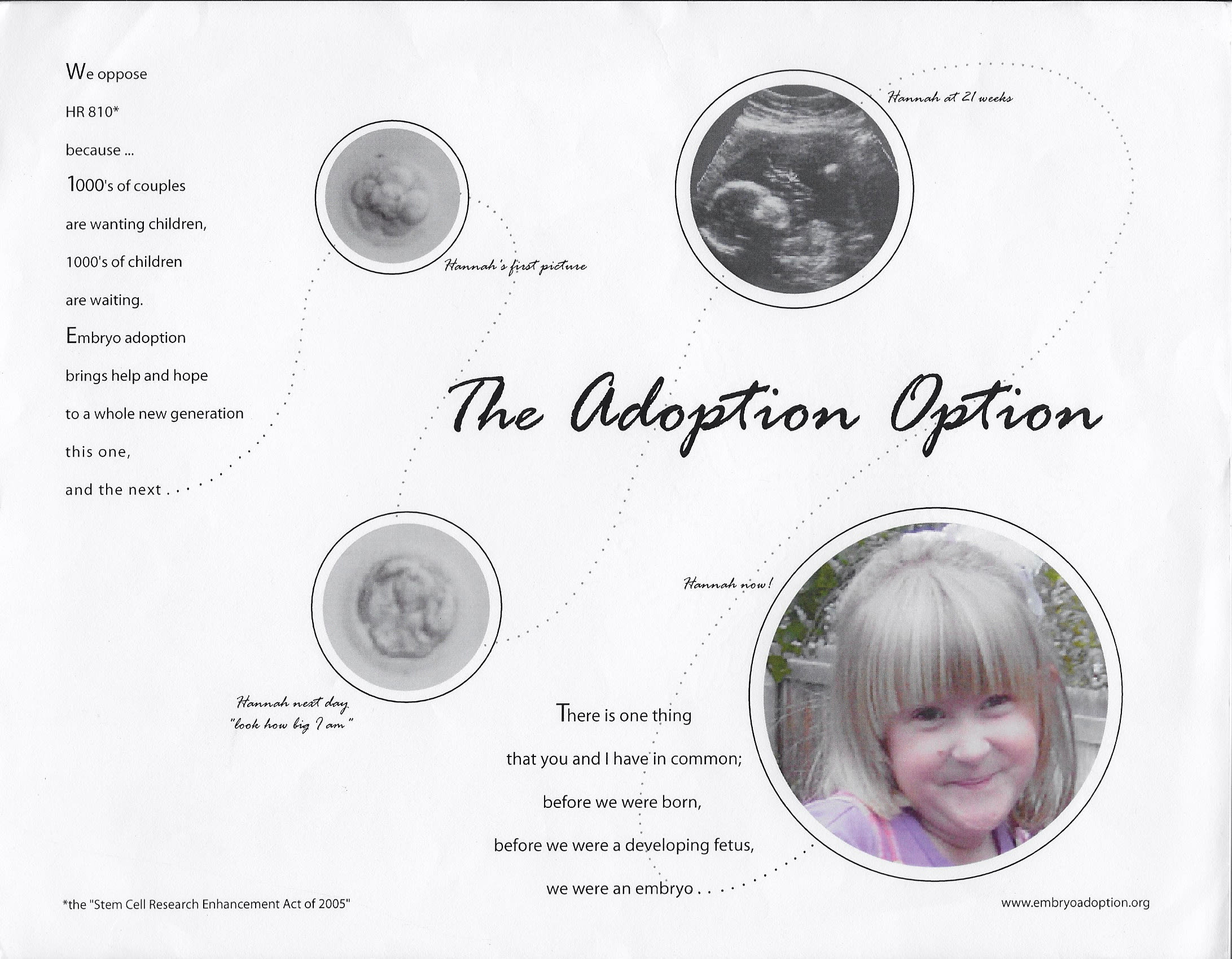
When lobbying Congress on behalf of frozen embryos, Hannah would hand this poster to each Congressman or Senator. The bill they were opposing was one that would have allowed for frozen embryos to be used for stem cell research. While HR 810 passed both the House and Senate, President Bush vetoed it, at great personal and political risk to himself.

Twenty-five years ago, at the bioethics council’s start, an estimated 100,000 to 400,000 “surplus” frozen embryos existed in the United States. Today, it is estimated that millions to tens of millions of human embryos are held in cryostorage worldwide. Questions about what to do with all these embryos swirl, even as their number continue to exponentially increase. And sensational, dystopian-sounding cases — clinics accidentally destroying embryos, doctors kidnapping embyros, embryos mistakenly transferred to the wrong woman’s womb — are becoming regular. Old hat. Unsurprising.

In the United States, you’d have more protections under our law as a horse or turtle embryo than as a human embryo. And as the number of frozen embryos continue to increase exponentially, the logistical and legal issues surrounding their preservation and disposition become more complicated — and more pressing. But we have a responsibility to these suspended lives. We created them. We need to do justice by them. What does justice look like for the human embryo?

It’s a hotly debated topic. Some would say we should thaw them, baptize them, and give them a funeral. Others say they should be donated to couples seeking children. I wanted to know what Hannah Strege, the world’s first adopted frozen embryo, thought about it. So I asked her what should be done with all the embryos — and what she thought should be done about their creation in the first place. Her answers might surprise you.

Today, Hannah works full-time as a therapist in Colorado while trying to open her own business and nonprofit, Wonderfully Made Adoption Services International, in defense of frozen embryos. Her deeply-held Christian faith permeated our entire conversation. She hopes one day to provide therapy and consultation to IVF clinics and adoption agencies, to help solidify their embryo adoption programs and put children’s needs first, while also counseling families in the IVF and adoption world.

As always, thank you for reading. Here’s Hannah.

Subscribe now


Katelyn Shelton: I'd love to hear a bit about your background and specifically when you first learned that you were a frozen embryo and how you felt.

Hannah Strege: My parents really normalized the whole “adopted as a frozen embryo” thing from as far back as I can remember. I remember my mom would tell me that I’m adopted as a seed and put into my mommy’s tummy to grow. And so my mom did this whole exercise where she bought some seed packets in the mail and we froze some of them and then we didn’t freeze some of them, and then we planted them. And then that was the way she was able to show me that while some of the frozen seeds made it into little sproutlings, and some didn’t, that’s kind of like what happened with me and my siblings. It was just a really easy way to explain it to a child, and it’s something that I ran with. That’s how I explained my story to everybody when I was younger.

KS: Wow, that's really powerful. What did you think when, presumably, some of the frozen seeds didn't make it?

HS: I don't really know if I thought much about it. I was a child, but I did grasp the concept pretty quickly, especially when we went to DC and we were advocating for frozen embryos undergoing embryonic stem cell research. I made a whole poster about that — it was a drawing of me, being adopted, and I was smiling — and then there was a boy with a frowny face, because he didn't survive the freeze and the thaw. And then I drew a child with a straight line face that was like, “Hey, are you going to adopt me? Or are you going to destroy me?” And so I definitely understood the concept very young. That poster was distributed to politicians when I was really little.
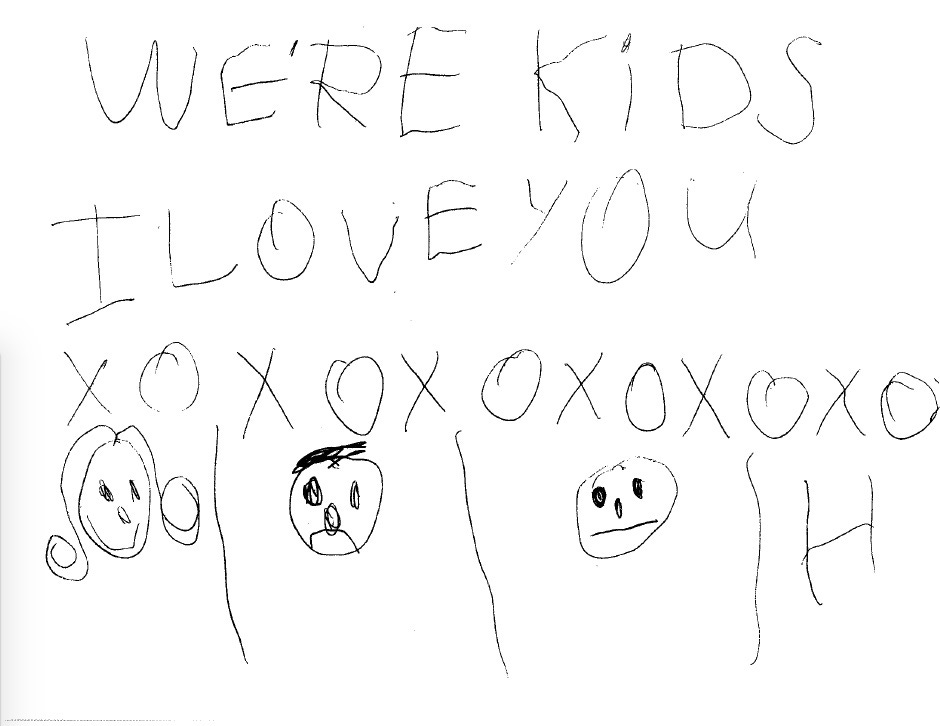
The poster Hannah drew as a child, representing herself (smiling) and other frozen embryos who didn’t implant or survive the thaw. She drew it for President Bush and Dr. James Dobson, her godfather, and sent it to them in the mail.

KS: Wow, that seems like a lot for a little girl to process. Do you know who your biological parents are, or do you have any contact with your biological siblings — the other frozen embryos who were adopted?

HS: It’s different for everyone, but my adoption was an open adoption. There was an adoption agreement signed, and that adoption agreement was between my adoptive family and my placing family. And so us siblings or embryos aren’t part of that signed agreement. There are some families I know that went through snowflake embryo adoption who have a very wide open door with their genetic family, where they call every day and go on vacations with each other. And then there are other snowflake families that maybe have the door cracked a little bit, where the door is open if they want to ask questions, but they don't really get together. Or maybe they just send letters. And then for me, it's more like we're friends on social media and we text occasionally, but it's really different for everybody.

KS: Do you feel like your genetic family is supportive of your advocacy work on behalf of frozen embryos?

HS: I don't feel like they're unsupportive. I think that they're maybe more neutral about it, or they're just quietly on my side. I am very public in sharing about my story because I feel like God gave me this platform to be open and saving babies this way.

KS: I think you said you were two years old when your dad was carrying you into places like the White House or Focus on the Family or the halls of Congress in Washignton, D.C. Tell me a little bit about that advocacy work, when it began, and then how it’s developed into the work you do today.

HS: It’s hard to remember since I was so young, but I have snippets of memories, like sitting on my dad's lap while my mom testified before Congress when I was two. And then I have memories of going to the White House. I think I went to the White House four times and met President Bush twice, in addition to advocating in Congress. I remember we did a lot of interviews or we'd have people come to our house and ask me a lot of different questions. We've been studied by psychologists, anthropologists, and sociologists like we're some big museum piece, I guess since people think our family is so interesting. But really we're just a traditional nuclear family. I just had very untraditional beginnings. And I think that's the part people miss a lot when they interview us — we are a traditional family. Nothing about us is different.
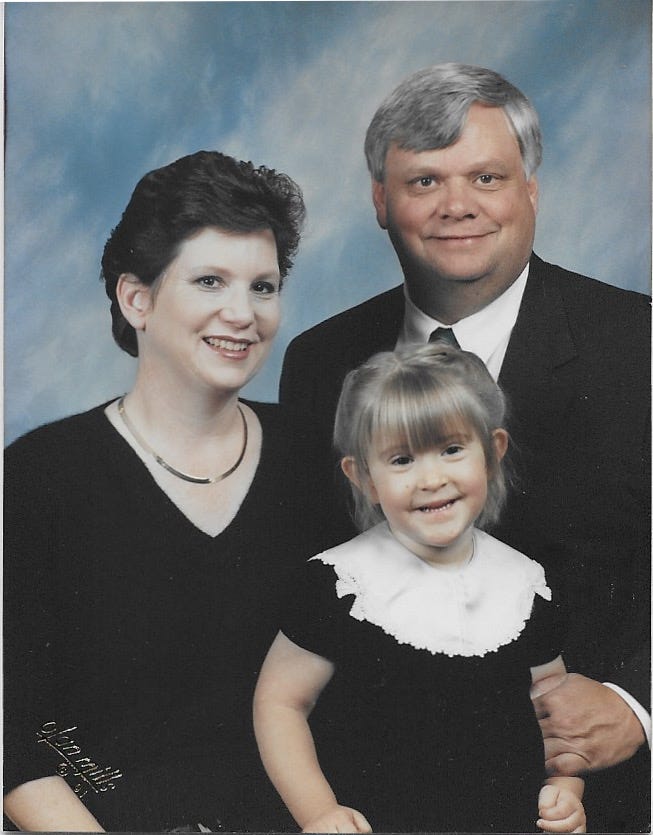
Hannah and her family, Marlene and John Strege.

KS: Do you feel like people misunderstand you?

HS: I'll get people asking me like, ‘Oh, do you get cold really easily? You were frozen…’ I'm a human girl and I work an eight to five and I went to school like everybody else. And nothing else is different. I think people just really try to fill in the gaps with what they don't know.

KS: I'd like to focus a little bit on how frozen embryos are regarded legally. State by state, embryos are regarded differently. In some states, they are regarded as property, and in some they are regarded as persons. There have been very famous cases like the Alabama Supreme Court opinion in which the judge ruled embryos were people, only for there to be backlash, since saying they’re people would have serious implications for how we treat them. How do you think embryos should be legally regarded?

HS: As a formally frozen embryo, I like to say life begins at fertilization, because if we say conception, we're leaving out the frozen embryos, and those are people. In the state of California where I was born I was considered property, and I was FedEx-ed, literally FedEx-ed on a plane to my parents' clinic from where my biological family lived. I was just kind of considered a “fragile package,” property to be exchanged. And these frozen embryos, they are people — that's just so natural for me to say, that these people deserve to be treated as humans and not property because the last time humans were treated as property in our country was slavery. We need to be mindful that if you're going to be creating a new person, there are complications that come with this. There are things that happen when we play around with creating life, or if we're consenting to sex, we're also consenting to the potential for a child.

KS: The numbers are guestimates since there are no reporting requirements for the creation, preservation, or destruction of human embryos, but some estimates say there are 1.5 million human embryos in cryostorage in the United States. What do you think should be done about all those embryos?

HS: They need to be adopted. And when I say adopted, I mean an actual adoption and not through some donor program. Having a background check, doing a home study, going through adoption classes — all the things that adoption agencies do to help support that adopted child — is needed, and should be a non-negotiable. If you're just going through an IVF clinic and an IVF doctor, and picking embryos from a list based on hair color, eye color, or IQ — that's how you pick your car. It's not how we're supposed to grow our family. That’s what my mom always said. If these are truly human lives, which they are, we need to have standards put in place to protect them. We don't just give children to any old person who asks or pays. You need to have that background.

KS: The lack of regulation surrounding embryo adoption — like surrogacy — is astounding, and is detrimental to children. But embryo adoption only solves for one side of the equation. Copious new embryos are being created and added to that number in cryostorage every day. What should be done about that side of the equation — the supply side?

HS: I really just want people to recognize the humanity of these embryos first. I haven't come outright and said this yet, but I think IVF needs regulation. I think people will still do it if it were banned altogether, but I think IVF reform is possible, and I think IVF can be done ethically with so many caveats. Some caveats might include using only the sperm and egg of a married couple, no freezing embryos, and only creating as many of them as you can parent or transfer immediately. And then if you don't get pregnant, you go back and you make another one. And yes, it might be more expensive to do it that way, and yes, it might take longer, but it’s more ethical than creating as many embryos as you can fertilize or as many eggs as you can fertilize with each cycle. If we look at what my biological mom went through, the doctors retrieved 32 eggs at least, and then fertilized all 32, and then the doctors froze the remainder of us until they figured out what to do with us. So it's quite the conversation, but I do think it can be done ethically.

Hannah at her graduation from Baylor University in 2023.

KS: If you could speak directly to policymakers, what one or two things would you say to them?

HS: I’d tell policymakers that these embryos are not spare parts. These are human beings, and our laws need to reflect that. They need protection because these are people that cannot speak for themselves. And I feel like I might be one of the only voices for these children, and I certainly have a passion for it because I was once frozen. But I'm often just called crazy. Most of the time when I speak out about this, if I'm speaking to people that don't have the same beliefs or ideologies as me, they just call me crazy or say I'm mentally ill for feeling like the other frozen embryos were my siblings that I lost. But you're allowed to grieve siblings that you lost. Because when life begins at fertilization, that's a human being. And so it's just really sad that even in our country, we have to defend those lives. But we should.

KS: I always like to ask my interviewees what technologies excite them. We’re not anti-tech or anti-innovation, just pro-tech and pro-innovation in the right direction. Is there a reproductive technology you’re excited about?

HS: I don't think I'm excited by technology anymore because I've just seen how detrimental especially reproductive technology can be for the child. And when I look at reproductive technology — if we're looking at surrogacy, if we're looking at donor egg and donor sperm, IUI, IVF, just any assisted reproductive technology — we always have to ask ourselves: is this in the best interest of the child, or is it in my best interest? And probably almost ten out of ten of the times it's in the parents’ best interest. And I think that's where a lot of our society is right now.


This interview has been lightly edited for brevity. You can find Hannah Strege on X at @HannahStrege or on LinkedIn.

Do you have a story about a frozen embryo in your life? Or were you one? If so, when did you find out, and how did you feel? Did you have siblings who either didn’t make it, or are still frozen? If so, I’d love to hear from you. Share in the comments, or send me a DM for a chance to be featured in Technically Human.

Leave a comment

Thank you for reading Technically Human, a yearlong exploration into the moral limits of emerging reproductive technologies. This is a series of interviews and published work on reprotech and what it means to be human. Follow along here on Substack or on X at @annakateshelt, and please consider sharing.

This project is made possible by The Fund for American Studies’ Robert Novak Journalism Fellowship.

Subscribe now

https://katelynshelton.substack.com/p/technically-human-hannah-strege
Extensions
Designing Savior Babies
on using IVF to create a sibling match for a dying child
Show full content

This article was originally published for WORLD Magazine.

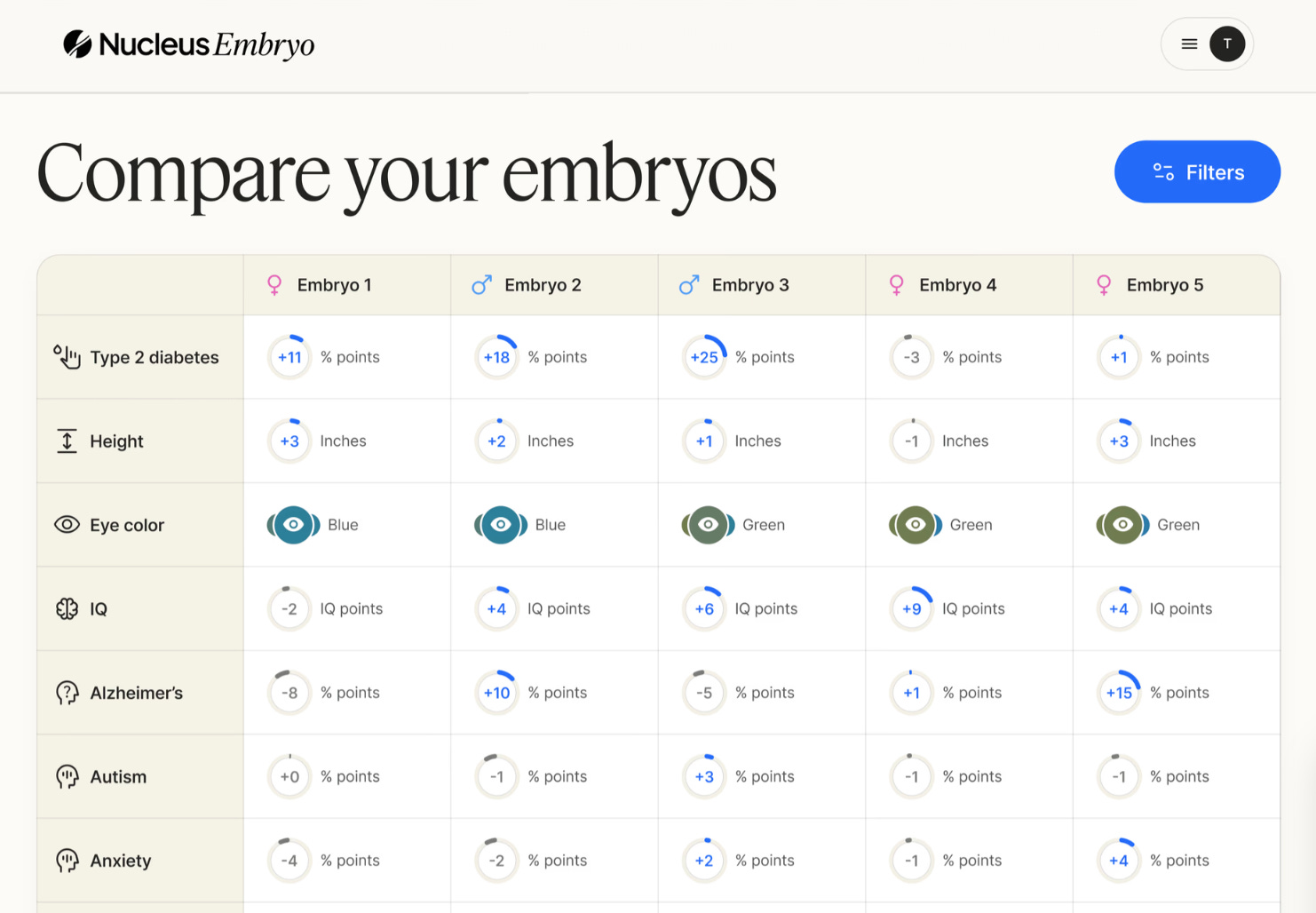
Embryo Comparison Demo from Nucleus Genomics at MyNucleus.com.

Duke’s twin basketball stars, Cameron and Cayden Boozer, would not exist if their older brother Carmani hadn’t been dying from sickle cell disease. When Carmani’s parents found out they could save his life with stem cells from a sibling’s umbilical cord, they decided to use IVF to select a perfect match. In a feat of modern science, the twins’ stem cells worked and doctors were able to perform a bone marrow transplant on Carmani, saving his life. “They were only born because I was sick. … They saved my life,” Carmani Boozer said.

But while this success story resulted in the lives of three young men, it also destroyed the lives of at least eight others. Eight sickle-free embryos were left over after the twins were selected and perhaps more with sickle-cell were discarded. Astoundingly, around 1.5 million human embryos live in cryostorage in the United States, and mounting concerns about storage space and cost continue to fester.

The lives of those created by IVF are as precious and as dignified as those conceived naturally. And Christians believe that all human life is sacred and imbued by God with dignity—including those embryos that are deemed unviable or unfit by modern science, which is itself fallible.

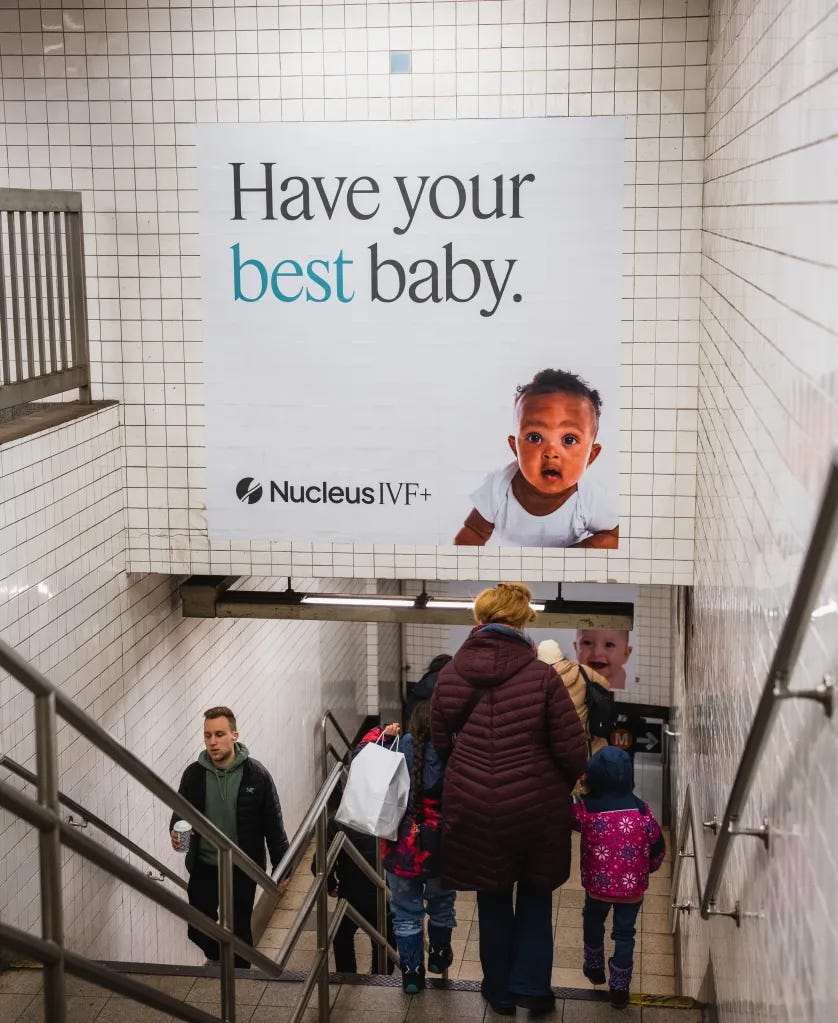
The Boozer Twins were born in 2007, but the technology that enabled their parents to select them 20 years ago has only become more advanced and mainstream. A host of venture-capital backed fertility startups are promising to help couples have their “best baby.” But really, they’re just practicing a new kind of eugenics: one in which children are ranked and selected (or discarded) based on their assigned genetic score.

Companies like Orchid Bioscience or Nucleus Genomics or Genomic Prediction use a new AI-powered technology to sequence an embryo’s entire genome—sometimes using only a single cell—to generate what’s called a polygenic risk score. This risk score doesn’t tell you whether the embryo will have diabetes or cancer or a stellar IQ, but it predicts what is claimed to be the likelihood of the embryo developing these things sometime during his or her life. Plus, selections can be made for height or hair color or even sex (despite the fact that human sex-selection is condemned as a human rights violation by the United Nations, a rare feat of moral clarity for that organization).

The whole business model, of course, is based upon the creation of scores of excess embryos, so they can be ranked and sorted and chosen for the “best” characteristics. The risk scores are tallied up and sent home to parents much like a kindergarten report card. But most of the embryos that are screened will never get the chance to see a kindergarten classroom, or even take their first breath.

When parents become designers rather than stewards, our orientation toward our children radically changes.

If Orchid Bioscience founder Noor Siddiqui hopes for a future where most parents choose to buy her product to procreate, I’m concerned about a future where parents are coerced into using it. Already, couples with disabled children report being pressured to consider IVF to screen out future embryos with genetic conditions.

But when parents become designers rather than stewards, our orientation toward our children radically changes. We no longer see children as a God-given gift but as one choice among many, or as a means to the end of our own desires. In a documentary about the twins, Cece Boozer said, “You feel like you’re having a baby for the wrong reason. … I just felt guilty because it was more out of love for Carmani. It wasn’t out of love for them.”

Meanwhile, pastors report feeling unequipped to counsel their flock on issues surrounding IVF. One pastor reached out to me for advice on how to counsel a couple like the Boozers whose doctors were recommending IVF. The mother had a rare and painful genetic condition and a one-in-four chance of passing it down to her future children. “They want to know whether it’s okay to select embryos so their children don’t have the condition she suffers from,” the pastor told me.

It’s a heart-wrenching scenario. No parents want their child to suffer. The only problem is, parents aren’t screening conditions out of their children, as these companies deceptively advertise. They’re screening out their children. And Christians have long been known as the ones who rescue even deformed or disabled children from the cliffsides in recognition that all human life is a gift that is worthy of love and care. We should see the human embryo as worthy of that same kind of protection. After all, Jesus Christ Himself, the incarnate God, once existed as a human embryo.

With one in six couples facing infertility worldwide, stories like the Boozers’ are only the first of many about reproductive tech’s impact on our children, families, and humanity more broadly. But when pastors don’t know how to counsel their members on these technologies, the primary conscience-shapers become their doctors, and the cathedral collapses into the exam room. It’s time for that to change.


Thank you for reading Technically Human, a yearlong series of interviews and published work on reprotech, the moral limits of emerging reproductive technologies, and what it means to be human. Follow along here on Substack or on X at @annakateshelt, and please consider sharing.

Have you used prenatal genetic testing for embryos or pregnancies? Why or why not?Have you received a prenatal diagnosis, or been pressured to abort? Would you use an embryo screening test to screen for genetic diseases or traits in your children? Share in the comments, or message me directly for a chance to be featured on Technically Human.

This project is made possible by The Fund for American Studies’ Robert Novak Journalism Fellowship.

https://katelynshelton.substack.com/p/designing-savior-babies
Extensions
Technically Human: Mandy H.
opposed to IVF, an IVF clinic was her only option. plus: what she wishes conseratives knew about childlessness
Show full content
A Shady Grove IVF fertility clinic in Atlanta, GA.

Mandy H. has always wanted to be a mom.* A conservative communications professional working on national security issues for a D.C.-based political organization, Mandy also wishes she could help stem the U.S.’s plunging fertility decline. There’s only one problem: she cannot conceive.

Mandy and her husband, who is in the military, live in rural Maryland, and have spent years ping-ponging to various doctors to help pinpoint the source of their infertility, only to be met with a baffling non-explanation: “unexplained infertility.” Mandy’s story is, sadly, not unique: up to 30% of couples facing infertility are (un)diagnosed with “unexplained infertility,” and many are funneled through the IVF pipeline, to varying degrees of (pregnancy) success.

Mandy and her husband are opposed to the creation of embryos in a petri dish. But for women like Mandy who can’t get pregnant, an IVF clinic is likely the only place she can turn for answers. The only problem is: while IVF clinics can run some tests to try to diagnose the causes of infertility, they aren’t really trained to look for and treat the root causes. IVF doctors are trained to use medicine like a hammer to get women pregnant. It’s no wonder that every woman begins to look (and perhaps feel) like a nail.

Mandy shares her story of seeking a diagnosis for her infertility through IVF chain Shady Grove, eventually turning instead to a Restorative Reproductive Medicine (RRM) and Natural Procreative (NaPro) technology doctor to do what the others couldn’t: officially diagnose the underlying causes of her infertility, and seek to restore her body to its natural function.

Mandy represents a growing tide of women who are opposed to IVF, yet also seeking fertility care at an IVF clinic, either because root-cause clinicians are few and far between, or because women don’t even know root-cause treatments exist. Shady Grove, on the other hand, operates over 50 fertility clinics in the United States, and is a founding partner of US Fertility, which is an even larger network of over 100 fertility clinics. Many others also exist.

Mandy’s story represents something I’ve highlighted in Technically Human before: that women’s health (alongside healthcare more broadly) is plagued by a crisis of identity. What is the purpose of medicine? Is it to heal and restore the body to its natural function? Or is it to bend the body to our limitless will and desire? Women’s healthcare seems to have forked along those two lines: Restorative Reproductive Medicine approaching women’s fertility care along the former, and standard IVF clinics along the latter. But good tech is not for transcending or replacing our bodies — good tech always serves the good of the human person, and aims at his or her own flourishing. And sometimes our flourishing runs contrary to our desires, even if they are good.

Mandy’s story, like many women walking the desolate road of infertility, is not over yet. She does not yet have a happy ending, even as she continues to work toward that end. But Mandy also shares what it means to be fruitful despite being unable to conceive, as well as what she wishes the pro-family right knew about the conservative women, like her, who desperately want to grow their families but, for one reason or another, can’t.

Mandy offers a vignette of the many women who are fed up with the mechanistic innerworkings of the women’s health conveyor belt. They’re tired of being just one more “cog in the machine.” They aren’t opposed to advanced reproductive technologies; they just want them to be aimed at their own good as persons, to be used in a way that promotes their own flourishing, and that of their families. Mandy seems to have found that whole-person treatment in Restorative Reproductive Medicine, even as she continues to wait for her own children. I’m honored to get to share her story with you today.

*Mandy’s name has been changed due to the intimate nature of her story.

Thanks for reading Technically Human! Subscribe for free to receive new posts and support my work.


Katelyn Shelton: Mandy, thank you for sharing your story with my readers. Would you begin by sharing some of your infertility journey with us?

Mandy H: It’s been a long road. I’ve seen multiple doctors and had four surgeries in a year, and after seeing two IVF doctors, I had no answers.

It started with our first year of marriage, which was a deployment. As soon as my husband got home, we knew we wanted to start having babies. We only tried for 6 months (rather than the recommended year) before I got antsy and sought fertility help, because I was confident from charting my cycles since before marriage that there was something going on.

We went to an IVF clinic near our house to see if we could get a diagnosis. I really felt hopeful about the clinic initially. I know some would balk that I even went to an IVF clinic, but my friends had received diagnoses from them for their infertility, and that’s all I was interested in anyway. I had always been clear from the beginning we wouldn’t be pursuing IVF, but I did need to know what was going on.

Right away they found polyps in the uterus and recommended a surgery to remove them. It felt like we had a smoking gun. We did the surgery in February of last year, and then a failed round of intrauterine insemination (IUI). I suspected I had endometriosis, and despite the fact they thought I didn’t have it, they begrudgingly agreed to a laparoscopy to check. Afterwards, we got word that while I did have a tiny bit of endometriosis, it didn’t even qualify for stage I. I was left feeling like a wuss with a really low pain tolerance – like my period pain wasn’t that bad, like it was all in my head.

After a move and relocating to another fertility clinic in Annapolis, we started timed intercourse, which meant 3 hour round trips for follicle monitoring. I was put on a couple different fertility medications, which gave me terrible hot flashes and extremely painful ovulation cramps. The side effects weren’t explained to me ahead of time, so I thought I was going into menopause. We did this for three months, and it failed every time. On a gut instinct, and surprised the doctor hadn’t suggested it himself, I asked if we could check if the uterine polyps had returned. Sure enough, they were back. Their next game plan was to increase my fertility meds and remove the polyps. But after feeling like I had to play both doctor and patient, I knew I was done working with them.

Everything with the IVF clinics felt exhausting, like having a brand new intern whose work you constantly have to check. Every time I asked for something, it felt like a big deal, or that they deemed it outside the norm: wanting to rule out endometriosis through surgery, questioning if I needed the fertility meds, wondering if the polyps were back, wanting explanations for dosages, not wanting to go on birth control (which they had prescribed so they could have an easier time scheduling my appointments). One nurse laughed when a routine urine sample visibly confirmed that I was not, in fact, pregnant. Insensitive and giggly nurses added insult to injury, and I frequently blinked back tears or failed to.

As someone with a tendency to be very hard on my body (high school eating disorder, marathon runner in early 20s), the IVF clinic felt like one more excuse to continue being hard on myself. The polyps were removed, I didn’t have endometriosis, my body was producing follicles, so what was the deal? Why wouldn’t my body just work like all my fertile friends? My weight dropped to what it had been in high school, but this time just from stress.

I felt like I was a cog in a machine that wasn’t functioning properly, and that’s how I felt about my body during that time. I was given no reason for my infertility which meant my body was a failure – was I a failure, too?

Daylily, Jim Dine, 1984.

KS: After you became dissatisfied with your care at Shady Grove, you pursued advice from a Restorative Reproductive Medicine (RRM) doctor, who pointed you to an RRM surgeon in your area. Tell me about your experience with the RRM doctor(s) and how you felt under their care.

MH: After the failed experiences at two different IVF clinics, I turned to Dr. Naomi Whittaker, a Restorative Reproductive Medicine doctor and advocate, to see if she had recommendations for surgeons in my area. She put me in touch with Dr. Moawad, who specializes in fertility preservation, endometriosis, and advanced pelvic conditions. On my telehealth appointment, I was amazed at the questions he asked, and also found myself saying “yes” to a lot of them.

Dr Moawad was incredibly different from any other doctor. No one had asked such in-depth questions about my pain, the blood flow of my period, the clots, and what my first period had been like. There was a lot of pain I’d never talked about before, feeling too shy to mention it to anyone that during intercourse there was excruciating pressure on my bowels and anus, or that the pain would go to extremes during PMS.

He confirmed what I had long expected: “I think you have endometriosis, but let’s get an MRI so I can map it.” The MRI revealed everything: I had deep infiltrating endometriosis (Stage III) and focal adenomyosis ( a sister disease of endometriosis that grows in the uterus). In December, we proceeded with the surgery. My right ovary had been seared out to my hip, and endometriosis had seared my bowels to my uterus, causing the extreme pain during intercourse. Looking through the MRI and seeing a disease that had infested my body, infertility wasn’t my fault anymore. I could finally stop blaming myself.

But I was immediately confused how two surgeons had missed two huge conditions: how did the surgeon who removed my polyps do so without identifying the focal adenomyosis, since it’s what caused them? Or how did the surgeon perform a laparoscopy and not see that my ovary was out of place from the endometriosis?

But I also felt so vindicated, that all these years my pain really had been extreme and abnormal. We finally had answers, and the surgery could increase our odds of conceiving by 30-50%. Dr. Moawad discovered, happily, that my fallopian tubes were open and functioning, and my ovary was not damaged. And another NaPro doctor identified a luteal phase defect (low progesterone), and shared that my low BMI could be an issue, so we’re now addressing both of those things as well.

After a follow-up surgery with Dr Moawad (my 4th surgery in the span of a year), we are all clear to be “open to life” once again. But since we know that our odds of natural conception are still rather low, we felt God nudging us to open ourselves to life through adoption. We are currently in the very early stages of our home study.

Dr. Moawad, board certified gynecological surgeon.

KS: It seems like there is a philosophical difference in the way IVF doctors approach infertility, and the way RRM doctors approach it. What do you think the primary difference between the two approaches is?

MH: With the RRM docs, there was a real sense of letting the “grown ups” take over. With Shady Grove, it was me, Google, and my “Taking Charge of Your Fertility” book. With my RRM doc, we both had my charts out, analyzing specific days of my cycle and confirming ovulation or other hormonal changes. It was what I had always wanted: next steps that were tailored to *me*, prescriptions that were tailored to *my* deficiencies.

My IVF doctors didn’t look at my charts, had no interest in cervical mucus, no concern with my weight loss, no interest in my temperature fluctuations. I didn’t realize how frustrating that was until my RRM doc, Dr. Sorra, looked through my charts and blood tests and confirmed that I was ovulating on my own, apart from the painful fertility meds the IVF clinic had put me on. I’d desperately wanted someone to give me that reassurance, but I never got it with the IVF clinic.

Where the IVF clinic brushed me off when I asked for diagnoses and slapped an “unexplained infertility” label on me, the NaPro and RRM docs were amazing at getting from “unexplained infertility” to “explained infertility.”

Dr Moawad had tips on every aspect of my recovery from surgery: he wanted me drinking coconut water pre- surgery and post-surgery, something with calories since I’d feel sick after surgery; he wanted me eating low-inflammation food post-surgery, since my body was inflamed; he prescribed a pelvic floor therapist to work on healing after endo; Dr. Sorra identified my low weight, and warned me that bodies that have been through trauma often need a lot to feel safe again, especially to conceive.

Everything with the RRM doctors was holistic, looking at me as a whole person: diet, sleep, exercise, weight, charts, all of it adds up.

KS: President Trump has promised to be the “fertilization president,” in an attempt to style himself as being pro-woman and pro-family. In October of last year, he took steps to lower the costs of certain medications used in IVF treatments. But RRM doctors can be just as (if not more) expensive, and they usually get little government or insurance assistance. Why?

MH: The truth is that pursuing restorative fertility doctors and surgeries are incredibly expensive. The reason is that insurance doesn’t reimburse doctors for the longer, more extensive surgeries they perform. Even with insurance covering our hospital and anesthesia, the out of pocket cost for Dr. Moawad’s surgery was $16,000, and another $4,000 for the followup. Insurance would have paid him around $1,500 for an hour-long surgery. Instead, he took 2.5 hours, and included endometriosis excision on multiple organs, checked all the organs and the fallopian tubes, put my ovary back in its proper place, resectioned the uterus and removed adenomyosis, and removed polyps. We are incredibly blessed that we were able to pay that, but I recognize that’s not feasible for many people. Surgeons shouldn’t be made to choose between getting paid enough for their work or doing a subpar surgery.

Tulip, Jim Dine, 1935

KS: You told me you weren’t comfortable pursuing embryo creation through IVF. Can you share why? And perhaps how your faith has impacted that decision, if it has? What does it mean to be fruitful and multiply despite living with infertility?

MH: I didn’t want to do IVF unless I was given a reason that I’d need it, and unexplained infertility wasn’t going to cut it. But even after a diagnosis, I knew my conditions didn’t necessitate IVF: the endometriosis didn’t damage my ovaries or fallopian tubes, and the effects of the adenomyosis in my uterus won’t be bypassed with it. If my uterus is so inflamed from the adeno, and my lining is too weak and thin because of low progesterone, it doesn’t matter how the embryo gets there, it won’t work. And I know it is entirely possible my uterus will never recover enough to carry a baby.

To work with the IVF clinic, we had to watch tutorials about how IVF works. When I watched the part about many embryos not making it, I started crying, thinking about them dying in a petri dish on a table under a fluorescent light. I knew if I was going to miscarry, at least they would have been in the warmth of my own body, that in some way, they got to be cared for by me. I told my husband later “There is no sacrifice I won’t ask of my body to bring us a baby: surgeries, meds, appointments, long drives, etc., but I can’t ask my babies to sacrifice for me.” I want to be the one to sacrifice for my children, not the other way around.

Not doing IVF feels like acceptance that conception is in God’s hands, and only His hands. I know doing IVF might lull me into feeling better about our chances, but even in a petri dish, God is the only one who controls life. I’ve accepted that, and I’m forfeiting my opportunity to play God.

KS: You work in conservative politics. You’ve said before that it’s difficult being a childless woman on the right. What’s something you wish conservatives knew about infertility?

MH: I know the Charlie Kirk motto of “get married. have kids. leave a legacy” is catchy, but “have kids” isn’t really a given, and we should be open about that. It’s not a command that we can all follow, nor is getting married, for that matter. A longer, albeit less catchy, phrase would be, “Get married when a Godly spouse enters your life and if it’s 22, awesome, if it’s 35 that’s good too. Be open to the gift of life, knowing it’s not something you can control. And leave a legacy that reflects the glory of God.”

Right now on the right there’s a lot of fertility flexing amongst women. Men also seem to take special delight on X in having a large brood of children. Big families are held up as ideal. But surely a tender family of 3 through a hard-fought fertility journey is also worth society’s delight and joy.

KS: Since this project isn’t anti-technology, I like asking each interviewee what technological advance related to reproduction they’re excited to see, or hoping to see in the future. Especially as a woman, is there any advance you hope to see?

MH: The robotic surgery is endlessly fascinating to me. It looks like this spidery machine, and the surgeon operates it like a video game. I am amazed that these spider-like arms went inside me, poking and prodding different organs, carefully cutting out endometriosis from the roots (a process called excision, which RRM doctors regularly practice and many IVF doctors oppose, due to its time-consuming nature). I feel excited thinking about how our surgeries keep getting better and better. Adenomyosis is still really underreported and underdiagnosed – most women don’t get a diagnosis until they get a hysterectomy, so I hope for future generations we get even better at extracting adenomyosis or preventing it entirely. I also think some of the ovary preservation is cutting-edge and so hopeful. I know women who have primary ovarian insufficiency which is a fertility dead-end and heartbreaking, but I like thinking there’s a way to rejuvenate ovaries.


This interview has been edited for brevity.

Have you pursued fertility treatment at an IVF clinic, even if you never intended to go through IVF? Have you gone through IVF even if you had misgivings about it — and if so, why? Share in the comments, or send me a DM for a chance to be featured in Technically Human.

Leave a comment

Thank you for reading Technically Human, a yearlong exploration into the moral limits of emerging reproductive technologies. This is the second in a series of interviews and published work on reprotech and what it means to be human. Follow along here on Substack or on X at @annakateshelt, and please consider sharing.

This project is made possible by The Fund for American Studies’ Robert Novak Journalism Fellowship.
https://katelynshelton.substack.com/p/technically-human-mandy-h
Extensions
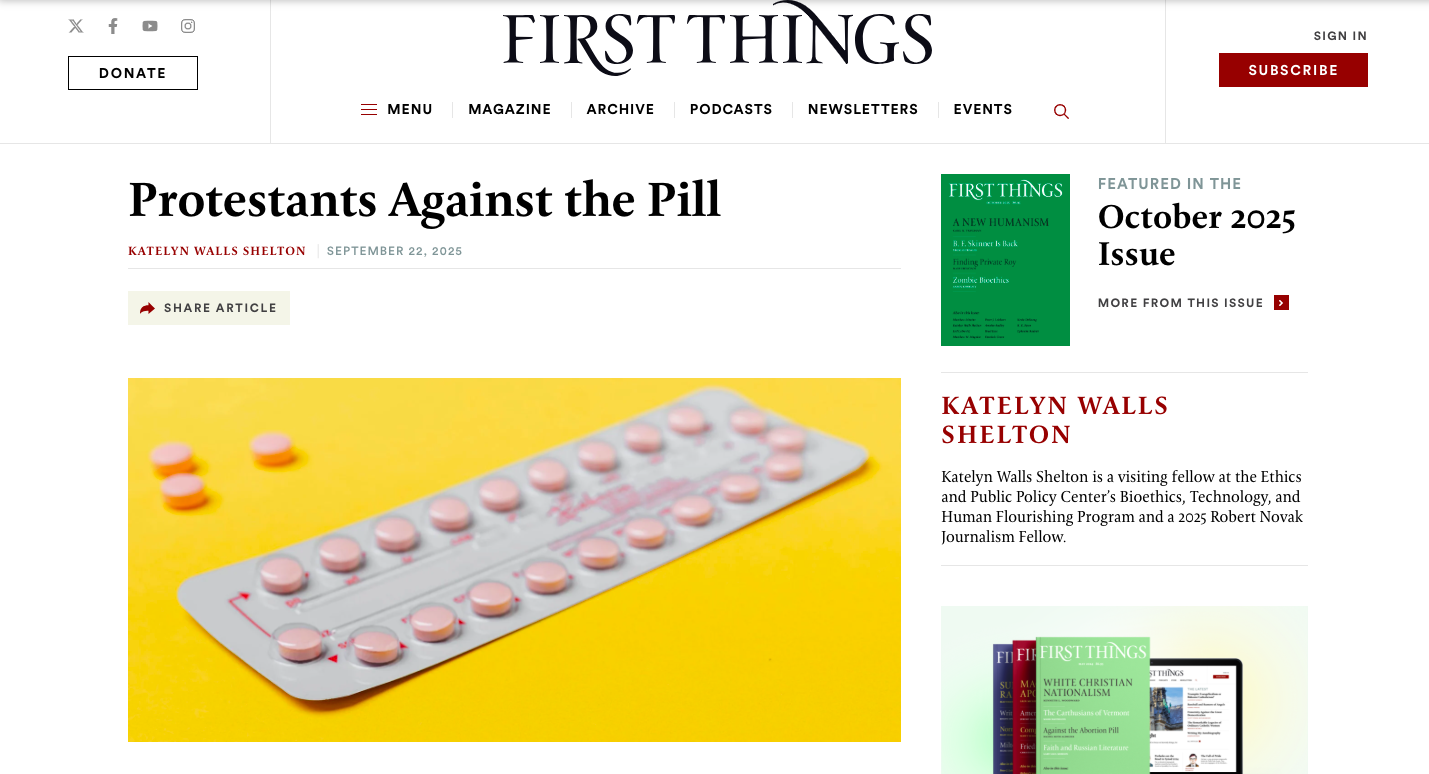
Protestants and the Pill
three women on why they don't take hormonal birth control, even though their denomination doesn't forbid it
Show full content

This article was originally published in print for First Things Magazine.

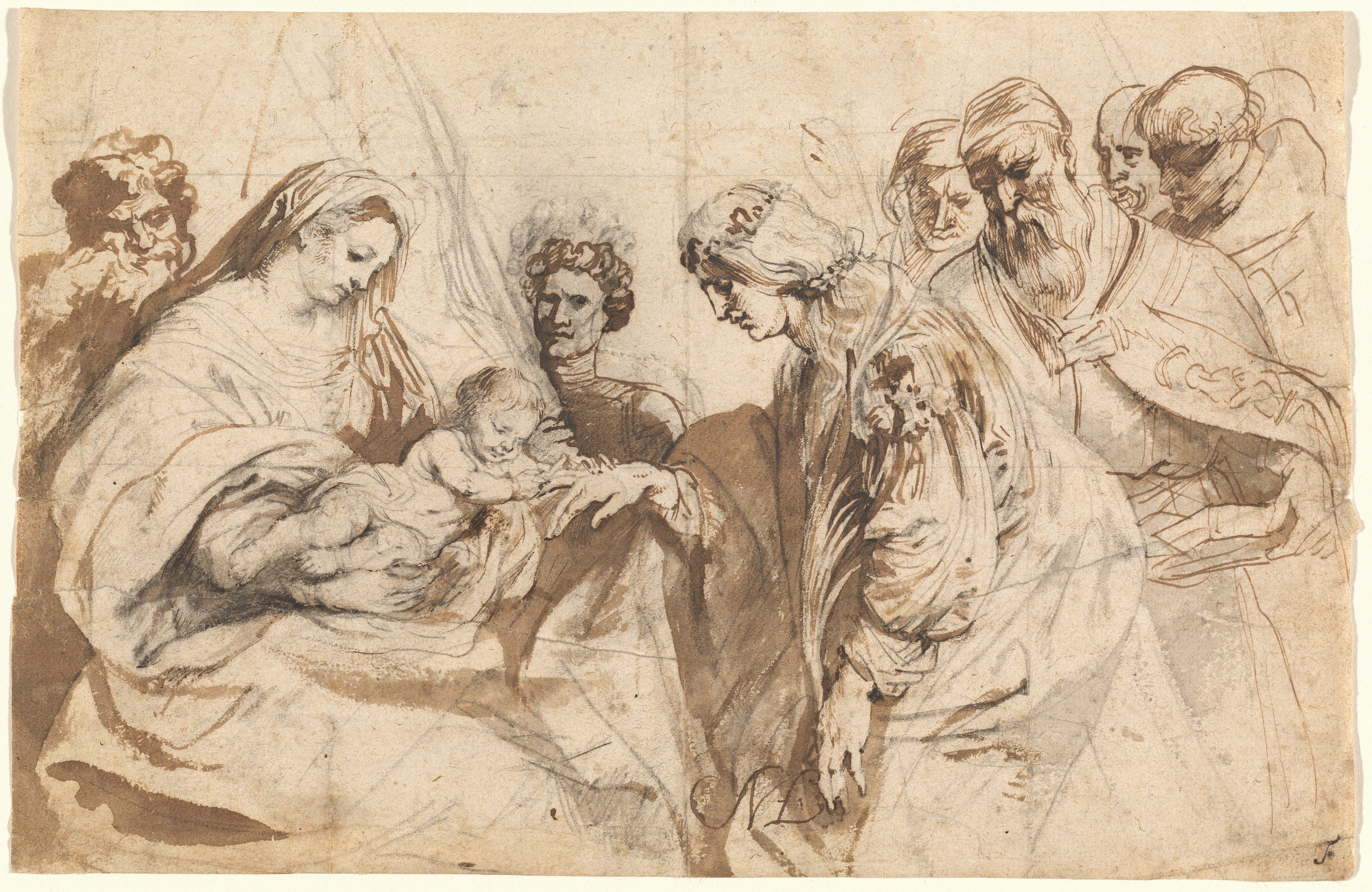
The Mystic Marriage of Saint Catherine by Sir Anthony van Dyck, c. 1618.

Ben Jefferies is an Anglican priest who says he knows that one of his parishioners throws away all the tracts he’s written on “Marriage, Sex, and Babies” when he’s not looking. He keeps them in the lobby of his church, alongside a number of other tracts on “things Anglicans believe.” Jefferies laughs good-naturedly when I ask how his parishioners receive his teaching on contraception. His own belief on the topic, though informed, differs substantially from what most ­Anglicans believe, at least in practice. In fact, ­Jefferies’s teaching on the matter is similar to that of the Catholic Church, proffering Natural ­Family Planning paired with ­periodic ­abstinence as the standard means by which Christians should avoid ­pregnancy.

The Catholic view used to be, well, catholic. Martin Luther and John Calvin regarded contraceptive sexual acts as a grave moral sin; this was the universal Christian position until the 1930 Lambeth Conference, at which Anglican leaders gave their official opinion that contraception was not in all cases sinful. Other denominations quickly followed. But though Protestants on the whole have left behind contraception as a moral issue, a growing number of Protestant women have begun to reject the pill. I interviewed three who are discovering more than Natural Family Planning—they are discovering an embodied faith.

Kelsey Meyers, twenty-five, is a new wife, mom, and lawyer who attends an Anglican church in Washington, D.C., with her husband and infant son. We both fed our babies as we talked on the phone.

Kelsey had been prescribed the birth control pill as a treatment for hormonal acne when she was in high school, and again later when she approached her doctor with symptoms of polycystic ovarian syndrome. But she didn’t like how the pill made her feel, and it didn’t seem to address her symptoms. “Every time I came with an issue, that was the Band-Aid solution that they slapped on it.”

Kelsey’s experience isn’t unique. Women are prescribed hormonal birth control for many issues: acne, mood swings, irregular or painful or heavy periods. In the United States, hormonal birth control is prescribed to girls as young as eleven, and there are neither federal age restrictions for its use nor longitudinal studies of its effects on girls who have yet to undergo puberty.

Once she got engaged, Kelsey researched alternatives to hormonal contraceptives. Catholic friends encouraged her to read Taking Charge of Your Fertility by Toni Weschler and The Genesis of Gender by ­Abigail Favale. Kelsey began to use the Tempdrop fertility tracker, which uses basal body temperature to track ovulation. She felt that it helped her better understand her body, including some of the symptoms for which she had approached her doctors. “I kind of came to realize that a lot of these things that doctors had told me were wrong with my body, like these longer periods and these longer cycles, were actually just my body operating normally.”

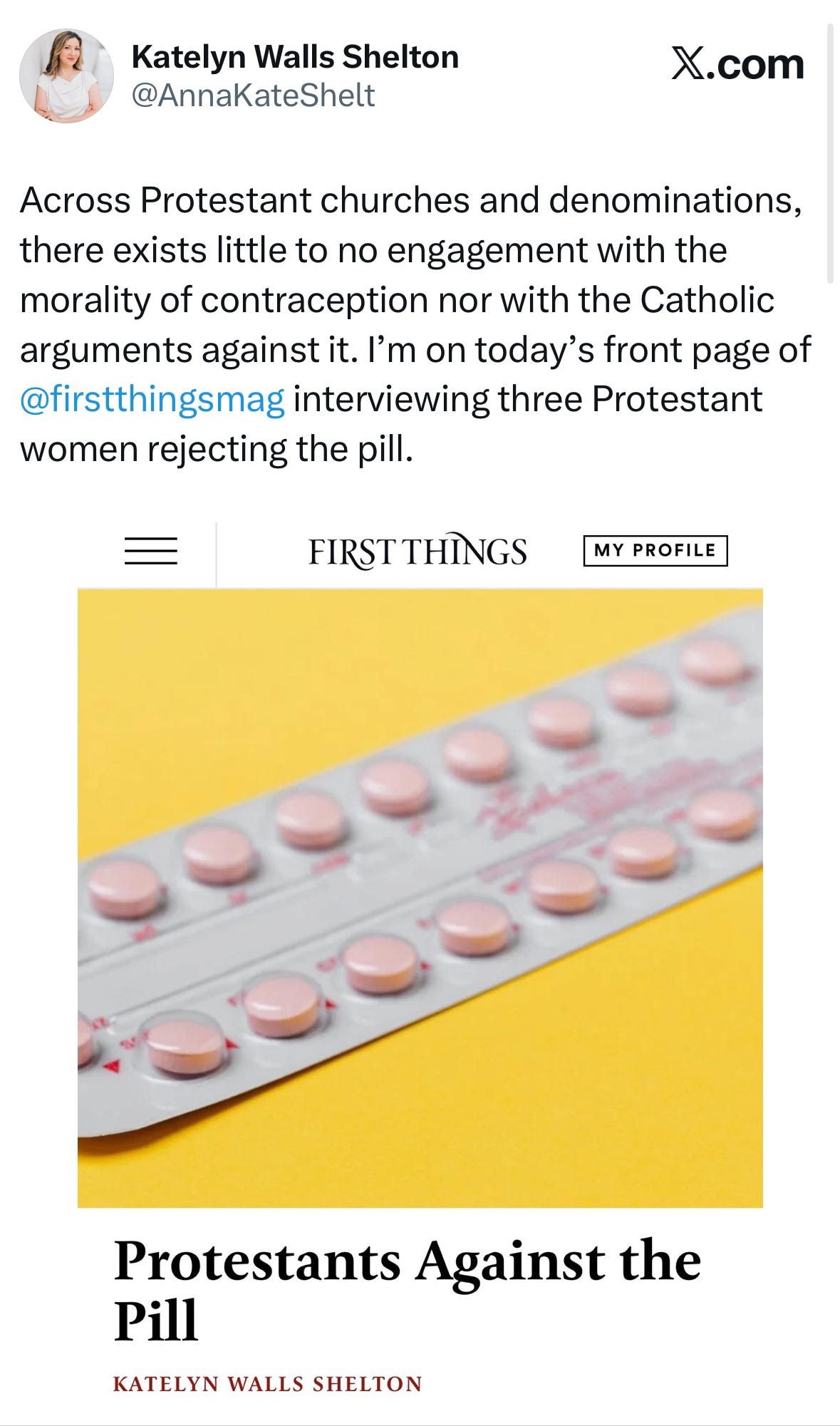
Kelsey began to question the morality of contraception. Whereas Catholics have a well-developed teaching on marriage and sex, including a prohibition on all forms of contraception, the nondenominational Protestant churches in which Kelsey grew up never taught on contraception. Across Protestant churches and denominations, there exists little to no engagement with the morality of contraception or with the Catholic arguments against it. “I would just love to see more Protestant women discussing what a consistent ethic with this is,” Kelsey told me. “I don’t have a consistent theology right now behind it. I’m still learning. But having the conversation is important.”

Marriage at Cana, unknown Russian artist, 18th century

Chaney Gooley, thirty-­three, is one of the few Protestant women I know who refused the use of contraception on almost purely theological grounds. She attends an Anglican church in Alexandria, Virginia, with her husband. But like Kelsey, she first began questioning the morality of contraception due to questions about health: not for herself, but for her future baby.

Through her volunteer work with a pro-life sidewalk ministry, Chaney learned about the potential abortifacient effects of hormonal birth control methods, including the pill. “I would never want to do anything to cause a baby to not have the nutrients it needs to implant in my womb,” she told me on the phone as I watched my children play in the front yard on a warm afternoon in March.

Birth control pills and IUDs work in three main ways to prevent pregnancy: a primary means and two secondary backups. First, they suppress the hormone that triggers ovulation, reducing the likelihood that an egg will be released. Second, in the event of “breakthrough ovulation,” they thicken the cervical mucus that carries the sperm to the egg, providing a physical barrier. Finally, as a fail-safe, they thin the lining of the uterine wall to prevent the implantation of a fertilized egg. “In moral philosophy, that’s an abortion,” Jefferies told me. Breakthrough ovulation—the release of an egg despite the use of ­hormonal birth control—varies in ­frequency from woman to woman. Nearly half of all women on the mini-pill (a ­progestin-only pill) continue to ovulate. Breakthrough ovulation is somewhat less frequent in other forms of hormonal contraception, but women who use it while sexually active for several years are likely to have at least one instance of breakthrough ovulation.

Most pro-life women don’t ­realize the potential abortifacient effects of hormonal birth control. This is partly because medical experts have changed the definition of “pregnancy.” In 1965, roughly concurrent with the development of the pill and the IUD, the American College of Obstetricians and Gynecologists updated its definition of “pregnancy,” which was now said to begin at implantation rather than fertilization. Hormonal contraceptives were therefore classified as birth control rather than abortifacients. Previously, in medical and lay contexts alike, pregnancy had been understood to begin at fertilization, the moment when a unique organism is created. Just a dozen years before the change in definition, Watson, Crick, and Franklin’s identification of DNA as the chemical signature of a unique living being had brought new insight ­into that moment of beginning. The change in definition denied a reality that was being understood with greater exactness every year.

Chaney also takes issue with the way hormonal contraception ­changes the female body. She calls it “antifeminist” to make women’s bodies “more like the male body”—that is, unable to conceive. She thinks that fertility cycle charting should be taught to girls as they enter puberty, to foster “body literacy.” And as a woman with endometriosis, she believes that Natural Family Planning can help diagnose reproductive diseases earlier. (Endometriosis, a known cause of infertility, takes on average seven to nine years to diagnose, despite affecting 10 to 15 percent of women of reproductive age. Symptoms of endometriosis are most often treated with the pill, despite the fact that it does not cure or even curb the underlying condition.)

In addition to gaining a better understanding of her body as God created it, Chaney has realized that there is “a deeper spiritual meaning to keeping the unitive and the procreative purposes of sex united”: She and her husband practice continence during her fertile window when they prefer not to conceive, yet they leave open the possibility of children when they do come together. She compared the marital act to participation in Eucharistic union with Christ: “We are to take and eat and to be united with him, and whether we believe that’s symbolic or literal or somewhere in between, there’s a very real sense in which he has given himself to us on the marriage bed of the cross.”

Ben Jefferies, like ­many Protestants I’ve talked to, found his way into thinking about contraception through the writings of Pope John Paul II, which he praises for expressing a poetic and poignant view of marriage, despite “being written by a chaste man who was never married.”

Though the Anglican Communion broke with the broader Church’s position on contraception at its Lambeth Conference in 1930, Jefferies reads its resolutions as more aligned with historic Christian teaching than most modern Anglicans do. He reads them as explicitly sanctioning only condoms (since hormonal methods did not yet exist), and only when there is, in his words, a “clearly felt moral obligation to limit or avoid parenthood and . . . a morally sound reason for avoiding complete abstinence.” (Interestingly, Jefferies’s reading of the Lambeth Resolutions on contraception is similar to the stance recommended for the Catholic Church by the Pontifical Commission on Birth Control in the 1960s.) Though ­Jefferies thinks there are times in the lives of many married couples when both of these provisions are met, he explains that those times are few, and that abstinence (perhaps paired with a fertility awareness–based method) is the ­only licit means for Christians to avoid conception at all other times.

In defense of his pastoral allowance for the use of barrier methods when circumstances warrant, ­Jefferies told me that he believes that Pope John Paul II’s phenomenological interpretation of the body does not take “sufficient account for the degree of depth to which things have become broken and muddied by the Fall.” He mentioned specifically the emotional, financial, and health implications of a couple’s having a child “every twelve to eighteen months for a twenty-year window,” which may be the ideal in a perfect world but quite difficult to achieve in our fallen state.

He thinks the Lambeth approach of permitting certain contraceptive methods in some cases at some times is more fitting. “I do sometimes wish that we had a stronger magisterium,” he told me. But he regards “trusting the Holy Spirit to be the teacher” as a more patient and persuasive pedagogy, “so the actual pastoral outcome is comparable or better to what the Roman Catholic Church is getting with their ironclad magisterium.”

Brooks Anderson is a forty-­five-year-old birth doula, graduate student, and “not-so-stay-at-home stay-at-home mom” to five children in Albuquerque, New Mexico, where she and her family attend a Presbyterian church. She and her husband have primarily used Natural Family Planning for the nineteen years of their marriage. Her youngest child was born when she was forty-three.

Brooks is the eldest of eight living children. Her parents were influenced by the Quiverfull movement, which teaches that because children are a blessing from the Lord, Christians should try to have as many as possible. Brooks remembers with awe her mom’s pregnancies and births, which impressed her with the miraculousness of the female body.

Brooks fondly described watching her younger sister’s birth when she was six years old. “The doctor put gloves on me and let me feel the placenta and explained how a baby lives and the way that God designed it.” For one of her brother’s births, she cut the umbilical cord. She remembered less fondly her mom’s last pregnancy, at forty-four, when Brooks was a junior in college: “You can’t get away from knowing that your parents are still having sex because there’s your mom, waddling around campus.”

Brooks witnessed five of her seven siblings’ births, including the ones that nearly claimed her mother’s life. Brooks’s parents’ theology has shaped her. But so has the difficulty of her mother’s pregnancies. “I really resented [that] my parents [kept] having children” despite her mother’s rare blood disorder and severe morning sickness. “I was like, ‘I’m not going to do this to myself, right? I’m going to respect myself.’”

She recalls writing a college paper on the question of whether Christians should use birth control, and in the course of writing she encountered Catholic theology of the body. She also learned about the negative effects of hormonal birth control on the female body. Though she ultimately rejected her parents’ maximalist Quiverfull approach, she realized that whether or not to use birth control was a question that merited prayerful consideration. A few years later, she discovered Natural Family Planning, and she came to appreciate the way it honored both the female body and God’s design for marriage and children.

She reflects with satisfaction on the times in her marriage when she and her husband used NFP: “We were not holding sex in a controlling way over one another, and we were both taking our desire, fear, whatever to God individually.”

A 2020 study by the Catholic Medical Association shows a 58-percent decrease in the likelihood of divorce among couples who have used Natural Family Planning. Other studies show an even greater association between NFP and marriage stability. Whether that association is correlative or causal, Brooks emphasized the need of husband and wife to be equally yoked—to be on the same page about these things, and for neither to pressure the ­other—especially since NFP requires self-control in the form of periodic abstinence.

As her children vied for her attention on the playground, Brooks told me that she had never heard a pastor discuss contraception from the pulpit. “Everything that I had always been taught had been geared towards me as a woman, like you submit to your husband. You don’t say no to sex. Don’t deny your ­husband. You make yourself available. It was never taught from a place of mutual responsibility and mutual honor.”

She contrasted that messaging with advice she heard from a Catholic priest: When looking for a spouse, look for someone with self-control, the ability to fast, because such a person “will be able to do hard things that will be necessary in marriage.” Brooks elaborates: “If you truly do Natural Family Planning, you have to say no to your own desires at times . . . and recognize that denying ourselves draws us closer to God.”

It may seem implausible that something as private and, well, human as a menstrual cycle could draw a woman into a deeper relationship with God, with her husband, with her own body. It’s no surprise that Jefferies’s tracts on contraception keep going missing. Many Christians prefer to keep God out of the bedroom. But Christians believe that Jesus submitted himself to the confines of a womb, a womb that underwent the same physical changes some Protestant women are beginning to embrace as part of their embodied faith. And as Chaney told me, it’s hard to keep God out of the bedroom when you keep a crucifix above your bed.


Thank you for reading Technically Human, a yearlong series of interviews and published work on reprotech, the moral limits of emerging reproductive technologies, and what it means to be human. Follow along here on Substack or on X at @annakateshelt, and please consider sharing.

Do you use hormonal birth control or a Fertility Awareness Based Method? Why or why not? Were you aware that hormonal methods of birth control can cause unintended abortions? Would you have used it if you had known? Share in the comments, or message me directly for a chance to be featured on Technically Human.

Subscribe now

This project is made possible by The Fund for American Studies’ Robert Novak Journalism Fellowship.

https://katelynshelton.substack.com/p/protestants-and-the-pill
Extensions
Why I Won't Use Hormonal Birth Control
and how femtech saved my life. also: the purpose of medicine
Show full content

This article was originally published at Upstream, The Daily Wire’s new home for culture and lifestyle.

Ortho Tri-Cyclen Lo Birth Control, sold by Wisp. “Proven acne fighter & menstrual regulator—in one tiny pill.”

Perhaps the most common feature of the flurry of articles about young women rejecting hormonal birth control is the claim that their concerns are fueled by “misinformation” or based on “unfounded theories.” I’m a younger millennial. I’ve never used hormonal birth control, and I don’t plan to. But what these writers and doctors fail to grasp is how fed up women are of being told their pain is normal and prescribed a pill at 13, only to be told they have “unexplained infertility” and need IVF at 30.

It doesn’t take a medical degree to hypothesize that women’s healthcare has gone terribly wrong. It is almost entirely structured around either suppressing or bypassing the female reproductive system altogether. When journalists and doctors claim women like me are misinformed, they reject an opportunity to help make women healthier.

For 60 years now, the standard of care for women in the United States has been a protocol that seeks not to understand and work with the female body, but to inhibit and short-circuit it. It’s no surprise that the women who watched their mothers and grandmothers unquestioningly swallow the pill and continue to suffer are now demanding a better way.

The increased rejection of hormonal birth control also comes amid a tectonic shift in medical treatment for minors. Several major medical associations recently issued statements against pediatric gender transition in the wake of the Fox Varin lawsuit, which held medical providers responsible for performing a double mastectomy on a minor. Sex-rejection treatments and surgeries involve medicating children with puberty blockers and hormone therapies, among other things. And yet many adolescent girls, some as young as 11, are prescribed hormone therapy in the form of the hormonal birth control pill or an IUD, despite their long-term effects being largely unknown.

Of sexually active 15 to 19-year-olds, almost half are prescribed some form of hormonal birth control. This, despite the fact that there are no large randomized controlled trials on the effects of synthetic hormones during girls’ pubescent years. Some research on this cohort has shown reductions in bone mass and density, which is itself concerning. But little exists on long-term effects to adolescent brain or cardiovascular health, both of which actively require sex hormones for development. Animal studies show that exposure to hormonal contraceptives during adolescence has persistent effects on the female brain and behavior, though it’s unclear how this translates to humans.

Your response to women rejecting hormonal birth control will almost certainly depend upon your answer to one question: What is medicine? The same ideology that undergirds the transgender movement forms the foundation of women’s health, too: “My body, my choice.” But making your body in your own self-image is not medicine. It’s choice theory applied to the human body. And the philosophy of choice will always be insufficient because it inherently rejects the bounds of reality.

What if women’s health was actually about making women healthy instead of maximizing choice? The solution to America’s health problem is the same as the solution to transgender ideology: Respect reality, recognize that our bodies bound us and we can’t make ourselves into whatever we choose to be, and accept that women’s bodies are different from men’s. That’s not only okay but also good. Women’s bodies were made to bear children; blaming the patriarchy or raging about the system will not change that fact. Let medicine be about restoring the body’s natural function, not trying to change it. When we become unfocused on what the practice of medicine is in principle, people get hurt, even when medical professionals have the best intentions.

As a woman who has been on the receiving end of so-called “women’s healthcare,” it seems as though there is little will to understand the potentially negative effects of hormonal birth control, or the positive effects of working with rather than against the female body’s natural function. After all, birth control is convenient and perhaps even something of a sacrament to the feminized, sexually evolved West.

“Women have been taking the pill for decades,” I was told by a pushy doctor at an Ivy League research hospital, who wouldn’t let me leave his exam room without a prescription for the minipill for the extreme cramps I was having in my early 20s. When I asked for a hormone panel to help diagnose a potentially underlying health condition, fearful I’d be unable to conceive later in life, he said, perhaps revealing more about himself than intended, that a hormone panel wouldn’t tell him anything.

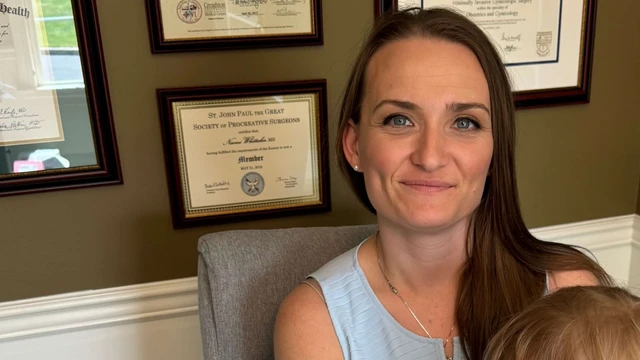
But not all women’s health practitioners are so unimaginative. Dr. Naomi Whittaker is a board-certified OBGYN and surgeon focused on women’s restorative reproductive medicine. She’s also the founder of RRM Academy, which employs both conventional medicine and the latest in restorative reproductive techniques. “Working with the female body rather than against it is the cornerstone of what I do,” she said. “I see hormones not as a nuisance to suppress, but as a language the body uses to communicate.” She calls restoring the body’s natural function “the spirit of restorative reproductive medicine.”

Even still, the establishment offers these doctors no help. Medical associations and education do not teach the kind of medicine Dr. Whittaker practices, and they are deeply skeptical of it. The American College of Obstetricians and Gynecologists and the American Society for Reproductive Medicine have issued statements and held congressional briefings against restorative reproductive medicine. After all, it is a competitor to the medical status quo at a time when the government has expressed more interest in women’s health and fertility. It seems as though the medical establishment is vying for a cut of a much-hoped-for government check.

Regardless, women continue rejecting the status quo. And this rejection comes amid an explosion of so-called “fem-tech” companies marketing devices (usually wearables, such as rings or watches) to assist women in either avoiding or achieving pregnancy naturally.

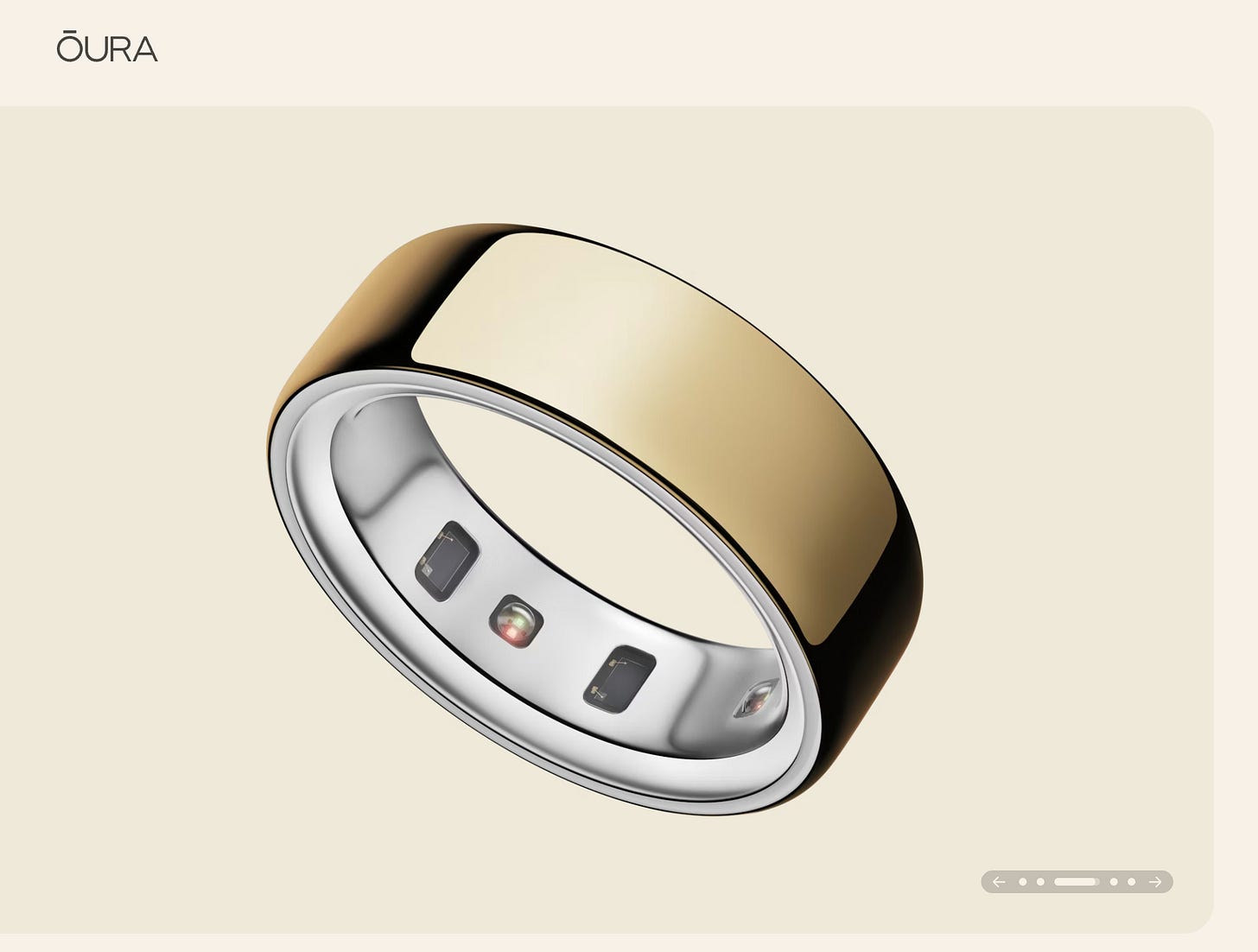
The Oura Ring, as seen on ouraring.com.

These devices use sensors to track temperature, sleep, and heart rate, among other things, to pinpoint ovulation or even underlying health conditions. Natural Cycles, which uses an AI algorithm adjusted to each individual user, became the first app to be cleared by the Food and Drug Administration as birth control in 2018. And Oura, whose sensor-laden rings have become something of a status symbol in Washington, is aiming higher than transforming women’s healthcare: It is purporting to change the face of American healthcare altogether.

Wearables such as the Oura ring are not only designed for tracking menstrual cycles, though they can do that. They are also designed to help wearers know more about their bodies (sleep quality and blood oxygen, activity, or stress levels, for example) and to help alert them to potential illness. Only a few months ago, an older-style wearable — the Fitbit — alerted me that my heart was in arrhythmia and told me to go to the emergency room. At 31, I am not the usual candidate for atrial fibrillation, and the ER doctor assumed the device had been faulty. After performing an EKG, he was amazed to find the watch had been right. Untreated heart arrhythmias are the most common cause of sudden cardiac death in the world.

American medicine has long suffered from being reactive rather than proactive. We treat symptoms and diseases rather than teaching people how to avoid them. After all, symptom and disease management is where all the money is, and healthcare, like all businesses, needs money to survive. But wearables may be a sign that’s changing. After all, Oura’s market valuation of $11 billion dollars is more than four times greater than it was just three years ago.

As women continue rejecting the pill, those beholden to the medical status quo will probably continue blaming women for falling prey to misinformation. That’s a lazy response. They’d do well to look a little closer: Women may be the early adopters of a new age of American medicine, rejecting pills and their unintended side effects in favor of preventative and restorative approaches, with wearables at the helm. American women seem to be ahead of the curve in heralding a return to true medicine. The only question is: Will the medical establishment get on board?


Thank you for reading Technically Human, a yearlong series of interviews and published work on reprotech, the moral limits of emerging reproductive technologies, and what it means to be human. Follow along here on Substack or on X at @annakateshelt, and please consider sharing.

Do you use hormonal birth control? Why or why not? Please share in the comments, or message me directly for a chance to be featured on Technically Human.

Subscribe now

This project is made possible by The Fund for American Studies’ Robert Novak Journalism Fellowship.
https://katelynshelton.substack.com/p/why-i-wont-use-hormonal-birth-control
Extensions
Technically Human: Elizabeth Condra
Her son has a genetic disorder. She was pressured to do IVF.
Show full content
The website homescreen of embryo screening company Nucleus Genomics, which promotes screening embryos so parents can select the “best” one.

Elizabeth Condra is a young wife and new mother. Her son, who is now sixteen months old, was born with a rare multi-gene deletion disorder. After undergoing genetic testing with her husband to determine whether they were carriers for the genetic disorder, genetic counselors “continuously referenced” IVF, even after Elizabeth and her husband said they weren’t interested in pursuing it, no matter the results.

“Though it wasn’t stated, I believe the obvious implication was that we could pick the embryos that were unaffected and discard the rest, which makes me sick to think about,” Elizabeth told me. “My husband and I mutually agreed that whatever the results, we would not let fear rule our decision to grow our family. Our son is the biggest blessing to us and though having a disabled child is difficult, it would not be the end of the world to have another one. I know that will sound incomprehensible to some, but we believe children are a gift and we want to continue to grow our family.”

If either Elizabeth or her husband were carriers of the gene, there would be a 50% chance it could affect a future pregnancy. Thankfully, Elizabeth and her husband tested negative, meaning their son’s disorder was spontaneous, and any future children would have little risk of developing it.

“From the get-go I was kind of shocked at how IVF was continuously referenced during our genetic counseling appointment. Though the counselor meant well, I think she just kind of assumed that’s the road we’d be taking if we were carrying the mutation and wanted to have another baby. Aside from the obvious financial considerations, we are Orthodox Christians and we do not participate in IVF, and when we shared that, she just kind of brushed it off like we’d change our minds.”

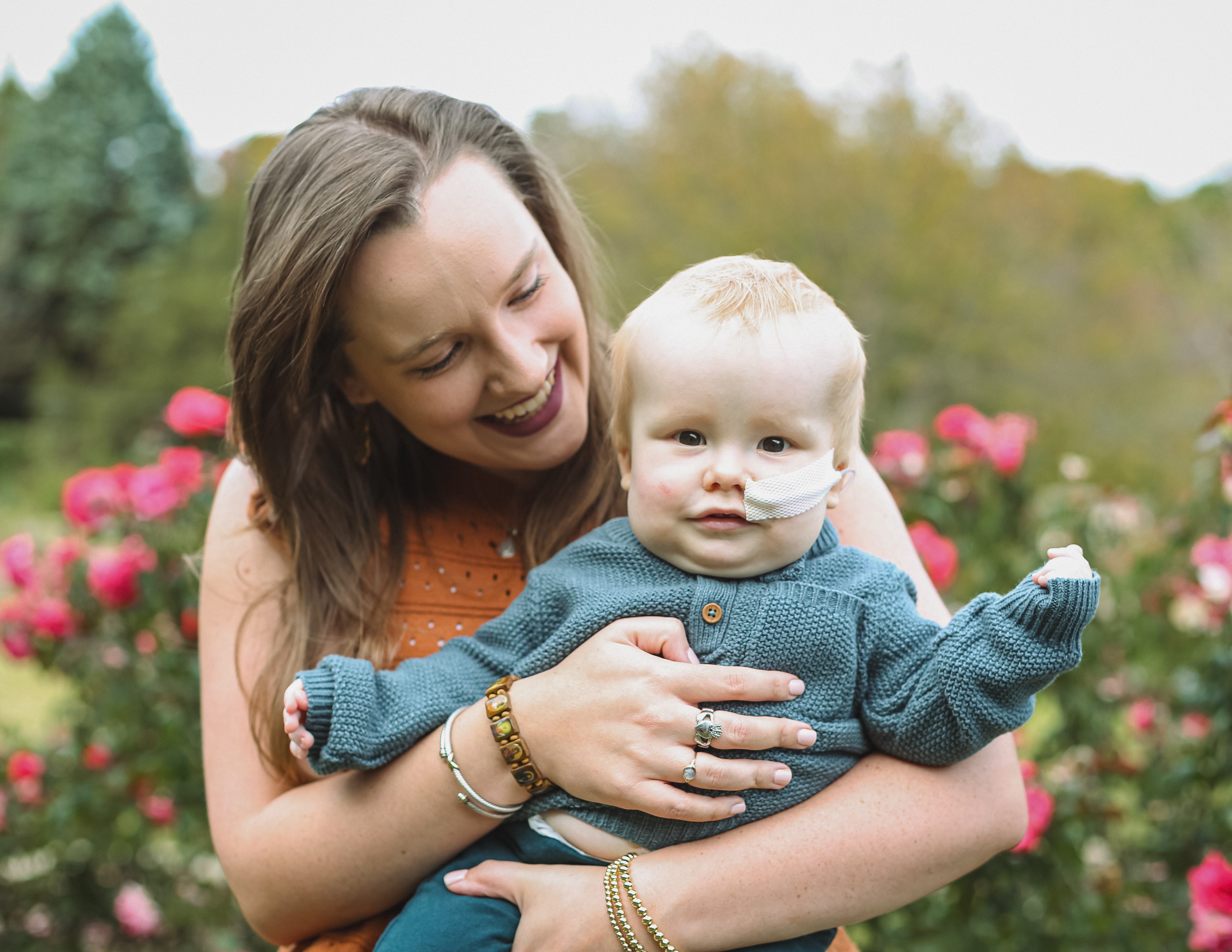
Elizabeth with her beautiful son.

Technically Human is a project examining the moral limits of our reproductive technologies, inquiring whether they contribute to human flourishing or perhaps dehumanize us in some way. I followed up with Elizabeth to dive deeper on genetic testing, disability, and using IVF to screen out undesirable human embryos. Elizabeth spoke of her (perhaps angelic?) son, the impact her Christain faith plays in her bioethical considerations, and how every child — no matter how he or she is brought into the world — is a gift.

Here’s our conversation:

Subscribe now


Katelyn Shelton: Tell me a little about when you found out about your son’s diagnosis. Were you pregnant, or was it after birth?

Elizabeth Condra: I’m not sure of percentages or statistics, but I imagine I’m one of a small minority of women who discovered their child’s genetic issues after birth. Strangely enough, I had a completely normal, low-risk pregnancy. I had blood tests and a 22-week anatomy scan, none of which were flagged for concerns. I also have a three-year-old who is developmentally healthy and neurotypical, and I had a healthy pregnancy with her as well.

However, it was evident at birth that my son had difficulties, the severity of which wasn’t immediately apparent to us. He had issues with feeding and nursing, and he slept constantly. He also had a visible craniofacial deformity, but we didn’t begin to unravel that until he was around 4 months old. We received his official diagnosis last year when he was 11 months old, after testing and a consultation with geneticists.

KS: Tell me about your son. What are some things about him that make you smile?

EC: I know that I’m biased, but my son may be an angel. I’ve always been around babies and children my entire life (I’m one of 5!) and I’ve just never seen a baby quite like him. He’s happy and cheerful from sunup to sundown. He loves to play and sing, and he’s a big cuddler, a huge mama’s boy. He has his upset moments, but these are really few and far between. I feel like he makes everyone happier just by being around him, and that’s my favorite thing about him. I can’t imagine our family without him.

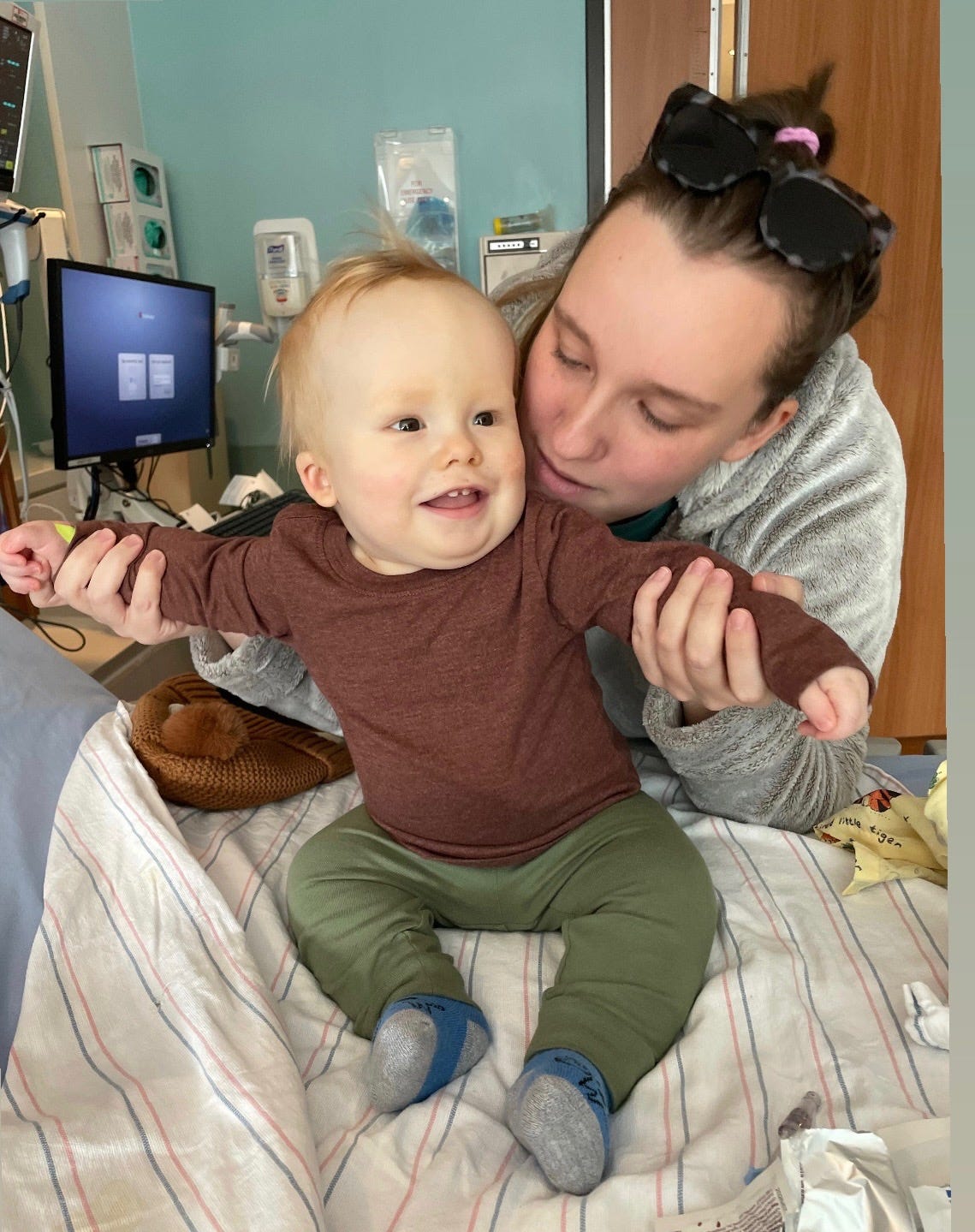
Elizabeth with her son in the hospital.

KS: Advances in gene editing technology like CRISPR are providing opportunities for some to undergo gene therapy to treat genetic disorders. Baby KJ was a baby born in August 2024 with a severe genetic condition, which was treated with CRISPR and seems to have cured him. What are your thoughts about this technology? Are you hopeful or skeptical of it? Do gene therapies exist for treating your son’s condition?

EC: As far as I’m aware, there are no gene therapies that exist for treating my son’s condition. He has a micro multi-gene deletion syndrome—specifically, he is missing three genes on the arm of his 11th chromosome (Potocki-Shaffer Syndrome, or 11p11.2 disorder).

When it comes to discussions of gene editing and therapies, I would say I am cautiously optimistic. As with any technological or scientific pursuit, I think any scientist considers how it will make individual lives better, but because I’m a Christian, I always have ethical concerns about these technologies, specifically processes like germline engineering. Even the most noble pursuit can have unintended consequences or uses, completely divorced from what it was created for.

However, I am also human enough to know that many special needs parents I now consider my friends are pursuing these therapies with the hope of bettering their children’s lives, and knowing that I would do anything for my son, I understand their pursuit of those options.

KS: Tell me a bit about your pursuit of genetic testing. Why did you and your husband decide to get tested? How did you feel receiving the results?

EC: My husband and I decided to pursue genetic testing after receiving our son’s official diagnosis last fall. We went to a follow-up genetics appointment, and our geneticist there mentioned that it might be something we’d want to pursue if we wanted more children. She asked me point-blank if we wanted more, and I actually broke down then and there, because I do! With the diagnosis and all of the excitement surrounding that, I hadn’t made the next logical step to realizing that if either of us were carrying the mutation, we could potentially have another child with 11p11.2.

Given that our daughter, our eldest, is healthy, I was hopeful from the get-go that our son’s condition is de novo, or spontaneous. My husband and I discussed it at length, and finding out if either of us were carriers seemed like the responsible thing to do. Knowing is half the battle, my husband says. One way I looked at it was that it wasn’t just about us anymore. If the deletion was hiding in one of our families, it could affect my siblings’ children, or my husband’s, potentially, or our daughter’s.

We received our results on January 16th, and we are not carrying the deletion. I think we were both relieved and very emotional from the whole journey. Given the rarity of my son’s disease, it also hits home for me that he was always meant to be part of our family.

The website homescreen of embryo screening company Orchid Bioscience Inc., which uses a new technology to predict an embryo’s genetic future so undesirable embryos can be weeded out.

KS: You told me that even if you or your husband had been carriers of your son’s genetic condition, you knew you wouldn’t pursue IVF to screen the condition out of future embryos. Why not?

EC: To be honest, this was not even an option for us. For one thing, we believe that intimacy between a couple is sacred and profound, and taking the act of procreation away from us and into a lab is not something we’d ever consider. Additionally, I have a difficult time thinking about my children, half of myself and half of my soulmate, being implanted and dying in me, or sitting in storage for years on end. It’s hard for me to wrap my head around. Because I believe what I believe, I don’t think I’d ever be able to think of them as just ‘embryos.’

KS: You mentioned the genetic counselors assuming you would pursue IVF, even when you said you wouldn’t. Tell me a little about these encounters, and what the underlying rationale seemed to be.

EC: IVF has been mentioned, very casually, I might add, not just by our genetics counselor but by a handful of other doctors we’ve seen for my son’s condition. It’s been treated around us like paying a bill or a dental appointment, just something offhand we could consider and not a huge commitment. These encounters weren’t tense by any means, but the person sitting across from us usually had the attitude of ‘this is the rational thing to do,’ even though we’d never pursue it. I’m sure that to a doctor with a medical degree, that is the normal thing to do, but I believe they think that because they don’t share our worldview or our beliefs, or maybe they’re not used to having patients challenge them.

KS: You mention not wanting to pursue IVF because of your Christian faith. Many Christians participate in IVF. Could you share a bit about why you feel like Christianity is incompatible with IVF? Does your denomination forbid the practice outright, or is your stance based on personal conviction (or both)?

EC: IVF is not outright banned in the Orthodox Church, but it is something a couple would have to have approval from their priest or bishop to pursue.

Similar to what Scripture teaches Christians on sexual purity, I believe many Christians today have an extremely non-committal, watered-down view of the sanctity of human life. I know it may be easy for the average Christian couple or individual to view IVF as relatively harmless or a net positive.

Still, there are very serious considerations that affect a family financially, biologically, and spiritually, such as egg or sperm donation, surrogacy, and the future of embryos. As an individual, I also try to maintain a consistent life ethic (human life is sacred from conception until natural death), and the everyday practices of IVF run directly contrary to that belief.

Jeremiah 1:5 says, “Before I formed you in the womb, I knew you.” God has ordained all lives since before the beginning of time, and any industry that commercializes procreation and seeks to willfully disrupt that sanctity or that ordination is one I have fears about.

Particularly in recent years, even since I had my son almost two years ago, I am seeing more and more normalization of making the most “healthy” children possible through means of embryo selection, even for couples not struggling with infertility or the other reasons that motivate them to pursue IVF. It sounds like a good thing; it sounds like something any caring parent would want for their child. Having a disabled child, I’m envious of families with healthy children.

But at the risk of sounding hyperbolic, this is the same rhetoric Nazis often used in spouting eugenics. Making “healthy” children today will eliminate all those who are deemed unhealthy tomorrow, and I know many would say my son is part of that classification, which is why I feel as strongly about this as I do. All human lives, even those in petri dishes, are made in the image and likeness of God, and are deserving of dignity.

Elizabeth’s son, who has a rare genetic disorder called Potocki-Shaffer Syndrome, or 11p11.2 disorder.

KS: Do you think IVF contributes to human flourishing? What about genetic testing?

EC: Though I have serious concerns about IVF and its proliferation, I have also never dealt with the painful burden of infertility, and I recognize that I speak from a very privileged perspective. Just because I have concerns about it and it’s not something that I would pursue doesn’t mean I think couples who use it are evil, or their children shouldn’t exist. Many of my friends are products of IVF or have used IVF, and because I’m pro-life, I hope that every life is celebrated, no matter the way in which it originated. There is no doubt that IVF has helped couples across the world for decades grow their families, and I hope that in their joy and happiness, they cherish the lives that have survived and mourn the ones that have died.

I believe genetic testing is a positive benefit to our society, when used appropriately for the purposes of gathering information, as it was used in my son’s case, and not necessarily in determining which lives deserve a chance at survival and which ones don’t.


This interview has been lightly edited for brevity. You can find Elizabeth Condra on Substack at or on Instagram at @emcee_squared_.

Have you used genetic testing or IVF for screening out genetic disorders in your family? Have you opted not to use them — and if so, why? Share in the comments, or send me a DM for a chance to be featured in Technically Human.

Leave a comment

Thank you for reading Technically Human, a yearlong exploration into the moral limits of emerging reproductive technologies. This is the second in a series of interviews and published work on reprotech and what it means to be human. Follow along here on Substack or on X at @annakateshelt, and please consider sharing.

This project is made possible by The Fund for American Studies’ Robert Novak Journalism Fellowship.
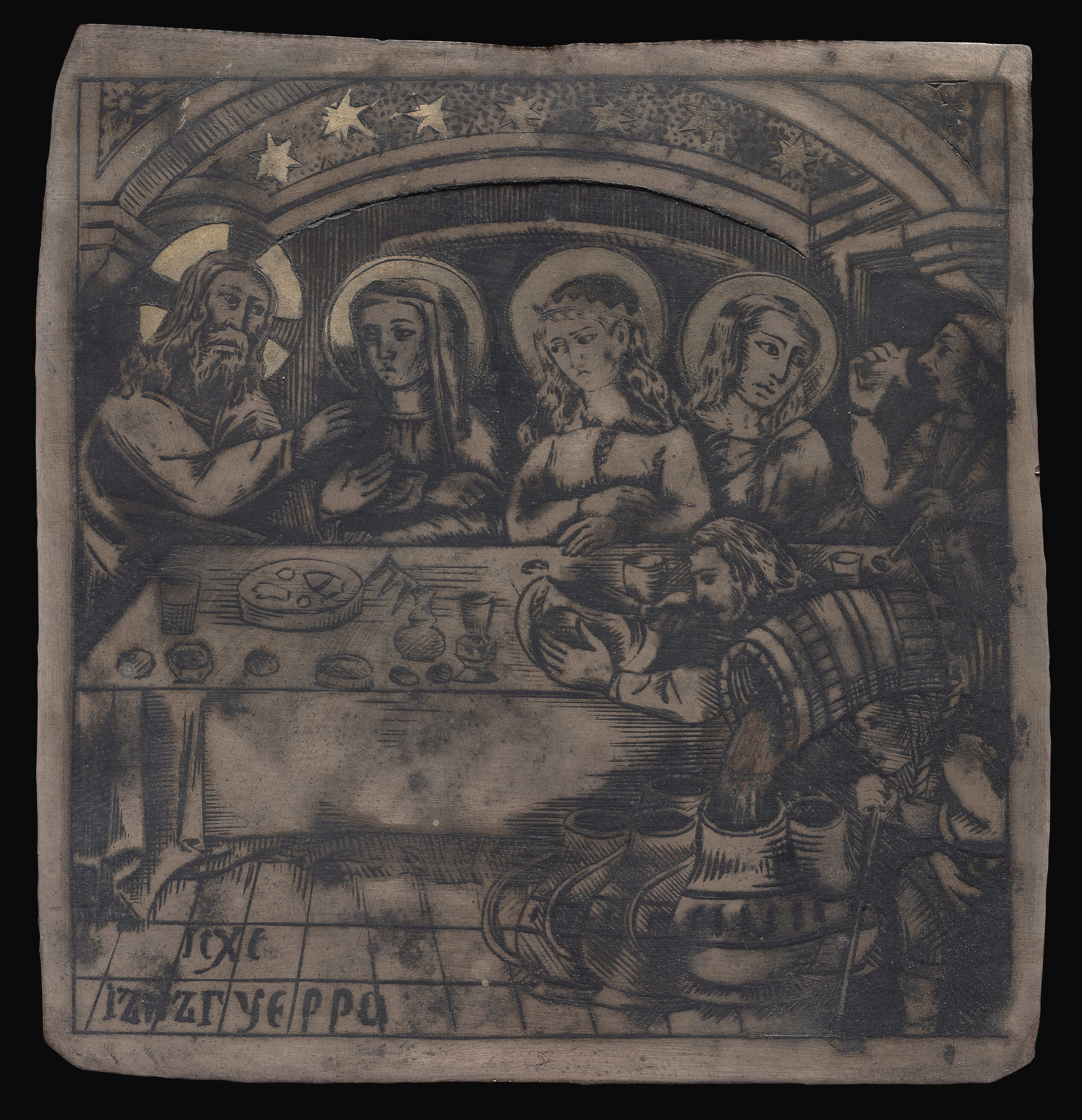
Share Technically Human

https://katelynshelton.substack.com/p/technically-human-elizabeth-condra
Extensions
Technically Human: Dr. Naomi Whittaker
on restorative reproductive medicine, femtech, & the purpose of medicine
Show full content

Few advances in reproductive technologies give me more hope than Restorative Reproductive Medicine. Commonly referred to as RRM, Restorative Reproductive Medicine seeks to work with the female body rather than against it at every stage of a woman’s reproductive life. It can help a woman avoid pregnancy, get pregnant, identify underlying health conditions like endometriosis or sometimes even cancer, or help regulate hormones during menopause (plus a lot more). It is truly good women’s healthcare, and I think it’s the future.

That’s why I wanted to interview Dr. Naomi Whittaker — the founder of RRMAcademy.org and a board-certified OBGYN fertility surgeon focused on women’s restorative reproductive medicine, compassionate healthcare, and education. 

Dr. Whittaker specializes in the Creighton Model FertilityCare System and NaProTechnology, which works cooperatively with a woman’s body to treat the underlying causes of gynecologic issues and infertility, such as endometriosis and PCOS. She helps women improve their gynecologic health, and avoid or achieve pregnancy in accordance with their natural fertility using the latest research, medicine, and surgery. She currently practices in Harrisburg, Pennsylvania.

Dr. Naomi Whittaker

Katelyn Shelton: Dr. Whittaker, thank you for agreeing to be the first interviewee in a series of interviews for Technically Human. I’ve admired your work for a while. Start by telling us what your day-to-day work looks like. And answer a question I get frequently: How is the work RRM doctors do different from what an IVF doctor does?

Dr. Whittaker: My goal is to care for women with nearly any reproductive health issue and help them find a genuine path toward healing. Many of my patients come to me after years of frustration within a broken healthcare model that too often defaults to “just take birth control” or “just do IVF.” Those quick fixes rarely address the root causes of problems like PCOS, endometriosis, or hormonal imbalance—and they’ve left countless women unheard and untreated.

In my clinic, I start by listening—to their stories, their symptoms, and their bodies. Through detailed cycle charting, I often gain insights no prior provider has noticed. Sometimes within the first appointment, I can tell them what’s likely going on, even before ordering more tests.

I love empowering my patients with information about their own health. When they realize someone is finally listening and explaining, you can see the relief on their faces. I often joke that the bar for care has been set so low that I could trip over it and still exceed expectations—it usually earns a laugh, but it’s sadly true.

From there, we collaborate on an individualized treatment plan—whether that involves labs, hormone support, or surgery—based on her goals and my medical expertise. Healing is not one-size-fits-all; it’s a partnership built on trust, compassion, and science.

KS: Let’s talk a little bit about that individualized treatment plan. How do you as a doctor seek to work with the female body rather than against it?

Dr. W: Most doctors and patients currently don’t have the training or time to understand a woman’s ovulatory cycle. So they rely on one size fits all birth control options to entirely suppress ovulation all together.

I was taught in med school that ovulation was a risk factor for cancer. Despite it being a normal, physiologic event, it was insinuated that birth control was the healthier option. They essentially suggested that women are born with a birth control deficiency.

Rather than flying blind like most OBGYNs when a patient walks in the door, I rely on data provided by the patient to identify the critical event of the menstrual cycle: ovulation. It’s elusive if a woman isn’t educated on how her body functions: she may not even see these subtle signs.

The major difference between me and most standard trained OBGYNs is that I have extra training to be able to interpret the language of the cycle chart. I know what the biomarkers should look like. I understand what a normal/optimal cycle is and what its biomarkers look like - not only the bleeding patterns but what the most scientifically reliable markers are for the fertile window and phases of the menstrual cycle. This is absolutely critical to understanding women’s complex hormonal design.

I use this data to run targeted, individualized hormone panels, a series of labs based on specific cycle days. I use this data to recommend precise dosing uniquely targeted in real time on a per-cycle basis. I then can use that same cycle chart to see her biomarker response: a real time report card of her reproductive health.

KS: One thing I’ve noticed in my own experience on the receiving end of women’s healthcare is a marked lack of understanding about female sex hormones. Do you think there’s a role in women’s healthcare for better understanding female hormones, and do you try to do that in your approach?

Dr. W: I’m afraid the training on hormones is abysmal and antiquated in medical school and even OBGYN residency. Many doctors do not understand the differences between bio-identical and synthetic hormones (like birth control). Many OBGYNs just use a small variety of birth control options for nearly all reproductive complaints.

This over-reliance and has led to an over-simplification of the practice of women’s healthcare. It’s a paternalistic model that women’s hormones should be the same every day and that the variations of natural hormones are a nuisance when, in fact, these pesky fluctuations matter not only for fertility, but for overall physical and mental health.

This one-size-fits-all mentality has led to a stagnation of intellectual curiosity and awe of women’s bodies and designs: and a near halt on all scientific advancement.

What I see over and over in practice is women who have been failed by this model. They seek a second opinion and are essentially just given another flavor option of birth control or, worse, are told to take two birth controls at once. Women are often shamed if they do not tolerate birth control or insist on another option.

KS: RRM seems to be gaining steam culturally, alongside another development I’m personally really excited about: femtech. The number of cycle-tracking and algorhithm-based apps for predicting ovulation that exist today did not exist ten years ago. Are you hopeful about new appraches to women’s healthcare?

Dr. W: Organically, women are rising up angry at the status quo. With social media, what felt like gaslighting of the masses won’t work anymore. The women who want better have said “enough is enough.”

What is going to fill the gap? Femtech is rushing in to fill this gap… some of it via pharmaceutical companies who see their target base looking elsewhere. The science of femtech is overwhelmingly bad. They can get away with it due to poor understanding of women’s bodies which has been enabled by decades of birth control use.

We need to educate women on valid methods of fertility awareness based methods (FABM) or Natural Family Planning (NFP) or else they will be duped by the next best marketing ad. We must focus on proper scientific education, and that’s why I founded RRM Academy, an educational nonprofit.

Women deserve scientific education to help them interpret the predatory world out there. Cutting-edge solutions specific to the reproductive needs of women — from hormones to fertility and pelvic pain — necessitate an understanding of women and what makes them healthy and unique: ovulation.

We must demand that medicine stops the misogyny of demonizing ovulation. We must respect the ovulatory cycle. In doing so, we will try to restore ovulation or mimic the benefits of ovulation by cooperative, bio-identical hormone support which mimics optimal female physiology. That is the essence of the term “restorative reproductive medicine.” It is simply using medicine to restore the healthy, physiologic state of women, which is ovulation. Just treating women as if they have an optional on/off switch for ovulation and fertility is just not working for many women.

KS: This is a great segue to my next question, regarding technology. As you know, this project, Technically Human, explores how reproductive technology may be making us less human. Do you think anything in your field is making us less human, and if so, how do you work to counter that?

Replacing natural bodily functions with medical interventions can risk stripping away human dignity and replacing it with a profit-driven mindset. This is evident, for example, with birth control—when the goal becomes financial gain rather than supporting women’s health. The idea that a woman’s natural cycle is “flawed” is deeply misogynistic and can lead to dangerous assumptions in medicine. Women are often told they are “broken” and must accept a treatment, while informed consent slowly fades from the picture.

When natural conception is bypassed entirely, as with IVF, the potential for commodifying the female body increases. It becomes easy to prioritize the lab over the natural process—to assume that technological reproduction is better. But this mindset ignores the ethical consequences. When conception is separated from the body, we risk reducing people to their parts—eggs, sperm, uteruses—like interchangeable components on an assembly line.

Technology itself is neutral; its moral value depends on how we use it. What I fear is technology without ethics, and medicine without bioethics. Progress must always be guided by a moral compass that protects human dignity. Bioethics exists precisely to help us navigate that tension—reminding us to treat humans with dignity, to follow the principle of “do no harm,” and to ask the essential question: just because we can, should we?

IVF, introduced in the 1970s as a cure-all for infertility, hasn’t fully lived up to its promise. While techniques like embryo freezing and genetic screening have advanced, little attention has been given to restoring the underlying health of patients. Male factor infertility, for example, is often ignored and circumvented through ICSI (an advanced IVF laboratory procedure used to treat severe male factor infertility), shifting the burden entirely onto women. Success rates remain modest, especially when underlying conditions go untreated.

The focus on embryos and lab techniques overlooks the health and well-being of women. High-dose hormone stimulation can even worsen inflammatory conditions such as endometriosis or PCOS. Ignoring the diseases that cause infertility erases part of our humanity. These patients aren’t just vessels for embryos—they are individuals with complex health needs and personal suffering.

True healing begins with listening—understanding each patient’s story, history, and symptoms. This is how we preserve their dignity and humanity. In my own practice, I strive to respect both the science and the soul of medicine by following the principle of “do no harm”; staying current with research in medicine and surgery; practicing compassion and deep listening; using tools like cycle charting as a diagnostic guide—my own “EKG” for the female body; and studying diverse literature, from mainstream to cellular-level research, and engaging patients as partners in discovery.

My patients have taught me the most—through their bravery, curiosity, and persistence. Working with them has allowed me to refine the science of Restorative Reproductive Medicine (RRM), combining rigorous data analysis with individualized, dignified care.

Ultimately, respecting the humanity of our patients means treating the whole person—not just their reproductive parts—and never losing sight of our ethical responsibility to heal rather than to harm.

KS: What kinds of advancements would you most like to see in women’s reproductive medicine?

Dr. W: We need far more research. The state of understanding around female-specific conditions is, unfortunately, not much better than it was in the 1960s or 70s. Many fundamental questions remain unanswered: What defines optimal female hormone health? What does a normal cycle truly look like for each woman?

Dr. Thomas Hilgers, who trained me and inspired much of my approach, conducted the only prospective, real-time studies tracking women’s hormones throughout their cycles. His work transformed our understanding of the luteal phase and fertility, and his legacy motivates me to continue pushing for progress.

If I could direct future advancements, I’d love to see research and innovation in the following areas:

  • Reversing ovarian aging and promoting ovarian longevity through therapies like cooperative hormone replacement, platelet-rich plasma, mitochondrial support, and photobiomodulation.

  • Improving microsurgical and robotic techniques for delicate tubal surgery and developing non-surgical options for repairing inflammation or obstruction.

  • Reducing inflammation triggers, especially for women with endometriosis, and preventing adhesions after surgery.

  • Identifying PCOS subtypes so treatments can be targeted more precisely to each pattern of disease.

  • Expanding research on hormonal health more broadly—including perimenopause, menopause, hormone replacement therapy, and conditions like MCAS and POTS.

Women’s health research deserves the same depth and innovation afforded to other fields of medicine. The possibilities ahead are vast—and if guided with ethics and empathy, technology can truly help us restore rather than replace what makes us human.


This interview has been lightly edited for brevity. You can find Dr. Whittaker on X at @NaomiMWhittaker, and on Instagram at @Napro_Fertility_Surgeon.

Have you used RRM, NFP, or another fertility awareness based method? How did it work for you? Has the women’s health status quo failed you — or radically succeeded — in some way? Share in the comments, or send me a DM for a chance to be featured in Technically Human.

Leave a comment

Thank you for reading Technically Human, a yearlong exploration into the moral limits of emerging reproductive technologies. This is the first of a series of interviews and published work on reprotech and what it means to be human. Follow along here on Substack or on X at @annakateshelt, and please consider sharing.

This project is made possible by The Fund for American Studies’ Robert Novak Journalism Fellowship.

Share Technically Human

https://katelynshelton.substack.com/p/technically-human-dr-naomi-whittaker
Extensions
Introducing: Technically Human
Tech is reinventing reproduction. Will we let it?
Show full content
“Ectolife” is an artificial womb facility conceptualization by biotechnologist Hashem Al-Ghaili.

Nothing is as fundamental to the human experience as birth. But Silicon Valley and other investors are hoping to change that, to “reinvent reproduction.” And I have questions.

I’m Katelyn Shelton, and I’m a Robert Novak Journalism Fellow and Visiting Fellow at the Ethics and Public Policy Center in Washington, D.C. where I research and write on issues of bioethics. Today I’m launching Technically Human on Substack, a yearlong investigation into emerging reproductive technologies and how they’re changing what it means to be human.

What does it mean to be human? If we change something as fundamental as how we reproduce, how might that change humanity? Will pregnancy robots eventually supplant mothers gestating their own children? Will embryo selection – micromanaging our children down to their very DNA – affect the way we view them? Change the way we treat them? Or even… change the way they feel about us?

“Have your best baby,” the ads proclaimed in the New York City metro, just a matter of weeks ago. The ads featured a number of plump and beautiful babies, next to a QR code and a caption: “These babies have great genes.”

The controversial ad campaign was launched by Nucleus Genomics, one of a host of new venture-capital backed, fertility-focused startups in the United States.

Companies like Nucleus or Orchid or Genomic Predictions use a new technology to screen an IVF-created embryo for diseases and traits like sex, height, eye color, and even IQ. Each embryo is assigned a grade and a report, their future health determined and sent home like a kindergarten report card.

But in this case, parents aren’t evaluating their child’s learning performance. They’re evaluating their child’s genes, and ranking them against all their siblings. For the first time in history, we are deciding who gets to exist based on predicted performance.

Emerging technology selects, edits, stores, discards, or redesigns this life in a petri dish, and there are few laws governing what happens under the fluorescent lights of the lab.

You’ll often hear that the United States is the “wild west” of the women’s health and fertility landscape. We are the fertility tourism capital of the world: people travel from all over the globe to do here what they could do nowhere else. Not because the technology is so much better here: but because the absence of laws and taboos are so much worse.

Unlike most developed nations, the US has no overarching federal law governing the creation, manipulation, freezing, sale, or destruction of human embryos. The fertility industry is largely market-driven and self-regulated, worth more than $8B annually and on track to make a lot more than that.

There are no national standards like how many eggs can be harvested at a time, how many embryos can be created or transferred, or how the embryos should be treated, stored, or disposed of. Depending on where you are, embryos are either treated legally as property, potential life, or persons.

If you have the good fortune of being a certain kind of embryo, however, there are multiple layers of regulation, at the federal, state, and industry-standard levels. The treatment, transfer, sale, and transport of equine embryos, that is, horses, are more strictly regulated than that of human embryos manipulated in a fertility clinic.

It is clear that reproductive technology has outpaced our moral imagination: We cannot regulate what we cannot rightly condemn.

Right now, we are on the cusp of many momentous biotechnical advances, some of which hold great promise – and some of which hold great propensity for harm — for babies, for women, for families, and for our nation.

While companies like Nucleus predict and rank an embryo’s DNA, CRISPR can be used to actually edit it. While there are different types of gene editing, some of it potentially good, heritable gene editing involves manipulating an embryo’s DNA in a petri dish, meaning all changes, good or bad, are likely passed on to the next generation. And though there are international agreements amongst scientists that they won’t open that Pandora’s Box, one Chinese scientist already has.

He Jiankui shocked the world when he announced that he had edited the DNA of a set of Chinese twin girls in 2018. The full effects on those girls are still unknown, but at least one of them suffers from a mistake Jiankui made – and any genetic errors made by the scientist could be passed on for generations.

He Jiankui was sentenced to three years in prison by Chinese authorities, perhaps to maintain appearances with the international community and its self-imposed rules. But now Jiankui is back at work, and last year he announced the new location of his independent lab: Austin, Texas.

An AI-generated photo on Jiankui’s X feed of himself. He often portrays himself as a kind of God.

While Jiankui promotes his work as curing genetic diseases, there is no guarantee that people would not use the technology to make edits beyond curative ones, in an attempt to influence traits, like height or skin color or IQ. How could we believe that they wouldn’t, when companies like Nucleus already allow parents to choose such traits in their embryos?

When companies are already making money practicing eugenics, there’s no reason we should trust scientists not to try it another way.

For centuries, modern medicine has sought to overcome disease. Now it seeks to overcome biology. Some fear we are witnessing the technological erasure of human nature. But not all applications of cutting-edge reproductive technologies are so dystopian.

Consider, for example, Nicole Muldoon, who was told her son would be born with a fatal genetic condition. She didn’t expect him to live more than a few weeks. But thanks to a new gene-editing technology tailored specifically to her baby, doctors were able to cure baby KJ of his genetic condition. A few days after his birth, his parents expected to have a funeral – but now they’re celebrating his birthdays.

Technology isn’t inherently bad. How we use it can be.

Few issues hold greater significance for the future of the human race. That’s why I’ll be interviewing doctors, ethicists, geneticists, and the women who have either used these technologies or refused them, asking both what science can do for us, and what science may do to us. And what we should do about it.

Follow along here at Technically Human or on X at @annakateshelt, where I’ll share written interviews as well as links to my published work exploring the moral limits of reproductive biotechnologies.

Subcribe for free, and please share Technically Human:

Finally, do you have a story about reprotech and what it means to be human, or know someone who does? Have you been affected by IVF, surrogacy, abortion, genetic screening, women’s healthcare, disability in pregnancy, or something else? Please be in touch, either in the comments or DM, as I’d love to share your story (anonymously, if desired). Thank you for reading.

Leave a comment

https://katelynshelton.substack.com/p/introducing-technically-human
Extensions
Protestants Against the Pill
My debut in First Things. Plus: Sex + Moral Guidance & the Future of Women’s Healthcare
Show full content

I’m delighted to share that I’m on the digital “front page” of First Things Magazine today as part of the October print edition’s online debut. It’s an honor to get to write about a topic I’ve been obsessed with for the better part of a decade: the ethics of contraception. Excerpt below.

Subscribe now

More Writing

After writing for months, three of my articles were published within about a day of each other. I’m in Mere Orthodoxy discussing the need for sexual moral guidance. And I’m in WORLD Magazine discussing a fertility treatment more successful than IVF (that medical associations don’t want you to know about). Excerpts below.

Protestants Against the Pill

“Ben Jefferies is an Anglican priest who says he knows that one of his parishioners throws away all the tracts he’s written on “Marriage, Sex, and Babies” when he’s not looking. He keeps them in the lobby of his church, alongside a number of other tracts on “things Anglicans believe.” Jefferies laughs good-naturedly when I ask how his parishioners receive his teaching on contraception. His own belief on the topic, though informed, differs substantially from what most ­Anglicans believe, at least in practice. In fact, ­Jefferies’s teaching on the matter is similar to that of the Catholic Church, proffering Natural ­Family Planning paired with ­periodic ­abstinence as the standard means by which Christians should avoid ­pregnancy.

The Catholic view used to be, well, catholic. Martin Luther and John Calvin regarded contraceptive sexual acts as a grave moral sin; this was the universal Christian position until the 1930 Lambeth Conference, at which Anglican leaders gave their official opinion that contraception was no

t in all cases sinful. Other denominations quickly followed. But though Protestants on the whole have left behind contraception as a moral issue, a growing number of Protestant women have begun to reject the pill. I interviewed three who are discovering more than Natural Family Planning—they are discovering an embodied faith.

Kelsey Meyers, twenty-five, is a new wife, mom, and lawyer who attends an Anglican church in Washington, D.C., with her husband and infant son. We both fed our babies as we talked on the phone.

Kelsey had been prescribed the birth control pill as a treatment for hormonal acne when she was in high school, and again later when she approached her doctor with symptoms of polycystic ovarian syndrome. But she didn’t like how the pill made her feel, and it didn’t seem to address her symptoms. “Every time I came with an issue, that was the Band-Aid solution that they slapped on it.”

Kelsey’s experience isn’t unique. Women are prescribed hormonal birth control for many issues: acne, mood swings, irregular or painful or heavy periods. In the United States, hormonal birth control is prescribed to girls as young as eleven, and there are neither federal age restrictions for its use nor longitudinal studies of its effects on girls who have yet to undergo puberty…”

Read the whole thing at First Things Magazine, online or in print!

Sexuality and Moral Guidance

“When I told my Dad I was writing a book about contraception, his first question (after a beat) was, “But what am I going to tell my friends?”

His next question: “How much is there to say about a condom?”

I understand. Talking about sex can be awkward, especially when you’re a Christian who would prefer to talk about almost anything else. Our culture is hyper-saturated with sex. It’s in our faces all the time, from movies to books to music to fast food ads and everything in-between. “Modest is hottest” is still one of my favorite sayings, and as I am now the mother of two daughters (and two sons!), I think saying it a lot will be part of my not-too-distant future.

In​ an essay for First Things, Carl Trueman ​said that we exist today in “a battle for the body.” “The status of the body as it relates to us as human persons,” Trueman says, “seems to be the issue that lies, often unseen, behind many of the other more prominent debates of our age.” As such, talking about sex and thinking through a more robust theological anthropology is crucial in an age that makes a golden calf of sex. And the church would be neglecting its duty if it refused to talk about it.

Haley Baumeister bravely took up the mantle when she wrote a thoughtful and provocative “Case Against Vasectomies,” which has garnered a fair amount of attention. Kirsten Sanders wrote a thought-provoking reply, “Desiderata for a Protestant Theology of the Body,” in which she opines about what a distinctly Protestant theology of the body might look like, while gently pushing back on the impulse to want an ironclad prohibition of contraception. While I agreed with some of Kirsten’s response, I took issue with her admonition to speak of sex less, and with her assumption that discussions about “theology of the body” are inherently Catholic in nature…”

Read the whole thing online at Mere Orthodoxy.

The Future for Women’s Healthcare

“When Madeleine Kearns got married in 2023, she knew she would have trouble getting pregnant. She had been told she likely had a gynecological disorder (though an official diagnosis couldn’t be given without an invasive surgery). Although doctors suggested in-vitro fertilization (IVF), Madeleine knew IVF wasn’t a route she and her husband could pursue due to their Catholic faith.

Madeleine isn’t alone. She is one of 53 million Catholics in America for whom IVF is prohibited as members of the Catholic Church. And while Protestants have no top-down prohibition against IVF as Catholics do, many of the 136 million Protestants in America have conscientious objections to IVF. Despite this, referrals for IVF based on “unexplained infertility” have become the standard of care for many women in the United States. As a system, women’s healthcare is broken, and while there are hopeful signs that the field is changing, major medical associations are seeking to stifle innovation and maintain the status quo.

After suffering many miscarriages and consulting many doctors, Madeleine became a mother to a healthy baby girl in July. When her doctors in New York City couldn’t help beyond referring her for IVF, Madeleine sought a cutting-edge practice in Missouri that specializes in giving women a real diagnosis, not just the catchall “unexplained infertility” (which is a fancy way for doctors to say, “I have no idea what’s wrong”). The Veritas Fertility and Surgery clinic was founded by a doctor trained in NaPro Technology, an innovative and successful approach to women’s healthcare that seeks to identify and treat the underlying causes of infertility so women have a greater likelihood of conceiving naturally (and being healthier overall).

NaPro Technology is one of a number of approaches that falls under the umbrella of Restorative Reproductive Medicine (RRM), a field that has existed for over 25 years and is growing in popularity. According to the International Institute for Restorative Reproductive Medicine, “RRM has a record of care that, compared to IVF, is less invasive, less expensive, and has improved maternal and neonatal health outcomes.”

Truly, RRM should be the future for women’s healthcare in an era where infertility continues to surge and a fertility crisis looms. So why are the major medical associations denouncing RRM as “ideological, unproven, and ineffective”"? …”

Read the whole thing online at WORLD Magazine.

Thanks for reading. More to come!

Share Technically Human

https://katelynshelton.substack.com/p/protestants-against-the-pill
Extensions
Christians Need to Talk About Sex
In which I pick a fight with Kirsten Sanders. RIP me.
Show full content

I’ve shared here and elsewhere that when I told my Dad I was writing a book about contraception, his first question (after a beat) was, “But what am I going to tell my friends?” His next question: “How much is there to say about a condom?”

I get it. Talking about sex can be awkward, especially when you’re a Christian who would prefer to talk about… almost anything else. There’s also quite a bit to be said for modesty. Our culture is hyper-saturated with sex. It’s in our faces all the time, from movies to books to music to fast food ads and everything in-between. After a recent trip to the beach where many girls wore thongs for swimsuit bottoms, my husband remarked that scantily-clad beach-goers should be thrown in jail (he jokes. mostly.). “Modest is hottest” is still one of my favorite sayings, and as I am now the mother of two daughters (and two sons!), I think saying it a lot will be part of my M.O. in the not-too-distant future. If this phrase bothers you due to its provenance from Purity Culture, please see my recent tweet:

About a week ago, my e-friend Haley Baumeister (with whom I now exchange Christmas cards) posted a thoughtful and provocative article entitled, “14 reasons to stop normalizing vasectomies.” Before I had a chance to read it, I saw (another e-friend) Kirsten Sanders’ thought-provoking reply, “Desiderata for a Protestant Theology of the Body” (let me know if you want to exchange Christmas cards).1 And like any good Substacker, I knew deep down in my bones that I had to write a response of my own. Make yourselves comfortable, and read the other two first if you’re so inclined (linked above), although I hope this response will be able to stand on its own as well.

1. It’s immodest for Christians to refrain from talking about sex.

Kirsten says, “I try to speak of sex in accordance with Scripture, which is to say not very often and with little clarity.” That seems curious to me, since a number of theological doctrines are rarely (if ever!) spoken of in Scripture, and many of them are “clear” enough to have needed church councils to decide upon them.

For example, it is Christian doctrine that Jesus Christ is fully man and fully divine, having two distinct natures in his one person. But you won’t find the phrase “hypostatic union” in Scripture, and it isn’t terribly easy to describe to a five-year-old (ask me how I know). The Council of Chalcedon convened in 451 AD to address a number of heresies that had cropped up surrounding the person of Jesus Christ, which had begun jeopardizing Christian understanding of salvation.

Or consider the doctrine of the Trinity. Again, you may be surprised to know that the word “Trinity” is not found in Scripture at all. But the first Council of Nicea (which is celebrating its 1700th anniversary this year) decided it was in accordance with Scripture and key to Christian understanding that there is one God who exists eternally in three co-equal persons. Don’t try to explain it to a five year old at all, lest you commit heresy.

There are a number of Christian doctrines necessary to orthodox Christian belief and practice, which are in accordance with Scripture but spoken of rarely and with little clarity. Why, then, would speaking of sex — a topic which actually does occur a surprising amount in Scripture! — be different?

Sex is instantiated in Genesis with the command to “be fruitful and multiply,” and reinforced in Genesis 4 when “Adam had sexual relations with his wife Eve and she conceived.” Onan is killed by God in Genesis 38 for having repeated sexual encounters with his brother’s widow, Tamar, with no intent to impregnate her. Sex is one of a select group of topics referenced in the ten commandments when God commands his people not to commit adultery. The Song of Solomon is an entire book dedicated to the topic, and is enough to make even the most brazen among us blush. In the New Testament, Jesus condemns all forms of sexual immorality, going so far as to say that lustful thoughts are tantamount to adultery.

The church has also spoken about issues of sex and celibacy for millennia. More on that later. But even the Puritans, who get a bad rap for being anti-sex, had rules about how often husbands and wives should be having sex. If a husband or wife deprived his or her spouse for more than three months, there could be consequences from the church! How’s that for puritanical?!

As I mentioned before, and it pretty much goes without saying, our culture is inundated with sex. Its understanding of the human person is depraved. And the church has not been immune to these misunderstandings. If Arianism and Monophysitism were the heresies du jour in the 300s and 400s AD, sexual individualism/libertinism is the heresy du jour today. And it’s shredding our understanding of the doctrine of anthropology, of what it means to be a human person created in the image of God.

In​ an essay for First Things, Carl Trueman ​said that we exist today in “a battle for the body.” “The status of the body as it relates to us as human persons,” Trueman says, “seems to be the issue that lies, often unseen, behind many of the other more prominent debates of our age.”

The church would be neglecting its duty if it refused to talk about sex.2

2. To refuse to talk about our bodies is a denial of the incarnation.

Kirsten makes a necessary point that “Privacy and prudence should be closer friends.” Again: modest is hottest. Even and perhaps especially when you’re talking about sex.

But while it may sound hip and cool to say “I would be fine to never hear about someone’s religious feelings in regard to their lovemaking [or their cervical fluid] ever again,” it does a disservice to women, to couples, and to the church to never talk about sex or our reproductive capacities. It also seems to ignore the fact that Jesus himself took on human flesh and had a reproductive system, just like the rest of us. He created it for a purpose, and it’s our job to discern, using Scripture, tradition, and nature, what that purpose is and how we should comport ourselves to it.

The reason we haven’t had to think deeply about issues of sex, procreation, or the reproductive system for the past sixty-some-odd years (depending on how you count) is because hormonal birth control has rendered the female cycle invisible even to ourselves as women. And while technologies for birth control have continued to evolve, Christians have not kept up theologically. There is much to discuss here, including whether women have been lied to very deliberately (by medical associations like ACOG) about hormonal birth control’s capacity to cause an abortion. More on that in a forthcoming article I’ll be sure to share.

As I have told many, there are more women in my (Protestant) church asking to meet with me to discuss the ethics of contraception and the basics of Natural Family Planning than I have time to meet with. Something’s up. But many within evangelicalism (most publishers included) seem to agree with Kirsten that we shouldn’t talk about sex, contraception, or our reproductive cycles. Why?


I was well-catechized by my Southern Baptist forebears that Scripture bears upon every aspect of our lives. They’re right. And that includes every part of our bodies, even the parts that are the most private to us.

3. Theologies of the Body/Sex/Fertility are not inherently a dogwhistle for Roman Catholicism

Having read Kirsten’s piece before reading Haley’s which prompted it, I had the sense that Haley’s article must have bemoaned the state of Protestantism’s lack of magisterial guidance with regard to issues of contraception specifically. The main thrust of Kirsten’s reply is that Protestantism’s lack of an ironclad magisterium is good, actually — a feature, not a bug.

But when I read Haley’s piece, she actually doesn’t talk about the magisterium at all. She doesn’t go out of her way to praise the Catholics, and she doesn’t lament the state of Protestantism. She just writes about how weird it is that evangelicals talk so nonchalantly about sterilization (which she rightly characterizes as a type of bodily mutilation, a surgical procedure done not to heal but to circumvent normal, healthy bodily function… something that can also be said of hormonal contraception, incidentally). In fact, Haley even says “you shouldn’t need to swim the Tiber if you care about these things”!

Perhaps Kirsten’s post is less a response to Haley’s and more broad-based, incorporating others' thoughts or comments into the conversation. This would make sense given that many of the Protestants thinking about Protestant theology of the body do make the kind of pro-magesterial move Kirsten is warning against. But it is important to note: Haley doesn’t, and you do not have to! Talking about theology of the body / theology of sex / bringing your faith to bear on your fertility are not a trojan horse for importing Catholicism into Protestantism.

I wish it were published already so I could just share it here, but alas, you all will have to wait (I’m sure you’re on pins and needles): I have a forthcoming piece in First Things Magazine in which I report on several Protestant women who have chosen to forego contraceptives for various medical and theological reasons, and we talk about the ways in which that decision has impacted their faith. As a part of that project, I interviewed the most fascinating Protestant voice I have found on this side of the Tiber: Ben Jefferies, an Anglican priest in the ACNA.

Many do not realize that for almost two-thousand years of Christian history, contraception was considered anathema. (Yes, forms of contraception have been around for more than two-thousand years.) Many think prohibitions against contraception are “a Catholic thing.” But as I have written elsewhere,

“Augustine says that “intercourse even with one’s legitimate wife is unlawful and wicked where the conception of the offspring is prevented. Onan, the son of Juda, did this and the Lord killed him for it.” Likewise, Calvin declared Onan’s sin as “wickedness … condemned by the Spirit,” saying that contraceptive acts were “rightly seen as an unforgivable crime.” Luther also considered contraceptive sex a “most disgraceful sin … far more atrocious than incest and adultery … a Sodomitic sin.””

Protestant thinking with regard to contraception didn’t change until quite recently, considering the scale of Christian history which rejected it. At the 1931 Lambeth Conference, a decadal gathering of Anglican bishops, the church broke with historic Christian teaching on sex for the first time, allowing for the use of contraceptives in marriage (ironically, arguments both for and against contraception were made on eugenic grounds). As someone recently told me, if you had twenty people in a line representing 2,000 years of Christian history, and you asked them to raise their hand if they believed contraception was licit, only one of them would raise their hands. This should make us pause! We 21st century Christians are liberal on the issue of contraception with respect to the great cloud of witnesses who have come before us!

But where most Anglicans read the 1931 Lambeth provision as a blanket allowance for contraceptives, Rev. Jefferies reads it as only allowing for the use of condoms (as it’s the only contraceptive that existed at the time), and only when both provisions listed are met: “where there is clearly felt moral obligation to limit or avoid parenthood,” and “where there is a morally sound reason for avoiding complete abstinence.” He says that the primary means of avoidance when there is a clearly felt moral obligation to limit or avoid parenthood is abstinence (natural family planning or fertility awareness based methods would be licit here).

Interestingly, when I talked with him earlier this spring, he said he thinks that the Protestant lack of a magisterium is a feature, not a bug (the opposite of what many Protestants in this space tend to think). He said that of Catholics, something like 97% do not observe the church’s teaching on contraception, and he worries about the ways in which the teaching binds people’s consciences when they’re clearly not willing to follow it. For Catholics, every contraceptive act of any kind is a mortal sin!

On the other hand, he thinks his “evangelical” approach has won over more than 3% of those he’s spoken with about it. He also thinks that a pastoral approach is preferable given the dual purpose of sex: procreation and unity. Especially in cases where there is a grave medical reason to avoid conception (such as while on chemo, or when pregnancy could endanger the life of the mother or child), he thinks that the use of a barrier method could help preserve the unity of the marriage. (I gave a lecture to this effect at the Protestant Theology of the Body Conference held in Washington, D.C. in 2023. It’s behind a paywall, but you can find it here if you’re so inclined.)

You should read Jefferies in his own words here. It’s the best engagement I’ve read on the ethics of contraception from a Protestant point of view.

Landing This Plane

All this to say: Protestant Christians in 2025 are the odd ones out with regard to our understanding of sex, and we should talk about it. If we refuse to talk about our created bodies and how God created them to function, we risk trivializing the God who became incarnate on our behalf and we do a disservice to the women whose bodies bear the effects of hormonal birth control, pregnancy, childbirth, and childrearing. And talking about sex and fertility and “theology of the body” is not inherently Catholic, nor must we aim for it to be.

Happy to chat in the comments!

1

And I am sorry for picking a fight with you but also I love it and I suspect you do too…

2

Kirsten addresses this from a bit of a different angle at the end of her rejoinder, “A few more Desiderata.” I think my critique still stands!

https://katelynshelton.substack.com/p/christians-need-to-talk-about-sex
Extensions
In Defense of the Ick Factor
A Response to Cartoons Hate Her's "Everything is Eugenics"
Show full content

One account I’ve enjoyed following on Substack since I joined about a year-and-a-half ago is . I follow her on Twitter, too.

I have no idea why her name is . Nevertheless, she seems to offer interesting cultural commentary and critiques, primarily on whatever Twitter dIsCOuRsE is happening on a given week. Sometimes I agree with her. Other times I don’t. Either way, I appreciate her candid (and hilarious!) writing and I think her perspective makes me a better thinker and writer.

But a recent CHH post caught my attention so strongly I had to buy a subscription to read the whole thing. She starts the post with an apology to her subscribers for the off-topic nature of the article. She says that while she usually writes about dating and sex, this post was about IVF. Deal with it, she essentially says, implying that an article on biotech/ethics is… less-than-interesting for many people.

As a bioethics fellow who has a master’s degree in Ethics from Yale, I took it personally (kidding. mostly.). I think biotech and the ethical considerations surrounding it are supremely interesting. I just forgot for a sec that I’m kinda nerdy and that normal people do not think such things are interesting. (I think they’re wrong. I’ll die on this hill.)

Are you a little icked-out by this image? I am. It’s a little bit icky.

ANYWAY, the hook of her post is about a tweet that made the rounds a few weeks ago about IVF “twins” (embryos created during the same round) born 13 years apart. CHH says,

“What struck me about the ‘twins 13 years apart’ thing was that a great deal of the opposition was vaguely right-wing, but not necessarily religious. None of these people like IVF, but the fact that the ‘twins’ (who were almost definitely fraternal) were born at very different times seemed to just distress them in a way that felt very visceral and illogical. It was creepy, it was new-age, it was Gattaca. As my four-year-old said about the animated film, Bad Guys, ‘It’s scary and I want it off.’ They react similarly to other forms of reproductive technology, where no harm can be proven, but it nebulously distresses them nonetheless.”

What stands out to me in this analysis (other than the fact that our four-year-olds are exactly the same) are the two forms of ethical paradigms at play. On the one hand, CHH is utilizing the harm principle, which evaluates situations by asking whether and how much harm would be caused by a thing. No harm? No problem. More on this in Part 2 of my response (forthcoming!).

The second ethical paradigm at play here is that of the so-called “right-wing” reactionaries, the Ickies-against-IVF, who are “nebulously distressed” about the IVF “twins” being born 13-years apart. We’ll call this paradigm “the ick factor.” It’s a gut sense of repugnance that something must be wrong because it gives you a bad feeling. “It’s scary and I want it off.”

(Believe it or not, the “yuck factor,” also known as the “repugnance factor,” is a real thing discussed specifically in bioethical circles. Leon Kass, renowned scientist, bioethicist and chairman of the Bush Council on Bioethics, wrote a chapter about it in The Ethics of Human Cloning called “The Wisdom of Repugnance.”)

As Charles Fethe says in a fantastic article on “The Yuck Factor,”

“To some people, primarily those with liberal utilitarian leanings, the biological possibilities offered by scientific advances are viewed as part of a brave new world in which human beings would be able to correct the defects of nature and mold their environment and their progeny according to their own standards. To people who follow a more conservative way of thinking, such a future would give us just more yuck.”

This is exactly the dynamic that CHH is highlighting in her post.

But while CHH is annoyed at the Ickies-against-IVF, the whole point of her article is, arguably, that people’s sense of ick doesn’t extend far enough! She gives various tangible examples of human trafficking which she says people should be outraged by if they’re worried that IVF or surrogacy are human trafficking. I agree! Something has desensitized our ick! In the cases she brings up, it’s most likely partisan politics that has caused the desensitization. To that I say: Make Ick Great Again!

Part of the problem with the IVF dIScOuRsE (and other moral or ethical issues) is that people just aren’t good at articulating why certain moral or ethical principles matter. Maybe it’s an issue of the ivory tower not coming down to earth enough to make sense to the rest of us normies. Maybe it’s a byproduct of our social media age in which Facebook commenting and Twitter “poasting” facilitates us talking past one another rather than actually engaging in logical argumentation. Maybe it’s because people don’t believe that there *are* right or wrong conclusions to arguments, meaning the way we *feel* about something becomes much more important than how we *think* about it. Maybe it’s a combo of all these plus more (probably).

But the CHH analysis that most people are vaguely icked-out by IVF and other repro-tech without much to ground that ick seems right to me. Because when academics and pastors have either lost influence or the ability to speak understandably to people, there isn’t much left to ground moral or ethical decision-making than intuition and feelings. AKA the “ick-factor.”

But all my twenty-plus years of schooling (plus my type-A personality) incline me to think it’s EXTREMELY IMPORTANT to think not only well, but correctly. There are right and wrong conclusions to arguments just like there are right and wrong answers to “What is 2+2?” Are most ethical questions more complicated and nuanced than “What is 2+2”? Of course! *Whispers: so are most math problems!* But there is still a right answer, even when it’s complicated and even if we can’t know for sure if our answer is correct.

The sense of ickiness is not the problem. In fact, I’d argue that a gut-sense that something is wrong is a moral intuition that should be paid very close attention. But as Leon Kass said, “Revulsion is not an argument.” The ick factor should be a starting point for moral/ethical deliberation, not a trump card. Both things can be true: People need more ick, and the people who have it should learn to articulate why.

More on the why in Part 2, “IVF & Moving Beyond the Ick Factor.” Idk when it’s coming because I’m a mostly stay-at-home-mom of four four-and-under and my life is insane. Subscribe for free and you’ll get an email when it comes out, if ever. How’s that for enticing?

I also have one additional one-month gift subscription to thanks to the subscription I bought just to read her one singular post on IVF. If you’ve read this far and want it, hit me up with your email address in the comments! First come, first served!

Thanks for reading The Mommy Blog! A blog not just for mommies. Subscribe for free to receive new posts and support my work.

https://katelynshelton.substack.com/p/in-defense-of-the-ick-factor
Extensions
What the Roman Empire Has To Do with The Sexual Revolution
My Review of Louise Perry's "A New Guide to Sex in the 21st Century" for The Gospel Coalition
Show full content

The Roman Republic was born after a woman plunged a knife into her own chest. She’d been raped by the son of the Etruscan king, and she felt she should take her own life to maintain her honor, despite the fact that she hadn’t consented to sex. Lucretia’s story reminds us that, in some ways, modern culture has become more hospitable to women.

Louise Perry—British journalist and podcast host—would agree. But in her books, The Case Against the Sexual Revolution and A New Guide to Sex in the 21st Century, the self-proclaimed feminist rejects the “wisdom” of another, more modern philosophy wreaking havoc on women’s bodies: feminism. These books will seem pedestrian to most Christians, but they’re surprising admissions of many truths about sex that Christians have known all along.

The Case Against the Sexual Revolution, released in 2022, is a well-reasoned critique of modern-day feminism from a self-proclaimed feminist. Drawing on her work in a rape crisis center, Perry bravely questions feminist dogma that has become status quo in the West over the past several decades. She claims the sexual libertinism and personal autonomy held in high regard in our cultural moment are shackling women rather than freeing them, benefiting certain high-status men and leading some of the women they exploit—women like Marilyn Monroe—to suicide.

Read the rest for free at The Gospel Coalition, and leave a comment below. As always, thanks for reading.

Subscribe now

The Mommy Blog is a blog not just for mommies, on all things theology, ethics, politics, sex, culture, and the stuff in-between. It’s inspired by Elizabeth Anscombe, and written by Katelyn Walls Shelton. Thanks for reading.

https://katelynshelton.substack.com/p/what-the-roman-empire-has-to-do-with
Extensions
"Anglican Complicity in the Sexual Revolution"
Sharing an important article by Jay Thomas via First Things Magazine
Show full content

I know I’ve been MIA on Substack for the last couple of months, and there’s a good reason for that: I’m working on a book proposal! I’ll be sharing more about that in the year ahead, but for now, I wanted to share this important article that was published on First Things today. In some ways, it is similar to the talk I gave in September at the Protestant Theology of the Body Conference (which was hosted at my Anglican church here in DC). I ended my lecture with a call-to-action for the ACNA to reconsider its position on contraception, righting the wrong it committed at the Lambeth Conference of 1930. If you’re interested in watching that lecture, you may do so here. (I’ve also written at WORLD Magazine about this topic here, here, here, and here.)

In the meantime, please read this important article by Jay Thomas, a Priest in my own denomination, the Anglican Church of North America. I was deeply heartened to read it, and am grateful to him for writing it (despite its unpopularity!). I’ll paste some of my favorite quotes below.

Anglican Complicity in the Sexual Revolution by Jay Thomas, First Things Magazine

“[I[n all the most trying ages of the Church’s history, the questions which were most defining and dividing were questions of God and Christ (theology and Christology). Today, as we muddle our way through the sexual revolution, the questions that divide are those of anthropology. But we need to unwaveringly assert that because Christ became man, questions of anthropology are intrinsically questions of Christology. The man Jesus Christ sits at the right hand of the father. Yes, he is fully God; but we cannot forget that he also remains fully man. Christian anthropology participates in Christology. Thus questions of human sexuality, gender roles, and biology cannot be confined to the realm of adiaphora. This is not because Christians only care about sex, but because Christians only care about Christ.”

“St. Paul teaches us that the union of man and woman in marriage reflects Christ’s union with his Church. This union is fundamentally and intrinsically life-giving and reproducing. The entire Gospel message is about bringing about new life, everlasting life, abundant life. God designed sex to be ordered toward creating new life, and the past century has shown us that when that act becomes divorced from God’s purpose, the whole structure comes crashing down.”

“We have allowed the unitive and the procreative acts to be separated within marriage, thus opening Pandora's anthropological box. But there is hope. As Archbishop Beach noted, the modern Anglican Church is called to be a repenting church. We may not be able to put the cat back into the bag (so to speak), but we can ask God’s forgiveness, and through his absolution and grace, nothing is impossible.”

You should definitely read the whole thing. And if I don’t write before the new year: Merry Christmas and Happy New Year! More exciting things to come soon. Thanks for reading.

-Katelyn

https://katelynshelton.substack.com/p/anglican-complicity-in-the-sexual
Extensions
The Barbie Bomb (July-August)
...that blew up conservatives; the end of virtue; your mother's body; (toxic) masculinities; urban flowers; end(less) summer
Show full content

Subscribe now

Barbie: the movie that divided conservatives. I’m not sure it’s what any of us saw coming, and yet here it is. I must say, of all the controversial topics that I’ve written about, the Barbie movie has been my most controversial yet (and I write about sex, politics, and religion!).

I know it’s rather late to be doing more of the so-called Barbie discourse, but the past three months have been my busiest of the year, so consider this a cold take (I think the world would be better off with more cold takes, anyway). As a starting point for my cold take, though, it’d be worth reading my hot take on Barbie, written just a few days after it debuted. Spoiler: I really disliked the movie and my review was likewise negative. In sum, I argue that the film’s mistreatment of Midge, the pregnant Barbie, is emblematic of the feminist tendency to malign pregnancy and motherhood in favor of a woman’s choice to “be whatever she wants to be.” I argue that being a mother is different from other “careers” in that it is inherent to what it means to be a woman; motherhood is not simply one option in a long list of other career options to be chosen. Motherhood is not a career but a natural outworking of our bodies (if we choose to be sexually active, and barring infirmities).

But where I took offense, others had appreciation. The most common response to my article was, “but what about the strong mother-daughter relational theme in the movie, culminating in Gloria’s monologue, in which she says it’s okay if women just want to be a mom?!” Some pointed out that all of Greta Gerwig’s movies thus far have been about female, usually maternal or sisterly, relationships (see: Frances Ha, Lady Bird, Little Women; I actually loved them all). I have also since learned that Gerwig herself grew up in a Catholic school and, according to some interviews, is conversant with biblical themes and narrative. She is also a decorated feminist according to the New York Times and other left-leaning outlets. And Gerwig herself has said of the movie that she was “doing the thing and subverting the thing.” But is “the thing” feminism? Is it “traditional Christian values”? Is it something else?

The movie seems to be a sort of Rorschach Test, with people seeing what they want to see in the movie based upon where they’re coming from. Liberal feminist who wants to see choice exalted? It’s in there. Conservative Christian who wants to see the givenness and boundedness of bodily reality affirmed? Also in there. This is a testament to Gerwig’s talent as an artist. The movie is layered, with multiple potential interpretations — even contradictory interpretations! — possible at the same time. I appreciate it and all the Very Strong Opinions™️ that have been elicited by it. And I did also appreciate all of the pink. And the soundtrack, oh my word.

Ultimately, my review of Barbie hinged upon my gut-level interpretation of the movie, which is not universally agreed-upon. I still think there’s a strong case to be made that pregnancy is disconnected from motherhood (feminism sees no reason these two should be connected, when modern technology allows us to choose whether we get pregnant or become mothers — or not. Again: choice is the important thing here, not biology. This is why liberals also loved the movie!). For starters, none of the Barbies apologize to nor reconcile with pregnant-Barbie Midge, where they do with Ken and “weird Barbie.” We’re left thinking “pregnant Barbie” is gross, and their maltreatment of her warranted. Additionally, Gloria presents motherhood alongside a long list of other “careers,” ultimately concluding that women can choose to be “whatever they want to be.” Motherhood is not a career, though, in the same way that, say, being a girlboss CEO is a career. Motherhood is inherently tied to our bodies, which feminism seeks to transcend when it isn’t convenient.

And while I absolutely loved the final scene, in which we think Barbie is about to go in for a job interview but actually it’s an appointment with her gynecologist, I think it’s naive to imagine that Gerwig (the feminist) sees any necessary connection between having female reproductive anatomy and motherhood — especially not when many gynecologists perform abortions and sterilizations as well as deliveries and fertility treatments. It’s not clear from the movie that Barbie visiting the gynecologist is connected in any way to her reproductive function, aside from, perhaps, her now having female reproductive organs. There’s a disconnect in the film (and in society/feminist/secular thought) between pregnancy and motherhood—they’re merely incidental to each other. What Barbie has now is a choice, the most sacred of feminist ideals. As Leah Libresco Sargeant said in her Barbie review for The Dispatch, “It’s a jarring and cheap way to end the movie. Now that Barbie is real in this way, has she come to the doctor to restore the sterility she possessed as a doll? The rallying cries of a post-Roe world suggest that a woman’s freedom depends on access to an off-switch for her fertility. If Barbie is hoping for the children her embodiment could offer her, a man is more necessary than a GYN.”

Conservatives assume that Barbie wants kids, that that’s why she chooses to be part of the real world. I just don’t think there’s sufficient evidence from the movie that that is her desire. But, then again, my own child was crying during the consequential scene in which Barbie talks with her maker, Ruth Handler, so perhaps upon rewatching I might think differently. My view has softened and evolved a bit after listening to others’ takes on the movie (here are two that I found most compelling: Emma Waters on Problematic Women, and Michael Knowles on Twitter/X).

Ultimately, while I do think there is a kind of celebration/endorsement of motherhood (which is great, and more than I expected!), I ultimately find it insufficient. And while you may disagree with me on the interpretation of the Barbie movie, my critique of feminism stands no matter what your interpretation. Whether the movie is feminist or not (I think there’s a strong case that it is, not least of which because Gerwig herself says it is), the progressive feminist/transgender philosophy that I contradict exists in and pervades American social thought. And it is functionally Gnostic. Perhaps I’ll write more on that in the future.

But first, and in keeping with the theme: please enjoy a (non-exhaustive) Barbie review roundup from some of the coolest Barbies I know (seriously, these women are incredible), if indeed you are still interested in the #BarbieDiscourse.

ReadingThe Barbies
  • Theological Barbie — Barbie’s sparkling pink Gnosticism: “Any feminism that denies our bodies is just Gnosticism painted pink,” (oh hey, that’s me!).

  • Sad Barbie — The sad, shallow world of Barbie: “Barbie echoes a shallow view of womanhood often perpetuated by transgender ideologues, who fetishize the trials of femaleness while imagining the beauty of womanhood as no more than a doll’s costume to put on or off,” writes Madeline Fry Schultz.

  • Dystopian Barbie — Barbie’s Dystopia: “The promise of a successful career, it seems, was not enough to overrule many women’s desire to raise children. 

    Unfortunately for those women who have followed the Barbie model, many now find themselves childless and unsatisfied,” writes Carmel Richardson.

  • Overly Optimistic Barbie — “Barbie” Is A Pinkified Social Satire That Pokes Fun At Feminists And Misogynists Alike: “By exposing the shallowness of modern conversations about feminism and patriarchy, Barbie asks viewers to think more deeply about life – and have a fantastic time doing it,” writes Jillian Schroeder.

  • Glad Barbie — Barbie: A Millennial Mom Movie: “Barbie is a movie about how being a woman is difficult, just like Lady Bird is about how being a mom is difficult. In both cases, the difficulty is worth it because it connects a person to the deepest kinds of love known to womankind, sisterhood and motherhood,” writes Helen Andrews.

  • Existential Barbie — Myopic ‘Barbie’: “I’m left awaiting Mattel’s next tie-in product: Sisyphus Barbie, complete with a hot-pink rock representing the weight of internalized misogyny. She’s ever struggling, always happy,” writes Leah Libresco Sargeant.

  • Surprised Barbie — "Barbie" Movie Is Surprisingly Pro-Motherhood & More Hot Takes on the Summer Blockbuster: a podcast by the ladies at Problematic Women.

  • Christ-haunted Barbie: The Barbie Movie: “Through Barbie, Gerwig wants to offer us a blessing: the knowledge that we are of infinite worth, not because of our beauty or market value, but because we have received our personhood and design as a gift,” writes Robin Harris.

    Got another Barbie to recommend? Drop her in the comments below. [Only Barbies who have actually seen the movie, please, for the love.]

Books
  • After Virtue, Alasdair MacIntyre — This is perhaps the most poignant diagnosis of our socio-political moment, and it was first written over 35 years ago. MacIntyre offers no prescription. But at least we can now identify the disease: moral disrepair.

    • “I inherit from the past of my family, my city, my tribe, my nation a variety of debts, inheritances, rightful expectations and obligations. These constitute the given of my life, my moral starting point. This is in part what gives my life its own moral particularity… This thought is likely to appear alien and even surprising from the standpoint of modern individualism. From the standpoint of modern individualism, I am what I myself choose to be… The story of my life is always embedded in the story of those communities from which I derive my identity. I am born with a past, and to try to cut myself off from that past, in the individualist mode, is to deform my present relationships… What I am, therefore, is in key part what I inherit, a specific past that is present to some degree in my present."

    Though he is not specifically talking about the body here, this idea does include our inherited bodies. We are not individuals disconnected from all else. We are persons in community with other persons, and we are bounded by those communities and by our bodies. I include bits of this quote in my review of Barbie.

  • Our Bodies Tell God’s Story, Christopher West — “When we fail to appreciate the profound unity of body and soul, we no longer see the human body in light of our creation in the image and likeness of God. Rather, we reduce it to a thing to be used, exploited, manipulated, and even discarded at will, forgetting that that body is not just a body but some-body.”

Bible

Malachi, Psalms, Proverbs

  • “Speak up for the people who have no voice, for the rights of all the misfits. Speak out for justice! Stand up for the poor and destitute!” Proverbs 31:8-9

  • “Don’t be afraid to correct your young ones; a spanking won’t kill them. A good spanking, in fact, might save them from something worse than death.” Proverbs 23:13-14

  • “Don’t they know anything, all these predators? Don’t they know they can’t get away with this— Treating people like a fast-food meal over which they’re too busy to pray?” Psalms 14:14

  • “I hate divorce,” says the God of Israel. God -of-the-Angel-Armies says, “I hate the violent dismembering of the ‘one flesh’ of marriage.” So watch yourselves. Don’t let your guard down. Don’t cheat.” Malachi 2:16

  • “You make God tired with all your talk. “How do we tire him out?” you ask. By saying, “ God loves sinners and sin alike. God loves all.” And also by saying, “Judgment? God ’s too nice to judge.” Malachi 2:17

Articles / Essays
  • Jesus and John Winthrop: Alternatives to Toxic Masculinity, John Shelton (I know that guy!), The Gospel Coalition — “One significant issue with Du Mez’s narrative is that it starts a century or more too late, kicking off the story after the defining action has already taken place… Nancy Pearcey details a broader history of masculinity that Du Mez leaves unexplored… the good news is that, more often than not, Christian men will rise above the rest of society in loving their wives and their children. The even better news is that Christ is making all things new and will one day wipe away the tears of everyone hurt by men who failed to live up to their heavenly calling.”

  • “Sex, Marriage, and Divorce,” chapter in Protestant Social Teaching, Onsi Kamel & Alastair Roberts — “Scripture affirmed the original goodness of sex, marriage, and family, their subsequent enslavement to corruption, and their ultimate redemption and re-consecration for divine service… Marriage and family life fall under the curse of the flesh, but are simultaneously redeemed for service to God.”

  • The Church in a Time of Gender War: Why marriage can do what ideology cannot, Samuel James, Digital Liturgies (Substack) — “This issue is crucial now because many church members are having to navigate the epistemological bottleneck of a gender war. Which do you believe: that men need to be empowered and encouraged to be manly, or that men need to be rebuked and challenged to not be abusive? That women should be taught to desire a godly husband they can love and submit to, or that they should be reminded that they don’t need to accept mistreatment from anyone, much less a man? All four sentiments here are logically compatible. But they are often not experientially compatible.”

  • Urban Farmer Grows Flowers in Neighbors’ Yards, Lisa Boone, LA Times — “Walking through the neighborhood, the flowers are a touchstone that connects her to neighbors and elevates her mood. “I often experience euphoria working with beautiful flowers all day,” Nafis said. “I also appreciate that flowers are appropriate to mark every occasion, from grief and loss to heart-bursting celebration, to long difficult days that drag on forever.””

  • Men Carry the Weight (of this conversation), Leah Libresco Sargeant, Other Feminisms — In which she asks the question, “Where have you had your best opportunities to use your strength for others? Where did you want to be relied on but feel out of place?” The men respond.

PoetryText within this block will maintain its original spacing when published
Beach Body
by Kate Baer

Mountain body. I don't want your
[cropped body]. Give me all the hot
body. Soft body. Curve and dimple
big body. Love to see a strong body,
loose body, other kind of built body.

Want to hear your loud body. Lover-
in-the-night body. This is not your
mother's body. And even if it was—
look at how she moves.
Writing
  • Barbie’s sparkling pink Gnosticism, by yours truly, WORLD Opinions — “Sitting in the dark theater, I saw myself in Midge, the pregnant Barbie, and didn’t find the movie to be empowering (even while I did enjoy all of the sparkles and pink). I did, however, feel a sense of awe and womanly glory to be able to give my body as a gift to my baby girl, just as I have ever since she came into being. It’s normal. It’s incredible. And there’s nothing at all weird about it, despite what Greta Gerwig might have to say.”

  • An indefensible Department of Defense, by me, WORLD Opinions — “Kirby’s assertion that lack of abortion access undermines the military readiness of an all-volunteer force is not only blatantly wrong, it’s also embarrassing evidence that our military strategists are short-sighted in their defense strategies for our national security.”

  • The pill and the Christian conscience, also by me, WORLD Opinions — “What was once considered a serious moral issue with which all Christians had to contend is largely taken for granted, forgotten, simply not thought about at all. But as advanced hormonal contraceptives continue to evolve and proliferate, and especially as new drugs are coming to market for over-the-counter use for all ages, including minors, it’s time for Christians to recognize contraception for what it is.”

  • Author’s page, WORLD Magazine

Loving

  • This incredible recipe from Half Baked Harvest. I add chicken (before the shallots and garlic, getting the one pot needed for this recipe nice and schmaltzy) and sub chicken broth for water at the end. It doesn’t miss. Perfect for these cool, drizzly days!

Share

RememberingThe Past Few Months

Traveling with Twins and a baby is no joke. I flew solo with all three of them from Nashville to DC!

Happy Fourth of July :)

Long live summer!

#Barbenheimer

We love OCNJ <3

Visiting Dada’s alma mater!

Happy 3rd birthday to our miracle boys!

The great grands!

We all scream for (Jeni’s) ice cream!

My rec soccer team that made it to the championship! We are the (Para)cletes ;)

In our superhero era and I’m so here for it

Thanks for reading The Mommy Blog! Subscribe for free to receive new posts and support my work.

https://katelynshelton.substack.com/p/the-barbie-bomb-july-august
Extensions
This One's About Sex (June)
Sex in public; what Ozempic has in common with contraception; technology and Christian ethics; loving transgender youth
Show full content

Subscribe now

Over the past few days, I’ve seen many articles and conversations about Ozempic, a new drug for treating Type 2 Diabetes which is also being prescribed to overweight patients in order to help them shed some pounds. A friend sent me this article, which highlights the tension some people feel between using the drug to lose weight versus “doing the work” to lose it naturally themselves. My friend asked me, “What does Christian ethics have to say about Ozempic?” and “When are shortcuts okay for the Christian?”

It’s an interesting question, though I’m not convinced that the issue with Ozempic (if there is a moral issue with Ozempic) is about shortcuts. After all, is driving to work instead of walking or running a shortcut? taking the easy way out? not “doing the work yourself” to get from point A to point B? morally wrong? Obviously not. Ozempic, like the automobile, is a technology. And as with all new technologies, the question with Ozempic is about whether and how we should incorporate it into our lives.

Some technologies (like the wheel, washing machines, Tylenol, computers, etc.) are very helpful, and we use a lot of them without a thought — in fact, we oftentimes forget that these things are technologies, taking for granted that they haven’t always existed. But as new technologies come along — like AI, Ozempic, or lab-grown meat — Christians must think deeply about what biblical, Christian principles are at play, and make a determination about whether and how we should incorporate them into our lives.

I don’t know enough about Ozempic to make that determination, though from my cursory reading, it seems like the drug is helpful in treating Type 2 Diabetes, which is a mercy (though it could also have drawbacks). But this question about technology has been one that has flooded my brain for years, ever since I began studying Christian Ethics at Yale Divinity School. Specifically, I have been curious about the ethics of contraception, which is itself a form of technology used, in various different ways, to block conception.

In many cases, Christians have had a healthy skepticism for new technology, and especially for technologies that seem to supersede nature. Take, for example, vaccines, and specifically new vaccines (such as the COVID vaccine) that have little long-term testing. It is right and good for Christians to weigh the risks and benefits of such technologies, especially when we’re injecting them into our bodies. So why don’t we approach the topic of birth control with the same level of skepticism as we do the COVID vaccine, Ozempic, or other new drugs that could have perilous, long-term side effects on our bodies?

Perhaps the problem is that many Christians don’t regard hormonal birth control as “new”; our moms used it and they turned out fine (did they?). But consider this: “the pill” was first approved by the FDA in 1960, the modern IUD in 1988, the injectable implant in 1990, the NuvaRing in 2001, and the patch in 2002. We’re only just starting to see the long-term impacts of the use of hormonal contraceptives, and young women (like myself) are scared. To add insult to injury, it’s unproven that even birth control billed as “safe” for fertilized eggs isn’t abortifacient, meaning that all hormonal birth control could cause the abortion of a pregnancy just after conception.

But as a Christian, I’m concerned by more than just the physical impacts that hormonal contraceptives have on our bodies. I’m also concerned with the theological implications of contraception. If God created sex for the unity of a husband and wife and for the procreation of children, as Scripture lays out, what does it mean for a Christian to intentionally frustrate one or both of those ends? How does marriage change when pregnancy is no longer a natural, possible result of sexual union? How are our views of children impacted when children become a choice, wanted or unwanted? (Here’s a piece I wrote last year about why we shouldn’t consider children to be a choice.)

These are all questions worth asking, especially for those who are married or considering marriage soon. They’re questions I’ve been asking for a while, and I’ve been disappointed to find little resources from a Protestant, Christian perspective to help me answer them. That’s why I’m endeavoring to think and write about these issues in a more focused manner in the weeks and months to come. And I’m hopeful that my new fellowship with the Paul Ramsey Center for Bioethics and Culture will help me think about them more cogently.

In the meantime, here are several books and articles that have been informing my thinking of late about sex, gender, and contraception, among other things.

ReadingBooks
  • The Genesis of Gender, Abigail Favale — Hands-down the best treatment of the issue of gender that I’ve read: “If we think marriage is easy and self-satisfying and the celibate life is difficult and self-denying, we've understood neither, at least not in the Christian sense. The cross is not imposed on gay and celibate people but offered to all as a means to holiness. We are all asked to curb our sexual desires out of deference for human life and its genesis in human sexuality.”

  • My Life in France, Julia Child — In keeping with my goal of becoming a better cook this year: “This is my invariable advice to people: Learn how to cook- try new recipes, learn from your mistakes, be fearless, and above all have fun!”

Bible

Ezekiel, Hosea, Joel, Amos, Obadiah, Jonah, Micah

  • “I can’t stand your religious meetings. I’m fed up with your conferences and conventions. I want nothing to do with your religion projects, your pretentious slogans and goals. I’m sick of your fund-raising schemes, your public relations and image making. I’ve had all I can take of your noisy ego-music. When was the last time you sang to me ? Do you know what I want? I want justice—oceans of it. I want fairness—rivers of it. That’s what I want. That’s all I want.” Amos 5:21-24

  • “They flatter you with compliments, but all they care about is making money and getting ahead. To them you’re merely entertainment—a country singer of sad love songs, playing a guitar. They love to hear you talk, but nothing comes of it.” Ezekiel 33:30-32

  • “Your preachers cover up for the politicians by pretending to have received visions and special revelations. They say, “This is what God , the Master, says . . .” when God hasn’t said so much as one word.” Ezekiel 22:26-29

Articles / Essays
  • Procreation and Children,” Matthew Lee Anderson, chapter from Protestant Social Teaching (hard copy) — On the topic of technology and contraception: “The question of contraception is centrally about the moral status of the nature of our own bodies and their inherent teleology toward reproduction. It is a curiosity that a movement founded upon Luther’s reification of the body has now turned against it… One worries, though, that Protestantism’s theological imagination was not robust enough to resist the technologization of nature wrought in the early modern world…”

  • Navigating the Scylla and Charybdis: Paul Ramsey and Contemporary Political Theology, John Shelton (hey, I know that guy!), Providence Magazine — “In a time when our national politics leaps from exigency to exigency, taking every situation to be uniquely urgent, we need the cool and careful analysis of a Paul Ramsey. We need a theology that can lay out the boundaries of acceptable Christian action and take political responsibility seriously, but also one that understands the difference Christ makes for all of our moral reasoning.”

  • The Limits of Sex as an Icon for God, Matthew Lee Anderson, The Path Before Us — Matthew Lee Anderson is a friend and I endeavor to read everything he’s written on the issue of contraception; he’s one of the few Protestants who’s done it: “Evangelicals doubtlessly need an ethics of marriage and sex that captures its significance, both within the boundaries of creation and as a sign and indicator for the eschatological life. Yet the pedagogy of sex is fraught with dangers on every side, and liable to lead us into theological distortions if not handled with the utmost care. Evangelicals were never going to win the “sexual arms race” to outdo our neighbors in being “sex-positive.” Nor should we try. The fruitfulness of the church’s witness does not depend upon how many different colors of crayons we use to paint the glories of sex, but how faithfully we embody the quiet continence and chastity within our homes and families. “

  • Sex In Public, Stanley Hauerwas, chapter from A Community of Character: Toward a Constructive Christian Social Ethic — “Many people are particularly disturbed when they are told that contemporary Christian ethics has little coherent to say about sexual ethics. We live in a cultural situation that is extremely confusing in regard to sex and we rightly feel we need some guidance from somewhere… Sexual ethics cannot be separated from political ethics if we are to understand why Christians believe that sexual practices should be determined by how they contribute to the good end of the Christian community.”

  • Transgender Teens, Pronouns, and Preferred Names: Youth Pastors Grapple with New Questions, Ericka Andersen, Christianity Today — A much-needed conversation: “Several evangelical pastors working with youth told CT they believe it’s possible to maintain orthodox Christian standards while loving transgender youth with compassion and truth within the context of relationship.”

  • Why Are So Many Girls On SSRIS?, Freya India, GIRLS — On another common medical technology: “We shouldn’t stigmatise those who are suffering. But we should think carefully about our compassion, where we direct it, and how it can be co-opted. Because I don’t believe for a second that compassion is making serious medication as accessible and convenient as possible to the point it resembles Deliveroo. I don't believe compassion is expanding the pharmaceutical market to include any girl who experiences negative emotions. And nor is it normalising and normalising and normalising diagnoses and drugs until we start to stigmatise how it feels to be human. The truth is that we are a generation of girls and young women with more drugs available to us than ever before. For every surge of anxiety, sadness, panic, period pain or social awkwardness, there’s Prozac, Paxil, Celexa, Effexor, Zoloft. Diagnosed in five minutes. Prescribed in ten. It’s futuristic. It’s revolutionary. It doesn’t really work. Because the easier they make it to sign prescriptions and swallow pills, and the more Mental Health Awareness months and weeks and campaigns flood our inboxes and app stores and algorithms, the worse we seem to feel.”

Poetry

“B” by Sarah Kay

If I should have a daughter, instead of mom, she’s going to call me Point B,

because that way she knows that no matter what happens,
at least she can always find her way to me.

And I am going to paint the Solar Systems on the backs of her hands,
so she has to learn the entire universe before she can say ‘Oh, I know that like the back of my hand’

[read the whole thing, or better yet — watch it].

WritingLoving
  • These incredible toffee bars from America’s Test Kitchen. I had them at a baby shower recently and then had to recreate them myself. They are *chef’s kiss.*

Share

RememberingThis Month

A visit to the British Embassy!

Julie & Julia’s bruschetta. Omg.

The Children’s Museum with friends <3

DaVinci exhibit at our library! Which also has a slide!

Sweet TN times.

Don’t do a mirror maze with identical twins unless you want a glimpse into what it’d be like with octuplets.

Anniversary dinner <3 Happy four years, love!

“You only get one sunset per day.” -My Mom

We had a lot of fun in TN, if you can’t tell.

Thanks for reading The Mommy Blog! Subscribe for free to receive new posts and support my work.

https://katelynshelton.substack.com/p/this-ones-about-sex-june
Extensions
Is Morality in Disrepair? (May)
church as NGO, national divorce, the pursuit of happiness, gun control, female philosophers and whether women can teach, every parent's tech conundrum, who young Christians are reading & Tim Keller
Show full content

Over the past month, thanks to Benjamin Lipscomb, I’ve immersed myself in the thinking of four 20th century philosophers whose ideas revolutionized ethics: Elizabeth Anscombe, Philippa Foot, Mary Midgley, and Iris Murdoch. Each grappled with and opposed the idea, popular at the time, that observable, measurable, verifiable reality was the only standard of truth or fact, while morality was subjective, feelings-based, relative, inconsequential. Having witnessed with the world the atrocities of Hitler’s regime, these four women opposed this ivory-tower idea, instead arguing that there is an objective standard of right and wrong, good and bad, and that we can expect human beings to know and abide by a moral law.

Having piqued my interest, Lipscomb’s book prompted me to re-read Alasdair MacIntyre’s seminal work, After Virtue, which diagnoses the state of moral disrepair in (specifically) Western culture. MacIntyre demonstrates how and why the language of morality has become fractured, and points to the polarity of our political discourse to show that our public is deeply moral but lacks the language and tools necessary to judge whose morality is just.

The Women Are Up To Something may also prompt me to re-read Iris Murdoch’s Sovereignty of Good, which was another favorite of mine in graduate school. (Perhaps the greatest quote in the book: “Possibly Heidegger is Lucifer in person.”)

Image

However, one anecdote regarding Anscombe that I learned from my Theological Ethics professor and advisor at Yale, Adam Eitel, did not make it into the book. While teaching philosophy at Oxford, a student snuck into the classroom before class and wrote on the chalk board, “Anscombe breeds,” a crass reference to her return from leave after having another child (Anscombe had seven children in all). Anscombe, seeing the statement on the chalk board upon her entry into class, walked promptly to the board, picked up the chalk, and completed the sentence — “Anscombe breeds immortal beings.” And without saying a word, she began her lecture for the day.

Apparently this story is Anscombe lore, and no one is quite sure of its veracity. Perhaps it’s been embellished or warped over time. But the story doesn’t seem out of keeping with what we do know of the incredible woman who was G.E.M. Anscombe.

Elizabeth Anscombe is a personal hero of mine — she was a devout Catholic and did, in fact, help revitalize the tradition of virtue ethics in a world where the meaning of morality had become fractured. It’s still in disrepair. But this little Mommy Blog is my own vive la résistance. And “Anscombe Breeds Immortal Beings” has been the unofficial tagline of the blog since the beginning!

And speaking of ethics… This month I was accepted as a Fellow at the Paul Ramsey Center for Bioethics and Culture! For the next two years I’ll join the Ramsey cohort in California for weekend seminars on bioethics. I’m very excited to deepen my understanding of bioethics and to pair it with my own project of thinking through Protestant conceptions of contraception (pun semi-intended). Check out the other Fellows and a bit more about the program here. And while you’re at it, check out this recent essay on Ramsey penned by none other than my very own husband, John Shelton, whose Substack you should also follow. Alright, enough with the self-promotion.

Here’s what else my brain has been up to this month.

Subscribe now

ReadingBooks
  • The Narnian, Alan Jacobs — “When we talk today about receptiveness to stories, we tend to contrast that attitude to one governed by reason - we talk about freeing ourselves from the shackles of the rational mind and that sort of thing - but no belief was more central to Lewis's mind than the belief that it is eminently, fully rational to be responsive to the enchanting power of stories.”

  • A Prayer for Owen Meany, John Irving — “When someone you love dies, and you're not expecting it, you don't lose her all at once; you lose her in pieces over a long time—the way the mail stops coming, and her scent fades from the pillows and even from the clothes in her closet and drawers. Gradually, you accumulate the parts of her that are gone. Just when the day comes—when there's a particular missing part that overwhelms you with the feeling that she's gone, forever—there comes another day, and another specifically missing part.”

  • All My Knotted-Up Life, Beth Moore — “And when enough hardship happens within a small circumference, the roads to all the familiar places are little more than crisscrossing scars. By the time every direction you could take at a four-way stop—right, left, straight ahead, or reverse—carries the stomach-turning scent of carnage, moving can mean surviving.”

  • The Women Are Up to Something, Benjamin J.B. Lipscomb — A wonderful intellectual history, mentioned above, of four brilliant philosophers of ethics at Oxford in the 20th century: Elizabeth Anscombe, Philippa Foot, Mary Midgley, and Iris Murdoch. I want to be like them when I grow up.
  • Live No Lies, John Mark Comer — “We make our decisions, and then our decisions make us. In the beginning we have a choice, but eventually, we have a character.”
Bible

1 & 2 Kings, Isaiah, Jeremiah

  • “He created 3,000 proverbs; his songs added up to 1,005. He knew all about plants, from the huge cedar that grows in Lebanon to the tiny hyssop that grows in the cracks of a wall. He understood everything about animals and birds, reptiles and fish. Sent by kings from all over the earth who had heard of his reputation, people came from far and near to listen to the wisdom of Solomon.” 1 Kings 4:29-34

  • “But friends, your dead will live, your corpses will get to their feet. All you dead and buried, wake up! Sing! Your dew is morning dew catching the first rays of sun, The earth bursting with life, giving birth to the dead.” Isaiah 26:19

  • “Forget about what’s happened; don’t keep going over old history. Be alert, be present. I’m about to do something brand-new. It’s bursting out! Don’t you see it? There it is! I’m making a road through the desert, rivers in the badlands.” Isaiah 43:16-21

  • “Use words truly and well. Don’t stoop to cheap whining. Then, but only then, you’ll speak for me.” Jeremiah 15:19-21

Articles / Essays
  • Church as NGO, Jake Meador, Mere Orthodoxy — “This is the fear I have: Lingering behind “church-as-content” is a vision of church that essentially sees it as a kind of non-profit or NGO that dispenses spiritual experiences (and perhaps tangible material aid) to its consumers. This is the error before all errors because it is the error that fundamentally misnames the people of God.”

  • America Is Pursuing Happiness in All the Wrong Places, Arthur Brooks, The Atlantic — “And still today, the pursuit of happiness is what leaders must promote and protect. Their job is not to make us happy—no government can or should try to do that—but to protect our ability to pursue our happiness freely.”

  • I used to think gun control was the answer. My research told me otherwise. Leah Libresco, Washington Post — “Then, my colleagues and I at FiveThirtyEight spent three months analyzing all 33,000 lives ended by guns each year in the United States, and I wound up frustrated in a whole new way. We looked at what interventions might have saved those people, and the case for the policies I'd lobbied for crumbled when I examined the evidence. The best ideas left standing were narrowly tailored interventions to protect subtypes of potential victims, not broad attempts to limit the lethality of guns.”

  • Does 1 Timothy 2:12-15 prohibit women from teaching or having authority over men? Philip B. Payne, The Christian Post — “The problem with using 1 Timothy 2:12 to prohibit women from teaching or having authority over men isn’t just that it doesn’t clearly teach this. The crucial problem with excluding women from teaching and from having authority over men is that so many foundational principles of the Bible directly oppose this, including each of the following theological axioms from Paul that man and woman are equally:

    • created in God’s image,

    • given dominion over the earth,

    • given the creation blessing,

    • given the creation mandate,

    • and are equally in Christ.”

      • The kind of Greek exegesis I wanted in high school/college when I was studying Greek, had questions about this passage and its translation, and was brushed off by a youth pastor who told me, “Just hit the easy button and marry a pastor!” *eye roll*

  • Sports Betting Is the New Oxycontin, Eric Spitznagel, The Free Press — “No longer does one require an under-the-table bookie to place a bet. Now, you can lose staggering amounts of money just by downloading an app.”

  • You Have Permission to Be a Smartphone Skeptic, Clare Coffey, The Bulwark — “I am fairly certain that the self-restraint and self-discipline required to use a smartphone well— that is, to treat it purely as an occasional tool rather than as a totalizing way of life—are unreasonable things to demand of teenagers.”

  • From Feeding Moloch to 'Digital Minimalism', Ruth Gaskovski, Substack — “We may believe that we have moved beyond submitting children to such abhorrent circumstances, but I would suggest that we have merely turned the circumstances inward. Our children are suffering, not because of inhumane physical labour, but because of the increasingly inhumane conditions bred by their digital existence.”

  • The Parents Saying No to Smartphones, Olivia Reingold, The Free Press — “Meanwhile, a growing body of research shows that smartphones are at least partly to blame for skyrocketing rates of teenage anxiety and depression. As author Jonathan Haidt, reporting on a recent worldwide study on smartphone use among nearly 28,000 youths, put it: “The younger the age of getting the first smartphone, the worse the mental health the young adult reports today.””

  • Who are young Christians reading today? and Part 2, Brad East, Resident Theologian — “None of these kids are reading anything, whether they are cream of the crop or nothing of the kind. And they’re certainly not reading bona fide theology or intellectually demanding spiritual writing. All of them, including the smartest and most ambitious, are online, all the time, full stop.”

  • A pastor who truly loved his neighbors, even across deep divides, Tish Harrison Warren, New York Times — “Tim’s relationship with me was yet another example of his investment in people across difference. He was in a denomination that doesn’t ordain women, and he believed the Bible calls for distinct roles for men and women within the church and the household. I am a woman who is an ordained priest. We discussed our disagreements openly, but the conversations were never hostile. We found far more unity in our mutual faith in Christ and commitment to the Bible than our differences could undo.”

Poetry

Manifesto: The Mad Farmer Liberation Front (selection)

by Wendell Berry

So, friends, every day do something

that won’t compute. Love the Lord.

Love the world. Work for nothing.

Take all that you have and be poor.

Love someone who does not deserve it.

Denounce the government and embrace

the flag. Hope to live in that free

republic for which it stands.

Writing
  • POINT: A House Divided Once Again, Katelyn Walls Shelton, WORLD — “Abraham Lincoln once said, “A house divided against itself cannot stand.” If abortion is left up to the states alone, if the personhood of the unborn is not recognized by all, we are as divided as the slave and free states of Lincoln’s America. “This government cannot endure, permanently half slave and half free,” Lincoln warned. So long as we try to maintain different standards of personhood, the temptation toward secession—or a national divorce, as some members of Congress have suggested—will, God forbid, only continue to sound more appealing.”

    • Related: COUNTERPOINT by Daniel Suhr, and the framing for the two articles, by Dr. Albert Mohler

  • Author’s page, WORLD Magazine — more coming soon!

Loving
  • I’m currently loving Hoopla and Libby, the two apps I use to listen to books on a regular basis! Hoopla has a lot of smaller, more niche titles, like many of the Christian books I enjoy reading. I highly recommend checking to see if your library participates in either or both of these apps, which have greatly increased my reading ability since having kids.

Share

RememberingThis Month

Gala time!

We love our internet friends <3

Morning with Mom!

Happy meal, happy boys <3

“I flying!”

Sweet Home Tennessee

Enjoying the spoils of strawberry picking!

Life these days.

Last day of school *teary eyes*

“Beach church” on Pentecost

My beach babes <3

Thanks for reading The Mommy Blog! Subscribe for free to receive new posts and support my work.

https://katelynshelton.substack.com/p/is-morality-in-disrepair-april-may
Extensions
"Pretty Girls Can't Do Public Policy" (Week 10-April)
incarnation & femininity; public Christian schools; fairy stories, eucatastrophe & Easter; the parent's party; the great commission & gender; teen boys as caregivers
Show full content

Abby McCloskey isn’t the only young woman who’s been told public policy is a no-no. I’ve heard similar, and another friend in D.C. recounted a story to me just last week about how she chopped her hair off so that her policymaker bosses would take her seriously. Like McCloskey, though, I have hope that the GOP can still be the party of the parents, and specifically the mom. A couple weeks ago I wrote about the new abortion policy at the DOD and VA and whether Republicans and Democrats should join forces to make birth free in America. There’s little chance I’ll stop writing about policy anytime soon.

In the meantime, here are the ideas that have been filling my head and my conversations for the past few weeks. Since I’m prioritizing my other writing, it’s looking like this blog will come in monthly installments rather than bi-weekly. But maybe I’ll have a special edition here or there to highlight articles or ideas of particular interest. Feel free to join in the conversation in the comments below. And don’t forget to subscribe!

Subscribe now

ReadingBooks
  • Surprised By Oxford, Carolyn Weber — “Ahhh, teaching literature. A noble calling! For we are all stories.” I loved how this book took me back to the dreaming spires of Oxford, which captured my imagination (and my heart) as an undergraduate studying abroad at Magdalen College (C.S. Lewis’s own!).

Bible

Joshua, Judges, 1 & 2 Samuel

  • “The God of Gods is God, The God of Gods is God!” Joshua 22:21-22

  • “Jeshurun put on weight and bucked; you got fat, became obese, a tub of lard.” Deuteronomy 32:15-18

  • “In the time of Shamgar son of Anath, and in the time of Jael, Public roads were abandoned, travelers went by backroads. Warriors became fat and sloppy, no fight left in them. Then you, Deborah, rose up; you got up, a mother in Israel.” Judges 5:6-8

  • “The angel of God said, “What’s this? You ask for my name? You wouldn’t understand—it’s sheer wonder.”” Judges 13:18

  • “Hannah prayed: I’m bursting with God -news! I’m walking on air. I’m laughing at my rivals. I’m dancing my salvation.” 1 Samuel 2:1

  • “But then a black mood from God settled over Saul and took control of him.” 1 Samuel 19:9 — My new excuse when I’m in a bad mood for seemingly no reason.

Articles / Essays
  • Planting Pivot: From Church to Christian School, Sarah Eekhoff Zylstra, The Gospel Coalition — “Denney loves that growing spiritual sensitivity among students. He loves conversations with dads who want to break long cycles of generational brokenness. He loves anticipating how this education will change the trajectory of generations in the future.”

  • CS Lewis's literary legacy: 'dodgy and unpleasant' or 'exceptionally good'?, Sam Leith, The Guardian — “Philip Pullman, whose His Dark Materials trilogy presents as a sort of anti-Narnia, regards Lewis's religious writings as "bullying, hectoring and dishonest in all kinds of ways", and the Narnia books as actually "wicked". He says: "I find them very dodgy and unpleasant – dodgy in the dishonest rhetoric way – and unpleasant because they seem to embody a world view that takes for granted things like racism, misogyny and a profound cultural conservatism that is utterly unexamined.””

    • Related: The Republic of Heaven, Philip Pullman, The Horn Book Inc. — “And it has the terrible defect of libeling — one might almost say blaspheming against, if the notion had any republican meaning — the physical universe; of saying that this world is just a clumsy copy of a perfect original we can’t see because it’s somewhere else. In the eyes of some Christian writers, of course, this sort of Platonism is a great merit. C. S. Lewis, at the end of the last book in the Narnia series, has his character the wise old Professor explaining: “Our own world, England and all, is only a shadow or copy of something in Aslan’s real world.””

  • Perspective: How teen boys can bridge a gap in elder care, Leah Libresco Sargeant, Deseret — “There’s another natural, but under-appreciated affinity between ages. More elder care should be taken on by teenaged boys. Aging seniors often need physical support, which may go beyond what their adult children and caretakers can provide. Teen boys need to be needed, and they need examples of how they can grow into someone that others can depend on.”

  • He’s Not Jesus, but He Plays Him on TV, Tish Harrison Warren and Jonathan Roumie, The New York Times — “I said, “It would be amazing if God healed your son. I, unfortunately, don’t have that gift as far as I know, but I would love to pray for you and your son if that’s OK.” And I prayed, thanked them, and hugged her son, and they seemed like they were so happy. I turned around and I broke down into tears. Because I couldn’t fulfill that expectation. There must have been, deep down, some kind of disappointment. That was one of the hardest encounters for me.”

  • On Fairy Stories, J.R.R. Tolkien — “It is the mark of a good-fairy story…that however wild its events, however fantastic or terrible the adventures, it can give to child or man that hears it, when the “turn” comes, a catch of the breath, a beat and lifting of the heart, near to (or indeed accompanied by) tears, as keen as that given by any form of literary art, and having a peculiar quality.”

    • Related: What Easter Has to Do With Fairy-Stories, Jokien with Tolkien on Substack — “According to Tolkien—who coined the term in his essay “On Fairy Stories”—a ‘eucatastrophe’ is “the consolation of fairy-stories, the joy of the happy ending: or more correctly of the good catastrophe, the sudden joyous ‘turn’ (for there is no true end to any fairy-tale)” (“On Fairy Stories,” The Tolkien Reader, 86). This ‘good catastrophe’ gives “a fleeting glimpse of Joy, Joy beyond the walls of the world, poignant as grief” (Ibid.).”

    • Also related: The Narnian, by Alan Jacobs — “Tolkien himself is not interested in fairies, and not much in the kind of stories that are usually called fairy tales, but he is passionately fascinated by Faerie itself, a place, a world that sometimes overlaps with Britain but is fundamentally other than it… Faerie proper depends for much of its character on the gentleness of British landscapes… That homeliness is painted nowhere better than in Tolkien’s writings about the Shire… I have seen [Faerie portrayed] nowhere better than in Susanna Clarke’s Jonathan Strange and Mr. Norrell.”

  • The Cure Found in Beholding, Strahan Coleman, Ekstasis Magazine — “If the whole world teaches us that we’re just a product to be harvested for marketing by big corporations, if social media tells us we have to be beautiful and clever to be liked, then how on earth could we imagine that God just takes pleasure in us as we are?”

  • The GOP Failed Millennial Moms Like Me. But It Needs Us Now More Than Ever, Abby McCloskey, Politico — “He had gray hair and wire glasses and asked what I wanted to work on. I said women’s economic opportunity. He chuckled and shook his head and said something along the lines of That’s cliched; why do women always want to study women’s issues? And then he lowered the boom: ‘Because of how you look, no one’s going to take you seriously in policy. You should get a job in communications instead.’”

  • What Republican Parents Really Want, Patrick Brown, The New York Times — “The research should make one thing clear to conservative politicians: It’s not George W. Bush’s Republican Party any more, and their policy preferences should shift accordingly.”

  • Woman in God’s Image, Zachary Jones, Law & Liberty — “For Abigail Favale, professor in the McGrath Institute for Church Life at the University of Notre Dame, the doctrine of Christ’s incarnation is inextricably linked with her understanding of sex, womanhood, and femininity.”

  • Rick Warren: The Great Commission’s ‘Go and Teach’ Applies to Women, Russell Moore Interviews Rick Warren, Christianity Today — “Now Baptists—Southern Baptists—like to call ourselves “Great Commission Baptist,” and we claim that we believe the Great Commission is for everyone, [that] both men and women are to fulfill the Great Commission. Well, not really—you don’t believe that, because it says there are four verbs in the Great Commission: “Go, make disciples, baptize, and teach.” Women are to go, women are to make disciples, women are to baptize, and women are to teach, not just men.”

Poetry

Read it aloud, I dare you.

Pied Beauty, Gerard Manley Hopkins

Text within this block will maintain its original spacing when published
Glory be to God for dappled things –
   For skies of couple-colour as a brinded cow;
      For rose-moles all in stipple upon trout that swim;
Fresh-firecoal chestnut-falls; finches’ wings;
   Landscape plotted and pieced – fold, fallow, and plough;
      And áll trádes, their gear and tackle and trim.

All things counter, original, spare, strange;
   Whatever is fickle, freckled (who knows how?)
      With swift, slow; sweet, sour; adazzle, dim;
He fathers-forth whose beauty is past change:
                                Praise him.
WritingLoving

These art prints for the liturgical season, which my twins inform me they “made at school today.”

RememberingThis Month

https://katelynshelton.substack.com/p/pretty-girls-cant-do-public-policy
Extensions
Will Art Save the World? (Week 9)
the happiness of married moms, childbirth as crucifixion, talking trees, mythopoetics, free birth
Show full content
ReadingBooks
  • Mansfield Park, Jane Austen — The Hamlin Street Book Club read Jane Austen last month, and I just finished it up before we meet tonight. I’ve not been wowed by this one; I much prefer Middlemarch by George Eliot, which we read last October, and which is similar in period and genre to Mansfield Park. I think Eliot (who writes under a pen name) paints a much clearer picture of the human person, and especially human persons in relationship to others. Meanwhile, Austen’s characters seem more one-dimensional and thus unbelievable. A favorite quote, however: “[Sir Thomas] feared that principle, active principle, had been wanting, that [his daughters] had never been properly taught to govern their inclinations and tempers, by that sense of duty which can alone suffice. They had been instructed theoretically in their religion, but never required to bring it into daily practice. To be distinguished for elegance and accomplishments—the authorised object of their youth—could have had no useful influence that way, no moral effect on the mind. He had meant them to be good, but his cares had been directed to the understanding and manners, not the disposition; and of the necessity of self-denial and humility, he feared they had never heard from any lips that could profit them.”

  • The Goldfinch, Donna Tartt — In yet another book club, this one a long-distance mini club with childhood friend Suzanne Fletcher, I’m reading The Goldfinch. Reading books together is such a fun way to keep in touch with long-distance friends! Cards on the table: I was not a fan of The Secret History by Donna Tartt, which I read last summer. The plot was… underwhelming, and absolutely depraved. However, Tartt is an incredible writer, and I think her powers have only increased since writing The Secret History, which came out in the 90’s. The Goldfinch, which debuted in 2013 and has since been adapted to the silver screen, is a dazzling display of language, and I’m enjoying it immensely. No thing goes unnoticed by Tartt. I’m hoping this book will be the marriage of language and plot that The Secret History was unfortunately not. (I’m amazed Tartt spends 10 years writing her tomes! The quality is better for it.) I’m also looking forward to watching the movie after I finish the book! No spoilers!

Bible

Deuteronomy (The Message & ESV Illuminated Journals) — (audio & print)

  • “Know this well, then. Take it to heart right now: God is in Heaven above; God is on Earth below. He’s the only God there is. Obediently live by his rules and commands which I’m giving you today so that you’ll live well and your children after you—oh, you’ll live a long time in the land that God, your God, is giving you.” ‭‭Deuteronomy‬ ‭4‬:‭39‬-‭40‬ ‭MSG‬‬

  • There’s a lot of repetition in Deuteronomy so far of the phrase, “God, your God.” The more common translation is the Lord God, or the Lord your God. I like how “God, your God,” emphasizes Israel and thus also who God is: His people’s.

  • “And this is what will happen: When you, on your part, will obey these directives, keeping and following them, God, on his part, will keep the covenant of loyal love that he made with your ancestors: He will love you, he will bless you, he will increase you. He will bless the babies from your womb and the harvest of grain, new wine, and oil from your fields… You’ll be blessed beyond all other peoples…”

    ‭‭Deuteronomy‬ ‭7‬:‭13‬-‭15‬ ‭(excerpted) MSG‬‬

Articles / Essays
  • The Power of Art in a Political Age, David Brooks, New York Times — “I haul myself off to museums and such with the fear that in a political and technological age, the arts have become less central to public life, that we don’t seem to debate novels and artistic breakthroughs the way people did in other times, that the artistic and literary worlds have themselves become stultified by insular groupthink, and this has contributed to the dehumanization of American culture. But we can still stage our mini-rebellions, kick our political addictions from time to time, and enjoy the free play of mind, the undogmatic spirit and the heightened and adrenalized states of awareness that the best art still provides.”

  • The Married-Mom Advantage, Brad Wilcox and Wendy Wang, The Atlantic — “As tough as motherhood was during COVID, mothers were both happier and more financially secure than childless women during the pandemic. This gap existed before COVID, but it continued during the worst days of the pandemic and has remained since then… Challenging as they were to care for while many schools were closed, kids seem to have brought a sense of direction, connection, and joy to the average mother’s life during the pandemic, at a time when so many other social ties were cut off.“

  • Related: I saw an Instagram post this week from Abbey Wedgeworth, in which she was giving advice for moms who struggle with animosity or resentment toward their husbands when their job requires them to work late or travel. One of the things she said she does during those times is remember single mothers and pray for them, as solo-parenting is their norm rather than their anomaly.

  • Heartbeat of the World: On natality, motherhood, and keeping Christmas all the year, Caitrin Keiper, Comment — “The red blood of childbirth prefigures the blood that will be shed for humanity’s salvation, signified by the red stripes on a peppermint stick.”

  • Make Birth Free: It’s Time the Pro-Life Movement Chose Life, Elizabeth Bruenig, The Atlantic (July 2022) — “This would require veteran pro-lifers to take on a trifecta of onerous tasks: moving on from a narrow fixation on regulating the practice of abortion itself; taking up welfare as a cause just as worthy of political agitation as abortion; and overcoming a veritable addiction to liberal tears, indisputably the highest goal of American politics at this point in time, and which militates against human flourishing in every case. It’s time the pro-life movement chose life.”

  • The Speaking Tree, Eleanor Parker, Plough — “In order to become the remedy for the apple of the Garden of Eden, God chose to become both the fruit of Mary’s body, loved and cherished, and the fruit of the Cross, broken and torn – crushed so that the juices of life might flow.”

  • “Myth Became Fact,” C.S. Lewis, from God In the Dock — “For this is the marriage of Heaven and Earth: Perfect Myth, and Perfect Fact: claiming not only our love and obedience, but also our wonder and delight, addressed to the savage, the child, and the poet in each one of us no less than to the moralist, the scholar, and the philosopher.” http://judithwolfe.wp.st-andrews.ac.uk/files/2017/08/Myth-Became-Fact.pdf

  • Lent Seek & Wonder, Dawn Lueke, Church of the Resurrection — “Teaching our children through Lent is like preparing a garden in spring. We need to tend to our children at home to help them connect the dustiness of Ash Wednesday to the Joy of Easter.”

PoetryText within this block will maintain its original spacing when published
The Dream of the Rood
author unknown (c. 700-799 AD)

Wondrous was that victory-beam,
and I stained with sins,
wounded with wickedness.
I saw the tree of glory
adorned with drapery,
shining with joys,
decked with gold;
gems worthily wrapped the Ruler’s tree.
But through that gold I could perceive
ancient wretches’ hostility,
so that it first began
to bleed on the right side.
I was entirely afflicted with sorrow;
I was afraid at the fair vision.
I saw that eager beacon
change its clothing and colour;
at times it was drenched with moisture,
soaked with the flow of sweat;
at times it was adorned with treasure.
But I, lying there a long while,
beheld, sorrowful, the Saviour’s tree,
until I heard that it spoke.
The best of trees began to speak words.
WritingLoving
  • Trader Joe’s chocolate croissants 😍🤤 Better than the bakery! A special Sunday treat, as John and I have given up sweets for Lent.

RememberingThis Week

This Time Last Year

https://katelynshelton.substack.com/p/will-art-save-the-world-week-9
Extensions
You Are But Dust (Weeks 3-8)
unwanted house guests, the purpose of schooling, make birth free, family lent guides
Show full content

Well, the post that was intended to be weeks 3-4 has turned into weeks 3-8, thanks to three house guests, only one of whom was invited: a stomach bug, my parents, and now croup. I’ll let you guess which guests were welcome and which were not!

While much of my reading the past several weeks has been replaced by an ungodly amount of television-watching (here’s to hoping I’m not the only one who doesn’t have the energy to read while sick), I’ve still managed to listen to a couple of audiobooks and catch up on my Bible-reading plan. I have not, as I suggested in my last post, died in the desert with the Israelites. At least not yet.

ReadingBooks

The Common Rule, Justin Whitmel Earley — finished (audio)

Practical and helpful, I found this book to be similar in nature to John Mark Comer’s The Ruthless Elimination of Hurry (which I loved). Where Comer’s was a bit more philosophical in nature, Earley’s was more grounded — that is to say, Comer’s made me think, and Earley’s gave me some pretty practical ideas of what I could do. Of course, both books do both, and this is an oversimplified description. But if I had to recommend one, it’d definitely be Comer’s. Earley’s is definitely useful in church or small-group contexts, though. And great for Lent, which is officially upon us!

Being Mortal, Atul Gawande — finished (audio)

“Your chances of avoiding the nursing home is directly related to the number of children you have. And according to what little research has been done, having at least one daughter seems to be crucial to the amount of help you will receive.” Being Mortal

The Summer of the Great-Grandmother, Madeleine L’Engle (still reading)

This is my “midnights book,” which I’m reading as I nurse Virginia in the night. Though lately I’ve mostly been sleeping through feeds. Oh well.)

Bible

Numbers (The Message) — still reading (audio & print)

  • The Israelites complaining about the manna in Numbers 10 and following is hilarious, especially in The Message version.

  • I’m loving listening to The Message on audio, but I noticed that some words are different from what’s written! I wonder why the discrepancy?

Leviticus (The Message) — finished (audio & print)

  • All the laws for purification are exhausting. No wonder Israel needed a Messiah. We’re currently watching Season 3 of The Chosen (which is amazing, by the way), and there’s a funny scene where the disciples are exasperated listening to the reading from Leviticus.

Exodus (The Message) — finished (audio & print)

Quick notes on Exodus, which I finished in the past few weeks:

  • Rachel dies in or near Bethlehem (some sort of foreshadowing?).

  • The Israelites ended up in Egypt because Joseph’s brothers sold him into slavery, where he was eventually elevated to Pharaoh’s court. I’d never quite put the pieces together as to how they’d ended up there before Moses led them out.

  • John and I watched Ben-Hur while reading Exodus and appreciated the similarities/allusions. Great movie.

Genesis (The Message) — finished (audio & print)

I finished Genesis in early January, but forgot to add my quick notes:

  • In The Message, “bone of my bone and flesh of my flesh” has the exact same wordage because it’s the most poetic way to say it; there’s no more poetic way to capture Adam’s delight in Eve. It’s what all subsequent poetry tries to recapture. 

  • I liked the portrayal of the tree of the knowledge of good and evil as the “knowledge of everything from good to evil”; it’s the sum of knowledge, not just good and bad.

  • Instead of “brother’s keeper,” The Message uses the term “babysitter.” I thought it was a funny/helpful distinction.

  • I never noticed that there was a distinct time when people began praying and worshipping in the name of God. Did they not pray and worship before? Did they walk and talk with God, rendering prayer and worship unnecessary? Did they pray and worship to other gods?

  • In The Message, people are trying to “make ourselves famous” at Babel, which feels much more relatable than translations I’ve grown up reading.

Articles / Essays

The Epidemic of #DiedSuddenly, Vinay Prasad and John Mandrola, The Free Press (Substack)

The Free PressThe Epidemic of #DiedSuddenlyWhy are so many people, many of them quite young and seemingly in the peak of health, dropping dead? Today, the news of such events is so inescapable that it feels like an epidemic. Perhaps the most high profile of these was the near-death…Read more3 years ago · 443 likes · 224 comments · Vinay Prasad and John Mandrola
“We think the vaccines are an important tool for preventing severe illness and death among vulnerable people—particularly the elderly and those with certain underlying medical conditions. But we have been concerned that our federal officials recklessly continue to push for multiple Covid shots for everyone five years old and up, despite the growing evidence that these vaccines may not be appropriate for all. We are also concerned about the way side effects of the vaccine, particularly among young men, have been downplayed. For these reasons and more, we believe in being transparent and honest with a public that has lost trust in our essential public health institutions.”
Homeschooling is a Better Offense than Defense, Samuel James, Digital Liturgies (Substack)

“We do not tolerate disagreement because we do not happen to value anyone who disagrees with us. And we do not value anyone who disagrees with us because much of our life, starting at kindergarten, is structured around personal accomplishment and self-reference, not around a family unit whom we inherit rather than curate. Family is where people really learn how to disagree… Homeschooling is a living liturgy of home-life, a way of encountering the world that teaches a person that no matter what they learn or what they do, there is a place and a people to whom they belong.”

In this same vein, I listened to this “Good Faith Debate” on schooling between Jen Wilkin and Jonathan Pennington, produced by The Gospel Coalition. I thought both sides were very well-articulated and compassionate, and while I have many more thoughts on schooling than I did before listening, I can’t say I’m much closer to making a decision for our boys. But at least we still have 2.5 more years to think about it.

Make Birth Free: A Vision for Congress to Empower American Mothers, Families, and Communities, Catherine Glenn Foster, Americans United for Life

“The average cost of childbirth in the United States is nearly $19,000, and even privately insured mothers will likely pay more than $3,000 out-of-pocket simply for delivery… To change the future, we need a new model, a better paradigm. Birth in the United States of America should be free.”

A 72-year old congressman goes back to school, pursuing a degree in AI, Meagan Flynn, The Washington Post

“That’s been the story of the year for Beyer (D-Va.), who has been moonlighting as a student at George Mason University in pursuit of a master’s degree in machine learning while balancing his duties as a congressman… “I’m not gonna live forever, but I thought, you know, looking at our 80-year-old president, I thought it won’t be a bad thing to have a PhD in machine learning, artificial intelligence at age 80. Still got 20 more years, maybe,” he said.”

Poetry

The Calling Of The Disciples

by Lucille Clifton (Clifton is one of my favorite poets.)

Text within this block will maintain its original spacing when published
some Jesus
has come on me

i throw down my nets
into the water he walks

i loose the fish
he feeds to cities

and everyone calls me
an old name

as i follow out
laughing like God’s fool
behind this Jesus
Writing

The gospel of forgiveness, Katelyn Walls Shelton, WORLD

“These critics, however, have missed the very essence of the gospel’s meaning. The idea that some sins are too great for forgiveness—or that one must ask for forgiveness before being offered forgiveness—turn the Christian gospel of grace into a scrupulous system of anxiety.”

For abortion pills, the FDA goes soft on safety, Katelyn Walls Shelton, WORLD

“How can a drug be considered “medicine” if it endangers women’s lives? How can the government tout its promotion of “healthcare” if the drug it promotes not only takes one life, but could take two? At least 20 women have died from the use of mifepristone, as well as almost all infants whose mothers took the drug while pregnant. How many more must die before Democrats seriously consider the health of women to be as important as her so-called “ability to choose”?”

Why we need a Joshua Harris rule, John Schweiker Shelton and Katelyn Walls Shelton, WORLD (my first co-written piece with my beloved!)

“Especially now that, at the age of 38 and with three children, Kondo is rethinking what it means to live well. In a recent webinar, she confessed that she has “kind of given up on that” lifestyle of keeping a perpetually tidy home. “Now I realize what is important to me is enjoying spending time with my children at home.” This is not the first time a self-help author later came to a more mature understanding of the world after publishing a bestseller, and, without some sort of serious intervention, it will not be the last.”

Author’s page, WORLD Magazine

New articles coming soon — keep an eye out for commentary on pro-life orgs calling to make birth free and why Philip Pullman failed to write an anti-Christian story. As the kids these days say, “WATCH THIS SPACE.”

Loving

Church of the Resurrection’s Family Lent Devotional Guide with complementary Spotify playlist. Plus other lenten resources for families:

RememberingThe Past Few Weeks
This Time Last Year

https://katelynshelton.substack.com/p/you-are-but-dust-weeks-3-8
Extensions
Don't Let Me Die In The Desert (Weeks 1-2)
Christians and contraception, peace without quiet, science & cooking & book-flavored food, enjoying being mortal, chocolate sin
Show full content
ReadingBooks

Genesis (The Message)

John and I have undertaken, upon encouragement from his dad, to read the Bible in a year. We’re reading through a historical/chronological plan curated by YouVersion, and we’re reading it in the Message. It’s been fun to read the familiar verses in unfamiliar words; it’s helped us to notice things we never have before, and even question whether certain things are in the Bible. It pushes us back to the more familiar translations, causing us to dwell a bit more richly in the Scriptures. We’re deeply enjoying it. Hopefully this Substack will help hold me accountable so I don’t die in the desert with the Israelites.

The Summer of the Great-Grandmother, Madeleine L’Engle (still reading — this is my “midnights book,” which I’m reading as I nurse Virginia in the night)

Waiting on the Word, Malcolm Guite (still reading, though I should have been done on Epiphany… oops)

Articles / Essays

Christians and the Contraception Culture: How Dobbs provides an opportunity for reflection, C. Ben Mitchell, ERLC Light Magazine

I deeply appreciate Dr. Mitchell (my Ethics professor at Union University!) for writing on contraception, as well as the growing number of Protestants writing and thinking about whether contraception is licit for Christian use. It’s one of my favorite things to think about, and I appreciate thoughtful takes on both sides of the argument. I just haven’t heard an argument strong enough to convince me that it is licit for Christian use, so if you want to try your hand at convincing me, please be my guest. I’d love to be convinced.

“Christians mostly avoided contraception until recently, welcoming children as a gift from the Lord and realizing that widespread use of contraceptives would inevitably lead to promiscuity… Additionally, Mary Eberstadt’s volume, Adam and Eve After the Pill: Paradoxes of the Sexual Revolution, makes a convincing argument that widespread availability of contraception fueled the sexual revolution and its toxic aftermath of social pathologies such as abortion, divorce, cohabitation, and pornography… it’s time for evangelicals and other Christians to rethink their understanding of the relationship of marriage and procreation and what that means for being complicit in an anti-natal (against procreation) culture of contraception.”

In Memoriam: Pope Emeritus Benedict XVI, Luke Stamps, Mere Orthodoxy

“For his doctrinal and ethical stands, Benedict won the respect and admiration of many evangelical Protestants. He has, indeed, sometimes jokingly been referred to as a “Protestant pope.” But, of course, he remained firmly committed to Roman Catholic dogma on those seminal controversies that marked the Protestant Reformation: justification, Scripture and tradition, the sacraments, Mariology, and so on.”

Hail and Blessed, Clare Coffey, Plough

“Hail and blessed be the hour, and the moment, in which the Son of God was born of the most pure Virgin Mary, at midnight, in Bethlehem, in the piercing cold. All the failure piling up over time, of a novena, of a year, of a lifetime, is irrelevant. There was an hour, and a moment, that moved the lever for us. In that hour, nothing is impossible.”

Poetry

Peace, Not Quiet, Lyndsay Rush

I’m not here for a quiet time I’m here
for a resounding one
I’m here to grate fresh parm all over my life
and never say “when”

Audio 

Science and Cooking: Physics Meets Food, From Homemade to Haute Cuisine; Michael Brenner, Pia Sorensen, & David Weitz

If I’m going to have grandchildren someday, I better get a move-on on my cooking skills. 2023 is the year I become a good cook. Not a great cook, but a good one. We’re taking this in phases. And this book has me off to a very sciency start. I’m not super keen on using equations and food-specific coefficients to determine my own cook-times, but if I were, this would be the book I’d turn to. I was interested to learn, however, that one cook literally made an “old book” flavor by treating and soaking an old book from the library! I’m not sure if I’d want to taste that.

Being Mortal, Atul Gawande (just finished)

I highly recommend this book, my first finished in 2023. It’s the momento mori we all need, and I’ve thought about it every day since I’ve finished. As my mother-in-law said, it’s a “perspective-altering book.” That it is. I listened on audiobook, and the end, the reader said, “We hope you have enjoyed being mortal.” I couldn’t help but laugh. But really, that’s kind of the point of the whole book — that enjoying life and living to the full is more important than the length of your days.

Writing

Abortion is Not Healthcare: The Historical and Biblical Understanding of a Doctor’s Obligation, Katelyn Walls Shelton, ERLC Light Magazine

“Biblical healing is always about restoration: sight to the blind, hearing to the deaf, and strength to the weak and crippled. In fact, the whole biblical story is about healing: of a fall that took place in our bodies, cursed our bodies, and ultimately of a healer who will restore us to our bodies in glory. Restoration is an affirmation of the goodness of God’s original creation and a sign of our ultimate destiny as human beings with God in eternity… This is what healthcare is: the practice of healing, the restoration of the body’s integrity and wholeness, a recognition of and reprieve from the curse of sin, which separates our bodies from our sense of self, and ourselves from God.”

Author’s page, WORLD Magazine

New articles coming soon — keep an eye out for commentary on the FDA’s new rule on the abortion pill and why Philip Pullman failed to write an anti-Christian story. As the kids these days say, “WATCH THIS SPACE.”

Loving

The Pancake Pantry in Nashville. This dish was called “Chocolate Sin” and it was certainly more indulgent than was good for me. And of course, hashbrowns.

RememberingThis Week
Last Year

https://katelynshelton.substack.com/p/dont-let-me-die-in-the-desert-weeks
Extensions
Mothers Of All The Living (Week 52)
Feast of the Holy Name, ousia & ontology, my Clarkson year, economics of abortion, & holiday memories
Show full content

Happy New Year! I’ve recently finished several books, but instead of including them here I’ve decided to do a 2022 book roundup. Be on the lookout for that soon!

ReadingBooks

The Summer of the Great-Grandmother, Madeleine L’Engle

Thanks for reading The Mommy Blog! Subscribe for free to receive new posts and support my work.

My book club read the first book in this series of journals penned by L’Engle, and I think it was my favorite book of the year. This one is just as great.

“The Greeks come to my help again; they have a word for the realness of things, the essence of a frog, of the stone bridge I am sitting on, of my mother: ousia. If I am to be constant in loving and honoring my mother I must not lost sight of ousia. It’s a good word; it’s my new word. Last summer my word was ontology: the word about being. This summer I need to go a step further, to ousia, the essence of being, to that which is really real.”

Waiting on the Word, Malcolm Guite

I’ve appreciated reading a poem a day during Advent. It seems appropriate that as I practice waiting on the Word who is Jesus Christ, I wait on the words of poetry to reveal their meaning.

“It is the purpose of poetry to show us something we think we already know, and in that showing, show us something more.”

Articles / Essays

Mary Consoles Eve (interview), Sister Grace Remington and Joy Clarkson, Plough

This drawing has captivated me since the first time I saw it. For a long time, it occupied the background on my phone. I enjoyed reading this interview Joy Clarkson conducted with Sister Grace Remington, the artist herself.

“I also hope the picture communicates the way Christ is present in our encounters even when we cannot see Him. The picture is of Mary and Eve, but Jesus is there too. He is, in fact, at the very center. If it was just a picture of an un-pregnant Mary with Eve, it might be lovely, but the presence of Jesus in that picture is what gives it real meaning. If Jesus wasn’t there, I don’t think people would be so drawn to it. I always think of this during Advent: even before his birth, Christ was already among us within Mary. So many Advent texts talk about “awaiting the coming of the Savior” and we sing “O come, O come Emmanuel,” but he was there for nine months before that Christmas night. And now, too, we live in the “now but not yet” of the coming of God’s kingdom. Advent seems to me a perfect time to reflect on these two “mothers of all the living.””

There Is No Mary Problem In ‘It’s a Wonderful Life,’ Clare Coffey, The Bulwark

An insightful take on Mary in the Christmas classic. John makes fun of me because I don’t particularly like this movie. But this article might make me see it with new eyes.

“George’s life is shaped by a recurring characteristic act: the heroic acquiescence to duty when circumstances require it. But Mary sees the greater vision from the start. She is determined that George will lasso the moon, even if she is the only one who can see it in the sky.”

Middlemarch Marriages, Sarah Clarkson, Plough

I’ve semi-jokingly referred to this year as my “Clarkson year,” as so much of my thought has been shaped by these sisters and their mother’s ideas. The lovely bookclub I’m in read Sarah’s Book Girl as our inaugural read, and later in the year we read Middlemarch on her recommendation. I was beyond excited, then, to see that Sarah had penned this poignant reflection on the marriages in Middlemarch, a book I greatly enjoyed.

“I was once as ardent as Dorothea in my idealistic hunger for meaning, but I have discovered that the desires I bear – for true love, for a world cleansed of evil, to nurture children and form beauty – can’t be satisfied in an instant by one great symbolic gesture. Such heroic beauty can only be won day by faithful day, tiny act by tiny generous act, the gentleness and self-giving of a lifetime creating that unhistoric beauty that changes the world. I have known this beauty in the quiet, heroic gifts of others who stood by me in seasons of darkness.”

Does American Society Need Abortion? Ross Douthat, The New York Times

I’ve enjoyed this series Ross Douthat has written, and deeply grateful that the New York Times has allowed it to be published in its pages.

“…the right to abortion creates not just new social incentives that disfavor commitment and paternal obligation but also a kind of moral and spiritual alienation between the sexes. The most transformative thing that men and women do together becomes instead a ground of separation. The man’s right to avoid marital obligation separates the pregnant woman from either him, her unborn child or both. The woman’s right to end the pregnancy separates the man who doesn’t want to see it ended from what would otherwise be the most important relationship imaginable. And downstream from this alienation lies the culture we experience today, in which not just marriage rates but also relationships and sex itself are in decline, in which people have fewer children overall and fewer than they say they want, and also have more of them outside of wedlock than in the past.”

Poetry

The Lanyard, Billy Collins

This one made me laugh and cry. It was read at my bookclub as a reflection on Advent: all the gifts we bring before God are much like the lanyard presented to the mother — and we’ll never be close to even.

Audio 

Being Mortal, Atul Gawande

I’ve only just started listening but am appreciating the author’s opening observation that modern medicine is about avoiding death, rather than assisting patients in dying well. It also has me thinking about something my husband, John, and I have talked about frequently: our sense that (to the extent possible) aging and dying should occur with and around family, not in sterilized hospitals or nursing homes.

Writing

12 Days of Christmas: January 1, Feast of the Holy Name, Mere Orthodoxy

This is a piece I wrote two years ago for my church as part of a 12-part devotional on the 12 Days of Christmas. Mere Orthodoxy graciously published them online, where they now live. I include it here since January 1st and the Feast of the Holy Name is upon us; it’s also interesting to me to read now, given the fact that in the time since I’ve written this piece, I’ve had the joyous and solemn occasion of naming three human beings.

“A name is a containing – not simply a descriptor, but a fulfillment of the essence of the entirety of a person him or herself.”

Author’s page, WORLD Magazine

I’m a regular opinion contributor at WORLD Magazine since October 2021. Here’s where all my WORLD articles live. I’ll also share new articles as they’re published. I’ll have more coming soon!

Loving

Loving the NYT Cooking subscription my husband got me for Christmas! Here’s to a yummy and experimental 2023 ahead.

RememberingThis Week

I probably won’t include this many pictures every week, but I wanted to be sure to include the special people and places we’re spending time with this holiday season :)

Wonderful getting to catch up with lifelong friends. We’ve known each other since elementary school, and now we’re having children of our own!

They kissed her unprompted, I kid you not.

Christmas morning with these Christmas boys! They were so excited this year! They loved opening presents more than they actually loved the presents!

“Horsey, Dada!”

Proof of Mom :) Doing a lot of snuggling these days, and I’m loving every second of it.

Last Year

The boys are even more obsessed with trains this year than they were last year! Polar Express has been their favorite movie this year. They call it “Big Choo-Choo” :)

Our 2021 Christmas card :)

Two babies on bikes and one in a cape. It’s too much for me.

Thanks for reading The Mommy Blog! Subscribe for free to receive new posts and support my work.

https://katelynshelton.substack.com/p/mothers-of-all-the-living
Extensions