President Donald Trump on multiple occasions has assured the public that high gasoline prices will “rapidly” or “quickly” decline “as soon as” the war with Iran ends. Energy experts told us that prices will start to fall when the conflict is resolved, but it could take many months before the national average price is back to where it was before the conflict began.
President Donald Trump on multiple occasions has assured the public that high gasoline prices will “rapidly” or “quickly” decline “as soon as” the war with Iran ends. Energy experts told us that prices will start to fall when the conflict is resolved, but it could take many months before the national average price is back to where it was before the conflict began.
“For pre-war prices to show up, it could take beyond a year,” Patrick De Haan, head of petroleum analysis for the fuel-price tracking service GasBuddy, said in an interview. But he told us that there are “a lot of different potential” outcomes depending on what happens when the war ends.
The average U.S. price for regular grade gasoline was $4.50 per gallon as of the week ending May 11, according to the Energy Information Administration. That was up $1.56, or 53%, from the average price of $2.94 during the week ending Feb. 23 – which was five days before the U.S. and Israel launched airstrikes on Iran.
A customer pumps gasoline at a station in Farmingdale, New York, on May 11. Photo by James Carbone/Newsday RM via Getty Images.
Gasoline prices spiked after Iran responded to the joint attack by blocking the Strait of Hormuz – a vital waterway in the Middle East for trade – stopping the vast majority of crude oil exports from the Persian Gulf region. About 20 million barrels of oil and oil products were exported through the strait per day in 2025, which was about one-quarter of global seaborne oil trade, according to the International Energy Agency.
The reduced supply caused oil prices to increase, and that led to the rise in gasoline prices, since the cost of oil makes up about half of what drivers pay at the pump. Because it’s a global oil market, “if something goes wrong anywhere, the price goes up everywhere,” Mark Finley, a nonresident fellow in energy and global oil at Rice University’s Baker Institute for Public Policy, told us in March.
But Trump has saidrepeatedly that gasoline prices will fall fast when the war concludes.
“As soon as it’s over, you’re going to see gasoline and oil drop like a rock,” Trump told reporters in the Oval Office on May 11.
About a week before that, on May 1, during a Florida event for seniors, Trump said that “it’s going to come down lower than it was,” referring to the price of gasoline. “When all of that stuff comes out,” he said, mentioning “pent up” oil in the Strait of Hormuz, “you’re going to see prices dropping on gasoline like you’ve never seen.”
The same day, at another event in Florida, the president said the price of gasoline will “snap back” in the end. “I believe it will snap back very, very quickly,” he said.
And Trump isn’t the only person in his administration to make such a claim.
On May 4, in an interview with Fox News, Treasury Secretary Scott Bessent said he is “also confident” that gasoline prices are “going to come down very quickly” at the end of the conflict with Iran. “This gasoline — this temporary aberration — will be over in a matter of weeks or a month,” he said.
Experts told us it’s difficult to predict exactly what will happen in the long run. But they said it could be months, plural, before motorists see substantial price relief at the pump. Getting back to pre-war prices would take longer than Trump’s and Bessent’s remarks suggest, they said.
Expert Analysis
“When the strait opens in a meaningful way, it would likely have a fairly quick impact to start pushing prices down,” De Haan said, adding that price decreases will depend on how quickly oil tankers resume transporting shipments through the strait to increase the global supply.
“It’s very contingent on how much oil starts getting through the strait, whether it’s all or nothing,” he said. “But it’s going to take several weeks for those ships to reach destinations once it becomes open. So, at best, it’s probably going to still be two to three weeks before the flows of oil can normalize. So, at least several weeks, and potentially beyond that.”
“If the strait were to reopen today,” he said, “it would probably be early June until ships started going in and out,” and “it could be until July for some of those cargoes to start getting to the market.”
De Haan told us he was reluctant to make specific price predictions because of the uncertainty of the situation. But he did say that a return to average gasoline prices at less than $3 per gallon in the immediate future seems doubtful.
“Beyond the big drop, the initial big drop, it could take quite a bit longer for gas prices to more noticeably get back to like pre-war levels,” he said. “That’s going to take quite a bit of time, and the longer the situation goes on, the more time that could end up taking.”
Abhi Rajendran, a nonresident fellow at Rice University’s Baker Institute of Public Policy and the director of Oil Markets Research at Energy Intelligence, largely agreed.
“Should the conflict actually find some path to resolution, then I think prices could come down,” he said. But how fast that happens is another matter.
“I don’t know if it’s going to be quick and look like before-the-conflict prices were,” Rajendran said. He said he doesn’t see $3 per gallon gasoline “anytime soon,” even if the conflict ends, because “there’s still damage that’s been done to the supply side and to inventory, and that’s going to be felt for a little while.”
After a while, Rajendran said, he could see gasoline prices settling at between $3.25 a gallon and $3.50 a gallon, which is “higher than they were before the conflict.”
Meanwhile, Tom Kloza, chief energy adviser for Gulf Oil, predicted that prices in many states could be “back in the $3-$3.50/gal neighborhood” in the final 100 days of the calendar year, when he said “gasoline prices almost always drop” because “demand slumps and the formula for motor fuel changes.”
However, that projection could change, he said in an email to us, if the blockade on the Strait of Hormuz continues, or if a strong hurricane hits the Gulf of Mexico, which would “lengthen the $4-$4.75/gal pricing backdrop.”
“What happens between now and Labor Day is tougher” to forecast, he said.
Other Projections
Back on April 16, in an interview with CNN, Energy Secretary Chris Wright said prices would “certainly” decline after the conflict with Iran ends. But he was less sure about when the average price would again be below $3 a gallon.
“That could happen later this year,” or “that might not happen until next year,” he told CNN’s Jake Tapper.
But one day before that, in an April 15 press briefing from the White House, Bessent, Wright’s fellow Cabinet secretary, said he was “optimistic” that “we can have $3 gas again” this year, between June 20 and Sept. 20.
Skip York, another nonresident fellow in energy and global oil at Rice’s Baker Institute, told us that, like Wright, he believes $3 gasoline may not happen until next year.
“[R]eturning to $3/gal gas looks like more [of] a 2027 resolution,” he said in an email, in which he listed several reasons prices often “[go] up like a rocket, but down like a feather.”
York said when wholesale gasoline prices rise, “retailers raise pump prices immediately to cover the expected cost of replacing inventory.” When wholesale prices come down, however, “retailers may still be selling higher‑cost inventory and wait for cheaper supplies before cutting prices.”
In addition, he said, “Retailers often wait for a sustained downward trend before reducing prices because a quick cut could force them to raise prices again if wholesale costs rebound.”
Market behavior and competition is also a factor. “Drivers tend to more actively shop when prices rise but less as they fall; that reduces competitive pressure to cut prices quickly,” he said.
Finally, York added, abrupt supply shocks, such as geopolitical events and refinery outages, “cause fast price increases driven by consumer fears of shortages,” while easing those risks and rebuilding inventories “takes time, so declines are more gradual.”
Federal Gasoline Tax Holiday?
As of May 14, the war with Iran had gone on for 75 days, which is much longer than the “four to five weeks” that Trump initially said he intended for it to last.
With the U.S. so far being unable to reach a deal with Iran to end the conflict, and having a ceasefire agreement with Iran that is on “massive life support,” as Trump said on May 11, the president has proposed temporarily suspending the federal tax on gasoline.
That would reduce gasoline prices by about 18.4 cents per gallon and prices for diesel by about 24.4 cents per gallon. But that plan would also require approval from Congress, and it is not yet clear if there is enough bipartisan support to make that a law.
Furthermore, the experts said, eliminating the gasoline tax, even temporarily, could help keep prices more elevated than they otherwise would be.
“While relieving the gasoline tax would lower pump prices, that lower price also would encourage more consumption, meaning it would take longer to rebuild inventory,” York said. “If a policy doesn’t improve supply availability, it doesn’t really help restore physical fundamentals back to pre-conflict levels.”
De Haan also said that the plan for a federal gasoline tax holiday “could actually stimulate demand,” which would add to the imbalance between demand and supply and “could send prices higher.”
In a May 11 floor speech criticizing Trump on Iran, Senate Minority Leader Chuck Schumer said that “Senate Democrats will support real action to lower costs.” But he said a decrease of 18 cents per gallon is hardly enough.
“Eighteen cents isn’t a dollar fifty, which is how much the price of gas has gone up since this war started,” he said. “Americans don’t need just a few cents back.” He said the “best way to lower costs” was to end the war.
Schumer said, “Trump could end this war tomorrow and prices would plummet by far more than 18 cents a gallon.”
But, as we explained, while experts have said that the price of gasoline will likely start going down not long after the war ends, it is less likely that the price will “plummet” as quickly, as Schumer suggested.
In its Short-Term Energy Outlook for May, the EIA projected that the average retail price for gasoline will be $3.88 for 2026 and $3.62 for 2027. That’s up from the average prices the agency projected in early February – before the war began — which were $2.91 in 2026 and $2.93 in 2027.
In its May analysis, the EIA said its most recent price projections assume that the Strait of Hormuz “will remain effectively closed through late May, with flows slowly starting to resume in late May or early June.” If that happens, the agency said it expects it will take “until late 2026 or early 2027 for most pre-conflict production and trade patterns to resume.”
Editor’s note: FactCheck.org does not accept advertising. We rely on grants and individual donations from people like you. Please consider a donation. Credit card donations may be made through our “Donate” page. If you prefer to give by check, send to: FactCheck.org, Annenberg Public Policy Center, P.O. Box 58100, Philadelphia, PA 19102.
Q: Has President Trump asked for a billion dollars for the ballroom?
A: Since the White House announced plans in July for a ballroom, the president has promised to fund its construction without using public money. But in May congressional Republicans proposed $1 billion in federal funding for “security adjustments and upgrades” including at the White House and the ballroom site.
FULL ANSWER
President Donald Trump has claimed that the new White House ballroom would be privately funded,
Q: Has President Trump asked for a billion dollars for the ballroom?
A:Since the White House announced plans in July for a ballroom, the president has promised to fund its construction without using public money. But in May congressional Republicans proposed $1 billion in federal funding for “security adjustments and upgrades” including at the White House and the ballroom site.
FULL ANSWER
President Donald Trump has claimed that the new White House ballroom would be privately funded, using “not one dime of government money.” But Republicans in Congress have proposed $1 billion in public funds for “security” features, prompting criticism from Democrats that this means taxpayers are paying for the ballroom.
The White House has said the congressional proposal is strictly for security elements, not the ballroom itself.
When Trump first began touting the project shortly after he took office in 2025, he saidhe would foot the bill himself. When it was officially announced on July 31 at an estimated cost of $200 million, the president answered a question from a reporter about the source of the funding, saying, “It’s a private thing, yeah, I’ll do it, and we’ll probably have some donors or whatever.”
The press release for the project said, “President Trump, and other patriot donors, have generously committed to donating the funds necessary to build this approximately $200 million dollar structure. The United States Secret Service will provide the necessary security enhancements and modifications.”
As recently as late March, when the estimated cost had doubled to $400 million, the president maintained that it would be donor-funded, saying, “This is taxpayer-free. We have no taxpayer putting up 10 cents.”
Demolition of the East Wing proceeds on Dec. 8 at the White House. Photo by Chip Somodevilla via Getty Images.
But following the April 25 shooting during the White House Correspondents’ Association dinner, some congressional Republicans cited security concerns and proposed public funding for the project, arguing that the White House needs to have a secure facility for hosting large events.
“If this is not a wake-up call, what would be?” Sen. Lindsey Graham said on April 27, referring to the shooting, while announcing legislation that would authorize $400 million to build the ballroom and fund a military installation below it. (More on that later.)
A week later, Sen. Chuck Grassley, chairman of the Judiciary Committee, announced a proposed $1 billion for the Secret Service to provide “security adjustments and upgrades, including within the perimeter fence of the White House Compound to support enhancements … relating to the East Wing Modernization Project, including above-ground and below-ground security features.” The ballroom is replacing the East Wing.
The funding was part of a $72 billion plan to fund the Border Patrol and Immigration and Customs Enforcement through 2029 without Democratic support. It followed a record-breaking partial shutdown of the Department of Homeland Security that hinged on Democrats’ demands for changes to immigration enforcement policies after agents killed two U.S. citizens — Renee Good and Alex Pretti — in Minneapolis earlier this year.
Democrats panned the proposal, with Rep. Jared Huffman of California saying, “They’re sending Trump $1 billion to build a gilded room for their balls,” and Rep. Susie Lee of Nevada saying, “The economy in NV is tanking, gas prices are going through the roof … and Republicans are throwing down $1 Billion for Trump’s ballroom.” Rep. Jamie Raskin of Maryland wrote on X on May 5, “Trump said, ‘Not one penny is being used from the federal government’ to fund his ballroom boondoggle. True, in the sense that $1 billion is a lot more than one penny!”
In a meeting on May 12, the Secret Service chief reportedlytold Republican lawmakers that only $220 million of the $1 billion proposal would be used to fortify the ballroom with bulletproof glass, drone detection equipment, chemical filtration systems and other security elements. The rest would be used for training and security measures elsewhere, as a DHS spokesperson also told us in a statement.
Both the White House and Grassley’s office have responded to the criticism by pointing to language specifying that the $1 billion allocation would cover only “security”-related features. “None of the funds made available under this section may be used for non-security elements of the East Wing Modernization Project,” the legislation reads. We asked Grassley’s office for further details on what might qualify as a security feature, but we didn’t get an answer to that question.
Instead, we were provided a statement attributable to a Senate Judiciary Committee spokesperson that said, “The reconciliation text speaks for itself, providing funds for critical security enhancements to ensure Secret Service can fulfill their duties of securing the White House, protecting the President, members of the administration and White House visitors, and supporting broader public safety for designated events like America 250 and the World Cup.”
Likewise, a White House spokesman said, “The Ballroom will still be paid for with the private funds raised. The reconciliation package introduced was funds for DHS and USSS to better secure the WH complex.”
Here’s what we know so far about the project.
The Ballroom
The Trump administration began demolition of the East Wing of the White House in October to make way for what it has described as a 90,000 square-foot ballroom that can seat 650 people, although the president hassaid that it will have a capacity of 999.
The move drew condemnation from some architectural and historical organizations, prompting a lawsuit from the National Trust for Historic Preservation. In March, the federal judge handling that case ordered that construction of the ballroom should stop until plans receive authorization from Congress, although he allowed for the continuation of construction “necessary to ensure the safety and security of the White House.” The administration has appealed.
Another lawsuit brought against the administration revealed in April the funding agreement for the project. The agreement cited a comprehensive design plan for the White House complex that the National Park Service published in 2000 after about a decade of research, planning and public comment.
That design plan “identified the need for expanded event space to address growing visitor demand and provide a venue suitable for significant events,” the funding agreement said.
That’s true, but nowhere in the plan does it suggest a ballroom to replace the East Wing of the White House. Rather, it emphasized the importance of maintaining the existing structure of the White House complex and recommended expanding space underground, including a new meeting and conference space near the West Wing that could accommodate up to 200 people. It also recommended building a special events plaza in the ellipse on the south side of the White House.
As for the donors who have contributed to the fund to build the ballroom, a reporter asked on May 7 for a list and Trump responded, “I have no problem with it. You’re not supposed to because it’s done under a way where you don’t have to do that, but I have no problem. They’re unbelievable people. These are great patriots.”
In October, the White House released a list that included both companies — such as Amazon and Meta — and individuals — such as the Winklevoss twins, who had accused Mark Zuckerberg of stealing their idea to build Facebook and now run a cryptocurrency exchange, and Stephen A. Schwarzman, CEO of alternative investment firm Blackstone. The list didn’t include any dollar amounts for donations to the ballroom. Trump, himself, was not listed among the donors.
The Bunker
In March, Trump began speaking more about the military’s involvement in the project.
“The military wanted it more than anybody,” Trump said during a Cabinet meeting on March 26.
Three days later, he said, “There’s not one dime of government money going into the ballroom,” but he immediately added that “the military’s building a massive complex under the ballroom, and that’s under construction and we’re doing very well.” He described the ballroom as a “shed” over the subterranean military installation. “Everything’s drone-proof and bulletproof.”
There isn’t much publicly available information about plans for the new installation or the former bunker under the East Wing, which was built during World War II and has been updated over the years. “Known as the Presidential Emergency Operations Center (PEOC), it can become a command center for the president as needed,” the White House Historical Association wrote in a 2024 social media post. “For example, after the September 11, 2001, terrorist attacks, President George W. Bush and his team spent time in the PEOC.”
Trump was also taken to the bunker during his first term, amid protests following the death of George Floyd in 2020. He described the visit as an “inspection.”
The cost of construction for the new bunker and other security elements — which Trump has said would include “bomb shelters” and “very major medical facilities” — is also unclear.
But Trump said on May 7 that the $400 million he’s promised to collect in donations will pay for “the ballroom section of the ballroom,” while the $1 billion proposed in the reconciliation bill is “for projects having to do with safety … in a certain section of the White House grounds. That’s not all for the ballroom.”
We asked both the Defense Department and the Department of Homeland Security, which oversees the Secret Service, if they were paying for any of the construction. The Defense Department didn’t respond.
A DHS spokesperson provided this statement: “The $1 billion in funding included in the reconciliation bill will assist the United States Secret Service in delivering critical security upgrades at the White House to minimize threats, including, but not limited to, the security components of the East Wing Modernization Project, which will afford needed protection for the President, his family, and visitors, along with additional security functions. This hardening of the White House complex is long overdue, especially in today’s heightened threat environment. A majority of the money provided by the bill will fund other core critical missions for the USSS such as training, money for the Special Operations Division, and increased security measures to ensure safety at multiple upcoming events of national significance.”
Editor’s note: FactCheck.org does not accept advertising. We rely on grants and individual donations from people like you. Please consider a donation. Credit card donations may be made through our “Donate” page. If you prefer to give by check, send to: FactCheck.org, Annenberg Public Policy Center, P.O. Box 58100, Philadelphia, PA 19102.
In the midst of a court battle over whether to continue to allow access by mail to the medication abortion pill mifepristone, Republican lawmakers have claimed that 10% or more of women who take the drug have serious side effects. A 2025 report from an anti-abortion group that put forward the figure has been criticized by reproductive health researchers for methodological issues and a lack of transparency about its data source.
In the midst of a court battle over whether to continue to allow access by mail to the medication abortion pill mifepristone, Republican lawmakers have claimed that 10% or more of women who take the drug have serious side effects. A 2025 report from an anti-abortion group that put forward the figure has been criticized by reproductive health researchers for methodological issues and a lack of transparency about its data source.
Peer-reviewed studies show a far lower rate of serious problems.
Republicans cited the statistic last week while discussing court rulings on medication abortion. The Louisiana-based 5th U.S. Circuit Court of Appeals halted access to mifepristone by mail on May 1, but the Supreme Court temporarily restored access on May 4 for a week. On May 11, the court extended its order through May 14.
“Mifepristone sends 1 in 10 women who use it to the emergency room with life threatening conditions,” Sen. Josh Hawley of Missouri wrote in a May 4 post on X, calling on Congress to ban the drug when used for abortion.
Rep. Riley Moore of West Virginia in an X post that same day called the drug “extremely dangerous” while referring to a thread from a year prior that claimed “1 in 10 women had dangerous complications like sepsis or hemorrhaging,” based on an April 2025 report from the Ethics and Public Policy Center, a conservative nonprofit that opposes abortion.
“Eleven percent of these women will have side effects so bad within the first 45 days that you can cause sepsis or internal bleeding, hemorrhage, things like that,” Rep. Diana Harshbarger from Tennessee said during a May 6 interview with Tony Perkins, who is president of the Family Research Council, a Christian think tank that also opposes abortion. Harshbarger shared a clip of the interview on X.
Harshbarger’s communications director, Max Mallhi, confirmed to us that Harshbarger was talking about the EPPC report. Hawley’s office did not reply to an email asking for the source of the senator’s similar statistic.
The 2025 report, which was also cited by plaintiffs in the case now before the Supreme Court, claimed that 10.93% of women prescribed mifepristone abortions went on to have serious adverse events within 45 days, based on a review of health insurance claims data on more than 865,000 women from an undisclosed source.
Adverse events are health issues that arise after using a drug, but they aren’t necessarily caused by the drug. Serious adverse events are those that are life-threatening or lead to hospitalization, permanent damage or death.
A May 6 amicus brief from 360 reproductive health researchers filed with the Supreme Court said that the EPPC report, which was not published in a peer-reviewed scientific journal, was “riddled with methodological flaws that render its conclusions unreliable.” This conclusion echoed an August 2025 letter by an overlapping group of researchers.
The EPPC report authors “clearly misconstrued and used deceptive methods to erroneously inflate the rate of serious adverse events after an abortion,” Ushma Upadhyay, a public health scientist at the University of California, San Francisco, and an author on both the 2025 letter and the amicus brief, told us last fall.
Photo illustration by Anna Moneymaker/Getty Images.
Mifepristone is approved by the Food and Drug Administration for medication abortion through week 10 of pregnancy and is given alongside another drug, misoprostol. During the pandemic, the FDA eased enforcement of requirements that the drug be dispensed in person and in 2023 formally allowed it to be prescribed via virtual telehealth appointments and sent by mail. That year, 63% of abortions in the U.S. were medication abortions, according to the Guttmacher Institute, a research organization that supports reproductive rights.
The case currently being considered by the Supreme Court was brought by the state of Louisiana, which said the FDA’s 2023 decision violated law on proper administrative procedures and was illegal under an 1873 anti-obscenity law. Louisiana claimed the FDA’s actions had injured the state in various ways, such as by interfering with its sovereign ability to ban abortion and costing it Medicaid dollars for treatment for those who had used the drug.
The May 6 amicus brief from reproductive health researchers said that EPPC had failed to disclose key information on where the claims data underlying the study came from or how it was analyzed. We explained before that it is standard when doing research using health insurance claims data to disclose these details, and that researchers experienced in using such data said they had not heard of a dataset that matched EPPC’s description.
“This fundamental lack of transparency precludes any independent verification or reproducibility—fatal deficiencies for any scientific analysis,” the reproductive health researchers wrote in the amicus brief.
In a Feb. 12 amicus brief, EPPC said that it had “entered into a confidentiality agreement with the particular vendor of the database that it is using, in order to protect the vendor from political backlash,” adding that “substantially similar databases are widely available.” The brief also said the report “was internally reviewed and adjudicated by a panel of board-certified obstetricians and gynecologists, who carefully evaluated the clinical classifications, coding, and outcome assessments to ensure medical accuracy and consistency.”
The EPPC report incorrectly counted situations in which someone needed further treatment to complete the abortion as serious adverse events, the reproductive researchers’ amicus brief said, and otherwise “inflated its serious adverse event figures.” For example, the researchers wrote, the EPPC report “inadequately” defined hemorrhage. “Because a successful medication abortion always involves bleeding, EPPC more likely than not misclassified cases of normal, expected bleeding as serious adverse events,” they continued.
Multiple other sources of data on the safety of mifepristone show a far lower rate of serious adverse events. The rate of serious adverse events shown on the drug’s label from the FDA is less than 0.5%, based on data from 10 clinical trials.
Mallhi, the spokesperson for Harshbarger, said the EPPC report’s strength was in using claims data instead.
“FDA’s current label claims are based largely on controlled clinical trials,” Mallhi said in an email. “This study uses real-world claims data, and that is precisely why it matters. When findings this significant emerge, they should be treated as a serious safety signal warranting transparency, full adverse-event reporting, and a thorough FDA review.”
However, published studies using real-world data have corroborated the low rate of serious adverse events reported on the FDA label. For example, one study of Medicaid claims data identified a serious adverse event rate of 0.23%.
(Mallhi went on to say that an FDA review “is especially urgent because, in 2016, the Obama FDA stopped requiring prescribers to report all serious adverse health events associated with chemical abortion pills, leaving deaths as the only adverse-event reporting requirement.” As we’ve written before, in 2016 the FDA relaxed extra reporting requirements for physicians for mifepristone. The standard reporting expected for FDA-approved drugs remained, such as having manufacturers report adverse events, Greer Donley, an abortion law expert at the University of Pittsburgh School of Law, told us.)
Studies of telehealth abortions have not found a safety difference when drugs are dispensed by mail versus in person. In deciding to allow mail access to mifepristone, the FDA consulted relevant peer-reviewed studies and reviews of FDA adverse events monitoring data from the period when in-person requirements were initially relaxed.
In contrast, the EPPC report was not able to shed light on the safety of medication abortion via mail specifically because it did not break down its data by mail versus in-person dispensing, the reproductive researchers who wrote the May 6 amicus brief said.
In its Feb. 12 amicus brief, EPPC referred to a new analysis the group performed, which compared serious adverse events before and after the in-person dispensing requirements were first relaxed in 2020. The analysis, also released in a March 10 fact sheet, claimed that serious adverse events rose from affecting 10.15% of users between 2017 and mid-2020 to 11.5% from mid-2020 through 2023. However, EPPC noted that the group lacked “firm data” on the proportion of prescriptions that were dispensed by mail.
The May 6 amicus brief from the reproductive health researchers said that few by-mail instances were likely included in EPPC’s insurance claims data, because during this period the “vast majority” of medication abortion prescriptions by telehealth were not covered by insurance. “Telehealth is likely not the cause of any such increase,” the researchers wrote.
Editor’s note: FactCheck.org does not accept advertising. We rely on grants and individual donations from people like you. Please consider a donation. Credit card donations may be made through our “Donate” page. If you prefer to give by check, send to: FactCheck.org, Annenberg Public Policy Center, P.O. Box 58100, Philadelphia, PA 19102.
The nonpartisan Congressional Budget Office estimated that the One Big Beautiful Bill Act will reduce federal Medicaid spending by more than $900 billion over a decade. But in a series of congressional hearings last month, Health and Human Services Secretary Robert F. Kennedy Jr. misleadingly claimed that "there are no cuts to Medicaid" as a result of that 2025 law.
The nonpartisan Congressional Budget Office estimated that the One Big Beautiful Bill Act will reduce federal Medicaid spending by more than $900 billion over a decade. But in a series of congressional hearings last month, Health and Human Services Secretary Robert F. Kennedy Jr. misleadingly claimed that “there are no cuts to Medicaid” as a result of that 2025 law.
Kennedy said there are no cuts to Medicaid under the OBBBA because the CBO also estimated that federal spending on Medicaid will increase by “47% over the next 10 years.” But health policy experts told us that total spending on Medicaid is expected to still grow because of population changes and an increase in healthcare costs.
“[T]he notion that since Medicaid spending overall will continue to rise means that there are no cuts is simply false,” Michael S. Sparer, chair of the department of health policy and management at the Mailman School of Public Health at Columbia University, told us in an email. “The rise in Medicaid spending would be far greater had HR1 not been enacted,” he said, referring to the OBBBA’s assigned bill number.
Kennedy testifies during a Senate Committee on Health, Education, Labor and Pensions hearing on April 22. Photo by Saul Loeb / AFP via Getty Images.
At the hearings, however, Kennedy repeatedlyclashed with Democrats who said that the Republican legislation that President Donald Trump signed into law last summer made cuts to Medicaid and would reduce access to healthcare for millions of people.
For example, during an April 22 Senate Finance Committee hearing on the HHS budget, Democratic Sen. Tina Smith of Minnesota, while talking about mental health services covered by Medicaid, said that the Trump administration and congressional Republicans had “pushed through the biggest cuts to Medicaid in the history of that program.”
In response, Kennedy said that wasn’t the case. “First of all, there are no cuts in Medicaid,” he said. “I keep saying this. Here’s what the CBO said: In fiscal year 2025, $668 billion. Fiscal year 2036, $981 billion. That’s not a cut. It’s a 47% increase.”
Smith interjected, by saying: “Secretary Kennedy, a trillion dollars in cuts, according to the CBO. Seven million people losing their health insurance because of the Trump administration actions. That’s not debatable.”
Smith was largely correct about what the CBO said. It estimated a more than $900 billion reduction in Medicaid spending and an increase in the uninsured of 7.5 million people over 10 years.
Based on a CBO analysis, KFF, an independent health policy research organization, estimated that the OBBBA reduces federal Medicaid spending by precisely $911 billion. Most of the federal savings, KFF said, come from the law imposing new work requirements on individuals who became eligible for Medicaid due to an expansion of the program under the Affordable Care Act, as well as “limiting states’ ability to raise the state share of Medicaid revenues through provider taxes, restricting state-directed payments to hospitals, nursing facilities, and other providers, and increasing barriers to enrolling in and renewing Medicaid coverage.”
KFF said that those Medicaid spending reductions in the OBBBA would offset some of the costs of another part of the bill, which extended some expiring tax cuts for individuals.
Those spending reductions count as “cuts,” experts in health policy told us.
“By conventional budget scoring methods, including those used by CBO, as well as [Office of Management and Budget] and others, there were very large cuts to Medicaid in OBBBA,” Leighton Ku, director of the Center for Health Policy Research at George Washington University, said in an email. “CBO (and others) compare estimated federal Medicaid expenditures under OBBBA with the amount that would have been spent WITHOUT the legislation.”
Furthermore, Ku said, “A more telling sign of the impact of the cuts is that CBO estimated that the Medicaid and related CHIP cuts will cause the number of uninsured to rise by about 7.5 million people” by 2034. (CHIP is the Children’s Health Insurance Program for families that make too much money to qualify for Medicaid but can’t afford private insurance.)
We reached out to HHS about Kennedy’s claims, but haven’t received a response.
In an April 22 hearing before the Senate Committee on Health, Education, Labor and Pensions, Kennedy said the statement that “we’ve cut Medicaid by a trillion dollars” was a Democratic talking point. He claimed that the CBO “disagrees” with Democrats, and referenced the agency’s estimate that federal spending on Medicaid will increase from more than $600 billion in fiscal 2025 to well over $900 billion 10 years from now.
But Kennedy “is using smoke and mirrors here — everything gets more expensive over time, especially in health care,” Dr. Benjamin Sommers, a Harvard University professor of health care economics and medicine, told us in an email.
Akeiisa Coleman, senior program officer for Medicaid at the Commonwealth Fund, said in an emailed statement that, despite the projected spending reductions resulting from OBBBA, “federal spending on Medicaid is likely to increase over time to reflect changes in population and the cost of health care.”
Ku called Kennedy’s claim “misleading” because it “ignores the reality of medical care inflation, the aging of the population (which causes medical expenditures to rise even more) and other pressures.” He said “the reality is that people will receive much less health care under Medicaid because of these cuts,” and that “health care providers like hospitals, doctors’ offices and nursing homes will hurt financially because of the loss of revenue.”
Meanwhile, HHS has argued that some spending reductions were part of necessary changes to overhaul the Medicaid program.
“To be clear, HHS is taking steps to ensure Medicaid serves those it is intended to support,” Andrew Nixon, an HHS spokesman, told the Associated Press for an April 23 story about Kennedy’s claims. “These actions are not cuts — they are focused on addressing waste, fraud, and abuse to better position the program for those who rely on it.”
However, Sommers said “this is not simply cutting out waste and abuse,” since the CBO estimates that millions of people will lose health insurance because of eligibility restrictions and other changes that the law made to Medicaid.
“Any reasonable person would interpret that as a sizable cut to the program – particularly if you’re one of the millions of people expected to lose their health insurance under the law,” Sommers said.
We’ve explained before that while Republicans have said they are targeting able-bodied adults with the new Medicaid work requirements, health policy experts say that other groups would lose coverage as well due to paperwork burdens and other Medicaid provisions in the legislation.
Editor’s note: FactCheck.org does not accept advertising. We rely on grants and individual donations from people like you. Please consider a donation. Credit card donations may be made through our “Donate” page. If you prefer to give by check, send to: FactCheck.org, Annenberg Public Policy Center, P.O. Box 58100, Philadelphia, PA 19102.
FactCheck Posts2026 elections2026 TV AdMajority Forward
An ad attacking Sen. Susan Collins in Maine claimed that she voted "to raise healthcare costs and raise insurance premiums," as well as give President Donald Trump "a blank check for his war in Iran." But neither claim fully explains Collins' more nuanced position on those issues.
An ad attacking Sen. Susan Collins in Maine claimed that she voted “to raise healthcare costs and raise insurance premiums,” as well as give President Donald Trump “a blank check for his war in Iran.” But neither claim fully explains Collins’ more nuanced position on those issues.
For the healthcare claims, the ad cites her vote in September against a Democratic bill to, among other things, temporarily fund the federal government and permanently extend enhanced Affordable Care Act health insurance subsidies beyond 2025. But Collins did support extending the subsidies with some restrictions — however, she said the extension should be addressed separately from spending bills proposed to prevent or end a government shutdown.
As for the Iran war, Collins initially voted againstmultiplewarpowersresolutions filed by Democrats to require the Trump administration to get congressional authorization to continue the joint U.S.-Israeli operation that began with airstrikes on Iran in late February. But she also signaled that she would change her vote to require authorization by Congress if the conflict with Iran lasted longer than 60 days — and she did. That resolution ultimately failed.
The anti-Collins ad is being sponsored by Majority Forward, a nonprofit registered with the IRS as a 501(c)(4) issue advocacy organization. Majority Forward is aligned with Senate Democrats who hope to defeat Collins in the race for her long-held Senate seat in Maine.
Semafor reported that the liberal group is spending $600,000 to run the 30-second ad statewide. It began airing on April 23, according to AdImpact, which tracks political advertising.
Maine families are already being squeezed because Susan Collins voted with Donald Trump to raise health care prices.
Now she’s voted to give Trump a blank check for his war in Iran, raising prices across the economy.
The ad begins with the narrator telling Mainers: “You’re already getting squeezed, because Susan Collins voted with Donald Trump to raise healthcare costs and raise insurance premiums. Now, Susan Collins voted to give Trump a blank check for his war in Iran.”
We’ll get to the Iran claim later. As we indicated, the claims about healthcare costs are not the whole story.
The ad suggests that Collins was opposed to extending the more generous insurance subsidies — which are actually premium tax credits — for those buying coverage on the ACA marketplaces. The enhanced subsidies were first passed by Democrats in 2021 as part of pandemic relief legislation. But that wasn’t the case, according to Collins, who said she favored continuing them – at least for certain people, for a limited period of time.
It’s true that she voted against a continuing resolution that Democrats proposed to fund the government, permanently extend the ACA enhanced subsidies and other things. In fact, she votedagainst that resolution on multipleoccasionsbetween Sept. 19 and Oct. 9.
Around that time, Collins explained her position by saying that she thought the ACA subsidies – which didn’t officially expire until year’s end – should be handled apart from a must-pass spending bill to keep the government open.
For example, addressing the subsidies in a statement to the Maine Morning Star for a Sept. 26 story, Collins said, “It is clear that we need to act on this issue, but our focus right now needs to be on avoiding a harmful government shutdown that would cause disruptions to vital programs that many Americans rely on every day.”
And in a post on Facebook on Oct. 1, Collins encouraged her fellow senators to support the “House-passed clean, short-term funding measure” from Republicans instead of the “alternative proposal” from Democrats that she said was “full of significant partisan policy changes.”
She wrote: “We must end the government shutdown, continue our bipartisan negotiations on the annual appropriations bills, and work to find a path forward on the enhanced premium tax credits.”
In an email to us, Shawn Roderick, a spokesperson for the Collins campaign, said that during this period, the senator “was working around the clock to fund government and put an end to the harmful government shutdown” while Senate Minority Leader Chuck Schumer “was focused on forcing these performative messaging votes” that were “full of partisan poison pills.”
In addition to temporarily funding the government and permanently extending the enhanced ACA subsidies, the spending bill introduced by Democrats would have repealed healthcare provisions in the Republicans’ One Big Beautiful Bill Act, restored certain funding being withheld by the Office of Management and Budget, and limited OMB’s authority to withhold other congressionally authorized funding. Democrats attempted to get those policy initiatives enacted by attaching them to a spending bill to fund the government.
Then, in December, as time to act on the subsidies was getting short, Collins joined with a Republican colleague, Sen. Bernie Moreno of Ohio, to propose legislation to temporarily extend the subsidies for two years, while capping the household income threshold for eligibility at $200,000 and requiring a $25 minimum monthly premium.
“This bill would help prevent unaffordable increases in health insurance premium costs for many families by extending the Affordable Care Act enhanced premium tax credits for two years and putting a reasonable income cap on these subsidies to ensure they are going to the individuals who need them,” she said in a statement about the proposal.
That same month, Collins also voted to advance legislation introduced by Schumer that would extend the tax credits for three years. But that bill — which Collins sought to amend to include income limits — failed to receive the 60 votes necessary to move to final consideration.
In 2025, 86% of the more than 62,000 people insured through Maine’s state-based marketplace received premium tax credits, according to the health policy research organization KFF.
Lauren French, a spokesperson for Majority Forward, made the argument to us that Collins’ previous votes matter more than her words.
“The Senate doesn’t offer a lane for Sen. Collins to enable outcomes she claims to oppose and then skip accountability for her votes increasing the cost of health care and giving Donald Trump unchecked authority to wage war,” French said in an email.
Iran War
The Iran war claim is based on Collins’ previous votes against war powers resolutions that would stop military operations in Iran until Congress officially declared war or authorized the use of force. The ad cites one particular vote in March, but Collins voted against the war powers resolution multiple times.
In congressional testimony on April 29, the Pentagon’s comptroller, Jay Hurst, told Congress that the war has cost approximately $25 billion so far. But other estimates put the cost at closer to $40 billion to $50 billion, according to news reports citing unnamed U.S. officials.
In a statement released on March 4, Collins said she didn’t vote to stop the military operation that began days earlier because it was important not to allow Iran to have nuclear weapons and to show support for U.S. troops.
“Passing this resolution now would send the wrong message to Iran and to our troops,” Collins said. “At this juncture, providing unequivocal support to our service members is critically important, as is ongoing consultation by the Administration with Congress.”
But Collins later indicated in mid-April that her position would “very likely” change if the conflict continued for more than 60 days, which, under the War Powers Act of 1973, would then require the approval of Congress.
And as the war approached the two-month mark, Collins, on April 30, voted for a war powers resolution sponsored by Democratic Sen. Adam Schiff to halt military actions against Iran unless approved by Congress. (The ad began airing before this vote, but it was still running in Maine as of at least May 3, according to AdImpact.)
“As I have said since these hostilities began, the President’s authority as Commander-in-Chief is not without limits,” Collins said in a statement put out by her Senate office. “The Constitution gives Congress an essential role in decisions of war and peace, and the War Powers Act establishes a clear 60-day deadline for Congress to either authorize or end U.S. involvement in foreign hostilities. That deadline is not a suggestion; it is a requirement.”
The statement continued: “Further military action against Iran must have a clear mission, achievable goals, and a defined strategy for bringing the conflict to a close. I voted to end the continuation of these military hostilities at this time until such a case is made.”
Collins was one of just two Republicans to vote for the resolution, but it failed 47-50.
Editor’s note: FactCheck.org does not accept advertising. We rely on grants and individual donations from people like you. Please consider a donation. Credit card donations may be made through our “Donate” page. If you prefer to give by check, send to: FactCheck.org, Annenberg Public Policy Center, P.O. Box 58100, Philadelphia, PA 19102.
During an April 17 congressional hearing, Health and Human Services Secretary Robert F. Kennedy Jr. called for retraction of a new Danish study that didn't find a link between Tylenol and autism, repeatedly calling it “garbage” and baselessly suggesting that it was industry-generated and “fraudulent.”
During an April 17 congressional hearing, Health and Human Services Secretary Robert F. Kennedy Jr. called for retraction of a new Danish study that didn’t find a link between Tylenol and autism, repeatedly calling it “garbage” and baselessly suggesting that it was industry-generated and “fraudulent.”
There is no evidence of fraud or industry involvement, and the criticism Kennedy made was a limitation the authors of the paper acknowledged — not legitimate grounds for retraction, according to scientists.
Beginning with a press conference about autism in September — the Kennedy-imposed deadline for knowing the cause of the “autism epidemic” — President Donald Trump has repeatedly told pregnant women not to take Tylenol unless “absolutely necessary.” Kennedy has been a bit more circumspect on the topic, speaking of a “potential association” between prenatal Tylenol, also known as acetaminophen, and later autism diagnoses in children and calling the literature finding a connection “very suggestive.”
As we wrote in September, some studies have shown an association between prenatal acetaminophen use and autism. However, experts told us that these associations were likely not causal, and instead probably due to traits shared among people who tend to take more acetaminophen in pregnancy, such as a hereditary susceptibility to autism.
The new Danish study, published April 13 in JAMA Pediatrics, looked at national prescription fulfillment records for mothers of more than 1.5 million children and corresponding health records, finding no association between taking acetaminophen or taking greater doses of the drug during pregnancy and later autism diagnoses in the children.
Photo by Ronaldo Schemidt / AFP via Getty Images.
When asked about the Danish study at the House Education and Workforce Committee hearing on April 17, Kennedy moved to discredit it. “The study is a garbage study. It should be retracted,”he told Republican Rep. Virginia Foxx of North Carolina. Kennedy went on to criticize the study for relying on prescription records when acetaminophen is also available over the counter. “It was a garbage in, garbage out study,” Kennedy continued. “The industry has the capacity to generate these studies all the time, and it’s fraudulent. It should be retracted.”
The study did rely on prescription data, whichcan lead to incomplete data on the use of the drug, Dr. Kira Philipsen Prahm, a doctor in the Center for Fetal Medicine at the Copenhagen University Hospital Rigshospitalet and first author of the study, told us via email. But such a limitation “does not automatically invalidate results,” she said. “The key question is whether the misclassification is likely to meaningfully bias the findings.” Her team’s analyses, along with prior research, indicate that “if there were a strong causal effect” of acetaminophen on autism, “it would be unlikely to be entirely obscured by this limitation,” she said.
Brian Lee, a professor of epidemiology at Drexel University’s Dornsife School of Public Health, told us that most acetaminophen is prescribed in Denmark, followingrestrictions on how much of the medication can be sold without a prescription. This makes Denmark a relatively good location to do a prescription-based study, he said, contrary to Kennedy’s implication that the approach invalidated the study. These restrictions were in place during the latter years of the study.
Furthermore, Prahm said, her team’s study did not find “a pattern suggesting increased risk with greater recorded exposure.” If acetaminophen were causing autism, one would expect to see more cases with increasing doses.
Nor are papers retracted simply because they have limitations, which all studies have. Prahm and her colleagues wrote in their paper that information about individuals’ over-the-counter acetaminophen use was missing and that “thus, the true exposure level among those with low-level exposure was likely underestimated,” while also explaining why they thought this was unlikely to have introduced meaningful bias.
Kennedy has a history of trying to “wield his considerable influence” to “force a retraction of a study without a legitimate reason,” Lee said, referring to a study about a common vaccine ingredient Kennedy said last summer should be retracted.
Legitimate reasons for retraction, Lee said, would include “analytical errors that affect the qualitative conclusions of the study, integrity issues, or loss in confidence of findings by the authors.” Prahm’s study “does not appear to feature any of these issues,” he said, calling Kennedy’s calls for retraction “unwarranted and politically coercive.” Lee was co-author of a 2024 Swedish study that pointed away from a causal association between prenatal acetaminophen use and autism in children, but he was not involved in the new Danish study.
Dr. Per Damkier, a professor in the department of clinical research at the University of Southern Denmark, told us via email that Kennedy “is well outside his domain of expertise” in assessing the scientific merits of the study. Damkier was not involved in the new study but has studied acetaminophen use during pregnancy.
Prahm said that the study was “conducted using nationwide Danish registry data and the pharmaceutical industry was not involved in funding or any other part of the study.” The study lists Danish governmental and hospital funding. One of the nine authors disclosed funding by a pharmaceutical company for unrelated work evaluating a contraceptive pill.
HHS did not reply to a request asking for the basis for Kennedy’s claims about the Danish study.
Missing Context on Acetaminophen in Denmark
Kennedy faulted the Danish study for using prescription data and for the low percentage of women it recorded as using acetaminophen. “Only 2% of the people in this study got Tylenol during pregnancy, according to the endpoint,” Kennedy told lawmakers. “In fact, we know, because Tylenol is available by over the counter, most of you have taken Tylenol. Very few of you have ever gotten a prescription.”
But Kennedy was missing context on acetaminophen in Denmark, which has been increasingly obtained via prescription in recent years.
“Reliance on prescription records alone would be bad in a setting like the US, where most acetaminophen use is” over the counter, Lee said. “However, Denmark is not the US.”
Damkier said that before 2014, “more than 60% of all acetaminophen sold in Denmark” was over the counter. But in late 2013, Denmark limited the quantity of acetaminophen that could be sold without a prescription. Following this change, “more than 80% of acetaminophen sold has been prescription based,” he said, citing his own research on the topic. “I believe exposure data from 2014 and onwards are valid and representative with low risk” of misclassifying acetaminophen use, he said.
The new study looked at prescription records from pregnancies for children born between 1997 to 2022. Damkier said that the study “can be criticized” for using prescription data prior to the change in prescription regulations but that he believes “the conclusions of the authors are substantiated” overall. “By and large, this large population-wide study supports the findings from the most recent studies: Exposure to acetaminophen during pregnancy is not associated with an increased risk of childhood” autism, he said.
Prahm said that she and her co-authors had done further analyses to see if the findings varied before or after 2013, but the team “found no statistical differences between the two periods.”
Kennedy also provided a relatively high-end estimate for acetaminophen use during pregnancy in Denmark. “Fifty percent of the women in Denmark, we know from other studies, actually took Tylenol during pregnancy,” Kennedy said. “So the study was comparing people, women who took Tylenol during pregnancy to women who took Tylenol during pregnancy.”
HHS did not reply to a question about where Kennedy got this statistic, but older, self-reported data from the Danish National Birth Cohort found this relatively high rate of use. Estimates of acetaminophen use during pregnancy vary, and one more recent study found that 6% of women reported using the medication during the first trimester.
Lee said that many women in the Danish National Birth Cohort study were missing responses on acetaminophen use and were not included, saying that “the 50% is almost assuredly an overestimate.”
Furthermore, Lee and Prahm both objected to Kennedy’s characterization of the new study as comparing “women who took Tylenol during pregnancy to women who took Tylenol during pregnancy.”
“That is not an accurate description of the study design,” Prahm said. “While some individuals classified as unexposed may in fact have used over-the-counter acetaminophen, this does not mean the two groups are equivalent.”
Pros and Cons of Prescription Data
The Danish study is not alone in using prescription data. Lee explained that using prescription data has “advantages and disadvantages.” An advantage is that it provides an objective record of drug supply, whereas studying over-the-counter exposure requires asking people to report on their own use, he said.
People can misreport their medication use, Prahm said, or the data can be influenced by recall bias, a phenomenon where people can remember things differently depending on later events. For example, a parent with a child diagnosed with autism might remember their medication use during pregnancy differently than a parent without this experience.
Furthermore, while prescription-based studies do miss some exposures to acetaminophen, they are likely to capture the most impactful use.
“Prescription based exposure likely captures those women who use substantial amounts of acetaminophen as opposed to [over-the-counter] based use, which tends to be low and sporadic,” Damkier said. “If there is no signal for prescription-based use, it is consequently exceedingly unlikely that sporadic [over-the-counter] use be associated with an increased risk” of autism.
Regardless, researchers don’t rely on single studies to draw conclusions. Rather, they look for a pattern of replication among studies done using various methods and datasets, David S. Mandell, a psychiatry professor at the University of Pennsylvania Perelman School of Medicine and director of the Center for Mental Health Policy and Services Research, told us via email. “When we see replication, we grow more confident in the findings.”
Multiple studies have found that associations between prenatal acetaminophen use and neurodevelopmental conditions go awaywhencomparing siblings. In recent months, two reviewstudies have pulled together the available data, concluding that the evidence does not show any clear or “clinically important” link between prenatal exposure to the medication and autism.
“We now have studies from Nordic countries, Japan and Taiwan showing that Tylenol doesn’t cause autism,” Mandell said. The degree of acetaminophen use varied in the studies, “and it doesn’t make a difference in the findings.”
Prahm emphasized that her team aimed to “contribute one piece of evidence” to be interpreted in the context of the broader literature. “Overall, the current evidence does not establish a clear association,” she said.
Editor’s note: FactCheck.org does not accept advertising. We rely on grants and individual donations from people like you. Please consider a donation. Credit card donations may be made through our “Donate” page. If you prefer to give by check, send to: FactCheck.org, Annenberg Public Policy Center, P.O. Box 58100, Philadelphia, PA 19102.
A federal indictment against former FBI Director James Comey hinges on the meaning of "86." The Department of Justice said it indicates a threat of physical harm, while the more common dictionary definition is to throw out or get rid of something.
A federal indictment against former FBI Director James Comey hinges on the meaning of “86.” The Department of Justice said it indicates a threat of physical harm, while the more common dictionary definition is to throw out or get rid of something.
Legal experts have said the ambiguity of the meaning will make this a difficult case for the DOJ.
In May 2025, while walking on the beach in North Carolina, Comey said he came across shells arranged to spell out “86 47” — Donald Trump is the 47th president — and he shared the image on Instagram.
According to the online Merriam-Webster dictionary, “eighty-six” is a slang term most commonly used to mean “to throw out,” “to get rid of” or “to refuse service to.” More recently, though, and sparsely, Merriam-Webster says, it has also come to mean “to kill.” And that’s the definition the Department of Justice relies upon.
According to a two-page indictment announced on April 28, Comey “did knowingly and willfully make a threat to take the life of, and to inflict bodily harm upon, the President of the United States” by posting the image of the shells that “a reasonable recipient who is familiar with the circumstances would interpret as a serious expression of an intent to do harm to the President of the United States.”
“Threatening the life of the president of the United States will never be tolerated by the Department of Justice,” acting Attorney General Todd Blanche said at a press conference announcing the indictment.
“James Comey disgracefully encouraged a threat on President Trump’s life and posted it on Instagram for the world to see,” FBI Director Kash Patel said in a press release. In the press conference, Patel said the grand jury was presented with the fact that “shortly after posting that threat, he deleted that threat and then issued an apology.”
It’s true that the same day he posted the photo to Instagram, Comey took it down. But he did not apologize.
“I posted earlier a picture of some shells I saw today on a beach walk, which I assumed were a political message,” Comey wrote in a new Instagram message on May 15, 2025. “I didn’t realize some folks associate those numbers with violence. It never occurred to me but I oppose violence of any kind so I took the post down.”
A screenshot of Comey’s original Instagram post, which he subsequently removed.
In an interview on MSNBC on May 20, 2025, Comey insisted there was “no dark intention on my part” and that while he regretted the controversy around his post, “it’s hard to have regret about something that, even in hindsight, looks to me to be totally innocent.”
Comey said he thought it was just “a silly picture of shells that I thought was a clever way to express a political viewpoint. And actually I still think it is. I don’t see it the way some people are still saying it is, but again, I don’t want any part of any violence. I’ve never been associated with violence, and so that’s why I took it down.”
Trump wasn’t buying it.
“He knew exactly what that meant. A child knows what that meant,” Trump said on Fox News on May 16, 2025. “If you’re the FBI director, and you don’t know what that meant, that meant assassination, and it says it loud and clear.”
After the indictment, Trump commented on April 29, “If anybody knows anything about crime, they know 86. … It’s a mob term for kill him. You know, you ever see the movies? ’86’ the mobster says to one of his wonderful associates. ’86 him.’ That means kill him. … People think of it as something having to do with disappearing, but the mob uses that term to say when they want to kill somebody, they say, ’86 the son of a gun.'”
As we said, the Merriam-Webster dictionary says the term “eighty-six” is “slang meaning ‘to throw out,’ ‘to get rid’ of, or ‘to refuse service to.’ It comes from 1930s soda-counter slang meaning that an item was sold out. There is varying anecdotal evidence about why the term eighty-six was used, but the most common theory is that it is rhyming slang for nix.”
“In the 1950s the word underwent some functional shift, and began to be used as a verb,” Merriam-Webster says. “The initial meaning as a verb was ‘to refuse to serve a customer,’ and later took on the slightly extended meaning of ‘to get rid of; to throw out.’ The word was especially used in reference to refusing further bar service to inebriates.”
Merriam-Webster notes, “Among the most recent senses adopted is a logical extension of the previous ones, with the meaning of ‘to kill.’ We do not enter this sense, due to its relative recency and sparseness of use.”
The Oxford English Dictionary also says of the U.S. slang term, “In restaurants and bars, an expression indicating that the supply of an item is exhausted, or that a customer is not to be served.” The OED doesn’t include a definition meaning “to kill.”
When the controversy over Comey’s post first erupted last year, Jesse Sheidlower, adjunct assistant professor in Columbia University’s writing program and formerly editor at large for the Oxford English Dictionary, told the Associated Press, “The original sense is, we are out of an item. But there are a bunch of obvious metaphorical extensions for this. 86 is something that’s not there, something that shouldn’t be there like an undesirable customer. Then it’s a verb, meaning to throw someone out. These are fairly obvious and clear semantic development from the idea of being out of something.”
There are some uses of the phrase as a euphemism for killing someone, he said, but that usage is more rare.
“Yes, it can mean ‘to murder,’” Sheidlower told the New York Times last year. “But without any very specific indication that that’s the intended meaning, you’d never assume that. The notion that Comey was suggesting this is completely preposterous.”
Some legal experts say prosecutors will have a hard time proving Comey “knowingly and willfully” posted the photo as a violent threat.
“Posting numbers constitute a threat? I just don’t accept that,” Jimmy Gurulé, a University of Notre Dame law professor and former federal prosecutor, told the Washington Post. “They are going to have to prove that to a jury — beyond a reasonable doubt. … I don’t think they are going to be able to satisfy that legal threshold.”
“I think this indictment is deeply flawed. I think it’s probably fatally flawed. And here’s why,” CNN legal analyst Elie Honig said on April 28. “The law that Justice Department prosecutors have chosen to charge here requires an intent to kill or physically injure the president of the United States. And I think if you look at this communication, these seashells, it’s just way too ambiguous.
“What does 86 mean? Yes, there have been instances in pop culture and elsewhere where people have used 86 to mean kill, but there have been plenty of other instances, apparently far more instances where it simply means to remove or to cross off a list,” Honig said. “And that ambiguity is going to be a major problem for prosecutors because I will tell you, ambiguity is always the enemy of the prosecutors because you have to prove your case not just by 51% or 75%, you have to prove your case beyond a reasonable doubt. And I don’t see any realistic way prosecutors are going to be able to do that here.”
John Keller, a former senior Justice Department official who led a task force to prosecute violent threats against election workers, told the AP that he agreed the term “86” posted by Comey was “ambiguous — it doesn’t necessarily threaten violence and the fact that it was the FBI Director posting this openly and notoriously on a public social media site suggests that he didn’t intend to convey a threat of violence.”
Fox News legal analyst Jonathan Turley wrote in an opinion piece that despite being “one of Comey’s most vocal and consistent critics,” he believes the indictment is “facially unconstitutional absent some unknown new facts.” In order to convict Comey, he said, “the Justice Department will have to show that his adolescent picture was a ‘true threat'” according to the law. “It is not,” Turley wrote.
At the indictment press conference, Blanche was asked how he intended to prove intent when Comey has said he did not associate “86” with doing physical harm.
Blanche said that over the last year, the Department of Justice has done “a tremendous amount of investigation. And how do you prove intent in any case? You prove intent with witnesses, with documents, with the defendant himself, to the extent is appropriate, and that’s how we’ll prove intent in this case.”
This is the second time Trump’s Justice Department has sought criminal charges against Comey. In September, Comey was indicted on two criminal counts alleging he made a false statement to Congress in 2020 and obstructed a congressional proceeding. In November, a federal judge threw out the case, ruling that Lindsey Halligan, the prosecutor who secured the indictment, was unlawfully appointed to her role. The Justice Department has appealed.
On April 28, Comey released a video message on Substack responding to the latest indictment: “Well, they’re back. This time about a picture of seashells on a North Carolina beach a year ago. And this won’t be the end of it. But nothing has changed with me. I’m still innocent. I’m still not afraid, and I still believe in the independent federal judiciary. So let’s go.”
Editor’s note: FactCheck.org does not accept advertising. We rely on grants and individual donations from people like you. Please consider a donation. Credit card donations may be made through our “Donate” page. If you prefer to give by check, send to: FactCheck.org, Annenberg Public Policy Center, P.O. Box 58100, Philadelphia, PA 19102.
Two days after an armed man tried to enter the White House Correspondents’ Association dinner, White House Press Secretary Karoline Leavitt cited rhetoric from Democrats that she said is “inspiring violence” against President Donald Trump and other Republicans. But several of the statements she quoted were stripped of their original context, a point that House Democratic Leader Hakeem Jeffries made in a rebuttal.
Two days after an armed man tried to enter the White House Correspondents’ Association dinner, White House Press Secretary Karoline Leavitt cited rhetoric from Democrats that she said is “inspiring violence” against President Donald Trump and other Republicans. But several of the statements she quoted were stripped of their original context, a point that House Democratic Leader Hakeem Jeffries made in a rebuttal.
In prepared remarks in the April 27 press briefing, Leavitt called out a number of congressional Democrats, and a late-night television host, for “hateful and constant and violent rhetoric directed” at Trump. On April 25, security prevented the armed man from accessing the WHCA dinner, which the president and top administration officials attended. After Leavitt’s briefing, the man was charged with attempting to assassinate the president.
Leavitt takes questions during the White House press briefing on April 27. Photo by Andrew Harnik/Getty Images.
For example, the press secretary said: “As the first lady of the United States pointed out this morning, just two days prior to the shooting, ABC’s late-night host, Jimmy Kimmel, disgustingly called first lady Melania Trump an expectant widow. Who in their right mind says a wife would be glowing over the potential murder of her beloved husband?”
Later, Leavitt said she had “a whole host of examples” of “despicable statements” from Democratic lawmakers that she could share. “Rep. Hakeem Jeffries, just this April, this month, said we are in an era of maximum warfare, everywhere, all the time,” she said.
She continued: “Gov. Josh Shapiro said heads need to roll within the administration. Sen. Alex Padilla said people are, quote, ‘dying because of fear and terror caused by the Trump administration.’ Sen. Elizabeth Warren, President Trump is making the country look like a, quote, ‘fascist state.’ Sen. Adam Schiff saying President Trump using a dictator playbook. Sen. Ed Markey calling President Trump a dictator, saying that this administration’s actions are authoritarianism on steroids.”
And finally, reading off more quotes, she said: “Gov. JB Pritzker, never before in my life have I called for mass protests, disruptions. These Republicans cannot know a moment of peace. You have Rep. Pressley saying we’ll see you in the streets. Rep. [LaMonica] McIver, a Democrat representative on Capitol Hill, we will not take this shit from Donald Trump. He thinks he’s a dictator. We are at war.”
But Jeffries, the House minority leader, responded to Leavitt in his own April 27 press conference, calling her a “stone-cold liar” and claiming that the Democrats’ statements were “all taken out of context.”
Some, but not all, of the remarks she highlighted were presented without the context that shows them in a different way than Leavitt presented.
We’ll start with the statements by Jeffries, Kimmel, Shapiro, Padilla, Pritzker and Pressley that lacked important context.
Jeffries
On April 21, the day that Virginia residents voted to allow the state’s congressional district lines to be redrawn — potentially giving Democrats more seats in Congress next year — Jeffries posted about the election results on X.
“House Democrats have crushed Donald Trump’s national gerrymandering scheme,” Jeffries wrote, referring to Trump advising GOP state lawmakers in Texas and other Republican-run states to redraw their congressional district maps to give Republicans an advantage in the midterm elections this fall. After listing several ways that Democrats have stopped or negated those Republican efforts, Jeffries wrote: “Maximum warfare, everywhere, all the time.”
He expanded on his social media post the following day in a press conference celebrating the outcome in Virginia.
Jeffries said: “We are in an era of maximum warfare, everywhere, all the time. And we are going to keep the pressure on Republicans at every single state in the union to ensure, at the end of the day, that there is a fair, national map. Because we believe that it’s the people who should decide who’s in the majority in the next Congress – not Donald Trump and MAGA extremists.”
In an April 27 press conference in which he also condemned political violence, Jeffries responded to Leavitt quoting him without the fuller context about the back-and-forth over redistricting.
“The notion that any of us are concerned with so-called criticism from these phony Republicans as it relates to anything that has been said — certainly as it relates to the comment related to maximum warfare, everywhere, all the time, in connection with the redistricting battle that Republicans launched — I stand by it,” Jeffries said. “You can continue to criticize me for it. I don’t give a damn about your criticism.”
Jeffries noted that the “maximum warfare” phrase didn’t originate with him. It “came from the White House in the summer of 2025 when they started this redistricting battle,” he said.
He was referring to an August 2025 New York Times article that quoted an unnamed “person close to the president” who told the newspaper that “maximum warfare, everywhere, all the time” was the “White House’s political strategy” on redistricting.
Kimmel
On Thursday, April 23 — two days before the WHCA dinner — ABC’s late-night host, Jimmy Kimmel, included a segment on his show in which he performed a comedic roast similar to what is traditionally done at the correspondents’ dinner. The show spliced in footage of some administration officials facetiously suggesting they were in the audience.
Following a couple of jokes alluding to Trump’s age in that segment, Kimmel said, “And of course our first lady, Melania, is here. So beautiful — Mrs. Trump, you have a glow like an expectant widow.”
Both the president and first lady responded on April 27 with social media posts calling for Kimmel to be fired. Trump described Kimmel’s statement as a “call to violence.”
Likewise, Leavitt said at the press briefing the same day, “Who in their right mind says a wife would be glowing over the potential murder of her beloved husband? … This kind of rhetoric about the president, the first lady and his supporters is completely deranged and it’s unbelievable that the American people are consuming it night after night after night.”
But the context of the statement suggests that Kimmel was making a joke about the age gap between the two. Melania Trump turned 56 on April 26, which Kimmel mentioned, while Donald Trump — the oldest person to be inaugurated as president — is 79 and has a birthday coming up in June.
Kimmel responded to the criticism during his show on April 27, saying that the statement was “obviously” a joke about their age difference. “It was a very light roast joke about the fact that he’s almost 80 and she’s younger than I am. It was not — by any stretch of the definition — a call to assassination.”
The Federal Communications Commission issued an order on April 28 expediting a review of eight local broadcasting licenses held by ABC — a move that critics saw as retaliation from the Trump administration against Kimmel’s broadcaster.
Shapiro
In a January interview with progressive podcast host Brian Tyler Cohen, Shapiro, the governor of Pennsylvania, said that “heads do need to roll, certainly, within the administration” while calling for Kristi Noem, then the secretary of the Department of Homeland Security, to be fired over tactics used by Immigration and Customs Enforcement officers in Minneapolis.
After Cohen asked about the possibility of Noem being held accountable through impeachment by Congress, Shapiro said, “As it relates to Noem, she should be fired. The president should fire her. If he doesn’t, I think Congress needs to act.” Acknowledging that impeachment was unlikely, Shapiro said that even a growing number of Republicans appeared to “understand that she is way in over her head and that her directions, and the president’s directions, are violating people’s constitutional rights and undermining who we are.”
Later, when Cohen noted that Noem had been quoted saying that she was simply following instructions from the White House, Shapiro criticized her for not pushing back on “unconstitutional” immigration enforcement orders.
“Yeah, I mean it confirms what we were just talking about a moment ago, which is this is a directive that was sent by the president or [White House Deputy Chief of Staff for Policy and Homeland Security Adviser] Stephen Miller or [Vice President] JD Vance to Noem, and Noem didn’t stop and say, ‘Hey, this is unconstitutional, I’m not doing it.’ Instead, she plowed forward and now Ms. Good and Mr. Pretti are dead,” Shapiro said, referring to Renee Good and Alex Pretti, two U.S. citizens who were killed in January by immigration officers in Minneapolis.
Shapiro then said, “People have been disappeared in the community. American civil rights have been violated. None of this is acceptable. Heads do need to roll, certainly, within the administration. But most importantly for the good people of Minnesota and across this country, this directive needs to end. The mission needs to be terminated.”
Padilla
A 57-year-old farmworker from Michoacán, Mexico, named Jaime Alanís died after falling off of a greenhouse roof during an ICE raid in Ventura County, California, in July.
The day after his death, Dana Bash — who was anchoring CNN’s “State of the Union” — asked Sen. Padilla of California, “We learned overnight that a migrant farmworker died after he fell from a roof during ICE raids in Ventura County in your state. Have you been able to talk to the family?”
Padilla answered [emphasis ours]: “I haven’t spoken with the family directly, but I have been in touch with President Teresa Romero of the United Farm Workers union. I have known her for a long time. We’ve been in touch over the last several days. She’s been with the family and other families of people that are literally terrorized and traumatized based on what ICE is doing.
“Again, if all they’re doing is going after serious violent criminals, that’d be one thing. But because of these artificial quotas established by — whether it’s Donald Trump or Stephen Miller or somebody in the administration — it’s causing ICE to get more aggressive, more cruel, more extreme, and these are the results.
“It’s people dying because of fear and terror caused by this administration. It’s not just undocumented immigrants. There’s lawful immigrants that are being rounded up. There’s United States citizens that are being detained. There are military veterans that are being detained.”
Leavitt quoted the portion of his answer in bold as an example of “Democrat elected officials calling for war against the president of the United States and his supporters.”
Pritzker
In an April 2025 speech at a New Hampshire event, Pritzker, the governor of Illinois, said that “these Republicans cannot know a moment of peace,” while calling for Democrats to “fight” and protest against Trump administration policies on immigration and more.
More than 26 minutes into his almost 30-minute speech, the governor said: “Never before in my life have I called for mass protests, for mobilization, for disruption. But I am now. These Republicans cannot know a moment of peace. They have to understand that we will fight their cruelty with every megaphone and microphone that we have. We must castigate them on the soapbox and then punish them at the ballot box. They must feel in their bones that when we survive this shameful episode of American history with our democracy intact because we have no alternative but to do just that, that we will relegate their portraits to the museum halls reserved for tyrants and traitors.”
When some Republicans said at the time that Pritzker’s comments could be seen as a call for violence, he told reporters that interpretation was “ridiculous” and not his intent.
“I called for people to take out their megaphones and their microphones, to stand up on soapboxes and get to the ballot box in order to defeat the people who are trying to take so many things away from the American people,” he said. “That has nothing to do with violence.”
Pressley
In the first year of Trump’s second term, Rep. Ayanna Pressley of Massachusetts attended rallies and called on citizens to demonstrate against some of the administration’s policies.
At a February 2025 rally against the administration’s cuts to the Consumer Financial Protection Bureau, Pressley said, “We are going to litigate, legislate, agitate, and resist because you are worth it. So we will see you in Congress, and the courts, and in the streets.”
The same month, at a rally protesting Elon Musk’s access to the Treasury Department, Pressley said, “We will match their energy with unprecedented organizing, mobilizing, agitating. We will see you in the courts, in Congress, in the streets.”
Leavitt summarized her call to action as, “we’ll see you in the streets,” and cited it as another example of “Democrat elected officials calling for war against the president of the United States and his supporters.”
This isn’t the first time that Pressley’s calls for citizens to demonstrate against government policy have been cast by conservatives as an example of Democrats inciting violence. In 2021, we wrote about a viral meme that had cited her comments regarding postal funding as a call for violence.
Leavitt criticized such characterizations, saying, “Those who constantly falsely label and slander the president as a fascist, as a threat to democracy and compare him to Hitler to score political points are fueling this kind of violence.”
And Rep. McIver said at the February 2025 rally outside the Treasury Department that “we are at war” while criticizing the Department of Government Efficiency and Musk, the former head of DOGE and a major Trump campaign donor, for being given access to sensitive Treasury data. “Anytime a person can pay $250 million into a campaign and then be given access, full access to the Department of Treasury of the United States of America, we are at war,” McIver said.
Whether those remarks amount to “inspiring violence,” as Leavitt said, we’ll leave for readers to judge. But we would note that the politicians did not explicitly promote violence.
Editor’s note: FactCheck.org does not accept advertising. We rely on grants and individual donations from people like you. Please consider a donation. Credit card donations may be made through our “Donate” page. If you prefer to give by check, send to: FactCheck.org, Annenberg Public Policy Center, P.O. Box 58100, Philadelphia, PA 19102.
FactCheck.org has won a National Headliner Award for online beat reporting of government and political coverage. Our series on “How Project 2025 Has Unfolded Under Trump” won first place in that category.
FactCheck.org has won a National Headliner Award for online beat reporting of government and political coverage. Our series on “How Project 2025 Has Unfolded Under Trump” won first place in that category.
The series, which was published over several days in late September and early October, was written by Eugene Kiely, our former director. Eugene explained in detail how President Donald Trump was implementing or trying to implement many elements of Project 2025, a policy manual that was produced by the Heritage Foundation and written by veterans of Trump’s administrations or campaigns, along with other conservatives. Trump had distanced himself from the document during the 2024 campaign, saying he knew “nothing about Project 2025.”
The judges called the series a “powerful deep dive that showed how Project 2025 was implemented across the federal government. Excellent explanatory lookback at promises made and kept — with an easy-to-navigate presentation.”
This is the second year in a row that FactCheck.org has won first place in the National Headliner Awards’ category of online beat reporting of government and political coverage. These awards were founded in 1934 by the Press Club of Atlantic City.
Editor’s note: FactCheck.org does not accept advertising. We rely on grants and individual donations from people like you. Please consider a donation. Credit card donations may be made through our “Donate” page. If you prefer to give by check, send to: FactCheck.org, Annenberg Public Policy Center, P.O. Box 58100, Philadelphia, PA 19102.
It’s a common, misleading refrain in anti-vaccine circles: Childhood vaccines may be unsafe because few if any have been tested in placebo-controlled trials before being approved. But that claim misunderstands the vaccine safety testing process and takes advantage of a narrow definition of a placebo, scientists told us.
It’s a common, misleading refrain in anti-vaccine circles: Childhood vaccines may be unsafe because few if any have been tested in placebo-controlled trials before being approved. But that claim misunderstands the vaccine safety testing process and takes advantage of a narrow definition of a placebo, scientists told us.
“Not a single childhood vaccine on the schedule has ever been through a double-blind placebo-based trial prior to licensure,” Del Bigtree, a prominent activist with ties to Health and Human Services Secretary Robert F. Kennedy Jr., said at a March 9 conference that billed itself as being about a “massive epidemic” of vaccine harm. “It is now a known fact they were never done. No placebo trial anywhere in sight,” Bigtree went on to say.
Kennedy has been making similar claims for years. He previously led Children’s Health Defense, a group that says its “mission is ending childhood health epidemics by eliminating toxic exposures” and writes frequently about alleged harms from vaccines, and hired Bigtree as his communications director during his 2024 presidential run. Kennedy has generally refrained from speaking about vaccines in recent months, but in a congressional hearing on April 21, he repeated the claim when stating that he’s “never been anti-vax.”
“I don’t believe all vaccines are bad. I’ve never said that. What I’ve said is they should be safety tested,” Kennedy said, noting that the government is funding the development of a universal flu vaccine and cancer vaccines. (In a 2023 podcast, he said that “no vaccine” is safe and effective, and later denied making those remarks.)
“With one exception, none of the 92 doses of 18 vaccines now given to our kids has ever gone through a randomized, controlled placebo trial,” he continued. “And all I’m saying is we should know a risk profile so that we can inform parents.”
Kennedy made the same basic appeal about placebo-controlled trials on at leastthreeoccasions in January.
“Today’s children get between 80 and 92 vaccines and the only ones that have been safety tested in a randomized placebo-controlled trial is the COVID vaccine. None of the other ones have,” Kennedy said in an interview with USA Today on Jan. 16. (As we have written before, this number of routinely recommended vaccines was only ever possible when counting each dose, including annual flu and COVID-19 shots through age 18 and separating out combination vaccines.) “So we do not know whether those vaccines are causing downstream effects,” such as chronic diseases.
And in similar remarks at a Jan. 21 rally in Pennsylvania, he said that without such trials, “we don’t know what the risk profile is.”
On the surface, it seems to be a compelling argument. Most Americans have enough familiarity with science to know that testing a medical product against a placebo control is the most rigorous way to determine if the product works. Such trials can also reveal common side effects.
All approved vaccines have been tested for safety, experts say, but that does not always involve a saline-only placebo, as Kennedy and othersoftencontend must be used. There are scientific and ethical reasons to choose other controls, such as another vaccine or a solution with inactive ingredients, as Johns Hopkins’ International Vaccine Access Center explains.
Moreover, while the trial process ensures a certain level of safety, trials are unlikely to be large enough to rule out side effects that are rare, the center says. That information can only come from vaccine safety surveillance systems and population-level studies with tens of thousands or millions of people.
Kennedy’s statement that the “risk profile” of childhood vaccines is unknown without placebo-controlled trials is “clearly false,” Jeffrey S. Morris, director of the division of biostatistics at the University of Pennsylvania’s Perelman School of Medicine, told us, because it “dismisses all of the other studies and data that are present.”
Photo by Thaut Images / stock.adobe.com
“Many of these vaccines have been given for a long, long time,” Dr. Kathryn Edwards, a now-retired Vanderbilt University vaccinologist, told us. “Their safety profiles have been confirmed with observational studies involving millions of children.”
With Kennedy at the helm of HHS, the focus on narrowly defined placebo-controlled trials for vaccines has begun to shape messaging and policy. In May, as we wrote, an HHS spokesperson said “very little” is known about “the actual risk profiles” of vaccines because of a lack of testing against an “inert placebo,” and suggested that regulators would require placebo testing for all “new” vaccines. A few weeks later, the Food and Drug Administration indicated it would now require new placebo-controlled trials to approve updated COVID-19 vaccines for lower-risk populations.
In December, the Centers for Disease Control and Prevention’s Advisory Committee on Immunization Practices, which Kennedy had remade earlier in the year, hosted Aaron Siri, a vaccine injury lawyer, who emphasized the lack of pre-licensure placebo-controlled trials for routine injected childhood vaccines in a more than 90-minutepresentation.
And when the CDC unilaterally cut the number of universally recommended childhood vaccines in January, officials noted a lack of placebo-controlled trials for some shots. (On March 16, a judge temporarily blockedthat policy and all others made by the current ACIP, preliminarily finding that the government likely had not followed proper procedures when making vaccine schedule changes and appointing committee members. HHS has since issued a new charter for ACIP, alteringthe rules to permit other experts, including those specializing in “recovery from serious vaccine injuries.”)
While we’ve addressed the vaccine-placebo claim severaltimesbefore, it remains a persistent misconception. Here, we discuss it in detail, explaining why certain childhood vaccines were not tested against saline placebos — and why scientists say that’s not a reason for concern.
Narrowly Defined Placebos
As we’ve explained before, those making these claims are very strict in their definition of a placebo. They accept saltwater, or saline, as a placebo control, or another substance they say would be “inert” — but often don’t count similar controls that contain inactive ingredients to match aspects of the vaccine’s formulation but lack the antigen, which is the key part of the vaccine that the immune system responds to in order to generate protection.
These inactive ingredientscan includesurfactants to keep the vaccine well-mixed; stabilizers, preservatives or buffers to keep the vaccines safe and long-lasting; as well as trace ingredients leftover from the vaccine manufacturing process.
“Even though it’s not a saline placebo, it is considered a valid placebo,” Morris said.
In fact, perhaps the most famous placebo-controlled vaccine trial — the massive 1954 Salk polio vaccine trial — used a reddish liquid virtually identical to the one in the vaccine, but without killed polio virus, as a placebo. As the pediatrician Dr. Vincent Iannelli explains on his Vaxopedia blog, this was done to help keep participants and the people running the trial unaware of who got a placebo versus a real vaccine, or what’s known as blinding.
The varicella, or chickenpox, vaccine, was also tested against a placebo that contained a stabilizer and a trace amount of the antibiotic neomycin. The vaccine contains trace neomycin because it is made by growing weakened virus in cells and the antibiotic is used to prevent contamination. While most of the neomycin is removed in purification, a residual amount remains.
There is no evidence that this trace antibiotic causes any problems, except for rare individuals who are allergic, the University of Oxford’s Vaccine Knowledge Project explains. Even for those who are allergic, the risk is theoretical, the Children’s Hospital of Philadelphia notes, as minute amounts of antibiotics in vaccines “have never been clearly found to cause severe allergic reactions.”
“Studies involving approximately 11,000 children and adults followed for periods ranging from 2 to 12 years showed the vaccine to be safe and effective,” two FDA scientists wrote in the Journal of Pediatrics, explaining the agency’s decision to approve the chickenpox vaccine in 1995. “No severe side effects attributable to vaccination were reported in healthy recipients,” they added.
Continued safety monitoring — including a review of 22 years of postmarketing safety data — has borne out the overall safety of the chickenpox vaccine.
The two available rotavirus vaccines, which are given orally, alsousedsolutions with various inactive ingredients as placebo controls when they were evaluated in randomized controlled trials.
Other Controls
Activists opposed to the childhood vaccination schedule also don’t accept controls that include adjuvants, which are ingredients that help the immune system respond to a vaccine and create a more protective response, sometimes lowering the number of needed doses or the amount of antigen. Adjuvants often cause temporary, local reactions, such as redness and swelling at an injection site, and therefore can be useful when a trial is blinded.
One of the issues with a saline placebo is that there usually isn’t any kind of typical, mild vaccine reaction, which could tip someone off that they received a placebo. If people know they received a placebo, they might alter their behavior, which could change their risk for the disease in question, or change their perception of any side effects.
Trials that use adjuvant controls isolate the effect of the vaccine’s active ingredient, or antigen, and determine if it is responsible foradditional side effects, Johns Hopkins and the Children’s Hospital of Philadelphia explain. One commonly used adjuvant is aluminum, which groups such as Children’s Health Defense have longclaimed is problematic. But the available scientific evidence does not indicate it is dangerous in the small amounts present in vaccines, as we’ve explainedwhenreporting on such claims in the past.
“The way aluminum is processed is that the vaccine stays near the injection site and is released more slowly over time,” Charlotte Moser, co-director of the Vaccine Education Center at the Children’s Hospital of Philadelphia, told us. The prolonged exposure makes for a strong immune response, but does tend to cause pain, redness and inflammation at the injection site. Including the adjuvant in the control “makes the experiment more robust,” Moser said.
In other cases, other vaccines are used as a control, both to preserve blinding and because of ethical concerns.
“Often what you’re doing is comparing a new vaccine with an old vaccine,” Edwards said. If a vaccine against a particular pathogen already exists, it usually is unethical to withhold the vaccine. “Unvaccinated children can contract dangerous illnesses,” the American Academy of Pediatrics explains. “Parents of children in the placebo group would not know they didn’t get the vaccine and that their child is unprotected.” And in many cases, part of the scientific question is whether the new vaccine is at least as good as the old one.
Other vaccines may still be used as controls even with a new vaccine if it’s determined that doing so would be needed to provide some benefit to all participants.
The New York University medical ethicist Arthur Caplan and colleagues wrote in a July 2025 article published in EMBO Reports that placebo controls “are very rarely ethical in vaccine trials,” and only permitted if there is genuine uncertainty — or what researchers call equipoise — about the benefit of the vaccine.
The issue of placebos is particularly fraught with studies involving children. Although the FDA has not traditionally had its own guidelines for placebos in vaccine trials, it has issued specialized guidelines for medical products involving children, emphasizing that trials should “maximize benefit and minimize risk.”
The agency told us in 2023 that a “placebo control, such as saline, is not required to determine the safety (or effectiveness) of a vaccine” and that in some cases is “considered unethical.”
The use of an adjuvant or other vaccine as a control does not mean the vaccine hasn’t been sufficiently studied for safety, experts told us.
“The concerns being raised around the need for fully inert placebos aim to distract,” Moser said, adding that the “notion that companies are making vaccines and not testing them appropriately is completely unfounded.”
“Every childhood vaccine is studied extensively before licensing, and the FDA and its counterparts around the world have to agree to the study designs before those studies are even conducted,” Grabenstein said. “It’s up to the FDA to choose the acceptable comparator.”
When the FDA reviews a product, Grabenstein noted, regulators scrutinize the data by reviewing information on each study participant.
“You’re seeing a part of the tip of the iceberg,” he said of the information presented in a vaccine’s package insert. “Regulators have reviewed far more extensive original data.” (Grabenstein worked for Merck Vaccines for more than a decade. He said he has no financial ties to the company now.)
Before licensure of any major new vaccine, an independent committee of experts typically also advises the agency on whether to approve the vaccine; a similar process occurs within the CDC when the agency decides how approved vaccines will be used.
In an email, Bigtree objected to the notion of accepting non-inert placebo trials if the FDA allows them, saying “that this is what consumer advocacy groups like ICAN,” Bigtree’s nonprofit, “are for,” and going on to point to instances of FDA failures. He allowed that efficacy trials could use other controls, but said that for safety trials, the placebo must not have any pharmacological effect. “To establish a true safety baseline equivalent to a person receiving ‘nothing at all’, only a saline placebo is acceptable,” he said. “That is not my opinion, that is scientific fact.”
Bigtree also said that “virtually every independent expert who has evaluated systems like VAERS,” the CDC and FDA’s Vaccine Adverse Event Reporting System, “describes them as inaccurate, underpowered, and fundamentally unreliable,” although he still thought they could “yield meaningful studies … if there were any institutional appetite for transparency and honest inquiry.”
As we have explained before, VAERS is just one of several surveillance systems the government uses to monitor vaccine safety. While VAERS is passive, accepting voluntary, unverified reports of potential vaccine side effects, other systems are active, automatically collecting information at regular intervals. While no system is perfect, the surveillance systems have successfully identified problems with certain vaccines, which led to restrictions on or the removal of some from the market.
A placebo “can mean saline, and it can be something else considered inert. However, that would not include, for example, adjuvants,” a senior partner for Siri’s law firm said when we asked several questions about Siri’s statements in his presentation before ACIP. “Mr. Siri’s publicly available presentations and writings make plain the issues with post-licensure safety.”
HHS did not respond to a request for comment.
It’s worth noting thatforsomevaccines, placebo or other randomized controlled trials have also occurred after licensure. Activists’ claims about placebo-controlled trials often focus on pre-licensure studies, but studies done after U.S. approval are part of the overall evidence on a vaccine or general vaccine antigen.
Scientists “continue to study vaccines after they are licensed, and yes, controls are included,” Moser said.
Pneumococcal Vaccine
In his presentation before ACIP, Siri repeatedly claimed that childhood vaccines had been insufficiently tested for safety.
“The concern is that not one of them was licensed based on a inert, a placebo-controlled clinical trial,” he said, referring to the “standalone, routine, injected” childhood vaccines on the vaccine schedule. “Nor was any vaccine used as a control to license any of those vaccines licensed based on a placebo-controlled trial.”
As one key example, Siri highlighted the pneumococcal vaccine, noting that the current childhood pneumococcal vaccines were licensed based on trials with earlier versions of the vaccine, but that the first licensed vaccine — Prevnar 7 — had been tested against an investigational vaccine that had not yet been approved.
“That’s not an appropriate control. It does not establish a baseline of safety,” he said. Earlier in the meeting, he said that since Prevnar 7 was the first of its kind, “there was certainly no excuse to not use an inert control for that trial.” Siri, who has represented and advised Kennedy, has filed petitions on behalf of ICAN to pause distribution of vaccines or remove them from the market. He also said that the pneumococcal vaccine trial data “raises some very serious safety concerns.”
Scientists, however, told us there were ethical reasons for choosing an investigational vaccine as the control, and that safety was extensively studied.
“Subjecting what turned out to be half of more than 37,000 children to four injections — and these are infants and young children — with no potential benefit whatsoever was not ethical,” Dr. Steven Black, a pediatric infectious disease specialist and veteran vaccine clinical trialist who was involved in the original Prevnar trial, told us. The pneumococcal vaccine is given at 2, 4, 6 and 12 through 15 months of age.
The initial decision to use another vaccine as the control was his, he said, but when he presented the plan to the study’s Institutional Review Board, an independent committee that protects the rights and welfare of trial participants, he said the group “concurred that given the option of an active control vaccine that could provide benefit, that vaccinating so many children with four doses of saline was unethical.”
“We felt that by providing a control vaccine against meningococcal disease, for which there was not a vaccine in use in the United States at that time, would provide the potential of some protection for those infants,” Black said.
The decision to use an investigational vaccine was out of necessity.
“There was really a limited menu,” Black explained. “Most of the vaccines that you might have chosen were already recommended routinely,” preventing their inclusion as a control in a trial.
The team therefore chose a meningococcal vaccine that, like the pneumococcal vaccine, had been through phase 2 trials. Phase 2is thestep before the main, large trial, but after basic safety testing in phase 1.
Black, who is the co-director of the Global Vaccine Data Network, noted that following the Prevnar trial, the investigational vaccine was used in the U.K. during a meningococcal outbreak. “The U.K. felt comfortable with the safety data from the control,” he said.
Black said the safety assessment in the Prevnar trial “was the most extensive of any safety evaluation for a phase 3 trial that had been conducted in the United States prior to that.” Medical professionals looked each time a child in either vaccine group sought medical attention to see if there was a potential vaccine concern, he said, and any serious event was reported to the FDA.
“When the trial results were presented to the FDA review committee, the chair of the committee commented that in terms of the safety assessment, the bar had been raised by this trial for the conduct of future trials,” Black said.
The data safety monitoring board monitored all the safety events as they were occurring, Black added, and if there had been a cluster of events, the trial would have been unblinded. “We would have notified the FDA,” he said. “So we were not only looking at individual events, we were looking for patterns as well and didn’t see any.”
Additional safety data accrued in post-licensure studies of the original vaccine, as well as in the trials testing newer versions of the vaccine against its predecessors. Today’s pneumococcal vaccines for children target either 15 or 20 pneumococcal bacterial serotypes.
The vaccine, Black said, has been “extremely effective in reducing the risk of invasive pneumococcal disease in children” and indirectly has reduced carriage of the bacteria and disease in parents and grandparents. “The number of lives saved has been tremendous,” he said. “And serious confirmed safety concerns have not been identified despite millions of doses having been given.”
Editor’s note: FactCheck.org does not accept advertising. We rely on grants and individual donations from people like you. Please consider a donation. Credit card donations may be made through our “Donate” page. If you prefer to give by check, send to: FactCheck.org, Annenberg Public Policy Center, P.O. Box 58100, Philadelphia, PA 19102.
Job growth slowed, with a total of 369,000 jobs created as of March. The unemployment rate ticked up to 4.3%.
Inflation worsened a bit, and gasoline prices increased after U.S.-Israeli airstrikes on Iran.
Average weekly earnings of private-sector workers, adjusted for inflation, rose 1.0%.
The economy grew 2.1% in 2025.
Consumer sentiment has now hit a record low.
The number of apprehensions at the U.S. border with Mexico decreased about 92%, and refugee admissions dropped by the same percentage.
The percentage of the population lacking health insurance held steady in the first six months of 2025.
The trade deficit dropped 14% for the most recent 12 months.
The number of murders nationwide has continued to decline, a trend that began in 2022.
The stock market fell dramatically after the U.S.-Israeli strikes on Iran, then rebounded and reached new heights.
Oil production went up 2.7%, and oil imports declined almost 6.6%. Carbon emissions increased slightly.
About 3 million fewer people are receiving federal food assistance.
The federal debt held by the public rose about 8.6%.
Analysis
This is the first update in our “Numbers” series for Trump’s second term. Expect additional updates to be published every three months for the remainder of his presidency, as we did for his predecessors, starting with President Barack Obama in 2012.
These are just some of the many economic and social statistics that indicate how the U.S. is faring. We will include a few other data categories, such as household income and the poverty rate, later this year when the newest government figures are available.
We only present the numbers, which, depending on the reader’s perspective, may seem positive, negative or neither. How much credit or blame the president should receive for the statistics is also in the eye of the beholder.
Jobs and Unemployment
Job growth slowed markedly, and unemployment crept up during Trump’s second term. Manufacturing jobs continued to decline despite new tariffs on imports. Job opportunities declined.
Employment — Employment continued growing during Trump’s first 14 months in office, but far more slowly than it had in the previous 14 months.
The most recent figures from the U.S. Bureau of Labor Statistics show an increase of only 369,000 in total nonfarm employment between January 2025 and March 2026. The total went up four times faster before, rising by 1,565,000 during the final 14 months of President Joe Biden’s administration, even after the BLS revised Biden’s figures downward in February as a result of its annual “benchmarking” study.
Much of the sluggishness under Trump is due to the president’s deliberate slashing of the federal workforce. Federal government employment has fallen by 352,000, or 11.7%, since he took office.
Looking only at the private sector — excluding federal, state and local government workers — 609,000 jobs were added during Trump’s term so far. But that’s still far less than the 1,044,000 added in the preceding 14 months.
Last August, after the BLS reported only 73,000 jobs had been gained in July, Trump called the figures “rigged” and “phony” and fired BLS Commissioner Erika McEntarfer. But the numbers have only grown worse since then. The gain for July has been revised downward to 64,000, and the BLS reports that the economy actually lost jobs in August, October, December and February.
Manufacturing Jobs — A year ago, Trump predicted a flood of new factory jobs as he announced sweeping new tariffs on what he called “Liberation Day,” April 2, 2025.
“Jobs and factories will come roaring back into our country,” he said. But so far that hasn’t happened. The economy has continued to lose manufacturing jobs.
During Trump’s first 14 months, the loss was 82,000, following a loss of 186,000 in the preceding 14 months.
Labor Force Participation — The labor force participation rate declined a bit in Trump’s second term, dropping from 62.6% in January 2025 to 61.9% as of March.
The rate is the portion of the population over age 16 that is working or seeking work. It generally has been in a long decline as the population ages and people retire.
Unemployment — The unemployment rate has gone up slightly since Trump took office. It was 4.0% in January 2025, and most recently was 4.3% in March.
But that is still well below the historical norm. The median rate for all months since 1948 is 5.5%.
Job Openings — The number of job openings declined by 549,000 under Trump, to 6.9 million as of the last day of February. It’s a drop of 7.4%.
Meanwhile, the number of people officially listed as unemployed and seeking work rose by 374,000, to 7.2 million as of March. When Trump took office there were more openings than job-seekers. Now it’s the opposite.
Wages and Inflation
CPI — Trump campaigned on a promise to reduce inflation, but since he took office it has worsened a bit.
In the 12 months before Trump took office, the Consumer Price Index, the most commonly cited measure of inflation, rose 3.0%. And in the most recent BLS report, the 12-month increase was 3.3%.
Over Trump’s first 14 months in office, the CPI went up 3.6%, pushed up most recently by the U.S.-Israeli strikes on Iran, which have sent up gasoline prices in particular.
Fuel prices — always volatile — had been a bright spot for Trump before. As of our previous “Trump’s Numbers” report in January, the national average price for regular gasoline at the pump had declined to $2.78 a gallon, down from $3.11 the week he was sworn in for his second term. But as of the week ending April 20, it was up to $4.04, according to the Energy Information Administration. That’s an increase of 29.9% since Trump’s inauguration.
Inflation is still higher than the Federal Reserve would like, and it’s going in the wrong direction as measured by the Fed’s preferred metric, the Personal Consumption Expenditures Index, compiled by the Bureau of Economic Analysis.
The central bank’s target is a 2% annual increase in the PCE. When Trump took office, the 12-month increase in the PCE was 2.5%. But the most recent report put the 12-month increase at 2.8% in February. And that does not reflect the effects of the war on Iran, which began the last day of February. (PCE figures take longer to collect than the CPI, but the Fed prefers the measure because it is more comprehensive and adjusts more quickly to consumers’ buying habits.)
Wages — Wage increases accelerated under Trump, even adjusted for worsening inflation.
The average weekly earnings of all private-sector workers, adjusted for inflation, rose 1.0% during Trump’s first 14 months. They were rising when he took office, but had only gone up 0.4% in the preceding 14 months.
Those figures include professionals, executives and supervisory employees, whose pay is normally higher. But rank-and-file wage earners are seeing gains just as rapid as those of their bosses. For private-sector production and nonsupervisory employees, real average earnings also rose 1.2% under Trump through March, after a 0.8% rise in the preceding 14-month period.
Economic Growth
The U.S. economy resembled a roller coaster last year – with weak first and fourth quarters but strong second and third quarters.
The end result: a respectable, but underachieving 2.1% growth for the year.
“Despite a solid 2.1% expansion for the full year, 2025 will likely be remembered as the year that ‘could have been,’” EY-Parthenon Chief Economist Gregory Daco said in an April 9 analysis. “A rare confluence of supply shocks — tariffs, tighter immigration and elevated policy uncertainty — constrained activity, leaving growth below what strong organic productivity gains and rapid AI adoption would have otherwise supported.”
The nation’s real gross domestic product declined at an annual rate of 0.6% in the first quarter and expanded by only 0.5% in the fourth quarter, according to the Bureau of Economic Analysis. In between, the economy grew at the robust annual rates of 3.8% in the second quarter and 4.4% in the third quarter.
For the full year, the U.S. finished with the weakest GDP since 2020, when the COVID-19 pandemic wrecked the economy. (See the chart below.)
As for this year, economic experts project that the U.S. economy will continue to grow – but they warn that projections carry what S&P Global called “a high degree of unpredictability” because of the Middle East conflict.
In an economic outlook released March 25, S&P Global Ratings projected 2.2% real GDP growth for the U.S. this year, assuming that the war will result in only a “temporary, supply-driven oil shock that recovers inside the year.”
Similarly, Michael Wolf, a senior manager and global economist at Deloitte Touche, wrote in late March that Deloitte economists project U.S. growth at 2.2% – while noting that “conditions remain highly fluid.”
Daco, who is also the president of the National Association for Business Economics, said in a press release that an NABE survey of economic forecasters conducted from March 5 to March 13 found that most of those surveyed expect “recent geopolitical developments to reduce 2026 GDP growth.”
As of April 21, the Federal Reserve Bank of Atlanta’s GDPNow model was projecting growth of 1.2% for the first quarter. The BEA first quarter estimate will be released on April 30.
Consumer Sentiment
When Trump took office, consumers surveyed by the University of Michigan expressed concern that his plan to increase tariffs would increase prices, and that turned out to be true. Consumers now have an added inflationary concern: the joint U.S.-Israeli attack on Iran that started on Feb. 28. Over a nearly two-month period, the war has driven up the cost of oil, gasoline, and other goods and services.
Consumer sentiment, which already has been stubbornly low under Trump, has now hit a record low.
“Consumer sentiment sank about 11% this month, extending a decline that began with the start of the Iran conflict,” Joanne W. Hsu, director of the Surveys of Consumers, said in a press release issued this month. “Demographic groups across age, income, and political party all posted setbacks in sentiment, as did every component of the index, reflecting the widespread nature of this month’s fall.”
April’s preliminary number, which could change when it is finalized on April 24, is 24.1 points lower than it was in January 2025, when Trump took the oath of office for a second time.
In its most recent Consumer Confidence Survey, the Conference Board — a research organization with more than 2,000 member companies — reported that consumer confidence “improved modestly” in March for the second straight month. “Nonetheless, the Index has been on a general downward trend since 2021,” Dana M. Peterson, the board’s chief economist, said in a March 31 press release.
The Conference Board’s April report is scheduled to be released April 28.
Home Prices & Homeownership
Homeownership — Homeowner rates have remained largely unchanged under Trump.
The most recent homeownership rate, which the Census Bureau measures as the percentage of “occupied housing units that are owner-occupied,” was 65.7% in the fourth quarter of 2025 — identical to the rate during Biden’s last quarter in office.
Last year’s fourth quarter rate was up slightly from the previous quarter, but the difference was not statistically meaningful, according to a February press release from the bureau.
The homeownership rate remained largely unchanged last year even though the Federal Reserve cut interest rates three times and mortgage rates declined.
Days before Trump took office, the average 30-year fixed rate mortgage was 7.04% for the week ending Jan. 16, 2025, according to Freddie Mac. As of the week ending April 16, the average 30-year fixed rate mortgage was 6.30%.
In a Dec. 12 article, Realtor.com Senior Economic Research Analyst Hannah Jones said homeownership rates continue to be affected by “[p]ersistent affordability challenges and a shortage of reasonably priced homes.”
Home Prices – Home prices have remained fairly stable under Trump.
The national median price of an existing, single-family home sold in March was $412,400, according to the National Association of Realtors. That was only 3.6% higher than it was in January 2025, when Biden left office and the median price was $398,100.
Year-over-year, the median sales price in March was only 1.25% higher – a record high for March, despite a decline in home sales for the month, NAR Chief Economist Lawrence Yun said in a press release. Existing single-family home sales were down 3.5% from February and 0.3% year-over-year, the NAR data show.
“March home sales remained sluggish and below last year’s pace,” Yun said. “Lower consumer confidence and softer job growth continue to hold back buyers.”
“Because inventory remains limited,” he added, “the median home price rose to a new record high for the month of March.”
Illegal immigration continues to be historically low since Trump took office for his second term.
While it’s impossible to know how many people successfully cross illegally into the U.S., for the purposes of our Numbers stories going back to Obama, we have calculated the change in border apprehensions as a proxy to measure illegal border crossings. Over the last 12 months under Trump, there were 85,218 immigrants apprehended attempting to illegally cross the southern border. That’s down nearly 92% from the last 12 months under Biden.
Colleen Putzel-Kavanaugh, an associate policy analyst at the Migration Policy Institute, said that one of the biggest drivers of the dramatic drop in illegal immigration was a new policy, which Trump invoked on his first day in office, that “effectively … people were no longer able to apply for asylum” at the border. That was one of the major drivers of immigration during the Biden administration, with hundreds of thousands of migrants crossing the border and “sort of waiting to be intercepted and asking for asylum.”
“So now, without access to that kind of protection, that certainly impacted the number of people who are trying to cross the border,” Putzel-Kavanaugh told us.
In addition, Trump abolished the so-called “catch and release” policy, such that people apprehended at the border are processed for expedited removal or placed in detention, rather than some, such as those seeking asylum, being released into the U.S. pending an immigration hearing.
That is what Trump was apparently referring to in a speech at a Turning Point USA event on April 17, when he said he had taken an “open border and created the most secure border in U.S. history, one of the most secure borders anywhere in the world with zero illegal aliens coming into our country in the past 11 months. Zero.”
But, Putzel-Kavanaugh said, because “people are just immediately processed for removal,” it’s also possible things are returning to the “standard migration pattern” where people are seeking to evade detection.
One other major factor in the decrease in illegal immigration to the U.S. has been the Trump administration’s focus on interior enforcement and deportations, which, Putzel-Kavanaugh told us, “likely has somewhat of a chilling factor for people who maybe were thinking about coming to the US.”
According to publicly available Immigration and Customs Enforcement data, the average daily population of those detained by ICE during the first three months of 2026 is up nearly 300% compared with the last three months under Biden. The Trump administration is also arresting a greater percentage of people who have neither criminal convictions nor pending criminal charges. In the last three months of the Biden administration, 65% of those detained by ICE had criminal convictions and 29% had pending criminal charges. Just 6% had neither. By contrast, in the first three months of 2026, 30% of those detained by ICE had criminal convictions and 31% had pending charges. The percentage of those detained by ICE with neither criminal convictions nor pending charges was 39%.
Refugees
In Trump’s second term, refugee admissions have all but stopped – except for South Africa’s white minority Afrikaners.
As we wrote last year, Trump signed an executive order on his first day back in office that called for an indefinite suspension of all refugee admissions until the program “aligns with the interests of the United States.”
But Trump issued an order on Feb. 7, 2025, making an exception for Afrikaners. When asked about the exception, the president told reporters there was “a genocide that’s taking place” against white farmers in the country – which, as we wrote, distorts the facts.
Since February 2025, the U.S. admitted only 5,005 refugees in Trump’s first full 14 months in office – including 4,838 refugees from South Africa, according to the State Department’s monthly refugee admissions reports.
That’s an average of 357.5 per month, or 92.5% fewer than the monthly average of 4,741 per month under Biden.
For fiscal year 2026, which began Oct. 1, 2025, Trump capped refugee admissions at just 7,500. In the first six months of the current fiscal year, the Trump administration has resettled 4,499 refugees and all but three came from South Africa.
Health Insurance
Data on how health insurance coverage has changed under Trump’s second term is slowly being released. In late January, the National Health Interview Survey published a preliminary report on the first six months of 2025 that found no change in the percentage of the population lacking health insurance, compared with the full-year report for 2024.
For January to June 2025, 8.2% of the U.S. population was uninsured, the same figure as the prior year. In raw numbers, 27.5 million people lacked insurance in the first half of 2025, a figure that “was not significantly different” from the 27.2 million who lacked insurance in 2024, the report said. The NHIS measures the uninsured at the time people are interviewed.
The NHIS, a project of the National Center for Health Statistics at the Centers for Disease Control and Prevention, used to release quarterly preliminary reports, but as of last year, it said it would switch to biannual reports only. A full-year report for 2025 is scheduled to be published in June.
Annual reports from the Census Bureau, typically released in September, measure those who were uninsured for the entire calendar year. The report for 2024, the latest available, similarly put the uninsured rate at 8%.
The 2025 One Big Beautiful Bill Act is expected to increase the number of people who lack health insurance, but the impact will occur over several years. The nonpartisan Congressional Budget Office estimated the uninsured would increase by 10 million people over 10 years, with most of the increase due to the law’s changes to Medicaid. For 2026, the rise was estimated at 1.3 million people. (See the link to estimated changes in people without health insurance.)
Trade
The latest figures from the Bureau of Economic Analysis show that the U.S. trade deficit in goods and services may be headed for a decrease in 2026 after rising in 2025.
During the most recent 12 months ending in February, the U.S. imported about $775.6 billion more in goods and services than it exported. That trade gap was down 14.15% from the annual trade deficit of $903.5 billion in 2024.
The trade deficit rose to almost $911.7 billion in 2025, which was influenced by larger than usual monthly deficits in January, February and March of last year. As we have written, those three monthly deficits — all above $100 billion — were the result of U.S. importers stocking up on goods to get ahead of a number of tariffs on imported products that Trump had said he planned to implement.
Trump claimed that his tariffs would help reduce, or even eliminate, the trade deficit, which had increased by 34.1% under Biden.
Violent crime has declined. The latest data comes from several groups that monitor crime statistics. The FBI’s annual nationwide report for 2025 won’t be released until the fall.
AH Datalytics, an independent criminal justice data analysis group, documents an 11% drop in the number of violent crimes from 2024 to 2025, based on data from 445 law enforcement agencies across the country covering nearly a third of the U.S. population. Murders declined 17.9%, and robberies were down 19.2%. The number of property crimes decreased 12.2%. The number of violent and property crimes continued to go down in January and February, compared with those months last year.
AH Datalytics’ charts on the longer-term trend show an increase in the number of murders starting in 2020, during the COVID-19 pandemic, and a decline in the numbers since 2022.
The Major Cities Chiefs Association, an organization representing police executives in large cities, similarly found a 19.3% decrease in the number of homicides and a 19.8% drop in the number of robberies in 2025, compared with 2024. That’s based on data from 67 law enforcement agencies.
The Council on Criminal Justice, a nonprofit think tank, found similar percentage decreases among 35 U.S. cities from 2024 to 2025. Its year-end report, released in January, said that when the FBI publishes nationwide data later this year, “there is a strong possibility that homicides in 2025 will drop to about 4.0 per 100,000 residents. That would be the lowest rate ever recorded in law enforcement or public health data going back to 1900, and would mark the largest single-year percentage drop in the homicide rate on record.” The existing historic low is a rate of 4.4 per 100,000 population in 2014.
“The overall reduction in crime, especially homicide, is welcome news,” Ernesto Lopez, lead author of the report and a CCJ senior research specialist, said in a press release. “While the big story here is that homicide saw the largest one-year increase [in 2020] and the largest one-year decrease in a short period of time, we should not forget that homicides had been steadily dropping since the late 2000s. It is possible that these rates reflect a longer-term downward trend punctuated by periods of elevated homicides.”
CCJ also published comments from several criminal justice experts on what might be driving the recent decline in homicides. “Researchers and practitioners have pointed to a range of possible contributors, including changes in criminal justice policy and practice, shifts in routine activities and social behavior, economic conditions, technology use, and local violence prevention efforts,” the group said.
Corporate Profits
Corporate profits have set records every year since 2015. The streak continued last year under Trump, but at a slower rate.
The Bureau of Economic Analysis reported that after-tax corporate profits hit a record $3.51 trillion in 2025, but that was just 0.6% higher than the previous year. (See the chart below.)
Under Biden, the annual average growth in profits was 31% in 2021, 3.8% in 2022, 7.8% in 2023 and 7.9% in 2024, according to BEA data.
The estimate of first quarter profits for this year will be released May 28.
Stock Market
It’s been a turbulent ride for the stock market since we wrote the first “Trump’s Numbers” piece of this term on Jan. 20. Stock prices fell dramatically after the U.S. and Israel began airstrikes on Iran starting in late February, and Iran retaliated by blocking the Strait of Hormuz, an important waterway for international trade. But with subsequent peace talks amid a fragile ceasefire, the stock market has rebounded and again reached new heights, just as it had under Biden.
The S&P 500, which is made up of 500 large-cap companies, closed at roughly 19% higher on April 22 than it was three days before Trump’s inauguration in January 2025.
Meanwhile, the Nasdaq composite index, comprising more than 3,000 companies, many in the technology sector, surged by almost 25.6% between Jan. 17, 2025, and April 22.
The gains under Trump have come after substantial increases during the Biden administration, when the S&P rose 57.8%, the Dow Jones went up 40.6%, and the Nasdaq increased by almost half.
Oil Production and Imports
Crude oil production in the U.S. averaged roughly 13.6 million barrels per day during Trump’s most recent 12 months in office (ending in January), according to Energy Information Administration data published in late March. That was 2.7% higher than the average daily amount of crude oil produced in 2024.
The 13.6 million barrels produced each day in 2025 set a new U.S. record, exceeding the previous high of more than 13.2 million barrels produced daily in 2024. The EIA said that even with “less rig activity and fewer wells” in 2025, “efficiency improvements that we saw in 2024 continued through 2025 and resulted in a slight increase in crude oil production.”
However, in its Short-Term Energy Outlook for April, the EIA reported that it expects production to dip slightly in 2026 — to 13.5 million barrels per day — before increasing again in 2027.
Meanwhile, crude oil imports are down under Trump — dropping to about 6.15 million barrels imported on average each day in his first full year in office of his second term. In that time, imports fell almost 6.6% from the daily average in 2024. But the U.S. is expected to remain a net importer of crude oil in 2026, according to the EIA.
Carbon Emissions
The latest EIA data still show a slight increase in U.S. carbon dioxide emissions from energy consumption under Trump.
In his first 11 months (ending in December), there were more than 4.4 billion metric tons of emissions from the use of coal, natural gas and petroleum-based products. That was 2% more than the over 4.3 billion metric tons that were emitted from consuming those energy sources over the same stretch in 2024.
However, as of April, the EIA’s outlook was that energy-related CO2 emissions would fall in 2026, by about 2.4%, to roughly 4.8 billion metric tons — down from just over 4.9 billion in 2025. The 2026 total, if the EIA estimate holds, would be almost exactly the same as the amount of CO2 emitted in 2024. The agency said the expected drop this year is “due primarily to expected declines in coal consumption” at electricity-generating power plants.
Food Stamps
Early data from the U.S. Department of Agriculture show that the number of people accessing benefits from the Supplemental Nutrition Assistance Program, formerly known as food stamps, has declined under Trump.
As of December, the most recent month for which preliminary USDA figures are available, about 39.5 million people were participating in SNAP. The number has dropped further since our last update in January and is down by more than 3.3 million, or about 7.7%, since Trump took office in January 2025.
The decline in SNAP participants was expected because of the Republicans’ One Big Beautiful Bill Act, which changed eligibility requirements for nutrition assistance and is estimated to reduce federal spending on the program. For example, the law extends work requirements to include “able-bodied adults without dependents” aged 55 to 64, who were previously exempt.
The CBO estimated in August that provisions in the law “will reduce participation in SNAP by roughly 2.4 million people in an average month over the 2025-2034 period.”
Debt and Deficits
Debt — Since our last update, the public debt, which excludes money the government owes itself, has risen. It increased by more than $505 billion to over $31.3 trillion, as of April 21. The public debt is up about 8.6% under Trump. It increased by one-third on Biden’s watch.
Deficits — The debt continues to increase mostly due to large annual budget deficits. The Congressional Budget Office estimates that the deficit so far for fiscal year 2026 is lower than it was at this point in fiscal 2025, when the annual deficit was almost $1.8 trillion.
Through the first half of the current fiscal year (October to March), the deficit was about $1.2 trillion, or “$139 billion less than the deficit recorded during the same period last fiscal year,” the CBO reported in its latest Monthly Budget Review. But as of February, the CBO projected that the deficit for FY 2026 would rise to nearly $1.9 trillion for the year.
Judiciary Appointments
Supreme Court — There hasn’t been a vacancy on the Supreme Court during Trump’s second term. At this point in his presidency, Biden had won confirmation for one justice, Ketanji Brown Jackson, which occurred on April 7, 2022.
Court of Appeals — As of April 22, six of Trump’s nominees to the U.S. Court of Appeals had been approved. At the same point in his term, Biden had won confirmation for 15.
District Court — Trump also has had 31 nominees confirmed to be District Court judges, while 43 were confirmed by this time in Biden’s tenure.
By this point, two U.S. Court of Federal Claims judges alsowere confirmed under Biden. None have been confirmed so far under Trump, and there are no such positions currently available.
As of April 22, there were no vacancies for Court of Appeals judges, 33 for District Court judges with nine nominees pending, and one vacancy for the international trade court with a single nominee pending.
Sources
We provide links to the sources for these statistics throughout the article.
Editor’s note: FactCheck.org does not accept advertising. We rely on grants and individual donations from people like you. Please consider a donation. Credit card donations may be made through our “Donate” page. If you prefer to give by check, send to: FactCheck.org, Annenberg Public Policy Center, P.O. Box 58100, Philadelphia, PA 19102.
We're honored to have won the 2026 Webby People’s Voice Award in the category for Websites and Mobile Sites: News & Politics. Thank you to our loyal readers and social media followers who voted for us.
We’re honored to have won the 2026 Webby People’s Voice Award in the category for Websites and Mobile Sites: News & Politics. Thank you to our loyal readers and social media followers who voted for us.
FactCheck.org has now won 12 People’s Voice Awards, dating back to 2007.
The Webby Awards have been presented by the International Academy of Digital Arts and Sciences since 1996. This year’s winners will be honored in a May 11 event in New York City.
We did not win this year’s Webby Award in News & Politics that is chosen by a panel of judges (we have won the judges’ award 10 times in the past). The Trace, which reports on the issue of gun violence in the U.S., took home the 2026 prize. The other nominees in our category were the Council on Foreign Relations; Reuters, for its coverage of Syria after the fall of the Assad regime; and the SLAPP Back Initiative, a project based at New York University that tracks so-called SLAPP lawsuits targeting First Amendment expression.
Thanks again to our readers for their support. Now, we need to work on our 5-Word Speech, a hallmark of the Webbys.
Editor’s note: FactCheck.org does not accept advertising. We rely on grants and individual donations from people like you. Please consider a donation. Credit card donations may be made through our “Donate” page. If you prefer to give by check, send to: FactCheck.org, Annenberg Public Policy Center, P.O. Box 58100, Philadelphia, PA 19102.
A: The government doesn’t provide estimates of the extent of so-called birth tourism — pregnant women coming to the U.S. on tourism visas in order to obtain birthright U.S. citizenship for their newborn child. One outside group has estimated it may be more than 20,000 births per year. Some argue it’s not common enough to justify upending longstanding birthright citizenship policies.
A:The government doesn’t provide estimates of the extent of so-called birth tourism — pregnant women coming to the U.S. on tourism visas in order to obtain birthright U.S. citizenship for their newborn child. One outside group has estimated it may be more than 20,000 births per year. Some argue it’s not common enough to justify upending longstanding birthright citizenship policies.
FULL ANSWER
As the reader who asked us about this noted, birth tourism was cited by the solicitor general in Supreme Court arguments on April 1 as a reason why birthright citizenship ought to be ended. According to longstanding interpretation, the U.S. Constitution grants citizenship to children born in the U.S. even if their parents are in the country illegally. The Trump administration is challenging that.
Solicitor General D. John Sauer argued before the Supreme Court that birthright citizenship “has spawned a sprawling industry of birth tourism as uncounted thousands of foreigners from potentially hostile nations have flocked to give birth in the United States in recent decades, creating a whole generation of American citizens abroad with no meaningful ties to the United States.”
When asked by Chief Justice John Roberts if he had any information about how common or significant a problem birth tourism is, Sauer responded, “No one knows for sure.”
The high court is expected to rule this summer on the case challenging President Donald Trump’s executive order to end birthright citizenship, which he issued on the first day of his second term.
The State Department does not keep data on birth tourism. But that hasn’t stopped the Trump administration from sharing high-end estimates.
Trump has long criticized birth tourism, saying it is a magnet for illegal immigration. In 2023, he proposed an executive order that he said would “end their unfair practice known as birth tourism where hundreds of thousands of people from all over the planet squat in hotels for their last few weeks of pregnancy to illegitimately and illegally obtain U.S. citizenship for the child, often to later exploit chain migration to jump the line and get green cards for themselves and their family members.” (What he signed in 2025, however, went beyond targeting birth tourism and called for an end to birthright citizenship for any child born in the U.S. to parents who aren’t citizens or legal permanent residents.)
On Fox News on April 4, Border Czar Tom Homan said, “Birth tourism has been a problem for the three decades that I’ve been enforcing immigration law, especially from Russia and China, where hundreds of thousands of their nationals come to this country just to give birth. So we’ve got hundreds of thousands of Chinese nationals and Russian nationals who have U.S. citizen children. And if that continues, that is a significant national security threat.”
In 2020, the Center for Immigration Studies, an organization that advocates low immigration, estimated the possible number of birth tourism cases at 20,000 to 26,000 per year. For context, there were 3.61 million births in the U.S. that year.
Steven Camarota, director of research for CIS, said he arrived at the estimate by comparing census data with birth records. Due to some changes in the census data, he said, the 2020 estimate is the most recent he can provide. But over a decade, he said, that would be an estimate of more than 200,000 birth tourism cases.
Birth Tourism Operations
In his Supreme Court arguments, Sauer cited a 2022 congressional report from Republicans on the Senate’s Committee on Homeland Security and Governmental Affairs that detailed two birth tourism operations: one that solicited clients in China and operated out of California and another that catered to “Russian elites coming to Miami through these birth tourism companies.”
Sauer also noted that in 2015, a Chinese newspaper reported that at least 500 companies offered “birth tourism” services in China at that time.
In 2019, federal authorities announced the first federal case involving birth tourism, with the arrest of three people for running an operation in Southern California catering to Chinese clients. The indictments, which came following an undercover operation in 2015, also included an additional 16 fugitive defendants.
“The indictments describe birth tourism schemes in which foreign nationals, mostly from China, applied for visitor visas to come to the United States and lied about the length of their trips, where they would stay, and the purposes of their trips – which were to come to the U.S. for three months to give birth so their children would receive U.S. birthright citizenship,” according to a U.S. Attorney’s Office press release at the time.
Photo by Nomad_Soul / stock.adobe.com.
The press release said the operators coached pregnant Chinese customers about “how to pass the U.S. Consulate interview in China by falsely stating that they were going to stay in the U.S. for only two weeks. Their clients were also coached to trick U.S. Customs at ports of entry by wearing loose clothing that would conceal their pregnancies. … The indictments allege that many of the Chinese birth tourism customers failed to pay all of the medical costs associated with their hospital births, and the debts were referred to collection.”
“Receiving a tourist visa from the United States Government is a privilege, not a right,” IRS Criminal Investigation Acting Special Agent in Charge Bryant Jackson stated at the time.
One of the operations in the indictment purported to have a “100-person team” in China and to have served more than 500 Chinese birth tourism customers. The operation used an array of apartments in California and charged customers between $40,000 to $80,000. Another, which was believed to be the largest birth tourism operation, claimed it “provided services to 8,000 pregnant women (4,000 from China) since we established.”
“Our federal government has no idea how many Chinese nationals have done this,” Schweizer said, because the U.S. does not compile birth certificate data on the nationality of parents. “So our federal government has no clue.”
Schweizer claimed Chinese officials estimated as many as 100,000 Chinese babies have been born each year in the U.S. over the last 13 years.
Republican legislators have also raised concerns about the Commonwealth of the Northern Mariana Islands, a 14-island U.S. territory in the Western Pacific, being used as a birth tourism hub. Since it’s a U.S. territory, those born in the Northern Mariana Islands are granted citizenship.
In a Jan. 15 letter to the departments of Homeland Security and the Interior, Sens. Rick Scott, Jim Banks and Markwayne Mullin argued that President Barack Obama had paved the way for birth tourism with a parole program in 2009 that enabled Chinese nationals to visit the Northern Mariana Islands without a tourist visa.
“Birth tourism has long been an underground industry in the CNMI, with pregnant Chinese women flocking to Saipan to give birth that automatically provides U.S. citizenship to their new-born child,” the Pacific Island Times reported on Dec. 5, 2017. “Most of these women leave the CNMI after childbirth and receipt of their baby’s U.S. passport.”
Births registered to foreign tourists in the Northern Mariana Islands reached a peak of 581 in 2018, the New York Times reported.
That year, the U.S. Attorney’s Office for the District of Guam and the Northern Mariana Islands reported the conviction of a man for operating an illegal birth tourism business on Saipan, the capital of the Northern Mariana Islands. A press release said the man — who was sentenced to a year in jail — said he had employed “dozens of caretakers, or ‘nannies’, all Chinese nationals who were in the CNMI without work authorization.”
Kimberlyn King-Hinds, a Republican who serves as a non-voting delegate for CNMI in the U.S. House of Representatives, told NPR that local and federal officials have since cracked down on the practice and tightened border security. By 2025, she said, births to foreign tourists had dropped to 47. (That figure was also confirmed by the New York Times.)
Federal Policies
In 2020, the Trump administration issued a new rule giving the State Department discretion to deny tourism visas to an applicant it has “reason to believe intends to travel for this primary purpose [birth tourism].”
According to the 2022 minority report from the Senate’s Committee on Homeland Security and Governmental Affairs, the “rule change made it more difficult for birth tourism companies to continue operations.”
Camarota said the rule change may have encouraged federal authorities to be more diligent in scrutinizing people seeking tourism visas. But he believes there is more the government could do — such as barring travel visas to people who appear to be obviously pregnant.
“Birth tourism is an issue, there is no doubt,” Michelle Mittelstadt, director of communications and public affairs at the Migration Policy Institute, told us via email. “It is visa fraud and a misuse of the U.S. immigration system.”
According to U.S. law, when people come to the U.S. on tourism visas for pleasure, that “does not include obtaining a visa for the primary purpose of obtaining U.S. citizenship for a child by giving birth in the United States.”
“That said, birth tourism is a very small occurrence – of the 3.6 million U.S. births annually, a tiny fraction is due to foreign women who are not regularly domiciled in the U.S. coming here for the purpose of giving birth to secure U.S. citizenship for their child,” Mittelstadt said.
In 2024, the Centers for Disease Control and Prevention reported 9,576 births in the U.S. to foreign residents. Mittelstadt acknowledges that the CDC figures may be an undercount of birth tourism, and that many women may list a U.S. address even if they are not intending to live in the U.S. after giving birth.
“Still, even the most expansive estimates of birth tourism … [from CIS] puts the total at a max 26,000 births a year,” Mittelstadt said.
“There are effective ways to address birth tourism without watering down constitutional protections and both expanding the size of the unauthorized population and creating a category of second-class individuals as would occur if birthright citizenship is ended,” Mittelstadt said.
For example, Mittelstadt said, the government could tighten consular and border screenings, including “rigorous questioning about purpose of travel and financial arrangements for medical care. And making travel primarily for giving birth in the U.S. an explicit ground for inadmissibility or visitor visa denial.” In addition, she said, questions could be added to visa application forms “about pregnancy and intent to deliver in the U.S., with long-term or lifetime visa bans for those who engage in misrepresentations.” Regulations could also be put in place stipulating how late in pregnancy women can travel from international destinations to the U.S. And law enforcement could also prosecute birth tourism operators more vigorously.
Camarota agreed there are ways the U.S. could reduce birth tourism short of banning birthright citizenship.
“You probably can address a lot of it just by taking a forceful position,” Camarota said. “You couldn’t eliminate it, but … you probably could greatly curtail it with different State Department rules and different border controls.”
Camarota said he also wishes the administration had started with an executive order more narrowly targeting birth tourism, which he thinks might be more winnable at the Supreme Court.
“Birth tourism probably is the best case against automatic birthright citizenship,” Camarota said. “Most Americans, say, ‘Yeah, that doesn’t seem right at all.’ And I think that that’s probably where they should start.”
At the Supreme Court hearing on April 1 to consider abolishing birthright citizenship altogether, Chief Justice Roberts asked Sauer, the solicitor general, if he agreed that birth tourism “has no impact on the legal analysis before us.”
Sauer responded that birth tourism is an example that the 14th Amendment’s “interpretation has these implications that could not possibly have been approved by the 19th century framers of this amendment.”
Sauer noted that we now live in a world “where 8 billion people are one plane ride away from having a child who’s a U.S. citizen.”
“Well, it’s a new world,” Roberts said. “It’s the same Constitution.”
Editor’s note: FactCheck.org does not accept advertising. We rely on grants and individual donations from people like you. Please consider a donation. Credit card donations may be made through our “Donate” page. If you prefer to give by check, send to: FactCheck.org, Annenberg Public Policy Center, P.O. Box 58100, Philadelphia, PA 19102.

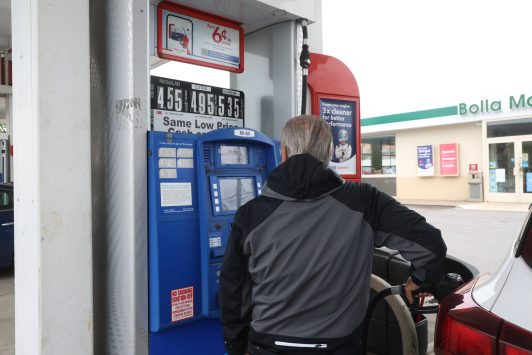
 Q: Has President Trump asked for a billion dollars for the ballroom?
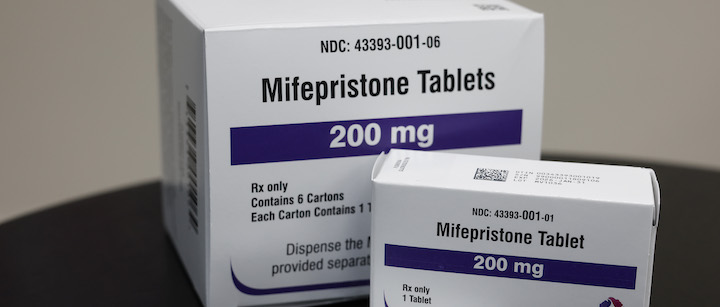 In the midst of a court battle over whether to continue to allow access by mail to the medication abortion pill mifepristone, Republican lawmakers have claimed that 10% or more of women who take the drug have serious side effects. A 2025 report from an anti-abortion group that put forward the figure has been criticized by reproductive health researchers for methodological issues and a lack of transparency about its data source.

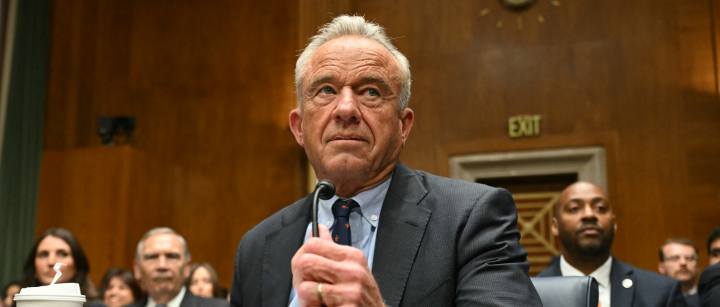 The nonpartisan Congressional Budget Office estimated that the One Big Beautiful Bill Act will reduce federal Medicaid spending by more than $900 billion over a decade. But in a series of congressional hearings last month, Health and Human Services Secretary Robert F. Kennedy Jr. misleadingly claimed that "there are no cuts to Medicaid" as a result of that 2025 law.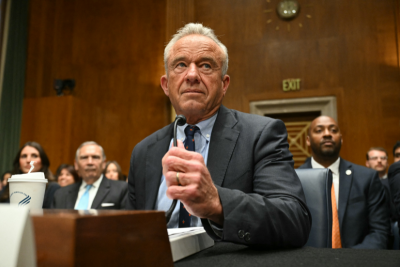
 An ad attacking Sen. Susan Collins in Maine claimed that she voted "to raise healthcare costs and raise insurance premiums," as well as give President Donald Trump "a blank check for his war in Iran." But neither claim fully explains Collins' more nuanced position on those issues.
 During an April 17 congressional hearing, Health and Human Services Secretary Robert F. Kennedy Jr. called for retraction of a new Danish study that didn't find a link between Tylenol and autism, repeatedly calling it “garbage” and baselessly suggesting that it was industry-generated and “fraudulent.”
 A federal indictment against former FBI Director James Comey hinges on the meaning of "86." The Department of Justice said it indicates a threat of physical harm, while the more common dictionary definition is to throw out or get rid of something.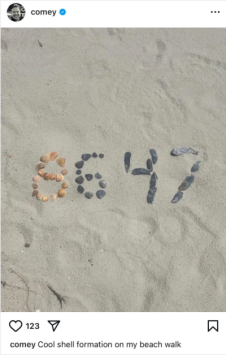
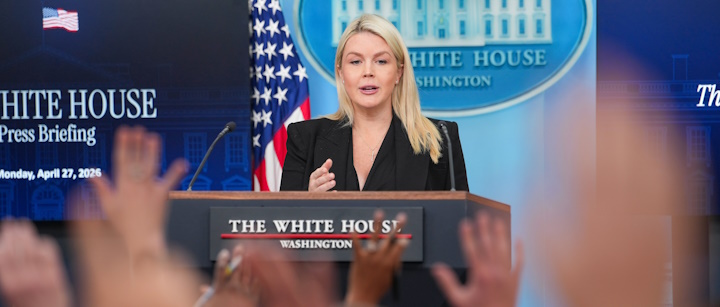 Two days after an armed man tried to enter the White House Correspondents’ Association dinner, White House Press Secretary Karoline Leavitt cited rhetoric from Democrats that she said is “inspiring violence” against President Donald Trump and other Republicans. But several of the statements she quoted were stripped of their original context, a point that House Democratic Leader Hakeem Jeffries made in a rebuttal.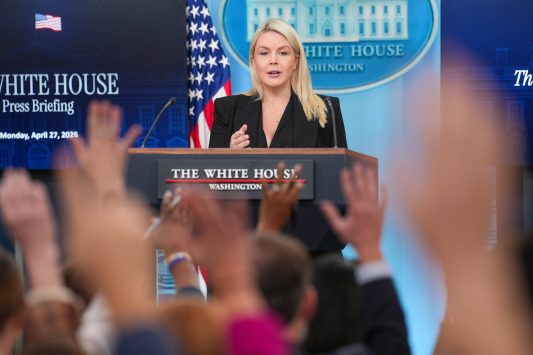
 FactCheck.org has won a National Headliner Award for online beat reporting of government and political coverage. Our series on “How Project 2025 Has Unfolded Under Trump” won first place in that category.
 It’s a common, misleading refrain in anti-vaccine circles: Childhood vaccines may be unsafe because few if any have been tested in placebo-controlled trials before being approved. But that claim misunderstands the vaccine safety testing process and takes advantage of a narrow definition of a placebo, scientists told us.
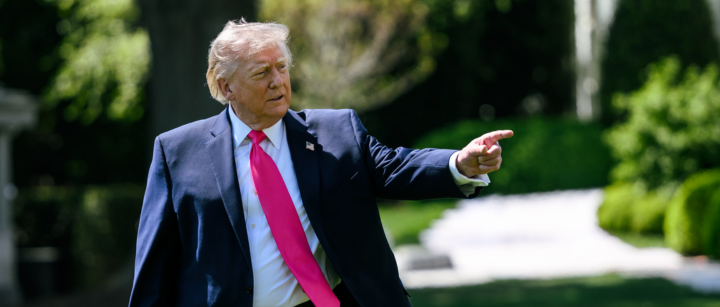 Our first quarterly update of various economic and social indicators under Trump's second term as president.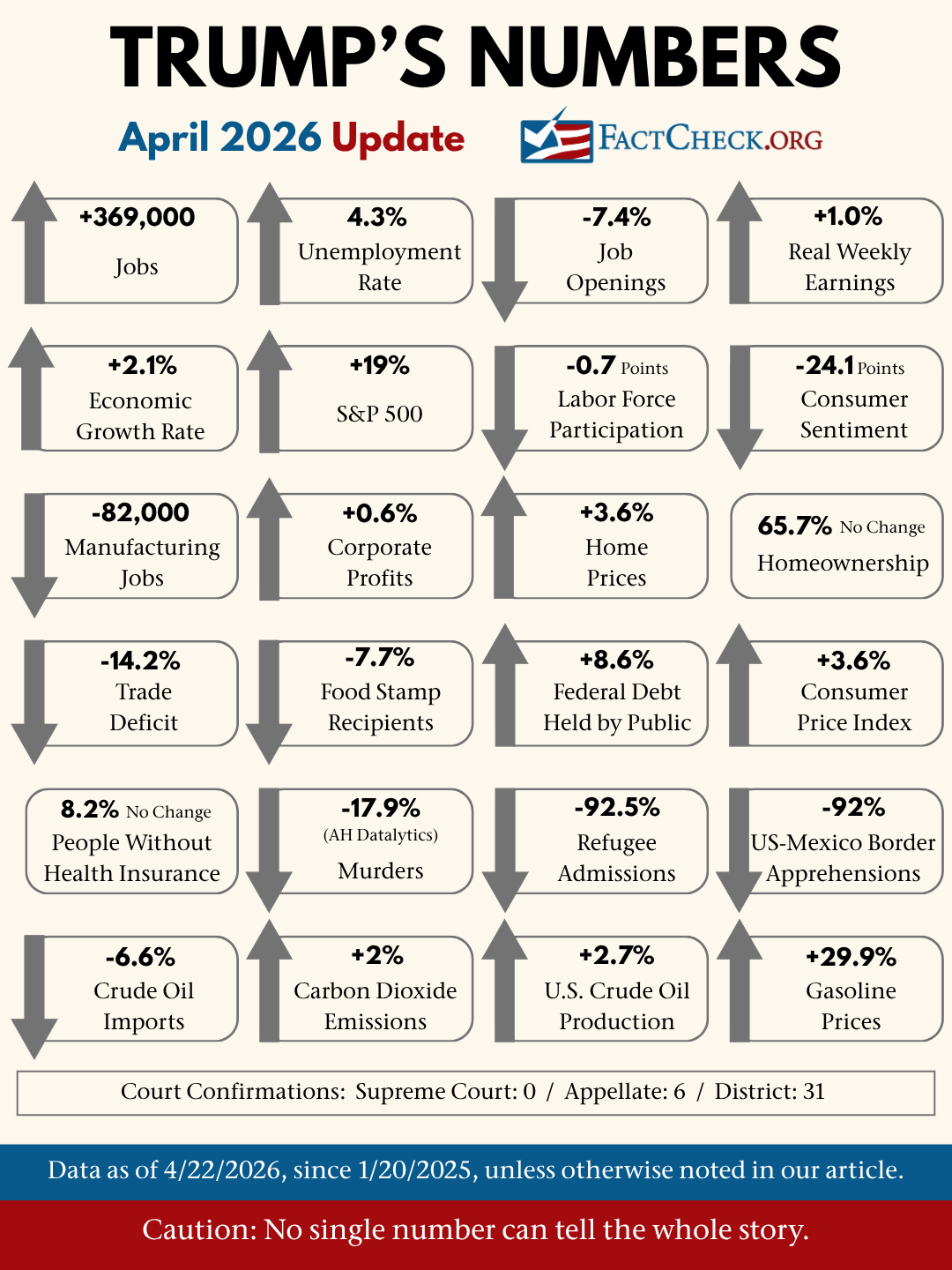
 We're honored to have won the 2026 Webby People’s Voice Award in the category for Websites and Mobile Sites: News & Politics. Thank you to our loyal readers and social media followers who voted for us.
 Q: How real is birth tourism?