GeistHaus
log in · sign up

https://theatlantic.com/feed/author/zeynep-tufekci

atom
75 posts
Polling state
Status active
Last polled May 19, 2026 07:56 UTC
Next poll May 20, 2026 09:25 UTC
Poll interval 86400s
Last-Modified Sat, 31 Jul 2021 03:02:11 GMT

Posts

The Next Big Gasoline Shortage Is Coming
If the pandemic has taught us anything, it’s that we cannot ignore the warning signs for future catastrophes.
Show full content

In North Carolina, where I live, only about one-third of gas stations are currently reporting that they have any gas, and that’s after some improvement in availability. A ransomware attack shut down a key pipeline supplying these stations, an event that could, but likely won’t, serve as a wake-up call, before we experience a true catastrophe.

Prior to the pandemic, I wrote a lot about digital security, or the lack thereof. I once compared our security status quo to “building skyscraper favelas in code—in earthquake zones.” Not much has changed since then, but we are starting to hear more rumbles.

The dynamics of digital insecurity, ransomware, and related threats are eerily similar to the global public health dynamics before the pandemic. Battlestar Galactica helps explain one key similarity: Networked systems are vulnerable. The premise of the series is that the battleship Galactica, and only Galactica, survived an attack by the Cylons (humanoid robots) on the human fleet simply because it was old and had just been decommissioned in the process of being turned into a museum. Being older, it had never been networked into the system. The “shutdown” command sent by the attackers never reached it, and it was thus spared.

In pandemic terms, Galactica was an island that no one could travel to.

Our software infrastructure is not built with security in mind. That’s partly because a lot of it depends on older layers, and also because there has been little incentive to prioritize security. More operating systems could have been built from the start with features such as “sandboxing,” in which a program can play only in a defined, walled-off area called a “sandbox” that is unreachable by anything else. If that program is malicious, it can do damage only in its sandbox. (This is analogous to the idea of “air gapping,” in which crucial parts of a network are unplugged from a network’s infrastructure.)

[Read: How ransomware became a billion-dollar nightmare for businesses]

Adding security after the fact to a digital system that wasn’t built for it is very hard. And we are also surrounded by “technical debt,” programs that work but were written quickly, sometimes decades ago, and were never meant to scale to the degree that they have. We don’t mess with these rickety layers, because it would be very expensive and difficult, and could cause everything else to crumble. That means there is a lot of duct tape in our code, holding various programs and their constituent parts together, and many parts of it are doing things they weren’t designed for.

Our global network isn’t built for digital security. As I wrote in 2018, the early internet was intended to connect people who already trusted one another, such as academic researchers and military networks. It never had the robust security that today’s global network needs. As the internet went from a few thousand users to more than 3 billion, attempts to strengthen security were stymied because of cost, shortsightedness, and competing interests.

Even putting aside the security of our networks, our ordinary devices are sometimes shipped with passwords that are drawn from a preexisting list that includes the very-hard-to-crack “password,” “1234,” and “default.” In 2019, I explained how vulnerable that leaves us, using the example of interlinked zombie baby-monitors being used to cripple infrastructure (such as by bringing down cell communication infrastructure in Liberia) or to censor journalists:

Most of our gizmos rely on generic hardware, much of it produced in China, used in consumer products worldwide. To do their work, these devices run software and have user profiles that can be logged into to configure them. Unfortunately, a sizable number of manufacturers have chosen to allow simple and already widely known passwords like “password,” “pass,” “1234,” “admin,” “default” or “guest” to access the device. In a simple but devastating attack, someone put together a list of 61 such user name/password combinations and wrote a program that scans the Internet for products that use them. Once in, the software promptly installs itself and, in a devious twist, scans the device for other well-known malware and erases it, so that it can be the sole parasite. The malicious program, dubbed Mirai, then chains millions of these vulnerable devices together into a botnet—a network of infected computers. When giant hordes of zombie baby monitors, printers and cameras simultaneously ping their victim, the targeted site becomes overwhelmed and thus inaccessible unless it employs expensive protections.

Many problems like these aren’t fixed, because of what economists call “negative externalities”: Shipping software or devices like these is free, and fixing any issues that come up is expensive. Taking the latter, more expensive route provides no immediate reward. It’s like telling factories that they can pollute as much as they want, dumping their waste into the air or a nearby river, or they can choose to install costly filtering systems, in a setup where the pollution isn’t quickly visible through smell or appearance. You can guess what happens: The companies don’t worry about it, because they don’t have to.

[Read: Cyberwar is officially crossing over into the real world]

It’s actually surprising that digital hacks and ransomware attacks don’t happen more, given how widespread these problems are. There has been hack after hack, thefts of profitable data (such as in the Equifax hack), and devices being chained together for denial-of-service attacks—and little to no accountability. And just like with the pandemic, our digital vulnerability is rooted in a connected network with coupled vulnerabilities: Like the biological viruses that travel when we do, malware and software viruses can travel through interconnected networks (which are now everywhere, as software eats the world). And in a coupled system, when one thing goes wrong, it usually ends up dragging other things down with it. Tightly coupled systems are prone to cascading failures, in which one failure essentially triggers an avalanche.

Before bitcoin, there was no obvious way to monetize all of this digital malfeasance. Despite its freewheeling appearance, the global financial sector is fairly heavily regulated. People may be deceived by how easily money can be transferred here or there within the system, but laundering large amounts of illicit gains from outside the system into the kind of money that can be spent freely in legal markets is not that easy if the sums are large enough and the regulators in a few choke points are dead set against it. Of course, such laundering is done all the time, such as by large drug cartels, but those are large, professional operations and it’s not easy even for them. These choke points include the SWIFT money-transfer systems, the United States Treasury and the Office of Foreign Assets Control program, and the U.S. attorney for the Southern District of New York, where Wall Street is located.

Of course, bitcoin changes this calculus, at least the temptation to try. It’s still not as easy as people might think to use bitcoin to move truly large amounts of money out of the system—to buy things with it, or turn it into cash. Small amounts, sure. The kind of sums that would make large-scale fraud attractive? That would be much harder without being traced. However bitcoin sure makes it more tempting to try, even for small sums. A lot of ransomware attacks aren’t for huge sums, meaning bitcoin and the cryptocurrency ecology have given ransomware a scalable business model, at least in the minds of its “entrepreneurs.”

This is a very costly problem to fix. A solution would require our government to shift its priorities. And we would need a regulatory environment to encourage and force different practices, to devote resources to the issue. Programs would need to be more reliable, crucial functions would need to be isolated, and external audits would need to be commonplace.

Some of the steps we could take on the financial side—such as targeting the ways in which people can launder money out of the crypto currencies they have acquired through such illicit activities—may be practically easy, but they raise a lot of thorny questions too. Would that mean finally looking at regulations for cryptocurrencies? That would bring up how they have become speculative tools as well, and that raises an issue that’s even more fundamental: how the global economy keeps producing asset bubbles and massive waves of speculation, like the one that led to the 2008 financial crisis. And that problem relates to the concentrated nature of global wealth chasing returns, and the lack of strong oversight for some of the implications of this chase. All of this is to say, just like with technical debt, duct-taping our way out of the immediate crisis does not address the fundamental problems.

[Read: How soon until the next ransomware catastrophe?]

Addressing digital insecurity would also entail providing better regulation up and down the technical stack, so that the negative externalities become, instead, internal issues for the companies and they’re responsible for solving the problems they create.

The more likely scenario is that there will be moves on the financial side (making it harder to launder large sums from crypto currencies into the regular financial system) and on the state-sector side (you can disincentivize another government from hacking your infrastructure, but doing that with independent players is much harder). There may also be efforts to “make an example” of a few high-profile ransomware attempts: tracking down the perpetrators and handing down massive sentences. This isn’t as difficult as it sounds, but it requires resources. If ransomware attempts proliferate, punishment will not be as effective a deterrent, because most people will not be caught, given that so many are making attempts. This would set up a catastrophe lottery for the ransomware folks: Most of them probably will not be snared, but the few that do will be crushed.

Again, I’m reminded of our pre-pandemic era: We knew that a major threat was afoot, and that our infrastructure was lacking. We had the Ebola crisis from 2014 to 2016 where we worried more about slight risks to ourselves rather than strengthening our global response; we had SARS in 2003 which was barely averted from becoming a pandemic; and we had the HIV/AIDS catastrophe starting in the 1980s which also had an inexcusable delay in providing access to affordable medications globally. Did we move to truly fix the things that were revealed to be lacking from those experiences? We did not. Meanwhile, my Honda Civic has half a tank of gas, so I’ll be fine for now, but I’m not so sure about the future of the networked world.

tag:theatlantic.com,2021:50-618893
Extensions
The CDC Is Still Repeating Its Mistakes
The agency’s new guidelines are too timid and too complicated.
Show full content

Yesterday, the CDC released more relaxed mask guidelines for outdoor activities, as well as new charts for indoor and outdoor recommendations. The more permissive guidelines were a welcome step forward, but they’re still frustrating. By issuing recommendations that are simultaneously too timid and too complicated, the CDC is repeating a mistake that’s hounded America’s pandemic response. The new guidelines are rigid and binary, and aren’t accompanied by explanations or a link to an accessible version of the underlying science, which would empower people to both understand them better and figure things out for themselves.

The new guidelines come with charts that list specific activities and how a person should engage in them, based on their vaccination status. The charts illustrate people wearing masks or not, with different colors and mask statuses for vaccinated and unvaccinated people, depending on the activity. The chart for outdoor activities suggests that masks are not necessary for walks or runs, for example, if people are by themselves or with their household, regardless of vaccination status. However, unvaccinated people are advised to wear a mask at “small” outdoor gatherings that include other unvaccinated people, but the people are still marked “safest.” Colors change, too: Yellow is used for the unvaccinated dining outdoors with multiple households, marked as “less safe,” though the earlier “small, outdoor gathering” does not clarify household status. Crowds have everyone masked, but the colors are different: red for the unvaccinated, green for the vaccinated, who are wearing masks but marked “safest.”

Confused? You’re not alone. The guidelines got Linsey Marr, a professor at Virginia Tech and a leading expert on viral transmission, to remark that even she can’t remember all of this. “I would have to carry around a sheet of paper—a cheat sheet with all these different stipulations,” she said in an interview after the announcement.

And despite all the detail, social media was flooded with questions from people who couldn’t figure out what they should do in different settings. What happens if they live with someone who is not vaccinated or has medical issues? What counts as a crowd? How small is a “small, outdoor gathering”? Why are unvaccinated people “safest” at a small outdoor gathering but not at an outdoor restaurant? And why is a crowd a threat to the vaccinated? What does the color coding for unvaccinated people indoors mean exactly, since they are advised to wear masks at all times? The CDC should, at the very least, explain the scientific reasoning behind these rules. Not only would this empower people; it would inform the inevitable debate about the guidelines.

[Read: Are outdoor mask mandates still necessary?]

We wear masks for three reasons: to protect ourselves from people who might be infected, to protect others from our infections, and to set social standards and norms appropriate for a pandemic. The last one is also important: A pandemic requires a collective response. As we learn more, we move from broader precautions to targeted mitigations. Early in the pandemic, the existing guidelines that suggested only the sick should wear masks and the objection that we didn’t know all we needed about the effectiveness of masks violated both the need for social norms, by stigmatizing the sick, and the precautionary principle, by letting remaining uncertainty stop us from protecting ourselves as best we could even with imperfect knowledge. So we changed the rules.

Now, a year later, both the sociology of outdoor masks and the precautionary principle operate in the opposite direction, because the science is in. We need to change the rules again, but also explain why.

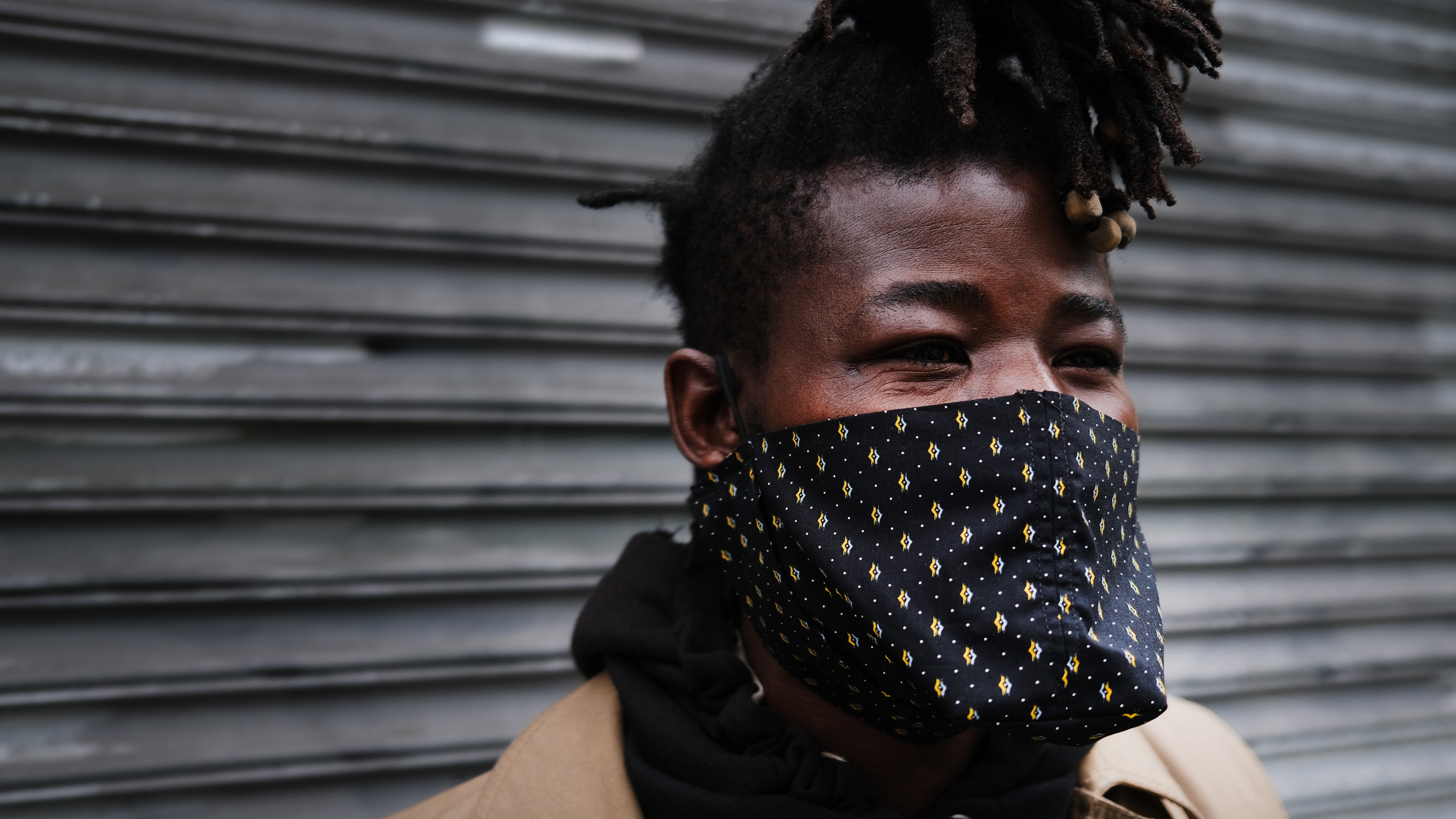
Let’s start with the outdoors. Study after study finds extremely low rates of outdoor transmission. So far, I’m unaware of a single confirmed outdoor-only super-spreading event, even though at least thousands of confirmed super-spreading events took place indoors. (The Rose Garden party to celebrate Donald Trump’s nomination of Amy Coney Barrett to the Supreme Court and the multiday Sturgis motorcycle rally in South Dakota both had extensive indoor components.) When outdoor transmission does occur in small numbers, it’s not from fleeting encounters, but from prolonged contact at close distance, especially if it involves talking, yelling, or singing.

An increasing number of scientists believe that outdoor and indoor transmission differ so starkly because the coronavirus transmits through aerosols—essentially little floating particles that we emit, even if we are just breathing, but even more if we are talking, yelling, or singing. Unlike droplets, these aerosol particles do not immediately fall to the ground with the force of gravity within three to six feet, and they concentrate most around the person emitting them, so close contact remains risky. Crucially, they can disperse quickly if they are released in the great outdoors, or, conversely, they can keep accumulating in a poorly ventilated, enclosed environment and travel beyond the short distance in which droplets would fall.

The risk of transmission depends on the person, place, and activity, and the first is the hardest to be sure about. The rate of aerosol emission varies greatly among people, and the viral load in infected people changes throughout the disease’s progression, peaking right around symptomatic disease for most. Plus, we don’t always know who is vaccinated. But we know where we are and what we are doing—whether we are outdoors and whether we are interacting at close length. So even without taking vaccines into consideration, the previous guidelines that recommended masks in “public settings,” including outdoors, were already too rigid and too timid.

Now that nearly 100 million Americans have been fully vaccinated, we have to factor that into our risk assessment. The CDC has been loosening rules for the vaccinated, and there, too, the guidelines have an implicit message. For example, the CDC does not require vaccinated people to quarantine after exposure or travel unless they get sick. The totality of the evidence so far indicates that vaccinated people are not just incredibly safe from severe disease or death, but they are very well protected against symptomatic COVID-19. These no-quarantine-required rules show that the CDC further believes that the risk of unknowing transmission due to an asymptomatic infection can be considered so minuscule as to be negligible. So perhaps although one can imagine that vaccinated people may transmit COVID-19 indoors in very, very rare cases, it’s harder to imagine the chances of such transmission occurring outdoors to be anything but vanishingly low.

[Read: Why aren’t we wearing better masks?]

To add to the confusion, in earlier guidelines, the CDC already said that vaccinated people could meet indoors without masks even if one of the households had unvaccinated members. It’s confusing to say that vaccinated people can meet indoors without masks with unvaccinated people in one guideline, but that they should wear masks outdoors in a crowd in another guideline, without further explanation of why. If the idea is that, in crowds, we should keep masks for everyone because of sociological reasons, to avoid the awkwardness of selective mask enforcement, the CDC should just say so.

What about rules for vaccinated people indoors, then? One could argue that the science is already fairly strong that the vaccinated are likely fine even indoors, especially if community transmission isn’t very high, and that the CDC guidelines implicitly assume this. That said, one can concede that this part of the empirical record is still evolving. However, that’s not currently relevant for public rules and behavior, because just like we can’t tell only the sick to wear masks, we cannot tell only the vaccinated to chuck their masks indoors—a grocery-store clerk shouldn’t have to police this. For now, indoor spaces have to keep masks as a rule simply for sociological reasons. We should make that explicit too.

The CDC needs clearer, science-based guidelines that inform and empower us. People do not need a complicated patchwork of charts with rigid, binary rules. The science supports a simple guideline that allows for the removal of all mask mandates outdoors, except for unvaccinated people in prolonged close contact, especially that involving talking, yelling, or singing. (As Marr notes: Either masking or social distancing can be sufficient outdoors.) If you are vaccinated but want to increase your comfort because transitions can feel abrupt, or if you are concerned, for example, because of an unvaccinated or vulnerable household member, you can keep your distance and wear a mask, but a mandate for everyone else is not required. Having the CDC spell this out with nuance is better than strict rules that can create stigma and therefore put unwelcome pressure on people with specific circumstances, such as the immunocompromised. Plus, it’s good to adopt the social norm that, outdoors, we should let people be masked or unmasked, especially because shaming and scolding in either direction is unwarranted.

Finally, the CDC guidelines are not just timid and inconsistent. They are late: We’ve known about outdoor transmission being a much lower risk for almost a year now. We should move cautiously, for sure, but excessive caution creates fatigue and mistrust. In the United States, case counts and deaths are trending down thanks to our impressive vaccine supply, and because of the tragic reality that millions have already attained some level of immunity from being infected. Over the past year, we’ve also gained tremendous understanding about transmission risks—where they are high and where they are very low. It’s time that our rules reflect that reality, and spell out their reasoning explicitly, so they can inform and empower us as we trudge through the rest of this miserable pandemic.

tag:theatlantic.com,2021:50-618739
Extensions
The Fourth Surge Is Upon Us. This Time, It’s Different.
A deadlier and more transmissible variant has taken root, but now we have the tools to stop it if we want.
Show full content

Across the United States, cases have started rising again. In a few cities, even hospitalizations are ticking up. The twists and turns of a pandemic can be hard to predict, but this most recent increase was almost inevitable: A more transmissible and more deadly variant called B.1.1.7 has established itself at the precise moment when many regions are opening up rapidly by lifting mask mandates, indoor-gathering restrictions, and occupancy limits on gyms and restaurants.

We appear to be entering our fourth surge.

The good news is that this one is different. We now have an unparalleled supply of astonishingly efficacious vaccines being administered at an incredible clip. If we act quickly, this surge could be merely a blip for the United States. But if we move too slowly, more people will become infected by this terrible new variant, which is acutely dangerous to those who are not yet vaccinated.

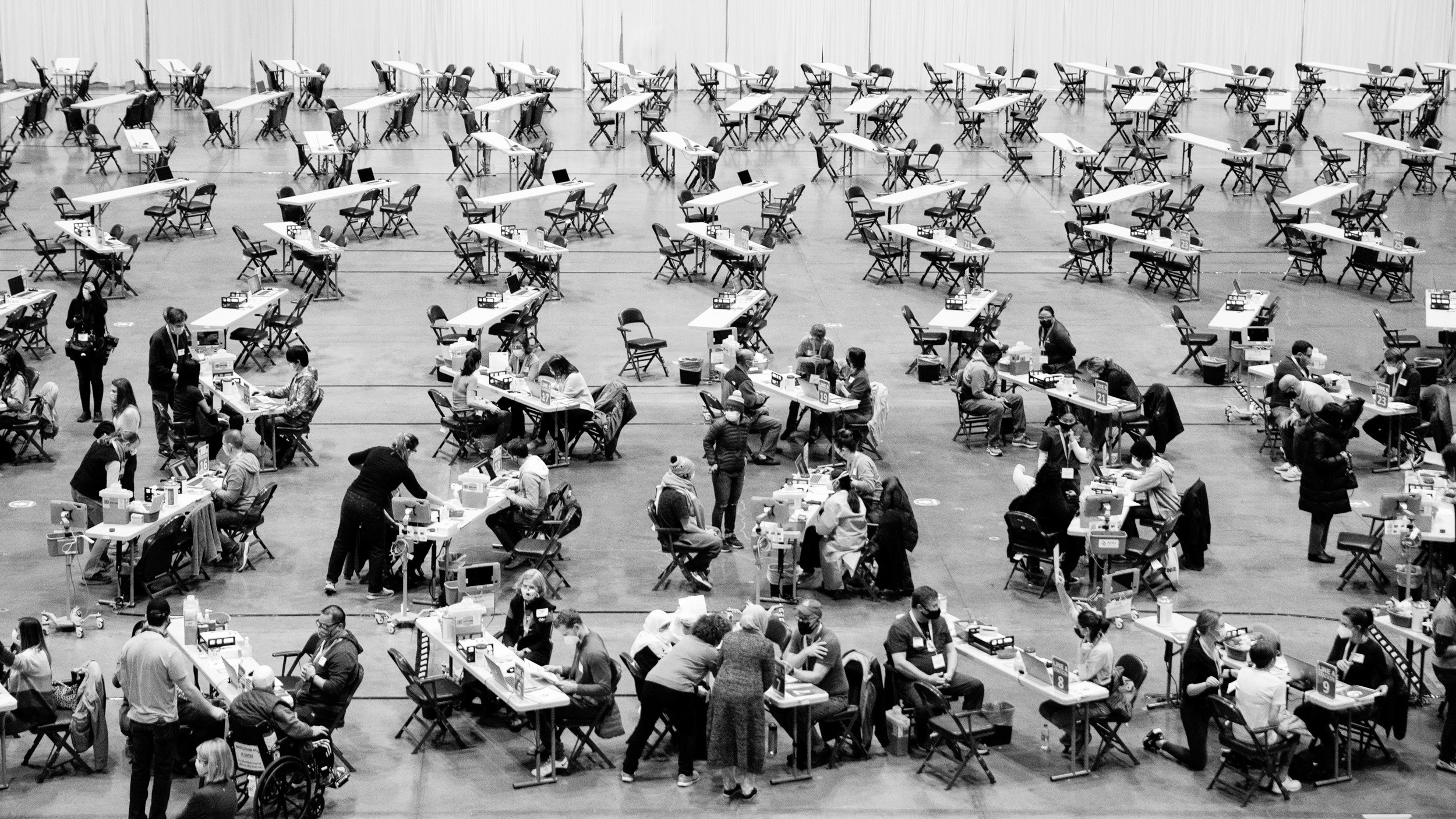
The United States has an advantage that countries such as Canada, France, Germany, and Italy, who are also experiencing surges from this variant, don’t. The Moderna, Pfizer, and Johnson & Johnson vaccines work very well against this variant, and the U.S. has been using them to vaccinate more than 3 million people a day. That’s more than 4 percent of our vaccine-eligible population every three days. An astonishing 73 percent of people over 65, and 36 percent of all eligible adults in the country, have already received at least one dose. More than 50 million people are now considered fully vaccinated, having received either their booster dose or the “one and done” Johnson & Johnson shot. Many states have already opened up vaccination to anyone over 16, and everyone eligible is expected to have a chance to get at least a first dose no later than May.

In addition, the United States has had one of the largest outbreaks in the world. This has caused us immense suffering and loss, but it also means that we are now less vulnerable to future waves. So far, 30 million people in the United States have had a confirmed SARS-CoV-2 infection, although the real (unmeasured) number is perhaps as high as 100 million. As expected, those people retain some level of immunity for a substantial amount of time. It’s hard to know exactly how long, because the virus is so new, but for SARS (the related coronavirus that almost sparked a pandemic in 2003), people who were infected retained an antibody response, and thus protection, for an average of two years. Though amazingly, the vaccines appear to provide better immunity than natural infection, those previously infected also gain defenses. Carefully done studies on large populations show a very low rate of reinfection for this coronavirus: less than 1 percent. Plus, many documented reinfections tend to be mild or asymptomatic, an unsurprising outcome given that in these cases the virus is no longer totally novel for the immune system, and thus not as catastrophic in its consequences.

[Read: We can now see a virus mutate like never before]

It’s pretty clear that large numbers of people in the U.S. already are, or will soon be, protected from COVID-19’s more severe outcomes, such as death and hospitalization, which the vaccines reduce so close to zero that clinical trials have reported hardly any such cases. And it gets better: Yesterday, the CDC released real-life data showing that, just two weeks after even a single dose, the two mRNA vaccines were 80 percent effective in preventing infection. The effectiveness rose to 90 percent after the second, booster dose. People in the study were routinely tested regardless of whether they had symptoms, so we know that vaccines prevented not just symptomatic illness—the vaccine-efficacy rate reported in the trials—but any infection. People who are not infected by a virus cannot transmit it at all, and even people who have a breakthrough case despite vaccination have been shown to have lower viral loads compared with unvaccinated people, and so are likely much less contagious.

All of this doesn’t mean that there will be zero deaths or illnesses among the vaccinated. The elderly, who tend to have weaker immune systems, are especially prone to having vaccines fail. In nursing homes, even the common cold can cause deadly outbreaks. But for the vaccinated, the risk from COVID-19 clearly has become comparable to “baseline risk”—it’s not zero, but just like the risks presented by the flu and other viruses, it’s not something for which most of us would put our lives on hold.

How do we square all this good news with what happened during a White House briefing yesterday, when CDC Director Rochelle Walensky interrupted the flow, saying, “I’m going to lose the script,” and talked of “the recurring feeling I have of impending doom.” She was visibly emotional and her voice cracked as she said was “scared,” and pleaded with Americans to “hold on a little longer.”

I can’t read her mind, but if I were Walensky, I’d be scared because those who are not protected through vaccination or past infection are still at grave risk, a fact that may be overshadowed by all the good news. Even as our vaccines continue to work very well against it, the particular variant we’re facing in this surge is both more transmissible and more deadly for the unvaccinated.

Throughout this pandemic, Americans have become used to asking one another to pull together and enact mitigations for everyone’s benefit. One of the slogans for mask wearing was “My mask protects you, and your mask protects me.” Although we were always polarized, and the effects were always unequal—our mitigations helped those who could work from home more than the essential workers who made that possible—at least theoretically, we were all in it together, even if some of us did not act like it.

[Read: America is now in the hands of the vaccine-hesitant]

You see this appeal to the collective good in the many discussions around achieving herd immunity, too: a goal that will protect us all. That’s still true to some degree, for the future, but it was always an oversimplification. Now, with uneven but increasing rates of vaccination, understanding how those divisions work is even more important, starting with herd immunity.

Herd immunity is sometimes treated as a binary threshold: We’re all safe once we cross it, and all unsafe before that. In reality, herd immunity isn’t a switch that provides individual protection, just a dynamic that makes it hard for epidemics to sustain themselves in a population over the long term. Even if 75 percent of the country has some level of immunity because of vaccination or past infection, the remaining 25 percent remains just as susceptible, individually, to getting infected. And while herd levels of immunity will eventually significantly drive down the number of infections, this may not happen without the epidemic greatly “overshooting”—infecting people beyond the levels required for achieving herd immunity, somewhat like a fire burning at full force even though it is just about to run out of fuel.

Worse, people’s infection risks are not distributed evenly: Some people have lots of contacts, while others have a few. People are also embedded in different social networks: Some may have a lot of friends and family members who are immune, others not so much. Some work in jobs that increase their risk, others not so much. So it’s perfectly possible for a country as a whole to have herd immunity against a pathogen, but for outbreaks to happen among communities that have a lot of unvaccinated people among them. That’s happened in California, Michigan, and New York for measles among vaccine-resistant communities. In addition, this coronavirus is highly overdispersed. Infections occur in clumps. A single event can result in dozens or even hundreds of people being infected all at once in a super-spreader event.

[Read: What if we never reach herd immunity?]

Compared with previous surges, case-for-unvaccinated-case, this surge has the potential to cause more illness and more deaths, infecting fewer but doing more damage among them. We can also expect to see more younger, unvaccinated people falling sick and dying. We’ve observed this in other places, including the U.K. and Israel, which started vaccinating the elderly after B.1.1.7 had already taken hold and then had many younger victims. This variant is also very hard to dislodge; the U.K., for example, was able to avoid more catastrophic outcomes by delaying booster doses to cover more people initially, but still battled lengthy surges, as did Israel. Even with the U.K.’s ongoing vaccination campaign, which started in early December, almost 50,000 people in the country died from COVID-19 in just January and February this year, equal to nearly two-thirds of the total for all of 2020.

Other complications have arisen, too. In some places, we could be seeing what pandemic denialists have been calling “casedemics”—a term that (falsely) implies that the large number of cases amounted to no big deal. In the past, those deniers were wrong because case numbers and infection rates were leading indicators of later hospitalization and death rates. This time, in many places, case upticks may not result in measurable hospital outcomes, because so many elderly people are vaccinated. However, this surge can’t be dismissed as a “casedemic” either, because this virus causes lingering long-term effects—known as “long COVID”—for some portion of the younger population, too. This effect has been observed for other viral diseases, such as influenza and nonbacterial pneumonia, and is clearly an important consideration, especially when so many people are encountering a novel virus for the first time as adults.

While we don’t have extensive genomic surveillance, we do have some, and every indication is that the upticks in cases are happening in places with a high percentage of B.1.1.7 variant among reported coronavirus infections: Michigan, New Jersey, Philadelphia, Florida, Southern California, and few others. Tragically, some of those places also have great vaccine inequities. In Michigan, for example, as of mid-March, a mere 28 percent of Black people over 65 had received one dose of vaccine—a number as low as 15 percent in Detroit—even though more than 60 percent of all senior citizens in the state have been at least partially vaccinated. Similar inequities have been reported all over the country, with great disparities in vaccination rates especially among the elderly, who are more vulnerable to severe disease. Frontline and essential workers, who tend to be poorer and are more likely to be Hispanic or Black than the average American worker, also have varying levels of vaccine coverage from state to state.

The solution is obvious and doable: We should immediately match variant surges with vaccination surges that target the most vulnerable by going where they are, in the cities and states experiencing active outbreaks—an effort modeled on a public-health tool called “ring vaccination.” Ring vaccination involves vaccinating contacts and potential contacts of cases, essentially smothering the outbreak by surrounding it with immunity. We should do this, but on a surge scale, essentially ring-vaccinating whole cities and even states.

A vaccination surge means setting up vaccination tents in vulnerable, undervaccinated neighborhoods—street by street if necessary—and having mobile vaccination crews knock on doors wherever possible. It means directing supply to places where variants are surging, even if that means fewer vaccine doses for now in places with outbreaks under control. It doesn’t make sense to vaccinate 25-year-olds in places with very low levels of circulation before seniors and frontline workers in places where there is an outbreak.

Another sensible step would be to delay opening up—especially places with surges and especially for high-risk activities that take place indoors—until the next 100 million Americans are vaccinated, which could be done as quickly as in a single month. It makes no sense to rush to open everything now, when waiting a few weeks could protect so many. In the meantime, we need to protect frontline and essential workers by providing high-filtration masks and paid sick leave while targeting their workplaces with vaccination campaigns. We have already asked so much of them, and they have already suffered so much.

I understand the impatience with restrictions—I’m fed up and tired, too—but our restlessness risks creating one last set of victims who could easily be spared. We should not condemn anyone to be the last person to die unnecessarily in a war that we will win, and shortly. The vaccinated can clearly do more, and safely, especially two weeks after their final dose. But it’s a particularly perilous time for the unvaccinated, who deserve our attention, resources, and continued mitigation measures as appropriate.

[Read: The coronavirus is evolving before our eyes]

More dangerous variants are going to be a huge problem around the world, too. Brazil is facing its own variant and surge, and is registering a record number of deaths day after day, as its hospital system faces a collapse from overload. Multiple countries in Europe are going into another round of shutdowns as they face B.1.1.7-driven surges without sufficient vaccine coverage or supply. Places like India that were relatively spared before are seeing a significant rise in cases and deaths, and once again, B.1.1.7 and other local variants appear to play a role. Many countries have yet to vaccinate a single person, and will now face potential surges driven by more difficult variants. In the HIV pandemic, we went through the same tragic moral failure: Poor countries didn’t get substantive supplies of effective—but expensive—antiviral therapies until almost 10 years after they became available in rich countries. Meanwhile, millions died.

Exponential growth—the hallmark of epidemics, but which the B.1.1.7 variant accelerates—is dangerous but also sensitive to small initial changes, giving an advantage to those who act quickly. A slight increase in transmissibility can make the difference between an epidemic petering out or being easy to control with a reasonable amount of mitigation measures, and that same epidemic ravaging a whole country. Starting vaccinations a few weeks earlier can make the difference between being able to largely outrun the virus and being swamped by its exponential growth instead.

We know what we should do—match variant surges with vaccines and keep up our mitigations for just a little longer. We have the vaccine supply and the infrastructure to do it. We just need to act—now.

tag:theatlantic.com,2021:50-618463
Extensions
3 Ways the Pandemic Has Made the World Better
COVID-19 has inflicted devastating losses. It has also delivered certain blessings.
Show full content

This has been a year of terrible loss. People have lost loved ones to the pandemic. Many have gotten sick, and some are still suffering. Children have lost a year of school. Millions have lost a steady paycheck. Some have lost small businesses that they’d built for decades. Almost all of us have lost hugs and visits and travel and the joy of gathering together at a favorite restaurant and more.

And yet, this year has also taught us much. Strange as it may sound, the coronavirus pandemic has delivered blessings, and it does not diminish our ongoing suffering to acknowledge them. In fact, recognizing them increases the chance that our society may emerge from this ordeal more capable, more agile, and more prepared for the future.

Here are three ways the world has changed for the better during this awful year.

1. We Now Know How to Code for Our Vaccines

Perhaps the development that will have the most profound implications for future generations is the incredible advances in synthetic messenger RNA (mRNA) biotechnologies.

We got our vaccines very fast—the previous record for vaccine development was four years, and that was set in the 1960s. This time, we developed multiple good COVID-19 vaccines in less than a year. Luck bought us some of that speed. For example, the HIV retrovirus is notoriously difficult to vaccinate against, and we still don’t have a vaccine for it. COVID-19 was much more susceptible, and billions of dollars in public money and a global sense of urgency pushed things along. Tragedy also sped things up: Because the pandemic was raging—more cases to test against—it was easier to get results from vaccine trials.

But amid all this came historic developments. The new mRNA technology, on which several vaccines—notably Pfizer-BioNTech’s and Moderna’s—are based, is an epochal scientific and technical breakthrough. We are now coding for vaccines, and thanks to advances in science and industrial production, we can mass-produce them and figure out how to deliver them into our cells in a matter of months.

This is all new. Neither Moderna nor BioNTech had a single approved product on the market before 2020. Each company essentially designed its vaccine on a computer over a weekend in January 2020—BioNTech’s took just a few hours, really. Both companies had vaccine candidates designed at least four weeks before the first confirmed U.S. COVID-19 fatality was announced, and Moderna was producing vaccine batches to be used for its trials more than a month before the World Health Organization declared a pandemic. In 2021, the companies together aim to produce billions of stunningly efficacious vaccine doses,

[Read: How science beat the virus]

We know the principle behind vaccination: Once our immune system encounters a virus, it can learn how to fight it and remember how to do it the next time. Vaccines give our immune system the practice it needs, but it’s deliberately structured as an unfair fight. Until now, most of our current vaccines have been either weakened or completely deactivated viruses or, more recently, protein subunits: just a few fragments from the virus, called antigens. We’ve achieved extraordinary levels of effectiveness and safety with these techniques, but they still have downsides. In 1955, a botched batch of weakened polio vaccine killed 10 children and caused paralysis in hundreds. We’ve since made sure to never repeat that tragic failure, but producing vaccines from the actual pathogen still means handling the virus in the manufacturing process. The newer subunit vaccines hold a lot of promise, but come with their own challenges. Identifying the right subunit (or antigen) can be difficult, and these vaccines tend to produce weaker immune responses. Plus, it’s not like antigens are hanging out on a supermarket shelf. We grow them in cell systems like yeast or in E. coli—essentially hijacking their genetics to produce the antigens we want, and then harvesting the yield. It works, but it’s slower than the mRNA process.

The mRNA vaccines work differently. For these, scientists look at the genetic sequence of a virus, identify a crucial part—such as the spike protein, which it uses as a key to bind onto cells’ receptors in order to unlock and enter them—produce instructions to make just that part, and then send those instructions into our cells. After all, that’s what a virus does: It takes over our cells’ machinery to make more of itself. Except in this case, we instruct our cells to make only the spike portion to give our immune system practice with something that cannot infect us—the rest of the virus isn’t there!

Until this year, that was the dream behind the synthetic mRNA technologies: a dream with few, scattered adherents, uphill battles, and nothing to show for it but promise. This year, it became a reality.  

Our cells have a remarkable kind of software—wetware—that uses the instructions in the DNA in our cells’ nuclei to produce proteins. If you imagine the assembled proteins as a Lego structure, the DNA is like the instruction booklet. But someone has to look at those instructions and put the blocks together in the right way. In the cell, a key part of this process is the messenger RNA: a short-lived, single-strand molecule that carries the instructions from the DNA in the nucleus to the protein-making factory outside it.

In 2020, we figured out how to make messenger RNA with precision, by programming the exact code we wanted, producing it at scale (a printing press for messenger RNA!), and figuring out a way to inject it into people so the fragile mRNA makes it into our cells. The first step was pure programming: Uğur Şahin, the CEO of BioNTech, sat at his computer and entered the genetic code of the spike protein of the mysterious virus that had emerged in Wuhan. Moderna employees had done the same thing the weekend after the genomic sequence was released on January 10. The Moderna vaccine candidate was called mRNA-1273 because it encoded all of the 1,273 amino acids in the SARS-CoV-2 spike protein—the code was so small that it could all be represented with little less than half the number of characters that fit on a single-spaced page.  

The rest of the process relied on key scientific and industrial innovations that are quite recent. Messenger RNA are fragile—they disintegrate easily, as they are supposed to. The lipid nanoparticles we envelop them in to use as delivery systems were approved only in 2018. Plus, the viral spike protein is a notorious shape-shifter. It takes one form before it fuses with our cells and another one afterward. The latter, postfusion form did not work well at all for developing vaccines, and scientists only recently figured out how to stabilize a virus’ spike in its prefusion form.

[Read: The second COVID-19 shot is a rude awakening for immune cells]

Now that this process is in place, a host of possibilities have opened up. We may soon have vaccines for many other diseases that have eluded our grasp. Efforts are already under way, for example, for an mRNA vaccine for malaria—a parasite that each year kills hundreds of thousands of people, mostly children, and is notoriously hard to vaccinate against.

We may also finally get a new set of tools to better fight cancer. (Both Moderna and BioNTech were working on cancer treatments before pivoting to coronavirus vaccines.) The challenge with cancer is that it is our own cells gone awry. It is really difficult to find a way to kill just a patient’s cancer cells thoroughly without also killing healthy cells—and thus the patient. But synthetic mRNA can be encoded with only the specific mutation in one patient’s cancer cells—and if the cancer cells further mutate, those can be targeted as well.

This may allow us, finally, to transition from a broadcast-only model of medicine, wherein drugs are meant to be identical for everyone in a particular group, to targeted, individualized therapies. Plus, these technologies are suitable for small-scale but cheap-enough production: a development that can help us treat rare diseases that afflict only a few thousand people each year, and are thus usually ignored by mass-market-oriented medical technologies.

It’s also no coincidence that these two mRNA vaccines were the fastest to market. They can be manufactured rapidly and, crucially, updated blazingly fast. Şahin, the BioNTech CEO, estimates that six weeks is enough time for the company to start producing new boosters for whenever a new COVID-19 variant emerges. Pfizer and Moderna are both already working on boosters that better target the new variants we’ve seen so far, and the FDA has said it can approve these tweaks quickly.

2. We Actually Learned How to Use Our Digital Infrastructure

The internet, widespread digital connectivity, our many apps—it's easy to forget how new most of this is. Zoom, the ubiquitous video service that became synonymous with pandemic work, and that so many of us are understandably a little sick of, is less than 10 years old. Same with the kind of broadband access that allowed billions to stream entertainment at home and keep in touch with family members and colleagues. Internet connectivity is far from perfect or equally distributed, but it has gotten faster and more expansive over the past decade; without it, the pandemic would have been much more miserable and costly.

Technology also showed how we could make our society function better in normal times.

Consider, for example, the advent of telehealth during the pandemic. Last summer, while a few hours away from home, I developed the same debilitating neck pain that I had experienced once before, about five years ago, on a different trip. It was instantly recognizable: sharp, relentless pain that radiated from where my neck joined my left shoulder; even a slight movement felt as if an army of tiny, poisonous spears were hitting that area.

[Read: What a doctor learns from watching you on video chat]

The previous time, I was told nothing could be done before I could see my doctor in person, many days later. Not so now: My doctor and I connected immediately through a new patient portal, which had a videochat option that had become available because of the pandemic. I described the problem and demonstrated my limited range of motion. He signed off by saying he’d send a prescription for oral corticosteroids to a nearby pharmacy. Just an hour later, and less than a full day after the onset of my symptoms, I was sitting in my car in the pharmacy’s parking lot, staring at the box of medicine in wonder. Previously, I had suffered through severe pain for multiple days, to the degree that I had started hallucinating from lack of sleep. This time, relief was right there in my hand.

According to the CDC, telehealth visits increased by 50 percent in the first quarter of 2020, compared with the same period in 2019. Such visits are clearly not appropriate for every condition, but when warranted, they can make it much easier for people to access medical help without worrying about transportation, child care, or excessive time away from work. Remote access to medical help has long been a request from people with disabilities and people in rural areas, for whom traveling to clinics can be an extra burden.

Work, too, has been transformed. Suddenly, hundreds of millions of people around the world had to figure out how to get things done without going into the office. It turns out that for many white-collar jobs, this is not just possible; it comes with a variety of upsides.

Commutes, to take one example, are unhealthy—they waste time and potentially increase our sedentary time, which is associated with many adverse health outcomes, and perhaps worst of all, driving is among the most dangerous activities we undertake each day. The competition to try to avoid long commutes distorts property values and can worsen inequality, as those with money pay extra to live near centers of work, while other residents can no longer afford to live there.

Unsurprisingly, many of my luckier friends—those able to work from home and who did not suffer directly from COVID-19—have been whispering about how much better their lives have gotten without commutes and with more flexibility.

Many events have become a lot more inclusive too. Throughout the past year, I’ve been able to attend conferences and talks I’d otherwise have no chance to participate in without extensive time and travel costs. I’ve also given talks during which I’ve interacted with folks from around the world, who might never have been in that “room” otherwise. And I’ve noticed that a broader range of experts can appear on TV, now that we’ve normalized calling in from one’s home office, living room, or even bedroom. In a world divided by visas, income inequalities, time constraints, and opportunity, why didn’t we just incorporate videoconferencing into more of our events before? Why didn’t we take questions from the audience not in the room? We should keep doing that after the pandemic as well.

I certainly miss some of the serendipitous conversations that conferences and other in-person events provided: not just during the talks, but in the corridors, or at breakfast before a panel. And it’s true, such events are a form of livelihood for many, and I’m not advocating for eliminating that income. It’s also not that we should never go back to the office, nor ignore all the issues that can stem from working outside of the office—especially the threat to work-life balance. Being in the same office also allows for conversations that go beyond strict work discussions, and the connections they foster. We might never be able to fully replicate those positives digitally, but we should still provide some remote access to those who would otherwise be completely left out.

3. We’ve Unleashed the True Spirit of Peer Review and Open Science

On January 10, 2020, an Australian virologist, Edward Holmes, published a modest tweet: “All, an initial genome sequence of the coronavirus associated with the Wuhan outbreak is now available at Virological.org here.” A microbiologist responded with “And so it begins!” and added a GIF of planes taking off. And so it did indeed begin: a remarkable year of open, rapid, collaborative, dynamic—and, yes, messy—scientific activity, which included ways of collaborating that would have been unthinkable even a few decades ago.

Holmes was announcing that a scientist in China, Zhang Yongzhen, had rushed to sequence the genome of the mystery virus from Wuhan—his team had worked practically nonstop, completing the sequencing a mere 40 hours after a virus sample had arrived in a box of dry ice at his Shanghai office. Without waiting for approval or official permission, Zhang also promptly shared the result with a consortium of researchers in Australia, giving them the go-ahead to post it online in an open depository.

[Read: The coronavirus is evolving before our eyes]

Peer review—review by one’s fellow scientists—remains the cornerstone of the scientific process, and rightly so: Good science happens when members of a community dedicated to advancing our knowledge can examine findings, replicate results, test theories, and challenge one another.

However, peer review as a formal process—as it happens right now—is different from the idea and spirit of peer view. We have “peer reviewed” scientific journals in which scientists can publish their findings. But in a hard-to-believe-but-true twist, many of those journals—especially the highly prestigious ones that can help a scientist’s career—are privately owned by for-profit companies, even though the peer reviews are done for free, on a volunteer basis, on articles that are submitted by scientists who also don’t get paid by the journals.

Worse, after they go through the formal process at these for-profit journals, these papers are then put behind paywalls, meaning these companies then charge outrageous sums to academic libraries in universities—whose scientists have freely contributed the paper and the peer review. The companies block the general public from accessing them too, unless they also pay for them. These companies will even charge scientists for the privilege of making these papers “open access”—again, papers written by the very scientists who receive no financial benefit from charging the public!

It’s little wonder that these companies remain highly profitable while many academics are up in arms over this terrible process that impedes the dissemination of science! Unfortunately, scientists—especially those who are early in their career—feel compelled to keep participating in this system, because getting published is the coin of the realm for hiring, promotions, and prestige.

Well, no more. When the pandemic hit, it simply wasn’t tenable to keep playing the old, slow, closed game, and the scientific community let loose. Peer review—the real thing, not just the formal version locked up by for-profit companies—broke out of its constraints. A good deal of the research community started publishing its findings as “preprints”—basically, papers before they get approved by formal publications—placing them in nonprofit scientific depositories that had no paywalls. The preprints were then fiercely and openly debated—often on social media, which is not necessarily the ideal place for it, but that’s what we had. Sometimes, the release of data was even faster: Some of the most important initial data about the immune response to the worrisome U.K. variant came from a Twitter thread by a tired but generous researcher in Texas. It showed true scientific spirit: The researcher’s lab was eschewing the prestige of being first to publish results in a manuscript by allowing others to get to work as fast as possible. The papers often also went through the formal peer review as well, eventually getting published in a journal, but the pandemic has forced many of these companies to drop their paywalls—besides, the preprints on which the final papers are based remain available to everyone.

Working together, too, has expanded in ways that were hard to imagine without the new digital tools that allow for rapid sharing and collaboration, and also the sense of urgency that broke through disciplinary silos.

For example, in early 2020, after I started writing about the necessity of wearing a mask, it became clear that we also needed detailed scientific articles looking at the science of the efficacy of masks for dampening community transmission. The questions the topic touched on involved many disciplines, including infectious diseases, aerosol science, and sociology. So I teamed up with a group of scientists, doctors, researchers, and data analysts across the globe to co-write an academic paper, and from start to finish, it was like nothing I had done before. A lot of scientific work involves international teams, but this time we had assembled practically on the fly: the co-authors lived in cities as varied as Cape Town, South Africa; Beijing, China; Chapel Hill, North Carolina (me!); Stanford, California; and Oxford, England. We would eventually publish in the most highly cited scientific outlet in the world, the Proceedings of the National Academy of Sciences of the United States of America, which is more than 100 years old. Most of the tools we used, however—shared editing of scientific papers, videochat and other forms of meetings—weren’t widely available or as easy to use even just a few years ago.

Like many others, we didn’t wait for formal peer review to end before sharing our findings. We quickly put our paper onto a preprint server so that it could receive both open peer review from the scientific community and questions and comments from other relevant stakeholders, including policy makers and even ordinary people trying to puzzle through a confusing time. And feedback came in quickly: We received thoughtful and lengthy emails and Twitter corrections and comments, which were extremely useful—as well as much less useful contributions, which sometimes involved random people getting mad at us. I started categorizing the feedback on the sections I’d worked on, as did many of my collaborators. Even before the first round of formal peer reviews were in, we used that feedback to generate a new, stronger version, which we added to the preprint server. We then got our initial round of formal peer review—which we also found quite useful. We updated the paper again, resubmitted the new version to PNAS, and waited for a second round of peer review (which took many months, but was also very useful). Finally, about a year later: acceptance and formal publication.

[Read: Why aren’t we wearing better masks?]

I have to admit, the final published paper looks great on my CV, but our preprint had already been downloaded more than any other paper on that server. It has been cited hundreds of times, including in the highest-ranked medical and scientific journals in the world; contributed to the global scientific discourse; and played a crucial role in the adoption of mask mandates. We even had a celebratory happy hour—chatting about our lives; challenges; and new, shared friendship.

This process of open peer review is fast, dynamic, and, admittedly, messy; it’s not without its downsides. Too many sensationalist headlines have resulted from journalists rushing to write about not yet sufficiently evaluated preprints, without waiting for the process of open review and feedback to do its work. This can be confusing to the broader public. However, the explosion of preprints is sometimes portrayed as the downfall of formal peer review. It’s the opposite. No process that allows more insight into how the sausage gets made can avoid a glimpse of its less tasteful elements, but what we need to change is how we relate to science, not try to go back to the stilted, slow pre-pandemic world. We should embrace the extraordinary and robust process of open science and more peer review, as well as its dynamism, even as we establish new guardrails to contain its energy.


The pandemic happened at a moment of convergence for medical and digital technology and social dynamics, which revealed enormous positive potential for people. Nothing will erase the losses we experienced. But this awful year has nudged us toward dramatic improvements in human life, thanks to new biotechnologies, greater experience with the positive aspects of digital connectivity, and a more dynamic scientific process.

Still, let’s never do it again.

tag:theatlantic.com,2021:50-618320
Extensions
5 Pandemic Mistakes We Keep Repeating
We can learn from our failures.
Show full content

When the polio vaccine was declared safe and effective, the news was met with jubilant celebration. Church bells rang across the nation, and factories blew their whistles. “Polio routed!” newspaper headlines exclaimed. “An historic victory,” “monumental,” “sensational,” newscasters declared. People erupted with joy across the United States. Some danced in the streets; others wept. Kids were sent home from school to celebrate.

One might have expected the initial approval of the coronavirus vaccines to spark similar jubilation—especially after a brutal pandemic year. But that didn’t happen. Instead, the steady drumbeat of good news about the vaccines has been met with a chorus of relentless pessimism.

The problem is not that the good news isn’t being reported, or that we should throw caution to the wind just yet. It’s that neither the reporting nor the public-health messaging has reflected the truly amazing reality of these vaccines. There is nothing wrong with realism and caution, but effective communication requires a sense of proportion—distinguishing between due alarm and alarmism; warranted, measured caution and doombait; worst-case scenarios and claims of impending catastrophe. We need to be able to celebrate profoundly positive news while noting the work that still lies ahead. However, instead of balanced optimism since the launch of the vaccines, the public has been offered a lot of misguided fretting over new virus variants, subjected to misleading debates about the inferiority of certain vaccines, and presented with long lists of things vaccinated people still cannot do, while media outlets wonder whether the pandemic will ever end.

[Conor Friedersdorf: The public-health value of speaking plainly]

This pessimism is sapping people of energy to get through the winter, and the rest of this pandemic. Anti-vaccination groups and those opposing the current public-health measures have been vigorously amplifying the pessimistic messages—especially the idea that getting vaccinated doesn’t mean being able to do more—telling their audiences that there is no point in compliance, or in eventual vaccination, because it will not lead to any positive changes. They are using the moment and the messaging to deepen mistrust of public-health authorities, accusing them of moving the goalposts and implying that we’re being conned. Either the vaccines aren’t as good as claimed, they suggest, or the real goal of pandemic-safety measures is to control the public, not the virus.

Five key fallacies and pitfalls have affected public-health messaging, as well as media coverage, and have played an outsize role in derailing an effective pandemic response. These problems were deepened by the ways that we—the public—developed to cope with a dreadful situation under great uncertainty. And now, even as vaccines offer brilliant hope, and even though, at least in the United States, we no longer have to deal with the problem of a misinformer in chief, some officials and media outlets are repeating many of the same mistakes in handling the vaccine rollout.

The pandemic has given us an unwelcome societal stress test, revealing the cracks and weaknesses in our institutions and our systems. Some of these are common to many contemporary problems, including political dysfunction and the way our public sphere operates. Others are more particular, though not exclusive, to the current challenge—including a gap between how academic research operates and how the public understands that research, and the ways in which the psychology of coping with the pandemic have distorted our response to it.

Recognizing all these dynamics is important, not only for seeing us through this pandemic—yes, it is going to end—but also to understand how our society functions, and how it fails. We need to start shoring up our defenses, not just against future pandemics but against all the myriad challenges we face—political, environmental, societal, and technological. None of these problems is impossible to remedy, but first we have to acknowledge them and start working to fix them—and we’re running out of time.

The past 12 months were incredibly challenging for almost everyone. Public-health officials were fighting a devastating pandemic and, at least in this country, an administration hell-bent on undermining them. The World Health Organization was not structured or funded for independence or agility, but still worked hard to contain the disease. Many researchers and experts noted the absence of timely and trustworthy guidelines from authorities, and tried to fill the void by communicating their findings directly to the public on social media. Reporters tried to keep the public informed under time and knowledge constraints, which were made more severe by the worsening media landscape. And the rest of us were trying to survive as best we could, looking for guidance where we could, and sharing information when we could, but always under difficult, murky conditions.

Despite all these good intentions, much of the public-health messaging has been profoundly counterproductive. In five specific ways, the assumptions made by public officials, the choices made by traditional media, the way our digital public sphere operates, and communication patterns between academic communities and the public proved flawed.

Risk Compensation

One of the most important problems undermining the pandemic response has been the mistrust and paternalism that some public-health agencies and experts have exhibited toward the public. A key reason for this stance seems to be that some experts feared that people would respond to something that increased their safety—such as masks, rapid tests, or vaccines—by behaving recklessly. They worried that a heightened sense of safety would lead members of the public to take risks that would not just undermine any gains, but reverse them.

[Julia Marcus: The danger of assuming that family time is dispensable]

The theory that things that improve our safety might provide a false sense of security and lead to reckless behavior is attractive—it’s contrarian and clever, and fits the “here’s something surprising we smart folks thought about” mold that appeals to, well, people who think of themselves as smart. Unsurprisingly, such fears have greeted efforts to persuade the public to adopt almost every advance in safety, including seat belts, helmets, and condoms.

But time and again, the numbers tell a different story: Even if safety improvements cause a few people to behave recklessly, the benefits overwhelm the ill effects. In any case, most people are already interested in staying safe from a dangerous pathogen. Further, even at the beginning of the pandemic, sociological theory predicted that wearing masks would be associated with increased adherence to other precautionary measures—people interested in staying safe are interested in staying safe—and empirical research quickly confirmed exactly that. Unfortunately, though, the theory of risk compensation—and its implicit assumptions—continue to haunt our approach, in part because there hasn’t been a reckoning with the initial missteps.

Rules in Place of Mechanisms and Intuitions

Much of the public messaging focused on offering a series of clear rules to ordinary people, instead of explaining in detail the mechanisms of viral transmission for this pathogen. A focus on explaining transmission mechanisms, and updating our understanding over time, would have helped empower people to make informed calculations about risk in different settings. Instead, both the CDC and the WHO chose to offer fixed guidelines that lent a false sense of precision.

In the United States, the public was initially told that “close contact” meant coming within six feet of an infected individual, for 15 minutes or more. This messaging led to ridiculous gaming of the rules; some establishments moved people around at the 14th minute to avoid passing the threshold. It also led to situations in which people working indoors with others, but just outside the cutoff of six feet, felt that they could take their mask off. None of this made any practical sense. What happened at minute 16? Was seven feet okay? Faux precision isn’t more informative; it’s misleading.

All of this was complicated by the fact that key public-health agencies like the CDC and the WHO were late to acknowledge the importance of some key infection mechanisms, such as aerosol transmission. Even when they did so, the shift happened without a proportional change in the guidelines or the messaging—it was easy for the general public to miss its significance.

Frustrated by the lack of public communication from health authorities, I wrote an article last July on what we then knew about the transmission of this pathogen—including how it could be spread via aerosols that can float and accumulate, especially in poorly ventilated indoor spaces. To this day, I’m contacted by people who describe workplaces that are following the formal guidelines, but in ways that defy reason: They’ve installed plexiglass, but barred workers from opening their windows; they’ve mandated masks, but only when workers are within six feet of one another, while permitting them to be taken off indoors during breaks.

Perhaps worst of all, our messaging and guidelines elided the difference between outdoor and indoor spaces, where, given the importance of aerosol transmission, the same precautions should not apply. This is especially important because this pathogen is overdispersed: Much of the spread is driven by a few people infecting many others at once, while most people do not transmit the virus at all.

After I wrote an article explaining how overdispersion and super-spreading were driving the pandemic, I discovered that this mechanism had also been poorly explained. I was inundated by messages from people, including elected officials around the world, saying they had no idea that this was the case. None of it was secret—numerous academic papers and articles had been written about it—but it had not been integrated into our messaging or our guidelines despite its great importance.

Crucially, super-spreading isn’t equally distributed; poorly ventilated indoor spaces can facilitate the spread of the virus over longer distances, and in shorter periods of time, than the guidelines suggested, and help fuel the pandemic.

Outdoors? It’s the opposite.

There is a solid scientific reason for the fact that there are relatively few documented cases of transmission outdoors, even after a year of epidemiological work: The open air dilutes the virus very quickly, and the sun helps deactivate it, providing further protection. And super-spreading—the biggest driver of the pandemic— appears to be an exclusively indoor phenomenon. I’ve been tracking every report I can find for the past year, and have yet to find a confirmed super-spreading event that occurred solely outdoors. Such events might well have taken place, but if the risk were great enough to justify altering our lives, I would expect at least a few to have been documented by now.

And yet our guidelines do not reflect these differences, and our messaging has not helped people understand these facts so that they can make better choices. I published my first article pleading for parks to be kept open on April 7, 2020—but outdoor activities are still banned by some authorities today, a full year after this dreaded virus began to spread globally.

We’d have been much better off if we gave people a realistic intuition about this virus’s transmission mechanisms. Our public guidelines should have been more like Japan’s, which emphasize avoiding the three C’s—closed spaces, crowded places, and close contact—that are driving the pandemic.

Scolding and Shaming

Throughout the past year, traditional and social media have been caught up in a cycle of shaming—made worse by being so unscientific and misguided. How dare you go to the beach? newspapers have scolded us for months, despite lacking evidence that this posed any significant threat to public health. It wasn’t just talk: Many cities closed parks and outdoor recreational spaces, even as they kept open indoor dining and gyms. Just this month, UC Berkeley and the University of Massachusetts at Amherst both banned students from taking even solitary walks outdoors.

[Read: America is trapped in a pandemic spiral]

Even when authorities relax the rules a bit, they do not always follow through in a sensible manner. In the United Kingdom, after some locales finally started allowing children to play on playgrounds—something that was already way overdue—they quickly ruled that parents must not socialize while their kids have a normal moment. Why not? Who knows?

On social media, meanwhile, pictures of people outdoors without masks draw reprimands, insults, and confident predictions of super-spreading—and yet few note when super-spreading fails to follow.

While visible but low-risk activities attract the scolds, other actual risks—in workplaces and crowded households, exacerbated by the lack of testing or paid sick leave—are not as easily accessible to photographers. Stefan Baral, an associate epidemiology professor at the Johns Hopkins Bloomberg School of Public Health, says that it’s almost as if we’ve “designed a public-health response most suitable for higher-income” groups and the “Twitter generation”—stay home; have your groceries delivered; focus on the behaviors you can photograph and shame online—rather than provide the support and conditions necessary for more people to keep themselves safe.

And the viral videos shaming people for failing to take sensible precautions, such as wearing masks indoors, do not necessarily help. For one thing, fretting over the occasional person throwing a tantrum while going unmasked in a supermarket distorts the reality: Most of the public has been complying with mask wearing. Worse, shaming is often an ineffective way of getting people to change their behavior, and it entrenches polarization and discourages disclosure, making it harder to fight the virus. Instead, we should be emphasizing safer behavior and stressing how many people are doing their part, while encouraging others to do the same.

Harm Reduction

Amidst all the mistrust and the scolding, a crucial public-health concept fell by the wayside. Harm reduction is the recognition that if there is an unmet and yet crucial human need, we cannot simply wish it away; we need to advise people on how to do what they seek to do more safely. Risk can never be completely eliminated; life requires more than futile attempts to bring risk down to zero. Pretending we can will away complexities and trade-offs with absolutism is counterproductive. Consider abstinence-only education: Not letting teenagers know about ways to have safer sex results in more of them having sex with no protections.

As Julia Marcus, an epidemiologist and associate professor at Harvard Medical School, told me, “When officials assume that risks can be easily eliminated, they might neglect the other things that matter to people: staying fed and housed, being close to loved ones, or just enjoying their lives. Public health works best when it helps people find safer ways to get what they need and want.”

Another problem with absolutism is the “abstinence violation” effect, Joshua Barocas, an assistant professor at the Boston University School of Medicine and Infectious Diseases, told me. When we set perfection as the only option, it can cause people who fall short of that standard in one small, particular way to decide that they’ve already failed, and might as well give up entirely. Most people who have attempted a diet or a new exercise regimen are familiar with this psychological state. The better approach is encouraging risk reduction and layered mitigation—emphasizing that every little bit helps—while also recognizing that a risk-free life is neither possible nor desirable.

Socializing is not a luxury—kids need to play with one another, and adults need to interact. Your kids can play together outdoors, and outdoor time is the best chance to catch up with your neighbors is not just a sensible message; it’s a way to decrease transmission risks. Some kids will play and some adults will socialize no matter what the scolds say or public-health officials decree, and they’ll do it indoors, out of sight of the scolding.

And if they don’t? Then kids will be deprived of an essential activity, and adults will be deprived of human companionship. Socializing is perhaps the most important predictor of health and longevity, after not smoking and perhaps exercise and a healthy diet. We need to help people socialize more safely, not encourage them to stop socializing entirely.

The Balance Between Knowledge And Action

Last but not least, the pandemic response has been distorted by a poor balance between knowledge, risk, certainty, and action.

Sometimes, public-health authorities insisted that we did not know enough to act, when the preponderance of evidence already justified precautionary action. Wearing masks, for example, posed few downsides, and held the prospect of mitigating the exponential threat we faced. The wait for certainty hampered our response to airborne transmission, even though there was almost no evidence for—and increasing evidence against—the importance of fomites, or objects that can carry infection. And yet, we emphasized the risk of surface transmission while refusing to properly address the risk of airborne transmission, despite increasing evidence. The difference lay not in the level of evidence and scientific support for either theory—which, if anything, quickly tilted in favor of airborne transmission, and not fomites, being crucial—but in the fact that fomite transmission had been a key part of the medical canon, and airborne transmission had not.

[Renee DiResta: Virus experts aren’t getting the message out]

Sometimes, experts and the public discussion failed to emphasize that we were balancing risks, as in the recurring cycles of debate over lockdowns or school openings. We should have done more to acknowledge that there were no good options, only trade-offs between different downsides. As a result, instead of recognizing the difficulty of the situation, too many people accused those on the other side of being callous and uncaring.

And sometimes, the way that academics communicate clashed with how the public constructs knowledge. In academia, publishing is the coin of the realm, and it is often done through rejecting the null hypothesis—meaning that many papers do not seek to prove something conclusively, but instead, to reject the possibility that a variable has no relationship with the effect they are measuring (beyond chance). If that sounds convoluted, it is—there are historical reasons for this methodology and big arguments within academia about its merits, but for the moment, this remains standard practice.

At crucial points during the pandemic, though, this resulted in mistranslations and fueled misunderstandings, which were further muddled by differing stances toward prior scientific knowledge and theory. Yes, we faced a novel coronavirus, but we should have started by assuming that we could make some reasonable projections from prior knowledge, while looking out for anything that might prove different. That prior experience should have made us mindful of seasonality, the key role of overdispersion, and aerosol transmission. A keen eye for what was different from the past would have alerted us earlier to the importance of presymptomatic transmission.

Thus, on January 14, 2020, the WHO stated that there was “no clear evidence of human-to-human transmission.” It should have said, “There is increasing likelihood that human-to-human transmission is taking place, but we haven’t yet proven this, because we have no access to Wuhan, China.” (Cases were already popping up around the world at that point.) Acting as if there was human-to-human transmission during the early weeks of the pandemic would have been wise and preventive.

Later that spring, WHO officials stated that there was “currently no evidence that people who have recovered from COVID-19 and have antibodies are protected from a second infection,” producing many articles laden with panic and despair. Instead, it should have said: “We expect the immune system to function against this virus, and to provide some immunity for some period of time, but it is still hard to know specifics because it is so early.”

Similarly, since the vaccines were announced, too many statements have emphasized that we don’t yet know if vaccines prevent transmission. Instead, public-health authorities should have said that we have many reasons to expect, and increasing amounts of data to suggest, that vaccines will blunt infectiousness, but that we’re waiting for additional data to be more precise about it. That’s been unfortunate, because while many, many things have gone wrong during this pandemic, the vaccines are one thing that has gone very, very right.

As late as April 2020, Anthony Fauci was slammed for being too optimistic for suggesting we might plausibly have vaccines in a year to 18 months. We had vaccines much, much sooner than that: The first two vaccine trials concluded a mere eight months after the WHO declared a pandemic in March 2020.

Moreover, they have delivered spectacular results. In June 2020, the FDA said a vaccine that was merely 50 percent efficacious in preventing symptomatic COVID-19 would receive emergency approval—that such a benefit would be sufficient to justify shipping it out immediately. Just a few months after that, the trials of the Moderna and Pfizer vaccines concluded by reporting not just a stunning 95 percent efficacy, but also a complete elimination of hospitalization or death among the vaccinated. Even severe disease was practically gone: The lone case classified as “severe” among 30,000 vaccinated individuals in the trials was so mild that the patient needed no medical care, and her case would not have been considered severe if her oxygen saturation had been a single percent higher.

These are exhilarating developments, because global, widespread, and rapid vaccination is our way out of this pandemic. Vaccines that drastically reduce hospitalizations and deaths, and that diminish even severe disease to a rare event, are the closest things we have had in this pandemic to a miracle—though of course they are the product of scientific research, creativity, and hard work. They are going to be the panacea and the endgame.

And yet, two months into an accelerating vaccination campaign in the United States, it would be hard to blame people if they missed the news that things are getting better.

Yes, there are new variants of the virus, which may eventually require booster shots, but at least so far, the existing vaccines are standing up to them well—very, very well. Manufacturers are already working on new vaccines or variant-focused booster versions, in case they prove necessary, and the authorizing agencies are ready for a quick turnaround if and when updates are needed. Reports from places that have vaccinated large numbers of individuals, and even trials in places where variants are widespread, are exceedingly encouraging, with dramatic reductions in cases and, crucially, hospitalizations and deaths among the vaccinated. Global equity and access to vaccines remain crucial concerns, but the supply is increasing.

Here in the United States, despite the rocky rollout and the need to smooth access and ensure equity, it’s become clear that toward the end of spring 2021, supply will be more than sufficient. It may sound hard to believe today, as many who are desperate for vaccinations await their turn, but in the near future, we may have to discuss what to do with excess doses.

So why isn’t this story more widely appreciated?

Part of the problem with the vaccines was the timing—the trials concluded immediately after the U.S. election, and their results got overshadowed in the weeks of political turmoil. The first, modest headline announcing the Pfizer-BioNTech results in The New York Times was a single column, “Vaccine Is Over 90% Effective, Pfizer’s Early Data Says,” below a banner headline spanning the page: “BIDEN CALLS FOR UNITED FRONT AS VIRUS RAGES.” That was both understandable—the nation was weary—and a loss for the public.

[Read: A quite possibly wonderful summer]

Just a few days later, Moderna reported a similar 94.5 percent efficacy. If anything, that provided even more cause for celebration, because it confirmed that the stunning numbers coming out of Pfizer weren’t a fluke. But, still amid the political turmoil, the Moderna report got a mere two columns on The New York Times’ front page with an equally modest headline: “Another Vaccine Appears to Work Against the Virus.”

So we didn’t get our initial vaccine jubilation.

But as soon as we began vaccinating people, articles started warning the newly vaccinated about all they could not do. “COVID-19 Vaccine Doesn’t Mean You Can Party Like It’s 1999,” one headline admonished. And the buzzkill has continued right up to the present. “You’re fully vaccinated against the coronavirus—now what? Don’t expect to shed your mask and get back to normal activities right away,” began a recent Associated Press story.

People might well want to party after being vaccinated. Those shots will expand what we can do, first in our private lives and among other vaccinated people, and then, gradually, in our public lives as well. But once again, the authorities and the media seem more worried about potentially reckless behavior among the vaccinated, and about telling them what not to do, than with providing nuanced guidance reflecting trade-offs, uncertainty, and a recognition that vaccination can change behavior. No guideline can cover every situation, but careful, accurate, and updated information can empower everyone.

Take the messaging and public conversation around transmission risks from vaccinated people. It is, of course, important to be alert to such considerations: Many vaccines are “leaky” in that they prevent disease or severe disease, but not infection and transmission. In fact, completely blocking all infection—what’s often called “sterilizing immunity”—is a difficult goal, and something even many highly effective vaccines don’t attain, but that doesn’t stop them from being extremely useful.

As Paul Sax, an infectious-disease doctor at Boston’s Brigham & Women’s Hospital, put it in early December, it would be enormously surprising “if these highly effective vaccines didn’t also make people less likely to transmit.” From multiple studies, we already knew that asymptomatic individuals—those who never developed COVID-19 despite being infected—were much less likely to transmit the virus. The vaccine trials were reporting 95 percent reductions in any form of symptomatic disease. In December, we learned that Moderna had swabbed some portion of trial participants to detect asymptomatic, silent infections, and found an almost two-thirds reduction even in such cases. The good news kept pouring in. Multiple studies found that, even in those few cases where breakthrough disease occurred in vaccinated people, their viral loads were lower—which correlates with lower rates of transmission. Data from vaccinated populations further confirmed what many experts expected all along: Of course these vaccines reduce transmission.

And yet, from the beginning, a good chunk of the public-facing messaging and news articles implied or claimed that vaccines won’t protect you against infecting other people or that we didn’t know if they would, when both were false. I found myself trying to convince people in my own social network that vaccines weren’t useless against transmission, and being bombarded on social media with claims that they were.

What went wrong? The same thing that’s going wrong right now with the reporting on whether vaccines will protect recipients against the new viral variants. Some outlets emphasize the worst or misinterpret the research. Some public-health officials are wary of encouraging the relaxation of any precautions. Some prominent experts on social media—even those with seemingly solid credentials—tend to respond to everything with alarm and sirens. So the message that got heard was that vaccines will not prevent transmission, or that they won’t work against new variants, or that we don’t know if they will. What the public needs to hear, though, is that based on existing data, we expect them to work fairly well—but we’ll learn more about precisely how effective they’ll be over time, and that tweaks may make them even better.

A year into the pandemic, we’re still repeating the same mistakes.

The top-down messaging is not the only problem. The scolding, the strictness, the inability to discuss trade-offs, and the accusations of not caring about people dying not only have an enthusiastic audience, but portions of the public engage in these behaviors themselves. Maybe that’s partly because proclaiming the importance of individual actions makes us feel as if we are in the driver’s seat, despite all the uncertainty.

Psychologists talk about the “locus of control”—the strength of belief in control over your own destiny. They distinguish between people with more of an internal-control orientation—who believe that they are the primary actors—and those with an external one, who believe that society, fate, and other factors beyond their control greatly influence what happens to us. This focus on individual control goes along with something called the “fundamental attribution error”—when bad things happen to other people, we’re more likely to believe that they are personally at fault, but when they happen to us, we are more likely to blame the situation and circumstances beyond our control.

An individualistic locus of control is forged in the U.S. mythos—that we are a nation of strivers and people who pull ourselves up by our bootstraps. An internal-control orientation isn’t necessarily negative; it can facilitate resilience, rather than fatalism, by shifting the focus to what we can do as individuals even as things fall apart around us. This orientation seems to be common among children who not only survive but sometimes thrive in terrible situations—they take charge and have a go at it, and with some luck, pull through. It is probably even more attractive to educated, well-off people who feel that they have succeeded through their own actions.

You can see the attraction of an individualized, internal locus of control in a pandemic, as a pathogen without a cure spreads globally, interrupts our lives, makes us sick, and could prove fatal.

There have been very few things we could do at an individual level to reduce our risk beyond wearing masks, distancing, and disinfecting. The desire to exercise personal control against an invisible, pervasive enemy is likely why we’ve continued to emphasize scrubbing and cleaning surfaces, in what’s appropriately called “hygiene theater,” long after it became clear that fomites were not a key driver of the pandemic. Obsessive cleaning gave us something to do, and we weren’t about to give it up, even if it turned out to be useless. No wonder there was so much focus on telling others to stay home—even though it’s not a choice available to those who cannot work remotely—and so much scolding of those who dared to socialize or enjoy a moment outdoors.

And perhaps it was too much to expect a nation unwilling to release its tight grip on the bottle of bleach to greet the arrival of vaccines—however spectacular—by imagining the day we might start to let go of our masks.

The focus on individual actions has had its upsides, but it has also led to a sizable portion of pandemic victims being erased from public conversation. If our own actions drive everything, then some other individuals must be to blame when things go wrong for them. And throughout this pandemic, the mantra many of us kept repeating—“Wear a mask, stay home; wear a mask, stay home”—hid many of the real victims.

[Read: The good news of COVID-19 is sticking, for now]

Study after study, in country after country, confirms that this disease has disproportionately hit the poor and minority groups, along with the elderly, who are particularly vulnerable to severe disease. Even among the elderly, though, those who are wealthier and enjoy greater access to health care have fared better.

The poor and minority groups are dying in disproportionately large numbers for the same reasons that they suffer from many other diseases: a lifetime of disadvantages, lack of access to health care, inferior working conditions, unsafe housing, and limited financial resources.

Many lacked the option of staying home precisely because they were working hard to enable others to do what they could not, by packing boxes, delivering groceries, producing food. And even those who could stay home faced other problems born of inequality: Crowded housing is associated with higher rates of COVID-19 infection and worse outcomes, likely because many of the essential workers who live in such housing bring the virus home to elderly relatives.

Individual responsibility certainly had a large role to play in fighting the pandemic, but many victims had little choice in what happened to them. By disproportionately focusing on individual choices, not only did we hide the real problem, but we failed to do more to provide safe working and living conditions for everyone.

For example, there has been a lot of consternation about indoor dining, an activity I certainly wouldn’t recommend. But even takeout and delivery can impose a terrible cost: One study of California found that line cooks are the highest-risk occupation for dying of COVID-19. Unless we provide restaurants with funds so they can stay closed, or provide restaurant workers with high-filtration masks, better ventilation, paid sick leave, frequent rapid testing, and other protections so that they can safely work, getting food to go can simply shift the risk to the most vulnerable. Unsafe workplaces may be low on our agenda, but they do pose a real danger. Bill Hanage, associate professor of epidemiology at Harvard, pointed me to a paper he co-authored: Workplace-safety complaints to OSHA—which oversees occupational-safety regulations—during the pandemic were predictive of increases in deaths 16 days later.

New data highlight the terrible toll of inequality: Life expectancy has decreased dramatically over the past year, with Black people losing the most from this disease, followed by members of the Hispanic community. Minorities are also more likely to die of COVID-19 at a younger age. But when the new CDC director, Rochelle Walensky, noted this terrible statistic, she immediately followed up by urging people to “continue to use proven prevention steps to slow the spread—wear a well-fitting mask, stay 6 ft away from those you do not live with, avoid crowds and poorly ventilated places, and wash hands often.”

Those recommendations aren’t wrong, but they are incomplete. None of these individual acts do enough to protect those to whom such choices aren’t available—and the CDC has yet to issue sufficient guidelines for workplace ventilation or to make higher-filtration masks mandatory, or even available, for essential workers. Nor are these proscriptions paired frequently enough with prescriptions: Socialize outdoors, keep parks open, and let children play with one another outdoors.

Vaccines are the tool that will end the pandemic. The story of their rollout combines some of our strengths and our weaknesses, revealing the limitations of the way we think and evaluate evidence, provide guidelines, and absorb and react to an uncertain and difficult situation.

But also, after a weary year, maybe it’s hard for everyone—including scientists, journalists, and public-health officials—to imagine the end, to have hope. We adjust to new conditions fairly quickly, even terrible new conditions. During this pandemic, we’ve adjusted to things many of us never thought were possible. Billions of people have led dramatically smaller, circumscribed lives, and dealt with closed schools, the inability to see loved ones, the loss of jobs, the absence of communal activities, and the threat and reality of illness and death.

Hope nourishes us during the worst times, but it is also dangerous. It upsets the delicate balance of survival—where we stop hoping and focus on getting by—and opens us up to crushing disappointment if things don’t pan out. After a terrible year, many things are understandably making it harder for us to dare to hope. But, especially in the United States, everything looks better by the day. Tragically, at least 28 million Americans have been confirmed to have been infected, but the real number is certainly much higher. By one estimate, as many as 80 million have already been infected with COVID-19, and many of those people now have some level of immunity. Another 46 million people have already received at least one dose of a vaccine, and we’re vaccinating millions more each day as the supply constraints ease. The vaccines are poised to reduce or nearly eliminate the things we worry most about—severe disease, hospitalization, and death.

Not all our problems are solved. We need to get through the next few months, as we race to vaccinate against more transmissible variants. We need to do more to address equity in the United States—because it is the right thing to do, and because failing to vaccinate the highest-risk people will slow the population impact. We need to make sure that vaccines don’t remain inaccessible to poorer countries. We need to keep up our epidemiological surveillance so that if we do notice something that looks like it may threaten our progress, we can respond swiftly.

And the public behavior of the vaccinated cannot change overnight—even if they are at much lower risk, it’s not reasonable to expect a grocery store to try to verify who’s vaccinated, or to have two classes of people with different rules. For now, it’s courteous and prudent for everyone to obey the same guidelines in many public places. Still, vaccinated people can feel more confident in doing things they may have avoided, just in case—getting a haircut, taking a trip to see a loved one, browsing for nonessential purchases in a store.

But it is time to imagine a better future, not just because it’s drawing nearer but because that’s how we get through what remains and keep our guard up as necessary. It’s also realistic—reflecting the genuine increased safety for the vaccinated.

Public-health agencies should immediately start providing expanded information to vaccinated people so they can make informed decisions about private behavior. This is justified by the encouraging data, and a great way to get the word out on how wonderful these vaccines really are. The delay itself has great human costs, especially for those among the elderly who have been isolated for so long.

Public-health authorities should also be louder and more explicit about the next steps, giving us guidelines for when we can expect easing in rules for public behavior as well. We need the exit strategy spelled out—but with graduated, targeted measures rather than a one-size-fits-all message. We need to let people know that getting a vaccine will almost immediately change their lives for the better, and why, and also when and how increased vaccination will change more than their individual risks and opportunities, and see us out of this pandemic.

We should encourage people to dream about the end of this pandemic by talking about it more, and more concretely: the numbers, hows, and whys. Offering clear guidance on how this will end can help strengthen people’s resolve to endure whatever is necessary for the moment—even if they are still unvaccinated—by building warranted and realistic anticipation of the pandemic’s end.

Hope will get us through this. And one day soon, you’ll be able to hop off the subway on your way to a concert, pick up a newspaper, and find the triumphant headline: “COVID Routed!”
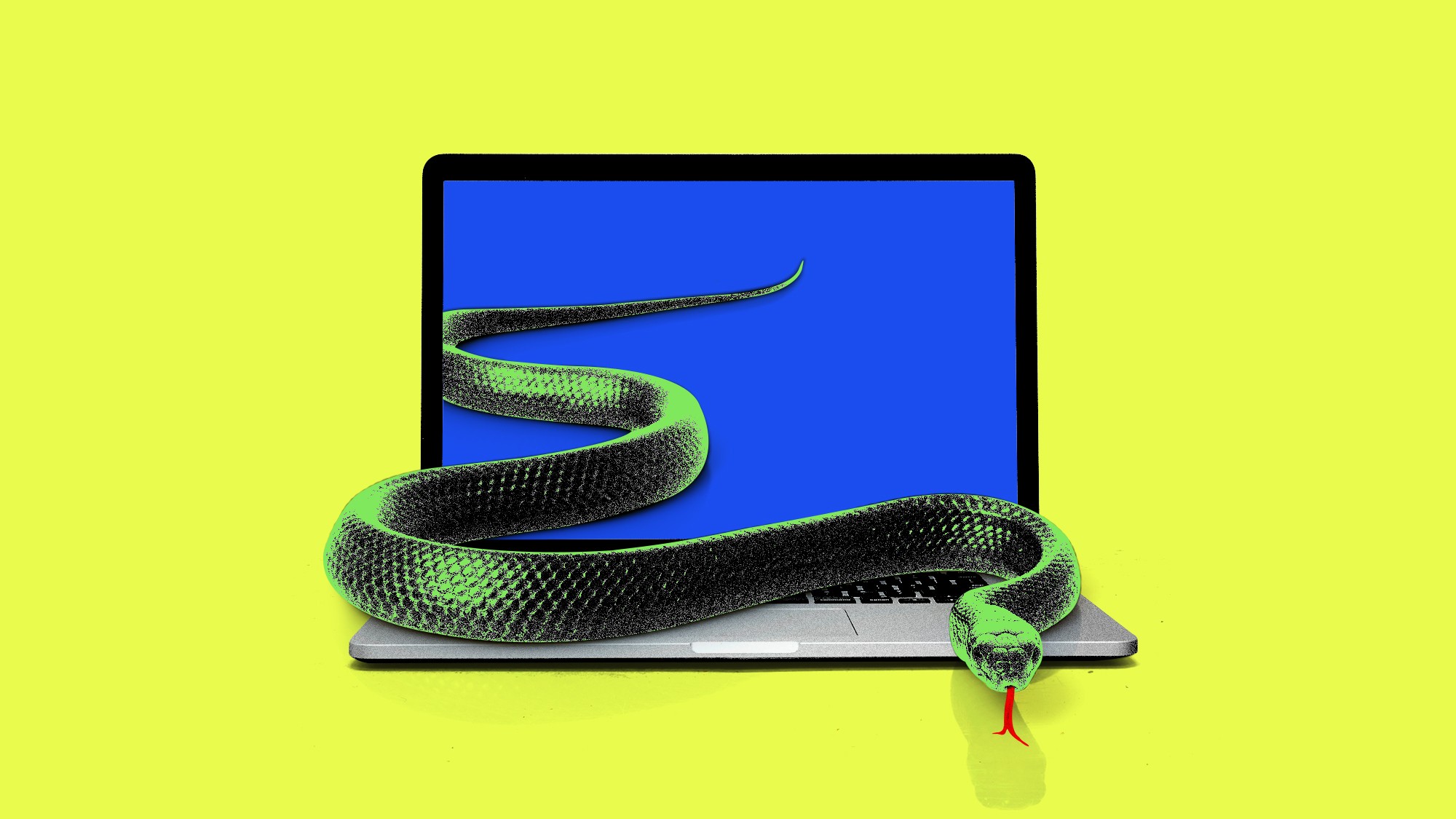
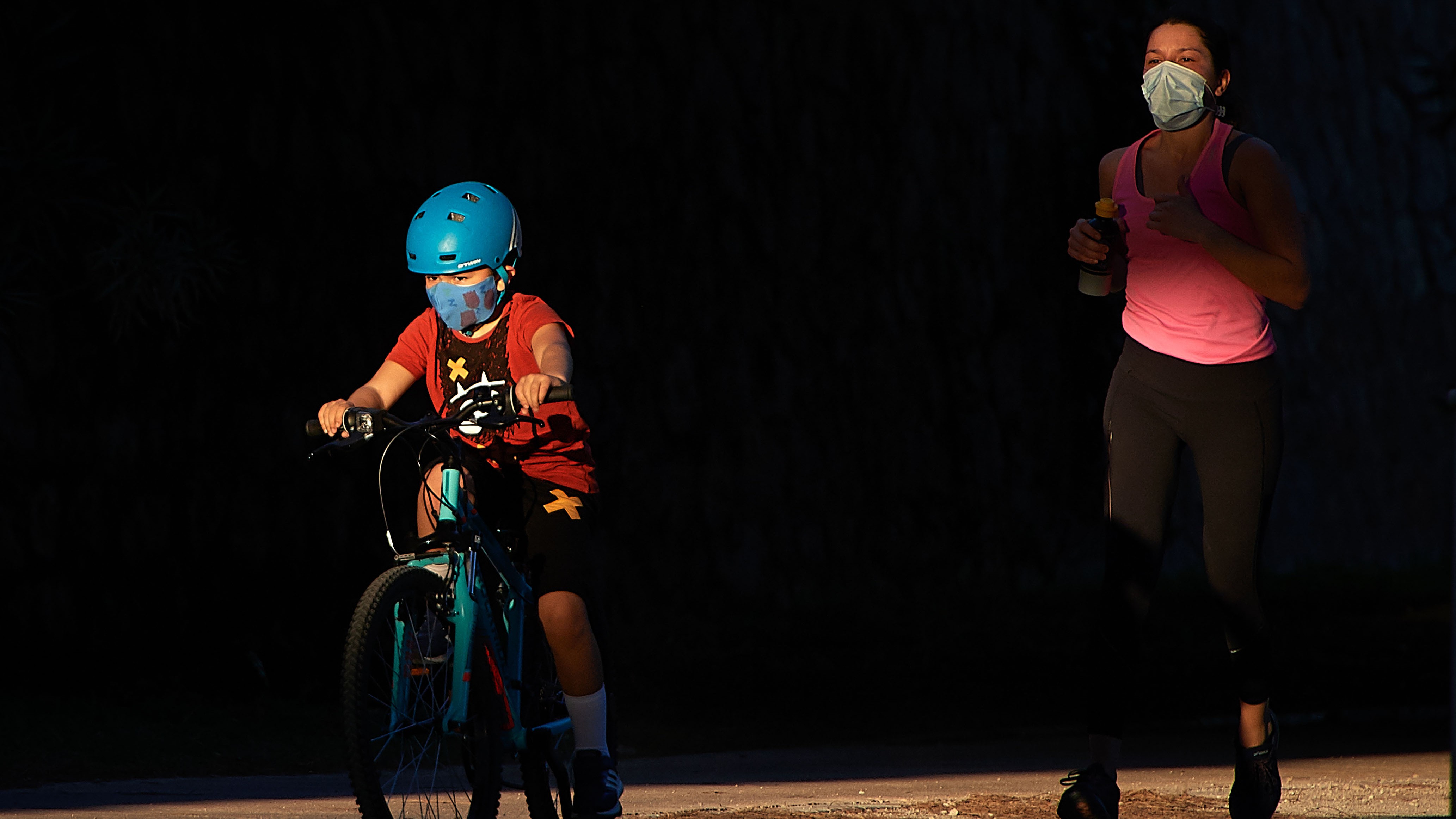
tag:theatlantic.com,2021:50-618147
Extensions
It’s All Rigged
What Robinhood and Facebook have in common
Show full content

As of January 10, nine brokerages had set the one-year target stock price for GameStop at about $10.

But that’s not where it would stay—at least for a while. It climbed in price because a subreddit, r/WallStreetBets, engineered a short squeeze.

That kicked off a wild ride, revealing many things not just about how digital technologies are transforming our world, but also about how they are not. It was yet another stark demonstration that technology is not simply a tool—neutral on all possible outcomes, good or badbut something more dynamic, messy and complicated. It’s a complex system where the workings of both the technology and our society, and crucially, how they interact with each other matter greatly.

This is how the squeeze worked: A few large hedge funds had “shorted” GameStop. That means that they had borrowed the stock, with the intention of returning it when the share price moved lower, as they expected it would, leaving them with a profit. Obviously, this works only if the future price of the stock is indeed lower. If the share price rises, the hedge funds would have to buy the stock at the new, higher price, leading to losses. Investors on r/WallStreetBets had noticed that this particular short position was especially vulnerable because a large portion of its existing shares was tied up in the short betting. They explained to others in the forum that if the price went up and up, the hedge funds would eventually be forced to cover those short positions by purchasing the stock back at a much higher price—from them.

They started buying. The stock started rising.

The attempted squeeze and the ensuing rise in GameStop’s stock price was a media sensation.

[Derek Thompson: The whole messy, ridiculous GameStop saga in one sentence]

On January 25, The New York Times wrote: “In an epic contest between Wall Street traders who bet against stocks and legions of small-scale investors, the small guys are winning.”

On January 27, just two days later, the stock hit $347. A writer for Bloomberg said that this was an example of the internet world affecting reality. She compared the small-scale investors on Reddit to people into live-action role playing, and said this market LARPing could “lead to changes in the real world.” She contrasted the “rational” pros that operate according to “fundamentals” with the “tribal dynamics” of the “feelings-fueled investors.”

Self-organized groups have been using the web to act on the physical world for a while. The tech companies that enable this behavior are themselves old. Facebook turned 17 on February 4. Google is already 22, Reddit is 15, and Apple’s iPhone—which ushered in the era of smartphones—is 13. We’ve had many years to think smarter about what digital connectivity means. And yet, we still face this idea that the internet is a game, that the virtual world is something distinct from the real one. This condescension is even embedded in the phrase IRL—“in real life,” meaning not online.

But the internet isn’t a game. It’s real. And it’s not just a neutral mirror that passively reflects society. One hears that notion from tech elites who’d like to deflect blame from their own creations, which have both empowered and enriched them. “It’s just a tool,” they say. This same mentality is what made Mark Zuckerberg say that it was a “pretty crazy idea” that Facebook had anything to do with Donald Trump’s election—a statement he had to walk back, in part, because it contradicted everything that Facebook usually claims: that its software matters; that it influences people; that it changes, rather than merely reflects, the world.

[Read: Facebook is a doomsday machine]

On January 28, Robinhood and other major trading platforms abruptly announced that they had restricted transactions for GameStop—and a few other stocks that redditors were also trying to squeeze. All of a sudden, people could not open a new position to purchase those stocks. Robinhood users weren’t forced to sell their existing shares, but they could not buy more than a single GameStop stock and five option contracts (which give the bearer the right to buy or sell an underlying stock in the future).

Robinhood is particularly important to this saga because it was the platform of choice for r/WallStreetBets. It drove the retail (meaning small investors rather than big institutions) trade boom because individuals could buy and sell as much as they wanted without a fee. But as with social media, Robinhood’s users were about to find out that the intermediary platform’s business model mattered greatly.

Unlike traditional brokerages, which charge a fee for buying and selling, Robinhood offers these seemingly free trades because it makes its money in large part by selling the trades to big buyers, many of them other hedge funds. It’s those players that will make the real money—and in turn pay Robinhood for the privilege.

The restrictions came because, under its business model, Robinhood could not put up the kind of capital required for all of these trades in the clearinghouses where they are eventually settled, the company wrote in a blog post. So it wasn’t that Robinhood had an interest in kneecapping the short squeeze. Rather, it was never a suitable platform for engineering a squeeze of this scale—based on “free” trades by retail investors precisely because those investors were never its true customers.

These consequences do not necessarily flow from any particular malice from the company or its employees. Instead, it’s always important to pay attention to a company’s incentives, and especially how it makes money. This is especially crucial with digital platforms, where the real mechanisms aren’t as easily visible. If a retailer sells shoes, for example, you expect them to make money … selling shoes. For many digital platforms, though, the users are not the actual customers, and that has profound consequences.

These dynamics play out across many digital platforms. Similar to how Robinhood makes money not from individual traders, who are its users, but from its hedge-fund customers, Facebook, Twitter, YouTube, Reddit, and the rest make money by selling our attention to advertisers or anyone looking to influence people. This business model also fuels surveillance because paid influence operations work better if they have more data to improve their targeting; data allow them to better find ways to “engage” us. And if there is one thing we know about a social species like humans, it is that in-group versus out-group dynamics (us versus them) are very engaging. Similarly, novelty and misinformation are often attractive, and the truth boring and unengaging. Thus, even though the engineers at these companies don’t set out to amplify tribalism and polarization, the algorithms they let loose on us inevitably do, as a corollary of their optimization target.  

This complex interplay between business models, technology, and existing power structures in our society means that we have to move beyond simple narratives: The underdog is winning! Technology is liberating us! The underdog has lost! It must be technology’s fault! To understand the Robinhood and GameStop episode, it is also essential to understand how Wall Street operates, and how the fortunes of big corporations and their executives have become intertwined with it.

On February 2, GameStop closed at $90, less than 20 percent of its all-time high, which it had reached just a few days earlier. Like many internet stories, the narrative may start with the “little guy” winning—David against Goliath—but they rarely end that way. The little guy loses, not because he is irrational and too emotional, but because of his relative power in society.

Similarly, Facebook was first celebrated for empowering dissidents during the Arab Spring, but just a few years later it was a key tool in helping Donald Trump win the presidency—and then, later, in clipping his wings, when it joined with other major social-media companies to deplatform him following the insurrection at the Capitol. The reality is that Facebook and Twitter and YouTube are not for or against the little guy: They make money with a business model that requires optimizing for engagement through surveillance. That explains a lot more than the “for or against” narrative. As historian Melvin Kranzberg’s famous aphorism goes: “Technology is neither good nor bad; nor is it neutral.”

It’s also important to remember that platforms are never all there is to these stories. For example, the United Nations has taken Facebook to task for amplifying hate speech that fueled the ethnic cleansing of the Rohingya in Myanmar, but Myanmar’s government had already been fueling ethnic divisions. Similarly, decades of U.S. institutions slowly but surely failing, becoming less responsive and less accountable toward the interests of ordinary people, allowed someone like Trump to win the presidency.

In 2021, one must be quite oblivious to argue that unyielding adherence to “fundamentals” is what allows certain companies to do spectacularly well on Wall Street, and that people attempting to engineer a short squeeze are merely irrational or dominated by feelings. Recent history has made a mockery of Wall Street’s pretensions to superior rationality. In the lead-up to the 2008 crash, under-regulated, cash-rich Wall Street pros made enormous bets using complex and indefensible formulas and clever tricks, making themselves richer while doing so. Those bets and formulas were not rational, but they were convenient as long as one could pretend they made sense. When it all finally came tumbling down, after a large investment bank went bankrupt, the whole financial sector was bailed out with taxpayer money, because the intertwined nature of the industry and the size of their massive bets meant they could drag the whole global economy down with them.

What was the consequence for these reckless, greedy, and irresponsible actions that could in no way be defended as rational investments based on “fundamentals”? A few people may have lost their massive bonuses for a short time, but no Wall Street executive went to jail. Just one year after being bailed out, they were back in business, handing out $20 billion in bonuses, as unemployment was soaring. However, for the millions of families without extensive wealth buffers, the effects of that crash have been terrible—not just a year of small or no bonuses—and will likely linger their whole lives. What one side has is not superior rationality, but superior power.

The pattern is persistent, and it’s not even concealed. The higher echelons of the corporate world play together with the government and Wall Street to enrich themselves. For example, major US airlines have spent nearly all its extra cash on stock buybacks for the past decade, thereby inflating its stock price—and thus executive pay, which is often tied to stock price—and the stock market. And when the tough times came with the pandemic? The industry got a $25 billion bailout from the government, as one does. Boeing, too, spent most of its cash on stock buybacks, and its CEO was fired with a $62 million exit package not long after the Boeing 737 Max crisis—which resulted in two crashes and 346 dead. A 2013 report found that the average “golden parachute” for the top-paid CEO who was fired was $47.7 million. On it goes.

The social contract is broken, and that’s why the game feels rigged. Right now, especially in countries like the United States, many of the largest, most profitable companies play the legal-tax-evasion game to the point that they are sitting on hundreds of billions of dollars in cash. (Apple alone has cash reserves that hover around $200 billion. Similarly, both Microsoft and Alphabet/Google have more than $100 billion in their cash pile.) These stockpiles are humongous and the companies are not productively investing them—by building something, or by paying people—so the money all goes back into the stock market. When there is such concentrated wealth, many assets—from stocks to Picasso paintings—appreciate. Such disproportionate investment in speculative or nonproductive assets, coupled with the lack of investment in things that make society work better for more people, like education and health care, further break the social contract.

When things are so unequal, and power so concentrated on one side, moralizing takes about whether r/WallStreetBets is a mob ring hollow. What makes them “a mob” for trying to profit together, while Davos is a distinguished gathering? Before digital technologies, it was mostly the wealthy and the connected who could coordinate and conspire to manipulate markets. Disruption certainly came with the internet, which made it easy for anyone to find a group to communicate and coordinate with. But the internet isn’t a pony that empowers only the nice groups we like (Arab Spring dissidents, but not white supremacists), nor does it magically and instantaneously alter the power dynamics in society (so the underdog can suddenly be assured of a Hollywood ending).

On February 4, GameStop fell to $53. That day, Treasury Secretary Janet Yellen went on Good Morning America and said she was meeting with regulators to discuss whether they needed to take “further action” to protect the investors—presumably including the investors at r/WallStreetBets, many of whom lost a lot of money. Did they take hope from her statements? It’s hard to know, in part because Yellen’s financial forms show that she made about $7 million in two years from speaking fees, much of it from talks given to banks and hedge funds, including Citadel, the very hedge fund that purchases trade information from Robinhood. It paid her $810,000 for a few speeches. Similarly, Ben Bernanke—former chair of the Federal Reserve—is now on Citadel’s payroll as a senior adviser. This may not preclude Yellen from taking positive steps, but you also can’t blame retail investors for wondering if the game is rigged against them, when there is such a fast revolving door between the government, the highest tiers of corporate America, and Wall Street.

On February 7, during the Super Bowl, Reddit used the r/WallStreetBets incident for a feel-good ad. “Powerful things happen when people rally around something they really care about. And there’s a place for that. It’s called Reddit,” the ad flashed. It went on to celebrate the underdog: “One thing we learned from our communities last week is that underdogs can accomplish just about anything when we come together around a common idea.” It was all warm and fuzzy.

Reddit may feel as if the ad cheers on the underdogs who congregated on its platform, but some of them lost real money. In contrast, many big players likely made a lot of money from the GameStop mess. A single hedge fund reported making $700 million. The big players are preparing to make money by surveilling such future attempts as well: Quiver Quantitative, a firm that monitors platforms like Reddit, said that it has seen “a surge of interest in its product from hedge funds and other institutional investors in the past two weeks.” The pseudonymous boards of r/WallStreetBets may well have harbored a lot of professional investors, who saw an opportunity to “pump and dump” the stocks.

GameStop is currently hovering around $50 a share, about a tenth of its peak.

tag:theatlantic.com,2021:50-618040
Extensions
Most House Republicans Did What the Rioters Wanted
The most dangerous thing that happened Wednesday occurred after the mob dispersed.
Show full content

January 6, 2021, will surely live in infamy—the day the United States Capitol was stormed by a mob, forcing legislators to evacuate in a rush and leaving five dead, including a police officer.

The most dangerous part of that day for the country as a whole, however, was not what happened when the insurrectionists fought their way into the Capitol in the afternoon, but what happened just a few hours later on the floor. After all that mayhem, the legislators were escorted back to the chamber under heavily armed escort, and a stunning 139 representatives—66 percent of the House GOP caucus—along with eight GOP senators, promptly voted to overturn the election, just as the mob and the president had demanded.

Unlike the insurrectionists, they were polite and proper about it. But the danger they pose to our democracy is much greater than that posed by the members of the mob, who can be identified and caught, and who will face serious legal consequences for their acts. Donald Trump’s ignominious departure from office—whether he is impeached and removed, resigns, or simply sulks away in disrepute—will leave us to solve the problem of the politicians who worked hard to convince millions that the election had been stolen, and then voted to steal it themselves.

[Adam Serwer: The Capitol rioters weren’t ‘low class’]

Throughout Trump’s presidency, many of his critics have conflated the ridiculous and the incompetent with the unserious. Too many are now repeating the same pattern, this time conflating the procedural and the polite with the legitimate and the responsible—and worse, with the harmless.

Those who raised the alarm before were treated as hysterical; dismissing their warnings allowed the attempt to proceed with more ease. Many Americans did not take Trump’s attempts to steal the election in the months leading up to January 6 seriously enough―probably because many of those attempts were, indeed, ridiculous and incompetent: the press conference on alleged fraud at Four Seasons Total Landscaping; lawsuits so sloppy that judges couldn’t throw them out fast enough; and tweets with enough punctuation and grammar mistakes to try the patience of even the kindest elementary-school teacher.

That mix of the serious and the absurd has characterized every step of Trump’s response to his defeat, the clownishness often hiding the gravity of the underlying reality. In the months leading up to January 6, the president attempted to coerce and threaten many elected officials and politicians into supporting his effort to overturn the election—including his own vice president, Republican senators, state election officials, and governors. His close allies openly voiced options such as staging a military takeover, suspending the Constitution, firing civil servants who wouldn’t go along, and executing the supposed traitors who refused to help the president steal the election.

But the most important, most dangerous part of all this was Trump’s successful attempt to convince millions of his supporters that he’d won and was being cheated out of his win—and the fact that many leaders of the Republican Party, at all levels, went along. That claim is somewhat akin to a charge of child abuse—the very accusation is also a demand for immediate action to stop it. The mob that gathered last Wednesday took that accusation seriously, and acted to “stop the steal.”

The storming of the Capitol also included many ridiculous elements—silly costumes worn together with tactical gear, a grinning man making off with a stolen lectern. But like the effort preceding it in the months before, it was also deadly serious: The mob was beaten back with lethal force, when some of its members were just steps away from legislators. The president, meanwhile, watched it all unfold on television, resisting calls to bring in the National Guard.

But the polite facade of what happened just a little later on the floor of the House, as it considered throwing out the results of an election, should not mask the seriousness of the threat this whole effort poses to our democracy. There is a great desire to blame Trump—who is certainly very much to blame—and move on, without recognizing and responding to the dire reality: that much of the GOP enlisted in his attempt to steal an election.

[David Frum: The conservative cult of victimhood]

The 139 representatives and eight senators who voted to reject the results of a democratic election, were certainly well mannered—speakers wore formal clothes such as ties and suits rather than the outlandish outfits of the mob. The legislators adhered to time limits rather than putting their feet on desks while hamming it up for photos. But this veneer of respectability makes what happened on the floor more dangerous, by making it harder to recognize as a violation of democracy.

The legislators were there to count the votes certified by the states—after months of review by election officials, and after endless court challenges were rebuffed—and, instead, they voted to throw them out. They did this after months of lying to the public, saying that the election had been stolen. They crossed every line a democracy should hold dear. To my knowledge, not one of them has yet apologized or recanted for their participation in what even some Republican senators are openly calling the “big lie.”

Some, like Senator Ted Cruz, have tried to cover up their attempt to overturn the election by saying that their constituents (and indeed tens of millions of Americans) believe that the election was stolen, and that they were merely honoring their beliefs. However, it was they, along with the president, who convinced those millions of people that the election was stolen in the first place, and that Joe Biden was not the legitimate president-elect. Convincing people of outright lies does not excuse attempts to pander to those lies later; if anything, it makes the whole act more damning for those who carry it out.

Cruz also invoked the precedent of 1876, and said he merely wanted an electoral commission to investigate a deadlocked election, as happened then. But in 2020, there is no deadlocked election; there is a clear winner. And, as Senator Lindsey Graham explained from the floor, the 1877 commission was not some neutral body looking into electoral fraud, but part and parcel of an effort to overthrow the 1876 election and to disenfranchise Black voters who had just been granted the right to vote. Southern Democrats failed to take the White House, but their efforts helped bring Reconstruction—and thus the effort to extend more freedoms in the South to newly freed people—to a close, paving the way for Jim Crow. If a parallel can be drawn between Cruz’s efforts and 1876, it does not speak in his favor.

Some legislators have since tried to argue that they didn’t mean to “overturn” the election, that their action was more akin to a protest vote. This cannot be taken seriously. That’s like pulling a gun on somebody, walking away with their wallet, and then claiming that you never intended to shoot them if they hadn’t turned over their wallet. A mugging is a mugging, and a mass of legislators claiming that the election was stolen and rejecting the results is an attempt to overturn the election. When the president himself refuses to concede, voting against the recognition of electoral votes cannot simply be a protest, and we don’t have to accept such absurdity at face value.

Others have noted that members of Congress have voted before to suspend the joint session certifying the Electoral College vote—which news accounts referred to as a “formality” because that’s what it’s supposed to be, unless an election is actually stolen. Since 1876, though, there have been exactly two such instances and both were genuine protest votes—they may have been inappropriate, but they aren’t comparable.

The first one, in 1969, was an objection to a faithless elector—a member of the Electoral College did not vote for the candidate to whom he was pledged. A representative and a senator objected to the certification of that vote, which was indeed stolen by the faithless elector, before Congress proceeded to confirm the overall vote.

The second one occurred in 2005, when a Democratic senator and a Democratic representative voted to reject Ohio’s electoral votes to draw attention to their concerns over alleged problems with electronic voting in the state. Not only were they careful to say that they weren’t challenging the result of the presidential election—no “stop the steal,” no claims that the president had actually won in a landslide and had the election stolen from him—but the losing Democratic candidate, John Kerry, had long since conceded to his opponent. (Nor had a mob just stormed the Capitol).

[Read: The Bush-Gore recount is an omen for 2020]

Some Republicans have raised the fact that the 2016 Democratic presidential candidate, Hillary Clinton, referred to Trump’s presidency as “illegitimate.” That may well be, but that happened long after the election was over and the transition was complete. She called Trump to concede less than 12 hours after the polls closed, and the Obama administration immediately started the transition process. There was no formal challenge that required suspending the session to debate whether to accept the actual results.

Today, by contrast, many GOP legislators have claimed for months that the election was fraudulent or stolen, and have explicitly and repeatedly called on their supporters to stop this fraud. The president not only refused to concede before they took their vote, but even as the storming of the Capitol was still under way, he once again claimed that he had won in a landslide.

A great misunderstanding about democracy is that it can be stolen or damaged only if formal rules are suspended or ignored. In fact, many authoritarian regimes are sticklers about formal rules, even as they undermine their meaning. Authoritarians may prosecute journalists in court, for example, instead of simply ordering that they be thrown in jail. The courts will go through all the motions, with judges, prosecutors, and defense attorneys playing their assigned roles, as the case winds toward its preordained conclusion. The journalists end up in jail just as surely as if a royal decree had been issued, but all the formal pretenses are upheld along the way.

We’ve already witnessed the hollowing out of some of the core tenets of liberal democracy—equal representation of voters, unimpeded access to the ballot—in many aspects of our electoral system. Republicans have pursued a project of minority rule for decades, exploiting structural features of American politics and opportunistically shaping rules in their own favor. The Senate is structurally dominated by a minority—less than 20 percent of the population elects a majority of its members. Through gerrymandering and the uneven distribution of the population, the GOP does about 6 percent better in the median House district than it does in the national popular vote. Republicans have used these advantages to shape the other branches of government, appointing conservative Supreme Court justices and federal judges, and blocking executive-branch appointments by Democratic presidents.

Already, there are signs that many in the GOP intend to respond to their loss in the Senate by doubling down on disenfranchising voters in the name of fighting the “election fraud” they falsely convinced millions is widespread. In Georgia and Minnesota, legislators are preparing to increase voter restrictions, which disproportionately impact minorities, especially Black voters. In Michigan and Wisconsin, legislators are considering allocating electoral votes so as to advantage Republican candidates. Republicans, having won a number of state legislatures in 2020—many with the aid of gerrymandering—are poised to draw new maps that entrench their electoral advantage.

After decades spent hollowing out the processes that are central to a healthy liberal democracy, a good portion of the GOP has now proved that they are willing to take the final step: throwing out election results they didn’t like.

[Ibram X. Kendi: Denial is the heartbeat of America]

The Republicans who backed Trump’s effort to overturn the election may have known that it didn’t have a high chance of success, but that doesn’t change the nature of the attempt, especially given their lack of remorse or apology. Unless they are convinced that it was a mistake—unless they pay such a high political price for it that neither they nor anyone else thinks of trying again—they are likely to seize the next available opportunity to do the same. If a future election comes down to one state instead of three, if a future presidential candidate uses lawsuits and coercion more competently, or if a few election officials succumb to threats more easily, they’ll be in the game.

A line must be drawn. The increasing entrenchment of minority rule and democratic backsliding in almost every level of government was terrible enough, but now we’ve even moved past that. Throwing out an election isn’t like disagreeing on tax policy or stimulus checks. It’s not something to move on from or forget. If no line is drawn, the attempt will surely be repeated, quite likely without the mob, by the polite legislators in suits and ties insisting that they want fair elections as they vote to gut what remains of our democracy. If anything, the unruly mob on January 6 may have made it a bit harder for them, by exposing the nature of the whole attempt. Republican representatives are already openly lamenting how the mob and the “illegal breach of the Capitol … destroyed two months of debate and work” on “election theft” that was supposed to play out in the House and the Senate. All of this is happening right in front of our eyes, and Trump, now on his way out, is perhaps the least of our problems.

The bad news is that what comes next will not be easy, or pleasant. The great temptation will be to punish Trump, and then move on to the healing phase. One can even interpret the reported sudden new openness of Senate Majority Leader Mitch McConnell to convicting Trump in the Senate—something that would until now have been unthinkable—as evidence that McConnell has strategically decided that throwing Trump under the bus might be the best way to obscure the broader nature of what his party is pursuing.

The good news is that although the effort to overturn the election was led by the Republican Party, it wasn’t the whole Republican Party. In the end, many Republicans, including Vice President Mike Pence, found their limit and refused to participate. Some have started speaking out against their own colleagues’ behavior, and many more likely recognize the danger of what happened. Democrats will soon control the House, the Senate, and the presidency, making it possible for them to undertake crucial reforms on voting rights and electoral integrity. Perhaps some Republicans will decide to join them; if there ever were a time for putting country over party, this is surely it.

The work will not stop there. The millions who have been lied to will need to be convinced of the truth. Reforms can bolster confidence in elections, without disenfranchising voters or pandering to lies. Voting-rights legislation can include provisions such as risk-limiting audits to reassure the public that the voting process is secure and that election results are worthy of their confidence. It’s not enough to say “You’ve been lied to” and leave it at that. Tens of millions of people have indeed been lied to, but reaching out to them is not just the right thing to do; it’s the only way to try to restore a healthier democracy.

Last Wednesday, one of the legislators who had been most vocal in her false claims of a stolen election, Representative Lauren Boebert of Colorado, tweeted, “Today is 1776.” Boebert intended to compare the “Stop the Steal” rally to the Revolutionary War against England, and those who gathered on the Ellipse to the patriots who fought the redcoats in defense of their liberty. But just like Ted Cruz, Boebert stood on the wrong side of the precedent she chose to cite. This is indeed a fight in defense of democracy—and we can’t afford to lose it.

tag:theatlantic.com,2021:50-617655
Extensions
Why Aren’t We Wearing Better Masks?
Cloth masks are better than nothing, but they were supposed to be a stopgap measure.
Show full content

If you’re like most Americans, there’s a good chance you’re going to wear a cloth mask today. Doing so makes sense. It remains the official recommendation in the United States, and it is something we’ve both advocated since the beginning of the pandemic. Both of us wrote articles as far back as March urging people to wear homemade cloth masks. We’re also the authors (along with 17 other experts) of a paper titled “An Evidence Review of Face Masks Against COVID,” which was just published in peer-reviewed form in the Proceedings of the National Academy of Sciences. But it’s past time for better solutions to be available to the public.

We first released the paper as a preprint back in April, and it took nine months to go through peer review. We’re happy that it’s published but, to be honest, we’re also deeply disappointed that it’s still relevant. We’d hoped that by 2021 supply chains would have ramped up enough to ensure that everyone had better masks. Cloth masks, especially homemade ones, were supposed to be a stopgap measure. Why are so many of us still wearing them?

Don’t get us wrong; everything we said about the efficacy of cloth masks stands the test of time. Wearing them is much better than wearing nothing. They definitely help reduce transmission of the coronavirus from the wearer and likely protect the wearer to some degree as well. But we know that not all masks are equal, and early on in the pandemic, there was a dire shortage of higher-grade masks for medical workers. During those emergency conditions, something was much better than nothing. There are better possibilities now, but they require action and guidance by the authorities.

Even all cloth masks are not equal. Construction, materials, and fit matter, and these can’t be tracked or certified with homemade masks. Unlike cloth masks, medical-grade masks (also called respirators) that adhere to standards such as N95 (in the U.S.), FFP2 (in the European Union), and KN95 (in China) do a much better job of protecting the wearer and dampening transmission. Ideally, they should also come with instructions on how to wear them and ensure that they fit properly.

[Read: The real reason to wear a mask]

Because we have written about masks, we’ve become informal advisers to friends, family, and strangers on the internet. We’re not much help, though. When our friends ask us simple questions like “Where should I buy a mask?” or “Is my mask any good?,” we don’t have great answers. We can mumble generalities: Make sure it fits well; here are some guidelines about layers; try to avoid fake N95s. But if we can’t give wholly satisfying answers to such basic questions, then how is the general public expected to fare?

Tragically, America is swamped with fraudulent medical-grade masks, some of which are only 1 percent effective. Many masks do not have labels clearly indicating their manufacturer. Some official mask-testing methods are inappropriate, including the use of far higher pressure than normal breathing exerts. No reasonable certification is available for the most useful masks generally available to the public. All of this means that everyone has to somehow figure out for themselves which masks are effective.

We routinely get PR pitches for excellent new solutions as well as snake-oil remedies, and we sometimes have trouble telling them apart—how is an ordinary person supposed to evaluate competing claims? When we share our articles about masks on social media, we are asked where to buy proper masks. Not only do we have no answer, but we often find that marketers will answer instead, directing readers to unreliable, overpriced masks. Worse, the supply situation apparently remains so dire that the CDC still “does not recommend that the general public wear N95 respirators,” because they’re crucial supplies that must continue to be reserved for health-care workers and other first responders.

Not all countries have this problem. Taiwan massively scaled up its manufacturing of masks at the start of 2020, such that by April every citizen received a fresh supply of high-quality masks each week, and the distribution system was regulated by the government. Taiwan’s COVID-19 death rate per capita is more than 1,000 times lower than that in the U.S. Hong Kong has been distributing patented six-layer masks (the efficacy of which has been laboratory tested) to every citizen. Singapore is on at least its fourth round of distributing free, reusable, multilayer masks with filters to everyone—even kids, who get kid-size ones. In Germany, Bavaria has just announced that it will be requiring higher-grade masks. If all of these places can do this, why can’t we?

[Read: How a bizarre claim about masks has lived on for months]

Fixing this problem is more urgent now that a new variant of the coronavirus, known as the B.1.1.7 lineage, is making its way around the world. This variant is believed to be about 50 to 70 percent more transmissible than earlier strains of the virus. Masks are an important part of the battle against this new variant because they decrease transmission by reducing the number of infectious particles spread by a mask wearer (known as “source control”) and by reducing the amount that a mask wearer inhales. The cloth masks that we focus on in our paper do a good job at source control, but on their own they do not protect the wearer as well as medical-grade respirators do. That’s why health-care workers wear respirators, and that’s why leaving existing supplies for them was important early on—they were dealing directly with COVID-19 patients, so they needed the protection. Right now, while the CDC language on supply shortages has not been updated, it’s unclear if that’s because the shortages are really that dire or because this topic has not been paid sufficient attention. In either case, the CDC should update us on the situation. And if, indeed, we are still suffering from shortages, emergency measures should finally be implemented to manufacture such masks at home.

Not having higher-grade medical masks or even reliable, certified cloth masks distributed to the population means more transmission. But that’s not all. If we could confidently tell people that the masks would also help protect the wearer from infection, we would likely get more people to wear them. Appealing to solidarity is excellent (“My mask protects you; your mask protects me”), but being able to confidently add self-interest to the equation would be even better.

Ideally we would have ramped up supply and been able to produce and distribute certified higher-filtration masks to the whole population. At a minimum, we should have created a certification program and a distribution channel that allows people to purchase higher-grade masks with confidence. Even better, we could have distributed them to the public for free like so many other places. It’s not just that many other countries showed us the way: Many experts have been urging a switch to better-grade masks as soon as possible. For example, Abraar Karan and his co-authors wrote on the same topic many, many times, in May, June, October, and even this month. As Karan pointed out to us, the fact that some people refuse to wear masks makes it even more imperative that we distribute higher-grade masks to those willing to wear them.

We need the CDC and the FDA to step up and provide simple, clear, actionable, and specific information that would allow the public to know which masks are reliable and where they can get them, as well as how to upgrade and better wear their existing options. Initial studies suggest that widely available surgical masks, combined with a mask brace, could increase the effectiveness of the surgical masks. Cloth masks can be upgraded with a nose wire (for fit) and a filter insert—and more than 100,000 types of these masks are available on Etsy. A good supply of KN95 masks is available from China, with many supermarkets and pharmacies now selling them for a couple of dollars each. But none of these solutions can work widely as long as the public has little guidance on which masks are reliable and certified.

When, three months ago, one of us found FDA-certified KN95 masks at a local supermarket, she was shocked that they were just sitting in a large bin, next to similarly priced single-layer cloth masks. There was no run on them, because the public was not informed of their importance. When she spread word of the masks on social media, hoping some locals would be able to take advantage of this chance, she was inundated by people asking whether they were fake—a valid concern, given that the country is awash in fake masks. She ended up purchasing a bunch to distribute, an effort that would have been comical if it weren’t so tragic.

One person reached out to say that his fiancée was about to undergo an organ transplant and was expected to do her rehabilitation wearing only cloth masks. A handoff of medical-grade masks was arranged. To an observer, it might have looked like a drug deal: people exiting their cars in a parking lot, searching for someone they clearly had not met before; both looking at the cars around them and their phone until they managed to meet up. Finally, a package was handed over, cash was offered but refused—an agreement was struck to pay it forward with a favor to someone else—and a relieved-looking man took the package back to his car and drove off. But it was much worse than a drug deal, the whole episode proof of a disastrous public-health breakdown in the United States.

tag:theatlantic.com,2021:50-617656
Extensions
This Isn’t Just Political Theater
Trump’s threats aren’t performative—he’s pointing a loaded gun at democracy.
Show full content

If people “define situations as real, they are real in their consequences,” William Isaac Thomas and Dorothy Swaine Thomas wrote in 1928. That sociological insight—often referred to as the Thomas theorem—offers the best way to think about this peculiar moment in American politics.

It’s what the “senior Republican official” quoted by The Washington Post in early November, on how to respond to President Donald Trump’s baseless allegations of electoral fraud, failed to understand. “What is the downside for humoring him for this little bit of time?” the official asked.

No one seriously thinks the results will change. He went golfing this weekend. It’s not like he’s plotting how to prevent Joe Biden from taking power on Jan. 20. He’s tweeting about filing some lawsuits, those lawsuits will fail, then he’ll tweet some more about how the election was stolen, and then he’ll leave.

On January 3, The Washington Post reported on an hour-long phone call in which the president urged Georgia’s Republican secretary of state to “find 11,780 votes” to put him over the top. Trump alleged, without any evidence, that thousands of ballots had been destroyed in Fulton County, and demanded that these phantom votes somehow be found and recorded in his favor. “That’s a criminal offense,” Trump told Brad Raffensperger, complaining about the destruction of the ballots, “and you can’t let that happen. That’s a big risk to you and to Ryan [Germany], your lawyer.”

[David Frum: Trump crosses a bright-red line]

Raffensperger recorded the call—which he answered after 18 attempts by the president to get him on the line—because this wasn’t the first time he’d been pressured. “Lindsey Graham asked us to throw out legally cast ballots. So yeah, after that call, we decided maybe we should do this,” a Raffensperger adviser told Politico. (Senator Graham has denied that account of his call.)

Nor is that the only ongoing effort to overturn the results of the election. Multiple Republican senators have said they will object to the Electoral College returns from particular states, and Trump has falsely declared that the vice president has the unilateral power to “reject fraudulently chosen electors.”

Throughout this ordeal have come repeated suggestions that this is all performative, that even Trump knows he lost the election, and that Republican senators are just playing to their party’s base, to better position themselves for 2024.

Even if that were all that is happening, having one party’s top presidential contenders competing to convince voters that they will be the best candidate to steal elections—because that is what they are offering to help Trump do—is a five-alarm fire for a democracy. It compounds our ongoing crisis, in which various aspects of our system that empower minorities either constitutionally or opportunistically have been used to create conditions in which an electoral minority can impose its will on the majority. States containing less than 20 percent of the nation’s population elect a majority of the Senate. The Republican Party has used its control of this chamber to capture the Supreme Court and the rest of the judiciary. Through gerrymandering and the uneven distribution of the population, the GOP does about 6 percent better in the median House district than it does in the national popular vote.

And the GOP also enjoys a significant advantage in the Electoral College, which elects the president, and thus controls the executive branch. Republicans who object to the current attempt to overturn electoral results in Congress have pointed to that edge: “From a purely partisan perspective, Republican presidential candidates have won the national popular vote only once in the last 32 years,” Representative Chip Roy wrote. “If we perpetuate the notion that Congress may disregard certified electoral votes—based solely on its own assessment that one or more states mishandled the presidential election—we will be delegitimizing the very system that led Donald Trump to victory in 2016, and that could provide the only path to victory in 2024.” The attempt to undermine whatever victories an electoral majority can eke out is the logical next step of persistent and entrenched minority rule as well as a significant escalation.

But that’s not all that’s happening. A theater show is performative because the actors and the audience know it’s a performance. If a gun is hanging on the wall in a Chekhov play, we know two things: that it will go off by the end of the play, and that it must actually be a fake or unloaded gun, because it’s only a play. When a loaded gun is brought out in real life, the fact that the person holding it is incompetent or clownish doesn’t make that gun performative; it’s still a gun. When the president of the United States calls up electoral officials to threaten them, he’s leveling a loaded gun at our democracy.

[Anne Applebaum: Trump and his heirs dream of endless victory]

This time, there was a Raffensperger on the other end of the line. If next time a few less scrupulous individuals answer the phone, the attempt to steal an election might well succeed. And if the Republican Party’s base is convinced by its leaders that losing an election means it was stolen from them, those voters will go on to elect officials who are properly eager to help get the “correct” results—so that Republicans win regardless of the vote count.

In December, I wrote that coup might not be the best technical term for what’s going on in the United States, but that it captures the zeitgeist—the moment. Some readers responded by pointing out that Trump isn’t planning a military takeover. But that’s the point. Not every country needs to use the same mechanisms for stealing elections or illegitimately taking or maintaining power. In fact, winning elections by reducing democracy to superficial formal rules—and when even that fails, attempting to throw out the results—is a common authoritarian technique. The opposition isn’t allowed to govern with whichever offices it does win, which further erodes its ability to win anything else.

In the United States, the military remains unlikely to be involved, but all 10 living former secretaries of defense were sufficiently alarmed to write an op-ed in which they said that the “military should have no role in determining the outcome of a U.S. election.” And It could never happen here! is cold comfort for a country that once endured a massive and bloody civil war. There’s no reason to think another civil war is looming, but there are other dangers; history repeats itself, but with imagination.

So what did we get for “humoring” Trump for “this little bit of time,” as if he were a toddler we were appeasing, rather than the holder of one of the most powerful positions on the planet? Apply the Thomas theorem. What people believe they should do is how they will eventually act. This is especially important because institutions—the courts, the political parties, the elections offices, the legislatures—are merely people collectively deciding to act in a particular manner. When people change their mind about the rules, those will be the new rules. Once this transition passes, the Trump wing of the Republican Party—which the 2024 hopefuls clearly think constitutes a plurality—is going to work hard to make sure no Raffensperger gets elected again. And the next time the call comes to “find 11,780 votes,” that gun—which was never performative, because it was always loaded—may well find its target.

tag:theatlantic.com,2021:50-617560
Extensions
The Mutated Virus Is a Ticking Time Bomb
There is much we don’t know about the new COVID-19 variant—but everything we know so far suggests a huge danger.
Show full content

A new variant of the coronavirus is spreading across the globe. It was first identified in the United Kingdom, where it is rapidly spreading, and has been found in multiple countries. Viruses mutate all the time, often with no impact, but this one appears to be more transmissible than other variants—meaning it spreads more easily. Barely one day after officials announced that America’s first case of the variant had been found in the United States, in a Colorado man with no history of travel, an additional case was found in California.

There are still many unknowns, but much concern has focused on whether this new variant would throw off vaccine efficacy or cause more severe disease—with some degree of relief after an initial study indicated that it did not do either. And while we need more data to feel truly reassured, many scientists believe that this variant will not decrease vaccine efficacy much, if at all. Health officials have started emphasizing the lack of evidence for more severe disease.

All good and no cause for alarm, right? Wrong.

A more transmissible variant of COVID-19 is a potential catastrophe in and of itself. If anything, given the stage in the pandemic we are at, a more transmissible variant is in some ways much more dangerous than a more severe variant. That’s because higher transmissibility subjects us to a more contagious virus spreading with exponential growth, whereas the risk from increased severity would have increased in a linear manner, affecting only those infected.

Increased transmissibility can wreak havoc in a very, very short time—especially when we already have uncontrolled spread in much of the United States. The short-term implications of all this are significant, and worthy of attention, even as we await more clarity from data. In fact, we should act quickly especially as we await more clarity—lack of data and the threat of even faster exponential growth argue for more urgency of action. If and when more reassuring data come in, relaxing restrictions will be easier than undoing the damage done by not having reacted in time.

[From the January/February 2021 issue: How science beat the virus]

To understand the difference between exponential and linear risks, consider an example put forth by Adam Kucharski, a professor at the London School of Hygiene & Tropical Medicine who focuses on mathematical analyses of infectious-disease outbreaks. Kucharski compares a 50 percent increase in virus lethality to a 50 percent increase in virus transmissibility. Take a virus reproduction rate of about 1.1 and an infection fatality risk of 0.8 percent and imagine 10,000 active infections—a plausible scenario for many European cities, as Kucharski notes. As things stand, with those numbers, we’d expect 129 deaths in a month. If the fatality rate increased by 50 percent, that would lead to 193 deaths. In contrast, a 50 percent increase in transmissibility would lead to a whopping 978 deaths in just one month—assuming, in both scenarios, a six-day infection-generation time.

Transmissibility increases can quickly—very quickly—expand the baseline: Each new infected person potentially infects many more people. Severity increases affect only the infected person. That infection is certainly tragic, and this new variant’s lack of increase in severity or lethality thankfully means that the variant is not a bigger threat to the individual who may get infected. It is, however, a bigger threat to society because it can dramatically change the number of infected people. To put it another way, a small percentage of a very big number can easily be much, much bigger than a big percentage of a small number.

I dismissed the news initially because viruses mutate all the time and there have been too many baseless “mutant-ninja virus” doomsaying headlines this year. The exaggerated, clickbaity alarmism makes it harder to discern real threats from sensationalism. Given the constant reality of mutation, genomic variants should be considered innocent until proved guilty. Even an increase in the proportion of cases attributable to a particular variant is not definitive proof of an evolutionary advantage.

[Read: Why the coronavirus has been so successful]

However, as data on the new variant roll in, there is cause for real concern. Trevor Bedford, a scientist at the Fred Hutchinson Cancer Research Center and a board member for the Covid Tracking Project at The Atlantic, points out that infections from the new variant are increasing very rapidly among the population in the U.K. Bedford also notes that this new variant seems to have a higher secondary-attack rate—meaning the number of people subsequently infected by a known case—compared with “regular” COVID-19.  Finally, the new variant seems to result in higher viral loads (though this is harder to be sure about as viral loads can be affected by sampling bias and timing). As Kucharski told me, all of this does not rule out other explanations. This increased transmission could be due to chance or founder effects—meaning one variant just happened to get somewhere before the other variants and then got “lucky”; it was early, rather than more transmissible. It could be due to changed behavior among people—quarantine fatigue, less masking—leading to more rapid spread. However, given the current evidence, along with the specifics of the mutation, it’s getting harder to assume that those other explanations are more likely than the simple proposition that this is truly a more transmissible variant.

So how much more transmissible? We aren’t completely sure yet, but the initial estimates from the data suggest that this variant could be about 50 to 70 percent more transmissible than regular COVID-19. To make matters thornier, we aren’t yet exactly sure why it’s more transmissible, though reasonable theories are already being tested. This variant, now called B.1.1.7, has “an unusually large number of genetic changes, particularly in the spike protein,” which is how the virus gains entry into our cells. The new variant may be better at eluding our immune response and replicating, or be able to better bind to locations in our body more conducive to infecting others, but that is all speculative for the moment.

This uncertainty in understanding the variant’s exact mechanisms means that we don’t know if our existing tools—masks, distancing, and disinfecting—are as effective as they were compared with an identical scenario with the regular variant. To be clear: The variant is still a respiratory virus, so the basic tools will not change, and they will all continue to work. In fact, they have become more important, but we may need to be stricter—less time indoors, better masks, better ventilation, more disinfection of high-touch surfaces—to get the same bang for our protective buck. It may be a small difference, or not. We don’t know. We won’t know for a while.

[Read: We need to talk about ventilation]

Given that this new variant is already here in America, are we too late? No, but we are on our back foot. The United States does not have extensive genomic surveillance, or a rapid turnaround with what surveillance it has, so in some ways, we are flying without a map. We have some indications that the variant is—so far—probably relatively rare in the United States.

This could, of course, change extremely quickly, before we can even detect that change, but that highlights the importance of early action. In addition to the threat of exponential growth, we must remember that this pathogen is quite overdispersed—meaning some people seem to cause many infections, while many do not transmit it at all (though these ratios may change as well). Early on, there was a lot of hand-wringing about why some European cities were very badly hit while others were spared—spared only until later, it often turned out—despite similar policies. The answer could be just a bit of bad luck and a few weeks of delay: For exponential processes, small initial differences can mean gargantuan differences in the long run, and we are not helpless.

We can and should deploy whatever weapons we have in our arsenal, as soon as possible. If public-health officials can accelerate our ability to detect the new variant, they must. “You could imagine case-based interventions specifically targeting the early variant-transmission chains,” Bedford told me. “I wouldn’t expect to contain them, but I could imagine buying a week or two.”

[Read: Don’t believe the COVID-19 models]

A week or two may not seem like a lot, but combined with other aggressive public-health measures, we may actually gain a few additional weeks. Maybe all of that could delay this new variant’s widespread establishment until February or even March.

This moment is somewhat similar to America’s initial COVID-19 surge and shutdown in March. We need to once again talk about the importance of flattening the curve. We need to again preserve hospital capacity, so our fatality rate doesn’t increase. But this time around, we can be a lot more hopeful: We need to flatten the curve because delaying potential infections just a few weeks or a month can make a tremendous difference when highly effective vaccines are being rolled out.

We are in a race against time, and the virus appears to be gaining an unfortunate ability to sprint just as we get closer to the finish line. Although the initial rollout of the vaccines has been slow, it is expected to increase rapidly. The U.S. may have 50 million to 100 million people vaccinated as early as March. That is a huge difference, one that could save many lives, especially since we also have perhaps that many people with some degree of postinfection immunity.

Here’s how to think about it: Vaccinated people are a lot less likely to get sick in the first place. One hundred million vaccinated people will mean 100 million people with much less (or hardly any) risk for any symptomatic COVID-19, especially severe disease. That’s an enormous gain.

[Craig Spencer: My emergency room is full of patients no vaccine can help]

But that’s not all. Vaccines benefit not just the vaccinated, but potentially everyone else, too. Fewer people symptomatically sick with a contagious virus means fewer sick people infecting even more people. Every indication we have suggests that vaccinated people will also transmit less—how much less is still being studied, but the difference may well be substantive. The mRNA vaccines (both already approved in the United States) cut down symptomatic disease by about 95 percent. We already know that people who never develop symptomatic disease are a lot less likely to transmit COVID-19. (Note the difference between people who are truly asymptomatic and people who are just about to get sick—presymptomatic—but are highly infectious.) In a preliminary study, the Moderna vaccine was found to even prevent two-thirds of asymptomatic infections. Vaccinated people are thus not only much, much less likely to get any disease; they appear much less likely to get even a silent, asymptomatic infection. Although we need more data to be sure, all of this strongly suggests that vaccinated people will also transmit less. The fewer people there are to efficiently transmit a pathogen, the harder it is for that pathogen to spread.

Now that we have effective vaccines, flattening the curve into the future also means obliterating the curve. Dylan Morris, a postdoc at UCLA who studies virus transmission and quantitative biology of infectious disease, and a co-author of a preprint paper studying the impact of timing on nonpharmaceutical interventions—such as reducing mobility and contacts, wearing masks, distancing, and avoiding indoor gatherings—told me that “delaying cases has always been valuable, but right now it is especially valuable. Buying even a bit of time to ramp up vaccination could avert a great deal of mortality and morbidity.” Every COVID-19 death is tragic, but with the existence of several effective vaccines, every death is now technically preventable too.

Even without a vaccine, Morris said, knocking down the virus through temporary suppression can be valuable even though the virus will grow again, precisely because of these exponential effects. The same percentage growth amounts to a much smaller number of infected people when the baseline number is much smaller. Bringing the baseline level of contagion down also allows for safer experimentation: What happens if we relax X a bit? What restrictions work best? Which ones are most sustainable? If cases are growing from a very large base number, however, that means the state of the world is changing very quickly, so small mistakes are magnified. As Morris said, “You can’t finesse the steep part of an exponential.” He noted that throughout the pandemic, we bemoaned the absence of silver bullets while underestimating the value of crude hammers. But now we are in a different situation: We do have a silver bullet—vaccines—just as we have this new threat thrown at us. How we react in the next few weeks will matter immensely.

[Read: The vaccine is here. Now for the hard part.]

Imagine it this way: There is a tsunami heading our way, and we are ferrying people to a high point. Everyone we transport up to the top is safe, but even better, they can also help other people get to safety (the exponential desirable effect of the vaccine). The reverse is also true, however: Everyone we leave behind also pulls down more people (the exponential unwanted effect of increased transmissibility). And the whole process is very sensitive to when we start; it’s much easier in the beginning but gets nearly impossible as the wave grows higher and gets closer. With this variant, at least in the United States, we are likely at the beginning, or near the beginning.

All this means that the speed of the vaccine rollout is of enormous importance. There are already worrisome indicators of slow rollout. Vaccination of a broad population, not vaccines in and of themselves, saves lives, and epidemics are fought with logistics and infrastructure. We should put every bit of energy, funding, and relentlessness into vaccinating as many people as possible as quickly as possible.

Meanwhile, the United States was reportedly planning to hold back half the vaccine it has in freezers as a hedge against supply-chain issues, and some states may be slowed down by murky prioritization plans. Scott Gottlieb—the former FDA chief and a current board member of Pfizer—has argued that the U.S. should also go ahead with vaccinating as many people as possible right now and trust that the supply chain will be there for the booster. Researchers in Canada—where some provinces decided to vaccinate now as much as possible without holding half in reserve, and will administer the booster with future supplies—estimate that this type of front-loading can help “avert between 34 and 42 per cent more symptomatic coronavirus infections, compared with a strategy of keeping half the shipments in reserve.” (Note that this strategy, which is different from the one the United Kingdom just announced it will adopt in prioritizing the first dose, does not even necessarily involve explicitly changing booster timing protocols in order to maximize vaccination now; it just means not waiting to get shots into arms when the vaccines are currently available.) These were already important conversations to have, but given the threat posed by this new variant, they are even more urgent.

[Read: The next six months will be vaccine purgatory]

Maybe—just maybe—this variant will turn out to be a false alarm, not nearly as transmissible as we feared. We will know soon enough. Our precautions will still be net positives. But if it is indeed much more transmissible, we may face a true tragedy: exponential growth with massive numbers of illnesses and deaths just as highly effective vaccines are being made available. We’ve had a year to learn—about the importance of early action, of acting decisively even in the face of uncertainty, of not confusing absence of evidence with evidence of absence. A year to learn to aim not for perfection in knowledge but for maximal impact even while considering the trade-offs. And most important, a year to learn to not wait when faced with threats with exponential dynamics but to act as early and as decisively as we can—and to adjust and tamper later, if warranted.

“Exponentials are so cruel that nobody wants to look them in the eye,” Morris told me. This is true, but averting our eyes doesn’t avert the outcomes. Each one of us is now counting on every person who serves the public—mayors, city-council members, health officials, nurses, FDA regulators, members of Congress, journalists—to speak up now, and to speak up loudly. We must insist on swift and aggressive action, along with more resources, in order to get this right. It is not too late. Many lives depend on what we do next.

tag:theatlantic.com,2020:50-617531
Extensions
Hang On for 3 More Months
Some simple advice for anyone contemplating a holiday gathering: Wait until March.
Show full content

Hunkering down to wait out the coronavirus isn’t easy. The costs of isolation are steep. Quarantine fatigue is real. The chance to gather with extended family and friends this holiday season is particularly alluring to those of us battling loneliness. Ritual is the bedrock of human society, and forsaking it feels even more destabilizing in a year that has already thrown us all off-kilter.

Even so, I have a simple suggestion for anyone contemplating a large gathering this month: Wait until March.

I recognize that’s not a small sacrifice. For most Americans, the COVID-19 restrictions began last March, when schools shut down and toilet paper was nowhere to be found, and the toll has only mounted over time. It’s been a long year. Human connection is no luxury, not something we can easily forgo. Socializing is one of the most important contributors to our health and well-being. Social isolation predicts mortality at similar levels to smoking. It’s a greater risk than obesity, elevated blood pressure, and high cholesterol.

But this Christmas will be a particularly terrible time to catch the coronavirus. Hospitals nationwide are already overwhelmed, ICUs stretched to their limit. A surge of cases tied to the holidays could further challenge hospitals’ capacity to provide lifesaving care. Meanwhile, treatments are improving, testing is expanding, and vaccines are arriving. If your loved ones can stay healthy a few months longer, they might be much likelier to survive the disease—or to avoid contracting it entirely.

[Julia Marcus: The danger of assuming family time is dispensable]

If you want to convince your relatives—especially your elderly relatives, who are at greatest risk—that gathering this holiday season is a bad idea, warning them of the potential consequences will get you only so far. Instead, offer them something that’s recently been in scarce supply: genuine hope.

There are good reasons to believe that the United States is about to experience a dramatic turnaround in its fight against the coronavirus, even as much remains uncertain. Keep your fingers crossed, knock on wood, sprinkle evil eyes in every nook and cranny, and offer a thought and a prayer and more coffee to the millions who will be working hard to pull this off. The future—even the near future—looks hopeful, even as the current moment looks particularly grim.

While apples-to-apples comparisons are hard—we were testing so much less in the spring—we almost certainly face a much bigger nationwide epidemic today than we did in the early, awful days of the pandemic, but the death rate is now much lower. Better clinical practices, more drugs, and a deeper understanding of how to treat COVID-19 have improved outcomes. However, those gains are fragile. The current surge of cases has placed hospitals around the nation under great strain. Some face shortages of beds and space, or even more dire, of trained personnel. An ICU bed without ICU nurses, after all, is just a bed.

Since the surge is occurring nationwide, health-care workers cannot go to the trouble spots to relieve their exhausted colleagues, as they did during the initial spring crisis in the New York area. Moreover, many are simply exhausted after a very difficult year. Inexcusable shortages of personal protective equipment at the outset of the pandemic forced nurses to improvise, with some donning garbage bags to treat patients. The months of hard work that followed forced many health-care workers to stay away from family members, to spare them from the risk. Some have watched colleagues succumb to the disease, or faced staffing shortages so dire that they had to keep working after testing positive for COVID-19.

[Read: ‘No one is listening to us’]

We’ve recently been breaking horrifying records almost daily: the most cases detected. The most hospitalized. The most deaths per day. All the gains in saving lives may be lost if hospital capacity is so strained that standards of care drop—and they may well drop, because people can only do so much for so long—or if overcrowding forces hospitals to raise the bar for admission. When caregivers are spent and sleep-deprived, medical errors increase, and motor and perceptual skills decline. Exhaustion strains our attention, memory, flexibility, and ability to adapt, and our general mood. We can push our health-care workers and hospital capacity only so far before feeling the consequences—indeed, those consequences are already being felt.

The fight against the coronavirus has been called a “national marshmallow test” that we’re failing. In a famous study, children were left alone with a marshmallow for 15 minutes, and promised a second if they didn’t eat the first. Kids who were better at delaying gratification were found to be more successful later in life. At first, this correlation was explained as demonstrating the importance of willpower and executive function.

Later, a team of researchers set out to replicate this study and uncovered something profound. Once they adjusted for factors such as household income, mother’s education, and home environment at age 3, the effect disappeared. Further variations of the study showed that whether the children judged the promise to be reliable made a great difference in whether, and how long, they were willing to hold off for the reward. Indeed, access to a consistently well-stocked pantry makes it easier to believe those who say that a bigger reward awaits those who can resist eating the marshmallow right away. The precarity and instability of poverty encourage people to live in the moment, simply because the future is so uncertain. Willpower and grit are not merely personal characteristics, existing in a vacuum devoid of social reality. And, yes, hope works, but only when it is realistic and not an empty promise.

If we failed our national marshmallow test this summer and fall, perhaps that says something about how little reason the public was given for optimism. Hope can’t just be a slogan or a pep talk; it must be justified by facts, experiences, and trustworthy promises. And in fairness, until last month, it was less clear when and how this would all end.

But hope is justified today. Multiple vaccines are now in development. Pfizer/BioNTech’s, just approved for use in the United States, and Moderna’s, expected to be approved shortly, both use messenger RNA—a piece of genetic code that carries instructions to create a protein—to deliver the spike protein of SARS-CoV-2 to our cells. The spike protein is the bit the pathogen uses as a key to gain entry to our cells. The idea is that by allowing the body to do target practice with just the spike protein, we can train it to handle the actual virus. Using messenger RNA in this fashion has until now been just a promising idea—but research during the pandemic has shown that at least for this virus, it works very, very well.

As late as April, Anthony Fauci and other experts cautioned us that even a year to 18 months would be an optimistic timeline for having a vaccine. Just five months ago, the FDA announced that it would approve vaccines that were at least 50 percent efficacious at preventing disease. Despite that long timeline and those modest expectations—both amply justified by previous experience—we already have two vaccines that have proved to be about 95 percent efficacious in large-scale trials. Even better, they have been shown to cut severe disease to near zero.

The United States is hoping to vaccinate 50 million people by the end of January, and the actual number vaccinated this winter could be even higher. The logistical challenges are substantial and many things can still go wrong. But speedy, effective vaccines have been the most stellar part of the global response, and more—many more—are on the way.

[Read: The next six months will be vaccine purgatory]

The first 50 million people to be vaccinated will give us more bang for our buck than the next 50 million, because the vaccination rollout will start with the elderly and other high-risk groups, health-care professionals, essential workers. While the exact order of vaccination has not yet been decided, the elderly and those at high risk must get some of the first vaccines, because those groups suffer the most from COVID-19. The risk profile of this disease is strikingly exponential: The risk of death for those ages 65 to 69 is a staggering two and a half times that of those just a decade younger. Those just a few years older, ages 75 to 79, face six times the risk of death compared with that same age group (ages 55 to 59). The steepness of this age curve really matters, because it means that protecting the most vulnerable groups with a highly efficacious vaccine will both quickly change our experience of the pandemic and relieve the strain on our hospitals. After that, vaccinating health-care workers ensures that they can continue to fight the pandemic without being sidelined. Essential workers don’t have the luxury of staying at home; their jobs may expose them to the virus, and they can expose others in turn. But it now seems plausible that many millions will be vaccinated rapidly. Indeed, the first batch of almost 3 million doses is being distributed as I type.

What about all the skepticism and the cautions? All the warnings that we don’t know if the vaccine prevents infection rather than just disease, that we won’t be able to stop wearing masks and social distancing anytime soon? Here, it’s important to distinguish between things we don’t know yet and things that just won’t happen. Sometimes, as in this case, We don’t know just means “We haven’t yet measured it.” While we need to wait for actual confirmation to relax, there is no need to assume the worst, which would be that the vaccines suppress the disease but provide no protection against infectiousness.

We already know that symptomatic COVID-19 patients are a lot more contagious than those who remain completely asymptomatic; it is reasonable to expect that reducing or eliminating symptomatic infection will help reduce transmission. Early results, moreover, already suggest that the vaccines may lower the rate of asymptomatic infection by two-thirds just weeks after the first dose is administered. Deepta Bhattacharya, an immunologist at the University of Arizona, told me that decades of research on viral immunology suggest we should feel confident that the vaccines will reduce transmission and contagiousness as well. Studies on those questions are in progress now, but all the indications we have give reason to be upbeat. And those who have been vaccinated already are known to benefit greatly in terms of avoiding the disease themselves.

There are also open questions about the durability of the immunity provided by the vaccines. The existing trials have tracked participants for at least three months and have provided tremendously encouraging data for at least that long. As millions more are vaccinated and as trials and measurements continue, we will get a lot more data. Yes, it’s wise for those who have been vaccinated to maintain their precautions for now, especially since vaccines take a while to have an effect. But we can also remind ourselves that, so far, all the data we have seen have been greatly reassuring, far exceeding our initial hopes.

All these reasons for optimism are also reasons to delay your Christmas gathering until March. Even if our hopes are not fully realized, at a minimum, waiting until March helps avoid the risk of infection during this grim period. Plus, March offers potentially better weather, which seems to slow down transmission of the virus while also allowing us to engage in safer practices such as gathering outdoors and opening windows. While young people can occasionally suffer greatly or even die from the coronavirus, and while questions remain about the long-term effects of the virus, an overwhelming majority of those who are hospitalized or die are older, with higher risk factors. As the elderly are vaccinated, hospitals may finally be able to gain some breathing room—lavishing better care on a smaller number of patients, and further driving down the death rate. Plus, scarce lifesaving therapeutics such as monoclonal antibodies—in short supply for everyone except the politically connected—will become available to a greater proportion of those who fall ill. As the essential workers on whom we rely are vaccinated, the rate of transmission is bound to slow down for all groups. And as hospital workers are vaccinated, they may become less stressed.

Vaccinating the first 50 million people won’t just protect them—it will make all of us safer and the nation better-off. We don’t yet know how much better things will get this spring, but we can already tell that the situation seems set to rapidly improve. We can see the brightening light at the end of the tunnel, if we can make it through this last, darkest stretch. Postpone that Christmas party, if you can. Protect the members of your family who are elderly, or who are at heightened risk; keep them safe now, as we stand on the precipice of relief. We cannot guarantee the future, but just as the dangers of this grim winter are real, so are the reasons for hope.

tag:theatlantic.com,2020:50-617410
Extensions
‘This Must Be Your First’
Acting as if Trump is trying to stage a coup is the best way to ensure he won’t.
Show full content

Updated at 5:39 p.m. ET on December 7, 2020.

On the evening of September 11, 1980, my mom was approached by a neighbor who held rank in the Turkish military. He told her to stock up on bread and rice. “Oh, another coup,” she immediately groaned. The neighbor was aghast—he wasn’t supposed to tell anyone what was coming. But my mom, of course, had immediately understood what his advice must have meant. Turkey is the land of coups; this was neither the first nor the last coup it would face.

Over three decades later, I walked up to a counter in Antalya Airport to tell a disbelieving airline employee that our flight would shortly be canceled because the tanks being reported in the streets of Istanbul meant that a coup attempt was under way.* It must be a military exercise, she shrugged. Some routine transport of troops, perhaps? If so, I asked her, where is the prime minister? Why isn’t he on TV to tell us that? Another woman approached the counter. “This must be your first,” she said to the young woman behind the counter, who was still shaking her head. “It’s my fourth.”

[Zeynep Tufekci: America’s next authoritarian will be much more competent]

I told the airline employee that we were not getting on that plane, destined for the Istanbul airport, which I knew would be a primary target. The other woman and I nodded at each other, becoming an immediate coup pod. I went out to secure transportation for us—this airport was not going to be safe either—while she and my 7-year-old son went to retrieve our luggage. “His first too,” I said to her.

In political science, the term coup refers to the illegitimate overthrow of a sitting government—usually through violence or the threat of violence. The technical term for attempting to stay in power illegitimately—such as after losing an election—is self-coup or autocoup, sometimes autogolpe.

Much debate has ensued about what exactly to call whatever Trump is attempting right now, and about how worried we should be. It’s true, the whole thing seems ludicrous—the incoherent lawsuits, the late-night champagne given to official election canvassers in Trump hotels, the tweets riddled with grammatical errors and weird capitalization. Trump has been broadly acknowledged as “norm shattering” and some have argued that this is just more of his usual bluster, while others have pointed out terminological issues with calling his endeavors a coup. Coup may not quite capture what we’re witnessing in the United States right now, but there’s also a danger here: Punditry can tend to focus too much on decorum and terminology, like the overachieving students so many of us once were, conflating the ridiculous with the unserious. The incoherence and incompetence of the attempt do not change its nature, however, nor do those traits allow us to dismiss it or ignore it until it finally fails on account of that incompetence.

Part of the problem is that we haven’t developed linguistic precision to put a name to it all—not just to what’s been happening since November, but to the processes within which it’s embedded. That’s dangerous, because language is a tool of survival. The Inuit have many words for snow—because their experience demands that kind of exactness. (The claim had been disputed, but the latest research affirms it.) “These people need to know whether ice is fit to walk on or whether you will sink through it. It’s a matter of life or death,” the linguist Willem DeReuse told New Scientist.

In Turkish, we do have many different words for different types of coups, because our experience similarly demands it. For example, coups that are attempted through threatening letters from the military are called memorandum coups. A 2007 attempt is commonly referred to as the “e-coup” because the threatening letter from the military was first posted on the internet. (The one before that, in 1997, is often referred to as a “postmodern” or “soft” coup.) We know the difference between military coups that start from the top and follow the military chain of command and those that do not. The term autogolpe comes from the Spanish partly because there have been so many such attempts in Latin America.

The U.S. president is trying to steal the election, and, crucially, his party either tacitly approves or is pretending not to see it. This is a particularly dangerous combination, and makes it much more than just typical Trumpian bluster or norm shattering.

Maybe in other languages, from places with more experience with this particular type of power grab, we’d be better able to discuss the subtleties of this effort, to distinguish the postelection intervention from the Election Day injustices, to separate the legal but frivolous from the outright lawless, and to understand why his party’s reaction—lack of reaction—is not just about wanting to conclude an embarrassing presidency with minimal fanfare. But in English, only one widely understood word captures what Donald Trump is trying to do, even though his acts do not meet its technical definition. Trump is attempting to stage some kind of coup, one that is embedded in a broader and ongoing power grab.

And if that’s hard to recognize, this might be your first.

On Tuesday, Gabriel Sterling, the Republican who serves as Georgia’s voting-system implementation manager, appeared at a press conference. Voice shaking, he talked about how the home of Secretary of State Brad Raffensperger—his boss—had been targeted after the president once again baselessly claimed that there was massive voter fraud in Georgia and called Raffensperger “an enemy of the people.” Sterling called on the president and the state’s two Republicans senators to condemn threats of violence against election workers.

That scene itself was unsettling. But when, just a few hours later, Trump retweeted Sterling’s plea with a shrug and a reassertion of his desire to steal the election, the situation turned profoundly frightening. “Rigged Election,” the president wrote. “Show signatures and envelopes. Expose the massive voter fraud in Georgia. What is Secretary of State and @BrianKempGA afraid of. They know what we’ll find!!!”

[Kim Wehle: Congress needs to end this, now]

With just a few notable exceptions, Republican officials have met Trump’s lies with a combination of tacit approval, pretending not to notice them, or forbearance. In a recent survey, an alarming 222 Republicans in the House and the Senate—88 percent—refused to acknowledge that Joe Biden won the presidency. Another two insisted Trump won. A few more have started speaking out, but what has finally taxed their patience seems to be anxiety that Trump’s antics may cost them an upcoming election for two U.S. Senate seats in Georgia—an instrumental concern about continuing to exercise power, rather than a substantive worry about the attempted election theft itself. (It should be noted that there have been conservative voices who have responded with the appropriate fury, but that few are elected officials or leaders of the GOP.)

After Sterling spoke in Georgia, a local TV station asked the two Republican senators running for election in the January runoff for comment. But instead of offering straightforward denunciations, both issued perfunctory condemnations and then used the opportunity to continue to fan doubts about the process. “Senator [David] Perdue condemns violence of any kind, against anybody. Period,” his campaign said. “We won’t apologize for addressing the obvious issues with the way our state conducts its elections.” The other senator’s campaign took a similar line. “Like many officials, as someone who has been the subject of threats, of course Senator [Kelly] Loeffler condemns violence of any kind. How ridiculous to even suggest otherwise. We also condemn inaction and lack of accountability in our election system process—and won’t apologize for calling it out.”

What is it that the Republican leadership is hoping will pass without too much comment, solved by the ticking down of the transition clock?

Let’s run through it—and this is not even all of it. Every day adds more.

The president has repeatedly and baselessly claimed that the election was stolen from him, and continues to do so daily. He is, effectively, charging that election officers around the country are involved in a dangerous conspiracy and that the incoming president is the leader of this illegal attempt.

The president and his key allies have repeatedly called for Republican state legislators to steal the election for him by appointing new electors who will support him instead of backing the winner of the state’s electoral votes.

The president, who has the power to appoint judges for lifetime appointments, and who has appointed nearly a third of federal judges on the crucial circuit-court level in the United States—more than any other president in recent history at this point in their presidency—has asked the courts to throw out valid votes wholesale, especially in cities with minority voters.

Right after the election, a legal adviser to the president stated on national television: “We’re waiting for the United States Supreme Court—of which the president has nominated three justices—to step in and do something. And hopefully Amy Coney Barrett will come through.”

The president’s high-profile allies are holding rallies where supporters are chanting “Lock him up!,” calling for the imprisonment of Georgia’s Republican governor, who is opposing his attempts to steal the election. (Georgia conducted two thorough recounts of the votes and found that the margin by which Trump lost the election holds.)

The president personally called the two Republican canvassers in Wayne County, Michigan, and then both signed affidavits attempting to rescind their certification of the vote in that state. They had earlier tried to block certification of votes from Detroit, providing a glimpse of what could happen if a more competent president tried to steal an election.

The president has amplified messages that call for people to “fight back hard” against the allegedly stolen election.

[From the November 2020 issue: The election that could break America]

The president’s election lawyer said that “the entire election, frankly, in all the swing states, should be overturned, and the legislatures should make sure that the electors are selected for Trump.” She has since been dismissed from his team, but he has not publicly repudiated her statements, and she continues to make similar statements.

Michael Flynn, the former national security adviser—a powerful post—who was just pardoned by Trump, has amplified calls for the president to suspend the Constitution and hold another election (an exercise presumably to be repeated until he wins).

The president summarily fired Christopher Krebs, the director of the Cybersecurity and Infrastructure Security Agency in the Department of Homeland Security, because he vouched that the election was not stolen.

Joseph diGenova, a lawyer for the Trump campaign, said that Krebs should be “taken out at dawn and shot.” (DiGenova later said that the statement had been “made in jest.”)

Before the election, the president pressured the attorney general to investigate his opponent and his son, after being impeached for pressuring a foreign state to announce its own investigation into his opponent’s son.

The president also fired the chief of the Pentagon, along with other top officials. These dismissals remain unexplained, but Trump was reportedly infuriated at the defense secretary’s opposition to using active-duty military troops against protesters in U.S. cities—portending what he might have liked to do, even though his incompetence has meant that he hasn’t found a way.

What makes this moment deeply alarming—and makes Republicans’ overwhelming silence and tacit approval deeply dangerous, rather than merely an attempt to run out the clock on the president’s clownish behavior—is that Trump’s attempt to steal this election builds on a process that has already entrenched minority rule around the country.

In North Carolina, where I live, only three of the state’s 13 representatives in the House were Democrats after the 2014 congressional election, despite Democrats getting 44 percent of the vote. In 2016, the Democratic Party’s vote share in the state increased to 47 percent, but still only three representatives were Democrats. In 2018, Democrats won an even larger share of the vote—48.3 percent—but still had only three representatives. In 2019, North Carolina’s blatantly gerrymandered district maps were finally struck down by the Supreme Court. And so, this year, the Democrats managed a meager increase in representation—five representatives out of 13—despite again receiving 48 percent of the vote.

[David Frum: The raw desperation of the Republican Party]

Who draws these grossly unfair maps, which are typical of others across the country? The state legislatures, which themselves are often elected using maps that reflect unrepresentative gerrymandering. In North Carolina in 2016, for example, the Republicans won a veto-proof supermajority in the state House of Representatives—obtaining more than two thirds of the seats—despite winning just 52 percent of the vote. Statewide races cannot be similarly gerrymandered, though, and that year, North Carolina voters elected a Democratic governor and attorney general. In response, the lame-duck legislature rushed to take away key powers from those offices. They succeeded. The general assembly then used its veto-proof majority to override 23 of Governor Roy Cooper’s 28 vetoes in the first three years of his term, rendering one of his key remaining powers effectively useless.

In Wisconsin in 2018, Republicans won a near-veto-proof supermajority in the state legislature with a minority of the votes in the state. That same year, Republican Governor Scott Walker lost his bid for reelection, and Republican candidates for lieutenant governor and attorney general were also defeated—again, statewide offices resist gerrymandering. After the loss, the Wisconsin state legislature followed the same playbook as the GOP in North Carolina, rushing, in a lame-duck session, to take away crucial powers previously exercised by Walker. The lawsuits filed by Democrats were rejected by the Republican-dominated state supreme court.

When voters try to contest gerrymanders or power grabs, many of the cases end up before the U.S. Supreme Court, where lifetime appointments are made by the president but approved by the Senate. The Senate is so lopsided right now that 26 states containing just 17 percent of the U.S. population elect a majority of senators—the smallest that proportion has ever been. That’s the people in the smallest 26 states. The Republican Party’s Senate majority in recent years has rested on its strength in these rural states. Barack Obama couldn’t even get a Senate hearing for his last nominee to the Supreme Court.

Today, the United States has a House filled with gerrymandered districts, a Senate dramatically tilted toward rural states, some state legislatures controlled by electoral minorities or slim majorities who get to exercise power as if they were overwhelming, and a Supreme Court with three justices appointed by a president who lost the popular vote. Is it any wonder that Trump thinks he can defy the results of the election and cling to power despite losing an election? Or that his party does not stand up for the will of voters?

In 1852, Karl Marx famously modified Hegel’s observation that historical occurrences tend to repeat by adding that they may occur the first time as tragedy and the second time as farce. Marx was mocking Louis-Napoléon Bonaparte, the nephew of Napoleon Bonaparte who had just seized power in a coup (or, in the interest of technical precision, an autogolpe), declaring himself emperor. Louis-Napoléon did indeed seem like a figure worth ridicule, but the well-heeled members of ruling classes often confuse lack of propriety for weakness.

Adolphe Thiers, a leading figure in the biggest political party that had backed Louis-Napoléon for the presidency in 1848, had persuaded his colleagues to support his candidacy, calling him a “moron” who’d be easy to lead by the nose—“un crétin que l’on mènera.” Louis-Napoléon had already organized two failed coup attempts so inept that they were described as “beyond comedy.” When Bonaparte won the election, though, he had other ideas about how manageable he was. In 1851, failing to change the laws that prevented him from staying in power, he organized his third coup d’état, which was successful. Napoleon III reigned as emperor until 1870, remaking France in the process.

[Read: How Trump could attempt a coup]

What starts as farce may end as tragedy, a lesson that pundits should already have learned from their sneering dismissal of Trump when he first announced his presidential candidacy. Yes, the Trump campaign’s lawsuits are pinnacles of incompetence, too incoherent and embarrassing to go anywhere legally. The legislators who have been openly pressured by Trump don’t seem willing to abide the crassness of his attempt. States are certifying their election results one by one, and the General Services Administration―the agency that oversees presidential transitions—has started the process of handing the government over to President-elect Joe Biden. If things proceed in their ordinary course, the Electoral College will soon vote, and then Biden will take office.

But ignoring a near catastrophe that was averted by the buffoonish, half-hearted efforts of its would-be perpetrator invites a real catastrophe brought on by someone more competent and ambitious. President Trump had already established a playbook for contesting elections in 2016 by casting doubt on the election process before he won, and insisting that he only lost the popular vote due to fraud. Now he’s establishing a playbook for stealing elections by mobilizing executive, judicial, and legislative power to support the attempt. And worse, much worse, the playbook is being implicitly endorsed by the silence of some leading Republicans, and vocally endorsed by others, even as minority rule becomes increasingly entrenched in the American electoral system.

It’s not enough to count on our institutions to resist such onslaughts. Our institutions do not operate via magic. They do not gain their power from names, buildings, desks, or even rules. Institutions rely on people collectively agreeing to act in a certain way. Human laws do not simply exert their power like the inexorable pull of gravity. Once people decide that the rules are different, the rules are different. The rules for electoral legitimacy have been under sustained assault, and they’re changing right before our eyes.

We’re being tested, and we’re failing. The next attempt to steal an election may involve a closer election and smarter lawsuits. Imagine the same playbook executed with better decorum, a president exerting pressure that is less crass and issuing tweets that are more polite. If most Republican officials are failing to police this ham-handed attempt at a power grab, how many would resist a smoother, less grossly embarrassing effort?

Adding to the crisis is that many of the 74 million people who voted for Trump now believe that the election was outright stolen. They believe that they were robbed of the right to vote. How many of these supporters will be tempted to carry Trump’s claims about being cheated out of an election victory to their logical conclusion? Meanwhile, millions of people around the country are repeatedly experiencing that being a majority is not enough to win elections, or even if one does win, not always enough to be able to govern.

When Biden takes the presidential oath in January, many will write articles scolding those who expressed concern about a coup as worrywarts, or as people misusing terminology. But ignoring near misses is how people and societies get in real trouble the next time, and although the academic objections to the terminology aren’t incorrect, the problem is about much more than getting the exact term right.

Alarmism is problematic when it’s sensationalist. Alarmism is essential when conditions make it appropriate.

[Kenneth Owen: Minority rule cannot last in America]

The boy who cried wolf is a familiar parable. But what of the boy who saw an approaching wolf scared off by a thunderstorm and decided that he didn’t need to worry about wolves, instead of readying himself for its return? Fortune favors the prepared; catastrophe awaits those who confuse luck with strength.

In Turkey, the leader of the 1980 coup, the one that my mom had been warned about, was Kenan Evren. He was a military-academy classmate of many who had taken part in a particularly incompetent coup attempt in the early ’60s that failed spectacularly—its missteps included tanks being accidentally sent to a neighborhood in Ankara at the wrong time. But the coup Evren led many years later was anything but farcical: Hundreds of thousands were detained, and more than 100 were tortured to death. A new, restrictive constitution was enacted, under repressive conditions. The failure of multiple attempted coups in the ’60s was not a reason to dismiss the risk of a subsequent coup—but a warning that such an effort might well succeed in more competent hands. Indeed, there was a “memorandum coup” in 1971, which resulted in a change of government after the military issued threats, and the full military takeover in 1980.

So, yes, the word coup may not technically capture what we’re seeing, but as Pablo Picasso said: “Art is a lie that makes us realize truth, at least the truth that is given us to understand.” People are using the term because it captures the sense and the spirit of the moment—its zeitgeist, its underlying truth.

Our focus should not be a debate about the proper terminology. Instead, we should react to the frightening substance of what we’re facing, even if we also believe that the crassness and the incompetence of this attempt may well doom it this time. If the Republican Party, itself entrenching minority rule on many levels, won’t stand up to Trump’s attempt to steal an election through lying and intimidation with the fury the situation demands; if the Democratic Party’s leadership remains solely focused on preparing for the presidency of Joe Biden rather than talking openly about what’s happening; and if ordinary citizens feel bewildered and disempowered, we may settle the terminological debate in the worst possible way: by accruing enough experience with illegitimate power grabs to evolve a more fine-grained vocabulary.

Act like this is your first coup, if you want to be sure that it’s also your last.


*A previous version of this article misstated the amount of time between 1980 and 2016. It is over three decades, not two.

tag:theatlantic.com,2020:50-617309
Extensions
It’s Time to Hunker Down
A devastating surge is here. Unless Americans act aggressively, it will get much larger, very quickly.
Show full content

The end may be near for the pestilence that has haunted the world this year. Good news is arriving on almost every front: treatments, vaccines, and our understanding of this coronavirus.

Pfizer and BioNTech have announced a stunning success rate in their early Phase 3 vaccine trials—if it holds up, it will be a game changer. Treatments have gotten better too. A monoclonal antibody drug—similar to what President Donald Trump and former Governor Chris Christie received—just earned emergency-use authorization from the FDA. Dexamethasone—a cheap, generic corticosteroid—cut the death rate by a third for severe COVID-19 cases in a clinical trial.

Doctors and nurses have much more expertise in managing cases, even in using nonmedical interventions like proning, which can improve patients’ breathing capacity simply by positioning them facedown. Health-care workers are also practicing fortified infection-control protocols, including universal masking in medical settings.

Our testing capacity has greatly expanded, and people are getting their results much more quickly. We may soon get cheaper, saliva-based rapid tests that people can administer on their own, itself a potential game changer.

[Read: The vaccine news that really matters]

The Centers for Disease Control and Prevention has finally acknowledged that aerosol transmission happens and that ventilation is important. The initial bungled messaging and science around masks was unfortunate, but things have turned around; the CDC has even publicized how masks can help protect the wearer from infection, as well as lower the chances of onward transmission. The importance of clusters and super-spreading is more widely appreciated, maybe partly because of the highly publicized White House cluster, which is still simmering.

We have reasons to celebrate, but—and you knew there was a but—a devastating surge is now under way. And worse, we are entering this dreadful period without the kind of leadership or preparation we need, and with baseline numbers that will make it difficult to avoid a dramatic rise in hospitalizations, deaths, and potential long-term effects on survivors.

Almost every day, America is breaking new records in confirmed cases: They are up 40 percent from just one week ago. These cases are not confined to a region or a state; the whole nation is in the midst of a terrible surge. So, too, is much of Europe, where country after country is experiencing record numbers of cases.

This is not a “casedemic”—the false notion that we just have better testing and detection, without any real change in the underlying risk for illness and death. It’s true that we missed a lot of cases in the spring because we didn’t have enough tests, and that we are catching more of them now. But it’s not just confirmed cases that are on the rise. The United States is also experiencing a steep increase in hospitalizations, as well as about 1,500 reported deaths a day; those are the highest numbers since mid-May, and they are still rising sharply. Trevor Bedford, a scientist at the Fred Hutchinson Cancer Research Center, in Seattle, calculates that more than 2,000 deaths a day may already be baked in for early December, meaning that even if we stopped every new infection from now on, we’d still see that many people die per day in just a few weeks among those already infected.

[Read: ‘No one is listening to us’]

The Pfizer-BioNTech vaccine—or Moderna’s vaccine—may be available in the United States to health-care workers and other high-priority people as early as the end of this year. But it won’t be distributed widely until well into 2021, even in the best-case scenario—and the Pfizer vaccine needs two doses, about 21 days apart. Those promising monoclonal antibodies, too, are in very short supply. The president was one of fewer than 10 people to receive the treatment outside of a clinical trial. Even if the drug works as well as we hope, the 300,000 doses that Eli Lilly has agreed to deliver will not be enough when they finally arrive, probably toward the end of this year, when we have 150,000 positive cases a day, and still rising. Dexamethasone availability is excellent, but deaths are climbing despite its widespread use, because it helps address only one of this disease’s complications.

We have little reason to count on the authorities for leadership that has the precision and scale we need. The outgoing president has refused to concede the election and has launched a flurry of frivolous lawsuits to muddy the transition, thereby making the odds of an effective federal response over the next few months less likely.

All of this means we desperately need to flatten the curve again before hospitals nationwide are overrun. Utah, Illinois, Minnesota, Colorado, and other states are already reporting that hospitals and intensive-care units are at or near capacity. The bottleneck for medical care isn’t just lack of space, or even equipment, which we may be able to increase, but staff—trained nurses and doctors who can attend to patients, and who cannot be manufactured out of thin air. During the spring crisis in the New York tristate area, health-care workers from around the country rushed to the region, buttressing the exhausted medical workforce. With a nationwide surge, doctors and nurses are needed in their hometown hospitals.

If fewer people can be admitted to hospitals because of lack of space, patients won’t benefit from our improved clinical management of COVID-19. We may give back some of our gains in the mortality rate. We may also see deaths rise from other causes: Fewer nonurgent but important surgeries, more overworked medical staff, and overburdened emergency rooms could all contribute to worsening health outcomes for many other viruses that peak in winter months, like influenza, as well other ordinary medical conditions.

This seasonality is not a huge surprise, which makes our lack of preparation even more tragic. The 1918 flu pandemic saw an earlier, milder wave in the spring; a lull in the summer; and a deadlier surge starting in the fall. Other coronaviruses endemic to us are also sharply seasonal, tending to peak in winter. This may be because the humidity and temperature conditions of fall and winter favor the virus more. It may also be because we spend more time indoors during the winter. Most likely, it’s a combination, along with other factors (less vitamin D? less light?). Whatever the causes, public-health experts knew a fall and winter wave was a high likelihood, and urged us to get ready.

But we did not.

The best way to prepare would have been to enter this phase with as few cases as possible. In exponential processes like epidemics, the baseline matters a great deal. Once the numbers are this large, it’s very easy for them to get much larger, very quickly—and they will. When we start with half a million confirmed cases a week, as we had in mid-October, it’s like a runaway train. Only a few weeks later, we are already at about 1 million cases a week, with no sign of slowing down.

Americans are reporting higher numbers of contacts compared with the spring, probably because of quarantine fatigue and confusing guidance. It’s hard to keep up a restricted life. But what we’re facing now isn’t forever.

It’s time to buckle up and lock ourselves down again, and to do so with fresh vigilance. Remember: We are barely nine or 10 months into this pandemic, and we have not experienced a full-blown fall or winter season. Everything that we may have done somewhat cautiously—and gotten away with—in summer may carry a higher risk now, because the conditions are different and the case baseline is much higher.

[Read: How we survive winter]

When community transmission is this high, every kind of exposure is more dangerous. A gym class is more likely to have someone who is infectious. Workplaces will have more cases, meaning more employees will unknowingly bring the virus home. More people at the grocery store will be positive. A casual gathering of friends may be harder to hold outdoors. Even transmission from surfaces may pose a higher risk now, because lower humidity levels may improve the survivability of the virus.

Plus, the holidays are upon us, which means a spike in gatherings of people who do not otherwise see one another. Such get-togethers, especially if they are multigenerational, can spark more outbreaks. I take no joy in saying this, but all of this means that any gathering outside one’s existing quarantine pod should be avoided for now—especially if it is indoors. Think of it as a postponement and plan to hold it later. Better a late Christmas than an early medical catastrophe. Pods should not expand unless absolutely necessary. Order takeout instead of dining indoors. Make game night virtual. Shop in bulk, so you can do fewer trips to the store. It’s not the right time for wedding receptions or birthday parties.

Young people present one of the biggest challenges. Many colleges are ending school and sending students home, for what could be a country-wide super-spreader event. That age group—young adults—is especially dangerous; although they can get infected, they are less likely to get very sick, so they don’t stay put the way sick people would. That means they pose a great risk to their more vulnerable parents and other older relatives as they go about their lives. Ideally, colleges should offer the students already on campus the option to stay in the dorms over winter break, and those who live in off-campus housing should consider staying put. If they do go home, the students should quarantine for the recommended two weeks to the greatest degree possible.

It might also be time for ordinary people to consider using higher-quality masks (N95s and KN95s)—something that public-health experts have long recommended. This is especially true for low-wage workers, a disproportionate number of whom are people of color and have to work indoors; older people, and anyone who works with them; and people with preexisting conditions that put them at higher risk. Ideally, we’d have a significant aid package, allowing businesses to remain closed and workers to stay home as much as possible, while also increasing workplace standards through better ventilation and masks. Tragically, that doesn’t seem to be in the cards.

On the plus side, though, it’s now possible for ordinary people to purchase higher-quality masks, which suggests that the dire shortage of the spring is over. It’s still wise to avoid hoarding; most people don’t need that many, and this surge will put a fresh strain on the supplies. As long as they are put on and taken off carefully (use hand sanitizer before and after), such masks are reusable after being left in a paper bag or breathable container for at least five days, which means as few as five are enough to rotate through a typical work week for people who work with others—especially indoors.

All of this is unpleasant, but the alternative is much worse. There is a Turkish saying for times like these, when we can see a light at the end of the tunnel: “Time passes quickly if we can count the days until the end.” We are no longer in the open-ended, dreadful period of spring 2020, when we did not know if we’d even have a vaccine, whether any therapeutics would work, and whether we’d ever emerge from the shadow of this pandemic. We can see the cavalry coming, but until it’s here, we need to lock ourselves down once again.

tag:theatlantic.com,2020:50-617106
Extensions
America’s Next Authoritarian Will Be Much More Competent
Trump was ineffective and easily beaten. A future strongman won’t be.
Show full content

Updated at 12:04 p.m. ET on November 7, 2020.

Now that Joe Biden has won the presidency, we can expect debates over whether Donald Trump was an aberration (“not who we are!”) or another instantiation of America’s pathologies and sins. One can reasonably make a case for his deep-rootedness in American traditions, while also noticing the anomalies: the early-morning tweeting, the fondness for mixing personal and government business, the obsession with ratings befitting a reality-TV star—the one job he was good at.

From an international perspective, though, Trump is just one more example of the many populists on the right who have risen to power around the world: Narendra Modi in India, Jair Bolsonaro in Brazil, Viktor Orbán in Hungary, Vladimir Putin in Russia, Jarosław Kaczyński in Poland, and Recep Tayyip Erdoğan in Turkey, my home country. These people win elections but subvert democratic norms: by criminalizing dissent, suppressing or demonizing the media, harassing the opposition, and deploying extra-legal mechanisms whenever possible (Putin’s opponents have a penchant for meeting tragic accidents). Orbán proudly uses the phrase illiberal democracy to describe the populism practiced by these men; Trump has many similarities to them, both rhetorically and policy-wise.

[Read: Populism is undefeated]

He campaigned like they did, too, railing against the particular form of globalization that dominates this era and brings benefit to many, but disproportionately to the wealthy, leaving behind large numbers of people, especially in wealthier countries. He relied on the traditional herrenvolk idea of ethnonationalist populism: supporting a kind of welfare state, but only for the “right” people rather than the undeserving others (the immigrants, the minorities) who allegedly usurp those benefits. He channeled and fueled the widespread mistrust of many centrist-liberal democratic institutions (the press, most notably) —just like the other populists. And so on.

But there’s one key difference between Trump and everyone else on that list. The others are all talented politicians who win elections again and again.

In contrast, Trump is a reality-TV star who stumbled his way into an ongoing realignment in American politics, aided by a series of events peculiar to 2016 that were fortunate for him: The Democrats chose a polarizing nominee who didn’t have the requisite political touch that can come from surviving tough elections; social media was, by that point, deeply entrenched in the country’s politics, but its corrosive effects were largely unchecked; multiple players—such as then–FBI Director James Comey—took consequential actions fueled by their misplaced confidence in Hillary Clinton’s win; and Trump’s rivals in the Republican primaries underestimated him. He drew a royal flush.

It’s not that he is completely without talent. His rallies effectively let him bond with his base, and test out various messages with the crowd that he would then amplify everywhere. He has an intuitive understanding of the power of attention, and he played the traditional media like a fiddle—they benefited from his antics, which they boosted. He also clearly sensed the political moment in 2016, and managed to navigate his way into the presidency, though that probably had more to do with instinct than with deep planning.

Luck aside, though, Trump is not good at his job. He doesn’t even seem to like it much. He is too undisciplined and thin-skinned to be effective at politics over a sustained period, which involves winning repeated elections. He seems to have been as surprised as anyone else that he won in 2016. While he hates the loser branding that will follow him now, he’s probably fine with the outcome—especially since he can blame it on fantastical conspiracies involving theft or ballot-stuffing or the courts—as long as he can figure out how to escape the criminal trials that are certainly coming his way. (A self-pardon? A negotiated pardon? He will try something.)

Trump ran like a populist, but he lacked the political talent or competence to govern like an effective one. Remember the Infrastructure Week he promised? It never happened. Remember the trade wars with China he said he’d win? Some tariffs were raised here and there, but the jobs that would bring relief to America’s decimated manufacturing sector never resurged. In Wisconsin in 2018, the president announced “the eighth wonder of the world”—a Foxconn factory that was supposed to employ 13,000 in return for $4.5 billion in government subsidies. However, going into this election, the building remained empty, and the president lost Wisconsin in the Electoral College. (Foxconn hired people in the final weeks of 2019 to fulfill quotas for the subsidies, and laid off many of them right after the new year.) Most populists globally deploy wide patronage networks: state spending that boosts their own supporters. Trump’s model remained attached more to personal graft: He encouraged people to stay in his hotels and have dinner at Mar-a-Lago in exchange for access, rather than develop a broad and participatory network that would remain loyal to him for years. And when the pandemic hit, instead of rising to the occasion and playing the strongman, rallying the country through a crisis that had originated in China—an opportunity perfect for the kind of populist he aspired to be—he floundered.

[Anne Applebaum: Trump’s forever campaign is just getting started]

Erdoğan has been in power nationally since 2003. After two decades, he has arguably lost some of his political magic, evinced by increasing missteps and a deteriorating situation around democratic rights. Still, he is among the most talented politicians in Turkey’s history. He has been able to navigate multiple challenges, including a previous global financial crisis. In Russia, Putin has won many elections, even managing to subvert term limits. In India, Modi has also been reelected. One could argue that these elections were far from perfect, but they were elections. Brazil’s Bolsonaro has bungled his country’s response to the pandemic but is giving the poor emergency aid and increasing his popularity. The CARES Act did the same thing, providing a significant subsidy to businesses and improving household finances, especially for people with low incomes, but it ended right before the election; Trump erratically tweeted about having nuked a new deal.

I suspect that the Republican leadership is sanguine, if not happy, about Trump’s loss. It’s striking how quickly Fox News called Arizona for Biden, and how many Republican leaders have condemned the president’s rage-tweeting and attempts to stop the count. They know that Trump is done, and they seem fine with it. For them, what’s not to like? The Supreme Court is solidly in their corner; they will likely retain control of the Senate; House Republicans won more seats than they were projected to; and they are looking at significant gains in state Houses as well, giving them control over redistricting for the next decade. Even better for their long-term project, they have diversified their own coalition, gaining more women candidates and more support from nonwhite voters.

And they have at their disposal certain features that can be mobilized: The Electoral College and especially the Senate are anti-majoritarian institutions, and they can be combined with other efforts to subvert majority rule. Leaders and parties can engage in voter suppression and break norms with some degree of bipartisan cooperation across the government. In combination, these features allow for players to engage in a hardball kind of minority rule: Remember that no Republican president has won the popular vote since 2004, and that the Senate is structurally prone to domination by a minority. Yet Republicans have tremendous power. This dynamic occurs at the local level, too, where gerrymandering allows Republicans to inflate their representation in state legislatures.

The situation is a perfect setup, in other words, for a talented politician to run on Trumpism in 2024. A person without the eager Twitter fingers and greedy hotel chains, someone with a penchant for governing rather than golf. An individual who does not irritate everyone who doesn’t already like him, and someone whose wife looks at him adoringly instead of slapping his hand away too many times in public. Someone who isn’t on tape boasting about assaulting women, and who says the right things about military veterans. Someone who can send appropriate condolences about senators who die, instead of angering their state’s voters, as Trump did, perhaps to his detriment, in Arizona. A norm-subverting strongman who can create a durable majority and keep his coalition together to win more elections.  

Make no mistake: The attempt to harness Trumpism—without Trump, but with calculated, refined, and smarter political talent—is coming. And it won’t be easy to make the next Trumpist a one-term president. He will not be so clumsy or vulnerable. He will get into office less by luck than by skill. Perhaps it will be Senator Josh Hawley, who is writing a book against Big Tech because he knows that will be the next chapter in the culture wars, with social-media companies joining “fake news” as the enemy. Perhaps it will be Senator Tom Cotton, running as a law-and-order leader with a populist bent. Maybe it will be another media figure: Tucker Carlson or Joe Rogan, both men with talent and followings. Perhaps it will be another Sarah Palin—she was a prototype—with the charisma and appeal but without the baggage and the need for a presidential candidate to pluck her out of the blue. Perhaps someone like the QAnon-supporting Representative-elect Lauren Boebert of Colorado, who first beat the traditional Republican representative in the primary and then ran her race with guns blazing, mask off, and won against the Democratic candidate, a retired professor who avoided campaigning in person. Indeed, a self-made charismatic person coming out of nowhere probably has a better chance than many establishment figures in the party.

What can be done? First and foremost, we need to realize the nature of the problem and accept that elite failure cannot be responded to with more of the same. A good deal of the Democratic Party’s messaging has been wrapped in nostalgia. But populism’s resurgence is a symptom of the failures of the past. Pearl-clutching for the good old days will not get us out of this. Yes, it’s important to highlight the value of norms and call for the restoration of democratic institutions. But what we need in order to move forward goes beyond more politeness and the right rhetoric. The failures of the past aren’t to be yearned for. They’re to be avoided and, crucially, understood and fixed. There will be arguments about how to rebuild a politics that can appeal to the moment, and how to mobilize for the future. There should be. Our American crisis cannot be resolved in one sweeping article that offers easy solutions. But the first step is to realize how deep this hole is for democracies around the world, including ours, and to realize that what lies ahead is not some easy comeback.

At the moment, the Democratic Party risks celebrating Trump’s loss and moving on—an acute danger, especially because many of its constituencies, the ones that drove Trump’s loss, are understandably tired. A political nap for a few years probably looks appealing to many who opposed Trump, but the real message of this election is not that Trump lost and Democrats triumphed. It’s that a weak and untalented politician lost, while the rest of his party has completely entrenched its power over every other branch of government: the perfect setup for a talented right-wing populist to sweep into office in 2024. And make no mistake: They’re all thinking about it.

tag:theatlantic.com,2020:50-617023
Extensions
This Overlooked Variable Is the Key to the Pandemic
It’s not R.
Show full content

Updated at 1:17 p.m. ET on October 1, 2020

There’s something strange about this coronavirus pandemic. Even after months of extensive research by the global scientific community, many questions remain open.

Why, for instance, was there such an enormous death toll in northern Italy, but not the rest of the country? Just three contiguous regions in northern Italy have 25,000 of the country’s nearly 36,000 total deaths; just one region, Lombardy, has about 17,000 deaths. Almost all of these were concentrated in the first few months of the outbreak. What happened in Guayaquil, Ecuador, in April, when so many died so quickly that bodies were abandoned in the sidewalks and streets?* Why, in the spring of 2020, did so few cities account for a substantial portion of global deaths, while many others with similar density, weather, age distribution, and travel patterns were spared? What can we really learn from Sweden, hailed as a great success by some because of its low case counts and deaths as the rest of Europe experiences a second wave, and as a big failure by others because it did not lock down and suffered excessive death rates earlier in the pandemic? Why did widespread predictions of catastrophe in Japan not bear out? The baffling examples go on.

I’ve heard many explanations for these widely differing trajectories over the past nine months—weather, elderly populations, vitamin D, prior immunity, herd immunity—but none of them explains the timing or the scale of these drastic variations. But there is a potential, overlooked way of understanding this pandemic that would help answer these questions, reshuffle many of the current heated arguments, and, crucially, help us get the spread of COVID-19 under control.

By now many people have heard about R0—the basic reproductive number of a pathogen, a measure of its contagiousness on average. But unless you’ve been reading scientific journals, you’re less likely to have encountered k, the measure of its dispersion. The definition of k is a mouthful, but it’s simply a way of asking whether a virus spreads in a steady manner or in big bursts, whereby one person infects many, all at once. After nine months of collecting epidemiological data, we know that this is an overdispersed pathogen, meaning that it tends to spread in clusters, but this knowledge has not yet fully entered our way of thinking about the pandemic—or our preventive practices.

[Read: Herd immunity is not a strategy]

The now-famed R0 (pronounced as “r-naught”) is an average measure of a pathogen’s contagiousness, or the mean number of susceptible people expected to become infected after being exposed to a person with the disease. If one ill person infects three others on average, the R0 is three. This parameter has been widely touted as a key factor in understanding how the pandemic operates. News media have produced multiple explainers and visualizations for it. Movies praised for their scientific accuracy on pandemics are lauded for having characters explain the “all-important” R0. Dashboards track its real-time evolution, often referred to as R or Rt, in response to our interventions. (If people are masking and isolating or immunity is rising, a disease can’t spread the same way anymore, hence the difference between R0 and R.)

Unfortunately, averages aren’t always useful for understanding the distribution of a phenomenon, especially if it has widely varying behavior. If Amazon’s CEO, Jeff Bezos, walks into a bar with 100 regular people in it, the average wealth in that bar suddenly exceeds $1 billion. If I also walk into that bar, not much will change. Clearly, the average is not that useful a number to understand the distribution of wealth in that bar, or how to change it. Sometimes, the mean is not the message. Meanwhile, if the bar has a person infected with COVID-19, and if it is also poorly ventilated and loud, causing people to speak loudly at close range, almost everyone in the room could potentially be infected—a pattern that’s been observed many times since the pandemic begin, and that is similarly not captured by R. That’s where the dispersion comes in.

There are COVID-19 incidents in which a single person likely infected 80 percent or more of the people in the room in just a few hours. But, at other times, COVID-19 can be surprisingly much less contagious. Overdispersion and super-spreading of this virus are found in research across the globe. A growing number of studies estimate that a majority of infected people may not infect a single other person. A recent paper found that in Hong Kong, which had extensive testing and contact tracing, about 19 percent of cases were responsible for 80 percent of transmission, while 69 percent of cases did not infect another person. This finding is not rare: Multiple studies from the beginning have suggested that as few as 10 to 20 percent of infected people may be responsible for as much as 80 to 90 percent of transmission, and that many people barely transmit it.

This highly skewed, imbalanced distribution means that an early run of bad luck with a few super-spreading events, or clusters, can produce dramatically different outcomes even for otherwise similar countries. Scientists looked globally at known early-introduction events, in which an infected person comes into a country, and found that in some places, such imported cases led to no deaths or known infections, while in others, they sparked sizable outbreaks. Using genomic analysis, researchers in New Zealand looked at more than half the confirmed cases in the country and found a staggering 277 separate introductions in the early months, but also that only 19 percent of introductions led to more than one additional case. A recent review shows that this may even be true in congregate living spaces, such as nursing homes, and that multiple introductions may be necessary before an outbreak takes off. Meanwhile, in Daegu, South Korea, just one woman, dubbed Patient 31, generated more than 5,000 known cases in a megachurch cluster.

[Read: The pastors already planning to rebel against future shutdowns]

Unsurprisingly, SARS-CoV, the previous incarnation of SARS-CoV-2 that caused the 2003 SARS outbreak, was also overdispersed in this way: The majority of infected people did not transmit it, but a few super-spreading events caused most of the outbreaks. MERS, another coronavirus cousin of SARS, also appears overdispersed, but luckily, it does not—yet—transmit well among humans.

This kind of behavior, alternating between being super infectious and fairly noninfectious, is exactly what k captures, and what focusing solely on R hides. Samuel Scarpino, an assistant professor of epidemiology and complex systems at Northeastern, told me that this has been a huge challenge, especially for health authorities in Western societies, where the pandemic playbook was geared toward the flu—and not without reason, because pandemic flu is a genuine threat. However, influenza does not have the same level of clustering behavior.

We can think of disease patterns as leaning deterministic or stochastic: In the former, an outbreak’s distribution is more linear and predictable; in the latter, randomness plays a much larger role and predictions are hard, if not impossible, to make. In deterministic trajectories, we expect what happened yesterday to give us a good sense of what to expect tomorrow. Stochastic phenomena, however, don’t operate like that—the same inputs don’t always produce the same outputs, and things can tip over quickly from one state to the other. As Scarpino told me, “Diseases like the flu are pretty nearly deterministic and R0 (while flawed) paints about the right picture (nearly impossible to stop until there’s a vaccine).” That’s not necessarily the case with super-spreading diseases.

Nature and society are replete with such imbalanced phenomena, some of which are said to work according to the Pareto principle, named after the sociologist Vilfredo Pareto. Pareto’s insight is sometimes called the 80/20 principle—80 percent of outcomes of interest are caused by 20 percent of inputs—though the numbers don’t have to be that strict. Rather, the Pareto principle means that a small number of events or people are responsible for the majority of consequences. This will come as no surprise to anyone who has worked in the service sector, for example, where a small group of problem customers can create almost all the extra work. In cases like those, booting just those customers from the business or giving them a hefty discount may solve the problem, but if the complaints are evenly distributed, different strategies will be necessary. Similarly, focusing on the R alone, or using a flu-pandemic playbook, won’t necessarily work well for an overdispersed pandemic.  

Hitoshi Oshitani, a member of the National COVID-19 Cluster Taskforce at Japan’s Ministry of Health, Labour and Welfare and a professor at Tohoku University who told me that Japan focused on the overdispersion impact from early on, likens his country’s approach to looking at a forest and trying to find the clusters, not the trees. Meanwhile, he believes, the Western world was getting distracted by the trees, and got lost among them. To fight a super-spreading disease effectively, policy makers need to figure out why super-spreading happens, and they need to understand how it affects everything, including our contact-tracing methods and our testing regimes.


There may be many different reasons a pathogen super-spreads. Yellow fever spreads mainly via the mosquito Aedes aegypti, but until the insect’s role was discovered, its transmission pattern bedeviled many scientists. Tuberculosis was thought to be spread by close-range droplets until an ingenious set of experiments proved that it was airborne. Much is still unknown about the super-spreading of SARS-CoV-2. It might be that some people are super-emitters of the virus, in that they spread it a lot more than other people. Like other diseases, contact patterns surely play a part: A politician on the campaign trail or a student in a college dorm is very different in how many people they could potentially expose compared with, say, an elderly person living in a small household. However, looking at nine months of epidemiological data, we have important clues to some of the factors.

In study after study, we see that super-spreading clusters of COVID-19 almost overwhelmingly occur in poorly ventilated, indoor environments where many people congregate over time—weddings, churches, choirs, gyms, funerals, restaurants, and such—especially when there is loud talking or singing without masks. For super-spreading events to occur, multiple things have to be happening at the same time, and the risk is not equal in every setting and activity, Muge Cevik, a clinical lecturer in infectious diseases and medical virology at the University of St. Andrews and a co-author of a recent extensive review of transmission conditions for COVID-19, told me.

[Read: I have seen the future—and it’s not the life we knew]

Cevik identifies “prolonged contact, poor ventilation, [a] highly infectious person, [and] crowding” as the key elements for a super-spreader event. Super-spreading can also occur indoors beyond the six-feet guideline, because SARS-CoV-2, the pathogen causing COVID-19, can travel through the air and accumulate, especially if ventilation is poor. Given that some people infect others before they show symptoms, or when they have very mild or even no symptoms, it’s not always possible to know if we are highly infectious ourselves. We don’t even know if there are more factors yet to be discovered that influence super-spreading. But we don’t need to know all the sufficient factors that go into a super-spreading event to avoid what seems to be a necessary condition most of the time: many people, especially in a poorly ventilated indoor setting, and especially not wearing masks. As Natalie Dean, a biostatistician at the University of Florida, told me, given the huge numbers associated with these clusters, targeting them would be very effective in getting our transmission numbers down.

Overdispersion should also inform our contact-tracing efforts. In fact, we may need to turn them upside down. Right now, many states and nations engage in what is called forward or prospective contact tracing. Once an infected person is identified, we try to find out with whom they interacted afterward so that we can warn, test, isolate, and quarantine these potential exposures. But that’s not the only way to trace contacts. And, because of overdispersion, it’s not necessarily where the most bang for the buck lies. Instead, in many cases, we should try to work backwards to see who first infected the subject.

Because of overdispersion, most people will have been infected by someone who also infected other people, because only a small percentage of people infect many at a time, whereas most infect zero or maybe one person. As Adam Kucharski, an epidemiologist and the author of the book The Rules of Contagion, explained to me, if we can use retrospective contact tracing to find the person who infected our patient, and then trace the forward contacts of the infecting person, we are generally going to find a lot more cases compared with forward-tracing contacts of the infected patient, which will merely identify potential exposures, many of which will not happen anyway, because most transmission chains die out on their own.

The reason for backward tracing’s importance is similar to what the sociologist Scott L. Feld called the friendship paradox: Your friends are, on average, going to have more friends than you. (Sorry!) It’s straightforward once you take the network-level view. Friendships are not distributed equally; some people have a lot of friends, and your friend circle is more likely to include those social butterflies, because how could it not? They friended you and others. And those social butterflies will drive up the average number of friends that your friends have compared with you, a regular person. (Of course, this will not hold for the social butterflies themselves, but overdispersion means that there are much fewer of them.) Similarly, the infectious person who is transmitting the disease is like the pandemic social butterfly: The average number of people they infect will be much higher than most of the population, who will transmit the disease much less frequently. Indeed, as Kucharski and his co-authors show mathematically, overdispersion means that “forward tracing alone can, on average, identify at most the mean number of secondary infections (i.e. R)”; in contrast, “backward tracing increases this maximum number of traceable individuals by a factor of 2-3, as index cases are more likely to come from clusters than a case is to generate a cluster.”

Even in an overdispersed pandemic, it’s not pointless to do forward tracing to be able to warn and test people, if there are extra resources and testing capacity. But it doesn’t make sense to do forward tracing while not devoting enough resources to backward tracing and finding clusters, which cause so much damage.

Another significant consequence of overdispersion is that it highlights the importance of certain kinds of rapid, cheap tests. Consider the current dominant model of test and trace. In many places, health authorities try to trace and find forward contacts of an infected person: everyone they were in touch with since getting infected. They then try to test all of them with expensive, slow, but highly accurate PCR (polymerase chain reaction) tests. But that’s not necessarily the best way when clusters are so important in spreading the disease.

PCR tests identify RNA segments of the coronavirus in samples from nasal swabs—like looking for its signature. Such diagnostic tests are measured on two different dimensions: Are they good at identifying people who are not infected (specificity), and are they good at identifying people who are infected (sensitivity)? PCR tests are highly accurate for both dimensions. However, PCR tests are also slow and expensive, and they require a long, uncomfortable swab up the nose at a medical facility. The slow processing times means that people don’t get timely information when they need it. Worse, PCR tests are so responsive that they can find tiny remnants of coronavirus signatures long after someone has stopped being contagious, which can cause unnecessary quarantines.

Meanwhile, researchers have shown that rapid tests that are very accurate for identifying people who do not have the disease, but not as good at identifying infected individuals, can help us contain this pandemic. As Dylan Morris, a doctoral candidate in ecology and evolutionary biology at Princeton, told me, cheap, low-sensitivity tests can help mitigate a pandemic even if it is not overdispersed, but they are particularly valuable for cluster identification during an overdispersed one. This is especially helpful because some of these tests can be administered via saliva and other less-invasive methods, and be distributed outside medical facilities.

In an overdispersed regime, identifying transmission events (someone infected someone else) is more important than identifying infected individuals. Consider an infected person and their 20 forward contacts—people they met since they got infected. Let’s say we test 10 of them with a cheap, rapid test and get our results back in an hour or two. This isn’t a great way to determine exactly who is sick out of that 10, because our test will miss some positives, but that’s fine for our purposes. If everyone is negative, we can act as if nobody is infected, because the test is pretty good at finding negatives. However, the moment we find a few transmissions, we know we may have a super-spreader event, and we can tell all 20 people to assume they are positive and to self-isolate—if there are one or two transmissions, there are likely more, exactly because of the clustering behavior. Depending on age and other factors, we can test those people individually using PCR tests, which can pinpoint who is infected, or ask them all to wait it out.

[Read: The plan that could give us our lives back]

Scarpino told me that overdispersion also enhances the utility of other aggregate methods, such as wastewater testing, especially in congregate settings like dorms or nursing homes, allowing us to detect clusters without testing everyone. Wastewater testing also has low sensitivity; it may miss positives if too few people are infected, but that’s fine for population-screening purposes. If the wastewater testing is signaling that there are likely no infections, we do not need to test everyone to find every last potential case. However, the moment we see signs of a cluster, we can rapidly isolate everyone, again while awaiting further individualized testing via PCR tests, depending on the situation.

Unfortunately, until recently, many such cheap tests had been held up by regulatory agencies in the United States, partly because they were concerned with their relative lack of accuracy in identifying positive cases compared with PCR tests—a worry that missed their population-level usefulness for this particular overdispersed pathogen.


To return to the mysteries of this pandemic, what did happen early on to cause such drastically different trajectories in otherwise similar places? Why haven’t our usual analytic tools—case studies, multi-country comparisons—given us better answers? It’s not intellectually satisfying, but because of the overdispersion and its stochasticity, there may not be an explanation beyond that the worst-hit regions, at least initially, simply had a few unlucky early super-spreading events. It wasn’t just pure luck: Dense populations, older citizens, and congregate living, for example, made cities around the world more susceptible to outbreaks compared with rural, less dense places and those with younger populations, less mass transit, or healthier citizenry. But why Daegu in February and not Seoul, despite the two cities being in the same country, under the same government, people, weather, and more? As frustrating at it may be, sometimes, the answer is merely where Patient 31 and the megachurch she attended happened to be.

Overdispersion makes it harder for us to absorb lessons from the world, because it interferes with how we ordinarily think about cause and effect. For example, it means that events that result in spreading and non-spreading of the virus are asymmetric in their ability to inform us. Take the highly publicized case in Springfield, Missouri, in which two infected hairstylists, both of whom wore masks, continued to work with clients while symptomatic. It turns out that no apparent infections were found among the 139 exposed clients (67 were directly tested; the rest did not report getting sick). While there is a lot of evidence that masks are crucial in dampening transmission, that event alone wouldn’t tell us if masks work. In contrast, studying transmission, the rarer event, can be quite informative. Had those two hairstylists transmitted the virus to large numbers of people despite everyone wearing masks, it would be important evidence that, perhaps, masks aren’t useful in preventing super-spreading.

Comparisons, too, give us less information compared with phenomena for which input and output are more tightly coupled. When that’s the case, we can check for the presence of a factor (say, sunshine or Vitamin D) and see if it correlates with a consequence (infection rate). But that’s much harder when the consequence can vary widely depending on a few strokes of luck, the way that the wrong person was in the wrong place sometime in mid-February in South Korea. That’s one reason multi-country comparisons have struggled to identify dynamics that sufficiently explain the trajectories of different places.

Once we recognize super-spreading as a key lever, countries that look as if they were too relaxed in some aspects appear very different, and our usual polarized debates about the pandemic are scrambled, too. Take Sweden, an alleged example of the great success or the terrible failure of herd immunity without lockdowns, depending on whom you ask. In reality, although Sweden joins many other countries in failing to protect elderly populations in congregate-living facilities, its measures that target super-spreading have been stricter than many other European countries. Although it did not have a complete lockdown, as Kucharski pointed out to me, Sweden imposed a 50-person limit on indoor gatherings in March, and did not remove the cap even as many other European countries eased such restrictions after beating back the first wave. (Many are once again restricting gathering sizes after seeing a resurgence.) Plus, the country has a small household size and fewer multigenerational households compared with most of Europe, which further limits transmission and cluster possibilities. It kept schools fully open without distancing or masks, but only for children under 16, who are unlikely to be super-spreaders of this disease. Both transmission and illness risks go up with age, and Sweden went all online for higher-risk high-school and university students—the opposite of what we did in the United States. It also encouraged social-distancing, and closed down indoor places that failed to observe the rules. From an overdispersion and super-spreading point of view, Sweden would not necessarily be classified as among the most lax countries, but nor is it the most strict. It simply doesn’t deserve this oversize place in our debates assessing different strategies.


Although overdispersion makes some usual methods of studying causal connections harder, we can study failures to understand which conditions turn bad luck into catastrophes. We can also study sustained success, because bad luck will eventually hit everyone, and the response matters.

The most informative case studies may well be those who had terrible luck initially, like South Korea, and yet managed to bring about significant suppression. In contrast, Europe was widely praised for its opening early on, but that was premature; many countries there are now experiencing widespread rises in cases and look similar to the United States in some measures. In fact, Europe’s achieving a measure of success this summer and relaxing, including opening up indoor events with larger numbers, is instructive in another important aspect of managing an overdispersed pathogen: Compared with a steadier regime, success in a stochastic scenario can be more fragile than it looks.

Once a country has too many outbreaks, it’s almost as if the pandemic switches into “flu mode,” as Scarpino put it, meaning high, sustained levels of community spread even though a majority of infected people may not be transmitting onward. Scarpino explained that barring truly drastic measures, once in that widespread and elevated mode, COVID-19 can keep spreading because of the sheer number of chains already out there. Plus, the overwhelming numbers may eventually spark more clusters, further worsening the situation.  

As Kucharski put it, a relatively quiet period can hide how quickly things can tip over into large outbreaks and how a few chained amplification events can rapidly turn a seemingly under-control situation into a disaster. We’re often told that if Rt, the real-time measure of the average spread, is above one, the pandemic is growing, and that below one, it’s dying out. That may be true for an epidemic that is not overdispersed, and while an Rt below one is certainly good, it’s misleading to take too much comfort from a low Rt when just a few events can reignite massive numbers. No country should forget South Korea’s Patient 31.

That said, overdispersion is also a cause for hope, as South Korea’s aggressive and successful response to that outbreak—with a massive testing, tracing, and isolating regime—shows. Since then, South Korea has also been practicing sustained vigilance, and has demonstrated the importance of backward tracing. When a series of clusters linked to nightclubs broke out in Seoul recently, health authorities aggressively traced and tested tens of thousands of people linked to the venues, regardless of their interactions with the index case, six feet apart or not—a sensible response, given that we know the pathogen is airborne.

Perhaps one of the most interesting cases has been Japan, a country with middling luck that got hit early on and followed what appeared to be an unconventional model, not deploying mass testing and never fully shutting down. By the end of March, influential economists were publishing reports with dire warnings, predicting overloads in the hospital system and huge spikes in deaths. The predicted catastrophe never came to be, however, and although the country faced some future waves, there was never a large spike in deaths despite its aging population, uninterrupted use of mass transportation, dense cities, and lack of a formal lockdown.

It’s not that Japan was better situated than the United States in the beginning. Similar to the U.S. and Europe, Oshitani told me, Japan did not initially have the PCR capacity to do widespread testing. Nor could it impose a full lockdown or strict stay-at-home orders; even if that had been desirable, it would not have been legally possible in Japan.

Oshitani told me that in Japan, they had noticed the overdispersion characteristics of COVID-19 as early as February, and thus created a strategy focusing mostly on cluster-busting, which tries to prevent one cluster from igniting another. Oshitani said he believes that “the chain of transmission cannot be sustained without a chain of clusters or a megacluster.” Japan thus carried out a cluster-busting approach, including undertaking aggressive backward tracing to uncover clusters. Japan also focused on ventilation, counseling its population to avoid places where the three C’s come together—crowds in closed spaces in close contact, especially if there’s talking or singing—bringing together the science of overdispersion with the recognition of airborne aerosol transmission, as well as presymptomatic and asymptomatic transmission.

Oshitani contrasts the Japanese strategy, nailing almost every important feature of the pandemic early on, with the Western response, trying to eliminate the disease “one by one” when that’s not necessarily the main way it spreads. Indeed, Japan got its cases down, but kept up its vigilance: When the government started noticing an uptick in community cases, it initiated a state of emergency in April and tried hard to incentivize the kinds of businesses that could lead to super-spreading events, such as theaters, music venues, and sports stadiums, to close down temporarily. Now schools are back in session in person, and even stadiums are open—but without chanting.

It’s not always the restrictiveness of the rules, but whether they target the right dangers. As Morris put it, “Japan’s commitment to ‘cluster-busting’ allowed it to achieve impressive mitigation with judiciously chosen restrictions. Countries that have ignored super-spreading have risked getting the worst of both worlds: burdensome restrictions that fail to achieve substantial mitigation. The U.K.’s recent decision to limit outdoor gatherings to six people while allowing pubs and bars to remain open is just one of many such examples.”

Could we get back to a much more normal life by focusing on limiting the conditions for super-spreading events, aggressively engaging in cluster-busting, and deploying cheap, rapid mass tests—that is, once we get our case numbers down to low enough numbers to carry out such a strategy? (Many places with low community transmission could start immediately.) Once we look for and see the forest, it becomes easier to find our way out.


* This article originally stated that, in April, coronavirus deaths spiked in Quito, Ecuador. In fact, they spiked in Guayaquil, Ecuador.

tag:theatlantic.com,2020:50-616548
Extensions
The Pandemic Is No Excuse to Surveil Students
Trying to do so is all but useless.
Show full content

In Michigan, a small liberal-arts college is requiring students to install an app called Aura, which tracks their location in real time, before they come to campus. Oakland University, also in Michigan, announced a mandatory wearable that would track symptoms, but, facing a student-led petition, then said it would be optional. The University of Missouri, too, has an app that tracks when students enter and exit classrooms. This practice is spreading: In an attempt to open during the pandemic, many universities and colleges around the country are forcing students to download location-tracking apps, sometimes as a condition of enrollment. Many of these apps function via Bluetooth sensors or Wi-Fi networks. When students enter a classroom, their phone informs a sensor that’s been installed in the room, or the app checks the Wi-Fi networks nearby to determine the phone’s location.

As a university professor, I’ve seen surveillance like this before. Many of these apps replicate the tracking system sometimes installed on the phones of student athletes, for whom it is often mandatory. That system tells us a lot about what we can expect with these apps.

There is a widespread charade in the United States that university athletes, especially those who play high-profile sports such as football and basketball, are just students who happen to be playing sports as amateurs “in their free time.” The reality is that these college athletes in high-level sports, who are aggressively recruited by schools, bring prestige and financial resources to universities, under a regime that requires them to train like professional athletes despite their lack of salary. However, making the most of one’s college education and training at that level are virtually incompatible, simply because the day is 24 hours long and the body, even that of a young, healthy athlete, can only take so much when training so hard. Worse, many of these athletes are minority students, specifically Black men, who were underserved during their whole K–12 education and faced the same challenge then as they do now: Train hard in hopes of a scholarship and try to study with what little time is left, often despite being enrolled in schools with mediocre resources. Many of them arrive at college with an athletic scholarship but not enough academic preparation compared with their peers who went to better schools and could also concentrate on schooling.

[Read: The real lesson of the college closures]

It’s no secret that many universities go to great lengths to let these “amateurs” in demanding athletic fields do as little as possible academically so that they can keep training hard. But it’s supposed to be a wink-wink-nudge-nudge process, not outright fraud. A few years ago, my own university, the University of North Carolina, breached this unspoken rule. The school became embroiled in a high-profile scandal after a professor provided fake classes aimed at athletes that gave them the grades required to keep their eligibility in return for little to no attendance or work. That, of course, made the charade uncomfortably explicit, and UNC faced national attention and some minor sanctions.

As an immediate countermeasure, the university dispatched minders to classrooms. In classes where I had student athletes, especially those in high-profile sports, a man started to appear after each class to ask me if so-and-so athlete had shown up. (This has apparently become a practice at other universities too). It was a no-win situation, because if I refused to cooperate, the students would face sanctions, and maybe even lose their scholarship. And my students were showing up, but many times they were dozing off in class, exhausted from their punishing training regime. Surveillance had brought surface-level compliance, but it had not solved the underlying crisis.

Instead of snitching on them, I took these students aside and did my best to warn them that their interests were not aligned with those of the university and the athletic department. I gave the football players pamphlets and information about concussions. I talked about the low odds that they would actually become professionals after college, and offered to help guide them in any way I could toward the healthiest, most viable future path.

[Adrienne LaFrance: ‘This push to open schools is guaranteed to fail’]

This wasn’t the first time I encountered extensive surveillance of athletes, only to watch it backfire. In the previous decade, just as Facebook was taking off as a college social network, my student athletes told me that they were forced to “friend” their coaches on Facebook, so the coaches could keep tabs on them. Their solution? Parties that were explicitly no Facebook, no phones. Later, when athletes at many universities were forced to download tracking apps, I have little doubt that some of them did the equivalent of “no Facebook, no phone” parties with these apps: sent their phone along to class with a friend, or left it in their dorm, “sleeping,” while they socialized elsewhere. Why would we expect any other kind of response to a draconian surveillance regime under an unfair system?

Mandatory COVID-19 apps could result in an even worse outcome than that of tracking athletes—whom universities may be able to coerce more effectively because many athletes need their scholarships—because public health rests on trust and cooperation. Knowing that they are being tracked, some students will no doubt let their phone “sleep” peacefully in their bed while they party elsewhere. If a few get sick, they may hide it, for fear of having their tech trickery found out. This is an extra challenge with the college-student cohort because many of them either experience COVID-19 as a mild illness or are completely asymptomatic, but still seem to transmit the virus efficiently, unlike young children. Universities will likely be hindered in their crucial contact-tracing efforts as students will be inclined to lie. The end result will be more surface-level surveillance, but less useful information—and worse public-health outcomes.

Excessive surveillance often backfires in this way. We saw it happen after the surveillance surge in many countries following 9/11. As terrible as it is, Islamic terrorism is, thankfully, a rare event in Western societies. It is perpetrated by small numbers of extremists, who often know one another from their families or neighborhoods. That makes them hard to identify through Big Data methods, which are good for identifying sweeping, structural patterns, not for accurately finding needles in haystacks—especially when those needles live near one another, can easily avoid digital tools, or merely speak a language that’s not commonly understood by law enforcement. And broad surveillance can engender a chilling effect among the whole populace, making people less willing to express their political views online.

[Read: Police-grade surveillance technology comes to the playground]

Worse, using Big Data for rare events leads to the problem of false positives. When no clear identifying and strong signal is exclusive to the real but anomalous terrorists, the system will pick up lots of non-terrorists as suspicious, wasting the time of law enforcement in the process. You can imagine that the FBI must have had better things to do than visit random people who had purchased pressure cookers and backpacks at the same time, but that’s what happened after two brothers used those items—putting homemade pressure-cooker bombs in backpacks—to attack the Boston Marathon in 2013. Just as contact tracing requires people to cooperate with the authorities, the best way to identify budding extremists within a community is to work with other people from that community. But covert targeting and surveillance of Muslims in the United States by the FBI doesn’t help the agency gain the trust needed to make cooperation work.

Draconian surveillance is not only counterproductive. It is antithetical to higher education. Our job as educators is not to create a surveillance environment that teaches students how to better lie, but to foster critical thinking and civic responsibility. Hiding from authorities because they have come up with an unworkable plan during a pandemic—opening university dorms but expecting students not to socialize—will foster cynicism, not education. For example, after a Northeastern University student posted a survey on Instagram asking incoming students if they would party, the school responded by sending letters to the parents of the 115 students who were honest enough to answer yes, threatening to rescind their admission offer. That’s a way to ensure students will lie, not to actually stop partying and indoor socializing (especially because many students live in dorms, since that’s what the university provides).

Instead of asking which measures might stop socializing among students, it’s better to understand why such gestures are, at best, futile but also fundamentally performative. In sociology, we talk about “manifest” and “latent” functions of institutions. Manifest functions are what everyone knows and thinks the institutions are about, and how those institutions describe themselves. For K–12 education, for example, the manifest function is to teach young people basic skills: reading, writing, math, social sciences. But as the pandemic has shown, K–12 education has a strong and crucial latent function in society: child care, which is especially important as our economy increasingly demands two-parent employment. Latent functions aren’t less important; they are just spoken about less explicitly. And when we kneecap them, their importance becomes clearer.

One of the most important latent functions of higher education in the United States is to provide a place for socialization where young adults can meet their potential lifelong friends, spouses, and business partners, and where they can create their durable social networks. Another is to provide a quasi-supervised transition from parental control to responsible, fully independent adulthood. That comes with the basic understanding that students will socialize and, yes, party, and that’s why colleges trying to recruit students emphasize the quality of life and extracurriculars they provide: the meal plans, the climbing gyms, the social clubs. Plus, many colleges are home to fraternities and sororities, which supercharge some of higher education’s latent functions, providing members with more exclusivity and less supervision, but still under the umbrella of the university. To deny these latent functions is to deny why residential higher education exists. Certainly, it’s for the learning and the experience in the classrooms and labs, but it's not just for that.

[Read: Generation C has nowhere to turn]

Making the latent functions explicit is important because we have to account for them in how we manage and change these institutions—during regular times and during a crisis. For example, for K–12 education, “summer learning loss” is a well-documented consequence of ignoring its latent function of child care. During the summer, when families lose the child care that school provides, those with resources can make up for the loss in ways that not only keep their children occupied, but also continue their education. Many times, kids from better-off families return to school in the fall after having attended enriching summer camps, whereas poorer families have to make do with haphazard child care—often the TV, and these days probably a lot of YouTube. This has implications during the pandemic as well, because wealthier families can respond to K–12 school closures by hiring tutors and forming pods, while poorer kids struggle even to access Wi-Fi. In the case of higher education, pretending that the latent function of socializing doesn’t exist makes controlling the pandemic harder.

The kind of mandatory surveillance that some universities are envisioning is also unethical, as it lacks sufficient justification. Certain ethical boundaries can justifiably be crossed during emergencies. Once, during a post-earthquake rescue mission (I was in a nearby city and joined a rescue team because help was needed), I walked into a house and swiped a floor lamp because I needed light to continue a nighttime rescue effort. I had no qualms, and a local police officer actually helped me “break in” to the house. Public health also often requires considerations that go beyond individual choice—such as mandating masks indoors—since individual actions can threaten the health of others.

But in this particular case, the authorities are going out of their way to create a situation where the congregate living (dorms and shared housing) alone makes outbreaks inevitable and threatens people who work at universities—the custodial and food-services staff, many of whom are older and from minority communities—who cannot avoid young people by teaching online (as I was allowed to and have chosen to do). Further, they are creating an extra privacy threat, because if we know anything about what happens to databases, it’s that they are often leaked, hacked, or misused. To add to these cascading failures, many universities are responding to the inevitable outbreaks by trying to move students out of dorms, or to send them home—ensuring that some of the infected young adults will then seed more outbreaks, or infect their more vulnerable parents or grandparents. No financial constraint justifies this combination of unethical actions and counterproductive surveillance.

At a minimum, universities should concede that if they open dorms and bring students on campus, there will be transmission. They should engage in frequent testing to try to locate, trace, and isolate outbreaks before they spread more. Contact tracing requires trust, and if digital contact tracing is to be invoked, it has to be through voluntary apps with strong guarantees of privacy and a lack of punitive consequences—ideally without any data collected in a central database or accessible to university administrators.

Instead of extensive but ineffective surveillance of the inevitable gatherings, universities should offer safer options for socializing (outdoors, distanced) throughout the semester while minimizing contact between students and staff and ensuring that adequate safety measures in regards to masks and ventilation are practiced. But that’s only if universities open in person. Instead of a haphazard opening followed by rapid backtracking that scatters students to seed more outbreaks, universities should stay closed to in-person, residential experience until the adults get their act together and get the virus under control. The rest is surveillance theater, ineffective against the pandemic and corrosive to what higher education should be about.

tag:theatlantic.com,2020:50-616015
Extensions
We Need to Talk About Ventilation
How is it that six months into a respiratory pandemic, we are still doing so little to mitigate airborne transmission?
Show full content

I recently took a drive-through COVID-19 test at the University of North Carolina. Everything was well organized and efficient: I was swabbed for 15 uncomfortable seconds and sent home with two pages of instructions on what to do if I were to test positive, and what precautions people living with or tending to COVID-19 patients should take. The instructions included many detailed sections devoted to preventing transmission via surfaces, and also went into great detail about laundry, disinfectants, and the exact proportions of bleach solutions I should use to wipe surfaces, and how.

[Read: The testing plan that could give us our lives back]

My otherwise detailed instructions, however, included only a single sentence on “good ventilation”—a sentence with the potential to do some people more harm than good. I was advised to have “good air flow, such as from an air conditioner or an opened window, weather permitting.” But in certain cases, air-conditioning isn’t helpful. Jose-Luiz Jimenez, an air-quality professor at the University of Colorado, told me that some air conditioners can increase the chances of spreading infection in a household. Besides, “weather permitting” made it all seem insignificant, like an afterthought.

While waiting for my results, I checked the latest batch of announcements from companies trying to assure their customers that they were doing everything right. A major U.S. airline informed me how it was diligently sanitizing surfaces inside its planes and in terminals many times a day, without mentioning anything about the effectiveness of air circulation and filtering inside airplane cabins (pretty good, actually). A local business that operates in a somewhat cramped indoor space sent me an email about how it was “keeping clean and staying healthy,” illustrated by 10 bottles of hand sanitizer without a word on ventilation—whether it was opening windows, employing upgraded filters in its HVAC systems, or using portable HEPA filters. It seems baffling that despite mounting evidence of its importance, we are stuck practicing hygiene theater—constantly deep cleaning everything—while not noticing the air we breathe.

How is it that six months into a respiratory pandemic, we still have so little guidance about this all-important variable, the very air we breathe?


The coronavirus reproduces in our upper and lower respiratory tracts, and is emitted when we breathe, talk, sing, cough, or sneeze. Figuring out how a pathogen can travel, and how far, under what conditions, and infect others—transmission—is no small deal, because that information enables us to figure out how to effectively combat the virus. For COVID-19, perhaps the most important dispute centers specifically on what proportion of what size droplets are emitted from infected people, and how infectious those droplets are, and how they travel. That the debate over the virus’s modes of transmission is far from over is not a surprise. It’s a novel pathogen. The Columbia University virologist Angela Rasmussen told me that, historically, it took centuries to understand how pathogens such as the plague, smallpox, and yellow fever were transmitted and how they worked. Even with modern science, there are still debates about how influenza, a common annual foe, is transmitted.

In particular, the size of infectious particles really matters, because that determines how they travel—are they big enough to be quickly pulled down by gravity or are they small enough to float around? Since the beginning of the pandemic, the World Health Organization has considered the primary mode of COVID-19 transmission to be respiratory droplets. These droplets are defined as particles bigger than 5 to 10 microns in diameter, and WHO guidelines say that once they are sprayed out of someone’s mouth, they travel ballistically and fall to the ground within close range of the infected person. For the WHO, that range is about three feet; for the Centers for Disease Control and Prevention, which also considers droplets to be the primary mode of transmission, it’s six feet. The dominance of a ballistic-droplet mode of transmission in this pandemic would mean that we should focus mostly on staying out of droplets’ range, especially to prevent them from falling on our unprotected mouth, nose, and eyes—hence the social-distancing guidelines. It also would mean that keeping that distance would be enough to stay safe from an infected person, on the other side of a room for example. (Of course, our hands can still potentially pick them up from surfaces and bring them to our face, hence the importance of hand-washing.)

There is a big dispute in the scientific community, however, about both the size and the behavior of these particles, and the resolution of that question would change many recommendations about staying safe. Many scientists believe that the virus is emitted from our mouths also in much smaller particles, which are infectious but also tiny enough that they can remain suspended in the air, float around, be pushed by air currents, and accumulate in enclosed spaces—because of their small size, they are not as subject to gravity’s downward pull. Don Milton, a medical doctor and an environmental-health professor at the University of Maryland, compares larger droplets “to the spray from a Windex dispenser” and the smaller, airborne particles (aerosols) “to the mist from an ultrasonic humidifier.” Clearly, it’s enough to merely step back—distance—to avoid the former, but distancing alone would not be enough to avoid breathing in the latter.

The disagreement got heated enough that earlier this month, hundreds of scientists around the world signed a letter, pleading with the WHO to acknowledge these smaller particles as an extra mode of transmission and to update its guidelines accordingly. Some experts I spoke with told me that they had been trying to convince the WHO to take the possibility of airborne transmission since March, and that the open letter was borne out of frustration about lack of progress. Signatories who study aerosols—the smaller, floating particles—including professor Linsey Marr of Virginia Tech and Jimenez, told me that they don’t disagree with the idea that transmission at close range represents the most risk, as per the WHO and CDC guidelines. But they disagree that the dominance of close-contact transmission implies that ballistic trajectories or larger respiratory droplets are the overwhelming mode of transmission. In their view, even some portion of that close-contact transmission is likely due to aerosols, and many experts told me that they think even particles bigger than the WHO’s definition of respiratory droplets (larger than 5-10 microns in diameter) can float for a bit. In response, the WHO published a scientific brief on July 9 acknowledging the possibility of airborne transmission, but still concluding that COVID-19 is “primarily transmitted” between people through respiratory droplets and touching, and that the question needs “further study.”

[ Read: What You Need to Know About the Coronavirus ]

Part of the difficulty with this discussion has been that the relevant experts, including infectious-disease specialists, epidemiologists, environmental and aerosol engineers, don’t even agree on the terminology. The particles we emit from our mouths can be called droplets, microdroplets, droplet nuclei (particles that start out bigger but get smaller because of evaporation) or aerosols. There is no clear line between big and small particles and droplets and aerosols; it’s a continuum with complex aerodynamics depending on the environment, and to make matters worse, the same word—like aerosol—sometimes means something different in each field. The terminological confusion led Milton to write a “Rosetta Stone” paper to try to clarify the terms across fields. For this article, I’ll call the spray-borne particles that travel ballistically “droplets,” and the ones that can float “aerosols” (regardless of what size the particles may be, as the key question is whether they can float and be pushed around by air—and that size cut-off remains disputed).

Plus, this debate has a long history: From the mid-19th century into the 20th century, infectious-disease specialists fought a long and hard-won battle against “miasma” theories of disease that posited that filth and noxious odors, instead of germs, were responsible for disease. In a seminal 1910 book, the public-health pioneer Charles Chapin distinguished “spray borne” diseases (WHO’s droplets that maximally travel only a few feet) from “dust borne” ones—spread by aerosols, or airborne transmission. He concluded that most pathogens were either “spray-borne” or spread through contact, and worried that an over-reliance on “air-borne” theories would needlessly scare the public or cause them to neglect hand-washing. More than a century later, there are still echoes of those concerns.

There are also different kinds of “airborne” transmission—the term can sound scarier than reality and can become the basis for unnecessary scaremongering. For example, some airborne diseases, such as measles, will definitely spread to almost every corner of a house and can be expected to infect about 90 percent of susceptible people in the household. In the virus-panic movie Outbreak, when Dustin Hoffman’s character exclaims, “It’s airborne!” about Motaba, the film’s fictional virus, he means that it will spread to every corner of the hospital through the vents. But not all airborne diseases are super-contagious (more on that in a bit), and, for the most part, the coronavirus does not behave like a super-infectious pathogen.

[Read: Is the coronavirus airborne? Should we all wear masks?]

In multiple studies, researchers have found that COVID-19’s secondary attack rate, the proportion of susceptible people that one sick person will infect in a circumscribed setting, such as a household or dormitory, can be as low as 10 to 20 percent. In fact, many experts I spoke with remarked that COVID-19 was less contagious than many other pathogens, except when it seemed to occasionally go wild in super-spreader events, infecting large numbers of people at once, across distances much greater than the droplet range of three to six feet. Those who argue that COVID-19 can spread through aerosol routes point to the prevalence and conditions of these super-spreader events as one of the most important pieces of evidence for airborne transmission.

Saskia Popescu, an infectious-disease epidemiologist, emphasized to me that we should not call these “super-spreaders,” referring only to the people, but “super-spreader events,” because they seem to occur in very particular settings—an important clue. People don’t emit an equal amount of aerosols during every activity: Singing emits more than talking, which emits more than breathing. And some people could be super-emitters of aerosols. But that’s not all. The super-spreader–event triad seems to rely on three V’s: venue, ventilation, and vocalization. Most super-spreader events occur at an indoor venue, especially a poorly ventilated one (meaning air is not being exchanged, diluted, or filtered), where lots of people are talking, chanting, or singing. Some examples of where super-spreader events have taken place are restaurants, bars, clubs, choir practices, weddings, funerals, cruise ships, nursing homes, prisons, and meatpacking plants.

Strikingly, in one database of more than 1,200 super-spreader events, just one incident is classified as outdoor transmission, where a single person was infected outdoors by their jogging partner, and only 39 are classified as outdoor/indoor events, which doesn’t mean that being outdoors played a role, but it couldn’t be ruled out. The rest were all indoor events, and many involved dozens or hundreds of people at once. Other research points to the same result: Super-spreader events occur overwhelmingly in indoor environments where there are a lot of people.

Benjamin Cowling, the head of epidemiology and biostatistics at the University of Hong Kong School of Public Health, points to a case at a restaurant in Guangzhou where a yet asymptomatic COVID-19 patient infected nine other people, many of whom were sitting at other tables but were in the direct line of the air conditioner, which was blowing air from one end of the restaurant to the other. Tables right next to the patient’s but not downwind did not have a single infected person, and closed-circuit camera videos from the day  show that the people at the infected tables didn’t interact with the patient at all. It was the air. Cowling’s colleagues analyzed the fluid dynamics of that outbreak, showing that the air conditioner blew the air in one direction, where it hit a wall, recirculated back, and was pushed out again, basically trapping the unlucky tables downwind, with the infected air going “round and round and round,” as Cowling described it to me.

[ Read: Paging Dr. Hamblin: Can AC spread the coronavirus? ]

In another super-spreader event, at a choir practice of 61 people in Skagit County, Washington, a single patient caused 32 confirmed and 20 likely COVID-19 cases—almost everyone in the room. In another striking case, at a Korean call center, where people talk all day, 94 out of 216 people on one floor of the building were infected, with cases clustered on one side of the floor but some as far as 20 desks away from each other, with a few as far away as the opposite wall. Only three people on other floors were infected, despite the employees sharing a lobby and elevators, reinforcing that surfaces aren’t efficient transmitters, but that shared air pockets can be, almost regardless of distance.

For these super-spreader events, Milton says you have to “really jump through hoops to argue that they were anything other than transmitted by air.” But it’s not only COVID-19’s super-spreader events that are indoors. The rest of the pattern of spread of COVID-19 —when it is spreading slowly, in small numbers—is also overwhelmingly through indoor transmission. Milton told me that if those sprayed droplets were the primary means of transmission, we would expect to see more transmission outdoors, since the droplets are being ejected with some force and falling on people, but that doesn’t seem to be the case. Even if sunlight, which can deactivate viruses, were dampening transmission outdoors, one would at least expect to see a lot more outdoor transmission than we are seeing now. Instead, epidemiologists are finding that this disease stalks us indoors.

There is also evidence from health-care settings. Hitoshi Oshitani, a virology professor at Tohoku University Graduate School of Medicine in Japan, told me that quarantine officers on the Diamond Princess cruise ship, who followed standard precautions against droplets and close contact, nonetheless got infected anyway. This was an important clue for Japanese scientists about the importance of aerosols. “Those were professionals,” he said. For him, that meant that it was unlikely they slipped up, and more likely that the disease acted in ways they weren’t prepared for. A recent (preprint) paper showed that health-care workers in the United Kingdom—where hospitals are older and ventilation measures are poorer—were getting sick at higher rates than those in the United States where many hospital buildings come with ventilation mitigation measures. And in a peer-reviewed paper just published in Nature, researchers reported finding viral RNA in more than half the air samples in a hospital, including outside patients’ rooms and in the hallways. While it remains a question how infectious those particles may have been, Marr told me that it was significant that “100 percent of samples from the floor under the bed and all but one window ledge were positive for viral RNA, indicating that the virus was transported through the air and settled onto these surfaces.”

However, to date, there is also no evidence of truly long-range transmission of COVID-19, or any pattern of spread like that of measles. Screaming “it’s airborne!” can give the wrong impression to an already weary and panicked public, and that’s one reason that some public-health specialists have been understandably wary of the term, sometimes even if they agreed aerosol transmission was possible. Cowling told me that it’s better to call these “short-range aerosols,” as that communicates the nature of the threat more accurately: Most of these particles are concentrated around the infected person, but, under the right circumstances, they can accumulate and get around.

All this has many practical consequences. As Marr, from Virginia Tech, says, if aerosols are crucial, we should focus as much on ventilation as we do on distancing, masks, and hand-washing, which every expert agrees are important. As the virologist Ryan McNamara of the University of North Carolina told me, all these protections stack on top of one another: The more tools we have to deploy against COVID-19, the better off we are. But, it’s still important for the public to have the correct mental model of the reasoning behind all the mitigations, since even those agreed-upon protections don’t all behave the same way under an aerosol regime.

For example, current WHO guidelines don’t recommend masks indoors if a distance of one meter can be maintained. Similarly, the CDC makes scant reference to the distinction between indoor and outdoor transmission in its mask guidance, and recommends masks in public settings, “especially when other social distancing measures are difficult to maintain.” However, an aerosol regime would suggest that distancing isn’t as protective indoors as one would hope, especially since people eating and drinking tend to be talking while unmasked. (The CDC seems to recognize this when it recommends hosting gatherings outdoors, though it still officially stresses transmission through droplets).

Under an aerosol regime, we would have different rules for the indoors and the outdoors (especially since, in addition to the diluting power of air, sunlight quickly deactivates viruses.) We would mandate masks indoors regardless of distancing, but not necessarily outdoors. Marr told me that she wears her mask outdoors only if she’s interacting with people, if she’s in a crowd, or if she cannot maintain distance. Yet, in the United States, many locales are mandating masks indoors and outdoors under the same rules, forcing even the solitary person walking her dog to mask up. And there are places, such as Chicago, where beaches are closed because officials fear crowds, but indoor restaurants and gyms remain open with mild restrictions.

As another example, you may have seen the many televised indoor events where the audience members are sitting politely distanced and masked, listening to the speaker, who is the only unmasked person in the room. Jimenez, the aerosol expert, pointed out to me that this is completely backwards, because the person who needs to be masked the most is the speaker, not the listeners. If a single mask were available in the room, we’d put it on the speaker. This is especially important because cloth masks, while excellent at blocking droplets (especially before they evaporate and become smaller, thus more likely to be able to float), aren’t as effective at keeping tinier aerosol particles out of the wearer’s mouth and nose once they are floating around the room (though they do seem to help). We want to see the speaker's mouth, one might say, but that is a problem we can approach creatively—face shields that wrap around the head and seal around the neck, masks with transparent portions that can still filter, etc.—once we stop ignoring the problem. In fact, designing a high-filtration but transparent mask or face shield might be an important solution in classrooms as well, to help keep teachers safe.

Once we pay attention to airflow, many other risks look different. Dylan Morris, a doctoral candidate at Princeton and a co-author of the first paper to confirm that the virus could remain infectious in aerosolized form, under experimental conditions, showed me a clip of a group of people in a conga line, separated six feet apart by ropes. They were merrily dancing, everyone standing behind someone else, in their slipstream—exactly where you don’t want to be, inhaling aerosol clouds from panting people. Similarly, Jimenez pointed out that, when a masked person is speaking, the least safe location might be beside them or behind them, where the aerosols can escape from the mask, though ordinarily, under a droplet regime, we would consider the risk to only be in front of them. The importance of aerosols may even help explain why the disease is now exploding in the southern United States, where people often go into air-conditioned spaces to avoid the sweltering heat.

Finally, all this would have implications for people around COVID-19 patients, especially in the community. In U.S. health-care settings, precautions against aerosols are usually already in place, partly because health-care workers undertake procedures—such as intubation—that generate aerosols even if a disease isn’t very prone to creating them. (Most COVID-19 guidelines, including from the WHO and the CDC, from the beginning acknowledged aerosols to be a risk in health-care settings because of such procedures; the dispute has always been whether aerosol transmission occurs organically in everyday settings). However, in the community, accepting aerosol risks would mean that people around COVID-19 patients at home or anyone high-risk, such as the immunocompromised, should at least be provided with higher-grade masks such as N95s, which do a better job of keeping aerosols out.


There are two key mitigation strategies for countering poor ventilation and virus-laden aerosols indoors: We can dilute viral particles’ presence by exchanging air in the room with air from outside (and thus lowering the dose, which matters for the possibility and the severity of infection) or we can remove viral particles from the air with filters.

Consider schools, perhaps the most fraught topic for millions. Classrooms are places of a lot of talking; children are not going to be perfect at social distancing; and the more people in a room, the more opportunities for aerosols to accumulate if the ventilation is poor. Most of these ventilation issues are addressable, sometimes by free or inexpensive methods, and sometimes by costly investments in infrastructure that should be a national priority.

Last week, I walked around the public elementary school in my neighborhood while thinking about what we could do if we took aerosol transmission more seriously. It’s a single-story building, all the classrooms have windows, some have doors that open directly to the outside, and many have a cement patio right outside. Teaching could move outdoors, at least some of the time, the way it did during the 1918 pandemic. Moreover, even when indoors or during rainy days, opening the doors and windows would greatly improve air circulation inside, especially if classrooms had fans at the windows that pushed air out.

[Read: Why can’t we just have class outside?]

When windows cannot be opened, classrooms could run portable HEPA filters, which are capable of trapping viruses this small, and which sell for as little as a few hundred dollars. Marr advises schools to measure airflow rates in each classroom, upgrade filters in the HVAC system to MERV 13 or higher (these are air filter grades), and aspire to meet or exceed ASHRAE (the professional society that provides HVAC guidance and standards) standards. Jimenez told me that many building-wide air-conditioning systems have a setting for how much air they take in from outside, and that it is usually minimized to be energy-efficient. During a pandemic, saving lives is more important than saving energy, so schools could, when the setting exists, crank it up to dilute the air (Jimenez told me that Shelly Miller, a fellow professor at the University of Colorado specializing in indoor air quality, persuaded the university to do just that.)

Jimenez also wondered why the National Guard hadn’t been deployed to set up tent schools (not sealed, but letting air in like an outdoor wedding canopy) around the country, and why the U.S. hadn’t set up the mass production of HEPA filters for every classroom and essential indoor space. Instead, one air-quality expert reported, teachers who wanted to buy portable HEPA filters were being told that they weren’t allowed to, because the CDC wasn’t recommending them. It is still difficult to get Clorox wipes in my supermarket, but I went online to check, and there is no shortage of portable HEPA filters. There is no run on them.


Some countries have already bucked the trend of ignoring short-range aerosols. Oshitani told me that in Japan, researchers took short-range aerosol transmission seriously from the start, and focused on the few transmission events that spread the disease to large numbers of people at once. Cowling, of Hong Kong University, told me the same thing: He considers short-range aerosols and super-spreader events to be key to the spread of COVID-19. Japan was expected to fail by many, as it implemented an unconventional response, bucking WHO guidelines, eschewing widespread testing, and forcing few formal lockdowns. However, Japan masked up early, focused on super-spreader events (a strategy  it calls “cluster busting”), and, crucially, trained its public to focus on avoiding the three C’s—closed spaces, crowded places, and close conversations. In other words, exactly the places where airborne transmission and aerosols could pose a risk. The Japanese were advised not to talk on the subway, where windows were kept open. Oshitani said they also developed guidelines that included the importance of ventilation in many different settings, such as bars, restaurants, and gyms. Six months later, despite having some of the earliest outbreaks, ultradense cities, and one of the oldest populations in the world, Japan has had about 1,000 COVID-19 deaths total—which is how many the United States often has in a single day. Hong Kong, a similarly dense and subway-dependent city, has had only 24 deaths.


To be clear, the science concerning aerosols isn’t settled, which is acknowledged by the signatories of the letter to the WHO urging recognition and mitigation of possible aerosol risks. Rasmussen, the Columbia virologist, could easily rattle off many things she’d like to know about airborne transmission: how much infectious virus is in a given droplet, if some people shed a lot more of the virus than others, or, at what point in their infection, if the virus is more concentrated in the droplet nuclei and what constitutes an infectious dose. But facing a pandemic, we have to act with imperfect information. The letter writers stress that “we must address every potentially important pathway to slow the spread of COVID-19,” even if evidence is incomplete, especially since some of the measures are as simple as opening a window and moving outdoors. This is especially crucial because mitigations stack: The more we have available, the more effective they become.

In this period when we don’t have all the answers, much is at stake. My COVID-19 test was negative, so I didn’t need to worry about that, but I wonder about the alternate world, where we take aerosols seriously, had I tested positive, I would have been sent home with firm instructions on opening windows, a loaner HEPA filter, N95 masks for my housemates, and strong warnings not to assume that staying six feet away from me was enough.

Marr told me that she “sheepishly” switched her elementary- and middle-school-age children to a private school because she was able to make a case with the school to take “good ventilation” seriously, in addition to wearing masks and social distancing. Not every school will have such resources, but maybe providing those resources is exactly what we should aspire to for all schools. If the signatories of the letter to the WHO are correct, then adding ventilation to our mitigation stack is exactly what we should focus on, doing everything necessary ranging from the more expensive upgrades to our air-quality infrastructure to opening the windows that are right within our reach.

tag:theatlantic.com,2020:50-614737
Extensions
The Tragic Loss of Coronavirus Patients’ Final Words
It takes a special kind of inattention to human suffering to not notice how unfortunate it is that people have been left to face death alone.
Show full content

Of all the wrongdoings of this pandemic, the one that haunts me most is how people are left to die alone. Health-care workers have been heroic throughout all this, but they do not replace the loved ones whom the dying need to be with, and speak with, even if only one last time.

A hallmark of COVID-19 has been the speed with which some patients have crashed, going from feeling only a little sick to being unable to breathe, sometimes in the space of a few hours. Such a crash often necessitates intubation, a process that then renders one incapable of speaking. Many people on ventilators are also heavily sedated and unconscious, to keep them from pulling out the invasive tubes going down their throat. Thus, sometimes with little warning, all communication is lost, and more often than not, a patient is without family or loved ones when this happens.

Early in the pandemic, patients were left alone precisely because the crisis was so dire. Many hospitals outright banned visitors—often even to non-COVID-19 patients. They did not have enough protective gear for the health-care workers, let alone anyone else. Many COVID-19 patients were transported solo in ambulances, and family and friends were unable to join them at the hospital once they had arrived. Others were dropped off by loved ones who were then turned away. Patients sat in their rooms, waiting. If they experienced dyspnea, the acute shortness of breath known as “air hunger,” they crashed alone and terrified.

[Read: The pandemic broke end-of-life care]

Sometimes, a nurse or doctor managed to connect the patient with their loved ones before the tube went in. But dyspnea is a medical emergency, after all, so in many cases there was simply no time for that last call, or anyone available to arrange it. As the disease progressed, families were left clustering around a phone as a hospital worker held up the device for a final goodbye on FaceTime. Often, the family could talk to their loved one, but not vice versa. That’s not enough. What the dying have to say must be heard.


The paramount importance of dying words has long been recognized across cultures. “When a bird is about to die, his song is sad,” Master Tseng, a Confucian leader, says in the more than two-millennia-old Analects of Confucius. “When a man is about to die, his words are true.” In Plato’s Phaedo, Socrates notes how swans sing most beautifully just as they are about to die. That concept of the swan song—one’s last, most beautiful expression—also comes up in Aesop’s fables and in Aeschylus’s Agamemnon, and was already a proverb by the third century B.C. In Shakespeare’s Richard II, a dying John of Gaunt, hoping the king will come to hear his last words, says:

O, but they say the tongues of dying men

Enforce attention like deep harmony.

Where words are scarce they are seldom spent in vain,

For they breathe truth that breathe their words in pain

Last words, or “dying declarations” as they are sometimes called, have long been recognized in jurisprudence as out of the ordinary, with known cases going back as early as 1202. That’s why statements uttered by people aware of their impending death can potentially be accepted in court without being subject to “hearsay” restrictions, which ordinarily exclude from evidence assertions made by those not in court to testify in person. In the Middle Ages, it was presumed that people alert to their immediate death would not dare lie, knowing they were about to meet their maker. Death was also seen as removing motives to lie: In a 1789 court case in England, which forms the basis of the modern hearsay exception, the court admitted a woman’s dying words—that her husband was her murderer—as evidence, noting that “when every hope of this world is gone: when every motive to falsehood is silenced,” then “the mind is induced by the most powerful considerations to speak the truth.”

[Read: What people actually say before they die]

The clarity that can come from those facing death is also integral to many modern traditions and philosophies, including the existentialist and psychotherapy schools of thought, which emphasize that death, meaning, loneliness, and freedom are core axes of our lives, and that making all these existential considerations explicit can be key to a good life. The Holocaust survivor Viktor Frankl talks about how these “primordial facts” of existence, including our mortality, help us realize and appreciate what truly brings meaning to our lives. The existential psychotherapist Irvin Yalom, who specializes in treating people with terminal illnesses, says that terminal cancer, as terrible as it is, gives patients clarity that they did not always have before: “What a pity I had to wait till now, till my body was riddled with cancer, to learn how to live,” a patient lamented to him. Yalom advocates listening to the dying and their wisdom even before we ourselves face our final stretch.

It’s also not just that the dying deserve to be heard or that their wisdom is valuable, but that the living need to have the chance to hear them—to let go on their own, mutual terms. That was something I learned the hard way, when my mother died unexpectedly in her 50s. There is no good way to lose a mother, but my loss was compounded by how complicated our relationship had been as she spiraled into alcoholism later in life. Her drunk version was mean, terrifying, and vicious, although when she was sober, she remained the loving, funny, if quirky, parent I knew as a child. When I moved to the United States, most of our conversations took place over the phone, and I became a human Breathalyzer via voice—a sad talent, I suspect, that I share with other children of alcoholics. Before she even finished saying “Hello,” I knew exactly how drunk she was, and if it was Jekyll-time, I just hung up without fanfare. It never went well if I didn’t.

Then my phone rang early one morning. I jumped out of bed to learn that she had died, without apparent reason—just dropped dead. My mind raced with only one thought: What was our last conversation? Had I hung up on her?

Losing an alcoholic parent can be marked by the same grief anyone feels after losing a parent, especially under tragic circumstances. But it’s also full of regret and guilt in its own ways. The regret is obvious: There is no longer a chance for a final, redemptive chapter. The guilt is layered: Was there anything else one could have done? One more intervention, despite the futility of all the others? And what to do with the feeling of relief from avoiding other, even more feared futures that tangles up with the loss?

[Read: What are the best last words ever?]

In this knot of confusing feelings, though, it was that last conversation that my mind kept circling around for the next many months. The last time my mother called me, she was not only sober; she was in a reflective mood—something that did not happen a lot. She apologized, sort of, for all her drinking and said she was very proud of me. We had a pleasant, lengthy conversation, a rarity that year. She wanted to talk about the latest books she was thinking of translating. She rambled about all the good times, and came back to how happy she was that I was her daughter. It was as close to closure as one could hope for. Intellectually, I knew that it didn’t matter much and that even if I had hung up on her the last time—as I had so many times before—I could have tried to focus on some other good conversation or experience we had shared. I knew it was a stroke of luck that this just happened to be our final conversation. It’s not logical, but that’s how grief works; in the thick of it, the last conversation feels like the truest word.


It’s been six months since the world began battling COVID-19. Coronavirus cases are now surging across the Sun Belt, and hospitals are filling up again. Immediately, some reacted by restricting visitors. Many places had never lifted their restrictions in the first place. Those facing the worst moment of their life still aren’t being treated as a priority.

That dying alone has been normalized, as if it were a small matter, is frightening and inhuman. The panic of the early days of the crisis could be seen as a temporary, terrible compromise. Since then, though, airlines have been bailed out to the tune of many billions of dollars, while there has been no rush to build more negative-pressure rooms, designed to circulate air out, at hospitals, which would allow for much safer visits. We still haven’t developed the infection-control protocols for visitors and built up supplies of personal protective equipment in ways that would avoid the need to completely isolate patients in the days and months ahead.

Even without all the wisdom of the ages, it takes a special kind of inattention to human suffering to not notice how unfortunate this is, that people have been left to face death alone. Some have come to fear dying alone more than the coronavirus itself.

In the years after my mother’s death, I managed to move my focus away from the last conversation and take stock of the good and the bad. I regained perspective, and now I would be at peace with whatever had transpired the last time we spoke, even if I had indeed hung up on her. After a bit of time, I am able to broaden out and consider everything, not just that one last conversation. But that certainly wasn’t always the case. The adage is true: Time has its own healing powers. But that’s not what the people who have lost loved ones to this pandemic should be left with, that time will help with the injustice of having been separated from them at the very end. If society seems to have lost perspective about both compassion and death, all that may be left for us is to reclaim what perspective we can, as best we can.

tag:theatlantic.com,2020:50-613951
Extensions
Scolding Beachgoers Isn’t Helping
People complain that going to the shore is a careless act during a pandemic, but the science so far suggests otherwise.
Show full content

We’ve entered another risky, uncertain phase of America’s pandemic summer. COVID-19 cases are surging across most states, and once again, intensive-care units are filling up. Eighteen states have either paused or rolled back their plans to reopen, and even Republican governors who previously resisted public-health guidelines about masks are now asking people to mask up.

So why on Earth do so many articles about this crisis feature pictures of people frolicking on wide-open beaches? Why is an attorney dressed as the grim reaper bothering beachgoers in Jacksonville, Florida? Why are cities such as Los Angeles shutting down beaches?

The answer, unfortunately, goes a long way to explain why, of all the developed, rich nations, the United States may well be stuck in the worst-case scenario, and for the longest amount of time.

Our national pandemic conversation, like almost everything else, has turned into a polarized, contentious tug-of-war in which evidence sometimes matters less than what team someone is on. And in a particularly American fashion, we’ve turned a public-health catastrophe into a fight among factions, in which the virus is treated as a moral agent that will disproportionately smite one’s ideological enemies—while presumably sparing the moral and the righteous—rather than as a pathogen that spreads more effectively in some settings or through some behaviors, which are impervious to moral or ideological hierarchy. Add in our broken digital public sphere, where anger and outrage more easily bring in the retweets, likes, and clicks, and where bikini pictures probably do not hurt, and we have the makings of the confused, unscientific, harmful, and counterproductive environment we find ourselves in now.  

[Read: America’s Patchwork Pandemic]

“You’d think from the moral outrage about these beach photos that fun, in itself, transmits the virus,” the Harvard epidemiologist Julia Marcus told me. “But when people find lower-risk ways to enjoy their lives, that’s actually a public-health win.”

The beach shaming is especially terrible because, so many months in, we now know that the virus spreads most readily indoors, especially in unventilated, crowded spaces, and even more so in such spaces where people are talking or singing without masks. Outdoor transmission isn't impossible, of course, but being outdoors is protective for scientifically well-understood reasons: Open air dilutes the concentration of virus in the air one breathes, sunlight can help kill viruses, and people have more room to stay apart in the great outdoors than within walled spaces.

In other words, one can hardly imagine a comparatively safer environment than a sunny, windy ocean beach. It’s not that there is any activity with absolutely zero risk, but the beach may well be as good as it gets—if people stay socially distant, which is much easier to do on a big beach.

And yet many news organizations have seized upon beaches, and scenes of beachgoers, as a sign of why things are so bad in the United States.   

For example, a New York Times article about the “disturbing” number of younger cases featured a beach photo with two women—in bikinis—who are very far away from everyone else in the image frame, who are also clearly far away from everyone else, alone or in small groups. They’re demonstrating the ideal precautions public-health experts have been begging us to undertake for months. Similarly, a Washington Post article talking about how Myrtle Beach, South Carolina, became “a coronavirus petri dish” includes a picture with the caption “Crowds pack the beach in Myrtle Beach,” but the very few people in the photo are separated by tens or even hundreds of feet, at least, and there are no crowds and no packing.

Still, people enthusiastically retweet or share photos of beaches in disgust, even when the photograph shows no crowding whatsoever. Worse, many photos make a scene look more packed than it actually is, because of the way the camera lens or the angle distorts the distances. It’s gotten to the point where even articles about the coronavirus in cities that don’t have a beach feature photos of beaches.

Who are you going to believe, your lying eyes or people who’d like us to get mad at others who dare enjoy life for a day outdoors, which epidemiologists overwhelmingly agree is safer than many other activities?

[Read: Just Because You Can Doesn’t Mean You Should]

But what about the indoor restaurants, packed shops, and house parties at vacation hot spots by those beaches? These activities represent a real risk, and especially given what scientists have found elsewhere, it’s crucial to emphasize that the crowded indoors appears to be conducive to transmitting this virus efficiently. A pandemic is a communications emergency, as the saying goes, and the only effective way to communicate risk effectively is to tell people the truth in plain language, and to give them evidence-based advice on reducing risk. Furious scolding about the least risky part of a potentially risky chain of activities is certain to backfire. When we scold, people stop listening, especially when they figure out that the scolding isn’t evidence-based—and they eventually will. When authorities close parks and beaches without strong scientific evidence, socializing may well move out of sight to more dangerous settings indoors.

This is particularly concerning because some of the places where beach outrage has taken hold, like Los Angeles and Jacksonville, are large cities, so locals enjoying the beach wouldn’t even necessitate travel or other risky behaviors. But limiting access or closing beaches down, as L.A. has done, might result in people congregating in less safe environments indoors. When we conflate high-risk and low-risk activities, people will not know what to avoid or how to do things safely.

We are drowning in anger and fear, but at the same time, we don’t get the basic information we need to live our lives in a pandemic. We don’t even receive the simplest message that applies in this case: Please enjoy the beach and practice social distancing while there, but avoid bars, indoor restaurants, and parties. And if you do have to be indoors around people you are not quarantining with, keep it as brief as possible and wear masks.

This furious scolding isn’t limited to beaches, but often to anything that can be deemed frivolous. But that is no way to sustain ourselves through a pandemic that may last another year. Until we learn how to assess the dire risk we all face, and how to live more safely and with reasonable precautions, we will be powerless to protect ourselves. And all the while, the pandemic rages on.

tag:theatlantic.com,2020:50-613849
Extensions
Do Protests Even Work?
It sometimes takes decades to find out.
Show full content

In a remarkable development in the midst of a pandemic, the United States is also witnessing one of the most broad, sustained waves of protest in decades. It’s been three weeks, and nearly one in five Americans says they have participated in a recent protest. Like many other academics studying protests and movements, I am often asked if protests work—an especially important question for the ongoing Black Lives Matter protests as they, like all crowded events, entail extra risk during a pandemic. Will all this accomplish something? The answer is, yes, of course protests work, but usually not in the way and timeframe that many people think. Protests sometimes look like failures in the short term, but much of the power of protests is in their long-term effects, on both the protesters themselves and the rest of society.

In the short term, protests can work to the degree that they can scare authorities into changing their behavior. Protests are signals: “We are unhappy, and we won’t put up with things the way they are.” But for that to work, the “We won’t put up with it” part has to be credible. Nowadays, large protests sometimes lack such credibility, especially because digital technologies have made them so much easier to organize. When it can take as little as a few months or even weeks to go from a Facebook page to millions in the street, as we saw with the Women’s March in 2017, a protest doesn’t necessarily make the kind of statement it did in the past, when they were much harder to organize. In comparison, the historic March on Washington, in 1963, took more than 10 years to go from being an idea to being organized, with many months dedicated just to the logistics, and with many obstacles before and during. When it’s that difficult to do something, just pulling off the march itself serves as an exclamation mark to those in power, whereas something that’s easy to organize is a mere question mark for the future: Maybe it will go somewhere, but maybe it won’t. Unsurprisingly, low-effort things don’t communicate credible threats. That’s also why things like apps that make it easy for people to contact their representatives don’t do much to help anyone’s cause—if an action is easy to do, legislators can also easily discern that it doesn’t necessarily represent a threat to their reelection. (Showing up at their office in large groups, though? That still bites because it represents a lot more work).

[Read: The psychology of effective protest]

Indeed, the past few decades in the United States have featured many large and widespread protests without corresponding immediate change. Large numbers of people marched around the country in early 2003 to oppose the impending invasion of Iraq, but the war and the occupation proceeded anyway in March of that year. The Occupy movement in the United States saw marches in 600 communities and 70 major cities quickly, and then went global, but inequality has gotten worse since then. Neither numbers nor streets are by themselves magic wands for change.

What about when protesters do things that are difficult? When protesters undertake acts that risk jail time, like the Catholic pacifists who broke into nuclear-weapons facilities to smear them with blood, or even death, like holding marches when a government or its paramilitaries will shoot and kill? Clearly, high-risk actions, especially if they inspire mass participation, have the potential to be more piercing in their impact. In 1986, millions of Filipinos protested attempts by President Ferdinand Marcos, who’d been in power for 20 years, to continue his rule through a marred election. They certainly risked being shot at, something that had happened before. This time, though, Marcos realized he could no longer control the country and fled instead.

The current Black Lives Matter protest wave is definitely high risk through the double whammy of the pandemic and the police response. The police, the entity being protested, have unleashed so much brutality that in just three weeks, at least eight people have already lost eyesight to rubber bullets. One Twitter thread dedicated to documenting violent police misconduct is at 600 entries and counting. And nobody seems safe—not even a 75-year-old avowed peacenik who was merely in the way of a line of cops when he was shoved so violently that he fell and cracked his skull. Chillingly, the police walked on as he bled on the ground. After the video came out to widespread outrage, and the two police officers who shoved him were suspended, their fellow officers on the active emergency-response team resigned to support their colleagues. Plus the pandemic means that protesters who march in crowds, face tear gas, and risk jail and detention in crowded settings are taking even more risks than usual.

Sustaining such widespread protests for weeks under these difficult conditions is no easy feat, and there are indications that these protests are already having immediate impacts. In Minneapolis, where the killing of George Floyd was the initial spark, the mayor called for sweeping structural reform, the city council passed a resolution to disband the police force and replace it with a community-led model, and the police chief pulled out of negotiations with the police union. Many other localities have been considering similar initiatives to scale back police departments.

[Read: Don’t fall for the ‘chaos’ theory of the protests]

Does that mean high-risk or difficult-to-pull-off protests can always work to scare authorities into implementing change? We can’t just say yes, because the authorities have another option to meet such actions: Make them even higher-risk through repression until the protesters give up.

Sadly, repression works. No matter how brave the protesters may be, a state often has a lot more capacity to inflict costs than ordinary protesters have to withstand them. During the Arab Spring, about one-third of the citizens of Bahrain marched for months on end—a staggering number, comparable to more than 70 million people marching in the United States. Instead of buckling, their government responded with widespread arrests, torture, and executions, even of teenagers, finally silencing the weary population. In Egypt, after a military coup in July 2013, at least tens of  thousands of protesters, including many women and children, camped out at Rab’a Square, in Cairo, to oppose the coup. In response, the military and the police opened fire, gunning down an estimated 1,000 people in a single day. Unsurprisingly, protests mostly died down, and the country has since been ruled by a ruthless military dictatorship. These are not historical exceptions. In 1989, the Chinese government killed hundreds or, by some estimates, even thousands of protesters in Tiananmen Square, where about 1 million people had peacefully assembled for months, crushing the pro-democracy movement.

So why don’t authorities always ratchet up the repression until people give up? Why do they sometimes give in to protest movements? The key to understanding that is also the key to understanding the true long-term power of social movements. Movements, and their protests, are powerful because they change the minds of people, including those who may not even be participating in them, and they change the lives of their participants.

Kate sterlin

In the long term, protests work because they can undermine the most important pillar of power: legitimacy. Commentators often note that a state can be defined by its monopoly on violence, a concept going back to the philosopher Thomas Hobbes and codified by the sociologist Max Weber. But the full Weber quote is less well known. Weber defined the state by its “monopoly of the legitimate use of physical force.” The word legitimate is as important as the words physical force, if not more. Especially in the modern world, that monopoly on violence isn’t something that self-perpetuates. Violence doesn’t just happen; it has to be enacted and enabled by people. The Soviet Union did not fall because it ran out of tanks to send to Eastern Europe when the people there rebelled in the late 1980s. It fell, in large part, because it ran out of legitimacy, and because Soviet rulers had lost the will and the desire to live in their own system. Compared with Western democracies, their system wasn’t delivering freedom or wealth, even to the winners. If the loss of legitimacy is widespread and deep enough, the generals and police who are supposed to be enacting the violence can and do turn against the rulers (or, at least, they stop defending the unpopular ruler). Force and repression can keep things under control for a while, but it also makes such rule more brittle.  

[Read: When cracking down on protests backfires]

Legitimacy, not repression, is the bedrock of resilient power. A society without legitimate governance will not function well; people can be coerced to comply, but it’s harder to coerce enthusiasm, competence, and creativity out of a discouraged, beaten-down people. Losing legitimacy is the most important threat to authorities, especially in democracies, because authorities can do only so much for so long to hold on to power under such conditions. Maybe they can stay in power longer in part through obstacles such as voter repression, gerrymandering, and increasing the power of unelected institutions, but the society they oversee will inevitably decline, and so will their grasp on power.

In that light, focusing on legitimacy as the most robust source of power, it becomes clear that the Black Lives Matter movement has been quite successful in its short life. It should first be noted: This is a young movement, but it did not start this year. The current wave of high-risk protests is a crest in a movement that goes back to the 2012 killing of Trayvon Martin in Florida, and that spread nationwide after the protests in Ferguson, Missouri, over the 2014 killing of Michael Brown. Understood in their proper historical context, Black Lives Matter protests are the second civil-rights movement in postwar America, and measured in that light, they are more and more successful in the most important metric: They are convincing people of the righteousness of their cause. In the long run, that’s of profound importance.

Protests are a grab for attention: They are an attempt to force a conversation about the topic they’re highlighting. By themselves, streets don’t magically hold any particular power beyond their ability to start that conversation and frame questions for broader society. Successful protests are the ones that win that conversation and in the framing of the issue, and by all accounts and measures, Black Lives Matter protesters are succeeding. By 2016, 40 percent of  Americans had reported supporting the movement. Currently, two-thirds do, (compared to a mere 31 percent who oppose it). Similarly, another poll found that 76 percent of Americans (and 71 percent of white people) thought racism was a “big problem,” a striking 26 percent increase since 2015. For the first time, a majority of the country also supports removing Confederate statues from public places, a 19 percent shift since 2017, when 39 percent did. Conversation sparked by protests can also move what is often called the “Overton window”—what’s seen as acceptable and reasonable in the public sphere. Right now, major newspapers are publishing op-eds calling for abolishing or defunding the police, while conservatives are publishing many pieces arguing that we should instead focus on reforming the police, and that abolition would go too far. Reforming the police as the minimal, conservative position is a striking shift in the Overton window in just a few years.

Protests also work because they change the protesters themselves, turning some from casual participants into lifelong activists, which in turn changes society. This is especially salient when a movement opposing police brutality and misconduct is met with more police brutality and misconduct. Peaceful protesters across the country have endured tear gas, rubber bullets, and batons, and this is no doubt part of the reason people are changing their minds. If the police will do this to protesters in broad daylight with cameras in so many hands, what else is happening to black or other vulnerable communities when nobody is around to film the interaction?

This gets to the final reason that protests work: Collective action is a life-changing experience. To be in a sea of people demanding positive social change is empowering and exhilarating. Protests work because they sustain movements over the long term as participants bond during collective action. In scholarship, this is called “biographical impacts,” and research demonstrates that, as one would expect, movement participation can be life-changing for many. The “new left” protests in the United States in the 1960s may have involved as little as 2 to 4 percent of the population, in contrast to the current ones, which are perhaps as high as 20 percent. Yet, those protests had long-lasting effects on U.S. society through its participants' lifelong impacts.

Kate sterlin

Black Lives Matter protests are also succeeding in creating a generational shift: Civiqs, an online survey research firm, found that 65 percent of people under 34 support for the Black Lives Matter movement, while just 19 percent oppose it. Such generational shifts are important not just because young people are the future, but also because a shifting culture also affects people who are older or in positions of power. Andrew Breitbart, founder of Breitbart News, dubbed the platform for the alt-right by Trump’s strategic advisor Steve Bannon, had once famously said that all politics is downstream from culture. When Barack Obama started his first term, he had not come out in support of same-sex marriage, but even by then, young people were broadly in favor of expanding such civil rights to gay people. Just this month, without much fanfare, the U.S. Supreme Court, where the majority of justices were appointed by conservative administrations, voted to expand employment protections to gender identity and sexual orientation—thus including LGBTQ rights in the broad umbrella of civil rights for workers, only a few years after it ruled to make same-sex marriage the law of the land. Once culture shifts, the rest can unravel quickly.

Do protests work? Yes, but not simply because some people march in the streets. Protests work because they direct attention toward an injustice and can change people’s minds, a slow but profoundly powerful process. Protests work because protesters can demonstrate the importance of a belief to society at large and let authorities understand that their actions will be opposed, especially if those protesters are willing to take serious risks for their cause. Protests work because they are often the gateway drug between casual participation and lifelong activism. And, sometimes, protests work because, for that moment, the question in the minds of the protesters is not whether they work short term or long term, but whether one can sit by idly for one more day while a grave injustice unfolds. And perhaps that’s the most powerful means by which protest works: when the cause is so powerful that the protesters don’t calculate whether it works or not, but feel morally compelled to show up and be counted.

tag:theatlantic.com,2020:50-613420
Extensions
I Can’t Breathe: Braving Tear Gas in a Pandemic
How a counterproductive crowd-control tactic could make the outbreak worse
Show full content

The first time I was teargassed, in Istanbul, Turkey, I thought I was going to die. Overwhelming pain flooded my eyes, nose, throat, and lungs. I couldn’t breathe. The most recent time I was teargassed, in November in Hong Kong, I paused to assess the situation, and nonchalantly reached for my mask in my backpack.

I had ducked into a building in the middle of Hong Kong’s swirling protests and had walked out, unexpectedly, into a cloud of tear gas. I wasn’t calm because I had somehow mutated to become resistant to tear gas. But like every protester in sustained political movements, I had been through the experience enough times to know what to expect. I knew about the first moment of existential horror, the shock of losing one’s breath, and the deep indignation of being gassed like an insect. I knew how to acclimate, adjust, and gear up. If you’re teargassed repeatedly, as I have been as an academic researching protest movements, you learn how to hold your breath and close your eyes. You learn how to avoid gulping a huge amount of wretched air in sheer panic, and how to quickly move toward an area with less concentrated gas. Most important, you learn to acquire a full-face respirator that keeps the gas out.

Being teargassed during a pandemic, as so many have been this past week in the United States, is a different experience. Tear gas is a major irritant to one’s throat, nose, and lungs, the very places the coronavirus attaches to in order to start its silent invasion. The U.S. Army found that recruits who were exposed to tear gas—to ensure that their first shocking experience with the weapon was in a controlled environment—had more respiratory illnesses in the following days. A study from Turkey similarly found chronic respiratory problems, persisting for years, among activists, journalists, and students frequently exposed to tear gas. Many reported ongoing dyspnea—the medical term for “I can’t breathe.”

Now some of the millions of people who turned out in the streets to protest the killing of black people by the police with apparent impunity are being suffocated, momentarily, by clouds of gas. Many are protected by little more than cloth masks because, in a pandemic, how do you get respirators? If doctors cannot find them, millions of protesters aren’t going to be able to procure them.

The response to being teargassed follows a typical pattern: shock, outrage, gear up. In the summer of 2019 in Hong Kong, at the beginning of its latest protest wave, when tear gas landed near the crowds, there would often be panic and screaming (a bad way to gulp air!) and confused running (which can be dangerous by itself). Only a few months later, Hong Kong’s frontline protesters showed up clad in standard-issue global protester gear: respirators, helmets, and long sleeves. They also learned the trick beloved by many movements: using heat-resistant gloves to toss canisters back at the police or to dunk them in water. Sometimes they swatted the canisters back at the police with badminton rackets. When the police charged to arrest them, they ran so that they could fight another day, but they almost never ran from the gas.

Extreme soccer fans, used to having rowdy interactions with the police, have also learned to acclimate to the gas and gear up. These fans can become frontline fighters of protest movements, as the so-called ultras (devoted soccer fans) did during the Arab Spring, or as the left-leaning “Çarşı/Beşiktaş soccer club” fans did in Gezi Park protests in 2013. In one remarkable video from those protests, Çarşı soccer fans in their home neighborhood of Beşiktaş, Istanbul, can be seen chanting defiantly in the middle of gas so thick that the police aren’t visible, although it’s possible to make out the protesters’ middle fingers.

In a non-pandemic world, tear gas will disperse marchers for a week or two while they gear up, but it will shock and anger them for years, something I heard from many protesters among the growing global fraternity of the teargassed—such a common experience that I titled my book on 21st-century social movements Twitter and Tear Gas. The indignation and rage that follow the experience can propel people from being casual participants to lifelong activists.

For many people, tear gas is their first interaction with state violence. It’s the first time they’ve been treated like an insect, usually by police geared up like robocops. That warlike stance is a strong escalatory agent in a protest. It’s common sense: Aggression from the police will fuel escalation. This is confirmed by decades of research: Combative and belligerent police action is often pivotal to starting and escalating a cycle of violence. After decades of research, I’ve personally concluded that perhaps the single most effective police action for crowd control would be for the police to show up dressed like humans, not terminators. But crowd control is often not the point of state violence. Its goal is usually to put people in their place, to “dominate,” as the president has called for. Viewed through that lens, it’s no wonder that tear gas is a tool of choice. Tear gas will enrage, but not deter. It will hurt and maim, but not de-escalate.

Tear gas is among the so-called cluster of nonlethal weapons—also including rubber bullets and water cannons—but those are anything but when shot directly at people, a too-common occurrence, rather than upward at a 45-degree angle, as they are supposed to be used. Already, two U.S. journalists have lost an eye this week, one from a tear-gas-canister strike, the other from a foam bullet.

In one incident in Miami, witnessed by reporters, the protester LaToya Ratlieff had been kneeling on the ground, urging the police in riot gear in front of her to stop teargassing the protesters. She was teargassed anyway. Choking, she stumbled, and another woman tried to lead her to safety, a moment captured in a photo by a reporter. Moments later, as Ratlieff was walking away, a police officer took direct aim at her—with no warning. Someone yelled at him to stop, but he fired anyway, hitting her with a projectile. Ratlieff, a black woman, was lucky by the standards of how these things usually go. Though her eye socket and skull were cracked, she will likely not lose her eye. She joins many victims around the world who have suffered from concussions, skull fractures, blindness, and even death due to such deliberate direct shots. Many human-rights organizations have repeatedly called for banning or greatly limiting their use, but they have made little progress. That’s why I keep my helmet on at all times in protest areas, and if tear gas is being fired, I’ll put on my shatterproof goggles before reaching for my gas mask.

But during a pandemic, the risk isn’t just flying rubber bullets or tear-gas canisters. The protesters descending on America’s streets this past week face an extra risk from the coronavirus, especially if they’re crowded into buses, jails, or other detention spaces—the very settings, indoors, crowded, and unventilated, that we now know lead to super-spreader events. Epidemiologists have been providing harm-reduction advice on how to protest as safely as possible. Wear a mask. Keep distance. Protesters can chant and yell, which produce the respiratory droplets that spread the virus. Maybe more signs and drums, less chanting. Stick with a small group to reduce unknown contacts. Given that this virus doesn’t seem to spread as effectively outdoors, a properly distanced protest with people wearing masks may be a relatively low-risk event. But that’s only if everyone cooperates—including the authorities. There have been videos of police pulling down protesters’ masks in order to pepper-spray them, of people being teargassed against steep hillsides that trap them, making them unable to escape the suffocating cloud. Many protesters report being shoved into packed buses, being housed in crowded garages, and being kept in jails without medical attention or the ability to distance. That’s one way to create new super-spreader events.

Some conservative commentators, especially those who oppose the ongoing lockdown policies, have been expressing frustration that beachgoers and park attendees have been scolded and shamed both by the media and on social media, while protesters have mainly received sympathy. They have a point; the scolding and shaming of park-goers and beachgoers was way overdone. But protesting police brutality and structural racism is an essential activity.

Most important, protesting is not about avoiding all risk. Protesting is about putting yourself out there despite all the risk, from the police and the virus, to engage in an act of shared vulnerability to make a political point: This will not stand. While I do keep my helmet on when interviewing protesters, I keep my mask in my backpack. A full-face mask also blocks eye contact and looks alien. If my interview subjects may be unpleasantly shocked by the sudden bang of tear-gas particles enveloping us, I don’t want to be more protected than they are.

And that’s the most remarkable part of these protests, now in their second sustained week nationwide. It’s not that the protesters are unaware of the risks; it’s that they are out there in spite of these risks, to say that black lives matter. Eric Garner couldn’t breathe. George Floyd couldn’t breathe. And now, by showing up day after day, even amid a widespread crackdown, the protesters are facing the risk of not just the tear gas that will cut off their breath, but also the very disease whose hallmark is dyspnea, the inability to breathe.

tag:theatlantic.com,2020:50-612673
Extensions
Trump Is Doing All of This for Zuckerberg
The new executive order targeting social-media companies isn’t really about Twitter.
Show full content

Updated at 1:00 p.m. ET on June 9, 2020.

As the United States enters a pandemic summer, with more than 100,000 Americans already dead, and as tear gas engulfed Minneapolis last night, following protests after yet another killing of a black man by a police officer, the president tweeted that the “shooting starts” when the “looting starts.” The tweet echoed a historic line uttered by a police chief in Miami in 1967 during the civil-rights unrest that was also widely condemned at the time. Twitter hid that tweet behind a message saying that it was “glorifying violence”—a violation of the site’s terms of service—though users could still choose to view it by clicking through. All of this was an escalation of the seeming conflict between the president and Twitter: Just two days ago, the social-media company added a fact-check link to one of Donald Trump’s tweets for the first time. The president responded by issuing an executive order that is getting a lot of attention, but not the right kind.

The president’s order targets Section 230 of the Communications Decency Act, which confers immunity to internet companies for content they host but is generated by their users—something without which they could not operate as they now do. We’ve already seen a flood of lengthy commentaries and expert analyses of the legislative basis of the order. Legal experts have derided it as “unlawful and unenforceable.” A Vice News headline worried that it could “ruin the internet.” And a senior legislative counsel at the ACLU pointed out that “ironically, Donald Trump is a big beneficiary of Section 230”—because it gives him unfettered access to the public through social media. A New York Times analysis similarly said that the order could “harm one person in particular”: the president.  

In reality, Trump’s salvo on social-media companies has primarily an audience of one: Mark Zuckerberg. And it is already working. After the executive order was issued, Facebook’s CEO quickly gave an interview to Fox News in which he said, “I just believe strongly that Facebook shouldn’t be the arbiter of truth of everything that people say online.” He added, “Private companies probably shouldn’t be, especially these platform companies, shouldn’t be in the position of doing that.”

[Read: How Facebook works for Trump ]

It’s important to pay attention to what the president is doing, but not because the legal details of this order matter at all. Trump is unlikely to repeal Section 230 or take any real action to curb the power of the major social-media companies. Instead, he wants to keep things just the way they are and make sure that the red-carpet treatment he has received so far, especially at Facebook, continues without impediment. He definitely does not want substantial changes going into the 2020 election. The secondary aim is to rile up his base against yet another alleged enemy: this time Silicon Valley, because there needs to be an endless list of targets in the midst of multiple failures.

Trump does very well on Facebook, as my colleagues Ian Bogost and Alexis Madrigal have written, because “his campaign has been willing to cede control to Facebook’s ad-buying machinery”—both now, and in 2016. The relationship is so smooth that Trump said Zuckerberg congratulated the president for being “No. 1 on Facebook” at a private dinner with him. Bloomberg has reported that Facebook’s own data-science team agreed, publishing an internal report concluding how much better Trump was in leveraging “Facebook’s ability to optimize for outcomes.” This isn’t an unusual move for Facebook and its clients. Bloomberg has reported that Facebook also offered its “white glove” services to the Philippine strongman Rodrigo Duterte, to help him “maximize the platform’s potential and use best practices.” Duterte dominated political conversation on the site the month before the Philippines’ May 2016 presidential election. And once elected, Duterte banned independent press from attending his inauguration, instead live-streaming it on Facebook—a win-win for the company, which could then collect data from and serve ads to the millions who had little choice but to turn to the site if they wanted to see their president take office. (Duterte has since been accused of extrajudicial killings, jailing political opponents, and targeting independent media.)

Playing the refs by browbeating them has long been a key move in the right-wing playbook against traditional media. The method is simple: It involves badgering them with accusations of unfairness and bias so that they bend over backwards to accommodate a “both sides” narrative even when the sides were behaving very differently, or when one side was not grounded in fact. Climate-change deniers funded by fossil-fuel companies effectively used this strategy for decades, relying on journalists’ training and instinct to equate objectivity with representing both sides of a story. This way of operating persisted even when one of the sides was mostly bankrolled by the fossil-fuel industry while the other was a near-unanimous consensus of independent experts and academics.

[Adam Serwer: Trump’s warped definition of free speech]

Some right-wing groups quickly adapted that strategy to social media, specifically Facebook and Twitter, which have become outsize gatekeepers in the public sphere, with enormous decision-making power over what gets amplified and what gets buried. For Facebook, that gatekeeper is a single person, Mark Zuckerberg. Facebook’s young CEO is an emperor of information who decides rules of amplification and access to speech for billions of people, simply due to the way ownership of Facebook shares are structured: Zuckerberg personally controls 60 percent of the voting power. And just like the way people try to get on or advertise on the president’s seemingly favorite TV show, Fox & Friends, merely to reach him, Trump is clearly aiming to send a message to his one-person target.

Perhaps the most successful application of this playbook occurred in the months leading up to the 2016 U.S. presidential election. That season of social-media browbeating began with the “trending topics” controversy in May of that year, when the tech-news site Gizmodo published an article, based mainly on a single anonymous source inside the tiny team, asserting that Facebook “routinely suppressed conservative news.”

In reality, that controversy was a tempest in a teapot in a year that was full of real ones. For one thing, the trending-topics module was a tiny box on the site, dwarfed in importance by the central Facebook News Feed, which is algorithmically sorted and over which the trending-topics team had no impact. The vetting team was tiny, and its job was to keep false or misinformation or inappropriate content (like obscenities) from appearing in the box, and while the vetting might have been biased, another plausible explanation was that there were more right-wing sites spewing misinformation than left-wing ones. For that matter, academic research has found that conservative-leaning, older people were more likely to engage with “fake news.” The whole trending-topics module was so trivial that it wasn’t even visible on Facebook’s mobile app, which in 2016 was already the key means by which billions accessed Facebook.

In 2016, there was no sign that conservative pages did badly on Facebook. To the contrary, they were the pages that got the most engagement on Facebook. They still are. These sites include Fox News but also Breitbart News, which, according to Vice News, is crushing mainstream media,” garnering more views and engagement on Facebook than “The New York Times, Washington Post, Wall Street Journal, and USA Today combined” and outpacing “each of the broadcast news networks, MSNBC, and CNN.” However, Breitbart News isn’t just a right-wing version of The New York Times; it was described by Steve Bannon, its former executive chairman, as “the platform for the alt-right,” and white supremacy and misogyny routinely flavor its coverage.* Until recently, Breitbart had a “black crime” section for its stories, and published made-up stories, such as one claiming that an undocumented immigrant had started the deadly Sonoma, California, wildfires. (When Facebook launched a news tab, it included Breitbart among its “trusted” news sources).

The claim that Facebook is biased against conservatives is so egregious that, in 2016, even the conservative media personality Glenn Beck took to lamenting the fake controversy, pointing out that his own page, which sometimes includes conspiracy theories, did very well on Facebook. Still, the trending-topics brouhaha led to a flurry of news coverage, culminating in a letter from Senator John Thune, who was then the chairman of the Senate Commerce Committee, demanding prompt attention and answers from Facebook regarding these allegations of bias. The letter, according to Wired, put Facebook on “high alert.” Staffers were immediately dispatched to meet with the senator. Seventeen “conservative thought leaders” were quickly invited to the company’s headquarters, in Menlo Park, California. “The company wanted to make a show of apologizing for its sins, lifting up the back of its shirt, and asking for the lash,” which came swiftly as the trending-topics “controversy” swirled in news media across the political spectrum. In response to the pressure, Wired reported, Zuckerberg decided “to extend an olive branch to the entire American right wing.”

As a consequence, Facebook became cautious of taking actions that would make it look like it was holding back right-wing information machinery. That was the environment in which the country headed into the 2016 election—five months during which all stripes of misinformation went easily viral on Facebook, including stories that falsely claimed that the pope had endorsed Donald Trump, or that Hillary Clinton had sold weapons to the Islamic State. These stories were viewed millions of times on the platform, many of them outperforming traditional news sources. The pressure to keep Facebook friendly to the Trump campaign continued unabated after the election. When Facebook appeared to be considering changes to its microtargeting rules in 2019—for example, not allowing political campaigns to use the same level of microtargeting tools that product advertisers can, a potential strike at “a major Trump ad strategy”—the Trump reelection campaign swiftly attacked the platform, and the rules were left unchanged.

Silicon Valley engineers and employees may well be overwhelmingly liberal, but Facebook is run by the algorithms they program, which optimize for the way the site makes money, rather than sifting through posts one by one. This is probably why the trending-topics controversy seemed like such a big hit: It took the one tiny section where humans had some minor input and portrayed the whole platform as working the same way. The employees may be liberal, but the consequences of how social-media companies operate are anything but. In 2016, for example, Facebook, Twitter, and Google all “embedded” staffers with both campaigns, without charge, helping them use the sites better and get more out of the many millions of dollars they spent on the platforms. However, this was especially helpful to the Trump campaign, an upstart with a bare-bones staff. Unsurprisingly, the “bulk of Silicon Valley’s hands-on campaign support went to Trump rather than to Clinton.

[Read: The billion-dollar disinformation campaign to reelect the president]

Trump and his campaign understood the power of Facebook better than the Clinton campaign, and formed a mutually beneficial relationship. Trump spent $44 million on the site, compared with the Clinton campaign’s $28 million, but ad money is only part of the story. A key role of Facebook is promoting organic content: posts, not ads, written by people who may range from partisans to campaign operatives to opportunists who just want the clicks. Some of the authors of these viral pages are motivated by promoting their ideology. Others are just grifters, using Facebook to maximize their spread so that they can collect ad money from their own webpage—which probably uses Google’s industry-dominating ad infrastructure. It’s a complete circle of back-scratching that is rarely commented on or known outside of a small number of experts and industry practitioners.

The Trump campaign also made better use of Facebook’s own artificial-intelligence tools, like “lookalike audiences”—a crucial functionality that lets advertisers find many new people that Facebook predicts will act similarly to a small “custom” audience uploaded to the site. In other words, if you upload a list of a few thousand people who are open to your message, whether it is interest in a harmless hobby or incendiary claims against a political opponent, Facebook’s vast surveillance machinery, giant databases, and top-of-the line artificial-intelligence tools can help you find many, many more similar targets—which you can reach as long as you’re willing to pay Facebook. These are the kinds of advanced functions that Facebook makes easy to use, and staffers embedded with the Trump campaign would be able to explain and help with.

As long as Facebook and other social-media platforms make money by increasing engagement without much regard to the content they algorithmically amplify, it doesn’t matter whether every last employee is an avowed liberal. In 2016, Facebook’s own internal research team found that “64% of all extremist group joins are due to our recommendation tools” and, if left unchecked, Facebook would feed users “more and more divisive content in an effort to gain user attention and increase time on the platform.” The same research team also found that fake news, spam, clickbait, and inauthentic users inevitably included “a larger infrastructure of accounts and publishers on the far right than on the far left.” This conclusion echoed academic findings that political polarization in the United States is not symmetric, and that the right-wing ecology is more prone to misinformation of various kinds. Efforts to heavily combat such misinformation, which would necessarily affect right-wing sites more, were nixed by Facebook’s leadership. The Wall Street Journal reported that Facebook’s vice president for global public policy, Joel Kaplan (who had earlier attracted attention by being a vocal supporter for Supreme Court Justice Brett Kavanaugh, sitting behind him during his confirmation hearings and even hosting a party after the vote), had played an important role in this nixing, pointing out that such a move would upset that side of the political spectrum.

This is all a win for the president, who can dredge up old tweets by Silicon Valley engineers that express disdain for him or for his followers, and have us focused on whether Silicon Valley is biased against conservatives and the right-wing information ecology because of its employees without examining the business model and the financial basis that makes it extra-friendly to them.

There are already widespread news reports of how Trump is trying to “punish” Twitter or Facebook. In reality, the former has given him an unfettered megaphone with no friction for years—only recently adding an extra click to one of his tweets—and the latter surely welcomes the millions his campaign will spend on the forthcoming election. Facebook is also likely to continue algorithmically amplifying divisive, polarizing, or dubious content. Again and again, people tend to underestimate this president, whose grammar and punctuation may leave something to be desired but whose political instincts are keen. What else can you call his ability—in the middle of this summer of pandemic and as a major American city erupts in anger against yet another police killing—to have so many newspapers, analysts, and nongovernmental organizations spend so much time doing close readings of an executive order to assess its legality, coherence, or potential for becoming a law, as if any of that matters an iota. In the meantime, Trump remains focused on the only thing that matters: keeping Facebook in line until November 3, 2020.


* This article previously misstated Steve Bannon's role at Breitbart News. He was its executive chairman, not a co-founder.

tag:theatlantic.com,2020:50-612349
Extensions
This Social-Media Mob Was Good
The online rage at Amy Cooper could prove to be a powerful deterrent.
Show full content

There is no doubt that social-media fury can go wrong. In one infamous instance, a young woman made a joke to her small circle on Twitter, just before boarding a plane to South Africa, about white people not getting AIDS. The joke was either racist or making fun of racism depending on your interpretation, but Twitter didn’t wait to find out. By the time the woman had landed, her name was trending worldwide, and she’d been fired from her job.

Throngs on social media violate fundamental notions of fairness and due process: People may be targeted because of a misunderstanding or an out-of-context video. The punishment online mobs can mete out is often disproportionate. Being attacked and ridiculed by perhaps millions of people whom you have never met, and against whom you have no defenses, can be devastating and lead to real trauma.

The vagaries of human nature and the scale and algorithms of social-media platforms fuel case after case of people finding themselves in the midst of such whirlwinds, but sometimes these mobs perform an important function. Sometimes the social-media mob isn’t just justified or understandable, but necessary because little else is available to protect the real victims. Such is the case with Amy Cooper, the woman now famous for making a false police report claiming that an African American man was threatening her life, when in fact he had merely asked her to leash her dog in Central Park, where he was bird-watching.

[Read: When calling the police is a privilege]

The difference between Amy Cooper’s case and many others is that the online fury has, in this case, served an important purpose. Unfortunately, such fury has so far been the only available form of deterrence against a heinous and intentional act: the weaponizing of police against black people, especially black men, through false or exaggerated reports. Because such false reports are rarely fully investigated or prosecuted, there isn’t an alternative to this online rage that provides the deterrence we need. Worse, even with years of publicity, little progress has been made in addressing the racist misconduct that allows police to be thus weaponized.

Deterrence is an important focus here, because the consequences of these fake cries can be dire. Black Americans have suffered a range of fates when police arrive thinking they’re dangerous from the outset, whether it’s needless arrest or being killed on the spot, like 12-year-old Tamir Rice, whom a police officer shot within two seconds of getting out of his (still not fully stopped) patrol car. Just this week, a black man in Minneapolis, George Floyd, was choked to death by a police officer who pressed his knee on Floyd’s neck for more than seven minutes while Floyd repeatedly said, “I can’t breathe,” and bystanders begged the officer to stop, to no avail.

Amy Cooper’s case is remarkably straightforward. We don’t need to read her mind or speculate about her motives. She tells us exactly what they are. The minute-long video of the encounter, filmed by the bird-watcher, Christian Cooper (no relation), starts with Amy Cooper walking up to and lunging at him. He steps back, saying, “Please don’t come close to me.” She lunges at him again and demands that he stop recording, and he steps back again. Amy Cooper then looks at him, takes out her phone, and matter-of-factly tells him, “I’m going to call the cops, and I’m going to tell them there’s an African American man threatening my life.” Christian Cooper surely knows his own race and did not need a reminder. Her statement was meant as a deliberate threat.

Amy Cooper then steps back to take off her mask so she can call 911, displaying the presence of mind to maintain social distancing. Once the 911 dispatcher is on the line, she changes her tone of voice to one of distress and says that an African American man is threatening her and her dog. She repeats this charge a few times all the while dragging her dog, in effect choking him, as the dog yelps in pain and panic—sounds the dispatcher may well have heard over the phone. She then lets out a hair-raising, desperate-sounding call for help, half-yelling, half-crying into her phone: “I’m being threatened by a man in the Ramble; please send the cops immediately.”

Toward the very end, she finally stops choking her dog, and while he lies on the ground, panting, she finally leashes him. In response, Christian Cooper, the man allegedly threatening her life, politely says, “Thank you,” and the video ends.

But life doesn’t end there. Amy Cooper’s 911 call was realistic enough that an NYPD unit showed up to what they thought was a “possible assault.” A tall black man suspected of assault, perhaps holding a shiny black object—bird-watching binoculars—may not even have had the two seconds Tamir Rice had. Thankfully, Christian Cooper had left by then, otherwise it might have been his name, not hers, that became a hashtag.

[Read: Police brutality leads to thousands fewer calls to 911]

We now know a lot more about Christian Cooper, whose conduct seems like a paragon of de-escalation to me, but we can skip over all that. Instead of a polite Harvard graduate, he could have been a rude high-school dropout. It wouldn’t matter if he was “no angel,” as The New York Times described Michael Brown, whose shooting death by a police officer in Ferguson, Missouri, kicked off a nationwide movement against police violence. Christian Cooper’s details don’t matter, because his life was on the line for something he didn’t do, simply because he was a black man in America.

During the Arab Spring and its aftermath, which I studied in the field as a scholar, in places such as Tahrir Square, Cairo, and Taksim Gezi Park, Istanbul, I witnessed numerous examples of social-media fury as protesters’ only tool of deterrence against wrongdoing by the powerful. Does it work? Not always, but sometimes there’s nothing else. For example, in the years before millions took to Egypt’s streets in 2011, many videos of police torturing victims surfaced and went viral online, provoking anger. Online comments may not have teeth against the Egyptian police, perhaps, in such a repressive state, but they made an important statement, the only statement available to the otherwise voiceless, powerless masses. Sometimes the social-media mob is the voice of the unheard, and sometimes it’s the only one they have.

Amy Cooper’s false report is not a minor crime, a momentary verbal tussle blown out of proportion by a mindless, keyboard-happy online mob. The immediacy of the threat it represents to so many is perhaps exemplified by the anchor Gayle King, a black woman with a young-adult black male son, breaking down on live television in anguish discussing the case. In their consequences, false reports such as Cooper’s are similar to the crime of swatting—making 911 calls with false claims of having been taken hostage or being in danger inside a target’s house, bringing heavily armed and agitated police teams to the location. At best, the police storm in, kicking down doors with guns blazing, and scare the living lights out of the victims. In one tragic case, the police killed a young man in the targeted house. For years, local and federal prosecutors had ignored swatting, and it is still often described as a prank. Finally, though, in that case, the swatter was prosecuted and sentenced to 20 years in prison.

What Amy Cooper did was swatting-adjacent in both intent, execution, and possible consequences—calling 911 to make a false report of being in danger as a way to target someone. As a result of the publicity, she was fired from her job as the vice president at an investment firm, and she “voluntarily” surrendered her dog to the shelter she had adopted him from. I’m sure it’s a difficult time for her, but is it enough of a deterrent to future Amy Coopers? Absent a prosecution, I’m not so sure. And NYPD officials have already told us that they are “not going to pursue” any charges against her, that they have “bigger fish to fry,” and the district attorney “would never prosecute that.”

If protecting black people’s lives from blatant false reports that may endanger them is not big enough fish to fry, what is? Social-media rage is not an unalloyed good. It has its excesses. But until there is sufficient lawful deterrence for this particular crime, I’m not ready to condemn this mob or this fury.

tag:theatlantic.com,2020:50-612202
Extensions
How Hong Kong Did It
With the government flailing, the city’s citizens decided to organize their own coronavirus response.
Show full content

It was January when I first heard about the mysterious viral pneumonia circulating in Wuhan, China. I had some major worries—was this SARS redux, or something else?—but also a small, selfish lament. I was eager to go back to Hong Kong, where I had been conducting research on its protest movement. A new epidemic there would likely mean that visiting the city anytime soon would be unsafe. I worried about my many friends there. I told them that I hoped to see them as soon as the outbreak was over.

It’s been five months, and I doubt Hong Kong will let someone like me in anytime soon. The city of more than 7 million people had no local cases for weeks until today; meanwhile, I live in the country with the worst outbreak in the world, the United States, with more than 80,000 known deaths from COVID-19 and without encouraging developments on the necessary measures to contain it. Hong Kong, by contrast, has had only four known deaths total from the coronavirus over the past many months. It recently stopped calculating the dreaded R(t)—the real-time transmission rate of the coronavirus—because, of course, you cannot calculate transmission rates without new cases. Hong Kong never even had a full lockdown (although it closed schools, which it plans to reopen soon). Meanwhile, I’m entering my sixth week under a stay-at-home order, with no robust exit infrastructure in place.

[Read: The real reason to wear a mask]

If there was a country that could have been expected to have a hard time with this virus, it was Hong Kong. It’s one of the most dense cities in the world, with crowded high-rise housing squeezed into almost every available space, and more cross-border traffic with China than anywhere else in the world. The region relies on an efficient but packed mass-transportation system—trains run every few minutes but many are stuffed to the gills during many hours of the day. There is little open public space, and little room to naturally spread out. Many of my favorite restaurants in Hong Kong seat diners elbow to elbow, knee to knee.

Unsurprisingly, Hong Kong has had a long history of epidemics. The 1968 flu pandemic that killed 1 million people around the world started in Hong Kong, and killed at least many thousands of the city’s residents, and became known as the Hong Kong flu. Hong Kong also lost the most people outside of mainland China to the 2003 SARS epidemic.

It wouldn’t have been shocking if, like many pathogens before it, this coronavirus had spread wildly through Hong Kong. The city is connected to Wuhan, where the pandemic started, via a high-speed-train line and many daily flights. More than 2.5 million people came to Hong Kong from mainland China just in January of 2020. The city also lacks a competent government with a strong basis of legitimacy. The people don’t have full voting rights and the region’s chief executive, Carrie Lam, who was hand-picked by Beijing, failed to muster an effective response when the protest movement engulfed the city in 2019. The region’s economy was already in recession before the pandemic, and things have worsened since. Lam is extremely unpopular, with a staggering 80 percent disapproval rating.

[Read: The problem with stories about dangerous coronavirus mutations]

Lam fumbled the response to the pandemic as well, reacting with ineptitude, especially at first. Hong Kong’s first coronavirus case was reported when she was having dim sum with world leaders in Davos, Switzerland, and there was an outcry over the fact that she did not quickly return. She dragged her feet in closing the city’s borders, and never fully closed down the land border with China. The hospitals suffered from shortages of personal protective equipment. Lam wavered on masks, and even ordered civil servants not to wear them. There were shortages of crucial supplies and empty shelves in stores, as well as lines for many essentials. In early February, the financial outlet Bloomberg ran an opinion piece that compared Hong Kong to a “failed state”—a striking assessment for a global financial center and transportation hub usually known for its efficiency and well-functioning institutions.

And yet there is no unchecked, devastating COVID-19 epidemic in Hong Kong. The city beat back the original wave, and also beat back a second resurgence due to imported cases. But unlike in Taiwan or South Korea, this success can’t be attributed to an executive that acted early and with good governance backed by the people.

[Derek Thompson: What’s behind South Korea’s COVID-19 exceptionalism?]

The secret sauce of Hong Kong’s response was its people and, crucially, the movement that engulfed the city in 2019. Seared with the memory of SARS, and already mobilized for the past year against their unpopular government, the city’s citizens acted swiftly, collectively, and efficiently, in effect saving themselves. The organizational capacity and the civic infrastructure built by the protest movement played a central role in Hong Kong’s grassroots response.

For example, during last fall’s district-council elections, Hong Kong protesters created many resources to guide and mobilize voters in what were otherwise local elections of little consequence, but that had become symbolically important in the middle of the protest wave. One key initiative was websites that provided information on candidates so voters could easily figure out who was pro-government and who was not—not always easy when the candidates were supposed to be discussing garbage collection, not Beijing’s attempts to limit Hong Kong’s constitutional protections. On the very day the first known coronavirus case in Hong Kong was announced, the same protest team behind the candidate information sites immediately created a new website—this time to track cases of COVID-19, monitor hot spots, warn people of places selling fake PPE, and report hospital wait times and other relevant information.

A protester wearing a mask in Hong Kong
Anthony Kwan / Getty

Many of the key information sources for Hong Kong protesters had been anonymous channels in the popular app Telegram and their own online forums. These anonymous formats protected the protesters from government repression but created a constant threat of misinformation, as someone could always pretend to be a protester or just be wrong or trolling. Consequently, the protesters learned to become incessant fact-checkers, used to looking up multiple sources and critically analyzing information. Now they turned their powers to critical analysis to the coronavirus: criticizing their own officials, as well as the World Health Organization, which did not advise wearing masks or travel restrictions, and China, which they saw as covering up the initial epidemic (they were right on all counts).

[Read: Keep the parks open]

In response to the crisis, Hong Kongers spontaneously adopted near-universal masking on their own, defying the government’s ban on masks. When Lam oscillated between not wearing a mask in public and wearing one but incorrectly, they blasted her online and mocked her incorrect mask wearing. In response to the mask shortage, the foot soldiers of the protest movement set up mask brigades—acquiring and distributing masks, especially to the poor and elderly, who may not be able to spend hours in lines. An “army of volunteers” also spread among the intensely crowded and often decrepit tenement buildings to install and keep filled hand-sanitizer dispensers. During the protest movement, I had become accustomed to seeing shared digital maps that kept track of police blockades and clashes; now digital maps kept track of outbreaks and hand-sanitizer distribution.

When the government refused at first to close the border with mainland China, more than 7,000 medical workers went on an unprecedented strike, demanding border closures and PPE for hospital workers. This strike was only possible because labor unions were formed during the protests. Now they came in handy for collective action. Protesters also tried to speak symbolically and increase awareness: They advocated wearing white ribbons to show support for medical workers and made art that demonstrated proper hand-washing and correct mask wearing, and that decried the mask shortage.

[Read: Hong Kong’s protesters finally have (some) power]

Some of the signals to the government were decidedly more confrontational. Through Telegram channels, “anti-epidemic actions” were threatened if the government did not respond to the virus by closing down borders. Explosives were discovered at border checkpoints between mainland China and Hong Kong, and flaming objects were thrown at the train tracks connecting the two countries. When the government hastily set up quarantine centers in dense neighborhoods without consulting the people who lived nearby, Molotov cocktails engulfed their (empty) lobbies, and the plans were scrapped. Later, the government set up quarantine facilities in much more sparsely populated holiday villages and many people used hotels to self-isolate.

Thanks partly to their long history of fighting epidemics, Hong Kong also has some of the world’s most prominent experts in infectious diseases. They were cautious about picking open fights with their government or with China, but were clear in prioritizing public health. Defying China’s pronouncements about lack of evidence for human-to-human transmission and ignoring the WHO, which relayed those pronouncements to the world, the experts stated from very early on that they suspected the disease was transmitted among people, and acted accordingly in their recommended safeguards. Despite the Hong Kong government’s continuing ban on face masks, Hong Kong’s health authorities openly credited the near-universal mask wearing among the people for avoiding a surge in cases.

An adult and child in masks walk through a park in Hong Kong
Vivek Prakash / Getty

Lam’s government eventually responded, but it was always a step behind the people. Hong Kong closed some border crossings throughout February but never fully shut down the border—by then, China was increasingly under a lockdown anyway, with limited travel anywhere. After increases in cases due to returning travelers, a screening center with testing was set up near the airport, along with a mandatory 14-day self-isolation period for all new arrivals (except those coming from China, Macau, or Taiwan)—but those measures didn’t happen until late into March, and testing for all incoming travelers did not even start until April 8.

Hong Kongers were so successful in their efforts that even the flu season ended six weeks earlier than usual. And now life returns to normal in Hong Kong: Museums and libraries are already open, and schools are reopening. People are able to go out and live their lives.

[Read: Venezuela’s coronavirus crisis is different]

The people kept up their vigilance in responding to new threats as well. A warning shot came from Singapore, which got its outbreak under control only to be faced with a major resurgence in April among the country’s crowded and densely packed low-wage migrant-worker dormitories. Volunteers in Hong Kong quickly started efforts to sanitize the subdivided flats that Hong Kong’s own working poor inhabit using UVC lights—free of charge to the poor residents. Now they are collectively organizing ordering takeout from beleaguered restaurants that suffered in the past few months, hoping to help them survive this crisis. As the government scales up its repression—arresting elected legislators and prodemocracy figures, and with scuffles in the legislative body that portend more crackdowns—the protesters have even started planning for protests. You can be sure they will show up wearing masks.

The people of Hong Kong know who’s actually behind the city’s success. A recent poll of 23 nations found that Hong Kong came in third-lowest in citizens’ scoring of their government’s handling of the crisis. They know their reality is difficult, but they also refuse to surrender to despair.

[Read: There’s one big reason the U.S. economy can’t reopen]

There’s a lesson here, as the United States deals with staggering levels of incompetence at the federal level. Stories have been written by doctors in major hospitals in the U.S. about how they tried to source masks in the black market and disguised PPE shipments in food trucks to avoid their seizure by the federal government. As Taiwan and South Korea show, timely response by a competent government can make the difference between surrendering to a major outbreak and returning to a well-functioning, open society without lockdowns or deaths. But Hong Kong also teaches that people aren’t helpless, even when their government isn’t helpful.

tag:theatlantic.com,2020:50-611524
Extensions
The Real Reason to Wear a Mask
Much of the confusion around masks stems from the conflation of two very different uses.
Show full content

If you feel confused about whether people should wear masks and why and what kind, you’re not alone. COVID-19 is a novel disease and we’re learning new things about it every day. However, much of the confusion around masks stems from the conflation of two very different functions of masks.

Masks can be worn to protect the wearer from getting infected or masks can be worn to protect others from being infected by the wearer. Protecting the wearer is difficult: It requires medical-grade respirator masks, a proper fit, and careful putting on and taking off. But masks can also be worn to prevent transmission to others, and this is their most important use for society. If we lower the likelihood of one person’s infecting another, the impact is exponential, so even a small reduction in those odds results in a huge decrease in deaths. Luckily, blocking transmission outward at the source is much easier. It can be accomplished with something as simple as a cloth mask.

[Read: Our pandemic summer]

A key transmission route of COVID-19 is via droplets that fly out of our mouths—that includes when we speak, not just when we cough or sneeze. A portion of these droplets quickly evaporate, becoming tiny particles whose inhalation by those nearby is hard to prevent. This is especially relevant for doctors and nurses who work with sick people all day. Medical workers are also at risk from procedures such as intubation, which generate very tiny particles that can float around possibly for hours. That’s why their gear is called “personal protective equipment,” or PPE, and has stringent requirements for fit in order to stop ingress—the term for the transmission of these outside particles to the wearer. Until now, most scientific research and discussion about masks has been directed at protecting medical workers from ingress.

But the opposite concern also exists: egress, or transmission of particles from the wearer to the outside world. Historically, much less research has been conducted on egress, but controlling it—also known as “source control”—is crucial to stopping the person-to-person spread of a disease. Obviously, society-wide source control becomes very important during a pandemic. Unfortunately, many articles in the lay press—and even some in the scientific press—don’t properly distinguish between ingress and egress, thereby adding to the confusion.

[Read: Everyone thinks they’re right about masks]

The good news is that preventing transmission to others through egress is relatively easy. It’s like stopping gushing water from a hose right at the source, by turning off the faucet, compared with the difficulty of trying to catch all the drops of water after we’ve pointed the hose up and they’ve flown everywhere. Research shows that even a cotton mask dramatically reduces the number of virus particles emitted from our mouths—by as much as 99 percent. This reduction provides two huge benefits. Fewer virus particles mean that people have a better chance of avoiding infection, and if they are infected, the lower viral-exposure load may give them a better chance of contracting only a mild illness.

COVID-19 has been hard to control partly because people can infect others before they themselves display any symptoms—and even if they never develop any illness. Three recent studies show that nearly half of patients are infected by people who aren’t coughing or sneezing yet. Many people have no awareness of the risk they pose to others, because they don’t feel sick themselves, and many may never become overtly ill.

[Read: Why we’re running out of masks]

Think of the coronavirus pandemic as a fire ravaging our cities and towns that is spread by infected people breathing out invisible embers every time they speak, cough, or sneeze. Sneezing is the most dangerous—it spreads embers farthest—coughing second, and speaking least, though it still can spread the embers. These invisible sparks cause others to catch fire and in turn breathe out embers until we truly catch fire—and get sick. That’s when we call in the firefighters—our medical workers. The people who run into these raging blazes to put them out need special heat-resistant suits and gloves, helmets, and oxygen tanks so they can keep breathing in the fire—all that PPE, with proper fit too.

If we could just keep our embers from being sent out every time we spoke or coughed, many fewer people would catch fire. Masks help us do that. And because we don’t know for sure who’s sick, the only solution is for everyone to wear masks. This eventually benefits the wearer because fewer fires mean we’re all less likely to be burned. My mask protects you; your masks protect me. Plus, our firefighters would no longer be overwhelmed, and we could more easily go back to work and the rest of our public lives.

[Read: What you need to know about the coronavirus]

To better understand what level of mask-wearing we need in the population to get this pandemic under control, we assembled a transdisciplinary team of 19 experts and looked at a range of mathematical models and other research to learn what would happen if most people wore a mask in public. We wrote and submitted an academic paper as well as a layperson’s summary. Every infectious disease has a reproduction rate, called R. When it’s 1.0, that means the average infected person infects one other person. The 1918 pandemic flu had an R of 1.8—so one infected person infected, on average, almost two others. COVID-19’s rate, in the absence of measures such as social distancing and masks, is at least 2.4. A disease dies out if its R falls under 1.0. The lower the number, the faster it dies out.

The effectiveness of mask-wearing depends on three things: the basic reproduction number, R0, of the virus in a community; masks’ efficacy at blocking transmission; and the percentage of people wearing masks. The blue area of the graph below indicates an R0 below 1.0, the magic number needed to make the disease die out.

[Read: A new statistic reveals why America’s COVID-19 numbers are flat]

Models show that if 80 percent of people wear masks that are 60 percent effective, easily achievable with cloth, we can get to an effective R0 of less than one. That’s enough to halt the spread of the disease. Many countries already have more than 80 percent of their population wearing masks in public, including Hong Kong, where most stores deny entry to unmasked customers, and the more than 30 countries that legally require masks in public spaces, such as Israel, Singapore, and the Czech Republic. Mask use in combination with physical distancing is even more powerful.

While cloth masks are sufficient for protecting others, people who are immunocompromised or those who have a few left over from fire season or hobbies may be considering wearing N95s, to better protect themselves. One note of caution: Many nonmedical N95s have exhalation valves (to make them less stuffy to wear) that let out unfiltered air, and thus won’t stop the wearer from infecting others—so they shouldn’t be worn around other people unless the valve is covered over with tape or cloth.

The community use of masks for source control is a “public good”: something we all contribute to that eventually benefits everyone—but only if almost everyone contributes, which can be a challenge to persuade people to do. It’s like emission filters in our car exhausts and chimneys: They need to be installed in all cars, factories, and houses to guarantee clean air for everyone. Usually, laws, regulations, mandates, or strong cultural norms ensure maximal participation. And once that happens, the result can be amazing.

[Read: Face masks are in]

For example, in Hong Kong, only four confirmed deaths due to COVID-19 have been recorded since the beginning of the pandemic, despite high density, mass transportation, and proximity to Wuhan. Hong Kong’s health authorities credit their citizens’ near-universal mask-wearing as a key factor (surveys show almost 100 percent voluntary compliance). Similarly, Taiwan ramped up mask production early on and distributed masks to the population, mandating their use in public transit and recommending their use in other public places—a recommendation that has been widely complied with. The country continues to function fully, and their schools have been open since the end of February, while their death total remains very low, at only six. In the Czech Republic, masks were not used during the initial outbreak, but after a grassroots campaign led to a government mandate on March 18, masks in public became ubiquitous. The results took a while to be reflected in the official statistics: The first five days of April still saw an average of 257 new cases and nine deaths per day, but the most recent five days of data show an average of 120 new cases and five deaths per day. Of course, we can’t know for sure to what degree these success stories are because of masks, but we do know that in every region that has adopted widespread mask-wearing, case and death rates have been reduced within a few weeks.

We know a vaccine may take years, and in the meantime, we will need to find ways to make our societies function as safely as possible. Our governments can and should do much—make tests widely available, fund research, ensure medical workers have everything they need. But ordinary people are not helpless; in fact, we have more power than we realize. Along with keeping our distance whenever possible and maintaining good hygiene, all of us wearing just a cloth mask could help stop this pandemic in its tracks.

tag:theatlantic.com,2020:50-610336
Extensions