GeistHaus
log in · sign up

Literary Hub

The best of the literary web

rss en-US
10 posts · 11 narratives
Feed metadata
Generator https://wordpress.org/?v=6.9.4
Status active
Last polled Apr 29, 2026 04:38 UTC
Next poll Apr 29, 2026 06:08 UTC
Poll interval 5400s
ETag "d3b935c3b8523a3f83da27062f916612"
Last-Modified Tue, 28 Apr 2026 19:13:51 GMT

Posts

The New York Public Library has announced its new class of Cullman fellows.
Book NewsEventsNews and CultureThe HubawardsCullman FellowsLauren Yeeliterary announcementsMegha MajumdarNick FlynnNYPLYaa Gyasi
This week, the New York Public Library announced its fresh class of Cullman fellows. The 15 gifted academics and writers were selected from a pool of over 800 applicants. They represent half a dozen fields of study; this year’s crew
Show full content

This week, the New York Public Library announced its fresh class of Cullman fellows.

The 15 gifted academics and writers were selected from a pool of over 800 applicants. They represent half a dozen fields of study; this year’s crew includes historians, essayists, novelists, poets, independent scholars, memoirists, journalists, and playwrights.

Over their fellowship term—which runs from September 2026 through May 2027—Cullman fellows will have access to the renowned research collections and resources of The New York Public Library towards the support of a new work. They’ll also each receive a private office at the Stephen A. Schwarzman Building, and a cozy stipend of $90,000.

Previous Cullman fellows include storied writers like Katie Kitamura, Raven Leilani, Colson Whitehead, Saidiya Hartman, and Colm Tóibín.

Here’s this year’s set:

Academics
Doyle Calhoun, Marlene Daut, Alan Shane Dillingham, and Hannah Farber

Fiction writers
Yaa Gyasi, Megha Majumdar, and Alexander Sammartino

Nonfiction writers
Rebecca Donner, Kasim Kashgar, Eric Lach, Rachel Monroe, and Ross Perlin

Playwrights
Viacheslav Komkov and Lauren Yee

Poet
Nick Flynn

Congratulations, class of 2027!

https://lithub.com/?p=270836
Extensions
One great poem to read today: Sarah Jean Grimm’s “Zero Conditional”
Craft and CriticismLiterary CriticismNews and CultureThe HubNational Poetry Monthone great poem to read todaypoetrySarah Jean Grimm
This April marks the 30th iteration of National Poetry Month, which was launched by the Academy of American Poets in April 1996. To celebrate, the Literary Hub staff will be recommending one great poem to read every (work) day of
Show full content

This April marks the 30th iteration of National Poetry Month, which was launched by the Academy of American Poets in April 1996. To celebrate, the Literary Hub staff will be recommending one great poem to read every (work) day of the month. We make no claim (except when we do) that these poems are the “best” poems in any category; they are simply poems we love. The only other thing they all have in common is that they are available to read for free online, so you can enjoy them along with us. The internet is still good for some things, after all. Today we recommend:

Sarah Jean Grimm’s “Zero Conditional”

Each line of this new Sarah Jean Grimm poem—which has only been out in the world since February of this year—opens onto its own avenue of introspection, ordinal prompts to the reader to see more, to see better. This poem is a gentle litany of small things noticed and seen to contain more meaning than we might otherwise sense: the toxic menace of a lawn too neatly tended; the bewilderment of birds during fireworks; the mute wildness of a bald eagle that symbolizes nothing.

As is the case with all great poems, “Zero Conditional” is lit from within by an energy in search of expression—here it is the impulse toward care. “I don’t know how far my care goes, and I suffer for it.” reads the poem’s penultimate line, setting up a perfect and devastating landing (the kind of concluding line, simple in its eight words, that contains a startling and subtle truth, snuck into an image as starkly memorable as an iconic song lyric).

And as is also the case with great poems, “Zero Conditional” (re)activates the reader’s own internal engine of noticing, inviting—insisting—that we see what’s really there, right in front of us, and in our own hearts.

Read the full poem here.

https://lithub.com/?p=270770
Extensions
Lit Hub Daily: April 28, 2026
Lit Hub Daily
Meet Scott Meredith, the literary agent who invented the book auction. | Lit Hub History Emerson, Hawthorne, Melville, and the American prose and poetry renaissance of the 1850s. | Lit Hub Criticism The 20 new books out today include titles
Show full content
TODAY: In 1953, Roberto Bolaño is born.  Featured Image: Farisori, CC BY-SA 3.0 , via Wikimedia Commons
https://lithub.com/?p=270809
Extensions
Was Emerson the True Father of American Literature?
BiographyFullwidth SliderHistoryNews and CultureAvid Reader PressBruce NicholsHerman MelvilleMoby-DickNathaniel HawthorneSimon and SchusterThe Emerson Circle: The Concord Radicals Who Reinvented the WorldThe Scarlet Letter
The 1850s have been called the American Renaissance, the decade when distinctive new voices emerged in prose and poetry. The great works were remarkably concentrated: from The Scarlet Letter (1850) to Moby-Dick (1851), to Walden (1854), to Leaves of Grass
Show full content

The 1850s have been called the American Renaissance, the decade when distinctive new voices emerged in prose and poetry. The great works were remarkably concentrated: from The Scarlet Letter (1850) to Moby-Dick (1851), to Walden (1854), to Leaves of Grass (1855). In her seminal 1846 essay on American literature in the New York Tribune, Margaret Fuller had called on writers “to develop a genius, wide and full as our rivers, flowery, luxuriant and impassioned as our vast prairies, rooted in strength as the rocks on which the Puritan fathers landed. That such a genius is to rise and work in this hemisphere we are confident; equally so that scarce the first faint streaks of that day’s dawn are yet visible.” That dawn broke just as she vanished into the sea.

Emerson was the wellspring of the Renaissance. Walt Whitman, in 1863, predicted that historians would come to acknowledge Emerson as “the actual beginner of the whole procession” of America’s original poets and writers. Today, scholars of American literature often say the same, but that claim has been largely forgotten outside the academy.

Yet it is the four great books of the 1850s that are an outgrowth from and a response to Emerson, with revealing backstories behind their creation.

The works of the American Renaissance could hardly have been more varied. As the literary critic F. O. Matthiessen described it: “Their tones were sometimes optimistic, sometimes blatantly, even dangerously expansive, sometimes disillusioned, even despairing, but what emerges from the total pattern of their achievement—if we will make the effort to repossess it—is literature for our democracy. In reading the lyric, heroic, and tragic expression of our first great age, we can feel the challenge of our still undiminished resources.”

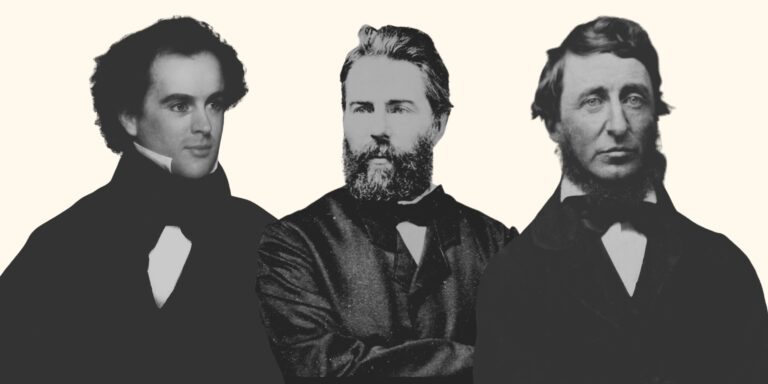
The authors of The Scarlet Letter, Moby-Dick, Walden, and Leaves of Grass at times embraced, at times resisted Emerson. What they could not do was ignore him. Hawthorne was drawn to Concord even as he satirized it. Melville, reading Emerson’s two essay collections in the 1860s, scribbled a mix of agreement and strong disagreement in their margins.

In the 1850s, all four writers were in their thirties or forties. Each developed a voice, a framing, and a structure that were unique in Anglo-American literature. To be sure, a full accounting of the American Renaissance would include Edgar Allan Poe and Emily Dickinson, two writers who were more distant from Emerson and his circle (though Dickinson did admire his poetry). Poe’s works mostly dated from the 1840s, and Dickinson’s then-unpublished poems are mostly from the 1860s. Yet it is the four great books of the 1850s that are an outgrowth from and a response to Emerson, with revealing backstories behind their creation.

The Scarlet Letter

Nathaniel Hawthorne, on the evidence of his novels, found it difficult to follow Poe’s advice to “cut Mr. Alcott [and] hang (if possible) the editor of The Dial.” He wrote three novels in quick succession in the early 1850s, two of which feature contemporary reformers. The Scarlet Letter is the only one of Hawthorne’s mature novels that avoids any hint of the Newness.

Hawthorne was the opposite of Emerson. His tragic worldview clashed with Emerson’s idealism, which may explain why he so often wrote stories that undercut the best of reformers’ intentions with the flaws of their hearts. In The Scarlet Letter, he turned to the seventeenth-century setting of Puritan Boston. Rather than the strange “moral shapes of men” that he satirized elsewhere, the characters in his great-est book face a rigid and restrictive social order. Their flawed hearts thereby become far more dangerous.

When eighteen-year-old Louisa May Alcott noted that she was reading Hawthorne, she commented that “‘The Scarlet Letter’ is my favorite . . . I fancy ‘lurid’ things, if true and strong also.” Poe’s advice may have been wise: by getting Emerson out of his head, Hawthorne freed himself to write his most enduring work.

The story of how he came to write it is its own tale of desperation. His first two story collections had met positive reviews but only modest sales. In the summer of 1849, his situation worsened: He was fired from his Salem Customs House position. The Democratic Party, led by Lewis Cass (father of the chargé d’affaires to Rome), had been defeated by Zachary Taylor and the Whigs. Patronage positions turned over at many levels, including in Salem.

He learned of his termination in June. (“I am turned out of office! There is no use in lamentation.”) Sophia had saved up some money but not enough to last long. One friend organized contributions from Hawthorne’s admirers and sent a substantial check. Hawthorne wrote in thanks, saying that the letter and check “drew—what my troubles never have—the water to my eyes . . . It is sweet to be remembered and cared for by one’s friends.  And it is bitter, nevertheless, to need their support. I am ashamed of it, and I ought to be.”

In Hawthorne’s hour of need, publisher James T. Fields came calling. He was thirty-two years old, the junior partner of William Davis Ticknor who had helped Ticknor and Fields become one of the country’s most prestigious imprints. When he heard that Hawthorne had lost his job, he first tried to convince politician friends to find a new position for him, with no success. He recalled one who dismissed the very idea of having a literary man in public office: “Hawthorne is one of them ’ere visionists, and we don’t want no such a man as him around.”

Next, Fields came to Salem. Fields told Hawthorne he would print two thousand copies “of anything you write.” Hawthorne protested that he had nothing to offer. Spying a bureau with drawers that might con-tain manuscripts, Fields asked again. Finally, he began to leave. “I was hurrying down the stairs when he called after me from the chamber, asking me to stop a moment. Then quickly stepping into the entry with a roll of manuscript in his hands, he said: ‘How in Heaven’s name did you know this thing was there? It is either very good or very bad,—I don’t know which.’ On my way up to Boston I read the germ of ‘The Scarlet Letter’; before I slept that night I wrote him a note all aglow with admiration of the marvelous story he had put into my hands.”

Nonetheless, the novel’s success did not make Hawthorne a rich man.

Hawthorne had intended to use a shorter version of the novel as part of a collection of “Old-Time Legends.” Fields convinced him to expand it and publish it separately. Hawthorne worried that it would be too “somber.” To help lighten it he wrote a lengthy introduction, a framing device of pseudo-nonfiction set in the Custom House. It was a chance for him to satirize his former colleagues ruthlessly. Fields liked the addition, though Hawthorne wondered whether readers would care about his own experiences.

When he finished the novel in February, he reported to a friend that Fields “speaks of it in tremendous terms of approbation; so does Mrs. Hawthorne, to whom I read the conclusion last night. It broke her heart and sent her to bed with a grievous headache—which I look upon as a triumphant success!”

The Scarlet Letter was published in March 1850. Its first printing of 2,500 copies sold out quickly. Another 2,500 were printed one month later, and yet another 1,000 five months after that. At last Hawthorne had a commercial success.

Reviews were mostly very favorable. The Massachusetts Quarterly Review gushed that “in no work has [Hawthorne] presented so clear and perfect an image of himself, as a speculative philosopher, an ethi-cal thinker, a living man.” Some religiously minded reviewers decried the “nauseous” and “debauched” themes and characters. But overall, and over time, The Scarlet Letter was accepted as “the most decisive production of the author and one of the remarkable stories of the age.” Evert Augustus Duyckinck hailed it as an “entire, perfect creation” and gushed, “Our literature has given to the world no truer product of the American soil, though of a peculiar culture, than Nathaniel Haw-thorne.”

Nonetheless, the novel’s success did not make Hawthorne a rich man. A few months after The Scarlet Letter reached stores, a senti-mental novel by Susan Warner, The Wide, Wide World, became one of America’s first true bestsellers. It went through fourteen printings in two years. Louisa’s alter ego in Little Women, Jo March, spends an afternoon “reading and crying over” it. It was just one of many sentimental novels that would turn at least a few American authors into wealthy women. Hawthorne complained bitterly. “America is now wholly given over to a damned mob of scribbling women, and I should have no chance of success while the public taste is occupied with their trash—and should be ashamed of myself if I did succeed.”

He still needed the help of his friends. When one couple offered the Hawthornes use of a cottage on the edge of their property, Tanglewood, in Lenox, Massachusetts, they accepted and moved in March 1850. There Hawthorne would write another success, The House of the Seven Gables.

Gables came out in 1851. His Brook Farm–inspired novel, The Blithedale Romance, followed in 1852, his third novel in three years, leading some biographers to note that his loss of the Customs House job was a great gift to American literature. By 1852, the Hawthornes were back in Concord. They purchased the Alcotts’ Hillside, renaming it the Wayside.

Returning, physically, to the Emerson circle may have been a bad move creatively. Hawthorne would continue to write fiction, including The Marble Faun, which he published in 1860, but just as with The Blithedale Romance, its contemporary setting and characters were not successful.

Melville was a pessimist, and a tragedian.

Emerson never much liked Hawthorne’s fiction. Julian Hawthorne would claim that Emerson “was never able to complete the perusal of any of Hawthorne’s stories.” In one journal entry, Emerson wrote, “Nathaniel Hawthorne’s reputation as a writer is a very pleasing fact, because his writing is not good for anything, and this is a tribute to the man.”

Moby-Dick

Another reason to be grateful for Hawthorne’s job loss and move to Lenox in 1850 is that he soon met a near neighbor: Herman Melville.

Melville was fifteen years younger than Hawthorne. Yet at the age of thirty-one, after spending five years at sea in his early twenties, he had already published five books. His first, Typee: A Peep at Polynesian Life (1846), was supposedly a narrative of four months he spent in the Marquesas Islands in the South Pacific when he jumped ship from a whaling vessel. In truth he had only spent one month there, and he borrowed or plagiarized a good deal of material from other accounts. It was a bestseller in both America and England. Hawthorne reviewed it for the Salem Advertiser, praising its light, vigorous style and its “effective” portrait of island life.

While some critics attacked the book for its apparent embrace of voluptuousness, Hawthorne disagreed: Melville “has that freedom of view—it would be too harsh to call it laxity of principle—which renders him tolerant of codes of morals that may be little in accordance with our own; a spirit proper enough to a young and adventurous sailor.”

It was an auspicious career start for Melville. Yet during his lifetime none of his other eight novels would sell as well. He followed Typee with a sequel, Omoo, loosely based on a brief stay in Tahiti as well as his voyages on a whaling ship; but even more than with Typee, he “altered facts and dates, elaborated events, assimilated foreign materials, invented episodes, and dramatized the printed experiences of others as his own.”

Reviews were again positive, though some critics took issue with the book’s truthfulness, not to mention its Rabelaisian celebration of alcohol. Horace Greeley hailed Melville as “a born genius, with few superiors either as a narrator, a describer, or a humorist.” But he argued that both Typee and Omoo were immoral books. “Not that you can put your finger on a passage positively offensive; but the tone is bad. . . . A penchant for bad liquors is everywhere boldly proclaimed, while a hankering after loose company, not always of the masculine order, is but thinly disguised.”

In 1849 Melville switched to full-on fiction with a romance about an American sailor who abandons his whaling ship to explore the South Pacific. He began Mardi: and a Voyage Thither with an ironic preface:

Not long ago, having published two narratives of voyages in the Pacific, which, in many quarters, were received with incredulity, the thought occurred to me, of indeed writing a romance of Polynesian adventure, and publishing it as such; to see whether the fiction might not, possibly, be received for a verity: in some degree the reverse of my previous experience.

Mardi is a rambling story, and reviewers were not kind. George Ripley, who had taken Margaret Fuller’s position at the New York Tribune, wrote that the “story has no movement, no proportions, no ulti-mate end; and unless it is a huge allegory—bits of which peep out here and there—winding its unwieldy length along, like some monster of the deep, no significance or point.” It did not sell well.

Melville wrote two more sailing novels that blended fiction and nonfiction based on his experiences on a merchant vessel (Redburn) and a man-of-war (White-Jacket), neither of which succeeded. White-Jacket did cause a stir with its discussion of the arbitrary and cruel use of flogging in the US Navy. In four short chapters (out of ninety-three), the book describes an incident of flogging and argues that the captain’s unchallenged authority to order it whenever he wishes, but never be subject to it, is antidemocratic and unconstitutional: “You see a human being, stripped like a slave, scourged worse than a hound. And for what? For things not essentially criminal, but only made so by arbitrary laws.” Melville’s publisher, Harper & Brothers, sent copies to every member of Congress. In September 1850, Congress banned flogging on all US ships.

For his part, Melville published an anonymous two-part rave review of Mosses from an Old Manse in Duyckinck’s The Literary World.

Melville was a pessimist, and a tragedian. In Mardi, a character states that “evil is the chronic malady of the universe.” The author of that line was a natural ally of Nathaniel Hawthorne. Their personalities, like their writing styles, were distinct: Melville had bouts of manic energy during which he could not stop talking. Hawthorne was often silent. Yet they connected on a deep level.

When they first met, on a hiking expedition up Monument Mountain in August 1850, they were with James T. Fields, Oliver Wendell Holmes, publisher Evert Duyckinck, and a few others. As Fields recalled, “We scrambled to the top with great spirit, and when we arrived, Melville, I remember, bestrode a peaked rock, which ran out like a bowsprit, and pulled and hauled imaginary ropes for our deectation.”

After lunching among the rocks and making toasts with “a considerable quantity of Heidsieck” champagne, they took an afternoon hike through the Ice Glen, a ravine with deep ice-filled crevices. “Hawthorne was among the most enterprising of the merry-makers; and being in the dark much of the time, he ventured to call out lustily and pretend that certain destruction was inevitable to all of us.” Fields, overweight, wore shoes that slipped on the rocks. Holmes joked, “Ten per cent more to your authors on your next book, and you’ll have less fat to complain of.”

Three days later Melville visited Hawthorne for more champagne and a walk. Hawthorne invited him to return for a stay of a few days. To prepare, he devoured Melville’s three most recent books, writing to Duyckinck in late August, “I have read Melville’s works with a progressive appreciation of the author. No writer ever put the reality before his reader more unflinchingly than he does in ‘Redburn,’ and ‘White Jacket.’ ‘Mardi’ is a rich book, with depths here and there that compel a man to swim for his life. It is so good that one scarcely pardons the writer for not having brooded long over it, so as to make it a great deal better.”

For his part, Melville published an anonymous two-part rave review of Mosses from an Old Manse in Duyckinck’s The Literary World. He praised Hawthorne’s “humor so spiritually gentle, so high, so deep, and yet so richly relishable, that it were hardly inappropriate in an angel.” He noted “such a depth of tenderness, such a boundless sympathy with all forms of being, such an omnipresent love, that we must needs say that this Hawthorne is here almost alone in his generation,—at least, in the artistic manifestation of these things.” He even compared Hawthorne to Shakespeare: “Now I do not say that Nathaniel of Salem is greater than William of Avon, or as great. But the difference between the two men is by no means immeasurable.”

Melville’s four-day visit began on September 3. Sophia wrote to her mother that “he has very keen perceptive power, but what astonishes me is, that his eyes are not large & deep—He seems to see every thing very accurately, & how he can do so with his small eyes, I cannot tell. . . . When conversing, he is full of gesture & force, & loses himself in his subject—There is no grace nor polish.”

Melville would visit Lenox at least six more times. Hawthorne and his daughter would reciprocate by visiting him in March 1851. The following August, Hawthorne described a chance meeting as he sat reading:

While thus engaged, a cavalier on horseback came along the road, and saluted me in Spanish; to which I replied by touching my hat, and went on with the newspaper. But the cavalier renewing his salutation, I regarded him more attentively, and saw that it was Herman Melville! . . . We all went homeward together, talking as we went.  After supper, I put Julian to bed; and Melville and I had a talk about time and eternity, things of this world and of the next, and books, and publishers, and all possible and impossible matters, that lasted pretty deep into the night.

Throughout these months of visits Melville was struggling with the manuscript of Moby-Dick. He was also fretting about his income. He wrote to Hawthorne in June 1851 that “dollars damn me; and the malicious Devil is forever grinning in upon me, holding the door ajar.

Scholars have long wondered what influence, if any, Hawthorne may have had over Melville’s masterpiece.

. . . What I feel most moved to write, that is banned,—it will not pay. Yet, altogether, write the other way I cannot. So the product is a final hash, and all my books are botches.” Later that month he wrote again: “Shall I send you a fin of the Whale by way of a specimen mouthful? The tail is not yet cooked—though the hell-fire in which the whole book is broiled might not unreasonably have cooked it all ere this. This is the book’s motto (the secret one),—Ego non baptiso te in nomine [I baptize thee not in the name of the Father, but the Devil]—but make out the rest yourself.”

Moby-Dick came out in October 1851 in the United Kingdom, and one month later in the United States. Hawthorne wrote to Melville, praising the novel and apparently offering to review it (that letter has not survived). Melville’s response is famous:

Whence come you, Hawthorne? By what right do you drink from my flagon of life? And when I put it to my lips,—lo, they are yours and not mine. I feel that the Godhead is broken up like the bread at the Supper, and that we are the pieces. Hence this infinite fraternity of feeling. Now, sympathizing with the paper, my angel turns over an-other page. You did not care a penny for the book. But, now and then as you read, you understood the pervading thought that impelled the book—and that you praised. Was it not so? You were archangel enough to despise the imperfect body, and embrace the soul.

Scholars have long wondered what influence, if any, Hawthorne may have had over Melville’s masterpiece. We know that the manuscript-in-progress was sitting on a desk, in plain view, during one of Hawthorne’s visits. In Melville’s letters to Hawthorne, he speaks several times of wrestling with the book, and the younger man clearly admired the elder. Surely, he would have paid close attention to any advice Hawthorne might have offered. But on this tantalizing question the record is silent.

Given the gulf between the two men’s styles—Hawthorne’s famous novels are spare and brief, hewing closely to a single theme or question, Melville’s novels are extravagant, lengthy journeys through oceans and subcultures—it is hard to imagine what Hawthorne might have said to Melville that would have changed the course of Moby-Dick. Melville’s book includes lengthy digressions on the typology of whales; the symbolic significance of white; the existing paintings and etchings of whales; and the history of fatal encounters with whales, among other topics. (With tongue in cheek, he defends including that history in order to prove that Moby-Dick is no “monstrous fable, or still worse and more detestable, a hideous and intolerable allegory.”) Would Hawthorne have advised him to trim these side branches?

We will never know. Yet there is one intriguing sign built into Moby-Dick at its start—the book is dedicated to Hawthorne: “In token of my admiration for his genius.” Hawthorne discovered this compliment at a private dinner with Melville at a hotel in Lenox. The two men dined at a table alone, lingering long after all other diners had dispersed. Melville handed Hawthorne an inscribed copy. It moved him profoundly.

The two men’s masterworks have a commonality: They are both tragedies built around the power of a symbol—the scarlet A and the great white whale—that marry allegory to drama. Lewis Mumford, writing about the American Renaissance in The Golden Day, goes so far as to say that “at heart, the American novelists were all transcendental.

The scene was a symbol: they scarcely had the patience to describe it: they were interested in it only because it pointed to something more important.” Melville admired Emerson as “more than a brilliant fellow” but insisted that he did not “oscillate in Emerson’s rainbow.” Neither he nor Hawthorne subscribed to Transcendentalism as a movement. Still, Mumford rightly notes that their famous books are churning with deep meaning beneath their surface symbols. Their characters are trapped—Hawthorne’s by the strict codes of Calvinism, Melville’s by Captain Ahab’s tyranny—but they long for liberation. These are tragic novels about trapped individuals, craving freedom.

Melville was discouraged. He would continue to write in different genres, including poetry and short stories, but he would never enjoy commercial success.

Hawthorne admired his friend’s new novel. In December, from his temporary home in West Newton, Massachusetts, he wrote to Duyckinck, “What a book Melville has written! It gives me an idea of much greater power than his preceding ones.”

The initial reviewers did not agree. The Athenaeum (London) called it “an ill-compounded mixture of romance and matter-of-fact.” That review was widely circulated and quoted in America. Duyckinck himself reviewed the novel in The Literary World in November. Even he offered a very mixed assessment of his friend’s “bulky and multifarious volume,” calling it an “intellectual chowder of romance, philosophy, natural history, fine writing, good feeling, bad sayings,” and noting that the characters and setting are “idealized throughout.”

There were some positive notices, including by Horace Greeley in the New York Tribune: “We think it the best production which has yet come from that seething brain, and in spite of its lawless flights, which put all regular criticism at defiance, it gives us a higher opinion of the author’s originality and power than even the favorite and fragrant first-fruits of his genius, the never-to-be-forgotten Typee.”

Melville was discouraged. He would continue to write in different genres, including poetry and short stories (most famously, “Bartleby the Scrivener”), but he would never enjoy commercial success. Moby-Dick initially sold fewer than four thousand copies, of which six hundred were in the United Kingdom. It was out of print by the time Melville died, in 1891.

One British review of Moby-Dick, reprinted in Harper’s New Monthly Magazine, captured the ultimate significance of the novel:

Want of originality has long been the just and standing reproach to American literature; the best of its writers were but second-hand Englishmen. Of late some have given evidence of originality; not absolute originality, but such genuine outcoming of the American intellect as can be safely called national. Edgar Poe, Nathaniel Hawthorne, Herman Melville are assuredly no British off-shoots; nor is Emerson, the German American that he is! . . . What romance writer can be named with HAWTHORNE? Who knows the horrors of the seas like HERMAN MELVILLE?

The reviewer was right.

__________________________________

From The Emerson Circle: The Concord Radicals Who Reinvented the World by Bruce Nichols. Copyright © 2026. Reprinted by permission of Avid Reader Press, an Imprint of Simon & Schuster, Inc.


https://lithub.com/?p=270490
Extensions
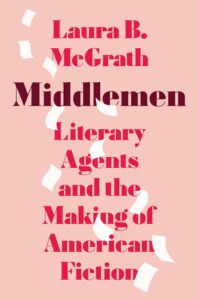
Meet the Literary Agent Who Invented the Book Auction
Book NewsFeaturesHistoryNews and Culturebook auctionsLaura B. McGrathliterary agentsliterary historyMiddlemen: Literary Agents and the Making of American FictionPrinceton University Presspublishing auctionsScott Meredith
In 1952, literary agent Scott Meredith did the unthinkable: he sent the same manuscript to ten publishers at the same time, and single-handedly invented the book auction. At least, that’s how Meredith told it, and how his obituaries eventually reported
Show full content

In 1952, literary agent Scott Meredith did the unthinkable: he sent the same manuscript to ten publishers at the same time, and single-handedly invented the book auction. At least, that’s how Meredith told it, and how his obituaries eventually reported it. The book industry thrives on lore, and Meredith was known to have a flexible relationship with the truth.

Not a week goes by without news of a high-profile auction breaking in Publishers Weekly. The auction has become a symbol a writer’s promise, of a publisher’s eagerness, of an agent’s ferocity. A buzzy auction sets the tone for a book, amping up expectations for success. It is publishing at its most capitalistic: high-risk, in hopes of high reward.

The problem with Meredith’s story of the first book auction is that it’s probably not true—at least, not strictly speaking. But a few facts emerge from the otherwise apocryphal account: the book auction wasn’t commonplace until the middle of the 1960s, and Meredith was an early adopter of the strategy. The auction initially caused quite a stir, upsetting tried and true gentlemanly practice. But it’s more likely that the auction took place in 1964, when Meredith sold a debut novel by a 24-year-old named Bruce Douglas Reeves— a novel for which Meredith and Reeves’s publisher, New American Library, clearly had high expectations that were ultimately unfulfilled.

In reality, Scott Meredith never read or responded to a single manuscript, despite his name on the letterhead and signature on the reader’s report.

Scott Meredith wanted to be a writer. Born Arthur Scott Feldman in 1923, he spent his boyhood trying his luck with the popular magazines that boomed in the 1930s. As he would tell it later, at the age of 12, he began submitting three short stories per week, and remained tenacious in the face of near-constant rejection. By the time he turned 20, he claimed, he had sold 400 stories “both to the pulps and to slick magazines like The Saturday Evening Post and McCall’s.” (I could find no record of these.) After serving in World War II, Meredith continued to write and publish his stories, but the life of a writer didn’t suit him. With his brother, Sidney, he founded the Scott Meredith Literary Agency in 1946.

From his earliest days as an agent, Meredith proudly flouted industry convention while inflating his own reputation and padding his bank account. To build his client list, Meredith sent employees to sneak into publishing houses, where they would offer a bribe of 10 cents to the mailroom workers for each return address they clipped from envelopes in the overflowing slush piles. To each of these aspiring writers, Meredith sent a brochure advertising his services. These aspiring writers could submit their manuscript to the Scott Meredith Literary Agency—for a fee. For the low price of $10-a-novel in 1946, Scott Meredith would reply with his personalized assessment of the work’s promise. Some lucky writers would be invited to continue to correspond with Meredith to further develop their manuscript, paying for each revision in the hopes of signing with the great agent eventually.

In reality, Scott Meredith never read or responded to a single manuscript, despite his name on the letterhead and signature on the reader’s report. Instead, he employed an army of “fee men”—readers straight out of college, most of whom had no writing or publishing experience, to read and respond, posing as the agent himself. At the agency’s height, 8 fee men were employed for 35 manuscripts a week. Meredith amassed for himself the largest slush pile in the business, and a small fortune. Though it raked in profit, the reading fee scheme was never very successful at surfacing promising clients. He received— and rejected— manuscripts from Stephen King and Raymond Carver.

Shady dealings notwithstanding, Meredith eventually became a significant agent within the science fiction community, representing genre-defining figures like Arthur C. Clarke (who wrote the introduction to Meredith’s book, Writing to Sell), Philip K. Dick, J.G. Ballard, and (more science, less fiction) Carl Sagan. His most significant client by any measure was Norman Mailer. Despite his notable clients, Meredith was never able to escape the stench of his pay-per-critique scheme: the practice of charging a reader’s fee was as unsavory then as it is now, separating the legitimate agents from the con men. Meredith was both.

In 1964, an opportunity presented itself in the SMLA slush pile: a short story by Bruce Douglas Reeves, a 24-year-old, San Francisco native. The fee men were enthusiastic about this first novel from an unknown writer, titled “Where’s the Action?” A young man in the thrall of Kerouac and the Beats, Reeves produced a novel about restless young San Franciscans, grey flannel suited office workers by day and drug-addled Bohemians by night, jumping in and out of beds and bathhouses. (There is also an amateur mime troupe, naturally.) Meredith sensed an opportunity: he could sell this book. This suited Reeves, who, like many of his characters, was broke.

Meredith’s sense of the shifting balance of power in publishing had been keen, and accurate.

In the early 1960s, publishing played by the “old, hard-and-fast” rule that under no circumstances may a manuscript be submitted to more than one publisher at a time.” According to custom, Meredith should make a ranked-choice list of editors and send the manuscript to one at a time, with a courier and his compliments. The publisher would read, and either offer a standard advance or return the manuscript with their regrets. And down the list they would go, “in leisurely sequence,” a lengthy and demoralizing process that often primed the writer to accept a low-ball offer. But Reeves was broke and needed money fast.

Meredith decided to dictate the terms of the sale. After all, he controlled the supply chain. Without the quality writers he was vetting, training, and pitching, publishers would have nothing to sell. Instead of making the rounds, Meredith had multiple copies printed and sent them out to several publishers at once. This, in itself, was a show of strength— to type 10 to 20 copies of a manuscript and to hire 10 to 20 couriers to hand deliver it took money, but thanks to his slush pile fund, his agency had cash to spare. Sure, it would be seen as “unethical, or at the very least ungentlemanly,” but Meredith had never been one to stand on ceremony.

Nineteen manuscripts were sent out, and soon, the offers began to come in. In the end, they received fourteen offers for “Where’s the Action?” and accepted an offer of $13,500 from New American Library. Within days, the film rights were optioned by Warner’s, for over $100,000, with Natalie Wood attached. (It was unusual for books to be optioned before publication in the early 1960s.) Jack Warner didn’t much like the title, and requested it be changed to The Night Action; Reeves obliged.

Meredith’s sense of the shifting balance of power in publishing had been keen, and accurate. As far-flung international media corporations acquired once-independent publishing houses in the 1960s, agents began to occupy a newly significant position in the field. With specialized knowledge and a keen eye for talent, the agent could both advocate on behalf of authors and scout talent for the ever-busier editor, becoming a useful gatekeeper for author and editor alike. Ever the scammer, Meredith seemed to sense this power shift, this weakness in the system. Like his fee scheme, the auction was another attempt to exploit the agent’s centrality for personal gain. But unlike the fee scheme, the auction caught on.

What began as a matter of necessity, a desperate ploy to get a writer paid quickly, soon became Meredith’s standard operating procedure. “When Scott discovered it was a very good idea and nobody killed him for doing it, he made it part of the regular practice,” remembered his colleague Jack Scovill in Meredith’s obituary (which erroneously dated the auction to 1952). Soon, the practice of simultaneous submissions became widely accepted, and the book auction was born. The auction morphed into various forms, replete with its own strategies and schools of thought around best bids and round robins. The book auction, and the invisible rearrangements in power that made the auction possible, heralded a new era in American publishing.

Early literary agents had worked equally for publisher and author, but the auction marked a significant rearrangement of power. No longer a neutral intermediary with divided allegiances, agents established themselves as the author’s most significant and powerful advocate, over and against publishers in a newly adversarial relationship. And, with the auction, a new generation of agents had arrived, ushering in a new generation of writers—Saul Bellow, Joseph Heller, Leroi Jones (as Amiri Baraka was then called), Norman Mailer, Flannery O’Connor, Philip Roth, J.D. Salinger, Thomas Pynchon— and commissioning a new chapter in the American literary canon.

Tap into desire—or, better yet, anxiety—and rationality goes out the window.

“It takes a strong book, of course, to turn old methods topsy-turvy,” wrote Paul Nathan of the auction in Publishers Weekly. Does it? Did the auction arise out of the dogged pursuit of an undeniable, generation-defining literary talent? Or was it simply another scam in a long-line of unethical dealings?

The Night Action may have generated a great deal of excitement among the Meredith fee men, and may have produced a good deal of competition among publishers, but the book itself was poorly reviewed when it was released in 1966. “Very Little Action Found in Night,” proclaimed the Los Angeles Times, describing Reeves’ attempt at hard-scrabble Beat living as “moody, adolescent and sentimental.” Kirkus described the novel as filled with “caricatures out here on the [dance] floor and after a while all those swirling lights and that music can give you a headache.” Publishers Weekly called it “garish, awkwardly written.” The Night Action was printed in hardcover in the US 1966, and then again as a paperback a year later, but has since fallen out of print, and out of memory. The much-vaunted film was never made.

We can’t know what motivated Meredith, or whether he was actually the first to try his luck with simultaneous submissions. But Meredith had undoubtedly learned something else from running petty scams: desire trumps reason and fuels competition. Tap into desire—or, better yet, anxiety—and rationality goes out the window. Publishers will keep bidding, for the sole purpose of staying in the game. For showing that they are the sort of player capable of staying in the game. To win the game. Meredith could play them against one another for the benefit of his client.

While interviewing literary agents for my book, Middlemen: Literary Agents and the Making of American Fiction, I heard a curious phrase repeated: Auction Fever. The term comes from Behavioral Psychology and Economics, attributed to Professor Gillian Ku. Auction Fever is “the emotionally charged and frantic behavior of auction participants,” in which the auction—the act of bidding and competing over a book—produces an irresistible momentum. The auction takes on a life of its own, as bidders lose the capacity to make rational decisions in their desire to win. This is why, Professor Gu and her colleagues argue, Auction Fever often results in over-bidding. When Auction Fever takes hold, the endgame shifts: what began as a competition over a book instead becomes a contest between rivals, a show of respective might. The book is no longer the point; winning is the point.

In publishing, auctions are reported on breathlessly; they are the subject of gossip and speculation and sour grapes. In part, this is because an auction has been taken to symbolize a publisher’s commitment to a writer and a book. If the auction was so hotly competitive, the thinking goes, the book must be outrageously good or the writer enormously promising. So promising, in fact, that several publishers competed over them. Surely, the film options and large print runs and book clubs and publicity campaigns will follow! Nothing primes expectations in the industry like a buzzy auction.

But spectators, too, have fallen prey to Auction Fever, directing our attention to the process rather than the book. Auction Fever tells us that the competition is less about the writer or the book, than it is about a publisher’s reputation—about jockeying for power and position and prestige. The auction isn’t a competition over a book; it’s a competition between publishers. Surely, this is what Meredith sensed when he demanded that publishers compete for the privilege of publishing his author. And as with The Night Action, so too with all auctions that have taken place in its legacy: the book’s quality and the author’s potential are immaterial.

Whatever the publisher’s intentions, auction fever can lead to what economists call the “winner’s curse.” Having gotten carried away by the auction’s momentum, a bidder realizes that they have overpaid and experiences feelings of intense bitterness and regret. The sweet smell of success turns sour. Though the regret that accompanies the winner’s curse should be directed at a process that got carried away, many a writer has found herself the object of a publisher’s disappointment when she inevitably fails to earn out her auction-inflated advance, and suffered the consequences.

Bruce Douglas Reeves did not become the “important new voice in American fiction” that Meredith sold to New American Library, as promised on the book’s dust jacket. For years, Meredith proudly proclaimed himself the inventor the book auction in his agency’s mailers, and his obituaries repeated this “fact” upon his death, but no one— not even Meredith himself, while he was living— could remember the book that was sold. It’s fitting, I think, that the middling book at the center of the (perhaps) first book auction would fall into obscurity. The Night Action was never the point. No book ever is.

__________________________________

From Middlemen: Literary Agents and the Making of American Fiction. Used with the permission of the publisher, Princeton University Press. Copyright © 2026 by Laura B. McGrath

https://lithub.com/?p=270553
Extensions
Ten Memoirs That Explore the Nuances of Family Estrangement
Craft and CriticismFeaturesLiterary CriticismMemoirReading ListsAlan CummingAnother Bullshit Night in Suck CityCatapultDaria BurkeEamon DolanEstrangedestrangementfamilyHarriet BrownI Would Meet You AnywhereJenny BartoyJessica Berger GrossMattilda Bernstein SycamoreNick FlynnNo Contact: Writers on Estrangementnoam keimNot My Father’s SonOf My Own Makingreading listsShadow DaughterStephanie FooSusan Kiyo ItoThe Land Is HolyThe Power of PartingTouching the ArtWhat My Bones Know
Family estrangement is a touchy topic, currently prominent in the zeitgeist. Celebrity family rifts are splattered across headlines daily; op-eds have labeled estrangement an “epidemic” and a “crisis”; and even Oprah recently explored the “rising trend” of going no contact
Show full content

Family estrangement is a touchy topic, currently prominent in the zeitgeist. Celebrity family rifts are splattered across headlines daily; op-eds have labeled estrangement an “epidemic” and a “crisis”; and even Oprah recently explored the “rising trend” of going no contact on her podcast. The subject is rampant on social media too, pitting the so-called “Doormat Moms” against the proud #nocontact crowd, all mediated by a throng of Instagram-savvy therapists and influencers.

Estrangement affects an enormous segment of the population. According to recent studies and surveys, between a quarter to a half of the population is estranged from at least one family member (it’s unclear whether these numbers are rising or simply have now become acknowledged). And for many estranged individuals, like me, our experience is far more nuanced than the current discourse might suggest. The button-pushing takes, though they may garner clicks, often misconstrue a deeply personal and painful phenomenon, one that is still widely taboo.

Social media has done wonders to expand the conversation around estrangement and provide analysis, connection, and validation. On the other hand, mainstream media coverage and Hollywood narratives still frequently dismiss or simplify family rupture, underlining traditional beliefs such as “Blood is thicker than water” to promote shame and reconciliation. But estrangement often is a good choice—or the only choice. Evidence shows that cutting or losing contact with close relatives typically stems from deep, long-standing issues. Estrangement is born of abuse, addiction, mental illness, divergent values, abandonment, and myriad other reasons, sometimes in combination. We may grieve our living relatives, but cutting ties can be a positive shift, offering relief from discordant or even dangerous family dynamics. Like much of our human experiment, the reality of estrangement is messy: part sad, part glad, not always within our control.

I’ve hungered for depth in representations of estrangement, and I’ve found it in literature. Classics jump to mind, such as Educated by Tara Westover, The Glass Castle by Jeannette Walls, and With or Without You by Domenica Ruta, but a significant amount of memoirs join that canon. Each explores the realities of estrangement with the vulnerability and nuance it deserves, providing a powerful counterpoint to pervasive and reductive sociocultural talking points. The titles below are just a few great ones.

*

Harriet Brown, Shadow Daughter

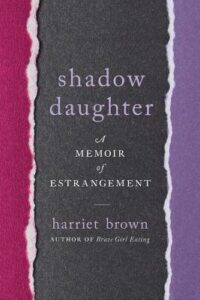
This book holds a special place in my heart because it changed my life. Never had I read something so validating about cutting ties with a problematic parent—I felt seen. Writing just before estrangement hit the zeitgeist, Brown tackles head-on the stigma and secrecy that have long surrounded the topic. Shadow Daughter opens on the day of Brown’s mother’s funeral, when the author is in Hawaii hiking with her family, having resolved not to attend. Brown frames the memoir with an investigation of her complicated on-and-off relationship with her narcissist mother until their eventual rupture, and weaves in dozens of interviews and research. The book is lyrically written and highly informative, diving deep into the common threads and tropes of estrangement in search of clarity. Brown writes, “We don’t talk about the fact that for some people, staying connected with family is far more destructive than stepping away. That sometimes estrangement is the healthiest option.” This quote alone is a balm for the no-contact crowd.

Stephanie Foo, What My Bones Know

In this best-selling memoir, Foo investigates the repercussions of complex PTSD (C-PTSD) caused by her abusive parents and her subsequent estrangement from each of them in turn. The book describes both her research into C-PTSD and her extensive efforts to heal. This is a rich, complex memoir in which Foo explores her familial roots, the impact of intergenerational trauma in Asian-American immigrant communities, the failures of American healthcare, and the patriarchal erasure of women’s suffering. While trauma is its focus, at heart the book wrestles with the concept of parent-less identity and the question of deserving to be loved. “Trauma isn’t just the sadness that comes from being beaten, or neglected, or insulted. That’s just one layer of it. Trauma also is mourning the childhood you could have had,” Foo writes. “Trauma is mourning the fact that, as an adult, you have to parent yourself.” At times heartwrenching, at others darkly funny, this story provides a vivid and layered glimpse into the perspective of a no-contact adult child.

Nick Flynn, Another Bullshit Night in Suck City

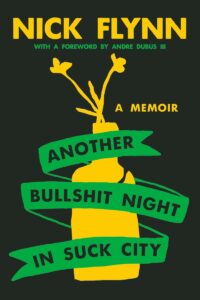
Flynn’s seminal memoir, which was adapted into a film starring Robert DeNiro, recently celebrated twenty years in print. When he was twenty-seven, Flynn worked at a Boston homeless shelter where one day he ran into his father—their third-ever encounter and the beginning of a tenuous reconnection. During his adolescence, Flynn had received letters from his father, a hard-drinking con artist who’d served time in federal prison, but he had remained a stranger. Their rekindled relationship illustrates the dissonance of familial expectations and intimacy with a parent one barely knows. Flynn is a poet by trade and this memoir is neither linear nor prescriptive. Instead, vignettes provide a meandering exploration, connecting past and present and sketching parallels between father and son. Absent parents, especially fathers, represent a significant cause of estrangement; mental illness is often a factor too. Touching on both, this memoir beautifully conveys the haunting presence of an estranged relative and the blurry line between longing and reluctance toward reconnection.

Mattilda Bernstein Sycamore, Touching the Art

Blending memoir, criticism, social history, and more, Touching the Art peels back the layers of legacy and trauma that form a person. Sycamore examines her complicated relationship with her late grandmother Gladys, a renowned Baltimore artist, and begins by literally touching her paintings and collages. Sycamore writes, “This book wouldn’t exist if Gladys were alive, because I wouldn’t have realized I missed her.” This desire to find connection in loss hints that death can often be more tangible to process than estrangement. Sycamore’s story is told in short bursts that immerse the reader into the present moment, creating a sense of urgency in the exploration of self, art, and family. Through exploring her grandmother’s art, the author navigates degrees of estrangement from family members: Gladys herself, whose reluctance toward Sycamore’s queerness engendered a growing distance; the author’s father whose sexual abuse precipitated a rupture of contact; and Sycamore’s mother and other relatives. Degrees of estrangement are common in dysfunctional families, and this book depicts their slippery, progressive nature. Touching the Art also delves into erasure and gaslighting, illustrating the all-too-common silencing that occurs when a family member speaks up about violence or abuse.

Susan Kiyo Ito, I Would Meet You Anywhere

Ito’s memoir is first a story of adoption, but adoption is by nature an estrangement, even if we rarely lump the experiences together. This notion is complicated by Ito’s turbulent relationship with her birth mother. Determined to get answers about her identity and Japanese-American heritage, and despite a closed adoption, in her twenties Ito finds and meets her biological mother, Yumi. There begins a decades-long rollercoaster of intermittent connection with the deeply reluctant but charmed Yumi, with whom Ito forges a series of tender alliances only to see them crumble when she crosses hazy boundaries. Yumi wants to keep Ito’s existence a secret, she refuses to introduce her to her other children or reveal her father’s identity, but Ito— gently, doggedly—insists, in a veritable tug of war for recognition. Ito’s “constant flux of connection, disconnection, rejection, denial, with Yumi” is a form of estrangement we rarely discuss, an existential yoyo that estranges one from their own self in the despair to be seen and known. This heartfelt, heartbreaking memoir offers an unusual angle into the experience of estrangement: when a family member we desperately love keeps us at arms’ length.

Eamon Dolan, The Power of Parting

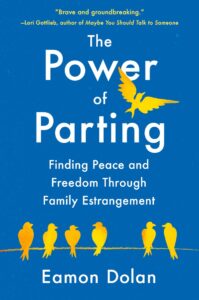
A hybrid work of nonfiction, part memoir, part self-help, The Power of Parting provides a how-to guide for disentangling oneself from toxic family relationships. Dolan dissects his estrangement from his mother after forty years of attempts at peace, and weaves in research and reportage about child abuse and trauma. Growing up in an Irish immigrant family, Dolan was frequently beaten by his mother who consistently mocked and berated him. As an adult, after setting repeated boundaries, he finally decided to save himself from her tyranny and cut contact. By vulnerably sharing his journey of estrangement and analyzing its errors and successes, Dolan crafts a helpful roadmap, rife with both personal and expert advice. Broken down into digestible sections with titles such as “The Myth of Duty” and “In Praise of the Clean Break,” this book gives the reader permission to liberate themselves from harmful relatives and move on with hope.

Daria Burke, Of My Own Making

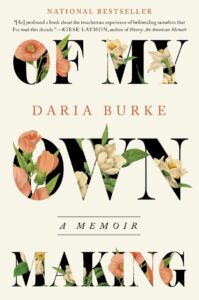
Burke grew up in poverty and neglect, then, estranged from her long-addicted mother and absent father, went on to become an award-winning fashion executive and keynote speaker. Of My Own Making opens when, after a decade of productive therapy, Burke discovers a photo of the car accident that took her beloved grandmother’s life, and thirty years of unprocessed grief and trauma come tumbling out. In this thoughtful memoir, Burke dives into the science of neuroplasticity, epigenetics, and early childhood brain development as she seeks to process her past and forge her destiny on her own terms. Throughout, she doesn’t waver on her estrangement, instead asserting firm boundaries that put the onus on her parents to address their problematic behavior, but the wounds of her upbringing haunt her. Feeling shame from craving love and connection, she writes, “This neglect wasn’t just the absence of care—it was the presence of a pervasive belief that I was unworthy of it.” Part rags-to-riches narrative, part healing strategy, this memoir is foremost a story of determination, at first a brave drive to overcome and succeed despite the odds, then later a methodological rewriting of her own brain, to reclaim the life she deserves. Burke’s memoir is a beautiful and hopeful reminder that while trauma changes the brain, so does healing.

Jessica Berger Gross, Estranged

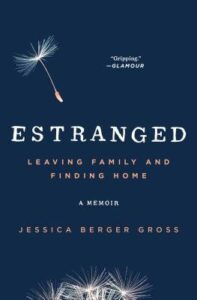
Gross’s memoir explores a nuance of estrangement that is rarely explored: cutting contact with family who to an outside eye may seem perfectly nice, but who to the narrator has become intolerable. Gross grew up in a typical middle-class Jewish household in Long Island, but her father often flew into violent rages which her mother enabled. Financially dependent on her parents throughout her youth and confused by waves of calm or small kindnesses, Gross wrestled with distancing herself for some time before cutting contact with her parents and brothers as an adult. Both unsentimental and lyrical, this memoir conveys the exhausting hypervigilance that comes with abuse—“But I couldn’t control my father’s moods, and I never knew when a good day would take a dangerous turn.”—and the relief found in cutting contact—“The estrangement was my way of saving myself.”

noam keim, The Land Is Holy

In this collection of personal essays, keim explores estrangement from family in parallel to estrangement from land and ancestry. The author was born a queer Arab Jew in a settler family in occupied Palestine then raised in eastern France, before escaping across Europe and to Asia, and finally finding chosen family in Philadelphia. Throughout this intimate and urgent book, keim aims to reconcile their sense of self with a dual estrangement from their mercurial, manipulative mother and from their countries of origin. “I am continuing a lineage of migration spanning generations; I am giving up my relationship to family to build myself anew,” keim writes. The Land is Holy is rooted in flora and fauna—birds give omens and metaphors, flowers bring healing— as it contends with a deep disconnect from place and geopolitics. Its fragmented essays investigate the inherited traumas of the diaspora and the impacts of colonialism and capitalism on land, peoples, and self. This lyrical memoir tugs at the importance of place and ancestry in our identity and what it means when cutting ties with family severs our connection to our roots—both figurative and literal.

Alan Cumming, Not My Father’s Son

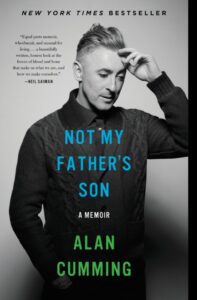
In this beautifully written celebrity memoir, the queer Scottish actor explores his genealogy and his traumatic youth at the hand of a violent father. Cumming was inspired to write this story when his cruel estranged father told him he was not his son, spurring a desire to get to the truth of his genetics and come to terms with his abusive upbringing. With warmth and wit, Cumming moves back and forth on the page, from his grim childhood in rural Scotland to his glamorous life on stage and film, as he navigates the complicated path to estrangement, fraught with loyalty and fear. This memoir poses perplexing questions about the meaning of family and belonging when shared genes don’t equate kinship, when blood doesn’t mean love. Cumming’s unraveling of the truth and his identity resonates, and his journey is a triumph of resilience and authenticity.

__________________________________

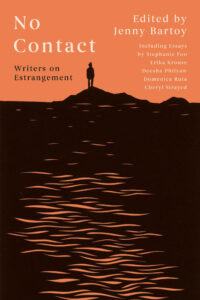
No Contact: Writers on Estrangement, edited by Jenny Bartoy, is available from Catapult.

https://lithub.com/?p=270350
Extensions
The Medicalization of Madness: How Schizophrenia Was Treated Throughout the Ages
FeaturesHealthHistoryNews and CultureJustin GarsonMacmillanMedicinemental healthpsychiatrypsychoanalysisschizophreniaSt. Martin's PressSt. Martin's Publishing GroupThe Madness Pill: One Doctor’s Quest to Understand Schizophrenia
For Sol, Freud’s best books, The Interpretation of Dreams and The Psychopathology of Everyday Life, read like fast-paced detective novels. Why did I forget the name of that town? Why did I just call my boss “Dad”? Why does my
Show full content

For Sol, Freud’s best books, The Interpretation of Dreams and The Psychopathology of Everyday Life, read like fast-paced detective novels. Why did I forget the name of that town? Why did I just call my boss “Dad”? Why does my patient arrange her pillows into a diamond shape every night? Sol delighted in Freud’s ability to find reason, logic, and necessity in what lesser minds dismissed as random and accidental. Dreams meant something. Forgetting meant something. A slip of the tongue meant something. Madness meant something. A young girl compulsively arranges and rearranges her pillows as a distorted symbolic fulfillment of her desire to sleep with her father. For Freud, the simplest word or gesture was a complex puzzle to be solved.

Thanks to Freud, Sol decided to become a psychiatrist. It was the ideal solution to the problem of wanting to be a doctor but hating science. As he later recalled, “I rationalized that if I could stomach the science courses of college and medical school, I might become a psychiatrist that, to my naïve way of thinking, wouldn’t differ too much from a life in philosophy.” He was particularly intrigued by schizophrenia—the pinnacle of madness and the most complex puzzle of all. In his vision of psychiatry, he saw himself sitting quietly with schizophrenic patients and contemplating their unmapped inner worlds. He wondered if someday he might solve the riddle that had confounded Western medicine for over two thousand years.

*

Schizophrenia has always been psychiatry’s white whale, its cure an elusive Holy Grail. Even the ancient Greeks saw madness as one of medicine’s chief puzzles. Of course, they didn’t have the term schizophrenia, which was coined in 1911 by the Swiss psychiatrist Eugen Bleuler to describe the “splitting” of thought, emotion, and behavior that causes psychological pandemonium. But as early as 400 BC, followers of the sage doctor Hippocrates on the windy Greek island of Kos described in detail how the mind could break from reality like a ship unmoored from its dock. They called this unfortunate condition mania.

The history of the treatment of madness, far from representing the slow but steady march of science, was until recently a series of false starts, futile debates about method, and pointless, even cruel, interventions.

Yet the history of the treatment of madness, far from representing the slow but steady march of science, was until recently a series of false starts, futile debates about method, and pointless, even cruel, interventions. For the Hippocratic doctors, mania was a disease like any other, caused by an imbalance in the four humors: black bile, yellow bile, blood, and phlegm. These imbalances blocked the flow of air to the brain. Hallucinations, delusions, and unprompted terrors were the symptoms of an air-deprived brain. Its treatment? Restoring the balance of the humors through profusely bleeding the patient or inducing vomiting or diarrhea with the poisonous plant hellebore.

The Hippocratic doctors vigorously denounced the religious healers of the day, such as the priests toiling in the temple of Asclepius. The priests argued that madness was a punishment from the gods and that healing came through repentance, along with sacrifices that helped maintain the temple’s operations. Yet neither approach had any factual basis, and any success either group had was likely due to the placebo effect—merely giving a patient special attention and the hope of a cure can be healing in itself.

Debates about the treatment of madness persisted through the centuries but led to little progress. In early seventeenth-century England, doctors and priests often clashed over sensational cases; for example, that of young Mary Glover. In 1602, she was afflicted by a slew of symptoms, such as convulsions, fits, and terrors. For the priests, this was a case of demonic possession due to witch-craft, and Mary’s crabby, aloof neighbor Elizabeth Jackson was the prime witch suspect. For physicians, among them outspoken Edward Jorden, these were symptoms of a medical condition known as hysteria, or “wandering womb.” During Elizabeth Jackson’s trial, Jorden argued that Mary’s afflictions had nothing to do with witchcraft.

Rather, as her dislodged womb drifted from place to place, it pressed into various organs—the heart, the lungs, the liver—and caused her strange symptoms. Medical treatments for wandering womb were geared toward coaxing the womb back to its proper place by wafting pleasant aromas near the pelvic region; physicians also prescribed sexual intercourse and bleeding the patient.

In the 1800s, psychiatry finally started to become a proper branch of medicine. (The term psychiaterie to denote the branch of medicine that treats diseases of the mind was first introduced in an 1808 book by the German physician Johann Christian Reil.) Thanks to the population explosion in asylums in the 1800s, doctors were finally able to observe vast numbers of mad patients, classify them, and document the results of interventions.

But doctors remained divided on the best way to cure patients. Advocates of the “moral treatment” of the insane, like Philippe Pinel in France and William Tuke in England, thought that patients would get better if you treated them as rational adults deserving of dignity and respect. They used drugs and restraints as sparingly as possible. In contrast, followers of the German physician Wilhelm Griesinger thought that madness would not be cured until the brain abnormalities that caused it were discovered. The moment a schizophrenic patient died, they quickly removed the patient’s brain, dissected it into thin slices, and analyzed them under micro-scopes for structural flaws.

The Germans also brought the art of classification to new heights of sophistication, culminating at the turn of the twentieth century with the pioneering work of Emil Kraepelin. Among other innovations, Kraepelin introduced the term dementia praecox for what we now call schizophrenia and manic-depressive illness for what we now call bipolar disorder. Today, doctors consider schizophrenia and bipolar disorder as the two chief categories of severe mental illness; the first ravages the mind, the second the emotions. Kraepelin also subdivided dementia praecox into three main types, types that are still recognized today.

The first type is replete with hallucinations and delusions—voices, visions, grandiose beliefs, paranoia. This is the kind my father had. The second happens when the cords of logic break entirely; these patients jump from idea to idea in a meaningless way, and their speech is nonsensical—what doctors call word salad. In the third, and most debilitating, patients withdraw from the world. They might sit for hours at a time maintaining bizarre postures or grimacing or repeating an action over and over, like lifting an arm and putting it down. By the 1950s, these three subtypes were known as paranoid, hebephrenic, and catatonic, respectively.

The Swiss Eugen Bleuler, a follower of Kraepelin, replaced the term dementia praecox, which implied hopeless deterioration, with the softer term schizophrenia. Though madness now had a proper name, its cause remained as elusive as ever. Examining brain slices under a microscope didn’t reveal what researchers now believe to be the subtle variations of brain function underlying schizophrenia. Consequently, at the time, the biological approach remained just one theory among others.

By 1955, when Sol graduated from high school, psychiatry had split almost perfectly into two camps. In one camp there were the psychoanalysts who followed Freud and believed in the power of talk therapy. In the other were the asylum doctors who experimented on patients’ bodies in hopes of finding a cure. At sixteen, Sol was firmly on the side of Freud.

While the psychoanalysts did occasionally use drugs, they saw them merely as tranquilizing agents that allowed talk therapy to proceed.

Psychoanalysis was launched in America in 1909 when the visiting Viennese doctor Sigmund Freud participated in a historic conference at Clark University alongside his younger protégé Carl Jung. (This was Freud’s only visit to America and one he later regretted.) Freud sought to trace the roots of all major mental disorders to unresolved childhood conflicts, particularly thwarted sexual longings—typically of the young boy toward his mother and the young girl toward her father. Primarily through his method of free association, with the patient supine on a couch and the doctor hidden from view, the doctor and patient would bring these unconscious conflicts to the surface and thereby break their power.

Thanks to World War I, during which psychoanalysis emerged as the foremost treatment for shell-shocked soldiers, this method came to dominate American psychiatry. A tenet of psychoanalysis was that you could find symbolic meaning and internal logic in the supposedly senseless ravings of madness. The American psychiatrist Harry Stack Sullivan, a follower of Freud who sought to cure schizophrenic patients with psychoanalysis, once described psychiatry’s whole job as being to “understand what the patient is trying to do.”

Then there were the asylum psychiatrists. In the first half of the twentieth century, a new spirit of unchecked experimentation swept through the wards of the major asylums of America and Europe as doctors devised increasingly bizarre and sometimes cruel interventions with almost no legal oversight. In the 1920s, doctors injected malaria-infected blood into schizophrenic patients in hopes of finding a cure. They also removed patients’ teeth, tonsils, and spleens. In the 1930s, doctors injected them with large doses of insulin to put them into hypoglycemic comas. They also shocked patients with high levels of electricity to stimulate epileptic fits. In the 1940s, lobotomies were all the rage. The scientific rationale behind these procedures was “at best shaky,” as Sol later put it.

Psychiatry had only recently discovered drugs. The antipsychotic drug chlorpromazine, derived from a clothing dye called methylene blue, was first tested on agitated and delusional patients in 1952. (In 1949, a French naval surgeon named Henri Laborit used promethazine, an earlier form of the drug, as a preanesthetic before surgery and noticed that it gave his patients a “beatific quietude” that he thought would help psychiatric patients.) Chlorpromazine seemed to calm patients down while still letting them think and talk. By 1954, hospitals throughout the world were using it, and by the late 1950s, numerous copycat drugs were in circulation.

Though the drugs dampened patients’ disturbing thoughts, they often caused movement problems. Some patients on chlorpromazine developed mild tremors or tics. Others would get restless and could sit for only short periods. Some developed uncontrollable repetitive movements that wouldn’t go away, even after they stopped the drugs. This is called tardive dyskinesia, a side effect that some doctors consider worse than schizophrenia itself. Still others slowed down or moved at a glacial gait, the so-called Haldol shuffle. Some developed masklike expressions that resembled those of patients suffering from Parkinson’s disease. A 1964 study showed that about a third of patients on antipsychotic drugs developed movement problems.

Doctors had no idea how or why the drugs worked. One doctor even celebrated them as a “chemical lobotomy.” At the time, they were just one more tool in the asylum psychiatrist’s toolkit. And while the psychoanalysts did occasionally use drugs, they saw them merely as tranquilizing agents that allowed talk therapy to proceed. The notion that these drugs reversed or neutralized an underlying disease process didn’t become widespread until the 1970s, and the fact that it did is due in part to Sol’s research.

__________________________________

From The Madness Pill: One Doctor’s Quest to Understand Schizophrenia by Justin Garson. Copyright © 2026. Available from St. Martin’s Press, an imprint of St. Martin’s Publishing Group, a division of Macmillan.

https://lithub.com/?p=270366
Extensions
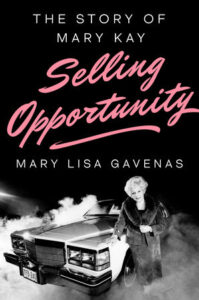
The Queen of Sales: How Mary Kay Ash Created a Beauty Empire
BiographyFeaturesNews and Culturebeauty industryentrepreneursMary KayMary Kay AshMary Lisa GavenasPenguin Publishing GroupPenguin Random HousesalesSelling Opportunity: The Story of Mary KayViking
Mary Kay was off to a bad start. She was averaging only $7 a party—and those parties were few and far between. It didn’t look like she would last any longer with Stanley Home Products than she had with the
Show full content

Mary Kay was off to a bad start.

She was averaging only $7 a party—and those parties were few and far between. It didn’t look like she would last any longer with Stanley Home Products than she had with the Child Psychology Bookshelf. Or with waterless aluminum cookware. Or with any of the other surefire moneymakers.

The company expected each party to bring in a $20 order. A $7 party meant that Mary Kay’s share of the take was only a couple of dollars. Before expenses. A $7 party was a disaster.

At that rate, each time she tried to sell Stanley, she would have gotten deeper in the hole. Whenever she sent in an order, Mary Kay was supposed to send Stanley another $2 toward the cost of her demonstration case, until the entire $30 was paid off. She had no hope of earning the $35 a week mentioned in that classified ad.

As it was, she wasn’t clearing enough to subsidize the dry mop and split duster she was obligated to give her hostess for throwing the party, finance the silver pastry server she was supposed to provide as an enticing door prize, add lagniappe like a Keytainer or percolator brush, and still make any profit for herself. She wouldn’t have been able to pay cash up front to get a 5 percent discount or place a bulk order to net more commission. She wouldn’t have qualified for the free merchandise earned by surpassing $50 a week in prepaid orders. She wouldn’t have made easy money off reorders either, since she wasn’t getting orders in the first place.

For as long as she lived, Mary Kay would tell and retell the story of her first Stanley rally until it became a kind of hero’s journey.

And because the size and snazziness of the Stanley hostess gift increased in proportion to the amount of product sold at the party, nobody was going out of her way to host a second party for Mrs. J. Ben Rogers. Nobody wanted to go through all the work of rounding up friends and feeding them refreshments if they weren’t going to get anything out of it. Stanley parties were turning out to be like everything else: Stage a few that weren’t successful, and people started to run the other way when they saw you coming.

This had been going on for a couple of weeks when Mary Kay heard about an upcoming Stanley rally and decided to go. Since there was no way her sales record justified the trip, this would be further proof that the little Wagner girl didn’t have any better business sense than her father. Selling Stanley was already like carrying water in a sieve.

Going to the rally would mean upping “L.O.,” salesmen’s slang for money laid out with little likelihood of return. She would have to shell out a $12 fee, travel all the way to Dallas, be away at least two nights, lose any chance of making money for three days, and talk Tillie Bass into minding the kids again. She would be forking over yet more money to Stanley. She would be headed there knowing she wasn’t going to win a thing. She would be a young woman traveling alone to a sales convention and staying with strangers in a hotel, which was no place for a respectable matron who might soon be asking for more typing work from Tabernacle Baptist.

Wild horses couldn’t have kept her away. Wasn’t getting out of a mental rut and having “new thoughts, new visions, new ambitions” the first point in Dale Carnegie’s How to Win Friends and Influence People? Wasn’t Carnegie always on the radio talking about how Aimee Semple McPherson had been a young and impoverished mother of two? Or how Greta Garbo had to leave her salaried job at a hat store to become Hollywood’s “Swedish Bird of Paradise”? The trip to Dallas was just the kind of journey that Carnegie’s titans of industry might take. True, she had demonstrated no aptitude for selling. But Stanley sales literature assured her that didn’t matter. Gumption was what counted.

Instead of staying in the Sixth Ward and reading about moth crystals in The Stanley Standard, she would meet dealers who proved that Stanley could change lives. She would be there when company founder Frank Stanley Beveridge, “the Great Encourager” himself, told everyone: “You can achieve anything you want to achieve. You can achieve any goal that you set for yourself. You just have to keep working toward it.”

As Mary Kay remembered it, she finagled the $12 from a friend after enduring a lecture that those dollars should be used for children’s shoes instead of attending a “wicked convention like men go to.” Then she emptied her Stanley demonstration case, a cheap metal box painted to look like a valise, packed her other dress, and added a pound of cheese and a box of crackers because she didn’t know if the attendance fee included meals. Arriving at the Adolphus, the city’s swankest hotel, she stiffed the bellboy who carried that case to her room. She didn’t have a cent to spare.

*

For as long as she lived, Mary Kay would tell and retell the story of her first Stanley rally until it became a kind of hero’s journey, a pilgrim’s progress that compelled her to leave home, spouse, and children behind as she set forth on her path to redemption.

“Those three days changed my life,” she would say later. By the time she said it, she would be staging Seminar, her own three‑day sales convention, in the same city and following the same format of song, sermon, and ritual that she first experienced in the 1940s.

Even then, the format was nothing new. The length and rhythm of the rally would have been familiar to her Alabama‑ and Tennessee‑born forebears, since camp meetings had been conducted the same way for over a century. For three days, souls would gather from far and wide. Some fleeing toil and craving transcendence, others reaffirming a faith long professed. Convened to hear testimonies of perfection, the congregation would sing. Then the speakers’ exhortations to excellence would build in emotional intensity until women began to weep and the meeting erupted in spontaneous pledges to set new personal bests. At that point, the next crusade would be announced. The difference was that, at Stanley, it was a sales crusade.

“Rally! Rally! Rally!” a Stanley executive explained. “Kept ’em excited. Workin’ toward the goal.”

Four decades after, she would recall more than “a thousand people at that convention,” a description that conveyed its importance to an overawed Mary Kay rather than its actual number of attendees. Even referring to it as a national convention was an exaggeration, since any Stanley get‑together in Dallas would have been a regional rally with, at most, a few hundred salespeople.

Calling it a national convention made for a better allegory, though. As did some other edits she made, creating a story about her first Stanley rally that combined characters and events until it was as long on moral, short on specifics, and easy to remember as a parable. In years to come, she would attend dozens that followed the same format.

With dealers assembled, proceedings started with a sing‑along. By company mandate, all weekly sales meetings kicked off with at least “two appropriate songs” and closed with at least one more. Many branches had a designated song leader, and some had groups practiced enough to pull off harmonies and rounds. At rallies, singing started from the stage, then the audience joined in. That got everybody over their shyness. “They’d get excited, you see. Take people out of themselves,” a Stanley executive explained. “When you sing with a group, you realize you’re not alone.” Set to tunes deeply familiar and conveniently out of copyright, Stanley sang the same old songs with new lyrics.

Everybody did, everywhere from school assemblies to union rallies. Fuller Brush had dozens of songs about selling—which Stanley was able to use by substituting “Stanley” for “Fuller.” To the tune of “I’ve Been Workin’ on the Railroad,” Mary Kay would belt, “I’ve been selling Stanley products, all the livelong day.” To “Jingle Bells,” dealers would sing, “S‑T‑A‑N‑L‑E‑Y, Stanley all the time.” A favorite like “Little Brown Jug” went:

Ha! Ha! Ha! You and me
We’re chuck full of pep and glee.
Ha! Ha! Ha! You and me
Boost the Stanley Com-pa-ny.

Stanley had a songbook full of these, some spirited, some spiritual. The tune of “Tramp, Tramp, Tramp, the Boys Are Marching” could go either way. One version had a chorus boosterish enough for a Rotary meeting:

Sell! Sell! Sell!
For Stanley products
Keep those orders rolling in—rolling in.
And we’ ll show the factory bunch that the sales force has the punch
And the Stanley crowd is bound again to win.

Another version used a chorus that could have come from a tent revival:

Yes, you bet that we can do it.
Cast all alibis away, away, away,
And the purpose firm and true we are out to win and do,
We can do it if we only follow thru.

After that rollicking sing‑along, the rally rotated through recognition of top salespeople, more singing, motivating talks from managers and Mr. Bev, more awards, more praise, and more singing.

Throughout those three days, selling was never addressed in the language of Mammon but in the language of “the Stanley Opportunity.” Mary Kay could have no doubt that selling was an ennobling endeavor, since God Himself seemed to be endorsing it. Assembled dealers were told that success was to be found only by placing trust in Him.

Mr. Bev was not a man given to distinctions between church and state. From the start of Stanley, he encouraged dealers to enlist church organizations in its “club plan,” a precursor to the party plan that allowed organizations hosting Stanley demonstrations to share the profits. As Stanley became successful, he made generous contributions to Catholics, Jews, and Protestants alike. In 1943, he introduced the official Stanley Prayer, his redaction of a prayer written by Mary Soulsby: “O Lord, grant that each one who has to do with me today may be the happier for it. Let it be given me each hour today what I shall say.  Help me to enter into the mind of everyone who talks with me.”

Even when the Lord’s name was left out, Stanley speeches sounded like sermons. Stanley dealers were not in cutthroat competition for filthy lucre. They were in competition with themselves, often in ways that made Stanley sound more like a center for personal growth than a Berkshires brush manufacturer. The company motto, “To better your best,” made individual success and company success one and the same. Never was Stanley presented as primarily profit seeking. Mr. Bev would say, “We seek to share through our goodness and helpfulness. Take that out of Stanley, and you’ll have just an ordinary, cold‑blooded business organization.” The Golden Rule was on‑the‑books company policy.

Throughout the rally, almost no mention was made of product: not by Mr. Bev and not by dazzlingly glib national sales manager Albert F. Reggie Regensburger. Mary Kay recalled that one executive disclosed the secrets of success as “Hitch your wagon to a star,” “Get a railroad track to run on,” and “Tell somebody what you are going to do.” Those could have come from Regensburger, but they sounded more like area manager C. B. Eckman, who was notorious for spouting slogans. Copying them carefully, Mary Kay took his catchphrases as commandments.

Here too was the ideal sales incentive. Because even more than she coveted that crown, Mary Kay coveted the bag that came with it.

An upcoming launch might be mentioned, but products were only means to an end. “They know how to sell window cleaner. You’re not going to go into that. That’s old hat,” said a Stanley veteran. “Instead you talk to them about their reason for being in sales. What is their goal? Not just in sales but in life.”

At Stanley, it was never too late. To try harder. To do better. To reinvent yourself and redeem your life. The English folk saying “Failure is the road to success” was a particular favorite. Mr. Bev took Robert Louis Stevenson’s flowery rephrasing, “Let him try as he please, he is still sure of failure; and it is a very old and a very true saying that failure is the only high road to success,” and rephrased it himself as the pithier “Try as hard as you will, you are bound to fail. But failure is the high road to success.” Then attributed it to Stevenson anyway.

There were slogans upon slogans: “Fortify in ’40,” “Get Things Done in ’41.” Linking one snappy saying to the next, Mr. Bev could go on for hours, a technique perfected with “talk cards”: a fistful of file cards with scribbled cues to proverbs, poetry, allegories, and song lyrics, which he reshuffled before each speaking engagement, thus guaranteeing that Stanley dealers heard the same message over and over but never the same way twice.

Mr. Bev knew his audience. Ralph Waldo Emerson, long‑winded champion of self‑reliance, was edited into easy‑to‑remember epigrams; thirty‑one words from Emerson’s 1841 essay “Compensation” redacted to a pithy “Every act rewards itself.” Henry Wadsworth Longfellow, champion of morality over materialism, was granted authorship of the motto outside Stanley headquarters—“There is an honor in business that is the fine gold of it; that reckons with every man justly; that loves light; that regards kindness and fairness more highly than goods or prices or profits”—although the only Longfellow associated with that sentence was Walker-Longfellow, a Boston advertising agency that used the sentence in a 1914 pamphlet. No matter. Mr. Bev stamped it on stationery and everything else he could, while the misattribution passed into business history.

Charles Dickens, Sir Francis Bacon, and Abraham Lincoln were all fair game. As was poet Robert William Service, whose “Song of the Wage Slave” included the verse “I’ve done their desire for daily hire / and I die like a dog in a ditch.”

An active Rotarian and pillar of the Westfield community who decorated his office with plaques reminding him to do more good more often, Mr. Bev was an early adopter of associates as a euphemism for workers and thought employer/employee sounded too much like master/ servant. He spoke with a nonroyal we because he considered himself one of the Stanley workforce, whom he described as “ordinary people with extraordinary ambitions and talents” and thought of as family.

He was the perfect father figure: dependable, genial, the same age that Mary Kay’s own father would have been. So supportive and evenhanded that his sales force played off his initials to nickname him “Fair and Square Beveridge.” He looked the part too: stout, bald, thick glasses. In one‑on‑one conversations, he focused on faces with the concentration of a man who was deaf as a doorpost.

He was also, in contrast to the deceased Alexander Edward Wagner, lavish with prizes. During the Dallas rally, Mary Kay watched scores of salespeople parade to the podium to receive recognition for selling the same products from the same demonstration case that was upstairs holding her cheese and crackers. Sitting in the back of the audience, she gawked as a tall, slim brunette named Laveda O’Brien, a housewife from Corpus Christi, was crowned Queen of Sales with an actual crown. Then she watched as Queen Laveda was applauded by other Stanley sellers and presented with an alligator handbag.

That was too much. Seeing that Queen of Sales onstage, she said, “I decided on the spot that next year I would be Queen.” Here were goodness and greatness and glory to be had.

Here too was the ideal sales incentive. Because even more than she coveted that crown, Mary Kay coveted the bag that came with it. “An alligator bag at that point was as far out of my reach as anything could be,” she remembered. That was what movie stars had.

On the spot, Mary Kay began applying the advice in her notes. Deciding that this would be a way to “hitch your wagon to a star,” she marched up to the winner and congratulated her, flattering the Queen of Sales into reenacting a “dem,” as dealers called demonstrations, in her hotel room. If she could observe, she might be able to figure out what she had been doing wrong.

Apparently plenty. O’Brien, who would spend over a decade as a Stanley branch manager, was more than happy to show how things should be done. In the end, Mary Kay took nineteen pages of notes, interrupting with so many questions that the session took three hours, and writing down every bit of queenly patter with the intention of reciting it like a script when she got home to Houston. This would be her “railroad track to run on.”

Two down, one to go. Eager to put “Tell somebody what you are going to do” into practice too, Mary Kay marched up to Mr. Bev and gushed, “Next year I am going to be the Queen.”

Gallant as ever, Mr. Bev stared at her and replied, “You know, somehow I think you will.”

__________________________________

From Selling Opportunity: The Story of Mary Kay by Mary Lisa Gavenas. Copyright © 2026. Available from Viking, an imprint of Penguin Publishing Group, a division of Penguin Random House, LLC.

https://lithub.com/?p=270408
Extensions
Helen Benedict on Chronicling the Legacy of the Iraq War In Fiction
Craft and CriticismFeaturesHistoryIn ConversationPoliticsauthor interviewHelen BenedictinterviewsJane CiabattariRed Hen PressThe Iraq WarThe Soldier’s House
Helen Benedict’s 2009 nonfiction book, The Lonely Soldier: The Private War of Women Serving in Iraq, revealed not only what it was like to be a woman at war, but the abusive treatment of women who served in Iraq between 2003
Show full content

Helen Benedict’s 2009 nonfiction book, The Lonely Soldier: The Private War of Women Serving in Iraq, revealed not only what it was like to be a woman at war, but the abusive treatment of women who served in Iraq between 2003 and 2006 by their fellow soldiers and supervisors, including rape and gang rape. This book inspired the 2012 documentary The Invisible War. Both The Lonely Soldier and The Invisible War were in the forefront of reporting on this injustice. I wondered why Benedict turned to fiction to expand upon this ongoing narrative.

“Almost all the many women I interviewed for The Lonely Soldier had not only endured the horrors of war, but had been relentlessly sexually harassed or assaulted by their own comrades while they were serving,” she explained. “These double-traumas were so dreadful that frequently, during our interviews, the women would fall silent, their hands shaking and their eyes filling with tears; while at other times they would deflect my questions with humor. Those moments haunted me. I came to believe that, as open as these women were with me, another story lay in those silences and jokes: the private, internal story of war hidden deep inside every soldier’s heart; the real story of war.”

She wanted to tell that hidden story, Benedict continued, “but I knew much of it lay beyond what these women were willing or even able to say aloud. Some couldn’t speak because they didn’t have the words, some were too ashamed, others too afraid. Military culture is fiercely self-protective, and soldiers who criticize it are usually treated as traitors.

“This is why I turned to fiction, where, without exploiting, retraumatizing or endangering anybody, I could fill out what was hidden behind the silences, tears and jokes of those soldiers—those secret places in the human soul that have always been the territory of novelists.

“D.H. Lawrence once wrote, ‘War is dreadful. It is the business of the artist to follow it home to the heart of the individual fighters.’

“I turned to fiction because I, too, wanted to follow a war home to the heart.”

*

Jane Ciabattari: How does fiction tell the story in a new way?

Helen Benedict: Whenever the US, or any other country goes to war, the government will wage another war of propaganda alongside it. During the Iraq War, the popular narrative was that our heroic soldiers and marines were going in to liberate the people, free women, and topple a brutal dictator—the same nonsense we are fed now about Iran. (See my essay about these parallels here.) Many a film, TV show, book and news article promulgated this view, ignoring the truth of how cruel the war was, let alone how it felt to the civilians we were decimating. Even novels and feature films that criticized the war were being told from the American point of view, as though Iraqis barely existed. This is a familiar trope in American war—to ignore the side of the civilians we are bombing and starving, especially when those civilians are not white, and focus on our heroic, absurd, or suffering soldiers instead. We did it in Korea and Vietnam for years, and we did it in Iraq.

I wanted to tell a different story, to portray the Iraqi view, and show that war is never glamorous or glorious, but only wounds its victims, collaborators and perpetrators, both physically and morally.

JC: The Soldier’s House, set in 2010, is the middle volume of the trilogy you call Reparation about the 2003-2011 Iraq War. How does it fit into the other two novels? Are there more novels in the works?

HB: The Soldier’s House follows all the main characters from my first novel in the series, Sand Queen: Kate, the young soldier from small-town rural New York; Jimmy, a fellow soldier who is in love with her; and Naema, an Iraqi medical student whose father and teenaged brother are arrested for no reason by American soldiers. Sand Queen is set at the start of the war, so by the time The Soldier’s House opens, seven years have passed, and Naema is arriving to live in the States. The final novel in the trilogy, Wolf Season, follows Naema’s life through 2011, the year of Hurricane Irene.

I wanted to tell a different story, to portray the Iraqi view, and show that war is never glamorous or glorious, but only wounds its victims, collaborators and perpetrators, both physically and morally.

Naema is the protagonist whose story threads throughout the whole trilogy, even as other characters come and go. That said, I wrote each novel to stand alone because I didn’t want readers to feel they had to read all three in order to follow the story. I have no plans to continue the series, but of course, one never knows.

JC: Can you describe what sort of research went into developing the story of Kate, the military veteran and wife of Jimmy, the soldier whose house is central to your narrative?

HB: Kate came out of the research I did for The Lonely Soldier, when I spent hours, months and years interviewing women veterans of the Iraq and Afghanistan Wars. I watched videos that soldiers had taken during the war (Iraq was the first war to be covered by its own combatants, thanks to smartphones), read their blogs, looked at their photographs, and read every memoir and account about the war I could find. I also delved deep into surveys and studies of how women fare in the military. By the end of all that, those stories had soaked deep into my blood, to the point where I was dreaming of being in war almost every night. This is what gave me the courage, and knowledge, to tell Kate’s story both in Iraq during the war, and when she comes home afterwards.

JC: In The Soldier’s House, Jimmy saves Naema by helping her relocate to his home in the U.S. with her five-year-old son, Tariq, and mother-in-law, Hibah. Naema expects Kate, whom she knows, to be there, but Kate leaves Jimmy without explanation just before Naema arrives in the U.S. What inspired you to develop this novel about Naema’s complicated entry into a little-known culture, where she does not feel she belongs, and in fact considers Jimmy responsible for her husband’s death.

HB: When I was interviewing Iraqis for this novel, I kept wondering how they felt about living in the land of their enemy. So I asked them. Their answers were surprisingly forgiving, which touched me deeply. But even more inspiring was their determination to overcome enormous losses and difficulties to try to make new lives for themselves. So even as I imagined how Naema would feel about being rescued by the man she considers responsible for her husband’s death, let alone living in the nation that killed half her family and destroyed her country, I also knew she would want to forge a future for her son and herself free of war and persecution. How she strives to reconcile her anger with these hopes makes up the essence of her struggle as a mother and a refugee. That struggle is what I wanted to explore through writing about Naema and her family.

JC: What made you decide to shape this novel with multiple points of view? How did you develop those perspectives, especially those of Naema and Jimmy?

HB: As a reader, I like fiction that pulls me back and forth between sympathies, allowing me to see all points of view and feel the tensions between them. I also like the intimacy of first person, as if the character is whispering in my ear, so that’s why both Jimmy and Naema have several chapters in their voices. Furthermore, when I write in first person, it helps me inhabit characters and understand them, even when they are very different from myself.

I often liken fiction writing to controlled dreaming, where you live an experience that feels utterly real even as it is not.

Sometimes, however, I wanted to hop between the thoughts of several characters in this book, so chose to write those chapters in third. As for how I developed the perspectives of my characters, that is the task of research and imagination together. We writers shed our own skins and step into that of others, using everything we have learned about who they might be and everything we know about what it is to be human to try to create characters as real as ourselves. I often liken fiction writing to controlled dreaming, where you live an experience that feels utterly real even as it is not.

JC: Your portrayal of Naema’s ambivalence, her pride, her shame at being unable to use her medical degree and skills in this new country, her anger at Jimmy and also her appreciation of his saving her life, and her son and mother-in-law, is masterful. What sort of research went into this portrait? And her experience as a refugee, starting over in an unknown country?

HB: After I finished writing The Lonely Soldier, I moved on to interviewing Iraqis who had settled here as refugees, usually on the special visas the US used to give to those who worked with Americans in the war. (I say “used to” because Trump has shamefully put a stop to that.) I watched videos Iraqis had taken during the war; read Iraqi blogs, including the brilliant Baghdad Burning by an anonymous young Iraqi who called herself Riverbend; and soaked up every translated book of poetry, fiction and nonfiction by Iraqis available. I also read some brilliant books about and by other refugees. And then I live in New York, city of immigrants, where every other taxi driver and shopkeeper had a life of more dignity and accomplishment at home—you only have to ask. Later on, I also spent several years interviewing refugees in a camp in Greece, whose stories are in my book, Map of Hope and Sorrow, and informed my last novel, The Good Deed. All this taught me to understand the daily humiliations one experiences as an exile and refugee in a world where nobody wants you.

JC: Jimmy’s connection with Tariq, who is missing a leg due to a bomb that also scarred his mother’s face, is rooted in his brotherly love for his father Khalil, Jimmy’s translator, who was killed because of his work with the Americans. How did you sort out Jimmy’s complicated feelings of affection and guilt toward Khalil’s family?

HB: Jimmy and Khalil, who are both innately good-hearted men, worked together every day under extremely dangerous circumstances. They endured attacks together, as well as the long, tension-filled waits that are characteristic of war, during which they talked a lot and grew as close as brothers. So when Khalil is killed and his family targeted exactly because of this work, Jimmy is torn by guilt and grief. He tries to do what he can to make amends, but never quite gets it right, for how can one make amends for death and an unjust war? So I didn’t so much sort out his feelings, as feel them myself.

JC: American veterans Jimmy and Kate, and Iraqi citizens Naema and her family, all experience PTSD. How were you able to gather intimate details on their symptoms?

HB: I witnessed the symptoms of war trauma myself while I was interviewing Iraqis and soldiers. The Iraqi child who showed me his drawing of a sky raining with bombs. The soldier who had to stop our interview because she was having a panic attack and couldn’t breathe. Another soldier who cried in my kitchen because she remembered being willing to shoot a child. The Iraqi mother who looked at me stonily as she recounted the murder of her 15-year-old son. I also researched—a lot has been written and filmed about PTSD. In essence, PTSD is a normal reaction to an abnormal horror. I just imagined that.

JC: Is the setting of this novel—near Albany, with forays into Catskill and Cairo—based on reality for refugees?

HB: Yes, some 400 Iraqi refugees were settled in and around Albany during the war. This is how I found the people I interviewed, as I live near there part time.

JC: In the course of The Soldier’s House, Tariq has gained a prosthetic leg, which gives him and his mother and the others great joy. I’m curious how you researched the medical aspect of Tariq’s journey.

HB: I spent a long afternoon in a prosthetics clinic in New Jersey, gleaning the details I needed for the novel. I also watched videos of children who had lost limbs to the war and landmines—a common tragedy in Iraq—and was astonished by the alacrity with which they maneuvered their bodies. Finally, and sadly, I consulted a young man I’ve known since his babyhood called Steven Attewell, who had lost a leg to cancer. He generously told me what it was like to learn to walk on a prosthetic, how it worked, and how it felt. Steven died much too young, which was utterly heartbreaking.

JC: What are you working on now/next?

HB: I am working on a very different novel, set in post-WW2 London, New York and Paris, which is more about love than war. But the plight of the displaced today, whether from war, genocide, persecution or prejudice, will always call to me as a subject.

__________________________________

The Soldier’s House by Helen Benedict is available from Red Hen Press.

https://lithub.com/?p=270345
Extensions
All Flesh
Daily FictionExcerptsFiction and PoetryFrom the NovelNovelsAll FleshAnanda DeviFSG OriginalsJeffrey Zuckerman
I devour myself in delicious painlessness. A lake of blood clots around me. All my short life, I’ve defied biology with my flesh. Now, I defy biology with my death. The eye fixed on me, binding me to millions—billions—of other
Show full content
all flesh

I devour myself in delicious painlessness.

A lake of blood clots around me. All my short life, I’ve defied biology with my flesh. Now, I defy biology with my death.

The eye fixed on me, binding me to millions—billions—of other eyes, only steels my resolve to see my sacrifice through to the end. At last, I’m not just something to belittle and laugh at; at last, I’m free to relish, savor, eat this morbid fascination right up. I used to live to consume; I used to be seen as nothing but what went into my mouth and got digested in my guts and then was expelled. What identity I had was permanently impermanent. This attention at long last is sweet revenge for so many years as an outcast. Now, I can sear their retinas in turn; now, I can brand their thoughts with the red-hot iron of my ruin. Now, at last, I can have my just deserts for their onslaught of cruelty: I will haunt their nightmares.

Forgive me for starting this story with its bodily, unpalatable origins—although doesn’t everything begin and end thus?

Everything, after all, is a story of flesh. Everything, in the end, comes down to this: our known yet inherently unknowable roots in our mothers’ wombs.

Let us begin, then, with the orgasm of living.

Who could possibly claim to have unlocked this secret?

Nine months spent there, and still a realm of utter mystery.

Still half-formed, yet all is decided there.

Was there really a shadow at my side for these few months, a sister? Or would she prove to be the first victim of an already-insatiable appetite?

She apparently made the ultimate sacrifice, bearing the blue mantle of saints so that I might survive. And so she was granted only the time for a breath, an ethereal stroke of my cheek, a prayer to the gods of the living, before passing away and passing along an obsession.

My mother’s womb has remained a closed book to me. What I do know is that I survived: I, the Darwinist.

While my sister, my double, my unknown, was absorbed into my tissues and my organs, and along with her went all my humanity.

Let us turn to the facts.

After precisely nine months and ten days, those ten days having stretched out as long as the nine months before, my mother gave birth to a pink elephant.

It weighed twenty-two pounds and eight ounces: hardly an excessive weight for a baby elephant; certainly a record for a baby human. When she delivered, my mother finally gave in to the shock she’d repressed all through her pregnancy, even as her slim body took on gargantuan proportions: she shrieked like a madwoman.

I was the pink elephant. My body had no trunk nor huge ears, but there was still no squaring it with the word “baby.” Some other term was needed to describe me. As my mother bawled out her lungs, the doctor and the nurses remained speechless, stunned not only by my disproportionate weight but also by my appearance: a Chinese Buddha whose eyes were unmoving, untrusting.

They were, I am told, in a rush to leave me in my mother’s arms, even though she was, physically and emotionally, struggling more than anyone else there with the reality of my utterly singular existence. I think I remember a frustratingly empty room, peopled only by the din of my hunger.

I imagine a hospital in which these echoes and shrieks reverberated, in which so many people, confronted with the unthinkable—a child too abnormal for anyone to love—simply fled. Maybe I should have been an actual elephant born of woman and made a circus freak, paraded for strangers to peer at with curiosity rather than love. I would have gone viral on the internet, where everyone, drawn to novelty, would have eagerly watched me as I grew.

I think I remember a tormented gaze, too; that must have been my mother realizing there was no going back now, no way of escaping this reality, or bypassing it, or denying it, no saying, Hold on, this isn’t my baby, there’s been a mix-up, the nurses gave me the wrong one, they all look the same, don’t they, but a mother always knows, and I know this one isn’t mine.

Actually, babies don’t all look the same: I didn’t look like any of the others. No foisting me on another mother too overwhelmed to notice. She was done for.

My cumbersome entrance was capped off by what has defined the whole human race: a fall. The day after my birth, my mother, still weak with the throbbing pain of her cesarean section and the horror of this giant baby born from her now-wrecked body, tried to lift me out of the cradle. She hadn’t considered the heft of twenty-two pounds of wriggling flesh, without the least muscle supporting any of it. She leaned down, slid her forearms beneath my swaddled body, hoisted me up. She felt her back strain as she stood back up with me in her arms. Her stitches stretched and snapped. Unable to take a step, she staggered and crashed to the ground, her body wrenching painfully to shield me from the fall. (I’ve wondered whether she might have come to regret this instinctive act of protection.)

She stayed like that awhile, a dying heifer sprawled across the greenish vinyl, while my angry, alert mouth mechanically sought her breast. She fed me, a cow felled by the enormity of her work. Her wound had reopened. The blood flowed alongside her milk. Her innards filled with acid. She sobbed, this woman who never sobbed. I was the undoing of my mother—my strong mother, my beautiful mother, my high-heeled and short-skirted mother, my American, professionally successful mother, who had refused to be cowed by anything and who had been unaware that her womanly body could hold so many traps.

I think she saw me from then on as the one whose mere

existence had sent her to rack and ruin, had thwarted her brilliant ambition to become a warrior queen. She now found herself laid horrifyingly low: greasy hair, flabby belly, night-gown hiked up over now-heavy thighs—the picture of devastation. This woman, in short, had regressed to the role of a child-bearer from that dark age when women were simply wombs, mere envelopes for vaguely desired offspring. She had reverted to a female ruled by her biological clock. Perhaps she ought to have had a hysterectomy, for her own peace of mind—but had she really had such a choice, had she made such a decision with all the cool precision of her ten-year financial projections? No, no, no. She had surrendered to her primal instinct: procreate or die.

How, then, could she have loved me?

*

In the beginning was a ravenous pink elephant laying claim to its mother’s life and body. I never stopped begging to be fed. I spent my days latched on to her breast. The one thing I had, the one claim I had.

I was born with no urge but to consume. And as I could not do so on my own, this Sisyphean task became her duty and her burden.

My poor, wan mother, wizened by her abrupt deflation, ill-prepared for such a burst of fury in her orderly existence, did try to sate me. But nothing was enough. My mouth was a gaping maw. More, more, more, the royal baby screamed, the scarlet-cheeked tyrant, the sumo-legged vanquisher.

Not an hour went by without my shrieking for her breast. The pace became hellish. As I grew, so she shrank. Dents and crevasses pockmarked her teats. She winced each time my open mouth approached, waited for the pain, tensed as she thought of her poor, swollen nipples, with their blue veins, their pale blotches, their pinkish wounds, their sticky runoff. How do cows do it? she wondered. Or, worse, how do dogs and pigs do it, with their litters, all those tiny mouths begging—is that what’s become of me? Why do I have just two teats, then?

She was convinced I was eating her alive. Maybe she wasn’t entirely wrong.

She eventually weaned me off, letting her bounty run dry so as to bottle-feed me. She mixed cereal into the formula. To tide me over between meals, she said. The doctor had officially told her not to, but he wasn’t the one who spent his days and nights feeding me. So she kept doing it, feeling giddily like a poisoner. To her dismay, my stomach took well to this new diet. She kept on adding cereal to my bottles; I kept on crying for more and growing. She had no way of knowing that her scheme would bear the seeds of its own downfall.

In the beginning was an unquestioned deity: me. Outside the hospital, people exclaimed upon seeing me in her arms or in my stroller, certain that the baby they were admiring was many months old—not mere days old. And so I was, briefly, a magnificent newborn: the empress of infants. I was dressed in lace and broderie anglaise. My cheeks reddened like spring blossoms in the air. I looked on the world as if it were my kingdom. My gurgling was so close to babbling that nobody suspected a thing.

The honeymoon proved to be short-lived. Everyone’s soft gazes soon hardened as the magnificent baby with so many rolls and love handles proved to be all unsightly flab. The weight of their disdain bore down on me, and far more so on my mother: after all, I was innocence itself, not having chosen to be born an elephant. My mother turned a deaf ear. She knew instinctively that the battle had been lost from the start and that she would not have the force to withstand my needs. I had no idea that we were enemies—yet I had already won. Perpetually interrupted nights can turn the most even-keeled women into hysterical harpies. The weeks went by; I suckled to the sound of her gnashing her teeth and hissing curses. One night, having hit her limit, she gave me a sharp pinch right when I was halfway through my bottle.

The baby I had been was momentarily puzzled: Should I express my pain with a cry, and thereby let go of the bottle with its wonderful rubbery taste? Or should I ignore it so as not to interrupt the practically aphrodisiac flow of sugary milk while my soft skin was assaulted by her nails? In the time it took me to decide, I choked, while the liquid kept on flowing down my throat. I spat up all that I’d swallowed, sobbing, hiccupping, drooling, drowning in the endless tragedy of my short life.

She slapped my back harder than she should have, but I could tell her harshness came from a fear now gripping her: the realization that the baby elephant would come to arouse such hatred that she would happily crack its skull against a wall, would gladly accept the guilt of such a crime just for that brief reprieve.

She decided to call in reinforcements. She hired a young au pair, a fairly hardy one who still could barely carry me, only for the woman to leave and not even insist on her final paycheck. Then there came a long line of nannies who couldn’t manage more than a few weeks, or even just a few days, with me.

I was perfectly good-natured, though. I think I might have been a rather calm baby had I not been so racked by hunger. But the nannies had to get up in the night at the sound of my shrieks while my parents slumbered with ear-plugs in. Each one of them eventually saw the same lure of violence my mother had, and made off before they could commit an unforgivable act. Which just goes to show how little maternal feeling counts for.

Finally, my mother found the best nanny possible: my father. And she fled.

__________________________________

From All Flesh by Ananda Devi. Published by FSG Originals, April 2026. Copyright © 2026 by Ananda Devi. All rights reserved.

https://lithub.com/?p=269022
Extensions

Related Narratives

← Back to feeds