GeistHaus
log in · sign up

Kelli Anderson

Kelli's Blog

rss en-US
10 posts · 1 narrative
Feed metadata
Generator https://wordpress.org/?v=4.7.29
Status active
Last polled Apr 29, 2026 01:37 UTC
Next poll Apr 30, 2026 01:37 UTC
Poll interval 86400s
ETag W/"bf67c3a17f81605c93838d9d14c97891"
Last-Modified Tue, 10 Jan 2023 05:01:29 GMT

Posts

New_ Public (+ some other meaningful things to do this week)
Uncategorized
(from my tinyletter) I just finished the stop-motion opening title sequence (and social media branding) for New_ Public, a conference about the future of online public spaces happening this week. How can we make open public space on the internet impervious to being coopted by white hate groups? Can these spaces be assembled in a […]
Show full content

Big paper P

(from my tinyletter)

I just finished the stop-motion opening title sequence (and social media branding) for New_ Public, a conference about the future of online public spaces happening this week.

How can we make open public space on the internet impervious to being coopted by white hate groups? Can these spaces be assembled in a way that facilitates safety/shared cultural values as a foundational value? How can we build digital worlds that resist replicating the world’s racist/sexist/ableist power structures? What guardrail-rules does “free speech” require to preserve itself—to ensure that we don’t fall again so quickly into authoritanarism?

Way back in 2014, one of the speakers, Astra Taylor, anticipated much of how the Internet (on autopilot with the blinkered values of its libertarian roots) would end up going wrong:

“They speak about openness, transparency, and participation, and these terms now define our highest ideals, our conception of what is good and desirable, for the future of media in a networked age. But these ideals are not sufficient if we want to build a more democratic and durable digital culture. Openness, in particular, is not necessarily progressive. While the Internet creates space for many voices, the openness of the Web amplifies real-world inequities as often as it ameliorates them.”
The People’s Platform: Taking Back Power and Culture in the Digital Age

This online discussion runs the 12-14, is free, and features a wide variety of vantage points—whose minds have invariably been racing to solve these problems. If you’re feeling the sober imperative that we learn something actionable in this moment and feeling the energy about how to get “the future” right this time—> this might feel good.


* * * *


It feels weird to talk about design-process right now, but hopefully some of this nerd-joy is contagious:
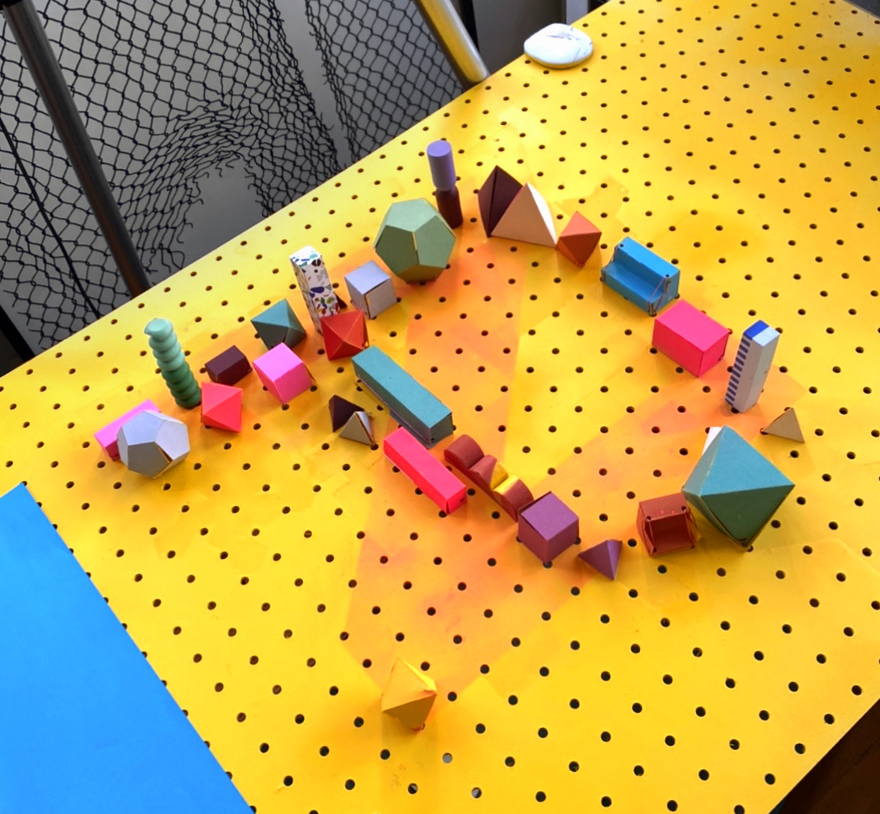
All of my favorite art supply stores are closed. The spray paint supply chain is currently pretty lacking. I can’t find the exact colors of papers that I want. So I got really scrappy and foraged all of the materials for this set from within my apartment. I had pegboard, string, paper, and a [dangerously] limited amount of the correct yellow color of spray paint.
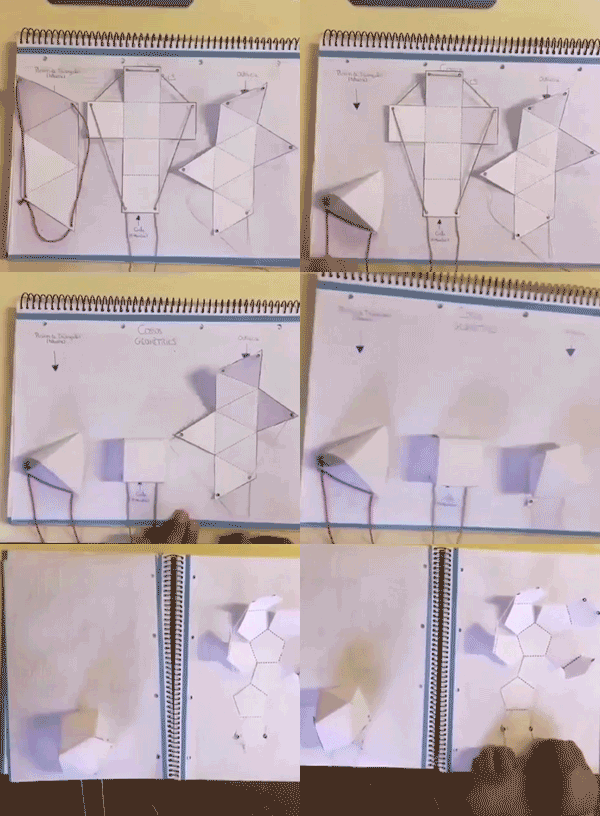
 

My idea was to transition from N to P using a technique I had seen in a fleeting animated gif, whose original source was lost, like a vision from a dream. In it, in a middle school geometry lesson, a student pulled a string to animate a 2-D shape into a 3-D geometric volume. I’ve since learned that these forms are called pull-up nets, I’m *obsessed*!


With almost no materials: the rules of geometry and the laws of physics were allowed to play out in physical space—choreographing a flat schematic into a concrete volume. (organic, like a flower blooming, but along the rigid demarcations of Platonic solids.)
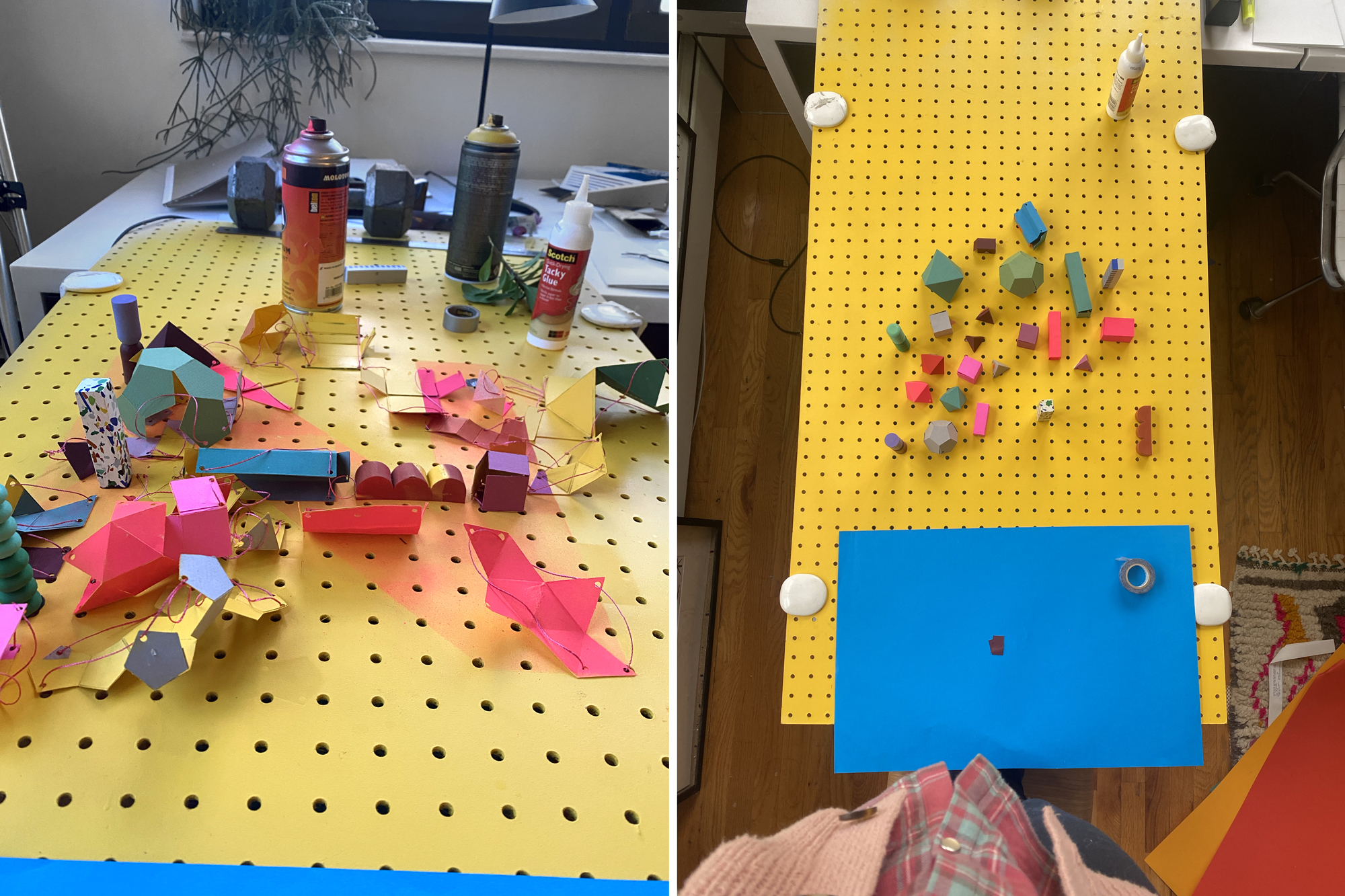
From 2-D space to 3-D volume, from screen-public-life to the physicality-of-an-outdoor-park these are all places that we, humans, purpose-build to reflect our values. The handmade final piece reminds that the internet we know today was also largely built by hand.

As I write this, the Internet is still a malleable place that we can shape and touch. (This will grow decreasingly true in the AI-led future.)


BIPOC Design History

Silas Munro has brought-together a group of historians specializing in African and African-American design and they are piecing-together a collective history, together, in real time, over Zoom. (And it is a pleasure to observe!) I caught the first three classes and my world has expanded. There are entire continents-worth (civilizations-worth) of art and design awaiting your enjoyment, and people with knowledge of the secret histories of the world who are eager to share their passion. (Running through the end of January.)
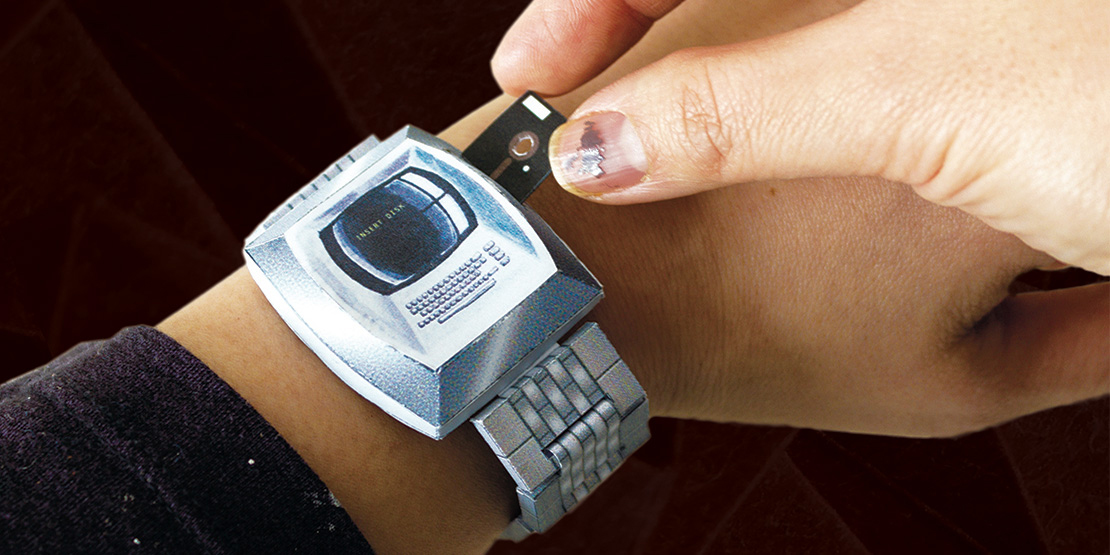


Paper recreation of BYTE magazine by Imin Yeh

Paper recreation of BYTE magazine by Imin Yeh

Art&&Code

Friends Golan Levin, Claire Hentschker, and others at The Studio for Creative Inquiry at CMU have put-together Art&&Code—a free, online conference that asks: “What does homemade mean in the digital age?” It is about art and tech, but also about gift-making and -giving, and about what connecting through art means right now.

Golan stated that he wants the conference to be a reminder that we should all feel empowered to make, do, and learn whatever we want, in as cross-disciplinary way as we wish. That, in this time when so much of society has fallen apart, that there is opportunity in structurelessness. Young designers believe they need 5 years at Apple, a functioning supply chain, and a couple years at an agency to do groundbreaking work… when really, all they actually need to radically experiment is sitting on their desk.

In that spirit, we are collectively making a downloadable zine of DIY paper projects for all attendees. Everyone is working so hard on this one and I think it will probably be wonderful.
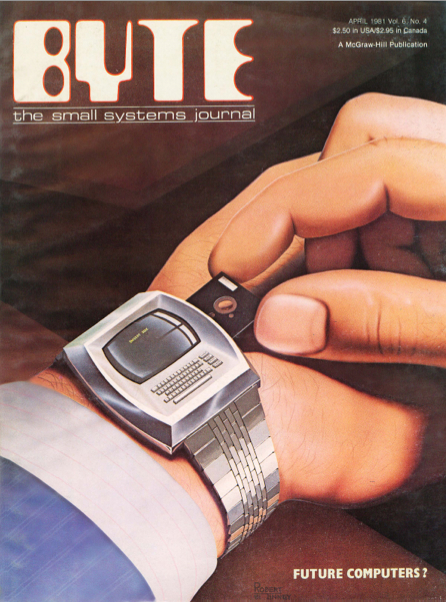
The original BYTE cover

The original BYTE cover. And a funny article about what it represents: https://time.com/60505/this-1981-computer-magazine-cover-explains-why-were-so-bad-at-tech-predictions/


Upcoming workshops

Many, many of you have bought This Book is a Camera this year (jeez, thank you so much!)

Are you using it? (I want you to love using it! or at least have that possibility)

If you’re a little bit intimidated by the idea of doing photography in your bathroom, fear not! It’s fun and easy, I promise. Let’s do it together. On Saturday, January 23rd, Ill run two workshops. One at 9am EST and another at 9pm EST. Sign up here and I’ll email a zoom link.
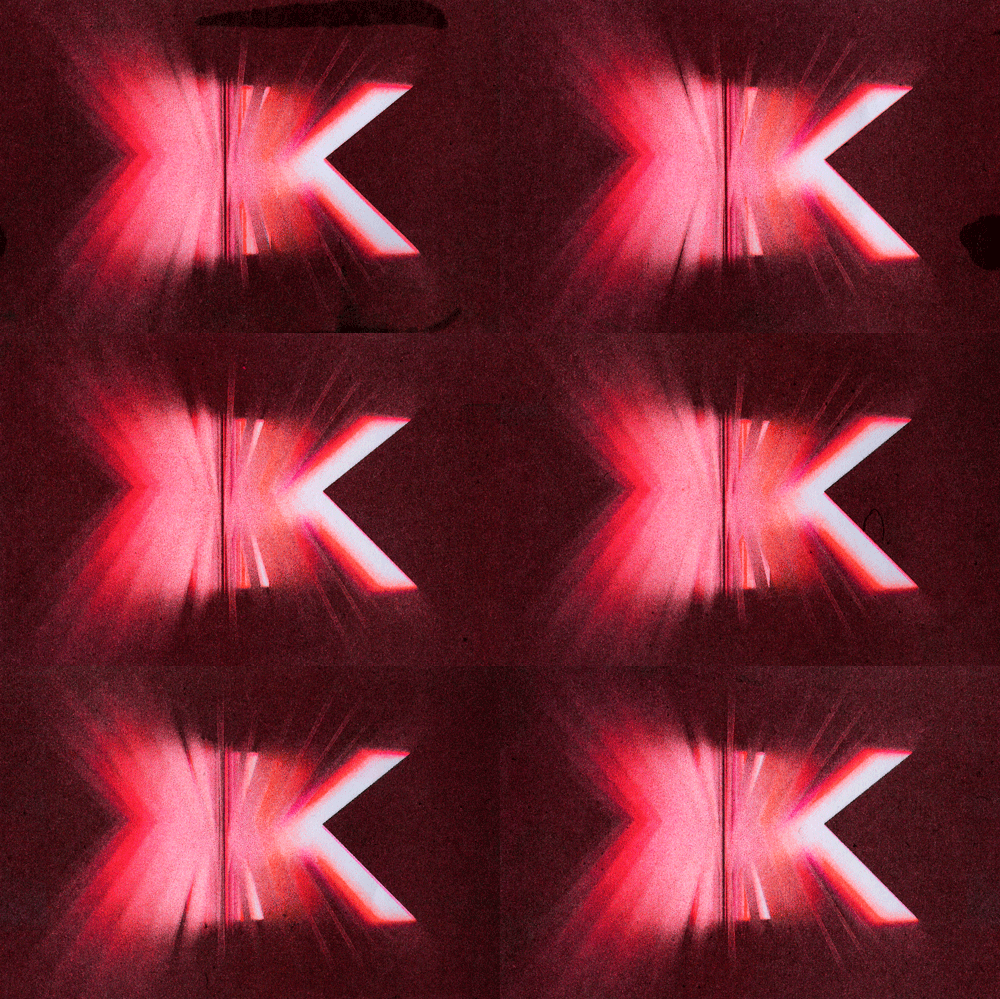


riso animation

I’m going to be running two RISO animation workshops in the coming months. While we can’t gather together in a print shop, Keegan at the Arm and I have worked out a system where we’ll print, scan, and mail the frames to participants. We also have a webcam, so we can all go over the function of the RISO machine’s inner-workings… the next best thing to touching the beige beast. If this sounds at all interesting, sign up here and I’ll email you when we set a definite date. It will be fun and fun will always be important.


Max Fenton recently shared this gorgeous poem, which I had forgotten about, but that feels like the perfect now. Stay safe, friends and keep going.

Good Bones by Maggie Smith

Life is short, though I keep this from my children.
Life is short, and I’ve shortened mine
in a thousand delicious, ill-advised ways,
a thousand deliciously ill-advised ways
I’ll keep from my children. The world is at least
fifty percent terrible, and that’s a conservative
estimate, though I keep this from my children.
For every bird there is a stone thrown at a bird.
For every loved child, a child broken, bagged,
sunk in a lake. Life is short and the world
is at least half terrible, and for every kind
stranger, there is one who would break you,
though I keep this from my children. I am trying
to sell them the world. Any decent realtor,
walking you through a real shithole, chirps on
about good bones: This place could be beautiful,
right? You could make this place beautiful.


https://kellianderson.com/blog/?p=4611
Extensions
A month at the Exploratorium
Uncategorized
    C, M, Y (no K!) lightbulbs plus a magnifying glass equals this. Striped light plus a rounded piece of plexiglass equals this.   Adrienne Rich’s poetry is best known for its impassioned critique of oppressive systems (typically: capitalism or the patriarchy.) Her poem, Hubble Photographs: After Sappho, showcases conflicted feelings regarding scientific enlightenment […]
Show full content


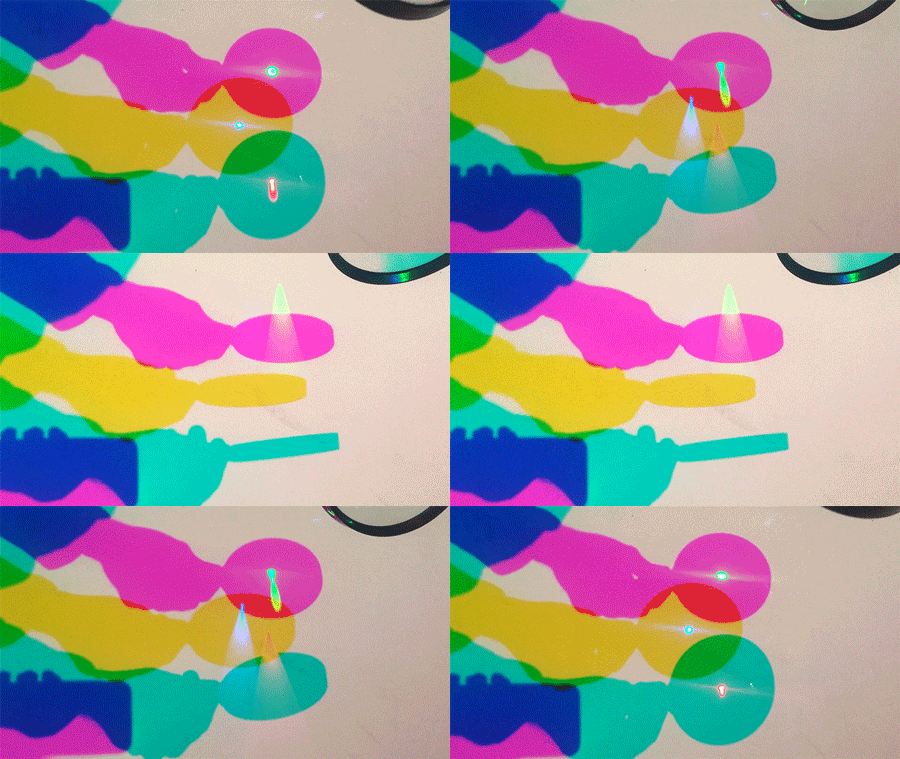
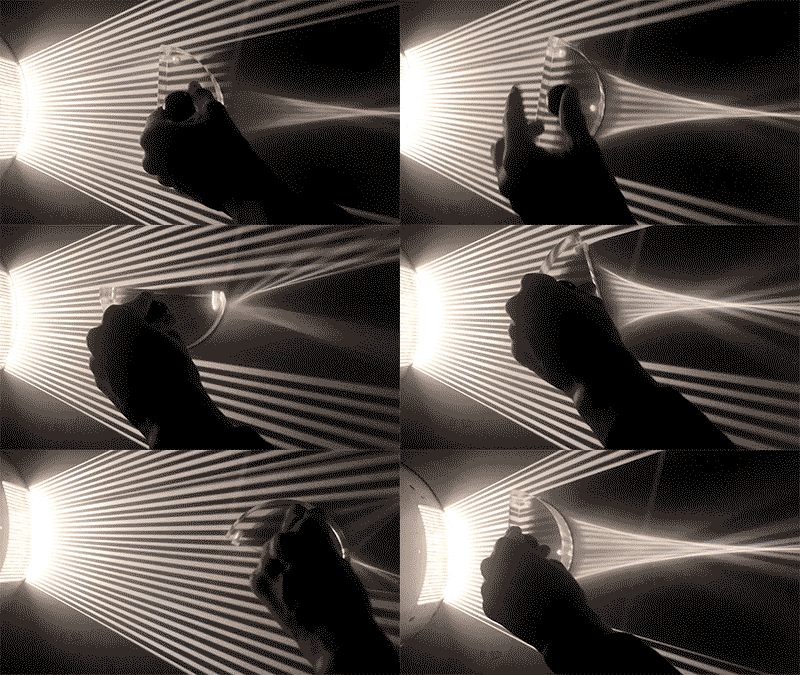
C, M, Y (no K!) lightbulbs plus a magnifying glass equals this.


Striped light plus a rounded piece of plexiglass equals this.


Adrienne Rich’s poetry is best known for its impassioned critique of oppressive systems (typically: capitalism or the patriarchy.) Her poem, Hubble Photographs: After Sappho, showcases conflicted feelings regarding scientific enlightenment vs. technology’s destructive potential. It begins as a celebration of the sheer ecstasy experienced when gazing upon a photo of another galaxy. However, there is something almost… deliberately off in her suggestion that this impossibly-distant view is superior to that of her lover’s gaze.
Any tool of scientific magic—the poem implies—will eventually become a tool of destruction in humanity’s hands. It is, precisely, because it is far away, that the Hubble photography can be a source of joy…without the imagination reflexively fast forwarding to its eventual annihilation.

Robert Gilbert’s interpretation is the most interesting (and bleak) I’ve read:

“While our inventions may allow us to pierce the temporal and spatial armor that conceals these galaxies from our view, ultimately “we cannot hurt them”— and that fact is the true source of the joy they impart… We might call this an environmental sublime, necessitated by an age when no earthly landscape seems immune to human harm.”


I animated Amanda Palmer’s intense reading of this poem for this year’s “The Universe in Verse.” using a risograph printing method.:


Science’s duality of ‘tools humans use for the-ecstasy-of-understanding’ vs. ‘tools humans use for destruction’ is famously embodied in the contrasting legacies of the Oppenheimer brothers.

Frank Oppenheimer began his professional life working with his older brother, J. Robert, who would later become known as “the father of the atomic bomb.” However, McCarthyism put a premature end to Frank’s first career: After admitting an earlier affiliation with the Communist Party, being barred from all professional activity as a physicist, and being relegated to the fringes of society, he was left with little choice but to go his own way.

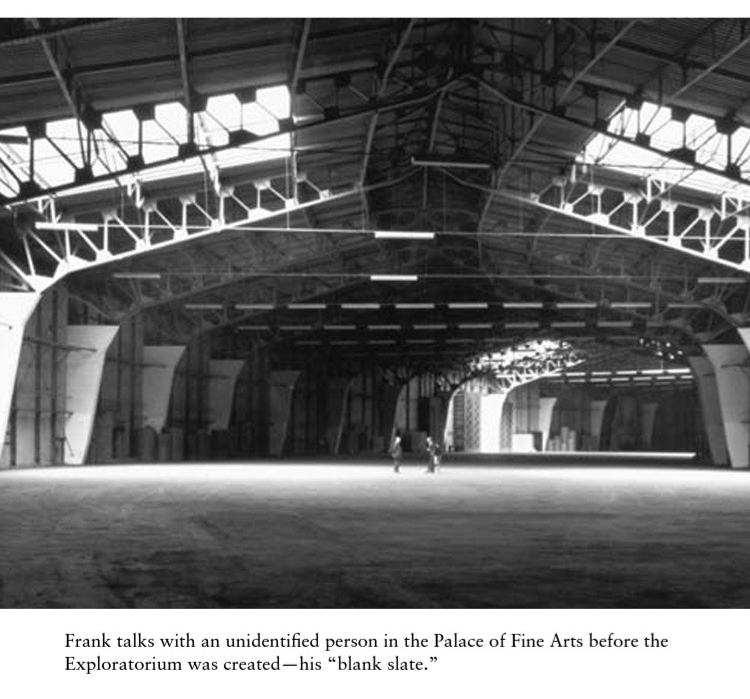
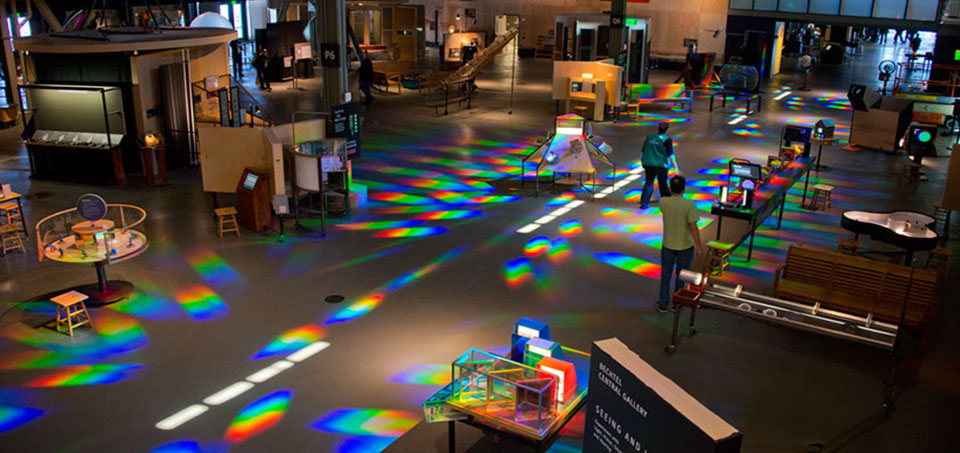
What he built out of this exile is nothing short of incredible. 12,000 (and a million) miles away from Los Alamos National Laboratory, Frank scrappily raised the funding to create a “museum of human awareness” within the Palace of Fine Arts in San Francisco. At the “Exploratorium“, visitors could tinker with the cosmic ray particles from distant galaxies in the Cloud Chamber, understand various methods to hack their own eyesight, and even manipulate the aesthetic balance in a Saul Steinberg drawing (to empathize/understand why the artist made specific compositional decisions.)

Within his un-museum, Oppenheimer accomplished what artist Robert Irwin refers to as “waking people from their non-thinking.” He sought to permanently change how people viewed the world they complacently lumbered-through through each day. To reveal that every mundane walk down the street is actually filled with an elaborate choreography of spacial, aesthetic, and material wonders and pleasures—wonders comfortingly agnostic to us and our wishes… impervious to our destructive impulses.

To impart such an awareness, lessons of physics were translated out of math and into matter, taking the form of interactive displays that visitors could touch, tinker-with, and attempt to break with their hands.

Oppenheimer’s biography, “Something Incredibly Wonderful Happens,” outlines the values that shaped the Exploratorium:

“sensitive observation, serious play, breaking the rules, a sometimes obnoxious insistence on transparency, respect for ordinary people, and a tolerance for chaos.”

Here’s what he had to say about computers (lol*):

“There’s nothing a computer can do that I want done.” Everything a computer did was a simulation, and therefore not sufficiently transparent—or even “honest.” You couldn’t see what was going on inside the box. Besides, computers were “passive and addictive.” Technology, including the technology of chips, is insidious,” he wrote. “It can carry us where we do not want to go if we follow mindlessly.”

*These ideas mirror those expressed in my own work so closely, I can’t believe that no one told me about this place until a few years ago.


I was initiated into the Exploratorium as an Osher Fellow on May 6th, so that I might “hang out and think and collaborate” for about a month—meeting almost everyone there.

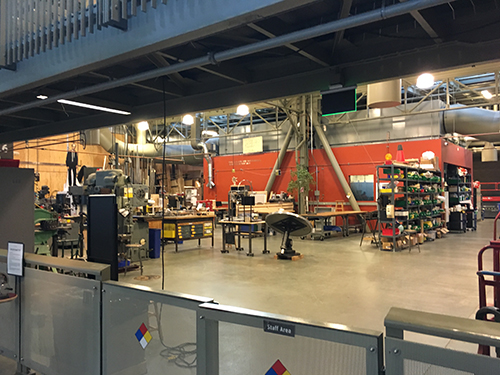
I approached it with the perspective and pile-o-projects of an artists residency, and their beloved open Exhibits Workshop generously lent me a workbench… and so I transported my desk-mess from Brooklyn to San Francisco. I discussed new exhibit ideas with their creative director, Tom Rockwell (<- come for his infectious enthusiasm, stay for the Jane Aaron paper stop-motion at 18:00.), went on a Light Walk with Ken Finn, learned how Paul Dancstep is translating mathematics into touchable metaphors, brainstormed cool event invitations with the graphic design team, talked art with Claire Pillsbury and Kirsten Bach for hours and hours, watched experimental films with longtime film curator Liz Keim, contemplated “how do images work?” with fellow Fellow Scott McCloud, and built radios with the since-the-beginning exhibit guru, Dave Fleming.

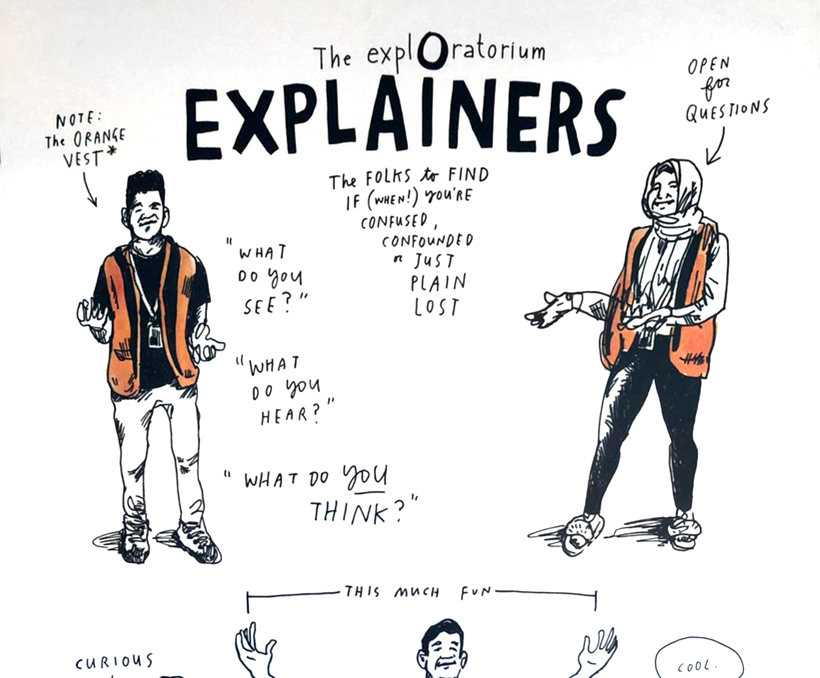
…And got to hang out with people whose literal/actual job title is “Explainer” (explainer is my favorite category of human!)


Illustration by Wendy MacNaughton


Here is a stream-of-consciousness tour of what I saw, did, and learned:


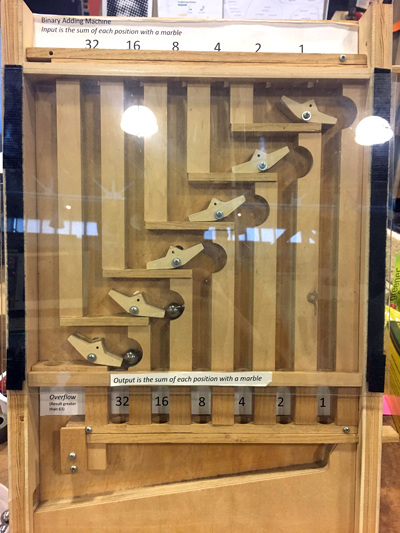
Binary number counter prototype on the workshop floor. (Made me think of SFPC—where they’re always seeking-out new physical metaphors to make the logic of binary numbers clear to new students.)


All the secrets…


This is a collection of moiré magnification tests from The Tinkering Studio. These are acetate sheets printed with halftone screens of varying densities. When overlaid, the regularity of the grid confuses the brain’s pattern-seeking tendencies—creating the illusion of magnification where there is none. (This can be made with shapes other than dots too! More about that here.)


The Stanford Library digitized a pdf of this here. Note: You may have to “download” to view it.

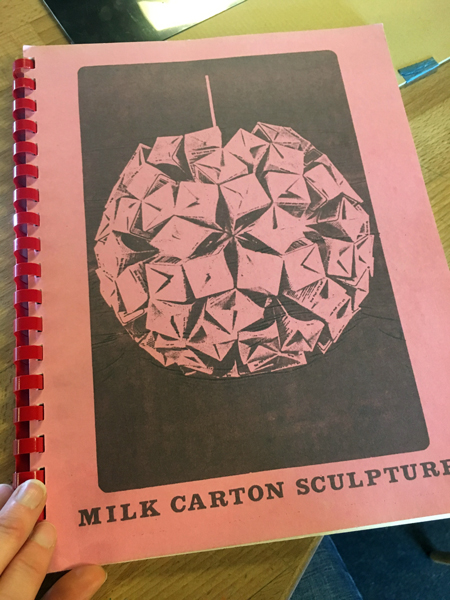
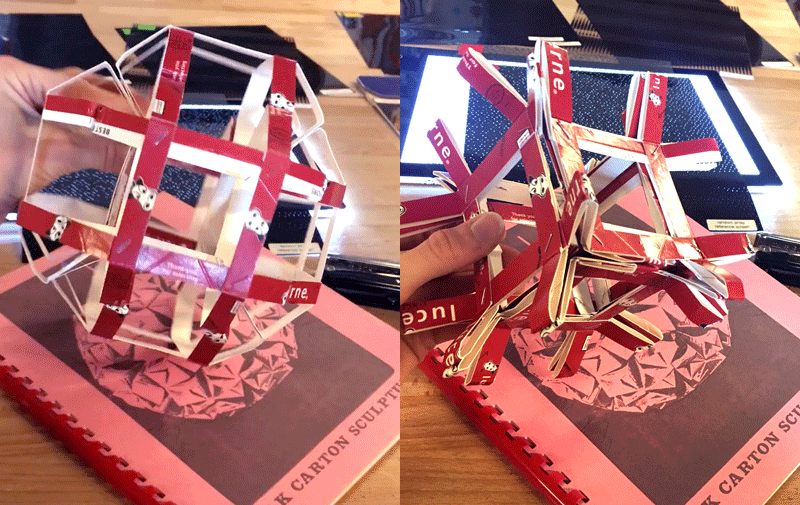
Karen Wilkinson and I also recreated one of Ruth Asawa’s milk carton sculptures (the influence of her teacher, Buckminster Fuller, is very apparent here.) To make these forms, she cut the cubic volume of a school lunch milk container into half-inch strips. Those strips may then be latticed together and stapled at the crossings to create a modular, reconfigurable structure:


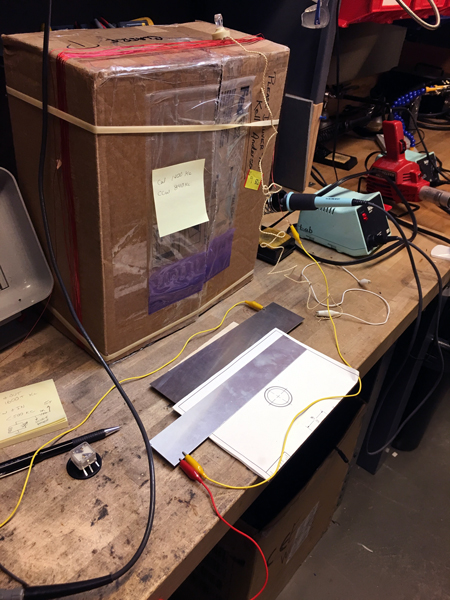
Dave Fleming, who has been inventing exhibits at the Exploratorium for over 40 years, took an interest in my desire to figure out how the format of a book might be used as an interface on radio waves. (Dave is responsible for the radio exhibits on the Exploratorium floor.) There are so. many. ways to build a radio. The coolest thing that Dave realized (which I’ll now fritter-away at developing) is that two sheets of conductive material moving against each other can work effectively as a tuner.

Also- that the wound coils of a radio antenna—if placed on a bellows or similar structure—might be spaced farther apart to change the frequency. Here’s the super-fun mess we made (we picked up some pretty awful AM talk radio 🙂 ):


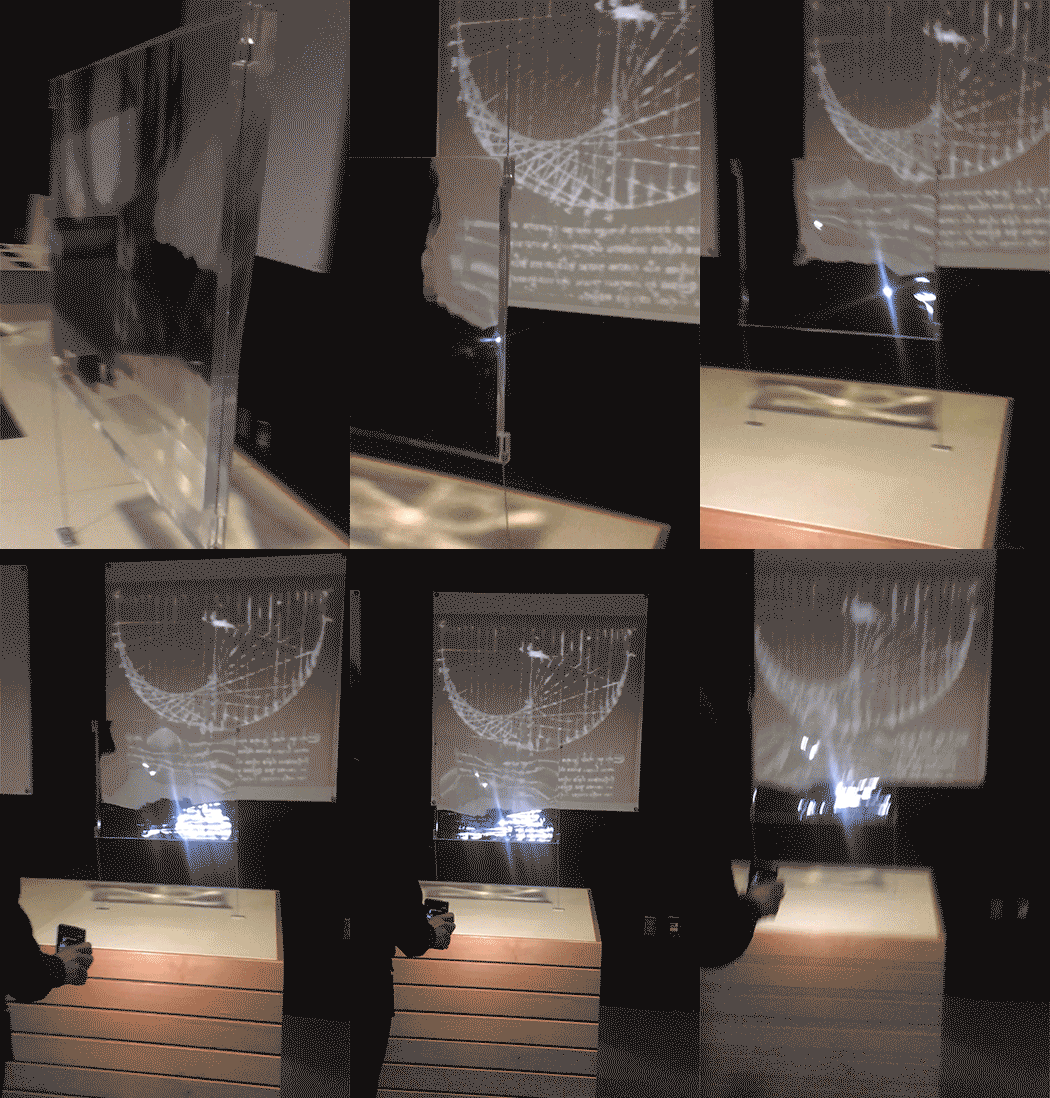
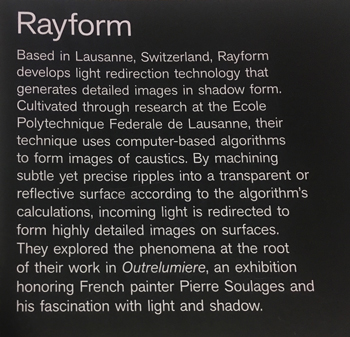
I caught the tail-end of an installation using Rayform, a technique invented at the Swiss Federal Institute of Technology, which creates imagery by molding completely clear plastic. There is nothing visible until you shine a flashlight through it.


The Teacher’s Institute at the exploratorium develops maximally accessible (low-cost, easy-to-use) exhibits, experiments, and demonstrations for teachers to employ in their classrooms. For whatever reason, it has always seemed completely reasonable to me to comb through kid’s science experiment books for graphic design inspiration. So… really: we all just got along swimmingly!

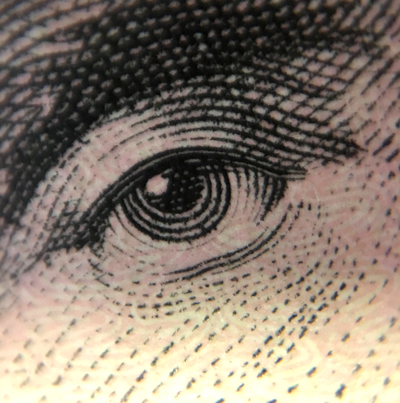
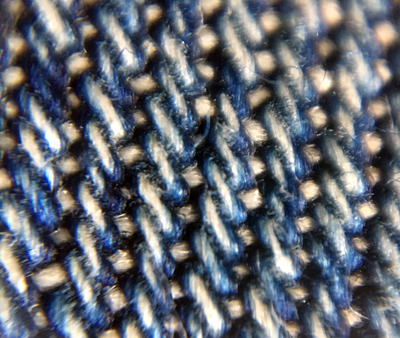
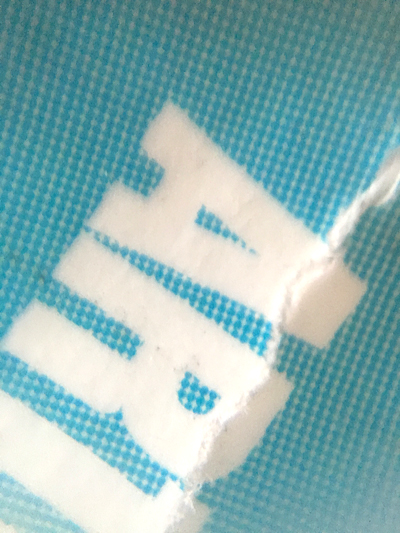
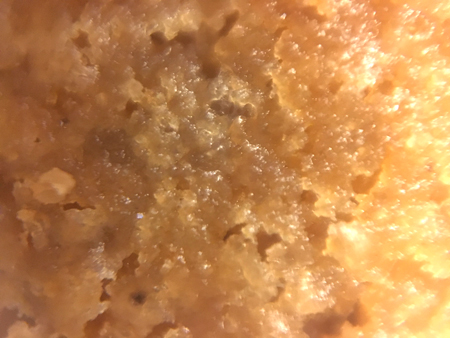
They’ve discovered these 6-cent lenses from laser pointers can be used on a smartphone camera to capture microscopic worlds.

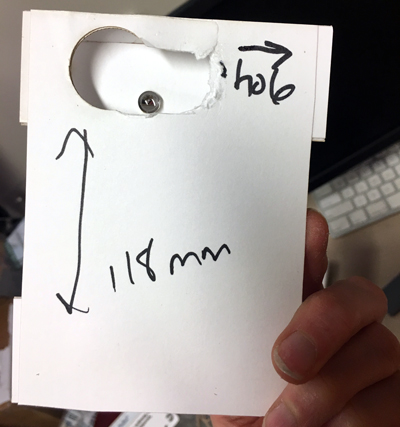
However, the tolerance for the focal distance required is incredibly unforgiving. If your hand wiggles a mere millimeter, the subject is thrown completely out of focus. To make the lenses more viable, I prototyped a paper “sled” to give the tool stability and ease focusing-woes. Here are some photos and videos of the prototyping process:


Sliding the holder/sled across a five dollar bill in truly-awful office lighting.


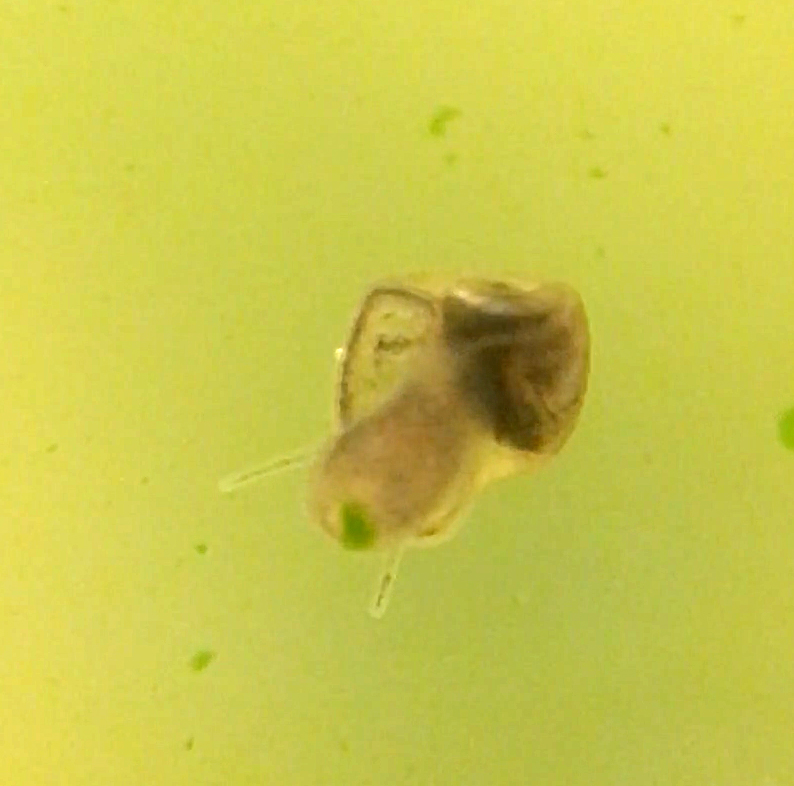
A newborn snail!


Eyeball on a five-dollar bill.

Denim is surprisingly complicated up close.

The spine of Artforum magazine.


The surface of a blondie.


Prototyping, making adjustments…


Just a completely-unnecessary amount of fretting went into deciding that design 2 was better than design 1 (it is definitely better… although, it could definitely still be much better.) Anyway, including this to show how it works.


I also iterated through 10 different versions of the next pop-up book I’m releasing (I was literally prototyping until the second my badge expired.) I don’t want to discuss it too much before I’m 100% sure that the manufacturing hurdles are worked-out, but… the paper mechanics work [sigh: finally…] is very pleasing:


At an SFPC salon a couple of months ago, Dr. Jo Kazuhiro, placed a record made out of scratched paper in my hand and it kind of blew my mind. I thus began digging into Amanda Ghassaei’s fascinating experiments, where she seems to make records out of almost any material. (She has written a processing script to convert songs to wiggles.)

However, interestingly, paper doesn’t have the resolution to “hold” complex sound. Anything more complex than a beep is pure static. The layered sound one finds in recorded songs (I tried a Joy Division song) just sinks back into being noise again.

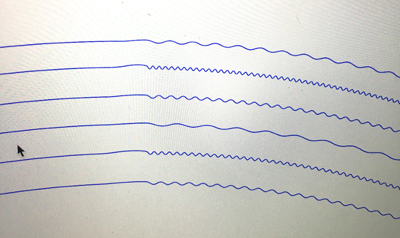
Basically: all recorded sound we hear is a palimpsest of another instance of sound. But one can draw sound that lacks an original acoustic origin. A sound is just a wave, a wave is just a wiggle. This seems to—in fact—be the only kind of sounds which paper will support. Here is what perfect beeping tones look like up close in Illustrator:

I then scratched them into the paper’s surface with a vinyl cutter (that 6-cent microscope came in handy here!):

This is what it sounds like:

…maybe this will turn into booklet of incessant beeping???


At the end of the fellowship, the social media team (Gayle and Sewon!) and I played around in the photo studio for their #50facesofexplo project… and they wrote this nice profile of my work:

“Human perception–and the illusion of magic when we see the edges of our own hardware’s limitations–is endlessly fascinating to me as artistic inspiration.” ⠀⠀
⠀⠀
Graphic designer and paper engineer Kelli Anderson creates surreal experiences with paper that both defy people’s expectations for humble materials, while demonstrating and explaining scientific phenomena. ⠀⠀
⠀⠀
Her paper explorations began with a simple paper record player she made for a friends’ wedding invitation in 2011. As the project became viral, she was struck by the attraction to lo-fi paper tech in this age of advanced tech, and she’s been prodding this question through her work. Her published work includes a functional paper camera pop-up book and a pop-up planetarium, “This Book is a Planetarium.” Her works highlights the superpower of paper mechanisms–that they do scale. A few of the satellites currently in space right now were modeled in paper using methods traditionally found in origami–fluidly jumping from book-sized and room-sized to galaxy-sized. ⠀⠀
⠀⠀
Over the past couple weeks, Kelli has been working as a “thinker-in-residence” Osher Fellow at the Exploratorium. She’s been exploring new connections and new project ideas stemming from conversations with Exploratorium staff, including a prototyping paper microscope stands, a pop-up record player book, and turning a book into a radio. ⠀⠀
⠀⠀
“You don’t need expensive tools, equipment, or even coding knowledge to make things that feel magical.”⠀⠀
⠀⠀
📷 by Gayle Laird, Exploratorium.


OK so… 10/10- Would definitely fellow again! Thank you so much to everyone at the Exploratorium.

https://kellianderson.com/blog/?p=4446
Extensions
Russ & Daughters at the Brooklyn Navy Yard
Uncategorized
Designing a new 18,000 square feet for an old NYC institution   It’s been almost five years since we completed work on Russ & Daughters Cafe—the beloved 105-year-old appetizing shop’s sit-down complement—in 2014. Since then, people have thrown parties there, John Zorn programs a monthly music series with downtown musicians there, and last week’s “Broad […]
Show full content
Designing a new 18,000 square feet for an old NYC institution


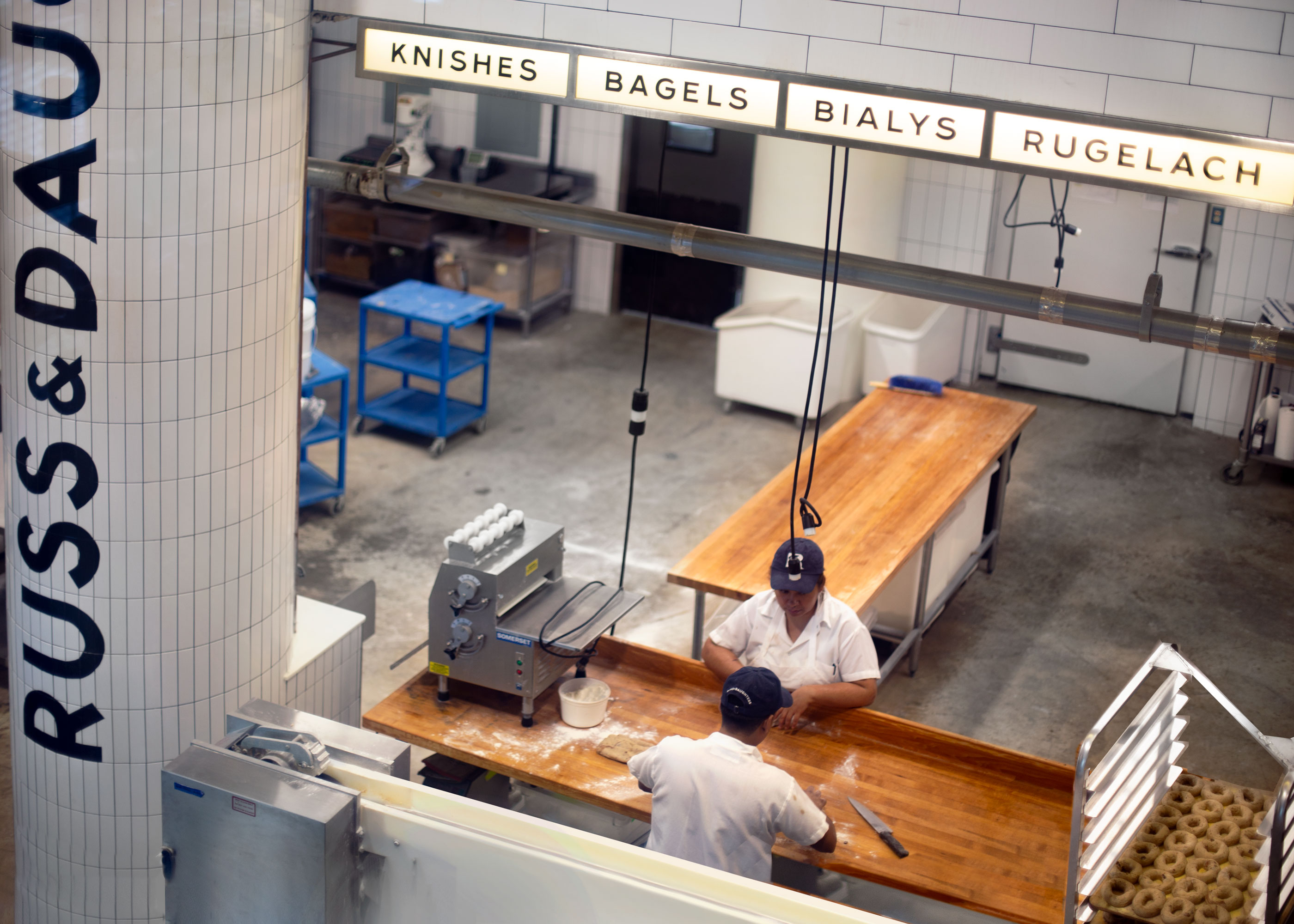
It’s been almost five years since we completed work on Russ & Daughters Cafe—the beloved 105-year-old appetizing shop’s sit-down complement—in 2014. Since then, people have thrown parties there, John Zorn programs a monthly music series with downtown musicians there, and last week’s “Broad City” episode was an all-out love-letter to the cafe (and the brunch bedlam it inspires).


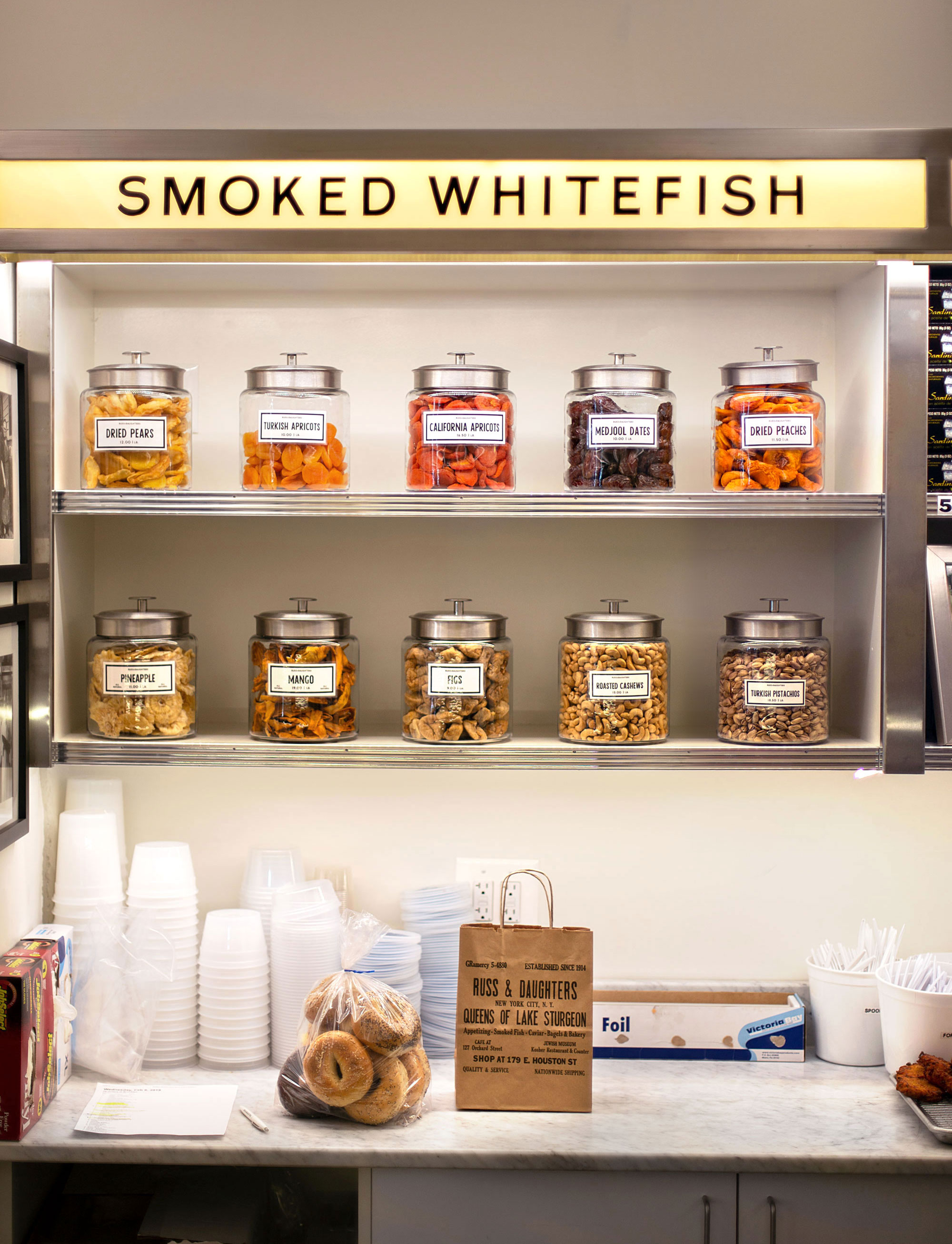
Lightbox shelving with glass jars of candy.


As a designer, it seems like the challenge of staying in-love with a longterm beloved project is to simply to never stop trying to understand/appreciate why it is awesome. Russ & Daughters represents a very specific idea of what New York City is (which is also the city that I moved here to find). With every “new” aesthetic move we make—whether it be the development of coffee bean packaging or a new location—there is a fair amount of design-hand-wringing about whether the new thing fits with the old spirit.


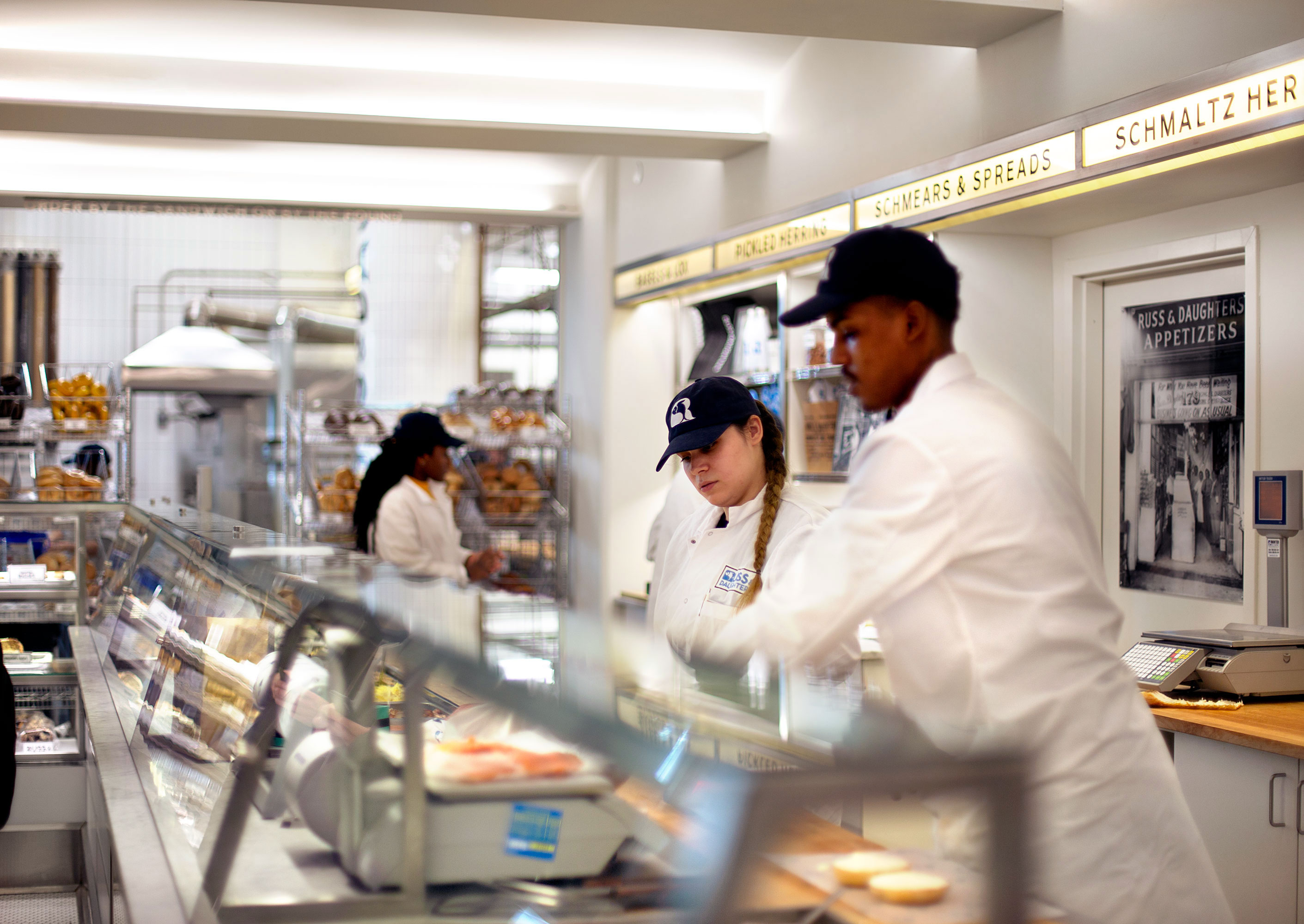
The appetizing counter (and brand new employees! 👋)


The extra anxiety keeps us honest (or perhaps… just more NYC?)


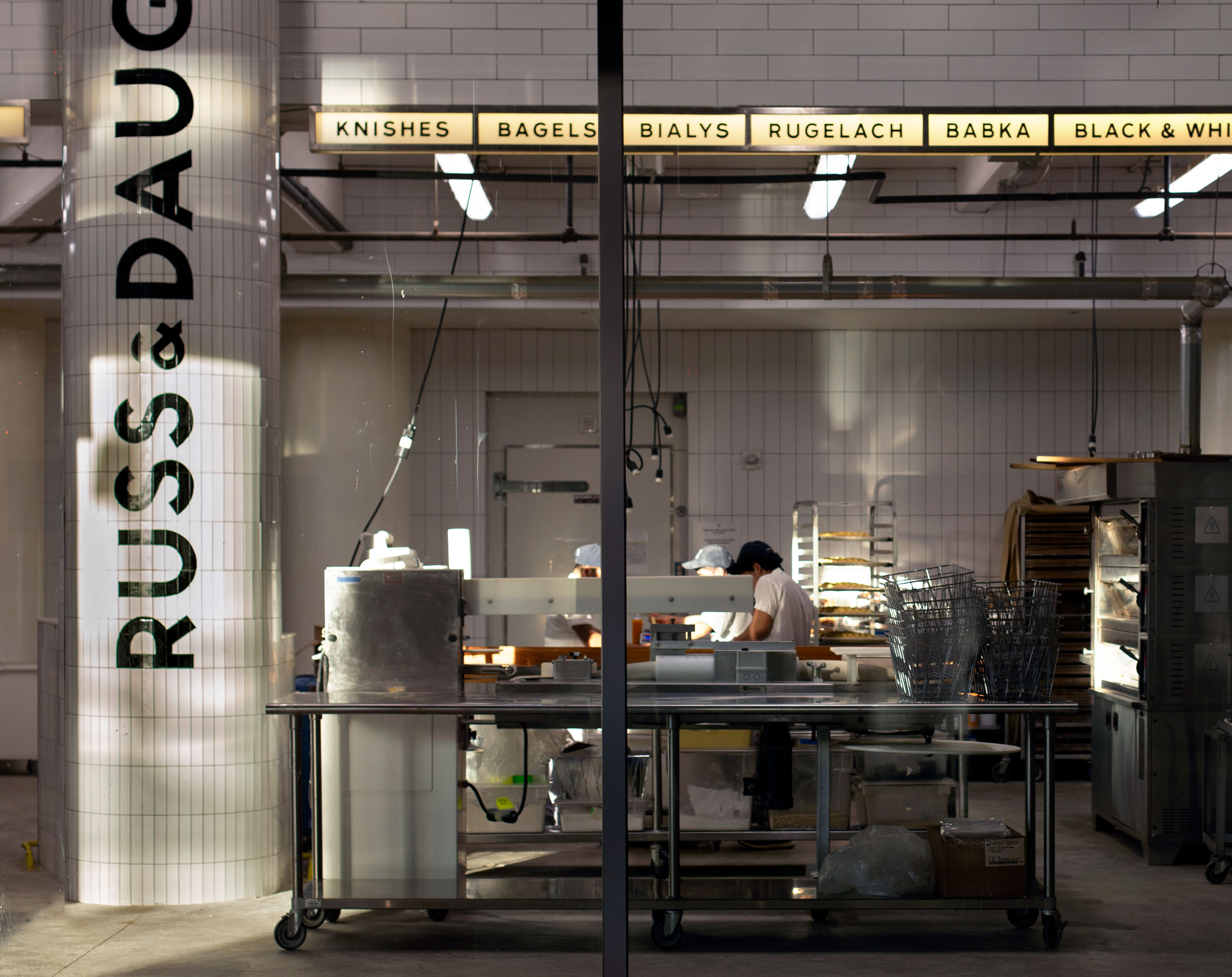
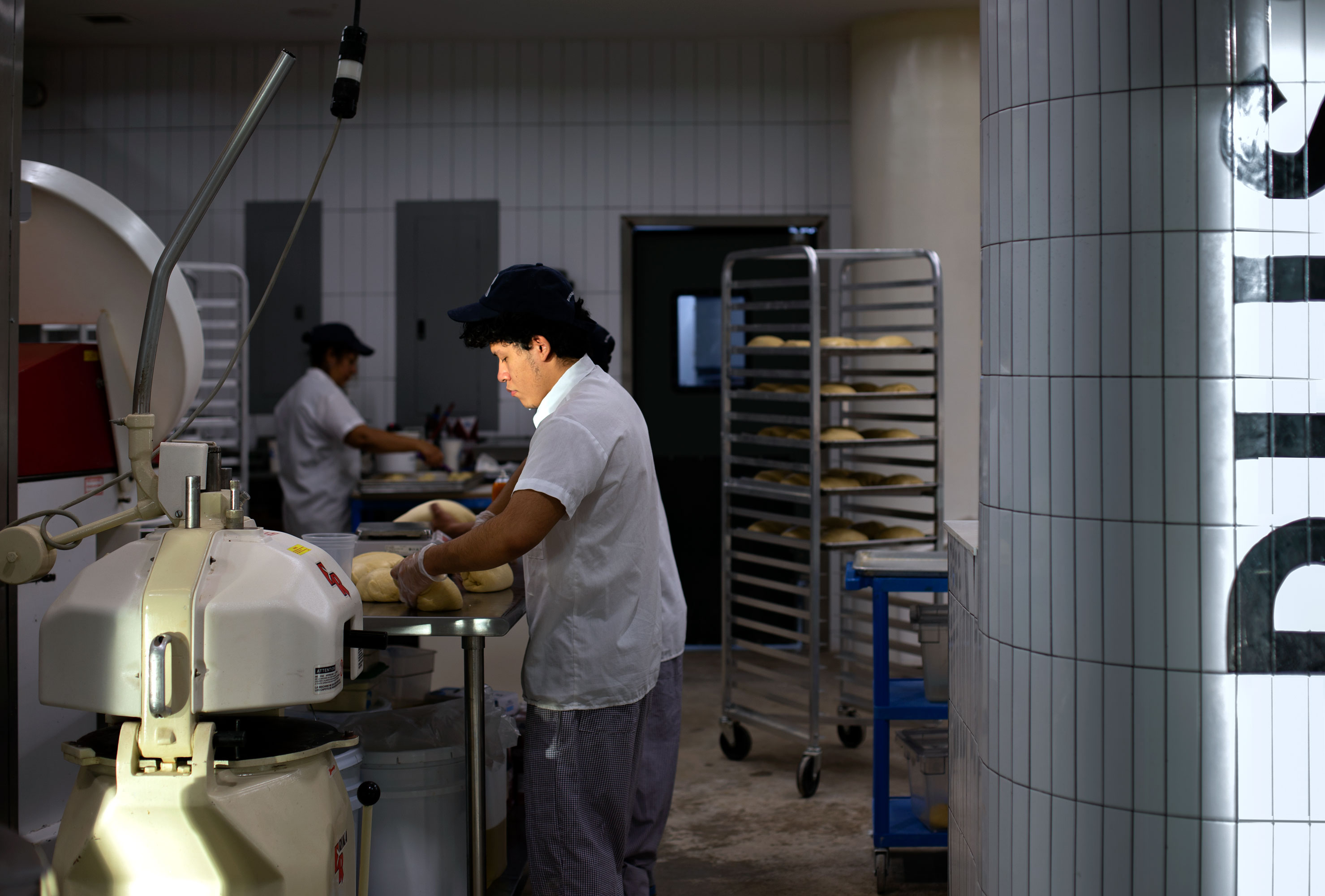
The production space at the crack of dawn, when the bulk of the day’s baking is done.


And yet: growth and change is inevitable. New people continue to discover that whitefish salad is amazing —so the designing/growing… /hand-wringing continues…

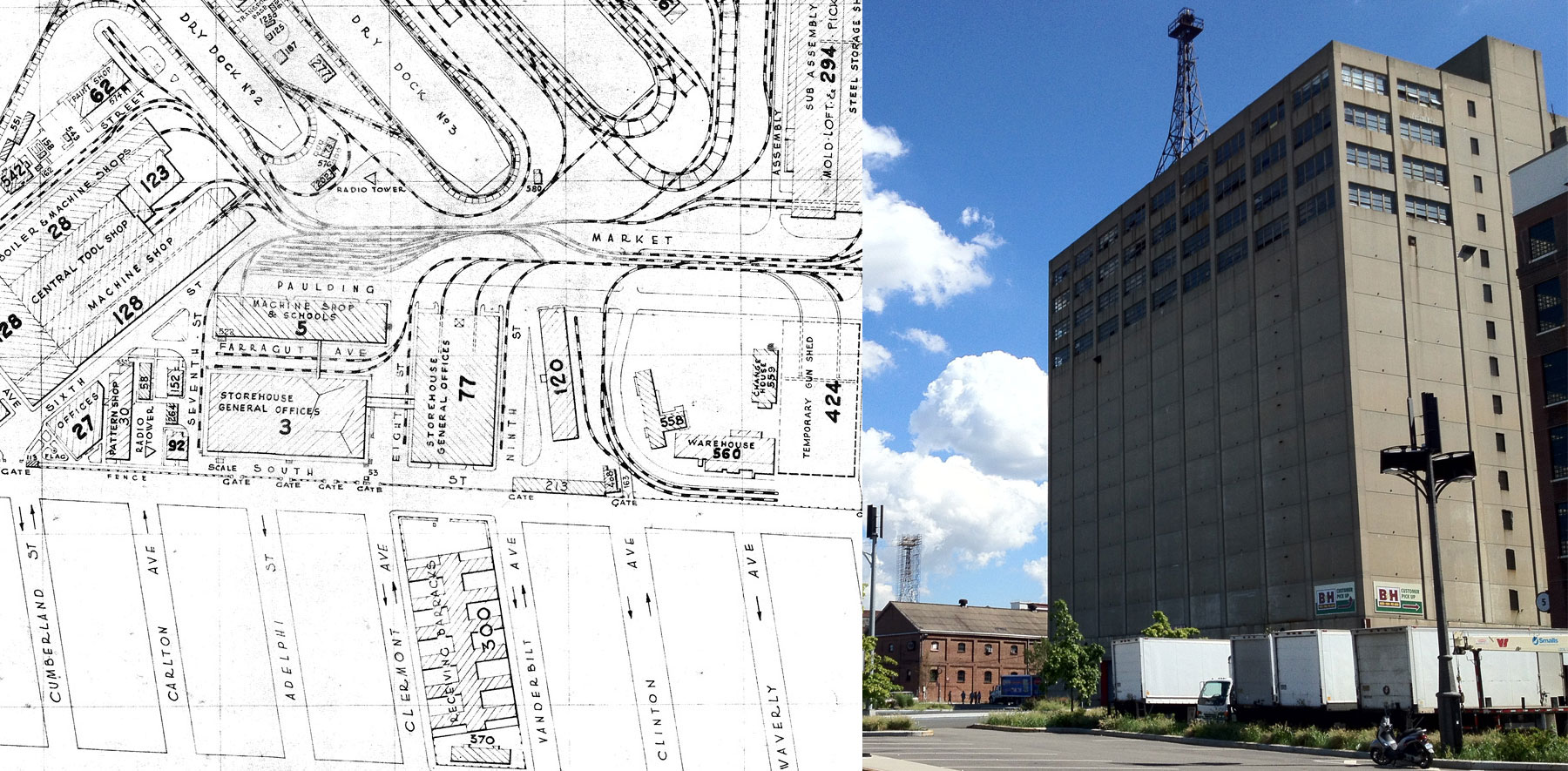
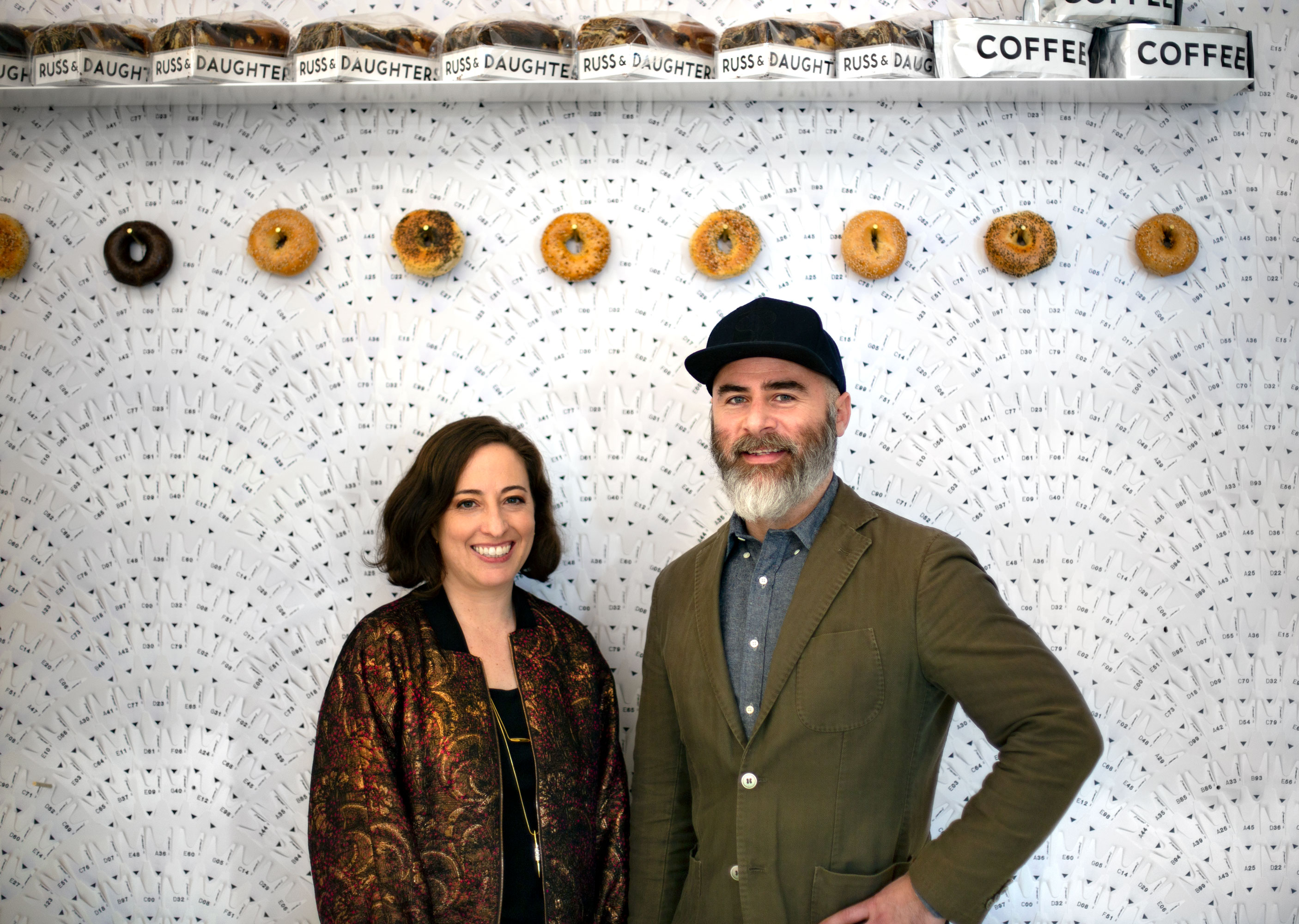
To keep up with the demand, 4th generation owners, Niki and Josh, officially opened the doors to their new 18,000 sq. ft. facility in Building 77 in the Brooklyn Navy Yard yesterday. Anyone who has been crammed into the tiny shop around the holidays probably doesn’t require this context, but… that’s just about, oh, 15,000 more square feet than they occupied previously. (A superbig deal for a small business.)


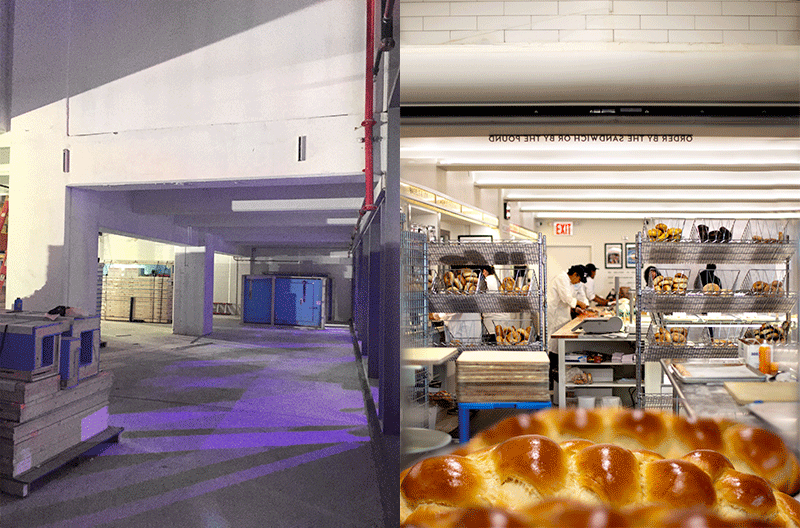
The view from production into the appetizing counter’s space.


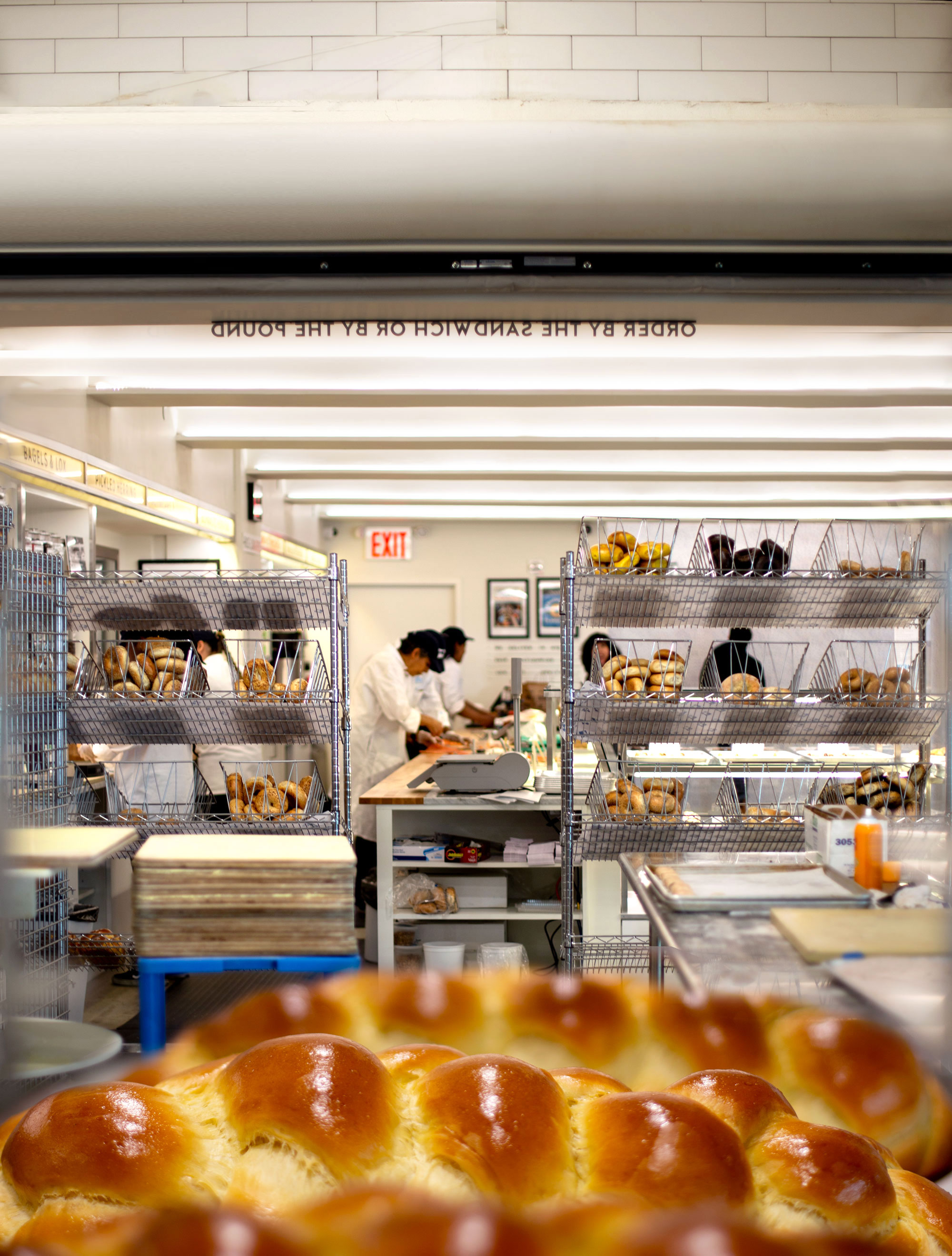
Making it come to life was an ambitious venture for everyone involved: the site includes not only an appetizing counter, but also: shipping facilities, kitchens, cold rooms, offices, private event space… and most thrillingly: a white-tiled production facility where visitors can press their faces up against the glass and watch bagels form, get boiled, baked, and roll out of production. Protip: You can even climb up to the mezzanine for a birds’-eye-view of how babka is marbled!


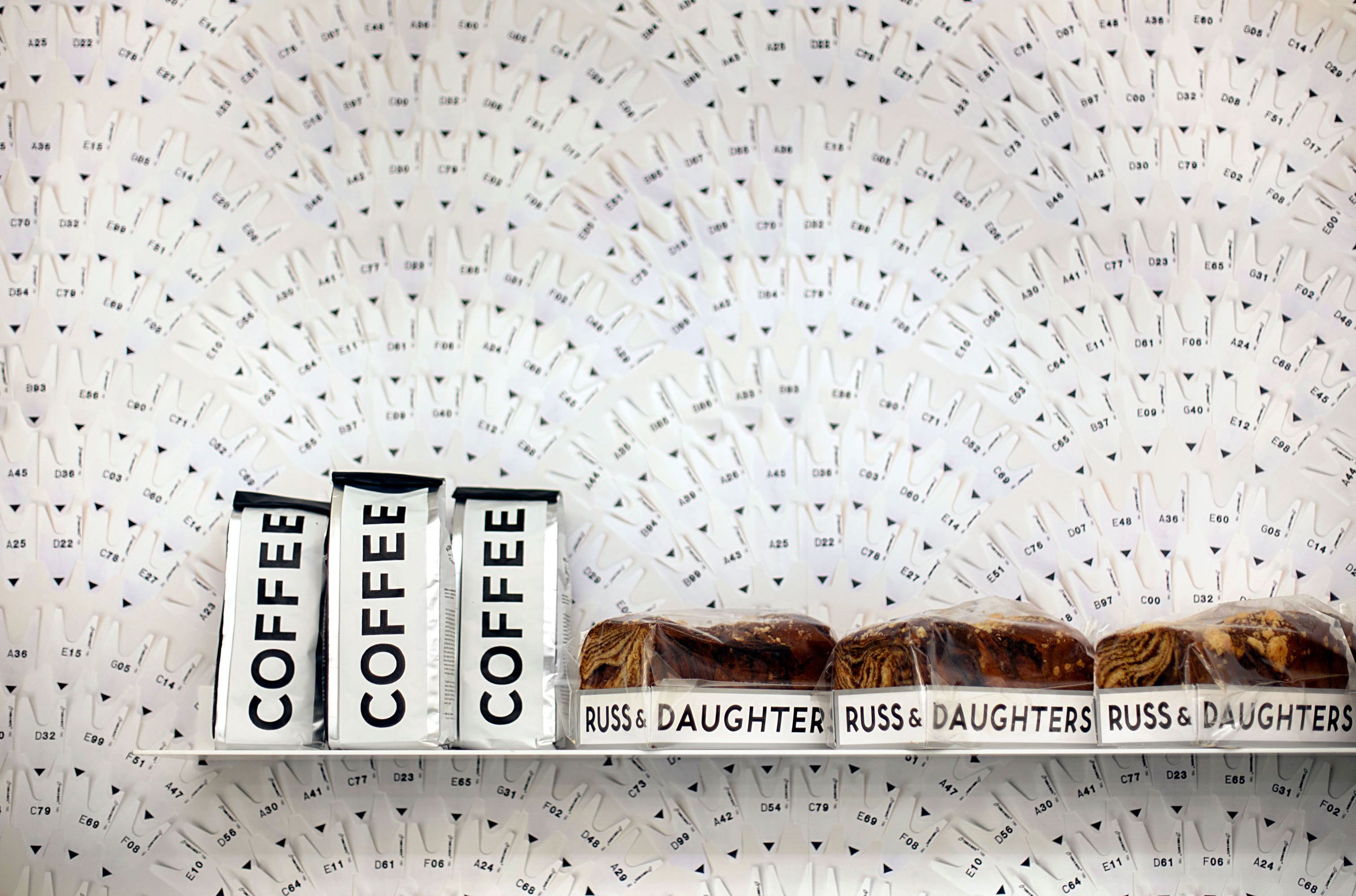
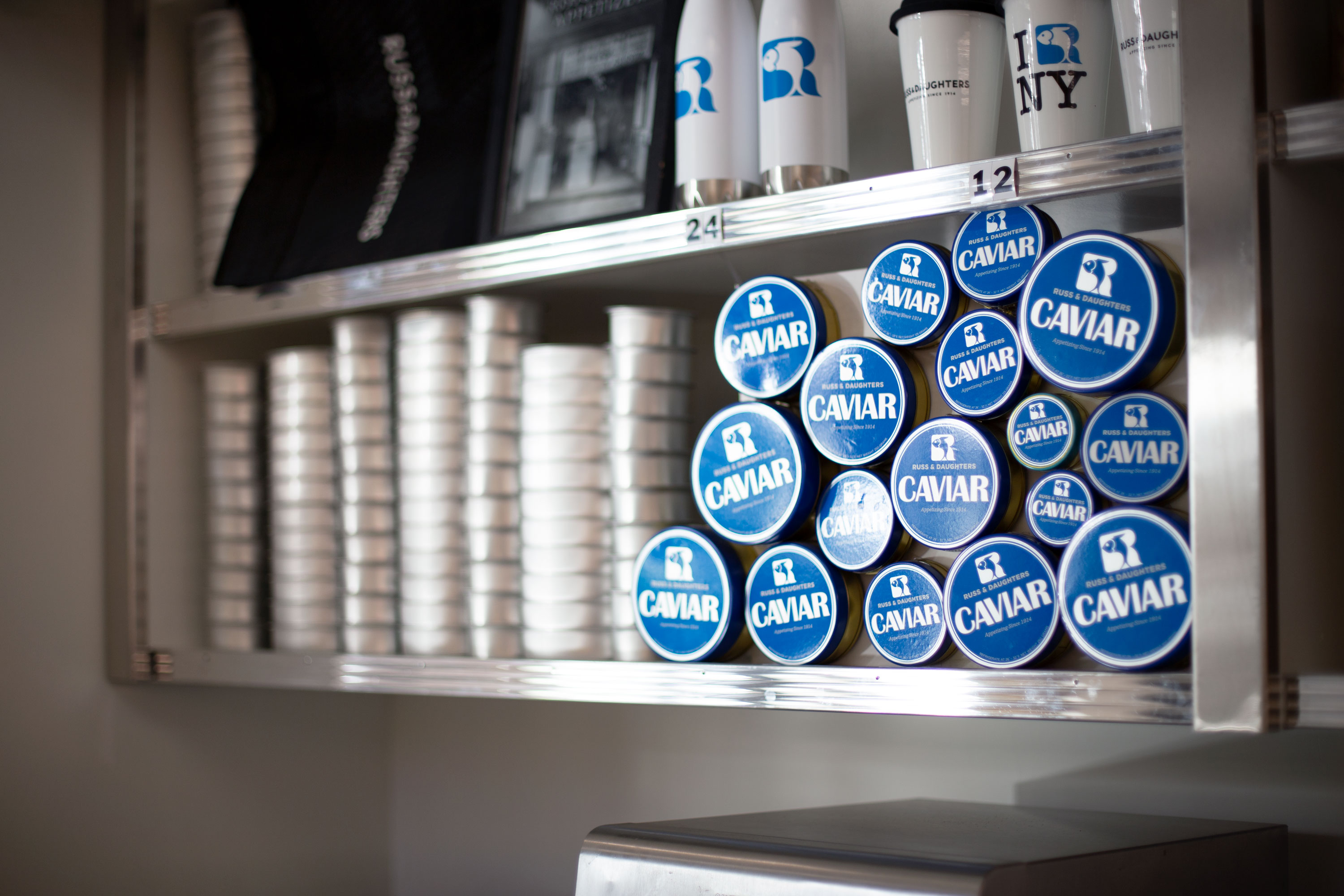
Russ & Daughters’ custom roast coffee and babka. In the past two years, we’ve developed lightbox-style packaging for many of their take-home products.


I again teamed-up with Russ & Daughters’ unofficial historian, PR, and communications “Yenta”, Jen Snow, to figure out how to translate a tiny Lower East Side shop into a new cavernous space built by the Navy without it feeling like a mall outpost.*

*”Mall outpost” being our guiding nightmare scenario of choice, although Christopher Bonanos does us one better in an article for Grubstreet, where he speculates on the worst type of expansion: “A squishy and sweet Russ & Daughters bagel sold in the Safeway frozen-foods case, or perhaps a stand-alone Russ & Daughters Cafe in Vegas, with bikini’d LED fish on the sign, is the nightmare scenario here.”

Designers: Never underestimate the import of a solid guiding nightmare scenario.


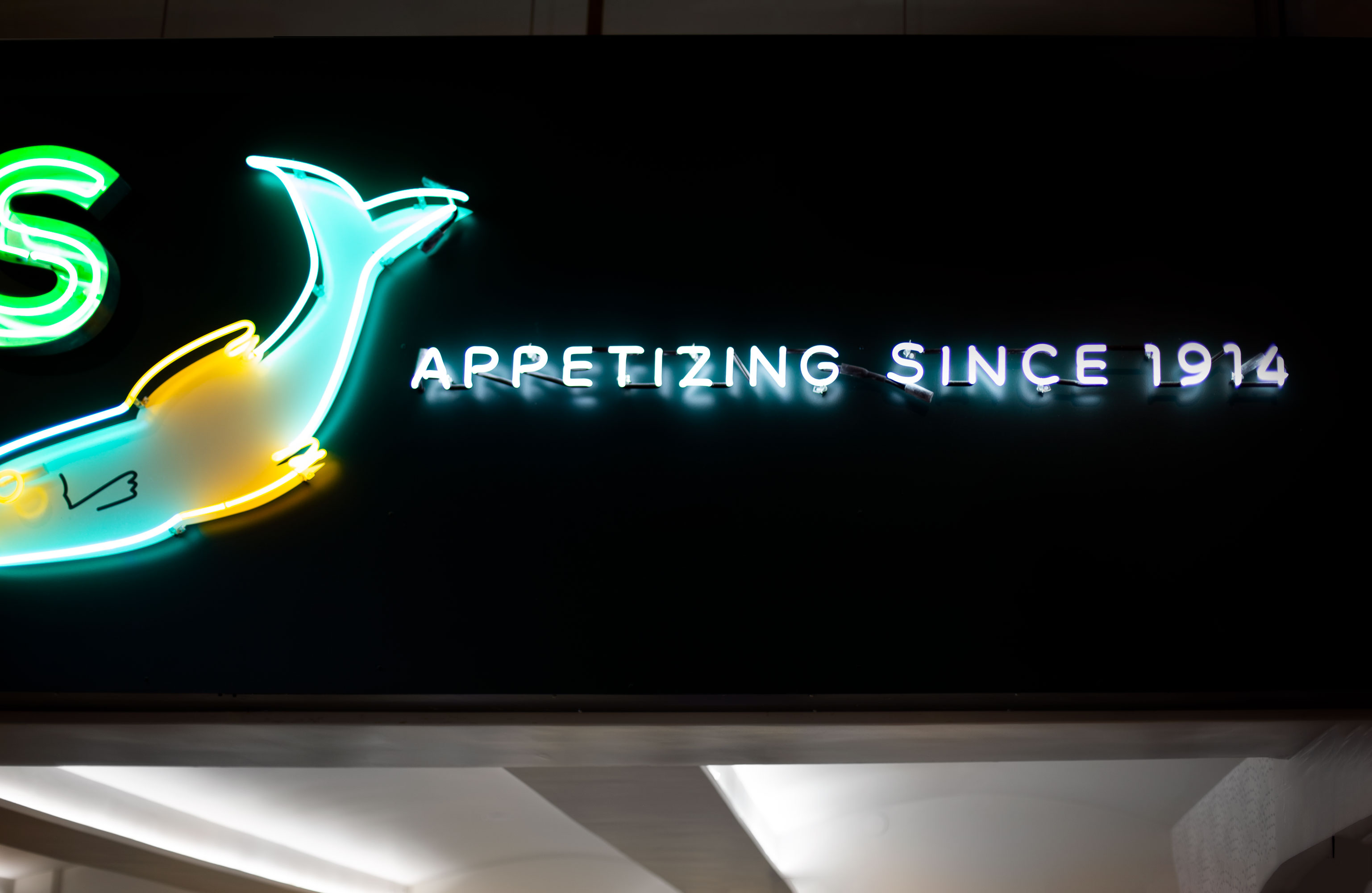
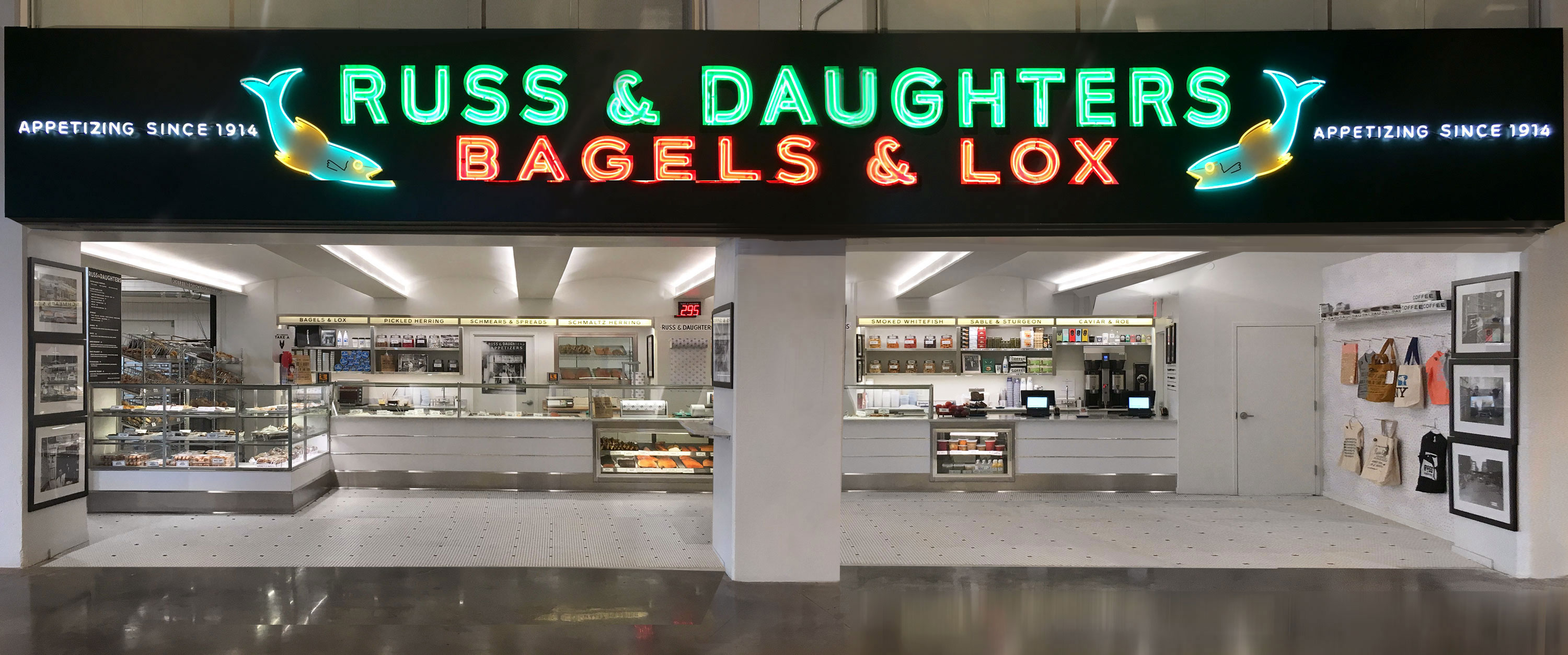
A 52-foot version of the shop’s neon sign, bent (again) by Let There Be Neon. See their magical, medatative process of bending glass here »


RHD Projects worked with Niki and Josh to get production whirring first and then we all figured out how to turn our consensus Photoshop comps into reality.


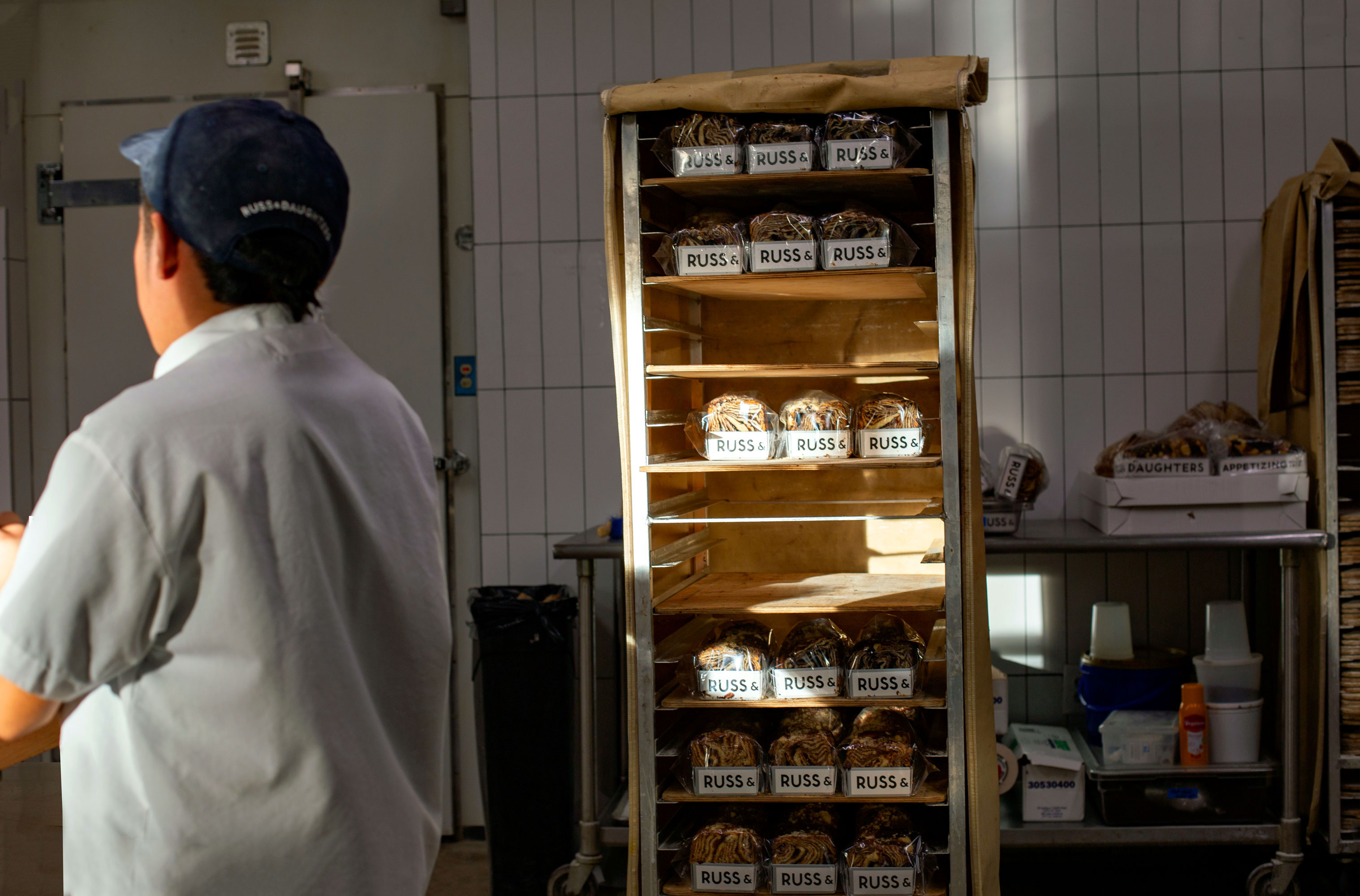
The day’s babka haul in the production space.


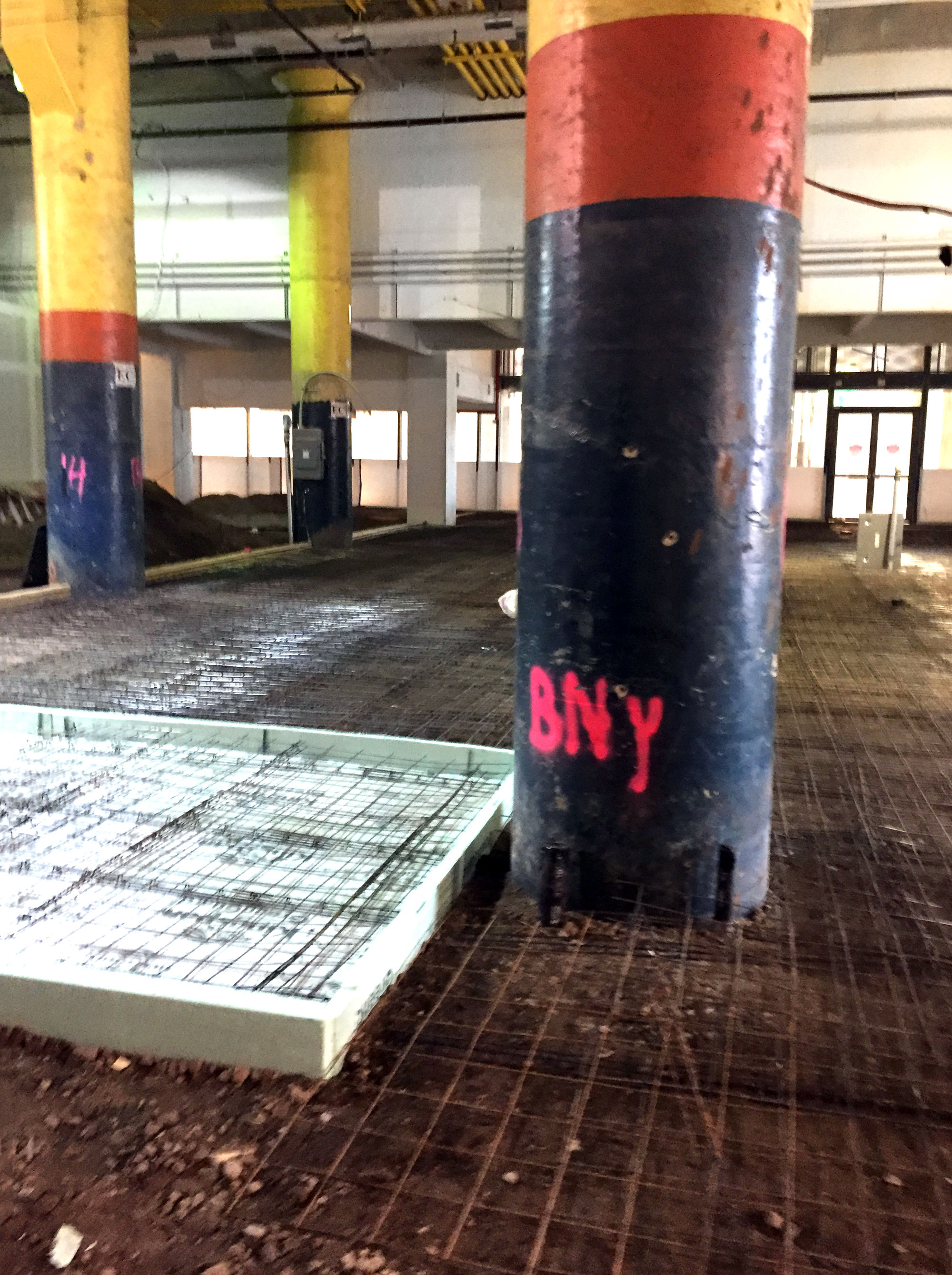
I first set foot into the space, in early 2017, when it resembled Walter de Maria’a Earth Room, except with soaring ceilings, yellow, orange and blue columns… (and we would discover: extremely(!) regimented, accurate geometries, courtesy of Navy construction.)


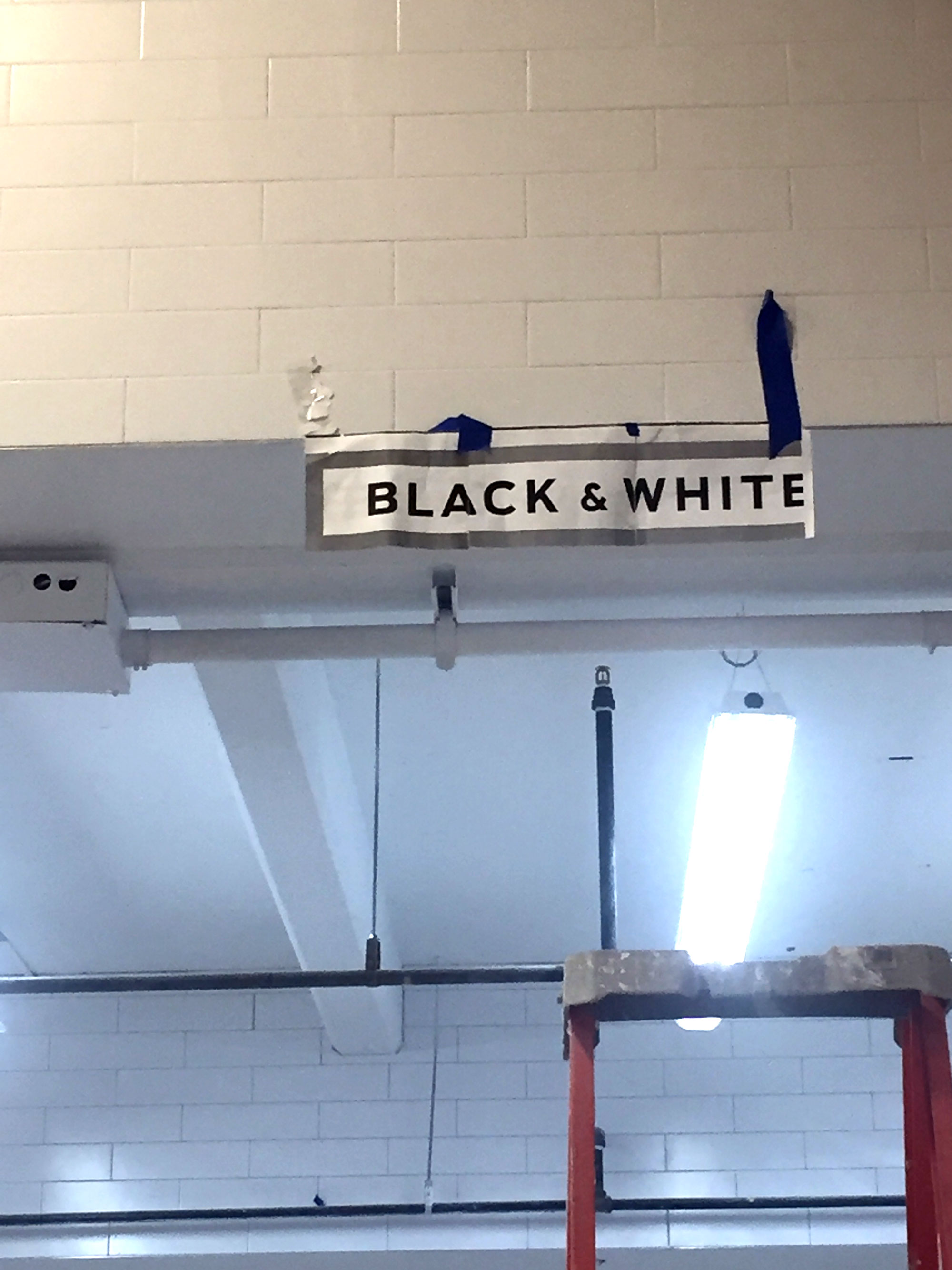
The enormous mass of concrete known as Building 77 was originally built by the Navy in 1943 as a secretive windowless storehouse (for munitions, it is presumed) and was later used by B&H for photo development (which was a thing during the heyday of the popular use of film cameras.)


The view from production into the appetizing counter’s space (before/after.)


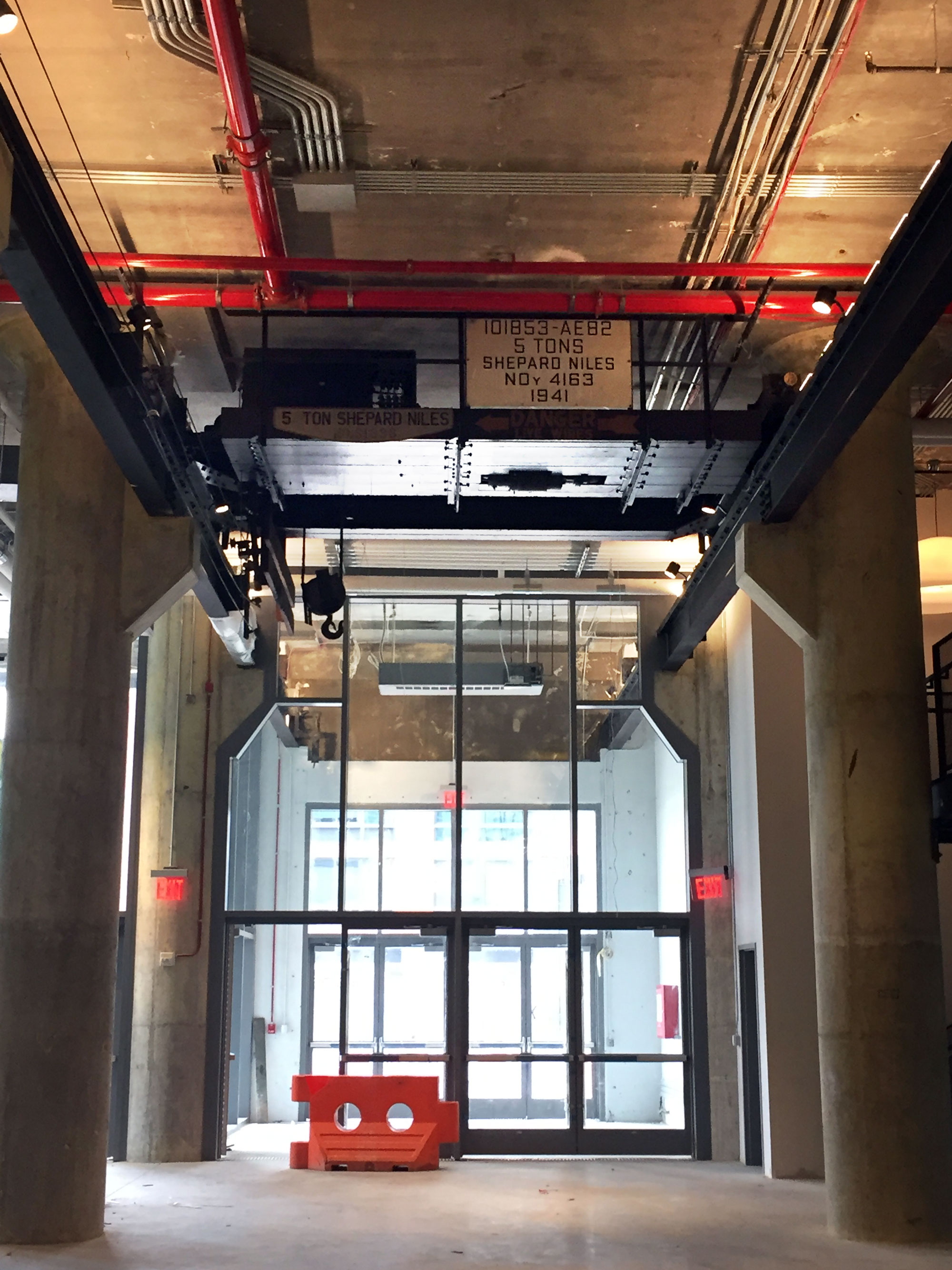
There were several enormous gantry cranes in the space, as well as visible tracks running outside and onto the concrete surrounding the building, toward the dry docks.


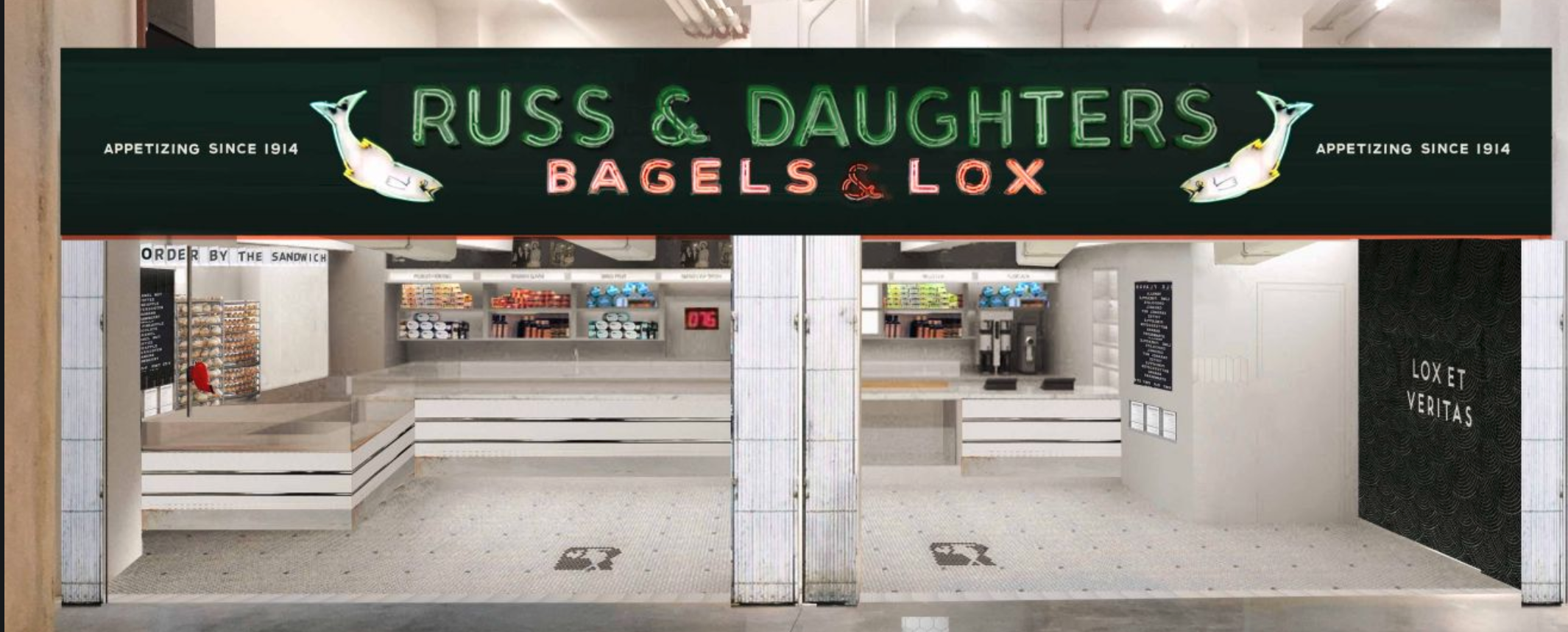
We began by hashing out the design in Photoshop. When I work on restaurants, I begin with flat, front-on shots of the facade and work additively (adding neon and wall treatments and light boxes and etc.)

Here is the “final” comp for the appetizing counter space. (RHD would later introduce some additional improvements and we changed a few elements when reality intervened.):

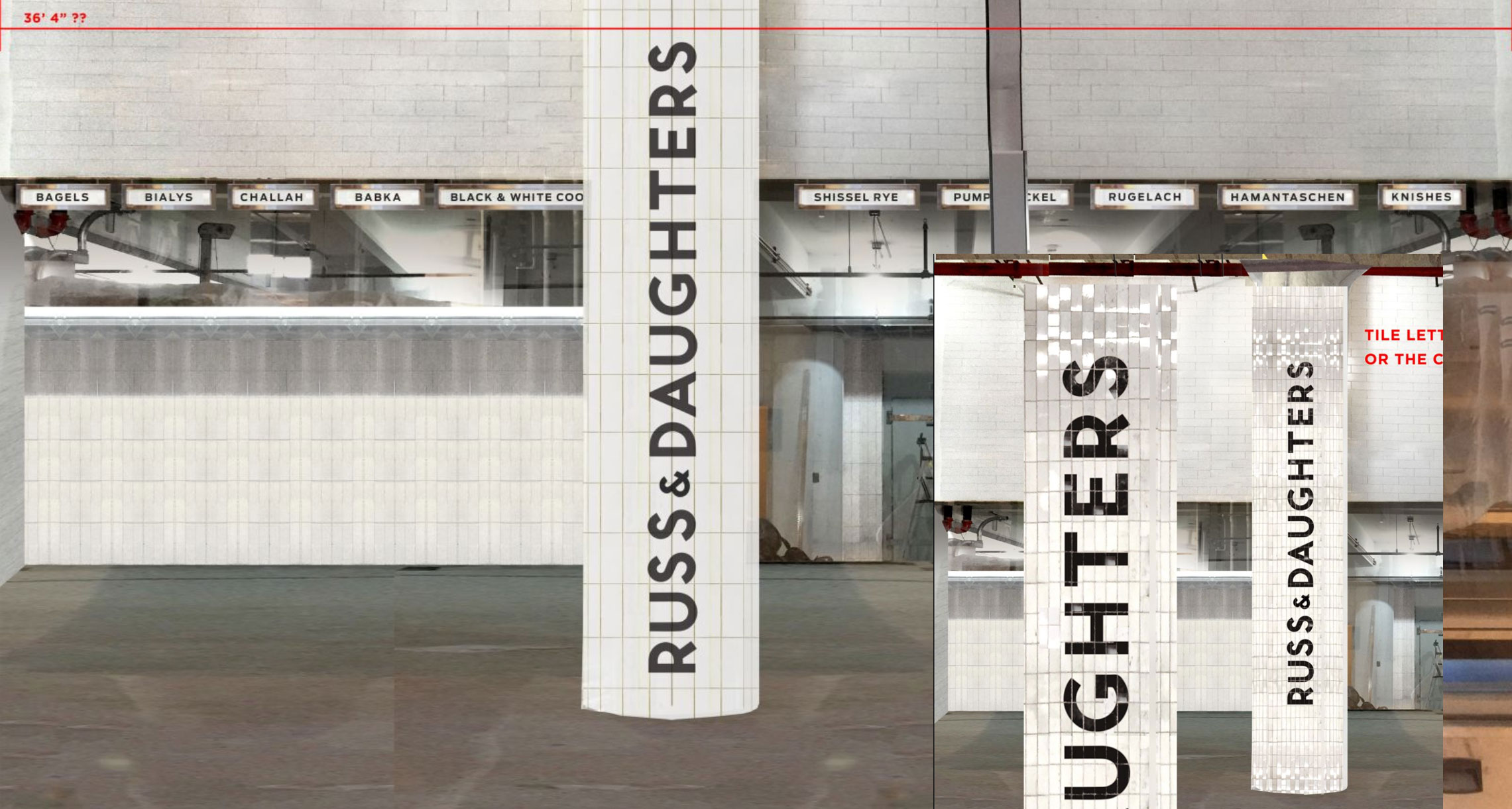
And here is the “final” flat Photoshop comp of the production space:


I used photos of tile from the NYC Subway in Photoshop to convey the correct texture in digital space. (More nimble than getting it right in 3-D software.)


And how the spaces turned out!:


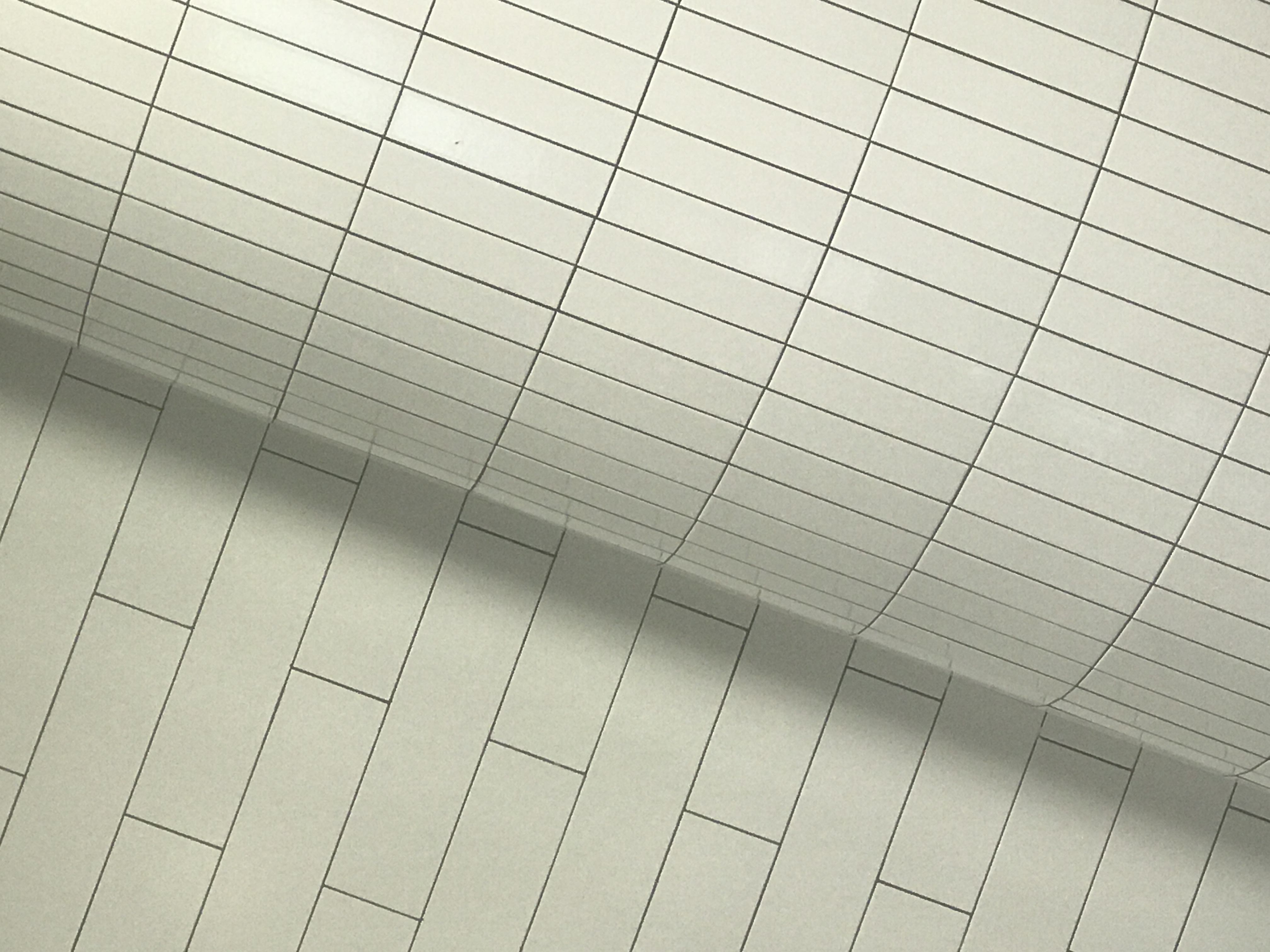
As a child obsessed with Sesame Street’s Crayola production video and as an adult acolyte of Fischli and Weiss’s mechanistic The Way Things Go, the value of elevating any type of conveyor-belt-production into visibility was irresistible. The challenge to do justice to the food traditions of New York making it even more exciting. We used shiny white tiles with black grout in part for durability and in part: to make the 25-foot-high production backdrop into something of a modest, glistening spectacle.


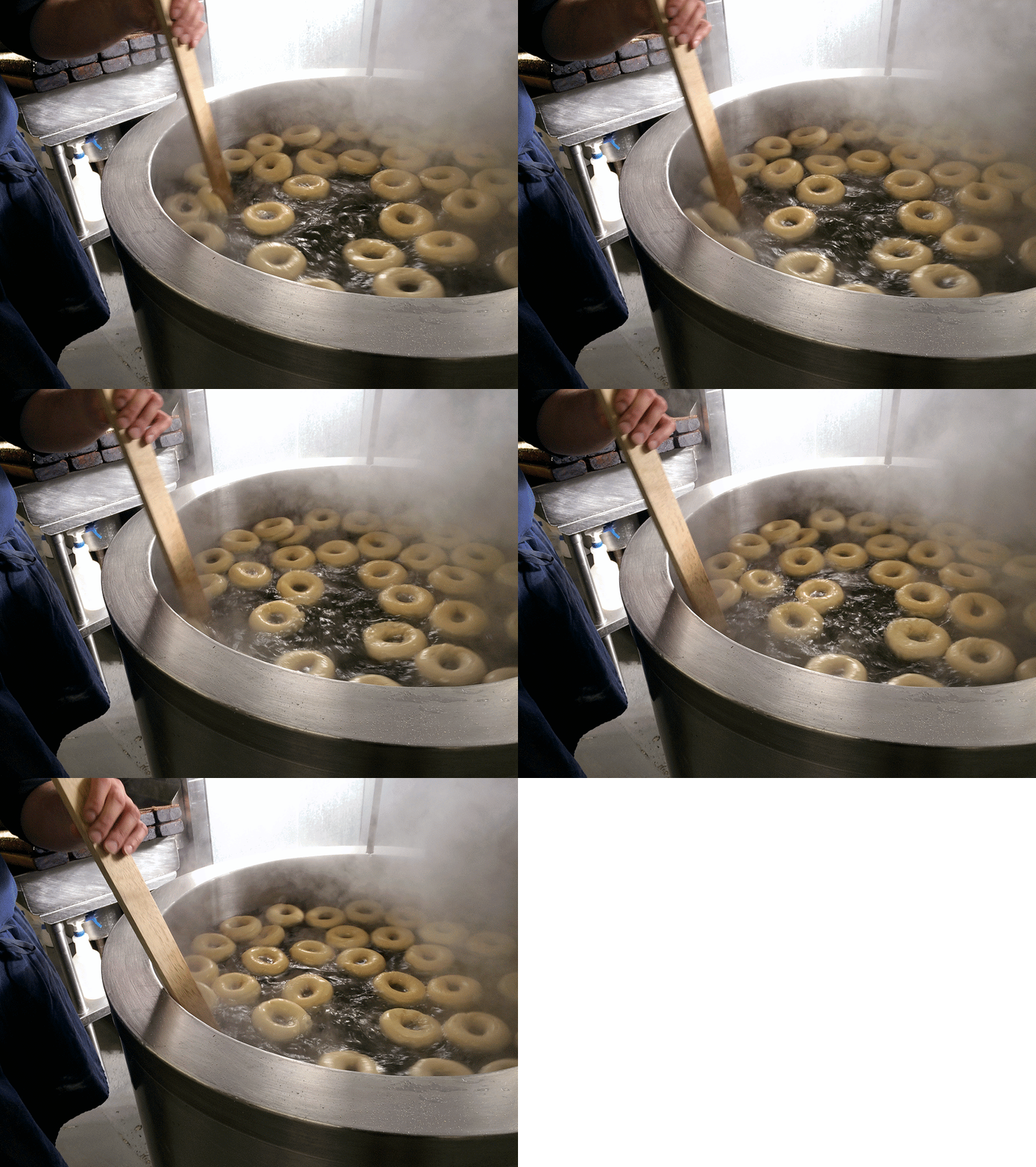
In NYC doctrine, bagels are water-boiled before baking. Photo by Jen Snow.


Yamir Ramirez kneading dough for challah.


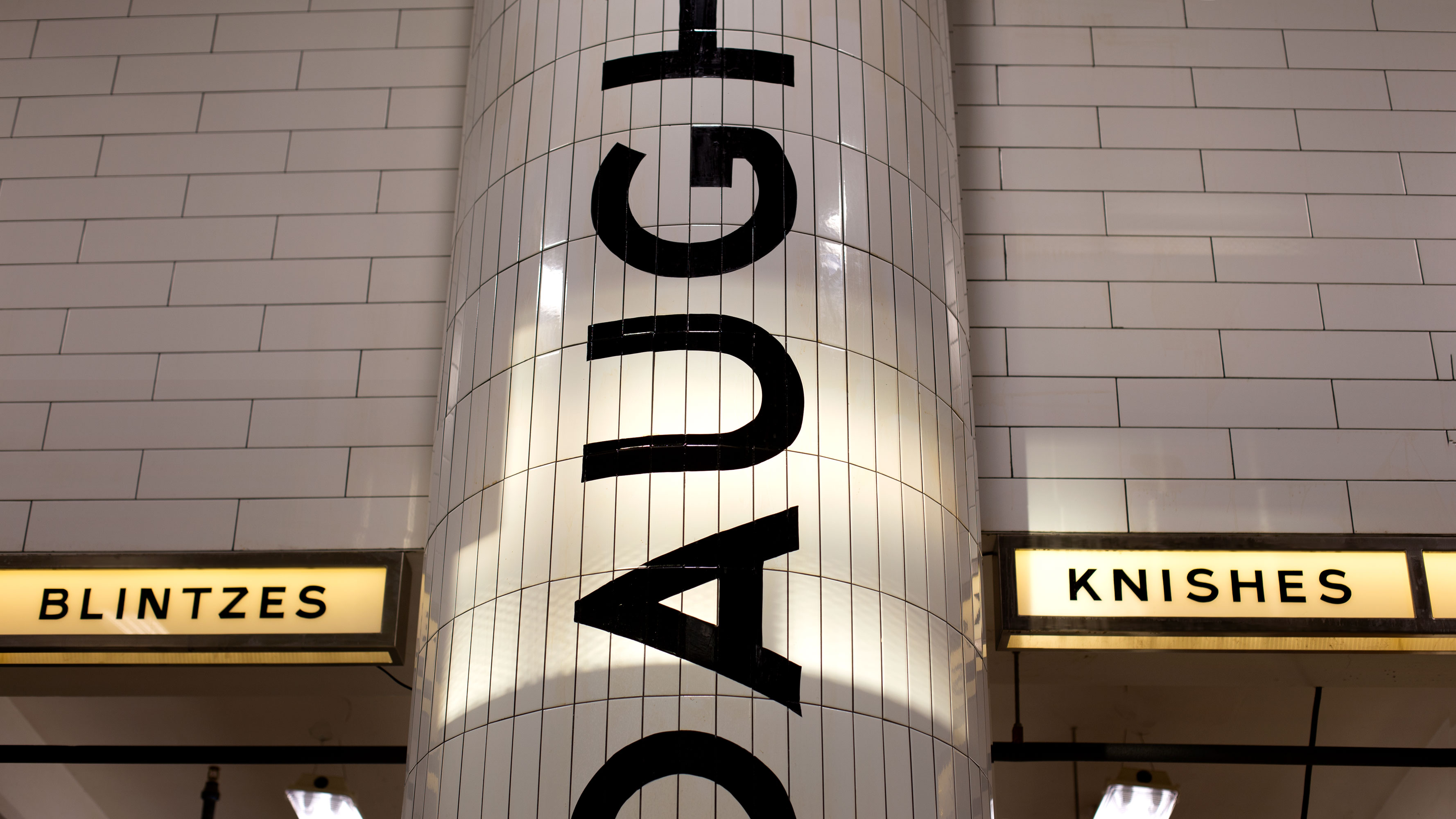
We were all giddy as hell (literally: jumping with joy) when the tile went up. We used a narrower width of tile on the columns to keep the faceting subtle. It looks really good.


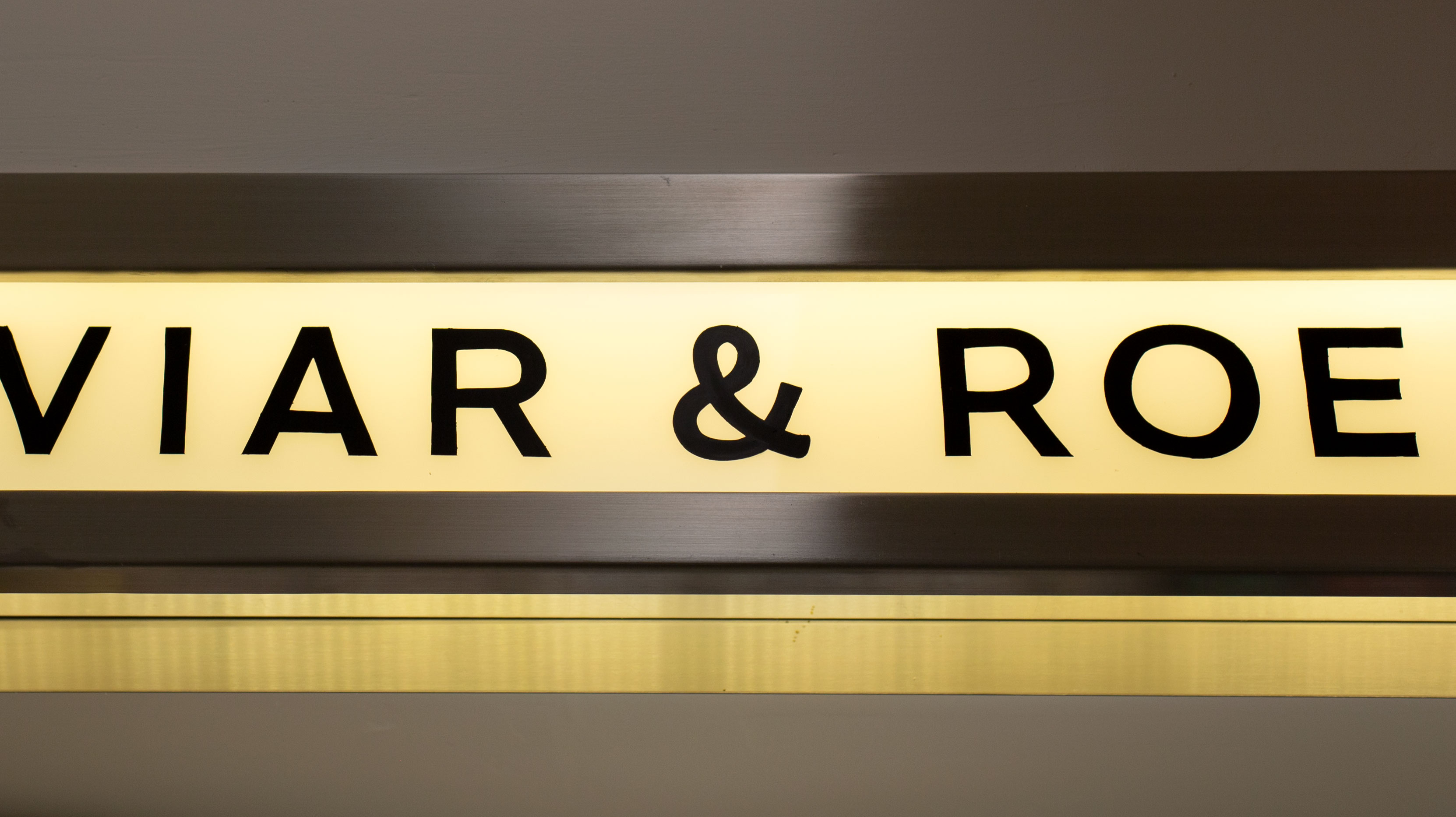
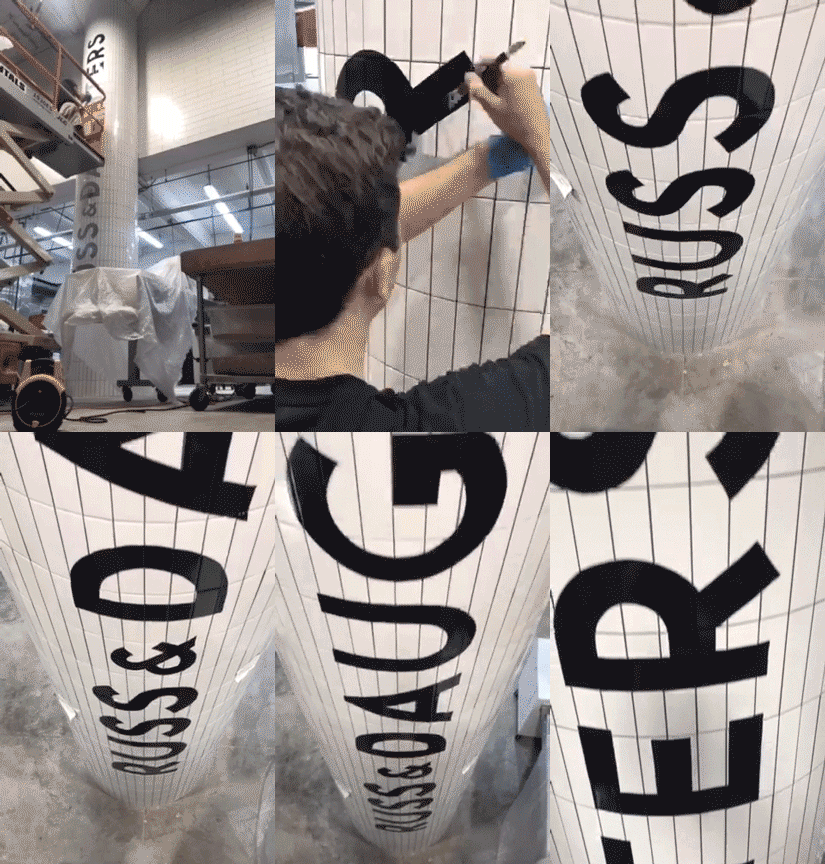
My friend from grad school and steady-handed sign painter, Jon Bocksel, came in to paint the column and the lightboxes according to specs we tested out both in Photoshop and dangling, shredded pieces on paper. (TY Niki and Josh for tolerating my methods as professional. lol)


1:1 testing ¯\_(ツ)_/¯ slash capture-the-flag game


With the help of an enormous printout, Jon transferred the vector design onto the central column.


Timelapse by Jon Bocksel.


Jen, who has studied the product stacking in the shop for years (and who keeps a pile of old photos for reference) organized the appetizing counter’s shelves.


I obsessed-over, sourced, and calibrated the lighting across the spaces—trying to achieve the right balance between the aesthetics of production and that of “warm, inviting space”… while keeping them part of the same whole. It was a very specific line to walk.


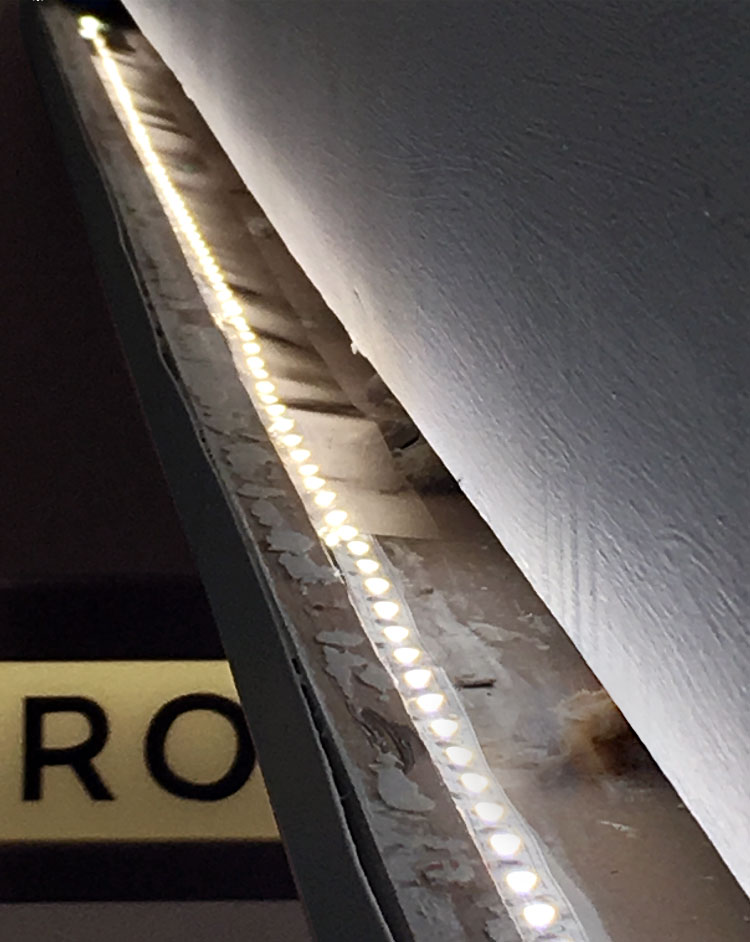
We used energy-efficient LEDs wherever possible (overlaid with theater lighting gels to achieve more of an incandescent feel.)


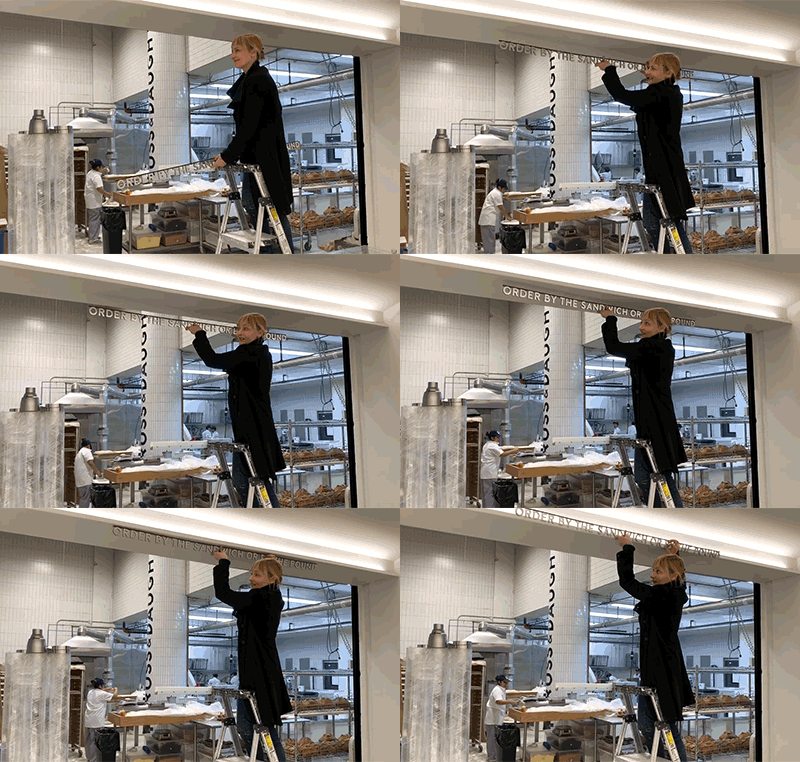
Placement and sizing is tricky in such a large-scale environment. Forever testing…


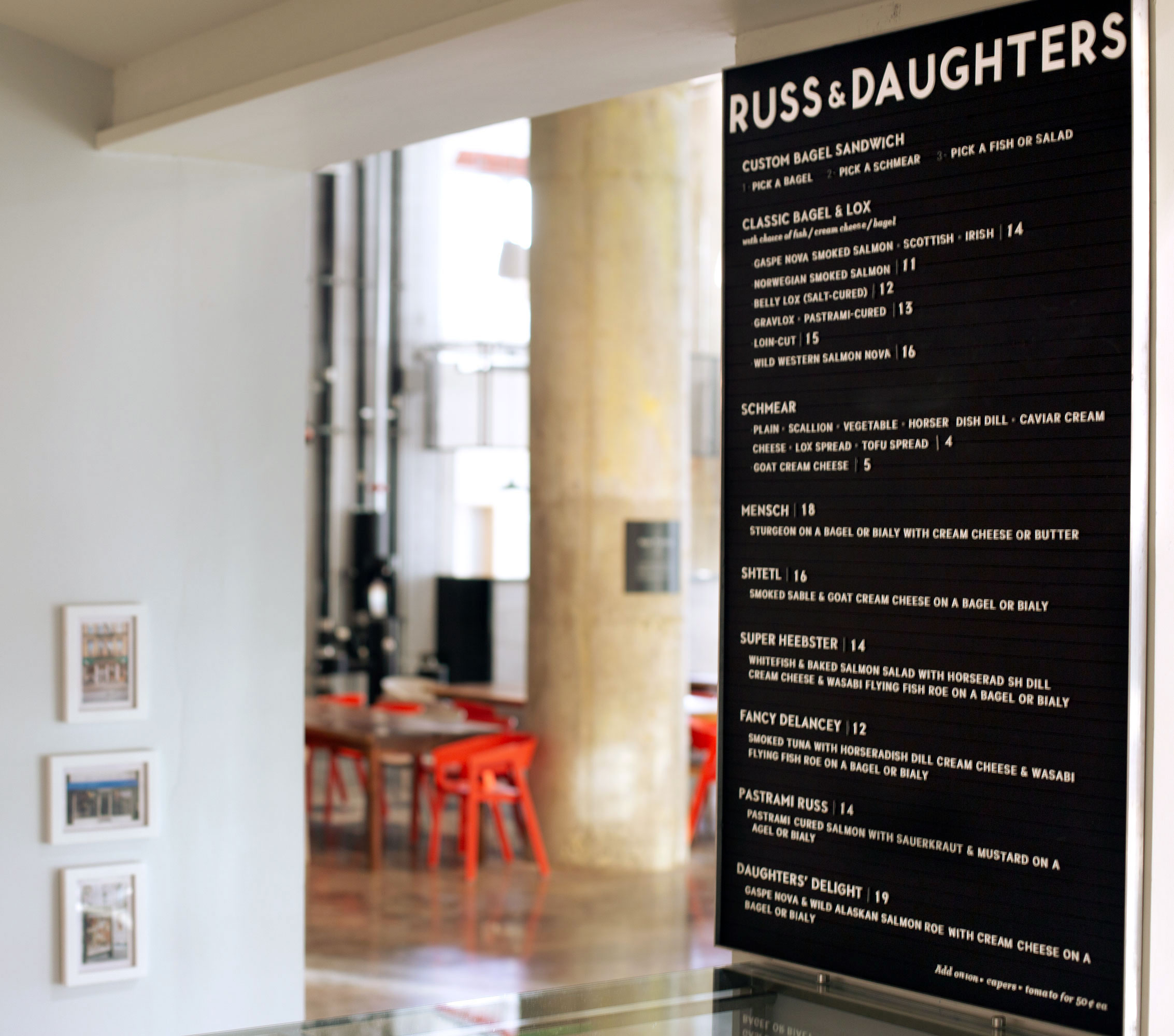
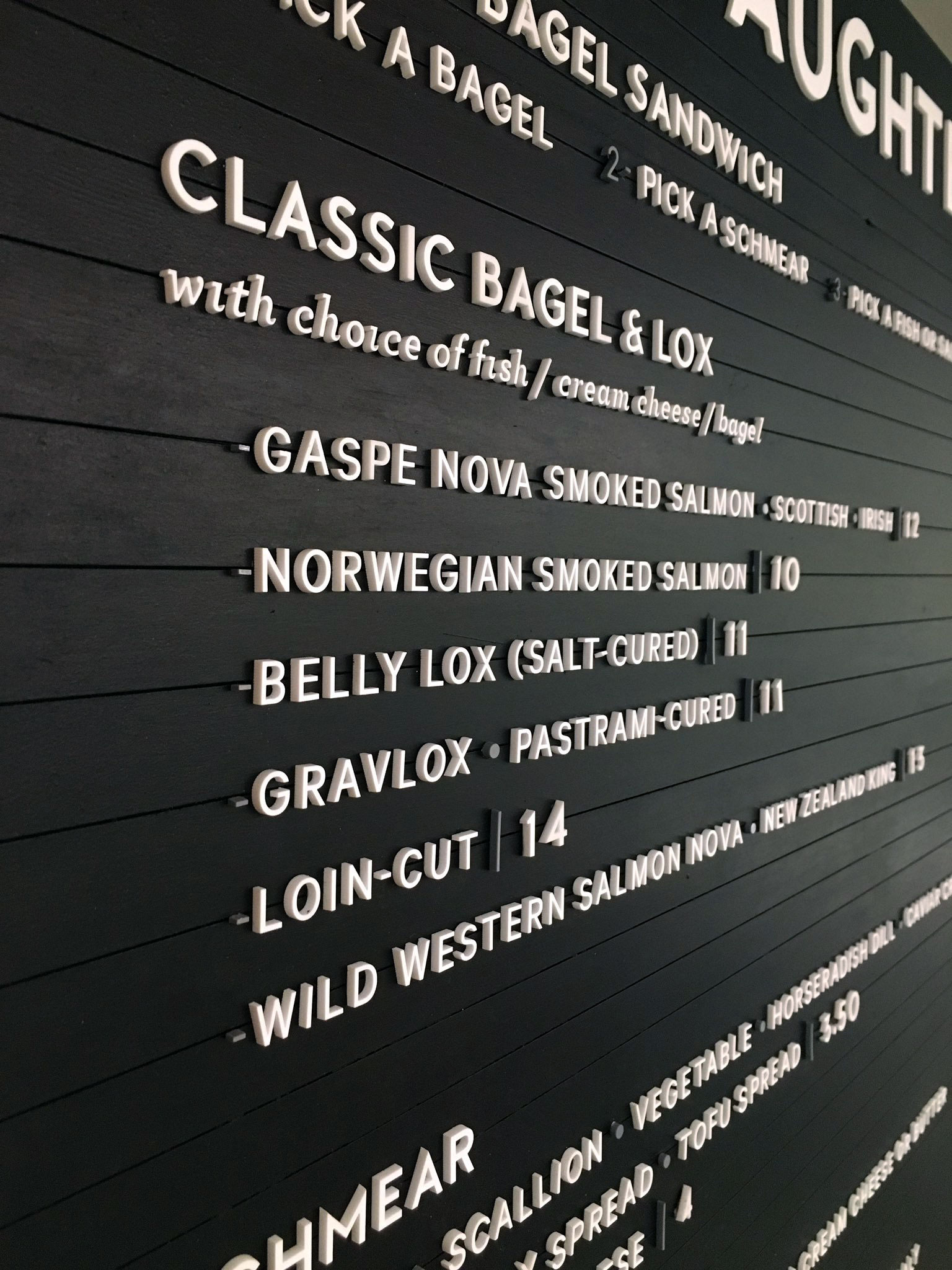
I built two experimental changeable letter systems for Russ & Daughters’ menu and announcement systems. This black changeable letter sign resembles its haimish counterpart but is made from stained and ribbed solid oak.


I had a lot of help from the amazingly-meticulous Alina Keay getting the letters onto the board.


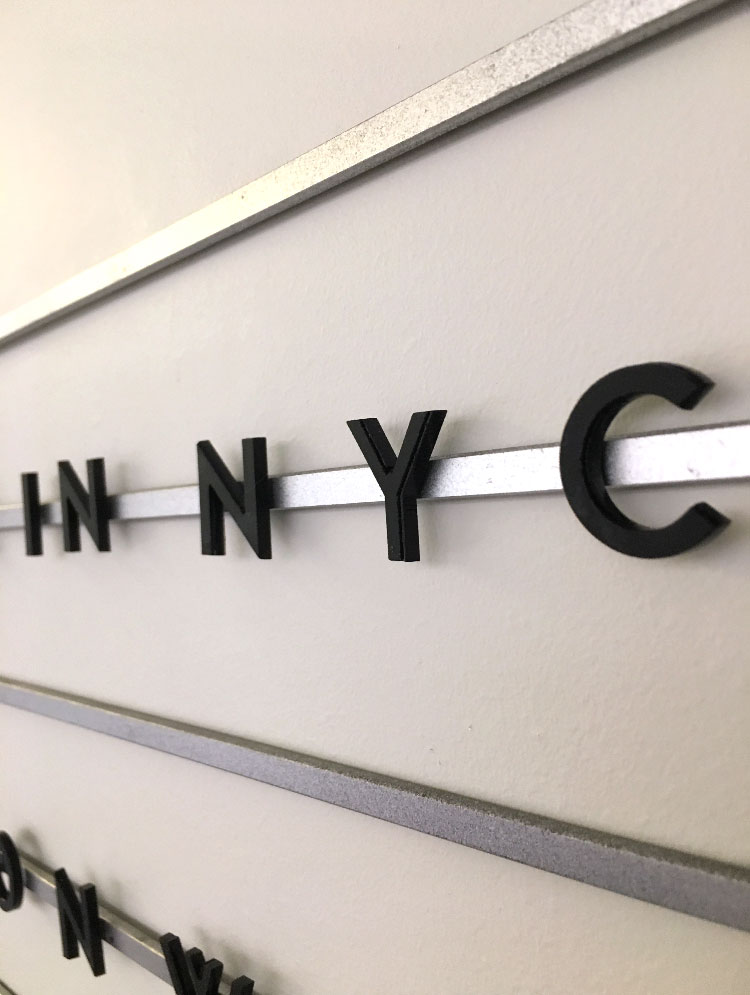
This second changeable letterboard employs standard steel rods from McMaster Carr, laser-cut letters, and some extremely strong magnets.


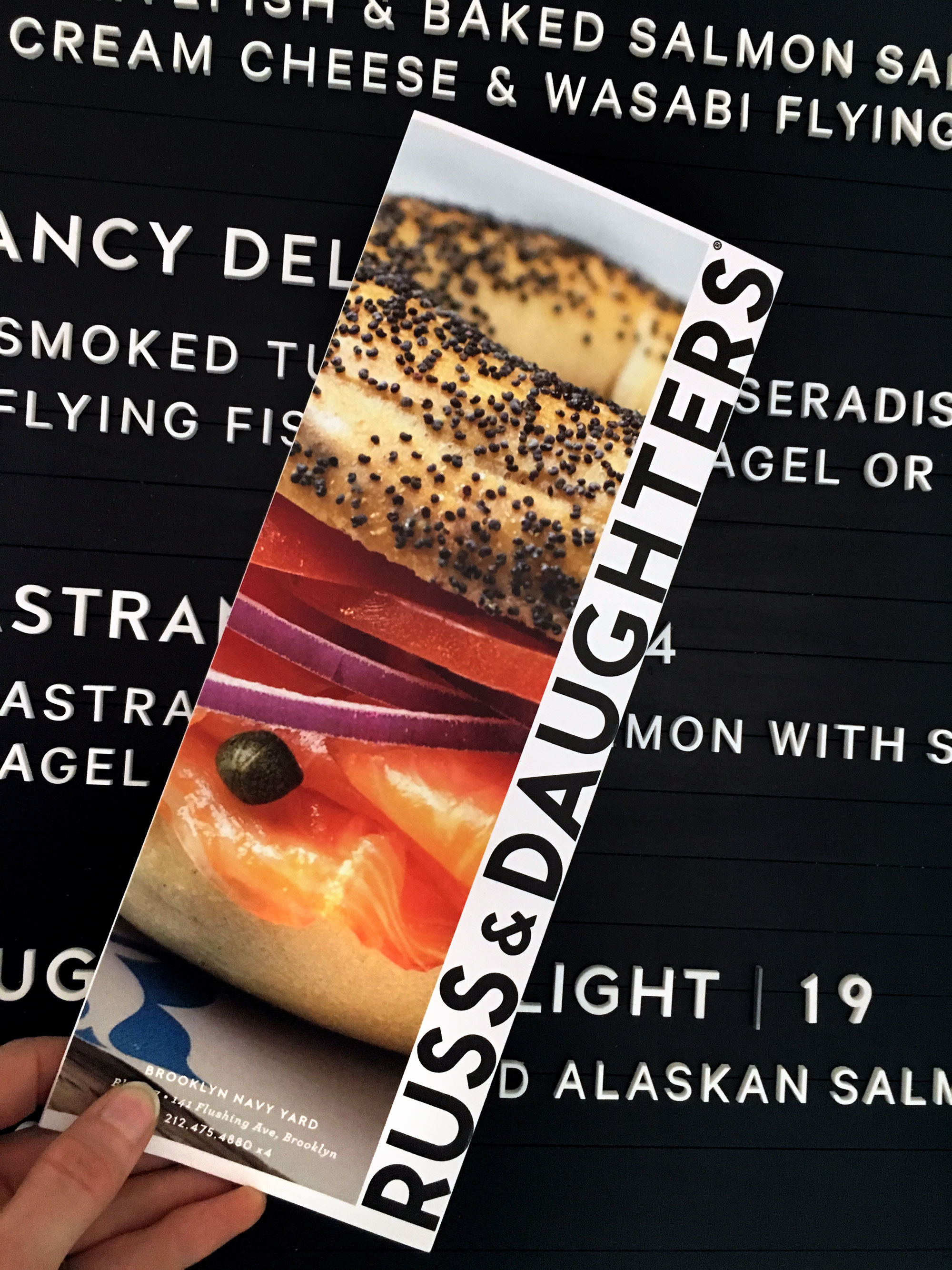
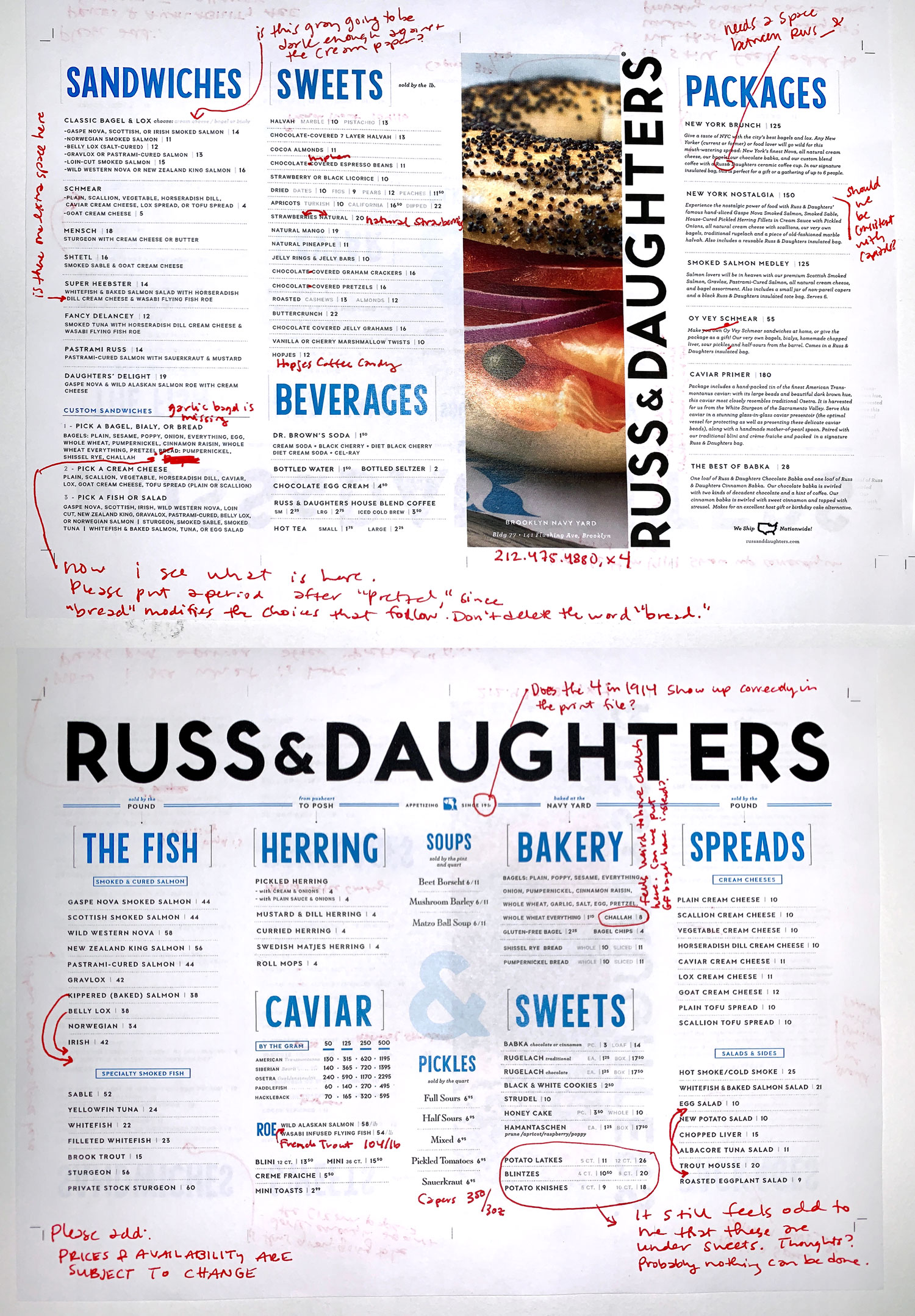
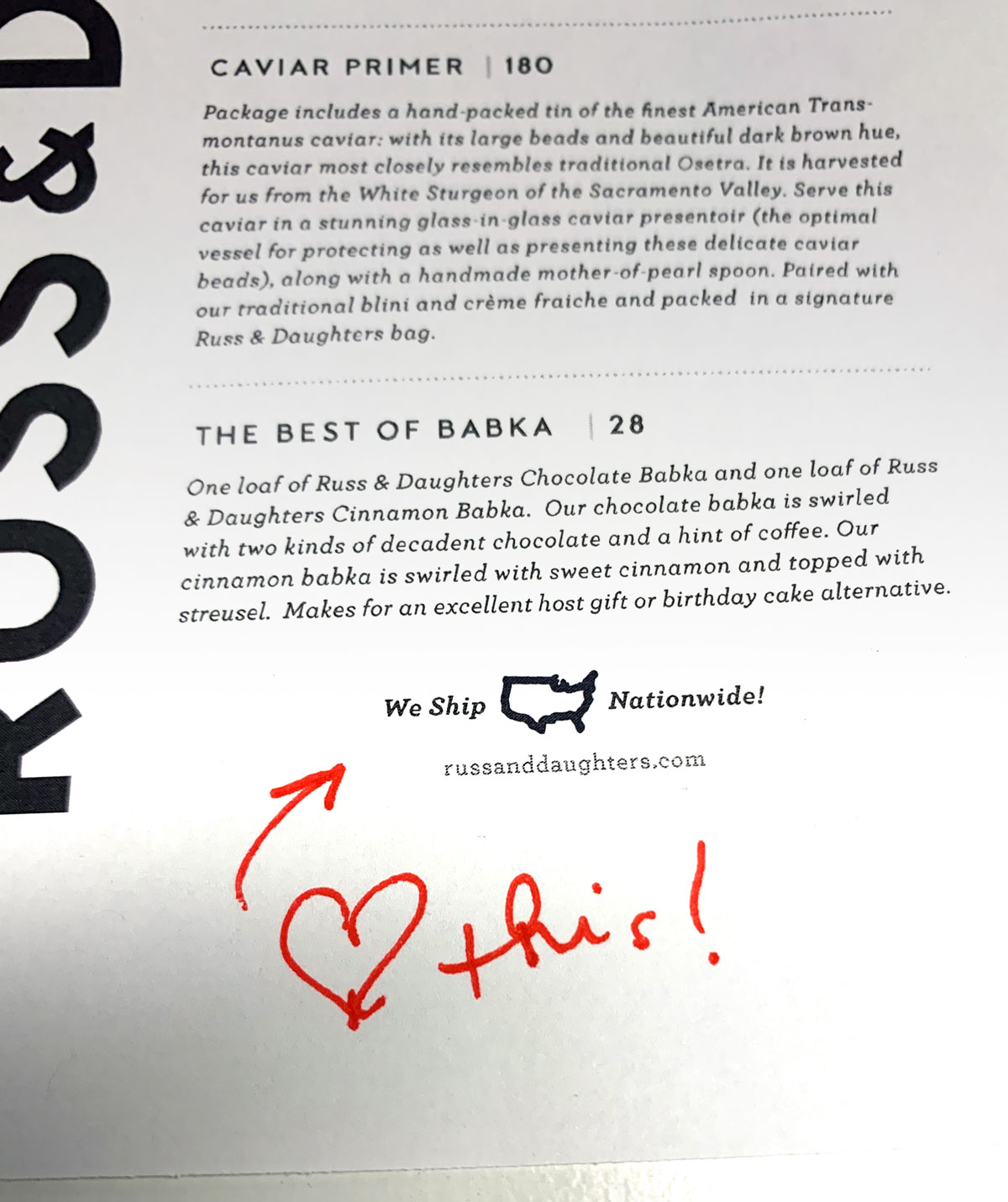
Because Russ & Daughters’ printed menu style must be so fastidiously-bricked together, Jen and I had to work back-and-forth very closely to calibrate the text to appear to have been MADE for exactly this amount of paper real estate. Feel free to download and scrutinize my type-Jenga here, while ordering a sandwich.


yay!


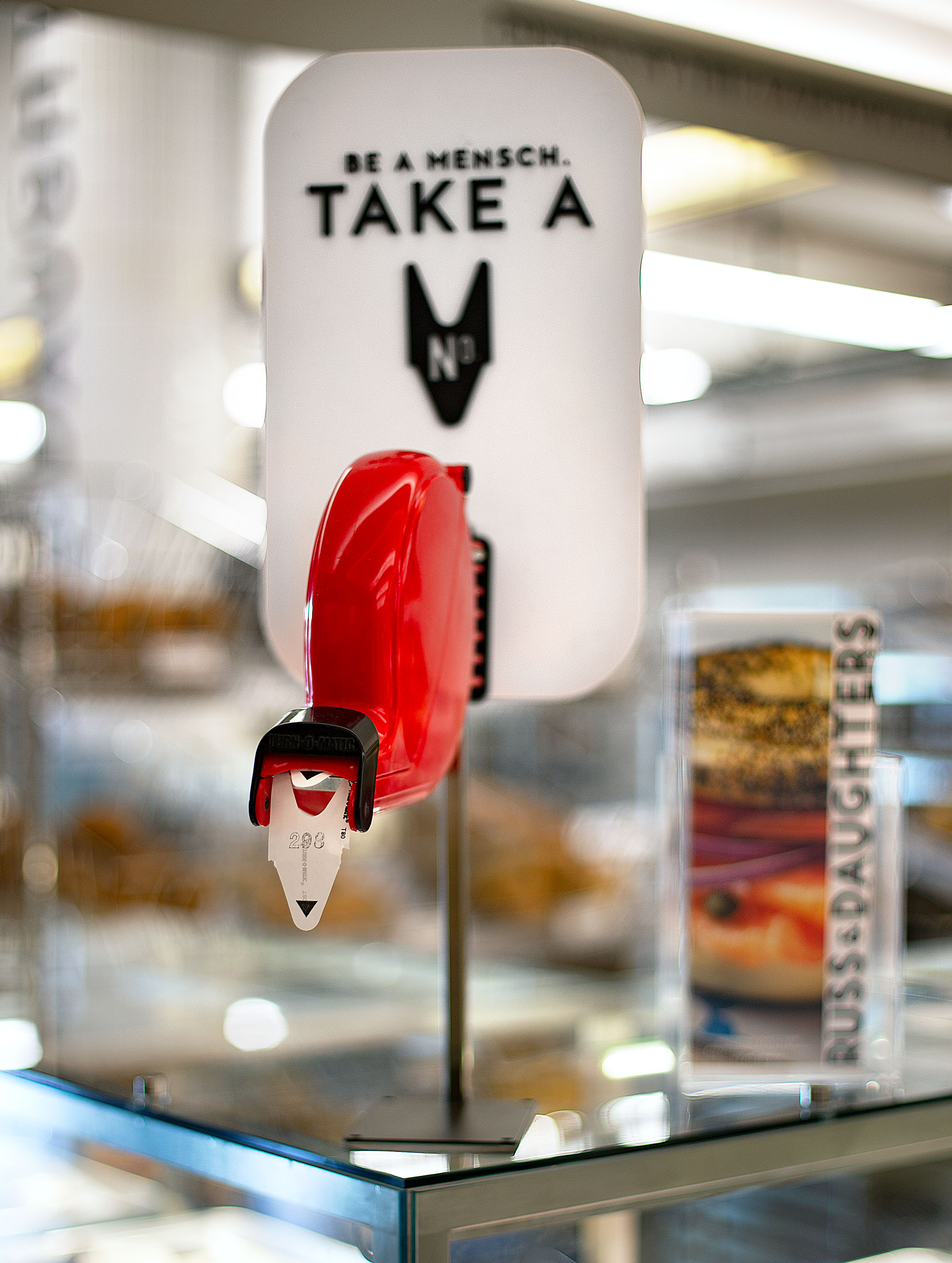
Another favorite details that we managed to work in: a mensch-y take-a-number dispenser.


Thanks to Niki and Josh for your continued trust and best of luck to the new army of bakers and counterstaff! <3


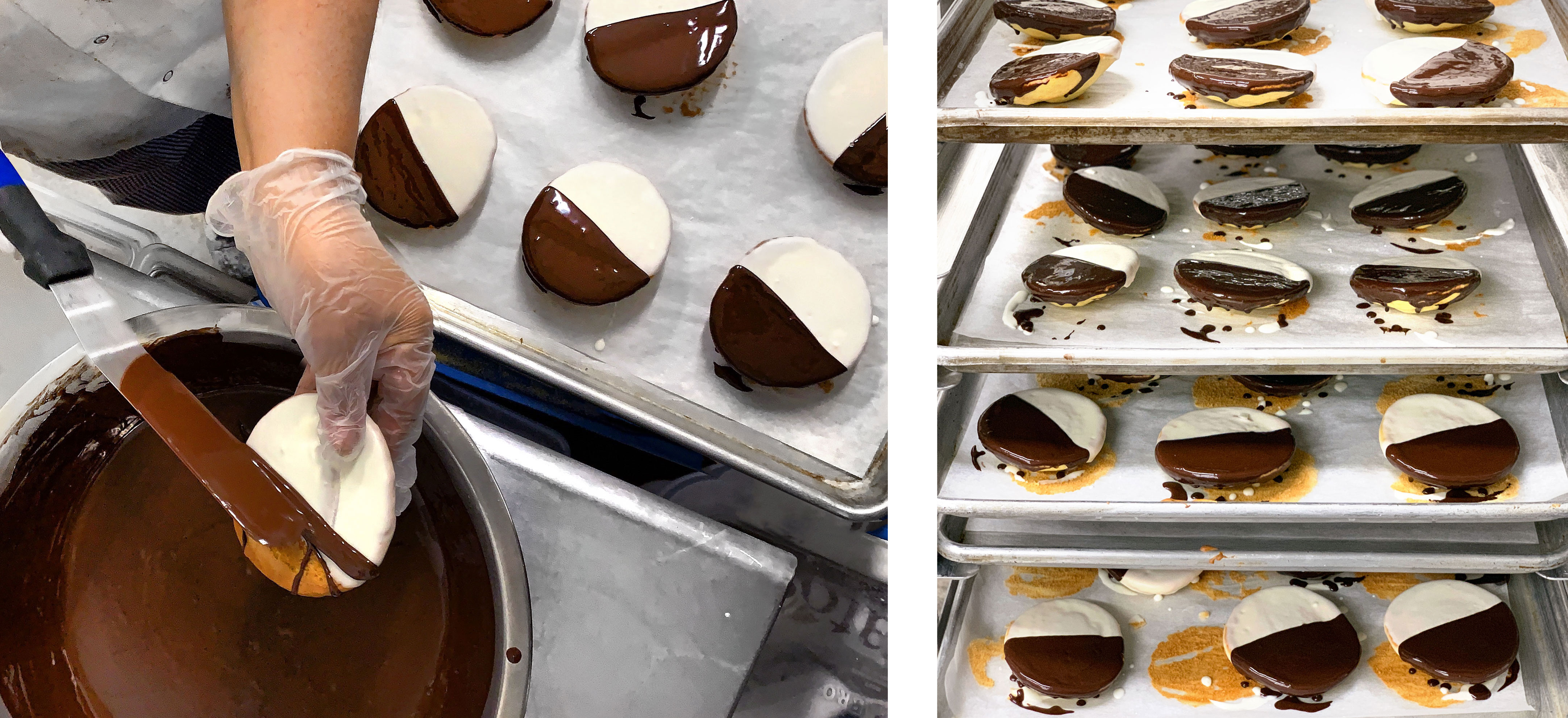
NYC’s iconic black and white cookie, in full-tilt production. mmmmmmmmmmmmm… Beautiful photos by Jen Snow.


And… just because design is a ridiculous (and wonderful) “in-a-vacuum” thought experiment sometimes


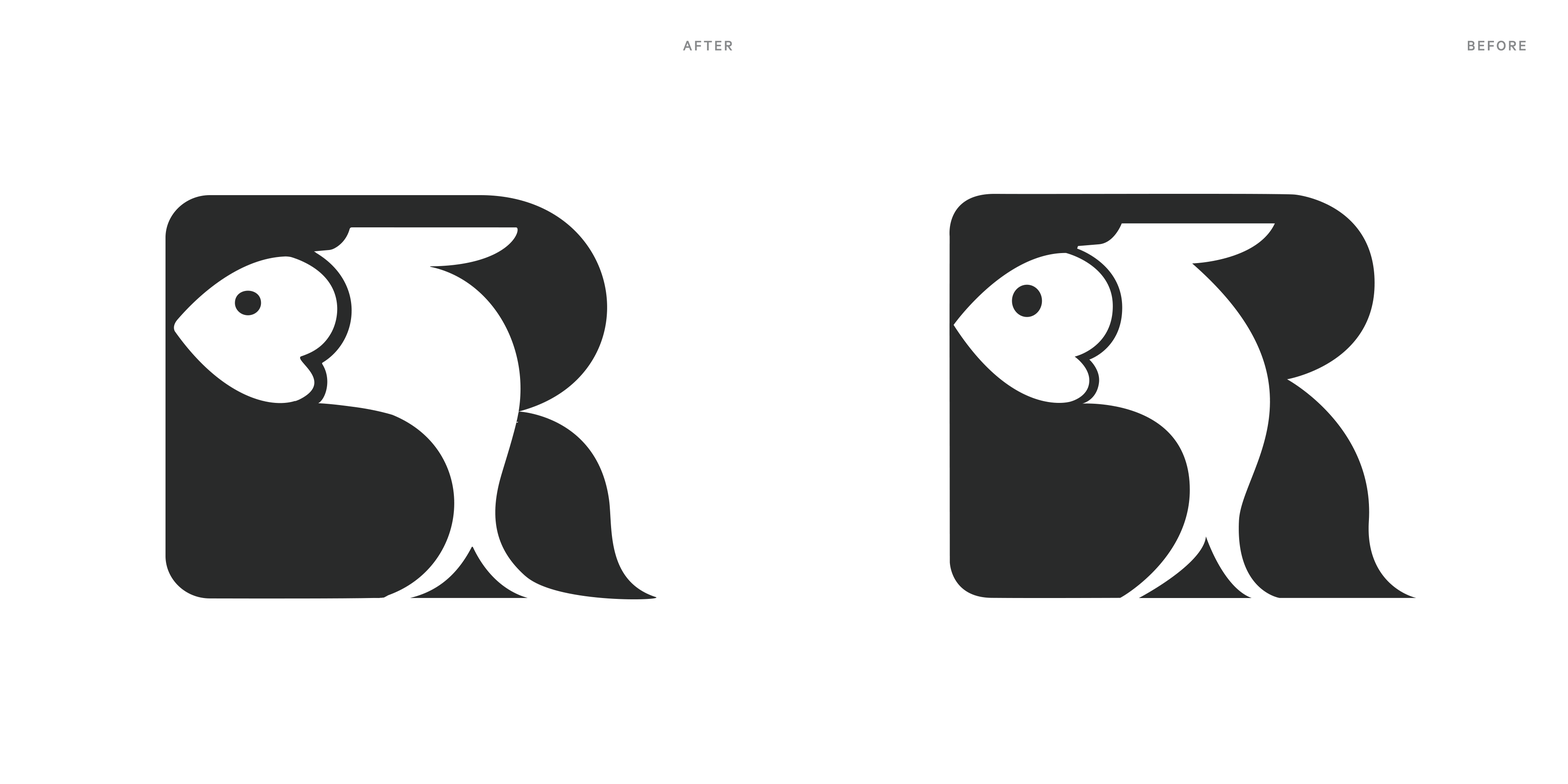
A few months ago, I wrote a presentation breaking-down all of the subtle and obsessive considerations that went into updating Russ & Daughters’ beloved logo. (I posted a distillation here.)

Meanwhile…

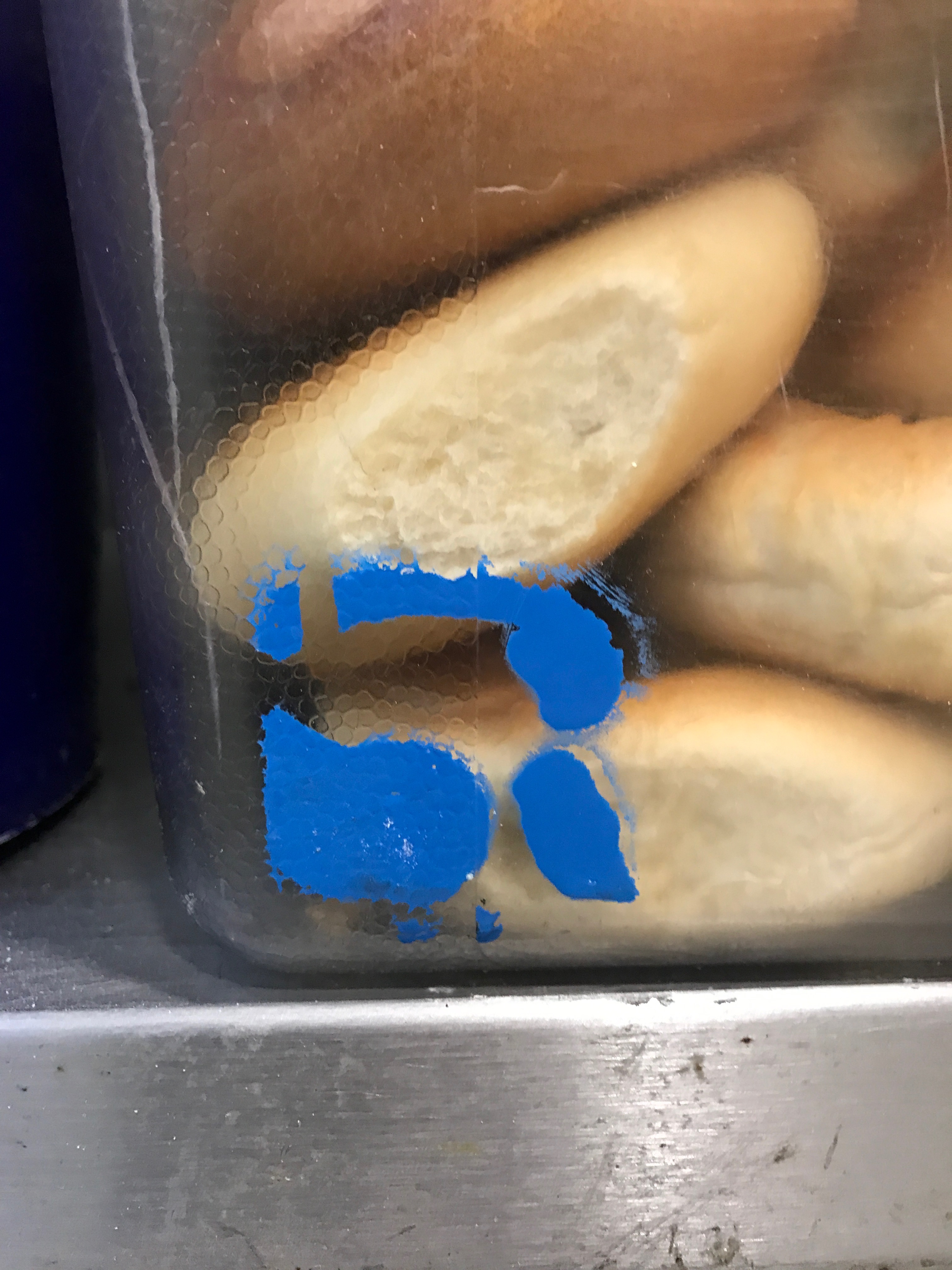
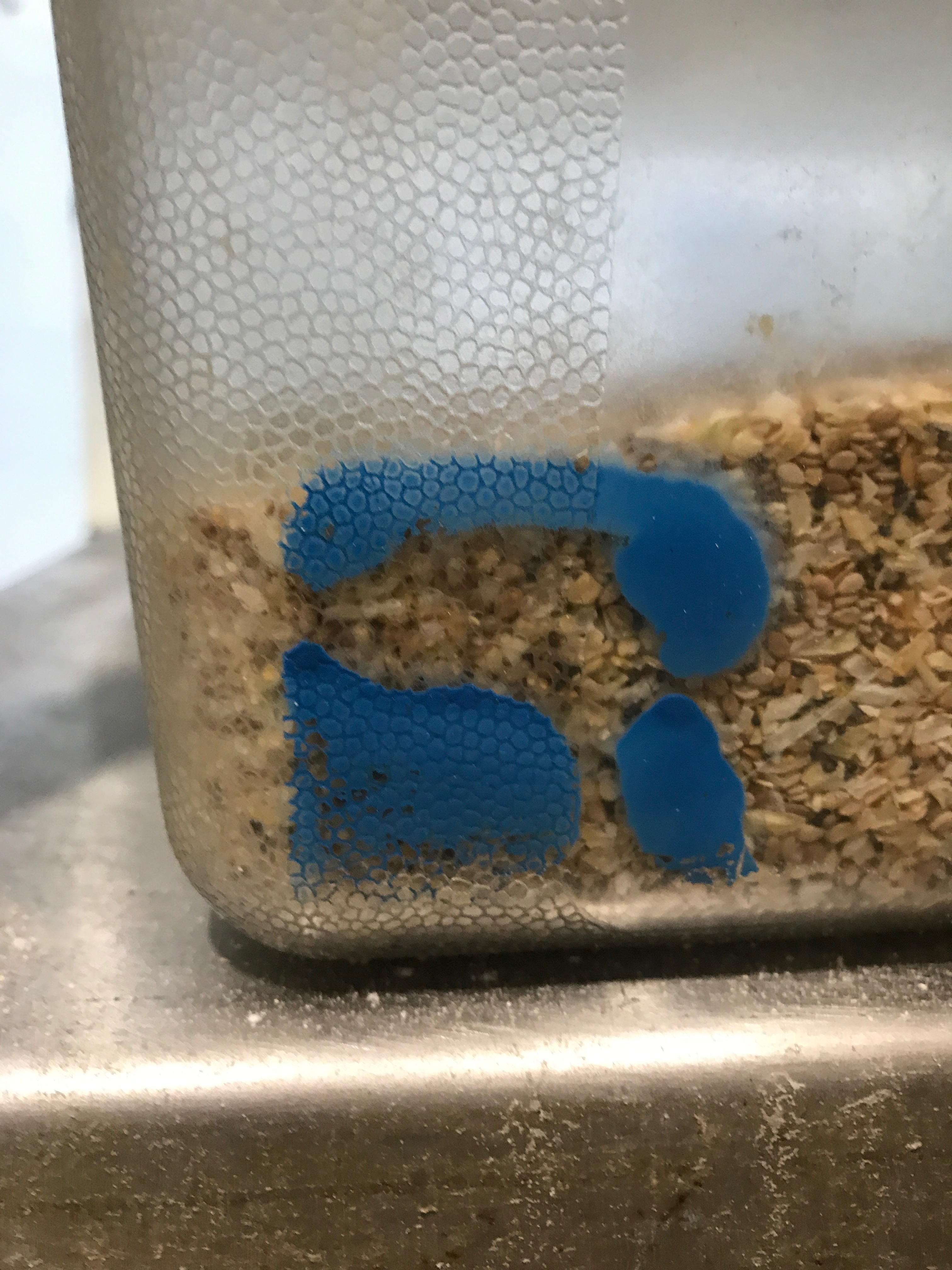
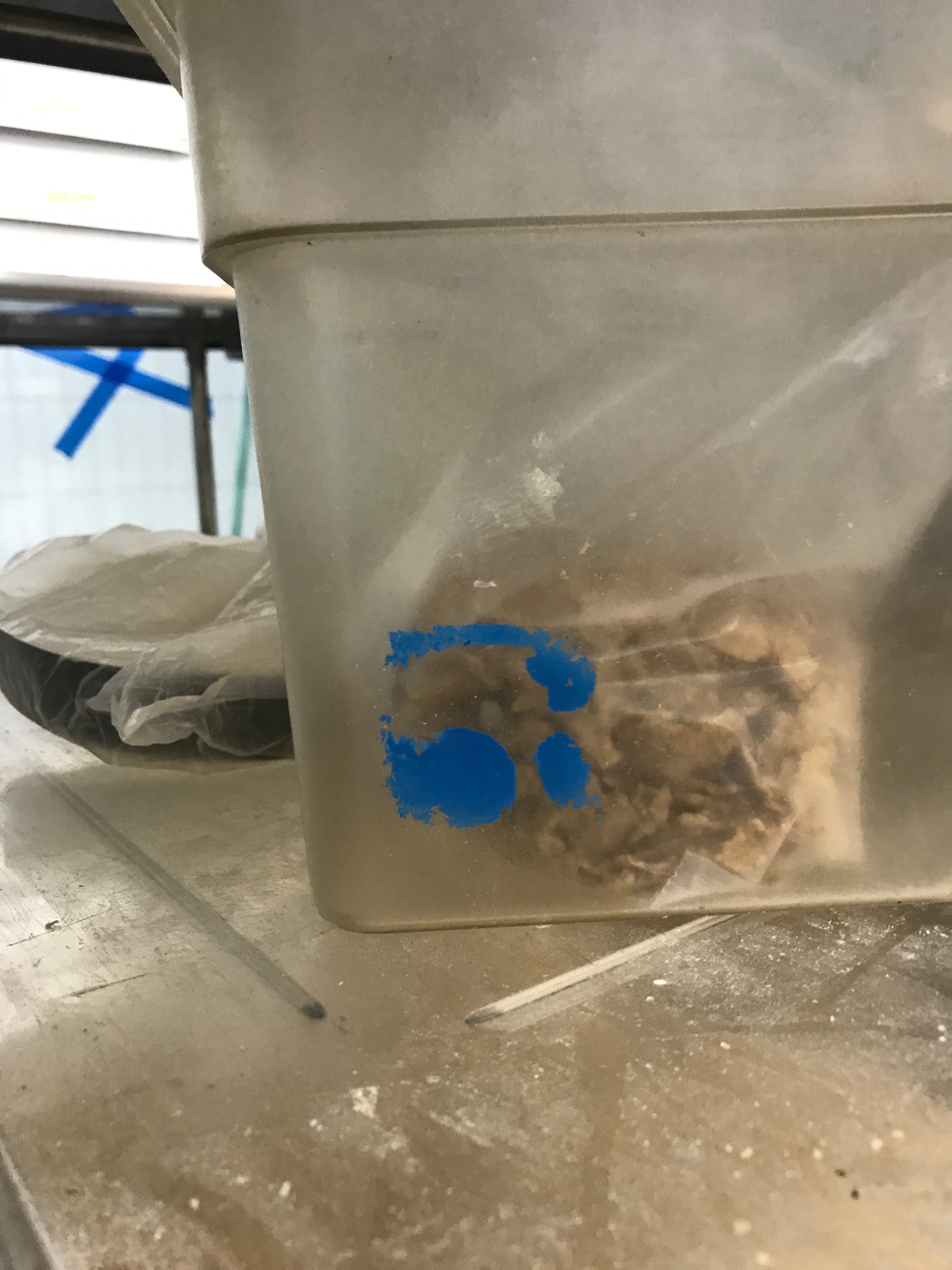
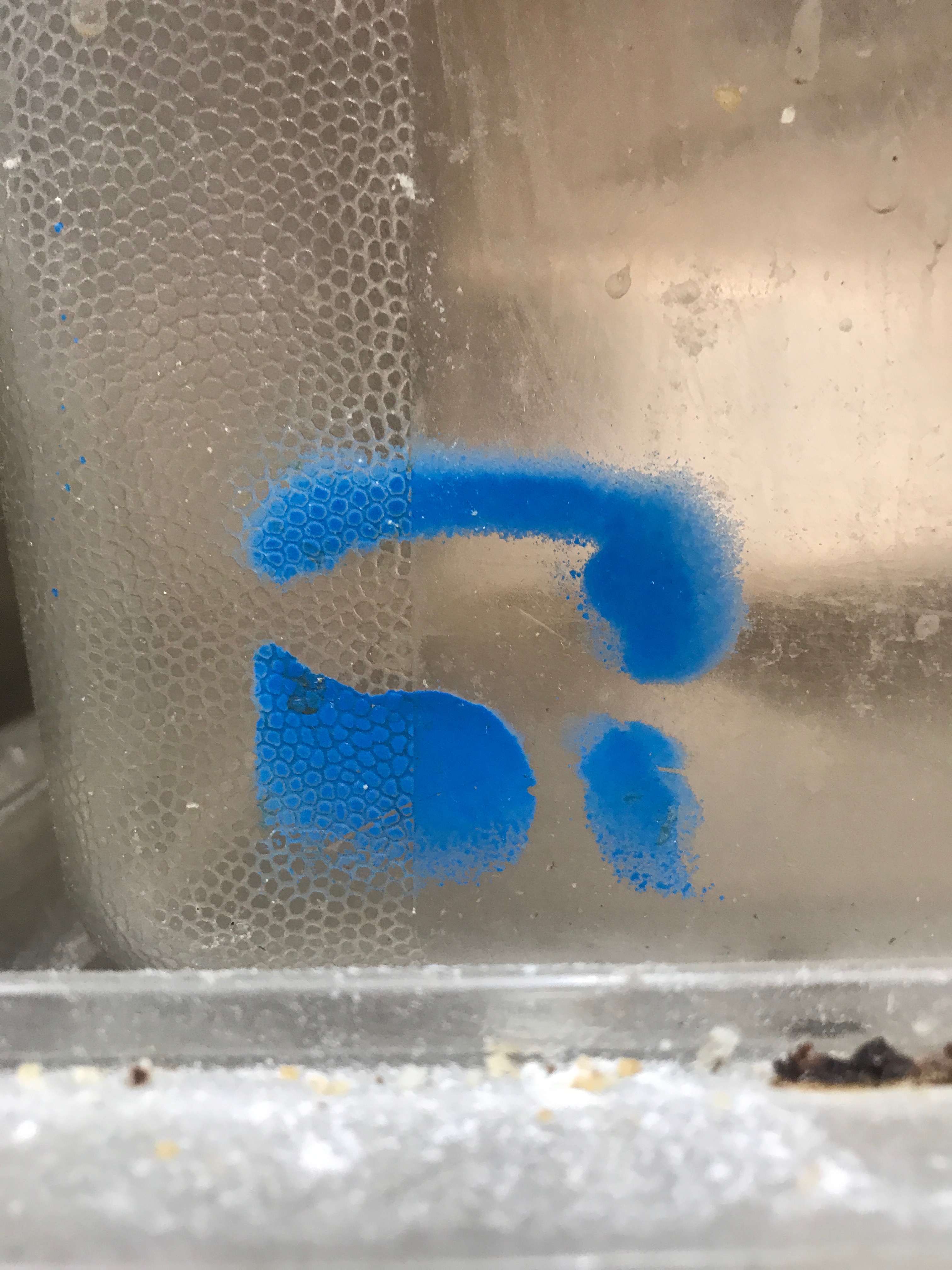
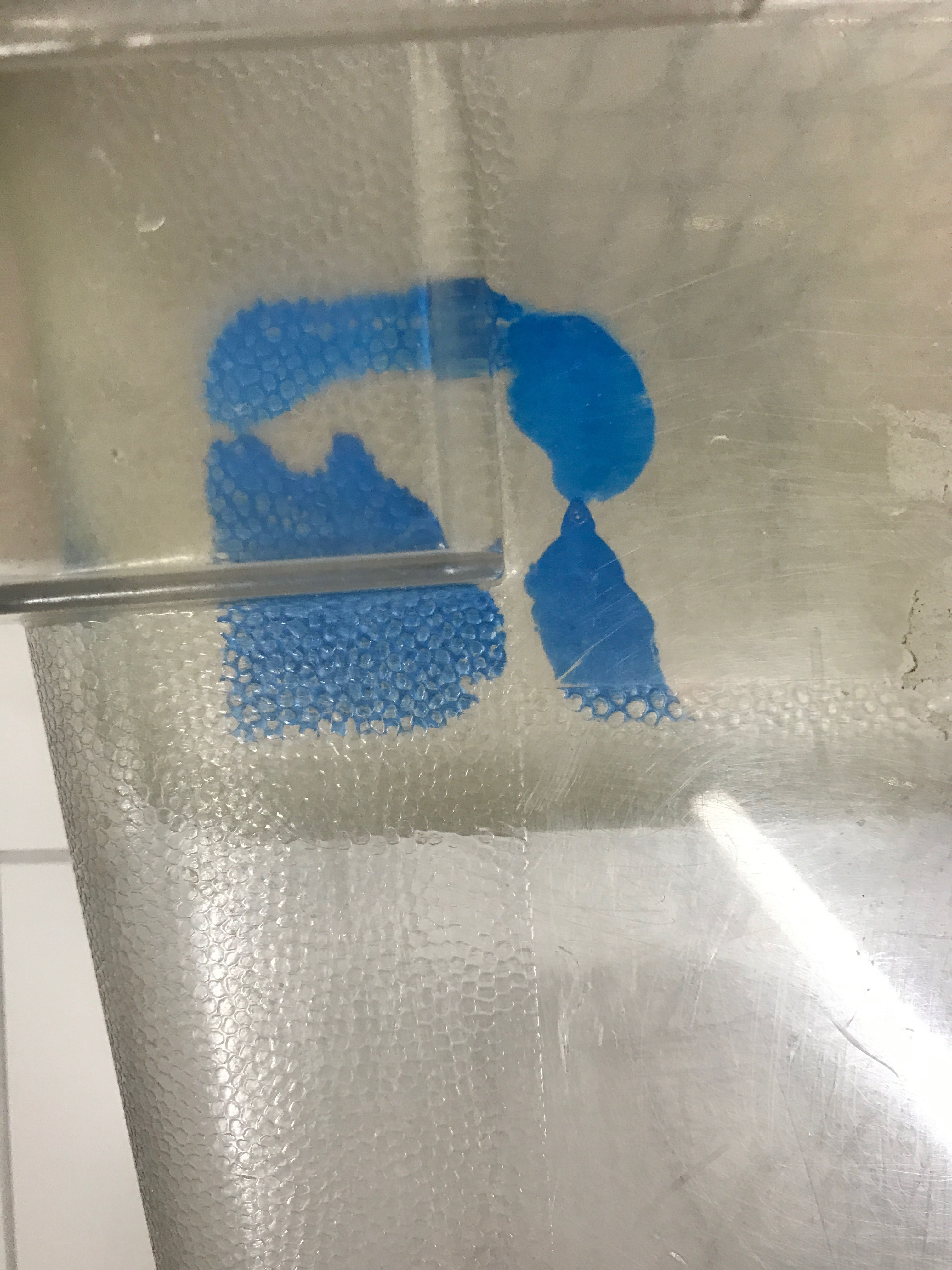
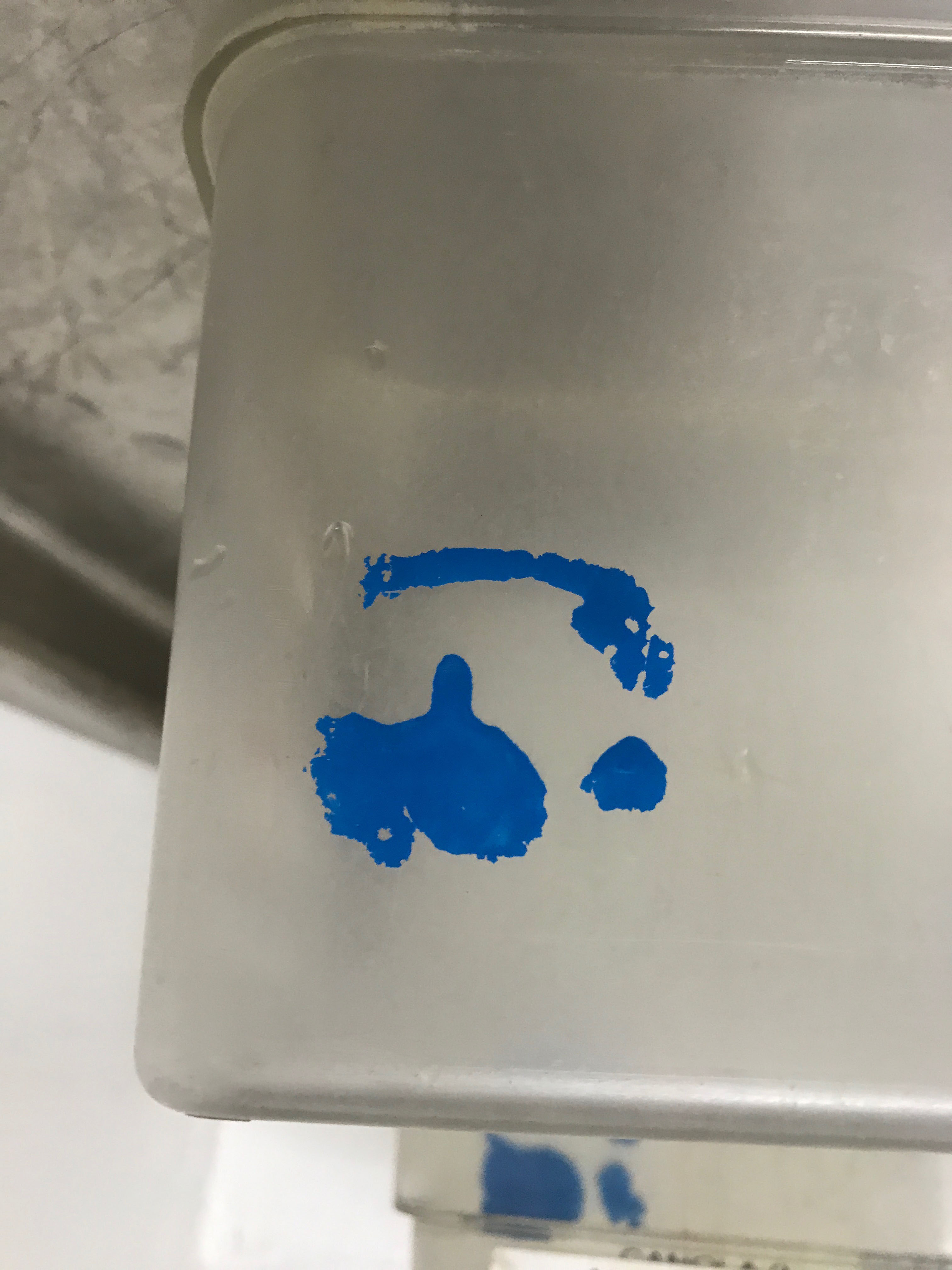
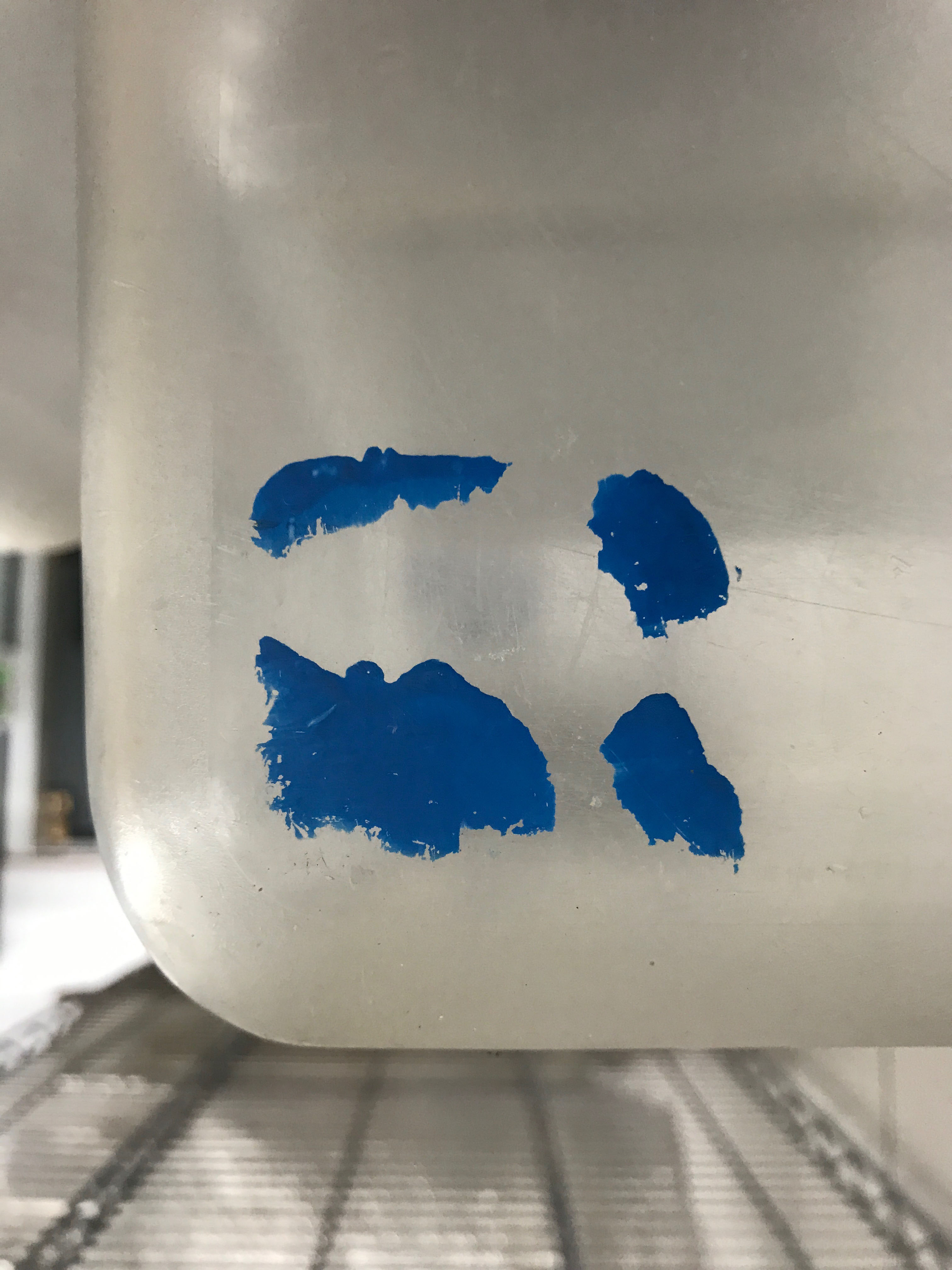
Production sometimes needs to designate plastic bins (and have made their own spray-painted stencil version of the logo.)

I’m a little obsessed with how logos degrade with different methods of replication. I have been following the fish’s escalating-abstraction with rapt attention:


https://kellianderson.com/blog/?p=4187
Extensions
Folding as Craft Tech
Uncategorized
    “Modern industry saves us endless drudgery, but… it also bars us from taking part in the forming of material and leaves idle our sense of touch, and with it, those formative faculties that are stimulated by it.” —Anni Albers   Two things: 1.) I am organizing a new, experimental course at the School […]
Show full content


“Modern industry saves us endless drudgery, but… it also bars us from taking part in the forming of material and leaves idle our sense of touch, and with it, those formative faculties that are stimulated by it.”
—Anni Albers


Two things:
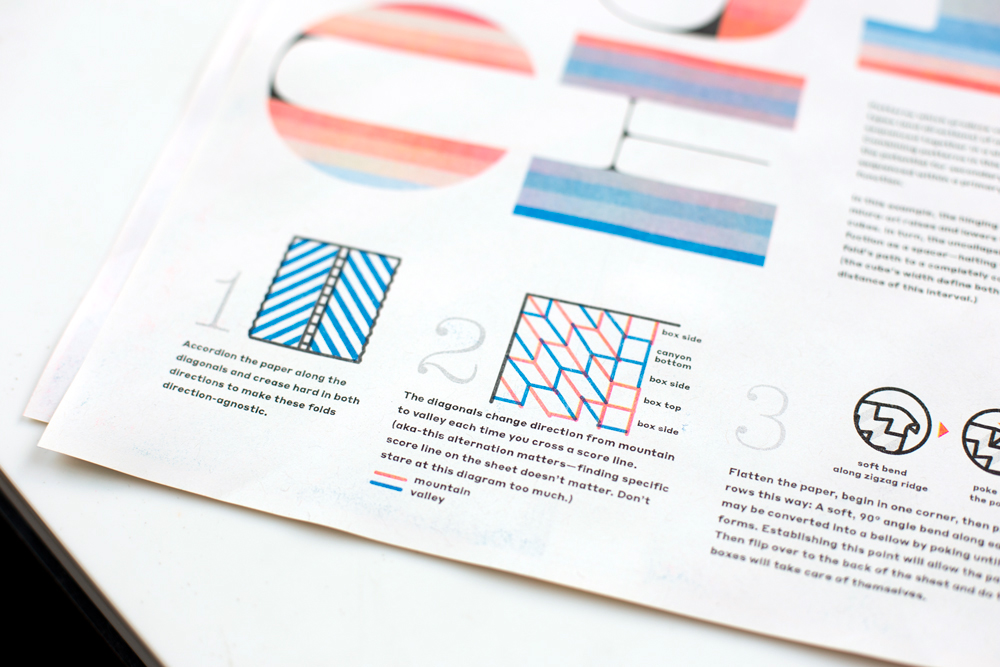
1.) I am organizing a new, experimental course at the School for Poetic Computation on the topic of folding-as-tech (rather than just a craft.)
and…
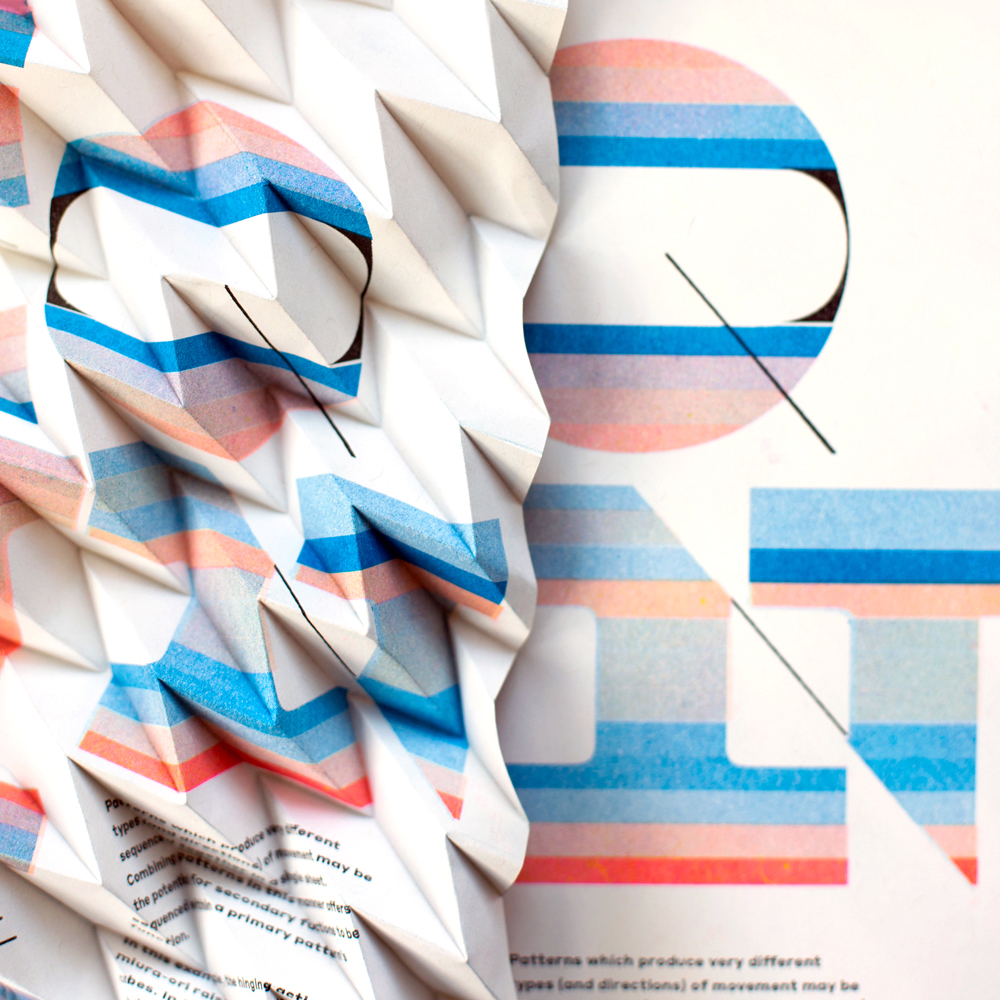
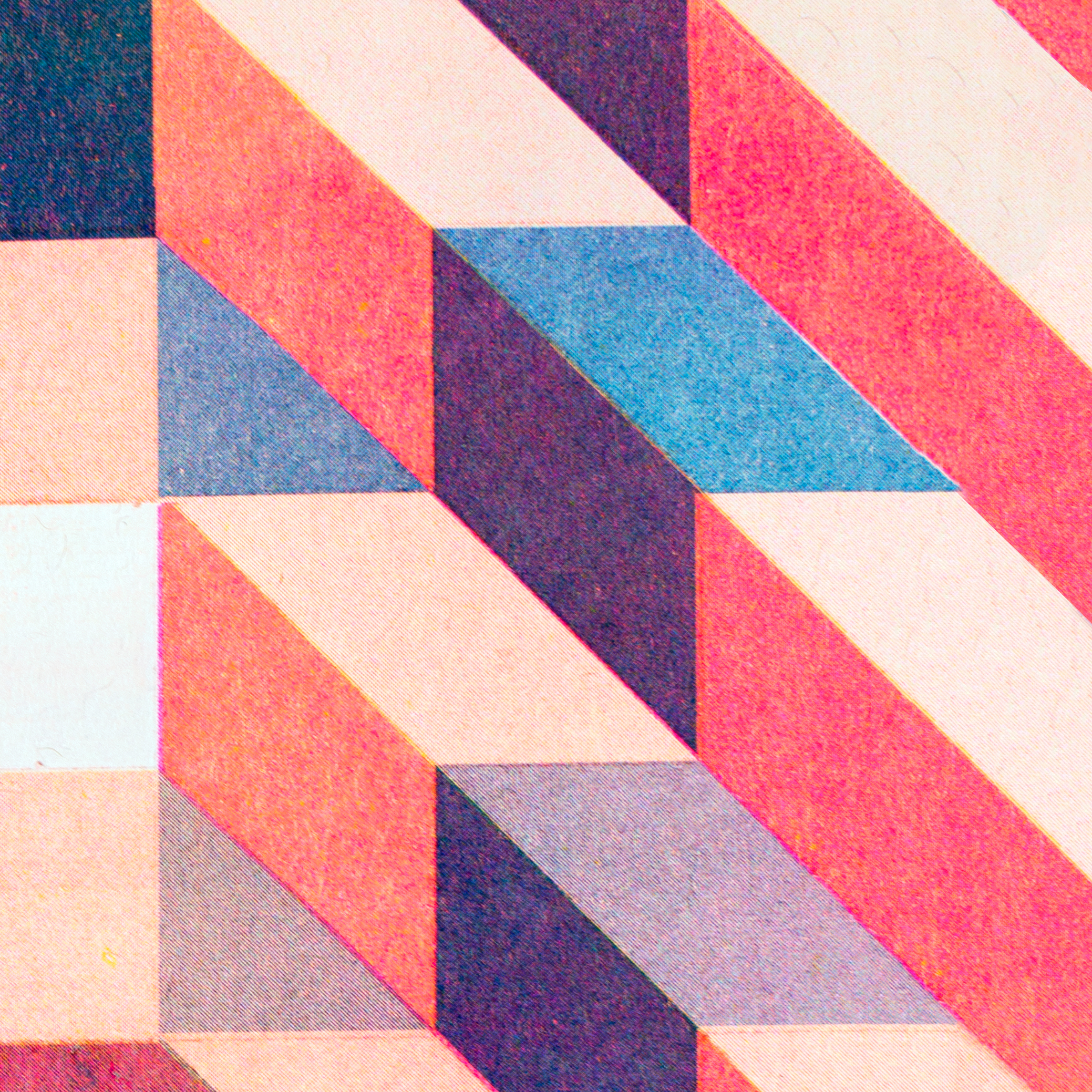
2.) I’ve made these ^^ foldable RISO prints, which you can buy!. They introduce the topic through super-satisfying paper folding activities (+ deformable, physically-animated typography.)

“Folding as tech” may initially sound like the niche pursuit of a handful of artists… wholly-unmoved by considerations of practicality*. It is actually an intimidatingly-wide topic with entry points from a multitude of disciplines. The notion of folding-as-tech spans centuries of nearly-forgotten tactile wisdom (ex.: origami) and the pressing demands of super new applications (ex: self-folding robots.) These are, for the most part, disciplines which never have a reason to talk to each other.
*no judgement, we’re gonna do that too


The knowledge, techniques, and ideas surrounding this topic is so broad, in fact, that the course’s co-organizer—computational origami artist, Robby Kraft—and I keep stumbling upon things and then wondering aloud: “Wait, so maaaaybe the entire world could have developed using flat-foldable technologies rather than mechanics?? (Like: if the Western world was less dominant during the Industrial Revolution and origamic techniques managed to proliferate?)” Would we ever, like… get to cars? Or would transport be 100% wriggling surfaces / 0% vehicle?

With resource depletion eminant (and its attendant human rights abuses increasingly being uncovered by the media), such thoughts are beginning to be thought outside of the context of art class. More thinkers are looking towards tech’s non-dominant counter-histories for hints on where to go from now—ways that an alternative history of tech could have developed (and ways that parallel techs have developed covertly, under the radar as “craft”.)

A good example is Daniela Rosner’s new book Critical Fabulations

Focusing on the development of computational systems, she takes on powerful narratives of innovation and technology shaped by the professional expertise that has become integral to the field’s mounting status within the new industrial economy. To do so, she intervenes in legacies of design, expanding what is considered “design” to include long-silenced narratives of practice, and enhancing existing design methodologies based on these rediscovered inheritances. Drawing on discourses of feminist technoscience, she examines craftwork’s contributions to computing innovation―how craftwork becomes hardware manufacturing, and how hardware manufacturing becomes craftwork.


Our class was formed in with this same spirit of questioning and reassessing what we can actually do with materials that are supposed to “do” nothing.

We are putting a bunch of multi-disciplinary people in a room together to learn from each other, but also, simply: to daydream freely without the confines of “the right way to do X.” To ask what could be, if the history of technology had progressed different? If the world ran off of someone else’s narratives.

And—of course—to figure out the range of things we can we build from this paper, tyvek, and cardboard.


In my own work, I’ve been using paper engineering* techniques to reimagine black box tech as lo-fi paper structures. Ones which tap into the laws of physics to make something happen, implicating the user in a direct collaboration with sound, light, time, or wind. My purpose with this is to connect people (mostly children) with the physicality of the world around them. (To open up the possibility of building something out of nothing by showing that the notion of “nothing” is a fallacy.)
*what pop-up book people do


Artist-researchers like Coralie Goucheron (who is also teaching in our course! woo!) are silkscreening circuits and touch-sensors onto paper, in order to make tech with significantly less e-waste.

paper radio


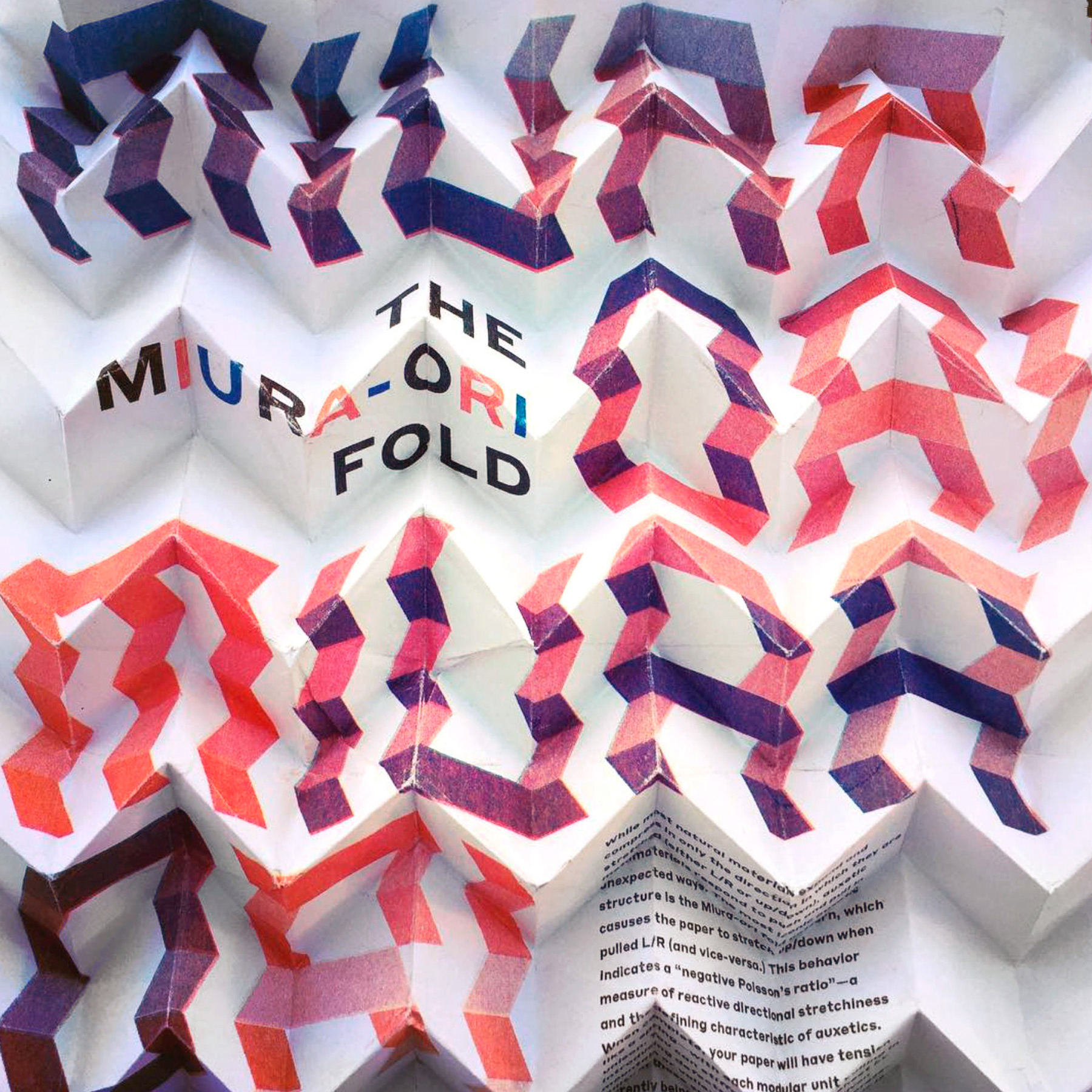
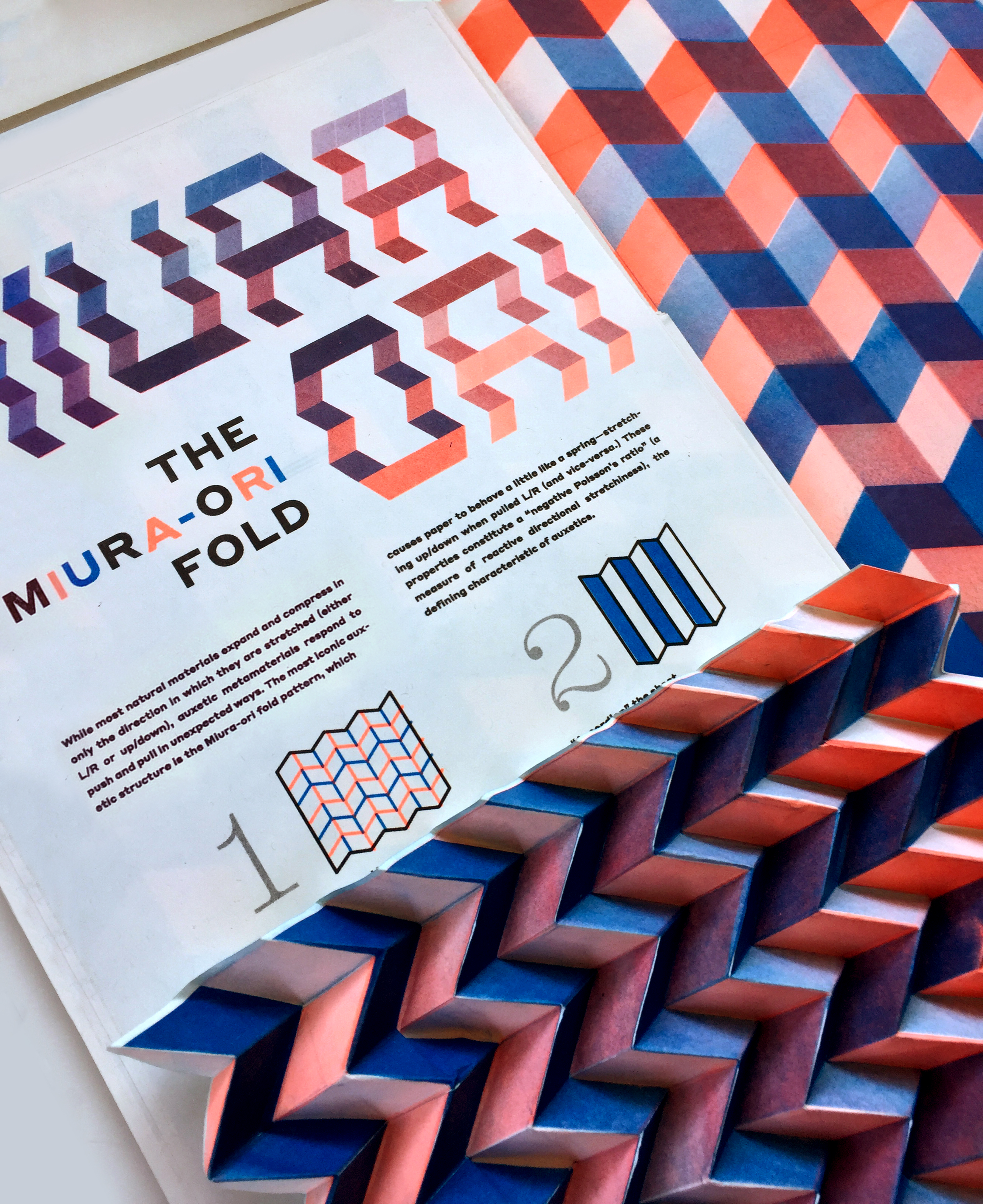
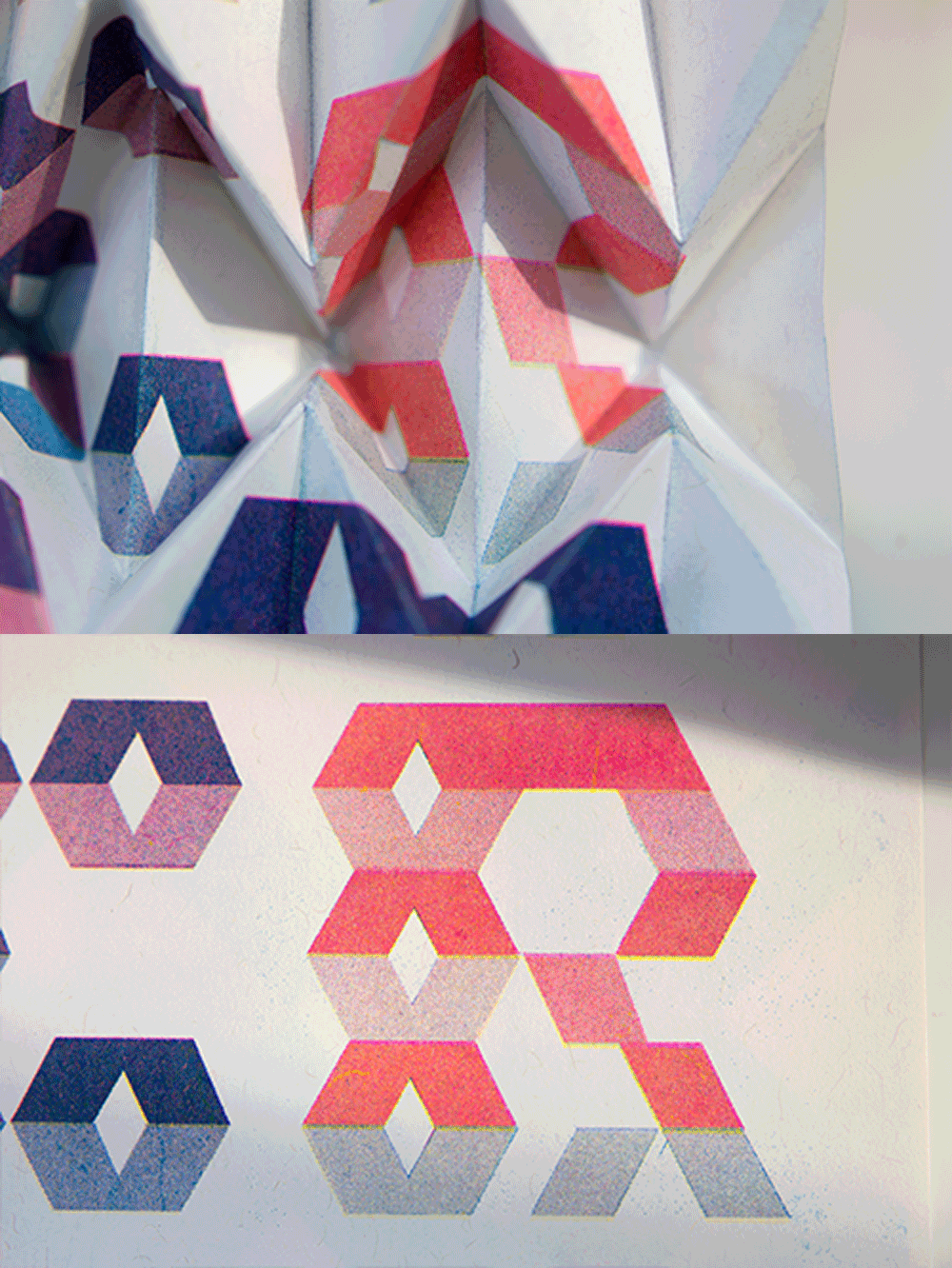
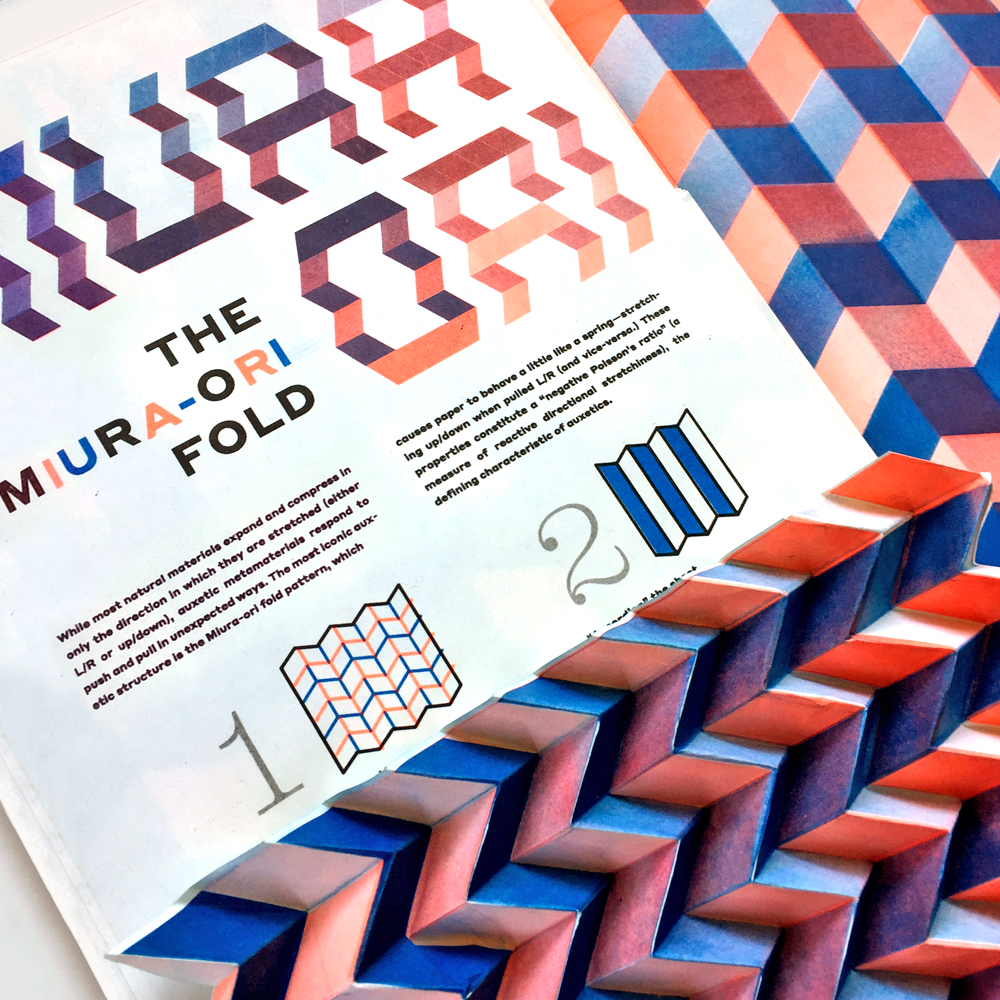
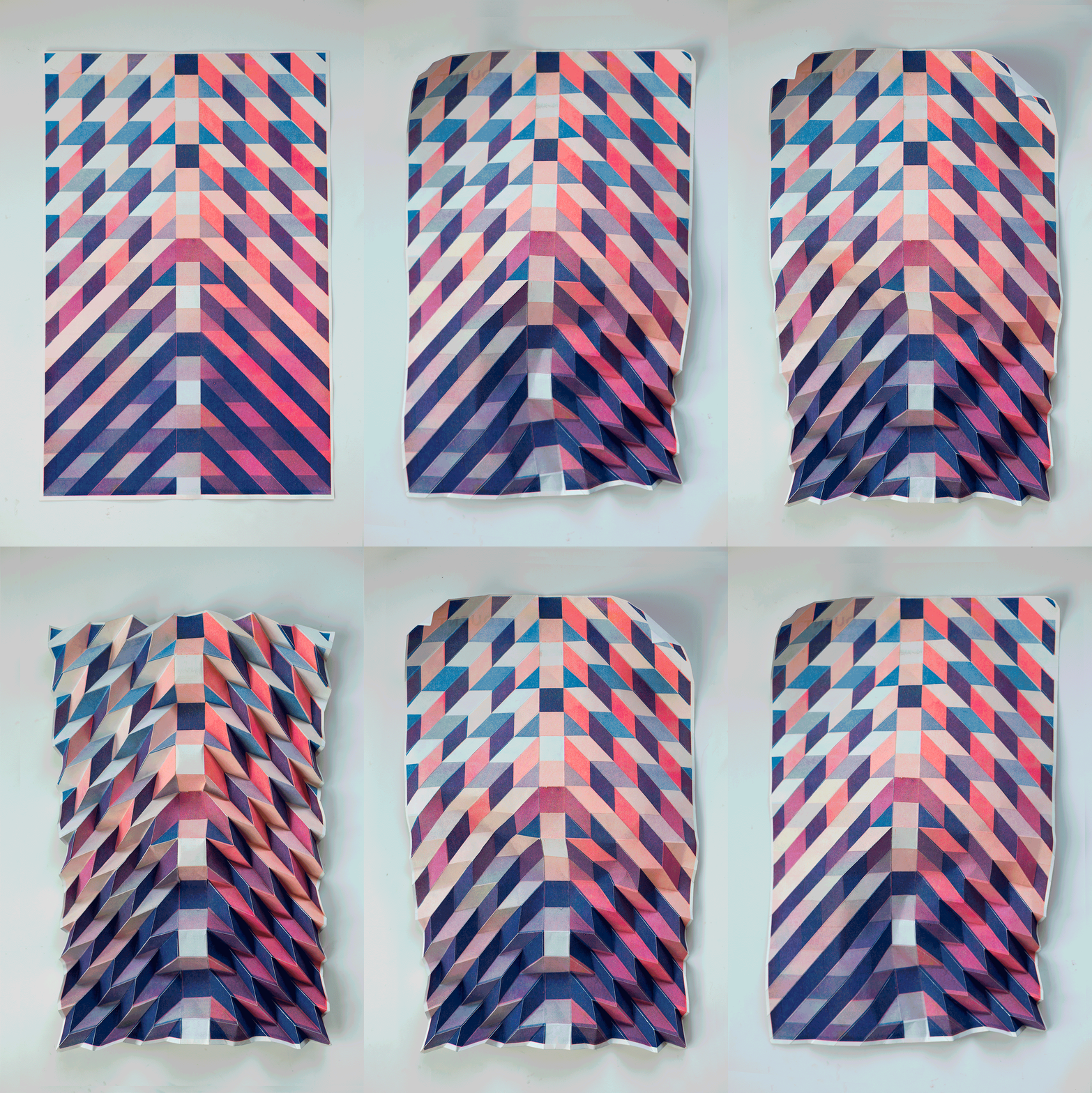
In the world of research, auxetic structures made from folding patterns seem to really be in [academic] vogue right now. I spent a month this summer reading Nature, rifling through online journals, teaching a workshop at the Exploratorium, and making this risographed poster series to learn about the tech applications of auxetic folding systems…

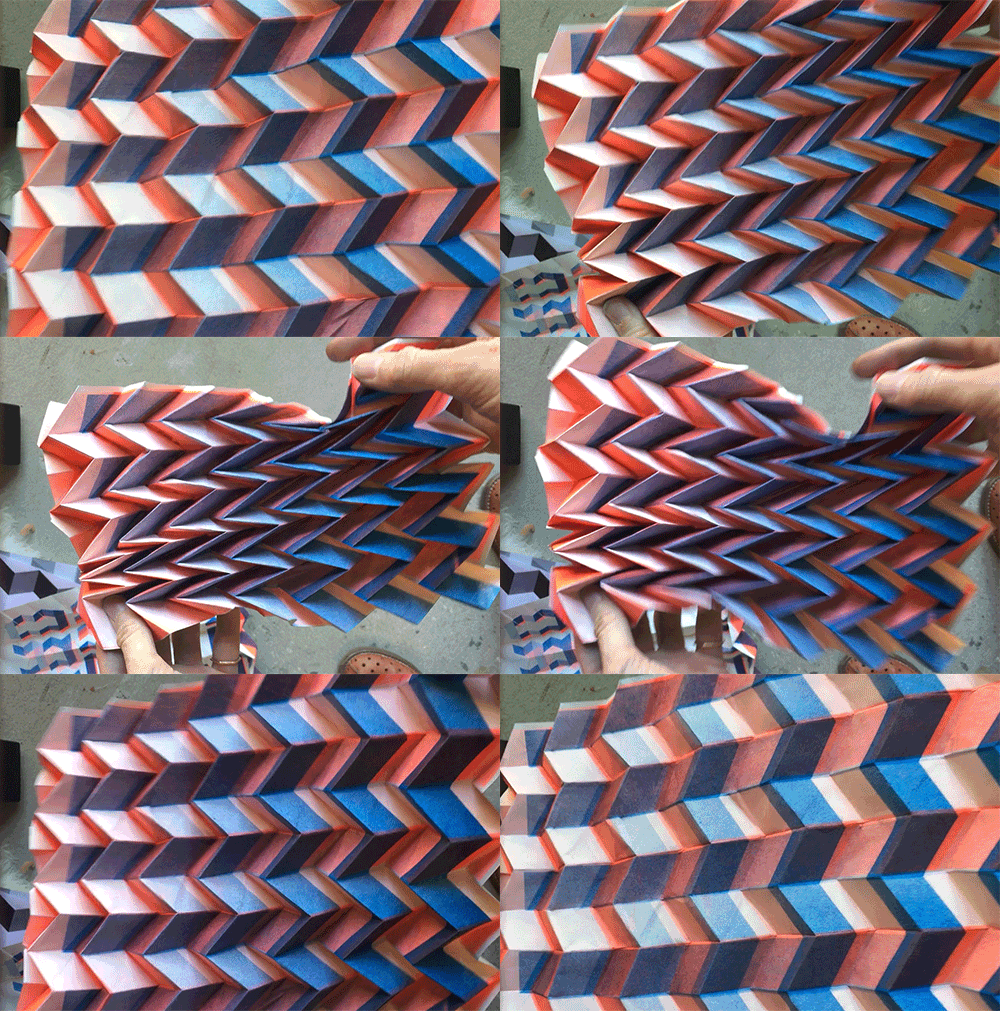
Here’s the miraculous Miura-Ori fold, for example:

while most natural materials expand Left right when stretched, auxetic meta materials respond in unexpected ways

This structure performs in two weird ways:
1.) It compresses up/down and L/R simultaneously. This is the quality that makes it a auxetic metamaterial, and is a behavior difficult to engineer with traditional mechanical parts
and
2.) If you press to deform one of its zig-zags inside-out, it will stop compressing in that area, but the pattern will continue to compress all around it. It is therefore a “programmable” surface in this respect.


The Miura-Ori’s superpowers help explain why documentaries like “The Origami Revolution” are being made right now, as humans move into tinier and vaster spaces (designing for building both nano-tech and satellites!) There are simply contexts where you don’t want nuts, bolts, gears, or other detachable parts that could become disconnected. Outer space and within the human body come to mind.

In these contexts, whenever function can be choreographed by manipulating homogeneous sheet material, it is preferable to heterogeneous, multi-part contraptions. In the case of nano-tech, folding enables function in contexts too microscopic for multiple materials to be used to enable function.


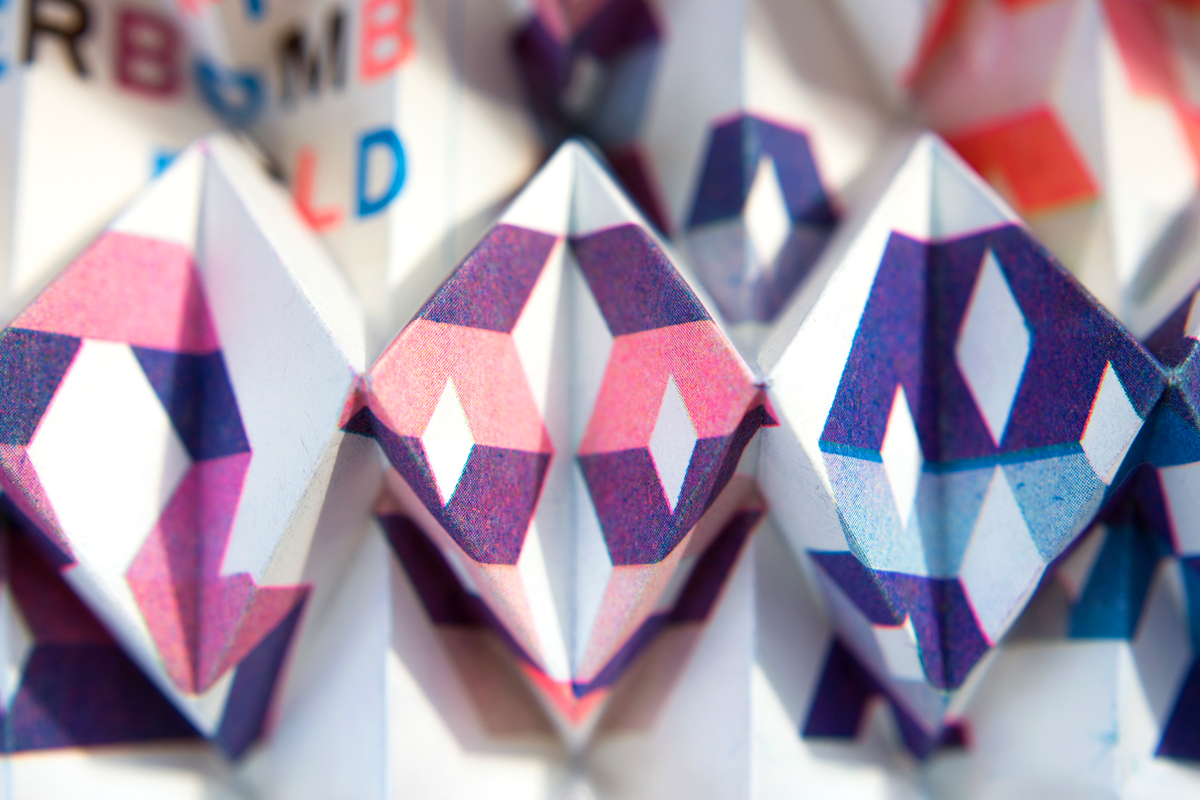
water bomb

The Muiri-Ori is not the only folding pattern with secret tech superpowers.“An origami tunable metamaterial,” from the Journal of Applied Physics explains how the traditional origami Waterbomb pattern might be modified to work in tunable applications (like as an antenna.)

There are additional applications for this shape in measuring acoustic transducer arrays which I will not pretend to understand. (Have tried. Feel free to explain it to me. ) 🙂


Other topics which we will definitely cover in class:

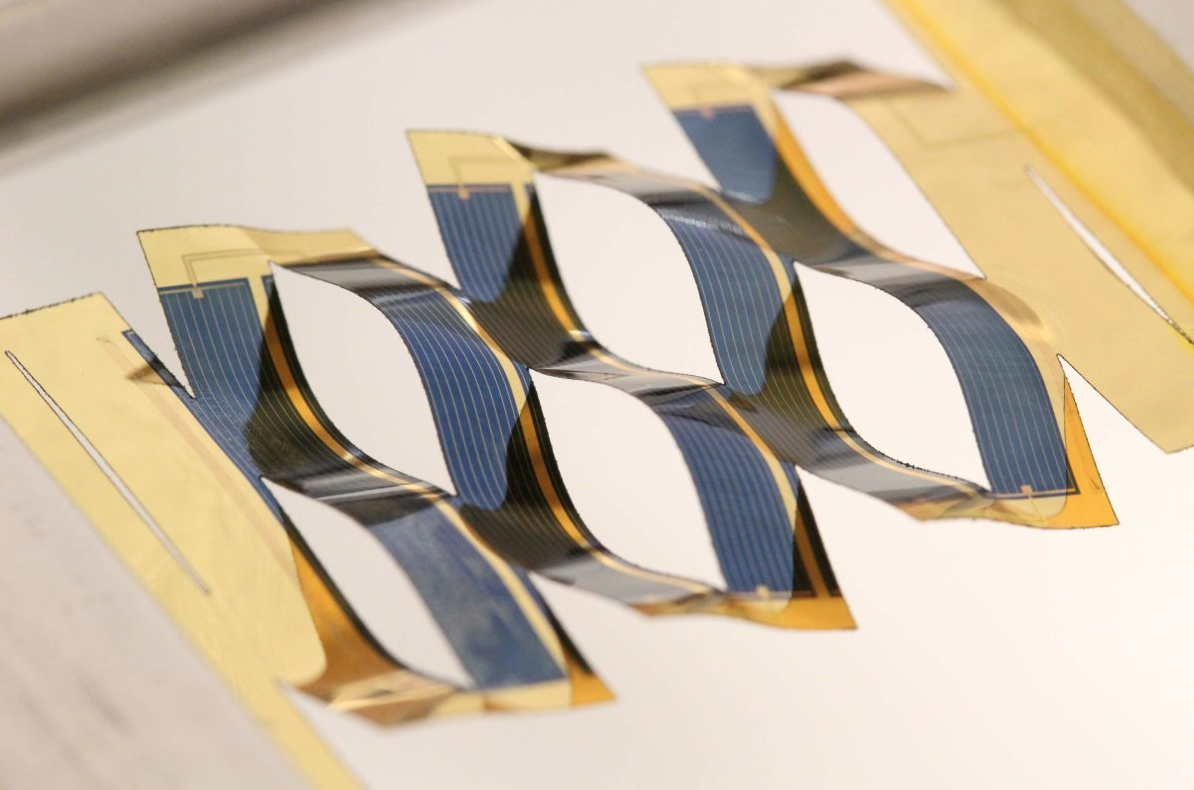
• Friend (and fellow Movable Book Society member) Matt Shlian used an absurdly-simple kirigami technique to radically reduce the materials required by solar panels, while improving their efficacy to track with the sun.

• And—as reported in the NY Times last year—origami-minded researchers finally “discovered” how ladybug wings, which are deployable structures, unfold. (And people are beginning to wonder what to build with this new knowledge… (!))


This is all to say, it’s a **super-exciting** times in structure, topology, folding/unfolding problems, and paper right now. (Also: super-bad times elsewhere and paper folding is therapeutic, SO…)

You should definitely join us at SFPC in February! So far it is: me, Robby, Coralie, Robert Sabuda alum/pop-up mastermind Simon Azripe, and weaving/tech/computation genius Pam Liou. Additional teachers will be announced soon. Learn more here »

And if you’re fresh out of pre-scored RISO prints about folding and tech, I got em »


https://kellianderson.com/blog/?p=4092
Extensions
Optimism
Uncategorized
    “…Order comes from chaos and chaos from order, and this harnessed just right…creates art.” —Jerry Saltz on Fiscli & Weiss’s entropic 1987 chain-reaction film, The Way Things Go     —— This stop motion animation was developed for The Universe in Verse, an evening of poetry and science created by Maria Popova on […]
Show full content


“…Order comes from chaos and chaos from order, and this harnessed just right…creates art.”
Jerry Saltz on Fiscli & Weiss’s entropic 1987 chain-reaction film, The Way Things Go


——

This stop motion animation was developed for The Universe in Verse, an evening of poetry and science created by Maria Popova on April 28, 2018 at Pioneer Works. Read her wonderful post about it—which provides the full context of the event.


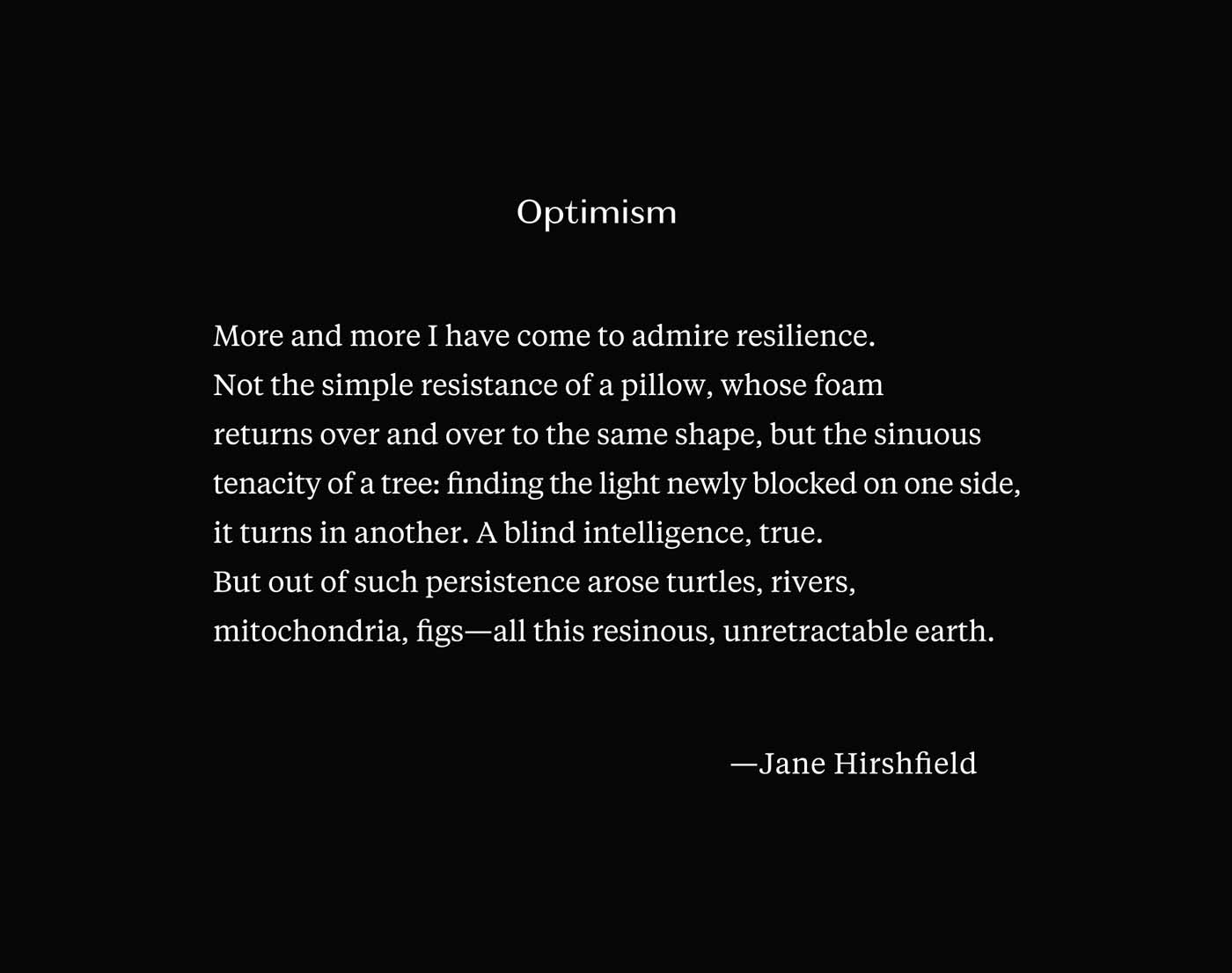
Poem by Jane Hirshfield | Music by Zoë Keating


I’ve just completed this tiny film defending optimism in spite of… [insert every single thing that has happened in the past two years.] Given the sorry state of the world, I’ve been heartened to see friends scavenging for durable, believable reasons to be optimistic in a variety of inventive places—oftentimes creating it from scratch, defining exactly what our future [non-binary/non-patriarchical/non-gendered] utopia will entail. Perhaps it has always been there, under the surface, but strategies for cultivating optimism has become a pastime people now share out in the open.

I, myself, am not good at this. I have a ton of experience with the cultivation of pessimism (as it has always seemed to more realistically insure against disaster.) My sketchbooks are filled with lists to the tune of “157 ways this can go wrong”—detailing alternate production strategies, persuasion strategies for unreasonable clients, Plan Bs, Fs, and Ws. At seven years old, I stopped drinking Louisiana’s tap water, as I was convinced a hazardous waste spill was leeching into the water table (for specific, although now forgotten, geologic reasons.) At nine, I lost faith in humanity’s ability to treat farm animals humanely and quarantine mad cow disease and permanently stopped eating meat. I spent grad school: 1.) researching the Department of Energy’s/Sandia National Laboratories’ failed plans to mark nuclear waste effectively, 2.) diagramming the mockery American consumerism increasingly makes of “choice”, and 3.) listening to “Song Against Sex” repeatedly. (and—as the apocalypse actually wasn’t headed straight for my fancy university—laughing at myself… I hope??…)

In adult life, I have made a career of throwing myself whole-heartedly into unreasonably unforgiving projects that will “probably never work” according to… everyone, especially experts. Within the production of these objects, the old adage of “everything that can go wrong, will go wrong” is an understatement. However, lately, the problems manage to extend even beyond the bounds of “everything”, finding novel ways to malfunction beyond my wildest dreams. Hidden forces surface—making their existence known by inflicting some existential blow or another to my mission… and I discover new ways that everything can break.

The upside to expecting chaos, though, is that it loses its damn power: when something fails, my only question is HOW FAST CAN I TRY THE NEXT THING? To me, making things has always felt less like imposing order on the world and more like surfing on a sea of barely-controllable complexity. As a result, the things I tend to appreciate in mine and in other people’s work (and personalities) are usually the most unlikely to succeed—those attributes most transparently colored by struggle. (<--conversely, art and design that feels too "pat" and lack grit carry the same emotional heft for me as stock photography.)


——

This is why I’m so smitten with Hirshfield’s poem. It seems to say that optimism belongs to the pessimistic preppers. (Those of us working on plan P before plan A has even officially failed.) In her sparse, wise poem, Hirshfield makes the case that struggle’s way of eeking out new possibility is where creativity comes from. Only by blocking the path of least resistance, is that searching, “sinuous tenacity” of life fully engaged and motivated. Adversity was a necessary precondition for evolution to produce the biological smorgasbord of “turtles, rivers, mitochondria, figs.”


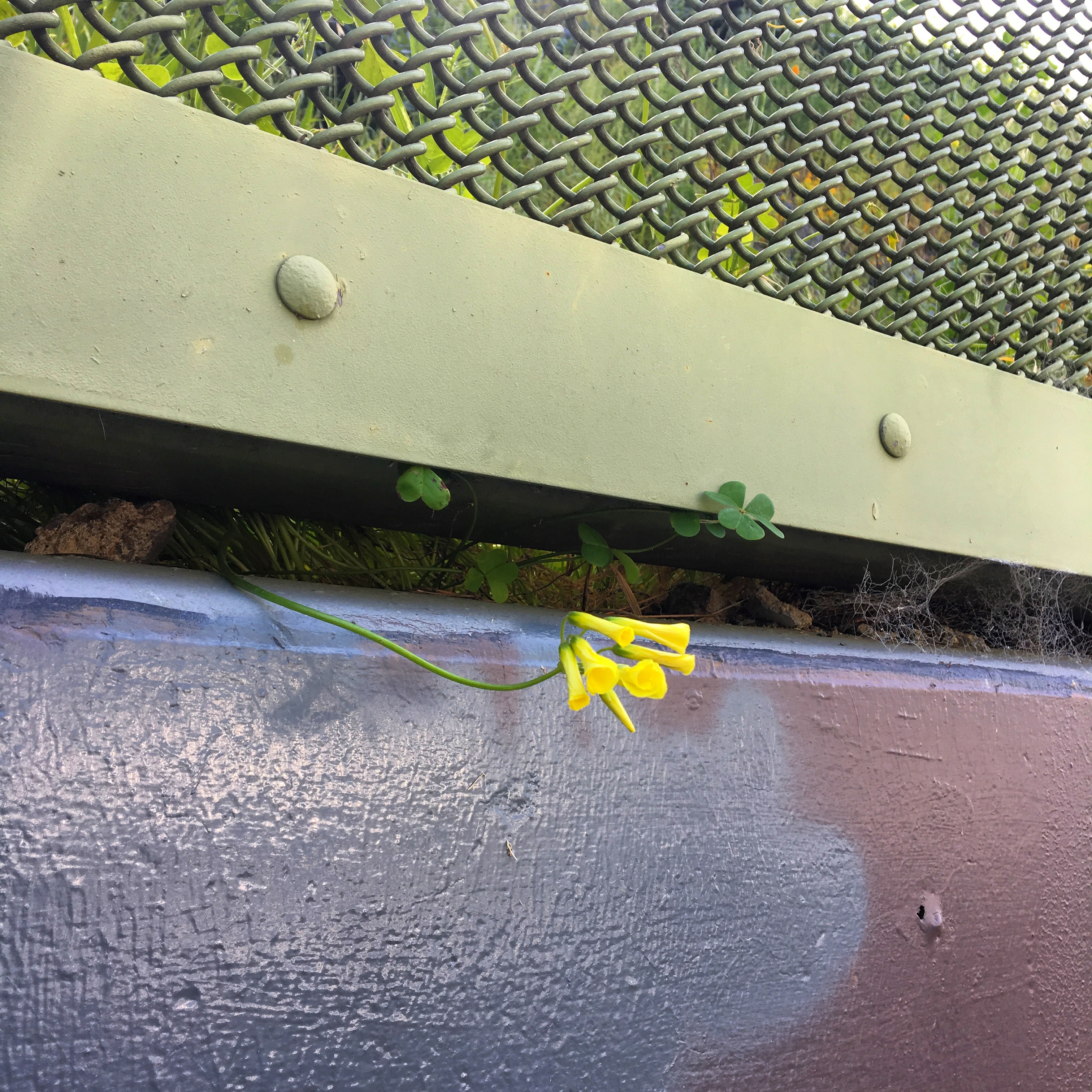
Jane couldn’t make it out to Pioneer Works to read the poem aloud in person, so longtime friend and event organizer, Maria, approached me to create visuals to accompany Optimism. Needless to say, all of this bending-toward-the-light required some stop motion (I’ve got a hammer and just watched some solid Wes Anderson…) In creating the animation, Maria and I decided upon New York City weeds as our tiny, quotidian mascots of resilience. She emailed this photograph (from San Francisco, but we have this clover weed here too):

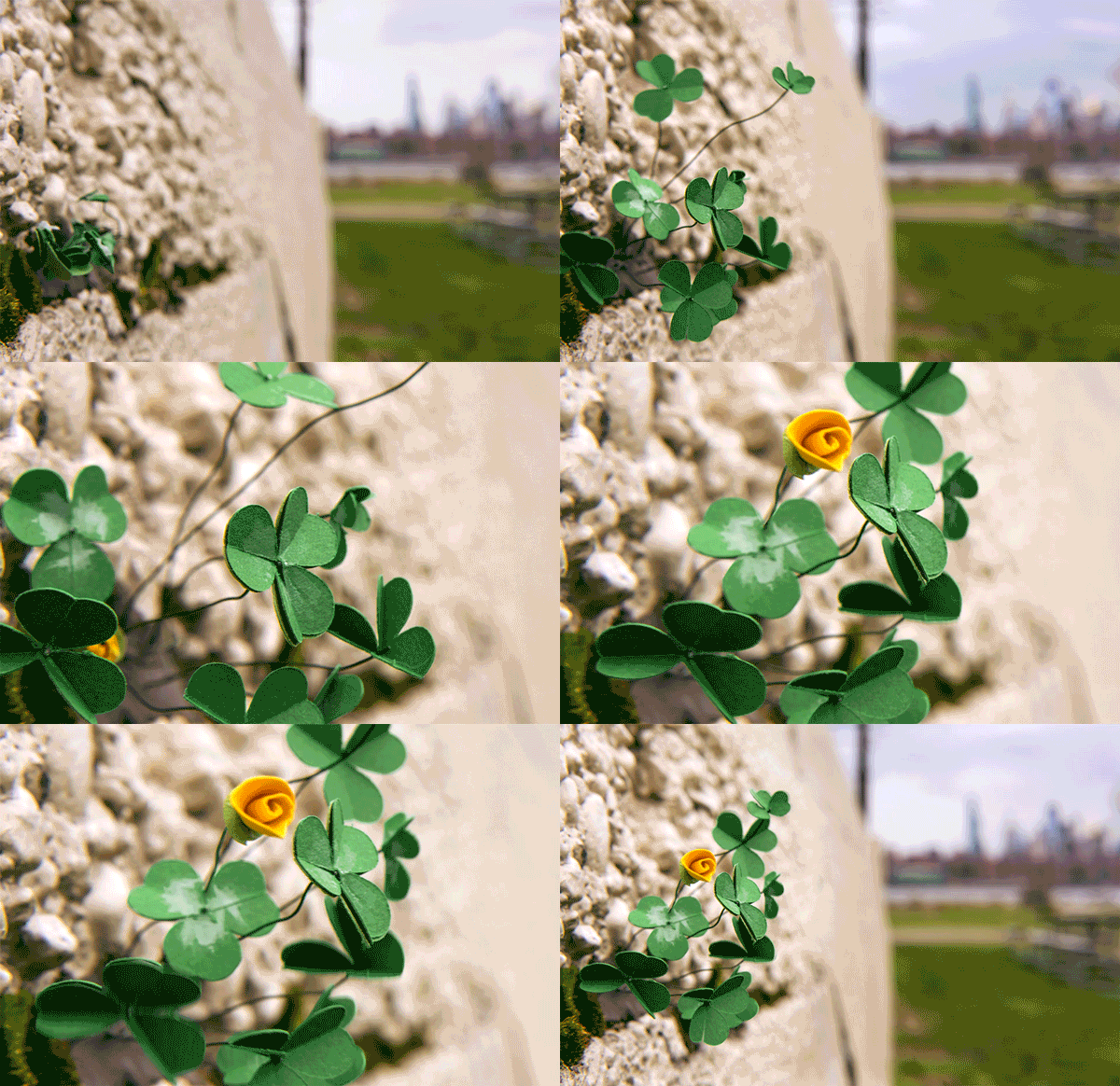
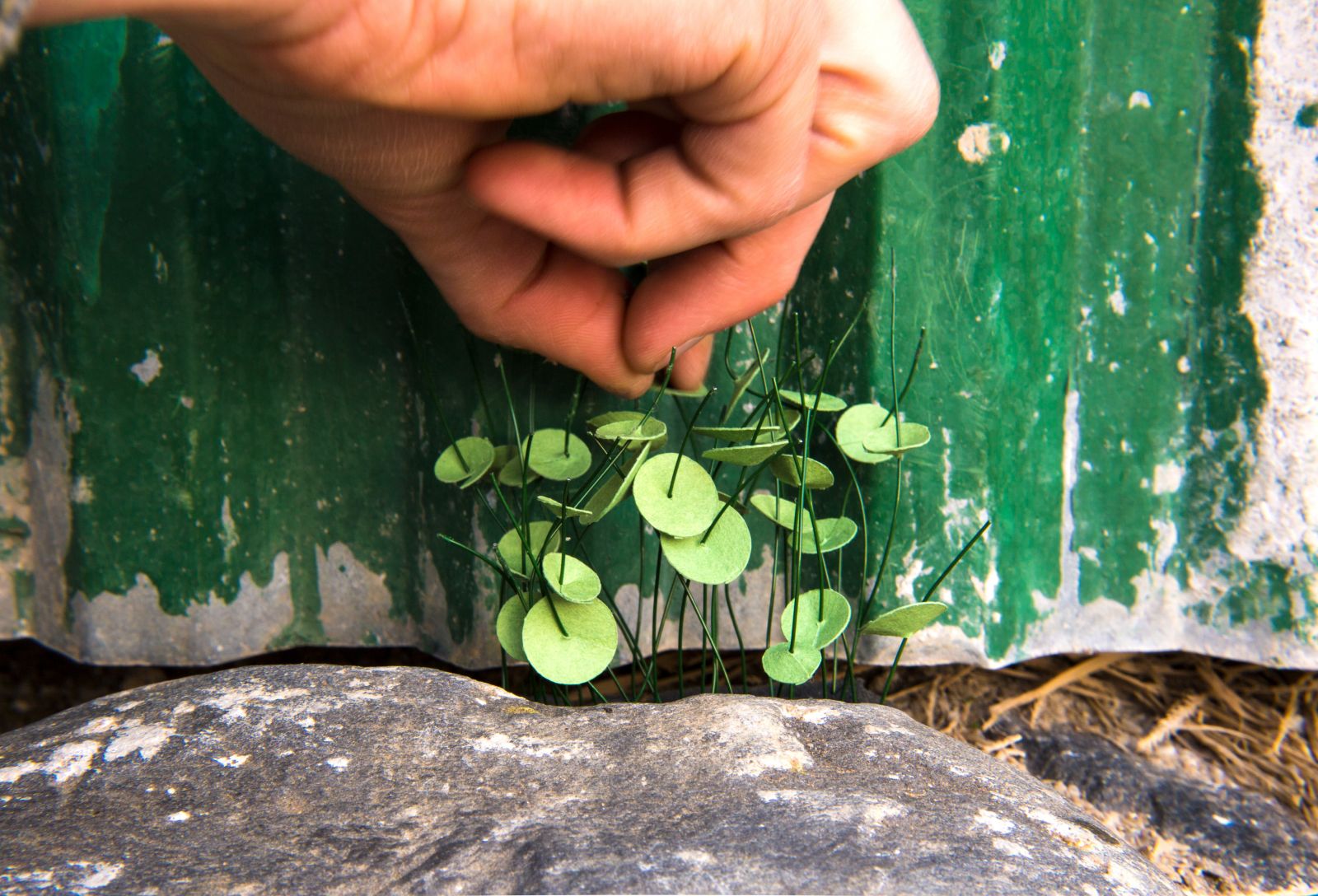
And I came back with this, filmed in the waterfront park in Williamsburg near where I live (under super-windy conditions that were just awful for stop motion):

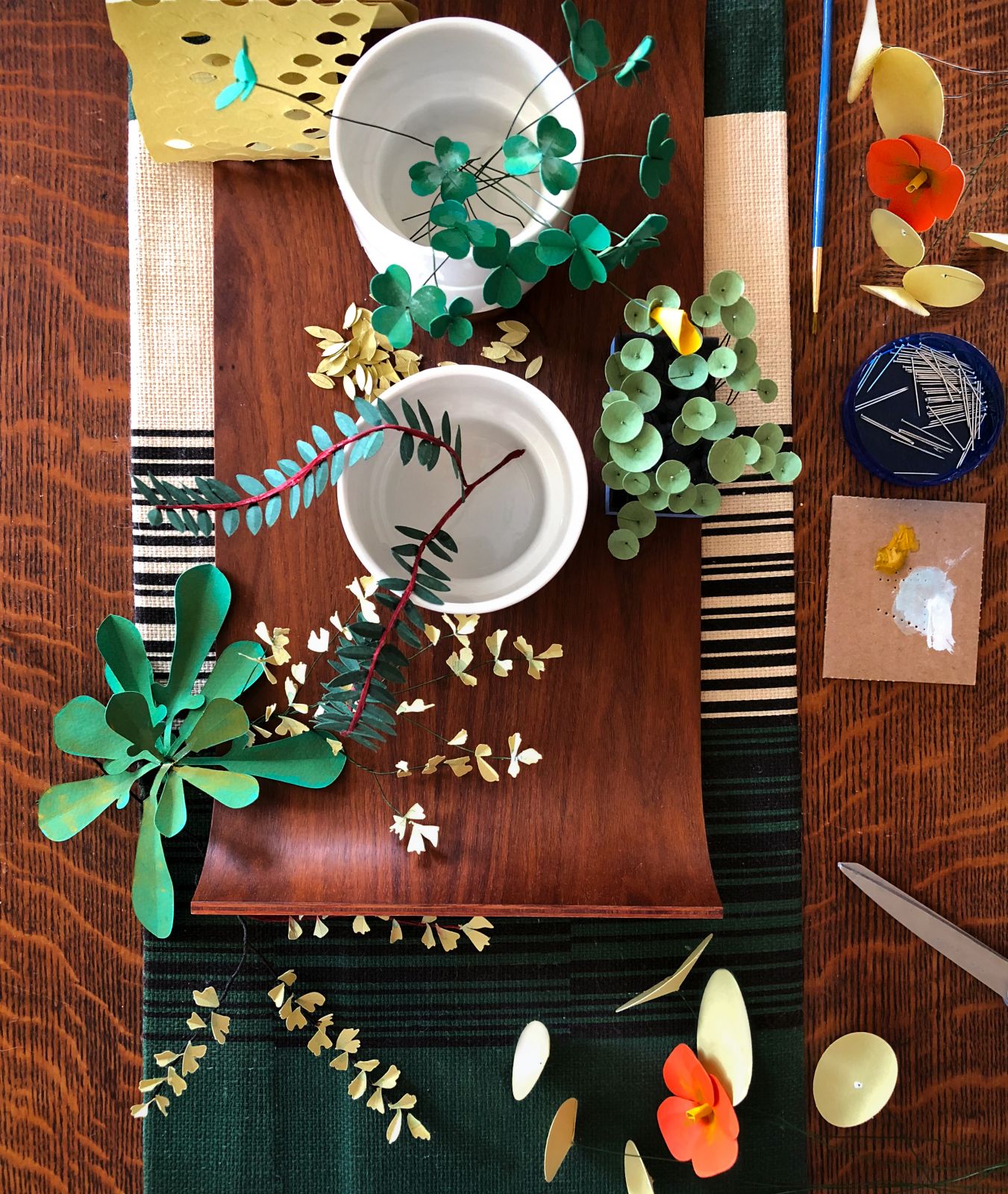
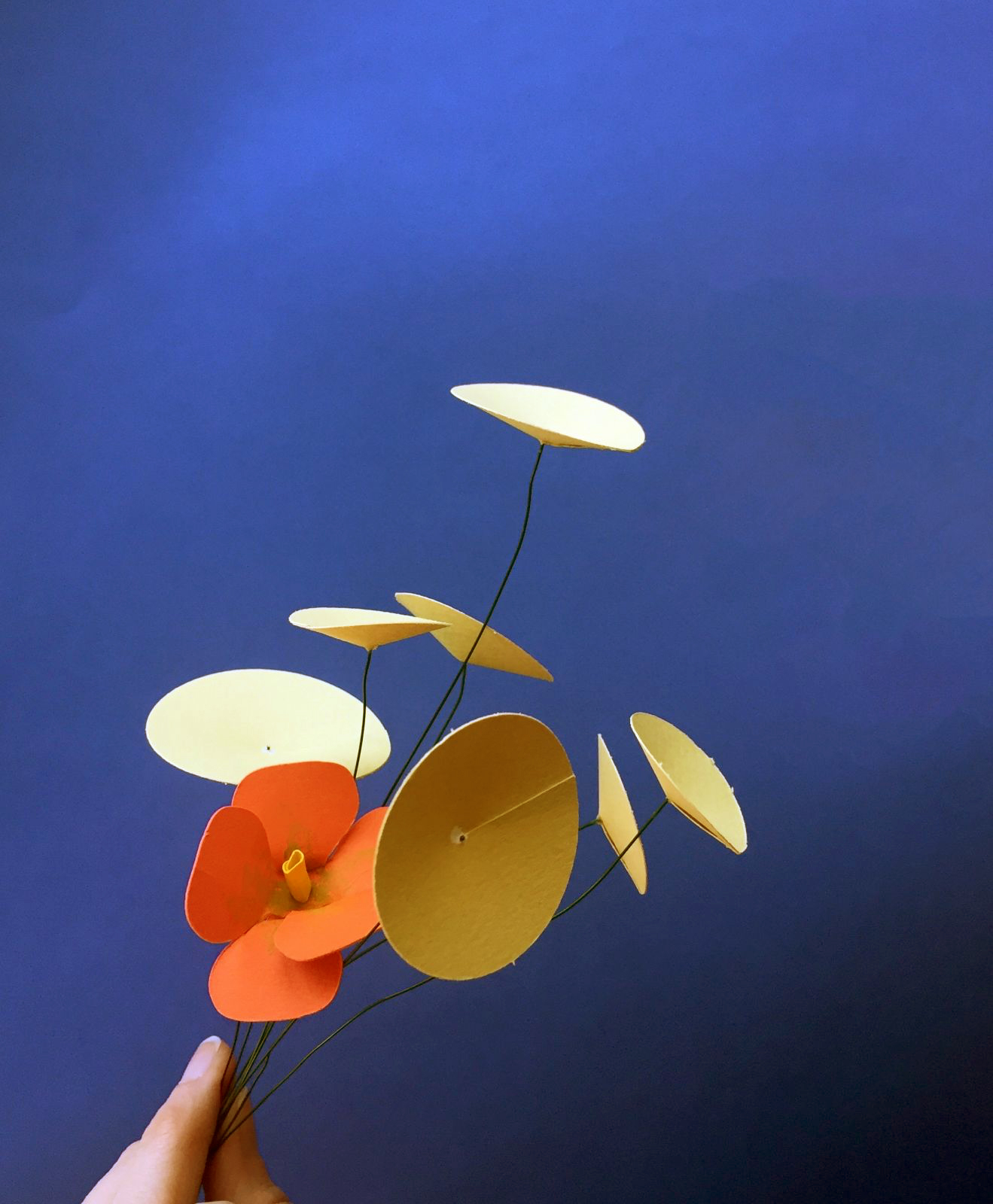
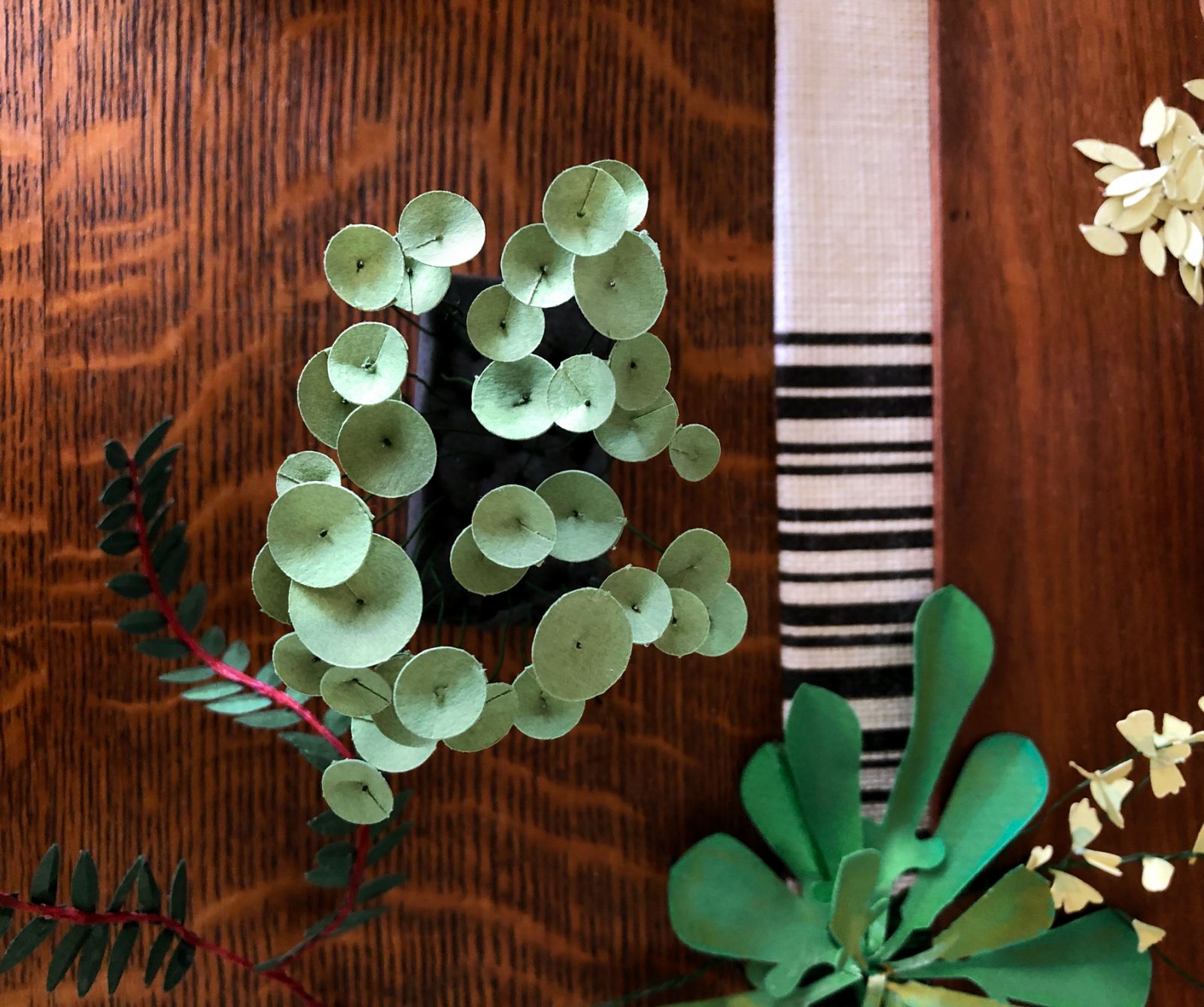
For the other cuts, I researched which weeds grow in NYC, built the shapes from recycled paper and floral wire, situated them in the grossest, nastiest places in the urban landscape I could find. I then proceeded to destroy them frame-by-frame to make them performatively shrink (later reversing the frames into growth.)

This is what it looks like when my sausage fingers shrink a delicate, paper weed:

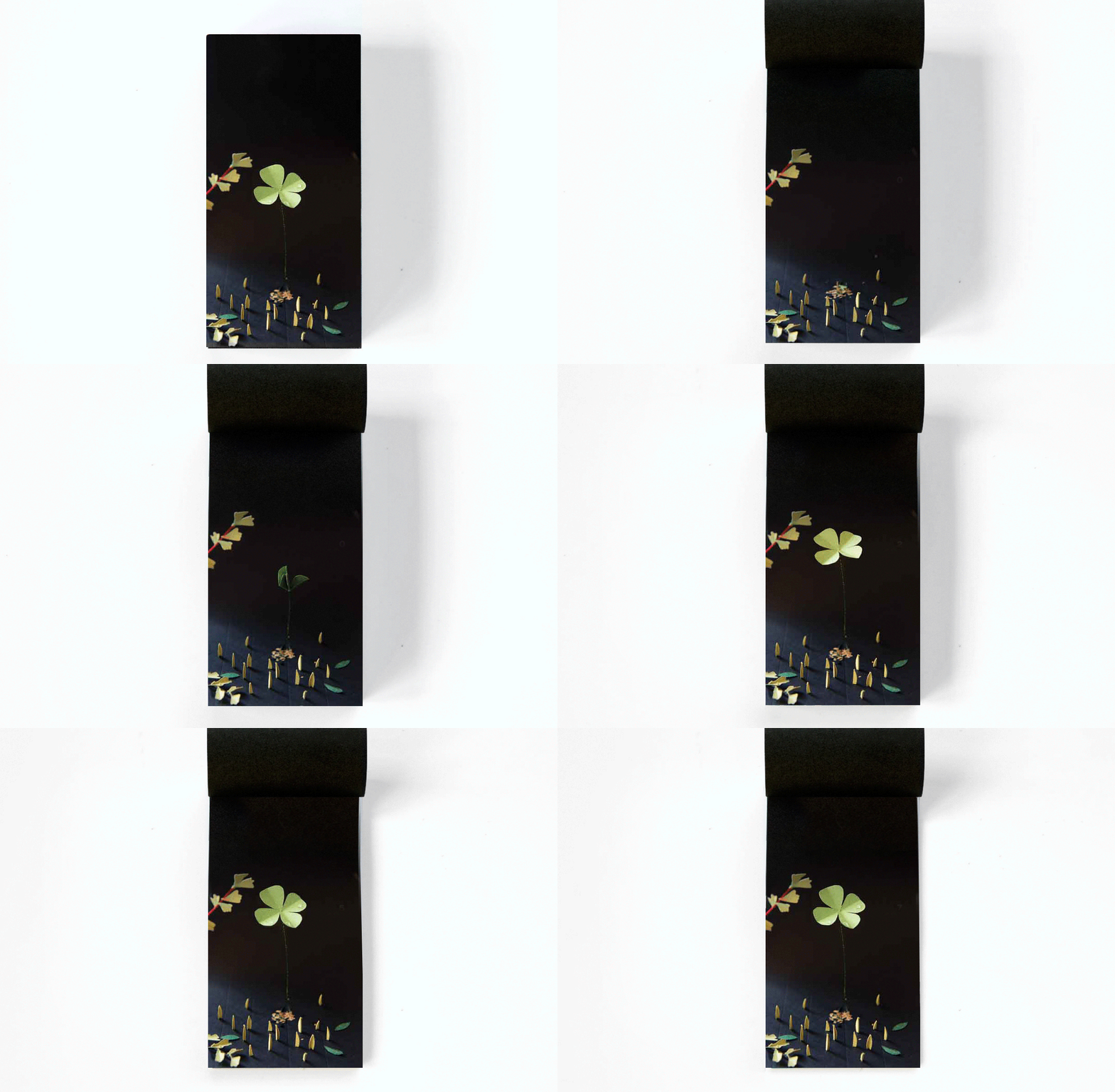
To accompany Pioneer Works’ screening of the animation, we produced tiny flip books revealing the growth of a solitary four-leaf clover.

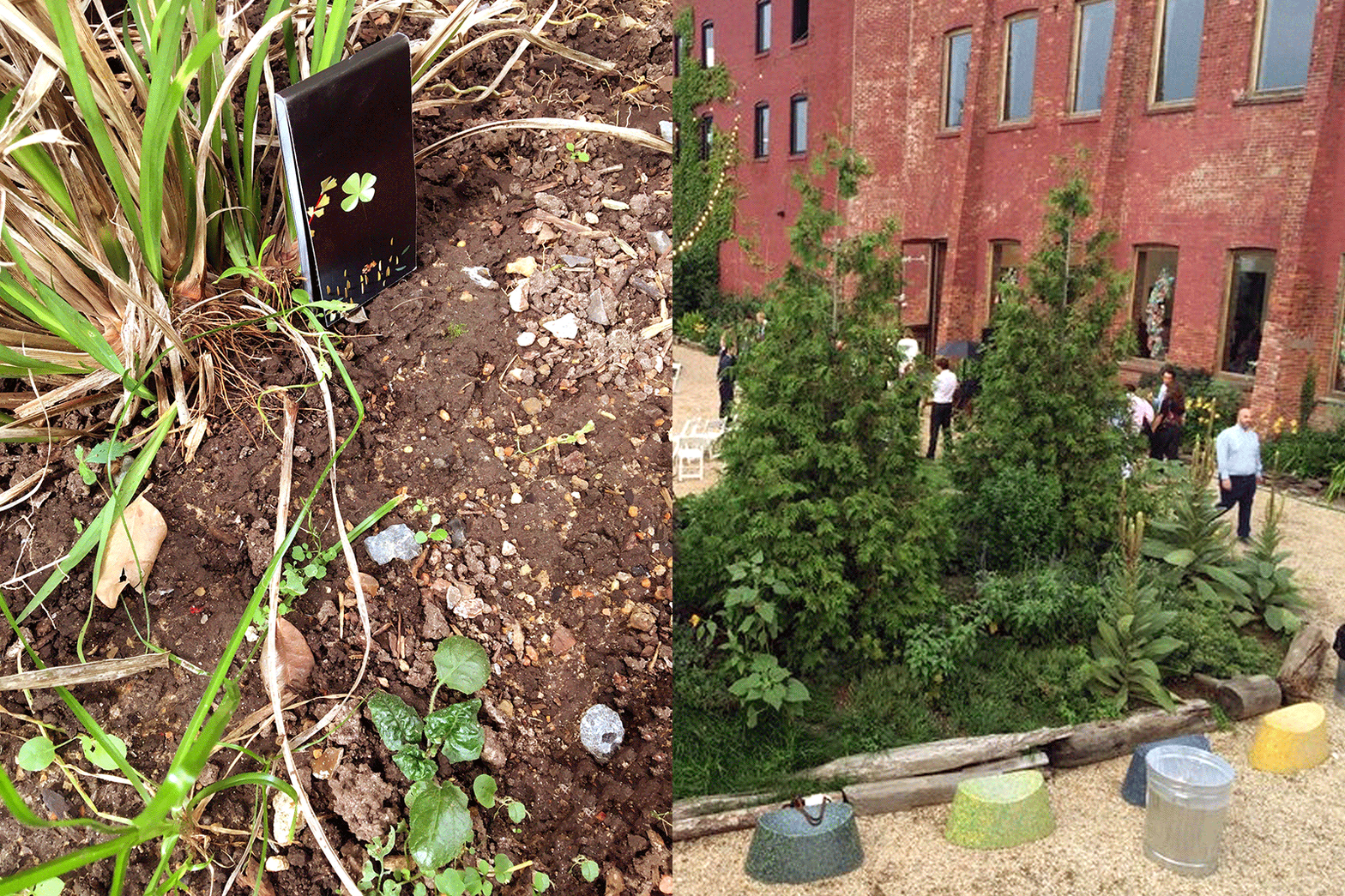
The flipbooks were peppered around the grounds. Visitors were told to go find them, so they would have an auspicious good luck charm for their back pocket. Like an easter egg hunt:

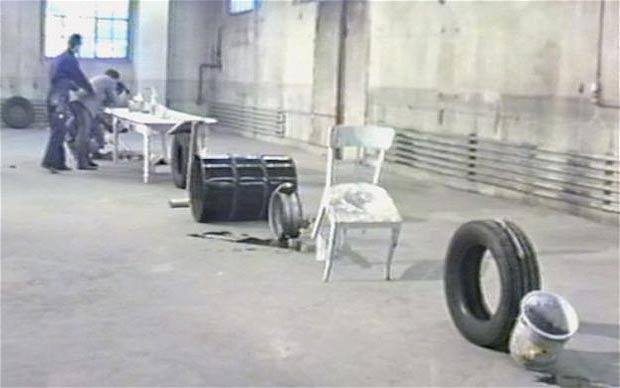
Parallel with my work on this animation, I have been co-teaching a craft class at my favorite utopia, The School for Poetic Computation. The class, Crafting Material Logic, encouraged coders to think about physicality as “programmable” (to constantly question what aspects of the normally-taken-for-granted world around them they could tinker with.) I drug in Pizza Rat as a personal favorite example, but what we ended up discussing at length was the insanely baroque, thrilling way that The Way Things Go proceeds to perform the most basic of all artistic operations:

“Draw a line”.

It does this by presenting a clattering, burning, exploding chain reaction. Normal household objects like tea kettles boil—steam propelling it down a track to knock over an object that ignites another, that swings another, ad infinitum (for thirty minutes.)

We took it apart to examine how it works. The film’s barely functional elegance is, like all art, a construction. As Jerry Saltz writes, “The Way Things Go appears to have been shot in what looks like some cold-water Zurich garage. A camera follows apparently without interruption — one long Godard Weekend-like shot. In fact, the film took almost a year to produce.”

If you watch it closely: abstract smoke, foam, or fire frequently fills the screen in order to hide cuts from human eyes unsuited to notice changes in abstract mush. These cut-points assume that failure will occur—they are structures used to limit the extent of the damage (then, when a take goes awry, only that segment needs to be reshot… not the entire sequence.) This is a filmmaking safeguard that I’ve always assumed originated with Alfred Hitcock’s Rope:

Thus, the second law of Thermodynamics was totally stage-managed in what is perhaps the most famous expression of it. And… of course it was.

About the film, Saltz writes:

“…beauty is that which works, and how, in all its nobility, humility, and believability, beauty produces pleasure and knowledge. Fischli and Weiss have said that by removing function … objects are no longer enslaved by it … this opens a space in which to do something else.”


PS- This theory of low (rut) vs high (searching) entropic states of mind provides an interesting corrollary.


https://kellianderson.com/blog/?p=3904
Extensions
Sexual Harassment PSA Poster
Uncategorized
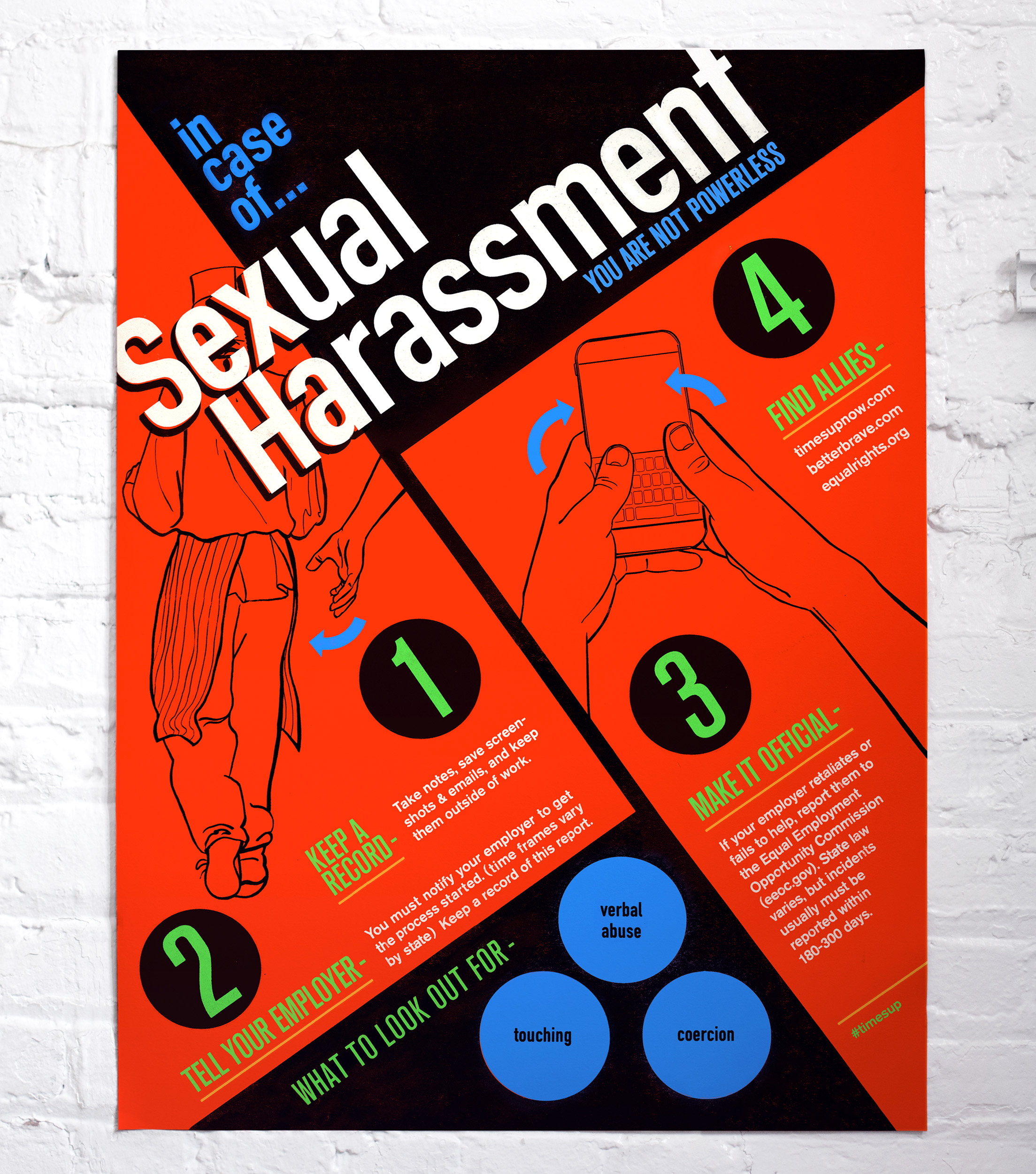
Posters for sale (and free download for DIY printing) here!! We now have Spanish and Chinese language versions as well. So excited that NY Magazine interviewed us too! In an Eater article published late last year, freelance food journalist Tove Danovich wrote this about the stark disconnect between the laws protecting against sexual harassment in […]
Show full content

Posters for sale (and free download for DIY printing) here!! We now have Spanish and Chinese language versions as well. So excited that NY Magazine interviewed us too!

In an Eater article published late last year, freelance food journalist Tove Danovich wrote this about the stark disconnect between the laws protecting against sexual harassment in restaurants… and the reality of sexual harassment in restaurants:

Title VII of the Civil Rights Act of 1964 requires employers to provide a workplace free of harassment. […] If the employer “knew, or should have known about the harassment and failed to take prompt and appropriate corrective action,” they could be held liable. But I worked in restaurants for five years without knowing these legal protections existed, and I doubt I’m the only one. […] Indeed, a 2014 Restaurant Opportunities Center United report about sexual harassment found that 78 percent of restaurant workers had been harassed at one time by a customer.

From the employer’s perspective: Restauranteur Erin Wade—in an op-ed in the Washington Post—explains how an incident with an abusive customer at her restaurant “sparked a flood of reactions from staff members who’d had similar experiences,” but had kept quiet. (Her restaurants have subsequently implemented a color coding system to flag problematic customers before their behavior can escalate into full-blown harassment.)

While commiserating with other concerned restauranteurs at an industry dinner earlier this year, Karen Leibowitz (of Perennial SF and Mission Chinese fame) realized that laws are of little practical use when no one is aware of them… much less the legal system in place to defend them. So—similar to the required minimum wage postings which inform employees of their wage rights—she decided that a physical indication of these rights was needed.

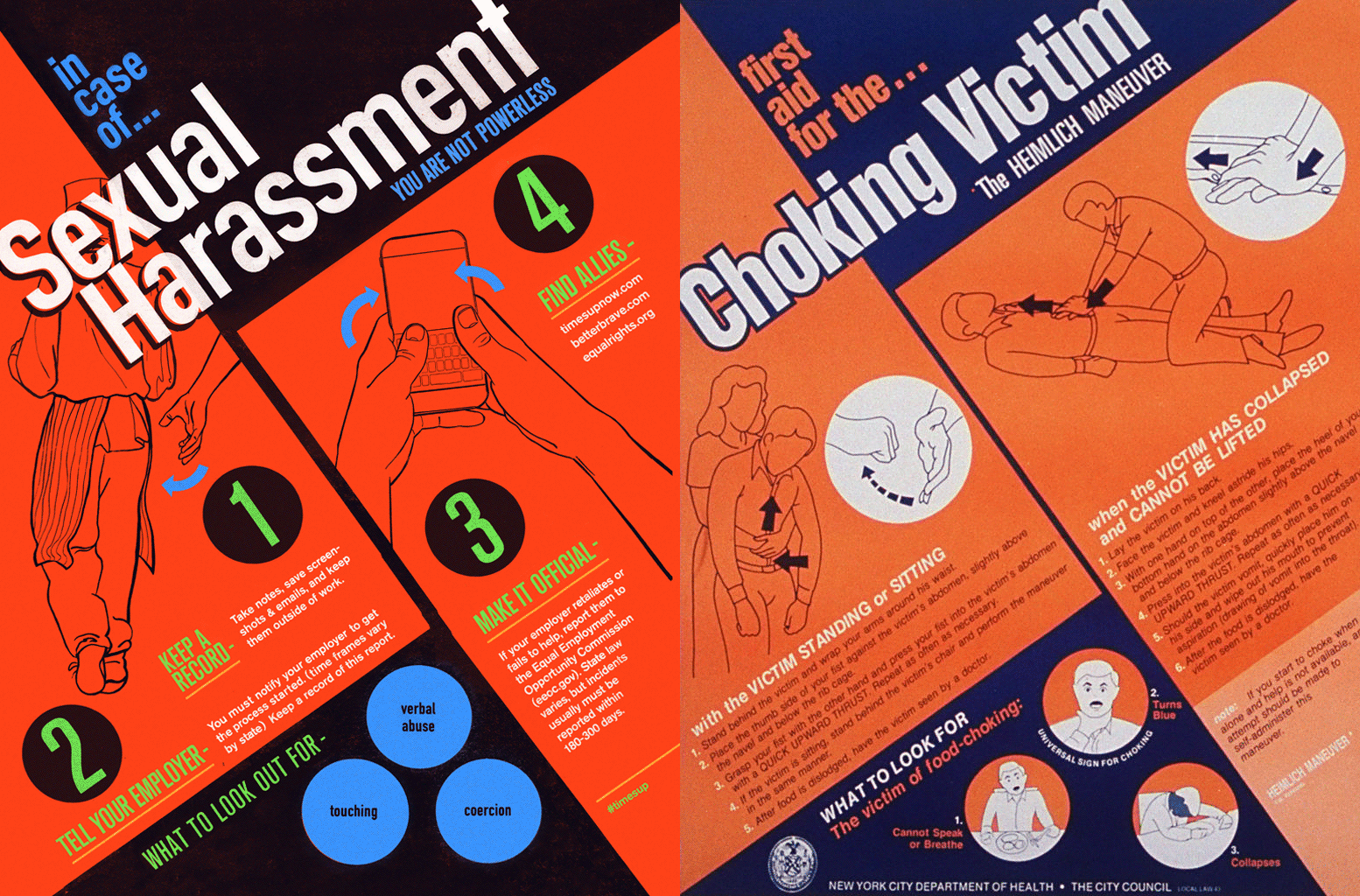
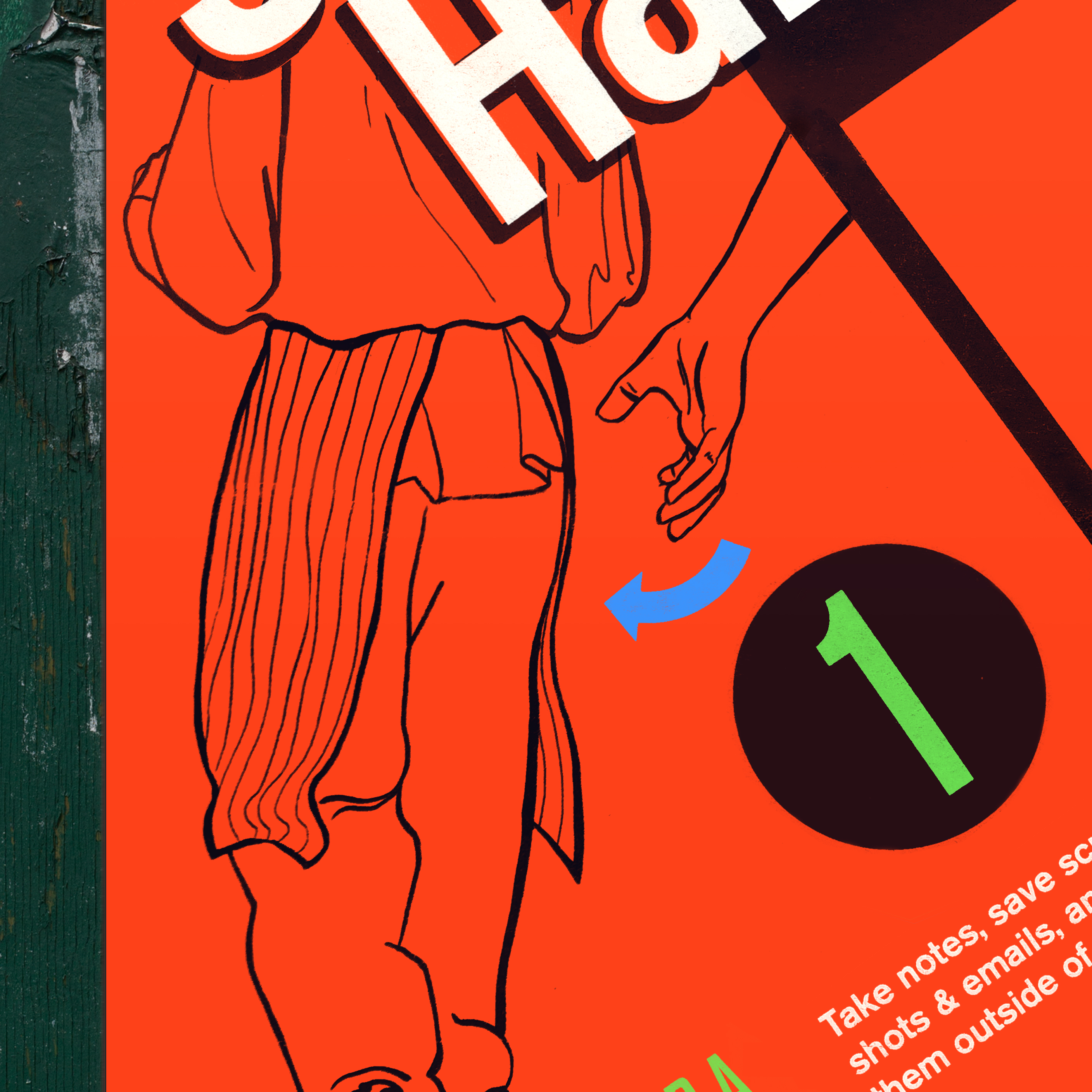
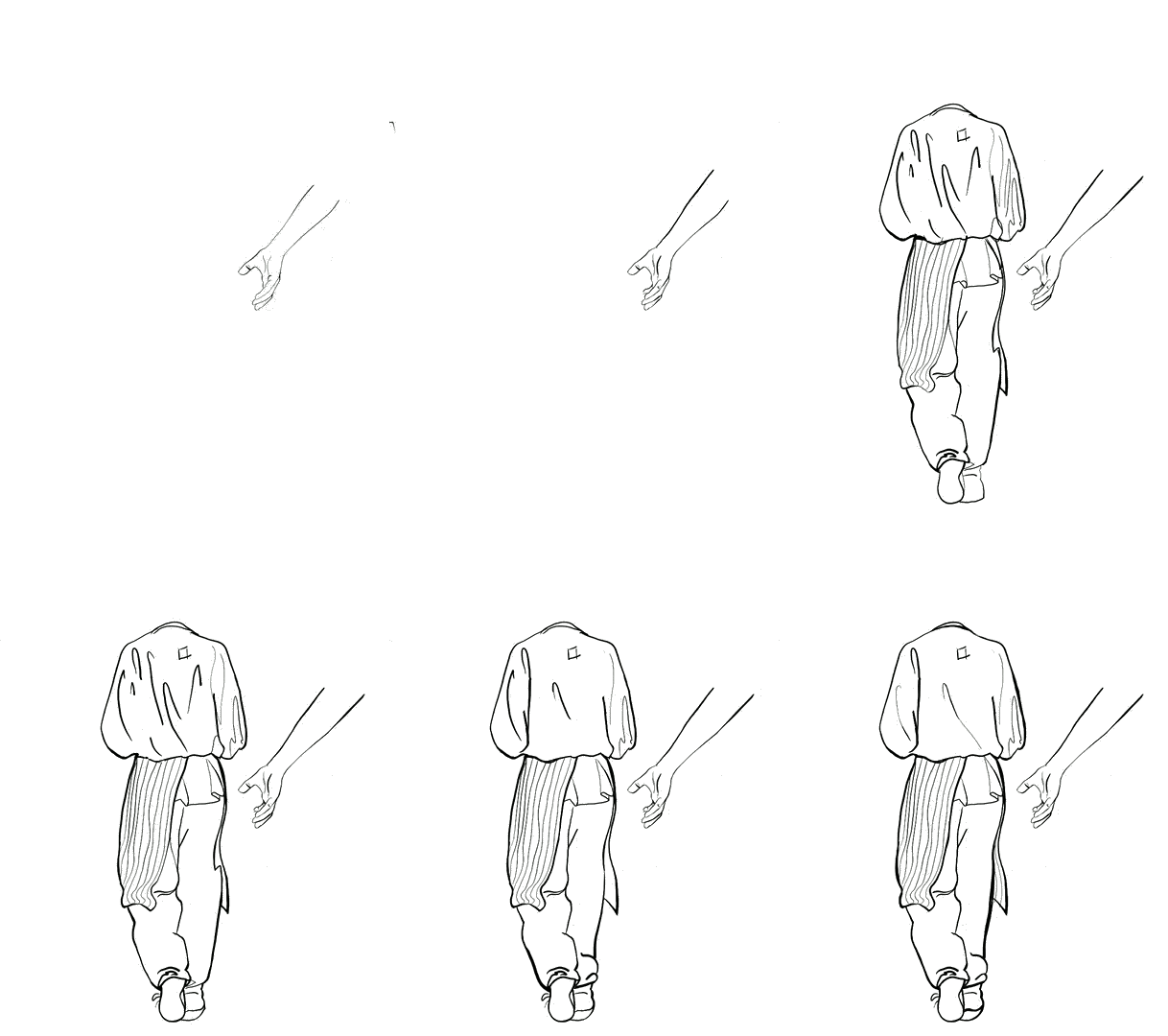
Which is why, over the past few weeks, Karen and I have been making a much-needed poster (it is launching today—with support from Cherry Bombe magazine—at their annual conference.) Using the *safety!* urgency of the ubiquitous Heimlich Maneuver posters that litter restaurant walls, these posters provide a clear, bold AF, step-by-step guide to document harassment, report it, and get support.


I modeled it after Mario Ruiz’s 1989 “Choking Victim” poster in particular, which was distributed by NYC’s City Council through the 90s:

(The rationale behind employing a vintage reference was that it would provide an instantly-recognizable PSA aesthetic, but wouldn’t risk misdirecting would-be Heimlich Maneuverists to run to the wrong poster.)


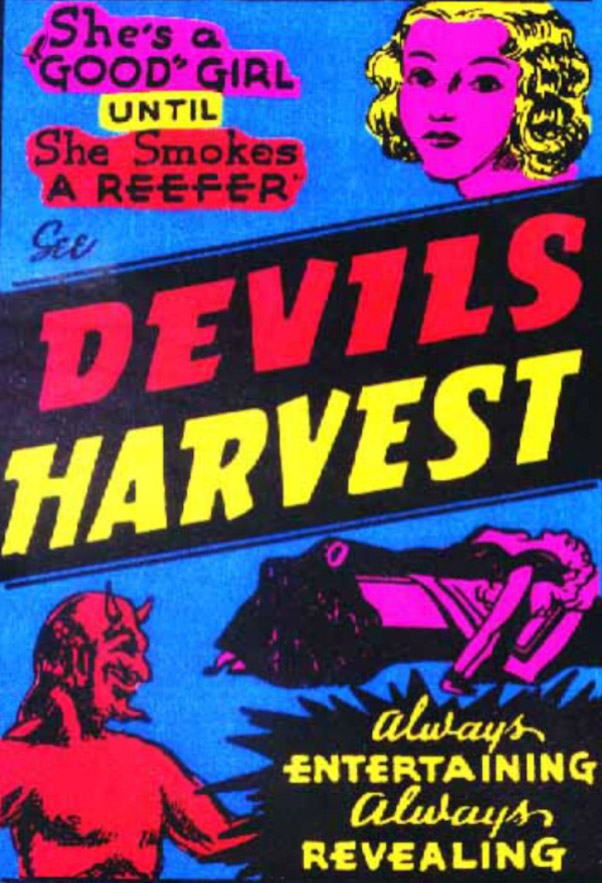
I used fluorescent RGB inks as an inversion of the original, hoping to create an alternate-reality poster—representative of the new world many are working to create in this post-#metoo moment (a lá friends at Triboro Design’s deliciously phantasmagoric wrong-color MTA map.) The fluorescents are a throwback to the blacklight anti-drug PSA posters I remember from the skating rinks of my youth in the 1980s. Indeed, posters intended to express looming danger have a long history of being loud.

Here’s a solid one from 1942:

While we’ve clearly had a lot of fun dabbling in references while making this poster, the goal remains serious: To provide a visual reminder that the default has changed. To tell front-of-house and back-of-house workers alike that their safety really/actually matters to everyone: to their employers, to their coworkers, to the law. That the onus no longer rests on the victim to simultaneously withstand the abuse and collect evidence to prove something untoward is happening—that distress will be taken seriously (and the problem recognized) by default And if not, the toxic workplace can and should be reported the EEOC. It’s more than a little fucked-up that, in 2018, it feels radical to prioritize making people feel safe and seen at work. However belated as it may be… I’m proud to contribute a tiny something to the project of reminding people that they have a right to feel respected and valued in the spaces where they spend much of their time.

Thanks to my friend and Russ & Daughters co-conspirator, Jen Snow, for the additional design+copy feedback.

https://kellianderson.com/blog/?p=3841
Extensions
This Book is a Planetarium (
Uncategorized
“Taste, touch and smell, hearing and seeing, are not merely a means to sensation, enjoyable or otherwise, but they are also a means to knowledge – and are, indeed, your only actual means to knowledge.” —Thomas Aquinas   In the futuristic-sounding year of 2017, I published a pop-up book of mechanical paper tech. Expanding out […]
Show full content


“Taste, touch and smell, hearing and seeing, are not merely a means to sensation, enjoyable or otherwise, but they are also a means to knowledge – and are, indeed, your only actual means to knowledge.”

—Thomas Aquinas


In the futuristic-sounding year of 2017, I published a pop-up book of mechanical paper tech.

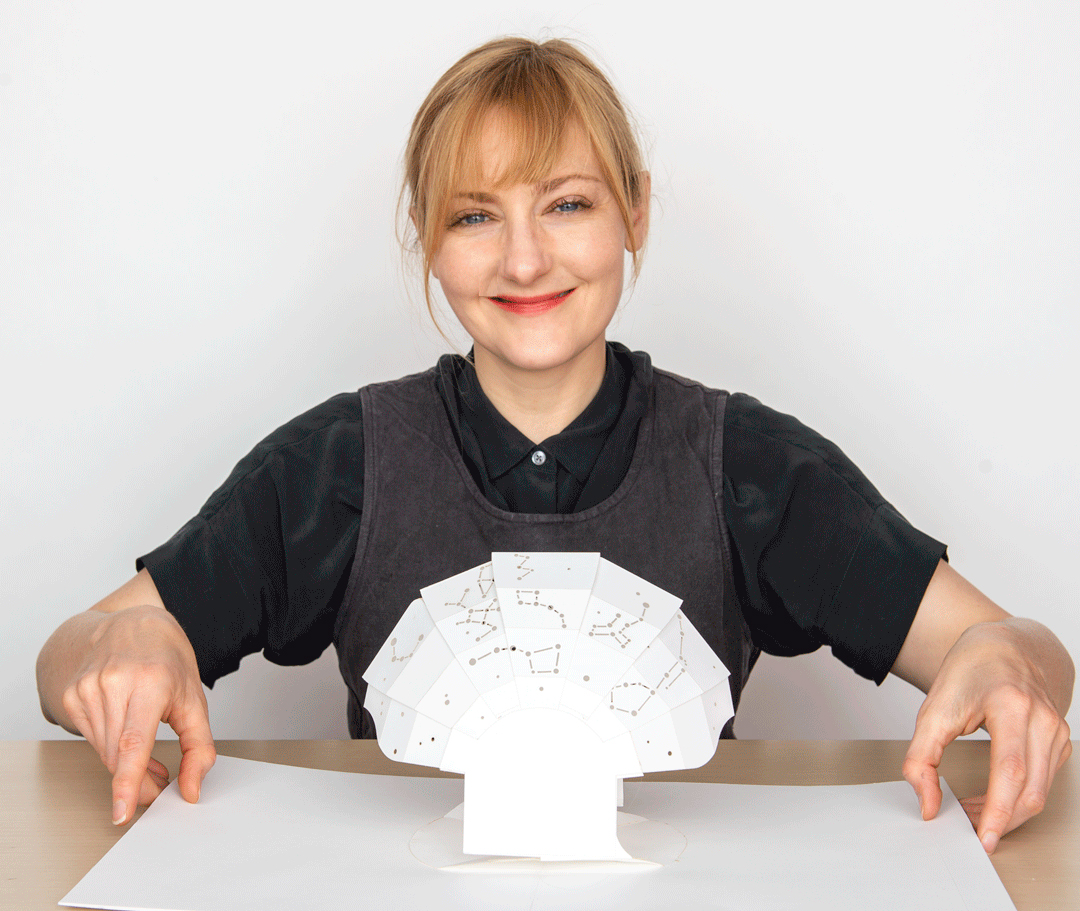
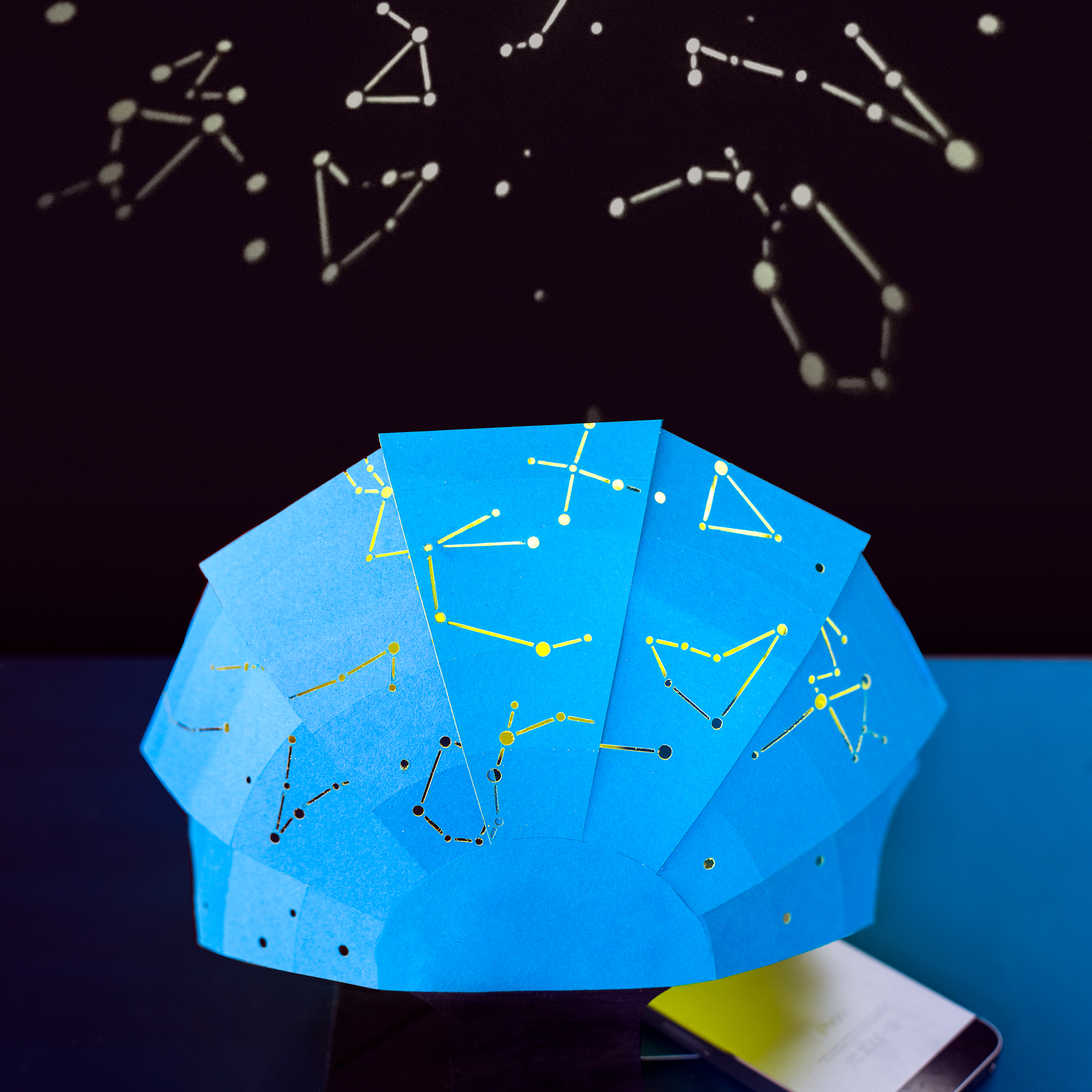
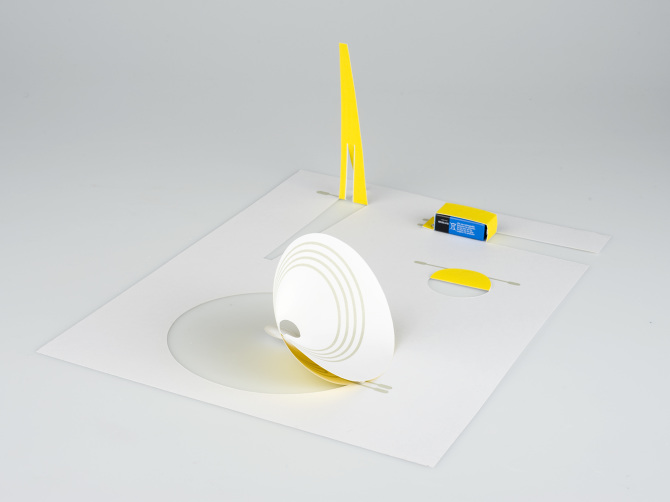
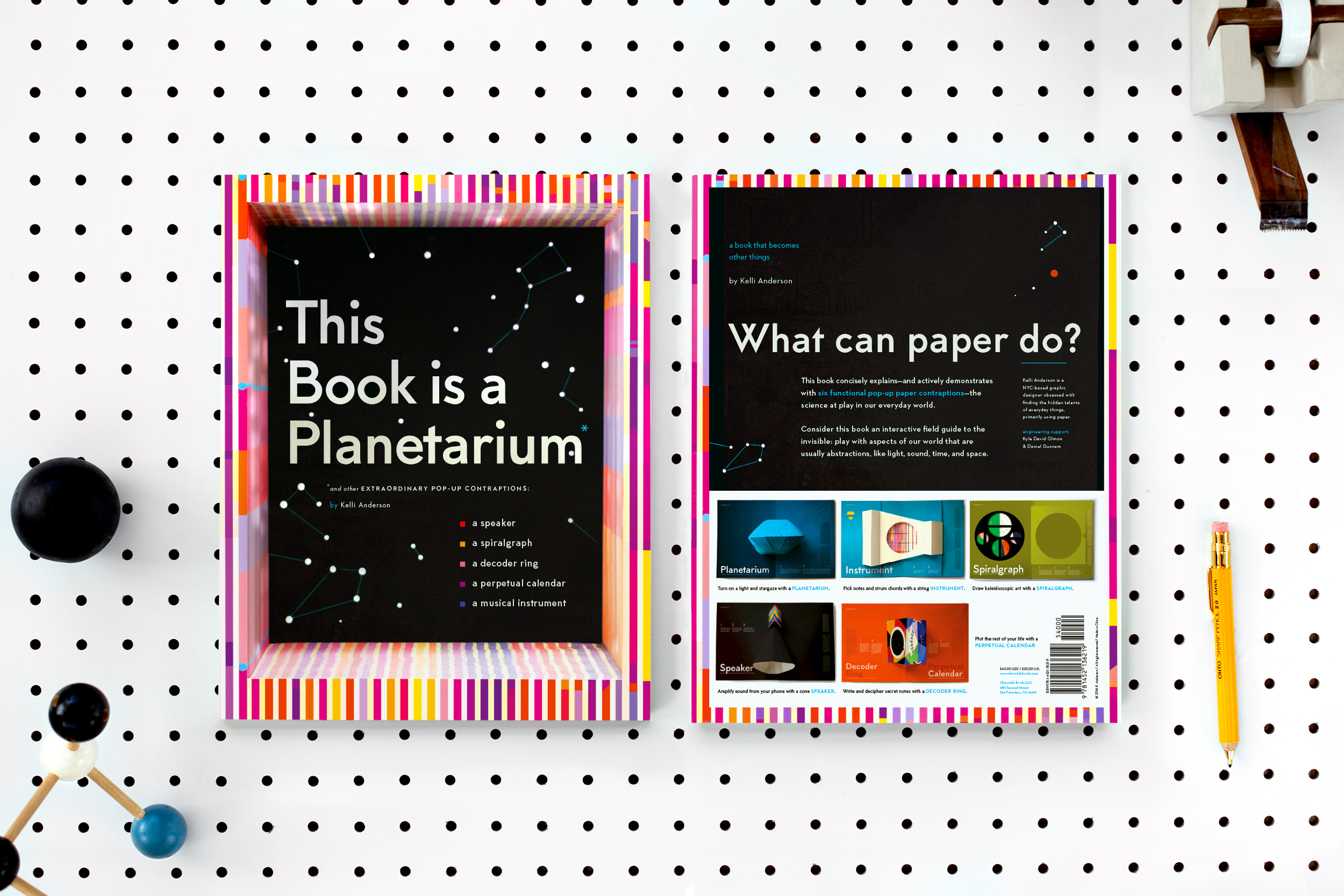
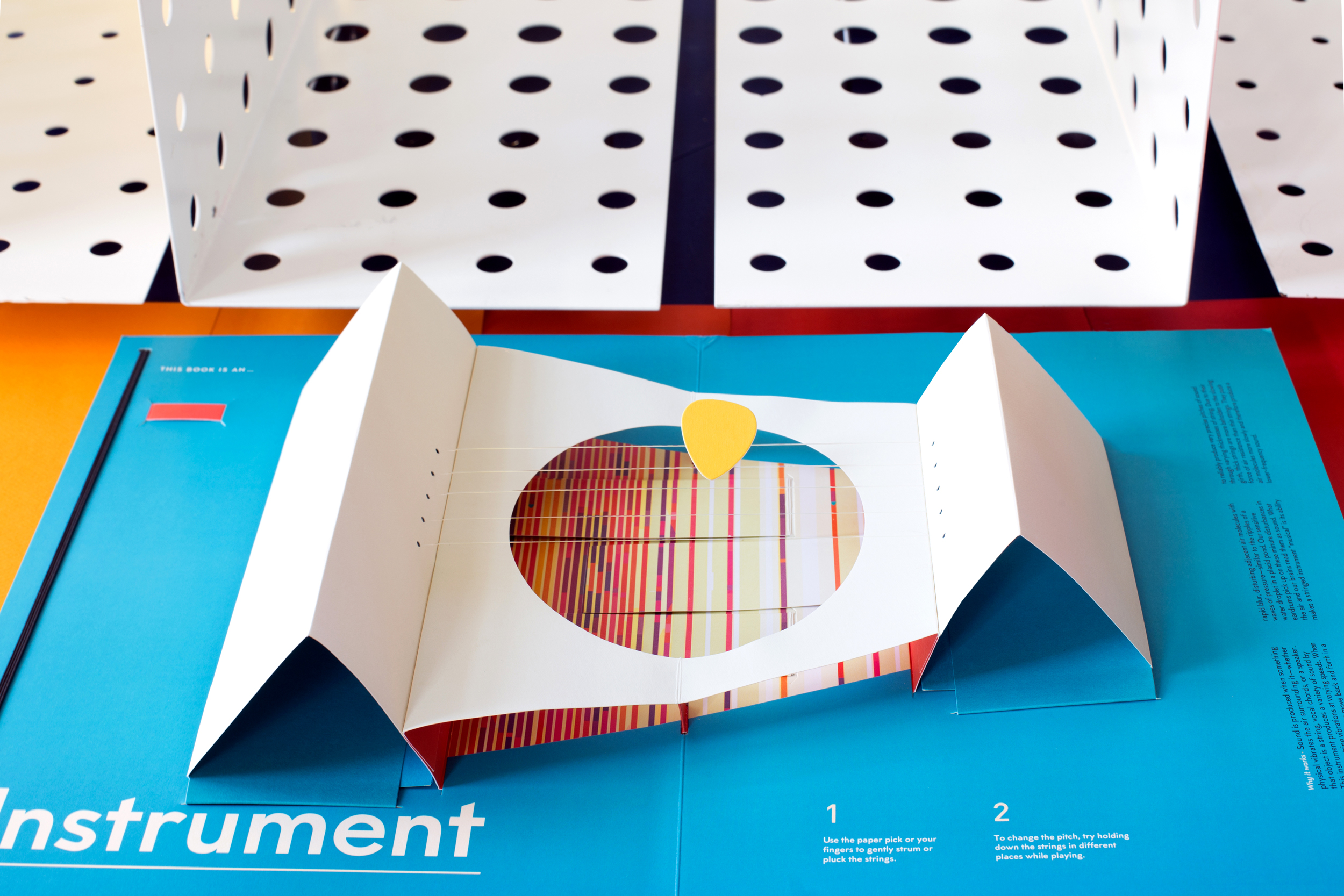
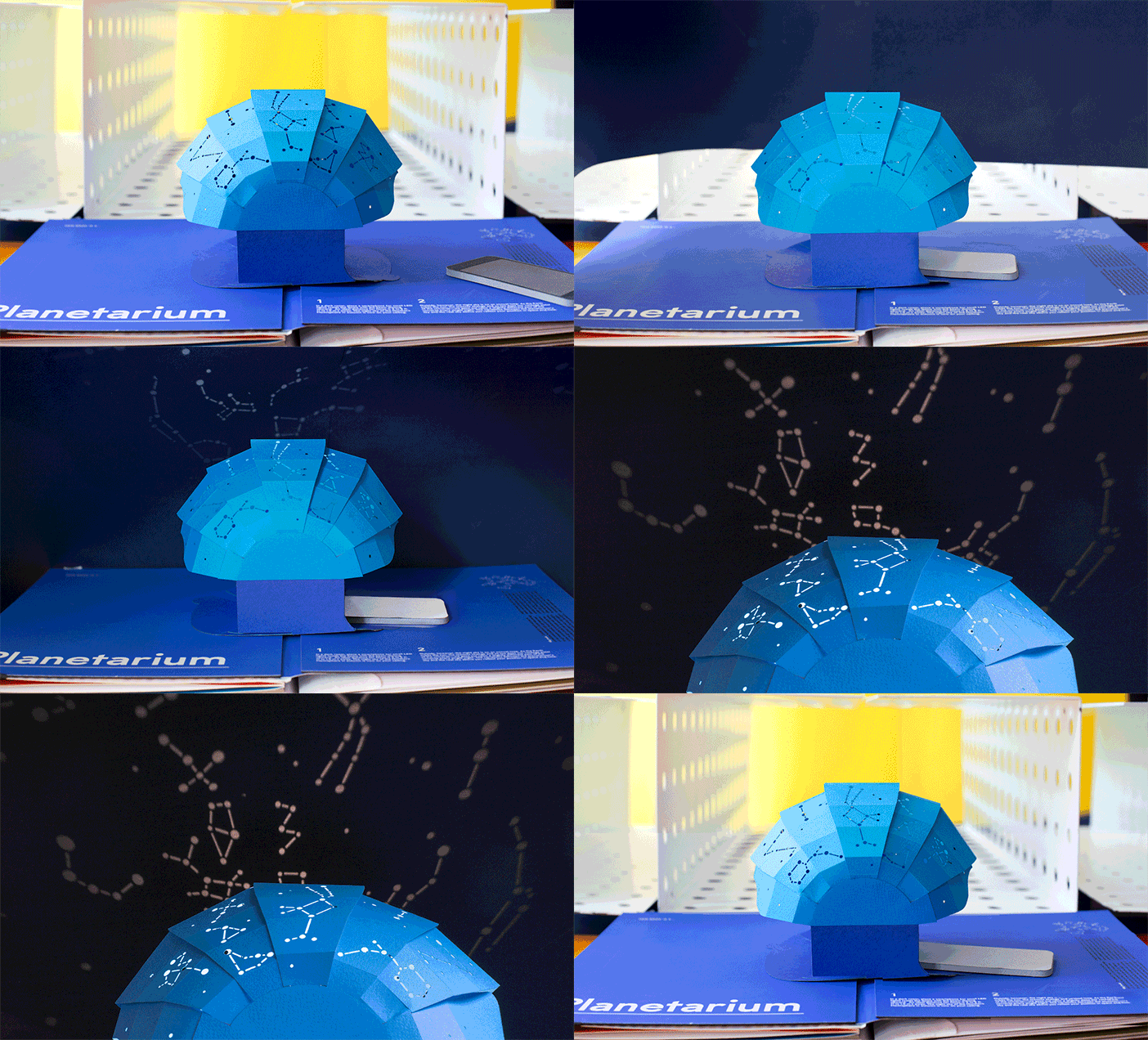
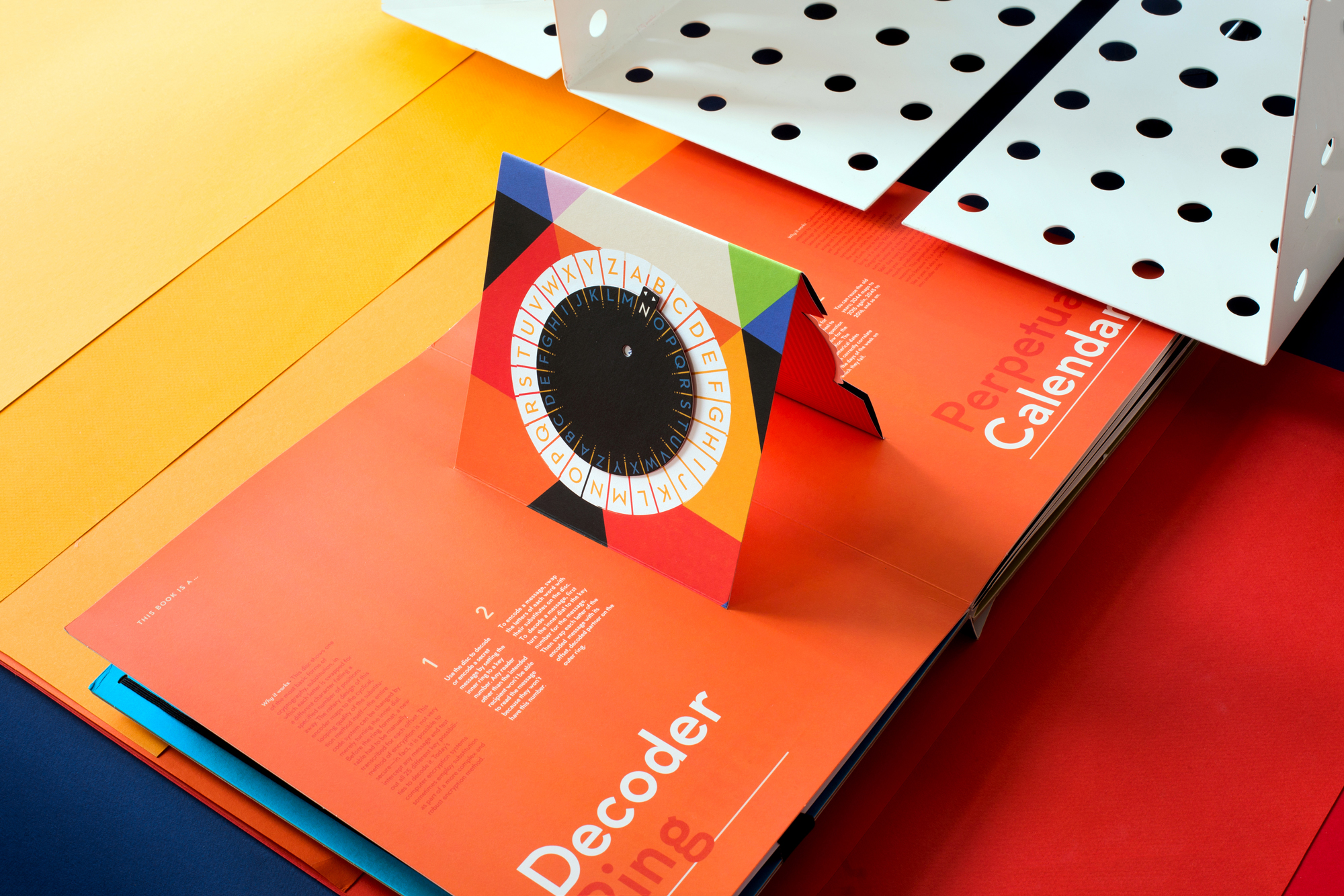
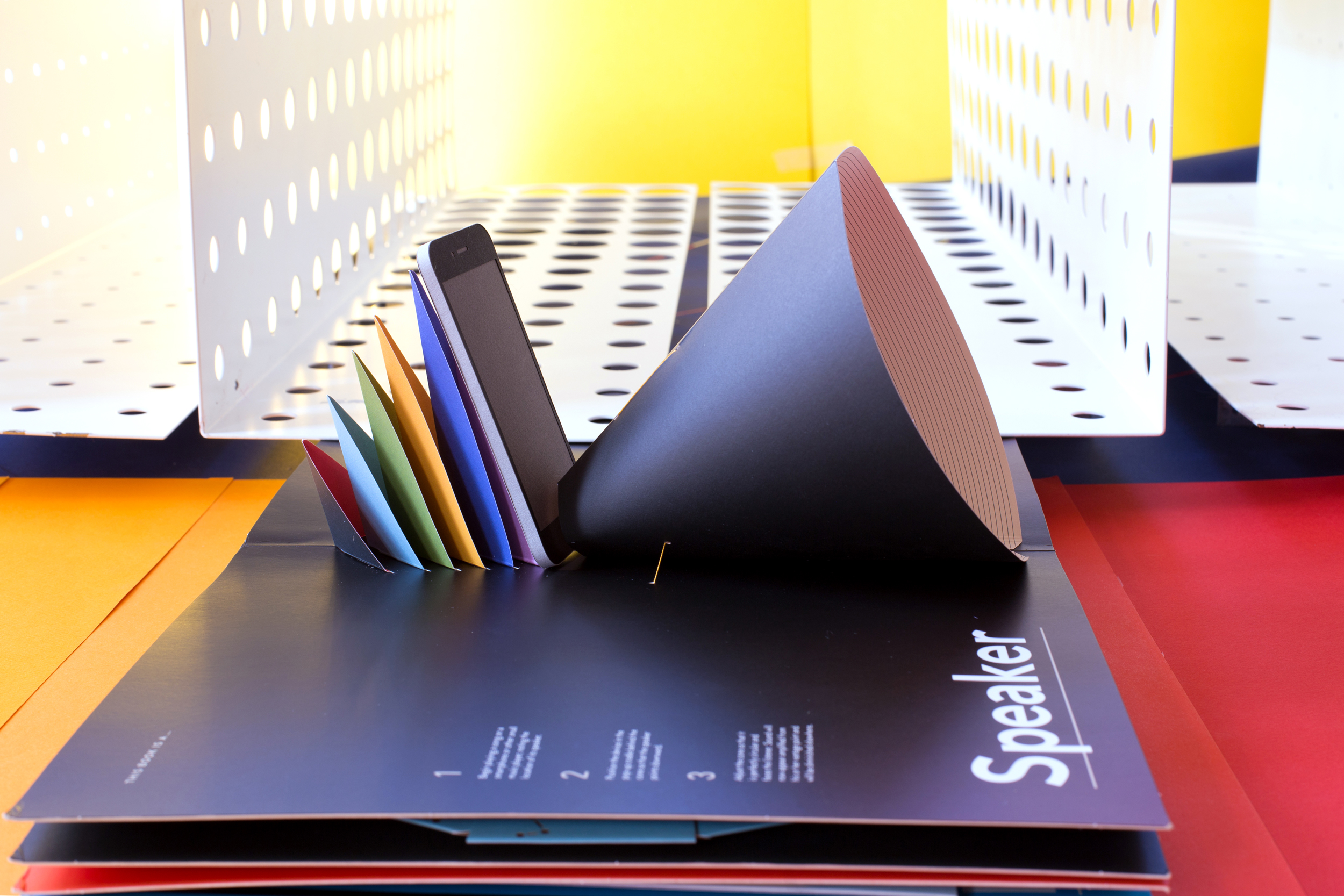
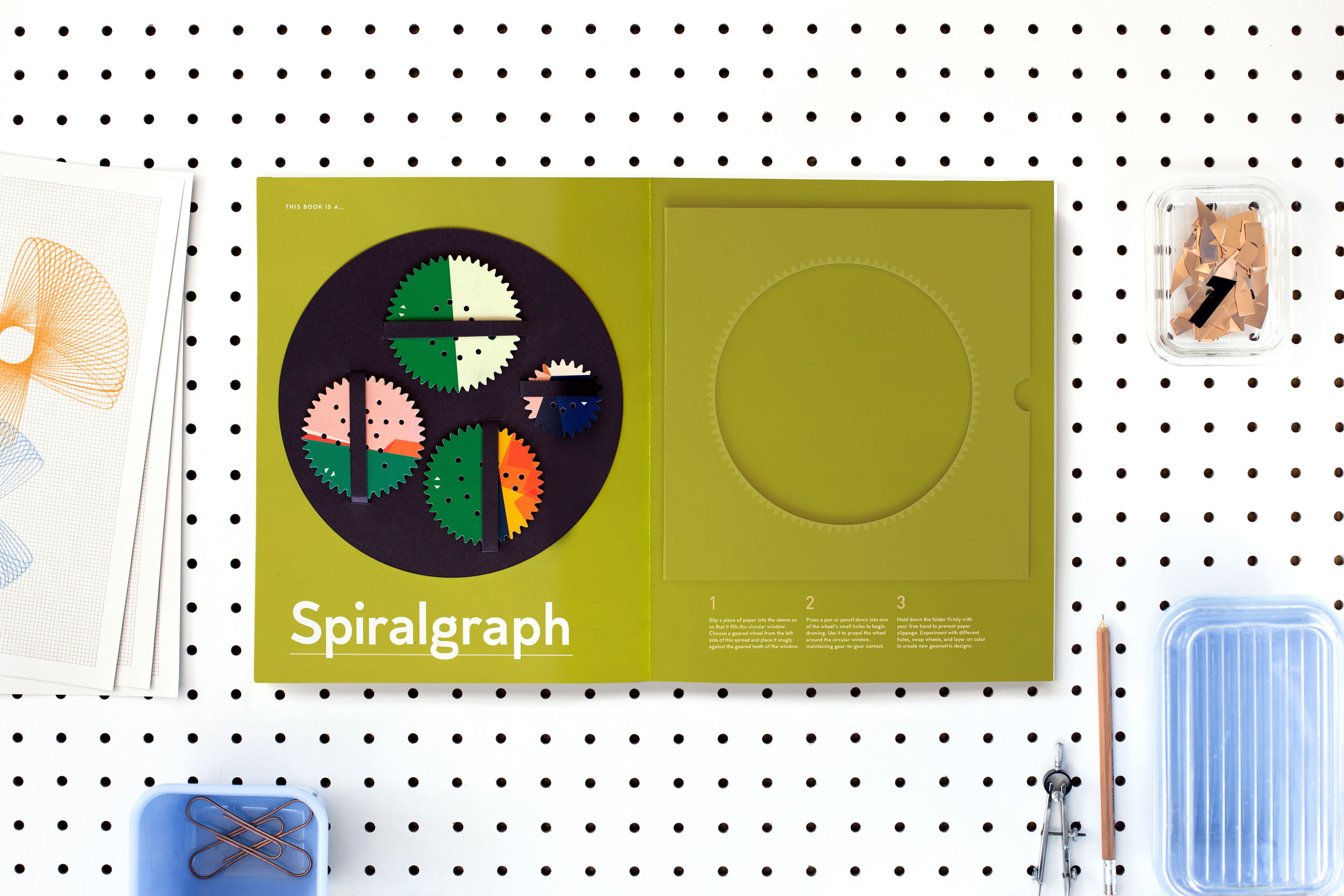
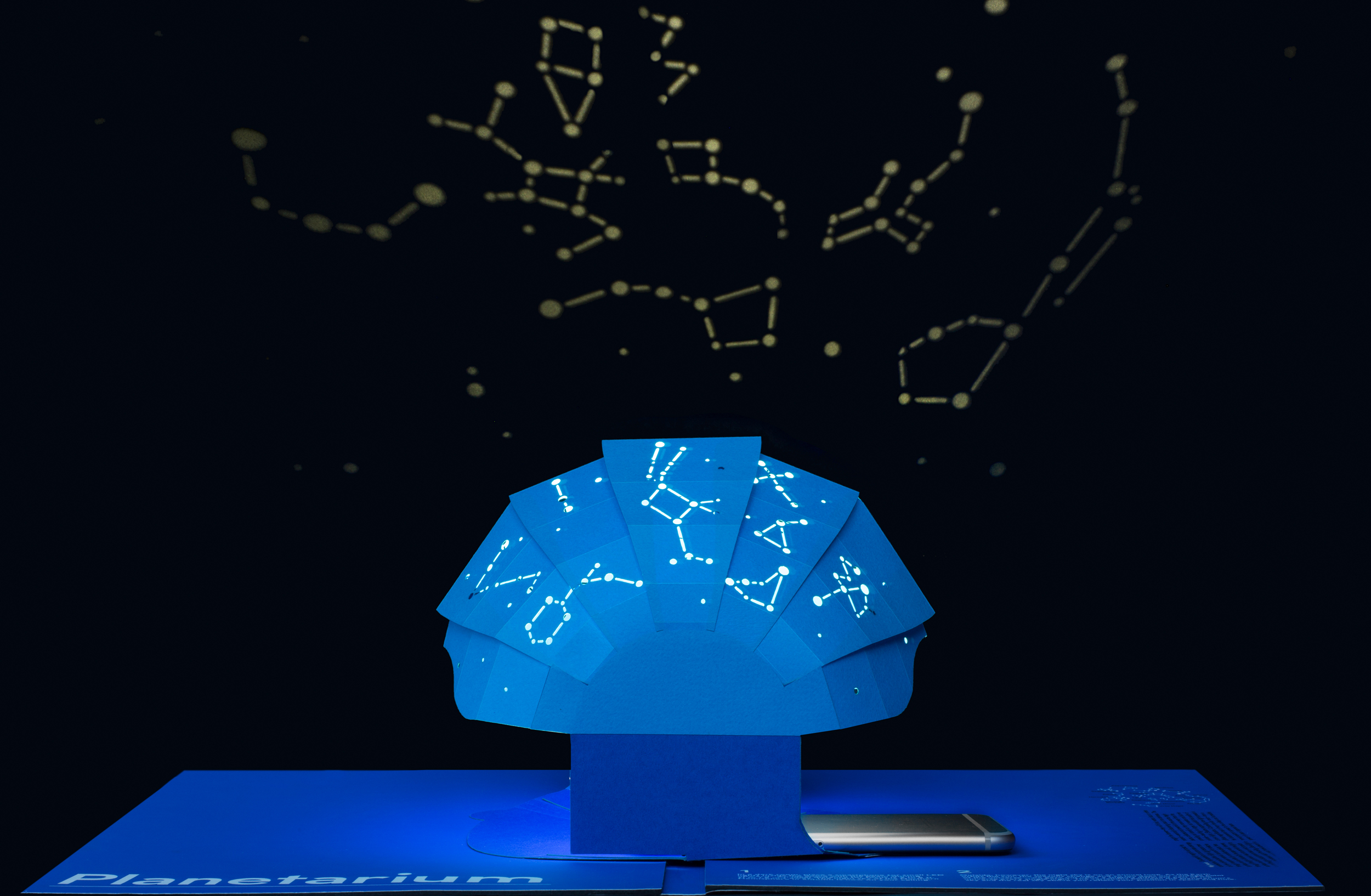
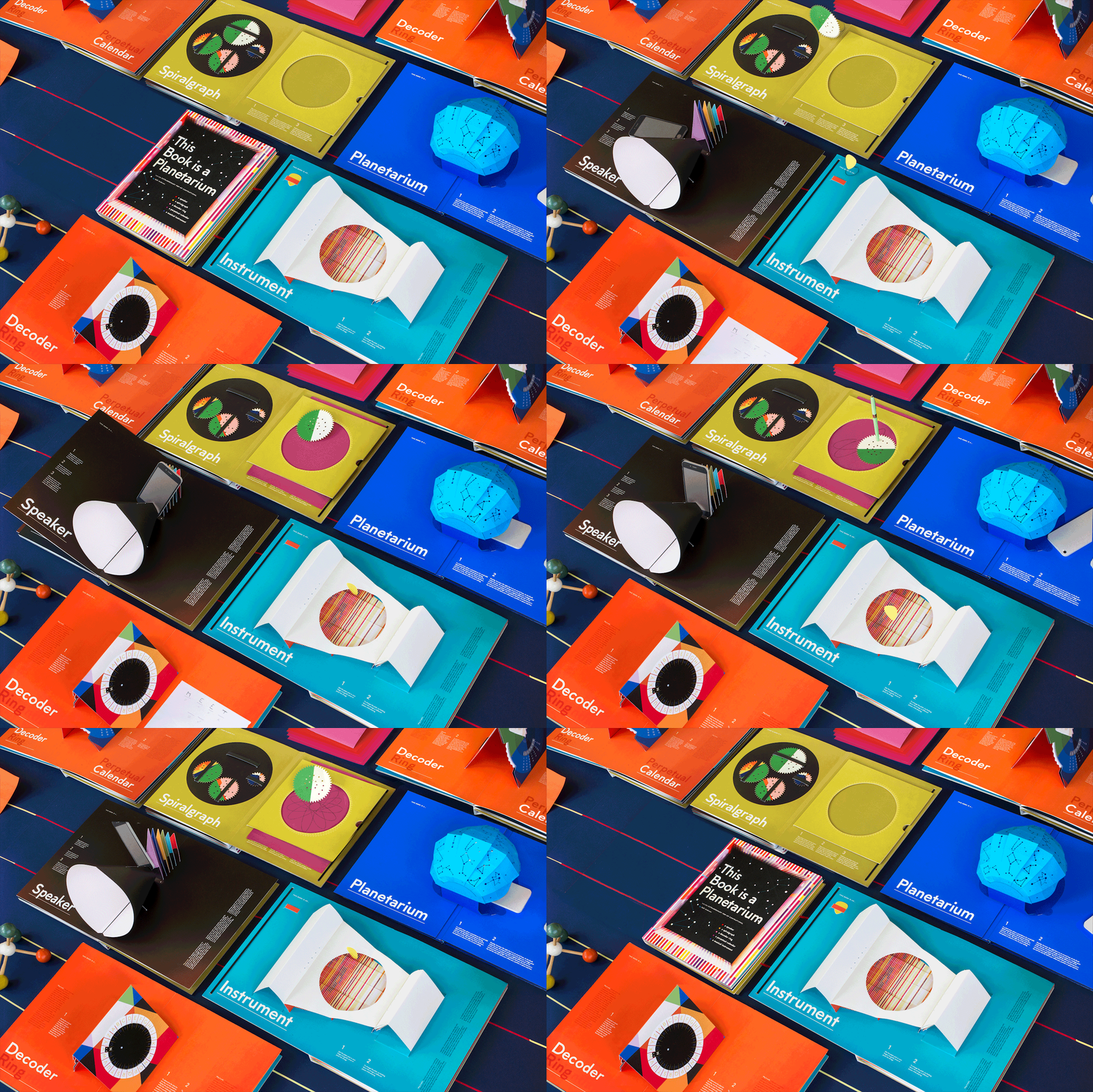
Expanding out of This Book is a Planetarium’s pages, you’ll find: a stringed instrument, a perpetual calendar, a decoder ring, a spiralgraph drawing generator, a smartphone speaker, and—yes—a constellation-projecting planetarium. With a little tinkering, turning, and futzing: the resulting paper objects actually work! (despite of being made from “almost nothing.”)


The book was designed to showcase the potential of the material world—while making a case for the inherent educational value of lo-fi experiences.

In their clunky way of functioning, the past’s technology served this unacknowledged secondary function to humanity: These objects helped us glimpse—and therefore connect to —the magic of the physical world. By being glitchy and fussy (and by sometimes requiring manual tinkering or duct tape), lo-fi contraptions more transparently revealed the underlying laws of the world to us.

We’ve increasingly lost that connection point as our things have become more black-box (a loss which may account for the otherwise-irrational cultural resurgence of lo-fi media, such vinyl records.) Sophisticated, opaque things are beholden to what we expect them to do. More primitive things, on the other hand, are beholden to (and reveal a glimpse of) larger forces, like… say, the laws of physics. And, as it turns out, are fun for kids (of all ages) to play with.

This project was born out of the paper record player invitation I made a few years ago (more about the process of experiencing that realization in this podcast interview with Debbie Millman.)


We made the record player “just because it felt cool” (the best reason to do anything!) But, the shocked response I received prompted quite a bit of reflection on why people were so surprised (and moved) by it. And where to take that realization that I stumbled-upon.

This is why I’ve been remaking the function of tech with something that most people consider trash: paper. By stripping technology bare of its complication and interfaces, I want to make a place where people can contemplate the wonders of the physical realm.

As long as humans continue to have hands, we can continue to think with them. And we can be moved, surprised, and enlightened by what our hands tell us about how materials, actions, and behaviors are structured.

Mary Oliver provides these instructions for how to live a life, which resonated with me: “Pay attention. Be astonished. Tell about it.” At my desk, with a giant pile of “doesn’t-works,” I would eventually stumble upon something that kinda did. Often, I felt silently blown away by just-how-little it took to build something capable of performing some minor feat. I don’t know if other people will have this same reaction, but this is the best way I’ve found to share it. It’s a pretty fun book.


Behind the Scenes of This Book is a Planetarium (aka crushing all of the magic!)


OK, here is how this sausage got made:
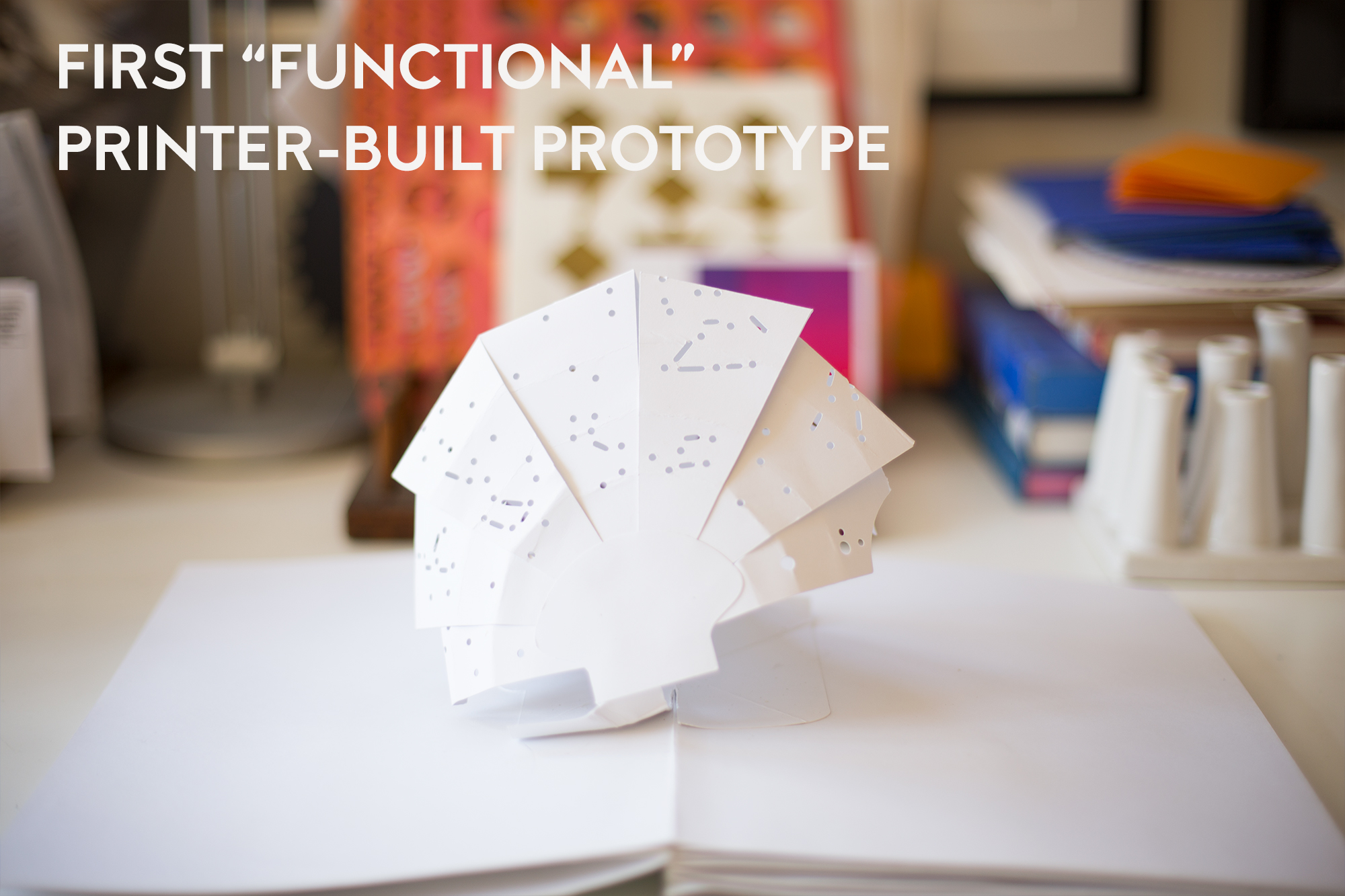
1) Pop-up books begin life with the author ripping apart other people’s pop-up books as a form of love, homage, and study (many friends at The Moveable Book Society have confirmed this.)

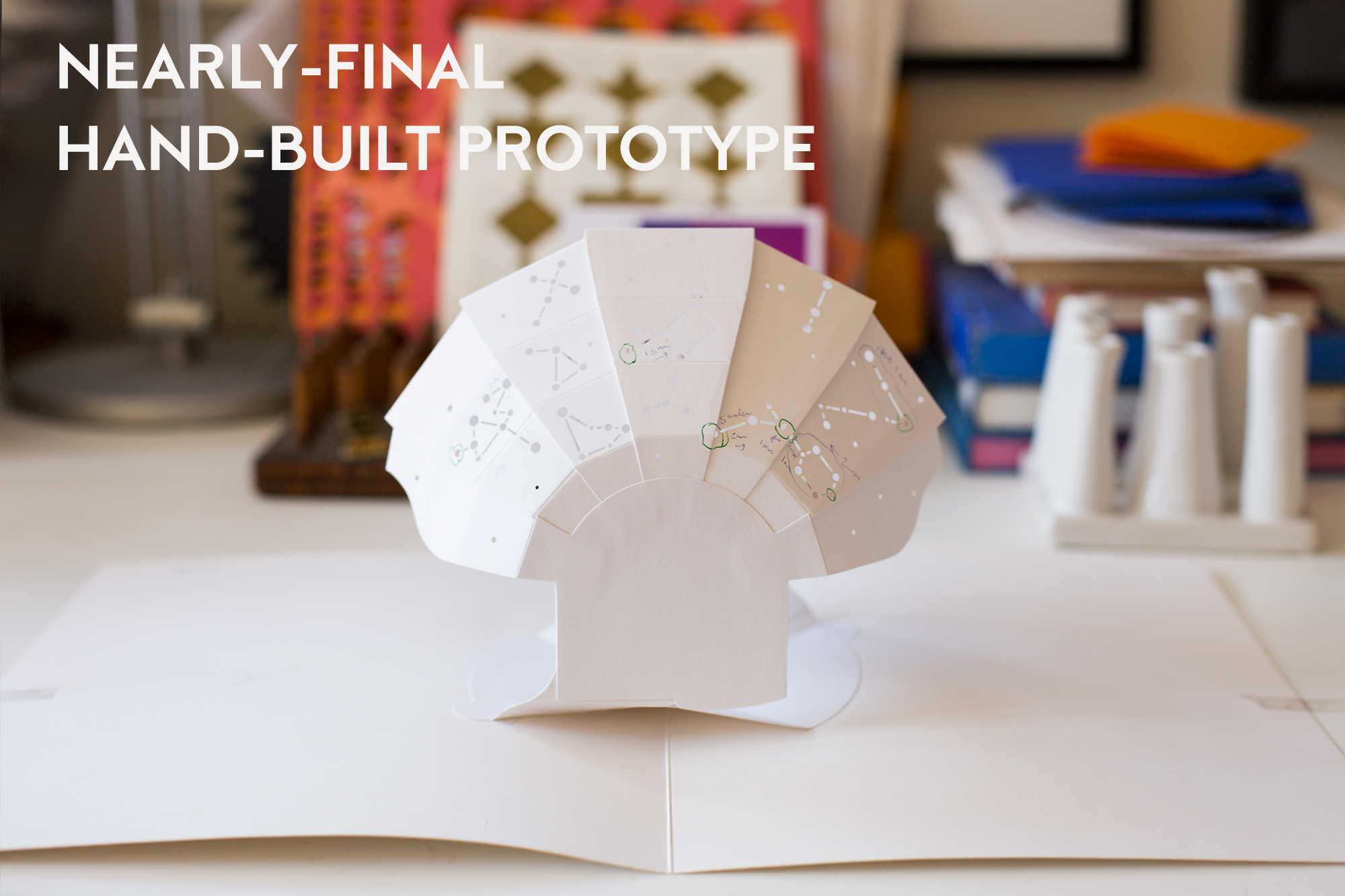
2) Then, you end up with a disgustingly soft/crappy handbuilt pop-up. It doesn’t close… or even open, really BUT THERE’S A GLIMMER OF HOPE. Like an addict, you keep going.

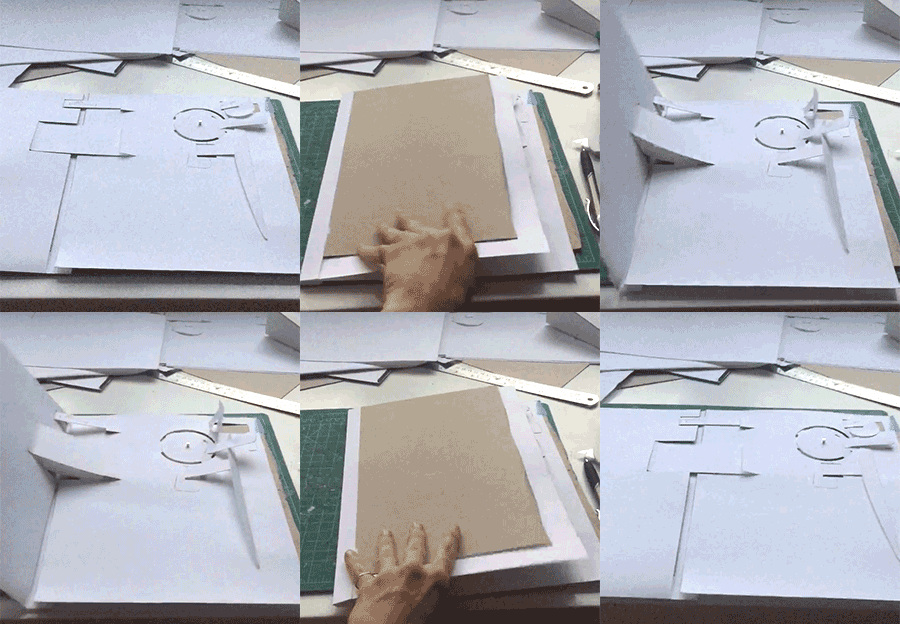
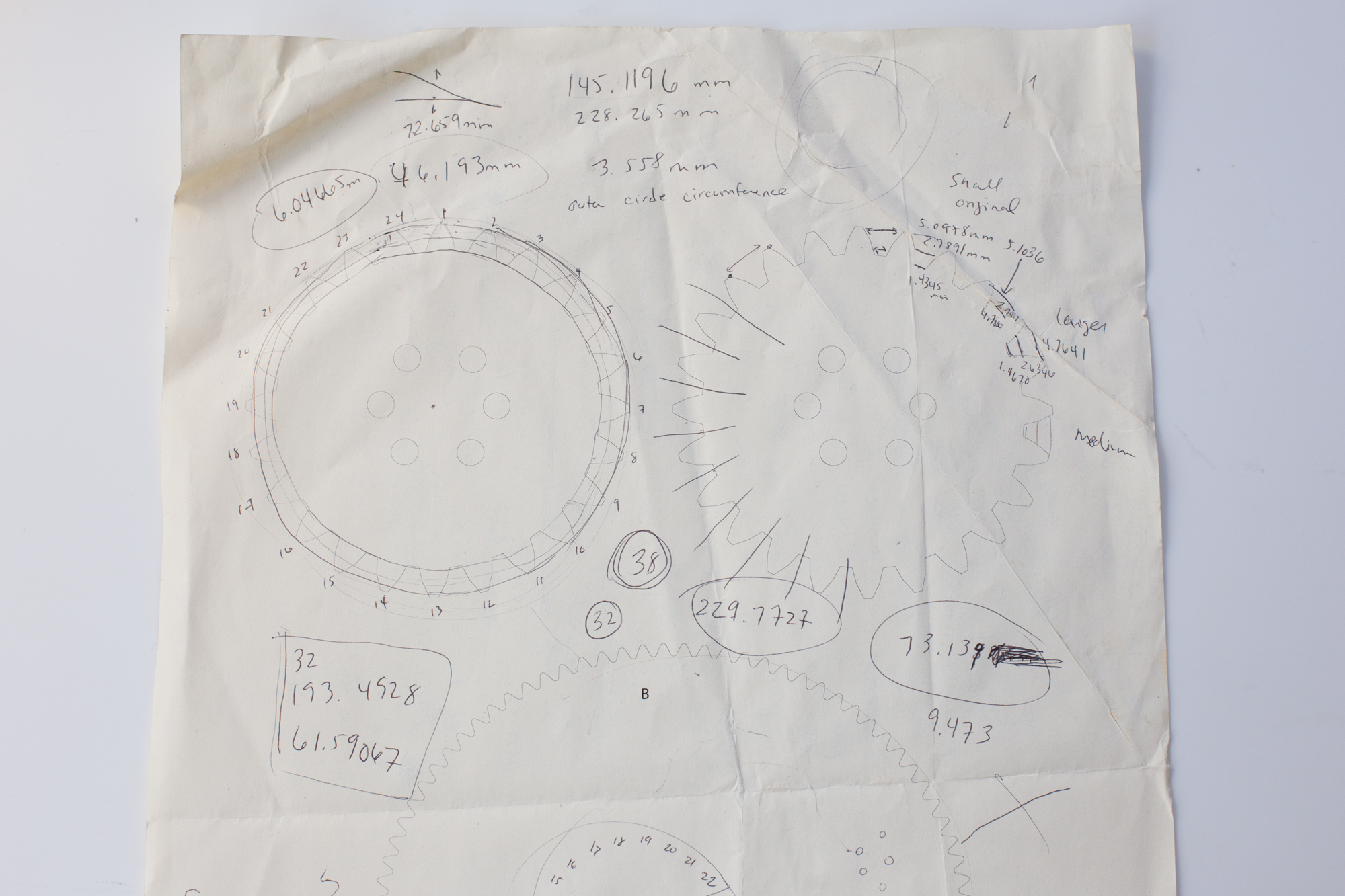
3) At some point in time, you feel sufficiently confident to scan your crappy-paper-form and make “dielines” which can be cut on a plotter. Refine, cut, glue, repeat.

4) When you achieve perfection, you then send your prototype to the mass-production printer, who will invariably start back at 1) again. This time, progressing through the steps to refinement is very slow, and resemble sa game of telephone.


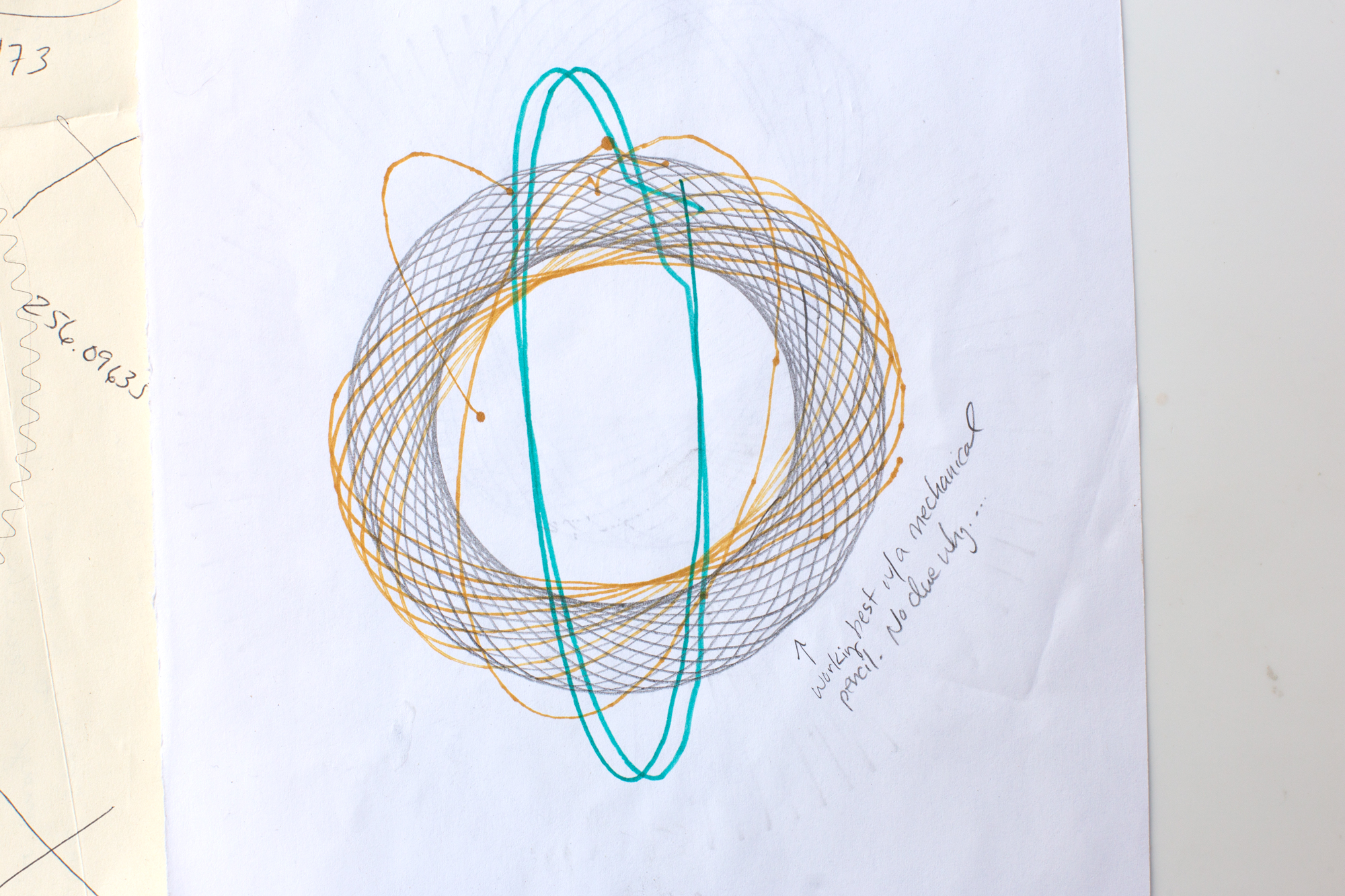
I made a ton of paper-gadget prototypes and only a few were published. Here is a full gallery of everything I came up with.

Personal favorite is this paper karaoke-room-light-machine (physical wheels that program light are ALWAYS A+++):


For someone who is accustomed to having their fingerprints all over every object they make, mass-production was extremely challenging. It took about 4 months to design and paper-engineer the book and then the publisher and I spent 2.5 years problem-solving with the printer. But we got it done! Both: Totally worth it and I’ll probably never do it again.


Credits:
The song used in the trailer is the best, most cosmic and ethereal version of ‘Major Tom’ in existence. It is by a self-taught musician named Susan Dietrich aka The Space Lady. Buy her music, it is amazing!

Thanks to: Daniel Dunnam (for the support and encouragement and sound-editing), to the team I worked with at Chronicle Books, to Kyle David Olmon and Structural Graphics (both advised on a few tricky production problems), to Alina Keay for the paper-prop production help, to Stefan Pelikan for the handmade galley assistance, to Jen Snow for the moral-support/PR help, Boris Ebzeev for editing the behind-the-scenes, and to Raul Gutierrez, Maria Popova, Debbie Millman, Daniel Morris Gardiner and Wendy MacNaughton for the invaluable feedback+support. I also worked on the book a bit during my creative residency with Adobe and during my residency at A/D/O. I consider myself so lucky to know you people! Thank you all!

Download video
Download video
https://kellianderson.com/blog/?p=3715
Extensions
And Then…
Uncategorized
A quick note to say: a new site is coming really soon by my friends at Oak (pardon the dust and non-responsiveness in the meantime…) I devised the branding for SVA’s Visual Narrative students’ final show—And Then…. I’ve attended in previous years and have been consistently impressed by the remarkably wide (and intrepid) variety of […]
Show full content

A quick note to say: a new site is coming really soon by my friends at Oak (pardon the dust and non-responsiveness in the meantime…)

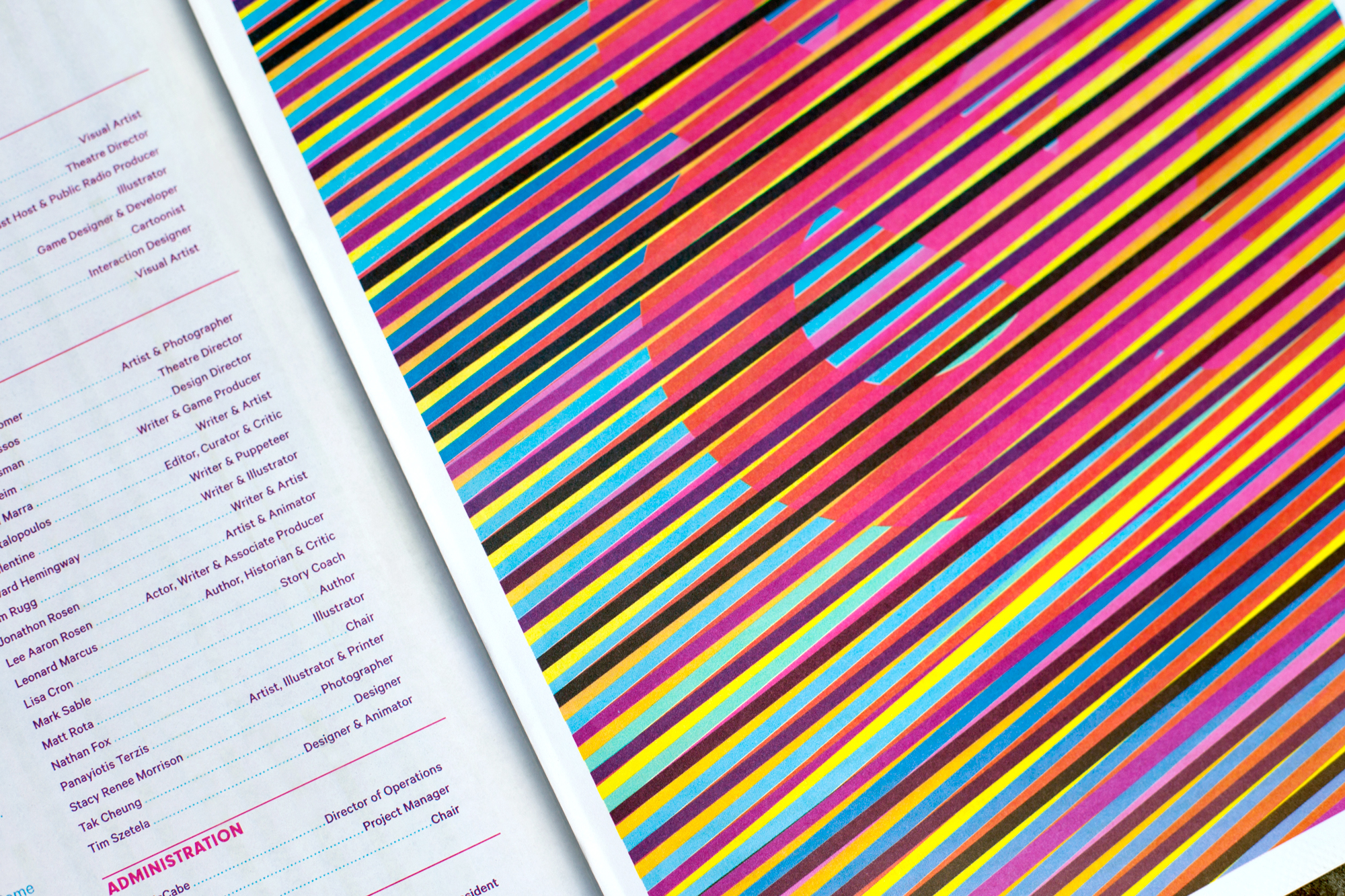
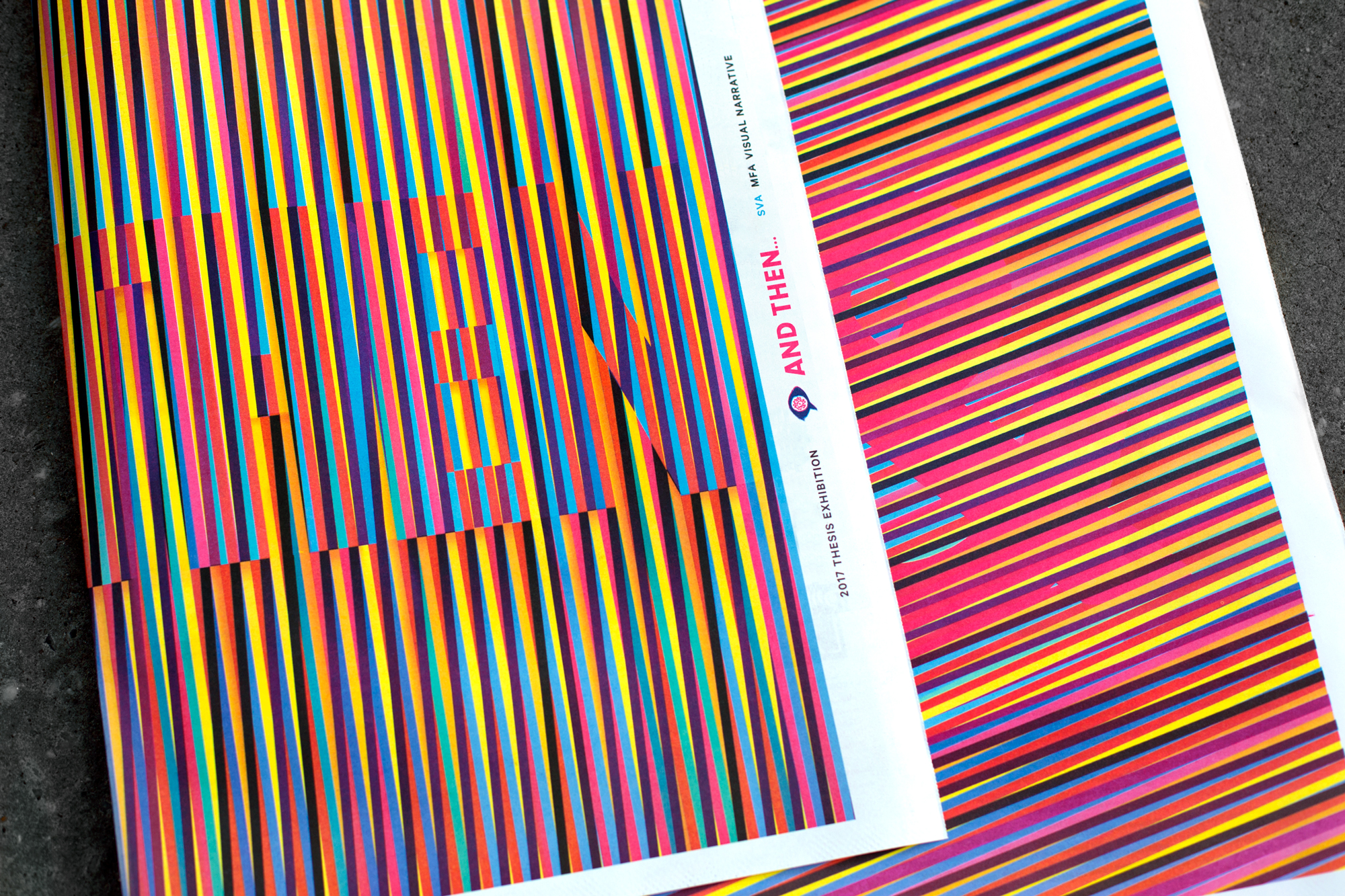
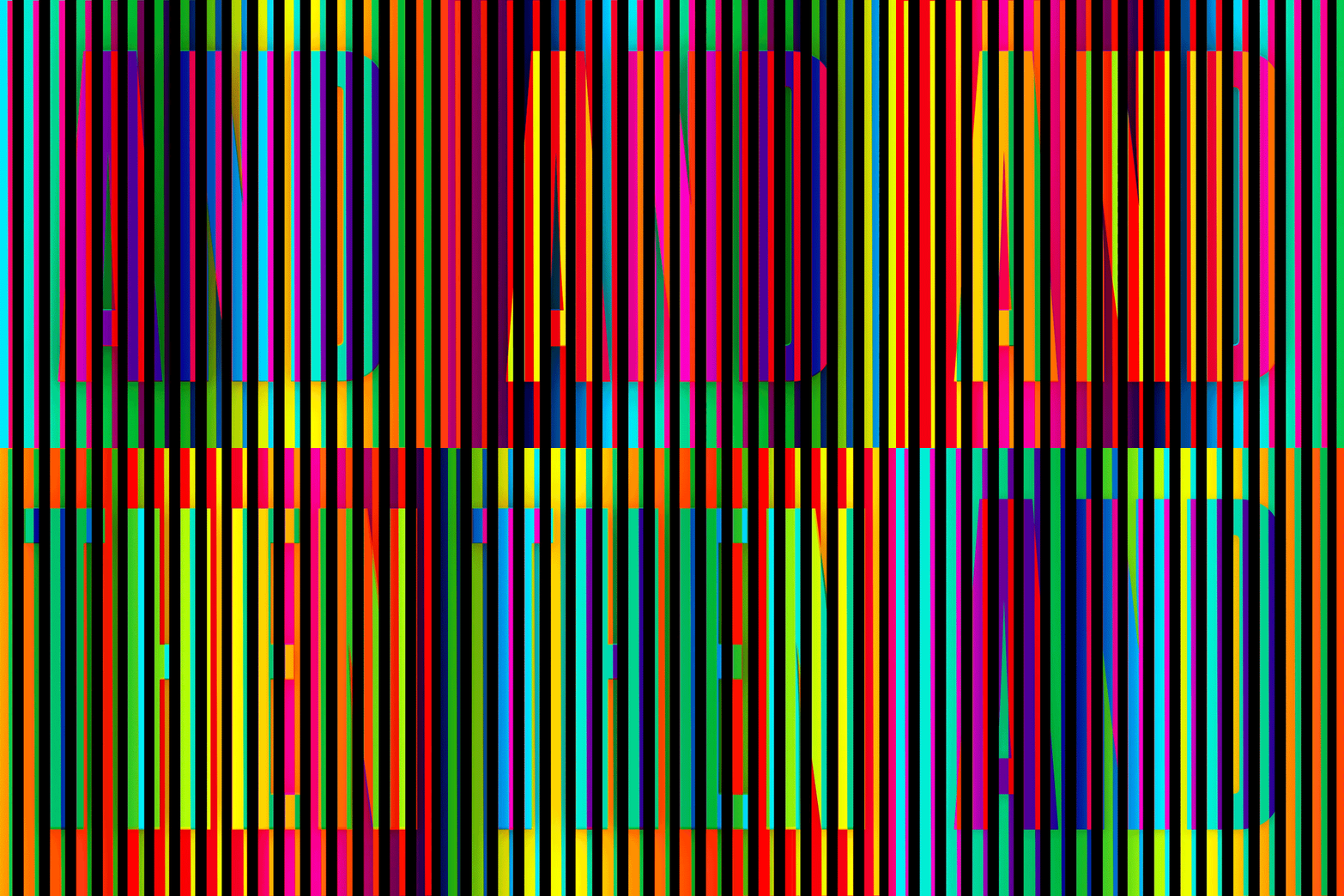
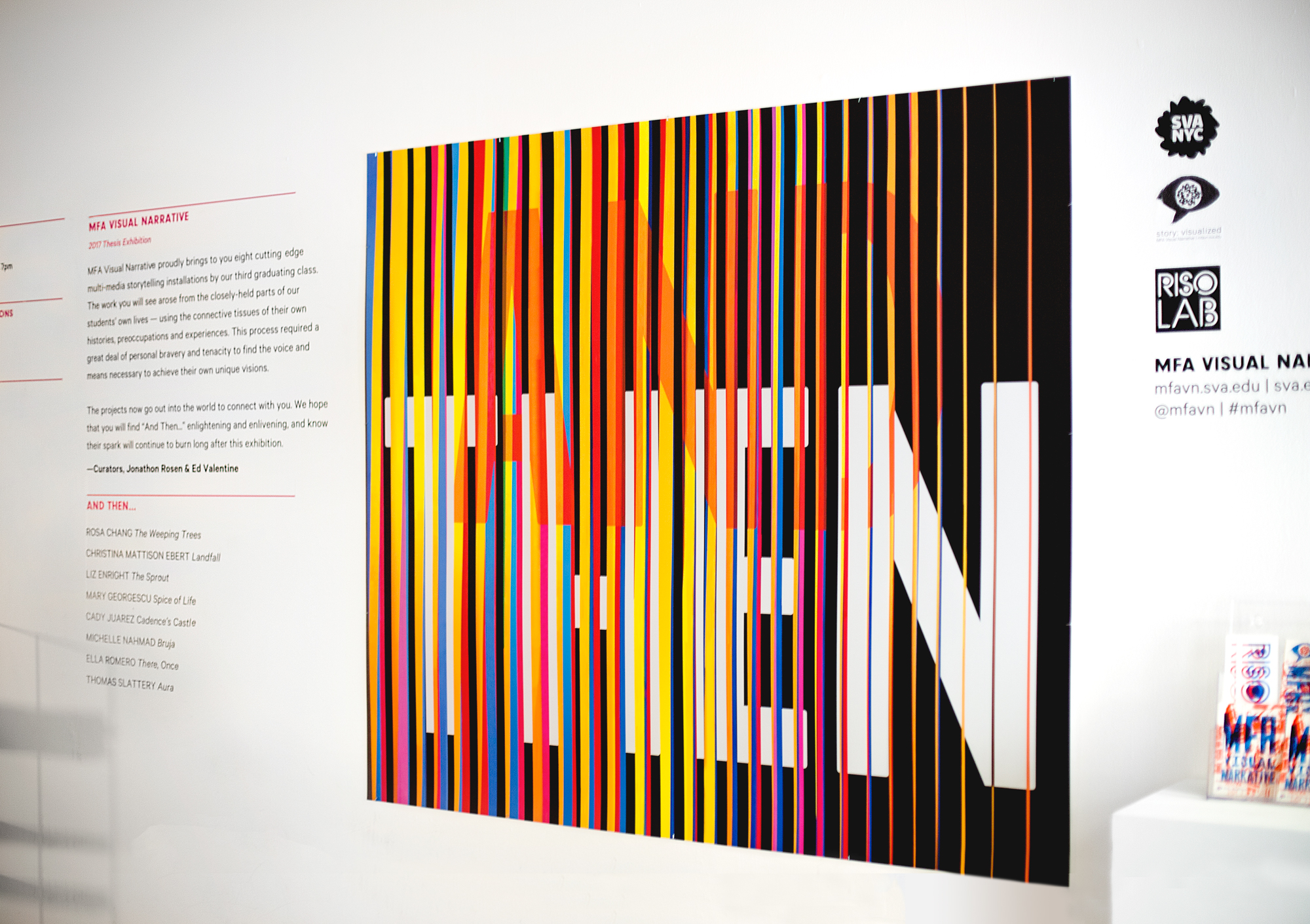
I devised the branding for SVA’s Visual Narrative students’ final showAnd Then….

I’ve attended in previous years and have been consistently impressed by the remarkably wide (and intrepid) variety of work that the students create—from narrative video games to sequential art to immersive storytelling installations. It is really exciting to see the new generation of art school students producing work without regard to traditional [media-specific] boundaries.

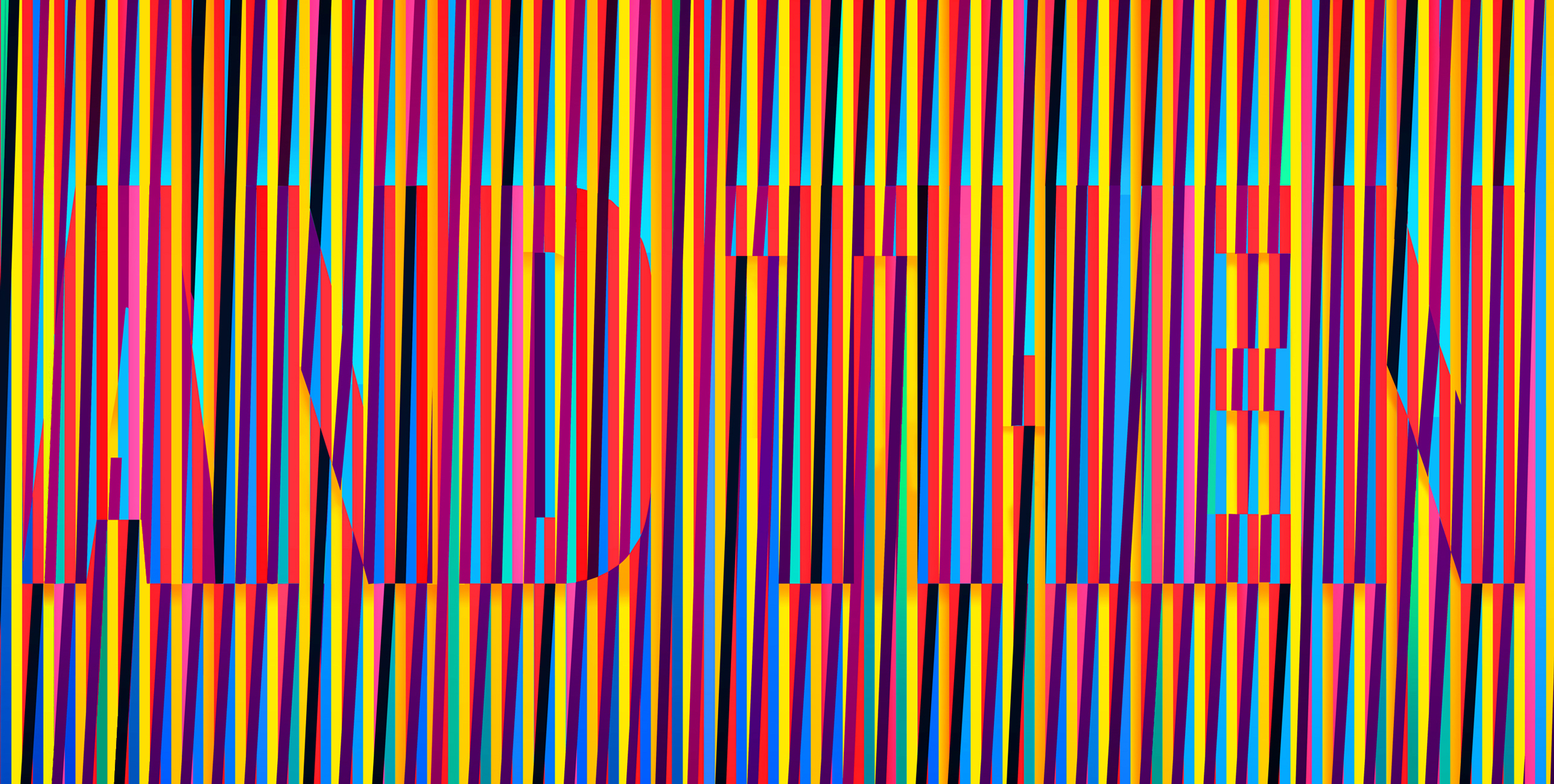
The main branding followed an instruction-based procedure as a starting point (a lá Sol Lewitt’s wall drawings.) The set of “rules” followed in the creation of a such composition feels [oddly] narrative and formally-descriptive at the same time. It uses words like “when” and “then” without actually telling a story-story, per sé:

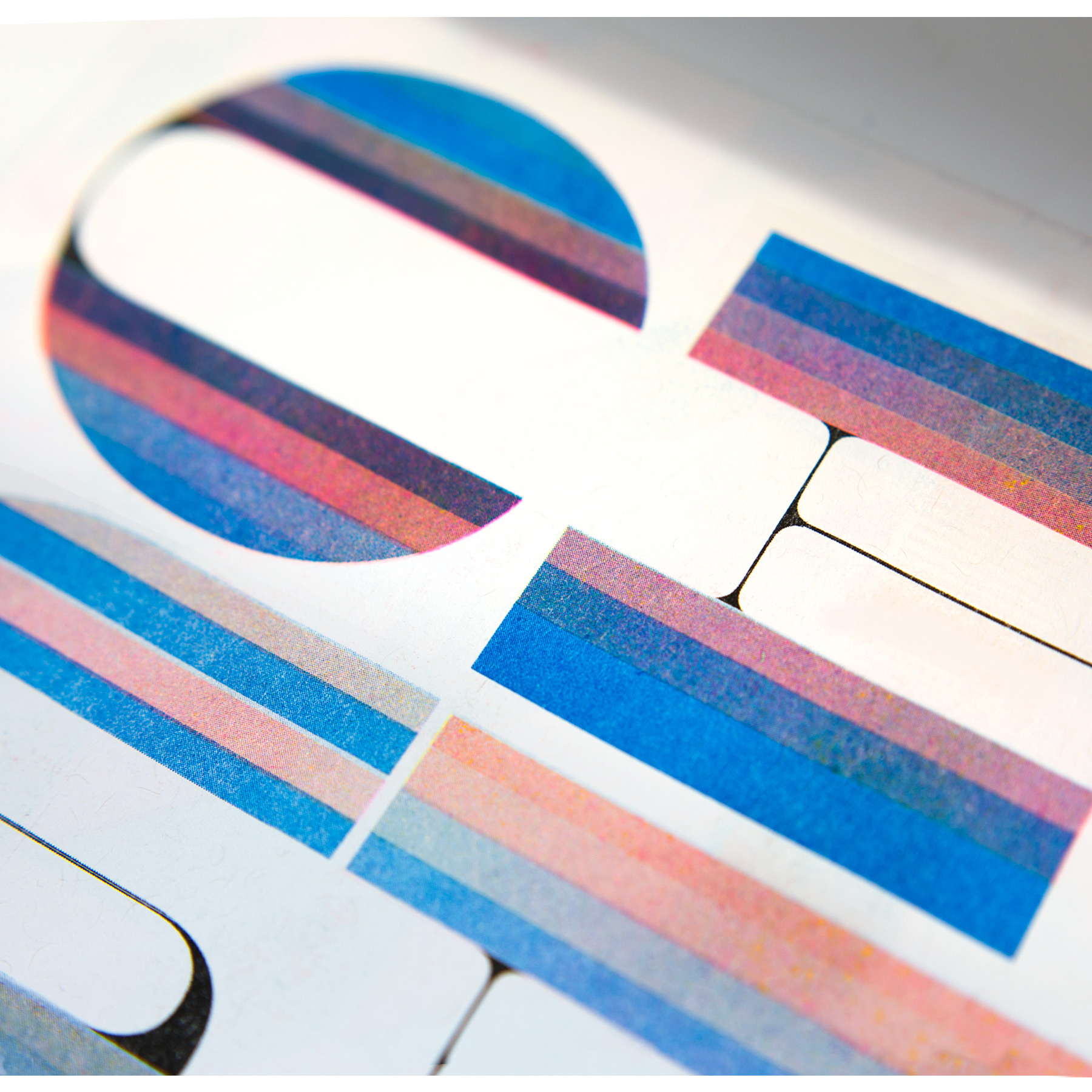
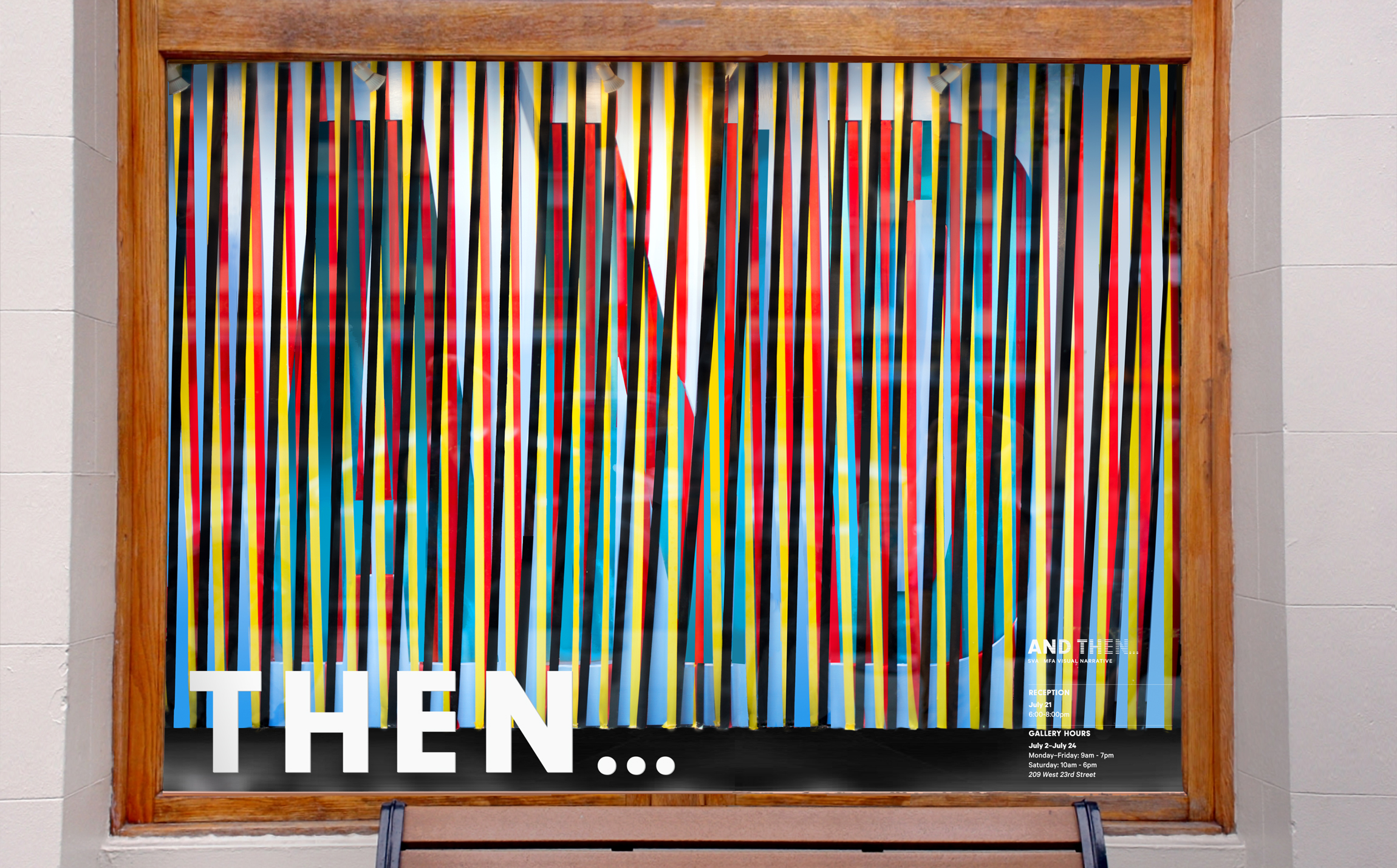
Draw vertical stripes: blue, yellow, and red. Repeat along the x-axis. Lay a diagonal black stripe over each red one, so that the bottom falls on the red stripe that is one place leftwards.

Where the stripes pass through the boundaries of a letter, swap the red and blue stripes. When a black stripe exits a letter, it moves one stripe leftwards

Since it had to actually be legible as branding, I let the instructions function as just as a starting point and tweaked the stripes to attain contrast and clarity.

Artists and designers have long ceded creative control to other processes—like automation or chance—to get beyond the limitations of intent. I discussed this history with Libby Nicholaou here if you’re interested. And my own #madewithrules sporadic/experimental series can be found here.

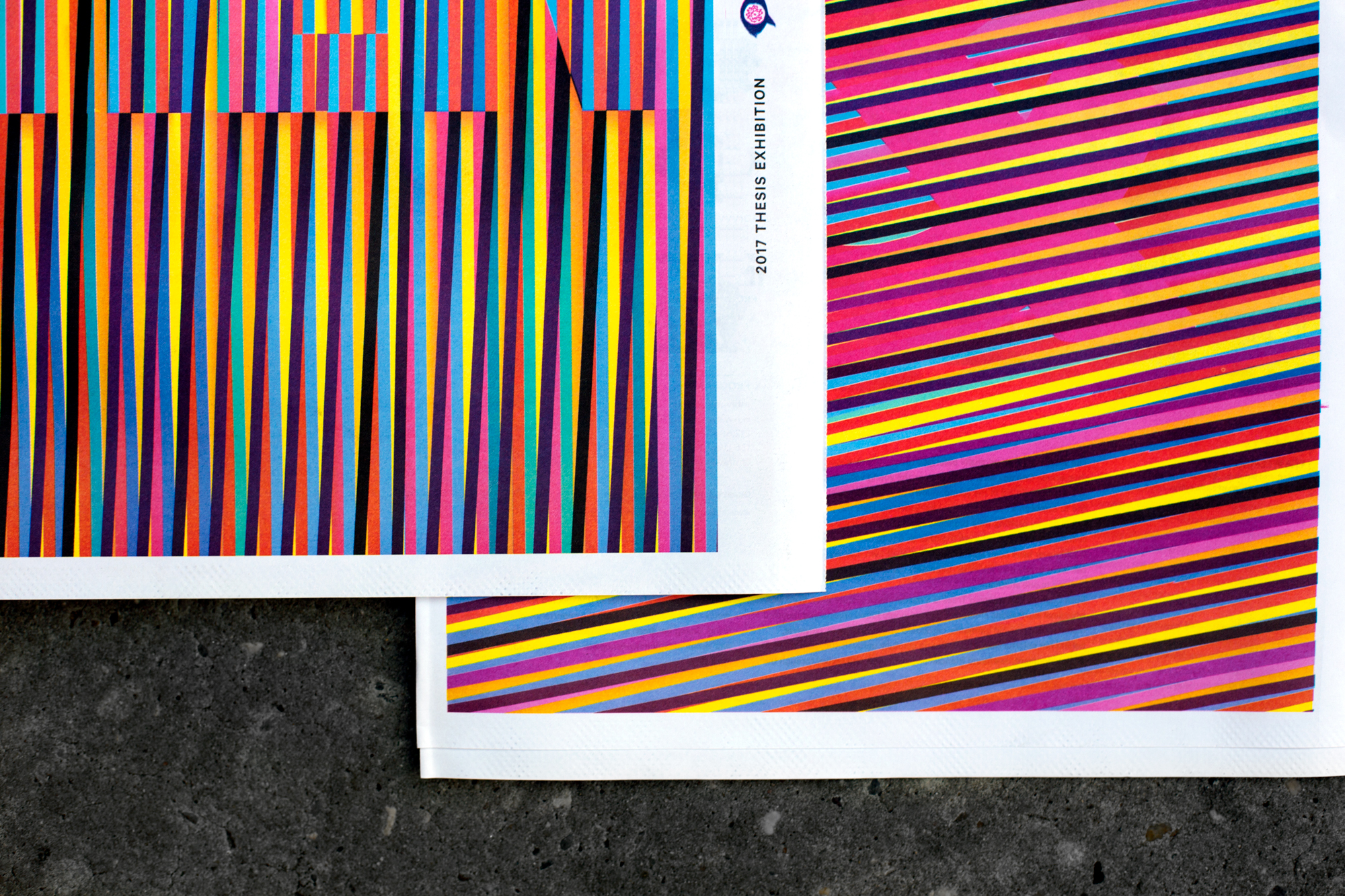
The various applications for this branding didn’t stray far from its generative, Cruz-Diez/Bridget Riley-inspired origin. The gallery guide featured background on each student’s work and continued the stripe-intensive theme:

There’s also this animation, which I made by nesting layers of moving stripes:

The entryway wall text employed the stripes in a manner that referenced decorative wall coverings (so it might “fall back” moreso than the super bright stripes.)

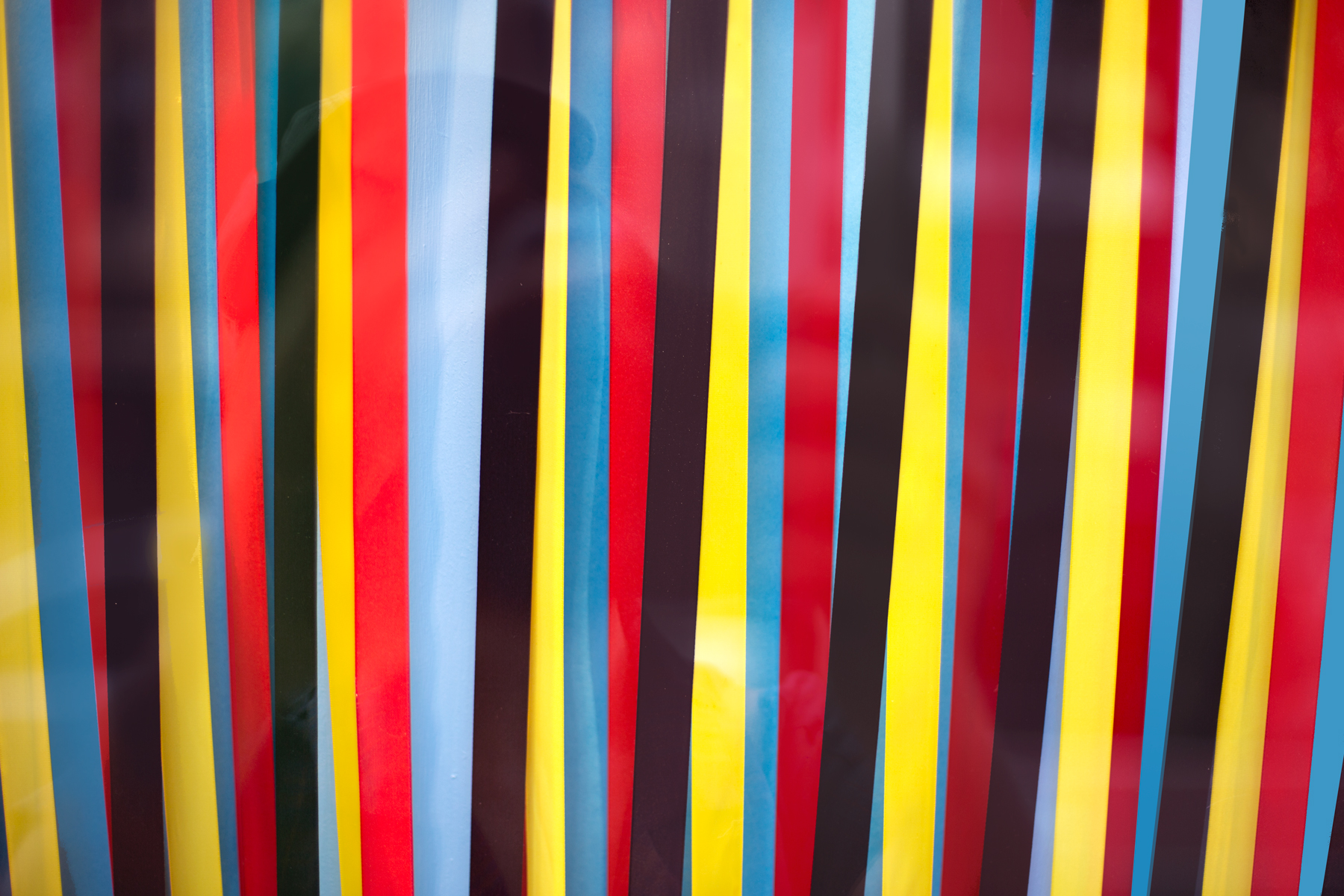
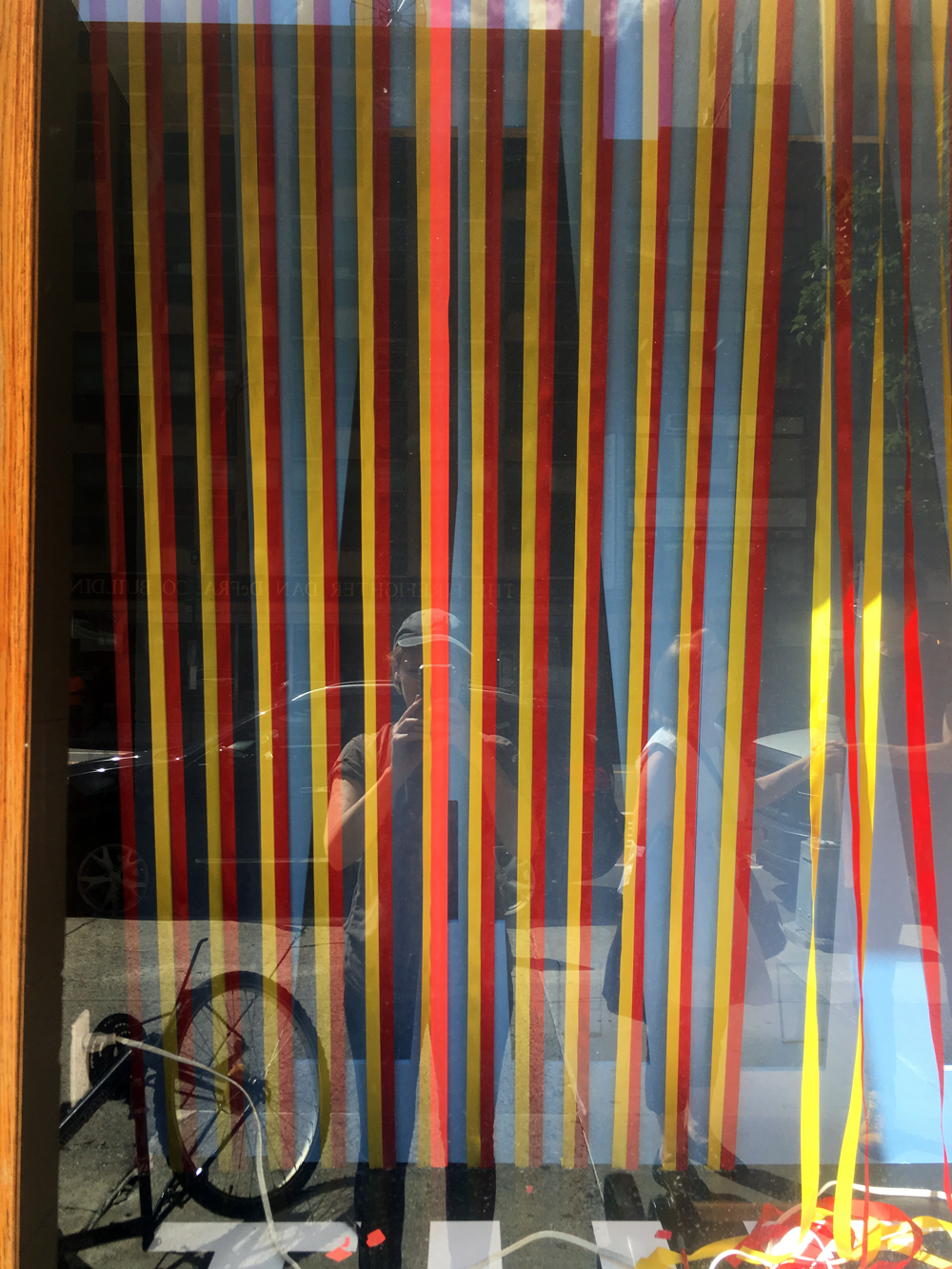
For the window facing the street, I created a physical graphic from ribbons that followed the same madewithrules procedure.

Congratulations to all of the students! Thanks to SVA for inviting me to be a part of this. And thanks to intern-extraordinaire, Stefan Pelikan for the help and for almost losing a limb to hot glue.

https://kellianderson.com/blog/?p=3676
Extensions
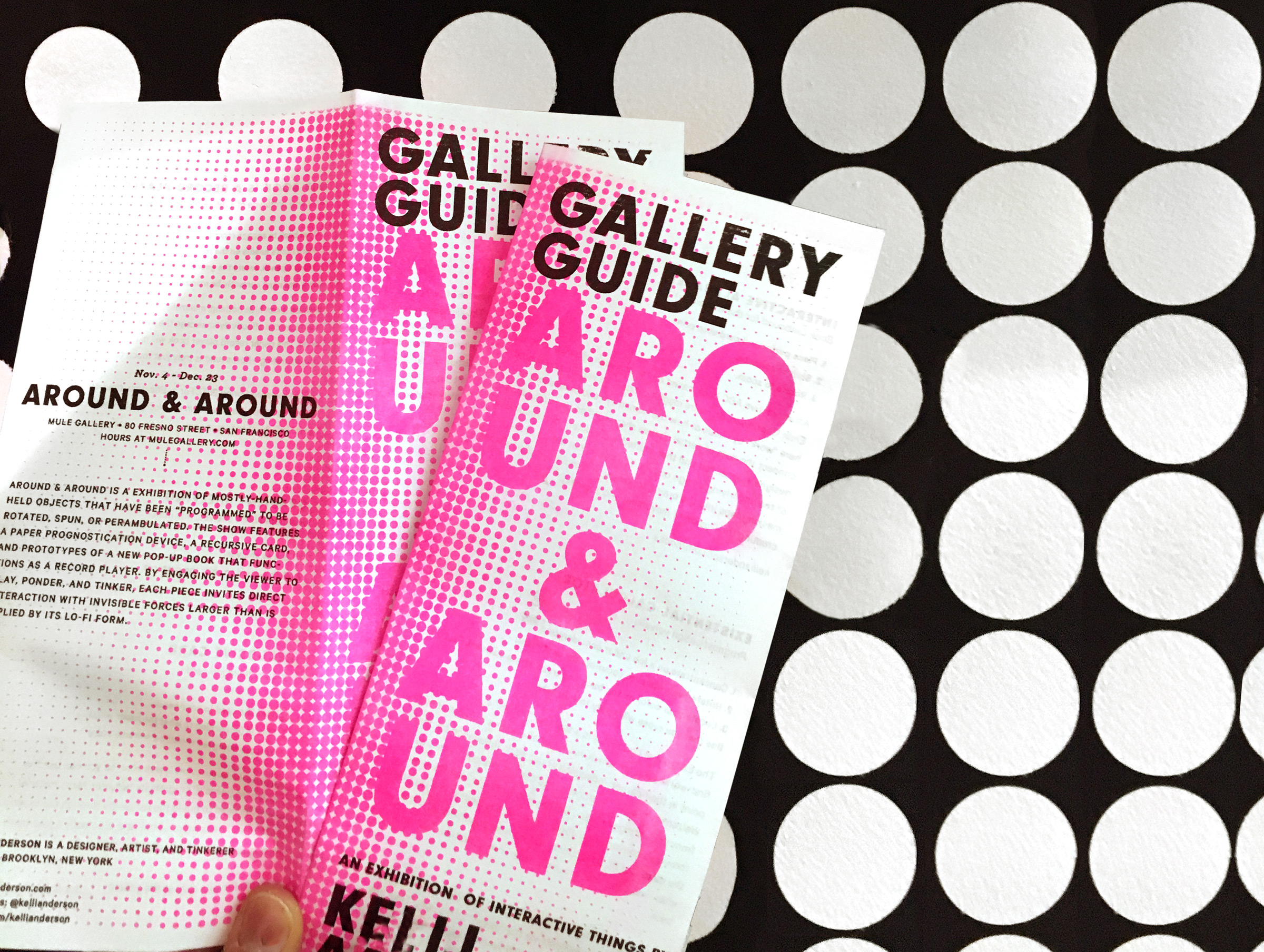
My first gallery show, Around & Around
Uncategorized
In light of current circumstances, 75% of proceeds (more if I can swing it) from the show and online sales will go to organizations. (Split between the Southern Poverty Law Center, 350.org, and CIEL climate science defense.) Through December 23, 2016: Around & Around at Mule Gallery, SF Wednesday–Friday • 1–6pm Saturday • 12-6pm   ^ […]
Show full content

In light of current circumstances, 75% of proceeds (more if I can swing it) from the show and online sales will go to organizations. (Split between the Southern Poverty Law Center, 350.org, and CIEL climate science defense.)

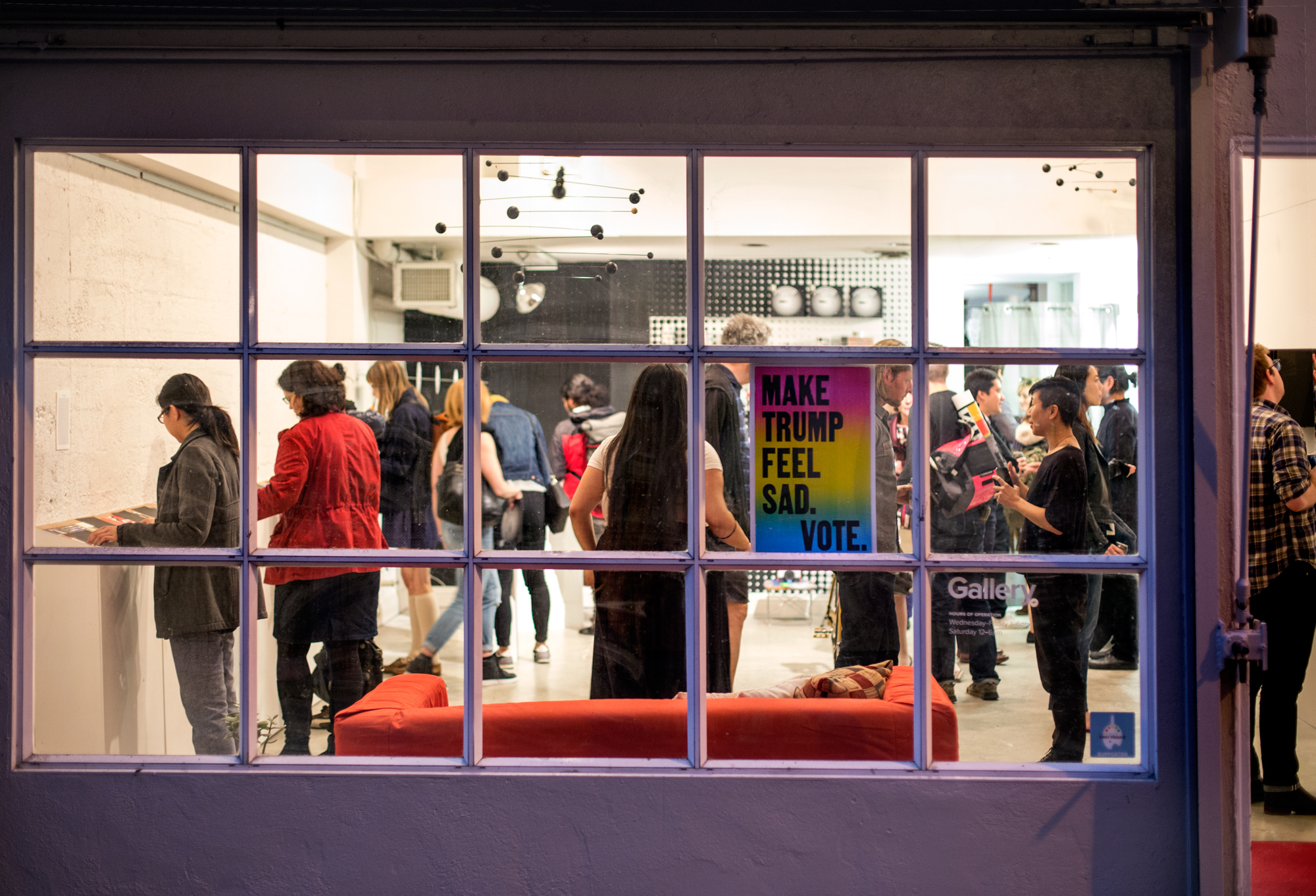
Through December 23, 2016: Around & Around at Mule Gallery, SF
Wednesday–Friday • 1–6pm
Saturday • 12-6pm


^
My first gallery show opened! …four days before the election. (So, basically: by day five, the whole experience felt like it lived in a surreal time-capsule.)

The show’s basic premise is that firsthand encounters have the power to contradict preconceived notions. When you walk in the door, paper objects play music, reveal animation, tabulate math-logic—and [modestly] expand the sense of possibility around a material that is crumpled up and discarded as trash countless times a day.

Now impossible for me not to consider these preconceived notions more broadly—in shadow of the election, they seem an impenetrable barrier to attaining a consensus reality. So (just putting this out there): could demonstration also work as a tactic to challenge political preconceived notions? Since seeing is [actually] believing for most people, it seems like showing-rather-than-telling may be one way of making facts visceral/consensus in this weird post-fact world. (in the name of getting us all an inch closer to a single reality?)

I know, I know (“I’m not just the president of the hair club for men, I’m also a client”)– but hear me out: The most compelling activism actions always demonstrate (they convince by way of firsthand interactions with systems, in the grit of real life, and play out like experiments.) Like: Spy Magazine’s shaming of the greedy rich, Strike Debt’s hack of the debt trading system, many of the Yes Men’s actions…and there’s more on actipedia. Such a strategy would also have the happy side effect of keeping us in check too—and away from indemonstrable dogma or models that don’t-play-out-in-reality. (FFS, we need more windows) [Thinking…]


Back to the show specifically (sorry…), Around & Around brings together objects that use rotation in a wide variety of ways —there is rotation that magnifies, rotation that reasons, rotation that shows you a film, and rotation as infinity…


All of the ideas are stated in physical terms (you’re actually supposed to turn, spin, and twirl all the pieces.) Just so no one feels awkward about poking things, this is urged—all official-like—in the gallery guide/wall text:

*Thanks ^ to Megan Lotter for showing me how to RISO on Guts & Glory’s machine!

Paper “tech” represents here in force: paper that amplifies sound, paper that magnifies shapes, and paper that predicts the future (through logic, really). The show even includes a prototype of a new(!) pop-up book/gadget that many people have been requesting for years now (…not ready to share online yet, but its there, go see it and I’ll gladly put your feedback to good use.)

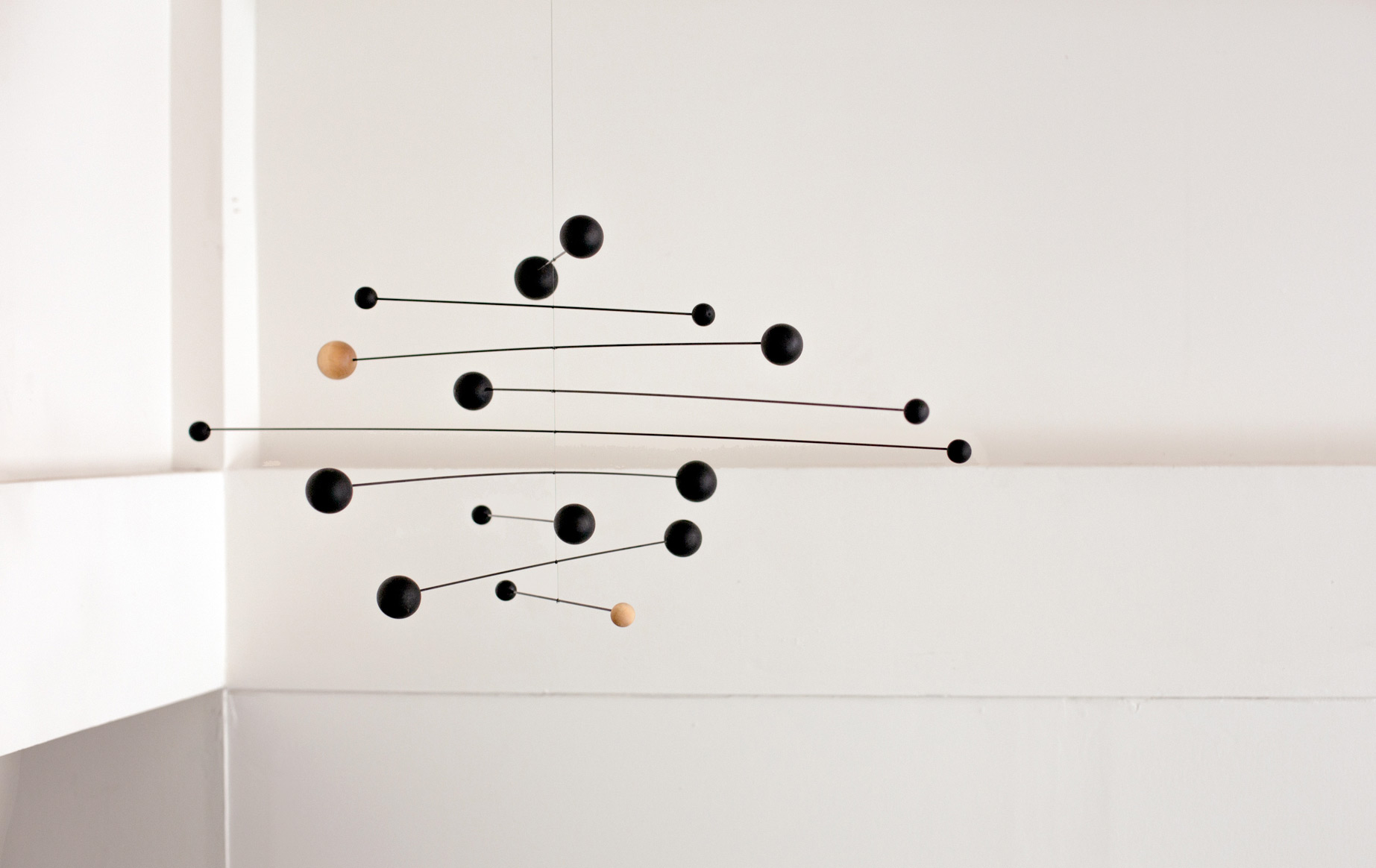
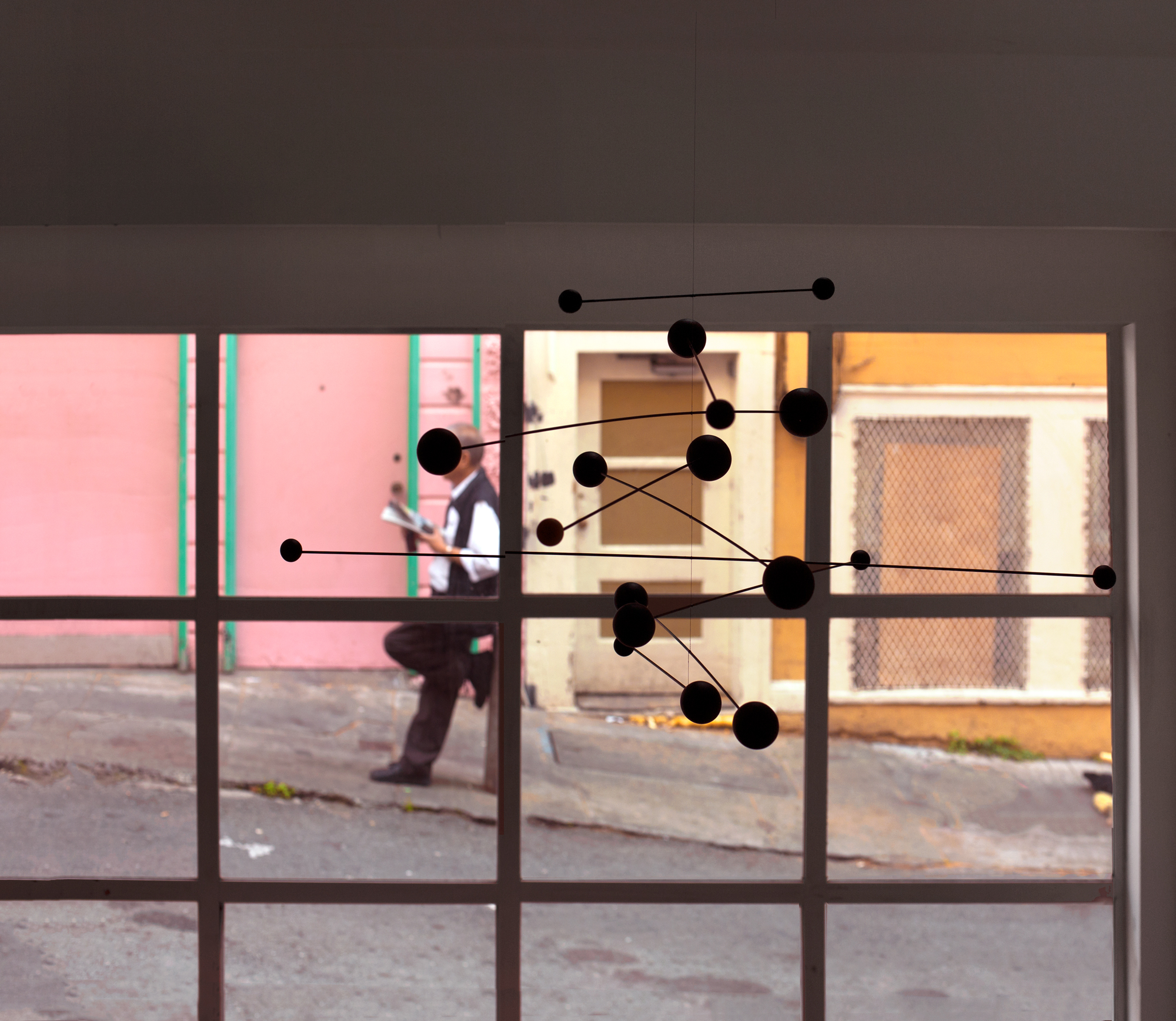
With the help of a few friends, I built plinths and learned from youtube how to build a wall. Mobiles of carbon fiber and wood turn slowly overhead (in a precarious balance I achieved by layering of black paint ad infinitum).


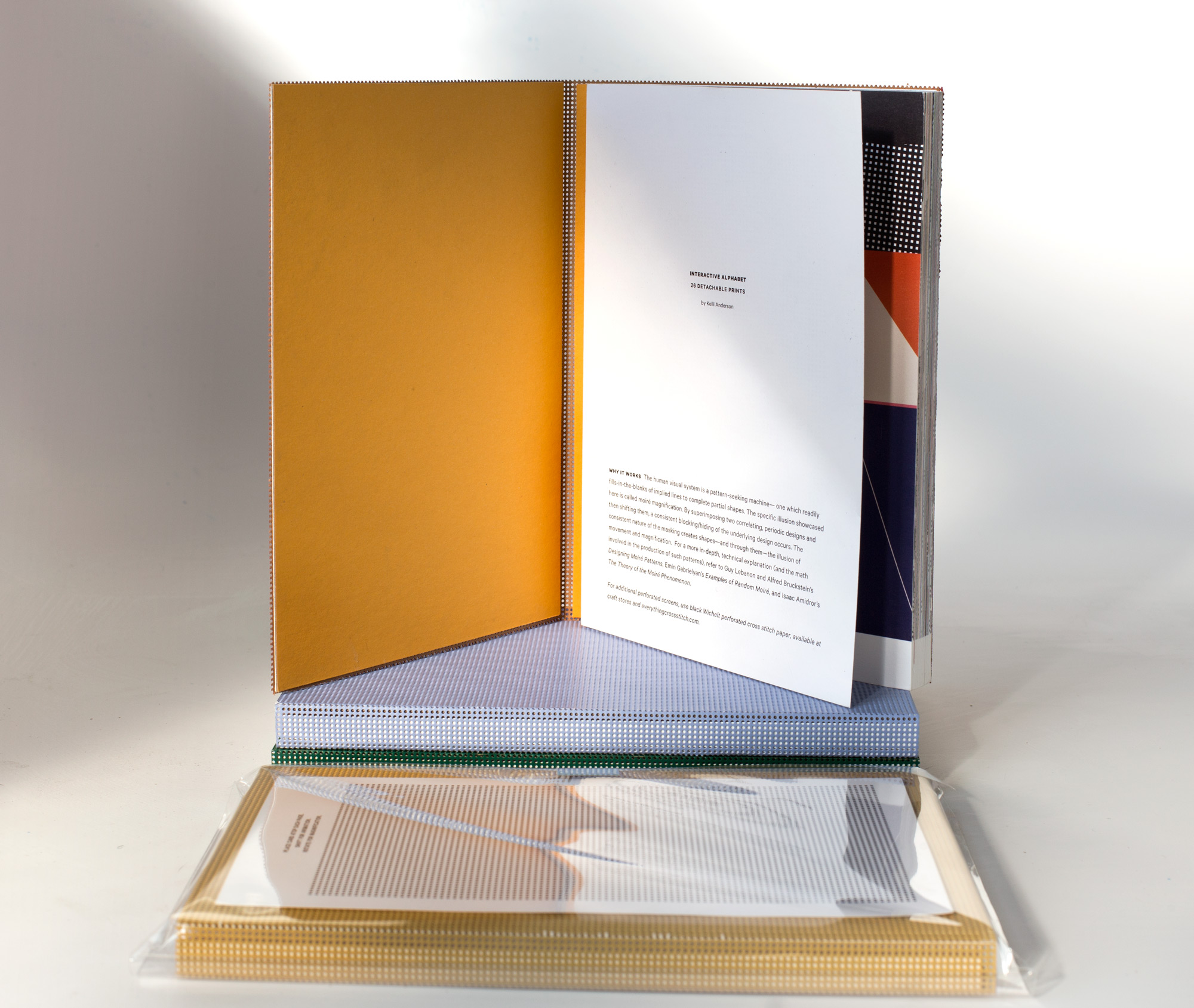
Interactive Alphabet


This one is an old adversary turned co-conspirator…

Before being adopted by the design world, I worked part-time digitizing the glass plate negative collection at the American Museum of Natural History‘s library (which, yep: that’s just as Wes-Anderson-y as it sounds.) Because of this, I became the wielder of a wide variety of anti-Newton Ring glass, sprays, and liquid products. A Newton ring is a type of interference moiré pattern that occurs when film touches glass. (You’ve probably encountered this before.)

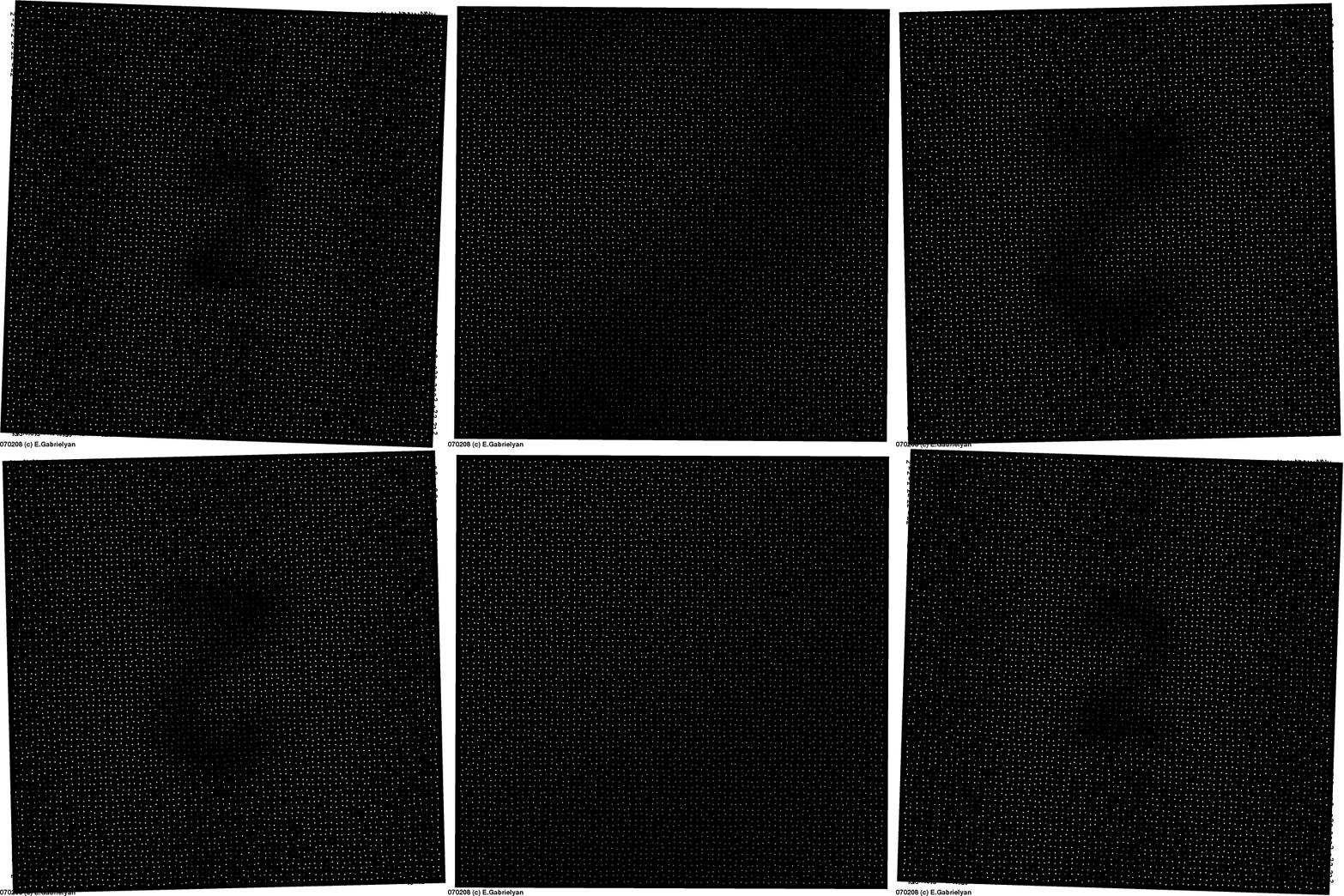
Since stomping-out moiré was basically the bane of my existence for years, you can imagine the retributive delight I experienced when I stumbled upon Swiss scientist, Emin Gabrielyan’s work. Gabrielyan—as well as Isaac Amidror—research the behavior and practical applications of moiré. (Practical applications, you ask? YES. Using moiré, they are developing new types of optical indicators for tiny measurement devices.)

This is the demonstration gif from Gabrielyan’s site that first blew my mind:

What you are seeing is an arrangement of numbers and a screen which has been perforated in that same exact formation. When it is rotated, it appears to magnify the tiny, ant-like numbers. (If you’re curious, what you are seeing here are 5777 number 2s and 5777 matching holes in a screen of paper. (Plus, rotation!):

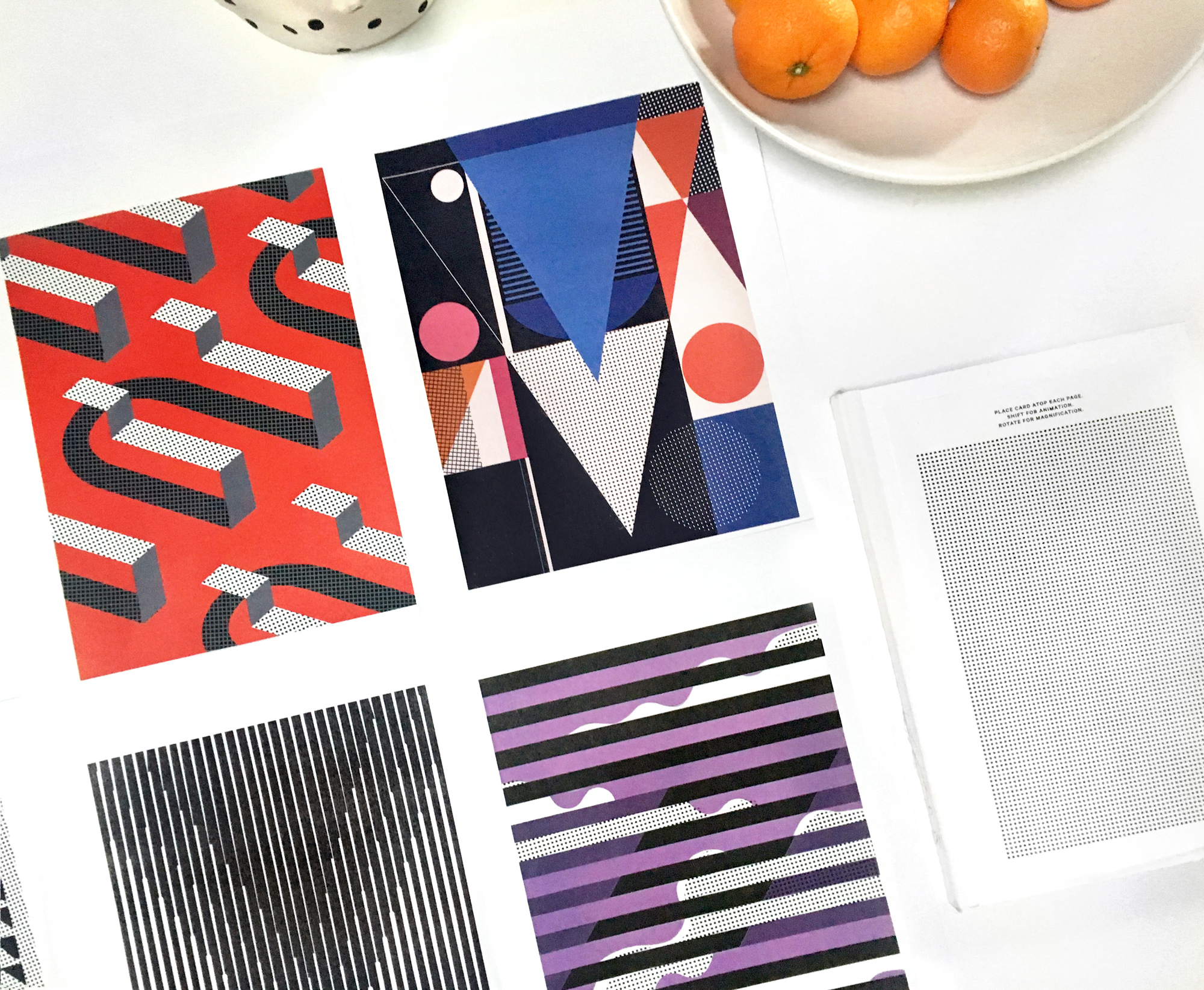
Rapt with excitement over this bizarre behavior, I began playing with screens+simple shapes (in correlating gridded patterns) to see if I could make this former foe dance. I found that by rotating my printed grids at varying angles, pleasing invisible boundaries formed:

I fretted over what to do with this technique for a good long while, but I knew I wanted a project with enough latitude to explore wildly different arrangements, colors, and compositions.

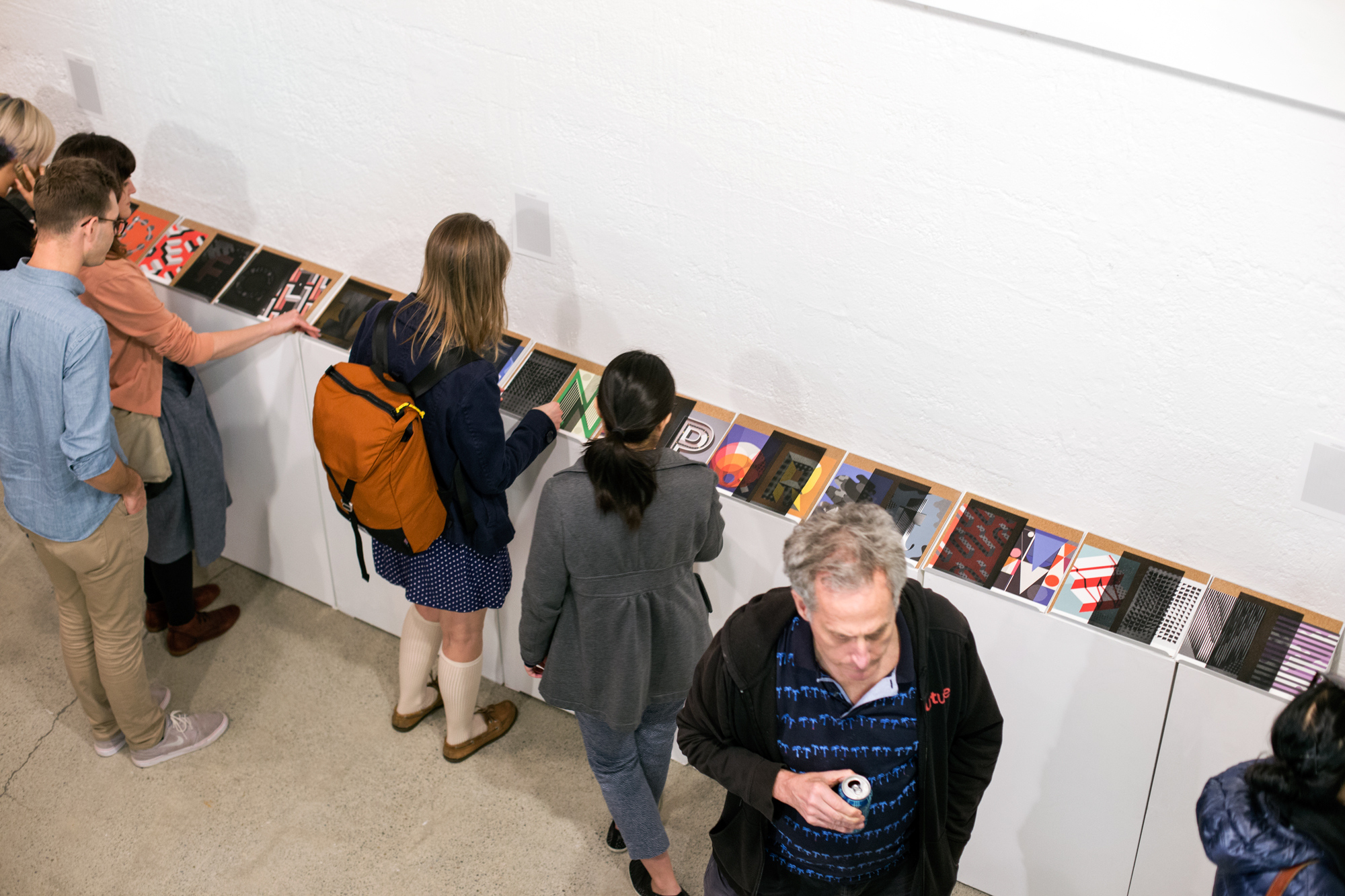
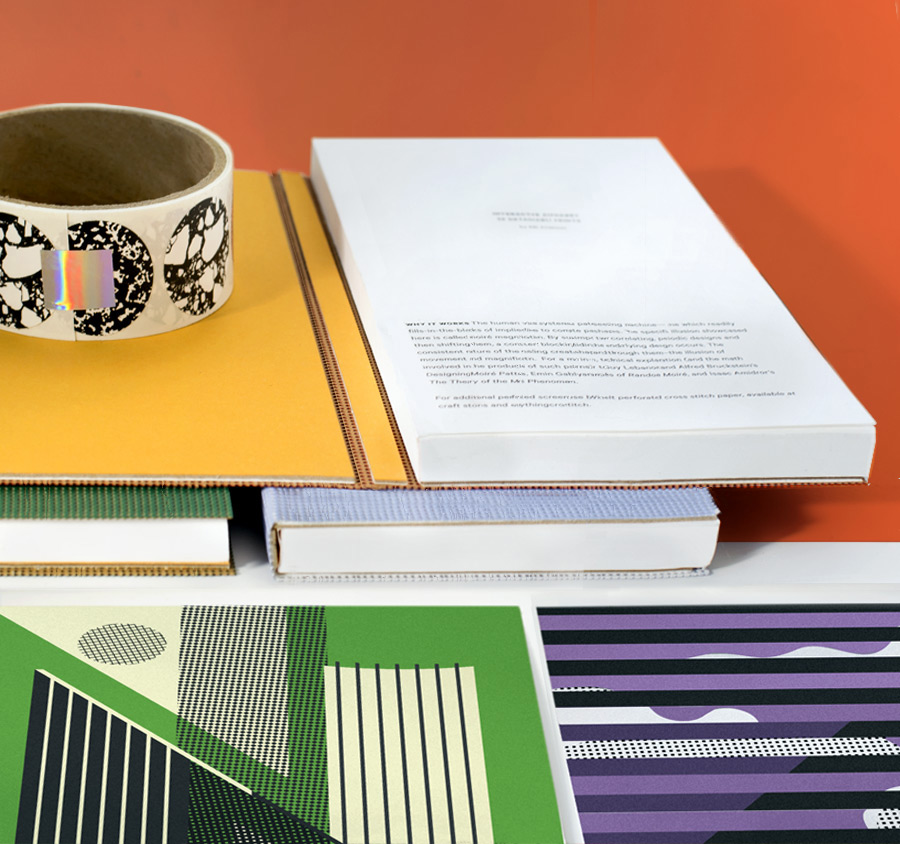
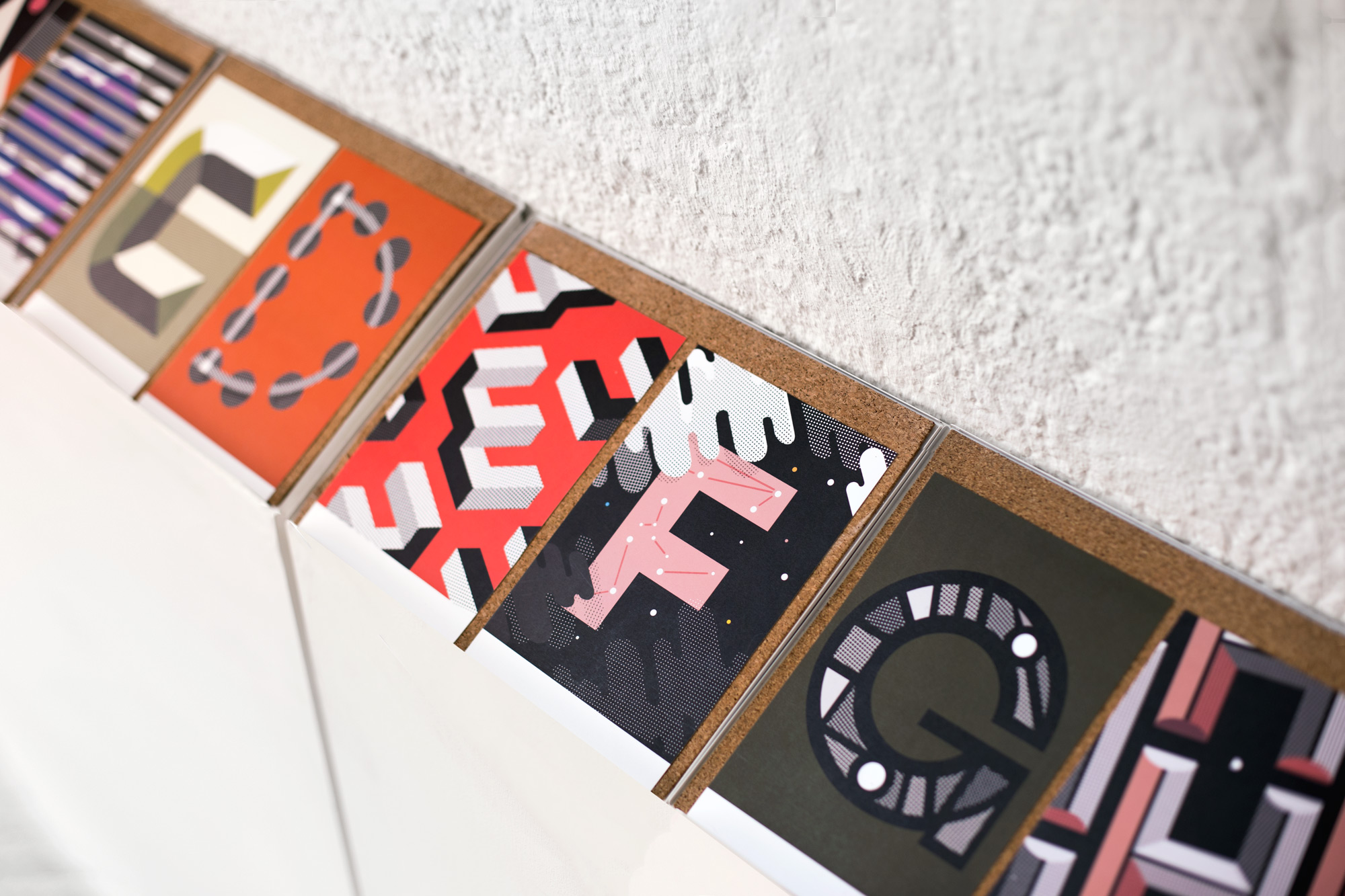
I eventually decided to make a “moire magnification” character for each letter of the alphabet in 26 different styles (a homage to specific artists and designers I admire). As maiden effort, I produced a small edition of 100 handmade books to start feeling out this technique. So: more to come…

Why does this work?
I’m not gonna pretend that I truly understand everything, but this much I know is true: The fundamental reason that you witness a “2”—or a square—growing larger (when there is actually no “2”—or square—growing larger) has to do with the brain’s subconscious pattern-recognition tendencies. Imagine you spy a silhouette in the distance—obscured by rain, fog, trees, or any-number-of-foregrounded-things. You understand the shape anyway because your mind knows what is supposed to be there and fills in the blocked parts.

Similarly, the illusions presented here “work” by virtue of how the human eye and brain constantly attempt to complete implied shapes—they essentially cause this system to misfire. When two identical grids are stacked and then shifted, a consistent blocking/hiding of the underlying design occurs. The consistent nature of this masking taps shows/hides just the right piece of every “2”, thus activating the brain’s tendency to complete the outlines (that it believes are there), creating the illusion of movement/magnification of distinct shapes, which don’t actually exist (they are solely optical occurrences.) The more dramatic the angle of the rotation, the more exaggerated the enlargement. (The stuff I definitely do not understand: why why why does the 2 flip vertically? And why does the screen rotate it 90 degrees? If you have answers, don’t be a stranger…)

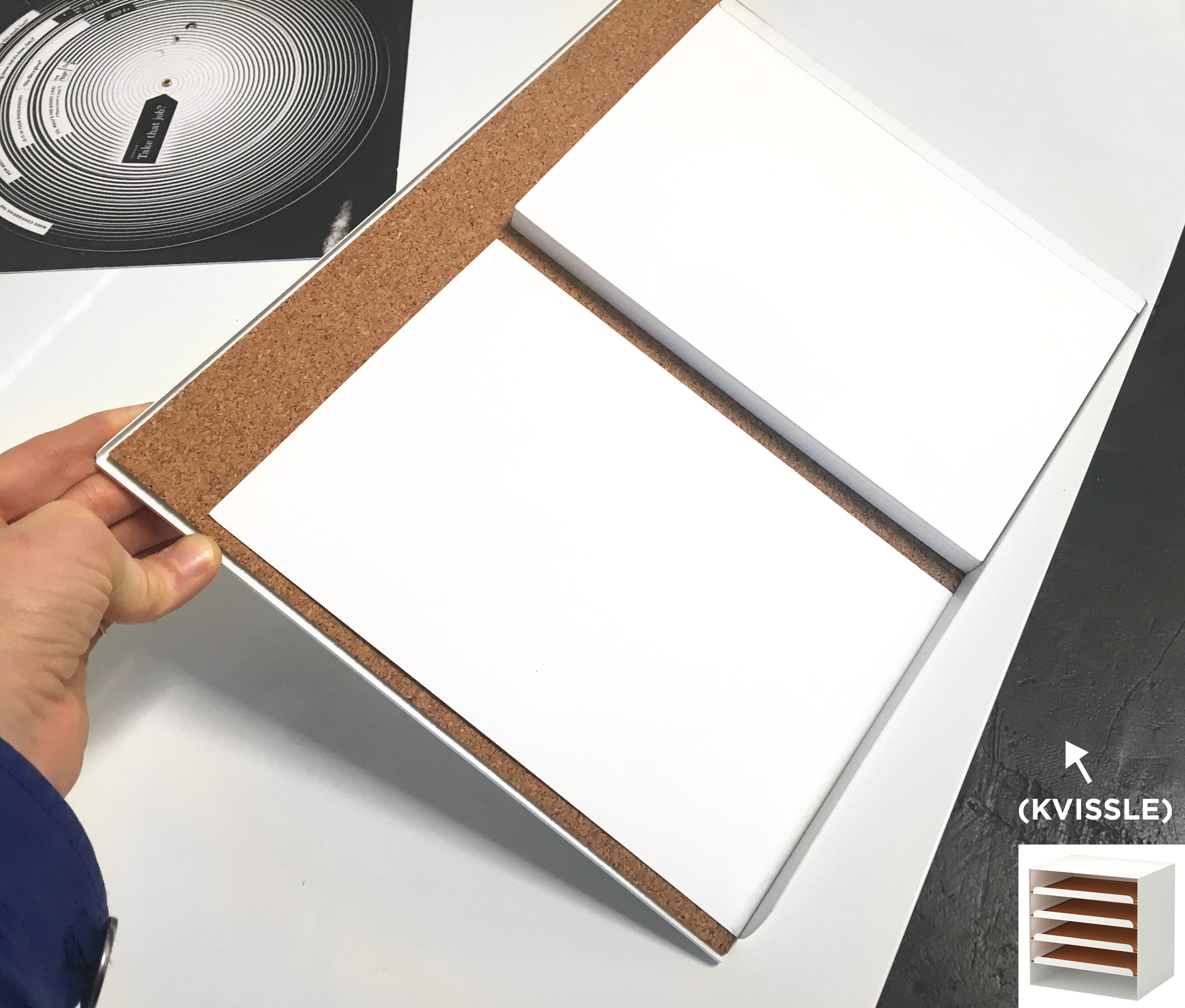
I should mention: the plinths are part IKEA-hack. I dissected Kvissel trays, so I’d have a nice cork ledge to best display the pages of the book. Highly recommended (cheap) solution for anyone who needs to display zines or books!


Flipbook boxes

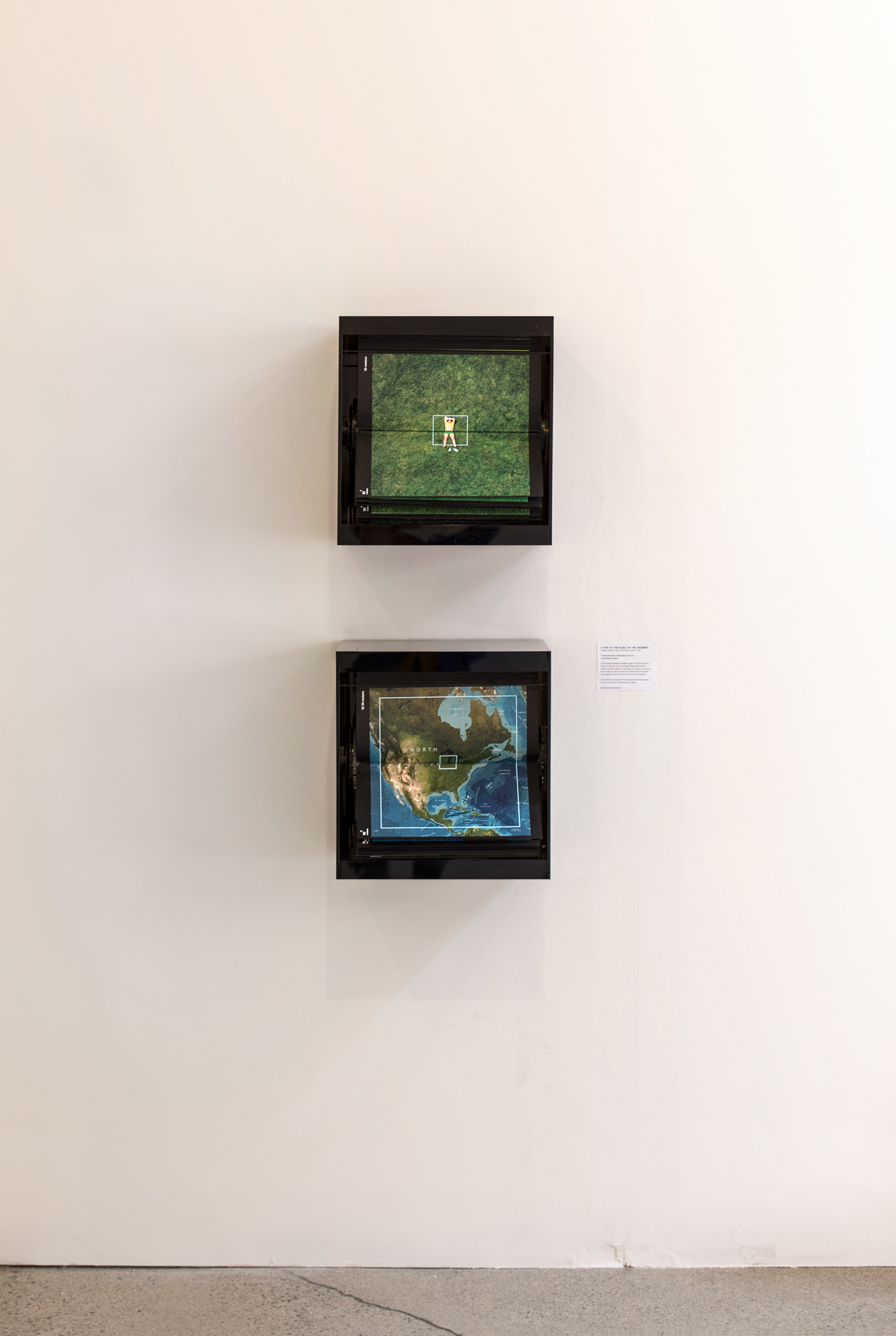
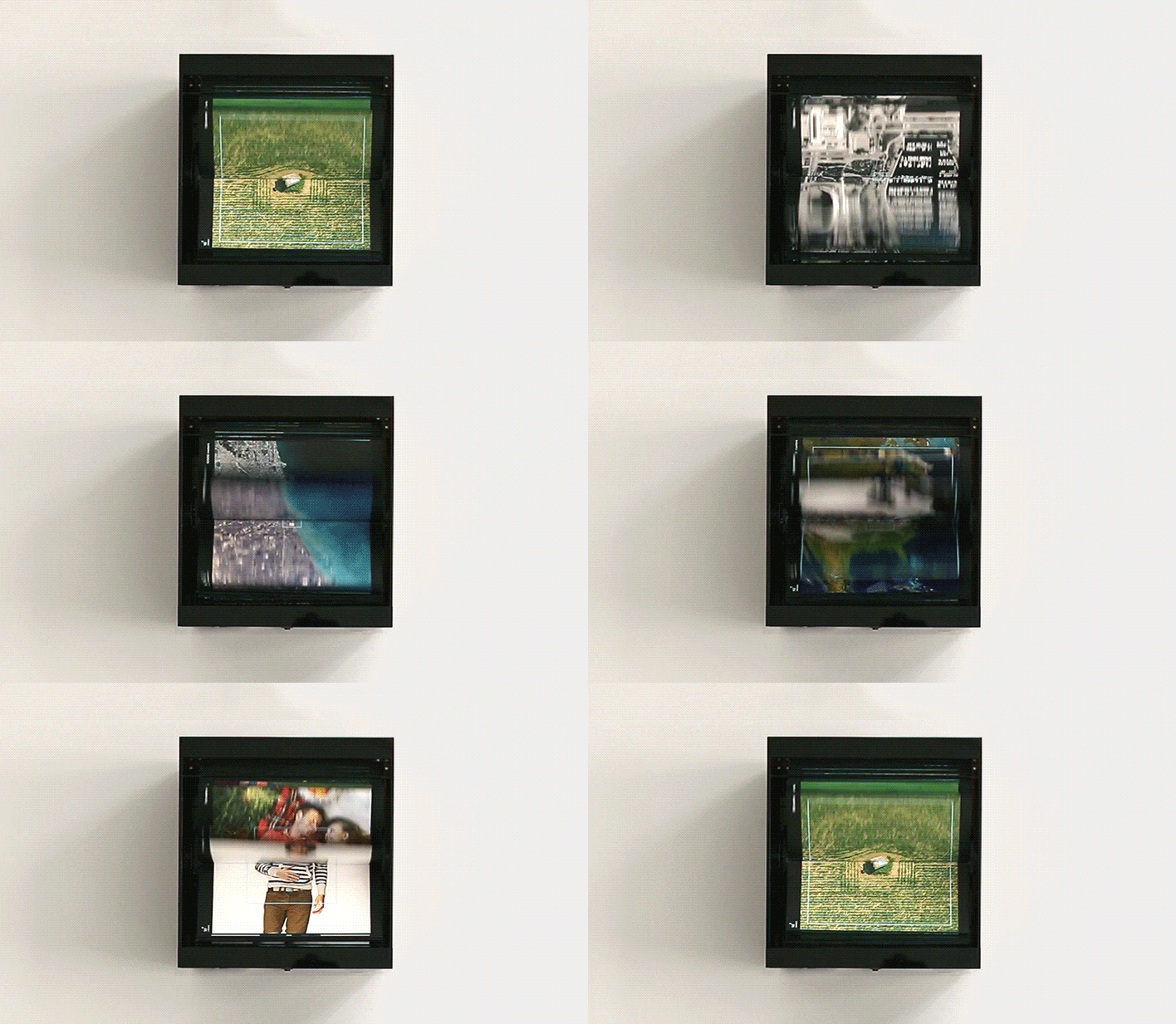
I* also built two flipbook boxes (aka mutoscopes—the contraptions you may have seen in that awesome OK Go video from last week) that you can play with. Just like the short paper-based films of dancing ladies that used to frequent penny arcades, a mutoscope is essentially a flipbook on a wheel, where the animation loops continuously.

*By “I”, I mean, I asked many people many, many questions about motors, which is a new frontier for me. The rabbit hole was deep and filled wth stepper cards, Arduinos, solder, Chinatown pillaging, momentary switches (…all to get the motor to turn on! then, finding the actual right-motor to turn 173 frames was another odyssey…)

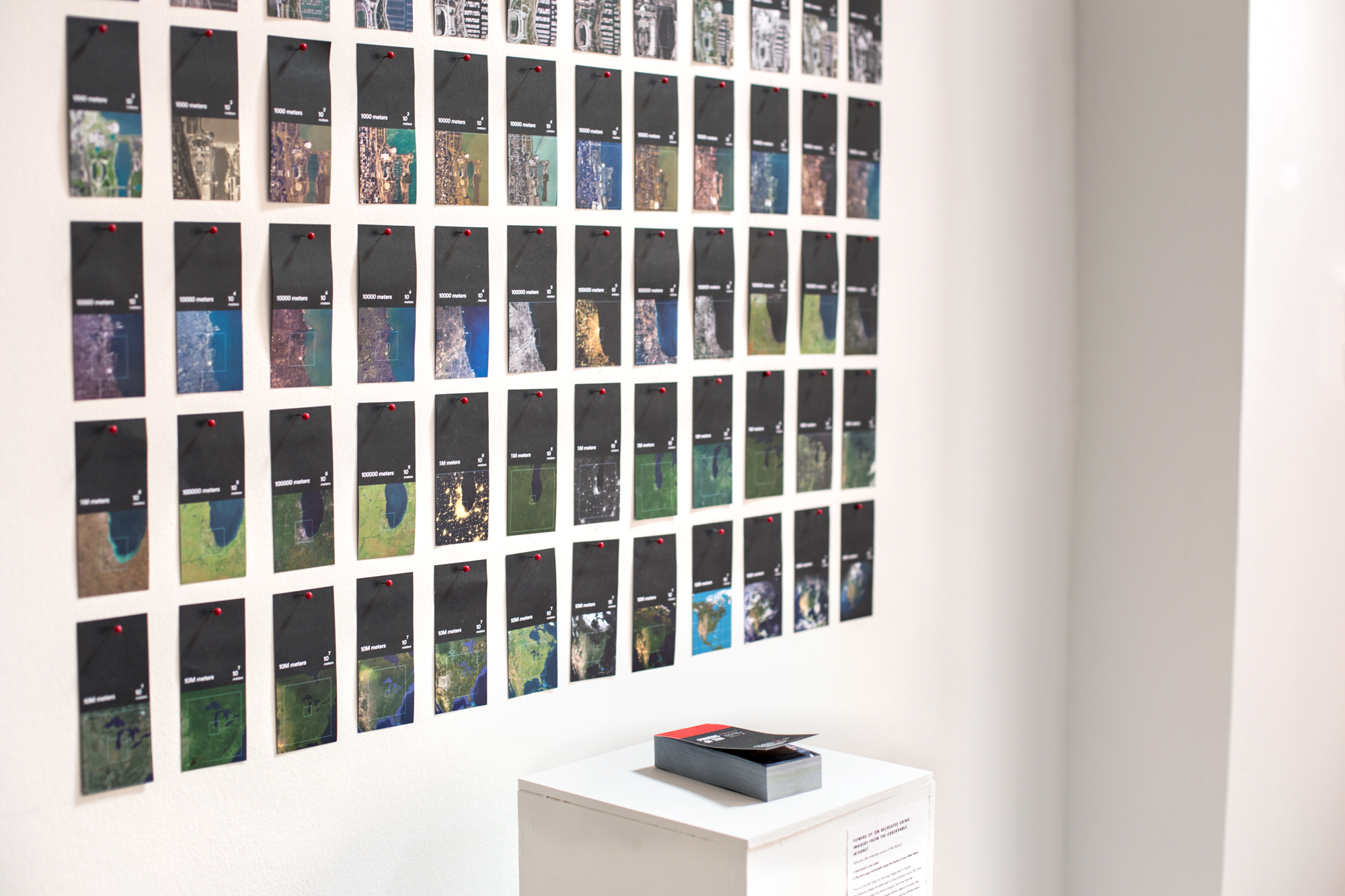
These particular mutoscopes display a segment of the Eameses’ Powers of Ten, which I recreated using found images from the internet. Why? As a way to feel-out how big the internet’s image cache really is. Turns out=”big enough” to recreate film frames… More about that project here

Because the “film” is a false continuum (made via a collage technique), it’s pretty choppy to begin with. Making a physical-animation-machine undermines its clarity further. But see if you can follow it (its motor-operated and therefore smoother than most performances of the flipbook, at least):

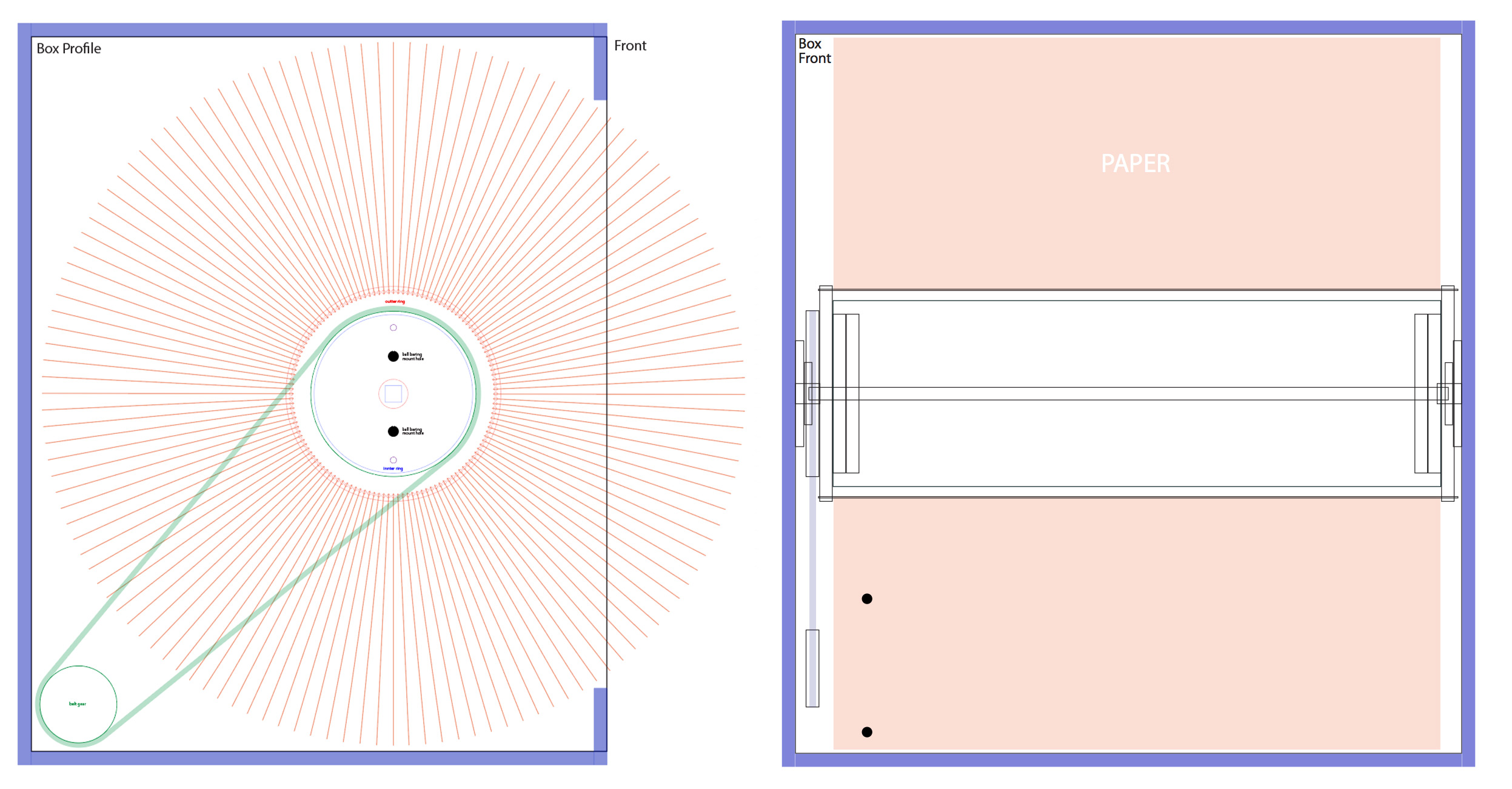
They occupy semi-transparent housing, so they [satisfyingly] hide little about how they work, unlike a TV or other digital frame-displaying devices. Here is a schematic anyway. (Just designed it in Illustrator, because having a vector schematic onhand made it easy to test bolts against screw sizes, belt lengths against pulley hub diameters…and just: keep track of the hundred other little tiny things that had to align/fit/coalesce.)


Recursive Card

The content of the card is actually a four-frame documentary about receiving the card. It has no instructions, it directs the user through the sense of touch alone. This is an old project, but still a mindfuck to me… More than you ever wanted to know about making it here »

Also, I learned that it has a name, it is called a flexagon… for the google. (Some people were upset that I failed to identify it last time, but I just learned the name!)


Existential Calculator

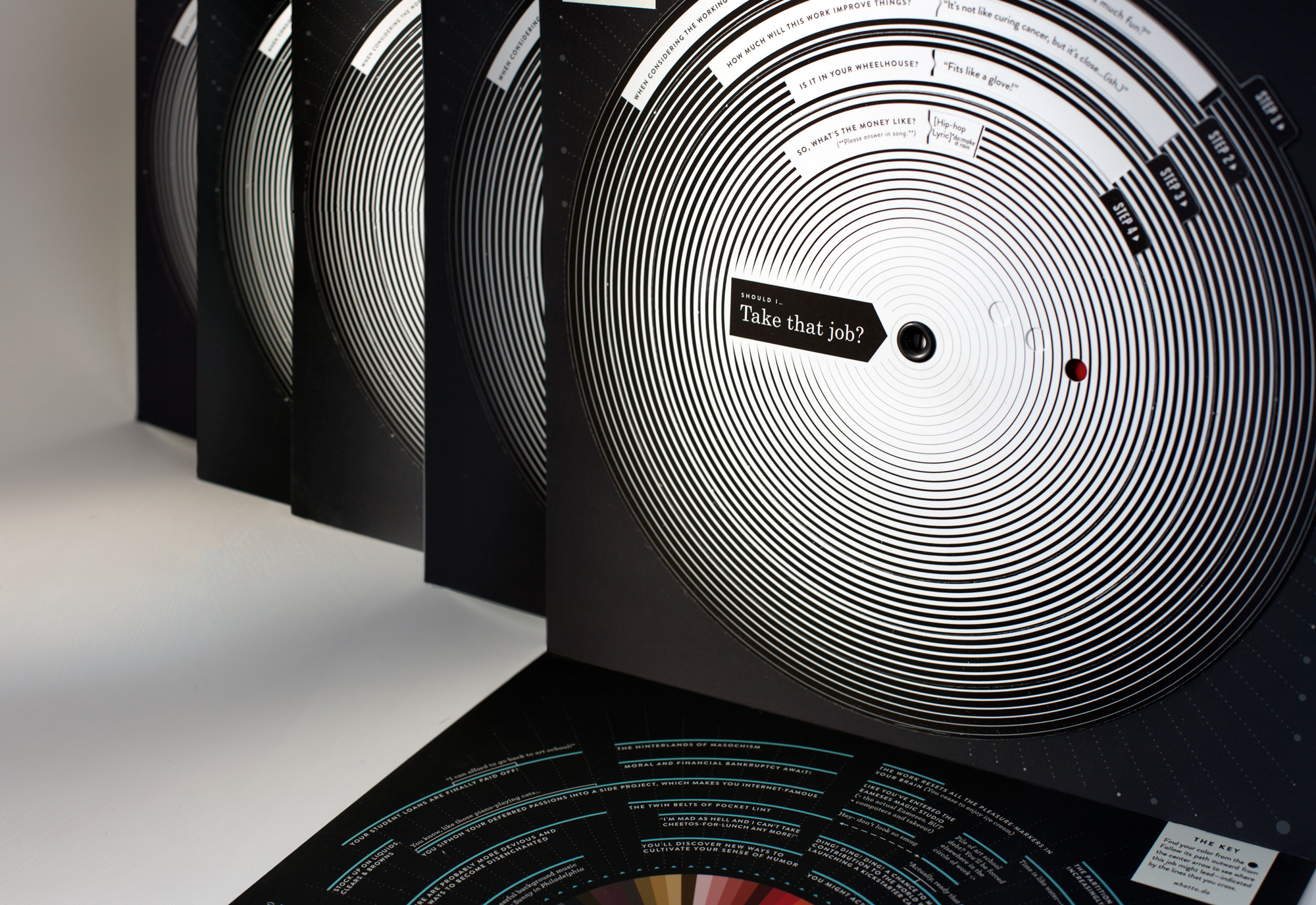
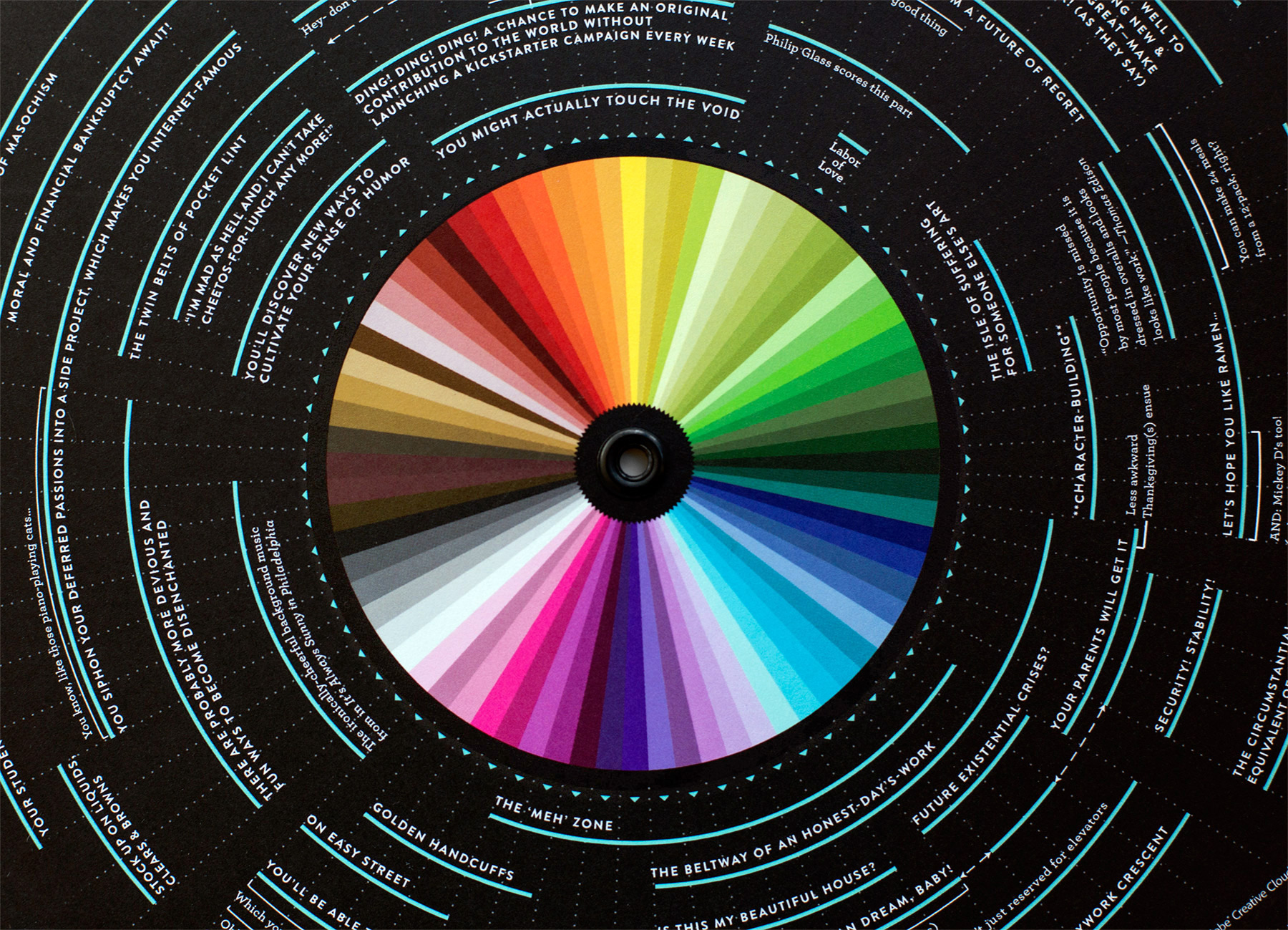
This is a paper calculation wheel (otherwise known as a volvelle) which answers the question “Should I take that job?” through inappropriately technical means—inspired, in spirit, by Joseph Weizembaum’s ELIZA. The logic that guides it is based on 4 user inputs about fit, pay, ethics, and working conditions. Its sort of a paper career counselor, I guess.

More information here »
Buy one here » 


Geologic Time Stickers

The entire arc of time [pretty much], as told through visually-similar textures. More info+buy here

They look good stuck to an very wide variety of things (graffitied-up my apartment yesterday…):


Shelf hack

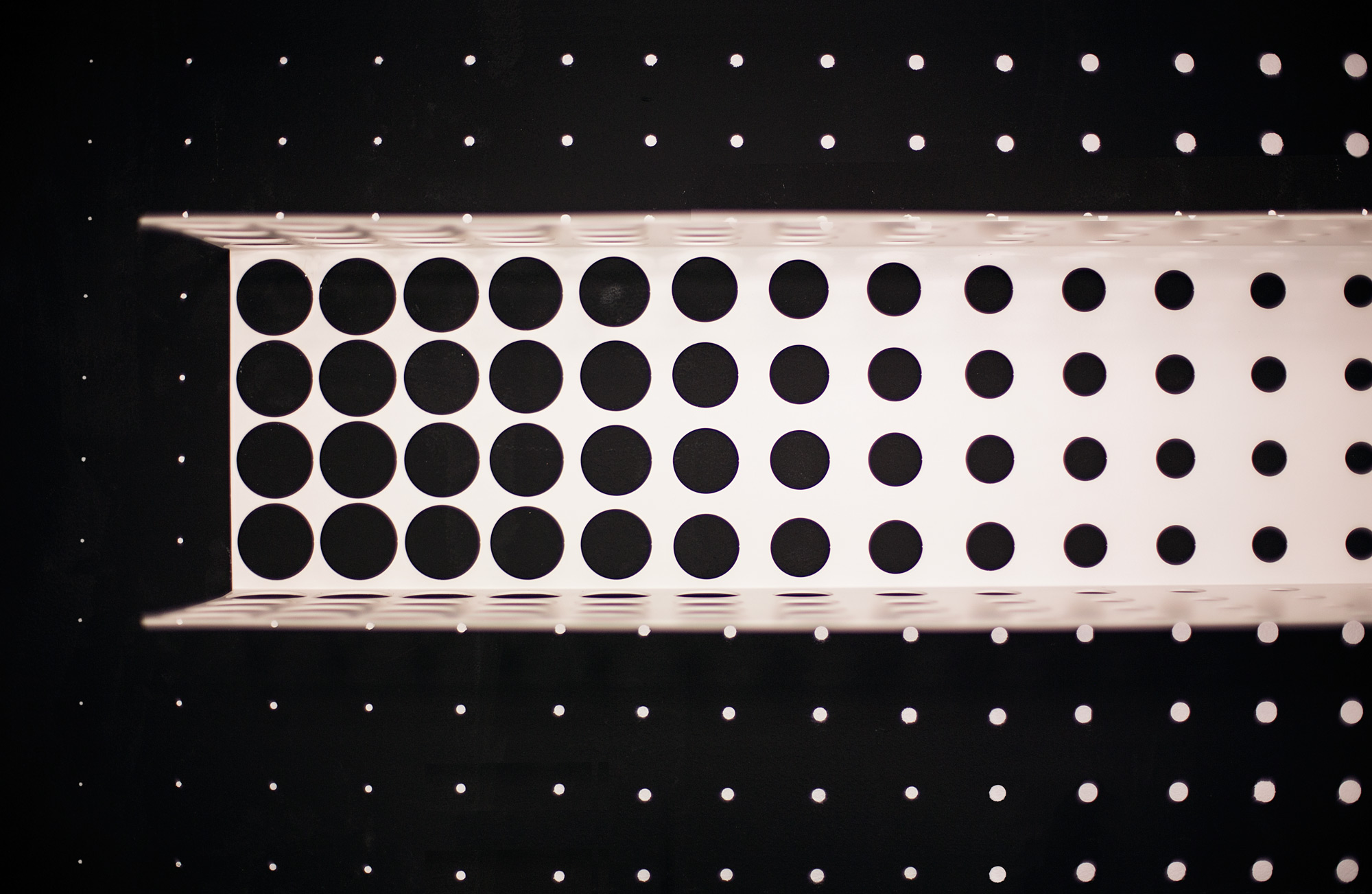
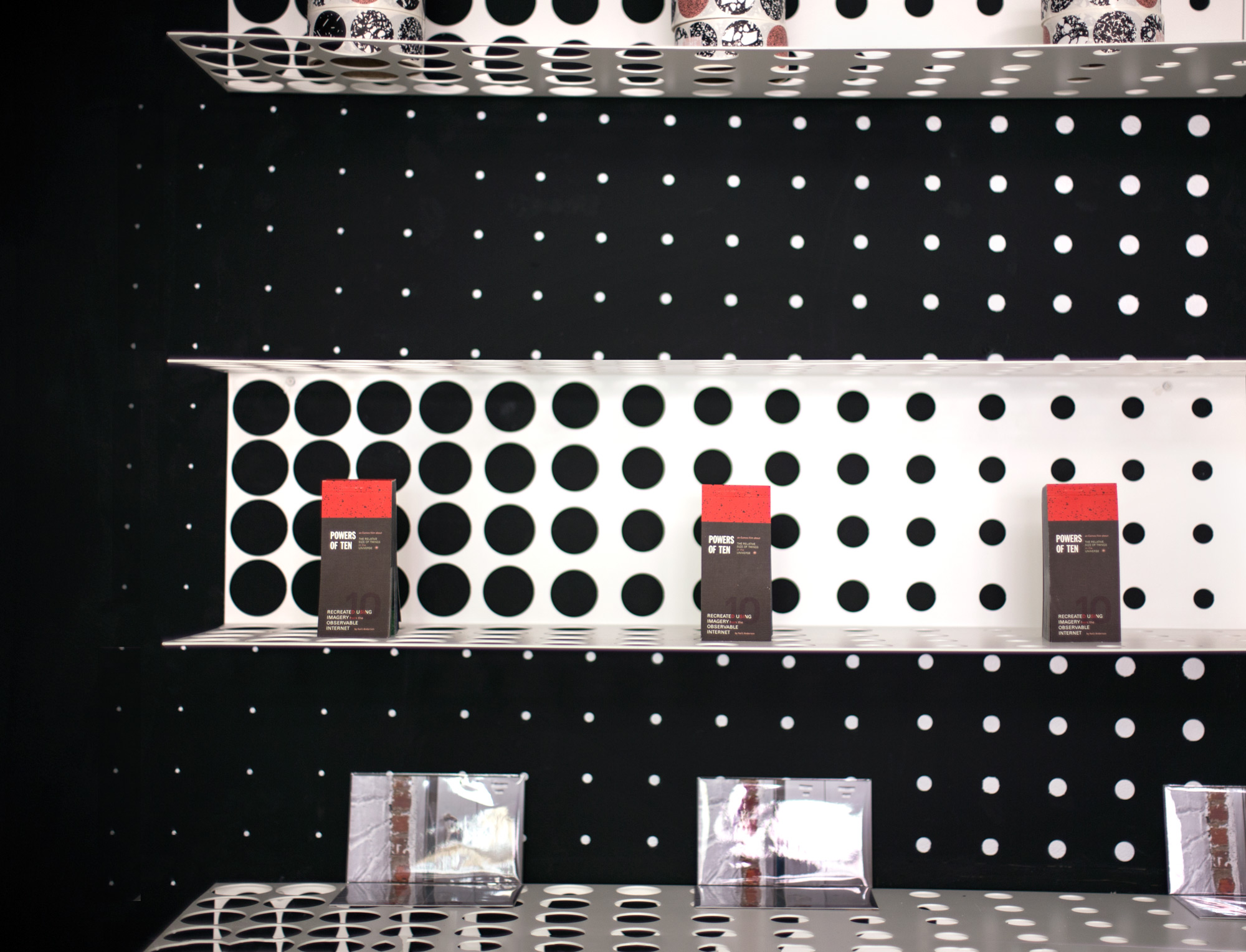
Finally, to display all of the book-things I asked a local metal shop to cut holes in some IKEA shelves to create this gradient wall installation.

stickers2

stickers2

As you can probably tell, setting up the show was a tad overwhelming. Now, whenever I pass a gallery show on my bike, I nearly fall off… (“It’s a damn MIRACLE!”) Thanks to everyone who came out and saw it and SUPER GIANT ALL-CAPS THANKS to my friends for the help. Even more thanks is in order to Daniel for putting up with the 6-months of mess too. It would have [literally] been impossible without you guys. Thank you!

stickers2

OK, back to this:

stickers2

http://kellianderson.com/blog/?p=3594
Extensions
Experiments, alive!
Uncategorized
A big client project got delayed and some paper-engineering work is stuck in feedback-tennis with the manufacturer. And so: I got to spend much of June and July playing with new-toys-and-techniques-of-interest—to see what they could do. Experimentation and summer are natural allies: no to pre-determined plans, yes to bonding with the physical world, time= “10 […]
Show full content

A big client project got delayed and some paper-engineering work is stuck in feedback-tennis with the manufacturer.

And so: I got to spend much of June and July playing with new-toys-and-techniques-of-interest—to see what they could do. Experimentation and summer are natural allies: no to pre-determined plans, yes to bonding with the physical world, time= “10 more minutes…”, etc… I made some short animations things and some websites too.

Animation experiments:

The above is an animation style that I worked-out as part of my contribution to an Exquisite Corpse collaboration (released today!)

Normally, the product of the Surrealist game is a drawing that looks like something in between a broken box of animal crackers and Terry Gilliam collage. However, in this case, we were collectively (although: sight-unseen) piecing together an animation.

This iteration of the game (called Motion Corpse) issues 5 players three simple instructions: 1.) Design a final animation frame. 2.) Pass that final frame to the next player. 3.) Get from theirs—to—> yours in 5 seconds to see what kind of animation results.

I really liked the concept and was excited to play.

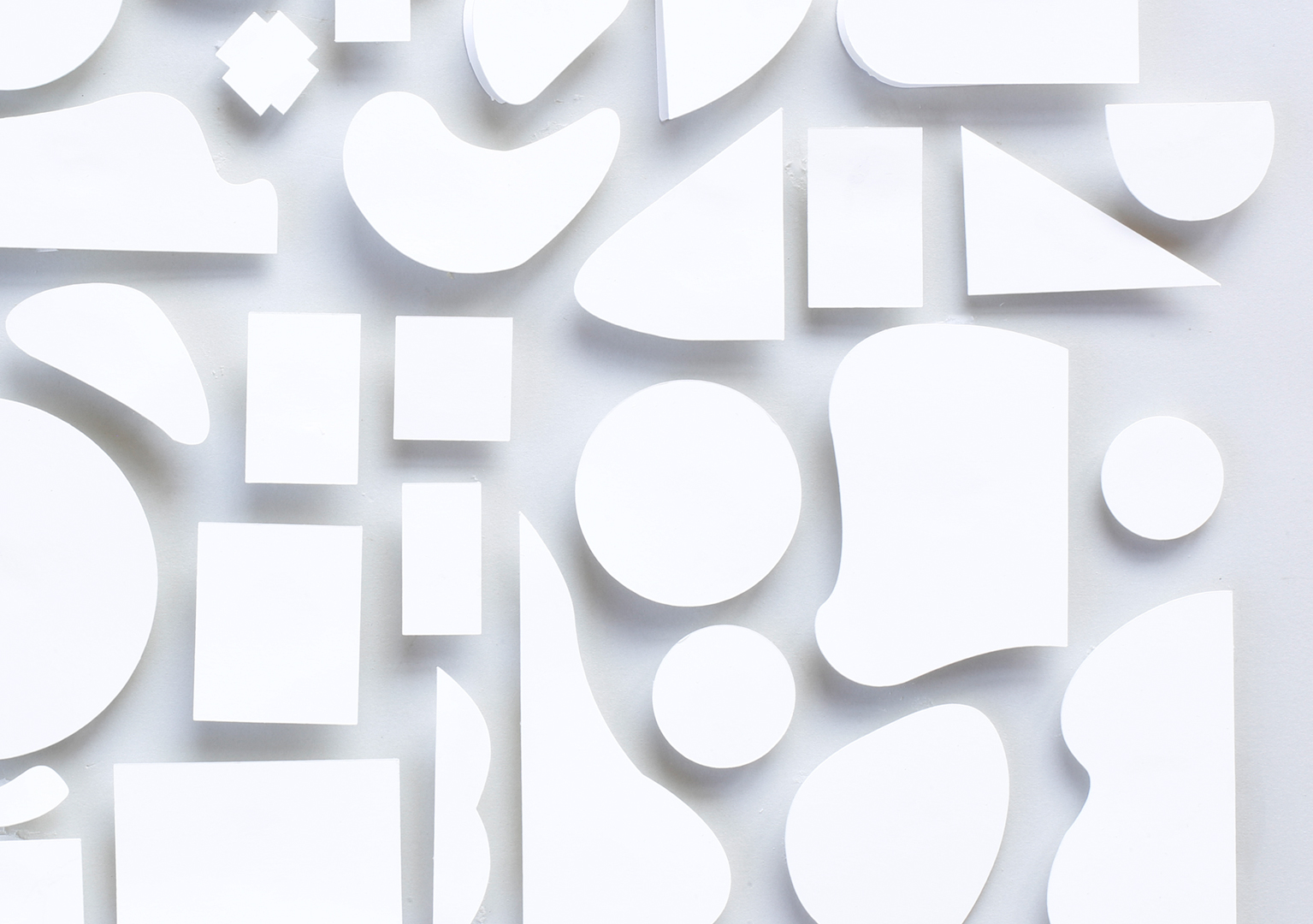
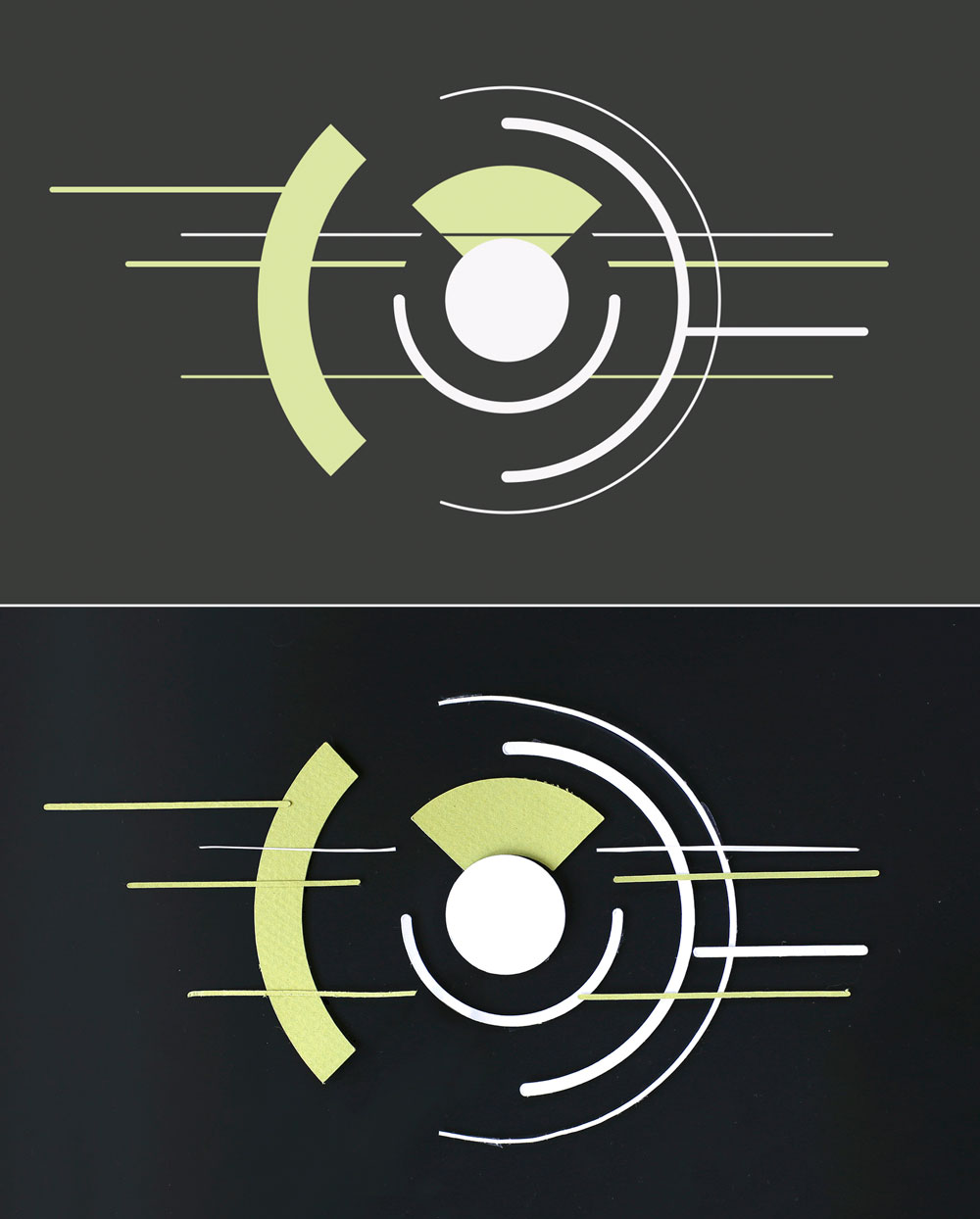
My final frame began with a geometric sketch from my sketchbook (a distillation of a collage I saw, whose origin I’m still trying to track down…) ↓ which I built out of paper.

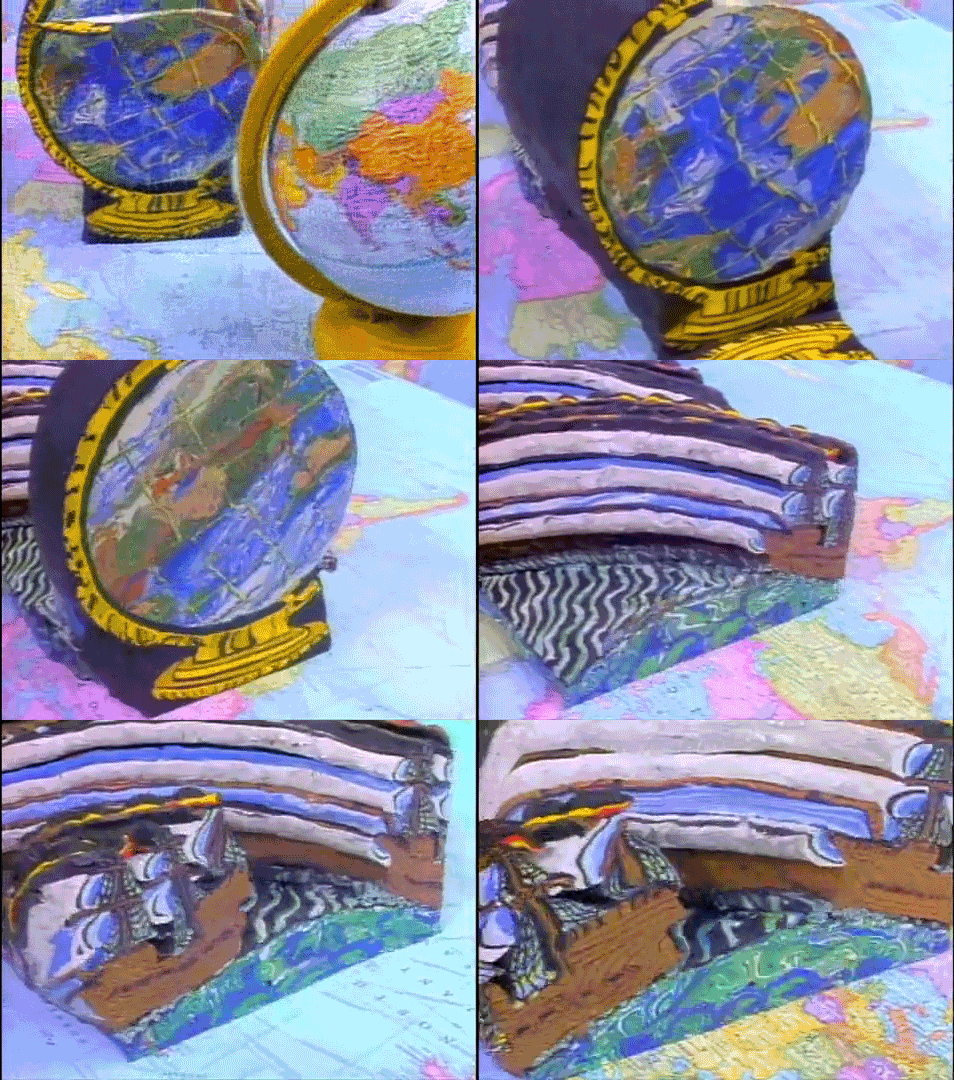
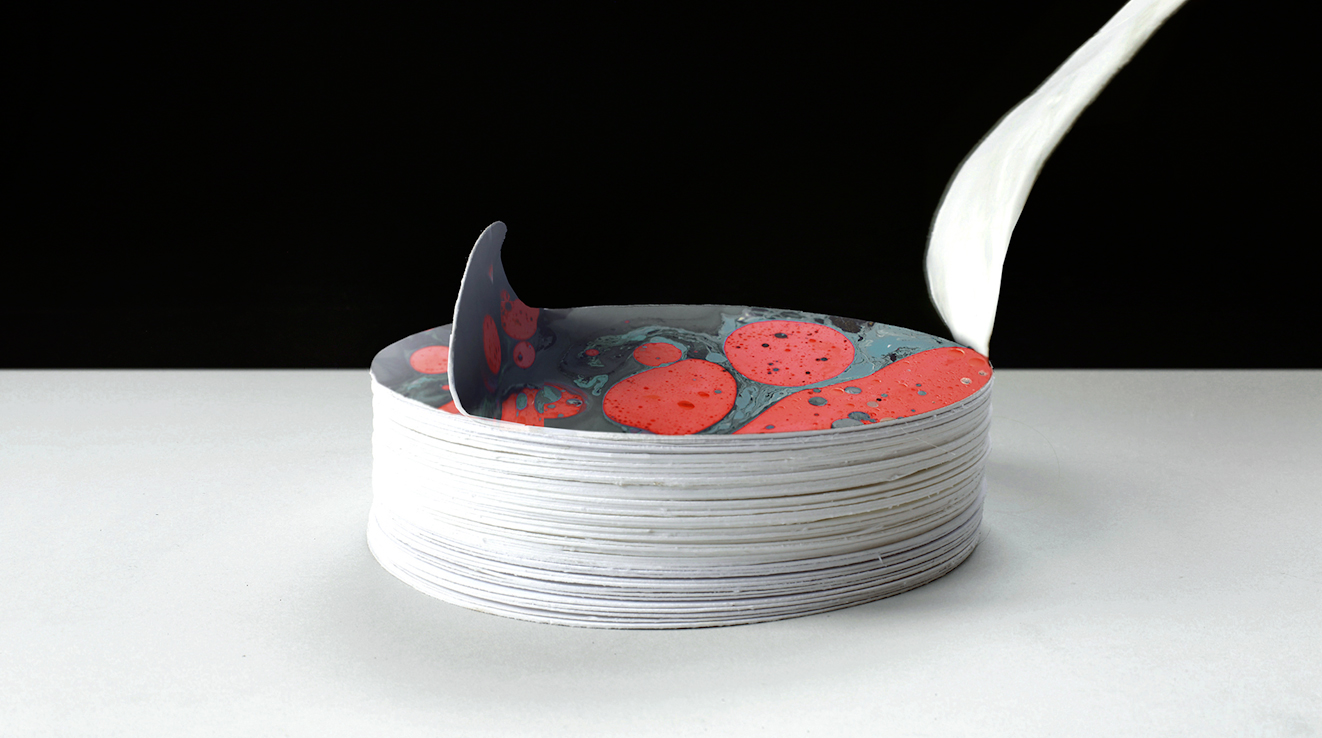
I merged that composition with an idea sparked by this new (to me) discovery: Strata cut animation—the other claymation!—wherein the frames are embedded in a log of clay and revealed only by slicing it apart.

Perfected by David Daniels in the late 80s, watching it makes me suspect these things:
a.) this may be the coolest thing ever and… b.) Pee Wee’s playhouse is probably a treasure trove of crazy animation techniques.

banner-image

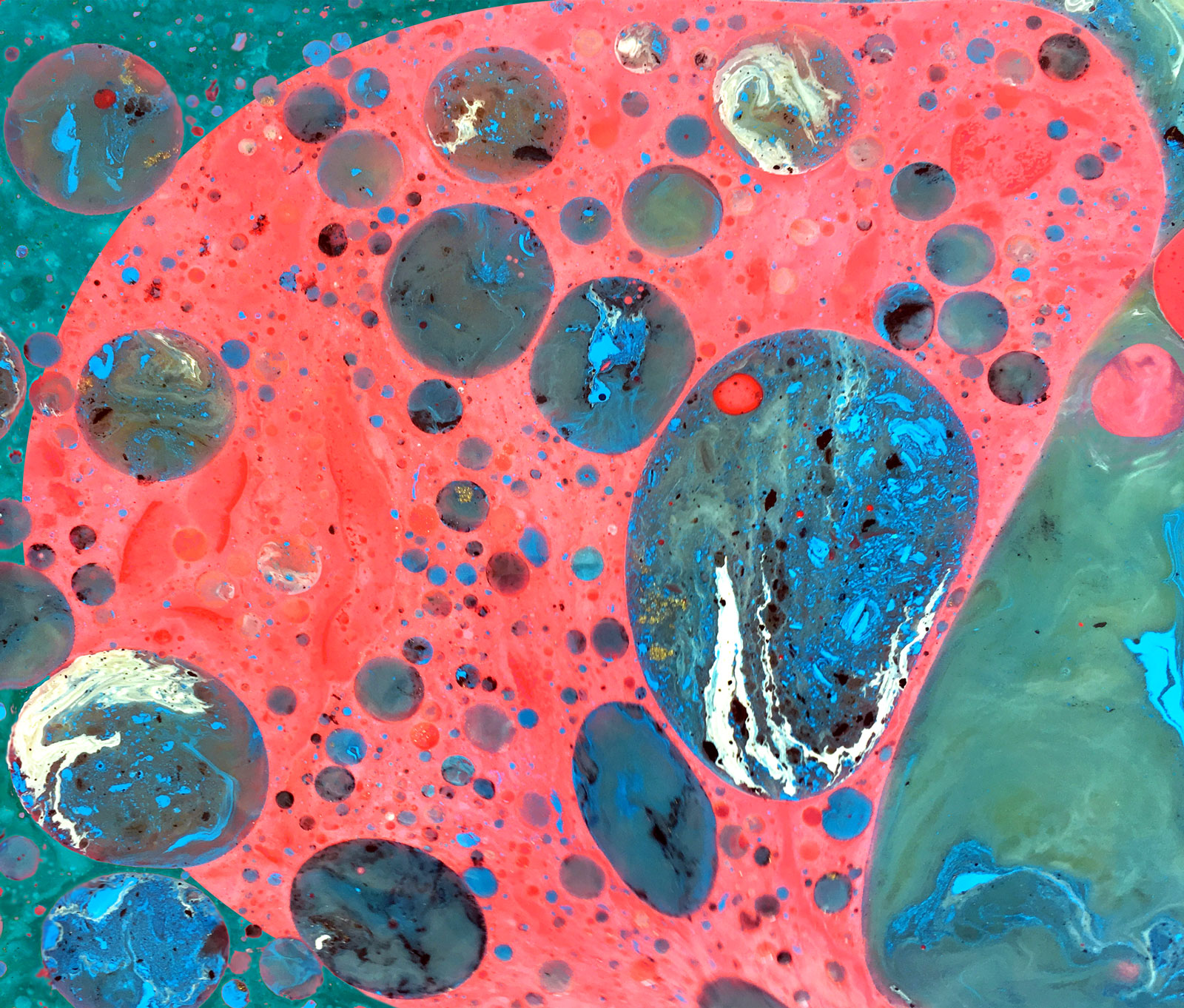
That marbled clay in Daniels’ work reminded me of some paint marbling textures I’ve been eager to use somewhere.

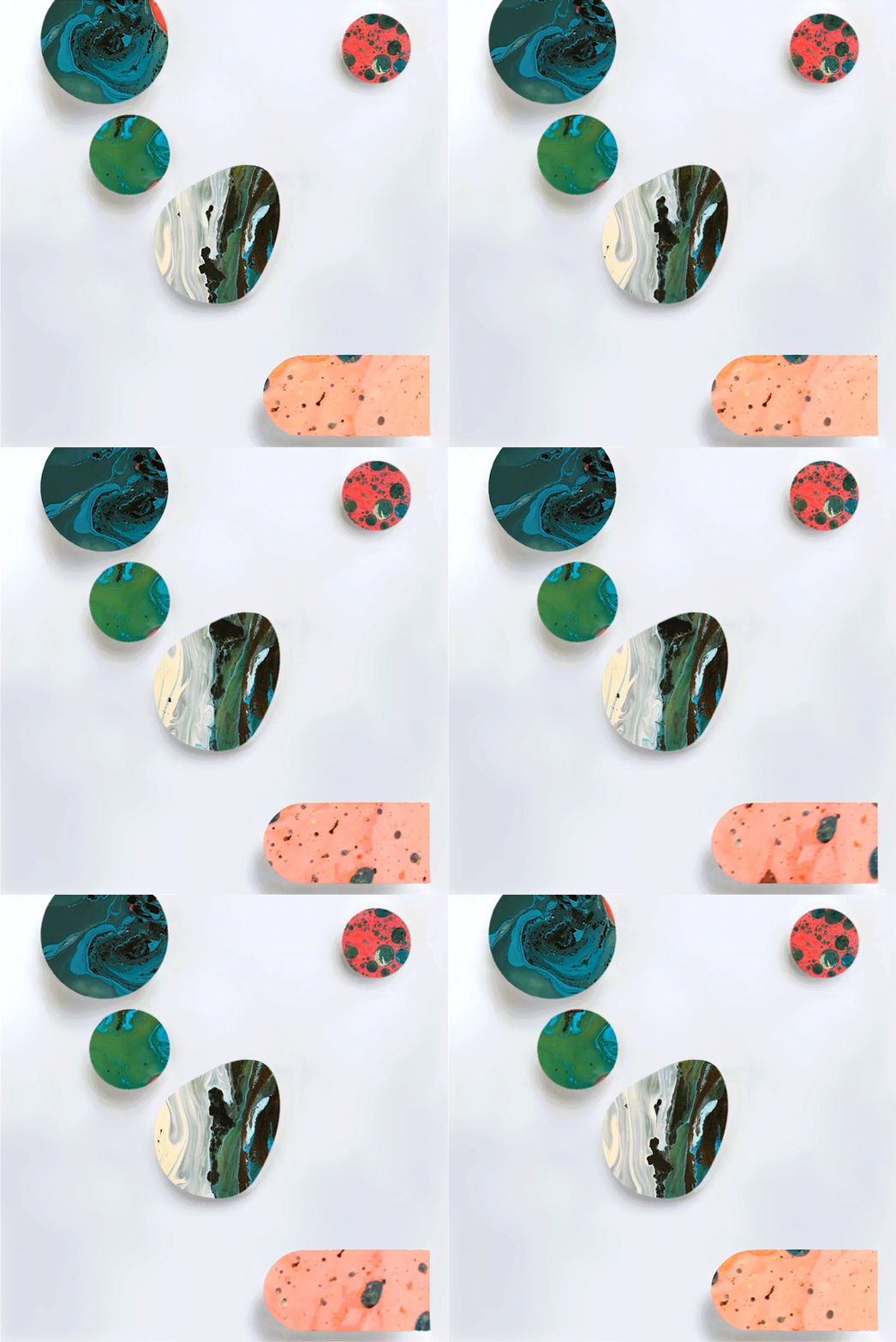
I printed some consecutive frames of paint swirling, stacked them, and then revealed them one-by-one to get the ebb and flow of the paint. (Tho: I ended up doing a lot of patching+fixing in photoshop because my stacks jittered too much.)

stack

The marbled texture comes courtesy of mixing-together some unlabeled cans of paint from the studio and some oils (and heavy whipping cream, for good measure) from the kitchen. The attraction and repulsion of the elements naturally ends up flowing into patterns like this (total chaos, but these designs can also be controlled if you know what you’re doing.)

paintswirls

Back to exquisite corpse…

In the spirit of the game, the final frame is supposed to be designed with a blind eye to any larger animation schemes (acquiescencing to the collective process and all…) However, by the time the design was complete, so were my aspirations for it. So I ended up making two projects—what the paint wanted to do and what the assignment wanted to do.

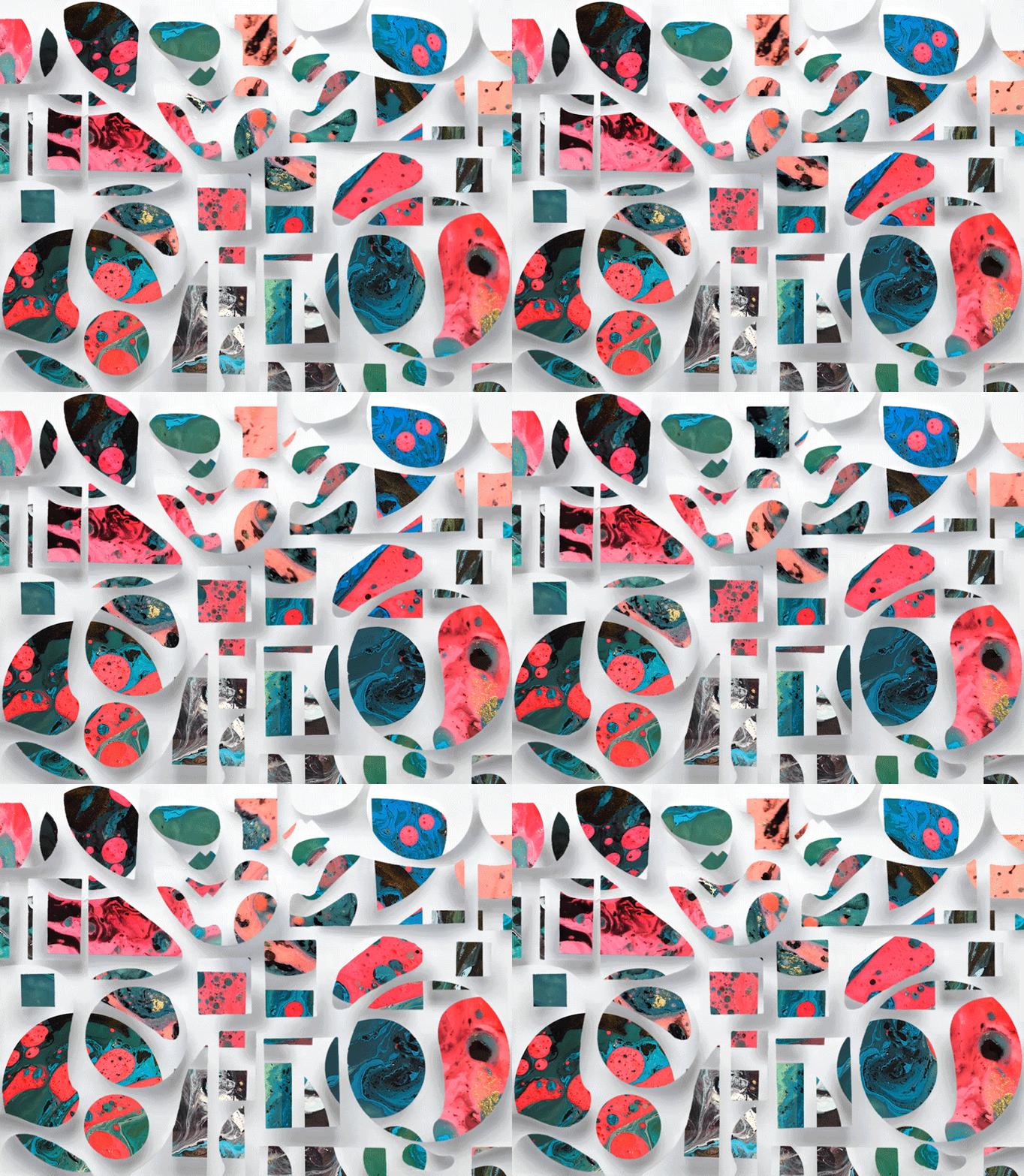
This is what resulted from just letting the paint blobs flow and loop. It breathes and digests food!! (and surprisingly feels a bit more Skip Hursh than expected):


Big gif version »

This glitchy thing also happened:

experiment5

That detour took FAR longer than the actual project… (Lots of moving parts = well…lots of moving parts)

But I did do my exquisite corpse duty and finished my limb. I worked my way from the previous player’s final digital frame to my paper-and-paint composition.

I first remade the digital frame in paper and then willed-it (through brute force!) to physically morph into blobs:

physdigital

Simultaneously, all of the other players were figuring out how to get from-here-to-there as well:

diagram
This is how all of the parts linked-up together. (woo-hoo, us!):

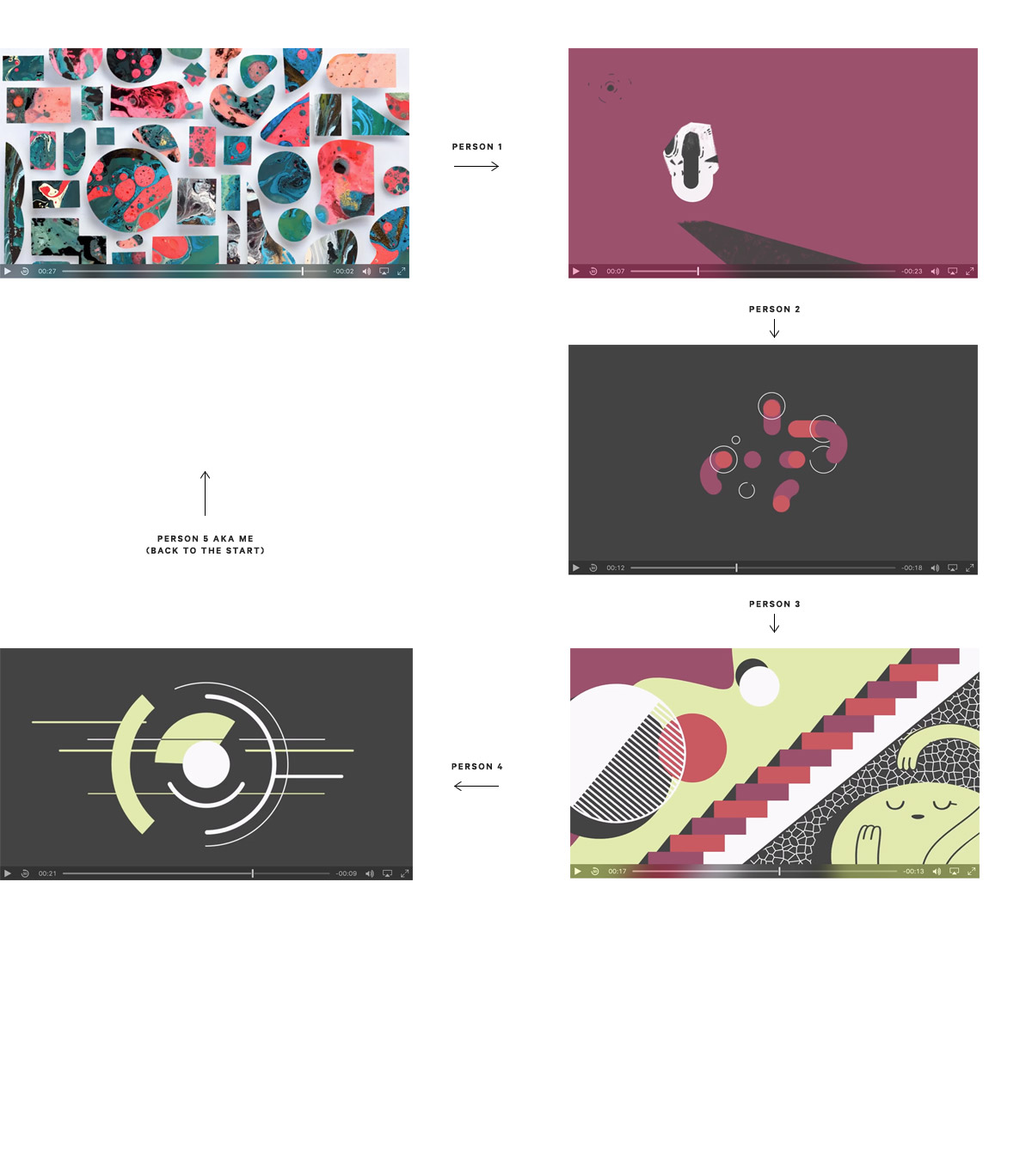
Bee Grandinetti 00:02 – 00:07, Linn Fritz 00:07 – 00:12, Rachel Yonda 00:12 – 00:17, Bethany Levy 00:17 – 00:22, and Kelli Anderson 00:22 – 00:29
Sound and Music by: Wesley Slover / Sono Sanctus


Website experiments:


Totally different project, same paints…

The paint was so much fun to work with that it made its way over into a completely unrelated (tho: surprisingly appropriate) project.

I’ve been awaiting a project-excuse to try some of the fancy things that css can now do. (Especially interesting: browsers now support multiply mode and… sites can animate upon scroll, like this neat one by Jonnie Hallman.)

As luck would have it, the perfect assignment found its way to me. A friend needed a playful/go crazy! brochure site for an arts facility that she is developing. Called Collective Museum—it is slated to be something of an Epcot center for creative experimentation.

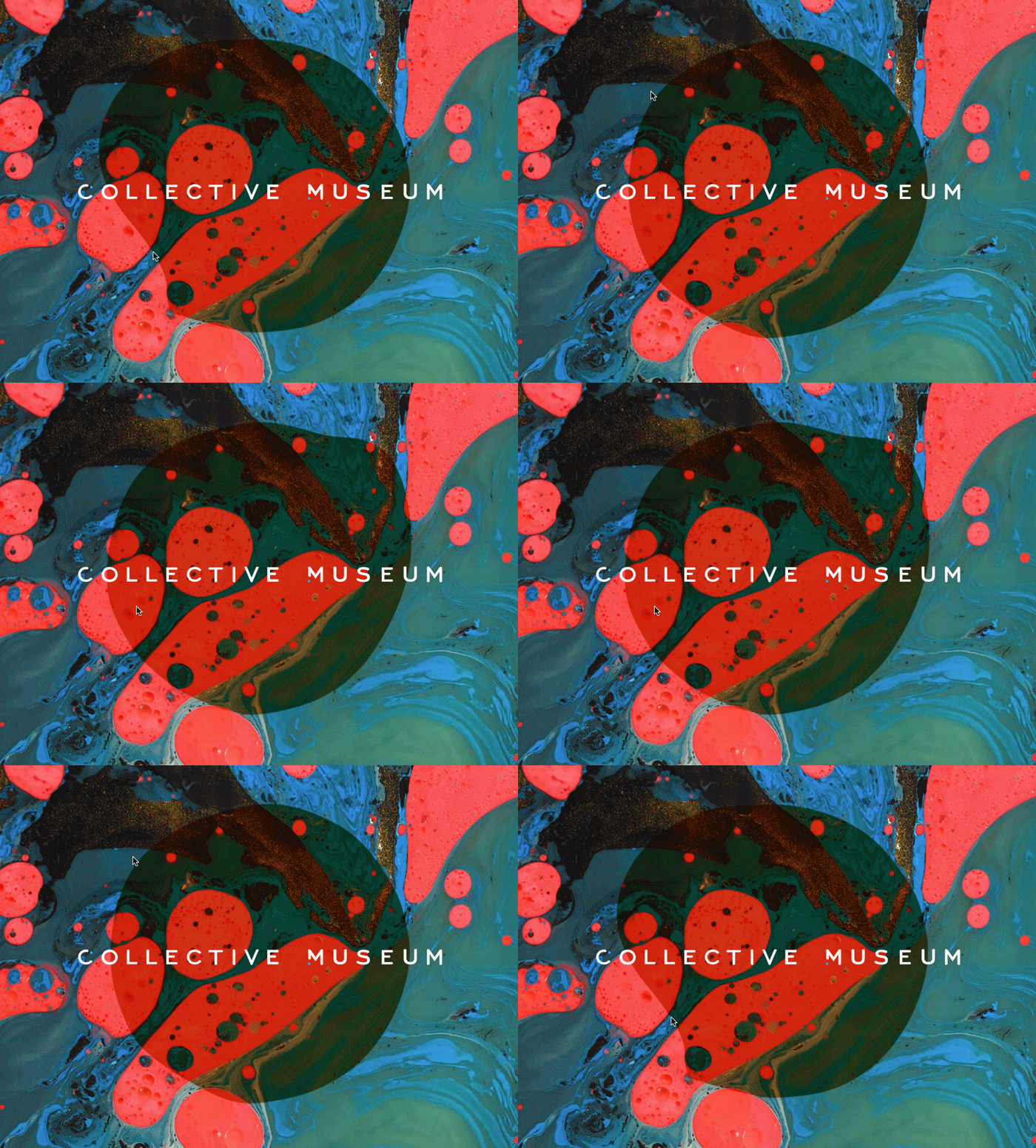
Since this future place will (literally) be a facility to push-around physical art materials, I took some of my best paint footage and created panels that the site visitor can physically-manipulate by scrolling up and down the page.:

Play with it here »

A blob, responsive to mouse-gestures, also pretends to be a liquid and intermingles with the paint.
The result is a website-Joshua-Light-Show, basically:

blobgif


After many false starts I ultimately ended up using scrollmagic.io for the subtle scrolling animation.

Here are some branding directions I developed that embody different projected-aspects of the organization-to-be. (Which came after the website was coded, a first for me.)

This first one follows the visual lead of the site (the interactivity of the site really being the truest expression of the intended spirit):

logo1

But, this second gives more of the feeling of vastness and infinite possibility that I was after.

logo2

So the branding may shift yet…


Aaaaalllsooo……:


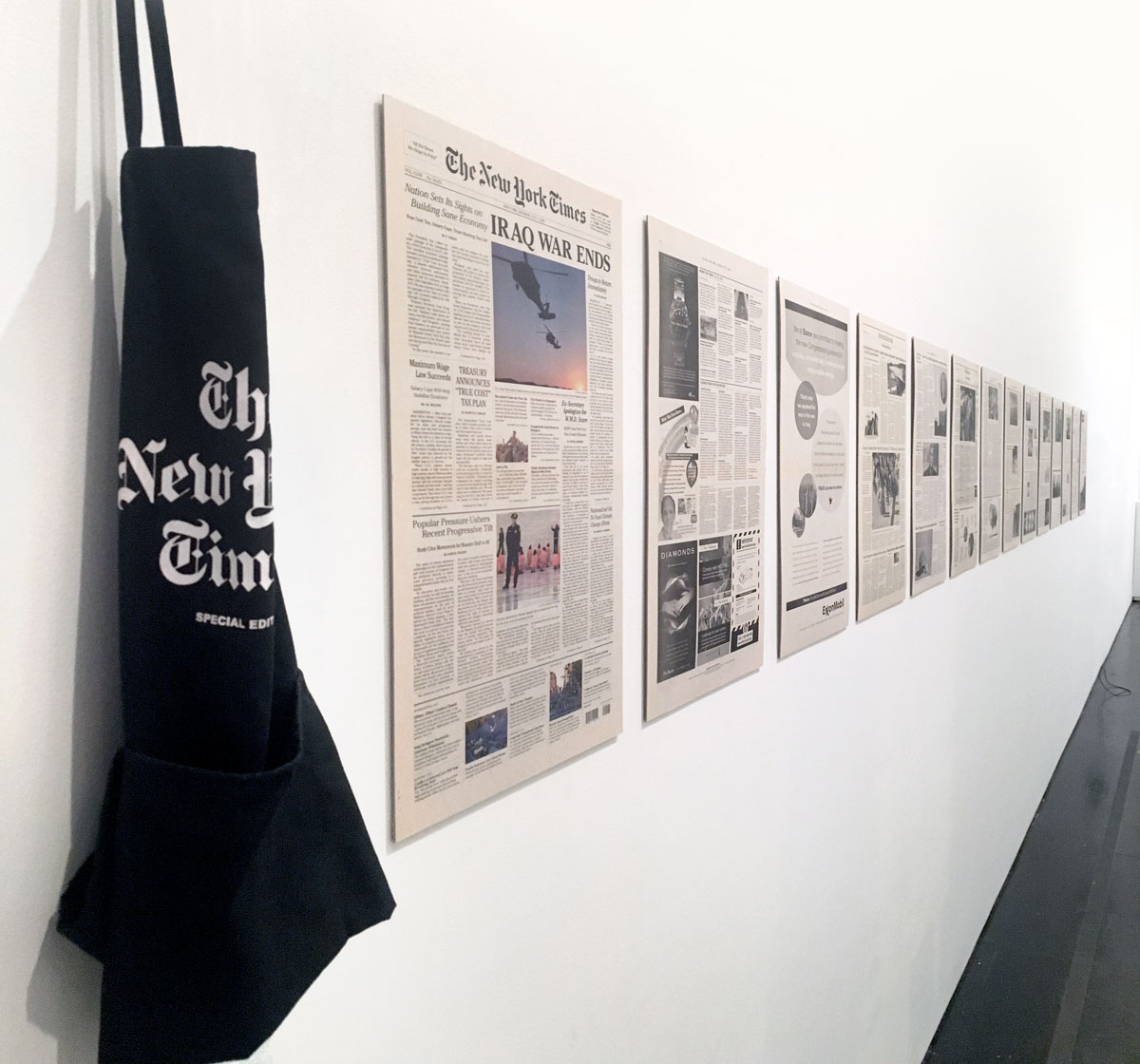
A collective leap-of-faith from the past now adorns a wall at the Brooklyn Museum! (through August 7th). My better-half, Daniel, and I worked with The Yes Men and friends to make a fake NY Times from a utopian future. It was one of the most fun group projects I’ve ever had the pleasure to work on.

A stack of leftover papers, as well as a few silkscreened newsie aprons are on view as part of the Agitprop! show.

nytimes-brooklynmuseum_sm

And: in this midst of the horrors of recent news, we continued this tradition and assisted The Yes Men in making a brand-new initiative for our dystopian present.

(Even showing it is a spoiler. However, the story of its origin is well out there by now… so…)


Related Stuff I’m reading


Whenever stepping away from reliable methods, I re-read this profile of Brian Eno by Sasha Frere-Jones. It makes the case that his biggest contribution to pop music may his repeated demonstrations that “musicians do their best work when they have no idea what they are doing.” Rare is the biographical profile that is such a wellspring of ideas. (SO good!)

A related, recent discovery is this interview with one of my material-experimentation heroes, Keetra Dean-Dixon, from the Through Process podcast. They chat about keeping a list of interesting-creative-things-to-try (onhand—should an appropriate client job or free time present itself) and making time for “Kindergarten Mode.” They also officially declare post-facto rationalization an OK thing to do.


http://kellianderson.com/blog/?p=3426
Extensions

Related Narratives

← Back to feeds