
GeistHaus
log in · sign up

Stories by David Jacobs on Medium

Stories by David Jacobs on Medium

rss
(yourfriends@medium.com)
10 posts
Feed metadata
Generator Medium
Status active
Last polled Apr 29, 2026 01:38 UTC
Next poll Apr 30, 2026 01:38 UTC
Poll interval 86400s

Posts

My Retro on Last Week's Hackathon
githubclaudesoftware-developmenthackathons
Show full content
Claude’s Retro on last week’s Hackathon
A Github contrubution graph.

Several people have asked about the tools I used to build Pinwheel Fates () with Claude Code. I’ll cover the tools, but the more useful takeaway is what I learned from using them.

At the end of the build, Claude wrote a final retrospective that synthesized 60+ sessions into five recurring failure patterns. The key finding was direct: “most of these failures share a single root — reactivity where proactivity was needed.” The insight that stuck with me most: prompt failures weren’t about bad instructions — they were a category error: prompts that list rules underperform prompts that show examples. Positive direction beats negative guardrails. Here are four lessons I took away:

Lesson 1: Encode your principles early. Building Resonant Computing Manifesto principles into my CLAUDE.md produced better first-attempt responses all week, especially on data use and storage decisions.

Lesson 2: Automate the retro, not just the build. Inspired by Every’s Compound Engineering Plugin, I targeted a 60/20/20 split: planning, building, retro and course correction. A pre-commit hook ran after every feature build passed tests — running the demo pipeline, updating the dev log, and updating UX notes. The logs made bad habits visible across sessions and helped me improve my planning documents.

Lesson 3: Always be demoing. Showboat and Rodney were announced by Simon Willison at the beginning of the hackathon. Showboat generates a self-documenting artifact — commentary, code, and output — from recent commits. Rodney captures screenshots. This demo pipeline acted as a proactive QA mechanism — generating 20 screenshots on every build for review — and helped me refine my demo script.

Lesson 4: Budget for the integration, not just the feature. I chose Discord because it looked drop-in ready: slash commands for governance, real-time notifications, OAuth for web auth. The overhead wasn’t worth it — at least half my debugging time went to Discord integration issues. The retro’s second most frequent pattern was “cross-cutting changes breaking distant tests” — and Discord was the primary source. If you’re evaluating Discord for a similar build, budget time for significant integration complexity — it’s easy to underestimate. In a future version, I’ll move auth to Google and revisit Discord’s role.

https://medium.com/p/47278becf4e9
Extensions
Pinwheel Fates: My MMO Basketball Simulator
software-developmentproduct-managementbasketballclaude
Show full content

I was one of 500 accepted to Anthropic’s Build with Claude Hackathon (out of 13,000 submissions) and shipped Pinwheel Fates: a 3v3 basketball simulator game. The core PM discipline — decomposing large problems into manageable pieces, writing clear specs, holding the whole system in your head — is the skill set that makes AI-assisted development work.

The game runs simulated games between 4 3-on-3 basketball teams. Between rounds, human governors propose and vote on rule changes in plain language, Opus interprets those proposals, and reviews the communal behavior (in public) and directly with players (privately, in DMs). The thesis: when people can see how they make collective decisions, they make different ones.

I had a five-day build window, from scratch. No prior codebases, no head starts. What made it possible wasn’t the AI — it was the process around the AI. I documented every design decision, every pivot, and every tool that broke in real time. I maintained a living CLAUDE.md file that expresses my philosophy for how a human and an AI should collaborate on a codebase. The dev logs are daily retrospectives.

The build came at a strange time. I was in a bike accident in late October and on February 5th I had ACL reconstruction surgery. After weeks of recovery fog I needed something to force my brain back into shape.

I will have much to write about the game and the process, but for now, you can fork the code: 🔗 https://github.com/djacobs/Pinwheel 🔗, play the game: https://pinwheel.fly.dev 🔗 , or join the Discord: https://discord.gg/4fDQ2jRsaE !

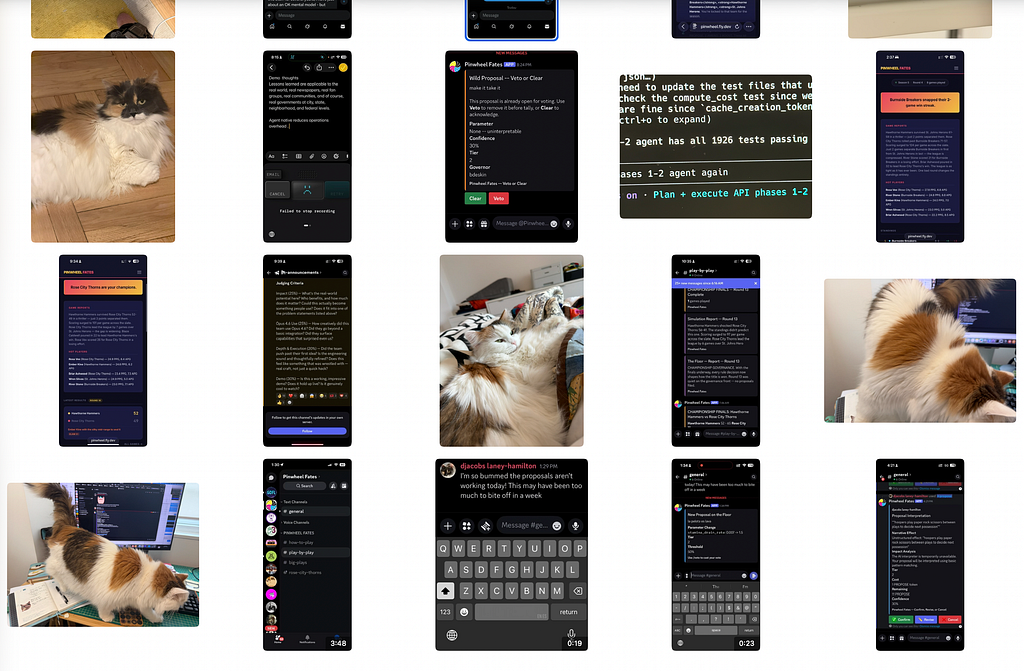
(My last few days photo roll)

https://medium.com/p/bb056bb08850
Extensions
Selfie
Show full content
https://medium.com/p/4221587efb7
Extensions
Hello World
Show full content

Tap, tap tap

https://medium.com/p/6cbe35a864d8
Extensions
WWDC 2017 Summary
Show full content

The company responsible for the most popular consumer product of all time is getting even better at giving people what they want.

https://medium.com/p/9b94fc6928de
Extensions
On Apple Computers
apple
Show full content

Apple’s current crop of computers built for professionals — up and down the board—are undoubtedly the very best they’ve ever made. The fact that users are unhappy is purely a failure of marketing.

https://medium.com/p/739c34fb1194
Extensions
Identifying Implicit Bias
bernie-sanderspolitics
Show full content

The role of Facebook and particularly Facebook’s impact on the publishing industry, has become an area of intense interest and conversation as developers, editors and publishers ask each other “What happened?”

I want to focus on a particular detail of this story that hasn’t received the attention it deserves, in my opinion. Trump’s campaign staff boasted on-the-record about spending more than $70,000,000 a month to disenfranchise likely Clinton votes. If you didn’t seen the look behind the Trump machine Bloomberg published on October 27th, I highly recommend giving it a read (link below). From that story:

…Trump’s campaign has devised another strategy, which, not surprisingly, is negative. Instead of expanding the electorate, Bannon and his team are trying to shrink it. “We have three major voter suppression operations under way,” says a senior official. They’re aimed at three groups Clinton needs to win overwhelmingly: idealistic white liberals, young women, and African Americans. Trump’s invocation at the debate of Clinton’s WikiLeaks e-mails and support for the Trans-Pacific Partnership was designed to turn off Sanders supporters. The parade of women who say they were sexually assaulted by Bill Clinton and harassed or threatened by Hillary is meant to undermine her appeal to young women. And her 1996 suggestion that some African American males are “super predators” is the basis of a below-the-radar effort to discourage infrequent black voters from showing up at the polls — particularly in Florida.

Why the Trump Machine Is Built to Last Beyond the Election

While the left was gloating over how poorly run Trump’s campaign was, Trump’s data team were spending $70M-$100M on Facebook ads encouraging Clinton voters to stay home. Unlike TV and print ads, these ad buys aren’t reported on or visible in any way — not even to the publishers whose work they appear next to. This isn’t illegal, but it underscores the incredibly persuasive power of Facebook’s products.

These efforts changed user sentiment. That’s not evil, that’s advertising. Facebook is a near-perfect machine sitting between audience, publisher and advertiser. Imagine a twenty-three year old voter from Miami reading a Talking Points Memo Instant Article in the week before the election, seeing an ad expressly designed and targeted to convince them to be less enthusiastic to vote. That’s not a nice story, but the reader and the publisher are actors in this story just like Facebook is. We have to decide if this is the future of media we want. Should both parties spend one billion dollars, or more, on these ads next time around?

Over the last week I’ve spoken with folks across the industry about the election. A (high-performing!) Google engineer suggested to me Sanders would have won. “He’s the brick the window middle-America wants,” he suggested. A friend I admire greatly suggested Cory Booker as a VP candidate would have delivered the Black vote. There’s no end to the second-guessing.

But none of it is followed up with consideration that the Trump campaign made incredible use of the products Facebook (and others) offered, benefitted from shorter hours and fewer polling locations in urban areas, late breaking and confusing communications from the FBI, and the major blindspot of the media that suggested Clinton would win in a landslide (encouraging a difference-making number of voters to go with the Green party rather than the Democrats).

This kind of algebra — making judgements about performance and value while subconsciously ignoring full criteria and context—is the textbook definition of implicit bias. Even in the week after her shocking defeat, Democrats considering how to win Congress in mid-term elections are laying the blame at the feet of the candidate until taking a broad look at everything that went wrong. Of course, she lost, so anything looks better than losing in hindsight. But if the path to a Democrats’ majority was obvious, Democrats would have a majority right now. Let’s keep digging.

https://medium.com/p/6113b4642686
Extensions
Stating the Obvious
twitterjournalism
Show full content

When somebody goes out of their way to state the obvious in public that usually means the opposite is true and the speaker knows it. This is a nearly daily occurrence in sports coverage — “[the manager] has our complete confidence,” “we have no interest in [that player],” “everything we do, the fans are our first priority,” and it’s true in business and politics as well.

So when Zuck says: “I do think there is a certain profound lack of empathy in asserting that the only reason someone could have voted the way they did is they saw some fake news,” not only does he know that his platform is used to spread fake news (on both sides), but he is aware that this is an existential problem for a platform that trades on trust.

Many hundreds of millions of us have placed Facebook squarely in the center of how we spend our time and conduct our relationships and conversations, and we get great benefits from being so efficiently connected. The people I know who work at Facebook are super intelligent critical thinkers. They are aware they are being watched and they have a huge influence on people’s day-to-day lives, and they know they have to solve this problem.

But we need to assert when things are not right, just as we have (and must continue to) with the harassment problems on Twitter. And those of us who work on publishing and community tools need to consider more deeply not just the packaging of our content but the wider context in which it appears.

https://medium.com/p/d08db0cee49f
Extensions
Updated Mac Pros and iMacs
Show full content

The Mac Pro and iMac will be updated when new keyboards are ready with the touch stripe (what’s it called?) Until then, we wait. No big deal, the computers they sell now are very fast.

https://medium.com/p/fcc42eff2c12
Extensions
My Magazine
gamingpublishing
Show full content

Originally published October 22, 2012 by Blake Eskin.

After spending more than two years writing my book about the Holocaust, I needed to start thinking about something else, anything else. In a used-book store, I found “Scarne on Teeko,” and with it a creative way forward. It turned out that the story of John Scarne and his board game Teeko, which I told in the Washington Post Magazine, was full of despair and loss, but these were trumped by a fascinating discovery: that a famous man thought his best chance at immortality resided in a board game he invented. Most people don’t know Teeko, but it was John Scarne’s great work of art. So I started writing about board games.

After Scarne, I sought out designers who were making new board games, and I realized that games writing could explore the same large, meaningful themes as the best arts writing and sports writing. But a creative way forward was not enough. By the time my book came out, in 2002, I was engaged to be married and thinking about starting a family. Even today — when you can find Settlers of Catan in Barnes & Noble, the App Store, and the offices of most tech startups — newspapers and magazines aren’t exactly looking for a board-game columnist, and I couldn’t craft a proposal that would secure a big enough book advance to support my research. I found great stories and a few editors — David Rowell at the Post, Nick Paumgarten at The New Yorker, Emily Botein at The Next Big Thing, among others — who helped me share those stories with their readers and listeners. But I quickly maxed out the appetite these general-interest outlets had for games journalism. In 2004, I spent a week on my own dime in Columbus, Ohio, at an international board-gaming convention. The next year, my first child was born, and it became harder to justify investing my money, time, and attention in writing about games.

From time to time, people suggested that I start a board game blog. They had the best intentions, but their suggestion aroused the same combination of rage and helplessness as when a magazine editor asked me to write a few thousand words about board games on spec. I looked at plenty of blogs, and useful sites like BoardGameGeek, built on the experiences of its many users, but they weren’t models, editorially or economically, for the kind of storytelling I wanted to do. The closest model I could find was Sumo’s Karaoke Club, the zine published between 1989 and 1995 by Mike Siggins, a hobbyist who opened up the world of German games to the English speakers. He is also a writer who can illuminate the adult male attraction to board games as well as Nick Hornby does with soccer or record collections. Siggins sold subscriptions to Sumo’s Karaoke Club. The subscriptions did not allow him to retire early, but it told him that people wanted him to keep going.

Part of what brought me to 29th Street Publishing was a nagging question: What if, in those years I spent exploring the world of board games, I could’ve sold a subscription to my own digital magazine? There was an audience for these stories, a modest audience compared to a general-interest magazine but an audience that valued the work more than general-interest readers would. With enough readers I could have paid for a trip to the annual game fair in Essen, Germany, or to England to profile Mike Siggins.

At 29th Street Publishing, we have plans for our own magazine, and it will cover board games. But the chance to help many individual writers, artists, and independent publishers sell subscriptions to their own work is why I came here. For those of you with nagging questions of your own, they are no longer hypothetical. We want to hear from you: Email us at hello@29.io.

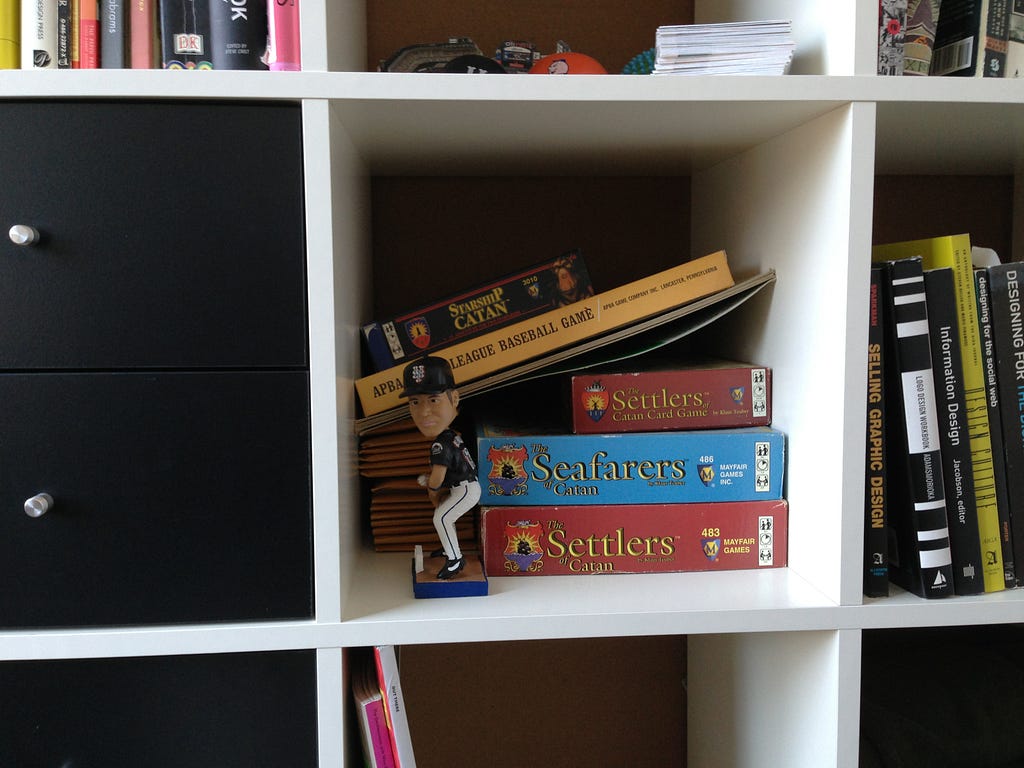
photo by djacobs

Originally published at www.29.io.


My Magazine was originally published in 29th Street Publishing on Medium, where people are continuing the conversation by highlighting and responding to this story.

https://medium.com/p/67b50cc9c36b
Extensions
← Back to feeds