Issue 386: Name your middle-class precarity – Read the full issue in the archive.
Show full content
One of the more bizarre features of this era is that even people who are doing objectively well by any reasonable measure can’t seem to shake the feeling that they’re falling behind.
Financial journalist Hanna Horvath has written a very clarifying essay on why this might be happening. She traces how ‘middle class’ stopped being an economic category and became a psychological one – a story about the kind of life you think you deserve. Which means when the story doesn’t match the reality, the gap hits hard:
“‘Middle class’ has become a psychological container that absorbs all of this anxiety – the gap between self-concept and lived experience, between what you were trained to expect and what the economy actually delivers. The term ‘middle class’ holds a feeling. And right now, the feeling is dissonance. ‘I have what I was told would be enough, and it isn’t, and I don’t know who to be angry at.’”
Horvath argues that there are two distinct experiences at play. Some of us feel ‘material precarity’ – when the basics genuinely slip out of reach – and others feel ‘positional precarity’ – when you earn well but the life that income was supposed to buy keeps receding.
What unites both groups is structural. Neither is accumulating capital. Both live off income perpetually – although at different levels. The resentment from not being able to get off the treadmill – rather than flowing upward toward those who are hoarding vast amounts of capital and/or shaping policies – tends to travel sideways (hatred of ‘elites’) or down (hatred of immigrants).
“The family earning $75K and the family earning $350K have more in common with each other – structurally, in terms of their relationship to capital – than either has with the family whose wealth generates its own income without labor. Both are running on the treadmill. One is running slower, but neither is able to get off.”
When the big goals feel permanently out of reach, doom spending becomes rational: if the future you want isn’t coming anyway, you might as well buy the thing that makes today bearable. Meanwhile, “they’re dealing with an entire consumer economy that’s been redesigned around making the base tier uncomfortable enough to push you toward a premium tier you can’t afford.”
The result is a growing share of our society who did everything right and yet are one bad quarter away from a financial crisis. The psychological result is the same across both groups: “the inability to plan, to imagine a future, to trust that effort connects to outcomes”.
The misdirected anger isn’t an accident, Horvath writes. Rather than recognising their shared position, the two groups tend to organise against each other:
“The fallen working class turns atavistic – nostalgic for a past economy that included them. The educated-but-blocked class turns progressive – demanding systemic reform. Both are responding to the same structural forces. But instead of recognising that shared position, they organise against each other. The resentment becomes horizontal instead of vertical.”
I really appreciate that Horvath doesn’t just leave it at diagnosis. A phrase that stood out to me was ‘manufactured dissatisfaction’ – the idea that some of what we feel is structural and real, but some of it is the consumer economy doing exactly what it was designed to do: keeping us in a state of aspirational lack so we keep spending, upgrading, chasing the next tier. Understanding this and separating the two is where agency begins.
Her most useful and immediately practical suggestion is really simple: name which precarity is yours.
“Money anxiety feels similar at every income level, but the mechanics are often different. If you’re in material precarity, the work is protecting the floor – building a buffer, reducing exposure to the extraction economy, making the system work for you where it can. If you’re in positional precarity, the work is harder to see because it’s quite psychological: separating what you need from what you were trained to expect.”
Issue 385: The dissonance is expanding – Read the full issue in the archive.
Show full content
Camilo Moreno-Salamanca shared something recently that I has stayed with me. He describes the pull between two speeds: the race to be at the technological vanguard on one side – keeping up with prompts, agents and chatbots – and on the other, the slow, the analogue: books, friends, the mundane. He arrives somewhere I recognise: “I’m not sure if humans are designed to operate in this mode.”
I’ve been sitting with this post, trying to untangle the different aspects of this discomfort.
One is moral. When I use AI tools, I’m aware that I’m participating in something I haven’t fully consented to – underwriting a set of values, a concentration of power, a particular vision of the future that I didn’t choose and wouldn’t vote for. It’s a reality constructed for us by platforms and capital. Engagement with it feels like complicity, but complete disengagement seems ever more futile. Stepping back and saying ‘I’ll watch from the sidelines’ or even downing the tools entirely (i.e. changing careers) is a privileged option only available to some.
Another aspect is about the life I want. I’m deeply convinced that the good life is found in real connection, in being present in the physical and the local rather than being constantly yanked into a world mediated by screens and platforms. And yet that version of the good life feels more and more like nostalgia. My appetite for slowness has intensified, and I distrust that a little. Getting older has a way of making retreat feel like principle, instead of what it often is: habit or fear.
And then there’s identity. Since my teenage years, technology and the web have shaped my life in ways I’m genuinely grateful for – education, connections, work I benefitted from immensely. But I find it increasingly hard to be part of an industry that is building a future I fear is becoming deeply anti-human. The person with seventeen browser tabs and a Claude Code subscription and the person who considers human creativity and the arts indispensable – they both feel like me. I’m just not sure they can fully coexist anymore. The tension is real.
Participating in capitalism has always asked us to make a kind of peace with dissonance – between what we value and how we actually live, between the world we want and the systems we help perpetuate. But what I’m being asked to accept – and overlook – keeps expanding.
Like Moreno-Salamanca, I arrive without answers. Underneath all the discomfort, the same question keeps popping up: are we really supposed to live like this? I’m not sure we need to answer it. The discomfort is already doing that.
Issue 384: So anyway, the rich won – Read the full issue in the archive.
Show full content
Inequality is one of those words that does its own damage just by showing up. By the time you’ve read it, your brain has already mentally filed it under ‘nothing I can do about’. That was before oligarchy stopped being an idea you mainly encountered in history books.
I’ve had this recent 70-page report on inequality called Resisting the Rule of the Rich sitting in my reading queue for months. I hate reading PDFs, but I finally read it so you don’t have to.
You already know it’s bad. Here’s how bad – just a few of the many stark numbers:
For the first time, there are more than 3,000 billionaires in the world. At the end of 2025, their wealth hit a record $18.3 trillion – an 81% increase since March 2020.
In the past year, billionaire wealth grew three times faster than the average annual rate of the previous five years.
The wealth gained by billionaires over the last year is enough to give every person on earth $250 – and still leave billionaires more than $500 billion richer.
The world’s 12 richest billionaires hold more wealth than the poorest half of humanity – more than four billion people.
Since 2000, for every dollar of new wealth created globally, 41 cents went to the top 1%. The bottom half of humanity received 1 cent.
The report shows that the most unequal countries are up to seven times more likely to experience democratic erosion – such as weakened courts, restricted civil liberties and the slow normalisation of authoritarian practices.
When wealth at this scale converts into political influence through media ownership, campaign financing and direct access to power, democracy starts functioning less like a shared system of governance and more like a shareholder meeting most of us weren’t invited to.
Before anyone mentions philanthropy, the billionaire’s get-out-of-jail-free card: the late German billionaire Peter Kramer called it a bad transfer of power from politicians to billionaires because it is no longer “the state that determines what is good for the people, but rather the rich who decide”.
The report suggests we establish an Independent Panel on Inequality – essentially what we do for the climate (IPCC) but for economic injustice – to give policymakers timely, accurate guidance on runaway wealth concentration. (The IPCC comparison is either inspiring or a warning, depending on your level of optimism.)
The policies such a panel would champion are kind of obvious but – as you’d expect – politically difficult: tax extreme wealth, cancel unsustainable debt in the Global South, break up monopolies, raise wages, fund public services properly.
There’s a mention of philosopher Ingrid Robeyns, who proposes an ‘extreme wealth line’ – a cap beyond which private wealth is taxed heavily and redirected to public purposes. If we accept a minimum wage, why not a maximum wage?
What this report did, more than anything, was shift something in how I relate to inequality. I’ve always cared about it, but it always felt like a condition rather than a mechanism; something out there in the world that is just a measure of a flawed system – like the rise and fall of the unemployment rate. But that framing misses the point.
Extreme wealth concentration is a one-way ratchet that steadily reshapes the rules of politics, media and public life – until what we call democracy is less a check on power than a polite fiction around it. None of that is inevitable, the report insists – and I want to believe it. What does seem clear is that treating inequality as a condition instead of a mechanism is exactly the kind of passive acceptance that lets the ratchet keep turning.
Issue 383: Why we defend what’s failing us – Read the full issue in the archive.
Show full content
Over the Easter long weekend I did some light podcast listening – and by ‘light’ I mean an 80-minute deep dive into the psychology of why most people, most of the time, don’t want things to change. Nice timing, for a holiday built around resurrection. Ha!
Roberts makes an obvious but important observation in his intro: when we look at history, what actually demands explanation isn’t rebellion – it’s the absence of it. “What demands explanation is voluntary servitude.”
Jost’s research suggests this isn’t apathy or ignorance. It’s psychology. The status quo offers something alternatives can’t: certainty. Familiarity. A sense of safety and belonging.
“It’s the devil we know. Whereas alternative social arrangements, utopian social systems, et cetera, these things often raise more questions than they answer.”
Challenging the system – even a broken one – means tolerating that uncertainty, risking social exclusion, and potentially making yourself a target.
What surprised me most is that this tendency to justify the status quo hits hardest among those the system treats worst. If the system is legitimate and you’re still not getting ahead, the only conclusion left is that you are the problem, that it is a personal deficiency. This is how systems reproduce themselves through the psychology of the people they’re failing.
There’s a depressing Catch-22 baked into all of this too. The moments when change feels most necessary are exactly the moments when people cling hardest to what they know.
“Thinking about how to improve things is a luxury that we can only really have as a society when we’re feeling like things are pretty good… When there’s a lot of discord, when there’s a lot of uncertainty, when there’s a lot of insecurity or threat, it’s difficult for people to think about alternatives.”
Climate change – which will generate exactly that kind of disruption – is his most troubling example: strong system justifiers “tend to perceive policy solutions aimed at addressing climate change as more threatening to the status quo than they do the threat of climate change itself.”
And yet. Progress does happen. Jost’s view is “two steps forward, one step back”. Change has always managed to fight its way through, often by working with system justification rather than against it. That means the most effective reformers throughout history have rarely positioned themselves as revolutionaries tearing things down – they’ve framed change as the system finally living up to its own stated ideals.
None of this makes the difficulty of change go away – but it does reframe the work: less about having the right arguments, more about creating the conditions under which people can bear to imagine something different.
Issue 382: The casino in your pocket – Read the full issue in the archive.
Show full content
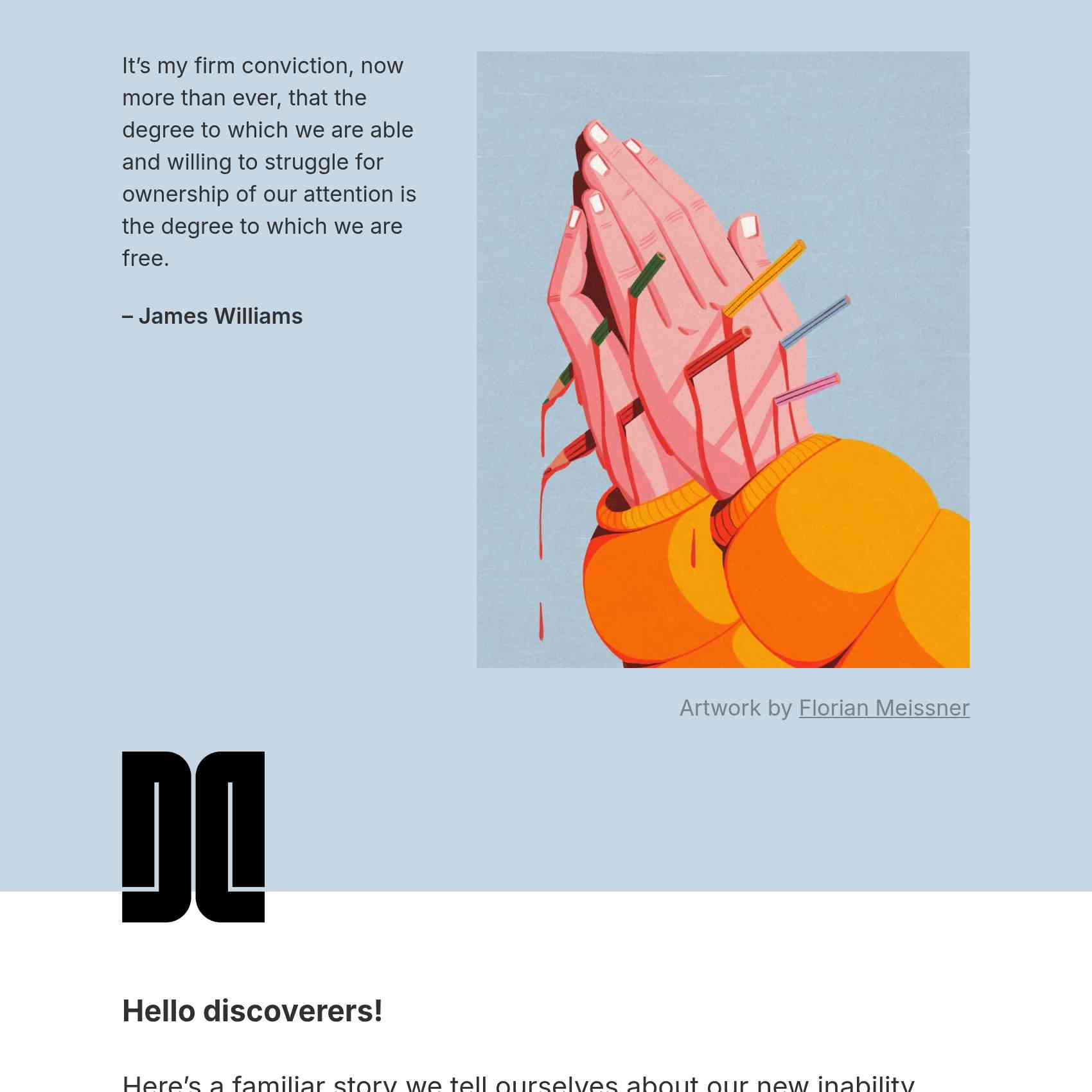
Here’s a familiar story we tell ourselves about our new inability to focus: screens bad, books good, civilisation circling the drain. It’s a seductive diagnosis – and also, probably, a lazy one.
Carlo Iacono is a librarian who spends his days watching how people actually engage with information, and in a recent Aeon piece he pushes back on that oversimplification. The issue isn’t screens, he argues. It’s habitat and design.
He first describes the kind of drowning many of us will recognise when trying to focus:
“Others are drowning, attempting sustained thought in environments engineered to prevent it. They sit with laptops open, seven tabs competing for attention, notifications sliding in from three different apps, phones vibrating every few minutes. They’re trying to read serious material while fighting a losing battle against behavioural psychology weaponised at scale. They believe their inability to focus is a personal failure rather than a design problem. They don’t realise they’re trying to think in a space optimised to prevent thinking.”
From here, Iacono makes a reframe I think deserves more credit than it usually gets:
“We haven’t become post-literate. We’ve become post-monomodal. Text hasn’t disappeared; it’s been joined by a symphony of other channels. Your brain now routinely performs feats that would have seemed impossible to your grandparents.”
“The real problem isn’t mode but habitat. We don’t struggle with video versus books. We struggle with feeds versus focus. One happens in an ecosystem designed for contemplation, the other in a casino designed for endless pull-to-refresh.”
The blame belongs somewhere specific, and Iacono is not shy about placing it:
“Expansion without architecture is chaos, and that’s where we’ve stumbled. The people who cannot sit through novels aren’t broken. They’re adapted to an environment we built. … We built a world that profits from distraction and then pathologise the distracted.”
What I appreciate most is that he refuses the fatalist’s exit ramp. The declinists often correctly identify the villains (you know who) – and then immediately surrender, treating the outcome as inevitable. Iacono is direct about what that surrender actually costs:
“To name the actors responsible and then treat the outcome as inevitable is to provide them cover. If the crisis is a force of nature, ‘screens’ destroying civilisation like some technological weather system, then there’s nothing to be done but write elegiac essays from a comfortable distance. But if the crisis is the product of specific design choices made by specific companies for specific economic reasons, then those choices can be challenged, regulated, reversed.”
The solution he proposes isn’t cultural or attitudinal. He’s not asking us to ‘try harder’:
“Reading worked so well for so long not because text is magic, but because books came with built-in boundaries. They end. Pages stay still. Libraries provide quiet. These weren’t features of literacy itself but of the habitats where literacy lived. We need to rebuild those habitats for a world where meaning travels through many channels at once.”
“The choice isn’t between books and screens. The choice is between intentional design and profitable chaos. Between habitats that cultivate human potential and platforms that extract human attention.”
I’d push back on a few of his points if we were at the pub, but these are quibbles around an otherwise solid argument. We didn’t drift into distraction – we were led there. The problem is architectural – which means the solution is likely too.
Issue 381: Maximising having, minimising living – Read the full issue in the archive.
Show full content
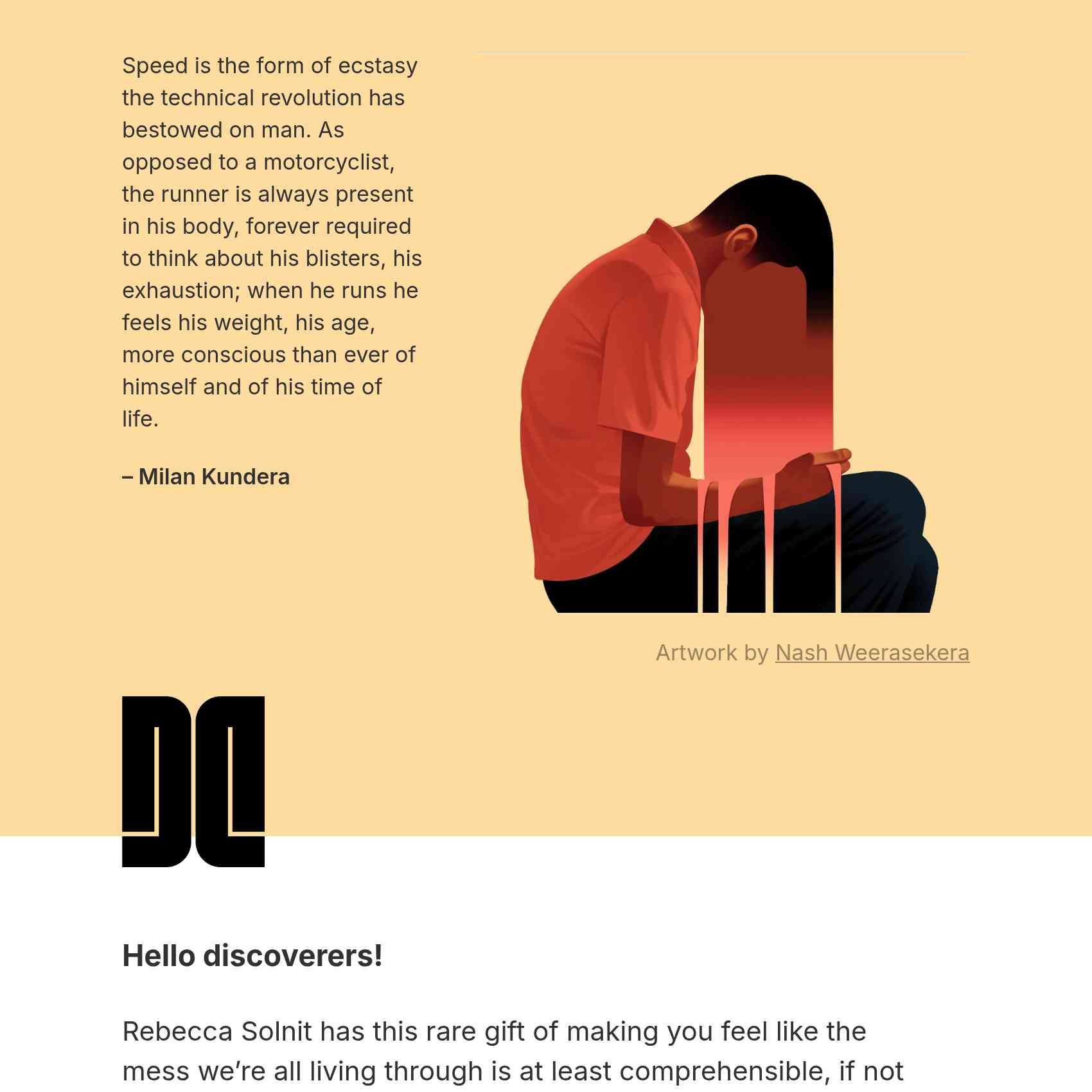
Rebecca Solnit has this rare gift of making you feel like the mess we’re all living through is at least comprehensible, if not fixable. In time for the launch of her new book (see the Books section), she’s published a pointed, thoughtful long-read in The Guardian that I’ve been chewing on over the weekend.
The essay opens on familiar ground – Silicon Valley's decades-long campaign to convince us that going out into the world is inefficient, risky, a waste of time. Regular readers of this newsletter will recognise that territory. But where Solnit takes it is more interesting. Her argument isn’t really about AI; it’s about a deeper ideological project that predates any chatbot:
“...we are beset with the ideology of maximising having while minimising doing. This has long been capitalism’s narrative and is now also technology’s. It is an ideology that steals from us relationships and connections and eventually our selves.”
The ‘doing’ she describes is ordinary stuff – buying milk, chatting to a stranger, finding your way around somewhere new. Small, but important acts. And when we withdraw from them long enough, we lose the capacity to tolerate them:
“The resilience to survive difficulty and discord, to brave the vagaries of unmediated human contact, must be maintained through practice. Silicon Valley-bred isolation robs us of that resilience.”
Solnit calls out the sycophancy problem of AI companions – by design, they have no needs of their own and never push back. But real relationships involve friction:
“One argument for AI companions is that they are always there for you: on when you want them on, off when you want them off, with no needs of their own. Yet behind this lies a capitalist argument that we’re here to get as much as possible and give as little as possible, to meet our own needs and dodge those of others. In reality, you get something from giving – at the very least, you get a sense of being someone with something to give, which is one measure of your own wealth, generosity and power.”
The resistance she calls for is less political than it might sound:
“We resist the tyranny of the quantifiable by finding a language that can value all those subtle phenomena that add up to a life worth living. A language not in the sense of a new vocabulary but attention, description, conversation centred on these subtler phenomena and on principles not corrupted by what corporations want us to want.”
Solnit doesn’t pretend any of this is simple. Stealing ourselves back, she admits, is not as easy as walking out the door. There’s no app for rebuilding the social infrastructure we’ve been letting decay.
“Resisting the annexation of our hearts and minds by Silicon Valley requires us not just to set boundaries on our engagement with what they offer, but to cherish the alternatives. Joy in ordinary things, in each other, in embodied life, and the language with which to value it, is essential to this resistance, which is resistance to dehumanisation.”
Her argument isn’t really a call to action so much as a call to attention – to notice what we’re surrendering, and to decide, with some deliberateness, whether the convenience is worth it.
Issue 380: Self-optimising into oblivion – Read the full issue in the archive.
Show full content
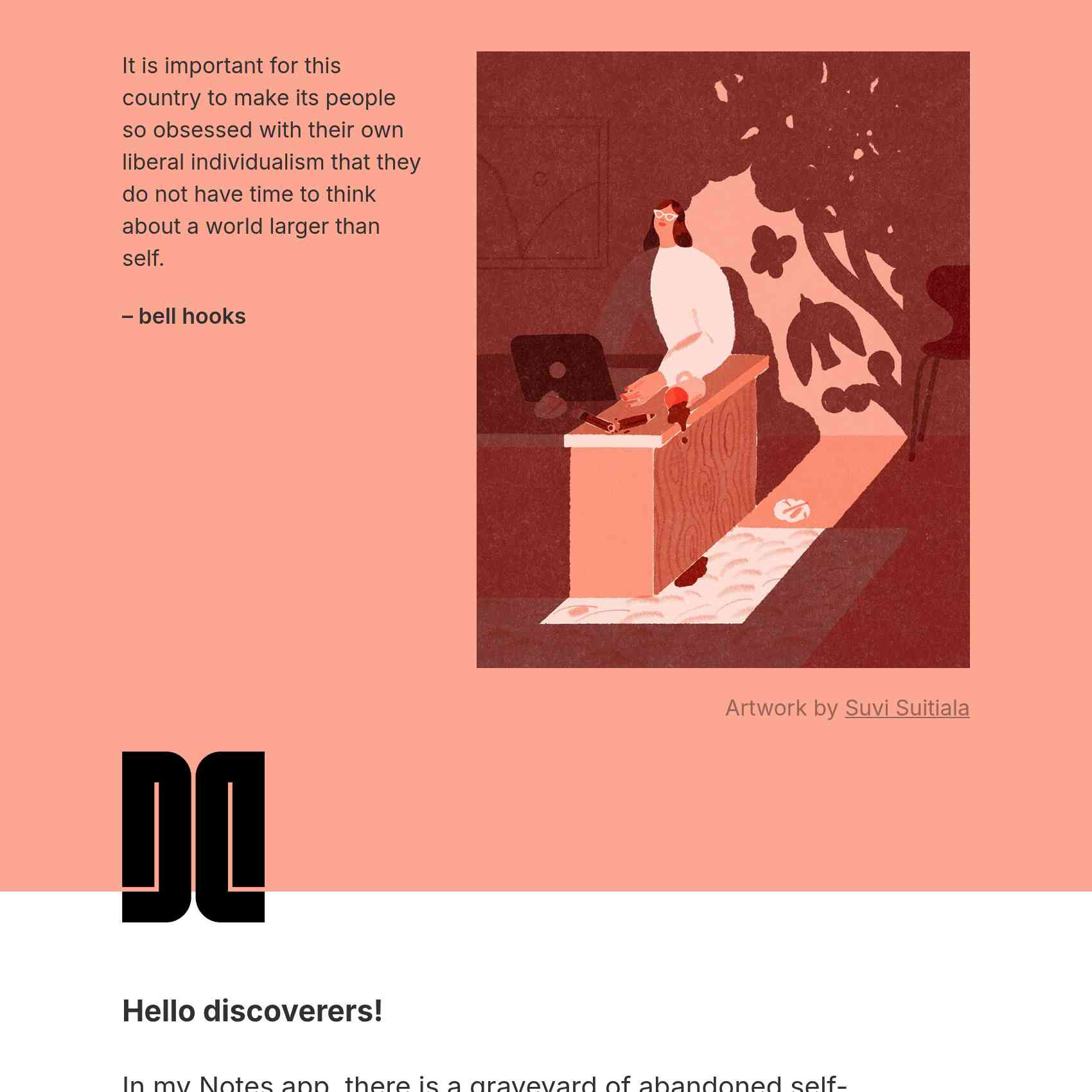
In my Notes app, there is a graveyard of abandoned self-improvement projects: morning routines, book titles, names of journalling and meditation apps I downloaded with genuine conviction and opened twice. I am, it turns out, excellent at thinking about becoming better – less gifted at the actual becoming.
Sara Hussain has a super short piece in Vogue India (!) that cuts right to it. She describes the exhausting loop of modern self-awareness – the constant monitoring, the diagnosis of every mood, the reflexive therapy-speak:
“Everything began to feel like a diagnostic exercise. If I’m tired, it’s burnout. If I’m irritated, it’s dysregulation. If I don't reply to a message immediately, I’m either protecting my boundaries or avoiding intimacy. I am never simply annoyed. I am always processing.”
We’ve become so fluent in the language of our own interior lives that we’ve started living there permanently, renovating the same rooms over and over while the outside of the house – other people, the world, the actual stakes of being alive – slowly falls into disrepair.
Hussain is careful not to dismiss therapy or emotional intelligence altogether. Naming patterns helps. Awareness is genuinely useful. But there’s a point where awareness becomes surveillance.
“There are plenty of things in this world that demand seriousness and accountability. War, violence, the steady erosion of rights. But instead of broadening our focus outward, many of us have turned it inward, turning critical thinking into overthinking; hyper-policing our thoughts and language until having a personality feels like a risk assessment exercise. And it’s exhausting.
In moments when collective action is desperately needed, we’ve somehow built a culture that exhausts us before we even get there. If everything requires total moral coherence at all times, participation starts to feel impossible. Silence becomes safer than imperfection.”
This isn’t entirely our fault. Neoliberalism has spent decades insisting that everything – health, happiness, success – is a matter of personal responsibility and individual optimisation. Of course that’s going to produce a culture of compulsive self-interrogation. The system basically rewards it.
Alex Olshonsky pushes this further in a fascinating essay on thinking as addiction. His argument is that the same compulsive mechanism driving substance dependency – escape the feeling, reach for relief – is what keeps us locked in endless mental loops.
“The object shifts from opiates to Instagram to productivity, but the move is always the same: escape the feeling and reach for the next thing that promises relief. Thinking is just a higher-status version of this. It grants you the feeling of control.”
The answer here probably isn’t to simply stop reflecting. Some introspection is good and necessary. The question is whether looking inward has become so consuming that we’ve lost the habit of looking outward – at each other, at the mess we’re collectively in. Hussain puts it well:
“Turning every inner state into something that needs fixing has made life feel smaller, not more expansive.”
Which, when you think about it, is a strange irony. All this work on ourselves, and we’ve somehow ended up with less of ourselves to give.
Issue 379: Chronically, get well soon – Read the full issue in the archive.
Show full content
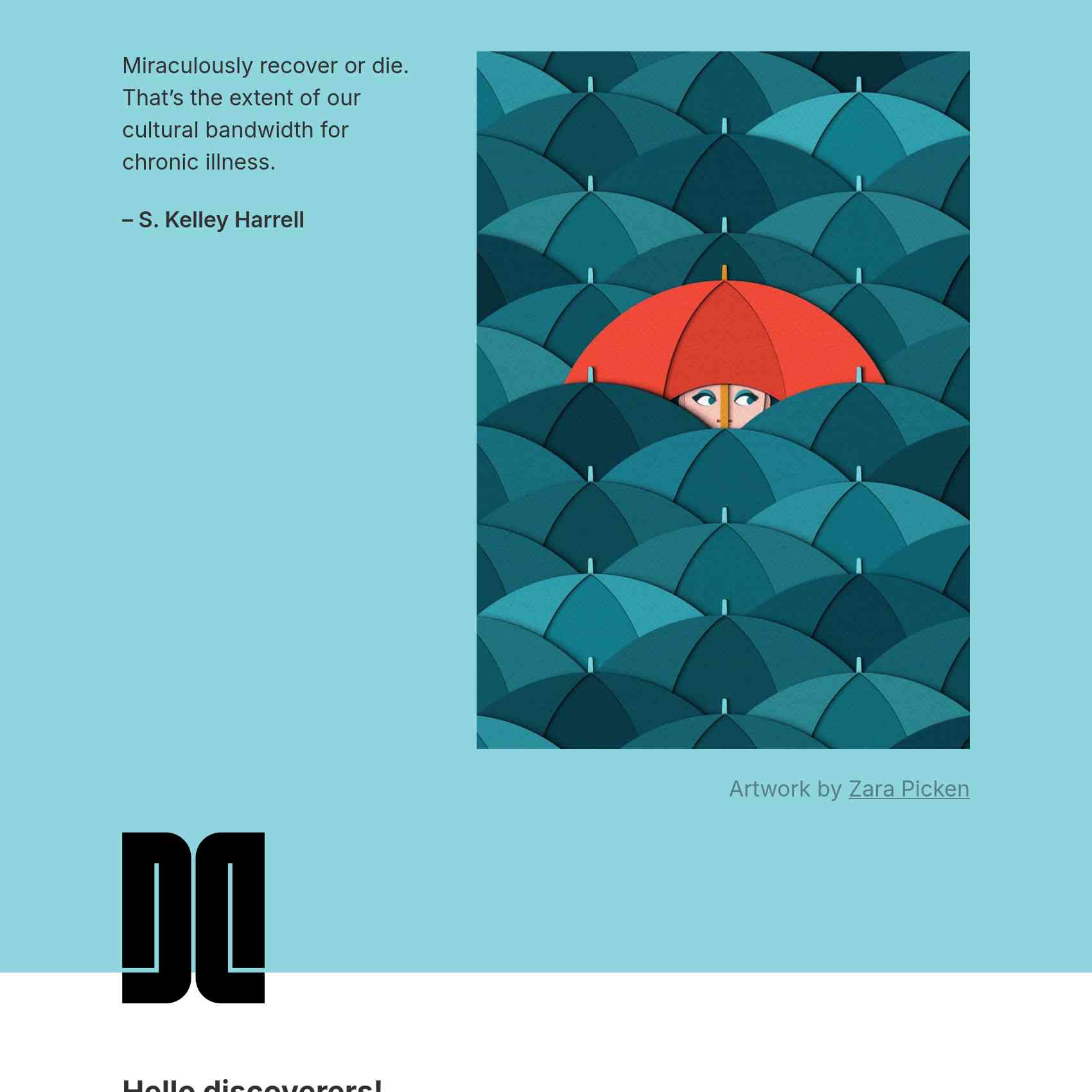
There is a special kind of gaslighting that nobody intends. It lives in the well-meaning question – ‘have you tried magnesium?’ – and in the friendly observation that someone looks well. It’s in the get-well cards we send, with their built-in assumption that getting well is, in fact, what happens next.
But for the chronically ill, it isn’t. And we’re incredibly bad at sitting with that.
Kristie De Garis has been ill since she was 21. She spent two decades doing everything right – cutting out sugar, gluten, dairy, alcohol, stress, late nights – accumulating an ever-longer list of restrictions that did not, in the end, produce the improvement logic seemed to promise.
“We tend to understand illness as something you either die from, or recover from. Those of us who are chronically ill live in the awkward inbetween space. Not dying, but not getting better either. Not an emergency, not something fully resolved.”
That inbetween space is where most ableism lives. Not through intentional prejudice, but through a belief system that treats effort as a moral virtue and outcomes as its rightful reward. Chronic illness is, by its nature, a rebuke to that belief:
“The idea that illness might be something you manage indefinitely, without progress, without reward, is deeply uncomfortable to a culture that has an ingrained belief that effort always produces results.”
“Chronic illness disrupts that extremely saleable, inspirational narrative. It produces people who do everything right and still don’t get better. In fact, I have never met a group of people who are doing more right than the chronically ill. And society, rather than question the belief, questions the person.”
Her strongest reframing is of ableism not as individual cruelty but as something with an economic logic behind it:
“Ableism isn’t just cruelty or ignorance. It’s the enforcement arm of meritocracy, which exists to protect the hyper-capitalist belief that ‘more’ always pays off. The existence of chronically ill and disabled people challenges this simply by the fact that they continue to be ill.”
The chronically ill aren’t just inconvenient to the story we tell about effort and reward – they actively destabilise it.
De Garis is careful not to fully exempt herself from this logic. She writes about still catching herself searching for the magic lever, the right supplement, the adjustment that might finally tip things. She knows it’s internalised ableism – knowing doesn’t dissolve it.
“Part of this is fear. Fear that if I stop striving, I will have no one to blame but myself. But also that other people will read any acceptance as giving up, or laziness, or self-pity.”
If I’m finding the counterweight here, it’s something like this: The belief that effort matters isn’t wrong. The problem is the assumption automatically attached to it – that outcomes will always match. As a framework for understanding human bodies, it falls apart.
Her reflections are well worth a read, particularly if you have someone in your life navigating this terrain. It won’t give you the magic question to ask them. But it might help you retire a few of the unhelpful ones.
Issue 378: The myth of the dying reader – Read the full issue in the archive.
Show full content
Reading is dead. Attention spans are toast. We are, collectively, heading toward a post-literate wasteland of reels and soundbites – our once-curious brains reduced to dopamine-seeking mush. At least, that’s the general vibe online.
I’ll admit I’ve sort of subscribed to this thesis. You probably have too. It feels intuitively right in the way that a lot of decline narratives do. But they are often a little too tidy, a little too satisfying, which should probably be our first clue that something’s off.
In Text is King, Adam Mastroianni (see also DD305) argues that the death-of-reading panic is mostly vibes, not data. Book sales in 2025 were higher than in 2019. Indie bookstores are booming. And actual reading time data shows a dip – but a modest one, concentrated mostly around the arrival of broadband internet in 2009, not the smartphone era we love to blame.
“If the data is right, the best anti-reading intervention is not a 5G-enabled iPhone circa 2023, but a broadband-enabled iMac circa 2009.”
His more interesting argument, though, isn’t really about the numbers. It’s about human nature. The ‘death of reading’ hypothesis assumes that people were only ever reading to fill time – that they never truly wanted it, and that Instagram and TikTok simply revealed their real preferences. But he calls BS:
“Everyone, even people without liberal arts degrees, knows the difference between the cheap pleasures and the deep pleasures. No one pats themselves on the back for spending an hour watching mukbang videos, no one touts their screentime like they’re setting a high score, and no one feels proud that their hand instinctively starts groping for their phone whenever there’s a lull in conversation.”
“Finishing a great nonfiction book feels like heaving a barbell off your chest. Finishing a great novel feels like leaving an entire nation behind. There are no replacements for these feelings. Videos can titillate, podcasts can inform, but there’s only one way to get that feeling of your brain folds stretching and your soul expanding, and it is to drag your eyes across text.”
He also makes a more general point about the influence of books. You don’t have to read a book for it to shape how you think. Ideas that get written down are like an invisible scaffolding of culture, and tuning out doesn’t protect you from them:
“Being ignorant of the forces shaping society does not exempt you from their influence – it places you at their mercy.”
To be fair, the declines in reading, however modest, are real. Not everyone who used to read has simply swapped it for something richer. After eight hours of having dense information beamed into my eyeballs, picking up a book at the end of the day is often the last thing I feel like doing. What that does to a society (and especially younger generations) over time isn’t a trivial question, even if the panic has been overdone.
But Mastroianni’s broader point holds. Text has outlasted radio, TV, dial-up, broadband and most likely TikTok. Yes, soundbites and reels hit the spot – fast food always does. But there’s a reason people keep coming back to the longer, slower, more nourishing stuff.
Issue 377: First, fast, forgotten: the media lifecycle – Read the full issue in the archive.
Show full content
By the time you’ve finished reading this sentence, seventeen new big things have happened on the internet. Most of them will be forgotten within the hour – including, probably, by the people who posted them. Spend 10 minutes on any feed and try to recall what you consumed. Speed turns out to be a surprisingly effective substitute for substance.
Veteran tech journalist Om Malik has a nice diagnosis for this feeling. In a recent essay, he argues that the organising principle of our information ecosystem used to be authority: you earned attention by being right, by being credible, by being worth reading. What replaced it is velocity.
“What matters now is how fast something moves through the network: how quickly it is clicked, shared, quoted, replied to, remixed, and replaced. In a system tuned for speed, authority is ornamental. The network rewards motion first and judgment later, if ever. Perhaps that’s why you feel you can’t discern between truths, half-truths, and lies.”
“Networks compress time and space, then quietly train us to live at their speed.”
It’s more of a structural argument than a moral one. In other words, nobody woke up one day deciding to make the internet worse. The platforms built incentive systems that rewarded speed above everything else, and rational people – writers, reviewers, newsrooms – responded accordingly. Malik believes that the algorithm is not some toggle you can flick off; it is the culture. (Worth noting, though: the algorithm has owners. It isn’t a force of nature.)
He uses YouTube tech reviews as a case study. When a phone embargo lifts, dozens of polished reviews drop simultaneously – same talking points, same mood lighting, same conclusions. The reviewer who spent three months actually living with the product? Mostly gone from the feed before anyone finds them.
“The system rewards whoever speaks first, not whoever lives with it long enough to understand it. The ‘review’ at launch outperforms the review written two months later by orders of magnitude. The second, longer, more in-depth, more honest review might as well not exist. It’s not that people are less honest by nature. It’s that the structure pays a premium for compliance and levies a tax on independence. The result is a soft capture where creators don’t have to be told what to say. The incentives do the talking.”
This dynamic extends well beyond tech reviews:
“People do what the network rewards. Writers write for the feed. Photographers shoot for the scroll. Newsrooms frame stories as conflict because conflict travels faster than nuance. Even our emotional lives adapt to latency and refresh cycles. The design of the network becomes the choreography of daily life.”
The result is a culture optimised for first takes, not best takes.
To be fair, the authority-based media of the past wasn’t exactly a golden age of truth-telling – gatekeeping had its own distortions, its own capture, its own blind spots. Malik, to his credit, has no romantic attachment to the old days. What we’ve lost isn’t some pristine past, but a slower metabolism that at least gave an idea time to be wrong before it was replaced by another one.
Issue 376: Coding: from craft to commodity – Read the full issue in the archive.
Show full content
For years, ‘knowing how to code’ was treated like the golden ticket. Even junior software developers were paid absurd amounts of money, and those who couldn’t speak computer watched with a mix of envy and bewilderment. ‘Learn to code’ became the new ‘get a college degree’.
Well, software development is having its assembly line moment. As the machines become more capable, human input is being dramatically devalued. Coding is transforming from craft to manufacture, from bespoke tailoring to fast fashion.
In ‘The rise of industrial software’, Chris Loy argues that AI is turning software from a carefully crafted product into an industrial, disposable commodity.
“In the case of software, the industrialisation of production is giving rise to a new class of software artefact, which we might term disposable software: software created with no durable expectation of ownership, maintenance, or long-term understanding.”
Loy draws comparisons to other industrialised outputs. Just as industrial agriculture gave us both abundance and obesity – cheap food alongside malnutrition – industrial software comes with its own set of unhealthy side effects:
“Industrial systems reliably create economic pressure toward excess, low quality goods. This is not because producers are careless, but because once production is cheap enough, junk is what maximises volume, margin, and reach. The result is not abundance of the best things, but overproduction of the most consumable ones.”
Loy’s comparison of LLMs to steam engines made me pause. The steam engine didn’t just make factories more efficient – it fundamentally restructured civilisation. And software, unlike cheap clothing or ultra-processed food, isn’t just one industry among many. It’s become the substrate of every industry. So it’s easy to see how, for better or worse, the industrialisation of software will have far-reaching consequences.
Of course, industrialisation never completely erases craft. Handmade clothing still exists, so does organic whole food. Loy raises the possibility of an ‘organic software’ movement – the farmers markets of the software industry, if you will. Maybe there’s a future where bespoke code becomes a luxury good, signalling care and quality in a sea of disposable slop.
The bigger question, though, isn’t about craft – it’s about stewardship:
“Previous industrial revolutions externalised their costs onto environments that seemed infinite until they weren’t. Software ecosystems are no different: dependency chains, maintenance burdens, security surfaces that compound as output scales. Technical debt is the pollution of the digital world, invisible until it chokes the systems that depend on it. In an era of mass automation, we may find that the hardest problem is not production, but stewardship. Who maintains the software that no one owns?”
In another essay, Loy argues that developers aren’t being replaced but that their role shifts from writing code to setting practices, from solving problems to architecting systems where AI writes the software. Software that nobody fully understands.
Many developers got into this work because they liked solving puzzles and building things, not because they dreamed of one day becoming middle management for a very fast, very confident intern who occasionally hallucinates. Such is ‘progress’, I guess.
Issue 375: American acceptionalism – Read the full issue in the archive.
Show full content
I grew up thinking the USA was basically one giant action movie with better shopping. Then I heard stories from friends who’d visited, and it started to feel less like a blockbuster and more like a cautionary tale. Medical bankruptcies from routine procedures. School shootings treated like weather events. Elections where the person with fewer votes can still win.
So when someone first mentioned ‘American exceptionalism’ – speaking very little English at the time – what I heard was ‘acceptionalism’, which I interpreted as America’s unique ability to somehow accept these flaws and carry on anyway. Turns out my linguistic confusion might have accidentally described reality better than the actual term.
The notion of American exceptionalism has seen a weird inversion. Amanda Shendruk’s recent viral post is a visual reminder that American exceptionalism is real – just not in ways many Americans think.
Then I came across Adam Bonica’s essay, which is both realistic about America’s dysfunction but also still hopeful about its future. He opens with a childhood memory of watching the Berlin Wall fall when he was six (like me, I was eight), transfixed by strangers embracing, hammers in hand.
Now a political scientist, Bonica studies why transformative political moments like that almost never happen, until they do – and he’s convinced America might be approaching its own wall-smashing moment.
Like Shendruk’s piece, he points out that much of America’s dysfunction are solved problems somewhere else:
“Universal healthcare is not some utopian fantasy. It is Tuesday in Toronto. Affordable higher education is not an impossible dream. It is Wednesday in Berlin. Sensible gun regulation is not a violation of natural law. It is Thursday in London. Paid parental leave is not radical. It is Friday in Tallinn, and Monday in Tokyo, and every day in between.”
“There is another America inside this one, visible in the statistics of nations that made different choices. Call it Latent America: the nation that would exist if our democracy functioned to serve the public rather than protect the already powerful.”
But Bonica believes that the current turmoil might contain the seeds of its own undoing – in large parts because systemic corruption is now in the open:
“Hidden corruption persists because it is difficult to mobilize against. Exposed corruption shifts the axis of politics from left versus right to clean versus corrupt, people versus oligarchs. That’s a fight authoritarians lose.”
Twenty-eight years the Berlin Wall stood. Then it fell in a matter of hours. Some transformations require decades of patient building and arduous organising. Others arrive like a fever breaking, sudden and irreversible. There was a moment when enough people stopped believing in the wall’s inevitability and saw it for what it was: a political choice that could be unmade.
“The wall looks permanent until the day it comes down. So it goes with all institutions. They are not immutable fixtures but human creations, designed to solve the problems of one era and replaceable when they fail the next.”
And, gosh, is America’s wall visible now! Rendered in Shendruk’s damning charts, performed daily by oligarchs courting power without shame. And once the mechanisms are this exposed, the fiction that any of this represents normal democratic function becomes harder to maintain with each passing day.
Issue 374: AI and the propaganda of inevitability – Read the full issue in the archive.
Show full content
Not a day passes without another AI think piece. I’ve mostly trained myself to scroll past them – the prophecies and confident predictions built on speculation. Last week I shared an O’Reilly piece because it offered something rare: a sober assessment grounded in how technology actually evolves, not how we fear it might.
That said, I’m not entirely immune to the more philosophical vision pieces. I try to read them like speculative fiction – thought experiments that provoke rather than pronouncements to believe. They’re useful for the questions they raise, not the answers they claim.
Peter Adam Boeckel’s recent essay falls into this category. A designer and futurist, Boeckel makes plenty of assumptions about AI’s trajectory. His central argument is that the real threat of AI isn’t job loss – it’s the displacement of purpose itself, that psychological scaffolding we’ve hung our sense of self upon.
“Purpose is not lost when a person stops working; it is lost when the work stops needing the person. … We are not defending competence but significance.”
He’s probably right, though work isn’t always our primary source of meaning. Family, community, faith, care work – these have always anchored us, often more deeply than any job.
For me, the essay’s strongest section is on education. Here Boeckel offers a future that feels (sort of) hopeful:
“If automation dismantles the architecture of work, education must become the architecture of meaning. The challenge is no longer how to prepare people for jobs that may soon vanish, but how to prepare them for a life where purpose is not delivered by employment.”
“A system can simulate empathy; a teacher can model it. What future education requires is not less technology, but more intentional humanity. The teacher of tomorrow will not compete with machines on knowledge, but on presence – on the ability to awaken curiosity, to hold silence, to provoke reflection.”
This is what I agree with: as knowledge becomes infinitely accessible, physical presence becomes scarce, a privilege even.
“The live moment, once ordinary, will become a premium product: an education not delivered, but experienced.”
It’s already happening: the return to in-person workshops, social gatherings, live performances – all the things that can’t be streamed or optimised. They resist scaling because presence is the point.
More broadly, what bothers me about essays like this, though, is the constant whiff of technological inevitability. By framing AI’s impact as civilisational and consciousness-altering, these vision pieces make resistance feel futile. Who argues with evolution?
But this isn’t evolution – it’s decisions made by a handful of corporations with extraordinary capital and influence. The future Boeckel describes isn’t arriving on its own; it’s being actively designed by companies with specific incentives that rarely align with the contemplative, wisdom-centred education he describes.
The risk is that these grand philosophical narratives become cover for continued privatisation and corporate control. We get sold the promise of transformation while the actual infrastructure – the algorithms, the data, the compute – remains firmly in the hands of a few.
So, do we need more essays imagining ‘new architectures of meaning’? There’s genuine transformation happening, for sure. But most AI think pieces sidestep the boring, near-term levers that actually give us some agency over how technology unfolds – labour standards, data governance, antitrust enforcement, policy interventions. The question isn’t whether AI will change us, but whether and how we’ll fight for any say in how.
Issue 373: Offloading risk, distributing fear – Read the full issue in the archive.
Show full content
Early after moving into our new apartment building here in Melbourne, we kept getting hit by burglars who stole bikes and ransacked storage cages. The response was predictable: we spent hours reviewing CCTV footage, filing police reports and reinforcing gates. As anxiety rose, many of us demanded more security measures, even private guards.
Looking back, I can see our default response was to turn to what anthropologists Mark Maguire and Setha Low call ‘security capitalism’. (I featured their latest book Trapped back in DD326, but only really discovered their work through a discussion in a recent podcast.)
Maguire and Low argue that security has morphed from an inalienable right into a commodity hoarded by those who can afford it. The central mechanism is pretty insidious: those with resources create ‘interior worlds’ – gated communities, securitised enclaves, fortified homes – and in doing so, they don’t just protect themselves, they actively make everyone else less safe.
One of my main take-aways: security, by its very nature, is antagonistic to equality. The risk doesn’t disappear – it just gets offloaded onto those without the means to purchase protection.
What fuels this system is an entire gadget- and service-slinging industry ready to profit from our fear:
“Just as middle and upper middle classes, and especially the wealthy, are becoming more risk averse and have the power to pay for that, there’s a giant sector that’s feeding that, that is more than willing to sell you some gadgetry. The more of it there is, the more it becomes ubiquitous. And it also feeds into status anxiety.”
Inside these spaces, security becomes the dominant lens through which to view the world. The more people invest in security, the more threats they begin to identify: workers you let in, teenagers gathering, a person in a hoodie, someone walking too slowly – suddenly there are red flags everywhere.
“The more you securitise your life, the more those walls and gates and guards make your life all about fear rather than less about fear. And so, as the fear grows, then you want more security, you buy more gadgets, you support all kinds of policing initiatives.”
Importantly, this dynamic extends into public space. When a park gets heavily securitised – police presence, cameras, controlled access – it becomes exclusionary:
“That means that young people of colour will probably not go because they don’t hang around where the police are. It means that people who don’t have a place to sleep probably won’t go there either. And suddenly, you have this homogenised space.”
In our time of intense uncertainty, the impulse to buy our way to safety is entirely understandable. But security capitalism offers only the illusion of protection while accelerating the societal breakdown we fear. This creates “a self-fulfilling prophecy of fearful people wanting more security, the state and private sector producing it, only to make the world more fearful for some and poorly protected for others”.
The alternative – rebuilding social connections, investing in genuine public space, fostering mutual aid – sounds almost quaint. What makes it so difficult is that we’re chasing something that doesn’t actually exist: there is no security in nature, only the management of inevitable risk. We know the walls we’re erecting aren’t freedom, but the illusion of safety feels more tangible than the difficult, incremental work of building trust and community.
Issue 372: Friction-maxxing through 2026? – Read the full issue in the archive.
Show full content
Tech companies have spent years perfecting their image as enablers – as tools that promise to amplify our capabilities. The pitch has always been ‘convenience’ and ‘efficiency’. But today, we’re coming to terms with the fact that we’re learning less, thinking less, tolerating less. We increasingly behave more like toddlers expecting machines to handle life’s unpleasantness.
Writing in The Cut (free archived version), Kathryn Jezer-Morton argues that tech companies are succeeding in making us think of life itself as inconvenient – something to continuously escape from into digital padded rooms of predictive algorithms and single-tap commands.
“Reading is boring; talking is awkward; moving is tiring; leaving the house is daunting. Thinking is hard.”
She adds an urgent perspective to this discussion – that of a parent watching what these tools of escape are doing to us and, more worryingly, to kids.
“Our love of escaping is one of humanity’s most poetically problematic tendencies, and now it’s being used against us. A friend of mine, a father of two young kids, admitted to me that the high point of each day is sitting on the toilet with his phone. … We’re foie gras ducks being force-fed escapism.”
Once we’ve adopted these habits of escape, the act of returning to unmediated existence feels insufferable.
“We become exactly like toddlers in the five minutes after the iPad is taken away: The dullness and labour of embodied existence is unbearable.”
“Children are the easiest targets for tech companies because they don’t know the difference between suffering and friction – one difference between children and adults is that adults do. Or at least, we’re supposed to.”
To counter this trend, she’s coined a brilliant term to carry us through 2026: friction-maxxing.
“Friction-maxxing is … the process of building up tolerance for ‘inconvenience’ (which is usually not inconvenience at all but just the vagaries of being a person living with other people in spaces that are impossible to completely control) – and then reaching even toward enjoyment. And then, it’s modelling this tolerance, followed by enjoyment and humour, for our kids.”
The notion of technology as an eliminator of friction has appeared again and again in DD. What we’re really talking about is learning to distinguish between friction and suffering – recognising that not all discomfort is bad, that some resistance makes us stronger, sharper, more alive. The tech companies want to collapse that distinction, to sell us a world where nothing is ever awkward or boring or difficult.
I can’t help but think our current political moment can be partly explained this way. We’re living through humanity’s most prosperous period, yet everyone feels disillusioned. We’ve been conditioned to expect frictionless existence and now we’re collectively enraged that it hasn’t delivered happiness. That gap between promised utopia and persistent dissatisfaction – that’s where cynicism breeds, where political rage finds its fuel.
The end game was never convenience but a texture-rich life that challenges and rewards us. Not happiness as a frictionless state, but satisfaction earned through the friction itself.
Issue 371: What our work weighs – Read the full issue in the archive.
Show full content
On the top shelf of my wardrobe sits a box containing still-wrapped copies of every issue of Offscreen Magazine, along with some stickers and coasters I’d made as giveaways. Twenty-four issues. Thousands of hours of emailing contributors, editing interviews, wrestling with Adobe InDesign. A decade of my career compressed to just under 10kg.
Whenever someone asks what I do for a living, I tend to start with “I used to publish a magazine...” I do this in part because it’s easier to explain than this newsletter thing, but mostly because it’s the weightiest thing I’ve produced in my life. It carries substantially more heft than 371 newsletters – and not just in kilograms.
“No matter how many you stack, Tweets and TikToks don’t add up to something heavy. They don’t solidify. At best, they’re a pile of snowflakes, intricate yet ephemeral. Beautiful while they’re here, gone before they hit the ground.”
Anu Atluru gets it. She writes brilliantly about ‘creative weight’ in one of her essays. We instinctively tie weight to value, and the modern internet has created a machine that actively resists the creation of heavy things.
“The modern makers’ machine does not want you to create heavy things. It runs on the internet – powered by social media, fueled by mass appeal, and addicted to speed. It thrives on spikes, scrolls, and screenshots. It resists weight and avoids friction. It does not care for patience, deliberation, or anything but production.”
Atluru distinguishes between ‘light mode’ and ‘heavy mode’ creation. Light mode is fast and iterative, producing work that’s quick to make but equally quick to fade. Heavy mode is slower, deliberate, intentional – often hermit mode, as she calls it.
“It’s not that most people can’t make heavy things. It’s that they don’t notice they aren’t. Lightness has its virtues – it pulls us in, subtly, innocently, whispering, ‘Just do things.’ The machine rewards movement, so we keep going, collecting badges. One day, we look up and realize we’ve been running in place.”
Ouch. But also – yeah, fair enough.
Writing this newsletter doesn’t feel light to me. It feels kinda mid-weight, anchored by two things: the ideas I wrestle with each week (the reading, the thinking, the connecting of dots), and the connection I have with you folks reading this. Those 371 newsletters might not fit into a box on my shelf, but they represent thousands of conversations and a sustained practice of paying attention to the world in a particular way. That has weight, even if I can’t hold it in my hands.
So my take-away from Atluru’s piece is: we don’t need to abandon light things entirely, but to be intentional about the balance. To recognise when we’re stuck in light mode, perhaps running on the content treadmill. But also to understand that sometimes light mode is what allows us to work up to heavy mode.
If you’ve been feeling that gnawing hollowness she describes – that sense that despite all the making, nothing has truly been made – well, you know what to do. Make something heavy.
Issue 370: New(ish) look, same insanity – Read the full issue in the archive.
Show full content
Welcome to a new year of insanity. And boy did it show up quick! I’m glad you’re here, looking for meaning in the soul-crushing reality of modern-day existence. (We’re all in this together, etc.)
You may notice as you scroll down that things look slightly different. I spent most of my spare time during this ‘break’ working on a refresh of this newsletter. It’s a minor change on the surface, but I rebuilt the template from scratch, along with a complete overhaul of the website – which is still in the works.
Having spent a few weeks in the engine room made me realise there are a lot of moving parts, even for a small operation like DD. Because I’ve kept tweaking parts of the site since its launch in 2018, it’s now a knotty web of extensions, patches and patches of patches. 2026 is the year I want to simplify and rebuild. Strip it back. Start fresh. That sort of thing.
Realisation number two: a heck of a lot has changed in the world of making websites. Tools have their own tools and frameworks sit on top of other frameworks. Building simple websites without a giant ‘stack’ is very pre-AI and definitely not cool, but it’s what I always loved, so I’m sticking with it – vibes or no vibes. (Although, I do ping Claude Code for dev help pretty often!)
Which brings me to realisation number three – I still love the tinkering. There’s something deeply satisfying about the slow process of building websites by hand, of knowing exactly how every part works. It’s meditative in its own tedious way. You know how it came into existence because you were there for every line of code, every stupid mistake, every moment of ‘why won’t this bloody thing work’ followed by the realisation you forgot a semicolon forty lines earlier.
What makes DD so much fun, even after 370 (!) issues is that every single issue comes out of my code editor, not a polished publishing app. It’s a celebration of friction: a hands-on, multistep process involving various tools, scripts and extensions that reshuffle the code to spit out two versions of the newsletter (the free one and a more customisable one for Friends) and another version for the archive. It’s gloriously inefficient.
All of this sounds slightly ridiculous in an age of one-click publishing platforms, but there’s something important here that Raffi Krikorian nails in his essay below: “If we want a digital future that reflects our values, citizens can’t be renters. We have to be owners.” Ownership means understanding how things work, and this is a tiny piece of real estate I can still own!
So here’s to 2026 – a year of ongoing tinkering, inevitable bugs and the slow satisfaction of making some things (mostly) by hand in a world that increasingly doesn’t.
If you’ve been thinking about starting your own ridiculous hand-built project – a website, a newsletter, whatever – do it. Because as Krikorian writes: “Abundance without agency isn’t freedom. It’s control.” The world needs more things made slowly, carefully, with your fingerprints all over them.
And now to this week’s discoveries. – Kai
PS: The new template may still evolve. If something looks wonky or broken, tell me. This is an email – hit reply!
Issue 369: How car culture drives us apart – Read the full issue in the archive.
Show full content
Last week’s issue on how we’ve designed away childhood independence struck a nerve with many of you. Makes sense – nothing exposes decades of systemic failure quite like watching children bear the consequences.
Cars keep surfacing in these conversations, and for good reason. Car-dependent planning isn’t just about transport – it’s shaped how we’ve organised modern life. A recent episode of Paris Marx’s podcast, featuring Doug Gordon and Sarah Goodyear (authors of Life After Cars, see below) digs into the less obvious fallout of car culture.
We keep looking to shiny, new (privatised) tech for solutions when old tech already works:
“What’s kind of confounding about being a bicycle advocate or a transit advocate is people think it’s a step backwards. … Any suggestion that you should use a bicycle or that the solution to congestion in cities is actually a good bus or a good train line is seen as though you’re against progress. But you’re not. If you look at the places that are solving congestion, it’s Japanese bullet trains, bicycle lanes in Amsterdam, or just a good train or tram line in Paris. Those are the places that are solving the problems of the 21st century with 19th-century technology.”
The fixation on electric and autonomous vehicles follows this same logic – a fancy tech solution to what’s really a geometry problem. No amount of battery innovation or algorithmic sophistication changes the basic physics of moving large metal boxes through limited urban space. In fact, autonomous cars are likely to increase the amount of trips we take, making traffic even worse.
The podcast conversation goes well beyond traffic flow, though, to examine what car dependency has done to us socially. Goodyear references research showing that “people who live on streets with a lot of traffic have fewer friendships and connections with people on their own street than those who live on lightly trafficked streets. That effect has been accumulating over generations now. I think that we’re really in a sort of almost end-stage illness with this automotive dependence and what it’s done to us as a society. The polarisation we see in our politics, the sadness, loneliness and anxiety that we see in our children, can be directly attributed to automotive infrastructure and dependence.”
We have excluded children from society “because they can’t get out of the house without someone driving them there. The effect on children and their perceptions of the world and their ability to foster their own sense of independence is significant.”
As a reminder that change in car culture is possible, look at Helsinki. Through its Vision Zero strategy – slowing traffic with deliberate design and policy changes – the Finnish capital achieved zero (0!) traffic deaths for an entire year. Not a single pedestrian, cyclist or driver died on the city’s roads. (Finland’s income-adjusted fines – like this €121,000 speeding ticket for a millionaire – probably help too.) Imagine how that changes the perceived safety of public space!
The scale of transformation needed in car-dependent countries like Australia, the US and Canada can feel paralysing. But Gordon and Goodyear argue that change doesn’t have to be all or nothing, and when top-down policy stalls, local action still matters.
It starts with understanding what car dependency has actually cost us – not just in congestion but in community, childhood and connection. Then – as I keep banging on about in DD – it comes down to the unglamorous work of local advocacy in our neighbourhoods, changing one traffic light, one speed hump, one playstreet at a time. – Kai
This is the last issue of DD for the year! I’ll be back in your inbox on January 6th – with a slightly refreshed design (if I can get there in time)! Don’t forget to book your ads for the start of 2026. See you all on the other side. ✌️
Issue 368: When feeds replaced forests – Read the full issue in the archive.
Show full content
I have this vivid memory from childhood of spending summer afternoons in the scrubby bushes on the edge of town, attempting to build a ‘fort’. We’d disappear after lunch with the only instruction from our mums to come home when the church bells ring at six. No itinerary, no check-ins, no GPS tracking. Just us, some sticks, and hours of gloriously unsupervised chaos.
As an adult now living in the city, I often find myself wondering, where do kids go for that kind of independent play today? This is exactly what evolutionary anthropologist Eli Stark-Elster explores in a recent essay.
We like to blame tech companies for trapping our kids in digital spaces – and sure, the slot-machine mechanics are real. But Stark-Elster argues we’re missing the bigger picture:
“Digital space is the only place left where children can grow up without us. For most of our evolutionary history, childhood wasn’t an adult affair. … kids spent their time together, largely beyond the prying eyes of grown-ups. But in the West, the grown-ups have paved over the forests and creeks where children would have once hidden. They have exposed the secret places. So the children seek out a world of their own, as they have for millennia, if not longer.”
The statistics he cites are jarring. Among American kids aged 8–12: 45% have never walked in a different aisle than their parents at a store; 62% have never walked or biked somewhere without an adult; 71% have never used a sharp knife. Meanwhile, 31% have chatted with large language models and 50% have seen pornography by age 13.
Stark-Elster traces childhood mobility data back to the ’70s – long before the internet existed. In England, 80% of seven and eight-year-olds went to school alone in 1971. By 1990, that number had dropped to 9%. This isn’t a phone problem, it’s a decades-long transformation driven by car dependency, stranger danger paranoia and concrete over forests.
Children across cultures have always sought spaces away from adults. Stark-Elster writes about the BaYaka children of the Congo wander forests with machetes. Samoan kids formed “veritable groups of little outlaws”. Even post-war British children built fires in bomb sites. “The important point is that kids want to spend time together, in their own space, away from the tiresome grown-ups.”
So when we’ve paved over every forest, when we won’t let kids walk to the corner shop alone – where are they supposed to go? Well, Fortnite and TikTok, because at least there, the adults don’t know what the hell is happening.
It’s easy to romanticise the BaYaka childhood (or my own), but nostalgia doesn’t offer solutions. The conversation around getting kids off screens ignores that we’ve systematically eliminated the physical spaces where they could roam independently. (See also DD238.)
The real question isn’t simply screens versus no screens, but rather: what would a space – digital or otherwise – look like if it actually preserved what children need? Independence, exploration, peer culture, the ability to be properly bored together and, crucially, free of predatory mechanics.
Until we do, we’ll keep watching them vanish into their phones, not because they don’t want to be present with each other, but because we’ve left them nowhere else to go. – Kai
Issue 367: From anti-system to part of the system – Read the full issue in the archive.
Show full content
About a year ago I shared Rosie Spinks’ piece on ‘collapse awareness’ – that slow-dawning realisation that our current systems are failing and a transition is under way from a life built on endless growth and consumption (‘There’) to one centred more around sufficiency, community and interdependence (‘Here’). Now Spinks has written a short follow-up with some timely observations.
She asks: what do we do about people whose politics feel like a direct assault on everything we value? Spinks encourages us to look deeper and quotes Sam Knight, who wrote in the New Yorker: “The main fault line currently running through … politics is not to do with left or right but with whether voters feel pro- or anti-system.”
Which leads to the next question: why is someone hell-bent on destroying the current system?
“We have to get more curious about what might make someone anti-system. We have to cultivate compassion for what brought them there. Because ultimately, though you may hate their politics, they are likely being harmed by the same dynamics of There as you are. And like it or not, we are going to have to live here with one another.”
This is not so much a moral point as it is a practical one – we’re stuck with each other, and the extractive systems of There are grinding down people across the political spectrum in different ways. The task isn’t winning some final ideological victory, but figuring out how to live alongside people we profoundly disagree with.
Her prescription is obvious and unglamorous: resist the self-interested, deterministic vision of the ruling/billionaire class.
“So the job is to resist adopting their mindset. How? To sit with the hard feelings and strengthen our ability to get through them together. To practice, in small quiet ways, what life might be like when we run out of rope on this particular version of it. To double down on being human, especially when it’s inconvenient, time consuming, and full of friction.”
Right after reading Spinks’ piece I came across an example of how people can shift from cynics to participants – from anti-system to part of the system.
In a small corner of Belgium, randomly selected citizens discuss how to solve local problems through modest citizen assemblies. In the process, people rediscover empathy and political agency they didn’t know they had. A housekeeper who’d never followed regional politics says her “political life went from zero to 100”. A distrustful teacher found herself running for office.
Citizen assemblies aren’t new (see DD209 and DD220), but they remain unfamiliar to most of us and deserve more attention, especially now. There’s something beautifully mundane about the Belgian model – paying people 115 euros a day to sit in a room on Saturdays and hash out retirement policy or school phone bans. It’s the opposite of algorithmic rage-farming. It’s what Spinks describes above: it’s friction, inconvenience and actual human conversation.
Spinks’ call to “sit with hard feelings” reads like more platitudes that won’t save us. But consider the alternative: the world the profiteering class is constructing through algorithms and private equity deals, where collapse becomes just another arbitrage opportunity and exits are reserved for the wealthy. That’s the real capitulation.
What Spinks is advocating for – the unglamorous work of staying present, of building connection even when it’s inconvenient – is the stubborn refusal to let the extractive logic of There determine what comes next. Small acts, repeated. It’s not much, but it might be the only hand we have to play. – Kai
Issue 366: How to work beside AI instead of under it – Read the full issue in the archive.
Show full content
Frank Chimero has long been one of my favourite design thinkers, and this transcription of a recent talk is good reading for any creative person who feels a bit yuck about using AI. I mean, how can you not like a talk that opens with “I am so tired of hearing about AI. Unfortunately, this is a talk about AI”?
Chimero frames generative tools as an instrument: “I want to … get away from GenAI as an intelligence, an ideology, a tool, a crutch, or a weapon. I find the instrument framing more appealing as a person who has spent decades honing a set of skills. … Thinking of AI as an instrument recenters the focus on practice. Instruments require a performance that relies on technique – the horn makes the sound, but how and what you blow into it matters.”
This reframing opens up a way to think about our relationship to these systems. Chimero describes it as a spatial relationship: “Where do I stand in relation to the machine – above it, beside it, under it? Each position carries a different kind of power dynamic. To be above is to steer, beside is to collaborate, below is to serve.”
He contrasts two approaches through two music producers: Rick Rubin and Brian Eno. Rubin – the poster child of ‘vibe coding’ – has become valorised as proof you don’t need skills, positioning you under the machine and dependent on it. Eno, on the other hand, works beside it. He sets up systems with loops and samples, then listens, selects and continues to shape. Eno describes it as feeling like a gardener: planting textures, watching them sprout, then pruning them into something beautiful. It’s creativity as cultivation, not consumption.
Eno doesn’t fight the machine’s limitations – he mines them. The weird outputs, the imperfect bits, the edge cases: that’s where the interesting material lives. Chimero suggests to use deliberately ambiguous prompts, then hone what surfaces with your own skills and judgement.
“The models aren’t deterministic; we don’t fully understand how their associations form or why certain patterns appear. So why not let them drift into ambiguity and see what happens? I wouldn’t want an irregular AI in my bank app, but in a creative workflow, hallucinating feels like the point of it all.”
Chimero lands on something quite essential: “An average email or line of code is fine. Average art isn’t. To make something alive with AI, we have to resist its pull towards average by working beside it, shaping what it gives, and listening for what’s missing.”
His talk doesn’t try to solve the ethical quagmire of generative AI, which remains a proper mess of copyright theft and environmental cost. But Chimero does something more immediately useful: he gives us a vocabulary for how we position ourselves relative to these increasingly unavoidable tools.
The spatial metaphor – above, beside, below – clarifies something I’ve struggled to articulate. Working beside the machine means staying engaged with your own skills, your own judgement about what’s alive and what’s merely adequate. It means recognising that the technology’s pull toward average isn’t inevitable, and that resisting it is the work. – Kai
Issue 365: Breaking up with the nuclear family – Read the full issue in the archive.
Show full content
The evidence is piling up that the nuclear family unit – two parents with one or more kids in one household – is failing many of us. Parental burnout; scary rates of loneliness; marriages that crumble under the weight of impossible expectations; isolating, car-dependent living arrangements that lack any sense of connection to others – pick your indicator, really. I’ve shared various writing on this theme in past issues (DD235, for instance).
In a recent essay, alloparenting writer Lisa Sibbett provides what might be the most comprehensive takedown of the nuclear family ideal I’ve come across.
“The nuclear family is a relatively new social construct that benefits wealth and power and capitalism but does not benefit children or families or parents or non-parents or communities or the planet. For many people, forming a nuclear family isn’t possible; and for many, it’s not desirable. As a culture, we’ve been trying out the nuclear family for some generations now, and I think it’s time to declare the experiment a failure and build – or rebuild – something else.”
Sibbett makes a brilliant comparison to diet culture (building on Virginia Sole-Smith’s work): both promise happiness through restrictive ideals, both blame individuals for systemic failures, and both primarily serve capitalism rather than actual human wellbeing. Like people on diets perpetually buying the next miracle solution, nuclear families keep purchasing more goods and services – bigger cars, private schools, therapy, tutors, nannies – trying to make an unworkable system work.
“The parents, like the dieter, are starved. They’re starved for support, for community, for practical, in-person, daily guidance and modeling from people who’ve been there.”
Sibbett acknowledges that for many people, the nuclear family isn’t just a default – it’s strategic protection:
“The further we are from various cultural ideals – thin, white, heterosexual, cisgender, able-bodied, neurotypical, financially stable, native English speakers, US citizens – the more the nuclear family functions as necessary cover, conferring legitimacy that our neighbors and coworkers might not otherwise afford us.”
What emerged as a post-WWII ideal is now so deeply embedded that we struggle to see it as changeable:
“We’re conditioned to associate single-family households with privacy and independence and autonomy, and communal living with mess and noise and kids running wild. We experience the nuclear family as basically respectable, whereas there are all kinds of cultural scripts about divorced families and single-parent households and kids being raised by people who aren’t their parents.”
Her solution circles back to what humans did for roughly 99.9% of our history: extended kinship networks, chosen family, community care. Breaking with traditional expectations of what a ‘family unit’ should look like and exploring new arrangements that spread the burden of care – whether for young children or aging parents (see last week) – more evenly among a broader web of relationships.
Unfortunately, the nuclear family’s failure doesn’t automatically generate alternatives. The infrastructure simply isn’t there – zoning laws favour single-family homes, workplaces assume two-parent backup systems, social scripts provide no language for ‘this is my co-carer but not in a nuclear family way’. We’re trying to build extended kinship networks using tools designed for isolation.
The result is that most of us hover somewhere in that uncomfortable middle, neither fully committed to the old model nor brave enough to abandon it entirely.
– Kai
Issue 364: When independence meets reality – Read the full issue in the archive.
Show full content
I’m currently in Germany helping my mum pack up our old childhood home in the country and move to a smaller flat in the city, closer to my brother. It’s one of those life transitions you don’t think much about until suddenly you’re standing in a half-empty living room surrounded by 45 years of accumulated stuff.
This is what my generation does at the moment: we boomerang back into the orbit of older family members, back into the gravitational pull of care. Louise Perry would call this ‘a period of atomisation coming to an end’ – when we realise that independence has its limits.
In a recent opinion piece, she describes our collective longing for community – specifically, the kind of village-style child-rearing we claim to want but rarely attempt to build. She argues that modern Western families have splintered into different locations, chasing careers and nuclear family dreams, leaving us spectacularly unprepared for the dependency that bookends human life.
“We modern people often like to imagine ourselves as autonomous individuals, but in the natural human life cycle we spend a large proportion of our lives dependent on others: as babies, in old age and when sick, pregnant or caring for young children.”
Perry points out that for more than 95 percent of our species’ history, we lived in small bands, constantly surrounded by others. Our babies arrived so helpless that survival depended on what anthropologists call ‘allomaternal assistance’ – the village, in other words. But today we want a village with an escape hatch:
“We claim to want a village, but I suspect that what we actually want is something closer to a paid service – a community that we can subscribe to when it’s convenient and back out of when it no longer works for us.”
I think she’s right. The freedom of atomisation feels brilliant when you’re young, untethered, accumulating experiences and paycheques. But then life happens – kids arrive, parents age, someone gets sick – and suddenly that autonomous life looks less like liberation and more like a trap we’ve built for ourselves.
A true village requires a level of sacrifice: “If you want a village, you have to be willing to act as a villager.” That means accepting duties to others that feel compelling not because we’ve opted in, but because we’re bound by something messier than choice – blood, history, proximity, need.
So here I am in Germany, sorting through old photo albums and kitchen utensils, slowly realising that for my mum and my brother this period of atomisation was always temporary. I get to fly back to Melbourne and resume my autonomous life – for now. But the distance that seemed perfectly reasonable from the other side of the world feels a lot less defensible from inside this empty living room.
– Kai
Issue 363: What do we owe young men? – Read the full issue in the archive.
Show full content
The mental health crisis, the manosphere, the rise in addiction and the lean towards strongman politics – young men’s struggle for identity manifests in so many troubling ways these days. Yet naming it explicitly remains fraught. We’re often reminded that doing so redirects attention from women’s ongoing battles for equality.
This is why Richard Reeves’ work feels necessary. In this excellent video, Reeves (who authored a book on the topic) offers sobering data and thoughtful proposals for supporting young men – without suggesting women’s issues matter any less.
“There’s a general sense of a lot of young men feeling a bit caught in a pinball machine. Like being told you’re too masculine on Tuesdays and not masculine enough on Wednesdays. … It’s made a lot of people realise there are young men out there who are up for grabs, and that should send some alarm bells ringing.”
The statistics bear this out. Drug poisoning deaths among men have increased sixfold since 2001 and men account for 80% of suicides. But less obvious is the dramatic decline of male representation across caring and educational professions:
“Only one in five psychologists, one in five social workers and lower numbers of counsellors are men. And all of those numbers have more than halved just in the last few decades. And that matters because for many men, boys, depending on the nature of their issue, they may well find it easier to talk to a male therapist.”
When it comes to gender inequality, we have rightly focused on getting more women into positions of power up top. But at the same time, Reeves argues, we’ve neglected to look down, where young men without university degrees have experienced stagnant wages for decades, poor career prospects and a confusing cultural landscape that offers little clarity about their place in the world.
So how can we help them?
Reeves: “I honestly believe that the way to beat the online world is offline, is in real life, by having male teachers, male coaches, fathers, uncles, neighbours, etc, just being a living and breathing version of what it means to be a man.
If there isn’t enough of a sense of what it means to be a man in my community, in my home, in my school, if there’s a lack of real-life men showing what it means to be a man rather than telling you how to be a man, then I think that creates a vacuum which then gets filled by online figures.”
I loved (and can attest to) this observation Reeves makes about how men communicate:
“One of the things we know is that men communicate more comfortably with each other shoulder to shoulder, as opposed to face to face. When men are face to face with each other, that’s quite a threatening position. Now, if I tell you this, you won’t be able to unsee it. If you want to communicate with young men, go fishing, go for a drive, go for a hike.”
And I like that he acknowledges these differences without pathologising them: “You could roll your eyes at that and just say, ‘Oh, what’s wrong with men?’ But we have to be really careful not to treat men like defective women, or vice versa.”
The work towards gender equality for women is vital and unfinished. But Reeves demonstrates that addressing men’s struggles doesn’t have to compete with that work. He’s asking us to hold both truths simultaneously: that women still face significant barriers, whilst men are struggling in different ways. The future can’t be gendered – it has to work for everyone. Which shouldn’t be controversial, yet somehow still is. – Kai
Issue 362: Profit in the wound – Read the full issue in the archive.
Show full content
The more cynical view of Big Tech is that it excels at solutions to problems we either didn’t have or they manufactured in the first place. AI chatbots to substitute for friends, wellbeing apps to monitor screen time, electric cars to offset emissions from car-dependent infrastructure. Each ‘innovation’ arrives with the sheen of progress while the underlying conditions remain carefully preserved. There’s profit in the bandaid, not in healing the wound.
Vincent Sanchez-Gomez (see also his writing in DD316 and DD330) has written a sharp critique of how this self-validating framework of technosolutionism operates:
“It works for tech companies and their leadership because no product that they put into the world can be harmful so long as people report finding it useful in their individual lives. And any harmful byproduct of their tech that they are willing to acknowledge, they can also alleviate by creating and layering on more tech products – each, conveniently, profit-generating. For people on the profiting end of the tech industry, there’s only ever upside.”
Rather than confronting the systems that create our problems, technosolutionists zoom in on a single friction point and deploy a product. To illustrate this, Sanchez-Gomez offers a great example: imagine a company developed a numbing ointment for the wounds of children working in factories rather than abolishing child labour. The ointment treats the symptom, might even be reported as ‘helpful’ by those using it, but it does nothing to address – and arguably helps preserve – the underlying harm.
Over time these ‘fixes’ shape what we think we value: “When we are given an apparent solution to a systemic problem, that solution also shapes the way we think about our values. If you are able to buy a gun and keep it in your house, you may do so and feel safer. You may start to say you value gun ownership when what you originally valued was safety.”
It’s no secret that tech companies spend big money to keep conditions stable enough that their ‘solutions’ remain necessary. As ProPublica reported back in 2019, accounting software Intuit spent 20 years lobbying against free government tax filing. Today, Zuckerberg claims his Meta AI friend addresses a genuine need for connection, but it is “only valuable in a world where genuine human connection is harder to come by – and it works in Zuckerberg’s best interest that things stay that way”.
These ‘solutions’ may only feel valuable, Sanchez-Gomez argues, because of the invisible baseline from which we now operate – one defined by overwork, consumption and scarcity. “Is one-day delivery only valuable because of the invisible baseline from which I now live my life?” The real challenge, then, is imagining a different baseline.
In my view, not every convenient tool is necessarily a dystopian trap – sometimes a bandaid is just a bandaid. It can offer genuine relief even within a flawed system. The challenge lies in distinguishing between solutions that buy time for deeper work and those that actively prevent it. I’m keen to read Sanchez-Gomez’ second part (yet to be published), where he promises a way to navigate that tension. – Kai
Issue 361: All we watch are millionaires – Read the full issue in the archive.
Show full content
I’ve been thinking about Taylor Swift lately, not because I particularly want to, but because it’s nearly impossible not to. She’s everywhere – arguably the most successful music artist of our time. A billionaire with the kind of cultural reach that most people can only dream about. And yet, for all that power and influence, what has she really done with it?
Not every artist needs to have world-changing ambitions, of course, but when you’ve accumulated that much wealth and reach, you’re no longer just making pop music – you’re part of a billionaire class that has a vested interest in keeping things exactly as they are. So it seems worth asking: why do we keep giving her more attention?
Matthias Endler had a similar realisation recently when he wrote: “I watched the Champions League final the other day when it struck me: I’m basically watching millionaires all the time. The players are millionaires, the coaches are millionaires, the club owners are millionaires. It’s surreal.”
It extends to everything: TV, music, news, the industry we work in – we’ve normalised giving our attention almost exclusively to people who already have obscene amounts of influence. And we amplify them by watching. The power law in action: a few rise to the top, and we keep them there by never looking away.
Kyle Chayka argues that elitism has become weirdly aspirational, or at least, inescapable:
“You can do very well right now by catering to these elites, peddling their ideas and following the pathways they build. … To be anti-elitist, however, is to stop caring about attention as a metric of quality, because those who already have it will always win. It requires caring about the people who aren’t on magazine covers and don’t have hundreds of thousands of followers. It requires engaging in smaller-scale, more private, and more coherent efforts – the community of friends and collaborators, people whose opinion you respect (as opposed to the passive hoards of onlookers and bots).”
In our era of algorithmic curation and crowd consensus, we’re constantly pushed towards what’s already popular, which is almost always what’s most profitable, which is almost always controlled by people who already have too much power.
But the web/world is still full of thoughtful people making interesting things – small newsletters, obscure podcasts, blogs that three hundred people read religiously. They’re there, just quieter, harder to find, requiring a bit more effort on our part.
Seeking out lesser-known voices isn’t just an act of cultural curation; it’s a philosophical stance, a refusal to let attention be the only metric that matters. Because the most interesting stuff usually happens on the margins. The algorithm can have Taylor Swift. – Kai
Issue 360: Being governed by Reply Guys – Read the full issue in the archive.
Show full content
It’s been said that we’re increasingly governed by the logic of the Facebook comments section. The brazenness, the casual cruelty, the performative stupidity – it’s beyond parody. As Rebecca Shaw wrote back in January: “I knew one day I’d have to watch powerful men burn the world down – I just didn’t expect them to be such losers.”
In a darkly cathartic essay, the excellent Hamilton Nolan draws a parallel between the trolls who populate the internet and the people currently running the show. He begins with what any public writer will recognise as painfully familiar:
“If you create things for the public, you will get yelled at by dumbasses. Indeed, this is the primary experience of being the sort of writer that I am. If you make a joke, they won’t get it. If you use sarcasm, they won’t detect it. If you exaggerate for effect, you will be taken literally, and if you try to be understated, you will be accused of a contemptible lack of urgency. If you make a reference, it will not be understood; if you choose one topic, they will wonder why you didn’t choose another; if you try to focus on one thing, they will ask why you didn’t focus on something else.”
Nolan sees this particular brand of idiocy not as peripheral noise but as the defining characteristic of contemporary fascism. The weapons of fascism – the masked secret police, the corruption, the crackdowns on civil society – are simply “the emboldened physical manifestations of Getting Yelled at By Dumbasses”. America’s entire power structure, he argues, has been taken over by the very same sort of dumbasses who have been yelling at all of us on the internet for years.
“All sort of buffoonish men, genuinely disturbed and disturbing men whose own lack of human empathy was capitalized upon by surrounding hordes of enablers, grifters, and sociopaths. The authoritarian strongman figure at the heart of awful regimes may possess some unique and interesting, if horrifying, characteristics, but the regimes themselves are built, always, of mean and damaged dumbasses who see in the breakdown of society a chance to finally let their own stupid voices be heard.”
The good news, according to Nolan: while dumbasses are capable of wreaking great havoc, they’re not capable of sustaining their supremacy. The president is a reality TV star, the vice president is an aspiring podcaster, and the security state is run by bumbling media figures. They’ve mastered noisemaking – which got them where they are – but they don’t actually know how to do things. The empty idiocy at their core leaves them “comically ill-equipped to carry out their current duties, like kids who played a lot of jet fighter video games being asked to pilot a 747 with one engine out”.
There’s something oddly steadying about naming the thing properly – not as some grand historical tragedy, but as what it actually is: getting yelled at by dumbasses. Too many of us, it seems, have mistaken volume for competence. That mistake won’t last forever. – Kai
Issue 359: The white logic of minimalism – Read the full issue in the archive.
Show full content
I wouldn’t call myself a minimalist – I still want a home that looks lived in – but there’s something about open space without clutter that makes my brain exhale. It’s a common enough response these days, this pull towards simplicity. But where does this trend actually come from?
Aradhya Jha’s short essay ‘Unmasking Minimalism’ argues that our collective aesthetic drift towards neutrality isn’t just about decluttering our way to inner peace – it’s tangled up with Eurocentric history, class power and cultural imperialism. The preference for monochrome simplicity, she suggests, systematically erases the vibrant, ornate traditions of the Global South.
“The East has been known for its magnificent architecture, intricate designs, opulent embellishments, and lavish decor since times immemorial. Rich, vibrant colour palettes form an inseparable part of the cultural tapestry of this part of the world. Yet, the beauty of exquisite detailing is largely being replaced by monochromatic, simple elements of minimalism that claim to promote mindfulness, sustainability, and efficiency.”
This ‘chromophobia’ – the systematic marginalisation of colour in Western aesthetics – has deep roots. She quotes David Batchelor who observed that “In the West, since Antiquity, colour has been systematically marginalized, reviled, diminished, and degraded.” Colour is seen as dangerous and superficial, while white represents rational, clean, controlled spaces.
It gets more uncomfortable when you consider minimalism’s origins. The Austrian architect Adolf Loos, who heavily influenced minimalist principles, argued that ornamentation was a remnant of primitive culture. His vision of ‘clean, functional design’ aligned neatly with the colonial project of civilising the supposedly backward East.
That legacy lives on today, particularly in how class dynamics amplify these colonial hierarchies: “Even in India, the affluent sections of society constantly emulate the West, while simultaneously attempting to disassociate from working-class culture. Here, the colonial hangover translates into class superiority, making the preference for minimalism a symbol of opulence and social status.”
If you’re feeling personally attacked, Jha is careful to distinguish personal preference from systemic critique: “It is crucial to note that individual preferences for minimalism are completely valid and justified. However, personal experiences cannot be understood independently from political contexts.” Like so many consumerist trends, minimalism needs to be understood within its larger cultural construct.
Consider Italian architect Fabrizio Casiraghi’s blunt assessment: “I think minimalism is fascism because it forces you to live in a very unnatural way. You’re a prisoner of the order you built to maintain the perfect shape of the home.”
Jha’s closing provocation is worth sitting with: “In fact, why do we feel the need to willingly impose structure on our lives at all? Why do we limit our potential by conforming to fleeting aesthetics and trends? Nothing about the world is ordered, methodical, or organized. In an existence characterized by chaos, why must our ways of life be regimented and flawless?”
In our rush to declutter, we somehow kept the one thing worth discarding: the colonial hangover that demands everything be so brutally organised.
– Kai
Issue 358: The feed no longer surprises but sedates – Read the full issue in the archive.
Show full content
After one too many sessions of mindlessly scrolling through The Slop Feed, I finally deleted Instagram from my phone. Yes, I still check it every few days, but via the browser. And it’s exactly that friction – the clunkier interface, the missing features – that breaks the compulsive loop and forces more deliberate use. For now, anyway.
So much has been written about social media’s descent into algorithmic purgatory, but James O'Sullivan’s essay ‘The Last Days of Social Media’ is still a worthy read, capturing both the reasons for its demise and what can come next.
“The timeline is no longer a source of information or social presence, but more of a mood-regulation device, endlessly replenishing itself with just enough novelty to suppress the anxiety of stopping. Scrolling has become a form of ambient dissociation, half-conscious, half-compulsive, closer to scratching an itch than seeking anything in particular. People know the feed is fake, they just don’t care.”
The result? “Outrage fatigues. Irony flattens. Virality cannibalises itself. The feed no longer surprises but sedates, and in that sedation, something quietly breaks, and social media no longer feels like a place to be; it is a surface to skim.”
O'Sullivan’s vision of what comes next feels hopeful. Like others I mentioned here before, he argues that “the successor to mass social media is emerging not as a single platform, but as a scattering of alleyways, salons, encrypted lounges and federated town squares – those little gardens. Group chats and invite-only circles are where context and connection survive. These are spaces defined less by scale than by shared understanding, where people no longer perform for an algorithmic audience but speak in the presence of chosen others.”
This aligns with my own experience. There are a handful of active group chats on my phone where we share restaurant recommendations, laugh/cry about the absurdity of today’s politics or plan the next neighbourhood gardening working bee. It feels like the ‘shop local’ movement applied to social media – intimate, intentional, grounded in real community.
As O'Sullivan writes, these smaller spaces remind us “why we came online in the first place – not to be harvested but to be heard, not to go viral but to find our people, not to scroll but to connect”.
The DD Lounge, our little community space for readers of this newsletter, operates on exactly these principles: free of bots, full of like-minded people, designed for thoughtful conversations between a few rather than performative broadcasting to the many.
Maybe that’s the lesson in social media’s steady decline: genuine connection was never meant to scale. – Kai
Issue 357: Refunded: no power to you! – Read the full issue in the archive.
Show full content
Last week I woke up to find the biggest DD ad sale in over a year sitting in my inbox. My heart sank when I read the client’s name. It was a SaaS company I once admired, but whose leadership had spent the past few years portraying themselves – like so many other rich men in tech – as victims of an imaginary ‘woke agenda’.
The sum was substantial enough to make me pause. In our ethically vacant times, turning down money feels almost performatively noble. For a moment, I’ll admit, I contemplated the mental gymnastics required to justify keeping them on. But my gut feeling won out: cancel and refund, even though paying those Stripe fees felt like adding insult to injury.
With impeccable timing, a few days later Elizabeth Goodspeed’s piece on ethical decision-making as a designer showed up at the top of my reading list. It’s worth reading for anyone trying to navigate client relationships while keeping their integrity intact.
Goodspeed doesn’t offer easy answers because there aren’t any. She presents a range of conversations with business owners about how they handle the inevitable clashes between their clients’ values and their own. Her closing thoughts reveal both how blurry these ethical lines can be, but also how much clearer they become when we stop hiding behind convenient abstractions.
Goodspeed acknowledges that we’re all implicated in systems of harm: “Some products carry more harm than others, but none are untouched. Even buying a tomato can connect you to low-wage farm work, pesticide runoff, and monopolised agriculture.”
But she refuses to let this uncomfortable complexity become an excuse for inaction: “I think people often twist ‘no ethical consumption under capitalism’ into a free pass for moral relativism; the idea that if the whole system’s broken, then nothing is off-limits.”
One of the type designers she interviews offers a pragmatic, practical framework of sorts: “It’s not feasible to make a living and keep a spotless conscience, but it’s our responsibility to find the most equitable balance we can, whether that’s through disincentivising certain usage, or turning down work for clients we disagree with.”
Her essay cuts to something essential about how we accumulate and deploy influence. Each client we work with, each platform we support – they aren’t isolated transactions. They’re votes cast in an ongoing election about what kind of world we’re building.
This perspective dovetails nicely with a recent piece by journalist Philip Bump, who explores the dynamics of where we choose to direct our professional energy:
“Your engagement and your work, not unlike your vote, is a form of power, something you can choose to grant to others. Those others, particularly organizations and companies, accrue that power to use as they see fit.”
While the discussion about ‘selling out’ typically revolves around money, there’s a deeper consideration at play: the question of who receives our accumulated influence and how they wield it to shape broader cultural and systemic outcomes. In other words, the more revealing question isn’t ‘Who are we taking money from?’ but ‘Who are we giving our power to?’
I won’t pretend that I always get it right. As Goodspeed writes, there is “no such thing as a perfect project tied up in a neat ethical bow”. But in this instance it felt good knowing that I didn’t empower another rich guy’s victim complex. – Kai
Issue 356: Like a horse stung by a wasp – Read the full issue in the archive.
Show full content
The best description I’ve recently heard for our collective emotional state comes from Danish anthropologist Christian Madsbjerg, who – in an interview with the Time Sensitive podcast – calls it directionless panic.
“It’s a little bit like a horse that’s stung by a wasp. It’s moving all over, but it doesn’t really know why.”
That phrase has been rattling around my head all week. We know the names of those committing genocide, building the surveillance apparatus and turbo-charging climate collapse. We can see the machine clearly. We can identify its operators, trace its logic, but in a way that clarity only amplifies our panic.
Every crisis demands systemic transformation, yet we’re offered nothing but empty slogans and incremental lifestyle adjustments. And so we spin frantically between outrage and overwhelm, desperate to act but lacking any meaningful channels for that energy. Directionless panic.
Unrelated, I also enjoyed Josh Brake’s e-bike-inspired perspectives on AI which got me thinking about this gap between promise and reality.
There are two main types of e-bikes. The ones with a throttle controller require only shifting a little lever to engage the motor. The ones with pedal assist, however, have sensors that detect how hard you’re pedalling and supplement that effort proportionally. The motor boosts your power, but only in response to the work you’re already putting in.
Brake sees similarities to how we ought to use new tech: “If we eliminate the connection between effort and results, we are training ourselves to become reliant on our AI tools. Just like only using the throttle on our e-bike will deprive us of the health benefits of exerting ourselves and cycling, using AI in this way will sacrifice opportunities we have to build our cognitive and intellectual skills.”
He explores how any technology simultaneously augments and amputates – extending our capabilities while potentially eroding the very faculties we’re trying to enhance.
It’s a clever, if imperfect, analogy that speaks to a larger tension in our relationship with AI. As these tools become woven into the fabric of daily life, we’re essentially choosing between two futures. One where technology enhances human capability, and another where it gradually supersedes it. The convenience is seductive, sure. But the question remains whether we’re building tools that serve us or training ourselves to serve them. – Kai
Issue 355: Big Tech’s subsidised empire-building – Read the full issue in the archive.
Show full content
Minor surgery last week granted me something I rarely allow myself: permission to do not much productive. Between waiting and the post-anaesthetic fog that followed, I had hours to fill and a brain too scattered for serious reading. So I did what any sensible person does in such circumstances – gorged myself on YouTube. That’s how I discovered Vanessa Wingårdh’s channel.
Wingårdh comes at tech criticism from an insider’s perspective – someone who worked at both enterprise companies and startups before concluding that user exploitation isn’t some unfortunate side effect but rather the entire point. Her video analysis cuts through Silicon Valley’s relentless optimism and shows how we’re funding the very systems designed to replace us whilst tech billionaires amass unprecedented wealth.
The first video I watched examines AI’s impact on electricity bills across the US – not the most riveting topic, until you grasp the breathtaking audacity of it all. Wingårdh reveals how US Americans are paying for Big Tech’s expansion twice: first through taxpayer-funded infrastructure, then through skyrocketing energy costs.
Your monthly AI subscription fee, it turns out, is merely the visible portion of a much larger iceberg – consumers are shouldering billions in additional electricity costs whilst multi-trillion-dollar companies secure tax breaks and drain water supplies during droughts, all under the veil of secret local government agreements.
Her latest video is an investigation into Palantir – a data-mining behemoth that has quietly embedded itself into governments worldwide, largely on the public’s dime. Watching CEO Alex Karp discuss total surveillance with pride whilst showcasing its military applications is genuinely unsettling – the kind of stuff that makes you realise we may have sleepwalked into a particularly banal dystopia.
Wingårdh (also on Patreon) brings a measured, professional approach. There’s no breathless conspiracy theorising or theatrical outrage – just systematic, well-researched deconstructions of an industry that’s convinced us we need their solutions to problems they’ve largely manufactured. Her work represents the kind of tech criticism we desperately need: clear-eyed, evidence-based and completely unimpressed by venture capital mythology.
If you’re looking for someone who can explain how we got here and where we’re headed without the usual Silicon Valley snake oil, her channel is worth your time. – Kai
Issue 354: Design’s reckoning: who really pays? – Read the full issue in the archive.
Show full content
I developed my digital design chops in the Web 2.0 era, when everything felt possible and most things felt harmless. Then the smartphone arrived, and we suddenly found ourselves wielding a device whose psychological and social implications we barely understood.
We treated design like a benevolent superpower – every problem was just another puzzle to be solved with enough cleverness and enthusiasm. ‘How might we disrupt this industry?’ became our rallying cry. Unfortunately, we forgot to pair it with a rather important follow-up question: ‘At what cost?’
In this short piece, impact designer Ida Persson summarises an critical reframe on how we should approach design problems today. Rather than just charging ahead with our solutions, she suggests: “Good design is a dance between curiosity AND criticality.” Alongside our existing creative approach of ‘How might we?’, we should be asking ‘At what cost?’ with the same conviction.
This isn’t just about being a bit more thoughtful with our wireframes and colour palettes. Persson points out a troubling pattern that extends far beyond the design studio:
“This pattern repeats across industries: someone else – often the most vulnerable – pays for the consequences of our innovations and good intentions. We see this clearly in the sustainability sector, where electric vehicles may reduce carbon emissions in wealthy countries like Sweden, while the environmental and social impacts of mineral extraction are materialised in communities and climate disasters in distant countries.”
Much of what we celebrate as ‘good design’ has simply become very good at hiding its true costs. We’ve become brilliant at creating sleek interfaces that make harmful systems more palatable, beautiful products that accelerate environmental destruction, and ‘user-friendly’ platforms that exploit our psychological vulnerabilities.
Persson’s framework demands we slow down and confront harder questions: rather than only considering ‘Who gains from it?’ we need to put equal effort into figuring out ‘Who pays for it?’ – and think broadly in our responses about people, cultures, ecosystems and possible futures.
This shouldn’t feel radical to anyone paying attention. If you want more, Persson’s Design Shifts project offers a great overview of the attitudinal shifts needed. It prompts us to move design from a tool that contributes to division and destruction towards a practice that rebuilds and reconnects.
The designers entering the field today will inherit – among many other issues – the environmental crisis, the mental health epidemic and the democratic backsliding that previous generations have designed into existence. They deserve better frameworks than we had. They deserve to understand that technical brilliance without ethical consideration isn’t innovation – it’s just more sophisticated harm. – Kai
Issue 353: Between less wrong and almost right – Read the full issue in the archive.
Show full content
I can’t recall how Isaac Asimov’s 1988 essay ‘The Relativity of Wrong’ made it onto my reading list, but it’s a welcome dose of nuance in this era of absolutist thinking. When knowingness tricks our brains into certainty, Asimov’s wonderfully nerdy piece demonstrates that right and wrong are far less binary than we may think.
The piece begins with Asimov addressing a young English literature student who’d written to scold him for his scientific arrogance. The student argues that every generation thinks they’ve got it sorted, and every generation gets proven wrong. Therefore, our current knowledge is just as flawed as flat-earth theory. But Asimov won’t have it:
“When people thought the Earth was flat, they were wrong. When people thought the Earth was spherical, they were wrong. But if you think that thinking the Earth is spherical is just as wrong as thinking the Earth is flat, then your view is wronger than both of them put together.”
He then makes his point clear through a series of delightful examples. Like spelling:
“How do you spell ‘sugar’? Suppose Alice spells it p-q-z-z-f and Genevieve spells it s-h-u-g-e-r. Both are wrong, but is there any doubt that Alice is wronger than Genevieve? For that matter, I think it is possible to argue that Genevieve’s spelling is superior to the ‘right’ one. Or suppose you spell ‘sugar’: s-u-c-r-o-s-e, or C₁₂H₂₂O₁₁. Strictly speaking, you are wrong each time, but you’re displaying a certain knowledge of the subject beyond conventional spelling.”
The same logic applies to mathematics: “Suppose you said: 2 + 2 = an integer. You’d be right, wouldn’t you? Or suppose you said: 2 + 2 = an even integer. You’d be righter. Or suppose you said: 2 + 2 = 3.999. Wouldn’t you be nearly right?”
The flat-earth idea is a great (and again timely?) case study for Asimov’s theory. The notion that the earth was flat wasn’t the product of ancient stupidity but reasonable observation given the tools available. The earth’s actual curvature is roughly 0.000126 per mile – practically indistinguishable from zero without sophisticated instruments.
“So although the flat-Earth theory is only slightly wrong and is a credit to its inventors, all things considered, it is wrong enough to be discarded in favour of the spherical-Earth theory.”
What he’s really arguing for is intellectual humility. Scientific theories don’t flip-flop wildly from flat earth to cubic earth to doughnut-shaped earth. Instead:
“What actually happens is that once scientists get hold of a good concept they gradually refine and extend it with greater and greater subtlety as their instruments of measurement improve. Theories are not so much wrong as incomplete.”
We seem to live in a world of zero-sum thinking, where nuance often gets steamrolled by the satisfying simplicity of being right. I want to remember Asimov’s framework the next time I’m certain someone else is wrong – that most disagreements aren’t between absolute truth and utter falsehood, but between different degrees of incompleteness. – Kai
Issue 352: The case for staying put – Read the full issue in the archive.
Show full content
July marked the third anniversary in my apartment here in Melbourne. Three years that have been something of an experiment in place-making. I’ve shared glimpses of this journey in DD (see DD242 and DD261 and my many updates to Friends of DD), but the lived experience has been far more instructive than any brief newsletter intro could capture.
It’s the most ‘settled’ I’ve ever felt, which makes Rosie Spinks’ latest essay all the more compelling. She’s dissecting our generation’s inability to commit to anywhere because we know too much about everywhere else. It’s the curse of infinite optionality – that nagging feeling that the perfect life is always just one flight away.
I recognise this restlessness. For years, I ping-ponged between places with a laptop and a suitcase, convinced that this kind of geographic arbitrage was the key to a happy life. The thrill wasn’t just the novelty of it all – it was the intoxicating freedom of never having to deal with anything tedious for very long.
Every Instagram story from Lisbon, every post about a Bali co-working space, every friend’s Berlin apartment tour fed this sense that I was missing out by staying put. Spinks articulates our generation’s predicament:
“...by quirk of history, technology, and privilege, [we] simply know too much about the world. As humans, we were never supposed to live with this much optionality embedded into our psyche. People didn’t used to see the myriad obligations of their lives as opportunity costs, but rather as the unavoidable work of being alive.”
There’s something almost tragic about having endless choice yet feeling perpetually unsettled. We’ve managed to optimise away the very constraints that might anchor us. The ‘digital nomad’ lifestyle promises liberation but often delivers a weird form of exile – always passing through, never quite arriving.
I’m reminded of what Spencer R. Scott describes as ‘becoming a person of place’ – the idea that rooting yourself somewhere makes the future feel more valuable because its wellbeing becomes intertwined with your own. It’s a beautiful and necessary reframing of commitment as expansion rather than limitation.
What my own experiment has taught me so far is that the rewards we seek – genuine connection, meaningful impact, that elusive sense of belonging – only come from sustained engagement with a place’s full spectrum of experiences.
“The richness and meaning arises in part from choosing it at the expense of all other places you could be and things you could be doing. Accepting a place’s shortcomings, the things it lacks, and its imperfections is essential to appreciating everything it does have to offer.”
These last three years have been rich in connection and meaning, but also friction – the daily annoyances and lengthy negotiations (some of them in my head, many with other people) that come with truly inhabiting somewhere. I’m convinced that this friction is what creates the texture that shallow experiences lack. You can’t Instagram your way into belonging; it requires choosing deliberate entanglement over endless optionality, again and again. – Kai
Issue 351: Imaginary lines, convenient blame – Read the full issue in the archive.
Show full content
Here we go again. Migrants have become the populists’ favourite boogeyman – the convenient reason behind every perceived ailment plaguing the nation. Nothing seems to work quite as effectively as pointing fingers at people who look and sound different. It’s the oldest political trick in the book: punch down instead of up, and watch the crowd cheer.
But this tired scapegoating obscures an inconvenient truth: as Lydia Polgreen explores in her series The Great Migration (paywalled – archived view here), the countries busy maligning migrants are actually in desperate need of new people.
“Country after country in the wealthy world is facing a top-heavy future, with millions of retirees and far too few workers to keep their economies and societies afloat. In the not-so-distant future, many countries will have too few people to sustain their current standard of living.”
She paints a picture of a future where wealthy countries (which will include China, by the way) will have to really compete for migrants. But beyond the clear economic imperatives, migration serves as a catalyst for renewal, bringing new energy precisely when societies need it most:
“Whatever nightmare pressed people to leave home – war, famine, natural disaster – their arrival unleashes torrents of human dynamism. The movement of people, even or especially under duress, is inextricably tied with human progress.”
“Having the will to leave, to seek out something new and leave everything and everyone you know behind, is a profound act of self-creation. The panic about migration, it strikes me, is really a panic about the future – and about progress. Migrants are individuals making a profound, risky bet that by undertaking the rare and difficult decision to leave home, they can build something new. Behind opposition to migration is often the reverse: a belief that the only way to protect the future is to make it more like the mythic past, to build something old. But this approach, as we will see, has never been a formula for human flourishing.”
Borders, of course, are merely imaginary lines we’ve drawn on maps. The rest of the natural world hasn’t received this memo, thankfully. As Willow Defebaugh writes beautifully for Atmos, we need only look to our fellow creatures to understand that movement across vast distances is both natural and necessary:
“All across the Earth, in its seas and skies, over manmade borders, courageous crossings and voyages are underway: generations making sacrifices for the ones to follow, seeking new suns, carrying culture and songs, sustaining and shaping life along the way. From Los Angeles to Gaza, all beings should be free to roam or remain. For ferried in the refrain of every whalesong, in every breeze that monarchs float on, nature reminds us that migration is sacred.”
Migration inevitably brings with it some challenges – that’s simply the nature of change. But rather than treating human movement merely as a crisis to be solved, we should recognise it as a profound, necessary expression of hope, resilience and our capacity to imagine a better future. The alternative, as we’re learning, is a world growing smaller, angrier and greyer by the day. – Kai
Issue 350: Move fast, break democracy – Read the full issue in the archive.
Show full content
There’s an unsettling ‘okayness’ spreading through the tech world about democracy’s decline. It’s not just the usual suspects – the oligarchs and venture capitalists openly courting strongmen – but a quieter, more pervasive indifference: the neutral coverage, the softening of criticism, the ‘keep politics out of the comments section’ attitude that suggests as long as the IPOs keep flowing, it can’t be that bad.
Tech folks have, of course, always harboured a soft spot for less regulation. But the libertarianism behind the early tech boom has morphed into something much darker: a romance with the idea of a benevolent, tech-friendly dictator who can finally slash through democratic red tape – just in time for AI to turbocharge the next stage of disruption.
In ‘Fascism For First Time Founders’, Mike Masnick observes that a lot of “younger entrepreneurs and VCs listen to their podcasts, read their posts and books, and slowly nod along to the idea that democracy is holding back innovation”.
I admit, it’s a pretty seductive pitch: democracy is slow and messy, politicians don’t understand tech, so wouldn’t it be lovely if someone who ‘gets it’ could just make those annoying bureaucrats disappear?
But as Masnick puts it: “Here’s what the ‘just let tech bros run everything’ crowd fundamentally misunderstands about how innovation actually works: It requires exactly the kind of chaotic, unpredictable, open ecosystem that authoritarianism systematically destroys.” (It also requires publicly funded research.)
“Real innovation happens when companies have to compete on merit, not on who can kiss the leader’s arse most effectively. In a functioning democracy with actual rule of law, the best products have the opportunity to win. In an authoritarian system, the company that makes the dictator happy wins – and that’s it.”
“Want to know what really kills innovation? Brain drain. And nothing drives brain drain like encroaching fascism.”
What I find even more disturbing than the outright arse-kissing is this broader tunnel vision in tech media – the inability to go beyond the growth mindset and unicorn flattery to what’s actually at stake.
The question isn’t whether we can build cool things under authoritarianism. It’s whether those things will still matter in a system that punishes critical, independent thinking.
Personally, I’ve long filtered out tech people that maintain their business-as-usual talk and treat this political moment as merely another data point in their investment strategy.
Given the tech sector’s defining role in our future, we deserve more critical thinking, more moral backbone. You can keep your techno-optimism, but perhaps pause for a moment to contemplate whether what you’re glamorising will advance a world where innovation and democracy can actually coexist. – Kai
Issue 349: The tyranny of being reachable – Read the full issue in the archive.
Show full content
Overnight updates from family in Germany, a neighbour’s text about an upcoming gardening project, playing calendar Tetris in a group chat to organise a weekend away – all perfectly lovely human connections that somehow hit simultaneously across different platforms. In between, the other apps demand their due: my bank chirping about a credit card payment, some guy on Facebook Marketplace keen on my bike stand, and a calendar reminder that I’ve got a 2pm doctor’s appointment.
My phone is always set to silent, notifications are pared back to the essentials, yet sometimes even these curated interruptions accumulate to something that feels unmanageable.
Some days I don’t want to touch my phone, when the competing demands create a kind of cognitive vertigo – not because I’m too busy, but because I get anxious about sending the wrong signal by forgetting to respond or not responding soon enough.
Writer Miski Omar has the perfect term for this modern affliction: ‘multiverse fatigue’ – a kind of existential buffering that occurs when we interpret responsiveness as a proxy for care.
“I’m switching lanes like a Subway Surfer. Digital whiplash has branded itself on to my cheek. My psychological tabs are maxed out, and there’s no alert to clear storage or update my internal OS.”
Omar quotes the work of Korean-born German philosopher Byung-Chul Han, who argues that we’ve shifted from a disciplinary society (where we were told what not to do) to an achievement society (where we’re constantly encouraged to do more, be more, connect more).
“This shift creates a culture of self-surveillance and exhaustion masked as freedom. … The burnout of our age, Han writes, doesn’t come from external repression but from internal overproduction. We are not crushed by the lash; we are fried by the light, the constant buzz of notifications, the tyranny of being reachable, and the invisible expectation to always be on.”
The result is that intimacy becomes emotional labour, where every message becomes a micro-performance of care:
“In today’s culture, your responsiveness equals your worth. It’s a proxy for your love, your professionalism, your care.”
Tweaking notification settings won’t solve this, and ghosting people only makes things worse. The irony is that I genuinely want more connection, richer networks of mutual care – but they so often manifest as an endless pile of digital demands.
Omar has no solutions but offers one simple piece of advice: when drowning, send up a flare. A simple ‘Got this, will respond properly soon’. This is at best a compromise between silence and responsiveness. The deeper challenge remains: how to be genuinely present without being perpetually available. – Kai
Issue 348: Expertise as a status threat – Read the full issue in the archive.
Show full content
Here we are, staring down civilisational challenges that desperately need rigorous scientific thinking – climate breakdown, biodiversity collapse, technological disruption – and yet we’re witnessing a growing rejection of expertise in favour of gut feelings and Facebook wisdom. It’s as if humanity has decided to throw away the instruction manual just as the system starts beeping erratically.
The idea that class tensions drive our political divide isn’t exactly new – plenty of people have written about how university degrees now predict voting patterns better than income brackets. Dan Williams’ essay ‘Status, class, and the crisis of expertise’ takes this further by showing how status competition has made our entire relationship with knowledge performative and competitive.
“People strive to show off their intelligence, knowledge, and wisdom. They compete to win attention and recognition for making novel discoveries or producing rationalisations of what others want to believe. They often reason not to figure out the truth but to persuade and manage their reputation. They often form beliefs not to acquire knowledge but to signal their impressive qualities and loyalties.”
When scientists or academics share their knowledge, they’re not just offering helpful information – they’re making symbolic claims about who gets to know what, which can feel threatening. On a smaller scale, this plays out in our daily lives all the time:
“We sometimes recoil at the thought of admitting someone has discovered something new, or – even worse – that they know better than we do. When that happens, we are not sceptical of the truth of their ideas, although we might choose to frame things that way. Rather, their offer of knowledge carries a symbolic significance we want to reject. It hurts our pride. It feels humiliating.”
This dynamic scales up dramatically in the political arena:
“When voters are asked to ‘trust the experts’ or ‘follow the science’, these requests have symbolic significance. They ask some humans to grant prestige to other humans – to acknowledge that others know better than they do.”
Williams believes that the populist love affair with ‘common sense’ should be seen through this lens – it lets ordinary folks reclaim intellectual authority from the fancy-degree establishment:
“The populist celebration of ‘common sense’ over expert authority also enacts an exhilarating status reversal. It frames ordinary people – those without educational credentials – as the real source of knowledge and wisdom. It creates the conditions for epistemic equality. It says that there is no need to accept assistance from fancy intellectuals with fancy degrees – and so no need to grant them status.”
This is why you can’t fact-check your way out of a political downward spiral that’s essentially about status and dignity. As long as accepting expert guidance feels like admitting intellectual inferiority, there’ll always be a thriving market for demagogues peddling more ego-friendly narratives.
The challenge becomes figuring out how to offer knowledge without accidentally stepping on people’s pride – a delicate bit of choreography when expertise has never been more essential to keeping our civilisational life support systems running. – Kai
Issue 347: Trickle-down empathy? – Read the full issue in the archive.
Show full content
If you told someone from the ’70s that we’d one day celebrate executives earning 6,000 times more than their workers while simultaneously trusting these same people to solve inequality, they’d probably think you were describing a dystopian novel. Yet here we are, not only tolerating but actively voting for this arrangement. Katie Jgln’s recent essay Survival of the Greediest maps out exactly how we arrived at this point of collective economic Stockholm syndrome.
In the 1970s, US American CEOs earned roughly 20 to 30 times their average worker’s pay. By 2021 that ratio had exploded to 400 to 1, with some companies reaching genuinely grotesque levels:
“Abercrombie & Fitch, for example, reported a CEO-to-worker pay ratio of 6,076-to-1. Meanwhile, Mattel clocked in at 3,620-to-1. To put that into perspective: if the average employee wanted to earn what Abercrombie & Fitch CEO Fran Horowitz makes over a seven-year CEO tenure (the average for S&P 500 companies), they’d have to work for... 42,000 years. That’s essentially the span of time between the first cave paintings and today.”
While CEO compensation has soared 1,460% since the late 1970s, workers’ wages have increased a measly 18.1%. How do we account for this? Are CEOs really performing work that’s thousands of times more valuable than the people who actually make the products we consume?
“While [CEOs] may be held accountable for their company’s profits, those profits aren’t generated by their labour alone. They’re made possible – overwhelmingly – by the workers. And it’s the fruits of their effort that we eat and wear and drive and use and rely on every single day. If CEOs were paid drastically less – or better yet if there were a legal cap on their compensation – nothing fundamental about our daily lives would worsen. In fact, you could argue things might even improve since workers would finally receive a fairer, more livable share of the pie they baked.”
Economist Ha-Joon Chang offers a great diagnosis for our collective acceptance of this arrangement: “Economics is now playing the role of Catholic theology in Medieval Europe. It has become an ideology that tells people that the world is what it is because it has to be, however unjust, wasteful and inefficient it may look.”
This new radical greed isn’t just morally unacceptable – it’s undermining the systems that make civilised society possible. The irony is that we’re soon crowning our first trillionaire while wondering why trust in institutions has collapsed and social cohesion has frayed. We’re diagnosing the symptoms while worshipping the disease.
But here’s the thing about unsustainable systems: they don’t sustain – and the more extreme they become, the closer we get to remembering there are other ways to organise society. – Kai
Issue 346: In defence of hard work – Read the full issue in the archive.
Show full content
In the early 2010s, I was guilty of perpetuating the ‘do what you love, love what you do’ gospel. As someone who genuinely relished the challenge of putting together a new magazine, the mantra felt authentic – at least for me. By the late 2010s, I’d swung pretty hard the other way, convinced that work – and our desperate need to define ourselves through it – was keeping us trapped in unsustainable cycles, all while feeding an economy where the many toil for the few.
These days, I’ve found my footing somewhere in the middle. I’ve deliberately cut back on work to be more present for friends, neighbours, family, myself. Work still occupies a pretty central place in my life. This newsletter continues to inspire me, exposing me to new perspectives and helping me process ideas through other people’s wisdom. It’s work that feels meaningful, even when it feels like work.
Writer Maalvika has perfectly captured the pitfalls of both extremes in her recent essay on why we’re lying to young people about work. She takes aim at the toxic positivity of passion culture and the equally problematic trend of treating any discomfort as evidence we’re on the wrong path.
“We tell them that if they just find their passion, work will magically transform into endless joy, as if difficulty is just a symptom of being in the wrong job rather than an inevitable part of doing anything worthwhile. As if work were some unfortunate byproduct of insufficient enthusiasm rather than the very engine of human flourishing.”
She’s critical of the modern tendency to avoid the friction necessary for good things to happen: “Gen Z has been raised on the mantra of ‘protecting your peace’, the idea that anything causing stress or discomfort should be eliminated from your life. This advice, while well-intentioned, has created a generation allergic to necessary friction. ... Everything worth having lives on the other side of effort. Everything good requires tending. Everything beautiful demands maintenance.”
I loved her take on motivation vs. discipline – something the German in me can very much relate to:
“Motivation is weather: changeable, unpredictable, often absent when you need it most. Discipline is climate: the steady, reliable conditions you create for yourself regardless of how you feel on any given day.”
Here’s what we should should expect from our work: “Good work should do at least one of these things: fund the life you actually want to live, align with values you can defend at dinner parties, surround you with people who challenge you to grow, or teach you skills that compound like interest over decades.”
This is a much more nuanced advice than either ‘follow your passion’ or ‘it’s just a job’. As she explains so eloquently in her essay, sometimes the most honest thing we can tell young people – and ourselves – is that meaningful work will be both harder than expected and more rewarding than imagined, often on the very same day. – Kai
Issue 345: Taste as resistance to the feeds – Read the full issue in the archive.
Show full content
Running a newsletter like DD is, at its core, an expression of taste. It’s me saying, ‘Here’s what I think deserves your attention this week.’ A process that Stepfanie Tyler describes beautifully in her piece on taste as the new intelligence:
“Curation is care. It says: I thought about this. I chose it. I didn’t just repost it. I didn’t just regurgitate the trending take. I took the time to decide what was worth passing on.”
She defines taste as “a deep internal coherence. A way of filtering the world through intuition that’s been sharpened by attention.” It isn’t about aesthetic snobbery or cultural capital – it’s about developing an internal compass that can navigate the endless noise.
“Taste is how you protect your mental environment. When you sharpen your discernment, you stop being swayed by trends. You stop needing consensus. You stop reacting to every new thing like it’s urgent.”
Our ‘personalised’ feeds, paradoxically, made our tastes boringly predictable and our attention spans alarmingly short. The content algorithms have flattened our sensory experience, training us to crave whatever triggers the quickest dopamine hit rather than what actually nourishes us. Tyler calls for a kind of principled withdrawal from this.
“Most people online are just echoing whatever is already echoing. Repeating frameworks. Recycling language. Riding hashtags. But taste requires subtraction. It means not participating in every viral moment. It means not resharing something just because it’s getting attention. It means opting out of the churn. That doesn’t mean being contrarian for the sake of it. It means noticing when the culture’s default setting no longer reflects what’s true for you – and walking away.”
Developing taste isn’t about consuming more thoughtfully – it’s about ruthlessly opting out of systems designed to exploit our worst impulses.
“Taste is how you teach the world to treat your attention. Taste is how you live a congruent life. Not in the sense of brand consistency, but in the sense of spiritual alignment. You can change your mind. Explore new spaces. But your values stay intact. Your center holds. And in a world where the cheapest dopamine wins by default, taste is how you opt out. Not to impress anyone. But to protect your soul.”
So, welcome back to this short weekly exercise in taste-making – my attempt to protect both my soul and yours from the algorithmic wasteland. – Kai
Issue 344: Betting on people, not pensions – Read the full issue in the archive.
Show full content
There is a particular kind of modern anxiety that hits around 3am – the one where you’re lying awake wondering how to build a viable retirement plan for a world where the old calculations no longer apply. It comes with the creeping realisation that all the traditional markers of security – the steady job, the property ladder, the retirement nest egg – feel increasingly like elaborate fairy tales we’ve been telling ourselves.
While most financial advice still operates under the delusion that we can all become mini-oligarchs hoarding wealth until we die, some folks are starting to look for alternatives and ask: what if security isn’t something we accumulate, but something we cultivate?
Lisa Sibbett writes about turning down a stable university job to pursue what she calls the ‘Interdependence Retirement Plan’. Rather than hoarding resources for an uncertain future, she’s choosing to invest in relationships and community care, trusting that generosity will somehow circle back when she needs it most.
She draws from Robin Wall Kimmerer’s latest book (see DD318), recounting the story of a hunter in the Brazilian rainforest who, when asked how he would preserve the meat from his excess kill, looked puzzled at the very question. “Store my meat? I store my meat in the belly of my brother”, he replied. Security not as individual stockpiling, but as interdependence with a community where everyone’s wellbeing becomes interconnected.
In her exploration of job anxiety (see DD341), Rosie Spinks observes that the traditional path isn’t just failing; it might actually make us more vulnerable.
“I’ve accepted that no job is coming to save me. That security does not come from a one-way, linear transaction with a for-profit corporation. But rather, a rhizomatic network, one that grows not just upwards, but outwards, downwards, and sideways – with gains and losses, ebbs and flows along the way.”
Both writers are describing the same shift – from thinking about security as something we hoard individually to something we build collectively. It’s less about accumulating enough wealth to insulate ourselves from reality and more about weaving ourselves so thoroughly into our communities and social circles that we become part of their collective resilience.
This is easier said than done, of course. Our system doesn’t value ‘social currency’; it encourages us to bet everything on a financial construct that seems increasingly determined to eat itself. But as Spinks explains, social currency can’t be automated away or crash overnight. “It’s a currency you can’t spend in a one-way transaction, but rather give and receive in turns.”
None of this is about recklessly foregoing any financial safety net and just living day-to-day hoping a friend or neighbour will save us. But when there are so many signs of a system near collapse, accumulating enough money to avoid needing people feels like a deeply flawed approach. Instead, we ought to work harder at becoming the kind of person people want to help – and turn to for help – when the time comes. – Kai
Issue 343: The map is not the territory – Read the full issue in the archive.
Show full content
Isn’t it interesting how quickly a minute of genuine human interaction can dissolve years of carefully constructed political narratives? Over the weekend, I stumbled across @soya_jones’ Instagram Story of his cycling trip through Iran. He’s an Irish bikepacker, pedalling through a country that most Western media presents as a malevolent enigma; and what does he find? People offering iced water while driving by in their car, families inviting him into their homes, workers downing tools to give him a tour of their workshop.
It made me think about how our understanding of entire cultures gets filtered through the narrow lens of political headlines and diplomatic tensions. Iran becomes synonymous with sanctions and nuclear programmes, not with the shopkeeper who insists on giving directions in broken English or the family who won’t let you leave without trying their homemade bread.
My own experience during my Big Walk across Germany a few years back was quite different. I was often met with a kind of polite wariness – raised eyebrows at the guy with a backpack trudging along country roads, sideways glances in small towns where strangers are noticed and noted. It wasn’t hostility, just... suspicion. The sort of reception that comes from societies where trust has been systematically outsourced to institutions or corporations, and where individuals have become cautious of each other as a result.
Watching @soya_jones’s short reel navigating Iranian hospitality, I couldn’t help but wonder when we decided that strangers were threats first, just another human second. When did being offered help by someone become so memorable rather than completely normal?
Perhaps it’s because some cultures – especially those somewhat insulated from the West’s relentless march towards individualised efficiency – have managed to preserve something we’ve lost along the way: an assumption of goodness in others. A default that sees a stranger and thinks ‘guest’ rather than ‘risk’. How ironic then that the countries we’re taught to view with suspicion often show us the very humanity we claim to champion around the world.
The news, as @soya_jones notes in his caption, gives us the lowlight reel – the political theatre, the diplomatic posturing, the conflicts that sell views and drive engagement. But behind every headline about sanctions or summits are millions of people living ordinary lives, raising families, sharing meals, helping strangers on two wheels. People who, given the chance, might surprise us with their warmth. – Kai
Issue 342: Navigating by aliveness – Read the full issue in the archive.
Show full content
I love the occasional pep talk from Oliver Burkeman, one of the few self-help writers I genuinely enjoy – mostly because his delightfully British approach to productivity and happiness challenges the entire self-help industrial complex. In one of his recent newsletters, he writes about the idea of navigating by ‘aliveness’, an unscientific and wonderfully subjective metric for pursuing a meaningful life.
Burkeman describes aliveness as something like “a subtle electrical charge behind what’s happening, or a mildly heightened sense of clarity, or sometimes like nothing I can put into words at all”. Importantly, it’s not the same as happiness: “Aliveness isn’t about feeling better; it’s about feeling better.” You can feel deeply alive in the midst of sadness, annoyance or uncertainty – what matters is whether you’re fully inhabiting your experience rather than numbing your way through it.
In our current moment – where Silicon Valley’s finest are busy building machines to do our thinking, creating and soon living for us – this notion of seeking aliveness feels more urgent than ever. Burkeman makes a brilliant observation that most AI discussions focus on what we can extract from these machines, but rarely consider what they might be extracting from us:
“One thing that’s missing from those discussions is any consideration of aliveness. Yet I think it might be the key to understanding how to think and feel about AI, how to respond to it, how to integrate it into our lives or not – and how to ensure, as technology marches on, that we don’t lose sight of what really matters for a meaningfully productive life.”
I agree that aliveness is precisely what feels absent from AI outputs: “I’m not claiming I couldn’t be fooled into thinking AI writing or art was made by a human (I’m sure I already have been); but that when I realise something’s AI, either because it’s blindingly obvious or when I find out, it no longer feels so alive to me. And that this change in my feelings about it isn’t irrelevant: that it means something.”
More troubling is how we’re increasingly rewiring our brains to better serve these tools. He includes this apt quote by Wendell Berry: “It is easy for me to imagine that the next great division of the world will be between people who wish to live as creatures and people who wish to live as machines.” Listen to most tech venture capitalists and you’ll feel this division acutely.
His conclusion offers a wonderfully stubborn form of resistance to our increasingly algorithmic world, anchored in two convictions: first, that “aliveness is so central to meaningful human experience that there’ll always be a market for those who can cultivate it, embed it in what they create, foster it in institutions and organisations, and bring people together to experience it”.
And second: “I think it’s good to stay fully, even slightly foolishly, committed to the idea that humans doing human things, with other humans, is and will remain at the vital heart of human existence. Because otherwise what on earth’s the point?”
Maybe eventually AI will make us realise that aliveness itself is the point – not a means to some more productive end. – Kai
Issue 341: Living in the friction economy – Read the full issue in the archive.
Show full content
The friction that technology removes from our daily lives, our relationships and increasingly our thinking has been a recurring theme in DD. But Kyla Scanlon’s recent essay offers a new interpretation of our digital moment, one that reframes friction not as something technology eliminates, but as something it redistributes. She presents one of the most coherent explanations for why our world feels simultaneously hyperefficient and fundamentally broken:
“We have a world where friction gets automated out of experiences, aestheticised in curated lifestyles, and dumped onto underfunded infrastructure and overworked labour. The effort doesn’t disappear; it just moves.”
This redistribution has created three distinct economic worlds. The Digital World promises infinite smoothness – AI companions to solve loneliness, apps that ensure ‘you never have to think alone again’. It’s no longer just about capturing attention; it’s about replacing “the very notion that engagement should require effort”. We’re witnessing what Scanlon terms the simulation economy, where the goal isn’t just to keep you scrolling but to convince you that real-world effort itself is obsolete.
Meanwhile, the Physical World has become a dumping ground for all that displaced friction. Infrastructure crumbles while our phones blissfully disconnect us from the analogue chaos beneath.
“The digital world has removed all friction, the physical world is where the friction still lives. ... The exhaustion of trying to hold together systems that no one’s willing to invest in anymore. … We’ve stopped expecting the real world to work. We assume it will be slow, broken, or possibly on fire.”
And then there is a third category which Scanlon calls the Curated Real World, where sufficient privilege allows you to circumvent the friction of the real world. This is where money buys not just convenience, but the aesthetic of effort without its substance. For instance, a degree at an elite school is no longer about acquiring knowledge but connections. You pay for the removal of difficulty. “Friction has become a class experience.”
These three realities are interconnected parts of the same system. Amazon’s one-click convenience offloads that friction onto warehouse workers. ChatGPT’s effortless essay generation requires huge data centres that strain local infrastructure and resources. The digital world’s promise of frictionlessness is subsidised by physical decay and human exhaustion.
What Scanlon has identified isn’t another economic trend – it’s the recognition of who bears the costs of our modern conveniences. The platforms may be new, but “the power structures remain stubbornly intact. And understanding how friction flows through them – who gets to avoid it and who gets crushed by it – tells us everything about how our economy actually works”.
This redistribution of friction might be the defining economic story of our time – not wealth creation, but the artful arrangement of inconvenience so that it pools wherever it’s least likely to bother anyone important. Which perhaps explains why so many of our problems feel simultaneously urgent and unsolvable: we keep trying to fix things within a system specifically engineered to export difficulty away from the people with actual power to change anything. – Kai
Issue 297: Marketing with a heart: resonance over reach – Read the full issue in the archive.
Show full content
In a recent conversation with a friend, he asked: “How do I promote a product these days if everything just feels like algorithms talking to each other?” It’s a great question. How do you make a genuine connection with values-aligned humans when every interaction is overshadowed by the suspicion of algorithmic intervention?
Search engine marketing, social media ads, programmatic advertising… it’s all just fiddling around with abstract data in the hope that some metric on a dashboard will tick upwards. This may suffice if your goal is to demonstrate your worth as a marketer to a boss or client. But if you’ve built something that you’re proud of and are looking for a discerning audience, endlessly tweaking automation tools and funneling more cash to Big Tech will suck the soul out of you faster than you can say ‘ad spend’.
Connecting more deeply with an audience cannot be put on autopilot. It requires the slow, continuous work of seeking out communities where like-minded individuals reside and engaging with them in a sincere and respectful manner. The commitment and patience required for this work naturally weed out brands that chase immediate growth, allowing smaller projects to step in and find their niche.
Reflecting on my experience with advertisers in DD, I rarely hear stories about unexpected click or conversion rates (although they do exist). What I hear much more frequently from folks who have run campaigns in DD is this: “You have a really lovely audience!” I hear from advertisers who found not just customers but contributors, sponsors, bug-fixers and business partners. They found real humans. Most of the feedback I receive is about the quality of the response to an ad, not the quantity. It is about resonance.
As the boundary between the human-made and the machine-made internet fades, numbers on a dashboard will become less meaningful. Yep, you can always throw money at an algorithmic ad campaign to make certain metrics move. But the real challenge and reward will be in discovering the remaining delightful corners of the web where your ideas and projects can still forge meaningful connections and bring true value to your work.
Issue 307: The illusion of online activism – Read the full issue in the archive.
Show full content
I’m always happy to see a new post by biologist and climate educator Spencer R. Scott, who, by the way, is living everyone’s solar-punk farm dream. In a recent post, Scott explores how social media often fosters a false sense of accomplishment in activism, distracting us from meaningful, long-term change.
He leans heavily on the insights of former classroom educator Mandy Harris Williams, who offers a candid critique of our ‘online protests’ and the self-deception that keeps us tethered to these platforms.
“We deceive ourselves that our online paltry protests are effective because it allows us to believe we’ve done the work; because the real work, as the subconscious believes, comes at a cost we’re not willing to pay if we don’t have to. This level of self-deception is what billion dollar tech companies know how to exploit, because we largely are appeased by the type of symbolic feedback we can receive on these platforms, and it allows us to avoid the real work, and stay on their platforms.”
“On social media we have a new arms race – those who can generate the most convincing appearance of ‘the work’, and those who attempt to verify the legitimacy of that appearance.”
Both Scott and Williams argue that real change doesn’t happen as performance art, highlighted in carefully curated reels. Instead, “activism requires intense focus and dedication to make even the smallest of progress. … There is a perverse incentive on social media to constantly have an eye-catching update; this is antithetical to how change actually happens: slowly (mostly uneventfully) through long-term dedication. If you think revolutionary change happens quickly, you are only looking at the threshold effect. The moment when years to decades of groundwork finally tips the scales past the social threshold.”
So how do we enact change in the real world? By consciously aligning our daily actions – whether in our jobs, as parents, friends, or consumers – with our moral framework:
“The question is how we transition from what could, despite our best intentions and deepest feelings, merely be a performance, to making the work the central thread of our lives, rather than just a sideshow. The power structure of our world doesn’t care much what you’re posting online. It cares what you are spending your entire life force on, how your job and total behavior align in opposition to the oppression.”
The challenge, then, is not just to critique the system from afar, but to shift our energy toward transforming our values into sustained action, where the focus is less on what we signal online and more on how we live out those principles day-to-day. A challenge, yes, but also an opportunity to ‘harmonise our dissonance’, as Scott writes.
“Someone could be sending no or irrelevant signals online – but have their entire life oriented in the direction of constructive politics, or vice versa. … There are billions of dollars against your very knowable brain structure, trying to keep you in a loop that starts and ends with the signals that are being sent, parsed, and regurgitated on the digital platform, which is famously not the real world that matters.”
– Kai
Issue 304: Beyond convenience: a truly smart home – Read the full issue in the archive.
Show full content
The allure of tech-powered ‘smart homes’ lies in their promise of convenience, a life where automation takes the reins and frees us from mundane tasks. But as Simon Sarris observed in DD295, this convenience comes at a hidden cost: layers of complexity that ultimately create what he calls “an air of unreality”. We surrender basic functions to systems that often obscure more than they simplify.
In her essay The home as a place of production, Karen Rosenkranz takes this critique further (see also her book in the Books section below). She suggests that the pursuit of ‘smart’ comfort in our homes is not just misguided but disempowering.
“To create environments in which humans can truly thrive, we need to be guided by different principles than just comfort and ease. A small first step would be to become a little more self-sufficient again. Learning how to solve shit by ourselves and within our communities will help us to reclaim some level of agency.”
In Rosenkranz’s view, a truly smart home is not one filled with digital conveniences but one that reconnects us to the physical and the tangible. It’s a home of production, not productivity.
“[A home] where some sort of knowledge work is done to generate part of the income, in tandem with some food production and preservation. It is a place for a multitude of activities, a place where we can acquire practical skills like gardening, woodworking or sewing. This home of the future is one of reduced complexity, a place filled with fewer things, but things we know how to care for and repair. It is a place that connects us to the outside, the weather, the seasons, also when that’s not always comfortable. Maybe it stimulates us to spend more time outside.”
In a world where algorithms can automate everything, the act of making something with our hands becomes not just valuable but essential, and therapeutic: “Our meditation apps might become redundant if we spend half an hour a day actually making something.”
Rosenkranz’s perspective is particularly relevant as AI becomes ever more ubiquitous. As she poignantly notes, “We only need to fear being replaced by robots, if we live like robots.” The resurgence of interest in crafts, repair and self-sufficiency is not a trend but a necessary counterbalance to the creeping digital dominance in our lives. Increased self-sufficiency would also strengthen our resilience in the face of turbulent times.
While I appreciate the convenience of certain smart gadgets in my own home, it’s crucial to recognise when technology begins to make us lazy rather than empowering us. Though my city life may limit how fully I can embrace Rosenkranz’s vision, I’m inspired by the idea of a home that challenges us to engage more deeply with the world around us. This is the essence of a smart home: a space that fosters resilience, creativity and productive making, rather than just delivering comfort and ease.
– Kai
Issue 293: Is self-expression just conformity in disguise? – Read the full issue in the archive.
Show full content
The most thought-provoking piece I read this past week was Adam Curtis’ exploration of the dangers of self-expression. Curtis argues that today’s emphasis on self-expression is simply another form of conformity, allowing us to fit into the system without challenging existing power structures. He writes:
“If you want to make the world a better place, you have to start with where power has gone. It’s very difficult to see. We live in a world where we see ourselves as independent individuals. If you’re an independent individual, you don’t really think in terms of power. You think only in terms of your own influence on the world.
What you don’t see is what people in the past were more able to see. When you are in groups, you can be very powerful. You can change things. You have confidence when things go wrong that you don’t when you’re on your own. That’s why the whole concept of power has dwindled. We’re encouraged just to talk about ourselves and our feelings towards others. We’re not encouraged to see ourselves as part of anything.”
Curtis suggests that this preoccupation with individual desires leaves us yearning for something greater and more mysterious. Many people now turn to conspiracy theories to fill the void once occupied by religion:
“It’s like religion knocking on the door and trying to come back in a strange and distorted form. A sense of mystery beyond our own understanding of the world. If you ever talk to conspiracy theorists, that’s the sense you get from them. A sort of almost romantic sense of awe that there is this dark mysterious thing that a rational thing could never penetrate. That’s sort of religious.
Maybe what’s trying to get back into our world is enchantment, and the only way it can come back in is in these strange distorted ways. The downfall of capitalism is that it’s become appropriated by rational technocratic disenchantment. It’s become an iron cage. It’s trapped us. Some new form of enchanted myth is going to have to come back in.”
In a world that glorifies individual success, we easily forget that our greatest power lies in our ability to come together. A truly empowered and resilient society can only arise from a sense of unity and collective purpose, not self-interest. How can we reclaim the power of the collective without losing our sense of self?
– Kai
Issue 317: The human scale of care – Read the full issue in the archive.
Show full content
In the tech world, scale is everything. Our obsession with scalability isn’t inherently wrong – it’s given us remarkable tools – but this mindset can blind us to a deeper truth: some things can’t and shouldn’t be scaled. Human care is a great example, because the very act of scaling inevitably diminishes the essence of what makes care meaningful.
This resistance to scale presents a particular challenge to the tech mindset and Steven Scrawls explores this tension beautifully in his short essay.
“Unscalability is anathema to the engineering mind. It’s weirdly terrifying to consider that you could be the CEO of a company devoted to feeding the world, spend your life developing the Food-o-Matic which can feed everyone on the planet, but if you neglect to care for your kids, then your kids just have to live with your neglect.”
The seduction of scale can make individual-level work seem inadequate. As Scrawls admits:
“It can be tempting to view individualized work as something paltry or unimportant. It doesn’t help that people whose work can scale get access to fame, wealth, and power that will rarely be available to people operating at an individual level. And yeah, sometimes small-scale work is just wasted effort, the result of being too proud to see that the same result could be achieved with less work.”
“But sometimes things can’t scale without changing. Care doesn’t really scale without becoming something else. Thinking about this has helped me reframe how I feel about things like parents looking after their children, things like my friends taking time to chat with me.”
We see this truth play out in countless settings – overcrowded classrooms where individual attention becomes impossible, hospitals where care quality diminishes with each additional patient per nurse, aged care facilities where ‘efficiency’ metrics eclipse human connection.
Yes, an AI can be trained to say exactly the right words, to respond with perfect empathy, but its response stems from pattern matching and automation, not from that ineffable space where two humans meet, with all their imperfections and genuine desire to understand each other.
Perhaps there’s wisdom in acknowledging that care, in its purest form, will always resist industrialisation. And maybe that’s exactly what makes it so precious. Amidst our dreams of unlimited scale and frictionless efficiency, the most meaningful connections still happen one human at a time.
– Kai
Issue 294: Calling out wealth supremacy in action – Read the full issue in the archive.
Show full content
In Breaking Up With Capitalism, Marjorie Kelly explores the entrenched nature of capitalism and how our current economic system still operates largely unchallenged, continually adapting and absorbing alternatives meant to reform or resist it.
Kelly highlights two core concepts at the heart of the issue. The first is ‘wealth supremacy’, a systemic bias that prioritises the accumulation of wealth for the already affluent:
“Personal greed is certainly operating. But the system problem is how greed is mandated, rewarded, normalized, and institutionalized in the practices and institutions of the system. It’s mandated in how investments are managed, how corporations are governed; the aim of both is maximum income to capital. In operation, wealth supremacy takes the form of capital bias – the way only capital votes in corporations, for example, while workers are disenfranchised and dispossessed. We see it in how a rising stock market is equated with a successful economy, even as the rising profits that drive stock prices often come from mass layoffs that feed the bottom line.”
The second concept, ‘financialisation’, is the logical, inevitable but largely invisible result of a system built on wealth supremacy:
“It means financial wealth is so overblown, it’s come to dominate our economy, our culture, the natural world, even our ostensibly democratic politics. For decades, economists have been ringing alarm bells, telling us that financialization is destabilizing society. We need to see that the problem of too much financial wealth in too few hands is as much of an emergency as the climate crisis. Indeed, it is linked to the climate crisis.”
Kelly admits that changing the entrenched biases of our system is extremely difficult and raw power is unlikely to overturn a deeply financialised system. The solution, she argues, lies in our minds: changing capitalism’s cultural acceptance starts with understanding, recognising and calling out wealth supremacy in action:
“A paradigm shift for our economy begins when we name and see the bias that lies at the heart of the capital-centric system. It begins when we see wealth supremacy clearly, in the same way that we’ve learned to name and see white supremacy and male supremacy. When we do so, we undercut capitalism’s legitimacy and challenge its standing as an acceptable cultural norm.”
Kelly’s approach is not just theoretical but is being put in place by various grassroots organisations committed to educating and reorienting communities towards more sustainable and equitable economic practices. Examples include worker cooperatives, community land trusts, and public ownership of utilities.
It’s worth reading the entire essay – a piece adapted from Kelly’s new book, Wealth Supremacy. Her key message is a reminder that the most powerful tool we have to reform capitalism is a new awareness of its pervasive negative, often invisible influence that has come to dominate the economy, culture and politics. Only by fostering a collective understanding of the inherent flaws and biases within capitalism can we actively challenge its legitimacy and allow room for alternatives to emerge at scale.
– Kai
Issue 328: What do you *like* to do? – Read the full issue in the archive.
Show full content
The dinner party question we all dread and ask in equal measure: ‘What do you do?’ It’s a peculiar cultural shorthand that attempts to compress our entire existence into a job title and industry. The way we’ve elevated professional identity to the centrepiece of selfhood comes at a considerable cost, narrowing our understanding of value and connection to something that can be neatly added to LinkedIn.
Simone Stolzoff beautifully captures this over-identification with work in his recent TED talk. You might remember his book The Good Enough Job (featured in DD214), which examines this theme at length. In this condensed pitch for a less work-centric life, he reminds us that “we are all more than just workers. We’re parents and friends and citizens and artists and travellers and neighbours. Much like an investor benefits from diversifying the sources of stocks in their portfolio, we, too, benefit from diversifying the sources of meaning and identity in our lives.”
Stolzoff offers three practical steps to help us ‘diversify’ our identities: creating time sanctuaries where work is forbidden, filling those spaces with activities that reinforce alternative identities, and joining communities that couldn’t care less about our professional achievements. It’s blindingly obvious advice, though it feels almost radical in our achievement-obsessed culture.
“If we want to develop more well-rounded versions of ourselves, if we want to build robust relationships and live in robust communities and have a robust society at large, we all must invest in aspects of our lives beyond work. We shouldn’t just work less because it makes us better workers. We should work less because it makes us better people.”
“This is about teaching our kids that their self-worth is not determined by their job title. This is about reinforcing the fact that not all noble work neatly translates to a line on a resume. This is about setting the example that we all have a responsibility to contribute to the world in a way beyond contributing to one organisation’s bottom line.”
And here’s a bit of dinner party advice that might just salvage our collective sanity: rather than asking ‘What do you do?’, Stolzoff suggests adding two small words: ‘What do you like to do?’
“Maybe you like to cook. Maybe you like to write. Maybe you do some of those things for work. Or maybe you don’t. ‘What do you like to do’ is a question that allows each of us to define ourselves on our own terms.”
In a world obsessed with productivity metrics and career trajectories, perhaps this tiny adjustment to our social script might help us recognise each other not just as economic units, but as the complex, multifaceted beings we truly are.
– Kai
Issue 322: The tools that use us – Read the full issue in the archive.
Show full content
The culture of modernity has a curious flatness to it – social media posts shaped by the same invisible templates, creative work driven mostly by algorithmic preferences, websites so similar they blur into a single, conversion-optimised canvas.
Yes, we can blame crowd consensus and algorithmic curation for this monotony, but we rarely pause to consider a more fundamental question: how do our digital tools shape not just our output, but our very thought processes?
This is what Tara McMullin explores in her recent piece on the invisible influence of software in our lives. She argues that we’ve become so accustomed to our digital tools that we’ve stopped seeing them for what they are – not neutral instruments of productivity, but powerful forces that mould our behaviour and thinking.
“Now that software has eaten the world, many of us don’t know where to direct our ire or even why we might feel frustrated in the first place. Software mediates our experience of the work we do – quite often in ways that improve efficiency while also making work less satisfying.”
“We don’t see the software, so we don’t see how it alters how we work, what we perceive as productive, or how doing things differently becomes increasingly difficult to imagine.”
The deeper irony is how these tools present themselves as enablers of creativity and productivity while subtly enforcing conformity:
“These apps are tools of power that masquerade as tools of agency… Design tools like Canva and Figma are tools of power that masquerade as tools of expression. Meeting tools like Zoom or Google Meet are tools of power that masquerade as communication tools.”
The problem isn’t just that we’re using these tools – it’s that we’ve stopped questioning how they’re using us. As McMullin observes: “Software had already insinuated itself into the way people thought so that they had a hard time thinking about what they wanted done or how they wanted it done outside the software paradigm. They were much more comfortable starting with one set of features and comparing it to another – in other words, evaluating software on its own terms.”
Every piece of software we use arrives with embedded assumptions about how we should work, think and create. These assumptions, of course, aren’t neutral – they’re designed to shape our behaviour in specific ways. It’s too late to argue that we shouldn’t use these tools, but rather we ought to try harder to see them clearly for what they are and choose them more intentionally:
“If we want to experience the positive impacts of software more often and resist its harmful ones, then we need to see it. We must be consciously aware of what it enables and what it disables. We must be intentional about the norms we establish with its use.”
Issue 330: Principles vs. paycheques – rejecting a false binary – Read the full issue in the archive.
Show full content
One of the quiet luxuries in my life is that I don’t need to perform a lot of mental gymnastics to reconcile what I do for a living with what I believe to be right. This alignment is a privilege I try not to take for granted, because I’m acutely aware of how many people must compartmentalise their work from their values – cordoning off the uncomfortable bits they do for money from the principles they hold dear.
“People often, for example, oppose the actions and belief systems of billionaires, but take jobs at companies that increase the power and influence of those same billionaires. It’s not because these job-seekers are bad people, but because we are all operating in a system that makes aligning our values and our everyday lives seem impossible.”
When healing this ‘moral injury’ seems impossible, we treat the symptoms with token acts – a social media post here, a small donation there – before getting back to the grind.
Sanchez-Gomez takes particular aim at the ‘earning to give’ model championed by the effective altruism movement:
“The simplified logic of earning to give is that earning more means donating more, which is always a good thing. In this framework, working at a company like Meta can be a values-aligned choice if it allows you to donate more to a climate relief fund than, say, someone who works as an elementary school teacher.”
This logic conveniently ignores a fundamental truth: no job is neutral. When we compartmentalise, we pretend that our means of earning can be separated from the ends we support.
What keeps us locked in this pattern? False binaries and the perception of scarcity. We’re led to believe we must choose between financial security and ethical alignment, between providing for our loved ones and working toward collective wellbeing. But Sanchez-Gomez offers a more expansive view:
“De-compartmentalization means recognizing a spectrum of opportunities between two seemingly opposing lifestyles. Work doesn’t have to be the central thread of your life, and it doesn’t have to be your only lever of impact. Work can occupy a limited place in your life, but still be meaningful. Work can represent just a portion of who you are and not be completely in conflict with the rest of your identity.”
The challenge, as he frames it, is how to establish a sense of ‘enough’ in a system designed to make us feel perpetually insufficient:
“If your monetary desires are limitless – which modern capitalism allows them to be – there’s no room to shift your career in alignment with collectivist values. And if every individual maintains an infinite financial growth perspective, we can’t continue to survive within ecological limits…”
The path forward begins with questioning what ‘enough’ really means in our own lives – a question I have pondered often in this newsletter! Sanchez-Gomez offers a practical approach:
“What are your actual priorities? … This question can help you determine the place you want to live, the kind of house or apartment you want to live in, your family’s essential needs (food, electricity, healthcare), and the cost of the activities that add pleasure and meaning to your life – traveling, hobbies, etc. It also allows you to consider what your priorities are from an impact perspective – involvement in your community, being there for your friends, reducing your waste – at the same time as you’re thinking about your material needs. Rather than cordoning off your value-oriented priorities into a less urgent category, to be pursued when you’ve reached financial satisfaction, you are making them of equal importance.”
This recalibration challenges the false dichotomy that keeps us stuck: “The scarcity mindset keeps you thinking you have to choose between a good life and a life that benefits the collective good. And, it is partly the vacuous, limitless promise of consumerism that keeps you thinking you have to choose between your values and your financial needs.”
It’s tempting to postpone thinking about these fundamental questions until we’ve reached some imaginary threshold of security. But I found that it’s the very act of defining ‘enough’ – giving it more practical shape and actual monetary boundaries – is what creates the space I needed to align my work with my values. In drawing that line for myself, I came to see that what truly matters was already within reach, just obscured by the relentless pursuit of more.
– Kai
Issue 316: The metrics mirage of do-good capitalism – Read the full issue in the archive.
Show full content
It’s easy to feel cynical about the language of ‘better capitalism’. B Corps, social enterprises and other do-gooder brands promise to rewrite the rules of the game – but more often than not, they’re still playing by the same old rules, just with a shinier coat of moral paint. Even nonprofits have jumped on the Silicon Valley bandwagon, chasing impact metrics like they’re the next big tech IPO.
For example, TOMS’ original one-for-one model sounded noble – give a pair of shoes to someone in need for every pair sold. But as critics like Kelsey Timmerman have pointed out, “The problem isn’t that people don’t have shoes. It’s that they don’t have the means to buy shoes.” Giving away free shoes seemed like a great way to quantify impact but overlooked the damage it did to local economies and the deeper, systemic roots of poverty.
In this lengthy essay, Vincent Sanchez-Gomez takes a hard look at why so many well-intentioned efforts to create impact fall short. He dives into three big traps we fall into: obsessing over metrics, conflating growth with success, and compartmentalising ‘doing good’ from everything else.
Sanchez-Gomez starts with a relatable analogy: judging friendship by the number of hugs you give. It’s flawed to reduce something as complex as relationships (or, say, societal impact) into neat but shallow metrics.
He points out that – in the name of chasing that imaginary impact metric – many organisations employ questionable methods on one end to ‘do good’ on the other. “Positive impact that’s funded by negative impact can only bring about incremental change, or maintain an equilibrium, but cannot be transformative.”
In that way, corporate philanthropy often works more like a guilt-offsetting scheme than a true commitment to change: “Adding a charitable initiative to a business model that relies on extractive and harmful practices is a bit like frosting a rotten cake – it might taste a little sweeter, but the cake is still going to make you sick.”
He’s not against scaling impact, but offers a refreshingly different take on it: “If something does well and is having an impact, one good way to scale that impact would be to spread the values that made that organization successful, rather than assuming that the organization itself should grow.”
As an alternative approach, Sanchez-Gomez proposes a values-driven framework, one that treats impact not as a box to check but as an ongoing conversation:
“Impact is not just a measure of how many good deeds you’re doing, it’s a self-interrogative process that requires integrating your values into every aspect of how your organization works, and changing your strategy when it becomes clear it’s doing more harm than good.”
Ultimately, positive impact can’t be neatly quantified on a dashboard. It’s a reflective practice – a way to lean into complexity and to continually ask whether the work we’re doing aligns with the change we hope to see. Sanchez-Gomez articulates this really well in this piece.
– Kai
Issue 312: A worldview centred around cultural grievances – Read the full issue in the archive.
Show full content
My nostalgia for the early internet (see DD310) partly stems from witnessing how a once-promising public good was corralled and commodified into a profit engine for a handful of tech oligarchs. What’s striking is how many of these tech titans – once a symbol for progressive, utopian ideals – now align with reactionary and even fascist ideologies simply to protect their interests. In many ways, it feels like a betrayal of the web’s foundational ethos.
Rebecca Jennings’ piece The Cultural Power of the Anti-Woke Tech Bro, superbly captures the strange evolution of Silicon Valley’s ideology. What started as advocating for minimal government interference has transformed into one that’s “almost entirely centralized around cultural grievances”. It’s now less about free markets and more about resisting the increasing presence of women, diversity and the ‘woke agenda’ in the tech space and beyond.
What binds the tech bros together is their belief in a new kind of macho – a strongman needed to save humanity. Their rationale can be neatly summarised by this quote from a post-apocalyptic novel: ‘Hard times create strong men, strong men create good times, good times create weak men, weak men create hard times.’
Nothing embodies this strongman ideal quite like the Cybertruck, which The New York Times aptly describes as “a culture war on wheels”. A dystopian tank better suited to a sci-fi film than a daily commute, it symbolises the hyper-masculine aesthetic of this movement:
“The hulking hunk of unpainted metal barely squeezes into a lane of traffic and encases its driver in a (sort of) bulletproof tank that’s easily mistaken for a weapon of war. It is one of the few cars in the world that no one would ever compare to a woman’s body – there are no curves, after all. The Cybertruck appeals to someone who imagines danger is all around them. If they can’t protect themselves against a culture that is moving on without them, perhaps they can do it with stainless steel.”
In Jennings’ view, the sharp, aggressive lines of the Cybertruck are a perfect metaphor for the fear that underlies the tech bro culture: fear of change, of losing status, of being outpaced in an increasingly diverse world. This fortress mentality reveals a lot about the crisis of masculinity – in tech but also more broadly.
As I write in DD249, the challenge lies in offering men a more positive model of masculinity. To counteract the toxic appeal of Silicon Valley’s strongman ideal, we need a vision of masculinity that values strength without aggression, character over bravado, and community over dominance.
Rather than armouring ourselves against change, perhaps we can recapture some of that early internet spirit by... boldly embracing it?
– Kai
Issue 314: We need presence, not punditry – Read the full issue in the archive.
Show full content
When this immeasurable heaviness lifts, the real work begins. And that work goes beyond election cycles and asks more of us than periodic outrage or social media activism. The slow, tedious work necessary for systemic change demands sustained attention as engaged citizens, not as armchair pundits.
If we believe fundamentally in the stakes before us, then our response must be appropriate. To change the neoliberal default that has pushed so many towards cynicism and detachment, we have to reconsider how we live and what we live for.
Environmental stewardship; racial, gender and social equity; collective power – these aren’t abstract ideals, they’re daily practices. They live in the small choices we make about where to direct our energy, our resources, our attention.
Attention – the ultimate currency of our time. Our screens gobble it up, promising connection but delivering distraction. What looks like hyperconnectivity masks a deeper disconnect from the tangible world around us. And so, what we lose is a sense of being part of something real, a place and community that hold meaning.
The path forward runs through real places, real people, real work. It runs through our neighbourhoods and workplaces, through difficult conversations and genuine commitments, but also through dull committee meetings and community petitions – those unglamorous parts of civil society where trust and change quietly build.
A hopeful future demands of us nothing less than our complete presence in the world – not as followers or consumers, but as participants. We have to learn again how to connect in ways that anchor us, ways that build the world we want to inhabit. This is where hope and possibility live.
– Kai
Issue 308: Cultivating care in the ‘Long Emergency’ – Read the full issue in the archive.
Show full content
You know that warm fuzzy feeling you get when you hear stories of neighbours helping each other out during a crisis? There’s something deeply reassuring about people coming together, whether it’s to fill sandbags before a flood or to share resources after a storm. When push comes to shove, our differences fade away and our shared humanity shines through.
I’ve been thinking a lot about this lately – how building strong local connections might be our best bet for navigating the bumpy road ahead. Remember Spencer R. Scott’s brilliant essay on ‘becoming a person of place’ in DD254? He argued that by truly connecting with our local community and ecosystem, we’re more likely to sustain climate-positive behaviours. It’s easier to care for what – and who – we know.
Climate writer Bill McKibben echoed this sentiment in his piece Where Should I Live?, reminding us that while no place is truly safe from climate impacts, our resilience comes from knowing our neighbours. It’s not about finding the perfect, disaster-proof location – it’s about building a network of support wherever we already are.
Adding to this chorus of voices is Adam Greenfield’s new book, Lifehouse (see Books section below). It’s a rallying cry for local, collective action in the face of what he calls the ‘Long Emergency’. Greenfield is not waiting for top-down solutions – he wants empowered communities that self-organise. Drawing inspiration from real-world examples like the Black Panther survival programs or community-run clinics in Greece, he introduces the concept of ‘Lifehouses’ – modest community hubs designed for mutual care and resource-sharing. (Brian Sholis wrote a short book review of Lifehouse on his blog.)
Wordsmith Mandy Brown, commenting on Greenfield’s book, offers some astute observations about the inevitable grief that sets in after a destructive climate event:
“I often listen to people as they talk about their desire for stability – a desire that is often especially acute after some crisis or another. And I’ve come to notice a couple of ways in which ‘stability’ tends to do work in those moments: one is as a kind of nostalgia, a longing for things to return to some point in the past. The other is the work of grief. Often, the nostalgia is corrosive: it encourages us to pine for something we can never have, and so drains us of the energy to act in the present.
The grief, however, brings us forward. It hurts, of course – often terrifically so. But by accepting it, we escape the past, become aware of the present, and can start to imagine and build the future. I suspect that breaking free of the seduction of stability, as Greenfield correctly puts is, requires strengthening those muscles of grief, learning how to accept grief as an inevitable and generative part of our lives, rather than a thing to be avoided at all costs.”
It’s a sobering thought, but also a hopeful one. By facing our collective challenges head-on, rooted in local collaboration and support, we can transform the weight of inescapable grief into the momentum needed to forge more resilient, interconnected lives.
– Kai
Issue 335: The gig economy’s soggy delivery – Read the full issue in the archive.
Show full content
A few months ago, we decided to get pizza delivered. We ordered directly from the restaurant’s website, thinking we’d sidestep the gig economy apparatus.
No such luck. The delivery was outsourced to a third-party cyclist who couldn’t find our building, dropped the food on the wrong side of the block, and only returned after we made two calls to the restaurant. By then, our pizza was cold, soggy and thoroughly disappointing – much like the entire experience.
This minor food fiasco is the type of scenario Anne Helen Petersen examines in her thoughtful essay on modern service work. She argues that the problem isn’t careless workers but a fundamentally broken system:
“What makes a job bad? Take a look at [the many ‘gig economy’ apps that promise] consumers cheap ease: just a few clicks, and some part of your life will be easier. In reality, the business model that creates both the cheapness and the ease makes the end product significantly worse: the only way the company can make a profit is by taking a significant cut off the top of the service and by exclusively hiring part-time ‘independent contractors’ (and thus circumventing labor laws; economist David Weil calls this phenomenon ‘the fissured workplace’).”
When these services fail us, we instinctively blame the individuals rather than questioning the structures behind it:
“We blame it on lack of ambition, lack of pride, laziness, rudeness, whatever, because it’s always easier to blame the individual who made our life difficult, instead of the systems that don’t just foster but incentivize bad work.”
Most of us already understand this fundamental flaw, yet delivery people on bikes are seemingly everywhere now. Petersen believes that “we rely on these exploitative services because we, ourselves, are subject to the demands of the same economy: one that tells us our time is always better spent working or recovering from work, instead of helping others with their bedframe assembly or, say, shopping in person”.
The irony is that our pursuit of convenience eventually creates a cascade of “unanticipated ruptures” that collectively erode our daily experience. “As a society, we have decided that we want more for less: more convenience, more purchases, more technology, but none of it at prices that render it out of reach. For years, we allowed immediate gratification to blind ourselves to the reality that making something cheaper and more accessible almost always makes it worse.”
My cold pizza was a minor disappointment but it was also a small window into this larger dysfunction. The delivery guy wasn’t negligent; he was trapped in a system designed to extract maximum value while providing minimum compensation. And this, perhaps, reveals the true cost of convenience – measured not in dollars, but in the gradual erosion of services we’ve come to expect and the diminished dignity of the work required to provide them. – Kai
Issue 290: On the allure of ultra-affordable fashion – Read the full issue in the archive.
Show full content
Hiya from Fort William, about two and a half hours north of Glasgow, where the weather is very... Scottish. The scenery is still impressive despite being half covered in cloud.
For those who have joined us recently: I’m on a rare overseas break for a few weeks, so my intros will be short, but the rest of the newsletter is packed with goodies as usual.
Next week’s newsletter will be coming to you from somewhere in Belgium. Tot dan/À bientôt/Bis dann – Kai
Issue 333: Knowingness: a modern disease – Read the full issue in the archive.
Show full content
One of the great ironies of our hyper-connected age is that we have unprecedented access to information yet seem increasingly trapped in bubbles of our own certainty. Despite the world’s knowledge at our fingertips, we’ve developed an impressive talent for filtering out anything that might challenge our existing views.
Brian Klaas describes this phenomenon in a recent essay as ‘knowingness’ – a sort of intellectual smugness that assumes we already possess all the answers. Klaas argues that this false certainty poses the most fundamental danger to our democracies.
“It’s defined by a relationship to knowledge in which we always believe that we already know the answer – even before the question is asked. It’s a lack of intellectual curiosity, in which the purpose of knowledge is to reaffirm prior beliefs rather than to be a journey of discovery and awe.”
This mindset is what leads to misinformation spreading like wildfire. It’s not just that people are uninformed – that would be relatively easy to fix. The real problem is that they’re misinformed and certain about it:
“In the past, we needed to worry about uninformed voters, those who didn’t know much about politics. These days, we need to worry about the much more dangerous misinformed voters. Uninformed voters often recognize the limits of their knowledge and are therefore more hesitant. Misinformed voters are certain they know something they don’t – and they don’t hesitate to act, sometimes aggressively, on those false beliefs.”
Drawing on historian Richard Hofstadter’s work, Klaas reminds us that genuine intellectualism isn’t about being the smartest person in the room. Instead, “it’s an approach to knowledge that treats intellectual pursuits as a constant opportunity for discovery. Self-assurance and certainty are rivals to true intellectualism.”
To break free from these constraints, Klaas points toward rekindling a sense of wonder and collaborative inquiry: “We, as a society, would be better off if our politics could become re-centered around a collective process of searching for answers to solve problems, made possible by exploring evidence, and then learning from it.”
There’s wisdom in acknowledging what Socrates understood centuries ago – that true wisdom begins with admitting how little we actually know. “The point isn’t to acquire knowledge to eliminate ignorance. That’s impossible. Instead, it’s to treat knowledge as the joy of discovery.”
Wouldn’t it be nice to sidestep the tedium of culture wars – which Klaas describes as boring precisely because “no one is trying to find out anything” – and instead value the questions more than the answers. – Kai
Issue 336: Culture’s journey down the sales funnel – Read the full issue in the archive.
Show full content
Today’s ‘influencers’ come with a curiously transparent job title. The word doesn’t hide its primary function: to influence you, typically towards a purchase. Even when these digital personalities began with genuine talents – makeup artistry, food exploration, outdoor adventure – the gravitational pull of commercialisation seems almost inescapable once an audience has formed.
In the 1990s, he argues, youth culture was guided by a relatively clear ethical principle: “Don’t sell out. There was a logic behind it: When artists serve the commercial marketplace, they blunt their pure artistic vision in compromising with conventional tastes.”
But by the early 2000s, this stance had softened, replaced with a new ‘poptimist’ ideology: “At this point, the new ideal for an artistic career is what I'd call the ‘single sell-out’. The artist was ‘allowed’ to make a few commercial compromises to gain attention in the increasingly competitive marketplace, but once they achieved fame and fortune, they were expected to use their vaulted platform to provide the world with meaningful and ground-breaking art.”
Marx believes that what we’re increasingly witnessing in the social media era is something more cynical – the ‘double sell-out’: “Creators who produce market-friendly content to achieve fame – and then use that fame to pursue even more commerce-for-commerce’s-sake. MrBeast is arguably one of the most important ‘creators’ of our times. He dreams up, produces, and directs elaborate and sensational video content, which made him the #1 channel on YouTube. He then used this world-historical level of fame... to open a generic fast food chain.”
What makes this trend so dispiriting isn’t artists seeking financial stability – it’s the hollowing out of cultural aspiration itself.
“Now the culture is most exemplified by people whose entire end goal appears to be empty profiteering. ... Double sell-outs don’t deserve our esteem as ‘creative’ people. They should be content with the reward they chose: the money extracted from fans who snap up their mediocre commodities out of parasocial loyalty.”
Perhaps this is why the notion of an ‘influencer’ makes me so uncomfortable – it’s not just the naked commercialism, but the way it celebrates influence divorced from substance. When we follow someone primarily because they influence us towards consumption, we become willing participants in the double sell-out economy. – Kai
[For a healthy counterview, read McSweeney publisher Dave Eggers’ stance on the notion of selling out.]
Issue 289: How drug decriminalisation is and isn’t working out – Read the full issue in the archive.
Show full content
Greetings from London. As I mentioned in a previous issue of DD, my partner and I are currently in Europe, visiting family and travelling by train from Scotland to Germany with many stops in between.
Having spent a short day and a half in Singapore, largely devoted to eating and rebuilding our appetites, the last three days in London have been much the same. The city welcomed us with unexpectedly lovely weather, perfect for strolling around, sampling more food and marvelling at its historic backdrop.
While on the road, DD will go out as usual, but with just a short travel update instead of a long introduction from me. I’m looking forward to catching up with my reading/podcast queue as we spend a lot of time in transit. (Tonight we’re getting on an overnight sleeper train to Glasgow.)
On the plane I listened to the Ezra Klein Show episode on drug legalisation – fascinating and enlightening, especially as decriminalisation of some drugs is being introduced in many European countries. I’ve always had a rather laissez-faire attitude towards certain drugs, but the conversation made me wonder whether we need to focus on reforming our social guardrails first before commercialising drugs and making them more legally available.
Anyway, next week’s email will come from somewhere in between Glasgow and Edinburgh.
– Kai
Issue 329: The hollowed world of the appistocracy – Read the full issue in the archive.
Show full content
We’ve heard much about the slide into oligarchy – and with good reason: the members of the US cabinet’s collective worth is reportedly close to half a trillion dollars, with the majority of them belonging to the top 0.0001%.
But journalist Ken Klippenstein offers a better term that captures our current moment with uncomfortable precision. He calls it the ‘appistocracy’ – a ruling class whose power extends far beyond mere wealth.
Amid the pomp of Trump’s inauguration, the tech tycoons watched from VIP seats “like an approving collective of Greek gods”. These aren’t your run-of-the-mill plutocrats amassing wealth from afar; they’ve engineered an unprecedented intimacy with our daily existence. Their digital empires don’t merely occupy our homes – they’ve colonised our attention, our social connections, and increasingly, our conception of reality.
Klippenstein on what makes these figures uniquely powerful: “Oligarchs are nothing new, but these men have a power over us that is more intimate than other billionaires. They collectively build, run, and control what can only be likened to an appendage of our own human bodies, a new organ that most can’t imagine losing or losing access to.”
How the appistocracy differs from previous industrial titans: “The robber barons of yesteryear, the Carnegies, the Fords and so on, at least employed a lot of people. At least they manufactured something tangible and of use to people’s lives. The appistocracy doesn’t do anything to improve health care, housing, or education. Their contribution to infrastructure amounts to building more energy facilities to power their data centers and fuel their artificial intelligence empires.”
“We are told we are saving time through the products of the appistocracy and yet we have no time. They’ve hollowed out the malls, stores and other public spaces – even ourselves, as we spend more time alone. Call it the hollowgarchy.”
We voluntarily carry the surveillance and influence tools of the ruling class in our pockets, checking them compulsively throughout the day. We’ve willingly adopted their products as extensions of our consciousness, even as they hollow out our physical world and social connections. Their apps have become phantom limbs – the loss of which feels like a genuine amputation.
The true power of the appistocracy isn’t measured in billions but in dependence. It’s a relationship that transforms us from citizens into users. Yet even as these digital dependencies deepen, so too does our capacity to question them – to carve out spaces of genuine presence in a world increasingly defined by algorithmic engagement.
– Kai
Issue 321: Unmaking the extractive class – Read the full issue in the archive.
Show full content
When we think of extractivism today, we usually picture a massive mining pit or towering oil rigs. But there’s another, more subtle type of extraction happening that affects each of us more directly: the steady flow of local wealth into distant corporate coffers.
Spencer R. Scott explores this dynamic in his recent essay on effective activism, describing how energy, labour and capital are extracted from local communities and funneled into the bottom lines of the ‘extractive class’, leaving behind hollowed-out economies and frayed social bonds.
“At the bottom of nearly every modern problem is this cultural monomyth of neoliberalism, and the inequality of power it creates and the environmental and social degradation it causes. If you can wade through everything else as a symptom of this singular cause, it illuminates a path forward: getting very serious about doing everything in our power to keep value you generate away from their bottomless pit.”
A perfect example of this can be found in our relationship with cars: often manufactured overseas with opaque labour practices, financed through major banks, insured by multinational corporations, and fuelled by big oil companies. Each transaction drains money from local communities, redirecting it to corporate entities that – on top of everything else – know how to maximise tax loopholes.
But alternatives to this extractive model already exist, as demonstrated by the remarkable story of Yackandandah, a small country town in Australia. When their only petrol station was about to close, residents pooled together money to form a community-owned company. Twenty years later, their service station not only provides essential services but returns profits directly to local shareholders and community projects. (Yes, they also still sell fossil fuels, but EV charging stations are in the works.)
What makes this story particularly compelling is how it demonstrates the ripple effects of local economic empowerment. Their community-owned service station has helped fund everything from sports equipment to firefighting gear. The venture’s success has inspired other local businesses to invest in their future, transforming what could have been another tale of rural decline into a blueprint for community resilience.
Scott argues that meaningful change often requires personal transformation – “we have to make real, tangible changes to our lives... we may have to quit our jobs, become activists at work, go back to school, start over, rethink, retool”. The residents who founded Yackandandah’s community service station embody this spirit, choosing to step beyond their usual roles to become local changemakers.
Building alternatives to extractive economics isn’t just about critiquing the system from afar/behind our screens. It’s about actively rewriting the story at the local level, where change feels personal and immediate. When those benefits are visible to the people we care about, they have the power to inspire more systemic change over time.
– Kai
Issue 296: VIP society: the egalitarian myth – Read the full issue in the archive.
Show full content
Australia touts itself as nation unburdened by class divides. Soon after moving here, I was told of the so-called ‘tall poppy syndrome’ – the idea that people who brag about their success and wealth would be ostracised from the community.
Of course, this is not true. Elitism exists here like it does in almost every countries. A glaring example is Australia’s disproportionate number of expensive private schools, where the well-to-do give their kids ‘the best possible opportunities’. (Astonishingly, Australian tax payers even subsidise those private schools.)
Despite its egalitarian ideals, Australia is not alone in upholding social hierarchies. This contradiction between principles and practice is evident in most Western democracies, but nowhere is it as stark as in the US. Journalist Hamilton Nolan writes in Everyone Into The Grinder: “The theory of ‘a rising tide lifts all boats’ does not work when you allow the people with the most influence to buy their way out of the water.”
Nolan argues that in order to incentivise improvements in our flawed public system, we must eliminate the escape routes that allow the wealthy and powerful to avoid experiencing its shortcomings.
“Private schools and private limos and private doctors and private security are all pressure release valves that eliminate the friction that would cause powerful people to call for all of these bad things to get better. The degree to which we allow the rich to insulate themselves from the unpleasant reality that others are forced to experience is directly related to how long that reality is allowed to stay unpleasant.
When they are left with no other option, rich people will force improvement in public systems. Their public spirit will be infinitely less urgent when they are contemplating these things from afar than when they are sitting in a hot ER waiting room for six hours themselves.”
The truth is, many of us are guilty of occasionally indulging in the ‘VIP treatment’ reserved for those who can afford it. But if we want a more equitable society, we should focus our time and resources on improving public services instead of perpetuating a two-tier system.
“All of us can think more deeply about the injustices that surround us. All of us can resist the temptation to purchase our way out of public problems and promptly forget about them. And all of us can enforce a social sanction – shaming – against extremely rich and powerful people who, one way or another, build a rocket to go to space while the planet burns in their wake.”
– Kai
Issue 324: Suburban tanks and secondhand smoke – Read the full issue in the archive.
Show full content
Walking my dog this morning, I witnessed a beefed-up SUV barrelling down a residential street at twice the speed limit, narrowly missing a cyclist. Encounters like that really shake me. Even as someone with 25+ years of experience navigating city streets on two wheels, nothing quite prepares you for the primal terror of a suburban tank hurtling towards you at 80 kilometres per hour.
I’ve written repeatedly about my frustration with Australia’s car-centric culture and a government that still refuses to acknowledge Truckzillas as a public health threat.
In an era where car manufacturers keep supersizing their vehicles – and their macho, identity-driven marketing – questioning our addiction to car bloat seems futile. However, as David Zipper points out in his recent anti-SUV piece on VOX, so did the fight against smoking – and there’s plenty we can learn from the anti-tobacco playbook.
Just like ‘secondhand smoke’, these road behemoths create what economists call negative externalities – “a product’s costs that are paid by society instead of its users ... Driving a gigantic vehicle endangers those who never consented to the danger they face walking, biking, or sitting inside smaller cars.”
But these individual choices don’t exist in a vacuum. As Zipper argues in another insightful piece, our infrastructure is designed to enable and encourage this behaviour. We continue to pour GDP-sized piles of public money into new road projects that do little to ease congestion while reinforcing car-dependent lifestyles and harming the environment. He draws a fascinating parallel between today’s ‘Big Highway’ vote-winner and the US’ dam construction craze (‘Big Dam’) in the first half of the last century.
When I do occasionally drive, I too would appreciate less congestion, smoother roads and easy parking, so I can see why politicians flaunt their car credentials and promise free parking as if it’s a fundamental human right. But urban designers, traffic engineers, policy experts – everyone agrees that throwing more money and asphalt at the problem only makes it worse.
That said, cracks are starting to show. Cities around the world are reclaiming streets for people, e-bikes are multiplying like rabbits, and even the most car-addicted among us are starting to question whether navigating a parking lot should feel like a military operation. Change might be slow, but watching e-bikes zip past gridlocked SUVs, it’s becoming clear which way the wind is blowing.
– Kai
Issue 301: Kids, cars and community: a street reimagined – Read the full issue in the archive.
Show full content
Can you imagine kids playing freely on urban streets? Stephanie H. Murray’s piece on so-called ‘playstreets’ (free archived view) evokes a world that once thrived but has since faded from our collective memory.
Consider this: in the 1920s, as cars slowly began to overtake streets, US courts routinely ruled that “a child has an absolute right to use the street, that it’s the responsibility of everyone else to watch out for the child. The parent does not have to be there.” Motorists pleading innocence at the time were firmly rebuffed: “That’s no excuse. You chose to operate a dangerous machine that gave you, the driver, the responsibility.”
With deliberate efforts by the auto industry – including ‘educating’ children that the street was not a safe space for play – streets became the exclusive domain of cars, reduced to nothing more than arteries for transportation. In this transformation, something vital has been lost.
The street, once alive with human activity, now lies bare, ruled by the tyranny of the car. However, a grassroots movement is gaining momentum, seeking to reclaim these spaces for life, not just transit. Playstreets – neighbour-led, temporary street closures – carve out safe spaces for children to play freely together.
According to Murray, playstreets reveal a profound truth: “Suddenly, the modern approach to children’s play, in which parents shuttle their kids to playgrounds or other structured activities, seemed both needlessly extravagant and wholly insufficient. Kids didn’t need special equipment or lessons; they just needed to be less reliant on their time-strapped parents to get outside.”
This simple act of reclaiming the street for play does more than provide children with a place to run around. As Murray notes, “Neighborhoods across the country have discovered that allowing kids to play out in the open has helped residents reclaim something they didn’t know they were missing: the ability to connect with the people living closest to them.”
It turns out that playstreets are a catalyst, breaking down the barriers we’ve unconsciously erected between ourselves and our neighbours. They transform the street from a place of transit to a place of lingering, of chance encounters, of shared experiences. It’s a recognition that our car-centric urban planning has robbed us of something fundamental to the human experience.
“Playgrounds are one of the few places in America where striking up a conversation with a stranger is considered socially acceptable and even expected. By siloing play there, we may have inadvertently undercut children’s capacity to bind us to one another.”
The playstreet, then, is not just about children. It’s about all of us. It’s a reminder of what we’ve lost and a glimpse of what we might regain: the joy of spontaneous interaction, the richness of community life, and the simple pleasure of knowing and being known by those around us.
– Kai
Issue 310: Crafting work on your own terms – Read the full issue in the archive.
Show full content
I loved Mandy Brown’s recent reflections on the delicate balance between finding connection and staying grounded as a creative person online. In two beautifully introspective essays, Brown explores what it means to share work in a world where screens, social feeds and platforms both enable and erode the very connections we seek.
In the first piece, she writes about her shift to the POSSE model (‘publish on your site, syndicate elsewhere’), a conscious move to regain control over her work and how it’s shared. For her, publishing from her own site is not primarily about ownership but context – about crafting a space where her words can breathe, unshaped by the algorithms and engagement pressures that so often distort our experience.
“I’m not typing into a little box, but writing in a text file. I’m not surrounded by other people’s thinking, but located within my own body of work.” A website is a container that shapes our work; a space where we can cultivate our own garden, planting seeds of ideas and watching unexpected connections bloom. This approach introduces friction – a quality Brown sees as necessary for meaningful creation: “More often than not, I find that what I need is some friction, some labor, the effort to work things out. Efficiency is an anti-goal; it is at odds with the work, which requires resistance and tension in order to come into being.”
Her second essay expands on this theme, questioning why we seek out an audience and where we find it. She points out how the platforms that once helped us connect now often contribute to our misery. But she’s not advocating for total disengagement; rather, she’s experimenting with syndication (sharing links to her site on social platforms, mostly without engaging much herself) as a way to interact with the world without losing herself to it.
“This is perhaps the greatest conundrum of our current technological era: the desperate need to connect with one another, because it is our only hope of survival; combined with the fact that nearly all the means of connection available to us are deeply – possibly irredeemably – fucked. Syndication, as I am currently experimenting with it, is then an effort to try and navigate that terrain, to find some productive way to play in the outskirts, to let the work out into the world while (hopefully) minimizing the misery that is reflected back.”
Brown acknowledges the complexity of needing an audience while resisting the capitalistic pressures to constantly perform online. I think this tricky balance of wanting genuine connection while avoiding the performative grind is a struggle for so many folks who are trying to navigate the demands of visibility, creativity and livelihood.
If, like me, you’ve been feeling scattered or worn down by the constant churn of online life, I think you’ll find a lot to resonate with in Brown’s writing. It’s a lovely invitation to step back, recalibrate and carve out a digital space of your own, away from the frenzy of social media.
– Kai
(By the way, I share Brown’s sense of nostalgia for the early social media era, when sharing felt personal and real-life connections were forged. Some of my closest industry friends came from those early days on Twitter, and Mandy Brown was, in fact, one of the archetypes I looked up to!)
Issue 287: We need a much wilder internet – Read the full issue in the archive.
Show full content
The increasing popularity of the ecological concept of ‘rewilding’ reflects our growing understanding that monocultures – whether in agriculture, cities, or industries – are detrimental to our survival.
In We Need To Rewild The Internet, Maria Farrell and Robin Berjon make a very compelling and urgent case for aggressively rewilding the internet, as Big Tech monopolies have turned what was once a thriving ecosystem into single-crop plantations: “highly concentrated and controlled environments, closer kin to the industrial farming of the cattle feedlot or battery chicken farms that madden the creatures trapped within. … For tech giants, the long period of open internet evolution is over. Their internet is not an ecosystem. It’s a zoo.”
Using apt analogies, Farrell and Berjon point to the many dangers of essential infrastructure being controlled by a handful of immensely powerful and profitable companies.
“Just like the crime-ridden, Corbusier-like towers [American urban planner Robert] Moses crammed people into when he demolished mixed-use neighborhoods and built highways through them, today’s top-down, concentrated internet is, for many, an unpleasant and harmful place. Its owners are hard to remove, and their interests do not align with ours. … As a top-down, built environment, the internet has become something that is done to us, not something we collectively remake every day.”
Borrowing ecological terms works really well here, I think. Those born before the ’90s remember the internet as more of a wild, complex ecosystem, with myriad cultures and subcultures using mostly open protocols in imperfect but creative ways to feed and sustain each other.
Farrell and Berjon eloquently explain how the concept of rewilding could be applied to the internet of today, emphasising the need for strong, proactive government action to bust monopolies on both the visible (e.g. app stores, browsers, search etc.) and invisible levels (e.g. DNS, cables, data centres).
“Rewilding an already built environment isn’t just sitting back and seeing what tender, living thing can force its way through the concrete. It’s razing to the ground the structures that block out light for everyone not rich enough to live on the top floor. ...”
“All this takes money. Governments are starved of tax revenue by the once-in-history windfalls seized by today’s tech giants, so it’s clear where the money is. We need to get it back. We need to stop talking about ethics and hoping the next generation will do a better job and start making demands of power.“
The focus on strong government policy is crucial. However, I wish Farrell and Berjon had included some criticism of the many people working in the tech industry who blindly follow the latest fad with little regard for its wider implications. The tech world’s continued uncritical adherence to the gospel of venture capitalists not only perpetuates but further fortifies the moated fiefdoms they have created. More of us need to demand and participate in the internet’s rewilding process:
“Ecologists have re-oriented their field as a ‘crisis discipline’, a field of study that’s not just about learning things but about saving them. We technologists need to do the same. Rewilding the internet connects and grows what people are doing across regulation, standards-setting and new ways of organizing and building infrastructure, to tell a shared story of where we want to go.” – Kai
Issue 315: Designing out recklessness – Read the full issue in the archive.
Show full content
Australia is by far the most car-centric place I’ve ever called home. Too often, I hear about cars hitting cyclists or pedestrians or people inside buildings. Many of these so-called ‘accidents’ stem from traffic engineering flaws: our streets are designed to encourage recklessness, prioritising speed over safety.
Our system has a standard response: fine the driver, sometimes imprison them. Punishment offers a kind of public reassurance, a sense that justice is being done. But as Kea Wilson argues elegantly in her recent opinion piece, the key to safer streets might lie in consequences, not punishment – a subtle but crucial distinction.
Wilson defines consequences as “the direct effect of an action; they’re guaranteed, and they teach a lesson.” When a driver hits a concrete bollard that separates a bike lane from the driving lane, the consequence is a wrecked car, an instant repair bill.
“No matter who you are or how much money you make, the only way to avoid the irrefutable physics of stationary concrete vs. fast-moving steel is, simply, not to hit the damn bollard. And if you know that in your bones, you’ll pay a little more attention every time you’re behind the wheel.”
She points out that punishment, especially when inconsistently enforced, creates fear rather than reliably change behaviour. In punishment-focused systems fear is, by definition, the deterrent – whether or not the driver is caught.
“Consequences are for the offender. They teach the offender a lesson. But punishments are for the offended. It makes the offended feel better. Consequences teach you responsibility for your action; punishments make you feel shame.”
I want to live in a world where speeding down a neighbourhood street will cost you a side mirror, or charging through an intersection too quickly will destroy your undercarriage. Consequential physics, not punishment.
Wilson thoughtfully provides two fundamentally different visions of road safety: one relies on fear and enforcement, while the other designs out recklessness and builds safety into the fabric of our streets.
– Kai
Issue 337: Productivity’s empty promise – Read the full issue in the archive.
Show full content
When cars became more fuel-efficient, we didn’t save on fuel – we just made cars bigger and drove more. This phenomenon is called the ‘Jevons Paradox’, named after economist William Stanley Jevons who observed in 1865 that more efficient coal use led to more consumption, not less.
Today, this paradox plays out in our relationship with work and technology. In her essay, Tina He applies this principle to AI and productivity, showing how our new digital tools don’t free up time – they just raise the stakes.
“The very tools designed to free us from labor are trapping us in an endless cycle of escalating work. As our productivity increases, our standards and expectations rise even faster, creating a psychological Jevons Paradox that threatens to consume our humanity in the pursuit of ever-greater output. We become victims of our own efficiency.”
Rather than enjoying a shorter work week, we find ourselves caught in what He calls the ‘labour rebound effect’, where productivity doesn’t eliminate work but transforms and multiplies it. The consequences ripple through our psychology in predictable and troubling ways:
“Leisure’s opportunity cost skyrockets. When an hour of work generates what once took days, rest becomes luxury taxed by your own conscience. Every pause carries an invisible price tag that flickers in your peripheral vision... Competition intensifies. The game theory is unforgiving: when everyone can produce 10x more, the baseline resets, leaving us all running faster just to stay in place.”
In addition, the more powerful our tools become, the less satisfied we feel about our own output. As He notes, “as our tools enhance our capabilities, they simultaneously deepen our sense of inadequacy”.
He suggests we need to fundamentally reconsider what we’re measuring. It’s not about simply rejecting productivity gains but capturing them “as genuine improvements to human flourishing instead of feeding them back into an endless cycle of escalation”. This might mean measuring ‘time affluence over output volume’ – free time as a success metric – or adopting ‘well-being indices over growth metrics’ that measure human thriving rather than just economic expansion.
Despite what Silicon Valley’s productivity prophets preach, cranking out more widgets faster doesn’t equal a life well-lived. Their gospel of optimisation ignores the fundamental question: what’s the point of being 10x more productive if we’re not 10x more fulfilled?
Tech optimists keep promising us we’re just one innovation away from magically enhancing our capacity for connection and meaning. Meanwhile, the messy, unoptimisable business of being alive remains stubbornly resistant to algorithmic solutions, reminding us that our limitations are the very features that make our existence worthwhile. – Kai
Issue 338: The comfort class bubble – Read the full issue in the archive.
Show full content
There’s something darkly comical about watching politicians scramble to understand ‘what everyday people want’ while most of them have never worried about an overdrawn bank account. At a time of staggering inequality, our society is increasingly splintered between those who’ve never experienced financial stress and those forced to live with it daily.
There’s a lot of talk about the ‘ruling class’ being out of touch with everyday voters, but Xochitl Gonzalez's recent piece (free archived view here) introduces a more nuanced concept: the ‘comfort class’ – a section of society who’ve never known what it means to experience genuine anxiety about money.
“Our systems – of education, credentialing, hiring, housing, and electing officials – are dominated and managed by members of a ‘comfort class’. These are people who were born into lives of financial stability. They graduate from college with little to no debt, which enables them to advance in influential but relatively low-wage fields—academia, media, government, or policy work.”
What makes this group problematic isn’t just their privilege, but their isolation: “Many of them rarely interact or engage in a meaningful way with people living in different socioeconomic strata than their own. And their disconnect from the lives of the majority has expanded to such a chasm that their perspective – and authority – may no longer be relevant.”
This disconnect has profound consequences for how our society functions. As Gonzalez explains: “What we have is a compounded problem, in which people with generational wealth pull the levers on a society that they don’t understand. Whether corporate policies or social welfare or college financial aid, nearly every aspect of society has been designed by people unfamiliar with not only the experience of living in poverty but the experience of living paycheck to paycheck.”
One of her most interesting observations is how the term ‘middle class’ now covers vastly different lived experiences: “The very term middle class has become a meaningless catchall for a disparate range of lived financial experiences. No wonder so much policy and rhetoric geared toward this group fails to stick. Who are these policies actually for? Those of the third-generation college-educated social worker, whose parents helped her with a down payment on a house? Or those of the first-gen woman with student loans who holds the same job and lives in a rental apartment?”
The key distinction isn’t about wealth per se, but about security: “Members of the comfort class are not necessarily wealthy... But wealth is not the marker of the comfort class. Security is. An emergency expense – say a $1,200 medical bill – would send most Americans into a fiscal tailspin; for the comfort class, a text to Mom and Dad can render ‘emergencies’ nonexistent.”
It’s not about income – it’s about who sleeps soundly at night, free from that kind of low-grade financial anxiety that has become the background radiation of modern life for so many. This distinction – between those who experience financial stress as an ambient condition versus those who’ve been inoculated against it – explains so much about our fractured politics.
Our social and political divides aren’t just about income brackets or political parties, but about fundamentally different lived realities operating in parallel. A divide that is harder to measure; it must be experienced. – Kai
Issue 313: The false promise of ‘unplugging’ – Read the full issue in the archive.
Show full content
It’s easy to cast social media as the villain these days – a constant drip of anxiety, division and distraction. We’re inundated with advice to go off-grid, downgrade to a flip phone, install time-trackers, and so on. But in his essay, Unplugging Is Not The Solution You Want, Matt Klein argues that the trend to disconnect might be less solution, more privilege.
“Unplugging is a short-term, unsustainable, selfish and frankly, privileged approach.” He is urging us to lean into responsible tech use, especially since digital access is now embedded into every essential service.
Klein makes the case that simply opting out isn’t fixing anything, pointing to the irony of tech’s loudest critics still broadcasting their thoughts on the very platforms they once demonised. For all our e-ink phone experiments and ‘digital Sabbath on Sunday’, the problems persist.
“This past year I ate at a restaurant which placed cute, chest-like boxes on each table. It was a gentle, decorative nudge to place your phones in there while dining. I loved it. Past tense. After the third time eating there, I thought: ‘How fucking grim.’ That we’re reliant upon a restaurant to remind us it’s rude to text in front of family, friends or a date is a grave signal of our moment. We’ve relinquished any sense of responsibility. We have more agency here than we think. This is on us. Not restaurant decor.”
When our ‘tech issues’ spill into the streets, classrooms, and even our relationships, turning away feels less like a solution and more like a form of denial. Klein’s point: if we can’t change the tech, perhaps we should change how we adapt to it.
“The opportunity (and challenge) is to embrace tech’s negative externalities as opportunities for change. Only once we can understand their biases and accept them, may we design remedies and honor headspaces to coexist with, not against this reality.
Unplugging leaves the mess behind and denies responsibility.”
While I think there are holes in Klein’s argument – calling for more individual responsibility is often a way to sidestep systemic issues – there is value in being reminded of our agency: we’re neither tech’s helpless victims nor its inevitable consumers. Quoting media theorist Douglas Rushkoff: “The question should not be about how humanely our technologies program human beings, but about how well human beings can program technology.”
The takeaway, perhaps, is that real tech literacy is more about awareness than abstinence. At the very least, Klein prompts us to reconsider what ‘healthy’ looks like in a tech-drenched world. If a digital detox brings relief, great. But what we need is to learn not just how to switch off but how to use these tools in ways that serve, rather than dominate, our lives.
– Kai
Issue 332: Beyond the manosphere’s binary trap – Read the full issue in the archive.
Show full content
I’ve previously touched on men’s identity struggles, sharing Christine Emba’s thoughtful piece on why men are lost. In a recent NYT essay, Joseph Bernstein explores how the so-called ‘manosphere’ – the bro-y and sometimes toxic masculinist fringe – has reached beyond its digital origins into mainstream politics and culture.
Bernstein frames this phenomenon within an important historical context. Drawing on other authors, he reminds us that this masculine resurgence isn’t new but cyclical, that there is “a cycle of male revanchism against successive waves of feminism. It returns every time women begin to make some headway toward equality, a seemingly inevitable early frost to the culture’s brief flowerings of feminism.”
What makes it particularly challenging to discuss masculinity today is the breadth of what falls under the ‘manosphere’ umbrella: “The ‘manosphere’ can seem, or be made to seem, as harmless as a hobby and as dangerous as a gun; as obscure as a trivial subculture and as encompassing as American manhood itself.”
I really appreciated Ann Friedman’s response, where she reminds us of not letting a narrow definition of masculinity dominate the conversation – particularly at a time when the media is saturated with its most problematic expressions.
After surveying her male readers, Friedman discovered something both revealing and nuanced about their experiences. One respondent articulated perfectly how the conversation has stagnated:
“The masculinity conversation has stalled out in this binary of ‘bad/toxic’ and ‘good???’ – the latter either a mystery or a virtue signal. Not an actual engagement with masculinity itself.”
Her survey revealed the tensions in men’s lived experiences. Many men described feeling uncomfortable in traditionally masculine spaces: “Lots of men feel on-edge in very straight, very male environments. It always feels as if there’s an underlying judgment going on of each other’s masculinity. There can be an emotional vacancy to some male friendships, and an attendant sadness.”
This observation captures the exhausting weight placed on men who are caught between rejecting toxic expressions of masculinity and finding authentic ways to embrace their identity as men. “Right now, the cultural narrative of masculinity is dominated by its worst adherents. And so, to everyone else, the pressure to counteract that version is a burden.”
For me, the takeaway from both pieces isn’t simply that we need better role models, though that would certainly help. Rather, it’s that we must resist the temptation to engage in reductive categorisation of men based on superficial signals.
When we hear someone reference an episode of Joe Rogan or see them engage with traditionally masculine pursuits, our immediate response shouldn’t be to mentally file them away as ‘one of those men’. That kind of binary thinking only deepens the polarisation that makes meaningful conversation about masculinity so difficult.
Instead, as Bernstein suggests, we might acknowledge that the path toward a healthier cultural discourse requires recognising that identities – masculine or otherwise – are inherently complex, drawing from varied and sometimes contradictory sources. The optimist in me wants to believe that most men are already navigating this terrain with more nuance than our intellectual debates give them credit for. – Kai
Issue 340: Cold equations: the tyranny of efficiency – Read the full issue in the archive.
Show full content
We’ve built a world that runs on spreadsheets and algorithms, where every decision must be justified by data and every outcome measured against efficiency metrics. It’s technocracy in action – society run by technical experts who prioritise measurable outcomes above all else.
This explains that nagging sense many of us have – that we’ve somehow engineered human warmth out of modern life. Matt Duffy explores this with clarity in his recent essay Efficiency Without Morality is Tyranny, tracing how our collective embrace of technocracy evolved from practical necessity into something altogether more troubling.
The shift happened gradually. As our institutions – religious, civic, political – were exposed as corrupt or ineffectual, we lost faith in traditional moral frameworks. Into that vacuum rushed technocracy, offering the cold comfort of neutrality and efficiency where messy human values once resided.
Duffy observes that technocracy isn’t cruel per se, it’s indifferent: “Technocracy sorts people into productive and unproductive categories. Even our best safety nets cannot undo this sorting, because technocracy doesn’t punish – it forgets. It doesn’t care who you are, only what you produce. This relentless classification … not only describes reality; it actively shapes it, becoming a primary fuel for the corrosive negative identitarianism tearing at our social fabric.”
Duffy notes: “Operational cost efficiency and ease filled that vacuum not because we believed they were genuinely good, but because we lost the language to argue convincingly for an alternative.” The results are everywhere: “You hear it when a hospital-billing bot insists your mother’s case is ‘resolved’ while she’s still in the ICU; the system isn’t cruel, it simply sees her as an input or output, and the discrepancy is just a bug for some programmer to patch tomorrow.”
Which brings us, inevitably, to AI – the technocratic wet dream made manifest. Duffy articulates what many of us sense but struggle to name: “AI is the culmination of the march of efficiency. It mimics our language, our reasoning, and will soon surpass us in productivity, and possibly creativity. We will never be more efficient than AI. In a world governed by efficiency alone, AI wins by default.”
His concerns about AI go beyond the typical anxiety about job automation: “I do not fear mere disruptions to our lives, like AI taking jobs. There will be more jobs to be done. I am afraid that it will replace our identities and our judgment. It will be the last authority we ever appeal to as we fully integrate with the machine.”
In response, Duffy calls for a new ‘moral seriousness’ – not a return to rigid orthodoxies, but something more nuanced: “Something rooted in the understanding that humans are imperfect, and that the project of living well is one of continual failure, forgiveness, and growth.”
This moral seriousness begins with personal accountability: “We reclaim agency by first demanding something of ourselves. It might be keeping a promise no one would notice you breaking or forgiving someone who hasn’t earned it. It might mean calling out cowardice among friends, or resisting comforts you haven’t earned. For me it has been small acts of newfound discipline, choosing not to fill every idle moment with distraction or leisure, to seek moments of uncomfortable silence, to revisit old ideas and read or reread them with wiser eyes in order to grow, and to understand. To devote myself more to others, through industry and through family.”
We face a fundamental question: will we cultivate a moral framework robust enough to resist technocracy’s logic, or accept our redundancy in a world optimised for everything except being human? Part of the answer lies in small acts of inefficiency – keeping promises, forgiving freely, seeing neighbours and colleagues as more than data points.
Duffy elaborates on his framework of ‘moral seriousness’ and how we can reclaim the ability to name and live by what constitutes a genuinely good life in a subsequent essay. – Kai
Issue 288: How to stop funding climate wreckers – Read the full issue in the archive.
Show full content
Today, I’m going to echo Spencer R. Scott’s recent email with a reminder that where we keep our money matters. Let’s talk briefly about divestment.
Without actively choosing to do so, many of us have savings that invest in and profit from war, fossil fuels, child labour, deforestation and harmful pesticides.
Here in Australia, the 30 largest superannuation (retirement) funds increased their “exposure in their default investment options to companies developing new or expanded coal, oil, and gas projects by 50 per cent in 2022”. They increased their funding of fossil fuels by 50%.
As Spencer points out, this is the result of a system that fixates on optimising for a single metric. An investment is deemed ‘good’ if it yields high profits, regardless of the cost borne by future generations. It’s ironic that these funds boast of their long-term returns while in reality financing the bleakest of futures.
Understanding how funds use our money can seem daunting, but there are now many helpful resources that translate financial gobbledygook and lay bare where the money flows.
US American readers can use As You Sow’s incredibly useful directory to identify the biggest offenders and find ethical alternatives. Here in Australia, Market Forces does a great job of exposing the toxic underbelly of the big superannuation funds. (I switched to Future Super many years ago.) There is probably a similar resource in your own country/language. Start by searching for ‘ethical investment funds’ but beware of greenwashing and learn more about screening processes.
By the way, most of our big everyday banks are also in the ‘bleak future’ business, providing investments and financial services to climate wreckers. Look for more ethical alternatives in your country, including credit unions, where every customer is a co-owner of the bank. I use Bank Australia, a customer-owned bank and certified B Corp, that does cool stuff like offer better mortgage rates to people who buy/build energy-efficient homes.
Like many other system-level issues, divestment requires the privilege of time and brain space in order to educate ourselves about the fact that we’re unwittingly supporting a system of destruction. By switching your financial services to more ethical alternatives, we’re not just withholding money from bad actors, we get a chance to actively fund the future we want to live in. – Kai
Issue 319: Looking for comfort in collapse – Read the full issue in the archive.
Show full content
The last issue of 2024! In what feels like a fitting close to these twelve months of reflection, I’ve saved one of my favourite recent essays for this issue – one that grapples with the notion of collapse. Though collapse might seem like an unlikely theme for the season, within this exploration lies a surprisingly hopeful invitation to reconsider how we live and connect.
In How I became ‘collapse aware’, Rosie Spinks articulates something many of us sense but struggle to name – that persistent feeling that we’re approaching the end of a particular way of life.
“It’s a nagging sense that has hung over modern life since 2020, or 2016, or 2008, or 2001 – pick your start date – that things are not working anymore. And that waiting for them to get better after the next Most Important Election of Our Lives, or another war to end, or a new economic recovery cycle doesn’t seem to be having the desired effects.”
It’s this shared unease that leads Spinks to explore the notion of collapse and how to respond to it: “To be collapse aware is to live with the sense that something about the way we live is coming to end. And then to ask the next obvious question head on: If the incrementalist approach of our existing political and economic structures is not up to the task of improving things – climate, society, inequality, injustice – what comes next?”
At the heart of her essay lies a simple framework that captures the dual reality many of us inhabit: There and Here.
“There is where I earn a living, and it’s where I have a mortgage, and order groceries for pickup. It’s where growth is uniformly seen as good, and we’re told that social problems have to be ameliorated while still upholding shareholder value... It’s a place where most of us are very burned out, in a manner that mirrors the exhaustion of the earth.”
Meanwhile, “Here is where I’ve internally accepted that infinite progress and wealth are not inevitable... Where life is less concerned with status, and more with sustenance. It’s a place where the entire economy is not based on getting consumers exactly what they want, where cheap flights and next-day delivery are not available... Where we adjust our lives accordingly, and rely on one another by necessity, rather than forging ahead pretending that everything is fine.”
What makes her essay compelling to me is her subtle reframing of collapse not as an endpoint, but as a transition from There to Here. Spinks reminds us that collapse doesn’t mean the end to “sustenance, shelter, security, pleasure, identity, and meaning – just that it’s an end to our ‘normal modes’ of acquiring all those things.”
This distinction seems crucial, especially when she notes that “a lot of people are already living under collapse. Throughout history to today, people outside the countries we call ‘developed’ have seen their homes and land destroyed, and have experienced no shortage of violence under this paradigm. Those people still manage to have rich lives as they fight for survival and meaning. They still have children, celebrate festivals, write stories, and fall in love. We have a lot to learn from them.”
From this view, Spinks points to a possibility – that being forced to move beyond our obsession with material wealth might actually present a chance for healing and a renewed sense of presence:
“While I believe my son’s life may be materially worse off than my own, I think about how it could possibly be better too – psychologically, spiritually, and collectively. I think about how many of the social problems we lament – the mental health crisis among young people, especially young men; the cruel isolation of new motherhood; the normalization of depression and anxiety; the growing number of homeless and destitute people in the richest cities in the world – would be ameliorated by the kind of collective consciousness change I describe above.”
Rather than a catastrophe to fear, collapse awareness becomes an invitation to reassess our relationships with consumption, community and care. As we enter a season typically marked by excess, perhaps there’s wisdom in pausing to consider how we might begin moving from There to Here – not in fear or resignation, but in somewhat hopeful recognition that different ways of living and connecting await our discovery. – Kai
(Thank you for your attention and support this year! DD will be back with issue 320 on Jan 7th! ️)
Issue 331: The radical act of building a village – Read the full issue in the archive.
Show full content
Every Wednesday night, a neighbour of mine transforms her kitchen into a communal hub. She cooks an extra large batch of dinner, opens her apartment door, and waits. Some evenings draw just two visitors, others attract ten or more. The meal itself is unimportant – what matters is the standing invitation, the reliable presence of her home as a place where residents can gather to collectively process their week and have a whine and a laugh together.
Spinks reminds us to not start with expectations of deep friendships: “Our primary focus isn’t looking for friends here – we’re looking for people.” This feels refreshingly pragmatic: populate your daily life with more casual connections, allowing repeated encounters to transform some into something deeper.
“Acquaintances, neighbors, people you don’t have a ton in common with but may have reason to see regularly, people who know your name, people you feel comfortable asking a favor from because you know you can reciprocate one day, people who unexpectedly lift your spirits on a bad day because they happen to be there.”
Spinks identifies that the most effective spaces for nurturing these connections share certain characteristics: they require minimal financial investment, operate on predictable schedules without complex coordination, center around shared interests or needs, and exist within reasonable proximity to home. The idea is to remove the friction that so often prevents meaningful engagement.
Of course, there’s nothing new about gathering regularly in low-pressure settings – and yet, in our current landscape of frictionless transactions and algorithmically-curated isolation, these simple human connections have become almost radical acts.
“Is it really revolutionary to remind people to have local clubs, groups, and hangouts to show up to on a semi-weekly basis that don’t cost a lot of money? Unfortunately, in the context of the private equity simulation we increasingly live in, the answer is: yes, it is.”
“This function used to be filled by churches, sports leagues, civic groups and even restaurants and bars – all things that are on the decline in what Derek Thompson of The Atlantic recently dubbed ‘The Anti Social Century’. We now have to be actively on the look out for ways to connect. We have to act counter-culturally to this moment.”
I love Spinks’ direct prescription: “Go ahead and ignore the news if it means you gain the capacity to gather people together IRL in a repeating, low effort way.”
Yes! We rarely find wisdom about living well in urgent headlines or polished social media personas. Perhaps nothing is more countercultural than shifting our gaze from screens to faces and rediscovering the irreplaceable richness of proximity.
– Kai
Issue 302: The pitfalls of political centrism – Read the full issue in the archive.
Show full content
In his TED talk ‘3 Ideas for Communicating Across the Political Divide’, Isaac Saul advocates for language that appeals to the centre in order to reduce polarisation. While his intentions are laudable, I believe this approach risks distorting what the actual centre represents.
There are parallels to how the media historically covered climate change. Despite the overwhelming consensus among scientists about the reality of climate change, news outlets often felt compelled to present ‘both sides’ of the debate. This created a middle ground fallacy that suggested the truth about whether climate change is real lay somewhere in between.
So what does ‘meeting in the middle’ mean in a political landscape where one side openly celebrates authoritarian ideas and distributes ‘MASS DEPORTATION NOW’ signs at rallies? Has the centre shifted too far in one direction that appealing to the middle risks legitimising openly fascist ideas?
A.R. Moxon believes so and strongly critiques this notion of centrism in his recent essay:
“Maybe ‘the center’ is just whatever no man’s land currently happens to occupy the space between the worst atrocities we can imagine, and however far we’ve travelled toward those committing them to try to get them on our side, a journey we undertook so that we won’t have to do the work of opposing them.” This conception of centrism, Moxon argues, “is a center that will make itself comfortable with any atrocity, because comfort is its only goal”.
True centrism shouldn’t simply find two opposing positions and place itself in the middle of them. Instead, it should anchor itself in core principles of human decency, compassion, moral integrity, etc. Moxon suggests:
“I recommend we seek a new center outside the poles we’ve inherited; one that sets its poles upon principles of basic human decency and basic governance and doesn’t stray outside that; one that cuts us free from the rough machinery of empire and colony and the instruments of punishment that are used to maintain and expand them; one that looks at supremacists and their malign intentions and then doesn’t involve them whatsoever.”
This version of centrism isn’t about always falling neatly between arbitrary sides or never taking a stand. It’s about approaching each issue with critical reasoning, personal principles and lived experiences – not party dogma or oversimplified narratives.
No individual aligns perfectly with any political party. In that sense, we’re all ‘centrists’, capable of independent thought. True centrism acknowledges that ideologies and parties can never fully capture the complexity of reality. It’s about not confusing the map for the territory, and refusing to constrain our thinking within the bounds of political tribalism.
Only by grounding centrism in unwavering core principles, rather than simply splitting the difference between two points, can we chart a more ethical and intellectually honest political course.
– Kai
Issue 327: Individual growth, collective crisis – Read the full issue in the archive.
Show full content
Can’t afford a house? Try a budgeting app. Burnt out at work? Perhaps your morning routine needs tweaking. Climate crisis? Recycle harder. Unaffordable healthcare? Have you tried meditation?
We’ve become incredibly good at turning collective challenges into personal shortcomings. The logic behind this thinking is comforting in its simplicity: if you’re struggling, you just need to find the right combination of morning routines, productivity systems and mindfulness practices. Success stories reinforce this narrative – tales of individual merit and grit that conveniently sidestep how our circumstances, privileges and communities shape every opportunity we encounter.
This fixation on self-improvement has become our cultural north star. Yet for all our careful self-examination, we’ve never been more fundamentally disconnected from one another.
Elle Griffin’s recent piece offers a good critique of this modern condition:
“I think there’s a misguided belief that self-development makes us better people. But if we want to be better people we have to focus on others, not ourselves. At some point, I realized this and changed tack. Rather than ask what I needed, I asked what my community needed.”
Her words touch on something crucial: the gap between understanding ourselves and actually showing up for others. While inner work has its place, Griffin argues against “the continual process of self-betterment at the expense of community-betterment. I’m against participating in too much theory and not enough action. We can focus on being more loving and more empathetic and more compassionate all we like but we won’t actually be any of those things unless we do something to help our families, our close communities, and even the world at large.”
Or as she quotes Hasan Minhaj’s perfect observation: “Therapy is like a haircut. You can’t tell me about it, I have to notice the difference.”
Maybe what we need isn’t another round of self-reflection, but a quiet revolution of small, meaningful actions: bringing dinner to a neighbour after surgery (and knowing them enough to be able to do so!), showing up at council meetings to advocate for better public spaces, or simply being there when our community needs an extra hand. These moments might seem small against our appetite for grand personal transformations, but they remind us of something vital: that our individual flourishing is inextricably linked to the wellbeing of those around us.
– Kai
Issue 295: Careless technology & the convenience mirage – Read the full issue in the archive.
Show full content
Technology should make life easier by helping us do more with less. But many of today’s inventions demand too many compromises, thanks to careless design and superficial conveniences. That’s what Simon Sarris argues in Careful technology, and I agree.
Many ‘smart gadgets’ are prime examples of what he calls ‘careless technology’: they sell convenience but actually add hidden complexity to our daily lives, ultimately creating “an air of unreality” in our homes.
“Many modern devices (and apps) really excel at squishing tradeoffs into weird shapes. They are better thought of as little imps that sneak into homes and ask for more and more of your attention. They want to gently claw at your eyes and ears. They want to put notifications on your phone and remind you that you need to interact with them, or buy more of them, so that they might become even more convenient. This does sound miserable. This does sound contra-nature.”
Unlike Sarris, I love my smart lightbulbs. I love that they automatically turn on when I get home at night and turn off when I leave. They also ‘fix’ some design choices where architects put switches in places inconvenient to my use of the space. Of course, when the Wi-Fi goes down or an update is needed, the smart benefits quickly become annoying liabilities. These are trade-offs that need to be considered before inviting more technology into the home or workplace.
Sarris points to his wood-burning heater and gas stove as simple technologies that ‘just work’. I actually think those are two examples of where newer technologies would quite literally improve one’s life, as both contribute to very toxic indoor air quality.
Still, I like the ‘careless technology’ framing because it underscores an inherent lack of consideration. It warns us against being seduced by flashy gadgets that claim to have life-improving benefits but, in reality, offer only a mirage of convenience.
– Kai
Issue 299: Why neighbourhood stories matter – Read the full issue in the archive.
Show full content
Local news stories often feel mundane, trivial, boring. Who really cares about the council’s heated debate over a new stop sign, or Margaret’s prized begonias winning first place at the annual horticulture festival?
The thing about local news, however, is that they cover many issues that touch our lives in direct, tangible ways. They are stories that can be verified by our own experience and face-to-face interactions. That’s why local news stands as an unexpected bulwark against misinformation.
Sadly, the state of local news media is dire. Especially in many regional areas, local news sources are dying or already gone. As local reporting ceases, people increasingly turn to social media, especially Facebook.
The rumors and heated exchanges in local Facebook Groups have supplanted well-researched local journalism, reducing a community’s capacity for informed conversations about everyday issues, as highlighted by a recent panel discussion on local news media here in Australia.
Listening to this panel of seasoned journalists, I gained a newfound appreciation for local reporting and its seemingly trivial storytelling. One panelist eloquently argued for the value of local news:
“It’s news about how the affairs of the world, the nation, and the state are playing out on the streets of the suburb. What’s happening in schools, what’s happening with roads, what’s happening with climate change – those stories but told from the point of view of the locals, so you’re actually getting a bottom-up politics, rather than a top-down politics.”
A few years ago, I met a local journalist with a vision for an ultra-local newspaper for my suburb of Brunswick, in the north of Melbourne. Three years in, I’m genuinely impressed with his body of work. The Brunswick Voice consistently produces local public-interest news with a solid journalistic approach.
In an era where global headlines dominate and polarise, Brunswick Voice carves out a crucial space for neighbourhood stories. By delivering ultra-local news, it recognises a fundamental truth: our immediate surroundings still have the power to shape our worldview. But it doesn’t just deliver news. It also offers the whispered promise of connection – a reminder that in better understanding our neighbours, we might just better understand ourselves.
– Kai
Issue 325: The sterile future *they* want – Read the full issue in the archive.
Show full content
A surprisingly enjoyable read last week was David Roth’s account of this year’s Consumer Electronics Show (CES) in Las Vegas. What starts as wry observations from tech’s most excessive trade show evolves into a perfect takedown of the industry’s soulless vision for our future.
The piece brilliantly captures the absurdity of it all, from the Tesla-branded Hyperloop shuttling people around the convention centre – “mass transit made dumb and inefficient through its insistent refusal to honor the concept; a futuristic aesthetic gone janky around the edges, in service of a howling and willful category error” – to the countless AI products promising to optimise (i.e. dehumanise) every aspect of our lives.
For tech executives looking to replace human workers, Roth notes, the current choice is between “deploying a technology that bungles even relatively simple tasks or continuing to entrust that work to people who are much likelier to do it correctly, but who will also periodically need to go to the doctor or just to bed”.
He connects these technological ‘innovations’ to our broader societal mess. This whole passage particularly resonates, so I want to share it in full:
“Consider the problems that, taken altogether, add up to our shameful and unworkable political moment. It’s the abandonment of not just any sense of a common cause but a workable consensus reality; it’s the swamping of any collective effort or any nascent social consciousness in favor of individuals assiduously optimizing and competing and refining and selling themselves, not so much alongside the rest of humanity as in constant competition with all of it; it’s the rich buffing all human friction from every aspect of their days so that they can more cleanly and passively move through them, a circuit of Teslas circling silently underground forever; it’s everyone else, somewhere offscreen, leaving whatever those restless protagonists have ordered on the doorstep and getting tipped 10 percent for it; it’s an efflorescence of dead-eyed scams and ever taller fences. The fantasy and utility of AI, for the unconscionably wealthy and relentlessly wary masters of this space, converge in a high and lonesome abstraction – technology designed less to do every human thing for you than to replace all those human things with itself, and then sell that function back to you as a monthly subscription.”
Perhaps the very inhumanity of this vision – this relentless push towards automation and isolation – might be what finally wakes us up. As tech oligarchs try to convince us their soulless future is inevitable, I hope more people will begin to question whether convenience should replace all connection.
What we urgently need in all ranks of leadership, both in corporate and government, is the ability to imagine futures that see the messiness of being human not as an inefficiency to be optimised away but as an essential friction that weaves the fabric of genuine human experience.
– Kai
Issue 292: Navigating trains and tensions in Europe – Read the full issue in the archive.
Show full content
After four wonderful days in the Netherlands, with Leiden being our surprise favourite – a charming miniature Amsterdam – we’re now on the final leg of our train journey to my hometown of Saarbrücken in southwest Germany.
Aside from driving through the Scottish Highlands by car, we’ve relied exclusively on trains for our entire trip. This included two overnight sleeper trains from London to Glasgow and back to London from Edinburgh, then the Eurostar to Lille in France.
Despite delays and minor complications, I remain in awe of the extensive train network that intricately weaves across the continent and beyond. Each city we visited unveiled centuries of bloody territorial disputes that shaped their history and architecture. Today, we don’t even notice when the train crosses a border, a reality that seems lost on many and feels especially poignant during a weekend marked by unsettling and disheartening European election results.
Living in Australia, where we don’t have a national train network but a neglected patchwork of rusty tracks, I struggle to empathise with my German friends and family who invariably complain about their public transport system.
I’m writing this with relatively stable wi-fi on a train travelling at nearly 250 km/h. A couple of weeks ago, we were on a high-speed train below the Atlantic Ocean! So when the German couple in front of us angrily grumbles about the train being twenty minutes late, I want to stand up and shout, “Look at this incredible marvel of engineering! Why do you take it for granted?”
It’s emblematic of the broader sentiment in Europe today, as reflected in the election results. Comparatively, everything is amazing, yet nobody is happy. Yes, this bureaucratic behemoth we created can be messy and imperfect, but the very fact that it exists at all is nothing short of a miracle. Just like this whisper-quiet, internet-connected, border-crossing high-speed train.
– Kai
Issue 318: Fighting cynicism, choosing joy – Read the full issue in the archive.
Show full content
Many of you already know Maria Popova’s work. Her carefully curated insights about literature, poetry, art and philosophy have a way of bubbling up through our digital lives. There’s something remarkably persistent about her work that speaks to its enduring relevance and her gift for illuminating timeless wisdom.
To celebrate 18 years of running what began as Brain Pickings and evolved into The Marginalian, Popova recently shared 18 life lessons that feel particularly poignant in our current moment. While each observation carries its own weight, two stood out to me as especially relevant:
“Choose joy. Choose it like a child chooses the shoe to put on the right foot, the crayon to paint a sky. Choose it at first consciously, effortfully, pressing against the weight of a world heavy with reasons for sorrow, restless with need for action. Feel the sorrow, take the action, but keep pressing the weight of joy against it all, until it becomes mindless, automated, like gravity pulling the stream down its course; until it becomes an inner law of nature. If Viktor Frankl can exclaim ‘yes to life, in spite of everything!’ – and what an everything he lived through – then so can any one of us amid the rubble of our plans, so trifling by comparison. Joy is not a function of a life free of friction and frustration, but a function of focus – an inner elevation by the fulcrum of choice.”
“Don’t just resist cynicism – fight it actively. Fight it in yourself, for this ungainly beast lies dormant in each of us, and counter it in those you love and engage with, by modeling its opposite. Cynicism often masquerades as nobler faculties and dispositions, but is categorically inferior. Unlike that great Rilkean life-expanding doubt, it is a contracting force. Unlike critical thinking, that pillar of reason and necessary counterpart to hope, it is inherently uncreative, unconstructive, and spiritually corrosive. Life, like the universe itself, tolerates no stasis – in the absence of growth, decay usurps the order. Like all forms of destruction, cynicism is infinitely easier and lazier than construction. There is nothing more difficult yet more gratifying in our society than living with sincerity and acting from a place of largehearted, constructive, rational faith in the human spirit, continually bending toward growth and betterment. This remains the most potent antidote to cynicism. Today, especially, it is an act of courage and resistance.”
In characteristically elegant prose, Popova reminds us that inner change comes not from passive observation, but from engaged presence.
As we navigate this strange and anxious world, choosing joy becomes more than a personal act of resilience – it becomes a radical gesture of hope. In an era where cynicism so often masquerades as wisdom, the decision to remain constructive, to trust in human potential, is itself a quiet but powerful form of resistance.
– Kai
Issue 291: How equity investment ru(i)ns entertainment – Read the full issue in the archive.
Show full content
Goedendag from the beautiful city of Bruges in Belgium. We spent the last two days exploring on foot, mostly with the help of two wonderful self-guided audio walking tours – see below. (I highly recommend Nicolas Vanlanduyt’s tours for this city!)
If there isn’t already a conspiracy cult that believes Bruges is actually a theme park and all the pretty buildings are just papier-mâché facades for the tourists, I’m going to start one. This place is ridiculously handsome. And so much history packed into a maze of cute alleys and swan-filled canals. It’s surreal.
A reminder, in case you’ve only joined us in the last few days: I’m on a rare overseas break for a few weeks, so my intros will mostly be short updates from the road, but the rest of the newsletter format remains unchanged.
Next up: Antwerp, then the Netherlands. See you next week!
– Kai
Issue 300: A new community for DD readers – Read the full issue in the archive.
Show full content
Today, I’m celebrating the 300th issue of DD with a custom illustration by the wonderful Sebastian Abboud, who managed to capture so many of DD’s themes within a little square. Bravo and thank you, Sebastian!
What an honour it is to continue this ‘discovering in the open’ with such a seriously thoughtful audience as a sounding board. Your kind and insightful interactions have been a constant source of inspiration for me, prompting me to reflect on how I could elevate this relationship even further.
Creating a community space for newsletter readers isn’t a new idea. I’m part of a few Slack and Discord channels, but I hardly ever check in, let alone engage. Asynchronous chat apps can feel like a burden for occasional visitors trying to catch up on conversations.
So, earlier this year, I decided to create a custom-built community space that would make engaging with newsletter topics and fellow DD readers effortless and fun. And last weekend, just in time for the 300th issue, I flipped the switch!
The DD Lounge is a new community space for Friends of DD where you can discuss the latest issue and create a simple, personal profile to connect with others. And importantly: no logins required! Once you’re a Friend of DD, just click a link in your newsletter, and you’re ready to join the discussion, meet others, and manage your account. Here’s a quick screencast of the DD Lounge experience.
There are teething issues to resolve and many features I plan to add, but in the last 48 hours alone, nearly 250 Friends have activated their profiles. It’s been just wonderful to finally put faces to the names of so many readers I’ve emailed over the years.
If any of the past 300 issues of DD have sparked a sense of connection in you, consider becoming a Friend of DD, then come hang out with us in the DD Lounge to strengthen that bond. Either way, I’m grateful to have you as a reader and look forward to many more discoveries together.
– Kai
Issue 320: Resisting algorithmic comfort – Read the full issue in the archive.
Show full content
As a timely nudge for the start of a new year, I enjoyed revisiting Adam Singer’s short piece Don’t let machines or the crowd decide your world. If anything, 2024 has repeatedly proven that our minds are now mediated by crowd consensus and algorithmic curation (which, as Singer points out, are frequently the same thing). We’re losing our ability to make genuinely independent choices.
“We’ve never had more freedom, more choices. But in reality, most people are subtly funneled into the same streams, the same pools of ‘socially approved’ culture, cuisine and ideas.... You might think you’re choosing, but you never really are. When your ideas, interests, and even daily meals are largely inspired by whatever was already approved, already done, already voted on and liked, you’re only experiencing life as an echo of the masses (or the machines, if personalized based on historic preference). And in this echo chamber, genuine discovery is rare, even radical.”
The allure of this algorithmic comfort zone is undeniable. There’s something reassuring about following the crowd, about letting machines curate our experiences. But it also robs us of the thrill of genuine discovery, making our lives feel more predictable, less vibrant, and increasingly driven by external agendas – often corporate ones.
“The machine goals are aligned with a company, the crowd is aligned with banality... In blending into the mainstream wasteland, you risk losing something deeply human: your impulse to explore, the courage to confront the unfamiliar, the potential to define yourself on your own terms.”
To reclaim that humanity, we ought to approach life with greater intention, treating curiosity and choice as conscious acts.
“Stop caring about if others already viewed something to determine if it’s for you. Step away from what’s trending, not just to be contrarian, but to reconnect with the human act of discovery in a way that’s unbiased by product signals, or even just (different from) what you’ve always done... There’s a huge world out there when you decide to have interests that are your own, where you’re actively choosing what to engage with, not just to get a fake feeling of connection.”
This newsletter has always aimed to be a small antidote to algorithmic curation – a space where you might encounter ideas and perspectives that haven’t been pre-filtered through popularity metrics or engagement algorithms. Thank you for joining me in this modest act of algorithmic rebellion. And happy new year!
– Kai
Issue 305: Life’s fuzzy math – Read the full issue in the archive.
Show full content
The notion of ‘ignorance is bliss’ always seemed compelling, but given the system we live in, shouldn’t ‘being smart’ – making informed life choices – lead to a happier, more fulfilling existence? It’s a comforting idea, isn’t it? That our intelligence could be the key to unlocking a life of contentment and satisfaction.
In Why aren’t smart people happier?, Adam Mastroianni takes this loaded question head-on, unravelling our assumptions about intelligence and its relationship to wellbeing. Along the way, he eloquently exposes the flaws in how we define and measure smarts.
“Google ‘smartest people in the world’ and most of the results will be physicists, mathematicians, computer scientists, and chess masters. These are all difficult problems, but they are well-defined, and that makes it easy to rank people.”
Mastroianni’s key insight is the crucial distinction between well-defined and poorly defined problems. Our conventional measures of intelligence – like IQ tests or academic achievements – excel at predicting success in well-defined domains.
But life’s most important challenges – finding purpose, nurturing relationships, or simply hosting a good party – are poorly defined problems. They’re messy, contextual, and often don’t have clear right answers. Mastroianni argues that skill in navigating these fuzzy areas is a different kind of intelligence altogether.
“There is, unfortunately, no good word for ‘skill at solving poorly defined problems’. Insight, creativity, agency, self-knowledge – they’re all part of it, but not all of it. Wisdom comes the closest, but it suggests a certain fustiness and grandeur, and poorly defined problems aren’t just dramatic questions like ‘how do you live a good life’; they’re also everyday questions like ‘how do you host a good party’ and ‘how do you figure out what to do today.’”
“One way to spot people who are good at solving poorly defined problems is to look for people who feel good about their lives; ‘how do I live a life I like’ is a humdinger of a poorly defined problem. The rules aren’t stable: what makes you happy may make me miserable. The boundaries aren’t clear: literally anything I do could make me more happy or less happy. The problems are not repeatable: what made me happy when I was 21 may not make me happy when I’m 31. Nobody else can be completely sure whether I’m happy or not, and sometimes I’m not even sure. In fact, some people might claim that I’m not really happy, no matter what I say, unless I accept Jesus into my heart or reach nirvana or fall in love – if I think I’m happy before all that, I’m simply mistaken about what happiness is!”
Not to discredit the achievements of doctors and chess masters, but being smart about living is infinitely more useful than being smart about solving abstract puzzles. Yet our society only bestows titles on those who excel at well-defined problems. The unsung heroes are those navigating life’s complexities, aka poorly defined problems, with grace and wisdom.
– Kai
Issue 323: The Great Unscrolling – Read the full issue in the archive.
Show full content
Something is changing in our relationship with social media. For years, conversations about ‘digital detox’ felt like self-care platitudes – well-meaning but ultimately superficial. This time around feels different. Even those who’ve built substantial followings on these platforms are questioning whether they should continue their presence there.
Perhaps it’s because our tech oligarchs have shown their true colours. (Mostly orange, it turns out!) Perhaps we’re just collectively exhausted by the endless scroll and incessant ads. Or perhaps, as Anne Helen Petersen suggests in her latest piece, we’ve reached a cultural tipping point:
“The amount of space these technologies take up in our lives – and their ever-diminishing utility – has brought us to a sort of cultural tipping point. [Our feeds have completed their] years-long transformation from a neighborhood populated with friends to a glossy condo development of brands.”
The spaces we once inhabited feel increasingly alien, overtaken by algorithmic ghosts and corporate voices that leave us restless, overstimulated, yet empty and disconnected.
Petersen quotes Kate Lindsay’s writing about how boredom is missing in our lives – and it’s the perfect observation:
“Boredom is when you do the things that make you feel like you have life under control. Not being bored is why you always feel busy, why you keep ‘not having time’ to take a package to the post office or work on your novel. You do have time – you just spend it on your phone. By refusing to ever let your brain rest, you are choosing to watch other people’s lives through a screen at the expense of your own.”
We’ve somehow managed to internalise the ‘photo or it didn’t happen’ mentality. Quoting Freya Moon:
“[There is] the Gen-Z belief that posting is what makes something ‘real’ – a boyfriend, a vacation, a meal. We have mistaken others’ recognition of a thing for actually experiencing the thing.”
So now we’re in this moment of nonsensical world events and it seems we’re finally beginning to accept a simple truth: no amount of scrolling or sharing will save us.
“Climate monsters, cultural monsters, political monsters. You can’t fight them by consuming news, or quote-tweet dunking, or sharing a graphic. You can fight them through connection.”
I think we are, at last, on the path to realising that the revolution won’t be live-tweeted – it’ll happen in the spaces where we dare to exist without documenting every moment of it.
– Kai
Issue 306: Belonging in a world of othering – Read the full issue in the archive.
Show full content
After sharing a link to the Grateful Living project last week, I’ve been dipping into their article library and found a few gems worth reflecting on. If you’re open to a bit of spiritual nudging, they offer some nicely framed observations that don’t come off as overly preachy.
One that caught my eye is Radical Belonging in an Age of Othering by Joe Primo, reminding us that in times of division and polarisation, we’re all particularly guilty of ‘othering’ – seeing certain people as less worthy. This behaviour is happening alongside our loneliness epidemic, and Primo suggests the two are closely intertwined:
“I think we need to ask whether we are sick from loneliness or from not belonging – to each other and ourselves. … Our entanglement with each other becomes disentangled. We are no longer woven. We are a single thread under tension, pulled taut. We are at risk of far more than fraying.”
“This pandemic of othering is sustained by binary thinking, which dismantles the inherent dignity of those different from us – religiously, racially, culturally, politically, intellectually, etc. Rather than thriving in relationship with each other, many groups find themselves in profound opposition. What is the point of this opposition? What are groups and people trying to protect? For some, it may be the comfort they find in their structure, order, and perspective. For some, it may be a desire to feel the nurturing and supportive sense of belonging, but the desire has become confused with fitting in.”
The cure to othering, as Primo explains, is belonging, and he makes an important distinction between belonging and simply ‘fitting in’:
“They are two very different experiences. One has a gatekeeper and requirements. The other is innate. Fitting in asks us to mould ourselves to things like ideologies, appearances, and dogmas. You can fit in if you subscribe to the group’s prescriptions. Belonging, on the other hand, is not about being affirmed for your likeness to others or your methodical virtue-keeping. Belonging is not interested in groupthink and mutual pats on the back. Belonging is where dignity, the sacred, and redemption meet. It is where you can be wholly you while also being in relationship with those wildly different from you. Belonging is a both/and.”
The Grateful Living movement – rooted in spirituality but not tied to any specific religion – believes that practising gratitude can help pull us out of this othering and non-belonging hole we’ve dug ourselves into. Their core belief is simple: ‘Life is a gift.’ From this, they argue, we can nurture a perspective of gratitude that recognises the inherent value in all people.
Now, I’ll be honest – there’s only so much spiritual reading I can handle. But as a non-religious person, I do appreciate the occasional sip of spiritual advice, especially when it offers timely reflections on connection and belonging in a world that seems to be pulling apart.
– Kai
Issue 334: Parent or not: finding networks of care – Read the full issue in the archive.
Show full content
The question of whether to have children – assuming it’s biologically possible – feels increasingly complicated as our polycrisis intensifies. More people are openly discussing this once-taboo topic in podcasts, essays and late-night conversations. It’s refreshing, this collective acknowledgment that perhaps the most consequential decision of our lives deserves more thoughtful examination than society typically allows.
When my then-partner and I decided against parenthood a decade ago, it wasn’t a sudden revelation but rather the culmination of months spent reading, reflecting and talking with others. (Including my aunt, whose non-parent path resulted in a life dramatically different from my mother’s.)
My decision clarified how I relate to children. Those who choose childlessness are often misperceived as anti-kids, but I genuinely enjoy their company – I simply didn’t want parenthood’s relentless responsibility. As friends started families, I discovered the ‘fun uncle’ role suited me far better. (Btw, some really great, practical tips on how to engage with kids here.)
I’m content with the choice I made, but I remain curious about how others navigate this decision. In a recent interview, author Jody Day addresses one of the most common concerns for people without children: what does aging for non-parents look like?
“What we worry about is not death, it’s vulnerability. We worry about being that person who is in a hospital, nursing home, or residential facility and having no one to be an advocate. Or we fear being alone in our home, unable to function as well as we’d like, and with no clear idea who or how to ask for help, scared to do so in case we get railroaded into a residential facility.”
Day articulates something profound here – that what we’re really seeking isn’t necessarily offspring, but a network of care as we age. Of course, even having children offers no guarantee of that support. Modern life scatters families across countries and continents, with careers demanding mobility that previous generations couldn’t have imagined.
Community and kinship with others (especially across generations) can – to an extent – replace traditional family structures that even modern family units lack, as Sarah K Peck highlights in her piece:
“The nuclear family – the small unit of just a few humans – is not enough. It’s not working for most of us. It’s up to us to reach out, meet as many people as possible, and build our extended families.” Quoting Kurt Vonnegut: “Marriage is collapsing because our families are too small. A man cannot be a whole society to a woman, and a woman cannot be a whole society to a man. We try, but it is scarcely surprising that so many of us go to pieces.”
What I’ve come to understand is that our choices about parenthood ultimately matter less than our capacity to weave ourselves into the social fabric around us. The nuclear family was never meant to be our entire world. We’re wired for broader connection, for the kind of intergenerational, overlapping relationships that sustained humans for millennia before modern isolation became the norm. Maybe the true challenge of our time isn’t deciding whether to have children, but rediscovering how to live together, creating networks of care that support us through life’s inevitable vulnerabilities. – Kai
Issue 298: The quiet power of parasocial influence – Read the full issue in the archive.
Show full content
Recent political events in the US have reignited discussions with friends and family about what constitutes a healthy news intake. The idea of simply ignoring the news has always struck me as too simplistic. But is it even possible to truly avoid the news and politics?
I revisited an episode of The Ezra Klein Show that delves into the perspectives and behaviours of politically ‘disengaged’ voters and how today’s media, particularly social media, shapes their opinions. In a conversation with Yanna Krupnikov, a professor of communication and media, they define two broad categories of news consumers, summarised by a simple question: do you find the news, or does the news find you?
People who do not actively seek out news still receive political information from sources they don’t consider political. This has always been the case – our views have long been shaped by colleagues, friends, and family. However, our modern, highly fragmented news environment puts specific emphasis on a phenomenon called ‘parasocial relationships’.
On social media, we develop one-sided relationships with people who seem to reflect our views on an aspirational level – whether that’s a health influencer or a woodworking vlogger. As our trust in them increases over time, there is a tendency to emulate their behaviour. Many of these parasocial relationships seem apolitical on the surface, but they still imprint a broad worldview on us, influencing, for example, our purchasing behaviour, attitudes about gender stereotypes, or trust in certain groups, such as scientists.
Krupnikov argues that this can easily lead to buying into misinformation and conspiracies – often presented as ‘special information’ that isn’t available on mainstream media, something that both influencers and their followers then take pride in. More common, in my view, is an underlying cynicism and distrust that is expressed in vague or seemingly innocuous ways.
We all consume political content – some of us actively seek it out, while others absorb it indirectly, often without even realising. So, take that break from the news if you need it or say goodbye to traditional news sources altogether, but be mindful of the hidden currents of influence that flow through all our digital interactions – whether that’s a Youtube channel, podcast or newsletter.
– Kai
Issue 303: Puppy love and algorithmic overload – Read the full issue in the archive.
Show full content
Last week, my partner and I made a life-altering decision: we adopted a rescue pup. Maya, a four-month-old Kelpie/Heeler cross, has turned our life upside down. But it wasn’t just our daily routines that changed – my online identity underwent a transformation, too. The algorithms noticed, and they’ve been relentless ever since.
It started innocently enough. I hopped on YouTube to find some early training guides, scoured a local Facebook group for a vet recommendation, and did a quick search for essential puppy products. And just like that, the algorithmic marketing machinery went into a frenzy.
Suddenly, my feeds were awash with dog content. It’s as if the internet had decided that I no longer existed as a person, but only as an extension of Maya. Forget about Casper, orthopaedic dog beds now haunt me in the little sleep I get. Chew toy ads warn me of terrible dental diseases that could befall Maya if I didn’t make a purchase fast enough.
The algorithms treat every major life event like a signal flare. Marriage, home renovations, a new baby, getting a dog – each of these milestones triggers an avalanche of targeted ads, each more insistent than the last.
And I have to admit, as a first-time dog parent, it’s hard not to get swept up in the wave of recommendations. After all, how did people make these big decisions before the internet was around to guide them? My search history reads like the frantic scribblings of someone on the brink: ‘Is it ok to feed a puppy carrots?‘ ‘How do I stop the barking?’ ‘Will I ever sleep again?’
Capitalism’s grip is firm. Every query I type in comes with a barrage of ads, each one whispering (or shouting) that without this product, my dog and I will surely fail.
Yet, buried beneath the constant barrage of sales pitches, there’s something comforting about turning to the internet for advice. In blogs, groups and comment sections, we’ve found a treasure trove of collective wisdom, where people share tips and provide reassurance. That’s the internet at its best.
So here we are, six days into life with Maya and this new algorithmic adventure where every click is a cue for capitalism to pounce, yet still finding comfort in the shared experiences of fellow pawrents. Because if there’s one thing the internet has taught me, it’s that I’m not alone in this sleep-deprived, slobber-covered ride.
– Kai
Issue 339: The age of engineered isolation – Read the full issue in the archive.
Show full content
It’s been on my reading list for months, and I’m so glad I didn’t let Derek Thompson’s piece The Anti-Social Century slip by. (Free archived view here.) It’s a long and sober but insightful assessment of why we’re spending less time with each other than in any other period we have records for.
The two technologies that kickstarted this retreat from communal life – the TV and the car – seem quaint compared to the arsenal of isolation tools at our disposal today. Our smart devices have transformed us so profoundly, we now live with the sad contradiction of being hyper-connected but desperately lonely.
“In a healthy world, people who spend lots of time alone would feel that ancient biological cue: I’m alone and sad; I should make some plans. But we live in a sideways world, where easy home entertainment, oversharing online, and stunted social skills spark a strangely popular response: I’m alone, anxious, and exhausted; thank God my plans were canceled.”
Thompson shows how this shift towards solitude is reflected in many ways today, for example how we design our living spaces. Modern homes aren’t just bigger – they’re being intentionally crafted for aloneness:
“‘In design meetings with developers and architects, you have to assure everybody that there will be space for a wall-mounted flatscreen television in every room’, he said. ‘It used to be “Let’s make sure our rooms have great light.” But now, when the question is “How do we give the most comfort to the most people?”, the answer is to feed their screen addiction.’”
As we enter the AI age, this disconnect will likely intensify. The emergence of AI companions – designed to provide us with emotional support without the messiness of human relationships – is already underway. Thompson anticipates a world where:
“These generations may discover that what they want most from their relationships is not a set of people, who might challenge them, but rather a set of feelings – sympathy, humor, validation – that can be more reliably drawn out from silicon than from carbon-based life forms. Long before technologists build a superintelligent machine that can do the work of so many Einsteins, they may build an emotionally sophisticated one that can do the work of so many friends.”
There is so much to quote from the piece but one thing that stood out to me was the notion of three distinct ‘social rings’:
“Home-based, phone-based culture has arguably solidified our closest and most distant connections, the inner ring of family and best friends (bound by blood and intimacy) and the outer ring of tribe (linked by shared affinities). But it’s wreaking havoc on the middle ring of ‘familiar but not intimate’ relationships with the people who live around us, which Dunkelman calls the village. ‘These are your neighbors, the people in your town,’ he said. We used to know them well; now we don’t. The middle ring is key to social cohesion. Families teach us love, and tribes teach us loyalty. The village teaches us tolerance.”
The middle ring is where democracy happens, where we learn to negotiate with people unlike ourselves. I’ve spent a lot of time in DD emphasising (and reminding myself of) the importance of this village layer of connection – those spontaneous encounters with neighbours, local shopkeepers and community members that texture our days with unpredictable human moments.
While Silicon Valley sells us ever more sophisticated tools for isolation, essays like Thompson’s remind us of a quiet counterculture brewing in spaces that prioritise presence over convenience: community gardens, repair cafés, food co-ops, co-working collectives. What seems like quaint holdovers from a pre-digital age has turned into laboratories for relearning what it means to be citizens rather than consumers, neighbours rather than users. – Kai
Issue 309: Get curious, not furious – Read the full issue in the archive.
Show full content
I tend to keep my distance from ‘stunt journalism,’ which is why I approached A.J. Jacobs’ work with a healthy dose of scepticism. Yet, in reading hisposts on avoiding absolutist thinking, I found a quiet reminder to challenge my own assumptions. While not groundbreaking, Jacobs’ suggestions offer a welcome nudge towards embracing curiosity and maintaining malleable views in polarised times. Some highlights that resonated:
Jacobs suggests we approach discussions not as verbal sparring matches, but as collective puzzles to be solved. He encourages us to ‘get curious, not furious’. “Why does she believe what she believes? Why do I believe what I believe? What evidence, if any, would change her mind? And what would change my mind? Even if we disagree on some points, what do we agree on?” In short, think, ‘How can I foster a spirit of shared exploration, rather than adversarial debate?’
Jacobs reminds us to consider the consensus of (many) experts rather than cherry-picking the views of individual ones. He proposes a ‘Rotten Tomatoes approach’ to judging scientific knowledge: “What do the majority of legitimate scientists say?”
Another suggestion I liked is to assign percentages of certainty to our beliefs. Jacobs writes, “Based on the studies I’ve read, I’m 70 percent confident that coffee is a net positive for my health. But I could be wrong. If I read a study tomorrow that coffee has the potential to damage our hearing, I might adjust my level of confidence to 65 percent. … In other words, most of my beliefs are not deep-seated. They are shallow-seated.” This approach acknowledges the inherent uncertainty and complexity in many of our views and leaves room for adjustment as new information emerges.
Jacobs emphasises the importance of admitting mistakes and errors of judgement, even in a culture that often punishes such honesty. “I encourage everyone to admit their mistaken beliefs. It should not be seen as a weakness. It should not be derided as ‘flip-flopping’. We need to reward people who evolve their thinking and admit past mistakes. Humans – at least those in current society – are drawn to certitude. We need to fight against that urge.”
Jacobs also cautions against a liberal use of the word ‘opinion’. You can have an opinion about the taste of a type of fruit, but not on well-established, scientific facts. “The hitch is that someone’s personal taste and someone’s hypothesis about reality are fundamentally different mental states. For starters, personal taste cannot be disproved. You can’t disprove that I love nectarines. I just do. On the other hand, a hypothesis can be supported or disproved with evidence.”
Absolutist thinking drives polarisation and entrenches us in binaries. A more nuanced, flexible approach to ideas – and each other – might serve us all better. Of that, I’m upwards of 90 percent sure.
– Kai
Issue 311: The fallacy of faster – Read the full issue in the archive.
Show full content
In Are We Too Impatient to Be Intelligent?, advertising executive Rory Sutherland challenges our knee-jerk assumption that faster is always better. He asks us to consider what might happen if we approached problem-solving and decision-making with a more open-ended, human-centered perspective.
He offers a thought experiment: what if the brief to design a new train connection was given to Disney instead of railway engineers? The latter immediately focuses on speed, time, distance and capacity. With Disney, the goal wouldn’t be to shave minutes off the journey. They may ask a different question: “How do we make the train journey so enjoyable that people feel stupid going by car?”
Such open-ended briefs are very rare because “businesspeople, governments, and politicians aren’t looking to solve problems; they’re looking to win arguments. And the way you win an argument is by pretending that what should be an open-ended question with many possible right answers isn’t one.” The result? Our fixation on measurable outcomes often leads us to overlook the nuances of human experience: comfort, joy, even a bit of whimsy.
Sutherland illustrates his point with Uber’s app design. The app doesn’t make your taxi arrive faster; it merely reassures you they’re coming, easing the anxiety of uncertainty. “Too often, we optimize for the numerical thing, time and speed. We’re not optimizing for the emotional state, which is disquiet or anxiety.” This subtle but powerful reframe suggests that what we often desire isn’t speed, but certainty – a different kind of efficiency, one that doesn’t come with quantifiable metrics.
Sutherland’s most timely example is our rush to automate everything with AI, such as essay writing: most essays we write over our lifetime have essentially no intrinsic value, but the effort and process of writing them does. If we hand over so many processes to AI, what human experiences and profound insights are we leaving behind?
“Instinctively, people love to codify things, and make them numerical, and turn them into optimization problems with a single right answer.” This simplifies decision-making but strips it of nuance, creating models where human psychology becomes the first casualty.
Metrics-driven decision-making gives us a world where social acceleration leaves us perpetually unsatisfied, and where train journeys feel sterile and never quite fast enough. Sutherland calls on us to ask better questions, embrace ambiguity, and resist the urge to reduce everything to a single metric. By doing so, we might rediscover the richness of human experience that often lies in the spaces between measurable outcomes.
– Kai
(Related: DD297 – Marketing with a heart: resonance over reach)
Issue 326: When enough outrage is enough – Read the full issue in the archive.
Show full content
I’m having so many conversations lately about avoiding social media and eschewing the news in favour of ‘staying sane’. While retreating into our shells feels like an absolutely natural reaction to – gestures wildly – all this, it’s also exactly what the monsters in charge want us to do. How do we tread the line between engaged citizen and thoroughly defeated media spectator?
In her piece You Can’t Post Your Way Out of Fascism, Janus Rose highlights how our social media platforms are designed to promote individualistic behaviours – like doomscrolling or hot takes – that masquerade as political engagement but achieve little.
Drawing on insights from Katherine Cross, Rose explains that with performative online activism “you are oxygenating the things these people are saying even as you purport to debunk them ... But perhaps the greatest of these sins is convincing ourselves that posting is a form of political activism, when it is at best a coping mechanism – an individualist solution to problems that can only be solved by collective action.”
The piece crystallises a fundamental problem with how social media shapes our relationship with information and activism: “For most people, social media gives you this sense that unless you care about everything, you care about nothing. You must try to swallow the world while it’s on fire ... Under this status quo, everything becomes a myopic contest of who can best exploit peoples’ anxieties to command their attention and energy. If we don’t learn how to extract ourselves from this loop, none of the information we gain will manifest as tangible action – and the people in charge prefer it that way.”
There’s a quieter path forward though, one that trades the dopamine hit of memes and quote tweets for something more substantial: “Trusted information networks have existed since long before the internet and mass media. These networks are in every town and city, and at their core are real relationships between neighbors – not their online, parasocial simulacra.”
We’re told these times are complex, that the issues require endless nuance and context. But perhaps the opposite is true. “The internet has conditioned us to constantly seek new information, as if becoming a sponge of bad news will eventually yield the final piece of a puzzle. But there is also such a thing as having enough information.”
The moral clarity of this moment is striking – we don’t need another outrage cycle to tell us what’s wrong. We have enough information. We know where we stand. The challenge now isn’t to understand more, but to act on what we already know, redirecting our energy from pointless online reaction to tangible local action. As I’ve said here before, we don’t need more clever dunks. We need more people showing up – in our communities, in our work, in the unglamorous spaces where real change takes root.
– Kai