GeistHaus
log in · sign up
8 posts
Feed metadata
Generator Site-Server v@build.version@ (http://www.squarespace.com)
Status active
Last polled Apr 29, 2026 01:39 UTC
Next poll Apr 30, 2026 01:39 UTC
Poll interval 86400s
ETag W/"a83fdb438dc25f2133b5b010bd39dd3e"

Posts

Player Movement
Some thoughts on movement and difficult games. This post includes a description of a physical assault.
Show full content

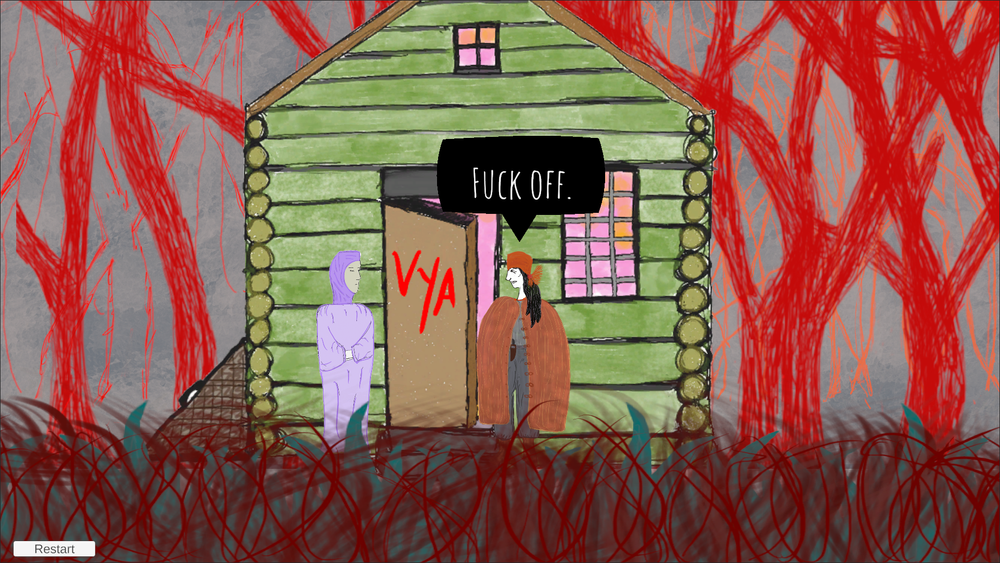
Vya, the playable character of my thesis game, can walk left and right. Eventually, the script that contains this movement will include others: definitely crouching, maybe kicking, possibly some hand gesture that suggests grabbing an object. But walking is the most important movement in my game, as it is for many narrative games. It is consequential in ways that go beyond the mere conveyance of Vya from one point along the x-axis to another. In Vya, walking into invisible colliders triggers narration, branching dialogue, animations, and scene changes. In a word, walking is eventful.

This script also activates Vya’s “walking” animation. As she shuffles her feet across the screen, the rest of her body remains fairly still, entombed in the heavy winter coat she wears. Her feet seem disconnected from the rest of her body, and they kind of are, since I basically sliced her feet and repositioned them to create the animation frames. When I describe Vya, I often characterize her movement as “janky”—broken and inelegant. What started as a preemptive apology for my animation skills I now present as a deliberate design choice, one that reflects how a body moves in middle age.

“Is ‘janky’ really how middle-aged women walk?” a friend asks. I think about that question for a long time. Sometimes, when the crosswalk light starts blinking, I’ll pick up my pace and walk-run to the sidewalk. This drives my kid crazy. “You’re not actually moving faster,” he tells me. A year ago, I pulled a muscle in my leg. While it persisted, standing up from a sitting position—something I do many times a day—was slow and painful. The funny thing is that no one said anything about this. Maybe I am at the age when it is normal to be unsteady on your feet, to look a little stupid when you run across the street. But I also think that by the time a woman reaches middle age, she has spent most of her life scrutinizing the way she moves in the world, in no small part because her movements are—have always been—relentlessly under scrutiny.

Earlier this month, I attended a lecture by Bennett Foddy at the NYU Game Center. His talk, “Why Did I Make This?” was a detailed retrospective of almost two decades of game making, from his early experiments like Many Ninjas (2007) to Baby Steps (2025), a reimagining of the walking simulator genre. Foddy’s games are known for their “difficult” playable character movements, which have influenced my own thinking about player movement and uncomfortable game design. In Getting Over It with Bennett Foddy (2017), an extraordinary study on persistence and failure, the playable character, Diogenes, is a white man with a lean, muscular torso who the player maneuvers up a mountain with the help of a climbing hammer. Diogenes has a climber’s physique, but the catch here is that the rest of his body is encased in a black cauldron. To move him, you need to adjust the angle and position of the climbing hammer to push your cauldron body over the mountain. Failure risks repeating the tedious effort from the very beginning.

But in Foddy’s other games, like QWOP (2008) and Baby Steps, the playable character’s body is designed to make basic game movements, like taking a step, laborious and error-prone. In a 2014 GDC talk, Frank Lantz, who was then chair of the Game Center and Foddy’s colleague, observed how QWOP’s tricky movement mechanic encourages the player to think about what it means to move: “Here’s this thing that we take for granted—walking. We do it with a fluid grace, a natural, instinctual behavior. What happens when we make it deliberate, conscious?” For Foddy, these words illuminated a major thread that continues to run through his games: “You have to take what is automatic to you and make it intentional,” he tells us.

The word “intentional” unsettles me. I start to feel my heart racing, and a familiar feeling creeps in, the one that I have never been able to name but lies somewhere between sadness and rage. I am wondering what it would feel like to experience walking as a movement one can take for granted, as unintentional. I try to recall a time when I moved through the world in this way, and I can’t think of a single one.

I am watching clips of QWOP play on the large lecture screen and thinking that this tangle of flailing limbs is how my body must have looked that day, two summers ago, when a man punched me in the back on Nassau Street. In my memory of this moment, I am standing outside of my body, watching it lurch forward. Somehow, I managed to stay on my feet. This man I didn’t know punched me with such force that his handprints clung to my shirt. The muscles that kept me from falling on the pavement hurt for days. But the thing that really stays with me and hurts the most is that he called me a fucking bitch.

“[QWOP] takes you way back, to the point where you can’t do the world’s most normal thing, which is to walk,” Foddy says. I am struck by Foddy’s universalizing framework. Who is the “you” he is addressing? How a player experiences the game’s “difficult” movement mechanic may be conditioned by the body they inhabit and their experience of movement in real life. For instance, women, people of color, queer and trans individuals, and people with disabilities do not have to go “way back” to feel far from “normal” in their everyday movements. Even the whole notion of what is “normal” movement is fraught, given how insistently patriarchy encourages women to normalize behavior that inhibits how they move in the world. Getting Over It is an astonishing game, not least because the white male body needs to be put into a cauldron in order to experience movement as difficult.

Vya’s walking animation encodes years of guarded and careful walking, and I want to continue thinking about how her movements in the game can reflect where she is in her journey through “midlife hell.” I don’t hold out hope that the world will change for women in my lifetime, but the truth is that I love walking. If I am drawn to games like Getting Over It, it is not because they ask me to be “deliberate and conscious” in my movements; rather, in the awkward and tormented movements of the characters I am playing, I recognize my way of walking.
Player Movement
683096dc7b1e064f37731a9a:683254c54a0d7f005974c063:69c751ea827a933afe2345d9
Extensions
Poems Make Games Better
An essay on poems as game assets.
Show full content

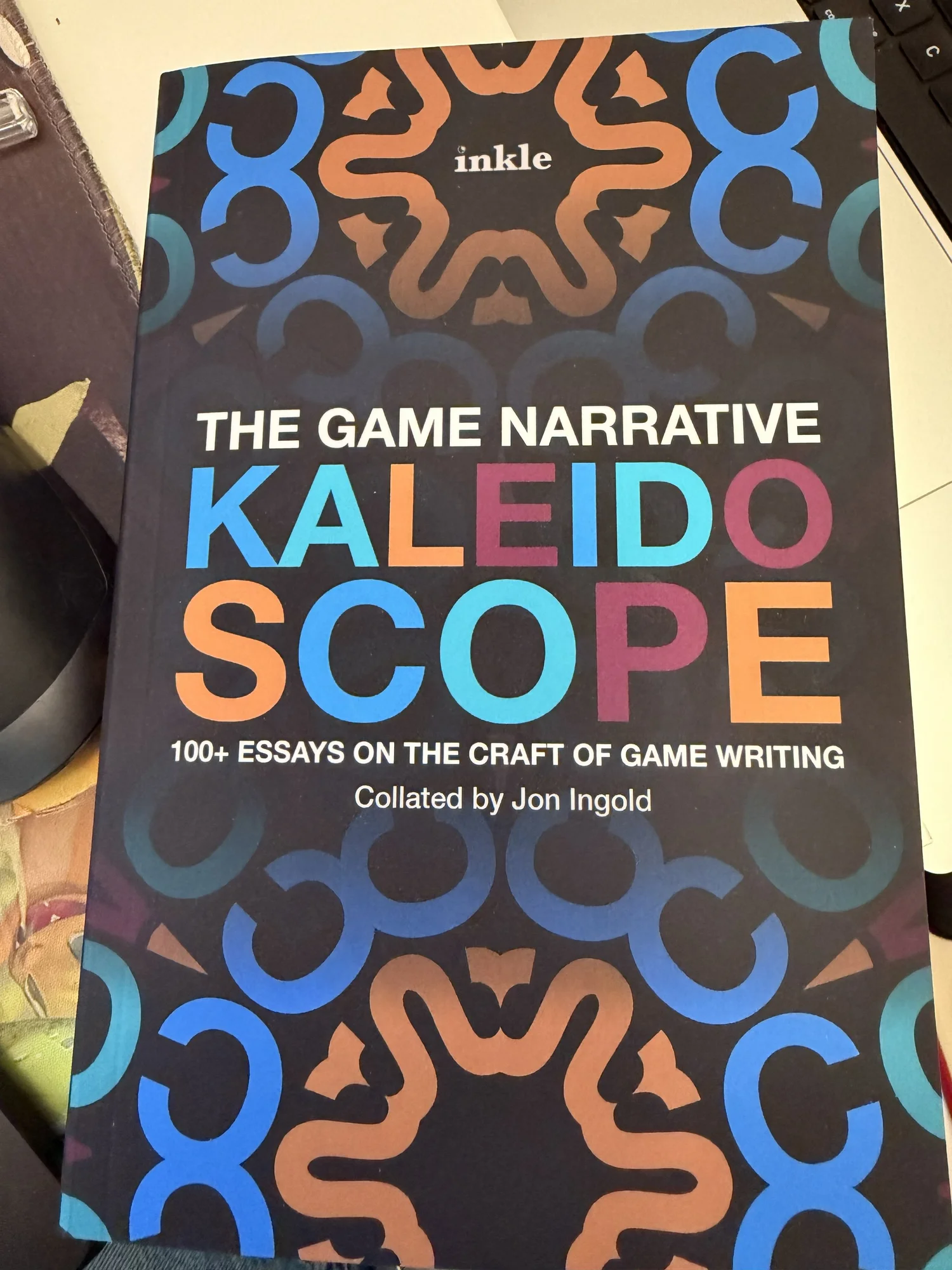
Late last year, Jon Ingold put out a call for 500-1000 word essays on narrative design and game writing. The collection—The Game Narrative Kaleidoscope: 100+ Essays on the Craft of Game Writing—is out now and includes my essay on poems as videogame assets. I encourage you to buy the book, but I’m happy to make my essay available here. And despite owning a copy of this book, which is literally next to me as I write this, I still managed to misspell “kaleidoscope.”

 Including poetry in a videogame is bold. I don’t mean games where one expects to find a poem, like Lawra Suits Clark’s Play a Hot Number or Doki Doki Literature Club (2017, Team Salvato). I am thinking specifically about games where poems appear as part of environmental storytelling or as a lore object. As a poet, I am inclined to think that poems make a game better, but I suspect that the probability a player is reading these texts carefully, especially mid-run, is low.

Reading a poem carefully means spending time with it, ideally, rereading it many times. The analogy is a cliché but nonetheless apt: rereading a poem is like peeling back the layers of an onion. The features that can make a poem daunting—figurative language, unconventional syntax, oblique images—are precisely what makes rereading a critical practice. Every time you reread a poem, the parts that feel obscure and confusing start to make sense—they start making sense to you, in a way that strikes a balance between the meanings a poet encodes in a poem and those that your reading creates.

Including a poem in a videogame is bold because there is no guarantee that a player will have the interest, attention, or opportunity to revisit the poem. I am always moved when I come across a poem in a game, knowing how much work goes into writing a thoughtful poem. I am currently playing Clair Obscur: Expedition 33 (2025, Sandfall Interactive) and assiduously collecting journal entries from previous expeditions. The entry for expedition 36 is a poem by a poet named “Isabelle.” You find it by beautiful white tree, in a scene that feels like you are in a painting. There is no obligation to spend time with this poem; you even have the option to turn off the voiceover reciting it. To move on, you need to close the inventory. The poem remains there, available to be reread, but there is so much else to do in this game, and nothing else the game asks us to do with Isabelle’s words.

Roguelikes, on the other hand, are well equipped to encourage, even compel, poetic rereading, but doing so requires intentional narrative design. Unless picking up and rereading a poem is essential to the completion of the game loop, let alone the game itself, its recurrence does not guarantee that a player will engage a poem more than once or at all. In Returnal: Ascension, the free DLC (downloadable content) for Returnal (2021, Housemarque), interacting with a book in the hospital sequence reveals two poems, “The Lamentation of Sisyphus” and “Prayer of the Moirai.” Completing the hospital sequence requires that a player return to this space several times, but repeated interaction with the book asset does not further affect the scene or game. But what I love about this poem is how it explicitly connects the story of Returnal to Greek mythology, specifically the roguelike myth of Sisyphus, condemned to carry the same rock up the same hill for all eternity, as well as the Fates, who weave the course of human lives (the web-like textures in the main game may be a reference to the latter). While evocative, these poems are optional worldbuilding features, designed for the kind of player who enjoys meticulous interaction with the environment and its storytelling.

Hades 2 (2025, Supergiant Games), on the other hand, is an example of how a game’s narrative design can achieve an obligatory integration of poetry in the game loop cycle. Interactions with NPCs (non-playable characters) like Circe, Arachne, and Medea introduce players to a range of poetic language and forms, from couplets to quatrains, full and slant rhyme, and more.  The poetic dialogue activates the moment Melinoë, the playable character, enters their rooms and continues until the player approaches the NPC or the poem’s recitation has concluded. Either way, between entering the room and triggering the NPC interaction, the player hears some of the poem.

The poems of Arachne, a spider, include references to weaving and allusions to her backstory, even a nod to the roguelike structure of the game itself. “Once more” or “And, back again” are among the final lines she will say before repeating the poem one more time. Circe’s poems consist primarily of potion ingredients, but this language frequently acknowledges the game’s inventory system and gardening mechanic—“heap of soil, chip of stone,/ harpy feather, knuckle bone,” for example.

Elective or obligatory, the roguelike game loop of Hades 2 and Returnal encourages a praxis of rereading that enriches the role that poetry assets have in these games, where they often call attention to the finer details of the game world. But these poems also have the capacity, as poems often do, to speak directly to a player’s experience both within and outside of this world. Medea is addressing Hecate when she says, “I first encountered you whilst in a haze,/ and you returned to me my will to fight,” but she is also speaking to and for us.

Poems Make Games Better
683096dc7b1e064f37731a9a:683254c54a0d7f005974c063:69bddf8faaa35a5b3ef37ace
Extensions
Connect
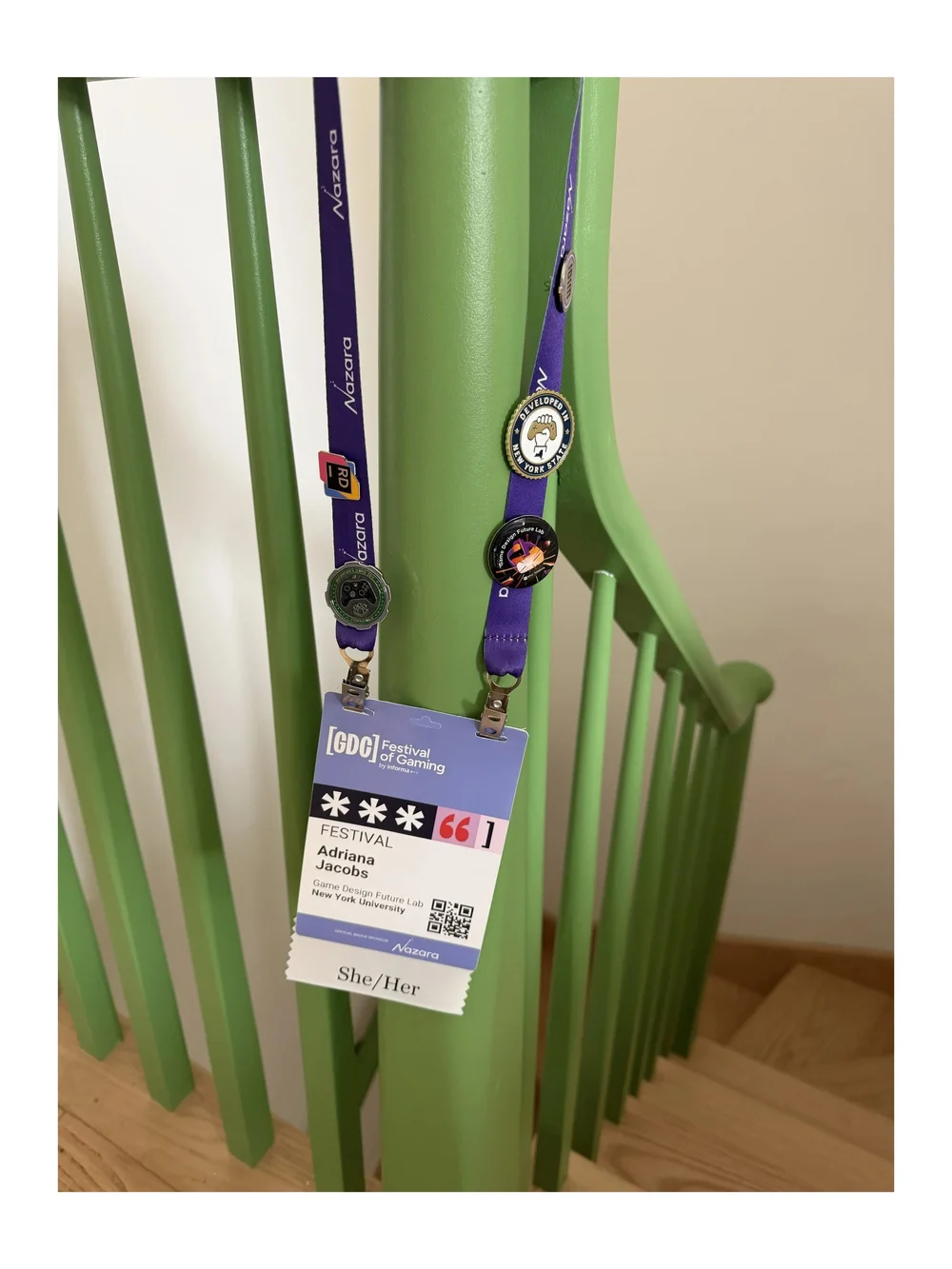
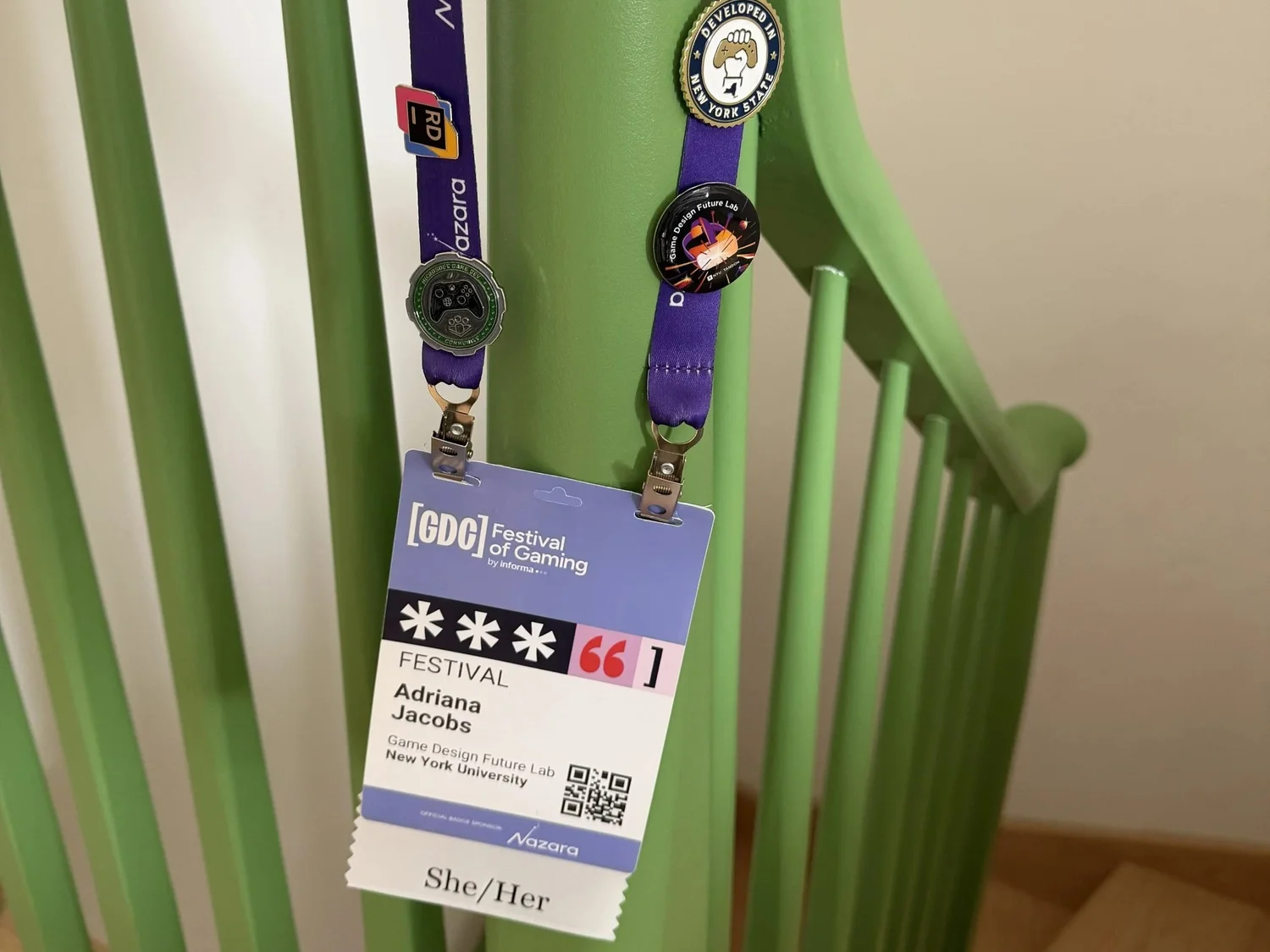
I went to the GDC for the first time and wrote about it.
Show full content

On my last night at GDC, I was at dinner with some friends from my MFA cohort and we were talking about the exhilarating disorientation and chaos of this conference. How it felt both profoundly tethered to our passions and interests, while also feeling sharply disconnected from the rest of our life. Nico described it as a “fever dream,” and I have not been able to shake off this description.

***

I know that one approach to GDC is to skip the talks and focus on in-person networking, but I really loved the talks and went to several. As a natural introvert, they also allowed me to reset socially, a welcome bonus. Here are some highlights:

The panel “Honing the Blade: Evolving Combat for Ghost of Yotei,” especially when Sucker Punch’s lead combat designer Theodore Fishman was talking about double-edged swords, environmental contexts, and player adaptability. He played an early prototype of the game to demonstrate how the playable character moved through water, a context that positively and negatively affects a player’s approach to combat, the environment itself embodying a metaphorical double-edged sword alongside the literal swords a player can choose to wield. Design and mechanics notwithstanding, and bearing in mind that I have not (yet) played this game, this approach to combat design is very poetic. And I don’t mean “poetic” as in a vague feeling or sentiment, but rather in a formal sense—in the antithetical relation between constraint and context, body and movement, address and response. If this battle moment were a poem, it would be Theodore Roethke’s “My Papa’s Waltz.”

“Performance and Direction Deep Dive” featuring the voice actors Jane Perry and Debra Wilson. Perry voices Selene, the main protagonist of Returnal (Housemarque 2021), a game that continues to inspire my thinking about poetry, translation, and videogames. In fact, I have an article coming out sometime this or next year on translation and videogames that features a long section on Returnal’s Xenoglyphs, mysterious obelisks featuring a language that you can translate with collectible ciphers. Returnal’s narrative designer Eevi Korhonen has a degree in translation studies and has spoken very persuasively about the generative space that translation crosses as it attempts to convey meaning between one language and another. As Selene translates these Xenoglyphs, she learns more about her environment, but the translations also expose her traumatized relation to language. (Oh my god, I love this game!) But back to Jane Perry: it was not my intention to approach her just for the sake of it, but after the panel, we were walking next to each other briefly and it seemed like the right moment to tell her how extraordinary it was to be a middle-aged woman playing a character who is a middle-aged woman voiced by a middle-aged woman. I also squeezed in a question about narrative design and the scout logs, which she graciously answered. She asked about my own work in game design and I told her briefly about Vya and how I want to make games that reflect the experiences of middle-aged women (because, really, such characters shouldn’t be “extraordinary”). “Yes! I fully support you on your journey,” she said. Her words felt like being hugged by those electric blue tendrils in the Overgrown Ruins.

Narrative Portfolio Review was not a talk, but rather an opportunity to have one’s portfolio assessed by a veteran narrative designer. An experience for which I stood in line for 2 hours, listening to a long interview with Rachel Reid and occasionally talking to the people I met in line. I opted for a random selection and drew Aysha U. Farah (Life is Strange, The Sky Left Us, Hiveswap 2). I presented my online portfolio, and Aysha’s feedback was very specific and precise, the kind of feedback that I can implement directly (and will do so very soon…).

Bruce Straley’s (The Last of Us, Uncharted 4, Coven of the Chicken Foot) talk on “fears, failures, and freedoms” will need its own post. It’s the one that resonated with me on a deeply personal, molecular level.

***

A lot of “connecting” happened at GDC. LinkedIn “connects” have replaced the business card (though there were some holdouts). Despite my misgivings about that platform (it’s too much like Facebook), I’m really pleased that most of these “connects” are the result of actual conversations with people, including people who played HEL10S, a game I worked on last year and showcased at the NY State Pavilion. Most of us who attend GDC and make (or want to make) games seek opportunities for visibility, collaboration, and investment, which risks turning every interaction into a potential transaction. When I asked questions or answered a question, I tried to remain anchored to a state of genuine curiosity. When this worked, I also felt very grounded in who I am right now, which hasn’t always been the case in my professional life. At the same time, this has been a period of reconnection with friends from other epochs of my life, as far back as twenty years. In these conversations, I sometimes feel partitioned—who I am now and in this moment ceding space to the self-parts cached in the past, sometimes a very latent, recessed past. If I go back far enough, the present can feel dislocated, unsettled. But there’s also something wondrous about this process, how it reveals the chiastic structure of our lives, with middle age being at the long center of it (if we’re lucky).

Connect
683096dc7b1e064f37731a9a:683254c54a0d7f005974c063:69bc3414691dfc2c0d2e8c44
Extensions
On the beach
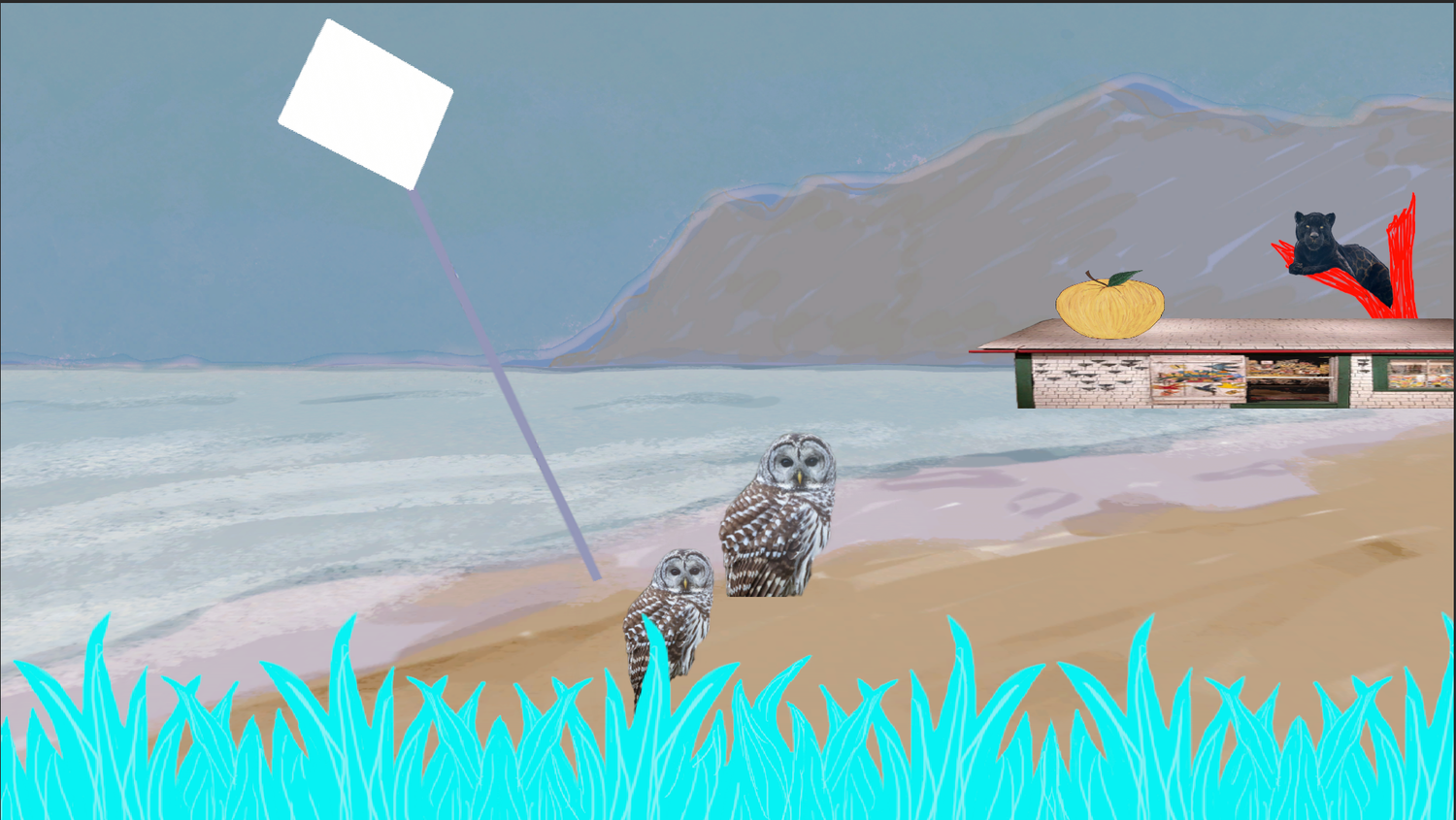
Vya update featuring Yarn Spinner, Limbo, beaches. Featured image is of my beach level prototype.
Show full content

My resolution to update my devlog weekly fell apart recently due to a bout of doubt. I am going to try to overcome the silence that doubt induces because I think it is very import to be honest about those weeks when game development is not going well. I have practiced this kind of honesty in my academic life, but maybe because game design is such a huge pivot for me, second-guessing and embarrassment muscle their way into any failure or struggle I encounter (and there are many!). “But you’re so good at what you do,” more than one person said to me when I started talking about studying game design. As if it is only permissible to change careers or specializations when you are not excelling at the one you have. Though I sometimes miss being “so good” at something, I don’t miss feeling stagnant. I don’t miss that at all.

Now for this week’s devlog update: Vya is a very “chatty” game, but until two weeks ago, I only had implemented Vya’s interior monologue, for which I relied on my own script and a bunch of colliders that activate textboxes when Vya walks by. It works well, however, for the game’s multiple branching dialogues and NPC background chatter, I am using Yarn Spinner, which is a ridiculously complicated and complex dialogue system. To be fair, most of the available dialogue systems are complicated, so in the end, it comes down to committing to one and persevering. Setting up speech bubbles was tricky, and I still have to customize them to fit my game’s visual style, but once I got them to work, the game’s next level—a nightclub—finally felt doable.

Vya and Pom—Yarn Spinner experiments in my prototype scene.

The nightclub level will correspond loosely to Dante’s Limbo, Hell’s first circle, where the outcasts (pagans, the unbaptized…) wallow eternally. Souls in Limbo do not suffer physical torment; rather, they exist in a state of constant tedium and yearning. When Dante and Virgil walk by, they are eager to talk and share their stories. I can see the entire level in my head—the sprites, the conversations, the critical path, how Pom (my game’s version of Virgil) interacts with the environment, and even the memories that Vya collects there.

A couple of weeks ago I hit a wall—working on a solo project can be really lonely. I miss working on a team, but what I struggled with really was my responsibility for all aspects of the game: art, writing, programming, level design, dialogue implementation, and more. To make this game, I inevitably end up working outside of my comfort zone, and for the past few weeks that zone has been Yarn Spinner.

Feeling unmoored, I took my copies of Alice Notley’s The Descent of Alette and For the Ride to the Game Center last week and spent an entire morning writing on the whiteboards of the small conference room. What emerged was a combination of poetry and dialogue for the game’s penultimate scene, which will take place on a beach. Here Vya and Pom, who reveals herself to be a certain poet, talk about aging, mortality, and the creative life. It is important that this conversation take place on an ocean beach both because I love beaches and because it is a classic liminal space that I associate with self-annihilation, transformation, apocalypse. The place where a vampire tired of immortality meets the sunrise. Or as one classmate put it, “your own Death Stranding.”

At the center of the last circle of Hell, Dante and Virgil find Lucifer encased in ice. Rereading this scene last week, I felt pity for the fallen angel, condemned to an eternity of immobility. So while it can be isolating, one of the gifts of working on a solo thesis project is that I can shift my focus and priorities. A long stretch of writing was the thaw I needed.

On the beach
683096dc7b1e064f37731a9a:683254c54a0d7f005974c063:6993fe543e701136e6a3a4b5
Extensions
Get and Set
A short Vya update, but mostly a post about properties.
Show full content

In my darkest moments, I worry that my study of programming, and specifically C# for Unity, will yield the same results as my attempt many years ago to learn ice skating. Then I remind myself that I can write a script that moves an object right and left. This is far more movement than I have ever managed on a rink.

This week’s code lab class was on properties. A property is a “wrapper” around a variable. The wrapper is a function (or functions) that adjusts every time the variable changes. A property “gets” and “sets” the variable, meaning that it retrieves it through the “get” function when it changes and (if necessary) modifies it through the “set” function. The property and variable must be the same word. The critical difference being that the property name is capitalized.

This is how programming works, I understand. But there is a part of my brain that implodes a little when it meets the resolute inflexibility of C#.

During our break, I went down the hall to the Clive Davis Institute, where Margrethe Aanestad’s Eternal IV, 2021 hangs on a wall. It is a giant pastel dot that turns from blue to black depending on where you are standing and the direction the light is hitting. It is a part of a series of Eternals that Aanestad began in 2017, each one unique “due to their handmade cumulative process of adding individual marks and traces.” Up close, you can see blue filaments curling at the edges of the circumference, pulled inward like cosmic dust or traveling outward like solar flares. Get and set.

***

On the art of computer programming, Donald Knuth had this to say:

A scientific approach is generally characterized by the words logical, systematic, impersonal, calm, rational, while an artistic approach is characterized by the words aesthetic, creative, humanitarian, anxious, irrational. It seems to me that both of these apparently contradictory approaches have great value with respect to computer programming.

First, let’s marvel for a moment at Knuth’s use of parallelism and antithesis, and how he uses hedging language to make it clear to the reader that the border between “scientific” and “artistic” is porous. I can’t help but notice that the word “generally” specifically targets the scientific approach, as if to unsettle the scientific side from the onset.

***

Brief Vya update: I spent most of the weekend revising a script called ActivateText. It does exactly what the name implies. As the Vya object moves through the scene, it triggers the activation of textboxes that contain the introduction’s main narration. Initially, the textboxes were on a timer and meant to fade out after 10 seconds, but this wasn’t working very well, maybe because they were all using the same textbox game object. Now Vya freezes until the player presses the spacebar to keep moving, so there is time to read or not read the narration at the player’s leisure. It also helps break the monotony of just holding down the left arrow key to move. Yes, Vya moves to the left in order to activate the narration. It’s a bit unusual, but after years of reading Hebrew texts, right to left reading comes naturally to me. I wanted to capture that feeling. I’m also absolutely going to use properties in this game—like memory/Memory and decay/Decay.

Get and Set
683096dc7b1e064f37731a9a:683254c54a0d7f005974c063:692dd2aeba45eb5baa855a75
Extensions
Introducing Vya
Introducing my MFA thesis game.
Show full content

At least twice a day, I spend time in an elevator, traveling the distance between my home and the world outside. Descent, which takes me away from my comfort zone, always requires a different kind of resolve. The poet in me can’t help but draw analogies to katabasis, Greek for “going down,” the name given to underworld narratives, like Persephone’s abduction into Hades, Dante’s Inferno, Alice Notley’s The Descent of Alette, or Neil Marshall’s The Descent. In these works, the underworld is a formidable place where the protagonist encounters the garrulous dead, their own fears, an obstacle course, a confrontation with the most hidden parts of themselves. Inspired by these descents, especially Dante’s Inferno, my video game Vya is a downward journey into the under layers of the middle-aged self. Along the way, the eponymous protagonist will encounter shades from her past, personal demons, figures of repression. Her experiences there will be claustrophobic and inescapable, raw and uncomfortable, precisely the kind of experiences she endeavored to avoid by escaping to life in the woods. Vya is a single-player narrative adventure game which I am building in Unity, using Yarn Spinner for the bulk of its branching dialogues.

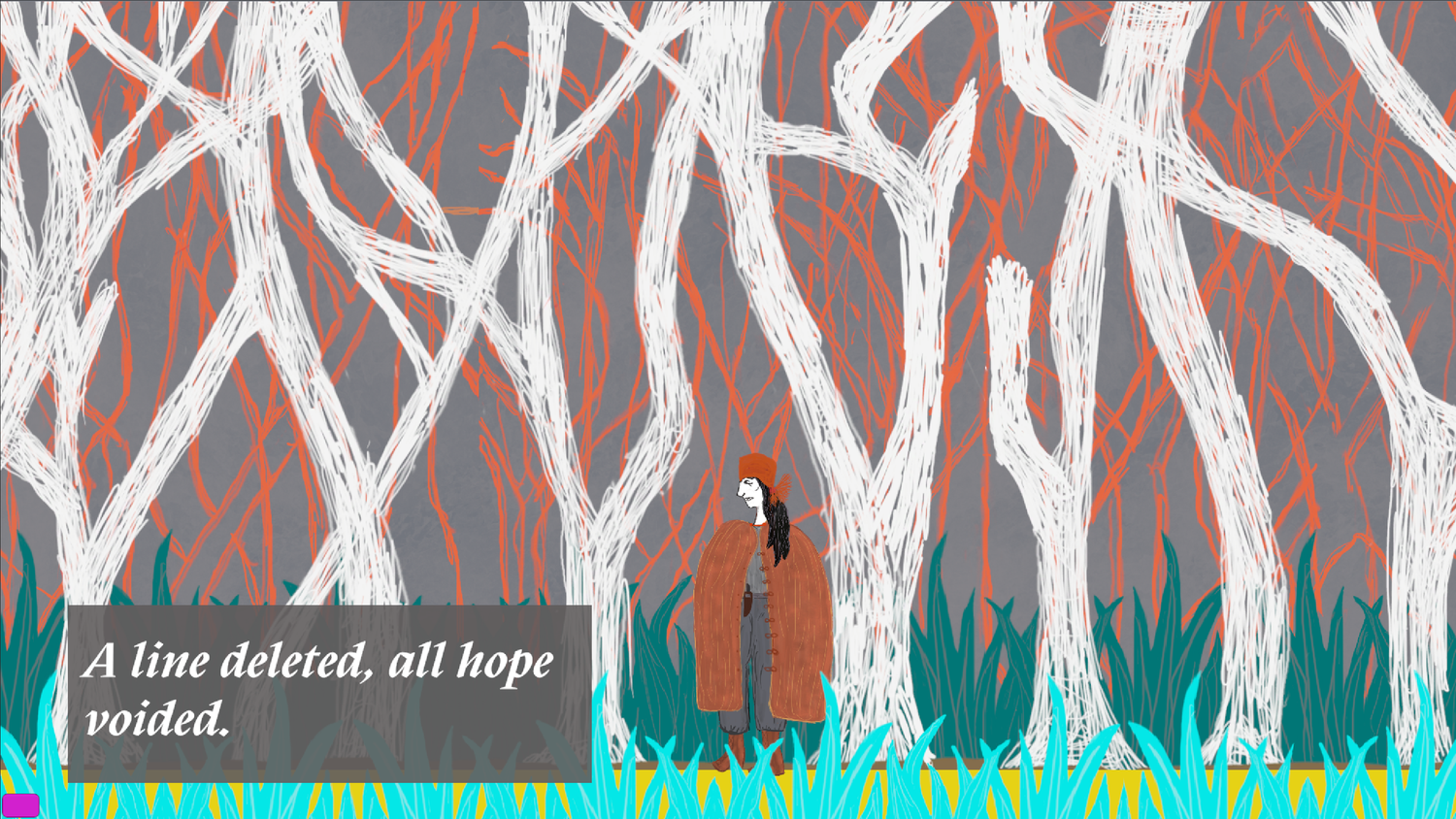
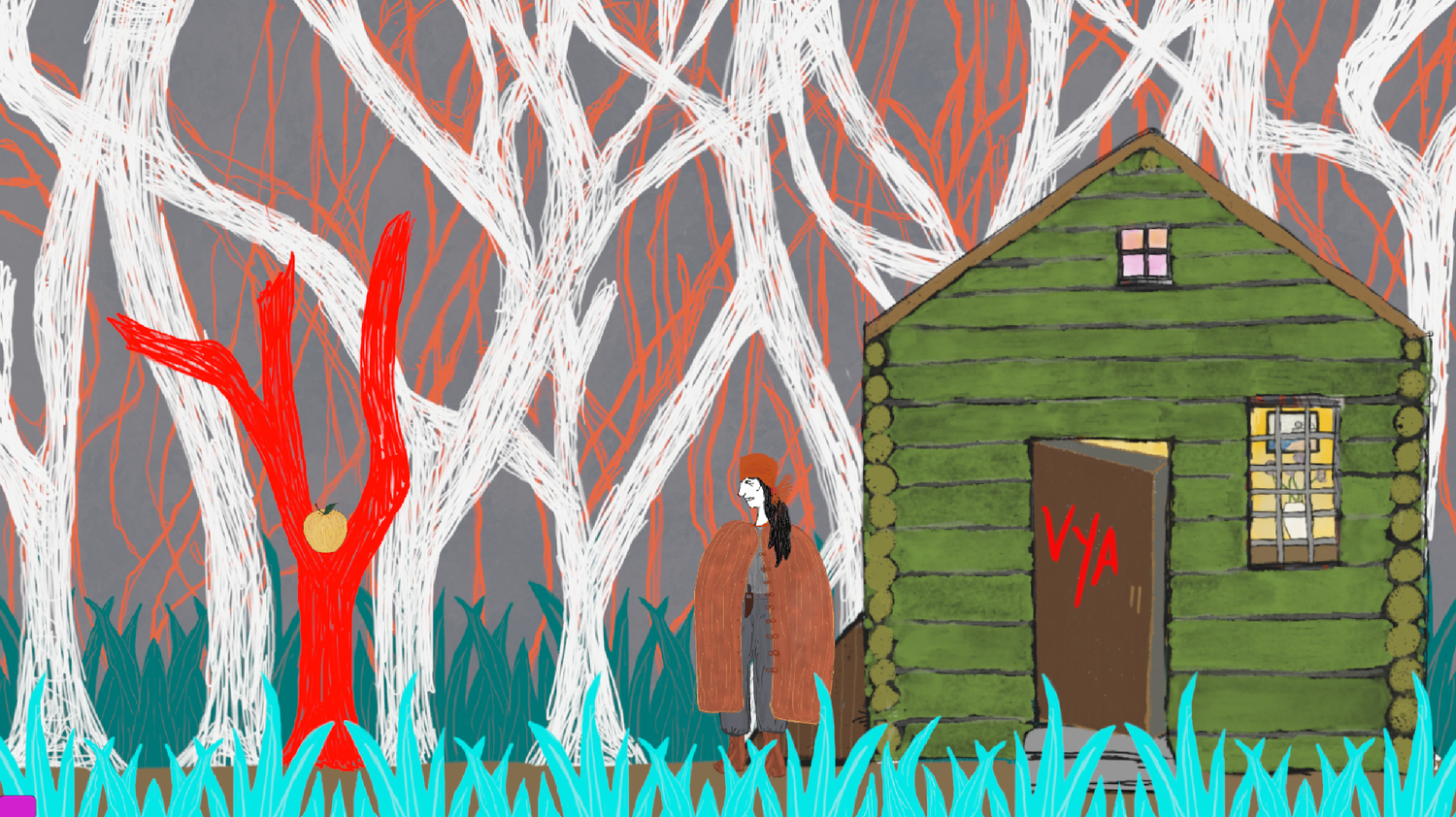
When the game opens, we find Vya in her forest home, reflecting obliquely on the motivations for her retreat from the outside world. Her narration begins with the lines “Midway upon the journey of my life/ I found myself within a forest dark.” Dante uses “midway” (nel mezzo del cammin), a spatial measure, to represent mid-life (for him, the age of thirty-five) and the “forest dark” (una selva oscura) as a figure of doubt and uncertainty. “Forest dark” is Henry Wadsworth Longfellow’s translation (in fact the first few lines of the introduction borrow directly from it), and it has inspired the introduction’s level design. For the opening, I wanted to capture a feeling of comforting and claustrophobic containment. The forest is Vya’s comfort zone but also a place of risks and dangers that she evades by not straying from a linear path. Rendering it as a two-dimensional level, where players can move only from left to right, serves as a convenient shorthand for the linearity and predictability of Vya’s life. Parallax scrolling imparts a feeling of depth, gesturing to the wider world while inhibiting the player’s ability to explore it. From the player’s perspective, Vya should appear to be enclosed, maybe even trapped, in this forest, implying that the straight path is the problem.

A few years ago, when I started telling close friends that I wanted to study game design, a few suggested that I was having a midlife crisis. The phrase carries such negative connotations, the weight of a warning, but instead the word “crisis” would bring me other meanings, like “turning point” and “change.” In Hebrew, the word for crisis—mashber—is related to fragmentation and shattering. The word for rift—shever—is a relative.  In English, as in Hebrew, a rift designates the breaking apart of landmasses. Geological rifts feature varied landscapes and habitats, creating conditions for biodiversity. A midlife crisis is a rift. It can be isolating and violent, but also creative and transformative. That is what Vya is about.

Introducing Vya
683096dc7b1e064f37731a9a:683254c54a0d7f005974c063:697cf5c11b8f7263ac852c2f
Extensions
Limits and ladders
“Every limit is a beginning as well as an ending.”—George Eliot
Show full content

The first time I tried to play The Last of Us (Naughty Dog, 2013) was in the spring of 2019, following a ten-year hiatus from video games. I didn’t make it very far.

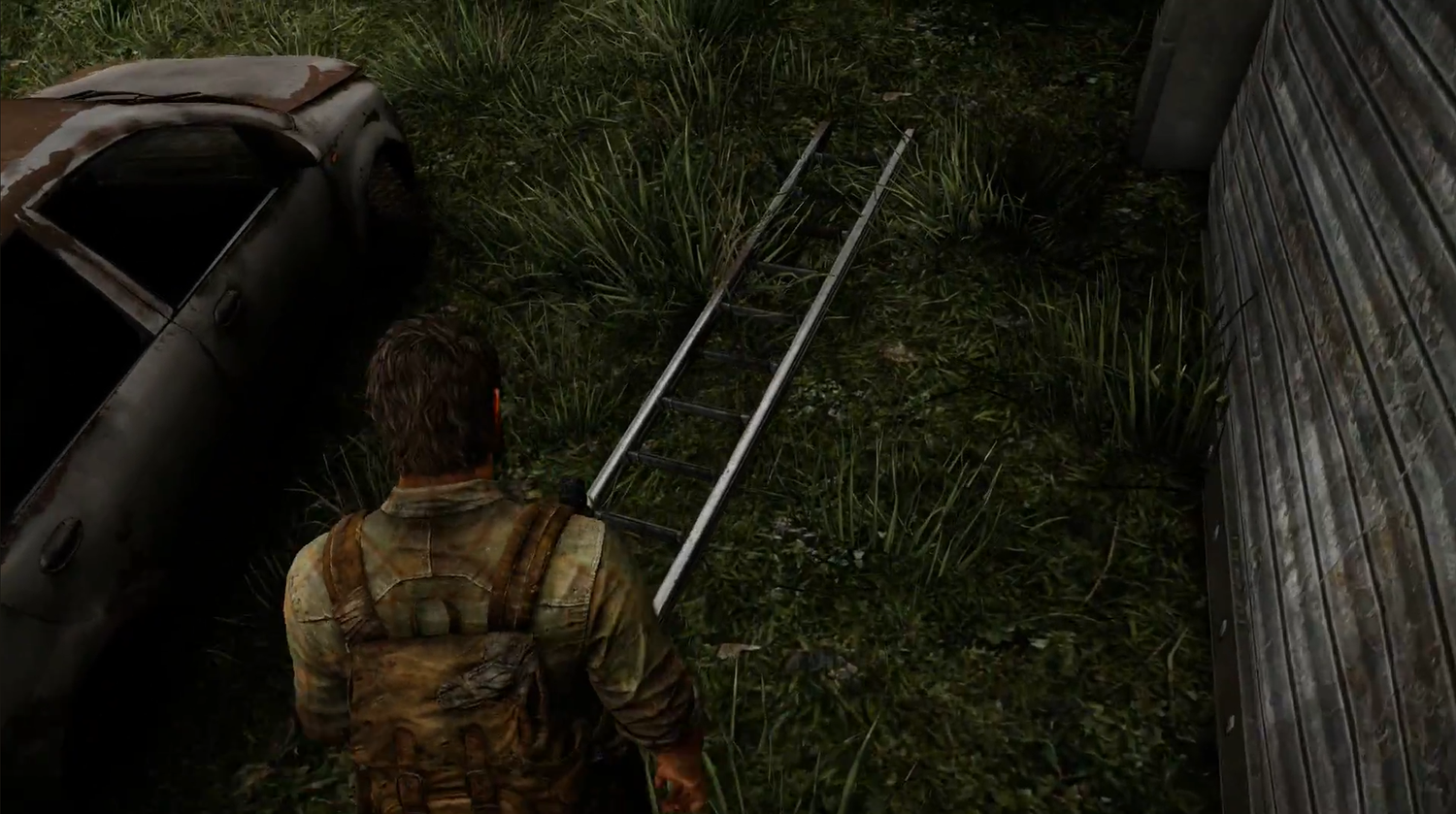
In the opening chapter, the game introduces several tutorial-like tasks. I learned how to pick up objects, move my player from one room to the next, and—most importantly—how to shoot and run. I entered a building and encountered my first infected person, and after bumbling around with the controls, I managed to eliminate them. I moved through every room, peering through cracks in the doors and windows. I could see that outside there was road, I just didn’t know how to get there. The building was adjacent to others, forming a grassy enclosure full of detritus. There I found a ladder, but the only place it reached was the building I had just exited.

I was moving in circles. My son had his head in his hands, begging me to give him the controller. I knew that he knew what to do because for months I had watched him play Fortnite with strangers, screaming ‘Revive me!’ I decided that this overgrown courtyard was as far as I could go and put my controller down. I had been a gamer once—now I felt old.

*

On Friday, March 20, 2020, my son’s school announced that it was closing “until further notice.” That morning, we took our usual route along the northeastern curve of our street, and through the short passageway that exits toward the school. Sometimes the bollards blocking cars from using this path lie broken on the ground, but not that day. We probably sprinted part of the way. We were always racing to get to the school gate. We lived next to the school and always thought that we had time to spare. And then, suddenly, there was no more school run.

*

We have been in lockdown mode for months. We have a pandemic routine: wake up, get dressed, eat breakfast. Print homework pdfs. Lunch. More work. Eat dinner, watch TV. It feels like doom and it feels cozy. We go out once a day for our brief government-approved outdoor exercise. We do this as a family, at night, when the streets are empty. Sometimes a cyclist whizzes by, sometimes a speeding car. I miss the adrenaline rush of almost being late to school. We get home and it’s time for bed. For everyone else, but not for me.

The pandemic has turned me into a gamer. I don’t remember now the exact moment, but not long into the first lockdown, I decided to give The Last of Us another try and this time figured out where to place the ladder. Detailed YouTube videos helped me out of my first serious confrontations with the infected, and many hours later, when the closing credits rolled, I started crying. I knew that I wouldn’t be able to go back to the old way of doing things. The colons and coinages of peer-reviewed articles, conference presentations where I said things like “in what follows, I will argue that”?—these forms didn’t make sense anymore. I started writing poems again and played more games. I sketched out an idea for a game and then another. I should have been enjoying the fruits of my professional “expertise,” instead, I read game design books, and wondered if it was too late to learn how to code.

The answers would come later. On this night, in the middle of the pandemic, I am playing as a parent navigating a global crisis without a blueprint. “You keep finding something to fight for,” Joel says, stroking his broken watch. What am I fighting for? To keep my family safe. To climb the ladder. Time and breath.

I want to stay alive. I pick up my controller and head to Pittsburgh. 

Limits and ladders
683096dc7b1e064f37731a9a:683254c54a0d7f005974c063:683254c54a0d7f005974c064
Extensions
Welcome
A place for my thoughts on poetry and video games.
Show full content

While I’m still figuring out if this is a blog, devlog, newsletter repository or some combination of all three, here’s a provisional list of topics this page may cover—

  • devlog

  • making Vya, a game about midlife (part of my MFA in Game Design)

  • an assortment of unpublished writing from the past five years—most of it about video games I played during the pandemic

  • poetry (what I am writing and reading)

  • middle-age

  • poem-games

  • my forays into the visual arts (drawing, cross stitch, and letterpress)

  • a book, show, film, song that I have enjoyed recently

  • last but not least—narrative design

Welcome
683096dc7b1e064f37731a9a:683254c54a0d7f005974c063:683254c54a0d7f005974c066
Extensions
← Back to feeds