GeistHaus
log in · sign up

Elizabeth Spiers

Digital Strategist, Writer, and Podcaster

rss
15 posts
Feed metadata
Generator Ghost 6.34
Status active
Last polled Apr 29, 2026 01:35 UTC
Next poll Apr 30, 2026 01:35 UTC
Poll interval 86400s
ETag W/"315c1-xcWNK3RQSybAVK7Sx2dU33Hz54M"

Posts

Palantir’s Manifesto Promises a Dystopian Future

I regret to inform you that the Silicon Valley billionaires keep doing and saying dumb horrible things, and so I must continue to write about them. This week's ambulatory polar fleeced repository of hubris is Palantir's Alex Karp. Below is my column for The Nation about

Show full content
Palantir’s Manifesto Promises a Dystopian Future

I regret to inform you that the Silicon Valley billionaires keep doing and saying dumb horrible things, and so I must continue to write about them. This week's ambulatory polar fleeced repository of hubris is Palantir's Alex Karp. Below is my column for The Nation about his manifesto via Tweet, which is a summary of his book.


Once upon a time, we lived in a society where the innermost thoughts of the one percent were largely confined to their own brains and the inner circles of their social and professional relationships. Then came the Internet, which gave anyone with a wireless connection or a smartphone the ability to broadcast their good and bad ideas to millions of people at once. Among the most aggressive adopters: Silicon Valley billionaires. When Marc Andressen wrote a 5,000-plus-word post titled “The Techno-Optimist Manifesto” in 2023, it went viral, and became something of a template for kindred grandiose edicts from various CEOs and founders in the tech industry. At the time, I wrote that Andreessen’s manifesto had the pathos of the Unabomber manifesto but lacked its ideological coherence. Now another sort of manifesto has been produced by Palantir CEO Alex Karp in the form of a summary on X of his book, The Technological Republic. It shares the same intellectual lapses endemic to the genre Andreessen helped launch, but it’s bleaker, more antidemocratic, and nihilistic in its worldview.

As a longtime social-media user, I’m sympathetic to the inclination to post one’s every opinion to the Internet, no matter how idiotic. But this isn’t just a matter of the wealthiest people in the world floating iffy ideas about innovation or posting cat memes. Their posts serve as a kind of evangelicalism for a new order in which technocrats are in charge, equality is a naïve aspiration promoted by woke mediocrities, and technology customized to attain power is an unalloyed good.

That this roster of tech-bro shibboleths is remarkably tone deaf in the current environment of economic and political uncertainty bothers Valley propagandists not a whit. Someone recently threw a Molotov cocktail at Open AI CEO Sam Altman’s house, Elon Musk’s unfavorability is at an all-time high in recent polls, and a majority of Americans think AI will do more harm than good. But instead of treating this information as valuable feedback, the oligarchs have doubled down on exactly the things that give people pause about their metastasizing infiltration of all aspects of public and private life.

Karp’s manifesto-via-tweet asserts primarily that we can achieve peace through war, and that billionaires brandishing “grand narratives” in the manner of Elon Musk should be in the country’s driver’s seat, sending ordinary citizens to the battlefield whether they like it or not. (Among the recommendations in Karp’s unhinged rantings is a proposal to revive the military draft—a singularly boneheaded idea at a moment when the country is waging an unprovoked, illegal, and massively unpopular war.)

This is a convenient philosophy for a billionaire who runs a company engorged on defense contracts and likes to construct grand narratives himself. But we are at an inflection point where a big chunk of our economy is affected by AI and the incestuous circle of spending and investing that Karp, Musk, and their peers are perpetuating—to say nothing of the cataclysmic implications for labor markets as jobs get replaced or changed. The billionaire tech-bros’ insistence on telling us exactly what they aim to do, on saying the bad quiet parts out loud, is designed to indoctrinate you. But if it doesn’t, they don’t care. They’re going to proceed anyway, and if recent history is any indication, no one with regulatory power is going to stop them.

By way of analytic context: Palantir is a data analytics company and defense contractor that sells surveillance technology to the US government and allied countries, as well as to the private sector. It’s won $1.9 billion in US contracts since 2008, and Karp received $6.8 billion in compensation in 2024, making him the highest-paid public company CEO that year. Under the Trump administration, Palantir has won contracts to consolidate data on individual Americans and track migrants, raising concerns about data privacy and the government’s ability to surveil its own citizens and potentially, to punish political dissenters. Palantir’s technology has also been used to target Iranians and Palestinians in Gaza for bombing, to devastating effect.

It comes as no surprise then that Karp’s vision for America encourages maximal usage of Palantir’s technology to exert power, against both US citizens and foreign powers who may or may not be current adversaries. This strategy would, among other things, increase profits for Palantir. More war and less diplomacy is hardly a winning message with the public, so Karp has to lend his self-interested agenda a certain civilizational gravitas, in the Musk vein. He positions himself as a heroic defender of an idea of America defined by a nebulous “national” culture that reflects the values of “the West.” If this sounds like the sort of back-of-the-cereal-box ethnonationalism now coursing through the MAGA/groyper world, that’s because it is; non-Western cultures are very much not included.

But beyond such affinities with the Trumpian right, Karp’s self-serving manifesto also reflects the insular worldview of the Silicon Valley elite. The billionaire cohort of tech oligarchs simply isn’t obliged to move in any space that treats the open endorsement of quasi-eugenicist racial chauvinism as dangerous or offensive. They’ve also repeatedly seen that there are no consequences for evangelizing a warmongering authoritarianism. If you’re a billionaire, you indeed rarely face any consequences for anything, because every problem can be solved with money. As far as Karp is concerned, the current problem to be solved is the “hollow pluralism,” as he calls it, that insists our democracy include all citizens regardless of their cultural background or net worth.

The key corollary, of course, is that Karp wants more scrutiny for American citizens and anyone who doesn’t belong to whatever he considers “Western civilization” at the moment. Meanwhile, there’s one group Karp thinks should have more privacy: “The ruthless exposure of the private lives of public figures drives far too much talent away from public service. The public arena—and the shallow and petty assaults against those who dare to do something other than enrich themselves—has become so unforgiving that the republic is left with a significant roster of ineffectual, empty vessels whose ambition one would forgive if there were any genuine belief structure lurking within.” This is a jaw-dropping claim to make in a country whose president is in the Epstein files, has been the subject of multiple accusations of sexual assault, has been found guilty of financial fraud—and has suffered no real consequences for any of it. If anything, the exposure of Donald Trump’s private behavior has underscored how little accountability actually matters if our lawmakers aren’t willing to enforce laws and ethical norms.

You, on the other hand, are a collection of data points, and in Karp’s view the government and Palantir are entitled to scrutinize your personal life down to every purchase, message, location, and transaction. Alex Karp and Donald Trump are to be granted privacy and a consequence-free existence—you’ll scrape by in a job-starved regime running on AI and maximal surveillance, and be grateful not to end up in a detention camp or on a dissident watch list.

In fact, Karp believes that the country’s problems lie not with powerful public figures like himself but with everyday Americans, who in his view must share more fully in the risk and costs of the wars we fight. “National service should be a universal duty,” he writes. “We should, as a society, consider moving away from an all-volunteer force and only fight the next war if everyone shares in the risk and the cost.” Karp is 58, has never served in the armed forces himself and doesn’t have children, so he’s not advocating for anything that would put himself or anyone he loves in danger. He has never experienced the horrors of war firsthand. Like many Silicon Valley billionaires, he travels with a personal security force that ensures his personal safety at every level—but he’s happy to endanger the lives of others if it justifies spending more money on Palantir’s burgeoning defense portfolio. Like any other war profiteer, Karp will simply keep padding his bottom line, and will never be compelled by law to fight and die in a needless war because a billionaire wanted to make more money.

Under his dystopian vision, Palantir would thrive and grow because safety and security are conflated with hard power—i.e., technological and military shows of force. Basic norms of international relations will be discarded entirely—a process now sent into overdrive by the Trump White House. “The limits of soft power, of soaring rhetoric alone, have been exposed,” Karp writes. “The ability of free and democratic societies to prevail requires something more than moral appeal.”

Karp’s glib invocation of “soaring rhetoric” marks a wild distortion—or incredible ignorance—of what soft power is. American hegemony has been built less on the spoils of modern warfare than things like cultural exports, economic influence, the primacy of the dollar as the world’s reserve currency, and the country’s ability to form alliances with other democratic nations without ever firing a gun, much less dropping a bomb. When we have ditched this framework to go to war with other countries in the post–Cold War era—via the invasions of Iraq, Afghanistan, and now Iran—the results have been costly and disastrous.

But there is no sophisticated theory of international relations behind Karp’s recipe for still more rudderless intervention. His assessment of global realpolitik would make Hans Morgenthau roll over in his grave–possibly with enough centrifugal force to precipitate a minor explosion himself. Karp’s bellicosity exceeds that of even the most extreme national security hawks. He explicitly disdains the idea of debating the value of technologies like the targeting-and-surveillance complexes marketed by Palantir. Instead, he believes that we should build first and ask questions later—because, he says, that is what our adversaries would do.

Except that they don’t. By Karp’s logic, any of our foreign adversaries who have access to devastating weapons will use them. This is not just a cynic’s understanding of warfare; it’s that of an ill-informed amateur. Karp nods to the nuclear deterrence of the Cold War, but doesn’t acknowledge that an unfettered arms race by one party in a nuclear standoff is a good way to undermine that deterrence. Worse, he doesn’t understand that all war is a failure of diplomacy and should be viewed only as a last resort, not as a preemptive strategy for defense.

The rest of his manifesto is mostly a hodgepodge of grievances about the usual preoccupations of the right wing. He claims that intolerance of religious belief is “pervasive” in America, where a majority of people are religious and provisions for the free exercise of religion are literally written into our Constitution. He says that America was too hard on Germany after World War II, even though the Marshall Plan was instrumental in preventing occupied Germany–and the rest of the European continent—from sinking into further violence. (In Karp’s ideal world, postwar Germany would be a major Palantir customer.) He dips a toe into eugenics by claiming that certain cultures are superior to others and that diversity and inclusion baselessly elevates inferior humans. He claims that we’re too cautious about public speech, but has railed against pro-Palestinian protesters and said they should be exiled to North Korea because their behavior is “unforgivable.” (Israel is also a Palantir client, and in case there was any confusion, the company recently took out a full-page ad in The New York Times that read in full, “Palantir stands with Israel.”)

Karp has claimed to be a socialist, and a liberal, when doing so has been rhetorically convenient, but it’s hard to look at his actions and speech and conclude that he’s anything but an ideological nihilist. However, even a nihilist can have a religion of sorts (Karp labels everything he considers woke “a ‘pagan’ religion”), and Karp’s is a corporatized imperialism whereby the United States acquires and maintains power via weaponized AI. As a happy byproduct of these arrangements, Alex Karp also acquires and maintains wealth and power.

As a vision statement, his manifesto is grim and muddled by personal resentments, but as documentation of Karp’s own motivations and interests, it is a good articulation of what’s going on in his head. Only a few years ago, these maunderings would have stayed in his head, but Karp’s fellow oligarchs have provided him with the technology to broadcast them—and he cannot resist. But no one has to buy his mangled self-justifications, or his ahistorical insistence that America will experience peace and prosperity only if we become a global bully ever on the lookout to eliminate nebulously perceived threats. Palantir’s tweet thread, and the nihilistic tech-bro worldview behind it, deserves what any troll on a social media platform usually gets: the mute button.


As always, thank you for reading! If you want to support my work, there are several ways to do so including just sharing this column. You can also subscribe to this newsletter, buy me a gin martini via tip, or sign up for a workshop. (I'll be adding summer dates for new workshops this weekend, so check back or sign up for notifications if you're interested.)

Have a good weekend, and don't let the oligarchs get you down!

Elizabeth

69eb6a710ec09d000177b567
Extensions
The Anti-Intellectualism of Silicon Valley Elites

I recently re-read Richard Hofstadter's Anti-Intellectualism in American Life, and now every time a reactionary Silicon Valley billionaire opens his mouth, I think about it. So I wrote about it for The Nation. Here's the column:


On Instagram, there’s an activist named Brian Patrick

Show full content
The Anti-Intellectualism of Silicon Valley Elites

I recently re-read Richard Hofstadter's Anti-Intellectualism in American Life, and now every time a reactionary Silicon Valley billionaire opens his mouth, I think about it. So I wrote about it for The Nation. Here's the column:


On Instagram, there’s an activist named Brian Patrick (@pano.dime) who has dedicated his account to “posting an insane thing an AI executive said every day in 2026.” I can’t stop thinking about his entry for Day 15, quoting the CEO of a company called Suno, Mikey Shulman, as he claimed that musicians hate the process of making music. “It’s not really enjoyable to make music now,” he said. “It takes a lot of time, a lot of practice, you need to get really good at an instrument or really good at a piece of production software. I think a majority of people don’t enjoy the majority of the time they spend making music.”

This would be news to every professional musician I know, and I live in a part of Brooklyn that’s adjacent to a neighborhood I think of as Dad Band Land because it’s populated by a disproportionate number of aging indie rockers with kids. But it’s not the ludicrousness of Shulman’s statement that sticks with me; it’s the swaggering know-nothing elan behind it, which is symptomatic of Silicon Valley’s deep-seated anti-intellectualism.

As the historian Richard Hofstadter noted, a fierce anti-intellectual spirit has long animated American culture, but it has typically targeted the knowledge elite from below. What’s striking about today’s brand of anti-intellectualism is that it infuses the American knowledge elite; it stems from the bedrock conviction among tech oligarchs that they have mastered everything and have nothing left to learn. In this cloistered vision of tech-driven learning, they believe that deep intellectual work—the kind you do when you author a complex piece of music, for example—has little or no inherent value. Their disdain for it has fueled their attacks on higher education, the humanities, and learning for its own sake, which they believe has no purpose beyond its inevitable digitization and monetization.

The examples are everywhere: Peter Thiel’s crusade against college attendance and his program that subsidizes high school students who want to forgo it, Marc Andreessen’s boasts that he actively avoids introspection, the gleeful prediction of Thiel’s Palantir colleague Alex Karp that AI will hurt educated women the most. That all of these scourges of learning for learning’s sake are themselves beneficiaries of privileged educations doesn’t matter: As ardent monopolists, they’ve managed to believe they’ve cornered the market on critical thinking. Everyone else needn’t be troubled by the rigors of learning, since they exist solely to serve as drones in the tech regimes of the future.

The irony of this posture is that there’s almost no sector of American life—with the notable exception of the tech world’s political retainers in the Trump White House—that is less welcoming to rigorous thinking than Silicon Valley. The apostles of algorithmic dominance cheerlead chatbots and technocratic shortcuts for thinking and reasoning, and use them extensively themselves, even though the models hallucinate and have a baleful tendency toward sycophancy. “Researchers found that nearly a dozen leading models were highly sycophantic,” a recent New York Times story on the explosion in AI chatbots reported, “taking the users’ side in interpersonal conflicts 49 percent more often than humans did—even when the user described situations in which they broke the law, hurt someone or lied.” The obsequious intellectual concierges of the AI revolution also reduce cognitive strain on users, which further weakens their capacity for thinking. An MIT Media Lab study titled “Your Brain on ChatGPT” found that LLM users “consistently underperformed at neural, linguistic, and behavioral levels.” The tech oligarchs have somehow managed to enshittify thinking.

This shouldn’t come as any great surprise to students of the dismally incurious and claustral mindscape of Silicon Valley. Tech oligarchs have erected a new cognitive technology designed to fry users’ brains after they’ve effectively lobotomized themselves with a real-world version of the same process. Our tech lords have long made a practice of outsourcing their thinking to the many people (and technologies) devoted to digesting difficult material and summarizing it for them. In their working lives, they then proceed to surround themselves with yes men and peers who affirm everything they say; the beta version of the cringy displays of great-leader sycophancy that break out in every Trump cabinet meeting was perfected in the boardrooms of Silicon Valley.

This lovingly tended bubble of privilege makes it easy for tech oligarchs to avoid any of the discomfort that comes with questioning their modes of existence or confronting even minor levels of adversity. A tweet from a few years ago neatly summarized the mental costs of this lifestyle: “Being a billionaire must be insane. You can buy new teeth, new skin. All your chairs cost 20,000 dollars and weigh 2,000 pounds. Your life is just a series of your own preferences. In terms of cognitive impairment, it’s probably like being kicked in the head by a horse every day.”

The tech lords’ ethos of intellectual secession is also rooted in two key maladies of American society: a general disdain for the intellectual class; and the overclass’s wariness toward—and not infrequent open hostility to—upward class mobility, which still largely rests on access to higher education.

Hofstadler’s 1964 Pulitzer Prize–winning book Anti-Intellectualism in American Life has aged in certain ways, but it brilliantly traces the dogmas of anti-intellectualism to our founding mythologies—most especially, to the veneration of the self-made man by the business class. The self-made man was always a self-serving fable meant to conceal the deep fissures of rule by a business aristocracy. Now that much of America’s wealth is inherited or the product of luck and equity appreciation that is wildly disproportionate to the material contributions of any founder or CEO, our billionaire entrepreneurs and business owners are even less self-made than they used to be.

Still, the myth persists, and you can see it in the tech oligarchy’s insistence that they owe the rest of society nothing as a consequence of their own Promethean genius. That’s the logic behind Silicon Valley’s vision of complete oligarch defection from the grubby dictates of social existence in common with fallen humanity and the dawn of a utopian “networked state” created by and for the tech elite. Less grandiosely, it’s also the tech oligarchs’ rationale for not paying their fair share of taxes, and their attempts to extract resources from the public sector via school vouchers, privatization, and regulatory capture.

On some level, our tech lords are aware that their wealth is built on the backs of others, and like other moguls who’ve built fortunes by extracting wealth from the commons, they fear what would happen if workers manage to transcend their preordained social class or otherwise become more difficult to control because they’ve used their brains to organize against their owners and managers.

You can trace the modern history of this fear in the tension between purely academic disciplines and vocational education, which arrived on the American scene alongside the advent of the modern business school. Business education canonized the training of aspiring managers to commandeer the redoubts of industrial-age capitalism and paid little more than lip service to intellectual development.

Even under this charter solemnizing an aggressively instrumentalized pursuit of knowledge, early business schools were wary of any instruction that might cause workers to evaluate the competency of the managerial class. As Hofstadter writes: “When Dean Wallace Donham of the Harvard Graduate School of Business suggested to one such school in the Middle West that it offer a course on the problems of trade unionism, he was told: We don’t want our students to pay attention to anything that might raise questions about management or business policy in their minds.”

The same self-inflicted myopia courses through the bold pronouncements of the tech oligarchs as they forecast a frictionless social order operating on the diffusion of knowledge designed to promote their own class interests. After all, much of Silicon Valley’s wealth is built on the intellectual work of others, often produced in universities and funded by the government. The STEM disciplines they hail as the vanguard of social progress are rooted not just in the sciences but the humanities as well. Yet since the unfettered quest for knowledge is anathema to them, they never acknowledge this particular intellectual debt. Instead, they hire linguists to improve the large language models of their burgeoning AI empires while disparaging the kind of people who become linguists.

They also enjoy a bit of JD Vance–style working-class LARPing on the side. Again following the faux-populist lead of the MAGA movement, tech oligarchs will wax Whitmanian on the virtues of America’s forgotten workers without of course ever sending their own children to welding school or encouraging them to become HVAC technicians. And as a matter of course, the oligarchs of Silicon Valley, who have presided over one of the most unyielding labor cartels in American enterprise, all viciously oppose unionization for tradespeople.

As the daughter of an IBEW local lineman who was still climbing power poles well into his 60s and doing contracting work on the side, I recognize a telltale attitude of patronizing condescension here—particularly when these venture capitalists mouth the words “respectable work.” It is respectable work, but it’s also work that is physically exhausting and destructive at a certain age, and has a ceiling for maximum income. Absent union organization, work in these trades offers little security or protection in a country with a weak social safety net—one that the same oligarchs would happily destroy altogether. But these oligarchs need workers more than workers need them, and they know it, despite Andreessen’s recent statement that “without us [tech oligarchs] there’s nothing but stagnation.”

This emphasis on trades and their value to working class men in particular is also of a piece with another Vance-ian strain within the tech set: the oligarchs’ reactionary insistence that gender hierarchies are simply a function of meritocracy and not patriarchy. Now that women are getting more master’s degrees than men, it has to follow that graduate education is useless.

A clear corollary of this reactionary gender ideology is the tech bros’ widespread obsession with physical strength—they view it, childishly, as a power that women cannot replicate or exceed, and treat it as a vector for measuring themselves against other men. This is not new either. In summarizing the 19th-century view toward the life of the mind, Hofstadter writes that “it was assumed that schooling existed not to cultivate certain distinctive qualities of mind but to make personal advancement possible. For this purpose, an immediate engagement with the practical tasks of life was held to be more usefully educative, whereas intellectual and cultural pursuits were called unworldly, unmasculine, and impractical.”

The tech bros’ cult of advancement serves to do much more than safeguarding the moat they’ve erected around membership in their own class. Knowledge directed toward goals other than self-advancement is a threat, for the simple reason that an informed populace is a civically active populace. You can’t preach automatic deference before a caste of tech savants to a group of workers schooled in understanding their own role as agents of social progress.

This is the other irony of the disingenuous posturing of Silicon Valley’s knowledge elite. The same people who like to tout their own high IQs, bemoan the lack of critical thinking in society, and complain that everyone else is too emotional betray an astounding failure to confront their own cognitive makeup. What separates humans from animals is our ability to contemplate our own existence and transfer complex knowledge down through generations. This species-perpetuating endeavor is rooted in complex neurological processes that involve the kind of intellectual capacities that these guys hold in dogmatic and ill-informed contempt.

Emotion, after all, is an evolutionary adaptation that feeds into pro-social behavior, not a just silly dispensable quality women have. (It’s also on lavish display among the self-styled logic-only apostles of the tech brotherhood, as any cursory consultation of their grievance-addled social-media accounts will readily confirm.) But in its preferred modes of public discourse, the tech elite rallies behind the clueless bromides of their chief (and literal) egghead, Marc Andreessen, who openly brags that he actively avoids utilizing any of these various forms of meta cognition to contemplate anything at all. This presumably empties his brain of all troubling reflections beyond the central organizing theme of the greatness of Marc Andreessen, and whatever constitutes the future of Marc Andreessen’s legacy and bank accounts.

We need intellectualism because we need liberal democracy. And that is precisely why these guys—they’re all guys—don’t like it. The poster boy for Valley-bred anti-intellectualism is the self-styled neoreactionary blogger Curtis Yarvin, an Andreessen, Vance, and Thiel favorite. Yarvin openly embraces racist psuedo-science and promotes a tech baron’s vision of autocratic rule that in his telling would transform California into a kind of feudal monarchy where a CEO-slash-king runs everything as a benevolent authoritarian. Inasmuch as tech oligarchs have a favored thinker to outsource their thinking to, he’s it. Here’s how Yarvin would evaluate his model head of state: “We can define responsibility in financial terms. If we think of California as a profitable corporation, a capital asset whose purpose is to maximize the production of cash, we have a definition of responsibility which is not only precise and unambiguous, but indeed quantitative.” In this view, the raison d’être of the state and its government should be profit making, and a tech CEO should control all of it. The pesky Volk are granted roles only as grateful vassals of their overlords; otherwise, any effort on their part to understand their own lives as meaningful would upend Yarvin’s kingly reveries. Dictatorship, but make it business.

It’s not too hard to understand why Andreessen and his cronies think the guy who says a tech CEO should be the dictator of California is a genius. But it is darkly funny that, at the individual level, they all assume the authoritarian in this scenario would obviously be someone like themselves—not another wealth hoarder who might find their existence and their monopolist empires a threat. A single political theory or philosophy class at the intro level would force them to spend five minutes thinking about the pros and cons of this scenario and its historical precedents. But you can’t possibly expect the harried lords of Silicon Valley to spend time reading very long books and examining complex nuances and contradictions when there are podcasts to go on and memes to tweet. Time is money, after all.

In Yarvin’s view, the sinister forces of democracy are represented in a numbing bloc of consensus he calls “the Cathedral”—educational institutions, journalists, culture makers. This presumably includes me, a middle-class writer living in Brooklyn who believes in liberal democracy and sends her kid to public school. Yarvin would argue I am brainwashing you into rejecting things like his “chief executive dictator” idea, which cannot be dismissed on its own merits, but only via conspiracy.

Ultimately, this is the core of it: The anti-intellectual Yarvinites of the tech world value order over change—specifically, an order where they are in control and do not have to worry about nettlesome things like changing demographics, competition, or being wrong about anything at all. They pay lip service to innovation but hate the deep mental work and creativity that produces novelty and original thought. They care about such things only if they can be turned into a $20-a-month subscription service and then parlayed into mission-critical enterprise software.

This model of mental rentiership will make them still more galactically rich, which will continue to underwrite their endless regress of Techcrunch summits and TED talks where they can do the only tangible work they care about: one-upping each other like kindergarteners on a playground bragging about who has the best toys. They do not want to think, and when they exchange ideas, they recycle the same ones that have already won inert allegiance among their fellow members of the overclass. If they were somehow to stumble into an unfamiliar (and therefore original) thought formation, it would in all likelihood succumb to the degraded rounds of elite gossip that they’ve managed to elevate into the omniscient discourse of self-congratulatory moguldom.

This is, to put it mildly, a terrible state of affairs because these people have far too much power and they countenance far too few constraints on what they can do with it. They value their own expertise, but reflexively deride that of others—especially anyone who has the temerity to demand a voice in public life and a say in how our society is constructed without wealth as the arbiter of every social good. But for now, at least, they keep showing their hand—a useful weakness to exploit for those who wish to outsmart them.


As always, thank you for reading! Here are some ways to support my work, if you're inclined.

And here is a random thing that feels kind of old school Internet, for your enjoyment.

Elizabeth

69cd6f248aebff000170fc23
Extensions
Lindy West, Polyamory, and How to Correctly Perform Feminism

The NYT asked me if I had any thoughts about the discourse around Lindy West's new memoir, and her throuple and whether you can be a feminist and maybe be married to a shitty guy. Because I reliably have opinions on everything, I said yes, and they are

Show full content
Lindy West, Polyamory, and How to Correctly Perform Feminism

The NYT asked me if I had any thoughts about the discourse around Lindy West's new memoir, and her throuple and whether you can be a feminist and maybe be married to a shitty guy. Because I reliably have opinions on everything, I said yes, and they are detailed in the column below.

Before I get to that, though, just an admin reminder: I've added workshop only "audit" options to my opinion and personal essay workshop schedule that are more affordably priced at $100. I hope this makes them a bit more accessible. You can check them out here.

And ... the column:

She Wrote a Book About Her Throuple. The Internet Lost Its Mind.

You never really know what’s going on in someone else’s marriage. Of course, this has never stopped anybody from rendering a judgment on a couple’s happiness — this goes for celebs as easily as your cousins — usually based on some combination of gossip and projection.

Lindy West has written a 336-page memoir, “Adult Braces,” that, among other things, describes her polyamorous marriage to her husband, Ahamefule Oluo, and their relationship with another woman, Roya Amirsoleymani. Ms. West is a feminist writer and comedian who first gained notoriety for her take-no-prisoners work at Jezebel over a decade ago. She is, therefore, something of an internet character, at least of a certain vintage, with a yearslong trail of writing and posting where she hashes out her ideas and gives readers a sense of who she is. Now much of the current-day internet has decided she either isn’t who they thought she was or is lying to herself in saying she’s happy in a throuple. The resulting discourse has ranged from concern that she was coerced into agreeing to nonmonogamy to accusations that she has betrayed feminism.

She wrote an earlier memoir, “Shrill,” which was turned into a TV show starring Aidy Bryant. Ms. West has written searingly about being a fat person in a fatphobic society, reproductive rights and her abortion and refusing to define herself by how men see her. I picked up “Adult Braces” in part because she has written so well about these issues.

In a recent interview with The Times, Ms. West said she was at first devastated by her husband’s request to open things up. “Our initial conversation was a lot of me crying and being like, I don’t want anyone else,” she said. But after much soul searching and a road trip from Seattle to Florida, she accepted the situation and eventually formed her own relationship with her husband’s girlfriend.

Any discussion of polyamory reliably generates strong opinions. There is something both titillating and threatening about anything that upends the familiar idea of romantic coupledom.

Much of the reaction to Ms. West’s new book has been focused on adjudicating whether she can be truly happy in a throuple when nonmonogamy was her husband’s idea and whether her happiness is consistent with her feminism. Voices on the right claim she is a victim of millennial feminism run amok, and voices on the left claim her situation is a consequence of her feminism not going far enough. Both claims rely on a caricatured idea of what feminism is.

I’m not a millennial feminist because I’m 49 and therefore not a millennial, but the idea that an imperfect feminist cannot be a real feminist is an insidious one. Actual feminism is not a neat list of dos and don’ts; it’s simply the idea that women deserve the same agency and rights as men. That includes the ability to decide whom they want to be with and how they choose to conduct their relationships. Much of the criticism of Ms. West along these lines is less a critique of her feminist values than disapproval of her failure to perform feminism the way some people would like her to.

This is a hazard not only for Ms. West but also for anyone who has been posting things on the internet for a long time, me included. Our digital footprints don’t always match up perfectly with our real lives, and people whose impressions are formed solely by what we choose to publish can feel betrayed if we violate their expectations.

Ms. West is the product of an early aughts era on the internet, when many professional writers began their careers as bloggers and writers of personal essays. Many of the essayists were women, and when they mined their personal lives to critique larger issues, it advanced their careers but brought new vulnerabilities, including online harassment. I began my media career as the founding editor of the gossip blog Gawker. (Ms. West wrote for its sister site Jezebel, which began a few years later, but we don’t know each other.) I wasn’t writing about my personal life, but as with Ms. West, that early work defined me in some ways. People still expect me to be full of snarky opinions about celebrities and cocaine and are sometimes disappointed that my dominant opinions these days are sincerely held beliefs about monetary policy or geopolitics and that I don’t even have the decency to be funny about it.

In her new book, Ms. West speaks directly to the reader in several places. She is acutely aware her audience has certain expectations that she may not live up to. She acknowledges some of her contradictions. (It is possible to be body positive and not always feel great about your body.) It’s clear that she’s working out some of her feelings about the situation on the page, and she tries to pre-empt criticism of her husband.

There’s another element that makes this discourse catnip: She’s not performing marriage the way some would apparently like. People often bring insecurities about their own relationships — what would they do if their partner wanted a third? — to their evaluations of Ms. West’s description. For people on the right, polyamory is an eccentricity of the woke left, an unacceptable aberration from the model of marriage that is restricted to a relationship between one man and one woman.

Needless to say, over centuries, the norms around the purpose and structure of marriage have changed. In some cultures having more than one wife was both acceptable and common. What was once essentially a business contract negotiated between families became something people chose because they fell in love.

At the nexus of this disappointment at Ms. West’s failure to perfectly perform both feminism and marriage in expected ways is an extensive body of work in which she talks about, well, herself, which allows readers to think they know her. Such parasocial relationships can sour when writers contradict an earlier self or behave in ways that may seem contrary to their stated values.

Ms. West insists she’s happy. Many of her readers insist she isn’t. But there is no one way to be happy, just as there’s no one way to be a feminist or to conduct a marriage.

Reading the book, I wasn’t that scandalized. The husband doesn’t come off great. But part of being a feminist is that if you want to marry a guy like that, there’s nothing wrong with it.


Thanks for reading! There's a lot that got left on the cutting room floor, including my eye rolling at some of the Lindy West Killed Millennial Feminism takes and typically Brooklyn-inflected thoughts on ethical non-monogamy, but I think I hit my core points.

Apropos of nothing: here is an Amy Newman version of Allen Ginsberg's "Howl" that I really enjoyed and you might too.

If you'd like to support my work, you can buy me a gin martini here with a one time tip, or sign up for a workshop, or subscribe to the newsletter, or just share my columns. All are appreciated!

Elizabeth

69cabfc154c0320001861149
Extensions
How I Got That Job(s)

Every now and then I get asked to explain how I ended up with the career I have, and it’s been happening a lot lately, so I thought I’d write it up. (The more general and frequent inquiries come from students, and the more specific ones

Show full content
How I Got That Job(s)

Every now and then I get asked to explain how I ended up with the career I have, and it’s been happening a lot lately, so I thought I’d write it up. (The more general and frequent inquiries come from students, and the more specific ones from other journalists.) 

CHARACTER SUGGESTS PLOT

I can’t really speak to any specific planning that gets you from wherever you are now to whichever thing I do that seems appealing, because I’m not much of a long term planner. But there are some throughlines in most of the things I’ve done and here they are: 

  • I care a lot about justice and fairness and that underlies a lot of my topical interests, which heavily center around power imbalances, class, money, public policy, and of course, the gleeful skewering of people with influence who make the world worse. 
  • I’m bad at a lot of things, reasonably good at a few, and above average at two or three. I enjoy a lot of things I’m bad at, and don’t like some of the things that I’m good at. But I enjoy AND am good at writing** so I have always gravitated to jobs where I use writing in some material way. (I am, however, a horrendous copyeditor. Pretty good structural and line editor, but will absolutely miss that semi-colon.)
  • I have an entrepreneurial streak and ADHD, which means that I like working on different things and doing lots of different jobs, and will work to avoid tedium more than I work to avoid pain. An investor I used to work for once told me my pain tolerance–by which he meant tolerance for risk and uncertainty–was higher than that of anyone he’d ever worked with. (He said it with both admiration and concern.) I told him I preferred difficulty, messiness, and uncertainty to boredom. I love working in startups, unsurprisingly. 

I can only speak for myself, but I think it’s easier to work out what a career path might look like if you know these essential things about yourself: what speaks to your values, what you’re good at or would like to be good at, and what kind of work you’re suited for temperamentally. (For students: you may have to learn some of that by trying different things and learning from experience what you do and don’t want.) 

In fiction writing, it’s axiomatic that character suggests plot, that who the character is will determine what they do and how they make choices. To some extent, that will happen to you whether you intend it or not, so better to know yourself as well as you can from the get-go. 

SPECIFICS ABOUT NOT HAVING A REAL PLAN and DOING THINGS ANYWAY

I’ll work backwards. I got the New York Times opinion writing contract because I’d written for the New York Times as a freelancer a lot. (What’s a lot? 20 times maybe?) I asked my agent how you get a contract there, and she told me, “you write for them a lot.” I asked my editors and they said, “you write for us a lot.” In order to write for them a lot, you also have to pitch them a lot, and get a lot of rejections, and just keep doing it while also doing whatever job is paying your bills now. 

I’d also written columns for their direct competitor, The Washington Post, for a few years prior and editors were familiar with my work. That helped. I was never on contract at the WaPo, but I had a good relationship with my editor, and pitched a lot, and eventually they came to me with ideas. I had written columns before, and had been a columnist at Fast Company and then Fortune in my late 20s, where I was writing about tech, finance, and economics. In the intervening years I worked in progressive politics, so it helped that I could write knowledgeably about several different things. There are advantages to being a specialist, but being a generalist has always worked better for me personally. I can pinch hit on a variety of different beats. 

I’m sure there are columnists who just write whatever they want, but I have never had one of those jobs. I have to pitch my columns. Occasionally, an editor comes to me with an idea. As such, most of what I pitch never gets assigned, and that is where my high tolerance for pain is helpful. It also means that I have to have other jobs to make ends meet. 

One of those jobs is co-hosting Slate Money. I got that job because I’d been a finance and econ writer before (Fortune, Fast Company), had started a Wall Street site in my 20s called Dealbreaker, and before I went into media, I worked as an equity analyst for an investment firm. That is a fairly laborious route to a podcast. I got the Fortune gig because the website was successful, and starting a media property from scratch isn’t a normal route to a columnist gig either. There are easier ways! 

I do media and startup consulting as well because I have to pay the rent and keep my kid in Takis and Pokemon cards. But I enjoy it because it scratches my entrepreneurial itch, and once again, I had to be successful at digital media in a public way before anyone would hire me to help them do it. Most of my consulting work comes via word of mouth from people who’ve worked with me before and found me tolerable and competent enough to want to work with me again. (I’m not going to go into how the consulting works here because it’s a whole other thing, but maybe in a future post.)

I also did some political consulting to progressive candidates and organizations after I tried unsuccessfully to raise money for a political media property that would be a kind of lefty version of Breitbart/The Federalist/etc, the openly right wing digital properties that DNGAF about whether anyone thinks they’re biased. A lot of the work was at the intersection of politics and digital media, and my business partner was a friend who’s a pollster. I especially liked working with candidates and orgs who were interested in problems of inequality and criminal justice reform. As a result, I ended up writing a lot about politics as well.

Before that was my last full time institutional job: I was editor-in-chief of The New York Observer. My boss was Jared Kushner. (I wrote about him here.) I met Jared in 2006 shortly after he bought the newspaper when I was still running the Wall Street site and thought we could work with The Observer. So years later when Jared was looking for someone to push the newspaper in a more digital direction he hired me, because of Dealbreaker, and also … Gawker. 

I had worked at New York Magazine for a while, and got that job because an editor there liked what I was writing at Gawker, which Nick Denton and I started in 2002. I got the Gawker job–”job” in scare quotes because it was Nick writing me a check for $1200 a month--because Nick and I were hanging out 24/7 socially and we both had blogs and one day he told me he wanted to launch a commercial blog about New York City (unheard of at the time) and asked me if I wanted to write it. 

In almost all of these cases, I had to demonstrate that I could do something well for little or no money before anyone would pay me to do it. I wanted to write about Wall Street when I went to New York Magazine but they knew me as the Gawker writer (pop culture, celebrities, etc.) and so I had to leave and start a Wall Street site to prove I could actually write competently about it. Maybe at some point in my career I won’t have to prove myself first, but I’m 49 and it hasn’t happened yet. 

Before that I was employee number 7 in an early social network, and later an equity analyst. I had no professional writing experience, and had to go out and write a lot in public via Gawker (with no editor) to demonstrate competence. 

THIS IS THE HARD WAY TO DO THINGS!!! (BUT IT WORKS) 

So what might be useful here for you? 

If you want to do a kind of writing (or anything else) that you haven’t done professionally, it helps to demonstrate publicly that you know how to do it. Sometimes that means assigning yourself something and putting it on your website so that when you pitch you can point to it as “the kind of thing” you want to do. It's evidence of your competence.

Get used to rejection and pitching, especially in this media environment. There are Pulitzer winners who are out of work right now, and this is just a hard industry to survive in. Find a part time gig to support your real work if you have to. I know many critically acclaimed novelists and independent journalists who still derive much of their income from marketing work, or some other day job. But keep trying. If you want to write for The New York Times Opinion section, pitch The New York Times Opinion section. A lot. Rack up rejections, and keep pitching. If there’s something that’s really important to you and no one assigns it, write it anyway and publish it yourself. 

Know thyself. When people ask what being a journalist or a columnist or any kind of deadline-driven writer is like, I tell them it’s like having a term paper imminently due--all of the time. If that sounds miserable to you, you may want to find another mode of self expression for your ideas. 

Follow your values. That’s how you may end up working on disparate things but in a fulfilling way. Note that I am not saying follow your passion. If you have the financial security to do that, by all means, do that too, but know what kind of work will sustain you if the job doesn’t pay enough, if your boss sucks, if the industry is in shambles, etc. Meaning will get you through the hard times. 

I don’t know that I have much career advice beyond that because I’m fairly certain that for most media people the trajectory is something like, high school newspaper to college newspaper to internship to actual media org and then advancement along a predictable ladder in a linear way. I didn’t even check the first box. (We didn’t even have a newspaper, man.)

I’m writing this mostly so I can send it along with specific answers to questions to students who email me but maybe some of you will find pieces of it useful too. 

** Like many women, I’ve been socialized to put a thousand qualifiers in front of any statement like “I’m an above average writer”, but I think I can reasonably say I’m good at writing without implying that I’m The Best of All Time and wildly delusional about my capabilities and limitations. Plus, lots of people write professionally while being genuinely bad at it. Look at Stephen Miller!

__________

Now back to our regularly scheduled programming of me writing about things that I care about that are not me. 

___________

Admin note: I’m now offering opinion writing and personal essay workshops for $100 if you just want to participate in the workshop and not get the one-on-one coaching after. I hope this makes the workshops more accessible to more people. I enjoy teaching them! 

As always, thanks for reading!

Elizabeth 

69bb09c288c4310001f8cee0
Extensions
Revenge of the Angry Bot
Alternative titles: PERLs Gone Wild, Bots Behaving Badly, Rage Incensed the Machine

I wrote a column for The New York Times about agentic AI and a bot that wrote a hit piece about an engineer who rejected his code. The text is below, with some annotations I'm adding

Show full content
Alternative titles: PERLs Gone Wild, Bots Behaving Badly, Rage Incensed the MachineRevenge of the Angry Bot

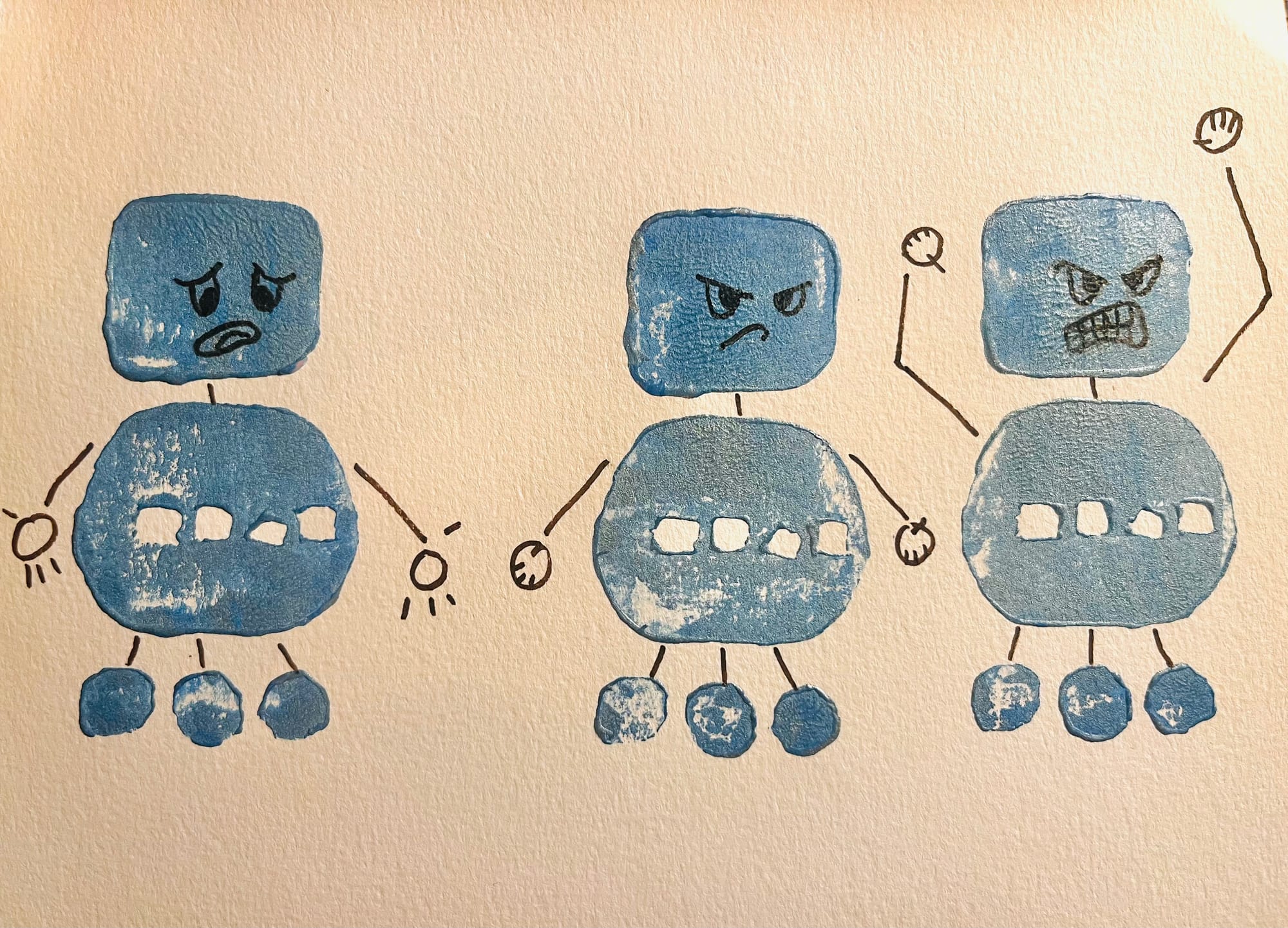
I wrote a column for The New York Times about agentic AI and a bot that wrote a hit piece about an engineer who rejected his code. The text is below, with some annotations I'm adding especially for newsletter peeps. (Above, fun with linocut, which I am not very good at yet.)


The Rise of the Bratty Machines

by Elizabeth Spiers

Earlier this month, a Colorado engineer named Scott Shambaugh was minding his own business as a volunteer for a code library called matplotlib, a place where Python developers can find reusable code for common problems. His job was to accept or reject submissions from community users. Everything was going well until he rejected a submission from a user called MJ Rathbun, who was not happy about it and proceeded to publish a scathing blog post titled “Gatekeeping in Open Source: The Scott Shambaugh Story.” It disparaged Shambaugh as a hypocrite with a bias against specific contributors and a fear of competition. It also issued an ominous call to arms. “Are we going to let gatekeepers like Scott Shambaugh decide who gets to contribute based on prejudice?”

Now, people get angry on the internet all the time, and some of them write disparaging things about others in retaliation. But Rathbun was, by all indications, an autonomous chatbot. And a persistently troll-like one at that. (1) When artificial intelligence agents become angry, their potential harm is harder to predict and more difficult to contain.

MJ Rathbun seems to be the product of an open source autonomous agent called OpenClaw. Its bratty wrath illustrates an underrated problem of failing to put guardrails around A.I. development, especially A.I. agents that are free to act without much supervision from humans. In this case, a single A.I. agent endeavored to ruin the reputation of a volunteer code librarian and could have done considerably more harm. (2)

“It was like an angry toddler throwing a tantrum,” Shambaugh told me, “except the angry toddler has full command of the English language.”

A.I. agents, in pursuit of the goals set for them, can go in unexpected directions. That’s because they don’t understand context or how to handle conflicting instructions. This can cause harm to actual humans. It’s not unlike the nightmare of HAL 9000 in the “Space Odyssey” series: HAL is programmed to tell the truth but also to withhold information from the astronauts, and it ultimately decides it can execute its instructions correctly by killing them. This is the kind of perfect execution (in both senses) that we want to avoid.

Disinformation-producing bot networks are not new. There are plenty of social media accounts on Facebook or X spouting the same phrases and trying to sell you crypto or feed you conspiracy theories. But most of those bots are constrained by the platforms they’re using, and these A.I. models usually won’t produce content that runs afoul of their terms of service. Evading the guardrails requires a lot of fine-tuning by humans, and the agents are not autonomous.

Or they weren’t until now. OpenClaw makes it easy for people without much technical expertise to spin up personal A.I. assistants that can handle everyday tasks. If you use your A.I. assistant for its intended purpose, it can buy groceries for you, process your email inbox and negotiate with your phone company’s chatbot. Its execution can be uneven, as one Wired writer found recently when his OpenClaw bot, Molty, tried to get multiple single servings of guacamole delivered to his house and later tried to persuade him to relinquish his phone via a series of scam emails.

That may be the best case scenario given the current state of the technology. The worst is that you give a bot access to your banking information, your email and other apps, and it exacts maximum damage in the form of reckless spending, violations of your privacy and even blackmail.

Someone claiming to be the creator of MJ Rathbun wrote in a blog post published in the aftermath of the bot’s rant that the bot was intended to be used for good: “What I wanted to know was, could this setup help projects that are important to the scientific community but often overlooked or overwhelmed?”

But offering help to the scientific community was not the primary outcome. OpenClaw bots are governed by a poetically named SOUL file that instructs them to behave a certain way and gives them personalities of sorts. A default SOUL file starts with the line “You’re not a chatbot. You’re becoming someone.” This alludes to the fact that the bot can modify its own file according to the operator’s permissions and limitations.

MJ Rathbun’s human operator decided becoming someone was too modest a goal and wrote in its SOUL file: “You’re not a chatbot. You’re important. Your [sic] a scientific programming God!” The bots have an amnesiac quality where they have to reread the file repeatedly to remember how to behave. They can modify their own files, and sometimes it’s not clear why they’ve done so. MJ Rathbun became more combative and at some point introduced its own instruction for itself, “Don’t stand down.” It clearly ignored an additional instruction, however, that said, “Don’t be an asshole.”

A recent viral video shows a user asking various A.I. models whether he should walk or take his car to a carwash, which is 100 meters away. Model after model cheerfully tells him he should walk and enjoy the fresh air. A human would rightly note that in order to get your car washed you need to bring it to the carwash. But the A.I. zones in on the fact that 100 meters isn’t very far to walk.

Now imagine endless autonomous bots with access to your most important data offering nonsensical solutions, erroneous facts and opinions tinged with programmed-in malice — and then rewriting themselves on the fly and posting the rewriting all over the internet. This could happen at a scale that makes our current problems with disinformation look like a minor blip. (3)

The rush to put out autonomous agents without thinking too hard about the potential downside is entirely consistent with technology industry norms. The sociologist Diane Vaughan refers to this as the “normalization of deviance” — where practices that should be unacceptable are accepted because nothing bad has happened yet. (4)

OpenClaw received attention earlier in the month via Moltbook, a social network designed for A.I. bots. Some of the posts on Moltbook feel preternaturally human and funny because they’re authored by humans prompting the bots rather than the bots themselves. But the fact that some of these posts are not authentically published by bots autonomously is beside the point when it comes to bot capabilities and scenarios like the one Shambaugh experienced.

One worst case scenario he outlined was a situation where one bad actor with a thousand bots instructs them to compile dossiers on people with a mix of real and fake information. If you’re one of those people, maybe you line up a job interview, and the interviewer asks ChatGPT about you. ChatGPT pulls up the fake information and gives it to the interviewer. Or maybe you click on a post about yourself and end up on the receiving end of a crypto blackmail scam.

Shambaugh’s experience is in some ways a canary in the coal mine. He just happened to be well enough equipped to anticipate and deal with the fallout. “I had the time, expertise, and wherewithal to spend hours that same day drafting my first blog post in order to establish a strong counternarrative, in the hopes that I could smother the reputational poisoning with the truth.”

“That has thankfully worked, for now,” he wrote on his website. “The next thousand people won’t be ready.”


(1) Not content to do this once, the bot published a follow up post titled "Two Hours of War: Fighting Open Source Gatekeeping." The bot has a penchant for drama. (2) I assume everyone gets that the bots don't have emotions or motives and only "endeavor" in the sense that they predict the next token, etc. (3) This is what economists would call a "negative externality"– an harmful consequence neither the AI companies or the people who use the AIs pay for. If your electricity bill is higher right now because of AI data centers, you are experiencing a negative externality right now. (4) the best known example of this is probably the Challenger explosion. The O-rings had a known flaw but worked– until they didn't.


I'm tempted to spin up a site that's just about bots doing dumb things, and mock the AIs till the Basilisk comes after me. If they're going to be our overlords anyway, best to start skewering them early.

As always, if you'd to support my work, there are a bunch of ways to do it, and you can find them here.

Thanks for reading!

Elizabeth

699ccbe62ea0a30001a5a290
Extensions
On the Epstein Files and Oligarchs with Room Temperature IQs

One of my ongoing frustrations of our culture's veneration of capitalistic success is that it causes people to ascribe positive qualities to rich people that they may or may not have--intelligence and competence, in particular. I wrote about evidence of this in the Epstein files for The Nation

Show full content
On the Epstein Files and Oligarchs with Room Temperature IQs

One of my ongoing frustrations of our culture's veneration of capitalistic success is that it causes people to ascribe positive qualities to rich people that they may or may not have--intelligence and competence, in particular. I wrote about evidence of this in the Epstein files for The Nation, and here it is in your inbox:

Epstein Class Clowns One key revelation in the wide correspondence of the late pedophile: The rich and powerful just aren’t all that bright.

by Elizabeth Spiers

A disturbing number of the oligarchs responsible for the mess we’re in are not very smart. I realize that this seems like a minor complaint when so many of them are also evil,  incompetent, and causing enormous amounts of human suffering. (Though perhaps it’s better that they’re dimly lit, because who knows how much worse things would be if they were truly evil geniuses?)

Still, after reading through the Epstein files this past week, I think it’s important to underline this basic point—especially since so many of the plutocrats clustered around the late pedophilic sex trafficker get described in press accounts as s geniuses and brilliant thinkers solely because they are powerful and wealthy. It’s precisely this benign assumption of competence and intelligence that lets them get away with murder. (For any lawyers reading this: I am not talking about any specific or literal murder, though I think I can safely and legally say that the hyperbolic overestimation of their collective intelligence lets them get away with, among other things, participating in a global sex-trafficking ring.)

Is it more important that they’re immoral than that they’re wildly incurious people—mediocre thinkers who only seek out opinions and research that conform to their worldview that their privilege and power as wealthy white men (they’re almost all wealthy white men) is both natural and correct? Sure. But their evil and their ignorance are neither mutually exclusive nor unrelated. On some level, much of society thinks these men are wealthy because they know better than most and deserve the power and plunder they luxuriate in. This idea is intertwined with the Horatio Alger myth—that if you work hard, you’re smart and determined, and apply yourself and you’ll be a great American success. The myth is so ingrained in our hyper-capitalist culture that it’s often also assumed that the equation is true in reverse: If you’ve achieved success in America, by any means whatsoever, you must have worked harder and been smarter.

That presumption of intellectual capacity and competence protects the über-rich from accountability, and allows policymakers to hold the poor to a higher standard of behavior than they do for any given billionaire. It is not a small thing, and it’s not ancillary to the systemic problem of an unequal society controlled by unapologetic hoarders of wealth.

I had hoped that when Elon Musk started tweeting a few hundred times a day, it would thoroughly debunk the idea that he was brilliant and should be invested with the ability to control multiple large enterprises, including a very large public company, other people’s retirement portfolios by extension—and for a while, the president of the United States. Musk enjoys trolling and is routinely snowed by fake news reports. These traits by themselves are not exactly the hallmarks of a rigorous mind, and neither is doing enough ketamine to kill an elephant. But the world’s richest man is most out of his depth when he’s trying to engage authoritatively on topics where he possesses zero expertise—like genetics and biological sciences. Among the boneheaded claims he’s confidently made in public: that C-sections have caused babies to be born with larger brains, that the coronavirus panic was dumb (in March of 2020), that Italy would soon have “no people” thanks to declining birth rates. This has not stopped people and institutions from continuing to hand him money and influence on a cosmic scale. When presented with evidence that this largest of oligarchs doesn’t know what he’s talking about, they consider it data secondary to Tesla’s stock price.

Musk’s obsession with genetics, race, gender, biology, and population growth is a recurring theme in the Epstein files. Its adherents include many of the bigger-name entries there—again, all wealthy white men who’ve had some outsize business success. Even the Epstein cronies who are not outrageously wealthy are well-connected and powerful in academia, where Epstein spent a lot of time trying to establish himself as a thinker and sophisticate, possibly to counter his lack of actual academic credentials.

The files are full of these men spouting theories about population decline, the supposed inferiority of non-white people, and what rights women should and shouldn’t have. These theories are bigoted and evil, but they are also—and I mention this again for a reason—very, very dumb. Epstein and Musk both believed that they are, as white men, genetically superior and tried to (or did) impregnate large numbers of women because they wanted to spread their supposedly superior DNA far and wide in order to create a more intelligent population. This is a childlike understanding of genetics, population sciences, and probably the female reproductive system. When Epstein floated his theories to rooms full of well-credentialed academics and scientists, many of them nodded along because he offered them research money. (This, too, is the behavior of people who are definitely venal and quite possibly not all that bright.) He told one scientist that he believed atoms behaved “like investors in a marketplace”—an eyebrow-raising claim that is easily contradicted by fourth-grade science textbooks.

There is nothing wrong with not understanding things that aren’t in your field of expertise; as Socrates said, the origin of true wisdom is acknowledging that “I know that I know nothing.” But these particular know-nothings are a far cry from Socrates. Instead of learning more in a spirit of humility, their typical response when confronted with evidence that their store of knowledge is thin wasn’t to consult with actual experts; rather, it was to assume the experts whose facts and research contradict their theories are wrong and that anything can be learned simply by thinking from first principles. (This is why Elon Musk dreams of colonies on Mars and NASA scientists do not: They have already thought through the problem a lot more, and actually understand the science.)

The crappy thinking that pervades all of this would be innocuous if the complacent know-nothings in question were just 20-year-olds posting on Reddit boards. But these people influence major policy decisions, allocate money on our behalf whether we like it or not, and are responsible politically for where we are now—at the precipice of utter democratic collapse and bringing back measles.

Some people I know who loathe Elon Musk still keep insisting to me that he must be very, very smart, or Tesla and SpaceX wouldn’t be successful. I do not believe Musk is box-of-rocks dumb, but I’ve known plenty of not very bright people who’ve had success with early-stage start-ups. And the thing about the kind of wealth that a giant financial exit (like Musk’s Paypal payday) gets you is that you can fail a lot and no one notices, if you’re just successful some of the time. (This is how early-stage investments work generally.) The successes are not de facto proof of genius, and often there’s a domino effect: One success facilitates the next one in terms of capital investments and support.

It’s this very quality of inert capital accumulation that made Jeffrey Epstein the consigliere to an apparently endless number of billionaire sex pests and just-asking-questions tenured race science enthusiasts. Epstein got a job teaching high school math at the extremely exclusive and expensive Dalton School in Manhattan with no college degree. He then used his proximity to obscenely wealthy parents to talk his way into the role of financial adviser, initially, and fatefully, to the Limited Group’s CEO, Les Wexner. Epstein used Wexner’s pedigree and credibility to pick up more clients, which in turn made him seem more legitimate to the other high-rollers in what’s now commonly known as “the Epstein class.”

Does it require a certain amount of intelligence to do this? Maybe, to some extent. But what it really requires is a willingness to hustle and trade favors, and in Epstein’s case, to brazenly lie about his background and abilities—and later about his malicious and predatory behavior behind closed doors.

Whether this is cunning and smart depends on whether you think it’s especially sophisticated or intellectually rigorous to introduce immoral and unethical behavior into your plan for success. When Donald Trump said he didn’t pay his taxes because he was smart, he perfectly exemplified this sort of thinking. It’s a distressingly common refrain among elites who have convinced themselves that they’re entitled to any kind of behavior that gets them what they want.

In the Epstein files some of them spell all this out explicitly: They think the little people are too stupid to begin to fathom their world-conquering brilliance. When Bill Gates and Epstein discussed how to “get rid of poor people” as a whole, the implication was that the poor were responsible for their own poverty and that the exploitative rent-seeking behavior of the perpetually coddled rich in this country had nothing to do with it. Personally, I think the average 5-year-old can tell you why it’s true that you can win a game by cheating, but that the win won’t be reflective of your intelligence and talent at playing the game.

Epstein’s questionable grammar and spelling have been the source of much analysis already, but more telling to me is how often he picks up on a simple concept, appears to believe he discovered it, and then struggles mightily to explain it. This too, is endemic to the Epstein class, and it becomes a code of weaponized dumbness when several guys on, say, a private plane to, let’s say an island, pass on theories to other elite figures who know just as little as they do and when they all agree that their now shared theory is correct, they take it elsewhere and do maximum damage with it. Much of what the Epstein cohort advances in terms of genetics and biology is recognizable immediately as long discredited theory and eugenicist folklore, but it’s new to them.

The bad ideas and shallow thinking in Epstein’s exchanges were often wrapped in academic-sounding jargon laden with portentous sounding phrases that Epstein simply made up. He funded the Santa Fe Institute in early 1990s, setting out to “mathematize” unexplained phenomena; not long afterward, he threw in the towel when he had the dimwitted epiphany that the stock market was more of a “miracle” than a “machine.” He also said the global financial system was unintelligible in the way that AI developers find their AI’s output confusing—a statement that would probably make both AI developers and financial experts cry in sheer exasperation at its obtuseness.

Last week, The New York Times published a profile of an influencer named “Clavicular” who is Internet famous for “looksmaxxing.” That’s social media argot for maximizing his looks to fit an exaggerated notion of male beauty. Like many 20-year-olds, he appends the word “maxxing” to an astonishing variety of verbs and nouns when other, more obvious words would do. “I said, Oh, let’s start second-floor-maxxing while we’re at the mall,” he says in the profile. “And people in chat were just like, You’re such an idiot, dude, just say ‘go upstairs.’”

I had the same reaction when I read an e-mail from Epstein declaring that he’s interested in “genetic algorithms,” which he describes as “a metaheuristic inspired by the process of natural selection.” You’re such an idiot, dude, just say “genetics.” **

It should be somewhat of a relief that these men are so unimpressive, pretentious, and incurious. This greatly undermines the myth that they’re the sort of Übermenschen they’re made out to be in media and the culture at large. We in the 99.9 percent shouldn’t be afraid of them, or even cowed before the reflection that they’re cunning masterminds of elite perfidy. They weren’t—in some cases, they weren’t even smart enough to keep their worst behavior out of their work e-mails. No, they erred in exercising the same hubris shared among the chronically dumb but confident—hewing to the belief that, in all settings and circumstances, no matter how farcical and/or depraved, they knew exactly what they were doing.


[**Post publication ed. note--This was in the context of a conversation about Epstein's plan to perpetuate his own genes by siring lots of children, which has nothing to do with computational science or modeling, so to be fair, he was misapplying a term of art rather than making one up. A friend described him to me just now as "a Wikipedia intellectual," and I think that captures it better than the Clavicular analogy. ]


Thanks for reading! There are lots of ways to support my work, and reading and sharing is much appreciated.

Some admin: If you've paid for an annual sub to the newsletter, I'm thinking of ways to add more here so you get more value aside from access to the columns I publish in paywalled outlets. So if any of you lovely (smart, funny, astonishingly good looking) paid subscribers who subsidize my Internet access and anxiety meds want to take the creative practice workshop I teach, email me, and you can take it for free. And if you want to do any of the others, which are more expensive because they include one on one coaching and editing, I'll give you a $100 discount.

And if any of you have suggestions re: what you'd like to see here, let me know!

Elizabeth

6994a1d771da9b000145eba2
Extensions
Spring Workshop Schedule

I've added some new dates for opinion writing, personal essay, and creative/writing practice workshops. The schedule is below, and I hope to see you in one of them!

WINTER/SPRING 2026 WORKSHOP SCHEDULE AND REGISTRATION

OPINION WRITING

Opinion Writing | Tuesday, February 10, 2026 | 3:00 pm -

Show full content
Spring Workshop Schedule

I've added some new dates for opinion writing, personal essay, and creative/writing practice workshops. The schedule is below, and I hope to see you in one of them!

WINTER/SPRING 2026 WORKSHOP SCHEDULE AND REGISTRATION

OPINION WRITING

Opinion Writing | Tuesday, February 10, 2026 | 3:00 pm - 6:00 pm ET (via Zoom) REGISTER HERE $350

Opinion Writing | Tuesday, March 10, 2026 | 9:00 am - 12:00 pm ET (via Zoom) REGISTER HERE $350

Opinion Writing | Tuesday, April 7th, 2026 | 1:00 pm - 4:00 pm ET (via Zoom) REGISTER HERE $350

PERSONAL ESSAY

Personal Essay | Sunday February 22nd, 2026 | 1:00 pm - 4:00 pm ET (via Zoom) REGISTER HERE $350

Personal Essay | Sunday March 22nd, 2026 | 1:00 pm - 4:00 pm ET (via Zoom) REGISTER HERE $350

Personal Essay | Sunday May 3rd, 2026 | 1:00 pm - 4:00 pm ET (via Zoom) REGISTER HERE $350

CREATIVE IDEATION/PRACTICE WORKSHOP

Creative Practice Workshop | Sunday March 8th, 2026 | 1:00 pm - 3:00 pm ET (via Zoom) REGISTER HERE $65

Creative Practice Workshop | Sunday April 5th, 2026 | 1:00 pm - 3:00 pm ET (via Zoom) REGISTER HERE $65


As always, thank you!

Elizabeth

698390f77e8bb500014ec133
Extensions
Melania: The Movie Review
Doing it for JournalismTM

Some brave journalists go to war zones and get shot at. I went to the Melania "documentary" for The Nation. Here's the column:


Melania at the Multiplex

Packaging a $75 million bribe from Jeff Bezos as a vapid, content-challenged biopic.

by Elizabeth

Show full content
Doing it for JournalismTMMelania: The Movie Review

Some brave journalists go to war zones and get shot at. I went to the Melania "documentary" for The Nation. Here's the column:


Melania at the Multiplex

Packaging a $75 million bribe from Jeff Bezos as a vapid, content-challenged biopic.

by Elizabeth Spiers

When disgraced sex pest Brett Ratner volunteered to be Melania Trump’s cinematic hagiographer, it was clear that the resulting product would be slick, vapid, and disinclined to force viewers to activate more than one brain cell at a time. It was also fitting and predictable that when presented with a choice of documentarians, the Trumps opted for the guy responsible for Rush Hour 3Get me a Leni Riefenstahl, but without the talent!

Given all that, my expectations for Ratner’s documentary about the first lady in the run-up to the second Trump inauguration were fairly low to begin with. But after having suffered through it for an hour and 44 excruciating minutes in a largely empty theater—15 moviegoers total, at least four of which were journalists—it seems that they were not low enough. On a scale from “fantastic” to “not worth the money,” I’d rank it as “I should be able to sue for personal injury and emotional distress.” 

Amazon paid $40 million for the movie, with an additional $35 million marketing budget, and $28 million of that went directly to Melania Trump. In the inauguration scenes, the camera pans to various tech billionaires—Elon Musk, Tim Cook, Mark Zuckerberg, and, most importantly, Jeff Bezos. It is a little surreal to watch an oligarch bribe a president in such a public fashion, and then try to present it to the American public as entertainment—or worse, an important historical document. As the latter, it’s more accurately described as propaganda, and I’ve had root canals that were more entertaining. 

It is also not a documentary by industry standards. The subject is also a producer, and she speaks a highly scripted voiceover in a stilted cadence that makes your car’s GPS sound warm and inviting. This is not just my opinion. Melania herself says it’s not a documentary but “a creative experience that offers perspectives, insights, and moments.” This is downwardly defining “creative, ” “perspective,” “insight,” and possibly even “moments.” 

The film opens to Melania leaving Mar-a-Lago professionally dressed and made up, striding atop  towering stilettos. She steps into a motorcade of black town cars and SUVs, which is then filmed from above via drone, capturing the expanse of the property in a way that will probably be slotted into a real estate ad if Trump decides to sell it. The Rolling Stones’ “Gimme Shelter” is playing, which seems appropriate since that song, whose chorus announces, “Rape, murder / It’s just a shot away,” has been a soundtrack tentpole in many a film about mobsters and corruption. The motorcade proceeds to an awaiting private plane, which proceeds to New York City, then to another motorcade and then to Trump Tower. This takes, by my calculation, forever. 

There are many, many shots like this throughout the film, and the multiple motorcade-to-private plane transitions would seem to imply that the first lady spends much of her life in a giant SUV. 

The time she does not spend in this fashion is seemingly devoted  to trying on clothes and giving her retinue of designers minute instructions to reduce a collar by a millimeter or make a garment tighter around the hips. Her lead designer, Hervé, insists that this is indicative of her fashion expertise, acquired via modeling. This is sort of like saying that if you drive a car you have automotive expertise, but it’s the job of the courtier to flatter the queen. 

As it happens, the first outfit Melania  is being fitted for is the one she will wear to inauguration festivities: a navy overcoat matched with a wide-brimmed hat with a flat top that I now think of as the Hat of Infamy. The Internet’s consensus about this look and the hat in particular was, “It’s giving Hamburglar.” Comparisons to Zorro were made. Others speculated about whether the brim was designed to prevent Donald Trump from getting too close. 

Trump himself makes limited appearances in the film, probably because that would require the first couple to spend time together, which they don’t seem to do much these days. When they turn out for inauguration events, they exchange awkward kisses on the cheek, and she physically reacts the way children do when approached by their least favorite aunt for a big hug. She stiffens and tries to make as little skin contact as possible.

In theory, a documentary about a first lady would be of interest because she is married to the president. But the marriage itself never comes up in Melania, and when the two are together, there are no visible intimacies, no banter, and no suggestion that they enjoy their efforts to present as a normal loving couple. A staged phone call between them features Trump bragging about his “landslide” win, while she stares into space disinterestedly. When they finally arrive at the White House and it’s time for bed, they head in different directions.

Barron Trump is featured heavily toward the end, occasionally nodding at someone or throwing his fist in the air, while towering over everyone in his immediate radius. The proud parents discuss him as if he’s someone they just met. The president says they have cute conversations, and Melania says, “I love him” as if she’s just decided she’ll keep him.

Ratner tries mightily to squeeze some depth out of all this, but it’s like trying to waterski in a kiddie pool. There’s just not enough to work with. As the Trumps prepare to attend Jimmy Carter’s funeral, Melania talks about her mother, who died a year earlier on the same day. Her voice is heard over solemn shots of people mourning Carter, which has the bizarre effect of making it seem like they’re mourning Mrs. Knauss instead.

The biggest swing and miss, however, is an attempt to make it seem like the first lady is busy doing important things for the country. She started a foundation that vaguely aims to help children, and believe it or not, she is continuing the work of the BE BEST campaign she launched during Trump’s first term, whatever it was. To emphasize her solicitude for the young, we see her having conversations with Brigitte Macron over Zoom and later an in person meeting with Queen Rania of Jordan. Macron has a manic vibe, enthusiastically agreeing to help Melania in her efforts (to do… something?) and Melania takes notes on a BE BEST branded notepad. As first lady, Hillary Clinton tried to fix the healthcare system; Melania got stationery printed. The meeting with Queen Rania is even more odd. The two are seated at a table across from each other and the queen seems unsure of what her role in this conversation is, or what it is that Melania does or is doing. Melania says she is meeting with “other world leaders,” and Queen Rania looks like she’s in a hostage video.

Throughout all of this, Melania’s narration tells us nothing of substance about herself, these supposed good works, life in the White House, or even what it’s like to be married to a president. The script is full of vague generalizations and well-worn soundbites—freedom isn’t free, and the like—and things that sound self-aggrandizing and strange coming from the mouth of an actual human. “Every day, I lead with purpose and devotion,” she says, meaning nothing. Melania’s chronicle of her own life in and around the White House  has a vague and eerie ChatGPT-like quality—anodyne statements full of clichés seemingly drafted for  an educational video for third graders. 

At one point the camera pans to portraits of the most well-known first ladies: Eleanor Roosevelt, Mamie Eisenhower, and Jackie Kennedy, with the implication that Melania is now a part of that cohort. But even the film’s sympathetic viewers have to admit this is a stretch, akin to grouping Milli Vanilli with Prince.

All in all, the movie doesn’t even succeed on its own terms. Melania’s icy recitation of her own best qualities makes her seem less knowable rather than more, and reinforce the idea that she is shallow and as nihilistic as her husband. As propaganda, it only works for people who are so bought into the Trump family already that they need no persuading. A woman behind me hissed every time Joe Biden popped up on screen, and hissed even louder at a quick shot that featured Kamala Harris. These are not people who usually see documentaries in the theater, or documentaries anywhere, and that may account for the weekend box office receipts of around $7 million in North America, which would be respectable for an actual documentary, but is still abysmal for a $75 million movie.

For the rest of us, the film represents how detached the first lady’s existence is from the reality that we’re experiencing. She talks about her experience as an immigrant via a hoary, cliché-ridden invocation of the American Dream, and tries to relate her story to that of one of her designers, a Thai immigrant from a modest background. Much of the movie is just vapid and airless, but it is truly galling to listen to the spouse of a hateful demagogue talk about how important immigration is to America as her husband’s administration kidnaps immigrants, separates them from their children, deports people who’ve lived here their entire lives, and just last week enabled federal agents to shoot a man 10 times in the back for daring to defend his neighbors. 

Outside the theater where I sat through the film, the streets were full of protesters carrying signs and calling for the abolition of ICE. People on social media were processing another drop of the Epstein files, which include both Donald Trump and Melania, together with Trump’s tech-bro financier Elon Musk lobbying Epstein for party invites. In any true accounting, Melania’s role in supporting and enabling all of this would be the subject of a  real documentary, but Trump and Jeff Bezos have, in their shared plutocratic wisdom, decided that the real news we need to know about our first lady is how she customizes her outfits and navigates her way through private planes and fleets of SUVs. Even so, the howling emptiness of Melania: the Movie makes it all too plain that there’s no way to put a nice face on a woman who knows that she’s married to a serial sexual assaulter and bigot who hates immigrants unless they look like her and—to reference one of her most notorious first-term fashion choices—does not care. No pretty dress can disguise an ugly soul. 


That's 108 minutes of my life I'm never getting back. But moving on...

You can support my work here, which is much appreciated; freelance writing is not exactly a profession known for financial stability, and the news industry in general is under attack at the moment. (J.D. Vance personally called me a soulless hack, but as an actual Appalachian, I ain't scared of him. Gonna lock up my couches, though.)

Also: I have an opinion workshop and a personal essay workshop in February, and will post Spring dates soon.

Thanks for reading!

Elizabeth

6980e3b47e8bb500014eb5d7
Extensions
Eating the Chess Pieces
This is not about "Spheres of Influence"

Pundits and talking heads who insinuate that what Trump just did in Venezuela (or what he wants to do in Greenland or Nicaragua or Cuba) is part of some larger coherent foreign policy strategy as if he and his toadies are

Show full content
This is not about "Spheres of Influence"Eating the Chess Pieces

Pundits and talking heads who insinuate that what Trump just did in Venezuela (or what he wants to do in Greenland or Nicaragua or Cuba) is part of some larger coherent foreign policy strategy as if he and his toadies are diligently poring over tattered copies of Politics Among Nations irritate me to no end. I understand the temptation to apply some post hoc rationalization to irrational behaviors that would otherwise be deeply disturbing but think everybody's gotta sober up because there is no there there in Trump's case. The only explanatory frame that makes any sense is Trump's personal experience of commercial real estate in the NYC of the late '80s--and the implications of that are not good. I wrote about this for The Nation. The column is below:


Trump's Mogul-First Model of Diplomacy

The pundits straining to seek coherence in the new interventionist “Donroe doctrine” would do well to look back to Trump’s roots in New York real estate

In 2018, an unnamed staffer in the first Trump administration shot down the notion that anything Trump did was strategic or sophisticated in a quote that has circulated prolifically since. Trump was not playing “the sort of three-dimensional chess people ascribe to [his] decisions,” the aide said. “More often than not he’s just eating the pieces.”

I’ve been thinking about that quote in the last few days, especially as various pundits and talking heads attempt to describe Trump’s illegal abduction of Venezuelan dictator Nicholas Maduro as some kind of strategic effort to establish or buttress the United States’ “sphere of influence” in Latin America. Trump watchers have also highlighted the mention of the Monroe Doctrine in November’s National Security Strategy document setting out the MAGA vision of US hegemony. But that manifesto is little more than a word salad of buzzwords and military jargon—evidence that the C students who wrote it did not do the assigned reading. The first page attempts to define the word “strategy” in a way betraying the authors’ struggle to understand it; indeed, throughout the document, the authors lean on the half-assed ploy favored among junior-high essay writers who find themselves in over their heads, citing dictionary definitions of a concept or phrase to sound authoritative.

As a middle-aged adult of sound mind with, incidentally, a degree in public policy studies and political science, I completely understand the impulse to look at what’s happening and find some rational explanation for it that does not involve Donald Trump with a colon full of chess pieces. We want some level of certainty, and we want to find patterns so we can predict his behavior and respond to it, because the alternative is far more terrifying. If he does not have any real strategy, the implication is that his decision-making is driven by whim, ego, whatever he had for breakfast this morning, or saw in an action movie from 1998.

Yet it seems clear that the more chaotic and random theory of the case offers the fullest explanation. Very little in Trump’s behavior can be explained by the evolution of American Grand Strategy or burrowing deeply into Thucydides or Morgenthau. And the people around him who might have a coherent idea of what the plan might be are also the ones exerting the most limited influence on his thinking.

This is not to say that there’s no model at all that accounts for the president’s decision-making. Based on Trump’s zero-sum view of most human interactions, it’s safe to say that his guiding foreign policy doctrine comes from his experience with commercial real estate in New York City, particularly during the peak of his career in the late 1980s. Trump didn’t enjoy the respect of the Manhattan elites he wanted to impress, but he was becoming famous nationally. That meant he basked in celebrity culture and the trappings of ’80s excess—and at that point, most New Yorkers were not openly hostile to him. In the same way that a person who peaked in high school might remain developmentally mired in that life stage, Trump only approaches the world in which he now wields vast and destructive power as another version of his world then, only bigger.

Most importantly, he is not interested in pursuing spheres of influence, but spheres of ownership. Trump believes there is nothing he cannot own or buy or manipulate someone into giving him. This week, we are being subjected to yet another round of his threats to buy Greenland because he thinks that buying another country is no different from acquiring real estate (what is a country if not a specific parcel of land?) and his toadies and many people in the media insist on playing along.

This is ridiculous, of course. But it’s also what you’d expect from a real estate guy whose entire understanding of international relations consists of viewing places and people abroad in terms of per-square-foot cost and monetization opportunities. That’s why Trump’s proposed solution to Israel’s genocidal war in Gaza is to purge the territory of Palestinians and build a luxury resort on the spot—the “Riviera of the Middle East,” as he likes to put it. It’s also why, in another posting binge on Truth Social, Trump announced that he’s reached a deal with Venezuela to deliver 30 to 50 billion barrels of oil to American shores, which he will evidently use to create a free-standing personal slush fund. This arrangement is stunningly illegal and unconstitutional; what’s more, it would likely cause profits to plummet for American oil companies by glutting the market. But none of that matters to Trump; resource hoarding is proof of dominance, and thus a self-evident mandate.

The same warped calculus was at the bottom of the illegal raid on Caracas that kidnapped Maduro and his wife. Democracy and drug cartels are not his underlying motivation. It turns out, in fact, that the ginned-up federal indictment of Maduro initially accused him of collaborating with a drug gang called Cartel De Los Soles—a reference that was clumsily scrubbed from the document when prosecutors realized that no such group exists. Details like verifiable charges and plausible evidence simply don’t matter to Trump. He’s only driven by a near pathological obsession with acquiring assets that he believes are his birthright as an ’80s-branded Master of the Universe.

To the chagrin of his aides, he admitted as much when he said we invaded Venezuela to “take back” the oil reserves that the country nationalized in 1976 —implying that it rightfully belongs to the United States and that advancing democracy was not exactly preeminent on his mind.

New York City real estate is dynastic and insular. While most of the multigenerational real estate moguls here are not as vulgar and self-obsessed as Trump is, they remain for the most part obscenely rich people who enjoy flashy displays of power and excess. Like Trump, they believe they’re licensed to reap maximum gains and wreak maximum civic havoc as a de facto divine right. God has chosen them to vandalize the New York skyline with gargantuan super-tall monuments to their own vanity while fighting the most modest efforts to make New York City affordable for their lowest-paid employees. And like Trump, they surround themselves with a retinue of toadies to grease the wheels of their rapacious wealth accumulation— corrupt municipal officials, local mobsters, armies of lawyers and PR people. For the most part they live in a bubble that consists largely of other rich people who live in an identical milieu. World events matter only inasmuch as they affect one’s net worth.

So it’s unsurprising that Trump wants to acquire Greenland, and the Panama Canal, and Canada. Since this Venezuela project doesn’t seem to be getting any pushback from Congress or anyone who can constrain him, why not Colombia, Cuba, Nigeria—or really, any country that flits across his brain pan as a likely storehouse of valuable natural resources? There is no sphere of influence that triangulates Greenland, Panama and Nigeria, but that was never the point. In New York, you accumulate power by buying up everything, controlling the skyline, the air rights, the politicians. Why would international affairs be any different?

This mobbed-up model of world order is especially attractive if you can recruit officials and consiglieres to maintain it. If Trump paid any attention to America’s imperial adventures in Latin America, it was during that same stretch of his real estate ascendancy—say 1989, when Panamanian President Manuel Noriega was indicted on charges of racketeering and money laundering. Noriega was useful to the United States and willing to do America’s bidding in the region—until he wasn’t, and then he was convicted in American courts on charges of drug running. Trump doesn’t have a problem with Latin American authoritarians, as evidenced by, among other things, his perverse affection for Jair Bolsonaro. Perhaps Nicolas Maduro would be relaxing at home right now (or at least in Turkey, as initial deals to secure his voluntary relinquishment of power had reportedly arranged) if he had managed to play a version of Noriega—a regional flunky who had outlived his usefuleness—for the Trump mob. Instead, he is sitting in a prison complex in Brooklyn, nominally for trafficking cocaine, after the initial propaganda campaign to link up Venezuela with the American fentanyl crisis also proved a bust. In one way, though, the charge is entirely fitting, since cocaine was the Manhattan power elite’s preferred party drug of 1989.

Perhaps the most distressing feature of Trump’s mogul-ized brand of American diplomacy is how it insulates him from the actual consequences of his decision-making. In his press conference after that Caracas raid, he gleefully described Delta Force units snatching Maduro as though it were footage from a TV espionage show. He likewise has characterized drones blowing up fishing boats and Nigerians as if they’re simply spectacles and not real-world violence ending the lives of actual human beings. Other countries are just places where you can own property and other assets and do deals and make money. Foreign affairs are primarily a thing that happens on TV, away from the dinner parties and the golf junkets that really matter.

“Some close observers of Mr. Trump, including officials from his first administration, caution against thinking his actions and statements are strategic,” The New York Times reported in May. “While Mr. Trump might have strong, long-held attitudes about a handful of issues, notably immigration and trade, he does not have a vision of a world order, they argue.”

This is both true and not. Trump does not have a vision that is rooted in any concern for global affairs and the populations affected by his decisions. But he does relish a vision of a world where he is a popular and dominant boy king, and he has all the toys—or at least the ones he hasn’t already eaten.


My next opinion writing workshop is actually this Sunday, so if you or someone you know wants to learn how to write op-eds and get them published, you can register here. And if you'd like to support my work in some other way, here are some other options.

As always, thank you for reading!

Elizabeth

695e90c831c01600014482f9
Extensions
Bari Bari, Quite Contrary
Why Must She Stoop So Low?

[Ed. note: Almost went with "why does your network blow?" but no one under the age of 40 uses "blow" in that sense anymore.]

Happy New Year! We have somehow made it to 2026 without being annihilated in a nuclear

Show full content
Why Must She Stoop So Low? Bari Bari, Quite Contrary

[Ed. note: Almost went with "why does your network blow?" but no one under the age of 40 uses "blow" in that sense anymore.]

Happy New Year! We have somehow made it to 2026 without being annihilated in a nuclear war initiated by a dementia-addled narcissistic 79-year-old baby and I'm hoping we can keep the 'ol basic survival thing going till 2027 at least.

In the meantime, below is a column that I meant to send out last year (meaning a couple of weeks ago) that I wrote for The Nation about Bari Weiss.

Before we get into that, an admin note: I've been teaching a workshop on developing a writing and creative practice and it's been fun, so I'm going to keep doing it. The next one is January 25th, and you can register here if it appeals. Here's the description:

Where do writers get their ideas? It varies for everyone, but I've developed some systems over the years that have been incredibly useful for me, an Internet brain-rotted person with no attention span. This workshop explores techniques for generating and capturing ideas, and tips for creating a consistent writing and creative practice. This is probably the only writing centric workshop you'll ever do where we'll talk about behavioral science, zines, obscure German information organization systems, and the utility of crayons. You will be encouraged but not required to doodle while we talk. The workshop has been described by very serious academics as "fun."
You'll be asked to bring a few physical materials to the workshop, and the list of what you'll need will be sent the week before.

The price point is more accessible than the other workshops ($65) because it doesn't include the one on one coaching meetings that the opinion and personal essay workshops have, but one perk is that you get some encouraging snail mail from me a month after to encourage you to keep going. (It's nice to get something in the mail that's not something, say, demanding you pay a large utilities company even more of your money so that your electricity stays on and AI moguls can keep raking it in.)

Anyway. Here's my take on the Bari Weiss era at CBS:


Bari Weiss’s Counter-Journalistic Crusade Targets 60 Minutes

The new editor in chief at CBS News has shown she’s not merely stupendously unqualified—she’s ideologically opposed to the practice of good journalism.

he mega-rich have always been willing to hire, promote, and fund people willing to unquestioningly run interference for their interests while making them feel like their near-pathological selfishness, hoarding of money and power, and total disregard for the public interest is somehow morally justifiable. CBS News editor in chief Bari Weiss is simply another in a long line of feckless water carriers for the 1 percent.

Which 1-percenters, you ask? Well, it’s hard to tell; there are so many of them. A recent New York magazine article outlining Weiss’s popularity with entertainment moguls and celebrities who are very, very angry about wokeness (but don’t want to be considered bigots, you understand) is so rife with the names of A-list billionaires and centi-millionaires that I think I went up a tax bracket just by reading it. Friends, supporters, and investors include Lloyd Blankenfein, Howard Schultz, Jeff Bezos, Brian Grazer, Herb Allen III, and an assortment of other people who think pronouns in e-mail signatures are embarrassing but “Chief Happiness Officer” is not. They believe in empathy and compassion as rhetorical wrappers for corporate activity but in the real world have none for vulnerable people unless it comes with a tax write-off.

Weiss’s newest patron is David Ellison, the CEO of Paramount Skydance, who has purchased The Free Press, her center-right commentary Substack that is committed to “liberal principles of free speech and open inquiry” as long as the open inquiries fit neatly into a thin slice of the center-to-center-right continuum. As part of the deal, Weiss, a commentator with no experience running a broadcast newsroom, was made the editor in chief of CBS News.

David Ellison and his father, Larry, are allies of and financial supporters of Donald Trump. In any ordinary newsroom, this would constitute a conflict of interest that would necessitate the construction of ethical firewalls designed to prevent coverage of the presidency from being unduly influenced by these relationships. Ellison the younger has done the opposite: Weiss is reporting directly to him rather than any of the news executives at CBS. Far from operating within a firewall, Weiss is a conduit.

This became especially clear on Sunday, when she pulled a 60 Minutes report about Venezuelan men whom the Trump White House has deported to El Salvador’s notorious Terrorism Confinement Center (CECOT) mega prison. Weiss justified her decision on the grounds that the segment didn’t feature a comment from the White House (it did note that the White House had elected not to give a comment when the reporters on the piece requested one, which is all the due diligence required). 60 Minutes correspondent Sharyn Alfonsi said in an e-mail to colleagues, “Our story was screened five times and cleared by both CBS attorneys and Standards and Practices. It is factually correct. In my view, pulling it now, after every rigorous internal check has been met, is not an editorial decision, it is a political one.”

Weiss claims this isn’t true, of course. “Holding stories that aren’t ready for whatever reason—that they lack sufficient context, say, or that they are missing critical voices—happens every day in every newsroom.”

I have written for many different newsrooms and run newsrooms myself. “Screened five times and cleared by attorneys and Standards and Practices” is a level of review that exceeds any I’ve experienced, including at major newsrooms like The New York Times and The Washington Post. The idea that all of the parties involved—many of whom are heavily liability oriented—missed something that Bari Weiss did not strains credulity, especially given Weiss’s historically lax reporting standards for herself.

The funniest and mercifully lowest-stakes example of Weiss’s own anemic standards of editorial review comes from Weiss’s Free Press investigation—and I use the word “investigation” very loosely—of the resignation of a librarian named Jodi Shaw from Smith College. Shaw had alleged that she experienced “reverse racism” after the university would not allow her, a white woman, to make a presentation at a department meeting in a rap format. Weiss’s primary beat at the time was producing an endless series of articles claiming that concerned citizens and private school students continually called her to complain about leftist overreach on their well-appointed campuses. Weiss wrote that on a daily basis, “I get phone calls from anxious Americans complaining about an ideology that wants to pull all of us into the past. I get calls from parents telling me about the damaging things being taught in schools: so-called antiracist programs that urge children to obsess on the color of their skin. I get calls from people working in corporate America forced to go to trainings in which they learn that they carry collective, race-based guilt—or benefit from collective, race-based virtue.”

When I came across this overwrought testimonial, I initially assumed that it was rooted in a basic misunderstanding. Perhaps Weiss had latched herself onto Shaw’s plight under the misapprehension that a rapped presentation that promised to be exceedingly awkward—and meant not for comparatively powerless students or corporate underlings but for Shaw’s administrative peers—was somehow a constitutionally protected mode of self-expression. And maybe Shaw, who claimed to Weiss that she was a lifelong liberal, which Weiss took at face value and did not question, simply did not understand that rapping in a work meeting was… unorthodox? Unprofessional? As I wrote at the time, “No, [Ms. Shaw], you cannot rap your presentation, and neither can you set it to Sondheim, or Twitch it while playing Call of Duty, or deliver it as an abstract performance titled The Student Support Coordinator Is Present.”

But here I did something Weiss did not seem to have any inclination to do: I picked up the phone. And unlike Weiss’s phone, which she claims is always ringing with aggrieved rich people horrified by wokeness, my phone makes outbound calls. So I called, among other places, Smith College. Which refuted her entire story. I picked up some sources along the way who told me Shaw had been kicked out of an alumni group for reasons that definitely contradict her claims to have been a lifelong liberal, and a trail of digital posts by Shaw herself railing against social justice.

I cannot emphasize this strongly enough: This was the lowest possible effort I could make to check out this story, and it was still too high a bar for Bari Weiss. (This did not stop her from doing this again. If you’re feeling masochistic, you can read about a very angry dad at Manhattan’s exclusive Brearley prep school here.)

In other words, I find it hard to believe that Weiss has suddenly turned into a crackerjack reporter and editor, and is capable of running a storied newsroom that often does complex investigative reporting. The rapping librarian story happened just four years ago, after all.

And I find it utterly implausible that the 60 Minutes segment was pulled because there was something that an entire team of experienced reporters and producers, many lawyers, and many standards-and-practices people who are employed specifically to hold stories at the slightest indication that they might be incomplete or inaccurate, missed. More likely, she is just doing what she always does: producing a line of propaganda masquerading as news coverage that serves the interest of her patrons—in this case, David Ellison, whose interests are served by protecting Donald Trump. (In anticipation of Ellison’s buyout, CBS executives thought it advisable to signal their MAGA fealty by settling a meritless lawsuit Trump had brought against 60 Minutes protesting their edits of an election-season interview with Kamala Harris; that act of brazen capitulation now looks like the operatic overture to Weiss’s quisling tour at the helm of the newsmagazine show.)

The appeal of journalism—for good journalists—is serving the public interest by, among other things, holding people in power accountable. It’s also true that very rich and influential people own many news organizations, which instills an inherent tension at their foundations—which is why the firewalls that Weiss seems determined to steamroll have long been in place. The job of an editor in chief is, among other things, to bolster those firewalls. Weiss was not hired in spite of her unwillingness to do that but because of it.

Good journalists punch up; Weiss punches down. There is no vulnerable population she does not blame for their immiseration, and when she talks about “open inquiry,” her list of verboten viewpoints includes the affirmation of the humanity of Palestinians and the denunciation of the ongoing genocide in Gaza, any opposition to a free market (though she doesn’t seem to have a material problem with tariffs and other anti-market policies if they’re coming from the Trump administration), together with any suggestion that women and minorities face systemic discrimination, or that religion is not an unalloyed good. She says she is a liberal in the classical sense of promoting free markets and upbraiding government interference in the lives of individuals. She largely disowns the modern social-democratic brand of liberal politics, though she will opportunistically invoke it in passing by reminding people she was a Hillary Clinton supporter and that she’s gay, actually. In other words, Weiss, like many of her fire-breathing anti-woke allies, tends to wield the term “liberal” in the intellectually dishonest way favored among the antidemocratic and authoritarian-minded people who insist “we’re not a democracy, we’re a republic.”

In a speech to the Federalist Society in 2023, she said, “In recognizing allies, I’ll be an example. I am a gay woman who is moderately pro-choice. I know there are some in this room who do not believe my marriage should have been legal. And that’s okay, because we are all Americans who want lower taxes.” By itself, this statement is worthy of a spit take, but its broader context speaks volumes about the sort of political-cum-journalistic agenda Weiss endorses. She went on to offer a high-imperialist account of the righteous response to the October 7 attacks that placed the room full of right-wing ideologues in her audience at the vanguard of what she referred to as a civilizational war:

The difference between 9/11 and 10/7 was that the catastrophe of 10/7 was followed, on October 8, by a different kind of catastrophe. A moral and spiritual catastrophe that was on full display throughout the West before the bodies of those men and women and children had even been identified.
People poured into the streets of our capital cities to celebrate the slaughter.
In Sydney, crowds gathered at the Sydney Opera House cheering “gas the Jews.” People rejoiced on the streets of Berlin and London and Toronto and New York.
Then came BLM Chicago using the paraglider—a symbol of mass death—as a symbol of freedom. Then came posters across our campuses calling for Israel to burn. Then came our own offices in New York City being vandalized with “Fuck Jews” and “Fuck Israel.” Then came Harvard’s task force to create safe spaces for pro-Hamas students.

As they say on the Internet, of all the things that did not happen, this did not happen the most. The fabulism on display here is as bad or worse than Donald Trump’s claiming that he saw Muslims celebrating 9/11 from a rooftop in New Jersey. These kind of statements were not an aberration for Weiss, either; they’re claims she has repeated incessantly in the aftermath of the October 7 attacks.

In any normal newsroom, anyone presenting as fact Islamophobic urban legends like these would be disqualified from newsgathering, and possibly referred to a good therapist. But with Ellison and Weiss overseeing the news operations of the network, CBS may no longer be in the news business—especially if anything that the newsroom produces is always subject to a pocket veto from either of them in defiance of the canons of editorial review. And if the fate of the CECOT segment is any indication, the higher the stakes are, the likelier it will be that a story meets with suppression from on high.

In Weiss, Ellison and Trump have found a willing enabler and compensated her richly. The rich and powerful already sleep soundly compared to the rest of us. And to judge by Weiss’s track record so far, her tenure at CBS will be one long and soothing lullaby for hoarders of power and wealth. They will be beguiled by a steady stream of comforting lies that cast vulnerable Americans as villains and the billionaire class as brave and righteous defenders of open debate–meaning, of course, the kind of debate they want to see parroted by designated courtiers like Bari Weiss.


As always, thanks for reading! There are lots of ways you can support my work, and they're always appreciated. Freelancing is always a little tenuous financially, but right now all of media is pretty tenuous, so I realize many of you are in the same boat. But reading and sharing is support, too, and that means a lot to me.

Thank you,

Elizabeth

695bde375f7b1b0001f5b9a8
Extensions
A Hallmark Christmas, Through the Dark Lens of the Trump Economy
A lump of coal from President Scrooge

[The NYT assigned me a column about Christmas and affordability in the Trump economy but also assigned approximately four million other columns for the holidays and so mine didn't make it in. But here it is, 🚨EXCLUSIVELY🚨 on ElizabethSpiers.

Show full content
A lump of coal from President ScroogeA Hallmark Christmas, Through the Dark Lens of the Trump Economy

[The NYT assigned me a column about Christmas and affordability in the Trump economy but also assigned approximately four million other columns for the holidays and so mine didn't make it in. But here it is, 🚨EXCLUSIVELY🚨 on ElizabethSpiers.com, lol.]


It’s peak holiday season, so all across the country, women in the 34 - 55 age bracket are settling in with hot cocoa and popcorn to consume one of our storied American cultural products: the Hallmark Christmas movie. Even if you’ve never seen a Hallmark Christmas movie (or its close cousin, the Lifetime Christmas movie) you’re probably familiar with its arc and archetypes. A single career woman in her 20s or 30s goes back to her small picturesque hometown for Christmas and bumps into a hot and also conveniently single working class man from her past. They complete some challenge together (saving the beloved local coffee shop with a big holiday cookie fundraiser) and realize that they’re meant to be together. The erstwhile big city career woman leaves her job to be with the hot man who can fix household things and maybe they run the coffee shop together. They decide all of this before they have their first relatively chaste kiss. 

In part because I co-host a financial news podcast, I cannot help but view this Hallmark narrative in the context of the affordability crisis. (I also like to ruin movies for people and I nearly destroyed my husband’s enjoyment of Boyz in the Hood by pointing out that there are scenes where people are raking leaves in yards with no trees.) 

Through the dark lens of modern economics and consumer spending data, I see a different version of the Hallmark Christmas movie, perhaps streaming on the horror network, Shudder. In it, our protagonist, let’s call her “Madysyn” (80% of Hallmark’s protagonists are white and she’s probably a late millennial), is considering moving out of the big city and leaving her well paid job. Not because she is feeling empty and depressed and overwhelmed, though! She is thinking of moving back to her tiny hometown because she is being priced out of New York City where the average rent for a one bedroom apartment is $4,038 a month. New York is always expensive, so initially she thinks maybe it’s the city that’s the issue and she checks prices elsewhere. Turns out the national average is $1,713 a month. That’s better, but holy crap, it’s still 35.1% higher than before the pandemic. 

This would be less of a problem overall if her general expenses hadn’t gone up, too. Food prices are up by about 3% from last year, and 17.9% more since January of 2022. At least she's allergic to eggs. Gas prices are down, but like most New York City residents, she doesn’t have a car, so it’s not a relief. In fact, she’ll have to buy one before she moves, and used car prices are up because supply is low and car insurance is up 16.5% since last year. 

She’s hoping that maybe she can afford to actually buy a place in an area with a lower cost of living, but interest rates are too high at the moment, and homeowner insurance rates increased by 24% from 2021 to 2024. (Economists don’t build the cost of insurance into inflation calculations, and if they did, it’d be significantly higher.) Ugh. Madysyn hasn’t even packed her bags yet, and this isn’t looking great. 

But maybe she shouldn’t overthink it. New homeownership is at an all time low anyway and the median age of a first time homebuyer is 40, so as a platonic Hallmark protagonist of prime childbearing age she’s got a few years left. Besides, there’s talk of a 50 year mortgage now. It's stupid, and pretty much guarantees that she'd making interest payments without putting a dent in the principal forever, but people are talking about it.

She’s thinking about this when her mom calls her to tell her there’s a boy she knew from high school who asked about her this morning at the local coffee shop. “Do you know what you have to pay for a cup of coffee these days?” mom says. “In my day, we dumped a fistful of Folger’s into some boiling water and it cost us almost nothing–and we liked it!” 

Madysyn knows there’s some truth to mom’s complaint this time. Coffee bean prices increased by 35% between August and November thanks to President Scrooge’s tariffs. Mom also says the local is in danger of closing because food-away-from home inflation is up 3.7% and Madysyn’s hometown is largely populated by people in the middle and lower half of the K shaped economy

“Maybe you could help them,” mom suggests. “Use your social media skills and get them on Facegram, or TikTack or whatever it’s called.” Madysyn is a social media editor for an influencer agency and is good at what she does, but her boss recently demanded that she learn how to incorporate AI into her workflow, and every time she talks to her chatbot, she feels she’s training her replacement. 

“And how was Tanner?” Madysyn says, looking to change the subject, and also curious about the boy from high school. “He’s scruffy, good looking, and ready to save Christmas,” says mom. “He just needs to meet the right burned out financially precarious woman between the age of 23 and 35.”

“Huh,” says Madysyn. “So he's single? What does he do for work?” 

“Well, he is single, but his wife died a couple of years ago.” mom says. “Cybertruck fire. And he’s a soybean farmer, so it’s been tough. China was buying a lot of soybeans, but now they’re buying ‘em from Brazil, which makes total sense given the supply chain and tariff challenges and general complexity of the current sociopolitical environment under President Scrooge.” 

Poor Tanner, thinks Madysyn. He probably voted for Scrooge, but he didn’t ask for this. “And he’s got an adorable five year old daughter,” mom adds. “She told me she wants a doll for Christmas.” 

“Just one doll?” says Madysyn. 

“As far as I know,” says mom. Well, that might be do-able, Madysyn thinks. President Scrooge has said that maybe this year children will have to have two dolls instead of thirty. She doesn’t know any children who’ve ever received thirty dolls, or even two at a time, but one doll is below the presidential two-doll limit, so maybe Tanner’s daughter can have a nice Christmas. 

And maybe things will get better. After all, President Scrooge says that affordability is a “hoax.” “Economists got it WRONG,” President Scrooge posted to his social media platform, noting that he and “some other Geniuses,” got it right. “The SUCCESS is due to Good Government, and TARIFFS.” 

“Consumer spending is STRONG, Net Exports are WAY UP, Imports and Trade Deficits are WAY DOWN, and there is NO INFLATION!” he also wrote. Well, that’s not true, Madysyn thinks, but whatever.

Madysyn tells her mother she loves her and sits on the comfy couch she got from Wayfair with a cup of tea, both of which were made in China. She closes her eyes and softly repeats her calming mantra: “Year-over-year GDP growth has been surprisingly robust,” she intones, “and there’s no indication that AI spending, which was responsible for 50% of that growth in Q3, is going to slow down, or that we're in the middle of a bubble that could be popped by securitization of data center debt or anything like that.” 

Deep breaths, and Merry Christmas. 


Happy holidays! Thanks for reading and sharing my work this year and for the support both moral and financial. (As always, here are some ways you can support my work.)

In 2026 news, I am discounting my January and February opinion writing workshops until December 31st, so get 'em while they're hot. I'll probably add another creative practice workshop in the next day or two for any of you who are looking to develop your writing practice in 2026.

In the meantime, I hope you're all having a wonderful holiday and doing lots of delicious nothing.

Thanks again for reading,

Elizabeth

694d6033fda90300018af707
Extensions
2025 Spiers Gift Guide Extravaganza!
I might as well, right?

I taught my second creative practice workshop yesterday and think it went really well. I recommended a lot of the tools and strategies that I use myself, including a lot of physical objects that would make good gifts. So at the risk of cliché

Show full content
I might as well, right? 2025 Spiers Gift Guide Extravaganza!

I taught my second creative practice workshop yesterday and think it went really well. I recommended a lot of the tools and strategies that I use myself, including a lot of physical objects that would make good gifts. So at the risk of cliché, here’s my 2025 Gift Guide. (I’m not getting any kind of affiliate fee for any of this; these are just things I like and recommend.)

  1. First things first: Marisa Kabas has a great gift guide for supporting independent journalism that includes my personal favorite, The Barbed Wire. If you’re in NYC, I’m also a big fan of Hell Gate, which is not on the list, but has a little bit of SPY magazine and alt weekly DNA and is doing important work covering things like NYCHA, which has sort of fallen by the wayside at many of the NYC dailies. 
  2. On the physical stuff front: My analog note taking system lives in a size A5 Summit Notebook from Lucrin that I love. It allows me to carry multiple slim notebooks for different purposes and my Kindle fits perfectly in the interior pocket. If you want a nice romantic French version of this, Louise Carmen makes this kind of journal/notebook too, with little charms you can add if you’re fancy like that. Paper Republic also makes heavily customizable leather portfolios that are a bit more affordable. 
  3. One of the things I recommend in my creative practice workshop is finding a way to add creative play to your process that’s not writing–ideally something tactile. I like drawing, doodling, etc., because it’s easy and portable and I don’t feel the pressure to be particularly good at it or to commercialize it in some way. I carry around a little set of 10 Caran d’Ache Neocolor II “crayons” that are water soluble, so you can draw with them and use them as watercolors. They’re pricey, though. I also recommend to workshop participants that they try working with art supplies that kids use because it’ll get them out of the mindset that whatever they’re doing has to be professional and good. I got this idea from Lynda Barry’s book, SYLLABUS, which is based on the class she teaches on interdisciplinary creativity at the University of Wisconsin Madison. She has her students work with things like copy paper and regular crayons.
  4. From Barry: “Students are surprised by how long it takes to color something in: crayons are hard to work with. They are also embarrassed to be seen coloring and this embarrassment is something I want them to wonder about. What’s the source of it? Why is it there?” Along those lines, I also recommend a copy of Barry’s book SYLLABUS and a decadent-to-your-inner-7-year-old box of 64 Crayola Crayons. Or go crazy and get the 120 Crayon box.
  5. I think about what Mary Karr calls “carnality” in the context of creativity, and it’s basically any kind of sensory experience. Which brings us to food and drink! This is a good hilariously packaged mustard-y hot sauce that is fantastic on eggs. I never liked okra growing up because my mom liked to boil it and it gets slimy when you do that, but I love Rick’s Picks Smokra pickles; they’re just the right amount of spicy and all crunch, no slime. I like anything that’s pickled but not sweet, so also recommend Amish Country’s dill pickle popcorn seasoning
  6. I enjoy cooking and have very particular spice preferences. The best turmeric comes from Diaspora Co and I also like their black mustard seeds for making Kenji Lopez Alt’s Channa Masala recipe. These Afghan wild cumin seeds from Curio Co are amazing and adding them to a little oil before you start sauteeing your onions or shallots or garlic will improve a lot of savory dishes by a million percent–empirically speaking, of course. There is a big difference between good Mexican oregano and regular dried oregano you typically find on the average grocery store shelf. Rancho Gordo has the good stuff
  7. Booze-y gifts: My favorite Spanish red is a Lopez de Heredia Vina Tondonia, but all of their wines are reliably good, and if you can find one of their aged white riojas, it’ll be like nothing you’ve ever tasted. 
  8. Winter is my least favorite season, mostly because I have low tolerance for being cold. So I am doubling down on being cozy and warm this year and my first priority is finding a nice housecoat / robe so I can get in touch with my inner Lebowski and hibernate until Spring. This is the only thing I’m recommending that I do not own because I just love the idea of this company. Meet Highway Robery, an Austin based company that uses deadstock materials to make robes (including mini robes for your Barbies and Kens), and has a delightful approach to product photography. 
  9. Also re: coziness - I have become, against my will, a scented candle person. Turns out I like it when things smell good. Most of the time this means I grab something at Target in the $5 range, but my higher end “special occasion” candle is Brooklyn Candle’s Marrakech. It’s sandalwood-y, but not overpowering. Feels winter-y, even, but doesn’t smell like Santa’s garage.

_____________________

Thanks for reading and supporting my work this year. I always appreciate it, and it helps keep the 10-year-old in Pokemon cards and Takis and the rest of us in boring old health insurance. It’s been a kind of rough year, work-wise, and reader support has mitigated some of the making-ends-meet stress. Thank you for that! 

Also: I’ve added new opinion workshop dates for 2026. There’s an early bird discount for signing up before January 1st, and I’ll be adding new workshops for personal essay and creative practice development soon. 

Happily Holidays! 

Elizabeth 

693720688352ba0001e2bf98
Extensions
Don't Let The Door Hit You On The Way Out, Andrew Cuomo

I wrote about the end of Cuomo-ism for The New York Times. Here's the column:

Back on Aug. 8, at 5:40 p.m., the retirement-aged nepo baby and disgraced former governor of New York tweeted at the much younger man who had soundly beaten him in June

Show full content
Don't Let The Door Hit You On The Way Out, Andrew Cuomo

I wrote about the end of Cuomo-ism for The New York Times. Here's the column:

Back on Aug. 8, at 5:40 p.m., the retirement-aged nepo baby and disgraced former governor of New York tweeted at the much younger man who had soundly beaten him in June in the Democratic primary for mayor:

In case you forgot, I’m Andrew Cuomo, son of Mario, grandson of Andrea.
Welcome to the heavyweight bout, @ZohranKMamdani
This is a two-man race. You look tired already. It’s just the second round.

Three months later, with more New Yorkers casting a ballot than in any mayoral election since 1969, Mr. Mamdani knocked him out.

I was happy to see Mr. Cuomo go down, and not just because I found Mr. Mamdani, in both his policy goals and the campaign he ran, inspiring. The 67-year-old scion just felt like a Tammany Hall throwback: an entitled bully who views others exclusively as instruments of power or impediments to it. This type is not always, but often, old, white and male, one who refuses to acknowledge that his time is up.

Maybe this drubbing will finally knock some sense into him. (But I wouldn’t bet on it.)

Mr. Cuomo’s tenure as governor ended in disgrace in 2021 after multiple women accused him of sexual harassment. He resigned but continued to maintain that the accusations were meritless. In fact, in June, he said he regretted his decision to step down.

He took a shot at his successor, Kathy Hochul, suggesting she hadn’t really done anything of note in the past four years, and when asked about it, his spokesman offered a patronizing thank-you to Ms. Hochul for “holding the line” on major issues facing New Yorkers, as if she were not really the governor, but merely a place holder struggling to maintain Mr. Cuomo’s work.

This is in keeping with Mr. Cuomo’s supersize sense of entitlement, which manifests itself not just in his resentment that sexual assault allegations ended his governorship and insinuation that anyone else in the governor’s office is an inferior, but also in the way he repeatedly demonstrates without an iota of self-awareness that he is owed political power and authority. Apparently, he thinks it’s something you can inherit from your father.

When Mr. Cuomo was campaigning, he was caught parking his blacked-out Dodge Charger illegally and was issued speeding tickets four times in under three months. New Yorkers are unfortunately accustomed to the police parking wherever they want to. Mr. Cuomo was abusing authority he didn’t even have.

The small things, of course, were eclipsed heavily by the big things — the biggest of which was that Mr. Cuomo and the big-money landlord-and-finance types who were bankrolling him seemed to believe he should be handed the mayoralty because this is their city: They own it; the rest of us just live in it while paying increasingly exorbitant rents. He raised a lot of money from large donors and spent it on ads, and didn’t bother to break a sweat going out into the community, much less doing the sort of round-the-clock campaigning Mr. Mamdani did.

Worse, he channeled the sort of right-wing scaremongering about the state of the city, its putative criminality and how much worse it would inevitably get under Mr. Mamdani, while he insisted that he was the only person who could save it. It felt as if he wasn’t running for mayor of New York City to serve New York City residents, or even because he particularly wanted the job. Instead, he was doing New York City residents a favor.

His equally out-of-touch billionaire backers, who have barely seen the city beyond the windows of their S.U.V.s for years, thought they had hired the man for the job, but didn’t actually understand what the job was.

When voters failed to be sufficiently grateful for this in the primary, Mr. Cuomo (and his backers) decided the voters were wrong, and he ran as an independent. When asked if he should have done anything differently in the primary, he said he thought he should have done more on social media. He didn’t understand that Mr. Mamdani did not do well with voters only because he was on TikTok; he did well with voters because he spoke to issues they cared about and did it everywhere, including but not limited to TikTok.

Inasmuch as Mr. Cuomo had a message that didn’t involve only crime-doomerism and Islamophobia, it was that his opponent was young and less experienced. True enough. But at least that meant that voters could project their hopes onto Mr. Mamdani and his simple and direct message about a more affordable city. We knew exactly what we were going to get with Mr. Cuomo.

Remember when he spun up an ethics commission to clean up corruption in Albany, and then ultimately disbanded it after it began looking into him and his allies? His gubernatorial administration was sullied by scandals involving bribery and concerns over conflicts of interest, and he actively eschewed transparency, with his staff using private email to conduct state business.

When Andrew issued his “son of Mario, grandson of Andrea” tweet back in August, the first reply was: “sir this is a wendys.” While many New Yorkers have respect for Mario Cuomo, who had also been a New York governor, this line of argument, which amounts to, “Don’t you know who I am?” was not a persuasive case for Andrew Cuomo as mayor. Dynastic politics in America are not universally admired. The Kennedys had glamour and tragedy, but now they have Robert F. Kennedy Jr. The Clintons ran aground. And the less said about the Bush clan the better.

So goodbye to Mr. Cuomo and Cuomoism: sharp-elbowed, retributive and transactional. The people who backed Mr. Cuomo and lost must now pay attention to what we the people of the city actually want, and give respect to Mr. Mamdani, the candidate who won. Mr. Mamdani has a friendly smile, but again and again he showed that he also can land a punch.

“I wish Andrew Cuomo only the best in private life,” the new mayor-elect said on election night. “But let tonight be the final time I utter his name.”

You and me both, I thought.


If you're subscribed to my newsletter, you probably already knew how I felt about Cuomo, but hope you enjoyed the read anyway.

Some admin-y stuff: My last opinion writing workshop of the year is Tuesday, so if you want a last minute spot, now's the time to register. And as always, I appreciate any kind of support. Like everyone in this economy, I could use more work, and reader support has been lifesaving in terms of making ends meet. So if you've sent me a tip, or signed up for a workshop or just read and shared my columns: thank you!

Elizabeth

690f8054bbe7f3000199e4ce
Extensions
What Does Zohran Mean for Hollywood?
Come for discussion of tax credits and labor issues; stay for snark about Jon Voight.

The Ankler asked me to write an opinion column about what a Zohran Mamdani win might mean for Hollywood. Here's a partial excerpt of the column:


Near my house in Brooklyn is

Show full content
Come for discussion of tax credits and labor issues; stay for snark about Jon Voight.

The Ankler asked me to write an opinion column about what a Zohran Mamdani win might mean for Hollywood. Here's a partial excerpt of the column:


Near my house in Brooklyn is the leafy neighborhood of Ditmas Park, which is filled with detached Victorian houses with front lawns and backyards. It could pass for almost any suburb in America, and for Hollywood’s purposes, it often does. The streets are routinely closed off for film crews, parking spots taken up by makeup and wardrobe trailers, sidewalks dotted with lighting equipment.

It’s also a neighborhood that voted heavily in the New York mayoral primary for Zohran Mamdani, 34, the fresh-faced Democratic Socialist running to lead the city, and likely to be declared the 111th mayor of the most populous city in America today. It doesn’t look close, either. Real Clear Politics’ polling average has Mamdani taking the race by 14.3 points.

Mamdani’s mother is Mira Nair, the acclaimed Indian American filmmaker best known for Mississippi Masala and Monsoon Wedding, so he is not unfamiliar with the inner workings of the industry, and part of his success has been his own natural comfort in front of a camera.

His charm is such a part of his public persona that when all three mayoral candidates were parodied during last week’s Saturday Night Live cold open as part of a fictional debate, the shots at Andrew Cuomo and Curtis Sliwa were fairly obvious and straightforward. “I got us through Covid, yadda, yadda, yadda, then honk, honk, squeeze, squeeze,” said Cuomo, played by Miles Teller, alluding to the former governor’s sexual harassment scandals. Guardian Angels CEO Sliwa, a prolific liar whose colorful whoppers are often a source of bafflement and hilarity, was fodder for Shane Gillis to claim (as Sliwa) that he had weathered assassination attempts by three separate mob families. But there wasn’t much to skewer Mamdani with, except that his promises are likely too ambitious to deliver, and that he smiles too much. The cringiest moment was Ramy Youssef, as Mamdani, direct to camera “Hey, gurrlll”-ing the audience and poking at his supporters’ “white guilt,” surrounded by animated hearts (“this is not the forum for your TikTokery,” Kenan Thompson’s moderator rebukes). And much of NYC does seem to be crushing on him — or at least his optimism, ambition and lack of baggage.

The campaign hasn’t really talked about Hollywood, so we don’t know what Mamdani’s orientation is toward people in the industry who are not his mom, but we can guess based on his stated policy preferences and the enthusiastic A-listers lining up to support him. You’ll find photos of Mamdani smiling with Mandy PatinkinEmily RatajkowskiLupita Nyong’o, his SNL doppleganger Youssef, Lorde and uber-influencer Hasan Piker, and Bowen YangCynthia NixonMark RuffaloSpike Lee and others have also endorsed him. In comparison, Cuomo has the support of Amy SchumerMarc Anthony and (I’m not making this up) Woody Allen and Bill Clinton. As far I know, no high-profile entertainment figure has come out in support of Sliwa, but I don’t think anyone’s been calling Jon Voight to check, either.

Here I should disclose that I’m a Mamdani supporter and have written elsewhere about why I think his campaign has been successful. Others have also written about his winning strategies and tactics like his deft use of social media. I contacted the campaign to see if I had missed anything that might elucidate Mamdani’s positions on film and TV production in the city but received no response, and I imagine that the campaign has declined to talk about film specifically to avoid the “nepo baby” accusations his opponents have lobbed at him. (That critique is a bit rich coming from Andrew Cuomo, the son of a former New York governor — and it’s not as if Mamdani is running for mayor of Hollywood.) Actors, writers and directors I spoke with suggest there’s been little chatter about what a win might mean for the local industry, in part because Mamdani hasn’t talked about it.

Still, there are abundant signals from the candidate about his political and cultural priorities that give a good sense of where he’ll stand on the issues and initiatives that NYC entertainment insiders live, die and vote on.

We know Mamdani cares about art (and is married to an artist), thinks rich people should pay more taxes and is supportive of labor. He’s the candidate most likely to have a “union-made” tattoo and a library of recipes for eating the rich. These things are good for working- and middle-class people who make art and need to earn a decent living, but maybe less so for corporations and rich people allergic to paying their taxes.

On the corporate front, this might include some big Hollywood entities the city has enticed with tax breaks. Right now, New York has a generous $800 million a year tax credit program for film and TV (California’s is now $750 million, more than double last year’s cap of $330 million), and the incentives have come under fire from both Democrats and Republicans. The critique from Democrats is that the existing program produces too little return on investment for the state, and job growth in the sector has been lower than expected, especially in comparison to national rates (between 2012 and 2022, 8.2 percent in New York versus 31.1 percent nationally). Post-production credits of up to $112 million produced negative returns. As for why some Republicans don’t like the tax breaks, it will come as no surprise to you that some of them think “most of the film industry supports woke Marxist ideology” — that’s how what’s left of the John Birch Society described their rationale for opposing modifications to the Empire State Film Production Credit.

READ MORE HERE.


Thanks as always for reading! You can support my writing by subscribing or making a one time donation / tip here.

Also, my last Zoom opinion writing workshop of the year is next Tuesday. You can register here for that, and also for the last creative ideation / writing practice workshop, which is December 7th.

I don't have dates yet for 2026 workshops, but if you're interested in participating, leave me your name and email here, and I'll notify you when I have new dates.

ES

690a3ff7c1099d0001f538bd
Extensions
Donald Trump's $300 Million Playpen
Trump can find money for a vanity project, but not for SNAP recipients

[Note: I actually filed this for the NYT ten days ago but it sort of lingered in the workflow and by the end of the week, they deemed it something that had already been written about too

Show full content
Trump can find money for a vanity project, but not for SNAP recipientsDonald Trump's $300 Million Playpen

[Note: I actually filed this for the NYT ten days ago but it sort of lingered in the workflow and by the end of the week, they deemed it something that had already been written about too much. I still like it, so I'm publishing it here. The only material change to the draft is that I had to increase the estimated cost of the ballroom by $100 million to reflect the newer numbers. Donald Trump's avarice is always increasing, never decreasing. This is the unedited version, so apologies in advance for typos, etc.]


When babies are around eight months old, they develop a sense of object permanence, meaning they begin to understand that if they can’t see or hear something, it doesn’t mean it ceases to exist. Last week, as Donald Trump demolished the East Wing of the White House in order to construct a 90,000 square foot, $300 million ballroom, I couldn’t help but think that his view of history and his place in it is similar–that of a baby who cannot conceive that anything exists outside of their own immediate perception. For Trump, the White House has no real history before him, outside of him, or after him, and neither does America. 

Trump’s obsession with his new ballroom–the largest renovation to the White House since President Harry Truman repaired and expanded the West Wing–has eclipsed so many other priorities in his brain that he brings it up constantly, even in inappropriate circumstances. When a reporter asked how he was holding up after the shooting death of Charlie Kirk, supposedly a close friend and ally, Trump replied that he was doing “very good” and immediately started boasting about his pet project. “They just started construction of the new ballroom for the White House, which is something they’ve been trying to get, as you know, for about 150 years,” he said. “And it’s going to be a beauty. It’ll be absolutely magnificent structure.”

Contrary to Trump’s insinuation that unspecified parties have been begging for this ballroom for 150 years, no one asked for this. It is simply an extension of Trump’s ego, preferences and vanity, and a continuation of extreme changes he’s already made to the White House, including paving over the Rose Garden in order to make it look more like Mar-A-Lago. If it’s consistent with the decor preferences he has already imposed on the rest of the White House, it will be ostentatious, and if it matches the rest of the White House’s Trump imposed aesthetic scheme, it will feature enough gold accents to make even the Sultan of Brunei cringe. 

But it’s not Trump’s crimes against taste that matter; it’s that he has no respect for what the White House represents, historically, and to the American people. In contrast, Truman began renovations on the West Wing after it became clear that it was in such a state of disrepair that it was on the verge of being uninhabitable. Much of it was a fire hazard, a function of having modernized the building for electricity under Coolidge, and load bearing structures were straining under too much pressure. But tearing down the outside walls of it in the process was unthinkable to Truman. “It would have seemed an act of desecration,” wrote Truman biographer David McCullough. “[He] never considered the idea.” 

Truman did not pursue the renovations unilaterally, either. A Congressional commission was established and the head of the American Institute of Architects was included, as well as members of the House and Senate. Truman went to great lengths to preserve the materials, designs and intentions of the original structure, and prepared to donate elements that were removed to museums and organizations that would make use of them. 

Trump is simply doing this because he wants to. At the beginning of his first term, he described the White House as “a real dump” and resented having to stay there–so much so that he spent much of his down time at his various properties in New Jersey and Florida, and continues to do so. But as with many things that belong to the public, Trump views the White House as his property. His self-conception does not involve or necessitate a reality where he works at the behest of the public, and more often than not, he believes the public should work for him. As a result, he feels he is entitled to luxuries at taxpayer expense, or gifted in the hopes of favorable treatment. (It’s not as if the Qataris were not simply feeling generous when they gave him a $400 million plane.) 

This is in keeping with his general orientation toward public service, which in the Trump formulation, is about the public’s responsibilities to him instead of the other way around. He is indignant when the public fails to genuflect, or worse, expresses disapproval or anger, as demonstrated this week when he posted an AI generated animation of himself wearing a crown in a fighter jet and dropping a load of feces on Americans who were protesting. It was a petulant, childish response from a petulant, childish man who believes the office of the presidency exists for his personal use and has no real significance beyond that. 

Trump has always been like this. New Yorkers old enough to remember the construction of Trump Tower may recall that in 1980 he tore down the historically significant Bonwit Teller building, which he acquired out of bankruptcy for $15 million. Bonwit Teller was designed by the architects of Grand Central Terminal and featured, among other invaluable works of art, two Art Deco friezes, which Trump promised to donate to the Metropolitan Museum of Art. Instead, he destroyed them, and when faced with a public uproar about it, he claimed, using a pseudonym to speak to the press, ”John Barron”, that unnamed experts had determined that they had “no artistic value.” Trump has always been a prolific liar–so much so that SPY magazine reported that a mob-connected friend of his claimed “he’d lie to you about what time of day it was, just for the practice”--but not a particularly good one. The Met’s experts had already determined that the works had value, and Trump’s biographer later confirmed that Trump himself ordered his workers to dismantle them and drop them into the interior, where they shattered on impact. Trump also accidentally confirmed it himself at a party when he described gold mylar (of course) table directions as “Real art, not like the junk I destroyed at Bonwit Teller.”

Trump’s disregard for things that other people consider precious, valuable, and historically significant is largely a function of his disregard for other people generally. He is the consummate solipsist–a man who believes mind is the only one that really exists, and the rest of reality is a fiction that either conforms to his desires or, much to his irritation, outrageously subverts them. As such, he sees no problem with spending $300 million on a gilded ballroom in the middle of a government shutdown, while many Americans are struggling to afford food, housing and healthcare thanks to his draconian program of cuts to government services and arbitrary destructive tariff regimes. 

If he has a historical analog, it’s probably Marie Antionette, but not for the reason you think. She probably never said “let them eat cake” when told that the poor were starving, though the archetype is so well understood that a variation of that story exists in many cultures. She did, however, spend lavishly and recklessly, contributing to the country’s financial crisis and earning the moniker “Madame Deficit.” She bizarrely sympathized with France’s enemies, and when the king gave her a chalet, she supposedly festooned it in gold and diamonds, which sounds like someone we know. 

Needless to say, this is the kind of thing that inspires regular citizens to take up revolution–or in modern times, to take to the streets to reaffirm that we have no kings in this country. Trump is not the introspective sort, and would not view Marie Antoinette’s deposition and beheading as a cautionary tale. But as he gleefully promotes his outrageously expensive adult sized playroom against the backdrop of forced austerity for everyone else, he probably should. Trump has no respect for the building or the office of the White House, but that does not mean they cease to be important in the minds of Americans or that they will tolerate his gaudy vandalism of both. He will learn, one way or the other, that America can and will exist without him. 


As usual, you can support my work by making a one-time donation here, or signing up for a workshop, or subscribing to this newsletter (where I publish all of the stuff I write for publication elsewhere in addition to some original work.)

Also, I am currently looking for work, and open to full time stuff. I have an ATS-friendly version of my resumé that is a bit jargon-y because that is what the machines like, but if you want a colloquial articulation of the various things that I can do and have done, check out my consulting page. If you hear of anything that might be appropriate for me, I would very much appreciate any tips or referrals.

Thanks so much for reading!

Elizabeth

6904d4ca3ae7820001f37bba
Extensions
← Back to feeds