GeistHaus
log in · sign up

Brilliant Maps

Making Sense Of The World, One Map At A Time

rss en-US
10 posts
Feed metadata
Generator https://wordpress.org/?v=6.9.4
Status active
Last polled Apr 29, 2026 01:35 UTC
Next poll Apr 30, 2026 01:35 UTC
Poll interval 86400s
ETag W/"894475c3880a905c1f65280525d6988a"
Last-Modified Tue, 28 Apr 2026 11:48:39 GMT

Posts

What If The US Had The Canadian Electoral System (~100k per district)
United States
Map created by reddit user AegeanRepublic The map above shows what the US House would look like if it had 100k people per district vs the over 750k people per district today. Overall, you’d have a house with 3,350 members, which in this map would mean 1692 Democrats and 1658 Republicans. About the inserst: INSETS […]
Show full content

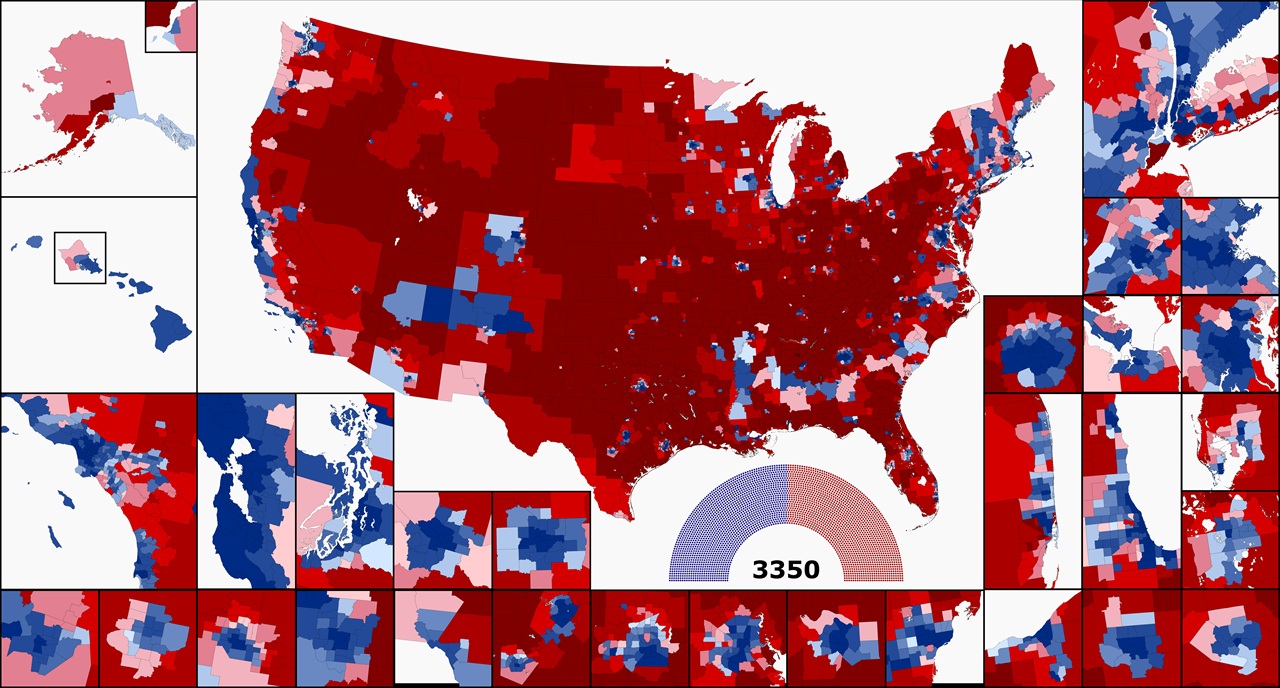
What If The US Had The Canadian Electoral System (~100k per district)Map created by reddit user AegeanRepublic

The map above shows what the US House would look like if it had 100k people per district vs the over 750k people per district today.

Overall, you’d have a house with 3,350 members, which in this map would mean 1692 Democrats and 1658 Republicans.

About the inserst:

INSETS (if you have a hard time)

Alaska: Anchorage inset; Hawaii: Honolulu/Oahu inset (easy enough, but I put them here on a technicality)

LEFT, Third row: Los Angeles/San Diego; San Francisco Bay Area; Seattle/Puget Sound; Portland, OR; Minneapolis

RIGHT

New York City

Second row: Philadelphia (and Trenton, NJ), Boston

Third row: Atlanta, Hampton Roads, Washington DC/Baltimore

Fourth row: Miami, Chicago/Milwaukee, (top) Tampa Bay, (bottom) Orlando

BOTTOM ROW: Sacramento; Las Vegas; Phoenix; Denver; El Paso; San Antonio/Austin; Dallas/Fort Worth; Houston; St. Louis; Detroit; Cleveland; Columbus, OH; Pittsburgh

And here a few more 100k maps they’ve made:

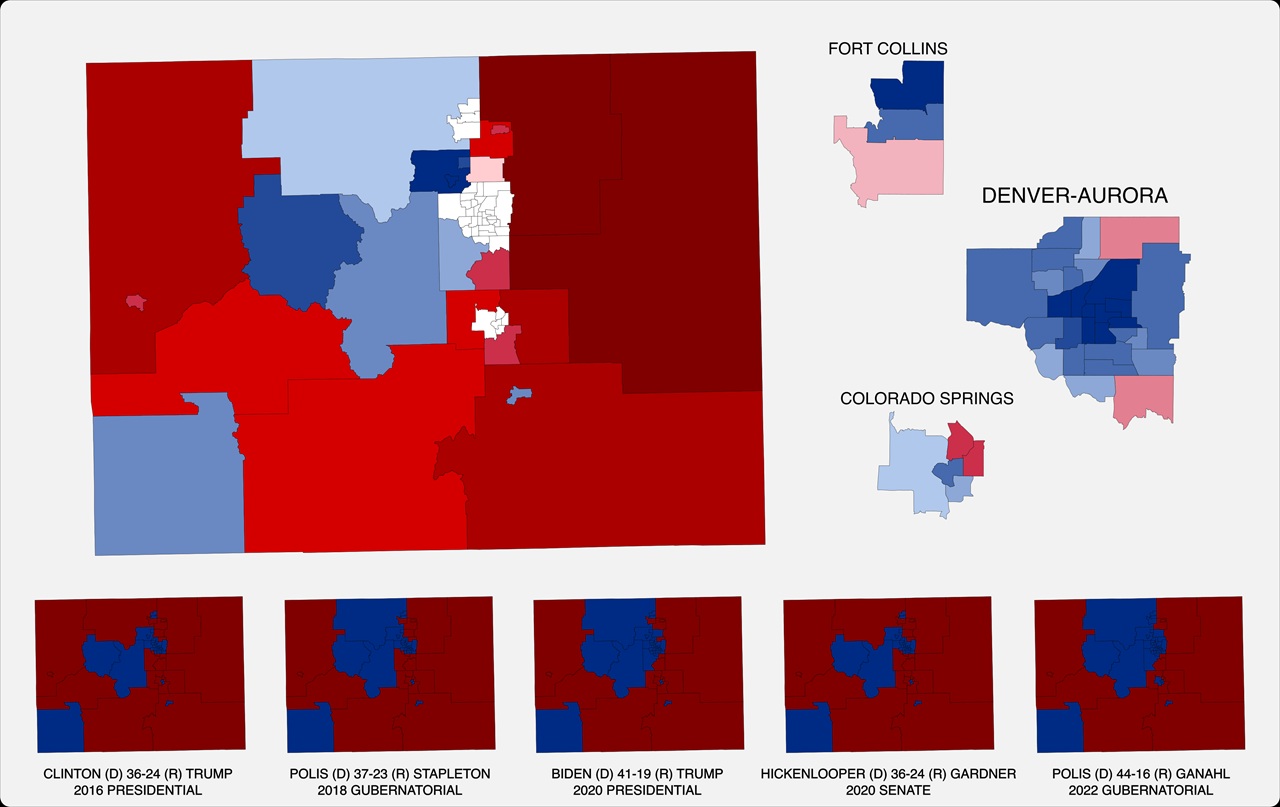
Colorado

Colorado if it had 100k per house member

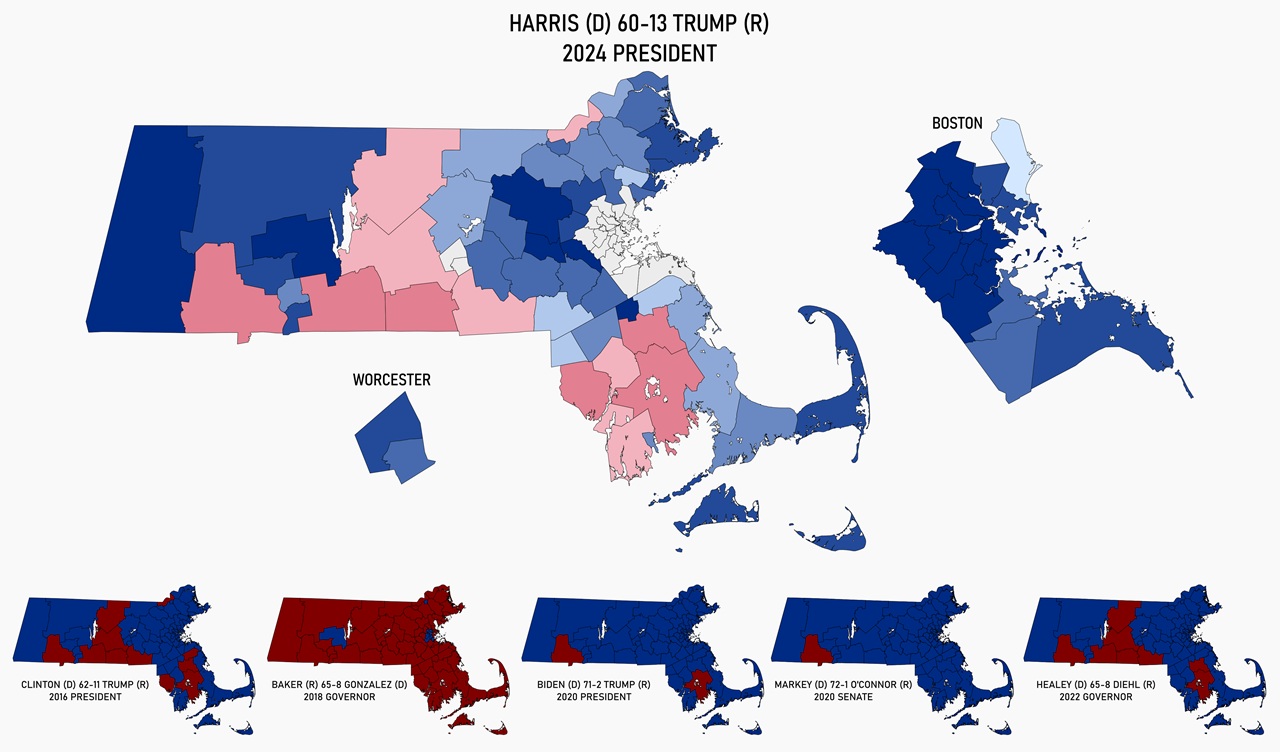
Massachusetts

Massachusetts if it had 100k per house member

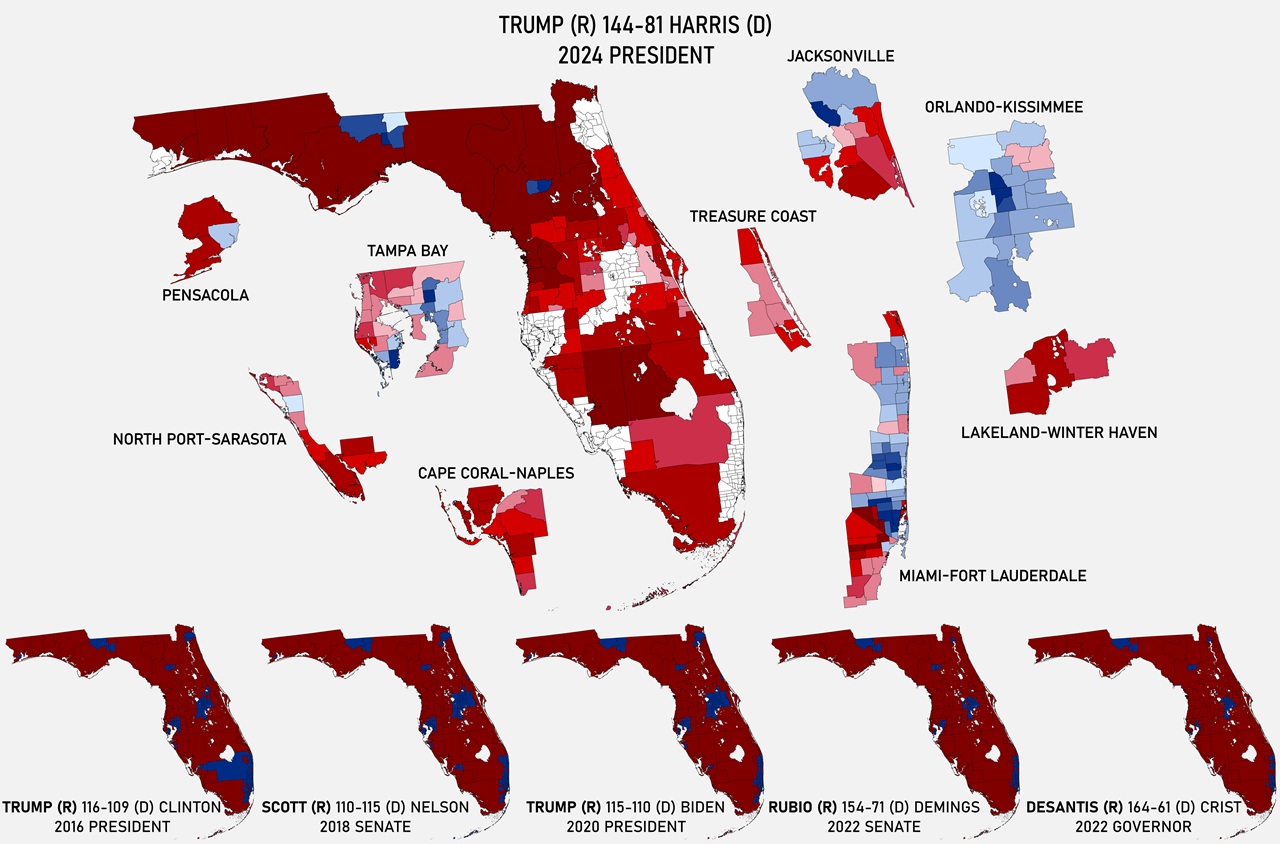
Florida

Florida if it had 100k per house member

Texas

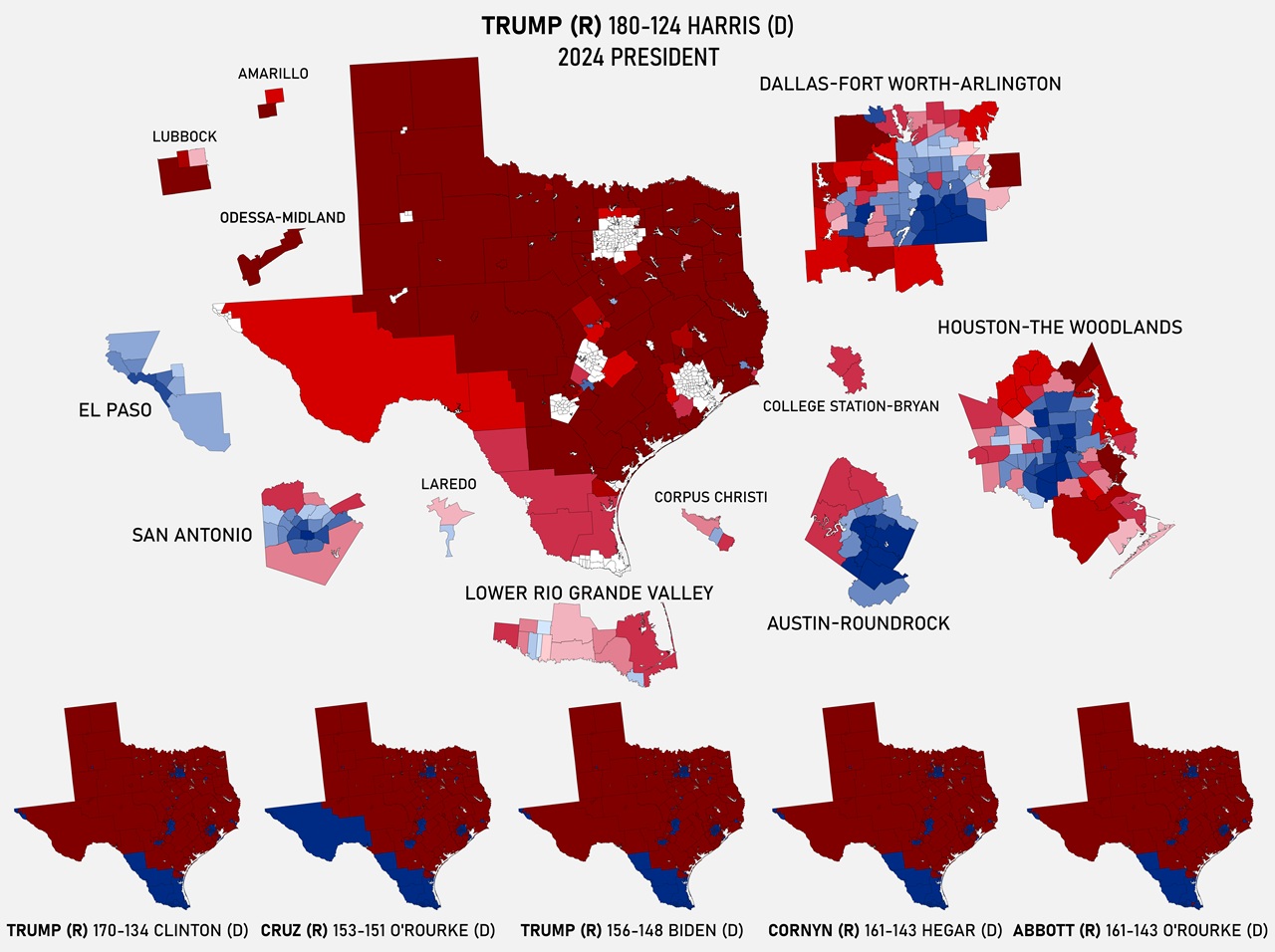
Texas if it had 100k per house member

What do you think?

https://brilliantmaps.com/?p=25006
Extensions
The Largest Possible (Non-contiguous) Congressional District In Every Western State
United States
The map above was created by reddit user Tiny_Big_4998 who explains what it shows: It’s always been hard for me to wrap my head around the true scale of population density in the American West. I’m used to seeing maps on a county or state level, which really dilutes things through aggregation. I see that […]
Show full content

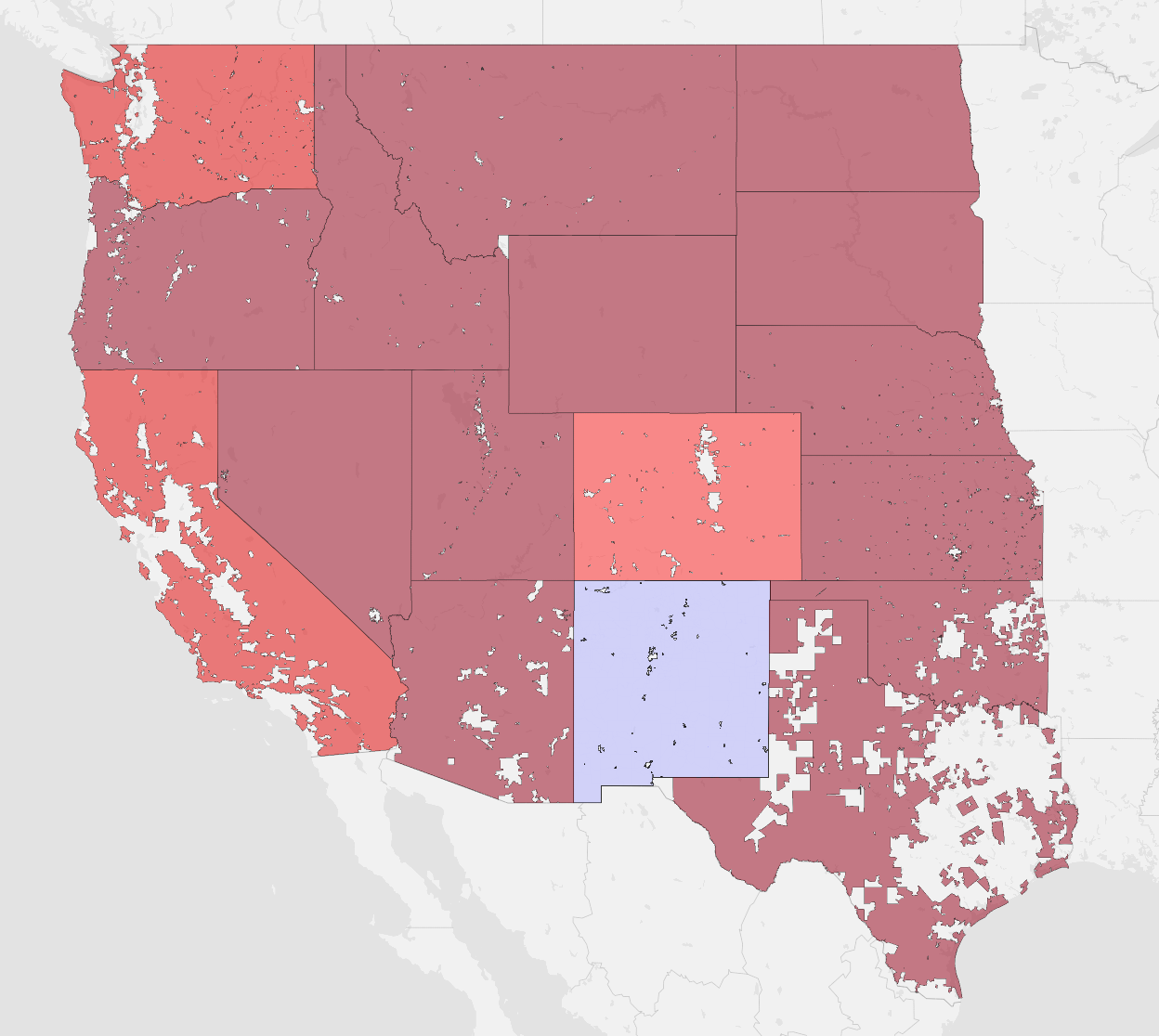
The Largest Possible (Non-contiguous) Congressional District In Every Western State

The map above was created by reddit user Tiny_Big_4998 who explains what it shows:

It’s always been hard for me to wrap my head around the true scale of population density in the American West.

I’m used to seeing maps on a county or state level, which really dilutes things through aggregation.

I see that a county has 20,000 people, and think “Wow, that’s really small.” Then, I find out that 17,000 of them live in 2 or 3 small towns, and think “holy shit, that’s unimaginably small.”

This map shows the largest possible (non-contiguous and absolutely illegal) congressional district in every western state.

Some, like California, were shockingly uncrowded (with 1/52nd of the population occupying ~85% of the space), while others like Montana or Idaho see half the population occupying well over 99.5% of the total area.

Oklahoma and Texas were surprising for the opposite reason— even the rural areas in the western half of the state were still pretty dense.

What do you think about the map?

https://brilliantmaps.com/?p=25003
Extensions
24 Ways Redditors Would Divide Europe
Europe
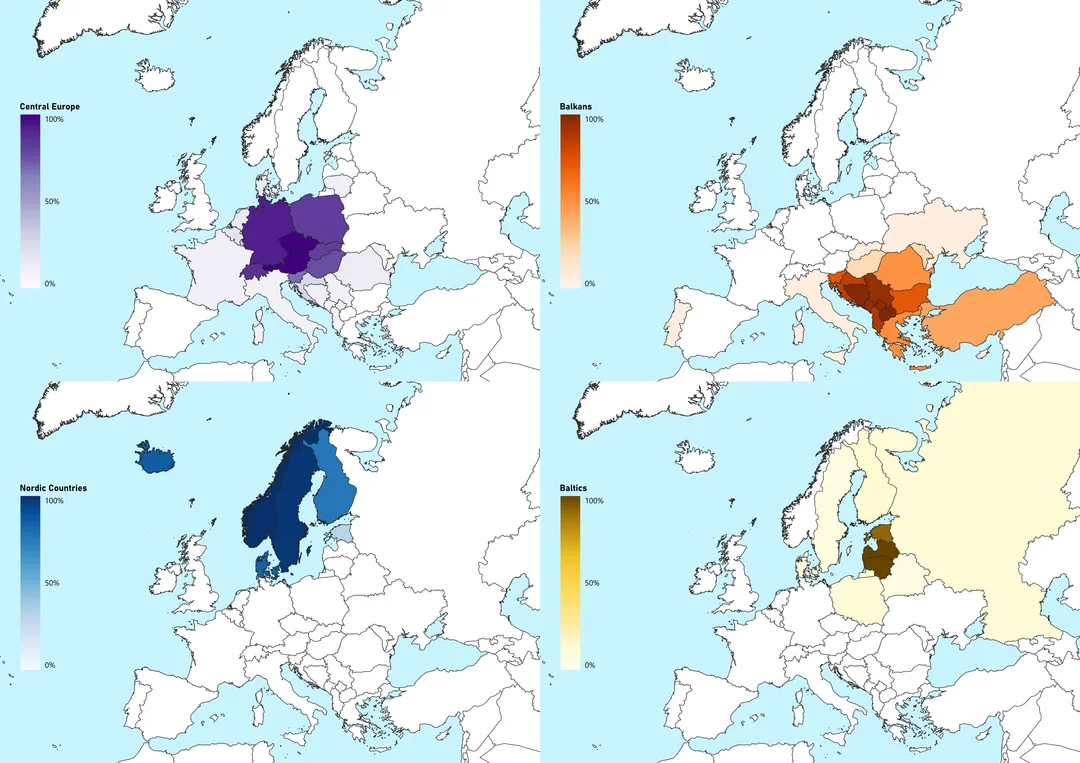
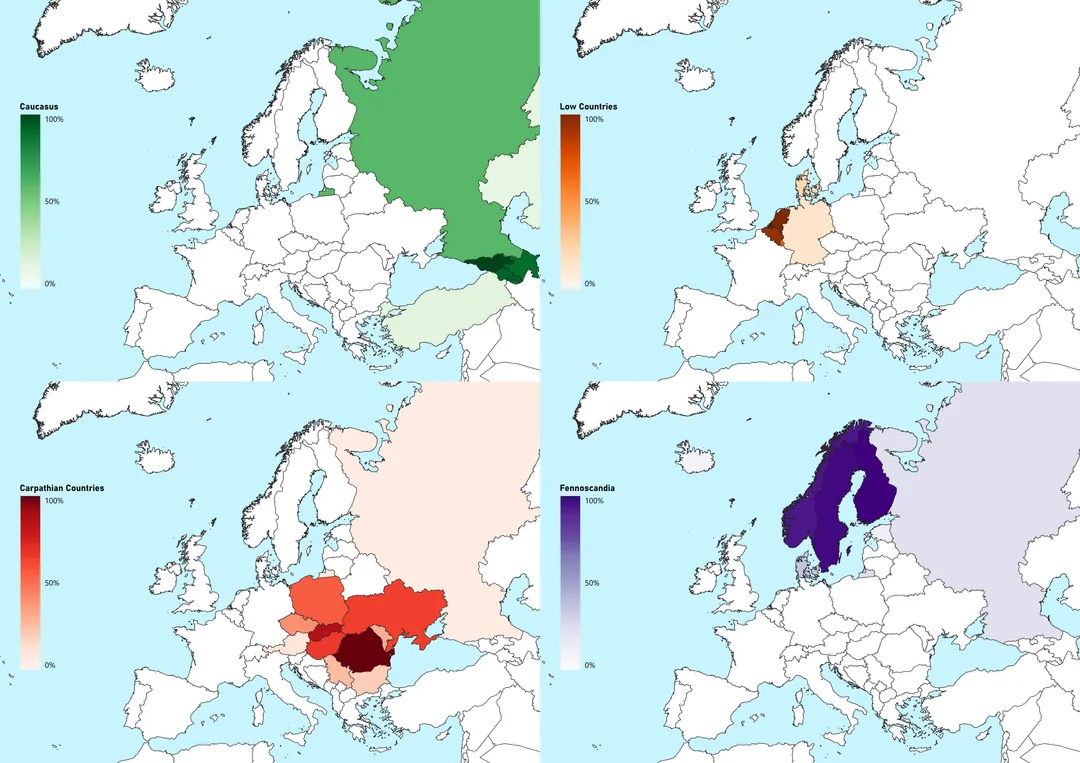
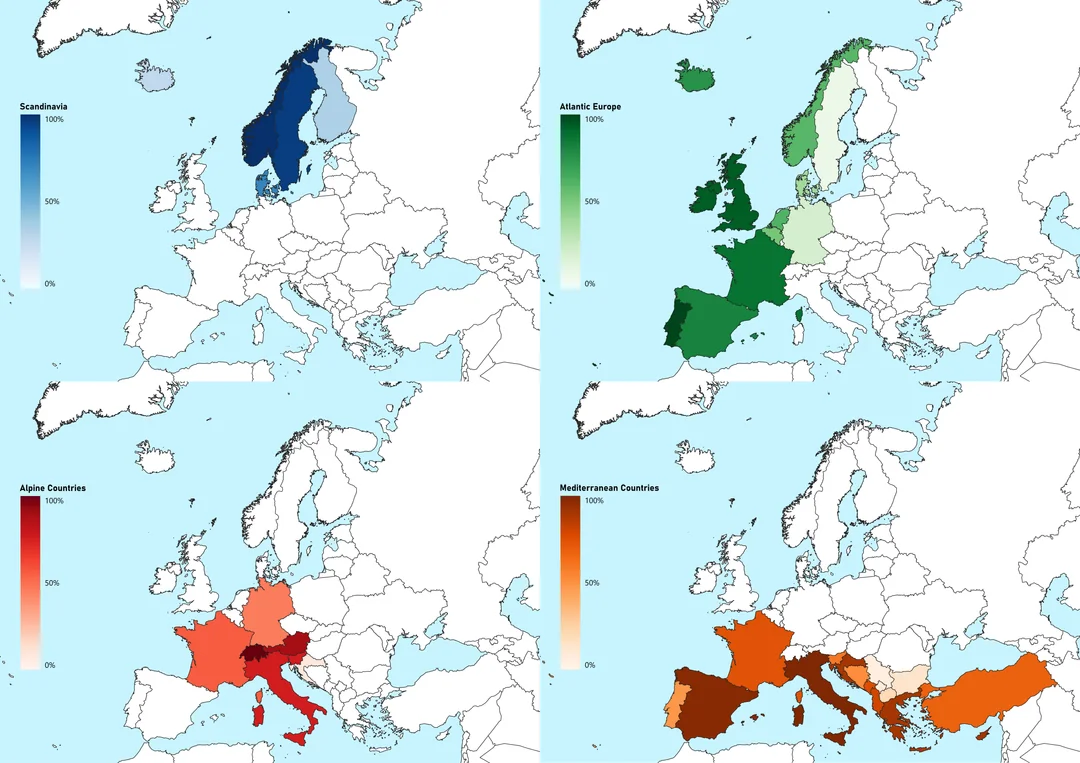
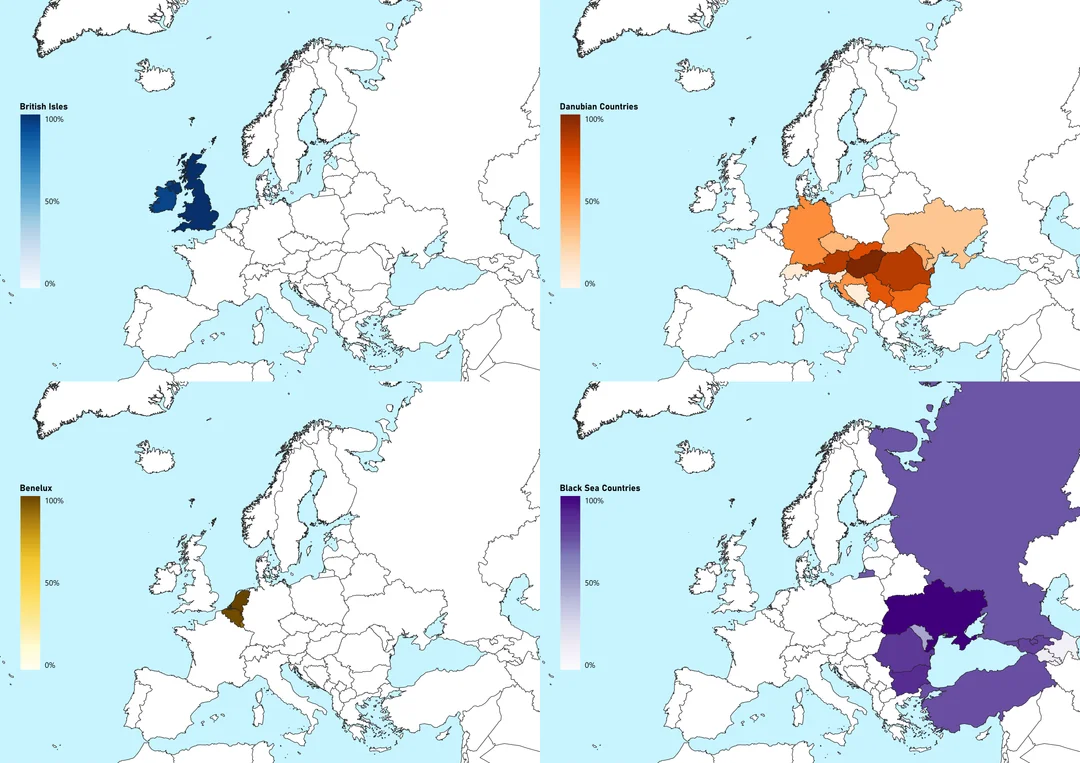
The following maps were all created by reddit user DM_me_fun_stuff_pls who explains: After my last post on the Regions of Europe, a week ago, I have gotten over 200 responses on my survey on it, thank you for that! So here are the results of the survey. Notes on the Survey and Map: Each category […]
Show full content

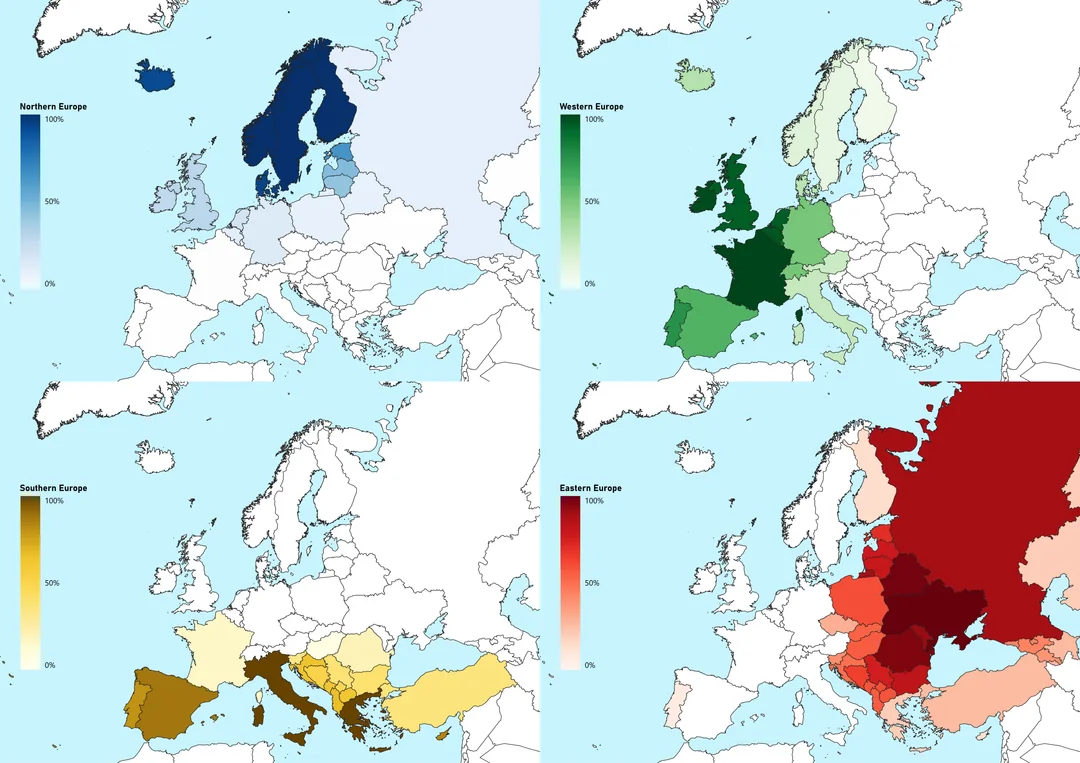
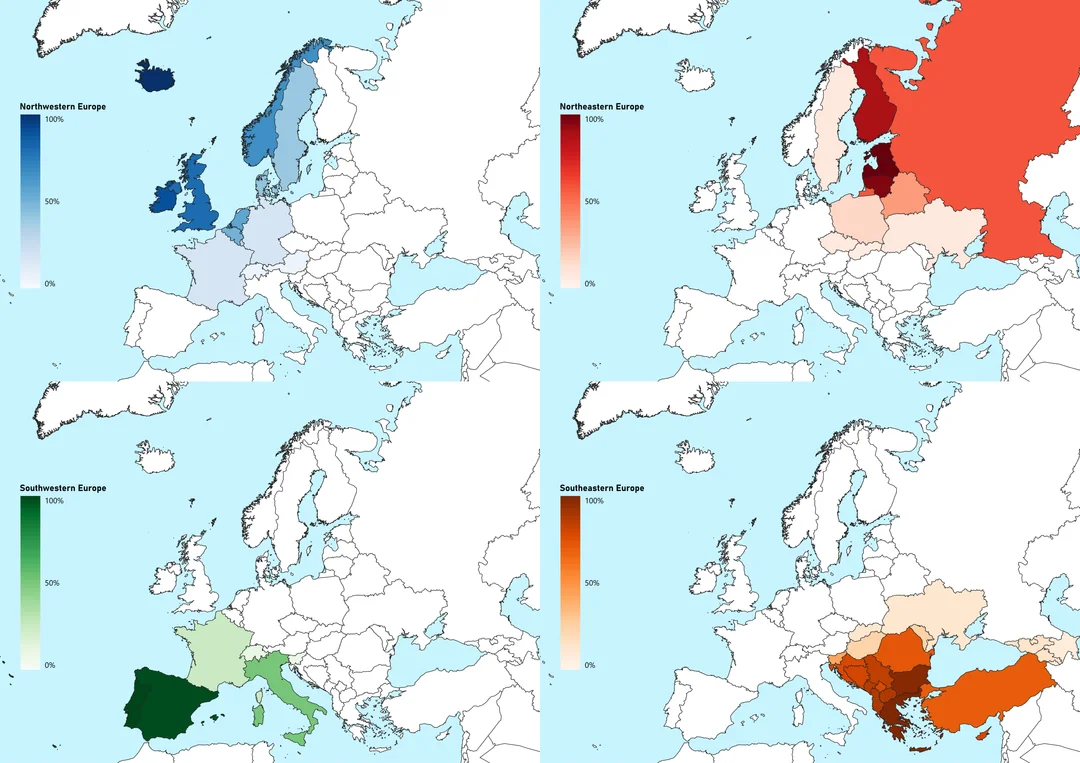
The following maps were all created by reddit user DM_me_fun_stuff_pls who explains:

After my last post on the Regions of Europe, a week ago, I have gotten over 200 responses on my survey on it, thank you for that! So here are the results of the survey.

Notes on the Survey and Map: Each category is normalized to the most voted country in each category. So 100% does not mean every single respondent chose this country but that it was the most chosen (although most of the times it was close).

It would probably be great and interesting to go into a lower level of subdivisions for some of these Regions, but honestly I don’t know how I would go about doing a survey for that, that is not a complete chore to respond to…

And now the maps:

Northern, Western, Southern & Eastern Europe

Northern, Western, Southern & Eastern Europe

Northwestern, Northeastern, Southwestern & Southeastern Europe

Northwestern, Northeastern, Southwestern & Southeastern Europe

Central Europe, The Balkans, Nordic Countries, Baltic Countries

Central Europe, The Balkans, Nordic Countries, Baltic Countries

Caucus, Low Countries, Carpathians, & Fennoscandia Countries

Caucus, Low Countries, Carpathians, & Fennoscandia Countries

Scandinavian, Atlantic, Alpine, & Mediterranean Countries

Scandinavian, Atlantic, Alpine, & Mediterranean Countries

British Isles, Danubian, Benelux & Black Sea Countries

British Isles, Danubian, Benelux & Black Sea Countries

A few questions were asked about the map including:

Why is Portugal marked as a Balkan country?

The answer:

Its a joke here on Reddit, since in many maps it appears in similar categories as the Balkan countries.

The Joke is popular enough for it to show up on the map. I wasn’t sure how to deal with it, since it was obvious Joke answers, but at the same time if I started removing “Joke answers” it would have been pretty hard to decide which would count as such (For example quite a few people voted for Britain not being part of Europe, that could either be a joke or it could be about it not being part of the European mainland).

So for the sake of Data sanctity I left it all as is.

The only Filter I employed is extending the white color of 0% up to 2%, to filter out random noise, since there were a handful of people that sometimes gave pretty random answers. So as you can see over 2% of people have voted for Portugal to be Eastern Europe and Balkans…

What do you think of the maps?

https://brilliantmaps.com/?p=24991
Extensions
The Sulu Sea
Asia
Above is a map the Sulu Sea between the Philippines and Borneo. More about the Sea and its connection to Star Trek below: The Sulu Sea is a deep, semi-enclosed sea in Philippines, bordered by Palawan to the northwest, the Visayas to the northeast, and Mindanao to the southeast. To the southwest, it opens toward […]
Show full content

Map of the The Sulu Sea With Sulu

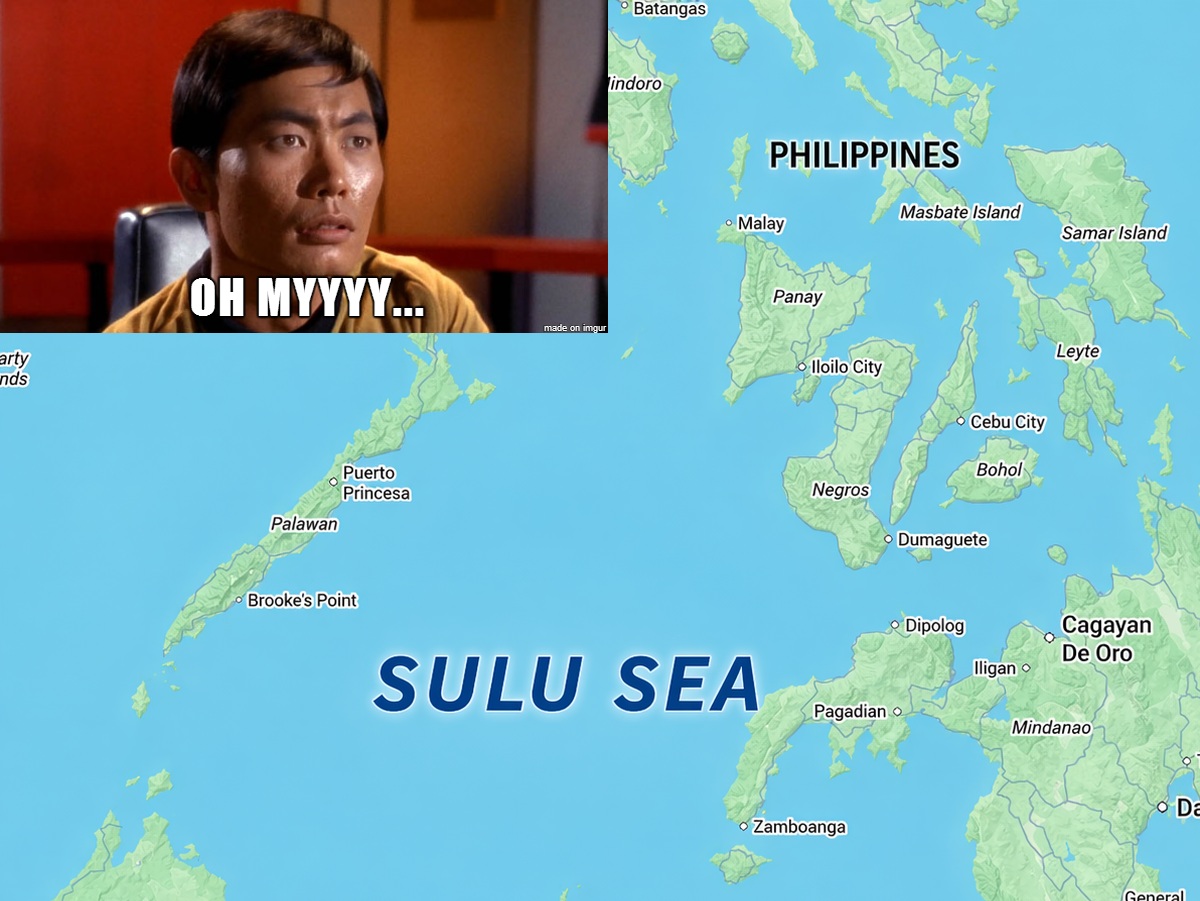
Above is a map the Sulu Sea between the Philippines and Borneo.

More about the Sea and its connection to Star Trek below:

The Sulu Sea is a deep, semi-enclosed sea in Philippines, bordered by Palawan to the northwest, the Visayas to the northeast, and Mindanao to the southeast.

To the southwest, it opens toward Borneo.

Geography
  • Deep basin: Parts exceed 5,000 meters (16,400 ft), making it one of the deeper seas in Southeast Asia.
  • Natural boundaries: Surrounded by island arcs like the Sulu Archipelago, which act like a partial barrier to ocean currents.
  • Coral ecosystems: Home to the Tubbataha Reefs Natural Park, a UNESCO World Heritage Site and one of the most biodiverse reef systems on Earth.
  • Limited water exchange: Narrow straits connect it to nearby seas (like the South China Sea), which creates distinct circulation patterns and high marine productivity.

This combination of depth, isolation, and reef systems makes the Sulu Sea a kind of “marine laboratory.”

Economic Importance

The Sulu Sea plays a major role in the regional economy:

Fisheries

  • One of the Philippines’ most productive fishing grounds
  • Supports tuna, sardines, and reef fish industries
  • Provides livelihoods for millions of coastal residents

Shipping & Trade

  • Serves as a regional maritime corridor between the Pacific and the South China Sea
  • Important for domestic shipping between Philippine islands

Natural Resources

  • Potential reserves of oil and natural gas (though not fully developed)
  • Rich marine biodiversity also supports eco-tourism

Tourism

  • Diving hotspots (especially Tubbataha) attract global visitors
  • Coral reefs, clear waters, and marine life are major draws

However, the region also faces challenges:

  • Overfishing
  • Coral reef degradation
  • Maritime security issues in parts of the Sulu Archipelago
🖖 Connection to Star Trek

At first glance, the Sulu Sea and Star Trek seem unrelated, but there’s a fun cultural link:

Hikaru Sulu

The character Hikaru Sulu from Star Trek was named “Sulu” deliberately.

  • Creator Gene Roddenberry chose the name to reflect a pan-Asian identity, rather than tying the character to one specific nationality.
  • The Sulu Sea was selected because it is a neutral, geographically broad reference in Asia.
  • This aligned with Star Trek’s vision of a unified, multicultural future.

So while the sea itself doesn’t appear in the show, its name lives on in one of Starfleet’s most iconic officers.

Have you ever been?

https://brilliantmaps.com/?p=24980
Extensions
Map of The Shortest Passenger Flight In The World
United Kingdom
The map above shows the shortest scheduled passenger flight in the world is between the Orkney islands of Westray and Papa Westray in northern Scotland, the flight is 1.7 miles (2.7 km) long and takes around 1 minute! But why does it exist? The flight between Westray and Papa Westray exists mainly because it’s the […]
Show full content

Map of The Shortest Passenger Flight In The World

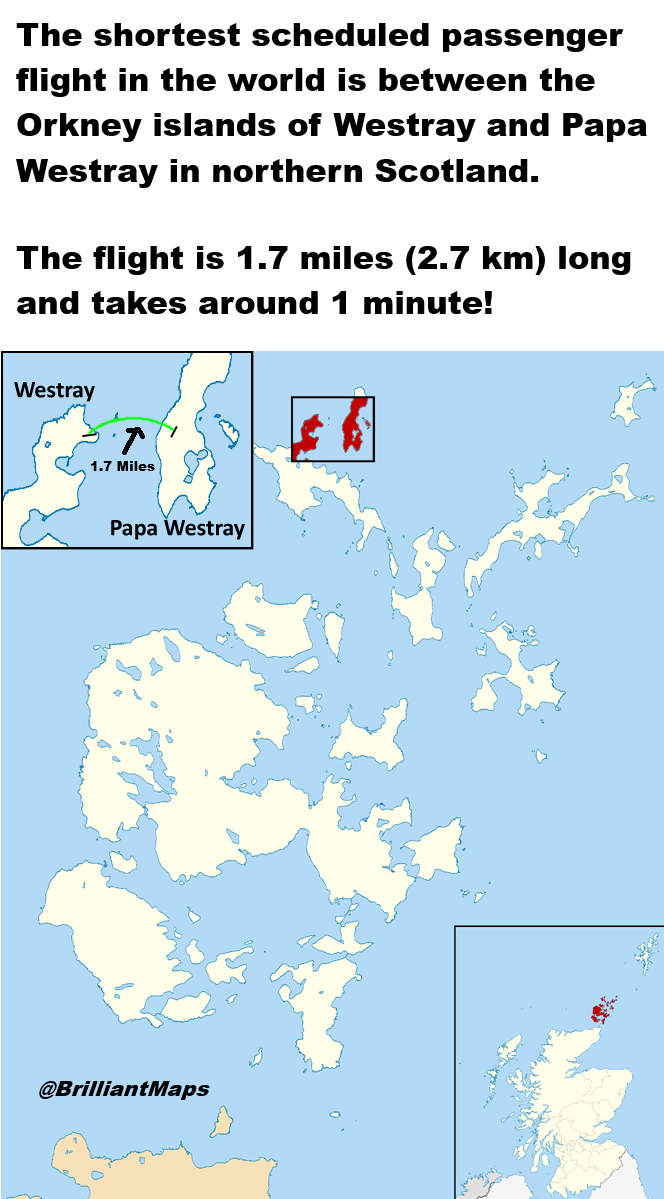
The map above shows the shortest scheduled passenger flight in the world is between the Orkney islands of Westray and Papa Westray in northern Scotland, the flight is 1.7 miles (2.7 km) long and takes around 1 minute!

But why does it exist?

The flight between Westray and Papa Westray exists mainly because it’s the most practical way to connect the two very small, remote islands.

Here’s the short version:

  • Distance is tiny, but conditions aren’t: The islands are only about 1.7 miles (2.7 km) apart, but the waters between them can be rough, windy, and unpredictable, making regular ferry service less reliable for such a short crossing.
  • Population is very small: Papa Westray has only a few dozen residents. Building and maintaining a bridge would be extremely expensive relative to the number of people using it.
  • Ferry isn’t efficient enough: There is a ferry, but it’s slower and not always ideal for urgent trips like medical visits, school travel, or mail delivery.
  • Flights are fast and flexible: The flight (operated by Loganair) takes under two minutes, making it the shortest scheduled commercial flight in the world. It’s quick, relatively cost-effective, and fits the needs of the community.

In short, the flight exists because it’s the cheapest and most reliable solution for such a small, remote population, even if it seems unusual given the short distance.

10 Fun facts About the route
  • It’s incredibly short: As mentioned abovetThe route is just 1.7 miles (2.7 km) long, roughly the same as the runway at Edinburgh Airport!
  • It’s the shortest scheduled flight in the world: The journey can take under a minute, with a record of 53 seconds.
  • Flights run daily: Services operate every day, but with different directions on weekends.
  • Weekend flights are one-way only: Saturdays have flights from Westray to Papa Westray, while Sundays go the opposite direction.
  • A record-setting pilot flew it most: Stuart Linklater completed over 12,000 flights on this route before retiring in 2013.
  • It mainly serves locals and students: Many passengers are school groups visiting archaeological sites on Papa Westray.
  • It’s also used for healthcare access: Residents (around 90 people) rely on it for medical trips and visiting professionals.
  • Tourists ride it for the novelty: The route attracts visitors wanting to experience the world’s shortest commercial flight.
  • Passenger numbers are modest: The route carries about 5,000 passengers per year.
  • It uses a rugged small aircraft: Flights are operated by Loganair using the Britten-Norman BN-2 Islander, chosen for its ability to handle short runways and harsh weather.

Have you ever taken it?

https://brilliantmaps.com/?p=24977
Extensions
35 of The Best Maps From Todd Jones
Other
All of the following maps are the work of Todd Jones who is according to his website: I am an Assistant Professor of Economics at Mississippi State University, an IZA Research Fellow, a CESifo Research Network Affiliate, and an Annenberg Institute (Brown University) EdWorkingPapers Contributor. Beginning in August 2026, I will be an Associate Professor of Economics at Mississippi […]
Show full content

All of the following maps are the work of Todd Jones who is according to his website:

I am an Assistant Professor of Economics at Mississippi State University, an IZA Research Fellow, a CESifo Research Network Affiliate, and an Annenberg Institute (Brown University) EdWorkingPapers Contributor. Beginning in August 2026, I will be an Associate Professor of Economics at Mississippi State University.

My research interests are in applied microeconomics, including topics in education, family, and crime. My research is published in journals including the Journal of Human Resources, Journal of Public Economics, Journal of Economic Behavior & Organization, Labour Economics, Journal of Population Economics, Economics of Education Review, and Education Finance & Policy. My CV is available here.

You can follow him on Twitter/X @toddrjones.

Now on to the maps:

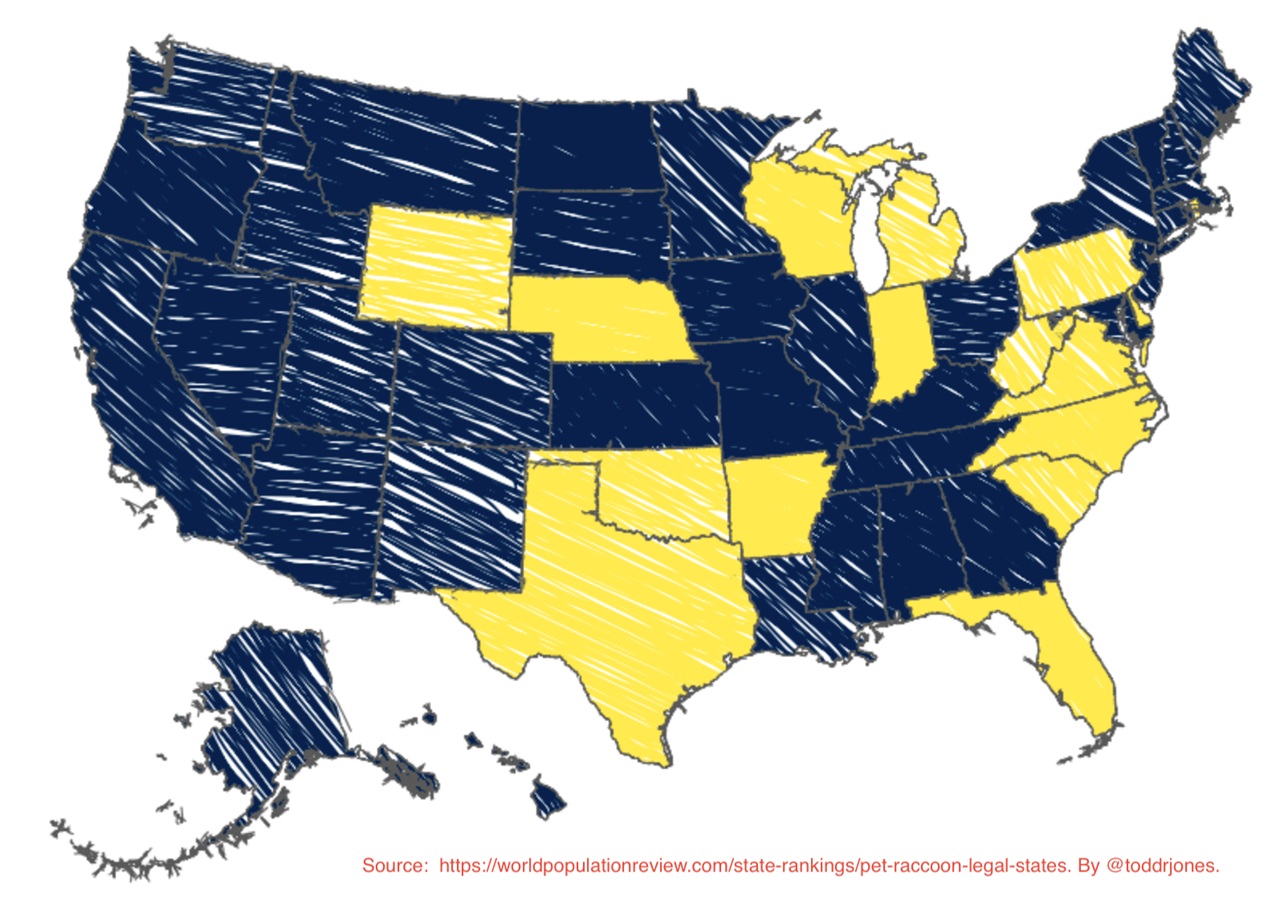
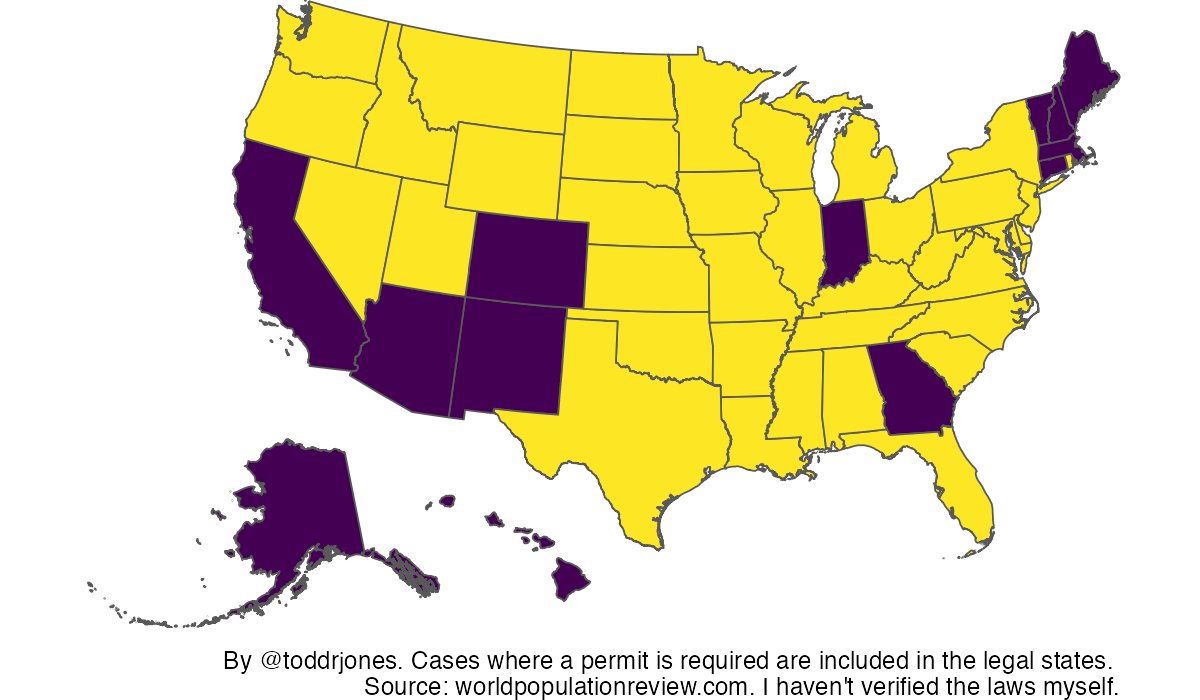
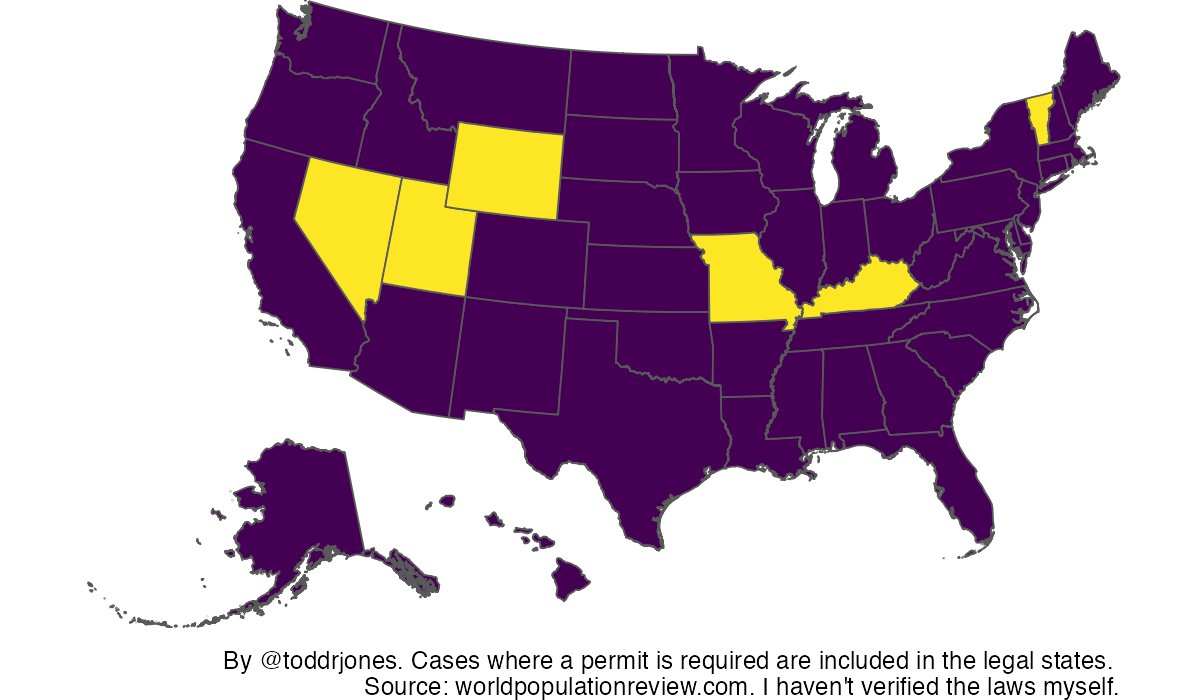
The yellow states in the map below are the states in which it is legal to own a RACCOON

Where it is legal to own a raccoon in the United States

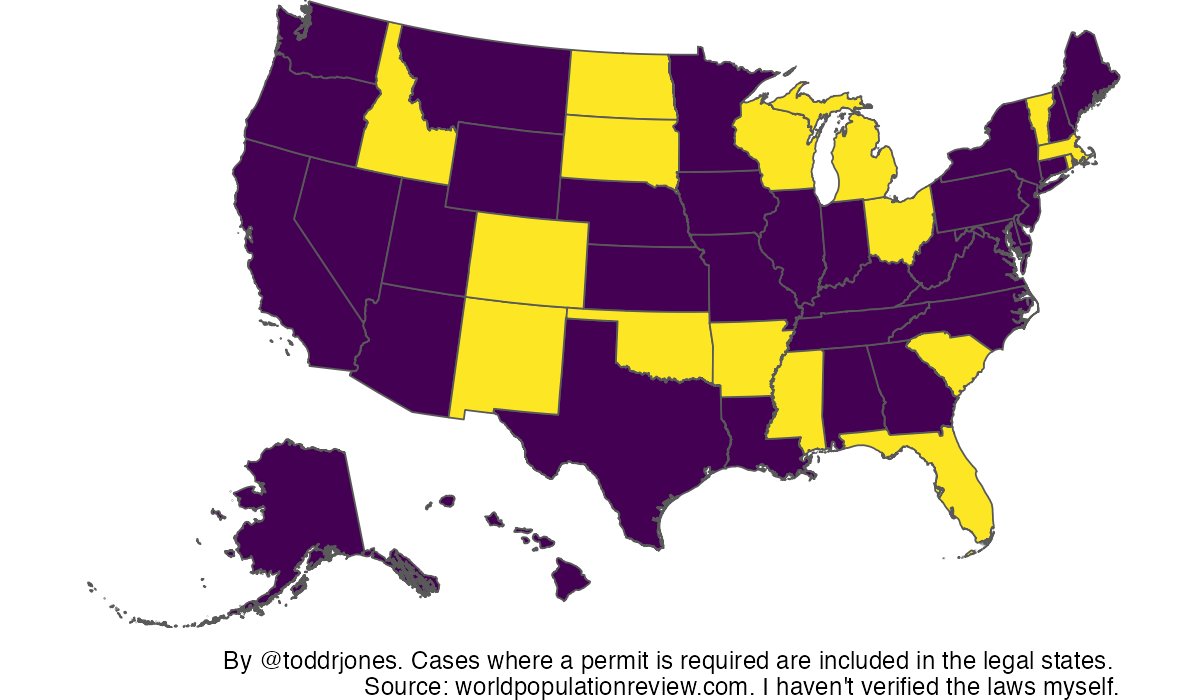
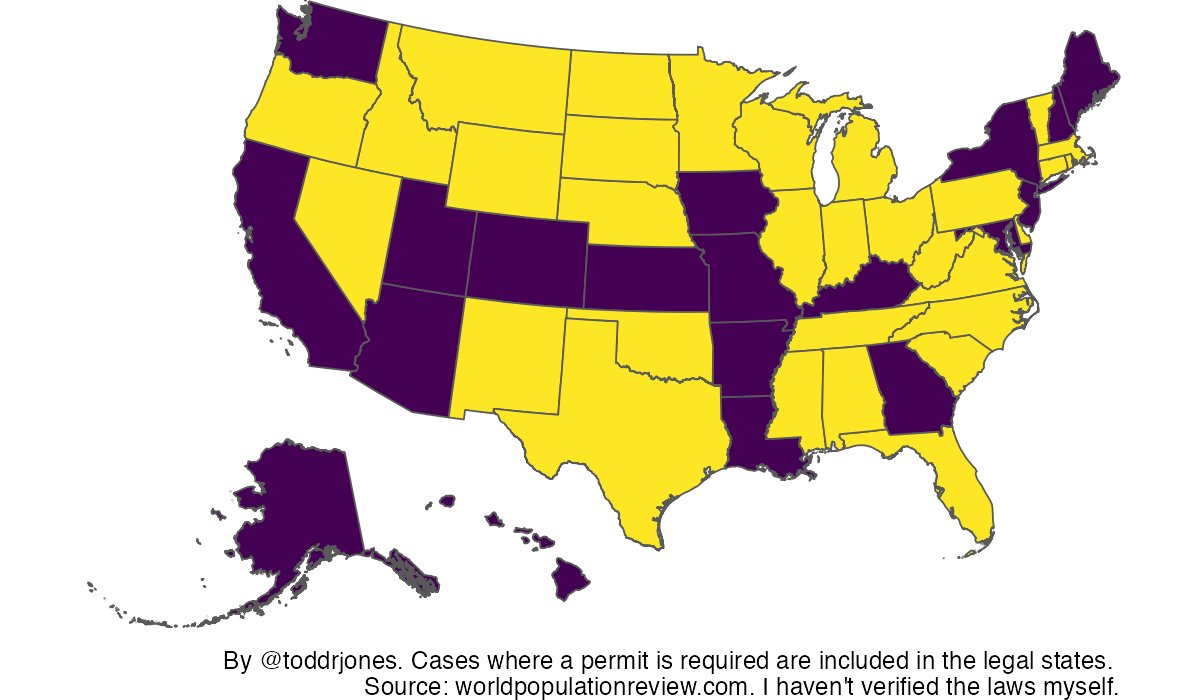
The yellow states in the map below are the states in which it is legal to own an otter

The yellow states are the states in which it is legal to own an otter

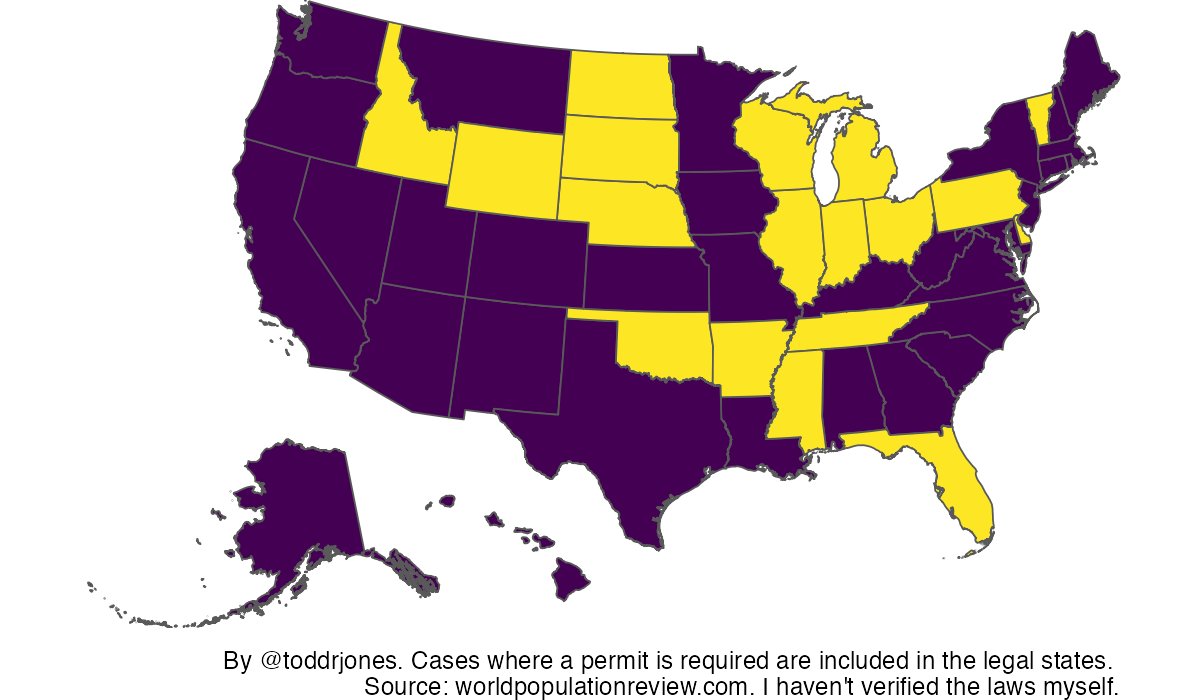
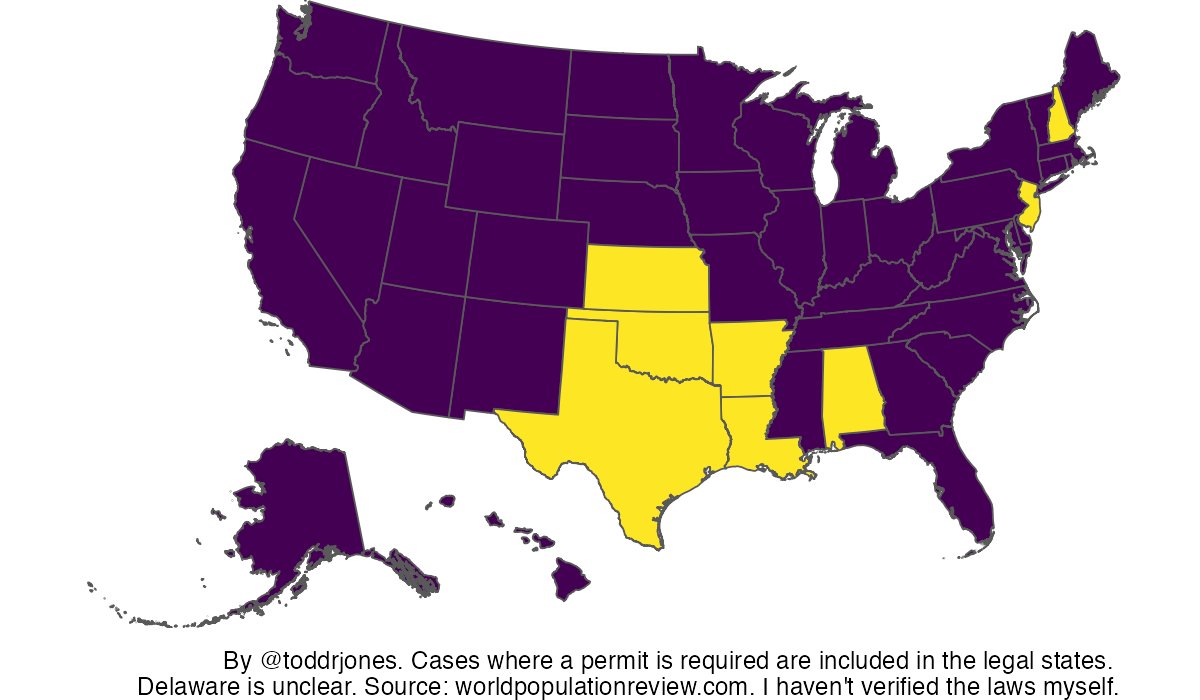
The yellow states in the map below are the states in which it is legal to own a Sloth

In the Yellow States Its Legal To Own a Sloth

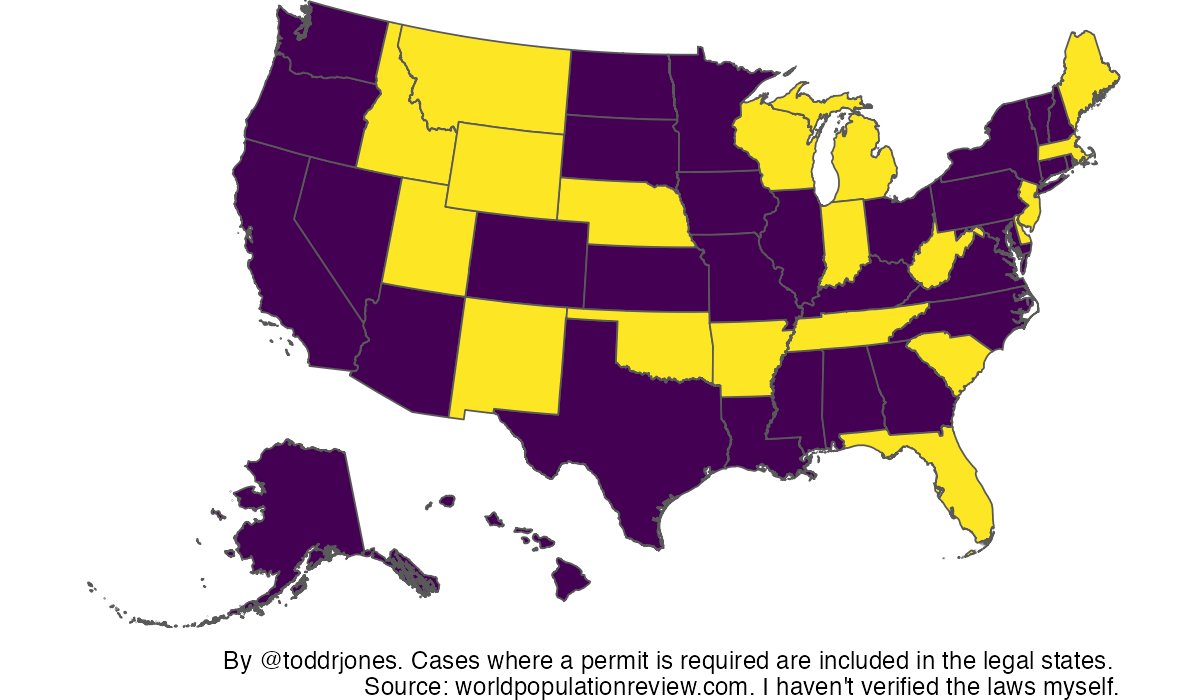
The yellow states in the map below are the states in which it is legal to own A Deer

In The Yellow States You Can Legally Own A Deer

The yellow states in the map below are the states in which it is legal to own a Fennec Fox

In the Yellow States It's Legal To Own A Fennec Fox

The yellow states in the map below are the states in which it is legal to own a Squirrel

In the Yellow States It's Legal To Own A Squirrel

The yellow states in the map below are the states in which it is legal to own an Owl

In the Yellow States It's Legal To Own An Owl

The yellow states in the map below are the states in which it is legal to own a Prairie Dog

In the Yellow States It's Legal To Own A Prairie Dog

The yellow states in the map below are the states in which it is legal to own An Armadillo

In the Yellow States It's Legal To Own An Armadillo

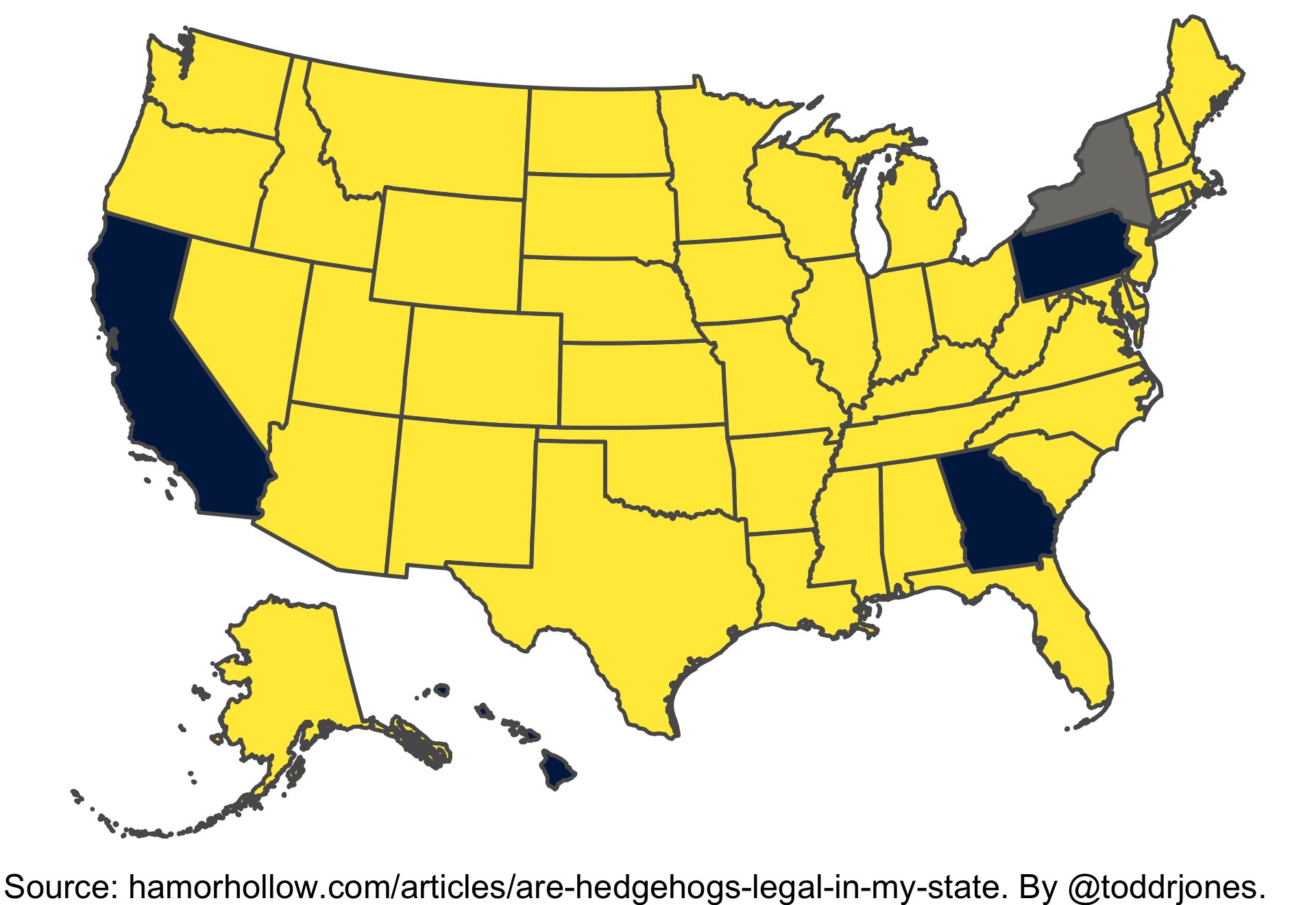
The yellow states in the map below are the states in which it is legal to own A HEDGEHOG

In the Yellow States It's Legal To Own A HEDGEHOG

Note: It is legal in New York State except for the five Boroughs of New York City.

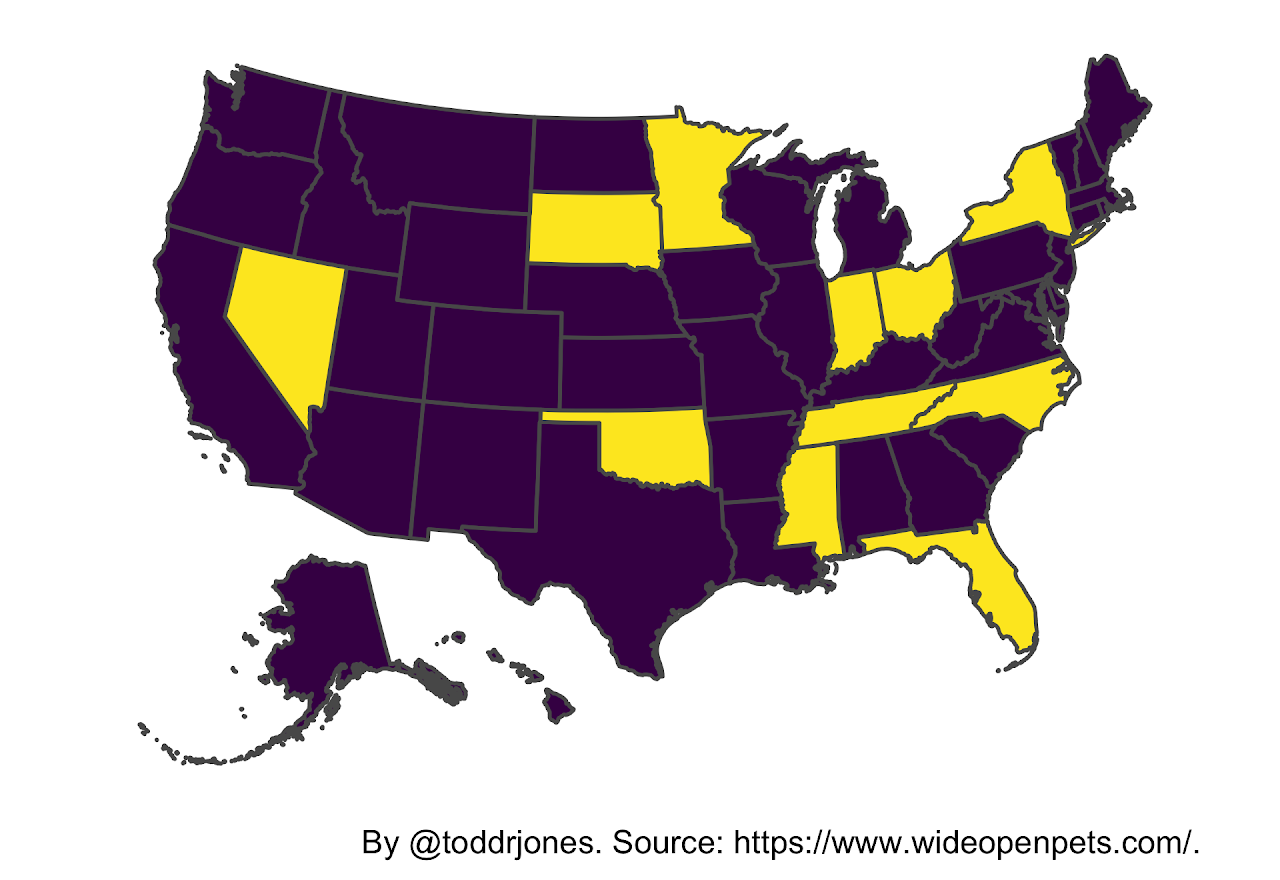
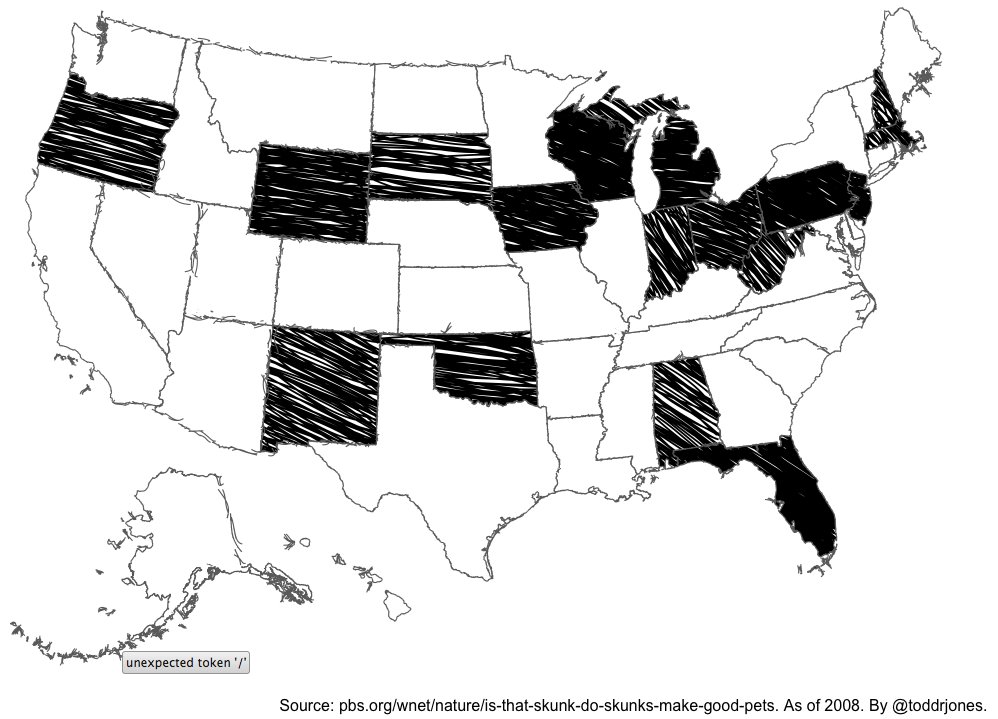
In the Black States It’s Legal To Own An Skunk

In the Black States It's Legal To Own An Skunk

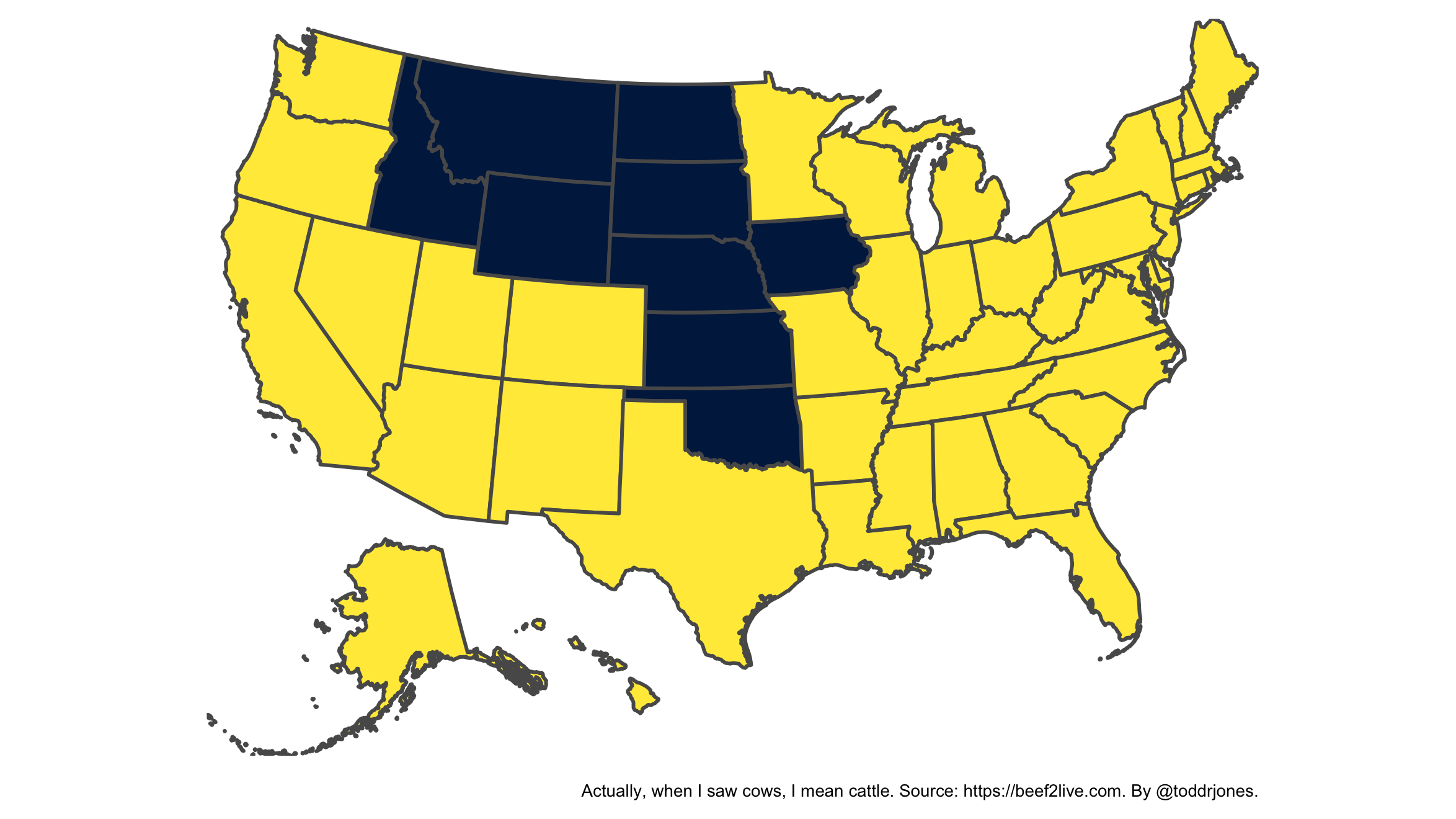
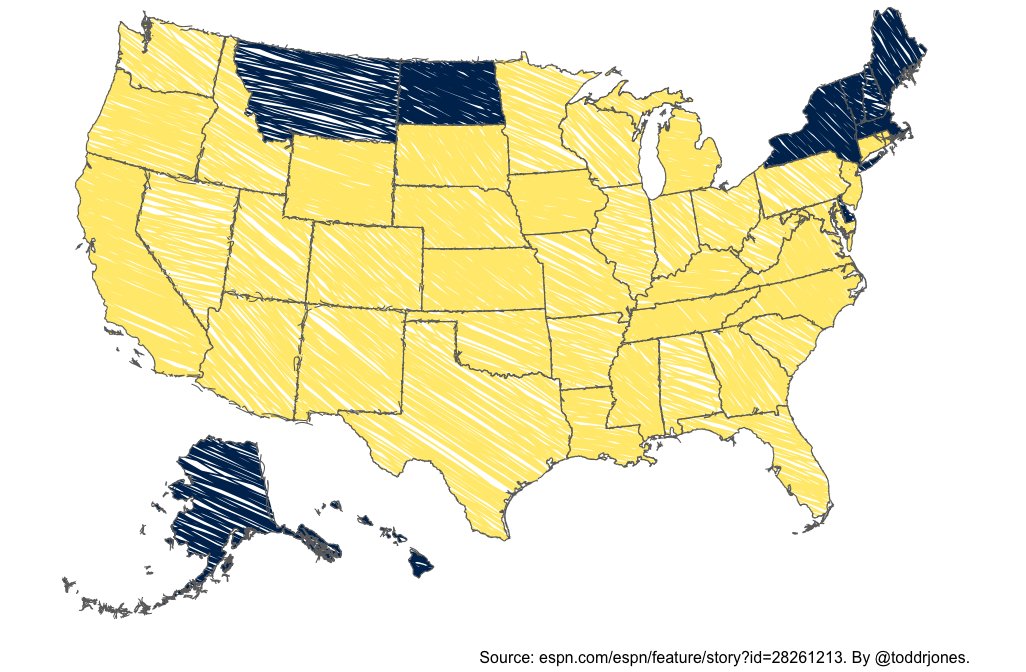
There are more cows than people in the Dark Blue States

There are more cows than people in the Dark Blue States

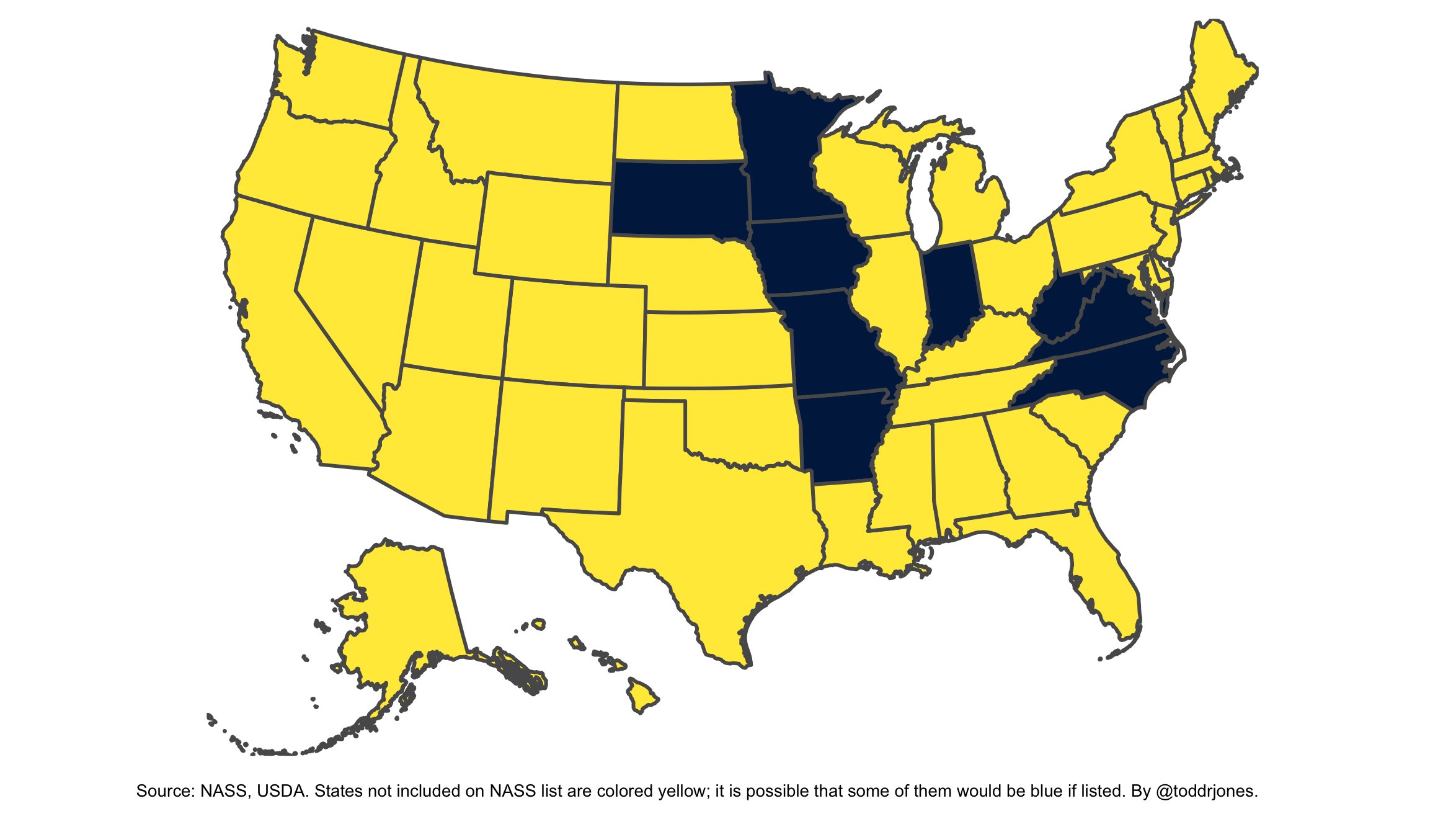
The blue states have more turkeys than people

The blue states have more turkeys than people

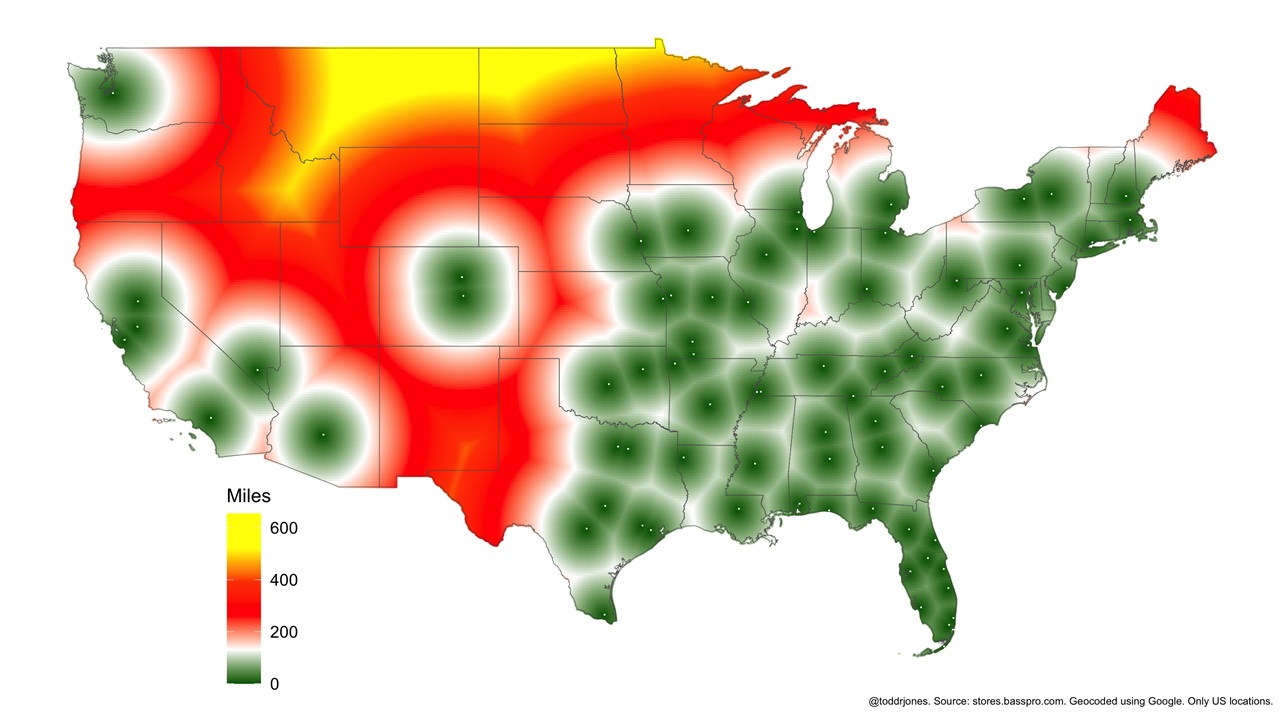
Distance to the nearest Bass Pro Shop

Distance to the nearest Bass Pro Shop

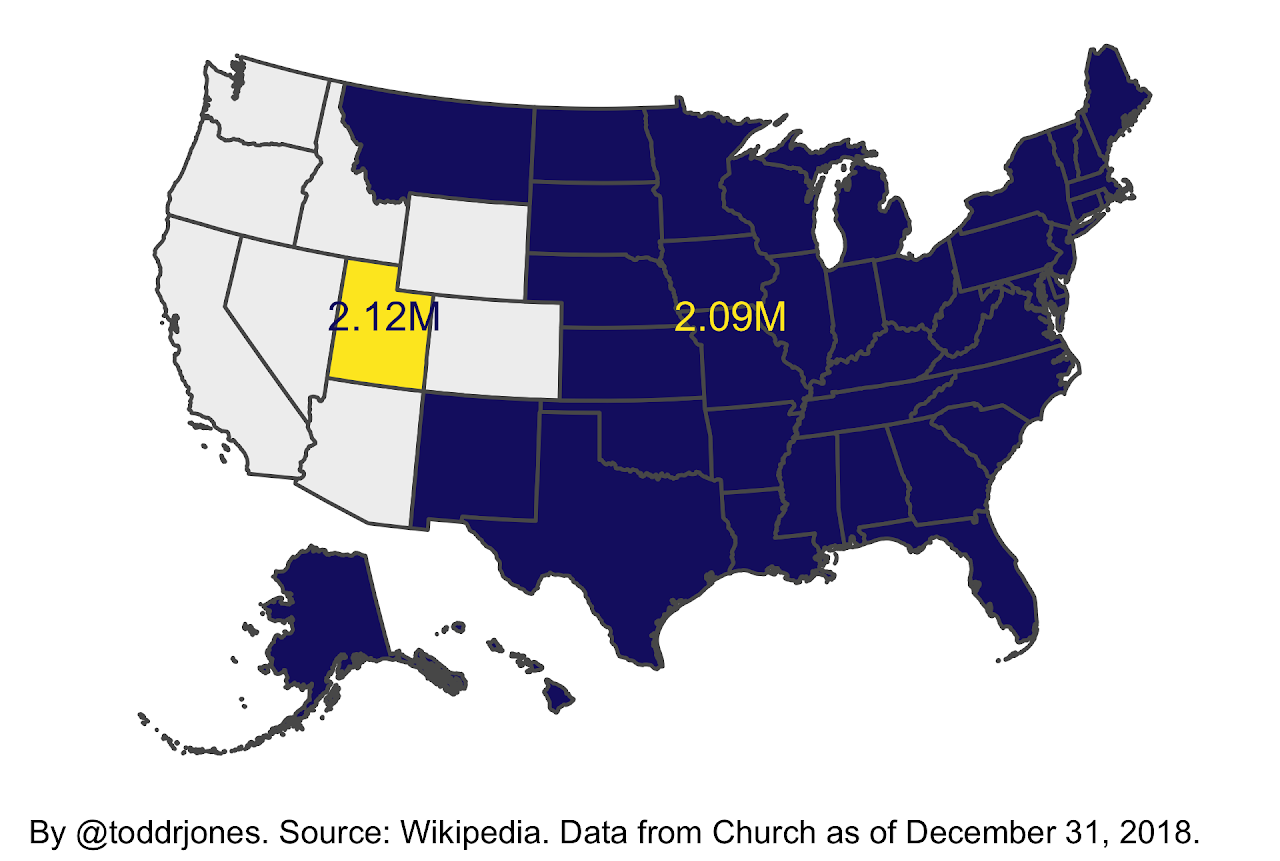
Utah has more Mormons (members of the Church of Jesus Christ of Latter-day Saints) than all the blue states combined

Utah has more Mormons (members of the Church of Jesus Christ of Latter-day Saints) than all the blue states combined

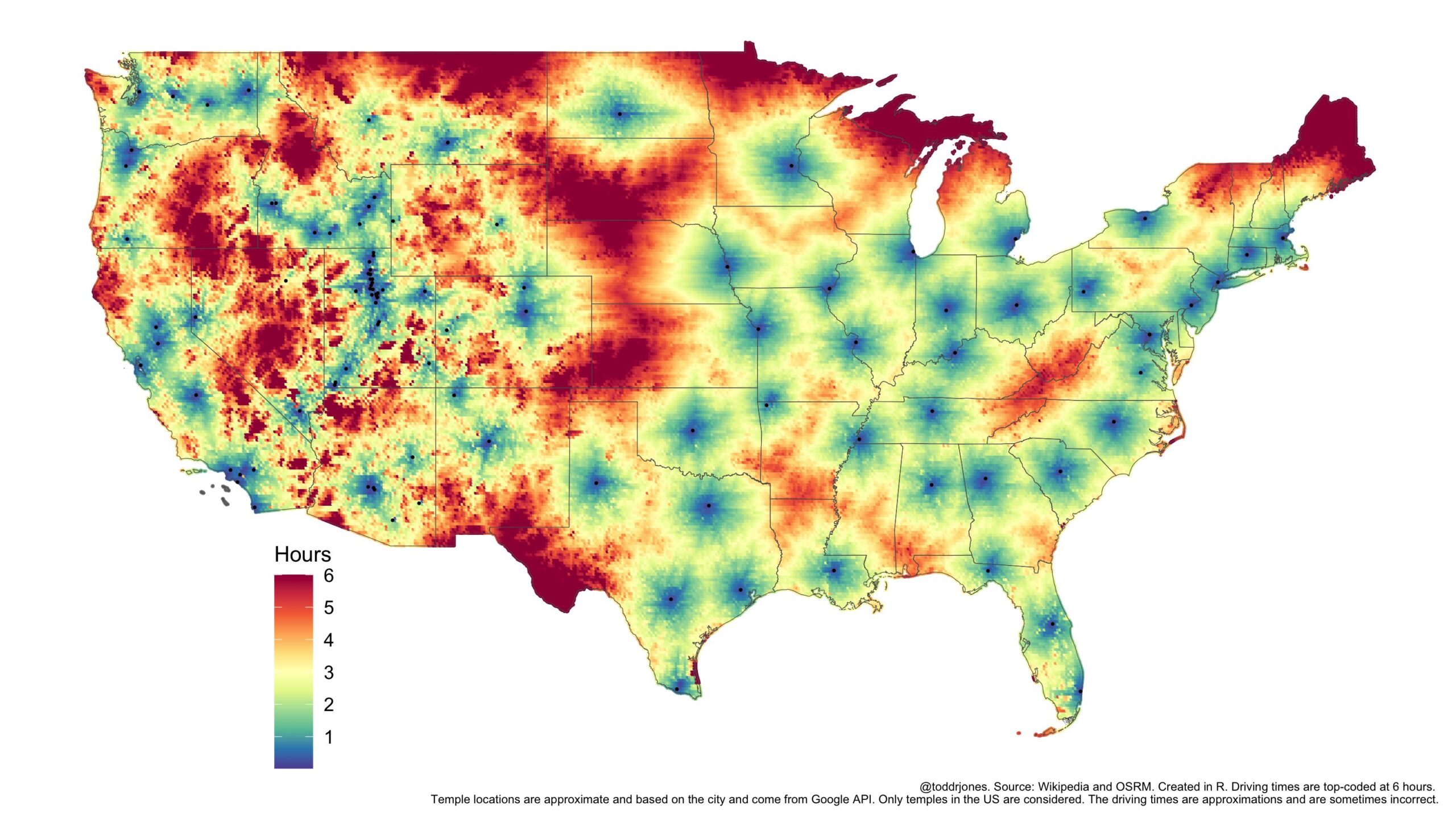
Driving time to nearest Latter-day Saint (Mormon) Temple

Driving time to nearest Latter-day Saint (Mormon) Temple

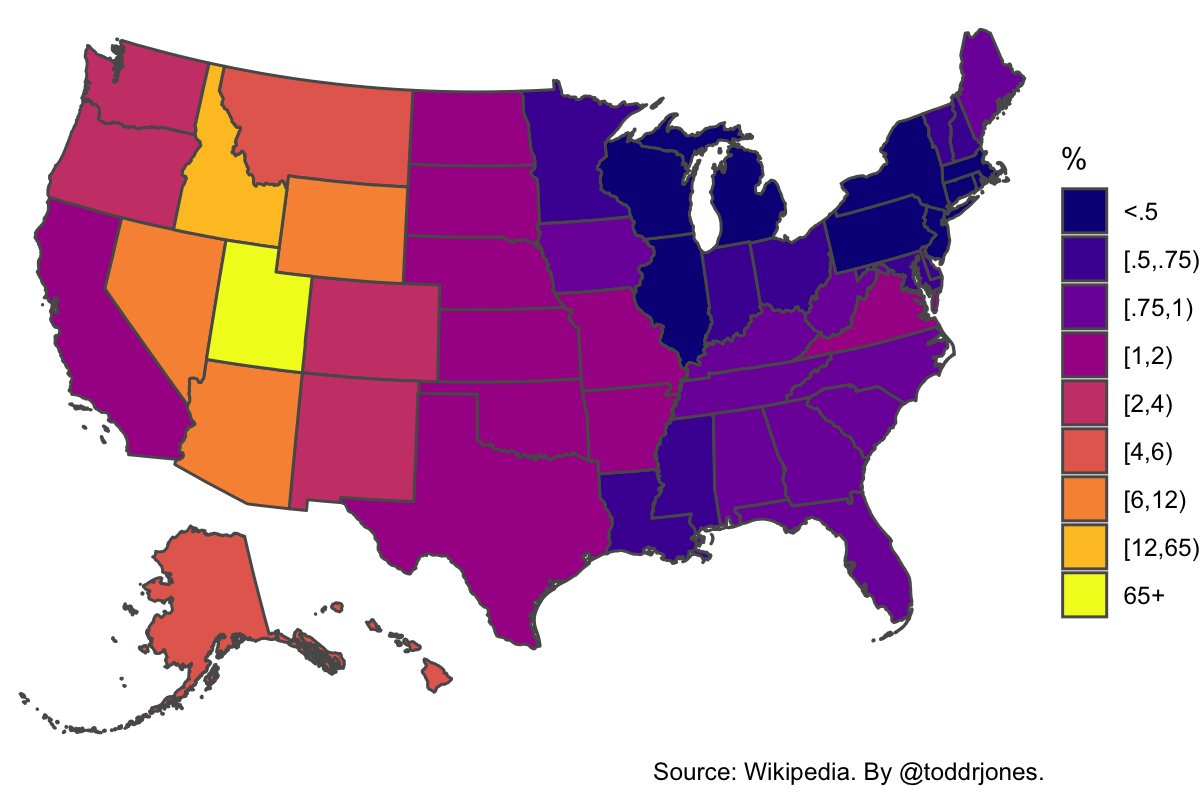
% of a state’s population who are members of the Church of Jesus Christ of Latter-day Saints

% of a state's population who are members of the Church of Jesus Christ of Latter-day Saints

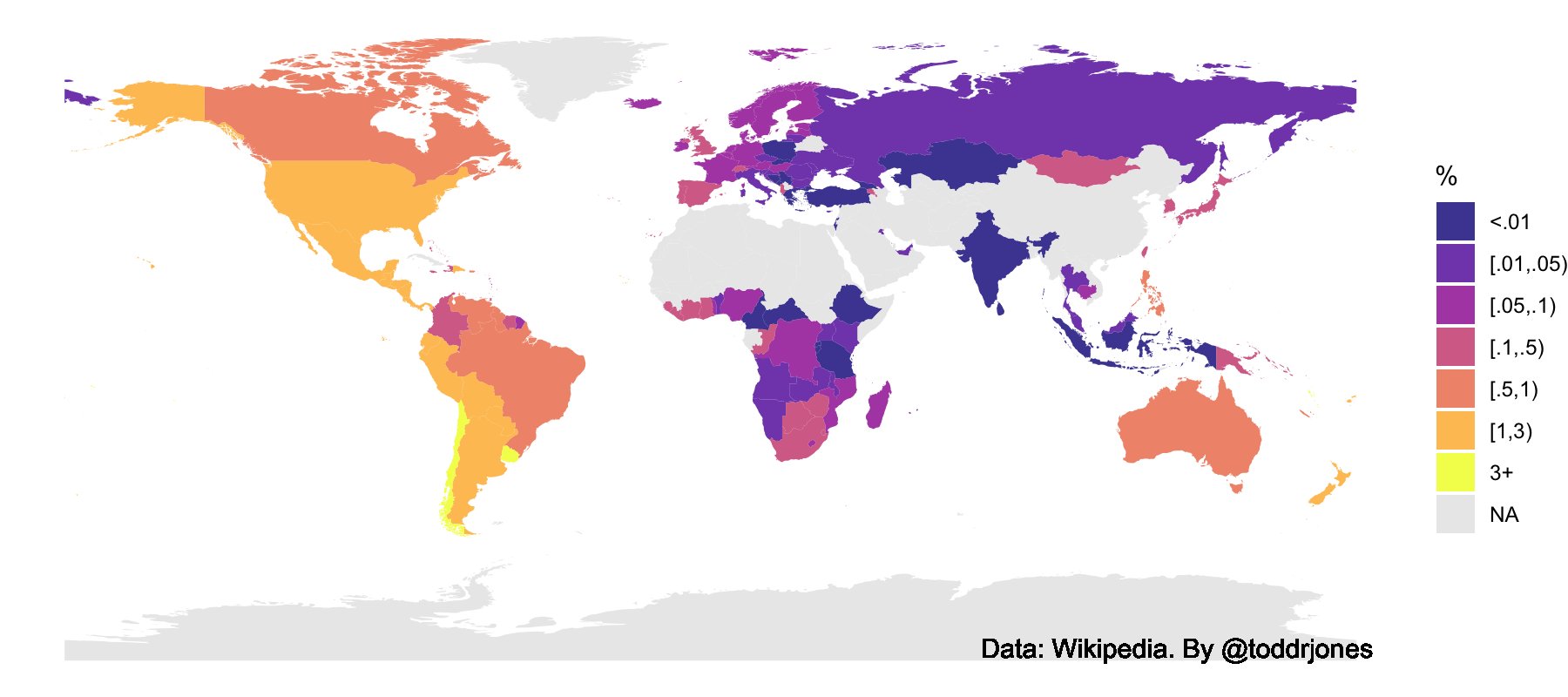
% of a country’s population who are members of the Church of Jesus Christ of Latter-day Saints

% of a country's population who are members of the Church of Jesus Christ of Latter-day Saints

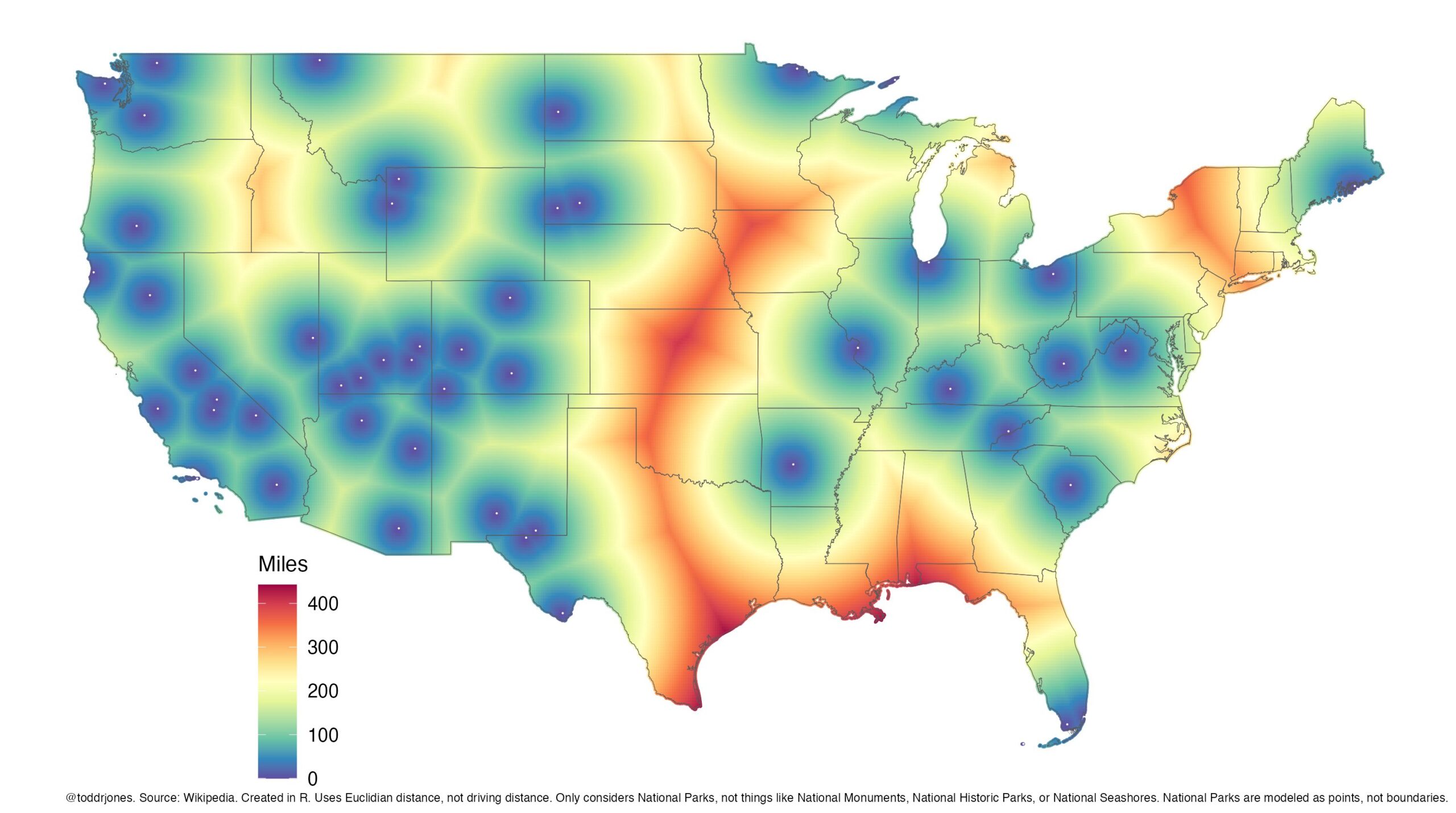
Distance to nearest National Park

Distance to nearest National Park

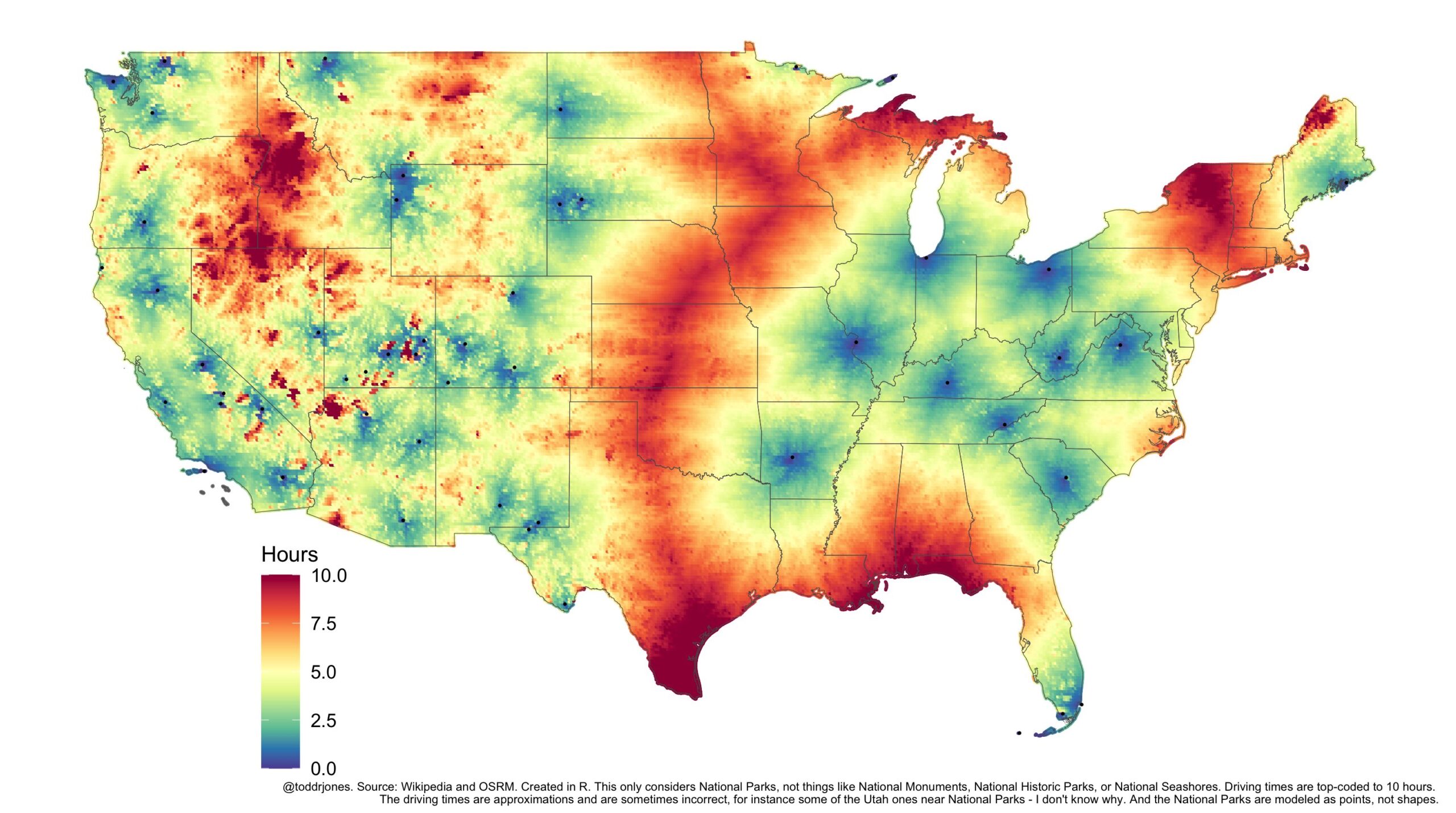
Driving time to nearest National Park

Driving time to nearest National Park

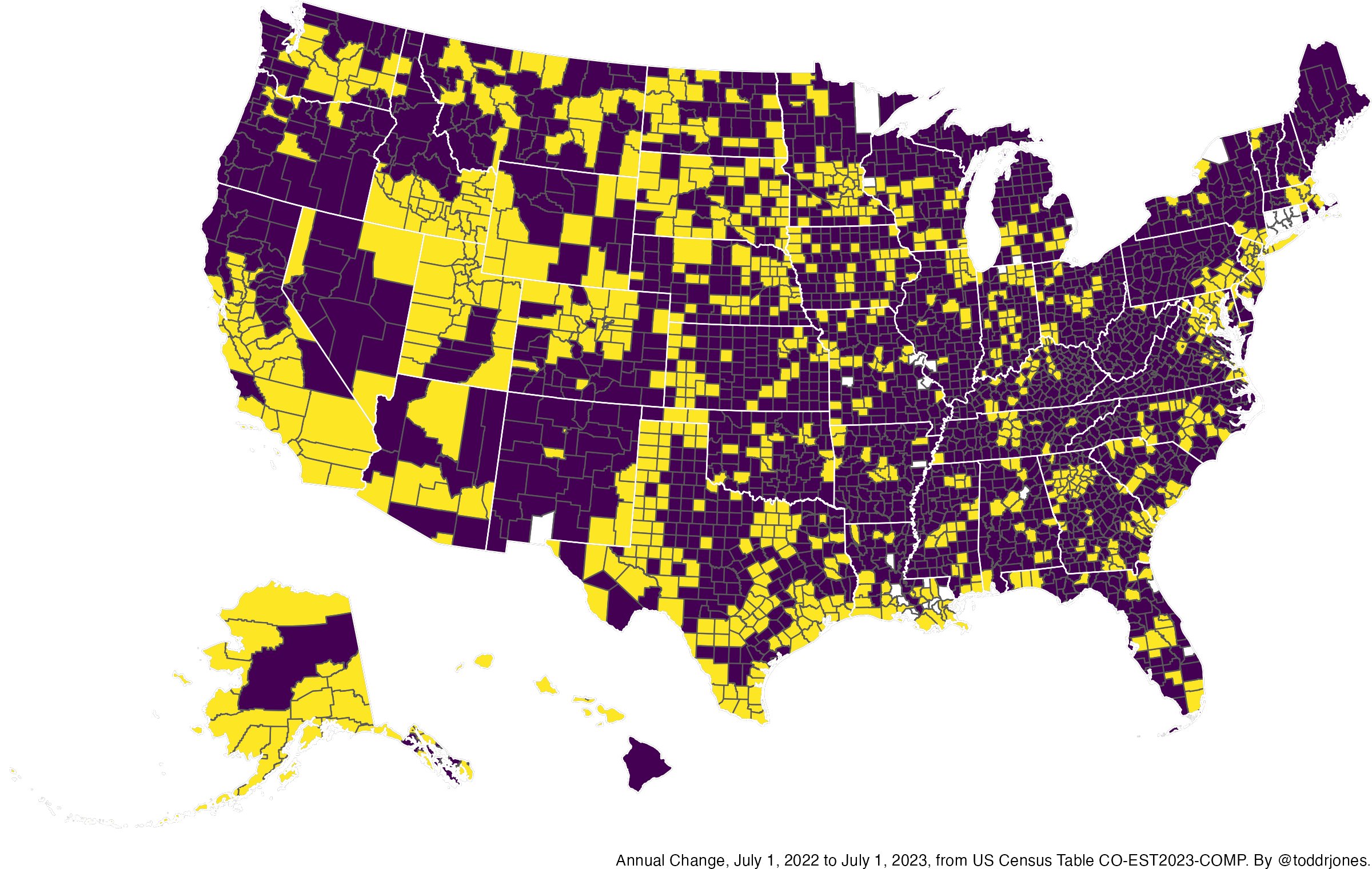
The purple counties had more deaths than births between 2022 and 2023

The purple counties had more deaths than births between 2022 and 2023

Percentage of each county’s population who are 65 and older

Percentage of each county's population who are 65 and older

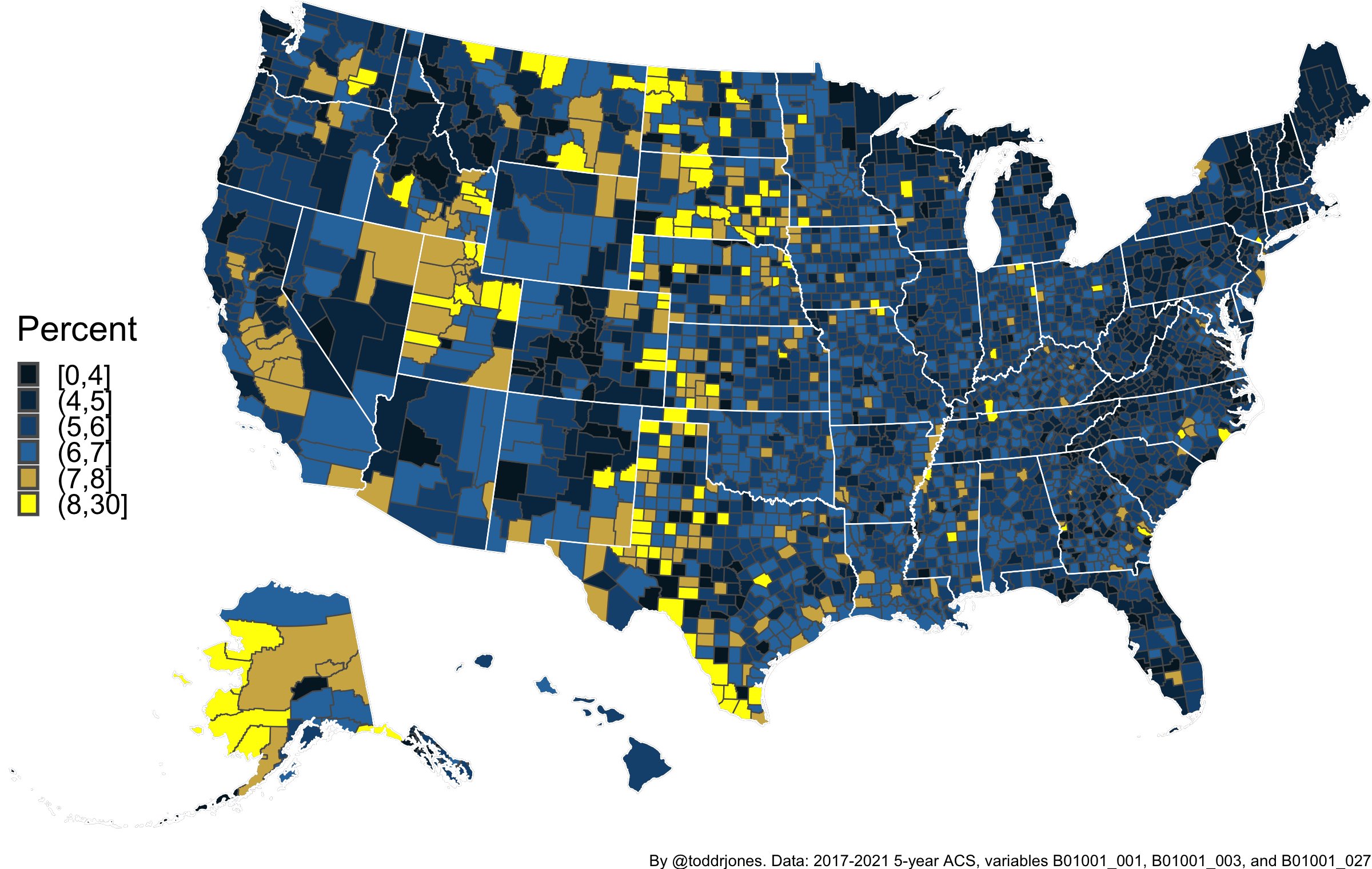
Percentage of population under 5 years old

Percentage of population under 5 years old

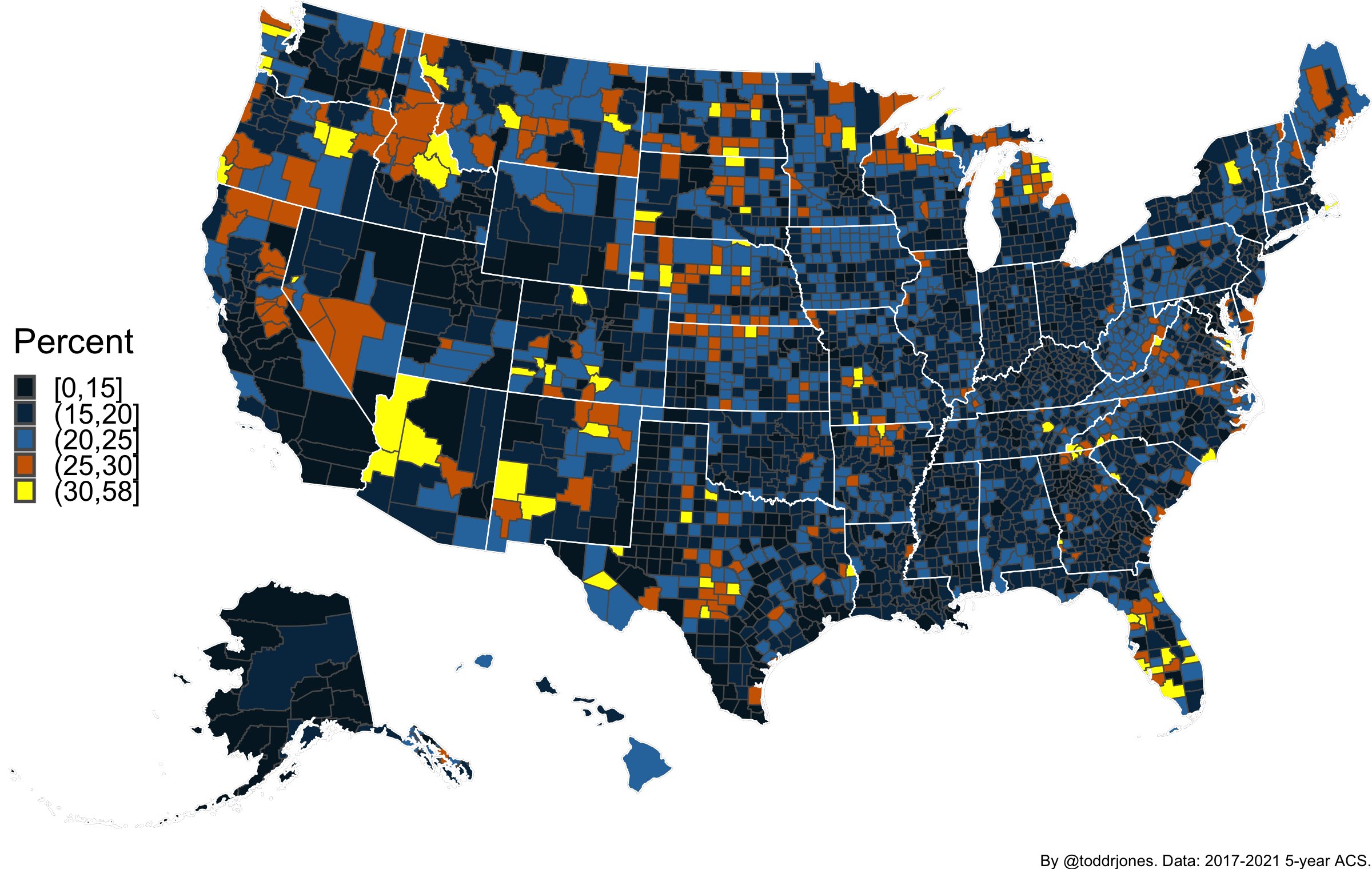
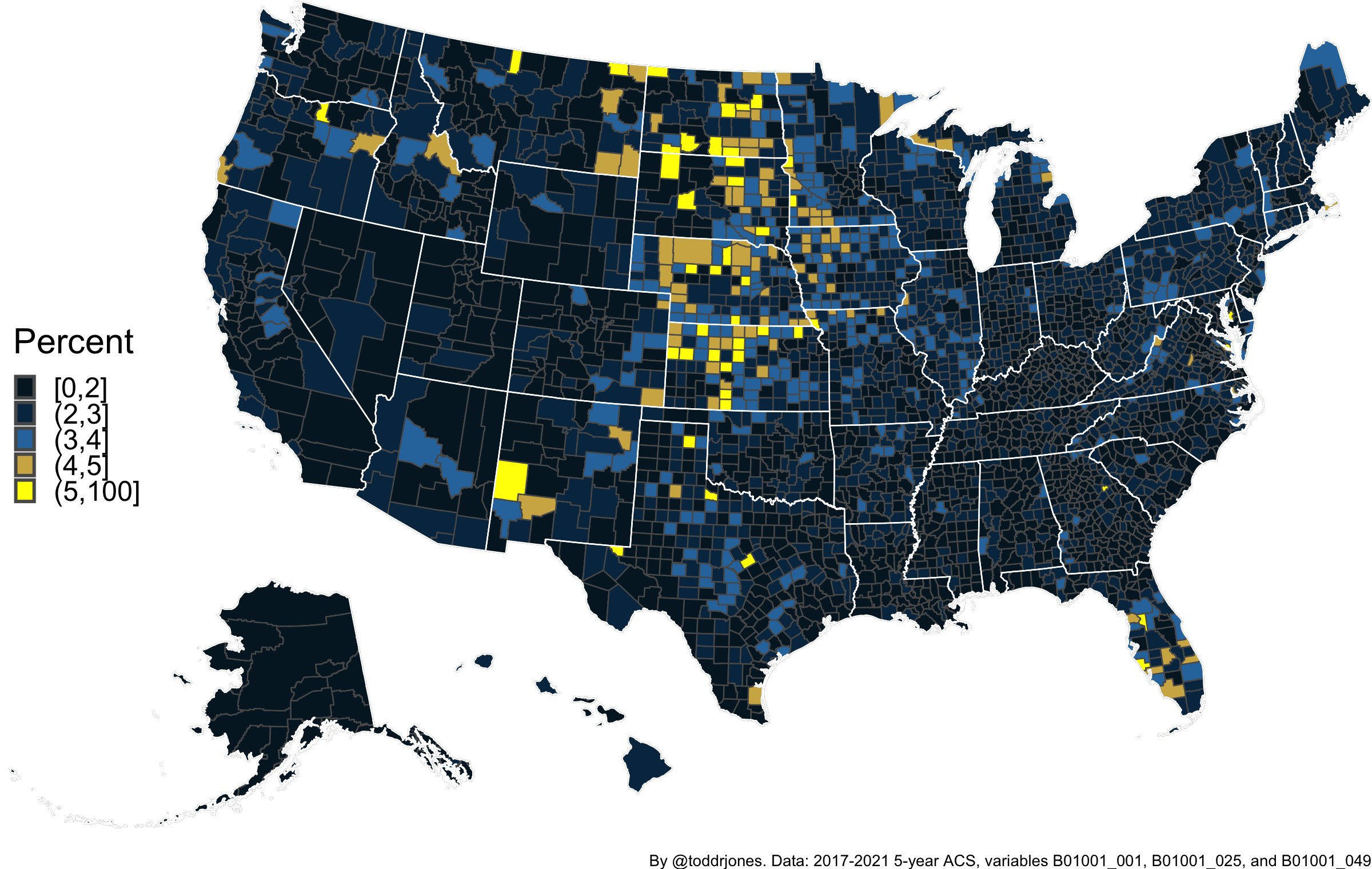
Percentage of county population 85 and older

Percentage of county population 85 and older

In The Yellow States the highest paid public employee is a college football or basketball coach

In The Yellow States the highest paid public employee is a college football or basketball coach

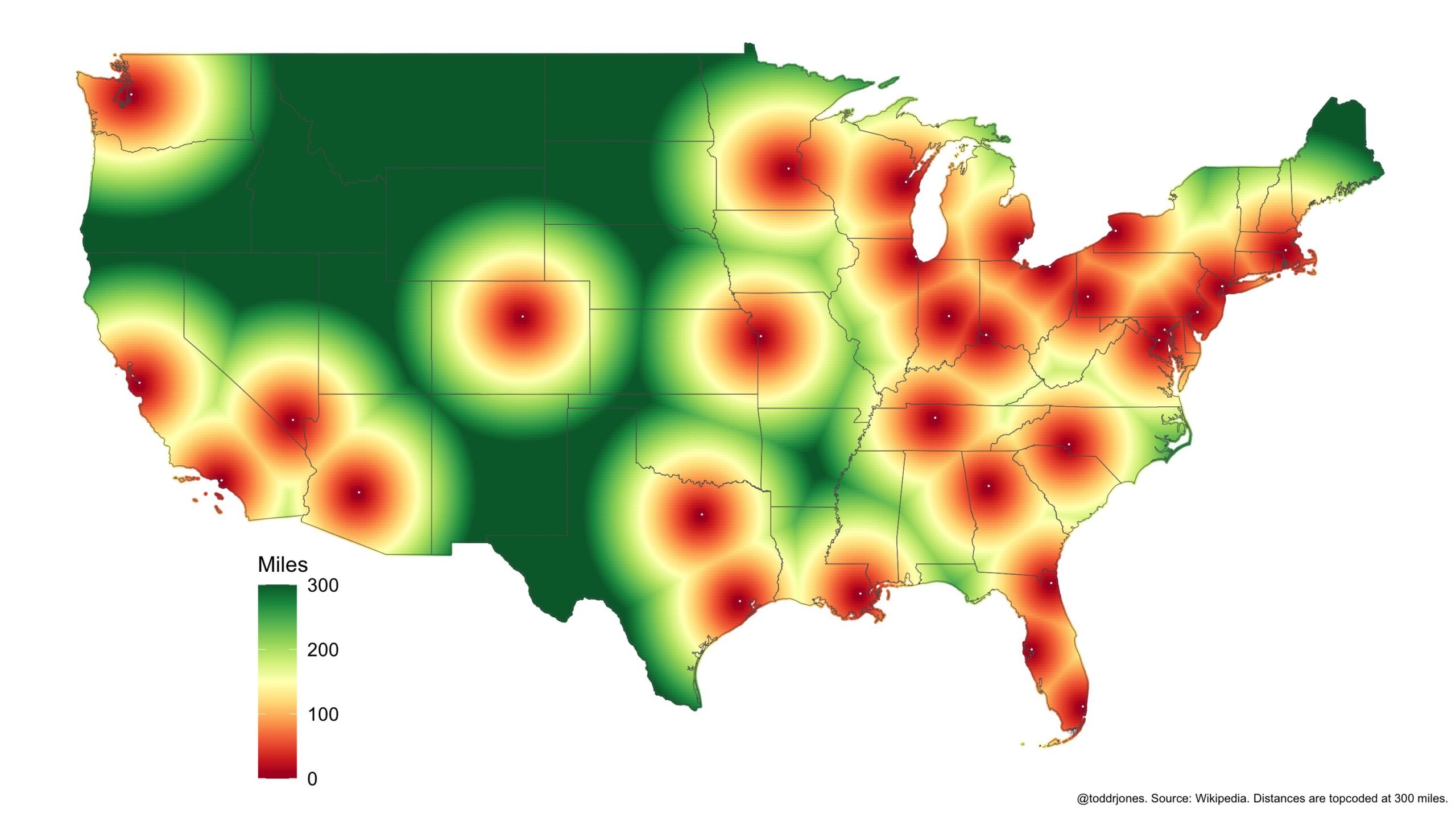
Distance to nearest NFL stadium

Distance to nearest NFL stadium

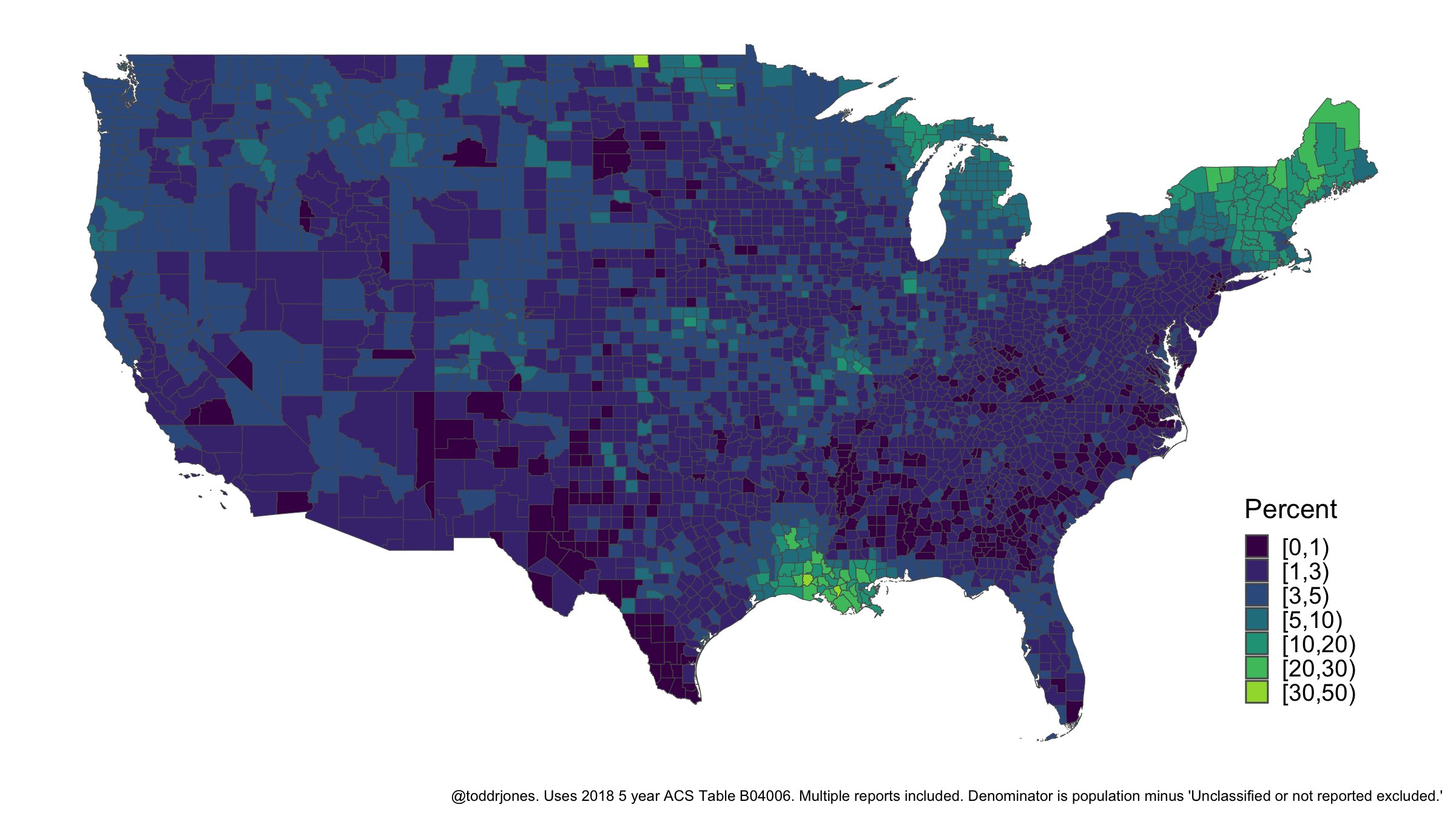
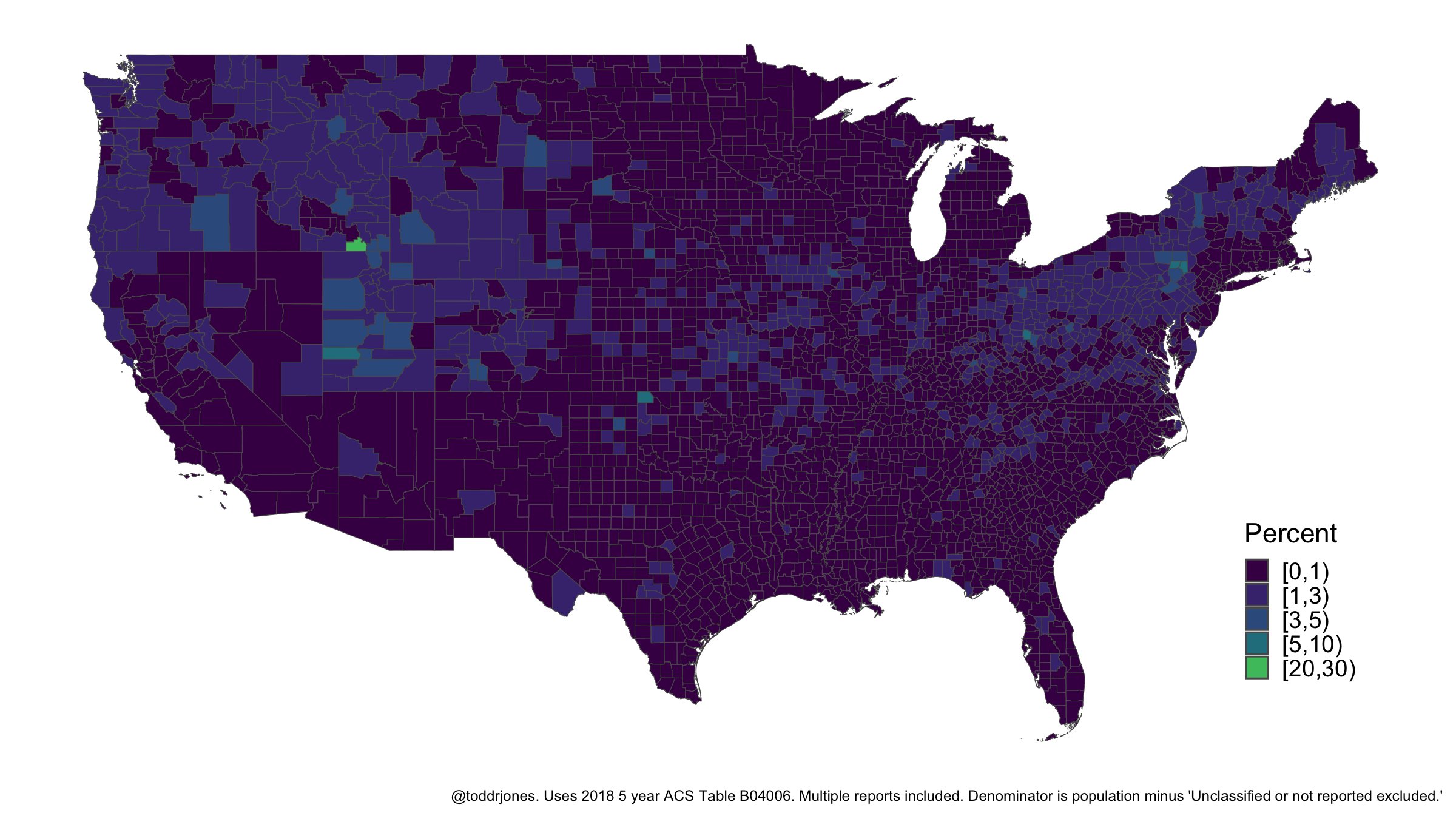
Percentage of county reporting French (excluding Basque) ancestry

Percentage of county reporting French (excluding Basque) ancestry

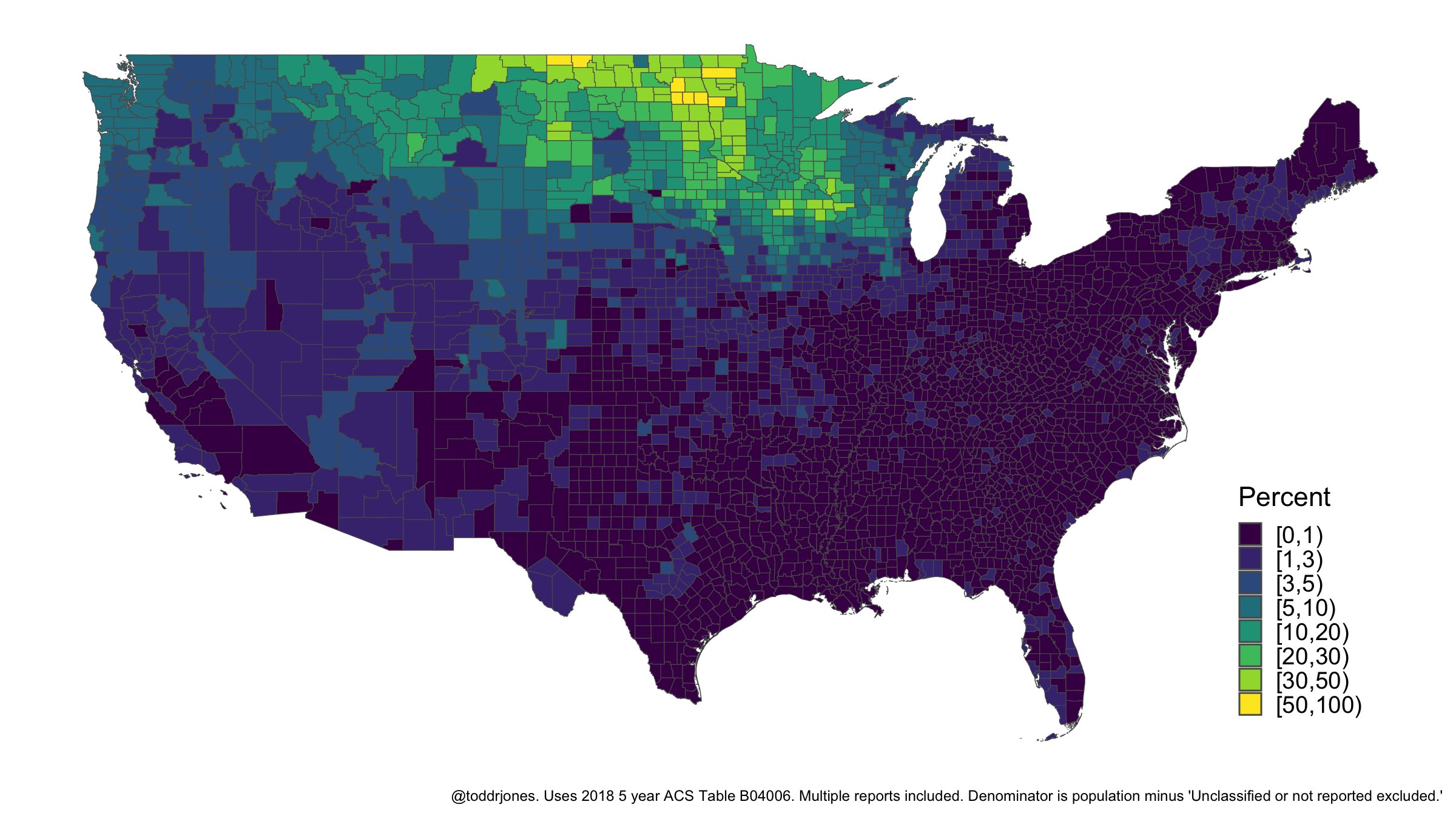
Percentage of county reporting Norwegian ancestry

Percentage of county reporting Norwegian ancestry

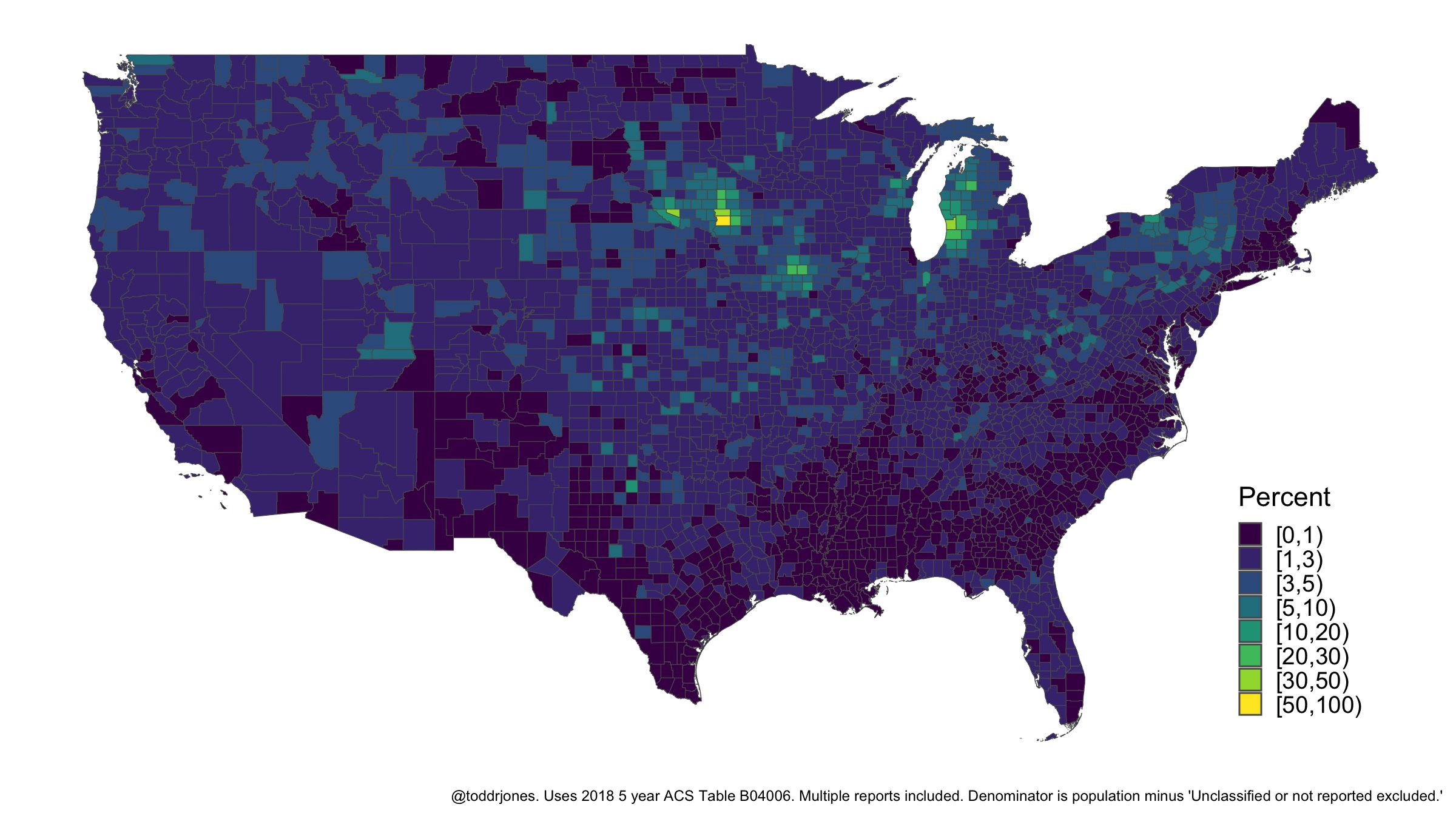
Percentage of county reporting Dutch ancestry

Percentage of county reporting Dutch ancestry

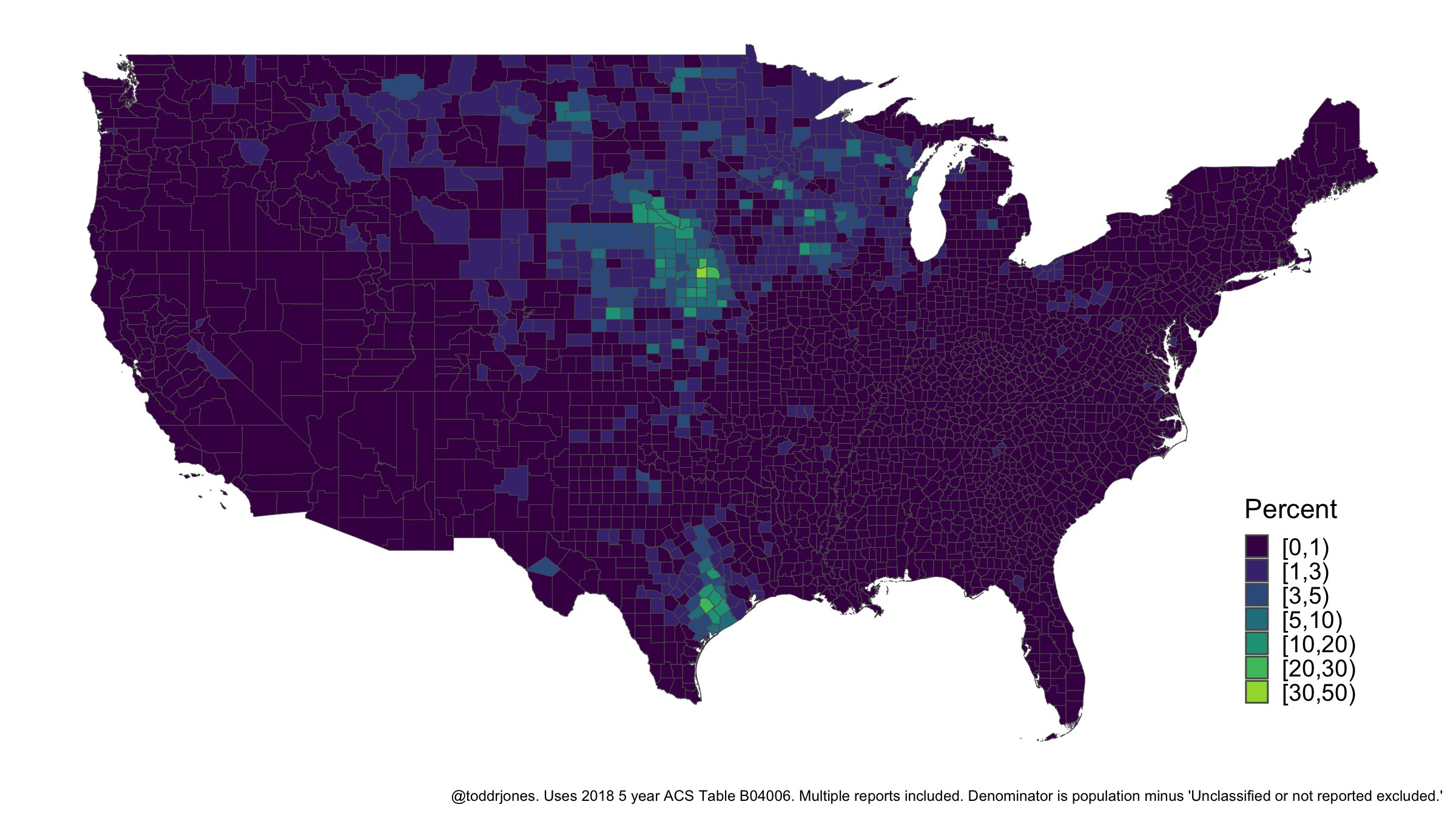
Percentage of county reporting Czech ancestry

Percentage of county reporting Czech ancestry

Percentage of county reporting Welsh ancestry

Percentage of county reporting Welsh ancestry

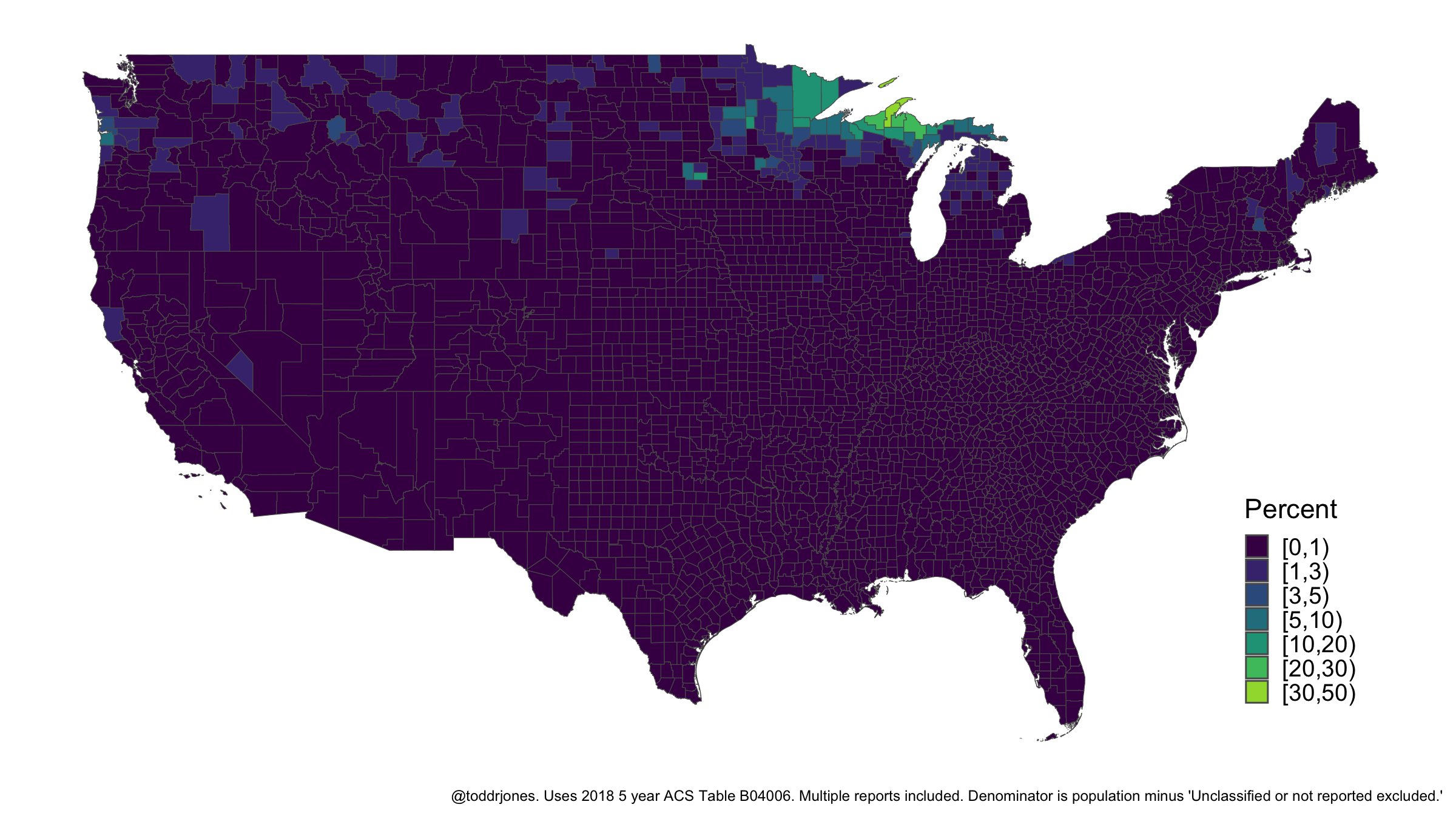
Percentage of county reporting Finnish ancestry

Percentage of county reporting Finnish ancestry

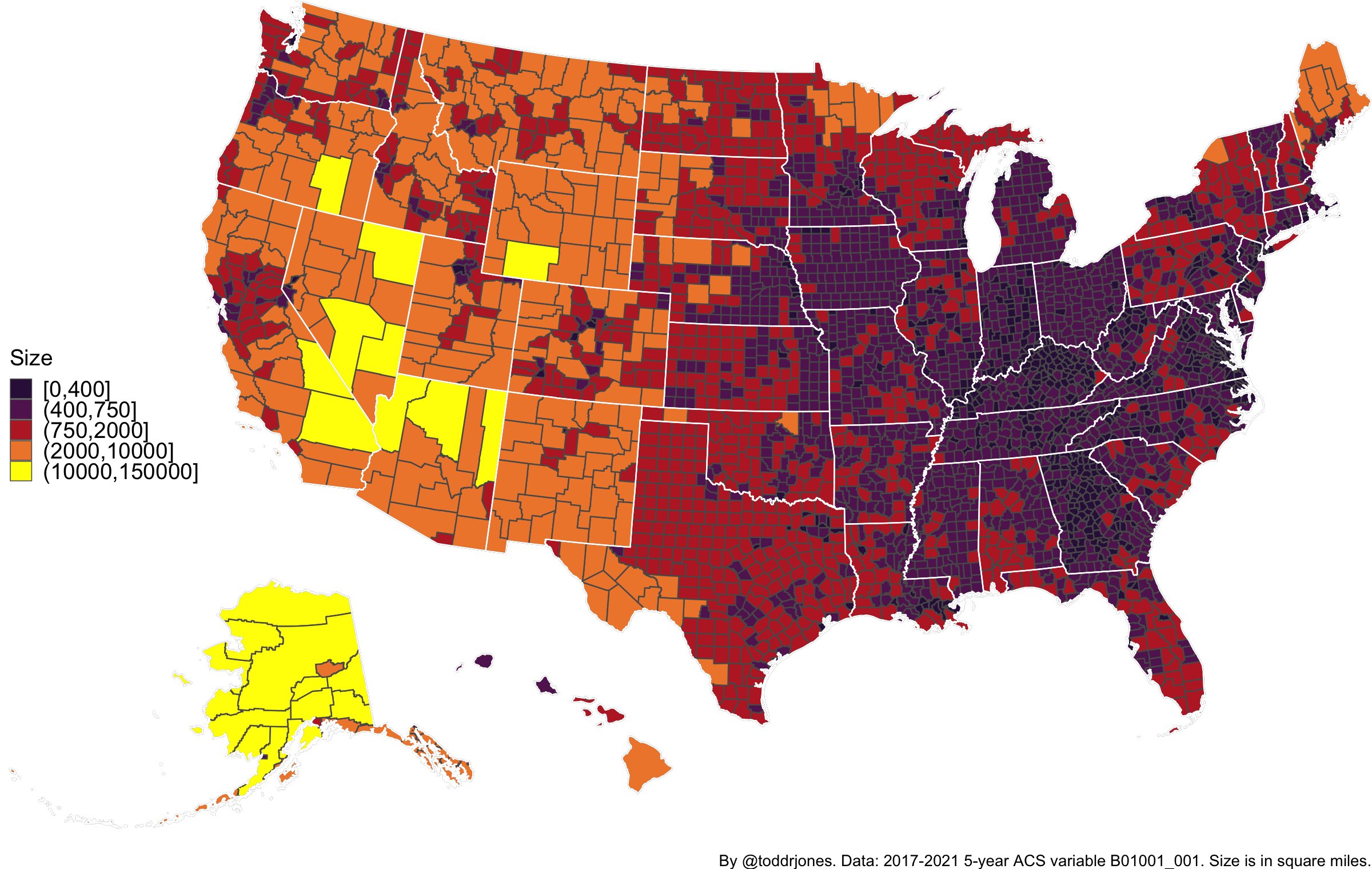
County size in square miles

County size in square miles

Mean Center of US Population, 1790-2020

>/center>

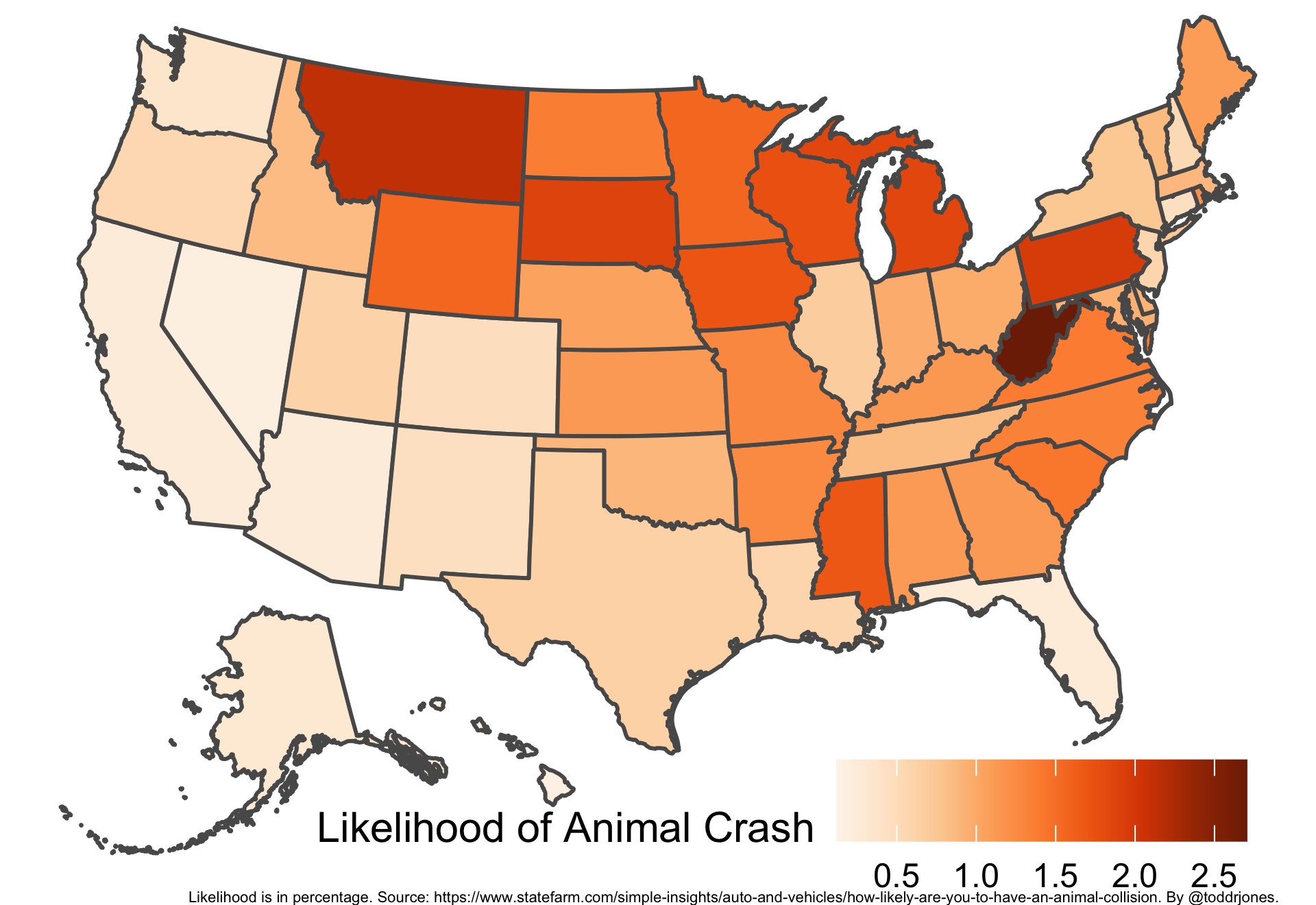
How Likely Car Drivers Are To Hit A Deer, Elk, Moose, Caribou or Other Large Animal Per Year

How Likely Car Drivers Are To Hit A Deer, Elk, Moose, Caribou or Other Large Animal Per Year

Download video
https://brilliantmaps.com/?p=24886
Extensions
Map Of East Germany’s One And Only Free & Fair Election
Germany
Credit: ErinthecuteThe map above shows the one and only free and fair election in East German’s entire history on 18 March 1990. East Germany would join West Germany later that year on October 3rd. More about this election and more maps below: How Elections Worked in East Germany (GDR) (Prior to 1990) The National Front […]
Show full content

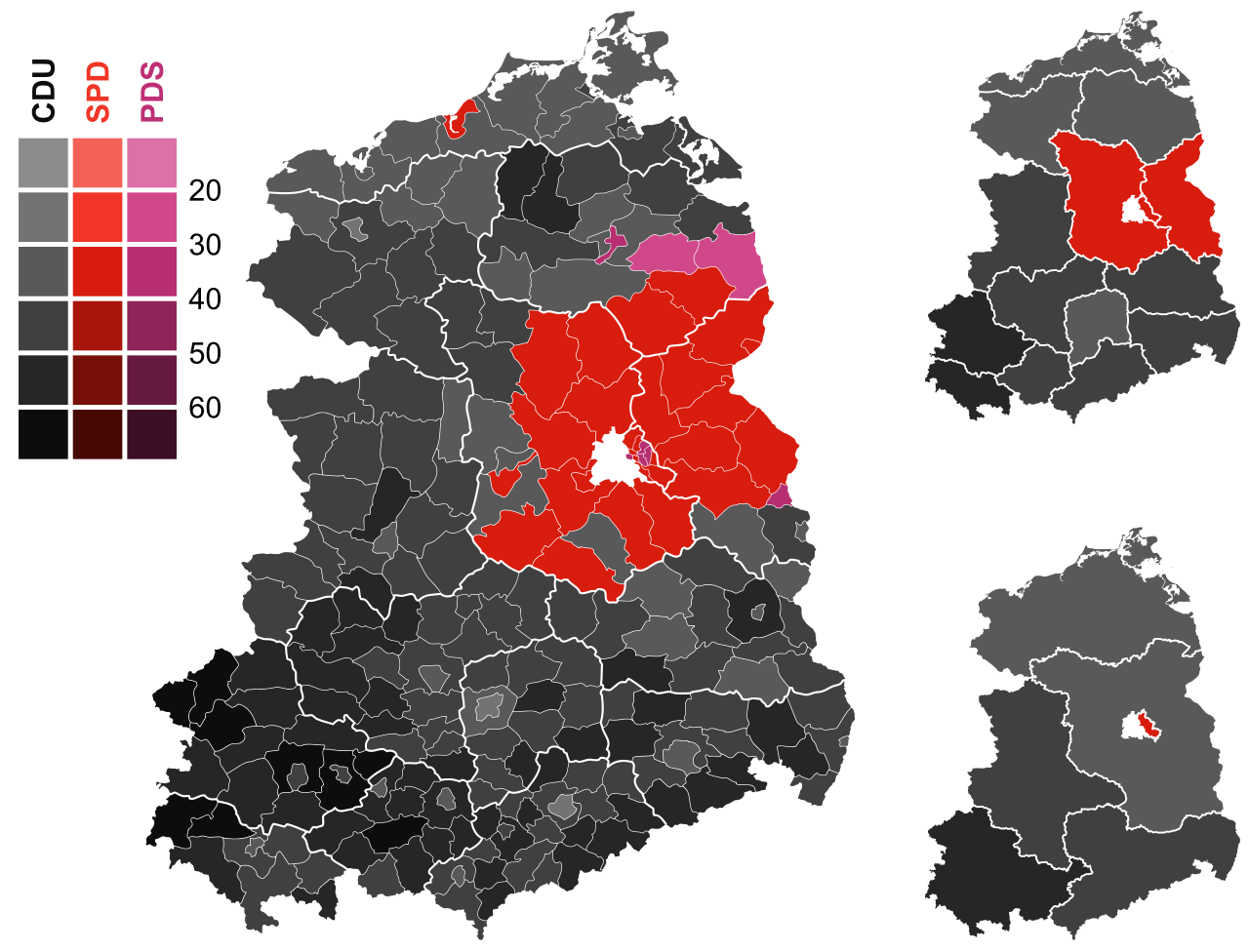
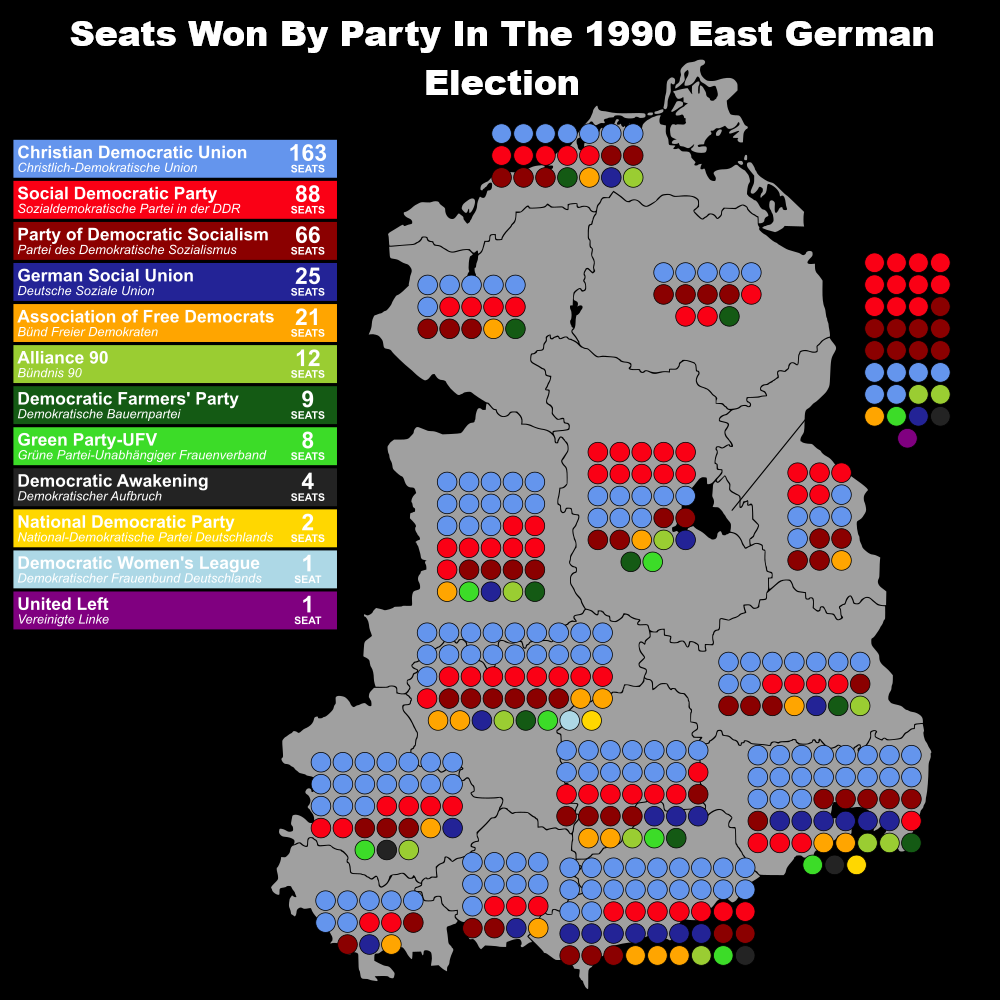
Results of the 1990 East German Election

Credit: ErinthecuteThe map above shows the one and only free and fair election in East German’s entire history on 18 March 1990.

East Germany would join West Germany later that year on October 3rd.

More about this election and more maps below:

How Elections Worked in East Germany (GDR) (Prior to 1990) The National Front System

At the center of the system was the: National Front of the German Democratic Republic.

How it worked:
  • All legal parties and organizations joined the National Front
  • Before elections, they agreed on a single candidate list
  • Seats in the Volkskammer (parliament) were pre-allocated
  • Voters could only approve or reject the entire list

In practice:

  • Voting “yes” = just drop the ballot unchanged
  • Voting “no” = cross out names (visible, risky)

Result:

  • 95–99% approval rates were typical
  • Elections were about demonstrating unity, not choosing leaders.

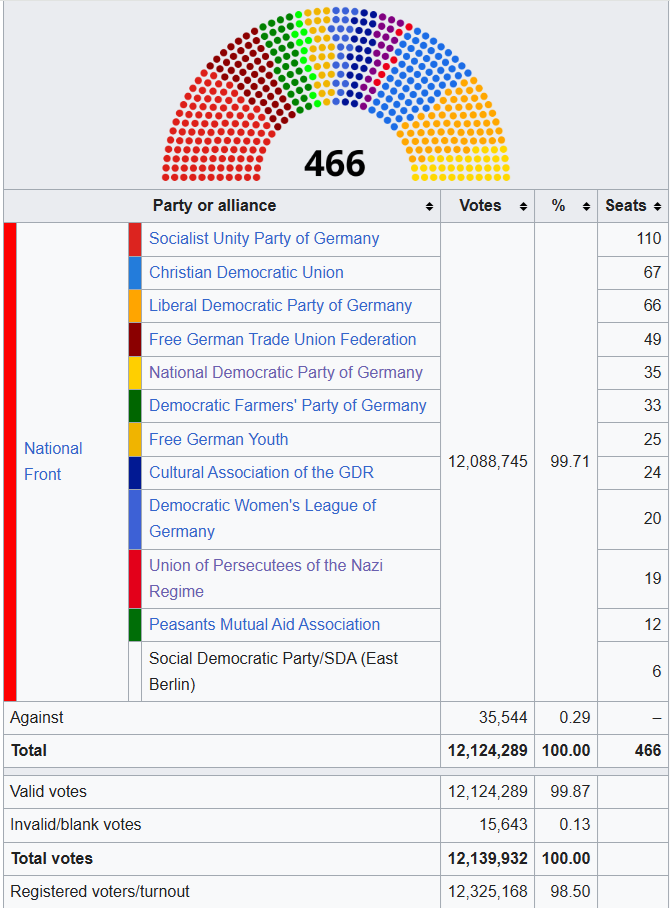
Here are the results of the first East German “election” in 1950:

Results of the 1950 East German election

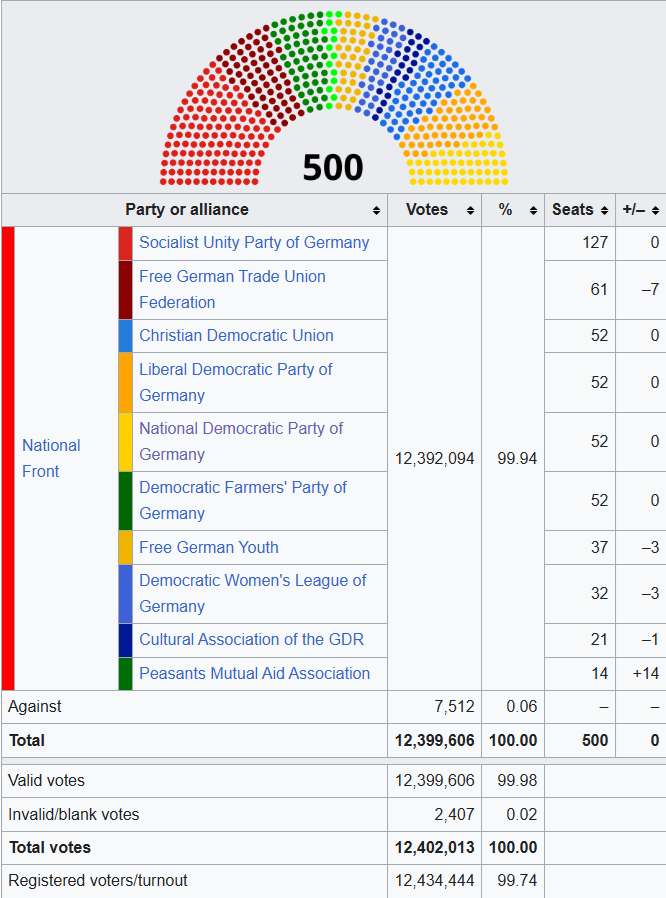
and here are the results of the last one before the collapse of the National Front system in 1986:

Results of the 1986 East German Election.

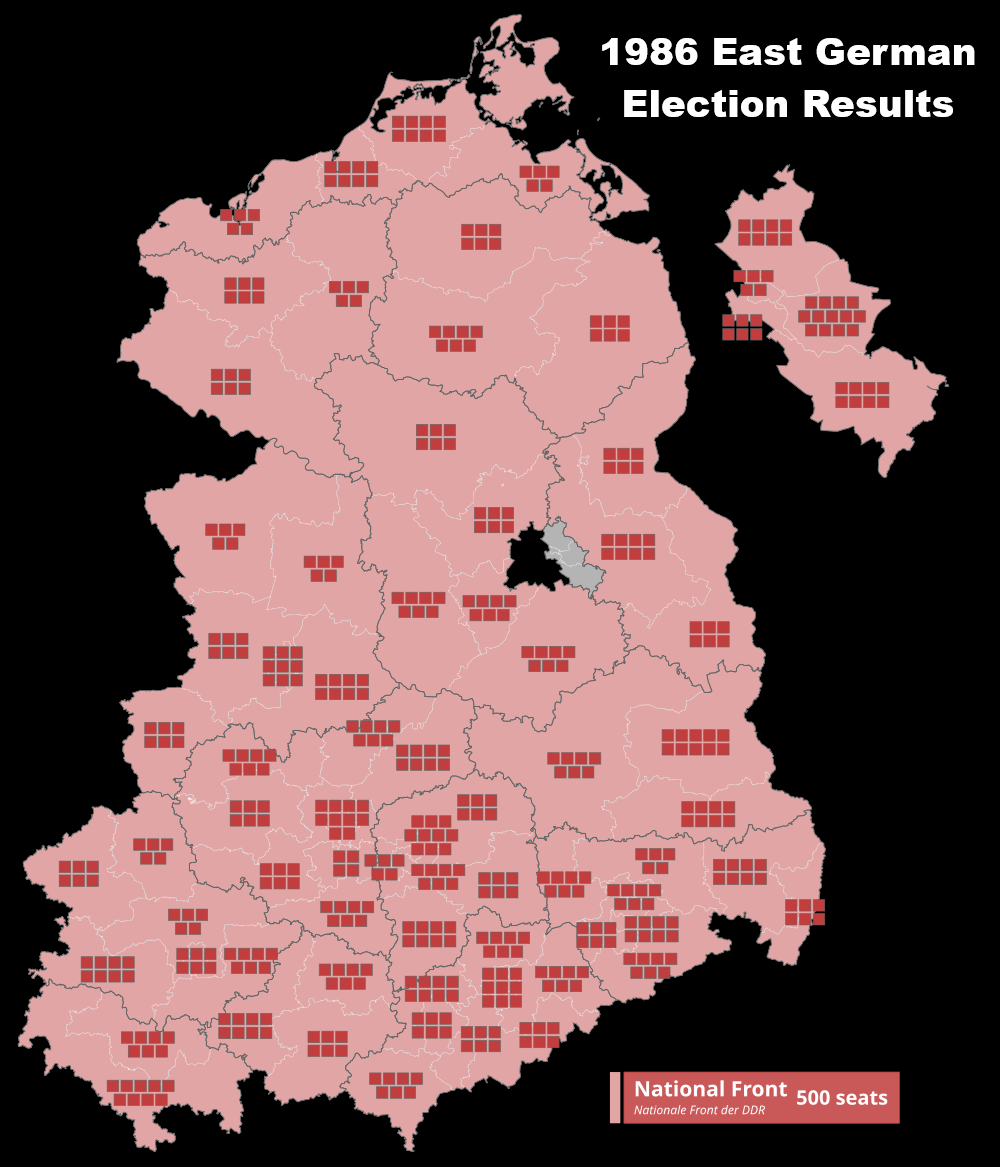
Map of the 1986 Election

Map fo East German election results in 1986

Credit: Erinthecute

Who Held Real Power?

The system was dominated by the: Socialist Unity Party of Germany

Even though multiple parties existed:

  • The SED controlled policy, appointments, and state institutions
  • Other parties were called “block parties” and followed its lead
Political Parties (Block Parties) Socialist Unity Party of Germany (SED)
  • Ideology: Marxism-Leninism
  • Founded: 1946 (forced merger of communists + social democrats)
  • Leader figures: Walter Ulbricht, Erich Honecker and Egon Krenz

Role:

  • The true governing authority of the GDR
  • Controlled:
    • Government ministries
    • Military and police
    • The Stasi (secret police)
  • Made all major decisions behind the scenes
Christian Democratic Union (CDU – East Germany)
  • Ideology (official): Christian democracy, social conservatism
  • Target group: religious citizens, middle-class conservatives

In reality:

  • Accepted socialism and SED leadership
  • Provided a “religious-friendly” face to the regime
  • Helped integrate church-going citizens into the system

Unlike its West German counterpart, it was not independent.

Liberal Democratic Party of Germany (LDPD)
  • Ideology (historical): Liberalism, civil rights, private enterprise
  • Target group: professionals, small business owners

In practice:

  • Abandoned true liberal opposition
  • Supported:
    • State-led economy
    • Socialist policies
  • Served as a bridge to middle-class citizens

It preserved liberal traditions symbolically, but not politically.

National Democratic Party of Germany (NDPD)
  • Founded specifically by the regime
  • Target group:
    • Former Nazis
    • Wehrmacht veterans
    • Nationalists

Purpose:

  • Prevent these groups from opposing the state
  • Reframe nationalism into “socialist patriotism”

Unique role: Absorbed potentially hostile groups into the system

Democratic Farmers’ Party of Germany (DBD)

Represented: farmers and rural communities

Role:

  • Helped enforce and legitimize:
    • Collectivization of agriculture
  • Encouraged farmers to join state-run cooperatives

Important function: Reduced rural resistance to socialist reforms

Mass Organizations (Not Parties, but Politically Important)

These groups were part of the National Front and had guaranteed seats in parliament.

Free German Trade Union Federation (FDGB)
  • State-controlled trade union
  • Represented workers, but:
    • No independent labor action
    • Promoted productivity & state goals
Free German Youth (FDJ)
  • Official youth organization
  • Focus:
    • Political indoctrination
    • Social activities
  • Membership strongly encouraged
Democratic Women’s League of Germany (DFD)
  • Represented women’s interests
  • Promoted:
    • Gender equality (within socialist framework)
    • Workforce participation
Cultural Association of the GDR (Kulturbund)
  • Organization for:
    • Intellectuals
    • Artists
  • Encouraged cultural life aligned with socialism
Peasants’ Mutual Aid Association (VdgB)
  • Supported farmers, especially during collectivization
  • Provided:
    • Resources
    • Political integration into the regime
Union of Persecutees of the Nazi Regime (VVN)
  • Represented victims of Nazism
  • Important for:
    • Anti-fascist legitimacy of the GDR
  • Later reorganized but remained symbolic
Key Takeaway About the System

Even though it looked pluralistic:

  • All parties and groups were subordinate to the SED
  • Elections were confirmatory, not competitive
  • The National Front ensured pre-arranged outcomes
The 1990 Election: Why This Election Was Different?

Seats won by party in the East German election of 1990

Credit: ErinthecuteBy late 1989:

  • The Berlin Wall had fallen
  • The ruling system of the GDR had collapsed
  • The National Front structure was effectively dead

The election (March 18, 1990) became:  The first and only free, competitive election in East German history.

It also quickly turned into a referendum on: Reform vs. rapid reunification with West Germany.

Main Parties and Alliances Alliance for Germany (Winner)

A coalition backed heavily by West German conservatives:

  • East German Christian Democratic Union (CDU)
  • German Social Union (DSU)
  • Democratic Awakening (DA)

Position:

  • Rapid reunification with West Germany
  • Adoption of the West German economic and political system
  • Introduction of the Deutsche Mark as soon as possible

Result:

  • Won ~48% of the vote (dominant victory)
Social Democratic Party (SPD – East Germany)
  • Newly revived independent party (not controlled like pre-1989)
  • Historically linked to pre-war German social democracy

Position:

  • Supported reunification, but:
    • Wanted a slower, negotiated process
    • Favored a more gradual economic transition

Result:

  • ~22% of the vote (much lower than expected)
Party of Democratic Socialism (PDS)

Successor to the ruling party:

  • Former Socialist Unity Party of Germany
  • Renamed and reformed after 1989

Position:

  • Democratic socialism
  • Preserve some GDR social structures
  • Opposed rapid absorption by West Germany

Result:

  • ~16% of the vote

Stronger than many expected, but far from power

Alliance 90 / Greens / Civil Rights Groups
  • Originated from:
    • Protest movements
    • Dissidents
    • Church-based opposition

Position:

  • Democratic reform of the GDR
  • Environmental protection
  • Often skeptical of rapid reunification

Result:

  • Performed poorly (fragmented and less organized)
Liberal Parties
  • LDPD (former block party, now independent)
  • FDP-linked groups

Position:

  • Liberal democracy
  • Market reforms
  • Generally pro-reunification

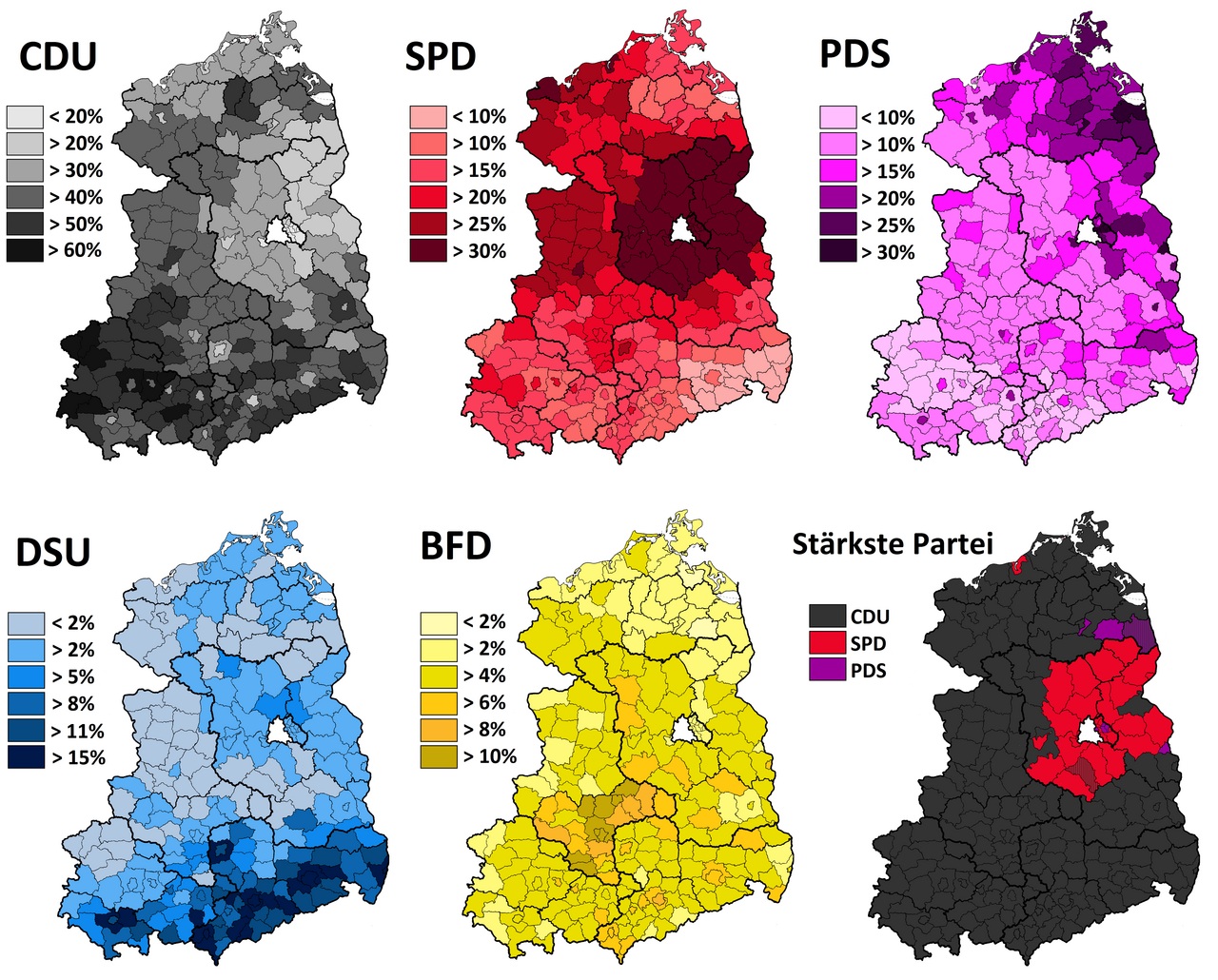
These map shows the popular vote of the different parties by county in the GDR election of the year 1990

Credit: Hilarus von Baerenstein

What Happened to the SED?

The ruling party underwent a rapid transformation:

Late 1989:

  • Leadership collapsed (e.g., fall of Erich Honecker earlier in 1989)
  • Public anger toward the party was intense

Rebranding:

  • Renamed: SED → SED-PDS → PDS (Party of Democratic Socialism)

Changes:

  • Dropped official Marxist-Leninist orthodoxy
  • Promised democratic reforms
  • Tried to distance itself from:
    • The Stasi
    • Authoritarian rule

Reality:

  • Still associated with:
    • Repression
    • Economic failure

Despite this, it retained a core base of support, especially among:

  • Older voters
  • Those worried about economic collapse
West German Influence (“Interference”)

West Germany played a major and decisive role.

Political Support

West German parties directly supported their East German counterparts:

  • West German CDU (led by Helmut Kohl) backed the East CDU and Alliance for Germany
  • West German SPD supported East SPD
  • Funding, advisors, and campaign expertise flowed in

This gave pro-reunification parties a huge advantage.

Economic Pressure & Promises

A key factor was the promise of:

  • Rapid introduction of the Deutsche Mark
  • Access to West German living standards
  • Economic stabilization

Kohl’s government strongly signaled: “Vote for fast reunification = faster economic help”

Media Influence
  • West German television was widely watched in East Germany
  • Campaign messaging from the West reached voters directly
Expected Outcome vs Reality

What Many Expected

Before the election:

  • The SPD was widely expected to win or lead
  • Reformist, gradual reunification seemed likely
  • Civil rights groups were highly visible after the 1989 revolution

Many thought voters would choose cautious transition.

What Actually Happened

The result was a decisive vote for speed:

  • Alliance for Germany (pro-rapid reunification) won clearly.
  • SPD underperformed significantly
  • Reformist groups were marginalized
Why the Surprise?

Economic Fear

  • GDR economy was collapsing
  • People feared:
    • Unemployment
    • Shortages
  • West Germany looked like stability

Currency Issue

  • The Deutsche Mark became the central issue
  • Seen as:
    • Security
    • Prosperity
    • Immediate improvement in daily life

Loss of Faith in Reform

  • Many no longer believed the GDR could be “fixed”
  • Preferred joining a functioning system instead
Consequences of the Election

The new government:

  • Led by Lothar de Maizière (CDU)
  • Immediately pursued:

Monetary Union (mid-1990)

  • East Germany adopted the West German currency

Political Integration

  • Negotiations with West Germany accelerated

Final Outcome:

German reunification (October 3, 1990)


https://brilliantmaps.com/?p=24828
Extensions
When US States Became States Relative To Other Countries
United States
Ok so the title is a little confusing but hopefully when you look at the maps it will make a bit more sense. The first map shows who the reigning British Monarch was when the US state became a state. Credit lapras-27 George III (1760–1820) Alabama Connecticut Delaware Georgia Illinois Indiana Kentucky Louisiana Maryland Massachusetts […]
Show full content

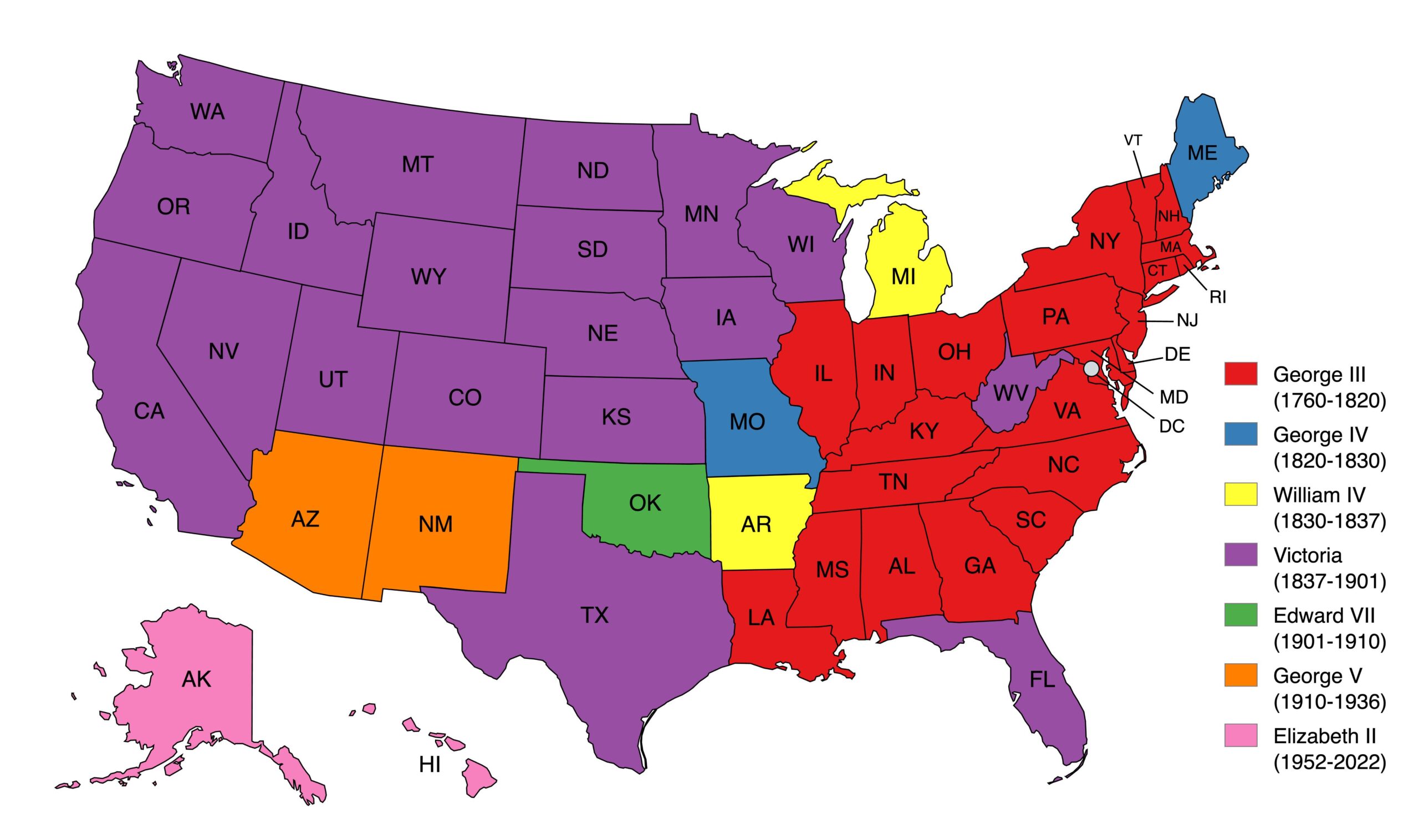
Ok so the title is a little confusing but hopefully when you look at the maps it will make a bit more sense.

The first map shows who the reigning British Monarch was when the US state became a state.

The reigning British monarch when each state became a state

Credit lapras-27

George III (1760–1820)
  1. Alabama
  2. Connecticut
  3. Delaware
  4. Georgia
  5. Illinois
  6. Indiana
  7. Kentucky
  8. Louisiana
  9. Maryland
  10. Massachusetts
  11. New Hampshire
  12. New Jersey
  13. New York
  14. North Carolina
  15. Ohio
  16. Pennsylvania
  17. Rhode Island
  18. South Carolina
  19. Tennessee
  20. Vermont
  21. Virginia
  22. District of Columbia
George IV (1820–1830)
  1. Maine
  2. Missouri
William IV (1830–1837)
  1. Arkansas
  2. Michigan
Victoria (1837–1901)
  1. California
  2. Colorado
  3. Florida
  4. Idaho
  5. Iowa
  6. Kansas
  7. Minnesota
  8. Montana
  9. Nebraska
  10. Nevada
  11. North Dakota
  12. Oregon
  13. South Dakota
  14. Texas
  15. Utah
  16. Washington
  17. Wisconsin
  18. Wyoming
  19. West Virginia
Edward VII (1901–1910)
  1. Oklahoma
George V (1910–1936) Elizabeth II (1952–2022)
  1. Alaska
  2. Hawaii

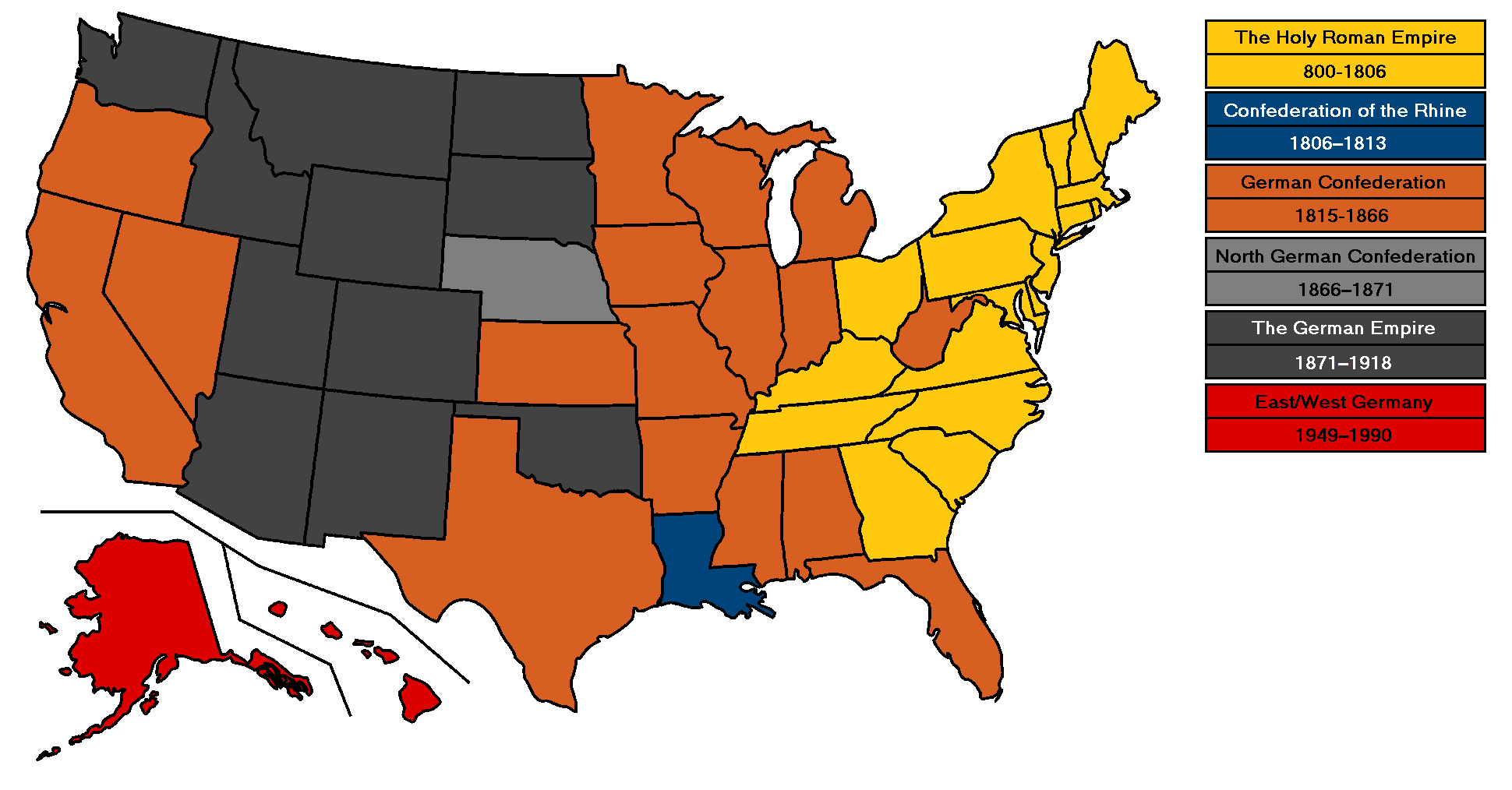
and Here’s one for the state of Germany:

The German state when US states joined as states

Credit to TheLegend2T

The Holy Roman Empire (800–1806)
  1. Connecticut
  2. Delaware
  3. Georgia
  4. Maryland
  5. Massachusetts
  6. New Hampshire
  7. New Jersey
  8. New York
  9. North Carolina
  10. Pennsylvania
  11. Rhode Island
  12. South Carolina
  13. Vermont
  14. Virginia
Confederation of the Rhine (1806–1813)
  1. Louisiana
German Confederation (1815–1866)
  1. Alabama
  2. Arkansas
  3. California
  4. Florida
  5. Illinois
  6. Indiana
  7. Iowa
  8. Kansas
  9. Kentucky
  10. Maine (note mistake on map)
  11. Michigan
  12. Minnesota
  13. Mississippi
  14. Missouri
  15. Nevada
  16. Ohio
  17. Oregon
  18. Tennessee
  19. Texas
  20. West Virginia
  21. Wisconsin
North German Confederation (1866–1871)
  1. Nebraska
German Empire (1871–1918)
  1. Arizona
  2. Colorado
  3. Idaho
  4. Montana
  5. New Mexico
  6. North Dakota
  7. Oklahoma
  8. South Dakota
  9. Utah
  10. Washington
  11. Wyoming
East/West Germany (1949–1990)
  1. Alaska
  2. Hawaii

and finally here’s a list of when each state joined the United States:

1787
  1. Delaware – December 7
  2. Pennsylvania – December 12
  3. New Jersey – December 18
1788
  1. Georgia – January 2
  2. Connecticut – January 9
  3. Massachusetts – February 6
  4. Maryland – April 28
  5. South Carolina – May 23
  6. New Hampshire – June 21
  7. Virginia – June 25
  8. New York – July 26
1789
  1. North Carolina – November 21
1790
  1. Rhode Island – May 29
1791
  1. Vermont – March 4
1792
  1. Kentucky – June 1
1796
  1. Tennessee – June 1
1803
  1. Ohio – March 1
1812
  1. Louisiana – April 30
1816
  1. Indiana – December 11
1817
  1. Mississippi – December 10
1818
  1. Illinois – December 3
1819
  1. Alabama – December 14
1820
  1. Maine – March 15
1821
  1. Missouri – August 10
1836
  1. Arkansas – June 15
1837
  1. Michigan – January 26
1845
  1. Florida – March 3
  2. Texas – December 29
1846
  1. Iowa – December 28
1848
  1. Wisconsin – May 29
1850
  1. California – September 9
1858
  1. Minnesota – May 11
1859
  1. Oregon – February 14
1861
  1. Kansas – January 29
1863
  1. West Virginia – June 20
1864
  1. Nevada – October 31
1867
  1. Nebraska – March 1
1876
  1. Colorado – August 1
1889
  1. North Dakota – November 2
  2. South Dakota – November 2
  3. Montana – November 8
  4. Washington – November 11
1890
  1. Idaho – July 3
  2. Wyoming – July 10
1896
  1. Utah – January 4
1907
  1. Oklahoma – November 16
1912
  1. New Mexico – January 6
  2. Arizona – February 14
1959
  1. Alaska – January 3
  2. Hawaii – August 21


https://brilliantmaps.com/?p=24821
Extensions
Number of Data Centers By Country
World Maps
The map above shows the number of Data Centers by country in the world according to Data Center Map and based off their numbers the US is the clear leader with over 4,000 compared to its next closest competitor the UK which has just 509. China is listed as only having 369 which seems suspiciously […]
Show full content

Number of Data Centers By Country

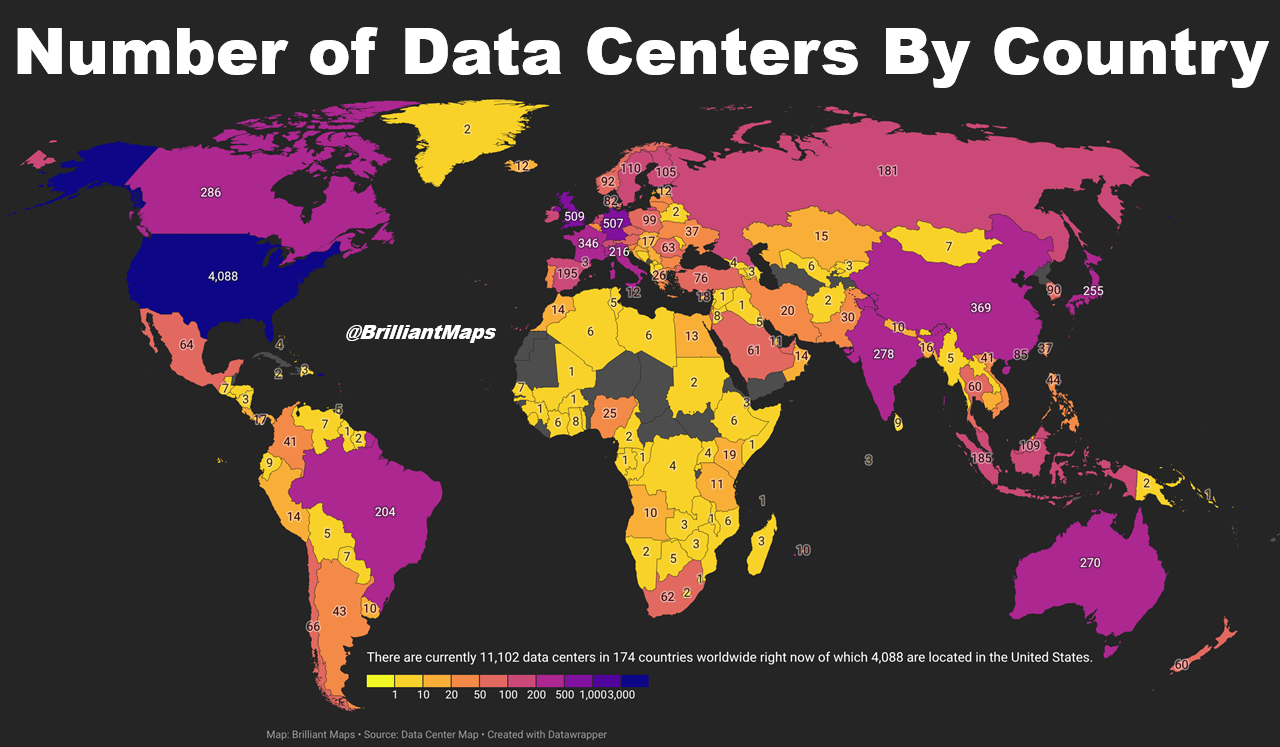
The map above shows the number of Data Centers by country in the world according to Data Center Map and based off their numbers the US is the clear leader with over 4,000 compared to its next closest competitor the UK which has just 509.

China is listed as only having 369 which seems suspiciously small.

So how is the data gathered? Data Center Map states:

Our database is global and covers data centers from all over the world, from data center operators and service providers offering colocation, cloud and connectivity services. We cover everything from hyperscale data centers to edge data centers, in both smaller markets and tier 1 markets in popular metros.

The data center listings in the database are primarily submitted and maintained directly by the operators, which means that the database is updated on a daily basis and constantly growing with new data centers. The data we collect, give you access to a unique research tool with industry leading statistics and insights.

The database can be accessed through our maps, our search and find functionality or our catalogue/directory pages, where you can narrow in from looking globally, by region, by country, by state or even by district.

So given that it’s the operators just submit the data themselves, it’s highly likely that most Chinese companies are just not doing that which is why their numbers are so small.

In any case, they list a total of 11,102 data centers in 174 countries worldwide. Here’s the full list:

CountryData Centers USA4,088 United Kingdom509 Germany507 China369 France346 Canada286 India278 Australia270 Japan255 Italy216 Brazil204 Spain195 The Netherlands187 Indonesia185 Russia181 Ireland127 Switzerland114 Sweden110 Malaysia109 Finland105 Poland99 Norway92 South Korea90 Hong Kong85 Denmark82 Turkey76 Israel66 Chile66 Singapore65 Mexico64 Romania63 South Africa62 Saudi Arabia61 New Zealand60 Thailand60 United Arab Emirates57 Czech Republic55 Austria53 Belgium48 Portugal45 Philippines44 Argentina43 Colombia41 Vietnam41 Ukraine37 Taiwan37 Bulgaria31 Pakistan30 Greece26 Nigeria25 Latvia24 Lithuania20 Iran20 Slovenia20 Kenya19 Cyprus18 Hungary17 Panama17 Luxembourg16 Bangladesh16 Croatia16 Kazakhstan15 Oman14 Morocco14 Peru14 Serbia13 Egypt13 Slovakia13 Estonia12 Iceland12 Costa Rica12 Malta12 Tanzania11 Qatar11 Angola10 Nepal10 Cambodia10 Mauritius10 Uruguay10 Sri Lanka9 Ecuador9 Ghana8 Puerto Rico8 Jordan8 Bahrain8 Paraguay7 Guatemala7 Mongolia7 Senegal7 Macedonia7 Venezuela7 Liechtenstein7 Ethiopia6 Uzbekistan6 Moldova6 Ivory Coast6 Mozambique6 Gibraltar6 Algeria6 Isle of Man6 Libya6 Guam5 Botswana5 Bolivia5 Albania5 Tunisia5 Trinidad and Tobago5 Myanmar5 Reunion5 Kuwait5 Jersey5 Bosnia and Herzegovina4 DR Congo4 Uganda4 Honduras4 Georgia4 Bahamas4 Brunei4 Zimbabwe3 El Salvador3 New Caledonia3 Dominican Republic3 Madagascar3 Monaco3 Djibouti3 Curacao3 Rwanda3 Zambia3 Kyrgyzstan3 Nicaragua3 Azerbaijan3 Bhutan3 Guernsey3 Maldives3 Andorra3 Armenia2 Namibia2 French Polynesia2 Belarus2 Togo2 Cameroon2 Jamaica2 Afghanistan2 Bermuda2 Laos2 Lebanon2 Sudan2 Cayman Islands2 Papua New Guinea2 Suriname2 Greenland2 Lesotho2 Mayotte1 Iraq1 Guyana1 Syria1 Martinique1 Guinea1 Burkina Faso1 Macau1 French Guiana1 Malawi1 Republic of the Congo1 Palestine1 Gabon1 Mali1 Equatorial Guinea1 Eswatini1 Kosovo1 Solomon Islands1 Seychelles1 Sierra Leone1 Somalia1 US Virgin Islands1 Total Data Centers:11,102

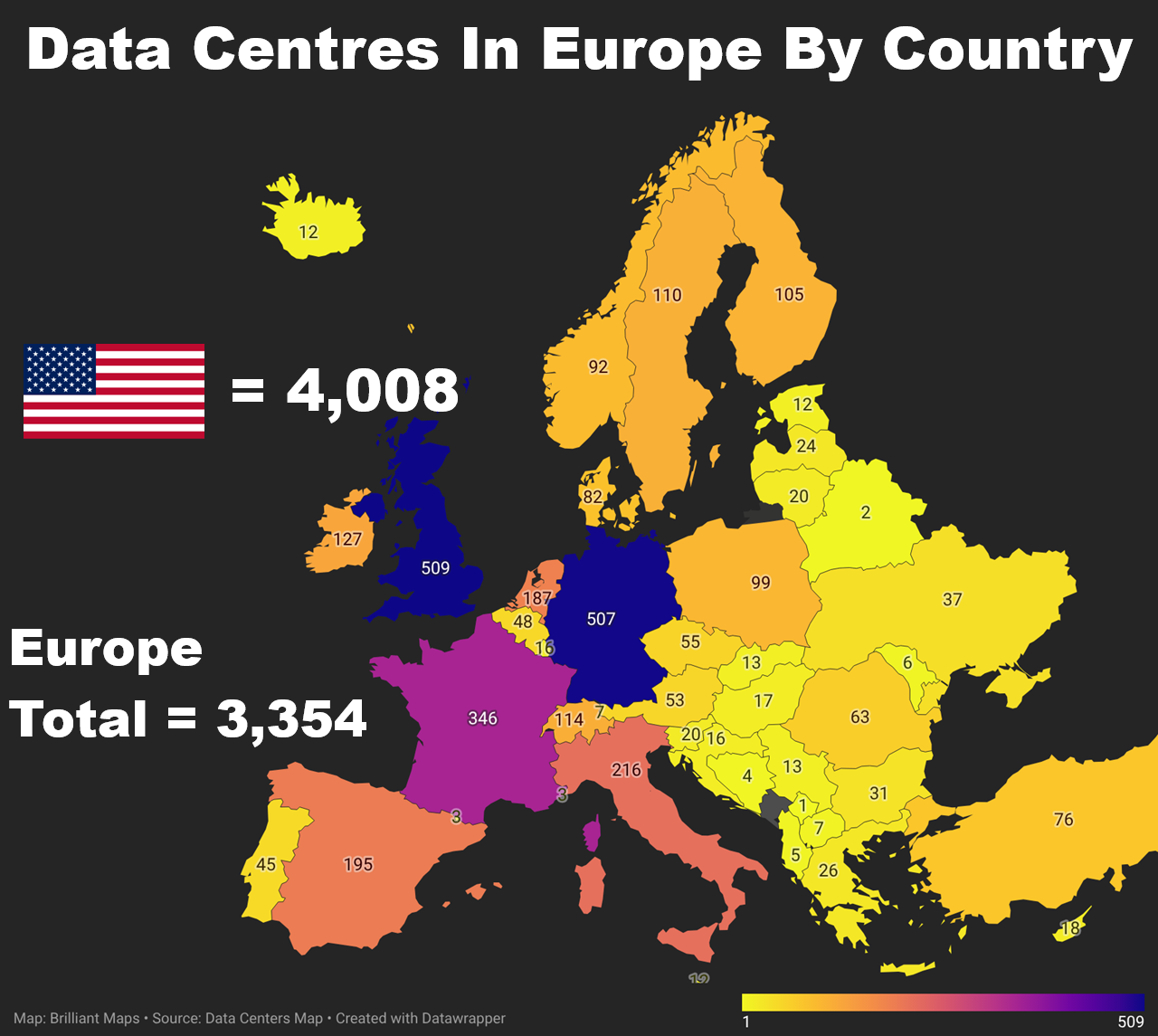
And here’s a map just for Europe:

Number of Data Centers In Each European Country

You can check out where they are all located on Data Center Map here.

Which country surprises you the most?

https://brilliantmaps.com/?p=24813
Extensions
Only 5 States Have Ever Had An African-American State Governor
United States
The map above shows a rather shocking state as of 2025, only 5 US states had ever had an African-American State Governor (all men), and in the case of Louisiana that was well over a century ago during the era of reconstruction. More about the the 5/6 men below: 1. P.B.S. Pinchback (Louisiana, 1872–1873) First […]
Show full content

Only 5 States Have Ever Had An African-American State Governor

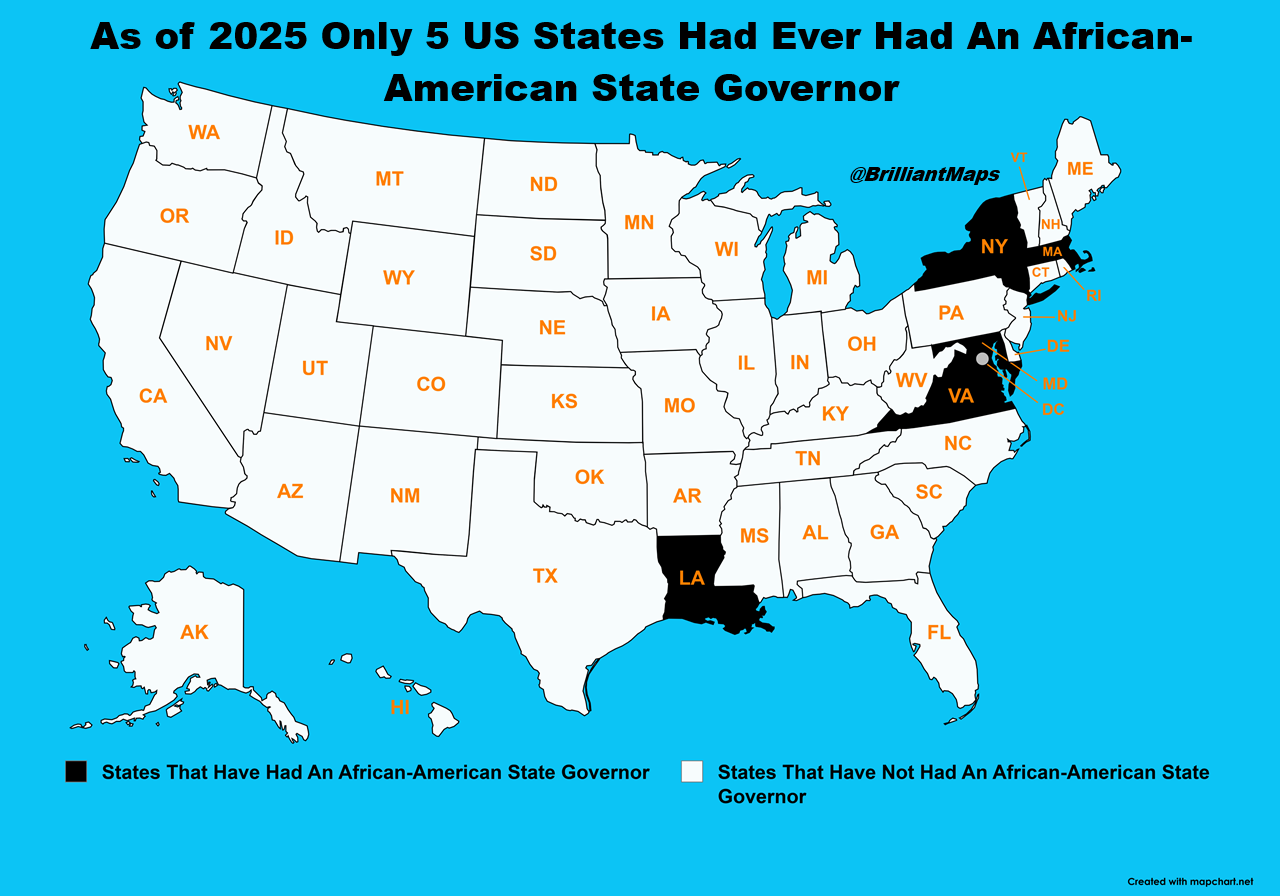
The map above shows a rather shocking state as of 2025, only 5 US states had ever had an African-American State Governor (all men), and in the case of Louisiana that was well over a century ago during the era of reconstruction.

More about the the 5/6 men below:

1. P.B.S. Pinchback (Louisiana, 1872–1873)
  • First African American governor in U.S. history (although this is disputed by some see Oscar Dunn below)
  • Served for about 35 days
  • Came to power during Reconstruction after a disputed election.

Louisiana Controversy:

  • The 1872 election in Louisiana was highly disputed, with multiple rival governments claiming legitimacy
  • Both Republicans and Democrats accused each other of fraud
  • Pinchback became governor after the sitting governor was removed amid this chaos
  • His governorship was technically legal, but widely challenged and politically unstable
  • Because of this turmoil, some historians debate how to classify his tenure (though he is officially recognized)
2. Douglas Wilder (Virginia, 1990–1994)
  • First African American elected governor by popular vote
  • Won a very close election in 1989
  • Known for fiscal conservatism and balancing Virginia’s budget
3. Deval Patrick (Massachusetts, 2007–2015)
  • First Black governor of Massachusetts
  • Second African American elected governor overall and first in the North.
  • Focused on education reform and economic growth
4. David Paterson (New York, 2008–2010)
  • First African American governor of New York
  • Also the first legally blind governor in U.S. history
  • Became governor after Eliot Spitzer resigned
5. Wes Moore (Maryland, 2023–present)
  • First African American governor of Maryland
  • Third elected Black governor in U.S. history
  • Focuses on economic mobility, education, and public service
O.? Oscar Dunn (Louisiana, 1868–1871)

Oscar James Dunn is a crucial figure, and often overlooked, in this history.

Why he matters

  • First African American elected statewide executive official in the U.S.
  • Elected Lieutenant Governor of Louisiana during Reconstruction (1868)
  • A formerly enslaved man who rose to one of the highest offices in the state

Did he act as governor?

Yes, very likely, at least briefly.

  • As lieutenant governor under Henry Clay Warmoth, Dunn would have:
    • Exercised gubernatorial powers when Warmoth was absent
  • However, records are incomplete, so:
    • Historians generally say he “likely served as acting governor”, but exact dates/times aren’t well documented

Political conflict

Dunn wasn’t just a placeholder—he was deeply involved in power struggles:

  • He broke with Governor Warmoth over:
    • Corruption
    • Control of the Republican Party in Louisiana
  • Dunn aligned with more radical Reconstruction policies supporting Black political rights

 Mysterious death (possible controversy)

  • Dunn died suddenly in 1871 at age 49
  • Many contemporaries suspected poisoning, though it was never proven
  • His death:
    • Shifted political power in Louisiana
    • Weakened Black political leadership during Reconstruction

Why he’s important historically

  • Preceded P.B.S. Pinchback
  • Represents one of the earliest examples of Black executive power in the U.S.
  • His career shows how fragile Reconstruction-era gains were

Key takeaway

  • If Pinchback is considered the first Black governor,
  • Then Oscar Dunn is arguably the first African American to exercise gubernatorial authority, even if only temporarily and less formally documented.

And finally here are African American lieutenant governors who briefly served as acting governor, usually when the elected governor was out of state, resigned, or temporarily unable to serve. These roles were often short but still historically important.

George W. Haley (Kansas, 1969–1973)
  • First African American Lieutenant Governor of Kansas
  • Served briefly as acting governor during absences of the governor
  • Brother of author Alex Haley
Mervyn Dymally (California, 1975–1979)
  • First African American Lieutenant Governor of California
  • Served as acting governor multiple times when Jerry Brown was out of state
  • One of the earliest Black officials to exercise gubernatorial powers (even if temporarily)
Pierre Howard (Georgia, 1991–1999)
  • First African American Lieutenant Governor of Georgia
  • Served as acting governor at times during the governor’s absence
  • Important figure in Southern Black political leadership post–civil rights era
David Paterson (before becoming governor in 2008)
  • As lieutenant governor, he temporarily acted as governor when Eliot Spitzer was unavailable
  • Later became full governor after Spitzer resigned (making him more than just acting)
Winsome Earle-Sears (Virginia, 2022–present)
  • First Black woman elected state-wide in Virginia
  • Has the constitutional ability to act as governor when Glenn Youngkin is absent (as modern lieutenant governors do)
How “Acting Governor” Works
  • In most states, when the governor leaves the state or is temporarily unavailable, the lieutenant governor assumes powers
  • These stints can last from hours to days, but they are legally significant
  • This is why some figures are noted in history even if they were never elected governor outright
Important Distinction
  • Acting governor (temporary) → short-term authority
  • Succeeded to governor (like David Paterson) → full governorship
  • Elected governor (like Douglas Wilder) → chosen directly by voters

Surprised?

https://brilliantmaps.com/?p=24810
Extensions
← Back to feeds