I have been struggling with what Jonathan Lethem calls “The Gulp” in The Ecstasy of Influence: “For me, there’s a weird, unfathomable gulf—I almost wrote gulp—between the completion of a novel and its publication. Some days this duration feels interminable, as though the book has voyaged out like some spacecraft on a research mission, populated […]
“For me, there’s a weird, unfathomable gulf—I almost wrote gulp—between the completion of a novel and its publication. Some days this duration feels interminable, as though the book has voyaged out like some spacecraft on a research mission, populated by forgotten losers like the ones in John Carpenter’s Dark Star, a craft cut loose by those who launched the thing and now grown irretrievable, bent by space and time into something distorted and not worth guiding home. Then there are other days, where the book might be a pitch that’s left your hand too soon, now burning toward home plate, whether to be met by a catcher’s mitt or the sweet part of the bat you can’t possibly know. Hopeless to regret it once you feel it slipping past your fingertips. Just watch. (That’s the gulp.) The weirdness is in that interlude where the book has quit belonging to you but doesn’t belong to anyone else yet, hasn’t been inscribed in all its rightness and wrongness by the scattershot embrace and disdain of the world. It’s a version of Schrödinger’s cat, unchangeably neither dead nor alive in its box.”
“It would calm me when I would start to think that what I was doing was important,” Seinfeld said. “You look at some pictures from the Hubble Telescope and you snap out of it.”
When Apatow said that sounded depressing, Seinfeld replied, “People always say it makes them feel insignificant, but I don’t find being insignificant depressing. I find it uplifting.”
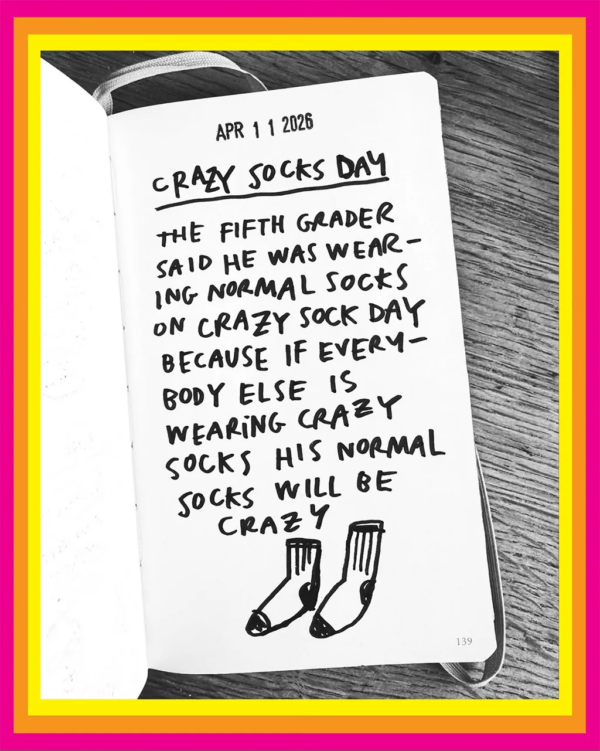
The kids in the forthcoming book are little kids — like, ages 3-7 — but those kids are now teen and tween. Still, they keep serving me up one-liners and inspiration, like my 11-year-old’s take on crazy sock day.
Preorder your copy of Don’t Call It Art and complete this form to download a PDF that includes: A personal note from me 5 mini posters 5 zines with bonus material and extra book chapters 1 playlist of all the musicians mentioned in the book, plus a J-card if you’re feeling inspired to make your […]
Easter in East Austin, 2013. The sign reads: “Don’t make your own easter eggs — ain’t nobody got time for that!” Today’s newsletter is about the other kind of easter eggs: It turns out our tweens aren’t too old for an egg hunt, so we got out the plastic easter eggs for at least one […]
Show full content
Easter in East Austin, 2013. The sign reads: “Don’t make your own easter eggs — ain’t nobody got time for that!”
Today’s newsletter is about the other kind of easter eggs:
It turns out our tweens aren’t too old for an egg hunt, so we got out the plastic easter eggs for at least one more year and hid them around the yard.
I can’t pull out Easter eggs without thinking about the other kind of Easter egg — the hidden feature or message. I don’t think everybody knows this, but I hide two Easter eggs in almost every one of my Friday newsletters…
I had a musical Easter weekend. We watched Wayne’s World for pizza night on Friday, my band practiced for 4 hours on Saturday, and I spent most of Sunday afternoon making a new mixtape: April is often a melancholy month for me. Last April I made an “April Showers” mix that I described as a […]
I had a musical Easter weekend. We watched Wayne’s World for pizza night on Friday, my band practiced for 4 hours on Saturday, and I spent most of Sunday afternoon making a new mixtape:
April is often a melancholy month for me. Last April I made an “April Showers” mix that I described as a “sad dad bad had” mix for spring with a bunch of country weepers and other stuff I like. This month, I got to thinking about Prince’s “Sometimes It Snows In April” and wondered if I could do a frozen version of “April Showers” with a bunch of wintry-ish music that might still sound good in spring. (If you’d rather listen to something more upbeat, check out last month’s mixtape.)
A new challenge: a reader sent me a big box full of sealed, blank C90 cassettes, so now I’m faced with filling 90+ minutes of tape. (As I mentioned last month, many 90-minute cassettes are actually more like 94-minute cassettes, because the manufacturers added a few extra minutes of tape to each side.) So this mix is something like 1 hour and 34 minutes long, with a few long tracks on side two:
The Sufjan Stevens track started off a mix of music we played at our wedding almost 20 years ago. I was going to follow it with another song from the wedding mix, Arthur Russell’s “A Little Lost,” but NASA’s Artemis II mission influenced me, and I chose “This is How We Walk on the Moon” instead. (I thought “Ashes To Ashes” would sound good after it, somehow forgetting that Bowie calls back to “Major Tom” in that song!) The things that look like moons on the cover are actually coins from a headdress in National Geographic:
From my letter, “Desert not-so-solitaire”: I don’t know how or when it happened, but I’ve somehow become a person who likes being in the desert? It started a few years ago driving from Los Angeles to Las Vegas, then developed on trips to Joshua Tree and New Mexico. Last week for spring break we took […]
I don’t know how or when it happened, but I’ve somehow become a person who likes being in the desert? It started a few years ago driving from Los Angeles to Las Vegas, then developed on trips to Joshua Tree and New Mexico. Last week for spring break we took a little 3-night trip to Arizoña (I pronounce it like Matt Berry), hiked in a canyon outside of Sedona, stargazed under dark skies, looked at the sun through a solar telescope at the Lowell Observatory in Flagstaff, and caught a Cleveland Guardians spring training game at Goodyear Ballpark in Phoenix. (The most fun I’ve ever had at a baseball game. Highly recommended.)
MiscellanyintrospectionMUSICpaul mccartneythe beatlesWalter martin
In a recent Tuesday Trio, I wrote about introspection, and quoted Ian Leslie: I’m often struck by how many high achievers are unencumbered by self-reflection. To take an example close to home, I’ve read or watched countless interviews with Paul McCartney, and he is at his least interesting on the topic of Paul McCartney. It […]
Show full content
In a recent Tuesday Trio, I wrote about introspection, and quoted Ian Leslie:
I’m often struck by how many high achievers are unencumbered by self-reflection. To take an example close to home, I’ve read or watched countless interviews with Paul McCartney, and he is at his least interesting on the topic of Paul McCartney. It isn’t that he doesn’t have a rich inner life. It’s that he puts it into his work – into the songs. His therapist is his guitar.
I think this a key to some of the problems Walter Martin has with McCartney’s work that he and I discussed on his radio show. Walter and I both grew up Lennon worshippers, so we got together to talk about our mixed feelings of admiration and bewilderment concerning Mr. McCartney and Morgan Neville’s new documentary, Man on the Run.
Obviously, this conversation was no fun at all
After we talked, I wrote a whole letter about McCartney’s creativity in 3 photographs, and included this chart of my ongoing relationship with the Beatles’ music:
There really is no in between for me. I’m either all in, or all out, which is why any new Beatles book, any new Beatles movie, any new Beatles anything has the ability to send me down the Beatles hole.
From my letter, “Analog Mailbag”: From time to time, my friend Warren Craghead sends me drawings on postcards in the mail. One day I decided to put one of Warren’s postcards at the center of a tape and magazine collage. Then I did it again. Pretty soon I had a little series going, but I […]
From time to time, my friend Warren Craghead sends me drawings on postcards in the mail. One day I decided to put one of Warren’s postcards at the center of a tape and magazine collage. Then I did it again. Pretty soon I had a little series going, but I got distracted working on other things. Luckily, Warren keeps sending me postcards. Now I’ve got a good stack of them ready to keep the series going.
I used the image above for my letter, “Spring Reverb,” and then I stripped the frame out of another collage and filled it with animated bluebonnets for “Flowers from Texas.”
In Tuesday’s newsletter, I wrote about the comfort of a Rubik’s Cube: When so many of life’s problems are unsolvable, solvable problems are a wonderful distraction. When so many things seem unfixable, fixing something feels amazing. I forgot to shout-out Bernard Suits in The Grasshopper: Games, Life and Utopia: “Playing a game is the voluntary […]
When so many of life’s problems are unsolvable, solvable problems are a wonderful distraction. When so many things seem unfixable, fixing something feels amazing.
[That quote is] a favorite of philosopher C. Thi Nguyen, whose new book The Score: How To Stop Playing Somebody Else’s Game both thrilled and exasperated me. I’m still processing it, and I’m sure I’ll have more to say about it later, but for now I’ll just say: I think it’s such a pleasure to see an academic write in a conversational voice and swing for the fences with a book that appeals to a general audience. “All of my hobbies involve basically micro-dosing epiphanies,” he says, and it’s hard not to love a writer who’s so passionate and articulate about his pasttimes. (See: my letter, “Your hobby looks exhausting!”)
I read so much about play and games while I was writing Don’t Call It Art, but a lot of it didn’t wind up showing up. Writing is weird!





 Easter in East Austin, 2013. The sign reads: “Don’t make your own easter eggs — ain’t nobody got time for that!”