"The self, the place where we live, is a place of illusion. Goodness is connected with the attempt to see the unself... to pierce the veil of selfish consciousness and join the world as it really is."
Show full content
“The self, the place where we live, is a place of illusion. Goodness is connected with the attempt to see the unself… to pierce the veil of selfish consciousness and join the world as it really is.”
To recognize that there are infinitely many kinds of beautiful lives is to step outside the self, beyond its particular conceptions of beauty — which includes, of course, moral beauty — and walking beside it with humble, nonjudgmental curiosity about the myriad other selves afoot on their own paths, propelled by their own ideals of the Good.
Such recognition requires what the great moral philosopher and novelist Iris Murdoch (July 15, 1919–February 8, 1999) termed unselfing — a difficult, triumphant act for which, Murdoch argues in her 1970 masterpiece The Sovereignty of Good (public library), nature and art uniquely train us.
Dame Iris Murdoch by Ida Kar (National Portrait Gallery)
Beauty is the convenient and traditional name of something which art and nature share, and which gives a fairly clear sense to the idea of quality of experience and change of consciousness. I am looking out of my window in an anxious and resentful state of mind, oblivious of my surroundings, brooding perhaps on some damage done to my prestige. Then suddenly I observe a hovering kestrel. In a moment everything is altered. The brooding self with its hurt vanity has disappeared. There is nothing now but kestrel. And when I return to thinking of the other matter it seems less important. And of course this is something which we may also do deliberately: give attention to nature in order to clear our minds of selfish care.
Oliver Sacks would come to echo the sentiment decades later in his observation that meeting nature on its own terms and timescales broadens our perspective by effecting “a detachment from the timescale, the urgencies, of daily life.” But this unselfing, Murdoch cautions, cannot arise from a straining of the will, for the will is a clenching of the very self which true beauty deconditions; rather, it comes as a gladsome relaxing of the spirit, of our essential nature, into the shared pulse of existence:
A self-directed enjoyment of nature seems to me to be something forced. More naturally, as well as more properly, we take a self-forgetful pleasure in the sheer alien pointless independent existence of animals, birds, stones and trees.
This “self-forgetful pleasure” calls to mind Jeanette Winterson’s wonderfully paradoxical notion of active surrender as the crucible of our joy in art and the fulcrum for art’s transformative power over the self. But while there is a distinct difference between how nature and art each effect unselfing, Murdoch argues that what separates great art from the bad and the mediocre is precisely this capacity for stripping down the self rather than inflating the ego — a notion evocative of Tolstoy’s insistence that “a real work of art destroys, in the consciousness of the receiver, the separation between himself and the artist.” Murdoch writes of this dissolution of the self in the presence of great art:
The experience of art is more easily degraded than the experience of nature. A great deal of art, perhaps most art, actually is self-consoling fantasy, and even great art cannot guarantee the quality of its consumer’s consciousness. However, great art exists and is sometimes properly experienced and even a shallow experience of what is great can have its effect. Art, and by “art” from now on I mean good art, not fantasy art, affords us a pure delight in the independent existence of what is excellent. Both in its genesis and its enjoyment it is a thing totally opposed to selfish obsession. It invigorates our best faculties and, to use Platonic language, inspires love in the highest part of the soul. It is able to do this partly by virtue of something which it shares with nature: a perfection of form which invites unpossessive contemplation and resists absorption into the selfish dream life of the consciousness.
And yet, Murdoch argues, any real understanding of goodness is necessarily an embrace of imperfection — something philosopher Martha Nussbaum, in many ways Murdoch’s only worthy intellectual heir, would argue brilliantly a generation later in her incisive case for the intelligence of emotions. Murdoch writes:
The concept of Good… is a concept which is not easy to understand partly because it has so many false doubles, jumped-up intermediaries invented by human selfishness to make the difficult task of virtue look easier and more attractive: History, God, Lucifer, Ideas of power, freedom, purpose, reward, even judgment are irrelevant. Mystics of all kinds have usually known this and have attempted by extremities of language to portray the nakedness and aloneness of Good, its absolute for-nothingness. One might say that true morality is a sort of unesoteric mysticism, having its source in an austere and unconsoled love of the Good. When Plato wants to explain Good he uses the image of the sun. The moral pilgrim emerges from the cave and begins to see the real world in the light of the sun, and last of all is able to look at the sun itself.
[…]
We may also speak seriously of ordinary things, people, works of art, as being good, although we are also well aware of their imperfections. Good lives as it were on both sides of the barrier and we can combine the aspiration to complete goodness with a realistic sense of achievement within our limitations.
With an eye to the legacy of the Romantics, who married nature and art in their model of happiness and transcendence, Murdoch returns to the notion of unselfing and the beautiful tessellation of possibility and limitation that defines our nature:
The self, the place where we live, is a place of illusion. Goodness is connected with the attempt to see the unself, to see and to respond to the real world in the light of a virtuous consciousness. This is the non-metaphysical meaning of the idea of transcendence to which philosophers have so constantly resorted in their explanations of goodness. “Good is a transcendent reality” means that virtue is the attempt to pierce the veil of selfish consciousness and join the world as it really is. It is an empirical fact about human nature that this attempt cannot be entirely successful.
For seventeen years, I have been spending hundreds of hours and thousands of dollars each month composing The Marginalian (which bore the outgrown name Brain Pickings for its first fifteen years). It has remained free and ad-free and alive thanks to patronage from readers. I have no staff, no interns, no assistant — a thoroughly one-woman labor of love that is also my life and my livelihood. If this labor makes your own life more livable in any way, please consider lending a helping hand with a donation. Your support makes all the difference.
newsletter
The Marginalian has a free weekly newsletter. It comes out on Sundays and offers the week’s most inspiring reading. Here’s what to expect. Like? Sign up.
This essay is adapted from Traversal. “In the great chain of cause and effect,” Alexander von Humboldt wrote as he was teaching science to read the poetry of nature, “no single fact can be considered in isolation.” When the first European colonists made landfall on New Zealand’s shores in Humboldt’s lifetime, the cats and rats that descended from their ships began decimating the native population of black robins — sparrow-sized birds with yellow-soled feet that had evolved without mammalian predators, mate for life in monogamous pairs, and raise only two chicks per year in cuplike nests close to the ground.… read article
When the first European colonists made landfall on New Zealand’s shores in Humboldt’s lifetime, the cats and rats that descended from their ships began decimating the native population of black robins — sparrow-sized birds with yellow-soled feet that had evolved without mammalian predators, mate for life in monogamous pairs, and raise only two chicks per year in cuplike nests close to the ground.
Bird by bird, claw by claw, there were only seven survivors within a century.
Black robin among other native birds (John Gerrard Keulemans, 1907)
Desperate to encourage the survivors to breed, conservationists moved them to Mangere Island, where twenty thousand trees were planted just to provide a hospitable habitat for the robins. But they would not pair — mysterious are the ways of even a bird’s heart, for it is all a single mystery.
Two of the seven died.
Among the five survivors there was a sole female capable of laying fertile eggs — a robin so aged that she came to be known as Old Blue. At eight, she had outlived the average black robin twofold. With the survival of the species resting on Old Blue’s near flightless wings, scientists thought that if her offspring were raised by surrogate parents, she would be able to lay more eggs.
Warblers were the first designated foster parents, but they failed to feed the chicks enough.
Tomtits were tried next, but they were too successful as foster parents — the black robin chicks grew up perceiving themselves as tomtits and wanted to mate only with other tomtits.
Finally, the chicks were returned to Old Blue, in whose care they thrived as black robins.
A single mother brought a whole species back from the brink of extinction.
Old Blue lived to be fourteen and raised eleven chicks. All the black robins in the world today, numbering around 250, are fractal emissaries of her genes — a winged reminder that immensities of harm can be undone by a single act of tenacious tenderness.
donating = loving
For seventeen years, I have been spending hundreds of hours and thousands of dollars each month composing The Marginalian (which bore the outgrown name Brain Pickings for its first fifteen years). It has remained free and ad-free and alive thanks to patronage from readers. I have no staff, no interns, no assistant — a thoroughly one-woman labor of love that is also my life and my livelihood. If this labor makes your own life more livable in any way, please consider lending a helping hand with a donation. Your support makes all the difference.
newsletter
The Marginalian has a free weekly newsletter. It comes out on Sundays and offers the week’s most inspiring reading. Here’s what to expect. Like? Sign up.
"Love one another but make not a bond of love: let it rather be a moving sea between the shores of your souls."
Show full content
“Love one another but make not a bond of love: let it rather be a moving sea between the shores of your souls.”
“What’s the use of falling in love if you both remain inertly as-you-were?” Mary McCarthy asked her friend Hannah Arendt in their correspondence about love. The question resonates because it speaks to a central necessity of love — at its truest and most potent, love invariably does change us, deconditioning our painful pathologies and elevating us toward our highest human potential. It allows us, as Barack Obama so eloquently wrote in his reflections on what his mother taught him about love, “to break across our solitude, and then, if we’re lucky, [be] finally transformed into something firmer.”
But in the romantic ideal upon which our modern mythos of love is built, the solidity of that togetherness is taken to such an extreme as to render love fragile. When lovers are expected to fuse together so closely and completely, mutuality mutates into a paralyzing codependence — a calcified and rigid firmness that becomes brittle to the possibility of growth. In the most nourishing kind of love, the communion of togetherness coexists with an integrity of individuality, the two aspects always in dynamic and fluid dialogue. The philosopher Martin Heidegger captured this beautifully in his love letters to Hannah Arendt: “Why is love rich beyond all other possible human experiences and a sweet burden to those seized in its grasp? Because we become what we love and yet remain ourselves.”
This difficult balance of intimacy and independence is what the great Lebanese-American artist, poet, and philosopher Kahlil Gibran (January 6, 1883–April 10, 1931) explores with uncommon insight and poetic precision in a passage from his 1923 masterwork The Prophet (public library).
By way of advice on the secret to a loving and lasting marriage, Gibran offers:
Let there be spaces in your togetherness,
And let the winds of the heavens dance between you.
Love one another but make not a bond of love:
Let it rather be a moving sea between the shores of your souls.
Fill each other’s cup but drink not from one cup.
Give one another of your bread but eat not from the same loaf.
Sing and dance together and be joyous, but let each one of you be alone,
Even as the strings of a lute are alone though they quiver with the same music.
Give your hearts, but not into each other’s keeping.
For only the hand of Life can contain your hearts.
And stand together, yet not too near together:
For the pillars of the temple stand apart,
And the oak tree and the cypress grow not in each other’s shadow.
For seventeen years, I have been spending hundreds of hours and thousands of dollars each month composing The Marginalian (which bore the outgrown name Brain Pickings for its first fifteen years). It has remained free and ad-free and alive thanks to patronage from readers. I have no staff, no interns, no assistant — a thoroughly one-woman labor of love that is also my life and my livelihood. If this labor makes your own life more livable in any way, please consider lending a helping hand with a donation. Your support makes all the difference.
newsletter
The Marginalian has a free weekly newsletter. It comes out on Sundays and offers the week’s most inspiring reading. Here’s what to expect. Like? Sign up.
In a recent conversation with my poetic physicist friend Alan Lightman, sparring over whether the creative spirit can be usefully divided into complementary arts and science (Alan’s view) or whether these are simply different side doors to our ongoing yearning to bridge matter and mystery in order to make meaning (my view), I was reminded of a forgotten speech by one of the most original minds and brightest spirits of the past century. On Valentine’s Day 1971, a year after the publication of her classic Centering, the poet and potter M.C. Richards (July 13, 1916–September 10, 1999) was invited to… read article
Show full content
In a recent conversation with my poetic physicist friend Alan Lightman, sparring over whether the creative spirit can be usefully divided into complementary arts and science (Alan’s view) or whether these are simply different side doors to our ongoing yearning to bridge matter and mystery in order to make meaning (my view), I was reminded of a forgotten speech by one of the most original minds and brightest spirits of the past century.
On Valentine’s Day 1971, a year after the publication of her classic Centering, the poet and potter M.C. Richards (July 13, 1916–September 10, 1999) was invited to speak at an arts festival in Maine. Going “from horticulture to alchemy to the history of consciousness, with a few poems sprinkled in, and relying heavily on paradox,” the address she delivered, later included in The Crossing Point: Selected Talks and Writings (public library), is one of the most honest, imaginative, and articulate investigations of creativity I have encountered — a bold defiance of the fracturing of culture anchored in the passionate insistence that “the center is everywhere,” that it is “made up of differences, uniquenesses, in a tissue of relationships, interactions, interpenetrations.”
Mary Caroline Richards at Black Mountain College (Getty Research Institute. Photographer unknown.)
At the center of her cosmogony of creativity are the connections between the life of the individual human being and the life of the universe; between the inner invisible realm, which she calls “the force,” and the outer visible realm of its manifestation, which she calls the “the flower”; between the different fields of study and work through which we explore these realms. She writes:
Artists are sometimes particularly attuned to these connections, scientists too, mystics too… There may be a message in this way of working. Maybe that’s what a subject is, a gathering of ideas as set in motion by a central impulse. Like a magnetic field. Start the field going, and elements begin to swarm. By what logic? By attraction. By resonance. Maybe that’s what relevance is: the feeling of attraction and resonance between ideas and people.
This feeling, Richard observes, is what we call creativity — the mystery to which we try to give shape in matter — and it begins not in the mind but in the heart. She considers the force by which the cabbage flowers:
Cabbage… grows a big heart. Out of this heart come leaves. As the leaves grow, the heart grows. The cabbage gets its leaves from the inside, where there aren’t any. Cabbages grow from the inside, from the heart. And by growing they create their hearts.
A neurophysiologist from Yale says that brains too are created in this way: from un-brain forces. He says that the human brain is created by thinking, that ideas and values create chemical reactions in tissue. Like a cabbage, somehow the physical form grows from an invisible realm.
This invisible realm must be a powerfully creative region. It furnishes us not only with cabbages and brains, but with our scientific hypotheses, religious experiences, and works of art.
With the recognition that works of art begin with “a feeling for things, a feeling which is a way of knowing about things,” she adds:
We tend to call any undertaking an art when it seems to be drawing upon the fullness of inner feeling and upon careful regard for physical expression. To live and to work in the world mindful of the processes which are necessary to infuse matter with soul forces, to use techniques on behalf of living forms, is a great art.
In this sense, she observes, living itself is an art — the art of connection. Just as Erich Fromm was formulating the ideas that would become The Art of Being, Richards writes:
Life is best understood and practiced as an art, the way that art is understood and practiced. We rely on inspiration, feeling for materials, knowledge of how to put things together well, patience, physical strength and awareness that we are part of a process which we don’t know much about yet but which we live within and are sustained by. The verbal arts we practice, or visual arts, or graphic arts, or theater arts, or musical arts, or liberal arts, are part of something. They are not the whole story. And they are interconnected at the center with all the other parts.
1573 painting by the Portuguese artist Francisco de Holanda, a student of Michelangelo’s. (Available as a print and as stationery cards.)
Pulsating beneath this interconnected totality is the essence of all creative work. While the young Jane Goodall was contemplating the indivisibility of art and science, Richards considers what creativity in all its forms asks of us and what it gives us:
Total concentration, total focus, enjoyment, discovery, inner effort, creating something, feeling secure in the process yet not knowing or demanding to know how it will come out. Many of the things we do may have this quality. Take gardening, for example, or making lab experiments, or working out a new equation, or cooking supper, or having a child, or teaching a class, or running a college, or praying, or going for a walk, or getting married, or dying.
This feeling of generative not-knowing — something the artist Ann Hamilton so beautifully articulated a generation after Richards — is also our best path to knowledge, integral to the creative process of science:
When we live in the spirit of science, we live in a quality of inquiry, of wonder. We put one foot in front of the other, standing firmly balanced on the earth, finding our way on. Each step is both an answer and a question. We both know and don’t know what we are doing… We need to learn to hear the yesin the no; the no in the yes. To hear what is not said. To see what is not visible.
For seventeen years, I have been spending hundreds of hours and thousands of dollars each month composing The Marginalian (which bore the outgrown name Brain Pickings for its first fifteen years). It has remained free and ad-free and alive thanks to patronage from readers. I have no staff, no interns, no assistant — a thoroughly one-woman labor of love that is also my life and my livelihood. If this labor makes your own life more livable in any way, please consider lending a helping hand with a donation. Your support makes all the difference.
newsletter
The Marginalian has a free weekly newsletter. It comes out on Sundays and offers the week’s most inspiring reading. Here’s what to expect. Like? Sign up.
“What we see from the air is so simple and beautiful,” Georgia O’Keeffe wrote after her first airplane flight, “I cannot help feeling that it would do something wonderful for the human race — rid it of much smallness and pettiness if more people flew.” I am writing this aboard an airplane. An earthbound ape in my airborne cage of metal and glass, I wonder who we would be, in the soul of the species, if we could fly — really fly, the way birds do; if we were born not just seeing “the world all simplified and beautiful and… read article
Show full content
“What we see from the air is so simple and beautiful,” Georgia O’Keeffe wrote after her first airplane flight, “I cannot help feeling that it would do something wonderful for the human race — rid it of much smallness and pettiness if more people flew.”
I am writing this aboard an airplane. An earthbound ape in my airborne cage of metal and glass, I wonder who we would be, in the soul of the species, if we could fly — really fly, the way birds do; if we were born not just seeing “the world all simplified and beautiful and clear-cut in patterns,” as Georgia did out of that small round window, but feeling it. And yet you and I shall never know the open sky as a way of being — never know the touch of a thermal or the taste of a thundercloud, never see our naked shadow on a mountain or slice a cirrus with a wing. What cruel cosmic fate to live on this Pale Blue Dot without ever knowing its blueness. And yet we are recompensed by a consciousness capable of wonder — that edge state on the rim of understanding, where the mind touches mystery.
It is wonder that led us to invent science — that quickening of curiosity driving every discovery — so that science may repay us with magnified wonder as it reveals the weft and warp of nature — the tapestry of forces and phenomena, of subtleties and complexities, woven on the enchanted loom of reality. To look at any single thread more closely, in all its hidden wonder, is to see more clearly how the entire tapestry holds together, to strengthen how we ourselves hold together across the arc of life. For, as Rachel Carson so memorably wrote, the greatest gift you could give a child — or the eternal child in you — is “a sense of wonder so indestructible that it would last throughout life, as an unfailing antidote against the boredom and disenchantments… the sterile preoccupation with things that are artificial, the alienation from the sources of our strength.”
Art by Nikki McClure from Something About the Sky — Rachel Carson’s serenade to the wonder of the clouds
Take the wonder of a bird — this living poem of feather and physics, of barometric wizardry and hollow bone, in whose profoundly other brain evolution invented dreams. That so tiny a creature should defy the gravitational pull of an entire planet seems impossible, miraculous. And yet beneath this defiance is an active surrender to the same immutable laws that make the whole miracle of the universe possible.
In one of the three dozen fascinating essays collected in The Miraculous from the Material: Understanding the Wonders of Nature (public library), the poetic physicist and novelist Alan Lightman illuminates the lawful wonder of avian flight, from evolution to aerodynamics, from molecules to mathematics, beginning with the fundamental wonderment of how a bird creates strong enough an upward force to counter gravity’s pull on its weight:
[The force] is created by a net upward air pressure, which in turn is created by the bird’s forward motion and the shape of its wings. The topside of an avian wing is curved, while the bottom side is rather flat. This difference in shape, together with the angle and some smaller adjustments of the wing, cause the air to flow over the top of the wing at higher speed than on the bottom. The higher speed on top reduces the air pressure above the wing compared to the air pressure below the wing. With more pressure pushing up from below than pressure pushing down from above, the wing gets an upward lift.
Anatomy of a bird by French artist Paul Sougy. (Available as a print, benefitting The Nature Conservancy.)
It may seem counterintuitive that a higher air speed above the wing would produce a lower pressure, but our creaturely intuitions have often been poor reflections of reality — it took us eons to discern that the flat surface beneath our feet is a sphere, that the sphere is not at the center of the universe, and that there is an invisible force acting on objects without touching them to make the universe cohere — a force which a bored twenty-something sitting in his mother’s apple orchard called gravity.
Alan explains the reality of chemistry and physics that makes flight possible as air molecules strike against the underside of the wing to lift the bird up:
Air consists of little molecules that push against whatever they strike, causing pressure. Molecules of air are constantly whizzing about in all directions. If no energy is added, the total speed of the molecules must be constant, by the law of the conservation of energy. But that speed is composed of two parts: a horizontal speed, parallel to the wing, and a vertical speed, perpendicular to the wing. Increase the horizontal speed of air molecules above the wing, and the vertical speed of those molecules must decrease. Lower speed of molecules striking the wing from above means less pressure, or less push. The molecules on the bottom of the wing, moving slower in the horizontal direction but faster in the vertical direction (with greater upward pressure), lift the wing upward.
The lift is greater the larger the wing area and the faster the speed of air past the wing. There’s a convenient trade-off here. The necessary lift force to counterbalance the bird’s weight can be had with less wing area if the animal increases its forward speed, and vice versa. Birds capitalize on this option according to their individual needs. The great blue heron, for example, has long, slender legs for wading and must fly slowly so as not to break them on landing. Consequently, herons have relatively large wingspan. Pheasants, on the other hand, maneuver in underbrush and would find large wings cumbersome. To remain airborne with their relatively short and stubby wings, pheasants must fly fast.
There are, however, limits to this factorial conversation between surface and speed. Alan considers why there are no birds the size of elephants:
As you scale up the size of a bird or any material thing, unless you drastically change its shape, its weight increases faster than its area. Weight is proportional to volume, or length times length times length, while area is proportional to length times length. Double the length, and the weight is eight times larger, while the area is only four times larger. For example, if you have a cube of 1 inch on a side, its volume is 1 cubic inch, while its total area is 6 (sides) × 1 square inch, or 6 square inches. If you double the side of the cube to 2 inches, its volume goes up to 8 cubic inches, or 800 percent (with a similar increase in weight), while its area goes up to 24 square inches, or 400 percent. Since the lift force is proportional to the wing area while the opposing weight force is proportional to the bird’s volume, as you continue scaling up, eventually you reach a point where the bird’s wing area is not enough to keep it aloft. Although birds have been experimenting with flight for 100 million years, the heaviest true flying bird, the great bustard, rarely exceeds 42 pounds. The larger gliding birds, such as vultures, are lifted by rising hot air columns and don’t carry their full weight.
But all this elaborate molecular and mathematical aerodynamics of upward motion is not enough to make flight possible — birds must also propel themselves forward without propellers. For a long time, how they do this was a mystery. (The mystery was even deeper for the singular flight of the hummingbird, hovering between science and magic.) It was the birth of modern aviation that finally shed light on it. In the early nineteenth century, watching how birds glide, the pioneering engineer and aerial investigator George Cayley became the first human being to discern the mechanics of flight, identifying the three forces acting on the weight of any flying body: lift, drag, and thrust.
Alan details the physics of drag and thrust that allow birds to move forward:
Birds do in fact have propellers, in the form of specially designed feathers in the outer halves of their wings. These feathers, called primaries, change their shape and position during a wingbeat. Forward thrust is obtained by pushing air backward with each flap. In a similar manner, we are able to move forward in a swimming pool by vigorously moving our arms backward against the water.
All of this helps explain why larger birds often fly in a V formation — each bird benefits from the uplifting air pockets produced by the bird in front of it, conserving 20 to 30 percent of the calories needed for flight compared to flying solo. Because the lead bird takes most of the aerodynamic and caloric brunt shielding the rest from the wind, the flock takes turns in the frontmost position.
This, too, is the physics of any healthy community, any healthy relationship — the physics of vulnerability and trust. Because life always exerts different pressures on each person at different times, internal or external, thriving together is not a matter of always pulling equal weight but of accommodating the ebb and flow of one another’s vulnerability, each trusting the other to shield them in times of depletion, then doing the shielding when replenished. One measure of love may be the willingness to be the lead bird shielding someone dear in their time of struggle, lifting up their wings with your stubborn presence.
For seventeen years, I have been spending hundreds of hours and thousands of dollars each month composing The Marginalian (which bore the outgrown name Brain Pickings for its first fifteen years). It has remained free and ad-free and alive thanks to patronage from readers. I have no staff, no interns, no assistant — a thoroughly one-woman labor of love that is also my life and my livelihood. If this labor makes your own life more livable in any way, please consider lending a helping hand with a donation. Your support makes all the difference.
newsletter
The Marginalian has a free weekly newsletter. It comes out on Sundays and offers the week’s most inspiring reading. Here’s what to expect. Like? Sign up.
"On many levels, we wind up being strengthened by what we join, or what joins us, as well as by what we combat."
Show full content
“On many levels, we wind up being strengthened by what we join, or what joins us, as well as by what we combat.”
“The fact that religions through the ages have spoken in images, parables, and paradoxes means simply that there are no other ways of grasping the reality to which they refer,” quantum pioneer Niels Bohr wrote of the subjective reality in which we live out our human lives, as he distinguished it from the objective reality of the universe. But for all that religions have done to moor us amid the uncertainty of time, space, and being, to give us a sense of agency and a sense of morality, they have also spurred the most violent conflicts in the history of our species — that infinitely dangerous mass rationalization of self-righteousness we call war.
My mother is very religious so I’m very much aware of the attitude that these are the last days. But, let’s face it, no matter where we have been in history, whoever has existed has been living in the last days… their own. When each of us dies the world ends for us.
[…]
The kind of religion that I’m seeing now is not the religion of love and it scares me. We need to outgrow it.
Religion has played such a large part in the lives of human beings throughout human history. In some ways, I wish we could outgrow it; I think at this point it does a lot of harm. But then, I’m fairly sure that if we do outgrow it, we’ll find other reasons to kill and persecute each other. I wish we were able to depend on ethical systems that did not involve the Big Policeman in the sky.
A better way of relating to each other, Butler intimates, can be found in the science of the natural world. Influenced by evolutionary biologist Lynn Margulis’s pioneering work on symbiosis, she reflects:
[Lynn Margulis] was not talking about people. She’s talking mainly about microorganisms, but still, it’s true, I think with people as well as some animals and microorganisms, on many levels, we wind up being strengthened by what we join, or what joins us, as well as by what we combat.
There is something lovely in reconfiguring religion as this relational interdependence of selves, rooted not in our ideology but in our biology. This, perhaps, is what moved Butler to write nearly two decades later: “To shape God, shape Self.”
For seventeen years, I have been spending hundreds of hours and thousands of dollars each month composing The Marginalian (which bore the outgrown name Brain Pickings for its first fifteen years). It has remained free and ad-free and alive thanks to patronage from readers. I have no staff, no interns, no assistant — a thoroughly one-woman labor of love that is also my life and my livelihood. If this labor makes your own life more livable in any way, please consider lending a helping hand with a donation. Your support makes all the difference.
newsletter
The Marginalian has a free weekly newsletter. It comes out on Sundays and offers the week’s most inspiring reading. Here’s what to expect. Like? Sign up.
The great danger is to stand motionless on the bank as the river of your life rushes by. It is not easy, learning how to stop waiting and start living; not easy not to waste your life; not easy knowing whether or not how you spend your time and mind and love is worthy of the improbable fact that you, against the vastly greater odds otherwise, exist. And yet to the unnerving question pulsating beneath everything — Why you? — the only answer is your life, lived. Emily Ogden hones the blade of that question in the very first sentence… read article
Is your boat also becalmed? I ask the authors of my books. Your commitments made, your loves chosen, did the wind drop? Did you wonder whether you were meant to wait for the next breeze, or whether you should row for your life?
With an eye to a fear the poet Mary Ruefle once named with her typical winking poignancy — “the deep-seated uneasiness surrounding the possibility that one day it will be revealed that I consecrated my life to an imbecility” — Ogden observes the fractal nature of this fundamental fear, branching into every aspect of what and whom we devote ourselves to. She writes:
In my attitude to these loves of my life, I find the same mixture of conviction and shame. I am devoted. I am embarrassed by my devotion. I cannot help but envision the contemptuous face of the one who sees my idol as a lump of clay.
Suppose a life that might, or might not, be consecrated to an imbecility. What then? What answers are there, beyond trying to answer with a certainty that can never be secured?… To put mattering in the form of a question concedes too much. The question mark’s business with me will never be finished. It stands like a cow in the road, uncomprehending, unmoving.
For my part, I stand with the Nobel-winning Polish poet Wisława Szymborska: “I prefer the absurdity of writing poems to the absurdity of not writing poems,” she wrote in her splendid poem “Possibilities.” I prefer the absurdity of devotion to the absurdity of indifference.
At the heart of devotion is a recognition that the reality of the other — whether or not you understand it, that is, can extract personal meaning from it — matters. Iris Murdoch captured this in what remains the finest definition of love I have encountered: “the extremely difficult realisation that something other than oneself is real.”
Ogden considers the poems of Emily Dickinson — those great love letters to reality — as a paragon of art that “evades the demand for ultimate meaning,” an opening something “that will not come to a point.” In Dickinson’s poem “A Bird, came down the Walk,” she observes, the bird is not the bird of the Romantics that sings and symbolizes, not the bird of divinations, but a creature occupied with the “prosaic things” of its own life met on its own terms: surviving, weighing its wants against its needs. Ogden writes:
John Keats’s nightingale warbles continuously across centuries. Walt Whitman’s thrush mourns Abraham Lincoln. Dickinson’s robin comes up close and gets about the work of surviving. This poem is about watching a series of alien troubles managed and dispatched. If poets are like birds, then on the view of this poem, it is not because they sing; it is because they mind their own business. The poem goes down the walk. It does not know I saw. It does not ask itself whether I think it matters. My doubt will not annihilate it.
Art by Jackie Morris from The Lost Spells by Robert Macfarlane
Each existence — yours, mine — is a living poem and every experience in it is, if we let it be, a bird. Its business is its own. Our business is not interpretation or rumination but observation, integration, devotion to what is — pure presence, without fear or judgment or the impulse for control, with reality and the infinities nested within it: all those realities different from our own, beyond it, never fully apprehended by means of reason, reachable only, and barely, by love.
This requires what Iris Murdoch so memorably termed “unselfing” — the same difficult practice that offers the best relief I know for the clutch of selfing that is most suffering.
Ogden writes:
The other day I watched a song sparrow perched on the topmost point of my arched bean trellis, feathers on his striped throat erect, his body the trumpet of his territorial call. The entirety of the tiny body became the huge sound. I rejoiced for him; I took a total interest in his interest in singing. In a similar way, I take comfort in walking my hound dog. His is a different world from mine, but one equally organized by keen preferences. Because of what he can smell, areas of grass that seem undifferentiated to me are intensely important to him. Rattled by the passing of another dog, he will carpet the affected area with his snuffling, pulling in the air so hard and quick that his whole snout shakes. Looking back at you from a wild face is striving and a wish for sequence; not, however, a striving or a wish for sequence that is like yours. You can follow along with a different mathematics; you still get to calculate, but not about yourself. It is only because the animal pursues a real project, and not an idle dream, that watching it is a relief.
We don’t know what it is like to be any creature other than ourselves — the bird, the dog, the person we love. The great triumph is to let the fantasy of understanding go and love anyway.
donating = loving
For seventeen years, I have been spending hundreds of hours and thousands of dollars each month composing The Marginalian (which bore the outgrown name Brain Pickings for its first fifteen years). It has remained free and ad-free and alive thanks to patronage from readers. I have no staff, no interns, no assistant — a thoroughly one-woman labor of love that is also my life and my livelihood. If this labor makes your own life more livable in any way, please consider lending a helping hand with a donation. Your support makes all the difference.
newsletter
The Marginalian has a free weekly newsletter. It comes out on Sundays and offers the week’s most inspiring reading. Here’s what to expect. Like? Sign up.
artculturebookscreativitydiariesphilosophyRockwell Kent
"These are the times in life — when nothing happens — but in quietness the soul expands."
Show full content
“These are the times in life — when nothing happens — but in quietness the soul expands.”
Not often — a handful of times in a lifetime, if you are lucky — you come upon a work of thought and feeling — a book, a painting, a song — that becomes a fountain to which you return again and again, and which returns you to your life refreshed each time.
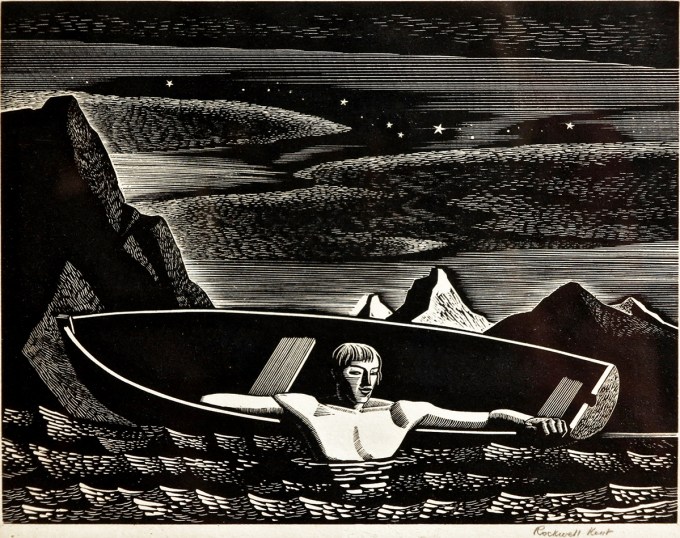
For me, The Little Prince has been one, and Leaves of Grass, and I Put a Spell on You, and Spiegel im Spiegel. Wilderness (public library) by the painter, printmaker, and philosopher Rockwell Kent (June 21, 1882–March 13, 1971) is another. (Ample gratitude to George Dyson for bringing this soul-slaking treasure into my life.)
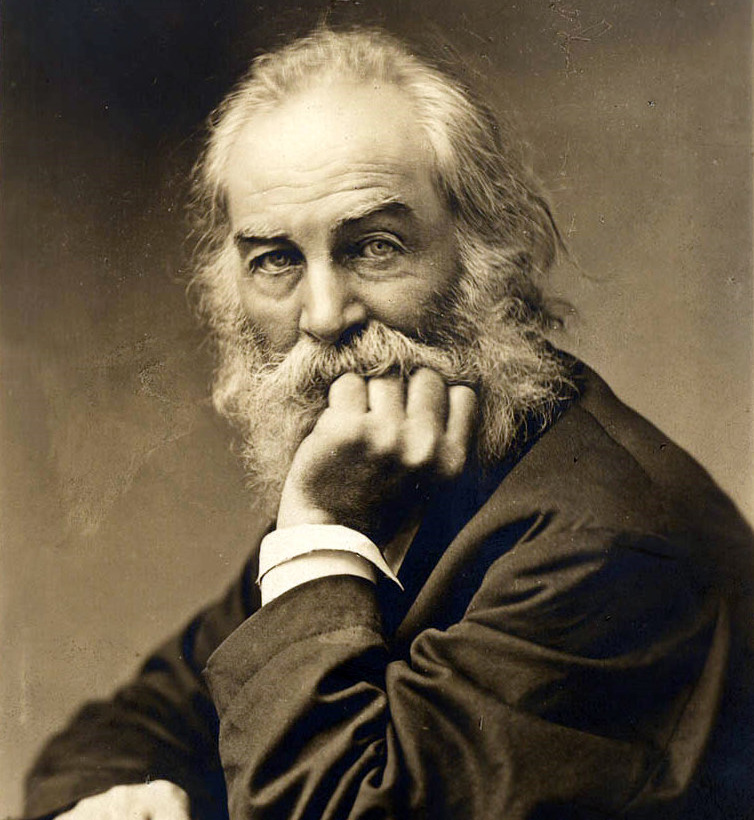
In the last days of August, in the last months of the world’s first global war, while the Spanish Flu pandemic was savaging civilization, Kent arrived on a small island in Resurrection Bay off the coast of Alaska, searching for the ultimate. He was thirty-six, dispirited and destitute, as passionate about his art and as pained by the world’s indifference to it as Walt Whitman had been when he self-published Leaves of Grass at that same age, from that same precarious place, intimate with the same depths of depression, buoyed by the same reverence for life.
Drawing on that experience, Kent would later formulate the closest thing to a personal credo:
Often I think that however much I draw or paint, or however well, I am not an artist as art is generally understood. The abstract is meaningless to me save as a fragment of the whole, which is life itself… It is the ultimate which concerns me, and all physical, all material things are but an expression of it… We are part and parcel of the big plan of things. We are simply instruments recording in different measure our particular portion of the infinite. And what we absorb of it makes for character, and what we give forth, for expression.
Kent arrived at this uncommon life in art via an uncommon path. His parents had pressured him to channel his talent into a practical, profitable career in form and function, but he had dropped out of Columbia University’s architecture program to devote himself to the work of form and feeling, moving to a rugged island off the coast of Maine. He built himself a small house there and spent his days in solitude — reading Emerson and Tolstoy, and painting; laboring as a lobsterman, and painting. Immersed in Haeckel’s inception of ecology, he grew enchanted with the interwoven life of nature; immersed in Thoreau’s journals, he absorbed the will “to live deliberately” in wild places where he could find and nurture his inner wilderness — those lush and desolate landscapes of the soul, from which all art is born.
So it is that, in his late twenties, Rockwell Kent voyaged to Newfoundland in the hope of establishing a communal art school with a friend in the untrammeled northern wilderness. The hope crumbled against reality, but the Great North cast a permanent enchantment. He returned four years later, in 1914, this time with his wife and three children, just as the world was coming unworlded by the Great War.
In a small-town community where the notion of an artist was alien and suspect, the large-spirited, liberal-minded Kent was soon accused of being a German spy. Driven away, the family had to make the long voyage back — Kathleen pregnant with their fourth child, the other three ill with whooping cough.
But the northern wilderness kept calling to the artist’s soul:
I crave snow-topped mountains, dreary wastes, and the cruel Northern sea with its hard horizons at the edge of the world where infinite space begins. Here skies are clearer and deeper and, for the greater wonders they reveal, a thousand times more eloquent of the eternal mystery than those of softer lands.
Four years later, at the peak of his struggle to support the growing family, Rockwell Kent returned to the North in the hope of resuscitating his spirit and his ability to, quite simply, go on.
“Never did I enter upon any course with such a sense of necessity, of duty, as drives me into this Alaska trip,” he told Kathleen.
Fatherless himself since the age of five, having inherited nothing more than his father’s silver flute, which he carried everywhere, he voyaged to the Far North with his nine-year-old son, also named Rockwell, and his silver flute. “We came to this new land, a boy and a man,” he wrote, “entirely on a dreamer’s search; having had vision of a Northern Paradise, we came to find it.”
They came with one duffle bag stuffed with the warmest clothes they owned and one heavy trunk full of books, paints, and provisions. Sprawling across three diary pages, Kent’s inventory includes these essentials:
8 lbs. chocolate
1 gal. peanut butter
4 pots
2 pillows
10 lbs. lima beans
10 lbs. white beans
100 lbs. potatoes
1 broom
6 lemons
6 agate cups
4 agate plates
4 agate bowls
5 lbs. salt
6 Ivory soap
2 cans dried eggs
1 tea kettle
12 candles
These they brought to Fox Island, welcomed there by an elderly Swede named Olson, who had arrived long ago prospecting for gold; having failed to find any, and having been dismissed by the mainland townspeople as a “crazy old man, he had made a home on the small and isolated island, tending to two pairs of blue foxes and four goats. Kent found Olson to be “a kind-hearted, genial old man with a vast store of knowledge and true wisdom,” a man of “deep experience, strong, brave, generous and gentle like a child,” a “keen philosopher [who] by his critical observations gives his discourse a fine dignity.”
Father and son set about converting Olson’s goat-house into a home. On either side of the log cabin, Kent — an excellent carpenter from a young age — built two long wall-to-wall shelves: one to hold their provisions, the other for paints, toys, clothes, and the flute. In the far corner, he built a bookshelf for their miniature library — sustenance for mind and spirit, as vital as the canned goods they had carried across the landmass and rowed across the icy strait of Arctic waters. Among the books were The Iliad and The Odyssey; Robinson Crusoe and the fairy tales of Hans Christian Andersen; a book of Indian philosophy and a literary history of Ireland; a natural history of the ocean and a basic medical handbook; William Blake’s poems and Life of Blake — the biography with which Anne Gilchrist had wrested Blake from obscurity a generation earlier to establish him as a creative icon for generations, celebrated by Patti Smith as “the loom’s loom, spinning the fiber of revelation,” and casting upon Kent a spell of “intense and illuminating fervor.”
Despite these marginal comforts, the cabin remained a ramshackle structure invaded by the elemental cold. Kent tried calking the gaping openings between the logs with dried moss, but the moss never managed to dry enough for insulation under the interminable rain. Indeed, from the moment they set foot on Fox Island, father and son waded into a world ruled by rain, an Anne Sexton kind of rain. In their first seventeen days, a single cloudless sunrise greeted them. “It will be a strange life without the dear, warm sun!” Kent lamented in his journal. The absence of the sun — like any absences of cherished warmth and radiance — made its rare returns all the dearer, aglow with ecstasy:
Ah, the evenings are beautiful here and the early mornings, when the days are fair! No sudden springing of the sun into the sky and out again at night; but so gradual, so circuitous a coming and a going that nearly the whole day is twilight and the quiet rose color of morning and evening seems almost to meet at noon. We glance through our tiny western window at sunrise and see beyond the bay the many ranges of mountains, from the somber ones at the water’s edge to the distant glacier and snowcapped peaks, lit by the far-off sun with the loveliest light imaginable.
But by early November, the unremitting gloom began eclipsing the sparse ecstasies of light:
Endlessly, day after day, the journal goes on recording a dreary monotony of rain and cloud. Who has ever dwelt so entirely alone that the most living things in all the universe about are wind and rain and snow?
As the days grew shorter and shorter and the weeks unspooled into months, the weather became a sort of teacher. In an entry penned the day after the deepest snow and the coldest cold snap on the record — “the cold very many degrees below zero” — Kent exclaims in the diary: “Such mild weather!” It was still far below freezing, but not nearly as far as the previous day — a study in the delight of contrasts, the same contrasts that give shape and texture to art and life.
Eventually, he arrives at a sort of existential acceptance, as applicable to the elements as to the ever-shifting weather system that is life itself:
I have learned to expect nothing of the weather but what it gives us.
We create our own weather, he intimates in an entry from the clutch of February:
A little snow, a little rain, but altogether a pleasant day. It’s always pleasant when I paint well.
Throughout the journal, Kent interpolates so naturally between the elemental and the existential, between observation and contemplation — nowhere more so than in this reflection on the totality of his wilderness experience:
These are the times in life — when nothing happens — but in quietness the soul expands.
Kent soon finds a new kind of liberation in the quiet expanse — freedom not only from the bustling tumults of the warring present, but from the totality of any collective human culture, which can so ossify identity and become a straitjacket for the soul:
So little do we feel ourselves related, here in this place, to any one time or to any civilization that at a thought we and our world become whom and what we please.
Father and child become, in the way only art and nature afford us, unselfed — not persons, scarred with identities and ideologies, but fields of grateful awareness. They go berry-picking along the coast of Resurrection, skate on the pond “frozen hard and thick,” and watch the killer whales play in the cove by their cabin, “their terrible, mysterious, black arms that beat the water with a sound like cannon.”
Recording these encounters with the elemental, Kent’s diary entries read like prose poetry, as any fully attentive and pure-hearted observation of nature always does — deeply affecting yet unaffected, fresh from the source. One mid-October evening, after quoting from memory a lullaby verse by a German poet born 100 years earlier, Kent exults:
The night is beautiful beyond thought. All the bay is flooded with moonlight and in that pale glow the snowy mountains appear whiter than snow itself. The full moon is almost straight above us, and shining through the tree tops into our clearing makes the old stumps quite lovely with its quiet light. And the forest around is as black as the abyss.
The following evening, a wholly different guise of beauty:
To-night the sun set in the utmost splendor and left in its wake blazing, fire-red clouds in a sky of luminous green.
And the following:
The moon has risen and illuminates the mountain tops — but we and all our cove are still in the deep shadow of the night. It is most dramatic; the spruces about us deepen the shadow to black while above them the stone faces of the mountain glisten and the sky has the brightness of a kind of day.
In another entry:
From our feet the cliff dropped in a V-shaped divide straight down to the green ocean; and at its base the ground swell curled, broke white and eddied. The jagged mountains across shone white against black clouds, — what peaks! huge and sharp like the teeth of the Fenris-Wolf.
It is impossible to place oneself amid such staggering beauty — “it is so beautiful here at times that it seems hard to bear,” Kent writes — and not wish to reverence it, to channel it, to magnify it and add to the world’s store of wonder with one’s own creations. And so, one cold October day seven weeks after alighting to Fox Island, Kent records:
We came home and had a good dinner. I cut more wood and at last, after one month here on the island, I PAINTED. It was a stupid sketch, but no matter, I’ve begun!
He feels “the goddess Inspiration returning” and soon the floodgates of his creative force rush open:
After the morning’s wood cutting I worked hard on my pictures. I’m now at last fully launched upon my work with small pictures going well. That’s both a relief and a concern to me. From now on my mind can never be quite free.
In a passage that captures every true artist’s savage and restless devotion to their art — the kind Beethoven conveyed in his letter of advice to a little girl longing to be an artist, the kind at the heart of Martha Graham’s exquisite notion of “divine dissatisfaction” — Kent writes one October day two months after his arrival:
Today was a day of hard work for me. I cut wood, baked bread and painted on three canvasses… Over to-day’s painting I’m filled with pride; it will be equalled by to-morrow’s despair over the very same pictures.
He becomes a channel for the majesty around him, seeing in it a reflection of his own worldview, mirroring it back to the world in the paintings nature draws out of him:
A wonderfully beautiful day with a raging northwest wind. I must sometime honor the northwest wind in a great picture as the embodiment of clean, strong, exuberant life, the joy of every young thing, bearing energy on its wings and the will to triumph.
Immersed in “the profound and characteristic winter silence of the out-of-doors,” a grateful gladness slips over him each time the wind parts the curtain of clouds:
It is no little thing to have one’s work on a day like this out under such a blue sky, by the foaming green sea and the fairy mountains.
From the outset, Kent decides that if his art is to ever be shown in civilization, the exhibition must be titled “Paintings of Paradise” — an homage to his love for his son and for his son’s love of the wilderness: “I know nothing in all life more beautiful than the perfect belief of Rockwell in his Paradise here,” Kent writes in one entry. It is a paradise build of what his literary hero Hermann Hesse, writing in the same era on a different landmass in a wholly different landscape, called “the little joys” — those smallest atoms of aliveness. Kent records:
Mornings we get up together and go through a set of Dr. Sargent’s exercises, do them with great energy. Then we go naked out-of-doors… No matter what the weather is we go calmly out into it, lie down in the drift, look up into the sky, and then scrub ourselves with snow. It’s the finest bath in the world.
One day, looking around the ramshackle goat-house that is now his home, filled with books and wind, filled with a man’s paintings and a child’s love, Kent observes:
I don’t see why people need better homes than this.
In an entry from the peak of winter, he contemplates how such simple life in harsh conditions can so salve and enlarge his creative spirit:
We have… turned out of the beaten, crowded way and come to stand face to face with that infinite and unfathomable thing which is the wilderness; and here we have found OURSELVES — for the wilderness is nothing else. It is a kind of living mirror that gives back as its own all and only all that the imagination of a man brings to it… and if we have not shuddered at the emptiness of the abyss and fled from its loneliness, it is because of the wealth of our own souls that filled the void with imagery, warmed it, and gave it speech and understanding.
Punctuating this surrender to the grandeur of nature and soul are various quotidian tragicomedies. Violent wind sweeps in through the cracks in the cabin and powders Kent’s drawing table with snow. The cold grows so ferocious that his fountain pen and paint freeze solid, the foxes’ food freezes solid, the water pails freeze solid ten feet from the booming stove. One of Olson’s goats — “foolish-faced Angoras” — eats the broom, then breaks into the house, leaving “boxes, pails, sacks of grain, cans, rope, tools, all lie piled in confusion about the floor.” Such happenings only foment Kent’s deep-souled reflections on life:
Where little happens and the gamut of expression is narrow, life is still full of joy and sorrow. You’re stirred by simple happenings in a quiet world.
These days are wonderful but they are terrible. It is thrilling… to reflect that we are absolutely cut off from all mankind, that we cannot, in this raging sea, return to the world nor the world come to us. Barriers must secure your isolation in order that you may experience the full significance of it. The romance of an adventure hangs upon slender threads. A banana peeling on a mountain top tames the wilderness. Much of the glory of this Alaska is in the knowledge I have that the next bay — which I may never choose to enter — is uninhabited, that beyond those mountains across the water is a vast region that no man has ever trodden, a terrible ice-bound wilderness.
And yet, as much as nature might gladden human nature, it is our nature also to long for love and connection with our fellow beings. After twenty weeks of such extreme isolation, in an entry penned in the pit of winter, in a sentiment acutely relatable to any twenty-first-century person who has anguished to see an email go unanswered or to watch the three dots on their phone blink and disappear, Kent writes:
It is terribly depressing to have your heart set upon that mail that doesn’t come.
His suicidal depression returns:
I feel like making no record of these days. I take pleasure only in their quick passage.
And then, just like that — like it always does and we always forget it does — daybreak comes for the dark night of the soul, the curtain of depression open, and he grows porous to beauty again, wakeful to the light of aliveness:
The day has been glorious, mild, fair, with snow everywhere even on the trees. The snow sticks to the mountain tops even to the steepest, barest peaks painting them all a spotless, dazzling white. It’s a marvelous sight… There never was so beautiful a land as this!
Eventually, confusions about time arise. His only timepiece — a dollar watch handed down to Olson by its previous owner — stops working. Father and son begin living by animal instinct: They rise at daybreak, have a prompt breakfast — always the same: oatmeal, cocoa bread, and peanut butter — then eat only when hungry as they immerse themselves in the day’s work and in the living world around them, noticing, noticing, and turning those noticings into art; in the evenings, Kent plays the flute for little Rockwell and reads to him (but not stories about kings and queens, which the boy tells his father he dislikes because “they’re always marrying and that kind of stuff”), until they “go to bed without any notion of the hour.” A typical entry reads:
Hard, hard at work, little play, not too much sleep. The wind blows ceaselessly. Rockwell is forever good, — industrious, kind, and happy. He reads now quite freely from any book. Drawing has become a natural and regular occupation for him, almost a recreation — for he can draw in both a serious and a humorous vein. At this moment he’s waiting in bed for some music and another Andersen fairy tale.
With time so elusive, they lose track of the date. There are practical consequences: The steamer to and from Seward — the “New York of the Pacific” — runs on a spare and strict schedule, on which they rely for their mail and provisions. There are poetic consequences, too: Unsure when to celebrate little Rockwell’s tenth birthday, they designate a best-guess day, on which Kent begins teaching his son to sing and presents him with his sole, precious present — “a cheap child’s edition” of a popular natural history encyclopedia. It so delights the boy with its depictions of his beloved wild animals that he decides, a generation before Borges, to begin writing and drawing an encyclopedia of imaginary beasts.
Zarathustra and His Friends by Rockwell Kent, 1919. (Available as a print and as stationery cards.)
Kent grows acutely aware of how these spare gladnesses — books and nature, freedom and love — are the fundaments of life, and all the rest is noise. Something quickens in him under the conditions of this new life — so spartan, so primal — and deconditions the habits of mind by which civilization bridles the spirit:
Here in the supreme simplicity of life amid these mountains the spirit laughs at man’s concern with the form of Art, with new expression because the old is outworn! It is man’s own poverty of vision yielding him nothing, so that to save himself he must trick out in new garb the old, old commonplaces, or exalt to be material for art the hitherto discarded trivialities of the mind.
There are days too short and dark to paint, too bleak to access the aliveness from which art springs — days when “the spirit didn’t work.” But there are also days, rosaries of them, that consecrate Kent’s painting with a state of total flow:
It is weeks since I have stopped my work even for a walk. In this “out-of-doors life” I see little of out-of-doors.
Five months into this Fox Island life, having “struck a fine stride,” Kent settles into a peculiar creative routine:
During the day I paint out-of-doors from nature by way of fixing the forms and above all the color of the out-of-doors in my mind. Then after dark I go into a trance for a while with Rockwell subdued into absolute silence. I lie down or sit with closed eyes until I “see” a composition, — then I make a quick note of it or maybe give an hour’s time to perfecting the arrangement on a small scale. Then when that’s done I’m care free. Rockwell and I play cards for half an hour, I get supper, he goes to bed.
Again and again, it is nature — so immediate, so alive, so numinous — that becomes the portal to this trance, leaving him with a magnified capacity for art and a clarified lens on life:
One night, one midnight out on the black waters of a Newfoundland harbor, the million stars above, and on the wretched vessel’s deck the horde of half-drunk, soul-starved men saying their passionate farewells, — on the dull plain of their life a flash of lightning revealed an abyss; — this night on the still, dark cove of Resurrection Bay, rimmed with wild mountains and the wilderness, strong men about you, mad, loosened speech and winged, prophetic vision, — God! but sane daylight seeing seems to touch but the white, hard surface of where life is hidden.
And so, seven months into his search for the hiding-place of life, Kent writes:
This beautiful adventure of ours has come to an end. The enchantment of it has been complete; it has possessed us to the very last. How long such happiness could hold, such quiet life continue to fill up the full measure of human desires only a long experience could teach. The still, deep cup of the wilderness is potent with wisdom. Only to have tasted it is to have moved a lifetime forward to a finer youth… We have learned what we want and are therefore wise. As graduates in wisdom we return from the university of the wilderness.
On March 18 — their last day in the wilderness, and the last days of the world’s first winter after the end of the war — Kent writes:
Fox Island will soon become in our memories like a dream or vision, a remote experience too wonderful, for the full liberty we knew there and the deep peace, to be remembered or believed in as a real experience in life. It was for us life as it should be, serene and wholesome; love — but no hate, faith without disillusionment… Ah God, — and now the world again!
But as he reentered the world, with its falsehoods and human ferocities, Kent carried the wilderness with him, its indelible imprint on his soul. Looking back on his time in Alaska, he wrote:
In living and recording these experiences I have sensed a fresh unfolding of the mystery of life. I have found wisdom, and this new wisdom must in some degree have won its way into my work.
And indeed it did. The two New York exhibitions of his paintings that followed his return from Alaska were artistically and financially triumphal, sparking a new chapter of solvency for him and Kathleen, and liberating him at last to devote himself wholly to art. Timed with the second exhibition, the publication of his Alaska journal was heralded by England’s most esteemed culture magazine as “the most remarkable book to come out of America since Leaves of Grass.” (An epoch earlier, the English — much thanks to Anne Gilchrist’s impassioned advocacy — had been early to recognize Whitman’s genius when his own country derided and dismissed him.)
When the first exhibition of his Alaska drawings was being mounted, the gallery engaged one of New York’s preeminent art critics to compose the introduction for the catalogue. He wrote to Kent to learn more about how this time in the wilderness shaped his artistic practice. Kent responded with a letter so exquisite, so vibrant with his authentic spirit, that it was printed as the introduction instead. In it, he wrote:
It has always been hard for me to understand myself, to know why I work and love and live. Yet it is fortunate that such matters find a way of caring for themselves. I came to Alaska because I love the North. I crave snow-topped mountains, dreary wastes, and the cruel Northern sea with its hard horizons at the edge of the world where infinite space begins. Here skies are clearer and deeper and, for the greater wonders they reveal, a thousand times more eloquent of the eternal mystery than those of softer lands.
While elsewhere in New York Edna St. Vincent Millay was composing her now-iconic sonnet that begins with “My candle burns at both ends,” to be published months later, Kent reflects on the allure of the Great North’s elemental brutality, on the magnetic misery in the “gloom of the long and lonely winter nights,” and writes:
Always I have fought and worked and played with a fierce energy, and always as a man of flesh and blood and surging spirit. I have burned the candle at both ends and can only wonder that there has been left even a slender taper glow for art.
And so this sojourn in the wilderness is in no sense an artist’s junket in search of picturesque material for brush or pencil, but the fight to freedom of a man who detests the petty quarrels and bitterness of the crowded world — the pilgrimage of a philosopher in quest of Happiness! But the wilderness is what man brings to it, no more. If little Rockwell and I can live in these vast silences beside the heartless ocean, perched high up on the peak of the earth with the wind all about us, if we can stand here and not flee from the terror of emptiness, it is because the wealth of our own souls warms the mountains and sea, and peoples the great desolate spaces. For the time we look into ourselves and are not afraid. We find here life, true life — life rich, resplendent, and full of love. We have learned not to fear destiny but to live for the heaven that can be made upon earth.
With the distance of eleven years, Kent looked back on the experience to find in it the kernels of a larger truth — personal and universal, humanistic and more-than-human. (Some necessary calibration for the ahistorical bristling modern readers often experience at our ancestors’ word-choices: Women were not yet citizens and would finally win the right to vote two months after the artist’s return from Alaska, which was not yet a state and wouldn’t be for another forty years; the word “man” was both the unexamined universal pronoun — to remain so until Ursula K. Le Guin so exquisitely unsexed it two generations later — and a reflection of what was practically possible and culturally permissible for women’s access to independent travel and wilderness adventuring.) Kent writes in the introduction of the second edition of Wilderness:
The thought that was born to me in the quietness of that adventure — that in the wilderness, in uneventful solitude, men for companionship must find themselves — has come to be for me the truth. Maybe the only truth I know.
Go, young men to grow wise and wise men to stay young, not West nor East nor North nor South, but anywhere that men are not. For we all need, profoundly, to maintain ourselves in our essential, God-descended manhood against the forces of the day we live in — to be at last less products of a culture than the makers of it. There, in that wilderness so anciently unchanged it might have seen a hundred cultures flower and die, there realize — you must — that what is you, what feels and fears and hungers and exalts, is ancient as the wilderness itself, rich as the wilderness and kin to it. And of those ancient values of the soul, Art through all its fashions of utterance, despite them all, despite the turmoil of this age, despite New York and Harlem, steel and jazz, proclaims above the riot of Godlessness that there, in Man, eternally, is all the very much man ever knew of God.
donating = loving
For seventeen years, I have been spending hundreds of hours and thousands of dollars each month composing The Marginalian (which bore the outgrown name Brain Pickings for its first fifteen years). It has remained free and ad-free and alive thanks to patronage from readers. I have no staff, no interns, no assistant — a thoroughly one-woman labor of love that is also my life and my livelihood. If this labor makes your own life more livable in any way, please consider lending a helping hand with a donation. Your support makes all the difference.
newsletter
The Marginalian has a free weekly newsletter. It comes out on Sundays and offers the week’s most inspiring reading. Here’s what to expect. Like? Sign up.
Several years ago, rummaging through the archives of the Academy of American Poets, I came upon a box labeled “Ballots 1950” — the record of the secret vote by the chancellors the year the Academy’s prestigious fellowship was awarded to E.E. Cummings, catapulting him into renown. The voting process is a black box — no one outside the Academy ever finds out who else is in the running and by how much the winner wins. Leafing through the ballots, one other name appeared over and over, so much so that I was impelled to count. Marianne Moore had lost by… read article
Show full content
Several years ago, rummaging through the archives of the Academy of American Poets, I came upon a box labeled “Ballots 1950” — the record of the secret vote by the chancellors the year the Academy’s prestigious fellowship was awarded to E.E. Cummings, catapulting him into renown. The voting process is a black box — no one outside the Academy ever finds out who else is in the running and by how much the winner wins.
Leafing through the ballots, one other name appeared over and over, so much so that I was impelled to count.
Marianne Moore had lost by one vote, never knowing how close she had come. It would be many more years until, at 77, she was finally awarded the fellowship.
Long before that, before she won the Pulitzer Prize and the National Book Award (sharing a table with Rachel Carson at the ceremony), Moore had set down her views on writing in a series of essays later collected in the out-of-print gem Predilections (public library). Pulsating through them is a reckoning with the impossible task of the writer — to weave tapestries of truth and meaning from the tenuous thread of words on the ramshackle loom of language.
Marianne Moore (Photograph: George Platt Lynes)
In an essay titled “Feeling and Precision,” Moore writes:
Feeling at its deepest — as we all have reason to know — tends to be inarticulable. If it does manage to be articulate, it is likely to seem overcondensed, so that the author is resisted as being enigmatic or disobliging or arrogant.
How we name what we feel is not so much a matter of our writing style as of our style of being, because in order to articulate something we must first apprehend it and we apprehend every smallest thing with the whole person — with the frame of reference that is our entire life, the sum of our experience and memory. When “one of New York’s more painstaking magazines” asked Moore to distill her poetic style into a formula, she fought back the “dictatorial” reflex to quip:
You don’t devise a rhythm, the rhythm is the person, and the sentence but a radiograph of the personality.
And yet a personality can write with more or less persuasion — that is, write more or less well — depending on what the person brings to the writing. In another essay from the collection, Moore identifies the three psychological elements necessary for persuasive writing: “humility, concentration, and gusto.” A generation after Mark Twain assured his friend Helen Keller when she was accused of plagiarism that “substantially all ideas are second-hand, consciously and unconsciously drawn from a million outside sources,” she writes:
Humility… is armor, for it realizes that it is impossible to be original, in the sense of doing something that has never been thought of before. Originality is in any case a by-product of sincerity; that is to say, of feeling that is honest and accordingly rejects anything that might cloud the impression.
By “concentration” Moore means a kind of discipline — annealing the essence of the sentiment by cutting away all superfluous explanations, elaborations, and distractions of stylistic posturing, being maximally truthfully in the most minimal way possible. Observing that there is always a “helpless sincerity which precipitates a poem” and that a good poem is always “a concentrate,” she writes:
Concentration — indispensable to persuasion — may feel to itself crystal clear, yet be through its very compression the opposite… I myself would rather be told too little than too much.
Long before we had the language of extrinsic and intrinsic motivation, of finite and infinite games, Moore uses a lovely word, now dusty, for that peculiar private zeal propelling all creative work with its twin dynamos of discipline and deliverance: “gusto.” Echoing Rachel Carson’s abiding advice on writing — “If you write what you yourself sincerely think and feel and are interested in,” she had counseled a young writer, “the chances are very high that you will interest other people as well.” — Moore offers:
Gusto thrives on freedom, and freedom in art, as in life, is the result of a discipline imposed by ourselves. Moreover, any writer overwhelmingly honest about pleasing himself is almost sure to please others.
She maps the fundamental relationship between the three:
Humility is an indispensable teacher, enabling concentration to heighten gusto.
When creating in integrity with these three values, it ceases to matter how the work is received because the process of locating and articulating the truth as you feel it, the world as you see it, is its own reward. In what may be the best advice I have encountered on how to orient to your own work, Moore writes:
There are always objecters, but we must not be sensitive about not being liked or not being printed… The thing is to see the vision and not deny it; or care and admit that we do.
For seventeen years, I have been spending hundreds of hours and thousands of dollars each month composing The Marginalian (which bore the outgrown name Brain Pickings for its first fifteen years). It has remained free and ad-free and alive thanks to patronage from readers. I have no staff, no interns, no assistant — a thoroughly one-woman labor of love that is also my life and my livelihood. If this labor makes your own life more livable in any way, please consider lending a helping hand with a donation. Your support makes all the difference.
newsletter
The Marginalian has a free weekly newsletter. It comes out on Sundays and offers the week’s most inspiring reading. Here’s what to expect. Like? Sign up.
How a doctor, a philosopher, a poet, and a sculptor co-created the modern concept of empathy.
Show full content
How a doctor, a philosopher, a poet, and a sculptor co-created the modern concept of empathy.
Empathy, an orientation of spirit decidedly different from sympathy, has become central to our moral universe. We celebrate it as the hallmark of a noble spirit, a pillar of social justice, and the gateway to reaching our highest human potential — a centerpiece of our very humanity. And yet this conception of empathy is a little more than a century old and originated in art: It only entered the modern lexicon in the early twentieth century, when it was used to describe the imaginative act of projecting oneself into a work of art in an effort to understand why art moves us.
That improbable origin and its wide ripples across the popular imagination are what Rachel Corbett explores in You Must Change Your Life: The Story of Rainer Maria Rilke and Auguste Rodin (public library) — a layered and lyrical inquiry into the personal, interpersonal, and cultural forces behind and around Rainer Maria Rilke’s iconic Letters to a Young Poet, a book so beloved and widely quoted in the century since its publication that it has taken on the qualities of a sacred text for secular culture. Out of its origin story Corbett wrests a larger story of “how the will to create drives young artists to overcome even the most heart-hollowing of childhoods and make their work at any cost.”
Recounting her revelatory first encounter with the Rilke classic, a gift from her mother, who had in turn received it from a mentor as a young girl, Corbett captures the singular enchantment that this miraculous book has held for generations:
Reading it that evening was like having someone whisper to me, in elongated Germanic sentences, all the youthful affirmations I had been yearning to hear. Loneliness is just space expanding around you. Trust uncertainty. Sadness is life holding you in its hands and changing you. Make solitude your home.
[…]
What gives the book its enduring appeal is that it crystallizes the spirit of delirious transition in which it was written. You can pick it up during any of life’s upheavals, flip it open to a random page, and find a consolation that feels both universal and breathed into your ear alone.
What most people don’t know, Corbett points out, is that as Rilke was bequeathing his poetic wisdom to the recipient of his letters, the nineteen-year-old cadet and aspiring poet Franz Xaver Kappus, he was also channelling his own great mentor — the French sculptor Rodin, for whom Rilke worked for a number of years and whom he revered for the remainder of his life. Despite their staggering surface differences — “Rodin was a rational Gallic in his sixties, while Rilke was a German romantic in his twenties,” Corbett writes, likening Rodin to a mountain and Rilke to “the mist encircling it” — the sculptor became the young poet’s most significant influence. But Rodin’s greatest gift to Rilke was the very thing that lends Letters to a Young Poet its abiding spiritual allure: the art of empathy.
Corbett writes:
The invention of empathy corresponds to many of the climactic shifts in the art, philosophy and psychology of fin-de-siècle Europe, and it changed the way artists thought about their work and the way observers related to it for generations to come.
Empathy may be a concept saturating today’s popular lexicon so completely as to border on meaninglessness, yet it was entirely novel and ablaze with numinous meaning in Rilke’s day. Its invention is the work of two unlikely co-creators — Wilhelm Wundt, a German doctor who “accidentally forged the birth of psychology in the 1860s,” and Theodor Lipps, a philosopher from the following generation. In seeking to understand why art affects us so powerfully, Lipps originated the then-radical hypothesis that the power of its impact didn’t reside in the work of art itself but was, rather, synthesized by the viewer in the act of viewing. Corbett condenses the essence of his proposition and traces its combinatorial creation:
The moment a viewer recognizes a painting as beautiful, it transforms from an object into a work of art. The act of looking, then, becomes a creative process, and the viewer becomes the artist.
Lipps found a name for his theory in an 1873 dissertation by a German aesthetics student named Robert Vischer. When people project their emotions, ideas or memories onto objects they enact a process that Vischer called einfühlung, literally “feeling into.” The British psychologist Edward Titchener translated the word into English as “empathy” in 1909, deriving it from the Greek empatheia, or “in pathos.” For Vischer, einfühlung revealed why a work of art caused an observer to unconsciously “move in and with the forms.” He dubbed this bodily mimesis “muscular empathy,” a concept that resonated with Lipps, who once attended a dance recital and felt himself “striving and performing” with the dancers. He also linked this idea to other somatosensory imitations, like yawns and laughter.
Empathy explained why people sometimes describe the experience of “losing themselves” in a powerful work of art. Maybe their ears deafen to the sounds around them, the hair rises on the backs of their necks or they lose track of the passage of time. Something produces a “gut feeling” or triggers a flood of memory, like Proust’s madeleine. When a work of art is effective, it draws the observer out into the world, while the observer draws the work back into his or her body. Empathy was what made red paint run like blood in the veins, or a blue sky fill the lungs with air.
In Vienna, the young professor Sigmund Freud wrote to a friend in 1896 that he had “immersed” himself in the teachings of Lipps, “who I suspect has the clearest mind among present-day philosophical writers.” Several years later, Freud thanked Lipps for giving him “the courage and capacity” to write his book Jokes and Their Relation to the Unconscious. He went on to advance Lipps’s research further when he made the case that empathy should be embraced by psychoanalysts as a tool for understanding patients. He urged his students to observe their patients not from a place of judgment, but of empathy. They ought to recede into the background like a “receptive organ” and strive toward the “putting of oneself in the other person’s place,” he said.
The concept, of course, was far from novel, even if the language to contain it was — half a century earlier, across the Atlantic, Walt Whitman had articulated the very same notion in his timeless treatise on medicine and the human spirit. But Lipps devised the right language to infiltrate the popular imagination and placed himself in the right place, at the right time. When he became chair of the University of Munich’s philosophy department in 1894, his students included the great Russian painter Wassily Kandinsky, who would later come to echo a number of Lipps’s ideas in his writings about the spiritual element in art, and Rilke, who enrolled in Lipps’s foundational aesthetics course as soon as he arrived in Munich from Prague.
Central to Lipps’s invention of empathy was his notion of einsehen, or “inseeing” — a kind of conscious observation which Corbett so poetically describes as “the wondrous voyage from the surface of a thing to its heart, wherein perception leads to an emotional connection.” She writes:
If faced with a rock, for instance, one should stare deep into the place where its rockness begins to form. Then the observer should keep looking until his own center starts to sink with the stony weight of the rock forming inside him, too. It is a kind of perception that takes place within the body, and it requires the observer to be both the seer and the seen. To observe with empathy, one sees not only with the eyes but with the skin.
The concept struck Rilke as a particularly revelatory way of looking at not only art but life itself. He wrote in a letter to a friend:
Though you may laugh if I tell you where my very greatest feeling, my world-feeling, my earthly bliss was, I must confess to you: it was, again and again, here and there, in such in-seeing in the indescribably swift, deep, timeless moments of this godlike in-seeing.
Corbett captures the crux of Rilke’s insight:
In describing his joy at experiencing the world this way, Rilke echoed Lipps’s belief that, through empathy, a person could free himself from the solitude of his mind. At the same time that Rilke was studying at the zoo in Paris, Lipps was in Munich working on his theory of empathy and aesthetic enjoyment. In his seminal paper on the subject he identified the four types of empathy as he saw them: general apperceptive empathy: when one sees movement in everyday objects; empirical empathy: when one sees human qualities in the nonhuman; mood empathy: when one attributes emotional states to colors and music, like “cheerful yellow”; and sensible appearance empathy: when gestures or movements convey internal feelings.
Out of this dynamic dialogue between inner and outer arises the most elemental question of existence: What is the self? This invites an auxiliary question: If we ourselves can possess a self, how can we know that others are also in possession of selves? Corbett writes:
[This] was the question to which Rilke’s old professor Theodor Lipps’s empathy research eventually led him. He had reasoned that if einfühlung explained the way people see themselves in objects, then the act of observation was not one of passive absorption, but of lived recognition. It was the self existing in another place. And if we see ourselves in art, perhaps we could also see ourselves in other people. Empathy was the gateway into the minds of others. Rilke’s prodigious capacity for it, then, was both his greatest poetic gift and probably his hardest-borne cross.
For seventeen years, I have been spending hundreds of hours and thousands of dollars each month composing The Marginalian (which bore the outgrown name Brain Pickings for its first fifteen years). It has remained free and ad-free and alive thanks to patronage from readers. I have no staff, no interns, no assistant — a thoroughly one-woman labor of love that is also my life and my livelihood. If this labor makes your own life more livable in any way, please consider lending a helping hand with a donation. Your support makes all the difference.
newsletter
The Marginalian has a free weekly newsletter. It comes out on Sundays and offers the week’s most inspiring reading. Here’s what to expect. Like? Sign up.
"I have been a sentient being, a thinking animal, on this beautiful planet, and that in itself has been an enormous privilege and adventure."
Show full content
“I have been a sentient being, a thinking animal, on this beautiful planet, and that in itself has been an enormous privilege and adventure.”
“Living has yet to be generally recognized as one of the arts,” proclaimed a 1924 guide to the art of living. That one of the greatest scientists of our time should be one of our greatest teacher in that art is nothing short of a blessing for which we can only be grateful — and that’s precisely what Oliver Sacks (July 9, 1933–August 30, 2015), a Copernicus of the mind and a Dante of medicine who turned the case study into a poetic form, became over the course of his long and fully lived life.
In his final months, Dr. Sacks reflected on his unusual existential adventure and his courageous dance with death in a series of lyrical New York Times essays, posthumously published in the slim yet enormously enchanting book Gratitude (public library), edited by his friend and assistant of thirty years, Kate Edgar, and his partner, the writer and photographer Bill Hayes.
Last night I dreamed about mercury — huge, shining globules of quicksilver rising and falling. Mercury is element number 80, and my dream is a reminder that on Tuesday, I will be 80 myself.
Elements and birthdays have been intertwined for me since boyhood, when I learned about atomic numbers. At 11, I could say “I am sodium” (Element 11), and now at 79, I am gold.
[…]
Eighty! I can hardly believe it. I often feel that life is about to begin, only to realize it is almost over.
At nearly 80, with a scattering of medical and surgical problems, none disabling, I feel glad to be alive — “I’m glad I’m not dead!” sometimes bursts out of me when the weather is perfect… I am grateful that I have experienced many things — some wonderful, some horrible — and that I have been able to write a dozen books, to receive innumerable letters from friends, colleagues and readers, and to enjoy what Nathaniel Hawthorne called “an intercourse with the world.”
I am sorry I have wasted (and still waste) so much time; I am sorry to be as agonizingly shy at 80 as I was at 20; I am sorry that I speak no languages but my mother tongue and that I have not traveled or experienced other cultures as widely as I should have done.
My father, who lived to 94, often said that the 80s had been one of the most enjoyable decades of his life. He felt, as I begin to feel, not a shrinking but an enlargement of mental life and perspective. One has had a long experience of life, not only one’s own life, but others’, too. One has seen triumphs and tragedies, booms and busts, revolutions and wars, great achievements and deep ambiguities, too. One has seen grand theories rise, only to be toppled by stubborn facts. One is more conscious of transience and, perhaps, of beauty. At 80, one can take a long view and have a vivid, lived sense of history not possible at an earlier age. I can imagine, feel in my bones, what a century is like, which I could not do when I was 40 or 60. I do not think of old age as an ever grimmer time that one must somehow endure and make the best of, but as a time of leisure and freedom, freed from the factitious urgencies of earlier days, free to explore whatever I wish, and to bind the thoughts and feelings of a lifetime together.
Oliver Sacks by Bill Hayes
In another essay, titled “My Own Life” and penned shortly after learning of his terminal cancer diagnosis at the age of eighty-one, Dr. Sacks reckons with the potentiality of living that inhabits the space between him and his death:
It is up to me now to choose how to live out the months that remain to me. I have to live in the richest, deepest, most productive way I can. In this I am encouraged by the words of one of my favorite philosophers, David Hume, who, upon learning that he was mortally ill at age 65, wrote a short autobiography in a single day in April of 1776. He titled it “My Own Life.”
“I now reckon upon a speedy dissolution,” he wrote. “I have suffered very little pain from my disorder; and what is more strange, have, notwithstanding the great decline of my person, never suffered a moment’s abatement of my spirits. I possess the same ardour as ever in study, and the same gaiety in company.”
Gliding his mind’s eye over one of Hume’s most poignant lines — “It is difficult to be more detached from life than I am at present.” — Dr. Sacks considers the paradoxical way in which detachment becomes an instrument of presence:
Over the last few days, I have been able to see my life as from a great altitude, as a sort of landscape, and with a deepening sense of the connection of all its parts. This does not mean I am finished with life.
On the contrary, I feel intensely alive, and I want and hope in the time that remains to deepen my friendships, to say farewell to those I love, to write more, to travel if I have the strength, to achieve new levels of understanding and insight.
Such intensity of aliveness, Dr. Sacks observes, requires a deliberate distancing from the existentially inessential things with which we fill our daily lives — petty arguments, politics, the news. With his characteristic mastery of nuance, he points to a crucial distinction:
This is not indifference but detachment — I still care deeply about the Middle East, about global warming, about growing inequality, but these are no longer my business; they belong to the future. I rejoice when I meet gifted young people — even the one who biopsied and diagnosed my metastases. I feel the future is in good hands.
Decades after his beloved aunt Lennie taught him about dying with dignity and courage, Dr. Sacks lets this lesson come abloom in his own life. True to the defining enchantment of his books, he turns his luminous prose inward, then outward, and in a passage that calls to mind William Faulkner’s sublime living obituary, he exits this world — the world of writing and the world of life, for the two were always one for Dr. Sacks — with a breathtaking epitaph for himself:
I cannot pretend I am without fear. But my predominant feeling is one of gratitude. I have loved and been loved; I have been given much and I have given something in return; I have read and traveled and thought and written. I have had an intercourse with the world, the special intercourse of writers and readers.
Above all, I have been a sentient being, a thinking animal, on this beautiful planet, and that in itself has been an enormous privilege and adventure.
For seventeen years, I have been spending hundreds of hours and thousands of dollars each month composing The Marginalian (which bore the outgrown name Brain Pickings for its first fifteen years). It has remained free and ad-free and alive thanks to patronage from readers. I have no staff, no interns, no assistant — a thoroughly one-woman labor of love that is also my life and my livelihood. If this labor makes your own life more livable in any way, please consider lending a helping hand with a donation. Your support makes all the difference.
newsletter
The Marginalian has a free weekly newsletter. It comes out on Sundays and offers the week’s most inspiring reading. Here’s what to expect. Like? Sign up.
“Words are events, they do things, change things… transform both speaker and hearer… feed energy back and forth and amplify it… feed understanding or emotion back and forth and amplify it,” Ursula K. Le Guin wrote in her magnificent meditation on how we tell ourselves to the world and each other two centuries after Mary Shelley prophesied that “words have more power than any one can guess; it is by words that the world’s great fight, now in these civilized times, is carried on.” I have been thinking lately about words, the power of them and the prison of them,… read article
Show full content
“Words are events, they do things, change things… transform both speaker and hearer… feed energy back and forth and amplify it… feed understanding or emotion back and forth and amplify it,” Ursula K. Le Guin wrote in her magnificent meditation on how we tell ourselves to the world and each other two centuries after Mary Shelley prophesied that “words have more power than any one can guess; it is by words that the world’s great fight, now in these civilized times, is carried on.”
I have been thinking lately about words, the power of them and the prison of them, the way we task them with containing the inarticulable and then come to mistake them for the contents, the way they are still our best hope for bridging the abyss between us in order to be understood. And yet outside of music and mathematics, the dream of a common language is just a dream. We speak of language as if it were unitary, forgetting that within any one tongue are nested infinities — the slang of subcultures, the vernacular of different generations and heritages, the private lexicon of lovers. When the parts we live with try to speak to each other, they speak in different tongues we keep translating to discern the whole and articulate it to others, to say who we are and what we want, how we suffer and how we like to be loved.
Words impose themselves, take root in our memory against our will… to challenge and assist.
“No one’s fated or doomed to love anyone,” Rich wrote in her epochal collection The Dream of a Common Language. We speak our loves to make them true, to make them tender. To say “I want you” is to walk right up to the edge of the abyss and leap, hoping to be caught; it is to say “I want to live.” A generation after Pablo Neruda made words an object of desire, hooks makes desire the subject of words:
Like desire, language disrupts, refuses to be contained within boundaries. It speaks itself against our will, in words and thoughts that intrude, even violate the most private spaces of mind and body.
[…]
To recognize that we touch one another in language seems particularly difficult in a society that would have us believe that there is no dignity in the experience of passion, that to feel deeply is to be inferior, for within the dualism of Western metaphysical thought, ideas are always more important than language.
We are not, however, merely the users of language — we are its makers. Language is a container for thought and feeling that shapes the contents. The great revelation of Einstein’s relativity was that spacetime — the fabric of the universe — tells matter how to move and matter tells spacetime how to bend. Language is the fabric of our lives. Language tells thinking how to move and thought tells language how to bend. We can bend ideas with words, we can even break them to make a mosaic of the pieces in the image of the world we want to live in, in the shape of our desires.
Reflecting on desire as the antidote to dualism, the most primal integration of the body and the mind, hooks writes:
To heal the splitting of mind and body, we marginalized and oppressed people attempt to recover ourselves and our experiences in language. We seek to make a place for intimacy. Unable to find such a place in standard English, we create the ruptured, broken, unruly speech of the vernacular… There, in that location, we make English do what we want it to do… liberating ourselves in language.
For seventeen years, I have been spending hundreds of hours and thousands of dollars each month composing The Marginalian (which bore the outgrown name Brain Pickings for its first fifteen years). It has remained free and ad-free and alive thanks to patronage from readers. I have no staff, no interns, no assistant — a thoroughly one-woman labor of love that is also my life and my livelihood. If this labor makes your own life more livable in any way, please consider lending a helping hand with a donation. Your support makes all the difference.
newsletter
The Marginalian has a free weekly newsletter. It comes out on Sundays and offers the week’s most inspiring reading. Here’s what to expect. Like? Sign up.
"Tone your wants and tastes low down enough, and make much of negatives, and of mere daylight and the skies."
Show full content
“Tone your wants and tastes low down enough, and make much of negatives, and of mere daylight and the skies.”
“Do you need a prod?” the poet Mary Oliver asked in her sublime meditation on living with maximal aliveness. “Do you need a little darkness to get you going?” A paralytic prod descended upon Walt Whitman (May 31, 1819–March 26, 1892) in his fifty-third year when a stroke left him severely disabled. It is a peculiar kind of darkness to be so violently exiled from one’s own body — a cascade of exiles, for it forced Whitman to leave his home in Washington, where he had settled after his noble work as a volunteer nurse in the Civil War that first taught him about the connection between the body and the spirit, and move in with his brother in New Jersey. Still, he kept reaching for the light as he slowly regained corporeal agency — a partial recovery he attributed wholly to being “daily in the open air,” among the trees and under the stars.
But as his body healed, the experience had permanently imprinted his mind with a new consciousness. Like all of our unexpected brushes with mortality, the stroke had thrust into his lap a ledger and demanded that he account for his life — for who he is, what he stands for, what he has done for the world and how he wishes to be remembered by it. As nature nursed him back to life in her embrace, Whitman found himself reflecting on the most elemental questions of existence — what makes a life worth living, worth remembering? He recorded these reflections in Specimen Days (public library) — the sublime collection of prose fragments, letters, and journal entries that gave us Whitman on the wisdom of trees and music as the profoundest expression of nature.
Walt Whitman (Library of Congress)
Writing to a German friend on his own sixty-third birthday, a decade after his paralytic stroke, Whitman reflects on what the limitations of living in a disabled body have taught him about the meaning of a full life:
From to-day I enter upon my 64th year. The paralysis that first affected me nearly ten years ago, has since remain’d, with varying course — seems to have settled quietly down, and will probably continue. I easily tire, am very clumsy, cannot walk far; but my spirits are first-rate. I go around in public almost every day — now and then take long trips, by railroad or boat, hundreds of miles — live largely in the open air — am sunburnt and stout, (weigh 190) — keep up my activity and interest in life, people, progress, and the questions of the day. About two-thirds of the time I am quite comfortable. What mentality I ever had remains entirely unaffected; though physically I am a half-paralytic, and likely to be so, long as I live. But the principal object of my life seems to have been accomplish’d — I have the most devoted and ardent of friends, and affectionate relatives — and of enemies I really make no account.
Above all, however, Whitman found vitality in the natural world — in what he so poetically called “the bracing and buoyant equilibrium of concrete outdoor Nature, the only permanent reliance for sanity of book or human life.” Looking back on what most helped him return to life after the stroke, Whitman echoes Seneca’s wisdom on calibrating our expectations for contentment and writes:
The trick is, I find, to tone your wants and tastes low down enough, and make much of negatives, and of mere daylight and the skies.
[…]
After you have exhausted what there is in business, politics, conviviality, love, and so on — have found that none of these finally satisfy, or permanently wear — what remains? Nature remains; to bring out from their torpid recesses, the affinities of a man or woman with the open air, the trees, fields, the changes of seasons — the sun by day and the stars of heaven by night.
“Broken/hearted” by Maria Popova. Available as a print.
For seventeen years, I have been spending hundreds of hours and thousands of dollars each month composing The Marginalian (which bore the outgrown name Brain Pickings for its first fifteen years). It has remained free and ad-free and alive thanks to patronage from readers. I have no staff, no interns, no assistant — a thoroughly one-woman labor of love that is also my life and my livelihood. If this labor makes your own life more livable in any way, please consider lending a helping hand with a donation. Your support makes all the difference.
newsletter
The Marginalian has a free weekly newsletter. It comes out on Sundays and offers the week’s most inspiring reading. Here’s what to expect. Like? Sign up.
"We are never simply seeing what’s 'really there,' stripped bare of our own anticipations or insulated from our own past experiences. Instead, all human experience is part phantom — the product of deep-set predictions."
Show full content
“We are never simply seeing what’s ‘really there,’ stripped bare of our own anticipations or insulated from our own past experiences. Instead, all human experience is part phantom — the product of deep-set predictions.”
Attention is less a lens on the world than a mirror for the mind. “My experience is what I agree to attend to,” William James wrote in his foundational treatise on attention in the final years of the nineteenth century. In the epoch since, we have discovered just what an “intentional, unapologetic discriminator” attention is, just how much it shapes our entire experience of reality. But we are only just beginning to discover that, far from a passive observer of the outside world, our attention is an active creator of it as the brain makes constant conscious and unconscious predictions of what it expects to find when it looks, then finds just that; we are only beginning to understand how right Thoreau was when, in James’s epoch, he observed that “we hear and apprehend only what we already half know.”
That is what cognitive philosopher Andy Clark explores in The Experience Machine: How Our Minds Predict and Shape Reality (public library) — an illuminating investigation of the human brain as a prediction machine that evolved to render reality as a composite of sensory input and prior expectation, replete with implications for neuroscience, psychology, medicine, mental health, neurodiversity, the relationship between the body and the self, and the way we live our lives.
René Magritte. The False Mirror. 1929. (Museum of Modern Art.)
Clark writes:
Contrary to the standard belief that our senses are a kind of passive window onto the world, what is emerging is a picture of an ever-active brain that is always striving to predict what the world might currently have to offer. Those predictions then structure and shape the whole of human experience, from the way we interpret a person’s facial expression, to our feelings of pain, to our plans for an outing to the cinema.
Nothing we do or experience — if the theory is on track — is untouched by our own expectations. Instead, there is a constant give-and-take in which what we experience reflects not just what the world is currently telling us, but what we — consciously or nonconsciously — were expecting it to be telling us. One consequence of this is that we are never simply seeing what’s “really there,” stripped bare of our own anticipations or insulated from our own past experiences. Instead, all human experience is part phantom — the product of deep-set predictions.
Because these predictions are informed by our past experience, reality is not how the present self parses the world but how the Russian nesting doll of selves we carry — all the people we have ever been, with all the experiences we have ever had — constructs the world before its eyes. Our sensorium is a simulation we ourselves are constantly running. Clark traces this predictive process as it unfolds at the meeting point of stimulus and expectation:
Incoming sensory signals help correct errors in prediction, but the predictions are in the driver’s seat now. This means that what we perceive today is deeply rooted in what we experienced yesterday, and all the days before that. Every aspect of our daily experience comes to us filtered by hidden webs of prediction — the brain’s best expectations rooted in our own past histories.
[…]
When the brain strongly predicts a certain sight, a sound, or a feeling, that prediction plays a role in shaping what we seem to see, hear, or feel.
Emotion, mood, and even planning are all based in predictions too. Depression, anxiety, and fatigue all reflect alterations to the hidden predictions that shape our experience. Alter those predictions (for example, by “reframing” a situation using different words) and our experience itself alters.
At the heart of this equivalence is the recognition that changing our expectations changes our experience — not in a New Age way, but in a neurocognitive way. With an eye to the opportunity to “hack our own predictive minds,” which Bruce Lee intuited in his insistence that “you will never get any more out of life than you expect,” Clark observes:
Since experience is always shaped by our own expectations, there is an opportunity to improve our lives by altering some of those expectations, and the confidence with which they are held.
Both the nature of our expectations and the confidence with which we hold them are shaped by a constellation of biological and psychological factors, from brain structure and neurochemistry to environment and personal history. Leaning on a large body of research, Clark examines how the brain’s unconscious compulsion for informed prediction shapes everything from our most basic sensations of heat and pain to our most complex experiences of selfhood and transcendence, revealing our brains to be not passive receptors of reality but “buzzing proactive systems that constantly anticipate signals from the body and from the world.” He writes:
To perceive is to find the predictions that best fit the sensory evidence. To act is to alter the world to bring it into line with some of those predictions… It is this deep reciprocity between prediction and action that positions predictive brains as the perfect internal organs for the creation of extended minds — minds enhanced and augmented by the use of tools, technologies, and the complex social worlds in which we live and work. Extended minds are possible because predictive brains automatically seek out actions that will improve our states of information, reducing uncertainty as we approach our goals (highly predicted future states). When such actions become parts of habit systems that call upon resources that are robustly available, trusted, and fully woven into our daily ways of dealing with the world, we become creatures whose effective cognitive apparatus exceeds that of the biological brain alone.
Human minds are not elusive, ghostly inner things. They are seething, swirling oceans of prediction, continuously orchestrated by brain, body, and world. We should be careful what kinds of material, digital, and social worlds we build, because in building those worlds we are building our own minds too.
For seventeen years, I have been spending hundreds of hours and thousands of dollars each month composing The Marginalian (which bore the outgrown name Brain Pickings for its first fifteen years). It has remained free and ad-free and alive thanks to patronage from readers. I have no staff, no interns, no assistant — a thoroughly one-woman labor of love that is also my life and my livelihood. If this labor makes your own life more livable in any way, please consider lending a helping hand with a donation. Your support makes all the difference.
newsletter
The Marginalian has a free weekly newsletter. It comes out on Sundays and offers the week’s most inspiring reading. Here’s what to expect. Like? Sign up.
"We must live it, now, a day at a time and be very careful not to hurt each other."
Show full content
“We must live it, now, a day at a time and be very careful not to hurt each other.”
Along the spectrum of losses, from the door keys to the love of one’s life, none is more unimaginable, more incomprehensible in its unnatural violation of being and time, than a parent’s loss of a child.
Ernest Hemingway (July 21, 1899–July 2, 1961) was in his twenties and living in France when he befriend Gerald and Sara Murphy. The couple eventually returned to America when one of their sons fell ill, but it was their other son, Baoth, who died after a savage struggle with meningitis.
Upon receiving the news, the thirty-five-year-old writer sent his friends an extraordinary letter, part consolation for and part consecration of a loss for which there is no salve, found in Shaun Usher’s moving compilation Letters of Note: Grief (public library).
Ernest Hemingway
On March 19, 1935, Hemingway writes:
Dear Sara and Dear Gerald:
You know there is nothing we can ever say or write… Yesterday I tried to write you and I couldn’t.
It is not as bad for Baoth because he had a fine time, always, and he has only done something now that we all must do. He has just gotten it over with…
About him having to die so young — Remember that he had a very fine time and having it a thousand times makes it no better. And he is spared from learning what sort of a place the world is.
It is your loss: more than it is his, so it is something that you can, legitimately, be brave about. But I can’t be brave about it and in all my heart I am sick for you both.
Absolutely truly and coldly in the head, though, I know that anyone who dies young after a happy childhood, and no one ever made a happier childhood than you made for your children, has won a great victory. We all have to look forward to death by defeat, our bodies gone, our world destroyed; but it is the same dying we must do, while he has gotten it all over with, his world all intact and the death only by accident.
Art by Charlotte Pardi from Cry, Heart, But Never Break by Glenn Ringtved — a soulful Danish illustrated meditation on love and loss
Very few people ever really are alive and those that are never die; no matter if they are gone. No one you love is ever dead.
With this, echoing Auden’s insistence that “we must love one another or die,” he comes the closest he ever came to formulating the meaning of life. Like David Foster Wallace, who addressed the meaning of life with such exquisite lucidity shortly before he was slain by depression, Hemingway too would lose hold of that meaning in the throes of the agony that would take his life a quarter century later. Now, from the fortunate platform of the prime of life, he writes:
We must live it, now, a day at a time and be very careful not to hurt each other. It seems as though we were all on a boat together, a good boat still, that we have made but that we know will never reach port. There will be all kinds of weather, good and bad, and especially because we know now that there will be no landfall we must keep the boat up very well and be very good to each other. We are fortunate we have good people on the boat.
For seventeen years, I have been spending hundreds of hours and thousands of dollars each month composing The Marginalian (which bore the outgrown name Brain Pickings for its first fifteen years). It has remained free and ad-free and alive thanks to patronage from readers. I have no staff, no interns, no assistant — a thoroughly one-woman labor of love that is also my life and my livelihood. If this labor makes your own life more livable in any way, please consider lending a helping hand with a donation. Your support makes all the difference.
newsletter
The Marginalian has a free weekly newsletter. It comes out on Sundays and offers the week’s most inspiring reading. Here’s what to expect. Like? Sign up.
This essay is adapted from Traversal. Sitting in the packed playhouse of the Bowery Theater on Manhattan’s Lower East Side one balmy evening in the summer of 1833 is a teenage boy who can barely afford the theater — he can barely afford his bread — but there he is, rosy-cheeked — an almost baby-like rosiness that would remain with him into old age — exhilarated by the spectacle on the stage, by having made the ferry crossing from Brooklyn in the warm salty breeze, by the triumph of having bought a ticket with his own money. He has just… read article
Sitting in the packed playhouse of the Bowery Theater on Manhattan’s Lower East Side one balmy evening in the summer of 1833 is a teenage boy who can barely afford the theater — he can barely afford his bread — but there he is, rosy-cheeked — an almost baby-like rosiness that would remain with him into old age — exhilarated by the spectacle on the stage, by having made the ferry crossing from Brooklyn in the warm salty breeze, by the triumph of having bought a ticket with his own money. He has just turned fourteen. Three years earlier, he left school to begin earning his living — partly to allay his family’s perpetual financial struggle, partly to allay the numbing of his soul. “Re-examine all you have been told at school or church or in any book, dismiss whatever insults your own soul,” he will later write. At eleven, he entered the labor force as an office boy for two lawyers, one of whom took the boy’s intellectual development under his wing and introduced him to the splendors of literature with a gift of a circulating library subscription. Within a year, he was apprenticing with the Quaker editor of a Democratic newspaper.
His parents — a twenty-one-year-old woman descended from a lineage of Dutch Quakers and a twenty-seven-year-old man whose ancestors arrived from England in 1640 on a ship named True Love — married the summer of the Year Without a Summer. The rosy-cheeked boy was the second of their eight children. Conceived the year Frankenstein was born, born months after the landmark legislation that proposed the abolition of slavery in Missouri and sparked the tensions that would eventually erupt into the Civil War, this Brooklyn boy would soon be shaking his young country awake from the slumber of complacency — not with preachings, not with politics, but with poems: poems that would effect more spiritual elevation, kindle more moral courage, seed more ideas of the basic humanity we call social justice, and thumb them deeper into the soil of culture than all the preachings and politics of his era combined.
“I would compose a wonderful and ponderous book,” he would resolve, not yet out of adolescence, his gray-blue eyes already drooping with a weary wisdom. “Yes: I would write a book!” And so he would — his life would become this book, then the book would become his life. He would revise it obsessively until his dying hour, expanding and republishing this swelling book, hoping it would beckon to “others who look back on me, because I looked forward to them.”
The newspaper he himself had founded as a teenager would scoff and call it “a repulsive and nasty book.” On its pages, he would declare himself “the poet of the body and the poet of the soul,” inviting again and again the difficult, daring understanding that the two are one and the same, that we are ensouled as much as we are enskulled; on its pages, he would emerge as a composite creature — a creature capable of sinking to unfathomed darknesses and soaring to transcendent heights; a celebrator and elevator of the patriotic spirit, but an artist who would always place nature over nation; a poet of immense talent and immense ego, but never grudging, never ungenerous, never small. The most erudite man in America would describe him as “a compound of New England transcendentalist and New York rowdy,” melding the traits of an Emerson or a Thoreau with those of a fireman. “Do I contradict myself?” the poet himself would write on those lush pages. “Very well then I contradict myself, (I am large, I contain multitudes.)” He would come to think of himself as a “chanter of pains and of joys, uniter of here and hereafter.” He would see his job, the poet’s job, as a joiner — of body and soul, of past and future, of the cosmic and the earthly, of races and genders and classes, of the disjointed parts in the body politic of the world—joining the myriad multitudes comprising personhood into an integrated, symphonic being. Against the starched proprieties of his time and place, he would kiss everyone he considered a friend — man or woman — in greeting and goodbye. He would make it his task to “show that whatever happens to anybody it may be turn’d to beautiful results.” His book would live up to his own description as “the song of a great composite democratic individual, male or female,” foundation for “an aggregated, inseparable, unprecedented, vast, composite, electric democratic nationality.” He would tease out of his poems a single running thread: “that time and events are compact, and that all the things of the universe are perfect miracles, each as profound as any.” He would resolve:
I will not make poems with reference to parts,
But I will make poems, songs, thoughts, with reference to ensemble,
And I will not sing with reference to a day, but with reference to
all days.
In the most eternal of these poems, written under the title “Sun-Down Poem” and later retitled to “Crossing Brooklyn Ferry,” he would peer across the epochs straight into your eye and straight into mine:
It avails not, time nor place — distance avails not,
I am with you, you men and women of a generation, or ever so many
generations hence,
Just as you feel when you look on the river and sky, so I felt, Just as any of you is one of a living crowd, I was one of a crowd.
[…]
What is it then between us?
What is the count of the scores or hundreds of years between us?
On Independence Day 1855, a strange book appeared in a handful of Brooklyn bookstores — a thin, capacious volume bound in green cloth, with delicate golden roots, branches, and leaves sprouting from the letters of the gilded title: Leaves of Grass. After the silence of the first blank page, a whispered shock: a portrait of the author, engraved from a photograph, thoroughly unlike the expected likeness of a poet. He is not a New England poet-as-scholar, a buttoned and collared Emerson gazing with intense intellect at you, demanding a commensurate gaze back. He is not a Romantic poet-as-spirit, a windswept, full-lipped Byron gazing into space with the distraction of inspiration, beckoning your gaze to that invisible place. In this new nobody is the poet-as-everybody. Bearded beneath his wide-brimmed hat, with his rough-hewn linen shirt parted at his chest, with one hand casually rested on his tilted hip and the other tucked into his pocket, he seems to have just risen from hulling corn, looking at you the way one looks at a mirror when one has finished dressing for a date.
There is no name on the book. Only, midway through the sixty-five-page opening miracle he would later title “Song of Myself,” this self-introduction:
Walt Whitman, an American, one of the roughs, a kosmos,
Disorderly fleshy and sensual… eating drinking and breeding,
No sentimentalist… no stander above men and women or apart from them
The frontispiece of the first edition of Leaves of Grass.
Immanuel Kant had proclaimed in his Critique of Judgment that there shall never be a Newton for a blade of grass. On the strange and wondrous pages of this book—one of the farthest-seeing and deepest-reaching works of literature ever composed — Walt Whitman emerges not as the Napoleon of poetry — a grandiosity of Byron had aspired to, commissioning for himself a replica of Napoleon’s carriage — but as the Newton for a blade of grass; not as a plundering conqueror and colonizer, recompensed with riches and living glory, but as a semaphore of elemental truth, born to be posthumous and glad for it, glad and ready to take his position as a grain of sand in the geologic layer of a present upon which the unwitnessed future would be built, glad to look at ordinary grass and see “the beautiful uncut hair of graves,” to see himself in a grassy grave feeding other lives, to see the “the similitudes of the past and those of the future,” the continuities and consanguinities of life across the varied scales of existence and experience.
“A leaf of grass is no less than the journey work of the stars,” he writes. This overarching belief in the unity of everything, the interconnectedness and interbelonging of everything, colors his entire cosmogony. It would also render him wildly controversial, for he channeled this belief by writing about science and sex and the equality of the sexes and the races and the classes — ideas thoroughly countercultural in his day, in the most literal sense, for they are drawn not from culture but from nature. Verse after verse, detail after detail patiently recorded in his notebook, absorbed and distilled into some essential truth, he writes of the natural way of things, before society and civilization have disfigured them into biases and borders, into the hubrises and hierarchies of which the rickety scaffolding we call society is built.
At the same time, he recognizes that these hubrises and biases spring from the selfsame source as our noblest and most generous impulses, and in this recognition, he gives room for our own multitudes to unfold in his vast heart — the beautiful and the terrible equally welcome as particles of our humanity, for he knows that they are particles of his. “Every atom belonging to me as good belongs to you,” he writes in an era when atoms were still an exotic notion to the common citizen, an incomprehensible abstraction. Only by being porous to the whole of the universe, to every expression of existence, can he harmonize those particles — the cosmic and the earthly, the temporal and the timeless, the scientific and the spiritual, the human and the nonhuman — particles charged, always, by the reality of the present.
Because of his time and place and particular predilections, perhaps more so than any other poet’s in the history of our civilization, Whitman’s poetic development took place in the fragile, fertile ground between the personal and the political. Another titanic poet, Audre Lorde, would capture this fertility a century later: “The shortest statement of philosophy I have is my living, or the word I.” Walt Whitman was the great absorptive and adhesive I of his era. “The book arose out of my life in Brooklyn and New York from 1838 to 1853,” he would later recall of Leaves of Grass, “absorbing a million people, for fifteen years, with an intimacy, an eagerness, an abandon, probably never equalled.”
In the 1840s, the New York Democratic Party had begun fissuring along the line of slavery, eventually splitting into two continents — one against slavery, known as the Barnburners, and one for it, known as the Hunkers. The owner of The Brooklyn Daily Eagle, where Whitman was hired as editor in 1846, was among the Hunkers. Whitman was not. That year the American invasion of Mexico and the resultant war aggravated the rift, leading the Barnburners to split off and form the Free Soil Party, predicated on preventing Western territories from becoming slave states. Until then, Whitman’s editorials had been primarily about concerts; without music, he would later reflect, he could not have written Leaves of Grass. But when a proviso was proposed to ban slavery from the newly conquered Mexican territory despite its adjacency to the South, Whitman put his impassioned pen behind it, urging those in support of it to turn up and vote for its proponent-candidate in the November election. “One vote may turn the election,” he exhorted on the typeset pages of the paper as his longhand unspooled on the pages of his private notebook trial lines for what would become “Song of Myself”:
I am the poet of slaves and of the masters of slaves…
I am the poet of the body
And I am the poet of the soul
I go with the slaves of the earth equally with the masters
And I will stand between the masters and the slaves,
Entering into both so that both shall understand me alike.
And so it is that Whitman’s most famous lines came abloom in the seedbed of his antiracist outrage, trellised by the yearning — so solipsistic, so human — for his own personhood to be understood.
By January, Whitman was fired from the Eagle
The following month, never having left New York, the twenty-eight- year-old unpublished poet left New York for New Orleans in search of freer journalism. Having met a Southern newspaper owner, who hired him on the spot to help establish an upstart paper, he traversed 2,400 miles via a Rube Goldberg machine of stage, train, and boat, accompanied by his fifteen-year-old brother Jeff. He left partly to pursue his journalistic career, yes — as Whitman himself later recounted, at the peak of the Mexican War, New Orleans was the “channel and entrepot for everything, going and returning,” the city with “the best news and war correspondents” and “the most to say.” But he left mostly, I suspect, to affirm with his own eyes the rightness of the outrage that had gotten him fired — the incomprehensible wrongness of slavery, which remained an abstraction, a party line, a moral and moralistic bargaining chip in the Northern bubble. He went from a city in which Black people comprised a mere 3 percent of the population to one in which they accounted for tenfold that — a proportion that had been even higher until the recent influx of immigrants; a city in which he witnessed the trade of goods and of ensouled bodies as goods. He saw persons treated as creatures or as commodities on the basis of their bodies, women sold into sexual slavery and priced out by the proportion of Blackness in their complexion. He pulled down a slave auction advertisement from a wall in the French Quarter, which he would keep for the next four decades — as a “warning,” he said — transmuting it into one of his steeliest, most indicting poems.
It was in New Orleans that his entire life-plan crumbled, and out of the rubble arose the realization that poetry was far more powerful an instrument for the propagation of ideas and ideals than journalism.
But something else happened in New Orleans, too — something profound and private that struck to the marrow of his own being.
New Orleans was not just a different city — it was a different world. In England, which remained the cultural and legislative model for the rest of America, the press frequently carried news of death sentences and executions for same-sex relations — barbarisms Whitman surely encountered as he sifted through the foreign papers at his newsroom desk. New Orleans, founded by French colonists a century before Whitman’s birth and eventually sold to the infant United States, was still legislated by a version of the Napoleonic Code, which had decriminalized sexual relations between consenting men. With its large rotating population of sailors and its permissive social mores, New Orleans was as close to an out gay life as nineteenth-century America could get.
Whatever happened to Whitman there, it was as much an experience of the body as it was of the soul, deep and beautiful and unsettling. He would allude to it only once, forty years later, obfuscating the details under a generality, deforming the reality of his heartbreak by inventing an ornate fiction about a romance with some mysterious Creole woman of higher social rank than his, invoked in his New Orleans poem “Once I Pass’d Through a Populous City”:
Once I pass’d through a populous city imprinting my brain for future use with its shows, architecture, customs, traditions,
Yet now of all that city I remember only a woman I casually met there who detain’d me for love of me,
Day by day and night by night we were together — all else has long been forgotten by me,
I remember I say only that woman who passionately clung to me,
Again we wander, we love, we separate again,
Again she holds me by the hand, I must not go,
I see her close beside me with silent lips sad and tremulous.
In the original draft of the poem, inscribed into Whitman’s private notebook, “the man I casually met” appears in place of the printed “a woman I casually met.” A poem that first appeared in 1860 hints at what quaked and quickened his heart that spring:
Sometimes with one I love, I fill myself with rage, for fear I effuse unreturn’d love;
But now I think there is no unreturn’d love — the pay is certain, one way or another;
Doubtless I could not have perceived the universe, or written one of my poems, if I had not freely given myself to comrades, to love.
Two decades after his time in New Orleans, Whitman would alter the ending to render it what might just be the central animating fact of all of Leaves of Grass and most of the art humanity has ever made:
Sometimes with one I love, I fill myself with rage, for fear I effuse unreturn’d love;
But now I think there is no unreturn’d love — the pay is certain, one way or another;
(I loved a certain person ardently, and my love was not return’d;
Yet out of that, I have written these songs.)
After all the years, all the love, all the life poured into it, Leaves of Grass entered a world of indifference spiked here and there with derision and hostility. The tastemakers of literature hardly noticed the book at all. Even the handful of positive reviews punctuated their praise with caveats and cautions. Any artist — any person who has placed a piece of themselves in the lap of the world in the hope of enlarging its store of beauty and aliveness — knows intimately that awful physics of psychology by which the mind glides over the positive and latches onto the negative, however negligible, proving again and again that reading reviews at all is a peculiar form of willful self-assault with no victors.
One of America’s most prominent critics — Charles Eliot Norton, who would go on to endow Harvard’s esteemed series of lectures on “poetry in the broadest sense” — commended Leaves of Grass for entwining intellectual tradition and street culture with a thoroughly original style in which the two “fuse and combine with the most perfect harmony.” But he hastened to disclaim that Whitman’s free use of slang often “renders an otherwise striking passage altogether laughable.” Of the negative reviews, some were unabashedly vicious, saturated with that saccharine pleasure that small spirits and lesser talents take in denouncing what they don’t understand, can’t crush into conventional categories, or simply resent for the bold reach of a vision far exceeding anything they themselves could have conceived. A critic whose name rings hollow to anyone alive today and who left little in the world besides the hubris of his outrages, indicted the book — this life’s work, this personal record of becoming — as “a mess of stupid filth” and hurled the first major public grenade of homophobia at the poet for “that horrible sin not to be mentioned among Christians.” Another saw the book as an occasion for the author’s suicide. From Boston — America’s intellectual capital — came the diagnosis that Whitman “must be some escaped lunatic, raving in pitiable delirium,” for “there is neither wit nor method in his disjointed babbling.” Even the otherwise broad-minded Thomas Wentworth Higginson — the only editor Emily Dickinson ever had, a man who recognized the singular poetics of Negro spirituals and transcribed them for the world, a man who loved men — quipped that “it is no discredit to Walt Whitman that he wrote Leaves of Grass, only that he did not burn it afterwards.” Across the Atlantic, a royal we managed to insult both the poet and his young nation in one fell scoff: “We had ceased, we imagined, to be surprised at anything that America could produce,” the anonymous reviewer wrote, until Leaves of Grass arrived to show that this laughable country published poets “as unacquainted with art as a hog is with mathematics.”
These spare shrieks interrupted the cruelest verdict — that awful silence.
In his notebook, under the heading “Depressions,” Whitman scribbled:
Every thing I have done seems to me blank and suspicious. — I doubt whether my greatest thoughts, as I supposed them, are not shallow — and people will most likely laugh at me. — My pride is impotent, my love gets no response. — the complacency of nature is hateful—I am filled with restlessness. — I am incomplete.
All great works suffer from and are saved by a gladsome blindness to what they ultimately demand of their creators.
Within a year, Whitman would transmute this private passage of despair into a vessel of empathy in a new poem — one of twenty new poems in a second edition of Leaves of Grass he stubbornly published, determined to change the book’s course in the world; one of humanity’s masterworks of perspective and unselfing: “Crossing Brooklyn Ferry.”
It is not upon you alone the dark patches fall,
The dark threw its patches down upon me also,
The best I had done seem’d to me blank and suspicious,
My great thoughts as I supposed them, were they not in reality meagre?
Whitman might never have shifted his suffering into the past tense, into a poem, into renewed resolve to continue growing his leaves in an inhospitable world, were it not for a single kindness that changed everything — a kindness soon to be emblazoned in gilded letters on the spine of the second edition of Leaves of Grass to carry it into the canon of literature and to carry its author into his legacy as America’s first great poet.
Seventeen days after the first edition unspooled into the hostile void, Whitman was staggered to receive a letter from Ralph Waldo Emerson — America’s reigning philosopher-king of intellectual life and literary sensibility — to whom he had mailed a copy, hoping for everything and expecting nothing. Emerson’s long 1844 essay The Poet — a manifesto for poetry as an instrument of culture-building, which can “penetrate into that region where the air is music” to compose “the songs of nations,” exhorting American poets to find an original voice in which to sing their young nation’s singular truths “yet unsung” — had emboldened Whitman to sing the body electric, the body of his being and the body of his country. “I was simmering, simmering, simmering,” he later recalled. “Emerson brought me to a boil.”
In The Poet, Emerson had urged American poets to persist in the break with tradition, in the search for an authentic voice, and to be unafraid to “stand there, balked and dumb, stuttering and stammering, hissed and hooted” as that voice is denounced by the bastions of convention. Now, awestruck by the bold defiance of convention emanating from Leaves of Grass, the Sage of Concord wielded his words to nurture the daring young poet. Having introduced America to Eastern philosophy in his pioneering Transcendentalist journal The Dial, which Margaret Fuller had edited before leaving their frustrated love behind for New York to become the first female editor of a major newspaper at the Herald, Emerson found Leaves of Grass to be “the Bhagavad Gita and the New York Herald combined.” He knew the life of the mind and the half-life of ideas well enough to recognize that the debut of so unexampled a work must have had a long invisible incubation. “I greet you at the beginning of a great career,” he wrote to the young man in Brooklyn, “which yet must have had a long foreground somewhere, for such a start.”
I am not blind to the worth of the wonderful gift of Leaves of Grass. I find it the most extraordinary piece of wit and wisdom that America has yet contributed. I am very happy in reading it, as great power makes us happy. It meets the demand I am always making of what seemed the sterile & stingy Nature, as if too much handiwork, or too much lymph in the temperament, were making our Western wits fat and mean. I give you joy of your free and brave thought. I have great joy in it. I find incomparable things said incomparably well, as they must be… I rubbed my eyes a little, to see if this sunbeam were no illusion; but the solid sense of the book is a sober certainty. It has the best merits, namely, of fortifying & encouraging.
So profound was Emerson’s gratitude for the existence of this improbable fruition of his vision that he ended the letter by offering to travel to meet Whitman—his “benefactor,” he called him.
And so he did, making the arduous traversal from Concord to Brooklyn across snow and ice in the vicious winter of 1855 — one of the coldest winters since Tambora. Two weeks before Christmas, with the Erie Canal frozen and the roof of the Brooklyn sugar refinery blown off two hundred feet and the steeple of St. Mary’s Church blasted to pieces by the storm that had raged the night before, Emerson boarded a coach, then a train, then a ferry to Whitman’s home on Classon Avenue—a house I passed daily on my bicycle my first five years in Brooklyn.
There is no record of what was said between these two men with such overlapping ideals and such wildly divergent life paths. I picture Emerson, with his starched dignity and his combed reserve, sizing up the brushy-haired poet in the half-unbuttoned shirt—part Shelley, part sailor, entirely himself.
When Whitman’s father died seven days after Leaves of Grass was published — his father, a large-nosed, full-lipped, hollow-cheeked man of democratic sympathies and brutal moods who had known Thomas Paine in his youth and had failed at just about everything he’d ever undertaken except the drink, and whom Walt loved — there was still Emerson’s letter.
For Whitman, Emerson’s attention and encouragement were nothing less than a lifeline. For months, he carried the letter in his breast pocket, folded and unfolded it, read it to his mother, read it to his lover, read it to himself in the bleak small hours, the hours James Baldwin saw as the time when the unconscious self tries to “force a reconciliation between oneself and all one’s pain and error,” Baldwin who would emblazon his semi-autobiographical novel Giovanni’s Room, published exactly one hundred years after Leaves of Grass, with an epigraph from Whitman: “I am the man, I suffered, I was there.”
Nine months after Emerson’s visit to Brooklyn prompted by the first edition of Leaves of Grass, Whitman published a second, with Emerson’s private praise gilded on the spine as public endorsement, haphazardly capitalized like a subtitle:
I Greet You at the Beginning of A Great Career
R.W. Emerson
Piqued, no longer sure what to make of the young poet who had so impressed him with his unbuttoned sincerity but who had so savvily appropriated his words of encouragement, Emerson dispatched one of his closest and most discerning friends to Brooklyn, to see for himself. And so, in the autumn of 1856, Whitman received another New England luminary in his Classon Avenue home: the utopian Transcendentalist and devout vegetarian Bronson Alcott, whose teenage daughter Louisa May was absorbing the ideas and experiences that would one day become Little Women.
The record Alcott left in his journal that October afternoon remains the most vivid direct portrait of Whitman — a portrait that is itself a poetic image of immense graphic power, crosshatched with admiration for the poet’s genius and warm amusement at his self-regard, sensitive and sentient of both the costumed performance of personhood and the naked soul beneath the performance:
To Brooklyn, to see Walt Whitman. I pass a couple of hours, and find him to be an extraordinary person, full of brute power, certainly of genius and audacity, and likely to make his mark on Young America — he affirming himself to be its representative man and poet…
A nondescript, he is not so easily described, nor seen to be described. Broad-shouldered, rouge-fleshed, Bacchus-browed, bearded like a satyr, and rank, he wears his man-Bloomer in defiance of everybody, having these as everything else after his own fashion, and for example to all men hereafter. Red flannel undershirt, open-breasted, exposing his brawny neck; striped calico jacket over this, the collar Byroneal, with coarse cloth overalls buttoned to it; cowhide boots; a heavy round-about, with huge outside pockets and buttons to match; and a slouched hat, for house and street alike. Eyes gray, unimaginative, cautious yet sagacious; his voice deep, sharp, tender sometimes and almost melting. When talking will recline upon the couch at length, pillowing his head upon his bended arm, and informing you naively how lazy he is, and slow. Listens well; asks you to repeat what he has failed to catch at once, yet hesitates in speaking often, or gives over as if fearing to come short of the sharp, full, concrete meaning of his thought. Inquisitive, very; over-curious even; inviting criticism on himself, on his poems — pronouncing it “pomes.” — In fine, an egotist, incapable of omitting, or suffering any one long to omit, noting Walt Whitman in discourse. Swaggy in his walk, burying both his hands in outside pockets. Has never been sick, he says, not taken medicine, nor sinned; and so is quite innocent of repentance and man’s fall. A bachelor, he professes great respect for women.
Much is striking about Alcott’s portrait, but two things especially: It radiates the author’s bewilderment at how such daring, arresting, supra- ordinary poems could have sprung from so sub-ordinary a maker, and it captures his warmhearted suspicion that Whitman was deliberately styling himself that way, art-directing his own image for this emissary of New England’s intellectual aesthetes, the portal to America’s literary consciousness. The irreconcilable tension ensnared Alcott. Wary of the hazards of first impressions and hasty assessments — especially on so grand a proposition as America’s first original poet — Alcott added with a scientist’s insistence on testing hypotheses with repeat observation: “I must meet him again, and more than once, to mete his merits and place in this Pantheon of the West.” This confusion, this inability to pin Whitman down—it was an echo of an intuition that Alcott could not name. Some haunting sense that beneath the poet’s posture of simplicity, beneath his monotone bravado, there was a real guardedness. Some roiling complexity, some trembling insecurity he did not want revealed. Perhaps even to himself.
Because Whitman saw his poetry as a proxy for his totality of being and a record of the ongoingness of his own development, he saw Leaves of Grass not as an isolated art object but as a living ethos, a creation in every aspect of which he wanted to be involved, immersed. Morning after morning, week after week, month after month, he had made his way to the print shop to oversee the production, typesetting some of the pages himself — a redemptive echo of his days as an apprentice printer, setting other writers’ work into the world; of his days as a bookshop proprietor, transacting other writers’ work into readers’ hands. I picture him in 1855, the age I am as I write this, crossing what is now Cadman Plaza, the promenade I too crossed daily for years when I first moved to New York, with the manuscript under his arm. He wanted that, of course. He wanted us — “men and women of a generation, or ever so many generations hence” — to project ourselves onto him as he projected himself onto us. “I considered long and seriously of you before you were born.” He may have opened with “Song of Myself,” but you is the most common word in Leaves of Grass.
Whoever you are, now I place my hand upon you, that you be my poem…
I will leave all and come and make the hymns of you,
None has understood you, but I understand you,
None has done justice to you, you have not done justice to yourself
None but has found you imperfect, I only find no imperfection in you,
None but would subordinate you, I only am he who will never consent to subordinate you,
I only am he who places over you no master, owner, better, God, beyond what waits intrinsically in yourself.
donating = loving
For seventeen years, I have been spending hundreds of hours and thousands of dollars each month composing The Marginalian (which bore the outgrown name Brain Pickings for its first fifteen years). It has remained free and ad-free and alive thanks to patronage from readers. I have no staff, no interns, no assistant — a thoroughly one-woman labor of love that is also my life and my livelihood. If this labor makes your own life more livable in any way, please consider lending a helping hand with a donation. Your support makes all the difference.
newsletter
The Marginalian has a free weekly newsletter. It comes out on Sundays and offers the week’s most inspiring reading. Here’s what to expect. Like? Sign up.
"Look for verbs of muscle, adjectives of exactitude."
Show full content
“Look for verbs of muscle, adjectives of exactitude.”
“I read the way a person might swim, to save his or her life. I wrote that way too,” the irreplaceable Mary Oliver (September 10, 1935–January 17, 2019) reflected in her lovely autobiographical essay on how literature saved her life. But what does it take to write such buoyant literature — be it poetry or prose — that lends itself as a lifeboat to those far from the shore of being?
A decade after she was awarded the Pulitzer Prize in Poetry and three years after receiving the National Book Award, Oliver distilled her wisdom on writing into a short prose poem titled “Sand Dabs, One,” found in her 1995 book Blue Pastures (public library) — just a few lines, largehearted and limber, each saturated with meaning and illustrating the principle it espouses in a clever meta-manifestation of that principle embedded in the language itself.
Mary Oliver in 1964. Photograph by her partner, Molly Malone Cook, from Our World by Mary Oliver.)
Oliver writes:
Lists, and verbs, will carry you many a dry mile.
To imitate or not to imitate — the question is easily satisfied. The perils of not imitating are greater than the perils of imitating.
Always remember — the speaker doesn’t do it. The words do it.
Look for verbs of muscle, adjectives of exactitude.
The idea must drive the words. When the words drive the idea, it’s all floss and gloss, elaboration, air bubbles, dross, pomp, frump, strumpeting.
Don’t close the poem as you opened it, unless your name is Blake and you have written a poem about a Tyger.
For seventeen years, I have been spending hundreds of hours and thousands of dollars each month composing The Marginalian (which bore the outgrown name Brain Pickings for its first fifteen years). It has remained free and ad-free and alive thanks to patronage from readers. I have no staff, no interns, no assistant — a thoroughly one-woman labor of love that is also my life and my livelihood. If this labor makes your own life more livable in any way, please consider lending a helping hand with a donation. Your support makes all the difference.
newsletter
The Marginalian has a free weekly newsletter. It comes out on Sundays and offers the week’s most inspiring reading. Here’s what to expect. Like? Sign up.
Marbling the waters of every ocean with their billows of black and white, orcas are Earth’s most creative and most successful apex predator. Although they are known as killer whales, they are the largest member of the dolphin family. Older than great white sharks, they hunt everything from seals a tenth their size to moose bathing in the shallows to Earth’s largest animal — the blue whale, whose tongue alone can weigh as much as a female orca. The secret to these staggering feats is not brute force but strategy and synchrony. Beneath the shimmering surface that divides us from… read article
Show full content
Marbling the waters of every ocean with their billows of black and white, orcas are Earth’s most creative and most successful apex predator. Although they are known as killer whales, they are the largest member of the dolphin family. Older than great white sharks, they hunt everything from seals a tenth their size to moose bathing in the shallows to Earth’s largest animal — the blue whale, whose tongue alone can weigh as much as a female orca.
The secret to these staggering feats is not brute force but strategy and synchrony.
Beneath the shimmering surface that divides us from what Rachel Carson called “those six incomprehensible miles into the recesses of the abyss,” through the growling din of the engines that conduct consumerism between continents, orcas are communicating in their sonic hieroglyphics, speaking to each other in haunting and melodious voices that summon the most coordinated hunting strategy known in the animal kingdom.
Traveling in matrilineal groups, they search for seals across the frozen expanse, moving effortlessly through pack ice that sinks immense ships. As soon as they identify the prey, they swim together under the ice to shatter it with a sub-surface shock wave, then begin blowing bubbles beneath to push the broken pieces apart. Once the cracks are wide enough, they turn on their sides to create a synchronized surface wave so large its crest crashes onto the ice, pushing seals into the water, where the pod divides the bounty according to a complex calculus of social bonds.
All the while, they are teaching their young how to perform this collaborative symphony of physics and predation — a further testament to social learning as a key substrate of intelligence — and it is the females, particularly post-menopausal matriarchs, who are doing the teaching. Orcas have such strong maternal bonds that sons stay with their mothers for life — a phenomenon so well documented that the researchers behind one longitudinal study dubbed male orcas “mamma’s boys.”
Orca pod hunting a great blue whale. St. Nicholas magazine, 1920.
But while these bonds are the orcas’ great strength, they are also their great vulnerability.
In 2018, while secluded on a small mossy island in Puget Sound to finish my first book, I watched the world turn with shattering tenderness toward an unfolding local event — for seventeen days, across a thousand miles of ocean, an orca mother carried her dead calf draped over her head, hardly eating, barely keeping up with her pod. NPR called it her “tour of grief.” When she lost another calf in early 2025 — two thirds of orca pregnancies result in either miscarriage or infant death — she did the same, this time seventeen days.
Such sights so chill us because they are emblems of the miracle and tragedy of consciousness. Orcas would not be capable of such staggering success as predators if they were not also capable of such shattering grief, both a function of their intricate bonds, their collaborative interdependence, their complex consciousness that differentiates and bridges the difference between self and other. In the human realm, we call this love — the aspect of consciousness subject to the cruelest evolutionary equation: As Hannah Arendt so poignantly articulated, loss is the price we pay for love. It seems almost unbearable as we watch the mother orca carry her dead calf, and yet we too must bear it, and do bear it, however long and however far we may have to carry the dead weight of our grief — because we must, if we are worthy of our own aliveness, love anyway. “Gamble everything for love, if you are a true human being,” wrote Rumi. Perhaps we are here to learn that love is worth any price, any price at all.
donating = loving
For seventeen years, I have been spending hundreds of hours and thousands of dollars each month composing The Marginalian (which bore the outgrown name Brain Pickings for its first fifteen years). It has remained free and ad-free and alive thanks to patronage from readers. I have no staff, no interns, no assistant — a thoroughly one-woman labor of love that is also my life and my livelihood. If this labor makes your own life more livable in any way, please consider lending a helping hand with a donation. Your support makes all the difference.
newsletter
The Marginalian has a free weekly newsletter. It comes out on Sundays and offers the week’s most inspiring reading. Here’s what to expect. Like? Sign up.
A habit is a spell you cast upon yourself that only you can break. “We are spinning our own fates, good or evil,” William James wrote in his pioneering treatise on the psychology of habit. What we habitually let in — ideas into the mind, people into the heart — shape what we become. In lives that begin as accidents of chance and go on being besieged by myriad chance events beyond our control, the choices that become habits are the most powerful instrument we have for being active agents in our destiny — none more transformative than the habits… read article
Show full content
A habit is a spell you cast upon yourself that only you can break. “We are spinning our own fates, good or evil,” William James wrote in his pioneering treatise on the psychology of habit. What we habitually let in — ideas into the mind, people into the heart — shape what we become. In lives that begin as accidents of chance and go on being besieged by myriad chance events beyond our control, the choices that become habits are the most powerful instrument we have for being active agents in our destiny — none more transformative than the habits by which we govern our attention.
Novelist Samantha Harvey considers how to best resist being turned into passive pawns in the attention economy in her conversation with my friend Natascha McElhone who, besides being a beloved actor in her primary life (and generously lending her time and talent to narrating the audiobooks of Figuring and Traversal), co-hosts the excellent podcast Where Shall We Meet — a guided tour of the minds and worlds of some of the most interesting and creative people alive, from writers and philosophers to astrophysicists and polar explorers.
With an eye to the great heist of mind that is social media — a system built to benefit the bottom line of companies by exploiting our psychological and physiological vulnerabilities, training us to be passive “users” of “content” rather than active participants in the co-creation of meaning that is literature — Harvey offers a compassionate way of meeting ourselves where we (like or or not) are, and beginning there in the project of striking a better balance between passive and active attention:
There are times when it’s incredibly active and pleasurable and generative to go down these clickbaity rabbit holes online and just be amazed at what you can find. It can spark all sorts of thoughts and challenge things that you felt and give you new information… It’s a magical thing to have, absolutely, and I do that myself… I just get to call it research… We have at our disposal this amazing world of not just information but of other people’s thoughts and feelings and interpretations, and that’s a great invitation, I think. [The question is] how do we stay active in that process when built into the structure is this imperative to become passive.
Responding to Natascha’s observation that active reading is not unlike dreaming — a kind of sustained and thrilling presence in another world by an act of unselfing that requires, as Natascha puts it, “being in one place for long enough to traverse into someone else’s psyche, to be interested enough to get out of your own head and into someone else’s” — Harvey reflects:
When I write, and also when I read, and probably in slightly different ways, dream-like spaces open up. And I think that is [what good books] invite — they ask for attention in a way that nothing else does, quite… The act of attention and of imagination takes work… but [books] also offer us something… spellbinding… [A great book] will have you enraptured, it will hold you in this dream space. That’s what you want as a writer — to arrest your reader, to to take them up in the spell and not let them down and not make them want to leave.
This, she observes, is the difference between reading, which demands the active imagination, and consuming “content” by scrolling passively through a “feed”; the difference between being compelled to stay, by means of a generous offering of another world, and being coerced to stay, by means of nervous system manipulation. It is also the difference between reading for information and reading for illumination. Harvey likens the former to “a corridor along which information is carried” that you passively pace, whereas the latter — the experience great books give us — opens doors on all sides of the corridor so inviting that you begin to actively and joyfully wander all the different rooms, spellbound by what you find there:
Fiction… opens up the possibility of other consciousnesses, other spaces, other ideas — and not just the ones that the author provides by telling you information, but the ones that are opened up in your own psyche through your own memories… multiple, countless rooms that you walk through, one to the other, and you never really know what’s in the next room or how many rooms there are, but it’s space — in a life that can sometimes feel rather breathless and and full and stressful and and distracted, suddenly you’re in something quite palatial that is only limited by your own imagination.
This difference between passive consumption and active imagination sounds to me like the difference between a trance and a dream. In a trance, something other than ourselves is in possession of our minds. In a dream, parts of us — the shy, the unheard, the neglected, the wild — come to the fore and begin to live, boldly and imaginatively, returning us to reality a little more integrated, a little more awake to our own complexity. Dreaming, which evolved in the bird brain as a laboratory for practicing the possible, is a highly active and dynamic state in constant, if coded, conversation with the conscious self of our waking life. It is an act of unselfing in order to become more fully ourselves. To refuse to be entranced and choose to be enchanted may be the most important habit in that most important choice of investing our consciousness: to whom and what we gift our attention.
For seventeen years, I have been spending hundreds of hours and thousands of dollars each month composing The Marginalian (which bore the outgrown name Brain Pickings for its first fifteen years). It has remained free and ad-free and alive thanks to patronage from readers. I have no staff, no interns, no assistant — a thoroughly one-woman labor of love that is also my life and my livelihood. If this labor makes your own life more livable in any way, please consider lending a helping hand with a donation. Your support makes all the difference.
newsletter
The Marginalian has a free weekly newsletter. It comes out on Sundays and offers the week’s most inspiring reading. Here’s what to expect. Like? Sign up.
Once, in an extreme of despair, I posed to my therapist a version of the haunting thought experiment Mary’s Room: How, I asked her, can a person who has never been modeled healthy, secure, steadfast love even recognize it when it comes along — to what extent is this knowing teachable, learnable? If a person has never seen the color blue, never experienced blueness in their creaturely sensorium, there are certain things you can do to convey to them a knowledge of it — give them the electromagnetic wavelength of the color and examples of blue things and a conceptual… read article
Show full content
Once, in an extreme of despair, I posed to my therapist a version of the haunting thought experiment Mary’s Room: How, I asked her, can a person who has never been modeled healthy, secure, steadfast love even recognize it when it comes along — to what extent is this knowing teachable, learnable? If a person has never seen the color blue, never experienced blueness in their creaturely sensorium, there are certain things you can do to convey to them a knowledge of it — give them the electromagnetic wavelength of the color and examples of blue things and a conceptual portrait of what blue feels like — but all they will ever do is run around the world with this checklist of criteria in hand, asking: “Is this blue? How about this?”
She paused for a moment, then said: “Maybe they will never see blue the way you or I see it, but they can have an experience that is entirely new and entirely wonderful — and that will be their blue.”
In 1672, holding up his finger in the shadow between the light from his candle and the rising sun, the German polymath Otto von Guericke was astounded to see his flesh turn an “azure blue of the utmost beauty.” Shadow, produced by the absence of light and therefore the absence of color we call black, suddenly had a hue — an optical effect caused by the contrast between different light sources.
Strolling through the royal gardens a century later, Goethe stopped to admire a yellow flower in the bright midday sun. When he blinked and looked away for a moment, a blue flower appeared before his closed eyes — he was seeing the opposite of the real flower, even though he was looking at nothing. (This negative after-image, we now know, when an image is too bright and brief for the retinal ganglion cells that carry signals from the brain to adapt to the changing stimulus.) Here was color not just as a function of light, as Newton had decreed upon unweaving the rainbow with his optics, but a function of the perceiving brain — a collaborative creation of the mind and the world.
Blue is not what we see but what we co-create with ourselves and each other.
Georgia O’Keeffe. Light Coming on the Plains, I, II and III, 1917, synthetic watercolor on paper. (Amon Carter Museum, Fort Worth, Texas.)
Chilean philosophers Humberto Maturana (September 14, 1928–May 6, 2021) and Francisco Varela (September 7, 1946–May 28, 2001) explore this with uncommon subtlety and rigor in their 1984 classic The Tree of Knowledge: The Biological Roots of Human Understanding (public library) — a timeless investigation of “why the apparent firmness of our experiential world suddenly wavers when we look at it up close,” and a timeless invitation “to let go of [our] usual certainties and thus to come into a different biological insight of what it is to be human.”
They write:
The experience of color corresponds to a specific pattern of states of activity in the nervous system which its structure determines … All knowing depends on the structure of the knower [but] the biological roots of knowing cannot be understood only through examining the nervous system… It is necessary to understand how these processes are rooted in the living being as a whole.
Our cognitive understanding may explicate blue, but our embodied experience implicates us in it, binds us both to our biology and to each other:
All cognitive experience involves the knower in a personal way, rooted in their biological structure. There, their experience of certainty is an individual phenomenon blind to the cognitive acts of others, in a solitude which… is transcended only in a world created with those others.
With the central premise that “every act of knowing brings forth a world,” they write:
Our experience is moored to our structure in a binding way. We do not see the “space” of the world; we live our field of vision. We do not see the “colors” of the world; we live our chromatic space… We are experiencing a world. But when we examine more closely how we get to know this world, we invariably find that we cannot separate our history of actions — biological and social — from how this world appears to us. It is so obvious and close that it is very hard to see.
René Magritte. The False Mirror. 1929. (Museum of Modern Art.)
Love, of course, is the deepest way we have of knowing one another. More than a psychological construct, more than a moral imperative, it is part of our creaturely inheritance. Defying the hollow dogma that questions of love are antiscientific, Maturana and Varela write:
To dismiss love as the biological basis of social life, as also the ethical implications of love, would be to turn our back on a history of living beings that is more than 3.5 billion years old… Love is a biological dynamic with deep roots. It is an emotion that defines in the organism a dynamic structural pattern, a stepping stone to interactions that may lead to the operational coherence of social life.
Biology also shows us that we can expand our cognitive domain. This arises through a novel experience brought forth through reasoning, through the encounter with a stranger, or, more directly, through the expression of a biological interpersonal congruence that lets us see the other person and open up for him room for existence behind us. This act is called love, or, if we prefer a milder expression, the acceptance of the other person beside us in our daily living. This is the biological foundation of social phenomena: without love, without acceptance of others living beside us, there is no social process and, therefore, no humanness. Anything that undermines this acceptance of others, from competency to the possession of truth and on to ideologic certainty, undermines the social process because it undermines the biological process that generates it… Biologically, without love, without acceptance of others, there is no social phenomenon. If we still live together that way, we are living indifference and negation under a pretense of love.
We have only the world that we bring forth with others and only love helps us bring it forth.
donating = loving
For seventeen years, I have been spending hundreds of hours and thousands of dollars each month composing The Marginalian (which bore the outgrown name Brain Pickings for its first fifteen years). It has remained free and ad-free and alive thanks to patronage from readers. I have no staff, no interns, no assistant — a thoroughly one-woman labor of love that is also my life and my livelihood. If this labor makes your own life more livable in any way, please consider lending a helping hand with a donation. Your support makes all the difference.
newsletter
The Marginalian has a free weekly newsletter. It comes out on Sundays and offers the week’s most inspiring reading. Here’s what to expect. Like? Sign up.