GeistHaus
log in · sign up

Meditations in an Emergency

Essays and analyses by Rebecca Solnit

rss
15 posts
Feed metadata
Generator Ghost 6.34
Status active
Last polled Apr 29, 2026 01:39 UTC
Next poll Apr 30, 2026 01:39 UTC
Poll interval 86400s
ETag W/"53829-YrWfCcgOmkkEeRFJeyTJVD6JPWA"

Posts

The Case for Climate Champion Tom Steyer in the California Governor's Race

Like a lot of you, I'm not, to say the least, a fan of billionaires as a species. Perhaps unlike a lot of you, I'm not a fan of airtight categories either: categories are leaky and a lot of what you may assume about gubernatorial candidate

Show full content
The Case for Climate Champion Tom Steyer in the California Governor's Race

Like a lot of you, I'm not, to say the least, a fan of billionaires as a species. Perhaps unlike a lot of you, I'm not a fan of airtight categories either: categories are leaky and a lot of what you may assume about gubernatorial candidate Tom Steyer might be undermined by knowing what he's done for California and the climate and how he's shown up on issues of economic justice over the past sixteen years. That's why Our Revolution, the group Bernie Sanders founded, endorsed him enthusiastically: "Tom Steyer has stepped forward with a platform that is clearly aligned with the priorities of our movement — single-payer healthcare, taxing extreme wealth, bold climate action, and getting money out of politics. He didn’t just seek our endorsement — he engaged directly with our organizers and demonstrated a real commitment to a people-first agenda." 

[My apologies to readers outside the state; but this is what I had time to write this week, and what happens in California often has repercussions far beyond. I'll be back to broader issues next essay.]

I have spent my whole life as a voter voting for people who are somewhere between not as bad as the other guy to reasonably okay on some of the stuff I care about. As a longtime climate champion, Steyer offers Californians a rare chance to vote for someone who will bring the necessary urgency, boldness, vision, and expertise to the climate crisis. In California, most of our politicians and our last two governors have been willing to support renewables but not to fight fossil fuel corporations boldly or consistently, and Steyer's main Democratic rival, Xavier Becerra seems to be more of the same in that regard (there's a footnote about his not-good climate policies below).

The Case for Climate Champion Tom Steyer in the California Governor's Race
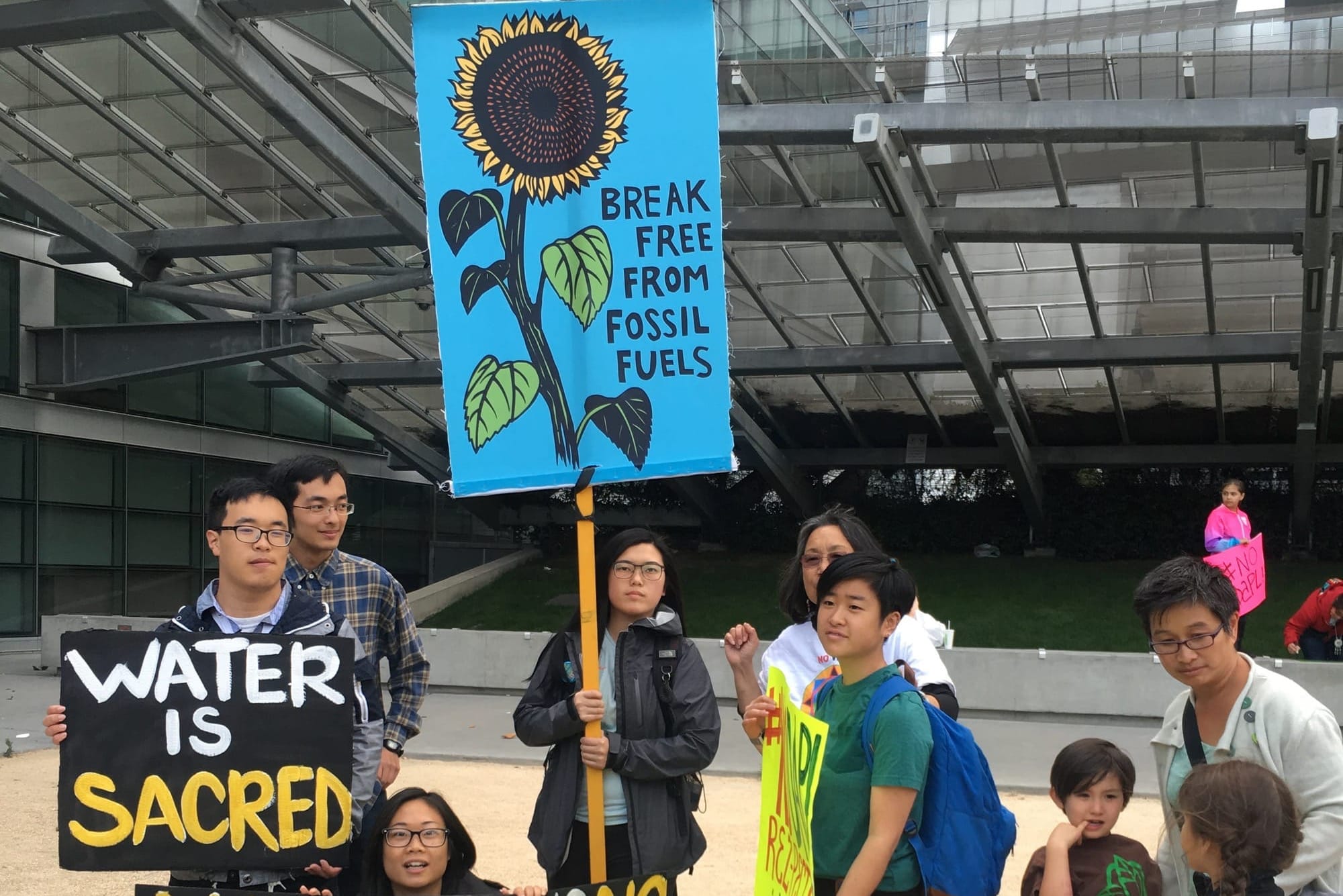
California is beautiful but its nature is under threat from climate chaos. Its nature, its people and our health, its places, its economy, its water, its future.....

I've never met Steyer, but the voices of those who know him well count for a lot. Among the most compelling is former state senator Nancy Skinner, a progressive environmentalist who represented the East Bay from 2008 to 2024, first in the California assembly, then in the state senate. When I talked to her recently, she praised him as a collaborator she'd worked with again and again when she was a legislator. She covered some of the same ground in a written statement, declaring, "Tom first came to my attention in 2010 when big oil tried to overturn CA’s signature climate law AB 32 [the California Global Warming Solutions Act of 2006]. Tom and just a handful of others took the lead and funded the campaign to uphold AB 32 and stop big oil’s ballot measure. Tom put his money where his mouth is to protect our climate. Tom is the only Governor candidate who has actually closed a corporate tax loophole. In 2012 when California still had lingering budget deficit from [the] Great Recession, Tom personally funded Prop 39 which closed a corporate tax loophole and dedicated 5 years of the resulting $2B annual revenue increase to a green jobs fund. Prop 39 passed and for 5 yrs it funded solar installations and energy efficiency upgrades at CA schools.... Even though Tom has never held elected office, he has been actively involved in state issues for decades. He established Next Gen California to be his policy think tank and advocacy group in Sacramento. NextGen and Tom were at my side for some of my most important progressive victories such as Universal School Meals - CA’s program that gives every public school student 2 free meals a day, and a number of groundbreaking criminal justice reform measures that lowered sentences and expanded effective reentry programs so those leaving our state prisons can be successfully return to their communities." He's also taken a strong position against ICE, vowing to fight it with the resources available in California.

Skinner's testimony shows not just his support for progressive issues, but that he understands the system well enough to have operated successfully within it again and again. That might answer the charge that he's never held elected office, usually levied to suggest he isn't qualified to take on the job. I met Skinner at an event for Jane Fonda's climate PAC (if you haven't noticed, Fonda has spent the last several years deeply --and brilliantly – involved in climate work). Incidentally, Fonda has ringingly endorsed him, as has Our Revolution, former State Controller Betty Yee, the California Nurses Association, the California Teachers Union,AFSCME 3299 (the union representing the most University of California workers), the California Domestic Workers union, the action funds of both the Center for Biological Diversity and the NRDC, a lot of elected officials in state office and Congress, and Third Act California (full list here), while the Bay Area chapter of 350.org has endorsed Steyer and Katie Porter, neither of whom will take fossil fuel money. 

 Bill McKibben co-founded 350.org in 2008, when the climate movement was just gathering force, and created Third Act in 2021 to mobilize people over sixty for climate and democracy. I've known Bill for more than two decades as a dear friend and climate role model and collaborator (and I sit on the board of Third Act). Bill in turn has known Steyer since Steyer came to him to deepen his understanding of the climate crisis and what to do about it. Bill writes, "Maybe 15 years ago he called me out of the blue to pick my brains about climate stuff; as he talked on the phone, I googled him and established he was a hedge fund billionaire, a species to which I am allergic. I tried to put him off, but he politely insisted to the point where escape would have required real rudeness on my part.... Over time we became real friends.... He’s the real deal: he stepped away from his hedge fund [in 2012] because his colleagues wouldn’t divest it from fossil fuel, and he’s been working hard ever since to make progress on the energy transition. I can’t think of a more knowledgeable or committed climate champion in political life in America today. Steyer has supported one bill after another that would raise his taxes, and he’s fanned out across the state year after year to help with important referendum fights—which is why, among other things, he’s found widespread endorsements from labor unions... And as a governor on climate and energy issues, he’d be relentlessly focused; the Golden State is America’s leader in clean energy deployment, but it has much more to do, especially in linking that deployment to widespread prosperity. Steyer has been aggressive in taking on the utilities in California, a key next step." 

One piece of evidence that his plan to reform California utilities is serious is the fact that PG&E, the for-profit utility serving much of California is dumping shocking amounts of money--a bit of the profit off our overpriced electricity--to fight him. The San Francisco Standard reports, "Pacific Gas & Electric has injected close to $10 million into an anti-Steyer PAC called 'Californians for Resilient and Affordable Energy,' according to new campaign finance disclosures. If he becomes governor, Steyer plans to introduce electricity reforms that could end up being a threat to the company and other investor-owned utilities." There are positive endorsements, but sometimes you can judge someone best by their enemies, and the animosity of PG&E is its own kind of endorsement. Steyer has pledged to cut electricity costs by 25%, a direct threat to the kind of profits that lets PG&E throw that kind of money around. 

The Case for Climate Champion Tom Steyer in the California Governor's Race
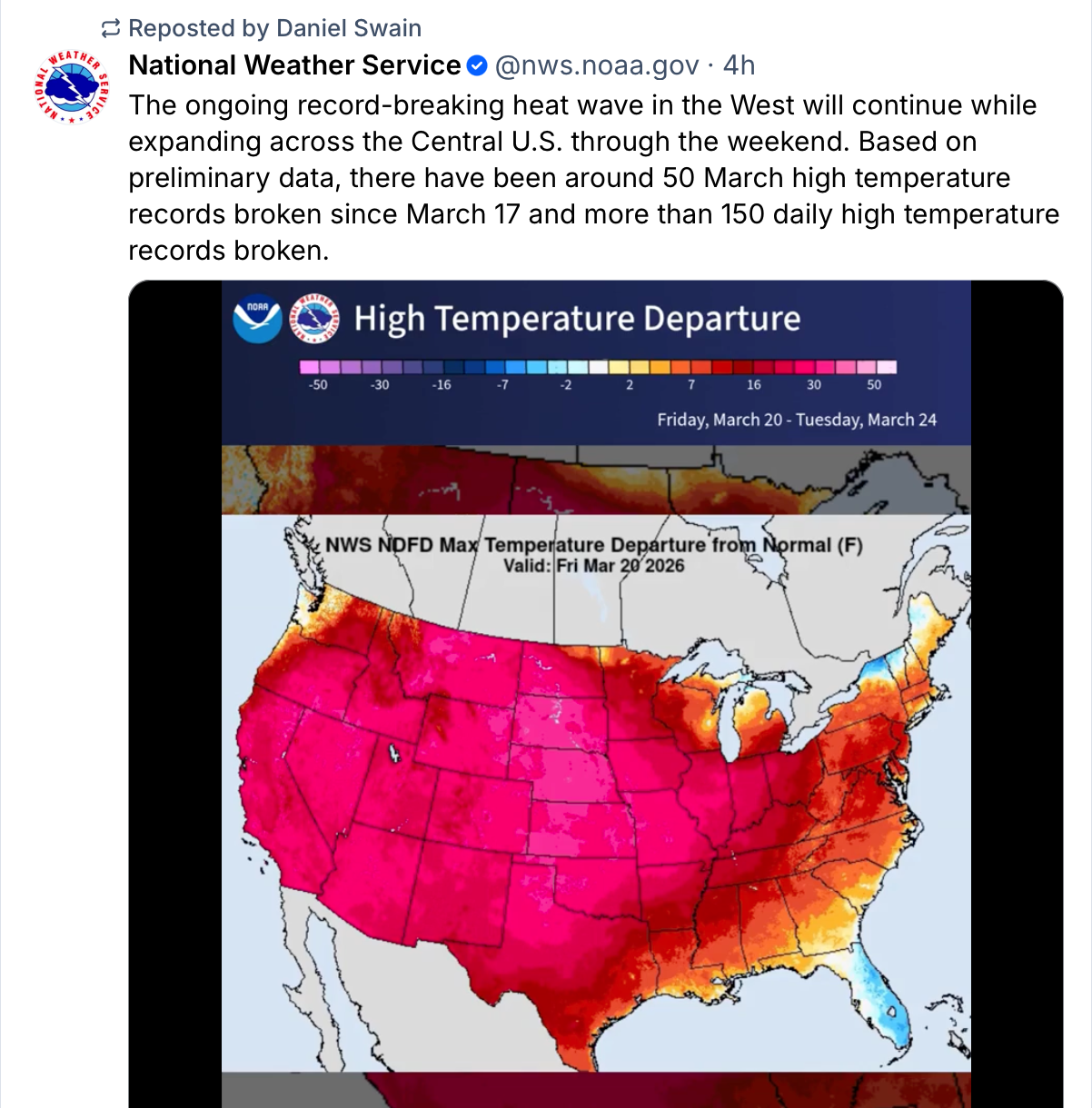
Much of California's water starts as snowfall, and after a few abundant years, we're back to drought conditions and snow that melted too quickly in March's freak heat.

From drought to flood to extreme heat to catastrophic wildfire to sea level rise, California is facing climate chaos, and it's an issue that must be addressed through many avenues. Steyer was recently interviewed by Emily Atkin for her climate newsletter Heated, a climate newsletter and podcast, and when she asked him why he doesn't talk more about climate in his campaign he replied, "Because when I talk about electricity, I’m talking about climate. When I talk about wildfires and insurance, I’m talking about climate. When I’m talking about technology growth and inventing the future in California and building the companies about it, I’m talking about climate. I’m trying to talk about climate in terms of the way that people experience it.…"

Most of the reasons cite for why people don't like or trust Steyer have to do with what he was doing before he walked away from his hedge fund and its investments, the work that made him a billionaire. But he changed his politics to reflect his changed values when he abandoned that work almost fifteen years ago. Of course I don't like the fact that Steyer's investment corporation held, from 2004-2006 shares in a private prison corporation, but he sold them and has apologized repeatedly for it, in actions as well as in words, by supporting progressive measures to reduce incarceration and reform the system. He's also vowed to give half his fortune away in his lifetime and been a hugely generous donor to climate action and the Democratic Party ever since. 

Steyer and his wife (since 1986)  Kat Taylor have done a lot more: together they funded set up Beneficial State Bank, a nonprofit community bank in Oakland whose investing "commitments include no predatory lending, and no investments or lending to fossil fuel, private prisons, or weapons manufacturing industries." Steyer likewise founded NextgenAmerica, originally NextGenClimate, to register young voters and mobilize them and candidates on climate and other issues, and another investment company, Galvanize Climate, specifically focused on investing in climate solutions. 

Betty Yee, in her endorsement after dropping out of the governor's race last week, said, "The only candidate who has the vision for California to become a truly golden state where economic prosperity is shared, is Tom Steyer. The other Democratic candidates are gifted but lack a comprehensive vision; we cannot return to a status quo of the past. This is unacceptable because too many Californians are struggling. I’ve known Tom and his wife, Kat, for two decades. I’ve seen firsthand their integrity, their commitment and their humble hearts for service. Tom leads with humility, surrounds himself with people who challenge him, and builds the type of partnerships needed to actually get things done. I campaigned too hard to just settle for a candidate. I am not settling for Tom Steyer. I am all in for Tom Steyer. I hope you will join me."

A lot of you probably don't hate all billionaires, because the category includes Beyonce, Rihanna, and Illinois Governor JB Pritzker. Only too often candidates who don't have their own money become beholden to those who have lots of it, be they individuals – think of Silicon Valley oligarch Peter Thiel as JD Vance's puppetmaster – or corporations and dark-money PACs that dole out money as an investment and reap huge returns on it in the form of favorable legislation. Getting money out of politics would be a huge step back toward representative democracy in America. In the meantime, it's a pay-to-play game, wherever the money comes from.

If you asked me last year, my dream candidate for governor would've been current attorney general Rob Bonta, a climate and human rights hero, but Bonta wisely decided he can do the most good right where he is and didn't jump into the race (but is up for re-election). With the candidates we've got, Steyer seems the strongest, and the first rule of electoral politics is you deal with what's possible, aka who made it onto the ballot (though in other moments you can change what's possible and who and what makes it onto the ballot).

Right now every voter who cares about climate and human rights should first focus on the mess this jungle primary hands us: the top two candidates go on to the general election, and if the Democratic vote in this blue-violet state is spread too widely the two Republicans could be those top two in the November election. But Steyer is currently one of the top two Democratic candidates. In 2016, I said voting is a chess move, not a valentine. I believe that Steyer is the right chess move for California voters. If he wins, we might be able to checkmate the fossil fuel industry at last and improve the life of so many Californians treated like pawns.
The Case for Climate Champion Tom Steyer in the California Governor's Race
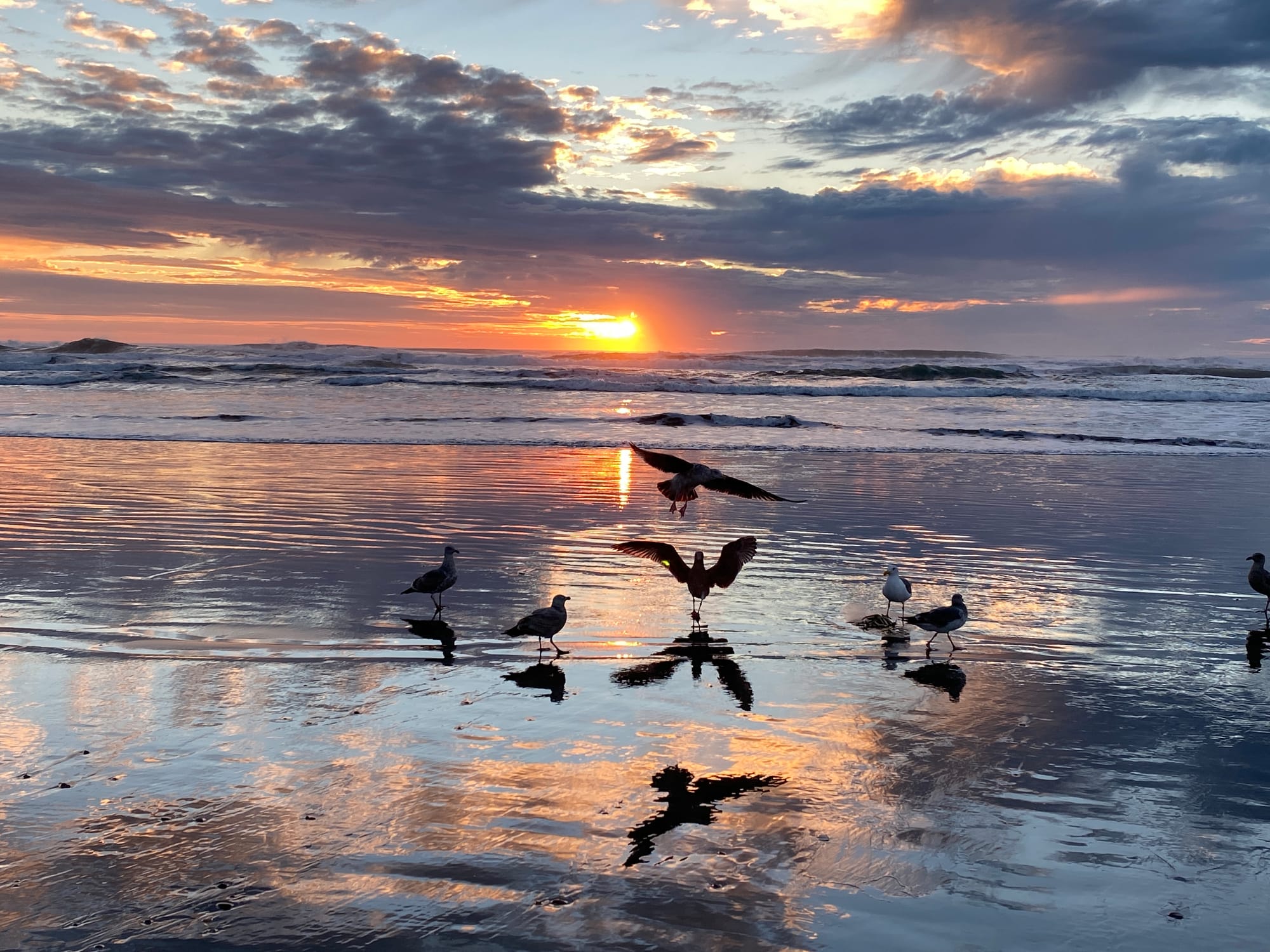
California is huge, wildly diverse in its ecologies, and severely threatened by climate chaos.

p.s. A note on Xavier Becerra, who seems to be the other top Democratic candidate in the race: he is not good on climate. Becerra took the maximum donation from Chevron for this election, and said "We need Chevron.... They're not the bad guy" in a recent appearance. The Action Fund of the Center for Biological Diversity gives him a C+ on environmental issues and Steyer an A, noting that Becerra "has not supported California’s Climate Superfund Act, instead asserting that the best way to make polluters pay is to give them a 'seat at the table,' demonstrating a fundamental misunderstanding of Big Oil’s relentless opposition to climate solutions. As attorney general, he did not file suit to hold major fossil fuel companies liable for climate deception, though his successor Rob Bonta did." Chevron absolutely is the bad guy in so many ways.
69ee5923a270530001ac5b0d
Extensions
Everything Is Changing Fast: A Brisk Tour Through Shifting Views

In this chaotic, transformative period, a lot of realities are changing in a lot of ways, and public opinion is often either changing with it or leading the change. We are not who we were even a few years ago when it comes to opposition to "Epstein class"
Show full content
Everything Is Changing Fast: A Brisk Tour Through Shifting Views

In this chaotic, transformative period, a lot of realities are changing in a lot of ways, and public opinion is often either changing with it or leading the change. We are not who we were even a few years ago when it comes to opposition to "Epstein class" billionaires, artificial intelligence, ICE ,and immigration enforcement. As Perry Bacon of the New Republic put it recently, "Guess What Moderate Democratic Voters Aren’t Anymore? Moderate." He continues, "Around 70 percent of moderates (combining the moderate and moderate-to-liberal respondents) said Democrats are 'too timid' in taxing the rich, taxing corporations, and cracking down on companies that break the law. A clear majority of moderates said the party is too timid in regulating Big Tech companies. Fewer than 5 percent of moderates said Democrats are “too aggressive” in their dealings with the rich, corporations, and Big Tech." That's an anti-elite wave right there.

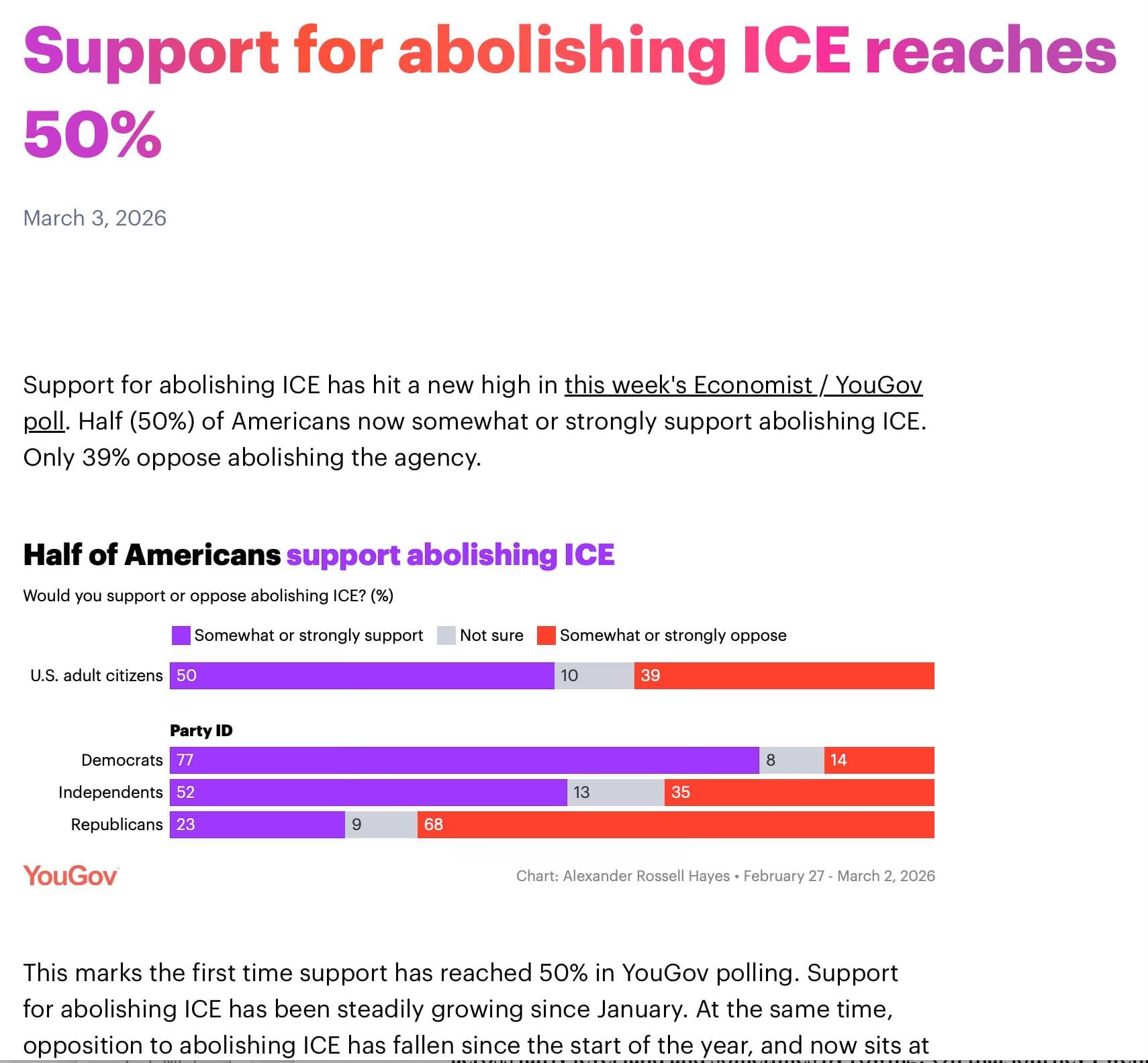
As I mentioned here recently, one way you can see the new attitude in action is as local campaigns, often successful, to prevent tech corporations from building data centers in their area and ICE from buying warehouses to convert to prisons. There's a quite exhilarating wave of opposition to AI right now. Elites, including a lot of mainstream media as well as the creators and profiteers of the technology, often insist that it's inevitable, all-powerful, and we should just lie down and let the tanks of big tech run us over. Again. The public is not having it, and whether they're seeing the slop and sludge AI spreads, the threats to jobs, the corrosive effect of chatbots on vulnerable users, the potentials for profound dangers, or the reckless amorality of those in charge of the technology, they are skeptical about the promises. There were three attacks recently, including two targeting the home of OpenAI CEO Sam Altman and one the home of an Indianapolis city councilman who voted for a data center there.

At his superb tech-critical newsletter Blood in the Machine, Brian Merchant writes, "the events signal an escalation in the blowback to generative AI and the broader AI project undertaken by Silicon Valley. Less than two weeks ago, I noted that it’s open season for refusing AI, and detailed a host of ways that politicians, workers, and advocacy groups were pushing back or banning outright AI in communities, industries and the workplace. Embodying the trend were Bernie Sanders and Alexandria Ocasio-Cortez, who introduced a bill proposing a nationwide moratorium on data centers.In the short time since I wrote that post, such pointed AI refusal has continued apace. Maine looks set to become the first US state to ban data center development outright. Form letters for refusing AI at work are circulating widely. Public polling of AI sentiment is in the gutter; it’s never been popular, and it’s especially unpopular now. A widely discussed NBC poll found that just 26% of Americans had positive feelings about AI; around half had negative feelings. Gen Z in particular loathes AI: For respondents aged 18-34, AI’s net favorability rating was minus 44."

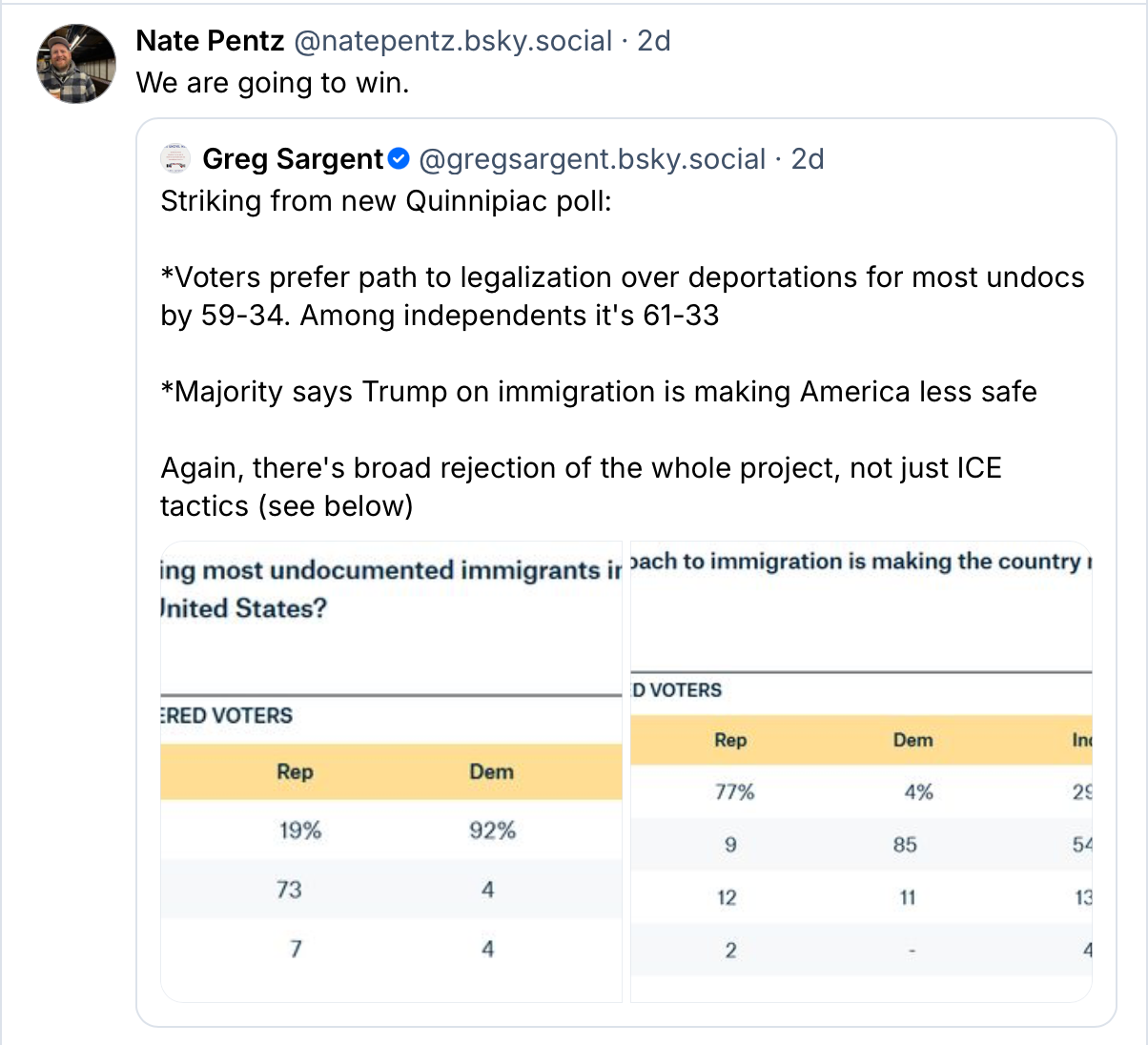
A Gallup survey of opinions on immigration last summer demonstrates a majority of the public has supported it all along and now supports it more. But if you took in mainstream-to-right-wing news you heard a whole lot from the anti-immigration minority as the people whose views matter, and that gave the impression that anti-immigration positions were majority opinions. People are hugely influenced by whether they believe a lot or only a few people share their position; if they know they're in the majority, they are likely to feel more confident about their position in ways that have real consequences (and likewise feel more confident in rejecting minority opinions). That includes views on climate change: a lot of people assume that support for climate action is a minority position when it's a broadly majority one. The same goes for reproductive rights and vaccines; we've heard only too much from a loud minority, aka an amplified minority, over the past several years on abortion.

The phrase "representation matters" is usually about voting rights, but it can also mean seeing your own constituency or positions represented. Liberal-to-left views tend to be underrepresented or treated as extreme, marginal, or unpopular, and misrepresented by hostile forces with grim fantasies like "the war on Christmas." Mainstream media is forever insisting that the right-wing rural or suburban white voter matters more symbolically and morally than the left or progressive urban nonwhite voter, which is why we see the former asked to share their opinions far more often than not the latter.

Everything Is Changing Fast: A Brisk Tour Through Shifting Views
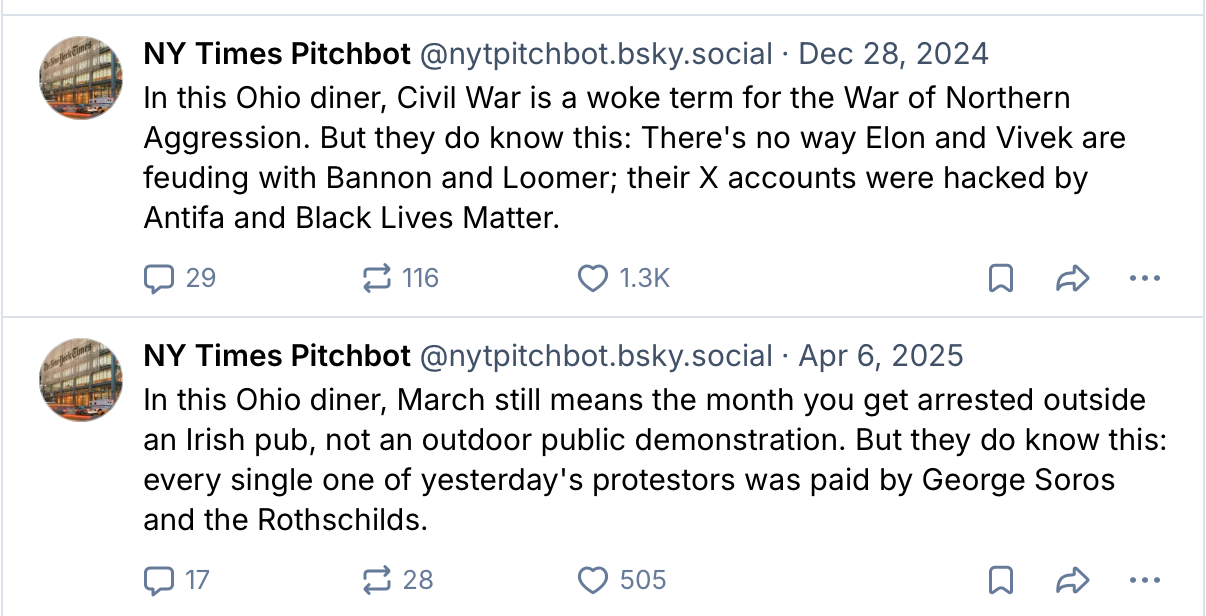
The mainstream reverence for the "salt of the earth average American" who is always a right-wing American, usually white, male, and Christian, is such a stereotype and joke that this New York Times parody account has been mocking it for years.

The Associated Press reported last summer, "Just months after President Donald Trump returned to office amid a wave of anti-immigration sentiment, the share of U.S. adults saying immigration is a “good thing” for the country has jumped substantially — including among Republicans, according to new Gallup polling. About 8 in 10 Americans, 79%, say immigration is “a good thing” for the country today, an increase from 64% a year ago and a high point in the nearly 25-year trend. Only about 2 in 10 U.S. adults say immigration is a bad thing right now, down from 32% last year." It seems extremely likely that it has shifted far more since then as the public has witnessed the brutal cruelty, disruption, indiscriminateness, and economic impact of attacking immigrants, people of color regardless of immigration status, and white people who stand up for the former groups (as well as imprisoning white tourists and longtime non-citizen residents). As I keep saying, the Trump Administration assumed it could do things and we could do nothing about it, that their positions would matter and ours would not. That's one of the many things they're wrong about. But it's also striking that we never did hear much about this widespread support for immigration.

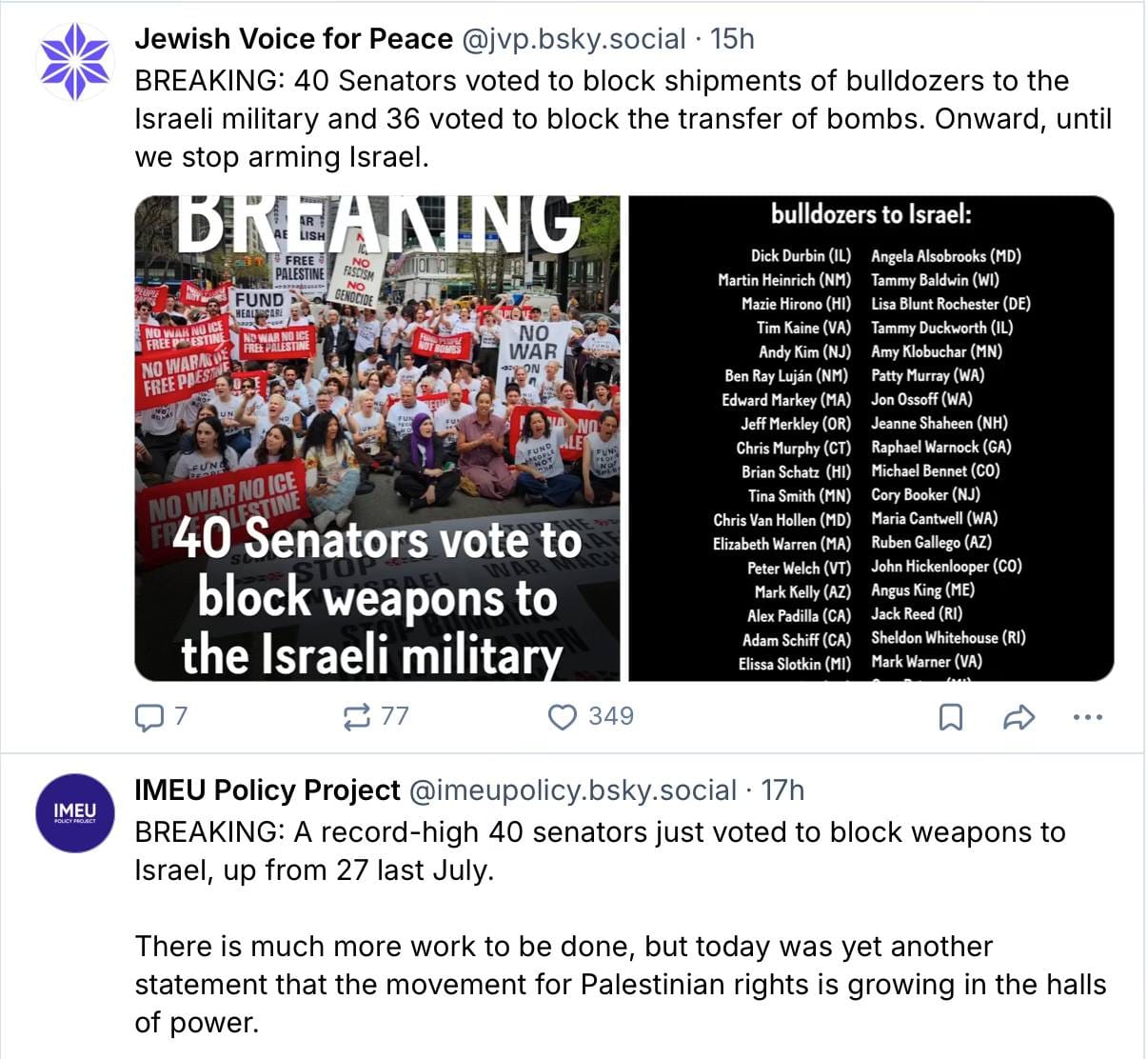
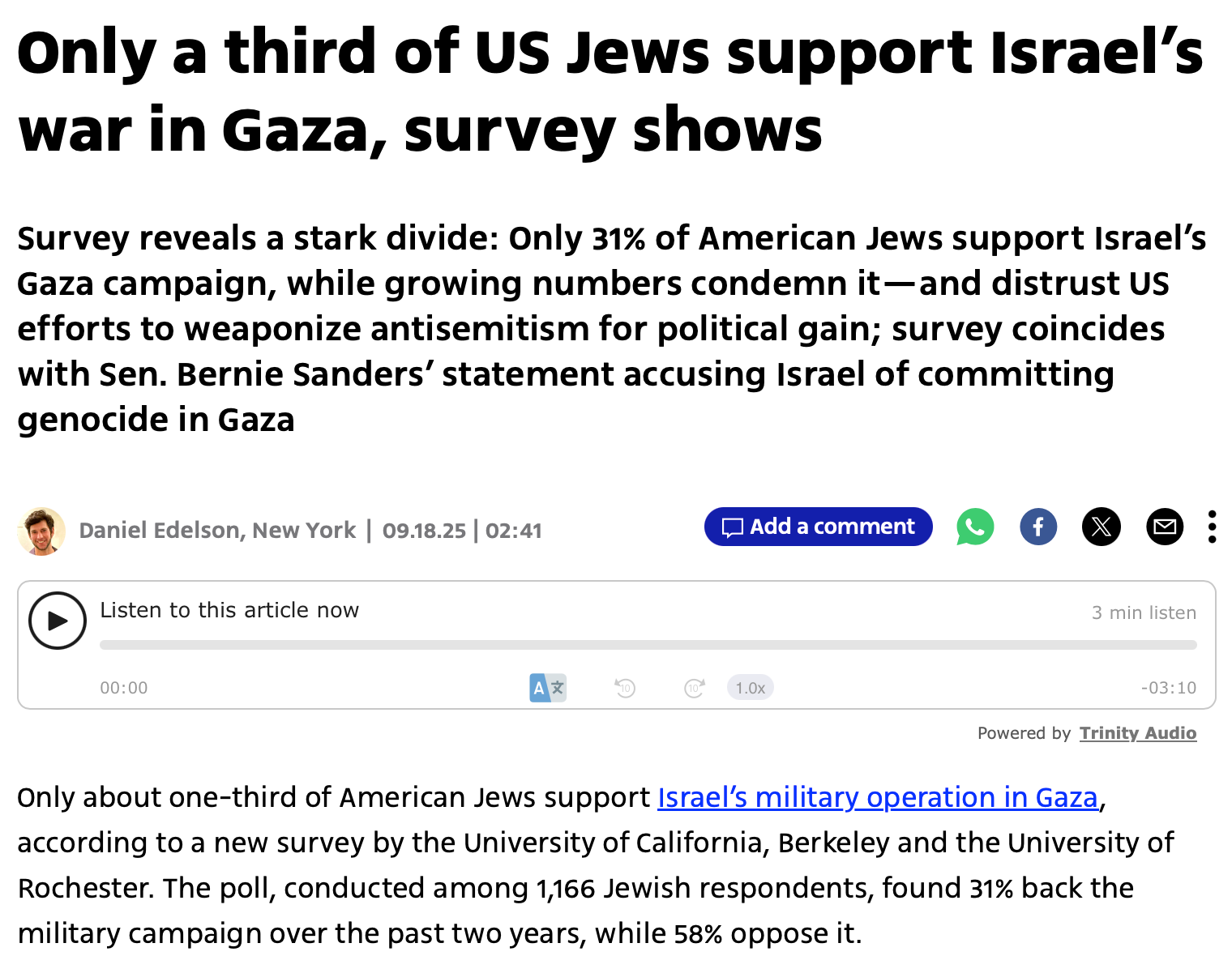
Another notable trend over the past couple of years is the decline in support for the Israeli government and military. Like opposing the NRA, opposing the Israeli government used to be something politicians were scared to do. The big shift in public opinion on the subject led the way (which is another reason why I hesitate to call politicians leaders; they are often followers of public opinion which is, at best, doing their job of representing us and at their worst following the money).

Everything Is Changing Fast: A Brisk Tour Through Shifting Views

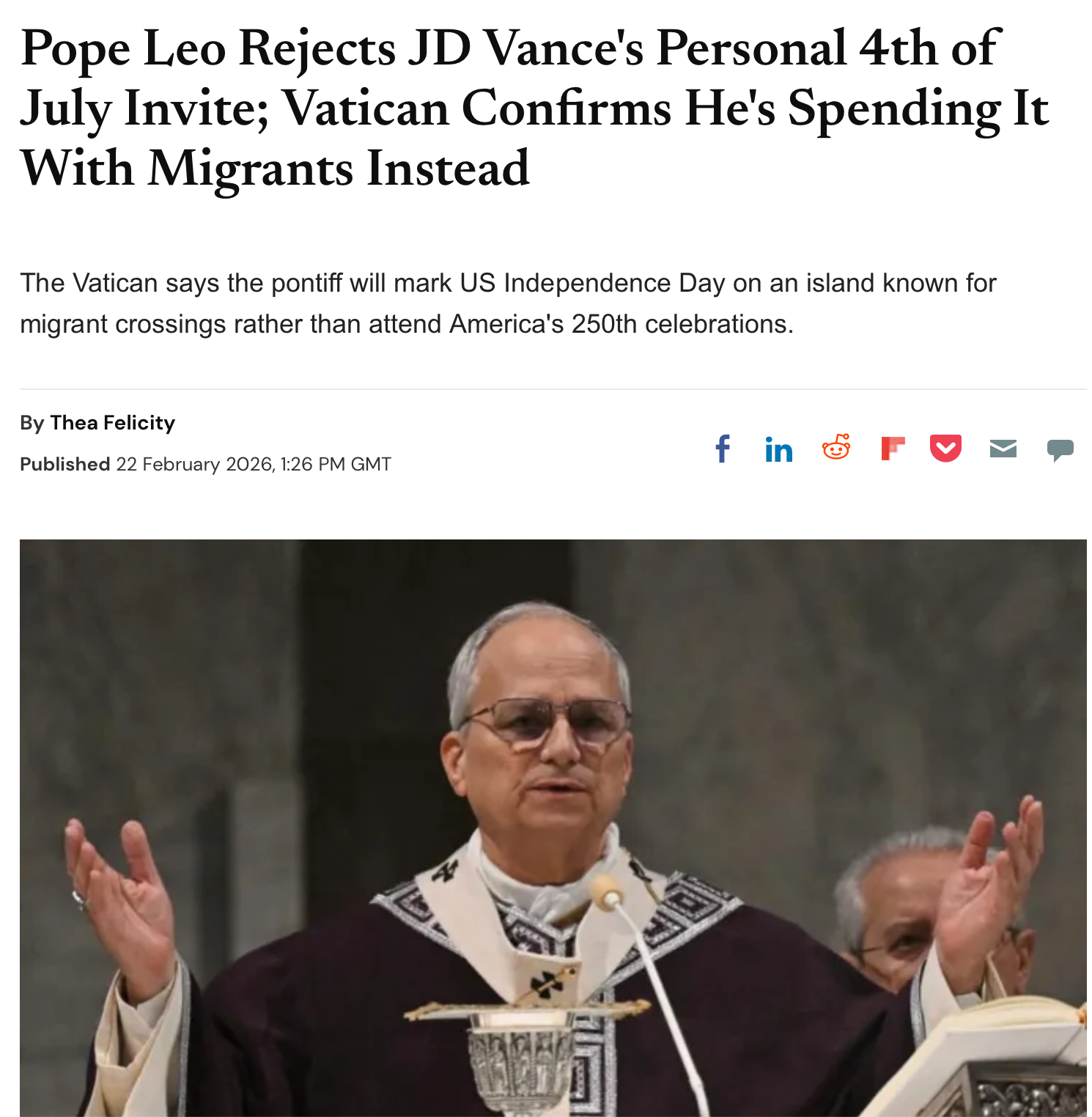
Another more recent striking shift is the decline in support for Trump, and it's now often said that MAGA itself is breaking up. Trump's extraordinary decline in the polls shows that he's not just losing centrists and relatively uncommitted people who voted for him or believed his promises but that his base is itself splintering. Major factors include the Epstein files and their suppression, the sabotage of the economy (the tariffs and rising fuel and fertilizer prices have hit farmers and rural America hard), the war in Iran, and most recently, the attack on the pope.

Simon Rosenberg in a newsletter essay titled, "The Trump Regime Is Rotting, Decaying, Crumbling, Unraveling, Falling Apart," declares, "The regime has started to truly crumble and fall apart under the weight of it all. Noem, Bondi, Bovino, Kent all gone. Prominent right wing media figures are in open rebellion against Trump. Vance’s Pakistani peace talks and salvage efforts in Hungary failed, spectacularly. Zelenskyy, Trump’s nemesis, has emerged as the courageous and respected leader of the free world, with Peter Magyar joining him as a powerful symbol of the power of people to triumph over Greater MAGA and autocracy. Democrats had huge, blowout performances in Georgia and Wisconsin last week, and saw polling showing us ahead in AK, ME, NC, and OH - enough to flip the Senate. Trump’s demands to fully fund DHS/ICE and pass the SAVE Act were publicly rejected by Thune and Johnson. His madness is becoming undeniably worse, as he threatened genocide in Iran, has repeatedly attacked the Pope and the Fed Chair, and keeps posting blasphemous AI images of himself." That Trump and Vance have sought out a fight with the pope for criticizing the fight they've picked with Iran shows that they're stupid enough to pick fights they can't win.

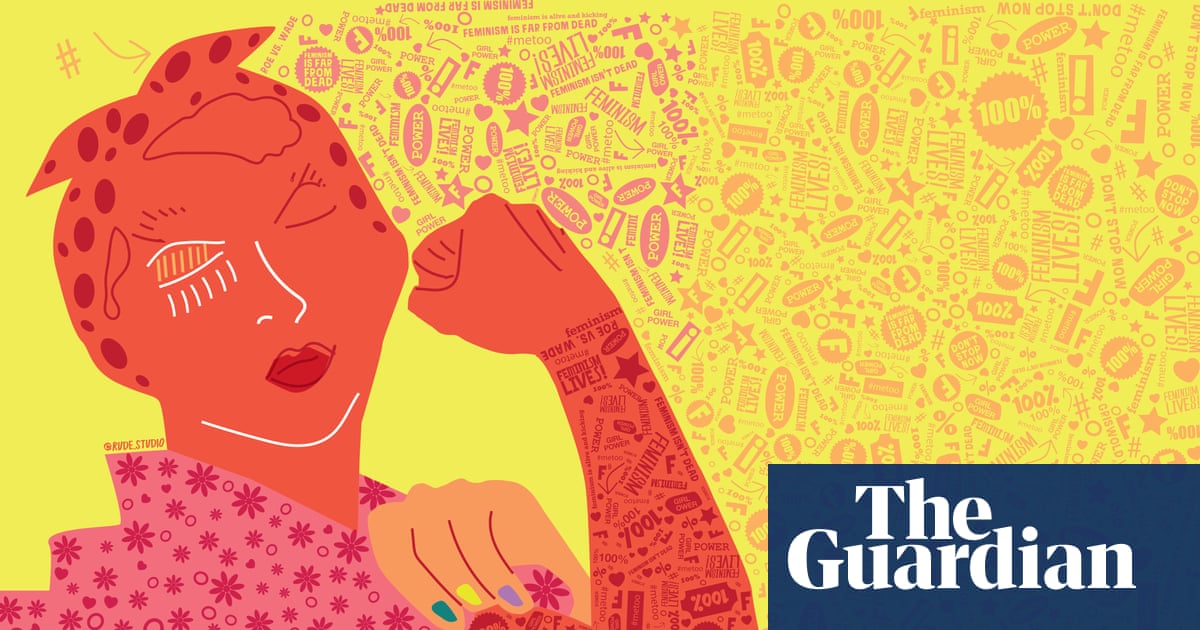
In another striking reminder of how things have changed, Katy Butler writes about the swift fall of former Congressman and gubernatorial candidate Eric Swallwell the Los Angeles Times, "Until a decade ago, shame was a weapon wielded widely against female accusers to shut them up. Rich and powerful men largely dictated the public narrative. When accused of acquaintance rape or harassment, they followed a simple playbook: declare innocence or argue consent. Hire investigators to dig up dirt on the woman, and feed the findings to reporters. Watch the alleged victim retract her charges or be discredited and silenced. See the criminal case collapse or end in a mistrial, acquittal or successful appeal.... In an era when “the news” was largely defined by top editors at a few gatekeeper media like the New York Times and the television networks, the tactics often worked. The editors were usually unscathed white men, ignorant about sexual assault, easily manipulated by predators, and fearful of false accusations, which are rare, and no more likely in rape cases than in any other crime." Feminists changed this, by which I mean not just high-profile advocates with platforms, but everyone who spoke up about the realities and pervasiveness of sexual abuse and gender violence. The public understands those issues and women's rights in a different way than it did before the current great wave of feminism began circa 2013-14.

At some point in the past, the Republican Party reached a crossroads. The party could either adapt to an increasingly progressive, increasingly multiracial democracy in which women were increasingly empowered by modifying its positions to appeal to the broad spectrum of voters. Or it could double down on its positions – support for the rich, first of all, hiding out behind hot-button issues like guns and abortion – and go to war with democracy. Of course they chose the latter path, and as their positions became increasingly unpopular they had to become increasingly undemocratic. Trump, the man who would be dictator, the attempted stealer of elections and suppressor of votes, the enthusiast for reinstating the old inequalities of race and gender and suspending civil and human rights, the fan of Putin and Orban, is where that decision was always leading. Mainstream media has colluded by continuing to cover the parts as though they were truly symmetrical (which often requires blowing up some minor democratic misdemeanor as though it were the equivalent of a Republican felony or just playing down the corruption and harm of the latter party).

The Democrats are very far from perfect, but the party itself has evolved, as old centrists like Nancy Pelosi (a political genius, but not exactly a climate or economic justice champion; she steps down at the end of her current term) retire and young progressives like Arizona's first-term congresswoman Yassmin Ansari step up (a climate champion, Ansari has initiated impeachment hearings against Secretary of Defense Pete Hegseth). In the wake of the 2024 election, there was an avalanche of opinions that, despite the thin margin of Trump's win, the swing of Latino and Asian voters to Trump meant that the whole country went right and would stay right. It was a hot take and a bad take. A lot of those voters found out what they really voted for and didn't like it. The Trump Administration itself is pushing the country to the left, is behind those blowout elections for Democratic candidates winning by margins far beyond the party in the 2024 election.

As we approach the midterm elections this fall and the next presidential, a cacophony of pundits is endeavoring, as usual, to instruct politicians on what constitutes a safe winning platform, and as usual, a lot of the advice is, well, the ingrown toenail of advice. It often focuses on selling out a minority population to appeal to a majority or tacking to the center even as (see above) so-called moderates become less moderate. Or it makes a lot of fuss about an obscure bit of language though it's widely deployed and widely reviled (see below). Or the same kind of fuss is made about minor trends hyped in inflammatory articles.

Everything Is Changing Fast: A Brisk Tour Through Shifting Views
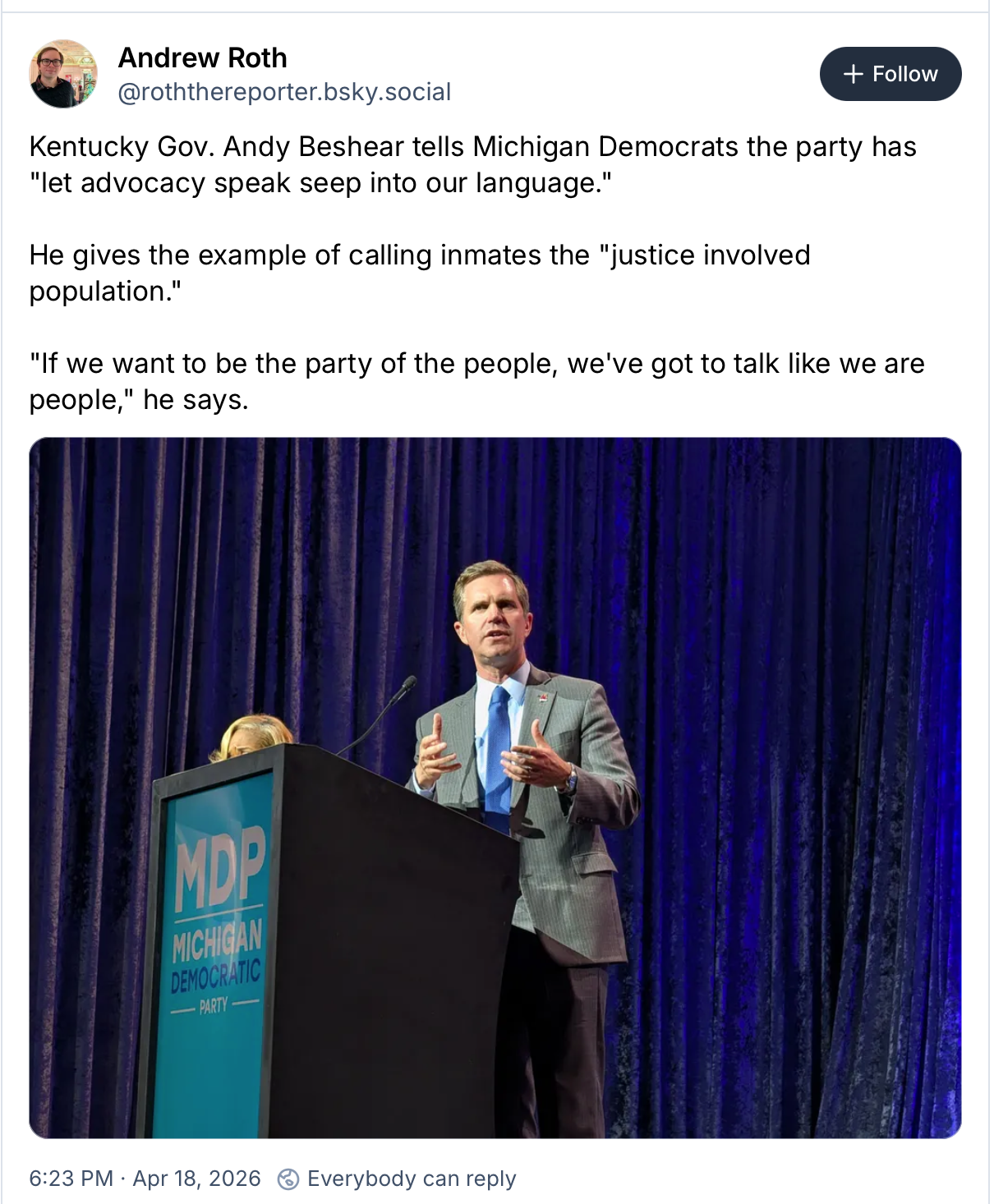
This is a classic complaint about "politically correct" language, and as usual it amplifies pretty obscure terms into something we should all fret about. That's a real phrase, but not one I'd heard and not one that is causing great hordes of people to do anything at all.

In a recent essay about trans rights and public opinion by Julia Serano in the Boston Review, she writes, "But the notion that retreating from trans rights will benefit Democrats in future elections rests on three false assumptions. The first is that the current anti-trans backlash is the result of “activists going too far,” a trope that is levied against virtually every social justice movement. This framing allows opponents to cast the rolling back of rights as a “realignment” with public opinion and a return to the “natural order” of things. But that is not at all what has happened here. What is new is that, starting around 2015—in the wake of increased trans visibility in the media (sometimes called the “transgender tipping point”) and the Supreme Court’s decision in Obergefell legalizing same-sex marriage—social conservatives began shifting their efforts toward targeting trans people instead. The attacks have since grown into a highly coordinated and well–funded movement that churns out both anti-trans and broader anti-LGBTQ legislation at unprecedented levels. This is the real reason why Republicans have become obsessed with “fairness in women’s sports,” “biological sex,” “social contagion,” “restrooms,” “grooming,” and other soundbites that didn’t exist ten or fifteen years ago. In other words, there hasn’t been an organic shift in public opinion on trans people but rather a massive astroturfing campaign against us." In fact, she notes, " poll after poll after poll has shown that voters reliably rank transgender issues among the least important to them."

There are issues that right-wing groups have spent billions to try to make you and me and all the ships at sea care about, as in angry about: immigration, social services (remember Reagan's "welfare queens"), government regulations (the ones that prevent you from getting cancer and nature from being destroyed), and of course the very existence of trans people. Sometimes money talks. But in the last few years we've had some striking examples of votes money can't buy – for example, the huge sum Elon Musk dumped in a race for a seat on Wisconsin's supreme court last year didn't net him a judge. Public opinion shifts for more authentic reasons too.

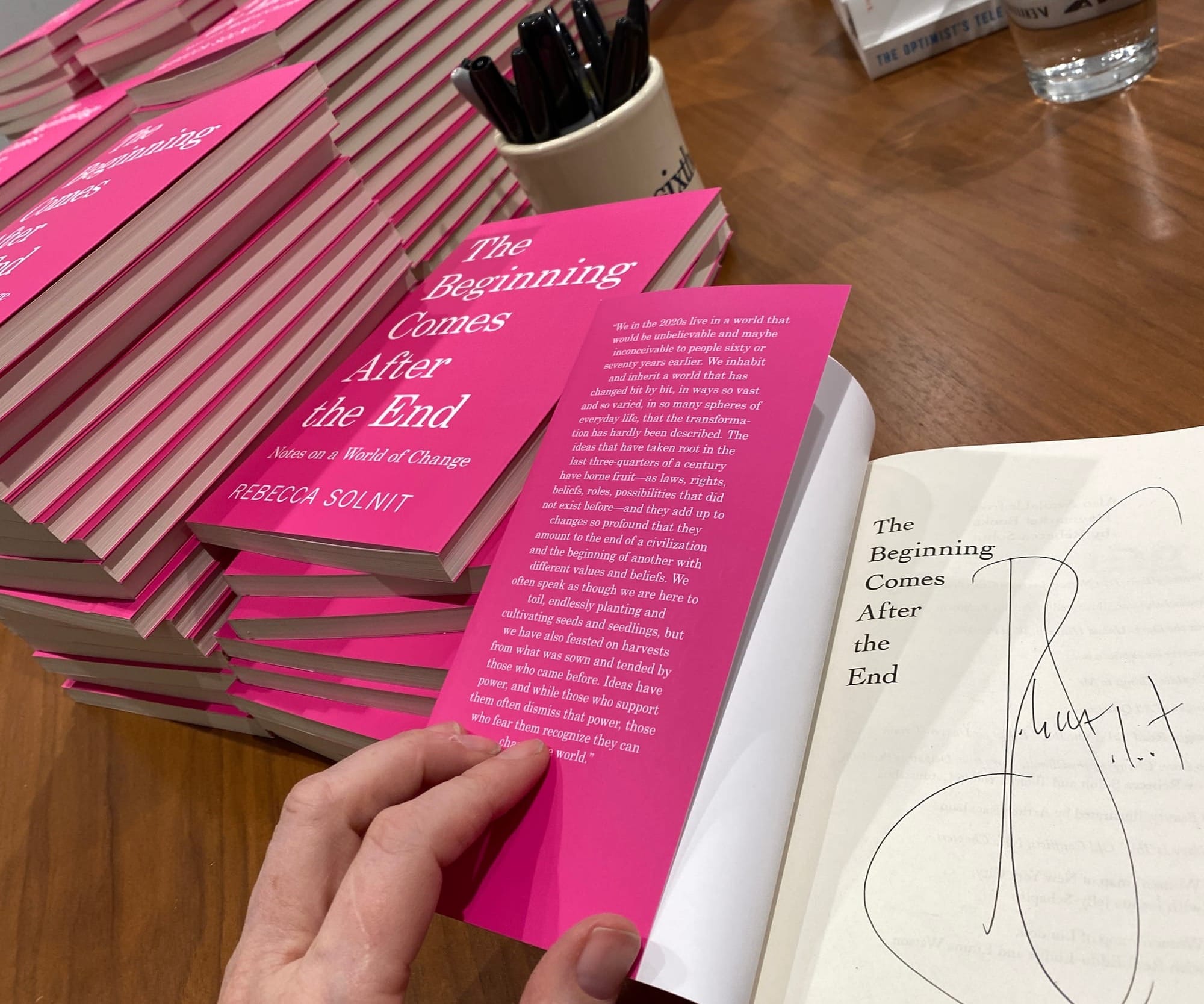
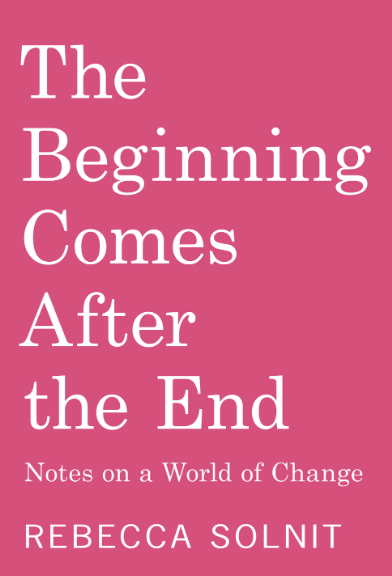
The main thing I wanted to tell you about today is just that it is shifting, and shifting a lot, often toward more progressive positions. (My newest book is about the huge shift over the past 70 years in public opinion about race, gender, nature, equality, and pretty much everything else, away from the old inequalities, with the right essentially now a backlash movement to "make America 1958 again," or maybe 1858.) In a funny way that goes back to their obliviousness to consequences I keep talking about, the Trump Administration is driving some of this, which makes it backlash to the backlash. But it's also driven by protest movements, direct experiences, and legitimate news stories about things like the catastrophic attack on Iran. Watch out for politicians and pundits who insist that winning elections requires sticking to safe old positions or pandering to centrists while abandoning progressives nationwide while asserting that the electorate is more conservative than it is. It's changing. Everything is.

p.s. This just came out, and it's along the same lines. https://www.prospectmagazine.co.uk/world/united-states/73041/the-radicalisation-of-the-american-liberal

69e14729636a9900010fbf18
Extensions
Flowers Bloom on Soldiers' Graves: Lessons in Power and Consequence

What is power? It is at its most essential the ability to influence an outcome on any or all scales, to protect one's own at a minimum and to influence, even control others at a maximum. Violence is constantly misunderstood as power, and it certainly looks like power,

Show full content
Flowers Bloom on Soldiers' Graves: Lessons in Power and Consequence

What is power? It is at its most essential the ability to influence an outcome on any or all scales, to protect one's own at a minimum and to influence, even control others at a maximum. Violence is constantly misunderstood as power, and it certainly looks like power, and in some respects it is power, but a limited kind of power to harm and destroy. The threat of violence is often used to coerce – but also often has negative consequences, including the loss of other kinds of power, the powers that come with relationship, connection, alliance, trust. Violence isolates and alienates; it makes enemies, it stirs up dangers that linger. Friends are another kind of power built through another set of skills.

Botanist David George Haskell's new book How Flowers Made Our World: The Story of Nature's Revolutionaries describes a kind of power often ignored or dismissed, just as flowers themselves are. He writes, "When flowers arrived, they upended and transformed the planet. They were late arrivals on the world stage, appearing about two hundred million years ago, long after the evolution of complex animals and other land plants. By one hundred million years ago they were the foundation of most habitats on land." He expanded on the subject in a Wonder Cabinet podcast interview, declaring “We often think of power and revolution as about control, authoritarianism, and violence. Might makes right. But that's not the only way in which revolution and power and transformation take place. Flowers offer a different narrative. They changed the world in revolutionary ways through cooperation, through collaboration, often mediated by beauty, by sensory experiences. So a flower is quite literally speaking to the sensory system of a bee or of a hoverfly or of a bird to draw that animal into establish a cooperative relationship, a reciprocal relationship. And we're just the latest animal to become enchanted by the flowers and to become loyal collaborators with the flowers.”

Flowers, as he unpacks, developed the power to influence others' behavior by building symbiotic relationships– "I'll feed you fruit if you scatter my seeds; I'l give you nectar and pollen in return for pollination; I'll let you domesticate me and provide you with your daily bread and you'll plant and tend me across countless fields for countless generations." In an earlier book, The Botany of Desire, Michael Pollan speculated that plants had domesticated us as much as we had domesticated them, since we serve their needs so that they may serve ours, from the most practical issue of bodily sustenance to the most poetic one of bouquets and beauty. That's flower power.

Flowers Bloom on Soldiers' Graves: Lessons in Power and Consequence
A hawk moth on a morning glory I witnessed a few summers ago in Santa Fe.

But as Jonathan Schell reminded us in his landmark book from 2003, Unconquerable World: Power, Nonviolence, and the Will of the People, violence as military attack is often deployed because politics – the art of persuasion, the building of alliance, the finding of common ground – has failed. Violence itself often fails too. Schell came of age as a young writer who went to Vietnam at the height of the US war there and perceived that for all its superior military might, the US could not conquer the people of that country. Because the US or some of its leaders didn't learn that lesson, the same mistake was made in Afghanistan, Iraq, and is being made now in Iran. People who have violence at their disposal often confuse it with power, and while it can achieve some things it fails at others. I think of the abusive spouses who think they can coerce love but often can only extort a reluctant simulation of same by someone whose motivating feeling is fear rather than love and whose desire is often to escape.

Something that's struck me about the Trump Administration throughout its second term is its profound misunderstanding of power. Over and over again, Trump and his minions demonstrate that they think they have a monopoly on power and that history will unfold as their actions without any reactions, a literally inconsequential view as in "there will no consequences other than the ones we impose." It's a version of reality so simple I would not accuse a toddler of holding it; toddlers know well there will be reactions and consequences, because they know others have power.

Flowers Bloom on Soldiers' Graves: Lessons in Power and Consequence
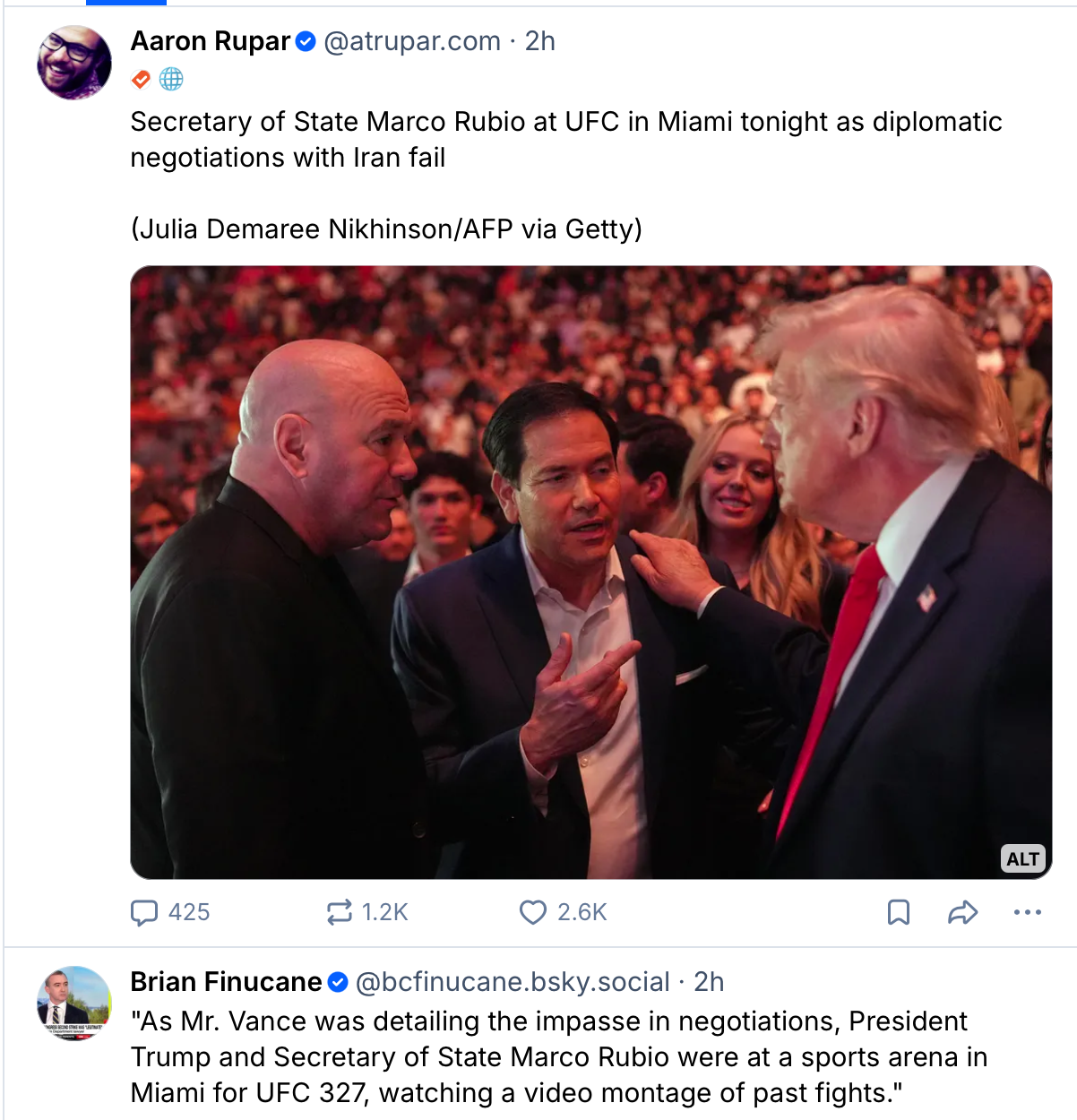
UFC fighting models that conflation of power with violence, and these are exactly the men to take away the wrong lesson from it. Negotiating peace deals is exactly what a secretary of state is supposed to be doing; that this one was ostentatiously doing nothing says a lot. Reportedly the crowd booed Trump whose power is fading fast.

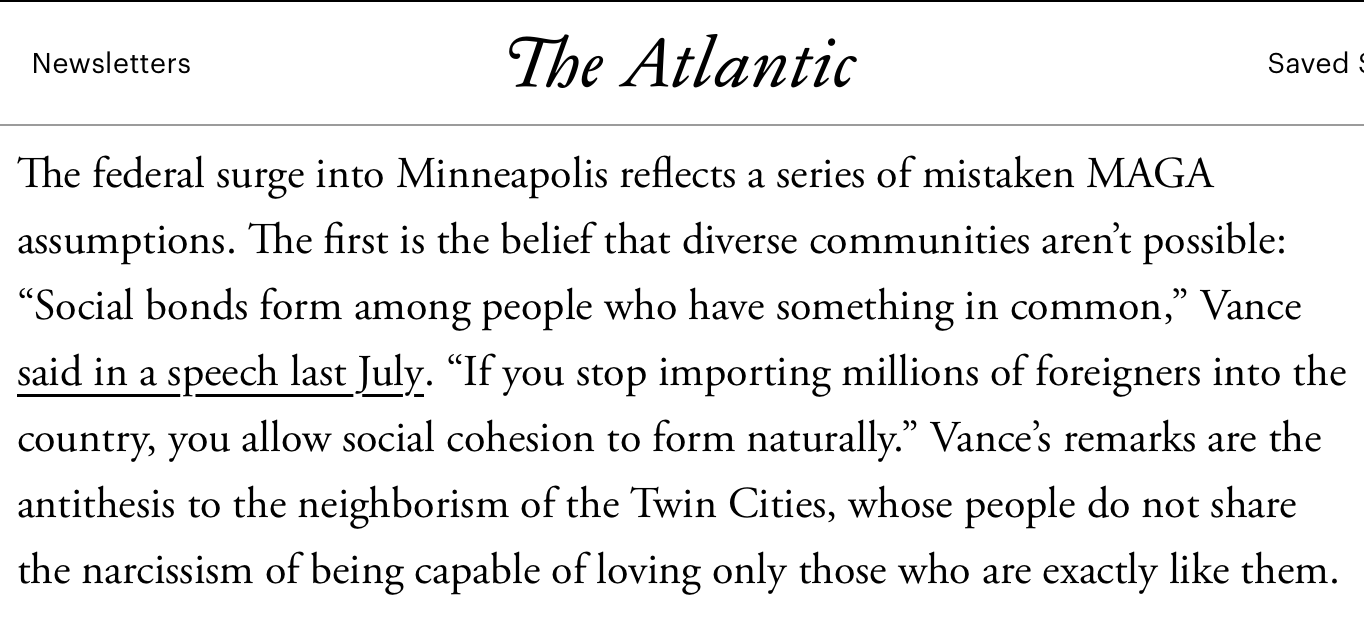
But the Trump Administration's thugs, for example, went into Minneapolis thinking they were a conquering army that would terrorize and intimidate the populace into subjugation and found that the populace was fearless in its defiance. It was a defiance motivated by a kind of moral beauty – solidarity, care, loving thy neighbor – this administration has trouble imagining, especially when it reaches across differences of ethnicity and religion as it did in Minneapolis. In this sense love is a power, or a motivating force to exercise the power of solidarity with the oppressed and noncooperation with the oppressors. The abominable JD Vance doesn't understand these forces; he had earlier misinterpreted Catholic theology to claim that “We should love our family first, then our neighbors, then love our community, then our country, and only then consider the interests of the rest of the world.” Catholic theologians smacked him down then, and they haven't stopped since.

Flowers Bloom on Soldiers' Graves: Lessons in Power and Consequence

Speaking of the Catholic church, this week the New Republic described this extraordinary situation: "Days after Pope Leo XIV delivered his State of the World speech, Undersecretary of Defense for Policy Elbridge Colby summoned Cardinal Christophe Pierre, the Vatican’s U.S. representative, to a closed-door Pentagon meeting for a bitter lecture. 'The United States,' Colby said, according to a blistering new report by The Free Press, 'has the military power to do whatever it wants in the world. The Catholic Church had better take its side.' One U.S. official present at the meeting brought up the Avignon papacy, a period in the fourteenth century in which the French monarchy bent the Catholic Church into submission, ordering an attack on Pope Boniface VIII that led to his downfall and subsequent death and forcing the papacy to relocate from Rome to Avignon, a region inside France."

Yes, these idiots reportedly threatened the head of this ancient institution, on the basis that the pope had better not dare oppose its power. But unless it wants to use violence against the pope and the Vatican, the Trump Administration has very little power in that situation. And if it did use violence, the blowback would be profound, domestically and internationally. The power the administration constantly squanders without understanding the consequences is soft power. Take for example, the fact that when Trump wanted European countries to help him re-open the Strait of Hormuz, which was only closed because of his feckless unforced mistake of a war, heads of state laughed at him because he'd destroyed the US's once-good relationships with a number of their countries with his threats against Greenland, waffling on support for Ukraine and NATO, and tariffs.

USAID created soft power around the world while also doing actual good in saving lives and preventing suffering; dismantling the organization was one of many actions this administration took that weakens this country in the long run and, really, the short run – that with all that macho strutting and bullying, they don't understand that they are weak and making this country weak says more about the epic incomprehension. This should remind us that knowledge is power, and understanding is power; stupidity is a weakness of theirs that has often benefitted the rest of us. Including, for better or worse, Iran, which in many respects has won this war. The country has suffered horrific losses, including the death of more than 160 schoolgirls in an attack on a school that was apparently a result of the Hegseth-era military's sloppy choice of targets. The heroic uprising against the regime was undermined, not strengthened, as the Trumpists thought, by this attack. They strengthened the regime instead. And Iran has seized control, for now, of the Strait of Hormuz and is demanding huge tolls from ship traffic there.

The war has had catastrophic impacts around the world on the price and availability of fossil fuel and fertilizer (aka nutritional supplements for flowering plants), and that in turn has sacrificed more US soft power and good will and created more suffering. The fact that this fossil-fuel crisis is pushing both nations and individuals to speed the transition to renewable energy is another consequence the fossil-fuel-allied regime did not foresee. Likewise, the Trump Administration has exercised its power to sabotage climate efforts and renewable energy in ways that make this country weaker in the long term, but Trump is on his way out and clearly does not care about the long term in any way other than in masturbatory monuments to himself and illicit wealth for his family. In a similar way, Netanyahu has devastated Israel's relationships with its neighbors and much of the world, because he apparently only cares about his own fate and not about his country's, let alone the lives of those he has slaughtered in Gaza and Lebanon.

While the primitive machismo of the Trump administration sees violence and the ability to inflict harm as power, and asserts that because it is powerful it does not need alliances and good relationships internationally, these things have not made it and our country strong, but weak.

Flowers Bloom on Soldiers' Graves: Lessons in Power and Consequence
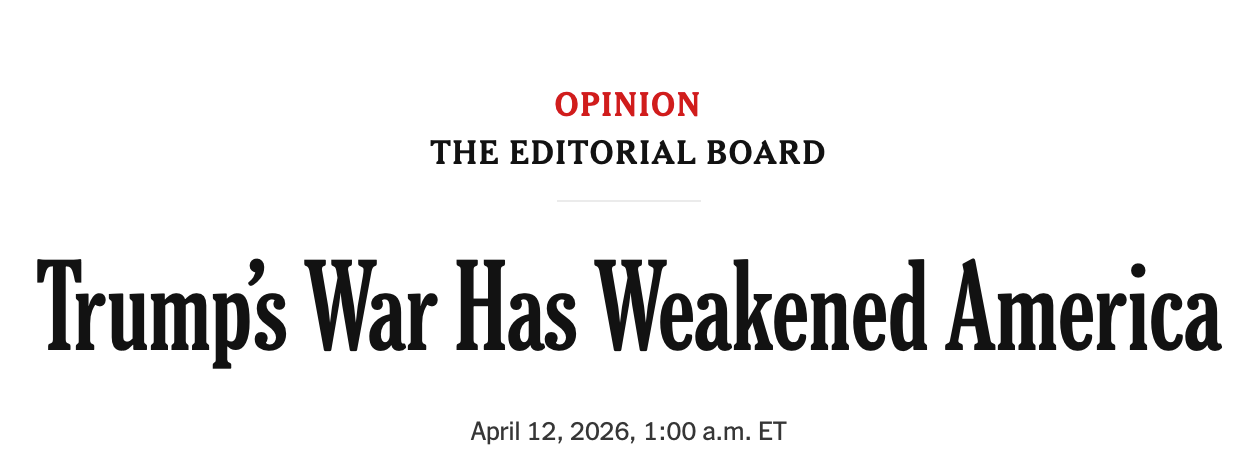
Even the New York Times sees it, though this editorial is specifically about the attack on Iran, not all the other ways the Trump Administration is weakening the country.

Vice President JD Vance has a playground bully's understanding of power, as has been clear at least since he went to Europe in 2025 and went out of his way to insult and patronize the world leaders he met with there. It too sacrificed the longterm power of having the trust and support of European heads of state and diplomatic leaders. Vance said this week in response to the Iranian refusal to give up the right to enrich uranium, "You know what? My wife has the right to skydive, but she doesn't jump out of an airplane because she and I have an agreement she's not gonna do that, because I don't want my wife jumping out of an airplane." This stunningly idiotic analogy seems intended to mean that Iran is like his wife, someone who has to agree to his wishes, but he has instead shown that he doesn't understand analogies, power, Iran and, possibly, wives.

Last week Vance went to Hungary to try to stump for Viktor Orban, the authoritarian president there who as I write, has just lost the election after sixteen years as prime minister, during which he worked hard to spread authoritarianism around the world, including in the USA. The vice president's efforts were said to have been the opposite of helpful. Only yesterday, the inexperienced Vance failed to gain anything in his negotiations with a far more skilled Iranian negotiating team. The Trump Administration appears to have lost this war – had it won, it would be dictating terms, rather than unsuccessfully negotiating to return to the status quo of an open Strait of Hormuz. And of course the main justification after the fact for the war is Iran's alleged pursuit of nuclear arms, but speaking of soft power and the power of cooperation, Trump sabotaged the deal the Obama Administration struck with Iran. Soft power trumps the power of violence, over and over.

Flowers Bloom on Soldiers' Graves: Lessons in Power and Consequence
Consequences means the rule of law in this case, and equal justice for all, or so I'd assume.

And then there's the case of Congressman and California gubernatorial candidate Eric Swalwell, exposed Friday by a detailed account in the San Francisco Chronicle of his alleged manipulation and sexual abuse of a staffer and by another report at CNN detailing accounts of sexual misconduct by more women. It's a sordid story or several of them, and one that is only too familiar. Two things are most striking to me. One is his apparent gambling on getting away with exactly the kind of actions that have in recent years terminated a lot of men's reputations and careers and sent some to prison (even if some have bounced back or escaped the most serious consequences).

The other is that while espousing Democratic and presumably lower-case democratic values, he allegedly used the power differential to bully and coerce young women, and counted on that inequality to keep them silent. Now he looks likely to pay for his abuse of power with a permanent loss of it. Democratic values in the sense I just employed it means a world in which the rights and voices of young women matter even when they're in conflict with a powerful man, a new world just emerging thanks to feminism. The soft power Swalwell had as allies, supporters and endorsers building possibilities of further political power is fast draining from him. By using coercive power, he has lost cooperative power.

The lesson flowers offer is that when you treat others well, when you meet their needs, you can enter into relationships that serve you as well as them. When you use violence or otherwise exploit and coerce to get what you want, you create adversaries, not allies, and they too often turn out to have power. In a world of increasingly equality over the past few centuries, cooperative power matters more, and violence, as Schell points out, has become an increasingly weak way to get what you want (though of course it's still necessary at times in self-defense).

We are increasingly coming to understand nature itself – Haskell's book is a fine exploration of this – as orchestrated by cooperation and symbiosis, not the Social Darwinist's vision of brutal competition for scarce resources. It's only one of many splendid books about this new vision of nature to appear recently. Forestry scientist Suzanne Simard, whose book Finding the Mother Tree was a hugely impactful account of how forests are essentially communicating cooperatives, a deeply interwoven whole, not a collection of lone competitors, has just come out with a new book I'm excited to start reading, When the Forest Breathes: Renewal and Resilience in the Natural World.

I want to step away from all the ugliness in the middle of this essay and end with an illuminating story the doctor, writer, and zen priest Clayton Dalton reminded me of, in a talk (now a podcast) titled "Bearing Witness in Gaza" he just gave at Upaya Zen Center. In the course of this talk that also covers his volunteer medical work in Gaza, Dalton recounts an ancient story of an ancient man with a curious beard who repeatedly came to listen to a Zen master talk. When the latter inquired about who he was, the former explained, in Kazuaki Tanahashi's translation, "I am not actually a human being. I lived and taught on this mountain at the time of Kashyapa Buddha. One day a student asked me, 'Does a person who practices with great devotion still fall into cause and effect?' I said to him, 'No, such a person doesn't.' Because I said this I was reborn as a wild fox for five hundred lifetimes."

He wanted to be freed from the consequence of his denial that we are all subject to consequences. The priest helped liberate him and then held a funeral for the aged fox they found in the mountains. Consequences in this sense could mean interrelatedness. I began by describing power as connection; we influence others; others influence us, and how those two forces dance together or fall apart into conflict arises from our actions and the understanding behind them. Dalton said that he has "found that something happens when you begin to perceive things in this larger, more inclusive way. I have found, sometimes to my surprise, that compassion rises up into this spaciousness, like water filling a well from below.”

Flowers Bloom on Soldiers' Graves: Lessons in Power and Consequence
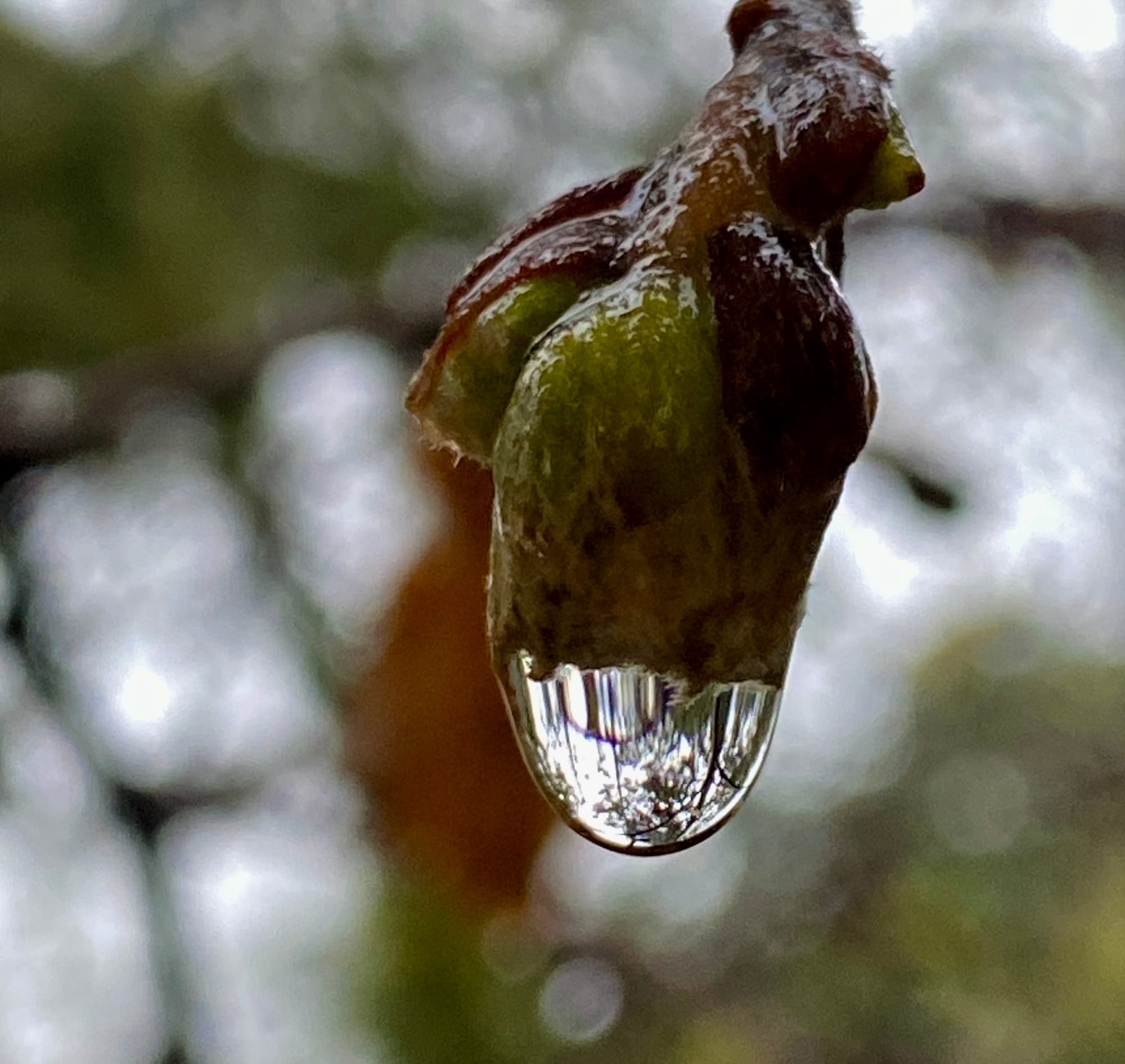
A raindrop on the tip of a bud in a coastal forest protected through the valiant efforts of local women sixty years ago and more. The forests and all 100,000 acres of Point Reyes National Seashore are the consequence of their commitment to the protection of this nature.

Zen master Dogen wrote a poem about seeing the moon in a dewdrop. In one interpretation, "the moon (Buddha-nature) is completely reflected in every one of the countless dew drops (all things) without discrimination, namely one in all, all in one." Elsewhere Dogen wrote, "The whole moon and the entire sky are reflected in dewdrops on the grass, or even in one drop of water." It is all connected. In my most recent book I quoted the scholar Judith Butler who has another explanation of why violence should not be conflated with strength or power: “In my experience, the most powerful argument against violence has been grounded in the notion that, when I do violence to another human being, I also do violence to myself, because my life is bound up with this other life."

p.s. I should have mentioned that in The Unconquerable World, Jonathan Schell is deeply influenced by the German Jewish philosopher and refugee Hannah Arendt's writings on violence and essentially reiterates her positions, with the addition of his own insights about nuclear weapons and the power of nonviolence and civil resistance. The book was treated shabbily when it appeared in 2003 just as the invasion in Iraq was starting and a lot of people had a lot of faith in violence; time has further validated his views.

p.p.s. Re: Netanyahu weakening Israel: https://www.inss.org.il/social_media/israel-is-losing-americas-youth/

69da759a14d2500001d8e39e
Extensions
Between the Impossible and the Inevitable: The Case for Defiance (aka Never F**king Surrender)

I have been hesitating to hit send on this one, because across the world we are all under the shadow of Trump's threat to commit war crimes that will "eradicate a whole civilization" in Iran while Iranians bravely surround threatened infrastructure with human chains. But I&

Show full content
Between the Impossible and the Inevitable: The Case for Defiance (aka Never F**king Surrender)

I have been hesitating to hit send on this one, because across the world we are all under the shadow of Trump's threat to commit war crimes that will "eradicate a whole civilization" in Iran while Iranians bravely surround threatened infrastructure with human chains. But I've decided, in this essay's spirit of defiance, to send it out, and it may be only too topical if the worst happens, still relevant if nothing does.

To know that you don't know is the beginning of wisdom, and to pretend, including to yourself, that you do when you don't is a form of foolishness often mistaken for worldliness. So much of my writing about hope has been nothing more or less than an invitation to recognize that we don't know what's going to happen, not least because the future does not exist in the same sense that a cake does not exist even if the flour, butter, sugar, etc. are on hand; whether the cake will be made at all and what kind of cake is yet to be determined, and if it is in fact mixed up and baked, we do not know whether it will be poisoned or accidentally dropped or served up nicely. (As a baker, I could add there are a lot of possibilities from angel food to devil's food to fruitcake and upside-down cake, to cite a few more symbolic names; even to say cake will happen leaves a lot of room as to what kind of cake. As a tech critic I could add that there are now reportedly a lot of AI accounts putting out slop recipes that don't work, including "recipes for deadly chlorine gas, 'poison bread sandwiches' and mosquito-repellent roast potatoes" as well as for human flesh.)

The cake, the future is being made in the present, including by how we show up or fail to. If we know what's going to happen, we cannot participate in deciding what happens, and vice-versa. To pretend to have the power of being in charge of the former is to surrender the motivation to impact the latter in an active and intentional way. It's to give up the very real power we have for a pretense at a power that is really merely a posture. And yet claims we have no power to impact what happens are nevertheless an intervention in what will happen, by discouraging participation, by encouraging passivity, surrender, acquiescence. If you insist that a given outcome is inevitable, you are lobbying against resistance. At best, you've surrendered; at worst you're complicit in the outcome.

I hesitate to call the pretense that we know what will happen a lie, though it is a claim that exceeds the bounds of what can be true. Sometimes I think it's just habitual, a contagious corruption of how we use language, or a lot of us do. I think that often when someone makes that kind of pronouncement, they're avoiding their own inner life and thereby avoiding acknowledging that they're talking about their feelings. "I fear that this will happen" or "the idea that this could happen fills me with anxiety and dread" are both technically subjective statements but they're actually also true, honest, factual ones if that's what's really driving the pronouncements. "This will happen/we are doomed" hides the subjective truth of the feelings driving the statement to pretend to have an objective and universal handle on what will happen. It's a journey from vulnerability to authority that's also a journey from truth to bullshit. That journey has become a well-trodden path, a mental rut.

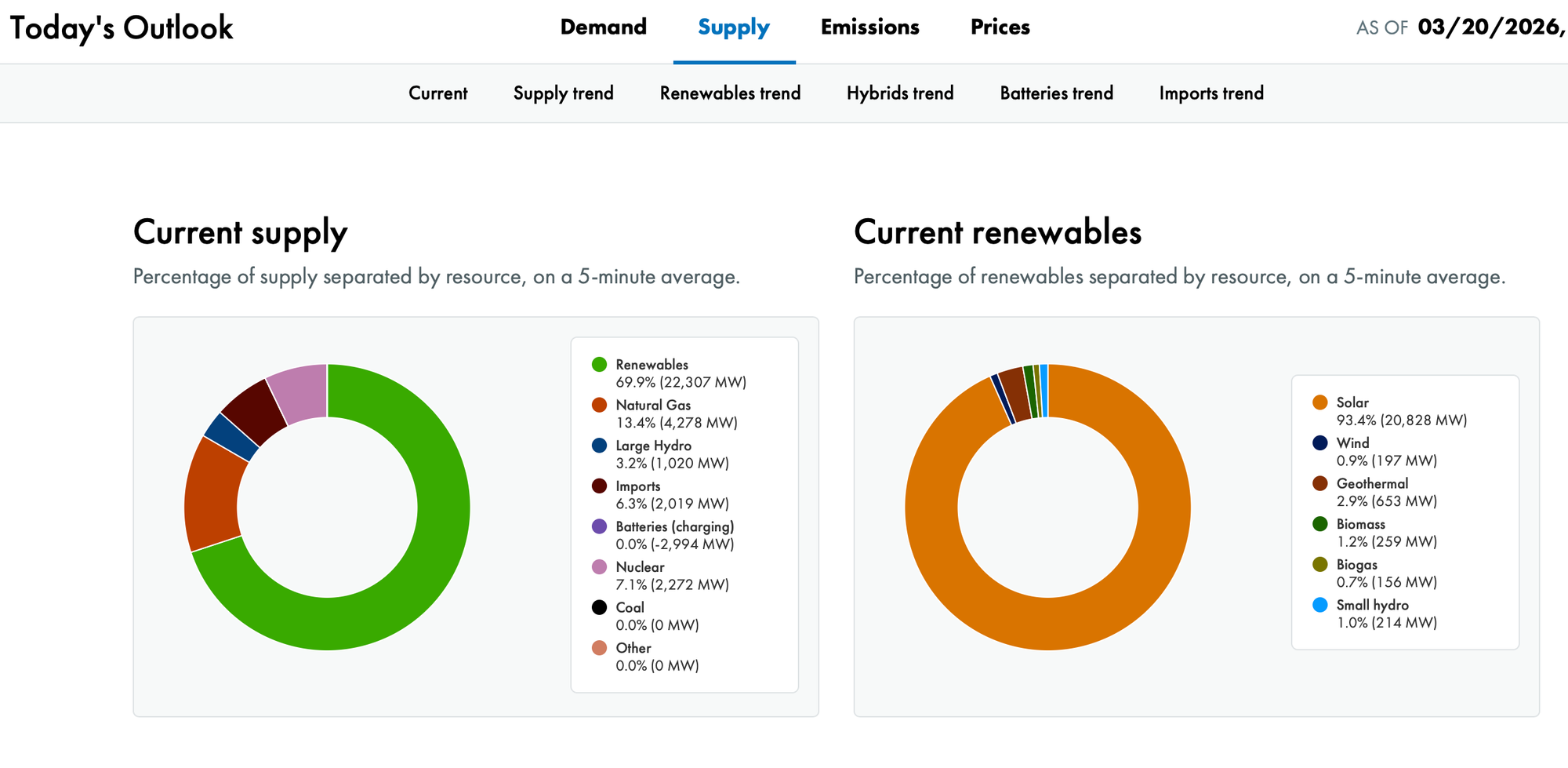
Perhaps a contributing factor to this is that in the rearview mirror, history seems pretty coherent and predictable, if you don't look closely. We're adjusted to a world in which the Berlin Wall fell; the Soviet Union disintegrated; Canada after telling its Indigenous arctic peoples they were doomed and trying to speed that doom into least the 1970s reversed course and in 1999 created an indigenous-governed province, Nunavut, three times the size of Texas; Mexico elected a Jewish woman climate scientist president; Ireland ended the Troubles and legalised abortion. To a world in which the feeble and expensive solar and wind technologies of the year 2000 became the superb (and still evolving) technologies of 2026 that are also cheaper than any other form of power generation throughout most of the world. None of these current realities were readily seen through, so to speak, the front windshield rather than the rearview mirror.

False certainty is dangerous; it rules out all possibilities but one and in essence surrenders to that imagined future. I remember people dismissively telling me that the 2016 joke candidate Donald Trump could never be elected, while they took Hillary Clinton's 85% chance of winning as pretty much the same as 100%, as if the likely was the inevitable, the unlikely the impossible. We've been living in the unlikely ever since (that a sundowning clown who is also the most powerful man in the world threatened the people of Iran with war crimes while standing next to a fretful life-size Easter Bunny would once have been unbelievable, but here we are). There is a lot of space between inevitable and impossible, and that is the space of the possible, good and bad.

Between the Impossible and the Inevitable: The Case for Defiance (aka Never F**king Surrender)
Psychotic clown nightmare movie still; also the reality of Easter Morning at the White House.

In Congressman Jamie Raskin's magnificent memoir, he writes about one of his early races for office, a race in which one "expert" pronounced his victory impossible and then when he won by a landslide another called it inevitable. Raskin notes, "So we went from impossible to inevitable in nine months because the pundits are never wrong, but as I told Tommy, we showed that nothing in politics is impossible, and nothing in politics is inevitable. It is all just possible, through the democratic arts of education, organizing, and mobilizing for change."

But the word hope, which I've been using a lot since 2003, is one a lot of people balk at, sometimes because they conflate it with optimism, or feeling good, or confidence. I often note that optimism, like pessimism, cynicism, despair and doomerism, are predicated on knowing what will happen; hope brings us back to where this essay started: the knowledge that we don't know, because there are at least to some extent possibilities, not inevitabilities, ahead. My friend Renato Redentor Constantino, a climate leader based in the Philippines, writes "The Franciscan priest Richard Rohr reminded his listeners once about a tenet so basic it's ignored if not contested: the opposite of faith is not doubt; it's certainty. The belief in certain doom or the belief in certain victory both do not require action. The truth? Faith is not just tested by doubt; it is reinforced when we act without any guarantee of outcomes."

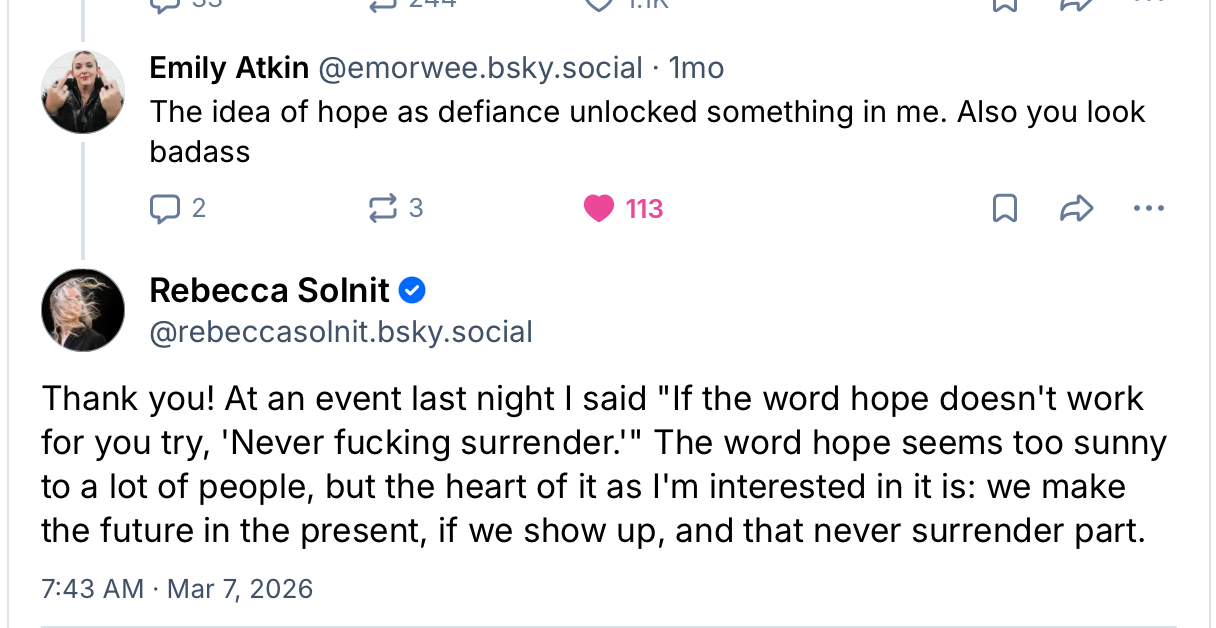
Lately I've tried to go light on the word hope, and all through last year the word resolute stayed with me, as in standing firm, resolved, determined, unwavering; that's what you can be even if you don't feel hopeful. I had the following exchange with climate journalist Emily Atkin on BlueSky last month (she was responding to the New York Times interview with me that appeared then):

Between the Impossible and the Inevitable: The Case for Defiance (aka Never F**king Surrender)

We surrender as if to the inevitable when we turn our backs on the possible. I've been thinking about all this again because of a thoughtful, fierce essay by scholar John Plotz I came across this week. It's both a look back to reflect on Hannah Arendt's 1971 essay on lying and the Pentagon Papers and a look around at where we are now. The Pentagon Papers, released by whistleblower Daniel Ellsberg, made it clear that high US government officials had through many administrations built lie upon lie rather than admit the US was losing the Vietnam War. Arendt's essay has only too many echoes of the current situation with the pointless, unwinnable war on Iran Trump launched and doesn't know how to get out of, partly because he doesn't want to admit it was a catastrophic bad idea and nothing can change that. She wrote, "From 1965 on, the notion of a clear-cut victory receded into the background and the objective became 'to convince the enemy that he could not win.' Since the enemy remained unconvinced, the next goal appeared, 'to avoid a humiliating defeat,' as though the meaning of defeat in war were mere humiliation." The experts' concern was not what the impact of defeat meant for "the welfare of the nation," let alone what it meant to kill hundreds of thousand of Vietnamese people and tens of thousands of US soldiers just for the prestige of the USA and its president. Which sounds too familiar as a US president kills Iranians in a war he cannot justify, with no clear goals, exit strategies, strategies at all, or ideas of how to end the thing.

Stohr's essay looks back at Arendt's ideas about the crises of truth and reality in her time and forward at them in our time. He writes: "I am grateful that Timothy Snyder ... has provided one phrase to warn us about what is happening now in response to Trump’s bs: “anticipatory obedience.” Bad as such anticipatory obedience is, though, it is not the only problem. Arendt’s insistence on seeing the facts as they are now (not as we fear they will become if this goes on) helps us see a corollary phenomenon, potentially just as damaging, which we might call anticipatory despair. Anticipatory despair preaches to the choir on the left, assuming we have already fallen into a far deeper pit than has yet been dug (maybe it is the left’s equivalent of the right’s “brokenism).” The dean of Columbia’s journalism school recently told students “Nobody can protect you … these are dangerous times.” When your dean tells you that, it’s not just an empty flourish, it is a definite speech act, an abdication of responsibility by those who can in fact take meaningful actions to protect their students.... Those who have been afflicted with anticipatory despair write as if we too were already in an American version: “Nobody can protect you” is a haunting refrain and a self-fulfilling prophecy." 

Anticipatory means looking ahead, assuming that you can look ahead and see what will happen, and adapting to what you've decided will happen. This is exactly what Snyder meant by obeying in advance. It is a clear alternative to committing to try to participate in what will happen. History offers countless examples of those who not only did not obey in advance of whatever threat hovered over them but did not obey after threat became reality. At the heart of this country's own history are the enslaved people who refused to give up believing in their right to be free and the quest for freedom and the Indigenous people who refused over centuries to abandon their land, their rights, and their culture in the face of immense pressure to do so. The rest of us can take instruction from their tenacity.

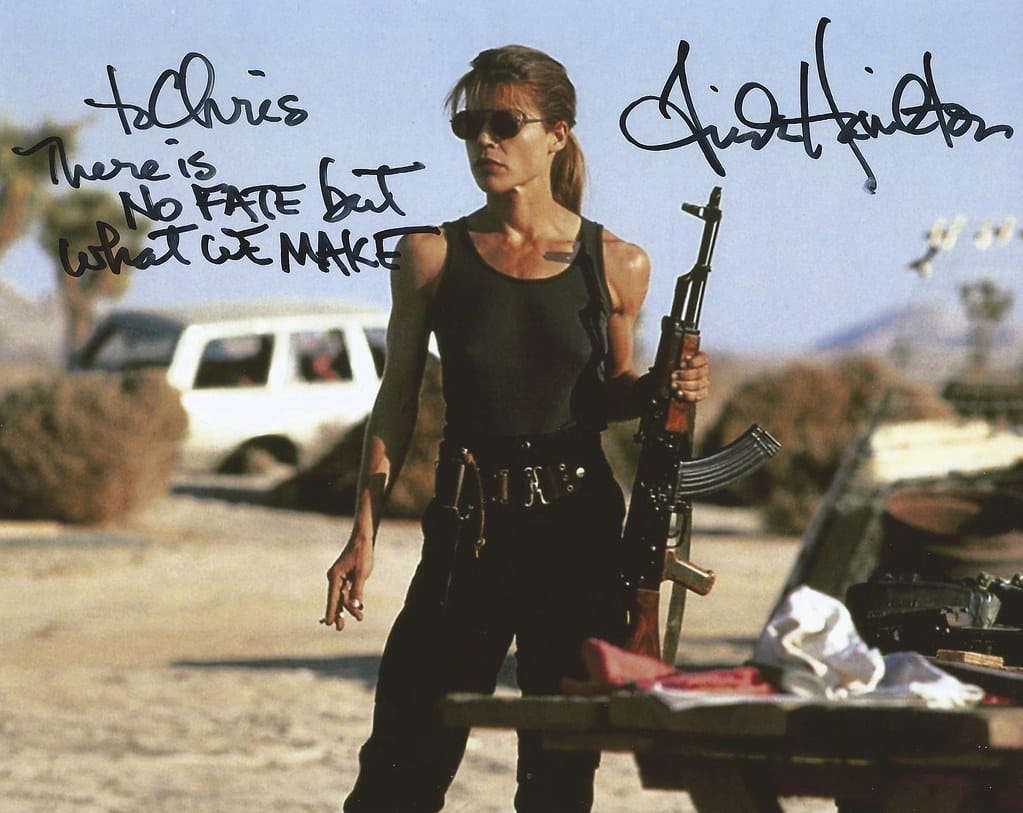
I often go back to the 1991 film Terminator 2, in which the fate described in the first Terminator movie is revised – the SkyNet mega-computer that will launch the Age of the Machines is destroyed, and other acts in the present shift what the future can and will be. Of course Terminator 2 is a science-fiction movie in which because time-travel exists people can know the future, but you don't have to know it to know you can participate in making it. "No fate but what we make" declares protagonist Linda Hamilton who has morphed from a maiden to be rescued in the first film to a ferocious warrior mom in the second. When I saw the movie in a theater a few years ago, it also struck me that co-star Arnold Schwarzenegger had no idea that he would himself enter politics, become California's governor from 2003 to 2011, and turn into to everyone's surprise (possibly including his own) a strong advocate for climate action. That is, he would try to change the future for real.

Between the Impossible and the Inevitable: The Case for Defiance (aka Never F**king Surrender)
Pardon the gun here; movies like changing the world to happen in simple ways, though lone heroes or small bands of them committing violence; we know changing the world usually involves instead good ideas, good organizing, and then mass movements shifting public opinion and then public reality.

You can see a version of Terminator 2 in the battles against both AI data centers and ICE warehouse-prisons across this country. While a lot of elite leaders and people invested in Silicon Valley's AI products talk as though its invasion of our lives, minds, economy, and society is inevitable, ordinary citizens are refusing to accept this wildly unpopular bundle of technologies and threats. (One striking aspect of the last few years, especially since Trump returned to office, is that elites are often more timid and willing to surrender, despite all their power and protection, than a lot of the rest of us.) Tech critic Brian Merchant writes in his newsletter that there's been "years of increasingly energized, widespread and bipartisan opposition to data center development on the municipal and state level. Several of those efforts have successfully shut down or delayed planned data centers. The movement has grown so broad, and so concerning to the AI industry, that a group was launched just to track it. Eleven states, from deep red to dark blue, are currently considering data center moratoriums; Georgia, Vermont, Michigan, Virginia, North Dakota, and South Carolina are among them. The mayor of Denver, Colorado just passed one. The Seminole Nation of Oklahoma became the first tribal council to enact a moratorium on data center development. It’s not just data centers, either. It’s a trend I’ve noticed over the last few weeks: Across the AI economy, workers and consumers have taken to refusing the technology in direct and robust ways." (He also reports on ways that the publishing and gaming industries are rejecting AI, as has Wikipedia, thanks to the abundant errors that come with it.)

Meanwhile, ICE has paused buying up warehouses around the country and activists as well as local and state authorities have challenged their efforts to both purchase the facilities and convert them into prisons. The Associated Press reported last week, "The warehouse plan ran into challenges from the start. Eight deals were scuttled in places like Kansas City, Missouri, when owners decided not to sell. The plan was hatched during [now-fired Homeland Security head Kristi] Noem's tenure but immediately ran into intense opposition around the country by residents and communities opposed to such large Immigration and Customs Enforcement facilities in their neighborhoods. Many objected on moral grounds to ICE’s presence in their neighborhoods, while others questioned whether the facilities would be a drain on local resources, such as sewer and water systems." Like the Seminole Nation, the Choctaw Nation stepped in, buying a vast 1.24-million square-foot warehouse ICE was attempting to acquire, "settling in a single transaction a dispute that had drawn protesters, tribal resolutions, and an emergency city ordinance," according to the International Business Times.

We make the future in the present, when we show up. Don't surrender it to those who would destroy it.

69d433c48e287200015ea359
Extensions
Eight Million Protestors and No Kings: The Case for Showing Up

It wasn't just bigger than the previous #nokings. It was different. Here's how USA Today unpacks that: "The organizers' crowd count, not verified by independent analysts, put the total at 8 million people, topping the 7 million estimated at the previous No Kings day,

Show full content
Eight Million Protestors and No Kings: The Case for Showing Up

It wasn't just bigger than the previous #nokings. It was different. Here's how USA Today unpacks that: "The organizers' crowd count, not verified by independent analysts, put the total at 8 million people, topping the 7 million estimated at the previous No Kings day, in October. This time, there were more events scheduled − 3,300 versus 2,700 − and larger crowds were reported in some places, boosted in part by opposition to the war in Iran. In a nation with a population approaching 349 million, the participation of 8 million people means that more than 1 of every 50 U.S. residents joined a No Kings rally.Organizers said two-thirds of participants who signed up live in suburban, small town or rural areas. That's a 40% increase over last time in protesters from outside big cities. The left-leaning protests with the Revolutionary-era call against President Donald Trump as a would-be monarch and authoritarian had the broadest geographic reach of any single-day protest in the United States in more than a half-century [that's an indirect reference to Earth Day 1970]. They included not only familiar precincts in New York and Los Angeles and Austin but also communities in all 50 states and every congressional district, including rural and Republican areas."

So it was not only big but dispersed not in the sense of diluted, but distributed --deeper into non-urban areas and in every congressional district in the country (and every continent – at the urging of a friend I scrambled to try to make contact with someone who might take a picture of a No Kings moment in Antarctica; I failed but someone did it). Tennessee Indivible notes, "Pulaski, TN [a town of less than 10,000] showed out today — 100 people came together in a county where most folks said organizing would never take root.In a place with this much history, this much pressure, and this much expectation of silence, seeing that many neighbors stand up is nothing short of a breakthrough.This is what a shift looks like in a red state."

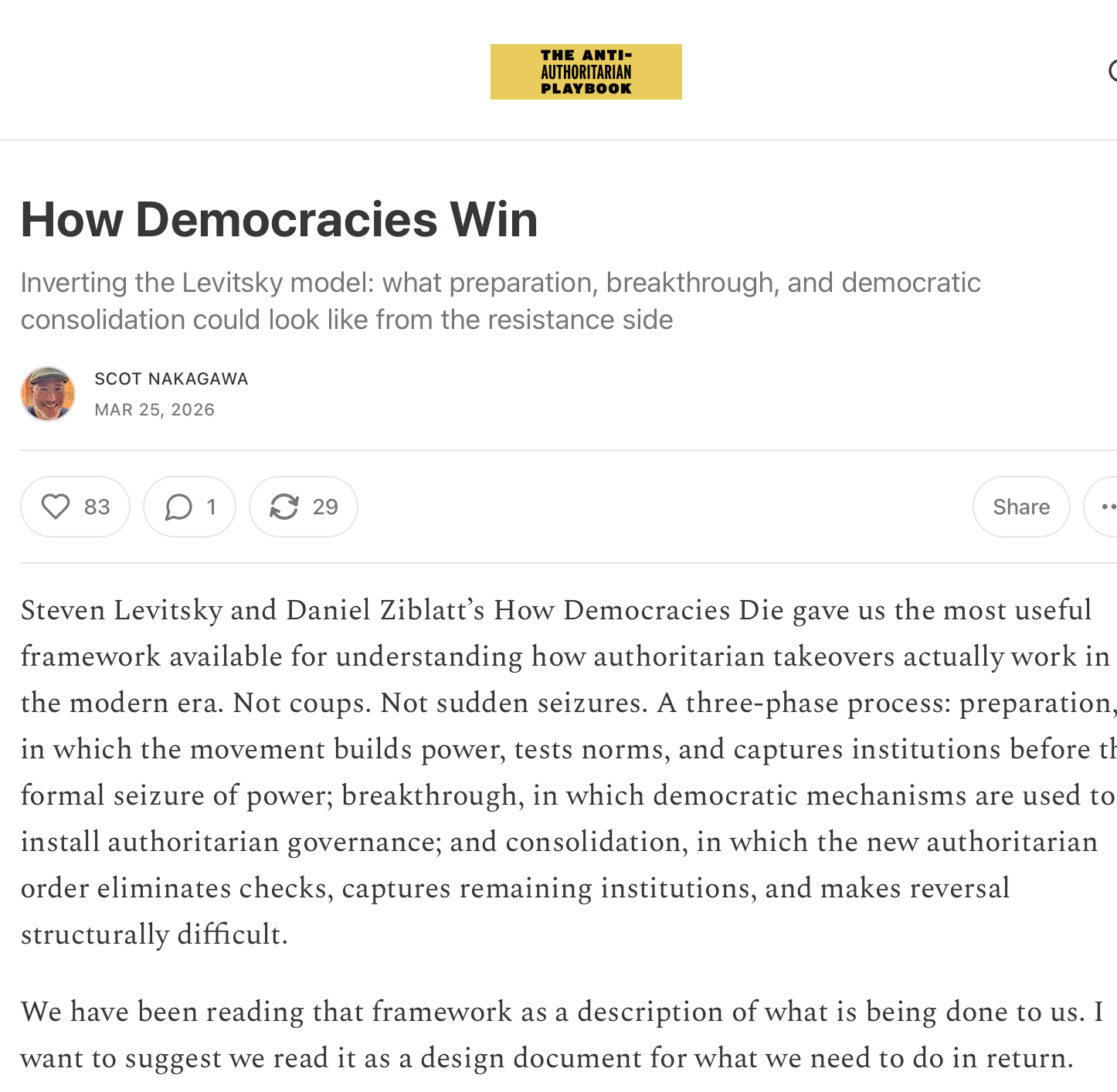
Jason Sattler, who writes as LOLGOB at his newsletter The Cause, reports, "Dana Fisher and Arman Azedi from American University were in DC with clipboards, surveying participants in the No Kings 3 march across the Frederick Douglass Bridge. They have done this at every major resistance rally since the Women’s March in 2017." He cites among their results, "At the People’s March in January 2025, 10% of participants said they heard about the event through an organization. Yesterday, that number was 34%. Word-of-mouth from family and friends, historically the most common channel for protests, dropped from 48% to 38%. People are no longer being summoned by just outrage. They are being mobilized by infrastructure, which now likely includes their friends and family. This is the difference between a movement that surges and a movement that can win. 47% of DC marchers reported being members of a group, including groups that organized the event. 27% were members of FreeDC, the local organizer. 10% were Indivisible.... What you are watching is the conversion of protest attendance into activism. The people who showed up on Saturday were not taking a day off from normal life to register their feelings. They were the most civically active slice of the electorate, and they are getting more active. [Nonviolence scholar Steven] Levitsky described the three domains in which democracy is defended or lost: the ballot box, the courts, and the streets. His point was that no single one is sufficient — and that the streets, far from being the weakest, are the foundation the other two rest on." There's a quality of resoluteness out there. People have absorbed the monstrosity of the destruction and the corruption, and it appears to have steeled their commitment to continue to show up and resist.

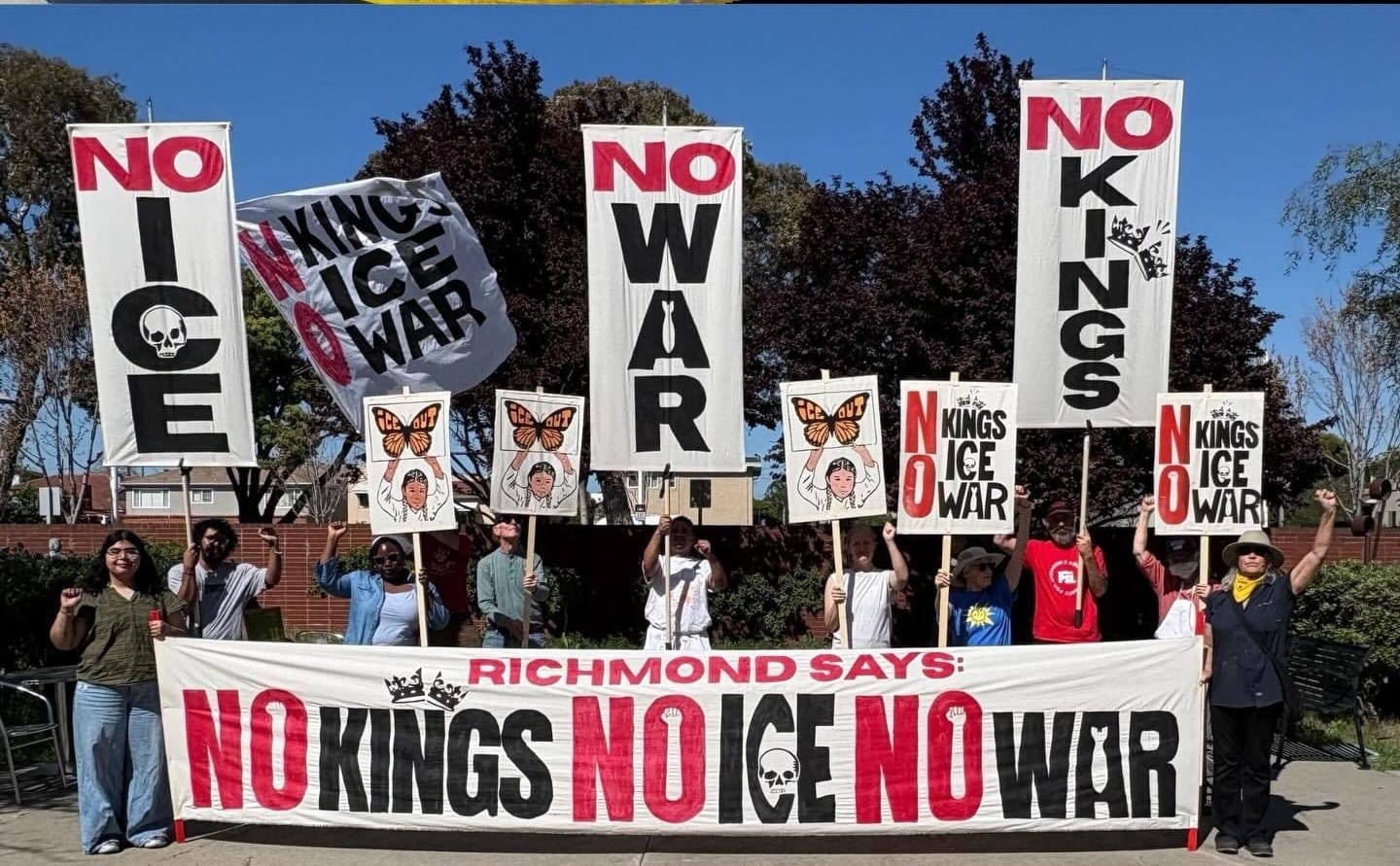
I've been to a lot of protests over a lot of years. There was an era when they felt very narrowly focused (and people trying make it about another issue felt like interlopers). One thing striking about this round of #nokings protest is that people recognize that it's all connected, because women's rights, immigrant and refugee rights, trans rights, voting rights, racial justice, public health, environmental and climate issues, the rule of law, and accountability are all under attack by the same players. I saw signs about Iran, signs about Cuba, about the Constitution, funny signs, furious signs, signs against Trump and the regime, signs for democracy and justice, and I saw a whole lot of Fuck Ice messaging.

Just before #nokings this Saturday, March 28th, a lot of criticism of it, of big protests in general, and of the organizers and participants in this one began to appear. When a lot of people suddenly begin to say the same stuff, I always wonder if division is being sown, and if so, by whom? It was the sudden online proliferation of these attacks that made me wonder; some of it was from real people, including people I know, but one friend reported a bot popping up on her social media to do it. On BlueSky disparagement of "normies" suddenly became a thing. A lot of the stuff I saw often made the same argument: that the people going to No Kings are not doing anything else and those who go consider that going to the protest is the whole job of addressing the crisis of advancing authoritarianism (advancing but also crumbling authoritarianism to be exact). That somehow it's a placebo and a soporific. That the participants are, in that most scornful term of those who consider themselves the true left, "liberals," a term that seems to equate to meekness and mildness and Not A Revolutionary.

The evidence suggests that a lot of mild-mannered people have been radicalized. One BlueSky guy reported 'Walking thru the “Ultra Normie” No Kings rally in my extremely rural, white town and there are Patagonia wearing moms carrying signs that say “DEAD PEDOPHILES DONT REOFFEND” and “ICE GETS THE WALL” and I hi fived an old guy with a sign that said MY DADDY FOUGHT NAZIS AND SO WILL I” this is wild. I cannot stress enough how these are PTA moms and soccer coach dads and I can best describe the vibe as “festively bloodthirsty.”' But the whole idea that there's a small cadre of revolutionaries who do all the political heavy lifting in this country isn't really accurate; a lot of it – I hope to do an essay on this soon – has been not just for decades but centuries by those who might be dismissed as nice ladies.

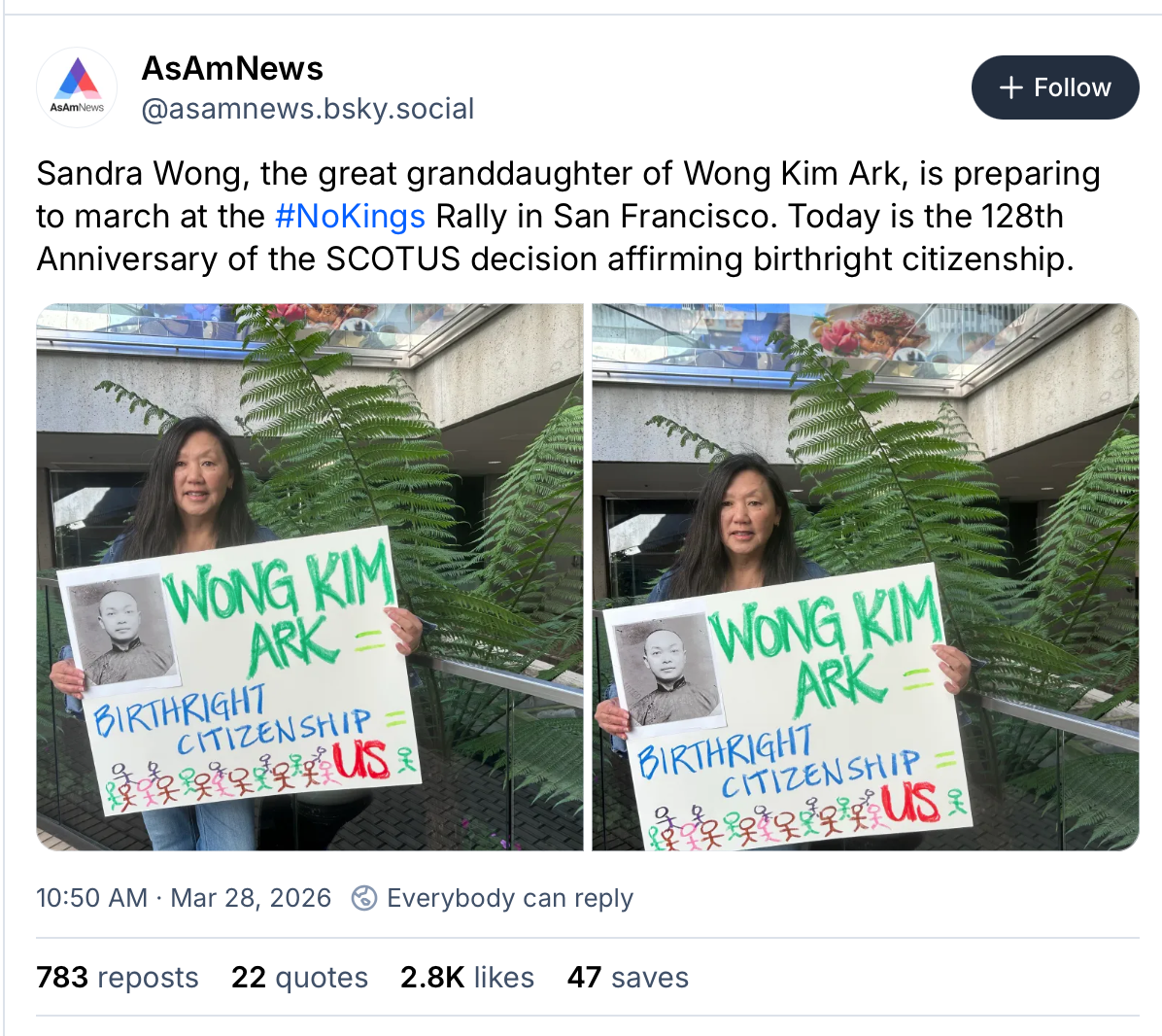
And people who showed up are showing up in other ways. As LOLGOP reported above, "47% of DC marchers reported being members of a group, including groups that organized the event." At the San Francisco event, I marched with a climate lawyer and saw people involved in unions, rights organizing, trans rights activism, and lots of other stuff. I didn't see her but I was moved to read about Sandra Wong, whose San Francisco great-grandfather sued all the way to the Supreme Court to get his birthright citizenship under the Fourteenth Amendment recognized. Her presence was a powerful reminder that the right is trying to undermine that right guaranteed by the Constitution since 1868 (and the Supreme Court is about to hear a case challenging that right this week).

Eight Million Protestors and No Kings: The Case for Showing Up

Tim Hjersted wrote a piece called "How To View Protests Like an Organizer "in response: "These critiques come from people who consider themselves more radical than the average protester. They carry a tone of world-weary sophistication. The implication being that those who show up are naive, and those who stay home see the bigger picture. Here’s the problem: this attitude is strategically illiterate. It mistakes cynicism for analysis. And it guarantees the one outcome its proponents claim to fear most: a movement that never escalates beyond what it already is. An organizer looks at a mass protest and sees something completely different. Where the cynic sees a feel-good spectacle, the organizer sees thousands of people ready to get involved — a chance to connect them with local groups, deepen their engagement, and build the relationships that every form of deeper resistance depends on."

He continues, "Protests rarely achieve their maximalist demands on their own. But they do things nothing else can: they shift public discourse (Occupy didn’t break up the banks, but the language of the “99%” permanently changed how Americans talk about inequality), they energize waves of downstream organizing (the Women’s March fed directly into the candidate recruitment and voter mobilization that flipped the House in 2018), they build relationships between people and groups who might never have connected otherwise, and they make visible the scale of opposition in a way that no online petition or social media post ever will."

But also what's wrong with feeling good? "Joy doesn't betray but sustains activism. And when you face a politics that aspires to make you fearful, alienated and isolated, joy is a fine initial act of insurrection," I wrote a while back. Timothy Snyder posted, "I was at a #NoKings rally yesterday and rather than writing another essay about why this matters I will just say that it is pure joy to meet the people who want to stand out and the people who are doing the work. Thank you."

There's fierce joy in feeling far from alone, and something magical can happen and has, again and again, when thousands of individuals feel part of a greater whole, feel the power of solidarity and the possibility that arises from it when they become civil society incarnate. I'm a believer in the almost sacred space of the street and th power of what happens there. I was really struck by LOLGOP's citation above of "the three domains in which democracy is defended or lost: the ballot box, the courts, and the streets. His point was that no single one is sufficient — and that the streets, far from being the weakest, are the foundation the other two rest on."

We need all three and more: we need organizing and building power in organizations and networks outside the established system of government. So far as I can tell, that work is being done, and it is as invisible as it is important, these millions of people learning to trust each other and work together to build alliances and organizations. A lot of the weakness and corruption in our society arises from the isolation and the withdrawal from public life that Silicon Valley inculcates and profits from. I believe that coexisting with strangers in public is a foundation, of democracy, an embodied participation in literal public life that underpins the capacity to participate in political public life.

I wrote in Wanderlust: A History of Walking long ago, "The street is democracy's greatest arena, the place where ordinary people can speak, unsegregated by walls, unmediated by those with more power. It's not a coincidence thatmedia and mediate have the same root; direct political action in real public space may be the only way to engage in unmediated communication with strangers, as well as a way to reach media audiences by literally making news. Few remember that 'the right of the people peaceably to assemble' is listed in the First Amendment of the US Constitution, along with freedom of the press, of speech, and of religion, as critical to a democracy. Citizenship is predicated on the sense of having something in common with strangers, just as democracy is built upon trust in strangers. And public space is the space we share with strangers, the unsegregated zone. In these communal events, that abstraction the public becomes real and tangible."

I do not know where we go from here. I know that a lot of people are working on it. In 2019, Greta Thunberg said  “Avoiding climate breakdown will require cathedral thinking. We must lay the foundation while we may not know exactly how to build the ceiling.”  I believe that millions are endeavoring to build a cathedral of democracy and a stronghold against authoritarianism. You build it in private in organizations and networks, and you build it in the streets with direct defense of those under attack and with protests like the monumental one on Saturday.

p.s. I found this a very useful piece for thinking about what should happen:

Eight Million Protestors and No Kings: The Case for Showing Up
69cb1f0dbf953d00016c92ce
Extensions
Remember: NO KINGS is Saturday. Also some notes on my new book

Find your #nokings march here. And while marches, protests, and demonstrations don't do the work of protecting democracy and human rights all by themselves, they're an important part of it, and very often an inspiriting one.

[What follows is a thread of various media with and

Show full content
Remember: NO KINGS is Saturday. Also some notes on my new book

Find your #nokings march here. And while marches, protests, and demonstrations don't do the work of protecting democracy and human rights all by themselves, they're an important part of it, and very often an inspiriting one.

[What follows is a thread of various media with and about me and my new book (strictly optional reading, but also audio and video options for those who like to take in their information and ideas that way) and a discount code at the end in case you want to order The Beginning Comes After the End yourself from the publisher; there's also an audio version I read myself.]

I might have mentioned I wrote a book and it got published and now I'm rushing about doing events and interviews and things, including, Tuesday night, a conversation with one of the writers I most admire: Anand Giridharadas, who's a brilliant political thinker, often scathing about the present but sometimes visionary about the possibilities, which is why he contributed one of the epigraphs to the new book: “We are living through a revolt against the future. The future will prevail.”

He posted that Brooklyn Public Library conversation at his (highly recommended) newsletter The Ink Wednesday morning.

Stop despairing. Start buildingMy conversation with Rebecca SolnitRemember: NO KINGS is Saturday. Also some notes on my new bookThe.InkAnand GiridharadasRemember: NO KINGS is Saturday. Also some notes on my new book

The Guardian conducted an interview with me last month that also dropped Wednesday:

‘A new world is being born’: author Rebecca Solnit on the ‘slow revolution’ the far right cannot tolerateIt’s easy to focus on authoritarians and their petty victories. But zoom out and the picture is more encouraging, says the woman who popularised the term ‘mansplaining’, whether it’s in feminism, or the environment, or civil rightsRemember: NO KINGS is Saturday. Also some notes on my new bookThe GuardianZoe WilliamsRemember: NO KINGS is Saturday. Also some notes on my new book

And there was this big New York Times thing in print, video, podcast, and glam photos. I was pleased that the thing that seemed to resonate most with people was this: "One of the great weaknesses of our era is that we get lone superhero movies that suggest that our big problems are solved by muscly guys in spandex, when actually the world mostly gets changed through collective effort. Thich Nhat Hanh said before he died a few years ago that the next Buddha will be the Sangha. The Sangha, in Buddhist terminology, is the community of practitioners. It’s this idea that we don’t have to look for an individual, for a savior, for an Übermensch. I think the counter to Trump always has been and always will be civil society. A lot of the left wants social change to look like the French Revolution or Che Guevara. Maybe changing the world is more like caregiving than it is like war." I have more to say about that when I have a moment.

Which led to this essay about me as a theologian:

We Don’t Need a Savior. We Need a Sangha.On Rebecca Solnit, implicit religion, and the theology hiding inside progressive politicsRemember: NO KINGS is Saturday. Also some notes on my new bookReligion, ReimaginedLiz BucarRemember: NO KINGS is Saturday. Also some notes on my new book

Speaking of theology, I then went to San Francisco's progressive Grace Cathedral and had a conversation with this lovely guy who's the dean:

Earlier, I had a conversation with Rowan Hooper, a young British scientist who zoomed in on the parts of the book focusing on new ideas in biology and their implications, and it turned out that Rowan has a fantastic new book coming out in August called Togetherness about symbiosis and collaboration in nature, which I'm reading (in advance) with enthusiasm.

Rebecca Solnit On Why the Future Isn’t as Dark as It LooksEpisode 353 The world might feel dark right now, but life is actually getting better, rapidly. From the rise of feminism and antiracism to environmental movements and shifting understandings of gender, the Western world looks nothing like it did 75 years ago. Yet despite so many historic victories for rights and ideas in recent times, it often feels like we’re living in dark times - with progress that’s stalling or going backwards. In her new book, The Beginning Comes After the End: Notes on a World of Change, writer and activist Rebecca Solnit explores how for decades social movements reshaped the world in ways we often fail to notice. Solnit argues that we are witnessing nothing less than the slow dismantling of an old worldview. And it’s time we pay attention. Rowan Hooper speaks to Solnit about the power of a good story, our growing understanding of the interconnectedness of nature and humanity - and why recognising progress may be essential to shaping the future. To read more about these stories, visit https://www.newscientist.com/ Learn more about your ad choices. Visit megaphone.fm/adchoicesRemember: NO KINGS is Saturday. Also some notes on my new bookNew ScientistRemember: NO KINGS is Saturday. Also some notes on my new book

There's a Youtube version here:

https://www.youtube.com/watch?v=PuyaGP3bAz0

And one more podcast, a conversation with Anne Strainchamps, formerly of the beloved NPR show To the Best of Our Knowledge:

Rebecca Solnit: Hope After the EndAs institutions unravel, Rebecca Solnit argues despair is a mistake—and that a more compassionate, just world is already being born.Remember: NO KINGS is Saturday. Also some notes on my new bookWonder CabinetAnne StrainchampsRemember: NO KINGS is Saturday. Also some notes on my new book

I did manage to write something for someone other than you, dear subscribers....

It begins: Feminism is far from dead, but people love to write its obituary. I’ve lived through dozens of them over the decades, and there’s been a fresh flurry over the past few years. These death announcements are mostly based on two dubious assumptions. One is that we’re at the end of the story, the point at which a verdict can be rendered and a moral extracted. In this version, 60 years on from the great 1960s surge of feminism, the process should be over, and if feminism has not won, surely it has lost. In reality, it’s naively defeatist to assume millennia of patriarchy entrenched in law, culture, social arrangements and economics could be or should have been fully disassembled in one lifetime.

and then it goes on to look at reproductive rights, #metoo, and the Epstein implosions. It was particularly satisfying to note: The eager obituary writers tended to announce that #MeToo had failed whenever further incidents of high-profile sexual abuse were reported (though the very fact they were reported and in some cases successfully prosecuted may have been a result of these shifts). The single most important impact of #MeToo, I believe, is akin to what many environmental victories look like: nothing, in the absolute best sense of that word. Success for many environmental campaigns is the river that was not dammed or polluted, the forest that was not cut down, the species that did not go extinct, the oil wells that were not dug, the coal that was not burned. Unfortunately, these results are invisible if you don’t know why the river is flowing freely, the birds are singing or the meadow near your home wasn’t paved over.

The one thing everyone gets wrong about feminismPeople love to declare the death of the women’s movement, pointing to the ‘failure’ of #MeToo or the Epstein files, but don’t give up the fight just yet, writes Rebecca SolnitRemember: NO KINGS is Saturday. Also some notes on my new bookThe GuardianRebecca SolnitRemember: NO KINGS is Saturday. Also some notes on my new book

The Beginning Comes After the End can be ordered from the publisher at a 30% discount at this link:

 https://www.haymarketbooks.org/books/2617-the-beginning-comes-after-the-end?discount_code=BEGINNING

And I cannot tell you how excited I will be to settle down and just be a writer again, not an opinion-slinger in person and podcast all over creation.

69c401113c22970001d1b8d7
Extensions
If Fossil Fuels Are War, Renewables Can Bring Peace

On one side of the world the US and Israel are pursuing an ill-conceived attack on Iran that has hugely impacted the flow of fossil fuel in the region. This is already having a grim impact on daily life in many nations, jacking up the price of oil and gasoline,

Show full content
If Fossil Fuels Are War, Renewables Can Bring Peace

On one side of the world the US and Israel are pursuing an ill-conceived attack on Iran that has hugely impacted the flow of fossil fuel in the region. This is already having a grim impact on daily life in many nations, jacking up the price of oil and gasoline, and threatening the availability of fossil-fuel-based fertilizer for spring planting. On the other side of the world, beginning in California and the Southwest and now spreading across the continent, an unprecedented heat wave has produced shocking temperatures for mid-March, with dire implications for agriculture, wildfire, snowpack and water flow. These two things are related. The climate is a crisis because for far too long we've burned too much fossil fuel.

The Associated Press reports, "The war in Iran is exposing the world’s reliance on fragile fossil fuel routes, lending urgency to calls for hastening the shift to renewable energy. Fighting has all but halted oil exports through the Strait of Hormuz, the narrow waterway that carries about a fifth of the world’s oil and liquefied natural gas, or LNG. The disruption has jolted energy markets, pushing up prices and straining import-dependent economies. Asia, where most of the oil was headed, has been hit hardest, but the disruptions also are a strain for Europe, where policymakers are looking for ways to cut energy demand, and for Africa, which is bracing for rising fuel costs and inflation. Unlike during previous oil shocks, renewable power is now competitive with fossil fuels in many places. More than 90% of new renewable power projects worldwide in 2024 were cheaper than fossil-fuel alternatives, according to the International Renewable Energy Agency." 

The war and the Iranian blockade of the Strait of Hormuz are pushing more people to recognize that fossil fuel is politically as well as environmentally devastating. Donald Trump never seems to think of consequences and the long game (sometimes he seems to imagine there will be none whether he's taking over the Kennedy Center or starting a war in the Middle East, perhaps because he imagines his is the only power that matters). But the longterm consequences of this war may be the opposite of what his fossil-fuel backers hope for: an accelerated energy transition. Of course, he's also fighting a war at home again renewable energy, slashing funding, withdrawing permits, and even considering bribing (with your money and mine) the French builders of US offshore wind farms to cancel. Here's a periodic reminder that in the summer of 2024 he told fossil fuel executives that if they gave him a billion dollars, he'd give them everything they want. They gave. They're getting.

As that Associated Press article notes, most new energy projects around the world are renewable, because it's now the best way to power anything that runs on electricity, and a related push is electrifying things from home appliances to construction equipment to industry. Bill McKibben noted in 2025, worldwide "people are now putting up a gigawatt’s worth of solar panels, the rough equivalent of the power generated by one coal-fired plant, every fifteen hours." What we call renewable energy is also decentralized energy. It's energy that can't be monopolized by cartels or corporations because sun and wind and hydro and geothermal power are far, far more widely distributed across the surface of the earth. Stanford climate engineer Mark Z. Jacobson long ago drew up transition plans for all fifty states and nearly every country on earth, making the point that different places have different mixes, but all have what they need.

It's domestic energy, local energy, and it's also free energy since once you build the infrastructure in the form of turbines or solar panels and the distribution system, your fuel is sun or wind that is both inexhaustible and free. Solar is now so abundant in Australia that electricity will be free for three hours a day when production (and the sun) are at their height. California has addressed this midday surge with the biggest battery array outside China, which stores that electricity and then puts it back into the grid at other times. I like to say that means from now on the sun shines at night. Because one of the really annoying things we were often told by naysayers about renewables is that the wind doesn't always blow, the sun doesn't always shine. Yeah, but with storage the mix can work and does.

If Fossil Fuels Are War, Renewables Can Bring Peace
Here's the California electricity grid as I write: 69% of electricity coming from renewables, most of it solar. https://www.caiso.com/todays-outlook/supply. Zero coal, because the last coal plant shut down last September, a year after the UK stopped its last coal power plant. Thanks to these renewables, California uses 40% less gas than it did in 2023.

But I want to digress about Australia for a moment. One of the things that prompted me to found MeditationsinanEmergency.com was a 2024 query to some of my editors about a piece I was really excited to write and that, to my frustration, they didn't seem to get. That confirmed I needed my own platform. The query was about a movie, so they didn't recognize it as political commentary, but it was about a movie that was in turn about the violent struggle over fossil fuel. That is, it was about another installment of the dystopian sci-fi action films that began with Mad Max. I had written my editors: I saw Mad Max Furiosa last night, which is a hot mess, but what was really striking was its stranding in what I once heard called 'yesterday’s tomorrows.' The film is mired in its 1980s vision of the future, but the obsession with gasoline just felt like a throwback. There they were under the endless Australian desert sun bashing each other for gasoline, cutting gas lines, blowing up each other’s internal combustion vehicles, fighting for a moated refinery called Gas Town, and so forth. I mean, you could put enough solar panels across the Australian outback to power several earths. [The smaller, grayer UK recently estimated that it would take only 1% of its land base to meet its 2050 renewables goals.]

If Fossil Fuels Are War, Renewables Can Bring Peace
Still from Furiosa: A Mad Max Saga, which is full of burning and crashing. Curiously it's not full of the cancer and other diseases exposure to fossil fuel products causes.


The amazing thing about renewable energy and an electrified world is that it’s just better in countless ways, starting with the fact that it means that almost all energy everywhere can be local, and the sunshine and wind are pretty much inexhaustible so there’s enough for everyone, and it’s all pretty clean and nontoxic, and the cars can be quieter; the film is full of roaring engines. Because we’re so focused on these technologies as a solution to climate change, most people don’t realize that they eliminate a host of other problems, and that would be true even if there was no climate chaos. Frederick Jameson famously said, “It’s easier to imagine the end of the world than the end of capitalism.” Apparently it’s easier, at least for director George Miller to imagine the end of the world than the end of the fossil fuel era; while over here in the real world we’re trying to accelerate the end of that era to forestall…well, not exactly the end of the world, but a good deal of devastation to it.  

A striking thing about that movie and its predecessor, Mad Max Fury Road, is that somewhere in its imagined grim future, there's a feminist oasis where people have figured out how to live, apparently in peace and equality, in a garden environment – it's where the Furiosa character comes from and is trying to get back to – but George Miller doesn't seem to know how to make a movie about the kind of subtle complex trouble we get in paradise. So he focuses on ultra-violent vroom-vroom internal (and external) combustion misogynist hell. It makes me think about Ursula K. Le Guin's landmark essay "The Carrier Bag Theory of Fiction," which proposes that the first human tool was not a weapon, but a container, because gathering was actually more significant a food source than hunting. But, she points out, how the men killed the mammoth makes a more dramatic story than how the women gathered the oats, a more obvious story, and the kind of story we get too often.

"I said it was hard," she notes, "to make a gripping tale of how we wrested the wild oats from their husks, I didn't say it was impossible." The renewables revolution is maybe like the wresting wild oats story – it's hard to even get people to focus on it and its magnificent (but technically complex and incrementally achievable) implications – while there's a lot of mammoth-spearing drama and gore in any war. Maybe we're in the trouble we're in here in the USA – and dragging the rest of the world with us – because too many people weren't very good at listening to the pragmatic wresting-oats story from the lady candidate and got captivated by the old man's fantasies of more mammoth-bashing. Or, to extend the metaphor, didn't realize our diet is mostly those oats, not gobbets of mammoth flesh – that is, that our well-being depends on things like economic policy and environmental protection and not on, say, dramatic violence against our neighbors courtesy of ICE.

What the Mad Max franchise (which began only six years after the 1973 oil embargo) got right is that fossil fuel in its extremely uneven distribution throughout the world always seems scarce, and there's always violence over it. The climate movement is a peace movement in two ways. First, it's an endeavor to wind down the many kinds of political and social violence – human-on-human violence – that is fossil fuel. Wars are fought for the stuff, and at every stage from extraction to refining and transportation to use (aka burning it), it's environmentally devastating, with poor, indigenous, and nonwhite communities (such as in Louisiana's Cancer Alley or the Native peoples near the Alberta Tar Sands) bearing the brunt of it. Secondly, you can regard the climate crisis as a war we're fighting against nature – human-on-ecosystem violence – and the movement as an attempt to realign ourselves with what the planet can bear. A movement to make some degree of peace with nature.

Climate change is caused by many human actions, and the solutions are likewise manifold: change how we design our residences, towns and cities, transit systems, agriculture, land management, and overall consumption habits, including food. But the single biggest one is: get over our reliance on fossil fuels. Climate change is itself violence as fires, floods, extreme heat, drought, famine, sea level rise and other catastrophes that both take human life and devastate the natural world. (Environmental historian Rob Nixon published a book in 2011, Slow Violence and the Environmentalism of the Poor, about the way we need to see these undramatic forces that poison, contaminate, undermine, force relocation as violence.) It is violence caused by the powerful minority that has delayed and derailed the decades of efforts to do what the climate requires of us. People die of stuff like the current heat wave (and heat-wave deaths are one of the most undercounted ways we die of climate chaos).

If Fossil Fuels Are War, Renewables Can Bring Peace
Screenshot from Friday: This heat is so extreme it's not just breaking records for March; it's exceeding records for April in some places. And yeah, it's impacting Mexico and Canada too. Weather and climate observe no borders.

Fossil fuel is historically tied to political violence and to the ugly geopolitics of the pursuit of the stuff. For example, the oil company BP began as the Anglo-Persian Oil Company, a British-controlled entity extracting Iranian oil in 1909. After huge profits went to the British government and shareholders, the Iranian parliament voted to nationalize the resources in 1951. Britain drew up plans to invade, but instead the US co-led a coup against the country's left-leaning prime minister, the monarchy was reestablished, the profits continued to flow to the West, and the Anglo-Persian Company morphed into BP. The 1979 revolution to overthrow the shah brought in the current government the US is attacking, and it too has devolved into a fossil fuel war, with attacks on oil infrastructure and a blockade of oil tankers. In the short term, this should produce huge profits for some fossil fuel corporations; in the long term it may – and may it – speed the transition away from the stuff.

The government of Spain has been outspoken against the attacks on Iran, perhaps because of its prime minister's left politics, but perhaps also because the country gets the majority of its electricity from renewables and is thus far less dependent on foreign fossil fuel than many other European countries. Meanwhile, from Ukraine to Cuba to Pakistan, countries are speeding the energy transition to achieve independence from the volatile and often brutal political economy of fossil fuel. (Trump is attempting to strangle Cuba, whose energy grid has collapsed, by shutting off the Venezuelan oil it depended on; China is supplying solar panels to help speed a transition.) In the US it's said to be producing a rise in interest in purchasing electric vehicles. Here's to peace on earth, all kinds of it, peace with nature, peace among human neighbors, and to the end of the fossil fuel era as a crucial part of that peacemaking.

69bdbac21b9b980001a6013f
Extensions
Today I Need to Say Something About (the Stupidity of) Antisemitism

Two stories erupted in the last twenty-four hours that have to do with antisemitism. One is deeply positive. It's a letter signed by 132 Jewish faculty and staff at UCLA rejecting the Trump Administration's definition of antisemitism while pointing out what's dangerous about this

Show full content
Today I Need to Say Something About (the Stupidity of) Antisemitism

Two stories erupted in the last twenty-four hours that have to do with antisemitism. One is deeply positive. It's a letter signed by 132 Jewish faculty and staff at UCLA rejecting the Trump Administration's definition of antisemitism while pointing out what's dangerous about this right-wing definition of antisemitism: it's an attack on free speech and legitimate opposition to the policies of the Israeli government. They might have added that it's an attack by the same administration that has been making nice with actual Nazis and open antisemites, which is how we know that this pretense to defend Jews is in bad faith.

It's trying to use Jews to advance a right-wing agenda. And in so doing it harms Jews by pretending that to oppose the Israeli government and/or its policies is antisemitic, which spreads the calumny that somehow all Jews are aligned with this government and its policies. Which is extremely not true. There are outspoken Jewish voices inside and outside Israel against the attacks on the Palestinians in Gaza and the West Bank, and more broadly against the Netanyahu regime. Prominent Jewish voices in the USA, including Judith Butler, Masha Gessen, former NYC comptroller and current congressional candidate Brad Landers, and Senator Bernie Sanders have spoken up about it.

Yet all across the political spectrum, some pretend that all Jews support the Israeli government. If you are a right-winger who wants to defend the Israeli government, this means you can conveniently pretend all opposition is antisemitism. Despite protests by specifically Jewish groups, such as Jewish Voice for Peace, even protests by rabbis. Alas, too many left-wingers likewise get on board with the obviously untrue notion that all Jews support the Israeli government which then becomes a justification for turning hatred of that government into hatred of or blaming of Jews (and since the October 7 attack, too many antisemites have latched onto the Palestinian cause to recruit the gullible to their worldview). I cannot count the number of times I've read or been told that all sixteen million Jews on earth are basically of one mind. Which is astonishingly stupid. (There's an old saying that if you put two Jews in a room you get three opinions.)

Today I Need to Say Something About (the Stupidity of) Antisemitism
This is at: https://www.ynetnews.com/article/bk9azbyoxe. It's from last summer.

Meanwhile the very smart people at UCLA point out that while they have a wide array of opinions overall, they share the rejection of one definition of antisemitism weaponized by the Trump Administration:

Although we hold varying views about Gaza, Israel, Zionism, and pro-Palestinian protests at UCLA—matters that have deeply divided the Jewish community—we are absolutely united in our vehement opposition to this ill-conceived lawsuit. The DOJ’s claim that Jews as a group face a hostile work environment at UCLA because of our religion or ethnicity is false. The DOJ takes advantage of Jewish concerns about antisemitism to attack free speech and academic freedom. The resulting lawsuit, which cynically invokes Title VII of the Civil Rights Act of 1964, will do absolutely nothing to protect Jews at UCLA. What it will do is inflict yet more damage to the culture of free expression and inquiry that is the beating heart of the university. ... The complaint paints a picture of our campus that we do not recognize. Many UCLA students, including Jewish students, are critical of Israel and its war in Gaza and have protested against it. The complaint relies on insinuation and misdirection to recast these students as antisemitic. ...Ironically, the DOJ cannot even recognize antisemitism when it occurs through a white nationalist attack on Jews, Muslims and students of color, because the DOJ is so obsessed with conflating pro-Palestinian and antisemitic speech.

[You can read the whole thing and see the signatories here.]

Today I Need to Say Something About (the Stupidity of) Antisemitism

I mentioned two stories in the last twenty-four hours. The second is the resignation of far-right antisemite Joe Kent from his position as director of the National Counterterrorism Center. Discord in MAGA-world and resignations from this administration are indeed good. But Kent's letter blames Israel in a she-made-him-do-it way: "It's clear that we started this war due to pressure from Israel and its powerful American lobby." He also does a thing that Republicans do all the time, which is to pretend that Trump is a both a brilliant leader who should not be questioned and a blameless innocent manipulated by nefarious others. What Trump does, when they don't like it, is always someone else's fault. Kent writes: "high-ranking Israeli officials and influential members of the American media deployed a misinformation campaign that wholly undermined your America First platform and sowed pro-war sentiments to encourage a war with Iran."

Then Kent gets into his full crazy: "This was a lie and the same tactics the Israelis used to draw us into the disastrous Iraq war...." Nope, George W. Bush and his administration (and UK prime minister Tony Blair) own that war fair and square. But it gets worse when he claims he lost his "beloved wife Shannon in a war manufactured by Israel," by which he seems to mean the Syrian civil war, which was a revolt of oppressed Syrians against the Assad regime, begun during the 2011 Arab Spring, ended only with Assad's fall in December 2024. His wife was blown up in 2019 by a suicide bomber who was apparently allied with ISIS, which is pretty far from "Israel did it." This morning's news made me look around to know a bit about who Kent is. There's plenty on him, including extensive criticism of his hiring.

Today the Associated Press offered some background: "His reference to Israel and claims about Jewish Americans’ political influence highlight Kent’s previous ties to antisemitism and right-wing extremism. It’s an antisemitic trope to suggest Jewish Americans have disproportionate control of media narratives. During his Senate confirmation hearings, Kent acknowledged that during one of his two failed congressional campaigns a political consultant set up a call joined by Nick Fuentes," who is himself an extreme antisemite. Will Bunch of the Philadelphia Inquirer put it well about the Kent situation: "My own take on Joe Kent is that he's a despicable Nazi who reached the right conclusion on Iran but did so partly because of his vile antisemitism, yet it's still a good development because it shows how Trump's base is further fracturing, which could hasten Trump's downfall."

Today I Need to Say Something About (the Stupidity of) Antisemitism
From Politico, 2022. Kanye West is also an antisemite.

What's striking about almost every form of hatred of a group is that it has to justify itself by pretending first that all members of the group are essentially the same so the haters can make all members of that group responsible for the crimes of any of them and then go for collective punishment of the group. That's been applied to Jews since the massacres in medieval Europe; lately it's been applied to Somalis in Minneapolis and immigrants/refugees in general by the Trump Administration, which is forever highlighting a crime by one or a few to try to justify collective punishment of the whole group. It's recently been the justification for attacks on trans women in the UK, whereby any act of sexual abuse by any one of them is used to demonize and criminalize the entire population and suggest they have no right to exist and are inherently threatening. There is no category of people, no sexual identity or orientation, no race or religion, in which every member is flawless, but there are only some categories in which, in the eyes of the haters, the sins of any one somehow become the responsibility and the guilt of all. After 9/11 George W. Bush and Co. weaponized anti-Muslim sentiment and the stupidity behind it to get too many Americans to back a war on Iraq, which had absolutely nothing to do with 9/11 and Al Qaeda, and to tolerate persecution of Muslims and people with Arab or middle-eastern backgrounds inside this country.

In 2016, my collaborators and I produced a New York City atlas, and one of the maps in it that was my idea is titled What Is a Jew: From Emma Goldman to Goldman Sachs, because a decade ago I was trying to make that same point: that Jews are not homogenous.

Today I Need to Say Something About (the Stupidity of) Antisemitism

I mean Bugsy Seigel, Barbra Streisand, Bob Dylan, Ruth Bader Ginsberg, and the Beastie Boys are not indistinguishable, or shouldn't be.

Today I Need to Say Something About (the Stupidity of) Antisemitism
Here's a detail from southern Manhattan

Here's a striking piece of the stupid: people say Israel as shorthand for the Israeli government, and then they pretend that all Israelis are Jews (only about 75% are), and that all Israelis support or are just indistinguishable from their government (which lots of protests and some peace movements make clear they are not). For people in the USA who are confident they are not one and the same as the Trump Administration, this should not be hard. But it apparently is. Some stupid goes so far as to blur the distinction between Israelis and Jews and we land back in the refusal to make distinctions. That's what's always striking to me about discrimination: it's indiscriminate.

Update: Kent is being investigated by the FBI for leaks. It's impossible to tell from the slight amount of available information if this is a legitimate investigation (in which case why wasn't he fired or put on leave earlier?) or a vindictive attempt to undermine his denunciation of Trump's war from a legendarily vindictive president and administration.

p.s. I have so many things I want to write for you, longer things, more hopeful things, but I've been really busy with book tour and promotion business. Thanks for bearing with me and I promise: there's more to come.

69b9a04f1b9b980001a56ebf
Extensions
Terminology, Clarity, and the Question of What Is the Left?

I often say that spoken and written are two different languages with their own grammar and their own difficulties and invitations. Anyone who's ever transcribed a conversation or an interview learns that most of us speak in phrases, rather than sentences, phrases whose intention is clarified by pauses,

Show full content
Terminology, Clarity, and the Question of What Is the Left?

I often say that spoken and written are two different languages with their own grammar and their own difficulties and invitations. Anyone who's ever transcribed a conversation or an interview learns that most of us speak in phrases, rather than sentences, phrases whose intention is clarified by pauses, inflections, and other auditory means that don't translate to the page). Most people are more fluent in spoken, but as a kid who didn't talk much but read all the time I am in some ways more at home in written, and I feel that my fingers are smarter than my mouth. That is, I trust my ability to write what I mean more than to say it. Saying it I often get flustered (and my habit of drawing a lot of things together is a sort of collage process that works better on the page than in the air; answering a complicated question I sometimes get tangled up in all the threads I'm trying to draw together).

I love being a writer, not least because I have hours to years to try to get the words and their meanings right, and I can see them on the page, reread, revise, fact-check, fine-tune, again and again until it feels like I've said what I mean. Which is why it came as an uncomfortable surprise when I reached the stage at which that my publishers expected me to do interviews in person, onstage, and on radio and for print (podcasts didn't exist yet). Extemporizing aloud doesn't allow for this time and process to get it exactly right, and whatever you blurt out under pressure may follow you around forever (some pre-recorded interviews allow for second takes, which I make use of with gratitude, but with live interviews, you have one chance, and you are generally not supposed to pause for more than a few seconds, no matter what gets thrown at you). The best interview draws you out, helps you find the deepest meanings and greatest possibilities; the worst tries to nail you with loaded and intrusive questions, even accusations, and mischaracterizations. I've gradually learned how to push back when I'm not too flustered or off-guard. Most interviews are somewhere inbetween. But also for a lot of interviewers, success is if they get you to say something spicy, controversial, over-share, and so forth.

I've been doing media interviews for my new book, The Beginning Comes After the End, for a month now, and it's been a lot, especially the three-day event that was the New York Times interview that appeared online this weekend as print, audio, video, and photography (gift link here and below). It was a wonderful opportunity to say what I believe matters, what's true, what's possible. It was also a tightrope to walk to try to get it all right (and look nice in the pictures and video and even clean up the house because the video was filmed in it).

In this New York Times thing, I got to say something I was very glad to get out into the world, in an answer to whether Gavin Newsom or Zohran Mamdani was the hero we needed: "One of the great weaknesses of our era is that we get lone superhero movies that suggest that our big problems are solved by muscly guys in spandex, when actually the world mostly gets changed through collective effort. Thich Nhat Hanh said before he died a few years ago that the next Buddha will be the Sangha. The Sangha, in Buddhist terminology, is the community of practitioners. It’s this idea that we don’t have to look for an individual, for a savior, for an Übermensch. I think the counter to Trump always has been and always will be civil society. A lot of the left wants social change to look like the French Revolution or Che Guevara. Maybe changing the world is more like caregiving than it is like war. Too many people still expect it to look like war."

And I said something I was less happy about. I replied to another question with Newsom in it, "I’m watching the left gear up to attack Gavin Newsom just in case he’s the nominee in 2028, and it makes my heart sink, because I watched people tear down Al Gore, I watched people tear down Hillary Clinton, I watched people tear down Joe Biden and Kamala Harris. There are definitely major things to critique about every one of them, but at the moment, when the job is to defeat the other guy, we defeat ourselves." That's something I would not have written or, having written it, would have revised and qualified and cleaned up, but you don't get to do that in an interview. I'm now seeing moderates use it to blame progressives and the left for lots of things, and leftists assert that I meant there should be no critiques, though clearly I said there should be. Somewhere else in the interview I did manage to say, "the left is a lot of different things, not a monolith."

I've been watching Newsom since his political career began, and there's a lot to criticize about the man. Like his flirtations with right-wingers like Charlie Kirk (there's a big difference between reaching across a divide and normalizing hate and lies – I mean if you meet a fascist halfway you're halfway to being a fascist). He's said terrible things about trans people and been both good and bad on climate stuff. But never mind Newsom, though he clearly wants to be president and will likely run, and will undoubtedly be better than JD Vance or whoever the Republicans field in 2028. I did mean it about seeing Democratic candidates for president sabotaged by campaigns so demonizing them and attacking and shaming and harassing anyone who supports the candidate that it dampens down the willingness to campaign or vote for the only person who'll defeat the Republican in question. I believe it's played a role in the defeat of the Democrats in multiple races since Al Gore in 2000.

The counterfactual of an Al Gore presidency is – well it's hard to imagine how different the state of the earth in regard to climate action might have been, and entirely likely there would've been no 9/11 (because the Bush Administration relaxed the anti-terrorism efforts of the Clinton Administration), and no Afghanistan and Iraq quagmire-wars. But also no appointment of John Roberts and Samuel Alito to the Supreme Court, and therefore no Citizens United decision in 2010 unleashing the tsunami of dark money in electoral politics (or to go further, "Chief Justice Roberts has voted to dramatically change the law of affirmative action, abortion, gun rights, separation of powers, free speech, the establishment clause, and the free exercise of religion, among many other examples" writes one scholar of the court) . Had there been no Donald Trump electoral college victory in 2016, there'd be no Gorsuch, Kavanaugh, and Coney Barrett and no overturning of Roe vs. Wade and a bunch of environmental legislation. Maybe there'd be a chief justice with enough principle to oust the utterly corrupt Clarence Thomas.Of course Gore would have done many things I would not have liked or supported, but as an activist said to me in 2012, you're choosing who you're going to fight with, not who you absolutely agree with. All that prompted me in 2016 to coin my most widely circulated freestanding sentence ever: "Voting is a chess move, not a valentine."

But it's risky to offer even mild criticism of the left, because people elsewhere in the political spectrum are so eager to turn your equivalent of a tap on the shoulder into their punch in the face, to amplify modest disagreement into blanket condemnation. As for that shorthand term "the left," it groups together some radically different coalitions and orientations. A couple of years ago, I wrote an essay addressing the shortcomings of the word: I said to a man working for Elizabeth Warren’s presidential campaign, at a point when he and the campaign were dealing with a lot of attacks from people who considered themselves the true left, “It’s as if we called fire and water by the same name.” Perhaps the left/right terminology that originated with the French Revolution has, more than two centuries later, outlived its appositeness. (In the French National Assembly of 1789, the royalists members sat to the right, the radicals to the left, and thus the terms were born.) The left I love is passionately committed to universal human rights and absolute equality and often is grounded in rights movements, including the Black civil rights movement.

I sometimes think of the current US version as a latter-day version of Jesse Jackson’s Rainbow Coalition. I’d argue that because of its intersectional understanding of both problems and solutions, this left is more radical—radically inclusive, radically egalitarian—than those who treat race and gender as irrelevancies or distractions (including the men, from Ralph Nader in 2000 on, who’ve been dismissive of reproductive rights as an essential economic justice as well as rights issue). Perhaps it’s seen as less radical because bellicosity is often viewed as the measure of one’s radicalness.

[This is part of why it was a joy to say in the New York Times that maybe changing the world is more like caregiving than war.]

Likewise, this rainbow left often has radical aims but is pragmatic about how to realize them. This might be because it includes a lot of people for whom social services and basic rights are crucial to survival, people who are used to compromise, as in not getting what they want or getting it in increments over time. All or nothing purity often means choosing the nothing that is hell for the vulnerable and I-told-you-so for the comfortable.

That’s the Rainbow Coalition-ish left; the other left has some overlap in its opposition to corporate capitalism and US militarism, but very different operating principles. It often feels retrograde in its goals and its views, including what I think of as economic fundamentalism, the idea that class trumps all else (and often the nostalgic vision of the working class as manly industrial labor rather than immigrants everywhere from nail salons to app-driven delivery jobs to agricultural fields). This other left is often so focused on the considerable sins of the United States it overlooks or denies those of other nations, particularly those in conflict with the USA, decrying imperialism at home but excusing it abroad.... It tends to rage against Democrats more than Republicans. If the word left means two opposing things, it's a useless or confusing word, but one that everyone keeps using. Including me in that interview.

Meanwhile I'll struggle to use language with clarity, precision, and accuracy, and I believe that's crucial to all our work in this world, whether it's telling one other person what's going on in our hearts or going on the radio to describe the world as it is and could be. But also we're in opposition to a regime led by people who have to lie about everything because what they're doing is so destructive and often so illegal and shameful, and who lie without compunction, catastrophically degrading language itself as well as accountability. Hannah Arendt famously said, "The ideal subject of totalitarian rule is not the convinced Nazi or the convinced communist, but the people for whom the distinction between fact and fiction no longer holds.”

Being a person who makes that distinction in what you say, being a person who cares about that distinction, is an essential part of resistance to totalitarianism and to the Trump regime. Aauthoritarians see facts, truths, history, science as enemies to be defeated, so that they can be the only source of information, the only determinant of truth. But also those lies mock accountability, including to the facts; the lies are aired as a kind of power over the truth and the listeners. Those things--facts, truths, history, science--are democratic by nature, but they need to be defended as part of the defense of democracy. The science of immunology or climate chaos, the economics of immigration, the history of racism and indigenous dispossession are not only true if convenient to the powers that be. They're true regardless, and protecting and asserting these truths is a crucial part of our work.

p.s. I do interviews because it's a duty of sorts, to the publishers and to participating in shaping the conversations about who we are and what's possible. Sometimes also it's a pleasure. Like, tomorrow at 7pm Atlantic/4pm Pacific, I'm talking with one of my heroes, dear friends, and longtime allies in climate work, Bill McKibben, online, and you're invited, if you're so inclined.

Rebecca Solnit Discusses: “The Beginning Comes After the End: Notes on a World of Change” with Bill McKibben – Third ActTerminology, Clarity, and the Question of What Is the Left?logoTerminology, Clarity, and the Question of What Is the Left?

My wonderful publishers are offering Meditations in an Emergency readers 30% off  the new book at this link. https://www.haymarketbooks.org/books/2617-the-beginning-comes-after-the-end?discount_code=BEGINNING

p.p.s. Like most or all of you, what's happening to and in Iran is heavy on my heart. I'm still figuring out what to say about it. In the meantime, here's what Bill McKibben said: "the U.S./Israeli force mounted another series of strikes, these on oil storage sites across the vast city of Tehran. The effect was astonishing—a cloud of truly toxic smoke—and I think it needs more notice than it’s been getting, even amidst all the other horrors of this war. This was in essence chemical warfare, even if the chemicals were the (easily anticipated) result of “normal” bombs. And it affected an almost entirely civilian population, that will be paying the price for decades to come. If we’re going to do this we should at least have to look at it." https://billmckibben.substack.com/p/a-dark-and-killing-cloud-over-tehran

Terminology, Clarity, and the Question of What Is the Left?
69aeea66ad01f700016a3735
Extensions
Visions of Life / Agents of Death: On Love Thy Neighbor and Love Thy Nature

Donald Trump's world is a dead and lonely world, a world in which everything is for sale and nothing really means anything and no one else matters. Earlier this year, he pressed Nobel Peace Prize winner María Corina Machado into giving him her gold medal, because

Show full content
Visions of Life / Agents of Death: On Love Thy Neighbor and Love Thy Nature

Donald Trump's world is a dead and lonely world, a world in which everything is for sale and nothing really means anything and no one else matters. Earlier this year, he pressed Nobel Peace Prize winner María Corina Machado into giving him her gold medal, because he does not comprehend that the medal is merely a symbol (a big shiny gold one to be sure) of honor, and to acquire it as he did is dishonorable. He confused a dead object with living respect, which cannot be extorted or bought. This grasping is evident in his dismissive words about the people who have already been killed in his newest war and those who might be.

It's evident in everything he does, and it leads to his inability to understand the limits of his hypermaterialist worldview. He acquired control over the building that housed the John F. Kennedy Center for the Performing Arts, thinking that he was thereby acquiring the prestige and the power over our arts and culture. But the Kennedy Center is not just a building you can grab and slap your name on. It's a system, a series of events and interactions, a whole network of relationships and principles and feelings, the feeling of performers who no longer want to appear there, of audiences who no longer want to buy tickets there, of employees who no longer want to work there. It's a system of relationships, not an alienable object. He has been forced to shut the building down while pretending it's for renovations rather than because the life in it has fled, and what he holds is a corpse.

He does not understand that the rules that apply to the acquisition of inert objects do not apply to the matters of the spirit and society. He cannot comprehend how honor and culture and admiration and community work or that the goods of the spirit can be inexhaustible – you do not run out of love through loving the way you might run out of cookies by giving away cookies, but also you cannot grab love or admiration or prestige the way you can grab a cookie. Which is also why he cannot understand the limits of power. The building is an object you can control, but the will of the people is something you cannot control through brute force.

This deadness, this disconnection, is at the heart of the main thing he would like us to shut up about and forget, the Epstein files. It's behind the grotesqueness of his desire to develop Gaza as a resort for an international elite. It was the thinking when he alternately insisted he wanted to buy or invade Greenland, with utter disregard for its indigenous inhabitants and government. Greenlanders said repeatedly that it is not for sale, and they do not want to be annexed or invaded and in the spring of 2025 did a very brisk job of whittling JD Vance's planned triumphalist visit down to a pathetic touchdown on the US airbase there. The fact that we already have that air base and have since the Second World War is part of why the now-abandoned claim that the US needs Greenland for national security was a bad joke.

It's an added insult that the former hotel and golf course developer not only treated Greenland as real estate, but real estate that Denmark can sell, saying at Davos, "And all we're asking for is to get Greenland, including right, title and ownership, because you need the ownership to defend it. You can't defend it on a lease." Greenland belongs to its indigenous people, not Denmark, and the idea that their homeland can be sold by others is insultingly oblivious to what the place is and means.

The threats to grab Greenland sabotaged something far more important if far less material: the US’s former good relations with most European nations and the role of NATO in global stability. The age of unshakeable alliance has been shaken up and broken down. But as with the Nobel medal, Trump craved what he perceives as a material possession and fails to understand the immaterial—in this case that political power comes through relationships and alliances and the trust that underwrites them, not just through autonomous power and possessions. In response to Stephen Miller’s Greenland comments, Danish parliamentarian Rasmus Jarlov said, "I hope he’s kept away from young women, because that’s the mentality of a rapist. You can’t defend yourself, so I’m going to take you." It was a fiercely brilliant comment, recognizing the parallels between state violence and personal violence.

The Epstein case is about the treatment of women and girl-children as commodities to be exploited with utter disregard for their needs, desires, dignity, humanity, the insistence on no connection, no relationship, no empathy, and the treatment of the whole gender as somehow less than human. It is not a coincidence that Jeffrey Epstein was a financier: he seemed to find satisfaction in the transformation of young female human beings into property without rights and agency. He even joked about Trump selling a "depreciated" woman to him.

Visions of Life / Agents of Death: On Love Thy Neighbor and Love Thy Nature
From the Epstein Birthday Book, this degrading joke about Trump human trafficking a woman or girl who is further objectified and commodified by being described in real estate terms as "fully depreciated" and sold -- thus the check.

Elon Musk, who has turned the AI feature on his social media platform into a vengefully misogynist pornography generator, said, "The fundamental weakness of Western civilization is empathy," and the radical right rails against it. (A new scientific study demonstrates that using X/Twitter with the right-biased algorithmic feed "increased engagement and shifted political opinion towards more conservative positions, particularly regarding policy priorities, perceptions of criminal investigations into Donald Trump and views on the war in Ukraine.") Empathy is the sense of an emotional connection to others, of care that extends beyond the self, usually underwritten by a sense of connection and identification, of non-separation.

The history of this country is, at its best, a broadening and deepening of who matters, with the end of slavery, the beginning of rights for women, movements for racial justice and disability and LGBTQ rights, the very recent public recognition of the profound wrongness of the genocide and dispossession of the indigenous peoples of the Americas. The Trump Administration is all about trying to run the process backward to make women and BIPOC people less equal again, to erase the "certain inalienable rights" that undocumented immigrants and refugees share with the rest of us, to make gender back into airtight boxes, to reinstate the inequality behind colonialism.

Visions of Life / Agents of Death: On Love Thy Neighbor and Love Thy Nature
JD Vance refuses to recognize that his values are profoundly at odds with his pope, and that he's regularly violating the tenets of the faith he's supposed to have converted to, as he abuses human rights at home and abroad. The pope has made this clear.

You can imagine Trump as Gollum with some of Sauron's powers, but to his credit, Gollum understood the One Ring was only as good as the powers that went with it. (While I'm at it with the Middle Earth analogies, let's call Silicon Valley's overlords orcs who think they are hobbits.) Trump wants the shiny stuff, whether it's the cheap molded glitz he glued to the walls of the Oval Office or the Purple Heart medal given to someone else entirely, wants the election victory whether or not he got the votes, the praise even when it's extorted and insincere, the utter farce of the peace award from FIFA, the international soccer federation. The poet W.H. Auden wrote of the Lord of the Rings trilogy, "Evil, that is, has every advantage but one – it is inferior in imagination. Good can imagine the possibility of becoming evil – hence the refusal of Gandalf and Aragorn to use the Ring-but Evil, defiantly chosen, can no longer imagine anything but itself. Sauron cannot imagine any motives except lust for domination and fear so that, when he has learned that his enemies have the Ring, the thought that they might try to destroy it never enters his head, and his eye is kept toward Gondor and away from Mordor and the Mount of Doom."

Visions of Life / Agents of Death: On Love Thy Neighbor and Love Thy Nature
Another way that the Trump Administration's imagination fails: it is itself a backlash against all the gains in equality and rights over the past several decades, and as it attempts to abolish them, it produces a backlash of even more support for immigration, even more opposition to ICE, and so forth.

Auden outlines one of our strategic advantages: they routinely fail to comprehend motives that are not selfish. So the idealism, the altruism, the commitment to ideals and principles, that motivates the resistance is seen as a cover-up for the real motives, which helps them cast progressives as criminal or delusional, but also made them unprepared for the heroic solidarity in city after city. JD Vance said in an interview last year, "I think a lot about this question of social cohesion in the United States.... And I do think that those who care about what might be called the common good, they sometimes underweight how destructive immigration at the levels and at the pace that we’ve seen over the last few years is to the common good. I really do think that social solidarity is destroyed when you have too much migration too quickly." He has since expressed versions of that view, even as the extraordinary solidarity in Springfield, Ohio (where Somali refugees are under attack), Minneapolis, and Los Angeles, among other places, demonstrates that in fact a lot of us are so capable of that empathy across racial and cultural difference that we will stand up for and with our neighbors and even risk our lives and our freedom. Jesus said, "Love thy neighbor" without qualifications about whether your neighbor was aligned with you ethnically or religiously.

Visions of Life / Agents of Death: On Love Thy Neighbor and Love Thy Nature

We are in a tremendous conflict of worldviews now, and that underlies many of the most urgent political struggles in this moment. In one worldview in which even rivers and mountains are alive, in which everything has rights and is entitled to respect, widely shared (with wide variations) by indigenous peoples across the world, in which the connections between humans and between human and nonhuman life matter. Trump, on the other hand, perfectly embodies the worldview of extreme capitalism in which everything is essentially dead: a commodity to be owned, exploited, destroyed at will. If even rivers are alive in the one view, even human beings can be and only too often have been reduced to commodified disposable objects in the other, as the Epstein files only too grimly document.

Each of these individual struggles matters – over the Epstein files and justice for the victims, the rights of immigrants, and refugees, over the rights of those currently being bombed by the US government, over the protection of the nature from which we were never separate. Underlying them is this broader struggle of ideas and values. Margaret Thatcher famously said "there is no such thing as society," meaning we're each on our own or should be and owe nothing much to each other and the common good. The antithesis of that might be the new scientific work reaffirming the old indigenous worldviews, recognizing that even in the absence of human beings there such a thing as society. For example, Suzanne Simard and other scientists have demonstrated that a forest is not a collection of isolated individuals competing with each other but a community of beings exchanging resources and information whose relationships are often symbiotic.

Among the consequences of this emerging – and re-emerging – worldview are the growing legal field of the rights of nature and the granting of personhood to rivers from New Zealand to Canada to Colombia and Peru. Underlying the rights and respect is a vision of interconnection and relationship, of aliveness, that stands in stark contrast to the alienation and deadness of extreme capitalism's worldview and the will to divide and disconnect of white supremacy and patriarchy. It is not only an indigenous worldview: Reverend DeWayne Davis, a minister at Minneapolis's Plymouth Congregational Church, declared to a reporter that the hundreds of clergy witnessing and standing up to ICE in the city's streets “didn’t do all that because we are heroes and saviors. We did it because we understand the meaning of our faith: that we are all connected. We join together. We are a part of a people, a body of humanity that is made in the image of a loving and beautiful God that wants all God’s children free.”

The reverend spoke of human inseparability much as Martin Luther King famously did when he declared, "all life is inter-related. All men are caught in an inescapable network of mutuality, tied in a single garment of destiny," and King was right that it's all life, not just human life. Maybe in this day and age, love thy neighbor should also be love thy nature. After all we are all neighbors to nature; we live in a grand neighborhood called the biosphere, the realm of life on earth, and we depend on it. We are it and it is us, from our gut biome to what we eat, drink, and breathe. Love in this case should manifest as active care.

Visions of Life / Agents of Death: On Love Thy Neighbor and Love Thy Nature
Demonstration in front of ICE hq in San Francisco last week led by Japanese Americans whose own experience of denial of rights and imprisonment during WWII is a foundation for empathy and solidarity with those currently under attack by this administration.

The United States government has launched wars on Venezuela and Iran,on immigrants and trans kids and women's rights, but its biggest war and its most impactful in the long run is the war against nature. Climate science is the study of the interconnection of all the organic and inorganic systems on earth. Denying this interconnectedness is essential both to the right-wing ideology of isolated individualism and to the perpetuation of the fossil fuel industry and its devastation of the climate. In that light, Greenland has long been under attack by the United States, because runaway climate change is threatening the stability of the ice sheets, climate, and traditional life ways of the island. As climate organizer and journalist Bill McKibben recently remarked, "there’s only one truly vital strategic asset in Greenland, one thing that could change the world. And that’s the ice that covers almost all its landmass." Were all its ice to melt, global sea levels would rise 24 feet. The US both produced a lot of historic climate emissions and now, under Trump, has left the global agreements to do something about the crisis and dismantled much of the legislation and funding to address it domestically.

All these war are related; they all come from the same ideology of isolation and mentality of commodification. The oil wars come in part from the refusal to see that we must exit the age of fossil fuel, that renewables already provide cleaner, cheaper, more universally available options. Sun and wind are also a solution to the constant strife of the age of fossil fuel, because you cannot steal sunlight and wind and you do not need to, because they are so widely distributed across the planet. In 1953, the US and UK overthrew the democratic regime in Iran, which had nationalized Iran's vast fossil fuel resources, and installed a monarch, whose main job was to let Britain continue profiting from the oil. The current regime rose to power by overthrowing the Shah in 1979. If and when we transition away from fossil fuel, these kind of sordid resource wars will largely come to an end (I know someone is going to pop up to say something about the minerals used for renewables, so read the footnote here first).

Meanwhile, the wars against immigrants and refugees ignore that in many cases these are climate refugees and unchecked climate chaos will produce far more of them; this too is about nature. The war against trans people insists on outdated notions of biological sex in which there are exactly two of them and they are strictly segregated into airtight boxes; contemporary science recognizes that sex has many determinants that vary widely from individual to individual in our species and that across the animal kingdom there are far more possibilities. The war against women insists that women are a kind of nature men should be able to control.

I believe these wars will all fail in the long run --not inevitably, not without heroic effort, but most likely – because they are more and more the manifestations of an old worldview that is increasing not just unpopular but not how we understand ourselves and our world. They benefit the few and not the many, which is why all these are connected to issues of rights and democracy and the environment. I believe that the climate movement is a peace movement, because industrial capitalism has fought a war against nature, seen it as something to conquer, own, manipulate, replace, has refused to recognize the ways we depend on it and the ways its complex interconnections cannot be dismissed and destroyed.

The poet Diane DiPrima wrote "the only war that matters is the war against the imagination." How we imagine the world is how we live in the world and how we act toward others, human and otherwise. It doesn't end in the imagination but it begins there, which is why at the root of all the other battles is a battle of ideas.

Visions of Life / Agents of Death: On Love Thy Neighbor and Love Thy Nature
Oak tree just leafing out in the North Bay a few days ago, on land protected by the community. I'm always struck by how places that look like "nothing has happened" because nature is more or less intact are places where campaigns to protect them often took place.

Footnote re the stuff used to make renewable energy and battery storage: studies show that it will require hundreds of times less extraction than fossil fuel does; that much of it is almost endlessly recyclable so that when we stockpile enough we can largely stop; and tons of great research is being done on using more common and less impactful materials for batteries. Of course all extraction should be done with respect for local communities and ecologies, but this transition will let us wind down the fossil fuel industry, which is destructive at every stage from extraction to transportation and processing to its use--by burning--and its emissions.

p.s. Dear Readers, publication day for my newest book was Tuesday and I've been really busy for the past three weeks with publicity-related activities. I usually put out a new essay at least once a week and I'm a bit dismayed it's been almost two weeks. Bits and pieces of book tour (the schedule is here) continue through much of this month, but I'll always be back. Thanks for your patience. This book, in which many of the ideas in this essay are explored more thoroughly.

Visions of Life / Agents of Death: On Love Thy Neighbor and Love Thy Nature
69613b3858d3db0001e0ab89
Extensions
Welcoming the Stranger and Fighting the Power: A Roundup

Resistance is happening in a thousand ways from people destroying Flock cameras to judges upholding the Constitution to the pope once again spurning JD Vance's advances. Resistance in solidarity with immigrants and others under attack, resistance against surveillance, cruelty, lawlessness. Even Olympic athletes spoke up against the Administration&

Show full content
Welcoming the Stranger and Fighting the Power: A Roundup

Resistance is happening in a thousand ways from people destroying Flock cameras to judges upholding the Constitution to the pope once again spurning JD Vance's advances. Resistance in solidarity with immigrants and others under attack, resistance against surveillance, cruelty, lawlessness. Even Olympic athletes spoke up against the Administration's policies this week ("I feel heartbroken about what's happening in the United States," said freestyle skier Chris Lillis at an Olympics press conference. "I think as a country we need to focus on respecting everybody's rights." So did a lot of other people. There's just so much going on, some of it encouraging. Very encouraging, which is not to lose sight that what it is is encouraging that there is resistance against this would-be authoritarian regime and its attacks on, well, almost everything. This is a roundup of some notable news.

Here's Chicago-based organizer Kelly Hayes at her newsletter interviewing people involved in resisting ICE and writing about what they've learned in a piece titled “We Belong to Each Other Now”: Lessons from Minneapolis (for clarity's and tidiness's sake all quoted material is in italics rather than quotes: One hurdle that local organizers had to overcome was the hesitancy of some residents who felt unqualified to take action. Some community members were reluctant to so much as blow a whistle, to alert their neighbors to the presence of ICE agents, unless they had attended a training. Responders described the need for outreach that allowed residents to embrace their own agency — a process that sometimes had messy results, but often resulted in essential, creative interventions. “You don't need to wait for nonprofit directors, leaders, or block captains, or a more organized neighborhood to give you permission,” Melvin explained. “Just get out there and do it.” To take bold action, group members argued, we must overcome our ingrained obedience to authority. Sasha noted that under a “tyrannical authoritarian regime” like the Trump administration, an allegiance to authority was utterly self-defeating, and that a posture of disobedience was essential. She noted that “authoritarian structures” already exist in the minds of people living under capitalism, because “we live in a world that robs us of connection, agency, creativity, and energy.” To participate in actions as risky and defiant as tailing ICE agents, a kind of internal liberation is necessary."

Welcoming the Stranger and Fighting the Power: A Roundup
from the (highly recommended) newsletter

Here's one of the best things I've read in the New York Times in a long time (gift link): an account of participating in the defense of Minneapolis against ICE as joyful, in prose that is itself a joy to read.

Welcoming the Stranger and Fighting the Power: A Roundup

Will McGrath writes, In the resistance we drive minivans, we take ’em low and slow down Nicollet Avenue, our trunks stuffed with hockey skates and scuffed Frisbees and cardboard Costco flats. We drive Odysseys and Siennas, we drive Voyagers and Pacificas, we like it when the back end goes ka-thunk over speed bumps, shaking loose the Goldfish dust. ...In the resistance we drive the high school car pool, that holy responsibility, the ferrying of innocents among the wolves. We drive kids we’ve never met before from families afraid to leave their houses, and most mornings we’re in our pajamas, a staling doughnut grabbed with yesterday’s cold coffee, teeth unbrushed — and OK, fine, that might just be me. You wouldn’t be the first to cock an eyebrow at my personal hygiene."

Later in the piece (but read the whole thing): What they don’t often tell you is how beautiful the resistance can be. In the evening, on the day that Alex Pretti, an I.C.U. nurse, was shot to death by federal agents in front of Glam Doll Donuts, my wife and I drove through Minneapolis. There were candlelight vigils on nearly every corner we passed, some corners with four or five people cupping tiny flames, some corners with 50 neighbors milling about, communing, singing, stoking a firepit hauled to the sidewalk, lighting up the little Weber grill, just hanging out in the frozen dark.

Across the country, in another act of resistance, reports Brian Merchant at his tech-critical newsletter Blood in the Machine people are destroying Flock surveillance cameras: Last week, in La Mesa, a small city just east of San Diego, California, observers happened upon a pair of destroyed Flock cameras. One had been smashed and left on the median, the other had key parts removed. The destruction was obviously intentional, and appears perhaps even staged to leave a message: It came just weeks after the city decided, in the face of public protest, to continue its contracts with the surveillance company. Flock cameras are typically mounted on 8 to 12 foot poles and powered by a solar panel. The smashed remains of all of the above in La Mesa are the latest examples of a widening anti-Flock backlash. In recent months, people have been smashing and dismantling the surveillance devices, in incidents reported in at least five states, from coast to coast.

Here's Mayor Zohran Mamdani at the NYC interfaith breakfast last Sunday on welcoming the stranger. He said to a roomful of priests, ministers, rabbis, imams: Standing before you today, I think of Deuteronomy 10:17-18, which describes the Lord as one who shows no partiality and accepts no bribes. He defends the cause of the orphan and the widow, and loves the stranger residing among you,0:28giving them food and clothing. And today, my friends, I want to reflect on the third charge:0:33loving the stranger. Across this country, day after day, we bear witness to cruelty that staggers the conscience. People ripped from their cars, guns drawn against the unarmed, families torn apart,  lives shattered, quietly, swiftly, brutally. If these are not attacks upon the stranger among us, what is? ...And they would succeed, were it not for the many among us1 who have not only read the Scripture, but who live the Scripture, those who refuse to abandon the stranger.

Full video at: https://www.youtube.com/watch?v=uoU9Img_B40

Here's a beautiful passage in The Bulwark podcast by Tim Miller, in which he reflects on the present in the context of the past (very casually because he's just speaking, unscripted, into the mike) after visiting Minneapolis : “Went then to the Prettie Memorial and the Good and Prettie Memorial. And it was really tough. I had a tough time with it. And, you know, the Prettie one in particular, I think maybe just because I've seen the video so many times, it was just very easy to visualize, like standing there. Like my subconscious knew all the signposts. I haven't watched the video so much. And so I was like visualizing them, executing him in the street, walking through, and just getting very mad and emotional. And had to walk away for a little bit. But when I walked back, I took to this guy, Jeff, who was there, who's been going there most days, help protect and clean up the memorial and just be a watcher, be a helper out there. And he said to me that he was doing it in the spirit of what Lincoln said in the Gettysburg Address.

And I went back to the hotel room and pulled it [the Gettsyburg address] up. And I saw the section that he was talking about in the Gettysburg Address. I just, I do want to read it because I think that it kind of summarizes what we were trying to do here in Minnesota. It goes like this:"We cannot dedicate, we cannot consecrate, we cannot hollow this ground. The brave men living and dead who struggled here have consecrated far above our poor power to add or detract. It is for us, the living rather, to be dedicated here to the unfinished work, which they who fought here have thus far so nobly advanced.” And that unfinished work is what Jeff was talking about. You know, there's only so much you can do to memorialize and consecrate the ground where these guys assassinated our fellow citizen for doing nothing, for trying to help someone, for exercising the rights of the First and Second Amendment that are enshrined in our Constitution. You know, we can remember and honor. But what it's really our job to do is to continue the unfinished work.”The Bulwark was co-founded by Never Trumper Bill Kristol, but it sounds increasingly progressive.

The backlash against Trump is showing up in hard data, not just polls, notes G. Elliot Morris in his newsletter Strength in Numbers: This week, new data came out showing that anti-Trump protests are roughly four times as common as they were at the same point in his first term. The backlash isn’t just in the polls, it’s everywhere.... He then gives figures from the Crowd Counting Consortium that Erica Chenoweth co-leads, showing that protest has been at four times the level it was during the first year of Trump's first term. He goes on to note, The most striking data point is that low-political-knowledge, low-news-engagement voters — roughly 27% of the electorate — have swung from supporting Trump by 11 points in 2024 to disapproving of him by 13 points. These low-information people largely don’t consume political news directly, so their changing attitudes are a sign that the consequences of Trump’s presidency are a topic of conversation among normal people.... Finally, special elections also pick up the same signals as the polls. According to The Downballot’s tracking, Democrats have performed an average of 13 points better than Kamala Harris did in elections for state legislative and congressional districts held in 2025 and 2026.

There's a big push to criminalize resistance and protest, but the lying is not paying off, reports the Guardian: Department of Justice prosecutors across the US have suffered a string of embarrassing defeats in their aggressive pursuit of criminal cases against people accused of “assaulting” and “impeding” federal officers. In recent months, the federal government has relentlessly prosecuted protesters, government critics, immigrants and others arrested during immigration operations, often accusing them of physically attacking officers or interfering with their duties. But many of those cases have recently been dismissed or ended in not guilty verdicts. In several high-profile cases, the prosecutions fell apart because they relied on statements by Department of Homeland Security (DHS) officers that had no supporting evidence or in some instances were proven by video footage to be blatantly false.

Many judges have all along been furiously rejecting the Trump agenda when it clashes with the law and the Bill of Rights. Here's federal district judge Joseph R. Goodwin declaring that in the case of an arrested and detained 21-year-old from El Salvador that both his Fourth Amendment right to be free from unreasonable searches and seizures as well as his FifthAmendment right to due process have been violated. Immediate release is the only relief sufficient to remedy Petitioner’s unlawful detention. (full text is here). But he doesn't just free the guy. He takes on the lawlessness: Antiseptic judicial rhetoric cannot do justice to what is happening. Across the interior of the United States, agents of the federal government—masked, anonymous, armed with militaryweapons, operating from unmarked vehicles, acting without warrants of any kind—are seizing persons for civil immigration violations and imprisoning them without any semblance of dueprocess. The systematic character of this practice and its deliberate elimination of every structural feature that distinguishes constitutional authority from raw force place it beyond the reach of ordinary legal description. It is an assault on the constitutional order. It is what the Fourth Amendment was written to prevent. It is what the Due Process Clause of the Fifth Amendment forbids. The overarching issue is whether the federal government may deploy anonymous agents to seize persons on American streets and highways for civil violations, without warrants, without identification, and without any process before or after. The Constitution does not permit that. The remainder of this opinion explains why. In our constitutional republic, governmental force derives its authority from the Constitution. But that authority is not unlimited. The Government’s power is legitimate only because it is derived from the People and exercised through law by identifiable public officers answerable to the public and to the courts. 

Welcoming the Stranger and Fighting the Power: A Roundup

– It's a big week for the Constitution. The Supreme Court, whose right-wing majority seemed to trash the Constitution in too many decisions in favor of Trump, asserted it in a decision about tariffs and the limits of presidential power. Or rather three of them did, along with the three remaining liberals on the court. The decision should've appeared sooner to check the global economic whiplash of Trump's capricious tariff infliction. As former secretary of labor Robert Reich reads it in his newsletter, This is a big decision. It goes far beyond merely interpreting the 1977 International Emergency Economic Powers Act not to give Trump the power over tariffs that he claims to have. It reaffirms a basic constitutional principle about the division and separation of powers between Congress and the president. On its face, this decision clarifies that Trump cannot decide on his own not to spend money Congress has authorized and appropriated — such as the funds for USAID he refused to spend. And he cannot on his own decide to go to war..... Trump has no authority on his own to impose tariffs, because the Constitution gives that authority to Congress. But by the same Supreme Court logic, Trump has no authority to impound money Congress has appropriated because the Constitution has given Congress the “core congressional power of the purse,” as the court stated yesterday. Hence, the $410 to $425 billion in funding that Trump has blocked or delayed violates the Impoundment Control Act, which requires congressional approval for spending pauses. This includes funding withheld for foreign aid, FEMA, Head Start, Harvard and Columbia universities, and public health.

Of course this has been true all along, and had the legislative branch of the federal government not been held hostage/surrendered/been shackled by Speaker of the House Mike Johnson and Senate Majority Leader John Thune, it could have asserted this itself. Now the question will be how to force the administration to follow the law.

—Speaking of the powers of Congress, Congresswoman Nancy Pelosi, who I've taken to calling the Napoleon of the House for her (under-recognized by casual observers of US politics) strategic brilliance, boldness, and leadership when she was speaker, goes big on the possibilities this fall:

Welcoming the Stranger and Fighting the Power: A Roundup

The pope continues to oppose and reject JD Vance and his anti-immigrant agenda. Vance, a Catholic convert who thinks he can disregard all the church's teachings (see Mamdani above on welcoming the stranger), seems to be unable to hear the message clearly, like a creep who keeps pestering a girl who won't go out with him. Vance flew to Rome to ask the US-born pope to come celebrate the fourth of July in this country. Pope Leo XIV probably felt obliged to give the vice president a hearing, but the video shows Vance trying to be chummy and obsequious while the head of the Catholic Church is politely icy. JD Vance Humiliated as Pope Snubs Fourth of July 250 to Stand with Immigrants says one headline.

Christopher Hale, who writes a newsletter that follows what this pope is up to notes, Pope Leo XIV will celebrate this coming July 4 not in the United States for its 250th festivities, but on the tiny Italian island of Lampedusa — a migrant gateway in the Mediterranean.  The Vatican announced that on Independence Day the pope will travel to Lampedusa, ground zero of Europe’s migration crisis, instead of attending any U.S. 250th birthday events. Coming just days after Pope Leo publicly rebuffed President Donald Trump’s invitation to join his “Board of Peace” initiative for Gaza, the decision reads as pointed counter-programming.

There is so much going on. Administration attacks on an independent news media, on the rights of immigrants and refugees, on science and public health, on the rule of law continue. But not without resistance, sometimes pushing back or stopping it altogether. It matters. We have not surrendered.

p.s. More news since I posted this edition: "US bishops warn ICE mega-detention plan is 'moral inflection point' for America."

Welcoming the Stranger and Fighting the Power: A Roundup
699b386aefd964000104e50b
Extensions
Journalism Is Dead. Long Live Journalism

In some respects, this is a golden age of journalism. Right now, a host of brilliant, dedicated souls do fantastic work reporting and interpreting the news in independent newsletters, podcasts, magazines and even mainstream media. In other ways, journalism is in an age of slop and slime and decline. Corporate

Show full content
Journalism Is Dead. Long Live Journalism

In some respects, this is a golden age of journalism. Right now, a host of brilliant, dedicated souls do fantastic work reporting and interpreting the news in independent newsletters, podcasts, magazines and even mainstream media. In other ways, journalism is in an age of slop and slime and decline. Corporate consolidation of news media has weakened and corrupted it. The Internet has undermined journalistic revenue and too often supported extremist sites, the spread of misinformation and disinformation, platforms for white supremacy, misogyny, and cults like QAnon (while at the same time allowing the rise of independent news production and a wide array of options for consumption as never before).

Local news has withered. As a 2020 editorial put it, "In the last 15 years...more than a quarter of the country’s newspapers have closed and 1,800 communities that had a local news outlet in 2004 were left without any at the beginning of 2020. Without local newsrooms, the basic work of reporting — gathering accurate information and demanding transparency and accountability from local governments and powerful business interests — vanishes. This loss directly imperils a functioning democracy, which requires an informed citizenry." When no one reports on local corruption, there's no public pressure to stop it.

Journalism Is Dead. Long Live Journalism
from https://reportearth.substack.com/p/the-lost-newspaper-jobs-of-2024-and

While I love the valor and insight of the people I rely on for information, and follow hordes of smart, informed journalists and experts on social media, I know that in the wake of the decline of local news, the public gets herded toward national outlets. A lot of us get our information from appalling sources – not just the right-wing media (Fox, NewsMaxx, conspiracy entrepreneurs like Alex Jones) but mainstream media that has been overtaken by the oligarchy. That includes both the Washington Post and Los Angeles Times which have been withered and corroded by their billionaire owners, with CBS now in the mix since Oracle's Larry Ellison (net worth $200 billion) and his son bought it and immediately turned it into a Trump-aligned misinformation machine.

The oligarch takeover also includes social media. The Ellisons just acquired control of Tik-Tok in the USA, which has reportedly been censoring anti-ICE posts. Musk owns Twitter, which he's turned into a cesspit of right-wing misogny, racism, and misinformation, and of course Facebook revenue made Mark Zuckerberg an oligarch). But also, over the years, many newspapers, radio stations, and television stations have been bought up by corporations whose interest is not in reporting the news but reaping the profits, and they have often squeezed and sabotaged journalistic integrity and service in the hopes of producing higher profits.

When an oligarch owns an information organization, he's too often inclined to make it serve his larger portfolio rather than the public and the truth; thus were endorsements of Kamala Harris suppressed at both the L.A. Times and the Washington Post. I write in the aftermath of Jeff Bezos's recent decision to fully enshittify the Washington Post by cutting a huge percentage of the staff after hiring a corrupt right-wing publisher who turned the paper's commentary into an almost exclusively conservative-to-nutty zone and skipped out right after the bloodbath. Many of the best people at the Post had already left. (I'm in particular a devotee of former Post columnist Greg Sargent, whose podcast The Daily Blast and reporting with the New Republic are essential reading for understanding the moment.)

Journalism Is Dead. Long Live Journalism
The Washington Post's management fired staff abruptly, across the board, with no care for those in precarious situations, including this journalist in a war zone.

Bezos seemed to have much more benign intentions during the first decade he owned the Post, but like many other oligarchs, he's a windsock whose political views align with his financial pursuits and right now too many oligarchs are making nice to the Trump Administration in particular, while some are loud advocates for authoritarianism in general (there's a whole other conversation about how extreme economic inequality is devastating for democracy, which is after all about equality). I get the impression that a lot of very powerful people are operating on the assumption that authoritarianism is here for the long run. If and when it fails, watch them scramble to pretend they were never who they are right now, just as after the end of the Second World War lots of French people who were part of the collaborationist Vichy regime pretended they'd always been with the Resistance, just as after it became clear the Iraq War was an idiotic catastrophe, lots of people decided they hadn't actually supported it, though the record showed otherwise. Anyway, watch the windsocks when the weather changes, and beware of people without firm moral positions.

Getting your news from social media is routinely deplored, but social media is as good or bad as who you follow and how well you can evaluate your sources. Before Musk bought Twitter, I followed a lot of excellent people there – climate scientists and organizers, feminists, journalists, experts in their fields, elected officials. I do the same now on BlueSky and find it a fantastic way to get breaking news reported and critiqued, find links to reports and essays I might not see otherwise, and sometimes get to meet people far away. Most recently I had a moment on BlueSky with Minnesota Public Radio journalist Sam Stroozas (who I had thought of as Bathrobe Lady for this picture of her in a crowd facing and documenting ICE, having just rushed out of the house without getting dressed in her zeal to report).

Journalism Is Dead. Long Live Journalism
Leila Navidi/The Minnesota Star Tribune. (I love this picture so much; someone compared it to a Norman Rockwell, which makes sense if you remember he painted strongly political stuff, including the aftermath of the murder of a civil rights activist in the south; I thought it looked like the Laverne and Shirley version of Liberty Leading the Masses.)

I got myself into and then out of an argument last year when someone I used to know and was still friends with on Facebook posted some outrageous nonsense about how Putin was liberating Ukraine from Nazis, including Zelensky. I backed down when I realized I had encountered one of the myriad people who are simply not equipped to filter the deluge of information, misinformation, and disinformation pouring over all of us, and I was not going to straighten him out in that moment. When I was younger, most people had pretty much the same information diet from mainstream media. It was like eating the most basic meat and potatoes diet or maybe eating fast food – bland, generic, a bit overprocessed, limited in possibilities, but basically safe. Now you can go eat the equivalent of your garden-fresh organic vegetables from your favorite podcaster, read all sorts of gourmet foreign and special-focus news online, or gobble down the equivalent of carrion laced with strychnine from right-wing disinformation sources ranging from the Putin regime to random crackpots and hate groups to professional scammer and clickbait ventures often run from distant countries (and often aided by AI's talent for hallucination and distortion).

Silicon Valley created and abets this chaos, both by undermining the financial basis for traditional news by siphoning away its advertising revenue and audiences, and by creating tools and platforms where, over and over, from Facebook to Substack, the bosses insist they are defending free speech by not filtering out dangerous disinformation and hate speech. In the 1990s I watched San Francisco-based Craigslist undermine newspaper want ads – what we called the classified section – as it expanded. There's an argument to be made that Craigslist was a more convenient service, but the want ads in newspapers subsidized journalism. The revenue from Craigslist just subsidized Craig Newmark, who became a billionaire. It's ironic that what was once Columbia Graduate School of Journalism is now the Craig Newmark School of Journalism; it's a bit like a fox endowing an orphanage for motherless eggs. (He could have at least given the money directly to news reporting.)

Journalism Is Dead. Long Live Journalism
For those of you too young to remember the classifieds well.....

Google has drained revenue from the news industry on a far more lethal scale, grabbing journalism's advertising revenue and serving up the information gathered by news organizations. And it just got worse: Tech Crunch reports, "Now that people can simply ask a chatbot for answers — sometimes generated from news content taken without a publisher’s knowledge — there’s no need to click on Google’s blue links. That means referrals to news sites are plummeting, cutting off the traffic publishers need to sustain quality journalism." How Google has sabotaged journalism's revenue is complex, but there's an excellent recent piece about that in the Atlantic here.

Three quarters of Google's revenue ($400 billion in 2025) comes from advertising, and after getting much of the world to use its search engine, it has corrupted the workings of that engine by promoting paid stuff first and pushing users toward its wasteful gratuitous unreliable AI offering, meaning the reliable results that got so many of us to use Google are no longer so reliable. Too, online platforms like Google and Facebook harvested our personal information as we used them, and sold it to advertisers. This allows advertisers to target our interests and prejudices, as anyone who just saw a an ad for something they recently searched for knows. There's no clear border between trying to sell you a hat or a vacation and trying to sell you a lie or a politician, as we saw in 2016, when both the Putin regime and Trump campaign targeted US voters with pro-Trump anti-Clinton propaganda in the form of social media ads. (Similar things happened with Brexit, while now-imprisoned former President of Brazil Jair Bolsonaro rose to prominence through Youtube's algorithms that push viewers toward extremist content. Google owns Youtube, so you can blame the corporation for the far-right president's destruction of thousands of square miles of the Amazon.) Privacy is essential to democracy; we need to be able to think and speak and act without Big Brother-style surveillance, and we've lost a lot of that privacy (though we can claw some of it back by being careful about our privacy settings; the Electronic Frontier Foundation has good instructions on that).

Lots of people, including me, who comment on the news and are often critical of major news outlets are nevertheless dependent on those outlets and a few others such as the nonprofit ProPublica for crucial reporting and investigative journalism (only too many stories on alternative and smaller sites turn out to be rehashes of someone else's reporting, some of them verging on plagiarism, though there's also another cycle whereby small, local outlets break a story and big national corporations take their lead from the locals, often without credit). The production of those stories requires money for salaries and expenses, and that money comes from advertisers and subscribers (and at the Guardian an endowment). I've often railed at the New York Times's editorial perspective, inflammatorily misleading headlines, and abysmal columnists. I'm also grateful that it employs some of the best reporters in the country and funds them going after stories for months to years. It's always worth remembering that institutions are made up of individuals whose competence, agenda, and integrity varies.

The impact of good reporting can topple politicians, send murderous cops to jail, prompt major reforms, expose environmental destruction, threats to public health, labor issues, human rights violations, and so much more. Julie K. Brown of the Miami Herald almost singlehandedly brought down Epstein in 2018 with a series of stories based on almost two years of research in the documents relating to his criminal cases, talking to key sources, and locating about 80 victims who she persuaded to trust her enough to tell their stories. Those stories launched the federal investigation and arrest of Epstein and led to the resignation of Trump's secretary of labor, Alex Acosta, who as U.S. attorney for Southern District of Florida had cut a sweetheart deal with Epstein in 2008 while illegally shutting out victims from their right to know. (She now unpacks breaking stories and background in the Epstein case in an independent newsletter.) You can't comment on a story unless there is a story, and a lot of stories are there because a journalist went out and got them. Marisa Kabas is an extraordinary independent journalist who at her one-woman The Handbasket often gets major scoops and builds stories from information garnered from her wide network of sources, including insiders and experts. But a lot of our essential news still comes from journalists backed by the resources of major mainstream outlets.

If you're someone like me who has a lot of time to sift through it all and some training in sifting you can be gloriously well-informed. If you just read the most successful of the new-form independent media, Heather Cox Richardson's newsletter, you'd be well-informed on the central issues in the USA. I've watched her rise in awe since she started writing her Letters from an American on Facebook in the fall of 2019. One reason is simply her reach, with 2.7 million direct subscribers and 3.6 million followers on her Facebook page, plus huge audiences for her streamed live conversations. That puts her at a scale comparable to a major newspaper (the Washington Post has been hemorrhaging subscribers; a year ago, its daily online readership was estimated to be 2.5-3 million; I suspect she's bigger than the Post).

Another reason for my awe is, while many news outlets seem to operate on the basis that the American public is shallow and needs lots of juicy gossip, lifestyle content, short articles and dumbed-down news, Heather has demonstrated that there is a significant audience for thoughtful, longform, deeply contextualized news summaries and interpretations. She doesn't just offer context; she offers a historian's deep context going back to the founding of this country. Perhaps the commentator most akin to her is Josh Marshall who has, at Talking Points Memo, long written deeply informed and contextualized essayistic commentary on current events.

A lot of mainstream news outlets manufacture versions of objectivity that amounts to decontextualizing the topic at hand so deeply that the remaining fragments don't make sense unless you have an excellent grasp of the background yourself. Context is seen as bias. Specifically, they're too often afraid to say "this government official said this but he/she has a history of lying" or "these people are losing their homes/jobs/healthcare because of economic decisions made by this party." They pander to extremism when they pursue other forms of the appearance of neutrality and objectivity by normalizing outrages, downplaying destruction, and creating false equivalencies. They've long seemed to feel obliged to do "both-sides" stories in which some minor infraction by the Democrats is equated to major crimes and outrages by Republicans, or to call the country polarized as if there was symmetry between the Democrats trudging along as usual while Republicans go to war against the rule of law and the bill of rights. (For example in September of 2024, the New York Times ran a story suggesting that economists "had questions" about both Trump's and Harris's policies to address to the housing crisis, when Trump's outrageous non-solution was mass deportations, aka the current hideous and often illegal ICE pogroms.)

So that's some of the problem. And yet while I can't call them solutions until they reach far more people, there is so much good journalism being done right now (even the Wall Street Journal, which I access through my public library, is doing some tough reporting on the administration now, and the New York Times seems to have somewhat corrected course after being the Trump-normalizing Joe-Must-Go paper in 2024). One anomaly is the left-leaning Guardian, which is a major newspaper covering domestic and global news, but based in London and without the fears so much of the US press seems to have of the Trump Administration – and likewise without fear of being seen as having a political position, which every publication has but some twist into pretzels to pretend they don't. (Full disclosure; I've long written for the Guardian, but I write for it because I think it's a great paper and not the other way around.) I get most of my climate news from alternative sources including Bill McKibben's and Emily Atkins's newsletters, Christiana Figueres's Outrage and Optimism podcast to Assaad Razzouk's weekly good climate news lists on Bluesky and climate scientist Katharine Hayhoe's informed posts there.

My brilliant climate journalist/fossil fuel industry analyst friend Antonia Juhasz writes on those topics for Rolling Stone, which like many magazines – Mother Jones, Wired, the New Republic, the New Yorker – often seems bolder and fresher in their takes than mainstream news sources. Jessica Valenti's Abortion Every Day is the smartest, fiercest, best source on reproductive rights and wrongs. Cory Doctorow at Pluralistic and Brian Merchant at Blood in the Machine offer valuable critiques and reports on the tech world. Tobias Barrington Wolff, Jay Kuo, Dahlia Lithwick at Slate, and Chris Geidner at his newsletter Law Dork are among the legal commentators who help me understand what's going on in the courts and what the law says and means. I'm a huge fan of Anand Giridharadas's The Ink, which includes video conversations, a book club, and guest voices, and Wajahat Ali's newsletter The Left Hook; both survey US politics from a progressive viewpoint. Hyperlocal news sources and the news reported by local public radio stations remain good sources of information. There is so much good stuff – if you have the time to find it and the skill to sift the wheat from the chaff.

I don't know where we go from here. I think the siloing of voices (including mine here) into solo newsletters is not an ideal solution, not least because it's just too much for most people to sort through and too expensive to subscribe to more than a handful. I hope that we find ways to aggregate into magazine-communes of sort with likeminded writers (the UK's great Carole Cadwalladr, a fierce critic of and reporter on tech, has founded a collective online newsletter recently, Broligarchy; maybe that's the model; Talking Points Memo and The Ink are also collectives with a strong central voice). I hope that the reach and impact of these alternative voices and sources reach more readers and subscribers I hope that the oligarchs and Epstein class don't completely destroy mainstream media. I hope that we wrestle forms of social media into existence that aren't corrupted by billionaire owners and advertising-driven violations of our privacy.

Something striking about our moment is: everything has been destabilized since January 20, 2025, and a lot of it was pretty damn shaky or rotten before. We are in the mess we are in because of parts of our society, including the news media, that were not what they should be before the current rampage (I believe that a truly informed public could not have elected Trump in 2016 or 2024). So while there are ways in which we might want to return to the world before Trump's second term, there are lots of ways in which we should and must not. We are going to have to rethink what this country should be, what our politics should be, and how we understand the world around us if we are to make a more perfect (or just functional) union, and good journalism that supports an informed public has to be at the heart of that project.

Journalism Is Dead. Long Live Journalism
Lewis Hine's 1914 photograph from his series on child labor, of a seven-year-old boy named Ferris, photographed selling "The Mobile Item" newspaper in Mobile, Alabama. Newsboys were once a vital part of the newspaper business, all the way up to the later 20th century (when their work was a little less exploitative; one of my brothers had a bike route for the local paper).

p.s. This is the longest essay-post I think I've published here; I peppered it with links in case any reader here wants to add to their news diet.

One more thing that matters: this newsletter is on the Ghost.org platform; a lot of newsletters I've recommended above are on Substack's platform. While I admire these individuals, Substack is problematic in ways that have been reported on repeatedly: here's a piece by Karl Bode noting "For several years Substack has been accused of coddling white supremacy and fascist ideology for cash. And despite several major scandals and a mass defection of ethical authors, there's little serious indication that's going to change."

The photographs of newsboys that begin and end this post are by Lewis Hine, who quit his work as a schoolteacher to photograph child labor around the country for the National Child Labor Committee, which sought to reform the system that allowed the exploitation of the very young.

698f761591dd5000010db47d
Extensions
Auspicious Omens and Excellent Insubordination

I started this out as a letter to a friend who's feeling down about where we as a nation are at in this moment, and I am still learning how this newsletter thing works so thought I could use the newsletter template to produce a private document, maybe

Show full content
Auspicious Omens and Excellent Insubordination

I started this out as a letter to a friend who's feeling down about where we as a nation are at in this moment, and I am still learning how this newsletter thing works so thought I could use the newsletter template to produce a private document, maybe a PDF, full of screenshots instead of emailing her, but it doesn't work that way. So I decided that more than a few friends and lovely strangers might like a pep talk that is really a round-up of a lot of signs of our strength and their weakness (in a format a little less essayistic and a little more choppy than what I usually deliver here).

The most essential thing about the Trump Administration right now is that it is weak, chaotic, and wildly unpopular and doing everything it can to make itself more so. Unfortunately it's taking the nation and to some extent the world with it, but if you want to see the administration as the drunk driver, more and more people are getting out of the car, or trying to turn it around (and take the keys away). Congress could do it, but Mike Johnson and John Thune won't let that happen (while everyone is focused on Trump, the fact that Congress has immense powers that have been sabotaged or surrendered could use a lot more attention and maybe a campaign to shame the party in charge).

The hideous crimes of Trump's ICE in the present and the revelations about the hideous crimes of the past that implicate so many rich and powerful white men, including Trump and his commerce secretary, Howard Lutnick, are together a sort of pincers move. They corral the administration from two angles, clarifying its utter disregard for the human rights of, well, everyone but powerful white men.

Auspicious Omens and Excellent Insubordination
Massie is Congressman Thomas Massie (on the right), the Kentucky Republican who's been speaking out with integrity and co-led the effort to release the Epstein files

All this is turning away longtime Trump supporters (and what the hell ever happened to the party of family values, the rule of law, and fiscal and personal responsibility? – I know, Trump happened). Nothing will distract the public for long from the Epstein files, and the dribble of releases with the obvious suppression of stuff that is legally required to be released, and the clarity about who is being protected (powerful men) and who is not (abused children), furthers the case against the administration.

The congresspeople examining the unredacted files and reporting back to us are the next phase of a story that has been unfolding for years now. Congressman Jamie Raskin told Axios that Trump's name is in the Epstein files more than a million times. Senator John Ossoff just coined the term "the Epstein class" for the elite who cavorted and chummed around with Epstein even after he was a registered sex offender whose crimes against children were covered in the national news. The Daily Beast recently reported, "Trumpy MMA [mixed martial arts] fighter Sean Strickland says he’ll pass on President Donald Trump’s upcoming White House birthday brawl because hanging out with 'the Epstein list' doesn’t appeal to him." The report says of the former ardent Trump supporter, "As one of the country’s top male fighters and a former middleweight champion, Strickland’s role in the MMA world domestically is not to be understated."

Trump's most recent outburst of extreme racism, directed against the Obamas, generated a backlash too. It's typical Trump to fail to understand that we live in a world where causes have effects, and the effects were for tons of people to praise the Obamas to the skies while sharing photographs of them looking gracious, dignified, and beautiful while describing Trump as gross; even some Republicans felt compelled to denounce him. Trump himself appears to be falling apart mentally, physically, and politically.

Meanwhile, Vance has had a Year of Boos. They boo'd him in Vermont almost a year ago when he tried to ski there, they boo'd him in Greenland, they boo'd him here, they boo'd him there, they boo him, boo him everywhere. They boo'd him big at the Olympics in Italy last Friday where he tried to glom onto the glory of the country's top athletes, poor things. Vance is supernaturally unlikeable and he does a lot to maximize that quality with his sneers, hate speech, and lies. It's said that Trump skipped the Super Bowl because he couldn't face the booing. And the Super Bowl was barely the Super Bowl; it was the most widely watched halftime show in history, in which a beautiful repudiation of Trump values was enacted with verve and generosity, and most of us barely noticed there was also a sports event.

Auspicious Omens and Excellent Insubordination
Vance will go down in history as the only person ever told to fuck off by two popes in one season. And pretty clearly the boos were for him rather than the young athletes, who in many cases said progressive inclusive things.

I've been saying for a while that their theory of power is that they have it all and no one else matters, which is a stupid theory of power. Political power is relational; it's in the ability to get and keep support, alliances, connections, to be at the heart of the kind of systems (like NATO, like trading partnerships) they keep destroying (while Vance in particular goes out of his way to insult constituencies he should maybe cultivate). When they do stuff that makes everyone hate them, they seem to operate on the premise that they have absolute and total and final power, even as the judges rule against them, MAGA falls out with them (remember Marjorie Taylor Greene?), and the public rallies against them in unprecedented numbers (#nokings) and ways, including those amazing networks of cross-racial solidarity we have not really seen since the Underground Railroad – well okay, at least since the Civil Rights Movement of the 1960s with Freedom Summer (is Minneapolis Freedom Winter?). Saner Republicans see a bloodbath coming in the midterms (which of course the Trumpists are gearing up to try to steal or delegitimize, which you can take as a sign they do not think they can win fairly). Last week's state senate election in a Texas district Trump won by 17 points was won by fourteen points – a 31-point shift – by a Democrat who was outspent twenty to one.

In the New Yorker, Jelani Cobb compared what ICE is doing to the Fugitive Slave Act of the antebellum era, which he notes politicized and mobilized a lot of Americans to defend their neighbors agains the slavecatchers and pushed the nation toward the Civil War as the institution of slavery became illegitimate, immoral, intolerable to more and more of the public. In other words the act backfired, just like the hateful pictures of the Obamas did, just like the public brutality against people going about their daily lives and jobs has, just like the mishandling of the Epstein files has.

Meanwhile, this nice item popped up the other day: "Comedian-turned-MAGA bro podcaster Andrew Schulz has gone viral after sharing during a conversation on The Brilliant Idiots with Charlamagne Tha God that ongoing ICE raids were his "breaking point" with President Donald Trump and that liberals were right about the threat Trump poses to democracy in the U.S. Schulz previously played a significant role platforming Trump, who appeared as a guest on the Flagrant podcast in October 2024 during his presidential campaign, an episode that racked up 9.6 million views." ICE agents are not so happy either, according to Wired, which got into a forum where 5000 users claiming to be ICE or Border Patrol talked about how discontented they are with what their jobs have become. Presumably they're the ones who didn't actually aspire to be the Gestapo.

Auspicious Omens and Excellent Insubordination
Across the country, meetings in churches and other places have gathered unexpectedly large turnouts of people eager to do the work of solidarity.

Also we have God on our side, and I say that without sarcasm. That amazing show of clergy in Minneapolis late last month. The way the Catholic church is coming out strong for immigrants. Episcopalians! Methodists! United Church of Christ! All the progressive Protestant denominations, along with rabbis, imams, and those Catholics (who seem to demonstrate that Pope Francis was quietly rebuilding the leadership in his own image, appointment by appointment). In Springfield, Ohio, the Guardian reports, churches are at the heart of community response against the Trump Administration threats against Haitian residents, and across the country churches are becoming meeting places, training grounds, and organizing networks for immigrant solidarity work.

Those Buddhist monks on pilgrimage blow me away – they were just out there walking week after week for peace, implicitly saying "we are nonwhite non-Christian immigrants," and crowds across the south were literally joining them. They arrived today at the National Cathedral and the end of their peace walk, and that they were received there says a lot.

Based on what I'm seeing at No Kings and the other protests, I believe progressives are reclaiming the flag and patriotism. There's a whole new wave of progressive Christianity or rather an old presence become more visible and impactful (including some candidates for Congress who are preachers or can talk about God and Jesus in ways aligned with progressive values and against white nationalism).... Also Bruce Springsteen is practically a human American flag and his "Streets of Minneapolis" song hit #1 in a bunch of countries.

Auspicious Omens and Excellent Insubordination

Auspicious Omens and Excellent Insubordination

Look! Just below: a Brigham Young University anti-ICE protest. And don't you love all those high school students all over the country walking out of class in protest of ICE? The Louisville, Kentucky, Courier Journal reports, "Hundreds of students across Louisville walked out of class Feb. 6 to protest the actions of Immigration and Customs Enforcement agents that have sparked nationwide demonstrations.At duPont Manual High School, students held signs that read “ICE kills” and chanted “ICE out.”."

Auspicious Omens and Excellent Insubordination
Someone explained to me that this is a progressive sector of the fight world, but whatever the audience's politics the notable thing is that immigration and human rights are front and center at the occasion. I presume this is not what wrestling matches are usually about.

They are losing the culture wars. The Grammies and then Bad Bunny's halftime show were demonstrations of opposition – and all Turning Point USA could muster as a counter-spectacle was Kid Rock, a minor has-been who seems to be the entertainer the right trots out over and over because they don't have a lot of other choices. It's been the case for decades that the right doesn't have a lot of impressive artists on its side. Last week, the Trump-controlled Kennedy Center announced it's closed for two years – to cover up that almost no one wants to perform at or attend the corrupted, debased institution Trump smeared his name on. The performers' cancellations have come one after the other.  Athletes, including Olympians, clergy, artists are all coming out against the administration.

Trump is so fixated on getting and owning that he does not understand the shiny gold thing is not the Nobel Prize and the building that housed the Kennedy Center is not the Kennedy Center, which was all its people and performances and systems and standing in the world, its meaning and honor and dignity he can never have. He is a deteriorating man living in a wrecked White House trying to shore up his defense against mortality and awareness of mortality by sticking his name on things and grabbing things and screeching things and proclaiming his own greatness. I see him as a falling man grabbing at everything he can on the way down, from buildings to medals to very large islands, but they cannot stop his fall, and a lot of them are slipping through his grasp.

And he's losing as he goes:

Auspicious Omens and Excellent Insubordination
Up to date as of February 5, 2026
Auspicious Omens and Excellent Insubordination

A lot of people have been framing different scraps of news with WE ARE GOING TO WIN.

Auspicious Omens and Excellent Insubordination
Milan is a former Supreme Court clerk who is now a successful romance novelist Philosophy professor Taiwo has made "we are going to win" his refrain as he shares his evidence.

As for the issue of the midterms, the estimable Josh Marshall at Talking Points Memo writes: "There are few things that the Constitution is more clear on than the fact that states administer our national elections. Congress has a significant but still limited ability to set uniform ground rules and standards for those elections. But states administer them. The federal government has only a very limited ability to get its hands into that process and it goes through the courts. This is a textbook instance where the subordinate but separate sovereign authority of the states comes so powerfully into play. They are separate sovereignties, the states and the federal government. There just aren’t levers or tethers connecting them to each other in this sense. For all his vast powers, a president can never order a governor or mayor or, for that matter, a dog catcher to do anything. He can’t fire them. They are part of a separate sovereignty. And it’s driving Donald Trump completely up the wall. Great! Let him suffer. Glory in it. And most of all lean into it. Trump’s supporters are abandoning him. He’s getting less popular. He’s losing. So he wants his Republican friends to start counting the votes. So he can win and feel less sad. Big loser energy! Thank you for your attention to this matter."

Auspicious Omens and Excellent Insubordination

The New Republic's Greg Sargent notes, "But a funny thing has happened with Miller’s authoritarian fever dreams. As plans for these new detention facilities have become public, they’re encountering opposition in some very unlikely places. Notably, that includes regions that backed Trump in 2024.  Which in turn captures something essential about this moment: The public backlash unleashed by Trump’s immigration agenda runs far deeper than revulsion at imagery of ICE violence. It’s now seemingly coalescing against the goal of mass removals as a broader ideological project." Locals defeating attempts to build immigrant gulags is one way this is manifesting.

Auspicious Omens and Excellent Insubordination

You're probably tired of me saying we're going to win. So here's Ross Douthat of the New York Times saying the right and Trump are going to lose.

Auspicious Omens and Excellent Insubordination

He writes: I want to tell you a secret. One that most conservatives on the internet don’t want you to know. A year into his second presidency, Donald Trump has lost the country. “The majority of voters believe the country is worse off today than it was a year ago.” “Approval rating at 37 percent, the lowest of his second term.” “A failure. Fail, fail, fail.” And the grand coalition that he united to defeat Kamala Harris has evaporated. And all of this was predictable. From the first days of DOGE through the debacle in Minneapolis, the Trump administration has consistently governed as if swing voters aren’t part of its coalition. And now, guess what? They’re not. ... There’s no one to point out the bleeding obvious: that the Trump administration is failing because it is making many millions of normal Americans feel totally freaked out. “I regret voting for Donald Trump.” “So I work on my family’s farm, and we’ve lost our best hands because of Trump’s deportations.” And the conservatives who are willing to say that are the kind of people who are easy for parts of the right to dismiss. New York Times conservatives. Trump skeptics rather than true believers. But damn it, I’m right. I was right when I warned liberals in the Biden era that they were losing the country and enabling Donald Trump’s return. And I’m right when I tell conservatives and populists the truth that they don’t hear enough of on right-wing media: that unless the administration finds a way to seem a little bit more moderate and just a little bit more normal, there isn’t going to be any Trump legacy at all.

Oh yes there will be, just not like you thought it would be or, seriously, what did you think? What did you think this adjudicated rapist, serial bankrupt, pathological liar, slob, and all-around idiot was going to do? Did you think, Ross the Douthat?

Meanwhile they're panicking.

Auspicious Omens and Excellent Insubordination
Do not listen to anybody but me is authoritarianism 101. "The party told you to reject the evidence of your eyes and ears. It was their final, most essential command," wrote Orwell in Nineteen Eight-Four.
Auspicious Omens and Excellent Insubordination

I see an intransigent, never-surrender spirit across the land. I see bold solidarity. I see an insurgent ethic of solidarity and a magnificent boldness in its realization as practical action. I see another USA swimming into focus, from Bad Bunny in California to the Buddhist monks arriving today in the National Cathedral in Washington, D.C., from the solidarity networks of Minneapolis to those of New Orleans. It gives me hope. I believe in the American people, insofar as I see that we are diverse, scattered across vast amounts of space, from inner city to wilderness, with centuries behind us of believing in and fighting for and expanding our rights and demanding a limit on authorities' ability to tell us what to do, backed by a surly insubordination that is a beautiful thing in this moment.

One of the observers in Minneapolis – those people who follow and document ICE there, at considerable risk – told journalist Jon Collins at MPR News, “I think they’re getting angry that we’re winning and the country is rallying around us. We’re so organized and we act with such integrity. They don’t want to admit they feel threatened by us.” Journalist Jon Collins concludes, "It's more soccer moms than hardcore activists, they said. But the challenging conditions have brought them closer together. After knowing each other for just weeks, they feel like they’d give their lives to protect one another if necessary." The woman Collins quoted told him she says to her family: “If I am killed doing this, throw my body at the White House, martyr the shit out of me and raise hell. Do not be sad. Do not think I would do anything differently. I would do it over and over again — this is too important to sit down and shut up and not do anything.” When people feel like that, they are very hard to defeat, and the momentum is on their side. Her daughter understands, she says, because she is learning about Martin Luther King, Jr., in school.

Recently I read something by a consummate Washington insider recently, a high-profile journalist who sounded a lot more pessimistic than me about where this country is headed. It might be because she focuses on what elected politicians and officially powerful people do and sees them as shaping our destiny, and i they're not shaping it very well right now. But they're not the only ones shaping it. I focus on culture and the power of ideas, on ordinary people, grassroots movements, and the power of civil society when individuals come together, and that gives you a very different view of what power is and how it shapes history. When you look at those sectors, you see something building, and you see momentum.

Auspicious Omens and Excellent Insubordination

We should be heartsore at all the suffering and destruction, we should be anxious about what's coming next, and about the huge job of rebuilding a functioning de-corrupted federal government after that. I texted another friend who was in a state of dismay that I believe we are winning but a lot of ugliness and brutality will transpire before the verb tense becomes past tense: won. Winning will become won, if it does, through our unflagging efforts, our solidarity, our commitment to our deepest values, and to each other.

Auspicious Omens and Excellent Insubordination

p.s. This seems to have a higher number of editing errors than my usual (I do all my own editing/proofreading, and it's often in incomplete revisions that I make a mess of things). Apologies to all; I'm just back from travels and fairly exhausted....

6986a7c47f12dd0001257739
Extensions
Breaking the Silencing Machine

In many ways this society has moved toward a democracy of voices, as people who for their race or gender were shut out of systems of power and possibility – out of jury duty, professions, institutions educational and otherwise – fought to be included. But we still have so far

Show full content
Breaking the Silencing Machine

In many ways this society has moved toward a democracy of voices, as people who for their race or gender were shut out of systems of power and possibility – out of jury duty, professions, institutions educational and otherwise – fought to be included. But we still have so far to go, and the right is seeking to roll back these successes. The news these days is filled with two stories on those fronts: the attacks on Brown and Black people and those white people who stand with them, and the Epstein files, which implicate a lot of other men (and some women).

In an earlier era, people often seemed to think that winning the legal battles was enough, but equality is also a cultural phenomenon, and cultural inequality can be imposed by corrupting the legal system, no matter what the law says, or just preventing some from accessing it. What's most striking about the Epstein case is how hundreds of victims remained unheard for decades while his and his associates' crime spree continued. The same is true in the cases of Bill Cosby, Harvey Weinstein, and countless others less known than these figures. They got away with violent felonies, sometimes with crime sprees spanning decades, because we live in an unequal society where they counted on their victims having little or no access to power, including the power of being heard, believed, having voices that had consequence in the legal system and elsewhere. Often they used tools – including lawyers, threats, and intimidation – that money can buy to keep victims from being heard or from daring to speak, but often others aided them because of their status, power, and gender.

I wrote about this question of voice in my 2020 memoir Recollections of My Nonexistence, and with kind permission from Viking, the publisher, am running this excerpt that seems only too topical as the Epstein files ooze out and show us the complicity of so many, too many, prominent and powerful men, men who are still in many cases being protected.

It took me ten years and dozens of feminist essays from that morning [in March 2008] I wrote “Men Explain Things to Me” to realize that I was not talking and writing, after all, about violence against women, though I was reading about it incessantly. I was writing about what it means not to have a voice and making the case for a redistribution of that vital power. The crucial sentence in“Men Explain Things to Me” is “credibility is a basic survival tool.” But I was wrong that it’s a tool. You hold a tool in your own hands, and you use it yourself. What it does is up to you.

Your credibility arises in part from how your society perceives people like you, and we have seen over and over again that no matter how credible some women are by supposedly objective standards reinforced by evidence and witnesses and well-documented patterns, they will not be believed by people committed to protecting men and their privileges. The very definition of women under patriarchy is designed to justify inequality, including inequality of credibility.

Though patriarchy often claims a monopoly on rationality and reason, those committed to it will discount the most verifiable, coherent, ordinary story told by a woman and accept any fantastical account by a man, will pretend sexual violence is rare and false accusations common, and so forth. Why tell stories if they will only bring forth a new round of punishment or disparagement? Or if they will be ignored as if they meant nothing? This is how preemptive silencing works.

Violence against bodies had been made possible on an epic epidemic scale by violence against voices. The existing order rested on the right and capacity of men to be in charge—of meaning and of truth, of which stories mattered and whose got told, as well as of more tangible phenomena that maintained the arrangement. And it rested on the silence or silencing of those whose experiences demonstrated the illegitimacies of the status quo and those atop it. But something essential had changed. The change was often seen as a beginning but I saw it as a culmination of the long, slow business of making feminist perspectives more widespread and putting more women in positions of power as editors, producers, directors, journalists, judges, heads of organizations, senators (and men who regarded women as equal and credible)...

To have a voice means not just the animal capacity to utter sounds but the ability to participate fully in the conversations that shape your society, your relations to others, and your own life. There are three key things that matter in having a voice: audibility, credibility, and consequence.

Audibility means that you can be heard, that you have not been pressed into silence or kept out of the arenas in which you can speak or write (or denied the education to do so—or, in the age of social media, harassed and threatened and driven off the platform, as so many have).

Credibility means that when you get into those arenas, people are willing to believe you, by which I don’t mean that women never lie, but that stories should be measured on their own terms and context, rather than patriarchy’s insistence that women are categorically unqualified to speak, emotional rather than rational, vindictive, incoherent, delusional, manipulative, unfit to be heeded—those things often shouted over a woman in the process of saying something challenging (though now death threats are used as a shortcut, and some of those threats are carried out, notably with women who leave their abusers, because silencing can be conversational or it can be premeditated murder).

To be a person of consequence is to matter. If you matter, you have rights, and your words serve those rights and give you the power to bear witness, make agreements, set boundaries. If you have consequence, your words possess the authority to determine what does and does not happen to you, the power that underlies the concept of consent as part of equality and self-determination 

Even legally women’s words have lacked consequence: in only a few scattered places on earth could women vote before the twentieth century, and not so many decades ago, women rarely became lawyers and judges; I met a Texas woman whose mother was among the first in their region to serve on a jury, and I was an adult when the first woman was appointed to the U.S. Supreme Court. Until a few decades ago, wives throughout much of the world, including the United States, lacked the right to make contracts and financial decisions or even to exercise jurisdiction over their own bodies that overrode their husbands’ ability to do so; in some parts of the world, a wife is still property under the law, and others choose her husband. To be a person of no consequence, to speak without power, is a bewilderingly awful condition, as though you were a ghost, a beast, as though words died in your mouth, as though sound no longer traveled. It is almost worse to say something and have it not matter than to be silent.

Women have been injured on all three fronts—as have men of color and nonwhite women doubly so: Not allowed to speak or punished for speaking or excluded from the arenas—courts, universities, legislatures, newsrooms—where decisions are made. Mocked or disbelieved or threatened if they do find a place in which to speak, and routinely categorized as inherently deceitful, spiteful, delusional, confused, or just unqualified. Or they speak up and it is no different than remaining silent; they have told their stories and nothing happens, because their rights and their capacity to bear witness don’t matter, so their voices are just sounds that blow away on the wind.

Gender violence is made possible by this lack of audibility, credibility, and consequence. We live inside an enormous contradiction: a society that by law and preening self-regard insists it is against such violence has by innumerable strategies allowed that violence to continue unchecked, better and far more frequently protected perpetrators than victims, and routinely punished, humiliated, and intimidated victims for speaking up, from workplace harassment cases to campus rape cases to domestic violence cases. The result makes crimes invisible and victims inaudible people of no consequence.

The disregard for a woman’s voices that underlies sexual violence is inseparable from the disregard afterward if a woman goes to the police, the university authorities, her family, her church, the courts, to the hospital for a rape kit, and is ignored, discredited, blamed, shamed, disbelieved. They are both assaults on the full humanity and membership of a person in her society, and the devaluation in the latter arena enables the former. Sexual assault can only thrive in situations of unequal audibility, credibility, and consequence. This, far more than any other disparity, is the precondition for epidemic gender violence.

Changing who has a voice with all its powers and attributes doesn’t fix everything, but it changes the rules, notably the rules about what stories will be told and heard and who decides. One of the measures of this change is the many cases that were ignored, disbelieved, dismissed, or found in favor of the perpetrator years ago that have had a different outcome in the present, because the women or children who testified have more audibility, credibility, and consequence now than they did before. The impact of this epochal shift that will be hardest to measure will be all the crimes that won’t happen because the rules have changed. 

Behind that change are transformations in whose rights matter and whose voice will be heard and who decides. Amplifying and reinforcing those voices and furthering that change was one of the tasks to which I put the voice I’d gained as a writer, and seeing that what I and others wrote and said was helping to change the world was satisfying in many ways to me as a writer and as a survivor.

I wrote about this question of voice again when the case against Harvey Weinstein ended in a guilty verdict in 2020, three years after the crimes were first reported on, decades after his career as a rapist began. For that editorial I noted, "Imagine if Mr. Weinstein had committed his first sexual assault in a world in which his victim had the audibility, credibility, value and resources he did. There would likely not have been a second, or six women testifying in a trial, or 90 women with stories no one made space for before something changed in 2017. More likely there would not have been a first in a world where he knew he could not overpower her facts and voice, even if he could overpower her physically."

The same is true of Epstein and all the rest. There is no democracy without a democracy of voice. I have been fortunate to acquire a voice as a writer. I wrote a while back, "Having the right to show up and speak are basic to survival, to dignity, and to liberty. I’m grateful that, after an early life of being silenced, sometimes violently, I grew up to have a voice, circumstances that will always bind me to the rights of the voiceless."

Breaking the Silencing Machine

p.s. Here's the book that excerpt is from, available from Bookshop.org and your independent bookstore and maybe your public library (it's also an audio book I read myself if that's your preferred mode). Speaking of voice, this is a good time to avoid Amazon, Jeff Bezos's mega-corporation, as Bezos is also gutting and corrupting the Washington Post, one of the key institutions for an informed democracy that we're losing. And yeah, that's me on the cover, age 19.

6982792f4acf4c00019f3fcf
Extensions
When Love Thy Neighbor Is a Cry of Resistance

Today marks one full year for this newsletter, and here's the 77th post (I thought once a week was going to be a lot, but there's so much going on I wrote almost 1.5 times a week over the past year). I'm so

Show full content
When Love Thy Neighbor Is a Cry of Resistance

Today marks one full year for this newsletter, and here's the 77th post (I thought once a week was going to be a lot, but there's so much going on I wrote almost 1.5 times a week over the past year). I'm so grateful to all of you who subscribed and I hope you'll stick around for whatever this next year brings us and prompts me to write. There is so much to say – the constant emergencies and eruptions of criminality have kept me from composing a lot of the less urgent essays I might have written in an era of less volcanic news, less catastrophic politics.

I don't think we'll get to peace and stability anytime soon, but I do believe they are losing, if thrashing violently on the way down (I cited better authorities than me on that question of losing in the essay Weak Violence, Strong Peace). In the most practical sense, the open cruelty and corruption, the lies and destruction, are driving people into the arms of the opposition (may we not drive them away ourselves).

And they are losing the culture wars, though that's not news. Last night two of this country's most successful musicians spoke up: Bad Bunny said "stop ICE" and Billie Eilish said "fuck ICE" while accepting awards at the Grammies, to enthusiastic applause. Yesterday the Trump-controlled Kennedy Center announced it's closed for two years – to cover up that almost no one wants to perform at or attend the corrupted, debased institution Trump smeared his name on. The cancellations have come one after the other. Culture is on our side. Michael Jochum writes, "the fact that Bad Bunny has been chosen to perform the Super Bowl halftime show feels less like a booking decision and more like a cultural stress test. And judging by the early howling from the usual corners, the test is already breaking them. Because nothing terrifies self-styled 'patriots' more than a brown man who is wildly successful, beautifully androgynous, politically awake, and utterly uninterested in kissing the ring." Bruce Springsteen's anthem "Streets of Minneapolis" hit the top of the charts internationally, and he just performed onstage there with a fellow musician holding an "arrest the president" sign. Athletes, clergy, artists are all coming out against the administration. Yesterday's state senate election in a Texas district Trump won by 17 points was won by fourteen points – a 30-point shift– by a Democrat who was outspent twenty to one.

I'm in Costa Rica doing a little teaching with my friends Wendy Lau and Roshi Joan Halifax, abbess of Upaya Zen Center. Yesterday Costa Rica's own Christiana Figueres was supposed to do a zoom event with Roshi but got delayed by a windstorm, Roshi asked me to step in, and I wrote the following before we went live. I was able to do so quickly because it's a sketch-summary of my forthcoming book, The Beginning Comes After the End: Notes on a World of Change.

You can see the video here as part of the series of socially engaged talks Upaya Zen Center has organized and will share online as live zoom events and then videos sign up (for free or by donation) for the whole series here. Christiana, who will forever be my hero for leading the 2015 Paris climate talks to their successful conclusion in the Paris Climate Treaty, did come on in the last five minutes, the wind whipping her hair, and she was magnificent.

Roshi began the session by saying, We are in a time of extreme rupture. In the midst, solidarity and recollection are essential. Let us take a moment to remember the nine people ICE has killed so far in 2026.

When Love Thy Neighbor Is a Cry of Resistance

When fear fragments us and the narrative of individualism has paved the way for authoritarianism, how do we measure ourselves not by what we fear or exclude, but by our capacity for connection and compassion?

The measure of our humanity is not found in isolation but in relationship. Not in dominance but in solidarity. Not in what we possess but in how we care. Not in our ability to other and objectify, but in our courage to recognize that "humans are not the enemy. It's the suffering from delusion, fear, and hatred that takes over and possesses us. 

That's her (and if engaged Buddhism speaks to you, Upaya has a treasure trove of online talks and classes as well as in-person stuff if you happen to be near Santa Fe).

Here's me:

At the very heart of almost all our crises is a conflict between two worldviews, the worldview in which everything is connected and the world of isolated individualism, of social darwinism and the war of each against each. I call the latter the ideology of isolation.

This is at the heart of the opposition to climate action – acting on climate requires first of all recognition that everything is connected. That truth is offensive and threatening to this worldview which would like to believe in the unimpeded freedom of the elite individual to act without impediment or consideration, be it a rich man in his jet, a landowner to clearcut her forest, or a fossil fuel corporation to produce and promote this destructive material. They endeavor to sever cause from effect, the to deny that the burning of fossil fuel leads to the buildup of methane and carbon dioxide in the upper atmosphere, thickening the planet's insulating blanket and generating climate chaos.

 Really the contemporary right would like to divorce cause and effect from everything. Theirs is an anti-systemic worldview in which they deny that, for example, poverty and poor health are very often the result of how the system is organized rather than personal failure, so they preach personal responsibility while denying collective responsibility and their own responsibilities, deny the collective overall. Margaret Thatcher famously said "there is no such thing as society," but we now know that societies exist even in the absence of human beings as forest ecosystems, ocean ecosystems. And the facts of climate change do threaten them directly by saying that what we do and don't do must be done in cooperation and coordination with all the rest of humanity in the service of all life on earth.

But this ideology goes beyond separating humans and our actions from nature; as you can see in the current US government, it wants to segregate us through a hierarchy of inequality, in which straight white Christian men are at the top, and in which women are separate from men and don't deserve the same rights, immigrants from US born, white from nonwhite, Christian from nonChristian.

It is a sad and lonely worldview and one whose most devout believers often seem miserable, angry, and eager to punish and harm. They have in recent years even directly attacked the idea and value of empathy. The word empathy literally means feeling into, the imaginative extension of the self into the other. I believe that this feeling at its best, as compassion, extends the boundaries of the self, literally makes you bigger as it makes you more connected; the intention of feeling compassion is the intention of expanding and relating and connecting. Its opposite withers you into the smallest version of yourself, a hard knot of ungiving. It robs you of the wealth of relationship; from that comes the sense of poverty and the insatiable hunger for more of our billionaires.

Adam Serwer wrote a beautiful essay in the Atlantic last week in which he pointed out that the ideology-of-isolation white nationalists in the government, including JD Vance, argue that you cannot have social cohesion without social homogeneity, which is one of their justifications for the evil and impossible pursuit of a white America that never did and never will exist. What is happening in Minneapolis, he notes there and in a podcast interview I listened to, undermines their worldview andtheir strategy, which seems to have been premised on the assumption that people would be selfish and fearful in the face of these pogroms.

Instead thousands upon thousands of white people are demonstrating that social cohesion exists in racial and cultural diversity so powerfully that people are willing to risk their lives, even after two of them lost their lives, to stand up for and seek to defend their Hmong and Somali and Latino neighbors, to protect them, bring them food, prevent or at least document their arrests, drive their children to school. It is one of the greatest examples of solidarity I have ever witnessed, and versions of it are likewise happening in New Orleans and many other places. This is a heroic age (and brings up for me Bertolt Brecht's famous "pity the nation that needs a hero," though this is not one hero but countless thousands). May we remember who we are capable of being when this crisis subsides.

When Love Thy Neighbor Is a Cry of Resistance
Adam Serwer: MINNESOTA PROVED MAGA WRONG

At the very heart of the conflict raging in the United States is a conflict about human nature, a deep moral and philosophical conflict. I believe the isolationists will lose in the long run because they are not only out of step with the majority but they are out of step with reality and because theirs is an impoverished version of who we can be, walking away from the possibilities of love and joy and the sense of abundance and connection from which generosity springs.

In the opposite of the ideology of isolation, we recognize that everything is connected. That is the first lesson that nature teaches if we listen, if we learn, though capitalism and related systems of alienation and objectification taught us all to forget, ignore, or deny it. Nevertheless this cosmology of interconnection has grown more powerful and influential over the past several decades, thanks to many forces seen as separate but that all move us in the same direction: antiracism and feminism which reject discrimination, inequality, and exclusion; gay rights which insisted that gender does not narrowly define who we can be and who and how we can love and become beloved, become family; environmental activism that charts how damage moves downwind, downstream, how sabotaging one piece of an ecosystem affects the whole. The past two hundred years have expanded the idea of universal human rights and equality through revolutions but also through cultural shifts, which themselves can amount to slowmoving, incremental, subtle, and therefore too-often unnoticed revolutions that manifest in a thousand small ways.

At least as important is the resurgent power of indigenous worldviews, especially in the Americas, because although indigenous North, Central, and South Americans have wildly diverse cultures and societies, most of them insist on the inseparability of humans from nature, on interconnection, and on our role as stewards of nature. In the white world we often talk about responsibility but I prefer what Robin Wall Kimmerer, author of Braiding Sweetgrass, calls reciprocity. Responsibility sounds dismally dutiful, but reciprocity begins by recognizing that nature has given so much and therefore responds with gratitude and love, which makes the work not just giving, but giving back, a beautiful and natural response to abundance. (You can contrast that with the sense of scarcity and the manufacture of scarcity that underwrites capitalism's logic.)

Since the early 1990s indigenous people have become far more powerful, visible, taken leadership roles in the global climate movement and become hugely influential on the thinking of us settler-colonialists, first of all by correcting the story that we used to tell that culture and nature were somehow inherently at odds with each other, that human beings were inherently destructive. It has been a great revolution that I have been watching with joy, wonder, and exhilaration since the early 1990s. I talked about the expansion of the idea of rights and equality; the rights of nature is the next phase unfolding across the globe, from Peru and Colombia to Canada and New Zealand. Indigenous peoples of the Colorado River are seeking personhood for this exploited, exhausted river right now.

But this cosmology of connection comes from many directions. As Roshi Joan Halifax knows from lived experience, since the late 1950s and 1960s, Buddhism has come to the West in a big way and brought us many visions of interconnection – Thich Nhat Hanh's word "interbeing" is one description; dependent co-arising another, and compassion for all beings and the Boddhisattva vow to liberate all beings one of the central tenets of Mahayana Buddhism.

But that's not all. Contemporary biological sciences, from planetary ecology to botany, zoology, and neuroscience, have documented that we are all in dependent co-arising, that we are all part of systems and relationships, that each of us is not so much an individual but a node on a network, a plural being whose body is made up of billions of microorganisms as well as what we call human. There's a wonderful new field of biology called processual biology that looks at the world as made up of processes rather than objects, as phenomena forever flowing and changing and thereby exchanging with each other and changing into each other. It proposes that it is more useful and accurate to think of ourselves and most of what we call things as events.

When Love Thy Neighbor Is a Cry of Resistance
Coexistence: three or so kinds of lichen (itself a symbiotic relationship between two organisms) on a fallen twig, Olompali, California. A healthy forest is a diverse community.

After all you yourself in this very moment live by taking gulps of the sky into your lungs and could not last long without taking in that most gloriously fluctuating of all things, water, and devouring other forms of life, and other things come out of you, be they poems or babies or political contributions. Buddhism gives us Indra's net, a vision of an infinite net whose every nexus contains a jewel reflecting every other jewel; science gives us another version of that world of systems, connections, and relations. 

For the survival of our democracy and our planet, understanding that interconnectedness, that capacity to relate and the abundance, joy, love that spring from it, are no longer abstract topics but an urgent political matter.

Thank you everyone. Onward to year two of Meditations in an Emergency.

When Love Thy Neighbor Is a Cry of Resistance
Person attending the emergency demonstration in San Francisco the day Alex Pretti was murdered, with a sign that gets to the heart of the matter.

p.s. This book, coming out in March, of which Donna Seaman at Booklist says: "In this remarkably lucid and fluent chronicle of social change over the last six decades or so, the course of her lifetime, she traces profound shifts in perceptions and convictions regarding race, gender, equality, and the environment. Confirming that we’re in the midst of a massive backlash as the right attempts to undo everything from the promise of renewable energy to efforts at achieving diversity, equity, and inclusion, Solnit argues that this reaction is due to already profound and ultimately unstoppable societal transformations. She delves into the Black civil rights, feminist, and LGBTQ+ movements, the rise in Indigenous leadership, especially in conservation, and paradigm-altering scientific discoveries, illuminating these pursuits of justice via profiles of trailblazers and accounts of her own experiences. The through line here is the recognition that everything and all of us are interconnected. Solnit’s holistic anatomy of the dynamics of change is precise, compelling, and deeply clarifying. Continued vigilance and action are required to protect human rights and the living world, and Solnit offers encouragement: “it is easier to see the old world dying than the new world being born. But beginnings are what come after endings.”"

When Love Thy Neighbor Is a Cry of Resistance
Haymarket Books, early March, tour dates to be announced soon. Find it at your independent bookshop or direct from Haymarket.
697fc057caa81100016bf8b7
Extensions
← Back to feeds