GeistHaus
log in · sign up

Scope of Work

Excellent writing about the physical world.

rss
7 posts · 2 narratives
Feed metadata
Generator Ghost 6.34
Status active
Last polled Apr 29, 2026 01:40 UTC
Next poll Apr 30, 2026 01:40 UTC
Poll interval 86400s
ETag W/"32272-hLTGpaI6eIpfX+aKvA3WhcPsP5s"

Posts

The Sofa
Project Notes
I would commit.
Show full content
The Sofa

I’m almost done restoring my old sofa, and I think it’s good, and I want to tell you about it.

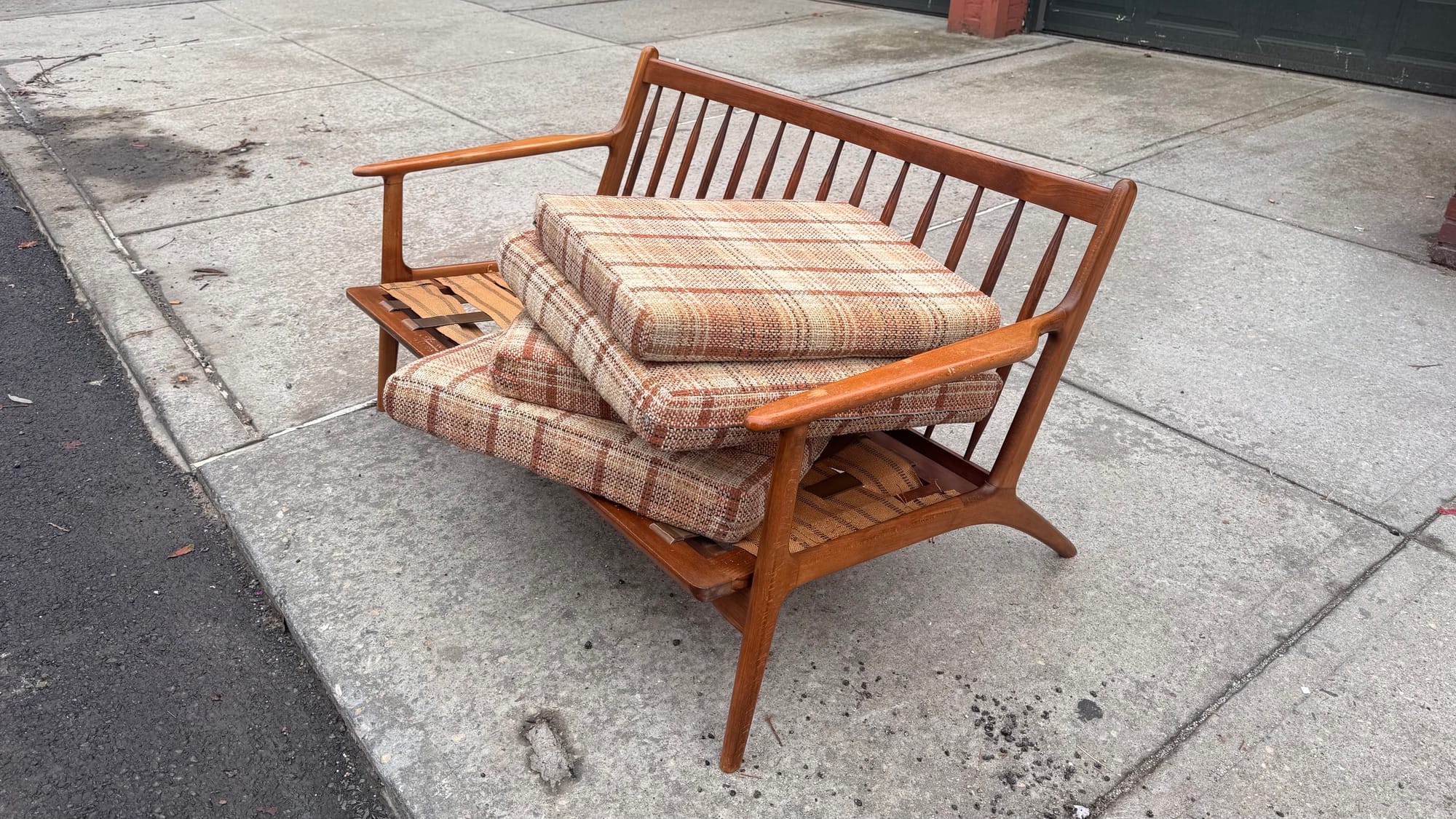
First of all it’s a two-seater, a loveseat maybe. I believe it could be described as a “Selig-style” sofa, but modifiers like “midcentury” and “Danish” would probably get me further. Anyway it’s old, with a wood frame and four rectangular cushions, and I bought it from someone in Greenpoint. I haggled with her a bit on the price. The finish, which was some kind of polyurethane, was pretty beat up and worn through on both arms. The cushions were clapped, and the original seat webbing was too, and someone had gone to town with a staple gun installing more seat webbing, which was now beyond clapped. Also the frame wasn’t all that sturdy.

Maybe I should have haggled with her on the price a bit more. Anyway I think I asked for a hundred bucks off list, and she kind of shrugged, and I paid her, and then I hauled the sofa out of the lobby of her apartment building and onto the sidewalk outside. Or maybe “hauled” is the wrong word — the sofa really isn’t that heavy, and it really isn’t that big, and honestly it was easy to carry single-handedly out of the building, and easy to carry around the corner to a side street, where I could more easily call a car to haul it (wrong word again) back home. The first car I called only paused for a second before driving off, so I had to call a second car, and thankfully its driver stopped and helped me load the sofa into the back of the car. I told him that I would bike back home, and that I’d probably beat him there by a few minutes, and he nodded, and I hopped on my bike, and rode south on Kent, and then west on Flushing, and then south on Clermont and then yada yada I beat him back home by a few minutes. I put my bike inside, then sat on the stoop in the midday sun to greet him when he arrived. And when he did, I unloaded the sofa and brought it into my home.
The Sofa

This was all on March seventh, 2026-03-07. Then:

On 2026-03-08 I removed all of the old seat webbing, including many bent-over staples, which required maybe a half-hour of work with a pair of pliers.

On 2026-03-11 I moved the sofa frame into my dining room, because my dining room table is by far my largest work surface, and it’s also right next to the back door, making it easy to pull the sofa outside in the case of either nice weather, or dirty work, or, as I was hoping for, both.

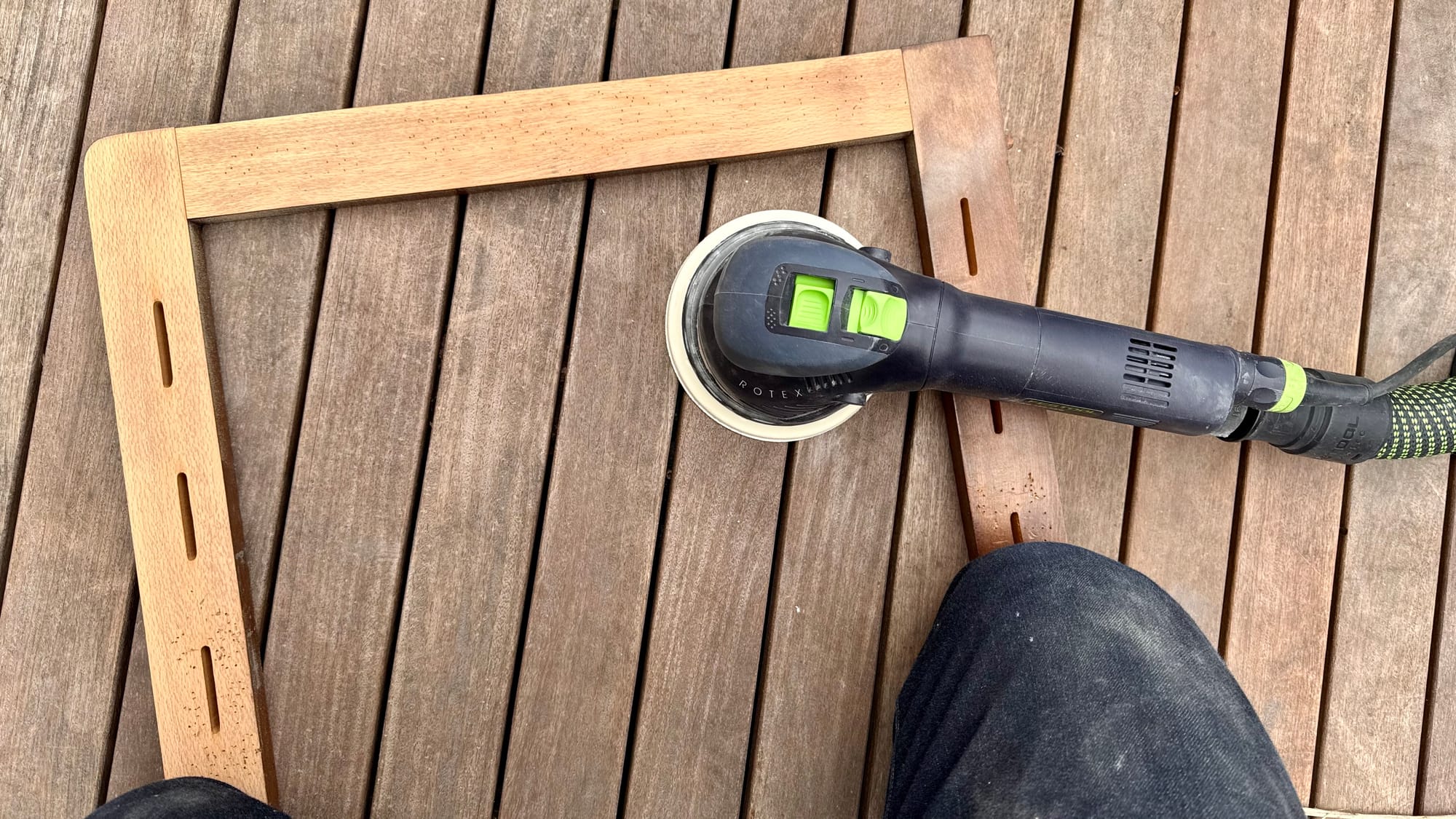
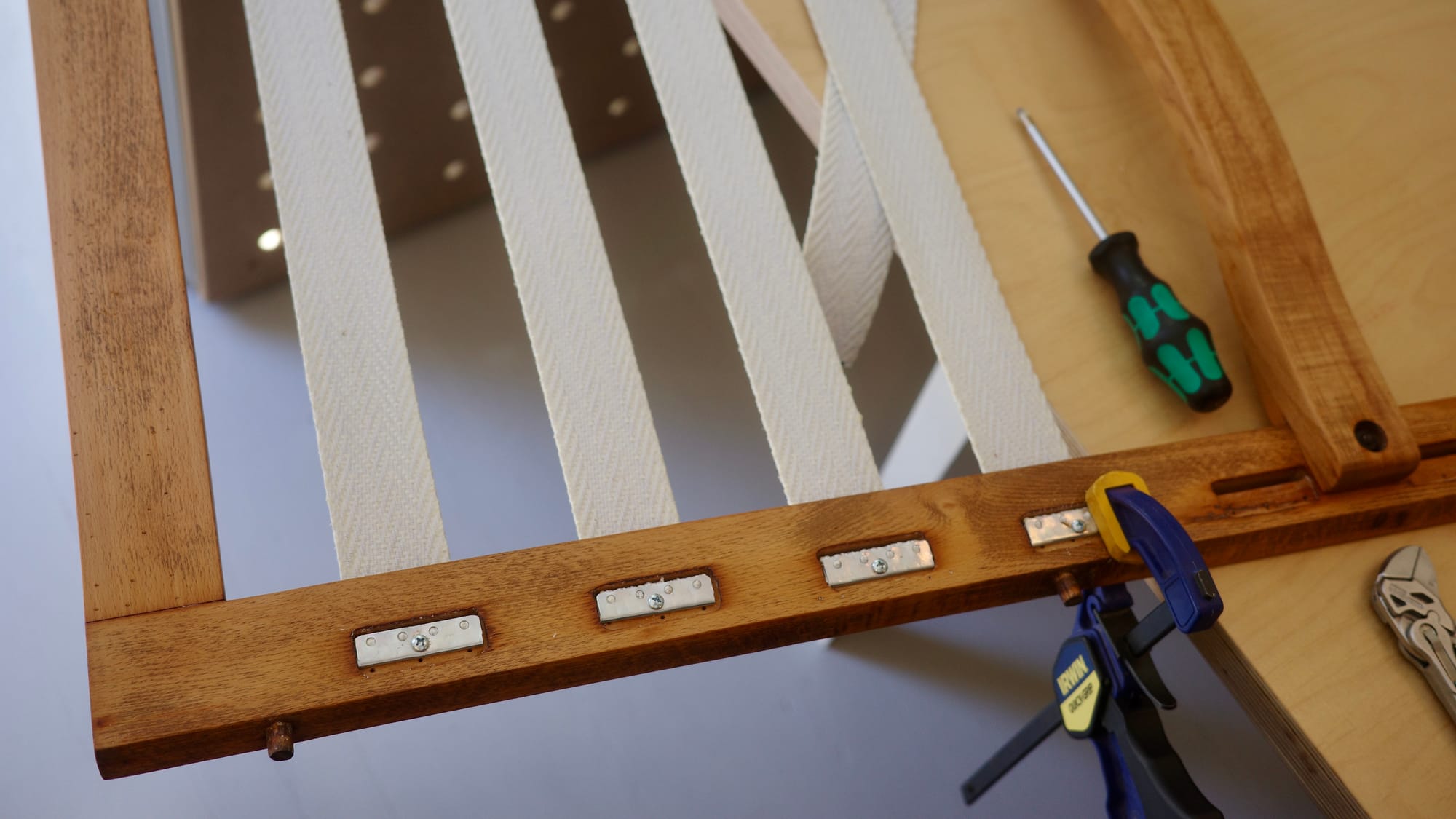
These first two work sessions were, as I think about it now, how I often approach projects like this one. I start by completing some simple, minimally-invasive task, in this case removing the seat webbing and the staples, and then I step back, and then I step back in, and then I get down to the real work. In this case I began the real work by removing the sofa’s seat from the rest of the frame; this didn’t require any tools, and the ease with which I did it made me optimistic that the rest of it would come apart easily as well. But the sofa’s seat frame had seen better days, and once I had it on my dining room table I decided to go a bit deeper on it. In addition to its original webbing slots (ten little slots along the butt-side rail, and ten corresponding slots on the knee-side rail), and the previous owner’s extensive stapling activity, there was also some kind of adhesive residue — “duct” tape maybe? — in a few places. I looked at this disapprovingly. Presumably it could be removed with isopropyl alcohol or some other mild solvent, but that wouldn’t constitute dirty work. “Or I could sand it off, and the polyurethane too,” I thought, and then I stood there for a minute, thinking about whether I could justify this approach.

It was a Wednesday afternoon, the day my kids and I “hang out,” which is to say the afternoon that we occupy the house together without any particular activity or plan. I picked them up from school — we had biked to school that morning, and they had parked their bikes inside the school’s lobby, and so in the afternoon I biked myself back to school, and the three of us rode our bikes north through Lincoln Terrace Park, then took a left on Eastern Parkway, and rode that most of the way home. When we got home I probably got out some snacks, and also (I hope) encouraged them to take agency over their own needs, and also of course speak up if you need help, and I’m going outside for a while to sand this part of the sofa frame.
The Sofa

Restoring things is crazy. I really needed a portable workbench to hold the seat frame while I sanded it (I went and got a nice fixturing workbench a few days later) but I wasn’t going to let my lack of workbench stop me, so I just put the seat frame down on the deck, and kneeled on it, and started at it with an honestly overpowered six-inch sander. As I did this I regretted having previously gotten rid of my old five-inch sander, but in the end the adhesive residue, and the polyurethane beneath it, came off easily. This was maybe an hour and a half’s worth of work; I think one kid was playing outside with me for part of it. Then I must have made dinner — we’ve been having fun making cold sesame noodles together recently, and I think dinner this particular night was that, plus a hiyayakko? — and then it was bath time, and then I probably read a chapter of Charlotte’s Web to the kids before bed.

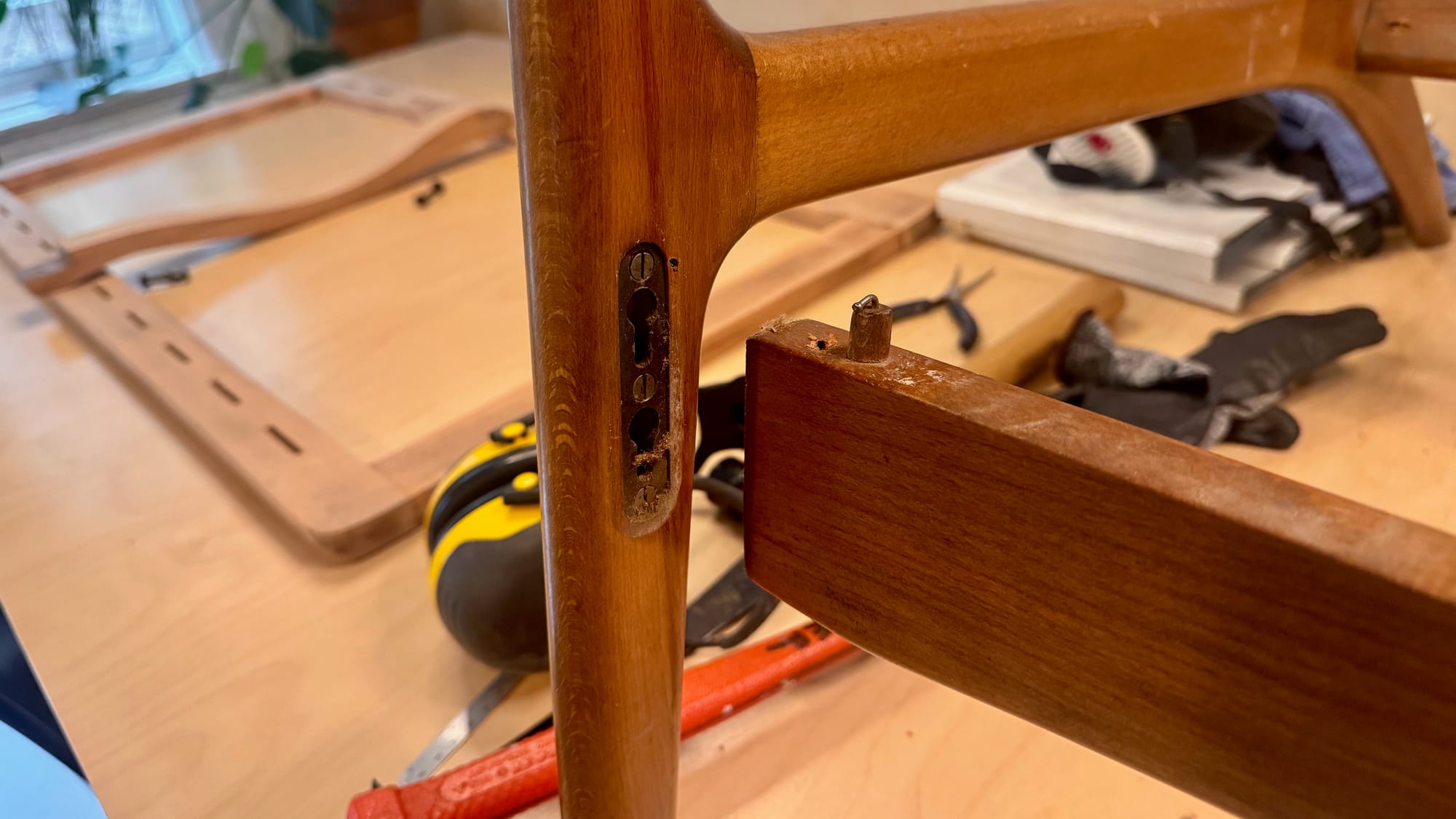
After bedtime I went back downstairs and lifted the rest of the sofa frame up onto the dining room table. I did this partly so that it wasn’t blocking traffic through the dining room, and partly so that I could look at it up close. I looked at it one way, and then I turned it around and looked at it the other. It looked like the back frame, and the front rail, might just lift out of the arms. But there were little finish nails, one in each of four joints, keeping it all together. So this was the question: Should I pull the nails, disassemble the whole frame, and completely refinish it? Or should I stop here, try repairing the frame’s existing finish, or at least chill out about the project a bit and accept that it would be a partial restoration as opposed to a full one?

2026-03-12: “Ah, fuck it, let’s just pull these nails and see what happens.”
The Sofa

What happened was that the whole thing came apart easily. I saved the nails, and disassembled the frame, and stacked it up against the dining room wall, and looked at it fondly from time to time over the next week and a half.

And in this time it became clear: I would completely restore the sofa. In addition to replacing the cushions and seat webbing I would sand it free of polyurethane, and refinish it with oil and wax, and generally set a high bar for its future well-being. I would commit.

On 2026-03-21 I worked on the chair more or less continuously from noon until it started to get dim outside. I got both arms and the front rail all sanded to 80 grit, removing basically all of the polyurethane and getting down to wood whose tone was pale brown and more or less consistent. Some spots still wanted to be worked a little further, but the heavy work was done and in general everything looked good.

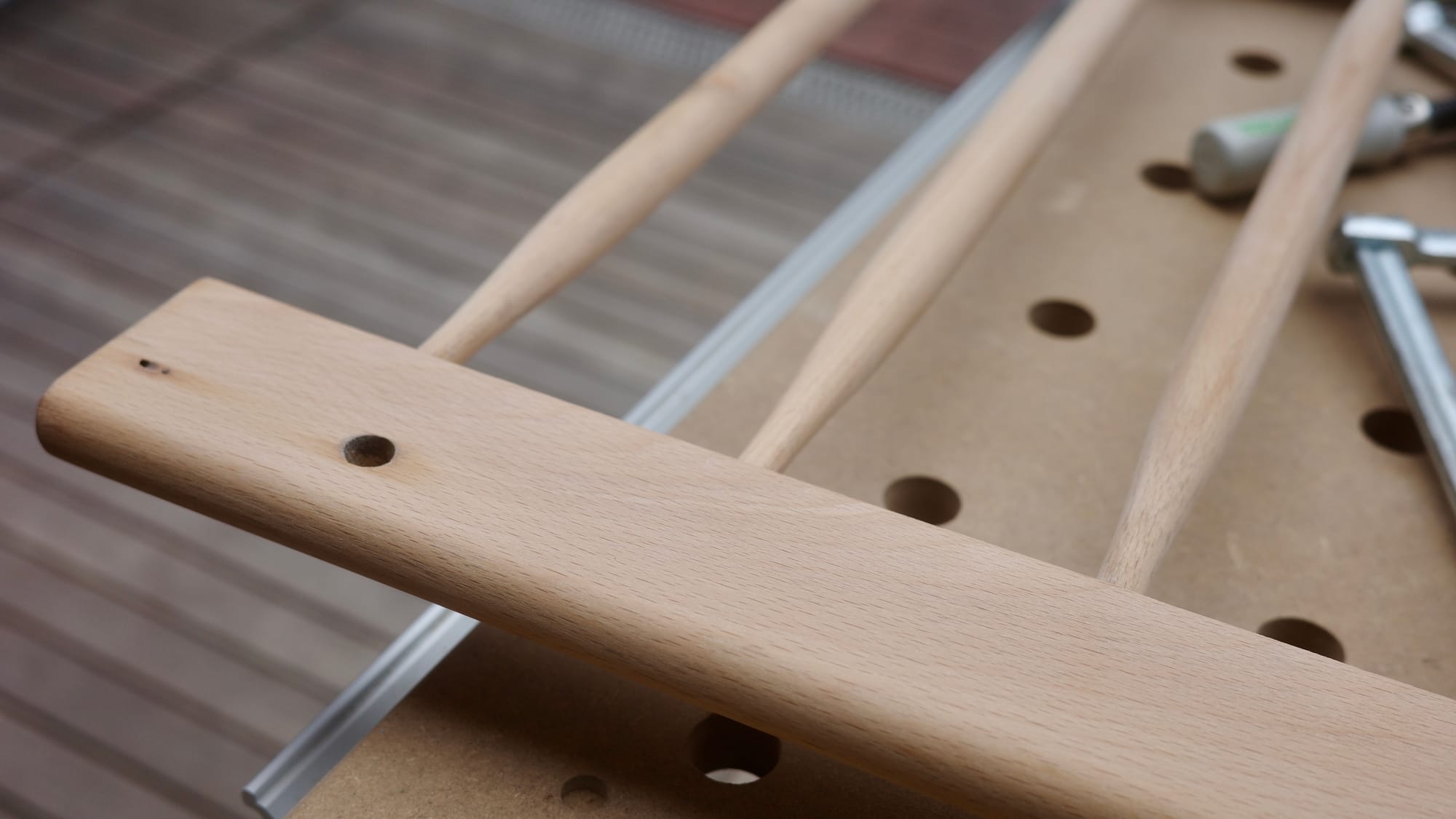
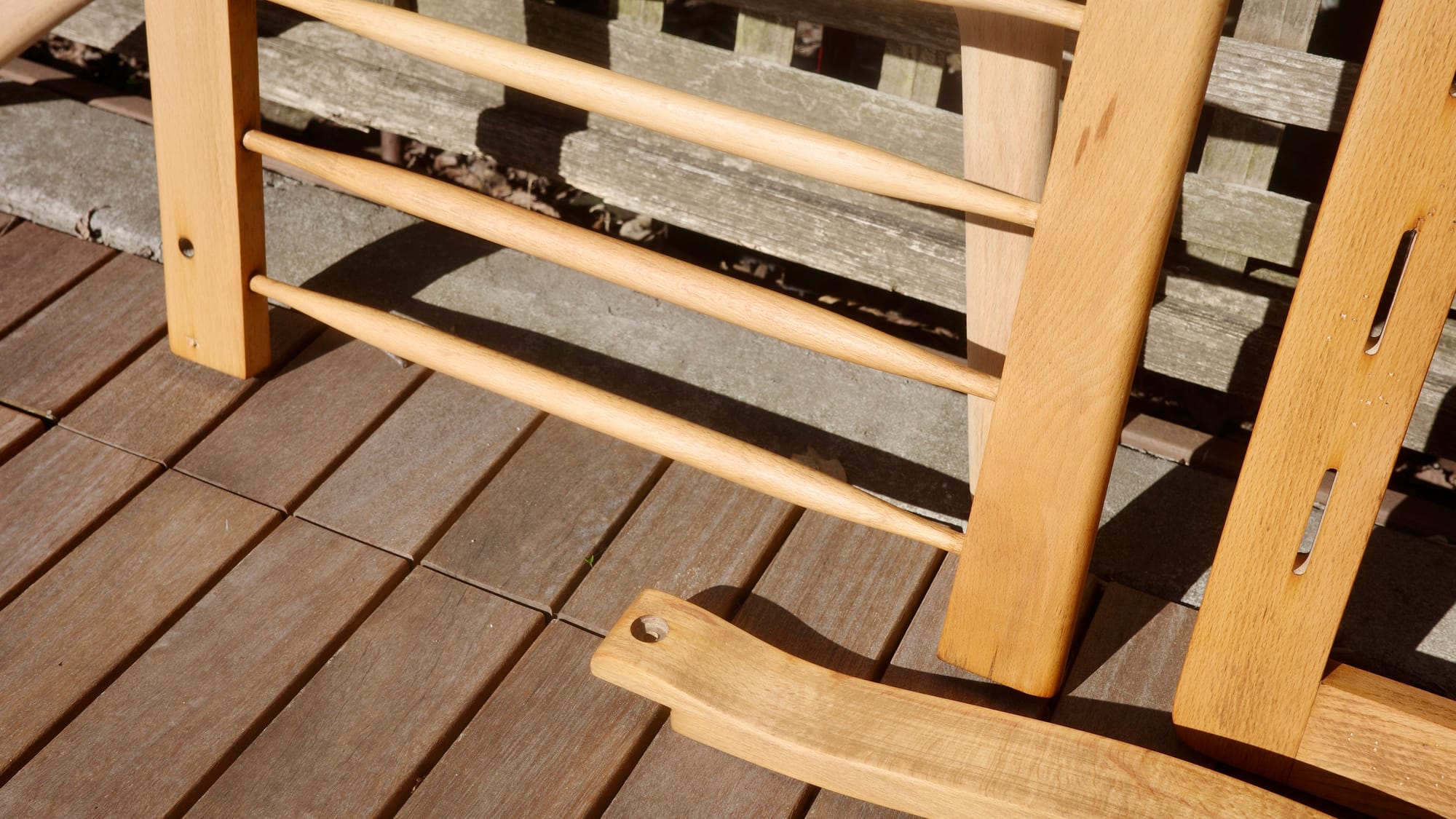
On 2026-03-22 I got the back frame sanded to 80 grit. This was a lot of work. The back frame has long top and bottom rails, and between the rails are a series of spindles. I’m looking over at the sofa now as if I could count them from here — I can’t — so let’s just say there are twenty spindles, that’s close enough, and anyway each one had to be sanded by hand.

The spindles are mostly cylindrical, and to sand the cylindrical sections I used thumb and fingers to press a small piece of sandpaper against as much of the cylinders’ circumferences as possible. But the spindles taper at each end, and to sand the tapered portions I used long strips of sandpaper, which I gripped with two hands and swished back and forth rapidly in a sort of buffing motion. The rails also needed to be sanded, of course, and it was not easy to sand the parts of the rails where the spindles entered into them. I pulled a small scrap of wood from my material pile — a little rip about as wide as my thumb, and as thick as a cell phone, and as long as it needed to be — and wrapped strips of sandpaper around it, using it more or less like a file as I removed the old polyurethane from around each spindle. This took hours. I’m pretty sure I also left the house at some point to get groceries, and anyway around one-thirty my kids came home and I cleaned up, then hung out in the kitchen with them, cooking dinner and chatting about what their weekend had been like. We hosted my sisters’ families for family dinner that night; I believe I made tacos, with beans and guacamole and heavily-seasoned, plant-based ground meat. Recently I’ve been trying to get family dinner fully prepped by the time everyone comes over, at about four in the afternoon, even though we don’t usually eat until five-thirty or six. This is a lot of work — there are eleven of us, give or take — and I think I cooked, and set the house up, more or less continuously from one-thirty until four.
The Sofa

On 2026-03-27 I sanded the seat frame, and the back frame, all the way to 220 grit. It was a sunny day, and as usual I had pulled my new workbench into the backyard, and I had gotten into a nice groove. I had figured out how to fixture each part quickly and securely, and had brought my new portable stereo out with me, and was feeling good about the rhythm of the work, and the state of the project, and the broader lifestyle it represented. And the freshly-sanded parts looked beautiful. The wood — I wasn’t sure what species it was, and had struck out identifying it with my copy of Wood Book — slid into a pale blond tone as I worked it, with beige flecks and little washes of umber and sienna here and there. It was becoming gorgeous, and by association, and through my devotion to it, I was pretty sure that I was becoming gorgeous too.

A few days earlier I had walked over to the hardware store on Bedford and bought some tung oil. I had tried the hardware store on Nostrand — it’s closer to home, and I really like the guy who runs it — but they were out of tung oil, and so I walked to the store on Bedford, and the droopy-eyed guy there helped me find it, and then I think I swung by the grocery store on my way home, and threw a bunch of broccoli rabe in my backpack, alongside the can of tung oil, and was pleased with the juxtaposition between the two purchases. When I got home I put the broccoli rabe (which I should really call rapini, but then nobody would know what I was talking about) in the fridge’s crisper drawer, and the can of tung oil on the windowsill next to where the sofa frame parts were stacked.

I mentioned this earlier, but again, restoring things is crazy. When I had seen the sofa’s old polyurethane finish, and its sorry condition, in that apartment building lobby in Greenpoint, I thought darn, that’s not what I want, I want a piece of wood furniture finished with oil and wax, you know, something lustrous and warm, something that will radiate out into the room, into my life. If I’m being honest, my desire to remove the polyurethane and replace it with oil and wax — my desire to care for the sofa, and thus enable it to care for me as well — might have been the driving force behind the whole project. But as I read these words back I wonder if they’re the full story. Why did I really want to do this? Why buy this sofa just to turn around and insist that it shed its skin? Why get so involved with it, why make such a huge commitment, hours spent on each of the dates in this list, hours and dollars spent on top of that, ordering seat webbing and setting up the fixturing workbench and walking down to Prospect-Lefferts Gardens to get new cushions made? Why this sofa? Why was I putting so much of myself into it?

And all of this while there is so much change happening in my home, in my life. A few weeks ago we inherited a weighted-key electric piano from a neighbor, and I put it in the living room, and then I set up some old synths (owned since the pandemic but historically not on display, and therefore rarely played; my hope is to change this) next to the piano. There’s a new calendar in the kitchen, and a new pinboard, covered with new art that the kids have brought home from school, and new polaroids of the three of us together, next to the back door. About half of the moveable objects in my current field of view, sitting here in the living room, have been acquired in the past three months. Almost everything that isn’t new has been moved from where it was in December.

And the question I keep asking myself is, is now the right time to bring a sofa into my life?
The Sofa

I have yet to find a satisfying answer to this question. Nevertheless, on this day I did also apply one coat of tung oil to the back and seat frames, and I was happy about that.

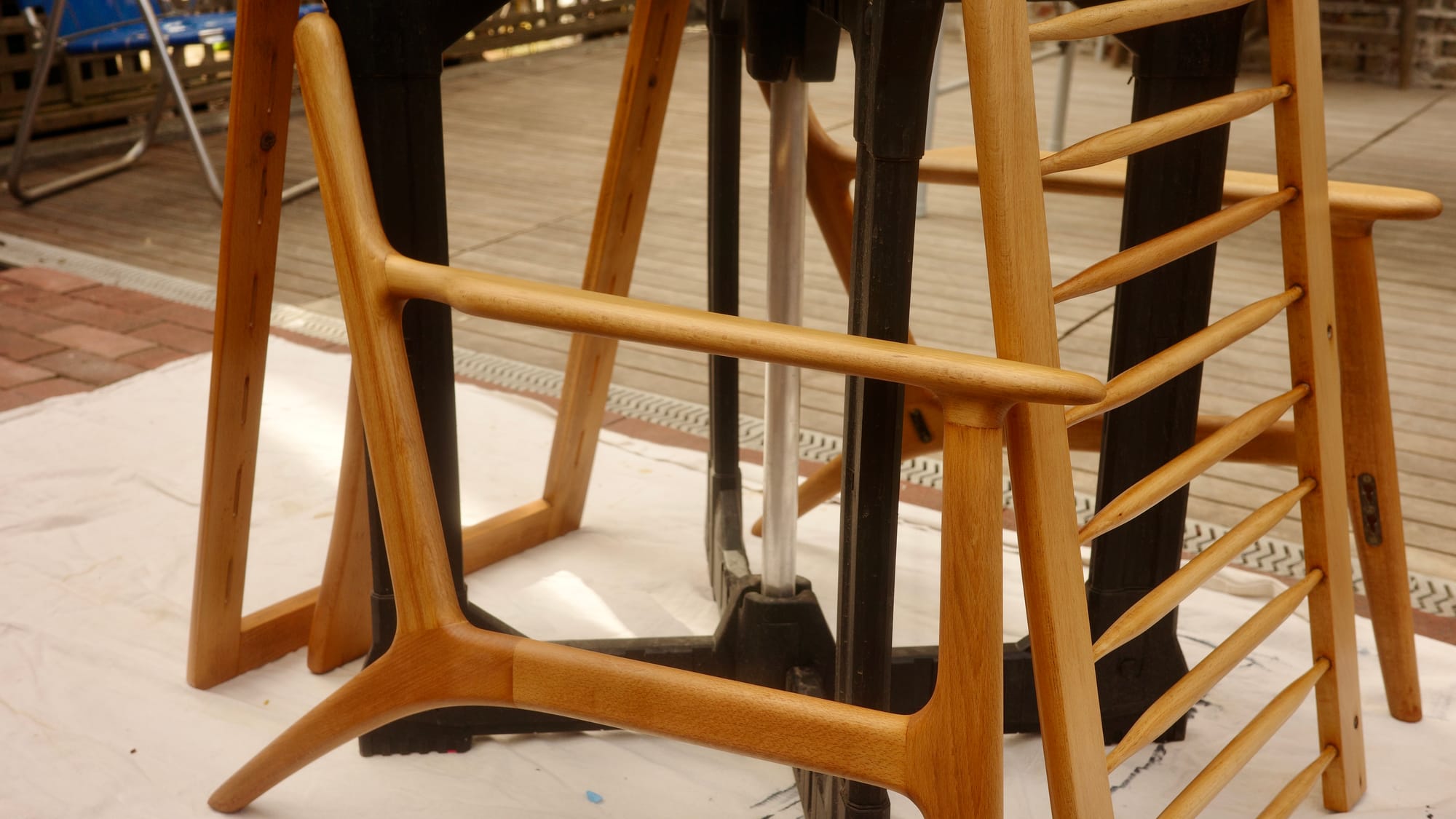
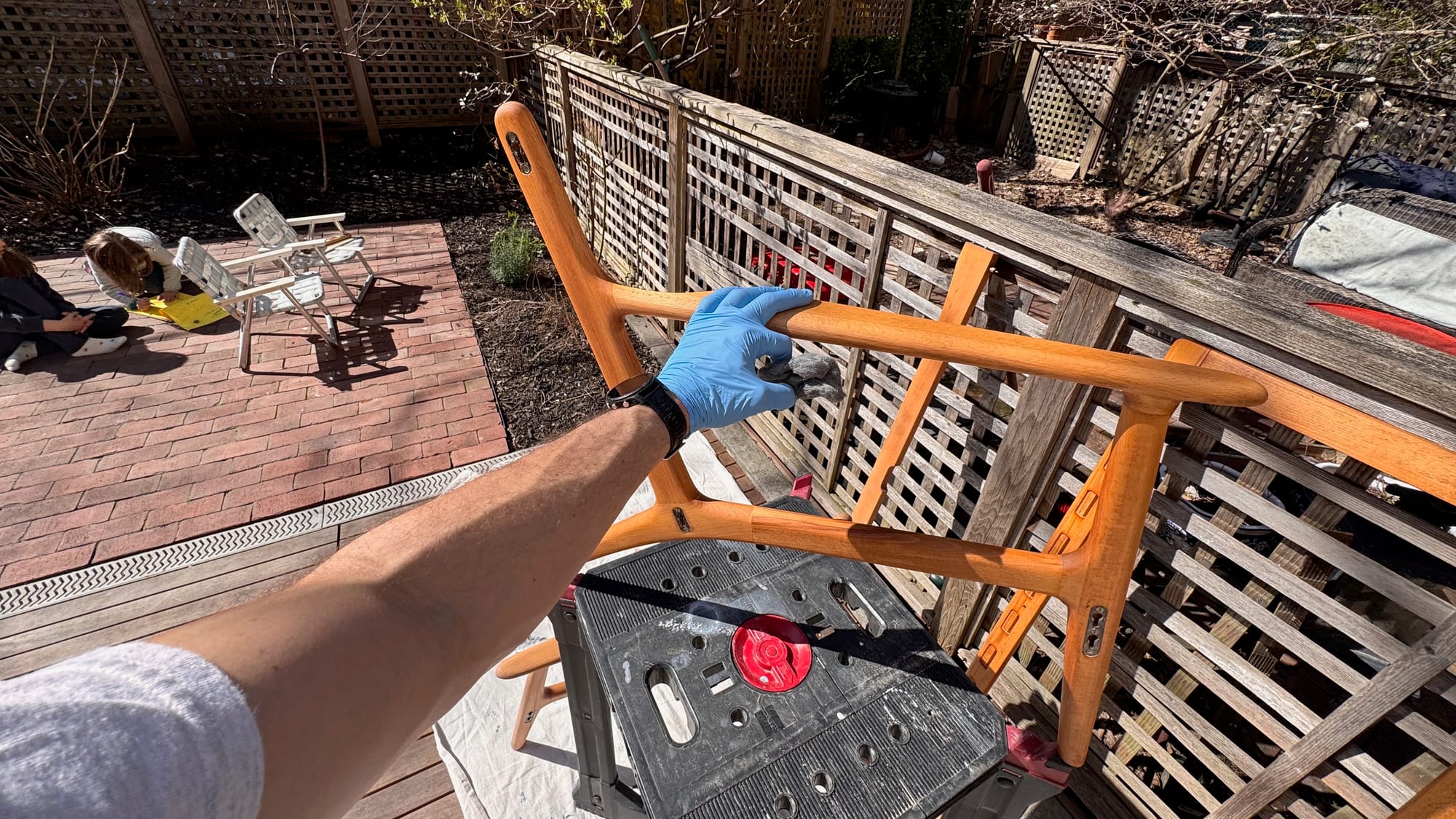
On 2026-03-28 I spent most of the day sanding and oiling. I sanded the arms and the front rail up to 220 grit, then used 0000 steel wool to buff the first coat of tung oil on the back and seat frames. Then I oiled everything — a second coat for the back and seat, and a first coat for the arms and the front rail. It all looked amazing.
The Sofa

On 2026-03-29 the one activity the kids really wanted to do with me was to try miracle berries. You may have heard of this — you eat these berries, or in our case little tablets made of these berries, and they turn off your tongue’s sour receptors for a couple hours, and during that time any other food you eat tastes weird. I had bought the tablets online, and had collected a handful of things from our pantry to taste, but I “knew” we “needed” to go to a market and get more things to try. Fresh fruit, dried fruit, maybe some pickles, whatever, let’s try it all, but we don’t have that stuff in the pantry and so let’s hop on the bike and go over to Bob & Betty’s and we’ll get whatever you guys want? And on the way I’ll go to a hardware store and try to get some decent furniture wax.

The furniture wax required not one hardware store visit but four of them, and even then I struck out and ended up ordering the stuff online. The kids were annoyed, which made sense. I wouldn’t let them try the miracle berries, or the snacks, until we met up with some friends later in the afternoon, so I guess I was just dragging them around on this errand that I claimed we “needed” to go on, and acting like it was some special treat the whole time, like “guys isn’t it cool, living in a city like New York, there are so many hardware stores we can go to!” Finally at the last hardware store on my list the kids got off the bike and came inside, and asked if we could buy some flower seeds, and I said of course, that’s a great idea, let’s plant them in our tree well. The hardware store had a big TV, mounted to the ceiling, playing cat videos, and the kids were happy.
The Sofa

When we got back home we still had a couple hours before meeting up with the friends to try the miracle berries, and in the meantime the kids seemed content to work independently. So I put a second coat of tung oil on the parts that needed it, and then, wanting to start the seat webbing as soon as possible and wanting to wax the seat frame before I did so, I grabbed my jar of conservator’s wax and decided I would just use that. This wasn’t ideal, but it was what I had on hand, and I could always re-wax the frame with something more durable after I installed the webbing. Who knows, now that I’m writing this down I feel like I’ll come to regret it, but really you only live once so what the hell, conservator’s wax it was.
The Sofa

And then I strung the webbing, and I started to really think I would pull the project off.

I still don’t really know what I want from this sofa, and I’m not at all sure whether this was the right time for me to have gotten it. I don’t know where I’ll put it, or who will use it, or what they’ll use it for. Presumably I am not the sofa’s only stakeholder — I have come to believe I’m basically never the only stakeholder — but I can’t tell who the other stakeholders are, or whether they’d approve of everything I’m doing. I imagine them telling me that it’s all wrong — the sofa isn’t the right kind of sofa, and the work I’ve put into it is based on some misunderstanding I have about its true identity, and I really should have gotten my house in order before committing to a new piece of furniture. Maybe I should have directed my energy towards the things that were already in my life. The door in the kids’ room needs to be re-hung — I could have done that. The basement stairs have needed a handrail for about seven years, and the kids’ little feet keep getting splinters from the fucked-up front entry floor, and I still need to repaint the wall that was the subject of a too-long-to-describe-here project I did a month or so ago.

Heck — I could use some work myself.
The Sofa

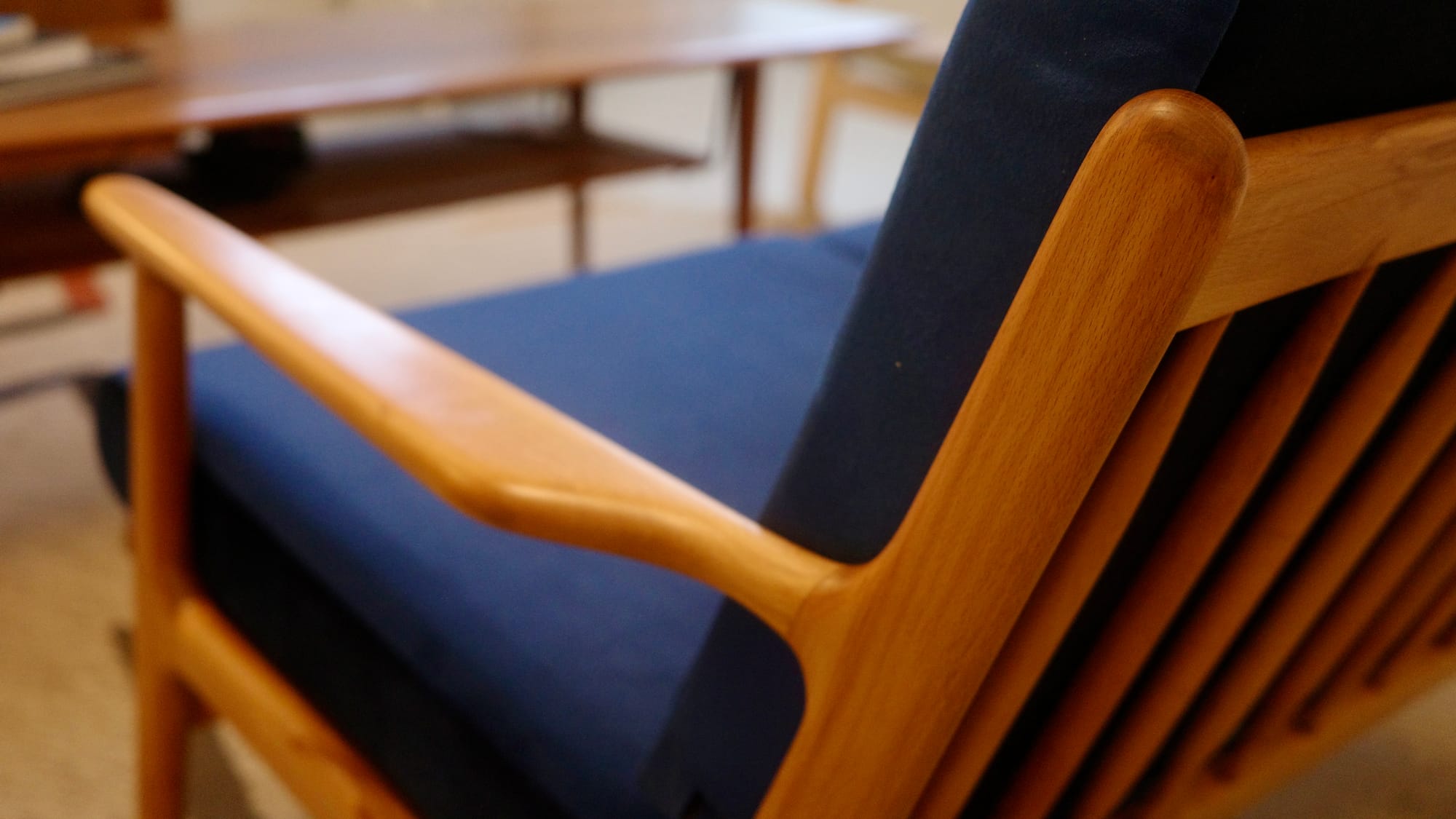
But putting the freshly-waxed sofa frame back together felt healthy, and cathartic, and restorative. One of the screws that holds the back to the arms had been bent out of shape, and I unscrewed it, and brought it down to the basement, and straightened it in my vise — the old one that I had bought broken a decade or two ago, and then restored, and then have used to fix and modify and mess up countless objects since. Then I went back upstairs, and screwed the screw back in, and snugged each of the other screws up a bit, testing how they fit into their respective slots to make sure the whole frame was as sturdy as possible when reassembled. Then I slotted the back frame into the left arm, and then I slotted it into the right one, and then I did the same with the front rail, and then I popped the seat frame into place with a couple careful yet confident smacks from the heel of my right hand.

I had gone back and forth about whether I’d also nail the frame back together, and decided in the end to leave the nails out for the time being. The sofa should be allowed to settle in, I figured, and should acclimate to its new environs, and its new cushions, and the new butts that will be resting on them. I thought also about giving the frame another coat of wax before putting the sofa into service, but I wanted to see if and how it supported me first. So I smoothed the flocking on the cushion covers, and made sure that their zipper pulls were all aligned the right way, and set them satisfyingly into place.

I don’t know how long this sofa will support the weight of my body, my family, my life. It’s possible that at some point I’ll break it, and it’s possible that in the process it’ll break me too. But as I lowered my own weary frame onto the sofa’s, I knew that on some level our relationship was reciprocal, and appropriate, and right.


With thanks to K, who provided many of the questions behind this essay. Thanks also to SOW’s paid subscribers (who you could also be one of!), who literally make all of this possible 💞

69dba704986906000108bef8
Extensions
What’s Really Been Happening With Me
Some updates regarding my own emotional surface area
Show full content

What’s really been happening with me, over these past couple of months, is that my wife and I are separating. We celebrated our ten-year wedding anniversary this past October. Our first date was in 2009. We have two kids together; they are six and nine years old. We own a house together, and until recently we shared a Spotify “duo” account, and each of us has a change of clothes stashed at the other’s childhood home. And over the holidays we began the process of uncoupling our respective lives.

It’s a mess, obviously, and by “it” I guess I mean “I.” This relationship was the foundation upon which basically my entire life was built, and as I’ve moved through the world this past few months I’ve had the distinct sense of being untethered, of not walking but floating through the city, floating through my own emotions, ping-ponging around manically, leaving little (and not-so-little) splashes of emotion behind every time I collide with someone or something. Unexpectedly, this has felt good. It’s been sad, and confusing, and (as previously mentioned) quite messy. But it’s also been good, and beautiful, and healthy. And I’m pretty sure that it’s the right thing to be happening to me right now.

I think I’ve learned some things in the process, and I’m working on learning some more things. One thing I’ve learned is that I can increase my emotional surface area well beyond what I previously thought was possible. I can expose my feelings more deeply, and to more people, and instead of turning away they almost always listen, and empathize, and then turn around and share parts of themselves with me, and I really do believe that we all walk away better, and stronger, and healthier for having shared, and listened, and empathized. I still haven’t found the limit to this process. Maybe it can go on forever, ending only in my own transcendence; my love, and my hurt, and all of the rest of my feelings, expanding outward until they touch everything that is.

Here is another thing I’ve learned: Basically everything can be renegotiated, including things that you might think of as facts of life or hard, physical limits. Perhaps I can be more specific: I had not considered, until a week or two ago, that I could cook broccoli rabe as part of my midweek lunch-for-one, or that I might only eat half of the broccoli rabe for lunch, and leave the rest in the pot, on the stove, and then eat it as part of my dinner-for-one later that evening. I had not considered that I, a single, forty-two-year-old man, might smile to myself as I put a bouquet of tulips on my kitchen counter on a Saturday morning, even though I don’t have a spouse, or kids around on Saturdays, to admire and appreciate the gesture. I had not considered that the acts of vacuuming and then wet mopping the entire house might grow to be sources of real personal catharsis, tasks that I’d look forward to doing on Mondays, and also sometimes on Fridays. I had not considered that I might listen to the same song on repeat for two solo days as I walk around the city, getting drinks, and talking with people about how much I’ve been crying, and then coming home to my empty apartment, and putting that same song on repeat again, and sitting in my recently-redecorated living room, and writing about my feelings for hours into the night. I had not considered that I might allow myself to make extended eye contact with strangers on the train. I had not considered that I might tell my kids to stop asking me whether they can have another cookie; the pantry is right there, and they can make their own decisions about how many cookies are appropriate on a Wednesday afternoon. I had not considered that my roles as a romantic partner, and as a parent, and as a homeowner might actually be distinct from one another. I had not considered that parenting might feel as easy and rewarding, or as impossibly challenging, as it has recently. I had not considered that one could cry this much, or this hard, or be brought to tears by such a wide range of things. I had not considered that I could feel so overwhelmingly happy in (at least some of) the moments in which I am crying. I had not considered that I would feel so optimistic and excited while struggling through what will undoubtedly be one of the biggest personal crises in my life.

I am now considering all of these possibilities, these realities. The act of considering them is affecting my work. It’s affecting my entire life, of course, but the effect it’s having on my work is one of the reasons I’m sharing any of this with you today. In person, I’ve been quite explicit about the shift: “I write about my feelings for a living,” I’ve begun telling people, and while I go on to explain that I do so from the perspective of someone who’s interested in, you know, engineering or manufacturing or construction or whatever, still the reality is that the things I’m writing at the moment are all on some level about the emotional experiences I’m having, and the ones I’ve had in the past. I am using my writing to increase my emotional surface area. This is, if I’m being totally honest, something I’ve been trying to do for a long time. Still I find it unexpected, and challenging, and stressful, and rewarding.

So, what are the other reasons why I’m sharing all of this with you today? In theory I’d like to offer you some idea of what you can expect from me in the months to come, but what that is I can’t really say. I suppose I also want your empathy, but actually I’ve been realizing recently that it is my own empathy that is the most sustaining and ultimately necessary for my survival. Partly I just want to send these words out into the world, and then take a step back, and read them again, and notice that they’re true.

But I think that the real reason I’m sharing all of this is the one I mentioned earlier: I can expand my emotional surface area, and doing so feels genuinely good, and I’ve yet to find a reason not to continue doing it.

So there it is. That’s what’s really been happening with me.

Love you, guys 💞

Support SOW
69b75d035fc47f00012620b2
Extensions
Sublime Capability
It's no big deal.
Show full content
Sublime Capability

Recently I’ve found myself trying to cultivate, or really fall into, a sense of sublime capability. I’ll look at a problem, some physical fix or project, and think “I can do that.” And then I’ll think “I can do that and it’s no big deal.”

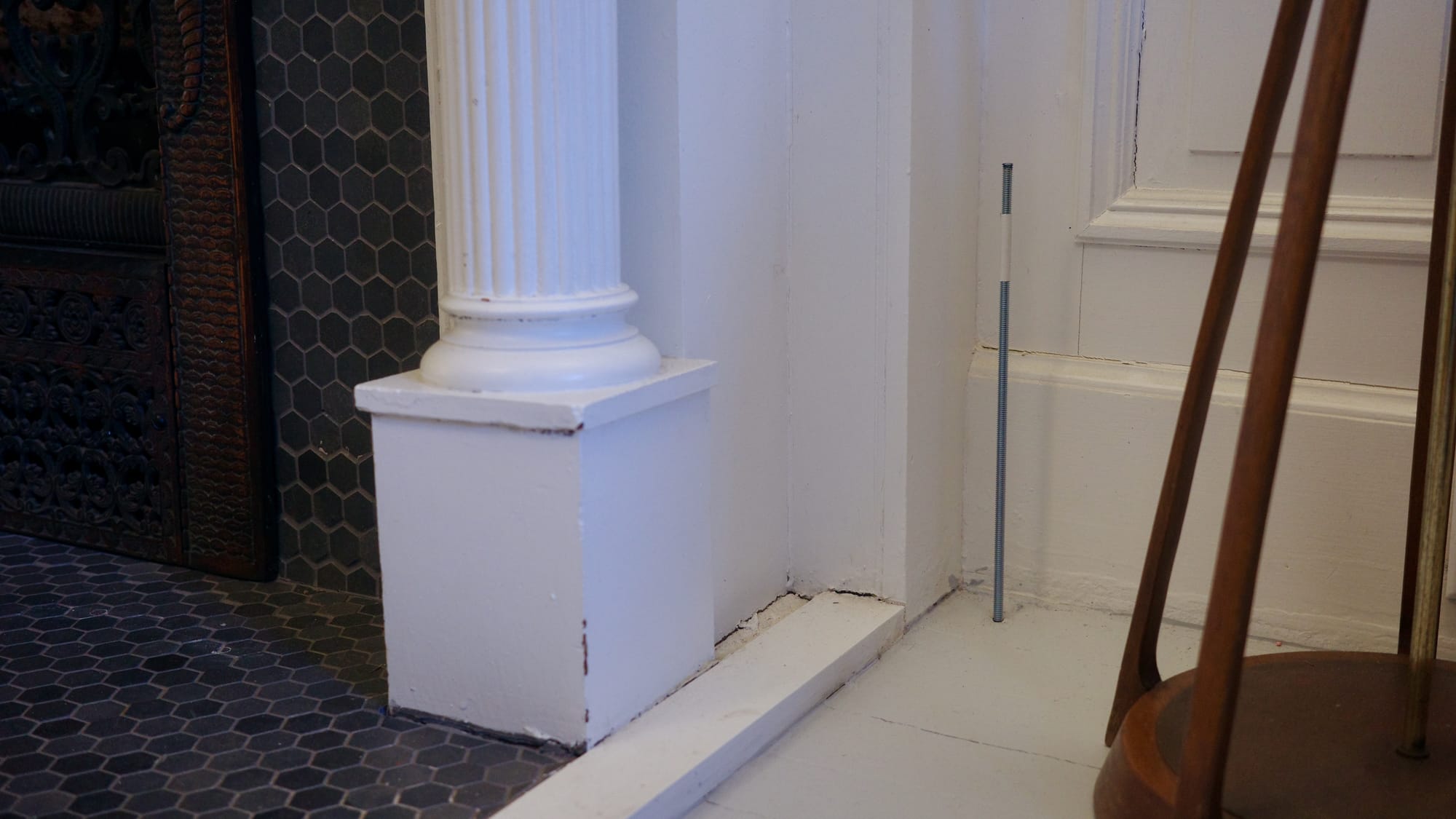
So, for instance, a Cat5 cable wants to be run from the network cabinet, in the basement, up to the TV, in the living room. I drill a hole in the living room floor, then go to see if it comes out of the basement ceiling below. It does not, and it’s no big deal. A longer drill bit is acquired, the process repeats, there’s still no hole in the ceiling, and still, it’s no big deal. Being as there’s a practical limit on the depth you can drill without increasing the diameter of your hole, I decide instead to poke my way through the basement ceiling. I walk to the hardware store, and buy a three-foot length of quarter-inch threaded steel rod, and after a few minutes with a file I’ve got myself a weirdly long shank that I can then insert into my hole and whack with a mallet until I hear the gypsum board fracture below.

SPONSORED

Baukunst just published a research report on how AI is transforming manufacturing. Check it out for just-in-time insights from from multinational contract manufacturers and top startup founders who are implementing AI in real-world manufacturing processes.

Learn more

This all happens in an afternoon. Then the project is abandoned for weeks, gestating while other, more urgent projects come into focus, and are processed, and then recede. Every time I see the threaded rod sticking up out of the floor I think it’s no big deal, I can do it later. Like so much else around me, this little corner of the living room looks kind of messed up. But I can manage it.

This is supposed to be inspirational, comforting. I’m trying to lean into my own capability, you see, and I think you should lean into your capability too. Whether they’re mandatory or elective, most of the projects you can do are honestly no big deal in the grand scheme of things. Go ahead, take them on: Repaint that wall, hang that shelf, snake that drain, flip that electrical receptacle around so that the cords lead into it more elegantly. People do these things every day, and you can too. It’s nothing to worry about.

So I’ve been getting stuff done, and when I finish something I step back and think yeah, see, I knew it wasn’t a big deal, and then I think about how much time and emotional energy I should spend congratulating myself on the accomplishment.

Sometimes I think that my celebration of a project’s completion should be inversely related to its complexity. A week or two ago I decided to roll all of my laundry up, Marie Kondo-style, and see if that felt good. I made this decision in the moments leading up to what should have been my bedtime, but in those moments I hit pause on the whole evening, and sat down there in the dressing room, and reorganized basically every garment I own. It took maybe fifteen or twenty minutes, and when it was over I stood there for a good long time and really patted myself on the back, congratulated myself for a job well done, agreed with the decision to take the project on, and to take it on at that very moment. I was genuinely proud of myself, and verbalized this fact quietly, savoring the feeling before turning back to my ablutions. The laundry-rolling was a real accomplishment; it was also easy, no big deal.

Or, I don’t know, maybe it’s all a big deal and everything is hard. Recently I’ve spent a lot of time hearing about the worst parts of people’s lives: an abusive ex, an unfulfilling job, a friend’s attempted suicide, a tough relationship with a parent. I hear these things and I find myself saying I’m sorry, that must have been so hard, how does it feel to you now? And then there’s usually some kind of shrug, and I kind of shrug back, and afterwards I find myself thinking about just how beautiful it is, that we can look across the table at each other, and talk, and empathize. None of it is resolved, but it’s beautiful anyway. It’s beautiful that we suffer, and it’s beautiful that we try, and it’s beautiful to stand back every once in a while and be proud of what you’ve been working on — regardless of whether it’s come to a satisfying conclusion.

And there’s so much in life that has not yet come to a satisfying conclusion. A month ago I bought a huge sheet of white Formica to laminate onto the dining room table. Last weekend I picked up a beat-up spindle-back loveseat, which needs new seat webbing, and cushions, and really wants to be refinished and maybe even taken apart and glued back together again. I’ve got an old bike that needs to be either rebuilt or disassembled and hung on the wall, and a stack of Baltic Birch scraps that really should be turned into shelves and side tables. The parlor entry door needs to be completely rebuilt, and the stairs down to the cellar need a handrail, and the tree of heaven in the backyard really needs to be trimmed so that the spotted lanterflies stop nesting (and pooping) all over the patio. Thought has been put into each of these projects; they occupy space in my life. They all ache a little bit, sitting there unfinished. But maybe the ache feels good.

How else could I describe, or at least contextualize, these feelings? Here, let’s try this, from a school holiday last week:

On the crowded subway back home from the Met, with the kids, I finally took out the book I had brought, and about which I had so many feelings, and read it aloud to them. I believe my mom was reading it aloud to me and my sisters, it being From the Mixed Up Files of Mrs. Basil E. Frankweiler, when she was diagnosed with brain cancer in her left occipital lobe. I was about ten at the time, and she would have been thirty-eight or so — a few years younger than I am today. The tumor had destroyed her vision, making reading the book incredibly difficult, and I’m not actually sure if we ever finished it as a result. I’m sure this is part of the reason that reading its final chapters, to my young kids, on the subway coming home from the Met, was so intense for me — but also the end of the book is incredible on its own. Its protagonists, Claudia and Jamie, ages eleven and eight, ran away from home and have been camped out in the Met for a week. While there, they discovered an art-historical mystery and worked towards solving it; the trail eventually led them to Mrs. Basil E. Frankweiler, who narrates the book. And then, at the climax of the kids’ encounter with Mrs. Frankweiler, we get this exchange:

Claudia said, “But, Mrs. Frankweiler, you should want to learn one new thing every day. We did even at the museum.”

“No,” I answered, “I don’t agree with that. I think you should learn, of course, and some days you must learn a great deal. But you should also have days when you allow what is already in you to swell up inside of you until it touches everything. And you can feel it inside you. If you never take time out to let that happen, then you just accumulate facts, and they begin to rattle around inside of you. You can make noise with them, but never really feel anything with them. It’s hollow.”

So yeah, that’s how I’m feeling about things. There is no conclusion; it feels good anyway.

Scope Creep
  • For years it seemed that my dream of owning a bidet toilet seat would be unfulfilled, but a couple weeks ago I decided that not only would I achieve this goal, but I’d go ahead and purchase a mid-range heated model. It takes energy to heat a toilet seat and the water that it squirts at you, and this meant that my bidet seat would need to be plugged in, and because the bathroom wasn’t wired for a bidet, this meant adding a new receptacle right near the toilet. I am not an electrician; I did not hire an electrician to do the work; the work has been completed, and it feels fantastic.
  • Limerence is a state of intense, passionate, and potentially anxious romantic love. It can be obsessive, and probably looks a little crazy from the outside, and according to some studies can resemble addiction.
  • Recently I’ve been listening to the same music on repeat, obsessing over the same set of lyrics and auditory moods. Some of it has gotten kind of weird, like this Headache track, which includes an unattributed line from an Emily Dickinson poem that I wasn’t previously aware of. In the poem itself, Dickinson says that the freight should be proportioned to the groove, and at least in the context of the poem’s first two beautiful lines I think I agree with her. But how proportional is an open question.
69aec8e92af329000193f347
Extensions
Supersaturate, Recharge
*With one hand!*
Show full content
Supersaturate, Recharge

Here’s a product that I did not know about previously and have not used myself: Sodium acetate hand warmers. These little goop packets contain a supersaturated liquid solution of sodium acetate dissolved in water. They also contain little metal discs that, similar to the cap from a Snapple bottle, make an audible click if you squeeze them through the pouch.

Supersaturation is a weird idea. It’s as if there’s some maximum amount of salt that can be dissolved in a liquid before it crystallizes, but if you just put a little bit of care into the dissolution process then you can blow right through that limit, going headlong into supersaturation. But supersaturated solutions are delicate, and if you disturb them just a little bit — decrease the solution’s temperature, or introduce a seed crystal, or just shake them up a bit — then all of a sudden the whole thing will crystallize rapidly, releasing heat as it does. This is the principle behind sodium acetate hand warmers: Grab one of these pouches, and click the metal disc inside it with your thumb, and the sodium acetate will come to its senses and solidify into sodium acetate trihydrate. The crystallization reaction is exothermic, with a latent heat of crystallization around 264–289 kJ/kg; this heat is released over about a half hour, warming your hands and pockets and whatever else is nearby. Then, when the reaction has been exhausted, you can boil the pouch in water, turning it back into a supersaturated liquid that just waits around to crystallize again.

I find it relaxing to think about this chemical solution, flipping between its solid and liquid phases. But I can’t tell whether the relaxation phase is the solid one, which is brittle and tense, or the supersaturated liquid, which stands on high alert for anything that might kick off crystallization.

Now that I’ve learned about sodium acetate, I somewhat regret having recently purchased iron oxide hand warmers in advance of a ski trip with my kids. These little packets, which I remember fondly from the ski trips of my youth, contain powdered iron, which reacts with atmospheric oxygen to produce iron oxide. This is to say, they rust. The rust reaction is, in a hand-wavey sense, reversible (grid scale iron-air batteries operate on a similar, and reversible, principle). But my hand warmers only go one way, down the chemical potential energy hill. Then they sit there, in their little energy holes, presumably for a long time. Which must be, now that I think about it, a more relaxed state than the sodium acetate hand warmers experience.

Something I think I know about myself is that I can experience relaxation through work. Or some work, I should say, some of the time. Anyway it happens, every once in a while, that I assign myself a piece of work and then find myself totally at peace, moving from motion to motion, switching from task to task, identifying and then overcoming one problem after another. The experience is non-reversible, but when it’s over I feel recharged.

Scope Creep
  • This Thursday, at noon ET, the SOW Members’ Reading Group will be discussing Ian Hacking’s scientific-philosophical essay, “Do We See Through a Microscope?” You can join us, with a nice discount, by signing up as a Member today.
  • Related to microscopes: Traditional optical microscopes show us all of the light originating from a single viewport, no matter which focal plane it originates from. On the other hand, confocal microscopes block all out-of-focus light, resulting in images with increased resolution and contrast. Confocal microscopy was invented by none other than Marvin Minsky, who went on to co-found MIT’s AI lab and then be named, later and in graphic detail, in a deposition related to Epstein and Maxwell.
  • Something I remembered recently from childhood: Jim Abbott was born in 1967 in Flint, Michigan. He was born without a right hand. In high school he became both a pitcher and a quarterback, excelling at both positions. He was drafted by the Blue Jays right out of high school, but decided to go to the University of Michigan instead, where he kicked considerable collegiate butt. After college he was drafted again, as the eighth overall pick, and signed with the California Angels. In his second season in the majors he had the fourth-lowest ERA of any pitcher in the American League, and two years later, playing for the Yankees, he threw a no-hitter against the Cleveland Indians. In his last year in the majors Abbott was traded to the Milwaukee Brewers, where he was required to bat as well as pitch; he went two for twenty-one, scoring runners on each of his hits. With one hand.
  • The word “serendipity,” which I’d define roughly as “pleasant randomness,” has its origins in the word “Serendip” — an antiquated name for the place we now know as Sri Lanka.
  • In linguistics, a mora is a sub-syllabic unit of timing. Syllables are composed of mora, and in some languages (Japanese among them) the number of mora in a syllable can determine its linguistic weight.
  • The next time I’m in Boston, I want to visit Harvard’s incredible-looking collection of glass flower replicas. Made by a German father and son around the turn of the twentieth century, the replicas are intricate and botanically accurate; this blog post explains how and why they were made.
  • Diatoms are single-celled microalgae, which collectively generate between twenty and fifty percent of all the oxygen produced on earth. Diatoms “constitute nearly half of the organic material found in the oceans.” Their decomposed shells go on to produce the nutritious marine sediment that, blown from the Sahara desert west across the Atlantic ocean, fertilizes the Amazon basin.
  • It’s not exactly seasonal, but nonetheless I find resonance with the spirit represented in “Yes, Virginia, there is a Santa Claus”:
Nobody sees Santa Claus, but that is no sign that there is no Santa Claus. The most real things in the world are those that neither children nor men can see… Nobody can conceive or imagine all the wonders there are unseen and unseeable in the world.

You may tear apart the baby’s rattle and see what makes the noise inside, but there is a veil covering the unseen world which not the strongest man, nor even the united strength of all the strongest men that ever lived, could tear apart. Only faith, fancy, poetry, love, romance can push aside that curtain and view and picture the supernal beauty and glory beyond. Is it all real? Ah Virginia, in all this world there is nothing else real and abiding.

Thanks as always to SOW's paid subscribers for making this newsletter possible; you, too, could be one of them.

698b3fa35aadae00018a6c5f
Extensions
Notes, 2026-01-26
It's a good idea, at least — that it is possible to truly understand history.
Show full content
Notes, 2026-01-26

One of the joys of reading history is the sense of perfect clarity that it sometimes offers. You might begin with a question about why such-and-such technology developed as it did. Perhaps you’ve got hunches about the answer, but perhaps they feel just a little too neat. Like any thoughtful person you know not to trust your hunches too much, and as you begin your research you find that yes, your hunches are notionally correct, but also no, they don’t capture the full picture. With each new historical source you piece the full picture together in the same way that the proverbial blind men piece together their collective understanding of the proverbial elephant. One historical detail might align with one of your hunches, while another historical detail might align with another. There may come a moment, then, when your sense of the history is disjointed, multifaceted, complex. But if you push through, and keep reading the history, then sometimes you reach what feels like a moment of perfect clarity.

It’s a good idea, at least — that it is possible to truly understand history. That the past makes sense, and that you can make sense of it too.

SPONSORED

Catch critical design issues early with DRCY, AllSpice's AI design review agent. It runs first-pass checks on schematics and datasheets to flag config errors, voltage mismatches, and more — so hardware engineers spend less time on rechecks, more time innovating.

Learn more

I did not read much history over the end-of-year holidays, focusing instead on Roberto Bolaño’s 2666, Rick Rubin’s The Creative Act, and Anthony Bourdain’s Kitchen Confidential. Of these I found Kitchen Confidential to be the most entertaining and informative, but I appreciated The Creative Act for its meditative, liberating, and honestly fluffy characteristics. I listened to each of these books as I meticulously cleaned, sanded, cleaned again, primed, and re-painted about nine hundred square feet of flooring in my home, a project that itself was meditative and liberating too. I cut all my edges sans masking tape, staged the work in zones so that I could still use the house while the project was active, and quickly touched up scores of wall scuffs with a lightly-loaded roller. I also learned about and used sugar soap, which is often used to clean painted surfaces before repainting and which usually does not contain sugar. It was, in all, a highly satisfying experience, and one that I’m surprised to say I’ll look forward to doing again in the future.

Returning to my “normal” routine in January, I picked up my copy of Hasok Chang’s Inventing Temperature, which the SOW Reading Group is working its way through now. The book goes into incredible historical detail, explaining at length scientific ideas that have been out of vogue for centuries or more. It’s a little strange to learn so much about long-dead theories, but nevertheless I’m enjoying the book, and learning a surprising amount about how mushy and imprecise even the most basic physical benchmarks are. For instance, it turns out that water can, without too much effort, be heated to 110°C or even 120°C without boiling. This is weird; the systems we use to measure temperature are based on physical phenomena that are not firmly fixed. It’s weird too that temperature itself has a bounded quality: Absolute zero is a theoretical state which cannot be reached or surpassed, and Planck Temperature (the hottest possible temperature, at which point the wavelength of emitted light reaches Planck length) is a firm limit on how hot things can get. Thermal energy is not something you can have infinitely much of, and nor is it possible to have none of it at all.

Scope Creep.

Thanks as always to SOW's paid subscribers for making this newsletter possible.

Be in touch,
Spencer

697789a616a34f000144e62e
Extensions
Five Rides for 2025
Some lists are just worth making
Show full content

Here’s a minor provocation: Maybe end-of-year lists aren’t about the things being listed, but about the person writing the list. A few weeks ago I shared five books that shaped my experience of 2025, the point of which was mostly that I was shaped. In the lead-up to the list, I offhandedly mentioned making a separate list of excellent bike rides I’ve taken. I had not actually written this list down, but in the days that followed I began to wonder what it would look like, and whether it might be more revealing, and honest, than anything I could share about my reading habits.

I’m not honestly sure how many books I read last year, but I do keep pretty good records of where, when, and for how long I ride bikes. In 2025 I rode about six thousand kilometers by bicycle, for a total ride time of a little under three hundred hours. This was something like five percent of my waking life, but I’m pretty sure it consumed more than five percent of my attention and it almost definitely provided more than five percent of the catharsis I experienced. There are so many things I could tell you about my time on two wheels, but let’s get to the list itself — the format does, after all, have its virtues.

City Therapy, Brooklyn/Queens/Manhattan

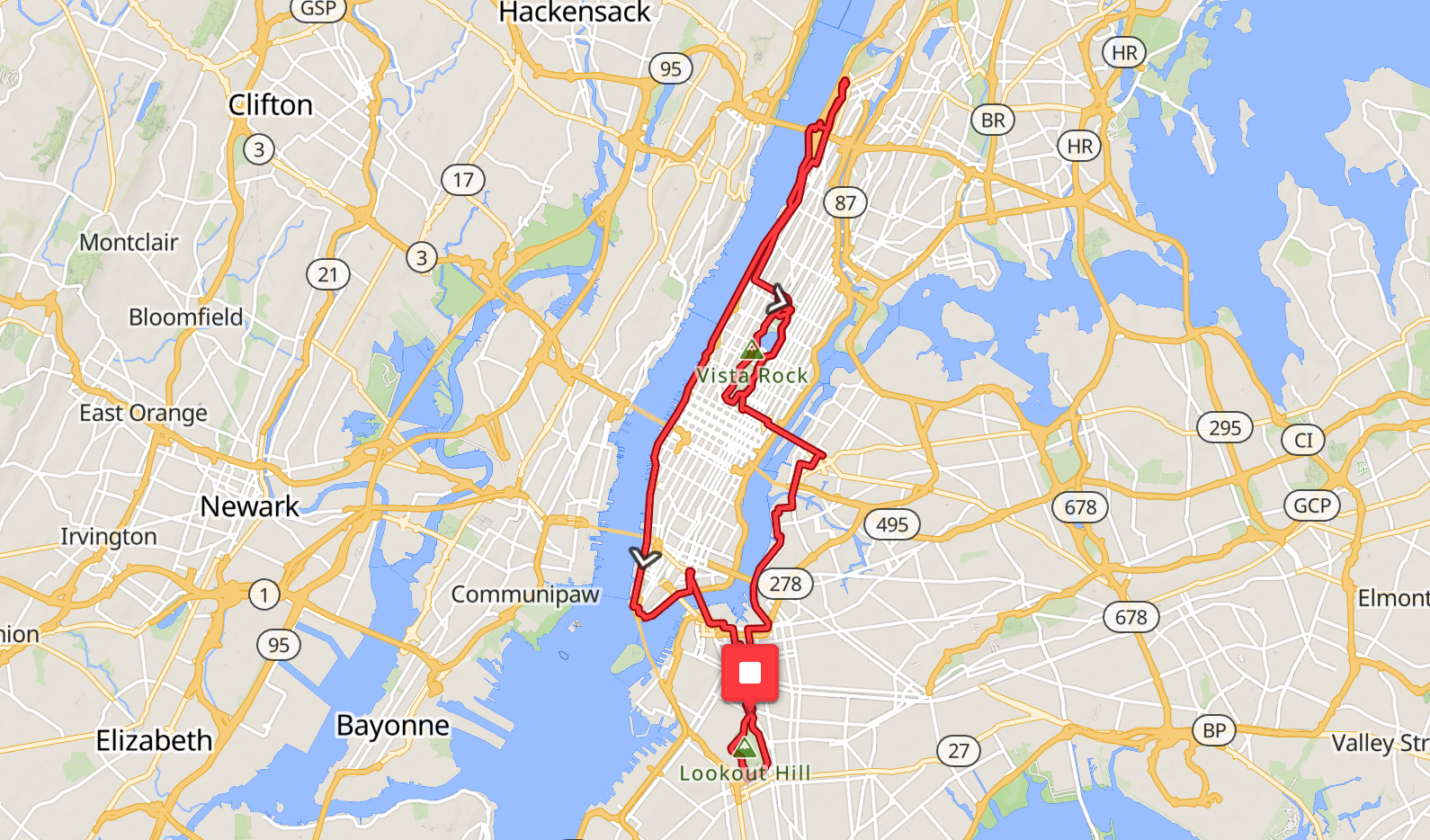
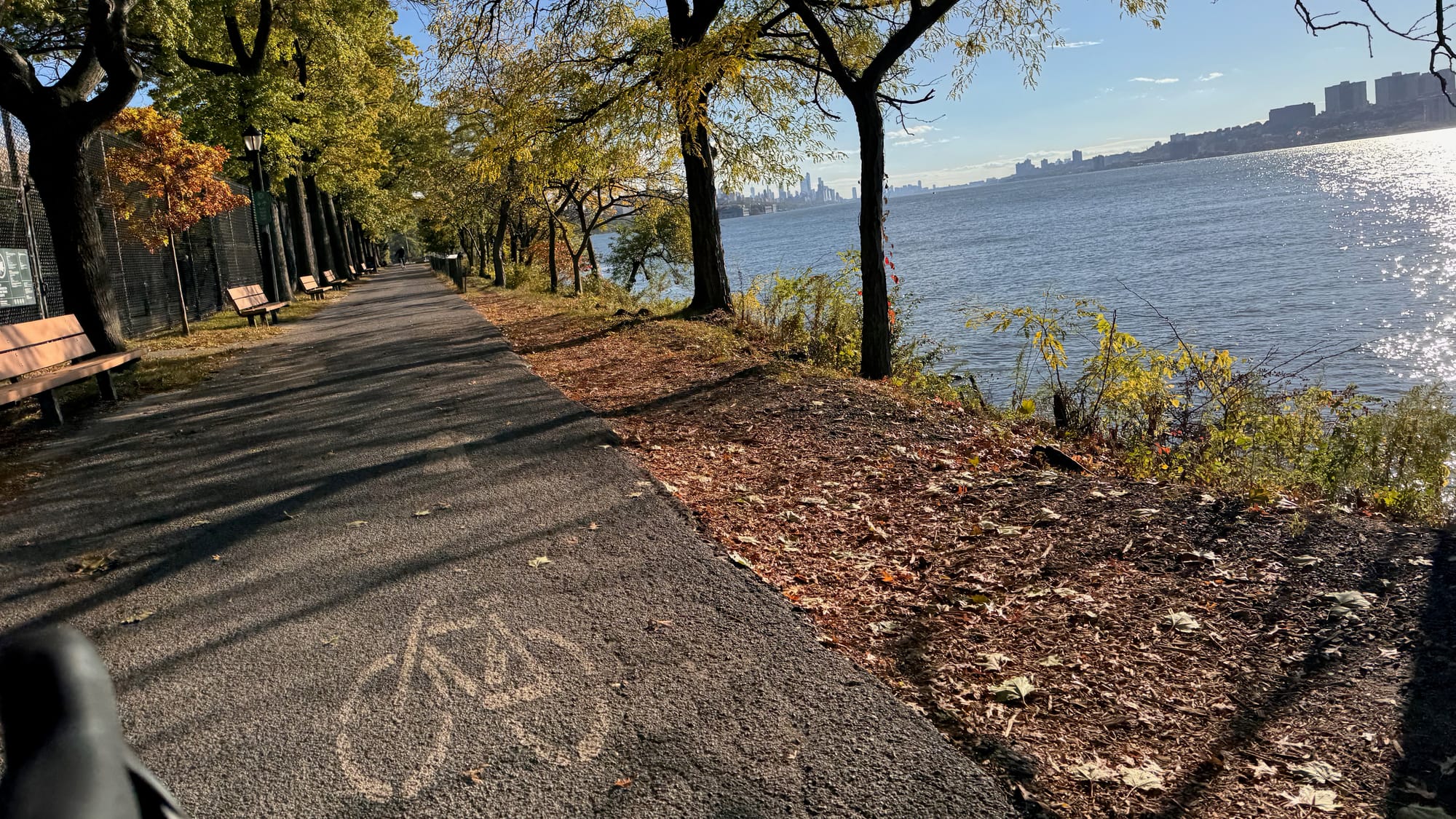
I attempt to ride this route, or a variation on it, roughly once a week, though in reality I think I only did the full thing sixteen times this year. It is, in my opinion, a fantastic way to see New York City. I usually ride it on a road bike, but it’s pleasant on more or less anything. I often find myself tracing portions of it on my commuter, and rode a big chunk of it on my track bike, as a distraction, on Election Day 2024. The route travels a healthy mix of bike lanes and fully separated bike paths, and it meanders through a wide range of neighborhoods without feeling too circuitous. When I have time I like to find ways to extend it beyond eighty kilometers (usually by doing another loop in either Central or Prospect Parks), and every once in a while I’ll add a lap back and forth across the George Washington Bridge so that I can call it an interstate commute. No matter the details I love this route, and I recommend it (or segments of it, depending on your appetite) to residents and visitors alike.

It is maybe worth mentioning that the original purpose of this route (and the original meaning behind its name) was to give me some emotional breathing room after visiting my therapist’s office. At the time it, the office, was just south of Union Square, and after lying on the couch for fifty minutes I’d find myself riding up the West Side Greenway, then looping around Central Park, and over the 59th Street Bridge, before tracing the North Brooklyn waterfront on my way home. These days I normally ride the route in reverse, widdershins, with the bulk of the ride happening before my therapy session. This requires planning, and on-the-fly adaptability. I need to plan my work and family responsibilities around what ends up being a four-and-a-half-hour outing, and I need to be prepared for changes in the weather, and I need to deal with a fair amount of in-your-face New York City car traffic. One might think that these stressors would exert pressure on the ride, but I consistently find the entire door-to-door-to-door experience therapeutic, regardless of the weather and how the riding itself feels. Early in January, I rode this route on a cold, sunny Sunday a few days after it had snowed. The whole ride I was cautious; the streets were almost completely dry but still had a ton of road salt on them, and cornering became a bit squirrelly at times. Then, as I was cruising on a tailwind down the West Side Greenway, I was suddenly launched skyward by a foot-shaped wedge of ice that had welded itself to the asphalt. I was completely airborne, listing noticeably to starboard, soaring for a moment before landing hard on my right hip. My bike barely hit the ground, but I spent five minutes shaking myself off before I could continue. Afterwards I limped for days, and my hip became mottled with purple and yellow. Still I was happier, calmer, and I do believe stronger for having gone on the ride.

Sierraville to Downieville, CA

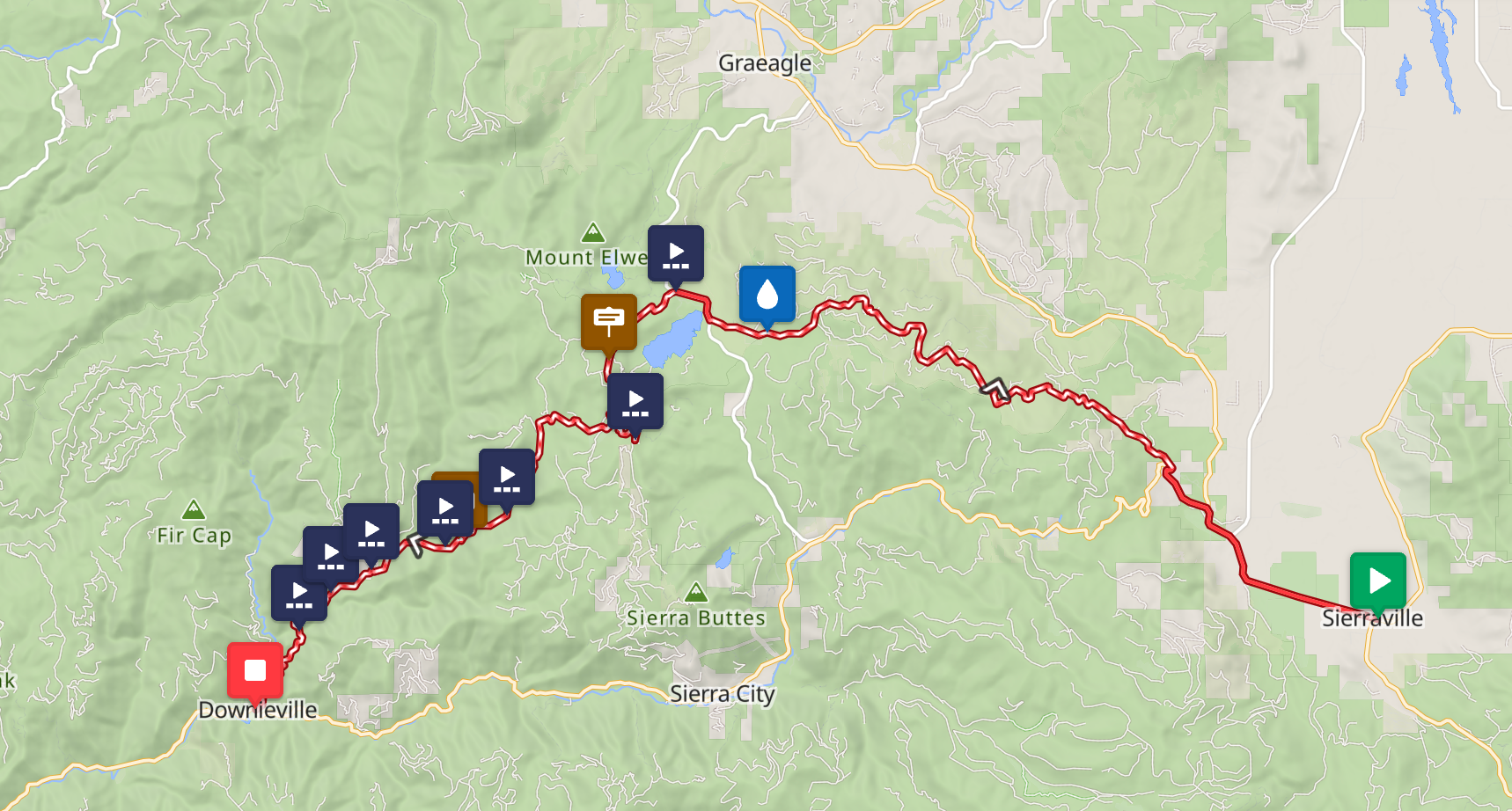
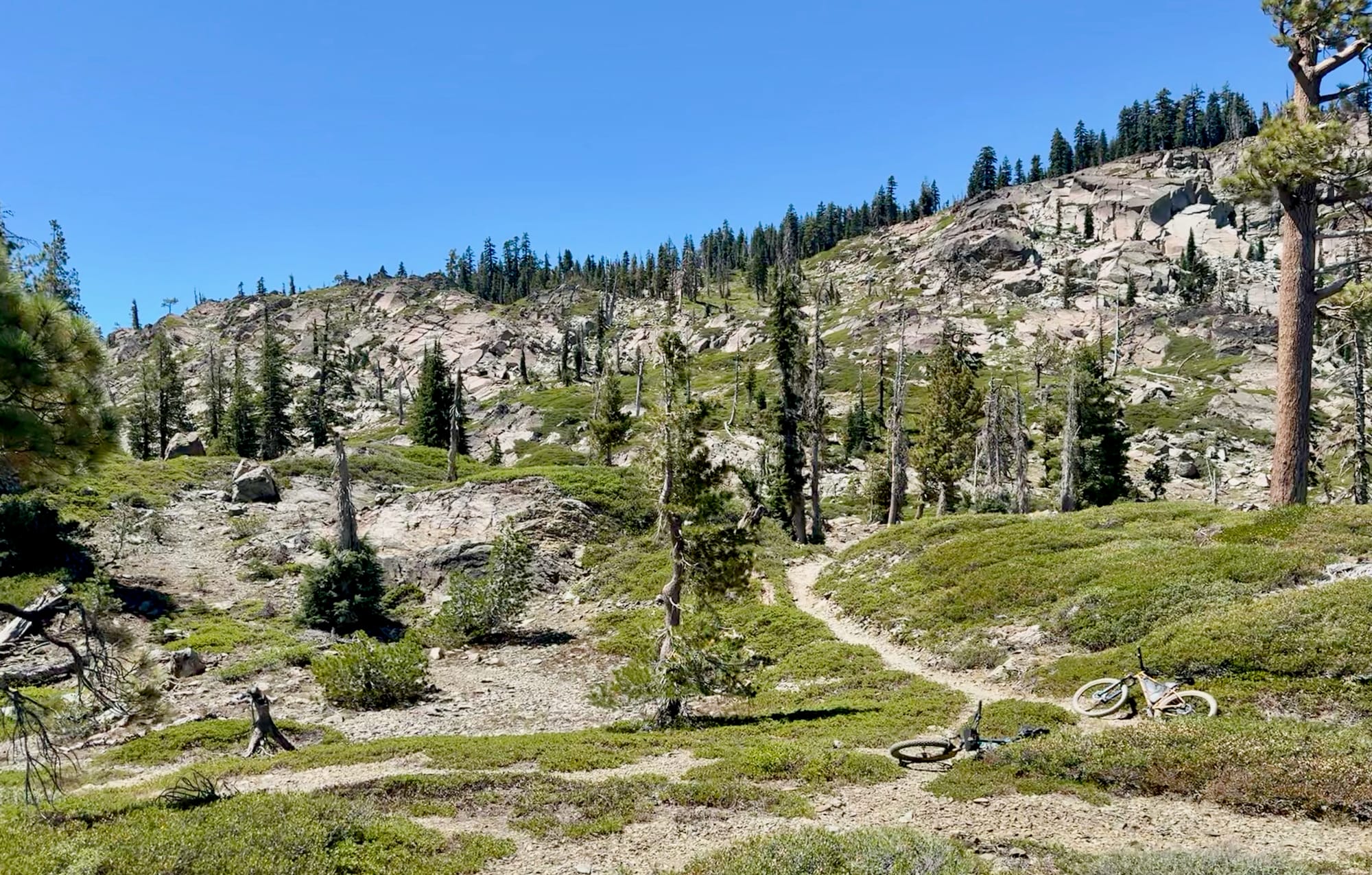
I’ve known about Downieville’s legendary downhill trail network for twenty years, and this route completely blew my expectations away. I rode it with Chris, in August, on my new hardtail, and since then I’ve been more or less constantly scheming about how I could do it again. The day previous I had ridden solo from Donner Pass to Sierraville (itself an excellent ride), ending at an Airbnb right next to Los Dos Hermanos and taking a soak at the hot springs before bed. On the Sierraville-to-Downieville day Chris and I awoke early, ate breakfast burritos at the little cafe in town, and then rolled along the southwest corner of the yellow-gold Sierra Valley before climbing a series of active logging roads over Haskell Peak. Then we descended to Gold Lake, hiked up the Round Lake Trail to a decommissioned portion of the PCT, and finally linked up, around lunch time, with the Downieville trail network. We flew down the Gold Valley Rim Trail, rumbled down “Baby Heads,” swooped alongside Pauley Creek and hung on for dear life on the Third and First Divide Trails. All of this riding was incredible and completely terrifying, and even sitting here months later I can barely believe I escaped without serious injury.

Better yet: At times I got the distinct sensation of having loosened my grip a bit, and of fully trusting the trails, and my bike, and my own physical ability. This is something I’ve found myself searching for, chasing, cultivating over the past few years — both on the bike and off of it. There are too many factors to worry about in life, too many subtleties to grok and study and manipulate. If I have any hope of making it through, I’ve realized, then I’ve got to learn how to play life a bit looser. I did this, for a few moments, while plummeting towards Downieville — and the sensation was utterly transcendent.

Goodwin Trail Loop/Laurentide Limit Day Scout, Connecticut

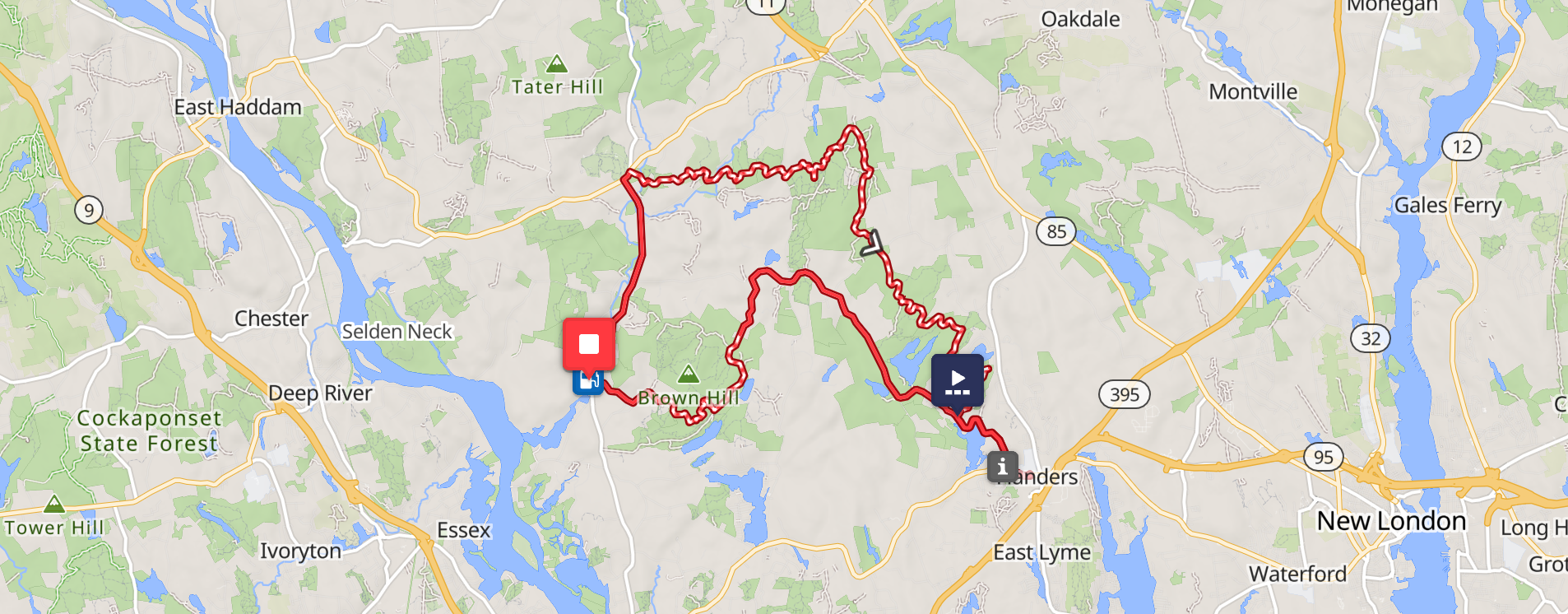
For a year or so I’ve been building a multi-day off-road route in Long Island and Connecticut, and early this spring I scouted a section of it. The section I scouted was just east of the Connecticut River, and includes what I believe to be the best singletrack of the entire route: the Richard Goodwin Trail. The riding was fun and the scenery was nice, and I enjoyed the opportunity to do a challenging downcountry mountain bike ride within an admittedly long drive from New York City. If I were doing it again and didn’t need to charge an electric car while I was riding, I might just ride the Goodwin Trail out-and-back rather than looping back on a mix of trail and asphalt. But even the paved sections of the route were pretty, and it was nice mixing the terrain (and vistas) up.

I rode this route on a Tuesday in July; on paper my productivity almost certainly suffered as a result. In this sense the ride was a manifestation of my decision to make time for the things that matter to me. Why a multi-day off-road route in Long Island and Connecticut matters to me, I do not know. But it feels like as good and healthy a side quest as could possibly exist, and if nothing else I think it’s worth allocating a few Tuesdays in July to side quests like these.

Bennington Covered Bridges Gravel, Vermont

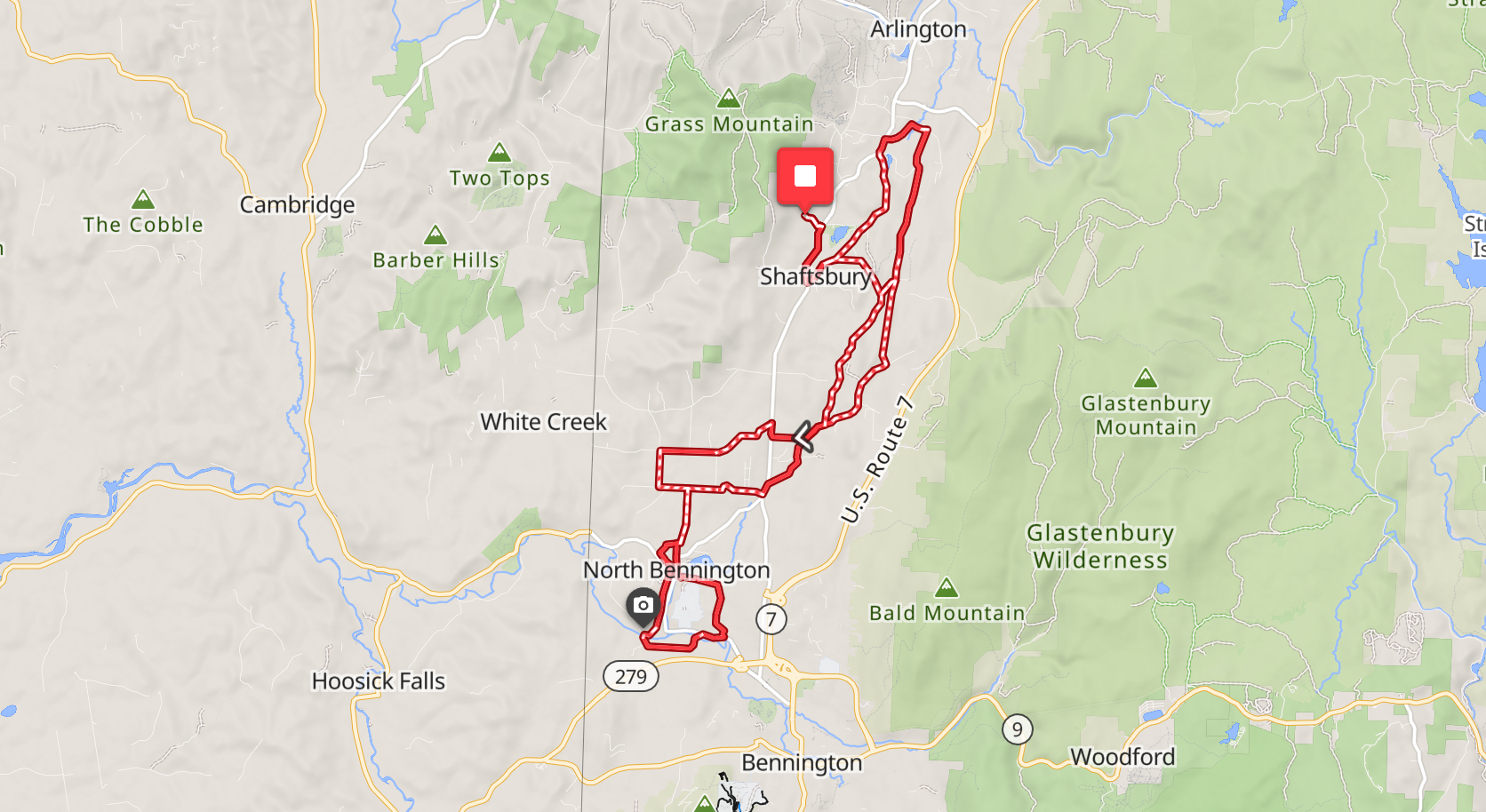
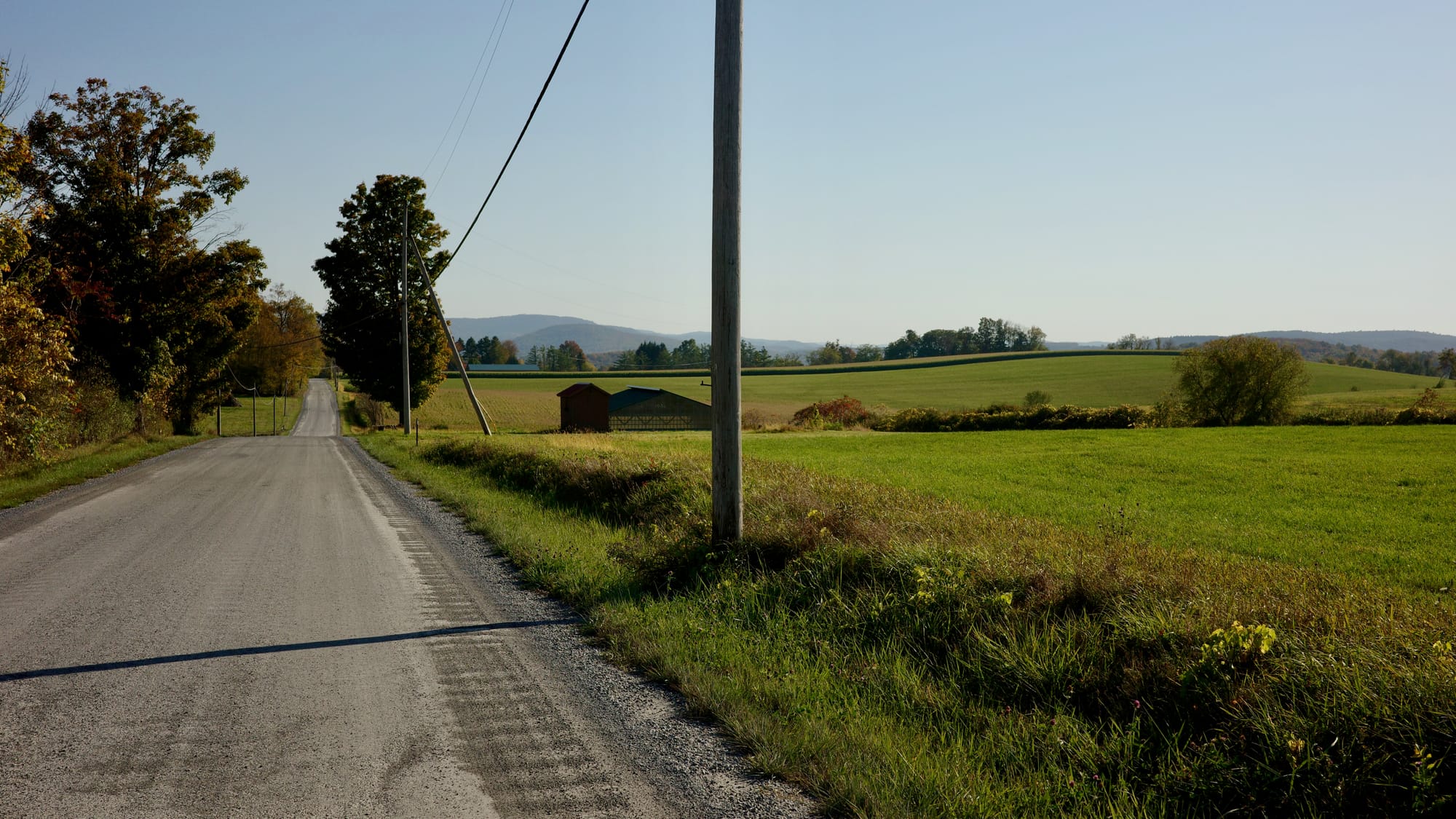
This route, which begins and ends at a Hipcamp I stayed at for part of a week in October, was probably the best gravel riding I did this year. At fifty-eight kilometers it wasn’t all that long, but bathed in afternoon sunlight it was beautiful. Also, I think I had ridden a longer loop, around Glastonbury Mountain, the day before, and that included multiple chunky sections that I was still recovering from. Wanting to spend some time in the saddle but not wanting to overdo it, I made a compromise, and the result was this route — which includes two different covered bridges, both of which I believe use the “Town Lattice” truss design. Stopping to look at one of the bridges’ plaques, I learned that the Town Lattice was invented by someone named Ithiel Town. I recommend learning covered bridge facts like this one before you go out of your way to cross a bunch of covered bridges, lest you become one of the rubberneckers like me blocking traffic so that you can read the whole plaque.

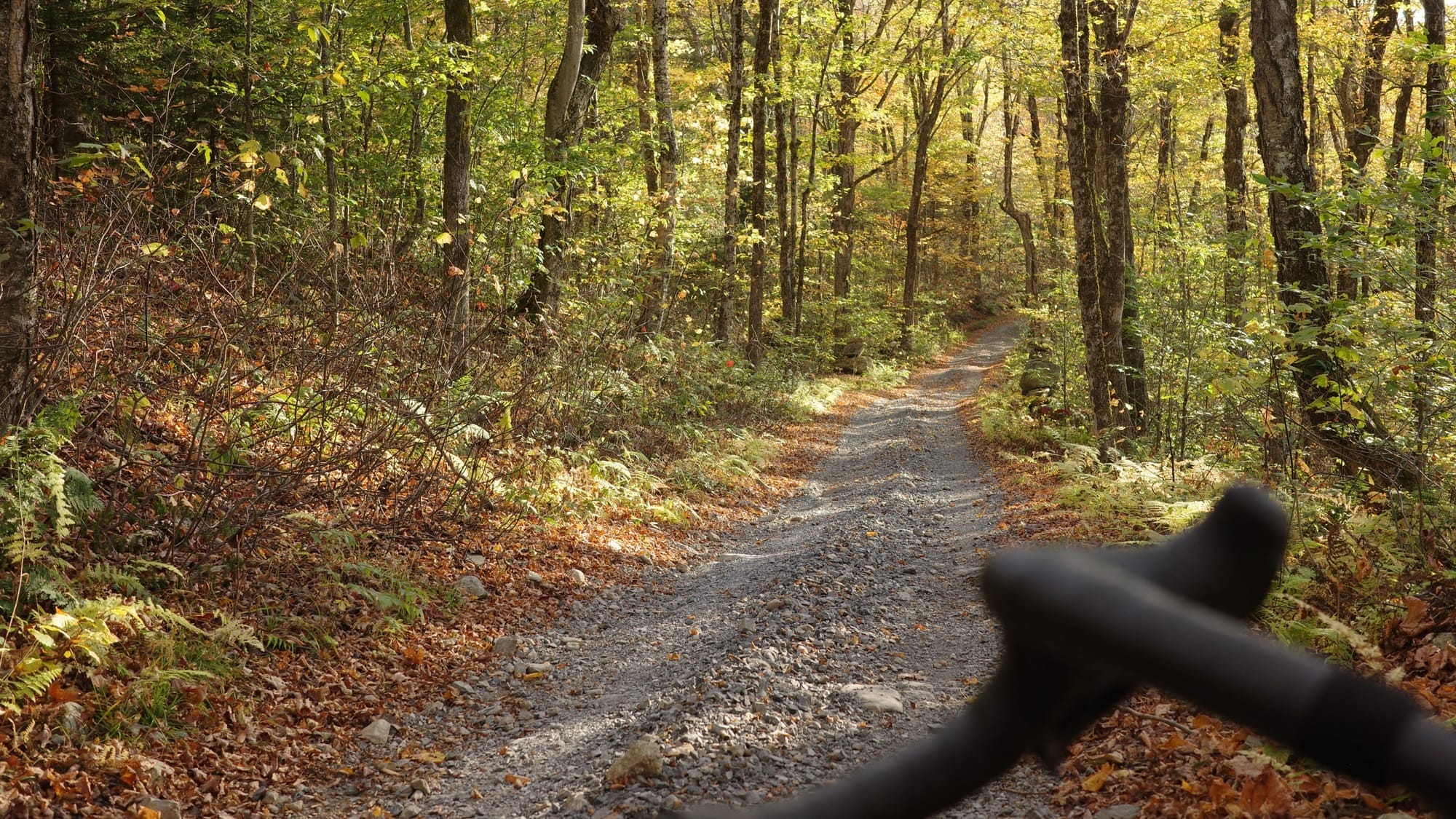
Then again, sometimes it’s okay to rubberneck. I was there in early October, and southern Vermont was dozing through what seemed like the last week of meteorological summer. I had intended, initially, to ride the entire length of the state, catching an autumnal wave at the Canadian border and surfing it all the way to Massachusetts. But there were logistical hurdles to doing so, and in the end I camped out just north of Bennington and spent more or less equal parts of the week reading, writing, and riding asphalt, gravel, and Class IV roads. It was a compromise; it took effort; I enjoyed it very much.

XLI, Long Island, NY

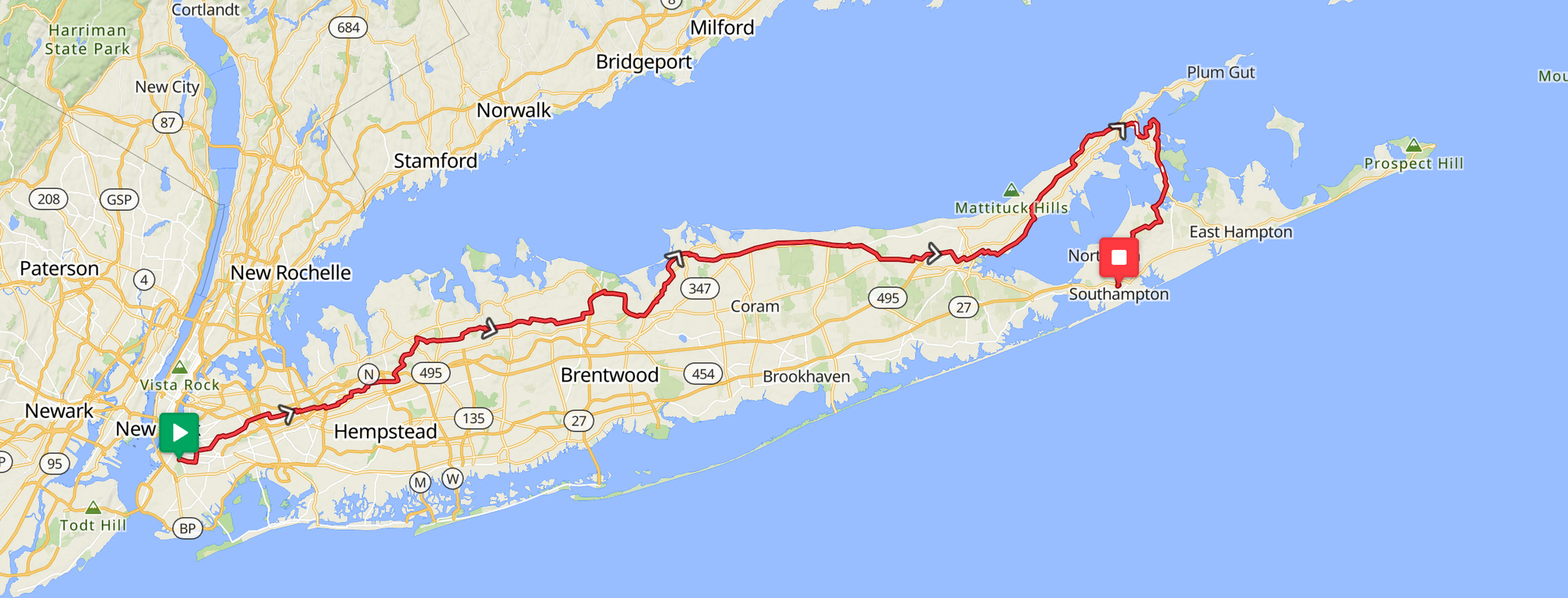
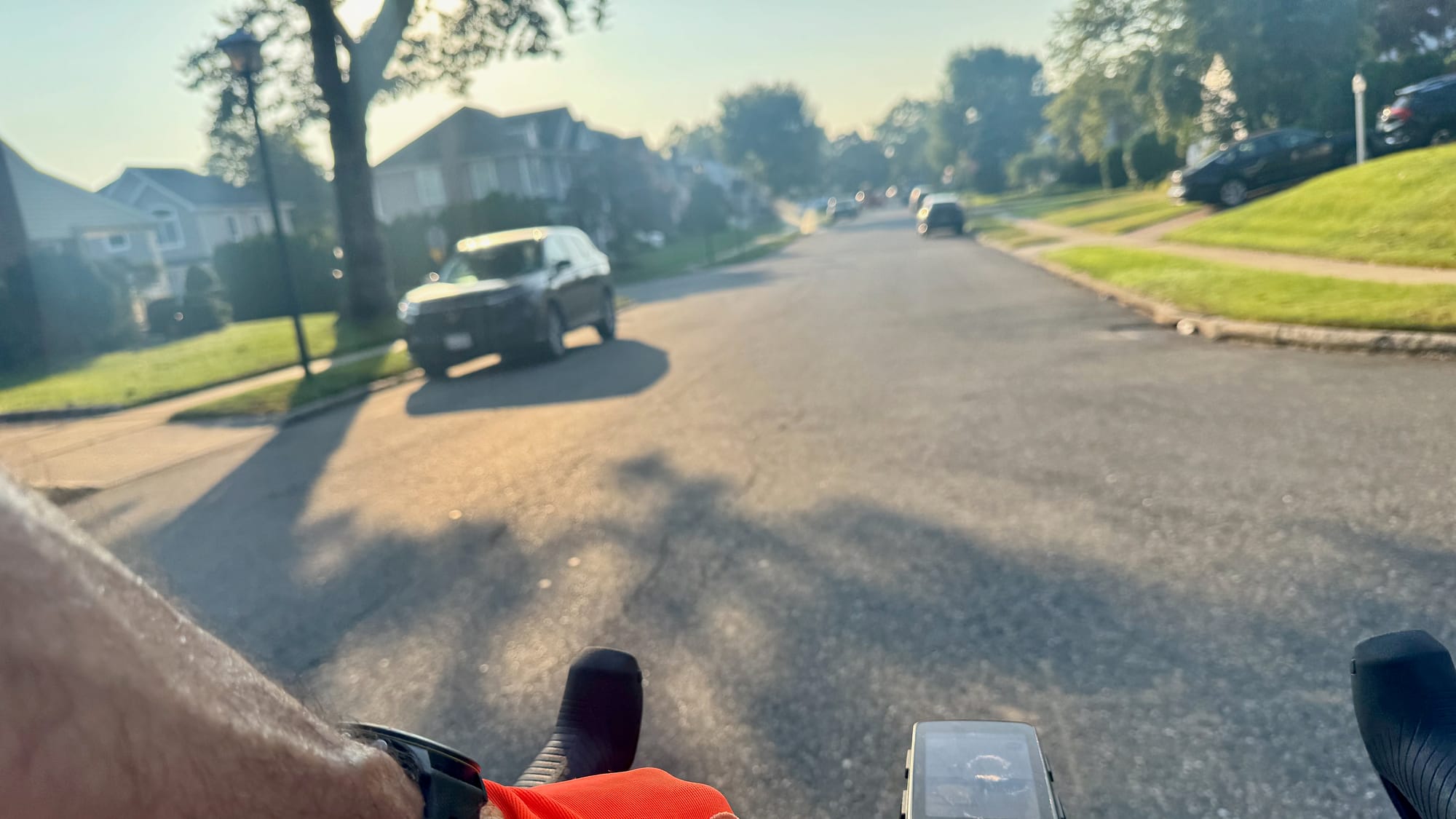
I love, love riding the length of Long Island. I do it from Brooklyn (where I live now) to Southampton (where I grew up), and I very much recommend riding it in this direction, west to east, rather than the other way, which is fun every once in a while (I did it towards the end of summer) but tends to be less refreshing and more exhausting. On this year’s eastbound ride I added an additional North Fork loop, extending its length to more than two hundred kilometers and enabling some nice views over both Long Island Sound and Peconic Bay. This also meant taking both the North and South Shelter Island Ferries, neither of which accept credit cards — the only form of payment I had brought with me. Luckily my fares were lent to me by two different fellow cyclists, both of whom forgave the debt immediately and were totally lovely to chat with while on the ferry. While on Shelter Island I also had the great pleasure of receiving a free lemonade from a stand being manned by a couple of kids and their babysitter. By this point in the day it was late, and I was hot, and it was pretty lovely to come around the bend on a totally empty road and see a complimentary beverage just waiting there for me.

The thing I like most about this ride — perhaps the thing I like most about bike rides in general — is seeing the fabric of the island, and of the world, morph. For much of the route this change is gradual. Bed Stuy shifts to Bushwick, and Bushwick slides into Ridgewood. Long Island is almost entirely within the Census-designated New York Urban Area, and while riding its length one can really see an urban ombré, a dense environment fading into rurality. Pick any variable — sound, temperature, color palette — and as you ride you can watch the dial sweep from one end of the spectrum to the other. The result is both predictable and gently surprising. I believe this route was the longest ride I’ve ever completed, but I arrived at its endpoint more refreshed than tired.


It being the holidays, and me being me, I’ve spent some time recently catching up with friends and family. Often they ask how my work is going, and often I’ve found myself giving complicated answers in response. Any clear-eyed observer would conclude that I’m obviously pretty confused about how my work is going, and I wonder whether it might be good to write down how I’ve been feeling about it, in the spirit of transparency and the hope of making some progress on whatever it is I’m working through.

So, here’s how I think my work is going. On the one hand, I believe that my job is to write and publish things, and at these two tasks I think I did a better job in 2025 than ever before. I wrote and published a lot of things, and the things I wrote and published were more deeply researched, more informative, and more honest than anything I’ve worked on previously. This is great, and I’m proud of it, and I’m excited to continue on this path in 2026.

On the other hand, though, my income has trended downward, significantly, for at least the past two years, and on some level that makes me feel like I must be doing something wrong. Every time I think about this I shudder a little. Then I steel myself, and re-resolve to follow what feels right, even when what feels right is to make a list of bike rides that meant a lot to me. I think all of this, each word reverberating in my head, shaking all of my insecurities loose. Then I take a breath, and sit back in my chair, and start planning the rides that, with any luck, will shape my experience of 2026.

A special thanks to SOW's paid subscribers, who make literally all of this possible. They also get more: In this case full .gpx route files for each of these five routes. If you've got even a hint of curiosity about any of these routes, or if you just want to help keep SOW alive, you can support me directly by upgrading to a paid subscription today.

Upgrade today
695b8a04ac04ca000136cc62
Extensions
Five Books for 2025
It's a time for reflection.
Show full content
Five Books for 2025

It is a time for reflection. The second-to-last Monday in December may as well be the last Monday in December, depending on holiday observances and one’s tendency to coast through this last week. If you’re one to assess the year that’s nearly passed, you really ought to have started by now. For my part I did recently look at my beginning-of-year goals, of which maybe three-fifths have been checked off, and I’ve been thinking about the non-goal achievements I’ve both made and missed. When thinking about those gets to be a bit too much, I turn to making lists of excellent bike rides ridden, and impressive home projects completed, and (our topic for today) mind-focusing books read.

Looking for something good to start reading in 2026? Try Inventing Temperature: Measurement and Scientific Progress, by Hasok Chang, which the SOW Members’ Reading Group (which you should join!) will begin discussing on Thursday, 2026-01-08.

Barbarian Days by William Finnegan

More than anything else I consumed this year, Barbarian Days infected my mood, my outlook, and my sense of my own life arc. I listened to it, on audio, at least three or four times back-to-back, and then I bought a paper copy so that I could study a few key passages. I was deeply affected by Finnegan’s stories, which are nominally about surfing but are really about a life fully lived (and fully reflected upon). Finnegan paints himself as a rich, nuanced, and ultimately flawed person, and the net effect is that he feels genuine, vulnerable, and trustworthy. This is great — anyone who writes a memoir would want to be trustworthy — but the real payoff is when Finnegan then leverages the readers’ trust to describe his closest friends and family members with tenderness, generosity, and grace. Throughout the book, his level of emotional availability is staggering, and the fact that it was counterbalanced by Finnegan’s truly jaw-dropping surf sagas made the entire package a blast to read. I was left with the sense that Finnegan was both larger than life and also deeply human; he’s not a hero, but he’s an incredibly effective protagonist. As a writer, I found this inspirational, and it reinforced my sense that my own emotional availability might enhance whatever other story I want to tell — whether it be technical, historical, or simply explanatory.

Four Thousand Weeks by Oliver Burkeman

Four Thousand Weeks, along with Meditations for Mortals, had a big effect on the way I thought about my own ambitions and life outlook this year. Burkeman begins from the realization that there’s effectively zero chance that his own achievements will be remembered past his own lifespan. Almost nobody leaves a legacy that outlives them, and it’s not immediately clear that doing so is even a good or admirable thing. We all die — our lives last roughly four thousand weeks — and so maybe all we can do is try to use those four thousand weeks as best we can.

This all may seem banal, but I submit to you that it’s profound. Burkeman is not defeatist, and in fact he retains quite a bit of optimism while writing about his ultimate demise. But his practical approach towards his own life “accomplishments” (or lack thereof) is refreshing, and the way he communicates his life philosophy is energizing and enduring.

Trick Mirror by Jia Tolentino

I was surprised and impressed with the way that Tolentino blended erudite and vaguely academic criticism with her own intimate and rather rambunctious personal history. At times her cultural, art-historical analysis verged far beyond my own interests, but Tolentino is such an interesting and appealing person that I stuck with her. Even more so, I found myself racing, dragging my own jaw across the floor as I tried to keep up with her, craning my neck to get a better view of whatever she was looking at, trying in vain to recognize her in the crowd around me. The book made me want to listen to Tolentino, whatever she was writing about.

Trick Mirror is itself a set of essays, each exploring some intersection between modern culture and self-identity. I’m not sure whether it affected how I understand my own self-identity vis a vis the culture in which I live, but it did convince me that these two things can coexist in a single text, and that that text can be both serious and fun, reflective and speculative, broad and specific. These were, I think, important lessons for me to be exposed to, and I’m glad that Tolentino put so much of her intelligence, experience, and wit into them.

All Fours by Miranda July

For the past couple of years my wife has joked that I’ve been experiencing some kind of midlife crisis, and inasmuch as I’m in the middle of my life I’m inclined to agree with her. Having already read some of the most well-regarded twentieth-century midlife crisis books, and being aware that the lion’s share of my social circle had all read All Fours, and being a fan of Miranda July’s film work, I finally decided to listen to it while undertaking an extensive backyard project early this summer. It did not disappoint; in fact it transfixed me. July’s approach towards even the simplest problem feels both naturalistic and utterly bizarre, and it was both fun and vaguely enlightening to track her reactions to a pretty traumatic series of midlife events. In one sense her idiosyncrasies (and the extreme nature of her midlife traumas) made the book difficult to relate to, but at the same time her way of explaining herself is so completely logical and well-reasoned that it’s impossible not to empathize. My biggest takeaway, though, is that life is hard for all of us — no matter what stage you’re in, and no matter whether you share July’s (let’s say) atypical way of dealing with life’s difficulties.

QED by Richard Feynman

If there’s one thing I’m really into, it’s soulful descriptions of highly technical subject matter. There are many lanes within this particular pool, and Feynman, with his jocular, winking style occupies — one might say defines — one of them. This book, which attempts to explain how photons and electrons interact (and how their interactions go on to explain many of the phenomena we can perceive, from the partial reflection produced by a piece of glass to the difference between conventional and nuclear explosives), does not always manage to balance explanation and entertainment, but in its best moments (which in my opinion occur towards the end of the first chapter) it is brilliant. Like any good physics text, I would be best demurring if asked to explain its contents. But QED (which was originally written as a series of “lay” lectures, and includes many beautiful diagrams) was both enlightening and fun to read, and more than anything it seemed to be driven by Feynman’s genuine (and infectious) pleasure in attempting to understand the world around him.


Thanks as always to SOW’s Members and Supporters for making this newsletter possible. Thanks especially to the SOW Members’ Reading Group, who together do wonders in helping me focus on thought-provoking texts.

69488a039602c000011bc3a8
Extensions
Scope Creep, 2025-12-08.
Scope Creep
I do not know how they got away with it.
Show full content
Scope Creep, 2025-12-08.

Here’s a short video about rom-coms, and in particular the inevitable scene where the protagonist runs through their home city (or an airport, maybe) in order to tell someone they love them. There are some totally iconic visuals in the video, but it was this bit, in the voiceover, that got to me:

In the modern day, we live in a world without a cosmic moral order, a framework of meaning to which everyone automatically subscribes. We had one for a while. But round about the year 1700, give or take a century, that framework started cracking, fragmenting, losing its authority, and the burden of finding meaning shifted onto individuals. We all became desperate seekers in a confusing and disjointed world.

Disjointed the world is, and burdensome living in it can be. Recently I’ve found myself searching for coherence in cultural experiences — live music, mainly, but really anything that I can witness alongside others, and be sure that we’re all feeling something. As if through being in the same room, swaying to the same rhythm, each of our self-constructed moral frameworks becomes a little more stable.

But still the world is mostly confusing, and in spite of the moral-authoritative orders they may have lived under I suspect that our ancestors were plagued with confusion as well. Take this, from Adam Mastroianni’s excellent Experimental History newsletter:

As late as 1813, some parts of the European medical establishment believed that potatoes cause leprosy. (Don’t even get ‘em started on scrofula!) Potato historian Redcliffe Salaman suggests that people were skeptical because potatoes look kinda weird, they grow in the ground, and you plant them as tubers rather than seeds, which are all extremely suspicious things for a food to do.
Scope Creep, 2025-12-08.
An old cigarette card shows seed potatoes, which "should be well exposed to the light, until they are tinged with green." Image via NYPL Digital Collections.
  • Recently my wife and I watched The Gleaners and I, Agnès Varda’s totally weird documentary about the relationship between farmers, and peasants, and the precise moment when a harvest season begins and ends.
  • Here’s an interesting podcast episode on the wild mushroom trade, and the social and physical infrastructure required to glean feral fungi, and transport them to your plate.
  • “Pen knives” are so named because they were originally used to cut points onto quills so that they could be used to write with ink.
  • I’m listening to Rosalia’s new album, Lux, a lot right now, and also Dijon’s Baby; I think both are fantastic. Also on rotation (mostly while writing) is The Disintegration Loops by William Basinski.
  • Here’s a workshop and showroom tour of the Melanzana cut-and-sew shop in Leadville, Colorado. Here’s an interview with Melanzana’s founder, Fritz Howard. Melanzana produces all of their clothing in Leadville, a town of about 2600 people which, at over ten thousand feet above sea level, is the highest incorporated city in the US. This makes it challenging for them to expand production, and ultimately constrains their growth as a company. They handle this partly by selling the vast majority of their product in-person at their showroom, which actually requires appointments for most purchases and has a per-customer, per-visit limit on the quantity of clothing one can purchase.

    I find Melanzana’s business strategy counterintuitive and unexpected, and I suppose it helps to explain the fact that I was totally unaware of Melanzana until a couple of months ago, when I was given one of their hoodies more or less by accident. What has remained a mystery, though, is the honestly shocking amount of attention this hoodie has received since then; it’s easily the most commented-upon garment I’ve ever owned, with both friends and strangers calling the brand out by name and complimenting the sweatshirt’s frumpy yet somehow athletic drape. I guess this is all to say that Melanzana seems to have forged their own idiosyncratic moral framework, and has somehow managed to convince a large number of New Yorkers that that framework is worthy of their attention.
  • Also re: factory tours, I noted with interest this, from Jim:
About factory tours, one of my favorites was the Yuengling tour in Pottsville, PA. They let visitors look inside brewing tanks, stand next to the control panels, and walk so close to the canning lines you can get wet from the wash water. This was 10 years ago, I do not know how they got away with it.
  • Here’s a pretty good video about NYC’s food carts: their supply chains (a not-at-all automated bakery in the Bronx), their history, and the laws that regulate them.
  • Fran Sans is a typeface, designed by Emily Sneddon and based on the LCD displays in SF Muni’s Breda light rail vehicles — which were officially retired last month.
  • Tom Whitwell’s always-excellent “52 things I learned this year” post; I’m honored to be listed under #20.
  • Poland Spring has been selling water since at least 1860. The company initially packaged their spring water in wooden casks, but in 1876 they introduced their first bottle. Made of clear, brown, or green glass, the bottle was shaped to look like Moses. It was apparently popular with tourists, who would travel to Maine on their honeymoons and bring back Moses bottles to (??) store on their shelves at home.
  • “Zohran Mamdani hires car-hating activist Ben Furnas for NYC transportation team.”
  • Here’s one way to structure your family life: Joshua Slocum arrived in Sydney, Australia on January 9th, 1871. Over the next twenty-two days he met and married Virginia Walker. The day after they married, the new couple boarded the ship that Slocum was captaining; they would spend the next thirteen years sailing around the world. Virginia had seven children, all either at sea or in foreign ports, four of whom survived to adulthood. Then in 1884, in Buenos Aires, Virginia became ill and died. Slocum sailed to Massachusetts, left his three youngest kids with their aunts, and made his eldest son his first mate.

Thanks as always to Scope of Work's Members and Supporters for making this newsletter possible. Thanks also to Michael and Nick for helping source links & thoughts this week.

6936dc136f302400017ad237
Extensions
The Fall
In all, an almost pleasant experience.
Show full content
The Fall

There had been some fighting on the way to school, but it wasn’t bad. It was supposed to rain for much of the day, but that wasn’t bad either — a light drizzle, barely noticeable as I pulled the bike out and the kids piled onto it. We rode two blocks, then stopped to wait at an intersection for Grant and Elizabeth. Grant had texted me beforehand to coordinate this, but our coordination was imperfect, and as we waited there we all noticed that we were being drizzled upon and began to wonder whether Grant and Elizabeth had actually gotten there before us and were now further along the way to school. To the Little One the solution to this uncertainty was clear: We should leave, now, and just when I decided she was probably right the Big One said “there they are,” and we all looked back to watch the two of them riding their bikes across the intersection towards us. Elizabeth seemed delighted to see us and began talking immediately about Mr. Popper’s Penguins, which she had apparently been reading and had found hilarious. My kids didn’t seem to care (I remember Mr. Popper’s Penguins only vaguely, and they remember it not at all), but I played along as we rolled slowly east all the way to Rochester Ave. Then we dropped through Lincoln Terrace Park, the Big One urging us to ride the extra-long route that weaves down into the meadow, then up towards the barbecuing area, before swooping back down past the playground. At this point the Little One became animated, demanding that we “please go,” and eventually I said I wasn’t taking any more requests this morning and focused my attention on just getting everyone to school.

The Little One got off the bike and walked into school without acknowledging my presence, but the Big One gave me a big hug. I gave fist bumps to Elizabeth and Grant, then rode off, up the incline towards East New York Avenue. “This light is all messed up,” I thought when I got there. The walk sign beckoned me northward, across East New York Avenue, but eastbound cars continued to drive through the intersection. It’s like this basically every day, cars blowing this particular red light, which is immediately in front of two public elementary schools and at least two private preschools. I didn’t let it heat me up; instead I waited for the offending cars to pass, then rode across East New York Ave and continued up Rochester.

Rochester Avenue, between New York Avenue and Eastern Parkway, is probably the least friendly road I ride on regularly. It has two-way automobile traffic and curbside parking on both sides, and the roadway just isn’t wide enough for all of that and a bike. Let alone a big e-cargo bike, though I try to use that factor to my advantage by tapping its controller into “TURBO” mode so that I can fly up the hill as quickly as possible. It’s an imperfect strategy, partly because cars still want to pass me as they speed from stoplight to stoplight, and partly because they are then inevitably stopped at one of those stoplights, leading me to pass them, and so on. The whole situation is sketchy, and I don’t like doing it alone, and I definitely don’t like doing it with the kids; when I’m with them we ride through Lincoln Terrace Park, like we did on the way to school. But when I’m alone, riding home from drop-off, I usually bite the bullet, and contend with the traffic, and do my best to get neither hurt nor overly involved in the absurdity of it all.

The traffic was normal, which is to say that it was bad. At President Street a red light presented itself, and I pulled up to the light, or more precisely to my place in the line at the light, behind and to the right of a white Ford Explorer. The Explorer was maybe the third car waiting in line for the light to change. To my right, parked at the curb, was a big Verizon truck. If I were riding my commuter bike, which is lighter and much more flickable than the e-cargo bike, then I would have hopped up onto the curb, riding on the sidewalk until there was a gap where I could drop back onto the street. Or maybe I would have pulled to the left of the Explorer, riding the wrong way into oncoming traffic; this is an especially dangerous move, but one that I’ve been known to pull when I’m riding alone. Anyway, I did not do these particular things on this particular day. I waited there, kind of hoping that the Explorer would pull a little to its left so I could squeeze through, but waiting my turn nonetheless.

It was immediately obvious what had happened, even though I didn’t anticipate it and didn’t really see it happen either. Everything seemed fine, normal, and then there was a crash just to my left, and the Explorer bounced to its right, into me, pinning me up against the Verizon truck. These actions seemed to occur simultaneously, in a single event; first I was sitting there waiting, and then I was pinched between a sport utility vehicle and an actual utility vehicle. I could not tell who else was involved, but I assumed that someone had hit the Explorer hard, and that whoever was in the Explorer might have been injured and was probably a little shaken up. I was a little shaken up — I noticed that my knee was bleeding — and I very much wanted not to be pinned there.

So I called to the Explorer driver not to move their car yet, and I wriggled myself, and then the cargo bike, out from where we were pinned. Taking a step back, I could see the other car that was involved in the crash, which had rolled onto its passenger side such that I was looking at its undercarriage. I think one of its wheels was slowly spinning, and its engine was definitely running, and it occurred to me that I didn’t really want to be nearby a running engine that had just rolled onto its side. I also didn’t want to be near its driver, though the reasons for that were a little less clear. I looked down at my knee, which had a fairly large cut in it but was not bleeding much. I touched it (it hurt, but not that bad), and tried to think about whether anything else hurt (nothing seemed to), and began to reconcile myself with the day that was to come.

It was in the ambulance that I realized this was probably the first day of fall. This was September tenth, a culturally aseasonal Wednesday about halfway between the first day of school and the equinox. I had been clinging to the idea that I was still living in summer, trying to squeeze its last few moments out, but today was dreary and with the way my knee was looking I would probably have to take it easy for at least a few days. Whatever summery things I had hoped to get done this year should be assumed lost. For planning purposes, I was living in autumn.

Somehow I fell into sync with this reality almost immediately; I rolled with it, played along with the new script that I had been presented with. I sat for a minute in the ambulance that the rolled-over driver was in; she didn’t acknowledge me and seemed utterly unaware of the conditions under which she had caused the crash. Then I was moved to my own ambulance, which hung out at the scene long enough for the cops to come and get my statement. Then they, the ambulance crew, took me to the emergency room closest to our house. It was a Wednesday morning, too early for ERs to be very chaotic, and sure enough the triage area was almost boring in its normal misery, its miserable normality. An odorous patient, apparently a regular, berated the staff to give him a sheet as he laid on a stretcher near the admittedly drafty entrance. The woman in front of him, who was very frail and had apparently brought with her a gallon-sized Ziploc bag full of assorted pills, seemed to be refusing treatment while simultaneously requesting and utilizing a barf bag. I sat awkwardly in a chair next to her, waiting to be triaged. My ambulance team milled nearby, chatting as if it were their first time interacting with one another, just two random New Yorkers who happened to be paired up for the morning. The triage nurse smiled as she asked me her intake questions, glancing up and down the hallway and batting her dramatically large eyelashes at nobody in particular. It didn’t take a long time, but it didn’t take a short time either. Every few minutes I stood up so that someone could push a stretcher past my bandaged left leg.

Then I was moved to another waiting room, this one marked “FAST TRACK,” where I sat in another chair for a while. I inquired about coffee (I had not had any) and was told I should wait to see a doctor first, which I thought was reasonable and not particularly onerous. My chair wobbled but was not uncomfortable. The doctor saw me, ordered an x-ray, waited for me to complete the x-ray, and then pointed me vaguely towards the place where I could get a coffee, which was in the lobby of the next building over. Getting there required me to leave the ER, which I did without really knowing where I was going, but the whole excursion ended up being extremely normal and vaguely rejuvenating. The coffee procurement place was a little bodega inside the hospital. I found it easily, guided by a few other hospital employees, and then found myself right at home in its typically New York layout, styling, and selection. I got my coffee — a canned espresso and cream, cold, bought two in a single transaction and consumed in a couple of efficient but pleasant gulps as I walked back to the “FAST TRACK” door. The caffeine had begun to kick in when I was eventually called and taken back to an exam room by a PA who cleaned, numbed, and tied seven stitches into the laceration on my kneecap. We talked about mountain biking, and California, and the size of the sutures he was using (3-0), and the kind of stitches he was tying (two horizontal mattresses plus five simple stitches). I have no idea what his name was, but I did learn that he started at the hospital late in 2020. “Or, I guess it was early 2021,” he corrected himself.

It was, in all, an almost pleasant experience. Fall had fallen, and I fell willingly along with it.

The Fall

One of the things I’ve been working on over the past couple of months is my ability to describe sensory experiences. I spent a good chunk of the summer trying to explain the sensation of drinking lemonade — the flavors, partly, but also my own mouth’s complex and seemingly automatic reactions to each sip. Now, as autumn set in, I found myself methodically eating Concord grapes, focusing on how their textures and flavors ricochet off of one another. I cannot say for certain why I’ve been working on this; surely some of it is rooted in a personal desire to enjoy seasonally appropriate libations. But there’s another part that has to do with understanding how and why I perceive the world the way I do. “Maybe if I can describe what I’m feeling,” I think, “if I really put my finger on the rhythms of this experience, then it’ll be easier for me to move in time with it.”

It doesn’t honestly make a ton of sense, but I’ve found myself returning to it again and again. Recently, after stumbling across a pint of Concord grapes at the “Taste NY” rest stop on the Taconic Parkway, I found myself working through the grapes like one should (but I never do) eat popcorn. I wrote:

691b39a42788a20001b6bca4
Extensions
Scope Creep, 2025-11-10.
Scope Creep
The opposite of deasil is widdershins.
Show full content
  • Does one need to provide spoiler alerts when discussing offhanded phrases in relatively obscure, 67-year-old novels? I would think not, but consider yourself warned regardless: Towards the end of Graham Greene’s Our Man in Havana, a disgraced British pseudo-spy is court-martialed in absentia. The spy, who was half expecting to be “shot at dawn,” instead survives the court-martial, and receives a permanent job offer, apparently on the recommendation of a naval officer who he had never met. The spy, asking why he received the naval officer’s recommendation, is told that “at sea one learns to take the long view.”

    This struck me because of Natasha’s essay about sailing a building, which got me thinking about further implications of the house-as-ship analogy. The long view is not one I’m predisposed to taking; perhaps I should be thinking more seriously about the length of the voyages I’m on.
  • Looking for a Story is a book about John McPhee; I have not read it yet, but I enjoyed this interview with the book’s author.
  • Here’s a video tour of the Neoliner Origin, a hybrid sail/diesel cargo ship. A surprising amount of the (honestly awkward) tour focuses on the passenger cabins, which seem to be targeted at eco-tourists looking for a fancy (€5,500.00 round-trip) and memorable way to cross the Atlantic. The ship’s main purpose is to transport roll-on, roll-off cargo, of which it can carry 265 TEU. Its first transatlantic trip occurred last month, though its aft sail sustained some damage and needed to be repaired at dock in Baltimore. The ship’s sails, which are made by a French company called Chantiers de l’Atlantique, are probably its most interesting aspect; the demo videos and descriptions on their website are worth poking around at.
  • An informative, short, and very grainy video on glass annealing.
  • A good essay on a career as a “minor” writer; this more or less reflects my current ambitions 🤜🤛
  • A while back I bought a bottle of Smith & Cross, a Dutch-blended Jamaican rum, in order to make some delicious (and dazzlingly strong) Kingston Negronis. Kingston Negronis contain sweet vermouth, and recently I found myself without a bottle of vermouth but wanting to make a drink with the Smith & Cross. I had a lime — a stroke of luck — and ended up making a Mega Daquiri, which contains equal parts Smith & Cross, lime juice, and Angostura bitters, to the tune of (no joke) an ounce apiece. It was maybe the strangest cocktail recipe I’ve ever tried, but almost immediately I wished I had a second lime.
  • Apropos of the obituary I believe I wrote for D’Angelo a few weeks ago, here’s Questlove’s pre-release review of Voodoo.
  • Apropos of nothing, I just wanted to remind you that “lonely Tylenol” is a palindrome.
  • Deasil, sometimes spelled deosil, is a borrowed Gaelic word that functions like “clockwise” but really means “the way the sun passes through the sky, as seen by looking to the south from the Northern Hemisphere.” The opposite of deasil (which is to say “counter-clockwise”) is widdershins.
  • I've mentioned Lester Beall, and the posters he made for the Rural Electrification Administration, previously; now my favorite of these is available as a tee shirt on the SOW merch store. Come get it!
Scope Creep, 2025-11-10.

Thanks as always to Scope of Work’s Members and Supporters for making this newsletter possible

Love, Spencer

6911fd4de34e840001217b99
Extensions
How to Sail a Building
Domestic calm is what I'm after, come hell or high water.
Show full content
How to Sail a Building

All good adventure stories contain a moment of real coziness. There has to be a little bit of something homey to illustrate the stakes of the quest, and the reasons for discomfort endured. I’ve recently had the adventure of moving internationally with a nine-month-old baby and enduring the discomfort of paying movers to break a lot of my stuff. Now, domestic calm is what I’m after, come hell or high water. 

Domestic life, more than any other sphere, is characterized by its dependence on a personal relationship to a particular building. To live neatly, comfortably, and economically in any place, you have to develop and live out a personal understanding of how that place works. To steal a phrase from a recent journal paper by Bill Bordass, Robyn Pender, Katie Steele, and Amy Graham, you have to learn to sail a building.

To sail one’s home is to embrace an active role as its inhabitant. Architects and engineers provide a seaworthy structure, a building that is legible and intervenable, but its occupants are the ones in charge of sailing it. Bordass et al. focus on heating and cooling, offering a paradigm in which old-fashioned measures and personalized adjustments can be used to achieve a low-carbon, comfortable life. In the architectural world, approaches that seek to minimize the need for mechanical heating and cooling usually fall under the umbrella of “passive design,” and usually prioritize a tight building envelope, extra insulation, and heat recovery systems. But the image of a listless, passive house slouching off into the skyline leaves me cold. Living in a building the way Bordass et al. describe requires a more energetic attitude — at least a little each of knowledge and spirit.

To sail a building implies skill, attunement to environmental conditions, the possibility of adventure. For most of history, living comfortably required an array of adaptive measures. Draperies, tapestries, and rugs were placed between people and cold surfaces to serve as radiant breaks; nightcaps warmed heads and lap dogs warmed laps; and a range of interventions provided localized and personalized thermal comfort, suited to the needs of a particular occupant engaged in a particular activity. And sometimes, people embraced fluctuations in temperature. To a certain degree, it may have kept them healthier. When people live within a narrowly controlled band of temperature variation, becoming “habituated to tightly controlled environments, their thermoregulatory systems begin to shut down,” Bordass et al. note, “making them less able to adapt to changing conditions” and more prone to some modern health issues.

How to Sail a Building
“Sailing a building” makes me think of the architectural drawings of Lebbeus Woods, in which buildings resemble icebergs, shattered glass, or sails stretched against the wind. Source: Lebbeus Woods at Drawing Center by Hrag Vartanian, CC BY-ND 2.0

In their workshops with building managers and church volunteers, Bordass and his collaborators taught building occupants some basics of building science and thermal comfort, and gave them access to — and technical support in understanding — environmental monitoring data from their buildings. They encouraged deeper thinking and curiosity about heating, ventilation, and building maintenance, and empowered volunteers to experiment with and implement their own adaptations. Some tried heated cushions for the church pews. Others hung fabric to trap downdraughts from leaky windows. Some invested in infrared cameras, and made use of their revelations.

Sailing a building in this way requires a level of familiarity, understanding, and consistent presence that can be at odds with contemporary Western lifestyles and housing arrangements. It has certainly been at odds with my own haphazard approach to housekeeping and the itinerancy of my early adulthood. As a new parent in a new city, I’m trying to change my ways, and keep house in a manner more conducive to sanity. For inspiration and catharsis, I’ve been reading Home Comforts by Cheryl Mendelson, an 837-page book about housekeeping that is both a compendium of useful household information (“Glossary of Fabric Terms,” “General Guidelines for Good Pantry Storage”) and a spiritual artifact of weight and power. A former professor of philosophy and lawyer who described her passion for housekeeping as her secret life, Mendelson is a firm believer in tuning into the space you live in. 

The first chapter of Home Comforts chronicles the different styles of housekeeping practiced by her grandmothers (one Italian, one Anglo-American), and how each emerged from the climates and environs of their heritage. The Anglo-American grandmother kept things tight, dark, and neat, drawing every weapon against chill, rust, and encroachment of the elements. The Italian grandmother, who’d grown up in a hot climate, flung the windows wide. Both of these approaches strike me as examples of sailing a building. Mendelson laments the fact that we seem to have lost some of our ancestors’ practical understanding of how our homes work, and how we might conduct ourselves in them. The magic of good housekeeping, Mendelson wrote, is that through it one identifies oneself with one’s home. The accumulated choices involved in household management come to express far more than just decorative taste. The homemaker’s habits, dimensions, lightness or briskness of touch, preference for warmth or fresh air, and consideration for the members of their household are all embodied in the layout of the home and the ways things are done there. 

Where Bordass et al. document the erosion of practical knowledge in the realm of building physics, Mendelson writes about what’s lost when parents decline to invest their children with domestic skills. Both problems have some common cause in the sweeping technological changes that cut across the 20th century. “Every generation makes the mistake of thinking that the next one will repeat its own experience,” Mendelson wrote in 1999:

Many people in my parents’ generation tried to avoid this mistake. They knew their parents were out of date, and they expected to be out of date too. They thought that they had nothing to teach us, their children, about housekeeping because our homes were going to be entirely different from theirs. It is ironic, then, that in trying to be so very modern as to overthrow themselves before we even had a chance to, they made that same old mistake. They had experienced huge changes in housekeeping styles and technologies, but then, unexpectedly, we didn’t. Although homes in 1955 were startlingly different from those of 1915, they would turn out to be remarkably similar to homes in 1995.

The cyclic tumble of the washing machine and the low whoosh of the dishwasher, once new and exciting machines, are sounds I associate with calm and satisfaction — the cleaning is done, or peacefully underway. The whirring crawl of the robovac is still unfamiliar enough that it perks my ears up, but I expect it will take on a soothing power as well (though it doesn’t help that right now my baby is terrified of the little robot, ever since it bumped into her high chair from behind). If the current enthusiasm around household robots is to be believed, we may be on the cusp of another sea change in the world of housekeeping. What will we value, what will we understand, once the next revolution in household technology has come to pass?

How to Sail a Building
Source: Hackerspace Charlotte, CC BY-SA 2.0

One can imagine a possible future in which the robots have gone mainstream and middle-class, where a normal house runs like something haunted by benevolent spirits. The floors are swept and mopped; the dishes washed and replaced in the cabinet; groceries sorted into their respective temperature-conditioned cubbies and preserved with optimal levels of airflow and light exposure; waste and compost and recycling all appropriately spirited away — all by a clockwork of clever and cooperative automations. But one can also easily imagine a nightmare of disconnected blinks and chips from a horde of robots and devices governed by clunky or shadowy apps, harvesting the data of your personal habits and providing only brief and awkward service in return, all incapable of talking to one another or approximating the longevity of a mop.

Already, many technologies crucial to the habitability of our homes have reached levels of complexity that are out of hand for the average maintainer. One memorable essay in my mental file of HVAC essays  opens with an anecdote illustrating the trouble that can come when practical knowledge and skill fail to keep pace with technological advancement.

“It just knows.” 

The senior HVAC technician I’d been working with on a home remodel answered with the conviction of decades of experience. I, on the other hand, was less certain. How could a new furnace “know” that it had just been connected to a 20-year-old air conditioner (from a competing brand), somehow read that unit’s cooling capacity, and then calibrate its own output to the precisely required airflow? In a bid to reconcile the reading on my manometer with the tech’s supposed savvy, I asked whether he was certain. He was, he told me, quite positive. “Tell you what,” he said. “If I’m wrong, then there’s probably 200 air conditioners in Princeton with bad airflow.”

The technician’s certainty was misplaced. The narrator’s sense that something was amiss was soon confirmed: after a series of HVAC trainings and a few years of projects, he came to conclude “there were probably many more than 200 air conditioners with bad airflow in Princeton.” 

Of course, HVAC is not the only trade with dishonest or incompetent actors. Most things don’t work perfectly on their own, and part of using them is becoming resilient to failures that occur, and curious about how to mitigate them. A seaworthy vessel still needs a handy crew. 

A building might be flawed in mundane ways, with mismatched HVAC equipment or faulty wiring, or it might embody a mismatch on a deeper level. Take this anecdote from Adam Smith, architect of the Burj Khalifa, as related to Daniel Brook:

“How did the project come to you?” I asked of the Burj, his famed Emerald City in gray scale. I was referring to the design concept but Smith assumed I meant the business proposition. The Dubai developers had approached him, he said, because they admired his design for Tower Palace Three, the seventy-three stories of green-glass luxury that loom over Gangnam, Seoul’s poshest neighborhood. After I clarified my question, Smith explained that the design of the Burj also came from the same building. But the inspiration for that building, he continued, had come from staring out his office window in Chicago at Lake Point Tower, a 1960s high-rise of undulating black curtain wall designed by George Schipporeit and John Heinrich. Completing this architectural series of begats, he noted that Lake Point Tower had been inspired by an unbuilt design Schipporeit’s mentor, Mies van der Rohe, had submitted to a 1921 competition for Berlin’s first skyscraper. This convoluted backstory was, alas, one only architecture obsessives would appreciate so, for the clients, Smith came up with a tall tale. The Burj’s form, he told them, was inspired by a “desert flower.”

The Burj is a facsimile of a facsimile of a facsimile of a building that was never built. In order to sell this facsimile to developers, the architect fabricated a story about its design inspiration. This is all in the past, and what we’re left with now is like no real flower that ever evolved: a glassy spear a half-mile high, disconnected at its root from the vernacular building features (thick walls, shading) that made its local climate livable for millennia prior. Problems stem from this. Building forms and building systems have been copied, lifted and airdropped all over the world, in all kinds of inappropriate settings. The task remains to steward these buildings into the future, using them as best we can to fit current needs and adapting them to suit the world to come. And at the same time, to keep making more, and sailing them all — old and new — over uncertain waters.

It’s possible to prepare for stability, like Cheryl Mendelson’s grandparents’ generation, and be caught off guard by the changes that come. It’s possible to prepare for upheaval, like her parents’ generation, and be surprised by continuity. I want to learn to keep house, and I want to last. I don’t know which lessons I’ll eventually impart to my child, or which she’ll make use of, but I look forward to practicing what I’m learning here: paying attention, making adjustments, tuning into changes in the air.

SCOPE CREEP.
  • The staggering numbers of new buildings needed in coming decades are often quoted in multiples of cities we know. Eleven Londons a year for the next twenty-five years, to paraphrase the architect Norman Foster. “One billion new housing units in the next twenty years,” according to writer and theorist Niklas Maak, or “96,000 affordable housing units a day,” if you ask UN-Habitat. But these figures omit more than they reveal. Housing units do not flow undifferentiated from a spout in thousands or millions. There will be no new Londons, because there are no other Londons. No other places where the Thames ebbs and widens in that way, following its course to the North Sea, flowing over that particular history. London today was made by and contains London yesterday. Only a certain type of city, for example, could furnish us with the names and categories of ‘greatcoat’ and ‘raincoat’ buildings—greatcoat buildings being those with solid walls, like old stone and raincoat buildings those with modern, multi-layered construction, which deal with heat and moisture very differently from their heavyweight predecessors. 
  • My short personal list of top favorite HVAC essays includes, in addition to the one referenced above, Patrick Sisson on air conditioning in public housing in the MIT Technology Review and Salmaan Craig on thermal flow patterns and convective loops for solar heating and natural cooling in e-flux.
  • The first author of the “learning to sail a building” paper, Bill Bordass, has an amazing old-school website called Usable Buildings. Push the button in the corner.

Thanks as always to Scope of Work’s Members and Supporters for making this newsletter possible

Love, Natasha

6908b6b8e9d7710001f8aa5a
Extensions
Scope Creep, 2025-10-27.
Scope Creep
Whoever buys it will probably expeller-press it.
Show full content
Scope Creep, 2025-10-27.

It was a pretty good premise for a newsletter: Do your normal work, but take notes the whole time. Open some tabs, write down what you notice about them, and once a week send the whole thing out and see if anyone else enjoys learning along. Meanwhile you're working on something different, something bigger presumably, but it's not quite ready to show people yet and anyway maybe the big project isn't the point. The point is, you're noticing things, and when you notice something — no matter how small it is — you make some effort not to lose it.

Anyway, here it is: All the out-of-scope stuff I've noticed in the past week or so.

  • Scope of Work's Reading Group is starting A Thousand Brains: A New Theory of Intelligence by Jeff Hawkins. We'll discuss the book through chapter 4 this Thursday at noon ET in the SOW Members' Slack, and will then work through the book weekly, in roughly 40-page chunks, until we finish it on 2025-12-11. This book (which is available as a PDF here, and is summarized in this 2019 blog post) relates directly to a recent interest of mine, which is understanding how my own sensory data is stitched together into a seemingly-coherent experience; I'm looking forward to chatting with the Reading Group (which, as always, you can join!) about it over the next month and a half ;)
  • Here's a 591-word essay, in the Provincetown Independent, about the appeal and execution of a breakfast of freshly-dug oysters Rockefeller. The essay is complete with a step-by-step recipe for Rockefeller sauce, which is made ahead of time and then frozen, to be nuked quickly on the morning the oysters are to be consumed, and then dolloped in "generous spoonfuls" on the just-harvested Wellfleets. This is claimed to produce a "most perfect breakfast" — a claim I am unable to verify, but which I'm interested in investigating.

    I found this after spending an afternoon roaming around some sand dunes on eastern Long Island, where I saw the "scratch circles" made by dune grass as it's blown this way and that in the wind. I did not know the term "scratch circles," and one of the few places on the internet that seemed interested in promoting it was the Provincetown Independent, in an article here. Subsequently I found this 2024 academic paper on scratch circles observed in South Africa, including ones made on exposed cliff faces. Some of these date back to the Pleistocene, and some seem to have been made by humans by scratching arcs into the sand with primitive, compass-like tools.
  • Re: James' heartfelt elegy to factory tours from a few weeks ago, there is now officially an #only-factory-tours channel in the SOW Members' Slack (which you can join here!). Since its creation I've been going through my own catalog of factory photos and trying to remember which of their corresponding NDAs I'm still subject to; then again, the Members' Slack is a semi-private space, and the likelihood is that I'll end up dumping everything into it in the coming weeks.
  • The T.S. Golden Bear is a training ship, originally commissioned by the US Navy in 1989, then laid up in the Suisun Bay Reserve Fleet in 1994, then reinstated in 1996 by the US Maritime Administration. It is operated today by the California State University Maritime Academy, which uses it as a "floating classroom." Here's a photo tour of T.S. Golden Bear; it's currently at anchor near the Benicia-Martinez Bridge, in Suisun Bay. T.S. Golden Bear will be replaced by a purpose-built vessel, T.S. Golden State, next year.
  • Copra is the dehydrated flesh of coconuts. Pick a mature coconut, split it in half, and lay it out in the sun to dry; the white stuff inside is copra, and can be sold on the commodity market for a couple bucks per kilogram. Whoever buys it will probably expeller-press it, extracting the oil and then reselling the high-protein, high-fiber cake as livestock feed.
  • Here's an interesting personal/corporate/technological history of the people, businesses, and techniques used to make monolithic polyurethane-concrete domes.
  • The state of Wyoming has 2.4 million acres of "corner-locked" public land, which is to say parcels of public land which are surrounded on all sides by private land, but which are arranged in a checkerboard pattern with other pieces of public land such that their corners are coincident. If no fences are present, you could theoretically jump from one parcel of corner-locked public land to another without trespassing on the private parcels. And the 10th Circuit Court of Appeals just ruled that it's not lawful for private landowners to put up fences that would prevent "corner-hopping," which hunters might do in order to access a corner-locked parcel.
  • Methyl anthranilate is an ester of anthranilic acid, and one of the primary compounds behind the distinctive flavor of Concord grapes.
  • One of the pleasures of getting old is looking back at something you did in the past, and agreeing with the decision to have done it, but simultaneously having only a vague sense of why you did it at the time. Some time ago — I think I was in my twenties — I purchased a heavy wall Erlenmeyer flask, stamped with the Pyrex trademark, on eBay. I believe I bought it used, and also a heavy wall low-form Griffin beaker, and while I might have claimed to be using them as research for some other product I was "thinking about designing," I mostly just thought they looked cool. The Griffin beaker now holds pens; the Erlenmeyer flask has sometimes been used to prepare a salad dressing. I still think they look very cool, and the other day I dug around the internet and found a 131-page Pyrex catalog, apparently from 1938, of wonderfully hand-drawn lab glassware.
  • A porrón is a pitcher, used to drink wine in Catalonia and Valencia, Spain. Porrónes are typically shared by a group; the drinker's lips do not touch their spouts.

In addition to A Thousand Brains, I'm reading (thanks to Avi and Adam) Albert Camus' The Myth of Sisyphus, which apparently instructs us to "imagine Sisyphus happy." I'm also listening to Dan Charnas' Dilla Time, which chronicles the life and enduring impact of the late hip-hop producer and rapper J Dilla. Off the top of my head, my favorite J Dilla tracks are probably (with Common) "E=mc2", and Slum Village's "The Look of Love, Pt. 1", and the Madlib-produced (but still highly swung) "The Official".

Scope Creep, 2025-10-27.
Michael Eugene Archer, aka D’Angelo, playing at Brixton Academy in 2012. Image via Wikimedia.

I have lost the original quote (it may have been from rock critic Robert Palmer) but I can distinctly recall reading "R&B" being defined as "pop music, which happens to be made by or for Black people." This would have been circa 2012, a time during which I had Frank Ocean's Channel Orange on repeat. Ocean was paraphrased, in a 2012 profile by Sasha Frere-Jones, as saying that the term "R&B" carried "racial connotations;" I would add that at least in the late 1990s, when I became aware of contemporary R&B, the genre also had sexual connotations. This association was made most prominently, and tragically, by D'Angelo, who died last week after battling pancreatic cancer. D'Angelo's 2000 sophomore album Voodoo, which like many people I encountered first in its highly erotic video form, had by this time become one of my most-loved pieces of music — and one that I only vaguely associated with sex. For a couple years its final track, the lullaby-like "Africa," would automatically start playing every time I plugged my iPod into my car's stereo. To call it rhythmic would be almost obtuse; the song rolls, Ahmir (Questlove) Thompson's toms tumbling along as D'Angelo — whose overdubbing on this track is subtler than on the rest of the album — flutters tenderly about protecting the listener "for all eternity."

In the context of the album, "Africa" feels like a coda, its tentative final mission statement. The track's final few seconds (which seem to run the entire album back, in reverse) reinforce this reading, which in a way is self-evident: "Africa" is the mood that D'Angelo wanted to leave his listeners with. And leave them he did, retreating shortly after the album's release to, as he apparently told Questlove around this time, "go in the woods, drink some hooch, grow a beard and get fat." He didn't release another record until 2014, when he reemerged with the more distorted and much less sexual Black Messiah — his final of only three full studio albums. As Justin Charity wrote in The Ringer, "We'd come to terms with D'Angelo being a rare cosmological event."

D'Angelo was, ultimately, a victim of his own success as an artist. His gifts as a musician, and the intense effort he put into his recording sessions, resulted in artwork that compels a wide range of emotional responses. One of those responses is erotic, and in the end the erotic aspects of "Untitled (How Does It Feel)" came to dominate public conceptions of D'Angelo as a person. This is, in my understanding of him, both incidental (it's possible to experience "Untitled" simply as an incredible piece of music) and tragic (D'Angelo spent roughly half his life walking back the image of himself as a sex icon). So when I think of D'Angelo, I think of a brilliant composer and performer — a master of pop — who happened, for a time, to make sexy music.

D'Angelo released Brown Sugar in 1995, Voodoo in 2000, and Black Messiah in 2014; in total, his full-album discography is under three hours long. He produced a few one-off tracks as well (I especially recommend "I Found My Smile Again," which appeared, strangely enough, on the Space Jam soundtrack), and appeared as a guest on his friends' recordings (here I suggest "The Notic," a song by the Roots with both Erykah Badu and D'Angelo that — just as strangely — was on the Men in Black soundtrack). But if you really want to nerd out, then I recommend interviews with his collaborators. Here's guitarist Charlie Hunter, twenty-eight years after the original recording sessions, trying to remember the song structure of "The Root." Here's engineer-producer Russell Elevado jamming out to, and then discussing the different track layers on the same song. Here's producer-songwriter Raphael Saadiq, telling the story of when D'Angelo stopped by his two-bedroom house in Sacramento — a day late — to hear the first demo of "Lady." Here's bassist Pino Palladino, who was well into his career when he came into D'Angelo's youthful orbit, on the immediate connection he had with the singer, and the effect that Voodoo had on Palladino's public image.

But the big one is Ahmir (Questlove) Thompson, who was interviewed at length in 2013 about his career, and how D'Angelo and J Dilla "reprogrammed" his understanding of musical time. Thompson's energy is pretty low, and confessional, throughout the interview, and he opens up at various points about the disappointments in his career. It struck me as possible that D'Angelo himself is one source of disappointment for Thompson. But then I stumbled upon this solo acoustic demo of "Africa," and again D'Angelo left me with a protective, tender, and dreamy sense of the world.


A scrap of writing that I came up with the other night, but which then ended up on the cutting room floor:

Sometimes I'll go on a run and intentionally "forget" to bring my little ten-ounce running water bottle, with its snug little wrist strap, figuring that it’s not that hot out and anyway I can always stop at the entrance to the park and grab a bottle of water as needed. There are, of course, water fountains in the park too, but I know from experience that their reliability, especially in the cooler parts of the year, has not been ensured by the city council member who got their name plastered to the fountain's pedestal. No — if I need an emergency source of hydration, I will turn to commercial entities, namely the Halal trucks and smoothie carts that park themselves on either side of the park’s entrance. They are, in one sense, the simplest possible businesses: One human being, often bundled in a puffy jacket and fingerless gloves, hawking rapidly-prepared foodstuffs of the lowest common denominator varieties. In their carts’ stainless steel bellies lie melting bags of ice — not nearly enough ice to properly cool the bottled water, and sugar water, that have been thrown in there as well, but enough to cut the heat a bit if I find myself wilting mid-run.

Thanks as always to Scope of Work's Members and Supporters for making this newsletter possible. Thanks also to Denise for sending links, to Vicent and Seth for helping fact-check my notes this week, and to James for recommending A Thousand Brains.

Love,
Spencer

68ff69b483c73d00014c9324
Extensions
Postcards, Part 11
Postcards
Sitting on the plane, I wondered if there were any limits to my unpreparedeness.
Show full content
Postcards, Part 11

One of the things I've been working on this year is to find ways to practice my professional skills during non-work times. I am, I have discovered, a writer; I should feel at least somewhat comfortable writing at any time, from any prompt. This is in some ways akin to my sense of myself as a cyclist: I ride my bike not only when it's warm and sunny and I have three hours to spare, but also when the weather is hostile, and when I'm emotionally burnt out, and when I just need to run an errand across town. Riding a bike is something I do to make my body feel a certain way; writing is something I do to develop, or express, or change my perspective on something.

To this end, late this summer I solicited the home addresses of a dozen or two paid subscribers of this newsletter and, over the course of a month or two, sent handwritten postcards to each of them. Some of these wonderful people included wonderful prompts, which I did my best to respond to; others simply asked for a note, which I conjured from whatever had my attention at the moment. Below you'll find the prompts (if applicable, in blockquotes) and my transcribed scrawlings; if you want to receive a postcard of your own, upgrade to a paid subscription today and I'll get you right into my queue ;)


Briefly discuss what got you motivated, interested in starting SOW?

I started writing because I had nothing else to do. I was lost, drifting a bit, trying to figure out what I could do with my career, my professional identity. And, I don’t know, I guess I figured I should develop my voice, my thought process, something. I also definitely wanted a platform from which to sell myself, and that aspect of my writing career has taken a couple of forms. But now, recently, I’ve felt sometimes that I actually am just putting thoughts & feelings into words, with the assumption that if I work on my self-expression then I’ll figure out the rest in time. It’s less a strategy than a leap of faith... but maybe that’s better for me at this point in my career.


Figuring it all out

I’m not sure whether it’s helped or hurt me, but I have fond memories of my grandfather telling me that he still wasn’t sure what he wanted to do when he grew up. He was, for at least a good chunk of his life, an insurance salesman, though by the time I knew him he had retired, then lost much of his savings, then gone back to work in an administrative/cultural capacity at his son-in-law’s sign-making business. I don’t believe he ever figured out parenting (who among us could say they have?), and in the end I think the highest compliment you could have given him was that there were a number of people — myself included — who found him deeply pleasant to be around.

I wonder, as I write this, whether this is a goal that I could set for myself, and if so whether it’s one that I could work towards directly. My suspicion is no: Some things come only as side effects on the way towards other goals. And perhaps the best way to be a legitimately positive member of society is to have first failed to achieve anything else at all.


Largest thing you’ve moved alone

It probably reflects my poor prioritization skills more than anything else, but a huge part of my experience building bike frames involved physically moving large pieces of equipment by myself. The first really big thing I moved was a frame jig, which was constructed of a 3’ x 5’, 1” think piece of aluminum plate, with a bunch of maybe 2” x 4” aluminum bar ribs on the back, all mounted to a rolling base, made of steel c-channel, which had a footprint roughly the size of a full sheet of plywood. I think the whole thing weighted two or three thousand pounds, and it was loaded into my pickup, disassembled, with a forklift. I unloaded and reassembled it alone, using milk crates and 2x6s to lift the big parts and hoping like hell that nothing fell on my (sneakered) toes. I would use this same method, later, on one lathe (old, light, easy) and at least three milling machines (the heaviest of which weighed over 3000 lbs).


Textile threads.

“So what is a 3-0 suture,” I asked, as the PA prepared the first of two horizontal mattress stitches. “Like, what does the ‘3-0’ part mean?”

I had been at the hospital for an hour or two at this point, and the whole experience was moving forward much easier than I had anticipated. But the numbing shots had indeed pinched a bit, and I figured it might help if I had something concrete to think about — besides the pain. His explanation was imperfect: “Well, it’s bigger than a 6-0,” he told me. I asked if it was similar to a wire’s gauge, where bigger numbers denote smaller dimensions, and in the end he agreed that it was. It turns out, though, that “3-0” is shorthand for “000,” and “6-0” is shorthand for “000000.” Both of these is smaller than a “1” suture, which was at one point the smallest one made.


Author’s choice!

“Sitting on the plane, I wondered if there were any limits to my unpreparedeness.” - Geoff Dyer, Yoga for People Who Can’t Be Bothered to Do It, page 177.

I didn't really think about this until just now, but I think my strategy...

That's all for the free version of today's newsletter. To read the whole thing — and to sign up for a handwritten postcard yourself — upgrade to a paid membership today.

Upgrade
68e6a1b86e02700001077b07
Extensions
On Factory Tours.
Feature

I have a core memory of touring a Phillip Morris cigarette factory when I was a kid. My mom and I rode around the massive plant, thick with the sweet smell of tobacco, on a tram that would not have been out of place at Universal Studios. The factory produced

Show full content
On Factory Tours.

I have a core memory of touring a Phillip Morris cigarette factory when I was a kid. My mom and I rode around the massive plant, thick with the sweet smell of tobacco, on a tram that would not have been out of place at Universal Studios. The factory produced millions and millions of cigarettes daily, combining filters, wrapping paper, and tobacco at unimaginable scale. Strangely, its web of mainframe-looking machines were spread over an expansive parquet floor. Even as an elementary school student, I recall thinking this was a strange architectural detail that didn’t fit with the industrial activity taking place all around me. 

I recently asked my mom why she thought the tour was a good idea, especially given that my folks weren’t smokers, and had made it clear that I shouldn't be one either. She told me she had three young children at the time and was looking for some (free) things to do with us. Her thinking was that it was a “cool” thing to see, particularly given the importance of tobacco production to our local economy at the time. I’m glad my mom thought about it this way. It gave me an early appreciation for how things are made at scale. The machines and processes were remarkable, despite what I might think of the industry they were supporting.

On Factory Tours.
Shrewsbury Flaxmill Maltings, a former English flax mill built in 1797. It is the first iron-framed building in the world and has been nicknamed “the grandfather of skyscrapers.” Yes, they offer a historic tour. Image by Simon Whaley Landscapes/Alamy.

Factories attracted tourists almost as soon as there were large factories to visit. Even at the dawn of the industrial revolution in the late 18th century England, textile mills drew visitors from around the world. The mills and their machines were novel to pre-industrial people, and represented a new modernity. In his wonderful history of factories, Behemoth, Joshua Freeman (who the SOW reading group interviewed in 2021) recounts the amazement experienced by early tourists. Unaccustomed to industrial buildings of similar scale, they compared them to “palaces” and their smokestacks to “obelisks.” The near-religious awe was present despite billowing smoke and miserable working conditions.

I can relate to this experience, though I’m from a very different time and place. Factories are rich sensory spaces. The immense scale of the buildings and machinery, combined with curious smells and semi-predictable sounds, can be overwhelming. But a good factory tour, like the one I took with my mom, can take you on a journey from awe to understanding. From the cacophony of sensory input, one can draw out clear inputs, processes, and outputs.

After the invention of the moving assembly line at his Highland Park plant in 1913, Henry Ford began opening his factories to journalists and freely discussing their innovations. The 1915 book Ford Methods and Ford Shops, authored by reporters who had been given access, reveals the extent of Ford’s openness, which was (and still is) fairly novel. Such publicity attracted broad popular interest, and other companies followed suit. Ford not only offered tours of the Highland Park plant, but created several traveling assembly lines for international exhibitions, each of which made functioning vehicles.

The public appetite for industry was strong through much of the 20th century, so much so that the Department of Commerce published several travel guides of available plant tours throughout the United States. The 1962 guide, which you can see here, was beefy, with hundreds of industrial tourism opportunities, ranging from beer brewing to textile manufacturing. The tour of Phillip Morris I took is listed in the even longer 1977 edition, indicating the experience had been available for at least a decade when I took part. These tours did big numbers. My mom and I were among 50,000 annual visitors to the Phillip Morris plant in Richmond. Ford’s River Rouge automobile manufacturing complex drew more than 243,000 people in 1971.

Sign up for Scope of Work

Excellent writing about the physical world.

Subscribe .nc-loop-dots-4-24-icon-o{--animation-duration:0.8s} .nc-loop-dots-4-24-icon-o *{opacity:.4;transform:scale(.75);animation:nc-loop-dots-4-anim var(--animation-duration) infinite} .nc-loop-dots-4-24-icon-o :nth-child(1){transform-origin:4px 12px;animation-delay:-.3s;animation-delay:calc(var(--animation-duration)/-2.666)} .nc-loop-dots-4-24-icon-o :nth-child(2){transform-origin:12px 12px;animation-delay:-.15s;animation-delay:calc(var(--animation-duration)/-5.333)} .nc-loop-dots-4-24-icon-o :nth-child(3){transform-origin:20px 12px} @keyframes nc-loop-dots-4-anim{0%,100%{opacity:.4;transform:scale(.75)}50%{opacity:1;transform:scale(1)}} Email sent! Check your inbox to complete your signup.

No spam. Unsubscribe anytime.

There was a supply side and a demand side to this phenomenon. Businesses had to be willing to allow people inside their facilities. Ford and Phillip Morris believed that exposing current and potential customers to the visceral power of their factory lines might help sell more product. Recent studies back up this intuition: People appreciate a product more if they have some understanding of how it’s made. On the demand side, people are perpetually drawn to the new and the novel. These factory spaces could be as stimulating as a circus, museum, or carnival, and they represented a taste of the future. The factory visit was a serious consideration for those wanting to experience modernity.

On Factory Tours.
A field of “resting” beans at the Jelly Belly factory. These are awaiting the final polishing and stamping steps. 

My family recently visited the Jelly Belly Factory about an hour north of San Francisco. The tour was a hit with my 9- and 11-year-olds, who are notoriously difficult to please. Jelly Belly’s approach seems consistent with the earlier era of openness, clearly viewing it as an opportunity to boost brand loyalty and spur sales. They have invested heavily in overhead walkways that permit visitors to see the action, videos that explain each step in the process, and an entire museum that documents the 100-year history of the company. They charge a nominal fee for entry ($8 for adults, $4 for kids) and sell special merchandise at the end, but I imagine the company views the experience as more of a marketing expense than a revenue generator.

The 23,000-square-meter facility can produce over 1 million jelly beans per hour at peak production. It was fun to talk with my kids about how its different processes fit together, and to the extent that I was trying to recreate the magic of that cigarette factory tour I took as a kid, their smiles and generally positive reviews were rewarding. I was most taken with the automation on one of the packing lines and a jelly bean tray stacking robot, which you can see in the linked videos. My kids were most taken with the jelly bean samples, which I later found myself feverishly attempting to confiscate from them. This was a surprise: I thought I had avoided the baggage that the tobacco industry brings with it, but had somehow forgotten about the dangers of sugar. Who knows how an industrial candy operation might be viewed in a few decades? Are cancer, obesity, and diabetes really that different? 

This gets at some of the moral ambiguity that shows up when you spend time in factories. Where once factories represented a bold future, they now highlight some of the challenges and complexities we face as a society – few of which have easy answers. It is one thing to understand a plant’s inputs and outputs, but now we have to ask questions like, “Were the inputs responsibly sourced?” and “Do the outputs have a negative impact on the environment?” It is fun to marvel at elegant engineering and automation, but such innovation raises questions about potential job losses. While initially in awe of the factory environment, we slide down a gradient to sober reality. Now that we understand how it all works, there is a pull to evaluate it, or (if possible) make it better. 

On Factory Tours.
A cigarette testing machine at the Phillip Morris Factory in Richmond, Virginia. Image by PantherMedia/Alamy.

Phillip Morris stopped its factory tour in 1993, implying in public statements that it was a distraction from its “core business” of making cigarettes. But with only 4 of the company's 9,000 employees devoted to the operation at the time, most onlookers viewed it as an attempt to keep a low profile amidst the public’s increasing awareness of the dangers of smoking. While I think their situation was somewhat unique, it is harder and harder to find factories that are willing to share their operations with the outside world.

One reason that companies will often cite as a reason to keep their operations closed is a desire to protect trade secrets and intellectual property. The idea here is that factory processes are developed at great cost, and sharing them freely would give unfair advantages to competitors. I don’t find this reason to be compelling, at least for most operations. Observing a machine gives you scant insight into its mechanical complexity, and the same vendor that makes a machine for one company probably makes similar stuff for their competitors. There’s value in the way the factory itself is run, but one’s ability to protect it (outside of a process patent) is limited given that employees can generally move freely between companies.

Companies also cite safety as a reason for privacy — an argument I find much more persuasive. While injury-free operations are an expectation for modern factory environments, introducing untrained visitors undoubtedly makes things more difficult. If you’re going to have people on a factory floor, they need the same PPE as any member of the team, which is a logistical challenge. The alternative is to build tour-specific infrastructure (like Jelly Belly’s overhead walkways or Phillip Morris trams), but such workarounds are expensive and require long-term planning. Another risk is product contamination, particularly in environments that make food. It would be very bad if an excited child grabbed a handful of jelly beans from one of the big spinning polishing pans that gives the candy its shine.

On Factory Tours.
One of the packing areas at Bay Center Foods. We weren’t allowed many pictures and my eyes were closed (sigh), but you can get a sense of the PPE. 

People do all kinds of weird things when they are excited about a cool factory. I, for example, convinced my wife to base our anniversary trip around a visit to one. She finally got me into Bay Center Foods, one of the largest lemon-squeezing operations in the United States. Bay Center, a subsidiary of Chick-fil-A, makes all the juice for the fast food company’s lemonade. I’ve been begging Christina to get me inside the building since her team worked on some of the facility design in 2020. This might be the nerdiest anniversary gift of all time, but considering we met while working on the warehouse floor at McMaster-Carr it kind of makes sense.

I was excited to see the factory because of its scale and the intense level of automation. The 18,000-square-meter facility processes roughly 725,000 kilograms of fruit each day — roughly ten percent of the US’s total lemon production. Bay Center is almost completely automated, with only a handful of employees monitoring operations to ensure things go smoothly. The robots harvest virtually every part of the lemon: The juice and pulp go to Chick-fil-A restaurants, the lemon oils are used by the cosmetics and fragrance industries, and their peels are sold as livestock feed.

The thing that struck me most, aside from the powerful smell of lemons, was the level of preparation I needed to even walk on the floor. After watching a lengthy safety video, I needed to don a hair net, hard hat, lab coat, and steel-toed shoe covers. Only after walking through a dry powder meant to kill listeria, washing my hands, and removing all jewelry was I permitted to see the magic. I had nagged my wife for this opportunity, and it now hit home why it was so challenging to make happen. Food safety concerns alone are a significant barrier to access.

That said, it was one of the coolest plant tours I’ve ever taken. It felt incredibly modern, as humans were only there as stewards for the machines, who took over as soon as the trucks backed the lemons into the dock. We met a few of the employees, most of whom had technical backgrounds in things like mechatronics. This felt like the type of manufacturing we are working so hard to encourage in the US — with high-skill, high-productivity, well-compensated labor. Unfortunately, very few people have a spouse they can beg for access to this vision of the future.

On Factory Tours.
One of the packaging lines at the Jelly Belly factory in Fairfield, CA. My kids seemed to enjoy figuring out how it all worked.

Though factories are less associated with modernity and the cutting edge than they once were, I think this is a perception that is ripe for change. A modern plant is not the dark, dank, and dangerous place of the past. They are often full of creative engineering and automation, the type of imagery many associate with the future. The popularity of shows like How It’s Made (which had 416 episodes over 32 seasons) also reveals that there might be an enduring interest in how we come to have the objects around us.

A bigger challenge is getting manufacturers to allow people in. I’ve documented some of the reasons why businesses might not be convinced that the benefits are worth the costs, but I left out a significant factor that might motivate a change in thinking: talent. Manufacturers often struggle to fill open positions (something I’ve written about in the past), and it is a problem that is only expected to get worse in the future. How can they recruit without leveraging their most dynamic and compelling experience — the high tech factory floor? It is telling that besides the nerdy spouses of Chick-fil-A employees, one of the few groups of people that Bay Center allows into its facility are students from the local school district.

Factories, though complex societal artifacts, have an untapped magic that we should be using to encourage young people to build the future we want. Coming out of college, I had never considered working in an industrial environment. I took the interview at McMaster-Carr because I wanted the interview practice, and thought the trip to Atlanta would be cool. But seeing the facility at work — the miles of conveyor, the meticulously choreographed processes, the thinking put into every piece of the puzzle — made me excited to get involved. Christina and I are not the only people who might also benefit from seeing industry at work.

Scope of Work is supported by our awesome Members, and through support from:

On Factory Tours. SCOPE CREEP.
  • As factories modernize in China, industrial tourism is becoming increasingly popular. Coveted tours, like the Xiaomi car manufacturing plant in Beijing, receive thousands of applications for only a few spots.
  • This 1915 Factory Facts pamphlet was published by Ford to promote its factories and their innovations, more evidence of their attempt to use their operations as a way to sell more cars.
  • Though hard to find, some companies do still encourage visitors. This list from Lonely Planet has some pretty good options, including Jelly Belly.

Thanks as always to Scope of Work’s Members and Supporters for making this newsletter possible. Thanks also to Christina for always being a good tour partner, and Aaron for helping with some lemon math. 

You matter,

James

68ed0fbdf78e500001098afa
Extensions

Related Narratives

← Back to feeds