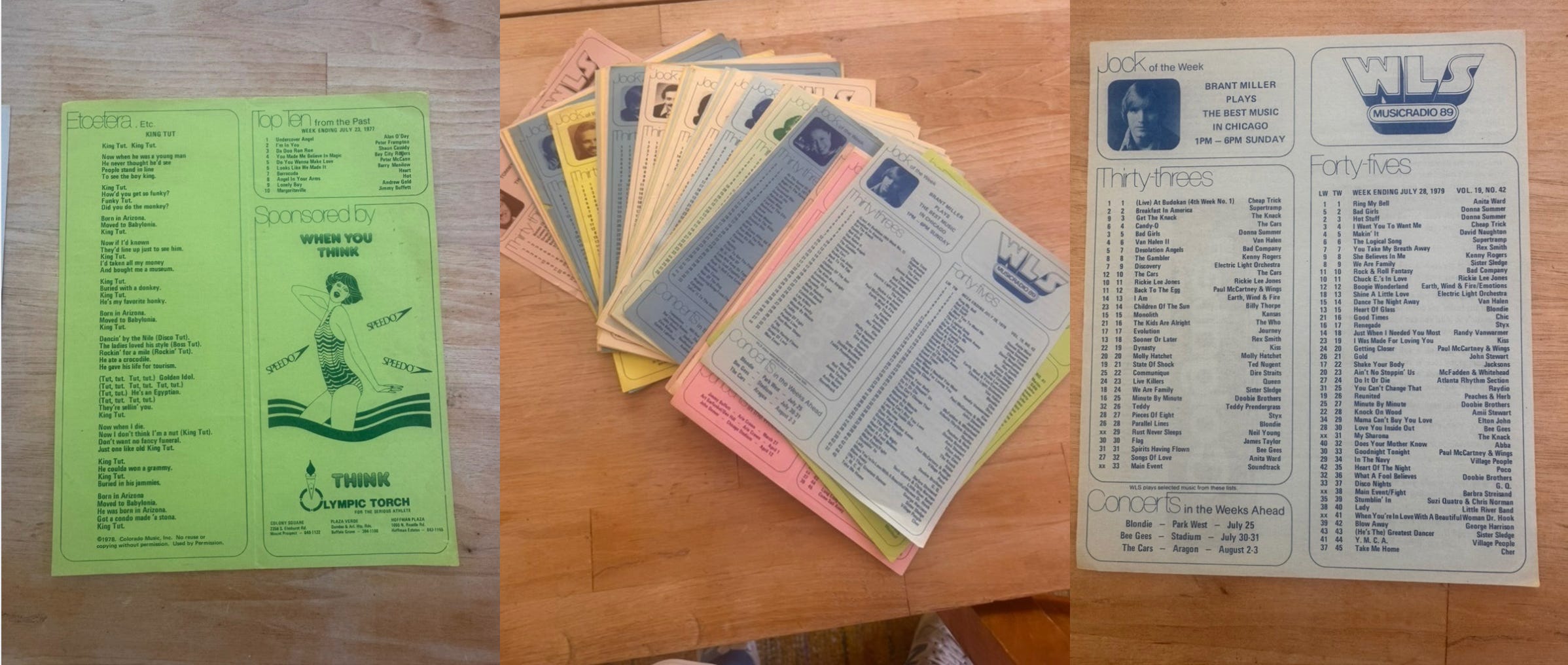
On WLS Radio 89, lyrical intensity, and early innocence.
Show full content
Todd Krieger (TK) is a writer, cyclist, live music lover, and proud father of two daughters. While his comic book collection has stopped growing, his amassing of Grateful Dead recordings and memorabilia has not. He’s previously written WITIs on Dead & Company and WandaVision.
Also, a bonus for you today–why not listen to the playlist Todd made to accompany this article after you’ve read it?
Todd here. I grew up on the North Shore of Chicago in the 1970s, spending my formative elementary school years in bucolic Glencoe, Illinois, 60022. For those unaware of the magic of Glencoe, treat yourself to a rewatch of Home Alone or Ferris Bueller’s Day Off (though not Risky Business, for even though Princeton-bound Joel says he’s from Glencoe, they shot in neighboring Highland Park.)
While for many it was the magic of the movies that molded their youthful views of romantic love, for me it was the radio. The programming-heavy Top 40 of my pre-teen years, brought to me by WLS AM Radio 89, was the rocket fuel of my understanding (and misunderstanding) of what makes up all the wooing, the union and the heartbreak.
The images above are a paper trail of memory from that time in Chicago. What you see here are just some of the 63 leaflets I lovingly collected from my local record store Wally King’s, an analog archive of aching and marginalia listing the top 45s and the top 33s, along with lyrics and upcoming concerts in the area. I would loyally trudge down to Wally’s, collect my leaflet, and pore over it—who’s up, who’s down, what’s new—with the intensity of a minor league scout seeing who is ready to get called up to the majors.
Why is this interesting?
All of this of course hearkens to a certain kind of shared experience that no longer exists. There is the quaintness today to the idea of waiting days to once again hear songs you were dying to digest, that were all being programmed by somebody else. But beyond even that, what I remember most is listening to these songs on my bed, craning my ears to hear the lyrics, and thinking, “Wow, this is what love is supposed to be.”
The first shot across the bow into my heart center was 10cc’s ‘The Things We Do For Love’, which charted as high as #5 on April 16, 1977. The lyrics in the bridge serve as kind of a catch-all for the pathos and intensity of romantic pursuit.
Like walking in the rain and the snow
When there’s nowhere to go
And you’re feeling like a part of you is dying
And you’re looking for the answer in her eyes.
You think you’re gonna break - up
Then she says she wants to make up…
This was followed in short order by the emotional closeness of ‘Reminiscing’ from Little River Band, which peaked at #3 in October, 1978…
Friday night, it was late, I was walking you home
We got down to the gate, and I was dreaming of the night
Would it turn out right?..
I want to make you understand, I’m talking about a lifetime plan
Was it really that simple? You go out, you say, “You’re the bomb,” and next thing you know you have a partner for life. It all sounded so exotic, so mysterious, so terrifying and magical all at the same time. As my ears tried to make sense of the lyrics, my heart was being fed information it didn’t know how to metabolize. Reflecting on these efforts, it strikes me that in much the same way I would fill in all the action in a comic book between the panels, I was reaching to understand adult relations—an unchartered land of intrigue, heartbreak and some little thing called “love”.
There was no guide, there was no chatbot to inquire of. Just me, the radio, and a whole lot of questions.
Another example of singular 1970s songwriting searing its way into my consciousness comes by way of the uniquely named duo of England Dan and John Ford Coley, “I’d Really Love to See You Tonight”, which peaked at No. 2 on September 25, 1976.
I’m not talkin’ ‘bout moving in
And I don’t wanna change your life
But there’s a warm wind blowing the stars around
And I’d really love to see you tonight
Again, the stakes of romance and the language was so charged to my 9-year old ears it read like a foreign (and yes, romantic) language. Contrast this with today’s internet, and the documented epidemic of adult content reaching too-young kids, and I may as well be talking about a time as distant as the Wild West of the 1800s.
Finally, neither of the above tunes’ talk of lifetime plans hold a candle to the incandescence of Dan Hill’s “Sometimes When We Touch,” which peaked at # 3 on March 4, 1978.
And sometimes when we touch
The honesty’s too much
And I have to close my eyes and hide
I wanna hold you ‘til I die
‘Til we both break down and cry
Could just brushing a person’s elbow be so all-consuming that tears would well? Are adult emotions that much bigger? As I reflect on the Romance 101 of my AM Radio youth today, these are the questions that I remember my child-size brain asking. (TK)
I’m a career writer and journalist. I’ve worked in-house at several magazines and newspapers, including a brief but necessary stint as a Condé girl about a decade ago, but I prefer being my own boss. I’ve written for just about every publication you can think of (yes, that one and that one too) and I’ve ghostwritten five books for CEOs and celebrities, plus two coffee table books.
Right now, I’m having a lot of fun working on my newsletter, Rich People Shit, or RPS, as people who read it tend to call it. It is about cultural capital and the intersection of money and behavior. I started it in January and it has done quite well in that time. I’m also throwing a RPS event in June, which I have been spending a lot of time planning. It will be for paid subscribers and friends of the letter.
I live in New York City. I’m a pretty private person.
Describe your media diet.
For RPS, I’m really reading everything. Local papers in Montecito and Palm Beach and Nantucket, British tabloids, big papers like The Wall Street Journal, The New York Times, and Financial Times. Glossies like Vanity Fair. Newsletters, Substacks, all of it, including Air Mail, The Love List, The Stanza, Feed Me, Trademarked, and whatever else is floating around. I’m also fully obsessed with How Long Gone, which they are well aware of. It’s my favorite podcast and I wish it were daily instead of three times a week.
What’s the last great book you read?
A Sport and A Pastime by James Salter
What are you reading now?
Famesick by Lena Dunham
Before that I read Strangers by Belle Burden. My subscribers are obsessed, and can’t stop sending me emails about it.
What’s your reading strategy when you pick up a print copy of your favorite publication?
I’ve normally read half of the things in print online before they make it to publication so I flip through to see what I haven’t read yet.
Who should everyone be reading that they’re not?
Cultured Magazine by Sarah Harrelson and Racquet Magazine by Caitlin Thompson and Steph Chung are the best independent publications around. They’re doing everything right.
What is the best non-famous app you love on your phone?
I wouldn’t look to me for advanced technology advice. My Microsoft Word crashes weekly. If I had to choose I would say the NYC Ferry App. Not enough people take the ferry.
Plane or train?
Train if the first option is commercial.
What is one place everyone should visit?
The Aeolian Islands when Stromboli is erupting at night. Nantucket in mid-September, once the last of the family week dinners are over and it’s just sweaters and people who don’t have to leave. A polo field in Wellington during high season, right as they start walking the horses out. Landing a Cessna on an unlit runway in rural Virginia, where someone’s car headlights are doing more work than the airport. Dancing with strangers at a wedding in a castle in Northern England. Sorry, did you say one?
Tell us the story of a rabbit hole you fell deep into.
This story I did for The New York Times ten years ago about the former madame of the Chelsea Hotel, who was running a male prostitution ring out of it while also cutting some of the most famous people’s hair in a salon she had set up inside. I’m pretty sure it was the first time the Styles section had used “gigolos” in a headline. I love a good story. (CG)
Four letters from young Chinese professionals who left Beijing, Shenzhen, and Guangzhou — on freedom, regret, marriage pressure, and the search for ‘heart energy’.
Fashion moves faster than commerce, which moves faster than infrastructure, then governance, then culture, then nature. I’m new to this smart theory, which of course Colin and Noah first wrote about here years ago.
On casual water, caddies, and an affordable luxury.
Show full content
Mark Slavonia (MJS) is an investor, a pilot, and an avid cyclist. He’s written plenty of WITIs, including appreciations of rowing machines and dangerous toys. He posts other things that are interesting on his website.
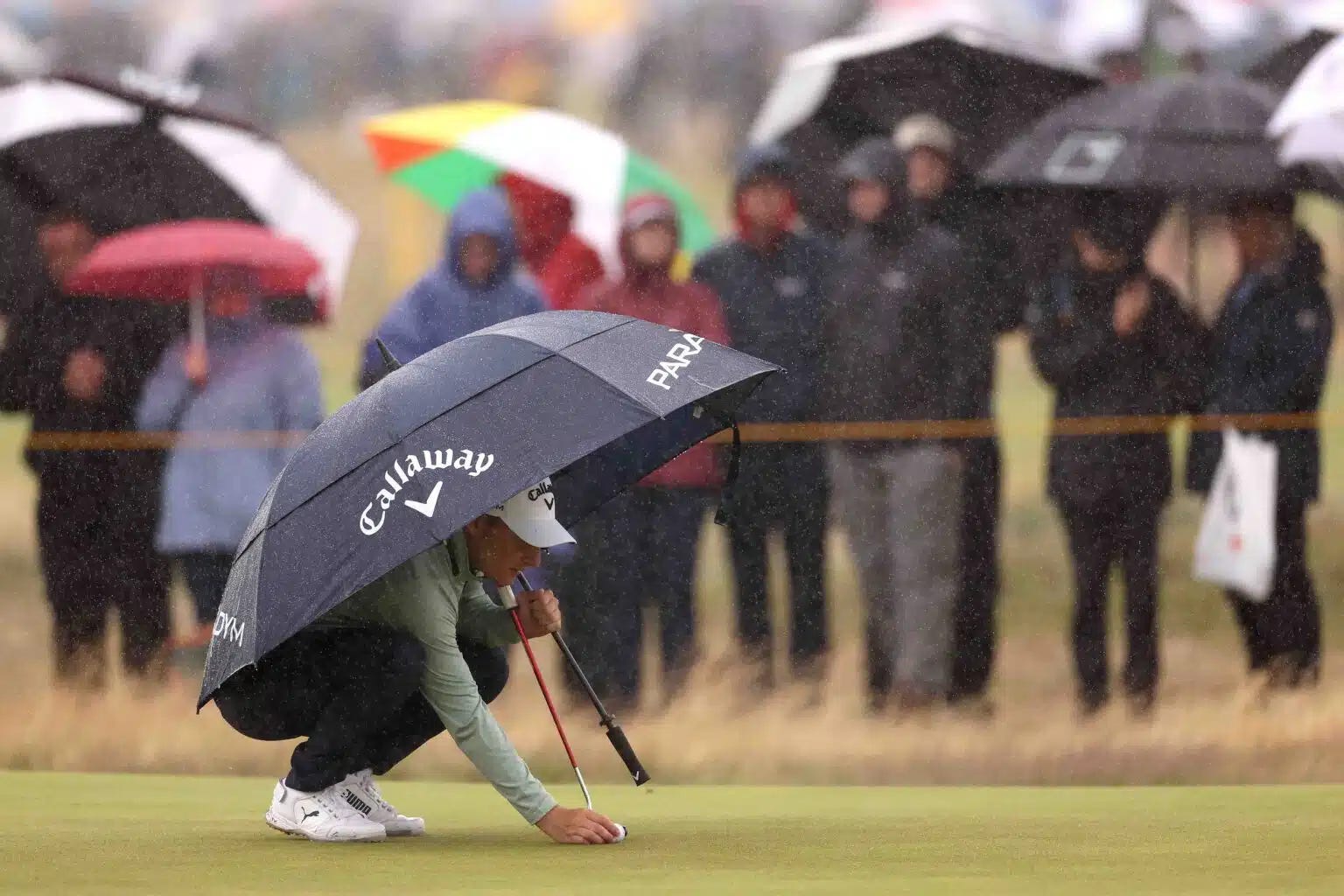
Mark here. I am a lapsed golfer. Like many apostates, I retain residual knowledge of the rituals of my former faith, etched in my soul through weekly service on the golf course with my father and brother. I know where to stand, when to be quiet, when to tend the pin and when to pull it out of the cup, and how to play in the rain.
My family considered playing in the rain to be the highest form of devotion to the religion of golf. Unless and until the lightning alarm sounded, we played on, squishing through “casual water” beneath the shelter of our commodious golf umbrellas.
It is these very golf umbrellas that I recommend to you.
Why is this interesting?
The golf umbrella is the king of umbrellas. It is a portable Superdome, a mobile gazebo that you can hold in one hand. It arches overhead in a graceful geometric dome like an alien butterfly, and the sound (heavens, the sound!) of fat raindrops bouncing off impermeable tensioned nylon is a summer hymn.
If you’ve never used a golf umbrella, it might be hard to imagine how much better the experience is than being under a normal umbrella. Let me put it this way:
A golf umbrella is to an umbrella as an umbrella is to a hat.
Quantity has a quality all of its own. The vast area covered by a golf umbrella transforms the umbrella experience. A golf umbrella is designed to cover two people (the golfer and the caddy) and a set of golf clubs extending off the back of either one of them. Gone is the problem that the shaft of a normal umbrella stands directly in the middle where protection is the greatest, because the golf umbrella is large enough that it covers you completely, even if you stand to one side. Gone is the problem that your lower body gets soaked, because the golf umbrella’s coverage thwarts the wind’s angled assault on your trousers. Gone is the problem of sharing a tiny canopy with your companion—all are welcome under the big tent of a golf umbrella.
The golf umbrella is one of those products that has been honed to such excellence by professionals that its appeal extends beyond the narrow confines of its design, like diving watches, EMT shears, and jeweler’s loupes. You may never play golf, but my friend, you need a golf umbrella. Sure, there might be some special cases for which a different sort of umbrella is more appropriate, like walking down a particularly crowded city sidewalk or packing an umbrella into a handbag, but for the vast majority of umbrella days the golf umbrella is the umbrella you want to have.
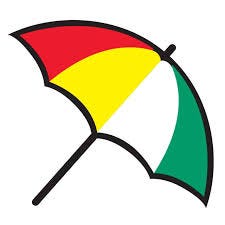
And oh, the rainbow of colors! The classic golf umbrella has alternating panels of white and a single solid color, choose your favorite. (For a classy look, choose an all-black golf umbrella and you’ll be ready for the next mafia funeral.) A logo is often silk-screened on one of the panels, promoting a golf ball company or a country club or a consulting firm that wisely chose the coveted golf umbrella as the attendance gift at a corporate retreat. Arnold Palmer, native son of my hometown, used a multicolored golf umbrella that was so distinctive it became his personal logo.
The Arnold Palmer Golf Umbrella Logo
How much would you pay for raingear of this quality? You might be forgiven for assuming that luxury and excellence comes at a premium price. But rest easy; the golf umbrella is surprisingly affordable. I will not be providing links to specific purveyors of golf umbrellas below, lest you suspect that my enthusiasm for golf umbrellas is tainted by a craven lust for affiliate revenue. I will merely say that your favorite big-box membership store sells a two-pack of quality golf umbrellas for $40, emblazoned with the logo of some golf equipment brand in whose factories these umbrellas were certainly not made.
Alternatively, you can breeze into the pro shop of Pebble Beach Golf Links, one of the most spectacular and most famous golf courses in the world, plunk down $60 U.S. dollars, and emerge under the shade of a classic fiberglass-handled golf umbrella, proudly boasting of your visit and still with a pocketful of change! This would make a great gift. They’re available online.
There are some premium models from specialist umbrella makers that cost $80 - $120. They might be good, but I can’t vouch personally for their design. The classic, ubiquitous, fiberglass-shafted golf umbrella found in every pro shop in the country is probably all you need.
My father would like to leave you with one important umbrella-maintenance tip. Never stow a wet umbrella. After use, leave it to dry completely open before folding it up, and you’ll get decades of use from your wonderful golf umbrella. (MJS)
Graydon Gordian (GG) is the Founder of the Backyard Care Company. He is an orange belt in Judo, which is not very impressive, but he’s pretty happy with that given that a year ago he knew nothing about it whatsoever.
Graydon here. In 1882, a man named Kanō Jigorō founded a martial art called Judo. His work consolidated a variety of schools of Jujutsu, a prominent pre and early modern Japanese martial art, into a cohesive set of throws and submissions that eventually grew into an olympic sport and globally practiced form of self defense that has influenced countless other combat sports, such as Sambo, Brazilian Jujistu, and MMA.
Flash forward 143 years, and I found myself standing in a dojo in Atlanta, Georgia, in a gi (the often white jacket and pants commonly associated with Japanese martial arts), taking an Introduction to Judo class for the first time in my life.
Judo is awesome. Through efficient, detailed movement, you learn how to throw people much larger than you to the ground. You learn how to choke and arm bar people. You work your ass off grappling for position and trying to pull your opponent off balance (kuzushi) so you can slam them on their back and score an Ippon, an instant victory in the sport-version of Judo. It’s challenging and thrilling and very humbling, because there is always someone in the room who is bigger, stronger, and more technically skilled.
Why is this interesting?
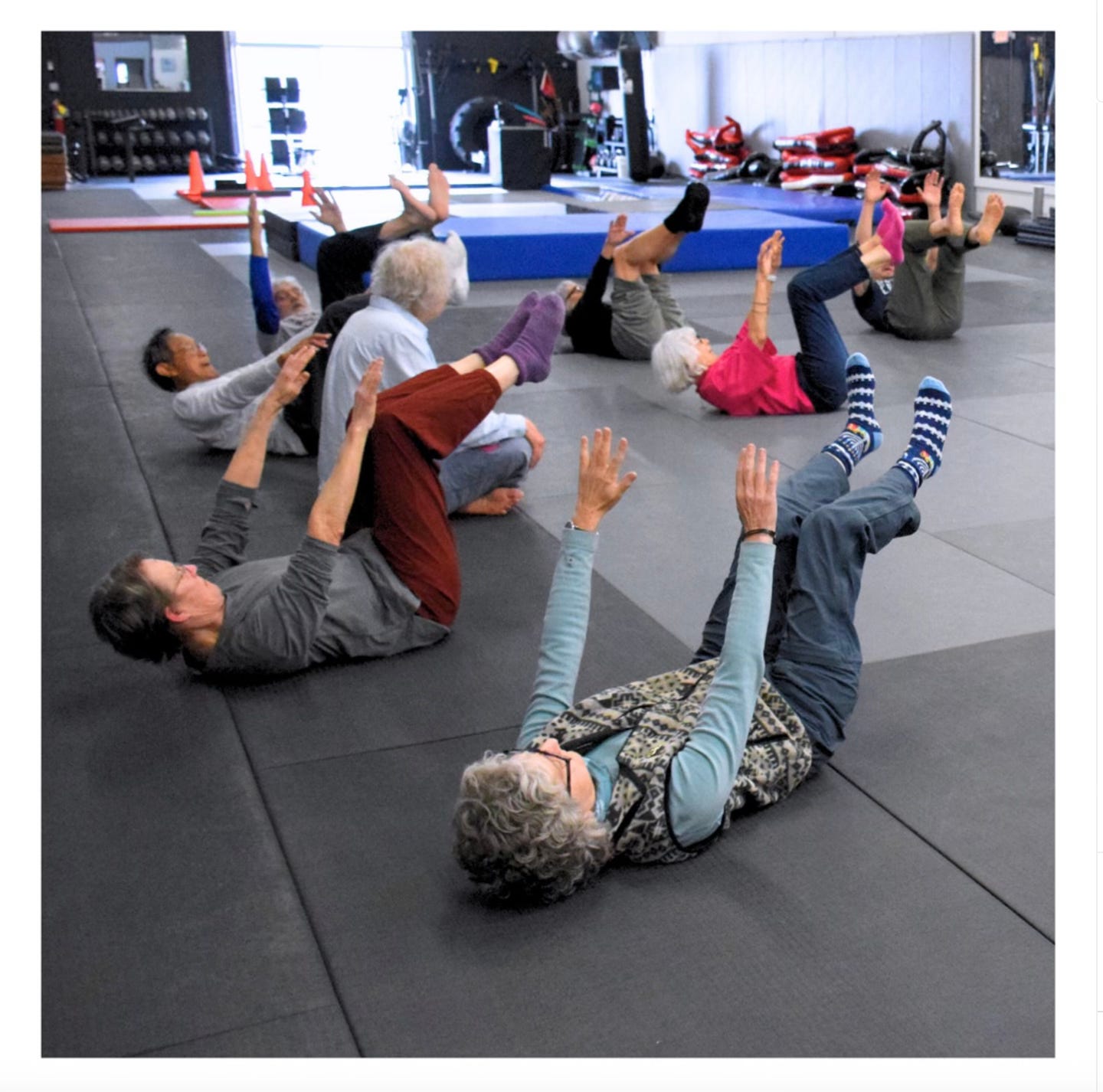
Your first judo class involves none of that whatsoever. Instead, you spend the overwhelming majority of your time falling down. You fall on your back and your side. You roll into a fall. You get reprimanded for sticking your arm out or not keeping your chin tucked. You are learning ukemi, the art of breakfalling. It is the foundational skillset that has allowed me, as a 41-year-old, to show up to the dojo multiple times a week and get thrown onto my back with full force by friends and strangers, and head home after to toss my kids around, carry the groceries, and do plenty of other things I’d struggle to do if I’d hurt myself.
Falling is the leading cause of injury for adults ages 65 and over. 1 in 4 older adults, about 14 million in total, report falling every year. My mother-in-law, who is in her early 70s, fell last year and broke her knee. In the final few years of my mother’s life, she fell repeatedly, leading to multiple black eyes and stitches in multiple places on her head.
Dogs being walked bolt for a nearby squirrel and yank you off balance. Curbs catch your foot and stop you from catching yourself. Grandchildren’s toys litter the hallways around the house. The world is designed to make you fall. You should learn how, so that you can get back up.
The teachers at my dojo agree, and they think Judo can help. They have even started a program called The Falling Class, which takes the core frameworks of Judo breakfalling and applies them to real world situations in which one might find themselves going to the ground when they’d rather not. My friend and teacher Sensei Willard, a 5th-degree black belt who still practices Judo in his 80s, recently shared a story in which he stepped off a stool in his closet onto a shoe, fell, and walked away unharmed. That simple story is more remarkable than it sounds.
The Honolulu Judo Club has a similar class but the sad reality is that there aren’t many programs like this in the United States today. The American health and wellness system is overwhelmingly focused on fall prevention or injury recovery, not reducing harm during an inevitable fall. But the mere existence of the International Safe Falling Conference held at Japan’s Tokai University (a hotbed of Judo) in late 2025 shows that the movement is gaining momentum.
We all trip and fall from time to time. But the consequences of those falls grow more severe with each passing year. Learning to fall better could change your life, or the life of someone you care about. If a program like this shows up in your area, encourage the older people in your life to participate. Or show up to an intro to Judo class. You just might like getting slammed on your back more than you think. (GG)
Molly Jensen (MJ) runs Afripods based out of Nairobi. Pleased to have her with us this week. -Colin (CJN)
Tell us about yourself.
For the last five years, I have been running a podcasting hosting platform called Afripods out of Nairobi, Kenya that serves the African continent. We work to help African creators get analytics, take up space and eventually use that information to get paid for their content. I find the work I do to be not just a privilege but a real responsibility and I am grateful to be able to do it. Previously (and many years ago), I used to be a competitive athlete and was recruited to play soccer as a Goalkeeper at a Division I school. That said, I am extremely excited for the World Cup to be back and to have so many African teams represented in this edition!!
Describe your media diet.
I get information all over the internet. I don’t want to say I’m chronically online, but I’m definitely chronically online. I like to know what’s going on and I like to keep tabs on as much breaking news and social news as possible. I’ve found that it makes it easier to relate to people when you care about the same things as them and also are tapped into local issues. Additionally, with culture and new media, it is important (in my opinion!) to be online and to be aware in general. I think with as quickly as news breaks, and as short as everyones attention span is, we have never been more inundated with information, misinformation and content. Discernment is more important than its ever been. But to answer your question, usually from different substacks, to podcasts, to social media like TikTok as well as on my Twitter/X timeline. I used to really like reading The New Yorker online and sometimes would read bits of the NY Times whether it was Modern Love or checking out articles from Wirecutter. I get some newsletters for work including PodNews and the Creative Brief as well as a few others. I love Doug Shapiro’s The Mediator and David Adeleke’s Communique-- both of them have excellent takes on the state of the creative economy. Both Sara Wilson (Community Catalysts) and Abby Ho (Fellow Kids) have excellent newsletters as well. I recently have started spending quite a bit of time on Reddit or referencing it for reviews.
To shout out some excellent African podcasts, I’d give a true variety. Case Number Zero by Nation Media is an excellent investigative journalism podcast that has all the makings to be a Serial out of Africa, Sincerely Accra for some easy banter and conversation, as well as It’s Related I Promise.
What’s the last great book you read?
I really like fiction and using my imagination when I’m reading. It helps me relax and makes me feel truly entertained. When I’m reading a good fiction book, I can get through it in a few days. That said, I enjoyed reading The Seven Husbands of Evelyn Hugo and I also reread Children of Blood and Bone.
What are you reading now?
I actually need to go to the library and pick up something new! I was gifted a few books over the holidays but hadn’t brought them on my most recent flights. I think I actually want to read 8 Dates by the Gottmans as I am getting married this summer.
If I can add what I am listening to right now, it is the new season of The Honest Bunch podcast and regularly sprinkling in some Diary of a CEO.
What’s your reading strategy when you pick up a print copy of your favorite publication?
Depending on what it is, I am a pretty quick reader so I tend to do a full skim before going back and slowly reading what stuck out to me. Usually I like to be cozy and comfortable when I’m getting ready to read something -- regardless of what it is-- so I will be on a couch, in a comfy chair or lying in bed.
Who should everyone be reading that they’re not?
Everyone really should be reading fiction books. I know for some it can feel frivalous but I read somewhere that people who read fiction tend to be better at problem solving and have more active imaginatiosn which has been my argument for why I would prefer to spend so much time wth a good story!
I’d highly suggest everyone reads all three of Tomi Adeyemi’s books.
What is the best non-famous app you love on your phone?
I think probably Tabata timer. It helps me with my workouts and is essentially just a timer but I like how it works compared to others. For famous, we’d have to have a serious tie breaker between my Whoop app and Tiktok.
Plane or train?
Both. Depends on the distance to be honest. I grew up in New York and travel quite a bit between NY and DC area so the Amtrak NE Regional line is excellent in connectivity for that. Most of my work travel is on a plane and generally across the continent I have flown a lot of Kenya Airways. For intercontinental travel, and given the chance to have business class lie flat seats, I’d specifically choose that on a middle eastern flight carrier.
What is one place everyone should visit?
I tell people that Lamu was the first place in the world I actually felt relaxed, so I’d say that. It can be difficult to get there as you can only access it from within Kenya, but it is such a special island. For a long time they only had donkeys as transport as there are no cars on island, but as the port has been built up they have added boda transport (motorbikes). There are so many beautiful pockets of Africa, and I feel so lucky to have experienced some of the continent. I am endlessly inspired by each country I visit and cannot wait to go to whatever new place is in my future.
Another place I would recommend is Portland, Jamaica. You drive from Kingston through the Blue Mountains and get to a true paradise on the island. If Negril, Montego Bay and Ocho Rios are for tourists, then Portland is for Jamacians. It is truly special.
As a last one, the Nicoya peninsula in Costa Rica is incredible. Specifically Manzanillo. I went with a friend and flew into Liberia and went on an incredible driving tour of Costa Rica. We drove from Liberia to Nicyoya, to the Arenal Volcano and through some of the rainforest.
Tell us the story of a rabbit hole you fell deep into.
I’ve been deep into this big carrot conspiracy lately. DId you know that most carrots have been sitting in warehouses for 6-12 months before we get them in stores? I have some health issues so I’m usually falling deep into some wellness-health-longevity-crunchy hole of the internet. I don’t suscribe to all of it, but there is definitely some truth to some of it. There’s also plenty of political rabbit holes to fall into right now between the US government & Iran, and Palestine and Israel. (MJ)
Astronaut Glover on Thursday told reporters Orion’s onboard screens showed they reached speeds of 29,839 miles per hour. If you’re still as hooked by this story as I am, here’s a video of the launch as seen from a commercial airline in flight, and a New Yorker story about the time Neil Armstrong wanted to go to the zoo.
For more than 50 years, France’s brown motorway signs have done far more than point the way: they’ve sold the country’s history, culture and identity in seconds.
Michael here. My brother is a physicist, which means that news from his world sometimes pops on my radar. Case in point: On March 24, a truck left the CERN antimatter factory outside Geneva and drove around slowly for 30 minutes. The truck was carrying 92 antiprotons. These are individual subatomic particles, together weighing less than 1.66 x 10⁻²² grams. Scientists use antimatter to explore the asymmetries of physics, and thus our known universe.
The particles were suspended in a vacuum inside a one-ton cryogenic box cooled to -452 degrees Fahrenheit. Superconducting magnets held them in place. The truck drove carefully. Scientists monitored from the cabin. When it returned, 91 of the 92 antiprotons were still there. The scientists popped bottles of champagne.
If the antimatter had touched anything, it wouldn’t have been damaged or broken, it would have been annihilated. It would have ceased to exist in a small flash of energy, because antimatter can’t tolerate contact with matter.
Why is this interesting?
This is the first time antimatter has traveled by road. The goal is to eventually drive these particles eight hours to Heinrich Heine University in Düsseldorf, which has better experimental conditions than CERN. (Currently, CERN operates the world’s only dedicated Antimatter Factory.)
An antiproton decelerator at CERN’s Antimatter factory.
What really piqued my interest was the transit and delivery problem. The scientists needed to build a container whose only job was to keep its contents from touching anything. A box designed around the premise that the object inside can’t make contact with the physical world it’s moving through. Every wall, every surface, any molecule of gas that drifted in would be catastrophic. It’s slightly more difficult than the classic egg drop competition.
Most objects we transport around the world tolerate their containers. They sit in them, press against them, get held by them. Even the most sensitive cargo, from organs to antiquities, vaccines to wild animals, exist in material continuity with the surrounding world. Trucks, planes, containers, roads, air are all just matter in different configurations, all ultimately compatible.
Antimatter is categorically other. It’s not fragile in a way that patience and care can manage simply, because it’s constitutively incompatible with everything that exists.
The BASE-STEP trap, as CERN calls it, is compact enough to fit through a standard laboratory door, and onto a truck bed. It’s an unglamorous industrial cylinder. And it did something that we humans had never done.
We moved matter’s opposite through the world matter inhabits, and brought it home. 91 out of 92 made it. That is a remarkable survival rate for something that shouldn’t survive at all. (MHB)
Noah here. A post from Kyla Scanlon about the “Ozempicification” of society is making the rounds. Her argument: people feel the system has failed them, so they’re turning to individual optimization tools—drugs, prediction markets, biohacking, hustle culture—to simulate control. The title, of course, comes from the miracle weight-loss drug from Novo Nordisk:
One example of an individual optimization tool that really works is Ozempic. Some people need to be on it for medical reasons and others are self-admittedly doing it for aesthetics. To be clear, Ozempic is a wonderful technology that solves a very real problem for individuals but it leaves the collective problem like the food system and healthcare access untouched.
Why is this interesting?
Putting aside the core argument (and the implication that because we aren’t solving the food system and healthcare access, we shouldn’t work on obesity), this positioning of Ozempic drives me totally nuts. Although Scanlon’s piece is really about something bigger, the Ozempic framing is where I want to focus, because it signals something I think is an even bigger trend in society: the celebration of suffering. Or maybe more specifically, the gatekeeping of new technology in the name of suffering.
The implication that a miracle drug that solves one of the most serious health crises in America is an “aesthetic choice” gets to the core of the issue. There’s a sense that somehow using Ozempic and its compatriots is cheating: that weight loss should be hard, and if you’re not doing it the hard way, then you didn’t earn it.
We see the same conversation around AI and, I would argue, just about every other technology ever introduced. Plato argued that writing would destroy memory; the printing press would make knowledge dangerously accessible; and calculators were banned from classrooms for being used to cheat. There’s a sense that if it’s not hard, it’s not real—and I think that’s a much more sinister force in society than a move towards optimization. (And that’s without even factoring in the additional impacts these drugs are having outside weight loss, in diseases like addiction.)
In general, I think technological solutions to human problems are severely underrated. Progressive writers love to declare that “tech won’t save us”, and decry the vile techbros who think a magic venture-funded gadget can overcome the eternal foibles of human nature. Instead, what most writers think we need are social solutions — we need to restructure our institutions, our politics, our mores, and our culture in order to balance out, or perhaps to better accommodate, our timeless flaws.
The thing about Ozempic is that it doesn’t just solve the most widespread pre-existing health issue in America; it also seems to be amazing at a bunch of other things, like addiction and inflammation. This is the kind of medicine we dream of, which is why there’s such a push to find more peptides. The same people who look around the country and wonder why there’s widespread vaccine skepticism are positioning this amazing new substance as “doing it for aesthetics,” and I guess I just think that sucks. (NRB)
Steve Calder (SC) is a friend of WITI. He runs one of my favorite menswear stores in Melbourne, Informale. -Colin (CJN)
Tell us about yourself.
I’m the co-founder and designer of Informale, a Melbourne-based menswear brand. I’ve worked in fashion retail my entire professional life, and being able to pursue the craft properly now feels like a dream realised. I love travelling and often use Informale as an excuse to explore the world with my wife and daughter. When I’m not in menswear mode I’m usually spending time with my girls. I love music: I listen to an eclectic mix of sounds - from old-school hip hop to drum and bass. I also love going for a drive in my old Audi - you’ll find me zooming some curvy mountainous roads at sunrise (at the speed limit, of course).
Describe your media diet.
Instagram is my go-to for keeping up with friends and the menswear world; X for finance and tech (I love the ability to use Grok to fact-check and add context in real time); and YouTube (YT premium is my pro-tip) for cars, menswear, and the occasional UFO deep dive. For those in need of a deep rabbit hole, I recommend American Alchemy by Jesse Michels.
In print, I’m a big fan of WM Brown magazine by Matt Hranek. His work is a rare treat these days, focusing on meaningful pursuits, travel, food, and living well. The “Drive” section is always a favourite - one story I always remember is a guy called Vincent Fauch who told this incredibly detailed and heartfelt story of his Porsche 996 4S, his connection to the car as a kid, finally being able to buy one (and find it in the perfect spec), and his subsequent journeys and experiences camping with it around Europe thanks to the rooftop tent he installed. This kind of real, raw, enthusiast-level stuff is what I really love about Matt’s work.
What’s the last great book you read?
It’s a tie between Manufacturing Consent by Noam Chomsky and Confessions of an Economic Hitman by John Perkins. I’m drawn to anything that peeks behind the curtain of power - both are fascinating takes on how the world really works, and help me to tune out a lot of the daily noise and negativity.
What are you reading now?
I’ve been about one-third of the way through America Before by Graham Hancock for about two years - just can’t seem to find the time to finish it, as much as I want to. It goes deep into the history of the Americas, and suggests a fairly advanced Ice Age civilization may have existed and would have been wiped out just before the beginning of our “modern” historical period. Echoes of it’s monolithic architecture, religion and culture echo throughout the world.
What’s your reading strategy when you pick up a print copy of your favourite publication?
I’ll usually start by checking the index for stories or topics that jump out. If I’m lucky enough to have some extra time, I’ll flick through the rest.
Who should everyone be reading that they’re not?
The Monocle Guide to Shops, Kiosks and Markets. In a world where global brands and big-box retailers dominate media ad-space and therefore our attention, an entire book dedicated to small, independent and often quirky retailers around the world is a breath of fresh air. Highly recommend!
What is the best non-famous app you love on your phone?
OBDeleven. It lets me troubleshoot and clear fault codes while driving my old car - my fellow enthusiasts will understand.
Plane or train?
Plane, simply due to distance. Australia is a minimum 6-hour flight to anywhere (unlike our friends in Europe), and luckily Bali is about that far away. You’ll find us there a couple times a year, sipping on Coconuts and taking things extremely slow.
What is one place everyone should visit?
Puglia, Italy. It’s like stepping back in time 20+ years, and the pasta, oh my god. Don’t bother trying to understand the local dialect, it’s insane.
Tell us about a rabbit hole you fell deep into.
I fall into rabbit holes all the time. There’s something deeply satisfying about going all-in on a topic or niche and understanding why it draws others in.
As a teenager, I once picked a book off my parents’ shelf called Fingerprints of the Gods by Graham Hancock. Ever since reading it, I’ve been secretly obsessed with the idea of a lost ancient civilisation that predates our current timeline that may have been wiped out around 12,000 years ago. It’s a pretty mind-blowing concept at first, but funnily enough it ends up making a lot of sense. (SC)
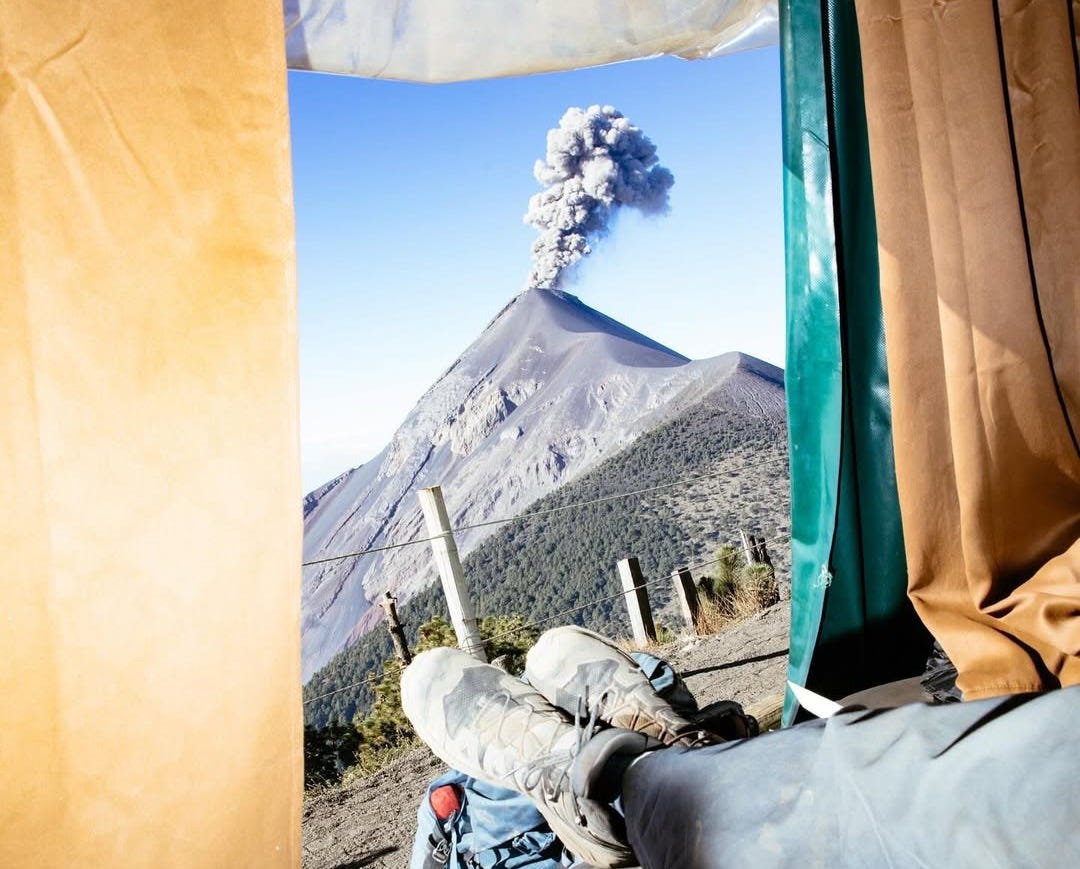
A chat with photographer (and Deadhead) Peter Fisher about climbing Guatemala’s Volcán de Fuego for National Geographic. (“You feel it in your chest—a deep rumble, then an explosion that makes your ears ring.”)
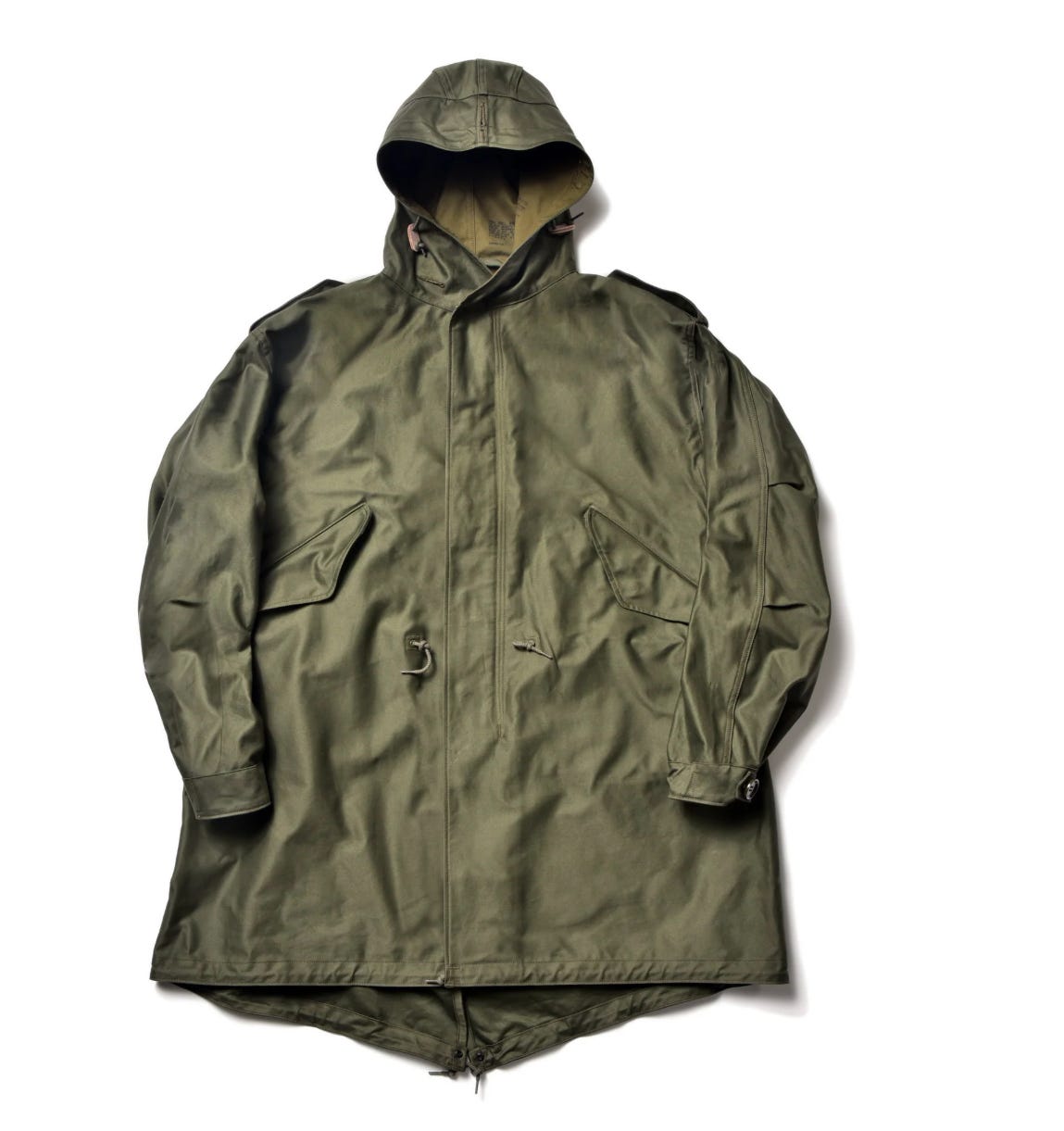
Colin here. There’s a particular piece of clothing that manages to be simultaneously utilitarian and totemic, military-issue and subcultural signal, American in origin and quintessentially British in meaning.
The M-1951 fishtail parka was developed for the U.S. Army at the outbreak of the Korean War. The military needed something that could handle extreme, cold temperatures regularly dropping to minus-30, and the solution was a layered system: a cotton outer shell with a removable wool liner, a snorkel hood that could be cinched tight, and the split rear hem that gives the garment its name, which could be unsnapped and wrapped between the legs for additional insulation when stationary.
It was excellent kit, and did exactly what it was supposed to do. And then it ended up in surplus stores, which is where things got interesting.
Why is this interesting?
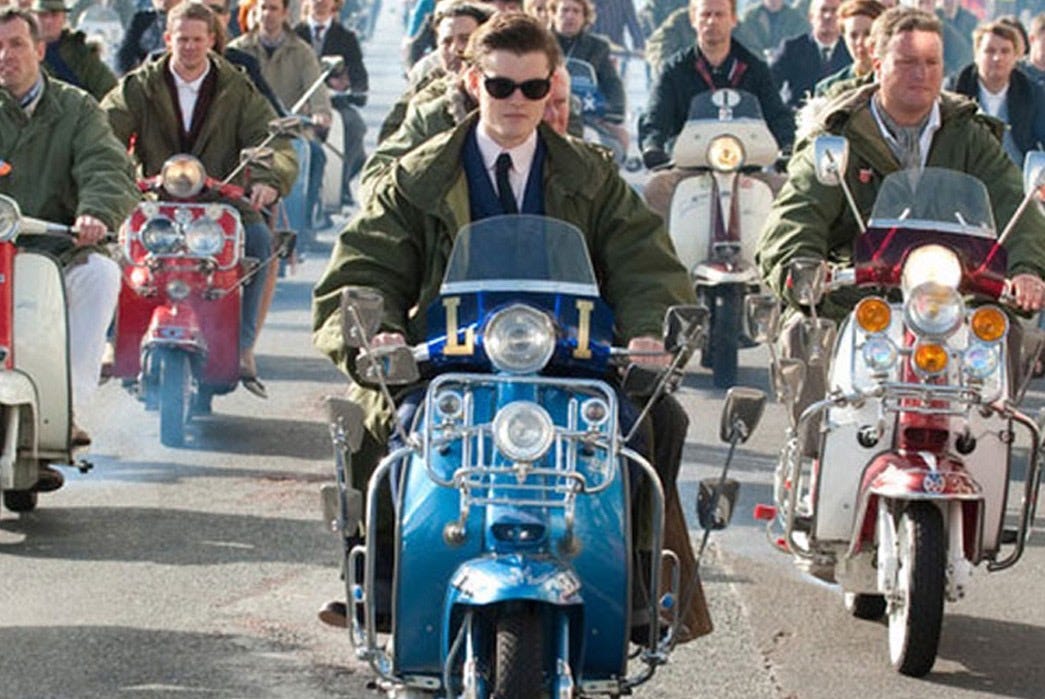
By the early 1960s, British mods had discovered it. Think Sting as Ace Face in Quadrophenia. The sartorial logic was initially practical: you were riding a Lambretta through the damp English air and needed something to protect your suit underneath. The parka solved the problem; it was cheap, long enough to cover your knees, and roomy enough to go over anything.
The fact that it was military surplus gave it an anti-fashion credential that suited the mod ethos to a T: specific taste expressed through found objects and unlikely combinations. The parka became the suit’s perfect foil. Mod style had a unique vibe that was fundamentally about precision—Italian tailoring filtered through working-class South London—and the parka introduced some deliberate contrast. It was a match made in heaven. When mods and rockers clashed on Brighton beach in 1964, news photos captured a generation’s uniform: parkas everywhere, often with roundels and target patches hand-painted on the back.
Which brings us to The Real McCoy’s. The Kobe-based label, founded in 1990, represents something specific about Japan’s relationship to American material culture. In the decades after the war, surplus U.S. military gear flooded Japanese markets, and a generation grew up with an almost archaeological fascination with the objects themselves: the stitching, the hardware, the fabric weight, the precise shade of olive drab.
What emerged was a cottage industry of reproduction specialists who approached American workwear and military garments the way a watchmaker approaches a complicated movement, with complete seriousness, no shortcuts, and a conviction that the original was worth getting exactly right.
I recently picked one up, and it is a masterclass in this sensibility. Exactly the right cotton sateen, properly constructed liner (sold separately of course!), hardware matching the original spec, and a fishtail that functions as intended. It’s reverence expressed through craft, and the entire brand rolls this way. It also has, co-signed by by friend of WITI Chris Black, some of the best retail in the world in Tokyo.
Similar to how W. David Marx brilliantly dissected Ivy League style in Japan through his book Ametora, this is also a fun and unlikely story: an American military garment designed for a brutal winter war becoming the defining visual language of British youth rebellion, then preserved with obsessive fidelity by Japanese craftsmen who understand its worth better than most people in either of its origin countries. Objects (and culture) travel in strange ways. (CJN)
On deep time, global hiding places, and the case for forgetting.
Show full content
Katie Dreke (KLD) is the founder of DRKE, a global strategy collective working at the intersection of brand strategy, systems innovation, and story-craft. She is a collaborator with The Long Now Foundation, an advisor to The Ocean Plastics Recovery Project, and thinks professionally about what it means to be a good ancestor.
Interior of The Future Library in Oslo, Norway, via Katie Paterson
Katie here. In 2014, Margaret Atwood wrote a manuscript, and immediately sealed it in an envelope. She will never know who reads it. In fact, the plan is that nobody will until a century from now.
The Future Library is a 100-year art project created to expand people’s sense of time, and their perspective on posterity. For twelve years, the Scottish artist Katie Paterson (along with her Norwegian counterpart Anne Beate Hovind and a group of trustees) has invited a prominent writer to submit a manuscript. In 2114, a century after the project began, they will all finally be published.
To supply the paper for this growing anthology of locked stories, a new forest was even planted in 2014, to be harvested in 2114. David Mitchell, Han Kang, Ocean Vuong, and a growing roster of writers have each made the same wager: that the world will still be here, and that people will still want to read.
Why is this interesting?
The Future Library is not a novelty. It’s one node in a quiet, distributed network of people building arks for deep time — an effort so diverse and beautiful and strange that it serves as hope-filled ballast amidst the drama and chaos of our current moment.
The Ice Memory Foundation is drilling ice cores from dying glaciers, collecting columns of ancient atmosphere extracted from the Andes and the Alps before the ice melts and the record is lost, and then sealing them beneath the Antarctic surface at -50°C, preserved for scientists who don’t yet exist, to answer questions not yet asked.
The Svalbard Global Seed Vault, 1,300 kilometers beyond the Arctic Circle, holds seeds from nearly every food crop on earth against an unspecified future agricultural emergency. 1,385,898 unique seed samples, from 132 depositors, securing 6,536 different species, for untold meals on tables of generations yet unborn.
The Rosetta Project, an effort from The Long Now Foundation, has etched over 13,000 pages documenting more than 1,500 human languages onto a disk the size of a palm, the text raised just 100 nanometers off the nickel surface, readable through a microscope by any future civilization that develops one.
The Frozen Zoo has been banking living cells since 1975. It holds over 11,500 cell lines from more than 1,300 species, many now endangered or gone. In 2020, they cloned a Przewalski’s horse foal from cells frozen in 1980. An animal extinct in the wild for decades, alive again because someone saved the material forty years before the tools to use it existed.
Each of these is, in its own way, a message addressed to someone who doesn’t exist yet. No living connection to the audience. No guarantee of delivery. Just the materials, the intention, and a faith that the future will receive this effort and pass it forward again.
Here is where it gets even more interesting.
On an island off the southwest coast of Finland, workers are currently boring 42 kilometers of tunnels into granite bedrock that is nearly two billion years old. The project is called Onkalo. In Finnish, the word means “cavity” or “hiding place.”
What will go into this Onkalo is spent nuclear fuel, sealed in copper canisters and surrounded by bentonite clay, placed 450 meters underground, beginning this year. The waste will remain dangerously radioactive for 100,000 years, a span ten times longer than all of recorded human history. When the tunnels are full, sometime around 2120, they will be backfilled and sealed with concrete. Forever.
The question Posiva, the company managing the site, is still actively debating: should they mark it? Warning signs, monuments, instructions. Or, should they erase every visible trace of it, landscape the island as if nothing happened, and hope that future humans will simply never drill deeply in this location?
The case for forgetting is not cynical. It’s strategically practical. Every ancient tomb humans have ever marked has been opened. Curiosity is a more durable human trait than caution. A warning might be an unintended invitation.
So here, in the same era as the Future Library, we have its shadow twin: an ark whose builders are considering whether the most responsible act is to disappear without a trace. One says: remember us. The other says: forget we were here. Both are addressed to strangers. Both are, in their way, acts of great affection and care.
I’ve spent a lot of my life thinking about ‘long time’, and works premised on the idea that civilization needs to get better at thinking across centuries, not quarters. What the ark builders have in common — the ice corers and the seed vaulters, the writers and the biologists and the nuclear engineers — is that they have each made an investment in the present in exchange for a benefit they personally will never collect. No feedback loop. Just the work, and an unwavering belief that serving the future matters.
The phrase or concept for that kind of action is uncomplicated and accessible to everyone, it’s simply about being a good ancestor.
The trees planted for The Future Library in Norway are now twelve years old. The copper canisters will go in the ground next year. Seeds are waiting in their cold vault. Extinct animals are preparing to roam again. Somewhere in Oslo, Margaret Atwood’s manuscript patiently awaits its first reader. (KLD)
On Pachinko, The Correspondent, and Casa Magazines
Show full content
Hanna Park is a NYC-based chief of staff and also writes for WITI-favorite FOUND.
Tell us about yourself.
I’m Hanna Park.
Some things about me:
I’m the middle child of 3 with an older brother that lives in San Francisco and works in tech (obviously) and then a younger sister who lives in Los Angeles and works in entertainment (obviously)
I think knowing birth order is more telling of a person’s personality than almost anything else
I have lived in New York for 13 years, which is a big source of pride (anything over 10 is brag worthy)
My main hobby is walking around the city - I average 15-25K steps a day over the weekend and 10K+ on weekdays
Other hobbies include cooking and hosting lots of (themed) dinner parties at my house, reading, endless online shopping, travel
I consider myself a micro-influencer among friends especially when it comes to recommendations in skincare, travel, services (e.g. cobblers, alterations, doctors, dentists, etc.), career advice and books
I have worked for @Gary Vaynerchuk in some capacity for the last 13 years - currently as his Chief of Staff
Describe your media diet.
This is a fun one -
Weekdays consist of what I’ll refer to as hygiene. I’m on my computer a lot during the work week so it’s pretty standard. Every morning starts with the NYTimes, New York Magazine and the WSJ which are all checked periodically throughout the day as I have breaks.
This is embarrassing to admit but I scan headlines and bylines for news and then spend most of my time in Real Estate, Wirecutter or Style Magazine of the NYTimes and Sex Diaries, Curbed, The Cut.
I’ll also treat myself to the New York Post and Airmail 1-2X a week, though the latter hasn’t been as interesting since it was acquired. Anyone else feeling the same way?
Weekends are where the real fun is. I spend weekends largely reading Substack articles I haven’t had the chance to read throughout the week. The ones I read top to bottom without fail -- Dylan’s Uncynical (shameless plug for my husband), Emily Sundberg Feed Me, Haley Nahman’s 15 Things I Consumed This Week and Tina Brown.
I’ll read hard copies of New York Magazine usually on Sunday nights and New Yorkers are exclusively for vacations where I bring a stack that I’ll read cover to cover (and leave behind).
What’s the last great book you read?
The Correspondent by Virginia Evans
What are you reading now?
Clutch by Emily Nemens. I saw it on every book list but haven’t found myself hooked by it yet but I’m going to give it at least 100 pages before I decide if it is or isn’t for me.
What’s your reading strategy when you pick up a print copy of your favorite publication?
It depends on the publication. New Yorker I look at the table of contents to see what I’m about to get into but will still generally read everything regardless of whether it seems interesting or not because even if the topic doesn’t seem interesting they have a way of going so deep almost everything is interesting. And it makes me feel smart and gives me a small serotonin boost to read the long articles.
For NYMag I almost always find myself in the Strategist section first. God, probably should say I spend my time in Intelligencer. But to be honest, that’s not what I subscribe to New York Magazine for. It’s about the levity and fun there.
I love going to Casa Magazines every quarter or so, giving myself a budget of $100 to spend on frivolous magazines and zines and little books.
Who should everyone be reading that they’re not?
There are a lot of people (mostly men) who only read non-fiction with the justification that there have been so many interesting things that have happened in history - why read something “made up”?
By the way, these are often the same people that tell me they’ve been reading the same WWII book but keep falling asleep. Guess why you’re falling asleep? It’s cause what you’re reading is boring!
Why not read something like All the Light We Cannot See as a supplement or instead of your WWII books? Or Pachinko to learn about the deep relationship between Korea and Japan?
Those 2 books are specific, WWII related, recommendations but more broadly I think everyone should read a mix of fiction and non-fiction. Fiction to expand one’s creativity and empathy. To experience emotions and other perspectives that would otherwise be unknown.
What is the best non-famous app you love on your phone?
I’m pregnant right now so What to Expect and Lively are two apps I’ve been checking at least once a week to see what size fruit or vegetable my baby is.
Plane or train?
Plane if it’s a lay down business or first class seat.
Train for anything under 4 hours. Must be acela because I cannot deal with the rushing to the seats situation at Moynihan.
I’m a brat!
What is one place everyone should visit?
Everyone should go on some sort of safari at some point in their lives. Borneo River Safari, Amazon Safari, Big Game South African / Tanzanian Safari, Indian Safari, etc.
(I’m a brat continued…)
Tell us the story of a rabbit hole you fell deep into.
Okay I go down a lot of rabbit holes as I’m sure everyone that’s intellectually curious does but a few that I really enjoyed.
The story of Dasani from Fort Greene who went to the Milton Hershey School that the NYTimes journalist Andrea Elliott wrote books and articles about. The school is fascinating to learn about - Milton Hershey who died single and without children left all his money to the boarding school he started and covers all costs. The story of Dasani is a fascinating one - everything from the dynamic of her and her mother and family to her with her peers and what she’s doing at school.
There was an article in New Yorker a while back about the importance and stories of fact checkers. Prior to reading the article fact checkers seemed like a job that could be taken by AI but after reading it you realize so much of what they do actually requires real-life verification, whether it’s confirming how many rooms are in a home or calling political dissenters to get their quotes. I envy fact checkers - they get to become deep’ish experts in a broad spectrum of topics consistently. Can you imagine how much you’d learn if that was your job!
Colin here. There is exactly one encryption system in human history that has been mathematically proven to be unbreakable. Provably, permanently, categorically unbreakable — even to an adversary with infinite computational resources, including a quantum computer that doesn’t exist yet.
It’s called the one-time pad. It’s also, in practice, nearly useless. And that tension is the story.
Why is this interesting?
The mechanics are elegant and simple. You take a message, combine each character with a corresponding character from a truly random key — the “pad” — using simple modular arithmetic, and the result is ciphertext that isn’t merely hard to crack, but informationally empty. An interceptor who tried every possible key wouldn’t get closer to the truth; they’d generate every possible message of that length, all equally plausible.
The catch: the system is only as secure as the key exchange. The pad must be at least as long as the message, genuinely physically random (measuring radioactive decay is one method), used exactly once, and pre-shared through a channel secure enough to resist interception. Which creates a certain irony: if you already have a channel secure enough to share the key, you could have sent the message through it to begin with.
In practice, this made the one-time pad a courier problem, not a cryptography problem. KGB field agents carried their pads printed on nitrocellulose flash paper, a material designed to combust completely, leaving nothing behind. Rudolf Abel, the Soviet spy arrested in New York in the 1950s, had one when he was caught. The Moscow-Washington hotline established after the Cuban Missile Crisis ran on commercial one-time tape, with each side preparing key material and exchanging it through embassies. Neither country had to reveal their encryption methods to the other.
The Venona project, the NSA’s decades-long effort to break Soviet wartime communications, succeeded not because anyone cracked the math but because Moscow’s cryptographic center — reportedly under pressure with German troops approaching the city in late 1941 — produced duplicate pages of key material. They reused the pad. Violated the first rule of the game. (Among the intelligence recovered: confirmation of atomic espionage at Los Alamos.)
It traveled further than the Cold War. The African National Congress used a disk-based version for Operation Vula in the late 1980s, running a covert network inside apartheid South Africa, with a Belgian flight attendant serving as the key courier. Quantum key distribution, the current bleeding edge of cryptographic research, is essentially a physics-level attempt to finally solve the courier problem — using the measurable disturbance of quantum states to detect any interception of the key itself.
What makes the one-time pad interesting isn’t the math. It’s that the limiting factor was always trust, logistics, and human error under pressure — the same things that compromise nearly every security system. We built a provably perfect lock and handed the key to a person in a hurry. (CJN)
Michael here. One of my favorite weeks of the year begins with Selection Sunday, the official start of March Madness. That day, 68 teams get chosen for the NCAA Division 1 Men’s Basketball tournament. The bracket comes out. Millions of people make picks. Billions of dollars get wagered in pools. And then, once the games start on Thursday, chaos typically ensues. Little known teams and unsung players defeat favorites, becoming a ‘Cinderella Story’ as fans watch to see how long the magic will last. At least, that’s how it always went, from 1985 until recently. But, perhaps, not anymore.
This March, for the second consecutive year, no team seeded 13th through 16th won a first-round game. Favorites went 16-0 during the Friday games. 13 of 32 games were decided by 20 or more points, the most blowouts in tournament history. Now, you’d expect sportswriters and fans like me to bemoan the death of Cinderella here. But truthfully, these historic fairy tales had a bit of a wicked foundation.
Why is this interesting?
The reasons for the recent sea change are actually pretty straight forward.
Since 2021, college players have been able to get paid directly, via Name Image Likeness (NIL). Since 2024, players have also been able to move freely amongst the 365 D1 Men’s Basketball programs via the Transfer Portal. Rich programs can pay more. Talent flows to money. Smaller programs, which used to have players for four years, now function as farm systems for bigger ones. It resembles the global marketplace of soccer.
The truth is, the structure that made most Cinderellas possible was one that trapped unpaid athletes at their schools. Those teams were usually stocked with older players, who had a cohesive system and playing style. Perhaps they had a dynamic freshman or two. The one thing the players lacked was the ability to take their talents elsewhere within the collegiate system.
While coaches could switch programs with impunity, if a player transferred, they had to sit out an entire year. Large programs were in fact paying players, but it was all off-the-books, and the sums were smaller. (This 2014 article about SEC football boosters funneling cash is an amazing read)
Where does these leave us in 2026? For one thing, the tournament is now better for the players. It is, by most accounts, producing better basketball at the top. First-round ratings were up 6% this year, the highest ever recorded for the opening day. People are still watching. The Davids are just no longer slaying the Goliaths.
What the transfer portal and NIL have done to college basketball is what labor markets do when workers get more power: they allocate talent more efficiently. The best players end up at the best programs more quickly.
Results look more like what the rankings predicted, and thus March has less of its historical Madness.
Whether that’s good or bad depends upon who you think the tournament is for. If it’s for the players, then this is progress. If it’s for the mid-major fan base who might get a magical run, or the casual viewer who tunes in when the bracket comes out, then yes, something has been lost. We fans fondly remember teams like Butler, VCU & Loyola Chicago making deep runs in the 2010s, but those rose-colored glasses have a different tint when looking at the reality of money, labor and agency.
Many smaller programs now are adapting to the farm system role, explicitly selling players on the pipeline: come here, develop, get seen, transfer up. And the transfer portal goes both ways — experienced players can switch or move down to find a better role with more playing time. The system is finding its new equilibrium. And as it adjusts, the tournament and its fans will soon find new narrative threads, and new forms of fairytales. (MHB)
Celeste is a Australia-based friend of WITI. Happy to have some Melbourne representation this week. -Colin (CJN)
Tell us about yourself.
I’m the Chief Operating Officer at Frais Capital, a boutique wealth management firm based in Melbourne (my sister is the CEO and founder and some say a dynamic duo). I’m from a family of six, number three of four siblings and my parents have always created a conversation around media diets. Active debate is what we grew up with and continue to this day, we say it’s the bush telegraph of communications - always live discussion. My nan was here until 98, finishing a cryptic crossword a day, so I am now on a mission to start the process of learning how to attempt a crossword. Hence the media diets and always to be in the know is innate and hereditary.
Understanding macro economic trends in the world and how it may affect the financial markets and global economy at any given moment and how it may affect financial markets, supply chains, consumer spending trends, interest rates and employment rates among all the economic data is important on many levels and it also helps to prepare for the day.
Throw in anything on culture, art, tech and fashion and every waking and sleeping moment is taken to feed my superpower. I’m a voracious reader of every aspect of media, print, online, social, podcasts, radio, ALL of it. I live and breathe all types of media, it’s a sport to me, and it’s a way to start and continue conversations, to be interested in what others have to share and also to add to a conversation.
I live in Melbourne, Australia and have been a longtime reader of Why Is This Interesting for many years. During the pandemic, Australia was closed to the world, international and domestic borders closed for nearly two years. WITI gave me the opportunity to time travel all over the globe. In that time and beyond, many of my favourite finds and people have come from reading The Monday Media Diet and I have read and listened to much that has been suggested and shared in the MMD. Talk to many from Melbourne, Australia and many still have many thoughts on that time.
This is certainly a privilege to share my media diet.
Describe your media diet.
I am chronically online (it’s not new to me, I have enjoyed creating this digest to see where I could adjust/ add/remove) and I am always reading, listening, researching and observing. I love this type of media diet, because it is not only part of what I do on a day to day basis, it feeds every conversation and idea I have. It’s how I research, find new ideas, brands, conversations. Here we go, buckle up and tune in.
Mornings are for the BBC, NYT and FT apps to see overnight movements on Wall St and the world, each of these publications provides an insight from every angle, of which as an Australian, I’m very aware that domestic and international view is necessary, especially given the tyranny of distance, we live on an island, albeit it an extremely large island. .
I have a plethora of newsletter subscriptions and love Substack for its broad diet of all of my most favourite topics, from geopolitics, the zeitgeist, business, arts, fashion, food, culture and tech, which leads me to my first morning check after the news apps, SIC Weekly Daily editions for every piece of zeitgeist that you can imagine. Ben Dietz is a master of this and always well worth reading. The curation of links Ben shares allows you to be across every topic of conversation if you choose. Feed Me by Emily Sundberg for a NYC centric business focus, with a dash of salacious discussion thrown in for good measure. Comment is Freed and International Intrigue for geopolitics and the movements in the world of foreign affairs as they provide a level insight, with an historical background to every aspect of foreign affairs. I find these to be similar to a non-fiction version of The Bureau, and tune into the WITI piece on The Bureau if you haven’t viewed it previously, the plots, costumes and Frenchness adds to the intrigue.
Locally I check The Australian Financial Review for the Australian finance updates and that’s all before the day has started. I also like to read through The Atlantic, FT’s HTSI, The Guardian, Town & Country, Tatler, books and everything in between. Town & Country and Tatler provide the society and leisure gossip of the world we now watch with an eager eye. The social pages of Tatler make excellent research to see those double barrel surnames in print. It’s a Plum Sykes world in the social pages of Tatler.
Of a weekend, I enjoy Laurel Pantin’s ‘Earl Earl’ for an instant hit of fashion and style. Five Things from Becky Malinsky for an Upper East Side style hit, The Mon Review from Monica Ainley and Books and Bits from Pandora Sykes for the crossover of books and chic fashion insights and, Yolo by Yolanda Edwards for every chic travel destination I have ever imagined traveling to. Each media gives me an opportunity to learn or find newness or be reminded of an old favourite. Earl Earl, Mon Review and Yolanda Edwards share their uber chicness with us all, to read these is an opportunity to be drawn into the world of travel, fashion and art, from LA to NYC, Paris and beyond. For dinner ideas I subscribe to Caro Chambers ‘What To Cook When You Don’t Feel Like Cooking’ and always love that I imagine that I am going to meal prep, whip up an amazingly delicious meal that will last the week. The recipes and cooking insight are brilliant, now I just need to engage the cooking muscle.
Podcasts are also a favourite in my media diet:
UnHedged and Odd Lots for an insight into macroeconomics trends that others may not have thought to discuss, with a hearty debate and repartee between the hosts of each.
The Rachman Review for foreign affairs, geopolitcs and hearing how the world is pieced together as a jigsaw puzzle
How Long Gone for up to the minute cultural zeitgeist, with the satire and humour that is unlike any other discussion.
Dish by Waitrose for a laugh and a story around food,with Nick Grimshaw and Angela Hartnett providing a hearty sense of humour.
Desert Island Discs for a step back in time and a playlist,
Fashion People for up to the minute fashion reporting on all the hot takes with Lauren Sherman.
The Powers That Be for the latest news of the world, The Town for advertising and Hollywood biz, The Grill Room for journalism and in-depth interviews and the occasional tune back into Pivot and On with Kara Swisher.
In fact any Puck podcast is always on my to listen list.
I take notes, then dive into the items noted in each episode.
I also tune into the AM radio stream, ABC 774 AM and Radio National, plus the weekend radio covers regional Australia and there is a wholesome nature to being in metropolitan Melbourne, listening to farmers and primary producers discuss current weather and agricultural trends, it’s important to hear, given Australia has such a strong agricultural sector, we produce more primary products than we can consume. .
I loved the BBC Sounds App, and thoroughly miss the options to tune into BBC live. it’s no longer available to international audiences, there was something brilliant about tuning into BBC and Nick Grimshaw’s broadcasting on BBC 6. And the Shipping Forecast.
I use social media as a research tool, and find Instagram to be a live reference,ideas guide and I am always finding a new source, a new idea, a new artist in the algorithm. Tastemakers and culture creators, hospitality mindset is real and feeds into my daily worklife, plus being able to tune into Paris Fashion Week live is quite magical. For me, Instagram is a brilliant moveable feast of culture and ideas.
So you may say that my media diet is big, it’s large and it’s my superpower. I’m sure I’ve missed many, but this is just a start!
What’s the last great book you read?
January in Melbourne is summertime reading, books that are beach reads, books that you read in a day and one that was great is The Wedding People. A beach read with dark humour and a tale of weddings, parties, anything. It was light and breezy, the reflection of January. I can certainly see it being made into a screenplay, it would make for a fun film, perhaps it’s in Margot Robbie’s hands as I type. It’s in the vein of Elizabeth Day, Marian Keyes and the like. I also loved Rivals by Jilly Cooper,
What are you reading now?
Between my media diet, I’m currently on a search for my next read. I have around 6 in the pile, from serious non-fiction to glorious fiction that you can’t put down, plus my ever growing library book pile (which must be read within the three week time limit).
On my list: The Heath by Hunter Davies, Hunter is a well established journalist and writer in his eighties and writes about finding love after his wife of decades passed away. He writ with self-depreciating humour, and writes of ageing as a privileged. His writing is also a mix of personal, humour and life. It’s a joy to read.
Then there is Around the Table by Diana Henry. When I need a break from non-fiction or the news of the world, I thoroughly reading food journalists share their story. Their descriptions of food and life make for the perfect anecdote when it’s time to dive into a book.
Next up, I also would like to restart The Chairman’s Lounge by Joe Aston. If you’d like to know more about the monopoly of airlines in Australia, The Chairman’s Lounge tgives an insight into the undoing of Qantas, once Australia’s beloved airline “I Still Call Australia Home”. At every Australian airport there is a separate lounge known as The Chairman’s Lounge, it became Qantas’s undoing, alongside the leadership. Joe Aston is a highly valued Australia finance journalist who has shared many anecdotes on business and the behaviours associated.
Finally I need to get back to Empire of The Elite by Michael Grynbaum, loving the stories of the boomtime in New York publishing.
What’s your reading strategy when you pick up a print copy of your favorite publication?
Front to back, skim the ads and then read through the best bits, the arts and culture sections, the news and current affairs. The tyranny of distance means Melbourne, Australia, my favourite magazines arrive by air freight if at all, so they are normally a few months behind (The World of Interiors, Grazia UK, Vogue UK, Elle UK, Vanity Fair, Town & Country).
Although I have magically found the Asia weekend version of Financial Times in print and am able to read that weekly, even if it arrives on a Tuesday after the weekend has departed, it is still an excellent read from front to back. The pink pages, journalism and insight is beyond excellent, it provides insight on the world at large, the latest in art and culture, and geopolitical discussions. Jo Ellison always shares a dry wit within her editors letters, this week’s piece non Withering Heights certainly put t paper the thoughts i had been thinning after seein gWuthering Heights. For fun , the final section of the FT Weekend is to read House & Home and go through the property section, breathtaking, whether you’d like a castle, villa or uber chic London pad, it’s all in House and Home.
When I’m overseas, the first stop is to find the print version of every newspaper, every magazine and more.
Who should everyone be reading that they’re not?
I could choose Shakespeare or James Joyce, but in reality, everyone needs to read Ruth Reichl, to read of Ruth’s breakout as the LA Times food critic in an era when being a food critic wasn’t really a gig. Her writing is warm, funny, intelligent and leans into similar nostalgic non-fiction in the vein of When The Going Was Good by Graydon Carter and Nora Ephorn, Marian Keyes style storytelling. .
I was late to the Ruth Reichl party and reading her memoirs and fiction during the pandemic made me feel like I was time travelling, her writing is magical in some senses, description of food journalism and characterisations are sublime. It takes you back to the boom times of New York and the publishing era.
I borrow a basket load of books from the library weekly, and while I may not read them, I find the habit of visiting the library a meditation. The quiet hush, the book smell that greets you on arrival, it leads to picking up many authors that we should all be reading. The library has them all.
What is the best non-famous app you love on your phone?
My local library app, Spydus. I often find myself in a bookshop, or reading FT’s book recommendations and will open up my library app to reserve the recommended book. I love cookbooks as my relaxation reading. My new lifehack is to reserve new release cookbooks, and if I find myself cooking a recipe from the book after borrowing from the library, it’s a winner. In the depths of Australian winters, when the latest air freight delivery of Tatler or Vogue has arrived on the shores, it’s often the best time to open the library app and reserve away new book recommendations.
Plane or train?
Australians are plane travellers, the tyranny of distance highlights we are often on planes, domestically and internationally. The Melbourne to Sydney flight path is the 6th busiest flight path in the world, with 9 million seats sold yearly and 70 flights a day. So while the romantic notion of the train is the dream, plane travel is the transport of choice. On the off chance a regional train is taken, the tyranny of distance can often mean no internet coverage.
What is one place everyone should visit?
The library, wherever you are in the world, whenever you visit a new city or a new country, take a moment to visit the library. Even if you aren’t a reader, there’s a magical energy that is ever present in local libraries, the book fragrance is the fragrance I would wear if DS & Durga or Diptyque created such a fragrance. People studying, reading quietly, taking in ideas and conversations. These libraries may be majestic a la New York City Library, they may be quaint, a la your small local library or they may have a slice of history entwined within them a la The New York Public Library. Libraries are central to gathering, learning and communities, a space for all.
Toastmasters. Yes, Toastmasters. All over the world, when you are travelling, you can stop by a Toastmasters and engage in brain gym. The fear of standing in front of a crowd, speaking in networking events or striking up an intriguing conversation with a stranger. Next time you are anywhere in the world, stop by. Brain gym is most important, it keeps our memory and cognition active, and Toastmasters truly makes any presentation or conversation an absolute breeze, plus it’s a bit like a sports club, without the sport!
Tell us the story of a rabbit hole you fell deep into.
Like many, rabbit holes form part of my every day, why is orange juice rising in price, why are people selling their polished silver, why is reality tv such a balm for calm. I could go on as to why rabbit holes can turn into some of the most informative threads of ideas, they provide not only a conversation starter, but also a level of intrigue and information you may have never learnt before.
This week, my rabbit holes range from the AI bubble, data centres and energy requirements (TBPN, Odd Lots and all the discussions from the last few weeks in the markets) to press tours scripts, in this instance, the Wuthering Heights press Tour.
Energy consumption is intriguing, given we use it every second of every day, add in the omnipresent AI world of tech and the data, reports and conversations are ever consuming. Now, where was I, that’s right, the Wuthering Heights press tour, alongside most other blockbusters these days have become a movie in themselves, styling and brand strategy is threaded throughout the press tour. Lead actors are now still more than likely in character while being interviewed. I offer one suggestion to those reading here who may be in the Hollywood sphere. Toastmasters for Hollywood, a script for a press tour. I’ll leave you with that thought while I continue on my rabbit holes.
One final rabbit hole is reality tv and cooking series are how I unwind, so I find that rabbit holes at the end of the day turn into where British reality stars are now and what is Ina Garten cooking in Paris. Oh and then there’s all the Chateau fixer uppers, my favourite to follow is an Australian, Jane Webster who has created a lush lifestyle in the Chateau region, plus in Paris, I could go on, and on and on. But first, let me get my pain au chocolat and a Yorkshire Tea and I’ll continue. Oh and Yorkshire tea, their instagram is brilliant and that could be a whole day of rabbit hole about tea leaves, british pottery and the best way to drink tea.
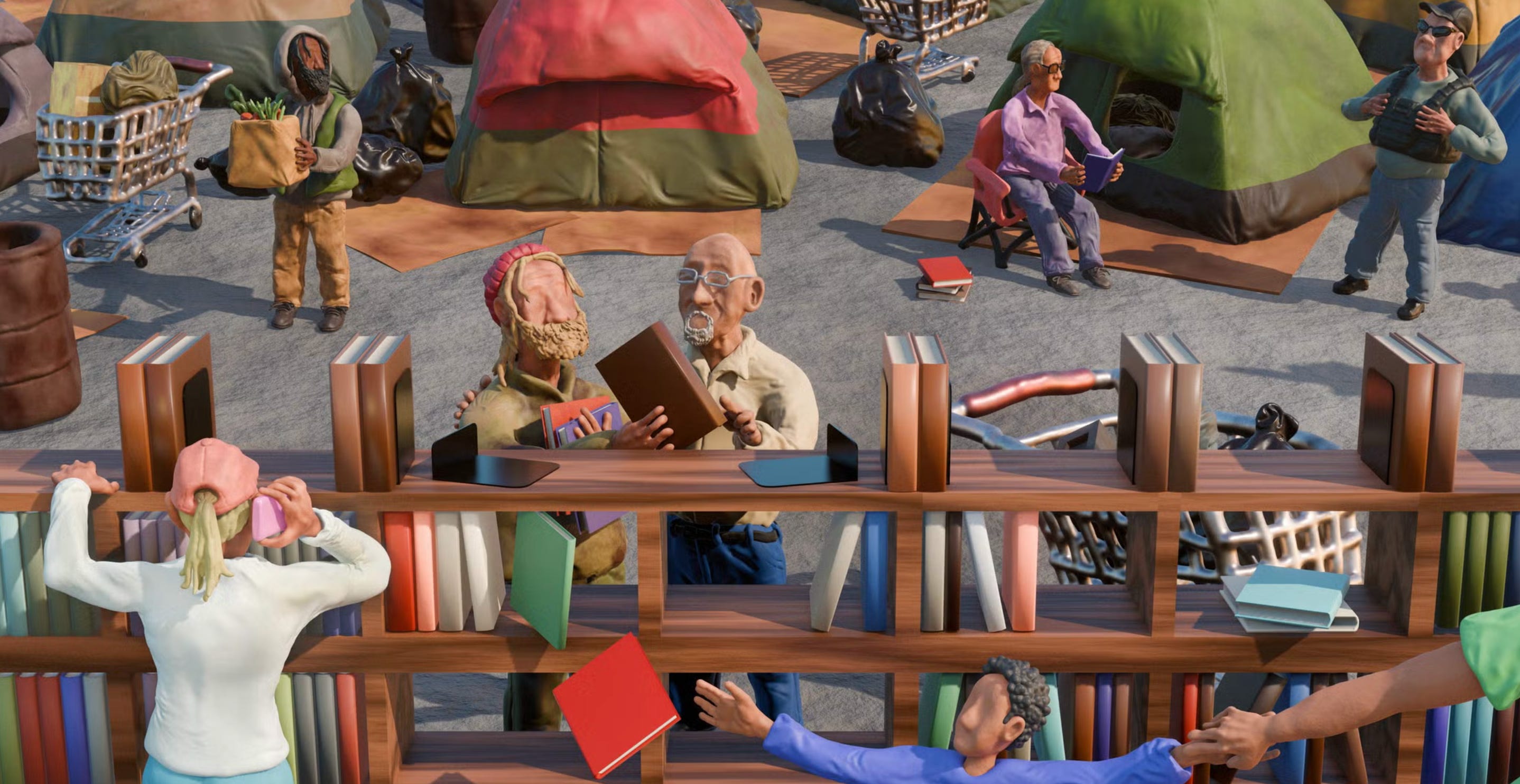
He moved to the block promising a new bookstore. He brought a whole lot more than that. Now no one is quite sure how to describe what happened outside Quirky Books.
On Louis Cheslaw, clothing, and knowing what to notice
Show full content
Colin here. We like supporting friends and readers over here. Louis Cheslaw has been a longtime pal and also edits a lot of what you see appearing on WITI day-to-day.
He’s launching a new publication soon, Wardrobe, focused on menswear.
In his words:
After a decade working in and around the industry, I’m fortunate to have relationships with some of the best minds in menswear—designers, tailors, buyers, enviable dressers—and that evening, I realised they might be able to help. Over the past month, I’ve been to Paris, London, New York, and Stockholm, spending time in a few of these people’s homes, stores, and studios, seeking their hard-earned wisdom, and asking about their most beloved items.
Wardrobe, publishing every few days, is where all of these discoveries will live. Whether I’m highlighting a worth-it designer, shadowing a tailor, traveling to see a specialist, or sharing the story of a great new find, my hope is that every send will help you think about your own wardrobe with a little more clarity, and leave you with a deeper appreciation for the quality items you already own.
The goal is pretty simple, really. I want us to all build wardrobes that make us happy, last a long time, and help us feel more like ourselves.
The key here is Louis will be doing real-life, shoe leather reporting and getting out into the world. This is a major difference from a lot of the regurgitation and laziness I see across many categories online. So go give him some support, it will be worth reading. (CJN)