If you’ve taken a high school science class, you’ve probably learned that the gravitational constant here on Earth is about 9.8 meters per second squared. In other words, things on the planet are constantly falling back to the ground, accelerating at that rate. We don’t tend to think about it much — unless you’re going to the International Space Station or on a Vomit Comet, gravity is the same wherever you are — hence the name. Except that, it actually isn’t. Gravity is a function of mass — the more massive an object, the stronger its gravitational pull. And that pull depends not just on how much mass there is, but how that mass is distributed around an object’s center. From afar, the Earth looks like a smooth, round ball, but in reality, it isn’t. Our planet isn’t a uniform sphere, and therefore, doesn’t actually have uniform density, so gravity varies slightly from place to place. In most cases, the difference is so small that it’s basically undetectable. But in one part of Canada, the difference is noticeable enough — with the right instruments — that scientists spent decades trying to figure out why. That region is near the area [...]
Show full content
If you’ve taken a high school science class, you’ve probably learned that the gravitational constant here on Earth is about 9.8 meters per second squared. In other words, things on the planet are constantly falling back to the ground, accelerating at that rate. We don’t tend to think about it much — unless you’re going to the International Space Station or on a Vomit Comet, gravity is the same wherever you are — hence the name.
Except that, it actually isn’t.
Gravity is a function of mass — the more massive an object, the stronger its gravitational pull. And that pull depends not just on how much mass there is, but how that mass is distributed around an object’s center. From afar, the Earth looks like a smooth, round ball, but in reality, it isn’t. Our planet isn’t a uniform sphere, and therefore, doesn’t actually have uniform density, so gravity varies slightly from place to place. In most cases, the difference is so small that it’s basically undetectable. But in one part of Canada, the difference is noticeable enough — with the right instruments — that scientists spent decades trying to figure out why.
That region is near the area around the Nastapoka Arc in Canada’s Hudson Bay. (Here’s a map.) If you were to stand there, you’d weigh about four-thousandths of a percent less than you would at the global average. That’s not enough to notice on a normal bathroom scale — you’d need extremely precise instruments to detect it — but it’s real, and it’s measurable by scientists who have better tools than we regular people do. Until recently, no one was sure why.
When scientists first discovered this anomaly in the 1960s, they had two theories. The first involved ice — specifically, the Laurentide Ice Sheet, a massive glacier that covered most of Canada during the last Ice Age. The ice was over three kilometers thick in places, and its weight pushed down the continental crust like a finger pressing into a memory foam mattress. When the ice melted around 10,000 years ago, the crust began to rebound — but slowly. According to IFL Science, the Laurentide Ice Sheet “pushed through the country and shifted dense rock out of its way, compressing it down below.” The result was a dent in the Earth, with less mass underneath — and less mass means less gravity.
The second theory pointed (literally) deeper, to the mantle beneath the crust. The mantle is made of molten rock heated by the Earth’s core, and it moves in slow convection currents over geological timescales. These currents can drag continental plates downward, reducing the mass in certain areas. Scientists suspected that something like this was happening beneath Hudson Bay, pulling the region down and further reducing its gravitational pull.
For decades, no one knew which theory was correct — or if both were. Then, in 2002, NASA launched a pair of satellites called GRACE, the Gravity Recovery and Climate Experiment. By measuring tiny variations in the Earth’s gravitational field, GRACE gave scientists the data they needed. As CBC News reported, the satellites allowed researchers to “measure tiny, minuscule ripples or changes in that gravity field, and that has never been possible before.”
And it turned out that both theories were right. According to BBC Science Focus, “Hudson Bay’s gravitational anomaly is caused by a combination of mantle convection currents and the legacy of the Laurentide Ice Sheet.” The ice accounts for somewhere between 25 and 45 percent of the missing gravity; the rest is due to what’s happening deep underground. The crust is still rebounding at about 12 millimeters per year, which means it’ll take another 300,000 years or so for the region to fully recover from the Ice Age. But even then, the convection currents will still be there — meaning Hudson Bay will always be a little lighter than the rest of the world. Just not as light as it is today.
So if you’re looking to lose weight, moving to northern Canada won’t help you fit into your old jeans. But it will, technically, make the number on your scale slightly smaller. Just don’t expect anyone to notice.
Bonus fact: Trees have a theoretical maximum height on Earth, and gravity is the reason why. BBC Science Focus explains: “Trees grow very tall when water and nutrients are plentiful and there is intense competition for sunlight. But as they grow, gravity gets stronger. Plants and trees carry water to their leaves for photosynthesis in a tube called the xylem. If there isn’t enough water, or gravity is very strong, this water column can break, creating potentially deadly air bubbles. This places an upper limit on tree height, which theoretically lies somewhere between 122 meters and 130 meters (400 to 426 feet).” That theoretical limit hasn’t been reached, though — the tallest known tree, a sequoia known as Hyperion, is only (only?) 116.22 meters (381.3 feet) tall.
From the Archives: Just Say No to Gravity: Meet the people who tried to harness the power of gravity — if not ending it.
Pictured above is the Space Shuttle Discovery, on its way to the International Space Station on October 23, 2007. As launches go, there’s nothing particularly notable about the above — many other launch photos look generally similar. As a result, nothing looks amiss, and that’s good, because nothing is. The launch went off fine and the mission was a success. But there is something odd about the photo: everything — except the large missile-shaped object in the middle of the spacecraft — is white. That’s the external fuel tank — it is, basically, a big tank of rocket fuel, the contents of which are needed solely to get the shuttle into space. There’s nothing else in there. And, as you can see, it’s orange — a color you rarely see in consumer products, let alone massive, very visible scientific expeditions. And in fact, in the early space missions — such as STS-1 on April 12, 1981, the launch of which can be seen below, that same part was white. What gives? Well, science, of course. Getting stuff into space is hard — it takes a lot of math, and a lot of fuel. And the bigger the thing you want [...]
Show full content
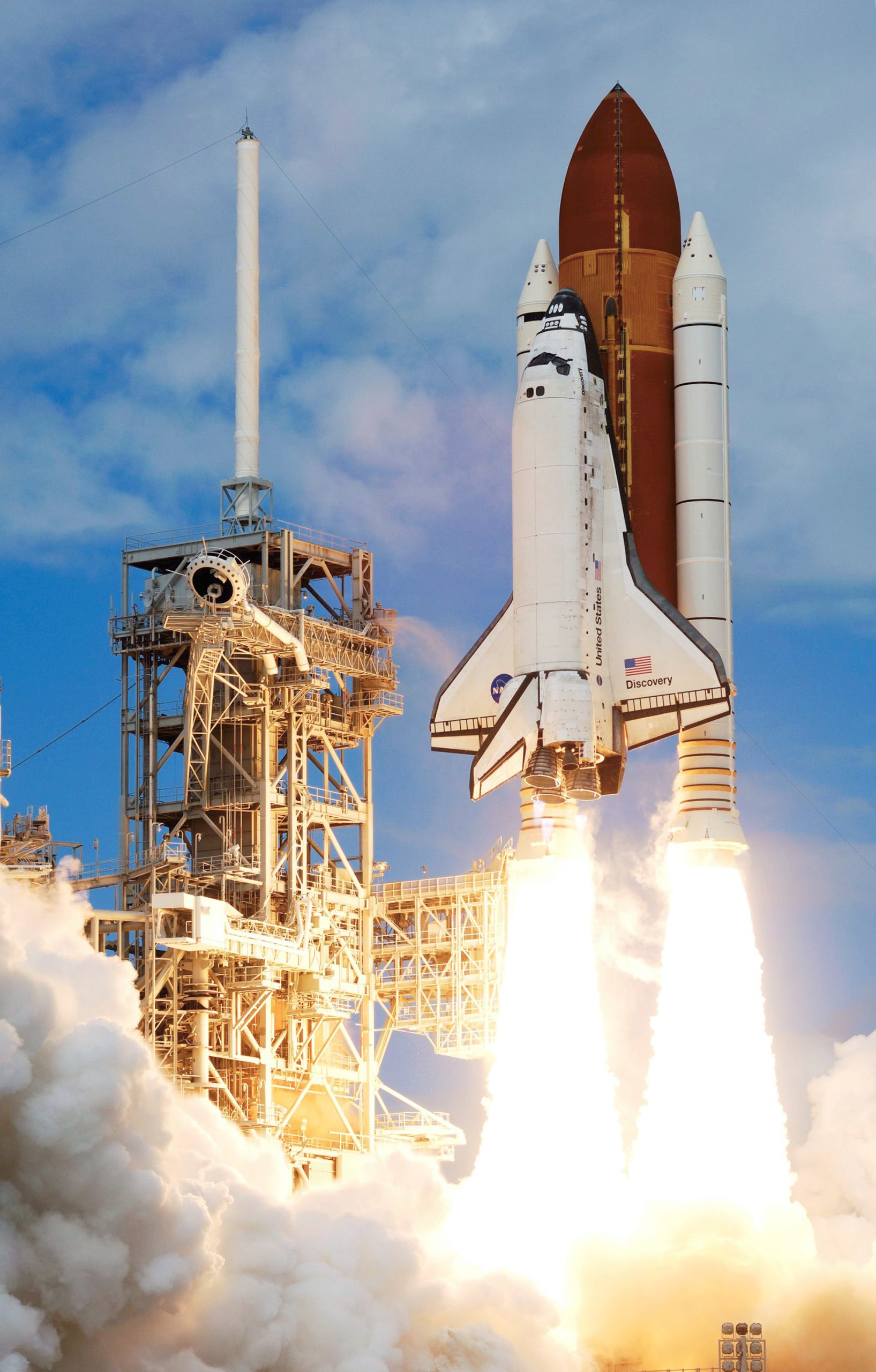
Pictured above is the Space Shuttle Discovery, on its way to the International Space Station on October 23, 2007. As launches go, there’s nothing particularly notable about the above — many other launch photos look generally similar. As a result, nothing looks amiss, and that’s good, because nothing is. The launch went off fine and the mission was a success.
But there is something odd about the photo: everything — except the large missile-shaped object in the middle of the spacecraft — is white. That’s the external fuel tank — it is, basically, a big tank of rocket fuel, the contents of which are needed solely to get the shuttle into space. There’s nothing else in there. And, as you can see, it’s orange — a color you rarely see in consumer products, let alone massive, very visible scientific expeditions. And in fact, in the early space missions — such as STS-1 on April 12, 1981, the launch of which can be seen below, that same part was white. What gives?
Well, science, of course.
Getting stuff into space is hard — it takes a lot of math, and a lot of fuel. And the bigger the thing you want to send into space, the more fuel you use. As Neil deGrasse Tyson points out, humans, their food, their equipment, etc. — that takes up only a tiny, tiny part of the entire contraption seen above; the rest is rocket fuel. The more the spacecraft carries upward, the more fuel you need. And as deGrasse further points out, the fuel itself needs to be propelled upward, so the more fuel you have, the more additional fuel you need to launch successfully. Which requires even more fuel, and so on. It scales exponentially, which is bad if you’re trying to save on fuel costs.
So NASA and other space agencies are very good about cutting mass wherever possible — the less the whole thing weighs, the less fuel you need. And the orange tank is orange for exactly that reason.
Rocket fuel isn’t the same as the gas we put in our cars. Per NASA (pdf), it’s composed of “liquid hydrogen fuel at minus 423 degrees Fahrenheit and the liquid oxygen tank at near minus 297 degrees Fahrenheit,” which is to say, very cold stuff. The world outside that tank is obviously much warmer, and the tank can be filled and idle, sitting in a big warehouse in Florida (typically the Vehicle Assembly Building) for months. So the external fuel tank needs to be insulated to keep the stuff inside cold. The spray-on insulation used by NASA is orange — and visible in the top photo.
That wasn’t always the case, though. Well, the color of the insulation has always been orange — that hasn’t changed. But the earlier days of the space program, NASA was concerned about the damage that ultraviolet light would do to the shuttle and its fuel tanks. To protect against this damage, the entire ship was painted white — including the external fuel tank.
After the first few Space Shuttle missions, though, a NASA engineer named Farouk Huneidi revisited the decision. He demonstrated that the white paint wasn’t necessary to protect the external fuel cell. But it did come at a cost — the paint job was so extensive, the paint alone weighed roughly 600 pounds (270 kg). In an environment where every ounce mattered, saving that many was — literally — a huge relief.
Due to Huneidi’s work, the external fuel tank remained orange for decades, throughout the lifespan of the space shuttle program. And its legacy continues today; in the recent Artemis II launch, most of the fuel tank remained orange.
Bonus fact: Okay, this is about painted oranges — there’s not a lot of trivia about orange-colored paint! — but close enough? In 1996, Michel Vaujour was in a Paris prison, serving his sentence for attempted murder and armed robbery, when he made a daring escape. Per CNN, he “forced his way onto the prison’s roof by wielding nectarines that were painted to look like grenades,” and then his wife — who had spent months taking flying lessons — picked him up in a helicopter she had learned to pilot. He was ultimately recaptured; there are no reports as to what was done with the painted fruit.
From the Archives: Orange Balls of Paint: Throw them at bad guys and the bad guys get marked.
Hi! A friend of mine posted the image above to her Instagram earlier today, and the timing was great — because (a) I wasn’t sure what I wanted to share today and (b) oh boy, have I been on the roller coaster above lately. Outside of Now I Know, I’ve been working on another project, one where I help people who work in PR and communications adapt to a world where AI literacy is increasingly important. I started that project in January and it’s not quite followed the path above (the second, squiggly path, I mean), but it’s pretty close. I build, I get excited about what I’m doing, I share, it lands fine but not with the same degree of excitement. That causes some self-doubt to take root, which doesn’t go away until I find another way to find a solution, and then the cycle repeats itself — or, until I realize that I’ve actually made a lot of strides toward my goal already. In other words, in the moment, where I am on the chart is all that matters, but if I take a step back, I can see the progress being made since inception, and it’s a [...]
Show full content
Hi!
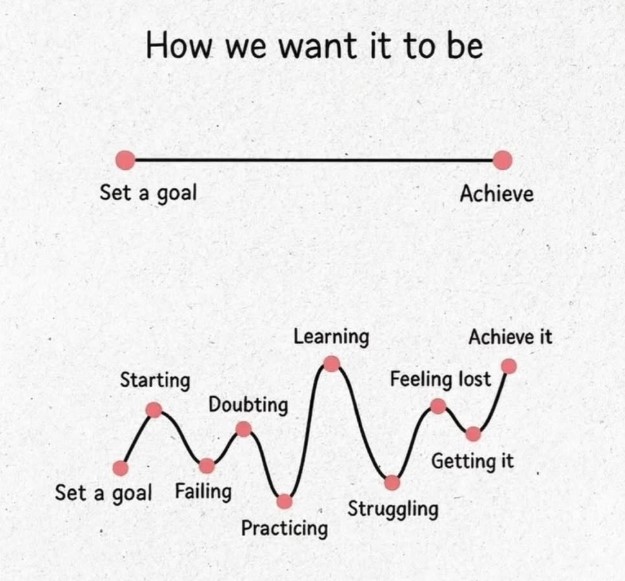
A friend of mine posted the image above to her Instagram earlier today, and the timing was great — because (a) I wasn’t sure what I wanted to share today and (b) oh boy, have I been on the roller coaster above lately.
Outside of Now I Know, I’ve been working on another project, one where I help people who work in PR and communications adapt to a world where AI literacy is increasingly important. I started that project in January and it’s not quite followed the path above (the second, squiggly path, I mean), but it’s pretty close. I build, I get excited about what I’m doing, I share, it lands fine but not with the same degree of excitement. That causes some self-doubt to take root, which doesn’t go away until I find another way to find a solution, and then the cycle repeats itself — or, until I realize that I’ve actually made a lot of strides toward my goal already. In other words, in the moment, where I am on the chart is all that matters, but if I take a step back, I can see the progress being made since inception, and it’s a lot.
But there’s something that the chart above shows which isn’t as obvious — and often, much more frustrating that the setbacks themselves. The top line isn’t just straight — it’s short. You set a goal and quickly achieve it. Unfortunately, the world doesn’t work on our timelines. When you’re creating something new, that almost always requires the help of others. and rarely do they have the energy for your project that you do.
It’s good to keep the lesson that my friend shared in mind — success isn’t linear, isn’t quick, and isn’t always obvious in the moment. But those aren’t reasons to give up. And really — it’s more fun on the squiggly path anyway.
(Oh, and if you want to help me move toward success on the other project, you can. I’m looking for people to help beta test something I’m building. If you’re interested in learning how to vibe code and similarly have interest in PR/communications, you’d be perfect; if not, but you’re willing to pretend, that’s good too. Just reply to let me know and I’ll follow up with more info.)
Tuesday: The Cat Phone Came Back: I’ve read a lot of Garfield comics in my life (my brother was really into it growing up) and this would have been a really dark one.
Wednesday: Crease and Desist: I really want to send a letter like this one day.
Here are a few things you may want to check out over the weekend:
1) “The Death of a Superman” (The Believer, 20 minutes, March 2026). What starts as an obituary for a Hollywood Boulevard Superman impersonator becomes a searing look at how clothing donation bins quietly kill homeless people across North America.
2) “Your IQ Matters Less Than You Think” (Nautilus, 13 minutes, April 2026). IQ often gets treated like destiny, but the actual evidence says otherwise — this argues that once you clear a baseline level of smarts, traits like grit, creativity, and drive tend to matter more.
Quitting smoking is hard. Really hard. The CDC estimates that about two-thirds of adult smokers want to quit, but only about 7% who try in any given year actually succeed. There are nicotine patches, gums, lozenges, prescription medications, hypnosis, acupuncture, and countless apps designed to help people kick the habit. Most people try multiple methods before finding one that works — if they ever do. Etta Mae Lopez tried something different. She slapped a cop. On a Tuesday in May 2013, Lopez, a 31-year-old Sacramento, California resident, stood outside the Sacramento County jail for several hours. She wasn’t there to visit anyone or post bail. She was waiting for a deputy to come outside. When Deputy Matt Campoy finished his shift and walked out of the building, Lopez — all five feet, one inch of her — blocked his path. As NBC News reported, she suddenly stepped into him and slapped him across the face. When Campoy grabbed her and brought her back inside the jail, she slapped his arm for good measure. Once safely in handcuffs, Lopez explained her reasoning. She told Campoy that she had deliberately targeted him because he was in uniform — she wanted to make [...]
Show full content
Quitting smoking is hard. Really hard. The CDC estimates that about two-thirds of adult smokers want to quit, but only about 7% who try in any given year actually succeed. There are nicotine patches, gums, lozenges, prescription medications, hypnosis, acupuncture, and countless apps designed to help people kick the habit. Most people try multiple methods before finding one that works — if they ever do.
Etta Mae Lopez tried something different. She slapped a cop.
On a Tuesday in May 2013, Lopez, a 31-year-old Sacramento, California resident, stood outside the Sacramento County jail for several hours. She wasn’t there to visit anyone or post bail. She was waiting for a deputy to come outside. When Deputy Matt Campoy finished his shift and walked out of the building, Lopez — all five feet, one inch of her — blocked his path. As NBC News reported, she suddenly stepped into him and slapped him across the face. When Campoy grabbed her and brought her back inside the jail, she slapped his arm for good measure.
Once safely in handcuffs, Lopez explained her reasoning. She told Campoy that she had deliberately targeted him because he was in uniform — she wanted to make absolutely certain she was striking a law enforcement officer. The goal wasn’t violence for its own sake, and she wasn’t targeting Campoy specifically. But she was going after the police. As Campoy told The Sacramento Bee, “She knew that the only way to quit smoking was to go to jail because they don’t allow tobacco in the jail.” Lopez had waited all day for a deputy to emerge, knowing that assaulting one would guarantee enough time behind bars to break her addiction.
The plan worked exactly as she had hoped. Lopez pleaded no contest to misdemeanor battery on a peace officer and was immediately sentenced to 63 days in jail, plus five additional days for violating probation from a 2010 drunk driving conviction. Among the conditions of her sentence, according to CBC News: an order to have “no contact” with deputies. (Of course, if the goal is to go to jail, that’s hardly a deterrent.)
That said, most others — including anti-smoking leaders — weren’t fold of Lopez’s strategy. Kimberly Bankston-Lee, one such advocate, told CBS News that she “agrees that coldcocking a cop isn’t the best way to quit cold turkey,” while acknowledging that “if [smoking] led somebody to do something like that to quit, that lets us know in the community that we have a real problem.” Others, like Lopez’s neighbor and smoking buddy, agreed, telling CBS that “There’s easier ways to stop smoking than hitting a cop “and “that’s not the way I want to quit.”
As for Deputy Campoy, he took the whole thing in stride. “I’ve been telling everybody that I have a new Irish name,” he told reporters. “Nick O’Derm.”
Bonus fact: In or around 2009, some smokers were given a new reason to quit — Apple wouldn’t fix their computers. As PC World reported, Apple was “telling at least some customers that the amount of cigarette smoke residue inside their computers makes it unsafe for the company to perform warranty service on them, despite the lack of such a clause in the company’s warranty agreement.” Reports of similar incidents persisted for a few years, but haven’t popped up again in about a decade.
If you grew up in the 1980s, there’s a decent chance you had a novelty telephone in your home — one shaped like a football, a hamburger, or perhaps a cartoon character. Among the more popular options was a phone shaped like Garfield, the lasagna-loving, Monday-hating orange tabby from the Jim Davis comic strip, as seen above. The phone’s eyes would open when you picked up the receiver, adding a touch of whimsy to your otherwise mundane landline experience. Thousands of these phones were manufactured and sold during the decade, and today, collectors still buy and sell the vintage items online. But for residents of a French coastal town, these Garfield phones weren’t a nostalgic curiosity. They were an inescapable nuisance. Starting in the mid-1980s, pieces of orange plastic began washing up on a beach on the northwest tip of France. (Here’s a map.) At first, the debris was probably just confusing. But as the years went on, a pattern emerged: the plastic wasn’t random garbage. It was Garfield. Specifically, it was parts of Garfield phones — sometimes intact, sometimes badly coated in grime, but always unmistakably the cartoon cat. According to the BBC, this had been happening, more or [...]
Show full content
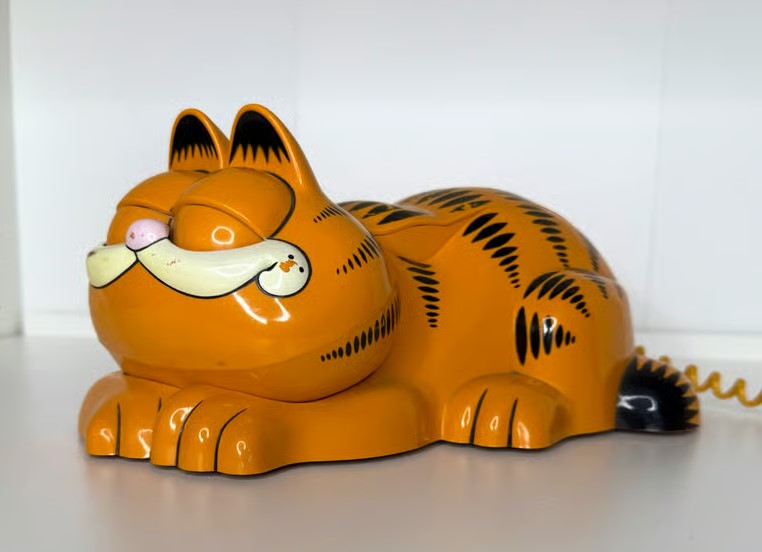
If you grew up in the 1980s, there’s a decent chance you had a novelty telephone in your home — one shaped like a football, a hamburger, or perhaps a cartoon character. Among the more popular options was a phone shaped like Garfield, the lasagna-loving, Monday-hating orange tabby from the Jim Davis comic strip, as seen above. The phone’s eyes would open when you picked up the receiver, adding a touch of whimsy to your otherwise mundane landline experience. Thousands of these phones were manufactured and sold during the decade, and today, collectors still buy and sell the vintage items online.
But for residents of a French coastal town, these Garfield phones weren’t a nostalgic curiosity. They were an inescapable nuisance.
Starting in the mid-1980s, pieces of orange plastic began washing up on a beach on the northwest tip of France. (Here’s a map.) At first, the debris was probably just confusing. But as the years went on, a pattern emerged: the plastic wasn’t random garbage. It was Garfield. Specifically, it was parts of Garfield phones — sometimes intact, sometimes badly coated in grime, but always unmistakably the cartoon cat. According to the BBC, this had been happening, more or less continuously, for more than three decades.
Local anti-litter campaigners from a group called Ar Vilantsou had long suspected the source: a shipping container, likely blown overboard during a storm, regurgitating its cargo into the sea. But they couldn’t prove it. The container, if it existed, had never been found.
In 2018, Ar Vilantsou decided to make the Garfield phone a symbol of plastic pollution in the region, launching a media campaign that drew national attention. And that attention caught the eye of someone who knew more than he’d ever let on: a local farmer named René Morvan.
Morvan remembered the phones appearing after a storm in the early 1980s, when he was a young man. More importantly, he remembered where they came from. “You had to really know the area well,” he told Franceinfo. Decades earlier, he and his brother had explored a secluded sea cave accessible only at low tide. Inside, they found a shipping container lodged in a rock fissure, its contents spilling out. “We found a container aground in a fissure,” he recalled. “It was open. A lot of things had spilled out, but there was a stash of cell phones”
After the anti-Garfield campaign took off, Morvan led members of Ar Vilantsou and a French news crew back to the cave. Climbing down the slippery rocks, they found exactly what he’d described: the rusted remnants of a shipping container, and scattered among the rocks, Garfield phones in better condition than any they’d ever pulled from the beach. (But alas, no well-preserved lasagna.) The mystery, at least, was solved.
But the problem wasn’t. The container remains wedged in an inaccessible spot, and no one knows how much of its cargo is still sealed inside. The phones that escaped won’t decompose in a human lifetime. For now, all locals can do is keep collecting Garfield, one orange piece at a time, as he continues his endless return to shore.
Bonus fact: Garfield made headlines in 2018 for another weird reason. That summer, Clara Edwards, a mom in Oklahoma posted a wanted ad on her company’s employee billboard, asking “to BORROW an orange cat for 24-48 hours,” and yes, “borrow” was in all caps (as seen here). Her kids — age two and four — wanted to eat a lasagna dinner with Garfield, and this was her way of getting that done. The photo of the wanted ad went viral and, according to USA Today, a neighborly person with a fat orange tabby cat offered to come by one Sunday, helping Edwards and her kids make the dream come true.
From the Archives: Starving Garfield: A very morbid series of Garfield comic strips.
If you’re old enough to remember VHS tapes, you probably also remember the small anxiety that came with renting one. You’d pick up a movie, watch it, and then — ideally within a day or two — return it to the store. If you forgot, you’d rack up late fees. Annoying, sure, but not the end of the world. The worst that could happen was a few extra dollars tacked onto your account, maybe a stern look from the clerk next time you came in. It’s not going to make you unemployable… right? Unfortunately for a woman named Caron McBride, that’s exactly what happened. In 2021, McBride — having recently married — moved from Oklahoma to Texas with her new husband. She went to the Texas DMV to change the name on her driver’s license, but was told that Texas couldn’t do that. Per USA Today, she was told she had to “fix an issue in Oklahoma first” and “was given a case number and a phone number to the courthouse.” When she called the Oklahoma court, she was told the bad news: she was a wanted criminal. The crime? Failing to return a VHS tape of “Sabrina the Teenage [...]
Show full content
If you’re old enough to remember VHS tapes, you probably also remember the small anxiety that came with renting one. You’d pick up a movie, watch it, and then — ideally within a day or two — return it to the store. If you forgot, you’d rack up late fees. Annoying, sure, but not the end of the world. The worst that could happen was a few extra dollars tacked onto your account, maybe a stern look from the clerk next time you came in.
It’s not going to make you unemployable… right?
Unfortunately for a woman named Caron McBride, that’s exactly what happened.
In 2021, McBride — having recently married — moved from Oklahoma to Texas with her new husband. She went to the Texas DMV to change the name on her driver’s license, but was told that Texas couldn’t do that. Per USA Today, she was told she had to “fix an issue in Oklahoma first” and “was given a case number and a phone number to the courthouse.” When she called the Oklahoma court, she was told the bad news: she was a wanted criminal.
The crime? Failing to return a VHS tape of “Sabrina the Teenage Witch” that records indicate she rented from a Norman, Oklahoma, video store called Movie Place back in February 1999. The tape was due back on February 16th. She never returned it. And in March 2000, prosecutors in Cleveland County, Oklahoma, charged her with felony embezzlement of rented property — a crime that, at the time, was punishable by up to a year in prison and a $5,000 fine (!). McBride told Fox 25, a local Oklahoma news channel, that, upon hearing the news, “I thought I was gonna have a heart attack.”
McBride insists she never even rented the tape. “I have never watched that show in my entire life, just not my cup of tea,” she told the local news. She believes a boyfriend she lived with at the time, who had two young daughters, must have rented it in her name. “I mean, I didn’t try to deceive anyone over Sabrina the Teenage Witch,” she added. “I swear.” (In some interviews, she mistakenly called the show “Samantha the Teenage Witch,” which perhaps underscores her unfamiliarity with the material.) And to make matters even more ridiculous, the video store — Movie Place — closed down in 2008, more than a decade before McBride even knew she had committed an alleged crime.
Oklahoma didn’t think that the dastardly deed required sending out a search party, so McBride wasn’t incarcerated when this all came to life. But she didn’t get off scot free — hardly. McBride had been living with a felony embezzlement charge on her record without knowing it. And over those years, as the Guardian reported, she had been let go from several jobs without explanation. “When they ran my criminal background check, all they’re seeing is those two words: felony embezzlement.” She told USA Today she had sometimes worked two or three jobs at once, struggling to make ends meet, when she knew she was capable of earning more. The unreturned tape — one she claims she never even rented — had quietly been sabotaging her career for years.
Ultimately, reason prevailed. When the tale of McBride’s “crime” hit the news, the Oklahoma DA’s office reviewed the case and dismissed it. But the damage had already been done. As McBride, then in her 50s, told USA Today, “It’s hurt me tremendously, and my family. It makes me madder and madder the more I think about it.”
Bonus fact: In November 2021, inmates in an Oklahoma prison sued the state, arguing they were being subjected to cruel and unusual punishment. As NBC News reported, inmates were allegedly required to stand for three to four hours in “stress positions” while listening to “Baby Shark” on loop. The inmates prevailed: two jail guards were fired for this and ultimately pled no contest to misdemeanor cruelty charges for their actions.
From the Archives: The Speed Trap That Trapped Itself: Speeding enforcement was so out of control, the state eliminated the police department.
Hi! Two weeks ago, as the Artemis II mission around the moon was, well, on its way to the moon, I told you that I wasn’t all that excited. As someone who is hardwired to be more curious than most, and who has intentionally focused on developing my curiosity muscle even further, that was uncharacteristic. But for reasons I couldn’t quite pin down, I didn’t really care about the mission that much — I didn’t watch the launch, for example, and didn’t mind that I missed it whatsoever. But, a week ago Friday, at 8:07 PM my time, I found myself sitting in my family room with one of my kids, watching the capsule splash down. We had been sitting there for at least 20 minutes, both in awe — NASA and the CSA had somehow sent people farther away then ever before, and landed them safely back on Earth, and estimated the landing time to the minute. What changed this for me? The pictures. Specifically, these three. Wow. Wow. and Wow. (More pictures here, but those are my favorites.) So: I was wrong. This mission was awesome, and I can’t wait for the next one. The Now I Know [...]
Show full content
Hi!
Two weeks ago, as the Artemis II mission around the moon was, well, on its way to the moon, I told you that I wasn’t all that excited. As someone who is hardwired to be more curious than most, and who has intentionally focused on developing my curiosity muscle even further, that was uncharacteristic. But for reasons I couldn’t quite pin down, I didn’t really care about the mission that much — I didn’t watch the launch, for example, and didn’t mind that I missed it whatsoever.
But, a week ago Friday, at 8:07 PM my time, I found myself sitting in my family room with one of my kids, watching the capsule splash down. We had been sitting there for at least 20 minutes, both in awe — NASA and the CSA had somehow sent people farther away then ever before, and landed them safely back on Earth, and estimated the landing time to the minute.
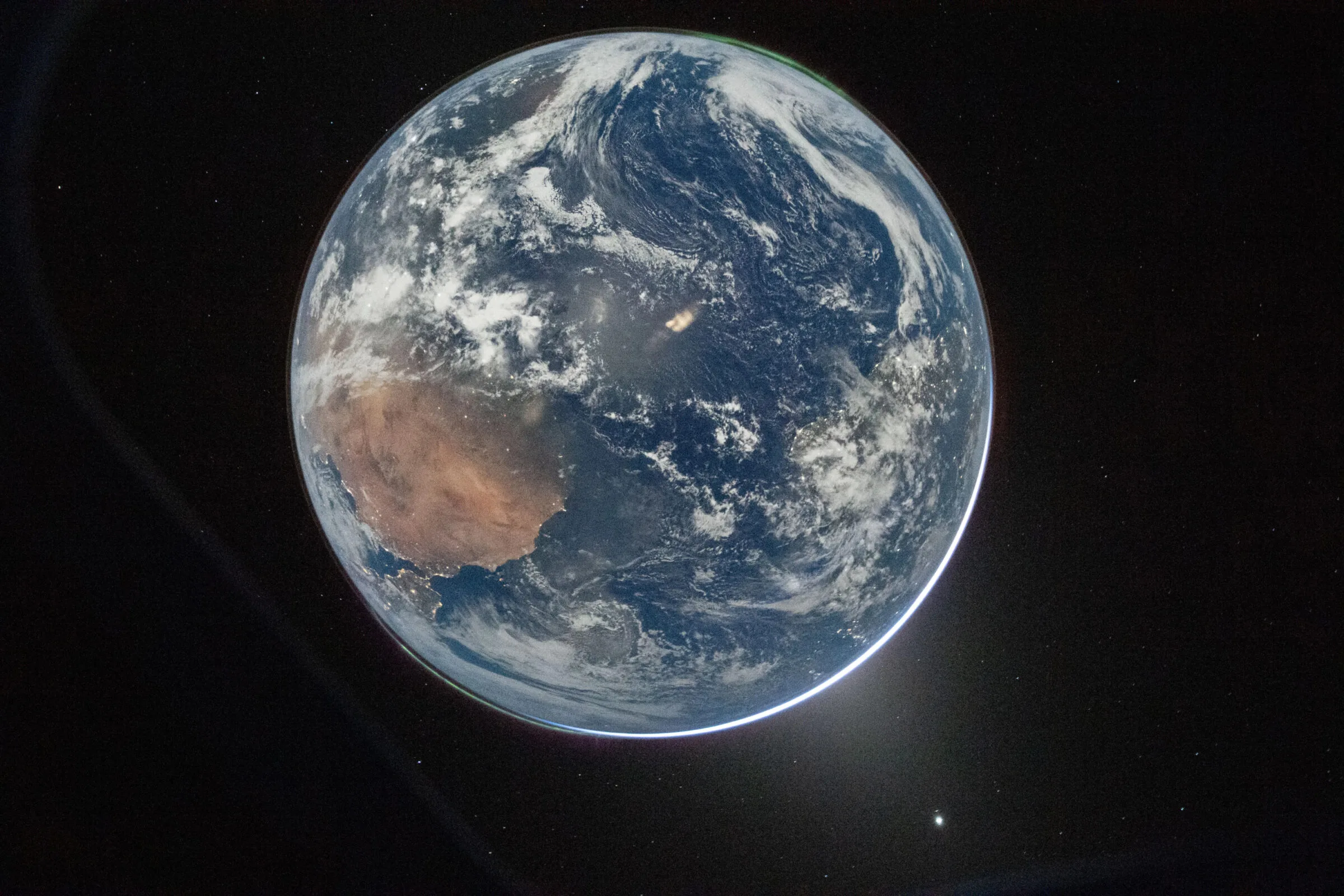
What changed this for me? The pictures. Specifically, these three.
So: I was wrong. This mission was awesome, and I can’t wait for the next one.
The Now I Know Week In Review
Monday: The Good Advice That The DMV Rejected: This is about a license plate. The next day, one of my kids and I saw one that read “K14-3FE,” which isn’t the format of a standard NY State plate. I’m not entirely sure what it means — if you have suggestions, share them. (At first, I thought it was about potassium and iron, but then I realized “143” is shorthand for “I love you” and “FE” probably means “forever,” and “K” could be someone’s name or initial. That’s the theory I’m going with unless you all have other, better suggestions.)
2) “The Lost Art of Reading an Actual Book” (Esquire, 6 minutes, January 2026). The subhead: “What happens when people stop reading books? We’re starting to see what a postliterate society looks like—and it’s very lame.” It’s not lost on me that this article only has a six-minute read time.
3) Not a long read, but probably more fun: Fold’NFly, a website with dozens of paper airplane designs that you can — and should! — build yourself. Get outside and fly some paper planes!
It’s not uncommon for towns, schools, or other groups to adopt an animal as a mascot. In most cases, they’ll choose an animal local to them — Baltimore’s baseball team is the Orioles because those birds are common in Maryland, for example. But that’s not always the case. Take, for example, the goat pictured above. As of a few years ago, he was the unofficial mascot of Fairbanks, Alaska — a place where goats aren’t native. For him to aspire to fame, he needed to do something special. And he did: he ran. Fast. In October 2019, the city of Fairbanks was in a tizzy because the goat seen above was running through its streets, “dodging cars near a local freeway” according to a Facebook post by the Alaska State Troopers,” and generally causing chaos. The “very fast goat,” as the local animal control board described it, was particularly hard to nab, to the point that the police enlisted local townspeople to help determine the location of the animals. For the next two days, residents of Fairbanks treated the chase like a citywide game of Where’s Waldo, posting sightings and updates as the fugitive hoofed his way through town. As [...]
Show full content
It’s not uncommon for towns, schools, or other groups to adopt an animal as a mascot. In most cases, they’ll choose an animal local to them — Baltimore’s baseball team is the Orioles because those birds are common in Maryland, for example. But that’s not always the case. Take, for example, the goat pictured above. As of a few years ago, he was the unofficial mascot of Fairbanks, Alaska — a place where goats aren’t native. For him to aspire to fame, he needed to do something special.
And he did: he ran. Fast.
In October 2019, the city of Fairbanks was in a tizzy because the goat seen above was running through its streets, “dodging cars near a local freeway” according to a Facebook post by the Alaska State Troopers,” and generally causing chaos. The “very fast goat,” as the local animal control board described it, was particularly hard to nab, to the point that the police enlisted local townspeople to help determine the location of the animals. For the next two days, residents of Fairbanks treated the chase like a citywide game of Where’s Waldo, posting sightings and updates as the fugitive hoofed his way through town. As the Anchorage Daily News reported, Facebook users who followed the saga gave him a name: Curry.
The chase came to an end the following night when some Good Samaritans spotted Curry near a road, where he had been jumping into traffic. They managed to grab him, and Alaska State Troopers transported the animal to the borough’s animal shelter. Assuming that the goat was just someone’s pet or a local farm animal, Curry was placed in the drop-off cages overnight and given breakfast the next morning — with the expectation that its owner would just pick him and take him home.
But the next day, Paul Finch, the goat’s owner, came to bail Curry out — and the true identity of the animal came to light. He wasn’t a pet — he was livestock, destined for the slaughterhouse and ultimately, someone’s plate. The people of Fairbanks weren’t keen on that outcome. The hashtag #FreeCurry had spread across social media. People were rooting for this goat — a goat who had, quite literally, fled his own execution. As Finch told a local TV station, “Everybody is rooting for the goat, and everybody wants to see the goat do good, because somehow it might be partly their story.”
Finch, who works in addiction recovery services, saw an opportunity. Curry had been arrested. He’d been in jail. And now he was getting a second chance. “I believe that he would be a great mascot for the reentry coalition or the reentry process for people reentering after incarceration,” Finch said. He brought Curry to The Bridge, a Fairbanks organization that provides employment and peer support for people affected by opioid use disorder. As the Seattle Times reported, The Bridge announced the adoption on its Facebook page with a simple message: “Welcome Curry the goat as the Bridge’s new mascot! We are going to reintegrate him to society.”
The organization launched an online fundraiser with a goal of $5,000 to cover Curry’s needs, and a local coffee shop began selling Curry stickers to raise money for The Bridge. Finch, meanwhile, asked the borough mayor to officially pardon Curry — a ceremonial gesture, sure, but a fitting one for a goat whose escape from the dinner table turned into a story about redemption.
Curry was no longer livestock. He was a symbol — and most definitely, not someone’s dinner.
Bonus fact: Vikings believe that, when you leave this plane of existence, you go to Valhalla — effectively, the Viking version of heaven. And as Vine Pair explains, there’s an “endless supply of beer” waiting for you there. But there’s a downside — the beer doesn’t come out of taps or kegs. It comes from “the udders of a magical goat.”
From the Archives: The Judas Goat: Goats can be an invasive species, and here was a creative way to get their population under control
When you think of a desert, the image in your head probably contains a lot of sand and… well, not much else. Maybe there’s some vegetation here or there, a snake or vulture darting cross the landscape, and maybe even the ruins of an old mining operation. Wait long enough, and you’ll probably come across a car or two. But you wouldn’t expect to see this. The image above is the winner of National Geographic’s 2018 photo contest. It shows a parking lot containing hundreds of thousands of cars (and one plane!), all of them sitting in neat rows, baking under the sun. They’re about a 90 minutes northwest from Los Angeles (here’s a map), but the cars there aren’t going to LA — or anywhere else — any time soon. They’re relegated to sit there and do nothing, much like they have for over a decade. Their story begins in 2015, when Volkswagen got caught in one of the largest corporate scandals in automotive history. The German automaker had been selling diesel vehicles marketed as clean and fuel-efficient, but as the Guardian reported, the company had rigged nearly 600,000 of those vehicles to cheat on emissions tests. The cars [...]
Show full content
When you think of a desert, the image in your head probably contains a lot of sand and… well, not much else. Maybe there’s some vegetation here or there, a snake or vulture darting cross the landscape, and maybe even the ruins of an old mining operation. Wait long enough, and you’ll probably come across a car or two.
But you wouldn’t expect to see this.
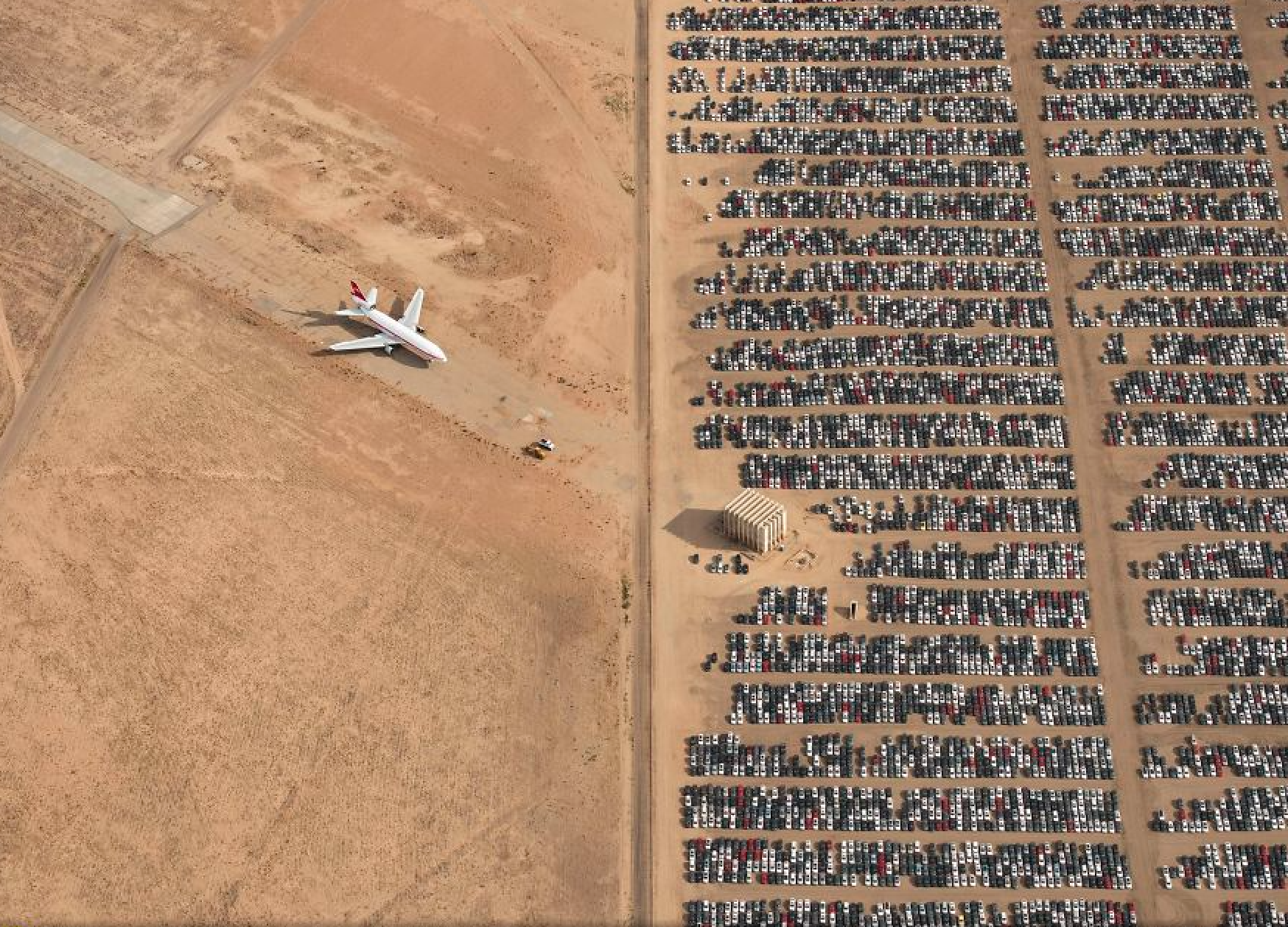
The image above is the winner of National Geographic’s 2018 photo contest. It shows a parking lot containing hundreds of thousands of cars (and one plane!), all of them sitting in neat rows, baking under the sun. They’re about a 90 minutes northwest from Los Angeles (here’s a map), but the cars there aren’t going to LA — or anywhere else — any time soon. They’re relegated to sit there and do nothing, much like they have for over a decade.
Their story begins in 2015, when Volkswagen got caught in one of the largest corporate scandals in automotive history. The German automaker had been selling diesel vehicles marketed as clean and fuel-efficient, but as the Guardian reported, the company had rigged nearly 600,000 of those vehicles to cheat on emissions tests. The cars were equipped with special software — so-called “defeat devices” — that could detect when an emissions test was being conducted and temporarily reduce the car’s pollution output. The rest of the time, the vehicles spewed pollutants at levels far exceeding legal limits.
The fallout was enormous. Volkswagen faced up to $20 billion in Clean Air Act fines alone, and the Federal Trade Commission sued the company for deceptive advertising. As part of the settlement, VW was required to either fix the affected vehicles or buy them back from their owners. Many owners chose the buyback, and according to NPR, by the end of 2017, Volkswagen had reacquired about 335,000 diesel vehicles, spending more than $7.4 billion in the process. The company was only able to get rid of about 30,000 — that left roughly 300,000 vehicles with nowhere to go.
So Volkswagen did what any company with nearly a third of a million unsellable cars would do: it went shopping for parking lots. The automaker leased space at 37 remote facilities across the country, including a former football stadium in suburban Detroit, an old paper mill in Minnesota, and — most famously — a 134-acre patch of land at the Southern California Logistics Airport in Victorville, pictured partially above. That facility was already well-known as an “aircraft boneyard,” a desert purgatory where retired airplanes go to collect dust. Now it had a new purpose: storing diesel Volkswagens and Audis while the company figured out what to do with them.
The Mojave was chosen, in part, because its arid climate would prevent the cars from rusting. A VW spokeswoman told Reuters that the vehicles were “being stored on an interim basis and routinely maintained in a manner to ensure their long-term operability and quality, so that they may be returned to commerce or exported once U.S. regulators approve appropriate emissions modifications.” That was in 2018. Even years later, most of those cars are still sitting there, waiting for a fate that may never come.
Today, the company — having already paid billions of dollars to buy back cars it can’t sell — is paying to store them indefinitely in the desert, maintaining them just in case they might someday be allowed back on the road. It’s the world’s most expensive parking lot, and the meter is still running.
Bonus fact: In 2007, a well-dressed man walked into a Porsche dealership in Malaysia, asked to test drive a $280,000 car, and then “sped off, smashing through the glass windows, as Reuters reported. He had successfully stolen the car. But he didn’t plan well — the car’s gas take was low and he quickly ran out of fuel, so he abandoned the car by the side of the road. But his caper wasn’t quite over. Authorities towed the car to a local police precinct and, sometime later, the their — who still had the keys — returned with a canister of gasoline, refilled the tank, and stole it again. (He’d ultimately abandon the car again, as police set up roadblocks in hopes of capturing him, but he was never identified or arrested.)
From the Archives: Quickly Going Nowhere: Why a lot of very expensive cars are being abandoned in Dubai.
If you’re driving a car, that car almost always has a license plate — a unique identifier that allows other drivers and the authorities to distinguish your car from other vehicles. Typically, the plates have either a random or sequentially issued series of numbers and letters, and don’t have any meaning unto themselves. But in most of the United States and Canada, for a fee, you can ask your state department of motor vehicles (the DMV) to give you a special one — one that has a message on it. “LETS GO METS,” “NCC-1701,” and this very creative “ETALLIC” one are examples of things the DMV will let you have. Not everything will fly, though — sometimes, the DMV will reject your request. Messages that are overtly political or sexual in nature typically get rejected outright (although I once did see a Pennsylvania-issued plate that absolutely should not have been… it involved Roman numerals, if you want to guess). Ones that involve violence — even if unintentionally so — typically suffer the same fate, as a father of two boys named Kyle and Sean learned a few years back. Makes sense — you don’t want tags like that being seen [...]
Show full content
If you’re driving a car, that car almost always has a license plate — a unique identifier that allows other drivers and the authorities to distinguish your car from other vehicles. Typically, the plates have either a random or sequentially issued series of numbers and letters, and don’t have any meaning unto themselves. But in most of the United States and Canada, for a fee, you can ask your state department of motor vehicles (the DMV) to give you a special one — one that has a message on it. “LETS GO METS,” “NCC-1701,” and this very creative “ETALLIC” one are examples of things the DMV will let you have.
Not everything will fly, though — sometimes, the DMV will reject your request. Messages that are overtly political or sexual in nature typically get rejected outright (although I once did see a Pennsylvania-issued plate that absolutely should not have been… it involved Roman numerals, if you want to guess). Ones that involve violence — even if unintentionally so — typically suffer the same fate, as a father of two boys named Kyle and Sean learned a few years back. Makes sense — you don’t want tags like that being seen on city streets.
But what about this? Is it good advice… or too toilet-focused to pass muster?
Get it? No? Let’s explain. If you’ve ever traveled with kids, you know the drill. You’re about to pull out of the driveway — or worse, you’re already fifteen minutes down the highway — when someone in the backseat announces they need a bathroom. It’s a parenting rite of passage, one that has spawned a universal pre-departure mantra: pee before we go.
Seth Bykofsky, a 69-year-old grandfather from Long Island, New York, decided to immortalize this wisdom on his license plate. For five years, his car bore the custom tag “PB4WEGO,” above, a lighthearted reminder visible to every driver stuck behind him at a red light. According to Bykofsky, the plate earned him smiles, thumbs-ups, and knowing nods from fellow parents and grandparents across the state. It was, by all accounts, harmless dad-joke territory.
Then, in January 2026, the New York State Department of Motor Vehicles sent him a letter. As CBS News reported, the DMV informed Bykofsky that his plate had been deemed “objectionable” and that he “must destroy” it, replacing it with standard-issue plates. The DMV cited regulations prohibiting plates considered “derogatory, contemptuous, degrading, disrespectful, or inflammatory.”
Bykofsky was, shall we say, peeved. (Sorry.) He took to social media to make his case, saying, “Is this simple plea… an incitement to riot? Have we inflamed the very soul of toddlers everywhere, struggling, against all odds, to hold it in?” He even jokingly announced a gubernatorial campaign with the pledge “A P On Every Plate,” warning that if the state could come for his license plate, they could come for anyone’s.
The story caught the attention of Governor Kathy Hochul, who apparently shares Bykofsky’s sense of humor. She didn’t just issue a statement — she called him personally. In a video she posted to social media, Hochul told Bykofsky she had read about his “plight” and loved the plate. “I’m going to get it back for you,” she said. “I think everyone should be reminded to pee before you go. I have kids and grandkids, and I support the effort wholeheartedly.” She called the plate a “public service.”
Amazingly, this isn’t the first time this exact license plate caused the same problem — with the same solution. In 2019, a New Hampshire mom also had a license plate reading “PB4WEGO,” and had for fifteen years, when her DMV suddenly made the same decision: she needed to turn the plates in because they were now deemed offensive. But ultimately, she was able to keep the plates; again, her governor intervened.
How the other 48 states will react has, as of yet, gone unreported. But regardless, the plates give good advice, and the drivers — and the governors, too, I guess — should be lauded for their efforts to keep long drives with kids a little less cumbersome.
Bonus fact: Before 1928, state license plates were boring — just numbers and letters, the state name, and not much else. But that year, Idaho decided to turn its plates into an ad for the state’s biggest claim to fame and cash crop — potatoes. As seen here, Idaho plates placed the number inside an image of an elongated potato, above the phrase “Idaho Potatoes.” Other states followed suit with stylized plates soon thereafter.