GeistHaus
log in · sign up

Bad Astronomy Newsletter

Everything, the Universe, and Life

rss en-us Copyright 2026, Bad Astronomy Newsletter
ScienceSpacePopular Culture
Beehiiv Support (support@beehiiv.com)
10 posts · 6 narratives
Feed metadata
Generator beehiiv
Status active
Last polled Apr 29, 2026 01:41 UTC
Next poll Apr 30, 2026 01:41 UTC
Poll interval 86400s
ETag W/"f88caa285f3cca11cda041af739cd9a7"

Posts

How much ice is there really on the moon?
Solar SystemAsteroidsEarthMoonsMoonSpace ExplorationImpacts
New observations imply there’s less than we thought
Show full content
.bh__table, .bh__table_header, .bh__table_cell { border: 1px solid #C0C0C0; } .bh__table_cell { padding: 5px; background-color: #FFFFFF; } .bh__table_cell p { color: #2D2D2D; font-family: 'Helvetica',Arial,sans-serif !important; overflow-wrap: break-word; } .bh__table_header { padding: 5px; background-color:#F1F1F1; } .bh__table_header p { color: #2A2A2A; font-family:'Trebuchet MS','Lucida Grande',Tahoma,sans-serif !important; overflow-wrap: break-word; } Premium Content

This content is reserved for premium subscribers of Premium Membership. To Access this and other great posts, consider upgrading to premium.

UpgradeLink ConjuctionSign In

A subscription gets you:
  • Three (3!) issues per week, not just one
  • Full access to the BAN archives
  • Leave comment on articles (ask questions, talk to other subscribers, etc.)


Powered by beehiiv
https://badastronomy.beehiiv.com/p/how-much-ice-is-there-really-on-the-moon
Extensions
The spectacular Sombrero galaxy
Star ClustersGalaxiesDark MatterColliding GalaxiesMilky Way Galaxy
Plus: the chance of the Milky Way and Andromeda colliding just went up. Maybe.
Show full content
.bh__table, .bh__table_header, .bh__table_cell { border: 1px solid #C0C0C0; } .bh__table_cell { padding: 5px; background-color: #FFFFFF; } .bh__table_cell p { color: #2D2D2D; font-family: 'Helvetica',Arial,sans-serif !important; overflow-wrap: break-word; } .bh__table_header { padding: 5px; background-color:#F1F1F1; } .bh__table_header p { color: #2A2A2A; font-family:'Trebuchet MS','Lucida Grande',Tahoma,sans-serif !important; overflow-wrap: break-word; } The Trifid Nebula looks like a red flower with dark lines converging on its center, surrounded by pale blue gas and countless stars.

The Trifid Nebula and environs. Credit: RubinObs/NOIRLab/SLAC/NSF/DOE/AURA

April 27, 2026 Issue #1028
Subscribers are the shiningest lights in my galaxy

Hey folks, a quick ask for y’all: I have an invitation to speak in the Los Angeles area on November 14, 2026. I enjoy giving public talks! I really would love to be able to give more while I’m in town there. If any of you have contacts at museums, community groups, schools, or whatnot that might enjoy having me come speak about astronomy, please let me know! Or better yet, my speaking agent Beth Quittman (info@samaraspeakers.com) of Samara Speakers Agency, that would be lovely. Thanks!


Another spectacular view of the Sombrero Galaxy

DECam’s wide shot has a… dark energy about it

I’ve written about the Sombrero Galaxy many times before. It’s relatively nearby (30 million light-years away), and bright enough to be a favorite target for astronomers. It’s a nearly edge-on spiral with two prominent features: a striking dark lane of dust across the midplane of the disk, and a vast smooth halo of stars surrounding it. It’s been imaged in detail by Hubble, JWST, and many more observatories. It’s gorgeous.

I’ve also written about DECam before: an insanely huge 570-megapixel (!) camera mounted on a 4-meter telescope, designed in a way to see a staggering 2.2° on a side of the sky — the moon is about 0.5° across, so this is an immense chunk of sky to see at one time for such a camera. It’s designed to look at millions of galaxies to understand better how dark matter and dark energy have sculpted the cosmos.

So, combining these two, here is a very cool and somewhat unusual view of the Sombrero with DECam:

A lens-shaped galaxy surrounded by a huge glowing halo with a background of literally thousands of galaxies and stars.

The Sombrero Galaxy via DECam. Credit: CTIO/NOIRLab/DOE/NSF/AURA; Image Processing: T.A. Rector (University of Alaska Anchorage/NSF NOIRLab), D. de Martin & M. Zamani (NSF NOIRLab)

Daaaaang. Most images show the galaxy itself filling the frame, but I love this one because it puts the Sombrero more in context, surrounded by stars and faint galaxies.

In the profoundly huge 14,000 x 9,000 pixel version several things stand out. One is that the halo of stars around the galaxy goes for a long way, stretching far outside the main disk. This is true for most big galaxies, including our own, but the Sombrero’s halo is much brighter than most. This is likely due to a collision with another galaxy, which can strip stars away and put them on far-flung orbits. The dark lane of dust across the middle is likely from that collision as well; most galaxies don’t have such an intense lane like that. It may have collided with a dust-laden galaxy; the gravity of the bigger galaxy then stripped out that dust which went into orbit around the big galaxy’s center.

There’s also a faint loop of material to the lower right as well, and that too is from a collision; it’s made of stars stripped from a smaller galaxy that came too close to the much larger spiral. There’s a hint of it at the upper left as well.

It’s well known that the Sombrero is also surrounded by about 2,000 globular clusters, ancient collections of hundreds of thousands of stars held together by their own mutual gravity. Compare that to our Milky Way, which only has 160 known! I’m starting to think the Sombrero is something of an overachiever. Anyway, I searched the high-resolution image of the Sombrero to look for them, but honestly there are so many stars and so many small fuzzy background galaxies I couldn’t positively identify any. Maybe you’ll have better luck. 

But this new image got me thinking about the Sombrero. I’ve actually never seen it for myself through a telescope. It’s part of the Virgo Cluster of galaxies, and is getting higher in the southeast part of the sky after sunset as summer approaches. I’ll have to try for it; I have dark skies here in nowheresville Virginia, so I bet I can spot it with binoculars. I’ll put it on my todo list! 


Your reach is rented. And landlords evict.

One algorithm update. One policy change. One bad quarter for a platform that isn't yours. The audience you spent years building disappears overnight.

beehiiv is what happens when you stop renting and start owning. A list that's yours. Revenue that compounds. Growth tools built in from day one.

30% off your first 3 months with code LIST30. Start building today.


The Milky Way and the Andromeda Galaxy: Swing and a miss, or a big collision?

It’s still not clear what the future of our two galaxies is.

Speaking of big, nearby spiral galaxies…

You’ve probably heard that in some billions of years time, our Milky Way Galaxy and the Andromeda Galaxy are due to collide, merging into a single larger galaxy as chaos ensues in them both.

I’ve written about this event many times, and (to toot my own horn) I’ve been one of the few voices out there throwing some skeptical cold water on the conclusions. Back when the results were first announced the merger seemed inevitable, but papers started coming out showing that that may not be the case; Andromeda’s approach toward us (or the two of us approaching each other if you prefer) has some sideways motion to it as well. If that tangential velocity is high enough, the two galaxies will miss each other.

Click here to upgrade your subscription (and really, your life) to premium and get three issues of all this per week!

The slide to the side is very difficult to measure, because you have to physically see the stars in the Andromeda Galaxy move over time. Given they’re 2.5 million light-years from us, that motion is teeny tiny, and you have to observe the galaxy over many years to see any motion at all. Even then, uncertainties in the measurement make it really hard to know exactly how fast the galaxy is moving. The last time I wrote about this, for Scientific American in August 2024, researchers looking at the gravitational influence of other galaxies around us on the collision concluded there was a 50/50 chance of a collision, and if it does occur it’ll be in about 8 billion years.

Art depicting the Andromeda Galaxy looking large in the sky next to the view of the Milky Way as seen from the ground on Earth.

Artwork of the sky’s distant future: as the Andromeda Galaxy approaches it will loom large in the sky next to our more usual view of the Milky Way, as seen past silhouetted mountains on Earth. Credit: NASA, ESA, Z. Levay and R. van der Marel (STScI), T. Hallas, and A. Mellinger

Welp. New research has just been published that builds on that. Starting with the same assumptions, these scientists used updated measurements from the Gaia spacecraft of stars’ motions in both Andromeda as well as the Triangulum Galaxy, the third largest in our Local Group of galaxies and the one with the strongest outside gravitational influence on the potential collision. With these new data they find the collision probability goes up to 90%, with a median merger time of 6.5 billion years from now.

BUT! They also show that this depends sensitively on their input assumptions, and the probability can range from 64% to 100%, depending on what parameters they use. So, aggravatingly, even after all this we can’t be completely sure a collision will take place! It’s probably the way to bet, but certainty still eludes us. 

The thing is, our understanding will get better over time, because the longer we do observe Andromeda the more the stars will move, and the easier it gets to see that motion (think of it like seeing a distant bird flying; its apparent motion is small so it’s hard to know what direction it’s moving, but if you wait long enough that gets easier to see).

So the jury is still out on any future existence of Milkomeda, but time will tell.


Et alia

You can email me at thebadastronomer@gmail.com (though replies can take a while), and all my social media outlets are gathered together at about.me. Also, if you don’t already, please subscribe to this newsletter! And feel free to tell a friend or nine, too. Thanks!


Powered by beehiiv
https://badastronomy.beehiiv.com/p/the-spectacular-sombrero-galaxy
Extensions
How big are the liquid methane waves on Titan? And another Voyager 1 instrument turned off
ExoplanetsSolar SystemMoonsNasaPhysicsAbout The NewsletterSpace Exploration
Very cool research shows just how gnarly surfing is on other worlds, and a venerable spacecraft is losing power rapidly
Show full content
.bh__table, .bh__table_header, .bh__table_cell { border: 1px solid #C0C0C0; } .bh__table_cell { padding: 5px; background-color: #FFFFFF; } .bh__table_cell p { color: #2D2D2D; font-family: 'Helvetica',Arial,sans-serif !important; overflow-wrap: break-word; } .bh__table_header { padding: 5px; background-color:#F1F1F1; } .bh__table_header p { color: #2A2A2A; font-family:'Trebuchet MS','Lucida Grande',Tahoma,sans-serif !important; overflow-wrap: break-word; } The Trifid Nebula looks like a red flower with dark lines converging on its center, surrounded by pale blue gas and countless stars.

The Trifid Nebula and environs. Credit: RubinObs/NOIRLab/SLAC/NSF/DOE/AURA

April 23, 2026 Issue #1027
The final hours of the subscription sale

Deep discount extended to 4:00 p.m. Eastern US time

Reminder: If you want to upgrade from being a free subscriber to premium, the nearly 50% off sale to $3.20/month (for the first month) or $32/year (for the first year) ends TODAY at 4:00 p.m. Eastern US time (I had originally said noon, but then realized that’s not much time after this issues goes out for folks to jump in).

Sign up here! After the sale ends the prices go back up to $6/month and $60/year, so get the cheaper price while you can! And, as always: THANKS!


Another Voyager 1 science instrument has been turned off

A necessary step to keep the spacecraft alive

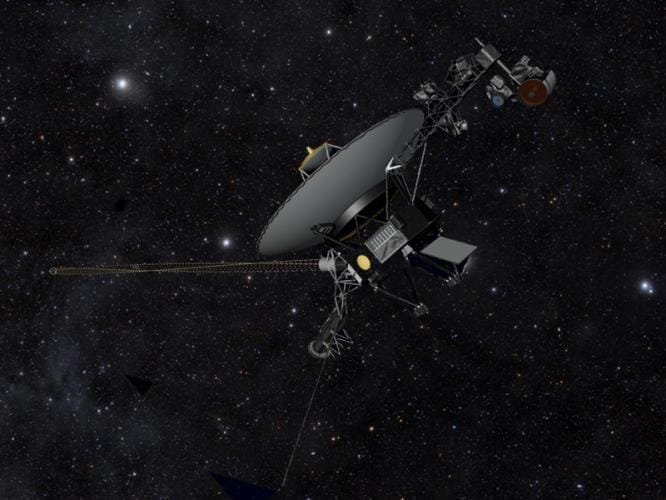
A spacecraft with a large white dish antenna floats in space with many stars shining.

Drawing of Voyager. Credit: NASA/JPL-Caltech

Well, this kinda sucks, but it’s no surprise: another scientific instrument onboard the Voyager 1 spacecraft has been turned off.

On April 17, 2026, engineers switched off the spacecraft’s Low-energy Charged Particle Detector, a device that measures the energy, direction, and composition of subatomic particles zipping through space.

It was shut off because the device powering the spacecraft, a radioisotope thermoelectric generator, is losing power all the time, and can no longer keep all the subsystems on the spacecraft operating. As I wrote in BAN #856 on March 2025, other instruments have been turned off over time for the same reason.

Losing the detector means an extra year of power overall for Voyager 1, which is the trade made. It still has other instruments working, which is really important: it’s over 25 billion kilometers from Earth, measuring an environment that is essentially interstellar space. That’s not something we can easily do, and doing so in situ is up to basically just Voyager 1 and its twin Voyager 2.

More events are planned, including shutting down a lot of instruments all at once to use lower power consumption devices instead. Tests for that are planned in May and June, and if that works it will be fully implemented as early as July. Stay tuned.


Did I mention the subscription sale ends soon? I did? OK, still, click this button to sign up before you forget.
Wind surfing on Titan — now you can plan ahead for your Saturnian vacation

Scientists calculate wave heights on alien worlds

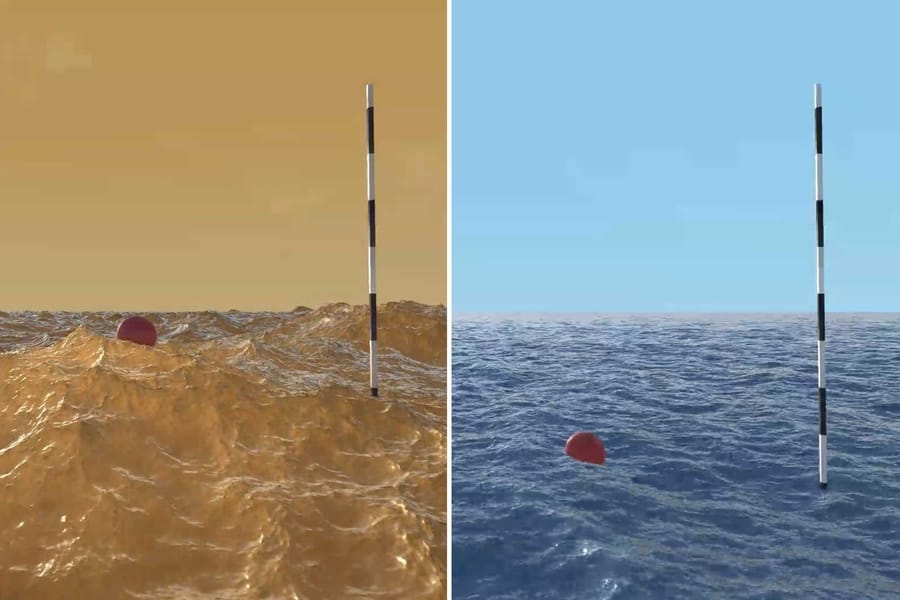
Side by side comparison of waves on Titan, which are much higher than they are on Earth for the same wind speed.

Waves on Titan (left) are much higher than they are on Earth (right) at the same wind speed. The floating red ball is one meter wide, and the marks on the sticks show one-meter heights. Credit: Schneck et al. 2026

If you’ve ever stood on a beach looking over the ocean (or a big lake; I remember days on Lake Michigan like this), you can see waves rolling in toward land. These waves are wind-generated; as the wind blows over the surface of the ocean the water moves with it, piling up a bit. The energy from the wind is transferred to the liquid, moving through the water horizontally, and the water moves up and down in response. It’s actually a fairly complicated physical effect, even though it seems familiar.

The equations behind it are fierce, and involve many parameters like the liquid density and viscosity (how easily the liquid flows), the wind density and speed, and more. Even (especially!) the gravity. 

These conditions are different on different worlds, so the waves we’d see on them would be different, too. 

A team of scientists were curious about this, so they created a physics-based computer model that crunches the numbers to determine how waves grow on alien worlds [link to journal paper].

First, as a sanity check, they used it to model waves on Earth, and got numbers that corresponded to real-world measurements. So that’s cool. 

Then they tried it for other places. Titan is the largest moon of Saturn, and is the only other large body in the solar system we know of with liquid on its surface. However, that liquid is actually methane, not water! Titan is extremely cold (about -180°C), so methane is a liquid there. Titan has an atmosphere of nitrogen that’s actually denser than our own air, despite the lower gravity (about 1/7th Earth’s). 

That makes thing different indeed. Not only that but liquid methane is much less dense than water (somewhat less than half, if I’m reading that page correctly) and also much less viscous, so waves there should be quite different than here.

That’s what the scientists found: waves begin to grow at lower wind speed and grow to higher amplitude than they do on Earth. That’s what I’d expect given the conditions, but it’s nifty to see the physics back it up. For example, on Earth a wind speed of 10 meters per second — 22 miles per hour, which is pretty brisk — creates waves two to three meters high with max heights around 5 meters. On Titan that same wind speed creates wave 15 meters high that peak at 40 meters. That’s higher than even rogue waves on Earth!

They found this to be the case at all wind speeds; at a few meters per second on Earth the wind barely gets the water to move at all, but on Titan that same speed generates waves several meters high! 

Titan may be a better place to surf than Santa Cruz. You’ll freeze to death, maybe even before you suffocate, but still.

One thing though: the waves move more slowly. That might be good for beginners. You can see that for yourself in a video the scientists made, showing waves on Earth (right) versus Titan (left) at the same wind speed:

Cooooool.


Subscribe to Premium to read the rest.

Become a paying subscriber of Premium to get access to this post and other subscriber-only content.

Upgrade Translation missing: en.app.shared.conjuction.or Sign In

A subscription gets you
  • Three (3!) issues per week, not just one
  • Full access to the BAN archives
  • Leave comment on articles (ask questions, talk to other subscribers, etc.)


Powered by beehiiv
https://badastronomy.beehiiv.com/p/how-big-are-the-liquid-methane-waves-on-titan-and-another-voyager-1-instrument-turned-off
Extensions
How much carbon-14 is in the air around you?
MiscellanyClimate ChangeSupernovaeScience
I was surprised to learn how little it actually is
Show full content
.bh__table, .bh__table_header, .bh__table_cell { border: 1px solid #C0C0C0; } .bh__table_cell { padding: 5px; background-color: #FFFFFF; } .bh__table_cell p { color: #2D2D2D; font-family: 'Helvetica',Arial,sans-serif !important; overflow-wrap: break-word; } .bh__table_header { padding: 5px; background-color:#F1F1F1; } .bh__table_header p { color: #2A2A2A; font-family:'Trebuchet MS','Lucida Grande',Tahoma,sans-serif !important; overflow-wrap: break-word; } Premium Content

This content is reserved for premium subscribers of Premium Membership. To Access this and other great posts, consider upgrading to premium.

UpgradeLink ConjuctionSign In

A subscription gets you:
  • Three (3!) issues per week, not just one
  • Full access to the BAN archives
  • Leave comment on articles (ask questions, talk to other subscribers, etc.)


Powered by beehiiv
https://badastronomy.beehiiv.com/p/how-much-carbon-14-is-in-the-air-around-you
Extensions
Rubin bags 11,000 new asteroids!
Solar SystemAsteroidsVera Rubin ObservatoryAbout The NewsletterImpacts
This is just the beginning, too. There are more millions more out there waiting to be seen.
Show full content
.bh__table, .bh__table_header, .bh__table_cell { border: 1px solid #C0C0C0; } .bh__table_cell { padding: 5px; background-color: #FFFFFF; } .bh__table_cell p { color: #2D2D2D; font-family: 'Helvetica',Arial,sans-serif !important; overflow-wrap: break-word; } .bh__table_header { padding: 5px; background-color:#F1F1F1; } .bh__table_header p { color: #2A2A2A; font-family:'Trebuchet MS','Lucida Grande',Tahoma,sans-serif !important; overflow-wrap: break-word; } The Trifid Nebula looks like a red flower with dark lines converging on its center, surrounded by pale blue gas and countless stars.

The Trifid Nebula and environs. Credit: RubinObs/NOIRLab/SLAC/NSF/DOE/AURA

April 20, 2026 Issue #1025
Premium subscribers hugely impact my life
Reminder: Four days left to get this newsletter at a deep discount

Paid subscriptions are nearly half off!

As I wrote in Ban 1024 (the 210th issue!), I’m having a big sale on premium subscriptions to this here newsletter: the price is US$3.20 per month or US$32 per year! The conditions are listed out in that issue so please check it out. The sale ends at noon Eastern US time Thursday (April 23, 2026). This applies to new subscriptions only, but if you’re already a paid subbie you can still get a gift subscription for another astrodork in your life.

Sign up here! And thanks for your support.


Rubin Observatory catches 11,000 new asteroids

And it hasn’t even started routine observations yet

The Vera C. Rubin Observatory has been in testing mode for a while now, and will soon begin routine scientific operations, where it will scan huge chunks of the sky every night looking for transients: objects that change their brightness or positions in the sky. This includes exploding stars, flaring black holes… and a lot of much solar system objects in our cosmic back yard.

I’ve already written on how 2,000 asteroids were discovered in early observations. Well, scientists just announced that looking at early images taken over the course of about six weeks, they have now found a staggering 11,000 asteroids. Eleven thousand.

Those are new discoveries, previously unknown rocks mostly orbiting in the Main Belt between Mars and Jupiter. It also spotted an addition 80,000 previously known asteroids as well! Holy wow. Many of those are what are called recovered asteroids, ones that were not observed long enough initially to get good orbits for them, so they became lost. Rubin has found them again, adding a long time baseline of observations that help nail down the shapes of their orbits.

A diagram of the solar system as seen from afar, with long, narrow triangular collections of thousands of tiny blue dots representing the asteroids seen by Rubin. The apex of each triangle shows where Earth was in the solar system when the images were taken.

Asteroids (shown in light blue) discovered by Rubin is it looked in various directions in the sky. Credit: NSF–DOE Vera C. Rubin Observatory/NOIRLab/SLAC/AURA/R. Proctor Acknowledgements: Star map: NASA/Goddard Space Flight Center Scientific Visualization Studio. Gaia DR2: ESA/Gaia/DPAC. Image Processing: M. Zamani (NSF NOIRLab)

Here’s an animation of the discoveries, which come in bursts as observations were made. You can see the orbits of the inner planets and Jupiter, with asteroids in between as a blue fog. As Rubin looks in one part of the sky as seen from Earth, asteroids are discovered along that physical track, which appear as lighter blue dots (and their motions are continued as time goes on). You can get more info by reading the notes for the video on YouTube.

In that 11,000 space rock haul are 33 near-Earth objects, asteroids that get relatively close to Earth as we both orbit the sun. None of them gets close enough to be a threat however. I expect, though, that over time Rubin will find plenty of those (called Potentially Hazardous Objects), too.

You earned the attention. Here's what to do next.

Most creators spend years building an audience on platforms that own it. The reach is real. The relationship isn't. One algorithm change and the people who chose you stop seeing you.

A newsletter is different. Your list is yours. Every subscriber is earned and stays earned. And on beehiiv, the tools to grow it, monetize it, and own it completely are built in from day one.

30% off your first 3 months with code LIST30. Start building today.

Incidentally, a paper has just been published where scientists ran simulations of how Rubin will see imminent impactors, (typically small) objects that are about to hit Earth [link to journal paper]. About a dozen of these have already been spotted (to be clear, I mean rocks that were found right before they hit our atmosphere, sometimes just hours in advance), almost all from the northern hemisphere. Rubin is in the Chile, so this will help us spot these smaller rocks. The scientists find that the observatory should catch one or two of these in the meter-size range per year, usually from about 1 – 3 days before impact. These rocks are small and therefore faint, which is why they typically aren’t seen until right before they burn up in our atmosphere. So this is good news too.

It also spotted 380 trans-Neptunian objects (TNOs), icy and rocky bodies that orbit the sun out past Neptune (you can think of Pluto as being the largest of these). Only about 5,000 TNOs are known, so in just a month and a half Rubin added about 8% more to that. After the sky survey is completed in about a decade, it should have found tens of thousands of these objects! That’s super important: the more we find, the more we can classify them by size and orbit. Our knowledge of this distant solar neighborhood is spotty, and Rubin will help us get a much better map of it. 

I’ll note that Planet 9, a still unconfirmed object potentially larger than Earth orbiting the sun very far out, was found due to its alleged influence on TNOs. Once we find lots more, that could help nail down its existence. It could even spot P9 directly! Time will tell.

Rubin hasn’t even really opened up for business yet and it’s already doing incredible work. I cannot wait until it’s up and running at full capacity. We’re going to learn so much about the changing sky.

You can keep track of Rubin’s asteroid discoveries on the Rubin Asteroid Discovery Dashboard. There’s also a cool interactive interface for exploring what it’s found (though it’s a CPU and RAM hog). It’s fun to poke around these.


One-liners, or thereabouts

Short attention span astronomy news

  • A Kuiper Belt Object called Altjira was thought to be a binary object, but new work indicates it’s likely actually a hierarchical trinary (with two objects orbiting each other and a third orbiting the two farther out); only one other such object is known, and these can help understand the dynamics of objects out past Neptune [link to journal paper].

  • Many Kuiper Belt Objects are binary, and some are contact binaries (like Arrokoth, where the two components physically touch, making a snowman-like double-lobed body) — but models of formation have difficulty reproducing them. New work shows that a collapsing cloud of small pebbles can naturally create contact binaries of various lobe shapes and sizes [link to journal paper].


Et alia

You can email me at thebadastronomer@gmail.com (though replies can take a while), and all my social media outlets are gathered together at about.me. Also, if you don’t already, please subscribe to this newsletter! And feel free to tell a friend or nine, too. Thanks!


Powered by beehiiv
https://badastronomy.beehiiv.com/p/rubin-bags-11-000-new-asteroids
Extensions
Happy 2^10th / 8th anniversary issue! To celebrate, here’s a DEEP discount.
DustStar ClustersNebulaPlanetary NebulaeAbout The NewsletterStarsJwst
Plus: A jaw-dropping star-forming nebula courtesy of JWST
Show full content
.bh__table, .bh__table_header, .bh__table_cell { border: 1px solid #C0C0C0; } .bh__table_cell { padding: 5px; background-color: #FFFFFF; } .bh__table_cell p { color: #2D2D2D; font-family: 'Helvetica',Arial,sans-serif !important; overflow-wrap: break-word; } .bh__table_header { padding: 5px; background-color:#F1F1F1; } .bh__table_header p { color: #2A2A2A; font-family:'Trebuchet MS','Lucida Grande',Tahoma,sans-serif !important; overflow-wrap: break-word; } The Trifid Nebula looks like a red flower with dark lines converging on its center, surrounded by pale blue gas and countless stars.

The Trifid Nebula and environs. Credit: RubinObs/NOIRLab/SLAC/NSF/DOE/AURA

April 16, 2026 Issue #1024
Celebrate my 2^10th and 8th anniversary issue with my biggest subscription sale ever!

This level of geekery must be acknowledged

<tl;dr> I’m running a big subscription sale right now where a monthly subscription is $3.20 for the first month and an annual subscription is $32 for the first year!


We here at the Bad Astronomy Newsletter HQ (and by “we” I mean me, and by “HQ” I mean my office in the basement of my house where I’m usually sitting around in PJs) recently celebrated the occasion of the publishing of the 1000th issue of this newsletter. Being a human with ten fingers, mentioning the third power of that number’s issue seemed appropriate.

Yet I am more than a human: I am a geek. Deeply, deeply nerdy. So, more important than that 103 issue is the one you are currently reading: Issue 1024, or Issue 210 . As you probably know, computers use base 2 for calculations, so any power of 2 is important, but this one comes up a lot in life; for example it’s the basis of the kilobyte for computer memory, and the number of pixels on the side of Hubble’s STIS CCD detector! Don’t even get me started with powers of two and fast Fourier transforms.

Like I said: deeply nerdy.

But there’s more: By a pretty fun coincidence, I also published the first issue of BAN on April 16, 2018, which makes today the 8th anniversary of the newsletter as well!

So this issue is a double kilometerstone, and one worth celebrating.

That’s why I am throwing a big ol’ premium subscription discount sale at y’all. In the past I’ve usually done a 20% discount, but that doesn’t work with our base-2 theme, so instead I’m keeping it binary.

The normal rates are US$6/month and US$60 year, but for this discount they’ll be 25 -based:

$3.20/month and $32/year (US dollars)!

(2 x 2 x 2 x 2 x 2 = 32, just to be clear.) 

In human terms, that’s very nearly a 50% discount!

This sale will be for one time unit of subscription: if you sign up for a year it’s good for that first year, and if you sign up for a month it’s good for that month; after that period the price will go back to the undiscounted rate.

The discount will be applied to all new subscriptions, and will be valid for a duration of one week (ending April 23, 2026 at noon Eastern US time). All you have to do is go to the signup page, enter your email, and when given the option choose the “Premium subscription”. You’ll see the discounted rates listed. After that it’s the usual process of paying for something online.

SIGN UP HERE!

What do you get as a premium subscriber? For one, you’ll receive three issues of the Bad Astronomy Newsletter every week instead of one (they’re sent out on Mondays, Tuesday, and Thursdays). That’s 156 per year, which, given their length, is roughly two full science books worth of articles every year. You also get access to the full archive of newsletter, 1024 strong as of today. You can also join the BAN community and leave comments on the articles — you can comment, ask questions (I try to answer them quickly), and discuss stuff amongst yourselves. It’s a good group.

[If you’re already a premium subbie: Thanks! But I’ll add you can give gift subscriptions, too. Just go to the signup page and enter their email address. After that you’ll be sent to a page that lets you choose some options. First, click the “Gift” button, then choose the subscription duration.]

Also, I sometimes run ads for various things here, and those are not visible to paid subscribers. If you hate ads, well, there you go.

And finally you’ll know you’re supporting my ability to publish this newsletter at all. I’m a freelancer, and even though I write for Scientific American as well I still need to pay for health insurance for me and my family and all that. I’ll be bluntly honest and say that without my premium subbies I would be in big trouble indeed. They keep me afloat financially, and I appreciate every single one of them.

And that means you get my very sincere thanks.

So please sign up! And in return I’ll do my best to bring the cosmos to your emailbox thrice weekly. To the edge of the observable universe and back, I thank you.

And now for some astronomy…


Arnold Schwarzenegger has a newsletter.

Yeah. That Arnold Schwarzenegger.

So do Codie Sanchez, Scott Galloway, Colin & Samir, Shaan Puri, and Jay Shetty. And none of them are doing it for fun. They're doing it because a list you own compounds in ways that social media never will.

beehiiv is where they built it. You can start yours for 30% off your first 3 months with code PLATFORM30. Start building today.


The extreme gorgeousity of Sharpless 2-305

A ridiculously amazing view of an incredible star-forming gas cloud via JWST

Y’all know by now I’m a sucker for a beautiful nebula: a cloud of gas and dust in space. These take many forms, including when stars like the sun die, when massive stars die, and — in this particular case — where stars are being born.

Sharpless 2-305 is one such star-forming region. Its distance isn’t perfectly known but it’s probably about 10 – 13,000 light-years from us. It’s huge, and making a lot of stars: there is about 3,000 times the sun’s mass worth of stars in it (which likely means many stars more than that, since lower-mass stars are more common), so it’s actually making a star cluster, called Mayer 3. The stars in the cluster are young, less than 2 million years old on average. Many of them are massive stars, and in fact the nebula is being lit up by two powerful O-type stars, blasting it with intense light.

But why talk so much when I can just show you:
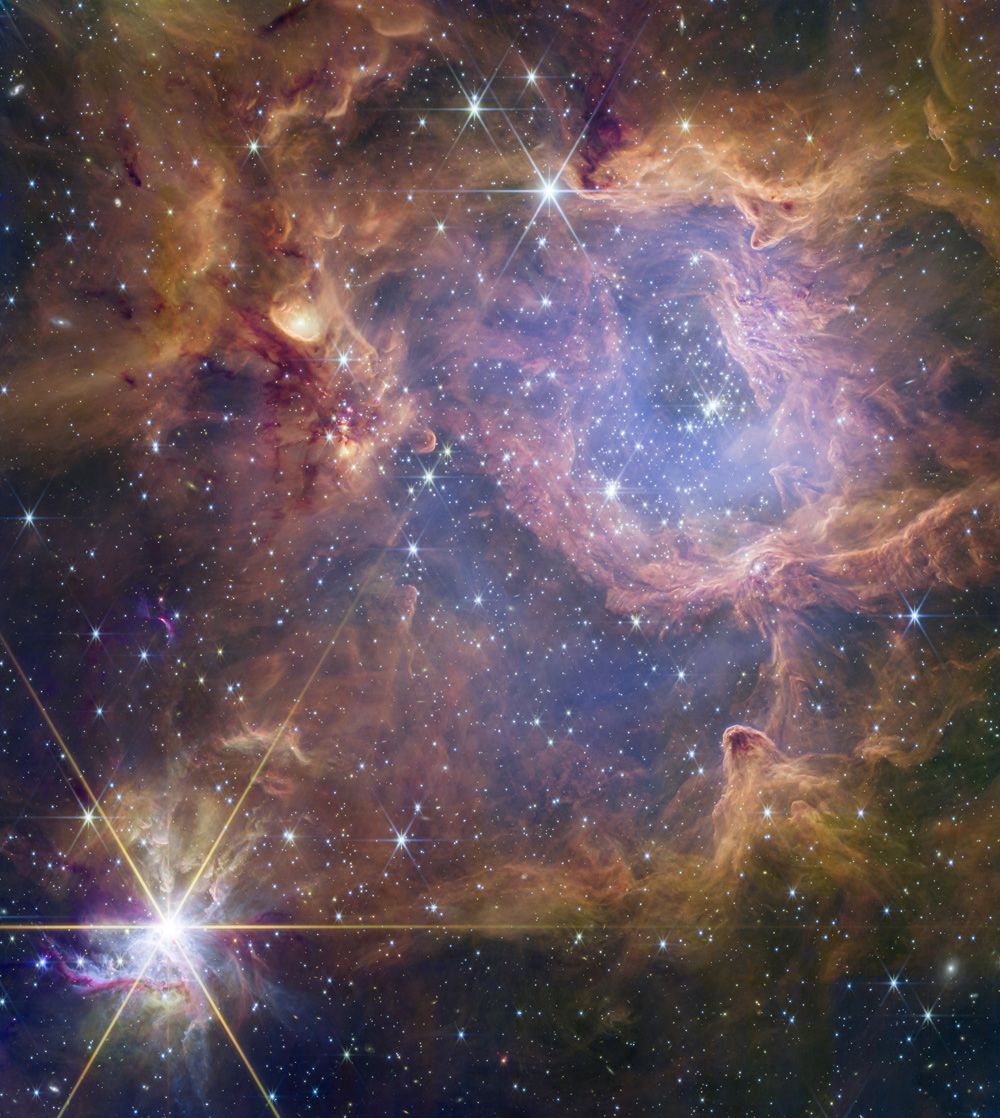
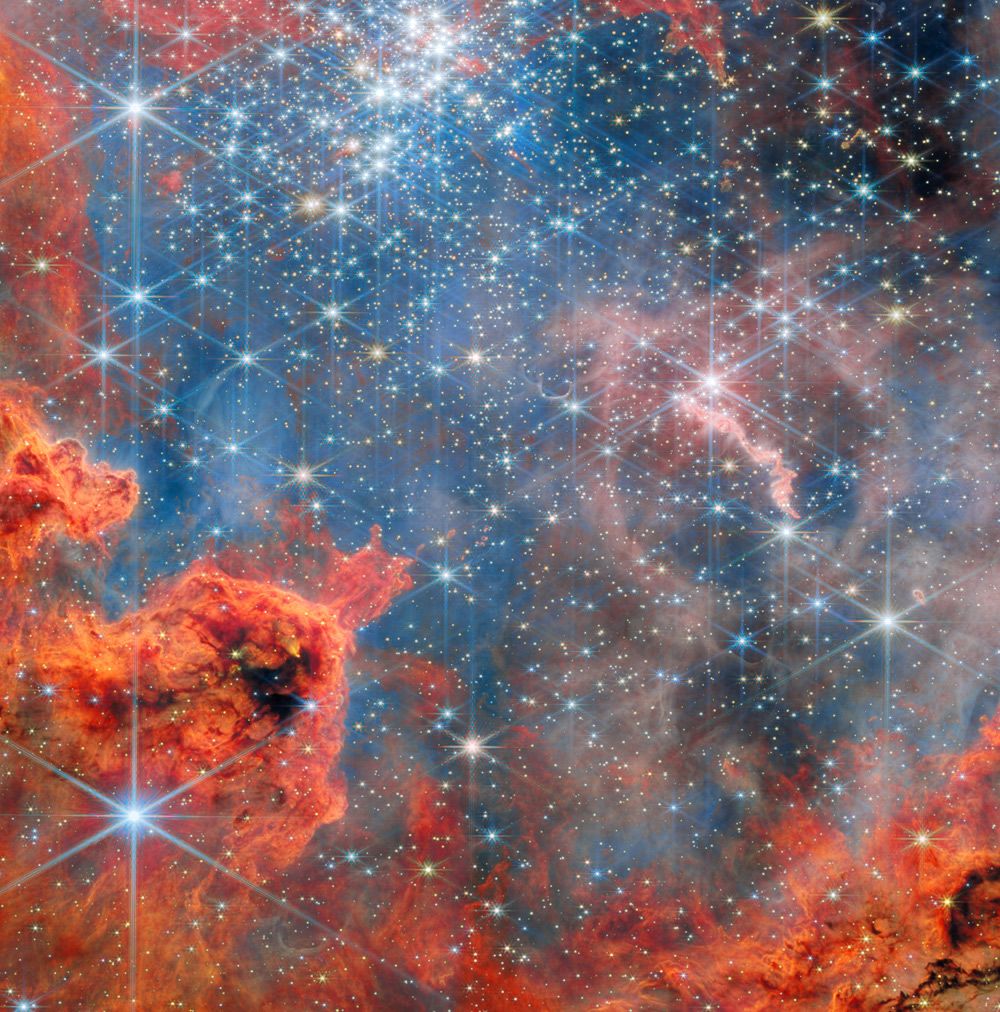
Orange and reddish material is strewn across the image, creating an alien landscape peppered with thousands of stars, including one intensely bright one at the lower left.

Sharpless 2-305 in the infrared. Credit: Mark McCaughrean (MPIA) / NASA, ESA, CSA / CC BY-SA 4.0

HOLY WOW.

[Click here to get the much larger 6,100 x 6,800 version, because yes you want it.]

This image was taken using JWST by astronomer Mark J. McCaughrean; he and I have been chatting about some of his JWST observations for a while now (and I have another one for you I’ll write up soon because yegads it’s also incredible). He sent me this image just so I can show it to you here on the BAN. 

It uses three JWST filters: what’s displayed as blue is actually the 1.82 micron filter (which sees redder stars, as well as water and methane gas), green is the 3.0 micron filter (water ice, typically), and red is 3.6 microns (which sees cosmic dust in the form of long sooty chains of carbon molecules). Mind you, this is all in infrared which we cannot see with our eyes, but the individual images have been displayed using these colors so we can see and interpret them. The reddest light the eye can see is about 0.75 microns, for comparison.

The star cluster is obvious, sitting to the upper right of center (note: the six “crosshairs” you can see in bright stars are called diffraction spikes; they’re due to optical effects inside the telescope and aren’t real). The light from the most powerful stars in the cluster has carved a huge cavity in the gas, creating a thick shell of material around them — the blue fog permeating the inside of the nebula is gas zapped by light from the big stars. The inside edge of the bubble has thick “fingers” of material pointing to the center; these are where the gas and dust is thicker and harder to erode, like sandbars in a stream. What’s left are those fingers pointing toward the most luminous stars (you can see there are two of them very close together just to the right of center).
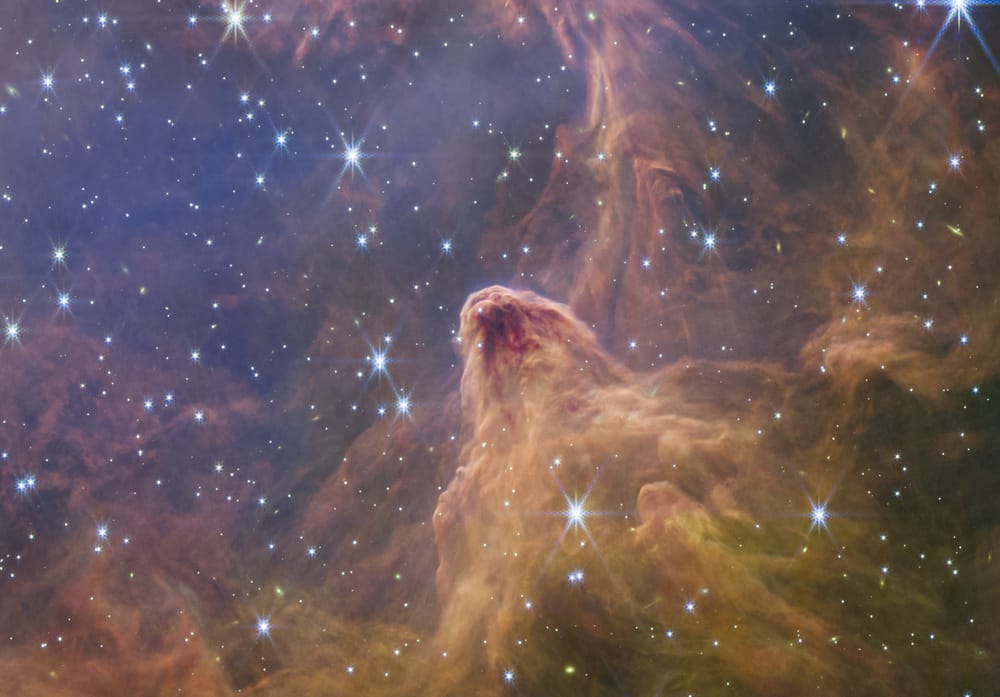
A close-up of one of the fingers of dust and gas, looking like a slightly tipped over orange-ish mountain with a black apex in a sea of orange fog and stars.

Detail on the finger to the lower right of center. Credit: Mark McCaughrean (MPIA) / NASA, ESA, CSA / CC BY-SA 4.0

I’ll note the nebula looks very different in visible light, the kind we see. This Very Large Telescope (VLT) image, for example, really highlights hydrogen gas in visible light (the kind we see with our eyes), and it almost looks like a different nebula. The little glowing upside-down red-rimmed V structure to the lower right in the VLT image is the same as the tower in the lower right of the JWST image, if that helps. The cavity isn’t nearly as obvious, either, but if you look carefully you can see the same stars in both images in places. That’s not easy, either, because some stars are bright in infrared but dim in visible light, and vice-versa. IDing them can be a chore.

The texture and detail in the JWST image are just spectacular. Infrared light can generally pass through denser dust than visible light can, so dark regions in the nebula are really dense knots of material. These tend to be where new stars are being born; the material is dense enough to collapse under its own gravity to form stars.

In fact, take a look at the lower left corner. That intensely bright star isn’t actually a star, at least not yet: it’s a protostar, caught in the act of forming. Called RAFGL 5232 (among many other names derived from different catalogs), it’s already massive, with about 11 times the mass of the sun! It’s blasting out light at a rate 13,000 times that of the sun, too, which is why it’s booming out in the JWST image. Weirdly, though, it’s far fainter in visible light, since the dense junk around it absorbs most of that light (it’s just barely in the VLT image at the lower left, but is so much fainter it’s not obvious at all).

Here’s a close-up of that fetal star:
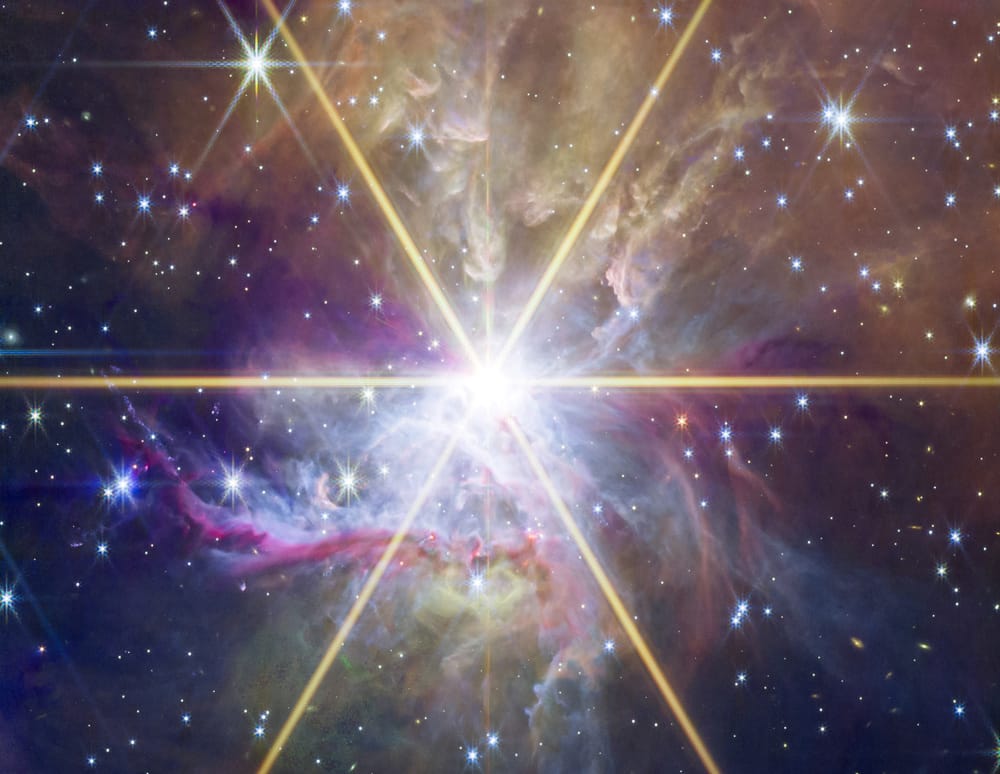
A brilliant star centered among wispy, tendril-laden filaments.

The protostar RAFGL 5232. Credit: Mark McCaughrean (MPIA) / NASA, ESA, CSA / CC BY-SA 4.0

Look at all that material being affected by the almost-star’s light! I love the multi-colored ribbon below it. Spectacular.

This shows the power of using JWTS combined with other telescopes like Hubble or VLT or Chandra: you see different structures in different wavelengths of light, and wholly different objects are revealed. We also get an idea of what’s inside these structures, what elements and molecules are strewn about. That’s always important, and in this case tells us a lot about the environment in which all these stars are forming. 

In fact that’s why these images were taken, to examine the range of stellar masses of the newborn stars to see how many low-mass ones are forming compared to higher masses, what’s called the stellar mass function (I wrote about this sort of thing here on the BAN as well as in Scientific American). That’s a critical component to understanding how stars are born.

And that’s important. Our planet happily orbits just such a star, and we’re learning more about it all the time (like, it was almost certainly born in a huge cluster not too different from Sharpless 2-305).

I for one like to understand the neighborhood I live in. It’s just that astronomers have a much bigger definition for that than most folks do.

Et alia

You can email me at thebadastronomer@gmail.com (though replies can take a while), and all my social media outlets are gathered together at about.me. Also, if you don’t already, please subscribe to this newsletter! And feel free to tell a friend or nine, too. Thanks!


Powered by beehiiv
https://badastronomy.beehiiv.com/p/happy-2-10th-8th-anniversary-issue-to-celebrate-here-s-a-deep-discount
Extensions
Mini-Neptunes may be hot and solid. Also, a star blew out a LOT of stuff before exploding.
SupernovaeExoplanetsBinary StarsStars
Exoplanets keep getting weirder, and a pre-supernova star expelled truly vast amounts of helium
Show full content
.bh__table, .bh__table_header, .bh__table_cell { border: 1px solid #C0C0C0; } .bh__table_cell { padding: 5px; background-color: #FFFFFF; } .bh__table_cell p { color: #2D2D2D; font-family: 'Helvetica',Arial,sans-serif !important; overflow-wrap: break-word; } .bh__table_header { padding: 5px; background-color:#F1F1F1; } .bh__table_header p { color: #2A2A2A; font-family:'Trebuchet MS','Lucida Grande',Tahoma,sans-serif !important; overflow-wrap: break-word; } Premium Content

This content is reserved for premium subscribers of Premium Membership. To Access this and other great posts, consider upgrading to premium.

UpgradeLink ConjuctionSign In

A subscription gets you:
  • Three (3!) issues per week, not just one
  • Full access to the BAN archives
  • Leave comment on articles (ask questions, talk to other subscribers, etc.)


Powered by beehiiv
https://badastronomy.beehiiv.com/p/mini-neptunes-may-be-hot-and-solid-also-a-star-blew-out-a-lot-of-stuff-before-exploding
Extensions
A galaxy aflame!
Hubble Space TelescopeDustNebulaAbout MeGalaxiesJwstColliding Galaxies
JWST image of NGC 5134 is fire. Also, using real AI to find galaxies.
Show full content
.bh__table, .bh__table_header, .bh__table_cell { border: 1px solid #C0C0C0; } .bh__table_cell { padding: 5px; background-color: #FFFFFF; } .bh__table_cell p { color: #2D2D2D; font-family: 'Helvetica',Arial,sans-serif !important; overflow-wrap: break-word; } .bh__table_header { padding: 5px; background-color:#F1F1F1; } .bh__table_header p { color: #2A2A2A; font-family:'Trebuchet MS','Lucida Grande',Tahoma,sans-serif !important; overflow-wrap: break-word; } The Trifid Nebula looks like a red flower with dark lines converging on its center, surrounded by pale blue gas and countless stars.

The Trifid Nebula and environs. Credit: RubinObs/NOIRLab/SLAC/NSF/DOE/AURA

April 13, 2026 Issue #1022
Paid subscribers light up my sky across all wavelengths
Should we mine asteroids?

I did a podcast interview about that plus space rocks in general

A cartoon of an astronaut in a spacesuit about to hit a tiny asteroid with a pickaxe.

Science Stuff! Credit: ScienceStuff

Wanna hear me talk about asteroids? Jorge Cham (creator of PhD Comics!) interviewed me for his Science Stuff podcast where we talk space rocks: where they come from, how we can find them, how we can keep them from hitting us, and should we mine them for valuable minerals, including water ice?

You can listen here!


Word of mouth (or keyboard) is a great way to help this newsletter find new eyeballs. If you like this, please share it by clicking here!
Galaxy of flame

NGC 5134 seen by JWST looks like it’s on fire, but it’s really just smoke

Sometimes, the coolness of an astronomical image is in how it’s presented.

Sometimes also it’s the hotness. Like this image of NGC 5134, a spiral galaxy about 65 million light-years away in the constellation Virgo (not far from the bright star Spica on the sky, actually):

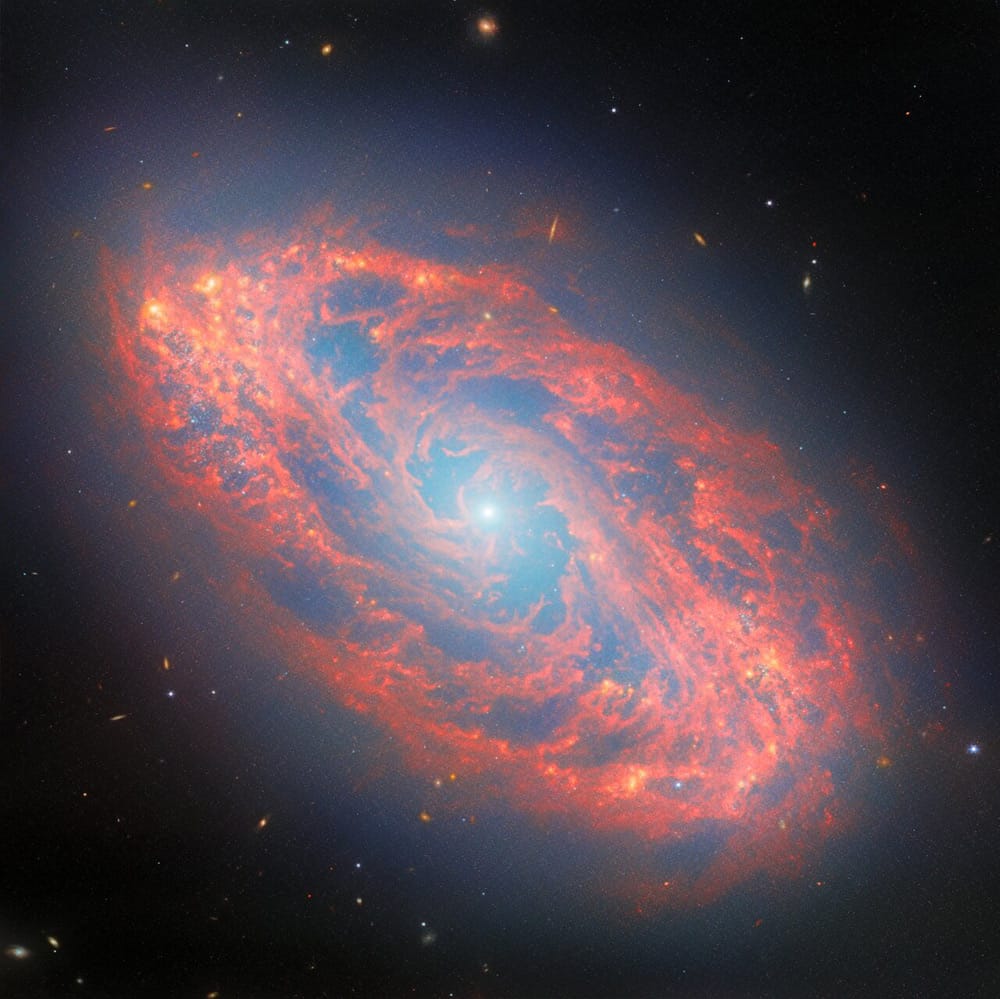
A spiral galaxy seen at an angle, with the spiral arms glowing brilliantly orange like flames.

Fire. Credit: ESA/Webb, NASA & CSA, A. Leroy

If you guessed this was an image from JWST give yourself an infrared star [and here’s a huge 4,200 x 4,200 pixel version of it]. It is, and it’s a combination of observations taken with both its NIRCam and MIRI instruments. The Near-Infrared Camera shows mostly stars, displayed as blue, teal, and green. It’s sensitive to redder stars (red in visible light, that is, like red giants and supergiants), and you can see them blurred together into a gentle glow in the center out to the edges.

The Mid-Infrared Instrument sees longer wavelengths, and in particular the 7.7-micron filter image (displayed here as orange) selects for dust grains in the galaxy, specifically PAHs, or polycyclic aromatic hydrocarbons. These are long-chain carbon molecules very similar to soot.

I love the poetry here: the spiral arms are displayed in a way that makes them look like flames, but we’re seeing the smoke! 

PAHs are created in massive stars when they explode as supernova, and even before that when they’re red supergiants. For example, remember when Betelgeuse got really dim in 2019-20? It expelled a huge cloud of dust (a generic term that includes PAHs) that made the star appear fainter, since that dust is opaque to visible light.

But warm PAHs emit light at long infrared wavelengths, which is why this image shows them so well. Massive stars don’t live long and stay near their stellar nurseries where they were born. Those are in the spiral arms, so the dust they blow into the galaxy is in the arms as well, and this image traces that structure well. Note the brighter sections at the ends of the galaxy along the long axis; those are gigantic complexes of nebulae making stars. That’s a bit clearer in images taken in visible light, like this one by the Carnegie Observatory (the image is copyrighted so I can’t display it here, but click through to see it; it’s rotated about 90° counterclockwise from the JWST image).

Observations like this help astronomers track where stars are born, where they die, how much dust they produce, and how that affects the galactic environment. And, as always, they’re also devastatingly beautiful.

It’s funny to me; the universe doesn’t have to be beautiful, and yet it is. I think this may be coincidence; we happened to evolve an aesthetic that appreciates graceful curves, flow, and color, and those are attributes common in galaxies. But whether this is true or not, art is science, and vice-versa. I’ve been saying that for years.


Become a premium subscriber and get three issues of the BAN per week! Sound good? Clickity click right here.
Neural net finds weird galaxies in Hubble images

This is real artificial intelligence, kinda

Hubble Space Telescope has taken hundreds of thousands of images of the sky, many of which are “deep”, meaning long exposures that can see faint objects. The vast majority of the galaxies seen have never been seen before! That’s a big opportunity for astronomers, but how to capitalize on it?

A team of scientists decided to give this a try. They developed a neural net called AnomalyMatch to dig into the data, looking at almost 100 million (!!) cutouts of galaxies — literally, small sub-images a few dozen pixels on a side featuring a galaxy in each — to see if they could find odd-looking galaxies. These are usually the result of galactic collisions, or gravitational lensing distorting their shape. But there could be other reasons, too, so examining them on a large scale can be pretty instructive.

Neural nets are computer programs designed to look into some specific aspect of a problem where there is a large sample of data to examine. They can be trained, meaning they are fed examples of objects — in this case, weirdly shaped galaxies — then let loose on the dataset to find more. Neural nets aren’t exactly artificial intelligence, even though in a very narrow sense they can learn, but they fit the bill way better than the LLM grift going on right now.

Anyway, looking through the images the net found 1,300 objects that fit the bill [link to journal paper]. Over 600 were from galaxy mergers, 140 from lensing, 35 were “jellyfish” galaxies (galaxies moving rapidly through a galaxy cluster and having their internal gas stripped away, leaving long tendrils behind them), and two were edge-on protoplanetary disks (disks of material around young stars that planets form from — in fact, this project was first trained to look for disks, but they expanded the list as time went on).

Six galaxies from the search, all showing odd shapes like loops, tendrils, and distortions.

Six galaxies from the search, including gravitational lenses and collisions. More info can be find by clicking the image. Credit: NASA, ESA, David O'Ryan (ESA), Pablo Gómez (ESA), Mahdi Zamani (ESA/Hubble)

1,300 out of 100 million is a small fraction, but imagine trying to do this yourself by eye! I imagine if they relax the parameters a bit they’d find many more, too. This was a first attempt, and shows that this sort of work is possible and helpful.

I played with neural nets a bit when I worked on Hubble — I was doing similar work looking for faint red dwarfs in the data — but found it a bit too out of my wheelhouse for me to use well. Also, those were early days of that sort of thing, and a lot of progress has been made since then. So I’m glad to see this going on! With Rubin and Roman coming online soon, we’re going to have vast amounts of data to sort through, so neural nets will become important, if not critical, tools for searching.


Et alia

You can email me at thebadastronomer@gmail.com (though replies can take a while), and all my social media outlets are gathered together at about.me. Also, if you don’t already, please subscribe to this newsletter! And feel free to tell a friend or nine, too. Thanks!


Powered by beehiiv
https://badastronomy.beehiiv.com/p/a-galaxy-aflame
Extensions
A naked-eye monster star turns out to be way more complicated than you’d think
White DwarfsBinary StarsStars
Gamma Cas is easy to spot, but hard to understand
Show full content
.bh__table, .bh__table_header, .bh__table_cell { border: 1px solid #C0C0C0; } .bh__table_cell { padding: 5px; background-color: #FFFFFF; } .bh__table_cell p { color: #2D2D2D; font-family: 'Helvetica',Arial,sans-serif !important; overflow-wrap: break-word; } .bh__table_header { padding: 5px; background-color:#F1F1F1; } .bh__table_header p { color: #2A2A2A; font-family:'Trebuchet MS','Lucida Grande',Tahoma,sans-serif !important; overflow-wrap: break-word; } The Trifid Nebula looks like a red flower with dark lines converging on its center, surrounded by pale blue gas and countless stars.

The Trifid Nebula and environs. Credit: RubinObs/NOIRLab/SLAC/NSF/DOE/AURA

April 9, 2026 Issue #1021
How to Be a high-energy star

Just be orbited closely by the magnetic core of a dead star. And spin REALLY fast.

Gamma Cassiopeiae, or just Gamma Cas, is a naked-eye star easily visible from the northern hemisphere; it is the central star in the W (or M) of the iconic constellation Cassiopeia. It’s about 550 light-years from Earth, and is a whopper: it has 15 times the sun’s mass, which means it’s very luminous, about 15,000 times the sun’s energy output. Replace the sun with Gamma Cas and we’d be cooked.

It’s the powerhouse behind the glow in the weird nebula the Ghost of Cassiopeia, which I’ve written about before, too.

But it’s also been at the center of a minor mystery in astronomy that’s bedeviled astronomers for decades. That mystery has finally been solved, but let’s take a step back first to understand what’s what.

Sky map showing the W of Cassiopeia and Gamma Cas arrowed.

Gamma Cas (arrowed) is the center star in Cassiopeia’s W. Credit: Torsten Bronger on Wikimedia commons (CCA 3.0)

It’s a B-type star, which is a classification that means its hot and luminous. But it’s more than that: it’s a Be star (pronounced “Bee Ee”, with the letters spelled out). The “e” stands for emission. In stars like the sun, hydrogen in a star’s atmosphere absorbs light coming up from below at very specific wavelengths (colors), so that when you get a spectrum of the star (spreading its light out like a rainbow) there are dark features at those wavelengths. That’s an absorption spectrum

But in some stars the hydrogen is actually excited, pumped up with energy and emitting light at those wavelengths, so we get an emission spectrum. Be stars are like normal B stars but with that emission feature.

We’ve known for a long time that Be stars are rapid rotators, spinning at tremendous speeds — Gamma Cas spins at nearly 400 kilometers per second, while the sun’s rotation is only 2 km/sec! — which is so fast that material at the equator is thrown into space by the centrifugal force. That material forms a disk around the star, called a decretion disk (the opposite of an accretion disk, where material falls onto a star or other object). That’s the material responsible for the hydrogen line emission.

A brilliant blue star sits above a cloud of red gas shaped vaguely like a bird with its wings outstretched.

Because why not, here’s the Ghost of Cassiopeia nebula I mentioned above. Gamma Cas is the fiercely glowing star above it, energizing the nebula’s gas. Credit: Ryan M, used by permission

But there’s more! We also know it’s orbited by a white dwarf (called Gamma Cas Ab, making the Be star Gamma Cas Aa* ): a star once much like the sun but which used up all its nuclear fuel, swelled into a red giant, blew off its outer layers, and revealed its hot, dense core to space. In fact, when that star became a red giant it dumped a lot of material onto Gamma Cas Aa, which is also why it spins so quickly. That material sped it up like a basketball player slapping a ball while balanced on their finger to make it spin faster. 

As it happens, the system also generates a pretty decent amount of high-energy X-rays. The source has been a mystery for decades, though! The X-rays could come from the magnetic field of the Be star interacting with the material in the decretion disk, but if matter is streaming from that disk onto the white dwarf (a reverse of the older situation) it could also generate X-rays.

It hasn’t been possible to distinguish the two scenarios until now. A team of astronomers used the Japanese (with participation from NASA and ESA) XRISM X-ray space observatory to take a look at Gamma Cas. It’s designed to take high-resolution spectra of X-ray emitting objects, which hasn’t been possible before. The importance of this is that when objects move toward or away from us, the wavelengths they emit shift to shorter or longer wavelengths — a Doppler shift. We can measure the object’s motion that way, including its speed. 

What they found is that there is a cyclic shift in the X-rays from the Gamma Cas system, and it matches the orbital period of the white dwarf (including shifting to the shorter wavelengths when the star approaches us in its orbit)! That means it must be coming from the white dwarf, and not the Be star [link to journal paper].

Artwork showing Gamma Cas A as a blue star with a thin blue disk of material around it. Nearby is a white dwarf with material flowing onto it, creating the X-rays.

Artwork depicting how astronomers think Gamma Cas produces X-rays. Credit: Nazé et al. 2026


Subscribe to Premium to read the rest.

Become a paying subscriber of Premium to get access to this post and other subscriber-only content.

Upgrade Translation missing: en.app.shared.conjuction.or Sign In

A subscription gets you
  • Three (3!) issues per week, not just one
  • Full access to the BAN archives
  • Leave comment on articles (ask questions, talk to other subscribers, etc.)


Powered by beehiiv
https://badastronomy.beehiiv.com/p/a-naked-eye-monster-star-turns-out-to-be-way-more-complicated-than-you-d-think
Extensions
Looking for planets? On average, you’ll find one around every red dwarf
ExoplanetsSolar SystemJupiterStars
Also: Jupiter lightning is ridiculously powerful
Show full content
.bh__table, .bh__table_header, .bh__table_cell { border: 1px solid #C0C0C0; } .bh__table_cell { padding: 5px; background-color: #FFFFFF; } .bh__table_cell p { color: #2D2D2D; font-family: 'Helvetica',Arial,sans-serif !important; overflow-wrap: break-word; } .bh__table_header { padding: 5px; background-color:#F1F1F1; } .bh__table_header p { color: #2A2A2A; font-family:'Trebuchet MS','Lucida Grande',Tahoma,sans-serif !important; overflow-wrap: break-word; } Premium Content

This content is reserved for premium subscribers of Premium Membership. To Access this and other great posts, consider upgrading to premium.

UpgradeLink ConjuctionSign In

A subscription gets you:
  • Three (3!) issues per week, not just one
  • Full access to the BAN archives
  • Leave comment on articles (ask questions, talk to other subscribers, etc.)


Powered by beehiiv
https://badastronomy.beehiiv.com/p/looking-for-planets-on-average-you-ll-find-one-around-every-red-dwarf
Extensions
View from a height: The Earth from Artemis II
AstrophotographyEarthAstronomyNasaVenusMoonSpace ExplorationStars
Moon-bound astronauts get a gorgeous shot of home, with lots of fun details
Show full content
.bh__table, .bh__table_header, .bh__table_cell { border: 1px solid #C0C0C0; } .bh__table_cell { padding: 5px; background-color: #FFFFFF; } .bh__table_cell p { color: #2D2D2D; font-family: 'Helvetica',Arial,sans-serif !important; overflow-wrap: break-word; } .bh__table_header { padding: 5px; background-color:#F1F1F1; } .bh__table_header p { color: #2A2A2A; font-family:'Trebuchet MS','Lucida Grande',Tahoma,sans-serif !important; overflow-wrap: break-word; } The Trifid Nebula looks like a red flower with dark lines converging on its center, surrounded by pale blue gas and countless stars.

The Trifid Nebula and environs. Credit: RubinObs/NOIRLab/SLAC/NSF/DOE/AURA

April 6, 2026 Issue #1019
Premium subscribers let me play among the stars 
Earth from space: delightful Artemis II photos of our home world

There’s a lot to see from a few thousand kilometers away

Hello, Earth
Hello, Earth
With just one hand held up high
I can blot you out, out of sight

Peek-a-boo, peek-a-boo, little Earth

 -Kate Bush 

On April 1, 2026, the crew of the Artemis II lunar mission launched into space. Today (Monday, April 6) they will swing around the far side of the moon (NOT the dark side, although in this case it mostly is due to the waning gibbous phase, but I’ll just leave that alone!) and at closest approach will be only about 6,500 kilometers from its surface. After that they’ll start to head back to Earth and are expected to splash down in the Pacific Ocean on April 11.

You probably already know this is the first crewed lunar mission in 50+ years, and a lot of firsts will be achieved during the flight. I have a lot of opinions about this mission, NASA’s plans, and the rocket itself being used, but that’s not what I want to focus on here. Instead, let’s look at something very cool indeed.

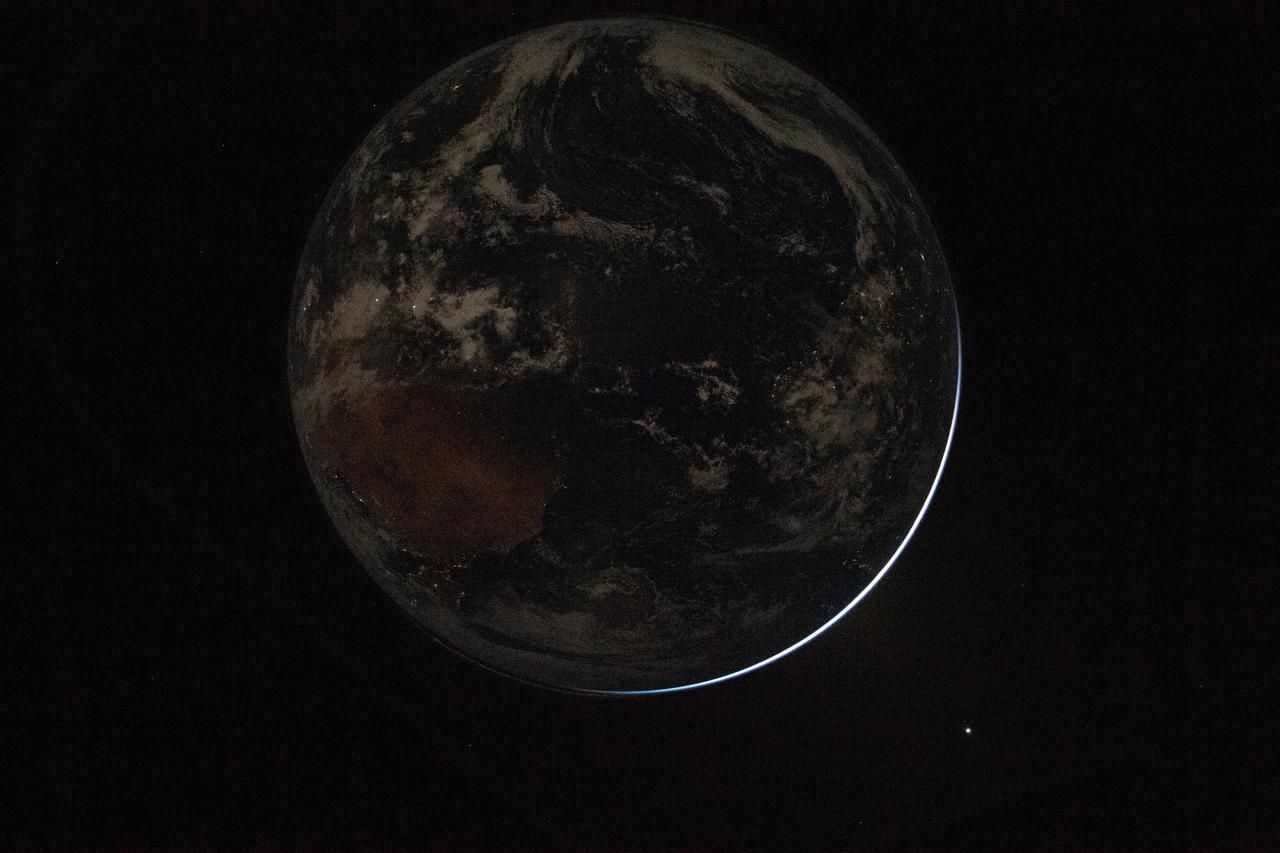
After launch, the spacecraft was in Earth orbit, a sort-of parking orbit until they were in the right position to ignite their engines for a translunar injection burn that sent them up and away from our home world and on their way to the moon. Not long after that was done, astronaut Reid Wiseman pointed a camera out the capsule window and took a truly amazing photo of Earth: 

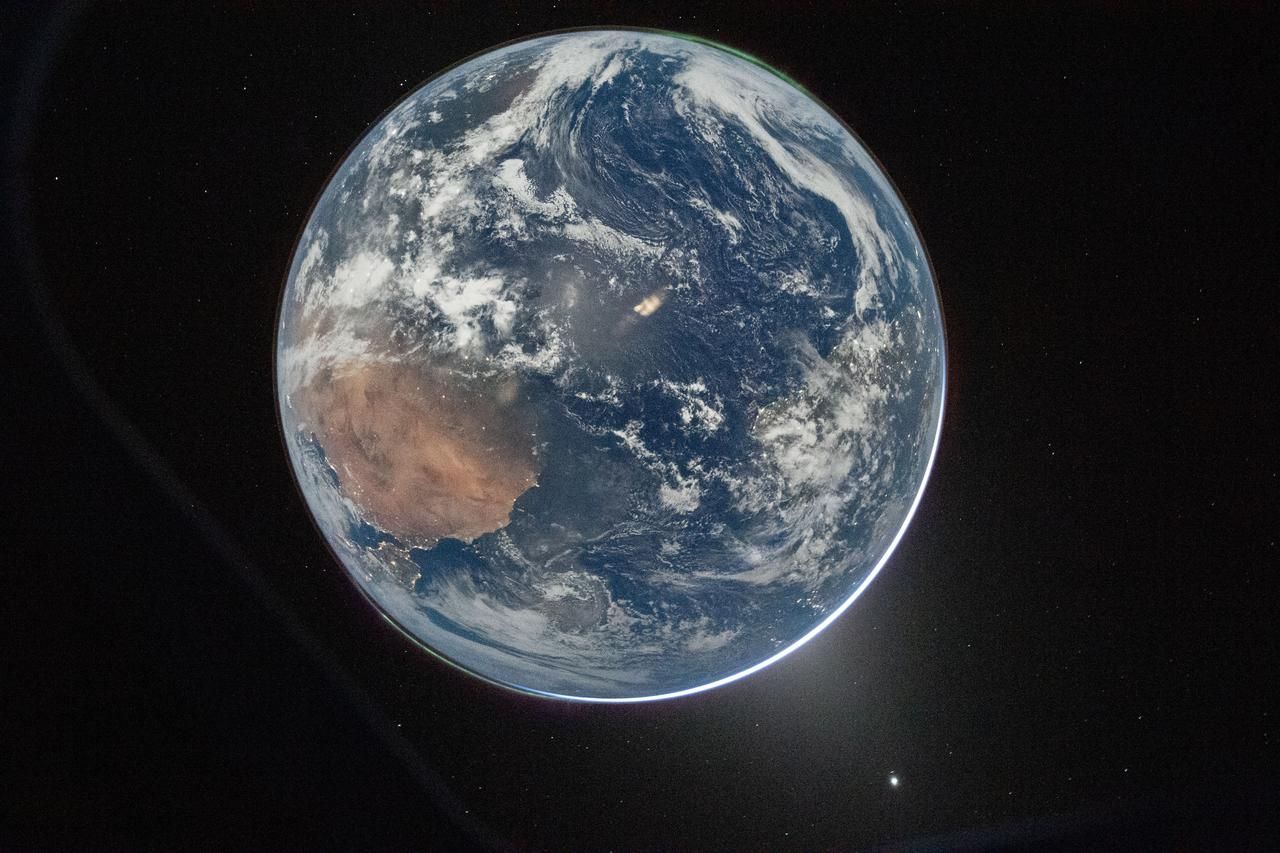
A photo of Earth showing northern Africa and the Atlantic Ocean with clouds swirling. Many stars can be seen in the background.

Hello, Earth. Credit: Reid Wiseman/NASA

[Click the photo to see much higher-resolution versions where the stars and more are clearly visible.]

That’s fantastic. It spread like wildfire online, unsurprisingly, with a lot of people asking about it, curious about what they were seeing. Some of the information being shared was great, some incorrect, and some didn’t give the full picture. I’ll try to fix that!

First, this shot of Earth is not lit by the sun. So what’s lighting it up then?

The moon! It was full, and the full moon is pretty bright  — you can read by it. What you’re seeing is light from the sun reflected off the moon, hitting Earth, and reflecting back up into space where the astronauts could see it.

Premium subscribers get three issues about the universe like this every week! Become one now. JOIN US. JOOOOOIIIINNNN USSSSSS.

When this shot was taken the sun was directly behind Earth, completely blocked out. However, it wasn’t centered behind it but instead a bit closer to the lower right side as seen here — if you look that way in the photo you can see a bright sliver, a very thin crescent. That’s sunlight passing through Earth’s atmosphere and lighting it up (it’s not the actual surface being lit by the sun)! The digital camera (a Nikon D5) was set for a ¼ second exposure at f/4 with an ISO of 51,200, which makes it very sensitive to light. The moonlit Earth is therefore exposed well, but the sunlit air to the right is overexposed.

If we were looking at Earth’s dayside here, it would vastly outshine the stars, which would be completely invisible. We see stars, so this must be the night side.

Wiseman took another shot about 20 seconds later at a 1/15th of a second exposure that makes it more clear this was taken over the unlit side:

Same as above, but Earth is much darker. Specks of light can be seen across Earth.

Same as above, but Earth is much darker. Specks of light can be seen across Earth. Credit: Reid Wiseman/NASA

Cooool.

As for Earth itself, the center of the disk is over the Atlantic Ocean west of Africa, with that continent looming large to the left, dominated by the brown tones of the Sahara Desert. Just below it is Spain and Gibraltar. On the far right South America is visible through the clouds — I’m pretty sure the specks of light across the face of Earth in the shorter exposure photo are cities in South America and Africa. Note that south is up here; we’re used to seeing maps the other way around, but in space up and down are relative. I’ve seen some folks displaying this photo with north up, which I get, but I prefer it this way, how the astronauts saw it. Remember: they were in space when this was taken. It’s always good to shake up your perspective a bit.

The odd glow just above and to the right of center is very likely a reflection of light off the cabin window. If you ramp the brightness up in the photo you can see the edge of the window frame on the left of the photo, too.

Speaking of perspective, a tricky aspect of this is that they weren’t all that far from Earth when the photo was taken, so you’re not seeing the entire hemisphere. Think of it this way: the horizon is only a few kilometers away from you when you’re standing up in a relatively flat area (like a beach), so your view is limited. The higher up you go, the farther the horizon is and the more of the planet you see, and when you’re really far away (technically infinitely far away, but, say, a hundred thousand kilometers is enough) then you’re seeing essentially the entire hemisphere of the planet.

Here, they were too close to see the whole thing. Judging from the stars (which I’ll get to in a sec) Earth is roughly 45° across, so doing the trig they were about 8,500 km away (measured from Earth’s surface in the center of the image) at that moment. Enough to see a lot of the planet, but not the complete hemisphere. The camera was using a 22 mm focal length, which is a wide angle, wider than you usually see in a normal cell phone camera, for example, which is why Earth only fills about half the frame.

I know you have someone in your life who’s a space exploration dork. Share this issue with them by clicking here!

Sticking with Earth for a moment more, look to the top and bottom of the disk: see that green glow? That’s the aurora! It’s pretty common to see the aurora in shots taken from the ISS, but that orbits pretty low and only sees one pole at a time. Here we see both the aurora borealis (northern lights) and the aurora australis (southern lights) simultaneously!

Also, there’s a reddish-brown ring encircling the Earth at the same height as the aurora; that’s airglow: oxygen atoms energized by sunlight during the day and slowly emitting that energy in the form of light. Again, ISS photos show this all the time. It’s a thin layer of oxygen that glows this way, so it’s easiest to see when you’re looking toward the horizon from space, when your line of sight goes through the most material (called limb brightening).

Now, finally, to space. The bright “star” off the lower right edge of Earth is actually the planet Venus! I knew this right away when I first saw this shot; from the ground Venus is now appearing over the western horizon after sunset. I’ve seen it a few times through the trees this past week, and it’s slowly getting higher every night. Given the shot is looking toward the sun past Earth, I knew that had to be our evil twin planet

You can also see an eerie glow seemingly reaching up from Earth toward Venus. That’s an illusion; it’s actually zodiacal light, the glow of sunlight reflecting off dust released by comets, so it’s actually far in the background. It’s pretty faint and difficult to see from the ground, but much easier from space.

You can also see dozens of stars in the photo, too. Given how wide the shot is and how sensitive the camera was, when I saw the photo I knew it wouldn’t be too hard to identify them. The stars near Venus are in the constellation Pisces, with Cetus to the upper right, and Andromeda to the left (the brightish star at the 7:00 position around Earth is Alpheratz, the brightest star in Andromeda; unfortunately the Andromeda Galaxy isn’t visible which would’ve been amazing). To the upper left are the stars in Aquarius — I got a kick out of that. The Apollo 13 lunar module was named Aquarius.

I’ll note that not too long after I figured all this out I saw my friend Corey Powell posted a much more detailed annotated version on Bluesky if you’re curious (the image has been flipped in that version).

Anyway, I was able to use the positions of the stars to get a rough estimate of how big Earth appears here, and then use the small angle formula to get its distance (they were about 15,000 km from Earth’s center, so subtracting its radius of 6,400 km I get roughly 8,500 km).

All of this is amazing. And there’s so much more; NASA is posting the images as they come in from space. Today the astronauts are very close to the moon, and I’m really looking forward to seeing those shots as they’re made available. Closest approach is at 19:02 Eastern US time tonight, and NASA will be covering all of this live. You can watch on NASA TV or on their YouTube channel. I will be.


Et alia

You can email me at thebadastronomer@gmail.com (though replies can take a while), and all my social media outlets are gathered together at about.me. Also, if you don’t already, please subscribe to this newsletter! And feel free to tell a friend or nine, too. Thanks!


Powered by beehiiv
https://badastronomy.beehiiv.com/p/view-from-a-height-the-earth-from-artemis-ii
Extensions
Two JWST stories: an incredible nebula/star cluster image, and a map of dark matter
Hubble Space TelescopeStar ClustersCosmologyNebulaBrown DwarfsGalaxy ClustersGravitational LensingStarsGalaxiesJwstDark Matter
Westerlund 2 is a feast for the eyes, and the dark matter map a feast for the brain
Show full content
.bh__table, .bh__table_header, .bh__table_cell { border: 1px solid #C0C0C0; } .bh__table_cell { padding: 5px; background-color: #FFFFFF; } .bh__table_cell p { color: #2D2D2D; font-family: 'Helvetica',Arial,sans-serif !important; overflow-wrap: break-word; } .bh__table_header { padding: 5px; background-color:#F1F1F1; } .bh__table_header p { color: #2A2A2A; font-family:'Trebuchet MS','Lucida Grande',Tahoma,sans-serif !important; overflow-wrap: break-word; } The Trifid Nebula looks like a red flower with dark lines converging on its center, surrounded by pale blue gas and countless stars.

The Trifid Nebula and environs. Credit: RubinObs/NOIRLab/SLAC/NSF/DOE/AURA

April 2, 2026 Issue #1018
Westerlund 2: Another JWST jaw-dropper

It’s a lot of stars.

Westerlund 2 is a massive star cluster. Located about 20,000 light-years from Earth, it’s surrounded by a nebula (called RCW 49) roughly a dozen light-years across — so, in the same category more or less as the Orion Nebula. Unlike Orion, though, it’s not forming hundreds if stars, it’s forming thousands. Westerlund 2 has at least 2,000 stars in it, about 20 of which are O-class monsters blasting out hundreds of times the energy of the sun each.

There are also low-mass stars in it, as well as brown dwarfs, objects more massive than planets but too low-mass to ignite hydrogen fusion in their cores, so not real stars.

Astronomers pointed JWST at the cluster to investigate these smaller objects, and what it saw was just phenomenal.

A clot of thousands of stars clumped together in a cluster surrounded by brilliant orange and red gas.

Westerlund 2, seen by JWST. Credit: ESA/Webb, NASA & CSA, V. Almendros-Abad, M. Guarcello, K. Monsch, and the EWOCS team.

Holy smokes! Click here for the much larger 4,125 by 4,175 pixel version that will pop your eyeballs out.

The cluster is at the top of the image. It sits in a cavity carved out of the gas by the stars themselves; those bigger ones blast out ultraviolet radiation that eats away at the gas, and pushing it away from the stars to form the inside of a bubble. 

The image is in infrared, but the colors have been converted to the colors we can see to display them. Blue shows cool stars, green methane gas, and red shows things like methane, cool objects like brown dwarfs, and dust grains made of long chains of carbon atoms (called polycyclic aromatic hydrocarbons, or PAHs; literally basically soot).

These observations were taken to see if the population of brown dwarfs in the cluster is affected by the intense radiation from the superluminous stars; as objects form, the radiation blast can strip away material, possibly making more brown dwarfs because it robs material from stars trying to get bigger. Or it could blow all the material away, creating a deficit of low-mass objects. They saw enough brown dwarfs to analyze, though. I haven’t seen a paper published with the observations yet, though so I can’t say much.

I’ve written about this cluster before, both in my very first newsletter as well as back on SYFY, where I talk about forming planets is hard in clusters like Westerlund 2 for this very reason.

The first brown dwarfs were discovered only in the late 1990s — I remember this, as I was working on Hubble not long after, and studied them for awhile. Finding them was hard, because they’re very faint and produce most of their light in the infrared, where even Hubble doesn’t see well. Now we can point JWST at a nebula and find dozens or even hundreds of them at a time!

Progress, baby. I love it. Not only do we get dynamite photos of space, but we learn so much about it, too, things we could only guess at just a few years ago. Progress!


Subscribe to Premium to read the rest.

Become a paying subscriber of Premium to get access to this post and other subscriber-only content.

Upgrade Translation missing: en.app.shared.conjuction.or Sign In

A subscription gets you
  • Three (3!) issues per week, not just one
  • Full access to the BAN archives
  • Leave comment on articles (ask questions, talk to other subscribers, etc.)


Powered by beehiiv
https://badastronomy.beehiiv.com/p/two-jwst-stories-an-incredible-nebula-star-cluster-image-and-a-map-of-dark-matter
Extensions
A fun (not really) twist on global warming: land sinking
Climate ChangeEarthNasaPoliticsStars
Plus a small satellite will look at big science for small stars
Show full content
.bh__table, .bh__table_header, .bh__table_cell { border: 1px solid #C0C0C0; } .bh__table_cell { padding: 5px; background-color: #FFFFFF; } .bh__table_cell p { color: #2D2D2D; font-family: 'Helvetica',Arial,sans-serif !important; overflow-wrap: break-word; } .bh__table_header { padding: 5px; background-color:#F1F1F1; } .bh__table_header p { color: #2A2A2A; font-family:'Trebuchet MS','Lucida Grande',Tahoma,sans-serif !important; overflow-wrap: break-word; } Premium Content

This content is reserved for premium subscribers of Premium Membership. To Access this and other great posts, consider upgrading to premium.

UpgradeLink ConjuctionSign In

A subscription gets you:
  • Three (3!) issues per week, not just one
  • Full access to the BAN archives
  • Leave comment on articles (ask questions, talk to other subscribers, etc.)


Powered by beehiiv
https://badastronomy.beehiiv.com/p/a-fun-not-really-twist-on-global-warming-land-sinking
Extensions
The Red Spider Nebula: JWST’s view of gorgeously dying star
Hubble Space TelescopeWhite DwarfsThe SunNebulaPlanetary NebulaeBinary StarsStarsJwst
In stellar death lies great beauty, and amazing science
Show full content
.bh__table, .bh__table_header, .bh__table_cell { border: 1px solid #C0C0C0; } .bh__table_cell { padding: 5px; background-color: #FFFFFF; } .bh__table_cell p { color: #2D2D2D; font-family: 'Helvetica',Arial,sans-serif !important; overflow-wrap: break-word; } .bh__table_header { padding: 5px; background-color:#F1F1F1; } .bh__table_header p { color: #2A2A2A; font-family:'Trebuchet MS','Lucida Grande',Tahoma,sans-serif !important; overflow-wrap: break-word; } The Trifid Nebula looks like a red flower with dark lines converging on its center, surrounded by pale blue gas and countless stars.

The Trifid Nebula and environs. Credit: RubinObs/NOIRLab/SLAC/NSF/DOE/AURA

March 30, 2026 Issue #1016
Premium subscribers make my core glow
The phenomenal awesomeness of the Red Spider Nebula

Ho hum, just another staggeringly ridiculous image from JWST

Look, hey, I know I’m biased. Back in the day I studied planetary nebulae — the gas shed by dying stars subsequently lit up by the exposed hot stellar core — for many years, so I have a predilection for them. They’re fascinating objects, and given the sun may create one some seven or eight billion years from now makes them even more interesting.

But also? They’re fantastically beautiful. And, as a scientist, I can offer you proof.

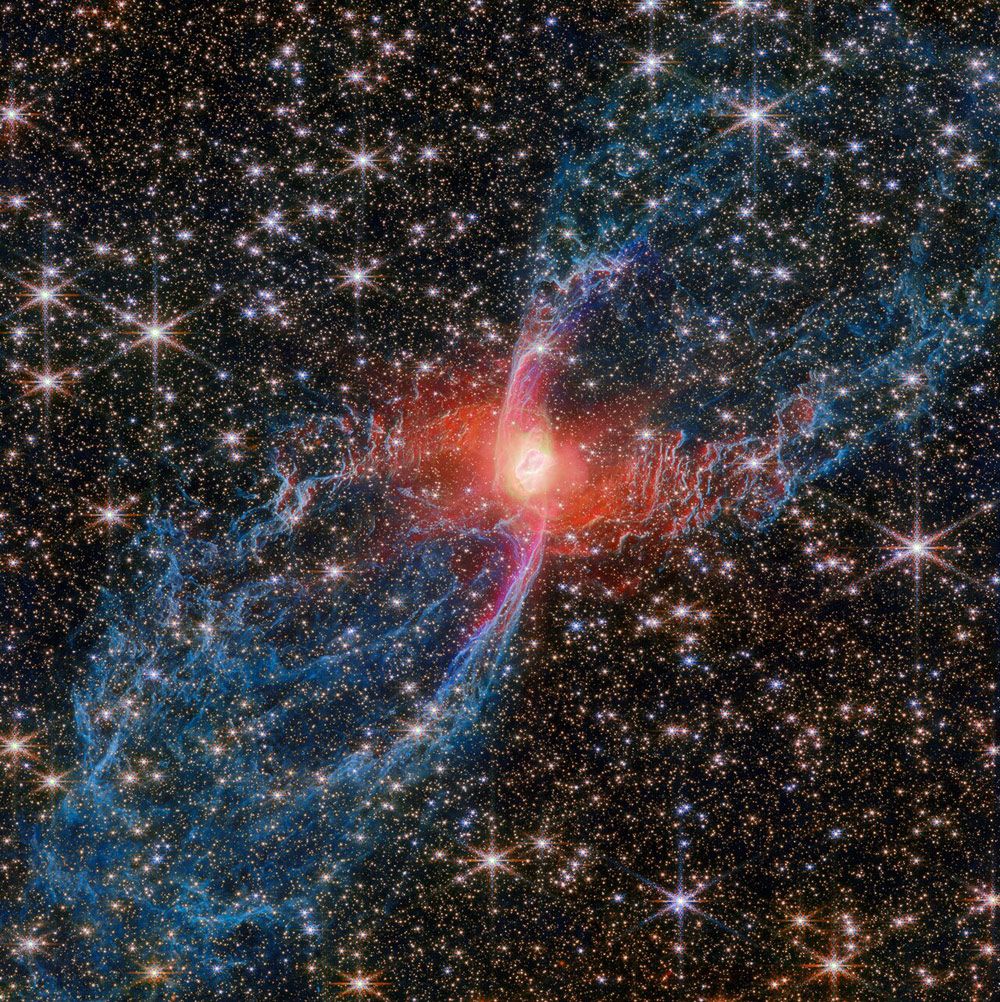
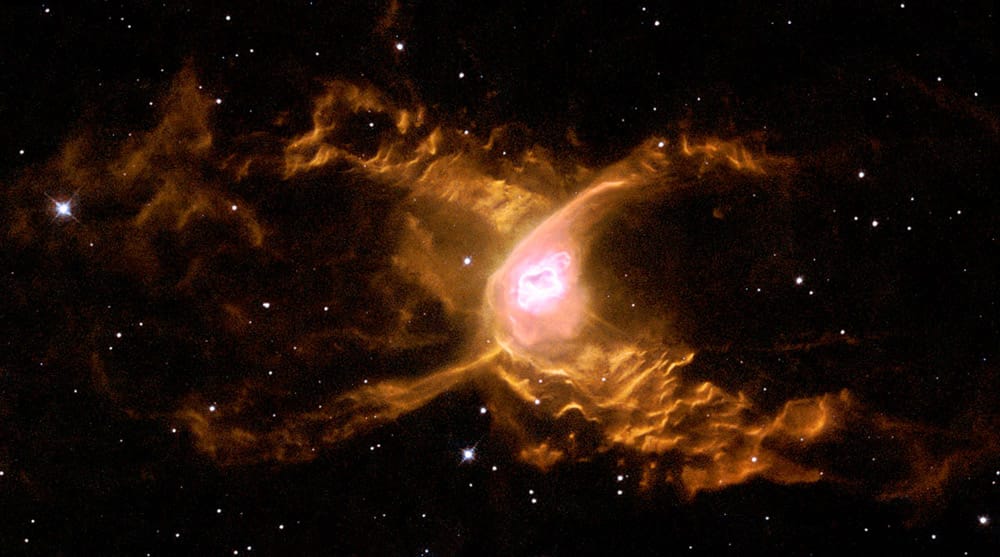
In a field of many many thousands of stars, a roughly hourglass-shaped gas cloud shows incredibly detailed blue filaments on the outside and reddish ones in the interior. In the center is an even brighter orange ring of material around he central star.

Yeah. I mean, seriously, wow. Credit: ESA/Webb, NASA & CSA, J. H. Kastner (Rochester Institute of Technology)

WHAT THE ACTUAL WHAT. Holy moly.

That is NGC 6537, aka the Red Spider Nebula. The distance to it is not clear, but it’s likely in the 5,000-light-year range. This image was taken using JWST, and to understand what you’re seeing you have to understand planetary nebulae a bit. 

I’ve written about them many times; the basic idea is that as a star runs out of fuel in its core it turns into a red giant and sheds its outer layers. Eventually so much material is lost that the core of the star, now a white dwarf, is exposed to space, and zaps the gas with ultraviolet light, causing it to glow.

But the devil’s in the details, and there are devils aplenty in the Red Spider [link to journal paper].

For one thing, what happens in the core as the star dies is pretty complicated. I go over this in a pair of Crash Course episodes (Low Mass Stars, and White Dwarfs and Planetary Nebulae), but here’s a synopsis.

Signing up for a paid subscription makes the universe a little bit cooler. Click here!

Stars are usually powered by fusing hydrogen into helium. The helium builds up in the core, getting denser and denser. When the available hydrogen in the core runs out, the helium is so dense that a weird quantum mechanical effect takes over — called electron degeneracy — and causes the helium to heat up a lot, way hotter than even the core was before. This causes hydrogen to fuse in a thin shell around the helium core at a furious rate, making even more helium that falls into the center. Eventually there’s enough helium that it begins to fuse. A truly colossal flash of energy ensues, which inflates the helium core and takes away the degeneracy. But now it’s fusing helium into carbon, and the whole running-out-of-fuel process repeats. It might actually repeat several times with heavier and heavier elements if the star is massive enough.

Every time the core changes, the outer layers do as well. All the extra energy from the hot degenerate core flows upwards, heating the outer layers and causing them to inflate. The star is so luminous and the outer layers so tenuous that the gas in the upper part can get blown away from the star. This is called the red giant wind.

When the core starts up fusion again the star will shrink, since less energy is flowing outward, only to expand again when the fused material builds up and gets degenerate. Eventually the star reaches the asymptotic red giant stage, where it gets truly huge. By this point it’s blown away a lot of gas, so much so that this stage doesn’t last long. The hot core is now becoming a white dwarf and dominating the upper layers, and the gas blown off is much more energetic, moving far faster. It slams into the previously ejected slower-moving gas, creating the phenomenal and weird shapes we see in planetary nebulae.

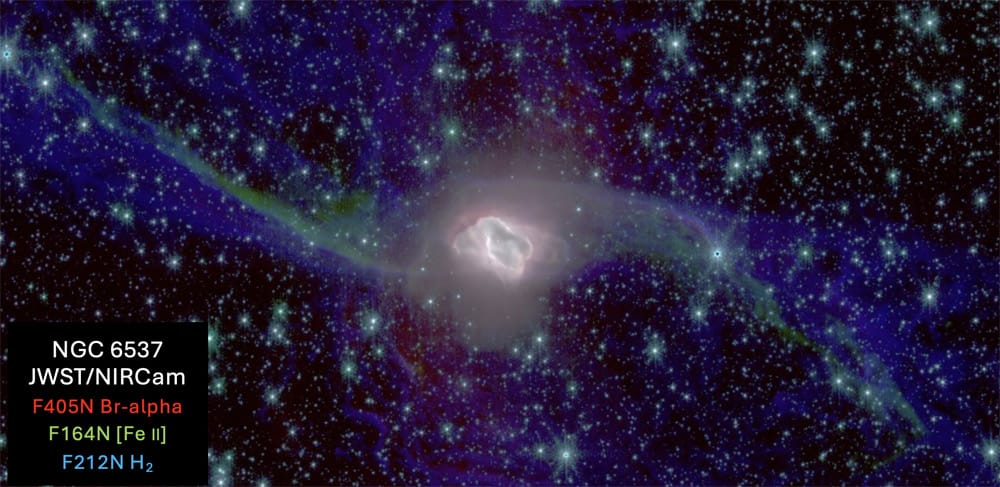
OK, so the Red Spider. The outer lobes in the hourglass shape (colored teal in the JWST image) are from hydrogen, blown out when the star was a red giant. It’s a bit hard to differentiate in the image, but there’s also an S-shaped teal structure extending to the bottom and top of the image along the edge of the lobes; that’s from iron that’s been ionized, losing a single electron. This is common in shock waves, when fast moving gas hits slower material; in this case the faster wind from the pre-white dwarf core ramming the slower material ejected earlier. The slow stuff is expanding at about 18 kilometers per second, and the fast wind at more like 350. That’s fast. It hits the slower stuff and inflates it, creating the huge lobes that are each about 4 light-years across end-to-end (quite large for a planetary). These structures are likely about 3,700 years old.

That’s a bit easier to see here, in a figure from the paper:

A S-shaped structure showing iron and hydrogen in the nebula.

The S-shaped structure showing iron and hydrogen in the nebula, rotated 90° clockwise. Credit: Kastner et al. 2025.

Here the iron is green, while hydrogen is red and blue.

The inner structure is more complicated (it’s also seen in Hubble Space Telescope images). That’s from material ejected when the star was an asymptotic giant, right before the white dwarf was exposed. It forms a thick dusty torus (a doughnut shape) around the star, opaque to visible light, but which is easier to investigate in infrared. It’s expanding at about 10 km/sec, so it’s probably about 10,000 years old. It formed before the lobes started getting hit by the fast wind, and may have helped focus the gas to blow “up and down” instead of in all directions.

Monday issues like this are free, so please click here to share this with a friend who would enjoy this slice of cosmic awesomeness.

The extreme elongated shape of the nebula overall is almost certainly due to the presence of another star that was a binary companion to the now white dwarf. When the first star started to die the binary motion may have made it spray material into that thick torus in the plane of the orbit due to centrifugal force. When the fast wind started up, it hit the torus and slowed, but stuff sprayed up and down was free to move, and hit the older gas.

Similar to above, the inner region of the nebula is seen by Hubble, colored orange, showing an X-shape to the inner parts of the big lobes.

Hubble’s view of the Red Spider; red is light from sulfur, orange from nitrogen, with hydrogen in green and blue. Credit: ESA & Garrelt Mellema (Leiden University, the Netherlands)

The white dwarf is hot, probably around 250,000°C. That implies it’s massive, and may be about the mass of the sun (squeezed into a ball the size of Earth!). That in turn means the original star was more massive than the sun, probably by a factor of 3 – 7. This is likely why this nebula is extreme in so many ways; such a massive star means more energy, pushing harder on the expelled gas, making the central stars hotter, and more. When the sun turns into a planetary nebula it won’t be anywhere near as elongated or as hot. Or as big! The Red Spider is huge as these things go. 

So, all in all a very cool object to study (and it’s nice to see my old friends Bruce Balick and Noam Soker involved with this study). And it’s also just dead spectacular. I almost don’t envy the scientists studying it; all those stars in the background would make a detailed analysis tough, but gee, what a thing to have to stare at for work! I do miss digging into observations like this a bit… but honestly I’m happy just to boggle at it and explain it to all y’all. That’s fun too.


Et alia

You can email me at thebadastronomer@gmail.com (though replies can take a while), and all my social media outlets are gathered together at about.me. Also, if you don’t already, please subscribe to this newsletter! And feel free to tell a friend or nine, too. Thanks!


Powered by beehiiv
https://badastronomy.beehiiv.com/p/the-red-spider-nebula-jwst-s-view-of-gorgeously-dying-star
Extensions
The astronomer who discovered what the universe was made of
MiscellanyThe SunScifiAstronomyPoliticsStarsScience
Cecelia Payne-Gaposchkin was an amazing scientist, and her work wasn’t all that long ago
Show full content
.bh__table, .bh__table_header, .bh__table_cell { border: 1px solid #C0C0C0; } .bh__table_cell { padding: 5px; background-color: #FFFFFF; } .bh__table_cell p { color: #2D2D2D; font-family: 'Helvetica',Arial,sans-serif !important; overflow-wrap: break-word; } .bh__table_header { padding: 5px; background-color:#F1F1F1; } .bh__table_header p { color: #2A2A2A; font-family:'Trebuchet MS','Lucida Grande',Tahoma,sans-serif !important; overflow-wrap: break-word; } The Trifid Nebula looks like a red flower with dark lines converging on its center, surrounded by pale blue gas and countless stars.

The Trifid Nebula and environs. Credit: RubinObs/NOIRLab/SLAC/NSF/DOE/AURA

March 26, 2026 Issue #1015
No Kings Rally this weekend!

I’ll be there. Will you?

As you may know, I’m not at all happy with how things are politically right now. You can pick from a thousand different horrific events, though I tend to focus in on the attacks on science. That includes RFK Jr.’s attempts to Make America Sick Again, severe funding cuts to agencies, and policies put in place to step on science and scientists’ ability to speak about reality.

I am also not afraid to make my voice heard. That’s why I’m glad there’s another nationwide No Kings rally on Saturday, March 28. I’ll be at my local one in Charlottesville, Virginia, waving my big American flag and letting people know we need real change.

There are over 3,000 such events planned for the day, so if you’re up for it and in the US I’m sure there’s one near you. This is more than the last rally where seven million people showed up, so I’m hoping we see an even bigger jump in attendance for this one. This could be the biggest single protest in US history, and I like the sound of that.

I hope y’all can attend. Things keep getting worse, but they don’t have to be. The louder we are the more progress we’ll make, and we need to make noise right up and through the mid-terms this winter. Oh: If you can’t attend for whatever reason, the good folks at Stand Up For Science are having an accessible rally you can attend online! That’s a great idea; being inclusive always is.


Was The Force with Cecelia Payne-Gaposchkin?

History is now

My colleague Jason Wright recently posted on Bluesky that he was reading the autobiography of the astronomer Cecelia Payne-Gaposchkin, and really enjoyed it. That prompted me to look it up, and I found it on the Internet Archive. I’m reading it now, and it’s delightful.

CPG was a fantastically remarkable person. You can read about her history in, for example, Wikipedia, though that does tend to flatten the nature of her accomplishments. The key issue here is that she was the first person to understand that the stars, including the sun, were made mostly of hydrogen and helium. It’s difficult to overstate how important this was in astronomy! It was thought at the time that the stars were made of the same stuff as Earth and the other planets. While those heavier elements are also in stars — and in roughly the same proportions as they are on our planet — they are dwarfed by the amount of hydrogen and helium, so much so that we say the universe itself is composed of H, He, and a dash of assorted other elements. 

And oh, did I mention that she did this for her PhD thesis when she was 25 years old? No? Holy wow. 

A rainbow colored series of horizontal lines with gaps in them, representing the color of light the sun emits and the elements in it absorbing specific wavelengths.

The spectrum of the sun (artificially colored to represent the wavelengths we see) showing lots of dark lines; those specific wavelengths indicate the elemental composition of the sun. It’s mostly hydrogen. Credit: N.A. Sharp/KPNO/NOIRLab/NSO/NSF/AURA

I’ll note her conclusion was at first dismissed by astronomers, including the famous Henry Norris Russell (of the Hertzsprung-Russell diagram, itself a revolution in astronomy). He urged her to downplay that result in her PhD thesis, and she did, saying her results that hydrogen was so abundant was “almost certainly not real.” 

Then, a few years later, Russell himself realized (via different means) that her results were in fact true, and briefly acknowledged she figured it out first. We now know she not only figured it out first but got the numbers remarkably accurately.

She literally discovered what the universe is made of.

And she did this before we understood how stars worked, before quantum mechanics, and only just as we started to understand what the spectra of stars meant. She figured out all this while still in the dark, so to speak, about a lot of work later done in this field that would clarify the science. Phenomenal.

As I was reading her autobiography I started thinking about her as a person. I have some knowledge of astronomical history, as any astronomer does, but the exact dates of all these discoveries are a bit of a blur to me. I was a bit surprised to learn she was born in 1900… but then was shocked when I saw she died in 1979.

My first thought after reading that leapt unbidden into my head: Cecelia Payne-Gaposchkin, the woman who first figured out what stars are made of, might have seen Star Wars.


Subscribe to Premium to read the rest.

Become a paying subscriber of Premium to get access to this post and other subscriber-only content.

Upgrade Translation missing: en.app.shared.conjuction.or Sign In

A subscription gets you
  • Three (3!) issues per week, not just one
  • Full access to the BAN archives
  • Leave comment on articles (ask questions, talk to other subscribers, etc.)


Powered by beehiiv
https://badastronomy.beehiiv.com/p/the-astronomer-who-discovered-what-the-universe-was-made-of
Extensions
How incomplete are we?
MiscellanyAstronomyBrown DwarfsStarsScience
Completeness is an important concept for surveys in astronomy
Show full content
.bh__table, .bh__table_header, .bh__table_cell { border: 1px solid #C0C0C0; } .bh__table_cell { padding: 5px; background-color: #FFFFFF; } .bh__table_cell p { color: #2D2D2D; font-family: 'Helvetica',Arial,sans-serif !important; overflow-wrap: break-word; } .bh__table_header { padding: 5px; background-color:#F1F1F1; } .bh__table_header p { color: #2A2A2A; font-family:'Trebuchet MS','Lucida Grande',Tahoma,sans-serif !important; overflow-wrap: break-word; } Premium Content

This content is reserved for premium subscribers of Premium Membership. To Access this and other great posts, consider upgrading to premium.

UpgradeLink ConjuctionSign In

A subscription gets you:
  • Three (3!) issues per week, not just one
  • Full access to the BAN archives
  • Leave comment on articles (ask questions, talk to other subscribers, etc.)


Powered by beehiiv
https://badastronomy.beehiiv.com/p/how-incomplete-are-we
Extensions
Hubble (accidentally!) catches a comet tearing itself apart
Hubble Space TelescopeCometsSolar SystemThe SunAbout Me
Images show it fragmenting into several smaller pieces. Plus: I’m on EnterpriseSplaining.
Show full content
.bh__table, .bh__table_header, .bh__table_cell { border: 1px solid #C0C0C0; } .bh__table_cell { padding: 5px; background-color: #FFFFFF; } .bh__table_cell p { color: #2D2D2D; font-family: 'Helvetica',Arial,sans-serif !important; overflow-wrap: break-word; } .bh__table_header { padding: 5px; background-color:#F1F1F1; } .bh__table_header p { color: #2A2A2A; font-family:'Trebuchet MS','Lucida Grande',Tahoma,sans-serif !important; overflow-wrap: break-word; } The Trifid Nebula looks like a red flower with dark lines converging on its center, surrounded by pale blue gas and countless stars.

The Trifid Nebula and environs. Credit: RubinObs/NOIRLab/SLAC/NSF/DOE/AURA

March 23, 2026 Issue #1013
Subscribers are the nucleus inside my fuzzy head 
Hubble observations show a comet falling into pieces

A routine observation of C/2025 K1 (ATLAS) turns out to be way more cool than expected

A team of astronomers wanted to use Hubble Space Telescope to observe a comet. They got time on the ‘scope, but when they wanted to get their observations it turns out there were some constraints that made viewing it with the orbital observatory impossible. So they submitted a new target, the comet C/2025 K1 (ATLAS) — [note: not the interstellar comet, but a different one discovered by the ATLAS sky survey], and when they got their observations they also got a surprise: the comet had broken up (technically called calving, or in this case fragmenting since it’s more than one piece) into at least five pieces!

Three images of the comet each taken one day apart showing it not as one piece but actually 4 or five.

The crumbling comet C/2025 K1 (ATLAS). Credit: NASA, ESA, D. Bodewits (Auburn). Image processing: J. DePasquale (STScI)

[Click the images here and below to get much larger versions.]

The images were taken one day apart each on November 8 – 10, 2025. The astronomers were expecting to see a single nucleus — the solid part of the comet — but instead were amazed to see it had broken apart into several pieces. The difference from day to day is pretty obvious, too. There were four pieces the first day, but the brightest split by the second observation, while another had faded by the third [link to journal paper].

The November 9 image from above but with the pieces annotated for clarity.

The November 9, 2025 observation with the pieces annotated. Note how the brightest one had split into two, but chunk number 3 disappeared by the next day. Credit: NASA, ESA, D. Bodewits (Auburn). Image processing: J. DePasquale (STScI)

So what’s going on? Comets are basically big piles of rock, gravel, and dust held together by ices (like frozen water, carbon dioxide, and more). When they get near the sun, the ice in the solid nucleus turns to gas (called sublimation), creating the fuzzy head surrounding the nucleus, and the long streaming tail.

But that ice is the glue holding the nucleus together, so as it sublimates pieces of rocks and such get loose. Sometimes, when a comet gets too close to the sun, enough ice goes away that really big chunks are freed, essentially shattering the comet. On occasion the entire nucleus disrupts into zillions of little pieces, and we say the comet disintegrated.

This usually happens at or around perihelion, when the comet is closest to the sun, and in this case K1 was about a month past that point, which fits. It got about as close to the sun as Mercury’s orbit, so the heat it faced was pretty intense.


Every headline satisfies an opinion. Except ours.

Remember when the news was about what happened, not how to feel about it? 1440's Daily Digest is bringing that back. Every morning, they sift through 100+ sources to deliver a concise, unbiased briefing — no pundits, no paywalls, no politics. Just the facts, all in five minutes. For free.

Read the newsletter trusted by 4.5 million fact-seekers.


Interestingly, this is a hyperbolic comet, too. That means its orbit is a hyperbola — it’s moving too rapidly for the sun to hold onto it, so it will fly away into interstellar space. It’s likely been orbiting the sun for billions of years, but got a kick from something that added enough speed to push it past escape velocity. The orbit of the comet is tilted with respect to the planets, so it never got near, for example, Jupiter, making me wonder if a passing star millennia ago, or even tides from the galaxy itself, is what gave it that little bit of extra oomph. The fragmentation doesn’t surprise me, since comets like this visiting the early solar system for the first time tend to be more fragile than ones on shorter orbits. The likely explanation is that comets closer to the sun get all that sort of activity out of their systems early on, and what we see now is tougher material less prone to fragmentation.

This serendipitous observation is pretty helpful. Usually, Hubble sees fragmenting comets well after the event, since it takes a while to get the ‘scope pointed to a new target. In this case the comet had just happened to fall apart days before, so the timing was perfect. In fact, it presented a mystery: there were bright outbursts of light seen from the comet, typically associated with fragmenting — brighter ice under the surface is exposed, plus the sudden release of lots dust reflects more sunlight — but the brightening seen was well after the breakup. The astronomers think that it might take time after the breakup for the dust to be released into space efficiently enough to increase the brightness.

Also, the comet is a bit weird; it has far less carbon in it than most solar system comets. That’s interesting indeed, since that low carbon content is usually seen in interstellar comets! Given this comet has a hyperbolic orbit, it might possibly have started out orbiting another star, got ejected, and has been wandering the space between the stars ever since. While possible, this is still odd, because the comet’s orbit isn’t super hyperbolic, which is what you’d expect for something moving at high speed through the galaxy before encountering the sun. Still, we’ve only positively IDed three such interstellar visitors, so we don’t have much data on how they actually behave.

 All in all, these observations wound up being pretty important. Seeing a comet after an outburst and fragmentation reveals what it’s interior is like, so that’s cool, plus, who knows? If this truly is an interstellar comet, the data become that much more precious.

Become a premium subscriber and send me into a hyperbolic trajectory!
Podcast interview: EnterpriseSplaining

It’s been a long road

My friend Maria D’Souza is a lot of fun. A skeptic (back when it was still cool) and a dork, when she says she wants me to be on her podcast the only answer is “yes”. Especially when the podcast is EnterpriseSplaining, where she, Jamie Bernstein, and Bill Stiteler watch an episode of “Star Trek: Enterprise” and explain it. Well, one of them watches it and tries to explain it to the other two. Then they do a rewatch later and go over their notes (they call this “Second Contact”).

They also have guests on, and they asked me ages ago; I said hold off until you get to the episode “Regeneration”, for reasons. They did, so I did, and now it’s live! There are lots of options to listen, including YouTube.

I reveal why I wanted to be on this episode specifically in the podcast; it’s because many years ago my pal Andre Bormanis, a writer and producer on the show, took me on a tour of the set while they were shooting the second season. I happened to see some set design pieces lying around, one of which was a Borg distribution node. I of course recognized it right away. He had to swear me to secrecy, since the episode using it (“Regeneration”, duh) wouldn’t air for a few months yet. That was fun.

Anyway, if you’re an Enterprise fan you should listen. I’ll note they aren’t always, um, too kind to the show (especially when it deserves it; the writing could be a little uneven), but it’s funny and fun. FWIW the “Second Contact” episode for this is up now too.


Et alia

You can email me at thebadastronomer@gmail.com (though replies can take a while), and all my social media outlets are gathered together at about.me. Also, if you don’t already, please subscribe to this newsletter! And feel free to tell a friend or nine, too. Thanks!


Powered by beehiiv
https://badastronomy.beehiiv.com/p/hubble-accidentally-catches-a-comet-tearing-itself-apart
Extensions
Space debris is hurting us in another way: making the sky brighter
Hubble Space TelescopeStar ClustersLight PollutionBinary StarsStars
Also, the blue stragglers mystery may finally be solved
Show full content
.bh__table, .bh__table_header, .bh__table_cell { border: 1px solid #C0C0C0; } .bh__table_cell { padding: 5px; background-color: #FFFFFF; } .bh__table_cell p { color: #2D2D2D; font-family: 'Helvetica',Arial,sans-serif !important; overflow-wrap: break-word; } .bh__table_header { padding: 5px; background-color:#F1F1F1; } .bh__table_header p { color: #2A2A2A; font-family:'Trebuchet MS','Lucida Grande',Tahoma,sans-serif !important; overflow-wrap: break-word; } Premium Content

This content is reserved for premium subscribers of Premium Membership. To Access this and other great posts, consider upgrading to premium.

UpgradeLink ConjuctionSign In

A subscription gets you:
  • Three (3!) issues per week, not just one
  • Full access to the BAN archives
  • Leave comment on articles (ask questions, talk to other subscribers, etc.)


Powered by beehiiv
https://badastronomy.beehiiv.com/p/space-debris-is-hurting-us-in-another-way-making-the-sky-brighter
Extensions
A red supergiant that isn’t yellow
SupernovaeSolar SystemAsteroidsThe SunStars
WOH G64 has apparently kept its hue. Also, the sun does seem to be able to fry asteroids that venture too close
Show full content
.bh__table, .bh__table_header, .bh__table_cell { border: 1px solid #C0C0C0; } .bh__table_cell { padding: 5px; background-color: #FFFFFF; } .bh__table_cell p { color: #2D2D2D; font-family: 'Helvetica',Arial,sans-serif !important; overflow-wrap: break-word; } .bh__table_header { padding: 5px; background-color:#F1F1F1; } .bh__table_header p { color: #2A2A2A; font-family:'Trebuchet MS','Lucida Grande',Tahoma,sans-serif !important; overflow-wrap: break-word; } Premium Content

This content is reserved for premium subscribers of Premium Membership. To Access this and other great posts, consider upgrading to premium.

UpgradeLink ConjuctionSign In

A subscription gets you:
  • Three (3!) issues per week, not just one
  • Full access to the BAN archives
  • Leave comment on articles (ask questions, talk to other subscribers, etc.)


Powered by beehiiv
https://badastronomy.beehiiv.com/p/a-red-supergiant-that-isn-t-yellow
Extensions
Does scifi exist in a scifi universe?
MiscellanyAliensScifi
A fun rabbit hole pondering of a metatopic
Show full content
.bh__table, .bh__table_header, .bh__table_cell { border: 1px solid #C0C0C0; } .bh__table_cell { padding: 5px; background-color: #FFFFFF; } .bh__table_cell p { color: #2D2D2D; font-family: 'Helvetica',Arial,sans-serif !important; overflow-wrap: break-word; } .bh__table_header { padding: 5px; background-color:#F1F1F1; } .bh__table_header p { color: #2A2A2A; font-family:'Trebuchet MS','Lucida Grande',Tahoma,sans-serif !important; overflow-wrap: break-word; } The Trifid Nebula looks like a red flower with dark lines converging on its center, surrounded by pale blue gas and countless stars.

The Trifid Nebula and environs. Credit: RubinObs/NOIRLab/SLAC/NSF/DOE/AURA

March 16, 2026 Issue #1010
Premium subscribers live long and prosper 

[Fun fact: This is issue 1010, and in base 2 1010 is 10 in base 10. Math is delightful!]


Does Star Trek exist in Star Trek?

Yo dawg I heard you like scifi so I put some scifi in your scifi

[Note: I have opened up comments to everyone for this issue, given I think this topic is ripe for fun discussion. Please go ahead and leave your thoughts below! Just keep it PG or so, and be kind!]

I sometimes like to let my mind wander a bit, finding a topic to ponder deeply and trying to find meaning and relationships in the profundity.

One of my favorites: Does science fiction exist in a science fiction universe?

Aside: Now, I don’t want to get into the weeds about how to define science fiction. I don’t think you can, not rigidly. “Fiction involving science” is a bit too general, but delving into narrow categories is too descriptive. I think it’s more of a “I know it when I see it” kind of thing, and I’ll leave others to nerdgas about it.

So, again, does scifi exist in a scifi universe?

I usually write about astronomy, but you never know! So keep up with my universe, and yours, by becoming a Premium subscriber to get three issues per week!

For example, Jules Verne is mentioned several times in Star Trek episodes. “The Day The Earth Stood Still” is a favorite movie for Captain Pike — as well it should be. So yes, there is scifi in that particular universe, but it’s old. Is there modern (meaning contemporary to the plot) science fiction in Star Trek? And if so, what would it be like?


After all, they have time travel, aliens, spaceships, robots, androids, alternate realities, telepathy, and basically every other topic of today’s scifi, but in-universe they’re real. So to the characters they’re not science fiction. Any stories featuring those topics would basically be adventure tales. 

It reminds me of one of my favorite lines from the TV show Firefly. They’re discussing if one of the characters has psychic powers, and there’s this exchange between Wash and his wife Zoe:

Wash: Psychic, though? That sounds like something out of science fiction.

Zoe: [a bit condescendingly] We live in a spaceship, dear.

Wash: [confused] So?

For them, living on a spaceship is their reality, so it’s not scifi. I’ll note that it’s never really established out loud that there’s faster-then-light travel in Firefly, so that kind of thing would still constitute scifi to them. We never see aliens or anything like that either, so those could technically be considered science fiction as well. 

But in Star Trek? Where there are actual incredibly powerful aliens indistinguishable from gods? What would constitute scifi there?

I actually don’t know. It’s fun to think about. At least for me it is; I don’t think Jean Luc Picard would agree. After all, he’s quoted as saying, “I never really cared for science fiction. I guess, I just didn’t get it.” [This is a meta-joke; Picard is known to prefer classics like “Moby Dick”, but also the actor Patrick Stewart is well known to have not been a big fan of Trek when he first took on the role.]

Me in a blue shirt and jeans in front of the original model of the Enterprise, and I’m giving a Vulcan salute.

“Let’s make sure that history never forgets the name Enterprise”. And yes, that’s the actual, original model used in TOS, which was being conserved at the Smithsonian National Air and Space Museum. Here’s that story. Credit: Paramount/CBS

A fun spinoff of this is to wonder whether the science fiction show you’re watching existed in-universe in that show. It’s a bit meta, but the answer is usually no. For example the TV show Star Trek couldn’t have existed in the Star Trek universe because it wouldn’t make sense; it would involve too many paradoxes. They have some fun with the idea in the Strange New Worlds episode, “A Space Adventure Hour”, which was a bit silly but I still enjoyed it; the computer creates a holodeck story that is an obvious Original Series Trek parody. Other than that, though, I can’t think of any show set in the future where the TV show itself existed in the past. An argument could be made for the remake of Battlestar Galactica (“all this has happened before, and all this will happen again” is almost literally true in-universe) but even that’s a bit of a stretch.

There is a fan-fiction story called “Visit to a Weird Planet” where Kirk, Spock, and McCoy beam into a parallel reality where Star Trek is being filmed, and have to pretend to be the actors for a short time. It’s a bit of fun, and does tackle the question humorously.

… and all this does make me wonder: Will scifi exist forever? We’ve seen it change considerably over the past century, both stylistically as well as in its content. A story written today where someone creates a submarine and goes on undersea adventures would not necessarily be considered scifi, but then again building a rocket and going to the moon probably would be, even though we can do that now (not to mention the first couple of seasons of For All Mankind, which takes place in an alternate history where the Soviets landed on the moon first). I suppose the line can be blurry, especially in a story about a currently evolving technology. 

I don’t know exactly what science fiction will look like in, say, 50 years, or a hundred. Once we start to explore the stars, or the microcosm, or alternate dimensions, what stories will be considered “far out”?

Will science fiction last? Perhaps it won’t, at least in a form we’d recognize today. After all, nobody sings The Poetic Edda anymore. Not all storytelling methods last forever.

But stories do. I might be a little melancholy pondering my favorite genre being made obsolete as reality catches up to it, but I can also be happy in my confidence that somehow, in some way, stories will still be told. They’re important, and they’re an essential part of what makes us human. As long as we can call ourselves that, we’ll still tell each other tales.


Don’t forget to leave any thoughts you have in the comments below!


Et alia

You can email me at thebadastronomer@gmail.com (though replies can take a while), and all my social media outlets are gathered together at about.me. Also, if you don’t already, please subscribe to this newsletter! And feel free to tell a friend or nine, too. Thanks!


Powered by beehiiv
https://badastronomy.beehiiv.com/p/does-scifi-exist-in-a-scifi-universe
Extensions

Related Narratives

← Back to feeds