GeistHaus
log in · sign up

Grist

25 Years on the Climate Beat

rss en-US
20 posts
Feed metadata
Generator https://wordpress.org/?v=6.9.4
Status active
Last polled Apr 29, 2026 01:38 UTC
Next poll Apr 29, 2026 08:21 UTC
Poll interval 24150s
ETag W/"c01b5676ab04a8a6145a83237ba4b2aa"
Last-Modified Tue, 28 Apr 2026 16:32:54 GMT

Posts

He’s the only lead tester in this contaminated neighborhood. He graduates next month.
Equity
The lack of inexpensive and comprehensive toxics testing has created a fragile public safety net in polluted towns across the country.
Show full content

Kim Booker never thought much about lead during her roughly 27 years living in Trenton, New Jersey. Born and raised in the once-industrial powerhouse, she first heard about the heavy metal at community meetings organized by the East Trenton Collaborative, a local nonprofit that works on environmental health and safety issues. There, she learned that the prevalence of lead-laden pipes and paint, a legacy of the city’s industrial past, could have contaminated the drinking water in her home and the soil around her property. 

She knew that her three-bedroom home was old, making it likely it had lead pipes. Booker noticed the paint on the walls chipping off. And she realized, too, that her late grandmother and sister were both diagnosed with Alzheimer’s, which researchers have tied to lead exposure. She wanted to know if she was being poisoned by the lead in her environment. 

With few free, comprehensive testing resources available to her, Booker turned to Shereyl Snider, one of the leaders of the collaborative, who in turn connected her with Sean Stratton, a doctoral student in public health at Rutgers University in late 2023. At the time, he was taking samples of lead to get a clear picture of how lead had contaminated Trenton homes for his dissertation work. Once Booker agreed, Stratton was soon at her home, testing for lead in her paint, yard, and water.  
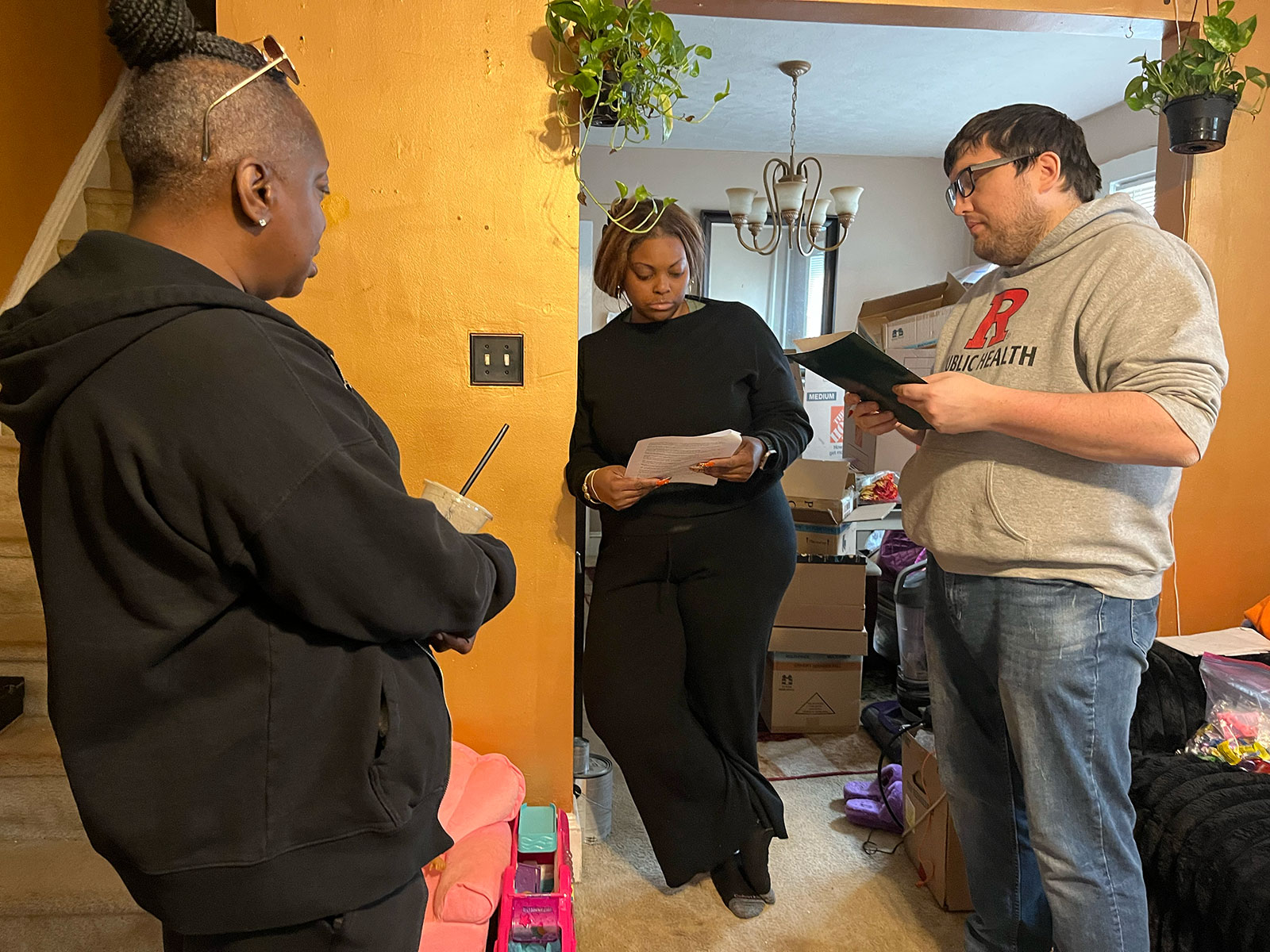
Two women and a man standing in a living room
Stratton visits Amber DeLoney-Stewart’s home in October to provide a full inspection with Shereyl Snider, a community member with East Trenton Collaborative. Anna Mattson

When the results came back, Booker learned that her home was — as she’d suspected — contaminated with lead and that she had low but detectable levels of lead in her bloodstream. Stratton’s testing revealed that lead levels in her yard were more than 450 parts per million, above the Environmental Protection Agency’s hazard level. If not for Stratton, she would not have known. 

“The city shouldn’t rely on a student to do this work,” Stratton said.

Comprehensive lead testing of the kind that Stratton provided costs upwards of $1,000. Over the past two years, Stratton has tested the soil, water, or paint in more than 140 Trenton homes and has been assembling the clearest, most cohesive picture yet of a crisis that permeates the state. Last July, the EPA added the entire neighborhood of East Trenton to the Superfund National Priorities List after testing found widespread soil contamination in residential yards, schools, and parks. Despite the designation, there has been no comprehensive door-to-door testing effort, leaving residents like Booker to rely on Stratton.

But Stratton’s project is coming to a close. He defended his dissertation in February and will graduate in May, leaving uncertain who — if anyone — will continue the work. Community groups like East Trenton Collaborative worry the neighborhood could lose its only accessible source of household testing.

“We don’t want to stop working together,” Snider said. “I don’t see it ending, but I don’t know how we can continue unless we have big supporters to help support our future endeavors together.”

    :root { --color-earth: #3c3830; } .service-callout { position: relative; border: 1px solid var(--color-earth); padding: 1.5rem; margin: 18px 0; font-family: Basis Grotesque Pro, 'Open Sans', Helvetica, sans-serif !important; PolySans, 'Open Sans', Helvetica, sans-serif !important; font-size: 17px; line-height: 1.6; background-color: #ffffff; box-shadow: 2px 2px 0 #3c3830; } @media (min-width: 612px) { .service-callout { float: left; margin-left: 0; margin-right: 36px; width: 400px; } } @media (min-width: 1024px) { .service-callout { margin-left: 2rem; } } @media (min-width: 1280px) { .service-callout { margin-left: 6rem; } } @media (min-width: 1440px) { .service-callout { margin-left: -8rem; } } .service-callout__title { color: var(--color-earth); font-family: PolySans; font-weight: 600; font-size: 19px; border-bottom: 1px dotted #3c3830; padding-bottom: 1rem; line-height: 1.3; } .service-callout__title--left{ text-align: left; } @media (min-width: 612px) { .service-callout__title.service-callout__title--left { text-align: left; } } .service-callout__toc { position: relative; padding-left: 1rem !important; } @media (min-width: 768px) { .service-callout__toc { padding-left: 2.5rem !important; } } .service-callout__toc::after { content: ''; display: block; position: absolute; height: 95%; bottom: 0px; transform: translateY(-32px); border: 1px solid var(--color-earth); } .service-callout__toc-item { display: flex; align-items: left; position: relative; margin-top: 1rem !important; padding-left: 0 !important; } .service-callout__toc-item::before { content: '' !important; display: block; position: relative !important; flex-shrink: 0; width: 3rem; top: 0rem !important; border: 1px solid var(--color-earth); } .service-callout__toc-item > *:first-child { flex-shrink: 0; } .service-callout__toc-item-thumbnail { aspect-ratio: 16 / 9; width: 7rem; box-shadow: 0 4px 6px -1px rgb(0 0 0 / 0.1), 0 2px 4px -2px rgb(0 0 0 / 0.1); } .service-callout__toc-item-link { margin-left: 0.5rem; font-size: 17px; border: 0 !important; } @media (min-width: 612px) { .service-callout__toc-item-link { font-size: 17px; } } @media (min-width: 612px) { .service-callout__toc-item-link { font-size: 17px; } } .service-callout__text { text-align: left; font-size: 17px; } @media (min-width: 612px) { .service-callout__text { text-align: left; } } Stay safe from lead exposure

    There is no safe level of lead exposure. Children under 6 and pregnant people are particularly vulnerable to health risks.

    You’re more likely to have a lead service line providing your water if your home was built before 1986, when lead pipes were banned nationwide.

    Filtering your water can greatly reduce your risk of exposure through tap water. Look for the NSF/ANSI Standard 53 mark, which means a filter meets EPA standards. Boiling water does not remove lead.

    Run water for several minutes — at least 5, if not longer — before using for cooking or drinking.

    Other common sources of lead exposure include paint in older homes and playgrounds, which can be ingested as chips or dust, and soil contaminated by industrial pollution or leaded gas exhaust (lead can linger in soils for hundreds of years).

    Look for your city or state’s resources for testing water, household, and soil contamination, as well as blood testing to assess exposure. Some cities offer clean soil for covering lead-contaminated dirt, free filters if testing reveals lead in water, or even service line replacement.

    Source: Lead pipes are everywhere. Here’s how to protect yourself. ( Grist)

    New Jersey has some of the highest legacy lead burdens in the country. The state has an estimated 350,000 lead service lines — placing it among the top 10 states, behind Illinois and Texas. It has received more than $100 million in federal funds for lead pipe replacements, but it doesn’t address legacy soil contamination, interior lead paint, or proactive household-level screening.

    Despite the patchwork of testing options available — blood lead screening through the health department, water sampling through Trenton Water Works, and occasional environmental assessments from state or federal agencies — Stratton said the system rarely functions as a coherent whole. 

    The state health department conducts home paint surface inspections, but only after a child has been poisoned, which is often first detected by mandatory lead testing. In New Jersey, children are required to test for lead at 1 and 2 years of age. Testing is free from local health departments for kids who are underinsured or uninsured. But older children and adults have to pay their own way.

    Trenton Water Works provides lead water test kits for homes built before 1986, but residents must coordinate testing with a private lab and pay for the cost of the analysis, which can run from $20 to $100. No agency reliably tests for lead in soil unless the EPA steps in to investigate. 

    Each test only addresses a narrow slice of the problem, leaving families with fragmented or incomplete information. Results can take weeks to arrive, if they arrive at all. One resident, Amber DeLoney-Stewart, said she never received her home inspection results from the city, even after blood tests revealed her child was lead-burdened. 
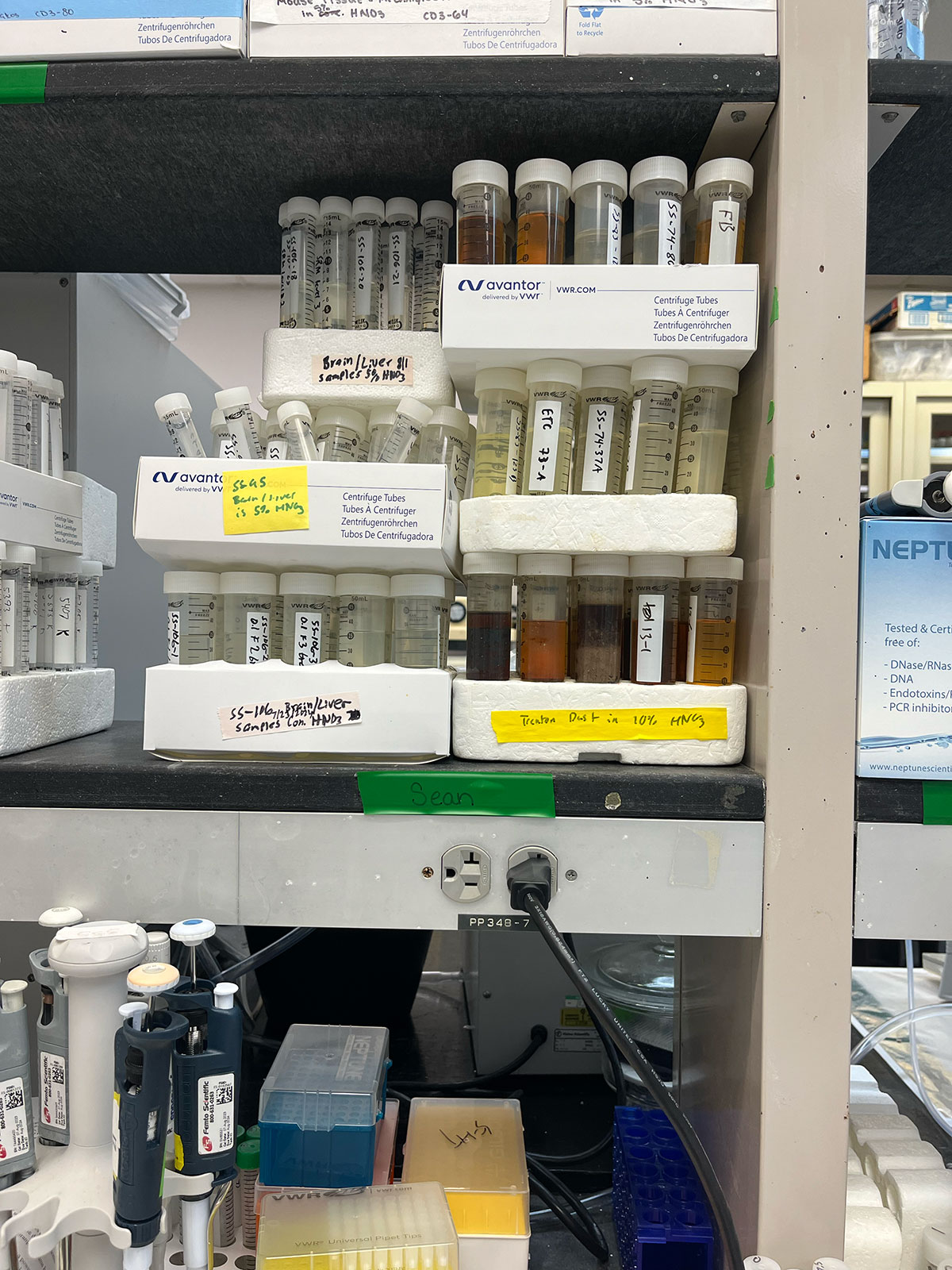
    Vials of samples on a shelf
    Stratton takes his vials of samples back to his lab at Rutgers University for processing. Anna Mattson

    Without coordination, door-to-door outreach, or a mandate for proactive household-level screening, the burden falls on residents to navigate a maze of programs — and too often, Stratton said, people who need the information most don’t receive it. 

    “It just doesn’t ever seem to be enough,” Stratton said. “It’s very siloed.”

    Stratton’s work reflects a broader pattern in environmental health research across the United States. In some communities concerned about pollution, residents turn to university researchers for help testing soil or water when government monitoring is limited. In Atlanta, for example, a soil-testing project launched by a graduate student at Emory University and community partners uncovered elevated lead levels in residential yards, prompting a federal investigation. And last year, the University of California, Los Angeles, offered free soil testing to residents affected by wildfires. Efforts like these often depend on temporary research projects, meaning they can end when students graduate or grant funding runs out. 

    Read Next
    Image of school children crossing derelict train tracks
    Ghosts of Polluters Past Yvette Cabrera

    Stratton’s research in East Trenton has been supported by two grants — one from the National Institute of Environmental Health Sciences and another directly from the federal government. As the Trump administration cuts billions of dollars of grant money, Rutgers’ Environmental and Occupational Health Sciences Institute saw some grants rescinded entirely. Other projects remain in limbo. But Stratton’s grants somehow made the cut, even with “environmental justice” in their titles. Brian Buckley, the institute’s executive director, said further budget cuts mean far fewer opportunities to continue future research.

    “We’ve been playing dodge the bullet,” he said. 


    Stratton didn’t originally set out to investigate lead contamination. After graduating from Rutgers University with a bachelor’s degree in environmental science in 2015, he worked in environmental consulting in New Jersey, sampling soil, air, and water and designing remediation strategies for contaminated sites. Around that time, Flint, Michigan, switched its water supply from Detroit to the Flint River, and triggered a public health crisis when corrosive water from the river caused pipes to leach lead, exposing more than 140,000 people to dangerous levels of the metal.

    A friend who was concerned about the events asked Stratton to sample water at his New Jersey home and send it to a lab to test for lead. The results came back extremely high: more than 78 parts per billion of lead — more than five times the EPA’s action level

    Confused, Stratton began digging through public records, water reports, and federal regulations. He noticed that his own town of East Brunswick was not testing the correct location type. Federal rules require that cities test homes that are most likely to have lead service lines, but Stratton said the agency was largely testing homes less likely to have them. Alarmed at the discrepancy, he began filing public records requests with water utilities across the state to see whether similar gaps existed elsewhere. 

    “I started arguing with the DEP,” Stratton said, referencing the New Jersey Department of Environmental Protection. “And then I decided I needed to go back to school, because I felt like I needed to get more credibility.” 

    A spokesperson for the state agency said in a statement that East Brunswick’s lead testing plan follows federal rules that require water systems to prioritize homes most likely to have lead service lines. It added that when there are not enough of these higher-risk homes available or willing to participate, utilities can test lower-risk homes to meet the required sample sizes. 

    Spurred by what he’d learned about the prevalence of lead contamination, Stratton ran for State Assembly as the Green Party candidate for East Brunswick in 2017. His candidate profile says that he will “continue to fight to ensure that our water is suitable to drink.” Stratton lost the race, but he returned to Rutgers three years later to earn a master’s degree in public health and then continued into a doctoral program.
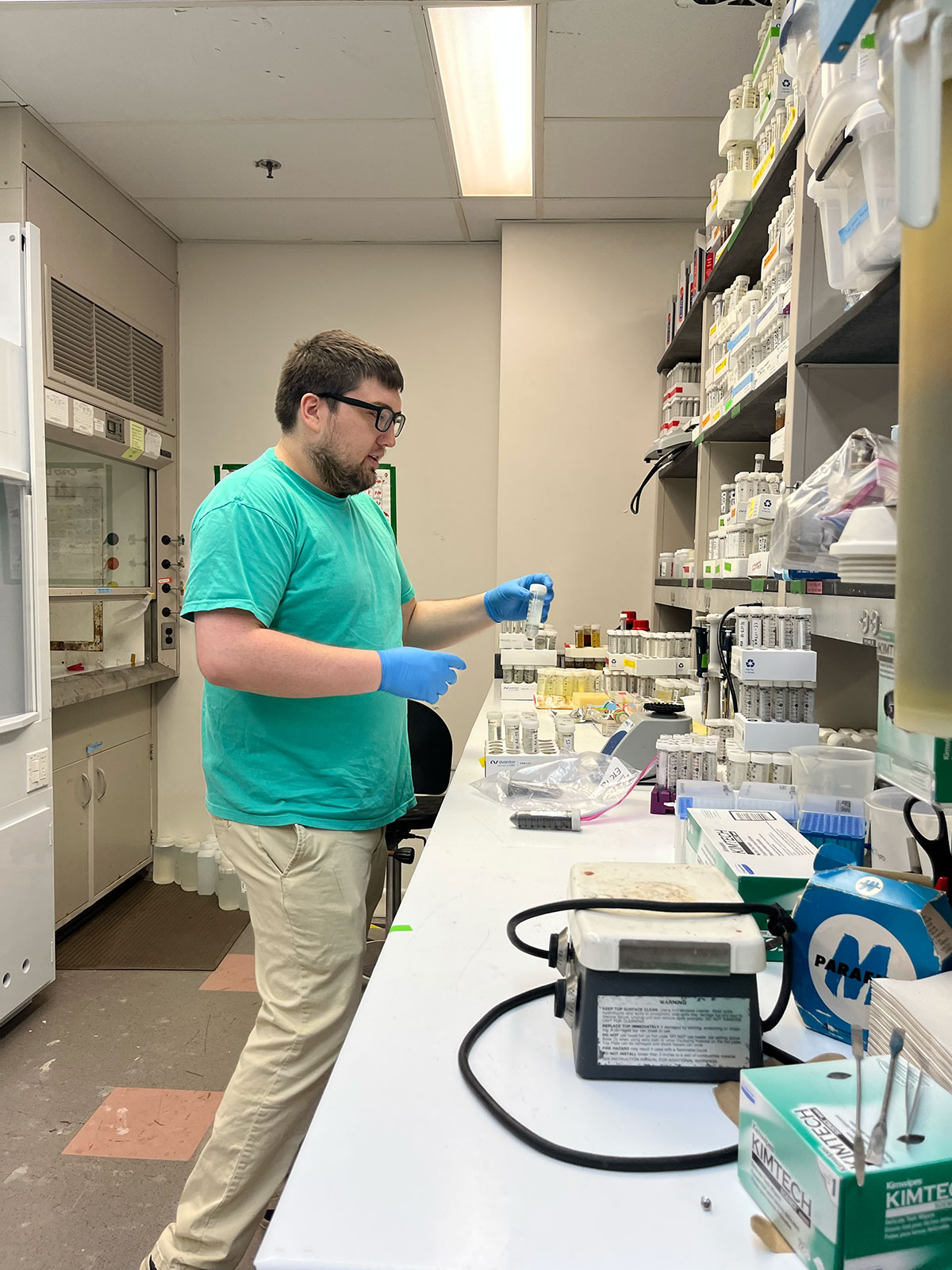
    Man standing in a laboratory
    Stratton has sampled more than 100 New Jersey homes for traces of lead in pipes, soil, and paint. Anna Mattson

    Stratton’s doctoral project had three main objectives: verify whether Trenton residents are exposed to lead, determine where the exposure was coming from, and uncover how residents can reduce exposure. In his testing, Stratton used an X-ray fluorescence gun to scan every wall in a willing volunteer’s home to see how much lead was in the paint. He dropped off water vials for residents to fill in the morning from the kitchen sink — first thing in the morning, before using any water. Out in the yard, he took a small vial and filled it with soil.

    Then he packed up his bag, put it all in the trunk of his car, and made the drive back to the cluttered Rutgers lab, where he would run tests. Afterward, Stratton provided residents with full results, information on what to do next, medical information about where to get blood lead checked, and his phone number, along with his supervisor’s at Rutgers, to call if they had questions. 

    In late February this year, Stratton presented his findings to a team of Rutgers professors during his official dissertation defense. His findings were stark. Most homes he tested had lead, whether it be in the dust, paint, or pipes. All homes measured for floor dust had detectable levels of lead, with 86 percent of them exceeding the EPA’s action level. 

    He also found that homes without lead-based paint in Trenton are still at risk of elevated levels because of the legacy lead dust outside. That outside dust in Trenton comes from a myriad of sources, including gasoline, atmospheric aerosols, and coal and soil contamination from its history of lead-based ceramics manufacturing.

    He also found that running the tap for five minutes before using the water — a common recommendation from public health experts — was still not an adequate amount of time to flush traces of lead. He suggested, in his results, that lead safety guidelines should expand to include reduction strategies, like using a water filter. 

    A week later, he welcomed more than 30 people into a Rutgers classroom for a presentation of his findings. He wanted collaborators and community members to celebrate with him. As gifts, he handed out little square 3D printed urban maps of East Trenton, with streets and raised buildings, to those he’d worked with over the years. Among those in attendance were partners who helped connect Stratton with residents, including Snider of East Trenton Collaborative and Anthony Diaz of the Newark Water Coalition. 
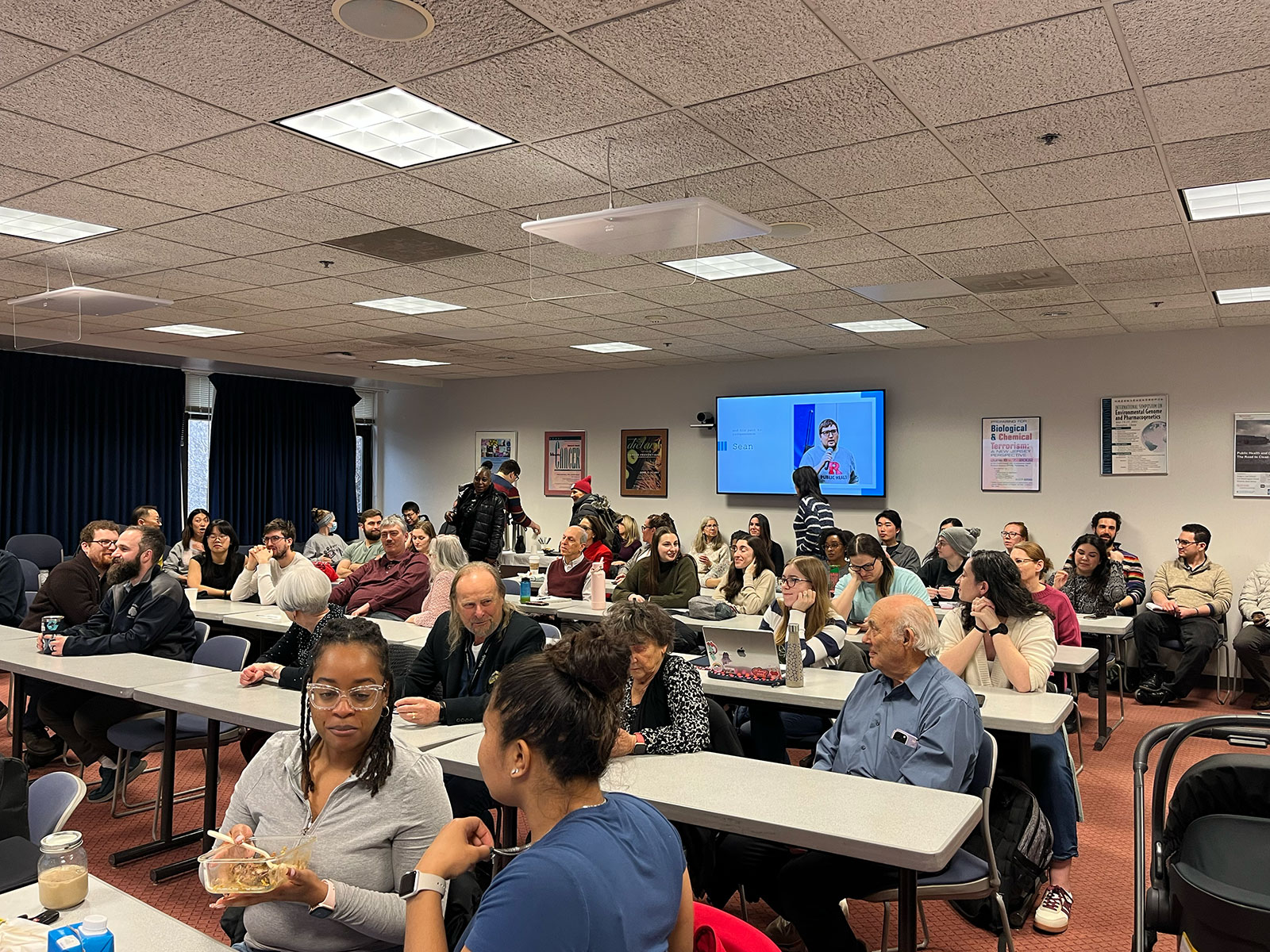
    A room full of people sitting at desks
    In early March, more than 30 friends, family, and colleagues gathered in a Rutgers conference room to celebrate Stratton’s work on lead contamination in New Jersey. Anna Mattson

    The EPA’s decision this summer to list East Trenton as a Superfund site means a cleanup is coming — but slowly, and only for the soil, not the pipes or the paint. The designation triggers more sampling, long-term soil removal plans, and years of federal oversight. Still, none of that has started yet. A remediation plan hasn’t been developed. And in a state dotted with Superfund sites that have languished for decades, residents know what a long wait can look like. 

    For now, Stratton’s research has offered immediate answers for concerned residents. Since learning about the lead in her home, Booker has tried to reduce her exposure. 

    “I use a vacuum to clean my floors and carpets instead of stirring up dirt and dust particles by sweeping,” Booker said. “When my nieces come over and want to run around in the yard, I make sure they remove their shoes when they come inside and wash their hands.”

    She said Snider, Stratton, and the East Trenton Collaborative have sounded the alarm on the lead issue in Trenton. Now, she hopes that the community will continue to fight so that the city can be a place where children and families can be healthy and thrive.

    “Knowledge is only powerful and beneficial if its effects change,” Booker said. “We can know there is a problem, but without action, the problem simply remains.”

    This story was originally published by Grist with the headline He’s the only lead tester in this contaminated neighborhood. He graduates next month. on Apr 28, 2026.
    https://grist.org/?p=696999
    Extensions
    This Supreme Court ‘victory’ for oil giants is not what it seems
    AccountabilityClimateClimate & Energy
    A recent ruling puts $745 million to restore Louisiana's coastline in doubt. But the effort to get Chevron and other oil majors to pay is far from over.
    Show full content

    For millions of years, the Mississippi River flowed unchecked, carrying roughly 400 million metric tons of sediment down to Louisiana, where it spilled into the Gulf of Mexico to create new land. But in the early 20th century, a series of dams and river-training structures were built to prevent flooding — leaving the river tamed and unable to produce new terrain at anywhere near its previous pace. Oil and gas development, which ripped broad canals through vulnerable marshland, made matters worse. 

    As sea levels rose, existing land subsided, and more brutal storms battered the coast. Louisiana lost more than 2,000 square miles of wetlands over the last century, a slow dismantling exacerbated by climate change. About a football field or more land disappears every 100 minutes, and the state’s southern parishes are expected to lose another 3,000 square miles by 2050 unless drastic action is taken. After years of devastating hurricanes, many of Louisiana’s southernmost towns have been emptying out.

    Complex restoration efforts remain the state’s best hope, but the Supreme Court hampered these initiatives earlier this month when it unanimously ruled that a lawsuit filed by Plaquemines Parish against Chevron — accusing the company of damaging coastal wetlands and accelerating land loss — should be moved to federal court, rather than the state court in which it was filed. The ruling effectively cancels a $745 million judgment against Chevron, decided before its appeal landed in front of the Supreme Court, and sets up a rematch of a decade-long legal fight. 

    “Frankly, it’s a ridiculous situation,” said Patrick Parenteau, emeritus professor at the Vermont Law and Graduate School. “All this time and effort has gone into litigating these issues before a jury in Louisiana. Now you have to do it all over again, but you’re doing it sort of up the street in the federal courthouse.” 

    Federal courts are generally seen as more industry friendly, and the Supreme Court’s ruling was applauded by the Trump administration. Critics are calling it a win for oil majors, but legal experts say it’s only a brief reprieve for oil companies, which will still have to face a Louisiana jury in federal court.  

    Plaquemines Parish’s lawsuit is one of dozens filed by Louisiana’s parishes against oil majors. Chevron appealed the state court’s ruling in favor of Plaquemines Parish last year, because the case focused on the company’s work drilling off the Louisiana coast back in World War II. Justice Clarence Thomas argued that the lawsuit should be moved to federal court, as the company was working as a military contractor during that time. 

    “I was surprised that the case was not removed to federal court originally,” said Edward P. Richards, a professor of law at Louisiana State University. He said that the lawsuit involves a number of aspects — dredging permits in navigable waterways, for example — that fall under federal purview. 

    “I think that might be the reason the more liberal justices also went along with the ruling,” Richards said. “There were a lot of reasons that this should be in federal court.” 

    What’s more, Richards explained, so few people are left in some of the southern parishes that it’s difficult to find an impartial jury — although it’s also unlikely companies will find a much friendlier audience in federal court. Louisiana might be one of the most conservative states in the country, but residents in these low-lying parishes don’t need to believe in or care about climate change to see that sea levels are rising and flooding has become more frequent. Governor Jeff Landry, for example, has been a longtime supporter of oil and gas, going so far as to call climate change a “hoax” and packing state environmental offices with fossil fuel executives. Still, the Republican has explicitly backed these parish lawsuits demanding damages from oil companies.

    The transfer of the Plaquemines lawsuit to federal court is sure to be frustrating for parishes looking for funds to restore their coastlines. Last year, Louisiana lost its most ambitious plan to combat sea level rise when Landry canceled the Mid-Barataria Sediment Diversion Project. The initiative was formed as part of the state’s “coastal master plan” and aimed to harness Mississippi’s former land-making power through an intricate series of locks and dams, funneling sediment into Barataria Bay off Plaquemines Parish, where it would support the growth of new wetlands.

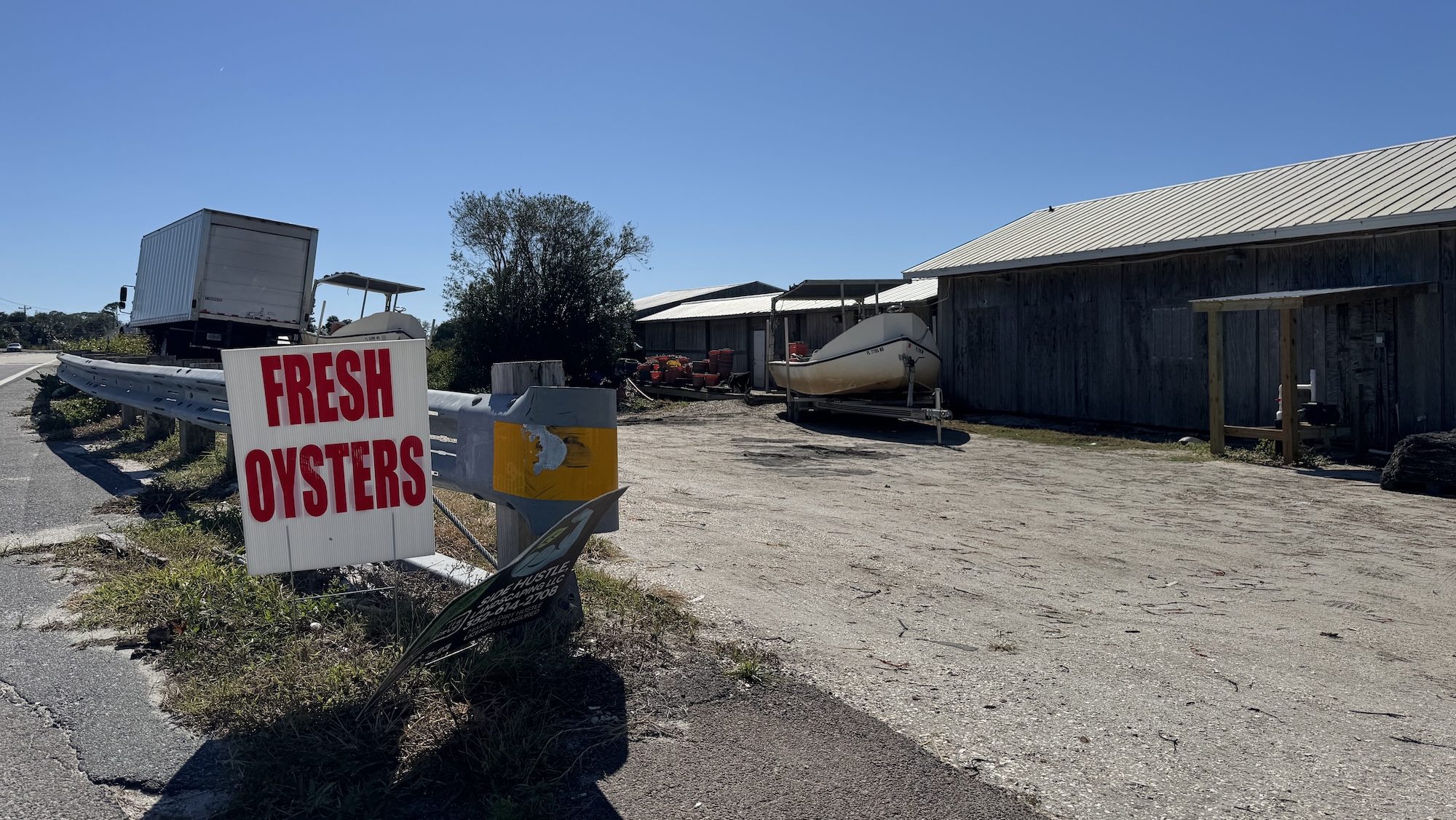
    The project would have been one of the largest ecosystem restoration undertakings in the country’s history, according to The Audubon Society, and was supposed to be funded in part by remediation money from the Deepwater Horizon Spill. But Landry scuttled it, citing concerns about construction costs — even though the project had received $3 billion in funding from the Deepwater Horizon settlement —and the possibility that the project would damage the state’s seafood industry. Many shrimpers and oyster farmers opposed it over worries that the influx of freshwater from the Mississippi River would drive their catch out of the bay. 

    Both Richards and Parenteau said that the Supreme Court’s decision is unlikely to have any impact on the climate lawsuits filed by other states, such as Hawaii and Rhode Island. Those lawsuits are not concerned with the damage the oil industry has done to any specific area, but rather what companies said and when: Oil majors, those lawsuits contend, knew that climate change was real and ran disinformation campaigns to avoid the consequences. 

    “We’re a long way from finding out what these individual cases are going to result in, in terms of damage awards,” Parenteau said. “But it could be a very, very significant amount of money, that’s for sure.”

    This story was originally published by Grist with the headline This Supreme Court ‘victory’ for oil giants is not what it seems on Apr 28, 2026.
    https://grist.org/?p=697145
    Extensions
    Nearly two decades after landmark Indigenous rights declaration, countries still aren’t complying
    Global Indigenous Affairs DeskIndigenous Affairs
    At the U.N., global leaders say governments must stop talking and start implementing protections they adopted.
    Show full content

    Nearly two decades after the United Nations adopted a landmark declaration on Indigenous rights, advocates say countries still aren’t living up to their promises to uphold and respect those rights.

    Indigenous people are being killed for protecting their territories, criminalized for practicing their culture, and seeing their lands stripped of resources without consent. Last week at the United Nations Permanent Forum on Indigenous Issues, or UNPFII, the world’s largest gathering of Indigenous peoples, leaders called for countries to fully implement the U.N. Declaration on the Rights of Indigenous Peoples, or UNDRIP, and other international human rights standards.

    In 2007, the United Nations General Assembly adopted UNDRIP, a sweeping resolution that established international standards for Indigenous land, language, health, and more. The United States and Canada were among a handful of countries that initially opposed the declaration and later adopted it. But in the years since, Indigenous people in those countries, and around the world, say nations are not living up to the framework.

    At the U.N., Kenneth Deer, a member of the Mohawk Nation of Kahnawà:ke, delivered a joint statement on behalf of the Canadian Coalition for the Human Rights of Indigenous Peoples. He called for states to establish independent monitoring systems to “ensure the full and effective implementation” of UNDRIP.

    “You need to have a group of independent, Indigenous individuals who will have access to how the government is implementing the declaration,” he said. “They should be able to study what they’re doing and make an evaluation whether they’re being effective or not, and then whether there’s failures. They need to highlight those failures to the government, and that’s how you get effective implementation.”

    Deer acknowledged how complicated that process could be, which he said highlights the need for a monitoring body. “To implement the declaration, they need a watchdog,” he said. “They need somebody over them to make sure they’re carrying out their responsibilities.”

    For many Indigenous nations, health also means cultural and spiritual health. Moses Goods, who is Kanaka Maoli, spoke on behalf of the Nation of Hawai’i and highlighted “the right to remain who we are.” He explained how Indigenous languages serve as memory, identity, and medicine — and are a protected right under UNDRIP.

    “Language is a link to our culture. It’s a link to who we are as a people and our identity, which is linked to health. When you take those things away, the health of the people start to decline,” he said. “It was intentionally taken away from us as Indigenous people, as Indigenous Hawaiians, so that we would decline. And it worked to a degree, until now.”

    Today, culture continues to be weakened, including with the disruption of access to lands, such as the wildfires that have caused displacement in Lahaina. 

    Despite the challenges, Goods noted that coming together as Indigenous Peoples in places such as the UNPFII is an important step. “We keep telling our stories, we keep telling the truth over and over again to each other, and we strengthen each other. And with those numbers, we can make something happen,” he said.

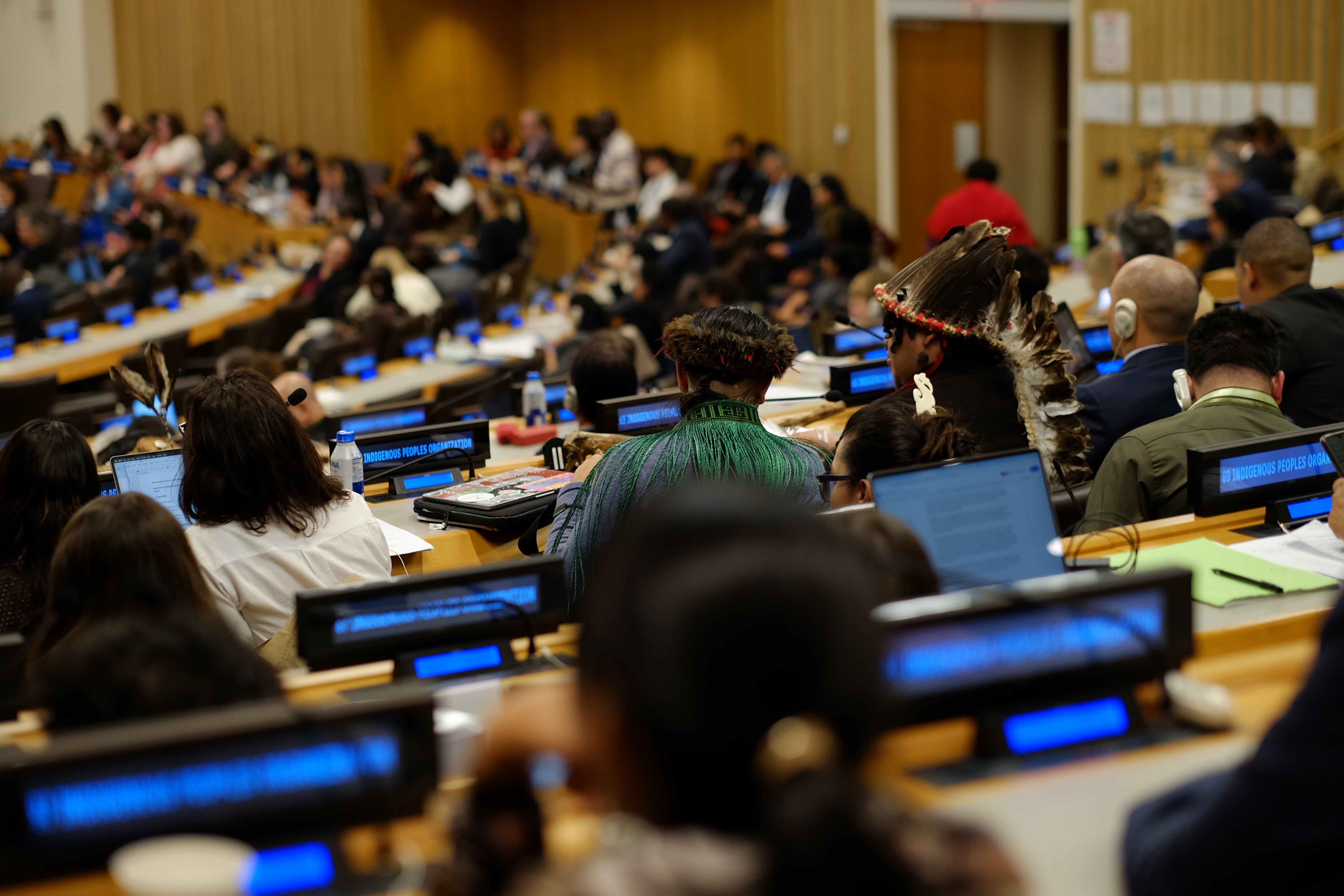
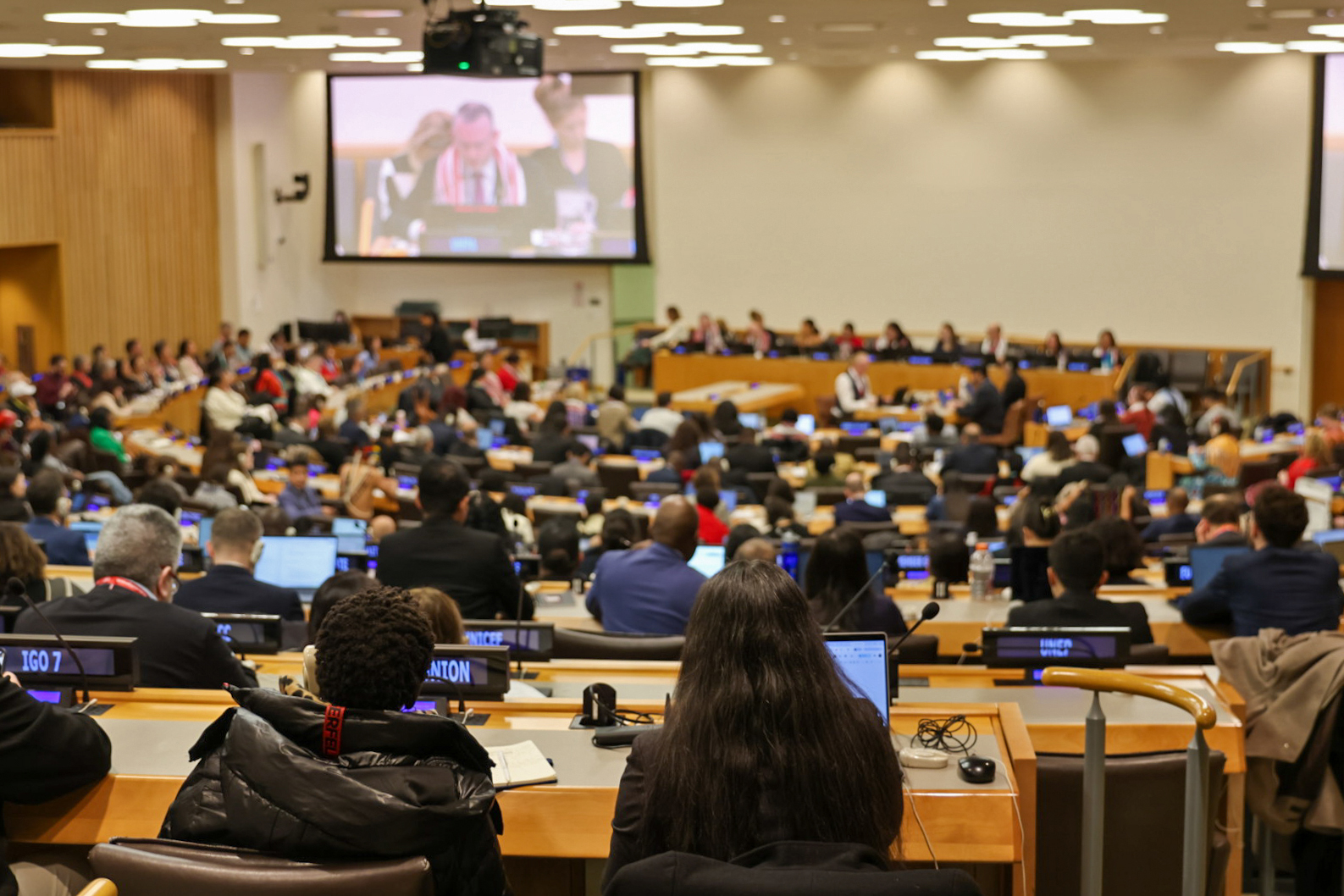
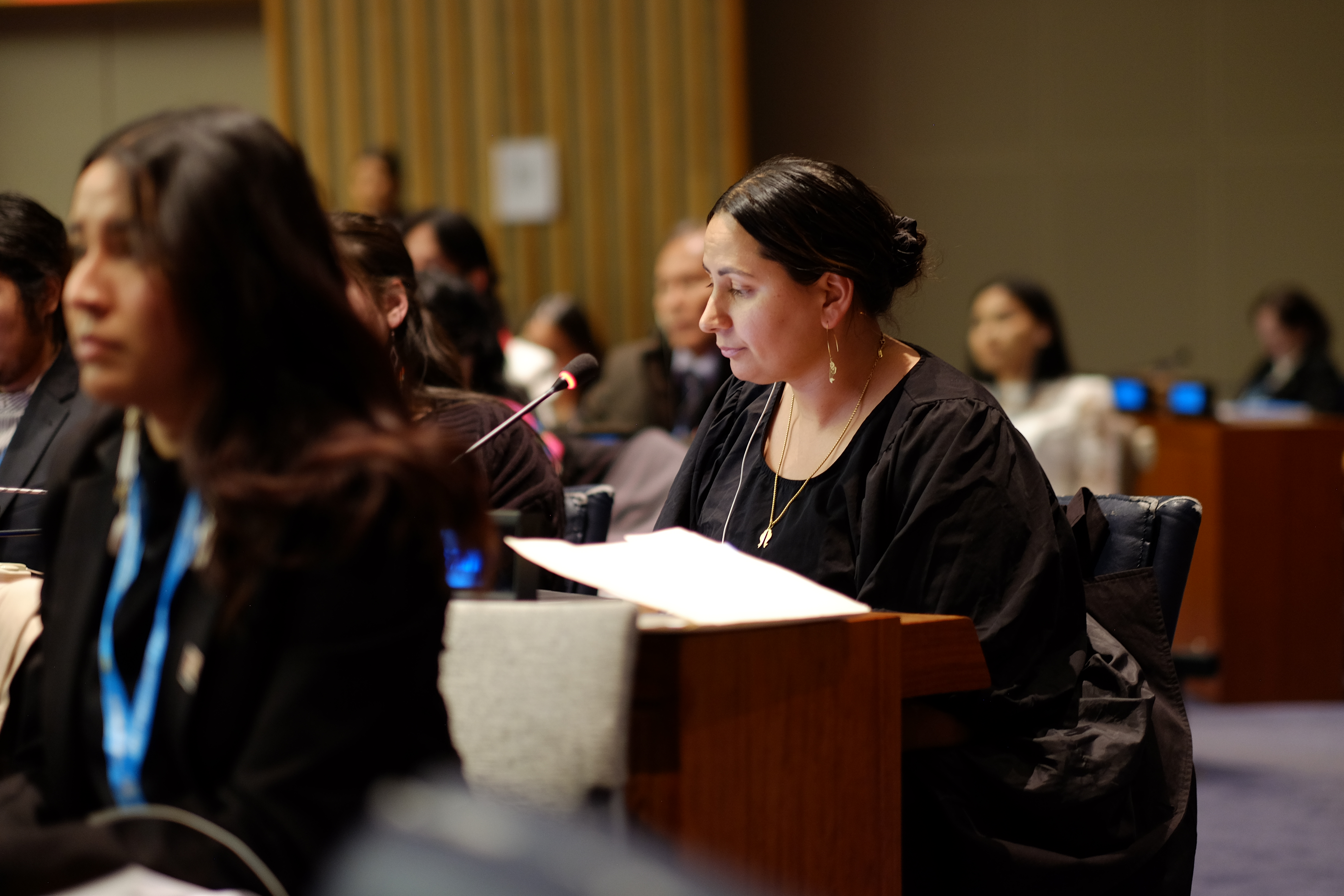
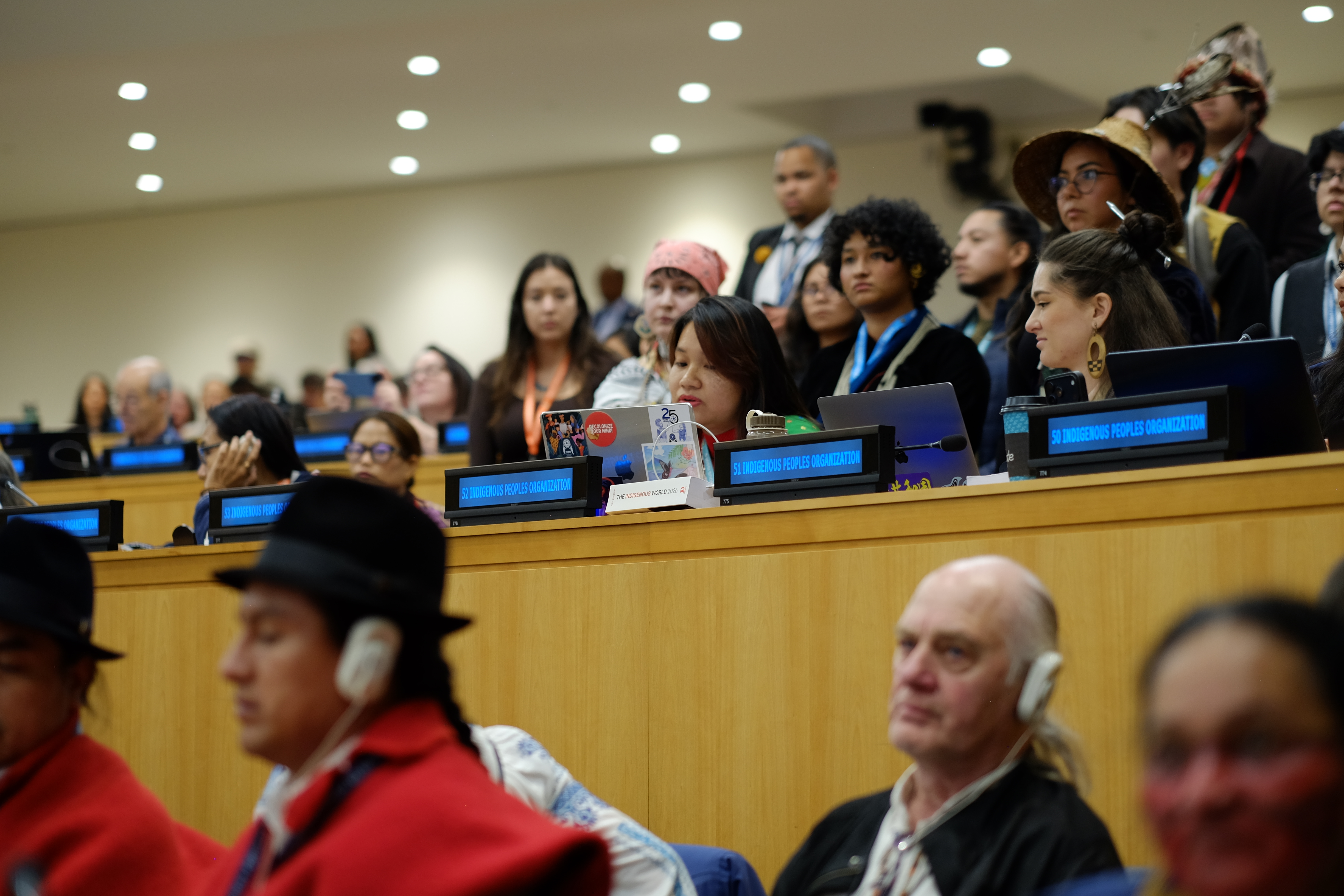
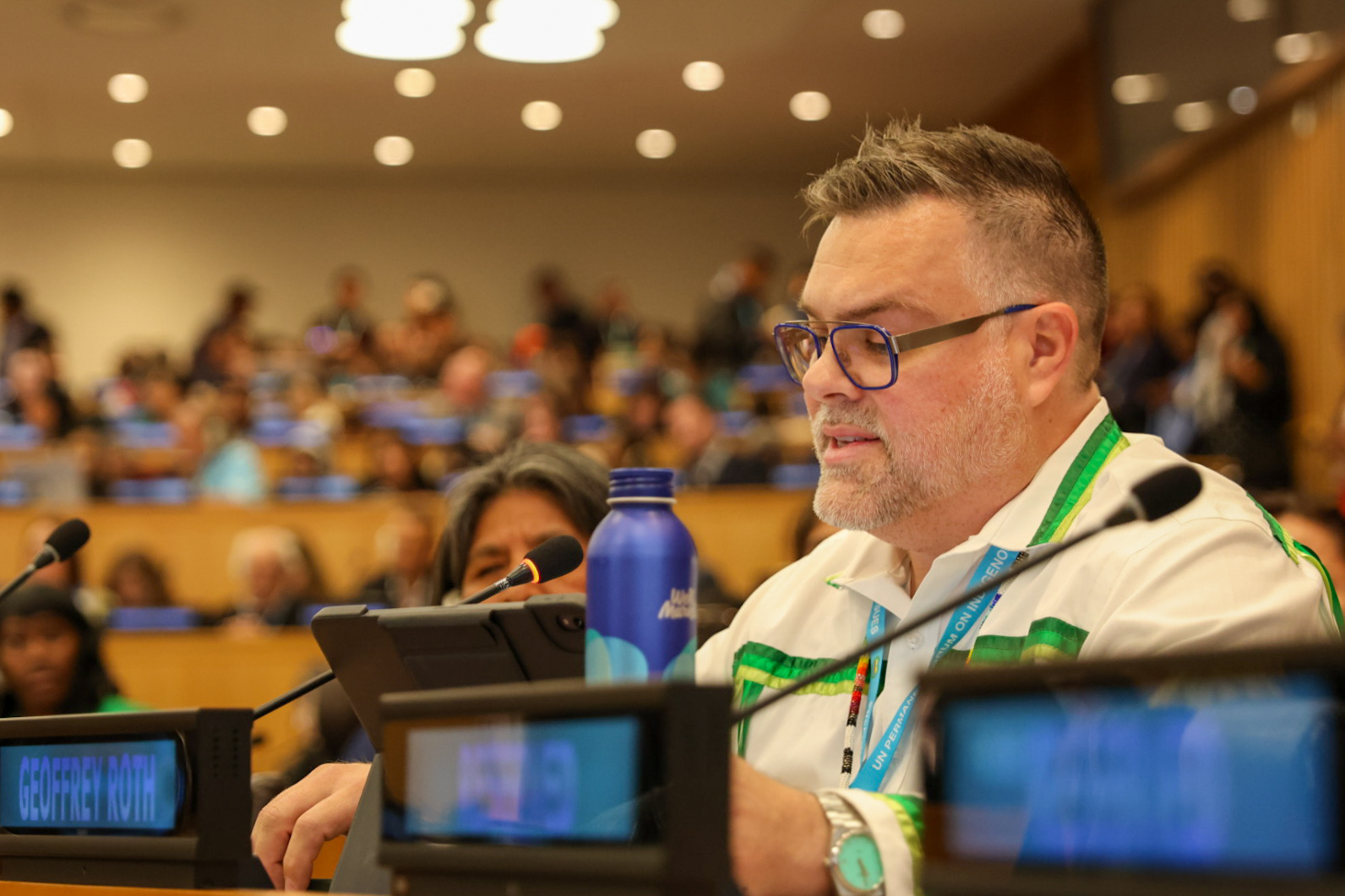
    Delegates address the United Nations Permanent Forum on Indigenous Issues. Tristan Ahtone / Grist

    In 2021, Canada passed a law that committed to aligning all government policies with UNDRIP, but Indigenous advocates at the U.N. said there’s still a long way to go for those rights to actually be upheld. 

    Ryan Fleming is from Attawapiskat First Nation in the remote Mushkegowuk territory of Northern Ontario and described his community as “frozen in time,” a symptom of the poverty he said is created by Canada.

    In 2019, Attawapiskat Chief — then councilor — Sylvia Koostachin-Metatawabin and former chief Theresa Spence endured a 15-day hunger strike to secure change from provincial and federal governments to reenact a dormant task force to address the urgency of water quality in the community and other issues affecting the members.

    “Until Canada addresses those structural conditions, then you can’t properly move forward with UNDRIP,” Fleming said.

    In an emailed statement, Jennifer Cooper, spokesperson for Crown-Indigenous Relations and Northern Affairs Canada, responded to concerns about Indigenous rights and highlighted the Crown’s efforts, which include an Indigenous advisory council and increased funding.

    “As we implement the Building Canada Act and advance nation-building projects, we will honour our commitments under the United Nations Declaration on the Rights of Indigenous Peoples Act, Duty to Consult, and Modern Treaties and Self-Government Agreements,” Cooper said. “We have made real progress together, but we know there are still barriers that slow things down. We’re improving how we work internally and bringing greater clarity to the process. We continue to develop rights-based agreements together with our partners in the true spirit of reconciliation, shared prosperity, and partnership.”

    The Province of British Columbia, which enacted legislation to enforce UNDRIP in 2019, has recently been under fire for seeking to suspend or amend parts of that law, after a court ruling found the province inconsistent with its own rules. The province has since backtracked, saying it would collaborate with First Nations leaders on a path forward.

    “The inherent pre-existing rights of First Nations are part of, and are protected by, international human rights law,” said Assembly of First Nations National Chief Cindy Woodhouse Nepinak in a statement at the UN. “[UNDRIP] affirms First Nations rights as human rights. Neither Canada nor British Columbia can extinguish, amend, or suspend First Nations’ human rights and remain a respected member of the international community.”

    Fleming noted that discussions and reports at the UN don’t always mean action is being taken to follow UNDRIP. “In practice, you don’t see that coming to fruition,” he said. “We don’t need a new treaty. We don’t need a new agreement. We just need [Canada] to implement the original agreement. We need to honour that, and then we can move forward.”

    As the UNPFII heads into its second week, Indigenous people around the world continue to fight for survival and the rights outlined in UNDRIP. Ercilia Castañeda is Kichwa and the vice president of the Confederation of Indigenous Nationalities of Ecuador, which represents 15 nationalities and 18 Indigenous Peoples.

    “We cannot speak of health while there is tear gas in our communities, while 60 percent of the water sources in the Amazon are contaminated, while 40 percent of our children live with chronic malnutrition, while around 10,000 people have been murdered in 2025,” Castañeda said in a statement at the Permanent Forum. “We cannot speak of human rights while the fabric of community life is being ripped apart.” 

    Castañeda called on Ecuador and international bodies like the UNPFII to strengthen and follow legal human rights frameworks.

    Indigenous leaders also repeatedly highlighted the need for direct funding to support UNDRIP implementation. In a presentation, Aluki Kotierk, who is Inuk and the chair of the Permanent Forum, explained the importance of the U.N. Trust Fund for Indigenous Peoples, which she said “contributes directly to facilitating the implementation of the United Nations Declaration on the Rights of Indigenous Peoples.”

    But Kotierk also said support from member states for the fund is minimal. Kotierk noted that there are only three states that contribute annually to the fund. 

    New systems, including a policy marker system by the United Nations Development Programme, or UNDP, are set to help track that funds reach Indigenous Peoples directly. Indigenous leaders hope that funds for climate and development will reach them without getting delayed through state intermediaries, but the exact process is unclear. The UNDP did not immediately return a request for comment. 

    As Indigenous leaders from around the world demanded change on international and domestic levels, Kenneth Deer said that UNDRIP implementation should be a collaborative process.

    “The relationship is about coexistence. It’s not about domination of Canada over Indigenous people,” he said. “What we need to offer is solutions, not just come to the U.N. and complain about Canada, but come to the United Nations with solutions.”

    The UNPFII is set to run till the end of the week.

    This story was originally published by Grist with the headline Nearly two decades after landmark Indigenous rights declaration, countries still aren’t complying on Apr 27, 2026.

    https://grist.org/?p=697115
    Extensions
    The world is getting too hot to feed itself
    EquityExtreme HeatFood and AgricultureInternational
    A new U.N. report maps how extreme heat is tearing through every layer of the global food system — and mostly overlooks the people at the heart of it.
    Show full content

    Two years ago today, an intense heat wave engulfed much of Brazil. For five days at the end of April 2024, temperatures in the central and southern regions climbed to sweltering heights. Many affected were still reeling from another extreme heat wave that had walloped southern Brazil. Just the month before the heat index in Rio de Janeiro reached a staggering 144.1 degrees Fahrenheit, the highest in a decade. 

    The two events were part of a cycle of prolonged and severe periods of heat that hit one of the world’s largest agricultural powerhouses over several years. Yields of soy and corn, two of Brazil’s biggest commodities, fell in southeastern states like São Paulo. Peanuts, potatoes, sugarcane, and arabica coffee also suffered widespread losses. Droves of livestock pigs in the central-western region were afflicted with severe heat stress for the better part of a year. And when an atmospheric cold front was blocked by the prevailing heat dome and triggered devastating rainfall and flooding throughout the southernmost state of Rio Grande do Sul, the supply chain and markets for pink shrimp were disrupted throughout Brazil.

    Much of this data is documented in a new joint report released last Wednesday by the World Meteorological Organization and the Food and Agriculture Organization of the United Nations. Merging weather datasets with agricultural ones, the report traces the compounding effects of extreme heat on the global agricultural system and outlines how to produce food in a world where extreme heat is becoming a baseline. 

    In the report, Brazil is the sole country-level case study explored in detail; the country’s exports face outsize pressure from warming temperatures and the oscillating extremes of natural weather cycles El Niño and La Niña. But a few dozen other nations are mentioned in the 94-page document, too. 

    The authors cite how, in Chile, warming seas in 2016 prompted massive algae blooms that killed off an estimated 100,000 metric tons of farmed salmon and trout, creating the largest aquaculture mortality event in history. In the U.S.’s Pacific Northwest, when one of the strongest heat waves ever recorded struck in 2021, entire raspberry and blackberry harvests were lost, Christmas tree farms saw 70 percent timber volume declines, and the intersection of extreme heat, vegetative drying, and wildfires led to an increase of between 21 and 24 percent of forest area burned in North America that year. After a record heatwave hit India in 2022, wheat in over a third of Indian states fell anywhere between 9 and 34 percent, dairy animals afflicted with heat stress produced up to 15 percent less milk, and some cabbage and cauliflower yields were halved. And last spring in Kyrgyzstan’s Fergana mountain range, a region known for its year-round snow, spring temperatures rose 50 degrees Fahrenheit higher than the seasonal average — a bout of weather so unusual that it contributed to a locust outbreak and dramatic declines in cereal harvests.

    Human-caused warming has already been increasing at an unprecedented rate. The past 11 years are also the 11 warmest years on record. “We’re not moving at a speed that is good enough,” said Martial Bernoux, senior natural resources officer at the FAO’s Office of Climate Change, Biodiversity, and Environment. “And we have, really, a residual risk that is increasing.”

    On a high-emissions trajectory, much of South Asia, tropical Sub-Saharan Africa, and parts of Central and South America could experience as many as 250 days a year that are simply too hot to work outside by the close of the century, according to the report. 

    Dangerous exposure to heat is already an occupational crisis for much of the world’s agricultural workforce. A 2024 report by the International Labour Organization found that extreme temperatures had put more than 70 percent of the global workforce, or some 2.4 billion people, at high risk. Those findings spurred a call to action on extreme heat by António Guterres, the Secretary-General of the United Nations, in the summer of 2024. He urged governments and the international community to prioritize four areas: caring for the most vulnerable; stepping up protections for workers exposed to excessive heat; boosting resilience using data and science; and quickly and equitably phasing out fossil fuels. 

    Read Next
    A man walks on rocks along the shore as oil tankers and cargo ships line up in the Strait of Hormuz, as seen from Khor Fakkan, United Arab Emirates, Wednesday, March 11, 2026. (AP Photo/Altaf Qadri)

    The war in Iran could plunge the world into hunger Ayurella Horn-Muller

    “Heat is estimated to kill almost half a million people a year,” said Guterres at the time. “That’s about 30 times more than tropical cyclones. We know what is driving it: fossil fuel-charged, human-induced climate change. And we know it’s going to get worse.”

    According to Bernoux, the joint FAO-WMO analysis is a direct response to the UN Secretary-General’s call to action. “The UN said, ‘We have a problem,’” said Bernoux. “So FAO and WMO, we decided to work together to be able to reply to that.”

    Naia Ormaza Zulueta, a postdoctoral researcher at the University of British Columbia studying extreme heat and the agricultural workforce, questions whether their report focuses enough on the people who grow, harvest, and raise the world’s food. 

    “The diagnosis in this report is sharper than anything we’ve had before, and that matters,” said Zulueta, who calls it a breakthrough in perspective — one that underscores how climate change and food systems can no longer be studied in isolation. “The prescription is where the system hasn’t caught up.” 

    First, the worker exposure calculations omit both hourly and nighttime wet-bulb exposure; Zulueta argues that these finer-grained metrics capture the severity of heat exposure for outdoor workers better than daily averages — meaning that she thinks the number of days of dangerous heat identified in the report is likely an undercount. 

    The report’s recommendations on how the sector can best adapt also center entirely on crops, livestock, and ecosystems — such as planting earlier or later in the season, developing heat-tolerant breeds, and investing in large-scale irrigation systems. Direct recommendations for agricultural laborers, though, only appear in passing references to existing international agreements on worker safety and health adopted more than a decade ago. For instance, the FAO and WMO call for dramatically increasing global climate-related development finance for food systems and increasing early-warning systems to lessen extreme heat’s compounding risks, but no concrete roadmap is provided for how best to adapt food production in order to protect the billions of outdoor workers exposed to intensifying heat. 

    Perhaps the oversight, says Zulueta, is because UN agencies tasked with worker rights — like the International Labour Organization — weren’t involved in the report. Even so, she finds it hard to justify, given the UN Secretary-General’s own emphasis on protecting the workforce from escalating temperatures.

    “The workers are present in the diagnosis, but they’re largely absent in the prescription,” Zulueta said. “It’s a little sad, to be honest with you. It almost feels like the human dimension is missing, and everything that comes with it.”

    This story was originally published by Grist with the headline The world is getting too hot to feed itself on Apr 27, 2026.
    https://grist.org/?p=697047
    Extensions
    The huge, untapped potential of planting rooftop gardens in cities
    CitiesFood and AgricultureSolutions
    To adapt to a rapidly warming world, metropolises are looking to green roofs, which boost biodiversity and reduce temperatures and flooding.
    Show full content

    The city has long been a beacon of opportunity, where folks flock to make it big. But metropolises the world over are wasting a major opportunity — many, many square feet of it: Flat rooftops are painted white, when really they should be green.

    Not, mind you, shades of mint green, forest green, or lime green, but with the lushness of actual plants. Adding vegetation to roofs — even if it’s just a coating of grass, moss, and succulents — bestows many overlapping, reinforcing benefits not only on a building’s occupants and owner, but on the surrounding community. Like parks on the ground, gardens in the sky reduce local temperatures and help prevent flooding, all while improving urban biodiversity and feeding pollinators like bees.

    According to a recent report prepared for the European Commission, the executive body of the European Union, if cities accelerated the transformation of these unused spaces into oases — and converted empty walls into vertical yet verdant surfaces — they’d make themselves more comfortable for urbanites as temperatures climb. Burgs might even start growing crops under solar panels, a burgeoning field known as rooftop agrivoltaics, simultaneously generating food and electricity. The technique could be especially powerful as urban populations continue to balloon: According to the United Nations, another 2 billion people could be living in cities by 2050. At the same time, a phenomenon called the urban heat island effect, in which the built environment warms much more than surrounding rural areas, is driving temperatures to increasingly dangerous levels

    “Our goal is to get our cities more dense, but keep them livable and climate-safe,” said Vera Enzi-Zechner, co-lead author of the report and a vice president at the European Federation of Green Roof and Living Wall Associations, based in Vienna, Austria. “Of course, also water comes in, energy comes in, multi-functionality, social cohesion, engagement, and biodiversity.”

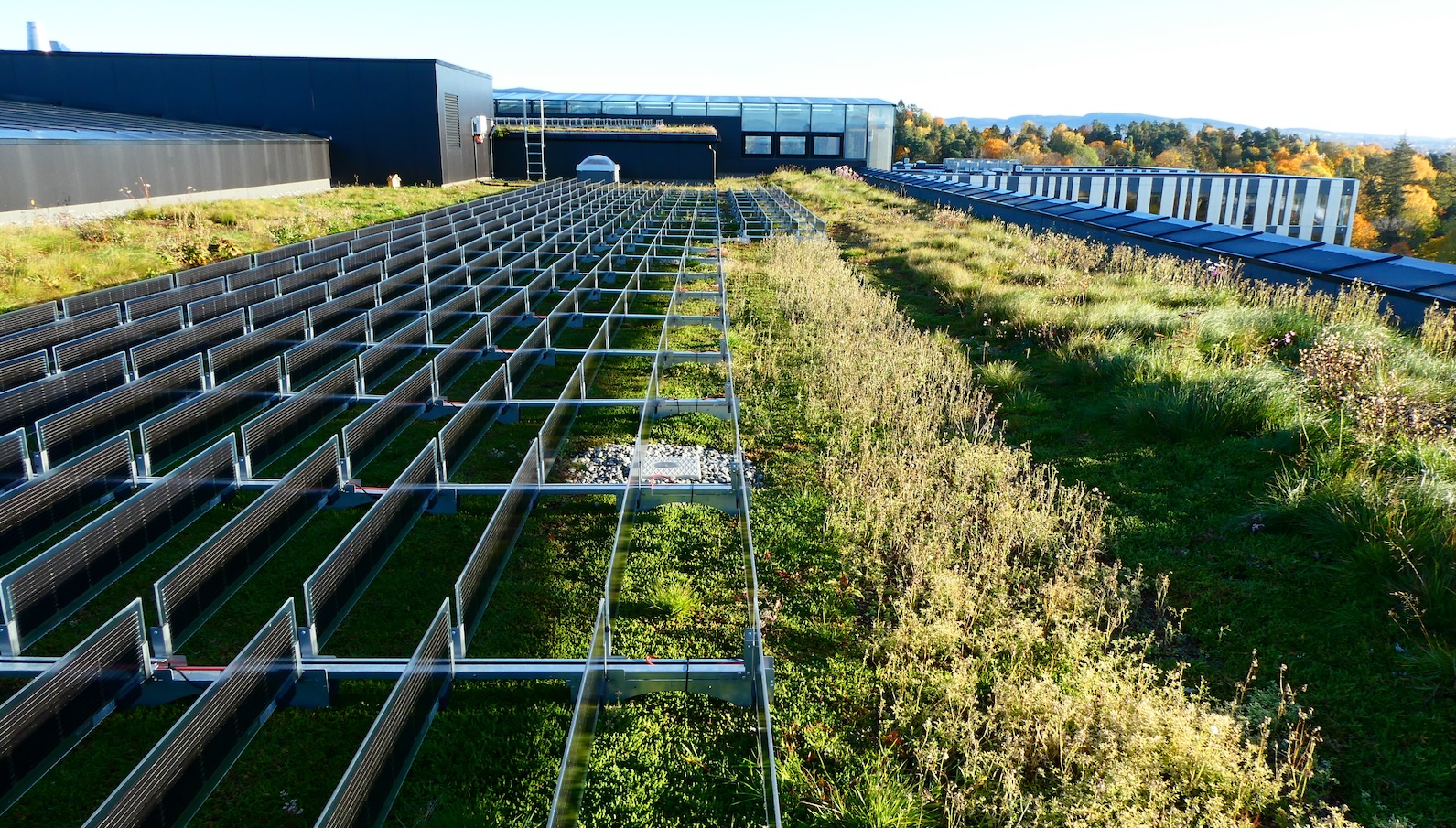
    Even simple vegetation, like grasses and mosses, turns a roof into a thriving ecosystem. Courtesy Over Easy Solar

    The green roof is a surprisingly old technology. Consider the Moos Water Filtration Plant, near Zurich, whose rooftops have hosted nine acres of meadows for over a century. Less of a planned amenity and more of a serendipitous colonization of plant life, the rooftops have nevertheless transformed into refuges for native species. 

    These days, architects would rather not have their buildings bloom by accident. Instead, they’re incorporating the requisite infrastructure into the design. To keep the garden from leaking into the top floor, for instance, they add waterproofing and barriers to contain roots. Designers also must consider the additional weight of the plants and water that soaks into the substrate. How much weight, exactly, will depend on what they want to grow: It might be simple grasses and mosses, like at the Moos Water Filtration Plant, or shrubs, or even trees, whose roots require a thicker layer. And it’s never too late to do this. An owner can add a green roof after construction is finished, though it might require reinforcement.

    The investment, though, could pay serious dividends over time. Whereas a traditional roof absorbs the sun’s energy, a green one sweats like a human, as its plants release water vapor during photosynthesis and shade the surface. This cools the air, and the substrate and waterproofing insulate the top floor. Beyond reducing cooling and heating costs, the greenery can extend the life of a roof, the report notes, because relentless sunlight, extreme heat waves, and hail aren’t aging shingles and paint and such. (Traditional roofs are constantly stressed by expanding and shrinking, as the sun heats them during the day and the night cools them off.) Down at street level, building owners can cover walls with vegetation, protecting them from the elements and providing habitat for birds and bats. 

    Cities, too, could save money by embracing gardening in the sky. As the planet heats up and rainfall gets more intense, gutters and sewers — designed for the climate of yesteryear — are struggling to keep up. Green roofs soak up some of that deluge and slow the flow of water into these systems, preventing costly flooding. Some designers are even going a step further with blue-green roofs, which incorporate systems that store rainwater to flush the toilets inside. 

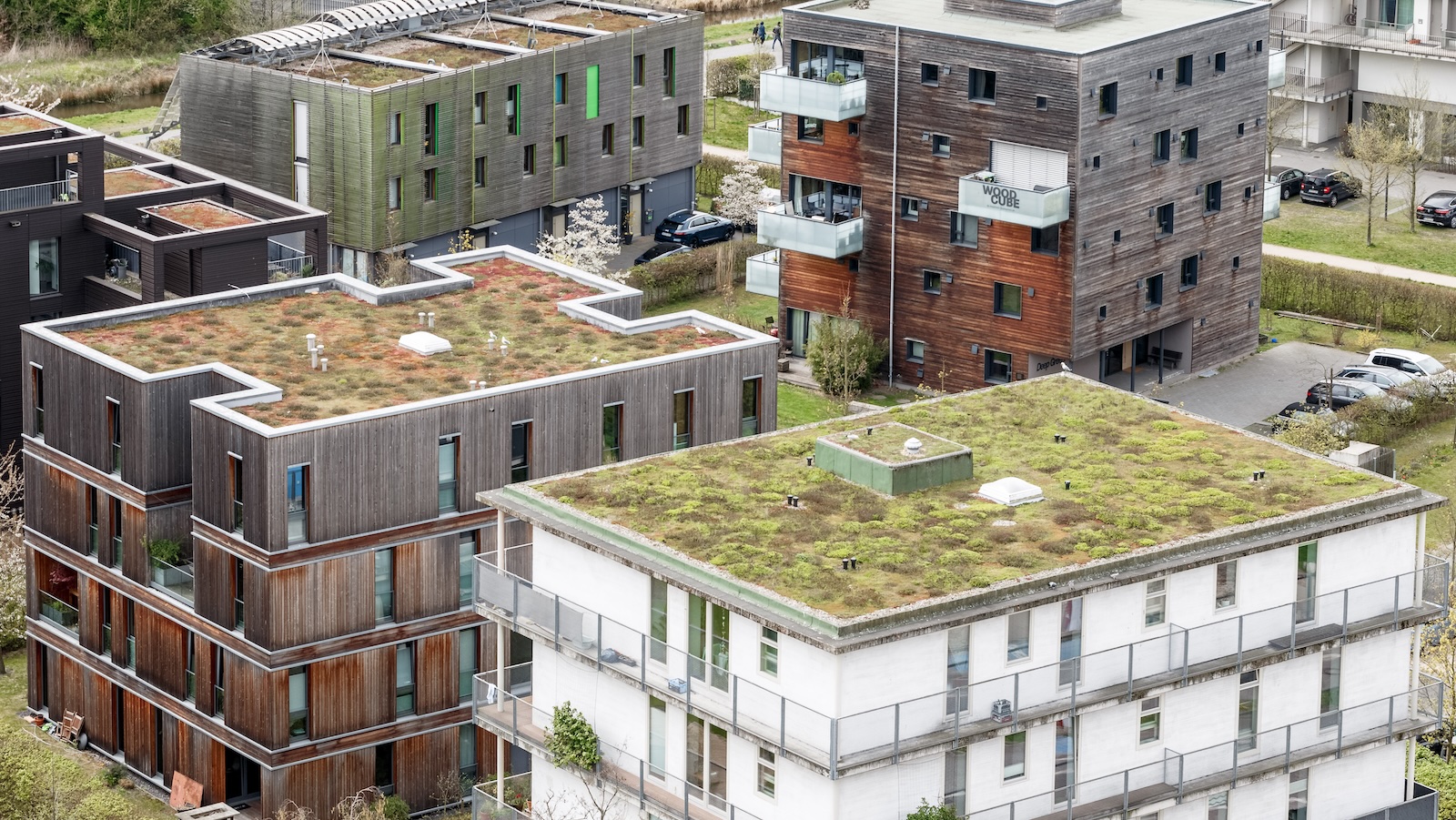
    Green roofs, like here in Hamburg, Germany, provide stepping stones for flying animals to move across the urban landscape.
    Markus Scholz / Picture Alliance via Getty Images

    So instead of all that precipitation flowing into sewers and out to sea, some of it goes instead to plants and people. “That is the basic principle for improved resiliency for many cities around the world,” said Steven Peck, founder and president of the nonprofit industry association Green Roofs for Healthy Cities. “We’ve got to capture that water and use it to support plants, because plants will do good things for us, like clean the air. They’re good for our mental health. They’ll cool the city.”

    Beyond reducing temperatures and flooding, all this additional greenery creates much-needed habitat for local plants and animals. It’s all well and good to have parks and gardens dotting a city, but this creates better pathways for species. Ideally, green roofs and walls would form a citywide network of stepping stones for flying creatures to move around safely, settle down in shelter, and tap reliable supplies of food. Indeed, the report notes that study after study has shown that this not only boosts biodiversity, it provides havens for endangered and rare species of flora and fauna. “We cannot just integrate green roofs or green walls into the urban environment,” said Maria Manso, co-lead author of the report and an assistant professor of engineering at Lusófona University in Lisbon, Portugal. “They have to be connected with other nature-based solutions in order to have this urban connectivity.”

    Free-roaming insects and birds will support the next frontier of green roofs: Scientists are now trying to figure out what crops might grow well up there, under the shade of solar panels. These rooftop agrivoltaic systems shelter the plants from fierce winds and excessive sunlight, and in turn, the vegetation releases water vapor, cooling the panels above and increasing their efficiency, meaning they can generate more electricity. Early research is finding that warm-season crops in particular, like watermelon, do astonishingly well high in the sky, with cucumbers growing as big as baseball bats. The fliers visiting these plants may well travel to nearby urban gardens on the ground and pollinate crops there, or even head to traditional agricultural fields abutting the city.

    Corn grows on the roof of Colorado State University, where scientists are researching which crops might thrive high off the ground. Courtesy Kevin Samuelson, CSU Spur

    The early results with rooftop agrivoltaics are so promising, in fact, that projects are popping up around the world. In Italy, for instance, the Florence airport’s roof will soon host solar panels and a vineyard. “They couldn’t decide between renewable energy generation or their cultural heritage of growing grapes,” said horticulturist Jennifer Bousselot, who studies rooftop agrivoltaics at Colorado State University but wasn’t involved in the report. “So they decided to actually combine the two.”

    While photovoltaic panels increase the upfront cost, they too can pay dividends, and not just with the energy they provide. Because their shade reduces evaporation, rooftop gardeners need to apply less water. That could also mean that a designer might not need as thick a layer of soil to retain water, if less of it is evaporating away. “So in theory, you can actually have a shallower green roof if you’ve got shade integrated, and still have high diversity and high plant success,” Bousselot said.

    Read Next
    Solar farms can be havens for rare plants. Just ask the threecorner milkvetch. Matt Simon

    Given all these benefits, how can cities encourage the proliferation of verdant roofs and walls? The report points out that starting decades ago, Basel, Switzerland, provided subsidies for greening the city’s roofs, then changed its building codes to mandate that all new and retrofitted flat roofs get the treatment. By 2010, the city had increased its green roof surface area from 10 to 100 hectares (247 acres). “This tenfold increase,” the report notes, “positioned Basel as a leading example of how coordinated policy, financial support, and ecological standards can effectively accelerate the adoption of biodiversity-friendly green roofs in urban environments.”

    In the United States, cities set their own building codes, so they could do much the same. A growing number of municipalities in the U.S. are also starting to charge property owners for the rainfall runoff they produce: The more impervious surfaces you have, the more you pay. Rip out more concrete, though, and install gardens high and low, and you can reduce those fees.

    This being American real estate, developers will want to know that even in the absence of subsidies, the things can make money over time, whereas traditional roofs lose it because they have to be replaced within decades. Buildings can even rent out their verdant rooftops for private events. 

    Cities the world over stand at an inflection point: Invest now in as much green space wherever they can get it, or risk withering as the world warms. “They’re going to be healthier places to live in the face of ongoing climate change impacts,” Peck said. “And that’s where the money is going to be. That’s where the creativity is going to be.”

    This story was originally published by Grist with the headline The huge, untapped potential of planting rooftop gardens in cities on Apr 27, 2026.

    https://grist.org/?p=696955
    Extensions
    Michigan wins key legal battle over Line 5 pipeline
    AccountabilityClimate & Energy
    A unanimous Supreme Court ruling clears the way for state court proceedings in the decades-long dispute over the pipeline crossing between Lakes Michigan and Huron.
    Show full content

    Michigan’s decades-long fight to shut down the Line 5 pipeline will be heard in state court after the U.S. Supreme Court unanimously ruled that the dispute belongs there, clearing the way for judges to weigh whether the aging oil pipeline can continue crossing the Straits of Mackinac. 

    The ruling is seen as a win for tribes, environmentalists, and state Attorney General Dana Nessel, who preferred to keep the fight in state court. She has since 2019 been trying to revoke the easement that allows the pipeline to cross the Straits, which connect lakes Michigan and Huron, citing the risk of an oil spill.

    “For far too long, following years of Enbridge’s delay tactics, the fear of a catastrophic spill from Line 5 has haunted our state, threatening to turn our most vital natural resource into a man-made disaster,” Nessel said in a statement.

    The pipeline, owned by the Canadian company Enbridge Energy, transports crude oil and natural gas liquids 645 miles from Superior, Wisconsin, to Sarnia, Ontario, a route that includes a critical 4.5-mile segment along the lakebed of the Straits.

    Writing for a unanimous court, Justice Sonia Sotomayor said Enbridge waited too long to move the case to federal court and that the company’s “counterarguments are not persuasive.” 

    Legal experts said the procedural ruling was significant because it determines which court will decide the pipeline’s future. Enbridge’s lawyers argued that a federal court was the proper venue because federal safety laws and international agreements are involved. (The Canadian government opposes shutting down Line 5, which provides half of the oil supply for Ontario and Quebec). Michigan’s lawyers countered that the pipeline violates the state’s ability to manage its natural resources, making this a matter for state court.

    With the question of jurisdiction answered, legal experts said state courts can now decide whether the portion of the pipeline spanning the Straits should be shut down. A unanimous decision by the high court is a “big deal,” said Andy Buschbaum, lawyer for the Great Lakes Business Network, which filed briefs in support of the attorney general.

    “The justices of the court, regardless of ideology, agreed that it’s the state court that’s the proper court to hear this dispute,” he said. “We’re finally in a position for the state court to actually decide whether Line 5 belongs on the bottom of the Great Lakes, or whether there are alternatives.” 

    Arguing the case in Michigan’s 30th Circuit Court also is expected to sharpen the focus on tribal sovereignty. All 12 federally recognized tribes in the state have called for Line 5 to be shut down, saying it threatens their waters, treaty rights and ways of life. They were not part of the Supreme Court proceedings. 

    “It will really create space now for tribes to uplift their voices in the proceedings, to uplift tribal treaty rights, to uplift the protection of natural resources and ultimately the preservation of our cultural lifeways,” said Whitney Gravelle, president of the Bay Mills Indian Community, one of the parties involved in separate litigation against Line 5.

    The case won’t be heard until an appeal of a separate case moves through federal court. Enbridge sued Michigan Governor Gretchen Whitmer for trying to shut down Line 5 in 2021, arguing that the state has no authority over pipeline safety. The Sixth Circuit Court of Appeals sided with the company in November, and Whitmer appealed the decision in January.

    Asked about the Supreme Court decision, Enbridge spokesperson Ryan Duffy cited the Sixth Circuit ruling that said the federal government regulates Line 5’s safety. The Pipeline and Hazardous Materials Safety Administration has found “no safety issues that would warrant its shutdown,” Duffy said.

    The legal back and forth comes amid ongoing court and regulatory battles over Enbridge’s plan to replace the aging dual pipelines beneath the Straits with a tunnel housing a segment buried beneath the lakebed. 

    The company is awaiting various state and federal permits, with decisions expected this summer. And last month, the Michigan Supreme Court heard oral arguments from tribes and environmental groups trying to overturn a permit the Michigan Public Service Commission issued in 2023.

    Lawyers for Enbridge defended the proposed tunnel last month, claiming it would make a safe pipeline even safer. “Under any standard, this safety and environmental upgrade is more protective of the environment than the status quo or any alternative,” said John J. Bursch, a lawyer for Enbridge.

    And in Wisconsin last week, a state court heard arguments in the Bad River Band of Lake Superior Chippewa’s bid to stop construction on a segment of Line 5 that crosses the tribe’s watershed. Gravelle said the Bay Mills Indian Community is supporting the Wisconsin tribe’s litigation against the pipeline.

    “Line 5 is such a complicated issue. But those are not just legal questions. They’re also moral ones and they ultimately ask us what kind of future we choose to protect,” Gravelle said.

    This story was originally published by Grist with the headline Michigan wins key legal battle over Line 5 pipeline on Apr 27, 2026.

    https://grist.org/?p=697076
    Extensions
    How New Mexico is ‘building a forest’ by solving a seedling shortage
    Solutions
    A Q&A with the New Mexico Reforestation Center director about what it takes to replant a burn scar post-wildfire.
    Show full content

    Recovery from the Hermit’s Peak-Calf Canyon Fire has been daunting. Residents are still waiting for disaster relief payments even as floods sweep through the ashy burn scar, contaminating the drinking water downstream. And then there’s the forest itself: in desperate need of new trees but lacking the necessary seedlings.

    Wildfires have burned 7 million acres across New Mexico since 2000, and millions of seedlings are needed to replant the burned areas. The Hermit’s Peak-Calf Canyon Fire alone, the largest in state history, needs 17.6 million seedlings. Trees play an integral role in restabilizing burned hillsides and protecting the drinking water sources below them. But current reforestation facilities lack the capacity to keep up with demand, creating a dire shortage. Experts estimate it would take 50 years to replant the Hermit’s Peak-Calf Canyon burn scar at current rates.

    That’s where the New Mexico Reforestation Center comes in. Conceived in 2022 as a collaboration between the state Forestry Division, University of New Mexico, New Mexico State University, and New Mexico Highlands University, the center is now about to break ground on an “absolutely massive” greenhouse facility that expands existing infrastructure in the northwestern part of the state, Director Jennifer Auchter told High Country News.

    The greenhouses, which will eventually total 155,000 square feet in size, are an essential part of the seed-to-seedling-to-tree post-fire reforestation pipeline, which involves processing over 1,500 pounds of native seed for future planting while researching ways to help seedlings survive an even hotter and drier future. (The enterprise has a uniquely New Mexican flavor: Auchter said that a repurposed chili roaster is used to extract seeds from cones and pods at the existing seed-processing facility.)

    High Country News caught up with Auchter in mid-April as she prepared for the greenhouse groundbreaking to talk about how the center will more than triple the state’s current seedling production capacity and why a “right tree, right place” approach is important for the success of modern reforestation.

    This conversation has been edited for length and clarity.

    Q. Why is re-planting a forest after a wildfire so important?

    A. This is my favorite part of the whole story. My background is in earth science, watershed management, fluvial systems, and that sort of thing. So I think about this from a “forest being water infrastructure” perspective, particularly in New Mexico and the Southwest. Here, it’s the snowpack in the winter that feeds our rivers and streams. People have tried to quantify this a bunch of different ways, but it’s something like 70 percent of all the water we use is coming from a forest, whether it’s the snowpack or the precipitation that streams capture.

    The likelihood of a forest actually regenerating (after a high-severity wildfire) is not very likely in our lifetimes. It could be decades to even centuries. For us, because of our water infrastructure here, we really need to conserve forests even just to have a water source.

    Courtesy of Jennifer Auchter

    Q. What are New Mexico’s current reforestation needs, given several large wildfires in recent years?

    A. The state’s current burn scars need 385 million trees, and that doesn’t include future wildfires. That’s just the existing backlog.

    Q. How many seedlings can current operations in New Mexico grow right now? Tell us about the gap the New Mexico Reforestation Center is seeking to fill.

    A. We say 300,000, but we don’t even usually hit that mark. It’s usually more like 250,000 seedlings per year, and those are grown at the John T. Harrington Forestry Research Center, which is a pretty small and pretty old nursery.

    Most of our tree seedlings are purchased from growers in Idaho. That’s not terrible, but they’re not exactly from the right climate, they’re not exactly from the right elevation, and then when they travel over land, they don’t do as well in planting. They’re kind of shocked when they get here.

    Q. What kind of research has been going on to help set the New Mexico Reforestation Center and its replanting efforts up for success?

    A. What the University of New Mexico is responsible for is doing a lot of the research on modeling: predicting seedling survival based on the site and based on the projected climate. So, when we’re selecting sites and planting out trees, we’re actually doing this for the 2100 climate, not for today’s climate. We want to make sure that these trees are surviving long-term. Then, once they plant it out, they will also do monitoring with drones, and on-the-ground monitoring as well.

    Q. How else are researchers trying to ensure seedlings can survive in hotter, drier conditions?

    A. New Mexico State University researchers are doing drought conditioning, so putting the seedlings under a lower amount of irrigation. They’re drought-stressing ponderosa pine and some of the other species as seedlings, so that when they plant them out, they are ready for that dry environment. There’s another thing that they’re doing specifically for aspen seedling survival in a post-fire environment: planting the seedling next to a log, for example, and trying to give it just a bit of shade while it’s in those early establishing months and years. They’re seeing higher survival for the seedlings that are planted in the shade areas.

    There’s a lot of research going on to try to optimize this, bigger-scale. Once we jump from 300,000 seedlings to 5 million seedlings, ideally, by that time, we will have sorted out the very best methods that are the most successful across the whole reforestation pipeline, from seeds to seedling to planting.

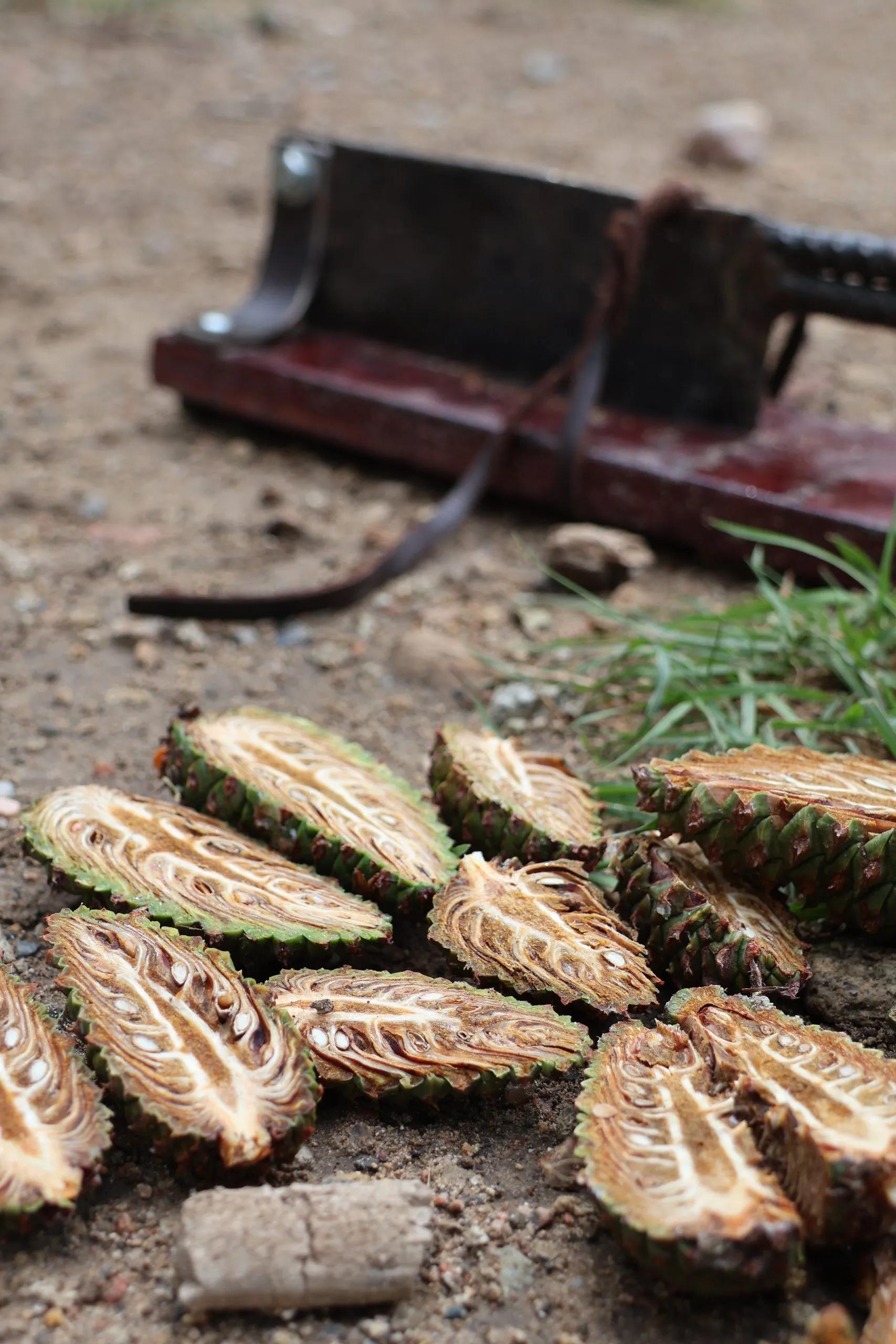
    Pine cones are sliced in two
    Ponderosa pine cones are cut to extract seeds. Courtesy of New Mexico Reforestation Center / Josh Sloan

    Q. Did you look to any other states for reforestation inspiration? What did you learn?

    A. The Pacific Northwest is really great at reforesting. At least in the early days, I think there was an idea that we would model reforestation in the Southwest after reforestation in the Pacific Northwest. But we really just need to have our own regionally tailored methods, regionally appropriate stock — the genetics of the seedling — all of that is really important.

    Q. How will the new forestry center benefit the broader region?

    A. We do anticipate that, particularly in other areas of the Four Corners states, our seedlings will be appropriate. For example, northern Arizona, Flagstaff — that’s a similar elevation, similar species. That could be said for some areas of Colorado as well. So, I think we probably will focus on New Mexico first, but we do expect to actually be able to provide more seedlings longer term, once we start reforesting our own burn scars.

    There’s not an official sort of hub or resource collaboration for the Southwest. There are a lot of groups working here — NGOs, government agencies, universities — there’s a lot of people doing a lot of different things, but they’re generally pretty disjointed. We envision the NMRC bringing those people together.

    Q. What’s an important part of the reforestation process that’s sometimes overlooked?

    A. I think it’s important to highlight the whole reforestation pipeline. The seed collection work that New Mexico Highlands University does is sort of this hidden part of it, right? The greenhouses and the seedlings are flashy, and it’s easy to take pictures and cover that, but the seed collection work is tedious, time-consuming, and requires a massive labor development approach. It’s rugged, it’s hard.

    Q. What do you wish more people knew about reforestation?

    A. I’ve heard a couple of different times, “Wow, that’s an expensive greenhouse.” It’s really not just a greenhouse. There’s so much more that goes into building a forest. It’s quite a daunting action, bringing that to the forefront in any way we can, raising awareness of how many bodies have touched the seed or the seedling or planted it out from the time that seed is collected to when it’s actually growing.

    Q. What kind of long-lasting impact can reforestation have on a community post-fire, and how are you going about that in New Mexico?

    A. I’ll use one example that we just finished last week. We had 48 students across grades from a charter school near Mora come to the seed collection facility, and we had the kids, who lived through wildfire, create a piece of art that was something special to them. During this whole workshop, while they were creating this art, we had some of our forestry experts talk about just the process of reforestation and what all goes into it. The point of it is really to get kids engaged locally at a younger age, so that as they go through school next year, those same kids will come back and get to see maybe some of the seeds they worked with are now in pots as seedlings, and maybe in three years, they get to go see that tree planted out in the forest. Keeping them engaged along the whole timeline of reforestation, to sort of imprint upon them how important conservation is. Because once it’s gone, it takes a long time to bring it back.

    This story was originally published by Grist with the headline How New Mexico is ‘building a forest’ by solving a seedling shortage on Apr 26, 2026.
    https://grist.org/?p=697013
    Extensions
    Nearly half of US children are breathing dangerous levels of air pollution, report warns
    CitiesEquity
    The American Lung Association report comes amid the EPA’s expansive rollback of environmental protections.

    Show full content

    Nearly half of children in the United States are breathing dangerous levels of air pollution, according to a new report, as experts warned Donald Trump’s expansive rollback of protections will make the situation worse.

    The 27th annual air quality report from the American Lung Association, or ALA, released on Wednesday evaluates pollution across the country by grading levels of ground-level ozone — also known as smog —as well as year-round and short-term spikes in particle pollution, commonly referred to as soot. The report analyzed quality-assured data collected between 2022 and 2024.

    It found that 33.5 million children in the U.S. — 46 percent of those under 18 — live in areas that received a failing grade for at least one measure of air pollution.

    The report also found that 7 million children, or 10 percent of all children in the U.S., live in communities that failed all three measures.

    Speaking to the Guardian, Will Barrett, assistant vice president of the ALA’s Nationwide Clean Air Policy, said: “Children’s lungs are still developing. For their body size, they’re breathing more air. And also, kids play outdoors, they’re more active, they’re breathing in more outdoor air … So, air pollution exposure in children can contribute to long-term developmental harm to their lungs, new cases of asthma, increased risks of respiratory illness and other health considerations later in life.”

    Read Next
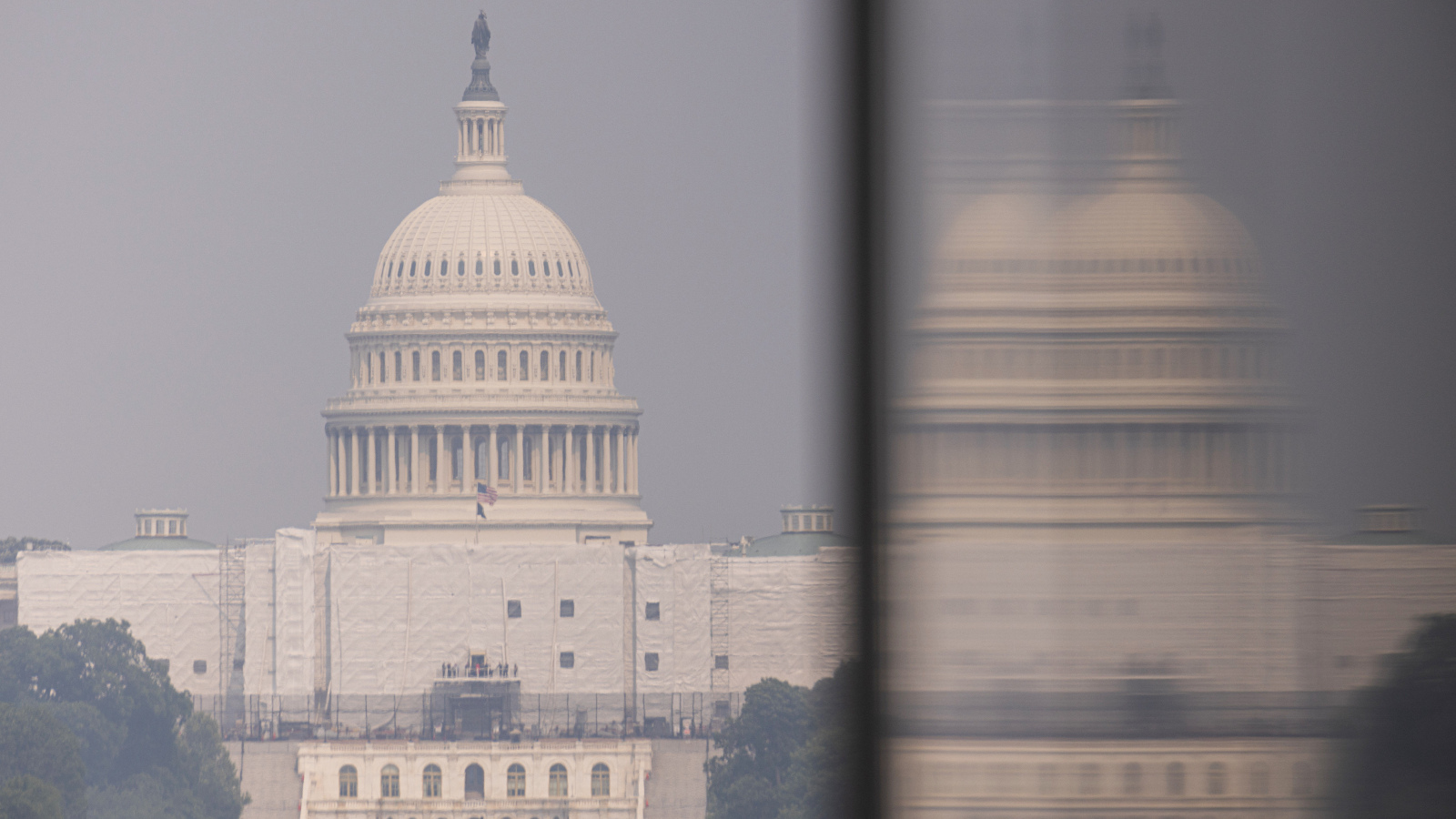
    Photo of U.S. Capitol building is shrouded in haze from wildfire smoke
    How the Trump administration’s climate math doesn’t add up Kate Yoder

    The report further found that communities of color are disproportionately exposed to unhealthy air. As a result, they are more likely to live with one or more chronic health conditions that make them more vulnerable to pollution, including asthma, diabetes, and heart disease.

    Although people of color make up 42.1 percent of the U.S. population, they represent 54.2 percent of those living in counties with at least one failing grade, the report noted. It also found that a person of color is 2.42 times more likely than a white person to live in a community that fails all three pollution measures.

    Smog remains the most widespread pollutant affecting Americans’ health. Between 2022 and 2024, 38 percent of the U.S. population — approximately 129.1 million people — were exposed to ozone levels that put their health at risk. This marks the highest number recorded in the ALA’s report in six years, and a 3.9 million increase from the previous year.

    Several factors contributed to these unhealthy pollution levels, including extreme heat, drought, and wildfires, which have exposed a growing share of the population to harmful ozone, the report said.

    The regions most affected by high ozone levels include southwestern states from California to Texas, as well as much of the Midwest. This is mainly driven by smoke from Canada’s 2023 wildfires crossing into the U.S., along with high temperatures and weather patterns that favored ozone formation in 2023 and 2024 — particularly in Southern states.

    Read Next
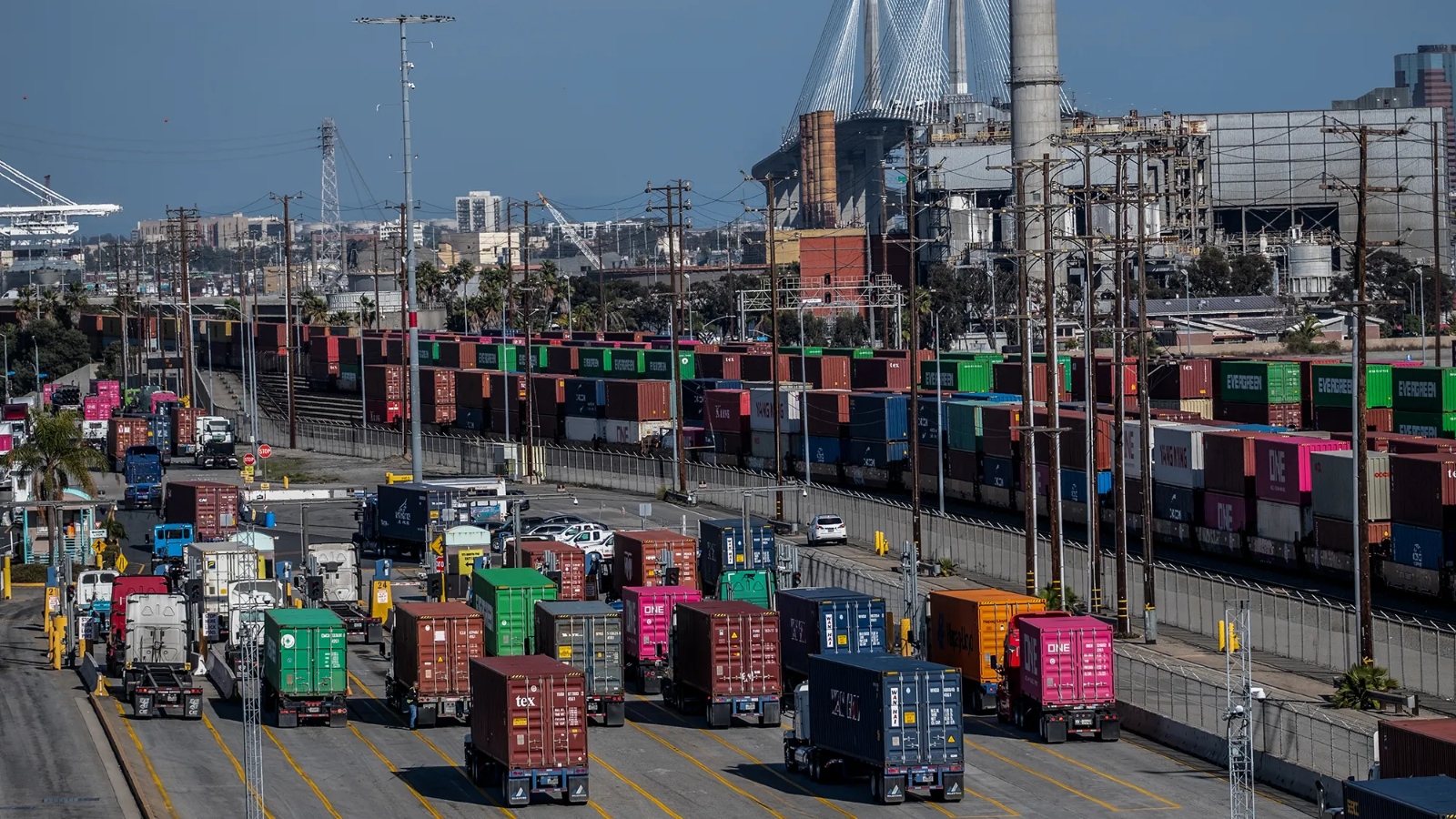
    A port filled with trucks carrying containers
    California bets on an obscure tool to replace clean air authority Trump revoked Alejandra Reyes-Velarde, CalMatters

    More broadly, the report found that climate change is intensifying ozone pollution by boosting precursor emissions and creating atmospheric conditions such as higher temperatures and lower wind speeds that allow pollutants to build up and ozone to form.

    The report also highlighted data centers as a growing source of air pollution. In recent years, data centers have consumed roughly 4.4 percent of total U.S. electricity, a figure that could rise to as much as 12 percent within the next decade.

    Their impact stems largely from reliance on regional electricity grids where fossil fuels such as methane gas and coal still account for a large portion of generation, the report said. In addition, many data centers use dozens of large diesel-powered backup generators, which emit carcinogenic particulate matter.

    “As the demand for increases in data centers continues to grow, the focus needs to be on non-combustion, clean renewable energy sources that are additive and not taking away from the grid,” Barrett said.

    He also pointed to a series of environmental rollbacks by the current Environmental Protection Agency, warning that they are putting air quality at greater risk.

    “There’s a devaluing of children’s health by this EPA as they are weakening, delaying, and repealing critical health protection,” he said, pointing to reversals including “missing deadlines for particle pollution standards, repealing vehicle standards, repealing EPA’s responsibility for protecting health against climate pollution, and even allowing for increased emissions of pollution from oil and gas facilities.” He also cited mercury — a toxic air contaminant released from coal plants — as a key concern.

    “[There is] a wide-scale effort by the federal EPA to eliminate health protections while also distancing themselves from their own mission to protect public health,” Barrett added.

    Since returning to office last year, the Trump administration has initiated at least 70 actions to roll back environmental and climate protections. Among them is the loosening of regulations on power plants that limit mercury and other hazardous air toxics.

    Other rollbacks include overturning limits on major air pollution sources, disbanding EPA advisory committees on air quality, and ending the practice of estimating the monetary value of lives saved by limiting fine particulate matter and ozone while still calculating costs to companies.

    toolTips('.classtoolTips7','<span style="font-weight: 400;">A powerful greenhouse gas that accounts for about 11% of global emissions, methane is the primary component of natural gas and is emitted into the atmosphere by landfills, oil and natural gas systems, agricultural activities, coal mining, and wastewater treatment, among other pathways. Over a 20-year period, it is roughly 84 times more potent than carbon dioxide at trapping heat in the atmosphere.</span>'); toolTips('.classtoolTips12','An acronym for per- and polyfluoroalkyl substances, <span class='tooltipsall tooltipsincontent classtoolTips12'>PFAS</span> are a class of chemicals used in everyday items like nonstick cookware, cosmetics, and food packaging that have proven to be dangerous to human health. Also called “forever chemicals” for their inability to break down over time, PFAS can be found lingering nearly everywhere — in water, soil, air, and the blood of people and animals.<br/>');

    This story was originally published by Grist with the headline Nearly half of US children are breathing dangerous levels of air pollution, report warns on Apr 25, 2026.

    https://grist.org/?p=696994
    Extensions
    AI is a double-edged sword for Indigenous land protection, UN experts warn
    Global Indigenous Affairs DeskIndigenous Affairs
    While AI helps monitor deforestation and illegal mining, data centers powering the technology are claiming water, energy, and minerals from Indigenous lands.
    Show full content

    Artificial intelligence, or AI, is helping Indigenous communities detect illegal logging, track wildfires, and monitoring of traditional lands. But the data centers powering AI are driving new threats, requiring water, energy, and critical minerals often extracted from Indigenous territories. 

    Now, Indigenous leaders at the United Nations Permanent Forum on Indigenous Issues, or UNPFII,  are wrestling with a paradox: how to harness AI’s protective capabilities without fueling the extractive forces they’ve resisted for generations.

    A new study published by Hindou Oumarou Ibrahim, who is Mbororo and a former chair of the Permanent Forum, highlighted some of the possibilities and challenges AI presents for environmental protection, as well as the impacts of the technology on Indigenous territories. These include land-grabbing, water overexploitation, and land degradation due to its high energy, water, and critical mineral needs.

    “For generations, Indigenous peoples have protected the world’s most intact ecosystems without satellites, without algorithms or technologies,” Ibrahim told Mongabay. “AI can become a powerful ally to that stewardship, if it is used on our terms in a culturally appropriate way.”

    Ibrahim explained that AI can help Indigenous communities monitor biodiversity, detect deforestation, illegal mining, wildfires, or water contamination through the use of satellite imagery and sensors. “When combined with Indigenous peoples’ knowledge, AI can help predict climate impacts, track wildlife movements, and strengthen land-use planning while helping to plan faster resilience strategies,” she added.

    Carrie Johnson / Grist

    In the Katukina/Kaxinawá Indigenous Reserve in Brazil’s Acre state, Indigenous agroforestry agents have been using AI to combat deforestation. The reserve ranks among the top five for deforestation risk, according to a forecast from an artificial intelligence tool developed by Microsoft and the Brazilian nonprofit Imazon.

    “It is very important to monitor the land, because we Indigenous people are safer when we can detect if someone is invading, if someone is taking wood from our land, if someone is hunting directly on our land, if someone is putting up a fire close to our land,” Siã Shanenawa, one of 21 agroforestry agents in the reserve, said.

    Lars Ailo Bongo, a professor at UiT The Arctic University in Norway, leads the Sámi AI Lab, which investigates how AI can support Indigenous Sámi people. AI is not yet inclusive enough, he said in an email, but it does present some opportunities for communities. “AI can democratize access to the analytical capabilities needed to conduct data-driven modeling aligned to Sámi views and norms,” he said. 

    In Nunavut, Inuit communities are blending traditional knowledge with predictive AI models and time-series analyses to locate new fishing locations as climate change impacts the availability of fish. Similarly, in Chad, Indigenous pastoralists are combining participatory mapping and satellite data with predictive AI tools to anticipate severe droughts and secure transhumance corridors, boosting their climate resilience.

    In South America, Rainforest Foundation US uses a combination of traditional knowledge and evolving technologies, from planting trees along boundary limits to smartphones and drones, to support Indigenous communities in protecting their territories.

    “AI is the latest tool in that continuum,” Cameron Ellis, field science director at Rainforest Foundation US, said in an email. “Community monitors can use AI-derived remote sensing products to process large volumes of satellite data and interpret deforestation patterns linked to mining or agriculture expansion, to respond to those threats more quickly.”

    Residents and farmers from Thailand’s Chonburi, and the neighboring Rayong province, which suffer from water shortages and pollution, have raised fears about the environmental impacts of data center expansion in the area — the digital infrastructure that powers AI. Data centers require large volumes of water for cooling and a large amount of energy to operate.  

    The same scenario is playing out in many other communities around the world, from rural communities in eastern Pennsylvania to villages in the state of Querétaro in north-central Mexico. Residents are worried about wastewater contamination, water and energy shortages, and rising costs linked to the expansion of data centers in their towns.

    “AI is often perceived as immaterial, but it carries a very real environmental footprint,” Ibrahim said. “It depends on vast amounts of energy, water, and critical minerals, many of which are extracted from or located near Indigenous peoples’ territories, leading to land degradation, biodiversity loss and, in some cases, the displacement of communities.”

    Beyond the environmental impacts of data centers, Ibrahim’s study also drew attention to other challenges for Indigenous peoples related to AI, such as a lack of infrastructure, legal protection, and institutional capacity to safeguard digital rights. She wrote that AI can also lead to the exclusion of Indigenous peoples or facilitate the extraction of sensitive data. The use of drones, satellites, or mapping tools without the prior consultation of Indigenous peoples, for instance, can expose the location of sacred sites, ecologically strategic areas, or other sensitive areas.

    Tristan Ahtone / Grist

    Kate Finn is a citizen of the Osage Nation and executive director of the Tallgrass Institute, which works to align investor strategies with Indigenous rights. She describes what she calls “opportunity space” within AI to help Indigenous peoples preserve their languages and strengthen their governance systems. At the same time, she agrees with concerns about the environmental risks. “The consistent ask from Indigenous peoples around the world is that they want their free, prior, and informed consent respected before data centers go into their land.” she said. “As we approach AI from an Indigenous lens, it will necessarily have to take account of all of those different nodes, both the opportunity space, but also a protective space of lands, territories, and resources, and also of language and culture, and the creative property that Indigenous peoples have placed online.”

    Bongo said the Sámi are limited by a lack of funding to hire the AI developers that can create Sámi-aligned AI models and to make these available to the community. “This is especially sad, since we have Sámi AI developers that are interested in doing the work,” he explained, meaning it is not a lack of competency, but capacity. “To make progress there is a need for a bigger center and push, that the Sámi organizations do not have the budgets for, so the states [Norway, Finland, and Sweden] need to provide the funding.”

    For projects that rely on outside funding, it’s also important that Indigenous peoples do not become a small minority partner, he said. 

    “Technology on its own doesn’t protect forests — people do,” Ellis said. “These tools are only effective when grounded in community governance and leadership, and when the data they generate is used to trigger action on the ground. Likewise, communities must be able to retain sovereignty over how their data is collected to ensure it advances their own priorities without undermining their rights.” 

    Ibrahim said that to ensure the protection of Indigenous peoples and their territories, governments must prevent all forms of land-grabbing, water exploitation, and mining activities related to data centers and energy sources, and respect Indigenous rights, worldviews, and aspirations.

    “AI becomes harmful when it is imposed without free, prior, and informed consent,” Ibrahim said. “In that context, it risks repeating old patterns of extraction of the resource, data, and appropriation of knowledge and the credit to this knowledge.”

    This story was originally published by Grist with the headline AI is a double-edged sword for Indigenous land protection, UN experts warn on Apr 24, 2026.

    https://grist.org/?p=697052
    Extensions
    The ‘age of electricity’ is here. No one knows what comes next.
    EnergyInternational
    As the war in Iran upends global fuel markets, two new reports confirm that 2025 was a banner year for renewable energy.
    Show full content

    The war launched by the United States and Israel on Iran has caused an unprecedented disruption in global energy markets, bottlenecking 20 percent of the world’s supply of oil and liquefied natural gas. We don’t yet know exactly what this means for the fight against climate change. But, thanks to two new reports released this week, we now have the clearest picture yet of the path the world was on before the conflict sent the price of oil soaring — and it was a path where the fossil fuels threatened by the war were less central than ever to meeting growing global energy needs.

    The world is entering an “age of electricity,” according to the reports, which come from the International Energy Agency, or IEA, an intergovernmental organization that publishes the world’s most authoritative analyses on the global energy sector, and the think tank Ember. That’s because core economic activities that traditionally involve burning oil and gas — driving cars, heating buildings, and even running industrial processes like steelmaking — are increasingly powered by electricity instead. And, most importantly for the climate fight, an ever-larger share of that electricity is coming from renewable sources. 

    The two new analyses confirmed that 2025 was a banner year for renewable energy. Solar power was the single biggest source used to meet humanity’s growing appetite for electricity. New power generation from the broader suite of carbon-free sources — including wind, nuclear, and hydropower — actually exceeded the overall rise in electricity demand, meaning renewables began to displace fossil fuel sources. If this trend sticks, it would mean that the so-called energy transition meant to shepherd humanity out of the climate crisis is no longer theoretical.

    “This was a year when the economy boomed, electricity demand grew very healthily — and still all that demand growth was met with renewables,” said Daan Walter, a lead researcher at Ember. 

    In 2025, renewables edged out coal in global electricity generation for the first time in more than a century. This progress was fueled by China and India, the world’s two most populous countries that together comprise 42 percent of global fossil power generation. The nations both saw electricity generated by fossil fuels fall in the same year for the first time this century. Like other countries around the world, China and India have been rapidly building out solar, wind, and battery infrastructure. (The cost of batteries fell 45 percent in 2025, an even steeper decline than the 20 percent drop in costs that analysts tracked in 2024.)

    There’s another sign that 2025 marked a turning point in the energy transition, according to the Ember report: Unlike in past years, the plateau in fossil fuel use was not tied to a recession. Global economic growth last year was normal, which indicates that renewable energy is driving a structural trend away from fossil fuels when it comes to generating electricity. 

    But that doesn’t mean that oil, gas, and coal use are nearing extinction. When it comes to the broader energy economy, rather than just electricity generation, the IEA’s report finds that renewables still aren’t displacing fossil fuels fast enough to force a sustained decline in the world’s use of greenhouse-gas-emitting energy. (This is because not all energy — for instance that which currently powers jets, cargo ships, and many motor vehicles — is generated from electricity.)

    As a result of complications like these, global carbon dioxide emissions reached a record high last year, rising 0.4 percent from 2024 levels. The pace of the increase, however, is declining as renewables rise. For years, emissions declines were driven by developed countries like the United States and European Union member states. Last year, however, emissions from advanced economies grew faster than emissions from developing countries for the first time since the 1990s, according to the IEA. 

    The trend reversal was driven by the U.S., where coal demand rose 10 percent last year. Rising natural gas prices prompted power producers to switch back to coal, which had been displaced by fracked natural gas in recent years. Plus, electricity use rose thanks to a harsh winter across much of the eastern part of the country, as well as the rollout of industrial-scale power customers like the data centers needed for new artificial intelligence applications.

    But trends in the opposite direction in developing countries played a role, too. In Indonesia, for example, electric cars now comprise more than 15 percent of new car sales — a larger share than in the United States and up from virtually 0 percent in the early 2020s. Many customers are “leapfrogging” gasoline-powered cars altogether and purchasing an EV as their first vehicle.

    “The energy transition was conceived as something that is led by the developed world, and the developing world kind of hobbles after at a slower pace,” said Walter. “We’re now seeing ‘leapfrogging’ across the world where actually developing economies are going faster in many ways than developed economies.”

    This story was originally published by Grist with the headline The ‘age of electricity’ is here. No one knows what comes next. on Apr 23, 2026.

    https://grist.org/?p=696961
    Extensions
    Indigenous land defenders are being killed, and AI is scraping their knowledge
    Global Indigenous Affairs DeskIndigenous Affairs
    At the U.N., leaders confronted compounding crises of territorial violence and digital extractivism.
    Show full content

    Indigenous land defenders are being killed and criminalized at alarming rates, AI systems scrape traditional knowledge without consent, while Indigenous women face escalating rates of violence — crises that Indigenous leaders confronted this week at the United Nations, where they warned that the fight for health and sovereignty now extends from traditional territories into digital spaces.

    Those warnings came during the 25th session of the United Nations Permanent Forum on Indigenous Issues, or UNPFII, where the overarching theme “ensuring Indigenous peoples’ health in the context of conflict” resonated with participants from around the world. In 2023 alone, 31 percent of human rights defenders killed worldwide were Indigenous or working on Indigenous rights, despite making up only 5 percent of the global population.

    “There is a crisis Indigenous people are currently experiencing, and it’s because many Indigenous peoples are killed, many are under arrest, many live in hiding. This is because Indigenous peoples’ land and territory are often not protected enough,” said Albert K. Barume, the U.N. special rapporteur on the rights of Indigenous peoples, in an introductory statement at Wednesday’s session.  

    As the largest gathering of Indigenous voices in the world, the forum provides a critical platform for communities to tackle systemic inequities together. Claire Charters, who is from Ngāti Whakaue, and is an expert in Indigenous global affairs who regularly presents at the forum, said the power of UNPFII lies in this shared experience.  

    “That is a very empowering thing,” Charters said, “because it supports the movement as a whole.” 

    Claire Charters, who is from Ngāti Whakaue, at UNPFII. Tristan Ahtone / Grist

    For Indigenous nations worldwide, the fight for health and rights is inextricably tied to the land. Yet, communities without legally recognized land tenure are left vulnerable to extractive industries and state-sponsored violence. As a result, Indigenous land defenders are facing a growing crisis of criminalization, with human rights groups warning that legal systems are increasingly being weaponized to suppress resistance on ancestral lands. 

    “The violence against Indigenous peoples happens so often,” said Hindou Oumarou Ibrahim, who is Mbororo and the former chair of the forum, in a statement in Wednesday’s session. “It’s happening every single day.” 

    According to the Global Terrorism Index, the Sahel region in north-central Africa has seen the rapid expansion of militant jihadist groups, particularly focusing on the pastoral sector — a key source for the well-being of the Indigenous peoples of the region. “Access to the land, access to water, is becoming a big challenge in the daily lives of women and men, and of course children’s lives are being lost on top of that,” Ibrahim said. 

    Fatal violence against land defenders and Indigenous leaders is a global issue. While Latin America remains one of the most dangerous regions for fatal violence against defenders, the suppression of Indigenous voices is a pressing issue in the U.S. and Canada as well.  

    “Canada is prioritizing rapid resource development,” said Judy Wilson, who is Secwépemc and an elder and knowledge keeper for the British Columbia Native Women’s Association. “The legislation directly threatens our Indigenous sovereignty, environmental protection, safety, and specifically increases the risks associated with man camps and missing, murdered Indigenous women and girls.” 

    Across North America, Indigenous nations have documented the widespread use of detention, surveillance, and strategic lawsuits to silence Indigenous leaders opposing projects like pipelines and logging. In 2022, the U.N. Committee on the Elimination of Racial Discrimination recently called for urgent action in land rights cases for Western Shoshone, Native Hawaiian, Gwich’in, and Anishinaabe peoples. 

    Advocates at the U.N. say the criminalization of Indigenous land defense is often linked to disputes over natural resources, where governments and corporations seek access to land without consent. Amnesty International has found that those abuses are rarely investigated, contributing to a cycle of impunity that leaves defenders vulnerable. 

    Indigenous leaders and advocates are calling for stronger protections, warning that the suppression of Indigenous voices undermines human rights and environmental efforts globally. In an interim report to the General Assembly, Barume, the special rapporteur on the rights of Indigenous peoples, warned that states must stop treating Indigenous lands as mere commodities and recognize the sacred, foundational nature of their tenure. 

    “Indigenous peoples’ land rights are inherent and do not originate from state authority or recognition,” Barume wrote in the report. “They arise from Indigenous peoples’ long-standing and ancestral ownership, use and occupation of their lands as distinct nations, prior to colonization or the establishment of state boundaries.” 

    With the rise of generative artificial intelligence, or AI, data sovereignty has also become a critical battleground for Indigenous leaders worldwide. As these systems expand, long-standing patterns of exploitation are being replicated in the digital realm. 

    A new study presented at the forum by Ibrahim outlined the double-edged sword of the AI boom for the world’s estimated 476 to 500 million Indigenous people.  

    Attendees at UNPFII. Carrie Johnson / Grist

    While she said AI offers powerful tools for Indigenous peoples, Ibrahim warns of a looming era of “digital extractivism.” Generative AI systems frequently scrape Indigenous medicinal knowledge, traditional stories, and cultural motifs from the internet without consent, leading to the commodification and appropriation of their heritage. Furthermore, due to the underrepresentation of Indigenous peoples in the data sets used to train AI models, algorithmic biases can result in systems that fail to accurately recognize Indigenous identities or languages, ultimately amplifying structural discrimination. 

    To combat digital exploitation, a growing global movement is pushing for strict “Indigenous data sovereignty” to replace the Western “open data” paradigm that often fails to protect collective rights. Ibrahim’s report highlights several successful frameworks where Indigenous communities are already implementing this digital sovereignty. In Aotearoa New Zealand, for example, the report praises the development of te reo Māori speech recognition tools created by Te Hiku Media. This initiative demonstrates how communities can build vast linguistic corpora while ensuring their cultural and linguistic data remains firmly under Māori control. 

    On an international scale, Ibrahim’s report recommends the adoption of the CARE Principles — Collective Benefit, Authority to Control, Responsibility, and Ethics — which establish a framework for the ethical management of AI technologies and ensure Indigenous communities retain ultimate decision-making authority over their data. Similarly, the report cites the OCAP principles — Ownership, Control, Access, and Possession — developed by the First Nations of Canada as a robust model that establishes a community’s absolute right to own its data and to control how it is collected, accessed, and physically stored. 

    The Kāhui Raraunga Charitable Trust is taking digital sovereignty into its own hands. Te Kāhui Raraunga Data Program Manager, Roimata Timutimu, said having Indigenous people in control of their own data is vital to ensuring better outcomes for service delivery, which Māori are implementing through the Māori Data Governance Model. The model is intended to assist all agencies to undertake Māori data governance in a way that is values-led, centered on Māori needs and priorities, and informed by research. 

    Māori data sovereignty expert Dr. Karaitiana Taiuru says artificial intelligence can offer opportunities for Māori, but only if it is grounded in Māori customs and Indigenous governance. In a panel discussion about Māori data sovereignty, he emphasized that data is not just a product but is deeply connected to identity and lineage.

    “All data is whakapapa [lineage],” Taiuru said. “It still has that spiritual connection.” 

    Displacement, climate change, and the fallout of extractive industries have an even more acute impact on Indigenous women. In North America, this reality is starkly visible in the ongoing crisis of missing and murdered Indigenous women and girls — a situation driven by the exact intersecting vulnerabilities being debated at the U.N. this week. 

    To combat this global crisis, Wednesday’s session featured a dedicated review of the Committee on the Elimination of Discrimination against Women (CEDAW) 2022 Recommendation No. 39, which stands as the only form of international law specifically dedicated to protecting the rights of Indigenous women and girls. 

    Despite that landmark status, Indigenous women at the U.N. repeatedly highlighted the lack of implementation and ongoing threats they face. “The international trauma and ongoing trauma is compounded each day, with more losses in our families and in our communities,” said Judy Wilson from the British Columbia Native Women’s Association. “This needs to change.” 

    Beyond physical violence, the recommendation outlines how systemic barriers restrict access to fundamental rights. In education, for example, Indigenous girls face major hurdles to school enrollment and completion, compounded by a lack of culturally appropriate, Indigenous-controlled educational facilities. To dismantle these barriers, CEDAW is urging states to provide targeted scholarships, expand financial aid, strengthen Indigenous-led education systems, and actively combat discriminatory stereotypes that continue to limit Indigenous girls’ educational opportunities globally. 

    However, Claire Charters notes that while discrimination against women isn’t a new phenomenon among Indigenous communities, dissecting the root causes of that discrimination remains a crucial and complex debate. “One focus or one question that often comes up is the extent to which Indigenous people discriminate against particularly our own women, and the extent to which that might be driven by colonization,” Charters said.  

    As one of the final speakers of the morning session, Em-Hayley Kūkūtai Walker, who is Ngāti Tiipa and an artist, reflected on the disparities Māori women face in Aotearoa New Zealand. As of 2025, Māori women make up 63 percent of the total female prison population, 49 percent of Māori women experience and/or sexual intimate partner violence and are a further three times more likely to experience intimate partner violence as opposed to non-Māori. 

    In her statement on Wednesday, she encouraged U.N. mechanisms to push Aotearoa New Zealand to ensure the rights of Indigenous women and girls are protected. “Hear the cry of my people,” she said. “Our women, children, and ancestors, who wish for our tapu [sacredness] and mana [authority] to be upheld.”

    This story was originally published by Grist with the headline Indigenous land defenders are being killed, and AI is scraping their knowledge on Apr 23, 2026.

    https://grist.org/?p=696983
    Extensions
    What’s driving the catastrophic wildfires in Georgia
    DroughtExtreme WeatherWildfires
    Drought conditions have been worsening for months in the Southeast. Now tens of thousands of acres are burning, displacing people and destroying dozens of homes.
    Show full content

    This coverage is made possible through a partnership between Grist and WABE, Atlanta’s NPR station.

    Wildfires are burning across more than 27,000 acres in south Georgia, according to the Georgia Forestry Association. Governor Brian Kemp has declared a state of emergency in 91 counties.

    One fire, the Brantley Highway 82 fire, began Monday night and has since prompted evacuation orders. On Tuesday morning, that fire covered a few hundred acres and was 75 percent contained. But it rapidly spread and intensified later in the day and overnight. By Wednesday morning, it had reached 5,000 acres and was just 10 percent contained, according to Western Fire Chiefs Association, which tracks fires around the country. Local officials say 54 homes have been destroyed.

    “I will be very honest with you and say it’s a miracle that there have not been any lives lost,” said Brantley County Manager Joey Cason in a press conference Wednesday afternoon.

    Brantley County and several area churches have set up shelter sites for displaced residents and begun collecting donations for firefighters and people who’ve lost their homes. The Pinelands Road fire in Clinch County, near the Florida border, began over the weekend and has since spread over 16,000 acres. It is just 10 percent contained.

    Both counties are heavily forested and sit on the edges of the vast Okefenokee swamp, Clinch to the west and Brantley to the northeast.

    Fires are burning in northern Florida, too, which is experiencing similar drought conditions. Officials in both states were monitoring more than 100 fires as of Wednesday, though many were small and quickly contained.

    While it’s common for fires to start in Georgia forests due to lightning strikes, stray cigarettes, sparks from backyard fires, and a number of other causes, thanks to forest management and plenty of rain, most don’t normally burn very far. Officials say this year is different. Rainfall and water levels are far below normal across Georgia, increasing fire risk. Conditions like this are becoming more likely in many places as climate change worsens the intensity and duration of droughts.

    “Under drought conditions, we have that much less water available either in the water table or in our swamps, ditches, drains, lakes,” said State Forester Johnny Sabo. “So the wildfires can spread more rapidly.”

    A large swath of South Georgia is in an “exceptional drought,” the driest category under the federal drought monitoring system. Much of the rest of the state is in “extreme drought,” the next most severe designation. Many Georgia forests also still have downed trees from Hurricane Helene, providing more potential fuel for large fires, said Erin Lincoln, director of the Center for Forest Business at the University of Georgia.

    “This is a serious and evolving situation,” said Tim Lowrimore, president and CEO of the Georgia Forestry Association, in a statement on the group’s Facebook page. “We urge all Georgians to remain vigilant. Preventing additional fires right now is critical as responders work to manage this emergency.”

    Hazy, smoky air has reached as far north as Atlanta, in the middle of the state, downgrading the air quality there to moderate, meaning it could be risky to some people. In Macon and Columbus, unhealthy air quality levels have been reported.

    The state has issued a burn ban for south and central Georgia, asking people not to light any fires outdoors. “Our number one cause of wildfires in the state are humans, unfortunately — people being careless,” Sabo said. It’s critical that Georgians heed those warnings, he continued.

    This story was originally published by Grist with the headline What’s driving the catastrophic wildfires in Georgia on Apr 22, 2026.

    https://grist.org/?p=696948
    Extensions
    A deadly bacteria is creeping up the Atlantic Coast. How worried should you be?
    HealthOceans
    Warming ocean waters are priming beaches and raw shellfish for Vibrio. Scientists are trying to stay one step ahead.
    Show full content

    Bailey Magers and Sunil Kumar cut strange figures on Pensacola Beach. Bags of disinfectant solution surrounded them on the white sand; their gloved hands juggled test tubes while layers of rubber and plastic shielded their skin from the elements. As the two organized their seawater samples on the popular Florida shoreline last August, an older woman wearing a swimsuit walked over to ask what they were doing.

    “We’re just actively monitoring water quality,” they told her, but she pressed on.

    “Are you looking for that flesh-eating bacteria?”

    “We’re looking into it,” they replied, hoping not to frighten her. The woman turned back toward the ocean, her curiosity satisfied. As she walked away, Kumar noticed that she had scrapes and bruises on her body. A few minutes later, he watched her step into the waves. He shook off a chill and returned to the task at hand. 

    Magers and Kumar study a bacteria called Vibrio, part of a lineage of ancient marine species that likely emerged sometime around the Paleozoic Era. Enormous, shallow seas flooded the massive, interconnected supercontinents that constituted the Earth’s landmass at the time, and complex marine ecosystems developed that thrived in these temperate, freshly-formed bodies of water. Researchers think there are more than 70 Vibrio species in the environment today, hundreds of millions of years later. The organisms float in warm, brackish water, attaching themselves to plankton and algae and accumulating in prolific water-filtering species like clams and oysters. 

    Two family members harvest seafood from a beach in Florida. Zoya Teirstein / Grist

    A small number of Vibrio species can sicken and even kill. In worst-case scenarios, a person who has been exposed to the most dangerous of them — by swimming in brackish water with an open wound or ingesting a piece of raw shellfish that is contaminated with the tasteless and odorless toxin — may find themselves with only hours before the flesh on one or more extremities starts to bruise, swell, and decay. Without the quick aid of powerful antibiotics, septic shock can set in and lead to death. Anyone can get infected, though it is much more likely in people who have liver disease or are immunocompromised, elderly, or diabetic.

    Climate change is making the world’s oceans, which have absorbed more than 90 percent of the excess heat trapped by greenhouse gas emissions, more hospitable to Vibrio. Research shows that temperature and salinity are the largest predictors of how widespread Vibrio bacteria are. As water temperatures rise, so does the concentration of Vibrio in seawater — boosting the risk of infection for beachgoers and shellfish consumers. The bacteria start getting active in water temperatures above 60 degrees Fahrenheit and multiply rapidly as coastal waters warm throughout the summer.

    In recent years, scientists have documented Vibrio expanding into places that were once too cold to support the bacteria, pushing as far north along the U.S. East Coast as Maine and appearing with more prevalence in temperate seas around the world

    Vibriosis infections in general are the leading cause of shellfish-related illness in the U.S. They have increased “more than any other illness caused by a pathogen in the U.S. food supply” since the Centers for Disease Control and Prevention, or CDC, started keeping tabs on such illnesses in 1996, according to a 2019 analysis by the International Association for Food Protection. The report attributed the precipitous rise to a “perfect storm” of factors that include climate change, food handling practices, expanding globalization, a patchwork of regulatory oversight, and improved diagnosis.

    More in this series

    On their conspicuous expeditions to Pensacola and other Sunshine State beaches, Magers and Kumar are trying to understand where, and when, harmful Vibrio species are present across the state. The research they’re doing is part of an ongoing effort by a laboratory at the University of Florida to create a Vibrio early warning system for the eastern United States — a program that can alert public health departments to high Vibrio concentrations in any given area a month in advance.

    How many limbs would be saved, Magers wonders, if doctors and nurses could be warned ahead of time that their emergency rooms would soon see an uptick in these chronically underdiagnosed infections? 

    The work serves more than one purpose: As Vibrio bacteria spread north into cooler waters, they serve as a first warning signal of changing marine conditions — giving researchers a heads-up that the familiar composition of marine species in their local waters may be starting to shift. In Europe’s Baltic Sea, for example, a spike in Vibrio infections in July 2014 closely mirrored a heatwave that rapidly warmed the shallow sea.

    The incident showed researchers that Vibrio spikes herald unusually warm marine conditions — and they have since been utilized as barometers for ocean heatwaves and sea-surface warming patterns, not just food safety.

    “We see Vibrio as the indicator for climate change,” said Kyle Brumfield, a microbiologist at the University of Maryland who has been studying the bacteria for a decade. “We can use the presence of Vibrio and Vibrio cases as a proxy for water health in general.”

    A woman kneels on a beach gathering samples of seawater
    Natalie Larsen, a member of the Vibrio surveillance research team, gathers seawaters samples from Florida’s Pensacola Beach to test for vulnificus and other bacteria. Courtesy of Natalie Larsen

    The CDC estimates that about 80,000 cases of vibriosis occur in the U.S. every year, resulting in about 100 deaths. Of those 80,000 cases, most are caused by a Vibrio called parahaemolyticus, which most commonly results in gastroenteritis, or food poisoning. The vast majority of the deaths, however, are caused by a type of Vibrio called vulnificus — the Latin word for “wound-making.”

    Vulnificus is so potent it can squeeze through a pinhole-sized cut in the skin and lead to death in just 24 hours. In the last five years, the CDC registered 429 such vulnificus cases, plus 136 foodborne cases. But even though foodborne cases are less numerous, the patients that contract vulnificus by eating contaminated shellfish are more likely to die than those infected via open wounds. Thirteen percent of those nonfoodborne cases died, compared to 32 percent of people who got the infection from eating seafood. Most cases occur in the Gulf and Atlantic coastal regions.

    As far as infectious diseases go, vulnificus is exceedingly rare: The CDC reports between 150 and 200 cases a year. The sexually-transmitted disease chlamydia, by comparison, one of the most common bacterial infections in the U.S., infects northward of 1.5 million Americans annually. But vulnificus’ astonishing speed and high fatality rate — 15 to 50 percent, depending on the health of the person exposed and the route of infection — makes it a unique public health threat, particularly as climate change grows its pathways of exposure. 

    Vulnificus is not the kind of pathogen you’d want behaving erratically, but that’s exactly what it’s been doing since the late 2010s. Across the Eastern Seaboard, local and federal health officials have been reportingunusual increases” in vulnificus prevalence — jagged spikes in infections that appear to correspond to extreme weather events like hurricanes and marine heatwaves.

    In 2022 and 2024, years when the brackish water that Vibrio bacteria thrive in was pushed inland by major hurricanes, Florida’s public health department reported 17 and 19 deaths, respectively, linked to vulnificus exposure via open wounds. North Carolina, New York, and Connecticut also saw small clusters of infections during a record-breaking heatwave in the summer of 2023. “As coastal water temperatures increase,” the CDC warned in its investigation of those outbreaks, “V. vulnificus infections are expected to become more common.”

    A 2023 study that analyzed a 30-year database of confirmed vulnificus infections from outdoor recreation along the U.S. Gulf and Atlantic coasts found the northern boundary of infections has moved north by a rate of 30 miles per year since 1998. The study noted that “V. vulnificus infections may expand their current range to encompass major population centers around New York,” and that annual case numbers may double as temperatures rise and America’s elderly population grows

    “In the 1980s, Vibrio abundance would increase in the late spring and stay high through the summer and drop in the middle of October,” Brumfield, who conducts research on Vibrio in Maryland, said. “Now … we can pretty much find them almost year-round.”

    An oyster bed in Cedar Key, Florida. Zoya Teirstein / Grist

    Just how worried we should be about the changing dynamics of Vibrio bacteria depends on who you ask and what you read. The gruesome and fast-acting nature of the vulnificus infection makes it enticing fodder for local and national news media, fueling a spree of terrifying reports every time a new severe infection or death surfaces.

    “Virginia dad wades in calf-high water, dies 2 weeks later of flesh-eating bacteria that ‘ravaged’ his legs,” read a recent headline in People magazine. “2 dead after eating oysters, contracting flesh-eating bacteria, officials say,” per a 2025 web story about two deaths linked to oyster consumption in Louisiana and Florida. Like many others in their mold, neither story mentions how rare the bacteria are. 

    The press is bad news for some in the seafood industry, which does not welcome a national conversation about the rise in vibriosis cases, vulnificus in particular. Shellfish farmers and industry representatives that Grist spoke to in Florida and New York argued media attention on the safety of their products is unwarranted. “‘Flesh-eating bacteria,’” said Leslie Sturmer, a researcher who works for the University of Florida’s shellfish aquaculture extension program and consults with the shellfish industry on research and regulation — “the media loves it.”

    Paul McCormick, an oyster farmer in Long Island who sells 750,000 oysters a year, thinks all press is bad press. “Even if the title of your article says ‘New York oysters are the safest oysters in the universe,’” he told me on the phone from his office in East Moriches in January, “you’ve already created a problem.”

    Shellfish tags used to keep track of where and when shellfish is harvested. Zoya Teirstein / Grist
    A sign says fresh oysters near a shack on the beach
    A sign advertises oysters for sale in Cedar Key, Florida. Zoya Teirstein / Grist

    In unrefrigerated oysters left out in warm conditions, Vibrio bacteria reproduce every 20 minutes. But in 2010, states began deploying strict protocols known as “Vibrio control plans,” which require harvesters to rapidly cool their catch onboard and then refrigerate it at a shellfish processing facility within a set number of hours. The measures have proven effective at stopping the growth of Vibrio in harvested shellfish and preventing disease.  

    The fact that infections can happen in one of two ways — shellfish consumption and seawater exposure — makes it easy to shift blame and point fingers. Consumers have more control over how much exposure they have to Vibrio than they have with E. coli, for example. A person with a kidney condition can choose not to eat oysters on the half shell. E. Coli, often found in raw vegetables, is far tricker to avoid. Likewise, someone with an open wound can opt not to bathe in brackish waters if they are aware of the risks lurking in the surf.

    Read Next
    microscopic photo of the vibrio vulnificus bacteria
    Know the facts about Vibrio, a bacteria found in coastal waters and raw shellfish Lyndsey Gilpin

    For shellfish industry representatives, personal responsibility is the primary way to bring caseloads down. “The person is the risk,” said Sturmer. “Not the climate, not the water, not the bacteria.” Implicitly, this appears to be the government’s position as well: There is currently no numerical threshold at which state public health agencies will “shut down” a beach for outdoor recreation, though states will issue public advisories and, very rarely, close beaches if they happen to find high levels of Vibrio in the water.

    But that perspective doesn’t account for the rapid marine changes brought on by climate change, the patchiness of vibriosis awareness, and the fact that Americans often make personal decisions that are at odds with their own health and safety.

    A sign on a beach warns of high bacteria levels while people swim in the water
    A sign warning of high bacteria levels in the water is seen on a California beach.
    Chris Delmas / AFP / Getty Images

    The shellfishers Grist spoke to fully acknowledged the research underpinning Vibrio’s spread. McCormick studied environmental science in college, and Sturmer is running her own climate experiments in a laboratory in the fishing town of Cedar Key, Florida, putting different kinds of clams and oysters through heat stress tests to determine which species are best equipped to weather the decades ahead.

    Marine mollusks are uniquely threatened by rising ocean temperatures, ocean acidification, and sea level rise, issues that can lead to thin shells, low crop yields, and mass die-offs on farms. A detailed understanding of climate science, in other words, is good business for those who make their living fishing.

    The problem, according to Sturmer, is that shellfishers have been unfairly singled out for a health issue that doesn’t affect most consumers and is more often contracted by ocean bathing rather than raw oyster consumption. While beaches stay open even when Vibrio bacteria are present in the water and lead to infections, a small number of foodborne vibriosis cases can trigger state closures of shellfish harvesting areas and product recalls. The National Centers for Coastal Ocean Science noted that these precautions “erode consumer confidence and likely decrease sales.” 

    A man's hands hold oysters from a tank
    Leslie Sturmer checks on oysters growing in her laboratory in Cedar Key, Florida. Sturmer puts baby oysters through heat stress tests to see which species will be able to withstand rising temperatures.
    Zoya Teirstein / Grist

    The panic that ensues after media reports of Vibrio infections has a similar effect: A 2024 study asked more than 350 shellfish consumers in Rhode Island — a state that relies heavily on its shellfish industry, particularly in summer months when people vacation along the coastline — to bid on entrees of raw oysters and clams. After showing study participants a real newspaper article about a 2015 Vibrio outbreak linked to an oyster farm in Massachusetts, the researchers reported that the news had a “significant negative impact” on participants’ willingness to bid on oysters. It had a depressive effect on clam sales, too.

    “You should really be out there beating the drum on botulism or salmonella or E. Coli,” Sturmer told me on a recent visit to her lab in Cedar Key. “Why worry about [vulnificus] when the number of cases are so minimal?” Sturmer is quick to point out that even the term “flesh-eating bacteria” is a misnomer. She’s right, in a sense: The bacteria doesn’t “eat” tissue; it destroys it. But it’s hard to say whether someone who has survived a bout of necrotizing fasciitis, the medical term for what vulnificus does to the flesh, would care to dispute the difference.

    Protecting consumers from being sickened by the bacteria isn’t as simple as trusting people with underlying medical conditions not to eat shellfish. Americans consume 2.5 billion oysters every year, half of which are eaten raw. Vibrio infections, which most often resemble food poisoning, are still underreported and underrecognized, even among individuals who are most at risk of developing a severe infection. Vulnificus infections are also underreported, but much less so than other Vibrio-related infections because they often require a hospital or emergency room visit. 

    Seafood for sale in Orlando, Florida.
    Jeff Greenberg / Education Images / Universal Images Group / Getty Images

    “I’ve cared for many people with salmonella infections and water-borne infectious processes, but this is the one that is likely the most serious,” said Norman Beatty, an associate professor at the University of Florida College of Medicine who is also a practicing infectious disease doctor in Gainesville, and has seen limbs and lives lost to vulnificus.


    When it comes to preventing Vibrio infections, the work Magers and Kumar are doing could take some of the onus off of individual responsibility. The researchers are identifying which parts of the eastern U.S. coastline will be most risky for overall vibriosis infections, and vulnificus specifically, as waters warm. Alongside a group of microbiologists from the University of Maryland, including Brumfield, the scientists have developed a computer model that can predict how high the vibriosis risk will be in any given coastal county on the Gulf or East coasts a month in advance. The team trained their model by pairing the CDC’s count of Vibrio-related foodborne and waterborne illnesses from 1997 to 2019 with satellite data that measures the conditions that fuel Vibrio growth, such as water temperature and salinity. 

    A man in a baseball hat sits in front of a computer monitor showing spacial data
    Sunil Kumar working on a Vibrio surveillance tool at the University of Florida. Zoya Teirstein / Grist

    The system is far from perfect. When the model was first trained and evaluated, it was only 23 percent precise in pinpointing high-risk counties, meaning just one in four of the counties the program labeled as high-risk actually ended up seeing a vibriosis case in a given month. But it was very good at determining which counties were low-risk, capturing those regions with 99 percent precision. And it improved over time as the quality of the data they fed it got better. When they had the model do a test run on data collected by the Florida Department of Public Health from 2020 to 2024, 72 percent of total cases occurred in counties the tool flagged as high-risk for vibriosis. 

    Perhaps most significantly, the model was especially adept at predicting high-risk counties ahead of Hurricanes Helene and Milton in 2024 — more than 80 percent of the vibriosis cases that occurred in Florida in the aftermath of those hurricanes were reported in counties the model had already flagged as high-risk. 

    The tool is geared toward predicting water-borne infections, but it may also provide useful information to the shellfishing industry, though the system isn’t a replacement for the established protocols farmers already use — protocols that have proven to be effective, particularly in states that are aggressive about enforcing them. What the new tool could do, however, is supplement those Vibrio control plans, especially when an upcoming weather pattern deviates from the historical norm — something that has been happening a lot lately.

    a man is washed down with disinfectant by people in official t-shirts with logos resembling the texas state flag
    A member of the Texas Task Force 1 Water Search and Rescue Team is scrubbed down with bleach and soap in order to reduce the chances of Vibrio vulnificus infection after a day of running boat rescues in the aftermath of Hurricane Katrina on September 5, 2005.
    Robert Gauthier / Los Angeles Times via Getty Images

    States currently use a rolling five-year average illness rate to calculate how many minutes or hours harvested shellfish can stay on a boat before moving into indoor refrigeration. In February, for example, Florida shellfishers have to get their oysters into refrigeration by 5 p.m. on the day of harvest. In July, they have no more than two hours, or they have to cool their catch in ice slurries on board. But these timetables don’t account for sudden temperature anomalies.

    “It’s going to be 80 degrees this week in Alabama,” Andy DePaola, a Gulf Coast oyster farmer, told me in February. “Yet I can keep my oysters out for, like, 14 hours, because the rolling five-year average is 20 degrees less than that anomaly.” (DePaola is also a microbiologist who worked on Vibrio at the FDA for the better part of 40 years, and is the author of the 2019 analysis that diagnosed the “perfect storm” for Vibrio spread.)

    But the shellfish industry doesn’t appear enthusiastic about the idea of assigning counties a risk category based on Vibrio prevalence. Vibrio researchers, by their own admission, haven’t done a good job of reaching out to shellfishers to find out how such a tool would work best for them. At an August meeting of the Delaware Bay Section of the ​​New Jersey Shellfisheries Council last year, the director of a shellfish research laboratory brought up the idea of using Vibrio predictive models to “determine optimal days to harvest to reduce the transfer of infection to humans.” A lengthy discussion ensued. The consensus, ultimately, was that the model was a bad idea, and could be “used against the industry.”

    Not all shellfishers are dead set against the kind of work Magers and Kumar are doing. “If Vibrio is an indicator of global warming, then that’s just an unfortunate bad luck scene for us,” McCormick, the Long Island oysterman, said. But it’s hard for him to see what relevance that research has to an industry that already has its own methods of controlling Vibrio. “In my mind that exists in one realm and the safety of our oysters is a whole different thing.”

    As we move deeper into the 21st century, however, those two realms will have more overlap. If countries keep up their current pace of greenhouse gas emissions, most coastal communities along the East Coast will be environmentally primed for vibriosis outbreaks during peak summer months by midcentury. It won’t be a question of if there will be more vibriosis cases — it will be a matter of how to manage them. That’s the scenario Magers and Kumar are preparing for.

    “In 30, 40, 100 years, these models won’t even matter because the risk is so high,” said Magers, the lead author of the predictive modeling study. “When it gets to that point, it would probably be a different kind of modeling strategy where we’d be modeling case numbers instead of infection risk.” 

    This story was originally published by Grist with the headline A deadly bacteria is creeping up the Atlantic Coast. How worried should you be? on Apr 22, 2026.

    https://grist.org/?p=696314
    Extensions
    Know the facts about Vibrio, a bacteria found in coastal waters and raw shellfish
    Community EngagementHealth
    Stay informed about your risk level as you enjoy fresh shellfish and beach trips this summer. 
    Show full content
    What is Vibrio? 

    Vibrio is a type of bacteria that has been around for hundreds of millions of years; researchers have identified more than 70 species. These species are mostly harmless, but some can cause infection. The bacteria thrive in warm, brackish (slightly salty) water such as estuaries and bays, attaching themselves to plankton and algae and accumulating in prolific water-filtering species like clams and oysters. Serious infections typically happen either through exposure to an open wound in saltwater or, more rarely, ingestion of raw shellfish that contain the bacteria. 

    The concentration of Vibrio in coastal waterways is higher from May through October, when temperatures are warmer. Most U.S. cases are in the Gulf and Atlantic coastal regions. Vibrio is tasteless and odorless. The Centers for Disease Control and Prevention, or CDC, estimates that about 80,000 cases of vibriosis (an infection caused by the Vibrio bacteria) occur in the U.S. every year, resulting in about 100 deaths. Florida has the highest number of cases, with about 20 percent reported from the Indian River Lagoon region, a popular recreation destination on the Atlantic Coast. 

    Read Next
    illustration of a beach scene with people wading and swimming in the ocean, with a gloved hand holding a Petri dish with 6 oysters on the half shell
    A deadly bacteria is creeping up the Atlantic Coast. How worried should you be? Zoya Teirstein What happens if you come into contact with Vibrio?

    Most people are not at risk of developing illness, or they may have only mild symptoms. However, those with compromised immune systems can develop life-threatening infections. 

    The majority of the 80,000 annual U.S. cases are caused by a Vibrio called parahaemolyticus, which most often infects people via the raw seafood they eat and usually leads to gastroenteritis, or food poisoning. Symptoms may include nausea, vomiting, diarrhea, stomach cramps, fever and chills, weakness, fatigue, and headache. 

    A different type of Vibrio, vulnificus, is much less common, but can cause severe illness. The infected wound may be red, swollen, and painful, or you may develop mild gastrointestinal issues such as watery diarrhea, stomach cramps, or vomiting. Symptoms typically appear within 12 to 24 hours and can last up to seven days. Healthy people tend to fight off the infection on their own. But if flesh on one or more extremities to bruise, swell, and decay, or symptoms of sepsis occur, it is a medical emergency. Vulnificus can squeeze through a pinhole-sized cut in the skin and lead to death in just 24 hours. This severe infection is rare, but it has a 15 to 50 percent fatality rate; the vast majority of the 100 annual deaths are from this strain. A severe vulnificus infection is much more likely in people who have liver disease or are immunocompromised, elderly, or diabetic.

    College students and others enjoy spring break in Fort Lauderdale, Florida. Paul Hennessy / SOPA Images / LightRocket / Getty Images
    How concerned should I be — and how do I stay safe? 

    You don’t necessarily need to avoid oyster bars or cancel your beach trip, but you should know how to stay informed and take precautions. Here are a few ways to do so:

    • Be aware that there are many fearmongering headlines about flesh-eating bacteria, despite vulnificus being one of the rarest forms of Vibrio exposure. Vibrio doesn’t attack random healthy flesh — there must be exposure through an open wound (a break in the skin) or it must be ingested, most often through raw shellfish. People who get sick often have underlying health conditions. 
    • If you don’t feel well after eating raw seafood or swimming in brackish water, don’t wait — go to the doctor. Some medical professionals, particularly those in areas where the bacteria hasn’t historically infected people, don’t know what vibriosis is. Advocate for yourself — ask for a test. 
    • If you have liver disease, your risk is much higher than the general population’s. Keep an eye out for public health advisories from state and local health officials and avoid swimming in ocean water with an open wound or consuming raw shellfish in warm months. Note that ocean temperatures, especially along the lower Atlantic and Gulf Coasts, have been elevated outside the typical seasonal range in some recent years.
    • Be aware when eating raw shellfish, particularly raw oysters. It’s best to be confident that the shellfish was refrigerated and stored in compliance with government standards. The vast majority of foodborne Vibrio cases lead to food poisoning. (Food poisoning from bacteria is always a risk when eating uncooked shellfish and many other foods like salads or deli meat.)
    How is climate change affecting Vibrio?

    Climate change is making the world’s oceans, which have absorbed more than 90 percent of the excess heat trapped by greenhouse gas emissions, more hospitable to Vibrio. The bacteria start getting active in temperatures above 60 degrees Fahrenheit and multiply rapidly as waters warm throughout the summer. Vibrio is expanding into places that were once too cold to support it, farther north on the U.S. East coast and in other temperate seas around the world. As it spreads, it serves as a first warning signal of changing marine conditions.

    What’s being done to address Vibrio?

    There’s a lot of research happening to better understand the risks these bacteria pose under changing environmental conditions: A group of microbiologists at the University of Maryland, alongside other scientists, have developed a computer model that can predict how high the risk of vibriosis will be in any given coastal county in the eastern U.S. a month in advance. The team trained its model, which is still under development, by pairing the CDC’s count of Vibrio-related foodborne and waterborne illnesses from 1997 to 2019 with satellite data that measures the conditions that fuel Vibrio growth, such as water temperature and salinity. It’s far from perfect, but it’s improving. And it was especially adept at predicting high-risk counties ahead of hurricanes Helene and Milton in 2024 — more than 80 percent of the vibriosis cases that occurred in Florida in the aftermath of those hurricanes were reported in counties the model had already flagged as high-risk. 

    This story was originally published by Grist with the headline Know the facts about Vibrio, a bacteria found in coastal waters and raw shellfish on Apr 22, 2026.

    https://grist.org/?p=696311
    Extensions
    Why millions of adorable bees are emerging from this cemetery
    CitiesScienceSolutions
    A growing body of evidence shows that cemeteries host much more life — including insects, birds, mammals, and rare plants — than death.
    Show full content

    A miner haunts the East Lawn Cemetery in Ithaca, New York. It’s not the spirit of an interred workman, but Andrena regularis, also known as the regular miner bee. It’s black and tan and fuzzy, sometimes sporting patches of yellow as it collects pollen. The critter is at once peculiar to humans and highly regular in the natural world: We might expect it to form huge colonies like honey bees, but in fact it’s among the 90 percent of bee species that are solitary. Instead of building bustling nests in trees, it digs tunnels into the ground, hence the moniker. 

    Scientists at nearby Cornell University have discovered that this seemingly sterilized habitat — lots of tombstones and cropped lawn — doesn’t just support this wonderful insect. It hosts one of the biggest and oldest known communities of ground-nesting bees anywhere in the world. 

    Great for the miner bee, to be sure. But the findings also add to a growing body of evidence that cemeteries, of all places, provide essential habitats for all kinds of wildlife, from insects to mammals. Bees are already under significant threat due to habitat loss and insecticide use, so thoughtfully managing these final resting places can protect the pollinators we need to fertilize crops amid rising temperatures and increasingly chaotic weather. “It’s exciting to see that things like this are being discovered, where you find biodiversity in unexpected places,” said Christopher Grinter, collection manager of entomology at the California Academy of Sciences, who wasn’t involved in the research. “It’s kind of this key, or this ‘aha,’ moment, where it’s like: ‘Wait, not only is this happening without us noticing, we should now encourage and foster this biodiversity.’”

    Unlike social bees that amass in large nests, the regular miner bee is a solitary species that digs tunnels underground. Courtesy Bryan N. Danforth

    It’s not your fault, but you might have the wrong idea about bees. We’re taught that bees live in colonies with a queen and lots of workers that produce honey. These are such essential flower-visiting pollinators that farmers rent hives to work their crops.

    As honey bees swarm farms, though, their less visible colleagues are also hard at work. The vast majority of them are solitary, making their homes underground or in natural cavities like trees. The regular miner bee, for instance, digs cavities under the East Lawn Cemetery, where it lays eggs that hatch into larvae and emerge as adults the following spring. Those adults go on to become critical pollinators for local plants, including New York’s apple trees, a highly valuable crop. 

    Weirdly enough, a cemetery might tick many of the boxes for a ground-dwelling buzzer in the market for a home. If this is a good spot for humans to bury their dead, it’s also a good spot for the regular miner bee: “places that don’t flood, and places that are easy to dig and don’t collapse when you dig them,” said Jordan Kueneman, a community ecologist at Cornell University and co-author of a new paper describing the findings. “So we think the bees in this area are drawn towards some of those same characteristics.”

    The East Lawn Cemetery is a seemingly sterilized landscape that in fact teems with life. Courtesy Bryan N. Danforth

    But if a lawn mower grazed your house, wouldn’t you think about moving? Well, this might not be too big of a deal for the regular miner bee. In fact, by cutting the grass close, groundskeepers could be doing the insects a favor. “They do like to often have the ground exposed,” Kueneman said. “That helps the ground warm up quicker, allows them to become more active more quickly in the day. It allows them to get in and out of their nests easily.”

    The researchers discovered that this population of miner bees is absolutely booming. By collecting individuals and scaling that count up across the grounds, they estimate that the East Lawn Cemetery hosts between 3 million and 8 million bees, including species other than the miner. “It was an extraordinary size, and a lot of that has to do with extraordinary density,” Kueneman said. “In some locations, we were measuring thousands of individuals emerging in a square meter.” (Still, Kueneman added, gardening crews could help the bees out even more by mowing earlier in the morning, before the insects emerge for the day.)

    The researchers could also determine that this is a healthy population because of how many females were flying around. Male regular miner bees are smaller than they are, so when a mother lays eggs, she has to put fewer resources into making male offspring. If a population has a healthy proportion of females, then, it suggests that it’s thriving, and indeed that’s what the scientists found in the cemetery.

    Enter the miner bee’s mortal enemy, Nomada imbricata, a variety of cuckoo bee. Just as cuckoo birds lay their eggs in other species’ nests, this opportunist invades the miner bee’s burrows and lays its eggs. This saves it the trouble of digging its own home, and its offspring hatch with plenty of food. “The parasitic bee develops and often has these large mandibles that they use to devour everything in their path, including the host bee,” Kueneman said. “They’ll sometimes decapitate them.” Not great for the miner bee, obviously, but the cuckoo’s presence at the cemetery provides more evidence that it has a healthy population to parasitize.

    The bees are not alone in their success in this unlikely habitat. Other scientists are finding that many species across the tree of life — bats, migrating geese, owls, coyotes, rare types of plants — are using cemeteries as refuges in an increasingly urbanized world. “It has a lot of the things you want,” said Seth Magle, senior director of the Urban Wildlife Institute at the Lincoln Park Zoo in Chicago, who wasn’t involved in the new research. “It’s got trees, it’s got grass, it’s potentially got prey species for you, and resources. And then it largely lacks a couple of things you don’t like about parks, which are probably people and dogs.” Also absent from cemeteries are speeding cars, which in the United States hit hundreds of millions of birds and large animals, not to mention untold numbers of insects, each year.

    A wildlife camera photo of a fox standing in a cemetery
    Wildlife cameras in cemeteries, like here in Illinois, have captured mammals and birds looking for food. Courtesy Lincoln Park Zoo

    While cemeteries already shelter hoards of regular miner bees and other species, groundskeepers can do even more to support wildlife. Reducing the use of rodenticides protects birds of prey, which die when they consume poisoned rats and mice. Adding native plants provides food and shelter for native pollinators, which go on to help humans adapt to a changing climate. These species fertilize greenery across a city, for instance, significantly reducing urban temperatures, and help farmers to propagate their crops. “In order to have flowers, in order to have a beautiful ecosystem, or any biodiversity, we have to have pollinators that are fueling the reproduction of those plants,” Grinter said.

    While cities have been historically cast as destroyers of biodiversity, conservationists now take a more nuanced view, Magle said. Yes, clearing forests to build metropolises is terrible for nature. But there are also ways to foster the natural world deep within cities. As places for the dead, ironically enough, cemeteries can teem with the living. “What would it look like to create a world where we continue to urbanize,” Magle said, “but we do it in a way that leaves the space for some of these species?”

    This story was originally published by Grist with the headline Why millions of adorable bees are emerging from this cemetery on Apr 22, 2026.

    https://grist.org/?p=696809
    Extensions
    Indigenous health can’t be separated from environmental health, leaders tell UN
    Global Indigenous Affairs DeskIndigenous Affairs
    At the Permanent Forum, leaders connect climate change, mining, and deforestation to mounting health crisis and demand a coordinated approach to land rights.
    Show full content

    On the second day of the United Nations Permanent Forum on Indigenous Issues, or UNPFII, experts called attention to the ways Indigenous health is deeply tied to nature and highlighted how health inequalities are compounded by environmental degradation, extractive activities, and climate change.

    The forum’s focus on Indigenous health comes as a new study by former Permanent Forum member Geoffrey Roth, who is a Standing Rock Sioux descendant, argues that U.N. agencies’ fragmented approach — addressing health, environment, and land rights through separate mandates — has “consistently failed Indigenous Peoples.” The study, presented as the forum opened its 25th session, positions environmental degradation, climate change, and biodiversity loss not as external pressures but as “direct manifestations of injury” to Indigenous well-being.

    “For Indigenous peoples, health is deeply tied to the health of the land,” said Roth. “It’s not just about access to clinics or medicine — it’s about clean water, healthy forests, traditional foods, and the ability to maintain cultural practices. When the environment is damaged — whether from mining, deforestation, pollution, or climate change — it directly affects people’s health.”

    At the forum, many Indigenous leaders spoke out about how the growing environmental crises increase the urgency to address their impacts on Indigenous health. “Climate change is also another threat to our health,” said Minnie Grey, former executive director of the Nunavik Regional Board of Health and Social Services in northern Canada. “We are people of the Arctic: We need the ice, we need the snow, and we need the wildlife that depend on it. Our hunters and people rely on these animals that sustain our food systems and nutrition.” 

    A second study, also presented at the forum by former Permanent Forum members Hanieh Moghani, Hannah McGlade, and Geoffrey Roth, examines how armed conflicts disproportionately affect Indigenous peoples, as they are frequently driven by competition over natural resources. This leads to the displacement of Indigenous peoples from ancestral lands and territories, the erosion of social and cultural cohesion, resource exploitation, and disruptions to agricultural livelihoods, leading to intergenerational health crises.

    “These impacts add to existing inequalities, which is why Indigenous communities are often hit hardest,” he explained. “In that sense, environmental damage isn’t separate from health — it’s a major driver of it.”

    By focusing on Indigenous health as separate from territories, waters, food systems, and culture, Roth said global health efforts have failed to address the structural drivers of health problems Indigenous peoples face, such as land dispossession, environmental degradation, cultural disruption, and the erosion of Indigenous governance.

    Geoffrey Roth speaks at UNPFII.
    Carrie Johnson / Grist

    The study emphasizes that climate change functions as a severe “risk multiplier” that intensifies pressures across biological, ecological, and social systems, with disproportionate impacts on Indigenous populations. Extreme weather events, such as droughts and flooding, degrade water quality and availability, which raises the risk of waterborne diseases and undermines hygiene. Furthermore, the climate crisis is driving severe mental health consequences in Indigenous communities. Evidence links climate-related disasters and environmental loss to increased rates of depression, substance abuse, and emerging diagnoses like “ecological grief” and “climate anxiety,” particularly among Indigenous youth who are watching their ancestral ecosystems change.

    In Alaska, for example, severe storm events like Typhoon Halong have devastated coastal villages, resulting in the forced climate relocation of thousands of Indigenous people. These relocations, driven by coastal erosion and thawing permafrost, cut communities off from their traditional food harvesting and weather forecasting systems, compounding their health vulnerabilities.

    Biodiversity degradation, for instance, can impact food availability and therefore cause nutritional inequalities, chronic disease, and mental distress. In the Munduruku territory in Brazil, which is one of the lands that has been hardest hit by illegal mining in the country, the Indigenous Munduruku people face many health issues, even after a government-led operation to halt illegal mining in the territory.

    Community members have reported a wide range of diseases linked to mercury pollution and ecological destruction caused by mining, including diarrhea, itchiness, flu, fever, childhood paralysis, and brain problems.

    “The situation is even more serious for Indigenous peoples in voluntary isolation and initial contact,” said Ginny Alba Medina, an Indigenous leader and lawyer from OPIAC, the national organization for Colombia’s Amazon peoples. “For them, the right to health begins with absolute respect for the principle of no contact. Any external intrusion can trigger lethal epidemics against which they have no immune defenses. Allowing extractive activities, armed presence, or territorial pressure in their territories poses an immediate threat to their physical and cultural survival.” 

    “What’s been missing is a more connected approach — one that includes land, culture, and self-determination as central to health,” Roth said. “Moving forward, U.N. agencies need to reduce fragmentation and work in a more coordinated way. You cannot improve Indigenous health in isolation. It requires aligning efforts across sectors and supporting Indigenous leadership within these systems.”

    Just weeks before the forum kicked off at the U.N. headquarters in New York, Indigenous Batwa women and children in the Democratic Republic of the Congo, or DRC, suffered fresh attacks by a group of armed men believed to belong to the Alliance Fleuve Congo and March 23 movement rebel groups. These cases, which took place on March 5 in the country’s South Kivu province, are linked to a larger pattern of targeted violence against the Batwa people to gain control over their land and natural resources.

    Conflicts in Indigenous territories are inherently an environmental and health crisis. As armed conflicts are frequently driven by competition over natural resources, Indigenous lands become strategic battlegrounds. 

    Analysts have pointed out that this escalating armed conflict in the DRC has had a significant and often overlooked impact on the environment. They highlight a sharp increase in deforestation since it broke out in late 2021, with an estimated 3,019 acres of tree cover lost in 2023. Between 2019 and 2022, the yearly average forest loss was 1,410 acres.

    Advocates at the conference discussed how conflict can restrict Indigenous peoples’ access to their lands, as they often must flee violence to protect themselves. But without access to their lands, similar to biodiversity degradation, which is sometimes also generated by conflict, Indigenous communities may struggle to obtain access to nutritional foods, leading to health impacts and the weakening of social and spiritual cohesion, as Roth’s study on Indigenous health pointed out. 

    “These conflicts have immediate and long-term health impacts,” Roth said. “Communities are displaced from their lands, access to healthcare is disrupted, and people face lasting trauma and stress. At the same time, the environment is damaged or destroyed — polluted water, deforestation, loss of food systems — which further undermines health.”

    This is the situation Ngāti Tīpā peoples of Waikato Tainui Tribal Confederation in Tauranganui Marae, New Zealand, are facing.

    “My great-great-grandmother said all the waters surrounding our community were once clean,” said Em-Haley Kūkūtai Walker, who is Ngāti Tīpā and an artist from the community. “We didn’t receive many floods, and our fisheries were healthy. Now, because of sea level rise into our river that is increasing salinity levels, fish are dying and moving elsewhere.”

    Indigenous leaders at the forum, such as Wilton Littlechild, a Cree chief and lawyer defending treaty rights, argued that legal recognition for their territories is a foundational prerequisite to protect biodiversity and Indigenous health.

    “Indigenous people have these treaties [and there is the United Nations Declaration on the Rights of Indigenous Peoples], which are tools to protect their health,” said Littlechild.

    This call was echoed by the WHO in its draft Global Plan of Action, or GPA, on the health of Indigenous people, which called for supporting “Indigenous-led ecosystem stewardship and nature-based approaches that safeguard health.” On February 5, the WHO’s Executive Board decided to delay consideration of the GPA draft to 2027 to allow more time for consultation.

    According to advocates, Indigenous health is completely inseparable from land tenure, biodiversity, food sovereignty, and self-determination, and this must be recognized by bodies such as the U.N. and the WHO.

    Leaders warn that global climate and biodiversity goals cannot be met without Indigenous peoples. In a session about tying national obligations under the United Nations Declaration on the Rights of Indigenous Peoples, or UNDRIP, to health, Ruth Mercredi, an elder and a traditional healer in Yellowknife, Canada, said governments need to start prioritizing Indigenous health.

    “Today, we are getting sick of the water, of the food, of the air,” said Mercredi. “Whatever we are putting in our bodies. We have to now be mindful of that when we didn’t have to before.”

    This story was originally published by Grist with the headline Indigenous health can’t be separated from environmental health, leaders tell UN on Apr 22, 2026.

    https://grist.org/?p=696932
    Extensions
    How deep-red Utah helped launch a portable plug-in solar movement
    EnergyPoliticsSolutions
    Since Utah passed a law last year, 30 more states and the District of Columbia have drafted similar bills.
    Show full content

    Utah state Representative Raymond Ward was reading a story in The New York Times about a growing trend in Europe, and it sparked an idea to make energy more affordable and portable at home.

    Plug-in solar panels — sometimes called “balcony solar” — allow people to generate electricity by plugging panels directly into a standard outlet and help cut down on utility bills, without the need for expensive rooftop installations. The relatively cheap technology has taken off in parts of Europe, and a recent Utah law sponsored by Ward has spurred interest across the U.S.

    Utah lawmakers passed HB 340 last year with bipartisan and unanimous support, becoming the first state to allow residents to plug solar systems directly into residential outlets.

    “It’s great for anyone who wants a little solar power but does not want to pay $30,000 for a roof install,” said Ward, a Republican.

    Ward learned about plug-in solar panels after reading about their popularity in Germany. Balcony panels there added 10 percent more solar capacity to the grid in just a few months, The New York Times reported, just as Russia’s war with Ukraine was draining energy supplies.

    Since Ward’s bill passed last year, 30 more states plus the District of Columbia have drafted similar bills, according to information tracked by the plug-in solar lobbying group Bright Saver.

    “Thank you, Utah,” said Cora Stryker, a co-founder of the California-based nonprofit. “It’s a common-sense, no-brainer thing that should keep sweeping the country.”

    Maine’s governor signed a similar bill earlier this month. Virginia’s plug-in solar bill currently sits on the governor’s desk awaiting a signature. Colorado and Maryland have legislation approved by both chambers of their statehouses. Bills in Hawaii, New Hampshire, New Jersey, Oklahoma, and Vermont have passed in one chamber so far.

    Despite that momentum, U.S. residents still can’t buy plug-in panels from the same big box stores that sell other consumer electronic appliances, like hair dryers, washing machines, or toasters. That’s because Utah and other states also need rules and regulations for the panels, because while they sound simple, they flip the way the electrical utility system works on its head.

    Residential households are only designed to pull power off the grid, through wires to outlets, and into plugged-in devices. Balcony solar does the opposite by creating power and pushing it backward into the outlet and “upstream” through a home’s wires, Ward explained. “Utilities tend, in general, not to want anybody else to make power,” he said.

    Power providers also have concerns about safety, the lawmaker said. If line workers are trying to repair an electrical line they think is switched off, for example, but a condo’s solar panels are still pushing electricity through that line, it could put those employees in danger of getting electrocuted.

    To Ward, those problems were solvable. “The electricity is the same over [in Europe] as it is over here,” he said. “All the same rules of physics work and have proved to be safe.”

    But U.S. residents can’t smuggle balcony solar systems over in a suitcase from Europe, because North America uses different plugs and voltages.

    An apartment building with solar panels attached to a balcony
    Solar panels attached to a balcony in Berlin, Germany. Alexandra Schuler / picture alliance via Getty Images

    Ward collaborated with Utah’s largest electricity provider, Rocky Mountain Power, to craft language for his bill so that the plug-in movement in Utah can be homegrown.

    A spokesperson for Rocky Mountain Power noted the utility took no position on Ward’s bill. “We remain concerned that some products entering the market may not meet the requirements of the bill,” the spokesperson wrote in an email, “potentially creating electrical hazards for utility workers.”

    The legislation removes liability for utilities, and owners of plug-in panels can’t ask for payments for the electricity they send back to the grid. It also requires a company called Underwriters Laboratories, often shortened to UL Systems, to develop safety certification for plug-in panels.

    UL develops all kinds of safety standards for consumer products, building materials, and other goods. But Utah’s legislation marked the first time they were asked to test plug-in panels, and the company got to work over the summer. Kenneth Boyce, vice president of engineering for UL, said he was surprised to see his company named in Utah’s legislation. 

    “But we take it very seriously,” Boyce said. 

    Portable solar panels and an invertor system, seen here installed on an apartment balcony, are now possible for Utah residents, and states across the country are following suit. Courtesy of EcoFlow

    The company issued a white paper in November outlining potential hazards with the panel systems themselves as well as how they might interact with a typical home’s wiring. From there, it developed product-level requirements that will allow the UL mark to appear on certified products.

    “We’re … making sure we keep [consumers] safe while they get the benefits of participating in the energy transition,” Boyce said. “We can do both.”

    Underwriters Laboratories’ researchers tested ways to ensure that plug-in panels don’t make circuit breakers explode, or that GFCI plugs that are supposed to trip and switch off — commonly found in bathrooms, kitchens, and outdoors — don’t fry and malfunction without the residents’ knowledge.

    No plug-in systems have been certified by UL to date, Boyce said. “We expect that will change soon,” he said, noting he’s heard from multiple manufacturers. He expects the UL stamp to appear on U.S. panels in “months, maybe even weeks.”

    Some inventive individuals, including the popular Utah YouTuber JerryRigEverything, have cobbled together their own plug-in systems. They use components that are individually UL certified, like panels, cords, and inverters. But all the components combined into a balcony system haven’t been tested and green-lit for safety, Boyce cautioned.

    For those willing to take the risk, a global company called EcoFlow is one of the most popular online retailers for plug-in panels in the U.S. They’re currently in conversations with UL about how to certify their product, according to Ryan Oliver, a spokesperson for EcoFlow.

    They’ve sold portable solar systems for about four years in Europe “where they’re very popular,” he said.

    An inverter, which brings electricity from the solar panels into the home and shuts down generation to ensure safety, currently costs about $300 on EcoFlow’s website. A system that includes a battery to store solar energy costs $1,200. And compatible solar panels run between $250 to $1,000, depending on the size of the array.

    “It’s consistent with Utah’s values of wanting to supply your own energy, and letting people make their own decisions around meeting their needs,” said Josh Craft, director of government relations and public affairs for Utah Clean Energy.

    Craft said he’s experimenting with his own plug-in system at home donated by EcoFlow. “It works. It’s fun,” he said. “I have foldable panels set up on my patio roof.”

    Josh Craft, the director of government relations and public affairs for Utah Clean Energy, shows the outdoor plug that connects his solar panels to his home in Salt Lake City.
    Bethany Baker / The Salt Lake Tribune

    The panels could also amp up an entirely new market for clean energy. Their surge in popularity comes at a time when the Trump administration is slashing subsidies for wind and solar projects, even as energy bills are expected to spike due to demands from data centers and artificial intelligence, Craft noted.

    Utah code resulting from Ward’s bill caps power output from plug-in systems at 1,200 watts, which means they won’t offset all the electrical use from a typical household.

    On his YouTube channel, JerryRigEverything reported that his array saves about a dollar a day on his electricity bill. Craft figures his system, which is combined with a battery, cuts down his power bill by about 10 percent, but he hasn’t tested it while running an air conditioner.

    In just the last few weeks, Ward said he’s had conversations with lawmakers in Hawaii, Washington, Minnesota, and Colorado about how to facilitate plug-in solar in their states. With Maine adopting a similar policy and several other states close behind, Utah’s experiment is already spreading.

    “Heck yeah,” Ward said.

    This story was originally published by Grist with the headline How deep-red Utah helped launch a portable plug-in solar movement on Apr 21, 2026.

    https://grist.org/?p=696717
    Extensions
    The Green New Deal has evolved. Now it’s all about ‘affordability.’
    EconomicsPoliticsSolutions
    A new "working-class climate agenda" seeks to provide economic relief and tackle global warming at the same time.
    Show full content

    Eight years ago, three little words took hold of the environmental movement: Green New Deal. Part popular slogan, part political philosophy, the phrase described a sweeping agenda to create jobs, advance social justice, and combat climate change through major public investment inspired by the New Deal of the 1930s. The term made its way from hats and protest signs to the halls of power, where it shaped local and national policy. Progressives even pressured future president Joe Biden to adopt plans to address the crisis in the lead-up to the 2020 election.

    Congress eventually whittled his ambitions down to the Inflation Reduction Act, a package of green tax credits and incentives that became the nation’s first comprehensive climate policy. That is, until Republicans dismantled the law last year. Under President Donald Trump, the national policy wins Democrats had scored by leveraging the Green New Deal’s momentum all but vanished. The party was left soul-searching, wondering how it should talk about climate change, or if those calling for solutions should even talk about it at all.

    Progressives seem to have settled on an answer: Make everything about affordability. A new climate agenda released Wednesday by the Climate and Community Institute, a left-leaning think tank, aims to lower costs for everyday people through home insurance rate caps, bans on utility shutoffs, and other measures. It promotes “green economic populism,” a framework to provide relief for the working class through policies that also happen to cut carbon emissions (such as free transit or a moratorium on data centers), while regulating the corporations contributing to climate change and the cost-of-living crisis. 

    The architects of the so-called “working-class climate agenda” say they’ve learned lessons from the Green New Deal and the Inflation Reduction Act: One lacked political will, while the other failed to deliver tangible results to working-class voters quickly enough. “I think we’re all hugely inspired by the Green New Deal, and the Green New Deal moment, and what that represented,” said Patrick Bigger, research director at the Climate and Community Institute. “But I think that we recognize that we’re in a radically different place, politically, socially, economically now than we were eight years ago.” 

    American voters have declared, in poll after poll, that their top concern is paying the bills as food, housing, and health care become more expensive. But many of these rising household costs are related to climate change. Because heat waves diminish harvests, and extreme weather leads to spikes in energy prices and home insurance rates, climate advocates are connecting the dots. An analysis the Brookings Institution released last year found that the effects of a warming world — including the health costs of wildfire smoke and flooding — are costing the average household somewhere between $219 and $571 a year.

    As the war in Iran drives up fuel prices, revealing the economic fragility of the nation’s dependence on oil, it creates a unique opportunity to advance the new agenda, said Daniel Aldana Cohen, a sociologist at the University of California, Berkeley, and founding co-director of the Climate and Community Institute: “It should be easier than it’s ever been before to say, ‘Fossil fuels are unreliable. They drive up your cost of living. They cause wars and people die. And if we make a green transition, that will make everyday life better for working people who are struggling.’”

    The agenda was also inspired by the mayoral campaigns of Zohran Mamdani in New York City and Katie Wilson in Seattle, both of whom won elections last year with populist platforms focused on affordability. Like the Green New Deal, green economic populism also seeks to mobilize massive investments in communities, infrastructure, and industry. In the medium-term, that means rolling out technologies that can cut household expenses alongside fossil fuel use, like heat pumps, induction stoves, and electric vehicles — and making them accessible to the working class, unlike Biden’s EV tax credits that were taken advantage of mainly by the wealthy.

    Read Next
    Data centers are straining the grid. Can they be forced to pay for it? Naveena Sadasivam

    Some of the climate solutions you might expect are noticeably absent from the agenda. For example, it makes no call for carbon taxes or cap-and-trade, since these economic systems can pass on costs to consumers — an option Bigger said is “not politically tenable right now.” Meanwhile, some of the plan’s suggestions, such as implementing rent caps or freezes, might not even strike most people as climate policies. But making housing easier to afford is a climate solution, according to Wilson, the new mayor of Seattle, where transportation is the leading source of carbon emissions. “When you build affordable housing in the city near where people work, near where people shop, near where people do all the things — that is what enables people to not drive a car an hour to get to work each day,” Wilson said during a press briefing about the agenda. 

    Grace Adcox, senior climate strategist at the progressive polling firm Data for Progress, said Americans’ lack of trust in institutions, combined with a skepticism that they’ll reap the benefits, could make implementing bold public investments difficult. “I will say that the biggest question I often get about proposed climate solutions or climate infrastructure is, ‘How can you assure me that I’m not going to be paying the cost down the line?’” Adcox said. Her polling firm, however, found that 70 percent of voters believe economic policy can simultaneously lower costs and emissions. 

    But Emily Becker, director of communications for the climate and energy program at the center-left think tank Third Way, described the agenda as “Biden on steroids,” warning that it may not resonate as broadly as its proponents hope. “It lacks the imagination of the Green New Deal, and it lacks the pragmatism of the Inflation Reduction Act,” she said. “They find themselves stranded between, ‘OK, do we tell policymakers how to make something durable that works and that has political fortitude? Or do we paint the picture of the world we wish to build?’” That middle ground makes her think the agenda won’t catch on. She also thinks using a populist framing to convince the public to care about climate is unnecessary. “You are lucky to be a clean energy advocate in this moment, because clean energy is affordable energy,” Becker said. “So talk to them about addressing energy affordability and how clean energy can satisfy that.”

    Advait Arun, an energy policy analyst at the Center for Public Enterprise, which advocates for state-led economic development, said the agenda is promising, but wonders if focusing so narrowly on how climate-friendly measures could cut individuals’ bills might be a mistake. Could climate advocates get so caught up in, say, pitching people on how a heat pump could cut their electric bills that they fail to fight for the larger changes needed to reduce price spikes? Or communities’ recovery costs after weather disasters? “I think [it] actually limits our imagination for the kind of stability we can sell and the kind of politics we can build around it,” Arun said.

    The architects of the plan are working with their allies to refine the particular policies of the agenda, but they feel confident in the general vision. “I would characterize green economic populism at this stage,” Bigger said, “as very much that sort of overarching North Star towards which we’re orienting.”

    Frida Garza and Jake Bittle contributed reporting to this story.

    This story was originally published by Grist with the headline The Green New Deal has evolved. Now it’s all about ‘affordability.’ on Apr 21, 2026.

    https://grist.org/?p=696499
    Extensions
    At the UN, Indigenous leaders tackle how to enforce global climate court rulings
    Global Indigenous Affairs DeskIndigenous Affairs
    The gap between what international courts say and what governments do is stark.
    Show full content

    Indigenous communities in the Pacific are facing increasingly devastating storms worsened by warming oceans. Mining operations continue expanding on Indigenous lands in the Amazon. Oil wells in Ecuador keep pumping despite court orders. And at the United Nations this week, Indigenous leaders and advocates are asking: What will it take to force governments to comply with international court rulings that mandate climate action?

    Last year, the world’s highest court — the International Court of Justice — issued an advisory opinion saying state governments that contribute to climate change should be accountable for the harm they cause, particularly to small island states. The Inter-American Court on Human Rights issued a similarly sweeping decision last summer, calling on governments to reduce fossil fuel emissions and incorporate Indigenous knowledge into climate policies. 

    But the rulings have collided with a harsh reality: Many U.N. member states would prefer to ignore their climate obligations, leaving open the question of whether these rulings can be implemented, enforced, and used to protect Indigenous land and rights. 

    “This is a moment of opportunity. These advisory opinions are not symbolic, they are instruments of power,” Luisa Castañeda-Quintana, executive director of the advocacy group Land is Life, told hundreds of Indigenous advocates at the United Nations Permanent Forum on Indigenous Issues on Monday. “They can and must be used to strengthen Indigenous peoples’ advocacy at every level. But to do so, Indigenous peoples must claim them, integrate them into the rights narratives, and take them into every space where their futures are being decided.” 

    That gap between legal recognition and enforcement is particularly stark in Ecuador. Magaly Ruiz Cajas, a member of the country’s Judiciary Council who also spoke at the forum, noted that Ecuador’s constitution has recognized the rights of nature since 2008. “In Ecuador, green justice is not an option, it is an obligation,” Cajas said, pointing to court rulings including a 2011 case regarding pollution in the Vilcabamba River. 

    Tristan Ahtone / Grist

    But multiple speakers from Ecuador said those constitutional protections haven’t stopped companies from ignoring Indigenous land rights. Juan Bay, president of the Waorani Nation of Ecuador, told the forum that Ecuador is not complying with international or national law to protect Indigenous peoples in voluntary isolation or living close to oil wells — actions he called “incompatible with climate action and with the rights of Indigenous peoples.” Indigenous land defenders in Ecuador have faced persecution and death in recent years, and in February, Ecuador passed a law to accelerate mining that weakened environmental protection requirements, ignoring criticism from Indigenous and environmental organizations. 

    The pattern isn’t unique to Ecuador. Albert Kwokwo Barume, the U.N. special rapporteur on Indigenous peoples, identified it across the region in a report last year: “Latin America and the Caribbean presents a paradox. The contributions reveal strong legal frameworks that coexist with persistent failures in implementation,” he wrote. “Even favourable court rulings are undermined by poor enforcement and lack of consultation.”

    Resistance has come from more powerful nations as well. Vanuatu and a dozen supporting states introduced a U.N. resolution earlier this year to operationalize the ICJ ruling, calling for fossil fuel phaseouts and climate reparations. In response, President Donald Trump’s administration sent a message to all U.S. embassies calling the resolution “disturbing” and a “charade,” urging Vanuatu to withdraw the resolution and other countries to reject it. 

    Vanuatu did not back down, but the vote in the General Assembly has been delayed until May. 

    Joie Chowdury, an attorney at the Center for International Environmental Law, said the ruling gave states clear obligations to address climate change. “It remains important to translate that legal clarity now into action,” she said. 

    As policy discussions continue, Indigenous nations in Northern Ontario are dealing with climate-driven flooding, large-scale evacuations, and contaminated water supplies. “We’re in 2026 right now, and we have Indigenous communities living in a poverty state,” said Ryan Fleming, of the Attawapiskat First Nation. “And it is not just an implementation gap. This becomes a human rights issue.” 

    Fleming said the flooding highlights the intersection of climate change and Canada’s failure to honor treaty obligations. 

    Janell Dymus-Kurei at UNPFII. Tristan Ahtone / Grist

    In Aotearoa New Zealand, Māori lands face stronger storms without increased support. Janell Dymus-Kurei, who is from Te Whakatōhea, spoke at the forum on behalf of National Iwi Chairs Forum Pou Tikanga, a national group focused on Māori self-determination, and said international courts and forums present an underused opportunity. “We’re just not really making the most of those mechanisms,” she said.

    Despite the resistance, legal momentum continues to build. The African Court on Human and Peoples’ Rights is currently considering a case on states’ climate obligations, including how African governments should handle climate-related displacement. 

    Fleming said spaces like the Permanent Forum are crucial for pressuring countries like Canada to honor their human rights obligations. “We understand the importance of leveraging these international mechanisms,” he said.

    This story was originally published by Grist with the headline At the UN, Indigenous leaders tackle how to enforce global climate court rulings on Apr 21, 2026.

    https://grist.org/?p=696867
    Extensions
    We asked climate leaders what’s keeping them inspired. Here’s what they said.
    Solutions
    "There are going to be times that are very, very hard, and we are in one of them. And we have to keep going with passion, dogged determination, and belief that we can make the impossible possible."
    Show full content

    Climate action may be facing headwinds right now. But the passion, courage, and creativity that defined the climate movement for decades have not gone anywhere. Doctors continue to care for the health of their patients on a changing planet. Grantmakers continue to reach for new pots of funding to enable crucial climate and justice work. Communicators continue to share information in creative ways and drive cultural change, one mind at a time.  

    This Earth Month, Grist reached out to climate leaders across the country, to hear about how they’re staying motivated and continuing to push forward. 

    Their responses remind us that wins are still happening, progress is still possible, and inspiration comes in so many forms.

    [Read even more of these conversations, and find out how to see them live]

    These interviews were conducted over email, and have been lightly edited for clarity and length.


    Gaurab Basu is a primary care physician and an assistant professor at Brigham and Women’s Hospital, Harvard Medical School, and the Harvard T.H. Chan School of Public Health.

    He is a leader in integrating climate education into medical curriculum, and studies the health impacts of climate change and the health benefits of climate solutions, in the U.S. and overseas.

    What originally led you to work on climate solutions?

    The U.N. IPCC report in 2018 was a catalytic moment for me. I had been spending my career studying global health inequity around the world, and how social systems in the U.S. impacted health and disease. This report made it clear that climate change was at the heart of everything I cared about in my professional and personal life. It fundamentally changed me, my understanding of the world, and my sense of responsibility. From that time on, I worked to incorporate climate solutions into all facets of my work.

    How have you seen climate action change over the past five to 10 years?

    We created an unprecedented movement for climate action in recent years. I’ve never seen so many people passionate about protecting our planet — and anchoring in our responsibility to protect people’s health and the vitality of future generations. We’ve made a lot of progress in explaining to people that climate change is a health issue. 

    At the same time, we have seen an unprecedented rejection and destruction of science and an extraordinary regression on the progress we were making. So much of what I have taken for granted — funding for science, medicine, and international aid — it’s made me appreciate how extraordinary the progress and gains we have made through these funding streams have truly been. I have no illusions of the challenges ahead of us, but I believe deeply that we can catalyze a new era in which we once again fund science, create durable policy, and take pride in protecting the planet and people. So many people are putting their heads down and pushing forward, in spite of the challenges. 

    What’s your best advice for staying motivated and making a difference?

    One of the projects I am working on right now that I care most about is in the Indian Sundarbans, a region that has beautiful ecology, including being a part of the largest continuous mangrove forests in the world. But it’s extremely poor, and being hit harder and harder by cyclones like Cyclone Amphan. They are clear-eyed about the tremendous challenges that face them — they know their home is changing, that floods are impacting their farmlands and threatening distressed migration and impacting health, education, nutrition, and gender equity. But they remain a vibrant, courageous community, ready to face the challenges with determination. I want to channel that clarity of purpose and courage in my own work, dig in, and continue to try my very best to be of service to the world for the rest of my life.

    Who or what inspires you and gives you hope?

    I see the ways that solar and batteries are profoundly decreasing emissions in California. I’ve been following Bill McKibben’s message of just how transformative solar has become in the clean energy transition. I’m also watching Pakistan exponentially increase solar on its grid. So many developing countries are switching to EVs faster than we ever could have imagined. 

    I’m inspired by organizations like the Environmental League of Massachusetts, where I am on the board. It’s a state organization that is fighting the headwinds from the pullback of federal policy, but just continues to push forward. 

    There are going to be times that are very, very hard, and we are in one of them. And we have to keep going with passion, dogged determination, and belief that we can make the impossible possible.


    Emily Graslie

    Emily Graslie is an independent science communicator and digital media producer.

    Her YouTube show, The Brain Scoop, breaks down science topics for hundreds of thousands of viewers. She has worked with a number of organizations (recently including the Great Lakes chapter of the Audubon society and the state tourism board of Montana) to make engaging videos about their research, education, and conservation efforts. 

    What originally led you to work in the climate space?

    As a non-scientist myself (I studied art and history in college), I never really felt like there was a place for me in the world of science or conservation. During the end of college I got involved with the campus natural history museum with the goal of creating artwork about the collections, but soon realized there was a major gap when it came to museums and scientists sharing their work broadly. That was a gap I was uniquely able to fill, as someone interested in being an informational conduit for others. 

    How have you seen things change over the past five to 10 years?

    Well, climate-wise, it’s become incredibly apparent that our world is undergoing unprecedented and likely irreversible changes. As I’ve learned more about deep time and the many phases our planet has gone through over the last 4.56-plus billion years, it’s astonishing to realize the human-influenced environmental catastrophes we’re experiencing are happening on a scale unlike anything Earth has ever before endured. So, that’s terrifying. 

    But on the bright side, there are also way more people involved in climate and environmental sciences, and awareness of these issues is way more pervasive than it was 10+ years ago when I started in the YouTube/digital media space. Social media gets a lot of (warranted) flak for all of its ills and detriments, but these platforms have established and facilitated incredible connections around the world. Creating and participating in online spaces is a powerful way to fight overwhelming feelings of isolation and hopelessness when it comes to facing an oftentimes daunting future. 

    What challenges (foreseeable and unforeseen) have you encountered in your work?

    The stakes feel much higher today than they were when I started my career during the starry-eyed Obama era. I saw a meme about how we thought becoming science educators was going to be similar to Bill Nye conducting whimsical experiments — not convincing people that the world isn’t flat, it is older than 6,000 years, and climate change is real. Add on the prevalence of harassment that women content creators face, and there’s a real weariness that has culminated over the years and resulted in various stages of burnout. And yet … nearly 15 years later, I’m still in the field, and still feeling as strongly and passionately about this work as ever. 

    What’s your best piece of advice for staying motivated and making a difference?

    Find like-minded people and communities that leave you feeling inspired, not tired. Working in the climate/environment space can be emotionally draining, so it’s imperative to surround yourself with those who share your passion and can support you fundamentally as a person. And get a hobby completely outside of your profession. I play violin in a professional symphony orchestra outside of Chicago. It’s glorious to have a space a few hours every week where the focus is on creating something beautiful with a group of incredibly talented musicians.


    Nick Tilsen

    Nick Tilsen is the founder and CEO of NDN Collective, a national, Indigenous-led advocacy organization.

    NDN Collective “bolsters the ability of Indigenous peoples, communities, and nations to exercise our inherent right to self-determination, while fostering a world that is built on a foundation of justice and equity for all people and Mother Earth.”

    What originally led you to work on climate solutions?

    I’ve been connected to the climate justice fight since before I was born. My parents met at the 1973 Occupation of Wounded Knee, where Native people were demanding the U.S. government stop violating their own treaties by desecrating our rightful land. Indigenous peoples have been stewarding our land sustainably for centuries, and have been fighting against environmental destruction since the U.S. government slaughtered millions of buffalo as part of their strategy to eradicate us. Our peoples hold a vast amount of traditional ecological knowledge that mainstream climate groups are finally beginning to take seriously. 

    Our message remains that landback is a necessary solution to the climate crisis, and should be centered in every climate organization’s mission. The more power Indigenous people have over our lands and waterways and can protect them from extractive industries, the better and safer our shared planet is for everyone. 

    How have you seen climate action change over the past five to 10 years? What challenges have you encountered?

    While Indigenous people have been ringing the alarm on climate change for many decades, most people began understanding the urgency and importance of developing alternatives to the extractive economy within the last decade or so, once folks started seeing material impacts to their lives. 

    From flooding and fires in the colonized kingdom of Hawai‘i, to the disastrous rains in Alaska, wildfires sweeping the plains, smoky orange skies in California, a hurricane devastating western North Carolina — more and more people are regularly facing climate disaster. 

    Under the Biden administration we saw the largest-ever climate investment in history, a victory which was the result of decades of Black and brown frontline organizers working tirelessly and strategically to make the climate crisis a national priority.

    When Trump took office, climate groups, programs, and efforts were totally gutted, with federal funding swiftly pulled out from under them. Many philanthropic organizations have followed suit, tightening their grip around their money rather than releasing it to the frontline organizations fighting to protect all of us. NDN Collective’s budget was rapidly cut in half.

    Despite an enormous funding and resourcing gap, we will continue to fight because our great-grandchildren are asking us to. The central problem is colonialism, which manifests itself in countless daily challenges, both ongoing and still emerging. We see colonialism show up in insidious ways, even within climate justice and environmental spaces.

    In the last five years alone, hundreds of Indigenous people have been killed for protecting Mother Earth — from forest defender Tortuguita in Atlanta, to Eduardo Mendúa in Ecuador, to Mãe Bernadete in Brazil, and many more. We honor their lives by continuing the work.

    What’s your best piece of advice for staying motivated?

    It is important to stay grounded in your purpose. We didn’t sign up to do this work because it is easy or popular. We do this work because it is necessary, because it is what the people need and what Mother Earth needs. Sometimes that means our work gets lifted up as a shining example — and other times, that means it gets attacked. 

    The other piece of advice I would offer is that you must have a strong belief in radical possibility. When doing this work, we need a steadfast vision — if we don’t have a vision of what is possible in the world, then it is really hard to keep fighting for a better one. So you need that vision of what you want the future to look like — and then be audacious enough to go after it. 

    What solutions excite you, or what gives you the most hope within your field?

    Our movement is strong, and we are telling our own stories in our own way. Our youth are learning our traditions and languages, keeping our ceremonies alive, and bringing invaluable insight and energy to movement spaces. Because we maintain and use our spiritual power, we have made impossible things happen. 

    Indigenous people are building sustainable food systems across Turtle Island — from revitalizing buffalo corridors, to having access to spearfishing in Wisconsin, to rebuilding traditional eel harvesting practices, to running a school in South Dakota centered around our interconnectedness to everything, and more. 

    We have the solutions. I remain steadfast in my belief that the best days are ahead of us.


    Benji Backer

    Benji Backer is the founder and CEO of Nature Is Nonpartisan, a nonprofit dedicated to protecting public lands and pursuing environmental action across party lines.

    The organization emphasizes natural climate solutions, aiming to build a movement that makes it easy and fun to take action for the protection of nature.

    What originally led you to work in the climate and environmental movement? 

    I grew up in Wisconsin, where snowy winters have become increasingly rare, invasive species have become a major issue, wildlife populations are out of balance, and ecosystems (like our prairies and the Mississippi River) have become significantly damaged. From childhood until today, I’ve watched the environment worsen in front of my eyes. Additionally, I’m an avid hiker, camper, and skier, so fighting for these places means a lot to me. As someone who has a background in politics, I thought this issue was the best way to bring Americans together again. Talking one-on-one with people across the spectrum offers great hope, as there is far more alignment than people realize. 

    How have you seen things change over the past five to 10 years? 

    The issue has become more polarizing than I’ve ever seen it. People feel really divided on this issue, believing it is more partisan than ever before, and understandably so. But in the hearts of most Americans, they actually largely want the same things when it comes to environmental protection, which makes this work really frustrating yet also hopeful. 

    As environmental advocates, there’s just so much outside our control. Between the mass media’s incentive to divide us, the ever-changing social media algorithms, and worsening global and national events (wars, the economy, etc.), focus on the environment has decreased for nearly every voter, making it difficult to rally and reach people. Additionally, the loudest voices in the country are increasingly the most hateful, which makes it hard to create a narrative.

    What’s your best piece of advice for staying motivated and making a difference? 

    “This too shall pass.” Everything we’re seeing right now is temporary, and we need to build for when the moment is right for us again. Outside of social media and the political landscape, when I talk to everyday people from all walks of life, I’m reminded that the army of Americans who stand together on this still exists, and that we can — and will — absolutely win again. Giving up is what they want us to do. Being divided is what they want us to be. And we must be better than that. The world needs it.

    What solutions excite you, or what gives you the most hope within your current field? 

    We’re launching entertaining, informative content like “The Firepit,” which is our YouTube show where two unlikely allies who are well-known and respected in their fields sit over a campfire to talk about environmental issues and the world at large. We want to educate and activate Americans in a way that makes environmental action engaging, uplifting, and impactful.

    I think the most immediate opportunity is rallying people around nature and conservation — natural climate solutions — which is exciting, because that’s what most people’s connection to climate and the environment is. That’s what people want to fight for. Nature isn’t just the grandiose mountains out West or a lavish beach vacation — it’s the river in your town, the trees in your neighborhood, the air we breathe, and the water we drink. It’s personal to everyone, and it’s worth fighting for every time. 


    Melanie Allen

    Melanie Allen is CEO of the Hive Fund for Climate and Gender Justice.

    The Hive Fund supports groups working to accelerate the clean energy transition across the South — in ways that center justice, redistribute power, and create healthier, safer, and more prosperous communities. 

    What originally led you to work on climate solutions?

    Like many people in this movement, I came to environmental justice through the lens of public health. As a young person, I got really sick and was diagnosed with a chronic illness. That eventually led me into advocacy around making sure all people could have access to health care. 

    Over time, it became clear that many of these challenges weren’t just about health care access. They were shaped by environmental conditions like air pollution, water quality, and housing. That realization fundamentally shifted how I understood the work. I began to see environmental issues as deeply connected not only to public health, but also to economic justice and the broader conditions that allow communities to thrive. That holistic lens has stayed with me ever since.

    How have you seen things change over the past five to 10 years?

    The last decade has shown that, when the conditions are right, even institutions many thought were immutable can change. We saw this during the early days of COVID, when funders streamlined processes to move money faster, and again in the summer of 2020, when many introduced practices centered on racial justice.

    But it shouldn’t take a crisis to move organizations to operate in ways that are more equitable and work better for all of us. And the rollback of much of that progress is a reminder that shifts driven by external pressure alone rarely hold. For change to endure, it has to go deeper — not just at the level of institutional practices, but into an organization’s values and how it understands its mission.

    What has also become clear is that no matter how conditions shift, frontline and grassroots groups find ways to hold the line. At the end of the day, this work is about things most people want: lower energy bills, cleaner air and water, and communities that can truly thrive.

    What challenges (foreseeable and unforeseen) have you encountered in your work?

    One of the most persistent challenges in this work is a mismatch between where the need and opportunity are greatest, and where resources actually flow. We’ve seen this play out in the South for decades. Southern states account for nearly 40 percent of the nation’s climate pollution, yet groups in this region receive only less than a quarter of U.S. regional climate funding.

    This gap reflects longstanding assumptions in philanthropy about where change is possible and whose leadership is worth investing in. But Southern groups have shown that when they’re well-resourced, they can and do win. In the past year alone, we’ve seen Hive Fund grantee partners stop polluting projects, secure major public and municipal investments in clean energy, and build coalitions that cut across partisan divides.

    Yet climate philanthropy continues to underinvest in the region. If funders can close this gap, it’s one of the most powerful levers we have to slow pollution, accelerate clean energy, and build the people power needed for long-term climate progress.

    What solutions excite you, or what gives you the most hope within your current field?

    What’s most exciting to me right now is seeing communities get creative about meeting the need for affordable, reliable, and scalable clean energy. Supporting communities to be the architects and builders of new possibilities and new futures is something we’ve been really intentional about at Hive Fund.

    Communities most impacted by climate and environmental injustice have long been forced to spend limited resources fighting harm and resisting injustice. That work is essential and will continue, but what’s often missing is support for people to not only fight, but also to imagine and create what comes next.

    Photos: Gretchen Ertl; Tom McNamara; Willi White; Brad Konopa; Cornell Watson Photography

    This story was originally published by Grist with the headline We asked climate leaders what’s keeping them inspired. Here’s what they said. on Apr 21, 2026.

    https://grist.org/?p=696746
    Extensions
    ← Back to feeds