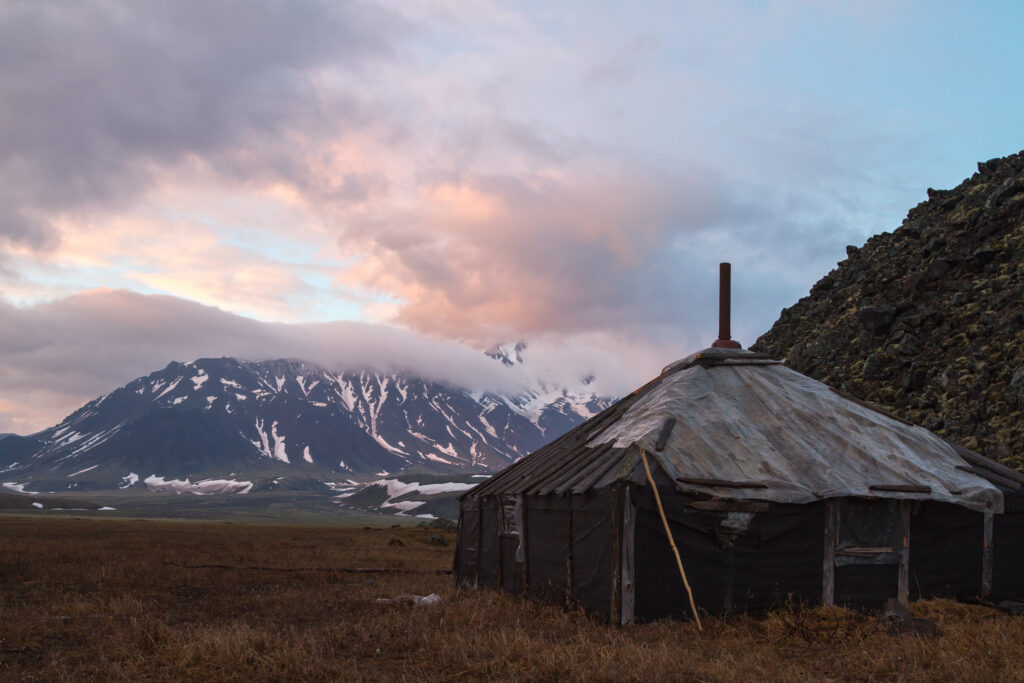
Reindeer herders’ house in Bystrinsky Nature Park, Kamchatka. Photograph by NadezhdaKhaustova, via Wikimedia Commons. Licensed under CC BY-SA 4.0.
Snowflakes whirl in the white daylight, and we advance with difficulty beneath the dense canopy. Dasho and Clint in front, me behind. Sweat drips down our foreheads. The snow crunches under our feet. Keep within the tracks! I think, every time I sink once more up to my thighs. After an hour’s trudging, bent over and with our shoulders hunched up to our ears, the landscape changes; the black spruce woods become sparser. The wind picks up as we lose the trees’ protection, and I muffle my face with my shapka’s earflaps. “Will you tell me where we’re going?” I shout to Dasho, trying to reach him over the wind’s bluster. “Nearly there,” he replies. “A little more patience and you’ll soon see.” We come out into a clearing, Dasho and Clint stop, and I follow suit. I look to the right and the left, and my gaze at last picks out a shape that’s blurry but discernible through the snowfall. Something large and white; something that is neither a house nor a tree. “Come,” Dasho says. “We’re here.” We walk towards the object, the contours of which become clear as we approach. It is a white, multifaceted sphere of imposing scale, perched on a metal structure that holds it suspended in the air. The structure must be between eight and ten meters high. At its foot, a ladder extends up towards a hatch in the sphere’s underside. I catch my breath and the boys light cigarettes, visibly pleased with themselves. “What is that?” They’re expecting my question; we have come all the way here precisely so I can ask it. “That,” Dasho says, “is America making sure the Russians can’t take Alaska back off them!”
My face must be quite a picture, as the pair of them are in stitches. Then Clint sucks on his cigarette and decides to enlighten me. I learn that the sphere is a surveillance radar trained straight at Russia. I soon observe that it is still live, or rather, “on hold”—as confirmed by the two American officials who briefly emerge from the hatch to greet us. “Hi. You’re the French anthropologist? Welcome to the end of the world!” They laugh, then disappear just as swiftly back into the sphere—“We have work to get on with in here”—and the hatch closes behind them. Clint says, with a wry smile, “Don’t worry, it isn’t only us they kick this kind of soccer ball at. There’s one in every indigenous village in Alaska.” My curiosity is piqued. I nod, encouraging him to go on. He says he knows from reliable sources that in Siberia the Russians are using the same sorts of rigs, all pointing straight at Alaska, and that they’re all in the native villages too. This radar and its siblings are remnants of the Cold War. “You want to know why they’re putting them with the natives?” he asks me, using the English word, but goes on before I can answer. “Because they’re better hidden this way. There’s no tourism here, no foreigners poking around to say it’s still going on, that the war isn’t really over, or at least that it could start up again anytime. It’s like fires in our sick, dried-up forests—a single spark is plenty.”
We stand in silence for a moment. My head is spinning—this is the last thing I expected. Dasho is standing quite still, hands in his pockets, the steam of his breath curling up, over his head. I observe him looking at the radar and decide that in his head too, something’s spinning. “What is it?” I ask, right away. “Nothing,” he answers. “Only, every time I come here, I wonder what they’re thinking on the other side of the strait.” I catch his eye and he looks away, to stare at the radar once more. He speaks again, more softly: “When they pass one of them, when they’re out hunting.” He exhales and the steam clouds thickly. “Or perhaps over there the radars are right in the middle of the villages, not hidden away like they are here? Perhaps they can even see them from their windows?” He turns back, towards me. Dasho’s fine brown face, his dark eyes and long black hair, are haloed by the white glow of the sphere behind him. “Do you think they’re like us? That they live like us?”
***
There are occasionally—rarely—moments during fieldwork that are like lightning strikes. Brief instants; spots of time. They stand out from the regular rhythm of the experience. And they can effect a crucial turn in your life or your research focus—or both. Dasho’s musing quickly became my obsession.
***
“Not so very long ago, we Gwich’in”—Clarence liked to tell the story—“all in a single day, we learned that not only were we now American citizens, but also that we used to be Russians in the past.” He added, “The Aleut people to the south retained this knowledge in their bodies, the Tlingit people in the southeast valiantly fought against it, the Yupiks of the northwest didn’t oppose it, the Iñupiats in the north sold their whales; but the Russians never got as far as the Gwich’in, and if they had got to them, we would have remembered, because the Gwich’in are warriors, because we would never have let the Russians take our land away, because …” Clarence always broke off somewhere around this point. “In any case,” he’d go on, “the Russians didn’t get as far as us, because Gwich’in land was too far west, too far into the subarctic taiga, and also because they had too much going on along the coast.” Sometimes I would tell the old man he was rambling. To shut me up or, perhaps, to impress me, he would then take his story still further back in time. “Before, truly before, we surely came here from out there, over the great ice bridge. We let the Iñupiat cross it first, to test the ice over the strait.” He giggled. “We saw that it held for them, so we came over too.” “And you gave them a few thousand years before you followed, just to be sure?” I was teasing, but he was never deterred. “Of course—we keep our eye on the prize! The seashore and the blizzards, that’s all Eskimo stuff. We went straight to the forest.” I burst out laughing. “Just think about it,” he said. “Think about the journey we made to get here, about our decision to live among the trees, and all those we left behind.”
“Yes, Clarence,” I answered, “I do think about it.” In fact, that’s all I think about. As time has gone on, these ideas have become my obsession: I too cross the strait and travel back in time. I follow in the footsteps of my predecessors in 1897; I follow the intellectual paths taken by Boas, Jochelson, Brodsky, Bogoras, and the others with the Jesup North Pacific Expedition. My mission may have been rather desperate, but so was I: I wanted to bring the two sides of the Bering Strait into dialogue. I too would try to travel back to find the links between places and collectives before colonization broke them apart. Who could say? Perhaps somewhere between East and West, shadows would lift. And one day, I would return to Fort Yukon, and I would tell Dasho and his father. I’d tell them how it was, over there.
***
We’re here, at last. In the forest below the volcano, on the edge of the river, surrounded by faces very different from our own. After hours in buses, in vans, and on foot, we had finally reached the botany research base at the Bystrinsky Nature Park, in western Kamchatka. Here, in the foothills of the Ichinsky volcano, where the Icha River has its source, we had set up our temporary base camp, in this strange place where young “volunteers” inventory plants for the national park alongside Even reindeer herders, who stop here to replenish their supplies.
For the first time in my career in anthropology, something that had arisen from my own cogitations was becoming a reality before anyone could field-test it. My working hypothesis was turning out to be of at least some value. After several bruising failures in Alaska in regard to my theoretical preconceptions, which crumbled as soon as I began the fieldwork, I no longer had much confidence in my own notions, however deeply informed by history and theory. Yet, this time, things were happening differently. That free-floating picture that I had dreamed up, of a past world reborn from its own ashes in response to a great crisis, might, possibly, be a reality. I remember Dasho and me sitting beside the fire that evening in Fort Yukon, looking into the flames. “If an actual crisis were to happen,” he said, “we Gwich’in would go back to live in the forest. We’re trapped in a stagnant economy, and in a village that was ruined before it could ever thrive.”
“A village that makes us believe in some kind of ‘good life’—whatever that could possibly mean in this postcolonial taiga, where we believe in a semblance of comfort—of ‘civilization,’ ” he corrected himself, “assuming that, in Fort Yukon, civilization is the visible manifestation of the loss of everything that made us who we are as humans.”
I enjoyed our discussions. They fed the optimism I had felt all my life, a slightly naive optimism which has always made me believe that another life is possible. “When this whole smoke screen has evaporated,” Dasho said, “because it will—what will happen then?” He looked at me mischievously, teasing. “Where will we go?” I smiled, because I already knew what he would say. “Back to the woods, of course.”
I knew that some indigenous collectives in Russia had returned to the forest during or after the collapse of the USSR. But as for finding them in Kamchatka, that was another story. I could almost have kissed old Nikolai when, between two glasses of vodka, in the half darkness of his old wooden house in Esso, he assured us of the existence of this Even family clan, while also making no secret of his scorn for these people, who refused to do as other people did and who thought they were superior because they had withdrawn into the forest. “Traitors, that’s all they are. Backward people who reject progress and the march of history,” he said, again. I was listening and looking around me while mentally reviewing what I’d learned over the last few days. I couldn’t help but imagine the end of his sentence: “Who won’t share the fate of their comrades in Esso, this former kolkhoz, which now, over the last decade, is becoming a promising tourist destination, and which will need—already needs—brightening up and better facilities.” In his view, the indigenous people’s place is right here, and has been for some time. It’s their role to bring color to the dalni-vostok (the Far East, as Kamchatka’s inhabitants like to call it) with indigenous traditions and folklore, to please the tourists who are drawn to the wild even as its emptiness unsettles them.
Then, since he was quite a few drinks in that evening, Nikolai told us that those idiots had left all this—the village, its shops, the hot springs, the museum and its dance stage—left it all behind. They weren’t dancing anymore, they weren’t singing, they weren’t playing their part in supporting their heritage by making traditional objects. Later that night, he stopped attacking them. There was only a deep sadness in his eyes. “My family left the forest long ago. I’ve no more reindeer, no more hunting lands.” The pauses between his statements grew longer. “So that’s it—we dance.” He looked down to stare at the shabby brown floorboards. Then he muttered: “It’s better forgotten.”
***
Why Kamchatka? Why choose this peninsula to compare with my research field in Alaska and not the Chukchi territory, for example, a mere fifty kilometers away from Alaska, on the other side of what has since become the maritime strait of Bering? A volcanic, mountainous region of northern rainforest to compare and contrast with the broad, flat expanse of the subarctic taiga—why attempt that? And to compare the Even people, historically reindeer breeders and herders, with the Gwich’in and their hunter-gatherer traditions? At first glance, a comparison between Alaska and Kamchatka seems like a bridge too far.
Be that as it may, I enjoy some high-wire work, and I have a particular taste for historical contingencies, especially those which seem, over time, to become not simply contingent but meaningful. One of the stories behind my wish to make this ethnographic comparison began with this rather banal fact: the first colonizers of Alaska were not Americans but Russians. The enticing and terrifying “Wild West” of North American Alaska had first been a mysterious and compelling “Far East” for Russia. And its first “discoverers” departed not from Chukotka but from Kamchatka. In 1725, Vitus Bering led a first expedition intended to stake a claim to the fantastical uncharted bolshaya zemlya, or “great land,” which had been fueling navigators’ daydreams since 1648, when Cossack Semyon Dezhnev returned from the Kolyma River reporting Chukchi people’s vague stories about the existence of another world east of the sea. Bering and his company failed, discovering in 1725 “only” the Sea of Okhotsk and the strait to which the explorer would give his name, that ancient, submerged land bridge which in the twentieth century was to become one of the focal points of tension between the two great Western blocs. It was only in 1741, after establishing the first settlement at Petropavlovsk (today the peninsula’s capital), that Bering launched a second expedition out of Kamchatka, and this time succeeded in landing in Alaska, on the Aleutian Islands. Alaska remained Russian until 1867, when it was purchased by the United States for the modest sum of seven million dollars.
As in Alaska, the geopolitical drive to claim “uninhabited lands” lay at the root of Kamchatka’s isolation until the nineties. From being a heavily controlled military zone, serving as storehouse for Russian submarines and site for heavy-arms testing until the implosion of the USSR in 1991, by the end of the twentieth century, like its American cousin, Kamchatka had been transformed into an exemplar of untamed nature in government discourse and in the Russian national imagination. Simultaneously, it was also recognized as a gigantic stockpile of natural resources awaiting exploitation, even while retaining its status as a strategic location for surveillance of the other bloc. In many ways, the Kamchatkan Far East is to Russians what the Alaskan Wild West is to Americans: its mirror image, with all the inversions that entails. The current and widely accepted media image of these territories confirms this view: both Russian and American politicians regularly present themselves as passionate defenders of the wilderness, because the symbolic heft of the concept of wildness attached to their respective iconic regions confers an automatic legitimacy they can lean on while also pursuing programs of resource extraction—targeting oil, natural gas, and metals, but also woodland and fishery resources—perceived as essential to their national economies.
Since the end of the Cold War, Alaska and Kamchatka have continued to reproduce the deep tensions coursing through modern industrial society, from the political conflicts of rival states eyeballing each other, to the challenges of securing access to and exploiting resources, and the ecological turmoil now undermining the very wilderness ecosystems they were meant to be preserving. Lastly, and it’s ultimately because of this that my comparative project has been possible: Kamchatka too harbors indigenous collectives still living according to systems other than our occidental norms, keepers of a different history, even though they’ve been compelled to share ours, too, for the last three centuries. There are three significant indigenous collectives based in Kamchatka: the Koryak, Itelmen, and Even peoples. Historically, the coastal Koryaks were hunters of the large marine mammals, while those who lived inland bred reindeer. These days there are roughly seven thousand of them in the whole peninsula. Their language is related to the Chukchi-Kamchadal language family, as is that of the Itelmen. The latter, traditionally hunter-gatherers, are considered to be the very first inhabitants of Kamchatka. Most Itelmens have many generations of genetic mixing with Russians, and there are now very few native speakers left. In the eighteenth century, both Koryaks and Itelmen were decimated by the arrival of Russian Cossacks, their populations drastically reduced by the combined effects of epidemics and deliberate extermination. As for the Evens, whose language belongs to the Manchu-Tungus family, they are traditionally reindeer breeders who traveled as nomads with their animals from the Altai region in southern Siberia. While widely used by both Russians and Evens, the ethnonym Even (which replaced the earlier ethnonym Lamut—“people of the sea”) bears little relation to their own terms for themselves: Oročel or Oroč, meaning “people of the reindeer.” Like the Cossacks and sometimes even alongside them, serving as their guides, the Evens made their way down the Kamchatka Peninsula over the nineteenth century. Around nineteen thousand Even people are thought to be living in Siberia as a whole, of which some three thousand are in Kamchatka and a bare thousand in the Bystrinsky region.
***
Time went by, slowly. Then, one morning, Andrey got up, opened the cabin door, and said simply: “Let’s go.” Just that, no explanation. “Pack your bags.” The three of us set off on his red quad ATV, through the seventy kilometers of mud and rain that separated us from Ublakachchan, the first hunting base on the Icha River. Somewhere along the way, while chewing on smoked baluk, he laughed. “Where you live in France, to go to someone’s house, you need to be invited, right?” I nodded, yes. “It’s no good trying to do things the way you do them at home,” he said. “In the forest, you just go.”
Night descended abruptly on us, out on the tundra. A fine, icy rain had us shivering by the time we got off after several-hour travel through the night. A faint glimmer shone through the wooden slats of the summer kitchen. “Andrura!” Andrey called, through the darkness. We heard a grunt. “Come on in,” Andrey said. I noticed two soaking-wet brown bearskins lying over a wooden rail on my right. We stepped into a dark, smoky cabin. Two Russians were sitting at the low table over glasses of vodka. Black bearskins insulated their limbs from the chill of the beaten-earth floor. Beside the fire in one corner, an Even woman was preparing a soup of salmon heads. Our welcome was somewhat frosty, but at least we were invited in. We emptied our glasses, gulped down our soup, and collapsed onto some pungent bearskins in the loft space they set aside for people passing through.
In the morning, Andrey told us he had to go back. He added that “they” would certainly come, for of course “they” knew, now, that we were here. We had only to wait for something to happen—for someone to come. A few days later, a man ducked his head through the rickety latticed doorway: our wait was temporarily over. About fifty years old, he was tall, agile, and sinewy, and his face was enigmatic, with no hint of a smile, though his eyes, perched above high cheekbones, showed nothing but gentleness. This was Ilo, here against the advice of his elder brother, Artyom, to take us from the Russian hunting base and help us cross the river, that frontier flowing peacefully between two worlds that knew nothing of each other.
***
Every morning, Ilo disappears into the driving rain to take in his fishing lines from the river, a twenty-minute walk. At midday he returns, his arms laden with salmon which he prepares straightaway, reserving half for the dog apana and the other half for us, to be fried or made into a soup over the fire. Ilo tells us about the French singers he likes, some Edith Piaf, a lot of Joe Dassin. Skillfully shearing off scales, he asks if there are lions in France. And we talk about the Earth, how it is turning even though we can’t feel it, and about the sun that “sets” although we’re the ones who sink below the horizon. It’s still raining, and how strange this is, being trapped here, even in the field, and discussing existential questions, which my pathological impatience makes me relegate to the category of small talk.
In the morning we’re woken by voices crackling through an old radio. Ilo is lying on a reindeer skin in a corner, holding the transmitter in one hand and listening intently, his ear pressed up against the speaker. “Ten packs of Klassicheskiy Belyy Tigr black tea, five bags of Maxim’s coffee, twenty kilos of flour, ten kilos of sugar.” Another voice answers: “Got it.” “Take a bag of sweets, too, for the children. And two boxes of smokes.”
At this point, I don’t yet know who’s speaking or where from; all I know is that this radio is the medium by which the Evens of Icha communicate with the outside world, how they send their orders to those traveling into the forest; that all or almost all the hunting bases are linked by this radio, and that the reindeer herders who move through the region are linked by it too. Ilo waits for the voices to stop, then asks again if anyone has news of the weather. Someone speaking from the village of Esso answers yes, they’ve seen the weather report and this bad weather will go on for several more days. “Igna,” Ilo says in Even. “Okay.” He disconnects the radio, lies there for a moment, thinking, then gets up, pulls his boots on, and vanishes into the rain again.
Translated from the French by Sophie R. Lewis.
An adapted excerpt from East of Dreams, forthcoming from New York Review Books in May.
Nastassja Martin is a French author and anthropologist. Her books include In the Eye of the Wild, Les Ames sauvages: Face à l’Occident, la résistance d’un peuple d’Alaska (winner of the Prix Louis Castex of the Académie Française), and, most recently, Lamont des sources. In 2023 she became professor of Habitabilité de la Terre et transitions justes at the University of Paris 1/Sorbonne, and she is the director of Tvaian, a documentary based on the experiences of Daria, one of the subjects of East of Dreams.
Sophie R. Lewis is an editor and a translator from the French and Portuguese. Her translation of Noémi Lefebvre’s Blue Self-Portrait was short-listed for both the Scott Moncrieff Prize and the Republic of Consciousness Prize in 2018, and her translation of In the Eye of the Wild was a winner of the nonfiction translation prize from the French-American Foundation in 2022.