Much more than a sum of its parts. There’s a port city in Tamil Nadu called Tuticorin where discarded shipping containers rust in stacks along the waterfront, forgotten once their working lives are done. Most people walk past them. Indian architecture studio Wallmakers saw a restaurant. Petti is the result, and it’s one of those [...]
There’s a port city in Tamil Nadu called Tuticorin where discarded shipping containers rust in stacks along the waterfront, forgotten once their working lives are done. Most people walk past them. Indian architecture studio Wallmakers saw a restaurant.
Petti is the result, and it’s one of those rare buildings that makes you wonder why we weren’t doing this all along.
Twelve containers, cut lengthways, welded onto a steel frame. That part’s straightforward. What happened next isn’t. Rather than leaving the steel exposed, the team encased the entire exterior in poured earth, applied in an alternating recessed pattern that reads as something between ancient ruin and freshly quarried stone.
It’s not decorative. The geometry was engineered to reduce heat gain and cut air conditioning load by 38 percent. In a tropical climate where heat isn’t seasonal, that’s a serious number.
From the outside, the building looks like it grew here. Warm-toned, deeply textured, with a zigzagging roofline that makes you puzzle over whether it’s old or new, handmade or industrial. It’s both. That tension is the whole point.
Inside, each container half becomes a dining niche, which gives the space surprising intimacy despite seating 200. Skylights drop daylight over each section. At night, chandeliers made from salvaged wax and pipes take over. The floors are reclaimed deck wood and oxide. Not a single surface was an afterthought.
The name Petti means “box” in Tamil. A box, rethought, coated in earth, stacked into something you’d book a flight to see.
What this building gets right is something a lot of eco-conscious architecture gets wrong. It doesn’t ask you to notice the materials before you notice the beauty. The photograph pulls you in first.
The backstory, that you’re looking at marine waste and mud, makes it more compelling. Not less beautiful.
Architecture by Wallmakers (Vinu Daniel and Oshin Mariam Varughese).
Warsaw-based artist Maciej Sidorowicz creates atmospheric digital paintings that capture the poetry of everyday places through light, mood, and painterly restraint.
Warsaw-based artist Maciej Sidorowiczcreates scenes that turn ordinary places into studies of light, atmosphere, and stillness. Plus a bit of surreal ‘weirdness’ that catches your eye and draws you in.
Working digitally with the sensibility of a plein air painter, he captures streets, cabins, tram stops, and suburban edges with remarkable immediacy, favoring mood and structure over meticulous detail.
What makes these pieces so compelling is their openness. Brushstrokes remain visible. Edges dissolve and reappear. Forms are suggested rather than fully resolved.
The result is a body of work that feels both observational and interpretive, as though each image is less a record of a place than a memory of passing through it. There’s a similar sensitivity to atmosphere in Shintaro Ohata’s paintings that blur the line between 2D and 3D, where everyday scenes are transformed through light and emotion.
Sidorowicz has a sharp instinct for reduction. He pares each composition down to its essential elements: the angle of light, the balance of color, and the rhythm of built space. In doing so, he transforms familiar environments into meditations on atmosphere.
A quiet road, a washed-out sky, and the glow of evening on concrete become moments of visual calm, rendered with restraint and sensitivity. That painterly compression of time and place also brings to mind Paintstrokes Through Time, where landscape and gesture work together to create something emotionally layered.
Though created digitally, the works retain the spontaneity and intuition of painting on site. That tension between speed and sensitivity gives them their particular resonance.
They feel lived-in, and uniquely skewed, with a deeply attentiveness to the poetry embedded in everyday surroundings.
There’s also a nice thematic echo here with Classical Paintings in Contemporary Settings, another piece that reconsiders how painted imagery can shift our reading of the familiar.
To explore more of Sidorowicz’s work, visit his website or follow him on Instagram.
Kolmanskop is an abandoned mining town in the southern African country of Namibia that has become one of the most hauntingly beautiful places on Earth.
Once a bustling settlement fueled by the diamond rush, this eerie ghost town is now a testament to the relentless power of nature, slowly being reclaimed by the encroaching desert sands.
Kolmanskop was founded in the early 1900s after a railroad worker stumbled upon a sparkling diamond lying in the desert sands. Almost overnight, the area transformed into a thriving mining town. German settlers constructed grand, colonial-style houses and lavish infrastructure, complete with a hospital, ballroom, school, and even a bowling alley.
The town’s wealth allowed for luxuries unimaginable in such a remote location, including imported goods from Europe and ice delivered from a factory.
At its peak, Kolmanskop’s residents lived lives of luxury in the middle of the harsh desert. The small town was a surreal oasis where opulence met cultural and geographical isolation.
The diamond boom, however, was short-lived. By the 1920s, richer diamond deposits were discovered further south, and the town’s decline began. By 1956, Kolmanskop was abandoned, and its grand houses were left to the mercy of the desert.
Over the years, the relentless desert winds have pushed sand through broken windows and doorways, filling rooms and hallways. Once elegant homes are now sinking under the weight of nature slowly reclaiming them, creating a mesmerizing blend of man-made decay and natural beauty.
The walls are cracked, the floors covered in shifting dunes, and the wind howls through empty rooms, bringing a sense of melancholy to what was once a thriving community.
Today, Kolmanskop is a haven for photographers and adventurers alike. The juxtaposition of finely crafted architecture and the overwhelming presence of the desert creates a visual feast.
Sand pours through open doors, fills entire rooms, and climbs up staircases, transforming the interiors into surreal works of art. As the golden sunlight filters through cracked windows, it casts ethereal shadows across the sand-covered floors, making the abandoned town look both eerie and beautiful.
The town’s strange atmosphere has made it an iconic location for photographers seeking to capture the haunting passage of time.
The stark contrast between this short-lived human endeavor and nature’s dominance is captured in every image, and it’s a reminder of how transient human achievements can be when faced with the elemental forces of the Earth.
The town is now a tourist attraction, and history lovers and photographers love to see the ways that the sand is slowly swallowing the town, and making fascinating visual contrasts.
Have you visited this ghost town, at the bottom of Africa? If so, we’d love to know your experience.
Images Via Unsplash and Pexels. Used with permission.
Portraits Appear and Vanish in Hernán Marín’s Double-Sided Drawings
Colombian visual artist Hernán Marín is creating striking graphite works on frosted acrylic that seem to shift between presence and disappearance. Rather than treating the surface as a neutral support, Marín uses the material itself as an active part of the image, allowing each piece to transform depending on the viewer’s position.
Viewed from one side, a softly obscured figure emerges with sharply rendered details in the foreground. Turn the acrylic panel around, and those details fall away, revealing an entirely different emphasis in the portrait.
Each work pairs a crisp drawing on one side with a hazier, more ethereal counterpart on the other, creating the sensation of an image suspended somewhere between memory and apparition.
The effect is especially compelling because of the frosted acrylic’s depth and translucency. Marín’s figures feel embedded within the material rather than simply drawn on top of it, giving the portraits an uncanny, atmospheric quality. Empty space becomes more than background here; it acts like fog, surrounding the subjects and lending them weight, mood, and mystery.
Marín’s latest body of work shows how a simple medium like graphite can become something unexpectedly dimensional when paired with an unconventional surface. You can see more of his work through his portfolio and Instagram.
The architecture follows that idea pretty closely. The outer shell curves around the shuttle with a smooth, almost aerodynamic shape. There are very few hard edges. It feels intentional without trying too hard.
Inside, it opens up in a big way. The main gallery rises about 200 feet and stays completely open, so you can see the shuttle from just about anywhere. It feels less like a typical museum and more like being near something operational, even if it is not.
Around that central space are multiple levels of exhibits focused on aviation and space exploration. There is a mix of real artifacts and interactive pieces, more than 100 of each. It is a lot, but it does not feel overwhelming. You can move through it at your own pace.
The outside and inside feel pretty different. From Exposition Park, the building stands out and has a strong presence. Once you are inside, the structure steps back and the shuttle becomes the only thing that really matters.
It took a long time to get this built, but the end result is straightforward.
Paolo Cericis a Croatian programmer and artist whose animated GIFs have been quietly melting people’s brains since he started posting them. The loops are mathematically precise and visually relentless.
Stare at one long enough and you’ll start to question whether perception is a reliable thing to have.
Luckily we have a myriad of calm and zen-like posts to enjoy, because looking at these mind-warping GIFs by Paolo Čerić for too long will probably make you go insane.
We recently revisited The Lord of the Rings film trilogy, and find ourselves absentmindedly humming the theme music. The films did such a phenomenal job of building a world that felt real, alive, and full of life, both evil and joyous.
The scenes of The Shire feature peaceful rolling hills, homes built into the land itself, and of course, furry-footed Hobbits.
One reason that the films were such a success was the incredible craftsmanship of the set pieces, not to mention the jaw-dropping beauty of New Zealand, where the filming took place.
Even 20+ years later, the set pieces of Hobbitown still exists, and is a tourist attraction that any LOTR movie fan would adore. Located in Matamata, New Zealand, the tours are run by Hobbiton Tours.
Below are some photos showcasing just how intricate and beautifully kept the set pieces are.
There is something quietly radical about a chair made of air. Actual air, pumped in with a foot pump, held inside a carbon steel frame and wrapped in deep emerald green fabric.
IKEA’s new PS 2026 Easy Chair is the brand’s first serious return to inflatable furniture since the a.i.r range quietly disappeared in the late 1990s. The concept was always good. Air is free, lightweight, and flat-packs beautifully.
The problem was execution. Earlier versions slid across the floor, squeaked, and sagged. Designer Mikael Axelsson’s answer was to stop fighting the physics.
Blow up a balloon. Trap it inside a metal frame. Let the structure do the work.
Twenty prototypes later, including one involving a tractor tire, he landed on two adjustable air chambers held within a tubular chrome frame. It ships flat with a foot pump.
It has passed every durability test IKEA runs on its armchairs. And it looks like something you would actually want in your living room.
The Easy Chair anchors the IKEA PS 2026 collection, the tenth edition of the experimental line running since 1995. Also shown at Milan Design Week: a solid pine rocking bench and a three-directional floor lamp that shifts the mood of a room depending on which way you point it.
Three different objects, one shared instinct. The things we live with should be a little more alive.
This lovingly illustrated series by Marko Rop shows the many colorful and even elegant insects of his homeland, Slovenia. From moths to beetles and butterflies, we see a full collection of colorful creatures.
This lovingly illustrated series by Marko Rop shows the many colorful and even elegant insects of his homeland, Slovenia.
From moths to beetles and butterflies, we see a full collection of colorful creatures, all lovingly illustrated in a way that bridges scientific illustration with playful sketches.
Picture perfect for a children’s book, the illustrations are accurate and detailed, while also somehow retaining a childlike look and feel.
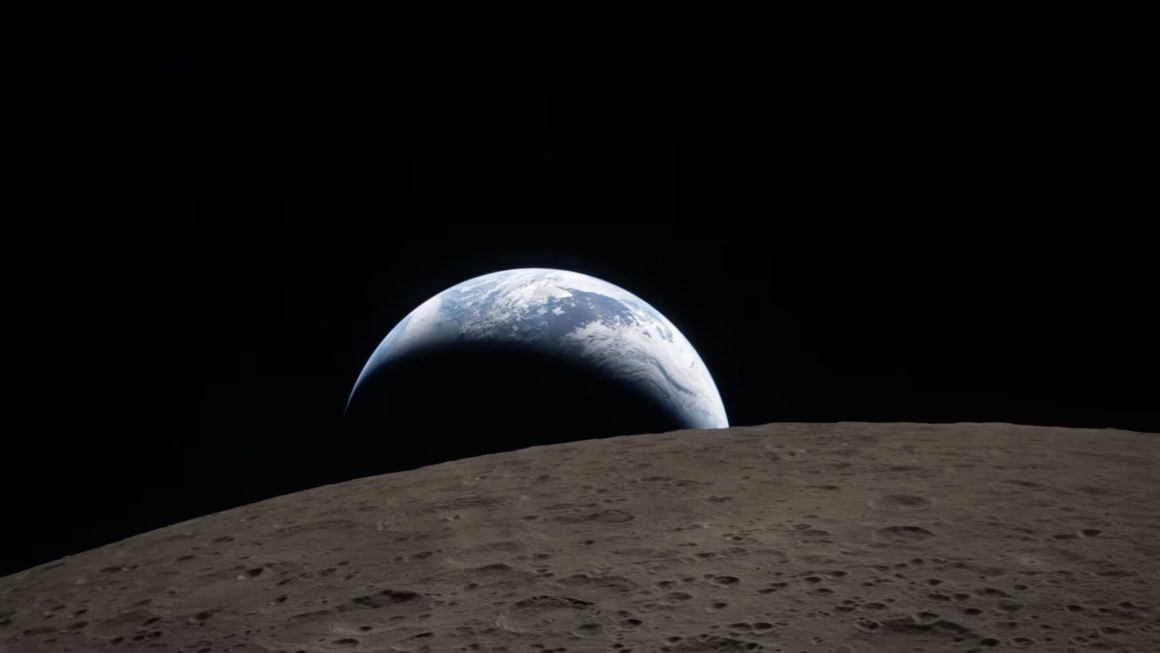
There’s a photograph of Earth taken from the surface of the Moon. And much more recently, on a flyby of the far side of the Moon.
Our planet hangs in absolute darkness, a small luminous marble, impossibly fragile. Astronauts who’ve seen it describe a sensation without a name. Overwhelming love. Grief that arrives without warning. The understanding that everything you have ever known lives on that one pale sphere.
Enhanced Earthrise image from 1968
Today is Earth Day. Most of us are trying, as we do every year, to hold two contradictory feelings at once.
The Grief Is Real
In the last fifty years, humanity has lost roughly two-thirds of the world’s wild animal populations. Coral reefs are bleaching at rates that would have seemed apocalyptic a generation ago. Ancient forests are measured now in decades of loss.
Via Getty Images
There is a particular grief that comes from loving something you are also losing. It sits in the chest. It is appropriate to feel it.
Snow leopards still ghost through the high passes of the Himalayas. Humpback whales, nearly extinct in the twentieth century, now breach in numbers that would astonish the whalers who hunted them.
In the decades since Chernobyl was abandoned, the forest came flooding back: wolves, lynx, beavers, bears, over 200 species of birds.
People protect what they love. People love what they can see. Every image of a forest cathedral, every aerial photograph of a reef alive with color, every close-up of a creature whose existence seems almost impossible, these aren’t escapes from the crisis.
They are arguments for engagement.
If Earth Day asks one thing: look. Really look. Let the beauty land. And then act.
Photo by Sean Musil on Unsplash
Things Worth Doing
Find the intersection of what you love and what the Earth needs. Sustainability that feels like sacrifice is fragile. Sustainability that feels like alignment is something you’ll actually sustain.
Go somewhere that reminds you why it matters. A trail, a city park at dawn, somewhere you can hear birds or smell rain on soil. Time in nature increases our motivation to protect it.
Choose one relationship to deepen. One land trust, one farmers’ market, one garden, one species you learn about. Depth beats breadth.
Reconsider one consumption habit. Most of us already know where our footprint is heaviest. Individual action isn’t the whole solution, but it shapes culture in ways that accumulate.
Support people doing extraordinary work. Organizations like the Nature Conservancy, Rainforest Alliance, and Ocean Conservancy operate at scales individual effort can’t reach.
Talk about it. Not with dread, but with the love that underlies the dread. Share the image that stopped you. The world shifts through conversation.
And vote. The environment is not a special interest. It is the ground beneath every other interest.
Somewhere right now, a bioluminescent wave is lighting up a dark beach with blue fire. A child is pressing their palm to a tide pool for the first time, and something is shifting in their chest that will stay with them forever.
We are not optimistic because we think things are fine. We are optimistic because we have seen what humans do when they decide something is worth saving.
The Earth is still here. So are we. Let’s make that mean something.
What does Earth Day look like for you this year? Share in the comments, or find us on Instagram.
We’ve long known whales as intelligent, feeling beings. But we’ve never quite seen them like this.
Underwater photographer Rachel Moore was in the water when Sweet Girl, a massive female humpback, swam into range, curious, calm, and unhurried. For nearly five minutes, the two stayed close.
Moore with her camera. The whale with what can only be described as patience.
The resulting images are extraordinary. The most intimate portraits of a humpback whale ever captured, and at their center: an eye the size of a grapefruit, ringed in electric blue, alive with detail and unmistakable intelligence. You look at it and feel, without question, that something is looking back.
Tragically, Sweet Girl was struck and killed by a fast-moving vessel just four days later.
Moore’s photographs have since struck a deep chord with people around the world, and rightly so. They are a gift, a rare window into the interior life of another kind of mind, and a quiet argument for why these animals deserve far better from us.
See more of Rachel Moore’s beautiful and vital work on her website.
This moment of eye contact was beyond my wildest dreams. I’ve never encountered a whale like this one, and it was the most profoundly beautiful experience of my life. I feel privileged that she allowed me to capture the beauty and life within her eyes.
Devastatingly, due to a tragic strike by a fast-moving ship, that life is no longer with us. Over the past few weeks, she touched so many lives, and thanks to your support of this recent photo of her eye, her story has now reached millions.
I hope her tragic story will spark real, meaningful change especially revolving around ships speed limits in these areas where whales are primarily found during whale season. “
Two brands that share more than they differ have made something quietly wonderful together.
Artek, the Finnish furniture house founded in the spirit of Alvar Aalto, and Heath Ceramics, the California studio rooted in Edith Heath’s elemental approach to clay, have expanded their Tile Table collection with a third colorway: terracotta red. It joins the original green and white, and feels right for this moment. Moody, warm, a little defiant of trend.
The concept is simple and satisfying. Heath’s handcrafted glazed tiles sit atop Aalto’s classic Table Square in moveable arrangements, inviting reconfiguration. The wood is left honest.
The tiles do what glazed ceramic has always done well: age gracefully, clean easily, hold color without apology.
There’s also a chess table, which manages to be delightful without trying too hard. The tile grid doubles as a board; hand-thrown ceramic pieces complete the set.
But on the outskirts of Madrid, a vast garden called Desert City is quietly making the case that it could be.
Designed by Madrid-based studio Jacobo García-Germán, the site unfolds across a former industrial wasteland. It’s now transformed into something unexpectedly alive.
Thousands of cacti and drought-tolerant plants stretch across the landscape, anchored by an enormous greenhouse where visitors can take a few of them home.
It’s a strange and lovely thing, a desert blooming where factories once stood.
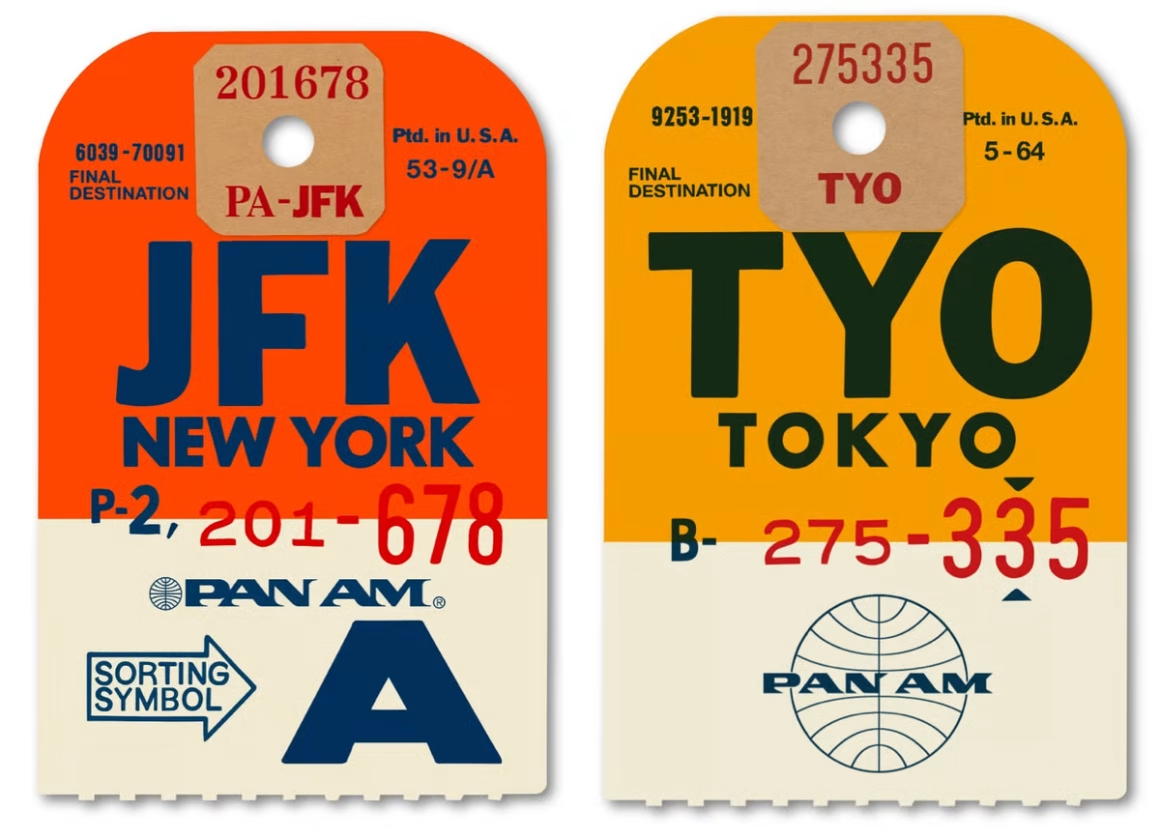
Referencing the golden age of air travel, plus the cheery, bold graphic design of the 60s and 70s, this collection of wall art is perfect for any travel aficionado.
These high-quality, archival prints are available framed, and have been reproduced for a number of the world’s most iconic airport destinations, and the classic Pan Am name.
The work of screen printing artist Ella Freire, this collection is so well done, and even features the tear-off perforations that the luggage tags used to use.
Each one feels like a love letter to travel, and adventure.
The prints are highly limited edition, and framing is made to order. Prints start at $1174.00 USD.
Ella has replicated the tags as closely as possible to the originals with their bright colour palette. The artwork is printed on 100% cotton archival paper, then mounted on to card and cut out to shape, including the perforated edges, punched hole through a reinforced tab overlaid on the print. The labels are printed in a very limited editions of 25 for each of the large and small sizes.
Ella is licensed by Pan Am Brands to create these limited edition prints. Her highly sought after artwork is held in collections all over the world and also displayed in the Pan Am Museum Gallery in New York.