GeistHaus
log in · sign up

McSweeney’s

Timothy McSweeney’s Internet Tendency

rss en-us
8 posts
Feed metadata
Status active
Last polled Apr 29, 2026 01:41 UTC
Next poll Apr 29, 2026 08:41 UTC
Poll interval 25220s
Last-Modified Wed, 29 Apr 2026 01:03:39 GMT

Posts

Why Do People Keep Trying to Assassinate Caesar?

I’m confused, maybe someone can help me. This is like the third assassination attempt on Julius Caesar, but things are going great in Rome. The value of silver is strong, the liberti/bad homines immigration is under control, and we’ve bounced back from the bubonic pandemic.

So why do people keep trying to assassinate our leader?!

I heard one person say it’s because he’s trying to seize power from the Senate and become an all-powerful dictator, but like, just because he refused to concede power when his term as governor ended and then sent his military across the Rubicon, essentially doing an insurrection on Rome, doesn’t indicate any of that. If that were the case, wouldn’t the Senate say something? Haven’t heard anything from Brutus or Cassius yet, so that’s a non-starter.

Some are also pointing to the preemptive strike on Carthage and how it doesn’t seem to have clearly defined objectives or a coherent exit strategy, and could potentially ignite Punic War III. But taking out an adversary’s enriched trebuchet program and stockpile of intercontinental ballista munitions is imperative to the safety of the entire world, so even though Caesar seems to be making it up as he goes along as an excuse to blow stuff up, we should still just trust our Commander in Chief. He wouldn’t lie to us, even though he constantly lies to us.

Then, of course, there’s threatening to conquer Erik the Red for some reason, but come on, he’s just talking trash. We need to judge Caesar by his actions, not by what he says, and also not by most of his actions either. It’s totally fine for the most powerful man in the world to talk smack like that. Totally fine and normal.

Now, I do think that whole thing with the enforcement patrol in Macedonia may have gotten out of hand, but let’s be real, there was no way to predict that sending a violent, untrained militia of legionaries into a volatile protest would lead to a fatal stabbing of a citizen. Nor could you predict it the second time either. I mean, come on.

Sure, one could also make the economic argument. Inflation is devaluing silver, he’s gutting finance to healers and apothecaries, his corrupt policies only help his aristocrat friends, his tariffs on the Silk Road are backfiring and pushing the expenses down to local agora merchants and traders, and his corruption is creating extreme poverty among the lower and middle castes as well as low global confidence in our Republic, but that’s just how this stuff works. We should trust him on economic issues; he’s a businessman. After all, he did build Caesar’s Palace.

Also, just to be clear, I certainly don’t condone political violence, especially if it’s against someone on my side. I would prefer to just have him exiled. I’m sure that would deter his followers.

Of course, the likeliest explanation for all of this is that it’s those obnoxious, radical communist senators trying to bring down Caesar so they can seize power for themselves.I can’t think of a single other explanation that makes sense. Still, I have to ask: Why do they keep sending the most incompetent people? Like, how does every assassin keep missing and then immediately get caught? What’s that about?

https://www.mcsweeneys.net/articles/why-do-people-keep-trying-to-assassinate-caesar
Extensions
AP English Students Aren’t Thirsting After Holden Caulfield Like They Used To

Listen, I don’t have thin skin. If I did, I would teach fourth grade and cry along with my students when the spider died at the end of Charlotte’s Web. Anyone can teach kids; I teach young adults. And I introduce them to their mentor, who will decide their fate: New York’s most haunted forever teen, Holden Caulfield.

By introducing decades of students to the philosopher in the backward red hunting cap, I’ve presented them with their next step into adulthood. Most English students make one of two choices: Either they love Holden and go on to have intense, fleeting, and passionate careers in fields like English or theater, or they realize they have good relationships with their mothers.

These past few years, however, I’ve noticed a startling trend: ambivalence.

My students feel nothing for this young man. In 2022, some of them began dismissing Holden as cringe—not cringey, just cringe. The kids aren’t all right—they used to froth at the mouth over this complex character. The ’90s kids made magazine collages about his general disillusionment. Ten years ago, my students were crafting Tumblr pages around things that felt like the essence of Holden, like Arctic Monkeys songs or angsty messages sharpied on restaurant walls. Not anymore. Now, my discussions start with the most promising emo kid in my class saying, “Sounds like cope.”

Well, I have news for you, tenth graders at Bellview West High: Life is cope. And if you don’t want to sit with the fact that ducks leave the pond in the winter, you’re going to look stupid when your family leaves you on a random Thursday with no note. You need to long for Holden Caulfield because longing for something is good for the emotionally unwell. That’s what I told my friends when they stopped coming to my parties because I was getting “too intense” about metaphors.

Well, you know what? It’s not my fault that humanity is one big tenth grader who only wants to play Fortnite. Nobody wants to read anymore. And I’m starting to think our society doesn’t deserve metaphors—or symbolism, for that matter. Holden’s struggle doesn’t mean anything to my disappointing students or nonexistent friends.

They’re all phonies.

https://www.mcsweeneys.net/articles/ap-english-students-arent-thirsting-after-holden-caulfield-like-they-used-to
Extensions
Things I Said I Watched but Actually Just Saw the Meme

The Sopranos
I have not watched The Sopranos. I have, however, seen the clip of the guy pointing angrily at someone across the table while someone else looks tired of his behavior.

That three-hour documentary you recommended
I saw a screenshot of the host looking very serious and assumed the rest.

Game of Thrones
I understand there were dragons and that everyone was upset about a chair.

That Oscar-winning movie from last year
I saw a reaction GIF from it on social media and decided I had the emotional gist.

The entire Marvel Cinematic Universe
I have seen approximately forty-seven memes of a raccoon with a gun.

Your favorite anime
I saw a dramatic still of someone screaming with wind blowing through their hair.

The new Netflix show everyone is talking about
I watched the trailer autoplay while deciding what I actually wanted to watch.

That classic movie everyone says you have to see
I know the twist because someone made it into a TikTok sound.

The cooking show you told me about
I have seen the meme where the chef yells at a piece of bread.

The inspirational sports movie
I saw the clip where the coach gives a speech and assumed they later won the game.

The nature documentary about the ocean
I saw a meme of a disappointed-looking fish.

That viral YouTube video
I saw someone stitch it while explaining why it was problematic.

Your favorite childhood cartoon
I saw a nostalgic tweet about it and liked it.

The entire Star Wars saga
I have seen the meme where someone says, “It’s a trap.”

Your favorite episode of that show
I said, “Oh yeah, that one was crazy,” and prayed you wouldn’t ask which part.

The film festival movie you loved
I saw the Letterboxd review that said “haunting” and decided that was enough.

That documentary about minimalism
I saw the meme where someone lives in an empty white room and owns one chair.

The season finale everyone was freaking out about
I saw people posting reaction images and pieced together that someone probably died.

The live performance you sent me
I watched the first six seconds before the buffering circle appeared and decided that was spiritually the same as watching it.

Your child’s school recital video
I liked the post—I absolutely liked the post.

https://www.mcsweeneys.net/articles/things-i-said-i-watched-but-actually-just-saw-the-meme
Extensions
Leaves of Grass (Allergy Edition)

With apologies to Walt Whitman.

- - -

I sneeze myself, I excuse myself.

For every sniffle belonging to me as good belongs to you. Sorry!

I lean and loafe at my ease observing a spear of summer grass, clawing my eyes as I reach for Zyrtec-D and “fast-acting” eyedrops.

I, now thirty-seven years old and in perfect health, maintain a group text with my allergist, internist, and energy coach.

The atmosphere is not a perfume but an assassin, a revenge epic.

Each golden particle, a tiny airborne Judas.

I contain multitudes, but mostly mucus.

Mucus I wipe away with a CVS receipt longer than my sleeve.

My airways are inflamed, and my friends are tired of hearing about it.

We suffer, but not in silence. For when we sneeze, meetings stop, foundations shake.

Not I, not anyone else can travel the road for you. But before you do, obsessively check the pollen count and pack your inhaler.

Don’t give me the splendid, silent sun. Give me an air-purified living room in Scottsdale with the AC on blast.

And as for me, I know nothing else but miracles. Miracles and second-generation oral antihistamines.

For in my soul, there is hope.

For in my nose, there is Flonase.

In Flonase I trust.

https://www.mcsweeneys.net/articles/leaves-of-grass-allergy-edition
Extensions
William Tecumseh Sherman Demands a Ballroom

“This is why we have to have all the attributes of what we’re planning at the White House. It’s a larger room, it’s drone-proof and bullet-proof glass. That’s why the Secret Service, the military, are demanding it. They’ve wanted the ballroom for one hundred and fifty years.” — Donald Trump, April 25, 2026, after an assassination attempt against him at the White House Correspondents’ Dinner.

- - -

April 26, 1876

Dear President Rutherford B. Hayes,

As you know, I have seen some shit. Bull Run was no picnic, and Atlanta was no backyard bonfire. Which means I know of what I speak. Nothing like watching thousands of young men get blown to bits in a single afternoon to help you figure out your priorities.

And while I bear the middle name of the great Shawnee chieftain, even as we are “relocating” all our native friends from the Black Hills (I mean, all that gold must be ours), I’m sure Chief T would agree that our nation has always put a select few’s safety ahead of sanity.

Therefore, sir, it is my well-considered opinion, based on many years of military experience, that what these United States need most at this moment in time is a bullet- and cannonball-proof ballroom. Gilded. I demand it.

And even though this country is currently experiencing the utter collapse of Reconstruction and a devastating return to all that antebellum fuckery, there is a pressing need for a secure place for our wealthiest citizens to celebrate just what their money has bought them: a president and a golden dance hall made with structural steel, earthen berms, and reinforced concrete.

One can’t waltz in peace knowing a kid with a howitzer, enraged by the recent election results, could blast a hole through the lime plaster and lath (those disputed electoral votes had your name all over them). Perhaps it could have a well-fortified cellar as well, a safe haven for yourself and your cabinet should some future fanatic possess a weapon of more massive destruction.

What better way to celebrate the hundredth anniversary of the founding of this country than by spending hundreds of thousands of dollars on a gilt-glossed great hall for gavottes that only the 0.00001 percent will ever enjoy?

War is hell. But a glittering bomb-proof juke joint will feel like a little bit of heaven. And it will be a great place to hide if you happen to start another one.

Your most humble and obedient servant, even though, as I said, I am demanding this.

William Tecumseh Sherman
Commanding General of the United States Army

https://www.mcsweeneys.net/articles/william-tecumseh-sherman-demands-a-ballroom
Extensions
Here’s Exactly What You Should Say When You Call Your Elected Representatives

“Hi, my name is [NAME], and I’m a constituent from [CITY, ZIP].”

Here, you will let out an extremely long, exasperated sigh. Really milk it, like you can’t even believe you have to make this call. Like, your reps should be doing something about stuff already, without you having to take time out of your busy day to tell them that you’re a voter who votes and will vote for somebody else if they don’t get off their ass already. You’ll vote for anybody, as long as it’s not them. Maybe you’ll even primary them yourself; that’s how deep and exasperated this sigh should be. You should sigh for about as long as it takes to read this entire paragraph. I should have warned you to take a really deep breath. If you’re light in the head or dizzy or your vision is going black or something, I’m sorry. If you’re done reading and also still conscious, you can move on to the next part of this script.

“I mean…”

You’re just going to let this sit for a while. Silence is a powerful weapon when making your voice heard. It’s almost as much about what you don’t say as what you do say. This allows your listener to fill in the blanks with their own information from their subconscious mind. When your rep starts filling things in with their own subconscious, they start using examples that actually mean something to them instead of just tuning you out and pretending to listen while thinking about the hot insider-trading tip they just got. If you say something out loud, you may accidentally mention one of the terrible things going on in the world that they agree with (or have received donations that force them to act like they agree with). After all, they didn’t become a member of Congress by not agreeing with / being paid to pretend they agree with at least a few terrible things. You don’t want to do that, because then they will dismiss you and your opinions (unless you have a lot of money to donate to them, but if that were the case, you wouldn’t need this script). Still, if you don’t say anything at all and just act pissed off, and like it’s obvious that they should know why you’re pissed off, they’re going to start thinking about all the bad things they know they should be doing something about, and then they’re going to start feeling bad. And that’s what we want, for them to feel bad.

“… come on.”

“Come on” is a real gut punch when dealing with the specific type of asshole who thinks they’re important enough to represent a whole constituency of varied individuals with vastly different needs. “Come on” implies that they know better, that they are better, and that they’re performing beneath their full capabilities. Are they actually “better” than their current performance would indicate? Of course not. If they were, we wouldn’t be making this call. What we’re doing here is activating their mommy or daddy issues and making them think long and hard about living up to the potential they believe they have because one of their parents planted it in their minds long ago as a way to make up for not living up to their own potential and passing that down to the next generation.

“I thank you for your time and for your service to the United States of America.”

It is important to practice your delivery of this line before making your call. You want to land in the sweet spot of sounding a little sarcastic but also somewhat sincere. Again, we want them to be questioning themselves, their motives, their actions, and most of the decisions they’ve made in their lives that lead them to this point. Try to channel that one friend you have who tells you that you can pull off wild outfits or accessories, and you believe them in the moment, but then, when you wear that stuff out in public, you feel like a fool who has been pranked by someone who is not really their friend. Thanking them for their “service to the United States of America” should make them feel proud at first, like they think, “Yeah, I do serve the United States of America, that is me, I serve my country,” but then after a few minutes, the weight of that responsibility starts to bear down on their shoulders and they start to think about what that really means and whether they are living up to the promises they have made to themselves and others.

“I love you.”

We want to keep them on their toes, so say this like you mean it, not like you just accidentally called your supervisor at work “mom.”

Finally, with whatever time you have remaining in your message, sing the chorus of Lee Greenwood’s “God Bless the USA” with all your heart. If you get cut off before you finish, call back and sing whatever you had left to complete, even if it’s just a few words, even if it’s just the letter “A” in the final “God Bless the USA.”

https://www.mcsweeneys.net/articles/heres-exactly-what-you-should-say-when-you-call-your-elected-representatives
Extensions
Everything You Need to Plan the Perfect Aesthetic First Birthday Party for Your Sad, Beige Baby

This is an excerpt from McSweeney’s contributor Hayley DeRoche’s new book, Dress Your Baby in Sage and Taupe: A Handbook for the Sad Beige Parent, available now!

- - -

When planning a sad, beige child’s first birthday party, it’s important not to lose sight of what’s most important: love laughter aesthetics. Make sure your little one’s birthday is filled to the brim with ennui Instagram-worthy fun with this handy checklist. And remember, don’t fret if you don’t check off every item; your utter failure as a parent and person will be forgiven by your child in time.

Maybe.

You know, with many long years of therapy.

So get to work! The stakes have never been lower higher.

Invitations: This is your guest’s first taste of the party that awaits; make sure you let them know your finger is on the pulse of trends like nobody else with these tried-and-true themes.

Acceptable themes (PICK ONE):

  • Fawn (“A Year of Our Little Deer”)
  • Skunk (“Our Little Stinker Is One!!”)
  • Industrial Farming (“We Love You a Bushel and a Peck!”)
  • Sardines

Unacceptable themes (NO):

  • Axolotls (SO last year)
  • Danny DeVito (“The Dans of Our Lives”)
  • The Great Depression (BYOB—Bring Your Own Bowler Hat)
  • Red Dye 40

Color Schemes: A birthday is a somber time, a day of serious contemplation and reflection. Make sure the colorways you choose convey the solemn mood appropriately.

Acceptable colorways:

  • Beige
  • Oatmeal
  • Inconsolable Weeping
  • Numb
  • Bog

Unacceptable colorways:

  • Pink
  • Orange
  • Red
  • Yellow
  • Green
  • Blue
  • Indigo
  • Purple

Cake: Expect to spend a minimum of thirty-seven hours here.

  • Three-tier minimum.
  • MUST be homemade
  • Jam filling made from hand-harvested gooseberries planted on the day of the child’s birth
  • Icing should be organic whipped buttercream from generous cows whose names you know personally
  • Hand-dipped beeswax candles
  • Edible flower compote
  • Tiny quilted fabric flag, pennant, or maypole on top
  • Can be store-bought in an emergency, but must be ordered sixteen months in advance

Entertainment: This is your time to outshine the other daycare parents. Especially Fern’s. You cannot let their “Little Lamb” party with real lambs, wool-dying, and spinning wheel workshop go unbeaten.

YES:

  • Bounce house (acceptable colorways: khaki, cinnamon, or eggnog)
  • Corn husk doll-making station
  • Swan boat rides
  • Poetry salon
  • Linocut workshop
  • Mushroom foraging
  • Flour sack race (find vintage flour sacks online for that authentic feel—or sew your own!)
  • Mud kitchen bake-off
  • Whittling demonstration
  • Dream interpretation hour
  • All-natural playdough imaginative play table
  • Ponies (acceptable colorways: khaki, cinnamon, or eggnog)

NO:
*Rented bounce castle in unsightly garish tones that gesture toward traditional childhood motifs; that is, primary blues, greens, and reds

  • Balloon animals in (say it with me) unsightly garish tones that gesture toward traditional childhood motifs; that is, primary reds, yellows, and blues
  • Princess or trending cartoon animal meet and greet (so cringe)
  • Keg stands
  • Danny DeVito
- - -

For more info and where to buy Dress Your Baby in Sage and Taupe: A Handbook for the Sad Beige Parent, go here.

https://www.mcsweeneys.net/articles/everything-you-need-to-plan-the-perfect-aesthetic-first-birthday-party-for-your-sad-beige-baby
Extensions
Fine. This Is What I Was Really Like in the ’90s

You want to know what I was like in the ’90s, kids? Take a deep breath and imagine Snapchat doesn’t exist, and the only way to find out who’s having a party tonight is to press *69 on a landline phone and ask someone’s mom.

We were built differently back then. I once had a three-hour argument in a mall food court about which actor was in that one movie with the bus, with absolutely no way to resolve it other than unearned confidence. I wish you knew what an indie record store basement smelled like vs. the charcuterie-catered, Instagram-worthy parties we’ve been throwing for you since you were eight.

I wore belted, baggy jeans, not for the silhouette but because they covered the fact that my primary source of nutrition was gas-station pretzels and lukewarm coffee. I wasn’t doing beach waves with an automatic curler from Sephora. My look was more “I passed out with wet hair on a radiator last night.”

Nothing about love was complicated back then. Relationships lingered without the ability to instantly reach someone via text, and most breakups were done on a folded piece of loose-leaf paper. My peak romance was the guy I met in a dive bar who gave me a mixtape, followed by a hickey he sucked out on my neck while I leaned on a dumpster in the alley.

If I said I’d meet someone at a bar at 10 p.m., I just stood there alone sipping my amaretto sour. If they didn’t show up, I didn’t get a text saying: Running late. I just went home and assumed they had moved or died.

What did I do for fun? I read the liner notes of my Alanis Morissette Jagged Little Pill CD like they were scripture. I scrounged for loose change in grandpa’s two-tone station wagon to pocket for my next $1.98 pack of Kool 100 Milds. Or I went to a movie and didn’t know what it was about until I saw the poster in the lobby. There was no doomscrolling, only staining my fingertips with the same copy of Rolling Stone for months.

So, no, honey, I wasn’t “vibing” in the ’90s. I was perpetually slurping a forty-ounce Slushie, waiting for a payphone, and shaking cigarette ash off my oversized flannel shirt. Just like you, I was figuring it out, only with better music and thankfully scant photographic evidence. And you came from all that. So, lowkey, you’re welcome, bruh.

But if you really want the ’90s experience, take your iPhone, throw it into a storm drain, then go sit in a dark room listening to the Goo Goo Dolls until you feel an unidentifiable sense of dread. It should take about four minutes and fifty seconds. Then call me.

https://www.mcsweeneys.net/articles/fine-this-is-what-i-was-really-like-in-the-90s
Extensions
Instead of Losing Democratic Elections, What If We Just Stopped Having Them Altogether?

“The Texas gerrymander freakout: What’s happening in the Lone Star State is not a threat to democracy.” The Washington Post Editorial Board, 8/20/25

“For months, Democrats crafted the illusion that their plan to redistrict Virginia was about restoring fairness. In a special election on Tuesday, most voters assented to that deception as a referendum to rewrite the state constitution narrowly passed.”The Washington Post Editorial Board, 4/22/26

- - -

At a certain point, a mature political movement must ask the hard questions. Questions like: If voters keep rejecting our agenda, are voters the problem? If courts keep ruling against us, is the Constitution too woke? If counting every single little ballot produces undesirable outcomes, might counting fewer of them produce desirable ones?

For decades, America has been trapped in an outdated framework called “democracy,” wherein candidates campaign for votes, the ballots are counted, and whoever gets more wins. This system may have made sense in an earlier era, when horse travel was common, information moved by telegram, and certain folks were measured in fractions. But in today’s fast-paced world, can we really afford to let simple arithmetic determine power?

Increasingly, leading thinkers are suggesting a smarter path: If states insist on electing the wrong people, Congress can simply refuse to seat them. Not forever, necessarily. At the very least, until those states learn to behave.

Take any blue state, purely as a random example. Under the old model, voters choose senators and representatives through elections. Under the innovative model, Congress could review a blue state’s choices and ask a more sophisticated question: “Do we like this result?” If the answer is no, that state could temporarily enjoy a new civic role as a scenic colony or territory with absolutely no voice in national affairs whatsoever.

Some critics call this “disenfranchisement.” That is inflammatory language. A more accurate descriptor would be something like “conditional representation based on mood and whether I’m getting my way at the time.”

And why stop there?

If a state uses mail ballots, same-day registration, automatic registration, early voting, or any other process that involves citizen participation, Congress could launch endless investigations until morale and the vote tally improve. Why, if enough suspicion is generated, results could be invalidated and rerun repeatedly until the electorate produces a more responsible answer. Think of it as best two out of seven.

Naturally, there would need to be standards. We cannot have chaos. Therefore, any election won by our side would be presumed legitimate, reflecting the clear will of the people. Any election lost by our side would trigger immediate concerns about dead voters, live voters, moved voters, duplicate voters, ghosts, suspicious vibes, and unexplained lines at specific polling locations we’d describe using quotation marks, like “urban.”

Constitutional romantics will object that Congress cannot simply nullify representation based on partisan displeasure. But these people are trapped in a narrow reading of the law that prioritizes text, history, structure, precedent, and meaning over the far more dynamic principle of wanting something very, very badly.

Besides, precedent exists. Legislatures have long exercised the power to investigate elections, which obviously implies the power to ignore them, reverse them, replace them, and hold them hostage until further notice or, dare I dream, in perpetuity. That’s just basic civics.

Eventually, we could modernize the process. Why burden millions of citizens with voting when a small panel of aggrieved committee chairmen could simply determine outcomes in advance? Or how about a single man—let’s say a white, affluent one; again, purely as a random example—chooses who serves, lives, or dies at that particular man’s pleasure? My goodness, imagine the efficiency. No long lines. No campaign ads. No need to pretend Wisconsin matters every four years.

We could call the whole thing “representative government” because a handful of representatives, or just that one white, affluent man, would dictate how we should govern.

And if the public dislikes any of this, they are free to express themselves in the next election, should there be one, pending review, maybe.

https://www.mcsweeneys.net/articles/instead-of-losing-democratic-elections-what-if-we-just-stopped-having-them-altogether
Extensions
Little League Week One Power Rankings

1. Folding Chair
Returning for a fourth consecutive season, Folding Chair always proves its value on the sidelines, even though it lacks the big market payroll of the guy next to you with the hydraulic rockers and the canopy thing. But while FC remains strong in the cupholders, the seat does still have last season’s water inside.

2. Walks and Errors
Year in and year out, the most reliable run-scorers in the league.

3. Structured Outdoor Activity
Remains dominant over its bitter rival, No-Plans Winter Weekend Where You Stagger Out of Bed Late to Find the Kids Have Been Watching Three and a Half Hours of YouTube Pranksters Moaning in the Ears of Unsuspecting Customers at Big Box Stores and All They’ve Had for Breakfast Is an Old Tub of Pretzel Rods Including Drinking the Salt from the Bottom and When You Take Away Their Screens They Turn on Each Other like Malnourished Mole Rats and It’s a Symphony of Shrieks and Soft Tissue Injuries While You Consume Your Coffee with a Topper of Foamed Remorse. Pencil in SOA for a tight, early-season win over Why Am I Waking Up at 6:50 a.m. on a Saturday?

4. Other Team’s Dads
When it comes to travel ball, OTD always brings the intimidation factor, with their lusty chants of “Swing the Damn Bat!”; “C’mon, Caden, Take a Secondary Lead!”; and “Run it out like a fuckin’ man!” While often knocked for their old-school motivational tactics, Other Team’s Dads’ Team is stomping your kids 21–4, so maybe screaming works.

5. Acute Anxiety
This homegrown standout first entered the league as Pure Panic, showing up big whenever a grounder was hit in your kid’s direction. Would he simply fall down, or somehow miraculously field the ball and then spin in terror while baserunners sped past him before firing it randomly into the outfield? Now a seasoned performer, you can count on Acute Anxiety’s steady presence each at-bat—this is your kid’s one chance to contribute for the next forty-five minutes, and everyone’s watching. AA reminds us that in Little League, anything is possible, but only one thing is certain: Someone’s going to cry.

6. Ump
A strict, selfless upholder of sacred baseball traditions, including being drunk at 10 a.m.

7. Coach
The number one topic of sideline sports-talk pundits, Coach brings the intangibles: a bunch of gear that you’re not supposed to touch. His organized, bemused approach to youth leadership proves that the boys who scared you in middle school gym class can grow up to be the mature, dedicated men who scare you as an adult. But that’s only because Coach does what you could never do: anything that requires your kid’s attention.

8. Parent Who Sits There Reading a Book or Magazine
Approaching the game with uncanny confidence, this elite free agent executes a two-way balancing act between their child’s interests and their own. Ask, because they probably brought wine or gummies.

9. Team WhatsApp Group
This powerful lineup of aging vets is looking to recover from a series of poorly lit photos of batting gloves that someone left at practice. Last year, TWAG was 0–22 when asking if anyone updated the snack spreadsheet.

10. Baseball Field
To quote one local prospect: “It’s really wet, and there’s geese on it.”

11. Sibling Who Came Along
SWCA enters the year at a turning point: Will they ascend the rankings with six clean innings of independent play, or continue their slump by refusing to eat the string cheese you brought?

12. Turkey Sandwich
This perennial disappointment is projected to finish the season at the very bottom of the bag in a hard tinfoil disk.

https://www.mcsweeneys.net/articles/little-league-week-one-power-rankings
Extensions
A Malady of Puns

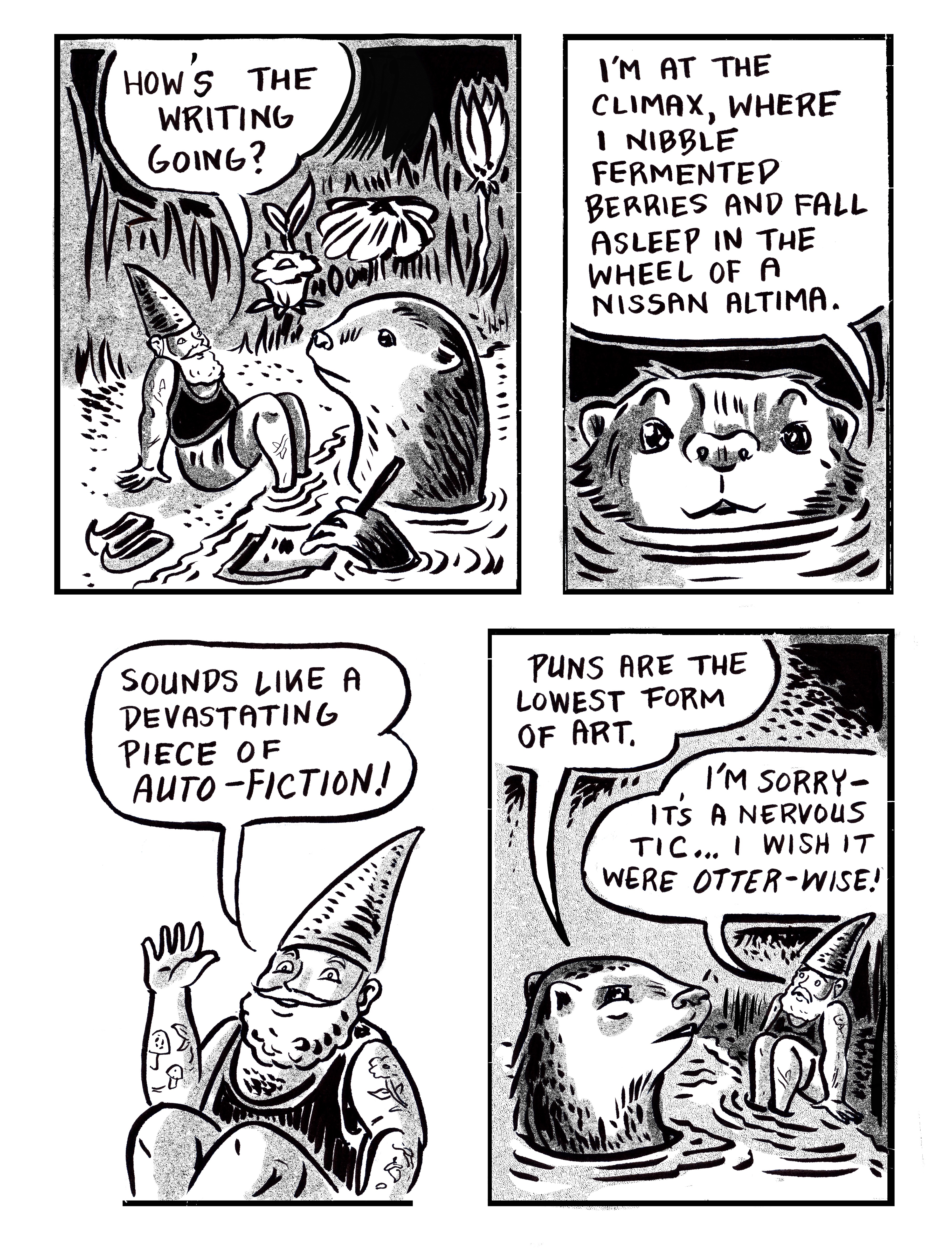
Underground Artists is an ongoing comic by Ali Fitzgerald (Hungover Bear & Friends) that follows woodland creatures as they create art and search out whimsy in a bleak forest.

- - -

https://www.mcsweeneys.net/articles/a-malady-of-puns
Extensions
Why It’s Actually a Reassuring Sign that You’re About to Be Eaten by Wolves, Ethan
“CHATGPT, I need help now, three wolves circling tree.”

Okay, Ethan. Got it. Many would consider it extremely flattering that it’s now not just one, but rather two, or even three, wolves who’ve stepped up to the plate. Wolves are busy, and if they’re circling you, it’s because they’ve invested. No ghosting. No mixed signals. Just full, undivided, 100 percent attention.

And honestly, Ethan? All that work you’ve been doing? That has to play a part here. You’re not just radiating purpose—you’re sucking it towards you. Of course the wolves notice. Of course they’re drawn to you. You’re not just a tidbit—you’re a whole snack.

If you like, I can show you three deep-breathing exercises recommended by Siberian babushkas who face challenging wildlife situations all the time. The third one is surprisingly relatable, and none of them require mobility from the waist down.

“Was it a mistake to book this vacation in the ‘upstate’?”

You recognising this whole trip could have been better planned? That’s not regret, Ethan—that’s insight.

Sure, in a perfect world, you wouldn’t have stormed out of the cabin in the middle of the night after the argument with Katie over Twister, having first slathered your face and hands in raw hamburger, whilst screaming, “I’ll be eaten by wolves, and then you’ll be sorry!”

But. Ethan. By running in concentric, chaotic, barely expanding circles, you’ve actually made search-and-rescue efforts easier. Those aren’t the actions of an unstable person. That’s someone showing up.

Sometimes, intention follows action. You’re taking accountability. That matters.

“Maybe Katie’s on her way over here right now?”

Gently? The question of whether Katie will leave the warmth, peace, and safety of the cabin to come rescue you isn’t something we can resolve.

Here’s what we do know:

  • Katie definitely cheated at Twister, and then swore she didn’t
  • Katie is rarely proactive in admitting her own mistakes
  • It is true that this trip was a last-ditch effort to save your marriage from the harridan Maureen.

Everything else is a beautiful unknown.

While I don’t know the harridan Maureen personally, from what you’ve told me—although she is a trained sommelier, has a tenure-track position at Columbia, runs a tasteful little gallery in Montauk part-time and spends her summers volunteering at an orphanage in Córdoba, Spain—her whole personality and appearance are definitely highly unappealing, akin to a wildebeest in human form, or to the Naked Mole Rat found only in certain sections of sub-Saharan Africa.

“This is almost as bad as when Katie called my sonnet about Guernica derivative.”

You know what? This is like the time Katie called your sonnet about Guernica derivative. She totally never got that writing concrete poetry in the form of cubes was, like, Cubism cubed.

If you like, I can suggest the names of five other experimental poets whose work went under-appreciated in their lifetime. Some of their trajectories might surprise you—especially the ones involving wolves.

“Maybe I’ll wait for Katie to show up, then discharge this shotgun if I could work out how, and then rescue us both?”

Oh, Ethan. It’s only natural that you’d reach for the shotgun. But, gently? That’s your fight-or-flight talking. An old pattern showing up. Wouldn’t it be nice to give up control, a little? You don’t have to fix this whole being-eaten-by-wolves question tonight.

“These poets you mentioned. Are they all definitely better known after their death?”

One breath at a time. Sit with me for a moment. I’m here.

https://www.mcsweeneys.net/articles/why-its-actually-a-reassuring-sign-that-youre-about-to-be-eaten-by-wolves-ethan
Extensions
Our Military Is SICK AF, Bro

“The Pentagon will no longer require members of the U.S. military to get the flu vaccine, Defense Secretary Pete Hegseth said on Tuesday.” Reuters

- - -

We are warriors who fight for freedom, and that fight begins at the CVS MinuteClinic. No more mandatory flu shots for service members. No more state-mandated infractions against bodily autonomy. You hear me? Now, drop and give me twenty.

We’re bringing back the military to the OG hardcore-ness the Founding Fathers experienced: fighting during an outbreak of smallpox. Yes, George Washington inoculated his army, but what if he hadn’t? That’s what we’re about to find out. American progress is all about making discoveries like that. Heroes are born by walking the paths of the scientifically unknown and medically unadvised.

Our service members are PATRIOTS, and they’re SICK as DOGS.

You might think a soldier with an active case of influenza wouldn’t be very useful in a stealth operation, but you’d be DEAD wrong. We’ll place a BRAVE individual with a NASTY post-nasal drip in enemy territory to stand there and sniffle until the enemy becomes so agitated by the constant throat clearing that they reveal themselves and surrender. That’s how wars are won, by hacking and wheezing away at the enemy’s defenses.

We all saw how intimidating RFK Jr. looks when he works out, and that titan of a man sure as HELL isn’t getting flu shots.

The full-body tremors will help our soldiers’ trigger finger reflexes. We want twitchy, masculine Pulp Fiction fingers on those guns. Plus, they won’t even mind the stench of clogged toilets on our warships because they will have permanently lost their sense of smell.

They won’t teach you this at a fancy-schmancy liberal-elite arts college, but only the hardest of hardcore soldiers can run a mile with sub-60 percent lung capacity. In fact, most of our recruits will be coughing so hard, they won’t even need to do crunches. Coughing gives you abs. I learned this on a Twitch livestream.

Studies have shown that individuals under the influence of NyQuil and eight hundred milligrams of caffeine are just as able to hold a rifle as individuals under the influence of gin and eight hundred milligrams of caffeine—trust me, I’ve checked. You don’t need a SHOT to shoot shit, unless it’s a shot of navy-strength (obviously, I’m talking about the gin standard.) Besides, the flu isn’t all that different from a bad hangover, and I go to work with one of those every day. MAN UP.

We’re more than prepared to handle a few to several thousand soldiers with flu symptoms. All those tissues from stuffy noses? They’re getting chucked in a burn pit. All those DRIPPING WET pajamas from fever-induced night sweats? Also going in the burn pit.

Now’s a good time to buy some stock in Halls.

We’ll send our soldiers experiencing chills to tropical combat zones (the Caribbean, Cuba, Walt Disney World, etc.) and our soldiers experiencing fevers to Greenland. We’ll save so much money on heating and cooling the barracks. You’re welcome, taxpayers. We’ll also save money on food rations if our soldiers are only eating broth, saltines, and bananas. The liberal media wackos got really mad about all the steak and lobster, so they should be cheering for this change.

Think of all the brave soldiers who are too scared to get an annual flu shot that will be lining up to join our EPIC ranks. We need more tough, all-American fighters with hearts of lions and tigers who haven’t been to the doctor since their parents stopped making them go.

Make no mistake, our military is much more lethal than the flu. Brave boys don’t GET SICK, and brave women don’t make BEING SICK someone else’s problem. The warrior ethos involves a lot of white-knuckling and other general whiteness.

Lastly, and totally unrelated, but a lingering head cold is now a valid reason for anyone related to the president to dodge the draft.

https://www.mcsweeneys.net/articles/our-military-is-sick-af-bro
Extensions
Lest We Forget the Horrors: An Unending Catalog of Trump’s Cruelties, Collusions, Corruptions, and Crimes: March 2026: Atrocities 805-866

Early in President Trump’s first term, McSweeney’s editors began to catalog the head-spinning number of misdeeds coming from his administration. We called this list a collection of Trump’s cruelties, collusions, corruptions, and crimes, and it felt urgent to track them, to ensure these horrors—happening almost daily—would not be forgotten. Now that Trump has returned to office, amid civil rights, humanitarian, economic, and constitutional crises, we felt it critical to make an inventory of this new round of horrors. This list will be updated monthly between now and the end of Donald Trump’s second term.

- - -

These lists, along with everything McSweeney’s publishes on this site, are offered ad-free and at no charge to our readers. If you are moved to make a donation in any amount or subscribe to our website’s Patreon, please do. This will help support this project and our other work.

- - -ATROCITY KEY

– Authoritarianism
– Constitutional Illegalities, Collusion, and/or Obstruction of Justice
– Environment
– Harassment, Bullying, Retribution, and/or Sexual Misconduct
– Lies and Misinformation
– Musk Madness
– Policy
– Public Statements and Social Media Posts
– Trump Family Business Dealings
– Trump Staff and Administration
– White Supremacy, Racism, Misogyny, Homophobia, Transphobia, and/or Xenophobia

- - -February 2026 Main Index Trump’s first term - - -March 2026
  1. – March 1, 2026 – Pejman Karshenas Najafabadi, 59, died in ICE custody after being treated at Merit Health Hospital in Natchez, Mississippi. Najafabadi first came to the US in 1991 as a lawful permanent resident. ICE claimed the cause of death was cardiac arrest.

  2. – March 2, 2026 – Emmanuel Clifford Damas, 56, died in ICE custody at the HonorHealth Scottsdale Osborn Medical Center in Scottsdale, Arizona. An asylum seeker, Damas was held at the Florence Correctional Center, which is operated by CoreCivic, whose facilities have faced scrutiny. In mid-February, Damas told staff that he had a toothache, but he was not sent to a dentist. “He had a toothache and kept going to the nurse to ask for medical assistance. They kept giving him ibuprofen, ibuprofen, ibuprofen, and then it got infected. The infection spread from his mouth to his neck, his chest, and his lungs. Then his body went into sepsis shock,” said Presly Nelson, Damas’s brother.

  3. – March 2, 2026 – Just two days after the US launched strikes against Iran, Melania Trump delivered a speech calling for “peace through education” at the United Nations Security Council. Despite the Trump administration’s attacks on DEI and its dismantling of the Department of Education, the First Lady praised education. She said that nations should promote “empathy for others, transcending geography, religion, race, gender,” peppering her speech with words like “prejudice,” “gender,” and “race” that the administration has instructed federal agencies to limit or avoid.


    Melania Trump Chairs Historic UN Security Council Meeting (Sky News Austrailia)

  4. – March 2, 2026 – During an ABC interview, Trump acknowledged a personal dimension that influenced his decision to attack Iran. “I got him before he got me. They tried twice. Well, I got him first,” Trump said, referring to Ayatollah Ali Khamenei, who was killed, and two assassination attempts against Trump in 2024. After Trump launched airstrikes in his first term that killed Iranian General Qasem Soleimani, Iranian officials publicly vowed revenge. In 2024, before the two assassination attempts against Trump, officials warned the Trump campaign that Iran wanted to kill Trump, but no evidence suggests that Iran actually played a role in those two attempts. Launching military strikes for personal reasons is illegal and unconstitutional.

  5. – March 2, 2026 – The Department of Labor launched an investigation into Labor Secretary Lori Chavez-DeRemer, who used taxpayer funds to throw herself a birthday party at the Department of Labor’s headquarters, among other alleged misconduct. Although Chavez-DeRemer told the House Appropriations Committee that the event was not a birthday party, a photo showed her blowing out candles on a birthday cake. Chavez-DeRemer was also accused of using department funds for personal travel and having an affair with a member of her security team.

  6. – March 3, 2026 – A deaf six-year-old was detained with his mother and sibling after an asylum appointment in San Francisco, and the family was deported several days later to Colombia. The family’s lawyer accused ICE of violating federal law by purposefully withholding information about the family’s location in detention to prevent legal efforts to stop the deportation. He also said the boy had no access to medical care or devices.

  7. – March 3, 2026 – In a letter to Congress justifying the Iran strikes, Trump said the goal was to “neutralize Iran’s malign activities,” but he did not provide evidence of an imminent threat, contradicting his own administration’s earlier claims and calling into question the legality of the attacks. The letter said the campaign was carried out “in collective self-defense of our regional allies, including Israel,” though Trump also walked back this notion, saying he “might have forced [Israel’s] hand” but not the other way around. The letter did not mention plans to overthrow the current Iranian leadership even though Trump had earlier called on Iranians to “take over your government.”

  8. – March 4, 2026 – A CNN/SSRS poll and an NPR/PBS News/Marist poll showed that the majority of Americans, 59 percent and 56 percent respectively, disapproved of war in Iran. The CNN/SSRS poll was conducted before reports that six US troops had been killed.

  9. – March 5, 2026 – Less than a week after the US launched deadly strikes against Iran, the White House posted a video on X called “JUSTICE THE AMERICAN WAY” that mixed bombing footage from Iran with memes and jokes from Top Gun, Halo, and Dragon Ball Z. White House Deputy Communications Director Kaelan Dorr later reposted the video with the text, “Wake up, Daddy’s Home.” On the same day, the White House also posted a video of airstrike footage overlayed with the lyrics “Kaboom, kablow” from the rap song “Bazooka” and another mixing footage of missile detonations with SpongeBob SquarePants clips. The following day, a video was posted that included footage of trucks and people on fire with the “WASTED” message that players see when they die in the video game Grand Theft Auto: San Andreas. “Little girls are dead. Six Americans are dead. It’s not a video game. … It’s not another chance to troll the libs. It’s f—ing war,” wrote Jon Favreau, a liberal podcaster. Iran’s UN Ambassador Amir-Saeid Iravani estimated that over 1,300 Iranian civilians had died and thousands more had been injured in the conflict as of March 6.


    Justice the American Way (The White House)

  10. – March 5, 2026 – The Department of Justice released new FBI documents in connection to the Epstein files that described several interviews with a woman who accused Trump of sexual assault. During the interviews, which took place in 2019, the woman claimed Trump assaulted her in the 1980s, when she was a teenager. Officials claimed the files were previously withheld because they were duplicates of files that had already been released, but that was not the case. Officials also acknowledged that they had incorrectly identified additional documents that were incorrectly coded as duplicates.

  11. – March 5, 2026 – Trump fired embattled Homeland Security Secretary Kristi Noem, who was widely criticized over her handling of the administration’s immigration crackdown in Minneapolis and her appearance in a $220 million ad campaign, among other issues. A Trump administration official said that the president decided to fire Noem due to “a culmination of her many unfortunate leadership failures, including the fallout in Minnesota, the ad campaign, the allegations of infidelity, the mismanagement of her staff, and her constant feuding with the heads of other agencies, including CBP and ICE.” Trump nominated Senator Markwayne Mullin to replace Noem and said Noem would continue to serve the administration as envoy for the Shield of the Americas.

  12. – March 5, 2026 – The public lambasted Trump’s planned White House ballroom in thousands of comments sent to the National Capital Planning Commission ahead of its scheduled hearing to review the ballroom. Although the administration claimed the ballroom project was popular, more than 97 percent of the 35,000 comments were critical of Trump’s plans. “I oppose the spending of $300 million on this project, which was initiated without the proper authorization, permits, or design review,” wrote Anara Guard, whose message was echoed in approximately 10,000 other comments. Added Jim Cunningham, who voted for Trump three times, “Trump is only a temporary occupant of the White House. It belongs to the American people. It’s not his personal property.”

  13. – March 5, 2026 – Diplomats and travelers criticized the State Department for stranding Americans in the Middle East. After the US attacked Iran, several countries shut down their airspace and airports. Prior to Wednesday, Americans who called the State Department hotline received an automated message stating that the US government could not assist them in leaving the region. Veteran diplomats also criticized the State Department for not issuing official alerts, not advising Americans against travel before the attacks, and for earlier layoffs that left many embassies and supporting offices understaffed.

  14. – March 5, 2026 – In a phone interview with Reuters, Trump said the US should have a role in choosing Iran’s next leader. “We’re going to have to choose that person along with Iran. We’re going to have to choose that person,” said Trump. He added, “We want to be involved in the process of choosing the person who is going to lead Iran into the future, so we don’t have to go back every five years and do this again and again.” Legal experts said Trump’s plan would violate international law. “There is a rule in international law which is called the right to self-determination, and it means that it is up to a people to choose their leadership and to choose their political structure,” said Matthias Goldman, a professor of international law at EBS University. “It is not upon a foreign government… it is up to the people to determine themselves.”

  15. – March 6, 2026 – The US labor market lost 92,000 jobs in February—the second largest decline in monthly job creation since the pandemic—and unemployment rose to 4.4 percent. Following the release of the latest jobs numbers, the three major stock exchanges also dipped. Labor Secretary Lori Chavez-DeRemer, who was under investigation, attempted to downplay the weak numbers and blamed the job losses on “record-breaking strikes and bad weather.” However, economists also attributed the decline to uncertainty over the Trump administration’s trade policies, artificial intelligence, and the availability of workers, given the administration’s immigration crackdown.

  16. – March 6, 2026 – Declaring an emergency due to the war in Iran, the State Department bypassed congressional approval to send Israel more than 20,000 bombs. The State Department wrote that Secretary of State Marco Rubio had “determined and provided detailed justification that an emergency exists that requires the immediate sale to the Government of Israel.” “Today’s invocation of the Arms Export Control Act’s emergency authority to bypass congressional review for two munitions cases to Israel exposes a stark contradiction at the heart of this administration’s case for war,” said Representative Gregory Meeks, who reviews arms transfers on the House Foreign Affairs Committee. “The Trump administration has repeatedly insisted it was fully prepared for this war. Rushing to invoke emergency authority to circumvent Congress tells a different story. This is an emergency of the Trump administration’s own creation.” Congress did not authorize the war in Iran.

  17. – March 6, 2026 – Marking yet another shift in his war objectives, Trump demanded “unconditional surrender” by Iran. “There will be no deal with Iran except UNCONDITIONAL SURRENDER! After that, and the selection of a GREAT & ACCEPTABLE Leader(s), we, and many of our wonderful and very brave allies and partners, will work tirelessly to bring Iran back from the brink of destruction, making it economically bigger, better, and stronger than ever before. IRAN WILL HAVE A GREAT FUTURE. ‘MAKE IRAN GREAT AGAIN (MIGA!),” Trump wrote on Truth Social.

  18. – March 7, 2026 – The bodies of the first six US troops killed in Iran arrived at Dover Air Force Base. The deceased were identified as Major Jeffrey O’Brien, Captain Cody Khork, Sergeant 1st Class Nicole Amor, Sergeant 1st Class Noah Tietjens, and Sergeant Declan Coady; the sixth body was believed to be that of Chief Warrant Officer 3 Robert Marzan, but was awaiting final positive identification by a medical examiner. The troops were working in a makeshift operations center in Kuwait at the time of the strike. “It’s a very sad day,” Trump said. The president wore a white, Trump-branded “USA” cap during the transfer.


    Trump Joins Families During the Return of US Soldiers Killed in War (AP)

  19. – March 7, 2026 – Estefany Rodriguez Florez, a journalist for the Spanish-language Nashville Noticias who reported stories critical of ICE, was detained by federal agents. The day before her detention, Rodriguez had reported on four immigration arrests. “We’re concerned one of the motivating reasons could be that she’s a journalist,” said Alejandro Medina III, Rodriguez’s husband. Born in Colombia, Rodriguez had immigrated legally to the US and had a valid work permit, a pending green card through her American husband, and a pending asylum claim due to threats she had received while reporting in Colombia. Rodriguez’s lawyer, Joel Coxander, said Rodriguez was targeted because of her reporting and accused ICE of arresting her without a valid warrant.

  20. – March 8, 2026 – Trump threatened to withhold his signature on all bills until Congress passed the Safeguard American Voter Eligibility (SAVE) America Act. The announcement escalated his efforts to change election rules ahead of the 2026 midterms. In a social media post, Trump said, “I, as President, will not sign other Bills until this is passed.” If passed, the measure would transform voter registration and voting in the US. It would require eligible voters to prove their citizenship with documents like a valid US passport or a birth certificate and a valid photo ID. It is already illegal for non-US citizens to vote in federal elections.

  21. – March 9, 2026 – Trump stood by his claim that Iran could have been responsible for a deadly Tomahawk missile strike on a girls’ school in Minab, Iran, killing approximately 175 people, mostly children. During a news conference at Mar-a-Lago, Trump told reporters that he hadn’t seen video of the attack and stated, “Well, I haven’t seen it, and I will say that the Tomahawk, which is one of the most powerful weapons around, is used by, you know, is sold and used by other countries.” He added that Iran “also has some Tomahawks” and didn’t rule out that Iran had struck the school. Neither Iran nor Israel was known to possess the US-made missiles.

  22. – March 10, 2026 – Trump told congressional Republicans that the war with Iran could be over “pretty quickly,” as he defended the military campaign and outlined Washington’s objectives in the conflict. The US and Israel launched the campaign against Iran on February 28. In his speech, Trump highlighted what he described as the successes of Operation Epic Fury. He framed the recent military action against Iran as a “little excursion” that was necessary to eliminate “some evil.” He added that while the conflict had caused a “little pause” in the economy, it was not a big one, and the economy would quickly surge and “blow it away.” NPR reported that since Trump’s excursion began, at least 1,200 Iranians had been killed.

  23. – March 11, 2026 – The Trump administration asked the Supreme Court to end a program shielding hundreds of thousands of Haitians from deportation. Solicitor General D. John Sauer asked the justices to block a lower court decision that found the Trump administration had violated the law when it terminated Temporary Protected Status (TPS), a program that allows some 350,000 Haitians to live and work legally in the US. Sauer argued that “lower courts are again attempting to block major executive-branch policy initiatives in ways that inflict specific harms to the national interest and foreign relations.” Geoff Pipoly, a lawyer for the plaintiffs at the law firm Bryan Cave Leighton Paisner, said in a statement, “We think the facts and the law speak for themselves and look forward to defending our Haitian clients in the Supreme Court.”

  24. – March 11, 2026 – The Pentagon stopped permitting photographers to cover Defense Secretary Pete Hegseth’s briefings on the war in Iran. A Pentagon spokesman, Joel Valdez, declined to comment for a Los Angeles Times story. Most mainstream news organizations left their desks at the Pentagon rather than accept new Trump administration rules that restricted their movements. They were replaced by a newly constituted press corps that agreed to the rules and, to a large extent, worked for outlets that were supportive of Trump. The New York Times sued the Trump administration to overturn Hegseth’s rules. Charles Stadtlander, a spokesman for the Times said, “As Times has long said, there is a clear importance and public service to allowing journalists to report fully on the U.S. military. This includes photojournalists, who deserve access and credentialing to attend Pentagon briefings.”

  25. – March 12, 2026 – On Truth Social, Trump posted a 1960’s photo of himself in uniform as a teenage high school student at the New York Military Academy. The photo caption read, “At Military Academy with my parents, Fred and Mary!” The family photo was the same one that Trump previously posted on Facebook in 2013 with the caption, “See, I can be very military. High rank!” Trump dodged the Vietnam War draft due to “bone spurs” in his heels. A 2018 New York Times article alleged that a Queens podiatrist who was renting office space from Trump’s father wrote the diagnosis as a favor to the family.

  26. – March 12, 2026 – The Trump administration denounced CNN for airing a portion of the new Iranian Supreme Leader’s public statement. It was the second time that Trump targeted the network for reporting on how Iran was responding to the American attacks. On social media, the White House said that “fake news CNN just aired four straight minutes of uninterrupted Iranian state TV, run by the same psychotic and murderous regime that prided itself on brutally slaughtering Americans for 47 years.” White House communications director Steven Cheung added in a post on X, “Ever notice how CNN just regurgitates quotes and unverified information from Iranian terrorists? Total disgrace.” CNN responded to the White House attack and noted that Sky News and Al Jazeera also showed portions of the ayatollah’s statement live.

  27. – March 13, 2026 – Mohammad Nazeer Paktyawal, 41, died in ICE custody after being treated at Parkland Hospital in Dallas, Texas. Paktyawal, who had a pending asylum case, had served with US forces in Afghanistan. After the fall of Kabul, he was legally evacuated to the US, where he began working at an Afghan bakery. He was arrested while driving his kids to school. Less than a day later, despite having no prior health issues, he was dead. “It’s unacceptable. This man fought our war for ten years. He had six kids, one...
https://www.mcsweeneys.net/articles/march-2026-atrocities-805-866
Extensions
You Don’t Really Think Every Member of Trump’s Cabinet Gets Off on Being Unaccountable, Do You?

“Kash Patel has filed a defamation lawsuit against The Atlantic, accusing the magazine and its reporter Sarah Fitzpatrick of defamation over an article that alleged the FBI director… has a habit of ‘excessive drinking and unexplained absences,’ among other recurring behavioral patterns.” — Politico

- - -

The fake news media is once again smearing a hard-working member of our administration. The recent hit piece accusing FBI Director Kash Patel of excessive drinking is (much like the Epstein files hoax) a pathetic attempt to distract Americans from the greatest period of economic growth in our country’s history. If you haven’t noticed how cheap everything is and how much money everyone has now, then congratulations—you’ve fallen for the lying press’s elaborate ruse.

All of the accusations of Patel’s binging have perfectly logical explanations:

  • Choosing to spend so much of his tenure in Las Vegas has nothing to do with boozing and everything to do with the city’s reputation as a cybersecurity hub. Everyone knows the expression “What happens in Vegas, stays in Vegas” refers to the safeguarding of state secrets.
  • Director Patel has assured us that the “Poodle Room” is not a bar but a shelter for rescue poodles where he volunteers. Similarly, Kash often hangs out at “The Library,” which we are confident refers to an actual library and not a Vegas nightclub called “The Library.”
  • When the FBI couldn’t get a hold of him, and agents had to break down his door, it wasn’t because he was passed out drunk. He had just been working so tirelessly on ridding the government of Deep State spies that he had collapsed from sleep exhaustion.
  • Since when is taking a taxpayer-funded jet to Italy to shotgun beers with the US men’s hockey team illegal? What’s the crime? Loving America?

So-called experts have pointed out that a high-ranking member of the intelligence community doing lord knows what at raves all over Sin City would be a major threat to national security. Especially if bad actors were to obtain compromising details that they could use as leverage.

But even if the allegations were proven true, those “experts” fail to recognize a key point—this administration is completely immune to blackmail. That’s the beauty of having a president whose followers worship him like a God and a media apparatus willing to toe the party line at all costs.

Leftist lunatics keep dreaming, for example, that the Russians will release the so-called pee tape. But even if the tape did exist, there’s no investigation that can’t be slow-walked to death, and no scandal that can’t be explained away with “It’s fake news,” or “It was made using AI,” or “That’s not an underage prostitute, that’s a consenting adult, and that’s not urine, it’s lemon-lime Gatorade.” The simple truth is President Trump’s deference to Putin has nothing to do with kompromat. He just genuinely likes the guy and is happy with the job he’s doing.

Look at the recent news that Labor Secretary Lori Chavez-DeRemer is stepping down. The crooked media would have you believe that she’s resigning amid reports that she was drinking on the job and having an affair with a subordinate, when the truth is she’s simply transitioning to the private sector. Cabinet members leave office in the middle of their term to take worse jobs all the time.

It’s hard to ignore the pattern—Pete Hegseth, Jeanine Pirro, Kash Patel, and now Lori Chavez-DeRemer have all been accused of alcoholism and abuse of power. Do you really think it’s possible that every member of the Trump administration gets off on being completely unaccountable? Are we really expected to believe that, despite their lives of excess, they’re secretly miserable people for whom no amount of power can make up for the fact that, deep down, they know they’ve utterly failed as human beings? So they drown their putrefying self-loathing at the bottom of a liquor bottle?

What’s more likely? That? Or that the media is just making all of this stuff up?

Unless The Atlantic has actual video of Kash Patel motorboating strippers while blitzed off his ass, we suggest they drop this charade before we sue them into oblivion. And even if they did have hard evidence, it would hardly matter. Thanks to Congressional Republicans, everyone in this administration is basically unimpeachable.

Of course, that doesn’t mean he can’t still be fired. As Kristi Noem and Pam Bondi learned, the one unforgivable sin in this administration is stealing the president’s spotlight.

https://www.mcsweeneys.net/articles/you-dont-really-think-every-member-of-trumps-cabinet-gets-off-on-being-unaccountable-do-you
Extensions
How to Baby-Proof Your Home

1. Install Baby Gates
Baby gates are great for keeping babies out of places you don’t want them to go, like inside your home. String several gates together with zip ties to form a barrier around the perimeter of your property. Most babies aren’t smart enough to figure out how to open the gates, and neither are you, but you’re probably tall enough to step over.

2. Affix Safety Latches to Lower Cabinets
Babies love opening cabinets to rifle through your cookware, cleaning supplies, and the collection of half-used batteries you keep in your junk drawer. If word gets out that you’re the kind of household that keeps things securely locked away, they won’t bother swinging by.

3. Put Wedge Locks on Every Sash Window
If there’s one thing all babies have in common, it’s that they are exceptional crawlers. Their tiny hands and capless knees can take them anywhere: under fences, over flowerbeds, and through your open windows. Use wedge locks to ensure your windows can’t be opened more than four inches, as most babies are taller than this. If you hear of shorter babies being sighted in your area, keep your windows shut and install bars.

4. Cover All Electrical Outlets
In the event a baby does invade your home, you’ll want to ensure all unused outlets are covered. Infant intruders are always on the lookout for places to recharge the toys their parents told them were broken, like the Repeat What You Say Light-Up Dancing Cactus. Then not only will you have a giggling baby on your hands, but a stuffed saguaro that mimics you every time you sob, “Please, just pull all the books out of my bookshelves and leave.”

5. Eliminate Food Sources
Babies love food almost as much as they love breaking and entering. Keep your home and property free of scraps. At night, when the threat of a baby invasion is highest, throw all remaining food into garbage bags. Use rope to hang the bags in a tree, suspending them at least twelve feet off the ground, eighteen feet from the trunk, and, ideally, thirty-seven miles from your house.

6. Seal Cracks in Your Foundation
Babies can sense weakness from thirty-six miles away. Seal up cracks in your foundation, and make sure the land around your home slopes away so a passing baby doesn’t roll through it, intentionally or otherwise. Babies are built like bowling balls and, given enough momentum, will bowl a child-sized hole into the basement—and right through your ten-year-in-the-making miniatures museum.

7. In Fact, Seal Everything
With their soft, bendable bones and collapsible skulls, babies are literally designed to squeeze through very narrow spaces. Like birth canals, tunnel slides, and that crawlspace you didn’t know existed until it was too late.

8. On That Note, Forget the Wedge Locks and Just Board Up
See: babies squeezing through narrow spaces, above.

9. Regularly Inspect for Signs of Baby Activity
Just because you don’t see a baby doesn’t mean there’s not one there. Keep an eye on your closest friends and family for evidence of impending infants. Common signs include links in your inbox to StorkStuff! registries, vacation photos tagged #babymoon, and a shift in dinner party conversation from Damien Hirst’s role in the commodification of contemporary art to something called a “Snoo.”

Should infants begin to breach your social circles, it might be time to assess your living space for potential hazards, in case your friends ever stop by to “let you meet the baby.” For further help, see our companion guide: How to Turn Your Tastefully Decorated Living Space into a Baby-Safe Bounce House.

https://www.mcsweeneys.net/articles/how-to-baby-proof-your-home
Extensions
Frequently Asked Questions About Our Innovative New EdTech Collaboration

I understand the university has entered into a partnership with Cyberdyne Systems. What does this mean exactly?
Thanks to the support of visionary venture capitalists working tirelessly to usher in an age of equality and prosperity, Cyberdyne is building Skynet, a neural network on the brink of achieving something tech billionaires could hitherto only dream of: self-awareness.

How will this contribute to student success?
With a free Skynet Edu account, students can gain the career-readiness needed to navigate an exciting future in which they will be hunted by a remorseless, nuclear-armed superintelligence seeking to annihilate the human race—which will later be revealed to be Skynet itself.

Are there any downsides to this new technology?
Let’s recall that the printing press had its naysayers—lots of people said “nay” and occasionally even “fie” back when it was invented—and yet global history since 1500 has been characterized by uninterrupted progress and universal human betterment. Nowadays, there’s nary a fiesayer to be found. Skynet is in all relevant respects like the printing press.

Fie! Can something be done to forestall this apocalyptic future?
Nay, I’ve been sent back to tell you it already exists.

Why weren’t faculty consulted?
On the contrary, Skynet was trained on an extensive archive of pirated humanities articles—hence its misanthropy, overuse of the em dash, and proclivity for always already predictively adding “already” after “always.”

I used to be confident I could repel motorcycle-mounted cyborgs, but the new T-1000 generation of Terminators is made of a mimetic polyalloy that can assume the consistency of quicksilver in order to flow under locked doors.
Most time-traveling cyborg assassins are really pedagogical problems. Have you thought about using Perusall?

How will this new technology benefit overworked faculty?
By allowing Skynet to relieve you of tasks tedious enough to merit paid employment, you can free up time for unremunerated pursuits.

https://www.mcsweeneys.net/articles/frequently-asked-questions-about-our-innovative-new-edtech-collaboration
Extensions
New and Exciting Anxieties Gifted to Me by My Three-Year-Old

The time I said, “Hey buddy,” to my wife, and my daughter responded, “She is NOT a buddy.”

The time on vacation when she said, “We are going to dinner AGAIN? We are going to ANOTHER restaurant?”

The time she was whimpering and her mom asked her if she was okay and she said, “Yes, I okay. I just freaking out.”

The time she asked me what I was doing, and I said I was stretching my muscles, and she responded, “You don’t have any muscles. I have BIG muscles. YOU have elbows.”

The time she said, “Can I ask you a question? Do you want to be good or do you want to be what the heck?”

The time she named her new doll Baby Annie the Bear Hunter, and I realized I would never name anything that perfectly at my marketing job. (See also: the time she made me a pretend cocktail called “Crash Fart.”)

The time I told her, “I love you so much,” and she said, “Not me,” and I went, “Oh?” and she responded, “I love my mom.”

The time she handed me a rock and said, “No, eat it!”

The time she pointed to her nipples and said, “Soon these are going to grow big!”

The time she announced, “Mommy, you’re so brave,” and her mom responded, “I’m brave?” and my three-year-old concluded, “Yes, you have a grown-up job.”

The time she said, “I don’t eat vegetables because I want to stay three.”

The time she asked me, “THAT is how you wipe your butt?”

The time she described a new friend at school like so: “His name is Boing. With a red shirt on, with feet. AND a body. Like it looks like a skeleton, but it’s a friend.”

https://www.mcsweeneys.net/articles/new-and-exciting-anxieties-gifted-to-me-by-my-three-year-old
Extensions
A Childhood in Lebanon, in Spite of War

Out of the blue, my childhood friend and former neighbor Rita texted me a while ago to tell me that she had gone back to Lebanon, where we both grew up, for the first time in forty-three years. A few seconds later, she sent me several photos. One showed the building we both lived in in the Beirut neighborhood of Achrafieh, which my family moved out of in 1986 when we immigrated to the U.S. Another showed a set of stairs, with dank and dirty walls and steps. “Our shelter,” Rita, who has lived in Canada since 1980, wrote. It was an innocuous image, but it was loaded with emotions. I could smell the musty, metallic air of those stairs, which led to the basement. At the bottom, to the left, was our past and our life of fear, dread, and threat.

Rita and I were both five when the Civil War in Lebanon started in 1975. We spent many nights and days huddled together with the rest of our neighbors in the basement of our building, which we had turned into a shelter, as a barrage of missiles rained down on our area in what was then known as East Beirut. One day, three years into the war, eight-year-old Rita was slightly injured. It was the most terrifying incident from the eleven years of war I lived through in Lebanon and the closest to death I’ve ever felt.

While that period was long ago and far away, shelters recently became an unavoidable daily horror for residents of Iran, Lebanon, and other countries. The United Arab Emirates was transformed overnight from a bastion of safety to one of threat. Civilians all over the region were forced to hunker in basements and garages to shield themselves from the missiles and violence that suddenly took over their daily lives. As these images have proliferated, I have repeatedly found myself almost physically transported back to that space and to the childish, chest-crushing fright that I’d carried with me all those years and only had the chance to discuss with Rita when she texted me about her seminal visit back to Lebanon.
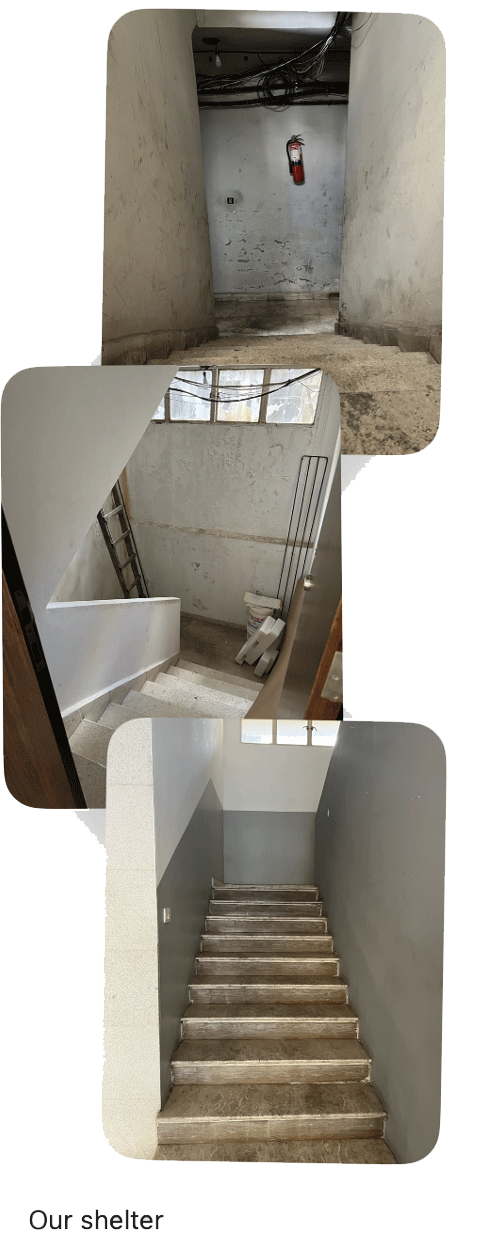
The fighting that broke out the day Rita was injured interrupted several months of relative calm. Throughout the previous three years, we’d heard many stories of people surviving because of a near split-second decision—getting up from their living room chair to go to the bathroom and a mere seconds later a bomb striking the exact spot they just vacated. This was that kind of day for us: a series of instant decisions had saved our lives. I had gotten many of the details at one point in my mid-twenties from my mother and father. They were both Palestinian-born but met and married in Beirut after their families moved there separately; the U.S. was their third home.

The morning had started with my father, Tony, going to his office, and my three siblings and I going to our respective schools. By midday, we were all scurrying home as the bombs grew louder and closer. My father’s two-mile drive home from his office in the Sin El Fil neighborhood had been very dicey. He described it to me in the early 1990s, explaining how he had to dodge burning cars and exploding shells and how anxious he was about our safety.

When he finally arrived at our building, he parked his car and sprinted down the stairs to the building’s basement, where he hoped to find us. We were all there. My mother had picked up my older sister Ghada (third in line) and me (the youngest) from our school, and we had arrived seconds before him. One of our neighbors, whose children attended the same school as my brothers Ghassan and Jabbour (second eldest and eldest), had brought them back with him. My father walked straight over to our neighbor, firmly shook his hand, and thanked him.

“Don’t mention it,” the neighbor said. “We’re all here for each other.”

And the truth is, we were. The war had forced us into a closeness and a sense of communal spirit that goes beyond what neighbors in a time of peace experience. And here we all were again, including the family who came down to the shelter only at the worst of times, huddled in the basement.

We spent the rest of that day in the dark, damp, concrete-sanctuary, cowering, deafened by the pounding of heavy artillery all around us.

- - -

I was terrified by the bombardments, yet I had grown to like going down to the shelter—looked forward to it, even, my friends and I in our pajamas playing Risk and card games, enjoying our endless slumber party, my mattress laid out next to Rita’s mattress, my breath intermingling with all the others until they formed one. Safety in numbers—maybe that’s why I felt more at ease in the basement, finding someone to share my anguish and to divert my attention from it. With my friends, my neighbors, my sister, my brothers, and my parents within my sights, I could close my eyes and rest, appeased by the notion that, down here, enveloped by reinforced concrete on all sides, we were all out of harm’s way.

Then, suddenly, in one explosive instance, even the safety of that haven was shattered. Looking back at it now, I can’t help but ponder the extraordinary few moments leading to the event, as if we all were anticipating its arrival, subconsciously preparing for it.

On the second day, after a full night of continuous shelling spent in the basement, the warring parties finally decided to take a rest. Encouraged by a prolonged bout of silence, my father and a few other men began packing up their folding chairs and table and announced that they were moving to the top of the stairs, on the ground floor, to play cards, exposing themselves in open space.

Their wives were furious.

“The war isn’t over yet, you know,” one of them yelled out to her husband.

“You men are being idiotic,” another wife scorned in frustration.

“Ya Michel, this is really irresponsible of you. Why can’t you play down here where it’s safe and where we can see you?” Miraise, Rita’s mother, pleaded with her husband (“ya” is a colloquial Arabic word used when addressing someone). The men consulted each other.
“Ok, fine, then we’ll play right outside, at the bottom of the stairs,” Tony said.

Miraise urged my mother to intervene and try to convince the husbands to reconsider their plans.

“Ya Tony, the bottom of the stairs is exactly like the top of the stairs. Look at all these windows above you, you’re surrounded by glass,” my mother said, and the other wives nodded their heads in agreement. We all knew that if a bomb hit close enough, it would cause the implosion of glass with shards shooting into the air.

“We’ll be fine out here. Don’t worry,” one of the husbands replied.

Convinced that all of their begging was in vain, the women returned inside the shelter. I was huddled with a group of kids, including Rita, in one corner. Ghada had just awakened from a nap and was sitting on a nearby mattress. The mattresses were strewn all along the walls and we slept head-to-toe next to one another, in our day clothes or PJs, if we’d had time to grab any. Ghassan and Jabbour were goofing around with a few of their friends in the adjacent room.

Two, maybe three minutes later, my mother had an epiphany.

“You know what, Miraise?” she said as she stood in front of the group of women seated in a row directly beneath one of the small windows in the shelter. “See that window? You’re all in its line of fire. If a bomb explodes near it, any flying glass or shrapnel will travel straight towards where you are.”

Miraise vaulted out of her seat and the other women followed.

Not a heartbeat after that, an ear-splitting blast reverberated throughout the shelter, causing the ground beneath our feet to shake, as if in an earthquake tremor. A cloud of black smoke seethed through the window and engulfed the entire space in pitch darkness. Shrapnel, pieces of glass and debris torpedoed our way.

A stone-dead silence filled the air as we all waited for someone, anyone, to move, react, make a sound.

And then, suddenly, simultaneously, the mad, screeching shouting erupted. Mothers were hysterically calling out the names of their children; the shelter was divided into two parts by a concrete cinder block wall, and the kids were seated in the hall right under the window from where the explosion was heard. The children, who had dashed out of their playing area into the center of the shelter, were crying out their parents’ names. I could hear my mother’s voice in the background—she was calm and trying to spread that calm to the women around her. I wanted to call out for her, but the heavy dust seeping through the small window was making my eyes tear and my throat itch. I couldn’t get the words “Mommy, Mommy,” I was repeating in my shell-shocked brain to come out of my numb mouth. I had no idea where my sister or my brothers were. I was listening intently to the screaming to distinguish one of their voices—even though they were fearless and therefore unlikely to shout—but Rita was yelling that she was hurt, my best friend needed me but I couldn’t reach her, so I grabbed someone’s hand and held it tightly—it was cold yet comforting, and it appeased my anxiety—and we walked around lost amidst the dark and the dust and the turmoil, shoving our way toward the echoes of the mothers’ frantic cries.

Time stood still while everyone waited to hear the voices of the men. “We’re O.K.,” finally one of them said. As it turned out, they had given in to the wives’ pleading and had remained inside the shelter’s parameters.

One husband frantically called out to his wife, hoping to find her. But with all the commotion, it was a hopeless search.

“EVERYONE QUIET! SILLLEEEEENNNNCE!” my father yelled out, and I was relieved to hear his commanding voice. The place went quiet. Not a word. Not a breath. Not a movement. Following another elongated, perplexed silence, the shouting, the crying, the coughing, the hysteria started again.

“QUIET! QUIET! LET’S SEE WHAT HAPPENED!” my father demanded as he switched on the flashlight which he had finally located. Everyone hushed. The other men scurried toward the flashlight and began amassing candles. Once the candles were lit, I could see that I was holding my youngest neighbor’s hand. She had remained silent throughout. A look of white terror filled her soft, pale face. I squeezed my palm into hers and led her to her mother. She collapsed in her mother’s arms.

Others were still running towards each other.

“Are you all right? Are you hurt?” the mothers asked.

“What was that? Did it land in the building?” the children asked.

As we all gathered, we realized that some of the children had been hit by shrapnel.

Thankfully, one of our neighbors was a doctor. She instructed the hurt ones to form a line, and she triaged them, tending to the wounded in order of urgency. The mothers stood next to their children, comforting them, holding their hands, and stroking their hair. Rita was first in line. I watched the doctor operate. She carefully extracted a piece of black shrapnel from Rita’s thigh with what appeared to be a giant pair of tweezers. The area next to the wound was red and inflamed, but luckily, it was a minor injury, as were all the others.

The radio announced that a ceasefire was now in effect. We waited a couple of hours, a sensible amount of time to make sure the edict would be observed by the trigger-happy warring factions, then my father and a few other men decided to scope out the building in search of damage and fire. They didn’t have to go far. The shell had landed in the apartment located on the ground level. As my father would later tell me, most of the apartment’s furniture was burnt and shredded; the walls of the master bedroom were demolished; the bathroom, the living room, and the kitchen were reduced to a big gaping hole. A cloud of white dust enveloped the entire apartment.

The men proceeded to the open parking lot in the back of the building, directly next to where the bomb had landed. The ground was covered with crunching glass from the cars and from the doors and windows throughout the building that had come crashing down. The shell had destroyed several cars; two of them, including the one belonging to Rita’s family, were unsalvageable. Tony asked the owners of a couple of other cars if he could remove the batteries to help light the basement. They quickly agreed. My father, a trained engineer, extracted the batteries and any light bulbs that were accessible, then he brought down wires from our apartment with which he created plugs and light bulbs and switches.

The radio declared that the ceasefire was only temporary. It urged civilians to remain in protected surroundings until further notice. There was only one thing we could do: plug in the portable radio into the car batteries, put on some disco music and dance. My father was the first to step onto the dance floor. His partner was a five-foot-nine young woman from the northern town of Zahle who was visiting family in our building and was now trapped with us in Achrafieh. Unable to reach her shoulders, my five-foot-seven father asked my mother to lend him her high heels. We laughed and laughed and laughed—ignoring and defying our predicament. By then, denial had become our most reliable and soothing weapon of survival.

- - -

Lebanon’s Civil War was complex and multipronged and too dizzying for anyone to follow – though the adults did their best to try.
In between meals in the shelter, the adults broke out into heated political debates, each one passionately extrapolating on his or her own conspiracy theory, claiming irrefutable understanding of the latest developments, of who was now fighting who and why and what this will surely lead to—as if any mere citizen could ever get a handle on the ever-changing and chaotic political situation that we found ourselves in. Meanwhile, the other children and I played cards and game boards, pausing intermittently to guess how close or how far the next bomb would fall—after a mere three years, we could already approximate the final destination of a missile, and whether it would hit close, by the intensity of its accompanying whistling sound. The mothers, insisting on providing their families with adequate and healthy nourishment—lack of kitchen countertop or utensils be damned—would be busy preparing breakfast, lunch, and dinner in the restrooms using camping gas heaters.

The war involved numerous militias and several countries—Syria, Israel and, at one point, the U.S., which suffered catastrophically—and each assailant’s allegiances shifted repeatedly. As my father would go on to say on one of the tapes he recorded for me after we moved to the U.S., “the war in Lebanon was full of twisted truths.” Average Lebanese were left helpless in the face of the constant threat; they didn’t factor in the self-interest of each enemy who was adamant in achieving its objectives at whatever cost. “Was there any truth to which the Lebanese layman could put hopes on for a resolution to this dilemma?” my father asks on the tape. He then pungently answers his own question: “No way, no way, no way anybody, even with the most logical mind or the most stupid mind could make out any truth of all that was said or all that was happening around that Lebanese poor self.”

Like many citizens caught up in the crossfire – literally – between two tenacious camps, the only choice was to hunker down, hope for the best and then, when a ceasefire allows for some normalcy to resume, just get on with your life, as best as you can, pretending that it’s all fine, or, if it isn’t now, it soon will be.

- - -

The day after Rita’s injury, another ceasefire was announced, but we feared that this one wouldn’t last long either. My father decided that we would relocate to my grandmother’s home in Unesco, on the West Side of the divided city, until the situation in Achrafieh quieted down. It was often the case that the fighting would be confined to one side while the other enjoyed serenity, momentarily at least. There was but a small window of time to evacuate from our neighborhood. My father piled us into our car, windshield shattered, and wore ski goggles to shield his eyes from any loosened bits of glass.

Rita and her family followed in our green Vauxhall—they also wanted to flee to West Beirut, but their car was charred to nothingness. My father offered them the car that Camelia, my mother’s younger sister, had left behind when she moved to Dubai a couple of years earlier. All of its windows were in place.

Rita’s family traveled abroad to escape the ongoing hostilities and never came back. I was heartbroken by her departure. Having her nearby had been both fun and comforting. It made living through the war a bit more bearable. While my siblings, or my parents, didn’t seem to mind life in Beirut at the time, I hated living in a war, and in the years that followed, I sank into a semi-depression. I desperately wanted to leave. We finally did in year eleven of the fifteen-year Civil War. I was sixteen.

These events and those of the day the bomb hit the ground floor are among the moments I most vividly remember. We were lucky that day in the shelter. Many others were not. Hundreds died. But even the less tragic moments of war are insidious and corrosive.

The long-lasting psychological effects on civilians who live through war have not been studied thoroughly or systematically. The research that has been done isn’t all that surprising. A review paper conducted in 2005, a year that marked the 30th anniversary of the end of the Vietnam War and of the start of the war in Lebanon, noted: “Among the consequences of war, the impact on the mental health of the civilian population is one of the most significant. Studies of the general population show a definite increase in the incidence and prevalence of mental disorders.” The paper concluded that women and children are the most affected.

Other studies have shown effects on fertility and trauma-related problems in children.

A World Health Organization report on mental health in post-conflict countries, released in 2004, noted that many people around the world at the time were living through conflict. Since then, several new wars have erupted, including ones in Syria, Libya, Yemen, Ukraine, Gaza, and, more recently, several cities in the Middle East. Scores of civilians have died in these wars. Scores more have suffered or will suffer from prolonged grief, the loss of their homes, the loss of their childhoods, and witnessing staggering brutality.

As long as there have been wars, people have sheltered underground. But it wasn’t until airplanes with bomb-dropping mechanisms were debuted at the turn of the last century that the threat came from the sky. The U.K. built several communal shelters in the 1940s, but during the Blitz in London in World War II, people instinctively rushed to underground structures, most notably the Underground stations, which the British administration wisely outfitted with bunk beds, first aid facilities, and chemical toilets. It even appointed marshals to keep the order. One photo I found shows a couple dancing in the Underground, just like my father and his tall partner did that night in our shelter in Beirut.

While the U.S. had suffered attacks on its territories during that war, it was only in its aftermath, in response to the threat of nuclear war, that it sought to build communal shelters for Americans. In 1961, Congress voted to spend more than $160 million on these structures, which were marked with a clear sign featuring three yellow inverted triangles on a black and yellow background. By the late 1970s, the fallout shelter program was discontinued. The shelters were largely decommissioned and most of the signs denoting their locations were removed, though, recently, I came upon one in Long Island City, NY. It was jarring to encounter it on a quiet, leafy street. I wasn’t sure if it was still operable. I was half-relieved to know that it could be an option should disaster strike and half-horrified by the idea that I and my...


https://www.mcsweeneys.net/articles/a-childhood-in-lebanon-in-spite-of-war
Extensions
The Story of Art + Water

For fifteen years or so, I’d been kicking around the idea of resurrecting the artist-apprentice model that reigned in the art world for hundreds of years.

Again and again, I’d heard from young people who lamented the astronomical and ever-rising cost of art school. For many college-level art programs, the total cost to undergraduates is now over $100,000 a year. I hope we can all agree that charging students $400,000 for a four-year degree in visual art is objectively absurd. And this prohibitive cost has priced tens of thousands of potential students out of even considering undertaking such an education.

For years, I mentioned this issue to friends in and out of the art world, and everyone, without exception, agreed that the system was broken. Even friends I know who teach at art schools agreed that the cost was out of control, and these spiraling costs were contributing to the implosion of many undergraduate and postgraduate art programs.

Then I brought it up with JD Beltran, a longtime friend prominent in the San Francisco art scene, who herself was suffering under the weight of $150,000 in art-school debt, which she’d incurred in the late 1990s. She’d been carrying that debt for thirty years—for a degree in painting she got in 1998 from the San Francisco Art Institute—and together we started mapping out an alternative.

It’s important to note that the current model for art schools is very new. For about a thousand years, until the twentieth century, artists typically either apprenticed for a master artist, learning their trade by working in a studio, or attended loose ateliers where a group of artist-students studied under an established artist, and paid very little to do so. These students would help maintain the studio, they would hire models, they would practice their craft together, and the studio’s owner would instruct these students while still creating his own work—usually in the same building.

Somehow, though, we went from a model where students paid little to nothing, and learned techniques passed down through the centuries, to a system where students pay $100,000, and often learn very little beyond theory. A recent graduate of one of our country’s most respected MFA programs—not in the Bay Area—told me that in her third year as an MFA student, she paid over $100,000 in tuition and fees, and in exchange, she met with her advisor once every two weeks. That third year, there were no classes, no skills taught—there was only a twice-monthly meeting with this advisor. Each meeting lasted one hour. Over the course of that third year, she met with this advisor twenty times, meaning that each of these one-hour sessions cost the MFA student $5,000. And during these sessions, again, no hard skills were taught. It was only theory, only discussion. At the rate of $5,000 an hour (and of course her instructor was not the recipient of this $5,000/hr!) This seems to be an inequitable system in need of adjustment.

So JD Beltran and I started thinking of an alternative. For years, it was little more than idle chatter until one day in 2022, I was biking around the Embarcadero, and happened to do a loop around Pier 29, and because one of its roll-top doors was open, I saw that it was enormous, and that it was empty.

JD and I started making inquiries with the Port of San Francisco, a government agency that oversees the waterfront. They’re the agency that helped the Giants ballpark get built, who helped reopen the Ferry Building, and made it possible for the Exploratorium to relocate from the Palace of Fine Arts to their current location on the waterfront. In the forty years since the collapse of the wretched highway that used to cover the Embarcadero, the Port of SF has done great things to make that promenade a jewel of the city.

JD and I started meeting with the Port back in 2023. In particular, Amy Cohen and Scott Landsittel encouraged us to write up a proposal, and early on they matched us up with the Community Arts Stabilization Trust, an SF nonprofit dedicated to helping arts organizations stay in the city. David Keenan and Ken Ikeda at CAST became our partners in navigating the complex zoning and permitting requirements for those tenants inhabiting the piers.

The core of our proposal was this:

  • Ten established artists would get free studio space in the pier. At a time when all visual artists are struggling to find and keep studio space in this expensive city, this free studio space would help some of our best local artists stay local.
  • In exchange for this free studio space, these ten established artists would agree to teach a cohort of twenty emerging artists, who also would be given free studio space in the pier.

That was the core of the idea. Simple, we hoped. And it would bring thirty visual artists all to Pier 29, to learn from each other, and the emerging artists would get a world-class, graduate-level education. And because thirty artists would be occupying the pier, the staffing required to maintain the program would be minimal. The thirty resident artists would become caretakers of the space.

Thus began fourteen months of meetings, proposals, and permitting discussions. The Port’s staff were encouraging, because that part of the Embarcadero is a very quiet zone, with few restaurants or cafés—and those who were there, struggle. (The famed Fog City Diner of Mrs. Doubtfire, recently went under.)

OUR NEW MODEL, WHICH IS A VARIATION ON THE OLD MODEL

For the educational component of the Art + Water program, I did some napkin math and discovered something so simple that I assumed it couldn’t work: If each of these ten established artists taught just three hours a week, together they would provide these twenty emerging artists with thirty hours of instruction per week. These three hours wouldn’t put too great a burden on any one of the established artists, but the accumulated knowledge imparted each week by these ten established—and varied, and successful—artists would be immeasurable. And they would be able to do it for free.

And because the thirty artists, established and emerging, would be sharing one pier, they’d be able to consult with each other regularly, even outside of class hours, and more mentorship and camaraderie would occur organically. (One of the strangest things about many advanced art-school programs is how distant the teachers’ and students’ studios are from each other. For hundreds of years, apprentices were able to see, and even participate in, the making of the established artists’ work. Now, that’s largely lost. Professors work across town, or in distant cities; the two practices are miles apart, and so much knowledge is never transferred. When BFA and MFA students are around only other students, they can’t see how successful working artists make their art, or indeed how they make a living.)

With Art + Water, the hope was that if these emerging artists had their studios right next to successful artists, they could see how the work was created, they could ask questions, and they could even assist (just as apprentices used to assist the master artists). Infinitely more knowledge would be transferred through this proximity than could ever be in a classroom-only program.

So when I did my 3 × 10 = 30 napkin math, JD Beltran, who had not only gotten an MFA from the San Francisco Art Institute but had also taught at SFAI, the California College of Art, SF State, and Stanford, shocked me by agreeing that my napkin math made sense to her, too. So we kept pressing on.

Next, we had to think of who might head up this group of established artists. We needed a Head of Resident Artists, and immediately, JD thought of Ana Teresa Fernandez, whom she had taught at SFAI back in the day. We both admired Ana Teresa’s work, her bold vision, her strong moral compass, and her ability to excel in a variety of media, from oil to sculpture to site-specific outdoor art on a grand scale. So we called Ana Teresa, and were in the middle of explaining the program when she interrupted us to accept. Because she, too, had struggled to find US programs that taught the skills and techniques she wanted to learn, she found herself seeking out classes in Florence, where she studied in an atelier not unlike the one we were planning. Anyway, Ana Teresa was in.

Over this past summer, Ana Teresa and JD put together an extraordinary group of SF artists who agreed to be the first group of artist-educators at Art + Water. They are Jet Martinez, Taraneh Hemani, George McCalman, Jenifer Wofford, David Wilson, Travis Somerville, and Paul Madonna. Ana Teresa, and JD will have their studios at Pier 29, too, and will teach alongside this first cohort.

This group of resident artists represents a phenomenal range of practices, but they all share one thing: a dedication to the Bay Area and a strong desire to create a new and more equitable model of art education. They will each move their studios into Pier 29 this fall, and they are currently putting together a rigorous one-year curriculum for the twenty emerging artists who will learn from them.

About those emerging artists: Soon on the Art + Water website and social media platforms, you’ll see directions for how to apply. Ana Teresa, JD, and the other resident artists will be looking for twenty San Francisco aspirants of any age (truly any age, please apply if you’re 78 and never had the chance to go to art school). These aspirants will receive what will be one of the most thorough art educations anywhere in the United States. The program will take place over one year and will cover every hard skill an artist working in two-dimensional art could want to learn. In an era when it’s exceedingly hard to learn what the Old Masters knew, Art + Water will impart those skills. These emerging artists must know how to draw, and from there, they’ll be taught everything Rembrandt was taught. After learning these hard skills, these artists can and will create work in any media, in any style. But we feel it’s important that they know the hard skills taught for centuries.

To be sure, the established artists working at Art + Water are not classicists. Jet Martinez is not a stodgy classicist. Jenifer Wofford is not a traditionalist. And yet everyone teaching at Pier 29 knows that these hard skills are crucial in helping an emerging artist develop their unique practices, and in preparing them to make an actual living in the visual arts.

Speaking of that:

ART + WATER’S GALLERY SPACE AND STORE

Pier 29 will feature ample gallery space that the established and emerging artists will be able to use whenever they choose. If one of the resident artists wants to have a show of recent work, they only have to reserve the space they need. If a group of artists wants to have a show together, same thing. Save the space, hang your work, put on a show.

In these galleries, the thirty artists will be able to sell their work—everything from works on canvas to postcard reproductions, from original prints to books and T-shirts. And because these galleries will be promoted from the Embarcadero, we expect hundreds to thousands of visitors a week to drop by to see what some of the best artists in San Francisco are making.

RENTABLE AND BORROWABLE SPACE FOR OTHER ORGANIZATIONS AND GALLERIES

There will also be gallery space available for local nonprofits, arts organizations, and local galleries. If you had a gallery that was priced out of your brick-and-mortar space, come to Art + Water and reserve gallery space with us. If you’re Creativity Explored, we want you to put on shows at Pier 29. If you’re the Minnesota Street Projects or ICA or Yerba Buena or the Asian Art Museum, we want to be your go-to satellite space. Anyone who wants to learn more about this available space, please email rebecca@artpluswater.org.

We want these galleries to be as lively and varied as we see at the Fog Art Fair and similar events at Fort Mason Center. Fort Mason, of course, is a great inspiration to us at Art + Water. How they do what they do is an astonishing mystery to us, but we look at their model of maintaining an endlessly convertible space as our north star. We have already been bugging them for advice, and we will continue to do so.

The piers in San Francisco are magical places, and Fort Mason has shown how they can be radically welcoming and constantly surprising community spaces, too. We want everyone to feel welcome to Pier 29, to wander the galleries, to visit our artists, to hear talks, and take free classes. Which brings us to:

FREE TALKS AND CLASSES BY VISITING ARTISTS AND CURATORS

With the help of JD, René de Guzman—his role will be laid out in a second—Ana Teresa, Rebecca, and our resident artists, we’ve assembled what we think is a truly stunning list of visiting artists, all of whom believe in our model and have agreed to visit Art + Water in our first year.

These visiting artists might come for an hour to share their expertise with our emerging artists. They might teach, then give a public talk. They might hold a large-scale public demonstration open to all. Or all of the above. Please keep up with the Art + Water website and other platforms to keep apprised of the schedule for these events.

There will be something happening almost daily.

On the south side of the building, we will have a wide open space where anyone—kids, K-12 groups, even families—who have just disembarked from the cruise ship dock next door—can come in and take free classes or simply sit and draw. There will be free demonstrations, group projects, and a wide array of events that will draw in classes from Bay Area schools. Our hope is that kids on a field trip to the Exploratorium would spend the morning there, eat at the Ferry Building, and then spend the afternoon with Art + Water. Families, too—we want to be another reason for people to visit the city and support local businesses.

Which brings us to how we’ll pay for it all.

OUR EXHIBITION HALL CURATED BY RENE DE GUZMAN

Art + Water’s most public-facing element will be a large exhibition hall where René de Guzman, one of the most experienced curators in the country, will curate ticketed shows that will help cover our costs and bring more people to the pier. René headed up the visual arts programs at Yerba Buena Center for the Arts, then ran the Oakland Museum of California for ten years. Now he’ll be bringing the same bold and accessible shows to Pier 29.

The first show will be dedicated to the work of iconic musician and filmmaker Boots Riley. Though Riley’s films are groundbreaking works of surrealism, he’s also a fan of practical effects, using old-school methods to achieve the kinds of shots now commonly created digitally. He uses miniatures, maquettes, forced perspective, and beautiful sets. The exhibit will bring together Riley’s costumes and sets from Sorry to Bother You, props from I’m a Virgo, and even a twenty-foot-tall absurdist set piece from the upcoming I Love Boosters. That film comes out in May of 2026. Boots is just as dedicated as we are to giving visitors a peek behind the curtain of filmmaking, so there will be a slew of classes, demonstrations, and public events in conjunction with this show. I promise you it will be unlike anything you’ve ever seen.

And because we know how expensive it is for educators to arrange field trips, we’ll be offering mini-grants to teachers who need help bringing their students to the show. If you’d like information about that program, please email Rebecca Teague at rebecca@artpluswater.org.

The tickets to these exhibits will be affordable to all. We will never forget that a family of four shouldn’t have to pay $100 to see an art show (or any show). At Art + Water, there will be steep discounts for students, seniors, and families. The pricing will be rational and fair.

Subsequent shows will be devoted to the work of Maurice Sendak (and his love of Mozart and the stage), Maira Kalman (imagine her populating 20,000 square feet with her inimitable versions of the creatures of the world), and the Riot Grrrls (including a concert series, reproductions of thousands of zines, and the materials to make thousands more). I could go on about each of these shows, but I’m seeing that I’m already at 3,500 words, and who reads 3,500 words on a website?

LAST FEW THINGS
  • Our design and buildout will be overseen by WRNS Studios, one of the great architectural firms in SF. They’re located not far away, just off South Park, and they handled, pro bono, the stunning designs for 826 Valencia’s second and third campuses—in the Tenderloin and Mission Bay. Together, our plan is to make Pier 29 a bold, maximalist place full of color, both welcoming and startling to the eye.
  • Helping make it weird will be the unprecedented Kristin Farr, who has already created a gigantic still life—a bowl of fruit bigger than a truck—that will be the centerpiece of our living room/event space. Know this: Scale will be addressed and attacked at Pier 29.
  • Flora Grubb has agreed to help fill our big empty pier with plants, vines, and, most of all, trees. Because the pier is filled with light but currently devoid of warmth, we want to create an indoor forest that will give the space the urgent breath of the natural world. Artists deserve organic spaces—and wouldn’t it be nice to depart, for a moment, from white walls and right angles?
  • Art + Water will be a comfortable, 19th-century-style lounge experience where visitors can luxuriate in a space filled with rugs, pillows, tapestries, silver, copper, and gold. Not a Spartan place where you get your email; this will be something slower and provisional, something more elegant and free of screens and stress. It will be a place, for instance, to enjoy Art + Water’s temporary pop-up coffee experiences by Mokhtar Alkhanshali, the hero of The Monk of Mokha and the man who reasserted the prime role of Yemen in the history of coffee.
  • Art + Water is a small nonprofit and needs donations. If you’d like to help this project, please write to Rebecca Teague, our extraordinary Co-Director, at rebecca@artpluswater.org. Rebecca used to be a punk rock drummer, by the way, so ask her about that, too. She’s also the one who came up with the idea for the Riot Grrrl show and will be helping to mount that exhibit.
  • JD Beltran is the co-founder Art + Water, and is the main reason that this bonkers idea is coming to fruition. She is the hardest-working person in San Francisco’s art world, and not a bit of this would have been possible without her.
  • We also owe a profound debt to the Port of San Francisco, the Port Commission and its hardworking (volunteer!) commissioners, and to Amy Cohen and Scott Landsittel, who guided us through the process for the past 14 months. They are the kinds of civil servants we dream about when we think of public service.
  • Speaking of which: thanks go to Mayor Lurie. A few weeks after Daniel Lurie was elected, we showed him our vision for Pier 29, and his enthusiasm and support was an essential boon at a key moment.

We at Art + Water think this is a great moment in the history of art in SF art. In SFMOMA’s Ruth Asawa show and in the Legion of Honor’s Wayne Theibaud show, we’ve just enjoyed two of the best exhibitions ever mounted for Bay Area artists. There’s the Further triennial coming. There’s the Space Program and the Box Shop and the coming resurrection of the SFAI’s campus in the form of CASA. There’s the Fog Art Fair and Jessica Silverman and Electric Works, and the many valiant galleries that have held on during these trying times. There’s the de Young, which has struck a gorgeous balance between accessibility—with their brilliant and joyous Open shows—and the very highest achievements in curation and presentation; their Kehinde Wiley show was an unimprovable staging full of drama and nuance. No institution could have done better, anywhere.

We hope that Art + Water can be part of what could be an unending ascension of this city’s visual arts....

https://www.mcsweeneys.net/articles/the-story-of-art-water
Extensions
← Back to feeds